Government clarifies misrepresentations
of human rights situation in Sri Lanka
The Permanent Mission of
Sri Lanka to the United Nations Office at Geneva
21st September2007
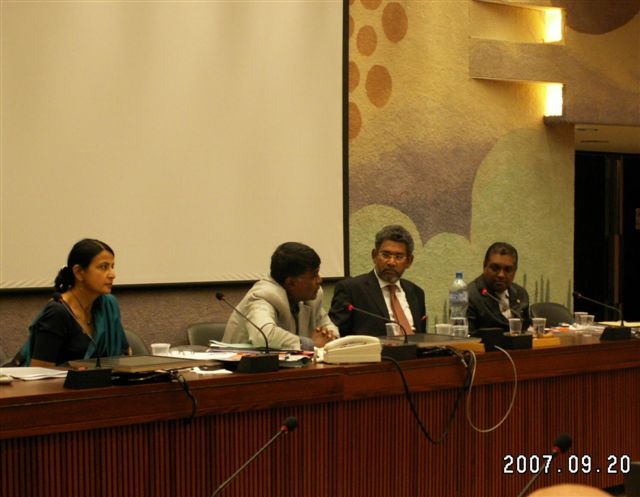
A presentation titled "Misrepresentations of Sri Lanka: A Briefing
on Human Rights", was held on Thursday 20th September from 13:15
to 15:15 in Room XXIV at the Palais des Nations. It was chaired by H.E.
Dr. Dayan Jayaytilleka. Over 60 representatives of mainly civil society
organizations attended.
The speakers were: Professor Rajiva Wijesinha, Secretary General of
the Secretariat for Coordinating the Peace Process, Ms. Shirani Goonetilleke,
Director Legal, Secretariat for Coordinating the Peace Process and Mr.
Shavindra Fernando, Deputy Solicitor General, Attorney General's Department.
Each speaker made a statement of about10 minutes.
Professor Rajiva Wijesinha stated that the issues of Internally Displaced
Persons and cases of abductions and disappearances had been misrepresented
and highlighted by certain parties both in Sri Lanka and abroad. While
admitting that there were real issues of concern, he insisted on the
fact that a number of allegations made against the government were not
well founded.
The almost exemplary conduct of the Sri Lankan Army during the recapture
of the Eastern Province and its continuously improving human rights
record are cases in point. Drawing particular attention to the need
for objective criticism, Prof. Wijesinha invited the NGOs not to unfairly
tarnish Sri Lanka's image but to cooperate with it genuinely in improving
its human rights situation.
He described the role and the function of the Peace Secretariat in
both rectifying misrepresentations and in requesting for information
for the clarification of alleged and potential human rights violations.
Professor Rajiva Wijesinha said that Sri Lanka faced both a political
and a terrorist problem and that they required new and imaginative solutions.
Ms. Shirani Goonetilleke, Director Legal of the Peace Secretariat (SCOPP)
described the role of the All Party Representative Committee as well
as the progress made in establishing a witness protection and victim
assistance programme.
She explained that four officials were in Australia undergoing practical
training so that they can become trainers once they return to Sri Lanka.
She said that the trainers had been drawn for their wide and varied
experience and contacts in all parts of the criminal justice system.
Ms. Goonetilleke also drew attention to certain difficulties that the
Sri Lankan state has to face when trying to reach its goals: lack of
funds and the absence of legislature, etc. Moreover, delicate and complex
issues such as those that Sri Lanka has been facing need careful analysis,
thus, time.
Referring to the Northern Ireland peace process, she noted how the
parties involved needed 2 years to find an acceptable solution. In the
case of the Sri Lankan APRC, it is now on the verge of coming out with
a solution after intense deliberations during the past 12 months.
Ms. Goonetilleke also spoke about the SCOPP's engagement in child soldier
rehabilitation (with the assistance of UNICEF), the obstacles they face
in this respect and the achievements they have made so far. She stated
that the SCOPP's objective is to help these children be integrated into
the society by giving them proper education, vocational training, etc.
Ms. Goonetilleke also described the steps taken by the Peace Secretariat
along with UNICEF to rehabilitate child soldiers.
Next the Deputy Solicitor General Mr. Shavindra Fernando described
in detail the role of the Attorney General and his Department in Sri
Lanka which he said was not a political office and did not initiate
or lead investigations.
He was responding to a recent public statement issued by The International
Group of Eminent Persons (IIGEP) in which it had expressed its concern
regarding four areas of the work of the Commission of Inquiry: slowness
of the process, the Attorney General's involvement in the process, the
lack of a Victim and Witness protection programme and the inadequate
disclosure of information.
Evoking the second cause of concern, Mr. Fernando explained in detail
the Attorney General's role in the Sri Lankan judicial system and the
COI. He noted the importance of understanding the Attorney General's
role in the local context before commenting on it from the point of
view of the international community. The Attorney General does not intervene
in the COI unless his support was asked for, and if requested, he could
even withdraw his staff and services from the COI.
Mr. Fernando noted that the third cause of concern of the IIGEP, i.e.,
the establishment of a Victim and Witness Protection Programme, has
already been addressed.
The statements by the panelists were followed by a question and answer
session.
|

