THAI NEWSPAPER SAYS RATHNASIRI’S
TRIP TO BANGKOK TURNED A RELATIONSHIP COZIER AFTER IT WAS SOURED AFTER
THAILAND’S AMBITION TO CAPTURE TOP UN POST
By Walter Jayawardhana
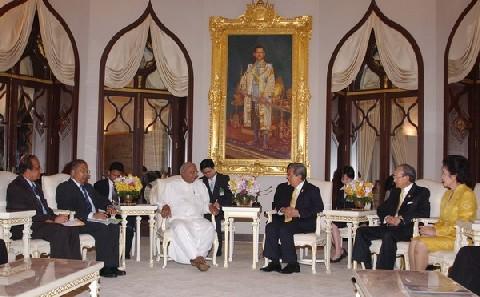
Bangkok’s Nation newspaper said the bilateral relations between
Sri Lanka and Thailand became cozier with Prime Minister Rathnasiri
Wickramanayaka’s trip to Thailand after it nose dived because
Sri Lanka fielded a candidate against Thailand shattering the former
Thai Prime Minister’s dream of capturing the top job of the United
Nations for his country.
The newspaper’s leading columnist Kavi Chongkittavorn wrote,
“ As the joint press statement issued by the countries this weekend
testified , both sides have overcome their suspicions and mistrust.”
But the newspaper was not approving what the then Thai government
did during the race and said, “However, ties took a nosedive
after the two countries fielded competing candidates for the top job
at the United Nations two years ago. Worsening the situation was the
fact that Thailand behaved undiplomatically towards its friend during
the race.”
The newspaper was of the opinion that the talks between the leaders
were short but successful and said, “The talks were short but
effective. Both sides were able to mend fences even though the Preferential
Trade Agreement, which was scheduled to be signed, was delayed due
to the last-minute recalcitrance of agricultural officials in Bangkok.”
Critical of the former Thai government which was toppled by a military
coup the newspaper said , “Thai-Sri Lanka ties were turned upside-down
when Sri Lanka put forward its own candidate, former diplomat Jayantha
Dhanapala. The Thaksin government was very unhappy with the move.
It argued that other countries in the region should not compete with
the Asean-endorsed candidate. It felt that all of Asia should have
and back a single candidate.
It was towards the end of the Thaksin government's first term that
relations with Colombo turned ugly. Thai authorities tried hard but
failed to convince Sri Lanka to withdraw its candidate. Relations
worsened even further when Thai authorities threatened to reduce security
offered to officials during visits of VIPs from Sri Lanka. Thailand's
hostility towards Colombo rattled the diplomatic community in Bangkok,
which was not used to this kind of diplomacy.”
In an earlier editorial written by the same columnist on March 29
the Nation reminded , “Thailand also has yet to fulfill a mammoth
promise made by former prime minister Thaksin Shinawatra in 2003 during
his visit to Sri Lanka. He pledged to give 10 elephants to Sri Lanka.”The
following is the full text of the editorial published on April 2 by
the Nation: “ Relations becoming cosier between Colombo and Bangkok
Thailand and Sri Lanka have some of the weirdest bilateral relations
on record, despite ancient links and the deep Buddhist influence in
both countries dating back to the 12th century.
“Sri Lankan Buddhism was revitalised by Bhikku Upali more than
250 years ago, but only in the past decade have relations between
Colombo and Bangkok been given the serious attention they deserved.
In the late 1990s, relations between Thailand and Sri Lanka rose from
obscurity and mistrust to blossom into a dynamic relationship. Official
exchanges, both civilian and military, increased at a meteoric rate.
Trade and investment also rose and Thais began flocking to Sri Lanka
for sightseeing and religious pilgrimages.
“However, ties took a nosedive after the two countries fielded
competing candidates for the top job at the United Nations two years
ago. Worsening the situation was the fact that Thailand behaved undiplomatically
towards its friend during the race.
“Sri Lankan Prime Minister Ratnasiri Wickremanayake visited
Thailand over the weekend, making him the first foreign leader to
venture here since the September 11 coup. He held talks with his Thai
counterpart, Surayud Chulanont, on Friday. The talks were short but
effective. Both sides were able to mend fences even though the Preferential
Trade Agreement, which was scheduled to be signed, was delayed due
to the last-minute recalcitrance of agricultural officials in Bangkok.
“Thai-Sri Lankan relations became twisted under the government
of former premier Thaksin Shinawatra after Colombo put forward its
own candidate to lead the UN towards the end of 2005. Before this
announcement, Thailand and Sri Lanka had healthy relations, exchanging
visits of senior foreign ministry officials and signing several agreements.
The Buddhist nations had finally discovered each other after years
of mistrust and misunderstanding, and their friendship seemed destined
to grow.
“Throughout the 1990s, the Sri Lankan government was convinced,
erroneously, that Thai authorities were turning a blind eye to the
illegal activities of the Tamil Tigers, known as the Liberation Tigers
of Tamil Eelam (LTTE), in the southern coastal provinces of Thailand,
especially Phuket. Initially, Sri Lankan army intelligence and foreign
ministry officials, including ex-foreign minister Lakshman Kadirgamar,
believed Thai authorities had turned a blind eye to the LTTE's activities
because Thailand did not respond to Colombo's allegations prior to
1999.
“When the first official allegation was made public in early
1999, the Chuan Leekpai government moved quickly to investigate possible
links between LTTE elements based in Thailand and guerrilla forces
in Northern Sri Lanka. Bangkok was left red-faced. The allegations
were true. Since then Bangkok has worked closely with Sri Lankan intelligence
officials to shut down LTTE mobile bases, interrupt the flow of their
finances and shut down the logistical support given by Thai citizens.
“Miraculously, a few months later in 1999, Thai-Sri Lankan relations
improved markedly. Deputy Foreign Minister MR Sukhumbhand Paribatra
was in contact with his Sri Lankan colleagues and discussions began
to have Thailand host peace talks between Colombo and the Tigers.
Throughout the rest of the Chuan government, which ended in 2001,
the friendship between Bangkok and Colombo seemed unbreakable.
“When the Sri Lankan government and the LTTE had their first
round of peace talks in September 2002, Sattahip Airbase was the venue.
The talks continued at the Rose Garden in Nakhon Pathom a month later
and a fourth round was also held there in January 2003. There have
been seven rounds of peace talks and they will continue but so far
there have not been any positive results.
“To demonstrate Thailand's valuable relations with Sri Lanka,
Thaksin promised to give 10 elephants to Sri Lanka as a gift for its
support of Thailand's candidate for the UN's top job, Surakiart Sathirathai.
“Two years later, Thai-Sri Lanka ties were turned upside-down
when Sri Lanka put forward its own candidate, former diplomat Jayantha
Dhanapala. The Thaksin government was very unhappy with the move.
It argued that other countries in the region should not compete with
the Asean-endorsed candidate. It felt that all of Asia should have
and back a single candidate.
It was towards the end of the Thaksin government's first term that
relations with Colombo turned ugly. Thai authorities tried hard but
failed to convince Sri Lanka to withdraw its candidate. Relations
worsened even further when Thai authorities threatened to reduce security
offered to officials during visits of VIPs from Sri Lanka. Thailand's
hostility towards Colombo rattled the diplomatic community in Bangkok,
which was not used to this kind of diplomacy.
“Obviously, this episode has become a textbook example of how
Thaksin personalised national diplomacy. It also shows how willing
his Cabinet was to kow-tow to him when national interests collided
with his. In this case, Thaksin's ambitions were driving him.
“As the joint press statement issued by the countries this weekend
testified, both sides have overcome their suspicions and mistrust
for now. Judging from the seven-member delegation, comprising mainly
security and intelligence officials, security and intelligence cooperation
was the purpose of the visit. The statement said that the two countries
agreed to intensify efforts to curb terrorist activities in the region.
Thailand also expressed strong support for Sri Lanka's sovereignty
and territorial integrity.

