60TH YEAR OF SRI LANKA'S INDEPENDENCE
Interview with Dr. Dayan
Jayatilleka,H.E. the Ambassador/Permanent Representative to the UN in
Geneva,
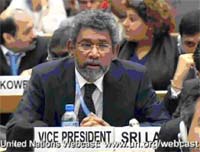
Dr. Jayatilleka received a team from UN Special, who had been invited
by the Mission on the occasion of the country's 60 year of independence.
Below is a brief history and socio-economic status of the country. Articles
on a number of interesting topics on Sri Lank have been published in
the UNSpecial over the past few years, inter alia: Perahera: a pageant
in fragile peace (October 2003); Ayurveda: cure, philosophy, or fashion?
(February 2003); Adam's Peak (July 2004); History of tea (December 2003);
Tsunami: two years after (December 2006). (www.unspecial.org)
Sri Lanka, officially the Democratic Socialist Republic of Sri Lanka
(known as Ceylon before 1972) is an island nation in South Asia, located
about 31 kilometres (19.3 mi) off the southern coast of India. Popularly
referred to as the Pearl of the Indian Ocean, it is home to around twenty
million people.
Because of its location in the path of major sea routes, Sri Lanka
is a strategic naval link between West Asia and South East Asia, and
has been a center of Buddhist religion and culture from ancient times.
Today, the country is a multi-religious and multi-ethnic nation, with
nearly a third of the population following faiths other than Buddhism,
notably Hinduism, Christianity and Islam. The Sinhalese community forms
the majority of the population, with Tamils, who are concentrated in
the north and east of the island, forming the largest ethnic minority.
Other communities include the Muslim Moors and Malays and the Burghers.
Famous for the production and export of tea, coffee, rubber and coconuts,
Sri Lanka boasts a progressive and modern industrial economy and the
highest per capita income in South Asia. The natural beauty of Sri Lanka's
tropical forests, beaches and landscape, as well as its rich cultural
heritage, make it a world famous tourist destination.
After over two thousand years of rule by local kingdoms, parts of Sri
Lanka were colonized by Portugal and the Netherlands beginning in the
16th century, before the control of the entire country was ceded to
the British Empire in 1815.
During World War II, Sri Lanka served as an important base for Allied
forces in the fight against the Japanese Empire. A nationalist political
movement arose in the country in the early 20th century with the aim
of obtaining political independence, which was eventually granted by
the British after peaceful negotiations in 1948.
The Sri Lankan independence movement was a peaceful political movement
to aimed at achieving independence for Sri Lanka from British imperial
rule. It was ultimately successfully and Sri Lanka was granted independence
on February 4, 1948. Dominion status under the UK was initially retained,
but after British influence was gradually removed over the next few
decades, Sri Lanka was declared of a full Republic in 1972.
It was impossible for the UNSpecial team to speak of Sri Lanka without
addressing the ongoing ethnic conflict in the country. A political scientist
by training, Dr Jayatillka graciously accepted that the interview move
away from "safe" subjects -- relating to the sixtieth anniversary
of his country's independence and cultural topics-- and discuss the
thorny issue of insurgency and political issues in his strife-torn homeland.
Dr Jayatilleka noted that in its 60th year of independence his country
was "at a decisive crossroads", locked in armed conflict trying
to maintain its identity and dealing with "existential issues"
through democratic means for the most part. "We have been voting
since 1931, so our democratic roots go deep, and have never been anything
but a practicing democracy continuously since independence."
He noted that the Tamil insurgency had coincided with other 1970s events
in South Asia, particularly the split of Pakistan and the independence
of Bangladesh.
Dr. Jayatilleka was affirmative in contending that peace there was
possible: "Yes," he replied to that question: if either the
insurgent Liberation Tigers of Tamil Eelam (LTTE) were defeated, or
the group became amenable to a peace accord. "There is no single
solution, but in the optimistic case, the Sri Lanka forces win. "A
military victory is possible," he concludes. He cites other examples
where this has been possible.
"Any solution must be a unified State solution", he insisted.
He noted that at independence Sri Lanka lacked the "unifying compact"
that had led to India's success, attributable to the vision of Nehru
guiding a multiethnic State.
The wave of Tamil nationalism that was born in the 1980s instead saw
its solution in a single ethnic State for 80 million people of the same
ethnicity.
Dr. Jayatilleka noted the large and regular demonstrations of Tamil
activists in Switzerland, including on the nearby Place des Nations
in Geneva, with which he had "no problem". But he denounced
all "violent symbolism" associated with the Tigers, and the
"open celebration" of suicide bombers, for example, on July
5th, dubbed Black Tiger Day.
UN Special
No 672 , April 2008
|

