|
TORONTO SISTER OF PRABHAKARAN
TELLS STEWART BELL THAT THE ARMY WILL NOT BE ABLE TO CATCH HER BROTHER
By Walter Jayawardhana
Sri Lankan security forces have announced that they are within the
kissing distance of Prabhakaran who, they think ,is hiding in a jungle
bunker. The Tamil Tiger leader’s enemy and former friend “Karuna
Amman” thinks Prabhakaran is at his last gasp.
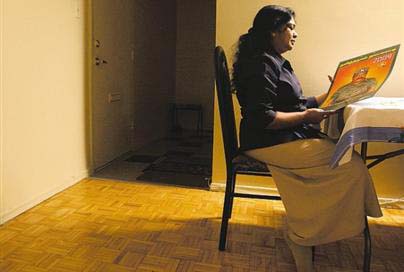
But Prabhakaran’s sister who is living in a modest apartment in
Toronto Vinodini Rajendran does not think so. She thinks once something
is started by his brother he would finish it and in this case, it is
an independent country called Eelam, separated from Sri Lanka.She told
National Post writer Stewart Bell that it was the nature of his father
too.
Indicating that he would escape from the security forces she said, “They
wont be able to catch him.”
The following is the full story Stewart Bell wrote:
Vinothini Rajendran's 11th-floor apartment is decorated with plastic
flowers, a poster of Lord Krishna and framed photos of the little brother
she left behind in Sri Lanka.
It has been years since she saw him. He never writes or calls, but
she accepts that is just the way it is when your brother is Velupillai
Prabhakaran, one of the world's most notorious guerrilla leaders.
"It must be God's wish that he should become such a man,"
says Ms. Rajendran, who immigrated to Canada more than a decade ago
and lives with her husband, Bala, in a modest apartment in east Toronto.
Despite being the sister of the Supreme Commander of the Liberation
Tigers of Tamil Eelam, Mrs. Rajendran has lived incognito in Toronto
since 1997, but she agreed to tell her story to the National Post.
For 25 years, her brother has led the LTTE, or Tamil Tigers, in a civil
war in Sri Lanka. His objective: independence for the ethnic Tamil minority.
A folk hero to Tamil nationalists, Prabhakaran is wanted by Interpol
and has been condemned internationally for his tactics, which have included
hundreds of suicide bombings and the assassination of senior politicians,
including India's Rajiv Gandhi.
Yesterday, Human Rights Watch accused the Tamil Tigers of forcing civilians
to fight and preventing them from fleeing the war zone. The abuses come
as the rebels are attempting to repel an intense government military
offensive.
"During the past 25 years, the LTTE has killed large numbers of
civilians, committed political assassinations in Sri Lanka and abroad,
and carried out suicide bombings," wrote the New Yorkbased rights
group. "It has systematically eliminated most political opposition
within the minority Tamil community and is responsible for killing many
journalists and members of rival organizations. In the areas under its
control, the LTTE has ruled through fear, denying basic freedoms of
expression, association, assembly and movement."
Sri Lanka has vowed to kill Prabhakaran and wipe out the Tamil Tigers
over the next few months. Last week, the military said it was within
"kissing distance" of the rebel stronghold, Killinochchi,
but Ms. Rajendran says her brother is in no danger.
"They won't be able to catch him," she says.
Variously known as the Sun God, Supremo and Thambi ("Little Brother"),
Prabhakaran, 54, is the son of a middle-class bureaucrat who served
in Ceylon's post-colonial government.
Ms. Rajendran describes her father as "very kind and soft talking."
He was highly disciplined. He never took bribes and abstained from all
vices, alcohol and cigarettes included. He worked as a district land
officer and volunteered as a trustee at the local temple. "He was
a religious-minded man, a Hindu," she says. The family lived in
Valvettithurai, a coastal village on Sri Lanka's northern Jaffna peninsula,
in a small house with a veranda and a banana tree, enclosed within a
fenced compound.
Vinothini was the third-born child. She was two years old when Prabhakaran
was born at Jaffna Hospital on Nov. 26, 1954. "As a child, I was
the pet and the darling of the family," Prabhakaran told the magazine
Velicham in 1994. "My childhood was spent in the small circle of
a lonely, quiet house."
Vinothini would play with her baby brother, and fight with him. "He
was as normal as any boy," she says. "Normal, only he was
reading a lot." The house was full of books. Their mother was "a
voracious reader," Ms. Rajendran says. They would borrow books
from friends or the library.
Like his mother, Prabhakaran devoured history books, particularly stories
about the Indian fighters who fought the British for independence. "It
was the reading of such books that laid the foundation for my life as
a revolutionary," he once said.
The Tamil-dominated northern region of Sri Lanka is a dry zone; much
of the soil is ill suited to farming. "So the people depended on
education and government jobs," Mr. Rajendran explained.
But following independence from Britain in 1948, the island's ethnic
Sinhalese majority tried to limit Tamil access to universities and civil
service jobs. Tamil youths grew disillusioned with the government and
turned to militancy.
Around the same time Prabhakaran took up arms, his father spoke to
a friend and they agreed that Vinothini and Bala would marry. The family
erected a temporary building in their compound to accommodate wedding
guests and shelter them from the sun and rain. The ladies prepared vegetarian
dishes in the kitchen. No invitations were required; everyone knew they
were welcome.
Prabhakaran was the best man. As is customary, he came by the groom's
house the day before the wedding to pay his respects. "He was a
very quiet man," Mr. Rajendran says. "He was smiling and his
eyes were piercing. He was lean."
A few months later, Prabhakaran formed the Tamil New Tigers, or TNT,
to wage an armed struggle against the Sri Lankan state security forces.
The group would later evolve into the Tamil Tigers.
"At that time, we knew he was doing
something, but we didn't know it was so serious," Mr. Rajendran
says. They thought he was only putting up political posters. They only
learned of his paramilitary activities when police came calling at the
family home in 1972. Prabhakaran slipped out the back and disappeared.
"After that he stopped coming to the house," Ms. Rajendran
says. Prabhakaran told the Indian journalist Anita Pratap that, "As
soon as the Tiger movement was formed, I went underground and lost contact
with my family ... They are reconciled to my existence as a guerrilla
fighter."
The Rajendrans were living in the capital, Colombo, when Prabhakaran
ignited the civil war with an ambush attack against Sri Lankan soldiers.
Mr. Rajendran promptly lost his job at an import-export firm; his employer
found out about the family connection and didn't want any trouble.
"I was asked to leave," he says.
They spent a week at a refugee camp and then sailed back to Jaffna.
Six months later, Mr. Rajendran went to Jeddah to work as a deckhand
on a ship on the Red Sea. Mrs. Rajendran stayed in Jaffna, but the police
gave her a hard time about her notorious brother so the family decided
to leave for India.
Thousands of Sri Lankan Tamils had sought refuge around Madras. The
Rajendrans registered with the police and rented a house. Mr. Rajendran
taught English and ran a consultancy service that helped Tamils submit
applications to immigrate to Canada and Australia.
Prabhakaran was also exiled in India at the time, running his guerrilla
war from a Madras safe house. The Rajendrans saw him there at a family
function, a cousin's wedding. "He came in a jeep with four or five
boys," Mr. Rajendran says. They saw him again just before he returned
to Sri Lanka. "He talked to us and said he is going."
Tired of refugee life in southern India, the Rajendrans travelled to
Canada, arriving on Oct. 27, 1997. They have returned to Sri Lanka only
once, in 2003, to help Ms. Rajendran's parents move back to Sri Lanka
from India. It was the first time she had seen her homeland in almost
two decades. The north was a desolate landscape of ruined buildings,
destroyed by incessant shelling. The lush gardens of her youth had gone
to weeds.
A red-and-yellow Tamil Tigers flag hangs in her living room in Toronto,
but Ms. Rajendran says she is not politically active. Neither she nor
her husband attends Tamil community events in Toronto, with the exception
of Heroes Day, the annual commemoration of fallen rebels.
Ms. Rajendran does not work; her English is awkward. Her husband works
part-time at a furniture store. His hands shake like he is nervous,
but he explains he has Parkinson's Disease.
A poster of the Hindu hero Arjuna hangs on the wall. The Tamil script
below tells a story from the Bhagavad Gita about a conversation between
Lord Krishna and Arjuna, who is reluctant to go to war.
"Arjuna says, how can I fight my relatives?" Mr. Rajendran
explains. "Then Krishna says, it is your duty. I am the God and
I am telling you, you do it. Then he decides to fight."
It was one of Prabhakaran's favourite childhood stories.
Every so often, Ms. Rajendran gets a letter from her parents in Killinochchi,
but she has had no contact with her younger brother since coming to
Canada. She only hears stories about him.
She believes he will not give up his fight for Tamil independence.
Because he started it, he feels obliged to see it through, she says.
"Once he accepts something, he always finishes it," she says.
"Father was like that."
|

