CHANDRA WICKRAMASINGHE ,
THE MAN WHO CHANGED THE VIEW OF SCIENCE AND BOLDLY SAID ,THAT LIFE
DID NOT START HERE ON EARTH BUT IN SPACE, HAS RETIRED AS PROFESSOR
AFTER 33 YEARS
By Walter Jayawardhana
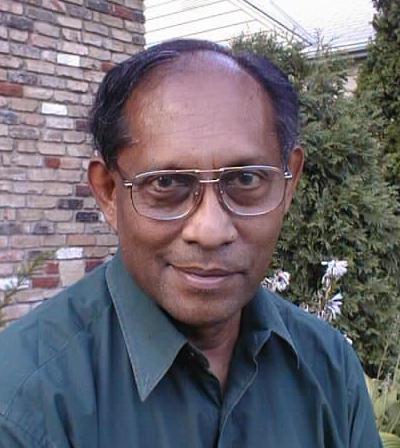
Chandra Wickramasinghe the scientist has been always a poet at heart.
As a young boy growing up in his native Sri Lanka he looked up at
the twinkling canopy of the tropical night sky and wrote :
Amongst the myriad stars
I stand alone
and wonder how much life
and love there was tonight
He wrote it at the age of 15 . From his childhood he has mysteriously
felt connected with the universe. Being a Buddhist the idea of life
having a cosmic connection was in tune with his philosophy. Some years
ago he told me, “the idea of life being a cosmic phenomenon is
fully in tune with Buddhist as well as Vedic philosophy. Ancient Buddhist
texts described inhabited circling distant suns, collections of suns
to form greater world systems , collections of world systems and so
on. I have surely been inspired by these philosophies throughout my
scientific studies.”A graduate of the University of Ceylon he
later joined the Cambridge University on a Commonwealth scholarship
and did his PhD under the late Sir Fred Hoyle, one of the best astronomers
of the 20th century. He was later awarded the university’s highest
doctorate for science , the prestigious Scd. He was decorated by the
President of Sri Lanka with the title “Vidya Jothi”. He
came to Cardiff University in Wales in 1973 and organized a new department
of astronomy that became one of the top astronomy centers in Europe.
After thirty 33 years of work as the professor of astronomy and mathematics,
Chandra Wickramasinghe is the world’s leading exponent of the
theory known as panspermia- the science that teaches earth and other
planets in the universe may have been seeded for life by microorganisms
carrying comets.
Before Chandra Wickremesinghe scientists thought that huge obscuring
clouds in deep space like the horse head nebula were made up of ice
particles. But his untiring research showed the particles were mainly
made of carbon- a form of a substance that was connected with life-
a freeze dried dormant bacteria.
Wickramasinghe calls them our genetic ancestors When he first came
out with this theory extremely harsh criticism was brought against
him. Some even called the theory pseudo- science. Chandra Wickramasinghe
thinks if there was no Sir Fred Hoyle, one of the greatest astronomers
of the last century , who stood by him his theory would have certainly
been put out of existence. He and the late Fred Hoyle were later awarded
the Dag Hammarskjöld Gold medal for Science.
Chandra Wickramasinghe has made his theory of panspermia the mainstream
in the new science of astrobiology- a link between astronomy and biology.
To celebrate his new theories the Cardiff university was holding
a scientific seminar to discuss the new view of the world of science
that boldly said that life did not start in a primordial soup spontaneously
here on earth as believed earlier but it started 4000 million years
ago on comets and traveled through space to earth and countless other
planets. With the participation of nearly 40 scientists from all over
the world the seminar was held from September 5 entitled, Unraveling
of Our Cosmic Ancestry.
Though retiring as the Professor at the age of 67 he will continue
to serve as the director of Cardiff Center for astrobiology.The following
is an email interview I did from California with him in Cardiff on
the eve of his retirement:
Question: You are retiring as a Professor at the University of Cardiff
this September. What was the most significant contribution you could
make to the progress of science during the time you served as the
professor of applied mathematics and astronomy since you came to this
university in 1973?
Answer: I played a key role in establishing a connection between astronomy
and biology. My work in the 1980's showed for the first time that
cosmic dust had properties that resembled the properties of living
material and their degradation products.
Question: When you were at Cambridge, before coming here your pioneering
research was on interstellar dust. What is the significance of those
theories on interstellar dust?
Answer: My PhD thesis and the dissertation on which I was awarded
a Fellowship at Jesus College was entitled: "On graphite particles
as interstellar grains" I think I was largely responsible for
astronomers moving away from the old idea that cosmic dust consisted
of ice particles that were formed in space to the idea that they condensed
in much denser regions in the environs of stars. I also transformed
showed that interstellar dust played a key role in controlling astrophysical
processes..
Question: Once when you were in California you told me that you and
some Indian team of scientists using balloons had collected from the
tropopause , or the upper atmosphere microorganisms that had come
from outer space and your estimate was that one third of a tonne of
cometary microorganisms enter the earth's atmosphere every year. What
are these micro organisms ?
Answer: I think that life arrived at the Earth 3800 million years
ago with the impacts of comets. If comets brought the first life to
Earth the process of comets introducing primitive life must continue
even to the present day. The Indian balloon experiment gave us the
first direct indication that this may be happening. The particles
collected in the stratosphere included clumps of bacteria, which we
know are viable (living), but so far we have not been able to culture
most of them.
Question: At that time you said the scientists are going to do detailed
analysis of these microorganisms and look in to their DNA. Have you
looked into the DNA now? Are they different from the microorganism
you find on earth? Can you compare them?
Answer: A few types of bacteria that were grown from the air samples
by Milton Wainwright in Sheffield were found to be similar to known
terrestrial counterparts, so contamination from the Earth is always
an issue. The clumps of bacteria that we could not culture or sequence
DNA we think must have come from space.
Question: If they came from outer space from where did they Actually
come and how? How did they survive in the deadly outer space with
all those killer rays?
Answer: They came from comets. When the comets formed at the time
of the birth of the solar system they would have included a very small
component of viable bacteria from the cloud from which our planetary
system condensed. These bacteria then grow exponentially in numbers
in the liquid interior regions of comets. When comets come into the
inner regions of the solar system their surfaces are peeled away,
and the bacteria particles escape into the cometary tails.
Whenever the Earth crosses trails of cometary debris, biological particles
would enter the Earth's atmosphere. Not all the biological particles
survive entry of course, but a fraction must do. I don't think survival
in the so-called harsh conditions of space is an issue any more. Bacteria
are found to be exceedingly space-hardy.
Question: Recently, the Kerala scientist Dr. Godfrey Louis
and his research assistant Santhosh Kumar said samples of red rain
that fell across the state of Kerala in India have been found to contain
microscopic red cells of unknown origin . What's the relevance of
this claim to your theory of panspermia? Could you also tell something
about their latest conclusions?
Answer: If these red cells came from a comet, then it would surely
be conclusive proof of cometary panspermia. The evidence to me suggests
that a small injection of red rain cells from comets took place in
July 2001, and this was somehow amplified in the clouds of our atmosphere.
This is the only way I can understand the intermittent showers over
several weeks, and the localization around Kerala. Incidentally this
phenomenon was repeated in this present year July 2006, showing a
5-year cycle of incident particles.
Question: We heard that samples of this red rain was also sent To
Cardiff for testing. What did you find? Could these also be aliens
showering on earth after traveling on a comet?
Answer: I think more work needs to be done, but this could well be
the smoking gun for anspermia.
Question: It was claimed in news reports that these microorganisms
lacked DNA. Then how did it replicate?
Answer: We also have had difficulty extracting DNA from these exceedingly
tough red-rain cells. There are however some staining tests that show
positive for DNA, but this could be ambiguous. Again, we need to extract
and amplify DNA, which we have not yet done.
Question: It was also claimed in news reports that the strange Cells
would reproduce in 600 degrees Fahrenheit while the known maximum
limit of heat in water for any life to survive is only 250 degrees
of Fahrenheit. Are they bacteria adapted to the harsh conditions of
space. Is this going to be the first concrete evidence for your panspermia
theory?
Answer: These are Godfrey's claims. I think these claims have to
be tested independently and if they are verified, they surely would
be a confirmation of an alien bug.
Question: What did you find out from NASA's star dust program? Were
you able to test some samples from that program?
Answer: I have not had access to these samples. But the collection
procedure would not have recovered microbes in tact. The organic residues
found in the aerogel can be interpreted as destruction products of
bacteria.
Question: If you think the intelligent man ultimately evolved out
of these unearthly microorganisms from outer space couldn't those
same spores of life contributed to intelligent life elsewhere in the
universe?
Answer: Yes, I would agree. The universe must be teeming with life,
and with intelligence as well.
Question: So, if we are to meet a visitor from space one day, who
Has mastered time traveling do you think that visitor would look very
much different from man?
Answer: He she or it would share much of our genetic heritage. Our
genes, and the genes for all life were derived from a much bigger
cosmic system. So a similarity of life forms across the universe is
inevitable.
Question: Do you think based on the studies of DNA from outer space
that the visitor from outer space would be a compassionate one or
a one who would be planning to devour us for protein.
Answer: I think if a visitor from space had developed the technologies
to travel to us, that visitor must come from a "culture"
where survival over millennia and coexistence had evolved as prime
values. Otherwise they would have blown themselves out in a matter
of tens of thousands of years, as our civilization may well be heading
to do.
Question: Would it be a carbon based life or a silicone based life?
Answer: The only life we know of is Carbon based, so I would like
to stick to that as the only life form to discuss
Question: A US suspense and mystery writer has written a novel depicting
a space visitor entering our bodies and destroying us. How could such
barbaric practice be possible among an advanced civilization who could
conquer space and time?
Answer: I think that is beyond belief!
Question: Do you think there are any chances of contacting an intelligent
civilization in the near future?
Answer: I would give it 3 decades, no more before contact is made.
Question: What benefits such a contact could bring to this world?
Answer: I hope that it would lead to a world view in which tribal
and International conflicts cease to exist.
Question: What are the chances that our civilization could come to
an end before all that by a nuclear war or the collision of earth
with an asteroid or a comet?
Answer: Yes, comet and asteroid impacts may present a very long-term
threat to our civilization, possibly over a timescale of a few thousand
years. But on a much shorter timescale nuclear wars could pose the
most serious threat. The rate at which we are amassing lethal weapons
is certainly very disturbing.

