"We have to talk to whoever
is willing." - Prof. Rajiva Wijesinha
The Permanent Mission of
Sri Lanka to the United Nations Office at Geneva 21st November 2007
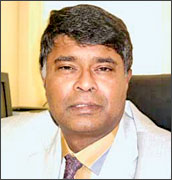
BBC Presenter: We will take a look at the situation in Sri Lanka
and the continuing violence in the north of the country between government
forces and Tamil Tiger rebels. It has been increasing in intensity with
artillery fire, air and naval bombardment. Back in 2002 a cease fire
was negotiated by Norway and it was agreed by the government and the
LTTE; the Tamil Tiger rebel group. But by December 2005, that cease
fire was in shreds although officially it remains in place. According
to government figures over 5000 people have since died. Earlier this
month the head of the Tamil Tigers' political wing S.P. Thamilchelvan
was killed in a government air force raid. He was the most senior Tamil
leader to die in recent years. On the very same day colonel Karuna,
leader of a breakaway faction was arrested in London and held in immigration
detention. Human Rights groups accused him of crimes including torture
and recruiting child soldiers. The Asian Human Rights Commission is
now criticising both the government and rebel forces for what it calls
the extrajudicial killing of civilians. They claim that in October alone
53 ordinary Sri Lankans died in this way. So is there a peace process
left, is there any point in talking about peace? Joining me now is Dr.
Rajiva Wijesinha, Secretary General for the Co-ordination for the Peace
Process. So that's the key question I must ask you - Is there any kind
of credible peace process or process that might lead to peace, on the
table, apart from war?
Prof. Rajiva Wijesinha: The most important thing is negotiation.
Unfortunately, the LTTE Tigers have not been willing to negotiate, basically
for 4 years, although there were brief talks last year. What the government
has done is, it has thought that it should really discuss a future constitutional
package with the non-LTTE Tamils plus other minorities. And there is
an on-going process.
BBC Presenter: But the All Party process, I think, that you
are referring to - Tamil National Alliance isn't a part of it, the main
opposition isn't a part of it, what did you hope to gain by killing
S.P.Thamilselvan? After all he was one of main public faces and one
of the negotiators of the LTTE.
Prof. Rajiva Wijesinha: If he was committed to peace we should
have actually had talks. I think the poor man was withdrawn from peace
talks. In fairness let's give him the benefit of the doubt. He had been
in military fatigue during most of the last year, but even assuming
that he really wanted to negotiate; as he is dead let us give him that
benefit, the LTTE withdrew him twice. We still hope that perhaps even
now they will return to the table.
BBC Presenter: But it is rather unlikely that you have taken
out one of their chief negotiators on the very same day we saw colonel
Karuna arrested here in London and the charge that's put is that it
was the Sri Lankan government that enabled him to travel - to get him
out of the way - on a diplomatic passport.
Prof. Rajiva Wijesinha: That charge I have certainly read and
it is conceivable but when I first saw he was in London I thought that
this was a wonderful British way of removing a problem and agreeing
to have him.
BBC Presenter: Not a wonderful Sri Lankan government way?
Prof. Rajiva Wijesinha: I thought it was conceivable that they
were together, but certainly all indications are that British knew nothing
about it - which is remarkable.
BBC Presenter: But indications are that the British government
was quite upset with Sri Lanka for how that happened?
Prof. Rajiva Wijesinha: You have to recognise that in the murky
world of people who have been militants or whatever in the past, perhaps
trying to reform perhaps not doing so, there are agencies at work that
perhaps would not be in an official government position, just as they
might not be in an official British government position. But I think
certainly the fact that Karuna is no longer in the East would help in
reducing some of the tension. The problem in the north must be resolved
through talks but if they are not happening with the LTTE, then we have
to talk to whoever is willing. And that is what the government is trying
to do, to produce a package that is serious devolution within the context
of a united Sri Lanka.
BBC Presenter: Is there a way ahead in concrete terms apart
from just talking the needs of negotiations?
Prof. Rajiva Wijesinha: I think it is pretty remarkable that
the Trotskyite who heads the APRC has managed to bring together two
sides that seemed at logger heads - one saying you need a merger of
two provinces and other saying nothing larger than a district - into
a consensus on the unit of the devolution, which of course we have discussed
with India as well. And this is in terms of the 1987 peace accord which
I think couldn't be properly implemented as the LTTE started fighting
with India. So in a sense we should implement that if possible with
full devolution so that the minorities could have the political rights
that in the 80's they were pretty badly deprived of.
www.lankamission.org ©
|

