Book
Review: ' The India Doctrine'
Review
by
Isha Khan Dhaka, Bangladesh
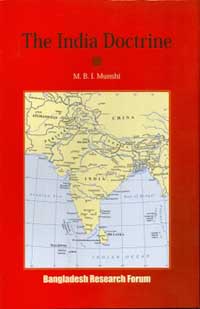
Adorned in a saffron red jacket and embellished with a
detailed map of South Asia the concept of an India Doctrine has been
introduced to the readers in Bangladesh recently. The book 'The India
Doctrine' has been published by the Bangladesh Research Forum and edited
by Barrister M.B.I. Munshi and is priced at Tk. 300. Munshi's contribution
to the book constitutes the largest section with several other writers
from Bangladesh, Nepal and Sri Lanka providing some useful and informative
chapters.
The book comes complete with a foreword written by esteemed scholar,
Professor Ataur Rahman of Dhaka University who sets the theme of the
book. We are reminded by Prof. Rahman that while India might have its
own rationale for framing its regional policy compatible with its national
interests, the fact remains that constant apprehensions, mistrust and
tensions between India and the smaller neighbors including Bangladesh
had its negative effects on any meaningful cooperation and security
in the region.
This introduction neatly moves us into the chapters written by Munshi
which are a series of discussions that covers the relations between
India and East Pakistan/Bangladesh from 1947 to the present. It attempts
a historical and geo-strategic appraisal of relations between the two
countries but also offers a more wide ranging analysis involving the
Indian external intelligence operations in Bangladesh and outside. The
central idea of the chapters when taken as a whole appears to be that
the India Doctrine as implemented by successive administrations in India
is not limited to simply harming the economic interests of [its neighbours]
but also has a historical and intellectual underpinning that comes from
the thoughts and writings of Jawaharlal Nehru and Madhav Sadashiv Golwalkar
amongst others. The idea of a United India (or an 'Akhand Bharat') according
to the author is still a goal of Indian policy making in South Asia.
Prof. Rahman is forced in his foreword to contend that this thesis
may seem implausible and 'far-fetched' but also points out that Munshi
supplements his ideas with an exhaustive and elaborate set of references
and notes to back up his argument. However, a defect in this intricate
framework of references is that the chapters lack a bibliography which
would have made it easier to verify the arguments advanced by the author.
The chapters also seems to be hampered by the fact that they were written
originally as a 3 part article and the author clearly has had some difficulty
in framing his arguments within this constriction. However, as we all
know Francis Fukuyama and Samuel Huntington both started their seminal
works in a similar manner with articles in prominent journals before
they were rendered into book form and this does not seem to have affected
the stream of their discussion and thoughts.
As this may be, the principle cause of disquiet will certainly be Munshi's
interpretation of significant historical events and his commentary on
the motivations of characters such as Jawaharlal Nehru, Indira Gandhi,
Sheikh Mujibur Rahman and Ayub Khan who are all now long dead. I was
certainly surprised by some of his findings but it was difficult to
find fault here as most of his views are backed-up with thorough research
and investigation. His chapters on the 1971 war and the insurgency in
the CHT are probably the most tantalizing in terms of historical data
and comparisons.
Some of Munshi's arguments are further buttressed by a short chapter
by Khodeza Begum who makes reference to events that occurred during
the 1990's related to clandestine meetings held in Dhaka concerning
the reunification of the subcontinent. In her chapter, there is an extensive
discussion on the policies being pursued by the Indian government that
according to her is detrimental to the sovereignty and territorial integrity
of Bangladesh. She analyses the concept of a United Bengal that has
featured in some of the Indian political literature in recent years.
She has also summarized the tactics and strategies adopted by the Indian
government and its intelligence agency to undermine the unity of Bangladesh
and to inculcate the population of the country with a perspective adverse
to the nations integrity.
Although solidly written there is a problem with the length of the
chapter as well as the dated materials used by the author. A more contemporary
approach may have served better but the evidence seems irrefutable and
the author should update her research before a second edition is considered.
In a sudden change of location Brig. Gen. M. Sakhawat Hossain inexplicably
takes us all the way to the Indian Ocean and the emerging strategic
scenarios being played out in the area. One may legitimately question
the relevance to the overall context and theme of the book but the author
makes this abundantly clear when he remarks that rivalries in the South
Asian region are primarily based on events in 1971 and India's intent
on dominating the region has had to appreciate the ground realities
that this cannot be achieved alone. Hossain expertly explains the intricate
alliances being forged in the region and the importance of the Indian
Ocean in the strategic thinking of India, China, the USA and Pakistan.
His comments on the North-East insurgency and the recent uprising in
Nepal are highly commendable and very insightful especially in the latter
case where he had visited prior to writing the chapter.
Following the chapters by the Bangladeshi authors mentioned above come
the section written by the Nepali writers. In the case of Madan Prasad
Khanal, Nishchal Basnyat and Sanjay Upadhya their contributions to the
book are highly articulate, elegant and almost near impeccable. Each
author discusses differing aspects of Indian interference and intervention
in Nepali internal affairs and in some cases provides possible solutions
to these problems. But with a clear conception of the implications of
Indian domination on Nepal Dr. Shastra Dutta Pant appeared a little
confused in his expressions.
The final chapters of the book are by two Sri Lankan writers Dr Rohan
Gunaratna and Arbinda Acharya. Both writers collaborated to produce
a single chapter on the Sri Lankan attitude to Indian interference or
as the authors themselves put it, "India's involvement in Sri Lankan
ethnic imbroglio has been one of the most controversial, ironic as well
as tragic aspects of New Delhi's foreign policy." While concentrating
on the Sri Lankan situation the writers also manage to draw in examples
from Bangladesh, Pakistan, Nepal and Bhutan to back up their case on
Indian aspirations in South Asia. Of significance is the Indian involvement
in the protracted and apparently insoluble conflict with the Tamils.
The chapter also involves a geostrategic appraisal of Sri Lanka and
its growing relationship with China and Pakistan. It is unfortunate
therefore that the authors were not as forceful about Indian interventions
in Sri Lanka especially during the time of the premiership of Rajiv
Gandhi. The chapter seems somewhat apologetic about Indian intervention
rather than condemnatory which would have been an appropriate response
from Sri Lankan nationals.
Isha Khan
bdmailer@gmail.com
|

