Among certain individuals, confusion seems to be evident
with regard to disposal of dead bodies of Covid 19 victims and what they call
‘human rights’.
However, the issue here seems to be not a
question of ‘human rights’, but the most prudent form of disposal
of these dead bodies, given the uncertainties regarding the survival of the
specific virus.
In this regard, the deciding factor for any
authority with a proper sense of responsibility seems necessarily to be the
welfare of all and not narrow-visioned considerations.
Cricket players who may have been above board should
not get involved in politics
Celebrated captain who lifted the World Cup should have
stayed as a senior cricketer like Sanga or Mahela and serve the nation .Trying
to emulate Imran Khan has not shown much results .Previous government
have him a lucrative job as the minister for ports and shipping and also made
him the minister of Petroleum .But the country did not see much of his
contribution to both industries
When the Galle Harbour marina project and Yacht repair
project was mooted investors requested to provide support to the minister
He did not understand the potential to develop Galle .As the
investor needed to get the state support matter was discussed at the Committee
chaired by then prime minster RW and minister was advised to help .
After the meeting the minister of ports came out and did not
show much enthusiasm to support the investor
Galle projects was just forgotten again and the Galle
harbour is still waiting for development
Marina will never come with cement unloading taking place
creating toxic cloud of dust and an abandoned gas carrier Brought in by
Mundo Gas by another supporter who is none other than Master Divers which
is sinking for last 15 years or more in Galle
As a minister he could have done something with the help of
his
Cricketers brother – chairman who followed him from
one ministry to another project to support to develop Galle project and
it was never done
Colombo Port also did not see much of a growth and
Trincomalee also
It would have been better that Arjuna stayed as a veteran
cricketer and give full support to develop the game rather than now lamenting
about the game
His other younger brother who was in the other side of
politics has not done much either
General opinion is that he cannot make comments about
cricket which he abandoned for a lucrative political carrier where he has
miserably failed
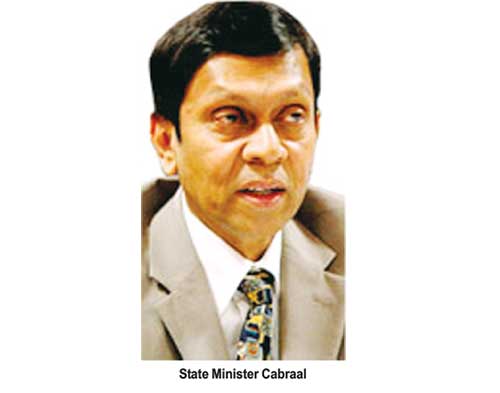
The government will continue 289 infrastructure projects worth more than rupees five trillion despite current economic challenges, State Minister for Money and Capital Markets and State Enterprise Reforms Ajith Nivard Cabraal said.
” Sri Lanka was able to pull through a very difficult period due to the Covid 19 pandemic. Despite those challenges the government was able to maintain macroeconomic fundamentals reasonably well. Further, the rupee has depreciated by 6.8 percent last year and to prevent further rupee depreciation, the Central Bank has taken prudent decisions, State Minister Cabraal said at the Annual General Meeting of the National Chamber of Commerce of Sri Lanka. The event was held at Kingsbury Hotel last Tuesday. At the event Nandika Buddhipala was elected the new President of the National Chamber of Commerce of Sri Lanka for the year 2021.
‘In 2020 the government set up macro environmental fundamentals in a proper manner that have set up the platform for stable economic growth this year. Due to the Covid 19 pandemic situation we were quite resilient and our exports touched US$ 2 billion and imports touched US $ 3 billion and, therefore, we were able to reduce the balance of trade by US$ one billion, Cabraal said.
Further, foreign remittances increased by 6 percent during last year. Due to the placing of macro environment fundamentals Sri Lanka could achieve 4 percent to 5 percent GDP growth, Cabraal said.
Cabraal added – Despite all odds we will increase public investments in a reasonable manner to move forward infrastructure projects, which had come to a standstill during the last regime.
‘The Port City project would be a very good project for Sri Lanka and it would start its development work soon. Once it’s started it would generate many employment opportunities for the country.
‘As the Chamber is involved in supporting the SME sector we need equity funds to develop, apart from bank debt capital. With the development of the stock market activities, SME sector should inject not only debt capital but also equity capital.’
Newly elected president Nandika Buddhipala said it is vital for SMEs and micro SMEs in Sri Lanka to access overseas markets through a credible authentic platform. By creating such a platform for Sri Lanka, the National Chamber believes that Sri Lankan products will reach their market destinations easily.
‘To meet this requirement the National Chamber has embarked on a nationally important mission to develop and professionally manage a web based platform, he added.
The COVID-19 situation in most of the areas in the country has gone out of hands due to the negligence and poor sense of responsibility from the part of general public, the Public Health Inspectors’ Union claimed.
Speaking to the Daily Mirror, Union Secretary M. Balasuriya said people have taken the gravity of the COVID-19 situation in the country for granted.
People living in areas where curfew and isolation status are imposed, have forgotten to follow the basic health guidelines. This is a very pathetic situation and we, as health officials felt very sad to note this,” he stressed.
We can’t go behind them and ask them to adhere to the guidelines. There is always limits for everything. Nevertheless, it has to be said that we have not yet given up,” he underlined.
He reiterated that people’s negligence had led to the present alarming situation in terms of COVID-19 spread in the country.
Therefore, he requested people to cooperate with health officials, so that the situation would bounce back on correct track with the rollout of vaccination.
Health Minister Pavithra Wanniarachchi who was infected with the coronavirus has been admitted to the IDH Hospital for further treatment.
The Minister who was under quarantine at a hotel in Hikkaduwa was transferred to the IDH Hospital after initially being admitted to the Kothalawala Defense Hospital.
However, the Ministry of Health stated in a statement that the health condition of the Minister of Health Pavithra Wanniarachchi who is receiving treatment for covid infection is improving.
Seven more persons who were infected with COVID-19 have succumbed to the virus, the Director-General of Health Services confirmed.
According to the Department of Government Information, total lives claimed by the virus outbreak in Sri Lanka now stand at 297.
One of the victims was identified as an 86-year-old from Colombo 06. He has passed away on January 26 on admission to Iththepana District Hospital. The cause of death was cited as diabetes and high blood pressure exacerbated by COVID-19 infection.
Another man, aged 73, meanwhile fell victim to the virus today (January 28) at his home in Nittambuwa area. COVID-19 infection, heart attack, diabetes and high blood pressure have been recorded as the cause of death.
Further, a 76-year-old woman from Gallela area in Ratnapura died of heart disease, blood poisoning and COVID-19 pneumonia. She had been under medical care at the Ratnapura Teaching Hospital at the time of her passing today (January 28).
A 61-year-old man who was residing in Colombo 13 meanwhile died yesterday (January 27). He had been transferred from Colombo National Hospital to Mulleriyawa Base Hospital after testing positive for the virus. The cause of death was recorded as severe COVID-19 pneumonia and heart failure.
As per reports, an inmate of Colombo Prison, aged 61, has succumbed to the virus on January 16. He had been transferred from Prison Hospital to Colombo National Hospital after testing positive for the virus. The cause of death was cited as COVID-19 pneumonia, heart attack and diabetes.
The sixth victim was identified as a 67-year-old woman from Colombo 06 area. She had been receiving treatment at a private hospital in Colombo where she passed away on January 24. She was reportedly suffering from asthma exacerbated by COVID-19 pneumonia.
In the meantime, a 62-year-old man from Enderamulla area died in January 21 on admission to Colombo National Hospital. The cause of death was recorded as kidney disease and COVID-19 pneumonia.
Sri Lanka’s confirmed COVID-19 infections count saw another uptick today (January 28) as 501 more persons were tested positive for the virus.
Department of Government Information said 501 of the newly-identified patients are close contacts of earlier cases linked to the Peliyagoda cluster. The remaining 40 are reportedly arrivals from the United Arab Emirates (33) and Oman (07).
The country has registered 892 positive cases of novel coronavirus within the day.
With today’s development, total COVID-19 cases confirmed in the country have soared to 61,586.
Reports revealed that 54,435 persons who were previously infected with the virus have made complete recoveries to date.
In the meantime, 6,854 active cases are still under medical care at multiple hospitals and treatment centres.
No global
tender was held. No effort whatsoever was made to list on the stock market. No
effort seemingly made to screen domestic partners. No serious global player
sought.
No nation
on Earth goes to India for infrastructure.
An MOU (which itself mentioned Japan and not exclusively
the pathetic Indians) is not a legally binding agreement. For the government to
say otherwise is an OUTRIGHT LIE.
India is
known to have actively worked to destroy and suppress this country.
Ceylon/Sri
Lanka has never been part of India, is not now and never will be. We are not in
“India’s backyard”. This is an independent country.
India’s
interests are of no concern to us.
India has
nowhere else to take its transhipments.
Adani has
serious corruption charges ongoing in Australia.
This President it seems – like his predecessor – lacks the
spine, the patriotism and the will to do what is necessary.
Elected
servants of this country would do well to remember that their allegiance should
be to the people of THIS nation. Not to India.
That our
leaders cancel various beneficial South Korean, Chinese and Japanese projects
(which often included actual legal agreements) and would sell out to the
Indians speaks volumes about their competence and allegiance.
The Indo
Lanka Accord is also illegal and has no validity. The Port of Trincomalee and
other assets should not be under Indian control either.
If India is deciding what happens here, there is no point
of an independent Ceylon/Sri Lanka. Corrupt and treasonous politicians who are
absolutely useless have ruined this beautiful country which has massive
potential.
ALL citizens – irrespective of party, ethnicity, region of
residence, age, etc – should be appalled at this dreadful decision which is
nothing short of high treason.
MARWAAN MACAN-MARKAR, Asia regional correspondent Courtesy Nikkei Asia
With eyes on growing Chinese influence, New Delhi ensures its interests get priority
Port of Colombo in 2019: Sri Lanka and India recently agreed on terms for developing the port’s Eastern Container Terminal with Indian company Adani Group. (Photo by Yuji Kuronuma)
BANGKOK — Sri Lanka’s hawkish President Gotabaya Rajapaksa has caved in to Indian pressure for a stake in the Port of Colombo, the busiest harbor in the strategically located South Asian island where China already has a foothold.
Rajapaksa’s retreat came on the heels of a visit earlier this month by Indian External Affairs Minister Subrahmanyam Jaishankar to India’s smaller southern neighbor, where he laid down unequivocal terms for Indian-backed development of a container jetty in the port. The Sri Lankan government has given the nod after taking into account “regional geopolitical concerns,” a statement from Rajapaksa’s office said after the talks.
Under the terms, the Eastern Container Terminal will be developed to ensure that the Sri Lankan government will have a 51% stake and the remaining 49% will be handed to Adani Group, an Indian business empire with investments in domestic and foreign megaprojects. The Indian conglomerate’s founder, Gautam Adani, is often said to have close ties to Indian Prime Minister Narendra Modi.
For the Colombo-based diplomatic community, the muscle that Jaishankar flexed over the port deal has left little room for doubt that New Delhi will “assert its regional weight” selectively. “India has sufficient strings to pull to remind the Sri Lankan government that its interests should be a priority over others,” a diplomatic source told Nikkei Asia. “The ECT has become a new strategic marker by which India-Sri Lankan ties will henceforth be measured.”
Foreign affairs observers in India reckon that its assertive role in Sri Lanka is part of a broader push back against the strategic ground it has lost to its Asian rival China in its own backyard, a trend that has unsettled New Delhi.
“India is a hegemon in South Asia and would not allow countries like China to exert influence,” said Pankaj Kumar Jha, professor of defense and strategic studies at the New Delhi-based O.P. Jindal Global University. “India feels that the accommodative stances toward the Maldives, Sri Lanka and Nepal have ceded too much strategic space to China [resulting in] China building bases and at times stationing its naval vessels for longer time in those ports [of Sri Lanka and the Maldives].”
Such alarm is not misplaced in Sri Lanka. The Port of Colombo already has the Colombo International Container Terminal, a $500 million project built by the Chinese, in which it maintains an 85% stake, with the state-run Sri Lanka Ports Authority holding the remaining 15%. It was to this terminal, commissioned in 2013, that Chinese submarines made an unannounced call in 2014, exposing the then Sri Lankan government’s tilt toward China.
The pro-Western government that was elected soon after, in January 2015, sought to make amends by offering the development of the ECT to a “non-Chinese venture,” as a government official revealed to Nikkei at that time. It paved the way for a tri-partite deal between the Sri Lankans, Indians and Japanese to extend the deep-sea, half-built quay from its existing 600m to its full length of 1,350m.
But Indian patience was tested after an agreement that was finally signed in 2019 by the then government — including terms about financing the planned ECT through two concessionary loans from the Japanese, totaling $690 million for both phases — was nixed by the Rajapaksa government in a display of its ultra-nationalist fervor after its electoral triumph at the November 2019 presidential polls. That was the second multimillion-dollar Japanese funded infrastructure project that the Rajapaksa government unilaterally scrapped.
The concessions Rajapaksa made to India for the ECT come at a time when Sri Lanka has sounded increasingly desperate to seek New Delhi’s favors. The Rajapaksa government has been holding out a virtual begging bowl for a $2 billion financial lifeline — a $1 billion currency swap and $1 billion debt moratorium — from India to save it from sinking into a sea of foreign debt.
According to the Central Bank of Sri Lanka, the $88 billion economy has been burdened by $51.6 billion in foreign debt as of September 2020. The country’s bill to service this debt stands at $4 billion annually through 2024. The situation is growing worse due to shrinking foreign reserves, which dropped to $5.5 billion as of November 2020, down from the $7.6 billion held as of December 2019.
Consequently, the Sri Lankan leader’s image on this front runs counter to the one he has cultivated of a tough-talking ultranationalist who has been governing to champion the interests of the country’s Sinhala-Buddhist majority. The shift has already angered politically active Buddhist monks and ultra-nationalist trade unions, with some snipping at Rajapaksa’s concessions to India — foreshadowing the troubled waters he could find himself in over the port deal.
According to political observers, global trends will make it unlikely for Rajapaksa to stick to his guns and sound anti-Indian in the hope that the Chinese will bail his government out, as Beijing did before 2015 for the previous Rajapaksa regime, then headed by former President Mahinda Rajapakasa, Gotabaya’s elder brother. “The China card may backfire,” said Ram Manikkalingam, a visiting political science professor at the University of Amsterdam.
“There may be a domestic political price to pay as China is suffering adverse publicity due to what many consider predatory investments and loans, and an international price as Delhi openly aligns with the U.S., Japan and Australia,” Manikkalingam added.
India’s eye on the Port of Colombo raises its value as the most prized of Sri Lanka’s three main maritime assets. The harbors have consequently propelled the country into the heart of geopolitical conflict involving India, China, Japan and the U.S. in the latest version of the South Asian Great Game. Besides the Colombo harbor, where 70% of the transshipment cargo is linked to India, the island has another in the northeast, the Trincomalee harbor, which is the world’s second-deepest natural harbor.
The newest is in the south, the $1.2 billion Hambantota harbor. It was built with Chinese loans and subsequently handed over to a Chinese company to run on a 99-year lease as debt-strapped Sri Lanka sought dollars to settle its multimillion dollar international sovereign bonds. The harbor sits on the edge of one of the world’s busiest shipping lanes, plied by over 60,000 vessels annually.
When I was a kid while helping with homework, my mother told
‘’look at this eraser, it is made in England, but do you know this is made out
of rubber from our country?’’ That was in early sixties. Then in mid-sixties my
father showed me a newspaper heading ‘’Soviet Union to build a Tyre factory in
Kelaniya.’’ Since I was fascinated by motorcars, although our family couldn’t
afford one, I thought ‘’how nice if I get an opportunity to work in that
factory.’’
I got that opportunity. In March 1982 I was appointed as the
Cost Accountant at Sri Lanka Tyre Corporation (SLT). As a cost accountant my
work cannot be limited to a routing deskwork. I had to interact with all the
technical personnel such as technologists, engineering, marketing etc. I had to
get their inputs to prepare the Annual Budget, monthly progress reports and
costing of products and processes that were under my purview. These officers
were very knowledgeable and competent and majority of them were trained in
Russia and German Democratic Republic (GDR) as East Germany was then called. I
learnt from them the tyre manufacturing process from A to Z. I also learnt
about Rubber plantation and Industry in Sri Lanka from which the main raw
material, sheet rubber was procured.
According to statistics published by Rubber Research
Institute (RRI) about 133,000 MT of rubber were produced in Sri Lanka in 1980. If
my memory serves me right, only about 15% or 19,000 MT of rubber was locally
used and the balance was exported in raw form. Out of the local use about 8%
was consumed by SLT to manufacture pneumatic tyres and tubes. Other
manufacturers used the balance 7% in tyre re-treading, toys, mattresses, floor
tiles, carpets etc. During the period I was at SLT, the technical experts were
experimenting to produce Radial Tyres in collaboration with BFGoodrich of
USA. Radial tyres compared to cross ply tyres have a longer tread life,
better steering characteristics, and less rolling resistance, which improves
fuel economy. Bearcat of Ireland, the largest solid tyre manufacturer of
the world at the time provided solid tyre manufacturing technology to SLT to
produce and export their brand.These are typical examples of a Sri
Lankan public sector institution reaping the benefits of the open economy
introduced in 1977.
SLT, the first tyre factory in Sri Lanka was privatised in
early nineties and it is now called Ceat Kelani International Tyres Pvt Ltd. It
consist 2 plants, Ceat Kelani International Tyres and Associated Ceat Kelani
Radials.
During last 40 years rubber based industries have grown by leaps and bounds
in Sri Lanka. Mainly a private sector driven industry in the country it consist
of a few large scale manufacturers as well as many small and medium scale
manufactures. Sri Lanka has become one of the largest producers of solid tyres
and latex gloves in the world. In addition to that Sri Lanka
also produce pneumatic tyres, rubber flooring, mats, automobile
components, sealing rings, rubber bands, straps, hoses and hot water bottles
for the export market. The rubber based manufacturing industry is the most
important value added industry in the country with over 50% value addition.
On the 14January 2021 the phase 1 of the largest
tyre factory in South Asia Ferentino Tyre Corporation (Pvt) Limited, was
opened by the President Gotabaya Rajapaksa in Horana. It is reported that,
US$ 250 million state-of-the-art European technology modern tyre factory
situated in a 50 acre property is expected to export 80% of its production of
cross ply and radial tyres and earn much needed foreign exchange for the
country. The second phase of the project will be commissioned in March 22. The project
will create 3,000 direct employment.
A Chinese firm Shandong Haohua Tire Co. Limited has decided
to establish a manufacturing facility within the premises of Hambantota
international harbour due to the high quality natural rubber available in the
country and the strategic location to ship efficiently to the South Asia,
Middle East and Africa. The investment is US 300 million. The factory that will
be in a 121 acre space in the Hambantota Port industrial zone is expected to
employ 2,000 workers and export 9 million tyres in the first phase.
Rubber is the most important agro based industrial raw
material produced in Sri Lanka. The country facing near starvation in early
fifties was rescued by ‘’Rubber Rice Pact’’ signed between Sri Lanka and China
under which former received rice at lower than world market price while rubber
was sold to latter at a slightly higher price than the world market. The pact
was wound up in late seventies as it was no longer needed when Sri Lanka
achieved near self-sufficiency in rice when accelerated Mahavali Programme was
implemented.
Our scientist should be commended for their research work
utilising every part of rubber tree for producing value added products. The seeds
are converted to oil to be used as an accelerator in vulcanisation process, seed shell
(RSS) uses as precursor for preparing activated carbon, rubber wood chemically
treated and furniture is made and remnants are collected and used to make
plywood, tree leaves are a good fertilizer for the rubber plant itself. Today
rubber tree could be considered as a ‘’Tree of economic development’’ like the
coconut tree that was called ‘’Tree of Life’’.
The demand for rubber will increase in the country when
above mentioned tyre factories achieve full production capacity. This 140 year
rubber plantation industry is consist of large plantations managed
by well established companies as well as many small holders. Tragedy is
production has dropped from 133 MT in 1980 to 83 MT by 2018. The local demand
from manufactures of rubber based products at present is about 70 MT and some
of them are compelled to import natural rubber. Though local use of natural
rubber has increased compared to early eighties still there is room for
improvement.
While land area under rubber plantation has come down from
171,126 Hectares in 1982 to 125,645 Hectares by 2010 (source RRI) contributed
to drop in production, main reason is productivity. Our yield in 2018 was only
774 kg per Hectare whereas Cambodia had a yield of 1,090 kg per Hectare.
According to an article published in Daily News of 7 December 2019 by Dr. L.M.
Tillekeratne, former Executive Director of RRI titled ‘’Impact of declining
Rubber production to the economy,’’ Cambodians followed the recommendations
of Sri Lankans. He further said that the RRISL scientists helped improving
rubber plantations in Myanmar and Cambodia to overtake total rubber production
in Sri Lanka in less than a decade.
It is a good time for all stakeholders to get together and
review Sri Lanka’s Rubber Industry Master Plan 2017-2026 and find solutions faced by Rubber
Plantations to achieve what RRI scientists achieved elsewhere. Remember ‘’Sri Lankans got the talent.’’
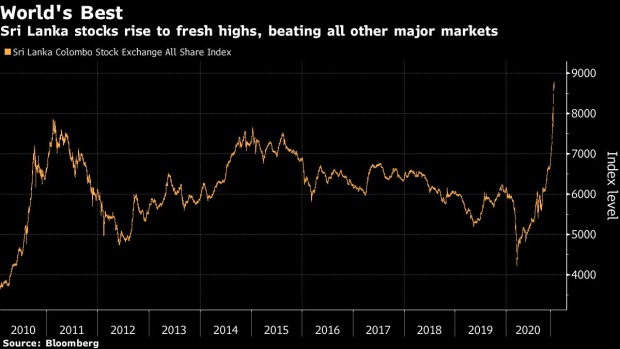
(Bloomberg) — Sri Lanka stocks have returned a world-beating 30% so far in 2021 as domestic investors get more active.
Local individuals were responsible for 79% of total market turnover last year, according to the nation’s stock exchange, amid a 70% increase in new accounts from 2019. At the same time, overseas investors were exiting — they sold $272.8 million of shares, data compiled by Bloomberg showed.
As the pandemic rebound got underway, abundance of global liquidity, substantial rate cuts and domestic retail participation have helped fuel the rally,” Joshua Crabb, a Hong Kong-based money manager at Robeco, said in an interview. Keep in mind the currency has also weakened, which makes exports more competitive, encourages tourism and introduces inflation, which helps nominal assets like equities.”
The March selloff saw the CSE All Share Index plunge 32% as a dearth in tourism, increased political uncertainty and concerns about debt sustainability weighed on risk appetite. Since then, the central bank cut its key rate by 200 basis points and provided liquidity, helping the island nation beat a recession. The country has even reopened its airports for international tourism. Equities have now more than doubled to records from their 2020 lows, and trading volume on the Colombo Stock Exchange hit a record $77 million this week.
Progress in accessing Covid-19 vaccines has also provided a tailwind. Sri Lanka approved the Oxford University-AstraZeneca PLC vaccine for emergency use last week after a surge in cases since October. Some 500,000 doses are scheduled to arrive from India on Jan. 28, the government said.
It’s encouraging to see Sri Lanka taking action on the vaccine front but developments still need to be monitored, Robeco’s Crabb said. After the rapid rally, he says stocks may be due for a pause.
In the near term, I would expect the market to consolidate its gains,” he said. At current valuations, we really need to see an improvement in the economy and in company earnings to see another leg up.”
ri Lanka will purchase 2 to 3 million doses of Oxford-AstraZeneca vaccine from its Indian manufacturing company Serum Institute of India during the next two days, a top Sri Lankan official said here on Wednesday. Lalith Weeratunga, the advisor to President Gotabaya Rajapaksa said that purchasing from India will follow Thursday’s arrival of India’s free vaccines to Sri Lanka.
He said the Indian Covishield vaccine is to arrive tomorrow and the consignment will be accepted by President Rajapaksa at the Colombo international airport. A total of 250,000 people, mostly health frontline workers, members of the security forces and police and the vulnerable aged, will get the vaccine on a priority basis.
The vaccination programme for which dry runs were made over the weekend will commence on Friday. Weeratunga added that 300,000 free vaccines from China are also due and the government would be requesting Russia also for the vaccine.
Sri Lanka has recorded a near 60,000 cases till January 26, with 288 deaths from the pandemic since it was found in the island nation in mid March last year. India is one of the world’s biggest drug makers and an increasing number of countries have already approached it for procuring the coronavirus vaccines. In the last few days, India has sent consignments of domestically produced coronavirus vaccines under grant assistance to Bhutan, Maldives, Nepal, Bangladesh, Myanmar, Mauritius and Seychelles.
It is also undertaking commercial supplies of the doses to a number of countries, including Saudi Arabia, South Africa, Brazil and Morocco.
GENEVA (Reuters) – U.N. human rights chief Michelle Bachelet called on states on Wednesday to impose targeted sanctions” on former Sri Lankan military commanders implicated in alleged war crimes during the final years of a 26-year civil war that ended in 2009.
States can consider targeted sanctions, such as asset freezes and travel bans against credibly alleged perpetrators of grave human rights violations and abuses,” she said in a report on Sri Lanka to the U.N. Human Rights Council.
Bachelet voiced concern that since 2020, President Gotabaya Rajapaksa had appointed at least 28 serving or retired military and intelligence personnel to key civilian posts, including some implicated in United Nations reports in alleged war crimes and crimes against humanity during the final years of the conflict”.
Travellers visiting the Indian Ocean country must have a negative PCR test result, take another test upon arrival and stay in a government-approved hotel
Sri Lanka has reopened to approved tourists who must show a negative PCR test and stay in a government-approved hotel for 14 days with supervised outside excursions. Unsplash
Sri Lanka has reopened to tourists for the first time in almost a year.
The island nation, which is a favourite with holidaymakers from the UAE, closed to international travellers in March 2020, and has remained shut to tourists for almost 10 months owing to the coronavirus pandemic.
Following a pilot programme during which approved groups of tourists visited the country in December, operations at Sri Lanka’s international airports have resumed and tourists can once again fly to the South Asian destination.
There are several new regulations in place designed to protect travellers and citizens during the pandemic. In a media briefing with the Sri Lanka Tourism Development Authority (SLTDA) on Tuesday, chairwoman Kimarli Fernando set out the new policies.
During the first 14 days in approved hotels, tourists are able to visit a number of approved sightseeing locations with hotels setting up ‘bio-bubbles’. AFP
“Travellers are most welcome in Sri Lanka. If you are an independent traveller, please book whichever Level 1 hotel you would like to stay in, then ask them to arrange your transportation from the airport. What is different from pre-Covid-19, is that you cannot just walk out of the airport and use public transport.”
What is different from pre-Covid-19, is that you cannot just walk out of the airport and use public transport
Kimarli Fernando, SLTDA
All visitors travelling to Sri Lanka must show a negative Covid-19 PCR test result before flying, then take another test on arrival. Tourists must also stay in government-approved hotels for the first 14 days of any trip, although they can leave the premises for organised sightseeing purposes.
There’s also a limit on the number of passengers who can fly to Sri Lanka. This is currently capped at 3,300 per day to help prevent crowding.
As one of the country’s biggest industries, employing more than two million Sri Lankans, tourism is on course to restart in an effort to help boost the nation’s economy.
If you are thinking of paying Sri Lanka a visit this year, here’s what you need to know before you go.
Can anyone travel to Sri Lanka?
There are only a few limits on foreign travellers planning to visit Sri Lanka. The most notable exception is the UK, with travellers from the country currently not permitted and flights to Sri Lanka cancelled.
Before flying to Sri Lanka, all tourists must apply for an online visa. This can be done via the Immigration ETA portal. To complete the process, travellers first need to book and pay $40 for each PCR test they will require during their stay. For visits of up to seven days, two PCR tests are required. For stays of more than seven days, three tests will be needed.
Tourists must also take out compulsory insurance that covers treatment for Covid-19 before submitting their visa application. There is a mandatory policy that costs $12 per person. Finally, all travellers must have a reservation in a government-approved Level 1 “Safe and Secure” hotel before visa applications can be processed.
Do I need a PCR test before flying?
A Sri Lankan health worker packs a swab sample collected for Covid-19 tests in Colombo. EPA
Yes, in addition to booking a PCR test on arrival and during their stay in Sri Lanka, travellers must also take a Covid-19 test before they fly. This includes children. Negative results must be received within 96 hours of arrival in Sri Lanka and will be requested by airlines before boarding is allowed.
What are the rules if I’m vaccinated?
At the moment, the rules are the same for all travellers, whether people have been vaccinated against Covid-19 or not.
Which airlines are flying to Sri Lanka?
Sri Lankan Airlines is operating flights to and from several destinations, with negative PCR test results required for all inbound flights to Sri Lanka. Courtesy Wikimedia
Sri Lankan Airlines is flying in and out of the country to several destinations. From the UAE, Etihad is operating three times per week to Colombo, while Dubai’s Emirates says it is operating four flights per week. Tickets for seats on these flights remain limited at this time.
A spokeswoman from flydubai told The National that “flights to Colombo have not resumed yet”, however, tickets for this route are available to book on the low-cost airline’s website from Sunday, March 28.
Do I need to stay in Sri Lanka for 14 days?
“There is no mandatory minimum quarantine, meaning you can come for any number of days, whether it’s one day, two days, five days … Sri Lanka has not indicated that you need to stay for a specific number of days, it’s up to you,” said Fernando.
However, for the first 14 days of any visit, travellers must stay only in Level 1 certified “Safe and Secure” hotels. If travellers have received their negative on-arrival PCR test result, they are allowed to change to other Level 1 certified hotels, and can stay in several different resorts located across the country. This means that travellers don’t need to spend their entire trip in one region of Sri Lanka.
For those staying in the country for more than four days, another PCR test will be conducted at approved hotels on days five, six or seven. A third PCR test must be carried out for travellers staying longer, with tests conducted at hotels between days 10 and 14.
Tourists will not be in strict quarantine in their hotel and will be able to use all the facilities, including pools, spas and restaurants with social-distancing in place. Shoreline hotels that have worked with the country’s tourism development authority have to ensure there is no mingling between locals and tourists can also offer guests beach access.
Tourists can also leave their hotel to visit approved tourist sites under the safety of what authorities are calling a “bio-bubble”.
Hotels are responsible for alerting medical officers at these tourist sites that guests will be visiting and should also arrange transportation and share itinerary details with local authorities. Staff accompanying tourists on these visits will have either quarantined for 14 days or will be wearing full PPE.
Which hotels can I book?
There are currently nearly 50 hotels designated as Level 1 “Safe and Secure” by Sri Lankan authorities. These hotels are set up to ensure that tourists have a safe but enjoyable stay in the country.
Amari Galle Sri Lanka is Level 1 approved for tourists and will reopen on February 10. Courtesy Amari Hotels
Each has a dedicated medical officer on site, an isolation room and a specific QR code that tourists can scan to get more information on health services, restrictions and other information during their stay.
The hotels are dotted around the country and range from five-star hotels in Colombo to guesthouses in Tangalle and eco-safari camps in Yalla. The variety of accommodation on offer means that there’s something for every budget – the complete list of approved accommodation can be found here.
What is there to do in Sri Lanka?
There are several approved tourism sites open to travellers which can be visited in a ‘bio-bubble’ arranged by hotels and local health authorities. Unsplash
There’s an approved list of more than 15 tourism sites that travellers can visit which can be downloaded from this site. This includes some of Sri Lanka’s most popular attractions such as The Temple of the Sacred Tooth Relic in Kandy, Sigiriya Fortress in the Central Province, whale-spotting in Mirissa and several national parks.
Restricted opening times are in place at these sites, as well as additional safety measures such as limited visitor numbers, social distancing and separate counters for foreign tourists.
Can I stay in Sri Lanka longer than 14 days?
After the first 14 days in the country, tourists who have not had a positive PCR test result are free to stay at any hotel or guesthouse in Sri Lanka and can explore the country freely. Travellers must adhere to rules in place for all citizens and residents such as compulsory face masks, no public gatherings and social distancing.
Tourists are advised to refrain from using public transport in Sri Lanka, even when they have been in the country for longer than 14 days.
What happens if I test positive for Covid-19 in Sri Lanka?
A security officer mans a temperature scanning machine at Bandaranaike International Airport in Katunayake, Sri Lanka. Reuters
Travellers will be covered for any positive Covid-19 test result.
You should not worry, because if you are positive, you will simply be asked to rest in your hotel room,” said Fernando. “If you have symptoms and need medical assistance, you will be sent to a private hospital, and your Covid-19 insurance will cover everything including the ambulance journey, any care in the hospital, tests, X-rays etc.”
The Director-General of Health Services confirmed that Sri Lanka has reported two more deaths from the coronavirus pandemic.
A 43-year-old male from Colombo 15 has passed away from COVID-19 pneumonia and a heart condition complication. He had passed away at Homagama Base Hospital today (January 27).
Meanwhile, a 74-year woman from Gonapola has died upon admittance to the Horana Base Hospital yesterday (January 26). The cause of her death has been determined as COVID-19 pneumonia, kidney infection, and severe cellulitis.
The new development brings the COVID-19 fatality count in the country to 290.
Principal Advisor to President, Lalith Weeratunga says Sri Lankan citizens will not be forced to receive the vaccine against Covid-19.
Addressing a media briefing earlier today (January 27), he said getting vaccinated for the novel coronavirus is not mandatory and that inoculation drive will go ahead on a voluntary basis.
Mr Weeratunga noted that however, those who decide to get themselves vaccinated will be required to fill a consent form before receiving the jab.
The first consignment of Covid-19 vaccines – Oxford-AstraZeneca’s COVISHIED jabs manufactured by Serum Institute in India – is expected to arrive in Sri Lanka tomorrow morning (January 28).
Accordingly, 500,000 vials of doses in total will be received by Sri Lanka as a donation from India to curb the Covid-19 pandemic in the country.
The vaccines will be first administered to health workers who are on the front line of the Covid-19 pandemic in the country.
The consignment weighing 1,323 kilograms will be brought to Sri Lanka by a special cold storage aircraft, AI-281.
China will donate 300,000 doses of the COVID-19 vaccine manufactured by Sinopharm to Sri Lanka, the Chinese Embassy in Colombo said.
China and Sri Lanka enjoy historical friendship and have always been strongly supporting each other including the joint fight against the COVID-19 pandemic, the statement said.
Responding to recent request by the Sri Lankan government, China has decided to donate 300k coronavirus vaccine doses to Sri Lanka to jointly fight against the COVID-19 pandemic, although the production capacity of the vaccine is still limited compared with the huge domestic and international demand.”
The vaccine doses are expected to be handed over to Sri Lankan side in mid-February after the due procedures in both ends are completed.
The vaccine is manufactured by the China National Pharmaceutical Group Co. Ltd (Sinopharm), a leading vaccine manufacturer in the world with the revenue of nearly RMB yuan 400 billion (US dollar 62 billion) in 2018.
The Sinopharm vaccine has already passed the phase three trials in several countries with 79-86% effective at preventing COVID-19 infection, 99.52% neutralizing antibodies and 100% preventing severe and moderate disease, the embassy said. As an inactivated vaccine, it better ensures the safety of vaccinees, and could be easily stored and transported at a regular fridge temperature (2-8 degrees Celsius).
The vaccine has received approval for public use in the UAE, Serbia, Egypt, Bahrain, Jordan, Iraq, Pakistan and China etc. By 26th January, over 20 million Sinopharm doses have been administered across the world with no reports of serious adverse reactions, the statement added.
Foreign state leaders including the Seychelles President, Bahrain Prime Minister, Jordan Prime Minister, the UAE Vice President and Prime Minister, and Serbian Health Minister etc have received the jabs.
The Embassy extended its most sincere solidarity and best wishes to the Sri Lankan people, and reiterate China’s commitment to jointly build a community of shared future for mankind.
Arundika Fernando, the State Minister of Coconut, Kithul, Palmyrah, and Rubber Cultivation Promotion and Related Industrial Product Manufacturing, and Export Diversification, has tested positive for COVID-19 infection.
After he was confirmed to have contracted the virus he has been directed for medical care.
Fernando is the 7th Member of the Parliament to be diagnosed with coronavirus.
Starting with State Minister Dayasiri Jayasekera, MP Rauff Hakeem, State Minister Piyal Nishantha, Minister Vasudeva Nanayakkara, Health Minister Pavithra Wanniarachchi, and MP Wasantha Yapa Bandara had also tested positive for COVID-19.
Meanwhile, State Minister Jayasekera and Minister Nanayakkara were recently sent home after recovering from the virus.
Signs are that anti-Sri Lanka forces at home and abroad are
already gearing up for a wishfully devastating diplomatic assault on the
country during the forthcoming 46th session of the UNHRC in Geneva in March
2021. Politicizing the artificial burial issue and the innocuous ‘peniya’ to resist/treat
Covid-19 and blaming it all on the government is one form of attack that uses
distortion of facts and disinformation as weapons. Which side stands to gain by
politicizing these ‘problems’ would be obvious to any dispassionate
observer. The implicit charges of racist discrimination against
minorities (trampling on their religious rights by banning burial) and
reliance on shamanism instead of proper scientific medicine in battling the
Covid pandemic do not hold water.
It
was on the basis of unsubstantiated war crimes and human rights violation
allegations against Sri Lanka that, in October 2015, the UNHRC in Geneva
unanimously adopted Resolution 30/1 co-sponsored by the infamous Yahapalana
regime. The UN body reinforced this with two other subsequent resolutions:
Resolution 34/1 in March 2017 and Resolution 40/1 in March 2019, the last even
after the US, the main sponsor of 30/1, left the HRC, having condemned it as a
‘cesspool of political bias’! (The United States withdrew from the UNHRC in
June 2018). Four uncalled for mechanisms were to be set up under these
resolutions: a judicial mechanism with a special counsel, an office on missing
persons, an office for reparations, and a commission for truth and justice.
Only the second and third (offices on missing persons and reparations
respectively) have been established. Of the four only the OMP is deemed
operational.
The
movers and shakers at Geneva looking forward to the 46th session of the UNHRC
in March to engage with Sri Lanka cannot ignore the implications of this
humiliating electoral pratfall of their protege in Colombo. The new Sri Lankan
Foreign Minister Dinesh Gunawardane officially informed the UNHRC of Sri
Lanka’s withdrawal from the co-sponsorship of the aforementioned UN resolutions
based on totally unsubstantiated allegations. He said this while addressing the
UNHRC session at Geneva in February 2020. The minister told the meeting that
the 2009-2015 government had established domestic mechanisms to address a
variety of issues including alleged war crimes, accountability, rule of law,
and human rights issues, but that the Yahapalana regime abandoned those
homegrown mechanisms.
Feeding
the anti-Sri Lanka propaganda campaign that is gathering momentum ahead of the
Geneva session, Rajan Philips (RP) (‘President Rajapaksa and his 13A
dilemmas’/Sunday Island/January 3, 2021) wrote about two weeks ago: ‘……no
one can do worse than CA Chandraprema’s attempt to rewrite history, as he did
in his hagiographic monograph, Gota’s War.” We can anticipate versions of it
to be undiplomatically broadcast from Geneva from March onward’ (‘President
Gotabaya Rajapaksa and his 13A dilemmas’/Sunday Island/January 3, 2021). RP is
launching a quixotic preemptive strike at Chandraprema, who was appointed as
Permanent Representative of Sri Lanka at Geneva in November 2020. What can a
biased scribe like RP do other than verbally discredit what he can’t rationally
disprove? (because Chandraprema’s history of Sri Lanka’s war against Tamil
Tiger separatist terrorism ‘Gota’s War’ is a record of solid facts, while being
a well supported commendation of Gotabaya and his achievements in that war (or
even a hagiography in RP’s sarcastic phraseology, if you like) crammed with
facts.
RP
quotes, out of context though, from KM de Silva’s ‘A History of Sri Lanka’
(1981) to suggest that Prime Minister SWRD Bandaranaike’s opposition to a
federal constitution in 1956 involved the abandonment of an earlier contrary
view of the matter that he had held: it was a grim irony that he (i.e.,
Bandaranaike) should be called upon, at the moment of his greatest political
triumph, to articulate the strong opposition of the Sinhalese to any attempt to
establish a federal constitution.” Actually, RP’s is a false implication drawn
from KM de Silva’s personal reflections or sentiments in that context.
What
I remember as having read in the particular book is that the Kandyan members of
the State Council on the eve of independence demanded a separate unit of
administration (something that smacked of federalism) for the Upcountry because
it had suffered special disabilities during the colonial times and could not
expect a fair deal under a structure that didn’t recognize this. But the
proposal must have been immediately shot down, because the Sinhalese looked
upon the whole of the island as their single homeland of Sinhale, as they had
done over millennia, despite numerous foreign invasions (from South India and
later Europe) and occupations, the last of which was by the British, and a
federalist notion was a contradiction of that unitary ideal. The Kandyans’
quasi federalist idea was much less menacing than what it means today: a hop,
step, and jump to separation.
As
RP later indicates, the quote comes from Chapter 36 titled The Triumph of
Linguistic Nationalism” of de Silva’s book. RP seems to indulge in some empty
rhetoric: The quote might suggest that the historian was having his academic
tongue in his political cheek, but it reads far superior to anything that a
geographer seems to be able to politically offer 40 years later. And this is
not because Sri Lanka has too much history and too little geography.” The
geographer meant here is Prof. GH Peiris, whose well argued case against the PC
system titled ‘Province-based Devolution in Sri Lanka: a Critique’ was
published in two parts in The Island issues of December 16 and 17. RP’s summary
dismissal of the scholarly essay as ‘Midweek fury’ does not do justice to his
own general knowledge or his common sense. To claim that the quote from
de Silva reads far superior to anything that a geographer seems to be able to
politically offer 40 years later” is sheer nonsense, but RP tries to justify
his summary dismissal of Sri Lanka’s history by stating that this is not
because Sri Lanka has too much history and too little geography”. The
unintended ambiguity emphasizes the truth that he wants to obliterate:it
is the truth that Sri Lanka has a well authenticated history that is far out of
proportion to the relatively small size of its geographical territory. It is
not the fault of the Sinhalese that detractors are not cultured enough to
recognize the greatness of their very long history and their unique
civilizational achievements recorded in ancient books and in rock inscriptions,
many dating back to centuries BCE.
To
return to RP’s reference to ‘Gota’s War’, which mainly provoked this reply,
former Island columnist C.A. Chandraprema (but he was much more than that
careerwise) has all the qualities that a successful diplomat should
possess according to Robert D. Blackwill, Director, Harvard University’s Kennedy
School’s Belfer Center for Science and International Affairs, Cambridge, USA.
Some of these that Chandraprema has incidentally demonstrated in the course of
his journalism are: good writing ability, an analytical mind, verbal fluency
and conciseness, attentiveness to detail, perspicacity in policy review,
insight into relevant political ideology. Of the fifteen positive qualities
that Blackwill enumerates, the eleventh is ‘be loyal and truthful to your
boss’. The ‘boss’ is of course the government of the country that accredits the
diplomat. Chandraprema is definitely not going to face the embarrassment that
our excellent career diplomats at Geneva had to face under Yahapalanaya. Love
of the country the official represents should be added to Blackwill’s list as
yet another essential quality in a good diplomat. Chandraprema possesses this
in abundance. We already have patriotic career diplomats there who weathered
through the difficult period while the Yahapalanaya ruled at home. With
them, Chandraprema will be a formidable presence in Geneva to take on disguised
eelam propagandists.
The
privatization of public enterprises had been a significant policy initiative in
a liberal economic system, and if it considers the era after the first world
war, it could be seen that many countries in the world have espoused the
privatization of public enterprises for various reasons and purposes, and many
governments used various techniques for privatizing the public-owned
enterprises. Investment in public enterprises began when the private sector has
no sufficient capital to invest in such business or did not interest in
investing in such business and services.
People
in Sri Lanka either misunderstand the policy of privatization or misinterpreted
the policy by left politics. The privatization of public enterprises means
changing the ownership of enterprises that need because of various reasons, and
although it might have chances to destroy the organizations if the private
sector weak to adopt efficient and effective management, it does not mean they
will destroy.
In
traditional society, no restrictions were imposed by the government for
economic activities except that activities aimed to promote immoral and anti-social
animations, against the national security and counter the national interest
purposes. The traditional society was more liberal, and entrepreneurs had
greater freedom to start a business and maintain business if consumers demanded
products and services. In a free society in history, doing business was easier
and the price mechanism helped to determine demand, supply, and equilibrium.
These ideas were incorrectly interpreted by Marxist politicians to attract the
power of people to them. The collapse of communism in the early 1990s was the
best example for expressing implausible views that would not last forever and
ever.
Public
enterprises became a grave burden to governments during the cold war, and after
the cold war, developed countries attempted to get away from the burden of
public enterprises by privatizing them. Many governments had various aims of
changing the ownership and converting public enterprises to better management
than wasting government funds to the management of such organizations.
Developed countries used privatization of public enterprises to gain successful
solutions to problems such as retiring public debt, fiscal issues, the balance
of payment adjustments, and many others. In the late 1980s, public enterprise
management in Australia crippled the economy with many problems, and the
government took leadership to get out of problems, despite the protests of
trade unions and some groups of people. The strategy used in Australia was
comparatively different from the way used in Sri Lanka, and it was successful
and popular among voters. The government has been monitoring the concerning
issues in privatized public enterprises and passed regulations to counter
possible disadvantaged developments.
Sri
Lanka’s parliament passed legislation to monitor privatized enterprises and
take back them, however, politics and corruption involved in the monitoring
process. Politicians’ as well as politically supported bureaucrats involved in
corrupt activities, and the concept of privatizing public enterprises became
corrupt activities and misunderstanding of people.
The
nature of Sri Lanka’s privatization has been in misunderstood and untypical style,
and policymakers introduced the experience of foreign countries as they were
without adapting the foreign experience appropriately. One example is foreign
governments did micro-reforms in public enterprises, converted them to public
companies, and listed such organizations in the stock market with a reasonable
price for a share and a percentage of shares allowed to institutional investors
and individual investors. For example, Commonwealth Bank and Telecom in
Australia are privatized in that way. The story in Sri Lanka reflected that the
government did not allow Sri Lankans to invest in such organizations and
allowed foreign investors to play with public enterprises. The incident
relating to the
Higurana
sugar factory was the best example to point out how corruption and bribery
involved in the privatization of public enterprises. They were corrupt deals in
Sri Lanka that have been rejected by people. Overseas, government enterprises
took over or merged by experienced private investors that were called merging
public enterprises for the development of synergy.
When
allowing single buyers, there may be many malpractices, as Sri Lanka
experienced in the 1980s and 1990s and the government introduced a new law to
take back privatized enterprises. People have seen these experiences and they
object to privatization, however, if private firms attract the supports of
people, the public doesn’t want to oppose the privatization process.
The
privatization policy in Australia successfully worked to get out of grave
problems and to achieve sustainable growth with the improvement of
macroeconomic variables. Sri Lanka has many economic and social problems that
should be approached by modernised strategies without giving a heavy burden to
the government. In Australia, privatized public enterprises contributed a
massive sum of tax revenue to the government, and such tax revenue is used to
provide benefits to disabled people, single parents, pensioners, and many
others. However, privatization in Sri Lanka has not benefited the public, and
it created a bad problem for people and to question and opposed by people. This
situation created
The
purposes of privatizing public enterprises could be well identified as
following points.
Sharing the burden of
economic activities with people and converting the role of government to
regulating the operational activities than management of firms.
Providing opportunities
to those who wish to invest capital in a business and allow the knowledge,
skills, and experience of people to invest them in the management of public
enterprises.
Saving government
spending for enterprises management using such an
An enormous sum of money
for infrastructure development and education and training.
Generating efficiency
(like electricity, when needs it can gain switch on and when no need the
service can switch off) and flexibility (when a strong wind comes trees bend
and the wind goes away trees go back to the previous position) in public
enterprises provide good services to the country.
Privatization
of public enterprises has been involved with international politics, many
community groups such as religious clergy and people who are interested in
gaining popularity, and international issues that are not related to Sri Lanka
(Indo – China issues) have associated with and the complexity in the process
seem to outweigh the benefits possible to gained by Sri Lanka. It has become an
international issue, despite this situation Sri Lanka can gain enormous
benefits by changing current fiscal spending for the benefits of lower-income
earners and creating a strong financial base for Sri Lanka.
It
is regret to note that the government is attempting to drink medicines without
feelings to thought and should educate the public on the matter of
privatization and its advantages and disadvantages.
The concept of
Post Combat Depression (PCD) is not new. There are many historical records to
provide that combatants manifested depressive symptoms after the war. The
feeling of guilt and despair plays a major role in post-combat depression. For
instance, King Dutugamunu went into a depressive type of reaction soon after
the Wijithapura battle. The king’s emotional worries were later healed by a
monk. Similarly, Napoleon Bonaparte developed depression while he was in exile
on the island of St Helena.
Post combat
depression is evident among some combatants who were exposed to traumatic
battle events. Apart from common depressive signs, PCD is usually characterized
by unresolved mental conflicts, survival guilt, negative interpretation of
combat events, and a pessimistic outlook on the post-combat environment.
The component of depression was evident to Dr. Mendez Da Costa who introduced
the term Irritable heart during the US Civil War and Lt Col (Dr) Fredric Mott
who coined the term Shell Shock during World War One.
Sometimes
depression is obvious among the servicemen who were exposed to traumatic combat
events. In addition to depressive symptoms, they can have anxiety-related
features. In common, terms depression is a medical condition leading to
persistent feelings of worthlessness, hopelessness, guilt, agitation, and
indecisiveness. Depression can occur following negative life events, physical
illnesses such as thyroid imbalance or diabetes mellitus.
Post combat
depression (PCD) usually takes place mostly as a result of traumatic combat
experiences with negative cognitive interpretations. A depressed soldier
experiences deep unshakable sadness and diminished interest in most of the
personal, as well as military, activates. Depression can dramatically impair a
soldier’s ability to function in field situations. A soldier who develops
severe depression may appear so confused frightened and unbalanced.
Depression is
a mood disorder in which pathological moods and related vegetative and
psychomotor disturbance dominate the clinical picture. The term Post combat
depression has been used for the first time in the publication PTSD Sri Lankan
Experience” and described as a group of symptoms such as anhedonia (feeling of
sadness and loss of ability to experience pleasure) low energy, decreased
libido, reduced life interests, somatic pain, alienation, numbing, self-blame
and survival guilt that is experienced by combat soldiers after exposing to
traumatic battle events.
Depression
causes a disturbance in a soldier’s feelings and emotions. They may experience
such extreme emotional pain that they consider or attempt suicide.
Learned Helplessness in the Battle Field could be described via Psychologist
Seligman’s research work. Seligman (1975) was studying the effects of learned
helplessness, which is associated with depression. He studied the series of
escape mechanisms of doges when exposed to electric shock. In this study, many
doges did not attempt to escape although there were escape paths. Instead, they
suffered eclectic shocks and remained helpless. Seligman stated that learned
helplessness is a factor in depression. The learned helplessness model proposes
that the depressive posture is learned from past situations. Soldiers on the
battlefield act in a certain way as Seligman doges when exposed to traumatic
events. Sometimes they do not take any positive measures to change their
situation. Also, they hardly take measures to detach from depressive
components. Beck (1979, 1983) hypothesized that depression-prone
individuals possess negative self schemata which he describes as a cognitive
triad”. Combatants with PCD often have a negative view of themselves may be as
a result of the acts that they have committed on the battlefield or may be due
to low recognition of post-military service by society. They see their
environment as overwhelming filled with obstacles and failure. Also, they have
a pessimistic outlook of the future.
Many soldiers
become emotionally shattered witnessing the death of their buddies. Sometimes
they hold responsible for the deaths of their friends. These soldiers always
question their conscience. Often they say to themselves it’s unfair for me to
live since I could not save their lives or they have gone because of my error,
I don’t deserve to live, etc. These are the common self-blame patterns that can
be seen among the soldiers with PCD. They carry the memories of their dead
comrades for decades. Many depressed soldiers use natural defenses
against self-attacking shame by striking out at others, attacking others by
being critical, sarcastic, or abusive. Alcohol and substance abuse can be a
prevailing feature of PCD. Depressive behavior clearly has a powerful
interpersonal impact. The affected servicemen have deteriorated interpersonal
relationships in the battlefield. On certain occasions, the combatant’s family
members too feel this distance and coldness.
Depression
represents a masochistic lifestyle. Soldiers with post-combat depression suffer
from a lack of assertion and outwardly directed aggressiveness. Aggression
turned inward mechanism is a universal explanation for depressed behavior.
Freud’s concept of aggression turned inward model or depressed affect is
derived from retroflection of aggressive impulses directed against an
ambivalently loved internalized object was actually formulated by his student
Carl Abraham. As the psychoanalyst, Carl Menninger elaborates suicide is a
murder in 180 degrees. Soldiers are taught to be aggressive. Killing is a part
of military training. Therefore aggressive tendency and will to kill the enemy
is an accepted component in the military culture. Sometimes this
outward-directed aggression turns 180 degrees and PCD soldiers shoot
themselves. Frequently soldiers with post-combat depression go in to various
types of self-harm including risk-taking behavior.
At the height
of the depression, they can take their own lives. Very often these soldiers use
their weapons to commit suicide. Undiagnosed and untreated depression can
lead to many complications on the battlefield. At the height of the depression,
combatants with PCD can go into fugue states. When they are under fugue states
they become numbed and can be disoriented.
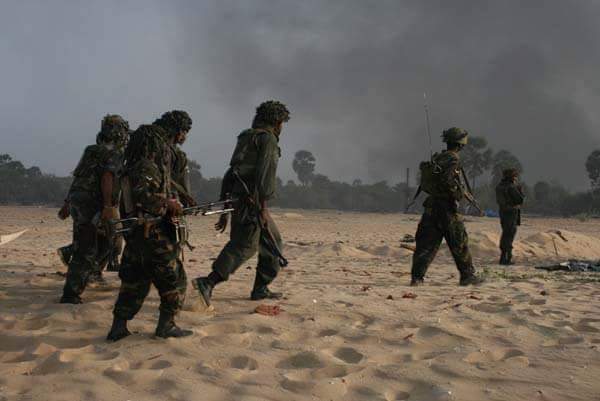
This is the
story of a soldier who went into a fugue state as a result of overwhelming
depression during the Eelam War. This combatant was found by a group of
soldiers when he was wandering and heading towards the enemy lines. When questioned
he had no idea how he came out of his bunker. In addition, there was no trace
of his weapon. Probably he must have dropped it in the jungle. When he was
referred for a psychiatric assessment, he denied any kind of substance abuse.
There was no history of dissociative disorder. But he was depressed following
the deaths of his platoon members. His depression was undiagnosed and untreated
until he went into the depressive fugue.
Physical
injuries, Disabilities, and PCD go hand in hand. A large number of soldiers who
sustain physical injuries and become disabled can go into post-combat
depression. This category describes depression that occurs in response to a
major life stressor or crisis. Stressful events such as physical injury and
disability often appear to be triggered by the temperamental instability that
precedes clinical episodes.
PCD can be
treated with medication and psychotherapy. Antidepressants are effective in
PCD. Psychotherapy is an effective treatment for PCD. Cognitive Behavior Therapy
or CBT focuses on the identification of distorted perceptions that patients may
have of the combat and themselves changing these perceptions and discovering
new patterns of action and behavior. PET or Rational Emotive Therapy helps to
change the irrational and illogical thoughts such as survival guilt held by the
combatants. RET is an approach that focuses on altering the client’s patterns
of irrational thinking to reduce maladaptive emotions and behavior.
How did the 2 court of appeal judges and the 2
supreme court judges who refused Ven. G’s permission to appeal, miss this video
clip?
Six lawyers and a
monk: importance of impotence
Posted on January 22nd, 2019 – Lankaweb
Part II-continuation
It is strange why the monk’s lawyers did not
present the video clip above as evidence. It is also strange why the two
monks who gave evidence on behalf of the monk said contradictory stories, which
the judges used against the accused monk. The evidence used by CA was what the
three lawyers said in the court and not the video tape recorded at the scene
when it took place. Lawyers are not supposed to coach prospective
witnesses to tell lies, but under an adversarial system of litigation, lawyers
have a duty to examine the witnesses in advance, assess their evidence, and
decide not to use them if their evidence is going to harm the accused instead
of helping hm. The use of such evidence by a court to impute criminal intention
is a case of cutting pork on a leg of pork.
Balu
Theendu and BBS
When S B Dissanayake was sent to jail for
branding SC decisions as balu teendu (decision by dogs?), his intention was
crystal clear. He did not apologize. On the pending case against Ranjan
Ramanayaka for condemning the court system as corrupt, his purpose in doing
that is fuzzy. When Nagananda Kodituwakku goes to SC with briefs against SC
judges, Chief Justice, or the AG, no one said his purpose was not noble. The
way BBS monk was trapped using clause 105 of the constitution is unique. The
magistrate Ranga Dissanayake had a dialogue with the monk and the monk accepted
his mistake, gave an explanation as to why he had to talk, and apologized twice
and went on to ask the judge in the Gandhian style to impose appropriate
punishment for his behavior. All this is on the video clip.
The magistrate could have fined him, imprison
him for the day, warn him or sent him to jail for a longer duration. The
magistrate was aware that he was dealing not with a solitary monk, but a kind
of national entity. He would have settled it in a casual manner, if not for the
intervention of the AG dept lawyer Dileepa Peiris and the JVP-connected lawyer
Upul Kumarapperuma, who appeared for the wife of an allegedly disappeared
person, Ekneligoda. With their intervention, the magistrate lost his
judicial independence and discretion. A minor incident became a national issue.
The facts of the case, the reaction of the
magistrate as recorded on the video, do not justify his subsequent opinion,
that the monk should be punished severely, and for that purpose he wanted to
report the monk’s behavior to CA, because he has no power to impose a
punishment like 19 years of rigorous imprisonment. In S.B. Dissanayake’s case
the complaint was by ordinary citizens, perhaps motivated by partisan politics.
In BBS case, it was instigated by two biased lawyers who found a golden
opportunity to trap the monk for his work in exposing the black-whites’ game.
It is clear from the evidence gave by the magistrate that he had to make a case
in narrating what had happened, so that he could justify why he wanted to
report the incident to CA for severe punishment instead of a lighter punishment
that he could have given then and there. The lawyer for the monk argued on this
basis, but CA refused to accept it. The million-dollar question is why the
court did not see the video clip, which makes court’s position untenable!
Objective/Subjective
Test
It is a common belief that a judge usually has
an opinion formed already about the case pending before him and gathers facts
and evidence that he could use to justify his decision. Often, words and
statements in the judgement provide hints as to the way a judge’s mind was
working. The following are examples reflective of the subjective nature of the
judgement (the statements copied from the judgement are categorized; my
comments are in italics below each category).
*1. High quality of
lawyers as witnesses
[Magistrate] was severely cross examined;
[SSC] was severely cross-examined at length; [private attorney] faced continuous
questioning by the accused’s attorney.
The judgement states the three lawyers who
gave evidence against the monk faced three different levels of testing. What
did the judges expect to achieve by these adjectives on cross examination of
the witnesses? Did the court mean that the accused’s side faced only mild/soft
cross examination?
Dileepa Peiris and Upul Kumarapperuma
corroborated magistrate’s evidence.
The three lawyers who
were directly responsible for the filing of the case are not going to do
anything different than corroborating!
*2. accused
corroborated Magistrate’s evidence
a. accused’s lawyer and his two witnesses
denied accused saying impotent but accused admitted it;
b. accused’s two witnesses lied;
c. accused lied.
These statements
demonstrate that the monk was honest, but his lawyer made some technical
errors. For example, no lawyer will use/call witnesses who will put the accused
in trouble. Unless the court is determined to teach a lesson to the
accused, these are so trivial in a case like this. This is not a murder trial.
*3. accused said
magistrate was a good magistrate, if so, why would magistrate gave bad evidence against the accused?
When AG’s lawyer asked
this tricky question, the monk could not give an answer. But CA used it against
the monk.
This change of
magistrate’s mind was due to the two lawyers who influenced the magistrate to
act at the time of the incident. The issue was not a good magistrate became a
bad magistrate. The issue should be why the monk’s mind changed at that moment.
It was his loss of hope of the release of accused soldiers, whom he considered
as national heroes. His sudden loss of mind and body control was triggered by
the tear drops of re-remanded soldiers fell on his hand. See how one incident
could be twisted to get the outcome one wants!
*4. address was not in
the form of plea-
a. not a peaceful dialogue;
b. addressed the court in high tone being emotionally aroused;
c. accused tried to intimidate magistrate to
reverse his order;
this is white man’s law. We do not accept this
law. Therefore, give bail to these war heroes.
The monk did not intervene when the case was
being heard. He did not disrupt that case. He spoke after it was over, and the
remand prisoners were taken out. The video clip does not justify, what
the court was imagining. Again, was this an incident/offence warranting a
rigorous jail term of 19 years? Unlike what S.B. Dissanayaka or Ranjan
Ramanayaka said the remark about the white man’s law is a political comment not
directed at courts or judges.
(Note that the court also accepts emotional
element coming within the exception of grave and sudden provocation in criminal
law).
*5. impotent
government’s some officers/impotent officers (obscene words)
sit-down, you, impotent state lawyer (to
Dileepa Peiris)
this type of treacherous government officers
The monk was accused
of uttering these words. Other than the words directed at Dileepa Peiris, there
was no insult to an individual but to the government in general. Napunsakaya in
Sinhala usage does not mean impotent in its biological English language meaning,
but as one who is a puppet without principles in its sociological context. A
barren person is not called a napunsakaya in Sinhala. A man acting like a woman
and vice versa is called a napunsakaya. Judges should have obtained experts’
advice in this regard.
http://www.colombotoday.com/54927-23/
https://www.youtube.com/watch?v=iwUhCS25hhE
*6. JVP
connection/protection of Buddhism
CA went on to state
that lawyer Kumarapperuma (Ekneligoda’s wife’s lawyer) said that he was not
anti-Buddhist and that his links with JVP (he contested 2015 election as a JVP
candidate) has nothing to do with the truthfulness of the evidence he gave. He
was the only non-state lawyer against the accused. By this statement CA
whitewashes Kumarapperuma’s evidence used as another corroboration of
magistrate’s evidence.
*7. Only lawyers can
address the judges in court
CA was clearly erroneous here. Any accused can
represent himself in a court of law; Any person can address a court with
permission. The accused monk even though he has no direct link with this case
was representing the close relatives (their wives) of the remanded war heroes.
They went to his temple and begged the monk repetitively to do something for
their relatives in remand for months without any charges filed against them.
The monk was the only outlet they had to disclose the political nature of the
arrests. After all, there are some doubts as to whether Ekneligoda is hiding in
Dubai. His disappearance is used for political purposes by a napunsaka
government.
Conclusion
Any reasonable person watching the video clip
attached cannot help but have doubts about the way the Court of Appeal handled
the BBS case, and the harsh punishment given to a public service monk.
The president has referred the appeal for his
pardon to AG for advice. An AG’s Dept. who marched overboard to fix this monk
cannot expect to be impartial in this regard.
Therefore, the lawyers of the monk need to
make either a fundamental rights appeal or a fresh appeal to the president to
release the monk from prison. There are strong reasons to doubt the legality
and reasonableness of the CA decision. (cwije77@outlook.com/wijeychandra@gmail.com)
Next: Part 4 -The Lore of the Law and other
memories