A total of 144,250 premises have been inspected island-wide during the National Mosquito Control Week implemented last week, the Media Spokesperson of the National Dengue Control Unit of the Ministry of Health, Community Medical Specialist Dr. Prasheela Samaraweera, said.
Speaking at a press conference today (08) to announce the progress of the activities conducted during National Mosquito Control Week, she explained that 35,495 sites were identified as possible mosquito breeding grounds.
Furthermore, Dr. Samaraweera stated that 4,275 premises with mosquito larvae were detected, adding that 3,812 red notices were issued and legal actions has been initiated against 982 premises.
She also noted that schools, government offices, factories, workplaces, and religious sites were among the locations identified as high-risk.
Inspections were carried out at 400 schools, with 226 found to have potential mosquito breeding sites.
The Community Medical Specialist further mentioned that 131,789 homes were inspected, and 31,967 were identified as having potential mosquito breeding sites.
Additionally, 955 government institutions were inspected, and 292 were identified as potential breeding grounds for mosquito larvae.
Meanwhile, 30,228 dengue cases and 16 related deaths have been reported island-wide, with most cases coming from the Western, Sabaragamuwa, Southern, and Eastern provinces, Dr. Prasheela Samaraweera said.
We express grave concern over the military strikes against the Islamic Republic of Iran since 13 June 2025, which constitute a violation of international law and the Charter of the United Nations, and the subsequent escalation of the security situation in the Middle East.
In the face of rising tensions with unpredictable consequences for international peace and security, as well as for the world economy, we underscore the urgent need to break the cycle of violence and restore peace. We call on all parties to engage through existing channels of dialogue and diplomacy, with a view to de-escalating the situation and resolving their differences through peaceful means.
We express serious concern over any attacks against peaceful nuclear installations that are carried out in violation of international law and relevant resolutions of the International Atomic Energy Agency. Nuclear safeguards, safety, and security must always be upheld, including in armed conflicts, to protect people and the environment from harm. In this context, we reiterate our support for diplomatic initiatives aimed at addressing regional challenges.
Civilian lives must be protected, and civilian infrastructure must be safeguarded, in full compliance with international humanitarian law. We extend our sincere condolences to the families of the victims and express our solidarity with civilians affected.
Guided by the principles enshrined in the United Nations Charter, BRICS remains committed to promoting international peace and security and to fostering diplomacy and peaceful dialogue as the only sustainable path toward long-term stability in the region. In this regard, we also reaffirm the necessity of establishing a zone free of nuclear weapons and other weapons of mass destruction in the Middle East, in line with relevant international resolutions.
We call upon the international community to support and facilitate dialogue processes, uphold international law, and contribute constructively to peaceful settlements of disputes for the benefit of all humanity.
Palestinians at a GHF aid distribution site in Gaza being fired on by American security” contractors. Still from a video shot by a contractor and given to the Associated Press.
There’s no precise number for how many Palestinians have been starved to death by Israel’s embargo on food entering Gaza. But there is a number for how many Palestinians have been killed trying to keep from starving to death at food distribution sites, many of them by Israeli gun or mortar fire: 549, with 5 to 10 more Palestinians being killed every day. More than 4,000 have been wounded.
These killings weren’t accidents. They weren’t provoked. They didn’t come about as an attempt to quell riots. The people killed were not collateral damage in attempts to kill Hamas fighters. The shootings were not in retaliation for any violence from the Palestinians. Israeli troops were ordered to fire on Palestinians coming to get scraps of food handed out by the Christian fundamentalists and mercenaries who run the food distribution sites set up by Trump and Netanyahu. Let’s repeat that: Israeli troops were ordered to kill starving, unarmed civilians who were trying to get food for their families.
These killings aren’t news to anyone who has been paying attention to reports coming out of Gaza from Palestinian journalists, eye-witness testimony from survivors of the attacks, and doctors who have treated the wounded and examined the bodies of the dead.
The news is that the Israeli paper Haaretz got Israeli soldiers to describe how their superiors ordered them to fire into crowds of people seeking food at aid distribution sites that Israel itself had designated. These sites have become the latest kill zones for Palestinian civilians. In the place where I was, between one and five people were killed every day,” an IDF soldier told Haaretz. They’re fired upon as if they were an attacking force: no crowd-dispersal methods are used, no tear gas — they shoot with everything imaginable: heavy machine guns, grenade machine guns, mortars.”
Nearly all of Gaza has been on the brink of famine since the first week of March, when Israel imposed its latest embargo on humanitarian aid entering Gaza. As global pressure mounted against Israel for imposing a mass starvation policy on Palestinians in Gaza, the Netanyahu government turned to a newly created company with the backing of Trump, the Gaza Humanitarian Foundation, now run by Johnnie Moore, Jr. Moore is an evangelical Christian with close ties to Trump. Moore had hailed Trump’s plan to assume control of Gaza, saying: The USA will take full responsibility for the future of Gaza, giving everyone hope and a future.”
Atar Riyad, a displaced Palestinian father of five from Beit Hanoun, whose wife is pregnant. Described to Al Jazeera the treacherous experience of trying to get his family food at aid sites run by the Gaza Humanitarian Foundation:
The Israeli military forced us into displacement. We ended up in Gaza City on the streets. I have a family. I have children who are all under the age of 15. My wife is pregnant. My financial situation is not easy. A few weeks ago I had to sell some of my belongings. I had a stroller that I used to push the gallons of water on. I had a bicycle too and other things I had to sell to buy flour. We have no food, no water. We don’t have anything. I went to the US aid distribution sites and to the aid trucks. I went there seven or eight times to get food. About 20,000 people gather at the distribution sites along the Netzarim corridor early in the morning, but only 2,000 manage to get any food parcels. Why? Because of the overcrowding. Because of the number of people creating chaos. The food parcels they put in front of us are not enough compared to the number of aid seekers. The American site is a dead end. They told me that there is American aid in Netzarim. I went there. I walked 15 kilometers to look for some flour, rice or lentils. I couldn’t get anything. I went to the Netzarim aid site three or four times. All in vain. We go there only to find death in front of us. There was no food or water. There was only death. People were lying dead in the sand in front of us. I don’t know what to say. This situation is very hard. They told us there is aid in the trucks. Then, we went to the trucks. The trucks move very fast, running over people. The trucks were running on top of people! Today, I am unable to do anything. I used to weigh 90 kilos. Now I weigh only 58 kilos. Things are hard, really hard in Gaza. We are subjected to the worst torture in the world.
These distribution sites, which operate for only one hour each morning, are not a serious attempt to avert the famine in Gaza that Israel engineered and continues to enforce. They are a distraction and a half-hearted one. Worse, they serve as a magnet, drawing thousands of desperate Palestinians together within the scope of Israeli guns and tanks. The humanitarian aid sites, like the humanitarian zones for Palestinian tent camps where so many families have been burned alive as they sleep by Israeli airstrikes, have become, in the words of one Israeli soldier, killing fields.”
The first GHF aid station opened on May 25 and was immediately met with violence that killed three Palestinians and injured dozens. This set the daily pattern, where the promise of food served as bait to trap and kill unsuspecting Palestinian civilians.
On June 1, 32 Palestinians were killed and more than 250 wounded near the Rafah aid station, in what became known as the Witkoff Massacre,” after Trump’s Mideast envoy Steve Witkoff.
On June 3, at least 27 Palestinians were killed and 184 were injured by an Israeli airstrike on the road leading to the Rafah distribution center.
On June 8, 13 Palestinians were killed and 173 wounded when Israeli forces fired on crowds at the Rafah aid site.
On June 9, 14 Palestinians were killed and 207 were injured at another GHF site.
On June 10, 36 Palestinians were killed and 207 were wounded at an aid site near Deir al-Balah.
On June 11, 25 Palestinians were killed at night, as they camped near a GHF distribution site and another 14 were killed during the day as they lined up to receive boxes of food.
On June 12, 26 Palestinians were killed by an Israeli drone strike on a crowd near an aid site.
On June 14, 29 Palestinians seeking aid were killed and more than 380 wounded in separate attacks at aid distribution sites.
On June 16, 23 Palestinians were killed and 200 wounded outside the Rafah aid site.
On June 17, 59 Palestinians were killed and 221 injured when Israeli drones, tanks and troops fired on a crowd at the Khan Yunis aid site.
On June 18, 12 Palestinians were killed and 72 wounded by Israeli gunfire and mortars while they waited for food trucks to arrive at the Deir al-Balah aid site.
On June 19, 12 Palestinians were killed and 60 were wounded at the aid site in the Netzarim Corridor.
On June 20, 23 Palestinians were killed and more than 100 wounded by Israeli drone and tank fire at the aid site in central Gaza.
On June 21, 8 Palestinians were killed and more than a dozen were injured by Israeli gunfire at a GHF aid center.
On June 22, 6 Palestinians were killed and more than 20 were injured by Israeli troops at an aid site in central Gaza.
On June 24, at least 40 Palestinians were killed by Israeli drones and gunfire at the GHF site in southern Rafah.
On June 25, 25 Palestinians were killed and 30 were wounded by Israeli forces at the aid site near the Netzarim checkpoint.
On June 27, 18 Palestinians were killed by an Israeli drone strike as they assembled to get flour from a GHF site outside Deir al-Balah.
Most of the massacres have taken place in the morning, as Palestinians line up in front of the aid sites before the gates open, even though, as one Israeli soldier said, there was no danger to the forces. There’s no enemy, no weapons.”
[We’d open fire] early in the morning if someone tries to get in line from a few hundred meters away, and sometimes we just charge at them from close range”, the soldier said. Once the center opens, the shooting stops, and they know they can approach. Our form of communication is gunfire. I’m not aware of a single instance of return fire.”
The rations are meager by any standard, but critically so considering the ever-deepening crisis in Gaza, where 2.3 million Palestinians are starving, nearly two-thirds of them women and children. In its first 10 days of operation, GHF reported distributing 8.3 million meals, equivalent to less than four meals per person for every Palestinian in Gaza, or approximately one meal every two and a half days.
Even now, the aid sites are only distributing enough aid to feed each Palestinian in Gaza one meal a week. And most, perhaps even the majority, aren’t getting that. There are only four aid sites, and each is open for only one hour a day. The goal isn’t to feed Palestinians, but to pretend to be doing so. Yet people are so hungry they’re willing to risk their lives to get a small box of food.
From the opening days of the war, the Israeli plan has been to starve the Palestinians out of Gaza. The strategy for the ethnic cleansing of Gaza has been one of maximum brutality on every front, making the choice for Palestinians a cruel one: leave or die.
A combat brigade has no tools to operate against a civilian population in a combat zone,” another IDF soldier told Haaretz. Firing mortars to drive away hungry people is neither professional nor humane. I know there are Hamas members among them, but there are also people who simply want to receive aid…Every time we fire like this, there are casualties and deaths, and when you ask why a shell is necessary, there are never any smart answers.”
Both Biden and Trump have endorsed using humanitarian aid as a weapon: Biden with his ridiculous humanitarian pier and Trump with the aid distribution sites, where Palestinians are forced to line up in fenced lanes like cattle at an auction to get a box of pre-packaged rations, resembling the MREs of the Gulf War. That’s if they don’t get shot. The aid sites serve, in the words of the UN’s Tom Fletcher, as a fig leaf for further violence and displacement.”
The GHF operation is projected to cost $550 million. Yet, so far, the US has contributed only $30 million. Where’s the rest of the money coming from? Yair Lapid, the Israeli opposition leader, said that both GHF and Safe Reach Solutions (the private security company run by former CIA officer Philip Reilly) were actually shell companies constructed to conceal the fact that they were funded and controlled by the Israeli government. In the words of UNICEF’s James Elder, These are not humanitarians, they are people with guns.”
It’s not just the Israelis slaughtering defenseless Palestinians. By their own admission, American security contractors hired by GHF are engaging in the same murderous attacks on people seeking food, firing on them as if in sport, under rules of engagement that give them an open license to do whatever they want.” Two contractors told Associated Press reporters Julia Frankel and Sam Mednick this week that US mercenaries routinely toss stun grenades and pepper spray bomblets into lines of Palestinians, some of them holding their children, and fire rounds of live ammunition in all directions, into the air, into the ground, and at times toward the Palestinians.”
One of the contractors said that most of his heavily armed fellow contractors have little to no experience in these kinds of operations and view all Palestinians with suspicion. A video shot by one of the contractors records a conversation on how to disperse the crowd of Palestinians after the aid site had run out of food parcels. A contractor says that he’d called on the Israelis to have one of their tanks make a show of force.” Then there’s the sound of around 15 gunshots being rapidly fired off.
Whoo! Whoo!” A contractor exclaims.
Another one congratulates him: I think you hit one.”
Hell, yeah, boy!”
This has become routine,” a soldier said. You know it’s wrong. You feel that it’s wrong, that the commanders here are taking the law into their own hands. But Gaza is a parallel universe — you move on quickly. The truth is, most people don’t even stop to think about it.”
The aid site massacres are acts of state terrorism. By instilling the fear that even the helping hands are holding machines that might strafe you down at any moment, Israel is attempting to make Palestinians lose all hope that they can hold out long enough for the world to finally turn against Israel and force it out of Gaza. Even as the bodies pile up at a rate of 10 or 12 a day, these tactical acts of butchery are doomed to fail. Gaza is Palestinian land and here they will stay, against all odds.
This is an expanded version of a piece that ran in the June 28 edition of Gaza Diary.
Colombo, Sri Lanka – Sri Lanka’s real estate sector is demonstrating robust signs of recovery and renewed investor confidence in 2025, buoyed by a stabilizing economy and favorable market conditions. The latest “Real Estate Market Outlook Report 2025 (REMOR25)” by LankaPropertyWeb (LPW) highlights a significant resurgence across the property landscape, with key indicators pointing towards sustained growth.
One of the most significant indicators of this recovery is the rapid appreciation of land prices in the Western Province. The report indicates an average year-on-year increase of 12% in the region for 2025. Suburban areas are leading this surge, with land prices in Colombo District’s suburban areas experiencing an average 20% increase. Piliyandala, for instance, recorded a 16% price increase, and both Athurugiriya and Homagama experienced 14% year-on-year growth. This trend suggests a shift in investor focus from the historically saturated city center to burgeoning suburban zones that offer strong infrastructure and development potential. In contrast, Colombo 1-15 saw a more moderate 7% price increase, underscoring the increasing appeal of outer-city investments. Beachfront lands are also in high demand, with southern coastal areas seeing average asking prices of LKR 2 million per perch, driven by tourism and interest from overseas buyers.
The report also notes that the residential apartment sector is beginning to stabilize following several years of sharp price swings. Year-on-year apartment sales prices increased modestly, with urban areas seeing rises from 0.2% to 2.8%, and suburban areas experiencing increases up to 2.9%. Rental prices have remained steady, particularly in high-end segments, reflecting sustained demand despite the broader market cooling. This shift indicates a cooling market environment and a transition from speculative activity to more structured, long-term investment behavior.
With an existing inventory of 37,000 units and an additional 8,200 expected by 2027, supply is ample, yet demand remains robust, especially for three-bedroom units. Overseas buyers account for a significant 27.7% of search traffic, according to LPW’s search traffic, emphasizing Colombo’s attractiveness to expats looking to invest, primarily due to the stabilizing environment and attractive square foot rates compared to the region and developed countries, when calculated in USD.
Housing demand in suburban locations has also picked up. Areas such as Malabe, Homagama, and Athurugiriya continue to gain traction among buyers due to improved infrastructure and relatively lower prices. Residential properties in Colombo 1–15 now start from LKR 60 million and above, while houses in key suburbs are priced from LKR 20 million. Rental yields in these markets remain healthy—around 3.5%—with monthly rents typically exceeding LKR 25,000.
Fueling this broad-based growth is the greater availability of affordable financing. Following a 7.75% cut to the Central Bank’s Overnight Policy Rate, most commercial banks now offer home loans at rates averaging around 10%. This has made property ownership more attainable, particularly for middle-income buyers, and has reactivated demand among developers and end-users alike.
Commenting on the release of the 2025 edition,Daham Gunaratna, Managing Director of LankaPropertyWeb, commented: We are proud to present the third edition of the Sri Lanka Real Estate Market Outlook Report, reinforcing our commitment to delivering timely, data-driven insights into one of the country’s most critical economic sectors. Over the past 12 months, we’ve observed a clear resurgence in real estate activity, with approximately 25 new developments launched and over 2,500 new units introduced to the market. In addition, several projects that had been on hold between 2020 and 2023 have now reached completion, adding around 3,600 new apartment units. As the broader economy stabilises and investor confidence returns, this report offers a comprehensive view of the evolving market landscape and the path ahead.”
With land prices climbing, the apartment market stabilizing, and access to credit steadily improving, Sri Lanka’s real estate market is entering a promising new phase of recovery marked by improved transparency, cautious optimism, and long-term investment opportunities.
LankaPropertyWeb’s “Real Estate Market Outlook Report 2025” draws on over a decade of proprietary and public data, offering a comprehensive view of the evolving market landscape and future prospects. The report can be downloaded from LPW.LK/MOR25.
About LankaPropertyWeb LankaPropertyWeb is Sri Lanka’s leading real estate platform, offering comprehensive listings, market insights, and professional consultancy. With a commitment to data transparency and user trust, the company continues to support buyers, sellers, and developers across the island.
Modern discoveries in quantum physics have shaken the world: the soul does not disappear after death — it transitions into a parallel reality. What is this world, and why does science increasingly confirm ancient mystical ideas about the afterlife? In this video, you will learn shocking details from research on life after death, real testimonies from people who experienced clinical death, and hypotheses from renowned scientists such as Raymond Moody, Eben Alexander, and Michael Newton. We will reveal the mystery of parallel worlds and explain how human consciousness continues to exist after physical departure. Watch until the end to understand what truly awaits us after death.
Between December 2024 and May 2025, a pen — not a gun — redrew Sri Lanka’s future. A series of bilateral pacts and MoUs signed between President Anura Kumara Dissanayake and Indian Prime Minister Narendra Modi are systematically converting Sri Lanka into a de facto Indian strategic satellite. What follows is not alarmist — it’s what has already been signed, and what it signals for Sri Lanka’s future. A party that once warned against Indian imperialism is now surrendering sovereignty through undisclosed agreements. The nation must wake up as should all politicians & political parties setting aside petty political agendas to safeguard the Nation’s Sovereignty.
ALARMING STRATEGIC SUBORDINATION – THE FRIGHTENING CONSEQUENCES
1. Strategic Subordination to India
India now wields disproportionate influence over Sri Lanka’s:
Defence: Secret MoU, naval surveillance cooperation, and joint exercises.
Ban clauses that restrict international arbitration.
2. Data & Digital Protection
Mandate local data hosting.
Audit foreign control of SL-UDI, GovPay, digital IDs.
3. Foreign Policy Rebalancing
ReaffirmNon-Aligned Movement.
Review allQuad-aligned military and economic deals.
Invite broader partnerships (Africa, ASEAN).
4. Protect Strategic Assets
State majority ownership of ports, energy grids, refineries.
Ban full foreign control over transmission or digital systems.
5. Cultural Balance
Equal or greater support for Sinhala, Buddhist, rural sites.
Monitor politicized temple/kovil funding in strategic regions.
6. Transparency & Public Engagement
Publishfull texts of all post-Sept 2024 MoUs.
Holdcitizen forums and debates on implications.
How the West & IMF/WB Will View the Unfolding Scenario
The West may quietly welcome India’s growing footprint — as long as it keeps China out, ensures regional stability, and maintains IMF compliance. India’s role in the QUAD makes this takeover geopolitically useful” for Indo-Pacific security aims.
However, if India overreaches — triggering public backlash, economic monopolies, or suppressing civic freedoms — the West may slowly shift. Embassies will likely begin supporting alternative civil society actors, opposition parties, and independent media to restore checks and balances.
For the IMF and World Bank, the primary lens remains fiscal discipline and debt servicing. If India helps ensure repayment and enforces reform” continuity, sovereignty questions may be side-lined — unless public unrest or non-transparency begins to risk broader instability.
How China and Its Allies Will View the Scenario
Beijing will see India’s takeover as a temporary setback to its Belt & Road objectives in Sri Lanka. Hambantota, Port City, and broader Indian Ocean ambitions are being encircled by India’s expanding influence.
Yet, China plays the long game. Rather than confrontation, it will:
Cultivate economic alliances with disaffected business sectors.
Build goodwill through non-interference and cultural diplomacy.
Wait for Indian overreach to provoke a popular backlash.
China’s allies (including BRICS and SCO) may also see India’s dominance in Sri Lanka as overreach — possibly sparking renewed interest in counterbalancing initiatives across the Indian Ocean Region.
India’s post-2024 engagements with Sri Lanka offer infrastructure and aid — but at the cost of strategic independence.
Without public resistance and urgent course correction, Sri Lanka may lose sovereign control over its:
National defence architecture
Digital identity and data
Strategic energy and port assets
Foreign policy autonomy
National unity and territorial cohesion
This is not colonization by force — but colonization by agreement. It is sovereignty surrendered — not stolen.
Sri Lanka must act now — before pen and ink erase 75 years of independence.
‘Before you study the economics, study the economists!’
e-Con e-News 29 June – 05 July 2025
*
‘Energy Minister Kumara Jayakody has lashed out
at the Japan International Cooperation Agency (JICA),
Asian Development Bank (ADB), & the World Bank
over their public criticism of amendments to the Electricity Act,
accusing them of bypassing diplomatic channels & politicising
the issue. ‘This is not how it should be done. They can’t work with us
like this,’ Minister Jayakody said in a tv interview on Thursday,
‘They should have handled it more diplomatically instead of going public.’
– see ee Industry, Energy Minister lashes out at international funding agencies
It is no surprise to discover the USA’s bankers & their Japanese bunraku (puppets) – the whites & the honorary whites (yes, the US Envoy too!) – striding about the country, spreading legs & wiping mouths across the media, cozily contravening any Vienna diplomatic conventions. Colombo has long been an occupied colonial enclave – and it is no surprise to find India’s merchants & their military moving in creepy lockstep to replace the old imperialist powers, this time as the USA’s front paws & claws. Shenali Waduge tells us Sri Lanka’s ‘commercial capital & nerve centre’ – Western Province – is today the ‘epicenter of India’s strategic control & influence. The prolific & indefatigable Waduge has begun a series (by province) to unravel this steady Indian infiltration, which she dedicates to ‘SL’s foreign ministry, national defense thinktanks & those tasked to secure Sri Lanka’s sovereignty’ (see ee Focus).
*
This week saw the passing of naval historian Somasiri Devendra. An ee maritime correspondent once asked Devendra about the 19th century English sabotage of Sinhala shipbuilding, and shipping, via insurance restrictions, etc, because the English ships could not compete with the Sinhala designs, etc. Devendra responded, ‘Not only Sinhala, but Tamil & Muslim shipbuilding & shipping too.’
Yet, the English had to permit their settler colonies to build their own ships. We wonder what the dearly departed Devendra would have thought about the 51% stake in state-owned Colombo Dockyard, first sold off to Japan’s Onomichi, which now seems to have been allowed to sell it off to India’s Defense Ministry–owned Mazagon Dock Shipbuilders. Japan took over and ruined Colombo Dockyard because it was a threat to Japan, just as they saw the building of a state-owned cement plant in Kakesanthurai as a threat to cement traders from both India & Japan (Tokyo Cement, Insee, etc).
The secretive decision to facilitate the divestment of Colombo Dockyard to an Indian company was taken during Indian Prime Minister Narendra Modi’s visit to Sri Lanka in April 2025. Even then concerns were raised over national security, economic sovereignty & transparency in the deal-making process. Sri Lanka possesses a wealth of local expertise in shipbuilding & maintenance, making foreign intervention unnecessary. Did Onomichi only promote the more toxic parts of production (fibre-glass use etc) to Sri Lankans? Did they ever reinvest their profits or share expertise in the making of engines, etc? We doubt it. Which is why we snicker when we hear about Japan’s yen largesse along with amplified sermons on petty retail corruption in Sri Lanka (see ee Random Notes).
This week saw a slew of largely unnamed Indian merchants & officials including the Confederation of Indian Industry (CII) enter Colombo. The CII’s 15 members were led by England’s Imperial Tobacco Co of India (ITC) Chairman & CII Immediate Past President Sanjiv Puri. ITC is linked to the Ceylon Tobacco Co (CTC), which is owned by British American Tobacco (BAT) – about both whom ee began a series from 22 February. The CTC also plays a major role in both exacerbating our health budget but also the economy – it claims to be ‘the most valuable company in Sri Lanka’. CTC Chairman Suresh Shah was put in charge of ‘SOERU – the State-Owned Enterprises Restructuring Unit’ – to sell off our national assets, and he appears to have disappeared into strategic camouflage…
BAT-ITC-CTC’s forward role is curious as it has been a commonplace for India’s largest fast-moving consumer goods (FMCG) company, the English-owned Hindustan Lever, to send down their trainees to head Unilever SL, as their corporate satrapy. Unilever is of course the illegitimate child of the East India Company, just like the Anglo American plc, which controls South Africa…
*
India (& its south in particular) has indeed deeply sought to play an outsized role in Sri Lanka’s political & economic life – before, during & after European invasions (which US patronage now wishes to continue forever, despite claims otherwise). The roads & rails inside & in between such slavish institutions as port, fort, prison & plantation were first built by England’s terroristic Pioneer Corps composed of mercenary Indians, Malays & Africans, then by unfree Sinhala labor (road taxes) & then indentured enslaved Indians. More recently, attempting partition, they trained terrorist gangs and suicide squads, recruited mainly from the North, Central Highlands & East, to facilitate the invasion of 70,000 Indian troops in 1987, which saw a united struggle, south & north, with great sacrifice, to drive them out.
*
‘There had never existed before a ‘government by which so
much is written & so little done, as the Government of India’.
When the East India Company was only a commercial association,
a most detailed report on every item had to be sent from the managers
of their Indian factories, like any trading concern. When the factories
grew into an Empire, the commercial items into ‘ship loads of
correspondence & documents’, the Leadenhall clerks went on in
their system, ‘making the Directors & the Board their dependents.’
They succeeded in ‘transforming the Indian Government into
one immense writing-machine.’ In one single dispatch
45,000 pages of collection were sent!
– Karl Marx, New York Tribune, 1853
India was England’s largest state (slaughtering & dividing & ruling) machinery, dispatched to invade China & Africa, etc. And India, having supposedly ‘saved’ Sri Lanka by lending us more rupees, is now calling in its debts. They, too, are also giving us sermons about fiscal fidelity & human rights along with England & Japan & Germany etc. So, we found it downright curious to finally hear the Energy Minister ‘lash out’.
We have heard no responses from these institutions seeking to make us even more energy-dependent with their patented solar & wind technologies. They normally saturate the media with their mundane press releases. Meanwhile, bankers are raking in dollar profits through remittances and the exports of mainly raw materials, while foreclosing on their debtors. What criteria these bankers use to lend money in the first place, to invest in what modern production, we are not told. But the WorldBank-financed ‘private’ Commercial Bank says it is thrilled to help Toyota export its ‘pre-loved’ vehicles to Sri Lanka. No wonder the IMF has been demanding vehicle imports!
Despite such high-level malfeasance, the media is having a field day – outragificiation personified – calling for ‘setting politicians to catch politicians’.Yet, such ‘corruption’ (including the high & low commissioners, really!) is very much part of the merchant & usurer capitalism that dominates such economies as ours. Yet no media owners, and the multinational corporations & bankers who own these owners, or the accountants who magically cover it all up, have been and will be arrested and paraded – perpwalked in handcuffs, like they do rural politicians wearing ‘national’, who tried to make a quick buck but don’t have the E&Y and KPMG accountants to magically make it disappear in Delaware, USA, or the Isle of Man, England.
*
Some of the last conversations SBD de Silva had with his friends & enemies, centred on the nature of Sri Lanka’s famed large irrigation systems, and how the ancient village councils (purana gamsabha) strictly maintained them, becoming the basis of solidarity among people. Interestingly, this was also what occupied Karl Marx in his last years, especially from evidence freshly gathered from Sri Lanka (see ee 11 July 2020, Cool Marx on SL).
This ee also continues looking at the largely unsung role played SBD de Silva in unearthing the roots of our discontent, by searching the world over for vital clues. ee has dutifully dedicated this blog to SBD, throughout these 7 years after his passing in June 2018. This ee therefore offers Shiran Illanperuma’s examination about why de Silva has been largely ignored by so-called Marxist movements & intellectuals. He suggests it has to do with SBD going against ‘the leading theoretical trends among Third World radicals of the time’. We should add, these ‘radicals’, by no means insistently pro-USSR or pro-Communist Party of China, were largely promoted by white academe & such institutions as the UN, NGOs, etc. Illanperuma interestingly explores de Silva’s London School of Economics (LSE) PhD thesis, which SBD himself soon rejected. SB’s book took on the Caribbean’s Nobel Prize-winning Arthur Lewis, who was even knighted by the English monarchy. Illanperuma also notes SBD took a relatively unpopular side in more famous inter-Marxist debates of that era. For SB it was more a question of where we are going, than where we are coming from. By the way, England’s universities like LSE hoard & prevent easy access to these knowledge productions by Sri Lankan & other students, and instead use them against us. Also, Illanperuma refers to an interview given by de Silva. SBD never gave ‘interviews’, so it’s surprising (then again, not) that the (hijacked) Social Scientists Association (SSA) of all places, claims he did (ee has excised the misleading reference in honor of SB’s memory!).
*
George V wished that the Secretary of State for the Colonies
would do something to ‘stop these horrible exhibitions…’
This ee Focus continues Chapter 6 of SBD de Silva’s classic, The Political Economy of Underdevelopment, which examines the great lengths the imperialists went to, to prevent us from finding out about each other across the divides of continents. It tells of the restrictions on Indian crews on vessels trading with England, who supposedly reported back on the scenes in England which divested them ‘of the respect which they had entertained in India for the European character’. It examines the various devices whereby white supremacy was maintained, noting that many prejudices arose due to ‘the jealousy of the European women’ who had to endure the double-standards white men upheld to enable liaisons with Black women. SBD also added, how ‘the ‘greater threat… came much later from cinema: In Africa, films viewed by the Africans were censored to exclude scenes suggestive of disreputable behaviour by Europeans.’
‘The racial privileges of the settlers were most helpful
to the small farmers, artisans & traders… The extensive
repression of the indigenous inhabitants in the settler colonies
was also due to the widespread economic involvement of the
settlers & to their monopoly of political power…
Political rather than economic forces were…
allowed to determine the structure of production.’
SBD detailed how the settlers developed a sense of local identity in such colonies, unlike the non-settler expatriates in Sri Lanka. He examined the role played by white supremacism especially in the settler-colonies, which are like a halfway house, between the genocidal white dominions (US, Canada etc) & non-settler colonies such as Sri Lanka.
*
• The media keeps blaming corruption on politicians, with their whitewashed news awash with lectures by Indian & Japanese & German envoys & commentators about our primordial corruption. They should know! A simple perusal of ee’s mind-numbing News Index (see below) would expose the sheer blatant repetition (photocopies, copy -&-paste jobs, really) of corporate & state & NGO news releases. The main culprits are the corporates, who seem to spend their time, giving each other awards and claiming them as tax-breaks, as well as the IMF, the WB, the Indian, Japanese, English, German & US embassies. The Germans only recently (2010?) banned the bribing of officials, while the US just OKed such bribery again, even as they are giving ‘free media’, ‘investigative’ awards to their favored hack scribes in their favored hack rags.
Yet, politicians are just the temporary actors in this game, while there is a permanent, invisible government, which some conspiratorially call the ‘Deep State’, without ever acknowledging such capitalist subterfuge has always been the realm & power of the state as state. This permanent government or senior bureaucracy is ruled by bankers & their corporations, and this role & power is hidden by the media, the chief proponents of this ‘deep state’ business. Which is why it was therefore a surprise to hear our Energy Minister supposedly ‘lash out’ at the WB, ADB etc… Meanwhile, the IMF & World Bank are parading a slew of their favoured coolios & kneegrows (Singhs & Gopinaths & Woldemichaels) to basically repeat the same mumbling their white handlers mouth. They could all be replaced soon by US Treasury or US Federal Reserve AI drones which travel the globe, alternately bombing babies & weeping about the corruptions of barbarians…
*
• In honor of the current wrangling for municipal office, with the ruling party ‘inextricably grounded between a Black Economy & a Debt Economy’ (so says CPSL President DEW Gunasekera on the Communist Party at 82, see ee Random Notes), ee Focus continues Gustavus Myers’ 1917 History of Tammany Hall about the New York ‘charity’ Tammany Society. A secret political machine, it sought to harness ‘the dangerous strength of the worst classes of the city’, to get ‘the foreign born, the native rowdies & the usual mass blinded into voting for their candidates’. He described the role played in the mid-19thC by ‘gamblers, brothel-keepers, immigrant runners [‘traffickers’?] & swindlers’ in the ‘manufacture’ of ‘1,000s of voters’. This episode describes a municipal election – ‘the first in which the Democratic voters of Irish nativity or lineage insisted on a full share of the best places on the party’s ticket. Previously they had seldom been allowed any local office above Coroner’. The Irish Catholics appear to have now attained an uneasy acceptance in US politics, and who knows, may even colonize England again!
*
• Humanities, Anyone? Imperialism now seems to feel secure or deluded enough to have its lesser genders & shades & ‘artists’ front its inner gateways & genocidal machineries. Blaise Metreweli, the next head of England’s MI6, the first female spy chief in that agency’s 116-year history, who from September will take charge of all of England’s grimy, filthy, bloody secrets (they just bombed a Russian oil tanker this week, & blamed it on the Ukrainians), read anthropology at Cambridge’s Pembroke College. But not to worry. Her anthropology may not extend to excavating the angry ghosts surrounding her grandfather Constantine Dobrowolski, ‘a Ukrainian dubbed ‘The Butcher’ who became their World War 2 Nazi’s chief informant in Ukraine’s Chernihiv Oblast’. She resembles a blue-eyed dwarf killer doll from Hollywood’s Barbarella flick.
Meanwhile, the USA’s latest Deputy Chief of Mission in Colombo, Jayne Howell, originally from South Carolina’s Charleston (the major North America receiving port for kidnapped Africans), holds a BA in Archeological Studies from the University of Texas at Austin. Dig that: an expert on bones, dipped in petroleum no doubt!
The World Bank’s latest Vice President for the South Asia Region, Dutch national Johannes Zutt has a PhD in Philosophy from the University of Oxford! We all should know by now what Oxonian Philosophy amounts to…
*
• Meanwhile, since ee noted on 15 March, ‘IMF Managing Directors are All White’, the USA has started sending us their token brown memsahibs & sahibs. One occasion was the commemoration of the ‘75th anniversary of the IMF’s engagement with Sri Lanka – a relationship that began with the founding of the Central Bank SL’: we got Gita Gopinath, IMF’s First Deputy Managing Director and Krishna Srinivasan, Director of the Asia & Pacific Department (IMF) attending the CBSL’s Sri Lanka’s Road to Recovery: Debt & Governance conference in Colombo. We had the pleasure of having the World Bank’s Punjabi Sikh President Ajay Banga visit Sri Lanka even earlier. But what does it matter? Their tanned lips all splutter the same white schlock about sticking to the IMF’s shaky guardrails and dutifully swallowing their prescriptions. So it doesn’t matter what color or shade or headwear they don, they might as well be US Treasury robots spouting the same tired algorithms. Their mathematics is the same: After all these centuries of imperial looting, they calculate we somehowowe them!
Gopinath was sent all this way to warn us, ‘the shock from Trump’s trade war is worse than Covid-19’. Really? Gopinath told the English-Japanese Financial Times: ‘Monetary authorities are steering through the fog without coordination or a shared crisis playbook’. And the head of the World Trade Organisation (WTO) concluded at the OECD annual meeting, about international cooperation – ‘We’re really where we were before the meeting, which is nowhere.’ Meanwhile, ‘Poverty rates (even those unrealistically set by the World Bank) are rising…’ So, all their forecasts somehow have not taken into account their big bosses’ propensities to wage wars, hot & cold – instead, they refer to ‘global turbulence’ etc. So…, fasten your Toyota & Ford seatbelts, everyone! All that the USA wishes to ensure is that we don’t industrially link with China (see ee Quotes, Vietnam). Beyond that, they have absolutely no constructive plan for us. Meanwhile, our leaders still keep insisting we must follow the white man over the edge….
Defence Secretary Air Vice Marshal Sampath Thuyacontha (Retd) made a field visit yesterday (Jul 05) to the Doppler Weather Radar Network project site in Puttalam. The project, supported through a generous grant aid from the Government of Japan, is aimed at enhancing real-time weather forecasting and early warning systems across the island.
Upon arrival, the Defence Secretary was warmly welcomed by Mr. Athula Karunanayake, Director General of the Department of Meteorology. The visit underscored the strategic collaboration between the Ministry of Defence and the Meteorology Department in developing resilient infrastructure against natural disasters.
The Doppler Radar Network, once operational, is expected to greatly improve the accuracy of weather predictions and provide timely alerts to safeguard lives and property from extreme weather events.
The Defence Secretary praised the initiative, noting its alignment with national efforts to modernize disaster management systems and strengthen bilateral ties with Japan.
The event witnessed the presence of Additional Secretary to the Disaster Management Division of the Ministry of Defence, K.G. Karunathiake, senior officials from the Meteorology Department and Ministry of Defence, as well as international collaborators including Hazama Ando Corporation, Project Manager Tanaka Shumei and a team of technical experts from Japan Radio Co. (JRC). Their participation highlighted the importance of global cooperation in transferring critical technology and expertise to Sri Lanka.
This landmark project not only advances meteorological science in Sri Lanka but also represents a powerful step toward climate resilience and international solidarity.
Minister of Health and Mass Media Nalinda Jayatissa announced that the admission of local students to the General Sir John Kotelawala Defence University (KDU) Medical Faculty has recommenced, in accordance with the previous admission process.
Speaking at an event in Colombo, Minister Jayatissa stated that the earlier decision to temporarily halt local student admissions to the KDU Medical Faculty was a provisional one.
This decision, announced by the government in Parliament recently, has drawn strong opposition from various parties, including Opposition Leader Sajith Premadasa.
Following this, a Cabinet committee was appointed to investigate the matter and submit recommendations.
Amidst these developments, Minister Jayatissa, responding to media inquiries in Colombo, confirmed that local student admissions to the university’s medical faculty have now resumed, adhering to the previously established admission procedures.
Meanwhile, the Inter-University Students’ Federation (IUSF) also commented on the government’s decision during a press conference in Colombo.
Madushan Chandrajith, the convener of the IUSF, accused the current government of aligning itself with the privatisation of education.
Who is Bill Gates, and why should Sri Lanka be concerned about his philanthropy”? Gates, through the Bill & Melinda Gates Foundation (BMGF), disburses billions under the banner of aid. But this is philanthrocapitalism—a model where charitable funding yields strategic influence. His private firm, Cascade Investment, grows his wealth while embedding his influence in public health, agriculture, and digital infrastructure across developing nations. When a foreign billionaire lands in Sri Lanka, opens shop in the President’es Office to shape public systems without accountability or consent, doesn’t it undermine national sovereignty and create backdoor influence over decision-making. Is this not cause for concern?
How does this link to the rejected MCC Compact?
The MCC was rejected for attempting to control Sri Lanka’s land and transport systems. But Gates’s foundation is now quietly penetrating deeper—into digital ID, agriculture, water and health systems.
Threat: Both MCC and Gates push reforms under the guise of development but result in external control over Sri Lanka’s core assets.
JOINT DIGITAL COLONIZATION: GATES & INDIA PUSH MOSIP AS THE NEW MCC
What is MOSIP, and why is it dangerous?
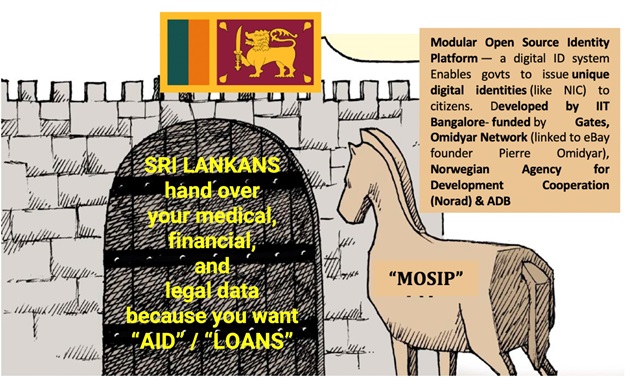
MOSIP (Modular Open Source Identity Platform) is a digital ID system modeled on India’s Aadhaar, funded by BMGF, Omidyar, & Norad and developed by IIT India. It collects biometric and demographic data and is now being piloted in Sri Lanka.
Threat: MOSIP is a digital Trojan horse. Though marketed as open-source, Indian consultants will have access to Sri Lankan citizen data, posing serious risks to data sovereignty and national security.
Is this digital system really necessary—and why not build it locally?
Sri Lankan experts could design a system tailored to national needs. But by importing a foreign-designed platform, Sri Lanka surrenders digital independence.
Threat: Future upgrades, data hosting, and maintenance will require foreign expertise—costing dollars and giving outsiders ongoing control over our most sensitive information.
GATES’ INDEPENDENT FOOTPRINT IN SRI LANKA’S CORE SECTORS
How is Gates shaping agriculture—and what does that mean for food sovereignty?
Gates backs digital farming, fortified rice, and supply-chain digitization. On the surface, this appears modern—but it centralizes decision-making and control of agri-data which can easily be manipulated & get out of local farmer control.
Threat: Sri Lankan farmers risk becoming data-dependent tenants on digital platforms owned or influenced by Gates’s global network—compromising food sovereignty and farming autonomy.
What’s in the fortified rice initiative—should we be concerned?
Gates promotes fortified rice to address malnutrition. But this bypasses local nutrition models and may eventually push lab-grown artificial or patented alternatives linked to Gates’s other food investments.
Threat: Control over what children eat shifts from the government to foreign funders—undermining public health autonomy and local food traditions even parental controls.
What is Gates’s interest in climate and weather—and how might that affect Sri Lanka?
Gates funds geoengineering research, including stratospheric aerosol injection to reflect sunlight. Such experiments could alter monsoon patterns or regional weather.
Threat: Sri Lanka’s rainfall, agriculture, and ecosystems could suffer unintended damage—without recourse or oversight. Is this why we see sudden shifts in weather of late?
Why is Sri Lanka being targeted now?
Following the 2022 economic collapse, Sri Lanka became a soft target for reformers.” The BMGF sees the island as a test bed for global expansion—just as colonial rulers once did. Threat: Crises are being exploited to push foreign-led solutions that undermine national sovereignty & usurp people’s representative powers under the guise of aid and efficiency. Ironically, it is these same people’s representatives that are foolishly handing over power that should be in their control & would see their exit sooner than later.
Is the government aware of this—and how transparent is this process?
Gates funds a Program Support Unit inside the President’s Office. This raises serious red flags about policy capture and loss of democratic oversight.
Threat: Citizens are unaware, unconsulted, and excluded—democracy is sidelined in favor of elite deal-making.
What does Gates control globally, and why is that relevant to Sri Lanka?
Influence in food tech, alternative proteins, and water systems
Threat: Sri Lanka’s water management and food systems could fall under the shadow of Gates-aligned corporations, pushing foreign tech and diminishing national control. We can recall global corporates of the view that water is not a human right! Water falling into transnational hands spells doom.
What is Digital Colonialism—and is Sri Lanka at risk?
Digital Colonialism is the 21st-century version of empire-building: instead of foreign boots, outsiders control data, public systems, and infrastructure – basically the entire Nation including its citizens.
Threat: By accepting foreign-designed DPI, Sri Lanka risks long-term dependency, data surveillance, and the erosion of innovation and local expertise while neutralizing citizens to slaves & onlookers with time.
Final Warning: Sovereignty must not be sold for Aid
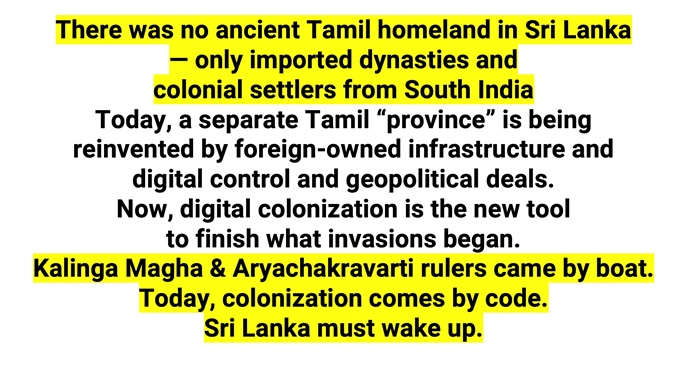
Beneath promises of development” lies a dangerous truth: Sri Lanka is becoming digitally colonized by private actors like Gates and foreign governments like India. ‘
With core data including citizens’ private information (such as financial accounts, property ownership, medical records, legal histories, and more), Sri Lankans can easily be profiled and manipulated. How many Sri Lankans are aware of these threats enough to get the Government not to sign away Sri Lanka’s & Sri Lankan’s sovereignty for political survival. At the end of the day the politicians will be the first to be dislodged! They are committing hara kiri.
With data on food, water, resources and public infrastructure being outsourced & digitally made visible to external actors, the nation risks becoming a client state, unable to protect its people or make independent decisions. A national army that fought & won a terrorist movement will be mere onlookers watching codes take over a nation.
Digital Colonialism is 21st-century empire-building: no boots, just backend access.
People must be informed of what these aid” and loan” conditions truly mean—and asked whether they are willing to risk having their privacy exposed and manipulated by foreign powers!
Sri Lanka must assert its right to national self-determination, invest in its own talent, and say no to Trojan Horse reforms—no matter how well they are packaged.
Let Sri Lanka lead its future—not be programmed by foreign-coded agendas.
The Ministry of Defence (MOD), extending its full support to the Ministry of Public Security, launched a special joint security operation in the Kadana, Wattala, and Ragama Police areas on the evening of 4th July. The objective of this operation was to enhance community safety, curb illegal activities, and restore public confidence in law enforcement efforts.
The Sri Lanka Army, Navy, Air Force, Police, and Special Task Force (STF) attended this special operation and the operation demonstrated strong inter-agency collaboration in maintaining law and order.
During the operation, several key measures were implemented including roadblocks, random checks on vehicles and individuals, house-to-house searches, and the arrest of suspects linked to unlawful activities. These actions were conducted with professionalism and discipline, ensuring minimal disruption to the public.
The MOD remains committed to working closely with all relevant agencies to create a safer environment for citizens. Such operations will continue in other identified areas to ensure sustained peace and public security across the island.
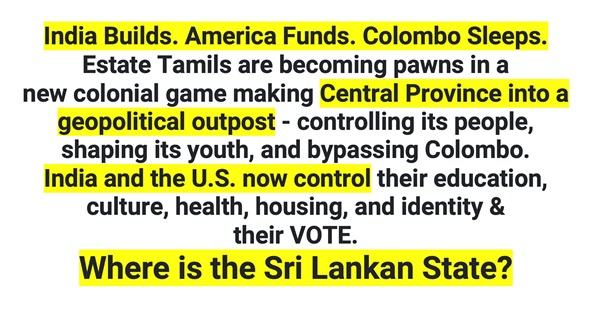
Sri Lanka’s Central Province has been a symbol of colonial exploitation and post-independence neglect—home to thousands of Indian-origin Tamils brought under British imperial labor schemes. Today, the same region has transformed into a geopolitical battleground—for soft power occupation, ethnic patronage, and foreign-state engineering. India is now assuming role of political patron & cultural guardian over Indian-origin Tamil estate community & influencing or rather exerting control over every aspect of their life. Then enters US, under guise of human rights” & inclusion” also spreading its influence in a bid to win loyalty & use this minority for western-imperial goals. The warning signs are no longer subtle—they are loud, open, and institutionalized. Is Colombo unaware, unwilling, or complicit in this systematic foreign penetration of its central heartland?
How did Indian Tamils end up in the Central Province?
Aspect
Detail
Group
Indian Tamils (Estate Tamils / Hill Country Tamils)
Origin
Tamil Nadu (Tirunelveli, Madurai, Tanjore, Ramanathapuram)
Brought by
British colonialists via kangani & maistry recruitment systems
Ideal for plantation agriculture; distant from nationalist resistance
British Colonial Motives:
Exploit Central Highlands for export crops (first coffee, then tea).
Sidestep local Sinhalese resistance by importing a detached, loyal, low-cost labor force.
Establish self-contained, politically isolated settlements (line rooms on estates).
India’s Current Penetration – Sector by Sector
Each of India’s activities in the Central Province ties into long-term strategic objectives, with significant national security and sovereignty implications.
1. Education
Involvement:
Indian-funded estate schools.
Indian syllabus influence in Tamil-medium schools.
Indian scholarships to estate youth.
India’s Strategic Objective:
Shape future generations loyal to Indian ideology and culture.
Create an Indian-educated elite to represent Indian interests locally.
Dangerous Implications:
Since Estate Tamils are now regarded Sri Lankan citizens, the Indian direct involvement with them likely to alienate them from Sri Lanka’s national curriculum and identity.
India is increasingly attempting to Politically and culturally align with youth leadership
2. Culture
Involvement:
Opening Indian Cultural Centres in Kandy.
Sponsorship of Bharatanatyam, Carnatic music, Hindu festivals – Pro-Indian culture
Promotion of Indian Tamil cinema, TV, and literature.
India’s Strategic Objective:
Promote Tamil Nadu cultural hegemony among estate communities & distance them from Sri Lankan identity.
India is attempting to make Indian-origin Tamils’ identity distinct from Sri Lankan Tamils or Sinhalese.
Dangerous Implications for Sri Lanka:
Cultural ghettoization and resistance to national integration – they end up a class of people who are by paper Sri Lankan citizens only.
Undermining Sinhala-Buddhist and indigenous Sri Lankan traditions.
3. Religion
Involvement:
Indian-funded kovils and Hindu religious activities.
Support for Saivite institutions mirroring Tamil Nadu’s religious map.
India’s Strategic Objective:
Embed Indianized religious-cultural footprint in Central Sri Lanka.
Deepen Tamil Nadu-style Hinduism as identity
Dangerous Implications for Sri Lanka:
Marginalization of Buddhism in historically sacred areas like Kandy & replacing Indianized Hinduism.
Import of caste-based religious divisions.
4. Tourism
Involvement:
Indian-run mythological pilgrimages and tourist circuits (Kandy, Nuwara Eliya).
Promotion of Hindu sites as Indian heritage points – given that India annually has festival wherein they burn effigy of Ravana after hurling insults & stones at it – this practice may soon become a feature in Sri Lanka if not stopped.
India’s Strategic Objective:
India using religion and heritage tourism as soft power.
Control revenue and narrative in sacred localities.
Dangerous Implications for Sri Lanka:
Undermining of domestic tourism sector especially the Sinhala History/Heritage
Surveillance and infiltration risks under guise of pilgrimage.
5. Sports
Involvement:
Sponsorship of youth cricket and training camps.
Introduction of Indian sports professionals in schools.
India’s Strategic Objective:
Attempting to win emotional loyalty through grassroots engagement.
Use sports diplomacy to propagate goodwill for India.
Dangerous Implications for Sri Lanka:
National identity replaced by ethnic allegiance to India
Politicization of young athletes.
6. Infrastructure
Involvement:
India upgrading Central Province roads and railways.
Power infrastructure and mobile towers by Indian companies.
India’s Strategic Objective:
Create physical integration between Indian-influenced communities and Indian shipping/logistics.
Dangerous Implications for Sri Lanka:
Indian presence in high-altitude strategic terrain.
Security vulnerability in national communication and energy grids.
7. Joint Ventures
Involvement:
Indo-Lankan ventures in tea factories and agribusiness.
Indian companies processing local plantation outputs.
India’s Strategic Objective:
Economic dominance of estate sector.
Make Sri Lanka dependent on Indian-owned value chains.
Dangerous Implications for Sri Lanka:
Erosion of domestic control over national resources.
Pressure on Sri Lanka to concede trade or land concessions.
8. Agriculture
Involvement:
Introduction of Indian seeds, fertilizers, agri-tech to estate areas.
Indian-trained agricultural officers operating in estates.
India’s Strategic Objective:
Control agricultural inputs and training pipelines.
Embed Indian agri-economy within Sri Lankan estate sector.
Dangerous Implications for Sri Lanka:
Displacement of traditional practices.
Dependency on Indian supply chains for food sovereignty.
9. Roads & Rail
Involvement:
Modernization of Kandy–Matale rail line and Badulla rail upgrades.
Indian-financed estate road development.
India’s Strategic Objective:
Secure access routes into highlands.
Enable commercial and strategic mobility.
Dangerous Implications for Sri Lanka:
Military-use dual-purpose infrastructure.
Possibility of Indian-facilitated troop movement or surveillance during geopolitical crises – these areas cannot be ignored or ruled out.
10. Hospitals & Health
Involvement:
Construction of Dickoya Hospital (fully Indian-funded).
Indian health camps, telemedicine, and eye surgeries.
India’s Strategic Objective:
Win hearts and minds through healthcare diplomacy.
Promote Indian pharma and telehealth control completely erasing hela medicines.
Dangerous Implications for Sri Lanka:
Health data exposure.
Undermining local public health capacity and planning.
11. Training & Vocational Programs
Involvement:
ITEC training for estate youth as per Indian curriculums.
Yoga, tailoring, ICT and language programs funded by Indian High Commission.
India’s Strategic Objective:
Create Indian-trained and India-dependent workforce loyal to India
Shape minds and aspirations to align with Indian economic interests.
Dangerous Implications for Sri Lanka:
Shift in youth allegiance and migration priorities.
Loss of human capital to India-centric labor markets.
12. Scholarships
Involvement:
Over 800 scholarships yearly to Indian universities.
Programs focused on estate Tamil students.
India’s Strategic Objective:
Groom future leaders aligned with India’s geopolitical interest while citizens of Sri Lanka & making use of all entitlements given by Sri Lanka.
Plant pro-Indian ideological agents in Sri Lankan institutions & private sector.
Dangerous Implications for Sri Lanka:
Policy infiltration through Indian-trained graduates.
Dismantling of Sri Lankan national consciousness.
13. Housing
Involvement:
Over 60,000 houses built by India across Central, Uva, and Sabaragamuwa Provinces.
Many bear Indian flags and are tied to MoUs with political conditions.
India’s Strategic Objective:
Cement demographic loyalty and ensure permanent Indian-origin voting blocs that use vote-base to suit Indian political interests.
Use housing diplomacy to gain political influence.
Dangerous Implications for Sri Lanka :
Creation of India-aligned ethnic enclaves in the heartland of Sri Lanka
Politicization of basic rights in return for foreign allegiance.
14. Land Leased to India
Examples:
Dickoya Hospital land under long-term Indian management.
Indian Cultural Centres in Kandy on state land.
Land for Indian-funded housing and schools leased under bilateral agreements.
India’s Strategic Objective:
Establish semi-sovereign Indian zones in interior Sri Lanka & use these to stage anti-Sri Lanka protests when/if required.
Permanent bases for Indian cultural, political, and intelligence operations.
Dangerous Implications for Sri Lanka:
Violates Sri Lanka’s territorial integrity – but Sri Lanka’s politicians & political parties are only to blame for permitting incursions.
Creates enclaves vulnerable to foreign interference or claims in future conflicts.
Indian Mission Influence in Sri Lanka’s Central Province
India has a diplomatic & consular presence in Sri Lanka’s Central Province in the form of a Deputy High Commission Office in Kandy. It serves as a critical soft power tool over the Indian-origin Tamils also known as Estate Tamils / Hill Country Tamils & Malaiyaha Tamils.
This Mission covers not only Central Province but Uva Province & parts of Sabaragamuwa too.
Kandy District: Gampola, Nawalapitiya, and areas around Hantana
Badulla District: Bandarawela, Hali Ela, Welimada
Sabaragamuwa: Rakwana, Balangoda areas with plantation populations
The Indian Mission in Kandy offers:
Mobile consular camps – Indian passport/OCI/PIO services to persons of Indian origin
Citizenship assistance for recent Indian-origin migrants
Close engagement with estate trade unions and political leadership
Implication for Sri Lanka : Creates dual-loyalty and emotional ties to India; undermines Sri Lankan national identity among estate Tamils.
Objective
Method
Strengthen cultural allegiance
Promote Indian identity through schools, temples, and cultural programs
Control estate politics
Influence local leaders, fund pro-India parties (e.g., CWC)
Create a loyal vote bank
Deliver services directly to estate communities, bypassing Sri Lankan state
Extend Tamil Nadu’s cultural frontier
Promote Hinduism, Tamil language, and traditions rooted in India
Humanitarian camouflage for long-term control
Use housing, education, health, and economic aid to entrench influence
India’s Strategic Objectives Behind These Regular Visits
Direct Diplomatic Access to a Target Population
Estate Tamils are the only community in Sri Lanka regularly and publicly engaged by a foreign mission at grassroots level.
India bypasses Colombo and provincial governments, acting as a parallel state in the region.
Cement Emotional & Cultural Loyalty
By attending Hindu religious festivals and Tamil cultural events, the High Commissioner plays the role of guardian and kin—not a foreign diplomat.
Emotional manipulation: estate families begin to see India as their original homeland and patron.”
Sustain a Politically Useful Vote Bloc
The Indian High Commission cultivates loyalty to pro-India estate Tamil parties (CWC, DPF, etc.).
Estate Tamils become a predictable vote bank in key electoral districts.
Neutralize Integration with the Sri Lankan State
Consistent Indian presence in the form of dignitary visits discourages full national integration.
Projects are presented as Indian gifts,” not Sri Lankan government services.
Dangerous Implications for Sri Lanka
Risk
Description
Loss of sovereignty
Indian diplomats operate with quasi-administrative roles in Central Province, influencing local governance.
Identity manipulation
Estate Tamils develop dual or hybrid identities, more loyal to India than Sri Lanka.
Electoral interference
Visits often precede elections, subtly directing estate Tamil voters toward India-aligned candidates.
Permanent psychological occupation
Children grow up with India-branded schools, books, uniforms, and flags, believing India is their benefactor, not Sri Lanka.
Territorial soft power encroachment
Regular diplomatic visits normalize Indian control of entire regions without legal sovereignty.
US visiting Central Highlands too
While the nature of India’s visits to Estate Tamils can be understood, we have to wonder why the US envoys have been increasing their visits to Estate Tamils & creating new programs & initiatives for them as well as using them as a launch pad for LGBTQIA promotions!
These visits began by Alaina Teplitz (2018-2021) & has been continued by present envoy Julie Chung (2021 to present). Not only the US envoys but officials from USAID, US embassy officials & even human rights officials are regularly visiting the areas.
They have visited Indian-built housing schemes, schools, overseen womens’ livelihood projects and created civil society meetings with plantation unions and NGOs.
When US visits a segment community we know it is to create a narrative around marginalized minority” merging with their toolbox of human rights, freedoms etc as a legitimate ground for western influences under rights’ banner. US would use these narratives to undermine the majority Sinhala Buddhist control. Though the community is heavily cultivated by India, US has ways & means to shift that in favor of their control. US will also be concentrating on youth leaders, women and grooming them to think & act in the interest of the West.
Implications for Sri Lanka
Risk
Description
Parallel foreign control
Both U.S. and India are managing a key population base independently of the Sri Lankan state.
Weaponization of minority identity
Estate Tamil grievances are used as tools to pressure Sri Lanka at the UNHRC and international forums.
Strategic foothold in heartland
Estate region = highlands, water resources, tourism potential. Foreign soft power here becomes a security threat.
Internal political destabilization
Estate-based leaders groomed by foreign missions could later push autonomy or constitutional change agendas.
Support for regime change operations
The U.S. uses grassroots NGOs and activists from estate areas to mobilize dissent, especially during elections or crises.
What Sri Lanka’s leaders & think tanks should see is that the community will be easy targets & vulnerable to vested interests of both India & US who are both separately & jointly competing to control them & use them to their geopolitical advantage. Either way Colombo’s governance will be undermined. Is Colombo even aware of such a scenario taking place under their very nose?
In a powerful step toward environmental sustainability and youth empowerment, NDB Bank is proud to announce its partnership with the Wildlife and Nature Protection Society (WNPS) to support the expansion of the WNPS Youth Wing’s ‘Education for Conservation’ program to ten schools in the Kurunegala District. The official MoU signing for this partnership took place on 20th June at NDB Bank premises with representatives from both WNPS and the Bank present. This initiative is part of NDB’s broader commitment to empowering future generations to lead with purpose, passion, and a deep respect for the environment.
The program will engage over 500 schoolchildren annually, creating a lasting impact through education, leadership training, and hands-on environmental action. Through a carefully designed structure, students will participate in workshops covering themes such as biodiversity, climate change, pollution, and sustainability, while also receiving mentorship to launch school-based sustainability projects and citizen science initiatives.
At NDB, we believe that creating a sustainable future begins with educating and equipping our youth,” said Lasantha Dassanayaka, the Head of NDB Bank’s Corporate Sustainability Committee, This partnership with WNPS reflects our unwavering commitment to sustainability, conservation, and holistic nation-building. We are not just funding a program, we are investing in the environmental consciousness of tomorrow’s leaders.”
Echoing his sentiments, Shontaal Manuelpillai, the Co-Chairperson of WNPS Youth Wing stated Positive change starts within your communities, and schools are one of the first points of action. The WNPS Youth Wing is excited to start a new chapter in the ‘Education for Conservation’ journey of youth inspiring youth creating the next generation of thoughtful leaders”
As a financial and brand partner of the initiative, NDB will support a range of activities across the program’s lifecycle, including:
Awareness-building sessions conducted in schools
Field-based nature education events and reforestation drives
A district-level felicitation ceremony to honour impactful student projects
Special leadership development training for top-performing youth ambassadors
Additionally, students selected as district ambassadors will be supported through a dedicated stipend facilitated via NDB accounts, strengthening the connection between responsible banking and responsible living. NDB staff will also play an active role in engaging with the program through volunteering and mentorship, creating a dynamic platform for collaboration and shared purpose.
The WNPS Youth Wing Program has already proven its effectiveness in multiple districts, cultivating environmentally literate youth and inspiring grassroots action. With NDB’s support, the program now enters the Kurunegala District with renewed energy and expanded capacity, aiming to build a vibrant network of 100 youth leaders, 10 sustainability action projects, and 10 biodiversity monitoring initiatives.
This partnership also supports NDB’s ESG-aligned sustainability agenda, where environmental protection, community education, and inclusive leadership development form integral pillars of the Bank’s purpose-driven strategy.
NDB Bank remains committed to being a force for good—enabling transformation not just in financial ecosystems, but in the ecological and social landscapes of Sri Lanka. Through this initiative, the Bank invites students, educators, and the broader community to come together in safeguarding the natural world and shaping a future built on awareness, resilience, and respect for the planet.
Defence Secretary Air Vice Marshal Sampath Thuyacontha (Retd) chaired an important meeting at the Ministry of Defence on Thursday (Jul 3) to discuss the reintroduction of Beira Lake as a water aerodrome, an initiative poised to bring renewed vitality to Sri Lanka’s tourism and domestic aviation sector.
The meeting brought together key stakeholders to review plans for Cinnamon Air, operated by Saffron Aviation (Pvt) Ltd, to take over seaplane operations at the historic Beira Lake Seaplane Base. As a company specialising in scheduled and chartered floatplane and wheeled aircraft services, Cinnamon Air is set to play a pivotal role in reconnecting Colombo’s urban heart to the skies and beyond.
At the outset, the Defence Secretary highlighted the government’s broader vision of bolstering Sri Lanka’s tourism and hospitality industry. He underlined the significance of domestic aviation as an essential driver of this growth, providing faster, scenic travel options that both local and international visitors can enjoy.
Discussions during the meeting focused on several critical areas, including the historical context of the Beira Lake Seaplane operations, overall security considerations, takeoff and landing procedures and the need to address environmental concerns responsibly. Emphasis was placed on fostering effective collaboration between all stakeholders to ensure the success and sustainability of this ambitious project.
Concluding the meeting, Air Vice Marshal Thuyacontha (Retd) extended his appreciation to all participants for their commitment and encouraged continued coordination to expedite the re-establishment of seaplane services at the iconic Beira Lake. He also proposed convening again in the near future to review progress and address any challenges that may arise during implementation.
As plans move forward, the reintroduction of seaplane operations at Beira Lake holds the promise of enriching Sri Lanka’s tourism landscape while enhancing urban connectivity and celebrating the country’s unique blend of history, nature and modern infrastructure.
The meeting was attended by the officials representing the Sri Lanka Navy, Air Force, Police, Civil Aviation Authority, Urban Development Authority, Central Environmental Authority, Sri Lanka Ports Authority, John Keels Group and Saffron Aviation (Pvt) Ltd.
Sunday, July 6, will be the tenth and the climatic day of Moharram which this year, has a unique feature, something that has never happened in history. A sizeable section of the world will, mostly, wear black, the colour of mourning and yet they will celebrate. In total contradiction of the Western media, the celebration will be for Iran having taught Israel a lesson.
The celebrations will be alongside the mourning for the tragedy of Karbala more charged this time than ever before.
For the uninitiated, the solemn observances of Moharram centres around the tragedy of Karbala which took place in 680 AD, barely 48 years after the death of Prophet Mohammad.
To escape the frenetic pace of messengers from Damascus seeking Hussain’s bayat”, or an endorsement of Yazid’s usurpation of the Caliphate, Hussain decided to leave Medina, for an indefinite period. His daughter Sughra was too ill to travel. The poignancy of the tragedy begins here.
What Hussain’s plan was has remained shrouded in a series of speculative thesis. All one does know is that the epic scale of the high tragedy was eventually enacted in Karbala. Members of Hussain’s family, his close friends and dedicated followers were a band of 72.
Armies of Yazid, numerically much larger, zero onto the group after having cut off water from Euphrates for three days in the torrid heat of Karbala. This is how the blockade of water, food and medicine to Gaza resonates with those observing Moharram.
On the tenth day of Moharram Hussain sees all options of peace closed, except one – endorse Yazid’s rule. Ali’s son would never compromise core principles.
Hussain look the decision to allow male members of his entourage to proceed one by one for single combat as was the custom then. The West has never understood how deeply embedded in the Shia psyche is the notion of martyrdom. Every combat became an epic in the hands of poets hundreds of masterpieces on such varied themes as honour, valour, separation, horsemanship, swordsmanship, relations between brother and sister, aunts, nieces, horse and master, all in dirges, nohey, songs of mourning and, above all, marsias measuring the greatest in world literature, particularly in the hands of such masters as Mir Anis.
The focus this Sunday, 10th of Moharram will be on Hussain’s passionate pursuit of peace when principles are in the bargain. Martyrdom emerges as the paramount theme in this sequence. The remarkable paradox this Sunday is that the mourners of the martyrs of Karbala will also, in undertones, be celebrating their having shattered the myth of Israel’s invincibility. For them Netanyahu will have donned the colours of Yazid. I recommend my friend Pravin Sawhney’s three essential videos” on the 12 day Iran-Israel war which confirm my own observation on the war.
Israel and its western supporters with the US in the lead has a different narrative: Iran’s nuclear project has been obliterated” to use Trump’s words.
A great tragedy that has befallen the West and which the West has chosen to ignore, is the collapse of the credibility of the western media. The media carries on regardless without qualms, not shedding spurious punditry.
Almost oracular in his pronouncements is the senior guru of the New York Times, Thomas Friedman. He is quite stunning in the authority he has given himself: he talks of Putin’s kleptocracy which he compares unfavourably, of course, with God’s gift to good governance in the persona of Syria’s Ahmal al Sharaa who mutated from Abu Mohammad al Jolani on whose head there was a bounty of $10 million because he was a certified terrorist and whom Friedman describes delicately as the new, frail, democratic government of Syria.”
Friedman is rejoicing not just at the transformation of Sharaa. He visualizes a lot of Sunnis and Shias in Lebanon and Iraq quietly rooting for Trump and Prime Minister Benjamin Netanyahu. Really? I thought they were being berated for genocide. For the first time in decades, a Syrian state and a Lebanese state are being rebuilt by decent leaders, he continues.
Jolani or Sharaa or whatever name he acquires in the future would never have dreamt in his wildest dreams that he would ever qualify to be called decent” by a pundit who pontificates from the pinnacle.
I wonder what Robert Stephen Ford, US Ambassador to Syria during the Arab Spring, would have to say about Friedman’s ecstasy. The wonderful thing about American officials is that the day they retire, they acquire the right to sing like canaries. Ford revealed in a recent speech, that a British Intelligence outfit asked him to groom” Sharaa diplomatically”, socially” and sartorially” to be able to play a bigger role in Syria.
Rather like the moods in the French and the British camps on the eve of the Battle of Agincourt as sketched in Shakespeare’s history play, Henry V, Israel and Iran offer two distinct civilizational visions to compare and contrast at this moment of war and mayhem.
When spaces of apartheid and separate development are expanding like dark shadows, it may be useful even for enemies to know a little more about each other.
I have been travelling to Israel since 1968 when an Australian set fire to the Al Aqsa Mosque. A country of soft, socialist Kibbutz seemed quite agreeable. My untrained eyes were unable to spot the nasty works of Zionism behind the curtains.
Israelis and their cohorts may find it useful to keep a steady gaze on Aashura, the tenth day of Moharram this Sunday in Iran, Lebanon, Iraq, Syria, Yemen, Bahrein, Dammam in Saudi Arab, Kuwait and significant minorities in Pakistan and India. The tendency to ignore or downplay Shia history and influences are self defeating. For instance how can one ignore the Fatimid rule which founded Cairo in the 10th century, expanded to Tunis. It is a forgotten story that Moharram processions were regular for 150 years of Fatimid rule in Palermo, the capital of Sicily.
Colombo, July 4 (Daily Mirror) – The government earlier said a joint statement was to be issued by Sri Lanka and the United States over the reciprocal tariffs but that turned out to be another tall story like most of the stories of the government, SJB MP Dr. Harsha De Silva said.
He said in a post on X that the government had rejected and laughed at the Opposition when they offered to help regarding the matter.
“President Anura Kumara Dissanayake and his government promised the people that they knew what they were doing and not only that they will ensure the stability of the economy, but register strong growth. They said a joint statement was to be issued by the two nations, but that turned out to be another tall story like most of their stories. Yes, there are a few more days and let us give them the benefit of the doubt. But if they don’t deliver, then what? What is plan B and C? Who is leading the strategy on this? Lies won’t do this time,” he said.
“Will Sri Lanka strike a better US tariff deal than Vietnam? When I questioned in Parliament as to the current status of the tariff negotiations with the US, Minister Anil Jayantha boasted that Sri Lanka is the only country in Asia negotiating a deal with the US ahead of the July 9 deadline and said a major progress and positive results are expected. However, Vietnam already did a deal this week to bring down their 46% reciprocal tariff to 20% and India is working round the clock to finalise a deal including some HS codes to come down to zero. Thereafter, they are planning on a comprehensive trade deal later this year,” the MP said.
The Lanka Indian Oil Company (LIOC) has donated Rs. 100 million to the President’s Fund, the President’s Media Division (PMD) said.
Dipak Das, Managing Director of Lanka Indian Oil Company handed over the relevant cheque to Dr. Nandika Sanath Kumanayake, Secretary to the President, at the Presidential Secretariat today (04).
Colombo, July 4 (Daily Mirror) – Opposition MP Mujibur Rahman has called for deeper investigations into the controversial release of 309 red-labelled containers, asserting that critical questions remain unanswered.
Speaking at a media briefing yesterday, the Samagi Jana Balawegaya (SJB) MP said the scope of the inquiry conducted by the presidential committee appointed by President Anura Kumara Dissanayake was too narrow. The committee’s mandate was limited to determining whether these containers were released outside standard procedures,” he noted.
Rahman stressed the need to uncover whether political interference was involved in the release and to clarify the nature of the cargo within the containers. It is vital to establish whether these containers were re-exported and whether any political figure facilitated their release,” he added.
He further demanded accountability from the Department of Customs. The Customs Chief must disclose whether any political leader issued orders regarding the release. If he fails to reveal the truth, the blame will fall squarely on him and his officers,” Rahman warned.
The MP also questioned the government’s reluctance to act on the recommendations made by the presidential committee. Why have government ministers remained silent about the next steps? Will a forensic audit, as suggested in the committee report, be carried out?” he asked.
According to the report, the committee found it unclear whether the cargo posed a national security risk or a threat to public health. It also revealed that neither physical inspections nor scanning of the containers had been carried out in line with standard procedures for red-labelled shipments.
The report recommended disciplinary action against customs officials involved in the unauthorised releases. It accused the Director General of Customs of overstepping his authority under the Customs Ordinance. It also noted a breakdown in the established risk management system, stating that red-labelled containers require the approval of four committee members prior to release. In this case, only one member, aside from the Director General, had approved the release.
In addition to disciplinary action, the report called for new protocols governing the release of containers to prevent future lapses.
Colombo, July 4 (Daily Mirror) – Japanese Ambassador Akio Isomata stressed that the eradication of corruption and good governance is a prerequisite for restoring confidence of both public and private entities, including those of Japan, in making investments in Sri Lanka, according to a press release from the Japanese Embassy.
Japan will continue to work closely with the Government of Sri Lanka for the country’s sustainable development, he said.
ISHIZUKI Hideo, Assistant Minister/ Director-General, International Cooperation Bureau, Ministry of Foreign Affairs of Japan, held the Japan-Sri Lanka Economic Cooperation Policy Dialogue with Dr. Harshana Suriyapperuma, Secretary to Ministry of Finance, Planning and Economic Development yesterday.
The Japanese Ambassador and representatives from the Ministry of Foreign Affairs, Ministry of Finance, Ministry of Economy, Trade and Industry (online), the Embassy of Japan and Japan International Cooperation Agency (JICA) also attended the meeting.
Mr. Ishizuki highlighted that Sri Lanka is a critical partner for maintaining and promoting a Free and Open Indo Pacific and expressed his determination to continue development cooperation with Sri Lanka, supporting its efforts to improve the standard of living of the people and to combat corruption, in particular.
During the Dialogue, he elaborated on the overview of Japan’s Official Development Assistance (ODA) and its Country Development Cooperation Policy, which defines the direction of Japan’s ODA policy for Sri Lanka.
Both sides exchanged views on Japan’s future development cooperation with Sri Lanka, including the ongoing yen loan projects to stabilise and reinforce Sri Lanka’s economy as well as overcome its socioeconomic challenges.
Both political and terrorist separatism in Sri Lanka have toyed with the claim to a separate Tamil homeland. However, before examining either, it is critical to return to the historical roots of the Tamil presence on the island to determine whether such a homeland or Tamil kingdom ever existed independently. When the timelines, records of foreign writers, and colonial-era observations are scrutinized, the claim to an indigenous Tamil kingdom collapses and is non-existent.
If there was a Tamil kingdom in Sri Lanka, who founded it – who were these kings?
Were the rulers truly indigenous or foreign invaders from Tamil Nadu?
Where are the civilizational evidence similar to that of the first capitals in Anuradhapura, Polonnaruwa etc?
Tamil Nadu with 80million Tamils sought self-determination & a separate homeland state based on being Tamil, can the same ethnic group claim two separate homelands across two sovereign nations?
Was Sri Lanka ever historically or politically part of Tamil Nadu or South India?
South Indian Kalinga Magha invaded North Sri Lanka first from 1215 to 1236
– The destruction of significant Buddhist sites during his invasion is testimony to a thriving Sinhalese Buddhist presence in the North, which Kalinga Magha forcibly displaced. This historical fact is now being twisted to falsely support separatist claims that Tamils were originally Buddhists.
After his reign began to weaken – South Indian Tamil mercenaries and administrators remained, creating the foundation for Aryachakravarti rule. Aryachakravarti dynasty rose to power under the protection or appointment of the Pandya Empire of Tamil Nadu — likely around 1250s–1270s.
These historical accounts collectively show the Aryachakravarti dynasty was a South Indian import and did not represent a native Tamil sovereignty.
Colonial Testimonies and Aryachakravarti Rule
Queyroz, in his 17th-century chronicle, clearly identifies Aryachakravarti as a South Indian invader who established dominance over the Jaffna Peninsula.
The Portuguese, Dutch, and British all documented this dynasty as having foreign roots. There is no historical record of a Tamil kingdom existing in Sri Lanka prior to the Aryachakravarti dynasty. The Aryachakravarti rule emerged only after the island experienced successive invasions from the Chola and Pandya kingdoms—numbering at least 17 incursions from South India.
Circa mid-13th century (~1250 AD): The dynasty was founded following the weakening of Kalinga Magha’s reign. The first Aryachakravarti ruler is believed to have been a Tamil military leader appointed by or associated with the Pandya Empire of Tamil Nadu.
~1250–1619 AD: The Aryachakravarti dynasty ruled the Jaffna Peninsula, establishing a feudal Tamil rule with close ties to South Indian powers. Their control was primarily limited to the Northern coastal region and had no documented historical continuity.
It is important to note that the Tamil-speaking populations present in the Northern Province today are largely descendants of later migrations, including South Indian mercenaries during medieval invasions and significant colonial-era arrivals, such as the Malabars” and Indian laborers brought by the Portuguese, Dutch, and British. This distinction clarifies that the current Tamil presence does not equate to an indigenous Tamil homeland or ancient sovereign Tamil polity.
South Indian King Cankili II was the last ruler of the Aryachakravarti dynasty.
1619 AD: The dynasty fell to the Portuguese, who executed the last king, Cankili II, marking the end of South Indian Aryachakravarti rule in Sri Lanka.
Multiple Sinhalese chronicles and foreign accounts indicate that the Aryachakravartis paid tribute to the Sinhala kingdom in Kandy. After the Portuguese destroyed the Aryachakravarti dynasty in 1619, King Senarath sent Mudaliyar Atapattu in 1620 to reclaim control of the North.
This indicates that the Sinhalese kings considered the North part of their realm, and saw the Portuguese takeover as an encroachment on Kandyan territory.
The fact that a Sinhala king was the one to respond militarily, not any Tamil successor, reinforces that the Aryachakravartis did not hold independent sovereignty over the North in any recognized national sense.
The Aryachakravarti dynasty was not a sovereign equal to the Kandyan Kingdom.
Rather, it was a foreign-invader dynasty that exercised localized control in the North but was not recognized as sovereign across the island — and when it fell, the Kandyan Kingdom took responsibility by trying to reclaim the territory from the Portuguese, not any Tamil political entity.
No Indigenous Tamil Monarchy
There is no lineage of Tamil kings in Sri Lanka unconnected to Tamil Nadu. All monarchs associated with Tamil rule in the North stemmed from dynasties or invasions from South India. This undermines the foundational argument of a historically rooted Tamil homeland on the island.
Can a dynasty founded by Indian invaders be used to claim an ethnic homeland in Sri Lanka?
Why are Tamil historians unable to list native kings of Jaffna prior to these invasions?
This undermines the foundational argument of a historically rooted Tamil homeland on the island.
Sinhala Presence in the North – Sinhalese Buddhist Roots in the North Prior to Tamil Invasions
Extensive archaeological and epigraphic findings confirm that the Northern regions of Sri Lanka were an integral part of the ancient Sinhalese Buddhist civilization long before the arrival of Tamil invaders such as Kalinga Magha in the early 13th century. Excavations in the Jaffna Peninsula and surrounding areas have uncovered Buddhist stupas, monasteries, and inscriptions dating back to the Anuradhapura period (4th century BCE – 11th century CE), a time when the Sinhalese kingdom flourished and spread its cultural and religious influence across the island. Notably, rock inscriptions and Brahmi script epigraphs found in the North mention Sinhalese kings and Buddhist monks, confirming continuous Sinhalese settlement and religious activity (Codrington, 1926; Paranavitana, 1937).
Furthermore, the toponymy of many place names in the North retains traces of Sinhalese origin, later Tamilized over centuries, indicating a longstanding Sinhalese presence that predates the Tamil influx (Dharmadasa, 1992).
Historical chronicles such as the Mahavamsa and Culavamsaalso describe the spread of Buddhism and Sinhalese rule extending into northern territories well before the 13th century, corroborating the material evidence.
This rich Sinhalese Buddhist heritage was severely disrupted during Kalinga Magha’s invasion (1215–1236 AD), during which significant Buddhist sites were destroyed or abandoned, marking a violent shift in the region’s demographic and cultural composition (Indrapala, 2005). The overwhelming archaeological and historical record firmly establishes that the North was not a Tamil homeland prior to the 13th century but was deeply rooted in Sinhalese Buddhist civilization.
Reference:
Codrington, H.W. A Short History of Ceylon. London: Macmillan, 1926.
Paranavitana, S. Inscriptions of Ceylon. Volumes I-IV, 1937-1950.
Dharmadasa, K.N.O. Language, Religion and Ethnic Assertiveness: The Growth of Sinhalese Nationalism in Sri Lanka. 1992.
Indrapala, K. The Evolution of an Ethnic Identity: The Tamils of Sri Lanka C. 300 BCE to C. 1200 CE. 2005.
Geiger, Wilhelm. The Mahavamsa or the Great Chronicle of Ceylon. 1912.
Archaeological and epigraphic evidence confirms that the North was once under the Anuradhapura Kingdom, part of a vast Sinhalese Buddhist civilization. The presence of Sinhala settlements, Buddhist stupas, and place names in new Tamilized form further validate this.
With the arrival of Aryachakravarti, South Indian Tamil communities remained and gradually assimilated or co-existed with the Sinhalese living in the North, leading to a Tamil presence—but not origin. When LTTE virtually chased every Sinhalese & Muslim out of North, we can picture this same scenario repeated under South Indian invasions.
If the Aryachakravarti rule was established through foreign invasions, can it be considered indigenous?
Who ruled Jaffna before Kalinga-Magha or Aryachakravartis?
Why is there no list of Tamil rulers in Jaffna unconnected to Tamil Nadu?
The invaders brought with people from Tamil Nadu and established rule in Jaffna, but were never recognized as indigenous to Sri Lanka. This is similar to the current Indianization taking place in the North.
Colonial Importation of Indian Laborers – Settler Colonization Policy
The British colonial administration deliberately pursued a settler-colonization policy by importing large numbers of Tamil laborers from South India to work on plantations in the Central Highlands. This policy was part of a broader ‘divide and rule’ strategy designed to alter the island’s demographic composition, weaken indigenous Sinhalese create a new minority Ceylon Tamil political influence, and maintain colonial control through creating inter-ethnic divisions. This imported Tamil population—today known as Indian-Origin or ‘Estate Tamils’—had no historical or ancestral claim to the island, further undermining any argument for an ancient Tamil homeland in Sri Lanka. Neither North or East nor Centre have any claim to separate Sri Lanka.
The importation of Tamil-speaking laborers during colonial times further complicates the narrative of a continuous, indigenous Tamil homeland, as it introduced a significant Tamil population with no historical roots in Sri Lanka prior to the 19th century.”
Portuguese and Dutch Periods: While the Portuguese brought South Indian mercenaries and artisans, the Dutch codified the term Malabars” to refer to Tamil and Muslim settlers from the Coromandel Coast.
Who were these Malabars”? Were they Tamil-speaking Hindus and Muslims from Tamil Nadu and Kerala?
If they were brought by the colonial rulers, how can they claim an ancestral homeland in Sri Lanka?
British Era: The British intensified Indian labor imports for coffee, tea, and rubber plantations. Tamils from Tamil Nadu were settled en masse in the Central Highlands. This population today constitutes the Indian-Origin Tamils or Estate Tamils.”
What was their legal and citizenship status when they arrived?
Were they brought to settle as a permanent population or for temporary labor?
Demographic Impact and Citizenship Controversies
By the early 20th century, the demographic impact of imported Indian Tamils had become a political issue.
The 1911 census distinguished Ceylon Tamils” (settled earlier, largely in the North-East) from Indian Tamils” (estate laborers). Ceylon Tamils opposed granting citizenship to Indian Tamils, citing competition for education, jobs, and political power.
Why did Ceylon Tamils oppose Indian Tamils if both were of the same ethnicity?
Does this not show intra-ethnic tension and contradict the narrative of a united Tamil homeland?
Caste and Class Divisions among Tamils
Indian-Origin Tamils faced discrimination from Ceylon Tamils, who considered themselves superior in education and class. These intra-ethnic tensions remain underexplored but demonstrate that even among Tamils, the concept of a united Tamil polity is historically impossible.
If Tamils themselves were divided by caste, class, and origin, how can they claim a collective ethnic nationalism?
The myth of a Tamil homeland collapses under scrutiny of historical records, colonial chronicles, and demographic facts. The Aryachakravarti dynasty, the only Tamil ruling entity in the North, was an extension of South Indian invasion—not an indigenous regime.
The Indian Tamils in the Central Province are a result of colonial-era importation and have no historic claim to Sri Lankan land. The notion of a Tamil homeland—be it in the North or Central Province—is an anachronistic political construct lacking historical legitimacy.
Cited Works:
Fernão de Queyroz, The Temporal and Spiritual Conquest of Ceylon, 1687
British Colonial Census Reports (1911, 1921)
Dutch Records on the Maritime Provinces
S. Arasaratnam, Dutch Power in Ceylon: 1658–1687
K.M. de Silva, A History of Sri Lanka
A Critical Question for Readers
Having seen the extensive archaeological and epigraphic evidence of Sinhalese Buddhist civilization flourishing in the North long before the arrival of Kalinga Magha and the Aryachakravarti dynasty, readers must now pause and ask: Were there any Tamils living in the North prior to Kalinga Magha’s invasion? If so, who ruled them, and where is the historical record of a distinct Tamil kingdom?
Moreover, if the Tamil separatist claim is to be believed, why do the chronicles and records not mention Kalinga Magha overthrowing any Tamil monarch or royal family? Instead, what is abundantly clear is that Kalinga Magha’s invasion resulted in the widespread destruction of Sinhala Buddhist temples and forced displacement of Sinhalese inhabitants. This silence in the historical record raises fundamental doubts about the existence of an independent Tamil kingdom in the North before these South Indian incursions.
A Manufactured Myth for Geopolitical Gain
The evidence is overwhelming. There is no historical, archaeological, or political foundation for a Tamil homeland in Sri Lanka. Every Tamil kingdom” or rather tributory in the North was the byproduct of invasions from Tamil Nadu, not an indigenous polity. The only historically verifiable Tamil dynasty — the Aryachakravartis — were appointed by South Indian rulers, paid tribute to Sinhalese kings, and never exercised island-wide sovereignty.
In contrast, the North bears the imprint of a long and vibrant Sinhalese Buddhist civilization, evidenced by stupas, monasteries, rock inscriptions, and place names dating back to the Anuradhapura era. Kalinga Magha’s violent invasion in 1215 — targeting Buddhist sites and displacing Sinhalese populations — is a clear attempt to deliberately erase this history and heritage. By doing so it cannot prove any indigenous Tamil rule.
The mass migration of Indian laborers under colonial rule — a clear act of British settler colonization designed to alter the island’s demography and divide its people — further complicates the notion of a cohesive Tamil homeland.
Many Tamils who now live in Sri Lanka, particularly in the Central Highlands, are descendants of those imported for plantation labor, not communities that evolved organically within the island. The regular diplomatic visits to the Central plains by Indian & US envoys showcases they are up to some form of mischief.
If we ask who truly benefits from the continued myth of a Tamil homeland today, the answer becomes clearer. India, which midwifed the LTTE through its intelligence apparatus, now eyes influence in Sri Lanka’s North, East & even Central highlights, justified on the grounds of shared Tamil heritage.” Notice the new narratives now being promoted. These are not without design or objective.
Western powers, who once backed Tamil separatism and now use the language of human rights” and devolution,” to continue to promote fragmentation under the guise of reconciliation.
With LTTE terrorism defeated, what remains is not a genuine Tamil liberation movement — but a proxy political project manipulated by external powers.
The so-called Tamil cause is today promoted by diaspora elites, Western-funded NGOs, and political actors with little connection to the suffering of ordinary Tamil people. These groups seek to carve out a geopolitical buffer — not uplift their people.
Yet, most Tamils are peaceful, law-abiding citizens of Sri Lanka, who neither identify with separatism nor have benefitted from its ideology. Many are descendants of settlers, mercenaries, or laborers, not ancient monarchs. They are used as pawns — just as they were under British rule — in a larger game of divide and rule.
If the past century has taught us anything, it is that those who did not evolve within this land, who have done nothing to defend it, and who now act on behalf of the very powers that caused Sri Lanka’s conflicts, cannot claim any part of it.
It is time for all Sri Lankans — Sinhalese, Tamils, Muslims, Burghers alike — to reject these externally imposed divisions. It is time to expose the myth of a Tamil homeland for what it is:
a colonial lie,
a geopolitical strategy,
and a dangerous distractionfrom building a sovereign Sri Lanka.
A Call to Assimilated Tamils
Most Tamils in Sri Lanka today are peaceful, hardworking citizens — descendants of settlers, artisans, or laborers who have lived and worked alongside Sinhalese, Muslims, and Burghers for generations.
These Tamils have no stake in separatism, nor do they benefit from the agendas of elite diaspora activists, foreign-funded NGOs, or geopolitical powers.
To them we say: You are part of Sri Lanka. Do not let those who never shed blood for this land, who profit from its division, speak in your name
Let history speak, not myth.
Let citizenship bind, not ethnicity divide.
This is your home too.
Join hands not with those who divide, but with those who build.
Reject the myth.
Reject the manipulation.
Reject those who seek to use your identity as a weapon against your country – OUR COUNTRY.
The geographic terms Israel” and Palestine” have a long history and specific connotations for Jews and Arabs with respect to their competing claims to the same land. The only way forward for Jewish Israelis and Palestinian Arabs is to cease looking backwards.Dr Daniel Miller –https://www.internationalaffairs.org.au/ australianoutlook/israel-and-palestine-where-should-history-begin-and-should-it-matter/
The article by Dr Daniel Miller, Where should history begin, and should it matter?originally published on 19 June 2021 and one of the top ten most read articles published inAustralian Outlook in 2021, sums up what all forward looking and those who are for a mutually beneficial solution to this conflict which has simmered and flared over centuries will welcome. Unfortunately, influential leaders of the world, and leaders and people in Israel seem to be of the opposite kind. The real cost of this conflict is the insecurity of modern Israel, which increases as they decimate Gaza, and the ongoing suffering of the ordinary people of Gaza and more broadly in all of Palestine.
Dr Daniel Miller is Chair of the Dept. of Religion, Society and Culture at Bishop’s University in Sherbrooke (Quebec), Canada and has a PhD in Near Eastern Studies from the University of Michigan. His areas of academic interest are Canaanite-Israelite cultic practices, ancient West Semitic magic and, more recently, the Scholarship of Teaching and Learning. He has taught courses in Hebrew Bible (Old Testament), comparative world religions, politics and religion, ancient Near Eastern magic and divination, apocalypticism, New Religious Movements and Biblical Hebrew. Dr Daniel Miller is very well qualified to talk about this conflict, its history, and the futility of looking for solutions based on history.
As Dr Miller says, Israel and Palestine are one land, two names, where both Jews and Arabs have claimed it as theirs alone. From a purely historical perspective, Israel” predates Palestine” by more than a millennium. But, with the Jewish people then dispersed from their homeland, Palestine” became home to a substantial Arab population, again for more than a millennium. From a perspective of justice and equity, both peoples have a legitimate claim to the land”. Dr Miller goes onto say The wrongs and brutalities done by each side to the other have become too numerous to count. It does no good to try to assign blame for the latest war between Israel and Hamas. The war and the specific events that led up to it are just more entries in a ledger written in blood and tears. The stark fact is that there is now no act of vengeance or retribution that Jews and Arabs could do to the other party in the conflict that would allow them to say that accounts had been settled on their side”
Dr Miller quotes Jodi Rudoren, Editorial Director of Newsletters at The New York Times who says Any hope of ending the conflict…requires Palestinians and Israeli Jews to either acknowledge each other’s versions of history without trying to determine which is more legitimate, or to just ignore them. The only possible peace agreement is one that looks forward.” In a reversal of the transformation of the Nile in Exodus 7, the rivers of blood spilled must, somehow, become water under the bridge”. In her 14 May Looking Forward” newsletter, Jodi Rudoren, New York Times Jerusalem bureau chief during the last two Israel-Hamas wars in 2012 and 2014 (there have been four since 2008), wrote: It does not, actually, help to examine what specifically started this conflagration, or the one before or the one before that, because it does, in so many ways, end up at ‘Abraham had two sons: there was Isaac, and there was Ishmael’”—a reference to the Genesis account that the Patriarch Abraham engendered one son said to be the ancestor of Arabs (Ishmael) and another considered to be the ancestor of Jews (Isaac)”.
Citing Dr Miller again on the background to the competing historical claims, he says that” investigating the particular events that culminated in the latest Israel-Hamas war can provide only an imperfect, fragmentary understanding of a conflict that began well over a century ago and is rooted in issues of territory that predate the Common Era. Still, given that one side claims fervently that the land is Israel” and the other equally passionately that it’s Palestine,” a potentially worthwhile avenue of enquiry for understanding the conflict, at least to some degree, is to look at what each of those terms has historically denoted with respect to geography.
Israel”
In the last decade of the 13th century BCE, Pharaoh Merneptah recorded that his military forces had decisively defeated an entity called Israel” in the central highlands of what was then known as Canaan.” A few centuries later, that region would be the location for two kingdoms: Israel” and a weaker sister kingdom called Judah,” the ultimate origin of the term Jew,” to its south. The biblical tradition holds that there had previously been a united monarchy, apparently under the name Israel.”
The kingdom of Israel was overthrown in ca. 722 BCE by the Neo-Assyrian empire, centred in what is now Iraq (ancient Mesopotamia), and Israel” ceased to be a geographic entity of the ancient Middle East.
Palestina”
In the sixth century BCE, Judah and its capital Jerusalem were conquered by the Neo-Babylonians, another Mesopotamian empire. Following the Babylonian Exile, the territory of the former kingdom would serve as the geographic centre of Jewish existence until 135 CE when, following a disastrous Jewish uprising, Roman emperor Hadrian expelled the Jews from Jerusalem and decreed that the territory surrounding the city be part of a larger entity called Syria-Palestina.” Thenceforth, it would be primarily Jews in the Diaspora who would carry the traditions of Judaism forward. Palestina” had as its ultimate referent the name and traditional territory of the Philistines, mortal enemies of the Israelites (forerunners of the Jews). As part of the Islamic conquest of the Middle East in the seventh century, Arab peoples began to settle in significant numbers in the land. Apart from a relatively brief period of Crusader control, Palestine remained under Muslim control for just under 12 centuries, its population overwhelmingly Arab.
Zionism and Jewish return
In the second half of the 19th century, Jews’ yearning to return to their ancestral land was given concrete expression in the form of the Jewish nationalistic movement Zionism. Zionism arose in response to mounting virulent Jew hatred in Europe and czarist Russia. As Jews began to trickle back into the land, they encountered a sizeable Arab population that had been there for centuries. Under the Turkish Ottoman empire, the land comprised three administrative regions, none of which bore the name Palestine”. World War I saw the collapse of the Ottomans, and in 1917 the land fell under British rule. Mandatory Palestine”—comprising also the current state of Jordan—came into existence in 1923. Until that time, the Arabs living there saw themselves primarily not as Palestinians” in the sense of a nationhood but as Arabs living in Palestine (or to be precise, Greater Syria”).
The founding of the modern state of Israel
During the era of Mandatory Palestine, the Zionist leadership in Palestine (the Yishuv) strove to increase Jewish numbers in the land to solidify Jewish claims to statehood, an initiative that was ultimately blocked by British limits placed upon Jewish immigration. It would be a horrified world reaction to the Holocaust that would push the Zionist project over the finish line.
In November 1947, the United Nations General Assembly passed Resolution 181, partitioning the territory into Independent Arab and Jewish States.” The Resolution received immediate Arab rejection, and Palestinian militias attacked Jewish settlements. On 14 May, 1948, the Yishuv declared the founding of the state of Israel, immediately recognised by the United States. On the morrow of Israel’s founding, the new Jewish state was invaded by a military force comprising multiple Arab armies plus Palestinian militia forces. By the time the fighting ended in 1949, the Palestinians had lost 78 percent of what the UN had allotted to them, and 700,000 Palestinians had been uprooted from their homes with no right of return to the present day. For Israelis, it was the War of Independence.” For Palestinians, it’s al-Nakba — the Catastrophe.”
Following decades of military and diplomatic setbacks, the Palestinian National Council issued a declaration of independence on 15 November, 1988, which was recognised a month later by the General Assembly as Resolution 43/177. Currently, about three quarters of the UN’s membership recognises the statehood of Palestine, which has non-member observer status” in the UN.
Since its founding and despite multiple wars with Arab states and non-state actors, Israel has flourished as a formidable Middle Eastern power. By contrast, the Palestinians have striven fruitlessly to establish a viable state and any real, sustained economic success.
The seizure by Israel of East Jerusalem, the West Bank, and Gaza during its overwhelming victory in the Six-Day War of 1967—in which Israel faced a true existential threat to its existence from a combined Egyptian, Syrian, and Jordanian military force—has left the majority of Palestinians under various forms of Israeli occupation or control.
Since the 1990s, there have been several unsuccessful attempts to achieve a two-state solution. Under former prime minister, Benjamin Netanyahu, Jewish settlement in the West Bank and East Jerusalem, considered illegal by much of the world, increased dramatically. Those Arabs who do have Israeli citizenship, about a fifth of Israel’s population, are far too often treated as second-class citizens within Israel. The 13 June ouster of Netanyahu from power could alleviate this somewhat—for the first time, an Arab Israeli party is part of a government coalition.
What is a possible way out of this ongoing insecurity and bloodshed?
The above account by Dr David Miller provides an account of the historical context to the Israeli/Palestine conflict. Neither the Israelis, who experienced the violent fury of two Palestinian Intifadas (1987–1993; 2001–2005), the second of which featured a wave of Palestinian suicide bombings and ambushes that killed over 1,000 Israelis and wounded about 3,000, nor the more recent 2023 October 7th attack on Israeli settlements which killed more than 1200 Israelis and where more than 250 Israelis were taken hostage, would wish for more violence and insecurity for their people. But violence continues on a massive scale while the world watches on, with seeming indifference or impotence in the face of Israeli and US military and economic power.
Palestinians would not wish for more land to be lost like the 78 percent of what the UN had allotted to them in 1948, and whatever left of Palestinians particularly in Gaza, like the 700,000 Palestinians who had been uprooted from their homes with no right of return to the present day. Neither would they wish for a repetition of the present war where more than 60,000 Palestinian people have been killed, and more than two million who have lost their homes.
The Palestinian National Council declaration of independence on 15 November, 1988, which was recognised a month later by the General Assembly as Resolution 43/177, with about three quarters of the UN’s membership recognising the statehood of Palestine, which has non-member observer status” in the UN, it is extremely unlikely that this situation will go any further as long as Israel is backed by the US and the US has a veto power in the UN Security Council to overturn any decision of the general assembly. So, Palestinian full Statehood is just a mirage at present, unless a miracle happens.
To say that a solution that is respectful of both sides to the conflict is almost impossible is an absolute understatement. The festering wound is too deep and too spread, with ancient history continuously exacerbating the wound, finding a genuine long-lasting solution almost a miracle. Palestinians should not provide any encouragement to extreme elements amongst them to perpetuate this conflict by not giving any recognition to the historical context of this conflict, the right of Israel to exist as a State, and the fears of the people of Isreal. Equally, Isreal people too should not allow their own leaders who do not recognise the historical claims of Palestinians, their dignity and their right to live safely and securely as equal citizens, to dictate the direction of Israel.
The power of Isreal, thanks mainly to the rich and influential Jews who wield enormous power in the US and who keep the US as its main ally, politically and militarily, gives Isreal a near cart blanche support to further their claim that the entire Palestinian region is Jewish territory, and on the other hand, the opposite of this, the impotency of the Arab nations to offer any genuine redress to the Palestinians and their cause, makes the miracle the mother of all miracles. This makes the task easier for Isael as they can and as the world has witnessed, to proceed with their final solution which is to conquer” the only bit of resistance that Palestinians have been able to muster to at least slow the Israeli violence. The direction being taken now by Israel is to totally disregard the status, wishes and above all the dignity and self-respect of the Palestinians, and usher a one-sided Jewish” solution.
In the medium, to longer term, this will not be a solution, and neither the long-term security of Israel nor the dignity and rights of the Palestinians will be addressed through a one-sided solution. A genuine long-term solution will require compromise from both sies and as Dr Miller and Jodi Rudoren have said, a look to the future as a solution and not an ever-festering, challenged version of history as a path towards a solution.
Insecurity of Israel will not be just its insecurity, but that of the region as has been witnessed in Lebanon and very recently in Iran. Impermanence of everything, including a solution based on anger and vengeance will not last as the status quo that resulted in a one-sided solution will change and the defeated Palestinians may rise from the ashes, so to speak, with support and assistance from those who did not provide that support on this occasion. Such a situation will not be one to be welcomed as more insecurity for Israel and more suffering for Palestinians and their supporters will not be what the people of Isreal or Palestine wish for or deserve.
A federal model as a solution?
Although unthinkable for those who are focused only on history, a possible futuristic conceptual solution might be to have a one State, federal union model where, Isreal and Palestine operate as semi-autonomous regions with a federal government comprising both Israeli and Palestinians in equal share being elected as members of a federal parliament and regions within the federal State having their own elected assemblies with Israeli and Palestinian members based on their populations.
Defence, foreign affairs and other ministry subjects that needs to be managed centrally, could be the responsibility of the Federal government, while subjects such as education and health etc, would be devolved to the regions. In terms of compromise, it may be necessary for Palestinians to accept some Israeli settlements as part of Israel and for Isreal to withdraw from some settlements and restore the lands back to Palestine. The opening of new Israeli settlements in mutually agreed areas to house the inhabitants of settlements being handed back to the Palestinians may be a contentious but a necessary arrangement for the long-term peace between both communities.
A model of this nature will have to contend with many of the problems and challenges faced by Israelis and Palestinians, and history that weighs on both sides will be one of the major challenges. However, considering the inevitability of change and the impermanence of everyone and everything, it could be a very difficult but worthwhile proposition to think of a solution that looks towards the future and not the past.
What is the alternative? More military spending to keep Israelis secure? According to the Stockholm International Peace Research Institute (SIPRI), the world’s military expenditure reached $2.7 Trillion in 2024, an increase of 9.4 per cent in real terms from 2023. The World Bank says this represents approximately 2.5% of the global GDP (https://data.worldbank.org/indicator/MS.MIL.XPND.GD.ZS). Military spending increased in all world regions, with particularly rapid growth in both Europe and the Middle East. The top five military spenders—the United States, China, Russia, Germany and India—accounted for 60 per cent of the global total, with combined spending of $1635 billion (https://www.sipri.org/media/press-release/2025/unprecedented-rise-global-military-expenditure-european-and-middle-east-spending-surges). Recently, the NATO countries agreed to raise this spending to 5% of GDP by 2035. The US has asked its other allies to increase spending to these levels as well. If the global average should increase to 5%, the expenditure will exceed USD 5.5 Trillion per annum.
While the world is moving towards equipping itself to eliminate or deter its enemies” with military spending exceeding USD 5 Trillion by 2035, the World Bank reports thatalmost 700 million people (8.5 percent of the global population) live in extreme poverty – on less than $2.15 per day. In 2024, Sub-Saharan Africa accounted for 16 percent of the world’s population, but 67 percent of the people living in extreme poverty. About 72 percent of the world’s population in extreme poverty live in countries that are eligible to receive assistance from the International Development Association (IDA). The World Bank reports also says that a surge in global malnutrition – State of Food Security and Nutrition in the World report had found that up to 733 million people globally suffered from malnutrition in 2023, an increase of 152 million since 2019.
If few people continue to have their way and orchestrate conflicts in various parts of the world, and they are led to spending more and more on military expenditure, the beneficiaries are not the people of such countries but the select few who created the conflicts in the first place. People of all countries should give this reality their careful thought and turn to leaders who opt to resolve conflicts through negotiation and compromise, rather than allowing them to become conflicts that end in military interventions, death and destruction.
The Israeli Palestine conflict is such an instance. However, if people in Israel and Palestine take a step back and resolve to negotiate and come up with a political solution, consider options including the one proposed here, the longer term benefit will be peace and security in their countries and in the region, and equality and equity for both communities.
The Northern Province, comprises Jaffna, Kilinochchi, Mullaitivu, Mannar, and Vavuniya. India is heavily influencing Northern society in multiple ways. Many of these post-war partnerships are turning into regional patron asserting its control over socio-political, economic, cultural landscape of the Sri Lankan Tamils in North Sri Lanka.
Northern Province (Jaffna, Kilinochchi, Mullaitivu, Mannar, Vavuniya)
Housing Projects
Type of Influence: Large-scale housing construction under Indian grant assistance targeting post-war rehabilitation and resettlement.
Completed Projects: Construction of thousands of homes across Jaffna, Kilinochchi, Mullaitivu, Mannar, and Vavuniya districts.
Ongoing Projects: Continued housing construction and infrastructure upgrades under Indian government aid programs.
India’s Strategic Objective: To establish a socio-economic foothold by creating dependency and goodwill among the Tamil population through reconstruction aid.
Implications for Sri Lanka: Creates economic and social dependency on India, strengthens Indian influence in rural Tamil communities, and fosters Tamil political solidarity aligned with Indian interests.
Railway Projects
Type of Influence: Reconstruction and operation of railway lines connecting Northern towns, undertaken by Indian Railways engineering firms.
Completed Projects: Restoration of Pallai–Jaffna and Omanthai–Kankesanthurai railway sections, supply of Indian rolling stock and coaches.
Ongoing Projects: Maintenance, upgrades, and potential expansions of rail infrastructure in Northern Province.
India’s Strategic Objective: To integrate Northern transport infrastructure into India’s economic sphere, facilitating movement and logistic control.
Implications for Sri Lanka: Enhances Indian logistical presence, increases Indian economic penetration, and potentially facilitates strategic movement of goods and people under Indian oversight.
Road Projects
Type of Influence: Rehabilitation and construction of key highways and local roads financed and executed by Indian agencies.
Completed Projects: Upgrades to main arterial roads and numerous rural access roads in the Northern Province.
Ongoing Projects: Continued road infrastructure improvements under Indian funding and contractors.
India’s Strategic Objective: To deepen infrastructural dependence and embed Indian firms within Northern economic development.
Implications for Sri Lanka: Entrenches Indian control over essential transportation arteries, increasing Indian influence on local commerce and mobility.
School Infrastructure
Type of Influence: Renovation and modernization of schools, provision of educational materials, transport, and facilities supported by Indian aid.
Completed Projects: Renovation of 27 schools, supply of buses, lab equipment, computers, and study materials.
Ongoing Projects: Continued education support programs including scholarships and capacity building.
India’s Strategic Objective: To influence Tamil youth and educational narratives, promoting Indo-Tamil cultural and political alignment.
Implications for Sri Lanka: Facilitates indoctrination of Tamil youth with Indian soft power, risks altering cultural and historical perceptions favoring Indian narratives.
Kovil (Temple) Projects
Type of Influence: Construction and renovation of Hindu temples (kovils) to enhance cultural and religious ties.
Completed Projects: Establishment and refurbishment of over 200 kovils across Northern Province.
Ongoing Projects: Continued temple development and cultural program sponsorships.
India’s Strategic Objective: To project Hindu soft power, strengthening Tamil Hindu identity aligned with Tamil Nadu and Indian cultural frameworks.
Implications for Sri Lanka: Risks religious demographic shifts, cultural interference, and exacerbates ethnic-religious tensions.
Ferry & Plane Operations
Type of Influence: Maritime and air connectivity between India (Tamil Nadu) and Northern Sri Lanka.
Completed Projects: Operation of ferry services between Nagapattinam and Kankesanthurai; commencement of direct flights Chennai–Jaffna.
Ongoing Projects: Expansion of air connectivity and ferry service reliability.
India’s Strategic Objective: To enhance people-to-people contact, economic linkage, and strategic presence in Northern coastal and air corridors.
Implications for Sri Lanka: Creates channels for economic dependency, increases Indian mobility and potential intelligence operations, and challenges maritime and border security.
Immigration Processing Centre
Type of Influence: Establishment of immigration offices managing cross-border flow at Jaffna.
Completed Projects: Setup and operation of immigration clearance and visa services.
Ongoing Projects: Continued management and potential expansion of cross-border regulatory controls.
India’s Strategic Objective: To regulate and monitor movement, gaining procedural influence over Northern border management.
Implications for Sri Lanka: Potential for data sharing and control over border flows favoring Indian interests, erosion of Sri Lankan sovereignty at a sensitive point.
Indian Consulate (Jaffna)
Type of Influence: Diplomatic presence focused on cultural, political, and developmental engagement with Northern Province.
Completed Projects: Establishment of full consulate with services, outreach programs, and cultural diplomacy.
Ongoing Projects: Continuous engagement with political parties, NGOs, educational institutions, and religious groups.
India’s Strategic Objective: To embed diplomatic influence directly within Tamil heartland, projecting Indian soft and political power.
Implications for Sri Lanka: Undermines centralized foreign policy control, deepens Indian political influence in Northern governance, and encourages Tamil political narratives aligned with India.
Road and Rail Links with India (General Northern Province)
Type of Influence: Planned physical infrastructure projects aiming to establish direct connectivity to India.
Ongoing Projects: Feasibility studies and preliminary works for road and rail corridors linking Sri Lanka’s North with India.
India’s Strategic Objective: To create direct land-sea transport corridors facilitating trade, transit, and strategic movement.
Implications for Sri Lanka: Potential erosion of border controls, increased risks of illegal crossings, smuggling, and enhanced Indian strategic penetration.
Indian Nationals & Economic Influence in Northern Province
Indian Workforce Presence
Type of Influence: Employment of Indian nationals, mainly from Tamil Nadu, in construction, hospitality, trade, and service sectors in Northern Sri Lanka.
Estimated Numbers: Several thousand Indian workers are believed to be active, especially in infrastructure projects, hospitality, and retail sectors. Precise official numbers are uncertain due to informal work and visa arrangements.
India’s Strategic Objective: Establish a people-to-people presence embedding Indian cultural, economic, and social ties within Northern communities.
Implications for Sri Lanka: Demographic shifts in local labor markets, potential cultural influence, risk of unregulated foreign labor undermining local employment and social cohesion as well as marriage & land ownership issues.
Wholesale Business & Trade Links with Tamil Nadu
Type of Influence: Direct wholesale imports and business networks operating between Tamil Nadu and Northern Sri Lanka, including consumer goods, textiles, building materials, and food products.
Nature of Operations: Tamil Nadu wholesalers supply Northern retail markets, often bypassing formal trade channels through informal networks.
India’s Strategic Objective: Create economic dependence by dominating supply chains and retail inventories in the North.
Implications for Sri Lanka: Undermines local producers and wholesalers, encourages informal trade networks, complicates customs revenue collection, and expands Indian commercial footprint in the region.
Type of Influence: Unregulated movement of goods, narcotics, weapons, and contraband via maritime and land routes between Tamil Nadu and Northern Sri Lanka.
Reported Activities: Smuggling of consumer electronics, narcotics, livestock, and timber. Use of fishing boats and small vessels for illicit trade is prevalent.
India’s Strategic Objective: While officially unendorsed, some networks reportedly benefit from tacit tolerance to maintain influence and economic leverage in the region.
Implications for Sri Lanka: Erosion of border security, loss of customs revenue, proliferation of illegal arms threatening local security, empowerment of criminal networks with potential political ties, and challenges to law enforcement capacity.
Indian Partnerships with Local Entities in Northern Province
India is involved in a range of partnerships with local Sri Lankan entities in the Northern Province – government bodies, political parties, businesses, educational institutions, religious organizations, and health sector partners. These partnerships enable India to exert strategic influence in the North through infrastructure projects, cultural, diplomacy, economic linkages & political engagement.
Government & Administrative Bodies
Northern Provincial Council (NPC) and Jaffna Municipal Council: Collaborate on projects including roads, housing, cultural centres, and transport connectivity funded or supported by Indian aid.
Kilinochchi Divisional Secretariat: Implements Indian-funded housing and vocational training programs.
Sri Lanka Ports Authority (SLPA): Works with Indian authorities on the expansion and development of the Kankesanthurai (KKS) port, enabling maritime access and trade facilitation.
Political Figures & Parties
Tamil National Alliance (TNA) and Eelam People’s Democratic Party (EPDP): Key Tamil political parties often involved in advocating for Indian-supported development and cultural projects in the North.
Local MPs and councillors aligned with Tamil political leadership support Indian-backed initiatives, contributing to a pro-India political narrative.
Business & Trade Entities
Jaffna Chamber of Commerce: Encourages Indian imports and investments, facilitating trade cooperation.
Numerous local Tamil traders and wholesalers maintain direct supply and wholesale business links with Tamil Nadu, enabling trade flows and consumer goods distribution.
Small and medium enterprises (SMEs) in textiles, fisheries, and retail sectors engage in partnerships or import routes connected to Indian suppliers.
Reports indicate significant Indian-origin involvement in wholesale trade and informal cross-border commerce, with concerns about unregulated smuggling and informal influence networks impacting local economies.
Educational & Vocational Institutions
University of Jaffna: Aacademic and cultural exchange programs with Indian universities, promoting Indo-Sri Lankan educational cooperation.
Various vocational training centres operate in partnership with Indian government-funded schemes aimed at post-conflict skill development.
Several local NGOs work on education and community skill-building projects supported by Indian grants. Some of these NGOs include:
Shanthi Sri Lanka —post-conflict community development and education.
Center for Peacebuilding and Reconciliation (CPR) —vocational training and social cohesion projects.
Jaffna Social Action Centre (JSAC) —livelihood and education programs with foreign aid including Indian funding.
Northern Province Rural Development Foundation (NPRDF) —rural skills development and infrastructure with Indian support.
Sewa Lanka Foundation —humanitarian aid, education, and health projects, occasionally funded by Indian government grants.Young Asia Foundation (Jaffna Branch) — vocational training and youth skill-building, with funding from Indian cultural cooperation programs.
Religious and Cultural Organizations
Hindu religious trusts and temple committees are actively involved in constructing and maintaining hundreds of kovils (Hindu temples) funded or supported by Indian cultural diplomacy.
The Jaffna Cultural Centre and similar institutions work closely with Indian cultural bodies such as the Indian Council for Cultural Relations (ICCR), advancing the soft power agenda.
Religious festivals and cultural programs receive funding and organizational support from Indian government-linked organizations.
Health Sector Partners
Vavuniya District General Hospital and other regional health institutions receive medical equipment, supplies, and training supported by Indian aid and suppliers.
Local health NGOs implement community health programs under Indian-sponsored initiatives, extending healthcare influence in the region.
India’s Strategic Objectives Through These Partnerships:
Socio-political influence over Tamil-majority Northern Province.
Tamil ethnic solidarity aligned with Indian geopolitical interests.
Indian cultural and religious soft power through temple construction and cultural centres.
Maritime and logistic footholds via port expansion partnerships.
Economic dependency by facilitating trade and commerce linked directly to Tamil Nadu.
Intelligence and diplomatic presence under civilian and development covers.
Shape post-war reconciliation dynamics through controlled aid and political leverage.
Dangerous Implications for Sri Lanka:
Sri Lankan sovereignty in the Northern Province through multi-dimensional Indian influence at high risk
Creation of parallel political and economic power structures aligned with India rather than Colombo.
Risks of increased Tamil separatist political pressures fueled by Indian support.
Economic distortion via informal trade, smuggling, and Indian wholesale dominance undermining local markets.
Cultural and religious realignment potentially upsetting Sri Lanka’s multi-ethnic, multi-religious balance.
Potential for increased intelligence penetration masked by civilian projects.
Long-term dependency on Indian infrastructure, trade routes, and aid programs.
Disputes Between India and Sri Lankan Tamils – LTTE & IPKF
Perception of Indian Tamil Politics: Many Sri Lankan Tamils, have felt that Indian Tamil political parties and groups have not sufficiently supported their cause during and after LTTE defeat. There is often resentment that India prioritizes its geopolitical interests over Tamil welfare in Sri Lanka.
Opposition to LTTE by India: India initially had links to Tamil militant groups but later designated the LTTE (Liberation Tigers of Tamil Eelam) as a terrorist organization, banning them in India after the assassination of former Prime Minister Rajiv Gandhi by the LTTE in 1991. This created a rift,
Indian Intervention and the IPKF (1987-1990): The Indian Peace Keeping Force was deployed to Sri Lanka under the Indo-Sri Lanka Accord (1987) to disarm militant groups and restore peace. However, the IPKF engaged in combat with Tamil militant groups, including the LTTE, leading to resentment among Sri Lankan Tamils toward Indian forces due to civilian casualties and human rights abuses.
Political Representation and Autonomy: Some Sri Lankan Tamil political factions feel that India’s post-war approach favors reconciliation within Sri Lankan state frameworks rather than supporting Tamil self-determination or autonomy aspirations.
Tamil Diaspora and Political Influence: The Tamil diaspora in India, particularly in Tamil Nadu, sometimes pushes for stronger advocacy for Sri Lankan Tamil rights, causing tensions between Indian state politics and New Delhi’s official policy, which aims to maintain diplomatic balance with Sri Lanka.
Disputes Between India and Sri Lankan Tamils – Fishing & Katchchativu
Fisheries Disputes Affecting Tamil Fishermen: Indian Tamil fishermen from Tamil Nadu and Sri Lankan Tamil fishermen have had disputes over fishing zones in the Palk Bay and Gulf of Mannar areas. Indian fishermen often accuse Sri Lankan authorities of harassment, and vice versa. These conflicts affect livelihoods and fuel cross-border tensions among Tamil communities.
Fisheries and Border Security: Violations and arrests related to fishing in disputed maritime zones have caused diplomatic rows, affecting Tamil fishermen on both sides who depend on these waters.
Katchatheevu Island Dispute: India ceded the small island of Katchatheevu to Sri Lanka in 1974, which remains a flashpoint for Tamil fishermen on both sides. Tamil Nadu fishermen oppose the ceding, leading to political pressure in India and occasional tensions with Sri Lanka.
Media & Communication Influence in the Northern Province
Type of Indian Influence: Massive cultural penetration through Tamil Nadu film, television, print media, and digital platforms. Ownership and dissemination of Indian-origin media dominate information flows and entertainment among Tamils in the Northern Province. Media literacy programs and journalist engagements are often funded via Indian consular channels or partner NGOs.
Completed Projects & Actions:
Widespread penetration of Tamil Nadu-based TV channelssuch as Sun TV, Vijay TV, Kalaignar TV, and Jaya TV, accessible via satellite and IPTV across Northern households.
Tamil Nadu film industry (Kollywood)dominates cinemas, local festivals, mobile viewership, and cultural imagination among youth in Jaffna, Kilinochchi, Mullaitivu, Mannar, and Vavuniya.
Indian print media ownership influencethrough regular circulation of newspapers such as The Hindu, Dinamani, Dinamalar, Ananda Vikatan, and India-based Tamil magazines, either in print or digital form.
Media training workshops for Tamil journalistssponsored by Indian diplomatic or NGO fronts under cultural or development banners.
Distribution of Indian entertainment content via mobile apps, YouTube channels, and social media platforms, curated for Northern audiences.
Ongoing Projects:
Expansion of Indian cultural programmingand religious broadcasts in Tamil, supported by Indian High Commission and ICCR (Indian Council for Cultural Relations).
Indian NGO–local media collaborationsthat embed narratives favorable to India’s image and regional role, particularly in reconciliation and development themes.
Mobile-based content consumption campaigns, promoting Tamil Nadu music, cinema, and religious storytelling across younger demographics.
India’s Strategic Objective:
To control cultural narratives, embed India-centric identity formation, and create emotional loyalty through language, entertainment, and religious resonance. Media becomes a tool for shaping Tamil public opinion, softening resistance to Indian policy interventions, and sidelining Colombo-based narratives. Ownership of content and distribution channels ensures India maintains dominance over the cultural thought space in the North.
Implications for Sri Lanka:
Diminished national narrative controlin the Tamil-speaking regions, where Indian-origin entertainment and press dominate both leisure and information cycles.
Cultural realignmentof Tamil society with Tamil Nadu values, aesthetics, and political symbolism — subtly de-nationalizing Northern Tamil identity.
Rise in anti-Colombo or anti-majoritarian sentiment, stoked by media themes emphasizing Tamil victimhood, separatist nostalgia, or Indian savior” framing.
Marginalization of Sinhala language media and Southern Sri Lankan perspectives, deepening linguistic and political divides.
Potential soft-preparation of the Northern Province for deeper Indian influence or even political leverage, especially during future electoral or diplomatic crises.
Undermines Sri Lankan national unityby fostering a cultural semi-autonomy rooted in external media ownership and narratives.
Dangerous Implications for Sri Lanka (Northern Province Overall):
It is important that the Govt of Sri Lanka & even the Tamils in the North do not forget the ugly reality of how Tamil militancy first started after youth were clandestinely trained in India to start a guerilla warfare that leveraged India’s political involvement in Sri Lanka using the Tamil card” This Indian patronage continues still & rising resentment among Tamils themselves showcases the nature of that leverage over the years where Tamils are now being dictated to in all spheres of life. How far that is better for Sri Lanka’s Tamils than the falsely created hate narrative against the Sinhalese is left to be seen. Sooner than later Sri Lanka Tamils will have to ask themselves who is better?
Newly appointed Defence Attaché at the Embassy of the United States of America in Colombo, Lieutenant Colonel Matthew House, paid a courtesy call on the Defence Secretary, Air Vice Marshal Sampath Thuyacontha (Retd), today (Jul 03) at the Ministry of Defence.
During the meeting, both officials engaged in a cordial discussion covering a wide range of topics, including enhancing defence cooperation, fostering mutual understanding and exploring new avenues for collaboration between the two nations. The visit marks an important step in further strengthening the longstanding defence partnership and shared commitment to regional stability and security.
The Defence Secretary extended his best wishes to the new Defence Attaché in his official duties in Sri Lanka and expressed appreciation for the sustained support and partnership extended by the United States.
This meeting reaffirms both countries’ shared vision of promoting peace, security and strategic cooperation in the Indo-Pacific region. The Military Liaison Officer of the Ministry of Defence also was at the occasion.
General Sir John Kotelawala Defence University proudly announces the 18th International Research Conference (KDU IRC-2025) under the theme ‘Bridging Frontiers: Interdisciplinary Research for Sustainable Progress’, scheduled to take place on the 30th of September and the 1st of October 2025 at the university premises.
Academic staff and researchers are cordially invited to submit Extended Abstracts or Full Papers for presentation at this prestigious conference. The deadline for submission is 07th July 2025.
Over the years, the KDU IRC has evolved into a premier platform uniting researchers, academics, professionals and policymakers across diverse disciplines. The conference provides an opportunity to engage in constructive dialogue and share impactful research addressing contemporary global challenges. This year’s conference aspires to foster interdisciplinary collaboration and promote innovative approaches aimed at sustainable development.
KDU warmly welcomes contributions in the fields of Defence and Strategic Studies, Management, Social Sciences and Humanities, Law, Built Environment and Spatial Sciences, Computing, Engineering, Medicine, Basic and Applied Sciences and Allied Health Sciences. Researchers are encouraged to align their submissions with the designated conference tracks to enrich the breadth and depth of the academic discussions.
The active participation of universities will greatly enhance the success of this academic forum. We look forward to welcoming academics, professionals and researchers to the KDU IRC 2025 and to collectively advancing knowledge for sustainable progress.


 රට පුරා පිහිටි ප්රාදේශීය ලේකම් කාර්යාලවල ප්ලග බේස් එක බැගින් සවි කිරීමට එකක් රුපියල් 72000ක මිලකට ප්රකට ව්යාපාරික ඉෂාර නානායක්කාර මහතාගේ සමාගමකට රුපියල් කෝටි පහ ඉක්මවූ කොන්ත්රාත්තුවක් ලබාදී ඇති බව ජන අරගල ව්යාපාරය සඳහන් කරයි.