
Teaching Sri Lanka’s 2009 UNHRC Geneva Win: The Barcelona Lecture
Posted on October 28th, 2025
BY Dr. Dayan Jayatilleka Courtesy The Island
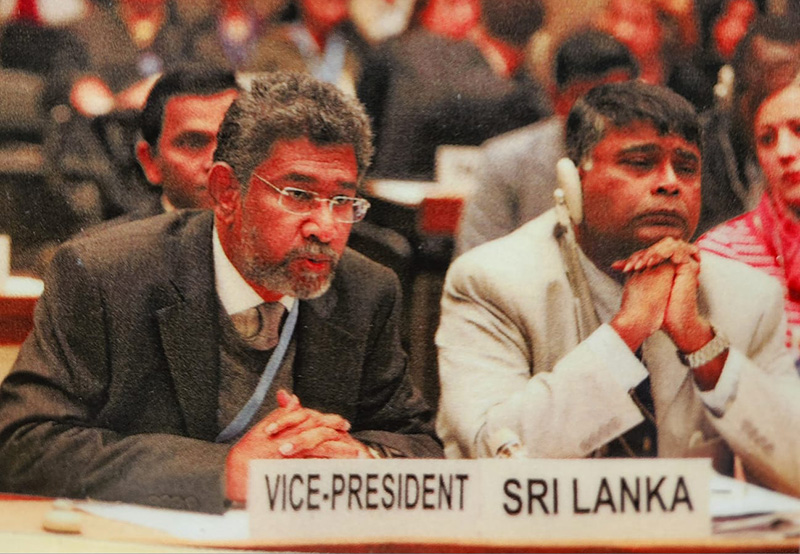
Dayan and Rajiva in Geneva
With the discussion on Sri Lanka and the UNHRC resurfacing this year, the singularity of Geneva 2009 and Sri Lanka’s decisive victory has been noted in Parliament by the Leader of the Opposition.
Though no Lankan institution ever asked me to explain that 2009 outcome, it has figured amply in international scholarly literature.
When I served as Ambassador to France, Spain and Portugal, the prestigious Barcelona Institute for International Relations (IBEI), Spain, invited me to deliver a lecture on the topic in May 2012, the third anniversary of the 2009 outcome. I readily agreed, given that Prof Fred Halliday, Emeritus Professor of International Relations at the LSE and iconic Marxist scholar had spent the last five years of his life as Research Professor at IBEI.
My lecture was chaired by Prof Robert Kissack, Co-ordinator of the MA programme, former student of Prof Halliday at the LSE and his successor at IBEI. A discussant was Dr Margarita Petrova, whose specialization is ‘The Politics of Norm Creation’. Her doctoral dissertation won the American Political Science Association’s Prize for best dissertation in International Relations (2008).
I thought it appropriate to publish the text/transcript of my lecture in a Sri Lankan newspaper because it reconstructs context and conceptual underpinnings of the strategy that succeeded—exceptionally, as it turns out.
The Barcelona Lecture, May 24th 2012
I am especially glad to be here because I knew that one of my intellectual heroes from my early teens, Prof. Fred Halliday, spent many years here and was very fond of this place. I am gratified that Prof Robert Kissack who invited me and is chairing this lecture was a protégé and colleague of his.
As you would have gathered from Dr Kissack’s introduction, I am not a career diplomat. Now that usually is a disclaimer but in my case it means that I am more responsible for what I have done — and not done –as a diplomat than a career diplomat would be. I cannot use the usual cop-out and say I was only following orders. Therefore, I was far more vulnerable to the kind of questions and criticisms that you may ask, and I welcome them because I wrestle with these issues everyday myself as well, as an academic and as a former political activist.
Few things are as difficult as meeting the test of objectivity when discussing a significant event or process in which one played a frontline role. A fairly safe method is to commence with assessments of that event, process and role made by sources which were critical or hostile. While these may not themselves be objective, at least their subjectivity would err on the other side and therefore constitute a litmus test of sorts.
Outside of purely partisan ethnic propaganda, the most serious negative account of Sri Lanka’s war and the conduct of the Sri Lankan state is the solidly researched, well written, intelligent and readable book, The Cage by Gordon Weiss. It contains an entire chapter, 30 pages long, on the international and diplomatic dimension of the conflict’s closing stages (Ch 9: The Watching World). That it does so confirms that diplomacy was an important arena of struggle and contradicts the conception of diplomacy as mood setting Muzak for making nice.
Weiss focuses on the UN in two theatres, New York and Geneva. In an earlier chapter he makes clear the situation in New York:
As the situation unfolded, the positions of China, Russia and India became clear. There would be no resolution from the UN Security Council warning Sri Lanka to restrain its forces. China and Russia, with separatist movements of their own would veto any motion within the Council. India struck a pose of outward ambivalence, even as it discreetly encouraged the Sri Lankan onslaught, though urging it to limit civilian casualties. But of the veto-wielding ‘perm five’ in the Security Council, it was China…which was the largest stumbling block” (pp.139-140)
In the halls of the UN in New York, Mexico, which held one of the rotating Security Council seats, tried to have Sri Lanka formally placed on the agenda. While Western and democratic nations broadly lined up in support, it quickly became clear that China would block moves to have the council consider Sri Lanka’s actions….The possibility of an influential Security Council resolution remained distant…Sri Lanka had deftly played its China card and had trumped.” (pp 200-201)
Thus, at the UN New York, Sri Lanka was structurally safe, and in Weiss’ book, its diplomats in that theatre at that time, remain unnamed. The UN Geneva is brought to life rather differently in Weiss’ volume:
On 27 May at the Palais des nations in Geneva, the UN High Commissioner for Human Rights, Navanethem Pillay, addressed the Human Rights Council and called for an international inquiry into the conduct of both parties to the war. While the EU and a brace of other countries formulated and then moved a resolution in support of Pillay’s call, a majority of countries on the Council rejected it out of hand. Instead, they adopted an alternative motion framed by Sri Lanka’s representatives praising the Sri Lankan government for its victory over the Tigers…” (p229)
In his concluding chapter Weiss describes my role:
Dayan Jayatilleka, one of the most capable diplomats appointed by the Rajapaksa regime, had outmanoeuvred Western diplomats to help Sri Lanka escape censure from the UN Human Rights Council in Geneva (p256)”.
In his Notes he makes this evaluation: Jayatilleka was the most lucid of the vocal Government of Sri Lanka representatives…” (p 330)
Gordon Weiss is not the only critical source available to the student of international relations for the objective understanding of Geneva 2009. Some of it is in Wikileaks, cables going not only from Geneva to Washington and back but even from cable traffic from the US Embassy in France and conversations between Ambassador Susan Rice and UN Human Rights High Commissioner Navi Pillay.
Here’s an observation about Geneva 2009, made by the international award-winning journalist and author Nirupama Subramanian:
As Sri Lanka mulls over last month’s United Nations Human Rights Council resolution, it may look back with nostalgia at its 2009 triumph at Geneva. Then, barely a week after its victory over the LTTE, a group of western countries wanted a resolution passed against Sri Lanka for the civilian deaths and other alleged rights violations by the army during the last stages of the operation. With the blood on the battlefield not still dry, Sri Lanka managed to snatch victory from the jaws of diplomatic defeat, with a resolution that praised the government for its humane handling of civilians and asserted faith in its abilities to bring about reconciliation.” (The Hindu)
There has also been some academic research and publication. The most interesting is a piece which helps advanced students of international relations understand the deeper dimension and wider ramifications—far wider than Sri Lanka—of the battles in UN forums including most notably the May 2009 Special session. This essay talks about a clash on norms which took place in the UN Human Rights Council over the Sri Lankan issue and that the Sri Lankan diplomats played a role of ‘norm entrepreneurs’.
Research scholar David Lewis presented a paper at the University of Edinburgh, entitled ‘The failure of a liberal peace: Sri Lanka’s counterinsurgency in global perspective’, and published in Conflict, Security & Development, 2010, Vol 10:5, pp 647-671. Lewis is Senior Research Fellow at the Centre for International Co-operation and Security in the Department of Peace Studies, University of Bradford, and headed the International Crisis Group’s Sri Lanka programme in 2006-7. He writes:
Many of the battles over conflict-related norms between Sri Lanka and Europe took place in UN institutions, primarily the Human Rights Council (HRC)…it was Sri Lanka which generally had the best of these diplomatic battles…”
Although this process of contestation reflects shifting power relations, and the increasing influence of China, Russia and other ‘Rising Powers’, it does not mean that small states are simply the passive recipients of norms created and contested by others. In fact, Sri Lankan diplomats have been active norm entrepreneurs in their own right, making significant efforts to develop alternative norms of conflict management, linking for example Chechnya and Sri Lanka in a discourse of state-centric peace enforcement. They have played a leading role in UN forums such as the UN HRC, where Sri Lankan delegates have helped ensure that the HRC has become an arena, not so much for the promotion of the liberal norms around which it was designed, but as a space in which such norms are contested, rejected or adapted in unexpected ways…”
As a member of the UN HRC Sri Lanka has played an important role in asserting new, adapted norms opposing both secession and autonomy as possible elements in peace-building—trends that are convergent with views expressed by China, Russia and India…”
The Sri Lankan conflict may be seen as the beginning of a new international consensus about conflict management, in which sovereignty and non-interference norms are reasserted, backed not only by Russia and China but also by democratic states such as Brazil.” (Lewis: 2010, pp. 658-661)
So, there we have it; that’s the story as seen by critical observer-analysts.
The backdrop of the special session of the UN Human Rights Council in 2009 was emotionally as highly charged as you can possibly imagine. The long Sri Lankan war was reaching its endgame, but what would that endgame be?
There was a lot of pressure not only from the Tamil Diaspora communities from the émigrés but also the liberal humanitarian view that there would be a blood bath which had to be stopped by a humanitarian intervention. It took the formula of a ‘humanitarian pause’. Lakhdar Brahimi and Chris Patten had written a piece in the New York Times about the imminent bloodbath on the beach”. The EU Parliament was pushing a resolution for a ‘humanitarian pause’ and the resumption of negotiations with the Tigers. This was the template for the resolution that was planned for the UN Human Rights Council.
A very serious special session of the sort that was held years later on Syria or Libya in the UN Human Rights Council, was sought to be held. This required 16 signatures. The Sri Lankan team together with our friends and allies in the Non-Aligned Movement, in the South Asian Association for Regional Cooperation (SAARC) etc., fought a bitter rearguard action to prevent the 16 signatures’ requisite for the holding of a special session and managed to hold it back while the war was on. I was fully conscious of what we were doing in fighting hard to hold back the 16 signatures from being obtained so that a special session could not be moved in which there could have been a UN mandated call for a ‘pause’ on what would be the final attack on the Tigers.
Shortly after that the war was over on the 18th-19th of May 2009, the last signature was obtained. The EU was one signature short for 10 days and then it got that signature and then the session moved on at full speed. Instead of waiting for the EU resolution to be tabled and voted on, Sri Lanka together with the Non-Aligned Movement seized the initiative. We presented a resolution of our own. The special session was held on the 26th-27th May 2009 and it went down to a vote. Because of the nature of the counter-resolution that we crafted together with the Non-Aligned Movement, we obtained almost a two-thirds majority of the UN Human Rights Council.
In a search for a synthesis of values, our resolution actually contained quite a few of the points made by the EU resolution, i.e. everything that was unobjectionable, that was progressive, that was generally liberal in the EU’s resolution. It is the defence of sovereignty, but a national or state sovereignty invested with a commitment to popular sovereignty, that enabled us to obtain the support that we did and to defeat the resolution against us.
The battle of norms was not simply the liberal humanitarian interventionism versus a simple reiteration of national sovereignty. Rather, it was the kind of ideology that you would find Brazil, India, Indonesia, the emergent democracies, very comfortable with: a strong defense of national sovereignty but no less strong commitment to progressive reform.
It was indeed a clash of norms but it would be wrong to see it in an over simplified fashion, in which it is presented by many on either side of the divide. It is usually projected as liberal humanitarianism or ‘liberal humanitarian interventionism’ if you are critic of it, versus old fashioned Westphalian sovereignty, now renamed ‘Eastphalian’ sovereignty.
But we know certainly from Gramsci, and reinforced by Poulantzas and Laclau, that in the political arena you do not have simple contention. It is not a football game of two clearly demarcated sides. You are talking about constellations, about blocs, complex agglomerations with their own changing hegemony. This is true also about ideologies and it is ideologies that help cement these blocs. So, what we are talking about are hybrids on both sides, and you find that one prevails over the other depending on (a) the hybrid (b) the situation.
Liberal humanitarianism or liberal humanitarian intervention prevailed in the case of former Yugoslavia/Kosovo but did not prevail in the case of Sri Lanka in 2009. ‘Liberal humanitarian interventionist’ calls work only when dealing with certain kind of situation, certain kind of regimes/states or involving a movement of a certain sort.
I must confess that I rather liked Dr. Kissinger’s book On China because he understands why the Chinese see things the way they do, with a focus on national/state sovereignty. This is true not only about China but also about Vietnam and many of those societies and nations which see themselves as ancient. Old societies, States which had been in existence for millennia and which therefore have a very acute sense of what external intervention can do.
I reiterate an old point made by Lenin, Trotsky and Gramsci, in terms of the nature of State and society in the East and the West. The State is a much harder nut to crack, the further East you go. But a simple reassertion or assertion of State sovereignty in the absence of a situation in which it is credible, and in the absence of other ideals and values, does not prevail either! One has to always try to understand and discern the constellation of ideas and therefore the blocs that the contending parties have been able to put together.
This is the concluding lesson that I would draw out: if you lose the moral high ground, you lose the vote. If you succeed in occupying the moral high ground and displacing your foes from it, not only in your own eyes but in a universal sense, you win.
BY Dr. Dayan Jayatilleka