
Vision of Dr. Gamani Corea and the South’s present development policy options
Posted on November 6th, 2025
Courtesy The Island
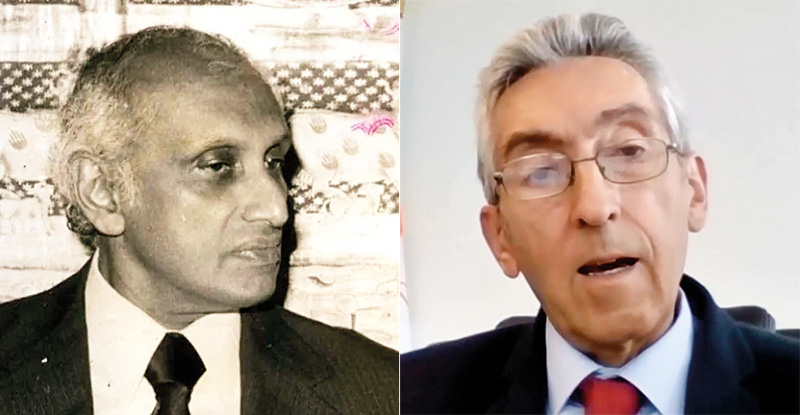
Dr. Gamani Core / Dr. Carlos Maria Correa

The ‘takes’ were numerous for the perceptive sections of the public from the Dr. Gamani Corea 100th birth anniversary oration delivered at ‘The Lighthouse’ auditorium, Colombo, by Dr. Carlos Maria Correa, Executive Director of the South Centre in Geneva on November 4th. The fact that Dr. Gamani Corea was instrumental in the establishment of the South Centre decades back enhanced the value of the presentation. The event was organized by the Gamani Corea Foundation.
The presentation proved to be both wide-ranging and lucid. The audience was left in no doubt as to what Dr. Gamani Corea (Dr. GC) bequeathed to the global South by way of developmental policy and thinking besides being enlightened on the historic, institutional foundations he laid for the furtherance of Southern economic and material wellbeing.
For instance, in its essential core Dr. GC’s vision for the South was given as follows: sustainable and equitable growth, a preference for trade over aid, basic structural reform of global economy, enhancement of the collective influence of developing countries in international affairs.
Given the political and economic order at the time, that is the sixties of the last century, these principles were of path-breaking importance. For example, the Cold War was at its height and the economic disempowerment of the developing countries was a major issue of debate in the South. The latter had no ‘say’ in charting their economic future, which task devolved on mainly the West and its prime financial institutions.
Against this backdrop, the vision and principles of Dr. G.C. had the potential of being ‘game changers’ for the developing world. The leadership provided by him to UNCTAD as its long-serving Secretary General and to the Group of 77, now Plus China, proved crucial in, for instance, mitigating some economic inequities which were borne by the South. The Integrated Program for Commodities, which Dr. G.C. helped in putting into place continues to serve some of the best interests of the developing countries.
It was the responsibility of succeeding generations to build on this historic basis for economic betterment which Dr. G.C. helped greatly to establish. Needless to say, all has not gone well for the South since the heyday of Dr. G.C. and it is to the degree to which the South re-organizes itself and works for its betterment as a cohesive and united pressure group that could help the hemisphere in its present ordeals in the international economy. It could begin by rejuvenating the Non-aligned Movement (NAM), for instance.
The coming into being of visionary leaders in the South, will prove integral to the economic and material betterment of the South in the present world order or more accurately, disorder. Complex factors go into the making of leaders of note but generally it is those countries which count as economic heavyweights that could also think beyond self-interest that could feature in filling this vacuum.
A ‘take’ from the Dr. GC memorial oration that needs to be dwelt on at length by the South was the speaker’s disclosure that 46 percent of current global GDP is contributed by the South. Besides, most of world trade takes place among Southern countries. It is also the heyday of multi-polarity and bipolarity is no longer a defining feature of the international political and economic order.
In other words, the global South is now well placed to work towards the realization of some of Dr. GC’s visionary principles. As to whether these aims could be achieved will depend considerably on whether the South could re-organize itself, come together and work selflessly towards the collective wellbeing of the hemisphere.
From this viewpoint the emergence of BRICS could be seen as holding out some possibilities for collective Southern economic betterment but the grouping would need to thrust aside petty intra-group power rivalries, shun narrow national interests, place premium value on collective wellbeing and work towards the development of its least members.
The world is yet to see the latter transpiring and much will depend on the quality of leadership formations such as BRICS could provide. In the latter respect Dr. GC’s intellectual leadership continues to matter. Measuring-up to his leadership standards is a challenge for BRICS and other Southern groupings if at all they visualize a time of relative collective progress for the hemisphere.
However, the mentioned groupings would need to respect the principle of sovereign equality in any future efforts at changing the current world order in favour of all their member countries. Ideally, authoritarian control of such groupings by the more powerful members in their fold would need to be avoided. In fact, progress would need to be predicated on democratic equality.
Future Southern collectivities intent on bettering their lot would also need to bring into sharp focus development in contrast to mere growth. This was also a concern of Dr. G.C. Growth would be welcome, if it also provides sufficiently for economic equity. That is, economic plans would come to nought if a country’s resources are not equally distributed among its people.
The seasoned commentator is bound to realize that this will require a degree of national planning. Likewise, the realization ought to have dawned on Southern governments over the decades that unregulated market forces cannot meet this vital requirement in national development.
Thus, the oration by Dr. Carlos Maria Correa had the effect of provoking his audience into thinking at some considerable length on development issues. Currently, the latter are not in vogue among the majority of decision and policy makers of the South but they will need ‘revisiting’ if the best of Dr. GC’s development thinking is to be made use of.
What makes Dr. GC’s thinking doubly vital are the current trade issues the majority of Southern countries are beginning to face in the wake of the restrictive trade practices inspired by the US. Dr. GC was an advocate of international cooperation and it is to the degree to which intra-South economic cooperation takes hold that the South could face the present economic challenges successfully by itself as a collectivity. An urgent coming together of Southern countries could no longer be postponed.