
Sri Lanka’s bureaucratic system needs an urgent clean up!
Posted on January 19th, 2026
Courtesy Daily Mirror
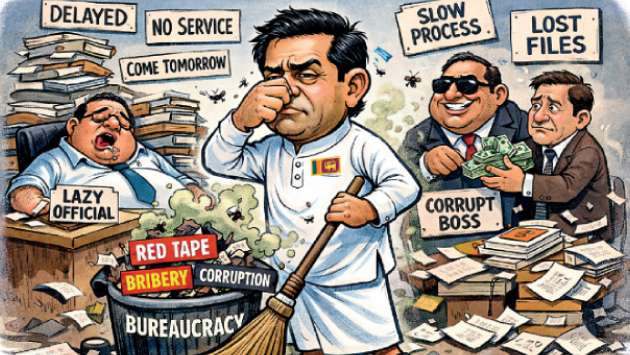
Last week, the Daily Mirror exclusively reported of yet another foreign investor pulling out of Sri Lanka citing regulatory obstruction and arbitrary state action.
China based Amber Adventures Private Limited, the country’s first cable car venture said it had officially pulled out of the Ambuluwawa Cable Car Project due to arbitrary and unlawful actions by state authorities including the suspension of construction by the Central Environmental Authority (CEA) based on complaints circulating on social media, despite clearance from technical agencies.
The most surprising part is the company had already invested US $ 3.5 million of the US $ 12.75 million and is now considering legal action to recover losses.
This is yet another story of foreign investors pulling out due to harassment by state officials and is yet another wake up call that despite governments changing, Sri Lanka’s bureaucratic system is corrupt to its roots and needs a through clean up.
Somehow our minds are now immune to foreign investors coming in and then pulling out months later. How can anyone survive when the system doesn’t allow them to?
It is a shame to even write this especially after knowing that Sri Lanka has the potential and could have been far ahead in terms of development and infrastructure but is yet stuck at ground zero because some bureaucrats prefer to fill their pockets instead of seeing the nation develop.
In the past how many projects have failed us? China invested the Colombo Port City, promising to attract millions of dollars in investments, but after the Sirisena Wickremesinghe administration came to power in 2015 they suspended it. If the terms and conditions needed to be changed it could have been prioritized and the project could have started construction but instead it remained suspended for one whole year causing severe financial losses to the project company. Sadly this project even to date is yet to reach its full potential and if it had, Sri Lanka would have given a tough run to Singapore and even Dubai.
Then we had promises of the Volkswagen car assembly plant in Kuliyapitiya in 2015 that never saw the light of day and the famous USD 3.5 billion oil refinery project initiated in 2019 which never moved beyond its initial stages. Then of course we had numerous other projects such as Japan’s LRT project, the Adani project, the VFS Global project, the Sinopec project, the BYD scandal to name a few – all who arrived in Sri Lanka and had to leave after facing severe allegations in our soil but are performing brilliantly in other countries under other governments.
Now when the National People’s Power (NPP) government swept into office on a powerful wave of public anger and hope, it did so with a promise that resonated across class, ethnicity and age, that corruption would finally be tackled, not just in politics, but in the system itself.
Months into this new administration, it is becoming painfully clear that while ministers may change, the bureaucratic machinery that governs everyday life in Sri Lanka remains stubbornly untouched and in many ways, unchallenged.
Today, Sri Lanka’s bureaucracy is not merely inefficient. It has become a curse on governance, development and investor confidence. It is the silent partner in corruption, the breeding ground of delays, files, signatures and come tomorrow” attitudes that quietly kill projects, destroy trust and drive investors away without a single protest slogan ever being shouted.
Foreign investors do not leave Sri Lanka because of speeches in Parliament or street protests. They leave because approvals take months, sometimes years. They leave because permits require endless back and forth between departments that do not communicate with each other. They leave because unofficial facilitation fees are still whispered, hinted at and sometimes bluntly demanded. They leave because predictability, the most valuable currency in investment, simply does not exist here.
This is not theory. It is reality, repeated again and again. International logistics firms that expanded rapidly in Vietnam and Bangladesh have quietly scaled down Sri Lankan operations citing port delays and licensing hurdles. Renewable energy investors who once viewed Sri Lanka as a regional hub walked away after power purchase agreements were stalled in ministries. Even technology startups, which require little physical infrastructure, have moved registration and billing abroad because local systems cannot guarantee basic timelines.
What does it say about a country when global companies are willing to operate in post conflict states and frontier markets but hesitate to expand in Sri Lanka because of paperwork?
The tragedy is that this bureaucracy survives every political revolution. Governments change. Presidents fall. Cabinets reshuffle. But the same desks, the same procedures and the same culture of power without accountability remains intact. Ministers may announce reforms, but files still gather dust unless someone pushes them or pays for them to move.
The NPP government came into office promising systemic change, not cosmetic reform. Yet without confronting the bureaucracy head on, no anti corruption drive can succeed. You can arrest politicians, but if procurement officers, licensing authorities and regulatory officials continue business as usual, corruption simply finds new doors to enter through.
And it is not only foreign investors who suffer. Local entrepreneurs are strangled before they can grow. A young business owner trying to export products must navigate customs, standards authorities, tax offices and multiple ministries. Each step becomes an opportunity for delay. Each delay becomes a financial burden. Many simply give up or operate informally, shrinking the tax base and expanding the underground economy. This is how corruption becomes normalised, not through dramatic scandals, but through daily survival.
Countries that have transformed their economies did not do so through slogans. They did it by building institutions that work. Singapore did not become Singapore because politicians were perfect. It became Singapore because systems were predictable, digital and brutally intolerant of inefficiency and bribery. Rwanda, despite its painful past, streamlined investment approvals to weeks, not years. Even neighbouring India, long infamous for red tape, is aggressively digitising governance to cut human discretion out of basic processes.
Sri Lanka, meanwhile, still worships the stamp, the signature and the file.
If the NPP government is serious about development, then bureaucratic reform must move from speeches to action. This means digitising approvals, setting legal time limits for decisions, publicly tracking applications and holding officials personally accountable for unjustified delays. It means breaking the culture where an official feels no urgency because there are no consequences.
It also means political courage. Bureaucratic networks are powerful. They outlast governments. Challenging them will not be popular within ministries. But leadership was never meant to be comfortable.
Sri Lanka cannot dream of becoming a developed nation while operating like a colonial outpost. Development is not just highways and ports. It is trust in institutions. It is knowing that rules apply equally, that timelines mean something and that investors, local or foreign, are not treated as beggars seeking favours.
The NPP government was not elected merely to replace faces. It was elected to dismantle a culture. A culture that has taught citizens that nothing moves without connections and taught officials that they answer to no one.
Every day this culture survives, young Sri Lankans lose faith. They migrate, they disengage and they stop believing that merit matters. No country can grow when its most ambitious citizens plan their futures elsewhere.
This is the moment for the government to decide whether it will confront the real engine of corruption or simply manage its symptoms. Speeches about clean politics mean little if dirty systems remain untouched.
Sri Lanka does not lack talent, location or opportunity. What it lacks is governance that works without bribery, begging or backroom influence.
If the NPP truly wants to build a new Sri Lanka, it must begin where corruption quietly thrives, behind desks, inside offices and within procedures that have never been questioned.
Because a nation cannot rise when its own system keeps pulling it down.
Jamila Husain
Editor-In-Chief