
What could be the cost to the economy from Ditwah?
Posted on December 7th, 2025
Courtesy Hiru News
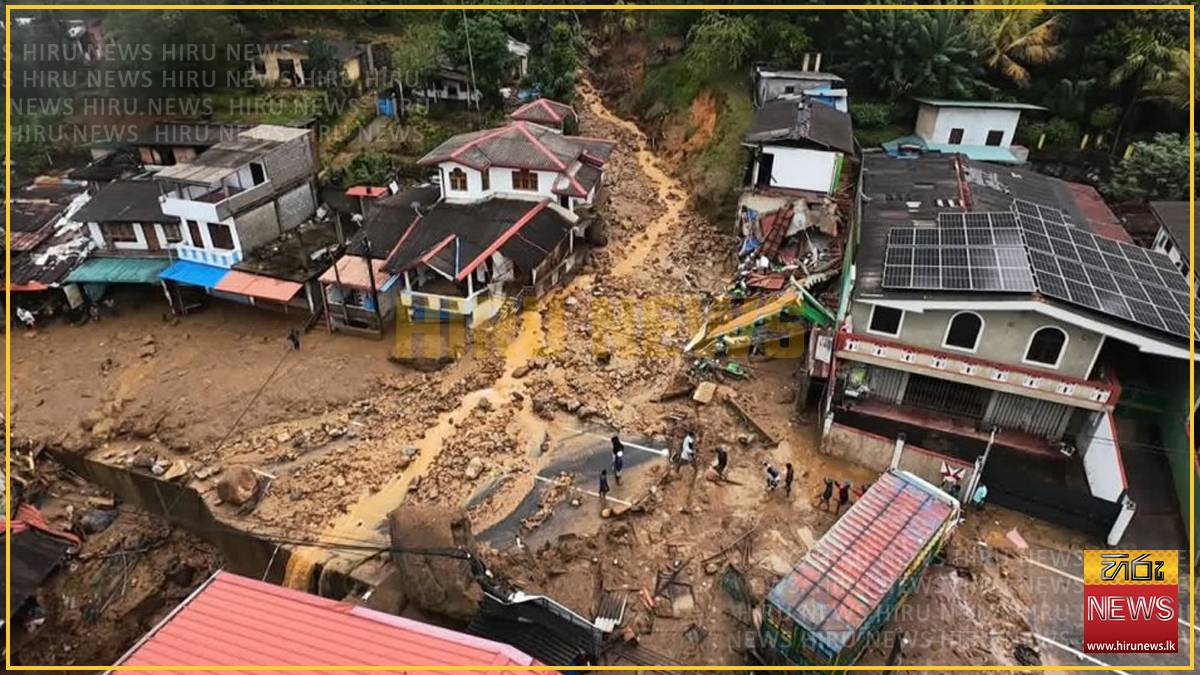
The total damage caused by the recent adverse weather in Sri Lanka is estimated to be between US$6 billion and US$7 billion, according to Commissioner General of Essential Services Prabath Chandrakeerthi.
Speaking to the media, he said this amount represents between 3% and 5% of the country’s Gross Domestic Product (GDP).
An Economist’s estimate
In an interview with us, economist Dr. Kenneth De Zilwa offered a lower—but still substantial—estimate of the destruction.
He stated that his team’s current assessment is Rs. 320 billion, which is equivalent to a little over US$1 billion, or more.”
Right now, we are taking a very conservative approach, and the projected figure of Rs. 320 billion will likely need to be revised upward, in my view. The damage to infrastructure, people’s livelihoods, and supply-side assets all place a significant burden on the country’s cash flow. So this estimate represents only one part of the overall impact on the nation,”
Dr. De Zilwa noted that agriculture and plantations are among the worst-affected sectors.
However, he stressed that Small and Medium Enterprises (SMEs) face a particularly severe blow.
SMEs hit after multiple crises
These SMEs have just come out of three major crises: first, the Easter attacks, then COVID, and then the financial shock. They were already struggling, and now, on top of all that, we have the all-island floods, which will take a significant toll,” he said.
He explained that the banking sector could also feel the ripple effects:
If you look at the average loan or lending book of the banking sector — around Rs. 1.2 trillion — we believe at least 10% of that will be affected, which is roughly Rs. 120 billion. This impact will feed through to the banking sector because the banking sector is the mirror image of the real economy. So even though the sector recorded significant profits, it will now have to brace itself to absorb a substantial rise in non-performing loans.”
Impact on credit ratings and the external position
Dr. De Zilwa also highlighted Sri Lanka’s vulnerable external sector:
We currently have a large negative net international investment position of around US$52 billion. On top of this, we will need significant external borrowing for infrastructure.”
He warned that supply-side disruptions will force higher import dependence, adding pressure on the current account and the fiscal deficit.
So we are looking at a kind of triple whammy. First, the external debt component will rise, which will negatively affect the overall rating that is due to be announced. Second, fiscal space — already highly constrained — will be squeezed further. And third, the deficit is likely to increase as more clarity emerges regarding domestic financing needs.”
Revenue challenges ahead
He noted that raising government revenue will be difficult in the coming year, adding that income from vehicle imports will likely be lower compared to this year.
Can the Central Bank print money?
Asked whether the Central Bank can inject liquidity by printing money amid these challenges, Dr. De Zilwa responded:
Absolutely, yes. Once the current account deficit begins to widen, the depreciation of the rupee will automatically push working capital balances higher. As a result, the banking sector liquidity will need to be supplemented by the Central Bank. Challenges in the movement of stock and inventory will also affect liquidity. Therefore, the Central Bank and the government will have to ensure that adequate liquidity is maintained in the market.”
Call to revisit the IMF programme
He also emphasised the need for the IMF to reconsider Sri Lanka’s current Extended Fund Facility (EFF):
The government has to intervene because the overall parameters set under the previous conditions no longer exist. They must revisit these frameworks and take a pragmatic approach. Multilateral agencies will also need to step in to smooth out cash flows. Therefore, the IMF agreement must be revisited… If not, Sri Lanka will be severely constrained, because fiscal and monetary policy are already tightly restricted.”
Central Bank Governor: ‘We have the buffers’
Meanwhile, during the Economic Summit organised by the Ceylon Chamber of Commerce, Central Bank Governor Dr. Nandalal Weerasinghe said that the Central Bank possesses sufficient buffers to address the shocks from Cyclone Ditwah.
What is most important in facing a shock like this is having sufficient buffers across the macroeconomic framework — fiscal, monetary, and external. This situation presents an opportunity, even for the banking sector, to use those buffers. That is precisely why we build them.”
He added:
I know the government is currently in a comfortable position, particularly in terms of short-term fiscal buffers for immediate relief. On the external side, too, compared to where we were in terms of foreign reserves, we are now in a much better position. On the monetary side, we are ready to provide any liquidity support needed by the banking system. The banking sector is also stable — capital buffers, liquidity buffers, and even profits have strengthened.”