President Dissanayake offering a floral tribute at the Mao Zedong Mausoleum during his state visit to China. Image courtesy – PMD
If the government had the required convincing power it could have turned around one of the much talked about rice merchants of this country to their side in the quest to find a solution to the rice problem
There is a Colombo ‘elite’ still controlling the show from the availability of rice, coconuts, eggs, essential grocery items and who gets to study in which popular school
After Ranil Wickremesinghe handed the baton over smoothly to the winner at the 2024 Presidential Elections, Sri Lankans still had ‘concerns’ if ‘worries’ wasn’t the best word to use at that period of time. The concerns were whether an inexperienced set of lawmakers could play administrator roles and turn around a crashed economy. Now those concerns are slowly turning into worries.
This is a country where its inhabitants see the word ‘worry’ etched in their minds. Some have it running in their blood. The present generation is looking for success stories from within the island itself to psych themselves up.
And the failure in such attempts makes hordes of youth leave the shores of beautiful Sri Lanka in search of greener pastures. There is a crude Sinhala saying ‘can beautiful be eaten’? We have to wait and see. But for how long?
For those who want inspiration, you just have to make a study of those leaving villages and heading for Colombo with one set of clothes and a few rupees in hand to start a new life. Those are the people who have completed their studies, worked hard and climbed the rungs in the ladder of the executive cadre. But among these success stories we hear of how bogus Colombo addresses were created to admit children to popular schools. There is a Colombo ‘elite’ still controlling the show from the availability of rice, coconuts, eggs, essential grocery items and who gets to study in which popular school. The new government must include in their agenda to make Colombo a city where anyone putting in the hard work can prosper during a reasonable time. We cannot be nurturing pipe dreams for ever. It’s so expensive to live and work in Colombo.
Past governments very openly used giving free gifts and aid as tools to strengthen their vote base. This new regime has put that practice into oblivion. This regime under Anura Kumara Dissanayake has stated very clearly that it will lay an even playing field for everybody. But this regime must take note that all individuals don’t have equal skills or may have different skills; hence they need different types of help and facilities. This regime must cultivate the skill to cater to the individual who has the expertise or the potential to make a significant contribution to the nation’s economy. Right now, the government has recruited into their working cadre, professors and very educated people who are serving as decision makers of state institutes. There is a fear that the private sector may not get the same opportunities that the state sector gets when it comes to engaging in the same businesses in the future.
This government is sweating to find a solution to the high prices of rice and coconuts. Soon they can utilise uncultivated lands and turn loss-making private properties for this venture. If the government had the required convincing power it could have turned around one of the much talked about rice merchants of this country to their side in the quest to find a solution to the rice problem. This rice merchant still pulls his own line.
What the educated people of this country fear most is a certain characteristic in the less educated people. Sadly this feature in the latter is the lack of depth when it comes to cultivating patience. We have fears because it is the not very educated voter who decides who enters parliament and who serves as the executive president.
Most of us don’t own cars, hence we take the bus or a tuk tuk to get to work. Now people employed in both these sectors are up in arms because the government recently gave orders to remove decorations from the vehicles they use in the transport business. The reactions of bus and tuk tuk owners have been harsh. Most of them have vouched not to vote for this government at the next elections. Decisions like these expose the lack of political experience in this regime. We fear the ‘agitated’ daily wage earner because they don’t think far when taking their next decision.
The lyrics of the song ‘Master Sir’ ring in our ears at this time. It is still a popular song in this country and it is originally sung by Neville Fernando. The lyrics of the song tell us how peasants of this country were treated by the British when it came to employment. The peasants feared the British and hated the tug-of-war between the local hierarchy and the peasants who were workers. After the British left the island, the Sinhala elite took control of politics and served themselves; baring just a handful of individuals who worked for a common cause of the less privileged.
Then we had power hungry individuals like Ranasinghe Premadasa and much later Mahinda Rajapaksa who ruled with the whip of terror in their hands. After that we were afraid of Gotabaya Rajapaksa, not because he had a military background, but because his thinking was not supported by any logic or reasoning.
The new regime under President Dissanayake is quite secretive in its dealings. Visuals shown on television during news in the night consists mostly of handouts and are accompanied by still pictures when it comes to covering of state events. This is the method used by the Chinese government when it comes to feeding the public with news. Just for the record, the present head of state of the Government of Sri Lanka is a on a tour of China.
Our learned friends of Sri Lanka can negotiate business blunders ‘if’ the present regime would make any. But they cannot plan for the future when the government doesn’t stick to preplanned decisions and are secretive in its business dealings. Remember President Dissanayake, as an elections candidate, boasting that the regime he installs would not import a single grain of rice? Did he live up to this statement?
Ranil, Mahinda and even Gotabaya to some extent were predictable in their dealings as Presidents, but not Dissanayake. This is why we are living in times of anxiety. To make matters worse for the new regime, the NPP has suffered many losses at some of the recent co-operative elections. Would this regime change its stance of adopting a work-driven approach to governance or change to playing politics for survival?
Whether one reads the newspaper, switches on the radio or watches social media, one topic dominates. They all have one criticism or the other of our four-month old regime. It started with the Speaker of the House and his claim of a doctorate.
We all know even Mervyn Silva was awarded a doctorate. The electorate unfortunately, did expect a similar character would exist in a political party claiming to be squeaky clean as the JVP. That was our mistake. The crux of the matter was that once the sham was in public domain, the former Speaker was forced to resign, despite his relationship with party hierarchy.
Quite a change from recent past traditions in our parliament.
President Dissanayake a month ago was in India where he thanked India for the help it had extended during our country’s financial bankruptcy. In addition he inked many agreements, which he opposed during the time he was part of his party’s three-member team in parliament.
He figuratively embraced India and hailed the important role India was playing in helping Sri Lanka overcome a financial crisis. He additionally praised India for maintaining its identity and leadership in the international scene.
He forgot, that in the periods 1989 and 1990s, his comrades in the JVP were threatening to kill ordinary Sri Lankan traders for selling ‘Bombay Onions’. The name of the onion was changed to ‘Big Onions’ and the killings stopped. Perhaps in their naivete, the then JVP leadership believed that the ‘Big onions’ were suddenly locally produced.
Prey let us not condemn the lads. They were just growing up to the fact, that we in Sri Lanka did not produce sufficient onions to meet local needs. They were as well, beginning to recognise realities of real life which were far from the translated theoretical doctrines they had picked up.
Today, it is in this light that we must read and view our current president’s words and actions. While in the opposition he felt he could in a jiffy change the IMF agreement. Government officials present at that meeting let on, that in five minutes our young president was able to realise that he could not change even a dot or coma in the agreement.
We cannot fault the president for wanting to alleviate the sufferings of the poor. AKD, as our president is affectionately referred to, shares the pain of more deprived sections of the Sri Lankan community. Today, he even changes into formal attire when meeting international figures of importance. Thank God he wasn’t in his double-pocketed shirt and jeans when he met the Chinese President.
He kept protocol -a system of rules that explain the correct conduct and procedures to be followed in formal situations.
In this way our president has shown how his party members have grown in stature. They have learned quickly it is easier to make promises and statements puffing up their chests to local audiences than in the face of international dignitaries who actually wield power and position.
Knowing the danger of putting all eggs in one basket, so-to-say, President Dissanayake who earlier saw a danger of Indian expansionism and feared Sri Lanka was becoming a pocket borough of China due to excessive loans from that country, has now provided extended facilities of the oil farm tanks in Trincomalee to India.
To balance international relationships, the President has signed an agreement with SINOPEC which will see the Chinese Petroleum Corporation invest 3.7 billion US Dollars in a state-of-the-art oil refinery with a capacity of 200,000 barrels in Trincomalee.
Earlier president AKD saw such deals as ‘selling important sections of our economy to foreigners. Thankfully, the president has now recognised the value of pragmatism. His visit to China will apparently bring in Chinese investments worth US $ 10 billion to Sri Lanka.
Additionally a grant of RMB 500 million (Rs. 20 billion) is also on the cards and 15 Memorandums of Understandings have been signed.
Today Sri Lanka is still paying back loans taken from international agencies. It’s going to take more than a ‘fistful of dollars’ to repay these debts. Rather than making fun of the about turns the president and his cabinet of ministers have made, lets appreciate that they have at least temporarily dropped ideology before country needs.
President Anura Kumara Dissanayake is resorting to political revenge by suggesting that former President Mahinda Rajapaksa should should pay the rent or leave his official residence in Wijerama Mawatha, MP Namal Rajapaksa said today.
MP Namal Rajapaksa told the media that Dissanayake was planning to take the residence from the former President and sell it.
He also pointed out that the residence is a privilege granted by the Constitution to executive presidents or former presidents for their safety.
“If Dissanayake wants to remove former President Mahinda Rajapaksa, he can make that request in writing. Granting a residence to former presidents is a practice in every country. Sri Lanka is not the only country where it is practiced,” he said.
Rajapaksa added that instead of prioritizing the needs of the people, Dissanayake was more focused on political revenge and his mask was finally falling off, showing his true face.
President Anura Kumara Dissanayake assured that the government has implemented measures to ensure that there will be no shortage of rice during the upcoming ‘Maha’ cultivation season.
Addressing a public gathering in Horana, the President emphasized the importance of maintaining rice reserves to stabilize food security.
Speaking at the event, which was part of a National People’s Power (NPP) meeting in the Horana electorate of the Kalutara District, the President outlined key relief measures planned from the forthcoming national budget.
These include provisions for government employees, university students, and individuals with disabilities, according to Dissanayake.
The meeting was attended by several prominent figures, including the Minister of Health and Mass Media, Dr. Nalinda Jayatissa, along with other NPP leaders and supporters.
The Working Committee of the United National Party (UNP) has reportedly approved initiating discussions with the Samagi Jana Balawegaya (SJB) on the possibility of the two parties collaborating in the upcoming elections.
The Working Committee of the UNP convened this afternoon (20) at the party headquarters to deliberate on the matter.
Meanwhile, the General Secretary of the Samagi Jana Balawegaya (SJB), Ranjith Madduma Bandara, confirmed that the first discussion regarding the potential unification of the UNP and the SJB for the upcoming elections will take place in Colombo tonight (20).
Additionally, former Parliamentarian Rajitha Senaratne revealed that the UNP has sent two representatives to participate in the meeting.
Recently, the SJB Working Committee approved a proposal to initiate discussions about uniting the two parties for the elections.
Amidst these developments, a special meeting of the SJB parliamentary group was held this afternoon at the Opposition Leader’s office in Colombo.
‘Before you study the economics, study the economists!’
e-Con e-News 12-18 January 2025
*
‘The crucial importance of gasoline as a raw material, of
the airplane as a weapon, and of the machine-tool industry
as the industrial basis of modern warfare, points to the possibility
that a tight control in a few strategic points within a country’s economy
might paralyze its power to prepare for war without impairing
its capacity to produce for the purposes of civilian consumption.’
– Albert O Hirschman, National Power
& the Structure of Foreign Trade, 1945
*
‘US lifestyle magazine Vogue has given Sri Lanka a glowing
endorsement by claiming it is this winter’s hottest travel destination.’
– Shivanthi Ranasinghe (see ee Economists, Is Our Economic Crisis Over?)
*
‘Only 3 months before he began work on The Prince, Machiavelli wrote
in a letter to his friend & colleague, Florentine diplomat Francesco Vettori:
‘Fortune has decreed that, as I do not know how to reason either about the art
of silk or about the art of wool, either about profits or about losses, it befits me
to reason about the state.’ The Machiavellians of today would probably be
astonished by this, since it reveals the complete failure of Machiavelli to perceive
any connection between economics & politics.
A textbook for the Modern Prince should indeed contain, in addition
to Machiavelli’s classic chapters, extensive new sections on the most
efficient use of quotas, exchange controls, capital investment,& other
instruments of economic warfare. In this respect, practice has preceded theory. The
extensive use of international economic relations as an instrument of national power
policies has been, together with the ‘war of nerves’, one of the main characteristics
of the period preceding the outbreak of the present war.’ – Albert O Hirschman,
*
It must be one of the strangest news items to inhabit the make-believe world of the merchant media in Sri Lanka: headlined: ‘No room to renegotiate IMF program’, the Wijeya Group’s Financial Times (FT) simply, or baldly, asserts, without stopping to take a breath:
*
‘Senior Economic Advisor to former President Ranil Wickremesinghe,
Dr RHS Samaratunga speaking at the Daily FT – ACCA & ICC SL
webinar ‘IMF Agenda: Opportunities & Challenges for Sri Lanka
Post-2025’, responded to a question about whether there is room to renegotiate
the current IMF program given the tough conditions in the agreement.
He noted there is very little space to make changes to the broader program
targets, the program has progressed satisfactorily so far. The program
was mutually agreed upon, and therefore, there is no room to revisit it.
Dr Samaratunga emphasised that it is in Sri Lanka’s interest to stay the course
within the broad parameters of the program.’
*
So there it is. The word made flesh. ‘There is no alternative’. So says the Daily FT – ACCA & ICC SL. FT is the Financial Times owned by Ranil Wickremesinghe’s relatives: Wijeya Group. The ICC = International Chamber of Commerce. The ACCA = Association of Chartered Certified Accountants. What else is new? At any given time on any given day, turn on your news device and they will be saying the same thing. Have been saying so since the end of history was declared in New York in 1989. Or was it 1848? There is no end to their endings. Otherwise, why tell us: There is no alternative?
Sri Lanka has been further encoiled in the embrace of the US government. Yes. Media are even quoting Marx & Lenin (but not Stalin or Mao), left and right. Yes. The JVP are suspected of biding their Bolshevik time. Red-baiting is digging new depths. Oh wait, with AKD in Beijing, Mao reemerges like a terracotta warrior as crafty inscrutable despot. Others claiming themselves instant ‘Leftists’, ‘Neo-Leftists’, ‘Real Leftists’, ‘AI Leftists’, are also declaring the inauthenticity of each other’s claims. And speaking of false accreditations and awards, examine the titles taken on by local agents – merchants, moneylenders, importers really – our ‘Symbolic Capitalists’? The most high apparently is CEO/Chairman… then there are the latest breed of ‘Independent’ bankers & ‘Independent’ directors…Independent of what, and of whom?
*
The media always lags behind its own revelations: long before US President D. Trump claimed Greenland, that sod of ice had already issued its first licenses for oil and gas exploration off the western Greenlandic coast, to Chevron & Exxon-Mobil. Trump’s first Foreign Secretary in 2017, Rex Tillerson, was an Exxon CEO, who refused to accept office until bribery was allowed! ….
Way earlier, in 1903, US President Theodore Roosevelt engineered a phony ‘revolution’ in Colombia, creating the new state of Panama, taking over the Canal Zone. The Panama Canal Co’s lobbyist, JP Morgan-related New York attorney William Nelson Cromwell directed the ‘revolution’ while sitting in the White House. Old French Panama Canal Co shares had already been purchased by a US financial syndicate of JP Morgan, Rockefeller, etc…
*
The media & academic system go to great lengths of fiction and assorted facts to declare the ‘independence’ of economics from politics, and the politics of economists.
Albert O Hirschman’s 1945 book – at the height of the mass slaughter of WW2 – is still cited, 80 years later, as an authority on economic warfare – on ‘power policy’. This ‘silent war of penetration’ involves maintaining a monopoly over industrial processes, their initiation, operation and destruction. A prerequisite for control over such processes involves sovereignty over a territory, Hirschman’s study being funded by the Exxon Rockefeller Foundation, as part of a Trade Regulation Project under the University of California, Berkeley’s Bureau of Business & Economic Research, perhaps made Hirschman choose to misunderstand (Ha! Ha!) that Machiavelli’s main interest was in the unification of an Italy divided into warring principalities. After all, Machiavelli dedicated his book to a merchant banker prince, of the Medici family (Michelangelo painted a Medici heiress as their Virgin Mary), to describe the bald doings of a rival merchant family of Borgias, one of whom as Pope, had just divided (in 1494) the world between Spain & Portugal, sending them to assail us from the West (see ee Random Notes).
*
Indeed, the world prior to the entry of the Portuguese into the Lakdiva Sea saw Lankans relatively unhindered travel East & West. This ee Focus, in the wake of the Sri Lankan President’s voyage to the People’s Republic of China, continues our attempt to depict Sri Lanka’s long and ‘enchanting’ historical engagements with China. We continue from the 3rd-5thC AD, with its major irrigation and architectural complexes. 317-419 is when formal Chinese links with Lanka presumably begin, after the first Qin Dynasty was set up, and Anuradhapura unified under the Hela language and Buddhism. By the Wei Dynasty (386-458), Lanka is famed for its Buddhist statues, and many countries send artisans here to study. Fa Xian (337-422) traveled the Southern Silk Road, and in 426, Lankan nuns arrived at Guangzhou port. In 520, Egyptian geographer Cosmas Indicopleustes, merchant from Alexandria, was calling Lanka an active ‘Emporium Mediatrix’ of the Africa-China trade.
*
In the last few years, even as our economists and media faithfully bellow the NATO version of free trade, while further entrapping Sri Lanka in their coils, many of their governments have put forward Economic Security Strategies to ‘derisk’ their economies ‘from foreign dependencies’. G7 governments in 2023 issued their Economic Resilience & Economic Security. Japan’s Economic Security Protection Act was announced in Oct 2023. The European Commission recommended ‘advanced semiconductors, artificial intelligence, quantum technologies & biotechnologies’ be classified as ‘critical technologies’. England’s National Security & Investment Act ‘gives the government powers to scrutinise and intervene in business transactions, such as takeovers, to protect national security’. The Future Made in Australia initiative highlights the country’s valued minerals and energy resources, while South Korea in Oct 2022, announced the National Strategic Technology Nurture Plan… (see ee Focus).
*
While media promotes US President Trump’s trade sanctions, the ‘US grip on global financial services’ provide the USA with ‘another source of leverage’. China apparently ‘has hegemonic power over global manufacturing, via its dominance of many supply chains’, while the USA has hegemonic power, in finance, ‘via the dollar-based system’. Meanwhile, Trump’s Treasury secretary nominee Scott Bessent says countries with military protection from the US should be forced to buy more dollar debt. He also says the world is heading for ‘Bretton Woods Realignments’ – perhaps ‘to weaken the dollar in order to help US exporters’ with ‘an attempt to replicate the 1985 Plaza Accord.’ (see ee Random Notes)
*
• We used to be so enthralled about SBD de Silva’s xray-sharp insights into SL economic malaise, thrilled by his vision for transforming Sri Lanka’s economy. We would bug him to share his views with the media. He without saying much just laugh grimly with a curl of whimsy in his cheek, ‘Let me interview them. Let’s find out what they actually know about the economy. Have they chosen to investigate?’ When we would mention that so-and-so wished to interview us, he would curiously ask, again with a smile, ‘Did they bring a camera!?’ Fake media: All about ego? Grim reality of tinsel!?
*
Another tactic by the media called ‘local’ is to fake modernity, as if turning on a computer is the same as making a computer or its parts. Fake claims about fake ‘industrialization’ are a regular feature in a fake Sri Lankan media. Handicraft, manufacture, assembly are all labeled ‘industry’. The latest car importer press release parading as a news item claims that ‘Sri Lanka’s local assembly and automotive component manufacturing sector has become a significant pillar of the nation’s economy’. Really! All this while the media is full of wailing about taxes on car imports. Meanwhile, it turns out the buses plying the roads are built on lorry chassis ‘not in conformity with modern mass transportation standards in terms of passenger comfort…’ Meanwhile, here’s another lovely….: SL makes groundbreaking entry into region’s luxury yachting market”… Parking lot? Cargo cult?
*
Indeed, as colonized Japan advocates censorship of the publication of its latest and edgiest patents on technology – their public curtailment of such statistics is not new – this ee looks at the latest moves by the white powers to wage war by economic means: through the prevention of the diffusion of the latest technology, and the destruction of competitive industries. A recent ee 28 December 2024 looked at how US & European Universities Block Asian & African Students from Advanced Technology programs…
Albert O Hirschman described ‘silent economic penetration’ as including the intensive study of consumer habits (see Unilever’s Kantar, eeRandom Notes) to control a country’s home market.
Of course, his example of such economic warfare at that moment in 1945 was Germany – the object of English sabotage prior to the outbreak of real war in 1939. Protectionist forces had the media portray the encroaching evil as economic aggression & penetration rather than call it ‘foreign competition’, which would have exposed their rhetoric about ‘free trade’.
*
‘In times of war between the People’s Republic of China & the West,
the knowledge that comes with economic presence & knowledge of the [Panama]
canal zone & its vulnerabilities could be exploited to shut down the canal in
‘deniable’ ways, from the sinking of container ships in key locations, physical
or digital sabotage of the locks themselves (&) threats from mining, (to) threats
to shipping at the entrances to the canal.’ – Evan Ellis, US Army War College
(see ee Sovereignty, US can’t hurt China’s interests in Panama & Greenland)
*
Without referring to English colonial practices where the destruction of economic power ran parallel with real warfare, Hirschman is candid enough to divulge, that what the Germans were accused of by their enemies was what the English & the USA themselves practiced as ‘business as usual’. Due to a lack of ‘systematic analysis of the connection between national power and international economic relations’: ‘All these arts and practices are nothing else than an intelligent seizure of legitimate business opportunities’:
‘Export subsidies, import certificates, emigration measures (of skilled workers, machinery, etc), came to be used not as normal methods of economic activity, but as an active means to suffocate rival nations. From the dumping of goods at low prices to crush domestic industries; to buying ‘exports’ at high prices at first to then acquire a monopsonistic position to later lower prices; by direct intervention or by manipulating exchange rates. Then there is the ‘export of enterprises & scientific personnel’, with the penetration of German capital into local enterprises, by controlling the country’s most important banks & key industries, particularly textiles, metallurgy, and shipping, and through industrial espionage by preventing credit facilities to ‘hostile’ local establishments, control investment, instigating industrial strikes…
In Hirschman’s book, countries were divided into agricultural & industrial (destined to exchange natural commodities, including their bodies, for manufactured goods). After they instigated war against Germany, the 6 Allied nations – England, France, Italy, Russia, Belgium, Japan – met at a ‘Paris Economic Conference’ in 1916: Allies also deliberately made ‘encroachments upon the rights of neutrals under the guise of measures against Germany’. They took ‘drastic measures’ ‘to prevent as far as possible the rebuilding of industries & commerce (of the Central Powers) after the war… Though they claimed the opposite…
According to news reports coming out from the most technologically advanced nation on earth today, the United States of America, new breakthrough, are coming every day so much so that they are now aiming to go back in time as far as computing is concerned. This is called de-computing. This is being explained by a tech expert, a Slavic girl (from Europe) who closely follows this subject and comes up with videos regularly.
In this video she comes up with predictions made sixty years ago by Rolf Landauer, a German-American physicist to say that this scientist predicted the minimum energy required to store a bit of information (ie. 0 or 1 in a chip) is 2.9×10^-21 Joules. This is so small when we compare the energy in a new AA battery is 10,000 joules (an average person uses 2500 calories or about 10,000 joules per day). As per the graph shown in this video at this moment the energy the most efficient machine or server uses up about a thousand times this energy. That is 2.9×10^-18 joules. With average computers doing gigahertz (cycles per second) with parallel cores etc, we can imagine how much energy a server farm in a develop country would use up. The environmental damage due to amount of heat that is released is enormous. Will this new invention change what has happened already is anybody’s guess. It is normally the children who get worried about climate change. I remember my daughter when she was about ten years old started worrying about climate change; that was about 15 years before Greta Thunberg started her campaign. Ironically her country is one of the worst offenders.
The new president of United States is surrounding himself with the tech giants like Elon Musk, Jeff Bezos, Mark Zukerberg, et al and hopes to come out of the doldrums his country is in today. Elon Musk is thinking in showering us with so much of wifi directly to us from space with thousands of satellites while Zuckerberg wants us to use mobile phones all the time, without limits. Ultimately what happens is all small insects that are in the food chain vanish giving us less food. Already bees who help in the process of pollination are vanishing as they cannot find directions due to the magnetic field they rely on for navigation has got distorted by electromagnetic waves. Even the sperm in males dying due to wifi smog that they live in all the time. The earth’s magnetic field may get change inside reinforced concrete buildings. Perhaps this may be affecting the way we receive energy from the sun. All developed nations are having drastic reduction in population growth. Even the countries like China and India also facing the problem of declining population growth. In our country we are faced with a double whammy. That is the reduction of population growth as well as emigration of locals to alleviate poverty.
Let us hope the new leader in the US who believes Christan values base on empathy to others, think about the rest of the world and humanity. We hope he would reduce the production of destructive electronic warmongering machines and bring peace to the world.
As usual let me wind up this write up with a popular song sung by crooner duo Martin Hein and Freddie Malavski with a back drop of famous statue of Christ the Redeemer on top of a hill in Rio De Janeiro, in Brazil and an animation of the same song by an Entertainer and musician Hans Romantikus (a 2022 version) with a few lines of lyrics, so that the readers will know what they are singing about.
I am sure our late Nimal Mendis would have done a wonderful video with very much similar scenes that we have in this country which has equal tourist spots and places of cultural venues. Are there any creative guys to take up the challenge. I have already given this challenge to one guy who has a well known musical band.
You’ve been dreaming about going out again for so long
Unhappy about photos on Ukraine war and South China Sea
The Russian and Chinese Embassies in Colombo have taken exception to some photographs exhibited at the World Press Photo exhibition now open at the Independence Arcade in Colombo.The complaint from Russia relates to photographs of the Ukraine war while China’s objection is over some photos relating to the South China Sea.
The Sri Lanka Press Institute (SLPI) CEO Kumar Lopez said they were the local partner organizing the exhibition which was funded by the Netherlands Embassy. They had no role in selecting the photographs on display. The World Press Photo Foundation is the main body owning the exhibition.
None of the photographs complained against have been taken down.
The exhibition which opened on Jan. 10 at the Independence Arcade will continue till Jan. 20 and then travel to Jaffna (Jan. 24-27) and Galle (Jan. 31 to Feb. 2) before returning to Colombo for display from Feb. 8 – 10 at The Forum, Cinnamon Life Hotel.
The German Dharmaduta Society founded by Asoka Weeraratna in 1952 and which maintains Das Buddhistiche Haus ( Berlin Maha Viharaya in Berlin – Frohnau) in Germany sponsored a Free Book distribution event directed towards the children of the Udaragama Primary School (remote school) situated at the Medirigiriya District, Polonnaruwa on Friday, January 2025. The books comprised Exercise Books and CR Books regularly used by the children.
This Book distribution event was initiated by the Chief Monk at DBH (Berlin Viharaya) Ven. Pelane Dhamma Kusala Thera utilizing funds collected from his Dayakayas worldwide.
This was the second annual book distribution event initiated by Ven. Dhamma Kusala Thera. The inaugural book distribution event was held at another school in Polonnaruwa in December 2023.
The current event was coordinated by Mr. Keminda Silva, the long standing Administration Secretary of the GDS.
Among the others who participated at this event were: 1) Mr. Senaka Weeraratna ( Hony. Secretary, German Dharmaduta Society), 2) Mrs. Priyanka Denukedeniya (Principal, Udaragama Primary School) 3) Ms. W.A.S. Wejarthna (Principal, Mahinda Maha Vidyalaya, Medirigiriya) 4) Ms. Peggy Moeller, German National and Buddhist social worker, 5) Mr. Wickrama Jayawickrema ( Producer of TV and YouTube programmes) 6) Mrs. S.Dhammika Silva ( wife of Mr. Keminda Silva), and members of the teaching staff of the Udaragama Primary School.
The children of the school presented several musical items as part of the welcoming ceremony.
Refreshments were served including a splendid traditional lunch comprising mainly plant based Vegetarian food.
The Hony. Secretary of the German Dharmaduta Society Mr. Senaka Weeraratna delivered an address and donated a copy of each of the recently published book ‘ ‘ 100 years Das Buddhistiche Haus ‘ commemorating the 100th anniversary of the founding of Das Buddhistiche Haus (1924 – 2024) to the Principals of the aforesaid Udaragama Primary School and the Mahinda Maha Vidyalaya, Medirigiriya.
A large number of children and their parents attended the function.
The Group Photograph shows the officials of the German Dharmaduta Society and the staff of the Udaragama Primary School.
President Anura Kumara Dissanayake has reiterated his commitment to completely eliminating the corrupt politics in the country, as promised to the people. He made these comments delivering a strongly worded speech while addressing a public gathering in Katukurunda, Kalutara, today (19). The President participated in an interactive meeting held at the Pakistan Sports Ground in Wettumakada, Katukurunda, Kalutara. Speaking at the event, President Dissanayake emphasized his administration’s no-nonsense approach to governance, stating: We took the oath of office on November 21 with a 21-member Cabinet. There are no state ministers. In the past, there were a number of ministers from Kalutara alone. While we have 8 MPs from Kalutara, only one of them holds a ministerial portfolio. This is because we don’t believe in developing the country by granting benefits to ministers. In the past, the practice was different. Ministerial posts were a way to please certain individuals. It is only us who will create such a government.” He also highlighted the irregularities in past appointments, saying: Previously, ministerial posts were shared among relatives. Family members were recruited into ministerial staff, with positions such as private secretary often given to spouses. I recall when Speaker Mahinda Yapa Abeywardena had a staff comprised entirely of his own relatives. We have put an end to these practices. Today, there are no vehicle fleets or police escorts behind ministers. This policy applies not only to the government but also to the opposition. That is because the police force is short of 21,000 personnel. They are working with the greatest difficulties.” The President further noted that, in the past, even military personnel were assigned to escort and serve high-profile individuals and their family members unnecessarily. Some used navy officers to help dress their wives. This is the kind of country that we have changes. Rs. 700 million was spent annually for the security of one former president. Thousands of police, military and STF personnel were assigned for their security. We have removed all of them and kept 60. If there are further complaints, we will remove the remaining 60 as well.” We are no longer providing state-owned residences to any minister. We will also not provide housing to any former president. I will give it in writing that I do not require any house. But the others will not do so.” Addressing the issue of former President Mahinda Rajapaksa’s official residence, President Dissanayake revealed: I personally commissioned the valuation of former President Mahinda Rajapaksa’s residence in Colombo through the Government Valuation department. We have only valuated the residence so far, without the land. According to the valuation, the monthly rent for the residence is Rs. 4.6 million. The land on Bauddhaloka Mawatha has not been valuated yet. According to the Constitution, a former president is entitled to a residence or a third of their salary. Therefore, we will take over the residence and provide a third of his salary, which amounts to Rs. 30,000. Or else he can pay the remaining amount and purchase it. If he does not pay the rest he has vacate the premises. This is the way forward. We must develop this country. Until now they have misled the public and lived luxuriously on public funds.” He also announced plans to introduce a proposal to revoke MPs’ pensions: A proposal to abolish pensions for MPs will be submitted soon. Additionally, there has been a debate regarding the Parliament canteen. I will tell you what will happen in a week or two. If you want to buy food, you have to pay the right amount, and that will be done. The National People’s Power government will not issue permits to MPs,” he added.
I give below the possible worker needs that I have gathered from AI sources for the reconstruction of Gaza which will commence in the near future. It would be expedient for Sri Lanka to send our workers to be employed in the reconstruction operations. This may entail training of large numbers of skilled cadres and sharing information with relevant professionals. It would also be a good opportunity to organize and support private sector consortiums to undertake subcontract work with international firms.
I urge your immediate attention to this unique opportunity.
THE NEEDS
The construction of Gaza will require a diverse range of construction workers and professionals due to the extensive rebuilding efforts needed for infrastructure, homes, public facilities, and utilities. The categories of workers in demand typically include:
1. General Construction Workers
Bricklayers and Masons: For constructing and repairing walls, buildings, and other structures.
Concrete Workers: For pouring, forming, and finishing concrete for foundations, roads, and buildings.
Carpenters: For framing structures, roofing, and interior woodwork.
Roofers: For rebuilding and repairing roofs for homes and public facilities.
2. Heavy Equipment Operators
Crane Operators: For lifting heavy materials to build high-rise buildings or large structures.
Excavator and Bulldozer Operators: For clearing debris and leveling land for new construction.
Truck Drivers: For transporting construction materials and debris.
3. Skilled Tradespeople
Electricians: To install, repair, and upgrade electrical systems for homes, businesses, and public facilities.
Plumbers: To repair and install water supply and sewage systems.
HVAC Technicians: For rebuilding and maintaining heating, ventilation, and air conditioning systems.
4. Civil Engineering Specialists
Structural Engineers: To design and oversee the construction of buildings and infrastructure that meet safety standards.
Civil Engineers: For planning and supervising the construction of roads, bridges, and water systems.
Surveyors: To assess land and map out construction projects.
5. Utility and Infrastructure Specialists
Water and Sanitation Technicians: For repairing water treatment facilities, pipelines, and sewage systems.
Power Grid Technicians: To restore and rebuild the electricity grid and related infrastructure.
Telecommunications Workers: To rebuild and upgrade internet and communication networks.
6. Disaster Recovery and Safety Professionals
Demolition Experts: For safe removal of damaged structures.
Health and Safety Officers: To ensure that construction projects comply with safety regulations.
Environmental Specialists: To manage pollution, waste, and the sustainable use of resources during reconstruction.
7. Architects and Urban Planners
Architects: To design new buildings and restore damaged ones.
Urban Planners: For planning city layouts, infrastructure networks, and public spaces.
8. Specialized Technicians
Glass and Window Installers: For residential and commercial glazing needs.
Painters and Decorators: To finish and beautify interior and exterior surfaces.
Steelworkers/Welders: For reinforcing structures, fabricating frames, and supporting large-scale construction projects.
9. Humanitarian and Support Workers
Logistics Coordinators: To manage the delivery and distribution of construction materials and equipment.
Labor Supervisors: To manage and train teams on-site.
Community Liaison Officers: To coordinate with local communities and ensure reconstruction meets their needs.
Given the scale and scope of reconstruction, there will also be a demand for project managers, financial planners, and procurement specialists to handle budgets and resources efficiently. Each category plays a critical role in rebuilding a resilient and functional Gaza.
Forced by India, successive governments since 2012 have invested disproportionate amounts of money in schools in estate communities. From a layman’s point of view, it is a good” thing and it will bring good” outcomes. In reality, that’s not how things work. In fact, the outcome of it will be disastrous for Sri Lanka. Instead, the government must make proportionate investments in education without favoring any one community. Past neglect is not an excuse to over-invest in schools in estate areas. Taxpayer funds are collected equally from every Sri Lankan and must be spent the same way. No favoring one community over another in education.
Sri Lanka has own examples of this happening in the past. The government elected in 1970 built the Jaffna University to address a concern among northern communities. They were uneasy at that time to travel and live in Colombo or Kandy for their university education; particularly women. A university in Jaffna would address it as they could travel to university from home. Unfortunately, it did not lead to the development of the north. Far from it. What it only did was breed more greed leading to violence. It led to cheating at exams to get into university which in turn led to standardization which failed to bring equity to communities. Some even blame it for terrorism. What’s worse is most students who gained a free tertiary education from the north left the country. They are the biggest brain drain burden on Sri Lanka!
The solution is not to increase investments in education. Taxpayers simply cannot afford to pocket out any more money for education. They are taxed to the maximum now while brain drain continues to drain out most of it. Pouring more into this bucket with a massive hole is worthless and is a crime against taxpayers and the national economy.
Overall, Sri Lanka keeps failing itself thanks to do-good” policies that must be sustained by taxpayers without proportionate benefits reaching them or the nation.
A worldwide study including Sri Lanka on civil wars was carried out by researchers Paul Collier and Anke Hoeffler in a World Bank study in 2000. The research looked into what causes civil wars – grievances or greed? Their conclusion was that greed was responsible for most civil wars since World War 2 which included Sri Lanka’s civil wars too. This predictive model when applied to the mindless but merciful act of Sri Lankan government wasting a disproportionate amount of taxpayer money in estate schools will backfire very badly for Sri Lanka.
A dramatic escape was cited by Israeli media as the reason that Yuval Vagdani, a soldier in the Israeli army, managed to escape justice in Brazil.
Vagdani was accused by a Palestinian advocacy legal group, the Hind Rajab Foundation, of carrying out well-documented crimes in Gaza. He is not the only Israeli soldier being pursued for similar crimes.
According to the Israeli Broadcasting Corporation (KAN), more than 50 Israeli soldiers are being pursued in countries ranging from South Africa to Sri Lanka to Sweden.
In one case, the Hind Rajab Foundation filed a complaint in a Swedish court against Boaz Ben David, an Israeli sniper from the 932 Battalion of the Israeli Nahal Brigade. He is also accused of committing war crimes in Gaza.
The Nahal Brigade has been at the heart of numerous war crimes in Gaza. Established in 1982, the brigade is notorious for its unhinged violence against occupied Palestinians. Their role in the latest genocidal atrocities in the Strip has far exceeded their own dark legacy.
Even if these 50 individuals are apprehended and sentenced, the price exacted from the Israeli army pales in comparison to the crimes carried out.
Numbers, though helpful, are rarely enough to convey collective pain. The medical journal Lancet’s latest report is still worthy of reflection. Using a new data-collecting method called ‘capture–recapture analysis’, the report indicates that by the first nine months of the war, between October 2023 and June 2024, 64,260 Palestinians have been killed.
Still, capturing and trying Israeli war criminals is not just about the fate of these individuals. It is about accountability—an absent term in the history of Israeli human rights violations, war crimes, and recurring genocides against Palestinians.
The Israeli government understands that the issue now goes beyond individuals. It is about the loss of Israel’s historic status as a country that stands above the law.
As a result, the Israeli army announced that it decided not to publicly reveal the names of soldiers involved in the Gaza war and genocide, fearing prosecution in international courts.
However, this step is unlikely to make much difference for two reasons. First, numerous pieces of evidence against individual soldiers, whose identities are publicly known, have already been gathered or are available for future investigation. Second, much of the documentation of war crimes has been unwittingly produced by Israeli soldiers themselves.
Reassured about the lack of accountability, Israeli soldiers have taken countless pieces of footage showing the abuse and torture of Palestinians in Gaza. This self-indictment will likely serve as a major body of evidence in future trials.
All of this cannot be viewed separately from the ongoing investigation into the Israeli genocide in Gaza by the International Court of Justice (ICJ). Additionally, arrest warrants have been issued by the International Criminal Court (ICC) against top Israeli leaders, including Prime Minister Benjamin Netanyahu.
Though these cases have moved slowly, they have set a precedent that even Israel is not immune to some measure of international accountability and justice.
Moreover, these cases have granted countries that are signatories to the ICC and ICJ the authority to investigate individual war crimes cases filed by human rights and legal advocacy groups.
Though the Hind Rajab Foundation is not the only group pursuing Israeli war criminals globally, the group’s name derives from a five-year-old Palestinian girl from Gaza who was murdered by the Israeli army in January 2024, along with her family. This tragedy and that particular name are a reminder that the innocent blood of Palestinians will not go in vain.
Though justice may be delayed, as long as there are pursuers, it will someday be attained.
Pursuing alleged Israeli war criminals in international and national courts is just the start of a process of accountability that will last many years. With every case, Israel will learn that the decades-long US vetoes and blind Western protection and support will no longer suffice.
It was the West’s shameless shielding of Israel throughout the years that allowed Israeli leaders to behave as they saw fit for Israel’s so-called national security—even if it meant the very extermination of the Palestinian people, as is the case today in Gaza.
Still, Western governments, including the US and Britain, continue to treat wanted Israelis as sanctified heroes—not war criminals. This goes beyond accusations of double standards. It is the highest immorality and disregard for international law.
Things need to change; in fact, they are already changing.
Since the start of the Israeli war on Gaza, Tel Aviv has already learned many difficult lessons. For example, its army is no longer invincible”, its economy is relatively small and highly dependent, and its political system is fragile. In times of crisis, it is barely operable.
It is time for Israel to learn yet another lesson: that the age of accountability has begun. Dancing around the corpses of dead Palestinians in Gaza is no longer an amusing social media post, as Israeli soldiers once thought.
Ramzy Baroud is a journalist and the Editor of The Palestine Chronicle. He is the author of five books. His latest is These Chains Will Be Broken: Palestinian Stories of Struggle and Defiance in Israeli Prisons” (Clarity Press, Atlanta). Dr. Baroud is a Non-resident Senior Research Fellow at the Center for Islam and Global Affairs (CIGA), Istanbul Zaim University (IZU). His website is www.ramzybaroud.net
Colombo, Jan 18 (Daily Mirror) – The Attorney General yesterday (17) provided an undertaking before the Supreme Court that any further complaints not yet considered could be forwarded by the petitioners to the Attorney General and these complaints will be reviewed when making a final and independent decision regarding potential action against Pastor Jerome Fernando in connection with alleged hate speech undermining religious harmony in the country.
Senior Deputy Solicitor General Sudarshana de Silva, representing the Attorney General, made this undertaking before a three-judge Supreme Court bench comprising Justices Preethi Padman Surasena, Janak de Silva, and Mahinda Samayawardena. This occurred during the hearing of a Fundamental Rights petition filed by a group of religious leaders seeking an order for legal action against Pastor Jerome Fernando.
The Supreme Court recorded that Sanjeeva Jayawardena, PC, would be authorized to forward any additional complaints to the Attorney General on behalf of the petitioners. The Attorney General would then consider these complaints for investigation and make a final decision at their discretion. Sanjeeva Jayawardena, PC, informed the court that if this approach was agreed upon, the proceedings could be terminated. As all counsel were in agreement, the Supreme Court subsequently terminated the proceedings.
Jayawardena further informed the court that the petitioners were dissatisfied with the Criminal Investigation Department’s (CID) investigation into Pastor Jerome’s alleged money laundering activities. He noted that, despite the pastor’s arrest and court appearance for violations under the Penal Code and the International Covenant on Civil and Political Rights Act, the petitioners felt the investigations were inadequate.
The petitioners Ven. Elle Gunawansa Thera, Ven. Bengamuwe Nalaka Thera, Ven. Angulugalle Sri Ginanada Thera, Rev. Father Nishan Cooray, Dr. Sivasui Ramachandra Kurukkal Babu Sharma and Al-Haj-As-Seyed Hassan Moulana Al Quadri filed this petition naming Pastor Jerome Fernando, IGP and several others as respondents. The petitioners had sought an order directing the authorities that legal action be instituted against Pastor Jerome Fernando under International Covenant on Civil and Political Rights (ICCPR) Act of 56 of 2007.
President’s Counsel Sanjeeva Jayawardena appeared for the petitioners.
Senior Deputy Solicitor General Sudarshana de Silva appeared for the Attorney General. Senior Counsel Jeewantha Kulatunga appeared for Pastor Jerome Fernando.
Sri Lanka’s Minister of Energy, Kumara Jayakody has stated that as a priority, the government will implement the recommendations of the Public Utilities Commission of Sri Lanka (PUCSL) to reduce electricity tariffs.
He emphasized that recommendation will be implemented considering this as the first phase in the plan to provide a 30% tariff reduction over the next three years for the domestic, hotel, and industrial sectors.
He made these remarks in response to an inquiry from Ada Derana.
Meanwhile, the Minister has also issued a special statement today regarding the matter.
I am aware that a significant reduction in electricity bills is a great relief to the people. I am pleased that as a government, we have been able to manage the challenges and provide relief to the public,” Minister Jayakody said in the special statement today (18).
I hope that all the people of the country, especially those in the hotel sector and industrialists, have benefited greatly from this,” he added.
Accordingly, he stated that the overall electricity bill will be reduced by about 20%, with the recommendations of the PUCSL being accepted and implemented from midnight on January 17.
The PUCSL had announced that it has decided to reduce electricity tariffs by an average amount of 20% overall for the first 06 months of the year, with effect from midnight yesterday (17).
However, the Ministry of Energy later issued a special announcement regarding the revision of electricity tariffs recommended by the Public Utilities Commission of Sri Lanka (PUCSL), yesterday (17).
According to the announcement, once the new electricity tariff revision recommended by the PUCSL is officially received, it will be implemented by the Ceylon Electricity Board (CEB) following the advice of the Ministry of Finance.
The Terrorism Investigation Division (TID) has uncovered further information regarding a planned terrorist attack targeting tourists in the Arugam Bay area, a popular tourist destination frequented by Israeli tourists.
The facts were presented before the court on Friday (January 17).
The TID reported that the terrorist attack was planned while the perpetrators were in prison. When the case was taken up before Colombo Additional Magistrate Pasan Amarasena, the court was informed that seven suspects have been arrested thus far in connection with the terror plot.
Three of the suspects—Yogaraja Nirojan, Suresh Ranjana, and W.A. Don Amarasiri—were produced before court yesterday.
Investigating officers, who had interrogated the suspects for 90 days, stated that the attack was planned to be carried out using former members of the Liberation Tigers of Tamil Eelam (LTTE) who had been convicted for their involvement in terrorist acts and released after serving long sentences.
The suspects had planned to execute the attack coinciding with the last Presidential Election. As part of their preparations, they had dispatched several individuals to the Arugam Bay tourist area to film and take photographs on October 7 and 8 last year.
Investigators further informed the court that Bilal Ahmed, the first accused in the case, had made contact with Anandan Sugadaran, who had been convicted over the 2008 Kesbewa bus bombing, while both were in prison.
Attorney Rajinda Kandegedara, representing the suspects, claimed in court that either the TID or the police had obtained Bilal Ahmed’s signature on certain documents.
In response, the Magistrate noted that the court had been monitoring the suspects since their detention for interrogation and that none of the suspects had complained to him regarding such incidents when he had visited them for observation.
After considering the arguments presented by both parties, the Magistrate ordered that the suspects be remanded until further instructions are received from the Attorney General.
Sri Lanka and China are ushering in a new chapter in bilateral relations,” Sri Lankan President Anura Kumara Dissanayake has said in an interview with Xinhua.
At the invitation of Chinese President Xi Jinping, Dissanayake was on a state visit to China from Tuesday to Friday, his first trip to China since taking office in September as Sri Lankan president.
I first visited Beijing in 2004. Returning after 20 years, I see a tremendous transformation,” Dissanayake said.
Over the past 68 years since establishing diplomatic ties, China and Sri Lanka have deepened their strategic cooperative partnership through sincere mutual assistance and lasting friendship.
Following their talks on Wednesday, the two heads of state jointly witnessed the signing of several cooperation documents in such areas as Belt and Road cooperation, agricultural products, social welfare, and the press, radio and television.
Dissanayake said that Sri Lanka is currently facing several challenges, including poverty reduction, technological advancement and infrastructure development, and China can play a significant role in supporting Sri Lanka in overcoming these challenges.
I observed that the Chinese government is people-centered and attentive to public needs. Similarly, Sri Lanka’s new government is also dedicated to serving its people,” said the 56-year-old president.
Dissanayake applauded China’s poverty alleviation achievements. China’s poverty reduction experience is a global model and has been praised by the United Nations. Sri Lanka has much to learn from China’s experience,” he said, highlighting his plan of field trips to rural areas in China to learn firsthand how local farmers have overcome poverty.
Dissanayake was also impressed by his visit to the Museum of the Communist Party of China (CPC), which shows how China, led by the CPC, has overcome challenges and achieved its current success. The exhibition holds great significance not only for the Chinese people, but also for us as it offers new perspectives on development,” he said.
Over the years, Sri Lanka and China have made steady progress in high-quality Belt and Road cooperation.
Chinese enterprises have constructed ports, highways, railways, hospitals, water conservancies and power facilities in Sri Lanka, significantly improving its infrastructure and investment environment while boosting local employment.
China is a major trade partner for Sri Lanka, a leading source of imports and foreign investment, and a key provider of development assistance.
The Colombo Port City and Hambantota Port are landmark projects of the Belt and Road cooperation between the two sides. These two projects will undoubtedly bring long-term economic benefits to Sri Lanka,” Dissanayake said.
Industrial parks would be developed around Hambantota Port, and Colombo Port City would attract more investment, greatly improving the living standards of the Sri Lankan people, he said.
Debunking Western media’s disinformation that China is creating a debt trap” and militarizing Sri Lankan ports, Dissanayake said, Global South countries need development, which cannot be achieved without external investment and loans. We cannot view such assistance as a ‘debt trap’.”
Looking ahead, Dissanayake expressed hope of attracting more Chinese enterprises to invest in Sri Lanka and more Chinese tourists. Currently, China is Sri Lanka’s fourth-largest source of tourists.
To further boost tourism, Sri Lanka has launched tourism promotion campaigns and streamlined visa application processes, and it is planning more direct flights to attract Chinese tourists.
Sri Lanka and China are both nations rich in cultural heritage with a long history of people-to-people exchanges. I believe Chinese tourists will have a wonderful time in Sri Lanka,” said the president.

 ජනාධිපති අනුර කුමාර දිසානායක මහතා ත්රිකුණාමලය තෙල් ටැංකි සංකීර්ණය පිලිබදව සිය ආණ්ඩුවේ අළුත් වැඩක් ලෙසින් ඉදිරිපත් කරන ව්යාපෘතිය මින් වසර තුනකට පෙර තමන් බලශක්ති අමාත්යධූරය දරන සමයේ සම්පූර්ණ කල ව්යාපෘතියක් බව පිවිතුරු හෙළ උරුමය නායක නීතිඥ උදය ගම්මන්පිල මහතා පවසයි. මේ සම්බන්ධ ගිවිසුම 2022 වසරේ අත්සන් කල බවත් එවකට එයට දැඩිව බාධා කලේ ජාතික ජන බලවේගය බවත් ඒ මහතා වැඩි දුරටත් සදහන් කර සිටීයි.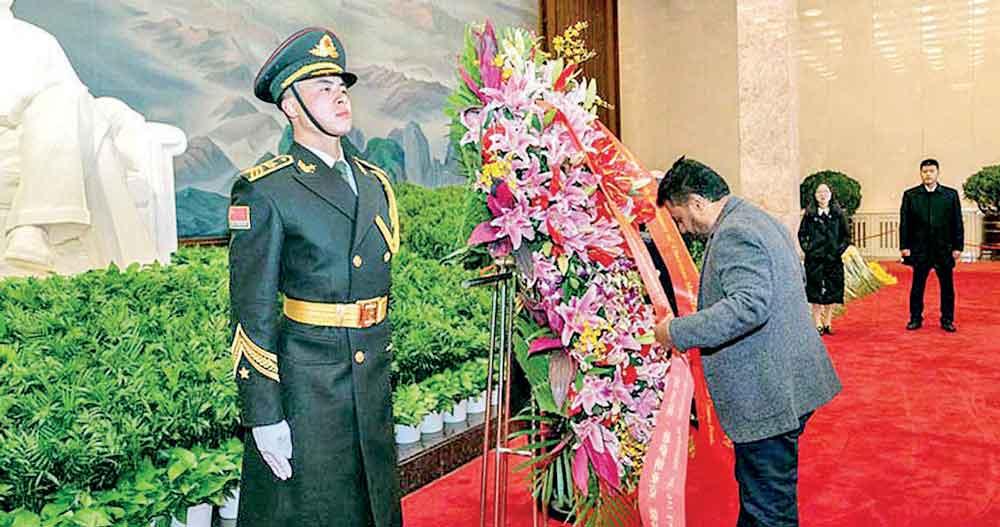
 After Ranil Wickremesinghe handed the baton over smoothly to the winner at the 2024 Presidential Elections, Sri Lankans still had ‘concerns’ if ‘worries’ wasn’t the best word to use at that period of time. The concerns were whether an inexperienced set of lawmakers could play administrator roles and turn around a crashed economy. Now those concerns are slowly turning into worries.