The Central Bank of Sri Lanka and the People’s Bank of China, in December 2024, successfully renewed the Bilateral Currency Swap Agreement signed in 2021, for a period of another three (03) years, under the terms and conditions stipulated in the original agreement. The CNY 10 billion (approximately USD 1.4 billion) currency swap facility reflects the financial cooperation between China and Sri Lanka.
Dr. P. Nandalal Weerasinghe, Governor of the Central Bank of Sri Lanka, signed the agreement on behalf of the Central Bank of Sri Lanka, while Mr. Pan Gongsheng, Governor of the People’s Bank of China, signed on behalf of the People’s Bank of China.
Energy Minister Engineer Kumara Jayakody announced that electricity bills have been reduced by approximately 20%, effective from midnight on January 17, following recommendations from the Public Utilities Commission.
In a special statement made today (18), the Minister expressed optimism that the reduction will benefit all citizens, particularly the hotel sector and industrialists.
He described the significant reduction as a major relief for the people of the country.
Dr. Chula Rajapaksse MNZM FRCP/FRACP Wellington NZ
Dear Editor,
It is quite frustrating to read of the continuing need. for ships to stay in ques to have them servied, This takes my mind back immediately to 1957/58 period when the LSSP controlled trade unions brought Colombo port to a stand still during Mr SWRD Bandaranayakes premiership.
However now the country has a brand new harbour in Hambantota completely underutilised.
This is a perfect opportunity for the New Govt. to begin utilising this underutilised resource so that efficiency in both ports could be used with country never being held to a ransom again like this.
The thousands of military bases, both foreign and domestic, around the world are a critical piece of the war machine that must be dismantled. Closing bases is a necessary step to shift the global security paradigm towards a demilitarized approach that centers common security — no one is safe until all are safe.
Here are the top 5 reasons why we’re calling for a Global Day of Action to Close Bases:Bases often perpetuate colonialism. From Panama to Guam to Puerto Rico to Okinawa to dozens of other locations across the world, militaries have taken valuable land from local populations, often pushing out Indigenous people in the process, without their consent and without reparations. Bases cost an exorbitant amount of $$. The cost of U.S. foreign military bases alone is estimated at $80 billion a year. Bases exacerbate environmental damage and the climate crisis. It is well documented at hundreds of sites around the world that military bases leach toxic so-called forever chemicals” (PFAS/PFOS) into local water supplies, which has had devastating health consequences for nearby communities. Bases can impact the local economy and community. Militaries have a notorious legacy of sexual violence, including kidnapping, rape, and murders of women and girls. Bases heighten tensions and provoke war-making. Additionally, bases make locations into targets for attack. Visit the website to learn more about why we’re calling for this worldwide day of action and check out our action planning resources to help you organize your event. Plus, organizations are invited to endorse the day of action here.
Individuals and organizations around the world are invited to get creative in organizing actions in your community! Action types will vary based on the location of the military base in your area and who holds the power to shut the base down. Some ways to take action include: Rallies and vigils at military bases Demonstrations at decision-makers’ offices, such as at embassies and Parliament buildings, to advocate for policy change to prevent, close, and convert bases Flyering workers at the entrance gates as they drive in and out of the base Educational events such as teach-ins about the impacts of military bases in your area Celebratory events at base sites that have been prevented, closed, or converted And more!
Core Mobilization Organizers for the Global Day of Action include: International Peace Bureau, No to War – No to NATO Network, Pace e Bene, RootsAction, Veterans For Peace, War Industry Resisters Network, and World BEYOND War. We hope you’ll join the Global Day of Action to #CloseBases on February 23 by organizing a local action near you.
Embassy of the People’s Republic of China in the United Kingdom of Great Britain and Northern Ireland
1.At the invitation of H.E. Xi Jinping, President of the People’s Republic of China, H.E. Anura Kumara Disanayaka, President of the Democratic Socialist Republic of Sri Lanka, paid a state visit to the People’s Republic of China from January 14 to 17, 2025.
2.During the visit, President Anura Kumara Disanayaka held talks with President Xi Jinping, and met with H.E. Li Qiang, Premier of the State Council and H.E. Zhao Leji, Chairman of the Standing Committee of the National People’s Congress. In a cordial and friendly atmosphere, the two sides had in-depth exchanges of views and reached extensive common understandings on deepening traditional friendship and advancing high-quality Belt and Road cooperation and multi-sectoral practical cooperation between China and Sri Lanka, and on regional and international issues of mutual interest.
3. The two sides share the view that China and Sri Lanka have consistently respected each other, treated each other as equals and stood by each other over the 68 years of diplomatic ties, and set a fine example of friendly interactions and mutually beneficial cooperation between countries of different sizes. The two sides agreed to carry forward the spirit of independence, self-reliance, solidarity and mutual assistance enshrined in the Rubber-Rice Pact, follow the principles of mutual respect, mutual trust, mutual support, win-win cooperation and common development, stay committed to deepening the China-Sri Lanka strategic
cooperative partnership based on sincere mutual assistance and ever-lasting friendship, and jointly build a China-Sri Lanka community with a shared future, to bring greater benefits to the two countries and peoples.
4. The two sides agreed to maintain the momentum of close high-level exchanges to keep the strong strategic guidance by the leaders of the two countries over bilateral relations, to further strengthen bilateral exchanges between the two governments, legislative bodies and political parties to consolidate political mutual trust and share and learn from each other’s governance and development experience, and make dedicated efforts to enhance China-Sri Lanka relations.
5. Both sides reaffirmed mutual support on issues involving each other’s core interests and major concerns. Both sides reaffirm the authority of the United Nations General Assembly Resolution 2758 and Sri Lanka reaffirmed its strong commitment to the one-China principle, recognizing that the Government of the People’s Republic of China is the sole legal government representing the whole of China, and Taiwan is an inalienable part of China’s territory. Sri Lanka firmly supports all efforts by the Chinese government to achieve national reunification, and opposes Taiwan independence” in any form. Sri Lanka reiterated that it will never allow its territory to be used for any anti-China, separatist activities and will firmly support China on issues related to Xizang and Xinjiang. China reiterated that it will continue to firmly support Sri Lanka in safeguarding national independence, sovereignty and territorial integrity, and will respect and support Sri Lanka in independently choosing a development path suited to its national conditions. The Chinese side reiterated its commitment to an independent foreign policy of peace. Sri Lanka reiterated its commitment to an independent non-aligned foreign policy.
6. China congratulated Sri Lanka on successfully holding presidential and parliamentary elections in 2024, expressed its good wishes for the new Sri Lankan government to take the Sri Lankan people forward in economic and social development, unity, stability and prosperity, and conveyed its readiness to provide active support as the Sri Lankan government works to promote the sustainable development of the country. Sri Lanka commended the remarkable achievements China made in the new era, and expressed support for China to build a great modern socialist country in all respects and advance the great rejuvenation of the Chinese nation through the Chinese path to modernization. Sri Lanka believes that China’s drive to further deepen reform comprehensively and promote high-standard opening up will bring new opportunities for Sri Lanka’s economic advancement.
7. Under the guidance and encouragement of leaders of both countries, China and Sri Lanka have produced fruitful outcomes in Belt and Road cooperation. Sri Lanka appreciates the important role of Belt and Road cooperation in its economic and social development and the livelihood of its people. The two sides agreed to advance all major signature projects including the Colombo Port City and Hambantota Port integrated development, fully utilize such platforms as the Silk Road Workshop and carry out more livelihood programs in Sri Lanka in accordance with the principles of planning together, building together and benefiting together, open, green and clean cooperation, and high-standard, people-centered and sustainable development and following the eight major steps announced by President Xi Jinping for supporting high-quality Belt and Road cooperation. The two sides were pleased to sign a Belt and Road cooperation plan to upgrade China-Sri Lanka high-quality Belt and Road cooperation and jointly open up new space for win-win development of higher standard, stronger resilience and greater sustainability.
8. Sri Lanka expressed its high appreciation for the valuable support it has received from China in times of financial difficulties, including the vital assistance in restructuring China-related debts, which was a robust support for Sri Lanka in effectively dealing with the debt issue. Sri Lanka expressed its desire for the early implementation of the agreed debt restructuring plan together with Chinese financial institutions. China will continue to play a positive role in the International Monetary Fund and maintain friendly communication with other creditors to help Sri Lanka ease its financial difficulties and achieve debt sustainability. The Central Bank of Sri Lanka and the People’s Bank of China have renewed their currency swap agreement and will continue to carry out financial cooperation.
9. The two sides are satisfied with the progress of bilateral cooperation in economy and trade. Sri Lanka expressed appreciation to China for its effort to promote import from Sri Lanka through various means. China expressed its readiness to continue supporting Sri Lankan enterprises in the tea, gem and other industries in establishing ties with relevant Chinese associations of importers and exporters, facilitate Sri Lanka’s participation in expos such as the China International Import Expo, China Import and Export Fair, China-South Asia Exposition and e-commerce platforms, and further enhance cooperation between enterprises of the two countries on the basis of mutual benefit and win-win outcomes. The two sides agreed to work toward the early conclusion of a comprehensive free trade agreement in one package in line with the principles of equality, mutual benefit and win-win outcomes.
Sri Lanka welcomes more business investment from China and will provide a conducive investment and business environment for this purpose. China will continue to encourage Chinese enterprises in investing in Sri Lanka to facilitate economic transformation and sustainable development in Sri Lanka. The two sides agreed to expand cooperation in such fields as logistics, green development, and digital economy to propel their high-quality and mutually beneficial practical cooperation.
10. The two sides shared positive evaluations of their wide-ranging cooperation and in-depth exchanges on agriculture. China conveyed its readiness to carry out training and demonstration programs with Sri Lanka in areas including bio-technologies for tropical crops, plant breeding and cultivation, and aquaculture to help Sri Lanka enhance its capacity for sustainable agricultural development; and welcome Sri Lanka to further expand its export of distinctive products to China, including tea, fruits, cinnamon, and aquatic products. The two sides shared the readiness to expand exchanges and cooperation with a sharper focus on poverty reduction and rural revitalization. China expressed its readiness to help Sri Lanka strengthen the capacity of personnel in related fields.
11. Both sides recognize climate change as one of the greatest challenges of human society and a threat to the sustainable development of developing countries including China and Sri Lanka. They agreed to work actively together on climate change. Sri Lanka expressed appreciation to China for its humanitarian relief in the wake of severe flooding. China expressed its readiness to enhance cooperation with Sri Lanka in such fields as disaster prevention and mitigation and emergency rescue, share its technologies and provide training in improving Sri Lanka’s emergency management capabilities. China welcomes Sri Lanka’s participation in the relevant activities of the Belt and Road International Green Development Coalition and other platforms as part of the joint effort to realize the U.N. 2030 Sustainable Development Goals.
12. The two sides share the desire to continue maritime cooperation on the basis of equality, mutual trust, openness and mutual benefit, and hold regular bilateral consultations on maritime affairs. The two sides are ready to deepen cooperation in such fields as conservation and restoration of the marine environment and ecosystems, maritime domain awareness, maritime rescue and disaster relief, and maritime personnel training and capacity building, and pool their strength to build a maritime community with a shared future. The two sides agreed to sign Memorandum of Understanding on Ocean Cooperation toward Blue Partnership.
13. The two sides are ready to deepen cooperation on education. The two sides fully recognized the importance of education exchanges for increasing understanding and friendship, and expressed readiness to further enhance exchanges of teachers, students, and researchers. China welcomes and encourages more committed students from Sri Lanka to pursue further studies in China, and is ready to continue to support them with government scholarships. China will work with Sri Lanka to implement the Luban Workshop to good effect and nurture more professionals through vocational and technical training for Sri Lanka. Sri Lanka appreciates China’s assistance in education, and will work for the success of the digital classroom project together with China. The two sides are ready to promote Chinese language education in Sri Lanka and continue to work through the China Culture Center in Sri Lanka to promote cultural exchanges and cooperation between the two countries. The two sides will continue to work in and develop the China-Sri Lanka Joint Center for Education and Research under the Chinese Academy of Sciences, and strengthen scientific and technological exchanges and cooperation and education in the universities and research institutes of the two countries.
14. The two sides are ready to carry forward their long-standing friendship and bring their peoples closer together. The two sides will take multiple measures to encourage mutual tourist travel and aviation connectivity. China welcomes more Sri Lankan cities in the International Tourism Alliance of Silk Road Cities. The two sides will continue to support each other in holding tourism promotion activities in China and Sri Lanka.
15. The two sides are ready to strengthen exchanges and cooperation in areas such as youth, think tanks, sports, and the media, build on the bond of Buddhist exchanges, and deepen people-to-people and sister-city exchanges.
16. China will continue to extend support for the development of the health sector in Sri Lanka. China’s Yunnan Province will continue to send medical teams to Sri Lanka to carry out the Brightness Action program.
17. The Chinese side commends Sri Lanka’s positive response to President Xi Jinping’s proposal of the Asian Initiative for Cultural Heritage Conservation and Sri Lanka’s participation in the Alliance for Cultural Heritage in Asia. China will further promote bilateral cultural heritage cooperation with Sri Lanka under the Alliance.
18. The two sides recognize judicial, law enforcement and security cooperation as an important component of bilateral cooperation, and stand ready to jointly crack down on cross-border crimes such as telecom fraud and online gambling. China is ready to do its best to support capacity building in Sri Lanka’s judicial, law enforcement and security areas and provide assistance of police supplies.
19. Sri Lanka reaffirmed its commitment to supporting and actively participating in the development of a community with a shared future for mankind, the Global Development Initiative, the Global Security Initiative and the Global Civilization Initiative proposed by President Xi Jinping. The year 2025 marks the 80th anniversary of the founding of the United Nations, which was just after the end of the Second World War. The two sides reaffirmed their commitment to jointly upholding the international system with the U.N. at its core, the international order underpinned by international law, and the basic norms governing international relations based on the purposes and principles of the U.N. Charter. The two sides will adhere to the Five Principles of Peaceful Coexistence and jointly advocate an equal and orderly multipolar world and a universally beneficial and inclusive economic globalization, and work toward a bright future of peace, security, prosperity and progress for all countries in the world.
20. During the visit, the two sides signed cooperation documents, in the areas of agriculture, tourism, livelihood assistance, the media and other areas.
21. President Anura Kumara Disanayaka expressed appreciation to the Chinese government and people for the warm hospitality extended to him and the Sri Lankan delegation, and invited the Chinese leadership to visit Sri Lanka. The Chinese leadership expressed appreciation for the kind invitation, and the two sides agreed to maintain communication via diplomatic channels.
BEIJING, Jan. 17 (Xinhua) — “Sri Lanka and China are ushering in a new chapter in bilateral relations,” Sri Lankan President Anura Kumara Dissanayake has said.
At the invitation of Chinese President Xi Jinping, Dissanayake is on a state visit to China from Tuesday to Friday, his first trip to China since taking office in September as Sri Lankan president.
“I first visited Beijing in 2004. Returning after 20 years, I see a tremendous transformation,” Dissanayake said.
Over the past 68 years since establishing diplomatic ties, China and Sri Lanka have deepened their strategic cooperative partnership through sincere mutual assistance and lasting friendship.
Following their talks on Wednesday, the two heads of state jointly witnessed the signing of several cooperation documents in such areas as Belt and Road cooperation, agricultural products, social welfare, and the press, radio and television.
Dissanayake said that Sri Lanka is currently facing several challenges, including poverty reduction, technological advancement and infrastructure development, and China can play a significant role in supporting Sri Lanka in overcoming these challenges.
“I observed that the Chinese government is people-centered and attentive to public needs. Similarly, Sri Lanka’s new government is also dedicated to serving its people,” said the 56-year-old president.
Dissanayake applauded China’s poverty alleviation achievements. “China’s poverty reduction experience is a global model and has been praised by the United Nations. Sri Lanka has much to learn from China’s experience,” he said, highlighting his plan of field trips to rural areas in China to learn firsthand how local farmers have overcome poverty.
Dissanayake was also impressed by his visit to the Museum of the Communist Party of China(CPC), which shows how China, led by the CPC, has overcome challenges and achieved its current success. “The exhibition holds great significance not only for the Chinese people, but also for us as it offers new perspectives on development,” he said.
Over the years, Sri Lanka and China have made steady progress in high-quality Belt and Road cooperation. Chinese enterprises have constructed ports, highways, railways, hospitals, water conservancies and power facilities in Sri Lanka, significantly improving its infrastructure and investment environment while boosting local employment.
China is a major trade partner for Sri Lanka, a leading source of imports and foreign investment and a key provider of development assistance.
The Colombo Port City and Hambantota Port are landmark projects of the Belt and Road cooperation between the two sides. “These two projects will undoubtedly bring long-term economic benefits to Sri Lanka,” Dissanayake said.
Industrial parks would be developed around Hambantota Port, and Colombo Port City would attract more investment, greatly improving the living standards of the Sri Lankan people, he said.
Debunking Western media’s disinformation that China is creating a “debt trap” and militarizing Sri Lankan ports, Dissanayake said, “Global South countries need development, which cannot be achieved without external investment and loans. We cannot view such assistance as a ‘debt trap’.”
Looking ahead, Dissanayake expressed hope of attracting more Chinese enterprises to invest in Sri Lanka and more Chinese tourists. Currently, China is Sri Lanka’s fourth-largest source of tourists.
To further boost tourism, Sri Lanka has launched tourism promotion campaigns and streamlined visa application processes, and it is planning more direct flights to attract Chinese tourists.
“Sri Lanka and China are both nations rich in cultural heritage with a long history of people-to-people exchanges. I believe Chinese tourists will have a wonderful time in Sri Lanka,” said the president. Enditem
(Xinhua reporter Che Hongliang in Colombo also contributed to this story.)
An under-construction luxury hotel property in Colombo has come under the scanner as part of a money laundering probe linked to a Gurugram-based realty company, Indian media reported today.
The Indian Enforcement Directorate, a government agency tasked with investigating offences of money laundering and foreign exchange laws, said that the property is part of a collection of assets worth more than Indian Rupees 200 crore, linked to Krrish Realtech Private Limited, which is promoted by businessman Amit Katyal.
The ED, in a statement had said, that it has issued an order to provisionally attach the under-construction luxury hotel and leasehold rights over 4 acres of land in the “Colombo 1” area of Sri Lanka to the case, apart from land rights for about 2.82 acres of Vicinity Hotels Pvt. Ltd., in the name of Good Earth Business Park Pvt. Ltd. located at Sector-66 in Gurugram, the Press Trust of India reported.
The money laundering case, it was also reported, stemmed from FIRs filed by the Economic Offences Wing (EOW) of Delhi Police and Gurugram police against Katyal and his associates.
It is alleged in the complaints against Krrish Realtech Pvt. Ltd. that it “defrauded” numerous investors and “illicitly” transferred hundreds of crores of rupees abroad “through a coordinated scheme involving cheating, deception and fraud”.
The agency said the company floated a project to provide residential plots in the centre of Gurugram, but after a lapse of more than 13 years no plots were provided to the buyers, despite collecting Indian rupees 503 crore from plot buyers.
“Amit Katyal willingly siphoned off funds collected from various plot buyers and investors to a Sri Lankan company named The One Transworks Square (Pvt) Ltd. (formerly Krrish Transworks Colombo Pvt Ltd) which was developing a luxury real estate project in Sri Lanka,” the ED also stated.
The Energy Ministry stated that the proposed electricity tariff revision would be implemented only upon receiving approval from the Finance Ministry.
Meanwhile, the Public Utilities Commission of Sri Lanka (PUCSL) announced today that electricity tariffs will be reduced by 20%, effective from midnight.
However, the Energy Ministry stated that the proposed tariff revision would only be implemented after obtaining consent from the Finance Ministry.
Sri Lanka might not have the pride it showcased during the Bandaranaike era of politics, but it will stop at nothing to grab all help offered by an Asian nation like China in its attempt to rebuild a weak economy
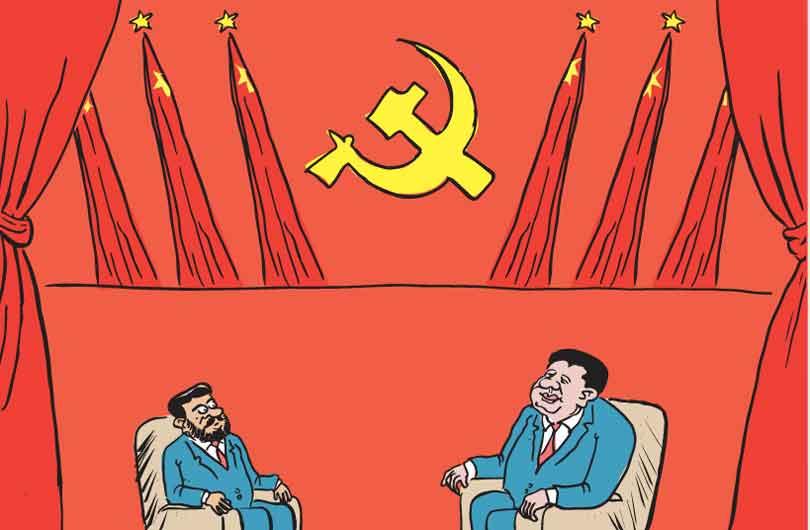
China’s President Xi Jinping might not be captured smiling on camera, but President Anura Kumara Dissanayake (AKD) has been grinning quite often during the latter’s ongoing official visit to China.
AKD is on a four-day visit to China (the visit ends on January 17) and the two heads of state have discussed on bilateral issues with Chinese President Xi Jinping giving assurances that the island nation will have China’s support to usher in a new era of development.
The issue with Sri Lanka has been that past development projects done in the island taking in foreign loans have failed to raise expected revenue. And for much of these projects, China was the lender. At least this time around, the Sri Lankan Government must think of ways to utilise upcoming development projects, so that loans obtained can be repaid.
The Chinese Government will be all eager to help Sri Lanka only if development projects commenced here support China’s Belt-Road Initiative. Sri Lanka-China relationships stretches back to 1952 when the two nations signed the Rubber-Rice Pact. In earlier times, Sri Lanka didn’t feel settled to help a non-socialist country to import rubber, fearing a backlash from USA. But now the global picture has changed and China is an emerging superpower and a more helpful business partner compared to other ambitious countries, which wish to rope in Sri Lanka and engage in geopolitics.
Sri Lanka might not have the pride it showcased during the Bandaranaike era of politics, but it will stop at nothing to grab all help offered by an Asian nation like China in its attempt to rebuild a weak economy. China’s presence in East Asia can be annoyingly affected if any other powerful nation secures footing on Sri Lanka in the guise of offering aid and help for development. But AKD was wise enough to do a visit to India first before saying yes to an official visit to China; the latter being AKD’s second official visit to a country after assuming the presidency in September last year.
There was a gun salute for AKD in China. The Sri Lankan president was then seen laying a floral tribute at the Mao Zedong Mausoleum later on. AKD probably felt his own pulse beating a bit louder when standing near the stature of the Chinese legendary leader because he can relate well to this socialist icon. Zedong was ruthless against his opponents and whatever that stood in his way. AKD can take a cue from China and be ruthlessly efficient instead. Many who work closely with AKD affirm that the new Sri Lankan President is a task master and workaholic; one Sri Lankan social media website recently reported that the island’s president can run a full day at work with just two breaks and that only for two cups of tea!
Forget China’s helping hand towards Sri Lanka, the Chinese are on a mission to conquer the business world and further their maritime interests on the Indian Ocean. During the Sri Lankan head of state’s visit to China, his Chinese counterpart outlined China’s plan to boost its high-quality belt-road initiative and needed the island’s cooperation for it.
During bilateral discussions between the representatives of the two nations (during this visit) there were the signing of cooperation documents which included an agreement to help Sri Lanka export agriculture products to China.
This is the time for AKD to strike while the iron is hot! China is more eager to continue being the nation that supports and aids Sri Lanka which easily supersedes the eagerness shown by the island nation to rebuild its fallen economy. China is still far away from Sri Lanka compared to India distance wise, but it has the skills to pull at the heart strings of the Sri Lankan president by whispering inspirational tales of socialism.
Sri Lanka and China have agreed to work towards the early conclusion of a comprehensive Free Trade Agreement (FTA) in one package in line with the principles of equality, mutual benefit, and win-win outcomes, a joint statement from the two countries highlighted.
China expressed its readiness to continue supporting Sri Lankan enterprises in the tea, gem, and other industries in establishing ties with relevant Chinese associations of importers. It also said it would facilitate Sri Lanka’s participation in expos such as the China International Import Expo, China Import and Export Fair, China-South Asia Exposition, and e-commerce platforms.
Sri Lanka expressed appreciation to China for its effort to promote imports from Sri Lanka through various means.
The two sides said they are staisfied with the progress of bilateral cooperation in economy and trade.
The dossier was researched and written under the leadership of Professor Grieve Chelwa of The Africa Institute, Global Studies University, through Tricontinental Pan Africa
In Africa, the leading forces of capitalism have ruthlessly wielded a neoliberal conception of corruption to undermine states’ sovereignty and open the continent to plunder at the hands of Western multinational corporations.
26 November 2024
The dossier was researched and written under the leadership of Professor Grieve Chelwa of The Africa Institute, Global Studies University, through Tricontinental Pan Africa.
The artwork in this dossier attempts to illustrate the true face of corruption on the African continent – from the brutal plunder of the colonial era to today’s legalised looting by multinational corporations through tax evasion and other illicit forms of accounting. The satirical images aim to subvert the racialised image of African corruption and highlight the true cost of neo-colonialism and the faces of the true culprits – the Western multinational corporations, banks, and accounting institutions who underdevelop Africa for their own profit.
In the years following the fall of the Soviet Union, the word ‘corruption’ increasingly began to appear in the reports of multilateral agencies and non-governmental organisations. These reports argued that corruption is rooted in the regulatory function of states, which control large-scale development projects and whose officials oversee the delivery of licences and permits; if the regulatory function of states could be minimised, many of these reports argued, corruption would be less pervasive. This kind of anti-corruption discourse fit neatly within the neoliberal drive to shrink states’ regulatory apparatuses, deregulate and privatise economic activity, and promote the idea that the freedom of the market’s invisible hand would create a moral foundation for society.
Yet, none of these reports – including those from the World Bank and Transparency International – offered a clear definition of corruption. In The Anti-Corruption Plain Language Guide (2009), Transparency International defined corruption as ‘the abuse of entrusted power for private gain’.1
Three years later, the World Bank described corruption as ‘the abuse of public office for private gain’.2
These definitions are similar, and they continue to be reproduced in reports from multilateral organisations and in academic scholarship. The key word here is ‘abuse’, and the main implication is that someone in the public sector entrusted with power or public office abuses their role for private gain, such as through bribery, nepotism, extortion, and embezzlement. This orientation argues that if the state were smaller or more disciplined, there would be little to no corruption in society. Even though the non-governmental organisation Transparency International added a concern about private sector corruption in 2010, this addition has been marginal to the overall focus on public sector corruption.3
The epicentre of this argument has been the African continent, where the idea of ‘corruption’ – meaning corruption of the state – has effectively been used to diminish the state’s regulatory functions and reduce the number of state employees. It is important to note that while 21% of the European workforce, on average, is employed in the public sector, that number is a mere 2.38% in Mali, 3.6% in Nigeria, and 6.7% in Zambia, which in turn limits these states’ capacity to manage and regulate large multinational corporations on the African continent.4
Furthermore, over the course of the 1990s and the 2000s, the International Monetary Fund (IMF) fought to reduce public-sector employees’ salaries, which certainly increases the likelihood of bribery. The IMF outlined this approach in its 1991 Public Expenditure Handbook, whichmakes reducing the wage bill for public-sector workers a central part of its agenda.5
In neoliberal literature, corruption primarily takes the form of bribery, extortion, and embezzlement – all of which refer principally to public sector corruption – while omitting concepts such as transfer mispricing, trade mis-invoicing, accounting irregularities, financial mismanagement, and tax avoidance – all of which are essential elements of multinational corporations’ accounting practices.6
There are a range of socio-psychological reasons for corruption, the most referenced one being greed. But greed is not a transhistorical concept or emotion; rather, it is shaped by the social formation in which it is allowed to grow. Capitalism has a special relationship to greed, since it fosters the ‘animal spirits’ (as the economist John Maynard Keynes put it) to reduce all human life to commodities and to centralise the profit motive as the economic motor.7
Yet, older forms of morality that are eager to set aside hypocrisy and overcome the dominion of money prevail in social consciousness across the world. This dossier is anchored in the popular sentiment against corruption in society, driven largely not by petty bribery but by industrial-scale corruption by private capital. The Malaysian sociologist Syed Hussein Alatas called this ‘tidal corruption’: the corruption that ‘floods the entire state apparatus involving those at the centre of power. Like the tide, it rises to cover wider areas and immerse the surrounding vegetation’.8
This dossier is not a defence of corruption; on the contrary, it argues for an understanding of corruption that is not rooted solely in the public sector but that appreciates the tidal corruption set in motion by the leading forces of capitalism. It focuses on the African continent because that is where agencies such as the IMF and the World Bank have most effectively wielded the idea of ‘corruption’ to undermine states’ sovereignty and subjugate the countries of the Global South to the extraordinary power of multinational corporations, particularly in the mining sector.9
Top
Part 1: The Neoliberal Corruption Industry
In 1993, Peter Eigen, a German lawyer who worked at the World Bank in the legal department, registered an association in Germany called Transparency International. Eigen worked with Michael Wiehen (formerly of the World Bank) and Hansjörg Elshorst (formerly of the German Agency for Technical Cooperation) to establish Transparency International in German business and government circles as a legitimate organisation. Before going forward to discipline countries of the Global South, the association had to ensure that European states had built their own legitimacy regarding corruption. That is why they lobbied the governments of France and Germany to stop the policy of what, in Germany, is called Schmiergeld (bribe money); these countries not only allowed bribes to be paid in foreign jurisdictions, but then permitted companies to deduct these payments from tax obligations.10
This lobbying resulted in the passage of the 1999 Organisation for Economic Cooperation and Development (OECD) Convention on Combating the Bribery of Foreign Public Officials in International Business Transactions. By passing this convention, European officials and their counterparts in North America created a framework about corruption through which to adopt a morally superior position over governments in the Global South.11
In 1997, Matthew Parris, a conservative South African-born member of the British Parliament, said, ‘Corruption has become an African epidemic. It is impossible to overstate the poisoning of human relations and the paralysing of initiative that corruption on the African scale brings’.12
This phrase – on the African scale – defines an attitude toward corruption that embodies both the long colonial history of theft and the neocolonial present of corporate malfeasance on the continent.
Yet those who moralise about African corruption have little to say when it comes to the criminality of corporate corruption. Take, for example, the German-South African retail giant Steinhoff International (1964–2023). In 2015, German officials raided the offices of Steinhoff Europe Group Services as part of an investigation into accounting fraud. As the scandal became too big to contain, with new investigations by contracted firms such as PricewaterhouseCoopers, and with Steinhoff’s senior management forced to resign, the South African parliament opened its own investigation of the firm, which found that businesses such as Steinhoff rely upon public funds for their investments, including – in the case of South Africa – the Public Investment Corporation.13
These public funds lost billions in Steinhoff’s eventual collapse. In 2019, South Africa’s Financial Sector Conduct Authority imposed an administrative fine of ZAR 1.5 billion (US $95 million) on the company for false, misleading, or deceptive statements to the market. This fine was later reduced to ZAR 53 million (US $3.4 million), a minuscule amount compared to the approximately ZAR 124.9 billion (US $6.9 billion) involved in fictitious or irregular transactions that substantially inflated Steinhoff’s profits and assets between 2009 and 2017.14
In the service of ‘investor-friendly policies’, these scandals are either underreported or treated as the exception rather than the rule. Yet this is a familiar story, from the accounting debacles at Enron Corporation (2001) and Arthur Andersen (2002) – which led to the largest known case of corporate fraud in history – to the faked emissions scandal at Volkswagen (2015).Top
Before Transparency
In the period of decolonisation and then of the formation of post-colonial states, Western-driven modernisation theory argued that corruption was not a ‘poison’ but an asset that helped shape the relationship between the ruling class and the state apparatus. Drawing from the experience of the United States, Robert K. Merton’s Social Theory and Social Structure (1949) provided the basis for this line of argument: that corruption made the relationship between state officials and the ruling class more intimate.15
In the 1960s, a range of influential scholars published important articles based on fieldwork in Africa and Asia to substantiate the claim that corruption ‘humanises government’, as Edward Shils wrote in 1960.16
Indeed, in his classic work Political Order in Changing Societies (1968), Samuel Huntington argued that corruption (or what he defined as ‘patronage from above’) in Africa, Asia, and Latin America had contributed to the creation of ‘the most effective political parties and most stable political systems’.17
In this Western modernisation literature, which dominated the worldview of multilateral institutions, corruption was treated as an utterly normal – even beneficial – form of economic interaction.
Modernisation theory played a considerable role in the new post-colonial states, but it was not the only approach to economic development. In 1955, the Bandung Final Communiqué made it clear that the most predatory aspect of the world economy’s neocolonial structure was the role of transnational corporations (TNCs), as they were known then (later called multinational corporations, or MNCs). Many of these TNCs, which emerged during the colonial era, had built up their capital stock through colonial theft and structured world economic relations to gain privileged access to raw materials in the former colonies as well as captive markets to which to export their expensive finished products. That is why the new post-colonial states centred the role of TNCs as they developed the platform of the New International Economic Order (NIEO): if these states were to establish sovereignty over their own territories, they had to reduce the power of TNCs either by regulation or restriction.18
Since many of these states lacked the capacity to develop an in-depth analysis of how these firms were organised or how they managed their financial transactions, they urged the UN Conference on Trade and Development (UNCTAD) and other United Nations bodies to do so. In 1974, the UN Centre for Transnational Corporations (UNCTC) was created for this purpose and began to build a database on the major TNCs’ operations in order to understand what was seen as the institutionalisation of corruption through novel manoeuvres of accounting.
At the same time, the post-colonial states understood the grave limitations they had inherited from their old colonial masters all too well, such as a hierarchical state apparatus designed to terrorise the colonised population and a bureaucracy that had been trained to serve the ends of colonialism, not the people. With the departure of the colonial bureaucrats, the now independent states had to train almost an entirely new administration, many of whose cadre came from impoverished or near-impoverished backgrounds (material conditions that increased the temptation to accept bribes). These states opened public administration institutes to develop the capacity of their new employees and to encourage them to work with the spirit of the national liberation struggles that had won them independence. Each state’s attitude towards public administration varied based on its class politics: in states with a more landlord-bourgeois character, the public administration institutes inherited the old colonial forms of bureaucracy without much revision, whereas states with a higher socialist character (such as China and Vietnam) emphasised combatting the forms of hierarchy amongst state officials. In Vietnam, for instance, Ho Chi Minh called upon the new workers to lead by example rather than corrupt society with bribery and extortion (Thi đua là yêu nước, yêu nướcthì phải thiđua, Ho Chi Minh said: ‘emulation is patriotism; patriots must emulate’).19
Since the material conditions to build a new kind of state simply did not exist, modern training and social pressure became the primary avenues through which to inculcate new values against a backdrop of low salaries and great temptations (the ‘creation of a new man’, as Ernesto ‘Che’ Guevara wrote).20
Yet, in the era ‘before transparency’, under pressure from TNCs and from Western modernisation theory which justified bribery, post-colonial governments struggled to produce new state values.
In the 1990s, a new argument emerged from the Western academy and multilateral organisations controlled by Western governments. This new theory, which moved from modernisation to neoliberal theory, suggested that the states in the Global South were the locus of corruption, that a smaller state would largely solve the problem, and that more pressure must be placed on these states in order to ‘discipline’ them. The idea that TNCs – now MNCs (multinational corporations) – could be corrupt completely vanished in this theory.
In 1992, under pressure from the US government, the UNCTC was integrated into UNCTAD, where its mandate was radically transformed. Instead of being a watchdog of these large corporations, the UNCTC put its resources toward helping MNCs enter southern markets. There was no more interest in producing a TNC Code of Conduct, the skeleton of which was relegated to a languishing draft from 1983 that is raised every few years and thereafter ignored in special sessions.21
In other words, the UNCTC became largely moot. What is truly remarkable is that the UNCTC and its code of conduct were sidelined by the West just when UNCTAD showed that 80% of global trade (in terms of gross exports) was linked to the international production networks of these mega corporations that operated across national boundaries, and that the market was becoming increasingly concentrated around these firms.22
That is largely why multilateral agencies make no mention of the private sector in their definition of corruption, which they describe as merely the ‘abuse of public office for private gain’.
In 1995, in place of the UNCTC’s TNC Code of Conduct, Transparency International released its annual Corruption Perceptions Index (CPI).23
The CPI was measured by a group of ‘experts’ (often private businessmen) who offered their subjective assessment of public sector corruption in various countries. Even when the CPI redefined corruption in 2010 as ‘the abuse of entrusted power for private gain, encompassing practices in both the public and private sectors’, it still ranked countries based on the perception of corruption in the public sector.24
The underlying neoliberal theory here is that corruption in the public sector corrodes the quality of investments in public goods, as corrupt officials seek to increase the volume of investments in order to increase bribes without considering how those investments align with broader national development goals. According to this theory, the correct course is more privatisation and less government oversight; its proposal for ‘transparency’ is merely to eviscerate regulatory state apparatuses and exaggerate the private sector’s ability to profit from public goods.
Under pressure from Transparency International and allied Western governments, the United Nations General Assembly adopted the UN Convention Against Corruption in 2003, which was replicated in the 2003 African Union Convention on Preventing and Combating Corruption. The UN and African Union (AU) treaties do not explicitly define corruption; rather, they make a list of offences that they suggest should be criminalised, which overwhelmingly focuses on the public sector (such as bribery of public officials).25
The UN convention, AU convention, and Transparency International’s CPI treat various types of theft as perfectly legal, including the legal theft of surplus value from workers, the illegal deductions of fines and fees used to penalise workers, and corruption legalised by accountants. By turning a blind eye to corporate corruption and focusing, instead, on bribes of public officials, these entities normalise the structured criminality of capitalism. Furthermore, the Western-driven UN Convention and the Western-based NGO (Transparency International) that have taken charge of this discourse of corruption have made it appear as though the West has transcended corruption and that corruption is primarily a problem in the Global South. This narrative exculpates the Western-based MNCs from blame and erases the long anti-corruption struggles in the Global South, a rich ethical tradition that is rooted both in religion and in common sense.
Meanwhile, the world of accounting has developed a new form of theft called ‘sustainability reporting’, which is emblematic of a broader trend that seeks ways to hide money from tax authorities and legalise corruption. This form of greenwashing allows accounting firms to disclose what they are doing to incorporate environmental, social, and governance (ESG) factors in order to discount their taxable income, and in so doing often providing false or misleading claims about the environmental benefits of a product, service, or investment.26
Furthermore, these accounting practices are not obligated to produce or follow a proper environmental assessment, nor are they concerned about the displacement of residents from an area of operation, degradation of ecosystems, misuse of agricultural land, consumption of fossil fuel energy, or harsh exploitation of labour. Despite rampant abuse by MNCs – the plastic pollution generated by Coca-Cola’s Africa branch; logging in Norwegian-owned Green Resources Mozambique, Tanzania, and Uganda; and wildly unethical harvesting of ‘ethical diamonds’ by De Beers, to name a few – accounting firms are allowed to investigate themselves and are absolved from accusations of corruption for this type of behaviour, which falls far outside the neoliberal understanding of corruption.27
Part 2:
How Neoliberalism Has Wielded ‘Corruption’ to Privatise Life in Africa
The Big Heist
Glencore and Zambia
From 2003 to 2023, Zambia’s exports to Switzerland (almost entirely consisting of semi-processed copper) totalled $61 billion – nearly half of the country’s total exports during this period ($145 billion).28
In other words, Switzerland, a tiny landlocked country thousands of kilometres away, has accounted for half of Zambia’s total export market for the last two decades. But it was not always like this.
From 1995 to 1999, for instance, Zambia’s exports to Switzerland, totalling $159 million, made up just 3% of the country’s total exports. This began to change in 2000, when a controlling stake of Mopani Copper Mines (MCM), which up to that point had been owned by the Zambian state, was purchased by Carlisa Investments, a company owned by the giant Swiss commodities trader Glencore AG and domiciled in the British Virgin Islands (itself a tax haven). Therefore, from a legal standpoint, MCM was not owned by Glencore, which allowed Glencore to comply with legal requirements to engage in ‘arm’s length transactions’ with MCM on paper (meaning that they are parties acting independently without influencing each other) while doing the opposite in practice. It is illegal for a company to purchase from and sell to itself (one of the few regulations in place to prevent MNCs from committing tax evasion). However, a company – such as Glencore – can create a subsidiary company – such as Carlisa – with whom it can carry out transactions as if it were a separate company ‘at arm’s length’ while still exercising full influence over the terms and prices in practice. Since it is the subsidiary – Carlisa, in this case – that owns a third company – MCM – Glencore’s transactions with MCM are technically between two independent entities. Efforts are made to ensure that there is no paper trail suggesting otherwise.
* We chose to refer to Glencore as the owner of the mine because in practice, and in common knowledge, Glencore is the owner of the mine. Since Glencore uses Carlisa to obscure its theft of wealth from Zambia, often by shifting its profits around to evade taxes through transfer pricing, we have chosen not to mirror their language of obscurity in this dossier.
As figure 1 shows, Zambia’s annual exports to Switzerland skyrocketed from virtually zero prior to Carlisa’s (i.e., Glencore’s) purchase of MCM in 2000 to nearly $4 billion in 2020. This pattern led many to suspect that Glencore was engaging in transfer pricing – shifting its profits from a high-tax jurisdiction (Zambia) to a low-tax jurisdiction (Switzerland) in order to pay the least possible amount of taxes and maximise its net profits. In other words, instead of having to pay 30% in corporate taxes on the sale of copper in Zambia based on the commodity’s true value, Glencore is able to price the value of copper sales near zero through its relationship with Carlisa and pay taxes on that artificially low amount. Then it pays corporate income taxes in Switzerland at a rate of 14.6% – nearly half the rate it would have had to pay in Zambia.29
In 2010, the Zambia Revenue Authority took Glencore to court for engaging in transfer pricing. Despite arguing that its transactions with MCM were ‘arm’s length’ transactions between two unrelated entities – MCM and Glencore – (after all, MCM was owned by Carlisa, not Glencore), Glencore lost and was instructed to pay a penalty in addition to lost taxes due to transfer pricing.30
After a costly, ten-year legal battle, the decision was upheld by Zambia’s Supreme Court – a landmark ruling that had wider implications for the future taxation of multinational corporations in Zambia and the region. Yet, even so, the penalty levied was a paltry $13 million – a far cry from the hundreds of millions, perhaps billions, of dollars that Glencore has spirited away from Zambia since 2000.31
Thabo Mbeki’s High-Level Panel on Illicit Financial Flows
In 2011, the United Nations Economic Commission for Africa (UNECA) established the High-Level Panel on Illicit Financial Flows, an outcome of a joint conference hosted by the AU and UNECA. In the words of the panel’s chairperson Thabo Mbeki, this was done in the interest of ensuring ‘Africa’s accelerated and sustained development, relying as much as possible on its own resources’ and ensuring ‘respect for the development priorities it had set itself’. After all, Mbeki said, ‘progress on this agenda could not be guaranteed if Africa remained overdependent on resources supplied by development partners’.32
The panel conducted in-depth analytical studies, interviews, and site visits over the course of several years before delivering a 120-page report to the AU in 2015. The report suggested that, even by conservative estimates, Africa was in fact a net lender of capital to the world – not a net borrower, as is the common perception. In other words, if not for theft on this grand scale, Africa would have all the necessary capital within its borders to meet its developmental aspirations.
The very same multinational corporations that had been billed as partners in Africa’s quest for development were making off with most of the continent’s wealth.
The report focused on illicit financial flows out of Africa, which it defined as ‘money illegally earned, transferred, or used’. ‘In other words’, the report continued, ‘these flows of money are in violation of laws in their [country of] origin, or during their movement or use, and are therefore considered illicit’. Some activities, though ‘not strictly illegal in all cases’, the report explained, could be categorised as ‘illicit’ since they ‘go against established rules and norms, including avoiding legal obligations to pay tax’.33
The report estimated that from 2000 to 2010, illicit financial flows out of Africa ranged between $30 billion and $60 billion per year, or a total of between $300 billion and $600 billion over the entire 10-year period. Yet, it was careful to state that the true magnitude of illicit financial flows were likely many orders of magnitude higher than the estimates provided, since, as Chairperson Mbeki wrote, ‘those responsible [for illicit financial flows] take deliberate and systematic steps to hide them’.34
For instance, another report on illicit financial flows, produced by Global Financial Integrity in 2015, found that Africa lost $675 billion in illicit financial flows from 2004 to 2013 while the developing world as a whole lost $7.8 trillion during this period, with these flows increasing twice as fast year-on-year as global Gross Domestic Product.35
Importantly, and perhaps without precedent for an inter-governmental analysis, the Thabo Mbeki Report, as it came to be known, revealed that the majority of illicit financial flows out of Africa (about 65%) were due to legally sanctioned commercial activities whose purpose was ‘hiding wealth, evading or aggressively avoiding tax, [and] dodging customs duties and domestic levies’.36
Multinational corporations’ standard way of limiting tax liabilities, the report explained, was to make false declarations, whether about undervaluing export receipts, overvaluing the costs of business with the ultimate purpose of limiting profits, or, in the extreme case, falsely declaring losses. One intriguing example in the report was that of an unnamed telecommunications giant which was causing the host government to lose an estimated $90 million annually through methods such as ‘diverting international calls and transforming them into local calls, with operators then making fake declarations of incoming international call minutes to reduce the tax payable to the [host] government’.37
Though many governments and multilateral agencies committed to implementing the reports’ recommendations when it was published in 2015, there is little to show for these promises as capital continues its unimpeded flight from Africa.
Top
Part 3: Five Ways to Make Money from Africa
In his 1963 book Africa Must Unite, Ghana’s first President Kwame Nkrumah wrote, ‘We have here, in Africa, everything necessary to become a powerful, modern, industrialised continent. United Nations investigators have recently shown that Africa, far from having inadequate resources, is probably better equipped for industrialisation than almost any other region in the world’. Nkrumah was referring to the United Nations’ Special Study on Economic Conditions and Development, Non-Self-Governing Territories (1958), which detailed the continent’s immense natural resources. ‘The true explanation for the slowness of industrial development in Africa’, Nkrumah wrote, ‘lies in the policies of the colonial period. Practically all our natural resources, not to mention trade, shipping, banking, building, and so on, fell into, and have remained in, the hands of foreigners seeking to enrich alien investors and to hold back local economic initiative’.38
How exactly do alien investors go about making money from ‘everything necessary’ for Africa’s sovereign development? We decided to put together a five-point guide that begins to answer that question.
Working with the IMF, World Bank, and World Trade Organisation to encourage (i.e., coerce) African governments to implement ‘investor-friendly’ policies. By ‘investor-friendly policies’, we mean the kinds of policies that make it easy to bring capital into Africa and use that capital to extract as much wealth as possible from the continent. Examples of such policies include privatising vital social services (health and education are key); enacting tax incentives that make it possible for investors to pay zero taxes; eliminating labour rights so that workers can be exploited as much as possible; and liberalising the host country’s capital account, which makes it easy to extract all the profits made in Africa.
Investing in the extractives sector, but not in manufacturing. The trick is to invest in those sectors that make it easy to make a quick buck while hiding behind a veil of opacity. There is no better sector to do this than extractives in Africa, whether drilling oil in Angola, collecting coltan in the Congo, or capturing natural gas in Mozambique. The sites of extraction in this sector are often in enclaves far away from capital cities and, therefore, away from the prying eyes of regulators and the citizenry, thus providing the necessary cover to extract as many resources as possible. Furthermore, investing in extractives rather than manufacturing promises the perpetual underdevelopment of Africa and, therefore, guarantees that the continent will forever be vulnerable to extractive capital – an investment that just keeps giving.
Engaging in transfer pricing. Transfer pricing is a time-tested technique developed by MNCs to expatriate as much profit as possible from the Global South. The subsidiary company in Africa ‘sells’ its products to the so-called parent company in the West, which subsequently sells the product to the ultimate beneficiary and, therefore, pockets the profits in the West. For example, a Swiss-owned mining operation in the Congo sells its cobalt to its parent company in Switzerland for a price that is nearly zero; the Swiss company then sells the cobalt to the ultimate buyer located at an electric car company in the US at the true value of the cobalt. The general idea with transfer pricing is to pay as little taxes as possible in Africa while booking the profits in the West and paying moderate taxes there.
Exaggerating production costs. Remember that since corporate taxes are levied on profits, anything that fictitiously reduces profits reported in Africa also limits the taxes that the corporation is obliged to pay. The example of transfer pricing is one way to reduce the profits reported in Africa. Another trick is to exaggerate costs incurred on the continent in ways that the authorities cannot verify. For example, a consulting company, located in the West, can provide expensive ‘consulting services’ to an African operation in a way that limits the profits in Africa and shifts them to the West. Another cost exaggeration gimmick is to grant a non-existent loan to an African subsidiary: interest payments on this fake loan serve to exaggerate production costs in Africa and, therefore, limit profits that must be reported there, instead shifting them to the West.
Hiring one of the Big Four accounting firms. The Big Four accounting firms – all British – are Deloitte, PricewaterhouseCoopers, Ernst & Young, and Klynveld Peat Marwick Goerdeler. Their stamp of approval is golden, and their audited reports are treated as legal documents. Instead of using information barriers (so called ‘ethical walls’) as they were intended – to ensure the independence and objectivity of the tax advice, consulting services, and auditing – these firms obscure the fact that, often, the same firm provides consulting services while also auditing the hiring company’s books – including auditing these consulting services. For instance, a firm proposes an operational optimisation plan or aggressive tax planning, and that same firm is the ‘independent auditor’ that oversees this plan and then issues an allegedly unbiased opinion that the financial statements are fair. Due to the reduction of state capacity, many African governments now rely upon the reports of accounting firms as uncontested statements of the truth about the operations of MNCs. The hefty fees demanded by the Big Four are very much worth the investment for MNCs, given the hundreds of billions of dollars that they save in taxes.
These five points allow MNCs to make off with Africa’s wealth while ensuring that the continent remains underdeveloped, and yet they are conceptualised as smart business strategies rather than a form of corruption or theft. These actions are legitimised by the hegemonic discourse of corruption, which has taken a decisively neoliberal direction that seeks to dismantle state regulation and protect MNCs. Actual corruption – which manifests both in the corruption of MNCs and the petty corruption of public officials – must be tackled head on, indeed with a clarity that does not exist at present.
Will there ever be an AU Convention on Corporate Corruption?
2 Daniel W. Barnes et al., Public Office, Private Interests: Accountability Through Income and Asset Disclosure (Washington, DC: World Bank Group, 16 March 2012), ix.
5 Mr Ke-young Chu and Mr Richard Hemming, Public Expenditure Handbook: A Guide to Public Policy Issues in Developing Countries (Washington, DC: International Monetary Fund, 1991).
6 Manenga Ndulo and Edna Kambala, ‘Transfer Mispricing in Africa: Contextual Issues’, Southern African Journal of Policy and Development 4, no. 1 (1 May 2018).
8 Syed Hussein Alatas, The Problem of Corruption (Kuala Lumpur: The Other Press, 2015), 64. This edition is built on the original 1968 text by Alatas called The Sociology of Corruption.
10 Ellen Gutterman, ‘The Legitimacy of Transnational NGOs: Lessons from the Experience of Transparency International in Germany and France’, Review of International Studies 40, no. 2 (April 2014): 391–418.
11 Barbara Crutchfield George, Kathleen Lacey, and Jutta Birmele, ‘The 1998 OECD Convention: An Impetus for Worldwide Change in Attitudes Toward Corruption in Business Transactions’, American Business Law Journal 37, no. 3 (2000).
12 Morris Szeftel, ‘Misunderstanding African Politics: Corruption and the Governance Agenda’, Review of African Political Economy 25, no. 76 (June 1998): 221.
15 Robert K. Merton, Social Theory and Social Structure. Toward the Codification of Theory and Research (Glencoe, Illinois: The Free Press, 1949).
16 Edward Shils, ‘Political Development in the New States’, Comparative Studies in Society and History 2, no. 3 (April 1960): 385. Based on fieldwork in a number of African states, a number of scholars developed the argument of Merton and Shils, see M. McMullan, ‘A Theory of Corruption’, The Sociological Review 9, no. 2 (July 1961) and Colin Leys, ‘What Is the Problem with Corruption?’, The Journal of Modern African Studies 3, no. 2 (August 1965): 215–230.
17 Samuel Huntington, Political Order in Changing Societies (New Haven and London: Yale University Press, 1968), 70.
19 See Vijay Prashad, ed., Selected Ho Chi Minh (New Delhi: LeftWord Books, 2022).
20 For more, see Ernesto ‘Che’ Guevara,‘Socialism and Man in Cuba’, in Ernesto ‘Che’ Guevara: On Socialism and Internationalism (New Delhi: LeftWord Books, 2020), 83, https://thetricontinental.org/text-che/.
24 Bill De Maria, ‘Neo-Colonialism Through Measurement: A Critique of the Corruption Perception Index’, Critical Perspectives on International Business 4, no. 2/3 (2 May 2008): 184–202; Faiz-ur-Rahim and Asad Zaman, ‘Corruption: Measuring the Unmeasurable’, Humanomics 25, no. 2 (June 2009): 117–126.
31 A 2021 Oxfam study estimated that Glencore was underpaying its taxes in Zambia by about $100 million per annum between 2011–2018. See Daniel Mulé and Mukupa Nsenduluka, ‘Potential Corporate Tax Avoidance in Zambia’s Mining Sector? Estimating Tax Revenue Gains from Addressing Profit Shifting or Revising Profit Allocation Rules. A Case Study of Glencore Mopani Copper Mines’, Oxfam Research Backgrounder series, 9 December 2021, https://www.oxfamamerica.org/explore/research-publications/potential-corporate-tax-avoidance-in-zambias-m
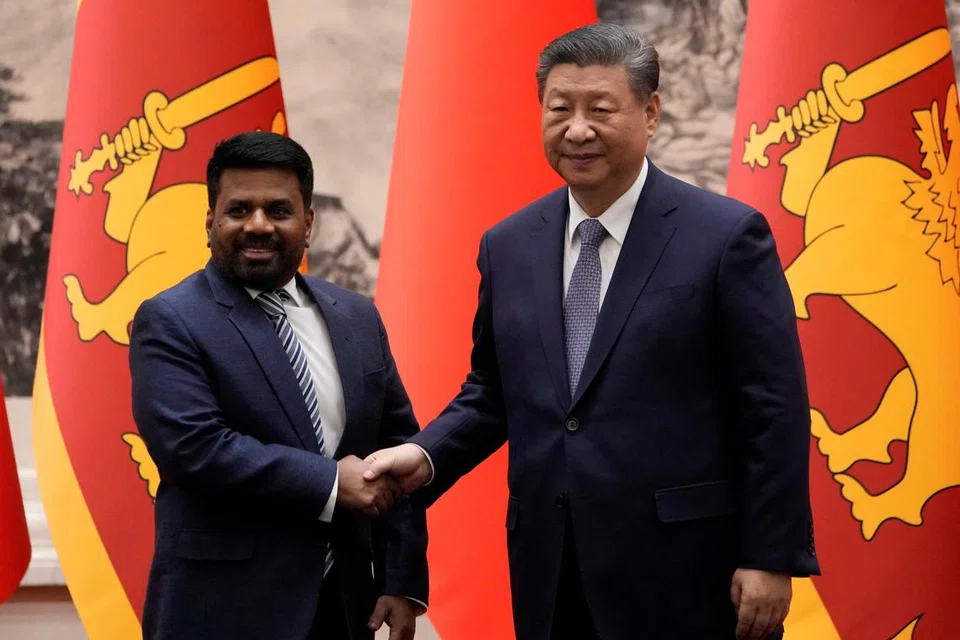
Chinese President Xi Jinping and Sri Lankan President Anura Kumara Dissanayake shake hands during a signing ceremony at the Great Hall of the People in Beijing, China on Wednesday, Jan 15, 2025. Aaron Favila/Pool via REUTERS
BEIJING – China and Sri Lanka agreed on more investment and economic cooperation on Wednesday as China’s President Xi Jinping met recently-elected Sri Lankan President Anura Kumara Dissanayake in Beijing.
The countries signed 15 cooperation documents, including agreements on economic and technological development and aligning China’s ‘Belt and Road Initiative’ with Sri Lanka’s 2030 digital economy blueprint.
Specifics of the deals were not disclosed at the signing ceremony.
Dissanayake’s visit to his country’s largest bilateral lender comes after first travelling to regional rival India.
Dissanayake won a big majority in September’s election, pledging to tweak the terms of an International Monetary Fund rescue package, and on his leftist coalition’s plans to fight poverty and graft.
Sri Lanka had been moving closer to China under the previous Rajapaksa government, leaning heavily on Chinese lending to build highways, a port, an airport and a coal power plant as part of Xi’s flagship cross-continent Belt and Road infrastructure initiative.
Colombo secured a preliminary $10 billion bilateral debt deal rework with key lenders including China, Japan and India last June and a $12.5 billion bondholder deal in December.
However, it needs direct agreements with China EXIM Bank and China Development Bank to lock in the deal to continue demonstrating progress to the IMF in restructuring its foreign debt to secure further disbursements from a $2.9 billion IMF bailout programme.
“I am willing to work with you, Mr President, to chart a new vision for the development of bilateral relations and promote new and greater achievements in China-Sri Lanka’s friendship and cooperation,” Xi told Dissanayake on Wednesday, speaking at the Great Hall of the People.
Welcoming more Chinese investment, Dissanayake told his host: “China has supported important and valuable infrastructure development in Sri Lanka via the Belt and Road Initiative and China has been and remains a key development partner.”
But during his visit to Delhi in December, Dissanayake struck a wide range of energy and security cooperation agreements with the other regional superpower, signalling his new government wants to become less reliant on Beijing.
Sri Lanka’s economy has begun a tentative recovery, but the high cost of living is still a critical issue for many, especially the poor.
China, the world’s second-largest economy, could give an economic helping hand by buying more Sri Lankan goods, of which it mostly buys tea, clothing, chemicals and other commodities, according to U.N. COMTRADE data, and through encouraging more Chinese tourists to consider holidaying there.
“It is necessary to strengthen people-to-people exchanges between the two sides and enhance new ties between the two peoples,” Xi told Dissanayake, according to the Chinese state broadcaster. REUTERS