වැට් බද්ද වැඩිවෙන්නේ 36%කින්.. මෙතෙක් සැගවූ කතාව මහින්ද හෙලි කරයි..There is still time for Government to amend VAT proposals – Mahinda

September 19th, 2016

පීඩාකාරී ලෙස වැට් බදු වැඩිකිරීම

15%ක් තෙක් වැට් බද්ද ඉහල නැංවීමට ඉදිරිපත් කර ඇති පනත් කෙටුම්පත සම්බන්ධයෙන් හිටපු ජනාධිපති මහින්ද රාජපක්‍ෂ මහතා විසින් ඉදිරිපත් කරන ලද විශේෂ නිවේදනය පහතින් දැක්වෙයි.

වර්තමානයේ අය කරන වැට් බදු ප්‍ර‍තිශතය සියයට තිස් හයකින් ඉහල දැමීමට පනත් කෙටුම්පතක් ගැසට් කර ඇත. ඒ අනුව භාණ්ඩ හා සේවා මත වැට් බද්ද 11% සිට 15% දක්වා ඉහල ගොස් ජනතාව පීඩනයට පත්වෙනු ඇත. කිසිදාක වැට් බද්දට යටත් නොවුණු පුද්ගලික වෛද්‍ය සේවාවන් වලටද මේ වැඩි වූ වැට් බද්ද බලපානු ලැබේ. මේ නිසා පුද්ගලික වෛද්‍ය වියදම් එකවරම 15%කින් වැඩිවෙනු ඇත. උදාහණයක් වශයෙන් හදවත් රෝගීන්ගේ බයිපාස් සැත්කමක් අද රුපියල් 700,000 වෙන අතර අනාගතයේදී එය රුපියල් 800,000 ටත් වඩා වැඩිවෙනු ඇත. අද බොහෝ සාමාන්‍ය ජනතාවද පුද්ගලික වෛද්‍ය සේවාවන් ලබා ගනී. මේ බද්දෙන් කරන්නේ මිනිස්සුන්ගේ ලෙඩ රෝග, දුක් කම්කටොලු තුළින් ආදායම් ඉපයීමට උත්සාහ දැරීමයි. රෝගයේ බරපතලකම වැඩිවෙන තරමට ආණ්ඩුවට අසරණ රෝගීන්ගෙන් වැඩි වැඩියෙන් මුදල් ලබාගැනීමට හැකිවෙනු ඇත.

වැඩිකරන ලද වැට් බද්ද කුඩා හා මධ්‍ය පරිමාණ තොග හා සිල්ලර වෙළදාම මතද අයකිරීමට නියමිතය. මගේ ආණ්ඩුව කාලයේ වැට් බද්ද ක්‍රියාත්මක වුණේ දිනකට ලක්‍ෂ 28ක පමණ මහා පරිමාණයෙන් වෙළදාම් කරන සුපිරි වෙළදසැල් වලට පමණි. නමුත් එම සිමාව දිනකට රුපියල් 138,000 දක්වාපහත හෙලූ විට, තොග කඩ සියල්ලමත්, සිල්ලර කඩ සෑහෙන්න ප්‍ර‍මාණයකුත්  වැට් බද්දට යටත් වේ.මෙයින් මුලු රට පුරාම භාණ්ඩ හා සේවාවන් වල මිල ඉහල යන අතර, වැඩි කල් නොගොස්, එහි අතුරුපලයක් හැටියට පාරිභෝගික ඉල්ලුමත් අඩුවෙනු ඇත. මීට කලින් පැවති කිසිම ආණ්ඩුවක්  සාමාන්‍ය මට්ටමේ තොග හා සිල්ලර වෙළදාම මත වැට් බද්ද පැණවූයේ නැත්තෙ එයින් ආර්ථිකය තුළ ඇතිවෙන අනිටු විපාක නිසාමය.

ලෝකයේ හැම තැනම භාණ්ඩ මිල අඩු වෙමින් පැවතුනත්, මේ වැට් බද්ද නිසා ලංකාවේ පමණක් භාණ්ඩ මිල වැඩි වෙනු ඇත. මේ ආකාරයට බදු වැඩිකිරීමට ආණ්ඩුවට සිදුවී ඇත්තේ, පසුගිය ඡන්ද දිනාගැනීමට ජනතාවට දුන් නොයෙක් රැවටිලිකාර සහන වලට මුදල් සොයා ගැනීමටය. මෙය ජනතාව රැවටීමට ගිය මුදල් ජනතාවගෙන්ම අය කරගැනීමට ගන්නා පියවරකි. වැට් බදු ප්‍ර‍තිශතය වැඩිකිරීමටත්, රෝගීන් හා වියපත් අයගෙන් වැට් බදු අය කිරීමටත්, බඩුමිල ඉහල යන බව දැන දැනත් සාමාන්‍ය තොග හා සිල්ලර වෙළදාම මත වැට් බදු අය කිරීමටත් අපට කිසිසේත්ම එකග විය නොහැක. මේ පීඩාකාරී බදු වැඩිකිරීමේ යෝජනා නැවතත් සලකා බැලීමට ආණ්ඩුවට තවමත් කල් ඇත.

මහින්ද රාජපක්‍ෂ
හිටපු ජනාධිපති 

Former President Mahinda Rajapaksa says that there is still time for the Government to amend the oppressive Value Added Tax (VAT) proposals.

We can in no way agree to the increase in the VAT rate, its unconscionable imposition on the sick and the elderly, and its imposition on the small and medium wholesale and retail trade without any concern for the all round price increases that it will cause,” he said issuing a statement today.

Full statement:

A Bill to increase the currently applicable VAT rate by thirty six percent has been gazetted. Accordingly, the VAT on goods and services will increase from 11% to 15% and cause hardship to the consumer. This increased VAT is to be imposed even on private medical care which had always been exempt from VAT.  This imposition will cause an immediate 15% increase in private medical costs.

For example, a by-pass heart operation that presently costs about Rs.700,000 would in future cost Rs.805,000. Many ordinary people make use of private medical services today. This tax attempts to raise revenue through sickness and suffering.

The more serious the illness, the more money the government would be squeezing from the hapless patient.  The increased VAT is to be imposed on the small and medium wholesale and retail trade as well.

My government charged VAT only on wholesale and retail establishments with a turnover of around Rs. 2,800,000 per day which ensured that the tax applied only to the largest upmarket retail businesses enjoying economies of scale. 

However, by slashing the threshold to just Rs. 138,000 a day, the Yahapalana government has brought all wholesale establishments, and a good number of retail establishments within the ambit of VAT.

This will cause a rapid escalation in prices throughout the country and in a short time bring about a reduction in consumer demand. Previous governments never imposed VAT on the small and medium wholesale and retail trade because of the negative impact it will inevitably have on the economy.

Commodity prices have been declining all over the world but in Sri Lanka the prices of goods and services will be going up because of these tax hikes imposed to finance the various concessions that the yahapalana government gave out to win elections.

Thus the people themselves are being forced to bear the cost of the deception that was practiced on them. We can in no way agree to the increase in the VAT rate, its unconscionable imposition on the sick and the elderly, and its imposition on the small and medium wholesale and retail trade without any concern for the all round price increases that it will cause.

There is still time for the government to amend these oppressive VAT proposals.” – See more at: http://adaderana.lk/news.php?mode=beauti&nid=37013#sthash.3g5cSf06.dpuf

When Sinhalese gave equal rights to Tamils in 1957 – The high caste Tamils objected.

September 18th, 2016

Shenali D Waduge

There is no ethnic problem in Sri Lanka. There is however a problem wherein a handful of high caste/class Tamils find it convenient to flag the Sinhala discrimination banner to hide the real issue. That issue is how these high castes/class wish to reign supreme over their own people in a separate state called their own. They would do anything to achieve this purpose. The lies and fabrications are part and parcel of this long-unfulfilled endeavor which started in 1923 by Sir Ponnambalam Arunchalam with the 50:50 demand when the Tamils against Sinhalese was hardly 70:30 as they were more Indian Tamils living in Sri Lanka than those referred to as Ceylon Tamils after 1911. Can anyone also explain why the Ilankai Thamil Arasu Kachchi (Lanka Tamil Kingdom Party) formed in 1949 months after independence was given, had as their objective the demand for a separate Tamil state? The only discrimination suffered under British rule was to the majority Sinhala Buddhists whose rights were all confiscated by false promises since 1815.

How many of those peddling the ‘Tamils are being discriminated’ sing-a-long are aware that Tamils denied Tamils the right to attend school, the right to participate in religious rites in kovils, the right to go inside a kovil and refused to allow low caste Tamil children to study sitting on benches? How many are aware that some of these restrictions prevail still?

It was a Sinhalese who brought legislative changes so that low caste Tamils would not get discriminated by high caste Tamils but high caste Tamil leaders opposed it. That is the truth and nothing but the truth.

Now comes the best part.

The Official Language Act was introduced in 1956 making Sinhala the Only official language yet allowing reasonable use of the Tamil language.

It has become a ruse to use the 1956 Sinhala Only Act as a reason d’etre for the so called ethnic problem. However, when the Act was passed there were no violent acts by Tamils, no satyagrahas, no large demonstrations not even mass protests except for a wafer thin crowd outside parliament.

If the Sinhala Only act was as profound and discriminate as is being projected currently why did all Tamils not oppose it in 1956?

In fact Tamils began learning Sinhalese. What both Tamils and Sinhalese shared post-independence was that apart from a handful of elite Sinhalese & Tamils most of whom had converted to Christianity and had obtained missionary English education and foreign qualifications, the majority of the Sinhalese and majority of the Tamils were not conversant in English. It was impossible to run a country when the majority populace did not know English while the minority populace of elite Sinhalese, Tamils and Muslims knew virtually only English! It was practically impossible to administer a country using English spoken/written by only a handful of people.

Today the Tamil politicians boast about ‘looking after our people’ but it was SWRD Bandaranaike who had to pass a Parliamentary Bill to legally afford Tamil equal rights because Tamils were denying their own low caste Tamil people the basic human rights. That Act called the Social Disabilities Act 21 passed on 12 April 1957.

The Act gave Tamil low castes who had been previously denied by their own Tamil high caste leaders, the right to equal status. Though equal rights was now made legal, Tamils continued to deny low caste Tamils equal status.

Therefore all those human rights activists and media personalities carrying on a sham show about Tamil rights being denied by the Sinhalese are reminded that it was a Sinhalese who gave Tamils their rights and not Tamils and it was the Tamils who refused to abide by the Act passed.

The Tamil caste factor is well hidden by Tamils but it holds the key to many of the problems and issues that exist.

The best thing about the two acts was that the 1956 Sinhala Only Act had little opposition by the Tamils but the 1957 Social Disabilities Act saw a very agitated lot of high caste Tamils who feared that the dismantling of the caste system would affect their political careers.

The elite high caste/class Tamils soon labored their educated minds and came up with the solution – lets campaign against the government. The ‘racial discrimination’ card became the opted slogan. Of course they needed to show examples for their false flag so Ministers were mobbed, instructions were given to tar Sinhala letters to incite racial discord and various other stunts commenced.

The racial slogan quickly hid from the low caste Tamils the reality that the 1957 Act was to protect their interests which the high caste Tamils were vehemently opposing.

Now you should wonder why the Tamil leaders did not organize mass protests, demonstrations for the 1956 Sinhala Only Act but did so within 24 hours following the 1957 Social Disabilities Act against caste discrimination implementation. You must probe into this and demand answers.

Where was the racial discrimination in bringing an Act granting the following rights to all especially to low caste Tamils who were being denied these rights by their own people? Chief Minister Wigneswaran please take note.

The Act considered the following as an offence

  • Anyone imposing caste restrictions if found guilty would be imprisoned for a maximum of 3 years or a fine of Rs.3000.
  • No business under a license can impose caste restrictions – if so they would face cancellation of license and may even face denial to recommence operations for 3 years.
  • No person can be prevented because of his/her caste from being admitted to school or employed as a teacher in a school or educational institution.
  • No person can be prevented or denied because of his/her caste from buying any item in a shop, market or fair
  • No person because of his/her caste can be prevented or denied entering or being served in any public hotel, resthouse, eating house, restaurant or any other place where articles of food and drink are sold to public.
  • No person because of his/her caste can be prevented or denied obtaining any room for residence in a public hotel, resthouse or lodging-house.
  • No person because of his/her caste can be prevented or denied from using water from any public well, spring, water-pipe or any other source of supply of water to the public (this immediately calls to mind the racial segregation in US
  • No person because of his/her caste can be prevented or denied entering or obtaining services at a hairdressing saloon or laundry
  • No person because of his/her caste can be prevented or denied entering any public cemetery, attending or taking part in any burial or cremation.
  • No person because of his/her caste can be prevented or denied wearing any kind of clothes, head-covering or foot-covering at any place to which the public have access
  • No person because of his/her caste can be prevented or denied being carried as a passenger in any public vehicle or vessel
  • No person because of his/her caste can be prevented or denied entering a temple, devale, kovil, church, mosque or any other place of religious worship
  • No person because of his/her caste can be prevented or denied to be engaged in any lawful employment or activity
  • No person because of his/her caste can be prevented or denied worshipping at any place of worship
  • No person because of his/her caste as a public officer can deny to perform his duty which he is legally bound to perform to another because of his/her caste.
  • No person because of his/her caste can discriminate workers or employees because of their caste
  • No person because of his/her caste can corrupt or foul water of any public well, spring, tank or reservoir so as to make it less fit or unfit for those of another caste.
  • No person because of his/her caste can be denied from using water as a teacher, student or employee in an educational establishment or any institution.
  • If above violations do occur assistance of the police can be sought who will provide what the person is being denied. The police officer can even arrest the person without warrant and bring him to the police station and released after being produced to a Magistrate’s court.

IT IS SHOCKING TO EVEN IMAGINE THAT THE HIGH CASTE TAMILS DENIED THESE BASIC RIGHTS TO THEIR OWN TAMIL PEOPLE AND ARE PREACHING TO THE WORLD ABOUT HUMAN RIGHTS.

In 2008 G. D. C. Weerasinghe wrote that the very famous Nallur Kovil did NOT permit non-vellalar to enter and when a low caste using the 1957 social disabilities act right did enter, riots resulted in Jaffna. Mr. C. Sunderalingam an ex-Minister went to the extent of sleeping between gateposts to prevent non-vellalar from entering the Kovil.

In reading each of the clauses of the act, one should immediately be asking ‘Are Tamils denying these rights for their own people?” People should wonder how many such low caste Tamils have not been allowed to drink water inside their place of work, how many children were denied education because of their caste, how many wells used by low castes would have been poisoned, how many kovils still do not permit low caste Tamils to enter, how many restaurants refuse to serve to low castes, how many dead Tamil lowcastes are denied last rites in times of sorrow. People should seriously go through these clauses and realize the extent of which discrimination took place by Tamils on Tamils and this whole Sinhala discrimination thing has been an absolute lie not corrected but allowed to be flogged for people’s own personal agendas.

http://www.commonlii.org/lk/legis/consol_act/posd33370.pdf

That the common citizens have been taken for a ride by politicians of all shades and names can be seen in the 1957 Bandaranaike-Chelvanayagam pact, signed without the concurrence of either the Parliament or Cabinet (raising the legal binding of it).

Why is it that no one objected to how a fuss supposed to be over the Sinhala language ended up with a secretly devised pact promising to devolve power? Notice the timing, the demand to devolve powers to regions came immediately as a result of the 1957 Act aiming to give all Tamils equal rights. This equality was objected by the Tamil high class/caste who rallied together claiming they were being discriminated but in reality to hide their caste superiority and the ‘we want to rule our own’ is another term for we, the high caste/class will reign over all low caste/class Tamils.

It was this that promoted low caste/class Prabakaran to be enticed by India and trained with a dual objective of destabalizing Sri Lanka while keeping the Tamil leaders in tow. Inferiority complexes got the better of Prabakaran who ended up drawing his men/women and child soldiers from the low caste while keeping the high caste dead scared of even speaking against him. The high caste Tamils all hated Prabakaran but were using him to win by terror the territoriy they failed to achieve politically.

Examples taken from Dr. S. Rasalingam

  • 1847 – Arumuga Navalar a hero amongst Jaffna Tamils, left teaching at Jaffna Central College because a low caste Tamil student from Nalavar caste was admitted to the school.
  • 1871 – caste riots between Vellala and dhoby & barber castes in Maviththapuram as a result of dhoby caste refusing to wash clothes of barber caste people. Vellala’s were blamed for instigating the riots (1st caste riot between Tamils).
  • 1877 – Arumuga Navalar provided food and medicine to only Jaffna high caste Vellala’s during a famine.
  • 1923 – Sutumalai, Jaffna – Vellala’s attack Paramba caste people for hiring drummers for a funeral alleging that they had no right to employ drummers for funerals as they were low caste (now you know why this clause was included in 1957)
  • 1929 – Caste riots following government directive on ‘equal seating’ enabling low caste students to sit on benches instead of the floor in the classroom. This resulted in many houses of low caste Tamils getting burnt and low caste children were too scared to return to school. The Vellala high castes begged the British government to cancel the directive. Sir Ponnambalam Ramanathan led 2 delegations to London to plead with the Colonial Office to encode Caste into all legislative enactments of Ceylon. (refer Communal politics under Donoughmore Constitution 1931-1947 by Jane Russell, Tisara publishers)
  • (How do you like that – begging the British not to allow their own Tamil children to sit on a bench to study – now you know why this clause was included again in 1957 – Tamils did not allow low caste Tamil children to sit on benches and Wigneswaran is preaching to the Sinhalese!)
  • 1931 – Canganai, Jaffna, Pallar caste attacked by Vellala’s for hiring drummers for a funeral. Vellala’s claim it was a ‘tradition’ that only Vellala’s could use drummers for funerals.

What is amusing and interesting is that none of the Sinhalese living in the North were discriminated by Tamils (either high caste or low caste) The wrath of the Vellala’s was only against the low caste Tamils primarily because Hindus viewed that ‘high castes’ were God’s chosen people. No wonder Prabakaran resolved to ensure none of his cadres followed Hinduism and made sure all his cadres were buried and not cremated. Until Prabakaran and his killing machine came along the Vellala’s were temple patrons, they provided money for the upkeep of the kovils and the priests who were all employed by the Vellalas. Looks like the Brahmins and Vellala’s had no choice but to even bow and worship low caste Prabakaran! The Vellala’s quickly devised to rally all Tamils under ‘Tamil discrimination’ slogan with LTTE/Eelam calls ensuring the low-castes were kept from questioning that the high castes were the bigger enemy of the low castes than any Sinhalese! A lot of energy is going towards brushing caste factor under the carpet.

The lowcaste Tamils have to be grateful to the Sinhalese for enabling them to study and gain some kind of equality which they would have been denied under Tamil caste Tamils. The objection to university standardization in 1973 was another ruse. Uptil 1973 there was an inequitable distribution of taxpayers money to higher education with students of the main towns/cities from all ethnic groups getting admissions. The 1973 standardization enabled students from less developed districts to also gain admission to university. The Vellala high castes who had been the only children to gain admission to university prior to 1973 soon found out that their allocation had to be divided between low caste Tamils also passing from Jaffna and the high castes were not too happy about that. Now do you understand the reason for the propaganda against standardization? Therefore, anyone claiming standardization is a reason for the ethnic problem have fallen for the Vellala yarns.

Confounding matters further, leaving out the caste issues that divide Tamils is also the status symbols that exist. Jaffna Tamils think themselves superior to Trinco and Batticoloa Tamils and together all Tamils think nothing of the Estate/Plantation Tamils and this segment has never been including into any of the Eelam calls. We really feel for the likes of Mano Ganeshan tagging behind the high castes when even the Tamil low castes don’t have a place for him!

The LTTE had little choice but to appoint a high-caste political party in the TNA who duly bowed to Prabakaran for their dear life but have now taken over the leadership mantle with vigor as can be seen by the arrogance in Wigneswaran and likes.

Glaring facts should stare readers in the face

  1. Discrimination is by Tamils against Tamils and not Sinhalese against Tamils.
  1. There have been more caste riots between Tamils than the handful of ‘riot’ occasions used to claim a separate state.
  1. It is the Sinhalese who gave equal rights to Tamils. It is the Tamil high caste/class who opposed low caste Tamils from enjoying the same rights as high caste Tamils.
  1. Sinhala Only, Racial riots, Standardization are only slogans used to hide the Tamil caste issue and lay blame on the Sinhalese ….the propaganda has succeeded because of political correctness and Sinhalese politicians vying for cheap minority votes without setting the story straight

Until and unless people begin to question the lies promoted over the years we are going to land up creating solutions to issues that are not problems and problems that never existed.

Shenali D Waduge

The Next Bomb: Arsenic to follow the Kidney Disease and Dengu

September 18th, 2016

By Garvin Karunaratne

Firstly the Kidney Disease, then the Dengu and what I think is coming over the horizon- is Arsenic. No one upto now has stated that the third,  Arsenic is on its way. But signs are there and unless immediate action is taken it will take a major toll. Both the Kidney Disease and Dengu are out of control today. Both take toll of thousands annually and the toll doubles every few years.

Let me give my opinion on the Kidney Disease. I have given my opinion earlier too but no one has picked it up. To start with it has to be accepted that the Kidney Disease is of recent origin. If the kidney disease had been there our ancient irrigation system  and the ancient  tank civilization that has lasted on a sustainable basis for centuries  would not be there.

It is my opinion that the kidney disease started with the excessive use of fertilizer, weedicides and such chemicals.

Something drastic did happen and the kidney disease erupted.

I happen to know the Dry Zone , its agriculture systems well because I have worked long in the Agrarian Services. I was  one of the pioneer administrators  in introducing the use of new varieties of paddy and enlisting the farmers to use inorganic fertilizers to boost yields. I introduced the Paddy Lands Act to the Anuradhapura District in 1963, organized cultivation committees, democratically elected , three hundred of them. It was  a vast staff of three Assistant Commissioners, ten Divisional Officers and some fifty to sixty overseers working, holding meetings till late in the night, planning paddy cultivation and the use and supply of fertilizer and chemicals. That was a yeoman effort including weekends working 14 or more hours on most days. It was a combined effort of our Agrarian Services and the technical agricultural department that enabled the breakthrough- the Green Revolution  came to stay.  The farmers got bounty harvests and benefited.

Today we have got cracking with this Kidney Disease, as it has reached almost epidemic status- some 40,000 dead and a mass of people going through medical attention. Farmers do not have the funds to travel for dialysis at hospitals far from home.  Dialysis machines offer a solution but our hospitals are also short of dialysis machines. The use of Glyphospate has been banned and water is even distributed by bowsers.  To my mind all what has been done is in the short term, because we have failed to find the real cause.

It is my opinion that the real cause is the breakdown of the agricultural extension service..

It is sad that many authorities will not believe this.

How did the extension system breakdown?

Firstly the World Bank decided to sabotage the agricultural extension system that Third World countries had developed through  imposing the Training & Visit System(TVS) of Agricultural Extension, by which the agricultural extension staff were required to contact the farmers direct, without using any of the farmer’s organizations like cooperatives and cultivation committees.  Accordingly the agricultural extension staff had no method of working with the entire farming population. At best the extension staff met a few farmers and this precluded the majority of farmers from being involved. This was a system that was suitable for a context where there were few farmers like in the USA. In Third World countries the farmers were legion in number and they could never be contacted by any extension staff unless they use cooperatives and other farmer’s organizations. This TVS was imposed on our countries by force.  As pointed out by me as far back as 1983,

What  happened was the imposition of a system akin to the US  on the Third World… The TVS is financed under IDA Credit, where funds are brought in on foreign aid to meet the salaries of local officers and servicing costs. The IDA Credit is  based on a design that has a repayment grace period of ten years, so that the Government that takes the loan has nothing to worry about the consequences  of re payment… The writer is of the opinion that  this is the main cause for the adoption of the TVS.”(From  Administering Rural Development in the Third World, University Press, 1983)  It was my contention then that this TVS was intended to cripple the extension services built up by Third World Countries. This is a part of the sabotage that is evident today in the IMF’s Structural Adjustment Programme, which entices countries to give up exchange controls, import controls, liberalise the use of foreign exchange, and depend on borrowed finance leading to our countries getting into debt. Debt was the weapon used to bring our countries to a ‘colonial’ subservient state. My book, How the IMF Ruined Sri Lanka, Godages tells this sad story.

In the case of Sri Lanka two other changes were made. Firstly the cultivation committees were abolished and with this change there were no farmer organizations  at the village level.

Secondly President Premadasa with one stroke of the pen promoted  all agricultural overseers to be Grama Niladharis and with this the agricultural extension staff no longer existed at the village level.  The overseers had an year’s training. The qualified extension staff was at the Divisional Level and each Agricultural Instructor had around five to thirteen thousand farmers. Years later Niyamakas were appointed, to handle the work of the agricultural overseers. These Niyamakas have no training whatsoever and with this the farmers had no one to contact for advice., Instead of farmers looking for advice, the Niyamakas are actually the laughing stock of the farmers even today.

Due to these changes the farmers had no one to guide them and they commenced using fertilizer, applying weedicides etc  as they pleased and this to my mind is the  cause for the spread of the kidney disease.

To add to the problem today we have a system of private companies providing advice. This is a very ineffective extension service.

Sadly our experts have failed to identify this very important cause. Ministries of Agriculture do not wish to admit that the agricultural extension system  is ineffective.

It is sad to realize that the entire farming community in the Dry Zone of Sri Lanka will be wiped out within a few decades unless immediate action is taken.. This is happening within our very eyes. The banning of chemicals is not the answer. The banning of Glyphosphate has already reduced the crop in paddy and tea. Scientists including Professor Chandre Dharmawardena have opined that banning chemicals that are essential for cultivation is not the remedy. The remedy is to ensure that there is an effective and systematic extension system like what we had when there were trained agricultural. Overseers and vibrant farmer institutions like cultivation committees and multipurpose cooperatives at the village level.

An attempt is being made to get farmers to use traditional varieties and to use compost- organic fertilizer. Traditional varieties yield only half the crop of new varieties and crop production will suffer  with the result that we will have to import rice. The entire Green Revolution was based on using new varieties with the use of inorganic fertilizer. An effective extension service has to guide the farmers in the use of chemicals.

The remedy is simple- to train the Niyamakas and also to strengthen the staff of Agricultural Instructors at the Divisional level aimed at establishing an effective extension system.

The Dengu

Dengu has reached almost epidemic levels and  many people have died. Dengu eradication commenced in the Nineties and then hordes of individual spraying staff were busy everyday, swarming out of the Urban Councils. They could be seen visiting the homes of people and spraying. What was not evident is what they sprayed. They took with them the chemical which they mixed with water and then sprayed.  The problem was that they sprayed with the chemical only if they were paid a santhosam lavishly. Otherwise they did spray but with water.

I pointed this out in an article that appeared in the Press but no one took notice. I suggested the system which was followed to spray DDT to eradicate malaria. I served in Anuradhapura and the spraying was done by a team of sprayers with a supervisor.

We are today reaping the effect of our own folly. It is time that we even resort to spraying DDT, but in an effective manner like what we did in the case of malaria.

Further we today concentrate only on  home gardens and the premises that we can see. We have conveniently forgotten the drains on either side of the roads which are full of putrid water and infested with dengu and other mosquitoes. It is essential that this is done by a team equipped with iron rods and at times tractors may be required to remove large slabs of concrete. I suggested this but no one has picked it up. When slabs are used  crevices should be kept to enable spraying.

The Arsenic Bomb is coming. This is due to the fact that almost ninety nine percent of the bottled water sold in Sri Lanka comes from tube wells.

Tube wells were concentrated on in the green revolution in Bangladesh and the benefits were extolled in terms of crop production. However the incessant pumping of water from a particular strata of soil has made the water have a concentration of arsenic. Today after decades of extracting water through tube wells it has been found that the arsenic content is high. The result is arsenic  in human beings that causes death through Cancer. The arsenic epidemic in Bangladesh is well documented. The Bulletin of the WHO states:

Exposure to arsenic through drinking water sourced from tube wells is a global health problem   that is particularly devastating in Bangladesh. (It is) estimated that 35 to 77 million people are involved…. The largest mass poisoning in history…. Causing cancers of the skin, bladder, kidney and lung.”( From  Flanagen, Johnson & Zheng, Arsenic in Tube Well Water in Bangladesh”, in Bulletin of WHO, 14/09/2012)

Today 43,000 people are killed annually in Bangladesh..

We can easily get over this problem if we concentrate on our springs and streams as the source for bottled water. . I have worked on minor irrigation in the districts of Nuwara Eliya, Kandy and Kegalla and can state that it is easy to find streams and springs from which bottled water can be harnessed.  The Sinharaja Area in the Matara District can also be a source.

Some authorities may think that my suggestion re bottled water is far fetched. But unless this fact is taken into consideration immediately we will have the Arsenic bomb on our population.

My suggestions re the Kidney Disease and Dengu have gone unheeded. Let us take immediate steps to eradicate the Kidney Disease and Dengu and also take immediate action to ensure that bottled water is sourced at springs to avoid the emergence of Arsenic.

I am sad to realize that I was in charge of the team that spread the use of new varieties of paddy and the use of inorganic fertilizer and chemicals. Little did I know then that  five decades later our  valiant effort then  will cause death to the farming population in the Dry Zone.
Garvin Karunaratne

Former SLAS, Government Agent, Matara

17 the September 2016

Be on your guard, there could be LTTE sleeper cells: Major Gen. Kamal Gunaratne -My book is for the families of the poor soldiers who authored the final victory

September 18th, 2016

By Chandani Kirinde Courtesy Sunday Times

Umpteen stories are written on how wars are fought and won and this is true of Sri Lanka, too, where since the defeat of the LTTE in May 2009, countless books have been authored giving different perspectives of how the Sri Lanka Army (SLA) defeated the Tamil Tigers.

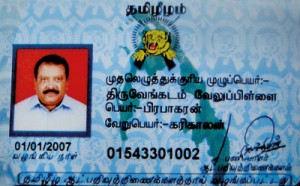
Major General Kamal Gunaratne: ” I am not a hardliner but we have to learn lessons from the past” Right: Prabhakaran’s ‘Tamileelam’ identity card. Major Gen. Gunaratne says he will hand it over to the Army museum

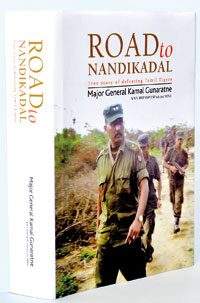
The most recent publication titled ‘Road to Nandikadal’, authored by Major General Kamal Gunaratne whose entire career in the Sri Lanka Army spanned the three decades of the separatist war in the North and East of the country, seeks to tell the story from the perspective of a battle hardened soldier.

He chose to launch the book earlier this month, a day after he hung up his uniform for the last time — 35 years and six days from the first day he donned military fatigues. It has been an exhaustive exercise for the newly retired Major General, four years of writing in long hand in Sinhala, not wanting a ghost writer to author the book for him. I have written the book from my heart. It’s 100 percent honest and based on my first hand experiences of more than three decades in the army,” he said.

Through his book, Major General Gunaratne tells the reader the story of what inspired him to join the Army, his frustrations at times working within a system where hierarchical politics sometimes got in the way of sound decisions in the best interests of the country, the camaraderie of soldiers who fearlessly went forward in the final battle against the LTTE knowing they were facing certain death or serious injuries, his feelings of euphoria on seeing the lifeless body of the LTTE leader Velupillai Prabhakaran lying at his feet and still has a word of praise for the dreaded terrorist leader for his unfettered commitment to his cause.

The flush of military victory has receded over the years but the release of his book has once again opened up new discussion on whether such a publication is a precursor to a possible career in politics. I am a well experienced and very successful military commander who reached the pinnacle of my career. If I enter politics, I will be an infant in the field. Hence you will never hear the name Kamal Gunaratna in politics,” he says firmly.

The rumors of his possible entry to politics, he says, were sparked by the presence of former President Mahinda Rajapaksa and Former Defence Secretary Gotabaya Rajapaksa at the launch of his book earlier this month. I have the highest respect for President Rajapaksa for his unwavering support to the military when he was under tremendous pressure from the international community to stop military action. As for Gotabaya Rajapaksa, he was my Officer Commanding when I joined the Army and I learnt a lot under him. This is why they were among the five persons I personally chose to invite for the event. But this does not mean I will align with them in politics,” he says.

Two other special invitees to the book launch were the widows of two much decorated senior military officers, Major General Vijaya Wimalaratne and Lieutenant General Denzil Kobbekaduwa. They died in action in 1992.If not for these two generals there would be no road to Nandikadal. They are the two most respected generals who ever served in the SLA.”

A notable absentee on the occasion was former Army Commander and now Field Marshal Sarath Fonseka. Asked why his former Commander was left out of the invitee list, Major General Gunaratne says it was to avoid an embarrassing situation.”
Now he is a politician and they have their own problems and I did not make it an embarrassing situation for anyone. I have given due respect and due recognition to General Fonseka in my book and I still respect my Commander General Sarath Fonseka, not Field Marshal or politician Fonseka,” he says.

Questions of political affiliations aside, Major General Gunaratne is uneasy about recent developments like the attacks on the Kandyan dancers at the Jaffna University and the attack on our High Commissioner in Malaysia. I am not a hardliner but we have to learn lessons from the past,” he says.

And in this situation, he does not mind being called an alarmist and warns it is too early to downsize the army or withdraw the military form the north and east even if the LTTE is militarily defected. The army must remain as it is for the next five years,” he says. To justify his argument, Major General Gunaratne points to the presence of more than 12,000 rehabilitated ex-LTTE cadres in the north and east. Among these, he says were around 500 suicide cadres and the lack of a mechanism to monitor their level of integration, means there is a threat of them regrouping. If the proper leadership emerges to give them motivation and moral courage, there could be a few hundred ready to take up arms again. Some sections of the Diaspora too have not given up their dream for a separate state and are active in pursuing different means to revive separatism,” he cautions.

I am an alarmist due to valid reasons,” he says.
Major General Gunaratne is assured a place in the history which records the decisive final battle against the LTTE. This is because he headed the 53 Division whose men killed Prabhakaran and wiped out almost the entirety of the top leadership of the Tamil Tigers.

While he talks openly about his jubilation and that of the soldiers around him on that fateful day on seeing the LTTE leader’s body, he says it’s a matter that must be left at that. Prabhakaran s body was cremated. We’ll leave it at that,” he says when asked for more details of what happened after the famous scenes were flashed across the nation over television showing the LTTE leader’s body lying on the ground surrounded by hundreds of soldiers. A memento he is taken from the scene, the Identity Card of Prabhakaran remains with him, which in due course he hopes to hand over to the army museum.

I wrote this book mainly for the families of the poor soldiers who came forward to defend the country. I want their loved ones to read it and understand the bravery of these soldiers. I did not want to antagonise anyone. I just want to get everyone into the picture about what transpired on the battle front,” he says.

Growing concern over new Constitution

September 18th, 2016

By Shivanthi Ranasinghe Courtesy  Ceylon Today

President Maithripala Sirisena recently said if former President Mahinda Rajapaksa won his third term or had the Liberation Tigers of Tamil Eelam leader Prabakaran survived Eelam War IV, then achieving lasting peace is not possible. It is an interesting observation on three counts. One is that though the former President gave political will to end the war against terrorism, he did not bring peace to the country. The other is, he and the terrorist leader together were the obstacles to peace – thereby equalizing the war winning leader with the notorious terrorist. Finally, this opinion offers the impression that lasting peace is a step away.

However, recent events (and the not so recent, such as the UN Human Rights Council Commissioner Zeid’s remarks), which took place almost back-to-back, seriously challenge this notion. It is indeed a very curious comparison that outgoing United Nations’ Secretary General Ban Ki-moon made. He in one breath lamented that the UN was unable to prevent the genocide in Rwanda, a year later in Srebrenica and again in Sri Lanka. Though the government disagrees any disparaging remarks were made, discerning analysts strongly assert that he indeed accused Sri Lanka of committing genocide.
Genocide is a very serious accusation. If a clarification is not sought urgently and misconceptions rectified immediately, the implications can be far reaching and extremely adverse to Sri Lanka.

Special appointment

Recently, MP Wimal Weerawansa, on special appointment, visited the Malwatte Chapter Prelate Thibbatuwawe Sri Siddhartha Sumangala Thera. There, he too emphasized the danger that lies ahead, if it was established that genocide was committed in Sri Lanka. The new Constitution in the making, he warned, will do away with existing laws to pave the path to reach such a conclusion.

“Though the drafting of the new Constitution,” explained MP Weerawansa, “is an ongoing process, we feel it is already finalized. I don’t think they’ll directly touch the status awarded to Buddhism by the Constitution. However, distracting us with such threats, the Constitution may be changed according to the needs of our detractors.”
The prelate had pointed out that MP Weerawansa had only a suspicion. He responded that his fears are founded on a number of facts. The speeches made by the Tamil National Alliance leader Sampanthan in the North is one factor.

Federalism as a solution

“At one point he states,” said MP Weerawansa, “that the new Constitution will fulfil our long cherished hope and give federalism as a solution”.

“Jayampathy Wickramaratne who is involved in the drafting of the new Constitution, also said a constitutional solution will be given to the Tamils, at a diaspora event. Likewise, if we look at the history of the people involved in the process and their ideology, it is reasonable to be concerned.”
He assured the prelate that as long as the new Constitution does not lead to separatism or harm the country, he will not object.
“The danger is,” he says, “the need for a new Constitution arose in the Geneva agreement. It has been definitely pledged in Geneva by Foreign Minister Mangala Samaraweera to establish a special war crimes tribunal through a special law to probe into war crimes allegations.

“The debate on this issue is, President Sirisena is against foreign judges. Geneva and the diaspora are however insisting on foreign judges. Yet, no one had said anywhere that a war crimes tribunal will not be established.

Hybrid court

“Now, once this tribunal is established, who will function in it? According to the documents, the agreement is a hybrid court with foreign judges, foreign investigators and foreign prosecutors. Though President Sirisena is against foreign judges, whether his opinion or if the agreement with the international community will hold sway we don’t know yet.

“Whether foreign judges participate or not is besides the point. We currently don’t have the laws for war crimes that they have agreed upon to investigate. What we have are laws against crime, which does not include war crimes.
“So, new laws are now being drafted to include war crimes, to be effected retrospectively. The current laws restrict this agenda, which is what the new Constitution is trying to overcome.

“For instance, a camp of many acres in Kilinochchi was recently removed. It was amidst an LTTE burial ground – especially during the final battle days. On some future date, if the areas were excavated, then all the buried dead bodies would surface.

War crimes

“This could lead to the accusation that a war crime had been committed. If the judgment was given that a war crime had indeed taken place, just like Kosovo was separated from Serbia, a UN resolution could be passed to divide Sri Lanka.”
When the prelate pointed out that the public opinion had been sought in the drafting of the new Constitution, he explained it was a process headed by the Lal Wijenayake Committee.

Wijenayake was a Provincial Councillor from the Lanka Sama Samaja Party (LSSP) for almost 15 years. Then, during the previous administration, he had to leave the party.

“My party didn’t like my sharing the platform with the [then] Opposition United National Party leaders,” he explained to Journalists for Democracy in Sri Lanka in 2012.

He said they are extremely biased against the military. According to him, “I don’t know whether everyone has realized the severity of the ongoing militarization process. There are several retired military officers who have been appointed as Provincial Governors. Some others – including serving military officers – have been posted as diplomats to various countries. This not only violates the fundamental values and core principals of a democratic system, it even goes further in violating international laws. This is because many of the officers have been accused of committing war crimes and crimes against humanity.”

War against terrorism

He overlooks two main factors. The North and the East were a terrorist hotbed for 30 years. Since the conclusion of the war against terrorism, nearly 14,000 LTTE cadres had been released. This number does not include the sympathizers of separatism who escaped the terrorist net. The bottom line is that there is a considerable, battle-hardened force now living in these areas.
General Daya Ratnayake explains that before normalcy regains, the first social aspect, then economic aspect and finally the political aspect must be established.

“Immediately after a conflict,” he explains, “people are disorganized. Except in the Jaffna Peninsula, almost 99 per cent of the people were displaced and they were living in welfare centres. Reuniting them with their families and resettling them in their homes is the social aspect. Then, providing them with livelihood opportunities and the necessary support is the economic aspect. Once these two have been achieved, people need a voice for their opinion, which is the political aspect.”

Band of bad boys

The other fact overlooked by Wijenayake was that the LTTE was not a band of bad boys confined to Sri Lanka. It was (and still is) an internationally organized syndicate of criminals, engaged in many nefarious activities such as human and contraband smuggling, money laundering, narcotics, and providing logistics to other terrorist groups. Tissa Ravindra Perera writes in ‘Rivira’ that countries such as Malaysia were LTTE hubs to smuggle arms and collect funds with the blessings of prominent politicians as P. Ramasamy – the current Deputy Chief Minister of the State, Penang. Therefore, Major Generals were sent as ambassadors to counter the illegal activities.

Wijenayake exaggerates, “Even to breathe they [Tamils in the North] need to get permission from the military.”
Presence of any authority is stressful. However, until May 2009, Tamils especially in the North were literally in the terrorists’ deathly grip. Many restrictions, some of inhuman proportions, were forced on them. Surely Wijenayake knows children as young as eight were conscripted against their anguished parents’ pleas and protests. They were used as slave labour and cannon fodder. Every business had to pay an exorbitant daily ‘tax’. People committed suicide when businesses failed to meet the target than face the punishment. Everyone who received foreign remittance had to ‘share’ half of it with the LTTE. It should hurt Wijenayake, a founder of Lawyers for Democracy as, “At a time of crisis in the country, the legal profession needs to play a serious role,” that all semblance of law was replaced by jungle law and people had no recourse from the kangaroo courts.

National question

Wijenayake strongly faults the Sri Lankan governments for failing to ‘resolve the national question’. He asks what is there to negotiate on the northern Tamil politicians’ demands. He even finds the Sixth Amendment to the Constitution the cause that threw ‘Tamil United Liberation Front leader Amirthalingam out of Parliament and eventually paving the way for his untimely death’. He fails to appreciate that the amendment safeguards the independence, sovereignty, unity and territorial integrity of our country. It also escapes him that Amirthalingam was killed by the LTTE which systematically eliminated the Tamil political leadership.

He asks, “How long do they intend to keep the Tamils as slaves of the Sinhala governments?” He further dismisses the massive post development efforts claiming, “A large number of people are still forced to live under deplorable conditions as IDPs even three years after the war ended? The government has not showed any intention to resettle them in their own lands.”
Wijenayake might be unaware, but the five non-governmental organizations engaged in the de-mining process requested 12 years to complete the task. It was thanks to the efforts of the military that the whole exercise was expedited and completed in three years.

Rear Admiral Sarath Weerasekera points out, “Those who express concern over the IDPs, did not so much as offer a cup of tea to the soldiers who were de-mining anti-personnel mines in very trying conditions.”

UN camps

When UN camps have had epidemics like cholera outbreaks, Wijenayake must question if the Sri Lankan IDP camps also had such issues. If not, could the camps have been as deplorable as he implies?

Wijenayake is tilted towards a certain adverse propaganda. His assertions are the same harangues of the separatists. He conveniently overlooks the misery the LTTE heaped on the Tamils. Nor does he see the normalcy these people are beginning to enjoy. Furthermore, he fails to appreciate that this is because of the Sri Lankan military’s efforts. Instead, he believes in accusations sans credible evidence.

Yet, he is charged with garnering public opinion on the new Constitution to be drafted. MP Weerawansa is correct that we as citizens should be wary in the face of such biased thinking. The new changes, he warns, might be irreversible.
Before we could recover from Ban’s stinging insinuations, our High Commissioner to Malaysia Ibrahim Sahib Ansar was publicly assaulted by Tamil separatist thugs. Almost simultaneously, the Buddhist chief monk in Sentul was also assaulted.
Dr. Dayan Jayatilleke draws a parallel between the attacks on the HC and the Jaffna university attack. In both instances, only one side was injured and had to be hospitalized. The Tamil Eelam map prominently in the background was the other common denominator.

The new Constitution is being drafted amidst this rising violence by Tamil extremists. The Getambe Temple chief monk Kappettiyagoda Siriwimala Thera advises the government to fulfil election promises, instead of grappling with a new Constitution. A new Constitution was neither pledged nor asked by the people.

Dr. Dayan Jayatilleke makes the chilling observation that since it is the Foreign Minister who announces its status and that too in the North, instead in the capital, the new Constitution appears as a project pushed by external forces.
The rising incidents hardly attest to a lasting peace. Instead, it appears we are grovelling with abject submission – not that it is improving the international community’s general response. To top it, the economic situation is worsening. Lasting peace seems a long way off.

ranasingheshivanthi@gmail.com


නිජබිම සංකල්පය මත ඉදිරිපත් වන නව ව්‍යවස්‌ථාවේ බෙදුම්වාදී ලක්‌ෂණ

September 18th, 2016

වෛද්‍ය කේ. එම්. වසන්ත බණ්‌ඩාර උපුටා ගැන්ම දිවයින

බෙදුම්වාදී යුද්ධයේ තීරණාත්මක අවධියක්‌ වූ 2008 සැප්තැම්බර් මාසයේදී “සිංහල හ`ඩ” සංවිධානය හරහා පේරාදෙණිය විද්‍යාර්ථීන් පිරිසක්‌ විසින් ප්‍රකාශයට පත් කළ “දෙමළ ඊළාම් නිජබිම ප්‍රශ්නය” නැමති පොත් පිංච ම`ගින් යුද්ධයේ දාර්ශනික පදනමට ප්‍රබල බුද්ධිමය ප්‍රහාරයක්‌ එල්ල කරන්නට යෙදුනි. එම කෘතිය ම`ගින් මහා වංශය සම`ග සැසඳීමේදී ඉතා දුප්පත් ඉතිහාස මූලාශ්‍රයක්‌ වූ “යාල්පාන වයිපමාලෙයි” නම් වූ දෙමළ ඊළාම් නිජබිම සංකල්පය තහවුරු කෙරෙන ප්‍රධාන ඉතිහාස ග්‍රන්ථය ඉතා තර්කානුකූලව අභියෝගයට ලක්‌ කොට ඇත. මුහන්දිරම් මුල්ලපිටියේ කේ.එච්. ද සිල්වා මහතා විසින් සිංහලට පරිවර්තනය කළ එම මිථ්‍යා ප්‍රබන්ධය රචනා කොට ඇත්තේ මයිල්වාගනම් පුලවර් නම් වූ අප්‍රකට පුද්ගලයකු විසින් 1736 තරම් මෑත කාලයේදීය.

යාල්පානම් වයිපමාලෙයි ප්‍රබන්ධය පිළිබ`ද තර්කානුකූල විමර්ශනයක්‌ ම`ගින් සහ වෙනත් පෙර අපරදිග විශ්වාසනීය ඉතිහාස මූලාශ්‍ර ම`ගින් දෙමළ බෙදුම්වාදී ව්‍යාපාරයේ දාර්ශනික පදනම සුනුවිසුනු කිරීමට දෙමළ ඊළාම් නිජබිම නම් වූ එම කුඩා කෘතිය සමත් වී ඇත. එහෙත් යුධ ජයග්‍රහණයෙන් පසුව එම මතවාදී පදනම තහවුරු කිරීම ස`දහා දේශපාලන වේදිකාවේදී ඊට අදාළව බරපතළ බුද්ධිමය සංවාදයක්‌ සිදුවූයේ නැත. එම නිසා බෙදුම්වාදයේ දාර්ශනික පදනම මතවාදී වශයෙන් පරාජය කිරීම කෙතරම් පහසු වූවත් ඊට අදාළව දේශපාලන මෙහෙයුමහක්‌ දියත් වූයේ නැත. එම තත්වය තුළ අද වන විට එම දුප්පත් සහ ව්‍යාජ දාර්ශනික පදනම මත දියත් වූ යුද්ධය පරාජය කොට වසර 07 කට පසුව ඊනියා නිජබිම සංකල්පය මත පදනම් වූ ව්‍යවස්‌ථා කෙටුම්පතක්‌ ඉදිරිපත් කිරීමට තරම් වර්තමාන රජය ධෛර්යමත් වී ඇත. එය ඉතිහාසයේ ෙ€දජනක සරදමක්‌ නොවේද?

ටී.එන්.ඒ. පක්‌ෂයේ මැතිවරණ ප්‍රකාශන සහ එම පක්‌ෂයේ නායකත්වයෙන් ඇතිකරගත් සිංගප්පූරු එක`ගතාව මෙන්ම 2009 සර්වපාක්‌ෂික විද්වත් කමිටු නිර්දේශ පමණක්‌ නොව ව්‍යවස්‌ථා සම්පාදක ක්‍රියාවලියේ “සුළුපියා” ලෙස කටයුතු කරන ආචාර්ය ජයම්පති වික්‍රමරත්න මහතාගේ යම් ප්‍රකාශ ආදී විවිධ මූලාශ්‍ර සැලකිල්ලට ගැනීමේදී නව ව්‍යවස්‌ථාව සකස්‌ වන්නේ ඊනියා නිජබිම සංකල්පය මත බවට ඉතා ප්‍රබලව තර්ක කළ හැක. ඒකීය වගන්තිය ව්‍යවස්‌ථාවේ තිබියදීම ලබා දී ඇති 13 වන සංශෝධනයේ ෙµඩරල් බලතල වලට ඉතා සුළු එකතු කිරීමක්‌ ම`ගින් ඒකීය ලේබලය යටතේ “ෙµඩරල්” වලින් එහාට ගිය “කොන්ෙµඩරල්” ව්‍යවස්‌ථාවක්‌ සම්මත කරගැනීමේ තාක්‌ෂණික ගැටලුවක්‌ නැත. එසේ කිරීම ස`දහා ගන්නා වූ උත්සහය තුළ මතුවිය හැකි දේශපාලන ගැටලු ව්‍යවස්‌ථා කෙටුම්පත ඉදිරිපත් කිරීමටත් පෙර යම් පමණකට විස¹ ගැනීමට බෙදුම්වාදී පාර්ශව සමත් වී ඇත.

ඒ අනුව 13 වන සංශෝධනයේ බලතල ඉක්‌මවා යන ප්‍රතිපාදනයක්‌ ලෙස 1987 සිටම ඉදිරිපත් වූ ඉල්ලීමක්‌ වන පළාත් සභා සමගාමී බලතල ලැයිස්‌තුව ඉවත් කිරීම ස`දහා ඒකාබද්ධ විපක්‌ෂයේ ශ්‍රී ලංකා නිදහස්‌ පක්‌ෂ කණ්‌ඩායම හරහා යෝජනාවක්‌ ඉදිරිපත් කරවා ගැනීමට ඔවුන් සමත් වී ඇත. එම යෝජනාවලිය තුළ සුළු ජාතීන්ගේ අභිලාෂ ඉටුකිරීමේ උවමනාවද අවධාරණය කොට ඇත. දෙමළ සහ මුස්‌ලිම් සුළු ජන කොටස්‌වල සැබෑ අභිලාෂය විය යුත්තේ සියලු ජන කොටස්‌ වලට සමානව සලකන ව්‍යවස්‌ථාවකි. නමුත් එම යෝජනාවලියෙන් හුවා දැක්‌වෙන්නේ බෙදුම්වාදී කප්පම් කරුවන්ගේ අභිලාෂයන්ය. එදා 1985 තිම්පු සාකච්ඡාවල සිට එම කප්පම්කරුවන්ගේ මූලික අභිලාෂය වූයේ තිම්පු සංකල්ප පිළිගන්නා ව්‍යවස්‌ථාවකි. එනම් දෙමළ ජනතාව වෙනම ජාතියක්‌ බව, ඔවුන්ගේ නිජබිම උතුරු නැගෙනහිර පළාත් බව සහ ඔවුනට ස්‌වයං තීරණ අයිතිය ඇති බව පිළිගැනීමය. “දෙමළ ඊළාම් නිජබිම ප්‍රශ්නය” කෘතියෙන් මූලික වශයෙන් අභියෝග කරන්නේ එම පිළිගැනීමටය.

වර්තමාන යහපාලන ආණ්‌ඩුවට එහි උපතේ පටන්ම උරුම වූ ප්‍රධාන කොන්ත්‍රාත්තු ත්‍රිත්වයක්‌ ඇත. ඉන් පළමුවැන්න බෙදුම්වාදී න්‍යාය පත්‍රයට අවශ්‍ය ආකාරයට රාජ්‍ය ව්‍යqහය දුර්වල කිරීම ස`දහා නව ව්‍යවස්‌ථාවක්‌ සම්පාදනය කිරීමය. දෙවැන්න ශ්‍රී ලංකාවේ සන්නද්ධ හමුදා දුර්වල කොට දුර්මුඛ කිරීමය.s එය සිදු කරන්නේ සංහිඳියාවේ සහ ප්‍රජාතන්ත්‍රවාදයේ මූලික අවශ්‍යතාවයක්‌ ලෙසිනි. එම ක්‍රියාවලි දෙක එකම අසිපතේ තල දෙකකි. ඒ ම`ගින් රට බෙදා වෙන් කිරීම ස`දහා සහ ඉන්දියානු සහ ඇමරිකානු අධිරාජ්‍යවාදී බලවේග වලට ශ්‍රී ලංකාවේ සහ දෙමළ ඊළමේ පය තබා ගැනීමට අවශ්‍ය තත්ත්වයන් නිර්මාණය කෙරේ. ආර්ථික සංවර්ධනයේ සහ සෞභාග්‍යයේ නාමයෙන් සාධාරණීකරණය කෙරෙන තුන්වන කොන්ත්‍රාත්තුව වන්නේ කොල්ලකාරී නව ලිබරල් ආර්ථික ප්‍රතිසංස්‌කරණ නව මානයකට ගෙන යන නීතිමය සහ පරිපාලන වෙනස්‌කම් සිදුකිරීමයි. ඉදිරියේදී සම්මත කිරීමට පෙළගස්‌වා ඇති 15 කට අධික පනත් කෙටුම්පත්වල මූලික අරමුණ වන්නේ එයයි.

නිජබිම සංකල්පය මත පදනම්ව බෙදුම්වාදී අභිලාෂ ඉටු කෙරෙන නව ව්‍යවස්‌ථාව තුළට ඉතා සූක්‌ෂමව ඇතුල් කෙරෙන මූලික බෙදුම්වාදී ප්‍රතිපාදන 8ක්‌ හඳුනාගත හැක. දැනට 13 වෙනි ව්‍යවස්‌ථා සංශෝධනයෙන් ලබාදී ඇති බරපතළ ෙµඩරල් ලක්‌ෂණ එසේම තිබියදී එම අමතර ලක්‌ෂණ ඇතුල් කිරීම මගින් එකීය ලේබලය යටතේ ෙµඩරල් තත්aත්වය ඉක්‌මවා යන කොනAෙµඩරල් හෙවත් එක්‌සත් රාජ්‍යයක්‌ බිහිකිරීමේ හැකියාව ඇත. බෙදුම්වාදීන් විසින් ඒකීය සහ එක්‌සත් යන වචන එක සමාන වචන ලෙස හුවා දැක්‌වීමට ගන්නා උත්සාහය අහඹු ක්‍රියාවක්‌ නොවේ. එහිදී උපක්‍රමයක්‌ ලෙස ඒකීය සංකල්පය, බුද්ධාගමට මුල්තැන දීම, ජාතික කොඩිය සහ ජාතික ගීය වෙනස්‌ කළ යුතු බවට ව්‍යාජ මතයක්‌ සමාජ ගත කළත් එම “ලේබල්” වෙනස්‌ කිරීමේ උවමනාවක්‌ බෙදුම්වාදීන්ට නැත. ඔවුනට අවශ්‍ය වන්නේ සිංහලයාට “ලේබල්” ඉතිරි කොට ෙµඩරල් ලක්‌ෂණ හැකිතාක්‌ ව්‍යවස්‌ථාවට ඇතුල් කර ගැනීමටය. එහිදී ඔවුන් 13 වන සංශෝධනයෙන් දැනටමත් ලැබී ඇති බරපතළ බෙදුම්වාදී ප්‍රතිපාදන වන පොලිස්‌, ඉඩම් සහ මහ ඇමැති මූල්‍ය බලතල මෙන්ම උතුරු නැගෙනහිර ඒකාබද්ධ කිරීම ආදිය පිළිබද සමාජ සංවාදයක්‌ නැවත මතු කිරීමෙන් වැලකී සිටීමටද ඔවුන් හැකිතාක්‌ පරිස්‌සම් වනු ඇත.

කෙසේ වෙතත් ඉහත ස`දහන් කළ “ලේබල්” ඉවත් කරන බවට සමාජය තුළ මතු කොට ඇති ඝෝෂාව තුළ ඒවා ඉවත් කිරීමට ඉඩ නොදෙන බවට ප්‍රතිඥවක්‌ ලබා දීම ම`ගින් විශේෂයෙන්ම ජනාධිපතිවරයාට ලකුණු දමා ගැනීමේ ඉඩක්‌ විවර වේ. එම`ගින් මහජනයා තුළ ව්‍යාජ ආරක්‌ෂාකාරි මනසක්‌ ඇති කොට “කොලේ වසා ඉදිරිපත් කරන බරපතළ බෙදුම්වාදී සංශෝධන පිළිබ`ද සමාජ අවධානය අඩු කිරීමේ හැකියාවක්‌ද ලැබේ. එසේ වූවත් එම “ලේබල්” වල සුළු වෙනස්‌කම් කිරීම සහ පසුව විරුද්ධ පක්‌ෂවල “ප්‍රබල ඉල්ලීම්” මත ඒවා නැවත වෙනස්‌ කිරීමේ උපක්‍රමයද ආණ්‌ඩුව යොදා ගන්නා බවට සැකයක්‌ නැත. ඒ අනුව ජනතා විමුක්‌ති පෙරමුණ, හෙළ උරුමය සහ ටී.එන්.ඒ. පක්‌ෂය වැනි පිටත සිට ආණ්‌ඩුව පවත්වා ගෙන යැමට තල්ලුව දෙන බලවේග එසේ විවිධ ව්‍යාජ සංශෝධන ඉදිරිපත් කිරීම ම`ගින් ඔවුන්ගේ ප්‍රතිරූප බේරා ගැනීමටද උත්සාහ කරනු ඇත. බොහෝ විට එසේ සංශෝධනය කිරීම ස`දහාම යම් වගන්ති ප්‍රමාණයක්‌ රනිල් වික්‍රමසිංහ මහතාගේ ව්‍යවස්‌ථා පැකේජයට ඇතුල් කෙරෙන බවට සැකයක්‌ නැත.

දෙවන බෙදුම්වාදී ප්‍රතිපාදනය වන්නේ තිම්පු සංකල්පවල තුන්වැන්න වන ස්‌වයං තීරණ අයිතිය සංකල්පය සහ ඒ සම`ග ගැට ගසා රටේ පරමාධිපත්‍ය සමස්‌ත රටේ ජනතාව අතර සහ පළාත් සභා ප්‍රදේශයක ජනතාව අතර බෙදී යන බව පිළිගන්නා සංකල්ප ව්‍යවස්‌ථාවට ඇතුල් කිරීමයි. ඒවා මූලික අයිතිවාසිකම් යටතේ ඉතා සූක්‌ෂමව ඇතුල් කිරීමට ඉඩ ඇත. බොහෝ විට ඒ ස`දහා මූලික අයිතිවාසිකම් පුද්ගල සහ පොදු වශයෙන් වර්ගීකරණය කිරීමටද ඉඩ ඇත. බලය බෙදී යාමේ සංකල්පය යටතේ විධායක, ව්‍යවස්‌ථාදායක සහ අධිකරණ බලතල මධ්‍යම ආණ්‌ඩුව සහ පළාත් සභාව අතර පැහැදිලිව සහ නිශ්චිතව වෙන් කර පෙන්වනු ඇත. තුන්වන බෙදුම්වාදී ප්‍රතිපාදනය වන්නේ දැනටමත් යෝජනා වී ඇති ආකාරයට සමගාමී බලතල ලැයිස්‌තුව ඉවත් කිරීමයි. එම ඉල්ලීම 1987 දී 13 වෙනි සංශෝධනය සකස්‌ කරමින් පවතින අවස්‌ථාවේ සිටම ඉදිරිපත් වූවකි. එම සංශෝධනය 13 වෙනි සංශෝධනයෙන් එහාට යාමක්‌ ලෙස සැලකෙන බරපතළ එකකි. එය අනාගතයේදී රට දෙකඩ කිරීමේ ක්‍රියාවලිය ජාත්‍යන්තර නීතිය යටතේ සාධාරණීකරණය කිරීමේදී අවශ්‍ය වන ප්‍රධාන සංකල්ප දෙක වන ස්‌වයං තීරණ අයිතිය සහ පරමාධිපත්‍යයේ බෙදීයාම ප්‍රායෝගිකව තහවුරු කිරීම ස`දහා වැදගත් වන මූලික ප්‍රතිපාදනයකි. මෑත කාලීනව ටී.එන්.ඒ. පක්‌ෂය විසින් එම ඉල්ලීම වඩාත් සංකීර්ණ කිරීම ස`දහා පළාත් බලතල ලැයිස්‌තුව සහ සමගාමී ලැයිස්‌තුව යන බලතල ලැයිස්‌තු දෙකම ඉවත් කිරීමේ යෝජනාවක්‌ද ඉදිරිපත්කොට ඇත. එම`ගින්ද සිදුවන්නේ එකම දෙයකි. නමුත් එවිට මහජන ඇස්‌ ඉදිරියේ සමගාමී ලැයිස්‌තුව පමණක්‌ ඉවත් කිරීමේදී ඇතිවන භීතිය යම් පමණකට සමනය වේ.

හතරවන බෙදුම්වාදී ප්‍රතිපාදනය වන්නේ සෙනෙට්‌ සභාව නමින් පාර්ලිමේන්තුවට ඉහළ ආයතනයක්‌ පිහිටුවීම සහ ව්‍යවස්‌ථාව ආශ්‍රිත ගැටුම් විසඳීම ස`දහා ශ්‍රේෂ්ඨාධිකරණයට ඉහළින් ව්‍යවස්‌ථා අධිකරණයක්‌ පිහිටුවීමයි. මධ්‍යම ආණ්‌ඩුව විසින් නව අණපනත් සම්මත කිරීමේදී බෙදුම්වාදී උවමනා ආරක්‌ෂා කිරීම සෙනෙට්‌ සභාවේ මූලික අරමුණ වේ. ඊට අමතරව එම`ගින් විධායකය සහ ව්‍යවස්‌ථාදායකය විසින් ගනු ලබන යම් තීන්දු නැවත පරීක්‌ෂාවට ලක්‌ කිරීමට සහ ඒවා ක්‍රියාත්මක කිරීම පමා කිරීමටද ඉඩක්‌ විවර වේ. ශ්‍රේෂ්ඨාධිකරණයට පිටින් පිහිටුවනු ලබන ඊනියා ව්‍යවස්‌ථා අධිකරණයට විනිසුරුවන් නොවන එන්.ජී.ඕ. කාරයින් ජනවාර්ගික පදනමින් පත් කිරීමට ප්‍රතිපාදන සැලසෙනු ඇත. යම් අවස්‌ථාවක පළාත් සභාවකට හෝ කලාප සභාවකට එරෙහිව ජනාධිපතිවරයා විසින් ගනු ලබන හදිසි ක්‍රියාමාර්ග පවා නැවත සලකා බැලීමට මෙම ඊනියා ව්‍යවස්‌ථා අධිකරණයට බලය ලැබෙනු ඇත.

පස්‌වැනි බෙදුම්වාදී ප්‍රතිපාදනය වන්නේ පළාත් සභාවල ප්‍රධාන නිලධාරීන් සහ කොමිෂන් සභා පත් කිරීමේ පූර්ණ බලය මහ ඇමැතිවරයා සහ අමාත්‍ය මණ්‌ඩලය වෙත ලබාදීමයි. ඒ තුළ විශේෂයෙන්ම ආණ්‌ඩුකාරයා පත්කිරීමේදී මහ ඇමැතිවරයාගේ කැමැත්ත විමසීම අනිවාර්ය කෙරෙනු ඇත. ඒ ම`ගින් ආණ්‌ඩුකාරවරයාගේ බලය දුර්වල කිරීම හරහා ජනාධිපතිවරයා විසින් කරනු ලබන මැදිහත් වීම් අවම කෙරෙනු ඇත. හයවැනි බෙදුම්වාදී ප්‍රතිපාදනය වන්නේ ජනාධිපතිවරයා විසින් හදිසි තත්ත්වයකදී පළාත් සභාව විසුරුවා හැරීම හෝ හමුදාව කැඳවීම වැනි තීන්දු ගැනීමට යම් බාධා ඇති කරන ආකාරයට දුර්වල කිරීමයි. ඒ ම`ගින් ජනාධිපතිවරයාගේ තීන්දු ඊනියා ව්‍යවස්‌ථා අධිකරණය ම`ගින් බල රහිත කිරීමේ හෝ වෙනස්‌ කිරීමේ හැකියාව ලැබෙනු ඇත. එහිදී මහජන ආරක්‌ෂක පනත යටතේ මේ වන ජනාධිපතිවරයා සතු බලතලද දියාරු කෙරෙනු ඇත. මෙම ක්‍රියාමාර්ග ජනාධිපති බලතල අඩුකිරීම හෙවත් ජනාධිපතිවරයාගේ තටු කැපීම නැමැති දේශපාලන වශයෙන් වාසිදායක සටන් පාඨයට මුවා වී එම ක්‍රියාමාර්ග වල බරපතළකම සමනය කෙරෙනු ඇත.

හත්වෙනි බෙදුම්වාදී ප්‍රතිපාදනය වන්නේ පාර්ලිමේන්තුව සහ ජනාධිපතිවරයා සතු මූල්‍ය බලතල වලට පරිබාහිරව ස්‌වාධීනව ක්‍රියාත්මක කළ හැකි මූල්‍ය බලතල ප්‍රමාණයක්‌ පළාත් සභාවට සහ මහ ඇමැතිවරයාට ලබාදීමය. විශේෂයෙන්ම මහ ඇමැතිවරයාට ස්‌වාධීනව තම දේශපාලන උවමනාවන් අනුව කළමනාකරණය කළ හැකි අරමුදලක්‌ ඇති කිරීමටද අවසර ලැබෙනු ඇත. එහිදී පළාත් සභාව ජාතික මූල්‍ය කොමිසමෙන් හෝ මහ බැංකුවේ අවසරය නොමැතිව විදේශ අරමුදල් සහ ණය ලබා ගැනීමට ප්‍රතිපාදන සැලෙසෙනු ඇත. එම`ගින් කොටින්ගේ කළු සල්ලි සුදු කිරීමටද පොටක්‌ පෑදෙනු ඇත.

අටවැනි බෙදුම්වාදී ප්‍රතිපාදනය වන්නේ පළාත් සභා ආශ්‍රිත ඉඩම් බලතල ශක්‌තිමත් කිරීම ම`ගින් මධ්‍යම රජයේ කටයුතු වලට පළාත් ඉඩම් යොදා ගැනීමේදී බාධා ඇති කිරීමයි. විශේෂයෙන්ම ජාතික ආරක්‌ෂාවට අදාළව ඉඩම් යොදා ගැනීමේදී සීමා පැනවීමට එම`ගින් පළාත් සභාවට බලය ලැබේ. එවිට හමුදා ක`දවුරු පවත්වාගෙන යාම ස`දහා පළාත් සභාවේ අවසරය ලබා ගැනීමට සිදුවනු ඇත. එම බලය යොදා ගනිමින් උතුරු නැගෙනහිර හමුදා ක`දවුරු වල භූමිය සීමා කිරීමට, ඒවා ඉවත් කිරීමට හෝ නැවත ස්‌ථාන ගත කිරීමට බලපෑම් කෙරෙනු ඇත. කෙසේ වෙතත් හමුදා ක`දවුරු කුඩා කිරීම, යම් ප්‍රමාණයක්‌ ඉවත් කිරීම සහ නිලධාරි සංඛ්‍යාව අඩු කිරීම වැනි බෙදුම්වාදී උවමනාවන් ව්‍යවස්‌ථාව සම්මත කිරීමට පෙර ඉටු කර දෙන බවක්‌ද පෙනෙන්නට ඇත. මෙම අටවැදෑරුම් බෙදුම්වාදී ප්‍රතිපාදන සහිත ව්‍යවස්‌ථා කෙටුම් පතෙහි සැර බාල කිරීම ස`දහා විවිධ වචන හරඹ යොදා ගන්නවා ඇත. ඊට අමතරව නව පන්නයේ මූලික අයිතිවාසිකම් සහ ඊනියා ප්‍රජාතන්ත්‍රවාදී සහ සිවිල් අයිතිවාසිකම් ප්‍රමාණයක්‌ ව්‍යවස්‌ථාවට ඇතුල් කිරීම ම`ගින් කරනු ලබන සැරසිලි ම`ගින්ද බෙදුම්වාදී ප්‍රතිපාදන පිළිබ`ද සංවාදය යටපත් කෙරෙනු ඇත. ජනාධිපති බලතල අඩු කිරීම සහ ඡන්ද ක්‍රමය වෙනස්‌ කිරීම වැනි සැරසිලි ඒ ස`දහා විශේෂයෙන් යොදා ගනු ඇත. එම සැරසිලි කොතෙක්‌ වර්ණවත් වනු ඇත්ද යන්න පැහැදිලි වන්නේ සමලිංගික අයිතිවාසිකම් පවා ව්‍යවස්‌ථාවට ඇතුල් කිරීමට යෝජනා කිරීම ම`ගින් පැහැදිලි වේ.

ඒ සියල්ලටම වඩා ඊනියා ව්‍යවස්‌ථා සම්පාදක මණ්‌ඩලය තුළදී සහ පාර්ලිමේන්තුව තුළදී මෙන්ම අමාත්‍ය මණ්‌ඩලයේදී වරින් වර කරනු ලබන විවිධ සංශෝධන සිදු කිරීමේ ක්‍රියාවලිය තුළින් මහජන විරෝධය සමනය කිරීමට ආණ්‌ඩුව උත්සාහ කරනු ඇත. නමුත් ඕනෑම රටක්‌ බෙදා වෙන් කිරීමට ප්‍රතිපාදන සලසන ව්‍යවස්‌ථාවක්‌ මහජන ඡන්දයෙන් හෙවත් ජනමත විචාරණයකදී සම්මත කර ගැනීම පහසු ක්‍රියාවක්‌ නොවේ.

දැනටමත් විපක්‌ෂ කණ්‌ඩායම් ව්‍යවස්‌ථා සම්පාදන ක්‍රියාවලියට පටලවා ගැනීම ම`ගින් සහ ඔවුන් ලවා තමන්ට අවශ්‍ය යෝජනා ඉදිරිපත් කරවා ගැනීම ම`ගින් අභියෝගයෙන් 50% ජය ගැනීමට ආණ්‌ඩුව සමත් වී ඇත. ඒ තුළ ව්‍යවස්‌ථාව එළියට දැමූ පසුව ඊට විරුද්ධ වීම ස`දහා අවශ්‍ය වන සදාචාර බලයද විපක්‌ෂයට අහිමි වේ. දැනටමත් විවිධ වාමවාදී කණ්‌ඩායම් එකතු කිරීමට යම් ඔත්තු සේවා විසින් ගන්නා වූ උත්සාහය තුළින් පැහැදිලි වන්නේ තවත් පෙරමුණකින් සුළු ජාතික හිතවාදී ව්‍යවස්‌ථාවක වැදගත්කම සාධාරණීකරණය කිරීමට විශේෂ උත්සාහයක්‌ ගැනෙන බවය. මෙහිදී විපක්‌ෂය තුළ මානසික බාධක පැනවීම විශේෂ උපක්‍රමයක්‌ ලෙස භාවිතා වනු ඇත. එනම් සුළු ජාතික ඡන්ද ලබා ගැනීම ස`දහා යම් දෙයක්‌ දිය යුතුය යන ස්‌ථාවරයට විරුද්ධ නොවී සිටීමේ තත්ත්වයක්‌ ඇති කිරීමයි. නමුත් සැබෑ ලෙසම එම මානසික බාධක ජය ගත හැක්‌කේ බෙදුම්වාදී නායකයින්ට කප්පම් දීම වෙනුවට සුළු ජාතික සාමාන්‍ය ජනතාව ඇතුළු සියලු පුරවැසියන්ට රටේ කුමන ප්‍රදේශයක ජීවත් වුවත් සමානව සැලකිය යුතුය යන ස්‌ථාවරයේ දැඩිව සිටීම ම`ගිනි.

Constitutional Reform and the Protection of Buddhism in Sri Lanka

September 18th, 2016

Senaka Weeraratna

In the light of the proposed changes to the Constitution of Sri Lanka now under consideration and growing accusations of contrived attempts via the proposed new Article 33 to neutralize the applicability of Article 9 in the Constitution that imposes a mandatory duty on the State to give to Buddhism the foremost place and protect and foster the Buddha Sasana, while assuring to all religions the rights granted by Articles 10 and 14(1)(e), an important question has arisen What is the relationship between the State and Buddhism that should  exist in the present day? ”

It is an incontrovertible fact that Buddhism, more than other ideology or religion, has played a singular role in creating an unique civilization and shaping the destinies of this country. Sri Lanka is the oldest Buddhist nation in the world. If not for the continuance of the Dhamma, through the study and practice of it in this country, it is unlikely that there would even be a semblance of pure Sasana in Thailand, Myanmar, Laos, or Cambodia. It is in Sri Lanka that the Wheel of the Buddha’s law was truly set in motion with the arrival of Arahant Mahinda with the blessings of that great universal monarch, Emperor Asoka. If this event did not take place in Sri Lanka, the Pali Canon may not have got recorded and the noble doctrine of the Buddha, recited and accepted by the Arahats, at Rajagaha, Vesali and Pataliputta, i.e. three Great Councils of the Arya Sangha, would have vanished into thin air long ago.

Arahant Mahinda not only introduced the Dhamma but he also taught it in such a manner that it soon became the overriding element in all the activities of our people in the past, enthused them to develop an altogether new culture, which has become basis of the social  outlook of the vast majority of our people even to this day. Such is the hold of the Dhamma so ingrained in almost every facet of this country that the Buddhist public very rightly feel that it is something they cannot do without as it is now representative of their life blood, more or less.  The day the Buddha Dhamma is abandoned or allowed to fade or wither away with the removal of patronage of our rulers and the protection afforded by the Constitution which was also explicitly set out in Article 5 of the Kandyan Convention of 1815,  that is the day this country would have truly lost its very soul.

In the pre-colonial period the Sinhala Monarch protected the Buddha Sasana and maintained its purity as one of his primary duties. He exercised his power and authority over the religion to prevent schisms and heretical interpretations of the Dhamma.   He invoked the “dasa raja dhamma” as a basis of governance. He developed an Animal Friendly Cultural Heritage which is unique to Sri Lanka. The tenet ‘compassion to all living beings’  based on the Buddha’s words in the Karaniya Metta Sutra was heavily influential in the choice of both vocation and diet.

When the foreigners came to this country beginning in 1505 they found the Buddhists united and strong. To weaken this unity they adopted every means to divide them. The post – independent Sri Lanka has a fundamental obligation to strengthen the status of Buddhism.

It is our historical track record of service to the cause of Buddhism that has shaped our national identity and brought universal recognition to this country and still continues to do so.

It therefore falls on the current and future generations to ensure that Buddhism continues to flourish in Sri Lanka and that the State performs its historic public duty, as enshrined in the National Constitution, to extend patronage, protection and foster Buddhism both within and outside the country. Any attempt directly or indirectly through tampering with the Constitution to stalemate the applicability of Article 9 which gives foremost place to Buddhism is fraught with grave danger to peaceful co – existence between various communities in Sri Lanka.

Senaka Weeraratna

Attorney – at – Law

http://www.sriexpress.com/articles/item/1032-fwd-constitutional-reform-and-the-protection-of-buddhism-in-sri-lanka.html

Will the Indian Masses Ever Know Truth Behind Uri Attack

September 18th, 2016

By Afshain Afzal

The official statement coming from Colonel S.D. Goswami at Headquarters Army’s Northern Command, Udhampur claimed that “Four militants, who had entered the rear base camp of an infantry battalion in Uri town around 5:30 am on 18 September 2016, were killed and search operation was continuing inside the camp”. Interestingly the Police official deputed in the area claimed that they the heard explosions inside Army’s Uri Brigade Headquarters at Baramulla which were silenced at 6:00 am. Three helicopters from 19 Divisional Headquarters, Baramulla were immediately given clearance by Northern Command, Udhampur and were seen by the witnesses landing inside the base, airlifting injured and dead. Indian Army’s Base Hospital, Srinagar confirmed evacuated injured troops from Uri receiving emergency treatment at the hospital. It has been confirmed that at least 17 troops have been killed and dozens injured in the incident. Early morning, Indian Home Minister Rajnath Singh briefed Prime Minister Narendra Modi about the Uri attack.

According to an eyewitness, who disclosed on the condition of anonymity, I saw a building caught fire and smoke coming from there, simultaneously there were blasts of explosives.” He added, Yahan Per Gola Barood Rakkha Jata Tha”. An injured soldier at Base Hospital, Srinagar disclosed that on hearing explosions, his senior Non Commissioned Officer order to open fire indiscriminately. It is pertinent to mention here that the makeshift temporary shelters were used by the Brigade troops for storage of ammunition and explosive. Being a rear headquarters, the strength of the troops was very thin as only those proceeding on leave or returning from leave used to temporarily stay here at the camp. Although, there has been no report of firing or explosion since 6:00 am, it took two hours for the Brigade Commander to pass all OK Report” for the information of Indian Army Chief Dalbir Singh Suhag at 0800 hours, sharing success story that causalities have been evacuated and area cleared. An inquiry has been ordered to investigate cause of the fire in the building while Director General Military Operations, Lieutenant General Ranbir Singh, National Security Advisor Ajit Doval rushed to Home Minister Rajnath Singh’s residence in New Delhi to prepare briefing for the media in the evening.

Not far from the place of incident, an eleven years old 7th class Kashmiri student of Green Light Higher Secondary School Ishbar, namely Nasir Shafi Qazi alias Momin, who was returning home after performing Jumma prayers at Darul-Uloom Qounsaria, was chased and beaten to death by Indian occupying forces on 16 September 2016. The father of unfortunate Kashmiri boy, Muhammad Shafi Qazi and his family members disclosed that dead body was recovered late night from Sarbandh reservoir near the stream, which had on its back hundreds of pellets’ marks and his right arm and elbow were also broken. Family members decided to keep his body in a nearby Government School premises at New Theed to show the world about brutalities carried out by Indian occupying forces in held Jammu and Kashmir state. Although Police has lodged FIR number 83/2016 at police station Harwan but the FIR is mere formality as names of Indian security forces are not mentioned on the grounds that Police are ascertaining the cause of his death from all angles. It is pertinent to mention there were mass protests all over Jammu and Kashmir state, in which each Friday tens and thousands of Kashmiris carry out peaceful protest demonstrations. It is on record that in a little over two months, Indian occupying forces have killed 108 Kashmiris and injured some 12,947.

Despite the Uri incident, about which it is too early to comment if it was an accidental fire at explosive dump or it was planned move of Indian Army to diffuse the out of control situation in Jammu and Kashmir state, thousands of Kashmiri defied restrictions and marched towards Eidgah in Bandipora district to show the real face of India. Although Indian security forces have sealed all entry and exit points leading towards Bandipora district to thwart “Bandipora Chalo” call to Kashmiris across the state, unarmed Kashmiris are moving towards Bandipora and chanting pro-independence and anti-India slogans.

If we recall, Indian Army Chief visited USA from 5th to 8th April 2016 to brief on Indian home grown insurgencies, especially in Indian occupied Jammu and Kashmir state. He also visited United Nations Headquarter and met Secretary General Ban Ki Moon to share CIA-India joint self-engineered inputs against Pakistan and Kashmiris. Once again, India Chief of Army Staff General Dalbir Singh Suhag, Corps Commander, Lieutenant General Satish Dua, Lieutenant General DS Hooda, GOC-in-C Northern Command and agencies have prepared a propaganda campaign against innocent Kashmiris to internationally defame them and prevent them from exercising their right of self-determination. One wonders how long the so called civilized responsible countries and International Organizations like UNO would keep their conscience mortgaged in order to protest their self-interest and let the Kashmiris die unnoticed. Honourable Secretary General Ban Ki Moon must come out of the plot of pressures groups’ politics and take decision on the basis of genocide and grave violation of Human Rights in occupied Jammu and Kashmir state. afshainafzal@yahoo.com

Nymphomania

September 18th, 2016

by  Dr  Ruwan M Jayatunge and Dr Laurent Karila, of Paul Brousse University Hospital, Villejuif, France

Problematic sexual behaviors have been identified for centuries and Nymphomania has become a controversial subject among the clinicians. Nymphomania is considered as an organic disease, psychological disorder and a legal construct (Groneman, 2001). The term nymphomania resonates with a sense of the insatiable sexuality of women, devouring, depraved, and diseased. It conjures up an aggressively sexual female who both terrifies and titillates men (Groneman, 1994).

In general notion nymphomania is defined as a neurotic condition in women in which the symptoms are a compulsion to have sexual intercourse with as many men as possible and an inability to have lasting relationships with them. Hypersexuality in males sometimes known as Don-Juanism (Shainess, 1972).

ruwan18091601

Nymphomania is a compulsive sexual behaviours which include conventional behaviours that are taken to such obsessive extremes that they interfere with everyday life. Nymphomania shows a symptom-profile similar to the current notion of ‘sexual addiction’ (Goodman, 1998; Berrios&Rivière, 2006). Since  the  appearance  of  sexual  addiction  in  the clinical literature, various  terms have been used to name the  condition,  including  nymphomania,  Don  Juanism,  satyriasis , sexual compulsivity,  sexual  impulsivity ,  out-of-control  sexual  behavior , sexual  addiction,  and  hypersexual  behaviour  (Karila et al., 2014).

The term nymphomania was inspired by Greek mythology: nymphs are minor deities represented as beautiful maidens. The nymph was a female character who could either resist male desire, or could be sexually promiscuous herself, to the point of aggression (Cohen, 2014).

Hippocrates (460 BC) wrote uncontrolled sexual behaviours in young girls (under the term of melancholy madness) and recommended marriage as the cure (King, 1998).  For centuries it was named as madness from the womb. In some cultures clitoridectomy was performed as a treatment measure. According to Brooten (1996) clitoridectomy was the suggested remedy for women with an overly large clitoris or masculine desires”. This concept of masculine desires” in women may also have included the act of being sexually aggressive” towards men. Furthermore as conservative management hemp seed emulsion was used to treat furor uterinus or nymphomania (Russo, 2002).

The treatment of nymphomaniawas discussed in the Aurvedic Medicine (Rao, 2003).The origin of Ayurveda is attributed to Atharva Veda where mention is made several diseases with their treatments. Later, from the 6th Century BC to 7th Century AD (Narayanaswamy1981).The Ayurvedic medicine recommended herbal treatmentfor impulse-control disorders such as   hypersexuality (Jansen et al., 2014).

Health care in Ancient Sri Lanka would go back about 5000 years (De Silva, 2015). The ancient Sri Lankan physicians identified extreme sexual behaviour in women and named it as Kinnara Umathuwa or Narikaunmadaya. For the affected subjects healing rituals were performed. These rituals constitute behavioral treatments (Bartlett, 1989).

The Buddhist Jātaka stories that were compiled from the 3rd Century B.C. to the 5th Century A.D. narrates about a princess named Krishna (in Maha Kunala Jātakaya) who had suggestive features of Nymphomania or sexual addiction (Jayatunge, 2015).

History recounts several infamous women with extraordinary sexual libido. The Empress Messalina (born in around 20 AD) who was the third wife of the emperor Claudius had an enormous sexual disinhibition. To quench her sexual thrust Messalina incognito used to go to brothels frequently.

The queen Anuladevi of Sri Lanka reigned from 47 BC –to 42 BC and became famous for her promiscuous behavior. She poisoned her husband the King Chora- Naga and came in to power. Anuladevi became the first queen in Sri Lankan history who had meaningful power and authority.

According to the historical reports Anuladevi had sexual sensation seeking behaviour. She was fond of men and had a number of affairs with the commoners. Ironically she used to poison her lovers after her erotic desires had been satisfied. She had extreme desire for sex and power.   As described in the Mahavamsa – the Great Chronicle of Sri Lanka in her last four months in power Queen Anuladevi had sexual relationships with 30 young men. Finally as a result of a coup she lost her power and her opponents set fire to her palace. The queen Anuladevi was burnt alive.

The Italian physician Girolamo Mercuriale(1530- 1606) believed that  immoderate burning in the genital area of the female, caused by the surging of hot vapour, bringing about an erection of the clitoris and causing hyper sexuality in them (Jung,  ‎2011). In 1769 a Scottish medical book published the term ‘nymphomania and the French physician de Bienville, used this term in the medical context in 1771. From the 1880s to the 1930s,   nymphomania began to be transformed from an organic illness with both mental and physical symptoms to a mental disorder caused by psychological factors (Groneman, 1995).

Freud believed the unconscious was filled with sexual and erotic desire and the true cause of nymphomania was women’s failure to have vaginal rather than clitoral orgasms. According to Freudian theory, nymphomania grew out of a psychological condition he called frigidity, in which affected, or sexually immature, women were unable to achieve orgasm during sexual intercourse.As a result of their inability to be sexually satisfied, these women sought frequent sexual encounters as a means of gratifying their sexual needs (Cavendish, 2010).

The German sexologist Richard Freiherr von Krafft-Ebingdescribed several cases of extreme sexual behaviours in women which he called insatiable succession of sexual enjoyments”In one of the cases Krafft-Ebing decribes a woman diagnosed with Nymphomania and her  incestuous desire for her own son.

The American Psychologist Albert Ellis became one of the founders of the American sexual revolution. His early work focused on nymphomania and he described a several cases of oversexed women.

The word ‘nymphomania’, the concept of ‘madness from the womb’ and the belief in the existence of a behaviour consisting in an abnormally high female sexual drive converged during the second half of the seventeenth century to give rise to a new clinical category which, with minor changes, has survived until the present (e.g., in ICD-10) (Berrios &Rivière ,2006). Nymphomania was listed as a “sexual deviation” in the first DSM (Diagnosticand Statistical Manual of Mental Disorders) published in 1951.

The International Classification of Diseases or ICD-10, includes “Excessive sexual drive” as a diagnosis (code F52.7), subdividing it into satyriasis (for males) and nymphomania (for females). However Hypersexual Disorder was proposed as a new psychiatric disorder for consideration in the Sexual Disorders section for DSM-V.  But it failed and the highly relevant clinical concept ‘hypersexuality’ has still not been incorporated as a separate category (Goethals &Cosyns, 2014).

Nymphomania is a form of Compulsive sexual behavior. Compulsive sexual behavior (CSB) is a disorder featuring repetitive, intrusive and distressing sexual thoughts, urges and behaviors that negatively affect many aspects of an individual’s life (Derbyshire & Grant  2015). Nymphomania can co-occurr with psychiatric disorders and traumatic experiences.

There is a stark contrast between the widespread myth of nymphomania and women who actually experience disruptive increases in sexual desire. Nymphomania can be defined in terms of three distinct elements: marked increase in sexual drive; extremely frequent partner sexual behavior; promiscuity (Levine, 1982).

Some describe of female compulsive sexual behavior in association with obsessive-compulsive disorder (OCD). Mulligan et al (2002) provide several case studies of female compulsive sexual behavior in association with obsessive-compulsive disorder. Some researchers believe that compulsive sexual behavior is a coping strategy to deal with serious stress or anxiety.

There are strong counter-arguments against the diagnostic entity –nymphomania.   Sexual desire is the subjective experience of being interested in sexual objects or activities or wishing to engage in sexual activities (Regan &Berscheid, 1999; Peplau, 2003). Therefore some Feminists argue that the diagnosis nemphomania” has been used as a   cultural suppression of female sexuality.

According to Groneman (1994) the medical diagnosis of nymphomania in the nineteenth century, constructed within a social and cultural context as well as within a scientific one, reflected and reproduced prevailing attitudes about appropriate behavior. Physicians, however, did not speak with a single voice: they did not agree on the nature of the disease, its extent, its treatment, or even what constituted normal female sexuality.Futhermore some feminists have argued that  diagnosesuch as nymphomania has served to enforce conformity to norms of female domesticity, subordination, and subservience to men’s sexual needs; at times diagnoses have reaffirmed class distinctions as well” (Marecek, 1993, )As indicated by Eriksen and  Kress (2005) feminist theorists believe that women’s anger, depression, and discontent have been reframed as medical or psychiatric symptoms, and that, as a result, the often difficult and distressing life circumstances of women have been disregarded.

References

Bartlett ,A. (1989).Behavioural perspectives on a Sri Lankan healing ritual. Int J Soc Psychiatry. 35(3):245-51.

Berrios, G.E., Rivière, L.(2006).’Madness from the womb’.Hist Psychiatry.  17(66 Pt 2):223-35.

Brooten, B. J. (1996) Love Between Women: Early Christian Responses to Female Homoeroticism. The University of Chicago Press, Chicago.

Cavendish, M. (2010). Sex and Society: Generations.Cavendish Square Publishing.

Derbyshire, K.L., Grant, J.E.(2015).Compulsive sexual behavior: a review of the literature.JBehav Addict.  ;4(2):37-43.

De Silva. N, (2015). Traditional Knowledge and Traditional Cultural Expressions of South Asia, 40-56.

Eriksen, K., & Kress, V. E. (2005). Beyond the DSM story: Ethical quandaries, challenges, and best practices. Thousand Oaks, CA: SAGE Publications.

Geiger, W. (1996). Mahavamsa: Great Chronicle of Ceylon.Asian Educational Services.

Goethals, K, Cosyns P.(2014).[Sexual disorders in the DSM-5].TijdschrPsychiatr.  ; 56(3):196-200.

Groneman, C. (1994). ‘Nymphomania: The historical construction of female sexuality’ in Signs: Journal of Women in Culture and Society, 19 (2).   343, 346.

Groneman, C. (1995).Nymphomania and the Freudians. Psychohist Rev.  ;23(2):125-42.

Groneman, C. (2001).Nymphomania: A History.WW Norton.

Jansen RL, Brogan B, Whitworth AJ, Okello EJ.(2014).Effects of five Ayurvedic herbs on locomotor behaviour in a Drosophila melanogaster Parkinson’s disease model. Phytother Res. 2014 Dec;28(12):1789-95.

Jayatunge, R.M. (2015). Psychological Aspects of Buddhist Jathaka Stories. Godage Publishers Colombo.

Jung , S. ( ‎2011). Restless in Thought, Disturb’d in Mind” An Exploration of the Cultural Poetics of Madness in Hamlet and Ophelia from Shakespeare to Coleridge.Retrived from http://lib.ugent.be/fulltxt/RUG01/001/786/339/RUG01-001786339_2012_0001_AC.pdf

Kafka, M.P. (2010).Hypersexual disorder: a proposed diagnosis for DSM-V.Arch Sex Behav. ;39(2):377-400.

Karila L, Wéry A, Weinstein A, Cottencin O, Petit A, Reynaud M, Billieux J.(2014).Sexual addiction or hypersexual disorder: different terms for the same problem? A review of the literature. Curr Pharm Des. ;20(25):4012-20.

King, H. (1998). Hippocrates’ Woman: Reading the Female Body in Ancient Greece.Routledge.

Levine, S.B.(1982).A modern perspective on nymphomania. J Sex Marital Ther. ;8(4):316-24.

Mulligan, A., Webb, M., Gill, M. (2002). A variant of nymphomania in association with obsessive-compulsive disorder: Irish Journal of Psychological Medicine Vol 19(3) Sep 2002, 96-98.

NarayanaswamyV.(1981Origin anddevelopment of ayurveda (a brief history). Anc. Sci. Life, 1 (1), 1–7.

PeplauL. A. (2003). Human sexuality: How do men and women differ? Current Directions in Psychological Science, 12(2), 37-40.

Rao,A.V.(2003). Ayurvedic Treatment For Common Diseases.Diamond Pocket Books

Regan, P.C., Berscheid, E. (1999). Lust: What we know about human sexual desire. Thousand Oaks, CA: Sage.

Russo, E. 2002.Cannabis treatments in obstetrics and gynecology: A historical review.JCannabis Therapeutics 2(3–4):5–35.

SamenowC.P. (2010). Classifying Problematic Sexual BehaviorsIt’s All in the Name. Sexual Addiction & Compulsivity, 17:3–6.

Shainess N.(1972).Nymphomania and Don Juanism.Med Trial Tech Q.  ;19(1):1-6.

Dr Laurent Karila, MD, PhD Paul Brousse University Hospital, Villejuif, France

ruwan18091602

Born in Paris in 1973, Laurent Karila obtained his medical degree in 1999. He performed his internship in psychiatry at the Universitary Regional Hospital Center of Lille (France) from 1999 to 2004. In 2004 , he joined the psychiatry and addiction medicine department of the hospital Paul Brousse in Villejuif (France). He obtained his PhD in 2012 in Paris 6 University (brain imaging and pharmacological treatment of cocaine addiction). His areas of work are substance use disorder and behavioral addiction treatment : cocaine, new psychoactive substances (cathinone, cannabinoids..), methamphetamine, amphetamines, internet and sex. Laurent Karila participated in numerous books and scientific publications in the field of psychiatry and addiction medicine . He also participated in many addiction prevention projects.

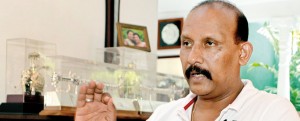
WIGGY’S MYOPIC, INSULAR AND Convoluted Ideology

September 18th, 2016

Courtesy Ceylon Today

From the wig to the Veshti (the traditional, usually snow white Tamil attire, oft mispronounced as Vetti/Verti), Northern Province Governor Canagasabhapathy Viswalingam Wigneswaran (fondly Wiggy to newspaper Editors and journalists for reasons of brevity) these days, does not seem to know from which orifice he is shooting! Whether it is from his lips or from his hips!

It was a steady but elongated run for the Royal College, Colombo 7-educated Wigneswaran to the highest echelons of the Sri Lankan Judiciary and end up as a Judge of the Supreme Court. Wiggy’s Royal College peers include another legal luminary, President’s Counsel Ben (Benedict) Eliatamby (whose elder son Niresh was the immediate past Associate Editor of this newspaper), Blue Chip Corporate icon Kandiah ( Ken) Balendra of Glennie Street fame, Plan Implementation Ministry Secretary-turned Insurance Ombudsman Dr. Wickrema Weerasooria, eminent Plastic Surgeon Narendra Wijemanne and globally acclaimed Cricket philosopher Mahinda Wijesinghe of third umpire fame, who, even convinced the then London Headquartered International Cricket Council to change the laws of the summer game, among a host of other luminaries, the literati and the glitterati.

However, in a strange paradox, the Supreme Court Judge Wigneswaran who knew the Constitution inside out while donning the wig and the Judges’ gown till a few years ago, seems to have conveniently forgotten for his convenience, the basic tenets of the Constitution after he changed into the Veshti/Vetti/Verti or whatever one may decide to call it! Wiggy, who has donned the Vetti, now says that the NPC Governor should be removed and that his appointment has been undemocratic! Wiggy, the ex-Supreme Court Judge, now wearing the Veshti, cannot be unaware that the members of the Northern Provincial Council, who have been elected democratically, have the mandate to request the President to remove the Governor, even if they believe that the appoint-ment of the Governor is illegal and undemocratic!! So, for the democratically elected Provincial government which claims that the appointment of the Governor is illegal while having the discretion to request for his removal, could only raise a laugh!!
It was as recently as yesterday that Vigneswaran, in an interview published in the Ceylon Today and as the lead story on Page 2 of our main paper, has emphasized making the governor’s post a ceremonial one.

Serious questions can be raised when he stresses this point not because he is the spearhead of just another Provincial Council but because of the fact that he was a former Judge of the Supreme Court. No way, can he plead ignorance of the supreme laws of this country, which are enshrined in the Constitution.

Powers of the Governor

The 1978 Constitution sets out its guidelines for the formation of the Provincial Councils in Article 154A. The powers of the Governor are very clearly elaborated in Article 154 (B); it very clearly sets out the vested powers of the Governor. It is true that the Governor appointed at the sole discretion of the President is to be the Executive Head of the provincial administration. In the recent developments we saw the Governor of the Northern Province being removed due to the continuous requests made by the council and the Chief Minister when the administration was changed on 8 January 2015. Therefore, we do not see any possibility of a dictatorship to build up in the act. Also it is safeguarded with the power vested in the Constitution to remove the Governor under Article 154 (B) 4 (a).

(4) (a) The Provincial Council may, subject to sub-paragraph (b) present an address to the President advising the removal of the Governor on the ground that the Governor –

(i) has intentionally violated the provisions of the Constitution;

(ii) is guilty of misconduct or corruption involving the abuse of the powers of his office; or
(iii) is guilty of bribery of an offence involving moral turpitude,
if a resolution for the presentation of such address is passed by not less than two-thirds of the whole number of members of the Council (including those not present).

The Governor exercises his power through the Chief Minister and the four Provincial Ministers who are appointed by him. Thus one could see that the Governor is a mere figurehead who is subject to the control and directions of the President.
The 13th Amendment goes on to say that the Governor shall exercise such executive power ‘either directly or through the Ministers of the Board of Ministers or through officers subordinate to him’. The term ‘officers subordinate to him refers’ to the members of the Provincial Public Service which has been created under the provisions of the Provincial Councils Act. Therefore, the Governor’s position always appeals for coexistence with the Provincial Council.

Instead of stripping the powers Wiggy should be much worried about the real difficulties in the Northern Province surfacing as we speak. When some of my journalist-colleagues met immediate past Governor of the Northern Province H.M.G.S. (Shums) Palihakkara a few years back he was emphasizing on the incapacity of public servants serving in the area. Thirty years of war has completely destroyed the intellectual cluster of the province hence unlike in other provinces a serious lack of competency, is existing in the province. Is it the Governor dragging the process or the incapacity of the public service? Ideally, Wiggy should be much worried about capacity building of the public workers rather than wasting time on actions to trim the powers of the Governor.

Merely making the position ceremonial will definitely imbalance the checks and balances between the Provincial Council and the Governor. Wiggy says he wants to be working close to the President. How can he see the light when he strives to strip the powers of the Governor, after all he is the representative of the President himself? Bit funny that!
It seems very obvious that Wigneswaran has wanted to reduce the powers of the President, in an obvious strategy to pursue the strategy of establishing the Federal solution.

The Constitution has been mooted and it has been proposed to solve the burning issues of the masses and the deprived and the depraved people, not to fulfil the greedy ambitions and whims and fancies of a Chief Minister!
As for the pipe dream of the federal solution, it will remain a dream. It will be more optimistic than the penniless man who ordered oysters for dinner at the five star beach resort and who hoped to settle the restaurant cheque with the pearls!

raviladu@gmail.com


ඇමරිකාවේ මීළග ජනාධිපති හිලරිද..ට‍්‍රම්ද.. – විජිත් රෝහණ විජේමුණි කේන්දර බලා ගණ පිහිටුවා කියයි.. [Video]

September 18th, 2016

ඇමරිකා එක්සත් ජනපදයේ පැවැත්වීමට නියමිත ජනාධිපතිවරණයෙන් එරට මීලග ජනාධිපති වන්නේ ඩොනල්ඞ් ට‍්‍රම්ප් බව ජ්‍යෙතිර්වේදී විජිත් රෝහණ විජේමුණි මහතා පවසයි.

4,293 Viewers

Mahinda never siphoned off state money – Rangith

September 18th, 2016

Mahinda never siphoned off state money – Rangith
රාජපක්ෂවරු මුදල් හොරකම් කර ඇති බවට ඔප්පු කළ හොත් ඒකාබද්ධ විපක්ෂය විසුරුවා හරිනවා… පාර්ලිමේන්තු මන්ත්‍රී රංජිත් මද්දුමබණ්ඩාර පවසයි.

Plans underway to hold a referendum – Wimal Weerawansa

September 18th, 2016

Adaderana

September 18, 2016  02:40 pm

The Government is eyeing to hold a referendum with respect of the proposed Constitution, National Freedom Front leader Wimal Weerawansa says.

He pointed out that the Government is planing to hold the referendum in the beginning of next year, instead of holding the proposed Local Government polls.

The observation was made while speaking at a meeting held in Kirimetiyana area in Wennappuwa.

– See more at: http://www.adaderana.lk/news/37000/plans-underway-to-hold-a-referendum-wimal#sthash.9M8JazgA.dpuf

After 28 years, Vaiko releases Prabhakaran’s letter to DMK chief?

September 18th, 2016

Courtesy  Adaderana

September 18, 2016  05:21 pm

  Indian MDMK general secretary Vaiko has released a letter written by LTTE leader V. Prabhakaran to DMK leader M. Karunanidhi in 1989 in which he had asked the latter to bring to the attention of opposition parties the atrocities” committed by the Indian Peace Keeping Force (IPKF), The Hindu newspaper reported.

Prabhakaran gave the letter when I met him in the jungles of Sri Lanka. A few months after I handed over the letter, Kalaignar (Karunanidhi) said he had destroyed it. But I kept a copy of the letter for 28 years and have released it now because the world should know its contents,” Mr Vaiko told The Hinduon.

The hand-written letter calls Mr. Karunanidhi as Anna (elder brother)” and tells him that while the Tamil leaders in Sri Lankan Parliament had left the Tamils in lurch for their own benefits, Mr. Vaiko, risking his life, had met us and our comrades.”

Prabhakaran adds that His (Vaiko’s) love for Tamils and his courage make us feel that we can die a thousand times for the cause of our people and language. We have respect for your party of selfless cadres.” It is his love for our people, that has made him to undertake the adventure,” he says in the letter dated February 22, 1989.

The LTTE leader, who closely identified himself with late Chief Minister M.G. Ramachandran, felt that the new DMK government would rejuvenate the Tamils. As far as we are concerned, we have taken up arms to fulfil our goal. We will either win or happily die for the cause. Our country is turning into a graveyard because of the presence of the IPKF. Time has come for you to bring it to the notice of the Opposition in India and people of Tamil Nadu. We hope you will inform the people of Tamil Nadu the betrayal of the IPKF and the attack unleashed on us. The IPKF is preparing itself for a massive attack,” he alleged.

I am sending Gopalasamy (as Vaiko was known then) Annan to Tamil Nadu because of the dangerous situation,” he says.

‘Kalaignar said he had destroyed it. But I kept a copy to tell the world what had happened.’

-The Hindu
-Agencies

– See more at: http://www.adaderana.lk/news/37003/after-28-years-vaiko-releases-prabhakarans-letter-to-dmk-chief#sthash.ViE1Oq5B.dpuf

We are opposed to any type of federalism: JO

September 18th, 2016

 Kelum Bandara Courtesy The Daily Mirror 

In the wake of former President Chandrika Kumaratunga calling for a Federal and Quasi-Secular Constitution for Sri Lanka, the joint opposition (JO) said it was totally opposed to ‘Federalism’ as a means to resolving the national question.

JO parliamentary group leader Dinesh Gunawardane said yesterday they met to discuss the issues concerning the country at large.

He said the JO had noted the statements made by Ms. Kumaratunga call for a Federal and Quasi-Secular Constitution for Sri Lanka.

Federalism will result in the disintegration and partition of the country,” the MP said and added that the JO stood for a unitary constitution.

Ms. Kumaratunga said at a recent function that Federalism as concept had been accepted in several countries and there was no need to be frightened about it.

– See more at: http://www.dailymirror.lk/115962/We-are-opposed-to-any-type-of-federalism-JO#sthash.huP3XJK8.dpuf

Bolt-holes of criminals

September 18th, 2016

Editorial The Island – Sept 15, 2016

Many war criminals are reported to have avoided deportation from the UK thanks to some serious lapses on the part of the British authorities, who have taken no further action after blocking their bids for citizenship. A recent article in The Daily Mail tells us that some human rights campaigners have faulted the British officials for not reporting the criminal elements including some Sri Lankans to Scotland Yard’s special war crimes unit.

It was obvious that the UK and other western nations made a very bad mistake by harbouring terrorists from other countries. They may have thought those criminal elements would pose no threat to them, but in so doing, they allowed complex underground networks to be set up for sordid operations such as fund raising for terrorism, gun running, money laundering, drug trafficking and human smuggling. These conduits are now being used by anti-western terrorist groups like al-Qaeda and ISIS to carry out attacks.

Meanwhile, powerful nations, unflinchingly, shield war criminals and blood thirsty dictators in a bid to safeguard their economic and strategic interests. The US has a history of defending many dictators such as Shah, Marcos and Pinochet and Saddam Hussein, who finally fell from grace. France and several other European nations cottoned up to Bokassa, the self-crowned ‘Emperor’ of Central Africa. The UK, too, went out of its way to defend Pinochet, whose Caravan of Death left thousands of suspected communists dead in Chile. All the countries that produce electronic goods prolong the suffering of people in countries like Congo, where armed groups, backed by multinationals seeking cheap coltan to manufacture semi-conductors, are unleashing violence to plunder those resources. The Global North gains both ways; it sells its arms to terrorist groups in Africa and obtains raw materials for their products for a song in return. This, the so-called western democracies do while championing human rights in the developing world.

Politicians in all parts of the world are prepared to do anything to retain or capture power. Some diplomatic cables disclosed by Wikileaks have revealed that while the Vanni war was raging the then British Foreign Secretary David Miliband rushed here in a bid to broker a truce because he and his party were eyeing the block votes, which pro-LTTE groups in the UK claimed to be able to deliver to a party of their choice. Lord Naseby, who echoes the views of the vast majority of British people averse to terrorism, revealed in 2013 that the creator, recruiter and organiser of LTTE child soldiers in Sri Lanka, Adele Balasingham, was living comfortably in Southern England. It was a supreme irony that the then British PM Cameron visited this country to attend the CHOGM 2013 in Colombo, and called for a war crimes probe.

The Daily Mail tells us that some human rights groups have slammed the British government and warned that the UK risks becoming a ‘safe haven’ for war criminals. While their concerns should be appreciated the fact remains that Britain has already become a bolt-hole for criminals of all sorts from the four corners of the earth. They have also said it is ‘hard to understand’ how British officials effectively blocked war criminals’ attempts to remain in the country but baulked at deporting them or referring their cases to police. Such hypocrisy on the part of Britain is nothing new. In 2009, Abdelbeset Ali Mohmed al Megrahi, the only person convicted in connection with the Lockerbie airline bombing that killed 270 people, was released from a British jail purportedly on ‘compassionate ground’. However, the Blair government drew heavy flak for having engineered his release to improve economic ties with Libya. Saif Gaddafi, the second son of the then Libyan Leader Muammar Gaddafi, according to a Daily Telegraph dispatch we reproduced at that time, thanked the British as well as the Scottish administration for securing Megrahi’s release, and implied that lucrative trade deals would follow.

The Dr. Jekyll-and-Mr. Hyde behaviour of the developed world has stood global terrorism in good stead. Having sown the wind the western bloc is now reaping the whirlwind if terror strikes on their soil and the gnawing sense of uncertainty troubling them are any indication. One who harbours venomous snakes under one’s sarong is sure to get the shock of one’s life, as a popular Sri Lankan saying goes.

Stilling the Buddhist moral voice in Sri Lanka

September 17th, 2016

Shenali D Waduge

Namesake Buddhists who are not culturally rooted in Sri Lanka are definitely not spokesman for the Sinhala Buddhists of Sri Lanka. Yet, it is the voices and opinions of these who are being showcased and who have helped to denigrate and still the real Buddhist moral voice in Sri Lanka. Some of these individuals have had no conscience to even demonize Buddha and media has not helped by giving space only to those who denigrate Buddhism in their regular columns/features.

When invaders arrived in our island nation there were the Sinhalese Buddhists and a handful of Tamil Hindus descending from South India and Muslim traders who were regarded as aliens. With colonial invasion and occupation the Sinhala Buddhists and Tamil Hindus were divided into Sinhala Christian/Catholics & Tamil Christians/Catholics. The invaders had successfully created groups of ‘minorities’ whom they would manipulate with time against the Majority Sinhala Buddhists who were their main target for annihilation. It is not surprising that all post-independence issues from insurrections to terrorism had foreign involvement.

Buddhism was the key and singular obstacle to taking complete control of Sri Lanka and its defenders were the patriotic forces (military and the patriotic groups) and the Maha Sangha and the British planned remove these obstacles or at best dilute their power.

The plan was to create Christian missionary schools in minority areas, educate the minorities and create an imbalance by giving them better opportunities while the Buddhists were fighting to defend the nation and dying.

History Should NOT be taught in schools” Sinhala people alone can boast of an uninterrupted sway over the island for some thousands of years. Since the South Indians living in Lanka had no such history, history should not be taught in schools as it could belittle and humiliate the South Indians.” said a Tamil gentleman in the Morning Star of 9th October, 1931.

Missionary schools achieved their objective – they created a submissive class of natives willing to be ruled by the British and willing to serve them. When Buddhism was ridiculed and denigrated very few Buddhists rose to object. Little has changed over the years.

In 1833 the British purposely established an office in Anuradhapura to disrespect the Sinhala Buddhists by putting up taverns, meat stalls, kovils and churches and giving ownership to Muslims who began complaining about the temple drummings and Buddhist pirith chanting leading to British imposing regulations on Buddhists. Buildings were built purposely on top of Buddhist heritage sites.

J Forbes, District Judge diary notes speak of 133 taverns in an area covering 200,000 residents I entirely sympathise with the Buddhist monks who resist the establishment of the taverns. They practice a religion that forbid them to drink alcohol, but a Christian government is forcing them to do so. This will not only increase the revenue for the government, but also increase robbery, murder, gambling and drunkenness.”  

Alcohol was introduced to intoxicate and make addicts out of the Sinhalese thereby weakening their resistance. In 1872 Governor Gregory admitted before the Legislative Council that the British were responsible for making the Sinhalese into drunkards – we know the extent of this malady.

1807 Governor Maitland’s letter to GA Matara use this carefully and secretly, reliance of Buddhism and philosophy of Matara Buddhists must be destroyed. In Matara, Bhikkus are more powerful than village chiefs, make sure all chiefs are Christian”. Now look at the 2015 cabinet of Ministers.

Take a closer look at where Christian NGOs operate, the work of charities, the governments that fund them and connect the dots and see the program in place. Take a closer look at the editorial boards and all key areas where media is used to denigrate the Buddhists. The 1964 Press Commission Report gives find examples of the manner media is used to ridicule the Buddhists. Little has changed. Column space is given to ‘Buddhists’ who are happy to question their faith and at times laugh at it! https://www.lankaweb.com/news/items/2014/05/04/the-press-commission-report-1964-some-extracts-and-a-brief-commentary/ Look at the television program schedule – in time to come a child asked to name Sri Lanka’s heroes will say ‘Jodha Akbar’ instead of Veera Keppetipola, Veera Puran Appu and our heroic armed forces. The Indianization of our nation is taking place at another level.

Those selected and given media prominence do their best to cover the fact that only Sinhalese can show with historical evidence the evolution of a new language, their own culture and a civilization that no others claiming homelands can show. For lack of such proof, the best tactic has been to laugh at the Sinhala Buddhists and attempt to smear their achievements. It is these rootless, cultureless and namesake Buddhists who laugh at the archaeological ruins and edifices. These namesake Buddhists are often on the payroll of nations that do not even have archaeological ruins or even edifices to showcase except scores of examples of confiscating nations/territories, plundering and murder and attempting to subjugate the natives and remove every pride natives have about their country, their heroes, their traditions and cultures. It is unfortunate how they have enticed natives with perks and privileges to laugh at their own people for which they get accolades and awards!

It is all part of a historical gameplan clearly indicative in the colonial policies and directives to missionaries and colonial officials by colonial governments whose stooges and lackeys are working tirelessly in the form of media, NGOs, rights activists, civil society and others. Every Buddhist” who denigrates Buddhists and Buddhism are rewarded and cheered and more inducements are showered. There is a competition to draw more.

The nearing of their objective is seen by drawing similarities to the manner how weaknesses of character of natives were taken advantage in 1815 to result in the handover of sovereignty to the British and exactly 200 years later virtually the same scenario has occurred. There is little anyone can deny that the sovereignty of Sri Lanka is being tampered with in every sphere of influence where stooges have been positioned to do the bidding. The key goal has been since colonials set foot in Sri Lanka to remove the identity and the place Buddhism held in Sri Lanka. Both Islamic and Christian agenda irrespective of those practicing the respective faiths has been to wipe out Buddhism incrementally. Education texts are changing the history through academics too ready to clap to the secular, multi-cultural, multi-faith theme. Let us make it clear that religious freedom and rights cannot remove the status quo of the Sinhale Buddhists who built the nation and Buddhism on which the moral values of the country was centred before colonial invaders confiscated and replaced moral good with a whole set of immoral values drawing natives to become a nation of drunkards, rapists, selfish and uncaring of others including animals. During the times of the rule of the Sinhale kings who followed the dasa raja dhamma, the entire island was animal friendly. Today, except for the Buddhist clergy & Buddhists & animal activists demanding the Animal Welfare Bill all other religions are silent! Mihintale was once considered the abayadana and today Buddhist citadels are carrying out animal sacrifice because to protest against the inhumanity of killing an animal is a violation of peaceful existence and an insult to minority rights! These are drilled into the people so much that the Buddhist moral voice has become stilled. There is not one single word of violence against any living being in Buddhism. Not a single war has taken place in the name of Buddhism. http://www.independent.co.uk/arts-entertainment/books/violence-more-common-in-bible-than-quran-text-analysis-reveals-a6863381.html

However, today even the sacred cities of Anuradhapura, Dambulla, Kandy etc butcheries and animal slaughter have been allowed for the sake of cheap votes and caving into money and influence. When Buddhist priests are attacked, museums are destroyed and Buddha statues are dashed to the ground even Ban Ki Moon the Secretary General has no concern. Buddhist leaders themselves are too scared to issue strong messages because they are held back because the minorities have money to throw and politicians need money before their conscience to survive in politics! Today, Tamil leaders appointed by the LTTE are demanding the removal of ancient Buddhist sites and their racist calls have led to stoning temples, defacing of statue of Buddha and physical abuse to Buddhist priests and even attempts to poison priests through dana. None of these had the reactions of the international community or any Buddhist leader or political parties even protesting. Of course there is little we can expect from the nikaya heads who are in a world of their own.

That sadly is the fate and as a result of these ground situations where iconoclasm of certain religions necessitates the destruction of the world’s most harmless and compassionate philosophy and religion, Buddhism is being attacked on all fronts.

Its history is being tampered and manipulated, its historical texts are being destroyed and replaced with fairytales, the Sangha who come from poor rural homes and do not have the finesse or English education to survive are cornered and in their place are more sophisticated multi-faith peddling priests and the heads of these nikayas prefer to sit inside enjoying the luxuries of the dayakas without so much as making any statement against the plight of Buddhism – either they are unaware or they are living in a cuckoo land. Perhaps that is why one of the nikaya heads recently told a prominent politician not to exaggerate concerns on the constitutional reforms. Is this nikaya head aware that the constitutional proposals proposed the removal of the foremost place to Buddhism, the change of the national flag, the change of the national anthem – are these exaggerations? Will any other country allow an unrepresentative bunch of people, lackeys of the parties trying to destroy and destabalize a nation to dictate what should be changed in the foundational pillars of a country? Apart from 2 people all others in that committee simply raised their hands in favour of the draconian changes.

In connecting these developments the success of the colonial objective doesn’t look too far in sight. There are scores of Buddhist organizations, scores of Buddhist conferences – do they take up any of these issues, or are they cowards to take the bull by the horn. Have they become infested with the reconciliation syndrome wherein objecting to historical discriminations/violations and threats to the existential existence of Buddhism and the Buddhist heritage of the country becomes taboo and has to be automatically vetoed or face the wrath of the entire world. All those bringing out these discrepancies are generally slapped with name calling, fascist, racist – you name it there will be a bunch of people paid to do the name calling and plenty of media will give them space. No one will come out to question that valid points are being raised instead the reactions and reactors get chided and the actions that led to the reactions are sidelined.

Those that pay lipservice to other people’s cultures and values do so because they do not know their own culture or values to be proud of. These are the proponents of the liberal multicultural slogans. We have a heritage and history to preserve and those that are proud of it will be inspired to defend the nation whatever the odds.

We now live in a world where universities destroy knowledge, doctors destroy health, lawyers destroy justice, governments destroy freedoms, politicians are a global nuisance, the press distorts and destroys information and bankers destroy the economy.

The Buddhist moral voice must re-emerge. Capitalism is collapsing. It is a failed experiment. If capitalism collapses in the West so too will Christianity – thus the worries of Islamization following the migrant exodus. The capitalists now steer to Asia and it is the opportune time to bring out the Buddhist moral voice – right livelihoods, making profit by not harming others, equitable development, sharing and caring, compassion for animals – no religion can fault these noble tenets of Buddhism. They have induced ‘namesake Buddhists’ to flout Buddhist ideologies and use that to denigrate Buddhists/Buddhism. That is not fair play.

We may not succeed, but we must try, and ten years later we might get what we try to achieve” so say Srimath Anagarika Dharmapala.

The time is ripe for the Buddhist associations, individuals, expat groups and all others to realize that the enemy is at our door and we cannot turn a blind eye to the incursions taking place. A look at all other nations falling apart by the same powers eyeing Sri Lanka should suffice for all citizens to protect their nation before we end up in no different a status. These are no exaggerations – Asia is the next target and Sri Lanka has been a historical target.

Shenali D Waduge

ආණ්ඩුව පොට මාරු කරන ජනප්‍රිය පාසල් ගැටලුව

September 17th, 2016

තේජා ගොඩකන්දෙආරච්චි

සී.ඩබ්.ඩබ්. කන්නංගර මහතා විසින් 1945 දී ශ්‍රී ලංකාවට හඳුන්වා දුන් නිදහස් අධ්‍යාපනයේ ඵල නෙලා ගත් ශ්‍රී ලාංකිකයන් එම අධ්‍යාපනයම දේශපාලනීකරනය වීම තුල අද  පීඩනයට පත්වන අයුරු දකින විට මට මතක ඇති කාලයේ ඇසූ දුටු  සිදුවීම් යලි මතකයට නැගේ.

දැන් තරමටම පිස්සුවක් නූනත් තම දරුවන් ජනප්‍රිය පාසල්වලට ඇතුලත් කර ගැනීමේ තරගය 80 දශකයේ මුල භාගයේදී ද තිබිනි. එකල මාතර  සුජාතා බාලිකාවේ ප්‍රාථමික  අංශයේ විදුල්පතිනිය වූයේ අපේ අම්මාය.

ඒ කාලයේ වසරේ අගෝස්තු නිවාඩුව මගේ මතකයේ විශේෂයෙන් ඇත්තේ, නිවාඩු යන නම ලැබුනත් ඒ කාලය තුල අම්මාට කිසිම නිවාඩුවක් නොතිබුන නිසාය. පළමු වසරට ඇතුලුවීම සඳහා ලැබෙන අයැදුම්පත් විශ්ලේෂණය කිරීම සඳහා ඈට සතියකට කිහිප වරක් උදය වරුවේ පාසලට යන්නට සිදුවූ අතර හවසට, තම දරුවා සුජාතාවට ඇතුලත් කිරීමට උදව් කරන්නැයි ඉල්ලමින් නිවසට පැමිනෙන අයගෙන් අඩුවක් නොවේ. මේ බොහෝ අය අම්මා දන්නා හඳුනන අය මාර්ගයෙන් හැඳිනුම්කම් හදාගෙන පැමිනි අතර, ඉටු කල නොහැකි ඉල්ලීම් කරන අයගේ  සිතත්, ඔවුන්ව යොමුකල හිතවතාගේ සිතත් නොරිදවා ආපසු හරවා යැවීමට සිදුවීම තුල ඒ නිවාඩු මාසයේදී කායිකව ලද වෙහෙසට වඩා තමාට හැකි  උපරිම අවංක   භාවයෙන් රාජකාරිය කල

 අම්මා විඳෙව්වේ මානසිකවය.

අපේ අම්මා 1949 දී තම පළමු පත්වීම ලැබුවේ එකල සමාගම් පාසැලක් වූ මාතර කඹුරුපිටිය බාලිකා විදුහලේ ගුරුවරියක  ලෙසය. පසුව එය රජයේ විදුහලක් බවට පත්විය. 1953 දී ඇයට විදුහල්පති තනතුර ලැබිනි. විවාහයෙන් පසුව තාත්තාගේ කාර්ය බහුල රැකියාව නිසා ඔවුහු මාතර නගරයේ පදිංචි වූහ. ඉන්පසු ඈ දිනපතා බස් රියෙන් කඹුරුපිටි ගියාය. 1969 දී තාත්තාට වැළඳුනු හදවත් රෝගයක් නිසා නිතර අසනීප වීමත්, තම කුඩා දරුවන් 6 දෙනාගේ වගකීමත් නිසා 1970 පමන වන විට අම්මාට මාතර නගරයේ පාසලකට මාරුවක් ලබා ගැනීමට අවශ්‍ය විය. කිසිදා දේශපාලනයේ නියැලුනේ නැති නමුදු අම්මාගේ කාර්යාලීය මේසයේ ඇතිරුනු කොලපාට මේස රෙද්ද නිසා අම්මා ‘යූඇන්පී කාරියක’ ලෙස හංවඩු ගැසී තිබිනි. අප දෙමව්පියන් හඳුනන කඹුරුපිටියේ වැසියෙකු ඒ  දිනවල තාත්තා  හමු වන්නට පැමිනියේය. මෙවර සමගි පෙරමුුණු රජය ජයගත්විට අම්මාව මඩකලපුවට මාරු කරන බව පලාතේ  දේශපාලන බලවතෙකු පැවසූ බව ඔහු තාත්තාට පැවසීය. තාත්තා ඒ කතාව සිනාසී බැහැර කලේය. මැතිවරණය අවසන් වී ටික දිනකින් මාතර ශාන්ත තෝමස් බාලිකාවේ ප්‍රාථමික විදුහල්පතිනිය විශ්‍රාම ගන්නා නිසා එම තනතුර හිස් වන බව දැනගත් අම්මා එවකට මාතර මන්ත්‍රීවරයා මෙන්ම නව සමගි පෙරමුණු රජයේ අධ්‍යාපන නියෝජ්‍ය ඇමතිවරයාද වූ බී. වයි. තුඩාවේ මහතා හමු වන්නට ගොස් තම දුෂ්කරතා පවසා එම තනතුරට අදාල සේවා මාරුව ඉල්ලා සිටියාය. ඔහු  අපේ අම්මා ගැනත් ඇයට වැදී තිබුනු ‘යූඇන්පී’ ලේබලය ගැනත් හොඳින්ම දැන සිටියේය. නමුත් ඔහු පවසා තිබුනේ ” මිසිස් ගොඩකන්දෙ ආරච්චි, ඔබ හුඟක් සුදුසු කම් ඇති කෙනෙක්. ඔබට තව මාස තුනක් ඉන්න හැකි නම් සුජාතා බාලිකාවෙ ප්‍රාථමික විදුහල්පති තනතුර හිස් වෙනවා. ඒ තැන ඔබට දෙන්න පුලුවන්” කියාය. එදා පැවසූ පරිදිම ඔහු එම මාරුව අම්මාට ලබා දුන්නේය. ඒ එදා පැවති දේශපාලනයයි.

අපේ පුංචි අම්මා විවාහ කරගෙන සිටි බාප්පා තම ඍජුු  විවේචනශීලී කතාබහ සම්බන්ධව ප්‍රසිද්ධව සිටියේය. ඔහු ඉහල උපාධි හා වෙනත් බොහෝ වෘත්තීය සුදුසුකම් ලද අධ්‍යාපන ක්ෂේත්‍රයේ දීඝර්‍ කාලීන පලපුරුද්දක් තිබුන අයෙකි. 1977 වන විට ඔහු මාතර දිස්ත්‍රික් සහකාර අධ්‍යාපන  අධ්‍යක්ෂවරයා ද විය. 1977 එජාප රජය බලයට පැමිනිිවිට ක්‍රියාත්මක වූ දේශපාලන කතුරට හසුු වූ ඔහුුට මාතර සුල්තානාගොඩ කණිශ්ඨ විදුහලේ විදුහල්පති ලෙස සේවා මාරුවක් ලැබිනි. වරක් අගෝස්තු මාසයේ දිනක, ළමයි පාසලට ඇතුලත් කිරීම සම්බන්ධව අපේ අම්මාට තිබෙන කරදරය දුටු ඔහු සිනාසුනේය. ” ඒකට මම ! මම නම් පාරට බැහැල යන එන මිනිස්සුන්ට අත්පුඩි ගහල කතා කරල කියනව, මෙතැනත් ඉස්කෝලයක් තියනව. ළමයිව එවන්නකො කියල” ඒ 1981 දී පමනය. මේ වදන් තුල එදා ඒ සමාජය හසු වෙමින් ගිය පෙරලිය කදිමට කියැවින.

බාප්පාට සුල්තානාගොඩට මාරුව ලබා දෙන්නට ප්‍රථම, නව එජාප රජය පත්වී මාසයක් ඇතුලත ඔහු එතෙක් දැරූ තනතුරට කෙනෙක් පත්කර එවා තිබිනි. නව සහකාර අධ්‍යක්ෂකට තම කාර්යාල කාමරය දෙන්නට සිදු වූ ඔහුට ඉන්පසු නිශ්චිත තනතුරක් තිබුනේ නැත. මඳක් පලල්  වූ කොරිඩෝවේ කුඩා මේසයක් හා පුුටුවක් තබා එතැන සිටින ලෙස බාප්පාට දන්වනු ලැබීය. වඩාත්ම වැදගත් දේ නම් ඔහුට මෙවන් මදි පුුංචිකම් විඳින්නට සිදු වූයේ ඔහු කල දේශපාලනයක් නිසා නොව, වරද දුටු  තැන තරාතිරම නොබලා නොබියව කතා කරන්නට හා නිවැරදි කරන්නට ඉදිරිපත් වූ බැවිනි. නමුත් එය පෙර පැවති රජයට නම් එතරම් ප්‍රශ්නයක් නොවීය. එමෙන්ම තමනට ලැබුන දේ භාරගත් ඔහු වරප්‍රසාද සඳහා කිසිවකු ඉදිරිපිට දෙකට නැමුනේ නැත. ඉන්පසු  වසර  13  ක් ගතවී විශ්‍රාම යන තුරු යලි කිසි දිනක ඔහුට තම සුදුසුකම්වලට සරිලන රැකියාවක් ලැබුනෙ  නැත.

එකල අධ්‍යාපන ඇමති නිශ්ශංක විජේරත්න වූ අතර ලයනල් ජයතිලක නියෝජ්‍ය ඇමති විය. මේ මෑතකදී මා දන්නා හඳුනන කාන්තාවක් ගම්පහ කළගෙඩිහේනේ පදිංචි තම සහෝදරයාගේ දියණිය කොළඹ විශාකාවට ඇතුලත් කිරීම සඳහා ඇමති නිශ්ශංක විජේරත්න  තම අත් අකුරින් ලියා ලබා දුන් නියෝගයක් සම්බන්ධව මහත් ආඩම්බරයෙන් කතා කල විට මට මේ සිද්ධීන් සිහිපත්  විය.

මේ සිද්ධි එක දෙක තුල වුව අධ්‍යාපනය දේශපාලනීකරනය වූ අයුරු පැහැදිලිය.

සැප්තැම්බර් 14 වන දා, තම දරුවන්ගේ පාසල් පිලිබඳ ප්‍රශ්නය පාදක කරගෙන ඉසුරුපායට රැස් වූ වෙෙද්‍යවරුන් සම්බන්ධව මාධ්‍ය හමුවේදී කල කතාවේදී, අධ්‍යාපන ඇමති අකිල විරාජ්ගේ ඍජු ලිපි මගින්  කොළඹ ජනප්‍රිය පාසල් වලට ළමුන් 200 ක් පමන ඇතුලත් කර ඇති තොරතුර ගැන මාධ්‍යවේදීහු ඔහුගෙන් විමසූහ. එම ප්‍රශ්නය ඉතා පහසුවෙන් මග හැරිය ඔහු ඊට පිලිතුරු ලෙස කිසිදු අදාලත්වයක් නැති තොරතුරු වගයක් පවසන්නට  විය. ඒ ප්‍රශ්නය යලි නැගෙන විට ”හොඳයි ඔබතුමන්ලාට බොහොම ස්තුතියි” කියා පවසමින් සාකච්ඡාව අවසන් කලේය. 

වෙෙද්‍යවරුන්ගේ  දරුවන්ට පාසල් ඉල්ලා සිටීම පිලිබඳ ප්‍රශ්නය පුවත්පත්වල පලවූ විට ඒ ගැන රජය විසින් මැවුුවේ අමුතුම චිත්‍රයකි. එනම් වෙෙද්‍යවරු තම දරුවන්ට රාජකීය සහ විශාකා වැනි  පාසල් ඉල්ලන බවයි. මේ ජනප්‍රිය පාසල් කතාවට අධ්‍යාපන ඇමති විසින් ලබා දුන් අර්ථ කතනය තුල ජනතාවගේ දැඩි කෝපය වෙෙද්‍යවරුන් වෙත පමනක් එල්ල වූ හැටි කදිමය.  මේ ඉල්ලීම වෙෙද්‍ය නිලධාරීන්ගේ සංගමයෙන් පමනක් ඉදිරිපත්  වූ නිසා මෙය වෙෙද්‍යවරුන්ගේ පමනක් ප්‍රශ්නයක් බවට පත්විය. නමුත් මෙම තත්වය මෙසේ වසර පහකට වරක් ස්ථාන  මාරු ලබන  ශ්‍රී ලංකා පරිපාලන සේවය වැනි වෘත්තිකයන්ටද බලපායි. ශ්‍රී ලංකාවේ දිස්ත්‍රික්ක 25 ක් ඇත. මේ සියලු දිස්ත්‍රික්කවල සේවය කරන වෙෙද්‍යවරුන්ගේ දරු පවුල් කොළඹ පදිංචිව සිටින බවත් ඒ නිසාම ඔවුන්ගේ දරුවන් කොළඹ ජනප්‍රිය පාසල්වලට යන බවත් ඔබ සිතනවාද? වසර  පහකට වරක් ඔවුන්ට මාරුවීම් ලැබෙන අතර විශේෂයෙන් විදෙස් පුහුණුවක් අවසන් කර පැමිනි විට ඔවුන්ට ලැබෙන්නේ දුෂ්කර පත්වීමකි. තම වෘත්තිය අනුව ලැබෙන මාරුවීම්  භාර ගත යුතු වනවානම් ඔවුන් තම දරුවන්ට තමන් සේවය  කරන ප්‍රදේශයේ අැති ජාතික පාසලක් ඉල්ලා සිටීමේ ඇති වරද කුමක්ද?

ශ්‍රී ලංකාවේ  ඇති දිස්ත්‍රික්ක 25 ම නියෝජනය කරන මැති අැමතිලා සියල්ලන්ගේම පාහේ දරුවන් යන්නේ කොළඹ රාජකීය, විශාකා හෝ වෙනත් ඉහලම තලයේ පාසලකටය. මේ මැති ඇමතිවරුන්ගේ කුහක කමයි. කිසි විටෙක මොවුන් තමන් චන්දය ඉල්ලන දිස්ත්‍රික්කයේ රැඳී සිටිනවාද? ඔවුන්ට කොළඹ  නිවෙස් ඇති අතර දරුවන් රටේ ඉහලම පාසල්වලට ඇතුලත් කර ගැනීමේ වී අයි පී වරමද හිමිිව තිබේ.ඒ තීරු බදු  රහිත  වාහන, සීමාවක්  නැති දීමනා මෙන්ම ඔවුන් ලබන විශේෂ වරප්‍රසාදයේ කොටසකි. එමෙන්ම  බොහෝ  නලු  නිලියන්, ගායක ගායිකාවන්ගේ දරුවන්ටද මේ වරප්‍රසාදය ලැබේ. නමුත් මේ බොහෝ දෙනෙක් පදිංචිව  සිටින්නේ කොළඹින් පිටත අර්ධ  නාගරික ප්‍ර්‍රදේශවලය. මේ ද  විශේෂ හැඳිනුම් කම් ඔස්සේය. මේ වරම මැති ඇමතිිලාට පමනක් නොව ඔවුන්ගේ කාර්ය මණ්ඩලවලටද හිමිය. එසේම ඕනෑම බලපුලුවන්කාරයෙකුටද මෙය වලංගු  වේ.

සියලු වෘත්තීන් සමාන බවද කිසිවෙකුට වැඩි වරප්‍ර්‍රසාද, වටිනාකම් නැතැයිිද පසුගිය දිනක  තම මුහුණු   පොතේ පිටුවකින් පැවසූූයේ අගමැතිවරයාය. තම ගෝල බාලයින්ගේ කල් ක්‍රියාව හා ඔවුන් භුක්තිි විඳින වරප්‍රසාද   දකින විට තමා මේ කියන්නේ ඇත්තද  කියා නැවත සිතා බලන්නේ නම් යෙහෙකි. 

තවත් වැදගත් කරුණක් ඇත. අප වෘත්තියක් ගැන මනින විට එහි ප්‍රතිස්ථාපන හැකියාවද සොයා බැලිය යුතුය. වෙෙද්‍ය වෘත්තිය යනු  එසේ ප්‍රතිස්ථාපනය කල හැකි වෘත්තියක් නොවේ. දීඝර්‍ කාලීන න්‍යායික සහ ප්‍රායෝගික දැනුම් සම්භාරයක් ඔස්සේ  බිහිවන වෙෙද්‍යවරයෙකු වෙනුවට  අපට සිතන තරම්  පහසුවෙන් වෙනත් අයෙකු ආදේශ කල නොහැක.  

එදා සී.ඩබ්.ඩබ්. කන්නංගර මහතා සද්භාවයෙන් අප රටේ   ස්ථාපිත කල නිදහස් අධ්‍යාපනය වඩාත්ම දේශපාලනීකරනය වූයේ  1977 න් පසුවය. වත්මන් අධ්‍යාපන ඇමතිවරයා හැමදාමත් ‘ලඟම පාසල  හොඳම පාසල’ යනුවෙන් සංකල්පයක් ගෙනාවත් එය අද දක්වාම ඒ වචන කිහිපයට පමනක් සීමා වී ඇත. එය  සැබෑවක් කරන්නට උත්සාහයක් හෝ දරනවා නම් එදා පාලිත  තෙවරප්පෙරුම ඇමතිවරයා මීගහතැන්නේදී රඟ දැක් වූ  නාඩගම මෙන්ම අද මේ පැන නැගී තිබෙන වෙෙද්‍යවරුන්ගේ ගැටලුුවද ජනතාවට දක්නට  ලැබෙනු නැත. එය එසේ නම් දේශපාලකයන්ටද අවශ්‍ය වෙලාවට පමනක් කොළඹ පැමින, තම තමන්ගේ බල  ප්‍රදේශවල සිට සේවය  කල හැකි  වනු  ඇත. එදා ජනාධිපතිවරයා විසින් මීගහතැන්න ළමුන් 9  දෙනාට මතුගම සාන්ත මේරි  විද්‍යාලය  ලබා  දීම තුල ඔහු අකිල විරාජ්ගේ  ලඟම  පාසල  සංකල්පයට අතුල් පහරක්  එල්ල කරමින් තම  දරුවන්  ජනප්‍ර්‍රිය පාසල්වලට දමා  ගැනීම සඳහා අලුත් ක්‍ර්‍රමවේදයක්ද හඳුන්වා දුන්නේය.

ඒත් මේ  සිහින   සැබෑ කරගන්නේ කෙසේද? මේ ඇමතිවරුන්ට පසුුගිය රජය චප්ප කරදැමීමේ  වගකීම ප්‍රමුඛතාවක් ලෙස පැවරී  ඇතිකොට තම අමාත්‍යංශ වල වගකීම් ඉටු කරන්නට ඉතිරිව ඇත්තේ සුලු කාලයකි. ඉතින් මෙවන් ප්‍රශ්නයක් පැන නැගුන විට ඒ ඉල්ලීම කල තැනැත්තන් ජනතාව හමුවේ වරදකරුවන් කර තමන් නිදොස් වීම සඳහා ලනු ඇඹරීමට ඒ කාලයත්  වැයවේ. 

ජනතාවවත් මේ ගැට  වලට  හසු නොවී විශ්ලේෂණාත්මකව මේ කරුනු දෙස බලන්නට පුරුදු වනවා නම් මේ අසීරු  මොහොතේ රටට යහපතක් වනු ඇත.


Role of Hindus in Wiping Out Buddhism in India and Parts of Sri Lanka – Part 1

September 17th, 2016

Dilrook Kannangara

This is an academic analysis of undeniable facts on a subject that is crucially important today. It is not aimed at targeting anyone or any religion but to bring to the fore less discussed forces at work against Buddhism. Sri Lankans must wake up to this threat before it is too late.

Today only 0.7% of the Indian population is Buddhist. Most of them are classified as ‘low caste’ and denied the right to education, medical care, employment and even life. It is easy to blame Moghul and Western invaders for wiping out Buddhism in the landmass now known as India. They also contributed. However, by the time they arrived at the scene, Buddhism had already collapsed. What is most interesting however, is not India but Sri Lanka. Buddhism has been completely wiped out far more than in India in all but one Hindu majority districts of the island! This is an unmissable pattern and certainly no fluke. This seems to be a standard template used against Buddhism.

Economic deprivation of Buddhists, deliberate Hindu ideological onslaught and structural genocide are the main tools used against Buddhists in Hindu majority landmasses in South Asia.

Objectively analyzing these time tested truths is very important to save Buddhism in the island nation. Pushing them under the carpet is the surest way to erase Buddhism from remaining parts of Sri Lanka. Sadly, some claiming to be fighting to save Buddhism seem to have a secret agenda of wiping it out peacefully by refusing to admit these truths. They do more damage to Buddhism than any other external threat.

Hindu Ideological Onslaught On Buddhism

The following scholarly research article clearly identifies how deliberate and determined campaigns against Buddhism succeeded in Hindustan.

http://www.academia.edu/207076/CONTRIBUTING_FACTORS_FOR_THE_DISAPPEARANCE_OF_BUDDHISM_FROM_INDIA
Various Brahminical texts included fierce strictures against Buddhists. Some of these (not all) are listed below.

Manusmriti by Manu ordered Hindus to purify by having a bath” if they touched a Buddhist. Implication of this was Buddhists were marginalized in India”. Another leader Aparka also ordained the same. Vradha Harit took it a level high claiming that entry into a Buddhist temple as a sin, which could only be expiated for by taking a ritual bath”. Myths including the  Mricchakatika, (Act VII), the hero Charudatta, on seeing a Buddhist monk pass by, exclaims to his friend Maitriya” “Ah! Here is an inauspicious sight, a Buddhist monk coming towards us.” Quoted from the above link.

However, the most powerful political ideology onslaught on Buddhism comes from celebrated strategist Chanakya (a Brahmin), author of Arthashastra. It is well accepted that since 1947 Hindustan religiously follows his strategies within and outside India. He declared that when a person entertains a dinner dedicated to gods and ancestors, then for those who are Sakyas (Buddhists), Ajivikas, Shudras and exiled persons, a fine of one hundred panas shall be imposed on him.” This effectively removed Buddhists from participating in societal affairs with others confining them to deprivation.

Quoted from the above research article, Brahannardiya Purana made it a principal sin for Brahmins to enter the house of a Buddhist even at times of great peril.” Such castigation is not found in any other major religion. The last of the Puranas, Vishnu Purana called Buddha as Maha Moha” (the great seducer) and warned against the sin of even talking with Buddhists which would guarantee them a place in hell! Interestingly, Vishnu Purana has a story involving the island nation of Sihaladeepa (modern Sri Lanka). A Vishnu avatar falls in love with a Lankan woman.

In Vayu Purana of Gaya Mahatmaya there mentions a demon” in the town of Gaya (called Gaya Asura). He preached a way of life for anyone of any caste or social status to attain salvation. Clearly, the demon” mentioned here is Buddha.
Shashanka the Brahmanic ruler murdered the last Buddhist emperor Rajyavardhana, elder brother of Harshavardhana, in 605 AD – even before Islam was invented let alone the Mughals. He went to Bodha Gaya and destroyed the Bodhi tree under which the Buddha had attained enlightenment. He forcibly removed the Buddha statue from the Bodhi Vihara nearby and installed a statue of Hindu Shiva. He allegedly slaughtered all Buddhist monks in and around Kushinagar. Nalanda destruction by Mughals pales into second place in terms of destruction.

This conduct is very similar to Hindu king of Jaffna Sankili who killed most Buddhist monks in Jaffna by poisoning. On the subject of Nalanda, consider what the Hindu nationalist Indian government did recently in Nalanda. Borrowing the good name of the celebrated ancient Buddhist university, a new university was established recently. However, it is hardly Buddhist. It is Hindu majority. This wiped out even the legacy of the Nalanda Buddhist University. In another one hundred years, it will be claimed that the Nalanda University remained a Hindu majority university for more than a century.

Wake Up and Save Buddha Gaya (from Hindus) in 1895 and 2012

When the great Buddhist revivalist Anagarika Dharmapala demanded that Bodh Gaya is saved, what was the threat from which he was trying to save it from? Was he trying to save it from Christian or Muslim acts? No. He was trying to save it from Hindu rule. Some of his actions succeeded thanks to British rule. Had India been Independent by then, Anagarika Dharmapala would not be able to even approach Bodh Gaya. Bodh Gaya was declared a UNESCO world heritage site in 2002.

In 1895 Dharmapala filed a case against Hindus causing destruction at Bodh Gaya. The proceedings of the case can be accessed here.

https://archive.org/stream/budhgayatempleca00dharrich/budhgayatempleca00dharrich_djvu.txt

In 1949, Independent India introduced the Bodh Gaya Temple Management Act under which the administration of the premises was shared between Hindus and Buddhists – 5 Hindus and only 4 Buddhists. The premises was mismanaged.

Only in 2012, following a successful petition to Indian supreme court by Venerable Bante Arya Nagarjun did the management transfer back to Buddhists. He successfully argued that under this Hindu majority rule, due to mismanagement and indifference to the temple, the sacred Bodhi tree is in danger of decay as found by a committee of the ASI”. This petition succeeded because in 2002 it was classified as a UNESCO world heritage site. Otherwise, it would not have materialised.

Strangely, this vital issue was not given due publicity in Sri Lanka.

Buddhism Wiped Out in Hindu Majority Jaffna, Kilinochchi, Mannar, Mulaitivu, Vavuniya and Batticaloa Districts

It cannot be a fluke as it also happened in Hindustan” next door. On the other hand Buddhism still survives in Islam majority Ampara and Trincomalee Districts and Christian majority Putlam District. Since the end of the war in 2009, Buddhist statues are broken and Buddhist shrines bombed (2012 in Chunnakam, Jaffna) and deprived of rehabilitation. A Buddha statue cannot be constructed even in Nagadipa – one of 16 holiest Buddhist shrines in the island. Buddhists displaced from Jaffna District have been prevented from resettlement.

Hindustan funded and armed Hindu majority terrorist groups attacked the two holiest Buddhist shrines in Sri Lanka in 1985 and 1998 while they also attacked crowded mosques in 1990 and churches in 1999 and 2007. In 1985, Tamil terrorists planted a bomb at the largest cathedral in Asia in Colombo north which failed. Relatively, they have very carefully avoided targeting Hindu kovils. Now their surviving associates are clamouring to remove the supreme status given to Buddhism which Indian-funded Hindu majority terrorist groups failed.

Interestingly this is a recurring theme since Buddhism was introduced to the island nation in 265BC. Lanka suffered a large number of Hindu invasions from the landmass called India today. These include Hindu invaders Elara, Chola, Pandyan, Magha, Chakravarti, etc. All of them without fail targeted Buddhism and Buddhist shrines.

Renewed Threat Emanating from Hindustan and Its Agents

Today there is a renewed threat from Hindustan and its agents to wipe out Buddhism from Sri Lanka and make it a Hindu nation. Despite the Catholic Cardinal clearly advocating to keep the supreme place granted to Buddhism and Islamic leaders having no problem with it, Hindu elements including the Hindu majority TNA party are at the forefront in attempting to remove supreme place to Buddhism. They are backed by Hindustan in every step of the way. Secular is a misleading term used to cover up Hindu invasion of the island nation as practiced in India. Islam followers get burnt to death in trainloads in secular” India. Buddhists are marginalized and get beaten and deprived every month. Christians are also persecuted and their churches are burnt. As Hinduism unifies India (Kashmir was never unified with India in substance), India is keen to extend this model to Sri Lanka. If Sri Lanka becomes Hindu majority, it will automatically become a natural extension of India without having to deploy military and rely on pro-Indian regimes in Colombo.

දොඩම්ගස්ලන්දෙන් පායා දකුණේදී නිවීගිය රතු තාරකාවිය

September 17th, 2016

ධර්මන් වික්‍රමරත්න         

 ලාංකීය සාම්ප්‍රදායික වාම ව්‍යාපාරය කලක නියෝජනය කළේ උගත් මධ්‍යම පන්තිකයන්වූ කාන්තාවන් පිරිසකි. ඔවුන් අතින් සමාජ ප්‍රගමනයට ඉවහල් වන කාරණා රැසක් සිදුවුවද පසුකාලීනව එහි ස්වරූපය මෝස්තරරූපි ලක්ෂණ වලින් ගහණ විය. එන්.ජී.ඕ කාන්තා ව්‍යාපාරය මගින් එය තවත් උඩු යටිකුරු කරන ලදී. විප්ලවවාදී දේශපාලනය තුළ කාන්තාවන්ගේ දායකත්වය ප්‍රථමයෙන් පෙන්නුම් කළේ 1971 අප්‍රේල් කැරැල්ල තුළය. එම කාන්තාවන් ඇතමෙක් තුළ පැවතියේ සමාජවාදී සමාජයක් ඇතිකර ගැනීම පිළිබඳව හැගීමක්ද එසේත් නොමැතිනම් පීඩනයට ලක්වූ සමාජ ස්ථරයන් නියෝජනය කිරීම නිසා එයට යොමුවීමක්දැයි විවාදිතය.

Dharman Wickremaretneධර්මන් වික්‍රමරත්න විසිනි

ජවිපෙ කාන්තා අංශය හැදින්වූයේ සමාජවාදී කාන්තා සංගමය නමිනි. එහි මංගල මහා සමුළුව 1982 ජනවාරි 6 සහ 7 පැවැත්වූයේ කොළඹ සුගතදාස ක්‍රීඩාංගනයේදීය. ජවිපෙ පොදු කටයුතු සඳහාත් සංස්කෘතික කටයුතු සඳහාත් කාන්තා සාමාජිකාවන්ගේ දායකත්වය කැපි පෙනිණි. ජවිපෙ 1983 ජුලි පක්ෂ තහනමින් පසු සමාජවාදී කාන්තා සංගමය ක්‍රියාත්මක වන්නේ අදාළ දිස්ත්‍රික්කයන්හි දිස්ත්‍රික් ලේකම් යටතේ ක්‍රියාත්මක වු කාන්තා අංශය වශයෙනි. එයට අදාළ තීරණ ගැනීම් සමාජවාදී කාන්තා සංගමය මගින් සිදුකරන ලදී. සෙබළිය නමින් භූගත පුවත්පත්ද එකල එළි දැක්විණි. මර්ධනකාරි වාතාවරණය තුළ උපක්‍රමශීලි ලෙස ක්‍රියාත්මකවීම ඔවුන් සතු ලක්ෂණයක් විය.

ජවිපෙ 2වැනි කැරළි සමය වූ 1986 සිට 90 දක්වා කැරැල්ලට එක්ව සිටි පූර්ණකාලීන සහ අර්ධකාලීනව කාන්තාවන් සංඛ්‍යාව 800ක් පමණ වූ අතර හිතවත් මට්ටමින් සහාය දුන් කාන්තාවන් පිරිස 5,000ක් පමණ විය. මේ අතරින් 2,000කට ආසන්න කාන්තාවන් පිරිසක් ඝාතනයට හෝ අතුරුදහන් වූ බවට ප්‍රකාශ විය. බොහෝ කැරළිකාරිනියන් ඝාතනයට සහ අත්අඩංගුවට පත්වූයේ කැරළිකරුවන්ගේ ඇදුම්, තොප්පි, සපත්තු, ඖෂධ බෑග් සකස්කිරීම, ජවිපෙ පන්තිවලට සහභාගිවීම, නවාතැන් දීම, ප්‍රහාරයන්ට සහාය දීම, විරෝධතා ව්‍යාපාර සංවිධානය කිරීම වැනි කටයුතු වලදීය. ඝාතනයට ලක්වූ තරුණියන් බහුතරයක්ම වාගේ තිරස්චින අතවරයන්ට ලක්වී තිබිණි. දොඩම්ගස්ලන්දේ ස්වර්ණලතාගේ ඝාතනය ඉන් වඩාත්ම ප්‍රචලිත වූ සිද්ධිය වේ.

dharman18091602ආරක්ෂක හමුදා මගින් 1988 දෙසැම්බර් 8 ගාල්ලේදි පැහැරගත් බව කියන පසුව කොටිගල කඳවුුරේදී තිරස්චින අතවරවලට ලක්ව ඝාතනයට ලක්වූ ජවිපෙ සමාජවාදී කාන්තා සංගමයේ ජාතික සංවිධායිකා දොඩම්ගස්ලන්දේ අප්පුකුට්ටි දේවගේ ස්වර්ණලතා නොහොත් දීපිකා මුතුහෙට්ටි නොහොත් මනෝරි සහ ගාල්ල දිස්ත්‍රික් ජවිපෙ කාන්තා නායිකාවක්වන හිනිදුම තලන්ගල්ලේ චාමිනි මුතුහෙට්ටි නොහොත් වරුණි යන දෙදෙනා ඉහළ වමේ සිට දැක්වේ. පහළ දැක්වෙන්නේ ඔවුන් දෙදෙනාගේ සිතුවම් ජවිපෙ සමාජවාදී කාන්තා සංගමය මගින් 2001 මාර්තු මස ප්‍රකාශයට පත්කර තිබූ අන්දමය.

ඇය නමින් අප්පුකුට්ටි දේවගේ ස්වර්ණලතාය. ජනතා විමුක්ති පෙරමුණ(ජවිපෙ) ඇයට දුන් නම දීපිකා මුතුහෙට්ටි(26)ය. පසු කලෙක මනෝරි ලෙසද ඇය හැදින්විණි. ජවිපෙ 2වැනි කැරළි සමයේ ජවිපෙ සමාජවාදී කාන්තා සංගමයේ ජාතික සංවිධායිකා ඇය වූවාය. ගාල්ල කරාපිටිය රෝහළ අසළ ස්ථානයකට යමින් සිටියදී 1988 දෙසැම්බර් 8වැනිදා ඇය අත්අඩංගුවට ගනු ලැබුවේ ආරක්ෂක අංශ මගිනි. ඇය සමඟම සිටි හිනිදුම තලන්ගල්ලේ එම්. ජී. කරුණාවතීගේ වැඩිමහල් දියණියවූ ජවිපෙ ගාලු දිස්ත්‍රික් කොට්ඨාශ නායිකාවක්වූ චාමිනී ගීතාංජලී මුතුහෙට්ටි ගමගේ(24) නොහොත් වරුණිද ඒ සමඟම අත්අඩංගුවට පත්වූවාය. පසුව දෙදෙනාම ඉමදුව කොටිගල හමුදා කඳවුරට ගෙනයෑමෙන් පසු වධබන්ධන සහ තිරස්චින අතවර වලට මුහුණදීමෙන් අනතුරුව ඝාතනයට ලක්වූහ.

වසර 1971 අප්‍රේල් 16වැනිදා අත්අඩංගුවට පත්වීමෙන් පසු 1971 අප්‍රේල් 17වැනිදා තිරස්චින අතවරවලට ලක්වීමෙන් පසු වෙඩිතබා ඝාතනය කල කතරගම අවුරුදු කුමාරියවූ ප්‍රේමවති මනම්පේරි සිද්ධියටත් වඩා අනුවේදනීය ජනක සිද්ධියක් වූයේ රූමත් තරුණියකද වූ දොඩම්ගස්ලන්දේ ස්වර්ණලතාගේ එම ඝාතනය වේ. කතරගම මනම්පේරි ජවිපෙ 71 අප්‍රේල් 5 කැරැල්ල වෙනුවෙන් කතරගම ගාමිණී බාස්ගේ නායකත්වයෙන් එක්ව සිටි කැරළිකාරිනියකි. හමුදාව වටකරන විට දෙටගමුව කැලයට කැරළිකරුවන් පසුබසින අවස්ථාවේදී ප්‍රේමවතී එයට එක්වීමට ඉල්ලීමක් කලද එය ඉටු නොවීය. ජවිපෙ පන්ති පැවැත්වීම සහ නිල ඇදුම් මැසීම ප්‍රේමවතී විසින් සිදුකර තිබිණි. තරුණියන් 500කට ආසන්න පිරිසක් 71 අප්‍රේල් කැරැල්ලේදී අත්අඩංගුවට ගනු ලැබූ අතර ඉන් ඇතමෙක් තිරස්චින අතවර වලටද මුහුණ දුන්නාය.

dharman18091603ආරක්ෂක අංශ මගින් 1989 ඝාතනයකර ටයර් සෑයේ පිලිස්සූ බවට පවසන ජවිපෙ කැරළිකරුවන්ගේ මිනිස් ඇටකටු නිරික්ෂණයට ලක්කරන මහමඟ ගමන්ගත් බස්රථයක මගීන් පිරිසක් මෙහි දැක්වේ.

අප්පුකුට්ටි දේවගේ ස්වර්ණලතා උපන්නේ කුරුණෑගල දිස්ත්‍රික්කයේ දොඩම්ගස්ලන්දේ රිදිගම, පල්ලෙහොරෙම්බුවදි 1963දීය. ඇයගේ පියා ලියෝනිස් සිල්ලර කඩයක් කරගෙන ගිය සුළු ව්‍යාපාරිකයෙකි. මව ඇසිලින්ය. එම දෙපලට දරුවන් 8කි. ස්වර්ණලතා 5වැන්නාය. ඇයට වැඩිමහල් සොහොයුරියන් වුයේ වර්තමානයේ දොඩම්ගස්ලන්දේ යසෝනා, මාතලේ උඩස්ගිරියේ නන්දාවතී, මාතලේ කයිකාවල කරුණාවතීය. කණිටු සොහොයුරින් වූයේ කුරුණෑගල කුඹුක්ගැටේ තිලකාවතී, මාතර වලාලේ මංගලිකා සහ කුරුණෑගල තල්ගස්පිටියේ චන්ද්‍රලතාය. පවුලේ එකම පිරිම දරුවා වූ සුමනදාස ඇයගේ වැඩිමහල් සොහොයුරාය.

ස්වර්ණලතා අධ්‍යාපනය හැදෑරුවේ දොඩම්ගස්ලන්ද රූද්දගොඩ මහා විද්‍යාලයෙනි. පාසැලේ ඇය ශිෂ්‍ය නායිකාවකි. අපොස උසස් පෙළ ඉහළින්ම සමත් වූවාය. ඇය ජවිපෙ දේශපාලනයට එක්වූයේ සිය පියාගේ සොහොයුරියකගේ දියණියක් වන හව්වා දේවලාගේ චන්ද්‍රලතා මගින් 1980දීය. චන්ද්‍රලතා ඒ වනවිට පල්යාය මහා විද්‍යාලයේ ශිෂ්‍යාවකි. චන්ද්‍රලතාට ජවිපෙ කොක්ක ගැසුවේ සුමනදාස නොහොත් ස්වර්ණලතාගේ අයියාය. දොඩම්ගස්ලන්ද පල්යාය මහා විද්‍යාලයේ අධ්‍යාපනය ලබන විට සුමනදාස ජවිපෙට 1970දී එක්වූයේ රණසිංහ ඉස්කෝලේ මහත්තයා මගිනි. ජවිපෙ 1971 කැරැල්ලට සහභාගිවීම නිසා ගංගොඩවිල විද්‍යයෝදය කඳවුරේ වසර කිහිපයක් සිටින්නට සුමනදාසට සිදුවිය. සුමනදාස සහ ස්වර්ණලතා පමණක් නොව එම පවුලේ බොහෝ දෙනා ජවිපෙ අනුගාමිකයින්ය.

dharman18091604ඝාතනයට ලක්වූ දොඩම්ගස්ලන්දේ ස්වර්ණලතාට සහ හිනිදුම චාමිනීට බලපිටිය මහකරාවේදී නවාතැන් දුන් බවට චෝදනා කරමින් ආරක්ෂ අංශ මගින් 1989දී ගිනිතබා විනාශකල බව කියන නිවසේ හිමිකරුවූ ඩිල්මන් පුල්වංශ, ඔහුගේ බිරිඳවන සරුගේ ජයසීලි, ජවිපෙ ක්‍රියාකාරින්වූ පුත්‍රයින්වන විපුල් පුල්වංශ සහ උරුගස්මංහන්දියේදී 1991 ජුනි 2වැනිදා ඝාතනයට ලක්වූ නලීන් කුමාර පුල්වංශ(ඉහළ වමේ සිට)

අධ්‍යාපන ධවල පත්‍රිකාවට එරෙහිව 1982 සිසු විරෝධතාවලට ජවිපෙ සාමාජිකයෙකු වශයෙන් ක්‍රියාකාරිව මැදිහත්වූ ස්වර්ණලතා අපොස උසස් පෙළ විභාගයට පෙනී සිටීමෙන් පසු ජවිපෙ පූර්ණකාලීනයෙකු විය. ඇය දඹදෙණිය ආසනයේ කාන්තා ක්‍රියාකාරිනියක වශයෙන් ක්‍රියාකල අතර ජවිපෙ 1983 ජුලි තහනමින් පසු වඩ වඩාත් පක්ෂයේ වගකීම් කරට ගත්තාය. ජවිපෙ පන්ති පවත්වමින් සිටියදී නාරම්මල පොලිසිය මගින් 1984දී මාර්තු මස ඇය අත්අඩංගුවට ගන්නා ලදී. පසුව නුවර බෝගම්බර බන්ධනාගාරයේ මාස 2ක් රඳවා තබාගැනීමෙන් පසු අලව්ව උසාවියෙන් ඇප ලබාදුණි. පසුව ඇය සමාජවාදී කාන්තා සංගමයේ කලාප නායිකාවක් විය. රුහුණු සරසවියේ 1985දී ශ්‍රාස්ත්‍ර පීඨයට ඇතුල්වූවද සති කිහිපයකින්ම යළි ජවිපෙ දේශපාලනයට ගිය ඇය සරසවියට ආයුබෝවන් කීවාය.

ප්‍රථම වරට ඇය ජවිපෙ පුහුණු කඳවුරකදී තෙදින අවි පුහුණුව 1985දී ලබාගත්තේ හෙන්පිතිගල පල්ලකැලේය. පසුව ජාතික අධ්‍යාපන පුහුණු කඳවුරකට ස්වර්ණලතා සහභාගි වූයේ 1985 නොවැම්බර් 3 වැනිදාය. එය දින 15ක් පුරා පැවතියේ කළුතර ප්‍රදේශයේ කිලෝමීටර් 8ක් පමණ පයින් යෑමෙන් පසු සිංහරාජ කැලේ තිබූ කඳවුරකය. එයට 31 දෙනෙකු සහාභාගිවූ අතර ඉන් එකම කාන්තාව වූයේද ඇයයි. එහිදී භාවිතා කල නම සමන්මලීය. පසුව ජවිපෙ කාන්තා අංශයේ දිස්ත්‍රික් කාන්තා නායිකාවක් වශයෙන් වැඩකල ස්වර්ණලතා දකුණු පළාත් කාන්තා නායිකාව ලෙස ගාල්ලේ ස්ථානගත වූයේ එම්.ජී කරුණාවතීගේ හිනිදුම තලන්ගල්ලේ නිවසේය. කරුණාවතීගේ දියණිය වූ චාමිනී ගීතාංජලී මුතුහෙට්ටි ගමගේද ජවිපෙ ගාල්ල දිස්ත්‍රික්කයේ කාන්තා කොට්ඨාශ නායිකාවක් විය. ස්වර්ණලතා චාමිනීගේම සොහොයුරියක් ලෙස පෙනිසිටීමට එම නිවසේම ලිපිනය යොදා ගනිමින් දීපිකා මුතුහෙට්ටි නමින් නව හැදුනුම්පතක්ද සාදා ගත්තේය. 

dharman1809160571 අප්‍රේල් කැරැල්ලේදී චිරස්චින අතවරවලට ලක්ව ඝාතනයවූ කතරගම ප්‍රේමවතී මනම්පේරි, ජවිපෙ 2වැනි කැරලි සමයේදී වධබන්ධන වලට ලක්ව ඝාතනයවු තරුණියන් සිය ගණනක් අතරවූ අරණායක උස්සාපිටියේ වාඩුවාවල චන්ද්‍රාමාලනී ගුණසේකර, මීපිටියේ සාමාලි කුමාරි සරෝජා, හක්මන පල්ලෙවෙල මාලනී රත්නායක, කදානේ පී. පද්මා, ජයවර්ධනපුර සරසවි සිසු කෑගල්ල ගලිගමුවේ ඉරේෂා පොල්ගම්පොල(ඉහළ වමේ සිට)

ස්වර්ණලතා අත්අඩංගුවට පත්ව ඝාතනයවන විට ඇය විවාහ වී දෙමසකි. හෝකන්දර සිරිනිමල් අමරතුංග ඇයගේ සැමියා විය. ඔවුන් විවාහ වූයේ ගාල්ලේදීය. හම්බන්තොට, මාතර, ගාල්ල සහ කළුතර දිස්ත්‍රික්ක ඇතුලත් දකුණු පළාත් ජවිපෙ නායකයා වශයෙන්ද කටයුතු කල ප්‍රධාන ලේකම්  උපතිස්ස ගමනායක කලාප රැස්වීමකදී සඳහන් කළේ ස්වර්ණලතා සහ සිරිනිමල් ඇමරිකන් ආක්‍රමණයට එරෙහිව සටන් වැදුණු වියට්නාම් යුවලකට සමකරමිනි.  ජවිපෙට 1984දී ක්‍රියාකාරිව එක්වූ සිරිනිමල් කලක් කෑගල්ල, කළුතර සහ ගාල්ල දිස්ත්‍රික්කයන්හි කලාප නායකයෙකු විය. සිරිනිමල්ද පසුව 1989 මුල්භාගයේදී ආරක්ෂක අංශ අත්අඩංගුවට පත්ව ඝාතනයට ලක්විය. ස්වර්ණලතාගේ සැමියාවූ ඝාතනයට පත්වූ සිරිනිමල් අමරතුංග අනුස්මරණය කරමින් ඔහුගේ දෙමාපියන් පදිංචිව සිටි නිවස පසුකළෙක සිරිනිමල්ගේ පවුලේ අය විසින් වැඩිහිටි නිවාසයක් ලෙස පවත්වාගෙන යෑමට පරිත්‍යාග කර තිබිණි.

සුමනදාස වන ස්වර්ණලතාගේ එකම සොහොයුරා 1987 දෙසැම්බර් 6වැනිදා උඩබද්දාවේ නිවසකදී පොලිස් අත්අඩංගුවට පත්වන්නේ මීගමුව බන්ධනාගාරයෙන් කුලියාපිටිය උසාවි බන්ධනාගාරයේ රඳවාගෙන සිටි ජවිපෙ ක්‍රියාකාරිකයෙකු වන කන්නංගර නිදහස්කර ගැනීමට කරන ලද මෙහෙයුමකිනි. පසුව කොළඹ මැගසින් බන්ධනාගාරයේ රඳවාගෙන සිටි ඔහු 1988 දෙසැම්බර් 13වැනිදා ජවිපෙ විසින් සෙසු ජවිපෙ සැකකරුවන් 221 සමඟ බන්ධනාගාරයට ප්‍රහාරයක් එල්ල කිරීමෙන් නිදහස් කරගනු ලබයි. අනතුරුව ඕමාරගොල්ලේ ජවිපෙ සංවිධාන කටයුතු වල නිරත වූ ඔහු යළිත් 1990 අගෝස්තු 17වැනිදා දඹුල්ලේදී ආරක්ෂක හමුදා අත්අඩංගුවට පත්වේ. පසුව වසර 4ක් බන්ධනාගාර ගතව සිටින සුමනදාස ආනමඩුව පුනුරුත්ථාපන කඳවුරේ මාස 6ක රඳවා ගැනීමෙන් පසු කුරුණෑගල උසාවිය මගින් නිදොස් කොට නිදහස් කරනු ලබයි. පසුව වයඹ පළාත් සභාවේ කුරුණෑගල දිස්ත්‍රික්කයේ ජවිපෙ මන්ත්‍රීවරයෙකු වශයෙන් 2003 සිට වසර 5ක් කටයුතු කල සුමනදාස වර්තමානයේ දොඩම්ගස්ලන්ද ආසනයේ ජවිපෙ සංවිධායකවරයෙකුවූ හෙතෙම සිව්දරු පියෙකි. ඔහුගේ බිරිඳ චන්ද්‍රානි ජයලත්ය.

dharman18091606ස්වර්ණලතා සහ චාමිනීගේ අතුරුදහන්වීම ඇතුළුව අධිකරණයට හබයාස් කෝප්‍රස් පෙත්සම් සිය ගණනක් ඉදිරිපත් කිරීම නිසා අර්ධ මිල්ටරි කණ්ඩායමක් විසින් 1989 ජුලි 7 කොම්පඤ්ඤවීදියේ ඝාතනය කරන ලද ඇල්පිටියේ පදිංචි 35 හැවිරිදි නීතිඥ චරිත ලංකාපුරගේ දේහයට අවසන් ගෞරව දක්වන ඔහුගේ ගැබිණි බිරිඳ චිත්‍රා සහ ඥාතීන්.

ගාල්ල කරාපිටිය රෝහළ අසළ 4වැනි පටුමගේ පිහිටි ජවිපෙ රහසිගත සම්බන්ධීකරණ ස්ථානයකට යමින් සිටියදී 1988 දෙසැම්බර් 8වැනිදා පැහැරගනු ලැබූ ස්වර්ණලතා සහ චාමිනී රැගත් රථය අහංගම දෙසට ධාවනය විය. පසුව දෙදෙනාම ගාල්ල ඉමදූව කොටිගල කඳවුරට ගෙනගිය අතර එහිදී වධ බන්ධනවලට ලක්විය. එහෙත් කිසිදු තොරතුරක් ඔවුහු විසින් අනාවරණය කළේ නැත. අවසානයේ තිරස්චින අතවර වලට දින 10ක් පුරා මුහුණ දුන් අතර පසුව වෙඩිතබා ඝාතනය කර පුළුස්සා දමන ලදී. ස්වර්ණලතා සහ චාමිනී ගාල්ලේදී අත්අඩංගුවට පත්වන්නේ ගාල්ල දඩල්ලේ බස් කොන්දොස්තරවරයෙකුවූ ජවිපෙ ක්‍රියාකාරිකයෙකුවන ගුණපාල නොහොත් තිලකරත්නගේ පුත්‍රයා වන අනුර නොහොත් වසන්තගේ ඔත්තුවක් අනුව බවට චෝදනාවකි. කොස්ගොඩදී අත්අඩංගුවට ගත් එම පිය පුතු දෙපල පසු කළෙක නිදහස් විය.  

ස්වර්ණලතා සහ චාමිනීගේ අතුරුදහන්වීමට එරෙහිව ඔවුන්ගේ දෙමාපියන් විසින් අධිකරණයට 1988 දෙසැම්බර් මස අධිකරණයට හබයාස් කෝප්‍රස් පෙත්සම් ඉදිරිපත් කරන ලද්දේ නීතිඥ චරිත ලංකාපුර ඇතුළු නීතිඥ කණ්ඩායමක් මගිනි.  ස්වර්ණලතා සහ චාමිනීගේ අතුරුදහන්වීම ඇතුළුව අධිකරණයට හබයාස් කෝප්‍රස් පෙත්සම් සිය ගණනක් ඉදිරිපත් කිරීම නිසා අර්ධ මිල්ටරි කණ්ඩායමක් විසින් 1989 ජුලි 7 කොම්පඤ්ඤවීදියේ ඇල්පිටියේ පදිංචි 35 හැවිරිදි නීතිඥ චරිත ලංකාපුරද ඝාතනය කරන ලදී. 

dharman18091607ජවිපෙ කැරළිකරුවන් විසින් 1989 ඝාතනය කල පොලිස් නිලධාරියෙකුගේ දේහයට අවසන් ගෞරවය දක්වන පවුලේ ඥාතීන්.

බලපිටිය ජවිපෙ සම්බන්ධීකරණ මධ්‍යස්ථානයක් වූ කොස්ගොඩ හෑගල්ලේ පූර්ණ හෝටලය අසළදී වසන්ති සහ තවත් තරුණියක් අත්අඩංගුවට පත්විය. හෝටලයේ හිමිකරුගේ පුතාවූ කොස්ගොඩ හෑගල්ල මහා විද්‍යාලයේ සිසු ජගත්ද මාතරින් ජවිපෙට එක්ව සිටි අතර බලපිටිය පාතමුල්ලේ විදුහල්පතිවරයෙකුවූ සුමතිපාලගේ පුතුන් වන සමන්ත සහ චූටි යන ජවිපෙ ක්‍රියාකාරිකයින් දෙදෙනා අත්අඩංගුවට ගැනීමට ගත් ප්‍රයත්නයේදී වසන්ති කොටුවිය. ස්වර්ණලතා සහ චාමිනී කොටිගල කඳවුරට ගෙන‍යන විටද ඝාතනය වන දිනයේදීද වසන්තිද එහි විය. පසුව මැදිහත්වීමක් මත වසන්ති ගාල්ල මූලස්ථාන ‍පොලිස් පරික්ෂක වෙත භාරදුන් අතර 1988 දෙසැම්බර් 9 සිට 30 දක්වා කාලය තුළ ගාල්ල සහ යක්කලමුල්ල පොලිස් ස්ථානවල රඳවාගත් වසන්ති ගාල්ල මහේස්ත්‍රාත් වෙත ඉදිරිපත් කිරීමෙන් පසු ඇප මත නිදහස් විය. සදාකාලිකව රහසක් වන්නට තිබූ ස්වර්ණලතා සහ චාමිනීට  තිරස්චින අතවර කර වෙඩිතබා ඝාතනය කර පුළුස්සා දැමීමේ සිදුවීම විවර වූයේ මෙසේ අත්අඩංගුවට ගෙනසිටි ජවිපෙ පූර්ණකාලීනයෙකු වූ වසන්ති මගිනි.

වසර 1987 මැද භාගයේ සිට ගාල්ලේ කැරළිකරුවන්ගේ ක්‍රියාකාරිත්වය ඉහළ තලයකට පැමිණෙමින් තිබිණි. තල්ගස්වල හමුදා කඳවුරට 1987 සැප්තැම්බර් 27වැනිදා ජවිපෙ ප්‍රහාරයක්ද එල්ලවූ අතර අවි ආයුධද පැහැරගනු ලැබීය. දකුණු පළාත් ආඥාපති වශයෙන් කර්නල් ලක්ෂ්මන් අල්ගම පත්විමෙන් පසු ගාල්ල  දිස්ත්‍රික්කයේ කැරළිකරුවනට එරෙහිව අනුකම්පා විරහිත මෙහෙයුමක් දියත්කර තිබිණි. කොස්ගොඩ ගනේගොඩැල්ල පන්සලේ අස්සජි හිමි, කස්සප හිමි ඇතුළු හිමිවරුන් ගණනාවක්ද ඝාතනය වන අතර විල්ලහේන පරගොඩ ජවිපෙ පුහුණු කඳවුරකටද පහරදීමෙන් කැරළිකරුවන් 10ක් ඝාතනයට ලක්විය.

dharman18091608ජවිපෙට එරෙහිව ගාල්ල සහ ඒ අවට 1988 නොවැම්බර් අවසාන සතියේ සංවිධානාත්මක කණ්ඩායම් විසින් අලවා තිබූ පොස්ටර් කිහිපයක්.

ආරක්ෂක අංශවල මෙන්ම කැරළිකරුවන්ගේද වැඩි අවධානයක් බලපිටියට යොමුවිය. බලපිටිය ආසනයේ අම්බලන්ගොඩ පොලිසියේ සිට රන්දොඹෙන් ඇරඹි බෙන්තර ඇල්පිටිය මහා ඉදුරුව දක්වා සාතිශය බහුතරය සලාගම කුලයට අයත් විය. කන්දේගොඩ කුරුදුවත්ත, බලපිටිය බේරතුඩුව, වතුගෙදර සීනිගොඩ, ආදදොල යන ගම් කරාව සහ වෙනත් කුලවල ජනයා නියෝජනය කළේය. කොස්ගොඩ එජාපයට බරවූ අතර අහුංගල්ල, බලපිටිය සාම්ප්‍රදායික වමට බරය. බේරුතුඩුව, මහකරාව, හීනැටිය සහ සීනිගොඩ වැනි ගම් ජවිපෙ මූල කඳවුරු බවට පත්වෙමින් තිබිණි. ගාල්ල දිස්ත්‍රික්කයේ ගොවිගම හැරුණු විට වාණිජ සහ දේශපාලන බලය මුහුදුබඩ ප්‍රදේශවල මුළුමනින්ම වාගේ පැවතියේ කරාව සහ සලාගම කුලවලට අයත් පිරිස අතරය.

ස්වර්ණලතා සහ චාමිනී අවසන් වරට නවාතැන් ගෙනසිටි බලපිටිය මහකරාවේ සිය දූ පුතුන් ජවිපෙ පූර්ණකාලිනයින්වූ ඩිල්මන් පුල්වංශට අයත් නිවස ඇතුළු ජවිපෙ කැරළිකරුවන්ට සහාය දුන් බවට සැක කරන නිවෙස් සිය ගණනක් ගාලු දිස්ත්‍රික්කය තුළ විනාශ කරන ලදී. ඒ පිළිබඳව චෝදනාව එල්ල වූයේ ප්‍රදේශයේ පොලිසි ඇතුළු ආරක්ෂක අංශවලට සහ ප්‍රාදේශීය එජාප දේශපාලඥයින්ටය. සමසමාජයේ කලක් ප්‍රබල ක්‍රියාකාරිකයෙකු වූ ඩිල්මන්ගේ මව වන කළුදුර පොඩිහාමි 1953 අගෝස්තු 12 හර්තාල විරෝධයේදී මහපාර අවහිර කරමින් රන්දොඹේදී කෑම පිසින ලද කාන්තා නායිකාවන් අතර පුමුඛයෙකි. ඩිල්මන්ගේ වැඩිමහල් පුතුවූ විපුල් පුල්වංශ 1980 ජවිපෙට එක්වූයේ බලපිටිය උපන් මොරටු සරසවියේ ඉංජිනේරු පීඨයේ සිසු නායකයෙකුවූ චිරත්ත වීරවර්ධන හරහාය. චිරන්තගේ මව එවකට බලපිටිය මහකරාව විමලසාර විද්‍යාලයේ විදුහල්පතිනිය වූවාය.

මේ අතර 1988 දෙසැම්බර් 19වැනිදා පැවැත්වීමට යෝජිත ජනාධිපතිවරණය වෙනුවෙන් එජාපයේ අපේක්ෂකයා වූයේ කොස්ගොඩ හෑගල්ලේ උපන් අගමැති රණසිංහ ප්‍රේමදාසය. එජාප ජනාධිපතිවරණ අපේක්ෂක ප්‍රේමදාසගේ රැස්වීමක් 1988 නොවැම්බර් 19වැනිදා බලපිටියේදී පැවැත්වීමට නියමිතව තිබූ අතර එයට පෙරදින වතුගෙදර සිට බලපිටියේ පාතමුල්ල දක්වා 7 දෙනෙකු ජවිපෙ කැරළිකරුවන් විසින් ඝාතනය කරන ලදී. එසේ ඝාතනය කර දැමුවේ බලපිටිය පාතමුල්ලේ වගා නිලධාරි එන්. කුලසේනද සිල්වා, ආදාදොල වගා නිලධාරි ජෝතිපාල ද සිල්වා, කුරුදුවත්තේ ෂර්ලි අනුර කුමාර ද සිල්වා, හිටපු නාගරික මන්ත්‍රී කළුගලගේ ප්‍රේමදාස ද සිල්වා, නිහාල් ද සිල්වා, බන්දුල ද සිල්වා සහ කළුගලගේ ප්‍රේම ජයන්ත ද සිල්වාය. මෙම ඝාතන සම්බන්ධයෙන් ජවිපෙ තීරණයක් ගැනීමට අදහස් විමසු අවස්ථාවේදී බලපිටියේ ජවිපෙ ක්‍රියාකාරිකයින් වූ විපුල් පුල්වංශ ඇතුළු බහුතරයම එයට එරෙහි වුවද ජවිපෙ බෙන්තර-ඇල්පිටිය කලාපයේ සන්නද්ධ නායකයාගේ උපදෙස් පරිදි බලපිටිය කොට්ඨාශ සන්නද්ධ නායකයා විසින් විපුල් පුල්වංශ ඇතුළු එයට එරෙහිවූ ජවිපෙ ක්‍රියාකාරිකයින් නිවාස අඩස්සියට ගෙන පිටස්තර ජවිපෙ ක්‍රියාකාරිකයින් වූ හික්කඩුව-අම්බලන්ගොඩ කලාපයේ පිරිසක් ගෙන්වාගෙන ප්‍රහාරයන් දියත්කර තිබුණු බව ආරක්ෂක අංශ මගින් කරන ලද පරික්ෂණ වලදි හෙළිවී තිබිණි.

පසුව මේ පිළිබඳව ජවිපෙ මගින්ද ප්‍රතිචාරයක් වශයෙන් දකුණු කලාප නායක සහ ප්‍රධාන ලේකම් උපතිස්ස ගමනායකගේ ප්‍රධානත්වයෙන් කැඳවු සාකච්ඡාවකදී  ගාල්ල දිස්ත්‍රික්කයේ සන්නද්ධ අංශයේ නායකයා සහ කලාප නායකයින් 4 දෙනාගෙන් දෙදෙනෙකු 1989 පෙබරවාරි සිට වෙනත් දිස්ත්‍රික්කයන්ට මාරුකර මාතර සහ හම්බන්තොට දිස්ත්‍රික්කයෙන් එම පත්වීම් පුරවන ලදි.  බලපිටියේ එදා ජවිපෙ ඇදිරිනීතිය යටතේ පැවති  එජාප ජනාධිපති අපේක්ෂක ප්‍රේමදාසගේ රැස්වීමට සහභාගි වූයේ පළාත් සභා මන්ත්‍රී ලීලසේන ද සොයිසා ඇතුළු කොළඹින් බස් දෙකකින් පැමිණි පිරිසකි. මහකරාවේ ජවිපෙට සම්බන්ධව සිටි වසන්ත පුල්වංශ, සුනිල් ප්‍රියන්ත, නිශාන්ත තිලකරත්න, නලීන් පුල්වංශ ඇතුළු කිහිප දෙනෙක්ද පසු කලෙක ඝාතනය වූ අතර එයට චෝදනාව එල්ල වූයේ එජාප ප්‍රාදේශීය දේශපාලඥයින්ටය.

දොඩම්ගස්ලන්දේ ස්වර්ණලතාගේ දෙමාපියන් වූ පියා ලියෝනිස් සිය නිවසේ කොටසක් අලුත්වැඩියා කිරීමේදී පැරණි බිත්තියකට යටවී 1989 ජීවිතයෙන් සමුගත්තේය. මව වන ඇසිලින් ඉකුත් 2015 සැප්තැම්බර් අභාවප්‍රාප්ත විය. ස්වර්ණලතා අද ජීවත්ව සිටියේ නම් ඇයට සිටින සොහොයුරු සොහොයුරියන් 7 දෙනාගේ දරුවන්වූ ඥාති දූ පුතුන්ගේ සංඛ්‍යාව 21කි.

වයඹ ඉපිද එහි හැදී වැඩී 1980 ජවිපෙට සම්බන්ධව 1983 තහනමින් පසු එය යළි ගොඩනැගීම සඳහා දකුණු පළාතට ගොස් ගාල්ල කේන්ද්‍ර කරගෙන පූර්ණකාලීනව ඇප කැපවී කටයුතු කල ස්වර්ණලතා අත්අඩංගුවට ගැනීමෙන් පසු කොටියාගල ආරක්ෂක හමුදා කඳවුරේදී දසවධදී තිරස්චින ලෙස අතවර කරද්දී අධ්‍යාත්මික වැහැරීම ප්‍රතික්ෂේප කිරීම නිසා අවසානයේදී ඝාතනයට පත්විය. ස්වර්ණලතාගේ ඝාතනය කන වැටුණු පිරිස් සෙල් පිළිම සේ සංතාපයත් ගෞරවයත් පිරුණු දෑසින් සවන්දී සිටියාට සැක නැත.

විදුලි කියත් තලයෙන් අත්පා කැපිමෙන් පසු සිය හිස කදෙන් වෙන්කර ඉරා දැමෙද්දීත් බද්දේගම ගිණිනිමැල්ලගහ කේ. එම්. කමලබන්දු පෑ ජීව ගුණය ඇයට මතකයට නැගෙන්නට ඇත. දියේ ගිල්ලවා මරාදමද්දීත් උනන්පිටියේ පදුම හිමියන් පෑ උපේක්ෂාව සිහියට නැගෙන්නට ඇත. දූෂණය කොට මරා දමද්දීත් කතරගම ප්‍රේමවතී මනම්පේරි සුරක්ෂිත කළ විප්ලවීය සදාචාරය ආවර්ජනය වන්නට ඇත. මෙයට වසර 28කට පෙර කොටියාකුඹුර ආරක්ෂක හමුදා කඳවුරේදී පොලෝ තලය වසාගිය අප්පුකුට්ටි දේවගේ ස්වර්ණලතා පමණක් නොව ජවිපෙ 2වැනි කැරළි සමයේදී එසේ තිරස්චින අතවර සහ වධ බන්ධනවලට ලක්ව ඝාතනය වූ තරුණියන් ගෙන් ගලාගිය උණුසුම් ලේ දහරා පිළිබඳව මතකය විනාශකල නොහැකි වුද, පරාජයකල නොහැකි වුද අපේක්ෂාවකි.(ජවිපෙ 2වැනි කැරළි සමයවූ 1986 සිට 1990 දක්වා පළවන මෙම ලිපි මාලාව ලබාගැනීම පිළිබද විස්තර පහත ලිපිනයට ඔබගේ ලිපිනය යොමු කිරීමෙන් ලබාගත හැකිය. ධර්මන් වික්‍රමරත්න, තැපෙ 26, 434/3 ශ්‍රී ජයවර්ධනපුර. දුරකථනය: 011-5234384 විද්‍යුත් තැපෑල: ejournalists@gmail.comThe writer ධර්මන් වික්‍රමරත්න Dharman Wickremaretne is a senior journalist who could be reached at ejournalists@gmail.com OR 011-5234384


Passionate Speeches from the Professionals speak at the UPM Hyde Park Rally against ETCA

September 17th, 2016

Eng. Arjuna Manamperi speaks at the UPM Hyde Park Rally against ETCA 23 3 2016

Eng.Arjuna Mamamperi (Council member, IESL) stressed that the government must consult the professionals from each field in the policy making process when formulating the trade agreements etc. He emphasized the necessity in implementing & upgrading of our in house regulations & systems prior to any liberalization of services. He further updated the gathering on the present state of the discussion between the government & the UPM , where he has been a participant throughout.

https://www.youtube.com/watch?v=mo86I9sV_-s

Dr Channa Jayasumana speaks at the UPM Hyde Park Rally against ETCA 24 3 2016

https://www.youtube.com/watch?v=DZpG8MrLPr4

Eng. Gamini N.Gunawardena    speaks at UPM Hyde Park Rally against ETCA – – 24/3/2016

https://www.youtube.com/watch?v=qg1x58eQkns


quotations calling valuations for locally held lands and buildings by central bank

September 17th, 2016

Dr.SARATH OBEYSEKERA

When I read the above Advertisement to day inserted by the Central Bank ,I wonder what Government Auditor who is the watch-dog for monitoring compliance with state rules and FR etc will say ?

This is double standard AS all other government institutions are  forced to request government valuer to issue valuations in accordance with rules stipulated by  FR ?

I have brought the same matter to the notice of the public that many corporations who are planning to implement PPP ( Private Public Partnership) to make the organization  more efficient and profit oriented are forced to go to the Government Valuer to get valuation of their lands to formulate equity partnership with private sector

I have personal experience regrading same matter where I got valuations from a member of the Royal Charter of Valuation ,and later rejected by the Board of Directors  of few institutions due to objection by the representative of the treasury in the board.,

In  instances  when institutions coming under  Fishery Minister and Housing Minister, accredited private values  were used but rejected ,and subsequently Government Valuer was approached to provide valuation .Their valuations are also based on set rules of valuation , and yet they take over six months to one year to provide any valuation ,thus making private investor running away .

I am sure that Central Bank does not want to wait that long to get the valuation and they desperately need money??

I strongly suggest that the state take this as a precedent and allow all corporations to go to members of Royal Institute of Values and obtain valuation for their use to implement PPP.

If the state wants to expedite the process faster, they should do the same thing with surveyors and allow Licenced Surveyors to make plans for the valuer ,rather than going to Government Surveyor whoc charges triple the amount for any survey work and you have wait long to get it done.

Cheers to Central Bank for breaking the rules and heading forward !

Inaugurate Anagarika Dharmapala Award

September 17th, 2016

Senaka Weeraratna

The grant of a Ramon Magsaysay Award in the Philippines to Pandit W. D. Amaradeva (in 2001), inasmuch as it brought honour to Sri Lanka drew attention to a glaring deficiency in this country’s national scheme of distribution of awards i.e. the lack of a comparable International Prize in the name of an outstanding Sri Lankan whose work most benefited humanity.

Whatever crisis Sri Lanka finds itself at this juncture in its history, this country’s repute in the international arena would improve if an award in the name of an outstanding Sri Lankan were to be inaugurated in Sri Lanka along the lines of the Nobel Prize, Mahatma Gandhi Peace Prize or Ramon Magsaysay award.

The case in favour of establishing such an award is strong. One advantage in sponsoring an international prize is the opportunity it provides for influencing people and promoting particular values that the host country would like to be publicly associated with. For example, both Norway and Sweden are relatively small countries. Yet they wield considerable influence internationally, among other things, by being associated with the selection process of the Nobel Prize (particularly the Nobel Peace Prize) and the conduct of peace initiatives in various parts of the world.

Sri Lanka has a range of choices in respect to the selection of a name for the proposed award. One of Sri Lanka’s great claims to international recognition has been the leading role it has played in the Buddhist world. Angarika Dharmapala (1864-1933) towers over any other figure in the past century for his pioneering contributions towards the revival of Buddhism in Sri Lanka and India, and the spread of Buddhism in the West. Dr. Martin Baumann, a noted German Scholar on Buddhism in the West refers to Anagarika Dharmapala as ‘the first global Buddhist missionary and the Maha Bodhi Society the first inter or transnational Buddhist organisation’.

The inauguration of an International Prize under the title ‘Anagarika Dharmapala Award for Promoting Buddhist Values in the Modern World’ or alternatively (if this title sounds restrictive) an ‘Anagarika Dharmapala Award for Promoting Moral Resurgence ‘ merits serious consideration.

Likewise the late Prime Minister Mrs. Sirimavo Bandaranaike (1916-2000) has a strong claim to be honoured through an International Award founded in her name. Women particularly in Third World countries find inspiration in Mrs. Bandaranaike becoming the world’s first woman Prime Minister and in turn demonstrating to the rest of the world that a woman can lead a nation upon assuming power through a democratic election. This is no mean achievement.

Dr. Ananda Coomaraswamy (1877-1947), the internationally acclaimed Art Historian and Philosopher, is a towering figure whose work particularly towards generating a better appreciation of Eastern Art and Culture deserves to be recognised by way of establishing an International Award for Cultural Understanding in his name.

The proposed Anagarika Dharmapala Award it is hoped would to some extent address the inequities inherent in the scheme of International Awards emanating from Western countries. The Nobel Prize, in particular has a distinct Euro-centric bias. Alfred Nobel, a Swedish industrialist, donated a part of his great fortune (earned from manufacturing and selling Dynamite which he invented, and gun-running in various theatres of war) towards establishing the Nobel Prize for the purpose of rewarding human ingenuity in several specified fields. The overwhelming majority of recipients however have been European. Mahatma Gandhi, the universally recognised apostle of Peace and Ahimsa (non-violence) of the 20th century was denied the Nobel Peace Prize for the simple reason that the Nobel Peace Prize Committee did not wish to embarrass the British colonial rulers.

The defining feature of the 20th century in political terms is the collapse of colonialism and the retreat of the West after nearly 500 years of military occupation of many Asian and African countries. Yet the Nobel Peace Prize Committee was not prepared to view the freedom fighters from Asia and Africa who combined their advocacy of human rights with calls for freedom from western colonial rule as suitable candidates for the Nobel Peace Prize. In the last few decades a handful of Asians have been awarded the Nobel Prize but most of them belong to movements that have challenged and embarrassed Asian countries that do not have pro-western leanings such as China and Myanmar.

Third World countries may find guidance in the practice adopted by the Jewish immigrants in North America. When they found that they were being sidelined for coveted prizes by the ruling Anglo-Saxon elite in USA, the Jewish leaders created their own system of awards. They started giving prizes to themselves and others.

The famed Oscar awards to the film industry, in an example of Jewish creativity to overcome racial bias against them.

The time has come for Third World countries to take a critical look at the fairness in the selection process of choosing candidates for International Awards originating in the West. Their self-respect and dignity would be preserved if the Third World were to inaugurate a premier scheme of International Awards through the African Union ( formerly known as Organisation of African Unity) and a proposed League of Asian Nations (as a counterweight to the European Union i.e. EU).

Senaka Weeraratna


Glyphosate

September 17th, 2016

Dr. Ivan Amarasinghe

In Viet Nam alone there are over a million human beings suffering from horrific teratogenic deformities caused allegedly due to the spraying of over 77 million litres of Agent Orange supplied by Monsanto and Bayer, sprayed by the American air force over much of the fertile Mekong  and Red River basin areas. Their immediate aim was to defoliate the jungles in search of the Viet Minh, Viet Cong and destroy the paddy fields and agriculture of the innocent Vietnamese people.

This was termed a Scorched Earth policy through destroyal of a country and its rebellious patriots by a western cabal led by the torch bearers of international democracy; Sadly the earth was scorched and generations have had to suffer but the spirit of defiance and the will of the Vietnamese bare footed paddies to repel the super powers reigned supreme. Unlike for post-war subjugant Germany, Japan, South Korea etc. no war reparations were made to the Vietnamese by any of the aggressors. From the date of victory in April 1975 to 1994 the US connived with the UN to ban all countries from trading with Viet Nam.

In 1994 President Clinton agreed to end some of the trading bans in exchange for the US to be allowed to commence an office in Ha Noi to collect all information and any remnants/cadavers of US servicemen Missing in Action (MIA) during the war. Open economy (Doi Moi) was the result. Today, Viet Nam is the fastest developing country in the East. Even those in their thirties still tell us of their childhood poverty and how they had to kill anything moving to satisfy their post-war hunger due to the US sanctions. If not for the rampant black market economy across the border with mainland China, Viet Nam would have been hell on earth, they say.

I have seen with my own eyes numerous innocent human beings suffering from physical deformities (one eyed or blind/deaf at birth, distorted faces and figures,  immobile children and adults who never could take a single step on their own on this earth, bodies covered in rashes and boils  that are untreatable etc. etc.) across Viet Nam. Never thought the day will arrive that a grown mature Sri Lankan man would cry when confronted with such inhumanity wrought on innocents by the Western powers.

Hiroshima and Nagasaki exploded with two atom bombs dropped by the US and killed around 250000, some thousands suffering post-explosion radiation attributed carcinomas and blindness.

In Viet Nam the spraying of the herbicide Agent Orange alone killed over 2.5 million people  suffering excruciating slow deaths through carcinomas, neurological disorders etc. Four decades have gone by since the spraying of the Monsanto herbicide and over a million casualties are there suffering the after effects of the war crimes of the US and its allies.

Quite apart from the allegations of teratogenic effects of this Monsanto pioneered grim reaper spray, there is another countrywide Monsanto pioneered herbicide sweeping the Mekong and Red River deltas and the agricultural plains of Indo China. This herbicide is supplied at very cheap prices by its giant neighbour and historical enemy, China. Vietnamese agriculture The name of the herbicide is Round up/Glyphosate. No one alleges that the massive use of Round up in agriculture is the cause of the continuation of  over a million human afflictions 40 years after the spraying of the first Monsanto herbicide, Agent Orange. They all attribute the continuation of human deformities, and health problems as residual teratogenic effects of the Monsanto pioneered herbicide Agent Orange which their western enemies imposed on them. So be it.

However, if by any misfortune, future scientific findings prove that over use of Monsanto pioneered herbicide Round Up/ Glyphosate purchased so cheaply from its historical enemy China is the cause for the continuation of ill health within the Vietnamese peasantry, the national, regional and global reverberations would be astounding.

Will the US accuse China of intended genocide of Vietnamese in the knowledge that Monsanto herbicides were known to cause grave health problems to the Vietnamese? The US may even declare that when they sprayed Agent Orange some 40 years ago they did not intend to create health monstrosities to the Vietnamese people. In fact the US may claim that they came to save them and look after them as Western Good Samaritans on outreach service. They may also declare that China as a Communist state and a known historical enemy of Vietnamese people, intentionally supplied Round Up/Glyphosate to annihilate the Vietnamese and as such the act of supply of this herbicide was intentionally genocidal! Has historical overtones of accusations of supply of Opium to the Chinese by the British in years gone by!!

Whatever the future holds, one hopes and prays that  the global scientific jury  exonerates Round UP/Glyphosate as the innocuous sibling in contrast to its deadly sibling Agent Orange so that the parent scientists of the generic multinational (Praise be upon Monsanto!) be awarded a relevant Nobel Prize!!!

A one-man cultural revolution

September 17th, 2016

By Dharma Hewamadduma(Former Act Secretary Ministry of Health and Adl Secretary Ministry of Justice.) Courtesy The Island

In memory of Anagarika Dharmapala, whose 152nd birth anniversary falls today

When he was born on Sept. 17, 1864 the Sinhalese had been deprived of their energy, confidence and spirit due to the colonial rule of the Portuguese, the Dutch and the British in that order for about 450 years but owing to his mission awakening the Sinhalese they were able to stand on their own feet moving among other nations of the world with pride and respect.

Born as the scion of famous businessman Muhandiram Don Karolis Hewavitharana of Hiththatiya, Matara and Mallika Hewavitharana and having received his education at S. Thomas’ College, Mt Lavinia, young Dharmapala (then Don David) joined the government service as a clerk, a respectable job a native could obtain at that time.
anadharmapala
Instead of remaining in that position and later entering the much-coveted Ceylon Civil, an elitist circle among the Ceylonese, Dharmapala chose a mission for the cultural emancipation which inspired a weak willed nation to clamour for political liberation. After renouncing the luxurious life which he could have enjoyed fully he launched a mass reawakening movement.
Then, he resigned from the Public Service and came to associate erudite Buddhist scholars such as most Ven. Hikkaduwe Sri Sumangala, Col. Henry Steel Olcott and studied Buddhism and the oriental languages such as Pali, Sanskrit, Hindi etc. and dedicated himself to social service.
Dharmapala was as brave as a lion and had no fear or hesitation in his mission and with great effort and enthusiasm, burning midnight oil he explored the ways and means of achieving aspirations of the Sinhalese. His was a ‘One man Cultural Revolution’. His service to the nation was nonpareil because he did all this work not for his own benefit but purely for the benefit of the nation with an honest motive.
Initially, joined the Buddhist Theosophical Society headed by Col. Henry Steel Olcott and ‘The Sandaresa ’ and The Bauddhaya’ newspapers to jolt the Sinhalese into fighting for their rights.
His mission, however, was not confined to Sri Lanka. In 1891, after visiting the places of Buddhist worship in India he saw with his own eyes the sad state of the sacred places like Buddha Gaya, Saranath, Lumbini , Kusinara etc. deserted and pillaged.
Although there had been hundreds of millions of Buddhists during the days of the Buddha, Dharmapala noticed that the Indians no longer remembered the Buddha.
He was shocked to see the activities of heretic Mahantha and the deterioration of the Buddhist Order and determined himself to re-establish the Buddhist Order in India. Accordingly, he set up The Mahabodhi Society. As a result of his services to the religion and the Buddhist Order, after forty years, millions of Indians were able benefit from the teachings of the Enlightened One.
Dharmapala’s mission in India to revive Buddhism and conserved places of worship associated with the Buddha compares with the introduction of Buddhism here by Arahat Mahinda Maha Thera in the 3rd Century B.C. There was no one of the calibre of Emperor Chakkravarti Asok or Devanampiyatissa to help him with that stupendous task. He laboured against numerous odds.
He used his own mode of expression to handle and attack whoever in Sri Lanka or abroad when such persons behaved improperly. Once a so-called noble Englishman travelling with him in the first class compartment in a train sipped a glass of liquor and smoked a cigarette and sending rings of smoke much to the consternation of Dharmapala, who politely asked the white man to refrain from doing so, but to no avail. At his tether’s end, Dharmapala sprang to his feet and threw out the glass and the bottle of liquor out of the window of the train while roaring: “If you continue to act in this manner you too will be thrown out.”
Another incident is etched indelibly in the minds of grateful Sri Lankans. He was summoned by the British Governor to the King’s House at 1.00 p.m. he had to wait for the Governor till 2.00 p.m. When the Governor came late he at once refused to stay with him. He thundered: “I lost my valuable time due to a fool like you who is not punctual. Therefore I do not want to have a word with you …” So, saying he walked away leaving the Governor red-faced.
He had to fight quite a battle to save Buddhagaya from the clutches of Mahantha. When his guardians at Buddhagaya were assaulted by unruly elements instigated by Mahanta he promptly resorted to legal action and launched an effective campaign to conscientize the world Buddhist population about the travails of Buddhists in India. With the help of the Indian National Congress, he succeeded in regaining the rightful place for the Buddhists in India.
When at the Chicago Parliament of World leaders of different faiths in 1893 he delivered an attractive and appealing lecture on Buddhism before a host of reputed intellectuals of the world and he was able to convert, to the amazement of everyone, a person from another religion to Buddhism.
On his return journey at Honolulu, where he met Madame John Foster after having a discussion on Buddhism she was so pleased to contribute lavishly for the propagation of Buddhism. On another occasion when he attended a religious festival abroad he met Madame Blavatsky, who also donated similar donation for the uplift of Buddhism.
Setting up Buddhist schools in place of Missionary schools, publishing newspapers such as ‘Bauddaya’ (The Buddhist”) and ‘The Mahabodhi, delivering lectures throughout the country, he began to arouse patriotism and religious conscience among the Sinhalese.
Due to the renaissance and reformation resulting from his activities many Buddhist leaders such as Ven. Walpola Rahula, Ven. Madihe Pannnaseha, Ven. Baddegama Wimalawansa, Ven. Bambarende Sri Seevalee, Ven. S. Mahinda, Prof. Gunapala Malalasekers, Henry Pedris, Piyadasa Sirisena, E. W. Adikaram, P. de S. Kularatna, Chandraratna Manawasingha, L. H. Metthananada launched a popular movement to bring about religious and cultural revival of the Sinhalese.
More than these services and the movement he started to awaken the Sinhalese and weaken the British domination, his forceful language coupled with his lion’s roar helped mobilise the masses and empower them.
“You Sinhalese people come forward to free the Buddhagaya ! Do not always lie down as an idiot or a bull … Rise up! Do not wear bent combs on your head like buffalos! Discard English names and use Sinhala ones! Don’t imitate aliens! Always sit upright! Have self-respect! You Sinhala ladies wear the Osariya (Kandyan sarees) instead of long skirts like the Portuguese! If you are scared of aliens make a scarecrow of such persons and hit them!” Dharmapala’s lectures were replete with such exhortations.
Hurt by the movement launched by him as described above, anti national elements with a colonial mentality started a campaign of slinging mud and insulting him with the intension of demoralizing him.
They alleged that he always travelled all over the world to promote the business of his father’s company e.g. Don Carolis & Sons co. But the people did not believe them. Anybody who visits India, England, America, Germany, Japan, and Honolulu can experience the service rendered by him for the Buddhist order.
When he met Madame John Foster in 1928 she gave him Rs.391, 032 to be spent for the uplift of Buddhism and later an amount of Rs.86.000/- was added to it as interest .He received 1/5 from his father’s company Don Carolis & Sons Co. Ltd. as his share and with that money he established a Fund in his name for the propagation of Buddhism all over the world.
After spending his valuable time, funds and energy for the religion and the nation he received respect and recognition from other countries. But while he was under arrest in Calcutta Sir Ponnambalam Ramanathan he made a forceful speech behalf of the Sinhalese in the Legislative Council when the British were on a witch hunt against the Sinhalese following the 1915 riots.
When he received insults from such people he was thoroughly disgusted and said “… After sometime Sudda fellows (English people) will leave this country but they will create an alien, anti national class which will ruin the country even more gravely than how Suddas did it …” Today we see that his prediction has come true!
His disgust was so severe that, he ultimately said “… Due to my some previous Karmic force I had to live with such wicked people here. My wish is not to either be born in this country or even to die within this territory. After my death ungrateful people of this country will not even get an opportunity to see my dead body.”
So saying Anagarika Dharmapala left for Dambadiva (India) and passed away at Isipathana. Those who went to bring his dead body could only bring his ashes to Sri Lanka.
Looking at the present scenario in the country one can say that the degeneration of the Sinhalese commenced from the date the Anagarika Dharmapala left this country. This state can be rectified on with the birth of a capable leader who is strong enough to awaken the nation in a state of stupor.
Grateful Sri Lankans will never forget their mentor, Anagarika Dharmapala, who accomplished his mission to inspire them with patriotism and morality similar to those of national heroes such as Dutugemunu, Gajaba, Dhatusena, Vijayaba, Perakumba, Rajasingha, who fought foreign invaders to protect this land. Without genuine heroes how can a nation survive?
http://www.island.lk/index.php?page_cat=article-details&page=article-details&code_title=152154

dharma.hmd@gmil.com

Tune in to nature’s body clock to maximise your health

September 17th, 2016

Being aware of your circadian rhythms can boost your energy levels, focus and performance.

Most of us pack as much into our days as we can. We cram in work, socialising, gym sessions and endless ferrying around of the kids without thinking twice about our body clock. The result, experts now claim, could be that we disrupt the body’s natural daily cycle, leaving us exhausted at times when we should feel alert, and vice versa.

A growing body of research suggests that we should pay more attention to the body clock, also known as our circadian rhythms — natural cycles that occur in the body over a 24-hour period that tell us when to eat, sleep and wake.

Your body needs an hour to process alcohol before you try to go to sleep

This week Canadian researchers found that women’s circadian clocks were on average two hours ahead of men’s, meaning that women should go to bed 1.7 to 2.3 hours earlier than men.

But it’s not only sleep that is influenced by circadian rhythms. Science shows that there are peak times for many aspects of our lives and that by aligning our body clock with our daily schedule, we can be happier, healthier and even slimmer.

The perfect time to wake up is 7.22am
As daylight hits the retinas in your eyes, the production of sleep-inducing hormones such as melatonin slows down. Conversely, the stress hormone cortisol begins to rise, preparing the body for the day ahead. Setting your alarm for 7.22am seems to offset the rise of these stress hormones, according to a study at the University of Westminster. Researchers found that people waking up earlier than that — between 5.22am and 7.21am — had higher levels of stress hormones, which remained high throughout the day.

If you’re going to drink coffee, drink it at 3pm, not in the morning
The best time to drink coffee — or caffeine in general — is between 2pm and 5pm, according to a study carried out by the University of Sheffield a few years ago. Caffeine has less of a negative impact on levels of stress hormones at this time of day and can provide a mental boost.

Avoid coffee first thing, however, because researchers have suggested that the early morning is the worst time to drink it. High levels of the stress hormone cortisol circulate in our bodies at this time and caffeine consumption interferes with its production. The upshot is that the body produces less cortisol, relying more heavily on caffeine to compensate.

Do yoga or go for a walk before breakfast
Levels of PAI-1, a substance involved in blood clotting, peak at about 6am-7am. For our hunter-gatherer ancestors PAI-1 was protective, but today it can raise the risk of blockages in our plaque-lined arteries and is one of the reasons why the incidence of heart attacks and strokes peaks at about 9am. Some studies have shown that a pre-breakfast workout can help to control levels of PAI-1 in the body, as well as aiding weight loss. A study at the University of Glasgow also reported that a morning workout led to a bigger reduction in artery-clogging blood fats.

Eat breakfast at 8am
In a study published last year researchers found that blood sugar levels stabilised when breakfast was consumed at about 8am, while another research team from Umea University, Sweden, suggested that people who ate a regular breakfast during their teens were 32 per cent less likely to have metabolic syndrome — a combination of diabetes, high blood pressure and obesity that can put you at greater risk of heart disease — as an adult.

Do important tasks at 11am, when your brain is at peak function
Body temperature rises gradually from just before waking through to early afternoon. Several studies have shown increased core body temperature is associated with heightened mental alertness, resulting in better working memory, alertness and general concentration by late morning.

Weightlifting sessions are best done at lunchtime
Levels of the hormone testosterone, important for power during workouts, drop steadily throughout the day. Studies show that strength output of muscles is highest at about midday, making this is the best time to do a weights session.

The best time to run or cycle is 5pm
Studies have shown the hours of 3pm to 6pm to be the best time for an endurance workout. Lung function, which is important for aerobic exercise, is 17.6 per cent more efficient at 5pm than at midday, according to a study of 4,756 patients at Albany Medical College in Albany, New York.

Workouts also feel easier at 5pm than earlier in the day, partly because our receptiveness to pain is lower in the afternoon, meaning we can push further, according to studies at Liverpool John Moores University.

The least damaging time to have a glass of wine is 6.30pm
At this time of day alcohol has less of a negative effect on cognitive ability in the short-term than it does later. On average, your body needs an hour to process alcohol before you try to sleep. Drinking late can disrupt the sleep process, sending you straight into deep sleep, but missing out the usual first stage of rapid eye movement (REM) sleep.

The benefits of a workout can be negatively affected by alcohol. A recent study published in the Plos One journal looked at the impact of drinking after a gym session on muscle-building and recovery from exercise. Exercisers who had completed an intense workout followed by several alcoholic drinks experienced a 37 per cent decrease in muscle protein synthesis.

Eat dinner at 7pm
Our body’s ability to process and store glucose is less efficient in the evening. Indeed, an experiment by nutritionists at the University of Surrey found that blood glucose levels after an evening meal were much higher than when the same meal was consumed earlier in the day. High levels of glucose in the blood are a warning for diabetes. Eat your evening meal early, about 7pm, and keep it light. Stomach acid production peaks between 10am and 2pm, which helps to digest food.

Avoid carbs before bedtime
A cocktail of hormones including cortisol, glucagon and epinephrine are released by the body just before dawn, causing the liver to dump glucose into the bloodstream. This is thought to cause a brief period of insulin resistance and blood sugar chaos that means that levels can be abnormally high first thing, a risk for people with diabetes. According to Diabetes UK, avoiding carbohydrates before bedtime the night before can help to reduce the effect.

Go to bed before 11pm
The optimal time to go to bed is between 9pm and 11pm, when your body temperature starts to drop and the brain begins to produce the sleep hormone melatonin.

GUNADASA AMARASEKARA’S SABYATHVA RAJYA KARA (TOWARDS A CIVILIZATIONAL STATE)

September 16th, 2016

DHARSHAN WEERASEKERA

It has been suggested, and I think quite rightly, that the most valuable function of a public intellectual is to provide interesting and stimulating ideas for public discussion, which in turn can ground material changes, whether in politics, arts, science, or any other field, in order to benefit society as a whole.

In my view, Gunadasa Amarasekara’s new book, Sabyathva Rajya Kara (Towards a Civilizational State) does the above.  I shall briefly discuss the main idea in the book, and offer some comments thereon.

His idea has three components:  first, that the political system of Sri Lanka for the past sixty years—i.e. ‘Westminster’ model, party politics, ‘democracy’ and so on—has utterly failed.  Second, the reason for the said failure is that the said institutions, which were foisted on this country by the British, are inherently at odds with the cultural ethos of the majority of people of this country, i.e. the Sinhala-Buddhists.

Third, the solution to the above problem is to generate a system of governance that is in tune with the said cultural ethos, which is to say, through a Civilizational State.  As far as I understand it, by ‘Civilizational State’ what Dr. Amarasekara means is the set of institutions, customs and practices (or principles derived from same) that helped sustain a Sinhala-Buddhist kingdom in the island for roughly two thousand five hundred years.

With respect to the first point, I don’t think any contemporary observer of Sri Lankan politics will disagree with Dr. Amarasekara’s conclusions.  Here for instance are some of the things he says about the present stage of evolution of Sri Lankan politics, that is, after Mr. Sirisena came to power:

‘After attaining [the Presidency] he took over the leadership of the SLFP.  Using the powers of his office, but without any basis in law, he removed the then-serving Chief Justice and had the previous CJ, who had been removed from that office, re-appointed.  Though there was a Prime Minister at this time, he appointed a different one. By making use of the National List, he appointed to Parliament certain persons who had been rejected by the people at the polls, and through this consolidated his power.’[1]

Given the above facts, especially the last one, about consolidating power by exploiting the National List, (a Parliament formed through such a process is now attempting to introduce a new constitution to the country) it is, as I said, very difficult to disagree with Dr. Amarasekara’s conclusion that the political institutions the British left us (or slight modifications to same) have utterly failed.

I shall next turn to the reasons for the above failure, and here I think there’s room for debate.  There are two positions:  one, is the reason for the failure the inability of Sri Lankan politicians to make use of the relevant institutions competently?  Or, is it that those institutions are inherently unsuited to the local soil?  Dr. Amarasekera gives some cogent reasons as to why the answer is the latter.

In my view, the outcome of the debate is immaterial to the larger point Dr. Amarasekara is trying to make—i.e. the need for a Civilizational State.  Dr. Amarasekara points out that, the Sinhala-Buddhists had maintained a kingdom in the island for 2500 years, until 1815.  True, the kingdom retracted, and retreated at times in the face of numerous challenges, but it never died out, or was wholly extinguished, throughout that period.

If Sri Lankans, in the 60 years since independence, have come to the present predicament by relying on the best ideas on government the West has to offer, it makes sense that they should look to their own traditions, see how their ancestors managed a polity for 2500 years, and extract some lessons that might be useful in finding a way out of the present mess.

The third and final part of Dr. Amarasekara’s argument, his call for a system of governance based on a Civilizational model, is the controversial part of his book.  I shall briefly discuss two objections that I expect critics, particularly in the West, to make to his proposal.  I make these observations as someone who, for better or worse, was educated in the West, and like to think I understand something of how the ‘Western mind’ works.

Dr. Amarasekara bases his concept of a Civilizational State on an idea advanced by Samuel Huntington in his book, the Clash of Civilizations.  Huntington’s idea, as far as I understand it, is that certain cultural paradigms distinguish large segments of the world’s population, that these paradigms are inherently incompatible with each other, and such incompatibilities will be the primary source of conflict in the post Cold War world.

By implication, each civilization must rely on its own cultural resources not only to survive, but to progress and develop to its highest potential.  When this idea was first propounded (if I recall, in 1993 or so) there was a furor.  Huntington’s supporters argued that he had identified a realistic way in which one could go about addressing some of the major problems in the world.

His detractors, on the other hand, argued that if one accepted the idea of a fundamental ‘clash of civilizations’ it locked one into considering the relevant segments of the world’s population as perpetual antagonists or enemies, which is not only unhealthy, but unhelpful to solving any problem.

They also pointed out that, ‘civilizations’ were not monolithic, and the historical record showed that every civilization had borrowed from, or been nourished by, other civilizations, hence there was no factual basis for saying there were insurmountable incompatibilities between them.

To turn to Sri Lanka, a critic will say that, if Dr. Amarasekara’s idea becomes a reality it will split this country into hostile camps, i.e. Sinhala-Buddhists, Tamils, Muslims, etc. for perpetuity.  Such a situation (they will say) will only exacerbate the problems of this country, not solve them.

The present review is not intended as a critique of the ‘Clash of Civilizations’ thesis, or to assess its relevance to Sri Lanka.  I can only say that, as far as my reading of Dr. Amarasekara’s book is concerned, his use of the idea of a Civilizational State is for its regenerative power, that is, its capacity for inspiring or instigating creative thinking among the Sinhalas, in order to generate lasting solutions to present-day problems.

Dr. Amarasekara emphasizes that the Civilizational State he proposes has to be accompanied by a parallel cultural revival.  He says, for instance:

‘Because the cultural invasion that the Foreigner carried on for two centuries, and which the ‘Macaulay Generation’ that he created carries on to this day, what we have today is a nation of persons who are devoid of any civilizational understanding, and are in effect ‘headless.’  Until a ‘head’ is fixed on these people, it is impossible to think of going towards a Civilizational State, let alone any other journey [towards national liberation]’

‘In the first half of the last Century, Anagarika Dharmapala launched his ‘Cultural Revival’ because he understood this.  He realized that no national liberation was possible in this country until the cultural knowledge that lay dormant in the minds of people, was re-awakened….What we must do today is to start where he [Dharmapala] left off’[2]

To repeat, Dr. Amarasekara’s idea of a Civilizational State involves re-awakening or rejuvenating a cultural tradition dormant within the Sinhalas:  the idea (if I understand it correctly) is that the said re-awakening will result in a renewed vibrancy in the intellectual and moral climate of the country, and it is this vibrancy that is expected to produce the relevant solutions.

It follows that, if there is friction with other groups, the creative forces unleashed by the revival will prompt novel solutions to such situations as well—solutions, at any rate, possibly better that the ones that imported modalities of thought have produced thus far.

The second objection that I think a critic will make is that Dr. Amarasekara is proposing a return to Nativism, or Ultra-Conservatism, and the danger in this is that it can lead—and indeed has led in various countries—to evil, for instance, to Fascism, Nazism, and so on.  Is it possible that Dr. Amarasekara’s idea can be exploited by some demagogue (or politico, as the case may be) in order to do evil?

I have two replies.  First, a public intellectual can be expected to present ideas, but they cannot be expected to anticipate, far less control, the uses for which those ideas may be put by others.

Second, and more important, I think that as a substantive matter Dr. Amarasekara’s idea is not amenable to being exploited by demagogues, because of the following reason.  As pointed out earlier, Dr. Amarasekara’s idea is predicated on there being a parallel cultural revival.

To the best of my knowledge, a cultural revival involves a process that goes far beyond people merely collecting information about their history and culture and being proud of the accomplishments of their ancestors.  A cultural revival, in essence involves a transformation within each individual member of a culture, whereby they change, at a fundamental level, their basic outlook on the world.  Such a process, by definition, requires intense introspection on the part of each individual.

I am hardly an expert on group behavior, or the dynamics of mobs, but it seems to me that, where demagogues have succeeded in firing-up a crowd by exploiting culture and history, it is by evoking the grandeur of the past in order to trigger various emotional responses in the hearers.  In such situations, I don’t see the hearers engaging in introspection.  In fact, it seems to me that, introspection on the part of the hearers will work counter to the purposes of the demagogue.

In any event, to turn to the question of whether Dr. Amarasekara’s idea can be exploited by a demagogue, or politico, in order to gain some nefarious end, in my view, if the ‘Civilizational State’ is understood as something that has to be accompanied by a cultural revival also, it is not amenable to such abuse.

In sum, Dr. Amarsekara has put in play a very powerful idea.  It is up to the Sinhalas to decide what they do with it.

Dharshan Weerasekera is an Attorney-at-Law.  His latest book, The Relevance of American Constitutional Principles to Solving Problems of Governance in Sri Lanka, will be in bookstores shortly.


[1] Gunadasa Amarasekara, Sabyathva Rajya Kara, Visidhunu, Colombo, 2016, Pg. 9

[2] Ibid, pg. 50

විග්නේස්වරන් කියන උතුරුපලාතේ මහා ඇමති,  නඩුකාර වෘත්තියට නිග්‍රහ කරන, කණ පතේ  අසුචි පහකරන  මහල්ලෙක්.

September 16th, 2016

චාර්ල්ස්. එස් පෙරේරා විසිනි

මේ මිනිහා අවුරුදු 70 වක් වෙනකම් ජීවත් උනේ, අධ්‍යාපනය ලැබුවේ , නඩුකාරයෙක් වශයෙන් රාජකාරි කලේ, පුත්තුදෙන්නට සිංහල ගෑනු අරන් දුන්නේ කොළඹ සිංහල මිනිස්සු ඉන්න පරිසරයක ජීවත්වෙලා ඉඳගෙන.

උතුරේ පළාත් සභාවේ මහා ඇමති උනාට පස්සේ  දැන් අවුරුදු හතරක විතර කාලයක් යාපනේ ජීවත්වෙලා දැන් යාපනේ දෙමළ මිනිස්සුන්ට පෙන්නන්න හදනවා මිනිහා යාපනේ දෙමලළ මිනුස්සන්ටත් වැඩි මහා දෙමළෙක් කියලා.  අතීතයත්  හැදුනවැඩුනහැටිත්  අමතක වෙච්ච මේ වචනාශ්‍රයෙන්ම නපුන්සකයා දෙමළ කමට පමණක් නොවේ මනුස්සකමටත් ලැජ්ජාවක්ම්  නඩුකාර වෘත්තියටත් අපහාසයක්.

මෑතක ඉඳල මේ මිනිහා කියන කථා අහපුවම හිතෙනව මේ මිනිහා වෙනත් ලෝකෙක ඉඳල ආවාවගේ කියලා. ගිය අවුරුද්දේ  පෙබරවාරි මාසේ  මේ අමනුස්සයා උතුරේ පලාත්සභාවට යෝජනාවක් ඉදිරිපත් කරලා පාස් කරගන්නවා 1948 ලංකා පුරවැසි පනත දෙමළ ජාතීන්ගේ කොටසකින් පුරවැසිකම අහක්කරලා ඔවුන් රටක් නැති ජාතියක් කරලා එදා සිට අදදක්වා පැවතආ ලංකාවේ විවිධ  ආණ්ඩු දෙමළ ජාතිකයෝ ජාතික සංහාරයකට ලක්කලාය කියලා. මේ අමනුස්සය මේ යෝජනාව එක්සත් ජාතීන්ගේ මානවහිමිකම් පිලිබඳ කොමසාරිස්වරයාගේ කාර්යාලයට යොමුකර ඉල්ලනවා මේ පිලිබඳ පරීක්ෂණයක් පවත්වා දඬුවම් සඳහා ලංකා ආණ්ඩු අන්තර්ජාතික අපරාධ උසාවියට ඉදිරිපත්කරන්න.

මේ මනුස්සය දන්නේ නැ එයා යාපනේට එන්ට ඉස්සෙල්ලා,  ලංකා වෙ යුද භටයන්  උතුරේ හා නැගෙනහිර දෙමළ ජනතාවට පිහිට උනේ කියන එක දැනගෙනත් ඒ සත්‍යය වහන්ට හදනවා.  බිම්බෝම්බ ඉවත්කරලා, ඉස්කෝල ඉස්පිරිතාල සකස්කරලා,  දෙමළ මිනිස්සුන්ගේ ඕනේ එපාකම් හොයල බලල, ආධාර උපකාර කලේ අපේ උද හමුදාවයි. නමුත් දැන්  විග්නේශ්වරන් කතාකරන්නේ යුදහමුදාව දෙමලුන්ගේ එදිනෙදා ජීවිතයට මහත් භාධාවක් හැටියට.  ටෙය්ලර්  ඩිබෙර්ට්  කියල විදේශීය ප්‍රවුර්ති වාර්තාකාරයෙකුට සම්මුඛ සාකච්චාවක් දීල දැන් බොරුවෙන් ජීවත්වෙන විග්නේස්වරන්  කියනවා :

« යුද්ධයෙ අවසානයෙන් පසු හමුදාභටයින් සිටීම අපෙ මිනිසුන්ගේ එදිනෙදා ජීවිතයට හානිකර අසුභදායක හෙතුවක්වෙලා තියෙනවා. හමුදාව අපේ මිනුස්සුන්ට අයිති  අක්කර ගණන් ඉඩම් වවලා  ගන්න එළවලු පලතුරු වෙලඳපොලවල්වලට යවනවා. ඉඩම් අයිතිකාරයින්ට කිසිගෙවිමක් කරන්නේ නැ. අපේ ගැහැනුන්ට විශේෂයෙන්  යුද්ධයෙන්  පුරුෂයන් අහිමි වූ ගැහැනුන්ට ආරක්ෂාවක් නැ. පළාත් භාර අයගෙන් අවසර නැතිව හමුදාව බෞද්ධයෝ නැති ප්‍රදේශවලත් බුදු පිළිම හා පන්සල්හදනවා. »

විග්නේස්වරන් කියනවා මේවා නතරකරන්න ප්‍රාදේශීය සභාවට බැ. උතුරට හා නැගෙනහිරට  ෆෙඩරල් ක්‍රමයක් නැතිව සෑහීමකට පත්වන්න බැ. මේ පළාත් දෙකේ දෙමළ වාසස්ථාන අවුරුදු 2000 හකටත් වැඩි කාලයක් තිබිල තියේනවා,ඒ ඉතිහාසය පිළිබඳව  ආණ්ඩුව නොදන්නවානම්  අන්තර්ජාතික විශේශඥයන් ගෙන් උපදෙස්ගන්න ඕනෑ. මේවගේ හෑල්ලක් මේ මනුස්සයා ගොතනවා.

පුදුමය අවුරුදු 70ක් දකුණේ  සිංහලයින් එක්ක හැදුනු වැඩුනු මේ විග්නේස්වරන් කියන  මිනිහා උතුරේ මහා ඇමැතිවෙලා අවුරුදු 4කින්  දෙමළ ත්‍රස්තවාදී ප්‍රභාකරන්ටතත් වැඩි දෙමළ අන්ත ජාතිවාදියෙක් වෙලා තියෙන එක.

විග්නේස්වරන් කියනවා ඕනෑතරම් පොලිස්  නිලධාරියෝ උතුර නැගෙනහිරට ආවාට කමක් නැ යුදහමුදාව එවන්ට එපා කියලා. නමුත් කනගාටුදායක මොවුන්ගේ කෙලිහිගුන නැතිකම. අපේ යුදහමුදාව තමයි ත්‍රසත වාදය නිසා දුක් විඳිමින් සිටි ල්ක්ශ3 ක්  පමණ දෙමළ ජනතාව බේරාගත්තේ. මොවුන්ගේ මනුස්සකමක් කියල දෙයක් තියෙනවානම් ලංකාවේ යුදහමුදාවට සදාකාලිකව ණයගැති බව හිතේ තියාගන්න ඕනේ. ඒ අතින් විග්නේස්වරන් කිසි අසහනයක් නැතිව ආරක්ෂසහිතවකොලොඹ හොඳ සුවයෙන්  ජීවත් උන නිසා උතුරේ දෙමළ මිනිස්සු වින්ද දුක් දන්නේ නැ.

යාපනයේදී  පවත්වන ලද ජාතික තරුණ ක්‍රීඩා උත්සවයක්  ඇමතු  විග්නේස්වරන් සිංහල තරුණයන්ට පණිවිඩයක් දුන්නා .  එම පනිවිඩයෙන් මේ ජාතිවාදියා කියනවා මෙවැනි ක්‍රීඩා පිළිගන්න ඕනෑ නමුත් ඒ අතරතුර  අපෙමිනිසුන්ගේ මුලික බලාපොරොත්තු තෙරුම්ගැනීමත් ඉතාම අවශ්‍යයි. අපේ හිතේ පවතින උතුරේ නැගෙනහිර මිනිසුන්ගේ නම්‍යතාවය හා පෞද්ගලිකත්වය (identity and individuality)මොනහෙතුවක් නිසාවත් වෙනසක් නැතිව පවත්වාගෙනයා යුතුබැවින් රටේ පිළියෙළ කරන විවස්තාවෙ එම වෙනස හා පෞද්ගලිකත්වය  දැක්විය යුතුයි.

මෙහෙමදෙවල් කියන විග්නේස්වරන්ට මිනිස්කමක්වත් නොමැතිබවයි  පෙන්නේ. මෙතරම් මෝඩකතාවක්  කීමට තරම් අඥාන මේ මිනිහා නඩුකාරයෙක්වශයෙන් සේවයකලේ කෙසේද ? අපේ නඩුකාරවරුන් ඔක්කොම ඉගෙනගත්ත පොතෙන් එහාට ගිහින් මනස  දියුණු මනුෂ්‍යයෝ  වගේ හිතන්ට බැරි අයද? මේ වගේ නඩුකාරවරු හින්දා වෙන්ට ඇති ලංකාවට විරුද්ධව එක්සත්ජාතී න්ගේ මානවහිමිකම් කවුන්සලයේ ගෙනා යෝජනාවේ විදේශීය විනිශ්ච කාරවරුන්ගෙන් සමන්විත  උසාවියක් යෝජානාකලේ.

විනිශ්චයකාර වරුන්ට හුඟාක් ගෞරවකරනවා . නඩුකාර හාමුදුරුවෝ කියල කතාකරන්නේ.  නඩුකාරවරු සාධාචාරමත් මනුස්ස සමානාත්වය ගරුකරන කොටසක් නමුත් විගනේස්වරන්  කියන මේ මනුස්සයා ලංකාවේ හොඳම පාසැලක ඉගෙනගෙන නඩුකාරවරයෙක්වෙලා ඉඳලා,  උතුරේ මහා ඇමැති වෙලා අවුරුදු හතරකට පස්සේ  මොළේ අවුල්වෙච්ච මෝඩ මනුස්සයෙක්වෙලා .

මේ මනුස්සයා සිංහල තරුණයන්ට දුන් පණිවිඩයෙ කියනවා දකුණෙන් ආපු තරුණ ක්‍රීඩකයින්ට  විශේෂ දෙයක් කියන්ට තියෙනවා,  ලංකාවේ උතුර නැගෙනහිර ප්‍රදේශ දෙක  අවුරුදු 2000 කට වැඩි කාලයක් දෙමළ මිනිසුන්ගේ නිජබිම, කාලයක් දෙමළ මිනිස්සු  බෞද්ධය්න්වී හිටියත් ඊට පසුව ඔවුන් හින්දු ආගම අදහන්ට පටන්ගත්තා.

විග්නේස්වරන්ගේ කතාවේ තවත් තැනක කියනවා ත්‍රස්තවාදය ඇතිවීමට හේතු උනේ උතුරේ මිනිසුන්ට ලංකාවේ ආණ්ඩුව නිසා  විඳින්ට සිදුඋන අපහසුකම් උසුලාගන්නට බැරිවූ දෙමළ තරුණයන් ඊට විරුද්ධ කාන්ඩායමක් හැදුවා. ඒ කාන්ඩායමයි  ත්‍රස්තවාදීන්  හැටියට සැලකුවේ කියල. මේක අමුලික බොරුවක්.

සිදුවුයේ වෙනදෙයක්. ලංකාවේ ජාති භේදයක් ඇතිකරලා රට කඩාකප්පල්කරන්ට මාන  බලා සිටි ඉන්දියාවෙ රහස් ඔත්තු  කාරයෝ  උතුරේ  දෙමළ තරුණයන් කාන්ඩායමක් දකුණු  ඉන්දියාවට අරන්ගිහින් දකුණු ඉන්දියාවේ කැලෑවක කඳවුරු පිහිටවලා ත්‍රස්තවාද යුද පුහුනුවක් දීලා  1983 දී යාපනයට ගෙනත්දැම්මා . එවුන්ටික තමා ප්‍රභාකරන් ඇතුළු ත්‍රස්තවාදී කාණ්ඩයම.

මෙවුන් තමයි උතුරේ සිංහල පොලිස් නිලධාරීන් 6දෙනෙක් අමුඅමුවී මැරුවේ. දකුණේ දෙමළ  විරෝධී කැරලිව්ලට හේතුව උනෙත්  ඒකයි. නමුත් දැන් විග්නේස්වරලයි ටිඇන්ඒ එකයි කියන්නේ වෙන කතාවක්. සමහරක්විට සිරිසෙනයි  රනිල් චන්ද්‍රිකා  නඩයත් මේ බොරුව ගිලපු හින්දා වෙන්ට අති දැන්  දෙම්ළ නායකයන් කියාගන්නා හැතිකරය ඉල්ලන හැමදෙයක්ම දෙන්නේ.

දැන් චන්ද්‍රිකාත් කියනවා ෆෙඩරල් ක්‍රමයක අවශ්‍ය තාවය. සිංහලයෝ අවදිවෙන්න ඕනේ  මේ නපුන්සකයන්ගෙන් ලංකාව බේර ගන්න. අලුත් ව්‍යවස්තාවක් අපට උවමනා නැ. 13 වන වියවස්තා සන්සොධනයත් අපට උවමනා  නැ. මේක එපා කියලා නියම ලාන්කිකයෝ  මේ නපුරු යහපාලනයට විරුද්ධව නැගී හිටින්න ඕනෑ කාලය ඇවිත් තියෙන්නේ.  මේ ව්‍යවස්ථාව අනුමත කරගත්තාට පස්සේ එකට විරුද්ධවෙලා වැඩ ක්වෙන්නේ නැ. දැනුයි ඒකට විරුද්ධව සටන් කරන්න ඕනෑ.

වයික්කාලේ ජීවක අසපුවක අසිරිය

September 16th, 2016

ධර්මන් වික්‍රමරත්න

 තැනින් තැන ගලායන දිය සීරාවන්ය. දසත ගස් කොලන්ය. පසෙකින් මාඔය ගලා බසී. ඉන් නැගෙන්නේ අපූරු සිසිලකි. මෙය දේශගුණිය ස්වභාවික තුලනයේ මනා සංකලනයකි. ඒ තුළින් මීගමුව වයික්කාලේ කරුණාකරල ආයුර්වේද ස්පා ඇන්ඩ් රිසෝට් ජීවක අසපුවේ සිරි අසිරිය මතුවේ. එය  ශ්‍රී ලාංකීය ආයුර්වේද වෛද්‍ය සත්කාර ලෝකය පුරා සිටින සංචාරකයන්ට පමණක් නොව දැරියහැකි මිලකට වෙනස් විදියේ නිවාඩුවක් ගතකිරීමට දේශීය ජනයාටද විඳින්නට හැකි ස්ථානයකි. සමන් ප්‍රියංකර එහි හිමිකරුය.

Dharman Wickremaretneධර්මන් වික්‍රමරත්න

සමන් ප්‍රියංකර ප්‍රථමවරට ලියුම්කරුට හමුවූයේ 1990 මුල්භාගයේදී තායිලන්තයේ තිබූ ශ්‍රී ලංකාවේ දේශපාලන සරණාගතයින් සිටි නිවසකදීය. ජවිපෙ 2වැනි කැරැල්ල ඇද වැටීමෙන් පසු 1989 අවසාන භාගයේ සිට 1991 මුල්භාගය දක්වා තායිලන්තයට පසුබැස ගොස් දේශපාලන රැකවරණ රැකවරණය ලබාගත් පිරිස 127කි. ඒ අතර ඉන්දියාවේ සිට පැමිණි ජවිපෙ ඉතිරිවූ එකම දේශපාලන මණ්ඩල සභිකයාවූ  සෝමවංශ අමරසිංහ සහ ඔහුගේ පවුලේ අයද විය. ඔවුහු තායිලන්තියේ නොන්නබූරි ඇතුළු ස්ථාන 7ක සහ වට්ඉන්ද විහාර් පන්සලේ ස්ථානගතවී සිටියහ. බැංකොක් නුවර එක්සත් ජාතින්ගේ පරිසර වැඩසටහන් වලට නිරතුරුව එහි ගිය ලියුම්කරු එහි ශ්‍රී ලංකා දේශපාලන සරණාගතයෙකුව සිටි විනිවිද සඟරාවේ සංස්කාරකවරයෙකුවූ මානව හිතවාදි භික්ෂු සංවිධානයේ එගොඩබැද්දේ ගුණසිරි හිමියන්ගේ(පසුව උපැවිදිව වර්තමානයේ ඕස්ට්‍රේලියාවේ බ්‍රිස්බන් නුවර ජීවත්වන මුණසිංහ) ඇරයුම පරිදි එහි සිටි කිහිප දෙනෙක් එකල හමුවිය. වැලිගම සමන් ප්‍රියංකරද ඒ අතර විය.

dharman17091601සමන් ප්‍රියංකර 2016 වයික්කාලේදී සහ 1990 බැංකොක් නුවරදී(වමේ සිට)

තායිලන්තයේ දේශපාලන රැකවරණ ලැබු සමන් ප්‍රියංකර පසුව 1991 මුල්භාගයේදි ජවිපෙ කැරළිකරුවන් 6 දෙනෙකු සමඟ ජපානයට ගොස් වෙල්ඩර් කෙනෙකු වශයෙන්ද කලක් කටයුතු කළේය. ජවිපෙ ජපන් කමිටුවේ ප්‍රධාන සංවිධායක ලෙස 1992 සිට 2008 මැයි 20 දක්වා ඔහු ක්‍රියාකාරි විය. සයුරු ඉන්ටනැෂනල්  නමින් ප්‍රධාන ව්‍යාපාර 2ක හිමිකරුවූ සමන් දේපල වෙළෙදාම් සහ වාහන අපනයන ක්ෂේත්‍රයන්හි රටවල් 44ක් සමඟ ව්‍යාපාර ගනුදෙනු කරන ජපන් සමාගමක හිමිකරුවකේ බවට පත්විය. ඉකුත් වසරේ ජපානයේ කියතෝ පරිසර වැඩසටහනකට ගිය අවස්ථාවකදී  පැය කිහිපයක් ඔහු සමඟ කථාකිරීමට ලියුම්කරුට හැකිවිය.

මෙයට දශකයට පමණ පෙර සයුරු ප්‍රින්ටස් නමින් මුල් පෙළේ මුද්‍රණාලයක්ද ඔහු විසින් ශ්‍රී ලංකාවේ අරඹන ලදී. එය අදටද සවිමත් අක්මුල් සහිතව විහිදී පැතිරී පවතී. සමන් ප්‍රියංකර ශ්‍රී ලංකාවේ ඇරඹූ නවතම ආයෝජනය වන්නේ වයික්කාලයේ කරුණාකරල ආයුර්වේද ස්පා ඇන්ඩ් රිසෝට්ය. ඉරිදා ලක්බිමේ තිස්ස ප්‍රේමසිරි, ඉරිදා දිවයිනේ බූලිත ප්‍රදීප් කුමාර ඇතුළු මාධ්‍යවේදී කණ්ඩායමක් සමඟ ඉකුත්දා එහි ගිය පිරිසට ලියුම්කරුද එක්විය.

dharman17091602මීගමුව වයික්කාලේ කරුණාකරල ආයුර්වේද ස්පා ඇන්ඩ් රිසෝට් දර්ශනයක්.

ශ්‍රී ලංකාවේ ආයුර්වේද වෙදකම වසර 5000කට වඩා පැරණිය. ආයුර්වේද වෙදකම කොටස් 2කි. ඒ ඉන්දියානු සහ පාරම්පරික ලෙසය. එම දෙකම කරුණාකරල ආයුර්වේද ස්පා ඇන්ඩ් රිසෝට්හි  ඇත.. ඉදිකිරීම සඳහා වසර 2ක් ගතවූ අතර වැයකල මුළු මුදල රුපියල් දශලක්ෂ 200කි. මෙහි යුගල හෝ ද්විත්ව ඇදන් සහිත කොටේජ් 17කි. විදේශීය මෙන්ම දේශීය සංචාරකයින්ටද විවෘත්තය. ආයුර්වේද පංචකර්ම සඳහා තෙදින, පස්දින සහ දෙසතියේ සත්කාර සේවා වැඩසටහන් ක්‍රියාත්මකය. ජපානයේ දැනටමත් ශ්‍රී ලංකාවේ ආයුර්වේද ප්‍රතිකර්ම ලබාදෙන නිකේතන 21ක් ඇත. එහෙත් අත මිට සරු ජපන් ජාතිකයින් වැඩි කැමැත්තක් දක්වන්නේ ශ්‍රී ලංකාවටම පැමිණ එම ප්‍රතිකර්ම ලබාගැනීමටය.

dharman17091603කාමරයක අභ්‍යන්තරයේ දර්ශනයක්.

මීගමුව වයික්කාලේ මාඔය ගලාගෙන යන නිම්නයේ අක්කර 2කට ආසන්න රමණීය භූමි භාගයක කරුණාකරල රිසෝට් පිහිටා ඇත. එය සමන් ප්‍රියංකර සැබෑ කරගත් තවත් සිහිනයකි. ඔහු ආමඟ සැබවින්ම වේදනාකාරි විය. වෙහෙසකර විය. ඒ දුෂ්කර කටුක මාවතේදී එක් සන්ධිස්ථානයකදී සියල්ල උඩු යටිකුරු විය. එහෙත් සියළු කටුක දුක් විද දරාගෙන එම සිහිනය සැබෑ කරගෙන ලාංකීය සංචාරක ව්‍යාපාරයට මෙමගින් නැවුම් පැතිකඩක් විවර කර ඇත.

dharman17091604ආයුර්වේද ප්‍රතිකාර කරන අයුරු.

වර්තමානයේ  ලෝකයේ ජීවත්වන බොහෝ ජනයා වැඩි කැමැත්තක් දක්වනුයේ හරිත වර්ණ ඇස ගැටෙන පරිසර හිතකාමි අන්දමින් නිර්මාණයවූ නිවාඩු නිකේතනයන්ටය. මනසට සුවය සලසන පරිදි නිර්මාණය කර ඇති කරුණාකර නිකේතනය පරිසර හිතකාමි සංකල්පය මත ස්ථාපිතය. දැනටමත් එය ජපානය ඇතුළු ආයුර්වේද සත්කාර විඳගැනීමට පැමිණෙන සංචාරකයින් අතර ජනප්‍රිය වෙමින් පවති. වෙදගෙදර නමින් ආයුර්වේද රෝහලක්ද මෙහි ඇත. රජය පිළිගත් ආයුර්වේද වෛද්‍යවරුන් සහිත කාර්ය මණ්ඩලයකින් ප්‍රතිකාර ලබාදීම සිදුකෙරේ. තැනක පන්සලකි. වටපිටාවේ කොහොඹ, බෙලි, දිවුල්, කාමරංගා, කටු අනෝදා ඇතුළු ආයුර්වේදයට අදාළ විවිධ ශාකයන් 41කි.

dharman17091605නේවාසිකව සිටි ජපන් සංචාරකයින් පිරිසක්.

සෑම කාමරයකම ඇතුළත නිමකර ඇත්තේ කොහොඹ ලෑලි වලිනි. අභ්‍යන්තර නාන කාමර ජපානයේ නිෂ්පාදිත අතිනවීන උපකරණ වලින් සමන්විතය. ආයුර්වේද සත්කාර වලට සරිලන ආහාරද ලබාගැනීමට හැකිවීමද විශේෂත්වයකි. තෝප්පුතොට මුහුදු වෙරළට සහ හැමිල්ටන් ඇලට මෙතැන සිට මීටර් 750කි. මිගමුව නගරයට කිලෝමීටර් 8කි. මුතුරාජවෙල තෙත් බිමට වැඩි දුරක් නැත. ලඟම දුම්රිය ස්ථානය වයික්කාලය. පිහිනුම් තටාකද ඇත. මාඔය සහ ඒ අවට සිරි අසිරිය විදින්නට බෝට්ටු සේවාවක්ද ක්‍රියාත්මකය.සිසිල් සුළං හමයි. සඳ මෝදු වෙමින් පවතී. තරු සිනහසෙන්නාක් මෙනි. වයිකාලයේ ජීවක අසපුවේ සාමාන්‍යධිකාරි හේෂාන් රණවීර ප්‍රමුඛ කාර්ය මණ්ඩලයෙන් අපි සමුගත්තෙමු. වයික්කාලේ කරුණාකරල ආයුර්වේද ස්පා ඇන්ඩ් රිසෝට් පිළිබඳ  විස්තර 0312272750 හෝ www.karunakarala.com වෙඩ් අඩවියට යොමුවීමෙන්ද ලබාගත හැකිය.(The writer ධර්මන් වික්‍රමරත්න Dharman Wickremaretne is a senior journalist who could be reached at ejournalists@gmail.com OR 011-5234384)

dharman17091606යාබඳව පිහිටි මාඔයේ බෝට්ටු සවාරියක්.dharman17091607පිහිනුම් තටාකය දිස්වන අයුරු

ධර්මන් වික්‍රමරත්න

ejournalists@gmail.com

පදින්චිකාර ජනවරිගයන්ට විජාතික අයිතිවාසිකම් දීම නිසා සිංහෙල රට ආක්රමනයට ගොදුරුවී ඇතිබව නොපෙනේද?

September 16th, 2016

අනුර සෙනෙවිරත්න       

ලොව හැම ජාතික රටක පදින්චිකාර ජනවරිගයන්  එම රටේ එකම ජාතික පුරවැසියන් බවට පත්වන අතර සිංහෙල රටේ  පමනක් අතහැර ආ ඔවුන්ගේ විජාතික රටේ විජාතික අයිතිවාසිකම් සිංහෙල රටේද දී ඇත. මෙය සිංහෙල ජාතික සෛරීත්වය මහ දවාලේ උල්ලංගනය කිරීමකි.  සිංහෙල ජාතික සෛරීත්වය නම් සිංහෙල ජාතික මව්බිමේ සිංහෙලයාගේ මූලික මිනිස් අයිතිවාසිකම් උල්ලංඝනයකි! එහෙත් තවම කවුරුවත් මේ ගැන 1948 සිට අදවනතුරු කතා නැත! ලොව වෙන රටක මෙවැනි අපරාදයක් මෙතෙක් කල් ඉවසන්නේ නැත.  හේතුව අර කලවම්  නාමික කුනු සිංහලයන් රට ඩැහැගෙන සිටීමය. බහුතර සිංහෙලයා බල හීනව අසරනවීමය. එහෙත් ජාතිකත්වය ඇති සුලු පිරිසක්වත් මෙම අපරාද ගැන දැනුවත් කිරීමක් කර නැත! අහෝ සිංහෙල මනසට වෙච්ච දෑ?   අපරාදයක් කොතරම් කලින් සිදුවුනද අපරාදය අපරාධයකි – එයට යුක්තිය දැන්වත් ලබාගැනීම අපේ යුතුකමය. නැත්නම් සිංහෙල රටේ හා ජාතියේ අකල් විනාසයට මග පෑදේ! සිංහෙල රට හා ජාතියට මෙතරම් අපරාදයක් සිදුවී ඇතිබව තේරුම් ගැනීමට බැරි කිසිම හේතුවක් නැත.  මෙම මූලික අපරාදය නිරපරාදය කිරීම අපේ මූලික ඉලක්කය මිස වෙන අනන් මනන් ගැන සිතීම පවා මිනිසත්කමට ලැජ්ජාවකි.

සිංහෙලයාගේ උරුමය තමන් විසින්ම පාවාදෙන බව පදින්චිකාර ජනවරිග නායකයන් නිතර සිතන බව ගැන අප සිතනවාද? ඔවුන්ගේ වැඩි අහංකාරකමට හේතුවද එය බව අප දන්නවද ?  ලෝකය ගැන දැනමුත්තෝ වෙන කිසිම ජාතියක් මෙවැනි පාවාදීමක් නොකරන බව නොදන්නේද?  

සිංහෙල රටට යුක්තිය ලබාගැනීම සින්හෙල රට තුලින් සිදුවියයුතුය.  


Copyright © 2026 LankaWeb.com. All Rights Reserved. Powered by Wordpress