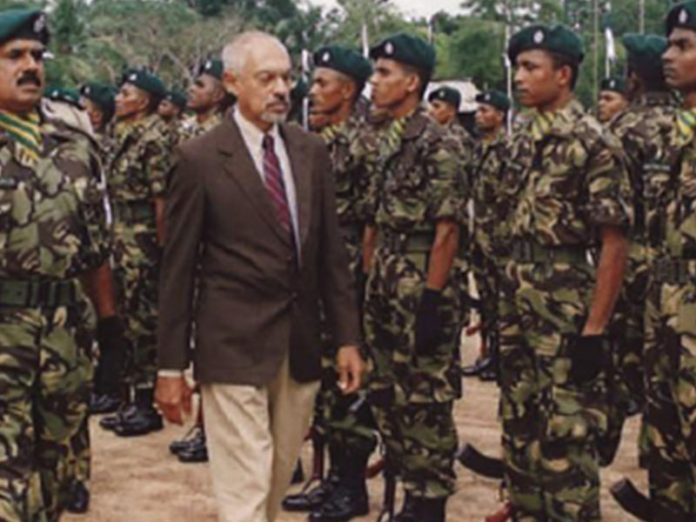
The Deputy Head of Mission at the Embassy of Japan in Colombo, Mr. Naoki Kamoshida, paid a courtesy call on Defence Secretary Air Vice Marshal Sampath Thuyacontha (Retd), at the Defence Headquarters Complex in Sri Jayewardenepura, Kotte, today (Oct 09).
Mr. Kamoshida was accompanied by the Defence Attaché of the Japanese Embassy, Captain Yuki Yokohari. Defence Secretary AVM Thuyacontha (Retrd) warmly received the Japanese delegation and had a cordial discussion.
During their discussions, both officials explored avenues to enhance defence cooperation and bilateral relations. The meeting also highlighted the historical ties and shared values between the two countries.
Subsequently, the Defence Secretary and Mr. Kamoshida exchanged souvenirs to mark the occasion. Military Liaison Officer of the Ministry of Defence, Air Vice Marshal Padman De Costa was also present at the occasion.
I’ve learned that false rumours are circulating in the media about a government intention to curtail entitlements accorded to Tri Forces personnel. However, I duly proclaim that the current government has no intention of ever curtailing entitlements accorded to Tri Forces personnel at any time.”
Defence Secretary Air Vice Marshal Sampath Thuyacontha (Retd) said so while addressing Air Force personnel during his maiden visit to the Sri Lanka Air Force (SLAF) Headquarters at the Defence Headquarters Complex in Sri Jayewardenepura, Kotte on Monday (Oct 07).
The Defence Secretary visited several divisions of Air Force HQ accompanied by the Air Force Commander Air Marshal Udeni Rajapaksa and other senior officers.
Military Liaison Officer of the Ministry of Defence, Air Vice Marshal Padman De Costa also joined the Defence Secretary on his visit to the Air Force HQ.
There is an old Sinhala saying ‘when the farmer washes off the mud splattered on his body after working on the field, he is fit to be king’ (FILE PHOTO)
Both China and the present Sri Lankan lawmakers cannot do away with socialist thinking; but Sri Lanka can learn from ‘socialist’ China the art of transforming both the lives of the citizens and human consciousness
Being in power for just over two weeks, this government has given some hope by checking on corruption and waste and driving fear into the corrupt forces in the country with the message that the law will not spare anybody
There is hope in the horizon after the 2024 Presidential Elections that the new regime would do all it could to ensure that people could, again, afford nutritional food in their diets. There was a time (2022) when at least 50% of the households were forced to cut the children’s food intake due to the country’s crumbling economy. Sri Lanka has recovered somewhat from that shaky past, but there are concerns still; concerns fuelled by the thought that Sri Lanka is now in the hands of a new government that has a Marxist label on it. The government’s leader or the President of the country has the label ‘Marxist’ pinned on him, and he has not made any attempt to remove it or acknowledge its relevance to him. We all know that Marxists were never known to be eating, drinking and merrymaking people. Socialists, Marxist and Leninist theories were at least partially practised in Sri Lanka during the rule of Mrs. Bandaranaike, and people suffered much because essential goods were in shortage. The bright citizens of this country believe that President Anura Kumara Dissanayake (AKD) would not be foolish to implement socialist features and deny the people of this country opportunities to grow and engage in business. He must remember that some businesses are still reeling from the double blows that they received in the recent past; the first from the Easter Bombings and then the Covid pandemic. People of this country are demanding opportunities to reach their full potential and earn a decent living. Living in Sri Lanka shouldn’t be restricted to surviving the 30 days of the month with a paltry salary in hand!
AKD’s method of governance needs an identity. Being in power for just over two weeks, this government has given some hope by checking on corruption and waste and driving fear into the corrupt forces in the country with the message that the law will not spare anybody. But still there is not enough food on the table at home and we all know that a worker on an empty stomach is not geared to even listen to a religious sermon; leave alone stepping onto the field and engaging in ploughing it. Just for the record, our well-dressed President is a believer that Sri Lanka must increase its food production within the island. This is good news for a country where there is a history of the former regime trying out giving Fridays off for the state worker to stay at home and grow essential ‘food’ to brace a looming food crisis. This was about two years ago; when the man who had a litre of fuel in a can and was willing to sell it was considered a ‘local king’. AKD hails from a farmer’s family, so he probably knows what he is talking about when it comes to production and planning Sri Lanka’s future. There is an old Sinhala saying, ‘When the farmer washes off the mud splattered on his body after working on the field, he is fit to be king’. This ambitious politician has shown lasting patience to go through the mill in politics and work his way to the presidency. AKD in his speeches has often promised better days ahead for the labourer or workman. A university professor who appeared on Rupavahini’s Nuga Sewana programme emphasised on the fact that a farmer must work eight hours and nothing more during a day. He emphasised that like in the good old days, a farmer who puts in decent hours at his field and returns home at a reasonable time will have time to read books, write poems and become a person who loves and appreciates arts and culture. This is a feature lacking in the present-day worker or labourer who is a daily wage earner. All signs point to the fact that AKD is opting for educated lawmakers to form the full Cabinet soon. He must wisely fill in the slots in the Cabinet to rope in even educated people representing the minorities. This is because Tamils and Christians in this country are somewhat sceptical and reluctant to throw their weight behind any government. This is because these Tamils and Christians are demanding justice for lives lost during a civil war and a carnage that took place inside three churches respectively. For most of these people carrying mental scars, justice served for their grievances would be more satisfying than a nutritious meal of rice put on the table after the first harvest of the season. AKD’s regime has reduced the cost of some essentials and promised more price reductions on more items on the list of essentials. He is likely to tax the rich and give more benefits to the less affluent. This is a President who was quick to say ‘Sri Lanka needs international support’. Should anyone teach him that he needs the support of both his loyal voters and also those who didn’t vote for him? China wouldn’t certainly send us food in the form of help. It would instead work closely with Sri Lanka and make sure the island’s government relies on Chinese technology and their prowess on building and construction. AKD’s government has shown an inclination towards looking at China for inspiration and support for obvious reasons. Both China and the present Sri Lankan lawmakers cannot do away with socialist thinking. But Sri Lanka can learn from ‘socialist’ China the art of transforming both the lives of the citizens and human consciousness. The Chinese worker on the agricultural fields has moved from being a peasant to a working professional. The mindsets of these workers have been changed over the years to embrace professionalism and be part of an advanced society. Sri Lanka can borrow from China on this change of mindset. But Sri Lanka certainly doesn’t have to borrow one aspect from the mindset of the Chinese people which makes them mere ‘subjects’ and not citizens enjoying better human rights; like the citizens of Sri Lanka. Mr. President, please make note of this as you shape the country’s future!
Colombo, Oct 09, (Daily) – In a move seen more as hysterical than having any purpose, two new stamps were released as souvenirs by the Sri Lanka Postal Department today with the faces of Prime Minister Harini Amarasuriya and Minister Vijitha Herath.
These stamps were released by the Department to celebrate the 150th World Postal Day.
While Sri Lanka state departments have always idolized politicians, it would have been more suitable if the souvenirs released carried more meaningful messages such as a tribute to the postal workers instead of the newly elected ministers.
Sri Lanka today rejected the draft resolution which was tabled before the United Nations Human Rights Council (UNHRC) seeking to extend the mandate of Resolution 51/1 on promoting reconciliation, accountability and human rights in Sri Lanka.
Earlier today (09), the draft resolution A/HRC/57/L.1 on promoting reconciliation, accountability and human rights in Sri Lanka was adopted without a vote during the ongoing 57th Regular Session of the UNHRC in Geneva.
However, delivering the government’s statement prior to the adoption of the draft proposal, Sri Lanka’s Permanent Representative to the UN Himalee Arunatilaka said the draft resolution 57/L.1 extends the mandates contained in Human Rights Council resolution 51/1.
She said Sri Lanka has opposed HRC resolution 51/1 and the preceding HRC resolution 46/1 under which an external evidence gathering mechanism has been established within the OHCHR.
She said Sri Lanka also disassociates from the Report of the UN High Commissioner for Human Rights, and that Resolution 51/1 was tabled without Sri Lanka’s consent as the country concerned, and was adopted by a divided vote.
As such, any subsequent decision extending mandates established by this resolution lack consensus in the Council, the Ambassador said.
As we have repeatedly reminded this Council, setting up of this external evidence gathering mechanism within the OHCHR is an unprecedented and ad hoc expansion of the Council’s mandate, and contradicts its founding principles of impartiality, objectivity and non-selectivity.”
No sovereign state can accept the superimposition of an external mechanism that runs contrary to its Constitution and which pre-judges the commitment of its domestic legal processes, the statement said.
Furthermore, Sri Lanka pointed out that many countries have already raised serious concerns on the budgetary implications of this mechanism given its ever-expanding mandate.
For the above reasons, we are obliged to reject the draft resolution which is tabled before this Council today seeking to extend the mandate of Resolution 51/1.”
Notwithstanding its rejection of the Resolution, Sri Lanka said it will continue its longstanding constructive engagement with the Council including with regular human rights bodies, and all core Human Rights treaties to which it is party, as well as the country’s commitments under the UPR process.
Sri Lanka also expressed appreciation for the principled positions taken by many countries in the UNHRC in support of Sri Lanka as it enters a new chapter in the country.
At a time of intense cynicism and polarization within the multilateral arena on human rights and humanitarian situations in the context of the on-going travesties of these norms, we urge the co- sponsors of this politicized draft resolution which we oppose, to support and encourage the Government’s clear intention to address human rights and reconciliation through domestic processes and in line with our international obligations.”
A prominent business leader, Mr Ganegoda currently serves as the Group Executive Director of Sri Lankan multinational Hayleys PLC and Deputy Chairman of Alumex PLC.
He joined the Hayleys Group in 2007 and was appointed to the Group Management Committee in July 2007.
He was appointed to the Board of Hayleys PLC in September 2009 and to the Board of Alumex PLC in November 2010.
He is a Fellow Member of CA Sri Lanka and a Member of the Institute of Chartered Management Accountants of Australia. He holds an MBA from the Post Graduate Institute of Management, University of Sri Jayewardenepura.
He held several senior management positions in large private entities in Sri Lanka and overseas.
Sri Lanka’s current Prime Minister, who holds a PhD in Anthropology, has sparked conversations on social media, where many are hailing her as the most academically qualified leader in the nation’s history. Indeed, the fact is irrefutable, but it raises a broader, more nuanced question: Is there a direct correlation between academic qualifications and political success?
The debate over what makes a politician successful is as old as politics itself, but education is often brought into the discussion. Does possessing a prestigious degree guarantee good governance? Does academic prowess naturally translate into political effectiveness?
Looking back at our history, the answer seems to be far from straightforward.
Sri Lanka gave the world its first female Prime Minister, Mrs. Sirimavo Bandaranaike, who held only a Junior School Certificate (JSC). Her supporters, especially those aligned with leftist ideologies, argue that she was one of the most successful leaders the country has seen. Known for her policies of nationalization and her firm stance on non-alignment, Bandaranaike shaped Sri Lankan politics during tumultuous times with a vision that resonated deeply with many.
On the other hand, supporters of J. R. Jayewardene, who was educated at the University of Ceylon, championed his economic reforms and the introduction of the executive presidency. He led Sri Lanka through a period of significant economic and political transformation. Many of his advocates believe he ranks as the country’s most accomplished leader, with his educational background lending him a certain intellectual rigour that translated into his governance style.
Both Bandaranaike and Jayewardene achieved tremendous success in their own rights, despite their vastly different educational backgrounds. Their contrasting stories underline an important point: academic qualifications alone do not dictate political success. Politics, after all, is a different beast.
A PhD in Anthropology may provide insight into human behaviour and social systems, but does it prepare one to navigate the choppy waters of political power, diplomacy, and governance? Conversely, does the absence of an academic degree mean one lacks the vision or leadership required to inspire a nation?
The world stage offers numerous examples. Winston Churchill, who led Britain through World War II, was famously disinterested in his formal studies, yet his leadership remains legendary. Nelson Mandela, with his legal education, used his knowledge to dismantle apartheid, but it was his resilience, not just his education, that made him an icon. At the same time, countless highly educated leaders have failed miserably, unable to translate academic success into political acumen.
So, does a PhD make someone a better Prime Minister? The truth is, it’s too early to say. Our new leader has only been on the job for a few weeks, and it will take time for us to measure her success—not by her qualifications, but by her ability to connect with the people, make tough decisions, and lead the country forward.
Ultimately, politics is about people. Success in politics requires the ability to understand human needs, articulate a vision, and, most importantly, inspire trust. While education provides a toolkit, it is no substitute for the complex, deeply human qualities that define political leadership. Whether one’s path to power is paved with academic accolades or life experience, history suggests there is no one formula for success.
What matters most is how effectively a leader can navigate the intricacies of governance, steer the country through crises, and leave a legacy that resonates with the people—not the letters after their name.
Brotherless Night (2023) by Vasugi.V. Ganeshananthan won UK’s 30,000 pound sterling Women’s Prize for Fiction in 2024. The book was also a New York Times Editors’ Choice. It was shortlisted for the Carol Shields Prize and was a finalist for Minnesota Book Award and the Asian Prize for Fiction.
Ganeshananthan is a journalist, essayist and novelist. She has degrees from Harvard and Columbia. She teaches in the MFA program at the University of Minnesota, where she is a McKnight Presidential Fellow and associate professor of English. She has served as visiting faculty at the Helen Zell Writers’ Program at the University of Michigan and the Iowa Writers’ Workshop. The National Endowment for the Arts, the Radcliffe Institute for Advanced Study at Harvard, Yaddo, MacDowell, and the American Academy in Berlin have awarded her fellowships.
Ganeshananthan was a vice president of the South Asian Journalists Association and served on the board of the Asian American Writers’ Workshop. She is presently on the Board of the American Institute for Sri Lankan Studies. For other positions held by Ganeshananthan see https://nineteenquestions.com/2017/05/25/v-v-ganeshananthan/
Her first book, LoveMarriage, (2008) which I have not read, was on the Tamil conflict in Sri Lanka. It was long listed for the Orange Prize and the Women’s Prize for Fiction and named one of the best books of the year by Washington Post.
Love Marriage is the story of a young American woman of Ceylon Tamil descent who travels to Toronto with her family to meet her estranged uncle when he resurfaces after many years. A founding member of the Tamil Tigers, he is now dying of cancer. As she asks him questions about their family, a rich and complex past emerges, along with challenging truths about the long consequences of Sri Lanka’s civil war, said a review.
I wrote Love Marriage partly to think through the connections between the present realities of our Diaspora communities and the histories of Sri Lanka that younger generations do not always know, Ganeshananthan said.
Ganeshananthan grew up in Bethesda, Maryland, outside Washington, D.C. her father was a doctor there. My friends and I talked about politics all the time. We read the newspaper voraciously and liked to dissect things going in the White House and on Capitol Hill.
She was exposed to Diaspora thinking from a very young age. I knew many people who were sympathetic to the Tigers and were strong supporters of them. Certain strands of Tamil nationalism have a stronger hold outside the country, she observed.
To the question, what inspired you to write Brotherless Night, Ganeshananthan replied, I grew up listening to the stories of friends and family who had lived through this period in Jaffna. She heard her parents, relatives, and family friends tell many stories of that period. Her cousin who emigrated from the Eastern Province in the 1990s also told of her experiences there.
In January 2004, I was returning home from Sri Lanka. On my way back to the US, I stopped in London, where a relative who was a librarian gave me a copy of a rare book titled The Broken Palmyra, by University Teachers for Human Rights, which records atrocities committed not only by the Sri Lankan state and its security forces, but also by the Tamil Tigers and Indian peacekeepers.
Four Tamil professors at the University of Jaffna taught themselves how to document human rights violations during the war. They were critical of the state, but also critical of the Tigers, Indian peacekeepers, and the international community. They were secretly distributed. I remember the UTHR reports that were smuggled into the HR Library in Colombo where I worked, recalled Nan in her column.
Reading The Broken Palmyra was the beginning of understanding how much I did not know. I followed the arrows of The Broken Palmyra into multiple university libraries. I held books up against each other, comparing one account to another. As I worked, I learned to admire the meticulousness of their work. Brotherless Night is a fictionalized version of their story. The character Anjali is thinly veiled Rajini Tiranagama. The book also reported in detail, under a fictional name, Thileepan’s fast and death.
Ganeshananthan took 20 years to write Brotherless Night. She worked on the book from 2004- 2022. It necessitated much research and interviews. She conducted numerous interviews with people who had lived through Sri Lanka’s civil war and with people who were in Sri Lanka during Black July 23, 1983. People took time to speak to her. They held her to a high standard, she said. She compared the different versions given to her. She constantly checked her draft with her informants.
People I spoke to who had lived through this era offered me versions I never saw in any book. I was especially moved by the stories of women who worked to keep their families safe in this difficult time. She said that the women who had lived through it were angry as well as sad. The author also felt anger when she thought of the events. She also found that people had informed on each other. Surveillance also happened in the Diaspora, she noted.
As a quarter-century of fighting drew to a grim close, in 2009, Diaspora Tamils were, like me, thinking of the unknown number of Tamil civilians trapped between the security forces and the Tigers, said Ganeshananthan. My novel,Brotherless Night, is an attempt to contend with the war’s end by returning to its beginning, said Ganeshananthan. The Diaspora had watched, in disbelief, the defeat of the LTTE. They found it difficult to stomach.
I wrote Brotherless Night because I wanted to read a book set in Jaffna during the 1980s period, one focused on civilian lives, particularly those of Tamil women, students, teachers, and political dissidents. I wanted to record their stories, [which would otherwise be] erased and marginalized. The book aims to portray characters at the margins of the conflict, especially individuals who were not officially in militant groups, but were near enough to them.
The narrator in Brotherless Night is Sashikala Kulenthiran, 16 when the story starts, daughter of a government surveyor, often out of home. She had four brothers. The elder brother is killed in anti-Tamil riots in Colombo, another is sent abroad, two join the Tamil Tigers rebel army, and one of them is killed by army shelling.
The book deals with the period 1981-1989. The author manages the plot and structure of the story so that her protagonist Sashikala is present at all the significant occurrences. Sashi is taken to Colombo by Niranjan to do her ALs to enter medical college.
While living with her grandmother whose late husband was a doctor, the July 83 riots occur. Thus the author, through Sashi, is able to give an authentic, first hand sounding description of what occurs. She and her grandmother are rescued by Sinhalese neighbors as the mob torches their home. ‘One escaped girl, one escaped child, one escaped grandmother.’ . They are taken to a refugee camp and then to Jaffna by boat. (CONTINUED)
Brotherless Night is well written, with nice turns of phrase. ‘I wanted the four clean walls of my Jaffna childhood, the courtyard with its cup of sunlight, the small and dear lane where I had grown up. A home full of people who considered me precious,’ wished Sashi.
For authenticity and context, there is mention of well selected, utterly Tamil elements. What village are you from, Sashi was asked in Medical College. That is the first question asked when a Tamil meets Tamil. It is to find out the caste.
The Pillaiyar kovil where the family worships is mentioned beautifully. Villagers went to the temple to see people, watch each other, and to gossip. Shashi like the rituals, the sounds, the fragrances, the familiar gods, the familiar faces of the worshippers. Priest came around with kungumum, the vibhuthi, the prasatham.”
There is mention of food. The book speaks of maampasham, mangoes and vaaz hai pasam the special small sweet bananas . Oodiyal kool, a rich soup which was a treat. Vadai, murukku, pittu and fish curry. Egg plant poriyal, murungakkai curry, bitter gourd.
The book described the vegetables in the market, sinuous heaps of yellow green snake gourds, burnished eggplants , long green beans, hot chillies, toasted cashews, betel leaf, king coconut halved and ready with spoons carved from their shells, neat rows of uncracked eggs, gingelly and coconut oil, various kinds of rice, lentils, curry powder, flour.
Tamils were known for their resourcefulness. They stretched the rationed kerosene. Use salt in the lamp, keep the wick short and use less oil but still have light to make it last. They studied under street lamps. Weaknesses are also mentioned. Sashi failed her first try at University . She was told ‘ no one will admit it, but failing is a Jaffna tradition. I sat my exam three times to go to Peradeniya .
Sashi’s Tamil relatives in Colombo lived well. Sashi’s grandfather has been a gynecologist in Colombo. The house had two large brass lamps at the entrance, a piano, a carved mahogany desk and a carved bone and ivory chess set.
The link with Tamilnadu is emphasized. The short distance between Jaffna and Tamilnadu is shown. A practiced man can swim from the northern tip of Jaffna to the southern tip of Tamilnadu, 25 miles across said the book. When Sri Lanka government tried to starve us, India fed us.
The usual propaganda items are mentioned. Government runs Sinhala colonization schemes in traditionally Tamil areas. Tamils were told learn Sinhalese or leave your job. Schools in Jaffna had stopped teaching Sinhala in protest . As a result Tamils in the north did not know Sinhala and did not want to learn it. No more second class status for our language, said Sashi.
There are references to Jaffna Public Library. The burning is described, also the DDC elections where the UNP government had send Sinhalese police to Jaffna. Atmosphere tense in Jaffna. During the DDC election time, the police went on the rampage in Jaffna, said this novel. Targets had been chosen carefully, office of a Tamil newspaper, a Hindu temple, the Jaffna market, they beat up a young boy. There are people in our country who would burn what we love and laugh at the flames.
The anti Tamil riots are reported. Her grandmother told Sashi about the Tamil riots of 1958 and 1977. The 1983 riots were described in first person as Sashi experienced it in Colombo where she and her brother went to visit grandmother. They had burnt Tamil shops, restaurants, hotels, factories. They had set on fire a car with three Tamils inside. The Sinhalese men who had done the rioting in 1983 had voter rolls, it was organized.
Sashi and grandmother escaped to a neighbor’s house, the Jayasinghes. But it was the Waduges who had told the rioters that the two were Tamil. The refugee camp was described, they were all strangers, not enough toilets.
The book then discusses the rise of the LTTE .After 1983 there was open talk of recruitment to the LTTE. The young Tamil boys craved action and had many liberation groups to choose from. By early 1984 several month so after Black July, the ranks of boys in Jaffna town began to thin. All round me, boys I had known were vanishing, said Sashi.
LTTE was recruiting persons from tuition classes . There were robberies at this time. The book records the defeat of TELO in the hands of the LTTE. They shot them in the head. Those who critiqued LTTE disappeared. Men were tied to lampposts and killed. LTTE behaved with unabashed cruelty. The book speaks of torture and the pits in which the LTTE held their prisoners.
Who thought the war will go on in this way for this long said Sashi. Around 1986 or so they started to build bunkers in their gardens. Sometimes there were cobras in the bunker, the deeper you went the darker it got. Continued)
The book ‘Brotherless Night’ is the ‘inside’ story of the Eelam war, written by an author who did not live through it and extravagantly praised by others who had no firsthand experience of it, either.
This book is yet another novel on the Tamil conflict in Sri Lanka, written by second generation immigrant Tamils, born and bred in the west, brainwashed by their elders and totally unaware of any view other than their own.
One purpose of this book is to provide the reader with the other side of the story, the effect the Eelam war had on the civilians in Jaffna. They are portrayed as innocent victims, not as persons complicit in high treason. Sri Lanka Tamils were a nation with a homeland and had a right to self determination, said the book.
The author says the book is specifically for Tamil people with ties to Jaffna. However, it is unlikely that those who lived thorugh this will want to relive it again in print. They will read it only to check for accuracy and impact. The book supports the Tamil separatist cause and is intended for the general reader. It is propaganda for Eelam.
The book shows how, in the book at least, Jaffna got politicized. Niranjan had gone to an international conference on Tamil language, literature and culture in Jaffna. Policemen had fired into the audience. This had affected him. He started to read Emergency 58, which his father had, from which he learnt all about the government of Sri Lanka.
According to this book, the Tamil took arms because of the actions of the government. After what they did to us in Colombo, [in 1983] how did they expect us to react? The young people in Jaffna said that there was no other choice than to fight. I had some sympathy for the Tamil nationalism taking hold in Jaffna, said the main character, Sasha. There was a call for a separate state fortified by generations of inherited anger and our own new fueled rage, she said.
The civil war arose due to discrimination and violence from successive Sri Lankan governments, said the book. We could no longer bear the discrimination of a government dominated by the majority Sinhalese.
Sri Lanka is viewed with contempt. Long before I was born, Sri Lanka stumbled into lazy self indulgent independence, discovered ways to promote their Buddha, their language, and their histories, said Sashi. There is anti-government propaganda. We thought the government was bad, said Sashi. We all knew the cruelty of the state.
A very negative image of the Sri Lanka army is presented. In 1984, Jaffna was occupied by the army. There were soldiers in Jaffna. They came to Tamil houses and kicked down Tamil doors.
Soldiers walked menacingly thorugh the villages of Jaffna. Why should an unarmed civilian in their own village ever walk past a solider with a gun. We did not consider army protection, and never had. We wished to be protected from them, said Sashi.
I heard of military detaining brothers, cousins, son on suspicions of being militants. Army began to cordon off villages with heavy weaponry and did house to house searches for suspected militants. In some places they detained all the Tamil men and boys over 14. One boy was stopped and searched. They beat him just because they wanted to. They took him to camp but denied that they had him there at all. .
After weeks of round ups the army asked Tamil mothers to bring their sons for voluntary checking. They detained all of them and took them away in trucks. There is a long description of the Mothers Front, formed in July 1984, which met the GA to ask their sons back. The sons were returned.
Shashi was told of the army stopping a bus of Tamil passengers on a break at a tea kiosk near Vavuniya. They directed the bus to a remote location and shot a third of them. Some survived to tell the tale. Also the women in the bus were raped. Buses were set on fire with people in them. We did not read about that, she was told. You won’t but that does not mean it did not happen, said the book.
Jaffna was bombed. We could see the planes, take off and dive and the lift again, the second ascent they would drop the explosives. When the bombs fell we could hear the little children screaming.
At first I could not understand why the army would attack Jaffna with planes. Then I was told that Army could no longer use the roads as LTTE had mined them. The government had bombed Jaffna with human shit, said the book, quoting reports. Military bombed Hindu temples in 1987. Many died in the shelling.
No Fire Zone is mentioned. Tell the UN, tell the Red Cross, tell the newspaper that we are dying, we die on the beach, we die in the sea, said the fictional hostages. In the Mullavaikkal rescue the army shot them from front and the LTTE shot them from behind. As they died they called overseas on borrowed phones , announced the book. (Concluded)
I was amazed by seeing “Fiddler on the Roof,” a musical drama at the Lionel Wendt last night. This stunning drama was directed by Jerome L. de Silva. This musical was based on the 1971 film “Fiddler on the Roof, directed by Norman Jewison. The film is based on Tevye, a Jewish milkman who was living in Imperial Russia a few years before the Bolshevik Revolution. Tevye is living with his wife and four daughters in a poor Jewish village that is subjected to social upheavals and pogroms. He is trapped between the old Jewish traditions and the emerging new world. However, he never forgets to keep his faith. The family lives in poverty and has a hand-to-mouth existence. Yet they are happy and cherish life. Tevye and his fellow Jewish villages constantly face racial discrimination by their non-Jewish neighbors. Eventually, the Jewish village was subjected to forced eviction, and Tevye migrated to New York. It is a powerful story about traditions, faith, and human suffering in an eternally changing world. Their story has certain relevance to Sri Lanka, which has experienced racial conflicts for a number of decades. The Sri Lankan version of Fiddler on the Roof” is Choreographed by Joshua Fernandez, and the actors did a marvelous job bringing “Fiddler on the Roof,” to Colombo.
I give it two thumbs up.
Fiddler on the Roof ********************
Fiddler on the roof Playing his melody It is sweet and stunning I am mesmerized When I close my eyes The melody still reverberates The fiddler’s tune Makes me blissful When I listen to the fiddler I forget time and space
People gather to stage a pro-Palestinian demonstration and condemn the Israeli attacks on Gaza, in Amsterdam, Netherlands on October 7, 2024 [Selman Aksunger/Anadolu via Getty Images]
No one expected that one year would be enough to recalibrate the Palestinian cause as the world’s most pressing issue, and that millions of people across the globe would, once again, rally for Palestinian freedom. The past twelve months have witnessed an Israeli genocide in Gaza and unprecedented violence in the West Bank, as well as legendary expressions of Palestinian sumud, steadfastness.
It is not the enormity of the Israeli war, but the degree of the Palestinian sumud that has challenged what once seemed to be a foregone conclusion to the Palestinian struggle. Yet, it turned out that the final chapter on Palestine was not ready to be written, and that it would not be Israeli Prime Minister Benjamin Netanyahu who would write it.
The ongoing war has exposed the limits of Israel’s military machine.
The typical trajectory of Israel’s relationship with the occupied Palestinians has been predicated on unhindered Israeli violence and deafening international silence. It was largely Israel alone that determined the timing and objectives of war. Its enemies, until recently, seemed to have no say over the matter.
This is no longer the case. Israeli war crimes are now met with Palestinian unity; Arab, Muslim and international solidarity; and early, albeit serious, signs of legal accountability. This is hardly what Netanyahu was hoping to achieve; just days before the start of the war, he stood in the UN General Assembly brandishing a map of a New Middle East”, a map that had completely erased Palestine and the Palestinians.
We must not give the Palestinians a veto over… peace,” he said. Why? Palestinians are only two per cent of the Arab world.” His arrogance didn’t last long. His supposedly triumphant moment in the international spotlight was short-lived.
Embattled Netanyahu is now mostly concerned about his own political survival. He is expanding the war front to escape his army’s humiliation in Gaza and is terrified by the prospect of an arrest warrant issued by the International Criminal Court (ICC).
And as the International Court of Justice (ICJ) continues to look into an ever-expanding file, accusing Israel of deliberate genocide in the Strip, the General Assembly resolved on 18 September that Israel must end its illegal occupation of Palestine within a year from the passing of its resolution on the matter.
It must be utterly disappointing for Netanyahu — who has worked tirelessly to normalise his country’s occupation of Palestine — to be met with total and thundering international rejection of his schemes. The advisory opinion of the ICJ, issued on 19 July, declared that Israel’s presence in the Occupied Palestinian Territory (is) unlawful.” This was another blow to Tel Aviv, which despite unlimited US support, failed to change international consensus on the illegality of the occupation.
In addition to the relentless Israeli violence, the Palestinian people have been marginalised as political actors. Since the Oslo Accords in 1993, their fate has been largely entrusted to a mostly unelected Palestinian leadership, which, with time, has monopolised the Palestinian cause for its own financial and political interests.
The sumud of the Palestinians in Gaza, who have endured a year of mass killing, deliberate starvation and total destruction of all aspects of life, is helping reassert the political significance of a long-marginalised nation.
This shift is fundamental as it runs contrary to everything that Netanyahu had tried to achieve.
In the years prior to the war, Israel seemed to be writing the final chapter of its settler-colonial project in Palestine. It had subdued or co-opted the Palestinian leadership, perfected its siege on Gaza and was ready to annex much of the West Bank.
Gaza became the least of Israel’s concerns, as any discussion around it was confined to the hermetic Israeli siege and the resulting humanitarian, although not political crisis.
While Palestinians in Gaza have tirelessly implored the world to put pressure on Israel to end the protracted siege, imposed in earnest in 2007, Tel Aviv continued to conduct its policies in the Strip according to the infamous logic of former top Israeli official Dov Weissglas, who explained the rationale behind the blockade as to put the Palestinians on a diet, but not to make them die of hunger.”
A year into the war, though, and the Palestinians have become the centre of any serious discussion on a peaceful future in the Middle East. Their collective courage and steadfastness have neutralised the Israeli military’s ability to exact political outcomes through violence.
True, the number of dead, missing or wounded in Gaza has already exceeded 150,000. The Strip was already impoverished and dilapidated to begin with; today it is in total ruins. Every mosque, church or hospital has been destroyed or seriously damaged. Most of the enclave’s educational infrastructure has been obliterated. Yet, Israel hasn’t achieved any of its strategic objectives, which are ultimately united by a single goal: that of silencing the Palestinian quest for freedom, forever.
Despite the unbelievable pain and loss, there is now a powerful energy that is unifying Palestinians around their cause, and the Arabs and the rest of the world around Palestine. This shall have consequences that will last for many years, long after Netanyahu and his fellow extremists are gone.
Oxford (UK) October 8: Parliamentary representation of minority ethnic and religious groups is in danger of splintering and weakening in the forthcoming elections affecting their capacity to effectively politically engage and promote the rights of minorities, a new European Commission funded research project reveals.
Major national parties such as the United National Party (UNP), Samagi Jana Balawagaya (SJB) and Sri Lanka Podujana Peramuna (SLPP) have successively reduced the space within their parties for minorities to participate and raise their issues; whilst minority ethnic parties are divided and their campaigning is shaped by the majority agenda rather than the needs and rights of their communities, research done by Oxford Brookes University as part of the Minority empowerment for democracy and pluralism programme reveals.
‘The main national parties in Sri Lanka have had a history of nominating representatives from minority communities who have gone on to take leadership positions. This is changing now with minority politicians in these parties often feeling isolated and finding fewer opportunities to raise minority rights issues,’ said Dr. Farah Mihlar, the lead researcher from Oxford Brookes University.
Challenges for minorities through alliances
National parties now prefer forming alliances or coalitions with minority parties rather than fielding their own minority candidates. In this competitive alliance or coalition forming process bargaining with minority party candidates has resulted in them criss-crossing between the major national parties which compromises their credibility as it is seen by their electorates as acting corruptly on promises of ministerial portfolios or other gains.
‘Minority MPs from the Muslim and Malaiyaga community prefer to be part of the government because they see it as an opportunity to do something for their community. This recent desperation to move with power has seriously affected their legitimacy and credibility, leaving voters from this community in despair,’ Mihlar added.
‘This is especially a concern in the Eastern province in this election where we are seeing many new independent candidates contesting and there are lots of splits in parties. This competition between parties and ethnic groups creates unnecessary tensions and increases the prospect of violence,’ Buhary Mohomed from Eastern Social Development Foundation said.
Minority party leaders need to consider the longer-term impact to ethnic politics and minority rights rather than short-term gains of gaining power when they prepare nomination lists for the forthcoming election. The research reveals that minority politics is increasingly affected by unpopular leaders, allegations of corruption and failure to promote rights of marginalised groups, which has been partly strategically caused by the actions of the big national parties.
Minority women candidates
The research also reveals that political parties are neglecting the nomination of women from minority communities and where women are making it into nomination lists, parties are not offering sufficient funding support, security or opportunities for them to raise their profiles. Minority parties themselves are also failing to challenge their internal structures and cultural barriers to enable more women to contest, the research found.
‘The main parties need to nominate more women from minority communities, and they need to offer them funds and support to be able to contest. We work with a lot of women who are strong leaders in their own communities, but they are not making it on to the platforms in party campaigns,’ said Ponnaih Logeswary of the Human Development Organisation (HDO), an implementing partner on the project.
National People’s Party (NPP)
The newly elected President’s party the NPP has also significant work to do to promote minority representation and rights within their party. In the last election the party fielded only one minority candidate out of a total of 15 in Colombo, at the last presidential election they offered little to minorities on substantive issues of rights or reconciliation and they mainly function in the Sinhalese language, excluding Tamil speaking populations.
The NPP has made strong commitments towards increasing women’s representation in their nomination list, which they need to advance to those from minority communities as well.
Conflict affected north and east
In the conflict areas voters are deeply divided on ethnic and political lines which has significant implications for peace building and reconciliation. The research shows that in the north the voter base is fractured, with around one-third prioritising their economic development and wanting to engage with the state and another one-third or so are on the opposite end wanting to disengage with national politics. Tamil Diaspora groups are being accused of influencing this latter group whilst some candidates fielded by the national parties influence the former, but these candidates often have a history of violence and are seen to be divisive.
In the Vanni district and the east there is serious ethnicization of the electorate, which has increased with the competition among minority parties and the national parties. In a post-war context such tensions can lead to conflict, which needs to be taken into consideration by all parties.
The research reveals that parties tend to politicise ethnic issues and campaigns respond to opponents’ claims rather than offering any constructive policies on rights or a political solution to the ethnic conflict.
‘The main parties are still stuck on the 13th amendment, which was negotiated over 35 years ago, they are offering little beyond this and the ethnic minority parties are not effectively using election platforms to demand more or advance minority rights critical to their constituencies, instead they mainly respond to the national parties,’ Dr. Mihlar said. She added that reducing militarisation in the north and east, returning civilian land and advancing the transitional justice process should be included in all party manifestos.
Monitoring and data
The research also shows a serious lack of disaggregated data on ethnicity, religion and gender. National parties and state bodies such as the Election Commission need to collate information on minority political participation in order to better understand the challenges they face.
‘Election monitors should also disaggregate data, they should research and analyse how targeted attacks on minorities can prevent a free and fair election,’ Azad Mustaffa, Sri Lanka Development Journalist Forum (SLDJF) said.
END
Background:
Sri Lanka concluded its presidential election on the 21st of September and elected a new president Anura Kumara Dissanayake from the NPP, which resulted in the dissolution of the parliament before its maturity period. The election commission announced a parliamentary election for 14th November 2024 with deadlines for nominations of candidates set for 11 October, 2024. After the announcement of the election, and the unexpected success of the NPP in the presidential elections, other political parties have actively commenced negotiations to form alliances with minority parties. It is in this backdrop that project partners decided to release the key findings of the current research.
Minority empowerment for democracy and pluralism is a two-year European Commission funded programme that aims to strengthen political participation of minority groups in Sri Lanka. The project is jointly implemented by Minority Rights Group, the Centre for Development and Emergency Practice (CENDEP) at Oxford Brookes University, Human Development Organisation (HDO), Eastern Social Development Foundation (ESDF) and Sri Lanka Journalist Development Journalist Forum (SLJDF).
Supporting notes:
In the last parliamentary election the SLPP did not nominate a single candidate from a minority community in Colombo and other parties also had minimal representation from minority groups. The SLPP overall had a reduced number of minority candidates in their nomination list compared to UNP and SJB. There was no ethnic Tamil or Muslim woman elected or nominated to the last parliament of Sri Lanka (2020-2024).
Media interviews are available with the following project team members:
Dr. Farah Mihlar, Centre for Development and Emergency Practice (CENDEP), Oxford Brookes University.
Ms. Ponnaiyah Logeswary, HDO on issues specific to Malaiyaga community and minority women’s political representation.
Mr. Buhary Mohomed, ESDF on the situation in the Eastern province and on minority women’s political representation.
Mr. Azad Mustaffa, SLDJF on issues relating to minorities in the media and public campaigns.
To organise interviews please contact: Vyshnavi Manogaran, Programme Coordinator Minority Rights Group: Contact Number- +94779914932, Email- vyshnavi.manogaran@minorityrights.org
Oct 8 (NewsIn.Asia) – Rohit Shetty’s much-anticipated cop drama Singham Again showcases stunning landmarks from Sri Lanka, weaving them into a modern retelling of the ancient Ramayana. This action-packed thriller, starring Bollywood heavyweights, promises a gripping narrative with scenes set against the backdrop of Sri Lanka’s cultural and historical beauty.
Released on Monday, the trailer of Singham Again, the fifth instalment in Shetty’s acclaimed cop universe, offers a tantalizing look at the cast and action sequences. The movie stars a powerhouse ensemble, including Ajay Devgn, Kareena Kapoor, Akshay Kumar, Ranveer Singh, Deepika Padukone, Tiger Shroff, Arjun Kapoor, and Jackie Shroff.
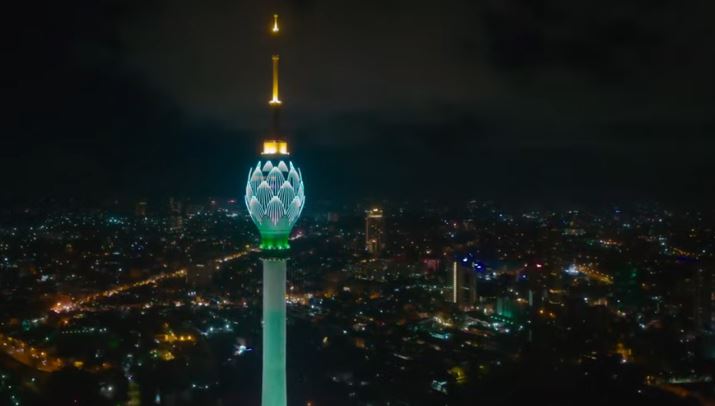
Filmed across multiple iconic locations such as Mumbai, Hyderabad, Kashmir, and Sri Lanka, the movie highlights Sri Lanka’s architectural gems. Landmarks like Colombo’s Lotus Tower, the luxurious Hotel Shangri-La, the scenic Galle Face Green, and the Seetha Eliya Seethai Amman Thirukkovil in Nuwara Eliya, a site linked to the Ramayana Epic, all make appearances in the movie trailer.
Singham Again is set to release on Diwali 2024, and promises to bring the grandeur of Sri Lanka to the big screen in spectacular fashion.
At the height of Sri Lanka’s debt crisis two years ago, India’s External Affairs Minister Dr S. Jaishankar gave a talk at Bangkok’s Chulalongkorn University on India’s ‘Look East’ policy. I asked him during Q and A session whether India and China could cooperate to get the new BRICS bank to bail out Sri Lanka?
He smiled and told me that if India and China can cooperate, they can bail out more countries, not only Sri Lanka. Then he went on to explain the border problems in the Himalayas and China’s activities in disputed Kashmir as a barrier. But, to keep the Indian Ocean peaceful it is essential that India and China cooperate to assist Sri Lanka, and not allow outside powers to destabilise the Asian region.
Sri Lanka’s evolving political landscape following the historic elections on 21 September that brought Marxist-leaning President Anura Kumara Dissanayake to power open new opportunities for both powers, and they should not see it as a competition.
Dr S Jaishankar was quick off the mark, visiting Colombo 4 October. A statement issued by his ministry after the meeting emphasised the advancement of bilateral cooperation based on India’s Neighbourhood First” policy to facilitate Indian investments and job creation in Sri Lanka”. The contagious issue between the two countries, agreed over three decades ago, regarding the implementation of the 13th amendments to the constitution to devolve more power to Tamil dominated north-east was mentioned as a distance last issue in the statement. The Tamil issue, which dominated election platforms for the past three decades, went missing this time, as people focused on anti-corruption and grassroots development.
A new chapter in China-Sri Lanka relations
A day earlier, Chinese Ambassador to Sri Lanka Qi Zhenhong, delivering a congratulatory message from the Chinese President Xi Jinping referred to a new chapter in China-Sri Lanka relations starting on a journey of mutual progress and prosperity. The Ambassador predicted the relationship would continue to gain great momentum on a higher level and he has told journalist after meeting the president without mincing his words that it would counter the disturbing global order with hegemony, high-handedness, and bullying being prevalent”.
The test will come right after the 14 November parliamentary elections when the new government will have to take a stand, publicly, on the current year-long ban on visits by foreign research vessels imposed in January 2024. It was meant to bar Chinese research vessels traversing Sri Lankan waters, under relentless pressure from India and the US. Sri Lanka is expected to lift the ban to improve relations with China and under current circumstances, with India unhappy with the US’s undermining of their interests in Bangladesh and unrelenting pressure on New Delhi to curtail economic ties with Russia, India may not object to such a policy shift from Colombo.
It is important to note that Dissanayake’s victory is a result of a ‘colour revolution’ that is home-grown and not driven and funded by western donors” such as the one in 2015 when pro-China President Mahinda Rajapakse was defeated in a shock election verdict. It was followed by a chain of US dignitaries, including the then US Secretary of State John Kerry, visiting Sri Lanka, trying to steer the country towards US geopolitical interests in the Indian Ocean.
Dissanayake’s party JVP—which is the leading component of the now ruling NPP (National Peoples Power) alliance—is a Marxist party that was inspired by the Chinese revolution when they mounted armed uprisings in 1971 and 1988-89 to topple the government. In 1971 at the height of the JVP insurrection, then socialist regime of Mrs Sirimavo Bandaranaike expelled the North Korean ambassador from Colombo (but did not accuse China), and India stepped in with providing military helicopters to help put down the rebellion as JVP held police stations and territory in the rural south.
Now part of a democratic people-power alliance, JVP has drifted away from that old extremist Marxist ideology. JVP killed intellectuals, artistes, public servants, media people and community leaders who were not supportive of their ideology during their 1988-89 uprising. But today the broad rainbow alliance NPP has formed includes them, and many of them are expected to be elected to parliament in the November elections.
NPP, though not publicly stated, could easily find inspiration in China’s development model of socialist democratic capitalism. Beijing should take note that NPP’s socio-economic development platform resonates well with China’s ‘Global Development Initiative’ with a focus on collective development rights.
India would have a lot to offer to Sri Lanka
On the other hand, India would have a lot to offer to Sri Lanka, utilising India’s expertise in IT-driven grassroots development and its management expertise. NPP’s anti-corruption drive especially in cleaning up the public services could be assisted by India—where e-governance structures have expanded rapidly across India in recent years—assisting in reducing corruption in delivery of government services. Sri Lanka’s universities need assistance in curriculum development—not branch campuses—and India’s higher education sector could help in working with Sri Lankan academia in updating, especially in IT, management and sciences.
Inspiration for a non-confronting geopolitical architecture in the Indian Ocean can be drawn from the 1970s when Mrs Bandaranaike had very close ties with Indian Prime Minister Indira Gandhi and China’s Prime Minister Zhou Enlai. In the mid-1970s, China built and gifted the Bandaranaike Memorial International Convention Hall in Colombo to host the 1976 Non-Aligned Movement’s Heads of State Summit, in which Mrs Gandhi was the main billing. China had no qualms about it. The Summit called for a New World Economic Order that will be fair to all.
There is something called the Paris Club of creditors that is part of that old order, to which Sri Lanka has been submitting itself to for aid and debt reforms for decades. This is a club dominated by the West and Japan, and it has exceeded its shelf life. It is their remedies implemented via IMF that has brought economic trauma for ordinary Sri Lankans and catapulted Dissanayake to the presidency.
Perhaps it’s time China and India form an alternative to that club for advice and policy guidance to help Sri Lanka to get over the economic crisis. Unlike in the 1970s, the large and expanding Indian and Chinese markets should be a part of the solution. This could be a template to adopt within the BRICS framework in future with Brazil, South Africa and Saudi Arabia joining in.
Both India and China say they are the voice for the Global South to reform the international economic architecture. Sri Lanka provides a test bed for what Dr Jaishankar was hinting at responding to my question two years ago. It is crucial that the two Asian powers assist Sri Lanka to make this socio-economic grassroots-driven development a success that could reverberate across the Global South.
A navy sailor and police officers stand guard outside St Anthony’s church on the fifth anniversary of the Easter Sunday suicide attacks, in Colombo on Apr 21, 2024. (Photo: AFP/Ishara S. KODIKARA)
Sri Lanka’s new government announced a probe on Tuesday (Oct 8) into the 2019 Easter bombings that killed 279 people, saying that previous investigations had failed to identify other culprits responsible for the country’s worst-ever attack against civilians.
In the aftermath, officials blamed a local jihadist group for the suicide bombings on three churches and three hotels, but a top Sri Lankan intelligence official was also accused of orchestrating the attack.
Other investigations faulted the authorities for failing to act on warnings from an Indian intelligence agency that an attack was imminent.
“There have been several commissions of inquiry, but some evidence was suppressed,” foreign minister Vijitha Herath told reporters.
“We want to find out why there were irregularities in the previous investigations, take a fresh look at the incident, expose the culprits, and bring them to justice.”
Herath’s announcement came days after President Anura Kumara Dissanayake dismissed Sri Lanka’s intelligence chief, Suresh Sallay.
British broadcaster Channel 4 reported last year that Sallay was linked with the bombers and had met with them prior to the attack.
A whistleblower told the network that he had permitted the attack to proceed with the intention of influencing that year’s presidential election in favour of Gotabaya Rajapaksa.
Two days after the bombings, Rajapaksa declared his candidacy and won the November vote in a landslide after promising to stamp out Islamist extremists.
Sallay, who has denied any involvement in the bombings, was promoted to head Sri Lanka’s main spy agency following Rajapaksa’s win.
Sri Lanka’s Catholic minority has maintained a campaign for justice since the bombings, saying that prior investigations failed to answer outstanding questions.
President Dissanayake on Sunday visited one of the churches targeted in the Easter Sunday attacks, where 116 people perished, and vowed justice for the victims.
“There is a widespread belief in society that the Easter Sunday attacks may have been carried out to gain political mileage,” Dissanayake told the congregation.
More than 500 people were wounded in the bombings, which also killed 45 foreigners and crashed the island nation’s lucrative tourism industry.
Last year, the Supreme Court fined then-president Maithripala Sirisena and four senior officials more than US$1.03 million in a civil case for their failure to prevent the attacks.
The UN asked Sri Lanka in April to publish parts of previous inquiries into the bombings that had been withheld from the public.
Sri Lanka begins a new political era under the presidency of Anura Kumara Dissanayake, who was elected in September following an economic crisis in 2022 that brought down the previous government and sparked political uncertainty in the country for the last two years.
There are several questions about Dissanayake and his National People’s Party (NPP), a leftist party that in the past has had strained relations with India and the West. These concerns are amplified by the current geopolitics in the Indian Ocean and the complicated triangular relationships between the United States, India, and China, and their respective relations with Sri Lanka.
Fulcrum of the Indo-Pacific
Defined in the State Department’s Integrated Country Strategy as the fulcrum” of the Indo-Pacific, Sri Lanka is crucial for promoting Washington’s broader regional policy. Concerns about China’s economic and potential military engagement with Sri Lanka and the Indian Ocean region will continue to drive U.S. interests in maintaining relations with the island nation. Washington views Sri Lanka as a lynchpin” of its Indo-Pacific strategy and seeks a partner committed to strengthening the democratic process and economic governance while protecting its sovereignty from malign regional actors.
In his speech after swearing in as president, Dissanayake articulated Sri Lanka’s aim to work with the world” in its foreign relations, regardless of geopolitical fractures, to serve the nation’s interests. This reflects a dynamic in Sri Lanka’s foreign policy aimed toward pragmatic multi-alignment that primarily serves the nation’s acute domestic economic needs. However, Dissanayake’s campaign and the NPP manifesto also stress promoting Sri Lanka’s sovereignty and territorial integrity without compromise,” suggesting that the new government’s foreign policy will also be guided by perceived threats to these core principles.
Under Dissanayake’s presidency, he is likely to view cooperation with the United States as strategically important. In a brief exchange on X (formerly known as Twitter) between Dissanayake and U.S. President Joe Biden, Dissanayake said he will work closely with the United States and expressed the two countries’ shared commitment to peace, security, and prosperity in the Indo-Pacific. While his domestic agenda will focus on growing the economy, fighting corruption, and fostering responsive governance through upcoming parliamentary elections, relations with the U.S. will include pursuing economic investment and trade facilitation along with maritime security cooperation.
Prioritizing Economic Engagement
Dissanayake’s economic agenda prioritizes renegotiating Sri Lanka’s 48-month $2.9 billion IMF bailout program and promoting worker-centered reforms that improve the economy’s feeble 2.2 percent growth rate and decrease its 25.9 percent poverty rate. Dissanayake will likely pursue an economics-centered foreign policy that prioritizes transparent foreign investment. He hopes to promote Sri Lanka, with its strategic location in the Indian Ocean, as a logistics hub, while protecting its exclusive economic zone.
The U.S. will continue its strong support for Sri Lanka in meeting IMF requirements on anti-corruption and transparency, values that align with U.S. interests and that were key elements of Dissanayake’s presidential campaign. Recent U.S. infrastructure investments, including the $553 million Development Finance Corporation (DFC) deal in the Colombo West Container Terminal, will also support the new Sri Lankan administration’s goals around foreign investment and high-quality infrastructure development. Such investment aims to serve multiple objectives: growing the island’s post-crisis economy, enhancing bilateral strategic benefits from the largest and busiest transshipment port in the Indian Ocean, and demonstrating tangible U.S. efforts to provide a transparent alternative” to China’s BRI initiatives in Sri Lanka.
It is unclear how the Dissanayake government will improve Sri Lanka’s trade levels, given the NPP’s left-leaning protectionist policies focusing on domestic manufacturing and industrialization. However, due to the United States’ position as Sri Lanka’s top export partner, accounting for 23 percent of its total exported goods in 2023, strong trade relations are expected to remain a focal point of bilateral engagement. Initiatives including the Trade and Infrastructure Investment Framework (TIFA) and continued collaboration on the development of a Trade National Single Window System (TNSWS) will support these efforts.
Additionally, the Indo-Pacific Economic Framework for Prosperity (IPEF) – if strengthened and extended to Sri Lanka – can provide tangible, strategic benefits for both countries and resonate with Dissanayake’s desire for fair trade, supply chain resiliency, sustainable infrastructure, and anti-corruption.
Maritime Security Cooperation
The NPP’s commitment to protecting Sri Lanka’s sovereignty and territorial integrity without compromise suggests a more cautious approach to potential military engagements in the Indian Ocean region. Under the previous Sri Lankan government, international concerns over Chinese surveillance vessels prompted Colombo to temporarily ban foreign research ships from visiting its ports in 2024. The government pledged to lift the ban by January 2025.
In this context, if the U.S. frames security cooperation with Sri Lanka within the lens of strategic competition with China, this may heighten fears in Sri Lanka that the Indian Ocean is being transformed into a battleground for great power conflict. While such an approach would not garner widespread support in Sri Lanka, a U.S. security focus instead on capacity-building and addressing issues in maritime security, including drug trafficking, illegal, unreported, and unregulated (IUU) fishing, and disaster risk management, could be more successful. These represent critical security concerns for Sri Lanka and involve the sustainable protection of its exclusive economic zones (EEZs).
Successful past U.S. military engagements in Sri Lanka include the Cooperation and Afloat Readiness Training (CARAT) program, and the International Military Education Training (IMET) program, aimed at enhancing capacity building in the maritime domain. These programs align with U.S. objectives to help Sri Lanka protect its sovereignty and to promote a more secure” and resilient” Indo-Pacific.
Multilateral efforts, such as the U.S.-led Indo-Pacific Environmental Security Forum held in Colombo in August 2023, alongside Sri Lanka’s current role as chair of the Indian Ocean Rim Association (IORA) – where it promotes the theme of Reinforcing Indian Ocean Identity” – further support the U.S.’s Indian Ocean engagement strategy. This strategy is aimed in part at enhancing the profile of small littoral states in sustainable maritime security while safeguarding their territorial integrity.
Uncertainty regarding security sector reform in Sri Lanka, including right-sizing its army and reducing its presence in post-conflict areas, remains a potential barrier to Sri Lanka-U.S. security engagement. If, on the other hand, Dissanayake pursues a proper security reorientation, this will make it easier for the United States to enhance its focus on the maritime domain, ensuring the protection of Sri Lankan sovereignty and contributing to a secure, resilient, and stable Indian Ocean region.
Human Rights Complications
Dissanayake’s election is likely to bring a renewed commitment to post-crisis responsive governance, transparency, and anti-corruption – values in line with U.S. priorities and initiatives in the country. However, his reluctance to hold individuals accountable for human rights concerns related to Sri Lanka’s long running civil war, which ended in 2009, may prove to be a source of contention.
Dissanayake’s stance on not punishing rights violators contrasts sharply with the U.S. push for accountability and its sanctioning of Sri Lankan military leaders believed to have engaged in gross human rights violations, especially in the final days of the war. Furthermore, the implementation of the 13th Amendment for power-sharing in the postwar north and east, an issue that the United States has previously supported, also remains uncertain. Dissanayake flipped on the amendment’s implementation throughout his campaign, and the NPP’s poor electoral performance in those areas signifies the Tamil community’s skepticism in the administration’s willingness to follow through with it.
Given continued U.S. focus on postwar accountability, reform of the Prevention of Terrorism Act (PTA), religious freedom, and reconciliation, human rights issues will likely continue to be a source of friction between the two countries. Recent congressional actions, such as a 2023 bipartisan letter to Secretary of State Antony Blinken raising concerns on Sri Lanka’s human rights accountability, and a 2024 resolution supporting Eelam Tamil self-determination highlight the influence of diaspora and advocacy groups on U.S. policy, and serve as a source of irritation between the U.S. and Sri Lanka.
Maintaining a balance on human rights will be critical for Sri Lanka-U.S. relations moving forward. The optimism surrounding the reformist Sirisena government in 2015, and its eventual failure to deliver on high expectations, serves as a cautionary tale. Pressuring Dissanayake too strongly with unrealistic expectations risks damaging potential reforms and fueling anti-west nationalist sentiments, while potentially driving Sri Lanka closer to China and Russia in the Human Rights Council.
Nonetheless, Dissanayake should expect the U.S. to remain firm on human rights as a central pillar of its foreign policy, especially in the context of promoting a free and open” and rules-based order in the Indo-Pacific. A strong Sri Lanka-U.S. democratic partnership will necessitate strategic cooperation alongside constructive dialogue and progress on human rights.
The Way Forward
A 2009 U.S. Senate Foreign Relations Committee report underscored the complexities of postwar bilateral engagement between the U.S. and Sri Lanka, emphasizing the need to balance domestic reforms with multifaceted interests while avoiding Sri Lanka’s further isolation from the United States. Amidst the growing complications of regional geopolitics and Sri Lanka’s own political and economic landscape, it is more important than ever that Washington pursue this kind of nuanced engagement.
For its part, the incoming Sri Lankan government has the chance to address past shortcomings and forge a more productive partnership with the United States. The Sri Lanka-U.S. relationship should strengthen democratic governance, encourage greater development and trade opportunities, and bolster maritime-oriented security cooperation, all while upholding Sri Lanka’s sovereignty, territorial integrity, and regional stability.
Sri Lanka stands at a pivotal juncture, and its future course under its new president will deeply impact its national growth, U.S.-Sri Lanka relations, and the wider stability of the Indian Ocean region.
Colombo, October 08 – (Bloomberg) Sri Lanka’s new government said it will review a wind power deal with the Adani Group, throwing a fresh hurdle for the Indian conglomerate as it seeks to expand abroad.
The previous administration’s approval of electricity prices for Adani Green Energy Ltd.’s projects was a problem,” Foreign Minister Vijitha Herath told reporters after a meeting of the Cabinet ministers on Tuesday. The new government would give the deal a fresh look after parliamentary elections are held Nov. 14, he said.
The move to reassess the Adani Green deal follows through on a campaign pledge by newly elected president Anura Kumara Dissanayake, who was swept into office last month after a closely contested three-way race. Dissanayake had called the project a threat to Sri Lanka’s energy sovereignty and vowed to cancel it.
Herath on Tuesday said no policy decisions on major projects would be taken before the parliamentary poll. Despite Dissanayake’s victory, his bloc only had three seats in Sri Lanka’s 225-seat legislature.
Any challenge to the deal would be a blow to Gautam Adani’s ambitions, as the group led by Asia’s second-richest person looks to develop multiple infrastructure projects in the island nation. Projects in the works include expansion of the Colombo container-ship port backed by the US Development Finance Corp.
More than 40,000 dengue cases have been reported so far this year in Sri Lanka, according to the latest statistics released by the National Dengue Control Unit (NDCU) on Tuesday.
The NDCU said that 40,109 cases had been reported with 19 fatalities so far, Xinhua news agency reported.
The western province recorded the highest number of cases accounting for 42.3 per cent of the total.
The northern province had the second highest number of cases accounting for 12 per cent and the central province had the third highest with 10.3 per cent.
In the western province, the highest number of 10,027 cases have been reported from the Colombo district. The Gampaha district trails behind in the province with 4,698 cases.
The NDCU has also identified 10 high-risk areas for dengue.
Last year, a total of more than 88,000 dengue cases were reported with a death toll of 57, according to the NDCU.
Sri Lankans who have traveled to Lebanon for employment without registering with the Sri Lanka Bureau of Foreign Employment (SLBFE) have been granted an amnesty until January 8, 2025.
Accordingly, this initiative allows unregistered migrant workers to rectify their status by registering at the Sri Lankan Embassy in Lebanon.
Taking into consideration the matters submitted by Sri Lanka’s Minister of Foreign Affairs Vijitha Herath relevant to the 57th session of the United Nations Human Rights Council (UNHRC), which is held from September 09 to October 11, 2024 in Geneva, the consent of the Cabinet of Ministers has been obtained to present the position of Sri Lanka for certain matters.
Accordingly, Sri Lanka has strongly rejected the proposed drafted resolution at the present session of the United Nations Human Rights Council and Sri Lanka continues to oppose the 51/1 resolution of the drafted resolution of the United Nations Human Rights Council and has not agreed to any resolution that extends the powers of the collection of external evidence mechanism.
Furthermore, the Cabinet of Ministers has agreed that even though, the said proposal has been denied, Sri Lanka has firmly believed to take action in respect of main human right issues including the reconciliation through local procedure.
Meanwhile, the Cabinet has also reached an agreement that Sri Lanka will continue to engage in the cooperative and meaningful discussions with the Human Rights Council and regular human right mechanism further.
Religious wars are nothing new. History will recount the Holy Wars & Crusades between Christians & Islam. Abrahamic religions find no fault in killing in the name of religion. Religious texts & verses continue to be used to manipulate youth to kill. Such killers are treated as martyrs. This is why majority of terrorist groups & terrorists belong to the same faith & their terror always quotes their religious texts. Thus, undeniably verses play a key role in molding people to kill & form groups of radicals. This is why Sri Lanka had intel units shadowing radical groups & were watching them. The tape issued by Zaharan is also noteworthy of revisiting & investigating to explain the source for the attacks. If any reconciliation has to take place it is between these 2 religious sects.
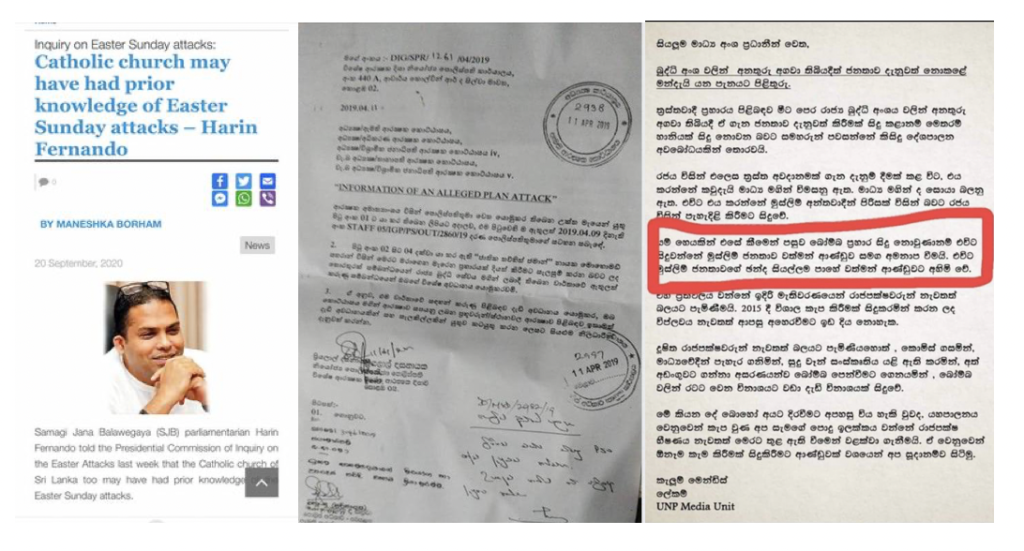
However, what is alarming is the fact that scores of people knew there was going to be an attack before the attack. The evidence of SIS Head Nilantha Jayawardena claims that by 11 April 2019 (one week before attacks) at least 10,000 including embassies knew of an impeding attack. He claims that in all at least 15,000 would have known of an impending attack.
How many of this 10,000 neglected to prevent the attacks?
Then Defense Secretary, Hemasiri Fernando admitted he knew something would happen but thought it was something small!
Who else outside of the security apparatus, knew other than Harin’s father?
Harin’s father informed Harin not to go to Church – who else did Harin inform not to go to Church on Easter Sunday?
How come most of those who annually attend Easter Sunday mass decided not to attend mass on that particular Easter Sunday?
Did Harin tell the Church, some fathers were aware – did they or did they not inform the Cardinal?
How many Catholics in Parliament did not attend Easter Sunday mass that day?
Who knew but kept silent? Investigate this!
Why didn’t the keyboard mavericks even put a single social media post giving a warning?
All those who knew but kept silent are as guilty as the 8 Islamic suicide bombers who carried out the mass murder. Those who knew did nothing to prevent innocent people getting killed. Their conscience should prick them daily for this.
Yahapalana govt is also guilty of dividing officials along political lines & to follow political orders without independence to their job role. The closure of intel units monitoring radical Islam youth & without charge putting intel officers in prison resulted in weakening & making vulnerable Sri Lanka’s security apparatus as well as demoralizing the forces & intel units. Their ability to quickly round up & arrest those involved after the attacks showed they had the network in place.
It was on account of the politicized divisions created by the yahapalana government in the Law & Order apparatus that left every authority passing the pillow of decision taking.
If as per SIS Head Nilantha Jayawardena at least 15000 knew of an impending attack WHY WAS EASTER SUNDAY MASS NOT CANCELLED? Why were people NOT PREVENTED from entering the church? Why were hotels not informed to beef up security? Why were the suicide bombers not apprehended & arrested before they could carry out the attack given their names were released before the attacks?
With these facts very clear, there are some ranting on about conspiracy theories and political conspiracies of mastermind Easter Sunday to come to power which includes the Church.
While the Church has to first respond & be investigated for being aware of the attacks before the attacks, for those peddling political conspiracies need to be reminded that the yahapalana govt by 2019 were on their way out. Having promised the people to deliver good governance, they delivered nothing of the sort – 2 bond scams, 99-year lease of Hambantota Port, taking $12.5b ISBs from Western private hedge funds & passing repayment to the next govt, the 2018 local government elections clearly showed the yahapalana govt was on their way out of power. Therefore, contrary to what some want to believe, there was no requirement to brainwash 8 suicide bombers when 15000 in the govt knew that an attack was going to happen before the attack happened. The conspiracy is nowhere else but inside the yahapalana govt. However even Interpol congratulated President Sirisena https://www.defence.lk/Article/view_article/480 – 27 Aug 2019. In 8 January 2021, FBI charged 3 Sri Lankans with conspiring to provide material support to ISIS.
In May 2021, America’s FBI confirmed Maulavi Mohamed Naufer as mastermind of Sri Lanka’s 2019 Easter Sunday bombing.
In October 2021, some 25 suspects were issued 23,270 charges over the deaths of 269 civilians on Easter Sunday.
President AKD must also investigate the radicals in his own party, after his national list member’s 2 sons were 2 of the suicide bombers and their wives also committed suicide. This is important given their closeness to the President himself & the security risk involved.
There is also need to investigate the role of Indian intel & why they did not make public the warnings that were sent? India released names, mobile numbers & target venues hours before the attacks – this was sufficient to prevent people entering the Church & evacuating people from the hotels.
The yahapalana government came to power with help of a consortium of political parties that included the JVP and assisted by US & India who openly applauded their triumph in 2015. If there was a political conspiracy to overthrow the government they helped bring to power given that India issued 90 plus warnings, surely, they would have included this in their warnings too!
How much of public funds have so far been spent on Commissions & investigations? Let us not forget that Easter Sunday is not the only murders that have taken place in Sri Lanka. LTTE killed thousands over 30 years. Why have these deaths not been given the same justice in the form of repeated Commissions & investigations? Treat all dead equally. Commissions & investigations cannot be reopened for only one crime ignoring others especially when those calling for justice” have to first respond to whether they were aware of the attacks before the attacks.
Therefore instead of repeating the investigations, a better option is to investigate all those who were aware of the attacks before the attacks including the family members of the suicide bombers & hold them accountable for neglect & aiding & abetting murder.
This article examines the global significance of ham radio stations and licensing, with a particular emphasis on Sri Lanka and its community benefits.
Ham radio, or amateur radio, is a crucial communication resource that connects individuals worldwide. It plays an essential role in emergencies, offering reliable communication when other systems fail.
To operate ham radio equipment legally, operators must obtain a license. This process ensures they possess the technical knowledge necessary to comply with regulations that prevent interference with other communication services. While licensing procedures differ across countries, they typically involve passing an exam covering radio theory, regulations, and operating practices.
In the United States, the Federal Communications Commission (FCC) issues licenses in various tiers: Technician, General, and Extra. Each tier provides different operating privileges, with the Extra class granting the most extensive frequency access. Similarly, in the United Kingdom, the Office of Communications (Ofcom) offers three license levels: Foundation, Intermediate, and Full.
In Sri Lanka, the Telecommunications Regulatory Commission (TRC) manages the licensing process for amateur radio operators. The TRC provides multiple classes of licenses, each with unique privileges and requirements. Obtaining a license involves a written exam that assesses technical knowledge, operating practices, and regulations.
Ham radio can be used for direct radio to radio communication, interfacing with disaster response agencies, and even sending off-grid email using Winlink. Link: Post..
Ham radio serves as a critical lifeline during natural disasters such as hurricanes, earthquakes, and floods. For instance, during Hurricane Helene, ham radio operators maintained essential communication links when other systems failed. As of October 7, 2024, over 200 lives have been lost due to the hurricane, and many are still missing. Over 100,000 people in Western North Carolina remain without power, highlighting the urgent need for reliable communication in disaster situations to locate missing persons and coordinate rescue efforts.
Ham radio fosters community among operators, promoting collaboration, knowledge sharing, and mutual assistance. This is particularly beneficial in rural areas of Sri Lanka, where modern communication infrastructure may be limited. Additionally, ham radio encourages interest in science, technology, engineering, and mathematics (STEM). Schools and universities in Sri Lanka can incorporate ham radio into their curricula, offering hands-on learning experiences. It also enables operators to connect with people from diverse cultures and countries, fostering cultural understanding and global friendships that enrich Sri Lankan society.
During Hurricane Helene, ham radio operators were instrumental in disaster response. Their ability to communicate without relying on the internet or cell service provided critical support. Ham radio operators facilitated locating missing persons, coordinating supply drops, and sharing information about road conditions. Notable operators like Dan Kitro (K2DMG) and Thomas Whitherspoon (K4WSL) have made significant contributions in managing communications and disaster response efforts.
Ham radio has proven its value in other disaster scenarios as well. After the devastating earthquake in Haiti in 2010, ham radio operators quickly established communication links, providing essential information to aid organizations and coordinating rescue efforts when other systems failed. In the aftermath of the 2004 Indian Ocean tsunami, ham radio operators in affected areas, including Sri Lanka, relayed information about survivors and facilitated relief efforts, operating independently of damaged infrastructure. During Hurricane Katrina in 2005, ham radio operators provided emergency communication when power and phone lines were knocked out, aiding rescue operations and supply deliveries. Following the 2011 earthquake and tsunami in Japan, ham radio operators helped bridge communication gaps, offering updates on the situation and assisting with relief coordination.
In the United States, the FCC allows individuals to use any means, including ham radio, to communicate without a license in life-threatening situations. However, obtaining a license is crucial for gaining hands-on experience and preparing for emergencies. It only takes a few hours of study and passing a straightforward 35-question exam to get your ham radio license, so don’t wait for the next disaster to take this important step.
Ham radio is more than a hobby; it is a vital communication tool with significant advantages for individuals and communities. By promoting and supporting ham radio in Sri Lanka, the country can improve its emergency preparedness, foster community spirit, and create valuable educational opportunities. As evidenced by Hurricane Helene and other disasters, the need for dependable communication during emergencies underscores ham radio’s importance for Sri Lanka’s future resilience.
By Palitha Ariyarathna
Reference: 1: ARRL: Amateur Radio Response to the 2010 Haiti Earthquake 2: OnAllBands: Bharathi Prasad and the Indian Ocean Tsunami 3: ARRL: Amateur Radio Response to Hurricane Katrina 4: ARRL: Amateur Radio Response to the 2011 Japan Earthquake and Tsunami
Malcolm Gladwell in his book “The Outliers” states that the reason Asian kids consistently outperform western kids in international math tests is because of the cultural attitude these kids have towards solving a math problem, or any task that requires patience and effort for a long period of time. In China and other Asian cultures, there is a logical pattern to learning math based on a confidence and expectation that if we apply enough effort the problem is solvable while in the West, kids believe their ability is innate and can’t be changed or influenced. Malcolm’s theory is that the reason for this difference in attitude has to do with the historical agriculture practices in both cultures, where the rice growing Asian culture had a different lifestyle for thousands of years that required consistent hard work which translates in the today’s attitude of their kids when trying to solve a math problem.
NPP scored a stellar election victory bagging the entire Christian Belt – Wattala, Ja-Ela, Katana, Negombo, Wennappuwa, Naththandiya and Chilaw.
In addition, electorates with a significant Christian population including Moratuwa, Dehiwala and Colombo West also went the NPP way.
Colombo North was once a Christian majority electorate but it is now a Hindu majority electorate while Colombo Central is a Muslim majority electorate.
It’s unusual for one party to win them all and even more interesting when the JVP/NPP wins them. The JVP was never popular in the Christian community. It’s communism association and past violence were the main reasons for the intense dislike towards the JVP. However, things had dramatically changed over the past couple of years to make them embrace the NPP/JVP.
The main reason is the absence of tribalism/sectarianism from politics and policy within the NPP/JVP party. As the smallest creed in the island, Christians are sensitive to racist politics. Though some sections were distracted by sectarian politics in the recent past, the vast majority shunned it. NPP/JVP gave them hope.
Shedding old and outdated opposition to open economic policies is another reason. NPP/JVP took a long time to come to the fold of supporting open economic policies. It delayed minority acceptance of the party.
The third reason is the full integration of the Sinhala Christian community into the broader Sinhala community. Whatever that affects the Sinhala broader community affects the Sinhala Christian community too. This was not the case until the late 1990s when the two communities retained their differences coming from colonial times.
This is a promising development not just for politics but also for the nation. Hope the government will leverage this to improve Sri Lanka’s standing in the international community and gain acceptance and investments from world’s largest developed economies, a preserve limited to UNP regimes so far.

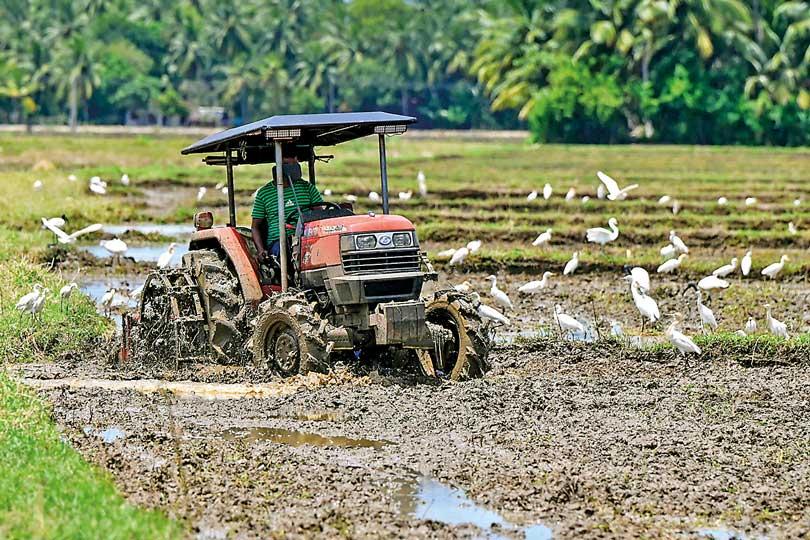
 There is hope in the horizon after the 2024 Presidential Elections that the new regime would do all it could to ensure that people could, again, afford nutritional food in their diets.
 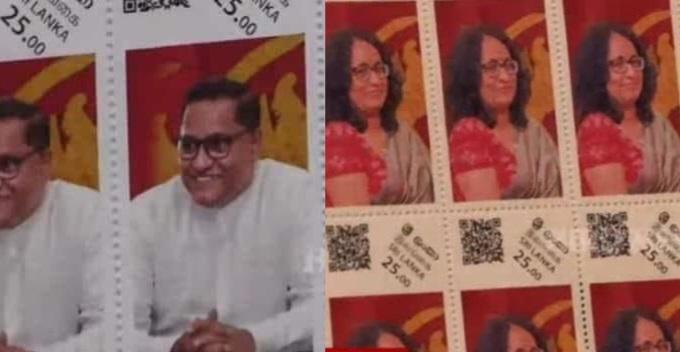 Colombo, Oct 09, (Daily) – In a move seen more as hysterical than having any purpose, two new stamps were released as souvenirs by the Sri Lanka Postal Department today with the faces of Prime Minister Harini Amarasuriya and Minister Vijitha Herath.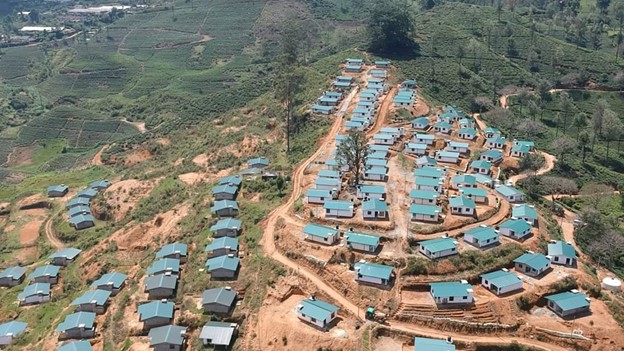

![People gather to stage a pro-Palestinian demonstration and condemn the Israeli attacks on Gaza, in Amsterdam, Netherlands on October 7, 2024 [Selman Aksunger/Anadolu via Getty Images]](https://i0.wp.com/www.middleeastmonitor.com/wp-content/uploads/2024/10/GettyImages-2176529948-scaled-e1728373989929.jpg?fit=1200%2C800&ssl=1)