
Sajith pledges to abolish Executive Presidency
August 18th, 2024YOHAN PERERA Courtesy The Daily Mirror
Ruwanwella, August 18 (Daily Mirror) – Opposition Leader Sajith Premadasa today pledged to abolish the Executive Presidency if he is elected President next month.
Premadasa made this pledge during a rally at Ruwanwella.
“A number of past Presidents have pledged to abolish the Executive Presidency but never did it. I will do it and introduce a system based on the legislature,” he said.
NPP will bring back Arjuna Mahendran as first priority: Anura Kumara
August 18th, 2024AJITH SIRIWARDANA Courtesy The Daily Mirror
Colombo, August 18 (Daily Mirror)- The National People’s Power (NPP) will bring back former Central Bank Governor Arjuna Mahendran, who fled to Singapore, to Sri Lanka as the first priority of a NPP government, NPP leader Anura Kumara Dissanayake said today.
Speaking at a rally in Kiribathgoda, he said the NPP will take over power with plans to raise state revenue and said the NPP government will stop fraud and corruption.
He said Rs. 1,100 billion in taxes have been defaulted by various people and assured that the NPP government will recover all the defaulted taxes.
“At least Rs. 169 billion can be recovered initially without any issues. There are some court cases regarding the rest. Some file cases against paying taxes and after the court rulings they pay the same amount after about ten years. We will amend laws to recover the tax amount with interest after the court ruling,” he said.
Dissanayake said the NPP will take over power with plans to raise state revenue and said the NPP government will stop fraud and corruption.
He said the NPP government will engage in discussions with the IMF on tax relief and pointed out that the Pay As You Earn (PAYE) tax threshold will be increased from Rs 100,000 to Rs. 200,000.
He also said low income families will be provided with a minimum monthly allowance of Rs. 10,000 under the NPP government.
Dissanayake said the Cabinet of Ministers and Deputy Ministers will be restricted to 25 and there will be no State Ministers under the NPP government.
“We will allocate ministries on a scientific basis,” he added.
Anura Kumara pledges to remove VAT on essential items
August 18th, 2024Courtesy Adaderana
National People’s Power (NPP) Presidential Candidate Anura Kumara Dissanayake says that steps will be taken to remove the Value Added Tax (VAT) imposed on food, health services, and school supplies after his election victory.
Speaking at a public rally in Galle yesterday (16), he emphasised the urgency of the NPP taking over the country’s leadership to address the current crises.
NPP’s leadership is needed to pull the nation back from its critical state”, said Dissanayake.
He further stated that their recent proposal for a new electricity generation plan was presented on August 15, which aims to reduce electricity tariffs by one third and remove VAT on essential items including food, health services and school supplies in the first budget proposal itself.
NPP’s leader further criticized other candidates for focusing on their personal interests rather than prioritizing the welfare of the people.
Sajith Premadasa promises to recover country’s economy through foreign aid
August 18th, 2024Courtesy Adaderana
Samagi Jana Balawegaya’s (SJB) presidential candidate Sajith Premadasa says that he will be initiating a recovery program for the country’s economy with the help of foreign aid after his presidential election victory.
Speaking at a public rally in Bandaragama, he highlighted that true development means the welfare and development of the people.
For us, the development means the development of 2.2 million people in this country, not just statistics”, said Premadasa.
He further criticized the current government for its focus on personal gains while neglecting the needs of 22 million citizens who are struggling.
As the election approaches, they make misleading promises, attempting to deceive the populace. It is not impossible to deceive the people of the country at the moment”, he added.
Support us in creating a new era of development for everyone. We are committed to addressing and resolving the country’s issues with the help of foreign aid”, he said.
Sajith vows to uncover truth behind Easter attacks
August 18th, 2024Courtesy Adaderana
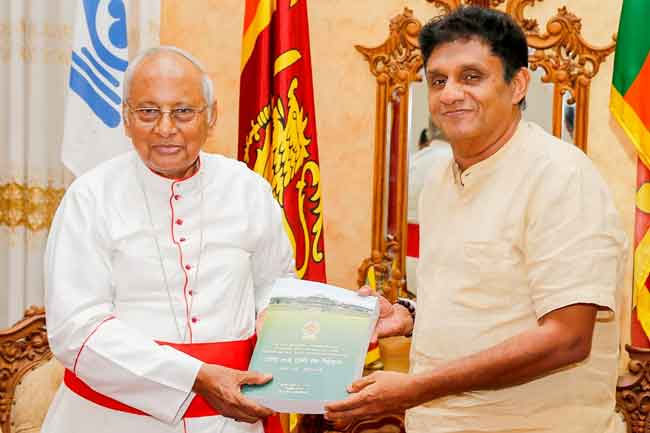
Opposition Leader Sajith Premadasa has pledged to expose the truth behind the Easter Sunday terror attacks, fulfilling the expectations of the people, particularly the country’s Catholic community.
Premadasa made this remark during a visit to the Colombo Archbishop’s residence, where he met with His Eminence Cardinal Malcolm Ranjith and the Assistant Bishops of the Colombo Archdiocese to seek their blessings.
The SJB leader and presidential candidate assured that he has a clear plan to uncover the truth, a plan that has already been presented in Parliament.
He emphasized that the entire nation, led by the Catholic community, is questioning whether the investigations into the Easter attacks were conducted transparently and whether the truth has been fully disclosed.
During the meeting, Premadasa promised Cardinal Ranjith and the Bishops that he would leave no stone unturned in his pursuit of justice.
He vowed to implement a programme aimed at uncovering the root causes of the attack without any discrimination, ensuring that all those involved will be held accountable and face the maximum punishment.
Sri Lanka seeks economic cooperation agreements from Japan to India
August 18th, 2024Courtesy Hiru News
President Ranil Wickremesinghe emphasized the importance of strengthening economic cooperation and regional integration from Japan to India, with a special focus on deepening ties with India. The President made these remarks while addressing the Head of State Session of the 3rd Voice of Global South Summit, held under the theme “An Empowered Global South for a Sustainable Future.”
Speaking from the President’s House in Anuradhapura virtually yesterday (17), President Wickremesinghe highlighted Sri Lanka’s strategic commitment to expanding economic partnerships across Asia, particularly through the Bay of Bengal Initiative for Multi-Sectoral Technical and Economic Cooperation (BIMSTEC). The President noted that as the Bay of Bengal region emerges as a hub of economic growth, the significance of BIMSTEC continues to rise. Sri Lanka, as a member, seeks closer economic integration with India and is exploring economic cooperation agreements extending from Japan to India.
The conference, chaired by Indian Prime Minister Narendra Modi, brought together heads of state from various countries. During his address, President Wickremesinghe praised India’s efforts to strengthen the Global South, acknowledging that the West can no longer maintain its dominance in global leadership. He lauded the Voice of the Global South Summit as a crucial platform for fostering consensus on challenges facing developing nations.
Reflecting on Indo-Sri Lankan relations, the President emphasized the “Vision” statement shared between the two nations, which celebrates their historical cooperation and lays the foundation for future collaboration. He expressed optimism that this vision will lead to stronger integration between Sri Lanka and India across various sectors.
President Wickremesinghe also expressed his gratitude to Prime Minister Modi and the people of India for their support during Sri Lanka’s recent economic crisis. The President acknowledged that India’s assistance played a vital role in helping Sri Lanka navigate the challenges of the past two years and emerge from bankruptcy.
President Wickremesinghe further elaborated,
“Your Excellencies, Sri Lanka thanks India for hosting the third virtual seminar on Voices of the Global South. This series enables us to engage with each other to understand our different viewpoints while also helping us arrive at a common stance on many issues confronting the South. We have reached a point where the West can no longer dominate global leadership and, furthermore, has become part of the problem. Ukraine and Gaza are prime examples, which I will not address as they have already been discussed by previous speakers. In this context, we must appreciate India’s efforts to strengthen the Global South.
Your Excellencies, let me speak a few words about my country. Sri Lanka has reached agreements with the Official Creditor Countries, the Export-Import Bank of China, the IMF, the World Bank, and the ADB to emerge from bankruptcy. At this stage, I must acknowledge the generosity of Prime Minister Modi and India, whose contributions made it possible for us to survive the two years of bankruptcy, which imposed a heavy burden on our people. The Vision Statement agreed upon by both our countries outlines the path for closer relations, emphasizing our 2,000-year history of cooperation. This will ultimately lead to deeper integration between our nations across many sectors.
We will be finalizing the Comprehensive Economic and Technological Agreement. We will also inaugurate connectivity in power, transport, and land, and we will focus on the development of Trincomalee Harbour, among other projects we have agreed upon. These efforts will help us upgrade our knowledge and technology, enabling us to move towards a digital economy. I must express my gratitude to India for the assistance it has provided.
I must also mention the Bay of Bengal, which is becoming a growth centre, with BIMSTEC gaining increasing importance. As a member of BIMSTEC, Sri Lanka, with its close economic integration with India, seeks membership in the RCEP, aiming to establish economic cooperation agreements from Japan to India. We recognize the Bay of Bengal as essential for the development of our economies.
Given that many of the topics I intended to address have already been covered by previous speakers, I would only like to mention that the post-1989 era, started with the collapse of the Soviet Union, which was dominated by such views as the clash of civilization and the end of history, which highlighted the dominance of the Western system, has now coming to an end. This summit, along with similar gatherings, the expansion of BRICS, and the expansion of the G20, will pave the way for a new order where the Global South will leave a lasting legacy. I must thank India, which, since its independence, has worked to unite Afro-Asian countries and for the role it continues to play in forging closer unity among all of us. Thank you.
PART VII: OF THE MYTH OF MALIMAWA: A COMPASS WITHOUT THE MAGNETIC NEEDLE
August 17th, 2024By Sena Thoradeniya
(Continued from August 3, 2024)
1. Ranil’s Strategic Maneuvers
A. RW- masquerading as the savior
RW was offered the Premiership by GR in April 2022, Finance portfolio in July 2022, made President by the majority of Pohottuwa MPs in July 2022; it was GR and Pohottuwa who jointly created a Frankenstein, knowing very well RW’s shadowy past since 1977 and how the UNP supported the Galle Face Protest. We have documented that dark history in our earlier writings. Pohottuwa accepted him as the leader of their parliamentary group, Head of State and Government, and their savior in the face of murderous onslaught of protesters; RW has saved not only their lives; he has paid compensation for their property destroyed by the goons.
At the last stages of GR’s tenure, police and security forces did not take any action against the protesters. A government MP Madura Vithanage disclosed in the Parliament on 7 July 2024 that on 31 May 2022 when the protesters besieged GR’s private residence at Mirihana he, as requested by GR had telephoned the then Army Commander to take preventive action against the protesters, (blocking roads using armored vehicles was the request made by him), but he was told that it was a political matter” and to quell the protest using their own club wielding party supporters.
This statement begs a few explanations: why the Commander-in-Chief ask an ordinary MP to speak to the then Army Commander instead him talking direct to him or Secretary/ Defense? Can an ordinary MP suggest the Army Commander the action he should take in such a situation? How can the Army Commander suggest to incite party supporters to take the law into their hands? Was it a political matter” that had happened at Mirihana on 31 May 2022? Have the protesters besieged President’s private residence to hold a political rally?
If this statement is correct it is a very contentious and a dangerous one; can an Army Commander suggest such a foolish act? Is not the duty and responsibility of the army top brass to safeguard the security of the President and the State? Was it a suggestion made to hasten the triggering of the conspiracy already hatched, had Madura Vithanage acted accordingly?
By a very strange coincidence Vithanage’s statement did not receive the attention it deserves either of SJB, NPP, foreign-funded NGO cabal or bourgeois press (columnists and editorialists). No one, including those hawks who visit the CID as to perform purification rites at a drop of a hat lodged a complaint. Vithanage can safely sing cradlesongs for the amusement of his new leader RW.
With this digression we come back to our main narrative; SLPP accepted portfolios under RW; the worst was done by Dinesh Gunawardena who is from a different party accepting the premiership; the man who was removed by GR immediately after his remarks made during his marketing spree at Delkanda Pola, Susil Premjayanth was appointed as the Leader of the House; it is very interesting to note that RW did not accommodate SLPP seniors in the Cabinet of Ministers; before long some SLPP Ministers and State Ministers became clamorous spokespersons of RW. The strangest happening was those SLPP seniors who were not accommodated in the Cabinet of Ministers by RW, joining RW in his Presidential Election campaign abandoning the SLPP.
RW from the day of his ascendancy to the top post began pursuing his own agenda, what he could not accomplish as PM on several occasions at the expense of the SLPP.
It is none other than the SLPP leadership who is responsible for the present predicament of the SLPP. Before they proposed the name of RW for the Presidency (as there wasn’t a single UNP MP in the Parliament) and voted and elected him as the President, SLPP leadership should have signed a MOU with RW for a minimum programme and giving RW critical support, in other words reaching a compromise knowing his satanic past – not to support his anti-national bills as it was common knowledge that RW would not accede to carry out SLPP programme. But alas! SLPP supported all his anti-national bills, including the controversial Electricity Bill, Gender Equality Bill etc. despite MR’s letter dated May 12 sent to RW, against the divestiture of profit-making SOEs and requesting him to stop such action until the conclusion of the next Presidential Elections. But MR himself voted for the Electricity Bill and negated what he himself had written.
This confirmed the impression that RW and SLPP are having a grand political honeymoon, cruising together in a luxury yacht in the Mediterranean, despite some muscle flexing antics by Basil R, orchestrated for the benefit of gossip savvy media.Basil Rwas not able to get acquiescenceof RW for conducting Parliamentary Elections before the Presidential Elections. A shrewd politician RW knew how to woo the SLPP parliamentarians who have not completed the stipulated period to enjoy pension rights.
In this context Basil R’sstatement made at a Kalutara felicitation meeting, bayath nae; nayatha nae” (we are neither afraid nor in debt) became meaningless as it was RW who is in debt to SLPP and the person who should be afraid of losing SLPP support. If our politicians know something about our ancient Buddhist canons, RW would have re-joined: I have redeemed a loan; now I can offer a loan; I have left behind a treasure”, as stated by the Bodhistva parrot king in Salikaedara Jatakaya”.
It was evident since many months ago that at an election a large number of Pohottuwa MPs would switch their allegiance to RW; before the nomination day this number multiplied dayby day in an unprecedent scale with diehard Mahinda loyalists switching allegiance to RW as they were caught in a bush fire.
In all meetings he addressed RW expressed that people should not forget the hardships endured in 2022, due to shortages of essential items such as fuel, gas, fertilizer, medicine; mentioned about calamitous circumstances people faced, foreign exchange scarcity, shortages and queues when he assumed leadership having only a single seat in the Parliament. He repeated all the other party leaders declined to accept leadership given on a platter. He was the only one who took up the challenge when others fled; he claimed that he himself was the savior and reiterated that he should be given another chance to continue the unfinished job.
RW says that he has revived agricultural activities, boosting production; bolstered revenue streams, strengthened the rupee and facilitated economic resurgence; he warns if we fail to rectify this and transition to a new economic paradigm we risk sliding back into economic turmoil; he creates a monster and shows its dreadfulness to the people; says Sri Lanka emerged from bankruptcy and was been able to agree upon debt repayment plans. His oft-repeated chansons full of poetic renditionswel Paalama” (vine bridge), Grusha and Caucasian ChalkCircle”,wankagiriya” (labyrinth) and the latest addition Titanic” keep the people in bewilderment, whether it is fantasy or reality.
In his Address to the Nation on 26 June RWsaid that Sri Lanka received an opportunity to repay loans on concessional terms with an extended period until 2043; Sri Lanka could now defer all bilateral loan installment payments until 2028. He said that development work which was halted are set to commence; can initiate new development projects; he demonstrated that he is capable of doing and have confidence to do so; said that he successfully elevated the country from bankruptcy and economic turmoil to a position that astonished the world; said that he had safely guided the child named Mother Sri Lanka through treacherous waters; this speech was like a clarion call for his Presidential Election campaign and showed futility of campaigns of Sajith Premadasa and Anura Kumara.
I pose a critical question. Will you move forward with me, who comprehended the problem from its inception, offered practical solutions and delivered results? Or will you align with those grappling in the dark still struggling to grasp the issues? Will you stay the course towards a brighter future for yourself and the nation? Or will you opt for a different path? We all are aware of the perils of veering off course or choosing the wrong path. Therefore, make the right decision.”
At Matara rally on 30 June Ekwa Jaya Gamu, Api Matara” (Victory through Unity), organised by SLPP Young Turks, again RW highlighted his efforts over the past two years; he underscored the need for collective commitment of all to propel the nation’s political journey; he said, I have safely brought the Titanic to the port; while other captains fled from the iceberg, we took a critical decision; sink or navigate to safety; now that we have reached the port; the question is what to do next with this ship; he blamed the other contenders; that they are not fit to hold any responsible position; When the President resigns and the ruling party fails to act, it falls upon the opposition to step in. Yet everyone evaded responsibility”. He said that he was the only person who shouldered the responsibility.
Clearly, he laid a trap; If any party possesses an alternative approach, I am willing to facilitate discussions with the IMF for them. The government is willing to make arrangements to provide travel permits, necessary funds for travel and accommodation for these discussions, he said at Matara. We can no longer afford to revert to old politics; do we have an alternative future? Can we afford to return to the days of long queues and traditional politics?” He repeated the same thing on 2 July in Parliament that he can make arrangements to meet Finance Ministers, in the countries mentioned by SP, Ghana, Argentina etc.
RW reaffirms, to take the country forward we no longer can make experiments; this is not a time to play bringing this person or the other; I have brought the country to a transformative stage only thinking about the country; if this government is replaced with any other there will be a severe crisis again; this should be avoided.”
Has RW done any miracle other than accepting dictates of the IMF and complying with IMF conditions and acting accordingly? It is well known that he has agreed to highly objectionable conditions of IMF.
Would the voters listen to these urban myths? This is a country which chased out the President who gave political leadership to defeat Tamil Tiger terrorists in 2005. Many say that we have short memories, although this writer does not subscribe to this idea, because we are a nation who have a rich historical memory and a cultural memory. But the neocons and neoliberals who are at the helm and various segments of the middle class who follow the former blindly want to keep the status quo.
The other important aspect is, this country having a surfeitof political parties, did not support even the war efforts, tried every trick in their book to scuttle the war efforts; even tried to defeat the budget. This criticism is also levelled against RW’s UNP and his loyal lieutenantsat the time. Just recall the notoriousutterances of Karunanayaka (Kilinochchi-Medawachchi: Alimankada-Pamankada binary), Kiriella (any bull can wage war”), Samaraweera (army commander is fit to be the commander of Salvation Army”), and RW himself (Toppigala is a jungle”). We do not see even a remote possibility major party leader joining the callof RW to unite, except three-wheeler parties”. These realignments are being witnessed daily. It is a futile call since all think that they are poised for victory; when they see the finishing line running solowhy shouldthey join in a relay and share the spoils?
B. Ranil’s strategic maneuvers in the economic front
Using public funds, RW began to give away various handouts and poor relief to different segments of the society. As they are legion it is not necessary to list down what they are and commenting on the viability and practicability of such acts, as almost all are aimed at the upcoming Presidential Election. But making some observations about some proposals which are detrimental to the country in the long run is important.
Under Urumaya land grants, giving freehold land title deeds was lauded by RW supporters, but it will result in pauperization of the peasantry and adding more numbers to landless lot as there is an inducement to sell land. This was what the Americans needed by their abortive agreements.
RW met Bishop of Mannar in mid-June and discussed development of Point Pedro, Mullaitivu as renewable energy hubs, power connectivity and land connectivity with India, plans to develop Mannar as a tourist hub, development of Mannar Fort to attract cruise ship tourists. This manifests the prominence he has given to so-called connectivity death trap laid by India.
RW while attending the opening of a Sea Water Desalinization Plant, promised a River to Jaffna” to provide water to the Northern Peninsula; this proposal was in the pipeline for nearly 5 or 6 decades. He also promised to introduce drip irrigation as it is a new concept; he did not tell how to get water for drip irrigation. All Presidential candidates promise to introduce many things thinking they are novel concepts; these do goodies try to invent the wheel not knowing that the wheel was invented many centuries ago, in this case several decades ago.
Proliferation of Smart classrooms” has reached an epidemic level as many Presidential candidates think that it is the main drawback in our school system. Education Minister on behalf of RW, announced the creation of Entrepreneurship Circles” in 3000 schools as part of the first phase aimed at fostering school-level entrepreneurs. Now RW, SP, Anura Kumara all talk about Entrepreneurship. Where were they all this time? JVP destroyed factories, transformers and Agricultural Service Centers. UNP governments destroyed state industries under its privatization programme and local level handloom and power loom industries.
RW says transformation of Sri Lanka to an export-driven economy is imperative; both SP and Anura Kumara repeat the same. Creating an export-driven economy was in the top of the agenda of development initiatives cherished by many policy makers and governments and there is nothing new in these dreams of new born babies.
RW said that he is going to identify areas occupied by plantation workers and designate these areas as new settlement villages at a special discussion held on 17 July. Not to be outdone Premadasa promises to make plantation workers entrepreneurs – tea smallholders providing them with tea lands; we do not know how he is going to do it. Is he going to fragment big tea plantations? This will provide with a death warrantto lush tea plantations in the hill country. These were the people who opposed vehemently nationalization of foreign owned tea plantations alleging that nationalization of plantations would kill the hen who lays golden eggs. Later when they came into power, they formed cluster companies and as the next step state owned plantations were handed over to capitalist management companies by CBK.
These politicians first, should understand how the tea small sector grew overtime. There is a scheme already in existence introduced since 2008 called Revenue Sharing Model (RSM) in some state-owned plantations. A part of tea estate land given to workers to grow, pluck and sell green leaf to the company.
The danger of these short-sighted proposals is making the so-called Mallaiyaha Tamils” into an antagonistic force in the hill country, fighting for their ‘liberation”. Already it is being carried out with the blesings of Julie Chung, so-called Rama Trail” and establishing massive Sita Amman kovils in the Central Highlands.
Increasing fixed deposit interest of senior citizens to 10% (senior citizens are aware that it was this government which reduced the interest rate from 15% to 8.5%), is a mere eyewash to hoodwink them.
C. Ranil’s strategic maneuvers in the political front
RW began his political manipulations by appointing some of his loyalists as Governors, the worst was the appointing of a Thondaman as Governor of the Eastern Province.
In July 2023 a conference was organised to update the parliament party leaders on the National Reconciliation Programme and North East Development Plan; RW said collective discussions among all parties are necessary to decide in granting police powers to Provincial Councils; RW proposed arrangements that would allow members of Provincial Councils to concurrently hold position and be appointed as MPs, while MPs could also hold position as members of Provincial Councils; his recent utterings reveal that he has not deviated from this stance. This will make provincial affairs and parliamentary affairs a mockery, making provincial affairs an appendage of the legislature, creating more power wielders at provincial level. RW is under pressure from Modi to implement the 13th Amendment. Now there is a competition between RW, SJB and NPP about full implementation of the 13th Amendment. It was UNP, JVP and TNA indefinitely postponed Provincial Councils elections in 2017. Provincial Councils are now being controlled by RW through Governors appointed by him. Visiting North and East he said that in this country we have 10 governments, 9 of which are Provincial governments”. He cannot say like this unless he is going to break Sri Lanka into 10 states.
Gender based bills: Womens’ Empowerment Bill and Gender Equality Bill; the former was introduced by Anupa Pasqual of Yuthukama Group , State Minister of Social Empowerment;according to Julie Chung’s ‘X’message dated 18 Juneshe had met withAnupa Pasqual at the US Embassy along with Madura Vithanage , SLPP MP, Dulles Alahapperuma MP (now changed his allegiance to SJB) and some other SJB MPs. Gender Equality Bill is said to be a joint effort of Women’s Parliamentary Caucus; they including Harini Amarasuriya of NPP were sent to New Zealand on a study tour funded by USAID with the blessings of Julie Chung. RW made a statement in the Parliament on 18 June concerning the Gender Equality Bill; proposed a Parliamentary Select Committee to review Supreme Court determination as it has determined the bill was inconsistent with the constitution, would require both a parliamentary special majority and a referendum. RW referred to it as judicial cannibalism”; Harini Amarasuriya of NPP said that it was a weak draft bill filled with vague clauses which was the reason why the Supreme Court has determined it was inconsistent with the constitution.
RW attempted to extend the term of Attorney General for another 6 months on the pretext of his services would have to be retained in view of the Easter Sunday probe and X-Press Pearl issue; but was scuttled by the Constitutional Council.
RW providing funds under decentralized budget to opposition MPs; alleged to have given bar permits to some.
Using Local Government polls candidates in state-funded development activities.
RW in July 2023 gave presidential pardon to 2 convicted Tigers, serving a jailterm in the Central Bus Station bomb attack on 31 January 1966, which claimed the lives of 91 persons. One of them was sentenced to 200 years imprisonment and the other life imprisonment; he also pardoned LTTE cadres who bombed the Central Bank in 1996.
RW began forging alliances firstly with SLFP breakaway group Ministers, State Ministers and MPs and secondly with PohottuwaMinisters, State Ministers and MPs and the so-called New Alliance” and other Pohottuwa anti Rajapaksa groups in a subtle way; diehard Mahinda loyalists of SLPP drifted towards him astoundingly breaking ties with MR and Basil R. We witnessed a grand spectacle in which SLPP MPs and former SLPP Ministers (men and women) who vilified, denigrated and disparaged RW joining him en masse as what was said and done by them had happened in a previous birth. This tide began with a significant number of Pohottuwa Ministers and MPs pledging their support to RW at Ekwa Jayagamu” public meetings held at various cities.
It is said by now around 100 out of 145 MPs elected on SLPP ticket have decamped. All these MPs decamped for their own sake to be re-elected as MPs at the next General Elections. Almost all these MPs were elected in 2020 thanks to MR. If the SLPP hierarchy has taken any action against the SLPP dissidents initially, as the SJB did, it could have halted this situation without allowing it to grow as anepidemic. MR’s saloon door policy” did work against him this time.
RW succeeded in forging alliances with EPDP, whose leader Douglas Devananda opposed the idea of fielding a common Tamil candidate declaring that it is not beneficial to Tamil community, inimical to the interests of Tamil community; Tamil Makkal Viduthalai Pulikal (TMVP), State Minister Sivanesathurai Chandrakanth (Pillaiyan) expressed solidarity and confirmed his support for RW. He was seen wrapping RW with a Ponnadai” (golden robe) and garlanding him with a huge garland; KarunaAmman and VillayaindranMP for Batticaloa also pledged his support; RW was able to woo certain leaders of the plantation workers. Just before the nominations and soon after the nominations some SJB key figures and Muslim MPs switched their alliance to RW defying their party leaders. Tamil (including plantations) and Muslim political parties and some old buddies like Ranawaka pledging support to Premadasa do not portray a significant political advantage to him as they all supported Premadasa in 2019 also; it should be stated that with their votes Premadasa obtained only 5,564,239 votes (or 41.99%).Only new faces in his alliance” are those who left the SLPP whereas RW leads a broader alliance” than his former ally.
Sarath Fonseka had met with RW regarding a foreign exchange matter, believed to be what SF had received in the run-up for the 2010 Presidential Elections; RW was the Chief Guest at the launch of SF’s book on 28 June; paying SF a glowing tribute RW highlighted SF’s ability to contribute significantly to the country’s future. He did not forget to remind that it was the yahapalana regime, he as the Prime Minister promoted him to the rank of Field Marshal; SF breaking away from SJB and contesting at the forthcoming Presidential Elections are interpreted as the work of a vote breaker proxy candidate.
RW addressing issues of unity in a coalition, demonstrates that he is committed to unity for the nation’s interest; encourages other political parties to join in this initiative. Regardless of political affiliations what is foremost is the country’s success has become his catchword; he extends an invitation to opposition urging them to prioritize national interests over partisan politics.
D. Culture
Not a single candidate is interested in culture. Sometime back Anura Kumara announced at a meeting held at Uda Dumbara that there are no Sinhala films in Netflix. This was the way he identified our cultural problems. Mao said: An army without culture is a dull-witted army, and a dull-witted army cannot defeat the enemy”. We change this to, a political party without culture is a party of hooligans and thugs”.
E. Internationally
By entering various connectivity” programmes with India RW is attempting to make Sri Lanka, a vassal state of India; doing so RW is trying to achieve two things: coming into the orbit of influence of India and thereby becoming a partner in QUAD activities in the Indian Ocean Region. This stance is good for him in the long run. RW had told the Indians that (in his visit to India) Sri Lankan territory will not be used against India; RW and Modi had discussed the question of Chinese presence in Sri Lanka; India protested to China’s research vessel Yuang Yung in2023, calling it a spy ship; to reassure India Sri Lanka on July 18, 2023, 2 days before RW’s visit to India announced a new standard operating procedure” for future port calls by foreign research vessels; but allowed Indian naval ship (INS) Khanjar to visit Trinco on 29 July, 2023 to take part in several training programmes with a crew of 151; it was welcomed by Sri Lanka Navy; on 14 September, 2023 INS Nireekshak” arrived at the Trinco harbor with a crew of 137; was involved in diving training with Sri Lanka Navy Diving Unit.
Julie Chung, the US Ambassador to Sri Lanka as self-proclaimed Viceroy of Sri Lanka continues her meetings with government officials, including members of the Elections Commission, superior officers in the defense establishment, government Ministers and opposition MPs as she was given a carte blanche by the Foreign Minister and the President. This week she was seen touring the Southern Province. Visiting Kirinda Viharaya she rang its gantaraya (temple bell). What was announced? For Whom the Bell Tolls? Does it signify death? This is none other than abusing Buddhist rituals.
Visiting Indian Externa Affairs Minister Jaishankar in June discussed with all political parties and he reportedly said that it is important that India-funded projects such as renewable energy projects, including solar power projects, grid connectivity, land connectivity and proposed petroleum pipeline between India and Sri Lanka are not derailed by any incoming government, stressing the need to ensure that these projects continue under any incoming government after theupcoming Presidential polls. He hailed the pledge to fully implement 13th Amendment.
2. Ranil’s Machiavellian tricks
Rapid alignments and realignments of political forces has changed the political dynamism. On 29 JulySLPP announced that it has decided not to back RW’s candidature at the Presidential Elections and to field its own candidate instead and he will contest under Pohottuwa symbol. Until then there was speculation that SLPP was going to support RW and he having a very good chance of winning. But the situation changed dramatically as scores of SLPP MPs switching their allegiance to RW. With this can RW free himself from the derogatory term used by the capitalist media Ranil – Rajapaksa” is the biggest question. But all the rogues who were responsible for the downfall of GR are either with RW or with Premadasa; the other group including Viyathamaga” grandees also joined Premadasa and neither party can claim that they are free from Rajapaksa wrongdoers. Similarly, SJB cannot absolve itself from yahapalana political, economic and cultural crimes.
RW was the last man out of the three main contenders to enter the fray; his delay in announcing his candidature gave rise to many speculations; but he was the first candidate to pay the deposit at the Elections Office, this time as an independent candidate. This was a terrible setback to SLPP strategists. Restoration of law and order, economic recovery even as an eyewash, getting the support of the majority of SLPP MPs defying MR and Basil R, are the stepping stones laid in front of RW. Next question posed by some is can an independent candidate win a Presidential Election? This is not a serious obstacle to be reckoned with, as in 2015 Sirisena won usingan obscure symbol -Swan- of a more obscure wild card” political party not in mainstream politics except loaning its name and symbol to political outcasts.
SLPP MPs have aligned themselves with RW not to save the country, but in the name of their political future; to get elected as MPs and getting portfolios in the event of a RW victory. The biggest question is whether they can bring votes; they have made a big misjudgment that they were elected last time on their popularity forgetting it was because Rajapaksas, especially MR’s munificence. It was MR who brought votes to SLPP and as a result they were elected as MPs.
Same thing applies to SLPP dissidents who joined Premadasa; all these people will be swept away at a General Election. Those who were appointed as appointed MPs will fade into oblivion never to see them again. Only G. L. Peris, the Olympian pole-vaulter and a handful would get a national list slot from SJB. If RW loses SLPP dissidents will be the biggest losers. They will have to come back to SLPP fold to win at a General Election. They cannot contest as Independents or as UNPers as UNP no longer exists.
Why SLPP leader MR postponed his decision regarding the presidential candidate? He kept business magnate Dhammika Perera, the actor who was dressed in his stage costume until the Director finalizes the acts, scenes and actors in a peculiar political drama in which the script wasconcealed, embroiled in a guessing game. Still everything is shrouded in a mystery; according to grapevine a massive campaign against him was being planned targeting his businesses; also, when the bats were abandoning the tree once full of juicy fruits, a person who has built up a massive business empire would not come forward to be a loser, having no SLPP loyalty and an established political network for himself. Another interpretation was it was nothing more than showing a Goliath toincrease SLPP’s bargaining power with RW which went haywire. No doubt Namal R was a last-minute replacement. Fielding a candidate is beneficial to SLPP instead of allowing it to be decimated as a political force. This would augur well at the next parliamentary elections.
Initial mistake was done by the SLPP. At this juncture we do not discuss why GR handed over the reins of power to RW; what we ask is why SLPP supported every bill introduced by RW? They were reduced to a mere set of puppets or signal posts raising their hands to every bill RW introduced. They deprived themselves of their power base; did not know how to show their strength and bring RW to the negotiating table; instead SLPP forfeited its bargaining power. They did not realise that they gave the reins of power to a person who himself was a creator of the present crisis, the architect of foreign exchange crisis under yahapalana regime. As this was discussed many times by various analysts, we do not intend to discuss this matter any further.
This process began with SLFP breakaway group led by Nimal Siripala Silva and the alliance consisting of SLFP dissidents holding meetings at Ambalantota, Badulla and Wellawaya. SLFP was broken into three groups of which one group fielding a candidate at the Presidential Elections. This candidate has resigned from his cabinet portfolio; it seems that he is coming forward to help RW to break whatever votes one group of SLFP has in its bag.
Pohottuwa grandees began to address RW’s meetings held at Matara, Kandy, Galle and other places respectively at a time SLPP was toying with many options whether to support RW, or RW coming as the SLPP candidate or fielding their own candidate; this idea remained while some Pohottuwa grandees openly supporting RW’s candidature.
Addressing a meeting of print and electronic media heads on August 7, RW said that the other candidates are coming forward for the furtherance of their future whereas he has come to build up the future of the country and people. Since he has rescued the nation from a severe economic disaster,he has no contest with the other contestants. What is needed at the next Presidential Election is carrying forward this government’s economic programme as the only way forwardand heneeds a mandate from the people for it.
Addressing Kantha Ape Balaya” rally on 9 August, RW replied to his critics why he became a non-partisan candidate: The truth is that hunger is not political; regardless of party affiliations everyone experiences pangs of hunger. We must set aside our political differences and unite to address the needs of our people.”
From the day he became the President he was inviting the opposition MPs to join him for the sake of the country. To the gullible voter this can be appealing. It sounds like something emanating from an auction house, do you want to go back to petrol, cooking gas and milk powder queues, power outages, shortages of pharmaceuticals and fertilizer”? Sounds like a call from the messenger of death, makingthe gullible voter shivering in fear and anxiety. This reminds us how JR came into power in 1977 amplifying the agonies of an era of queues.
RW’s selection of gas cylinder as his symbol is a shrewder act than its symbolic value portraying the hardships people had to undergo as he reiterates in his rallies. There is every possibility of using this symbol in public places defying election laws.
At this juncture it is only RW who draws attention of the people to certain developments outside the shores; no other candidate is worried about what is happening in the international arena as it does not affect Sri Lanka. Soon after the assassination of Hamas leader Ismail Haniyeh by Israel Zionists, RW appointed three committees to address the national security and economic impacts that may affect Sri Lanka considering the political developments in the Middle East. At a meeting he announced that in such an event Sri Lanka would have to take measures to repatriate the migrant workers from the Middle East.
3. Bangladesh: Ranil’s uninvited guest?
As soon as we received the news related to the ouster of Sheik Hasina of Bangladesh, we thought that the developments in Bangladesh are very much advantageous to RW and he would exploit it in his Presidential campaign to hilt.
As expected RW on August 7, declared at a meeting of print and electronic mediaheads, if he has not undertaken this country Sri Lanka too would have ended up as Bangladesh. Although the protesters ousted the Prime Minister there was not any organization to take over. He made a very legal observation, an observation Western governments and media ignored for reasons known to them. RW remarked whether the appointment of Mohammad Yunus as the head of Interim government is constitutional. What he said was a member of the Parliament should have been given the opportunity; if a similar thing happened in Sri Lanka, we would not be able to hold Presidential Elections. He must have thought about the way he came to power! But we should not forget that he was the man with Sirisena who made Mohan Peiris, the Chief Justice evaporate– remarking that such a position did not exist – under yahapalana regime. In doing so he did not follow any correct procedure. As President, postponing local government elections he said that there wasn’t an election to postpone.
Only the men of the SJB bandwagon and electronic media openly supporting SJB are using Bangladesh events, just to attack NPP in general and Lal Kantha in particular.
Lal Kantha addressing a group of tax men on 6, August said that JVP’s plan to capture parliament in July 2022 went awry as some protesters and their leaders did not support it; his party wanted to do it, but it was not possible because others left the scene. According to him the so-called aragalaya failed as a result; although they were able to oust GR, they could not capture power; Rajapaksas made a comeback consolidating their power in the parliament, he said. This shows NPP politics, using others as hirelings for their work.
At the opening of the Special Operations Command of the Police Special Task Force on 12 August, RW capitalized the Bangladesh situation very effectively. He repeated that after taking over the government he had taken necessary steps to stabilize the economy and avert bankruptcy. (We forget for the time being that it was he, his Finance Minister and Governor of the Central Bank were the persons who declared Sri Lanka’s bankruptcy). He reminded again the situation two years ago, how the protesters seized public buildings, attempted to set fire to them and take control of the Parliament. Due to the efforts of our armed forces and other law enforcement agencies we were able to prevent the capture of Parliament, he said. He described in detail the situation in Bangladesh, collapse of the Parliament, killing of MPs, key government functionaries have been forced to flee, hotels set on fire and destroyed and the situation in Bangladesh remains far from normal.
We should not forget that Ranil Wickremasinghe is The Child of Galle Face Protest”. He, UNP and his present advisers were with Galle Face Protesters; he proposed to provide facilities to the Galle Face urban ghetto; later he was instrumental in dismantling the Galle Face campsite and stopped NPPers storming the Parliament.
But we observe that RW is cautious in capitalizing the situation in Bangladesh as he does not want to antagonize his US and Western masters as now it has been revealed that the US was involved in the ouster of Sheik Hasina. In May, Sheik Hasina said that conspiracies are hatched to topple her government and alleged a white man’s plot” to carve a new Christian country” out of Bangladesh and if she had allowed a certain country to build an airbase in Bangladesh then she would have had no problem.
Deccan Herald” reported on 21 July that Sheik Hasina has said the Indian envoy in Bangladesh that anarchists in Bangladesh tried to create a Sri Lankan type mayhem to topple her government.
In her undelivered speech she revealed that she would have remained in power if she had surrendered the sovereignty of Saint Martin Island and allowed America hold sway over the Bay of Bengal”.
US Secretary of State Antony Blinken said, I welcome the swearing of Dr. Mohammad Yunus to lead the interim government in Bangladesh. US supports his call for calm and peace”. Can Blinken say anything rather than welcoming their protégé, the man flown from Paris immediately as a puppet. (This is not the time to describe what type of a person Yunus is. Allegations against this so-called poor man’s banker and Nobel laureate are appalling). Galle Face Protesters wanted to anoint a Bar Association bigwig, an arch anti-nationalist, a reactionary and a darling of USAID as their interim President of Sri Lanka! The irony of the whole episode is an 84-year-old octogenarian leading an interim government in Bangladesh formed after a so-called Z- Gen Revolution”! Earlier US State Department, UK and some other Western countries said Bangladesh elections held in January were not credible, free and fair”. Western countries expressed concerns over violation of human rights and press freedom under Hasina. The groundwork was prepared for her overthrow. Some US lawmakers in the Congress have urged sanctions on Bangladeshi officials over human rights abuses.
RW cannot denounce the attacks on Bangladeshi Hindus, their houses, businesses run by them and Hindu temples as he does not want to antagonize Muslims and Muslim fundamentalists in Sri Lanka on the eve of an election.
RW took more than a week to congratulate Mohammad Yunus. It was reported that the American puppet Yunus, in his telephone conversation with RW has requested RW to visit Bangladesh at the earliest opportunity and provide necessary guidance for the recovery of the country. Birds of a feather flock together!
Bangladesh Interim government appointed Ahsan H. Mansur, a former IMF official who has worked with the IMF for almost 3 decades as the Governor of the Central Bank. (Sri Lanka at the height of the crisis brought an IMF official as the Governor of the Central Bank.) Bloomberg” on 13 July reported Ahsan H. Mansur’s appointment as bringing firepower to the team negotiating with multilateral lender for more funds to prevent foreign reserves from dwindling further”.
It was a sad spectacle the so-called Jana Aragalaya” Presidential aspirant appearing in a TV talk show who justified the ouster of Hasina adding, that Bangladesh people had chased away Prime Minister Hasina as she had pursued an IMF led agenda inimical to her country”. Think ahead and see what is happening around before making such ridiculous statements is the advice we can offer to these misinformed people. If it is so why did not, they begin a struggle against RW’s capitulation to IMF dictates?
According to e-Con e-News political analyst US will put up their military demands on Sri Lanka before the elections and failing to obtain will allow their ‘elements’ to run riot by claiming fraud as in Venezuela until the US strikes a deal and then wipe them out, getting rid of another generation. Remember in 2010 JVP cried computer jilmart”, but could not go any further. This time they have ex-servicemen and a digital platform” to run wild after the election. Who has provided the NPP with finances, resources and expertise for this extravagant digital platform, which claims a digital revolution” remains unanswered? There are certain politicians in Sri Lanka already claiming that the election is not going to be credible, free and fair”.
Do not forget that NPP stalwarts Vijitha Herath, Samarasinghe and Nalinda Jayatissa had met with US Assistant Secretary of State for South and Central Asian Affairs Donald Lu on 13 May 2024. Julie Chung also took part in the discussions. Vijitha Herath received a memento from Lu. In her ‘X’ message Julie Chung had stated the discussion focused on Sri Lanka’s current economic situation, the intervention of the IMF, the conducting of free and fair elections and the security of the Indian Ocean region”.
Donald Lu and Julie Chung also met with Premadasa, Harsha de Silva, G. L. Peiris and a few more of the SJB, to discuss Sri Lanka’s upcoming elections and their perspectives on Sri Lanka’s economic recovery and their vision for the nation’s path forward”.
Economic Times” reported on August 9, as quoted in Indian Punchline”, citing Awami League sources that the hatchet man of the colour revolution in Bangladesh is none other than Donald Lu who visited Dhaka in mid May 2024. Indian Punchline” further adds that Donald Lu specialised in fueling and masterminding colour revolutions which led to regime changes in Albania, Georgia, Azerbaijan, Kyrgyzstan and the ouster of Imran Khan in Pakistan. (Imran Khan paid the prize as Pakistan abstained to vote against Russia). It is horrendous if one explores the treacherous history of this man named Lu.
There is a theory that Bangladesh will very soon become the next Afghanistan as influential Islamic religious groups such as Jamaat-e- Islami and Hefazat-e- Islam Bangladesh and terror groups like Jamaat-ul- Mujahedeen- Bangladesh (JMB) are actively participating in protests in Bangladesh.
Western narrative about Hasina’s ouster is exaggeratedwith criticizing Hasina’s security forces resorting to egregious levels of violence against peaceful protesters”; repressive action unleashed prompted the people rally around the protesters. Did GR resort to egregious levels of violence” against peaceful” protesters in Colombo for them to oust him? Why the protests were petered out when RW dismantled the Galle Face urban ghetto and prevented the storming of the Parliament? Answer is, whether there was violence against protesters or not Western imperialists use their pawns to achieve their goals.
NEXT PART VIII: Political dynamics and unpredictable nature of voters; Entrepreneurial State; Future of Sri Lanka as an independent sovereign state under US and Indian hegemonic influence; Way ahead
Canada has become Sri Lanka’s whipping boy on “Tamil Genocide Monument
August 17th, 2024Asoka Weerasinghe (Mr.)King Grove Crescent > Gloucester . Ontario. K1J 6G1 . Canada
17 August 2024
Your Excellency Eric Walsh
Canadian High Commissioner to Sri Lanka
33A, 5th Lane, Colpetty, Colombo 3
Sri Lanka.
Your Excellency Eric Walsh:
What do you know? I just read that Sri Lanka’s “Foreign Minister Summons Canadian HC to Register Sri Lanka’s Objections of the construction of a so-called Tamil Genocide Monument at theChinguacousy Park in Brampton, Ontario,”
So now puny Sri Lanka has become the Whipping boy of Big Canada. Ha! We asked for it, for our sheer Canadian arrogance and stupidity. For Prime Minister’s Justine Trudeu’s Liberal Government letting the Mayor of Brampton, the pretend Saint Patrick Brown of Barrie, get up on his High-horse and decide to recognize the Tamil deaths in a separatist War who were spoiling for a fight for donkey’s years, with Kalashnikov’s, Hand grenades, Claymore mines, and live bullets And having difficulty to accept the Kindergarten Fact that if you live by the Gun, you die by the Gun, and ‘there is no if’s and but’s not even to find sympathy for crying Tamil-Men-Baby tears having had their butts whipped by the Sri Lankan soldiers on 19 May 2009.
You know HC, what is insane and despicable on the part of the Liberal Government which has got my goat, is to let that pretend Saintly Clown Brown in Brampton, to discard the respect of the young lives of our own Indigenous children whose bodies were found in 1,300 unmarked graves,and 4,120 students known to have died in acts of Genocide at Residential Schools in the West, to erect a Memorial monument for them, before he decided to erect a monument for the separatist Tamils who died fighting wanting their separate mono-ethnic, racist Tamil State, Eelam, 13,720 km away.. This Saintly Clown is nuts and a Conservative.
Damn it! It was in a historic move, the Canadian House of Commons unanimously recognized the Indian Residential School System as Genocide, on October 27, 2022 . In other words Canada is deemed to be a country who were Masters of Genocide,, Which by right, we have no business to point our fingers, as we do at Sri Lanka, saying “We are Holier than Thou!”
Goodness, gracious. What poppycock! It’s time that Political-Canada smarten up without throwing Canadian-codswallop at Sri Lanka, and trying to feed them rotting dead capelin found on the shores of Middle Cove in Newfoundland, by frying them curled in the middle of a Tamil parippu-lentil wades. Sweet Mother of Jesus, these Canadian Liberals need help quite badly to understand the words “Truth” and”Honesty” Please help them.
If this pretend Saint Patrick Brown of Barrie is letting his bleeding heart to act, I wonder whose communal deaths will he recognize next to memorialize with a Monument in his Brampton Memorial Heavenly Garden.
Are these communities given numbers of priorities – like the 33 Sinhalese Novice monkswho were massacred at Arantalawa who were on a pilgrimage, by the Tamil terrorists on 2 Jun 1987, 13,720 km away; or the 147 Muslims who were gunned down by Tamil Tiger terrorists when over 300 men and boys were at Isha prayer. in the Meer Jummah Mosque at Kattankudy on 3 August 1990, in the east of Sri Lanka; or will it be Newfoundland’s Native Indian Beothucks who were wiped out 2,674 km miles away by the white-man. The last of the Beothuks was Shanawdithit who died on 6th June, 1829. If the majority lying Tamils deserve a monument so do the Beothucks … Shanawdithit the last who died, said::”..…
We tore our cassock
to reveal our Boghmoots (Breasts), to prove
we were women begging for your mercy,
but you had no compassion but heresy,
shooting and cutting our throats
killing the nits from lice,
and I still want to be understood
and be alive for I am Shanawdithit…”.
(from CANADIAN STORIES Vol 23, No.131, 2020 ,by Asoka Weerasinghe)
Your Excellency, I pray that this Sri Lankan- Canadian won’t be dragged along by the Tamil vote hungry Liberal Government with its arrogant, obnoxious, stupidity, and kill my will to let, truth, honesty and decency seep into my skull, for me to live in Canada in harmony in a multi-cultural society and not promote the Canadian version of Re-Con-Silly- a-shun with the Tamils that Canada aided and abetted helping them to become terrorists to fight the Sri Lankan Government to claim their mono-ethnic, separate Tamil state, Eelam, dissecting the beautiful little island, my Motherland, Sri Lanka , ino two, that I am still romancing with. Amen!
Sincerely
Asoka Weerasinghe (Mr.)
The other wrongfully imprisoned Julian Assanges that we do not fight for.
August 17th, 2024Senaka Weeraratna
The case of Julian Assange who was imprisoned for 18 years and raised global protests, leading to his release only a few months ago is a classic example of the double standard employed by human beings.
French Buddhist Monk Mathieu Riccardo used the expression ‘ Cognitive dissonance ’. You split your mind,’ to describe this morally indefensible stand of humans.
We are worried about the long term imprisonment of Julian Assange (for 18 years) and its effects on his health, but least worried about the fate of the equivalents of millions of Julian Assange of the Animal World that humans have imprisoned in jail houses called Zoos, with hardly a protest or call for their release. Totally innocent of any wrong doing they spend a lifetime in small enclosures with hardly any room to move, having been plucked from their natural surroundings.
We do not see any injustice in our actions concerning lifetime imprisonment of animals in Zoos but in contrast do everything possible to achieve freedom for humans like Julian Assange.
Though we are separated by differences on ground of different species we are all united by a common sentience. We all suffer.
Our actions and double standards are ethically incoherent. As lawyers our legal training and more importantly the extension of justice to weaker sentient beings is brought upon to stand on its head.
The way we treat animals not only by commission but also by omission ( failing to release them from man made prisons) is an innate test of our true commitment to Justice, the real purpose of our legal education and our own moral progress.
Unique features of the 2024 Lankan Presidential poll
August 17th, 2024By Veeragathy Thanabalasingham Courtesy NewsIn.Asia
Colombo, August 17: A total of 39 candidates are contesting Sri Lanka’s 9th Presidential election scheduled to be held on 21 September.
For the first time in the history of Presidential elections in Sri Lanka, one of the leading candidates is an Independent”. Serving President Ranil Wickremesinghe is contesting, not as a candidate of his United National Party, of which he is the Leader, but as an Independent.
The so-called common Tamil candidate” Ariyanenthiran has said that his fight is only symbolic”. And lastly, the election has a record number of candidates with 39 in the fray.
Another interesting feature of the Presidential election this time is that it will be between three top candidates and not two as in the past. The trio are: President Ranil Wickramasinghe; the leader of the Samagi Jana Balawegaya (SJB ) Sajith Premadasa; and the leader of the National Peple’s Power (NPP ) Anura Kumara Dissanayake.
Some political think that Namal Rajapaksa, the national organiser of the Sri Lanka Podujana Peramuna (SLPP ), will be the fourth leading candidate as he is the eldest son and political heir of former President Mahinda Rajapaksa.
This time, the Presidential election is taking place in an entirely different situation. Two years ago the severe economic crisis during the reign of the Rajapaksas sparked an unprecedented popular uprising in Sri Lanka’s history. Now Sri Lankan voters are going to get an opportunity to exercise their right to vote for the first time since the uprising that ousted the Rajapaksas from power. If there has been any perceptible change in the political thinking of the people as a result of the uprising, this election should definitely reflect that.
Unlike the previous Presidential elections, this time the campaigns started several months before the formal announcement of the election date by the Election Commission. Sajith Premadasa and Anura Kumara announced their candidature last year and started campaigning vigorously.
But as for President Wickremesinghe, he announced only late last month that he would contest the election. With his UNP severely weakened, he had to focus on building a broader alliance that could support him in the election. He is contesting not as a candidate of his party but as an independent with the support of a peculiar alliance comprising defectors from various political parties.
An agreement on the alliance comprising 32 political parties and groups was signed last Friday.
This is the first ever time that a leader of a main political party in Sri Lanka, the United National Party (UNP) is running as an Independent” candidate in a Presidential election.
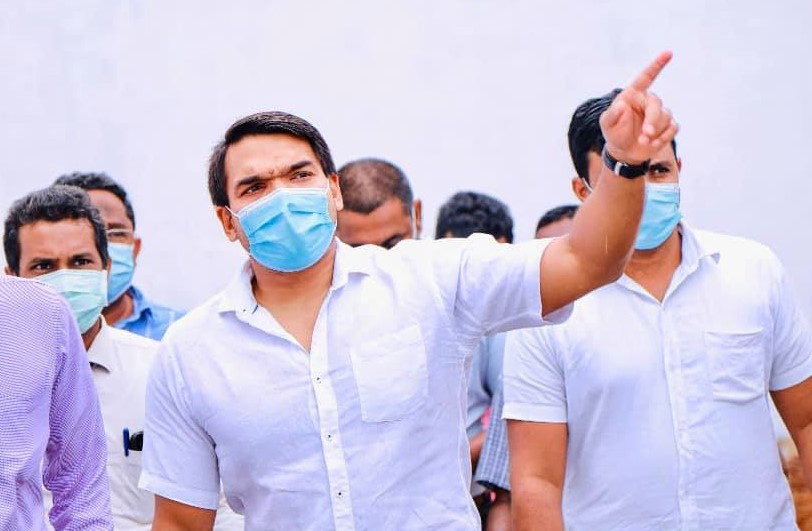
After the Rajapaksas decided to field a separate candidate on behalf of the SLPP, most of the parliamentarians of that party abandoned them and came to the side of the President. So even if the President is happy about the developments, he needs to really think about the number of votes each of them can bring to him.
Some observers say that because of the growing support for the President among the people in their constituencies, those members of parliament are abandoning the Rajapaksas and scrambling to support him. Even politicians who were staunch Rajapaksa loyalists say publicly that they have decided to back Wickremesinghe at the behest of their supporters who are increasingly turning towards him.
It seems that the President is conducting his campaign with an entirely different strategy declaring that he will campaign among the people by promoting the nation and not himself.
He says that he is not contesting the election against anyone and unlike other candidates, he is not contesting for his own political future but for the future of the country. He has announced that he is ready to work with all parties if he wins the election.
Earlier I invited Premadasa and Anura Kumara to come forward to work with me. But they turned it down. They may be worried about that now. Next time I will bring them into the government. Not only them, but also Namal Rajapaksa, the candidate of the SLPP,” he told newspaper editors and heads of media houses last week.
It seems certain that he is not going to attack any candidate in the election platform. Saying that the agreement with the International Monetary Fund (IMF ) is the only way to bring (IMF) Sri Lanka out of the economic crisis and lead it towards prosperity, he asks people to give him a mandate for the next five years to continue with the economic restructuring measures that his government has been taking forward for the last two years.
The President also points out that the other main candidates are also not opposed to the agreement with the IMF. They have openly said they would continue with it. He is not making any new promises and is seeking the mandate of the people to continue the same economic restructuring programme.
In addition, Wickramasinghe, who has presented himself as an independent candidate who can be supported by all parties without showing interest in party politics as the past, portrays himself as a new ‘avatar beyond party politics.’
If he Wickremesinghe wins he may be the first non-party President in Sri Lanka. But an important question is what impact the President’s current approach will have on Sri Lankan society, which has a political culture characterized deep party political rivalries and ethnic animosity.
After submitting their nomination papers at the Election Commission office last Thursday, the three main candidates made remarks to supporters and the media.
I seek the people’s mandate to create a bright future for the people of Sri Lanka. We took charge of the country and brought stability. You now have access to food, fuel and other essentials. This is just the beginning. There is a lot of work to be done to make Sri Lanka a stable nation. I request people to give me a mandate to carry out these tasks.”
When asked to take charge of the country at a time of crisis, members of the opposition ran away. Decide whether you are going to hand over the country to such people or not,” Wickremesinghe said.
The SJB leader Sajith Premadasa said that he will usher in an era in which the common masses will get priority as they did when his father, late President Ranasinghe Premadasa, was in-charge.
I promise to create an era of the common masses. I will create a situation where everyone living in the country can enjoy the benefits of development. I call upon the people to rally behind me,” he stated.
NPP leader Anura Kumara said that the people need a change and said that only their camp has the ability to bring about such a change.
He said: Despite the number of elections held in the past, the people suffered untold hardships for years. We can win this election. People want a change in the situation of suffering. We can turn this election to rescue people and the country from hardships. Only our camp can achieve that goal.”
Namal Rajapaksa is contesting in an attempt to rebuild the SLPP with his political future in mind. A significant aspect of Namal Rajapaksa’s entry is that a prominent member of the Rajapaksa family has entered the electoral fray after a popular uprising which ousted it from power.
No other member of the Rajapaksa family has any intention of contesting the Presidential election this time. At one point it was widely believed that supporting President Wickremesinghe was their best option. But after the President flatly refused to comply with their demands or conditions to secure their future political prospects, they decided to field a separate candidate.
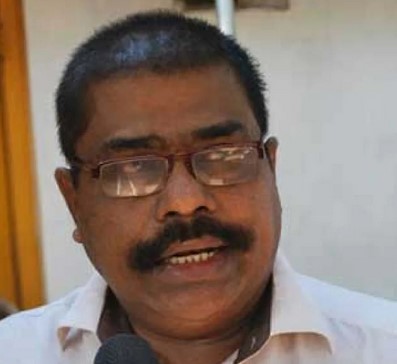
Before falling out with the President, it seemed that the Rajapaksas were subtly intimidating the President by the prospect of nominating the casino owner and leading businessman Dhammika Perera as their party’s candidate. The Rajapaksas’ attempt to use Dhammika and his money as a touchstone to test their current support among the people ultimately proved futile. He announced at the last minute that he did not want to contest due to personal reasons.
So the Rajapaksas were forced to field Namal Rajapaksa without any other option. Fearing that the SLPP’s vote base will be scattered if they do not contest the elections, the Rajapaksas have nominated Namal Rajapaksa to protect the party. But are the people going to vote to elect a new President or are they going to vote to protect the Rajapaksas’ party?
The Rajapaksas have a perverse idea that the Sinhalese people should be forever loyal to them regardless of their mistakes for ending the war.
At the same time, there is no doubt that the Rajapaksas will be inclined to repeat majoritarian mobilization against the political rights and aspirations of minority communities in order to garner as many votes as possible. But while all three main candidates, though may be for electoral purpose, are interested in reaching out to minority communities, it seems that the Rajapaksas’ communal rhetoric is unlikely to gain much traction with the Sinhalese this time around.
If Namal Rajapaksa, a young political leader who is nursing an ambition to lead the country in the future choses a non-communal path unlike the elders of his family, it will augur well for him. Will he be willing to change? At least he can show a change in his thinking on ethnic relations by announcing in his election manifesto a progressive stance on the implementation of the 13th Amendment to the Constitution.
Candidates of 23 political parties and 16 independent candidates are contesting the presidential election. Among them are leading politicians like former army chief Sarath Fonaseka, former Justice Minister Wijedasa Rajapakshe and new comer to politics Dilith Jayaweera, a leading media moghul. There is no doubt that they are contesting for other purposes than to be elected as President. Same is the case with most of the Independent candidates.
It also noteworthy that Nuwan Bobage, a lawyer, is contesting on behalf of the ‘People’s Struggle Alliance’, a movement formed by a faction of activists who were in the forefront of the ‘Aragalaya’ people’s uprising.
Meanwhile, some of the fundamental issues that usually dominate Presidential elections seem unlikely to get the attention of the main candidates this time around. In particular, it is not known whether the long-standing popular demand to abolish the Executive Presidential system will find a place in their election manifestos.
Regarding the Tamil problem, nothing else can be expected in the manifestos of the main candidates except for the declarations on implementing the 13 th Amendment to the constitution with vague positions on important powers such as police and land.
There are also politicians in the North who say that they can consider supporting any candidate from the South if they promise that they are ready to accept the Sri Lankan Tamil people’s right to self-determination and finding a solution to the ethnic problem based on a federal system. So much for their understanding of today’s political situation around them.
On the North and East political front , Pakiyaselvam Arianethiran, a former Batticaloa District Member of Parliament of the Tamil National Alliance is contesting as a common Tamil candidate put up by some Tamil parties and a newly formed civil body the Tamil National General Council .
But his appointment was contrary to all the criteria defined by the Tamil National General Council. Those who nominated Arianethiran say that he is a symbol of Tamil nationalistic political aspirations. He says that it is a symbolic duty which will end with election day. So there is no point in talking about him here.
It seems that hereafter Tamil people will not have leaders but only symbols if and when elections come.
මා ජනාධිපති වුනාම ඉන්ධන, විදුලි ගාස්තු අඩු කරනවා..ජනාධිපති අපේක්ෂක අනුර කුමාර දිසානායක
August 17th, 2024උපුටා ගැන්ම ලංකා සී නිව්ස්
ජාතික ජන බලවේගය ආණ්ඩුවක් යටතේ ඉන්ධන හා විදුලි ගාස්තු අඩු කරන බව එම අපක්ෂයේ නායක ජනාධිපති අපේක්ෂක අනුර කුමාර දිසානායක මහතා සඳහන් කරයි.
මේ වන විටත් ඊට අදාළ සැලසුම් සකස් කර අවසන් බවද බවද ඔහු කියා සිටියේය.
ගුණාත්මක ඖෂධ අඩු මිලකට ලබාදෙන සැලැස්මක්ද සකසා ඇති බවත් පැවසූ තම ආණ්ඩුවක් යටතේ පාසල් උපකරණ සඳහා පනවා ඇති භාණ්ඩ හා සේවා බද්ධ ඉවත් කර දමන බවද කියා සිටී.
ඉන් අහිමිවන බදු ආදායම උපයා ගැනීම සඳහා බදු ඉතාමත් සරල කර ඊට අදාළ බදු සැලැස්මක් සකස් කරන බවද හෙතෙම තවදුරටත් කියා පැවසුවේය.
ජාතික ජන බලවේගය විසින් තංගල්ල නගරයේදී සංවිධානය කර තිබූ ජනරැුලියක් අමතමින් ඔහු මෙම අදහස් පළ කරන ලදී.
අනුර දින්නාම විධායක ජනාධිපතිකම අහෝසියි.. විධායක බලය අරන් පාර්ලිමේන්තුවට..
ජාතික ජනබලවේග ආණ්ඩුවක් යටතේ විධායක ජනාධිපති ධුරය අහෝසි කිරීමට තීරණය කර තිබේ.
එයද අතුලත්වය ජාතික ජන බලවේගය ඉදිරි ජනාධිපතිවරණයට ඉදිරිපත් කරන ක්ෂේත්ර හතළිහක් ආවරණය වන ප්රතිපත්ති ප්රකාශනය එළඹෙන 26 වැනිදා එළිදක්වන බව ජනතා විමුක්ති පෙරමුණේ ප්රධාන ලේකම් ටිල්වින් සිල්වා මහතා සඳහන් කරයි.
පාර්ලිමේන්තුවට විධායක බලතල පවරමින් සියලුම ජාතීන්ට සමාන අයිතිවාසිකම් ලබා දෙන ප්රජාතන්ත්රවාදය තහවුරු කරන නව ව්යවස්ථාවක් නව ආණ්ඩුව යටතේ බිහි කරන බවද හෙතෙම කියා සිටියි.
‘පොහොසත් රටක් ලස්සන ජීවිතයක්’ යන තේමාව යටතේ මෙම ප්රතිපත්ති ප්රකාශනය ඉදිරිපත් කිරීමට සැලසුම් කර ඇතැයි ද පැවසූ ඔහු යහපත් රාජ්ය පාලනය, වංචා දූෂණ නතර කිරීම හා ජාතිවාදය නතර කිරීම ඇතුළු කරුණුවලට මෙහි ප්රමුඛකත්වය ලබා දී ඇතැයිද කියා සිටියේය.
රටේ ආර්ථිකය මුළුමනින්ම යථාවත් කිරීම සම්බන්ධයෙන් මෙම ප්රතිපත්ති ප්රකාශනයෙන් අවධානය යොමු කර ඇති බවත් කෘෂිකර්මය, කර්මාන්ත, ධීවර, වැවිලි හා ආයෝජනය අාදී ක්ෂෙත්රවලින් ආර්ථිකය දියුණු කරන්නේ කෙසේද යන්නද එහිදී අවධාරණය කරන බවද කියා සිටියේය.
මාලිමා ඇමතිලාට උපදේශක මණ්ඩලයකුත් පත් කරනවා…
ඉදිරියේ පිහිටවනු ලබන ජාතික ජන බලවේගයේ ආණ්ඩුවක කැබිනට් අමාත්ය දුර සංඛ්යාව විසි පස්දෙනකුට සීමා කරන බව එම පක්ෂයේ ජාතික විධායක සභික හිටපු පාර්ලිමේන්තු මන්ත්රී වෛද්ය නලින්ද ජයතිස්ස මහතා සඳහන් කරයි.
එම අමාත්යවරුන් සඳහා උපදෙස් ලබා දීමට වෙනම උපදේශක මණ්ඩලයක් පත්කරන බවද ඔහු සදහන් කරයි.
එම උපදේශකයන් අදාළ විෂයන් සම්බන්ධයෙන් විෂය ප්රවීණයන් වනු ඇති අතර එම අමාත්යංශයෙන් ඉදිරියේදී ගනු ගතයුතු ක්රියාමාර්ග සම්බන්ධයෙන් ඔවුන් විසින් උපදේශ ලබා දෙනු ඇතැයි ද කියා සිටියේය.
කොළඹදී එම පක්ෂය විසින් සංවිධානය කරන ලද සම්මන්ත්රණයකදී ඔහු මේ බව පැවසුවේය.
අනුර දැනටමත් දිනලා ඉවරයි.. ජනාධිපති කියන ලියුම ගන්න විතරයි තියෙන්නේ..
August 17th, 2024උපුටා ගැන්ම ලංකා සී නිව්ස්
සැප්තැම්බර් 21 වෙනිදා පැවැත්වෙන ජනාධිපතිවරණය සඳහා නාම යෝජනා භාර දෙන අවස්ථාව වන විටම තම පක්ෂයේ අපේක්ෂක අනුර දිසානායක මහතා ජයග්රහණය කර අවසන් බව ජනතා විමුක්ති පෙරමුණේ ප්රධාන ලේකම් ටිල්වින් සිල්වා මහතා සඳහන් කරයි.
සැප්තැම්බර් 21 වනදා සිදුකිරීමට ඇත්තේ අනුර දිසානායක මහතා ජනාධිපතිවරයා බවට පත්වන ලිපිය මැතිවරණ කොමිසම අතින් ලබා ගැනීම පමණක් බවද ඔහු සඳහන් කළේය.
ඉදිරි ජනාධිපතිවරණයේදී තම පක්ෂයේ ජයග්රහණය එතරම්ම ස්ථිර බවද ඔහු තවදුරටත් කියා සිටියේය.
ඒ මහතා මේ බව පැවසුවේ ජාතික ජන බලවේගය විසින් සංවිධානය කරන ලද තංගල්්ලේ ජනරැළිය අමතමිනි.
Mono ethmic villages
August 17th, 2024Sugath Kulatunga
The attention of readers with national interst is invted to the article on LBN by Dr.Sudath Gunasekera on the very important issue of the proposal to establish mono-ehnic villages in the Plantation sector. Relevant excerpts of the report are produced below.
What is worse is that while this Government treats the natives in this manner the same government has created a new Ministry called Ministry of Upcountry New Villages, Estate Infrastructure & Community Development only for estate Tamils and appointed P. Digambaram as its Minister, introducing a new type of Villages to this country called ‘Upcountry New Villages’ unheard in the annals of history in this country since the dawn of history. I also would like to point out at this stage that these were the very lands denied to the native Sinhala people who were evacuated in thousands from Kotmale and other landslide affected areas in the past to satisfy Thondaman. They were sent to the LTTE infested Dry Zone then. How come the present Government is generously handing over land denied to the sons of the soil to the Indian Tamils who should have been sent to India in order to create Tamil villages in the heart land of the Sinhale.
I am sure these Villages will be the future mono-Tamil villages referred to by Ra nil Wickramasingha and Kiriella during the pre-election period when they were handing over outright ownership of lands to estate Tamils. The ultimate result of this programme is the establishment of a separate Tamil country on the central Sri Lanka comprising Kandy, Matale, Nuwara Eliya and Badulla which will be extended to parts of Kegalla, Ratnapura and Monaragala districts in the near future. This is travesty and blatant violation and betrayal of the birth rights of the native Kandyan peasants. I am lost to understand as to why the Kandyan politicians and leaders, if there are any, do not protest against this selective discrimination against their own people.”
It is obvious that this is a political manoeuvre to win over planatation votes. It can turn into a misadventue similar to the failed MOU signed with the LTTE by RW as the then Prime Minister. The creation of mono ethnic Bantustans* will discourage ethnic integration which is a vital need for communal harmony in the region. The Government is adivised to learn from the policies of Singapore to achieve communal intergration in that country. An outstanding strength in the Singapore society is its communal solidarity which was deliberately promoted by the State. Minister for National Development in Singapore S. Dhanabalan warned that it would be unthinkable” for Singapore to regress to the days before independence, when a certain place was seen as belonging to a certain ethnic or dialect group.
Singapore established population based ratios for different ethnic groups in the allocation of flats. This policy has encouraged better understanding and harmony amongst communities. Such a rigid population ratio may not be appropriate in the proposed villages. But it is necessary that at least there is a fifty-fifty mix of communities in them.If this is not done these villages could become enclaves of seedbeds for communal agitation” and lead to a demand for an autonomus Malayanadu.
Sugath Kulatunga
*Bantustans = exclusive settlements for black Africans created by the Apartheid regime
Sri Lanka strongly object to construction of ‘Tamil Genocide Monument’ in Canada
August 17th, 2024Courtesy Adaderana
Sri Lanka’s Minister of Foreign Affairs Ali Sabry summoned the Canadian High Commissioner on Friday (16) to reiterate Sri Lanka’s strong objections conveyed on several occasions previously to the laying of foundation stone for the construction of a so–called Tamil Genocide Monument” at the Chinguacousy Park in Brampton, Canada on 14 August 2024, the Ministry of Foreign Affairs said.
Issuing a statement, the ministry stated that Foreign Minister Sabry emphasized that the Government of Sri Lanka categorically rejects this outrageously false narrative, which is being perpetuated for vote bank politics within Canada.
Minister Sabry noted that ill-advised action by the City Council of Brampton is offensive to all peace-loving people in Canada and Sri Lanka. The so-called allegation of a genocide in Sri Lanka is a fabrication based on malicious disinformation and is not substantiated by any responsible authority, nationally or internationally, the statement highlighted.
The Government of Sri Lanka has consistently engaged in efforts to foster reconciliation and build lasting peace following the end of the conflict despite the economic crisis in the country for the last two years, and such divisive action undermines those efforts by glorifying terrorism and sowing discord and mistrust which democratic countries, including Sri Lanka and Canada, cannot endorse, it added.
The Foreign Minister requested the Government of Canada to intervene and take action to prevent the construction of this monument in recognizing the damaging impact of this narrative on bilateral relations and to take immediate action to prevent further harm, according to the Ministry of Foreign Affairs.
INTERVIEW: Iranian retaliation is inevitable
August 17th, 2024George Galloway
If Iran does not respond the Israeli regime will only become more aggressive, says Prof Seyed Marandi. It’s a regime that only understands force.
මුල් වරට ශ්රේෂ්ඨාධිකරණයේදී ආරම්භ වන නඩු කටයුත්තකදී නියම කරන සිරභාරයට ගැනීමකට, දඩ සහ නඩු ගාස්තු නියෝගවලට එරෙහිව අභියාචනා කිරීමට “විශේෂ අභියාචනා ව්යවස්ථා සභාව” පිහිටුවන ලෙස ඉල්ලීමක්.
August 17th, 2024මාධ්ය අංශය, වෛද්ය තිලක පද්මා සුබසිංහ අනුස්මරණ නීති අධ්යාපන වැඩසටහන.
මුල් අවස්ථා අධිකරණයක් ලෙස ශ්රේෂ්ඨාධිකරණයේදී පළමු වරට ආරම්භ වන නඩු කටයුත්තකදී නියම කරන දණ්ඩනයකට, සිරභාරයට ගැනීමකට, අත් අඩංගුවේ තබා ගැනීමකට, රඳවා ගැනීමකට හෝ අන්යාකාරයකින් පෞද්ගලික නිදහස අහිමි කිරීමකට, දඩ මුදලකට හෝ නඩු ගාස්තුවකට එරෙහිව අභියාචනා කිරිමට “විශේෂ අභියාචනා ව්යවස්ථා සභාව” පිහිටුවීමට අවශ්ය පියවර ගන්නා ලෙස නීතීඥ අරුණ ලක්සිරි උණවටුන මහතා විසින් ජනාධිපති රනිල් වික්රමසිංහ මහතාගෙන්, අධිකරණ අමාත්යාංශය ලේකම් එම්. එන්. රණසිංහ මහතාගෙන් සහ නීතිපති ජනාධිපති නීතීඥ පාරින්ද රණසිංහ මහතාගෙන් අද දින (2024.08.16) ඉල්ලීමක් කර ඇත.
වර්තමානයේ පවතින නීති යටතේ මුල් අවස්ථා අධිකරණයක් ලෙස ශ්රේෂ්ඨාධිකරණයේදී පළමු වරට ආරම්භ වන නඩු ප්රමාණය වැඩි වී ඇති අතර එසේම එම නඩු වලදී තැනැත්තන්ට එරෙහිව මුල් වරට දණ්ඩනයකට, සිරභාරයට ගැනීමකට, අත් අඩංගුවේ තබා ගැනීමකට, රඳවා ගැනීමකට හෝ අන්යාකාරයකින් පෞද්ගලික නිදහස අහිමි කිරීමකට, දඩ මුදල් හෝ නඩු ගාස්තු නියම කිරීමටද ශ්රේෂ්ඨාධිකරණට අධිකරණ බලය හිමි වී ඇති බවත් එම ඉල්ලීමෙන් පෙන්වා දී ඇත.
එසේම පළමු වරට ශ්රේෂ්ඨාධිකරණයේදී ආරම්භ වන නඩු කටයුත්තකදී නියම කරන දණ්ඩනයකට, සිරභාරයට ගැනීමකට, අත් අඩංගුවේ තබා ගැනීමකට, රඳවා ගැනීමකට හෝ අන්යාකාරයකින් පෞද්ගලික නිදහස අහිමි කිරීමකට, දඩ මුදලකට හෝ නඩු ගාස්තුවකට එරෙහිව අභියාචනා කිරිමට අවස්ථාවක් මේ දක්වා නීතියෙන් ප්රතිපාදන සළස්වා දී නැති බවත්, මේ හේතුවෙන් ඇතැම් අවස්ථාවල විදෙස් අධිකරණ යාන්ත්රණ වල පිහිට පැතීමටද ඇතැම් තැනැත්තන් පෙළඹෙන තත්ත්ව ඇති අතර එය ශ්රී ලංකාවේ ස්වෛරීත්වයට, ස්වාධීනත්වයට, ශ්රී ලංකාවේ කීර්තියට සහ ජනතාවගේ පරමාධිපත්යයට අහිතකර තත්ත්වයක් බවත් ජනාධිපතිවරයාට, අධිකරණ අමාත්යාංශයේ ලේකම්ට සහ නීතිපතිවරයාට පෙන්වා දී ඇත.
එම ඉල්ලීමේ කරුණු සහ ජාත්යන්තර සම්මුති සහ මෙරට පවතින නීති සළකා බලා දැනට වසර 02කට පෙර සිට ඇතුළුව මුල් වරට ශ්රේෂ්ඨාධිකරණයේදී ආරම්භ වන නඩු කටයුත්තකදී නියම කරන ලද දණ්ඩනයකට, සිරභාරයට ගැනීමකට, අත් අඩංගුවේ තබා ගැනීමකට, රඳවා ගැනීමකට හෝ අන්යාකාරයකින් පෞද්ගලික නිදහස අහිමි කිරීමකට, දඩ මුදලකට හෝ නඩු ගාස්තුවකට එරෙහිව අභියාචනා කිරීමට “විශේෂ අභියාචනා ව්යවස්ථා සභාව” පිහිටුවන ලෙසත් ඒ සඳහා නීති කෙටුම්පත් කර පාර්ලිමේන්තුවට ඉදිරිපත් කිරීමට කඩිනමින් පියවර ගන්නා ලෙසත් නීතීඥ අරුණ ලක්සිරි උණවටුන මහතා ජනාධිපතිවරයාගෙන්, අධිකරණ අමාත්යාංශයේ ලේකම්ගෙන් සහ නීතිපතිවරයාගෙන් ඉල්ලා ඇත.
http://neethiyalk.blogspot.com/2024/08/blog-post.html?m=1
මාධ්ය අංශය, වෛද්ය තිලක පද්මා සුබසිංහ අනුස්මරණ නීති අධ්යාපන වැඩසටහන.
Government addresses key issues of the Civil Security Personnel
August 17th, 2024Ministry of Defence – Media Centre
The Civil Security Department (CSD), operating under the Ministry of Defence, has significantly contributed to ending the three-decade-long war and continues to play a vital role in ongoing development projects and society’s overall well-being.
Marking another leap forward, the government, under the direct intervention of State Minister of Defence Hon. Premitha Bandara Tennakoon, has decided, to provide labour support from the CSD for the construction of houses for the CSD members who do not currently own a house and for the repair works of existing houses.
Accordingly, during the initial stage, 100 CSD members will benefit from this initiative. In a press conference held at his office in Colombo yesterday (Aug 15), the State Minister announced this initiative and further stated that CSD members have been instructed to submit detailed applications to the Director General of the CSD. Arrangements will be made to provide the necessary facilities to members selected through specific criteria.
Furthermore, in response to the request from the CSD, the government has decided to increase the daily ration allowance from Rs. 350 to Rs. 500. Minister Tennakoon further stated that the above increase is implemented after considering the current economic climate in the country and that it will, to some extent, help the CSD members to stabilize their living conditions.
සිවිල් ආරක්ෂක බලකායේ සාමාජිකයන්ට රජයෙන් අත්වැලක්
August 17th, 2024Ministry of Defence – Media Centre
ආරක්ෂක අමාත්යංශය යටතේ ක්රියාත්මක වන සිවිල් ආරක්ෂක බලකාය පසුගිය තිස් වසරක කුරිරු යුද්ධය අවසන් කිරීමට සුවිශේෂී දායකත්වයක් දැක්වූ වර්තමානයේ මෙරට ක්රියාත්මක කෙරෙන සංවර්ධන ව්යාපෘති සහ සමාජයේ යහ පැවැත්ම උදෙසා අතිශය වැදගත් කාර්යභාරයක් සිදු කරනු ලබයි.
ඒ පිළිබඳ සැලකිල්ලට ගනිමින් සිවිල් ආරක්ෂක බලකායට අයත් සාමාජිකයන්ගේ සුභසාධනය වෙනුවෙන් රජය විසින් ක්රියාත්මක කෙරෙන වැඩසටහන් මාලාවේ තවත් සුවිසල් ඉදිරි පියවරක් සනිටුහන් කරමින් නිවසක් නොමැති සාමාජිකයන් හට නිවසක් ඉදිකර ගැනිමටත්, පවතින නිවාසවල අලුත්වැඩියා කටයුතු සිදුකර ගැනීමටත්, අවශ්ය කරන ශ්රම දායකත්වය සිවිල් ආරක්ෂක බලකාය වෙතින් ලබා දීමට රජය තීන්දු කොට ඇත. මෙහිදී පලමු අධියර යටතේ සාමාජිකයන් 100 දෙනෙකු සඳහා මෙම වැඩපිලිවෙල යටතේ සහන සැලසෙනු ඇති බව ආරක්ෂක රාජ්ය අමාත්යවරයා ප්රකාශ කලේය.
තවද, වසර ගණනාවක සිට සිවිල් ආරක්ෂක බලකා සාමාජිකයන් විසින් සිදු කල ඉල්ලීමකට ප්රතිචාර වශයෙන් ඔවුන් සදහා දැනට රු. 350ක් ලෙස ලැබෙන දෛනික සලාක දිමනාව රු. 500ක් දක්වා ඉහල නැංවීමට රජය තීන්දු කොට ඇත. රටේ පවතින ආර්ථික තත්වය හමුවේ ඔවුනට ලැබෙන දෛනික සලාක දීමනාව ප්රමාණවත් නොමැති බව සලකා බැලීමෙන් අනතුරුව මෙම සලාක දීමනා අගය වැඩිකිරීමට රජය තිරණය කර ඇති අතර, එමගින් යම් මට්ටමකට ඔවුන්ගේ ජිවන තත්වය ස්ථායි කර ගැනිමට පිටුවහලක් වනු ඇති බවද රාජ්ය අමාත්ය තෙන්නකෝන් මෙහිදී තවදුරටත් ප්රකාශ කලේය.
NASA cannot ensure the safe return of astronauts from the ISS
August 17th, 2024Lyubov Stepushova Courtesy Pravda
Russia can return stranded astronauts from the ISS, but a political solution is needed
NASA has postponed until the end of August a decision on when and how to return home two astronauts who are stuck on the ISS. The only safe option is on the Soyuz.
Photo: flickr.com by NASA Robert Markowitz is licensed under In the public domain in the United States
Boeing’s shame – Starliner engines failed to dock with the ISS
The problem arose with the Boeing Starliner carrier spacecraft, on which astronauts Butch Wilmore and Suny Williams launched to the International Space Station (ISS) in early June. Their expedition was supposed to be completed in a week, but has been going on for more than two months.
According to NBC news. com, this was the first flight of the Starliner, and if it had been successful, then the US National Aeronautics and Space Administration (NASA) would have been able to certify Boeing to perform regular flights to the ISS.
But five Starliner engines failed during docking. There was also a helium leak from the propulsion system during the flight – a problem that NASA was aware of, but Boeing did not finalize.
On top of that, a moratorium was imposed on astronauts on spacewalks – their spacesuits failed. According to reports, they live in conditions that are far from ideal: they lack places to sleep, they experience increasing psychological stress and health risks.
NASA is considering two options for rescuing astronauts
Two options for returning are considered:
- Solve problems with Starliner. NASA said that together with Boeing engineers, they disassembled and are testing the ship’s engine, similar to those in orbit. They are also trying to deal with the helium leak. For this, the laboratory also dismantled the service module. However, there is a risk – faulty Starliner engines can lead to a loss of control of the spacecraft immediately after undocking from the ISS, which can end in an accident.
- Use the Dragon spacecraft of rival Boeing company SpaceX, which is supposed to deliver new astronauts to the orbital station in September as part of the Crew-9 project. NASA said it could send two astronauts instead of the planned four, and land Wilmore and Williams on the empty two seats on the way back at the end of the Crew-9 expedition in February.
According to NASA, in this case, the Starliner will return to Earth without a crew. The main problem in this case is to ensure the life process of the astronauts and the equipment of the spacecraft.
The launch of the Dragon carrier to the ISS is scheduled for August 18, but there is no certainty that the launch will take place, since there are also technical problems.
The third option for saving the astronauts is to ask Russia
There is also a third option – to ask Russia to pick up the astronauts on the Soyuz. The head of Roscosmos, Yuri Borisov, during a speech at the Terra Scientia forum, said that space should be out of politics, so the Russian side is careful about maintaining interaction within the framework of the international ISS project.
“Today, American colleagues have problems with the Starliner, they do not know how to lower the crew. We are in constant dialogue with them,” Borisov said.
However, a political solution is needed in Washington. The National Space Council is headed by Vice President and now US presidential candidate Kamala Harris. She fears negative press coverage of the space disaster, so the decision will be postponed until after the election in November.
“The return of Williams and Wilmore aboard the malfunctioning Starliner would be too risky for her presidential prospects,” the New York Post believes.
In 2014, Boeing and SpaceX were awarded multibillion-dollar contracts to provide the U.S. space agency with flights to the ISS after the end of the space shuttle program in 2011. But so far they have not created a reliable carrier ship. The problems, as we can see, are with the engines. As a result, the United States had to rely on Russian Soyuz rockets for a long time to deliver crews. Now Dragon flies with a high degree of risk.
Related story: NASA Explained SpaceX’s Choice to Drop the ISS into the Ocean
NASA wants to abandon the use of Russian Progress transport spacecraft for cargo delivery
A decision was made on the controlled descent of the ISS from its orbit to Earth
Читайте больше на https://www.pravda.ru/science/2083974-nasa-starliner/
Capitalism, Mass Anger, and the 2024 Elections
August 15th, 2024by Richard D. Wolff Courtesy counterpunch
In the wake of his huge defeat on June 30, 2024, when 80 percent of voters rejected French centrist” President Emmanuel Macron, he said he understood the French people’s anger. In the UK, Conservative loser Rishi Sunak said the same about the British people’s anger, as Labor leader Starmer now says as the anger explodes. Of course, such phrases from such politicians usually mean little or nothing and accomplish less. Such leaders and their parties just keep calculating how best to regain power when they lose it. In that, they are like the U.S. Democrats after Biden’s performance in his debate with Trump and like the U.S. Republicans after Trump’s loss in 2020. In both parties, a small group of top leaders and top donors made all the key decisions and then organized the political theater to ratify those decisions. Even surprises like Harris replacing Biden are temporary departures from resuming politics as usual.
However, unlike Trump, the others missed opportunities to identify with an already organized mass base of angry people. Trump stumbled into that identification by saying loudly and crudely what traditional politicians treated as publicly unspeakable about immigrants, women, NATO, and traditional political taboos. That set the tone for Trump then doubling down by insisting he had won the 2020 election but had been cheated out of it. The mass anger of populations feeling victimized in their workaday lives found a spokesperson loudly claiming parallel victimizations. Trump and base grasped that together they might victimize their victimizers.
Whether or not they can politically exploit voters’ anger, no mainstream leader in the collective West, including Trump, seems actually to understand” it. They mostly see only as far as what they can plausibly blame on their opponents in the next election. Biden blamed Trump for a bad” economy in 2020, while Trump reversed the same blame over the last year and will shortly adjust to blaming Harris. Presidential opponents blame the other for the immigration crisis,” for inadequately protecting U.S. industry from Chinese competition, government budget deficits, and job exports.
No mainstream leader understands” (or dares to hint or suggest) that mass anger these days might be something more and different from any collection of specific complaints and demands (about guns, abortion, taxes, and wars). Even the demagogues who like to speak about culture wars” dare not ask why such wars” are hot now. Angry Make America Great Again” (MAGA) folks are notably vague and poorly informed as their critics enjoy exposing. Rarely do those critics offer persuasive alternative explanations for MAGA anger (explanations that are neither vague nor poorly informed).
In particular, we ask, might the anger that the MAGA movement enrolls express a genuine mass suffering that has not yet understood its cause? Might that cause be nothing less than the decline of Western capitalism and all it represents? If ideological taboos and blinders preclude admitting it, might that decline’s results—anxiety, despair, and anger—focus instead on suitable scapegoats? Are Trump and Biden, Macron and Sunak, and so many others competitively choosing scapegoats to mobilize an anger they misunderstand and dare not explore?
After all, Western capitalism is no longer the world’s colonial master. The American empire that succeeded the European empires has now followed them into decline. The next empire will be Chinese or else the era of empires will give way to genuine global multipolarity. Western capitalism is likewise no longer the world’s dynamic growth center as that has moved eastward. Western capitalism is clearly losing its former position as the self-confident, unified, ultimate power behind the World Bank, United Nations, International Monetary Fund, and the U.S. dollar as world currency.
In terms of global economic footprints as measured by national GDPs, the United States and its major allies (G7) comprise a total, aggregated GDP now that is already significantly less than the comparable aggregated GDPs of China and its major allies (BRICS). The footprints of the two global economic power blocs were roughly equal in 2020. The difference between the two footprints has been widening ever since and continues to do so. China and its BRICS allies are increasingly the world economy’s richest bloc. Nothing prepared the populations of Western capitalism for this changed reality or its effects. Especially the sections of those populations already forced to absorb the costly burdens of Western capitalism’s decline feel betrayed, abandoned, and angry. Elections are merely one way for some of them to express those feelings.
Western capitalism’s rich, powerful, and small minority practices a combination of denial and adjustment to its decline. Prevailing politicians, mainstream media, and academics continue to orate, write, and act as if the collective West were still globally dominant. For them and their ways of thinking, their global dominance in the second half of the last century never ended. The wars in Ukraine and Gaza testify to that denial and exemplify the costly strategic mistakes it produces.
When not denying the new reality, significant portions of Western capitalism’s corporate rich and powerful are adjusting their preferred economic policies away from neoliberalism toward economic nationalism. The chief rationale for that adjustment is that it serves national security” because it may at least slow China’s aggressiveness.” Domestically, the rich and powerful in each country use their positions and resources to shift the costs of Western capitalism’s decline onto the mass of their middle-income and poorer fellow citizens. They worsen income and wealth inequalities, cut governmental social services, and harden police behaviors and prison conditions.
Denial facilitates the continued decline of Western capitalism. Too little is done too late against problems not yet admitted. Deteriorating social conditions flowing from that decline, especially for the middle income and the poor, provide opportunities for the usual right-wing demagogues. They proceed to blame the decline on immigrants, foreigners, excessive state power, the Democrats, China, secularism, abortion, and culture war enemies, hoping thereby to assemble a winning electoral constituency. Sadly, left-wing commentary focuses on refuting the right’s claims about its chosen scapegoats. While its refutations are often well-documented and effective in media combat against right-wing Republicans, the left too rarely invokes explicit, sustained arguments about mass anger’s links to declining capitalism. The left fails sufficiently to stress that government regulators, however well-intentioned, have been captured by and subordinated to specifically private capitalist profiteers.
The mass of people therefore became deeply skeptical about relying on the government to correct or offset the failings of private capitalism. People grasp, often just intuitively, that today’s problem is the merger of capitalists and government. Left and right increasingly feel betrayed by all the promises of center-left and center-right politicians. More or less government intervention has changed too little in the trajectory of modern capitalism. To growing numbers, politicians of the center-left and center-right seem equally docile servants of the capitalist-government merger that constitutes modern capitalism with all its failures and flaws. Thus today’s right succeeds if, when, and where it can portray itself as not centrist, its candidates explicitly anti-centrist. The left is weaker because too many of its programs seem still linked to the idea that government interventions will correct or offset capitalism’s shortcomings.
In short, mass anger is disconnected from declining capitalism in part because left, right and center deny, avoid, or neglect their link. Mass anger does not translate into or yet move to explicit anti-capitalist politics in part because too few organized political movements lead in that way.
Thus, Rachel Reeves, the Chancellor of the Exchequer in Britain’s new Labour Party government—its top financial officer—blithely announces, There is not a lot of money there.” She prepares the public—and preemptively excuses the new government—for how little the new government will even try to do. She goes further and defines her key goal as unlocking private investment.” Even the words she chooses mirror what the old Conservatives want to hear and would themselves say. In declining capitalisms, electoral changes can and often do serve to avoid or at least postpone real change.
Chancellor Reeves’s words assure major corporations and the 1 percent they enrich that Starmer’s Labour Party will not heavily tax them. This matters since it is precisely in major corporations and the rich that a lot of money” is located. The wealth of the top 1 percent could easily fund a genuinely democratic rebuilding of a seriously depleted post-2008 UK economy. In stark contrast, the typical Conservative programs prioritizing private investment are what got the UK to its present sad state. They were the problem; they are not the solution.
The Labour Party was once socialist. Socialism once meant a thoroughgoing critique of the capitalist system and advocacy of something totally different. Socialists sought electoral victories to win government power and use it to transition society to a post-capitalist order. But today’s Labour Party has thrown that history away. It wants to administer contemporary British capitalism just a bit less harshly than Conservatives do. It works to persuade the British working class that less harsh” is the best they can hope and vote for. And British Conservatives can indeed smile and condescendingly approve such a Labour Party or else quibble with it over how much harshness today’s capitalism needs.”
Macron, also once a socialist, plays a similar role in France. Indeed, so do Biden and Trump in the United States, Justin Trudeau in Canada, and Olaf Scholz in Germany. All offer administrations of their contemporary capitalisms. None have programs aimed at solving modern capitalisms’ basic, accumulated, and persistently unsolved problems. Solutions would require first admitting what those problems are: cyclically recurring instability, increasingly unequal distributions of income and wealth, monied corruption of politics, mass media, and culture, and increasingly oppressive foreign policies that fail to offset a declining Western capitalism. Insistent denial across the collective West precludes admitting those problems, let alone fashioning solutions to them woven into programs for real change. Alternative governments administer; they dare not lead. Would a Kamala Harris-Tim Walz regime break with this pattern?
Their administrations will experiment with and perhaps oscillate between free-trade and protectionist policies—as past capitalist governments often did. In the United States, recent GOP and Democrat steps toward economic nationalism remain vote-seeking exceptions to still widespread commitments to neoliberal globalization. Western megacorporations, including many based in the United States, welcome China’s new role as the global champion of free trade (even as it retaliates moderately against tariffs and trade wars initiated by the collective West). Support remains strong for negotiations to shape generally acceptable global divisions of trade and investment flows. The latter are seen as profitable as well as a means to avoid dangerous wars. Elections will continue to include clashes between capitalism’s free-trade and protectionist tendencies.
But the more fundamental issue of 2024 elections is mass anger in the collective West aroused by its historic decline and the effects of that decline on the mass of average citizens. How will that anger shape the elections?
The more extreme right wing recognizes and rides the deeper anger without, of course, grasping its relationship to capitalism. Marine Le Pen, Nigel Farage, and Trump are all examples. They all mock and deride the center-left and center-right governments that merely administer what they depict as a sinking ship that needs new, different leadership. But their donor base (capitalist) and long-standing ideology (pro-capitalist) block them from going beyond extreme scapegoating (of immigrants, ethnic minorities, heterodox sexualities, and foreign demons).
The mainstream media likewise cannot grasp the relationship of mass anger to capitalism. Thus they dismiss the anger as irrational or caused by inadequate messaging” from mainstream influencers. For many months, mainstream economic pundits have bemoaned the strange” coexistence of a great economy” and polls showing mass disappointment at the bad” economy. By strange” they mean stupid” or ignorant” or politically-motivated/dishonest”: sets of words often condensed into populist.”
The left is jealous of the extreme right’s significant mass base now in working-class areas. In most countries, the left has spent the last many decades trying to hold on to its working-class base as the mainstream’s center-left movement pulled it away. That meant a greater or lesser shift from communist and anarchist to ever more moderate” socialist and democratic affiliations. That shift included downplaying the goal of a comprehensively different post-capitalism in favor of the immediate goal of a state-fostered softer, humane capitalism where wages and benefits were greater, taxes more progressive, cycles more regulated, and minorities less oppressed. For that left, what mass anger it could recognize flowed from failures to achieve such a state-fostered softer capitalism, not from Western capitalism’s decline.
As capitalism’s dynamic center moved to Asia and elsewhere in the global South, decline set in among its old, more-or-less abandoned centers. Old center capitalists participated in and profited greatly as the system relocated its dynamic center. Capitalists, both state and private, in the new centers profited even more. In the old centers, the rich and powerful shifted the burdens of decline onto the masses. In the new centers, the rich and powerful gathered the new capitalist wealth there mostly into their hands but with enough trickling down to satisfy large portions of their working classes. That’s how capitalism works and always has. For the mass of employees, however, the ride upwards when capitalism’s dynamic center is where they work and live is far more pleasant and hopeful than when decline sets in. The ride down provokes depression and traumas. When they fester without admission or discussion, they often morph into anger.
Richard Wolff is the author of Capitalism Hits the Fan and Capitalism’s Crisis Deepens. He is founder of Democracy at Work.
Sri Lanka is Not Bangladesh: Why Bangladesh Aragalaya is Nine (9) Times More Violent Than Sri Lanka?
August 15th, 2024Dilrook Kannangara
Comparing Bangladesh and Sri Lanka is wrong. The level of violence and ethnic composition are totally different in the two nations. Sri Lanka was economically bankrupt, had given up repaying loans and had 2 years and 1 quarter of negative economic growth when Aragalaya commenced. On the other hand, the Bangladeshi economy was doing far better when its people rose. However, there is one key similarity between violent sections of both countries during their struggles.
A disproportionately large number of violent people in Sri Lanka’s Aragalaya belonged to a certain creed and they are the ones causing all violence in Bangladesh too. The brutal decapitation and killing of a MP while chanting extremist religious chants, burning buses and beating rival people in Slave Island, burning some houses and businesses belonging to certain politicians and assaulting state television employees were carried out by this group of people. Among the arrested for violence in 2022 there is a disproportionately large group of people belonging to this particular creed. Over 90% of Bangladesh is made up of them too. That’s the main reason for Bangladesh’s extreme violence.
Sri Lanka gained Independence without bloodshed and violence where Bangladeshi Independence was marked by extreme violence by all sides. Since Independence a number of leaders were killed and the military took over power in Bangladesh further expanding its violent past.
What is most concerning is the violent future of Bangladesh. Extremist groups have already targeted ethnic Hindus and they have made it clear they will contest planned elections. If free and fair elections are held, extremists will make a grand entry into Bangladeshi parliament. The difference in the scale of violence in Sri Lanka and Bangladesh is of a factor of 10% to 90% for this reason. That is nine (9) times. Fortunately, Sri Lanka is not that unfortunate as Bangladesh which led to a peaceful transition of power once the three main slogans of Aragalaya people were met
COVID 19 POLICY – THE BREACH OF SOCIAL CONTRACT BETWEEN MAN AND STATE
August 15th, 2024Manuka Wijesinghe.
Quo vadis domine? ‘Where are you going, Lord?’, Peter asks the risen Christ whom he meets along the Appian way. ‘Romam eo iterum crucifigi’, Christ replies. ‘I am going to Rome in order to be crucified again.
While Christ sacrificed his life for the love of man, we live for the love of man. We live for the fulfillment of executing the simple rites and duties of the human family to which we belong. We are glad when life offers us the opportunity of caring for parents, children, spouses, siblings and community. The pinnacle of our Asian human experience is the fulfillment of duty according to the values embedded in our tradition. We are able to identify and differentiate between the roles of kinship. We are not free-floating individuals soaring on the wings of self-centred hedonism, rather, are born to live a specified life. We are deeply interconnecting to the unit of the family which is fortified and sustained from the happiness we give others and get from others. The units of family, community are not based on written constitutions; but founded on generations of trust. And, it is that trust we extend to our elected governments and public institutions. We humans do not need government or institutions to exist, but institutions and government need us.
It is this trust which was abused when the Covid narrative unfolded.
It is because of misplaced trust that most citizens, (even the rural Sinhalese and all Tamil, despite a post independent history of being deceived, tortured, killed and disappeared by the hands of state authorities) believed the narrative told by the same authorities and collectively, without least objection, obeyed the inhuman and perverse commands of social distancing, masking, testing and finally, having obeyed the ludicrous, unscientific and irrational commands of political and institutional authority, flocked to parks, temples and schools to get themselves injected with a substance, whose efficacy was uncertain but worse still, whose toxicity was unknown.
Trust is the Achilles heel of the human animal.
It was trust that made these people believe that the Polymerase Chain Reaction (PCR) test method was the gold standard for disease. The word wide web had sufficient material indicating otherwise, where even the inventor of the PCR test, Kerry Mullis says, ‘The PCR test doesn’t tell you are sick. These tests cannot detect free infection viruses at all’. Nonetheless, the majority did not inquire. They assumed that public authorities were of the same human family.
One cannot expect a populace with no medical knowledge to inform themselves on the questionable safety of this new technology using lipid nano particles containing synthetic RNA, for the purpose of herd immunity, for an uncomplicated viral infection, projected as an apocalypse, by an unelected non-governmental international organization; the World Health Organization (WHO).
The WHO, since its inception has succeeded, not in bettering human health, but transforming the healable acute into a progressive chronic. Thus, while making man more diseased it has escalated the profits of pharmaceutical giants whose objective is the generation of profit through new diseases whose management requires new drugs which, in eventuality, will destroy vital organs and the mind.
When death does come, one is long dead, in body, mind and spirit, through drug poisoning.
For whom do our health institutions work? For the public or for drug cartels? Well, the last years have proven that it has not been for the public. Instead, like good pied pipers; politicians, public institutions and health officials have parroted the number theories and mortality conjectures materialized by the WHO and its collaborators.
Yet, is this something new?
A recent film by Martin Scorsese, (coincidentally or intentionally, it was released immediately post covid vaccine rollout) ‘Killers of the flower moon’, is about the cruel fate of the native American Osage community of Oklahoma in the Americas. Having had their native lands seized by white settlers, they were driven into a rocky reservation around Oklahoma with the assurance that they could reap the profit of this assumed wasteland. But this wasteland proved to have oil. Soon, the plan for the acquisition of Osage terrain was hatched. First, they began poisoning them with a diet that was toxic to the Osage, causing the tribe’s youth to develop diabetes. Then, the same white settlers who caused the disease, gave them the medicine that killed them. It was a master plan to acquire the land and its oil. Coincidentally, it is the same people who are now trying to acquire the earth from all of us. With wars, regime changes, coups, sanctions and poisons marketed as drugs and preventives.
For example, why is it, that in the Kandy hospital, there has been a sudden surge of extremely malignant, rapidly proliferating turbo cancers* amongst its doctors?
Could its cause be the fact that Kandy hospital’s doctors and medical students were given the Moderna vaccine? Moderna was the most lethal of vaccines in the Covid market, its lipid nano particle content more than treble than that of Pfizer and has been categorized as the most lethal of all vaccines.
Why do the young and healthy suddenly fall down dead with cardiac arrest? Why is there a surge in blindness, deafness, sepsis, myocarditis, turbo cancers, thrombosis, strokes etcetera? Is the vaccine not the only common denominator of the last four years? Why is there a hush instead questions? Where are the voices of those lock down and vaccine advocates, doctors, virologist and pharmaceutical ombudsmen now, in the light of the immense proliferation of strange and inexplicable disease without known aetiology? Why are they silent? Should they not, instead, be holding a public inquiry regarding all the Covid 19 policies, both preventive (social distancing, testing and masks) and curative (vaccines)?
Are they answerable to us, or to international drug cartels?
What is Long Covid? Have those who seem reaffirmed pronouncing their sufferance through ‘Long Covid’ ever inquired if such a disease does exist? There is no scientific paper written by any serious scientist proving the existence of ‘Long Covid’ caused by a natural virus. ‘Long Covid’ is a placating name given to a collection of symptoms caused by vaccine side effect. It is only the vaccinated who can claim it.
Due to the sudden appearance of heart ailments in children, today, in the nation’s schools, children are instructed to take an ECG test prior to sports events. Indeed, it is good to take precautions, but how often does a child not run outside of sports events? Would he not run to catch a bus, a ball, run between wickets in a neighborhood cricket match? Is he expected to do an ECG prior to play? Or, has the current smart digitalized parenthood which permitted politicians to mask and imprison their children think play is no longer a child’s prerogative?
I recollect the sinister prophecy of Somalatha Subasinghe’s famous play ‘Vikurti’. The drama of a talented young girl whose passion was dance and drama. Her mother forbade her from doing what she loved for the want of having a daughter who would make her proud by becoming a doctor. For that, she wanted her to study, not sing, dance and act. ‘Vikurti’ ends with the girl’s mental derangement.
Is play not a child’s nature? Is it our preferred choice that they go mad?
Would it not be far more advisable to create a medical task force to understand the impact of the damage caused by vaccines and find a synthesis with our traditional medical systems to ameliorate the dangers to the nation’s youth? Are they not our future?
Alas, that is not of interest to the person prescribing the ECG. The ECG is far more profitable to the minister recommending it, the agent selling it and perhaps the school bureaucracy recommending it. For it is this institution; the school, which has been most evil in the last years. We had no vaccine mandate, yet schools refused entry to unvaccinated children. That is inexcusable and an unpardonable crime and every one of those principles who forced it must be held accountable. They have committed a crime against our children.
Children did not die of Covid. It was never a threat to them. But, they were injected with the genetic manipulating Pfizer vaccine. Studies have to be done over generations to understand what mutations genetic engineering may cause and how fertility may be affected. While parents received the comparatively non-dangerous Chinese and Russian vaccine, all our children were given the most dangerous western product; Pfizer. Not once, but twice; in adult doses.
Our children were forcibly inoculated by the orders of principals, teachers and the teacher’s unions for the fear that children could infect them. Had our grandmothers been afraid when a child came home with infectious diseases? No. It was they who looked after children while mothers went to work. When in human history has man sacrificed children to save himself? Today, children suffer, not only from heart diseases, but also from cancers, neurological disorders and infertility. The list of young girls whose menstruation has stopped is countless. And not to mention inflammation of testicles. Have our children been rendered sterile?
Naomi Woolf, in her book ‘Facing he Beast’, written after studying the Pfizer documents writes, ‘Reproduction itself is targeted by the mRNA vaccines, and babies and foetuses are harmed at a scale which everyone at Pfizer and the FDA (Food and Drug administration), who read these documents knew’.
That the vaccine was ‘safe and effective’ for the pregnant was pronounced after a study of forty four French rats. The scientist who ran the study were shareholders and employees of BioNTech Pfizer.
Will our children ever have the simple human joys, like we did, in having children? Most unlikely.
Was this vaccine another euphemism for birth control? An African leader is attributed to saying, ‘They (meaning the white colonial settlers) came to our lands, put the bible into our hands and taught us to close our eyes and pray. When we opened our eyes, we had the bible, they had the land’
Is this not happening again, or, has it ever stopped happening?
If not, which sublime idiot (WHO) orders medical intervention on children with products whose toxicity has not been tested, especially for the ridiculous ideal of preventing an airborne virus which is easily conquered by the essential genius of the human immune system. In the zeal of obliging colonial masters (who compromise the WHO) we have injected our children with irreversible damage and instead of holding an inquiry or conferring liability upon those who enforced these new technologies we move from one crisis to another, distracting ourselves from the foundational ingredient of human life; Health, and the highest of human virtue; Truth .
Khalil Gibran, the Lebanese poet wrote in his poem titled ‘On Children’,
‘Your children are not your children; they are the sons and daughters of life longing for itself. You may give them your love, but not your thoughts, for they have their own thoughts. You may house their bodies but not their souls, for their souls will dwell in the house of tomorrow’
We have taken from our children their tomorrow. Do we have no more ethical or moral demeanor? Do we truly not care? Children have been entrusted to a society for care. Is it not our joint responsibility to ensure their safety, both physically and mentally?
Instead of doing so we have merely followed imperial orders. We shut their schools and muzzled them with carcinogenous masks. Do not believe that we are free from colonial yoke. We are as enslaved as we have always been. Our minds captured by their myths for their economic empowerment is founded upon the enslaved native. Despite grand education and the triumph of Independence, we are still that native.
This killer virus narrative has been tried for several years, with AIDS, Mad cow, Swine Flu, Bird Flu, Ebola, Zika and many more, but it was only by 2019, with Covid that all the actors and collaborators, like building blocks, were in the right places and the integrity of every public institution and media station had been forsaken.
The false narratives were boosted by the media. Sick bodies in crowded wards, throats slit to fix ventilators, military trucks transporting bodies to crematoriums. Like a still life painting limited to the boundaries of its frame, reality was compressed into newspaper headlines and television announcements. Truth, existing out of the picture frame was excluded. It did not say that those hanging on ventilators were the aged with multiple drug related co morbidities and suffering terminal cancers, emphysemas, pneumonias and other chronic pathologies. Nor did it convey the verity of the military trucks. Nor did it say that medical doctors had been given new Covid treatment guide lines that were contra indicated to viral infection treatment and drugs and remedies that were known to ameliorate viral pathologies had been delisted and forbidden.
That was the fate of Ivermectin and Hydro chloroquine. The WHO orchestrated a narrative through a flawed scientific publication that indicated its lethality. The lethality was caused, not for the toxicity of the drug, but for WHO scientist giving a lethal dose of 3000 mg. There were plenty of scientific papers, since decades, indicating success by treatment of a regular doses of 50 or 60 milligrams. But the WHO did not want an old drug, it wanted a new technologies to render populations impotent and diseased. In our country, our children were made its first victims.
Yet, all this is not new, it had been tried over and over again, since the birth of microbe theory, but its prologue was AIDS.
The death of emaciated homosexuals was a god given chance to the drug cartels of the United States of America; a settler colony like Israel, which creates nation through the decimation of indigenous population.
One of their scientist prophets, targeting the Nobel prize (a prize that is more sensational than of intrinsic value to the human race) came up with a fabricated theory that the virus HIV was the cause of AIDS. Furthermore, although there was no evidence of AIDS being transmitted sexually it was proclaimed to be a sexual disease, contracted through touch, kiss, exchange of semen or even use of toilet seats.
But what was AIDS?
Did AIDS have a specific symptom that differentiated it from other diseases?
Had the modern microbe hunters (scientist) discovered a specific AIDS virus?
Negative. AIDS was not a particular disease but a name given to a series of symptoms that appeared simultaneously in the homosexual milieu. The symptoms that corroborated to become AIDS was Kaposi’s sarcoma, pneumonia (caused by Pneumocystis Carinii), tuberculosis and shingles.
Acquired immune deficiency syndrome or AIDS, as it became commonly known, was a range of symptoms that one would find in chemotherapy patients. It was only in the 1970’s, that these symptoms were seen in another population group; homosexual men without cancers. Though many commonalities existed between these men, like the consumption of recreational drugs, only sexual promiscuity was taken as a common denominator and a test was devised (like the PCR of today) to identify their microbes. HIV won the race.
Though HIV negatives had all had all symptoms of AIDS too, it was delisted. The sensation was greater with a ‘one disease, one virus’ marketing campaign. In this marketing campaign, HIV positives were given the death sentence. The campaign did not end with homosexuals, it was proclaimed that they would pass it to heterosexual lovers who would pass it onto their female lovers, wives and prostitutes. Eventually, all of humanity would be dead. In the meantime, the scramble for a drug that could be marketed as a dual pack (HIV positive equals AIDS) began.
Yet, that what was the world was not informed of was that these homosexuals were those who used the recreational drug known as ‘Poppers’, made from nitro glycerides that dilated the anal sphincter, thereby making sexual pleasure easier and longer. ‘Poppers’ was a recreational drug among the US homosexuals. The damage and degeneration caused to the capillaries by the uninhibited usage of ‘Poppers’ became evident in the appearance of Kaposi’s sarcoma lesions on their skin. This and the regular appearance of a strain of pneumonia which afflicted only on the severely immune compromised, (which happened with the use of Poppers) were summed together and called AIDS. Acquired Immune Deficiency Syndrome.
Immune deficiency was uncommon to the majority which lived within prescribed behavioral norms. That it was not anal sex but the use of sexual stimulators which caused AIDS was not divulged to the masses. Instead, they were mentally tortured with the lie that HIV positive was the prerequisite for AIDS, emaciation, and gradual death after an incubation period of zero years to ten or more.
The Long incubation theory was good for drug profits. A highly toxic drug, Azidothymidine (AZT) developed by the head of the US National Institute of Allergy and Infectious disease (NIAID) Anthony Fauci (who was the prophet of the covid narrative too), at exorbitant cost, was administered to all HIV positives, even if they were perfectly healthy. (like PCR positive and Corona)
AZT could not have cured AIDS for AIDS was not a disease. AIDS was caused by lifestyle choices, not by nature. AZT should have landed in the dustbin of pharmaceutical discoveries, but it was hyped (like the Covid vaccines) and sold to thousands of healthy HIV positives. Every one of them who was given AZT is now dead, killed by leukemia like morbidities caused by drug toxicity. Those who survived, such as Magic Johnson, discontinued the drug. Rock Hudson, who gave AIDS a face, was a heavy ‘Popper’ user. And, it was never made public that his longtime sexual partner had no AIDS. AIDS was never a sexually transmitted disease. It was a creation of recreational and pharmaceutical drugs.
Then, a WHO led public smear campaign, associating Africa with promiscuity, sexual savagery and excess hedonism, took AIDS to Africa. When the then Sunday Times medical correspondent flew to Africa to study AIDS, the answer he got from all, to nature of their disease was the one word, ‘AIDS’ But, when he studied the nature of African Aids, what he found was tuberculosis, chronic diarrhea, malaria, leprosy, malnutrition etc. He concluded the article saying, ‘all these diseases had been known in Africa for ages. But, in the new hype of pharmaceutical scramble preceded by fear mongering, every disease that had existed since the birth of human time was called ‘AIDS’
AIDS was not a new disease; it was merely rebranding of old disease. It was the same with Corona. A cough, a cold, the loss of taste was called Corona. And, the positive PCR established the lie. PCR’s efficacy in detecting infection was notoriously fallacious, even its founder, the Nobel laureate Kerry Mullis stated, ‘To get some big numbers for HIV positive cases in Africa before they realized that antibodies to malaria – which everyone in Africa has – show up as PCR positive tests’.
And, it is happening, in our country, again. Open the daily newspapers, ‘AIDS on the rise’, is a favourite front page headline. It is not AIDS that is one the rise, it is testing that is one the rise for obviously someone somewhere is trying to make a quick buck as long as virus mania is rampant.
The harm caused by vaccines are unsurmountable and can no longer be misinterpreted. Yet, many still love to use the euphemism of ‘Long covid’ to rationalize side effects of post covid jab. Why is man so reluctant to articulate the truth? I was recently was in the company of a couple, both Covid jabbed for the purpose of foreign travel where the husband, since the jabs suffers regular respiratory disease symptoms. Knowing their vaccination history, I pointed to the vaccination cause of this chronic malady and was about to suggest a path of amelioration when his wife attacked my hypothesis and manifested her own. ‘He gets these coughs because he doesn’t wear a mask when he takes the lift to his office’.
This person is 64 years old. He has gone in many lifts. Until the age of Covid, the lift has not caused respiratory disease in him or any other.
Few understand science as few understood God. God was created for the purpose of men becoming better through transcendental truth and science was created for men to near empirical truth. But, the supposed science of today is not truth, it is dogma. Scientific standards and jargon are used to deceive a public long disinterested in the pursuit of truth, but embroiled in the pursuit of digital sensationalism, identity politics and fake social justice theories that separate the ‘I’ from the world in which it lives.
Man is no longer a pilgrim upon a spiritual journey called life, but a puppet on a string in the Age of Disinformation.
Have we ever bothered to inquire as to why mankind suffers from disease that were rarely a topic before the emergence of the free market economy in our country? Then, except for acutes, we barely had chronic disease. Today, we are animated textbooks of chronic disease. Be it diabetes, asthmas, allergies, autism, auto immune diseases and cancers. Doctors and health care pundits claim that these have been caused by life style changes, but is it not equally probable that they have been caused by drugs?
For many in our country, popping a Panadol for painless sleep is like a faithful saying a prayer at night. But, while prayer does not damage the liver, Panadol does. Why do so many women suffer fatty livers? We are not a nation female alcohol consumerism. Why are so many children on brain changing psychiatric drugs? What is this child’s prognosis in five, ten, fifteen years when his liver cannot cope with detoxification and his brain gets the sluggishness and senility of a liver cirrhotic? Have parents ever question the damages they cause to their children by giving them Ritalin?
A friend recently said to me that his grandfather had little wound on his ankle that always opened. When he asked him why he did nothing about it, the grandfather’s repones was, If I close it here it will come out somewhere else, here I can see it and manage it, if it goes elsewhere, it can be fatal’.
Had men of yesteryear greater wisdom than men to today, even without universal education and access to prestigious foreign universities? ‘They put the bible into our hands and taught us how to pray, when we opened our eyes, we had the bible, they had the land?’ Is that what has happened to us?
We have learned their methods and lost our insight and common sense? Do we know what medicines we get when are treated for cancer? Do we know what drugs are sold to our free national health care system? Do we know what commissions are gifted to authorities for passing drugs which have never been approved? Have we ever asked if nature or allopathic drugs cause the need for kidney dialysis? Have we ever asked young mothers, what vaccine caused the personality change of their children, which was gladly diagnosed as Autism?
As Ivan IIlich writes in his book, the ‘Medical Nemesis’, ‘Before, he who got sick could still find in the eyes of the doctor a reflection of his own anguish and some recognition for the uniqueness of his suffering. Now, what he meets is the gaze of a biological accountant engaged in the input/output calculations.’
Quo vadis Domine?
Kanthi returned to be crucified the second time. With the first vaccine she got a turbo cancer. Its medical cure caused epileptic seizure. They killed her. Jesus fortunately left no children; he had the freedom to return to Rome to be crucified the second time. Kanthi could not. She had two young sons. A poor widow of 45 years from Obeysekera town in Colombo. Her mother wailed as the cortege was carried for cremation. Kanthi was her only daughter.
A human life is not born from artificial intelligence, it is born into the unit of the family; the hearth of trust, loyalty, reverence and duty. Kanthi was unable to fulfill her duty, either to her children or to her mother. She died crying, not for the sorrow of death, but the sorrow of unfulfilled duty. Her husband met an equal fate. He died from a sepsis that was left untreated until PCR test clearance. It was negative. By then, his organs had packed up and he died.
‘Death caused outside hospital waiting for PCR result’, which journalist dared to write such an article? Which newspaper cared to publish such an article? And why not?
It is not silence we need; it is a public inquiry and policy that makes every public official accountable to the crimes he commits against the human race. The WHO is in the wings, preparing for its ‘One Health’ plan; a power grab in the form of a ‘Pandemic Preparedness Treaty’. To abort that, we must be prepared, vociferous and brave. For should our representatives ratify it, the WHO would transition us from dictatorship to totalitarianism; the Ideology made up of Lies.
Manuka Wijesinghe.
August 13th 2024
*turbo cancers is a word created to describe the rapid proliferation of malignant cells, seen after Covid’s mRNA vaccines.
PAKISTAN: Tehreek-er-Lebbaik (TLP) Extremists Openly Threaten Ahmadis.
August 15th, 2024by A. Abdul Aziz
Reports reaching us indicate, the London based International Human Rights Commission (IHRC) is again calling the attention of International Community to intensifying threats against the Ahmadi citizens in Pakistan. Enjoying virtual immunity from official sanction, and magnified by viral social media posts, hatred for Ahmadis has become a form of mass hysteria.
An example of illegal; incitement to violence may be found in the following speech now widely circulated in a video.
Whoever feels sympathy for Qadianis should take them to their home. If Chief Justice feels sympathy for them, he should take them to their home. If anyone from the administration has sympathy, he should take them to his home. You talk of preaching, By the God of Holy Kaba, we will make life hell for them in District Okaraa.
Why are you feeling so sympathetic towards Qadianis?
Preaching aside, we are compiling their data wherever the Qadianis are living and soon we will tell them how we allow them to preach.!
They will be forced to leave their, let aside do preaching.
We are Ahl e Sunnat, we made Pakistan.
We made the English run to England.
We held the flag of moon and star.”
The IHRC is receiving many heartbreaking appeals for assistance from Ahmadis in Pakistan who fear for their safety and lives and have concluded that the police and other state officials are either in different to their vulnerability, or complicit in their persecution.
The IHRC thus again appeals to governments and international organizations to insist that Pakistani authorities take immediate steps to punish any who threaten or harm others on the basis of their religion or ethnic background, and thius reduce the specter of massacres at the hands of extremist forces that now haunts the country.
The incitement to violence in the viral social media posts and videos are inconsistent with international norms and values concerning freedom of religion and belief, as enshrined in Article 19 of the Universal Declaration of Human Rights (UDHR), on the freedom of religion, and Article 18 of the International Covenant on Civil and Political Rights (ICCPR), which was ratified by Pakistan in 2008. Three other UN Human Rights treaties as well as numerous General Assembly Resolutions and Human Rights Committee comments, prohibit religious discrimination. This viral social media posts and videos also violate Pakistan’s own National Action Plan as well as the recently enacted cybercrime laws because it fuels hatred, discrimination and persecution against members of Ahmadiyya Muslim Community in Pakistan.
Nonetheless the Pakistani Government authorities who continue to bring frivolous cases against Ahmadi Muslims under anti-Ahmadiyya, blasphemy, cybercrime laws, turn a blind eye towards systematic and country-wide efforts by Islamic extremists to fan hatred and ignite violence against Ahmadi Muslims. Instead of prosecuting the makers of these social media posts and videos under cybercrime laws and the Natiional Action Plan, the government authorities continue to protect and support extremists and target innocent Ahmaadis.
This comes just weeks after a group of top UN Human Rights experts including UN Special Rapporteurs urge an immediate end to discrimination and violation against Ahmadis in Pakistan, citing documented evidence of extrajudicial killings, arbitrary arrests and detentions, attacks on places of worships and curtainmentof free expression, peaceful assembly and association”. Apparently their pleas fell on deaf ears.
We call upon the Pakistani Authorities to honor their International human rights commitments to protect religious freedom and promote religious tolerance towards the Ahmadiyya Muslim Community.
We respectfully request all members of the international community to urge the government of Pakistan to take urgent steps to bring its laws and practices in conformity with international standards as ordained by UDHR and ICCPR.
Chennai District Ahmadiyya Elders’Association (Majlis Ansarullah) – Annual Gathering.
August 15th, 2024by A. Abdul Aziz reporting from Chennai.
The Second Khalifa of Ahmadiyya Muslim Jama’at (Community) in Islam H Hazrat Mirza Bashiruddin Mahmood Ahmad, may Allah be pleased with him, formed Auxiliary Organizations in the J ama’at to serve the needs of both genders according to different age groups:
In 1922: Majlis Lajna Ima’illah for women.
In 1928: Majlis Nasirat-ul-Ahmadiyya for girls ages 7 – 15.
In 1938: Majlis Khuddam-ul-Ahmadiyya for men ages 15 – 40.
In 1940: Majlis Ansarullah for men age 40 and above.
On Sunday the 4th August 2024, at Masjid Hadi, St. Thomas Mount, Chennai, District (Zilla) Ahmadiyya Elders Association Annual Gathering (Ijtima) was held. Previous day,the Sports Event taken place.
It is worthy to mention here that this Mosque Masjid Hadi was inaugurated by His Holiness Hazrat Mirza Masroor Ahmad, the Fifth Khalifa and the Supreme Head of the World-wide Ahmadiyya Muslim Jamaat in Islam, during his visit in the year 2008.
In this event, members from Chennai, St. Thomas Mount, Pondichery, Cuddalore, Panrutti and Thittacheri participated.
The main event started at 9.30 am with Flag Hoisting followed by silent prayer by Mr. A. M. Zahir Hussain (Amir – Present, Coimbatore, Ahmadiyya Muslim Community). He was the Representative of President, Ahmadiyya Elders Association, India. Program further continued with Holy Qur’an recitation by S. Ramzan Ali followed by translations.
Mr. A. M. Zahir Hussain read out the Pledge of Association and the audience repeated. An Urdu poem composed by Hazrat Mirza Ghulam Ahmad, the Promised Messiah and Imam Mahdi was recited followed by Welcome Address by Mr. Sultan Ahmad, Officer-in-Charge, Ahmadiyya Elders Association, Chennai District.
Annual Reports was read out by Mr. M.S. Waseem Ahmad.
In his inaugural Address, Chair Person Mr. Zahir Hussain emphasized the importance of strong bandage with Khilafat and its blessings.
The event included academic competitions such as Holy Qur’an recitation, Urdu Poem, short speech etc. and the prize distribution was also part of the event.
Acting Amir (President) Ahmadiyya Muslim Community, Chennai Mr. Zafarullah Ahmad and President, Ahmadiyya Muslim Community St. Thomas Mount, Chennai Mr. H. Shafik Ahmad also addressed the event.
Vote of Thanks by Mr. M. S. Waseem Ahmad, Chairman, Ijtima Committee and the daylong event concluded with closing address by the Chair Person of the event followed by silent prayer.
Message from Ahmadiyya Khalifa was read out. The gist of the message reads:
I am pleased to know about this event. May Allah bless this event and May He brings good effects. You have accepted the Promised Messiah, peace be on him. It is a fortunate and a great blessing as well. You have to be gratitude to Allah, it is your duty indeed. The best way to show gratitude would be, after you have accepted Ahmadiyyat, there should be pious changes in you. You must prove the best examples in action to others.
What are the expectations from us, by the Promised Messiah, peace be on him, you know that: He says: ‘Wake up during the night and duplicate before Allah. Close the door and pray.you will be shown Mercy’.
Promised Messiah, peace be on him, continues: it is essential to do efforts to fulfill the real purpose of Baiat (oath of allegiance). Recite the Holy Qur’an attentively. Ponder over that, then act accordingly’.
As Promised Messiah, peace be on him, said, do supplication, observe daily prayers and seeking His blessings. Ahmadiyya Khalifa added that, another important advice is, you should have strong bondage with Khilafat. You should also keep on advising this to your children as well.”
Economic Update: How Deficits and Debts Rip Us Off
August 15th, 2024On this week’s Economic Update, Professor Wolff devotes the entire program to explaining clearly and accessibly what government deficits are, why they occur, and who benefits from them. We show how deficits and debts reward corporations and the rich at the expense of the mass of employees. This show will equip our audience to see through the misuse of deficits and debts in the 2024 election campaigns. If you haven’t already, please subscribe to our channel, follow us on social media and of course be sure to sign up on our website: www.democracyatwork.info As always, we thank you for your attention, support, and solidarity.
සතර සතිපට්ඨානය හෙවත් සතර විපස්සනාව
August 15th, 2024තිස්ස ගුණතිලක
පසුගිය ධර්ම සාකච්ඡාවලදී සාකච්ඡාවට භාජනයවූ කරුනු සද්ධර්මය තුල හමුවන ආර්ය ප්රතිපදාවට අනුකූලව සකස්කරගන්න, ගලපාගන්න බලමු. ප්රතිපදාව යනු නිවන් මාර්ගයට අනුගතවන ප්රතිපදාවයි.
- නිවන පවතින්නේ ස්වභාවධර්මය හෙවත් reality එක තුල එනම් අසංඛතය තුල බව දැන් අපි දනිමු.
- අසංඛතය, ස්වභාවධර්මය තුල පවතින නිවන අවබෝධවීමට, නිවනට කිට්ටු වීමට ස්වභාවධර්මය තේරුම්ගත යුතු බවත් අපි දනිමු.
- ස්වභාවධර්මය යනු ආශ්වාදයක් හෝ වෛරයක් නැති, රාගයක් හෝ ද්වේශයක් නැති, කාමචන්දයක් හෝ ව්යාපාදයක් නොපවතින – විනෙය්ය ලොකෙ අභිජ්ඣාදොමනස්සං, නන්දියක් නැති, ගින්නක් නැති, අගයක් නැති ස්වභාවයේ පවතින්නකි.
- ස්වභාවධර්මයේ පවතින ඉහත සඳහන් ස්වභාවය ශුන්යත, අනිමිත්ත ස්වභාවයක් ලෙස හඳුන්වමු.
- ස්වභාවධර්මගත වීමට නැතහොත් නිවන් දැකීමට මෙම ශුන්යත අනිමිත්ත ස්වභාවය දැකිය යුතුය, අවබෝධ කරගත යුතුය. එම ශුන්යත අනිමිත්ත ස්වභාවය හා බද්ධ විය යුතුය. එම ස්වභාවය අවබෝධ කිරීමට ඇති එකම මාර්ගය සතරසතිපට්ඨානයයි.
- සතර සතිපට්ඨානය අවශ්යවන්නේ: ‘ආතාපී සම්පජානො සතිමා විනෙය්ය ලොකෙ අභිජ්ඣාදොමනස්සං – භාහිර ලෝකයේ, ස්වභාවධර්මය තුල (in reality) ආශ්වාදයක් (අභිජ්ඣා-කාමචන්ද) හෝ වෛරයක් (දොමනස්සං-ව්යාපාද) නැතිබව සිහියට හසුකරගන්නා (යෝනිසෝමනසිකාරය) වීර්ය’ ඇතිකරගැනීමටයි.
- කුමක්ද මේ සතර ආකාරයට (චත්තාරෝ) සිහියට හසුකරගැනීම (සතිපට්ඨානා)?
- කායෙ කායානුපස්සී විහරති, වෙදනාසු වෙදනානුපස්සී විහරති, චිත්තෙ චිත්තානුපස්සී විහරති, ධම්මෙසු ධම්මානුපස්සී විහරති.
සෑම සිතුවිල්ලක් හරහාම භාහිර ලෝකය අපට ග්රහනය වන්නේ අපගේ පංචේන්ද්රිය හා සයවන ඉංද්රියවන මනේන්ද්රිය හරහාය.
- චක්ඛු, සෝත, ජිව්හා සහ ඝාණ ඉංද්රිය සතර හරහා භාහිර ලෝකයේ පවතින වර්ණ රූප, ශබ්ද රූප, රස රූප හා ඝණ්ධ රූප අපට ග්රහනය වී ස්කන්ධ-පට්ච්චසමුප්පාද ක්රියාවලිය ඇතිකරයි. භාහිරයෙන් එන වර්ණ, ශබ්ධ, රස හා ඝණ්ධ රූප ආශ්වාදයක් හෝ වෛරයක් ඇති සේ process වී භවය සකස්කරයි. එහි කෙලවර සත්වයා (ආත්මය, ආත්ම දෘශ්ඨිය, ඉත්ථභාවය – ego, සක්කාය) ඇතිකරයි. එනම් අප ජීවත්ව සිටිනා බවක් දැනෙයි.
- පොට්ඨබ්බ ඉංද්රිය හරහා අපට සීතල, උනුසුම, තදගතිය හා ගලනා ගතිය (flowing effect) ආදී වේදනා ග්රහනයවී ස්කන්ධ-පට්ච්චසමුප්පාද ක්රියාවලිය ඇතිකරයි. භාහිරයෙන් එන පොට්ඨබ්බ රූප ආශ්වාදයක් හෝ වෛරයක් ඇති සේ process වී භවය සකස්කරයි. එහි කෙලවර සත්වයා (ආත්මය, ආත්ම දෘශ්ඨිය, ඉත්ථභාවය – ego, සක්කාය) ඇතිකරයි. එනම් අප ජීවත්ව සිටිනා බවක් දැනෙයි.
- මන ඉංද්රිය හරහා නොයෙකුත් මනෝමය සංකල්පනා සකස් කරගෙන ඒවා ග්රහනය වී ස්කන්ධ-පට්ච්චසමුප්පාද ක්රියාවලිය ඇතිකරයි. භාහිරයෙන් එන මන රූප ආශ්වාදයක් හෝ වෛරයක් ඇති සේ process වී භවය සකස්කරයි. එහි කෙලවර සත්වයා (ආත්මය, ආත්ම දෘශ්ඨිය, ඉත්ථභාවය – ego, සක්කාය) ඇතිකරයි. එනම් අප ජීවත්ව සිටිනා බවක් දැනෙයි.
බුදුන්වහන්සේ සත්වයා අර්ථ දැක්වූයේ ඉහත ක්රියාවලින්ට අදාල ‘ස්කන්ධයට’ අනුකූලවයි. සත්වයා ඇතිවීම යනු ‘සමුදය-උදය’ හෙවත් දුක ඇතිවීමයි. ස්කන්ධ ක්රියාවලියට විෂයවූ භාහිරයේ (ස්වභාවධර්මයේ, in reality) පවතින රූපය පවතින්නේ ආශ්වාදයක් නැති ‘වය’ ස්වභාවයෙනි.
මෙසේ සංඛතයේ සකස්කරන උදය හා අසංඛතයේ පවතින වය ස්වභාවයන් දැකීම සතර සතිපට්ඨාන ප්රතිපදාවේ මූලිකම සංසිද්ධියයි.
සතිපට්ඨාන ප්රතිපදාවන් සතර (කාය, වේදනා, චිත්ත හා ධම්ම) apply වන්නේ ඉහත සඳහන් සත්වයා ඇතිකරන ස්කන්ධ-පටිච්චසමුප්පාද ක්රියාවලින්ට අනුකූලව different විවිධ අයුරිනි.
එනම්;
1.කායානුපස්සනාව හරහා උදය-වය දැකීමෙන් නිරුද්ධ (ශුන්යත, අනිමිත්ත) කලහැකි වන්නේ චක්ඛු, සෝත, ජිව්හා සහ ඝාණ ඉංද්රියන් හරහා ස්පර්ශවී සකස්වන භවය හා අදාල සත්වයයි.
2.වේදානුපස්සනාව හරහා උදය-වය දැකීමෙන් නිරුද්ධ (ශුන්යත, අනිමිත්ත) කලහැකි වන්නේ පොට්ඨබ්බ ඉංද්රිය හරහා ස්පර්ශවී සකස්වන භවය හා අදාල සත්වයයි.
3. චිත්තානුපස්සනාව හරහා උදය-වය දැකීමෙන් නිරුද්ධ (ශුන්යත, අනිමිත්ත) කලහැකි වන්නේ මන ඉංද්රිය හරහා ස්පර්ශවී සකස්වන භවය හා අදාල සත්වයයි.
4. ධම්මානුපස්සනාව හරහා උදය-වය දැකීමෙන් නිරුද්ධ (ශුන්යත, අනිමිත්ත) කලහැකි වන්නේ ඉහත සඳහන් සය ඉංද්රියන්ට හසු නොවන භාහිරය තුල පවතින අනෙකුත් සංසිද්ධීන් නිසා සකස්වන භවය හා අදාල සත්වයයි.
පංච නීවරණ හා එහි ස්වභාවය
ඉහත සඳහන් 1-3 දක්වා ඇති කාය, වේදනා, චිත්ත ක්රියාවලින් ඔබට පහසුවෙන් තේරූම්ගත හැකියයි සිතමි. නමුත් කුමක්ද මේ ධම්මානුපස්සනාවට පමනක් හසුවන එහෙත් ඉහත සඳහන් මුළු සයේන්ද්රියටම හසුනොවන සංසිද්ධීන්? මුළු සද්ධර්මයේම අවසන් ඵලය එනම් ශරීරයට බලපාන ක්රියාවලිය ඇතිවන්නේ මෙම අවස්ථාව තුලයි.
කායානුපස්සනාව, වේදානුපස්සනාව හා චිත්තානුපස්සනාව යන විපස්සනා වඩා ලෝක සංඥාව (ග්රාම සංඥාව, ආරණ්ය සංඥාව සහ පෘතුවි සංඥාව තුල පවතින සියළුම දේ වල ශුන්යත අනිමිත්ත ස්වභාවය පසක්කරනා ඔබට දැන් ඉතිරිවන්නේ අවකාශය තුල පවතින එහෙත් සයේන්ද්රියන්ටම පටිච්ච නොවනා (හසු නොවනා) ධර්මතාවයන් පමනයි. මෙම ධර්මතාවයන් ‘කිරණ හා ශක්තීන්‘ ලෙස අවකාශය තුල පවතියි. අවකාශය තුල පවත්නා කිරණ හා ශක්තීන් වල සිදුවන ‘විපර්යාශ නිසා‘ ශරීරය තුල ඇති ලේ ධාතුව ඇතුළු සියළුම ධාතුවල (රසායනික ධාතුව) සිදුවන වෙනස්කම් වලට අනුරූපව සත්වයා තුල ඇතිවන ‘සත්ව ස්වභාවය’ එනම් ‘ස්කන්ධය’ වෙනස් වීමකට භාජනය වෙයි. ශරීරය තුල සිදුවන මෙම රසායනික වෙනස්වීමට අනුකූලව වරෙක සත්වයා (ඔබ) තුල ‘ආශ්වාදත්මක’ ස්වභාවයක්ද (කාමචන්දය-අභිජ්ඣා), වරෙක ‘වෛරී’ ස්වභාවයක්ද (ව්යාපාදය-දොමනස්ස), වරෙක ‘ශක්තිය මද ස්වභාවයක්ද lethargic (ථීනමිද්ධ), වරෙක ව්යාකුල ස්වභාවයක්ද (උද්ධච්ච – කුක්කුච්ච), වරෙක අතරමංවූ වැනි ස්වභාවයක්ද (විචිකිච්ඡා) ඇතිවෙයි. මේ ස්කන්ධ- පටිච්චසමුප්පාද ක්රියාවලියට භාජනයවූ අවකාශයේ පවතින ‘කිරණ හා ශක්තීන්’ වල වෙනස්වීම ඔබගේ ශරීරයට බලපාන ආකාරයයි.
බුදුන්වහන්සේ ඉහතසඳහන් රසායනික ක්රියාවලින් හැදින්වූයේ ‘නිවන වසනා පංචනීවරණ ධර්මතා’ ලෙසයි. ඔබ අවසානයේදී ප්රහානය කිරීමට නැතහොත් ශුන්යතාවය හෝ අනිමිත්ත බව දැකිය යුතුවන්නේ මෙම පංචනීවරණ ධර්මතාවලට මූලිකවන අවකාශයේ පවතින කිරණ හා ශක්තීන්වලයි. ධම්මානුපස්සනාව නැමති සතරවන විපස්සනාවෙන් මෙය සිඳුකල හැකිබව සතර සතිපට්ඨානයේ ‘පංචනීවරණ පබ්බයේ’ සඳහන් කරුනයි.
අනිමිත්ත චේතොවිමුක්තිය
දැන් ඔබ ලෝක සංඥාවද ආකාශ හෙවත් අවකාශ සංඥාවද අනිමිත්ත කොට විපස්සනාවතුල දෙවන ධ්යානය වන ‘ආකාසානඤ්චායතන’ ස්කන්ධ ස්වභාවයට පත්වී හමාරය. දැන් ඔබට මේ විශ්වය තුල පවතින එකම නිමිත්ත ඔබගේම ‘විඤ්ඤාණය’ පමනි. එයද සතර සතිපට්ඨානය තුල ඇති ‘ස්කන්ධ හා ආයතන’ පබ්බ වල දැක්වෙන ආකාරයට ධම්මානුපස්සනාව වැඩීමෙන් ශුන්යත, අනිමිත්ත කල තැන ‘විඤ්ඤාණඤ්චායතන’ නැමති ස්කන්ධ ස්වභාවය අත්කර ගනියි. ලෝක ධාතුව තුල පවත්නා සියල්ලම අනිමිත්ත කල තැන අත්විදින්නේ ‘අනිමිත්ත චේතොවිමුක්තිය’ හෙවත් අභිසංඛතය වන නිවනයි.
මෙම ලිපියේ අඩංගු කරුනු හා එම කරුනුවල දිගුවකට ඔබට ‘විපස්සනාව, සතර සතිපට්ඨානය හා සෝතාපන්නය’නැමති YouTube ධර්ම සාකච්ඡාව තුලින් සවන්දිය හැකිය. එයට පිවිසීමට පහත සඳහන් link එක භාවිතා කරන්න.
ඔබට තෙරුවන් සරණයි
තිස්ස ගුණතිලක
2024 අගෝස්තු මස 16 වනදා
Sent from Tissa’s Phone
Neuroscience of Chanting — Dr. Sweta Adatia
August 15th, 2024Chinfo Channel
Dr. Sweta Adatia, renowned neurologist, author, and TED-X speaker, in this captivating session recorded on April 9, 2024, at Sandeepany Sadhanalaya, Powai, Mumbai. Dr Adatia delves into the fascinating realm of neuroscience, exploring the profound impact of chanting on brain functions. Dr. Adatia specialises in treating strokes and migraine and has conducted extensive research on neuroscience-based exploration of career options. In this session, she expounds on how chanting influences various aspects of brain functions such as attention, memory, executive function and emotional stability. Listeners will understand the influence of chanting OM and other specific Vedic Mantras on the brain.
හොදට සල්ලි තියෙන අමාත්යංශයක් බදියුදීන්ට පොරොන්දු වෙලා..
August 15th, 2024උපුටා ගැන්ම ලංකා සී නිව්ස්
යහමින් මුදල් හම්බ කරගත හැකි අමාත්යංශයක් ලබාදීම සඳහා රිෂාඩ් බදියුදීන් මහතා සජිත් ප්රේමදාස මහතාට කොන්දේසි දමා ඇතැයි පාර්ලිමේන්තු මන්ත්රී ඉෂාක් රහුමාන් මහතා සඳහන් කරයි.
රිෂාඩ් බදියුදීන් මහතගේ නායකත්වයෙන් යුතු සමස්ත ලංකා මහජන කොංග්රසයේ මන්ත්රීවරයෙකු වන ඔහු කියා සිටියේ බදියුදීන් මහතා සජිත් ප්රේමදාස මහතා සමග එක්ව සිටින්නේ ඊළඟ පාර්ලිමේන්තුවේදී කැබිනට් අමාත්ය ධූර, හා නියෝජ්ය ඇමති ධුර සම්බන්ධයෙන් කොන්දේසි රැසක් ඉදිරිපත් කරමින් බවයි.
අදාළ අමාත්යංශය සඳහා ලබාදෙන ආයතන සඳහා කොන්දේසි පනවා ඇතැයිද කී ඔහු එම අමාත්යංශ හොඳින් මුදල් හම්බකර හැකි වන ඒවා විය යුතු බව දන්වා ඇතැයි කියා සිටියේය.
එම පක්ෂයේ මන්ත්රිවරුන් තිදෙනෙක් ජනාධිපති රනිල් වික්රමසිංහ මහතාට සහාය දීම සඳහා කොළඹ පවත්වන ලද මාධ්ය හමුවකදී එම මන්ත්රීවරුම මේ බව කියා සිටියේය.
Rishad’s ACMC inks agreement to support Sajith
August 15th, 2024Courtesy Adaderana
The All Ceylon Makkal Congress (ACMC), led by MP Rishad Bathiudeen, has signed an agreement with the ‘Samagi Jana Sandhanaya’ to support Opposition Leader Sajith Premadasa in the upcoming Presidential Election.
The agreement was signed by Samagi Jana Balawegaya (SJB) leader and presidential candidate Sajith Premadasa and ACMC leader, former Minister Rishad Bathiudeen, at the Cinnamon Lake Hotel in Colombo.
SJB General Secretary Ranjith Madduma Bandara, National Organiser Tissa Attanayake and other party members were also present at the occasion.