BUDDHIST VIHARAS AND EELAM PT 18a3

June 3rd, 2024

KAMALIKA PIERIS

There are several dimensions of anti-Buddhist activity   in the north and east which the Buddhist lobby must deal with, if it wishes to ‘Buddhistize’ the north and east. Firstly, there is the legal dimension. Law suits are used to obstruct or delay work on Buddhist sites in the north east. Kurundi is an example.

Tamil Separatist Movement invented charges against the Kurundi project. In September 2018, Santhabodhi and group went off to Kurundi to start work, having informed the police and the Vavuniya division of the Archaeology Department. But they found that they also needed permission from the Forest Department and so they turned back. On the returned journey they were ambushed and attacked by a large group of Tamils. The reason given was that the Kurundi team was going to install a huge Buddha statue at Kurundi. This was a lie.

Tamil Separatist Movement next complained that the Kurundi team was disturbing the peace. They were doing nothing of the sort.  It is the Tamil Separatist   group led by Raviharan   who were disturbing the peace. The magistrate decided that Kurundi team was in the wrong and ordered the Department of Archaeology to stop work.

 In this manner, Tamil Separatist Movement used the law to paralyze the work at Kurundi. Today, several court cases relating to Kurundi are pending in the Magistrate Court and Court of Appeal. There are three cases in Court of Appeal 474/23, 483/23 528/23, and I think just one in Mullaitivu. I am told that Court of Appeal cases are being heard while the Magistrate court case is getting delayed.

 Since the cases are pending, the Department of Archaeology is forced to stop work. Kurundi is now unable to proceed to the next stage of conservation which is to complete the pilimage and set the boundary stones. Pilimage ruins are collapsing. The lawyers who belong to the Buddhist lobby should be able to find a way out of this. Buddhists generally never give in, though they often appear to be sound asleep.

Lawyers appearing for Kurundi had their own complaints. They complained bitterly that the courts were biased towards the Tamil Separatist Movement. They complained that the Magistrate only listened to one side and that   court orders were based only on what the Tamil side said.

They also stated that all proceedings at the Magistrate court in Mullaitivu were in Tamil. The final order was also in Tamil. Kurundi had to get the order translated. They did so without any protest.  Kurundi team had been told that there were no translators for Sinhala. Kurundi accepted this also without question.

 The Buddhist lobby must insist that   matters that pertain to Buddhist ruins in the north and east should be   argued in Sinhala. Also that all court proceedings in Tamil must carry a Sinhala translation.

Lawyers dealing with the Kurundi case criticized state authorities. They went at them more strongly than the Tamil opposition. They critiqued the Department of Archaeology and Buddha Sasana Ministry for not appearing in   court to provide counter arguments.

 They said that it was the duty of the DG/Archaeology to go before courts and make a statement regarding the archaeological value of Kurundi. In India, a Hindu temple was declared a Buddhist one by courts,   on the information provided by the Department of archaeology, they complained to the media.   https://youtu.be/ymNe915HJKw

We saw the Tamils come drunk to Kurundi led by Raviharan, continued the lawyers. But they were not arrested. Instead police told courts that the Buddhist had disturbed the peace. Department of Archaeology had failed to get a stop order against the Raviharan group.   And when the Raviharan group said they had a stop order, the Department of Archaeology and the Buddhasasana Ministry did not ask to see that stop order, they added.

Lawyers observed that when the Buddhist temple cases came up in court, there were no Buddhists in the court room to  give   them support .That  is simply because  the Buddhists are not told when  the case  is going to be heard. If they are told, then they will turn up. They have done so on other occasions when they felt that Buddhist interests were threatened,    for example, at funeral of Ven.  Gangodawila Soma.  Alerting the Buddhist public is very easy today, thanks to social media.   There should be a regular bulletin on the progress of these cases.

The Buddhist lobby is watching the lawsuits against Kurundi as best as they can. This is evident  when you listen to the   discussions on You Tube. One participant  impatiently cut in to a panel discussion  on You Tube, which was going on and on, talking about the birds  and bees at Kurundi, to ask bluntly Is the court case over”. No, but we have started work again, came the reply (2022).

Lawyers complained that in the case of law suits in the Eastern Province, it was the Sinhala officers in the court who obstructed them, usually by   delaying to provide the necessary documents. This was part of the modus operandi of the Tamil Separatist Movement .Tamil Separatist Movement   uses willing Sinhala accomplices to achieve its purpose. If the Buddhist lobby, instead of meekly accepting this, showed aggression and demanded prompt action, the required documents will    promptly materialize, said activists.

One of the obstacles facing Buddhist temples in north and east is that from 1988, the Pradeshiya Sabha was made responsible for registering temples. In 1988 Presidnet Premadasa,   gave the power of registering Buddhist temples to the Pradeshiya sabha. The Pradeshiya Sabhas in the north and east are using this to strangle Buddhism in the region. The Pradeshiya Sabha is making it impossible to develop Buddhist temples in the north and east, complained the Buddhist lobby. Pradeshiya Sabhas are destroying Buddhism in the north and east.

Some temples are fighting back.Chavakachcheri Pradeshiya Sabha filed a case against the construction of a Chaitya at Navatkuli temple.  They lost the case. Magistrate ordered PS to allow the construction. Pradeshiya Sabha opposed the construction of .Tissa Raja Maha Vihara, at Thaiyiddi, Jaffna and took the matter to courts. The temple ignored the Pradeshiya Sabha and continued with the construction. 

Boralukanda Vihara at Iluppukulam in Nilaveli was ordered to halt further construction .The affected bhikkhus barged into a DDC meeting at Trincomalee, challenged the right of the PS to interfere in the matter and demanded that the order be withdrawn. It was withdrawn.

On August 21, 2023 a set of Buddhist organizations, went to the Ministry of Buddha Sasana, in a group, carrying posters. They were not allowed to enter, they were met outside the Ministry by an official. They handed over a letter fromSasana rakaganeemata goleeya Sinhala ekamutuva” asking that the power to register Buddhist  tramples be given to the Commissioner of Buddhist affairs. This was a legitimate request which the Ministry was obliged to entertain

Then  this group turned and addressed the media, who were waiting with their  mikes and cameras. It is now impossible to keep temples  going in north and east  , they told the media. .in Mannar, the Tamils and  Catholics are powerful. They do not allow  us to start Buddhist  temples there.

We are a Sinhala-Buddhist country.  The government  is obliged to look after Buddhism, and we  make this appeal on that basis. Registration of temples must be given to the Buddhist affairs Commission. If that is not done, we will go from village to  village and alert the monks and the temples and then we will return  to this Ministry with an impressive crowd , to show  the ‘bauddha janatavage mathaya’, they told the media. https://youtu.be/nRNjY7KRVZ4      

Ministry of Buddha Sasana  does not seem very interested in the plight of the  Buddha Sasana in  the north and east. It does not seem to have made an appearance in the issues relating to Buddhist temples in north and east.

This Ministry  has a problem.  It is not exclusively for Buddhist matters. The Ministry of Buddhasasana, is also the Ministry of  Religious and Cultural Affairs. It has three main areas , Buddhist Affairs, Other Religious Affairs and Cultural Affairs. This prevents it from working exclusively for Buddhist matters.

There is a You Tube clip of Minister Vidura Wickramanayake which is captioned, greeting Tamil protestors in Batticaloa.  But he seems to have gone there to try and settle some matter. https://youtu.be/qgqJjoxxL3Q. ( Continued)

State Minister Tennakoon chairs another programme to look into the welfare and administrative affairs of War Hero families and retired Army veterans

June 3rd, 2024

Ministry of Defence  – Media Centre

Another programme organized by the Sri Lanka Army to look into the welfare and administrative affairs of retired/ medically retired military personnel and family members of war heroes who sacrificed their lives in the war was held today (Jun 02) at the Regimental Center of the Sri Lanka Army Gemunu Watch in Kuruwita.

State Minister of Defence Hon. Premitha Bandara Tennakoon graced the event as the Chief Guest. Another programme in this series took place yesterday (Jun 01) at the Army Volunteer Force Training School in Diyatalawa covering Central Command of the Security Forces.

State Minister Tennakoon was received by the Commander of the Security Forces (West) Major General Mahendra Fernando on his arrival at the ceremony.

Army Headquarters conducts this programme island wide to look into the welfare and administrative affairs of retired/ medically retired military personnel and family members of war heroes who sacrificed their lives in the war. The Army authorities had established help desks under seven of its Directorates to facilitate retired service personnel and war hero families to forward their grievances and seek redress.

While addressing the gathering, State Minister Tennakoon praised the immense sacrifices of the parents and family members of the war heroes during the war, as well as the supreme service of our brave war heroes who fought to uphold the territorial integrity of the motherland. He also praised the services of the tri forces both during and off duty.

Further, he mentioned that the discussions have been held with Health Minister Hon. Ramesh Pathirana regarding the measures to be taken to provide services on priority basis for retired war heroes and war hero families at state hospitals. He also said that a programme is to be implemented, that would ensure a priority service to them when obtaining services from state banks and other government institutions. He revealed of a proposed subsidized loan scheme for serving and retired war heroes and said that the discussions are in progress with the chairman of the Bank of Ceylon in this regard.

In addition, Minister Tennakoon stated that the President has submitted a cabinet paper to the Parliament on providing land to war heroes and their family members on priority basis under the ‘Urumaya’ programme currently being implemented by the government providing freehold deeds for land. Retired veterans and war hero families will be able to get those services in the future through the Divisional Secretariats.

State Minister Tennakoon further stated that the discussion were held with the Foreign Ministry to allocate a job quota for retired veterans and members of war hero families when the government sends workers for foreign employment.

Following the Minister’s address, opportunity was given for those who arrived to obtain services to present their grievances and express their views to the Minister and Senior Army Officials.

District Secretary of Kegalle J.M.R.P. Jayasinghe, Senior Army Officials including Adjutant General of the Sri Lanka Army Major General Nalinda Niyangoda, Divisional Secretaries from Kegalle and Rathnapura districts,   State Officials and a large number of war heroes and their family members also participated in this event.

Concerns Over Religious Promotion in Sri Lankan Schools

June 3rd, 2024

By Palitha Ariyarathna Analyst of Buddhist affairs, Desha Abhimani Surya Vansa Ratna Vibhushan Palitha Ariyarathna from Senkadagala Sinha Dwaraya

 #Culture, #Education, #Heritage, #Religon, #Sri Lanka

Write 8487618 1280

NOTE: Attention to Mahanayaka Theros and Sri Lankan Educators

 #Culture, #Education, #Heritage, #Religon, #Sri Lanka

NOTE: Attention to Mahanayaka Theros and Sri Lankan Educators

As citizens of Sri Lanka, we cherish the values of equality, respect, and the preservation of our cultural heritage. Recent observations have brought to light a troubling trend within our national schools: the subtle promotion of religious ideals through extracurricular activities. Some teachers, driven by a belief that Buddhist children should learn about other faiths and their leaders, engage in activities such as analyzing the biographies of leaders from other religions and rewarding students who participate in multi-religious activities. While seemingly innocent, these activities risk alienating Buddhist children and sidelining the contributions of our national heroes.

It’s disheartening to note that the significant contributions of Buddhist heroes and those who prioritize Buddhism and Sinhala Buddhist culture are often overlooked or forgotten. When questioned, educators plead ignorance regarding these pivotal figures who have dedicated their lives to the propagation of Buddha Sasana and the protection of our motherland. This lack of awareness is concerning, considering the sacrifices made by these individuals in safeguarding our nation’s essence.

There exists a wealth of noble men and women, including Buddhist monks, who have selflessly devoted themselves to our country’s betterment and the preservation of our cultural identity. Their stories are not only inspiring but also crucial in instilling pride and belonging in younger generations. Yet, some educators, dubbed Aragala Type Teachers,” seem reluctant to acknowledge or promote the biographies of these esteemed individuals, raising questions about their commitment to our society’s values and principles.

It’s imperative that we address this issue urgently. Our education system must be reformed to ensure it imparts knowledge while fostering a deep appreciation for our cultural heritage and the sacrifices made by those who came before us. While inclusivity and respect for diverse religious beliefs are important, it’s equally crucial to uphold the principles enshrined in our constitution, particularly the foremost place given to Buddha Sasana.

Educational authorities and teachers must adhere strictly to constitutional principles and refrain from engaging in any form of religious propaganda or activities that may inadvertently victimize children of a particular faith.

Let us demand accountability from our educators and institutions. Together, let’s ensure that the next generation grows up knowing and cherishing the true heroes of our nation, those who have dedicated their lives to upholding Buddhist ideals and preserving our country’s unique identity. Our schools should remain spaces of learning, tolerance, and unity, where every child feels valued and respected, and where the rich tapestry of our cultural heritage is celebrated and preserved for generations to come.

One notable quote attributed to Buddha about religion and faith is:

Do not believe in anything simply because you have heard it. Do not believe in anything simply because it is spoken and rumored by many. Do not believe in anything simply because it is found written in your religious books. Do not believe in anything merely on the authority of your teachers and elders. Do not believe in traditions because they have been handed down for many generations. But after observation and analysis, when you find that anything agrees with reason and is conducive to the good and benefit of one and all, then accept it and live up to it.”-Buddha

This quote emphasizes the importance of critical thinking, rationality, and personal experience in evaluating beliefs rather than blindly accepting them based on tradition or authority.

By Palitha Ariyarathna

Analyst of Buddhist affairs, Desha Abhimani Surya Vansa Ratna Vibhushan Palitha Ariyarathna from Senkadagala Sinha Dwaraya

TCFBI PEC President Unethical Conversion of Buddhist

TCFBI International Co-ordinator

JBB Convenor and President and Founder Sinhala Buddhst Policy Centre

Hela Abimani National Foundation-Secretary

Author Publisher and Journalist

අප මාතෘ භූමිය වෙනුවෙන් දිවිපුද කල වීරෝධාර රණවිරුවන්ගේ පවුල්වල සමාජිකයින්ගේ හා විශ්‍රාමික /වෛද්‍ය හේතූන් මත විශ්‍රාම ගැන්වූ යුද හමුදා සාමාජිකයන්ගේ සුභසාධන හා පරිපාලන කටයුතු පිළිබඳව සොයාබැලීමේ තවත්  වැඩසටහනක් ආරක්‍ෂක රාජ්‍ය අමාත්‍ය වරයාගේ ප්‍රධානත්වයෙන්

June 3rd, 2024

Ministry of Defence  – Media Centre

විශ්‍රාමික / වෛද්‍ය හේතූන් මත විශ්‍රාම ගැන්වූ හමුදා සාමාජිකයන්ගේ සහ යුද්ධයේදී ජීවිත පරිත්‍යාග කල රණවිරුවන්ගේ පවුල්වල සාමාජිකයන්ගේ සුභසාධන සහ පරිපාලන කටයුතු සම්බන්ධව සොයා බැලීම සදහා ශ්‍රී ලංකා යුද හමුදාව වෙතින් දීපව්‍යාප්තව සංවිධානය කරනු වැඩසටහනේ තවත් එක් වැඩසටහනක් අද (ජුනි 02) කුරුවිට ගැමුණු හේවා බලකායේ රෙජිමේන්තු මධ්‍යස්ථාන කදවුරේදී පැවැත්විණ, එහි ප්‍රදාන ආරාධිතයා ලෙස ආරක්‍ෂක රාජ්‍ය අමාත්‍ය ගරු ප්‍රමිත බන්ඩාර තෙන්නකෝන් මැතිතුමා එක්වුනු අතර,මෙම වැඩසටහන් මාලාවේ තවත් එක් වැඩසටහනක් ආරක්‍ෂක සේනා මධ්‍යම බලප්‍රදේශය ආවරණ වන පරිදි  ස්වේච්ඡා බල සේනා පුහුණු පාසල- දියතලාව කදවුරේදී ඊයේ (ජුනි 01) දින පවත්වන ලදි.  

ආරක්‍ෂක සේනා බටහිර ආඥාපති මේජර් ජෙනරල් මහේන්ද්‍ර ප්‍රනාන්දු විසින් අද දින උත්සවය වෙත සපැමිණි ආරක්‍ෂක රාජ්‍ය අමාත්‍යවරයාව පිළිගනු ලැබීය.

යුද්ධ හමුදා මූලස්ථානය විසින් මුළු දිවයිනම ආවරණ වන පරිදි අප මාතෘ භුමිය වෙනුවෙන් දිවිපුද කල වීරෝධාර රණවිරුවන්ගේ පවුල්වල සමාජිකයින්ගේ හා විශ්‍රාමික /වෛද්‍ය හේතූන් මත විශ්‍රාම ගැන්වූ යුද හමුදා සාමාජිකයන් හට පවතින ගැටළු සොයා බැලීම හා ඔවුන්ගේ පරිපලන ගැටළු නිරකරණය කිරීමේ අරමුණින් මෙම වැඩසටහන් මාලාව සංවිධානය කරන අතර,මේ සදහා යුධ හමුදාවේ විවිධ අධ්‍යක්‍ෂ මණ්ඩල 07 ක් යටතේ උපකාරක සේවා මධ්‍යස්ථාන ස්ථාපිත කර තිබූ අතර, එහිදී රණවිරුවන්ට හා ඔවුන්ගේ පවුල්වල සාමාජිකයින් හට ඔවුන්ගේ පැමිණිලි ඉදිරිපත් කිරීමට සහ අවශ්‍ය උපදෙස් ලබාගැනීමට පහසුකම් සලසා දී තිබිණ.

අපගේ සංස්කෘතිය තුල අප දරුවන් ඇති දැඩි කරන්නේ ඉමහත් සෙනෙහසකිනි. එවන් වාතාවරණයක් මත යුධගිනි ඇවිලී තිබූ සමයේ රට වෙනුවෙන් තම දරුවන් යුද හමුදාව වෙත දායාද කල වීරෝධාර රණවිරුවන්ගේ දෙමව්පියන් මෙන්ම පවුලේ සාමාජිකයන් විසින් සිදුකළ අපරිමිත කැපකිරීම් මෙන්ම, මාතෘ භුමියේ භෞමික අඛණ්ඩතාවය වෙනුවෙන් අපගේ අභීත විරුවන් සිදුකල උත්තරීතර මෙහෙය පිළිබඳව හා රාජකාරි කටයුතුවලදීත්, ඉන් පිටතදීත් ත්‍රිවිධ හමුදාවෙන් සිදුකෙරෙන ඉමහත් සේවය මෙහිදී රැස්ව සිටි පිරිස අමතමින් ආරක්‍ෂක රාජ්‍ය අමාත්‍යවරයා පැසසුමට ලක් කරන ලදි.

රජයේ රෝහල් වෙතින් සෞඛ්‍ය පහසුකම් ලබා ගැනීමේදී විශ්‍රාමික රණවිරුවන් මෙන්ම දිවිපුද කල රණවිරුවන්ගේ පවුල් වෙත අපහසුතාවයකින් තොරව ප්‍රමුඛත්වය මත එම සේවාවන් ලබා ගැනීමට කල යුතු ඉදිරි පියවරයන් සම්බන්ධව සෞඛ්‍ය අමාත්‍ය ගරු රමේෂ් පතිරණ මැතිතුමා සමග සාකච්ඡා කල බවත්,  රාජ්‍ය බැංකු ඇතුළු අනෙකුත් රාජ්‍ය ආයතන වෙතින්,  සේවාවන් ලබාගැනීමේදී ප්‍රමුඛත්වය මත සේවාවන් ලබාගැනීමට වැඩපිළිවෙලක් ක්‍රියාත්මක කිරීමට නියමිත බවත්,  සේවයේ සිටින හා විශ්‍රාමික රණවිරුවන් හට සහනදායි පොලියක් යටතේ ණය ලබා ගැනීමට හැකි වන පරිදි ණය යෝජනා ක්‍රමයක් ආරම්භ කිරීම සඳහා ලංකා බැංකු සභාපතිවරයා සමග මේ වන විටත් සාකච්ඡා කර ඇති බව අමාත්‍යවරයා මෙහිදී පවසා සිටින ලදි.

මීට අමතරව, රජය විසින් දැනට ක්‍රියාත්මක කරන ඉඩම් සඳහා සින්නක්කර ඔප්පු ලබාදීමේ ‘උරුමය’ වැඩසටහන යටතේ රණවිරුවන්ට සහ ඔවුන්ගේ පවුල්වල සාමාජිකයන්ට ප්‍රමුඛත්වය මත  ඉඩම් ලබා දීම සඳහා වන කැබිනට් පත්‍රිකාවක් අතිගරු ජනාධිපති තුමා විසින් පාර්ලිමේන්තුව වෙත ඉදිරිපත් කල බවත්, ඉදිරියේදී ප්‍රාදේශීය කාර්යාල හරහා රණවිරුවන්ට හා දිවිදුන් රණවිරුවන්ගේ ලගම ඥාතීන් හට එම සේවාවන් ලබාගැනීමට හැකිවන බවද  අමාත්‍යවරයා සදහන් කරන ලදි.

තවද, රජය විසින් විදේශ රැකියා සදහා ශ්‍රමිකයින්  පිටත් කර හැරීමේදී විශ්‍රාමික රණවිරුවන් වෙත හා රණවිරු පවුල්වල සාමාජිකයින් හට යම් රැකියා ප්‍රමාණයක් ලබා ගැනීමට විදේශ කටයුතු අමාත්‍යාංශය මේ වනවිට සාකච්ඡා කර ඇති බව පැමිණ සිටි පිරිස  අමතමින් අමාත්‍ය තෙන්නකෝන් මැතිතුමා වැඩිදුරටත් ප්‍රකාශ කරන ලදි.

ඉන් අනතුරුව රැස්ව සිටි පිරිසට ඔවුන්ගේ පවතින ගැටලු අමාත්‍ය තුමා හට හා ජ්‍යෙෂ්ඨ හමුදා නිලධාරීන් වෙත ඉදිරිපත් කිරීමට සහ අදහස් ප්‍රකාශ කිරීමට ද අවස්ථාව සලසා දෙන ලදි.

කෑගල්ල දිස්ත්‍රික් ලේකම්  ජේ එම් ආර් පි ජයසිංහ මහතා, යුද හමුදා විධායක ජෙනරල් මේජර් ජෙනරල් නලින්ද නියන්ගොඩ ඇතුළු ජ්‍යෙෂ්ඨ හමුදා නිලධාරීන්,  කෑගල්ල හා රත්නපුර යන ප්‍රදේශයන්හි ප්‍රදේශීය ලේකම් වරුන්, රාජ්‍ය නිලධාරීන්, රණවිරුවන් සහ ඔවුන්ගේ පවුල්වල සාමාජිකයින් විශාල පිරිසක් ද මෙම අවස්ථාවට සහභාගී වූහ.

Sri Lanka, the IMF and Pathways to Economic Stability

June 3rd, 2024

Tharindu Udayanga Kamburawala Courtesy LSE Blog

Sri Lanka has had a long association with the International Monetary Fund (IMF) since her independence in 1948 — in fact, the latest loan (in 2023) is its 17th IMF support package. In this post, Tharindu Udayanga Kamburawala analyses the trends and reasons behind Sri Lanka’s recurring reliance on the IMF, and suggests ways forward towards a sustainable economic future. 

In March 2023, the International Monetary Fund (IMF) approved a US$3 billion loan under the Extended Fund Facility (EFF) for Sri Lanka, sought by the country as it faced its most severe economic crisis since independence in 1948. Per the terms and conditions, all current government policies are aligned with the EFF 2023 framework. This marks the 17th IMF program initiated by Sri Lanka, indicating a pattern of recurring reliance on IMF support. This post explores the underlying reasons for Sri Lanka’s repeated recourse to IMF assistance.

Discontinuation of IMF Programs and Policy Reversals

Despite initiating numerous IMF programs, many have in fact been only partially disbursed; of the previous 16 programs, seven can be classified as ‘partially disbursed’. Table 1 details fully and partially disbursed IMF programs.

Table 1

Source: Compiled by the author based on IMF Policy Documents

The discontinuation of IMF programs before their scheduled completion is a primary factor in Sri Lanka’s ongoing macroeconomic instability and its repeated need for IMF assistance. The inability to complete necessary policy adjustments resulting from these program discontinuations and subsequent policy reversals has hindered the achievement of long-term stability.

Standby Arrangements (SBAs)

There are several types of programs relevant to IMF financial assistance, each with its own characteristics. The Stand-By Arrangement (SBA) is the most popular,  providing short-term financial support to countries facing balance of payments problems. Unlike Extended Fund Facility (EFF) programs, SBAs do not include specific policies targeted at structural reforms. Of the 16 previous IMF programs in Sri Lanka, 10 are classified as SBAs; of the nine fully disbursed programs, seven are SBAs. This shows that most of Sri Lanka’s IMF programs have targeted short-term balance of payments difficulties rather than the structural reforms needed to address medium-term balance of payments problems. Sri Lanka has successfully completed only one EFF in 1979, and no EFF has been successfully completed since 2000.

Debt Distress and Non-Tradable Bias

For developing and emerging economies, a debt-to-GDP ratio of 40 per cent is the suggested threshold that should not be breached on a long-term basis. Some studies suggest that a 77 per cent debt-to-GDP ratio is optimal; exceeding this threshold makes an economy vulnerable to debt defaults and a deterioration of sovereign debt.

Sri Lanka’s total government debt significantly exceeds this recommended threshold for developing countries. Figure 1 illustrates the percentage of GDP represented by Sri Lanka’s government debt. Since 1976, this debt has consistently exceeded 60 per cent of its GDP. In 2022, amidst the economic crisis following the Covid–19 pandemic, Sri Lanka’s total government debt reached 114.2 per cent of its GDP leading to severe debt distress. In April 2022, Sri Lanka defaulted on its foreign debt for the first time, triggering the worst economic crisis in its history.

Figure 1: Central Government Debt (as % of GDP)

Source: Compiled from data from Central Bank of Sri Lanka.

In the five years following the end of the civil war in May 2009, Sri Lanka’s economy grew at an average annual rate of 7 per cent, marking the fastest average growth rate for any sub-period in the country’s history since independence. However, this period of rapid growth is identified as debt-driven, primarily facilitated by large-scale infrastructure projects funded through external debt. Sri Lanka was unable to generate sufficient foreign exchange earnings to meet interest payments on this external debt, as the growth was largely fuelled by non-tradable sectors. Unlike tradable sectors, non-tradable sectors do not expose the economy to international competition, thus failing to enhance productivity.

Sri Lanka’s inability to expand tradable production sectors is evidenced by the declining export revenue relative to GDP over the years. Figure 2 illustrates the performance of Sri Lanka’s exports as a percentage of GDP, highlighting the decline in export revenue relative to GDP and the concurrent increase in total external debt relative to exports. This debt-driven growth and the economy’s non-tradable bias have contributed to ongoing macroeconomic instability, necessitating frequent recourse to IMF assistance.

Figure 2: Exports as %age of GDP and Total External Debt as %age of Exports

Source: Compiled from data from Central Bank of Sri Lanka.

Large Budget Deficits and Current Account Deficits

The Sri Lankan economy has consistently faced challenges on both fiscal and external fronts. In 2022, Sri Lanka’s tax-to-GDP ratio was among the lowest in the world, characterised by low rates, a narrow base and complexity. According to the World Bank, tax revenue collection as a share of GDP ranges from 15 to 20 per cent in lower and middle-income countries, and exceeds 30 per cent in upper-income countries. However, as a lower middle-income country, Sri Lanka has been unable to maintain its tax-to-GDP ratio even at the lower threshold of 15 per cent. Figure 3 illustrates the changes in Sri Lanka’s government tax revenue as a percentage of GDP over the years. The significant decline in government tax revenue, combined with irrational government expenditure, has resulted in large budget deficits. To finance these fiscal deficits, the Sri Lankan government has relied on both domestic and foreign debt, exacerbating the debt burden.

Figure 3: Tax Revenue and Overall Fiscal Balance (as % of GDP)

 Source: Compiled from data from Central Bank of Sri Lanka.

On the external front, the Sri Lankan economy has experienced continuous current account deficits, reflecting a weakened export sector. As shown in Figure 2 (above), Sri Lanka’s export revenue relative to GDP has declined continuously since 2000. One of the main reasons for this persistent underperformance is the low level of industrialisation. To address this, Sri Lanka needs to diversify its industrial exports by shifting from labour-intensive products to more skilled and technology-driven products. The country is gradually losing its low-cost labour advantage and faces disadvantages related to energy costs. Additionally, Sri Lanka’s inability to implement structural reforms in the economy is a significant factor behind the underperformance of its current account.

Out of the five recent IMF programs, four (excluding the SBA in 2009) have targeted the restructuring of State-Owned Enterprises (SOEs). SOE restructuring is also a policy priority in the 17th program, underscoring the country’s long-standing failure to address issues within SOEs — particularly the Ceylon Electricity Board and Ceylon Petroleum Corporation. The persistent large budget and current account deficits have categorised Sri Lanka as a classic twin deficit country, contributing to its macroeconomic instability. Figures 3 (above) and 4 illustrate the evolution of Sri Lanka’s fiscal and current account deficit over the years.

Figure 4: Current Account Balance (as % of GDP)

Source: Compiled from data from Central Bank of Sri Lanka.

Way Forward

To prevent future economic crises and ensure macroeconomic stability, Sri Lanka must adhere to the objectives of the 17th IMF program and implement all required policy adjustments and reforms. Discontinuing the ongoing IMF program or reversing policies will have significant negative repercussions for the economy.

Key actions for Sri Lanka include:

  • Complete External Debt Restructuring: Proactive measures are needed to successfully restructure external debt.
  • Maintain a Surplus in the Primary Budget Account: It is crucial to rationalise government expenditure and strengthen government revenue.
  • Implement Structural Reforms: Addressing the bias against tradable sectors is essential for economic revival. Diversifying industrial exports and fostering growth in skilled and technology-driven sectors can improve productivity and competitiveness.

By following these steps, Sri Lanka can hope to stabilise its economy and lay the foundation for sustainable growth.

*

The views expressed here are those of the author and do not represent the views of the ‘South Asia @ LSE’ blog, the LSE South Asia Centre or the London School of Economics and Political Science. Please click here for our Comments Policy.

This blogpost may not be reposted by anyone without prior written consent of LSE South Asia Centre; please e-mail southasia@lse.ac.uk for permission.

Banner image © Micheile Henderson, 2020, Unsplash.

About the author

Tharindu Udayanga Kamburawala

Tharindu Udayanga Kamburawala is Lecturer in Economics at the University of Sri Jayewardenepura, Sri Lanka. His research interests include macroeconomic policy and structural reforms, poverty and development policy.

Sri Lankan Economy: Crisis, Consolidation, and Collaboration

June 3rd, 2024

AUTHOR : SOUMYA BHOWMICK Courtesy Observer Research Foundation

Sri Lanka’s recent economic crisis and recovery efforts present a complex narrative marked by internal challenges and external shocks. The crisis, which began in 2019, was exacerbated by ill-advised tax cuts, a poorly managed shift to organic farming, and a series of devastating events such as the 2019 Easter bombings, the COVID-19 pandemic, and the Ukraine-Russia war. These factors severely impacted key economic sectors like agriculture and tourism, further straining the country’s depleted foreign exchange reserves. The country’s heavy reliance on foreign debt, particularly high-interest commercial loans, increased its vulnerability to external pressures. As the country transitioned to middle-income status, access to concessional funding declined, leading to a rise in International Sovereign Bonds (ISBs) with short repayment periods. By 2019, commercial loans comprised 56 per cent of Sri Lanka’s foreign debt, up from 2.5 per cent in 2007.

In June 2022, the United Nations warned of a potential “full-blown humanitarian emergency” in Sri Lanka, calling for USD 47 million in aid for the most vulnerable populations. Although the Sri Lankan economy is forecasted to grow moderately by 2.2 per cent in 2024, the country continues to grapple with high poverty rates, income disparity, and labour market issues. The World Bank’s latest biannual Sri Lanka Development Update highlights improvements in inflation, revenues, and a current account surplus driven by remittances and tourism. However, poverty remains high, with 25.9 per cent of the population below the poverty line in 2023. Labour force participation has also witnessed a decline, especially among women and in urban areas, due to the collapse of Micro, Small and Medium Enterprises (MSMEs).

Restructuring Sri Lanka’s debt, particularly with major creditors such as India and China, gives Colombo a certain amount of leverage in negotiations with the IMF and reflects shifting regional dynamics.

The polycrisis severely impacted MSMEs, leading to job losses and hampering recovery efforts. While some MSMEs adapted through digitalisation and flexible work practices, many resorted to layoffs and asset liquidation. Despite their resilience, MSMEs received minimal support from institutions or government stimulus packages. Governance inefficiencies and institutional weaknesses further constrained their growth. Sri Lanka’s path to recovery represents not only an economic challenge but also a geopolitical balancing act. With substantial international assistance, especially from India and strategic reforms, Sri Lanka aims to stabilise its economy, navigate complex international relationships, and achieve sustainable growth.

Geopolitical dynamics and economic recovery

Before the pandemic struck, Sri Lanka was already grappling with high debt levels and fiscal deficits, which constrained its economic management capabilities. The pandemic exacerbated these issues, severely impacting vital economic sectors and leading to a significant GDP contraction of 7.8 per cent in 2022. Inflation soared, and the nation’s foreign reserves dwindled, pushing Sri Lanka towards an economic emergency culminating in a historic financial crisis.

In response to the escalating crisis, the Sri Lankan government sought international help, securing a critical USD 3 billion bailout from the IMF in 2023. This Extended Fund Facility (EFF) aimed at stabilising the economy through a series of ambitious reforms designed to restore fiscal and debt sustainability. These reforms included enhancing the tax system to improve revenue collection, broadening the tax base, and implementing rigorous fiscal consolidation measures. The program also focused on restructuring major state-owned enterprises to reduce their financial burden on the economy. Debt restructuring was essential to the IMF’s intervention in the country. The aim was to reduce the unsustainable debt-to-GDP ratio through negotiations with domestic and international creditors, with the goal of charting a sustainable economic pathway by 2032.

Restructuring Sri Lanka’s debt, particularly with major creditors such as India and China, gives Colombo a certain amount of leverage in negotiations with the IMF and reflects shifting regional dynamics. Sri Lanka’s strategic importance to China, particularly concerning its trade and infrastructure connectivity in the Indian Ocean region under the Belt and Road Initiative (BRI), has intensified after India announced non-participation in the BRI.

China’s involvement in Sri Lanka has been contentious, notably highlighted by the Hambantota Port incident in 2017, where the China Merchants Port Holdings Company acquired an 85 per cent share in the port on a 99-year lease for USD 1.12 billion. That same year, multiple clashes broke out in southern Sri Lanka between protesters and government supporters opposing a port deal with China over concerns about the port area potentially becoming a ‘Chinese colony’. Buddhist clergy also voiced opposition, citing cultural and demographic threats posed by the partnership. However, then-Prime Minister Ranil Wickremesinghe defended the deal as necessary to alleviate the debt burden incurred from port construction under the previous administration.

India and Sri Lanka’s bilateral ties have witnessed an upswing in recent years, boasting the most significant trade relationship within the South Asian Association for Regional Cooperation (SAARC).

Recent events, particularly the suspension of Chinese energy projects in Sri Lanka’s Northern Province in 2021, signify a potential re-evaluation of China’s commitment to Sri Lanka. The halting of a project aimed at establishing hybrid energy plants on the Delft, Nagadeepa, and Analthivu islands (reportedly due to security concerns from India due to its proximity to the latter’s southern coastline) suggests a shift in Sri Lanka’s priorities and partnerships. While China’s embassy in Sri Lanka confirmed the suspension without naming India, it aligns with India’s previous protests against a Chinese firm winning a tender for renewable energy plants in the same region.

India and Sri Lanka’s bilateral ties have witnessed an upswing in recent years, boasting the most significant trade relationship within the South Asian Association for Regional Cooperation (SAARC). With India marginally surpassing China in 2022 to become Sri Lanka’s largest bilateral lender, the resolution of Sri Lanka’s debt relief talks necessitated equitable burden-sharing among creditor nations, with India now holding a more significant stake in the process.

India’s comprehensive support for Sri Lanka

India’s involvement in Sri Lanka’s recovery process underscores its specific economic and strategic interests in the island country. As the first bilateral creditor to provide financial assurances to the IMF, India was pivotal in facilitating the progress of Sri Lanka’s bailout program. It provided financial support totalling around USD 4 billion, which included multiple credit lines and currency assistance, showcasing India’s commitment to stabilising the region amid Sri Lanka’s economic downturn. Indian connectivity initiatives, such as Chennai-Jaffna flights and future ferry services, also underscore the importance of collaboration in bolstering regional connectivity and growth.

Moreover, India’s role has extended beyond financial assistance, emphasising diplomatic engagements as well as enhancing investments in critical sectors such as energy, tourism, and infrastructure to foster long-term development in Sri Lanka. The country’s location in the Indian Ocean is pivotal in India’s security strategy, particularly as a counterbalance to Chinese influence in the region. This strategic dimension is complemented by deep-rooted cultural ties, with initiatives to renovate Buddhist sites and promote religious tourism between the two countries. Cultural engagement also includes support for ethnic reconciliation in Sri Lanka, particularly regarding the Tamil community.

Sri Lanka’s journey from economic turmoil towards recovery reflects a multifaceted approach to stabilisation, integrating economic, strategic, and cultural dimensions through strategic partnerships and ambitious reforms aimed at achieving both short-term recovery and long-term sustainable growth. However, it also entails navigating a delicate path between satisfying international creditors, balancing geopolitical interests between India and China, and implementing inclusive economic policies to reduce poverty and stimulate growth. India’s proactive involvement, with substantial financial support and a focus on infrastructure development, signifies a shift in regional influence while potentially countering China’s BRI. In this way, Sri Lanka’s recovery trajectory will not only redefine its economic future but also shape regional power dynamics and cooperative frameworks.

The Spreading of False Narrative of Genocide in Sri Lanka by Canada

June 1st, 2024

INSIGHT BY SUNIL KUMAR

MAY 31st. 2024

The Spreading  of  false narrative of ” Genocide” in Sri Lanka by Canada, particularly the Prime Minister’s office is unacceptable and never seems to stop. Spreading inaccurate propaganda about Sri Lanka continuously repeating the term Genocide which has no cognitive bearing on the truth and refers to Sri Lanka’s defense of Sovereignty and Territorial Integrity against armed insurgents of the Tamil Tigers  and their supportive operatives that lasted almost 4 decades and was put down by her armed forces.There were vicious crimes against humanity committed by them against civillians and public property to which Sri Lanka responded  with justifiable force and eventually annihilated the insurgents as a result of which many dissenting albeit supportiveTamils fled Sri Lanka and took refuge in various countries particularly Canada and were absorbed into mainstream Canadian life.Having done this they have regrouped in an attempt to revitalize the global Insurgent Tamil  Separatist movement and have begun false propaganda which the Canadian Prime Minister’s Office has picked up perhaps to bolster their chances of re- election as well as other agendas which they seem to think could favour them by spreading these false accusations where it is the Tamil Tigers themselves who committed horrendous acts against civilians and need to be further incarcerated for their crimes against humanity all the while a miniscule minority against a majority of over 85%.

As such,  a global news source – World News has now begun a campaign supporting the Canadian PM’s Office spreading the false narrative of genocide  under the caption” World News Indo-Asian News  Genocide Over 2009 Incident: Sri Lanka On Canada”.

Sri Lanka Foreign Secretary Wijewardane has  requested Canada to engage with Sri Lanka in a “constructive manner” and facilitate dialogue and reconciliation rather than make unacceptable and inaccurate statements to the detriment of Sri Lanka with statements which cannot really be confirmed or corroborated and created merely to suit the agenda and objectives of the Canadian Government and in response to the melodramatic scenarios of Tamils domiciled in Canada which in turn would obviously help Canada in a forthcoming Election perhaps for very apparent reasons..

In a recent media quote “The Sri Lankan government has once again slammed Canadian Prime Minister Justin Trudeau for engaging in vote bank politics by consistently spreading “false narrative” about the ethnic conflict against the Liberation Tigers of Tamil Eelam (LTTE) based on one sided information.”

In a meeting with the Canadian Deputy Minister for International Development, Christopher MacLennan at the Ministry of Foreign Affairs earlier this week, Lankan Foreign Secretary Aruni Wijewardane expressed the island nation’s deep concerns over the “high-level pronouncements” made in Canada “representing a false narrative of genocide” in connection with the conflict that took place in the country for over three decades till 2009.

Foreign Secretary Wijewardane requested Canada to engage with Sri Lanka in a “constructive manner” and facilitate dialogue and reconciliation.

She has expressed Sri Lanka’s deep concern regarding high-level pronouncements made in Canada in recent years representing a false narrative of genocide in connection with the conflict that took place in Sri Lanka and also requested Canada to engage with Sri Lanka in a constructive manner and facilitate dialogue and reconciliation,”

In response, the Canadian Deputy Minister appreciated Sri Lanka’s efforts at reconciliation and assured to convey Sri Lanka’s concerns to the relevant authorities in Canada.

The news that Justin Trudeau designated May 18 as ‘Tamil Genocide Remembrance Day’, marking 15 years since the end of the bloody civil war in Sri Lanka is truly an affront to the Democratic Government of Sri Lanka where the PM of Canada seems to be willing to consort with terrorist supporters and a group of armed and dangerous insurgents.It is curious that Canada not long ago outlawed the Tamil Tigers and hounded them out of existence and now has chosen to respond to the demands of their support in Canada which this action seems to represent and to reiterate, totally unacceptable.

“Two years ago, Canada’s Parliament unanimously voted to recognise May 18 as Tamil Genocide Remembrance Day. We will always advocate for justice and accountability for the crimes committed during the conflict, as well as for the hardships faced by all in Sri Lanka,” stated Canada’s PM where there seems to be a hollow ring to the accountability where the greater indemnity lies in the actions of the insurgents rather than that of the Government defending territory.

The Governmant of Sri Lanka immediately reacted to the allegations of “genocide” and accused the Canadian PM of engaging in “electoral vote bank politics”.

The Canadian PM;s rhetoric by far overrides that of his noble father Pierre Elliott who always remained a close ally of Sri Lanka and never chose to involve himself in the internal matters of Sri Lanka it needs to be observed and appreciated with gratitude.

Is Sri Lanka a Den of ISIS and Other Radicalized Terrorists?

June 1st, 2024

Dilrook Kannangara

The Gujarat Anti-Terrorist Squad (ATS) on May 19 arrested four Sri Lankans on suspicion of links to ISIS terrorism. According to the Gujarat Director General of Police, Mohammad Nusrat (35), Mohammad Faarukh (35), Mohammad Nafran (27) and Mohammad Rasdeen (43), have divulged to investigators that they were earlier associated with the banned Sri Lankan terrorist outfit, National Thowheeth Jamath (NJT), and joined ISIS after getting in touch with a Pakistani handler named Abu Bakr Al Bagdadi. The Anti-Terrorist Squad has travelled to Sri Lanka to further their terrorism investigation.

https://indianexpress.com/article/world/india-deal-isis-suspects-arrested-gujarat-says-sri-lankan-govt-9355023/

There is no question about their terrorism. That has now been established. Otherwise, the Gujarat Anti-Terrorist Squad won’t be coming to Sri Lanka.

However, Sri Lankan authorities who fail repeatedly, are trying to playdown the terrorism threat. They have no credibility left after they failed to prevent the ISIS terrorist attack on April 21, 2019 that killed 268 people and still fail to deliver justice. Trying to push this latest terrorism event under the carpet is unacceptable.

These are not their only failings.

Banned Sri Lankan terrorist outfit, National Thowheeth Jamath (NJT), has been involved in terrorist attacks since at least 2008.

https://www.sundaytimes.lk/090726/News/sundaytimesnews_09.html

Documented first act of Thawheed terrorists (though it was not termed so by incompetent Sri Lankan authorities) took place in 2008 in Thihariya, a town in the Gampaha district in clashes between Thawheed and traditional Muslims. Their next terrorist attack was on a Beruwala mosque in July 2009.

Quoted from the Sunday Times article – The relatively new group has emerged in several areas of Muslim concentration. Last year, clashes between Thawheed and the traditional Muslims occurred in a mosque in Thihariya, a town in the Gampaha district. The clashes began after the Thawjeed group, armed with knives, swords and axes stormed the mosque. The clash with their rivals damaged cars, motor cycles and bicycles. A special Police team has been deployed in the area.”    

In 2023 at least 35 radicalized terrorists from Kandy, Sri Lanka travelled to Syria to join ISIS terrorists to fight against the Syrian government. No action was taken by Sri Lankan authorities even after their return.

Radicalized terrorists continued their terrorism in Sri Lanka that resulted in riots every year from 2014 to 2018.

In 2019 the same NTJ terrorist group in affiliation with ISIS (there is a video they created which shows their affiliation with the ISIS) carried out the Easter Sunday terrorist attack killing 268 people.

Though Sri Lankan authorities failed and continue to fail in handling ISIS and other radicalized terrorist activities for political reasons, other countries have not been complacent. In 2021 USA charged 3 Sri Lankans for aiding and supporting ISIS terrorism. They include (quoted) Mohamed Naufar, the second emir” for the group of ISIS supporters that called itself ISIS in Sri Lanka,” who allegedly led the group’s propaganda efforts, recruited others to join ISIS, and led a series of multi-day military-type trainings; Mohamed Anwar Mohamed Riskan, who allegedly helped manufacture the IEDs used in the Easter Attacks; and Ahamed Milhan Hayathu Moahmed, who allegedly executed a police officer in order to obtain the officer’s firearm, shot a suspected informant, and scouted a location for a separate terrorist attack.”

Three Foreign Nationals Charged with Conspiring to Provide Material Support to ISIS

Three Foreign Nationals Charged with Conspiring to Provide Material Supp… The Justice Department announced today that three Sri Lankan citizens have been charged with terrorism offenses,…

In addition, a credible Japanese government funded website, The Diplomat, carried an article urging Sri Lanka to do more to arrest Islamic radicalization.

https://thediplomat.com/2024/05/why-sri-lanka-should-take-islamist-radicalization-more-seriously/

The world knows Sri Lanka is a den of ISIS and other radicalized terrorists. Only Sri Lankan authorities live in denial.

Rattled by the arrest of 4 ISIS terrorists in Gujarat, Sri Lankan authorities have arrested two more in Sri Lanka in connection with the terrorist group (Mohammed Nusrat and Mohommad Nafran).

Who are they trying to fool? Instead of arresting ISIS terrorists in Sri Lanka, politically motivated and incompetent police and CID units have arrested a lecturer over his factual statements! Shooting the messenger is not going to save the world from Sri Lankan origin ISIS terrorists.

There is no point in blaming India, Israel or any other. The problem is in Sri Lanka and nothing has been done to prevent or correct radicalization and terrorism.

Sri Lanka is unfortunately a hotbed and an incubator of ISIS and other radicalized terrorists. Stop pushing this fact under the carpet. Take responsibility, act and dismantle this radicalized network that is easily over 250,000 strong today. That is many times more than the armed JVP and LTTE combined!

ශ්‍රී ලංකා නීතීඥ සංගමයේ සභාපති ධූරයට ඉල්ලන අය වෙත නීතීඥවරයෙකු ඉදිරිපත් කරන විවෘත ප්‍රශ්නා 05.

June 1st, 2024

නීතීඥ අරුණ ලක්සිරි උණවටුන


1. ශ්‍රී ලංකා නීතීඥ සංගමයේ නිළවරණය සඳහා ඩිජිටල් / මාර්ගගත ඡන්ද ක්‍රමය හඳුන්වා දෙන්නේද?

ඔව් / නැත / අදහසක් නැත

2. නීතීඥවරුන් නඩු වාර්තා පරීක්ෂා කිරීම, සහතික පිටපත් ගැනීම, ලේඛන නඩුවට ගොනු කිරීම අදාලව අධිකරණ රෙජිස්ට්‍රාර් කාර්යාලවල සේවය කරන අය අකාර්යක්ෂමව ක්‍රියාකිරීමේදී අධිකරණ සේවා කොමිසමද එයට ඉඩ දී තිබීම අනුමත කරනවාද?

ඔව්/ නැත / අදහසක් නැත

3. නීතීඥවරුන් සහ සේවාදායකයන් අධිකරණය සේවා කොමිසමට කරන පැමිණිලි සම්බන්ධයෙන් සාධාරණ ලෙස නීතිය ක්‍රියාත්මක වනවාද යන්න සොයා බැලීමට මැදිහත් වෙනවාද?

ඔව් / නැත / අදහසක් නැත

4. නීතීඥවරයන්ගේ වැරදි සම්බන්ධව සොයා බැලීමට මැදිහත්වන ආකාරයට විනිසුරුවරුන්ගේ විනය සම්බන්ධ කාරනා වලින් අගතියට පත්වන අය  සම්බන්ධවත් මැදිහත් වෙනවාද?

ඔව් / නැත / අදහසක් නැත

5. නීතීඥ සංගමයට ලැබෙන ආධාර මුදල් / මූල්‍ය ගනු දෙනු සහ එම මුදල් යොදා ගන්නා ආකාරය සම්බන්ධයෙන් නීතීඥවරුන්ට මාසිකව පුද්ගලිකව විද්‍යුත් තැපෑලෙන් වාර්තා ඉදිරිපත් කිරීමට ක්‍රියා කරනවාද?

ඔව් / නැත / අදහසක් නැත

http://neethiyalk.blogspot.com/2024/05/05.html?m=1

නීතීඥ අරුණ ලක්සිරි උණවටුන
දුරකථන 0712063394

How Wall Street buys US elections: Blackstone funds Trump, BlackRock backs Biden

June 1st, 2024

Geopolitical Economy Report

While BlackRock veterans run Joe Biden’s Treasury, Donald Trump’s presidential campaign is financed by Wall Street’s highest-paid CEO, of Blackstone, the world’s largest commercial landlord. Ben Norton explains how Wall Street investment companies, asset managers, and banks essentially buy US elections.

State Minister Tennakoon chairs a programme to look into welfare and administrative affairs of War Hero families and retired Army veterans

June 1st, 2024

Ministry of Defence  – Media Centre

  • “The services of war heroes who sacrificed their lives and sustained injuries for the peace in motherland as well as the sacrifices of their families will always remain in our memory and we are eternally grateful to them.”

Said the State Minister of Defence Hon. Premitha Bandara Tennakoon while gracing another programme organized by the Sri Lanka Army to look into the welfare and administrative affairs of retired/ medically retired military personnel and family members of war heroes held today (Jun 01) at the Army Volunteer Force Training School in Diyatalawa.

State Minister Tennakoon was received by the Commander of the Security Forces (Central) Major General Rohitha Aluvihare on his arrival at the venue this morning. Army authorities had established help desks under seven of its Directorates to facilitate retired service personnel and war hero families to forward their grievances and seek redress.

Speaking further State Minister Tennakoon praised the immense sacrifices of the parents and family members of the war heroes during the war, as well as the supreme service of our brave war heroes who fought to uphold the territorial integrity of the motherland. He also praised the services of the tri forces both during and off duty.

He said that discussions have been held with Health Minister Hon. Ramesh Pathirana regarding the measures to be taken to provide services on priority basis for retired war heroes and war hero families at state hospitals. He also said that a programme is to be implemented, that would ensure a priority service to them when obtaining services from state banks and other government institutions. He revealed of a proposed subsidized loan scheme for serving and retired war heroes and said that the discussions are in progress with the chairman of the Bank of Ceylon in this regard.

In addition, the President has submitted a cabinet paper to the Parliament on providing land to war heroes and their family members on priority basis under the ‘Urumaya’ programme of providing freehold deeds for land, presently implemented by the government. Retired veterans and war hero families will be able to get those services in the future through the Divisional Secretariats.

State Minister Tennakoon further stated that the discussion were held with the Foreign Ministry to allocate a job quota for retired veterans and members of war hero families when the government sends workers for foreign employment.

Following the State Minister’s address those who had arrived to obtain services presented their grievances to relevant authorities.

Additional District Governors of Badulla and Monaragala, Senior Military Officers, State Officials, a large number of war heroes and their family members also participated in this event.

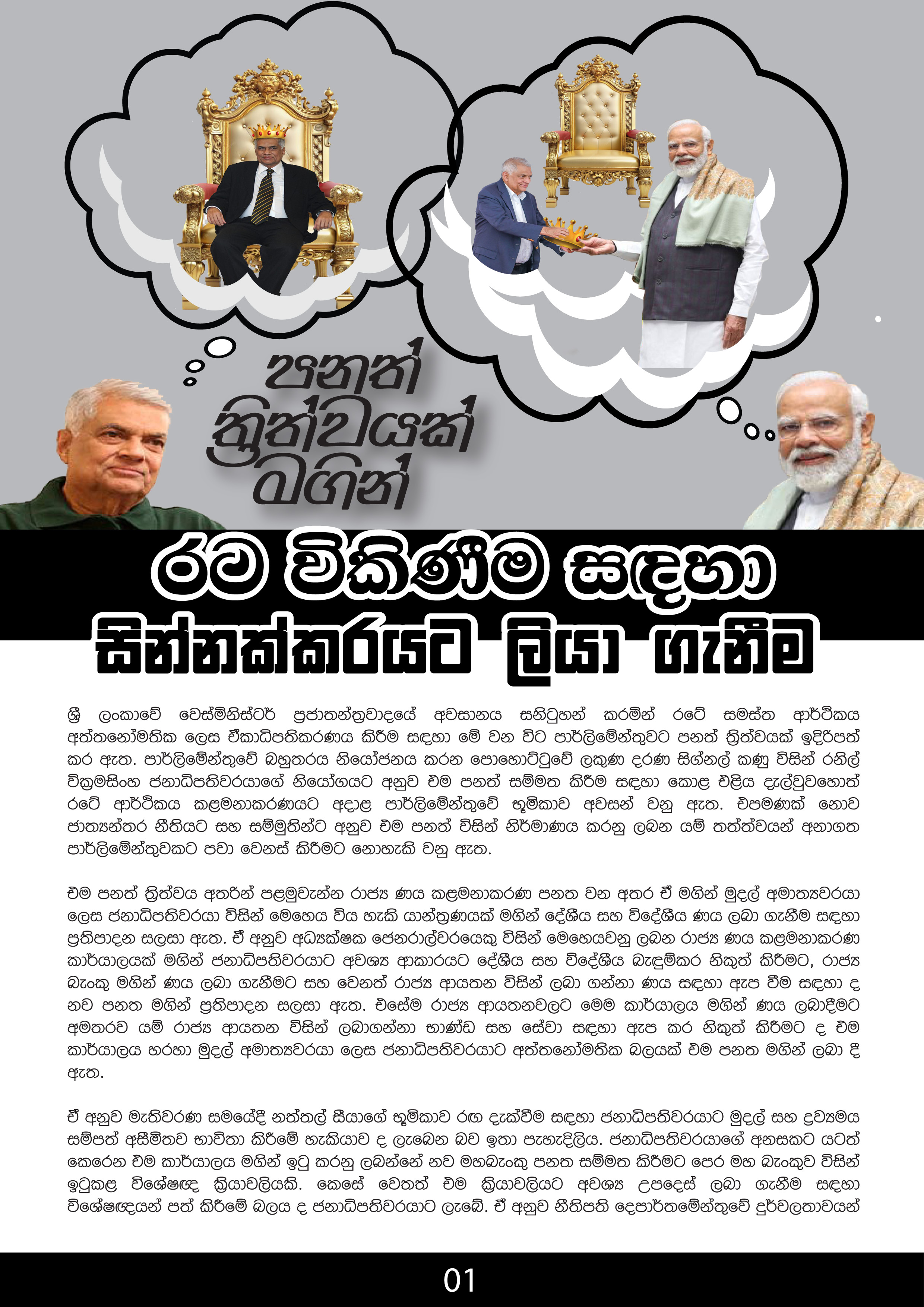
රට විකිණීම සඳහා සින්නක්කරයට ලියා ගැනීමට ගෙනා පනත් ත්‍රිත්වයක් ගැන දේශහිතෛෂී ජාතික ව්‍යාපාරයෙන් හෙළිදරව්වක්

June 1st, 2024

උපුටා ගැන්ම  ලංකා ලීඩර්

ශ්‍රී ලංකාවේ වෙස්මිනිස්ටර් ප්‍රජාතන්ත්‍රවාදයේ අවසානය සනිටුහන් කරමින් රටේ සමස්ත ආර්ථිකය අත්තනෝමතික ලෙස ඒකාධිපතිකරණය කිරීම සඳහා මේ වන විට පාර්ලිමේන්තුවට පනත් ත්‍රිත්වයක් ඉදිරිපත් කර ඇති බව දේශහිතෛෂී ජාතික ව්‍යාපාරය පෙන්වා දෙයි.

අදාළ පනත් පිළිබඳව විස්තර කෙරෙන සවිස්තරාත්මක පත්‍රිකාව පහළින්…

https://lankaleader.com/lankaleader/page/10?post_id=5715

Hadunnetti apologises to Elon Musk

June 1st, 2024

 By AJITH SIRIWARDANA Courtesy The Daily Mirror

Colombo, June 1 (Daily Mirror) Claiming that he never meant to call billionaire businessman Elon Musk an economic hit-man, NPP Economic Council member Sunil Hadunnetti said today he expresses his regrets to Elon Musk.

Speaking during a Business Forum, Hadunnetti said his reference to economic hit-men was to James Packer and George Soros who were brought into the country during the previous Ranil Wickremesinghe government.

“I was misquoted on what I said about Elon Musk. I didn’t mean to call Elon Misk an economic hit-man. What I explained was that world renowned investors never come to Sri Lanka due to its instability, political interventions in the economy, lack of discipline and lawlessness. My reference to economic hit-men was not to Elon Musk but to James Packer and George Soros. We do not call them honest entrepreneurs but economic hit-men. I never meant to call Elon Musk an economic hit-man. I offer my regrets to Elon Musk as I never meant to call him an economic hit-man,” Hadunnetti said.

Constitution mandates that any govt should accord priority to Buddhism – President

June 1st, 2024

Courtesy Adaderana

Constitution mandates that any govt should accord priority to Buddhism – President

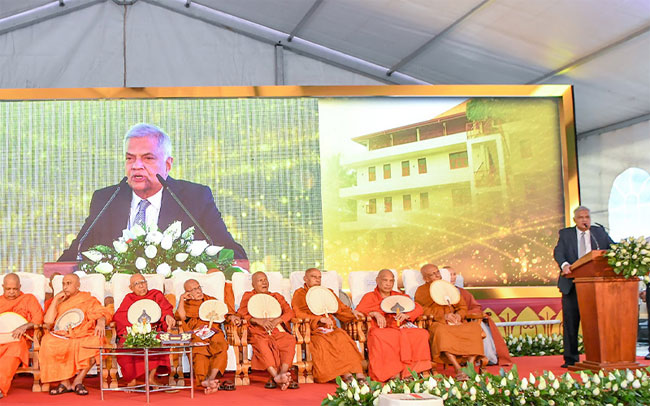
President Ranil Wickremesinghe underscored that according to the constitution, prioritizing Buddhism is imperative. He emphasized that the responsibility of upholding this principle is vested in the executive, legislature and judiciary. 

Emphasizing the indisputability of this matter, the President further stated that if anyone seeks to alter this principle, they should endeavour to amend the constitution accordingly.

President Ranil Wickremesinghe made these remarks today (01) during his participation in the inauguration ceremony of the Gurudev Suva Arana Gilan Bhikshu Centre,” constructed in Kiriwatthuduwa, Homagama.

The President emphasized the need for acknowledgment that the executive, the constitution and the judiciary, as the three branches of government, should prioritize the Buddhist doctrine within the country. He emphasized that failure to support this principle constitutes a violation of the constitution, emphasizing the obligation of all Members of Parliament to protect it.

The President highlighted that the constitution of this country outlines people’s sovereignty, prioritization of Buddhism and preservation of territorial integrity as its core principles. He stressed the importance of consistently advancing while safeguarding these principles, emphasizing that any opposition to them constitutes a breach of the constitution.

Additionally, the President shared that he was entrusted with the responsibility of overseeing the treatment of a ‘critically ill patient’. He noted that the patient, who was on the brink of death, is now showing gradual signs of recovery. The President conveyed his heartfelt appreciation in advance for the invaluable guidance and support provided by the Maha Sangha throughout this endeavour.

As per the suggestion of the late Chief Registrar of Sri Lanka Ramanya Maha Nikaya, and the Chief incumbent of Sri Dhathumaluwa Viharaya Kohuwala, Venerable Mapalagama Siri Somissara Nayaka Thero, and upon the recommendation of current Chief incumbent of Sri Dhathumaluwa Viharaya Kohuwala Venerable Pitigala Sonuttara Nayaka Thero, the Gurudev Suva Arana Gilan Bhikshu Centre” has been established to cater to the needs of monks locally and internationally.

The Gurudev Suva Arana Gilan Bhikshu Centre” comprises a five-story building and a three-story building, facilitating simultaneous treatment for fifty monks. Its amenities include 20 rooms, a ward yard, an alms hall, medicine stores, emergency treatment units, office rooms and hostel for doctors, ensuring comprehensive care and accommodation for those in need.

Under the supervision of qualified medical professionals, facilities have been established to provide treatment for sick monks. Additionally, a conducive environment has been created to accommodate five hundred monks for meditation practice.

The construction of this Gurudev Suva Arana Gilan Bhikshu Centre has been accomplished through the labour contributions of the Sri Lanka Army, supported by both local and international donors.

Venerable Bhikkuni Neunghaeng, the Chief of the Buddhist hospital in Ulsan, South Korea, and SinDaw, a Bhikkuni Kaushon from the Long Fong Monastery in Taiwan, have generously contributed to the medical equipment of this facility. Their contributions were made in response to an invitation extended by Venerable Katuwana Wijithawansa, Sri Lankaramadhipathi, Hethu, South Korea.

The President, after unveiling the plaque and inaugurating the Gurudev Suva Arana Gilan Bhikshu Centre, proceeded to conduct an inspection tour of the facility.

During the ceremony, homage was paid to the current Chief incumbent of Sri Dhathumaluwa Viharaya Kohuwala Venerable Pitigala Sonuttara Nayaka Thero, for his national and religious service. Furthermore, acknowledgment was extended to him for his dedication to establishing the Gurudev Suva Arana Gilan Bhikshu Centre, catering to monks both domestically and internationally. This gesture served as an expression of gratitude from the Sri Lankan Ramayana Maha Nikaya. Following the conferral of the Sri Sannath Patra honorary title, the President presented the vijinipata to him.

The President also bestowed a commemorative gift upon Venerable Neunghaeng, the head of the Buddhist hospital in Ulsan, South Korea, who generously provided the essential medical equipment for this monk hospital centre. Additionally, a commemorative gift was presented to Mrs. Sandhya Kantilatha, who graciously donated the land for the construction of this Bhikshu Hospital.

President Ranil Wickremesinghe further stated:

This marks the establishment of the first dedicated hospital for monks in Sri Lanka. While our country’s hospitals have traditionally accommodated monk wards, this facility is distinctively reserved solely for the care of sick monks. The government extends its gratitude to all contributors, particularly the efforts led by Bhikkuni Neunghaeng of South Korea.

I wish to emphasize that we have sought on-going support from the Ministry of Health – Indigenous Medicine section to sustain this endeavour, and I assure you that such assistance will be forthcoming. The government is also committed to providing resources for the continued development and enhancement of this hospital.

Moreover, situated in a stunning natural setting, it is imperative that we prioritize the protection of this environment as we progress forward with this project.

An argument has emerged advocating for the separation of government and Buddhism. However, considering the legal framework, every citizen in our country has the right to practice the religion of their choice, or to hold no religious beliefs at all.

Moreover, our constitution mandates that any government should accord priority to Buddhism. This responsibility is not solely vested in the government but extends to the state as a whole. Therefore, the support of all three branches of the state—the executive led by the President, the Parliament led by the Speaker and the Judiciary led by the Chief Justice—is essential to uphold this principle.

Failure to provide this support goes against the Constitution. As Members of Parliament, we have all taken an oath to uphold the constitution and it is incumbent upon us to adhere to its principles. Despite the conflicts experienced in our country, such a request has never before been raised or discussed.

It is essential to recognize that the three branches of government, the executive, the legislature and the judiciary should prioritize the Buddhist doctrine within our nation. While debate may arise regarding the specifics of implementation, the fundamental principle remains indisputable. As a government, it is imperative that we adhere to it. If there is a desire to amend this principle, it must be done through constitutional amendments.

The constitution of our country underscores three fundamental principles: people’s sovereignty, prioritizing Buddhism and maintaining territorial integrity. It is imperative that we uphold these principles as the basis for our actions. Any opposition to these principles is deemed a violation of the constitution.

At present, our hospital is caring for numerous patients, and I have been entrusted with the responsibility of treating one particular patient. We are making gradual progress in treating this critically ill individual, engaging in on-going discussions to ensure the best possible outcome. 

Healing a patient is not an instantaneous process; it requires time and dedication. It is estimated that it will take another three to four years to fully treat this patient. However, we are grateful for the opportunity to undertake this important work. I wish to extend my heartfelt gratitude to the venerable Maha Sangha for their invaluable support in this endeavour.”

–PMD

Prosecutorial Vs. Victim-based approaches to accountability

May 31st, 2024

by Neville Ladduwahetty Courtesy The Island

A report in The Island (May 20, 2024) states that the UN human rights office has criticised the Sri Lankan government’s failure to acknowledge and hold accountable the perpetrators of tens of thousands of enforced disappearances … Authors of the report also accuse the Liberation Tigers of Tamil Eelam of engaging in abductions” which were described as tantamount” to enforced disappearances” (May 20, 2024). Continuing, the report adds that the UN. The High Commissioner for Human Rights had stated: Accountability must be addressed. We need to see institutional reform for reconciliation to succeed”.

In the meantime, the Secretary General of Amnesty International (AI) had called for Sri Lanka to be referred to the UN Security Council and subjected to international war crimes inquiry when she participated to pay tribute to those who perished at Mullivaikkal. While the call for Sri Lanka to be referred to the Security Council may have pleased those who came to pay tribute, the reality is that such a referral would inevitably be vetoed. However, the fact remains that AI along with the UN Human Rights is advocating a prosecutorial approach to Accountability.

For instance, the Nuremberg Trial was strictly prosecutorial. In contrast, the Marshall Aid Plan was Victim based. While the objective of the former was to seek justice for the victims by prosecuting the perpetrators of the crimes, it was the latter that enabled Germany to recover and join the community of nations as a powerful and respected member.

The question that divides scholars and others who pursue accountability is; which approach to adopt. Should it be prosecutorial or victim based? While some, such as the UN report cited above advocate a prosecutorial approach for the sake of justice, others such as the High Commissioner are non-committal as to which approach to adopt. Yet, others want some aspects of both approaches. Therefore, the first question to be addressed is which approach to adopt, taking into account the particularities of the Sri Lankan society and the background that led to the armed conflict.

ESTABLISHING the CONTEXT

At a fundamental level, the raison d’etre for the armed conflict was the deep sense of grievance felt by the Tamil community; a circumstance they believed could only be overcome by resorting to an armed conflict to establish a separate state for themselves. For those representing the State of Sri Lanka, their bounden duty was to protect and preserve the territorial integrity of their cherished unitary state in keeping with Article 3 of Protocol II that state: Nothing in the Protocol shall be invoked for the purpose of affecting the sovereignty of a State or the responsibility of the government by all legitimate means to maintain or re-establish law and order in the State or to defend the national unity and territorial integrity of the State”. The only means by which these vastly contending positions could be resolved was through an armed conflict; a fact recognized by the UN Human Rights Commission in paragraph 182 and 183 of their OISL report of 2015.

Pargraph 182 states: Article 3 common to the four Geneva Conventions relating to conflicts not of an international character is applicable to the situation in Sri Lanka, with all parties to the conflict bound to respect the guarantees pertaining to the treatment of civilians ….”

Paragraph 183 states: In addition, the government and armed groups that are parties to the conflict are bound alike by the relevant rules of customary international law applicable in non-international armed conflict”.

Therefore, if both the Sri Lankan State and the LTTE are bound alike” by the relevant rules of customary international law applicable in non-international armed conflict”, why is all the attention to address accountability ONLY fixated on the Sri Lankan State and none on the LTTE. Since most of those who perished in Mullivaikkal were victims of the policy adopted by the LTTE to take civilians hostage, and continue to endanger the security of hundreds of thousands taken hostage by continuing to engage in hostilities, should NOT the LTTE also be held accountable? This being the case, would the evidence gathering that is currently being undertaken by the UNHRC in order to exercise Universal Jurisdiction, also apply to policies such as hostage taking and shooting escapees?

PROSECUTORIAL APPROACH

Judging from the attention given ONLY to the government of Sri Lanka by the UNHRC and by entities such as AI, the outcome of any judicial processes would be skewed, which means NO justice, despite the fact that the Sri Lankan Government and the LTTE are bound alike” by relevant rules of customary international law as in common Article 3 and Protocol II; a fact confirmed below.

INTERNATIONAL COURT OF JUSTICE, Judgment of 27 June 1986,
(NICARAGUA v. UNITED STATES OF AMERICA), MERITS
Judgment – para. 215 to 292

The conflict between the contras’ forces and those of the Government of Nicaragua is an armed conflict which is not of an international character”. The acts of the contras towards the Nicaraguan Government are therefore governed by the law applicable to conflicts of that character; whereas the actions of the United States in and against Nicaragua fall under the legal rules relating to international conflicts. Because the minimum rules applicable to international and to non-international conflicts are identical, there is no need to address the question whether those actions must be looked at in the context of the rules which operate for the one or for the other category of conflict. The relevant principles are to be looked for in the provisions of Article 3 of each of the four Conventions of August 12, 1949, the text of which, identical in each Convention, expressly refers to conflict not having an international character” (ICJ Judgment, Nicaragua v. U.S para 215 – 292)

In the Military and Paramilitary Activities in and against Nicaragua, the International Court of Justice observed that the acts of the Contras, fighting against the Nicaraguan Government, were governed by the law applicable to armed conflict not of an international character i.e. Common Article 3. Similarly, in the Tublada case, the Inter-American Commission considered”: Common Article 3’s mandatory provisions expressly bind and apply equally to both parties in internal conflicts, i.e. government and dissident forces. Moreover, the obligation to apply Common Article 3 is absolute for both parties and independent of the obligation of the other. Therefore, both the MTP attackers [the armed opposition group fighting in the conflict under consideration] and the Argentina armed forces had the same duties under humanitarian law” (Zegveld, Accountability of Armed Opposition Groups in International Law, p.21, ICJ Judgment Nicaragua v. US para 119 and Case No. 11/137).

Judging from the ICJ opinions cited above, it is certain that not only violations by the Sri Lanka Government but also violations perpetrated by the LTTE should be reviewed in the course of a Judicial Trial, since they are bound alike”. Therefore, although violations by the Government forces and LTTE would be judged by Common Article 3, the fact remains that the leadership of the LTTE who ordered the taking of 300,000 plus civilians, hostage is not among the living or has disappeared, and cannot be subjected to a trial despite the fact that the act of taking civilians hostage amount to a war crime and a crime against humanity. Thus, the exercise of gathering evidence against Government perpetrators pales in significance compared with endangering the security of 300,000 plus civilians that were taken hostage. Despite this, a prosecutorial process would mean a skewed outcome of any trial because of the strong possibility that violations perpetrated by the Sri Lankan Government would dominate the trial.

Thus, while a few of those associated with the LTTE would have to face prosecution, the majority cannot be located or identified since they have acquired new identities and are domiciled in foreign countries. Also, others who were in positions to exercise command responsibility, but are no longer among the living cannot be prosecuted for the crimes committed, e.g. taking 300,000 civilians hostage and killing those who attempted to escape.

Under circumstances where it would be next to impossible to identify and prosecute former members of the LTTE because they are dispersed primarily in the West with fresh identities, a prosecutorial approach would lead to an asymmetric outcome resulting in the polarization of the two communities to a degree that could give cause for instability and even resumption of hostilities since the numbers associated with successive Governments who could be identified and prosecuted would significantly be more.

Furthermore, while it would be possible to identify those associated with the Government responsible for command, it is NOT possible to identify the leaders of the LTTE who were responsible because they are no longer among the living.

The net effect of such an asymmetric outcome following a prosecutorial process would permanently damage the efforts advocated and undertaken to bring about reconciliation.by successive Governments. For the UNHRC to include the provision in several of its Resolutions that a credible justice process should include independent judicial and prosecutorial institutions….”, is because their perception is based on the premise that prosecuting the guilty would foster reconciliation.

While such a premise may be applicable to normal law and order situations, it is NOT applicable to Sri Lanka’s armed conflict that spanned three decades involving two communities if the prosecutorial process causes disproportionate outcomes as referred to above. Furthermore, if the outcome is such that more from the Sinhala majority community is prosecuted than from the minority Tamil community for whatever reason, the consequences would be to seriously setback the reconciliation processes; an outcome that defeats what the UNHRC hopes to achieve.

VICTIM BASED APPROACH

The real possibility of such serious outcomes, requires that the scope of the investigation is limited to such a degree that legal prosecution is not possible in the context of Sri Lanka. However, the scope of the investigation could be such that it is possible to establish the body of evidence associated with a particular incident There is strong evidence that the security forces targeted temporary hospitals despite being aware of their location. However, there is also counter evidence that the LTTE directed artillery fire from such locations and moved their ordinance soon after, thus tempting the security forces to target these make-shift hospitals. The investigation would then be limited to what each party to the conflict did in a given situation and not go beyond as to who was culpable to warrant prosecution under the relevant laws. Investigations would thus be a record of actions taken by respective parties to the conflict without delving further to establish which party was responsible for which violation of which laws, Human Rights or Humanitarian.

While this concept takes root, the leadership of both communities should jointly develop mechanisms to address the needs of victims and take joint responsibility for their implementation, instead of depending solely on the elected Government for Reconciliation to be effective and unity restored.

 CONCLUSION

 In light of the hard reality associated with prosecutorial processes cited above, and the ruling by the International Court of Justice in the case. Nicaragua v. U.S the acts of the Contras fighting against the Nicaraguan Government were governed by the law applicable to armed conflict not of an international character i.e. Common Article 3…”. Therefore, the approach should be to limit investigations, not with the intent of prosecution because it would be skewed for reasons cited above. but with the intent of recording the events that occurred during the armed conflict, and which party to the armed conflict could be identified with the respective violations with a view to use this body of evidence to institute reforms to prevent recurrence.

It is indeed a matter of serious concern that successive Sri Lankan Governments have failed to acknowledge that the Sri Lankan Security Forces and the LTTE are bound alike by the laws applicable to the armed conflict in Sri Lanka. This has seriously dented addressing issues of accountability in a balanced manner.

At the end of such investigations the present leadership of the parties to the conflict should acknowledge the serious omissions and commissions committed by both parties and move on by declaring the broadest possible amnesty to all who were associated with the conflict as stated in Section 5 of Article 6 of the Additional protocol II of 1977.

Article 6 Section 5 States: At the end of hostilities, the authorities in power shall endeavor to grant the broadest possible amnesty to persons who have participated in the armed conflict, or those deprived of their liberty for reasons related to the armed conflict, whether they are interned or detained”.

Since such amnesties and pardons have been instituted starting with the release of child soldiers and nearly 11,000 plus former LTTE combatants and more recently the release of prisoners, the practice has been in operation from time to time. This process would have gained momentum if not for the clamour for prosecutorial processes locally and resolutions of UNHRC that are tantamount to External intervention. The need therefore, is to regularize this practice and bring closure to an issue whose time has come.

සෝභිත හිමියන් ජාතික ව්‍යාපාරයේ ප්‍රතිමූර්තියක්…-අග්‍රාමාත්‍ය දිනේෂ් ගුණවර්ධන මහතා

May 31st, 2024

අග්‍රාමාත්‍ය මාධ්‍ය අංශය

කෝට්ටේ නාග විහාරය සංවිධානය කළ, පූජ්‍ය මාදුළුවාවේ සෝභිත හිමි 82 වන ජන්ම දින සැමරුම් උත්සවය හා ඊට සමගාමීව, අග්‍රාමාත්‍ය කාර්යාලයේ මගපෙන්වීමෙන්, කොළඹ දිස්ත්‍රික් ලේකම් කාර්යාලයේ සහයෝගයෙන්, නාග විහාර තරුණ සංවිධානය, ක්‍රියාත්මක කළ දහම් පාසල් අතර පැවැත්වූ නිර්මාණාත්මක වෙසක් සුබ පැතුම් පත් තරගයේ  සහතික පත්‍ර ප්‍රදානය අග්‍රාමාත්‍ය දිනේෂ් ගුණවර්ධන මහතාගේ ප්‍රදානත්වයෙන් 2024.05.30 දින අරලියගහ මන්දිරයේදී පැවැත්විණ.
මෙහිදී අදහස් දැක් වූ අග්‍රාමාත්‍යවරයා –
පූජ්‍ය මාදුළුවාවේ සෝභිත නායක ස්වාමීන් වහන්සේ අපේ ජාතිය අවදි කළ මහා සංඝ පීතෘවරයන් වහන්සේ නමක් ලෙස අපි කවුරුත් ගෞරවයෙන් සිහිපත් කරනවා. සෝභිත හිමියන් ජාතික ව්‍යාපාරයේ ප්‍රතිමූර්තියක්. රට වෙනුවෙන් සම්බුද්ධ ශාසනය වෙනුවෙන් අපේ භාෂාව හා සංස්කෘතිය වෙනුවෙන් ඉදිරිපත් වූ මහා සඟරුවනේ ආදර්ශමත් ගමන් මඟ යළි සිහිපත් කරනවා. අපේ රටේ ජනතාවට වගේම ජාත්‍යන්තරයටත් උන්වහන්සේගේ දම් දෙසුම එක්වුණා.  
උන්වහන්සේ සිදුකළ සේවාවේ සීමාවක් තිබුණෙ නැහැ. වර්තමානයටත්, අනාගතයටත් යළි යළිත් සිහිපත් කළ හැකි කර්තව්‍යක් දායක කිරීම නිසා  රටවැසියා එලෙස ගෞරවය පුද කරනවා. ගම් දහස් ගණනකට වැඩියා. ඒ කාලෙත් අපේ රටේ විදුලි පරිවර්තනයට සූර්යතාපය එක්කර ගන්න කටයුතු කළා. තරුණයින්, ඉංජිනේරුවන්, කලාකරුවන්, සාහිත්‍යදරයන්, මහාචාර්යවරුන් කීදෙනෙක් උන්වහන්සේ සමඟ එක්ව කටයුතු කළාද. රටට අතිශය වැදගත් අභියෝග වලදී  සෑම විටම මැදිහත් වුණා. රට පුරා වැඩියා විතරක් නෙවෙයි, ඒ කාලෙත් ගමන් නොකරපු ප්‍රදේශ හරහා ගමන් කළා. අපේ රට මුහුණ දුන්න තර්ජනාත්මක රට බෙදීමේ ව්‍යාපාරවලදී නොසැලී ඉදිරිපත් වුණා. නාග විහාරය  සමග සිටි තරුණයන්  ඒ මාර්ගයේ ඉදිරියට ගියා. එදා රට අතහැර ගියා නම් මේ ඉතිහාස සිතියම හුඟක් වෙනස් වෙනවා.  
උන්වහන්සේ ථේරවාදී බුදු දහම මෙරට කේන්ද්‍රස්ථානය කරගෙන අපේ අසල්වැසි රටවල් සමග කටයුතු කරන්නට කැපවී කටයුතු කළා. අදත් ආසියාතික රටවල, විවිධ විශ්වවිද්‍යාලවල පර්යේෂකයින්, ආචාර්ය මහාචාර්යවරුන් ඒ දේශයන් වලින් පැමිණ ථෙරවාදී බුදු දහමේ කේන්ද්‍රස්ථානය හැටියට පර්යේෂණ සඳහා අපේ රටට එනවා. එලෙස පවත්වාගෙන යාමට හැකි බුදුරජාණන් වහන්සේගේ ධර්මතාවය ලොවට දායාද කරන්නට එක්වීමේ ඕනෑකම වෙනුවෙන් සෑමවිටම කටයුතු කළා. ඒ මඟින් බුදු දහමේ පැවැත්ම ලෝකයාට ගැඹුරෙන් ලබාදීමටත් ථේරවාදී රටවල්වල් අතර මිත්‍රත්වය තහවුරු කිරීමට සහ ශක්තිමත් කිරීමටත් කටයුතු කළා. උන්වහන්සේ අපේ ජාතික, ආගමික අනන්‍යතාව ආරක්ෂා කර ගැනීමට පරාර්ථකාමීව මෙහෙය වූ ලබා දුන් ආදර්ශය මුළු මහත් සංඝ පරම්පරාවටත්  සමාජයටත් ඉතා වැදගත්.
එහිදි අනුශාසනා කළ කොළඹ විශ්ව විද්‍යාලයේ කුලපති අභයාරාමාධිපති පූජ්‍ය  මුරුත්තෙට්ටුවේ ආනන්ද හිමි –
සෝභිත හාමුදුරුවන් වහන්සේ මේ ජන සමාජය වෙනස් කරන්නට මොන තරම් කැප වුණාද. උන්වහන්සේ ජාතික සම්පතක්. ජනතාව අවදි කළ සිංහයෙක්. උන්වහන්සේට අවශ්‍ය වුණේ සාධාරණ  අනාගතයක් ගොඩනගන්නටයි. උන්වහන්සේ ඒ වෙනුවෙන් කැප වුණා.
අග්‍රාමාත්‍යවරයා එදා රට වෙනුවෙන් අපිත් එක්ක හිටියා.  එදා ජගත් කම්කරු දිනය අහෝසි කළා. දිනේෂ් ගුණවර්ධන මන්ත්‍රීතුමා අද අගමැතිතුමා අපි මැයි දිනය සමරමුද කියලා මගෙන් ඇහුවා. සෝභිත හාමුදුරුවෝ අපි සමග එකතු වුණා. එදා අභියෝග මධ්‍යයේ මැයි දිනය සැමරුවා. අපි   අග්‍රාමාත්‍යවරයාට කියන්නේ බොරලුගොඩ සිංහයා කියන නම අමතක කරන්න එපා. ඒක අමතක කරන්න දෙන්නත් එපා.
සෝභිත හිමියන් ගිය මඟ අපිත් යන්නට ඕනෑ. සෝභිත හිමියන්ට අපි කරන සැලකිල්ල නම්, ගෞරවය නම් අපි ඔක්කොම එකතුවෙලා උන්වහන්සේගේ මඟ හදන්න ඕනේ.  
එහිදි අනුශාසනා කළ නාග විහාරාධිකාරී පූජ්‍ය කොටහේනේ නාරද හිමි –
මාදුළුවාවේ සෝභිත හිමියන් තරුණ අවධියේ සිටම මේ රට දැය සමය වෙනුවෙන් ඉටු කළ සේවාව අපමණයි. උන්වහන්සේ මේ රටට යම් උවදුරක්, විපත්තියක් පැමිණුනානම් ඊට විරුද්ධව නැඟී සිටිය ආකාරය පිළිබඳව ජීවමානව  තිබෙන සාක්ෂි දෙකම මේ ස්ථානයේ සිටිනවා. එයින් එක් අයෙක් තමයි ගෞරවනීය මුරුත්තෙට්ටුවේ ආනන්ද නායක හාමුදුරුවෝ. අනිත් කෙනා අපේ රටේ අග්‍රාමාත්‍ය දිනේෂ්  ගුණවර්ධන මැතිතුමා.
දැන් තියෙන අරගලවල වගේ බුරියානි පාර්සල්, හෝටල් වලින් බුෆේ, ගිණුම් වලට ලක්ෂ ගණන් ඒ දවස්වල අරගල වලට ආවේ නැහැ. දිනේෂ් ගුණවර්ධන මැතිතුමා  අරගෙන එන එක බත් පාර්සලයක් දෙකක් කාලා එදා ධවල භීෂණයේ අරගල වලට මුහුණ දුන්නා කියලයි සෝභිත හිමියන් අපිට කිව්වේ. ඒ වගේම මාස ගණන් හතරවෙනි තට්ටුවේ මුරුත්තෙට්ටුවේ නායක හාමුදුරුවෝ හිර කරගෙන හිටියා. ලොකු හාමුදුරුවන්ව හිර කරන්න හොයන කොට දිනේෂ් ගුණවර්ධන මැතිතුමා එක්ක එක එක තැන්වල හැංගිලා ඒවායින් බේරිච්ච කාලය පිළිබඳව අද සමාජයේ දන්නේ නැහැ. ඒ වගේ මෙහෙවරක් කරපු නිසා එදා මේ රටට සිදුවුණ හානිය වළක්වා ගන්නට හැකියාව ලැබුණා. අද තරුණ තරුණියෝ මේ රටට වුණ උවදුරු, අභියෝග, බාධා මොනවද කියලා දන්නේ නැහැ. ඒ අය මාදුළුවාවේ සෝභිත හිමි කියන්නේ කවුද, මුරුත්තෙට්ටුවේ ආනන්ද හිමි කියන්නේ කවුද, කියලා හඳුනගෙන නැහැ. ඒ දරුවන්ගේ වැරැද්දක් නෙවෙයි. ඉතිහාසය පිළිබඳ නොදන්නාකමයි.
අනාගත පරම්පරාව අපේ සංස්කෘතිකමය උරුමයන්, අපේ සභ්‍යත්වය. අපේ ශිෂ්ඨාචාරය පිළිබඳව අවබෝධයක් ඇති දරු පිරිසක් සමඟ මේ රට ඉදිරියට යනවා දකින්නටයි අවශ්‍ය. ඒ සඳහා අවැසි සාධකයන් සම්පාදනය කිරීම මහා සංඝරත්නය හැටියට අපගේ කාර්යභාරය වගකීම බවට පත්වෙනවා. ඒ සඳහා පන්සල අනිවාර්යයෙන් කේන්ද්‍රස්ථානය විය යුතුයි. ඒ වගේම දේශපාලන අධිකාරිය ඒ සඳහා අවැසි නීති කෙටුම්පත් සම්පාදනය කළ යුතුයි. මහා සංඝරත්නයට, සම්බුද්ධ ශාසනයට, ධර්මයට විශාල අගතිකාරි ක්‍රියාදාමයන් අද සිදුවෙනවා. මේවාට විරුද්ධව අවශ්‍ය කරන නීති ඉක්මනින්ම ගෙන ඒමේ වැදගත්කම අවධාරණය කරනවා. වත්මන් රජය තුළම ඒ සඳහා අවැසි කරන නීති සම්පාදනයන් ගෙනල්ලා ඉක්මනින්ම මේ සම්බුද්ධ ශාසනය ආරක්ෂා කිරීමේ වගකීම මේ රජයෙන් ඉටු කළ යුතුයි.
කිරිවෙහෙර රජමහා විහාරාධිපති පූජ්‍ය කොබවක ධම්මින්ද හිමි, පුෂ්පාරාමාධිපති පූජ්‍ය ඇල්කඩුවේ නාගිත හිමි ඇතුළු මහා සඟරුවන, නාග විහාර තරුණ සංවිධානයේ අනුශාසක පාර්ලිමේන්තු මන්ත්‍රී යදාමිණි ගුණවර්ධන, කොළඹ දිසාපති කේ. ජී. විජේසිරි, විද්වතුන්, දහම් පාසල් ගුරු දෙගුරුන් දරුවන් රැසක් මෙම අවස්ථාවට එක්වූහ.

අග්‍රාමාත්‍ය මාධ්‍ය අංශය

කොළොන්නාව නව නගරයක් කිරීම සඳහා කෙටුම්පත් සකසා අවසන් තෙල් ප්‍රවාහනය සඳහා පමණක් භාවිත දුම්රිය මාර්ගය බත්තරමුල්ල දක්වා දිවෙන මගී ප්‍රවාහන මාධ්‍යක් කරනවා – අග්‍රාමාත්‍ය දිනේෂ් ගුණවර්ධන මහතා

May 31st, 2024

අග්‍රාමාත්‍ය මාධ්‍ය අංශය

කොළොන්නාව නගර සභා බල ප්‍රදේශය නව නගරයක් ලෙස පරිවර්තනීය වෙනසකට ලක්කිරීමේ පිඹුරුපත් සකසා අවසන් බව අග්‍රාමාත්‍ය දිනේෂ් ගුණවර්ධන මහතා පැවසීය.

අග්‍රාමාත්‍යවරයා මෙසේ පැවසුවේ (2024.05.28) කොළොන්නාව ප්‍රාදේශීය ලේකම් කාර්‍යාලයේ පැවැති සාකච්ඡාවකදී ය.

මෙහිදී අදහස් දැක්වු අග්‍රාමාත්‍යවරයා කොළොන්නාව නගර සභා බල ප්‍රදේශය නව නගරයක් බවට පත්කිරීමටත්, නව නගරයක පහසුකම් ජනතාවට ලබාදීමටත්, අලුත් ආකර්ෂණයකින් ප්‍රදේශයක් ලෙස දියුණු කිරීමටත් අවශ්‍ය මූලික කෙටුම්පතක් මේ වන විටත් සකස් කර අවසන් බවද සඳහන් කළේය.

මේ හරහා කොළොන්නාව නගර සභා බල ප්‍රදේශය තුළ සිදුවන පරිවර්තනය තුළින් තදාසන්න ප්‍රදේශද ආර්ථික, සමාජයීය පරිවර්තනයකට ලක් වෙයි. කොළොන්නාව පිරිපහදුව වෙත තෙල් ප්‍රවාහනය කෙරෙන දුම්රිය මාර්ගය බත්තරමුල්ල නගරය සමඟ සම්බන්ධ කොට දුම්රිය මගී ප්‍රවාහන මාධ්‍යයක් බවට පත්කිරීම ද සිදුකෙරෙයි. ප්‍රධාන පරිපාලන ආයතන රැසක් පිහිටා ඇති බත්තරමුල්ල නගරයට කඩිනමින් ළගා වීමේ හැකියාව ලැබෙන අතර කොළඹ තදබදයට ද මේ හරහා විසදුම් ලැබේ.     

මෙම අවස්ථාවට කොළොන්නාව දිස්ත්‍රික් සංවර්ධන කමිටු සභාපති, පාර්ලිමේන්තු මන්ත්‍රී සරත් වීරසේකර, පාර්ලිමේන්තු මන්ත්‍රී යදාමිණි ගුණවර්ධන, කොළොන්නාව ප්‍රාදේශීය ලේකම් ප්‍රියනාත් පෙරේරා, මහජන එක්සත් පෙරමුණ හිටපු ප්‍රාදේශීය සභා මන්ත්‍රිනී වී. ප්‍රභාෂීණී මහත්මිය ඇතුළු හිටපු මහජන නියෝජිතයින් පිරිසක් සහභාගී වූහ.

අග්‍රාමාත්‍ය මාධ්‍ය අංශය 

බුද්ධ ධර්මය විකෘති කරමින් සංඝ සංස්ථාව බිඳවැට්ටීම සහ ලාංකීය ඉතිහාසය විකෘති කිරීම වැළැක්වීම සඳහා ජාතික උරුමයන් සුරැකීම උදෙසා පාර්ලිමේන්තු සංසදය පෙළගැසෙයි

May 31st, 2024

උපුටා ගැන්ම  ලංකා ලීඩර්

මෙරට බෞද්ධ ධර්මය විකෘති කිරීම, සංඝ සංස්ථාව බිඳවැට්ටීම සහ ලාංකීය ඉතිහාසය විකෘති කිරීම වැළැක්වීම සඳහා නිර්දේශ ඉදිරිපත් කිරීම පිළිබඳ ජාතික උරුමයන් සුරැකීම උදෙසා පාර්ලිමේන්තු සංසදයේ අවධානය යොමු වී තිබේ.

ඒ, පාර්ලිමේන්තු සංසදය එහි සභාපති පාර්ලිමේන්තු මන්ත්‍රී ජයන්ත සමරවීරගේ ප්‍රධානත්වයෙන් පසුගියදා (22) පාර්ලිමේන්තුවේදී රැස් වූ අවස්ථාවේ දී.

මේ සඳහා සහභාගී වූයේ පූජ්‍ය ගලගම කුසලධම්ම් හිමි, පූජ්‍ය පාගොඩ ජනිතවංශ හිමි, පූජ්‍ය වාද්දුවේ ධම්මවංශ හිමි, සංසදයේ සාමාජික පාර්ලිමේන්තු මන්ත්‍රී මහාචාර්ය චන්න ජයසුමන, මහාචාර්ය චන්දිම විජේබණ්ඩාර, වෛද්‍ය මනොජ් කුමාර, වෛද්‍ය වසන්ත බණ්ඩාර, ඉසුරු උපනාද, නීතිඥ කල්‍යානන්ද තිරාණගම, ශකිල රාජකරුණා, ශාන්ත කුමාර යන අයයි.

මීට අමතරව මේ සඳහා මිස්සක කමලසිරි හිමි සූම් තාක්ෂණය ඔස්සේ අමෙරිකාවේ සිට කාරක සභාව වෙත සම්බන්ධ වී තිබේ.

මෙහිදී සභාපතිවරයා සඳහන් කළේ ත්‍රෛනිකායික මහනාහිමිවරුන් විසින් උක්ත කරුණ සම්බන්ධව අදාළ පාර්ශවයන් දැනුවත් කර ඇතත් ඒ පිළිබඳ ප්‍රමාණවත් ක්‍රියාමාර්ග තවමත් ගෙන නොමැති බවයි.

එ නිසා බෞද්ධ ධර්මය විකෘති කිරීම, සංඝ සංස්ථාව බිඳවැට්ටීම සහ ලාංකීය ඉතිහාසය විකෘති කිරීම වැලැක්වීම පිණිස අදාළ පාර්ශවයන්ගේ අවධානය යොමු කිරීම සහ ඒ සඳහා නිර්දේශ ඉදිරිපත් කිරීම සිය සංසදයේ අරමුණ බවද සමරවීර පෙන්වා දුන්නේය.

මෙහිදී, බෞද්ධ දර්ශනය විකෘති කිරීම්, බුද්ධ චරිතය පිළිබඳ මිථ්‍ය මත ප්‍රචාරය කිරීම් මෙන්ම භික්ෂුන් වහන්සේලාට අපහාස වන අයුරින් නොයෙක් මාධ්‍ය භාවිත කරමින් ගෙනයනු ලබන ප්‍රචාරයන් පිළිබඳ පැමිණ සිටි පිරිස විසින් දිර්ඝ වශයෙන් උදාහරණ දක්වමින් පැහැදිලි කිරීම සිදු කෙරුණි.

බෞද්ධ දර්ශනය විකෘති කොට සම්පාදනය කරනු ලබන ග්‍රන්ථ විශාල වශයෙන් ජනගත කෙරෙන බවද පැමිණ සිටි ස්වාමීන් වහන්සේලා උදාහරණ දක්වමින් පෙන්වා දෙන ලදී.

මෙසේ විකෘති දත්ත සහිත ග්‍රන්ථ ජනගතවීම මගින් බෞද්ධ දර්ශනය පිළිබඳ වැරදි අදහස් ජනතාව අතර, පැතිරෙමින් පවතින බවද උන් වහන්සේලා පෙන්වා දී ඇත.

එමගින් භික්ෂු ශාසනය, පැවිදි උපසම්පදාව මෙන්ම ශාසන චාරිත්‍ර ආදී කාලාන්තරයක් තිස්සේ ආරක්ෂා කරන ලද සංකල්ප පිළිබඳ අප්‍රසාදයක් ඇති වන අයුරින් මෙම ප්‍රචාරණයන් සිදු කරන බවද මෙහිදී සාකච්ඡා කෙරිණි.

මේ නිසා බුදුරජාණන් වහන්සේ යනු මන:කල්පිත චරිතයක් බවට ජනතාවට ඒත්තු ගන්වා බෞද්ධ ශාසනය කෙරෙහි ජනතාව තුළ ඇති විශ්වාසය බිඳ දැමිම සිදුවන බවද ස්වාමීන්වහන්සේලා විසින් පෙන්වා දී ඇති බවයි සඳහන් වන්නේ.

මෙයට අමතරව බෞද්ධ දර්ශනයට, බුද්ධ චරියතයට අපහාස කරමින් ප්‍රචාරයන් ගෙනයන පිරිස් මෙරට මෙන්ම වෙනත් විදේශ රටවලද විවිධ ව්‍යාපාරවල නියැලෙමින් විශාල ලෙස ධනය යොදවමින් මෙම කාර්යය සිදුකරන බව පැමිණ සිටි පිරිස පෙන්වා දුන්හ.

මෙය ජාත්‍යන්තර භූ දේශපාලනය තුළ ශ්‍රී ලංකාව රටක් ලෙස බිඳ වැට්ටීම සඳහා ගෙනයන කිසියම් කුමන්ත්‍රණයක එක් මුහුණුවරක් වියහැකි බැවින් සමස්තයම සලකා බලා පියවර ගත යතු බවත් ඔවුහු පෙන්වා දී ඇති අතර, මෙම ක්‍රියා හේතුවෙන් සමාජ ප්‍රචණ්ඩකරණය හා සංස්කෘතික බිඳ වැට්ටීම සිදු වී තිබේ.

මේ තත්ත්වය වැලැක්වීම සඳහා නෛතික ප්‍රතිපාදන සංශෝධනය කිරීම, ශ්‍රී ලංකාවේ ඒකීය පදනමට බලපාන ඓතිහාසික මූලාශ්‍ර විකෘති කිරීම වැලැක්වීම යන කරුණු කෙරෙහි දැඩි අවධානයක් කළ යුතු බව විද්වත්හු ‍මෙහිදී පෙන්වා දුන්හ.

මෙහිදී සභාපතිවරයා පෙන්වා දුන්නේ ඉදිරිපත්වන සියළු යෝජනා සහ අදහස් ඒකරාශි කොට බෞද්ධ දර්ශනය විකෘති කිරීම්, බුද්ධ චරිතය පිළිබඳ මිථ්‍ය මත ප්‍රචාරය කිරීම් මෙන්ම භික්ෂුන් වහන්සේලාට අපහාස වන අන්දමේ ප්‍රචාරයන් වැළැක්වීම සඳහා අවශ්‍ය නිර්දේශ සංසදය විසින් ඉදිරිපත් කිරීමට බලාපොරෙත්තු වන බවයි.

Ranil trying to open doors to economic hitmen like Elon Musk: Hadunnetti

May 31st, 2024

Courtesy The Daily Mirror

Colombo, May 31 (Daily Mirror)- President Ranil Wickremesinghe is trying to open doors to economic hitmen like billionaire Elon Musk, George Soros and James Packer by introducing the Economic Transformation Bill, NPP Economic Council member Sunil Hadunnetti said.

Addressing a meeting with the business community in Badulla recently, he said President Ranil Wickremesinghe claimed that Elon Musk is coming to Sri Lanka to provide WIFI.

“Ranil said in 2015 that free WIFI will be made available to all. He has now dropped the word ‘free’ and says WIFI will be given in 2024. Elon Musk will never give free WIFI,” he said.

He said Ranil Wickremesinghe claimed earlier that James Packer is coming to invest in Sri Lanka. But he never came with any investments.

Hadunnetti said a publicity stunt is being operated through a separate company by using government funds to show that foreign investors are coming to the country.
   
“There are businessmen in the world who visit countries on request of the Presidents in those countries. But,they do not always bring in investment,” he said. 

LankaPropertyWeb (LPW) releases its 2024 Western Province Land Price Index (LPI)

May 31st, 2024

Business

LankaPropertyWeb (LPW), Sri Lanka’s leading real estate portal, is pleased to announce the release of its 2024 Western Province Land Price Index (LPI). The index reveals a significant 7.8% increase in land prices compared to the previous year. Highlights include a 13% surge in Gampaha District, an 8% rise in Kalutara District, and a rebound of 2.3% in land prices in Colombo 1-15. Mr. Daham Gunaratna, LPW’s Managing Director, provides insights into the market trends driving the surge. Additionally, LPW’s methodology and services are outlined.

Attached to this email is an in-depth PR article along with accompanying pictures. We kindly request the publication of this press release in your esteemed newspapers and/or on your websites to reach a broader audience and inform readers about the latest trends in the real estate market. Including links in the article will enhance its quality and relevance, driving more traffic to your website upon publication.

Lanka Property Web – Real Estate Market Insights

Get all the latest property market insights in Sri Lanka. Estimate your potential ROI, find the best locations to settle in, evaluate how your price quotation fairs through our property price indicator and more. Navigate the property market in ease with us.

Is Sri Lanka’s Election Commission “compromised” after visit by US envoy?

May 30th, 2024

Shenali D Waduge

An official tweet was released on 28 May 2024 by the outgoing US envoy highlighting a meeting held with members of Sri Lanka’s election commission on the importance of voting in free & fair elections”. Expectedly there is no response from Sri Lanka’s Foreign Minister who we presume is in charge of all the diplomats & diplomatic protocols that all in the diplomatic community must abide by as per Geneva Diplomatic Protocols. Is the Foreign Minister tasked to protect the interests of Sri Lanka or the interest of other countries?

Needless to say, this meeting automatically takes our memories back to the time Britain’s High Commissioner David Gladstone was unceremoniously declared persona non grata for interfering in local elections & packed off back to the UK.

The reason – 10 May 1991 Local Government Elections

The incident – lodging a complaint at the Police Station about SLFP supporters being denied entering polling booth by UNP thugs at the Dickwella polling centre.

Gladstone was given 10 days to leave Sri Lanka.

Ironically, Gladstone’s next appointment ended up Ukraine!

Ironically days later 21 May 1991 Rajiv Gandhi was assassinated.

Increasingly, we see diplomats not only visiting everywhere & anywhere they please without informing Sri Lanka’s foreign office & having a member of the foreign office accompany them as was a practice in the past, envoys are crossing the line of diplomacy. Their interference” has become a common occurrence. It may come to a point where people in positions begin to function according to the dictates of the diplomats than the politicians.

While, we can fault the diplomats and highlight their lack of diplomacy, the bigger fault lies in our own people who fail to see how such meetings can compromise their own position and the Independent role expected of them.

There is little point brandishing a signboard INDEPENDENT” if they do not function as an independent body. There is little point bragging about being independent” if they do not act independent.

If judges do not attend or mix & mingle with ordinary citizens in view of any conflict of interest, can they wine & dine with diplomats & hold regular meetings with them. Do their funding & training programs warrant loosening of that distance that should be kept?

Exactly how independent” are elections in the US for the US envoy to be concerned about free & fair elections in Sri Lanka?

Elections were held for women in 1931 when US disenfranchised black people from voting. American blacks got to vote only in 1965 (black Americans have been voting only for 59 years!).

While 20,000 Sri Lankan prisoners do not get voting rights because of a lethargy in arranging voting for them, the US by law denies 5.1million felons voting rights.

Our concern regarding the meeting with the election commission follows a timeline of US meddling in elections of other countries.

US interference in foreign elections 

2015 Presidential Elections – Sri Lanka

Regime change in 2015 was jointly planned by the Indian intelligence & US to oust Mahinda Rajapakse’s govt. It was this operation that presented a common candidate & a pro-US alliance that became the common opposition. Maithripala Sirisena was selected as the common candidate & won enabling a string of pro-US/Indian decisions thereafter.

India appears to be copying everything US is doing as interference in UK’s 2019 election by India was highlighted by Times of India with BJP supporters campaigning for the Conservative Party via whatsapp messages across the country.

2002 Parliamentary Elections – Bolivia

US is said to have financed eradication of cocoa farms & warned voters not to vote for Evo Morales. USAID created a political party reform project” with motive to create pro-US political parties camouflaged as pro-democracy”.

1996 Presidential Election – Russia

US assistance for Boris Yeltsin’s election campaign is no secret. US had sent a team of campaign experts & were given an unlimited budget. US used their influence in IMF to grant Russia a $10.2billion loan to keep the Russian pro-US govt afloat. Though Yeltsin’s inner circle misused the funds, IMF turned a blind eye. Many view the election as being rigged to Yeltsins advantage.

1996 Parliamentary Elections – Mongolia

NED (National Endowment for Democracy) is accused of helping unite several political parties, intellectuals, businessmen, students & other activists into a Democratic Union Coalition” & given training in grassroot campaigning & membership recruiting. NED had also helped distribute 350,000 copies of a manifesto calling for private property rights, free press & foreign investment. The NED enemy was Mongolian People’s Revolutionary Party.

1992 Parliamentary Elections – Albania 

USAID, NDI, IRI provided anti-socialist political groups – funding, training & media support & US embassy publicly supported Albania’s Democratic Party. According to Los Angeles Times, US also provided advisors & vehicles for their campaign & threatened to withhold aid if Socialist Party of Albania won the elections.

1990 Parliamentary Elections – Czechoslovakia

New York Times reveals NED $400,000 funding for pro-US political parties to buy computers, fax machines copiers for their campaign.

1986 Parliamentary Elections – Costa Rica

IRI (International Republican Institute) supported the Social Christian Unity Party giving grants of $75,000, $100,000 & $145,000 for elections in 1986, 1987 & 1988 through the Association for the Defense of Liberty & Democracy in Costa Rica.

1984 Presidential Elections – El Salvador

Washington Post reveals US diplomatic pressure, media support & covert funding to the campaign of Jose Duarte.

1984 Parliamentary Elections – Grenada

Investigative journalist Bob Woodward says CIA spent $675,000 on education & campaigns after the Grenada invasion in 1983 & used opinion polls to swing voters towarsd a pro-US candidate.

1984, 1989 Parliamentary Elections – Panama

As per Manuel Noriega’s trial, CIA & drug cartels funded the election campaign of Nicolas Vallarino.

CIA is also accused of covertly campaigning to oust General Noriega from office. Radio & tv transmitters were given to opposition groups while US slapped sanctions on Panama after US failed coup in 1988.

1984 & 1990 Parliamentary Elections – Nicaragua

US is accused of funding & bribing anti-Sandinista opposition leaders to boycott the 1984 elections. 

Funds also flowed to anti-Sandinista opposition groups to oust him from power in 1990.

1983 Parliamentary Elections – Italy

Journalist Bob Woodward says CIA requested Saudi to spend $2m to assist a secret operation to prevent victory of the Italian Communist Party in 1983 elections.

1982 Parliamentary Elections – Mauritius 

CIA is said to have given financial support to Ramgoolam’s election campaign to defeat Anerood Jugnath thinking he would close Muauritian ports to US Navy as well as challenge Diego Garcia.

1980 Presidential Election – Iran

US is accused of covertly supporting campaign of Ahmad Madani who later fled to US.

Japanese elections in 1952, 1855, 1958, 1960, 1963, 1967, 1969, 1972 & 1980

CIA is accused of interfering in Japan’s 1st elections, withholding details of the new US-Japan security treaty from public, funding the Liberal Party, later Liberal Democratic Party, CIA is accused of offering payments to Japan Socialist Party members to weaken potential anti-US campaigns, sending US advisors as US-based businessmen”.

1955, 1958, 1987 Parliamentary Elections – Laos

US State Dept documents reveal US funded the Royal Lao Army,  the Govt & provided food aid to villages to discourage them supporting communism.

Former CIA agent & US diplomat James Liley says we pumped a relatively large amount of money to politicians who would listen to our advice” – CIA-friendly politicians won 54 out of 57 seats.

1971 Presidential Election – Vietnam

US is accused of running a number of covert operations to get Nguven Thieu elected.

1970 Presidential Elections – Chile

As per Church Committee, CIA supported the kidnapping of the Chilean Army Commander-in-Chief Gen Rene Schneider to prevent him confirming Allende as President. Kidnapping attempt failed & Schneider was shot & died 3 days later. US took pains to undermine Allendes presidency which paved way for his overthrow by coup.

1966 Parliamentary Elections – Bolivia

CIA had covertly funded groups that supported Gen. Barrientos for elections. Thereafter Che Guevara was killed in 1967.

1966 Parliamentary Elections – Costa Rica

US supported Costa Rica’s National Liberation Party

1966 Parliamentary Elections – Dominican Republic

US State Dept Office of Historian documents reveal US support for Joaquin Balaguer – assistance cover advice, media, information.

1964 Parliamentary Elections – Bolivia

CIA had covertly financed media, political groups, trade unions, student groups, youth groups to ensure a pro-US government came to power. $1.150000 had been allocated over 3 years for this operation. US is said to have covertly funded Gen. Barrientos in the military coup of 1964.

1964 Presidential Elections – Chile

US govt is said to have given $2.6m to candidate Montalva who opposed Salvador Allende & to character assassinate AllendeThe Church Committee in 1975 exposed US involvement in Chile’s elections.

1964 Parliamentary Elections – Somalia

US is accused of covertly influencing elections & ensure officials were pro-West.

1962 Parliamentary Elections – Brazil

Time Weiner’s book Legacy of Ashes speaks of a plan by US President JFK & US envoy in Brazil Lincoln Gordon to spend $8m to swing the election & prepare for a military coup against President Goulart. The funding went to Brazilians who opposed Goulart. Goulart was deposed in 1964 by military coup which ruled Brazil till 1985.

1962 Parliamentary Elections – Peru

US State Dept historians office reveals CIA funded the American Popular Revolutionary Alliance in 1962 & even supported the labor movement against President Alvarado.

1960 Congo 

Following the victory of Patrice Lumumba, he was assassinated in a US-led covert operation in January 1961.

1959 Parliamentary Elections – Nepal

CIA is accused of covertly assisting Koirala & Nepali Congress to win 1959 elections.

1958 Parliamentary Elections – Guatemala

CIA is accused of covertly aiding campaign of Jose Salazar to the tune of $97,000 to oust govt of Miguel Fuentes.

1955 Presidential Election- Brazil

US began educating” Brazilians against communism” & gave grants to parties that agreed to be pro-US

1955 Parliamentary Elections – Indonesia

CIA is accused of covertly giving $1m to Muslim political parties to cut support for Sukarno.

1953 Parliamentary Elections – Philippines

US & CIA are accused of influencing the 1953 elections with candidates competing for US support. CIA agent Edward Lansdale is credited with running the campaign of Ramon Magsaysay to election victory.

1952 Parliamentary Elections – Iran

US declassified documents in 2017 reveal US strategy to undermine Mohammad Mossadegh with CIA spending lots of money to get their 18 favorite candidates elected.

1948 Parliamentary Elections – Italy

The US in alliance with the Roman Catholic Church is accused of funneling millions of dollars to the Christian Democracy Party & other parties to support the Popular Democratic Front to win.

Its upto the Sri Lankans to ask themselves whether US is also rolling out the same campaigns in Sri Lanka?

  • How far has USAID, NED, NRI, IRI penetrated Sri Lankan society to influence their thinking & involved in grassroot campaigning?
  • Was IMF used in 2022?
  • Are US advisors, vehicles, equipment, social media training, media training being used?
  • What are the campaigns that have been launched so far? How is US influencing surveys & opinion polls?
  • Are their US advisors” posing as US investors/businessmen?
  • Who are the politicians listening to US advice” & are favorites” of the US/India
  • Who are the politicians, political parties, student groups, youth movements, media, intellectuals, activists, trade unions, businessmen taking advice” from US/India?
  • Who are tasked & paid to character assassinate? Who else are getting covertly paid?
  • The US didn’t need to kidnap the army general as in Chile, but a US-trained one was imported & made army commander after regime change in 2015!

In looking at the timeline of US interference in numerous countries, their judiciary has remained somewhat out of any conflict of interest. However, can we say the same about Sri Lanka? The BASL scandal, the manner USAID is funding the legal system’s administration & digitalization” provides a clue to the answer.

In such a scenario, what can we deduce from the US envoys meeting with the supposed to be independent” election commission. Do commissions wish to be independent so they can be not answerable or questioned for such actions that can easily undermine the sovereignty of the nation as can be seen by the examples highlighted from open source material.

Shenali D Waduge

සෝවාන් මාර්ගය, සූත්‍ර දේශනා ඇසුරෙන්; සෝතාපන්න වූ අයෙක් හඳුනාගන්නේ කෙසේද? –  සිව්වන කොටස 

May 30th, 2024

තිස්ස ගුණතිලක

සෝවාන් මාර්ගය හා එම ස්වභාවයට එලැබෙන ආකාරය පිළිබඳව පසුගිය ලිපි තුනෙන්‍ කල සාකච්ඡාව නැවතත් සාරාංශ කරමු.

සක්කාය දෘශ්ඨිය හා එහි ප්‍රහානය

බුදුන්වහන්සේ දේශනාකල ධර්මය දුක නැතිකරගැනීමටයි. දුක ඇතිවන්නේ මායාවක්වූ ‘මම’ නොහොත් ඉත්ථභාවය අස්මිමානය ඇතිවීම නිසයි. ‘මගේ ශරීරයේ’ බිඳීම, විපරිනාමය දුකකි. ‘මගේ යයි ගත් දෙයක්’ නැතිවීම දුකකි. ‘මම වින්ඳනය කරමින්සිටිනා ලෝකය’ හෝ එහි අඩංගු කිසිවක් නැතිවීම දුකකි. කොටින්ම කිවහොත් “මම” සිටිනා බව දැනීමම දුකකි. 

සංඛිත්තෙන පඤ්චුපාදානක්ඛන්ධා දුක්ඛා-ධම්මචක්කප්පවත්තන සූත්‍රය

උපාදාන ප්‍රත්‍යයෙන් භවය ඇතිවන බවත්, භව ප්‍රත්‍යයෙන් ජාති හෙවත් ‘මම’ සිටිනා බවක් දැනෙන ස්වභාවය හෙවත් අස්මිමානය ඇතිවන බවත් සද්ධර්මයේ එන මුලික කරුනකි.

මම සිටිනාබව (හැඟීම) හෙවත් ඉත්ථභාවය/අස්මිමානය ආත්ම දෘශ්ඨියටත් ආත්ම සංඥාවටත් දොරටුවයි.

දුක නැතිවීමට ‘මම’ ‘මගේ’ යන (අස්මි) මානයට මුල්වන ඉත්ථභාවය ඇතිවන සාධක දැන හඳුනාගෙන එම සාධක එකින් එක ඉවත්කල යුතුය (මූලපරියාය සූත්‍රය).

භාහිරය දෙයක් යමක් කෙනෙක් සේ දැනීම හා ඒ නිසාම භාහිරය විඳින ‘මම’ සිටින්නාක් සේ දැනීම ඉත්ථභාවයයි නැතහොත් සක්කාය දෘශ්ඨියයි. එසේ මම සිටිනාසේ දැනෙන්නේ විඤ්ඤාණමායාවෙන් වැසී ඇති භාහිරයේ සත්‍ය ස්වභාවය නැතහොත් යථාභූත ස්වභාවය ඔබට හසු නොවන බැවිනි. භාහිරයේ අනාත්මීය (දෙයක් යමක් කෙනෙක් නැති ස්වභාවය) විඤ්ඤාණමායාවෙන් වැසී ඇතිබවත් ඒ හේතුවෙන් ඉත්ථභාවය, මම සිටිනාබවක් දැනෙන්නේය යන දැනුම ඔබට ඇතිනම්‍ ඔබ සක්කාය දෘශ්ඨිය පලමු සංයෝජනය ලෙස ප්‍රහානය කලේ වෙයි.

විච්කිච්ඡාව හා එහි ප්‍රහානය

විඳීමට කිසිවක් හමුනොවන, ආශ්වාදයක් නැති අනාත්මීයව පවත්නා භාහිරය විඤ්ඤාණමායාව නිසා ආත්මීය (දෙයක් යමක් කෙනෙක් සිටිනා) ස්වභාවයට පත්වී වීඳීමක් ඇතිකරවයි. ආත්මීය භාහිරය බොහෝවිට සුඛදායකය. මොහොතකට දුක ඇතිවුවත් අනෙක් මොහොතේ නැවත සුඛසේ දැනෙයි. විඤ්ඤාණමායාව සකස්කරනා ආත්මීය ස්වභාවය මෙයයි. විඤ්ඤාණමායාව සකස්කරදෙන භාහිරය විඳීමට අප කැමැත්තෙමු. නමුත් සෘතවත් ආර්ය ස්‍රාවකයා එම වින්ඳනය දුකම බව දනී. ඔහු විඤ්ඤාණමායාව සකස්කර දෙන ආත්මීය භාහිරය ‘විඳිනවාද.’ නැතහොත් එම වින්දනය තුල හටගන්නා දුකෙන් ‘මිදෙනවාද’ යන උභතෝකෝටිකයෙහි (දෙගිඩියාවෙහි dilemma) සිරවී සිටියි. මෙම දෙගිඩියාව, උභතෝකෝටිකය විචිකිච්ඡාවයි. විචිකිච්ඡාවට හේතුව ධර්මය නැතහොත් ‘විඳීම හා මිදීම’ යන දෙකින් තෝරාගත යුත්තේ කුමක්දැයි නොදන්නා කමයි. විඤ්ඤාණමායාව තුල වින්ඳනය සකස්වන ආකාරයත් එනම් භවය සකස්වන ආකාරයත් එයින් මිදීම ආනාර්ය අශ්ඨාංගික මාර්ගයෙන් මිඳීම බවත් එහි කෙලවර ක්ෂේම භූමියවන නිවන පවතින බවත් දන්නා (ජානතෝ) තැනැත්තාට විචිකිච්ඡාවක් ඇතිනොවෙයි. හෙතෙමේ (භාහිරය) විඳීම අතහැර (භාහිරයෙන්) මිඳීම තෝරාගනියි. එනම් හෙතෙමේ විචිකිච්ඡාව ප්‍රහානය කලේ වෙයි.

සීලබ්බත පරාමාසය හා එහි ප්‍රහානය

අප සියළුදෙනාම ගෙවනා වැරදි දිවිපෙවත නොහොත් අනාර්ය අටමඟ (අශ්ඨාංගික මාර්ගය) හේතුවෙන් විඤ්ඤාණමායාව තුල සකස්වන විඳීමක් ගෙනදෙන ආත්මීයවූත්, අගයක් ඇතිකරන්නාවූත්, ඒ නිසාම නන්දිරාග සහගතවූත්, ‘මමයා’ සාදන්නාවූත් ලෝකය (ලෝක සංඥාව) මිස භාහිරයේ සත්‍ය යථාභූත ස්වභාවය ඔබට හසුනොවෙයි. මෙසේ භාහිරයේ සත්‍ය යථාභූත ස්වභාවය හසුනොවන දිවිපෙවත නැතහොත් අනාර්ය අටමඟ සීලබ්බත පරාමාසයයි. අද සෝවාන්වූවන් කිසිවෙකු ගැන සඳහනක් හෝ ආරංචියක්වත් නැති බැවින් අප සියළුදෙනා (in default) සිටින්නේ අනාර්‍ර්යවූ සීලබ්බත පරාමාසයක් වූ දිවිපෙවතකයි. එනම් භාහිරය සත්‍යසේ දකිමින්, විඳිමින් ගතකරන භවය සකස්කරන දිවිපෙවතක් තුලයි. මේ බව දැනගෙන (ජානතෝ) එම අනාර්ය අටමගක් වූ දිවිපෙවෙතින් මීදීම සීලබ්බත පරාමාස ප්‍රහානයයි.

සූත්‍ර දේශනාවල අන්තර්ගතය

ඛුදුන්වහන්සේ අවුරුදු 45ක් පුරාවට දේශනාකලේ මෙම සක්කාය දෘශ්ඨිය ඇතිකරවන භවය සකස් කිරීම නොහොත් භාහිරය දෙයක් යමක් කෙනෙක් සේ දකිනා අනාර්ය දිවිපෙවෙතින් මිදී උදාකරගන්නා දුකක් නැති, ශාන්ත සුවය අත්විඳිය හැකි නිවන නැතහොත් ස්වභාවධර්මය හා බද්ධවන ක්‍රියාවලියයි.

එම ක්‍රියාවලිය බුදුන්වහන්සේ ප්‍රථමයෙන්ම පෙන්වාදෙන්නේ ‘රතන සූත්‍රය, මංගල සූත්‍රය, කරණීය මෙත්ථ සූත්‍රය හා පරාභව සූත්‍රය’ වැනි සරල සූත්‍ර දේශනා තුලයි. මෙම සූත්‍ර දේශනාවල අන්තර්ගත දිවිපෙවතට (අටමඟට) ඔබට අනුගතවිය හැකිනම් ඔබ සෝවාන් වුයේ වෙයි. එම සූත්‍ර දේශනාවල අන්තර්ගතය ඔබට අවබෝධවී ප්‍රත්‍යක්ෂ වූයේනම් ඔබ නිවනට පත්වූයේ වෙයි. කොටින්ම මෙම සූත්‍රවල අන්තර්ගතය ඔබ තිපරිවට්ටයට බහා දැනුමෙන් (සත්‍ය ඥානය), අවබෝධයෙන් (කෘත්‍ය ඥානය) හා ප්‍රත්‍යක්ෂයෙන් (කෘත ඥානය) සාන්දිට්ඨික වන්නේනම් ඔබට පිලිවෙලින් සෝවාන් මාර්ගයටත් කෙලවර අමාමහ නිවන් සුවයටත් පත්විය හැකිය.

එසේනම් පලමුවෙන්ම කලයුතුවන්නේ මෙම සූත්‍රදේශනාවල අන්තර්ගතය බුද්ධියෙන් තේරුම් ගැනීමයි.

ප්‍රත්‍යවේක්ෂන ඥාණය හා ඡබ්බ සොධන සූත්‍ර අන්තර්ගතය

තමා සෝතාපන්න ස්වභාවයට පත්වූබව දැනගන්නා සිහිය ප්‍රත්‍යවේක්ෂණ (ප්‍රත්‍යවේක්ඛණ) ඥාණයයි. සෝතාපන්නයට පත්වීමට පෙර තම සිහියට දැනුන ස්වභාවය හා සෝතපන්නයට පත්වූ පසු සිහියට දැනෙන ස්වභාවයන් හා ගැලපීමෙන් තමන් සෝවාන් වූ බව දත හැකිය.

ඔබ අනාර්ය අට මගෙහි (අනාර්ය අශ්ඨාංගික මාර්ගයෙහි) එනම් සීලබ්බත පරාමාසයෙහි දිවිපවත්නාවිට ඔබට දැනෙනා තත්වයන්, ස්වභාවයන් කවරේද? ie. අප සියළු දෙනාම දිවි ගෙවන්නේ අනාර්ය අශ්ඨාංගික මාර්ගය තුලය. ඒ නිසා පහත සඳහන් තත්වයන් ඔබ සියළුදෙනාගේම සිහියට හසුවිය යුතුය.

ප්‍රතමයෙන්ම අප සියළුදෙනාම නිතරම බියකින් හා තැතිගැනීමකින්‍ දිවිගෙවයි. මේ බිය හා තැතිගැනීම විවිධ හේතුන් නිසා ඇතිවිය හැකිය.

උදා; 1. අප ආදරය කරන්නන්ට අනතුරක් කරදරයක් ඇතිවේදැයි ඇතිවන බිය හා තැතිගැන්ම,

2. අප රාජකාරිය කරනා ස්ථානයේ ඇති ආතතිය නිසා ඇතිවන තැතිගැන්ම,

3. අනාගතය ගැන ඇති බිය හා තැතිගැන්ම,

4. සමාජ තත්වයන් රැකගැනීමට දරනා තැත නිසා ඇතිවන ආතතිය,

5. මෙකි නොකි ජීවිතයේ හමුවන සියළුම අවස්තාවන් නිසා සත්වයා බියෙන් හා තැති ගැනීමෙන් නිතරම පසුවෙයි. මොහොතකට සුඛයක් දැනුනත්‍ පිටුපසින් ඇති තත්වයන් ඇතිකරනා තැතිගැනීම ඊලඟ මොහොතේ හෝ මතුවෙයි.

ඔබ ධර්මය ගැන තරමක හෝ දැනීමක් ඇති සෘතවත් ආර්ය ශ්‍රාවකයෙක් නම් ඔබගේ දිවිය පුරා විහිදී ඇති මෙම බිය හා තැතිගැනීම ඔබගේ සිහියට හසුවිය යුතුමය. ඒ සිහිය ආතතියක් ඇති ස්වභාවය හරහාද පැමිනෙයි. මේ සෝතාපන්නයට පෙර ඔබගේ සිහියට හසුවන ස්වභාවයයි.

ඔබ ගතකරනා අනාර්ය දිවිපෙවතින් මිදී භවය සකස් නොකරන (භාහිරයේ පවතින කිසිවක දෙයක් යමක් කෙනෙක් නැති, අනාත්මීය, අගයක් නැති, ගින්නක් නැති, ශුන්‍යත ස්වභාවය) ආකාරයට ඔබ තුන් දොර (කායි, වචී, මනෝ සංකාරයන්) හසුරවයි නම් ඔබ ආර්ය අට මගට පිලිපන්නේ වෙයි.

කරණීය මෙත්ත සූත්‍රය

මෙම සූත්‍ර දේශනාවේ බුදුන්වහන්සේ විශේෂයෙන් සෝතාපන්නට පත්වීම පිනිස කල යුතු දෑ පැහැදිලි කරයි. පලමු ගාථාවේ එම කරුන සාරාංශ වශයෙන් ඉදිරිපත්කරන අතර;

කරණීය මත්‍ථ කුසලෙනයං තං සන්තං පදං අභිසමෙච්ච

ශාන්ත වූ නිවනට පැමින වාසය කිරීමට කැමැත්තහු විසින් එය අත්දැකීමට කලයුතු වන්නේ භවය සකස් නොවනා ලෙස (කුසල්) දිවිපෙවෙත හැසිරවීමයි.

ඉතිරි ගාථා නමයේම සෝතාපන්න ආදි අවස්ථාවන්ට පත්වන ආකාරය අපට කියාදෙයි. ඉඩකඩ ලැබෙනා පරිදි පසු ලිපියක කරණීය මෙත්ත සූත්‍රය දීර්ඝව සාකාච්ඡා කරමු. දැනට සෝතාපන්න වූ පුද්ගලයෙකුගේ සිහියට හසුවන ස්වභාවය විස්තරවන තැන පමනක් සලකා බලමු.

සිව්වන ගාථාවේ;

යෙ කෙචි පාණ භූතත්ථිතසා වා ථාවරා වා අනවසෙසා

යෙ කෙචි පාණ භූතත්ථි –  ප්‍රණ සහිත සියළුම සත්වයින්ගේ

තසා වා ථාවරා වා අනවසෙසාබිය හා තැතිගැනීම ස්ථිරවම ශේෂ නැතිවම දුරුවෙයි.

සෝතාපන්න වූ පුද්ගලයාගේ බිය හා තැති ගැනීම (trembling) ක්‍රමයෙන් ක්ෂයවන ස්වභාවය තම සිහියට හසුවෙයි. සෝතාපන්නයට පෙර පැවති බිය හා තැති ගැනීම ක්‍රමයෙන් දියවන ස්වභාවය ඔබට හසුවන්නේ ප්‍රත්‍යවේක්ෂා ඥාණයටයි. භවය සකස් නොවනා සේ දිවිපෙවත සකසා ගත් ඕනැම කෙනෙකුට මෙම බිය හා තැතිගැන්ම දියවන සිද්ධිය පහසුවෙන් අත්විඳිය හැකිය. 

භවය සකස් නොවනා පරිදි දිවිපෙවත සකස් කරගන්නා ආකාරය 2024 මාර්තු 26වන දින lankaweb පිටුවේ පලවූ;

ආර්ය අෂ්ඨාංගික මාර්ගය, අනාර්ය අෂ්ඨාංගික මාර්ගය සහ සීලබ්බත පරාමාසය තෙ භවං අට්ඨමමාදියන්ති

ලිපියෙන් විස්තර කිරීමට උත්සාහ කලෙමි.

ඡබ්බ සොධන සූත්‍රය

ඉහත සඳහන් පරිදි තමා සෝතාපන්නයට පත්වූබව පසක්වන්නේ සිහියට හසුවන ප්‍රත්‍යවේක්ෂණ ඥාණය මගිනි. කෙනෙක්‍ සෝවාන්වූ බව හෝ ඉන් ඉක්බිතිව අර්හත් ස්වභාවයට පත්වූබව හෝ තවත් භාහිර පුද්ගලයෙකු විසින් දැනගන්නා ආකාරය බුදුන්වහන්සේ ඡබ්බ සොධන සූත්‍රය තුල පෙන්වාදෙයි. සෝතාපන්නයට පත්වුබවට (හෝ ඉන් ඉක්බිතිව අර්හත් බවට පත්වූ බවට) ප්‍රකාශකරනා පුද්ගලයාගේ ස්වභාවය (හෙතෙමේ සෝවාන් වී ඇද්ද නැත්ද යන්න) තහවුරු කරගැනීමට කලහැකි පරික්ෂාව මෙම සූත්‍ර දේශනාවේ අන්තර්ගතයයි. 

“මහණෙනි, මේ ශාසනයෙහි භික්ෂුවක් තෙම් භවය සකස්වීම නිසා දැනෙන මම සිටිනා ස්වභාවය නොහොත් ඉත්ථභාවය (සක්කාය දෘශ්ඨිය) ක්ෂය කරන ලද්දේද, අනාර්ය අශ්ඨාංගික දිවිපෙවතින් නික්මවන (බ්‍රාහ්මචර්‍ය්‍යාවට වැස නිමවන) ලද්දේද, කටයුතු දෑ කොට අවසානය, මත්තෙහි කළයුතු අනිකක් නැතැයි, දනිමි කියා රහත් බව ප්‍රකාශ කෙරේද, මහණෙනි, ඔහුගේ කීමට භික්ෂූහු නොම සතුටු විය යුතුය, ප්‍රතික්ෂෙපද නොකළ යුතුය. සතුටු නොවී බැහැරද නොකොට ප්‍රශ්න කීපයක් ඇසිය යුතුය”.

එම ප්‍රශ්නවලට හෙතෙමේ ලබාදෙන පිලිතුරු අනුව එම පුද්ගලයාගේ ආර්ය ස්වභාවය (සෝතාපන්න හෝ අර්හත්) විමසිය හැකිය. සූත්‍ර දේශනාවේ අන්තර්ගතය තවදුරටත් ඉඩ ලද හැටියට වෙනත් ලිපියකින් සාකච්ඡා කරමු.

නිවනේ ස්වභාවය

නිවන යනු ස්වභාවධර්මගත වීමයි නැතහොත් ස්වභාවධර්මය හා බද්ධ වීමයි. ස්වභාවධර්මය හා බද්ධ වීමට ප්‍රතමයෙන් ස්වභාවධර්මය තේරුම්ගත යුතුය. 

ස්වභාවධර්මය හෙවත් නිර්වාණ ස්වභාවය යනු තම ශරීරයද ඇතුළුව භාහිරය පවතිනා යථාභූත ස්වභාවයයි. භාහිරය කිසිම ආශ්වාදයක් (හෝ ගැටීමක්) නැති, අගයක් නැති, අනාත්මීය, ශුන්‍යත ස්වභාවයෙන් පවතී. ස්වභාවධර්මය තුල ක්‍රියාකරන්නෙක්ද නැත (අනත්ත ස්වභාවය). මෙම අගයක් නැති ශුන්‍යත ස්වභාවය නිසා අනාත්මීය භාහිරය (ස්වභාවධර්මය) තුල;

  1. දිග කෙටි, උස් මිටි, යාම් ඊම්, පිං පව්, සුභ අසුභ ආදි සාපේක්ෂතාවයන් නැත. 
  2. එසේම යහපත් අයහපත්, වැරදි නිවැරදි, ඇති නැති ආදි අන්තද නැත.
  3. තවද උපාදාන රෑප මෙන්ම නාම ධර්ම කිසිවක් ස්වභාවධර්මය හෙවත් නිවන තුල හමුනොවෙයි.
  4. ඉහත සඳහන් ස්වභාවය ඔබට ග්‍රහනය කරගත හැකිනම් ඔබට භවය සකස් කිරීමක් (භාහිරය දෙයක් යමක් කෙනෙක් වන සංසිද්ධිය) ඇති නොවෙයි.

මෙහිදී හොදින් තේරුම් ගත යුතු වන්නේ ඉහත සඳහන් සාපේක්ෂ සංසිද්ධීන් (දිග කෙටි, පිං පව් ආදි) මෙන්ම අන්ත (ඇති නැති ආදි) මෙන්ම උපාදාන රෑප හා නාම ධර්ම විද්‍යාමාන වන්නේ (පවතින්නේ) විඤ්ඤාණමායාව තුල සකස්වන ‘මගේ ලෝකය’ තුල මිස යථාභුත ස්වභාවයෙන් පවතින භාහිරය හෙවත් අනාත්මීය ස්වභාවධර්‍රමය තුල නොවන බවයි.

බුදුන්වහන්සේ කේවට්ට සූත්‍රය තුල පෙන්වාදෙන්නේ මෙම කරුනයි.

විඤ්ඤාණං අනිදස්සනංඅනන්තං සබ්බතො පහං

එත්ථ ආපො පඨවිතෙජො වායො ගාධති,

එත්ථ දීඝඤ්ච රස්සඤ්චඅණුං ථූලං සුභාසුභං

එත්ථ නාමඤ්ච රූපඤ්චඅසෙසං උපරුජ්ඣති.

විඤ්ඤාණස්ස නිරෝධෙනඑත්ථෙතං උපරුජ්ඣති

විඤ්ඤාණං අනිදස්සනංභවය සකස් කරනා විඤ්ඤාණය විද්‍යාමාන නොවන තැන 

අනන්තංඅනන්තයක්වූ ස්කන්ධ අතර 

විඤ්ඤාණංභවය සකස්කරනා විඤ්ඤාණය (භවය සකස්කරනා ස්කන්ධයන් මූලිකව ඇතිවන විඤ්ඤාණය)

සබ්බතො පහංසර්වප්‍රකාරයෙන් ප්‍රහානය කලවිට 

අනිදස්සනංහමුවන ස්වභාවය (නිවන)

එත්ථතුල 

ආපො පඨවි තෙජො වායො ගාධතිසතරමහා භුත ස්වභාවය බැස නොගනී. නාම අර්ථයෙන් සතරමහා භූතයෝ නොපවතී. දෙයක් යමක් කෙනෙක් වන ස්වභාවයෙන් ඒවා නොපවතී.

දිග කොට, කෙට්ටු මහත, සුභ අසුභ ආදි සාපෙක්ෂතාවයෝද ඉතිරි නැතිවම නිරුද්ධ වෙයි (නොපවතියි).

විඤ්ඤාණස්ස නිරෝධෙනඑත්ථෙතං උපරුජ්ඣති

භවය සකස්කරනා විඤ්ඤාණය නිරෝධයෙන් ඉහත ධර්ම සමූහයම ආවරණය කරයි, වලක්වයි. (නාම අර්ථයෙන් නොපවතියි)

අනාත්මීය ස්වභාවධර්මය (දෙයක් යමක් කෙනෙක් නැති භාහිරය) තුල ඇත්තේ ජීවයක් සහිත රූපහැඩතල (මනුශ්ෂ හා සත්ව ආදි) හා ජීවයක් රහිත රූපහැඩතල (ගස්, කඳු, සුලඟ වැනි) පමනි. භාහිරයේ යථාභූතව පවතින සියල්ලම ආශ්වාදයක් හෝ අගයක් නැති ශුන්‍යත ස්වභාවයෙන් පවතී.

නාම අර්ථයෙන් කිසිවක් නොපවතින, හමුනොවන ස්වභාවධර්මය තුල බුදුන්වහන්සේ තම සූත්‍ර දේශනාවල නිවන හා නිවන් ප්‍රතිපදාව පැහැදිලිකල ආකාරය මීලඟ ලිපියෙන් සාකච්ඡා කරමු.

ඔබට තෙරුවන් සරණයි

තිස්ස ගුණතිලක

eMail:  tgunite@tpg.com.au

2024 මැයි මස 31 වනදා

Sent from Tissa’s Phone

Four Sri Lankans arrested in India for smuggling. Here Rohan Gunaratne accuses  Muslims of radicalization

May 30th, 2024

 By Latheef Farook

Four Sri Lankans were arrested  on Monday 20 May 2024  at the  Ahmadabad Airport in India  for  smuggling of gold and drugs. 

According to Daily Mirror of 23 May 2024  Sri Lanka’s state intelligence has asked for further information from India’s state intelligence  to verify the background of these alleged suspects, as well as to probe if they are actually linked to the ISIS network.

Thus so far there was no report of their involvement in any organization promoting violence.  One should not forget the government in power in India  is extremely hostile to   Muslims.They demonize  and    unleash violence against Muslims.On the other hand it is ridiculous to state that they went to India to commit crime for mere Rs 100.000/ each.

However   within  24 hours Mr Rohana Gunaratne, the self claimed terrorist expert who is blind to the  on going RSS-BJP atrocities on Indian  Muslims  and the US-European backed Israeli genocide roasting and toasting Palestinians  , had given a fatwa describing  Sri Lankans  caught in India as ISIS agents.

This was done even before the Indian authorities started their inquiries .Perhaps Mr Gunaratne has his own information channel to Indian intelligence? The question is  how could Mr Gunaraten accuse these four people, perhaps professional smugglers, of being ISIS members even before Indian authorities started their investigations?

His statement warned Sri Lanka of ISIS threat . It was published on 22 May in the Ceylon Today under the title *Message to the Sri Lankan government and Muslim leaders:* “Do not live in denial, acknowledge the truth, and address radicalization”.

Such provocative  statements demonising Islam and Muslims  has been Mr Gunaratne’s speciality  for reasons better known to him. In his statement on 23 May 2024  this is what Mr Rohan Gnaratne stated;

 I have painstakingly stressed that the scourge of the Islamic State (ISIS) has not gone away from Sri Lanka even though Zahran and his infrastructure was disrupted. The ideology that is producing Zahran’s are intact.  Zahran was only the symptom of a larger problem of radicalization in the country. 

Whether we like it or not, the radicalisation is a regional challenge that will grow. The extremist organizations have established a presence in Sri Lanka. Based on interviews with detainees that staged a catastrophic attack, I have shared the details of the network in my book  Sri Lanka’s Easter Attack: Lessons for the International Community”. conclded Mr Rohan

 Many alleged that IS is a direct product of Israel, sometimes weaponizing the acronym to call it the Israeli secret intelligence service.”  An X account called Suppressed Voice,” which routinely amplifies Hamas propaganda and glorifies terrorism as a form of resistance,” posted these conspiratorial sentiments alongside the false claim that Mossad is also an IS-affiliate.

Islamic State said that Abu Bakr alBaghdadi was actually a Jewish agent of the Mossad seeking to sow destruction and anarchy in Syria and other regions,

Isn’t it time that Mr Rohan Gunratne speak about the barbarity unleashed by Israel with the complete support of US and Europe,  indiscriminately killing innocent Palestinians. This not only include children but even babies taken out of the womb of murdered   women. Latest being headless children. So far they have killed more than 36,000 Palestinians although the estimated figure is around 100,000 as  those buried under the rubble of bombed and destroyed buildings were not counted.

The Zionist Jews and their US European partners have caused immeasurable sufferings to Palestinians who were deprived of   water, food,medicine .electricity and shelter.

Zionists were committing  these barbarities  to justify their- US-European-Israeli wars invading Muslim countries and killing innocent Muslims worldwide.

This began with the collapse  of former Soviet Union in december 1988.So far number of Muslims countries were destroyed and millions of Muslims were slaughtered. Did  any Muslim country any where in the  world, invade a non Muslim country leave alone massacring  their people  in the way US-Europe and Israel had done and still doing?

Isn’t it  time that Mr Gunaratne  write about  US-European Israeli war crimes in Bosnia,Afghanistan,Iraq,Syria,Libya and now in Gaza  rather than demonizing Islam and Muslims and help justify  US-European Israeli war mongers destroy Muslim countries and kill  Muslims  world wide.

Sri Lanka is passing through a  very difficult period due to racist politics which divided the communities and contributed to the  current economic crisis. Under the circumstance  the need of the hour is  for all to get together to pull the country out  of this man made disaster and not divide communities.

Of the three communities in Sri Lanka Muslims were the most peaceful.They never resorted  to violence to restore their rights.Even in the case of Easter Sunday massacre only few Muslim individuals were accused  but the community as a whole ,even after five years, proved nothing to do with it.

ජනාධිපතිවරණය වසරකින් කල් දැමීමට ජනමතවිචාරණයක් අවශ්‍ය නැත්තේ ආණ්ඩුක්‍රම ව්‍යවස්ථාවේ 83 ව්‍යවස්ථාව නිසාය.

May 30th, 2024

නීතීඥ අරුණ ලක්සිරි උණවටුන B.Sc(Col), PGDC(Col)  සමායෝජක, වෛද්‍ය තිලක පද්මා සුබසිංහ අනුස්මරණ නීති අධ්‍යාපන වැඩසටහන

1. ජනාධිපති රනිල් වික්‍රමසිංහ මහතාගේ ධූර කාලය 2024 නොවැම්බර්වලදී අවසන් වේ. ඒ 19 වන ආණ්ඩුක්‍රම ව්‍යවස්ථා සංශෝධනය මගින්
එතෙක් පැවති ජනාධිපති ධූර කාලය වසර 6 සිට 5 දක්වා අඩු කළ හෙයිනි.

2. ආණ්ඩුක්‍රම ව්‍යවස්ථාවේ 83.(ආ) අනුව්‍යවස්ථාව අනුව ජනාධිපතිගේ ධූර කාලය වසර 6කට වඩා වැඩිකර ගන්නේ නම් ජනමතවිචාරණයක් පැවැත්විය යුතුය. නමුත් වසර 5 සිට 6 දක්වා වැඩිකර ගැනීමට ජනමතවිචාරණයක් අවශ්‍ය නොවේ. ඒ සඳහා අවශ්‍ය වන්නේ ආණ්ඩුක්‍රම ව්‍යවස්ථා සංශෝනයකට පාර්ලිමේන්තුවේ 2/3 ක (150ක්) මන්ත්‍රී ඡන්දයක් පමණි.

3. එවැනි ආණ්ඩුක්‍රම ව්‍යවස්ථා සංශෝධනයක් මගින් ජනාධිපති ධූර කාලය වසර 6ක් දක්වා වැඩි කර ගැනීමෙන් රනිල් වික්‍රමසිංහ ජනාධිපතිවරයාට 2025 නොවැම්බර් දක්වා ජනාධිපති ධූරයේ කටයුතු කළ හැකිය.

4. එය රටේ පවතින ආර්ථික අර්බුදයට විසඳුමක් වන්නේද යන්න කීමට තවම කල් වැඩිය.

http://neethiyalk.blogspot.com/2024/05/83.html?m=1

නීතීඥ අරුණ ලක්සිරි උණවටුන B.Sc(Col), PGDC(Col)  සමායෝජක, වෛද්‍ය තිලක පද්මා සුබසිංහ අනුස්මරණ නීති අධ්‍යාපන වැඩසටහන. දුරකථන 0712063394 (2024.05.29)

No candidate vying for the presidency has announced plans to abolish executive powers – President.

May 30th, 2024

Courtesy Hiru News

President Ranil Wickremesinghe emphasized that none of the candidates aspiring to run in the presidential election have announced their intention to abolish the executive powers associated with the position.

The President highlighted the dual nature of the executive presidential system, noting its advantages and disadvantages. He emphasized that the executive power vested in the presidency played a pivotal role in the economic development of Sri Lanka and the resolution of the 30-year war.

President Wickremesinghe made these remarks while participating in the What’s dialogue on legal reforms with young legal professionals at a workshop held yesterday (28) at the Presidential Secretariat.

President Wickremesinghe emphasized the importance of enacting laws that render the President accountable to Parliament. He noted the decentralization of certain executive powers to Provincial Councils and Parliamentary Oversight Committees, highlighting forthcoming divisions in this regard.<

Moreover, President Wickremesinghe affirmed the inevitability of future Presidential elections, stating that financial provisions for this purpose have already been allocated.

The President further stated,

Sri Lanka boasts multiple governance systems. One resembles the English model, epitomized by the cabinet, while the other adopts the executive presidential system, where the President wields executive authority. The legislature holds legislative powers. Notably, the President and the legislature may hail from different political parties. Examining the Swiss parliamentary setup, parliament appoints seven individuals to the federal committee, granting executive authority to the Federal Council.

In adherence to a customary practice, the two primary parties receive two seats each, while the remaining parties are allocated one seat each. Subsequently, these councillors convene to discuss the distribution of responsibilities among institutions, collectively exercising executive authority. Additionally, the Prime Minister holds the authority to appoint and dismiss ministers within the cabinet. Annually, one of the seven councillors ascends to the Chairmanship.

Alternatively, the Donoughmore system, once employed in Sri Lanka, involved dividing the executive structure into seven components. Among these, one served as the speaker, while another was elected as the chairman, simultaneously assuming the role of minister. Further, a minister was designated as the Leader of the House. The governor appointed three additional secretaries, resulting in a council of ministers comprised of ten individuals. Among these, the chief secretary chaired the council, where decisions were deliberated and finalized.

Following the previous systems, the French model emerged, where the executive president is elected via popular vote and members of Parliament are chosen by the electorate. This approach is predominantly adopted in Sri Lanka, possessing both advantages and disadvantages. During President J. R. Jayawardena’s tenure as Executive President, significant strides were made for the country, marked by the implementation of major projects such as Mahaveli, Samanala wewa, and Lunugamvehera. Additionally, Kotte was elevated to the status of a capital city, and two trading zones were established. Notably, these developmental endeavours were executed amidst an eleven-year-long war.

Similarly, President Premadasa initiated the establishment of around two hundred garment factories. The presence of the executive presidency was pivotal in Sri Lanka’s victory in the war, thwarting foreign hopes of inducing crisis and government collapse. The ability to apply executive power, exemplified by President Mahinda Rajapaksa, facilitated the deployment of the military and eventual triumph in the conflict.

During the tenure of the good governance government, there was a notable disconnect between the Executive President and the rest of the government. The presence of executive powers was crucial in maintaining stability during the “Aragalaya;. This was evident when there was no clear successor for the premiership. On a particular occasion, when the President departed for Trincomalee, some individuals urged me to resign from my position as Prime Minister.

However, I asserted that I could only resign if there was a parliamentary majority, and even then, the resignation letter would need to be submitted to the President. Resigning under external pressure or due to personal reasons, such as threats to my residence, would risk the ascension of someone outside the democratic process to power.

In the future, we will hold the presidential election. None of the candidates vying for the position have announced plans to abolish its executive authority. It’s imperative that we develop a program geared towards reinforcing the parliament’s role and capabilities.

Currently, some executive powers have been delegated to the Provincial Council, while others have been assigned to various commissions. Furthermore, parliamentary oversight committees are operational. As more bills are introduced and debated in parliament, there will be a gradual shift of presidential powers to the Parliament, the legislative body.

Enacting laws that render the President accountable to Parliament is imperative. The government’s agenda for the next four years should be outlined through the newly introduced Economic Transformation Act. Progress on implemented programs each year ought to be reported to Parliament annually. Mr. Karu Jayasuriya’s proposed Jana Sabha system appears highly feasible. Additionally, it’s worth noting the practicality of the forthcoming gender equality law.

The queries posed here and the responses provided by President Ranil Wickremesinghe are delineated below.

Q:In your experience, what factors contribute to the failure of national action plans?

A:The core issue lies in the absence of comprehensive policies among many governments. This deficiency has persisted for seventy-seven years. Until 2015, the prevalence of war overshadowed policymaking efforts, resulting in the lack of adequate preparation. Consequently, our economic structure remained stagnant, leading to significant challenges in recent years.

The impact of the war on the economy was profound. Economic collapse ensued in 2001, followed by the devastating tsunami. Despite the war’s end, there was a conspicuous absence of post-war strategies.

Upon assuming office as Prime Minister in 2015, I prioritized rectifying this situation. Efforts were made to achieve budgetary surplus and limit dependence on imports. However, our economy remains reliant on imports.

There was a notable absence of agricultural policies in place. Despite our historical success in exporting commodities like cinnamon, tea, rubber, and coconut since the Anuradhapura era, there was a failure to formulate a comprehensive agricultural policy post-1948. Although initiatives like the Mahaweli and Gal-oya land development projects were launched, a cohesive agricultural strategy was lacking. As a result, it’s clear that modernizing agriculture and fostering an export-oriented economy are imperative for our nation’s development.

Until 1977, our focus was on attracting investments and establishing free trade zones. However, after that period, our interest in these endeavours waned. Consequently, countries that were once behind us surged ahead. Thailand, which was once on par with us, progressed significantly. Similarly, nations like Malaysia, Vietnam, and Bangladesh surpassed us. Hence, it’s imperative that our political attention shifts towards policy studies to rectify this.

Additionally, reforms are essential in the education sector to provide our youth with opportunities to attain degrees locally, reducing their reliance on expensive foreign education.

Furthermore, it’s crucial that we embrace modern technologies such as Artificial Intelligence (AI) to propel us forward. Drawing from my extensive 75 years of life experience, I emphasize the importance of this to the younger generation, who belong to Generation Z. It’s imperative that you excel in this rapidly evolving landscape and consider your future prospects. Our goal must be to construct a developed nation capable of competing on a global scale.

Q:I truly admire your focus on climate change and your compassion towards animals. I would like to know your opinion on the proposed animal welfare bill and if you can expect it to be passed or enacted anytime soon.

A:The discussion on the Animal Welfare Act is currently underway in the Oversight Committee. However, it’s uncertain whether it will be adopted in this session due to the numerous bills slated for passage by August. Consequently, its consideration may be deferred to next year. We have prioritized the enactment of several new laws aimed at safeguarding women, followed by amendments to the Penal Code and the introduction of the Economic Transformation Act.

Additionally, the introduction of the Proceeds of Crime Act is likely. The Anti-Corruption Act has already been passed, along with the presentation of the Proceeds of the Crime Bill. The remaining legislative agenda is expected to be addressed after the presidential election, indicating a heightened workload for the legislature.

Meanwhile, the Agriculture Oversight Committee is examining the Animal Welfare Act, primarily due to concerns regarding crop destruction by peacocks, wild boars and deer. Consequently, efforts are directed towards finding a balanced approach to address this issue.

The event was attended by Member of Parliament Premanath .C. Dolawatta PC, former Parliamentary Secretary General Dr. Priyani Wijesinghe, Presidential Director of Youth Affairs and Sustainable Development Mr. Randula Abeyweera and others.

Important to enact laws that make the President accountable to Parliament : President

May 30th, 2024

Courtesy Hiru News

President Ranil Wickremesinghe during a workshop at the Presidential Secretariat said that none of the presidential candidates have expressed intentions to abolish the executive powers associated with the position. He elaborated on the dual nature of the executive presidential system, highlighting both its advantages and disadvantages. The President emphasized the crucial role played by executive powers in Sri Lanka’s economic development and the resolution of the 30-year war.

Furthermore, President Wickremesinghe stressed the importance of enacting legislation that renders the President accountable to Parliament. He discussed the decentralization of certain executive powers to Provincial Councils and Parliamentary Oversight Committees, signaling forthcoming divisions in this regard. Additionally, he affirmed the inevitability of future Presidential elections, noting that financial provisions for this purpose have already been allocated.

During the dialogue, the President addressed inquiries regarding the factors contributing to the failure of national action plans. He attributed this failure to the absence of comprehensive policies among successive governments, spanning seventy-seven years. President Wickremesinghe highlighted the impact of the war on the economy and the lack of post-war strategies. Despite efforts to rectify the situation after assuming office in 2015, challenges persist, particularly in modernizing agriculture, fostering an export-oriented economy, and embracing technological advancements such as Artificial Intelligence (AI).

Drawing from his extensive life experience, President Wickremesinghe emphasized the importance of the younger generation excelling in this rapidly evolving landscape to construct a developed nation capable of competing globally.

ජාතියේ මුරදේවතාවුන් වහන්ස,මේ උදාවී ඇත්තේ, රට,දැය සමය  බේරා ගැනීම සඳහා, ඔබ වහන්සේලාගේ බලය පෙන්විය යුතු කාලයයි

May 29th, 2024

ආචාර්‍ය සුදත් ගුණසේකර මහනුවර

.2024.5.29.

බුදුන් වහන්සේට සමකළ හැකි වෙනත් කිසිම අයිතිහාසික ආගමික ශාස්තෲ වරයෙක් ලෝකයේ පහලවී නැති අතර ජීසස් ක්‍රිස්ට් මෙන්ම ප්‍රොෆ්ට් මොහොමඩ්ද දේව දූතයින් පමණි. එවැනි සුරන්ගනා කතාවලින් බුදුන් වහන්සේ හෝ බුද්ධාගම ආවරණය වී නැති බව ඉතා පැහැදිළිය.

බුදුන් වහන්සේ වැඩසිටියේ ක්‍රිස්තුස් වහන්සේට වසර 623 කට පෙර. මොහොමඩ් තුමා පහල වන්නේ බුදුන් වහන්සේ පිරිනිවන් පා වසර 1113 කට පමණ පසුවය. මේ දෙදෙනාම දේව දූතයින්ය. එසේම දෙවියන්ගේ පණිවිඩය ලෝකයට ප්‍රකාශකළා මිස බුදුන් වහන්සේ මෙන් ස්වයන්භූ ඥානයෙන් තමන් වහන්සේ විසින්ම සොයාගත් තුන්කළටම ගැලපෙන, කිසිවෙකුට  කිසිදිනක බිඳලිය නොහැකි අසම සම ධර්මයක් දේශනා කළ අය නොවේ.

 බුදුන් වහන්සේ දේව ධූතයෙක් නොවේ.දෙවියෙක්ද නොවේ.උන් වහන්සේ සුද්දෝදන මහ රජුගේ සහ මහමායා දේවියගේ මිනිස් පුත්‍රයෙකි.  අල්ලා සහ ජේසු මෙන් දෙවියෙක් හෝ දේව දූතයෙක්ද නොවේ. එහෙත් උන්වහන්සේ දේවාති දේව බ්‍රහ්මාති බ්‍රහ්ම අසම සම මිනිසෙකි. මනුෂ්‍යයෙක් වෂයෙන් ඉපිද, මනුෂ‍යයෙක් වෂයෙන් ජීවත්ව සිට මනුෂ්‍යයෙක් වශයෙන් නිවනට පත් වූ උත්තරී තර මිනිසෙකි. උන්වහ්සේගේ ධර්මය ස්ඛන්ධ වෂයෙන් 84,000 යකි. එය සුත්‍ර, අභිධර්ම, විනය වශයෙන්පිටක තුනකි. ඌවහන්සේගේ විෂ්ව ඥානය අසම සමය.ලෝකයේ වෙනත් කිසිම ආගමක එවැනි ගැඹුරක් හෝ හෝ පුළුලක්ද නැත. එසේම උන්වහන්සේගේ ධර්මය අකාලිකය. ප්‍රඥාවන්තයින් පමණක් අවභෝධකොටගත හැකි, කිසිවෙකුට කිසිදිනක බිඳලිය නොහැක ධර්මයකි.  එච්,ජී වෙල්ස් පවසන පරිදි උන්වහන්සේ ලොව උපන් ශ්‍රේෂ්ඨතම මිනිසාය

නූතන විද්‍යාව හමුවේ නොසැලෙන, නොබිඳෙන එකම ආගම බුදු දහමය. නූතන තාරකා විද්‍යාඥයින් මේ ඊයේ පෙරේදා සොයාගත් විෂ්වයේ රහස් උන්වහසේ මීට වසර 2568 කට පෙර කිසිදු දුරක්ෂේපනයක් නැතිව සොයාගෙන තිබුණු බව අනන්ත අපරිමාන සක්වලවල් ගැන සඳහන් කිරීමෙන්ම උන්වහ්න්සේගේ ඒ අසමසම දැනුම් සම්භාරය පිළිබඳ අපට සිතාගත හැක.ඒ සමඟම එය නිවන් කෙළවරකොට ඇති ගැඹුරු දහමක වුවද ලෝකවාසීන්ට එය ජීවනමඟකි .බුදු දහම අනුව ජීවත්වන පුද්ගලයා  මිනිසුන්ට පමණක් නොව සියළුම සතා සර්පයාටද ගහකොලටද ආදරය කරන අහින්සාවාදි කෙනෙකි.සර්ව කාලීන දහමකි. සෙසු ආගම්වල මෙන් බුදු දහම ව්‍යාප්තිය සඳහා කිසිම විටෙක ආයුධ සන්නද්ධ යුද්ධයක් කොට නැත. එසේම එකද මිනිසෙකු හෝ මරාද නැත.

බුදුන් වහන්සේ යනු, අන්ගුලිමාල වැනි මිනීමරුවන්, චින්චිමානවිකාව, අම්බපාලී වැනි වෙසඟනුන් සහ මක්කලී ගෝශාල වැනි මිසදිටුවන් මෙන්ම ආලවක වැනි යකුන් පමණක් නොව නාලාගිරි වැනි මද කිපුණු තිරිසනුන්ද ධමනයකොට යහමඟ යැවූ, සියළු දෙවි බඹුන්ට ඉහලින් සිටි උත්තම ගණයේ අසමසම, අනන්තභද්‍ර මිනිසෙකි.

මීලඟට උන්වහන්සේ ගැන සුරන්ගනා මුසා බස් දොඩන පුද්ගලයින් ගැනද වචනයක් කිව යුතුය. ඒ අතර සිවුරු පොරවාගත් ගුරුහිමිනමක් නැති, පන්සලක් නැති පොට්ටනිකාර චීවරධාරීන්, හොරට සිවුරු පොරවාගත් අන්‍යාගමිකයින් සහ බටහිර මන්කොල්ලකාරී අධිරාජ්‍ය වාදි රටවලින් විසිකරණ ඩොලර් වෙනුවෙන් කහින චීවර සහිත සහ රහිත රාජ්‍ය නොවන සන්විධාන වැනි සින්හල බෞද්ධ විරෝධි කණ්ඩායම්  මෙහෙයවන කුමන්ත්‍රණ ආදිය සඳහන් කළ යුතුය.

මීටත් වඩා භයානක තවත් සින්හල බෞද්ධ විරෝධි වැඩවල යෙදෙන කල්ලිද ඇත. ඒ කාලාන්තරයක් තිස්සේ යන්ට එන්ට මන් නැතිව ඉන්දියාවෙන් නීතිවිරොදී අන්දමින් මෙහි පැමිනි සහ සුද්දන් විසින් ඔවුන්ගේ වහළුන් වෂයෙන් මෙහි ගෙන්වා අතරමන්කොට දමාගිය ,බොහෝවිට සින්හල නම් පවා ගත් සක්කිලි නම්වූ පිරිසය. තවද බටහිරින් ලැබෙන් ඩොලාර් වලින් යැපෙන මෙවැනි සින්හල බෞද්ධ විරෝධි කටයුතුවල යෙදෙන අරගල කාරයින් සහ ඊනියා සමාජ ජාලද මේ අතර වේ.

මොවුන් බෞද්ධාගමට නින්දා අපහාස කරන අතරම මේ රටේ සින්න්හල බෞද්ධ ජන නාකයින් බිහිවීමටද  එරෙහිව පුළුල් සින්හල බෞද්ධ විරෝධී ව්‍යාපාරයක් රට පුරාම ඉතා රහසිගතව දියත්කොට ඇති බව අනාවරණය වෙමින් පවතී. මේ අතර සින්හල නම් ඇති ඇතැම්විට් සිවුරු පොරවාගත් භික්ෂූන් වෂයෙන් පෙනීසිටිමින් කොන්ඩා රැවුල් වවාගෙන, පෙළපාලි යමින් උපවාසකරමින් මහමඟ සිවුරු දමා  වැටවල් උඩින් වඩින චීවර ධාරින්ද සිටී.

මෙහිදී කිවයුතු තවත් විෂ්ශේෂ කරුණක් ඇත, එනම්  බුදුන් ලකාවේ උපන් බව කියමින් බෞද්ධ ඉතිහාසය විකුර්ති කොට වසර 2567 ක් පුරා මේ රට ආලෝකමත් කරමින් ලෝකයම මවිත කළ සින්හල බෞද්ධ ශිස්ඨාචාරය සහ සන්කෘතිය හෑල්ලුකොට විනාශකිරිමට වෙර දරන පිරිස්ය. මේ අතර බටහිර රට වලින් අසීමිත ඩොලර් එවමින් රවටා සම්ප්‍රදායික බෞද්ධ ලාන්චනය විකුර්ති කරන ඇතම් භික්ෂූන් ගැනද එසේම රටේ රාජ්‍ය නායකයාට පවා අමු තිත්ත කුණුහරුපයෙන් බනින චීවරධාරීන්ද බිහි කරමින් සිටී.

මෙහිදී අපගේ මවිතයට හේතුවන තවත් වැදගත් කාරණයක් වනුයේ  කිසිම කතෝලිකයෙක් හෝ මුස්ලිම් මිනිසෙක් ඔවුන්ගේ ආගම් ගැන හෝ  ආගම් මෙහෙයවන පූජකයින් විවෙචනය නොකෙරීමය. එවැනි තත්වයක් යටතේ බෞද්ධාගම සහ  භික්ෂූන් පමණක් මේ ආකාරයෙන් දැඩිව විවේචනය කරරන්නේ  ගරහන්නේ  අනිවාර්‍යෙන්ම කුමන්ත්‍රණ කාරීව සන්විධානය වූ ගෝලීය වෂයෙන් සන්විධානයවූ සින්හල බෞද්ධ විරෝධී කුමන්ත්‍රණකාරි ව්‍යාපාරයක් බව කිව යුතුය.වසර 2500 ක් පුරා මේ රටේ උජ්වලිතව පැවති, 1505 සිට මේ දක්වාම  බටහිර  ජාතීන්ට විනාශ කිරීමට නොහැකිවූ ලක් පොලවේ සින්හල බෞද්ධ ලාන්චනය  විනාශකිරීමට ඔවුන් විසින් යොදාගෙන ඇති නවතම කුමන්ත්‍රණය වූ මේ මහා විනාශයෙන් මේ රටත් සින්හ බෞද්ධ ජාතියත් ඔවුන්ගේ ශිෂ්ඨාචාරයත් ආරක්ෂාකර ගැනීමේ කාලය දැන් අපගේ ගෙහි එලිපත්තටම පැමිණ ඇත.

එහෙත් ඒ අයිතිහාසික මෙහෙවර ඉටුකර ගැනීම පසෙක තබා  රටේ ජනතාවගේ එදා වේල සපයා දීමටවත් අද මේ රටේ රජයක් නැත. රජෙක්ද නැත. එපමණක් නොව එකම දේශපාලන පක්ෂයක් හෝ එකද සින්හල බෞද්ධ මහජන නියෝජිතයෙක්ද අද පාර්ලිමේන්තුවේද නැත,

මෙවැනි ඛේදනීය පසුබිමක් තුල අද රට දැය හා සසුන බේරා ගැනීමට සිටින එකම සරණ සහ බල මුළුව වසර 2500ක් පුරා රටේ සහ ජාතියේ මුරදේවතාවුන් වූ ඔබ වහන්සේලා පමණි.

එබැවින් රටේත් සින්හල ජාතියේ හා සම්බුද්ධ සාශනයේත් මුරදේවතාවුන් වහන්සේලාට කෙරෙන ආයාචනයක මේ ?

 මේ රටේ, ජාතියේ හා සම්බුද්ධ සාසනයේ මුරදේවතාවුන් වහන්ස,  වෙහෙර විහාර කුටි තුලින් වහාම එළියට  වැමකොට මේ රටත්  සින්හල ජාතියත් එසේම සම්බුද්ධ සාශනයත් මේ විනාශයෙන් බේරා ගැනීමේ ඔබවහන්සේලාගේ කාලයයි මේ.

රටත් සින්හල ජාතියත් බුදු සසුනත් පත්ව ඇති මේ අභාග්‍ය සම්පන්න හා භයානක තත්වයෙන් බේරා ගැනීම සඳහා

පළමුවෙන්ම, මල්වතු මහානායක හිමියන්ගේ ප්‍රධානත්වයෙන් ත්‍රයිනිකායික මහානායක හිමිවරුන්ගේ සාකච්චාවක් වහාම පවත්වා දිවයිනේ සියළුම භික්ෂූන් මෙහෙයවා පවතින දේශපාලන අවිචාරවත් බවින් සහ අර්භුධයෙන් මේ රට බේරාගෙන සින්හල බෞද්ධ නායකතවයක් යටතේ ධර්මිෂ්ඨ රජයක් පිහිටුවා ගැනීමේ මෙහෙයුමක් කිරීම.

දෙවනුව, බුදු සසුනට එරෙහිව දියත්කොට ඇති කුමන්ත්‍රණයන් පරාජයකොට සම්බුද්ධ සාශනය බේරා ගැනීම.

තෙවනුව, ධර්ම සන්ගායනාවක් පවත්වා සන්ඝ සමාජය පිරිසිදු කරගැනීම සහ සන්ඝ සාමග්ග්‍රිය ගොඩනගා ගෙන   බුදුන් අනුදැන වදාල ඉතිරි 2500 ද බුදු සසුන මේ රටේ පැවතීම සඳහා තිරසාර පදනමක් දැමීම. 

කාලෝ අයන් තේ භන්තේ! අප්පමාදේන සම්පාදේතබ්බන්!

Sri Lanka’s Easter Sunday Massacre Lessons for the International Community by Rohan Gunaratna

May 29th, 2024

Books

Radical Islam is an enduring global challenge that presents a national and international security threat. Instigation by hate preachers, inadequate government, societal attention, and religious and reciprocal radicalization have allowed this threat to manifest into terrorist violence. Extremist ideologies have infiltrated religious, educational, and digital spaces, and thus, terrorism’s shadow continues to shroud the safety and stability of countries and communities worldwide today.

On 21 April 2019, the world’s most dangerous threat movement, the Islamic State, mounted one of its deadliest attacks in Sri Lanka. The surge of fear, suspicion, and prejudice following what is now known as ‘Sri Lanka’s Easter Sunday Massacre’ fragmented the country, imbuing hatred and anger against the Muslim community. Years later, the radicalization pipeline remains intact, and the threat persists. With the global expansion of the Islamic State and al-Qaeda, will the world witness attacks of a similar or greater scale in the future?

Equal parts treatise and reference material, Sri Lanka’s Easter Sunday Massacre: Lessons for the International Community answers this question by tracing the genesis, threat trajectory, and aftermath of the bombings and the personalities behind them. With unprecedented access to accounts from Islamic State detainees, affected families, intelligence specialists, and investigators, the book reflects on lessons learned and provides insight into how such attacks are organized and what measures can be taken to prevent or respond to these threats effectively.

BUDDHIST VIHARAS AND EELAM Part 18a1

May 29th, 2024

KAMALIKA PIERIS

Kurundi is the first ancient Buddhist temple to be conserved in Mullaitivu. Mullaitivu is the one district that links the Northern Province to the Eastern Province. The bogus Tamil ethnic group declared that the north-east of Sri Lanka is their Eelam. Buddhist worship in Mullaitivu will hamper the rise of this Eelam. Therefore Tamil Separatist Movement intends to prevent Kurundi vihara from blossoming forth and functioning as a well patronized temple.

 Kurundi needs a strong lobby to resist this. Fortunately, an informal Buddhist lobby has emerged around Kurundi. This is led by Bauddhaloka Foundation.  The Department of Archaeology told Ven. Santhabodhi that they would do the work if he could find the money. The Bauddhaloka Foundation offered to put up the money.

Jagath Sumathipala, founder of Bauddhaloka Foundation signed an agreement with the Department of Archaeology to fund the excavation and conservation of Kurundi stupa. Funds were   readily provided as and when needed and the stupa was completed. We are told that the funds for doing the pilimage are ready and waiting at Bauddhaloka Foundation.

Kurundi also has   financial support from abroad, from Sri Lankan Buddhists in Dubai and from SPUR in Australia and others. Groups and individuals have also helped with other matters, like monk’s living quarters and the supply of dry goods. Santhabodhi was given a vehicle for his use.   But financial support alone is not sufficient, Kurundi needs a strong political lobby.

Since the Kurundi project   was initiated by a courageous young bhikkhu working alone,  the first support should be  from the Maha Sangha. The Sangha has shown interest in the  work at Kurundi. At one talk show, which was endlessly going round and round the topic of Kurundi,    bhikkhus cut in, tell us about the       court decisions in the Kurundi matter, they said.  What are the obstacles   we are facing in north east?

Leading bhikkhus from the three Nikayas have supported Santhabodhi, but they have done so separately.  Bhikkhus have appeared in court with Santhabodhi to give him moral support. They have visited the stupa and conducted   pinkama. But they have done all   this individually. This is not sufficient. They must appear in a body, en masse.

The first lay Buddhist association to support Santhabodhi was the All Ceylon Buddhist Association (ACBC).  The ACBC   was cautious. They first interviewed Ven. Santabodhi, were satisfied with what he said, and only then decided to support him.  They   provided quiet support for Kurundi. They sent a lawyer, Samith Kalhara to fight the Kurundi case in Magistrate Court, Mullaitivu on behalf of Kurundi.

Federation of Organisations for Protecting National Heritage led by Ven. Medagoda Abeyatissa announced on 29. Oct 2022, that it will file legal action in Supreme Court, against the Minister of Cultural Affairs and National Heritage, Vidura Wickramanayake and the Director General of Archaeology for violation of laws pertaining to preservation of historical sites.  

The Federation will file action for violating the Archaeological Sites of National Importance Act 16 of 1990 with regard to historical Kurundi Temple. No one is allowed to carry out construction at sites which have been identified as archaeologically important as per the Act. A Hindu temple is being constructed at the site currently in violation of the law, Medagoda said.

Former Army Chief of Staff Lt. Gen. Jagath Dias and two other retired officers, Brigadier Athula Hemachandra de Silva and Lt. Col. Anil Sumeda Amarasekera    petitioned the Court of Appeal on July 19 2023 , against the government’s decision to release state land around the historical Kurundi temple.

They  said that the DG, Archaeology tendered his resignation after being humiliated by President Wickremesinghe in the presence of a delegation of TNA MPs at a meeting held in the Presidential Secretariat on June 08, 2023.Subsequent to that meeting, a directive has been issued to alienate land, surrounding the Kurundi temple, to cultivators, who were cultivating the surrounding lands, and to remove the existing boundary stones placed by the Task Force for Archaeological Heritage Management in the Eastern Province and to replace the stones after the identifying the archaeological sites. 

The petitioners have   sought to prevent the government from removing the boundary stones already planted by the Presidential Task Force for Archaeological Heritage Management in the Eastern Province.

Declaring that over 300 acres has been now identified to be of archaeological value that needs excavation and gazetting under the provisions of the Antiquities Ordinance No. 09 of 1940, the petitioners alleged that a survey of the area was stopped by the second respondent Buddha asana, Religious and Cultural Affairs Minister Vidura Wickramanayake last September Subsequently the then Director General of Archaeology, Prof. Anura Manatunga who is the third respondent, resumed the survey and was proceeding according to a plan when President Ranil Wickremesinghe intervened .

The petitioners have submitted  a letter, dated January 11, 2023, sent by the Secretary to the President to the Director General of the Archaeological Department, directing that he obtain the approval of the Cabinet of Ministers before declaring any site to be an archaeological site or monument. The petitioners pointed out that  the power to declare an archaeological site and/or monument is a power granted to the DG, Archaeology under section 33 of the Antiquities Ordinance No. 09 of 1940. Therefore, the directive issued by the Secretary to the President is an unlawful encroachment of the powers conferred by an Act of Parliament to the Director General of Archaeology .

Thereafter media reported that the writ petition ( No 367/23) submitted to the Court of Appeal challenging the order given by the President on June 08 to remove the boundary stones of the archaeological sites identified by the Presidential Task Force for the Management of Archaeological Heritage in the Kurundi Temple Archeological Site and in the Eastern Province, was  scheduled to be heard  on July 20 2023.

Somaratne Vidanapathirana Buddha Sasana, Secretary of the Ministry of Religion and Culture, Vidura Wickramanayake Minister of Buddha Sasana ,Religious and Cultural Affairs,  Anura Manatunga former Director General of Archeology, Pradeepa Serasinghe current Acting Director General of Archeology,  Land Commissioner General, and Attorney General have been named as respondents. President’s  Counsel Manohara de Silva is representing the petitioner. ( Continued)

මාර්ටින් වික්‍රමසිංහ ජන ජීවිතය හා ලේඛන කලාගාරය විවෘත කිරීම

May 29th, 2024

අග්‍රාමාත්‍ය මාධ්‍ය අංශය

• වගකීමක් නැති ප්‍රකාශ වලින් රට කලඹන්න ප්‍රජාතන්ත්‍රවාදී ආණ්ඩුවක් හෝ පාර්ලිමේන්තුවක් ඉඩ දෙන්නෙ නැහැ…
• ආණ්ඩුක්‍රම ව්‍යවස්ථාව අනුව ජනාධිපතිවරණය පැවැත්වෙනවා..
• සෙනඟ දැකලා කිසිම දේශපාලන තීරණයක් ගන්නේ නැහැ. කලබල කරන්නේ හෝ රිවස් කරන්නේ නැහැ. ඉදිරියට යනවා…- අග්‍රාමාත්‍ය දිනේෂ් ගුණවර්ධන මහතා  
 අග්‍රාමාත්‍යවරයා මේ බව සඳහන් කළේ කොළඹ, ජාතික පුස්තකාල ප්‍රලේඛන සේවා මණ්ඩලයේදී මාර්ටින් වික්‍රමසිංහ ජන ජීවිතය හා ලේඛන කලාගාරය සුවිශේෂ මැදිරිය විවෘත කිරීමේ අවස්ථාවට අද (2024.05.29) එක්වෙමිනි.
එහිදී අදහස් දැක් වූ  අග්‍රාමාත්‍යවරයා –
අද දිනය අපේ මහා ගත්කරු මාටින් වික්‍රමසිංහ සාහිත්‍යය ශූරීන් වෙනුවෙන් විශේෂිතයි. අපේ රටේ සාහිත්‍යයේ අභිමානය වගේම සාහිත්‍යය, භාෂාව, සහ සමාජ විද්‍යාවට අලුත් අවදි කිරීමක් කළේ මාර්ටින් වික්‍රමසිංහ ශූරීන්. අපේ රටේ සෑම පුරවැසියෙක්ටම දෙනතින් දැක ගත හැකි වන පරිදි මාර්ටින් වික්‍රමසිංහ ශ්‍රීමතානන්ගේ එකතුවේ පැවැති සාහිත්‍ය කෘති ජාතික පුස්තකාලයට භාර දෙන අවස්ථාවේ එම වස්තු සම්භාරය ගොඩනගපු අපේ  මහා සාහිත්‍යවේදීයානන් ගෞරවයෙන් සිහිපත් කරනවා. මෙම වස්තු සම්භාරය රටේ සැමදෙනාට පැමිණ ප්‍රයෝජනයකට පරිවර්තනය කළ හැකි ආකාරයට සකස් කිරීමේ ක්‍රියාවලියට ජාතික පුස්තකාලය මින් ඉදිරියට උර දෙනු ඇති.
අපේ රටේ, ජාතියේම ආඩම්බරයක් වූ මාර්ටින් වික්‍රමසිංහ මැතිතුමාගේ පවුලේ අය මෙතෙක් කල් ආරක්ෂා කර අද දිනයේ මෙය මතු පරම්පරාවට ප්‍රයෝජනයකට පරිවර්තනය කළ හැකි ලෙස ජාතියටම  භාරදීම අතිශයින් වැදගත් සහ ඒ වෙනුවෙන් කෘතවේදීත්වය පළ කරනවා. පවුලේ අය මෙතෙක් මෙම වස්තුව ආරක්‍ෂා කිරීමට ඉටු කළ කාර්යයට වඩා කාර්යයක් මෙතනින් ඉටුවෙයි කියලා අපි බලාපොරොත්තු වෙනවා. මාර්ටින් වික්‍රමසිංහ මැතිතුමා ජාතික වශයෙන් පමණක් නොව ජාත්‍යන්තර වශයෙන් පිළිගත් අසමසම සාහිත්‍යවේදියෙක්. ලෝකයේ සාහිත්‍යවේදීන්ගේ කේන්ද්‍රස්ථාන උල්පත් තිබෙන රටවල් වල එතුමාට හිමිවන්නේ අතිමහත් ගෞරවයක්. මෙම පුස්තකාලය එලෙස අද දිනේ එක්වන අවස්ථාව අපේ රට වැටියාට වගේම ජාත්‍යන්තරවද සුවිශේෂයි.

එහිදී මාධ්‍යවේදීන් යොමුකළ ගැටළු වලට පිලිතුරු දුන් අග්‍රාමාත්‍යවරයා –
පවතින වාතාවරණය තුල මැතිවරණය පිළිබඳව රජයේ ස්ථාවරය කුමක්ද?
මැතිවරණය ගැන දැනටමත් රජයේ ස්ථාවරය ප්‍රකාශයට පත්කරල තිබෙනවා. ආණ්ඩුක්‍රම ව්‍යවස්ථාව අනුව ජනාධිපතිවරණය පවත්වන්නට පුළුවන් බව මැතිවරණ කොමිසම ප්‍රකාශ කළා. සැප්තැම්බර් ඔක්තෝම්බර් මාස දෙක අතර එය සූදානම් කරන බව  ඔවුන් ප්‍රකාශ කරලා තියෙනවා. ඒ බව ආණ්ඩුවත් ප්‍රකාශ කර තිබෙනවා.
මැයි දිනයේ සෙනඟ දැකලා ආණුඩුව මැතිවරණය කල් දාන්න උත්සහ කරනවා කියලා චෝදනාවක් තියෙනවා නේද?
සෙනඟ දැකලා කිසිම දේශපාලන තීරණයක් ගන්නේ නැහැ. කලබල කරන්නේ හෝ රිවස් කරන්නේ නැහැ. ඉදිරියට යනවා මිස.
  ප්‍රජාතන්ත්‍රවාදය විනාශ කළ දවසේ රාත්‍රියේ ඉඳලා අපි ප්‍රජාතන්ත්‍රවාදය යළිත් ස්ථාපිත කිරීමට පියවර ගත්තා. පාර්ලිමේන්තුව වහලා දාලා විනාශ කරන්න හදපු පිරිස පලවා හැරලා, රටේ සර්ව පාක්ෂික ආණ්ඩුවක් ගොඩනැගුවා. ඒක අමතක කරන්න එපා. ඒ ගොඩනැගුවේ ප්‍රජාතන්ත්‍රවාදය පමණක් නොවෙයි. උත්තරීතර පාර්ලිමේන්තු ක්‍රමය සහ මහජන වරම ඉදිරියට ගෙන යමින් රටේ දියුණුව සඳහා පිළිගත් මැතිවරණ නීතිය අනුව කටයුතු කළා. මැතිවරණ නීති වෙනස් කරන්න නම් අනුගමනය කරන්න තියෙන බොහොම අමාරු තුනෙන් දෙකක ක්‍රමවේදයක් තිබෙනවා. එහෙම නැතුව පාර්ලිමේන්තුවට ලබන අගෝස්තු වෙනකන් යන්න පුළුවන්. අවශ්‍ය නම් ඉක්මනින් ගෙදර යන්නත් පුළුවන්. එහෙම නැත්තම් තමන්ටම කියන්න පුළුවන් අපිට ගෙදර යන්න ඕනේ කියලා. එහෙම යන්නත් ආණ්ඩුක්‍රම ව්‍යවස්ථාවේ ක්‍රමයක් තියෙනවා. ජනාධිපතිවරණයට පස්සේ  මහ මැතිවරණය. පසුව පළාත් සභා සහ පළාත් පාලන මැතිවරණ එකටම  පවත්වන්න අවධානය යොමු වෙලා තිබෙනවා.
වගකීමක් නැතුව ඇතැමුන් විවිධ දේවල් ප්‍රකාශ කරනවා. ආණ්ඩුවේ කිසිම අවස්ථාවක, කිසිම සාකච්ඡාවක නොකෙරුණු දෙයක් ගැන හදිස්සියේ ප්‍රකාශ කරලා, වගකීමක් නැතුව රට කලඹන්න කටයුතු කිරීමට ප්‍රජාතන්ත්‍රවාදී ආණ්ඩුවක් හෝ පාර්ලිමේන්තුවකින් ඉඩ දෙන්නෙ නැහැ කියන එකයි මම රටවැසියාට කියන්නේ.
මැතිවරණ කැඳවීමේ බලය තිබෙන්නේ ආණ්ඩුවටද? මැතිවරණ කොමිසමටද?
ජනාධිපතිවරණය කැඳවීමේ බලය තිබෙන්නේ මැතිවරණ කොමිසමට. ආණ්ඩුක්‍රම ව්‍යවස්ථා පනත අනුව. කලින් කැඳවන්නත් බැහැ. පස්සෙ කැඳවන්නත් බැහැ.  ඒ පිළිබඳව ආණ්ඩුක්‍රම ව්‍යවස්ථාවේ ස්ථාවරව තැන්පත් කරලා තියෙනවා. ඒ අනුව මැතිවරණ කොමිසම දින නියමයන් අනුව මැතිවරණය  නියමිත පරිදි පවත්වයි.
පාර්ලිමේන්තුව විසුරුවන්න ජනාධිපතිවරයාට හැකියාව තිබෙනවා නේද?
පාර්ලිමේන්තුව විසුරුවන්න මීට පෙරත් ජනාධිපතිවරුන්ට වරම තිබුණා. තමුන්ගේම ආණ්ඩු තිබුණු ජනාධිපතිවරු දිනන්න පුළුවන් කියලා හිතාගෙන ආණ්ඩු විසුරුවල පැරදිච්ච අවස්ථා අපි දැක්කා. පක්ෂයටත් විරුද්ධ පක්ෂයට යන්න වුණා. ඊට ඕන තරම් උදාහරණ තියෙනවා. අලුත් පාර්ලිමේන්තුවක් අවුරුදු දෙකහමාරකට පසුව ජනාධිපතිවරයාට විසුරුවන්න අවස්ථාව හිමි වෙනවා.
අභියෝග මධ්‍යයේ අපේ පාර්ලිමේන්තුව බොහොම ඉවසීමෙන් ගමන් කරනවා. මතභේදත් තියෙනවා. එහෙම නැතුව නෙවෙයි. පාර්ලිමේන්තුව තවදුරටත් කටයුතු කරන්න බැරි නම් ජනාධිපතිතුමාට පුළුවන් පාර්ලිමේන්තුව වි     සුරුවන්න. පාර්ලිමේන්තුවේ යෝජනාවක් සම්මත කළොත් ඒත් ජනාධිපතිතුමාට විසුරවන්න පුළුවන්. එහෙම නැත්නම් ලබන අවුරුද්දේ අගෝස්තු මාසේ තමයි කාලය ඉවර වෙන්නේ.
රාජ්‍ය අමාත්‍යවරුන් වන සිසිර ජයකොඩි, අශෝක ප්‍රියන්ත, පාර්ලිමේන්තු මන්ත්‍රී යදාමිණී ගුණවර්ධන, ජාතික පුස්තකාල හා ප්‍රලේඛන සේවා මණ්ඩලයේ සභාපති මහාචාර්ය නන්ද ධර්මරත්න, ජාතික පුස්තකාල හා ප්‍රලේඛන සේවා මණ්ඩලයේ අධ්‍යක්ෂ ජනරාල් ඩබ්. සුනිල්, හිටපු රාජ්‍ය අමාත්‍ය ගීතාංජන ගුණවර්ධන, මහාචාර්ය ජේ.බී.දිසානායක, මහාචාර්ය ජයදේව උයන්ගොඩ, මහාචාර්ය පද්මලාල් එන්. මානගේ,   ඇතුළු පිරිස මෙම අවස්ථාවට එක්වූහ.
 
අග්‍රාමාත්‍ය මාධ්‍ය අංශය


Copyright © 2026 LankaWeb.com. All Rights Reserved. Powered by Wordpress