As part of the IMF-supported arrangement Sri Lanka has undertaken significant reforms to pave the way out of a deep economic and debt crisis. The economy is showing tentative signs of stabilization, supported by rapid disinflation and a significant fiscal adjustment. Tax revenues have increased but not as much as initially projected, and reserves accumulation has slowed, including due to slow progress on debt restructuring. Continued ownership of reforms is essential to rebuild fiscal credibility and to improve governance and reduce corruption vulnerabilities. The authorities reached agreements in principle (AIPs) with official creditors on debt treatments consistent with program parameters and are in good faith
IMF Executive Board Completes the First Review Under the Extended Fund Facility Arrangement with Sri Lanka discussions with their private creditors.
EXECUTIVE SUMMARY Context. As part of the IMF-supported arrangement Sri Lanka has undertaken significant reforms to pave the way out of a deep economic and debt crisis. The economy is showing tentative signs of stabilization, supported by rapid disinflation and a significant fiscal adjustment. Tax revenues have increased but not as much as initially projected, and reserves accumulation has slowed, including due to slow progress on debt restructuring. Continued ownership of reforms is essential to rebuild fiscal credibility and to improve governance and reduce corruption vulnerabilities. The authorities reached agreements in principle (AIPs) with official creditors on debt treatments consistent with program parameters and are in good faith discussions with their private creditors. Program Status. In March 2023, the IMF’s Executive Board approved a 48-month Extended Arrangement under the Extended Fund Facility (EFF), with access to Fund resources of SDR 2.286 billion (395 percent of quota or about US$3 billion), and a first disbursement of SDR 254 million (about US$333 million). The arrangement supports Sri Lanka’s efforts to restore sustainability through an ambitious revenue-based fiscal consolidation and debt restructuring; maintain price stability as well as rebuild reserves under greater exchange flexibility; safeguard financial sector stability; and address corruption vulnerabilities. On completion of the first review, Sri Lanka would have access to an additional SDR 254 million. Program Performance. Program performance at end-June was satisfactory. All end-June quantitative performance criteria (QPCs) were met, except on expenditure arrears, and all continuous QPCs were also met. All end-June indicative targets (IT) were met, except on tax revenue. Headline inflation led to the nonobservance of the end-June lower outer MPCC band, triggering consultation with the Executive Board. Based on the available data, all end-September ITs were met except for the tax revenue floor. Most structural benchmarks (SBs) due by end-October 2023 were either met or implemented with delay. November 28, 2023 SRI LANKA 2 INTERNATIONAL MONETARY FUND Program Risks. Risks to program implementation and financing are high and have increased since program approval. Implementation risks arise from Sri Lanka’s track record of reform implementation and the challenging political and social situation. A deeper crisis induced by delays in implementing the debt restructuring, a weakened banking sector, exchange rate pressure, and loss of market confidence could also complicate program implementation. In this regard, contingency plans are crucial, and policies should remain agile to adjust to the evolving circumstances. Program Modalities. All three prior actions for the first review have been met. Modifications of end-December 2023 program targets are being proposed for the QPCs for Net Credit to Government (NCG), the Monetary Policy consultation Clause (MPCC) and the ITs on central government tax revenue and treasury guarantees. The program also proposes new and modified structural benchmarks. Staff support the authorities’ request to rephase access by adjusting the disbursement availability schedule to better align it with data availability for test dates. A waiver is requested for the non-observance of the end-June QPC on arrears given that this nonobservance was temporary. Staff recommends that the Board completes the required MPCC consultation.
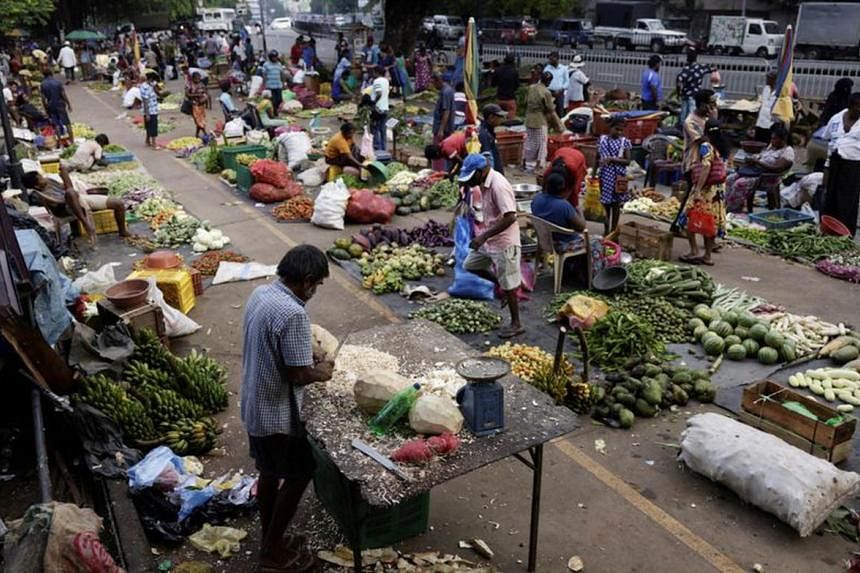
A general view of a main market is seen, after the International Monetary Fund’s executive board approved a $3 billion bailout, in Colombo, Sri Lanka March 21, 2023. REUTERS/Dinuka Liyanawatte
COLOMBO – The International Monetary Fund (IMF) said its executive board cleared the first review of Sri Lanka’s about $3 billion bailout on Tuesday, providing about $337 million in funds to help tackle the fallout from the country’s worst financial crisis in decades.
The South Asian island nation is recovering from its worst financial crisis since its independence in 1948 that sent the economy into freefall last year with soaring inflation, currency depreciation and low foreign reserves.
The total amount sent so far to Sri Lanka now stands at about $670 million, according to the IMF.
“A swift completion and signature of the Memoranda of Understanding with the official creditors is important. Timely implementation of the agreements, together with reaching a resolution with external private creditors on comparable terms, should help restore Sri Lanka’s debt sustainability over the medium term,” said Kenji Okamura, Deputy Managing Director of the IMF.
The economy, however, began to stabilise after Sri Lanka secured a bailout from the global lender in March. It reached a staff level agreement on its first review in October but had to wait for the board’s approval till an agreement was reached with bilateral creditors to restructure part of its foreign debt.
Sri Lanka’s parliament approved a hike in value-added tax(VAT)to 18% from 15% on Monday to meet revenue targets set under the IMF programme. REUTERS
The Cabinet of Ministers approved the proposal presented by the Minister of Transport and Highways to award the contract for the design and construction of the Ratmalana Railway Diesel Power Set Factory under the Railway Efficiency Improvement Project which is being implemented under Asian Development Bank funds, to China Civil Engineering Construction Company who was the lowest responsive bidder in accordance with the recommendation of the Cabinet Appointed Standing Procurement Committee.
Chairman of the Sectoral Oversight Committee (SOC) on National Security, Rear Admiral (retd.) Sarath Weerasekera yesterday (05) said that over a year after the killing of eight persons, including SLPP MP Amarakeerthi Atukorale and his police bodyguard and destruction of approximately 150 private properties the government was yet to conduct a proper inquiry into the incidents.
The former Public Security Minister also emphasized that the Wickremesinghe-Rajapaksa government hadn’t so far probed as to why law enforcement authorities and the military did absolutely nothing during the systematic violence unleashed by organized gangs in Colombo, its suburbs and the provinces. Polonnaruwa District lawmaker Atukorale and his police bodyguard had been lynched in Nittambuwa in broad daylight in spite of the presence of contingent of armed troops there. In fact, the contingent declined to intervene even after the local police sought its assistance, the former Navy Chief of Staff said.
The Colombo District MP said so in response to The Island query regarding SLPP MP Chandima Weerakkody raising a privilege issue with Speaker Mahinda Yapa Abeywardena over MP Weerasekera, in his capacity as the Chairman of the SOC writing to State Defence Minister Pramitha Bandara Tennakoon in this regard. MP Weerakkody, who is also a member of the SOC on National Security has declared that the Chairman couldn’t have written to the State Minister without the consensus of members.
In a letter to Speaker Abeywardena, MP Weerasekera, has asked whether the arrest of SSP Kegalle K.B Keerthiratne over ordering police to open fire on a mob that tried to set fire to a fuel bowser on April 19, 2022 discouraged law enforcement authorities and the military. One person died as a result of police firing while several police officers suffered injuries.
Pointing out that SSP Keerthiratne, now on bail, had been forced to meet his legal expenses, lawmaker Weerasekera has warned the Speaker of dire consequences of such a disastrous government policy.
Would any officer dare to issue instructions to quell mob violence when he realized the catastrophic consequences in the absence of political backing for security measures, MP Weerasekera asked. According to him, the bone of contention is that MP Weerakkody felt that he shouldn’t have drawn the State Defence Minister’s attention to a discussion chaired by him in Parliament on Oct 05, 2023. Lawmaker Weerakkody also found fault with me for commenting on US Ambassador Julie Chung’s behaviour during last year’s troubles,” MP Weerasekera said.
The US Ambassador misinterpreted developments. She intervened and in the process misled all, including her own government,” MP Weerasekera said.
Referring to the findings made by the Committee of Experts appointed by the Human Rights Commission to investigate the Rambukkana shooting, MP Weerasekera said that at the time he wrote to the State Defence Minister he hadn’t been aware of the existence of such a committee.
MP Weerasekera said that SOC wouldn’t under any circumstances endorse that committee’s recommendation that disciplinary action be taken against SSP Keerthiratne as the police officer didn’t violate any law. If not for the timely action taken by Kegalle police on the orders of the senior officer in charge, a massive disaster would have happened, the former Public Security Minister said.
At the time of the Rambukkana incident, Chief Government Whip Prasanna Ranatunga served as the Public Security Minister. Rambukkana violence erupted close on the heels of Weerasekera’s resignation as Public Security Minister.
MP Weerasekera said that SSP Keerthiratne’s issue hadn’t been resolved yet. The failure on the part of the government to address this issue posed quite a threat to national security as both police and military would hesitate to take tangible measures in emergency situations.
Having dismissed MP Weerakkody’s concerns over violation of certain Standing Orders pertaining to the operation of SOCs, MP Weerasekera said that no one could find fault with him for bringing a matter of utmost importance to the notice of the State Minister. The ex-Navy Chief of Staff asserted that perhaps the former minister had no idea whatsoever regarding the subject of national security.
Responding to another query, MP Weerasekera said that the government owed an explanation regarding the outcome of investigations. The retired Navy officer noted that lawmakers who had moved court against the failure on the part of police and military to save their property later withdrew their case on the promise fresh investigation would be conducted. We are yet to hear anything about the progress of this fresh investigation,” the MP said.
attackers among 25 arrested along with two trawlers
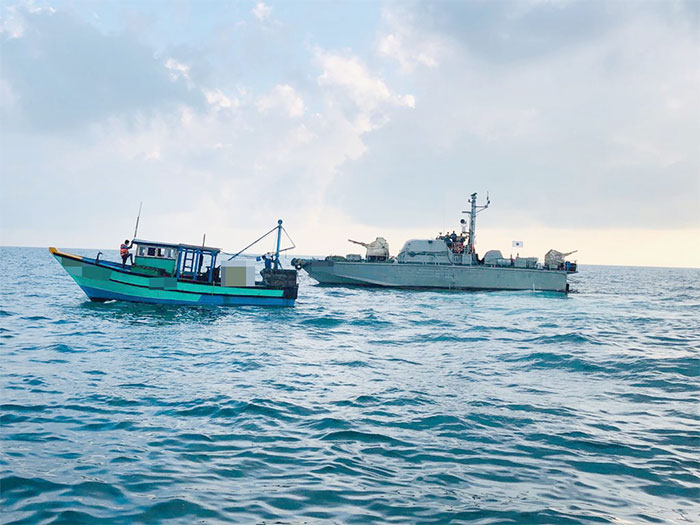
Poaching Indian fishers on Saturday night (Dec 09) caused injuries to two sailors in Sri Lankan waters off Point Pedro.
Authoritative sources said that Indian fishers attacked them with sticks and then threw boiling water in a bid to thwart SLN boarding one of the poaching vessels. Two Navy personnel had to be admitted to hospital following the incident, sources said, adding that the Indian fishing fleet reacted aggressively to recent arrests in the northern seas.
Responding to queries, sources said that Indian trawlers engaged in dangerous maneuovers close to SLN vessels to discourage them from coming closer to poaching trawlers. Sources said that the SLN was taking countermeasures in line with overall measures to curb illegal fishing, which is increasingly depriving local fishermen of their catch.
Asked whether those who had been involved in the attack on the sailors were taken into custody, sources said that in spite of the incident, SLN managed to take two trawlers and 25 fishers into custody. The arrested included those who attacked the sailors, sources said. Two of them jumped overboard and at one time we feared the worst. Fortunately, they were rescued.”
Sources acknowledged that the developing situation couldn’t be tackled by firing warning shots. It would be the responsibility of India to prevent large-scale crossing of the Indo-Lanka maritime boundary almost on a daily basis, sources said, alleging that Tamil Nadu seemed to have stepped up poaching.
Those who had been apprehended, along with the poaching trawlers, were handed over to the Mailadi Fisheries Inspector at the Kankesanthurai harbor for legal action.
Navy headquarters said that so far this year 33 Indian poaching trawlers had been taken into custody along with 220 fishers.
The Fisheries Ministry said that the government in October this year requested UN intervention to prevent continuing poaching here by the large Indian fishing fleet.
Fisheries Minister Douglas Devananda made the request on behalf of the Wickremesinghe-Rajapaksa government. A statement issued by the Fisheries Ministry on 16 Oct., quoted Devananda as having told UN Resident Coordinator in Colombo Marc-André Franche that the invasion of Sri Lankan waters was a serious problem.
The UN veteran, who had served in Libya as Resident Representative of the UN Development Programme before taking over the top job here, was quoted as having assured that the issue would be looked into and brought to the notice of New Delhi. Similarly about two years ago Devananda raised the issue with the US Embassy here, but there has been no favourable result to date.
Sources said that India would have to be apprised of the developing situation and unless tangible measures were taken to rein in the poaching fleet untoward incidents could happen. In response to the new situation, SLN has strengthened patrols and issued instructions on how to handle sudden developments.
Meanwhile, sources said that the fisheries communities in the northern and eastern regions found fault with the government for not taking sufficient measures to discourage poaching by the Indian fleet. The government should take up this matter at the highest level, sources said, adding that India couldn’t absolve itself of the responsibility of thwarting organized violation of the Indo-Lanka maritime boundary.
Sometimes quite large clusters of trawlers move very close to land creating an extremely hostile environment, sources said.
Asked whether the latest developments had been brought to the notice of the Indian High Commission in Colombo, sources said that the outgoing High Commissioner Gopal Baglay undertook a three-day visit to Northern Province from 29 November to 1 December 2023.
Baglay donated deep freezers to 15 fishermen’s cooperatives in the Jaffna region. Interacting with representatives of the cooperatives at Pasaiyoor, the High Commissioner assured that India strived to bring benefits of scientific research and expertise for commercially sustainable development of fisheries in Sri Lanka, including in the Northern Province, so that the benefits could directly reach the fishermen and the common people.
But, unfortunately, India continued to ignore the situation caused by large scale continuing invasion of Sri Lankan waters by its well organized fishing fleet in hundreds of vessels, sources said.
Colombo, Dec.12 (Daily Mirror) – In the wake of the organisations from countries such as Russia, China, Denmark and the United States proposing to invest in nuclear energy, Sri Lanka Atomic Energy Authority (SLAEA) has given the green light for nuke power, an official said.
Russia which has already invested in nuclear power generation in Bangladesh and India in the region has shown a keener interest in putting up a plant in Sri Lanka. A high-level delegation from Russia which was in Sri Lanka recently discussed the proposed cooperation in the nuclear energy sector among others with the Sri Lankan authorities.
SLAEA Chairman Prof. S.R.D. Rosa told Daily Mirror that he briefed the delegation about the current status regarding the Russian proposal for the development of an offshore or an onshore nuclear power plant in Sri Lanka. He said his office had basically given its nod for nuclear power to increase Sri Lanka’s energy mix, and it had been sent to the Foreign Ministry for approval.
We can implement this project only if the Intergovernmental Agreement (IGA) is signed between Sri Lanka and Russia. That is now pending,” he said.
Russia has offered assistance in terms of capacity building and training Sri Lankans in the field. According to the proposal, small modular reactors (SMRs) which are advanced nuclear reactors are to be installed in the event a policy decision is taken. However, the financing model of the project, which is likely to cost more than US $ 2 billion has not yet been discussed.
Asked about safety, Prof. Rosa said SMRs are inherently safe. He asserted that it is advisable for Sri Lanka to have nuclear power in its energy mix.
Commenting on proposals from other countries, he said a Chinese delegation also held talks with the SLAEA.
We have received proposals from the companies in the United States and Denmark too,” he said.
The Sri Lankan government has decided to appoint a combined standing committee to make decisions concerning renewable energy projects and monitor whether the decisions are efficiently and promptly implemented by relevant institutions.
Cabinet of Ministers green-lighted this resolution on Monday (Dec.11), after identifying the need to accelerate the implementation of renewable energy projects, in order to meet the Nationally Determined Contribution targets by 2030.
On November 20, the Cabinet of Ministers decided that a new system should be introduced for the speedy implementation of renewable energy projects, taking into account the time it takes to implement such projects following the existing methods and the potential difficulties that interested investors have to face while working according to those methods.
Accordingly, the Cabinet of Ministers approved the proposal presented by the Minister of Power and Energy Kanchana Wijesekera to appoint a combined standing committee representing the following institutions for this purpose:
• Presidential Secretariat (Chairman of the Committee) • Prime Minister’s Office • Ministry of Finance, Economic Stabilization and National Policies • Ministry of Investment Promotions • Ministry of Wildlife and Forest Resources Conservation • Ministry of Environment • Ministry of Tourism and Lands • Ministry of Industries • Ministry of Power and Energy • Ministry of Irrigation • Ministry of Water Supply and Estate Infrastructure Development • Sri Lanka Sustainable Energy Authority • Ceylon Electricity Board
The police have arrested a saffron-robed monk called ‘Vishwa Buddha’ for behaving in a manner offensive to Buddhism.
The 34-year-old, who is originally from Ratnapura, was taken into custody in the area of Kalagedihena.
While the arrestee is slated to be produced before the Colombo Magistrate’s Court tomorrow (Dec.13), the Criminal Investigation Department (CID) is conducting further investigations into the incident.
Sri Lanka extended restrictions on outward remittances by six months to manage foreign exchange reserves, cabinet spokesperson and transport minister Bandula Gunawardane told reporters at a weekly cabinet briefing on Tuesday.
The nation’s central bank suspended permission to remit funds for overseas investments by Sri Lankan residents from mid-2020 except under certain conditions. The restrictions would be further extended for six months from Dec. 28.
The Media Spokesman of Sri Lanka Army, Major General Ravi Herath states that so far, police have arrested 126 out of around 139 inmates who had escaped from the Kandakadu Treatment and Rehabilitation Centre last evening (11).
Of the arrested inmates, 44 individuals have been detained at the Pulasthipura Police Station, 23 at the Polonnaruwa Police Station, 34 at the Hingurakgoda Police Station and 25 others have been detained at the Meegaswewa Police Station, he said.
Furthermore, Major Gen. Ravi Herath emphasized that police and army personnel are continuing joint operations in search of 12 more escaped inmates, however, adding that the other escapees are expected to surrender to police as soon as possible.
Meanwhile, the Media Spokesman of the Sri Lanka Army mentioned that the situation at the Kandakadu Treatment and Rehabilitation Centre and its locality presently remains peaceful.
Minister of Sports Harin Fernando on Tuesday (Dec.12) signed a new gazette notification to revoke the decision appointing an Interim Committee for Sri Lanka Cricket (SLC), the national governing body of the sport.
Taking to X (formerly Twitter), the lawmaker said the move is an effort to lift the suspension imposed by the International Cricket Committee (ICC) on SLC.
Fernando says he has also written to the ICC, seeking their observations on the Auditor General’s report on the national cricket body, and to the Attorney General’s Department for future actions.
On Nov.06, a seven-member Interim Committee was appointed by the then-Sports Minister Roshan Ranasinghe. It was chaired by World Cup-winning former Sri Lanka captain Arjuna Ranatunga and consisted of S. I. Imam, Retired Supreme Court Judge; Rohini Marasinghe, Retired Supreme Court Judge; Irangani Perera, Retired High Court Judge; Arjuna Ranatunga (Chairman); Upali Dharmadasa; Rakitha Rajapakshe, Attorney-at-Law; and Hisham Jamaldeen.
The following day, the Appeals Court issued a 14-day stay order on the Interim Committee. The relevant order was issued by a two-member judge bench consisting of Appeals Court President Nissanka Bandula Karunaratne and Justice Vikum Kaluarachchi, upon consideration of the writ application filed by the SLC President Shammi Silva challenging the move.
Later, on Nov.13, then Sports Minister Ranasinghe filed a motion requesting the lifting of the stay order.
Nevertheless, on Nov.27, President Ranil Wickremesinghe removed SLPP parliamentarian Ranasinghe from all his positions including as the Minister of Sports and Youth Affairs and Minister of Irrigation.
Harin Fernando, who was serving as the Minister of Tourism, was subsequently sworn in as the new Minister of Sports to replace Ranasinghe.
On Dec.05, Fernando gave an undertaking before the Appeals Court, pledging that no further action would be taken in respect of the Gazette notification issued by his predecessor.
Against this backdrop, the SLC decided to establish an independent committee to inquire into audit reports, and make recommendations to ensure the prevention of corruption. The panel comprises Retired Supreme Court Judges S. I. Imam and Rohini Marasinghe and Retired High Court Judge Irangani Perera.
Senior officials of the Bill & Melinda Gates Foundation (BMGF) met the Sri Lankan Defence Secretary General Kamal Gunaratne today (Dec 11) at the Defence Ministry in Sri Jayawardenepura, Kotte.
The delegation led by BMGF’s Deputy Director for Emergency Response, Global Development Dr. Valerie Bemo was accorded a warm welcome on arrival at the Defence Ministry and subsequently had a cordial discussion with the Defence Secretary where matters related to the launch of the Sustainable National Anticipatory Action through Preparedness initiative in South Asia were discussed.
The BMGF’s Senior Program Officer for Emergency Response, Global Development Ms. Pilar Pacheco, Director of Preparedness for Response and Recovery Dr Sisira Madurapperuma and Ms. Nirmala Fernando from Asian Disaster Preparedness Centre were also in the delegation.
The BMGF has long supported disaster risk reduction initiatives in the region including several programs in Sri Lanka.
The Director General, Disaster Management Centre Sri Lanka Maj. Gen. Sudantha Ranasinghe (Retd) was also present at the occasion.
The commemoration of the 20th death anniversary of the world-renowned Buddhist priest, Most Venerable Gangodawila Soma Thera will be held today (12) at Siri Vajirarama Temple in Bambalapitiya.
The book Gautama the Buddha which is compiled by Jin Jayasinghe, a resident of Melbourne, Australia, will also be launched. The commemoration will be held under the Chairmanship of Aggamaha Panditha Balangoda Sobitha Thera, Principal of the Maligakanda Vidyodaya Pirivena, Colombo.
Ven. Professor Agalakada Sirisumana Thera and Professor Asanga Thilakaratne are also scheduled to hold lectures and a large number of lay people and the clergy are expected to join this event.
Most Venerable Gangodawila Soma Thera, who propagated the Dhamma worldwide for the spiritual benefit of many people, was invited by St. Petersburg International University of Theology in Russia on October 3, 2003 to be awarded the ‘Visionary Science’ doctorate for the famous book Buddhist Stupa written by him.
At that time, Most Ven. Gangodawila Soma Thera fell ill and was admitted to hospital for treatment. He passed away on December 12, 2003 due to a heart attack.
Many other religious ceremonies are scheduled to be held by the Sri Lankan communities in other countries to mark the 20th death anniversary of Most Venerable Gangodawila Soma Thera.
Key insights from the conference include a global south’s call for urgent action, emphasizing concrete decisions to curb excessive emissions.
Photo by YODA Adaman on Unsplash
The culmination of the Just Transition in South Asia press conference, which took place on December 11, 2023, at COP-28 in Dubai, has illuminated the pressing need for immediate action to confront the impending climate crisis. The event delivered a stark call for decisive decisions and collaborative endeavors by major economies to ensure an equitable and just transition in South Asia.
Key insights from the conference include a global south’s call for urgent action, emphasizing concrete decisions to curb excessive emissions and meet the 1.5-degree goal by 2050, as outlined in the Paris Agreement. The conference underscored that 83% of the carbon budget has already been exhausted, leaving a precarious 50:50 chance of achieving the Paris Agreement goals by 2030.
Further, the Climate Risk Index revealed that six South Asian nations, including Bangladesh, India, Nepal, Pakistan, and Sri Lanka, are among the top 10 most vulnerable countries impacted by climate change. The region bore witness to the devastating impact of seven cyclones in 2023 alone, resulting in loss of lives, destruction of homes, and severe economic repercussions.
Hasan Mehedi from CLEAN (Coastal Livelihood and Environmental Action Network), Bangladesh, firmly stated, The people of South Asia are bearing the brunt of climate change impacts, and their plea for urgent action is a call to the global community. The decisions we make today will determine the fate of vulnerable communities and the sustainability of our planet.
Recognizing the challenges faced by South Asian countries, representing a quarter of the global population and nearly a third of the world’s poor, the conference shed light on the intricacies of energy poverty. The imperative to decarbonize the energy sector is acknowledged, yet challenges persist in meeting basic electricity needs and overcoming economic crises, particularly in Sri Lanka, Pakistan, and Bangladesh.
A positive development emerged with the signing of the Global Renewables and Energy Efficiency Pledge (GREEP) by 123 countries, including Bangladesh, Bhutan, and Maldives. However, concerns were voiced about the adequacy of the target, considering the escalating global electricity demand and the need for more ambitious goals to achieve a just transition by 2030.
The event underscored challenges such as the concentration of renewable energy technologies in specific countries, giving rise to a form of ‘Climate Colonialism.’ The dominance of large corporations in renewable energy projects, notably hydropower, raised serious environmental and human rights issues, with indigenous communities facing the imminent threat of displacement.
Hemantha Withanage from the Centre for Environmental Justice (CEJ), Sri Lanka, shared, South Asian nations face a delicate balancing act: meeting the basic electricity needs of their citizens while navigating economic challenges. Big economies must acknowledge and support our transition efforts, ensuring a just and equitable pathway towards sustainability.
Opposition was against false solutions like hydrogen, ammonia, and carbon capture and storage (CCS) technologies. The conference emphasized the need for proven, affordable, and sustainable alternatives, rejecting the promotion of unproven technologies.
In the aftermath of the conference, key demands were outlined to address the climate crisis in South Asia. Organizers called for an ambitious target to generate at least 60% of global electricity demand from renewable sources, a cut-off date for using coal, gas, and petroleum in the power sector, cessation of financing for LNG as a transition fuel, and support for South Asian countries in building national renewable energy institutions.
The concentration of renewable energy technologies in specific countries is a form of ‘Climate Colonialism.’ We must shift focus towards community-owned decentralized systems to ensure not just environmental sustainability but also uphold the rights of local communities,” says Vidya Dinker of Growthwatch, India,
Furthermore, the demands included financing for community-owned distributed renewable energy systems, ensuring local communities’ human and environmental rights during the energy transition, and discontinuing the promotion of false solutions like hydrogen, ammonia, and CCS technologies.
Creating a unique record in the Sri Lankan cruise segment Aitken Spence Travels, brought 4,000 passengers from three vessels on a single day on Sunday.
The simultaneous arrivals of three cruise ships—Vasco Da Gama, Mein Schiff 5, and MS Seven Seas Navigator on December 10, 2023, at the port of Colombo also helped in increasing tourist arrivals and brought on the much needed revenue via a series of excursions.
Minister of Ports and Shipping Nimal Siripala de Silva who welcomed the Cruise ships said that they will add more infrastructure to the Colombo Port.
Operated by TUI, this cruise brought three flights to Colombo for disembarking cruise passengers. Notably, the Vasco Da Gama cruise will be continuing their voyage to the Trincomalee port as well.
As Aaron David Miller, a Middle East expert at the Woodrow Wilson Center, observes, a strange, self-sustaining relationship remains. Israel’s hawkish government — comprising many politicians who have little interest in seeing the creation of a separate Palestinian state — dwells on the security threat that Hamas’s crude rockets pose. Hamas depends, Miller writes, on “an ideology and strategy steeped in confrontation and resistance. “And so, he concludes, they are “two parties who can’t seem to live with one another — or apparently without one another either.”
David Miller has summed up in one phrase, the Israeli-Hamas conflict so accurately and so succinctly. Miller’s assertion is not simplistic by any means as the root of this conflict runs very deep and predates the advent of Hamas. It is a complex issue weighed by history and religious beliefs. For those who say the solution is a two State solution, it is, but it is also not something written on a document or spoken from a lectern that can be easily translated into practical action. A solution fundamentally has to come from the people of Israel and the people of Palestine. Easily said than done though!
Israel and Hamas and supporters of both sides are engaged in a battle involving manifestations of a deep-rooted problem. Till the 7th of October, this battle was one sided in relative terms, with Israel using all its fire power on Palestinians, while overtly telling the world they are after Hamas operatives. Were they actually looking to liquidate Hamas or to break the back of Palestinians, or what is left of their backs? The disproportionate and atrocious destruction and killings of Palestinians in Gaza does raise the question as to what the ulterior motive of Israel is. One can ask whether it is the total annihilation of the Palestinians and whether that is the solution Israel is seeking in the guise of looking for Hamas operatives. The latest UN announcement says Half of Gaza is starving and that 9 out10 people cannot eat every day. The BBC reports that meanwhile, the Biden administration has used an emergency law to bypass Congress and authorise the sale of some 14,000 rounds of tank ammunition worth more than $106m (£85m) to Israel.
The term wheels within wheels” has never been more apt if, as some articles quoted below suggests, and as Miller has said, to describe two parties, Israel and Hamas, who cannot seem to live with one another- or apparently without one another either. They suggest that Israel and Hamas were strange bed fellows and Israel had used Hamas to destabilise the Palestinian Authority which had recognised Israel and a two State solution in 1987 as the solution to end the long-drawn crisis. These articles present the view that Israel had been against the creation of a Palestinian State, and they had used all available means, including Hamas which opposed the recognition of Israel, to make sure a Palestinian State as envisaged by the PLO never became a reality. While the world looked on, or rather looked the other way, the conflict got worse, and the prospective two State solution became more and more distant. The ordinary Palestinians continued to bear the brunt of this indifference while Israel illegally expanded their borders by encroaching into Palestinian territory. Following are some of the articles that clearly outlines the Israel/Hamas linkage
The Israeli-Hamas conflict, and more broadly, the Israeli- Palestine conflict, reminds one of the Buddhist doctrine of Patityasamutpada or dependent origination, in particular the cause that has given rise to the manifestations which have been the driving force of this conflict.
Pratītyasamutpāda (Sanskrit: प्रतीत्यसमुत्पाद, Pāli: paṭiccasamuppāda), commonly translated as dependent origination, or dependent arising, is a key doctrine in Buddhism shared by all schools of Buddhism. It states that all dharmas (phenomena) arise in dependence upon other dharmas: “if this exists, that exists; if this ceases to exist, that also ceases to exist”. The basic principle is that all things (dharmas, phenomena, principles) arise in dependence upon other things.
In the case of this conflict, one can conclude that the dependent origination principle if this exists, that exists; if this ceases to exist, that also ceases to exist, and that all things arise in dependence upon other things” based on the many associated machinations and tactics of Israel, the stand taken by Hamas in 1987 to oppose the PLO to recognise Israel’s right to exist, and the two State solution, supported or influenced by Israel, and the demented outlook of the key World players, is absolutely true. The action of the British, supported by the League of Nations, in the creation of the State of Israel in 1948 without consultation with the Palestinians and giving Statehood to Palestine, could well be regarded as the event that resulted in what followed, and the interconnected of many events that followed. In this context, the October 7 massacre in Israel, deplorable and inhuman as it was, has to be considered from the many interconnected issues that are manifestations of the root cause of the conflict.
Hamas, founded in 1987, opposed the secular approach of the Palestine Liberation Organization (PLO) to the Israeli-Palestinian conflict, and rejected attempts to cede any part of Palestine. They embraced the use of violence, including acts of terrorism, as a means to achieve its goals. In this context, Hamas is as responsible for the violence that followed and is still ongoing, as Israel.
It is ironic that in a curious and one could say in a diabolical way, both Hamas and Israel had a common cause and objective at the time in standing in the way of the two State solution, with both being against the PLO which by then had embraced it. The world, in particular the West, was complicit in not exposing and acting against this objective. It certainly leaves one with the unsavoury conclusion that ordinary Palestinians, the fodder in all this, was, and still is, a dispensable community of no worth or consequence to the rest of the world, including the Arabs who have the clout to do something for them, but who basically have not done anything effective for the Palestinians. The world watches in horror from their comfortable living rooms as to what is happening to Palestinians in Gaza, but does nothing effective to stop Israeli atrocities which go on unabated.
Imagine the dynamics of this conflict had Israel allowed the Palestinians to extract their oil reserves within an independent Palestine State? Its people would have been carried on the shoulders of the West and Arab countries. Israel would have lost their clout as war mongers as the world would have teamed up with Palestine rather than Israel. Ramallah would have been another Dubai, or a Doha
According to UNCTAD, while Palestine produces no oil or natural gas and is predominantly dependent on the Israel Electric Corporation (IEC) for electricity, the Palestinian Territory “lies above sizeable reservoirs of oil and natural gas wealth” but “occupation continues to prevent Palestinians from developing their energy fields so as to exploit and benefit from such assets
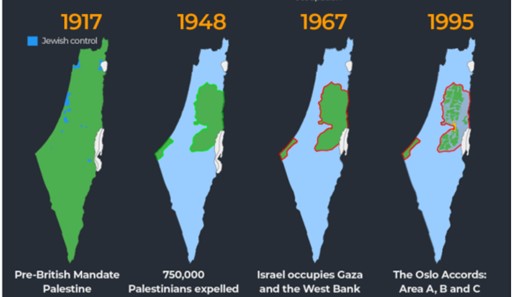
Every year on May 15, Palestinians around the world mark the Nakba, or catastrophe, referring to the ethnic cleansing of Palestine in 1948. Having secured the support of the British government for the creation of a Jewish state in Palestine, on May 14, 1948, as soon as the British Mandate expired, Zionist forces declared the establishment of the State of Israel, triggering the first Arab-Israeli war. Zionist military forces expelled at least 750,000 Palestinians from their homes and lands and captured 78 percent of historic Palestine. The remaining 22 percent was divided into what are now the occupied West Bank and the besieged Gaza Strip.
Mapping the Palestinian villages Israel destroyed
Between 1947 and 1949, Zionist military forces attacked major Palestinian cities and destroyed some 530 villages. About 15,000 Palestinians were killed in a series of mass atrocities, including dozens of massacres. Israeli annexation of Palestinian territory since 1948 is illustrated below.
Where are Palestinian refugees today? There are 6 million of them.
There are some six million registered Palestinian refugees living in at least 58 camps located throughout Palestine and neighbouring countries. The UN Relief and Works Agency for Palestine Refugees in the Near East (UNRWA) provides assistance and operates hundreds of schools and health facilities for at least 2.3 million Palestinian refugees in Jordan, 1.5 million refugees in Gaza, 870,000 refugees in the occupied West Bank, 570,00 refugees in Syria and 480,000 refugees in Lebanon. The largest camps in each are Baqa’a in Jordan, Jabalia in Gaza, Jenin in the occupied West Bank, Yarmouk in Syria, Eand in El Hilweh in Lebanon. More than 70 percent of Gaza’s residents are refugees. About 1.5 million refugees live in eight refugee camps around the Gaza Strip. The plight of Palestinian refugees is the longest unresolved refugee problem in the world.
Palestinians’ life under occupation
Israel’s military control over the Palestinian people affects every aspect of their lives, from what services they can access and where they can travel to whom they can marry and where they can live. Leading international NGO, Human Rights Watch (HRW) says Israel is committing the crimes against humanity of apartheid and persecution against Palestinians”. In a damning investigation, HRW documented a range of Israeli abuses, including extensive seizures of Palestinian land and property, unlawful killings, forcible transfer, drastic movement restrictions, administrative detention and the denial of citizenship to Palestinians.
Every year, Israel demolishes hundreds of Palestinian homes. According to data compiled by OCHA, between 2009 and 2022, at least 8,413 Palestinian-owned structures were demolished by Israeli forces, displacing at least 12,491 people. Forcible displacement is a violation of international law. Most of these structures (79 percent) are in Area C of the occupied West Bank which is under Israeli control. Twenty percent of these structures are in occupied East Jerusalem. Israel also holds some 4,450 Palestinians – including 160 children, 32 women, and 530 administrative detainees – in prisons. Al Jazeera staters that Four in 10 Palestinian men spend time in Israel jails.
Israeli settlements grow
Israeli settlements are heavily fortified Jewish communities built illegally on Palestinian land. Some 750,000 Israeli settlers live in at least 250 illegal settlements in the occupied West Bank and occupied East Jerusalem. Israeli settlements are illegal under international law.
Settler attacks against Palestinians and their property are a regular occurrence in the occupied West Bank and occupied East Jerusalem, home to some three million Palestinians. The Israeli government has openly funded and built settlements for Israeli Jews to live in, offering incentives and subsidised housing. This has meant the population of Israeli settlers in the occupied West Bank and occupied East Jerusalem is growing faster than the Israeli population of Israel.
Is there a solution to thos conflict?
The two State solution is mentioned as the solution by everyone except the Israeli’s and Hamas. Isreal has opposed it from day 1 and they have fought wars, killed thousands of Palestinians and they have witnessed the death of their own soldiers and ordinary citizens. Hamas has opposed the two State solution and Isreal’s right to exisisr as a State. They are equally responsible for the suffering of Palestinians as Isreal. Unfortunately, the elimination of Hamas as vowed by Isreal as their goal, will not advance the two State solution as Isreal is bitterly opposed to it. So, even if Hamas is no longer in the picture, which incidentally is a pipe dream of Isreal and their sipporters, their elimination will only strengthen Israel’s hand and a two State solution will recede futher into nowhere. Maybe this is what the supporters of Isreal also has as their objective. This could become a solution but it may require many interrnational interventions considering the current situation. Firstly, Isreal will have to agree to return to the pre 1967 borders. This will not be possible unless there is an Arab and Hamas agreement to recognise Israels right to exist should Israel agree. Secondly, there is so much mistrust of each other about commitments, even if they are made, there will have to be an interrnational armed force to monitor adherence to such a commitment. In an overall sense, unless there is an international intervention, the two State solution will not become a reality. Of course, there is one more possibility to explore how the conflict could be solved. This is by Israeli and Palestinian people, most of whom no doubt are peace loving people, finding ways and means of talking to each other about how they could live in peace. Extreme elements on both sides who are now calling the shots should be moved out of such a dialogue as they will not want this conflict to end as their existance and their power base is dependent on the continuation of the conflct.
‘Before you study the economics, study the economists!’
e-Con e-News 03-09 December 2023
The Netherlands is sending US F-35 fighter jet parts to bomb Palestine. And while we are on the ‘edge of an economic precipice’ (see ee Economists, Sanderatne), the bands (media) on this supposedly stationary Titanic wreck are announcing the latest imperial medleys & celebrity superstars & charitable loan-givers.
The local media are bribed handsomely to strike up a lot of song&dance about the Dutch state returning some old captured cannon&swords (at least they were once made here!) to Sri Lanka. There are even Dutch flags flailing outside the besieged ‘National Museum’ on ‘Sir Marcus Fernando Mawatha’. Why not give Sri Lanka a 30% stake in ASML? (ee 11 Nov 2023, Tradition of Knowledge behind Europe’s Most Valuable Tech Co). Instead, according to Dutch accounting, we still owe them!!! Meanwhile, Elon Mutt, the CEO of Twitter, has banned the term ‘decolonization’ from his platform. We must thank him! Next: Post-Colonial!
It turns out, it’s precisely to prevent such decolonizing ‘reparations’ for their ongoing horrors that the US & their Euro killer-poodles set up the World Bank’s ICSID (International Centre for Settlement of Investment Disputes). Italian mining companies then sued post-1994 South Africa at the ICSID, for enacting policies giving 30% of every company to their historically disadvantaged people (see ee Random Notes about ICSID cases against Sri Lanka so far). So much for ‘truth & reconciliation’!
This eeFocus therefore also looks at the colonial origins of ICSID & other supranational (imperialist?) bodies like Chambers of Commerce that are the source of the real ‘corruption’ in this country, and the spooky Mont Pelerin Society (President Ranil a member!) which is behind USDollared thinktank Advocata (with Borah merchant sahib Murtaza Jafferjee at its head & Catholic Action ‘poor boy’ Dhananath Fernando as nominal CE-hO), and faux media outlets like EconomyNext, etc, who are guiding Sri Lanka’s economic policy today.
*
• The JVP slogan for the next election is ‘Pohosath Janathawak – Pohosath Ratak’ (‘A rich people – rich country’, as translated by anglomaniacal Sunday Times, see ee Focus). This slogan recalls SBD de Silva’s classic query, ‘What do the rich think rich means in Sri Lanka?’ And perhaps echoes Deng Xiaopeng’s ‘It is glorious to be rich.’ The JVP leader goes on to add: ‘We should have a corruption-free country with democracy in place. Today we do not haveeconomic democracy.’
*
• The whites of this world see ‘democracy’ not as ‘the will of the people’ or ‘the results of the election’, but as a specific type of NATO-aligned ‘liberal’ government. While signaling such ‘populist’ mantras as democracy & corruption, it’s good that AKD rescues his notion of democracy by asserting the economic facet – though what kind he does not exactly say, outside of calling for much-media-maligned import-substitution. Again, recalling the 1970s, SBD de Silva pointed out the then UF government’s type of import-substitution was not part of a modern industrial political, economic & military strategy but a scrambling to resolve an acute balance-of-payments snafu.
*
• The Romans and the English, Marx recalled after India’s first war of Independence in 1857, pampered and fattened their allies, before slaughtering them. This is what the US and its killer poodles are setting out to do in Sri Lanka with the so-called middle class it promoted all these years, as it sets about refashioning a new multinational division of labor to rescue itself…
*
‘Of one they said that he had robbed funds
from the city government; of another, that he
had not succeeded in some undertaking
because he was bribed; and of yet another,
that because of his ambition, he had committed
this or that impropriety. As a consequence of this
hatred arose on every side, which led to deep disagreements,
from deep disagreements to sects, and from sects to ruin.’
– Machiavelli, 1517 (see ee Focus)
*
As for corruption, such accusations alone, as if it were some personal or psychological genetic (family) defect – fail to show how it’s due to the particular structure of the merchant & moneylender ‘rentier’ capitalism that fuels such ‘corruption’. While being an easy route to power, perhaps, such constant vague accusations will be used again the next government. & on & on it shalt go…
It turns out these accusations are part of that old CIA Playbook, that was also behind the so-called Aragalaya – an attack on the ability of the state to function as an engine of modern industrial growth but only as a repressive tool of the merchants (see ee Politics, CIA Change Agent: Gene Sharp’s Neoliberal Nonviolence).
*
• While the media sometimes admits that it was: ‘the aggressive borrowing [by the US-backed Yahaplana government] in the international bond market’ that ‘resulted in the country borrowing $12billion during 2015-19, resulting in the country’s foreign currency debt stock reaching almost 50% of the total debt stock of ISBs at around $15bn’. And that, ‘Of the $12bn so raised only around $2bn had been utilized to settle ISBs, most dollars were utilized to finance imports, especially cars’, such revelations are not given any saturated (like an US-Israeli blitzkrieg) media coverage, unlike the USA’s ‘China Debt Trap’ bull.
This week also saw a feeble, isolated, lonely, forlorn news item claiming the ‘Private sector as much to blame for corruption’…Really! The World Bank’s Transparency International (TISL) adds, ‘The private sector are also the enablers of this corruption that we see. Such grand-scale corruption couldn’t have happened without the lawyers, real estate agents’ (see ee Economists). But only lawyers & real-estate agents? What about all them bankers, US & EU & other poodle envoys, & CEOs, accountants, & media publicists who got us to look somewhere else while they entrapped the country?
*
• Smokin’ Harsha de Silva of Ceylon Tobacco Co & Assembly of God fame, says there is no proof that companies are parking their country’s dollars abroad (see ee Economists, SJB belatedly defends 2017 Foreign Exchange Act, rejects claim of funds ‘parked’ overseas).
ee therefore provides testimony of a ‘marketing & communication’ executive at Switzerland’s ‘UBS, the world’s largest private bank… best bank in the world & the oldest wealth manager on earth… about 200-250 years old’. It’s about UBS helping their clientele ‘disappear’ money. And in this overarching moment of bats & balls & bunker busters, she also exposes the role that sports & celebrities play in helping banks seduce the ‘emotions’ of the enormously wealthy. (see ee Random Notes, She Exposed UBS, they ruined her life: Meet Stephanie Gibaud)
*
• ee keeps asserting that the corporate media has no right to accuse only politicians of corruption. They are all‘sponsored’ by the same multinational corporations (MNCs) & their petty merchants & moneylenders. News items should clearly state not just which ‘news agency’ (Reuters, AP, BBC, etc) but the PR firms too (WPP, JWT, Phoenix, Mullen Lowe, Grants etc who’ve taken to awarding – Effies, indeed! should be Effems! – & congratulating themselves over & over, where do they find the time?), and name the main corporations and embassies, etc., funding the news item.
A simple analysis of the news section would show that many news items repeated ad nauseam in all the media emanate from the same publicist sources: Unilever, P&G, Exxon, CIC, CTC, the US & other embassies, World Bank, IMF, ADB… And many are promises using the infinitive verb ‘to’, which means it may happen in the next birth or one after that, perhaps… These news items are actually not for us but for these offices & institutions to report to their bosses in Washington & London & Brussels, on how well they are ripping off & fooling the natives.
The corporate media will of course not saturate us with more vital issues such as irrigation…even as the present government is out there ‘attracting’ investment at the International Water Summit (see ee Agriculture)
*
• This ee Focus continues sharing the Communist Party of Sri Lanka’s Alternate Program: this week examining irrigation, providing some startling data. Irrigation was the historical basis of the solidarity of the ancient village, and the main focus of the sabotage by the colonial powers of food security (outside of attacks on iron smitheries). In 2000, the water system in Cochabamba – Bolivia’s 3rd-largest city – was privatized and handed over to US corporation Bechtel, who jacked up prices, making it impossible for most people to afford water. They even made collecting rainwater illegal! …
*
‘In essence, Sri Lanka’s economic revival hinges on a fundamental shift in policy, one that prioritises State-led industrialisation to address market failures. This shift should maximise positive externalities, address indivisibilities and pursue dynamic comparative advantages. Since comparative advantage is inherently shaped by past technological advancements, which in turn influence contemporary scientific progress, specialisation based on current comparative advantages under free trade like labour-intensive garments and apparels, electronics assembly, plantation crops, etc. hinder the expansion of science, labour productivity and ultimately, economic prosperity. The policy framework must therefore foster job creation in sectors that align with scientific advancement’ (see ee Economists, Taxing poor to reward rentiers – Pathirana
Move follows claims by chief monk of assassination attempts
State Minister rubbishes allegations
The Ministry of Defence (MoD) will move to withdraw nearly 250 members of the armed forces who were deployed to carry out maintenance and support duties at the historic Mihintale Raja Maha Viharaya, State Minister of Defence Premitha Bandara Tennakoon said in Parliament.
The move follows an escalation of a dispute between the Government and the Chief Prelate of the Mihintale Rajamaha Viharaya which began with an electricity bill-related matter. Last week, the chief prelate alleged that his life was at risk due to security personnel entering the temple premises clad in civilian clothes, implying that there may be a move to assassinate him.
Speaking to The Daily Morning, Tennakoon rejected the allegation as baseless and unwarranted. According to the State Minister, nearly 250 members of the armed forces – including several officers – had been tasked with maintenance and construction of the historic temple grounds and to aid in cultural and religious activities.
We have 250 soldiers, sailors and Civil Defence Service officers at the Mihintale temple. They were tasked with helping with maintenance, cleaning, and construction of the historic site. We are withdrawing all of them today (10). These personnel have worked hard to maintain that site, and now the chief prelate claims they are a threat to his life. These are totally baseless allegations and we do not accept it. If he has no trust in our personnel, we are withdrawing them.”
However, the current detachment of police personnel who have been assigned for security duties at the Mihintale Raja Maha Viharaya are to remain at their station, it is learnt.
The Sri Lankan armed forces have continued to be deployed to a number of religious sites, for civilian tasks of renovating, rebuilding, and administrative duties following the end of the war – a role that the military is not traditionally deployed for. The Ministry of Defence has stated that with the ongoing defence review, such deployments will be curtailed. Given the politics involved, it remains to be seen if the Government has the political will to recall all the armed forces personnel deployed for such duties.
State Minister for Defense Pramitha Bandara Tennakoon announced in Parliament today that 251 members of the Army, Navy, and Civil Defense Force, who were on duty at Mihintalea Rajamaha Vihara, will be withdrawn. The decision follows a question raised by opposition leader Sajith Premadasa in Parliament yesterday.
The controversy surrounding the security forces’ presence at Mihintalea Rajamaha Vihara escalated when one of the officers was questioned by authorities on the 7th. The officer in question had been staying with other security forces in the Dharma Sala building under construction at the temple. The statement made by Mihintalea Viharadhipa Thero further fueled political controversy.
Opposition leader Sajith Premadasa brought the matter to the attention of Parliament, leading to Minister Tennakoon’s announcement today. The withdrawal of the 251 officers from the Army, Navy, and Civil Defense Force is seen as a response to address the political and public concerns surrounding the security forces’ presence at the revered religious site.
Parliament, Dec 10 (Daily Mirror) – It has been decided to withdraw the security personnel deployed at the historical Minintale temple if the chief Incumbent thinks that the military presence is a threat to his life, State Minister of Defence Pramitha Bandara Tennekoon told Parliament today.
The State Minister said this in response to a question raised by Opposition Leader Sajith Premadasa who said there is a threat to the chief incumbent’s life because of the presence of two unknown persons in civvies.
” The two persons in civvies are military personnel. They were deployed to ensure the security of the temple and the tourists after assessing the security situation. We have decided to withdraw all military personnel who are at the temple premises if their presence is considered as a threat,” the State Minister added.
According to the Sri Lankan Navy, the fishermen were allegedly involved in ‘illegal poaching’ and were detained after a special operation on Saturday.
The 25 fishermen belonged to Nagapattinam district in Tamil Nadu and Karaikal district in Puducherry.
Colombo:
25 Indian fishermen, who were fishing in international waters, were detained by the Sri Lankan Navy along with their two trawlers, off Point Pedro town in Sri Lanka.
According to the Sri Lankan Navy, the fishermen were allegedly involved in ‘illegal poaching’ and were detained after a special operation on Saturday night.
“The Navy continues to conduct regular patrols and operations in Sri Lankan waters to curb illegal fishing practices by foreign fishing trawlers, taking into account the consequences of these practices on the livelihood of local fishermen and marine resources of the country,” the navy stated in an official press release.
The 25 fishermen belonged to Nagapattinam district in Tamil Nadu and Karaikal district in Puducherry.
The apprehended fishermen were brought to the Kankasanthurai harbour and will be handed over to the Mailadi Fisheries Inspector for further legal action.
The relatives of the fishermen have expressed their concern about the incident and have requested both central and state government to rescue them and their two lifeboats.
Last month, 27 Indian fishermen were released by the Sri Lankan authorities. They returned to the Chennai airport on separate days in sets of 12 and 15.
Earlier in October, a total of 64 fishermen who belong to Rameshwaram and Mandapam were arrested in three separate arrests by the Sri Lankan navy, allegedly for cross-border fishing along with their boats and fishing nets.
A total of 33 Indian trawlers and 220 Indian fishermen have been apprehended by the Sri Lankan Navy in 2023 till now, the statement added.
Notably, the arrests of Indian fishermen by the Sri Lankan Navy has been a concerning issue for both Tamil Nadu government as well as the BJP-led central government.
In October, Tamil Nadu Chief Minister MK Stalin wrote to External Affairs Minister S Jaishankar, highlighting the issue of repeated arrests of Tamil Nadu fishermen by the Sri Lankan Navy.
He also reiterated the demand to protect the traditional fishing rights of Tamil Nadu fishermen in the Palk Bay region.
The issue was also discussed during the meeting of Prime Minister Narendra Modi and Sri Lankan President Ranil Wickremesinghe during the latter’s visit to July this year.
“Today we also discussed the issues related to the livelihood of fishermen. We agree that we should proceed with a humane approach in this matter,” the official statement by Prime Minister Narendra Modi after the meeting read.
Colombo, Dec. 9 (Daily Mirror) – The islandwide power blackout is due to multiple lightning strikes on several transformers and power stations, a Power and Energy Ministry official said.
Meanwhile, the Power and Energy Ministry said the islandwide power blackout is also due to a breakdown in the transmission line from Kotmale to Biyagama.
They said the power restoration process is expected to be completed within two hours.
In addition a Ceylon Electricity Board (CEB) confirmed the blackout is due to multiple lightning strikes on several transformers and hydropower stations.
The widespread power failure occurred at around 5 p.m. today.
Sri Lanka’s power and energy ministry says the country experienced an island-wide power outage for several hours after a system failure in one of the main transmission lines
December 9, 2023, 6:00 PM
Children stand in the balcony of a house during a countrywide power outage in Colombo, Sri Lanka, Saturday, Dec. 9, 2023. The outage is reportedly due to a system failure. (AP Photo/Eranga Jayawardena)The Associated Press
COLOMBO, Sri Lanka — Sri Lanka experienced an island-wide power outage for several hours Saturday after a system failure in one of the main transmission lines, the country’s power and energy ministry said.
The power outage began Saturday evening and continued for several hours.
Step by step restorations are underway and it may take few hours to completely restore the power supply,” said the ministry in a statement.
Sri Lanka largely depends on hydro power for power generation, while coal and oil are used to cover the balance. During the dry season, the country is compelled to use more thermal power for generation of electricity.
Sri Lanka experienced several hours of daily power cuts last year for several months due to plunging water levels powering hydroelectric dams. The power crisis worsened as Sri Lanka faced difficulty in importing sufficient stocks of oil and coal after the country’s foreign reserves were depleted during an unprecedented economic crisis.
Sri Lanka plunged into am economic crisis in 2022, creating severe shortages and drawing strident protests that led to the ouster of then-President Gotabaya Rajapaksa. It declared bankruptcy in April 2022 with more than $83 billion in debt — more than half of it to foreign creditors.
Under new President Ranil Wickremesinghe, a continuous power supply has been restored. But there has been growing public dissatisfaction with the government’s efforts to increase revenue by raising electricity rates and imposing heavy new income taxes on professionals and businesses.
Sri Lanka has sought the support of the International Monetary Fund to rescue the economy.
The IMF agreed in March to a $2.9 billion bailout package, releasing the first payment shortly thereafter. However, the IMF delayed the second tranche, citing inadequate oversight and debt restructuring.
An IMF review in September said Sri Lanka’s economy was recovering but the country needed to improve its tax administration, eliminate exemptions and crack down on tax evasion.
COLOMBO (XINHUA) – Income generated by tourism in Sri Lanka from January to the end of November reached USD1.8 billion, which is a 78.3-per-cent hike from the same period in 2022, the latest data released by the Central Bank of Sri Lanka (CBSL) revealed.
The revenue earned from tourism increased to USD205.3 million in November 2023, which is over twice the revenue in November 2022, according to the CBSL.
Minister of Foreign Affairs Ali Sabry told Parliament on Thursday that the tourist arrivals will spike in 2024 with more airlines coming into the country.
Sri Lanka welcomed 151,496 international tourists in November, the highest monthly number of visitors it received in 2023, official data showed.
Sri Lanka’s cumulative tourist arrivals for the first 11 months of the year stand at 1.27 million, according to the Sri Lanka Tourism Development Authority.