Sri Lanka’s economic crisis spiralling into food crisis

June 8th, 2022

Courtesy Reliefweb

Kuala Lumpur/Colombo, 8 June 2022 – The economic crisis in Sri Lanka is spiraling into a humanitarian emergency as millions of people face acute shortages of food, fuel, cooking gas and medicine, the International Federation of Red Cross and Red Crescent (IFRC) warned today.

Responding to the unfolding emergency, the IFRC has launched an Emergency Appeal for 28 million Swiss francs to provide immediate critical relief and for longer recovery efforts for an estimated 500,000 people.

Sri Lanka Red Cross Secretary General, Mahesh Gunasekara, said:

The situation has taken a devastating turn for people already struggling to put food on the table during the COVID-19 pandemic. It’s even worse for single parent households, those without steady work and those already suffering a loss of income.

We need international support now to help hundreds of thousands of people pull their lives back together. It’s going to be a long, tough road for people to rebuild and get their lives back on track.”

The civil unrest and food shortages gripping the country were sparked by an economic crisis that has been developing throughout the COVID-19 pandemic. Sharp declines in agriculture production has resulted in rapid price increase for staple food items like rice and vegetable, which directly impact the household economy and food security of the most vulnerable.

IFRC Head of South Asia Delegation, Udaya Regmi, said:

We hold grave concerns for the most vulnerable communities across the country – some 2.4 million people already living below the poverty line who are most affected by the loss of livelihoods, food shortages, and the spiraling cost of essential items.

The emergency appeal that we have launched in support of Sri Lanka Red Cross will protect the livelihoods and safety of thousands of households in need of support.”

Ruling family still holds key to Sri Lanka’s future

June 8th, 2022

Alasdair Pal and Devjyot Ghoshal, Reuters Courtesy Gulf Today

It was the moment when two brothers who had dominated Sri Lanka’s politics for nearly 20 years finally went their separate ways. On May 9, when a crowd of ruling party supporters marched towards activists protesting against a crippling economic crisis, President Gotabaya Rajapaksa ordered police to stop the pro-government mob, fearing violence. He was screaming at the police to disperse the crowd,” said former media minister Nalaka Godahewa, who said he was with the president at the time.

Despite the president’s order, the demonstrations against inflation, power blackouts and shortages of essentials turned deadly. Nine people were killed, hundreds were injured and the property of Rajapaksa loyalists was attacked. The violence marked a pivotal point in the crisis. Gotabaya’s older brother, Prime Minister Mahinda Rajapaksa, had addressed the government supporters earlier in the day. He was sitting down for lunch when he was shown a video of the violence by an aide, according to a source with direct knowledge of events at the prime minister’s house in the commercial capital Colombo.

He knew what he would do next,” said the source.

The 76-year-old, one of Sri Lanka’s most popular politicians in his heyday, finished his meal and had a nap, the source said. At 5.02 p.m., he announced his resignation as prime minister, making public a rift in Sri Lanka’s ruling dynasty. The source, who spoke on condition of anonymity to avoid retribution, said the president had already been pushing the prime minister to resign since early April as a concession to protesters demanding the ouster of both men because of their response to the economic crisis enveloping the island.

GR (had) told MR to go,” said another source close to the family, who also requested anonymity, referring to the president and the prime minister by their initials. Neither Mahinda Rajapaksa nor the president responded to requests for comment for this story. They have not publicly said anything about their differences. After he quit, Mahinda went into hiding at a naval base and stayed under protection of the armed forces for several days because of the wrath of the protesters. Gotabaya, 72, continues as president, deeply unpopular with many Sri Lankans, while political leaders discuss a move to clip the executive powers of his office. But the Rajapaksas are not done yet.

A third brother, Basil, wields considerable influence over the country via his hold over the ruling party that dominates parliament, according to at least five people who spoke to Reuters, including Godahewa and two other former ministers.

The new prime minister, Ranil Wickremesinghe, is heavily dependent in parliament on the ruling Sri Lanka Podujana Peramuna (SLPP) party to pass an interim budget within weeks that will outline measures to mend public finances. He has also proposed reforms to curb the president’s powers and strengthen parliament in response to demands from protesters.

The International Monetary Fund wants evidence of reforms before agreeing to a bailout, for which negotiations are ongoing. Sri Lanka also needs an agreement with bondholders and bilateral creditors to restructure its debt, and regain access to global financial markets. Wickremesinghe belongs to a party that controls just one seat in parliament, while the SLPP and its coalition partners have a comfortable majority in the 225-seat legislature. All five sources said the ruling party remains loyal first and foremost to Basil, 71, who helped rebuild it when the Rajapaksas surprisingly lost power in a 2015 presidential election. One of the sources, who is close to Basil, said the former finance minister would support the president, his elder brother, but not at the cost of the party. Events in Sri Lanka are being closely watched in neighbouring India, South Asia’s regional heavyweight, and China, which has invested billions of dollars in infrastructure projects in the past decade as part of its Belt and Road Initiative linking it to the rest of the world. Political scientist Jayadeva Uyangoda said Wickremesinghe faced a balancing act to meet the demands of the protesters and Sri Lanka’s international creditors, while placating the ruling party with an agenda that Basil would accept.

What Basil Rajapaksa wants will be what parliament approves,” Uyangoda said. Basil, who has not spoken publicly since he resigned in early April along with the rest of the cabinet, did not respond to requests for comment.

Among the nine Rajapaksa siblings, Mahinda, Gotabaya and Basil were once a tight-knit political unit. Mahinda, a lawyer by training, became Sri Lanka’s youngest ever legislator when he entered parliament in 1970. By 2004, using a combination of political charisma and guile, he rose to become prime minister. The next year, he was voted president. The brothers’ popularity soared after Mahinda and Gotabaya, a retired infantry officer who was appointed defence secretary, crushed a decades-long Tamil insurgency in the north and east of the country in a brutal government offensive in 2009.

Mahinda won a landslide re-election in 2010, promising to heal the country’s deep divisions. He also drew Sri Lanka closer to China, inviting heavy investment like the $1.4 billion Hambantota port that irked India, which feared losing influence over its southern neighbour.

Then, in 2015, a shock defeat for Mahinda in presidential elections threw the Rajapaksas into disarray. Basil, a U.S.-Sri Lankan dual citizen who served as a long-time adviser to Mahinda while he was president, was instrumental in reshaping a minor political party into the SLPP in 2016, making it the dominant player in Sri Lankan politics.

In 2019, coordinated suicide bombings by Islamist militants that killed more than 250 people presented the Rajapaksas with an opening to return to power. With Basil unwilling to renounce his US citizenship and Mahinda barred from standing due to term limits, Gotabaya ran for the presidency and won by a landslide. Mahinda was named prime minister soon after and Basil became finance minister in 2021, but things had started unravelling.

The start of Sri Lanka’s slide into economic chaos can be traced to 2019, when the Rajapaksas implemented populist tax cuts shortly after returning to power, shrugging off criticism from some advisers. Godahewa, the former minister, said he advised Gotabaya that the cuts would be a disaster” because of the already precarious state of public finances, but was overruled. Government officials have previously said that the tax cuts were aimed at resuscitating the economy by putting more money in the hands of people.

Then the COVID-19 pandemic hit, decimating tourism and with it a critical source of foreign exchange. Foreign workers’ remittances also dropped. A manifesto pledge to turn to organic farming and phase out the use of chemical fertilisers over the next decade was implemented abruptly in May 2021 by the president, throwing the country’s farming sector into turmoil and leading to food shortages as crop yields fell.

By then, relations between Mahinda and Gotabaya had deteriorated, according to four of the sources. The two brothers differed over the president’s fertiliser ban, but a move by the prime minister in 2021 to reverse the decision was blocked by Gotabaya’s staff, according to the source at the prime minister’s residence.

Abolition of Executive Presidency may cause anarchy – Justice Minister

June 8th, 2022

By Shamindra Ferdinando Courtesy The Island

Intervention made by lawyer and fiscal officer in Aeroflot affair extraordinary.

Justice, Prison Affairs, Constitutional Reforms Minister Dr. Wijeyadasa Rajapaksa, PC, has warned that the abolition of the Executive Presidency hastily, will plunge the country into anarchy.

The SLPP Colombo District MP said that as the Executive Presidential system has been tied up with the electoral system and 13th Amendment to the Constitution, it couldn’t be done away with.

Dr. Rajapakse said so appearing in a live Swarnavahini interview Monday night (06).

Lawmaker Rajapakse said that the abolition of the executive presidential system without making absolutely necessary constitutional safeguards through other means would definitely threaten Sri Lanka’s unitary status.

Reference was also made to how the Provincial Councils could undermine unitary status if the appointment of Governors, who exercised the executive powers, was done away with. Therefore, the relentless demand of those continuing the ongoing public protest campaign extremist at Galle Face couldn’t be addressed, Minister Rajapaksa said.

In a wide-ranging interview, Dr. Rajapakse discussed several issues at hand, including the alleged conspiracy involving an unnamed Justice Ministry employee and Attorney-at-Law Aruna de Silva, who appeared for the plaintiff Ireland-based Celestial Aviation Trading Co Ltd in a case against Public Joint Stock Company Aeroflot, the circumstances under which UNP leader Ranil Wickremesinghe was offered premiership and the inclusion of citizenship clause that had been in the 19th Amendment, in the proposed 21st Amendment to the Constitution.

Dr. Rajapaksa said that JRJ enacted the 1978 Constitution and brought in new electoral system believing the UNP could never be defeated. But, for 27 years, the UNP couldn’t regain the presidency.

Since Chandrika Bandaranaike’s Kumaratunga’s triumph at the Nov 1994 presidential election, the UNP’s efforts to regain the Executive Presidency failed, MP Rajapakse said, reminding how the UNP scuttled Kumaratunga’s bid in 2000 to abolish the system. The UNP set fire to the new draft Constitution in Parliament as it didn’t accept the provision the Executive Presidency would be abolished within two years after the enactment of the new law.

Responding to another query, Dr. Rajapakse said that if President Gotabaya Rajapaksa decided to resign, the issue could be settled. If that happened, Parliament could select any member of its choice but it would be from the ruling SLPP, the Justice Minister said. Therefore, a SLPPer would serve the incumbent President’s remaining period, the Minister said, pointing out that in spite of differences among some sections of the government group the SLPP remained the single largest party.

Gotabaya Rajapaksa was elected in Nov 2019 for a five-year period. How could we be sure that Gotabaya Rajapaksa’s successor would be better than him or far worse, Dr. Rajapakse asked? A smiling Minister pointed out in case of a vote in Parliament, the new President could be Basil Rajapaksa, he or somebody else from the SLPP. The SLPP group comprised 145 members whereas the SJB received 54 seats out of whom three had so far switched allegiance to the incumbent dispensation.

Dr. Rajapakse said that enactment of the 21 st Amendment was nothing but a prerequisite for revival of the national economy. The requirement for a new Constitution should be dealt with subsequently, the Minister said, dismissing concerns the government was on the wrong path.

Referring to views expressed by Prof. Alfred Jeyaratnam Wilson, the architect of the 1978 Constitution, in ‘The Gaullist System in Asia’, Dr. Rajapakse justified the Galle Face protest launched nearly two months ago, demanding the resignation of President Gotabaya Rajapaksa. Dr. Rajapakse said that the son-in-law of S.J. V. Chelvanayagam foresaw the current crisis 40 years ago.

Asked to explain how he now accepted Wickremesinghe as the Prime Minister after having condemned him on so many occasions, Dr. Rajapakse emphasised the UNP leader was capable of handling the situation. The Justice Minister reiterated his faith in Premier Wickremesinghe. However, the SLPP dissidents’ first choice had been the Samagi Jana Balavegaya (SJB).

Dr. Rajapaksa said that the dissident group comprising 53 lawmakers wanted the SJB to take over the government. We assured the SJB of our support and readiness to accept some ministerial portfolios. But, the main Opposition repeatedly declined,” Dr. Rajapakse said. The SJB’s position remained the same even after President Gotabaya Rajapaksa invited SJB leader Sajith Premadasa to accept the challenge.

Against the backdrop of the SJB’s decision not to accept their offer there wouldn’t have been any purpose in moving a No-faith motion, Dr. Rajapakse said.

Responding to calls for early parliamentary poll to settle the continuing political-economic-social crisis, lawmaker Rajapakse said that the electorate was not in a mood for election. Had there been a general election now, all current members of Parliament would lose their seats, Dr. Rajapakse said.

At the onset of the interview, the three-member panel of journalists questioned the Justice Minister over the Aeroflot affair, amidst furious Russian reaction to the unprecedented detention of their flight at the BIA on June 02. The minister acknowledged that the lawyer accompanying the fiscal official was an extraordinary development. The Minister said that there was no requirement for the official of Commercial High Court of Western Province to deliver a court order to the concerned official at the BIA. The court official and the lawyer had shown undue interest in the matter and therefore the need for an inquiry couldn’t be ignored.

Dr. Rajapakse said that the Justice Ministry would inquire into the conduct of the court official as the Supreme Court exercised the powers to investigate lawyers. The Justice Minister admitted without hesitation that fiscal officials had been routinely influenced by various interested parties and used them for illegitimate purposes.

The Justice Minister also admitted that suspicions had been raised over the possibility of the fiscal officer and the lawyer being used by a group of conspirators who carried out the project.

PM warns CEB TUs not to go for blackout; says it will impact help sought from India

June 8th, 2022

Courtesy The Daily Mirror

While warning Ceylon Electricity Board (CEB) trade unions not to go for a blackout, Prime Minister Ranil Wickremesinghe today said he could not guarantee that India would help Sri Lanka to obtain fuel if they did so.

The Prime Minister told Parliament that only India was helping Sri Lanka to purchase fuel and coal and that no other country was helping to purchase these for Sri Lanka.

“No country is helping us to purchase fuel and coal. They will help to purchase food, medicines and fertilizer. Only India is helping us to purchase fuel and coal under the credit line facility. Indian credit line has exceeded now. We are in talks with them to extend the facility soon. We need fuel and electricity. I warn you, if you go for a blackout, then don’t ask me to go to India for help,” he said.

“I must tell trade unions. They can take to the streets and display placards. But, don’t go for a blackout,” he said.

The Premier came up with these remarks after Opposition Leader Sajith Premadasa said that they were against the Sri Lanka Electricity Bill which was to be taken up for debate tomorrow and that CEB engineers had announced that they were going for a blackout against the proposed bill tonight.

Mr. Premadasa said the proposed Bill was aiming to allow unsolicited proposals in renewable energy projects.

He said after enacting this Bill, Sri Lanka would have to purchase wind power from foreign companies at higher rates in dollars.

“Our country will lose the right to purchase wind power at lower rates,” he said.

Power and Energy Minister Kanchana Wijesekara said they would take up the Bill today as planned and said allegations made by the Opposition Leader were baseless.

He said the Bill would only empower the Sri Lanka Sustainable Energy Authority to expedite the sustainable energy projects under the existing powers of the authority.

The Minister said Sri Lanka must connect the transmission grid with India and added that Bangladesh, Nepal and Bhutan had already connected their transmission grid with India.

“We are not passing this Bill to grant renewable energy sector to India as alleged. There was a discussion for the last 30 years that an underwater or overhead cable should be built between India and Sri Lanka. I hope, Sri Lanka must connect the transmission grid with India. Bangladesh, Nepal and Bhutan had already connected their transmission grid with India. We can generate wind power more than our requirement. Then only, we can export the excessive amounts,” he said. (Ajith Siriwardana and Yohan Perera)

Sri Lanka to receive IMF assistance by September?

June 8th, 2022

Courtesy Adaderana

Prime Minister Ranil Wickremesinghe says he would do his utmost to secure the assistance of the International Monetary Fund for Sri Lanka by this September.

The Sri Lankan Premier and Managing Director of the IMF Kristalina Georgieva have discussed the island nation’s current economic situation during a telephone conversation yesterday.

The IMF chief has been informed of the steps taken by the Sri Lankan government so far to resolve the economic crisis, PM Wickremesinghe continued, addressing the parliament earlier today.

The prime minister has explained that the negotiations on bridging finance are reliant on Sri Lanka and the IMF concluding a staff-level agreement.

He has appealed to the IMF staff-level delegation to visit Sri Lanka at the earliest possible so that the staff-level agreement can be finalised.

The IMF chief has expressed her willingness to help Sri Lanka in these difficult times.

Special gazette issued declaring electricity supply an essential service

June 8th, 2022

Courtesy Adaderana

A Gazette Extraordinary has been issued declaring the supply of electricity an essential service effective from today (June 08).

The communique was issued by President Gotabaya Rajapaksa, by virtue of the powers vested in him in terms of Section 2 of the Essential Public Services Act, No. 61 of 1979.

China willing to help Sri Lanka deal with debt burden

June 8th, 2022

Courtesy Adaderana

China has been paying close attention to the current difficulties and challenges Sri Lanka faces and assisting the country within its capacity, a Chinese Foreign Ministry spokesperson said Wednesday.

Spokesperson Zhao Lijian made the remarks at a daily news briefing when answering a relevant query.

According to Zhao, China has announced emergency humanitarian assistance worth 500 million yuan (about 74.75 million U.S. dollars) to Sri Lanka. The first batch of medicine has arrived in the country, and the first batch of rice is on its way. China has also provided assistance through various channels including local governments and friendship organizations.

After the Sri Lankan government announced the suspension of foreign debt repayment, Chinese financial institutions took the initiative to consult with the Sri Lankan side, expressing their willingness to properly deal with maturing China-related debts and help Sri Lanka cope with the current difficulties, Zhao said.

China hopes the Sri Lankan side will actively work with the Chinese side and step up consultations on feasible plans, said Zhao.

China is ready to work with relevant countries and international financial institutions to continue to play a positive role in helping Sri Lanka tackle the current difficulties, ease its debt burden, and realize sustainable development, Zhao said.

Meanwhile, China believes that Sri Lanka will make its own efforts to safeguard the legitimate rights and interests of foreign investment and financing partners and maintain the stability and credibility of its investment and financing environment, he added.

Neighboring countries, including those in South Asia, are the top priority of China’s diplomacy. China attaches great importance to and spares no efforts in consolidating and developing good-neighborly and friendly relations with its neighbors, Zhao said, adding that China and South Asian countries are a community with a shared future.

History has shown that China has always stood firmly with South Asian countries to help one another overcome difficulties of natural disasters such as earthquakes and tsunamis and global challenges such as the financial crisis and the COVID-19 pandemic, Zhao added.

Under the current circumstances, China will work with relevant countries to tackle risks and challenges, advance the high-quality Belt and Road cooperation, maintain the sound momentum of regional security, stability, cooperation and development, and bring more benefits to the region’s people, said Zhao.


Source: Xinhua

Dhammika Perera to enter parliament?

June 8th, 2022

Courtesy Adaderana

Business tycoon Dhammika Perera is tipped to enter the parliament through the National List of Sri Lanka Podujana Peramuna (SLPP), sources told Ada Derana.

According to sources, Mr. Perera is also expected to take up a ministerial portfolio involving the investment sector.

Reportedly, Mr. Perera will fill the National List parliamentary seat likely to be vacated by former Finance Minister Basil Rajapaksa.

It was reported earlier today, that the former minister is planning to step down from his parliamentary seat.

Basil to step down from parliamentary seat?

June 8th, 2022

Courtesy Adaderana

Former Finance Minister Basil Rajapaksa has decided to step down from his parliamentary seat, political sources of Sri Lanka Podujana Peramuna told Ada Derana.

According to sources, Basil Rajapaksa is expected to deliver a special statement in this regard tomorrow. 

POHOTTU AS USA’ S PROXY Part 3C

June 7th, 2022

KAMALIKA PIERIS

The departure of Mahinda Rajapaksa from the Pohottu government resembled a scene from a film. Gotabaya Rajapaksa had asked Brother Mahinda Rajapaksa to resign as Prime Minister. Instead, on May 9. 2022, Mahinda Rajapaksa convened a meeting of his supporters,   at Temple Trees, and asked them whether he should go or stay. Stay! yelled the loyal supporters. Mahinda Rajapaksa agreed to stay. This was shown on television news.

Then to the surprise of the watching television audience, his ‘supporters’ dashed to Galle Face, armed with poles   and attacked the Gotagama protesters there. They systematically tore down the tents and destroyed the stalls. Television cameras were there filming it all. In events like this, television cameras usually come after the event. In this case they were running alongside, recording for posterity.

There was an immediate reaction by the ‘peaceful’ group. Their reaction was anything but peaceful. They tracked down the Mahinda Rajapaksa supporters who had come from outstation. They knew exactly where the buses that brought them were parked. They went there and damaged the buses. Supporters were pushed into the Beira canal and made to stay there. All this took place amidst much shouting and jeering. No film director could have orchestrated this better. In fact it was just like     watching an action film. Better actually, because this was ‘live’.

Who organized this, asked Shenali Waduge. Who instructed them to attack the unarmed peaceful protestors”. Did they bring poles with them to the meeting or were they given poles at Temple Trees. It is suggested that supporters inside Temple Trees did not have poles. By 3 p.m. another set of people, mostly youth had arrived. They, it seemed, were armed with the poles.

Within a few hours of the Gotagama attack, came the announcement that Mahinda Rajapaksa had resigned as Prime Minister. No reason was given. There was much rejoicing. Then the protestors converged on Temple Trees and wanted to get inside. That was also shown to us on television. It was reported that at least 10 petrol bombs were thrown into the compound.

In a  pre-dawn operation, Mahinda Rajapaksa and his family were evacuated to safety by helicopter, by the army. He was airlifted out of Temple Trees as the crowds were waiting to attack him if he came out of Temple Trees.  Mahinda Rajapaksa and his family  were taken to Navy House inside  the  Navy  Headquarters in Trincomalee .

The next morning crowds arrived  at the entrance to the Navy headquarters  in Trincomalee and started to abuse Mahinda Rajapaksa calling him a thief and traitor. They wanted him taken prisoner. They kept up the verbal attack for hours. Each time you looked at TV news there they were, yelling. Those in front can be easily identified. They looked well rehearsed.

 Later, Mahinda Rajapaksa in a statement to the CID  said that he had not incited SLPP supporters to attack  Gotagama. He said  that if he  knew about the attack, he would definitely, have  stopped  it. We can accept this. Mahinda Rajapaksa is   Sri Lanka‘s most seasoned politician.  He is hardy likely to   commit such a blunder. The attack on Gotagama was staged by  an  anti- Mahinda group.

People are puzzled as to the animosity towards Mahinda Rajapaksa .People have asked me why do people hate Mahinda Rajapaksa so. Anura Gunasekera has offered an answer. Despite his easy camaraderie, hail-fellow-well-met persona and the diligently cultivated rustic appeal, Mahinda Rajapksa is fascist to the core. Mahinda is a total hypocrite, said Anura Gunasekera.

The long political career of a vainglorious man, signposted by overwhelming political victories, ignominious rejection and defeat, miraculous resurgence, accusations of massive corruption and complicity in the intimidation of opponents, has come to an inglorious end,   said Anura.

 It is the hypocrisy of this man,  so easily believed by the gullible Sinhala-Buddhist polity, which has brought our nation to this sorry pass. Such evil men must never be allowed access to positions of power. It is the Sinhala-Buddhist majority which gave them the license to pillage the nation,. Perhaps the grim present provides a lesson that they will not forget in the future, concluded Anura Gunasekera (.Island 5.6.22 p 9 )  

On the contrary, Mahinda Rajapaksa  is the only politician in Sri Lanka today, who has  a  well earned personal following. No other politician can  match this. People still remember, with gratitude,  that he  ended the war.  He    has many  significant  development projects to his credit as well.

When Mahinda Rajapaksa lost in the general election of 2015, crowds ran to his residence in Tangalle the day after. They wanted him back. They attended rallies in support of him. It was the fastest post-defeat turnaround in Sri Lankan political history, said Dayan Jayatilleke.  Mahinda Rajapaksa was  an important factor in the 2019 election as well. The vote for Gotabaya Rajapaksa in 2019  was actually a vote for Mahinda Rajapaksa .

Mahinda Rajapaksa was humiliated, jeered at  and chased away from Temple Trees by a well planned anti-Mahinda movement In May 2022. It is a pity that it  ended this way. Mahinda Rajapaksa had the opportunity to go down n history as  a very successful head of state, leaving with dignity, in 2016,after  two terms in office.

Sri Lanka: Temporary Custodian(Govt) cannot distribute State land – find better ways to help farmers!

June 7th, 2022

Shenali D Waduge

Sri Lanka is an island nation. A government is elected only for a term. A government is only temporary custodian and guardian of the State. A State comprises its People and its Resources. These resources are to be enjoyed not only by this generation but future generations as well. Therefore, it is everyone’s moral duty to ensure that future generations enjoy the resources in the same manner as the present one. This means no government can dish out land to a segment of people which not only violates the doctrine of Public Trust but violates the fundamental right of Equality.

In ancient times, the King held the powers of Public Trust to land & resources. Apart from illegal invasions and forceful takeover of lands, the kings did not forfeit the land except for Don Juan Dharmapala, Prince Vijayapala and of course the Kandyan Chieftans who signed 1815 Kandyan Convention.

Two colonial British Ordinances have paved the way for post-independent governments to break the Public Trust doctrine and violate the fundamental rights of the People (present & future generations).

  1. Crown Land Encroachment Ordinance of 1840 – vested 90% of our land (natural forests, wasteland, unoccupied, cultivated, uncultivated lands) under the British. The British then began systematically destroying natural forests where rainfall served the crops with intent to destroy our agriculture & grow commercial crops/cash crops.
  1. Land Development Ordinance 19 of 1935 – permits given with conditions for the purpose of cultivation. To be given land & continue living on the land, people had to cultivate. LDO permits prohibited sale & mortgage of land.

In 1982, the JR Jayawardena government gave 5million people 1.2million acres of LDO land permits under Swarna Bhoomi, Jaya Bhoomi, Ratna Bhoomi, Ranbima programs.

Post-independent Sri Lanka did not research the statutes & ordinances on land & create a national land policy. In 1985 the Land Commission presented a policy to use land & water resources however ministers chose to do as they liked as a result of the statutes/ordinances distributed among different ministries. The failure to establish a legal mechanism has led to foreigners waltzing in with their research of our land & recommending how we use it to the advantage of their funding agencies.

  1. The British began Torrens Law title registration in 1866 and 1897 – implemented in Australia. Torrens Law was introduced to Sri Lanka in 1998 (Act 21 of 1998) as Bim Saviya.

What the 1840 Crown Lands Ordinance did was to continue using Bim Saviya – to confiscate lands if owners did not have ‘deeds’ or title registration. The Act was passed because it came with the carrot of funding inspite of the Committee claiming forceful registration & removal of deed system was disadvantageous to land owners.

US influenced World Bank funded $3.4m to introduce Bim Saviya in Sri Lanka. Implementation of this would repeal existing deed system, Roman Dutch Law & make all land statutes subordinate to Torrens Law (Bim Saviya)

  1. Next is the most dangerous MCC $480m project – which is part of the US national strategy combining 3Ds – Defense-Diplomacy-Development & rolled out through ACSA-SOFA-MCC. MCC.
  1. Already Sri Lanka took a loan of $154m to be paid to a US company to carry out cadastral mapping of Sri Lanka.
  1. US companies are handling our land registries
  1. US companies are handling our land information system
  1. US companies are surveying our land
  1. US companies are developing an electronic land hub for National Land Title Program for which US embassy even advertised for expressions of interest
  1. On 28 June 2019, the Yahapalana Government tabled the State Lands (Special Provisions) Bill. The Bill, if enacted would have privatized 84% of land that belonged to the People (State). Sri Lanka would have become perhaps the only State without land. This would have raised the question of sovereignty, national security, key fundamental rights of the masses and plenty more issues that no politician would have been in a legal position to answer or solve. With no land under the State to control or tax, there would have been no reason to hold elections, to have a Government & it would have nullified the need for a Parliament of 225 Politicians.
  • Envisaging the chaos further, privatization of Sri Lanka would have even led to the declaration of Tamil Eelam after LTTE diaspora begin to buy over lands in North & East. Already LTTE Diaspora is proposing to settle Sri Lanka’s $52b debt if Eelam is given.
  • Entire Sri Lanka would have eventually ended up in the auction house. It was fortunate that President Sirisena stood his ground against it while a court case to everyone’s fortune resulted in the Supreme Court declaring the proposed Bill incompatible with Sri Lanka’s constitution. Pathfinding to MCC via privatizing Sri Lanka’s state land is a key component mentioned in the MCC agreement & promoted by Pathfinder organization as well as other foreign-funded entities going out of their way to promote MCC implementation.

The caretaker Prime Minister who was instrumental in bringing MCC is attempting to use the economic crisis as a ruse to once again forfeit State land, claiming farmers need to have a title possession to get loans. This is not true as farmers have been getting loans without title deed for decades.

Giving a title to already poor farmers will end up in the farmer having to pledge the deed to the bank, the land being forfeited for non-payment & bank auctioning land & foreigners purchasing land or using local front to do so.

This will result in the farmer not only losing the land his family has been living on for generations, but he & family will end up homeless, landless and livelihood-less as well.

With State land reducing in such a manner, a govt loses ability to tax, in such a scenario, the govt has no control over land & no means to even help these homeless & livelihood-less people. Sri Lanka is likely to end up like Hawaiians who have lost their land ownership.

The next important factor associated with Public Trust is that the govt cannot distribute land freehold as the government is only a temporary custodian. Giving land only to a segment of people (farmers) also violates the principle of equality. This implies all the 22million citizens have to be given equal share of state land while also preserving land for future generations. This is an impossible action which simply denotes that the govt cannot alienate land for whatever reason.

Attempts to alienate land outright to a segment must be objected as there is little point in holding the President, Govt, Public Officials/Judges & lawyers accountable by even seizing their assets or imprisoning them or even removing their civic status, as they cannot return the value of the land lost.

Therefore, the most important solution is to PREVENT such actions by a temporary custodian.

A govt must facilitate farmers to farm, giving a title deed is not the solution & will hardly help farmers. Let the government not try to fool the masses any more than they have already.

Shenali D Waduge

Who is behind the current turmoil?

June 7th, 2022

Sangadasa Akurugoda

Answering the last question raised by the interviewer at a live televised conversation with Prof. Ajith Dissanayake  under the ‘’Big Question’’ program of Sri Lanka Rupavahini dated 24th May 2002 (https://youtu.be/s73PKlWj4cg) , Prof. Dissanayake quite correctly hinted who should be behind the current turmoil  in Sri Lanka. He sighted Rukada Natya (Puppet dramas) as an example.

The themes of Rukada Natya are chosen from folktales, Buddhist stories, ancient literature, historical narratives and trivia with humorous anecdotes from contemporary life or Nadagam, an extinct form of ‘folk opera’. Puppeteers make their own wooden puppets and prepare with dialogues, music and songs, which they recite while manipulating the puppets. Perhaps due to the arrival of the television and other electronic entertainment media since late-1970s, traditional puppet drama which allowed the community members to laugh and have fun together has begun to lose its popularity. We remember how some were going to see puppet dramas based on the specific themes while others were going to see anything as long as it is a drama. Although some of the observers are aware or could see (if interested) who are responsible for manipulating the string puppets and providing the voice, music and songs etc, no one can see who is choosing/making the puppets and providing the script since they are not visible at the drama site but are residing outside. 

Prof. Dissanayake answering another question said Ranil Wickramasinghe , the current PM, has made a world record of becoming the PM for the 6th time of a country and asked the interviewer to decide the outcome of his appointment thinking about his past records and how he has handled the country’s issues.  Further he said Ranil represented the interest of the West and is a very obedient person to them where as Rajapaksa group followed the international politics of middle path.

As far as we are aware, Ranil who became PM 2001-2004 was neither the Head of the Executive nor the Head of the Cabinet of Ministers signed an agreement with the terrorist leader Prabhakaran in 2002. The agreement arranged by the Norwegians blindly gave some areas of the North and Eastern Provinces to the LTTE under so-called “LTTE territories”, without the knowledge or the approval of the country. Unless this foolish agreement was abrogated and LTTE defeated militarily to remove the so-called “LTTE territories”, the situation of the country would be entirely different today.  Ranil’s leadership always wanted the government of Sri Lanka to satisfy the requirements of the so-called international community and the Norwegians, who were openly interfering with the internal affairs of a sovereign nation (Sri Lanka) with sinister motives and made wild declarations openly accepting a federal solution without even having the decency to consult or to get the consensus of the other political parties before making such a declaration.

Ranil, who became PM once again in 2015, curtailed the President’s powers (since the country had since 1978) via 19A. Apart from the total failures of the so-called ‘’yahapalanaya’’  we still remember  the two bond scams perpetuated by the UNP under his leadership and how he justified  the signing of a controversial  MCC agreement before the last presidential election without presenting it to the Parliament.

We also remember how John Kerry who was the US Secretary of state 2013-17 admitted how they meddled with Sri Lanka’s politics to change the regimes in 2015. A person who couldn’t enter the Parliament as an elected MP and rejected by even his own party supporters is now the PM of Sri Lanka. We remember how the then US Ambassador talked about democracy and behaved in the Parliament when President Maithripala Sirisena appointed Mahinda Rajapaksa  as PM in 2019 and  how the current US Ambassador is making statements and behaving   when President Gotabaya Rajapaksa appointed Ranil as PM. What a democracy we have today! 

It is understandable that the Sri Lanka public can’t focus on Constitutional Changes, National Security or Unitary Status of the country because their priority is day to day existence. On the other hand, it looks like the politicians of all sides are largely thinking about their own survival and re-election. Unfortunately this situation is freely allowing the hidden agenda set by foreign powers and manipulated by NGOs and religious and extremist elements, similar to those of a Rukada Natya as indicated above by Prof. Dissanayake.

Sangadasa Akurugoda

A proposal to sell more than 1/3 of your country for $52b!

June 7th, 2022

Ramanie de Zoysa

Tamils for Biden: “Sri Lanka’s economic crisis is due to many factors. One major factor is the war and the money that Sri Lanka borrowed to buy destructive weapons.”

Response: Yes, the brutal war you terrorists heaped on us was the number one cause! Sri Lanka didn’t have any smart weaponry when the LTTE declared war on the State in July 1983; nor did Sri Lanka acquire hardcore weapons for another two and a half decades and the LTTE killing machine went on and on butchering people. Remind yourself of the Aranthalawa massacre, Anuradhapura attack, Kent and Dollar farms massacres, Dalada Maligawa attack, Kebithigollawa massacre, Central Bank bombing… and the list is endless! The last straw was the aerial bombardment of the Colombo city! In this environment, what do you expect the SLG to do? Play marbles till you cannibals flattened the whole country to the ground?

Tamils for Biden: “…Another is the massive corruption among government and defense department officials.”

Response: No arguments here; corruption among the politicians and officials is the biggest problem. Among the top corrupt names we notice Tamil names! Tamil Nadu is one of the most corrupt places on earth! So, we are not holding our breath until you lot come here and do any better!

Tamils for Biden:”… major reason for the crisis is the ethnic cleansing that forced most of the Tamils to quit small businesses, high tech-related jobs, manufacturing, exportation, and training, impeding Sri Lanka’s economic development, managerial efficiency, and productivity.”

Response: Now where’s the ‘ha ha’ emoji when you need it?!!! Who did ethnic cleansing? You Tamils or the SLG? You swine attacked Kent and Dollar farms and made mince meat out of people, infants, pregnant women and the old! You drove out Sinhala and Muslim inhabitants from the area you were occupying through sheer terror and violence? On the other hand you Tamils were very comfortable living, making money and enjoying government subsidised education and healthcare (even food in the 1940s, 50s) in ANY part of the country!

As for your inference that Sri Lanka collapsed economically because you violent, sadistic, racists left the country – Ha Ha Ha!!!!!

Tamils for Biden: “Racial discrimination in education and jobs, government oppression, land grabbing, the many pogroms (ethnic riots), plus countless other anti-Tamil actions have forced Tamils to leave Sri Lanka.”

Response: You say you had racial discrimination in education and jobs? The free education up to the level of first degree has been available in this country for every citizen and resident from the time Brits left! No one is denied any subsidies, be it in education, health or food! We can’t say the same about the Tamils though! Once a Tamil gets into a position they generally discriminated against everyone else – that is why WE left the country! You were not forced to leave Sri Lanka! You instigated the 1983 riots when you slaughtered 13 soldiers who were going about their daily duty! You engineered the 1983 riots, set fire to own houses, took photos and got asylum in wealthy countries like the US. That is why now you are there, kissing Biden’s axse!

Tamils for Biden: “It did not happen overnight. It started with the ethnic riots of 1977.”

Response: Damn right! It started with the Vadukkodai Resolution of 1972 when your leaders announced their desire to walk in shoes made of Sinhala skins. You racist scum!

Tamils for Biden: “Sri Lanka has maintained 90% of its military in Tamil areas, replacing Hindu temples with Buddhist symbols that Tamils hate to see in their neighborhoods and seizing the Tamils’ land.”

Response: Sri Lanka stations its military where there is anti-National mischief and daily security breaches! Yes, that’s right! Those are where you thieves live.

Replacing Hindu temples with Buddhist symbols? From end to end Sri Lanka has been inhabited by the Sinhala over the last 30,000 or so years. The country converted to Buddhism 2566 years ago. Since then every architectural excavation on this land finds Buddhist temples and Buddhist cultural structures- absolutely no Hindu monuments! We don’t need to replace anything as we have always been accommodating!

Tamils hate to see Buddhist symbols- yes, we know! Your racism is well known- well documented throughout history!

Tamils for Biden: “There are two million Tamils from Sri Lanka who proudly call them Eelam Tamils and live in foreign countries. Most of them are financially well-off, highly educated, and well trained and experienced in various fields.”

Response: Yes, those 2 million are well educated thanks to Sri Lanka’s free education! We are proud of it too!

Tamils for Biden: “A sovereign Tamil nation would survive without any economic trouble. Tamils will bring in highly skilled members of the diaspora to run the economy and other institutions in the sovereign Tamil Nation.”

Response: As for sovereign Tamil nation being without any economic trouble- just take a peek at neighbouring Tamil Nadu where 70 million Tamils live- 99.9% of the population are beggars!!! Ha Ha Ha!!!!

Bring in your highly skilled diaspora to run the country- No way! the Dutch brought those “highly skilled” hoards in 1700s to grow tobacco and to build roads; the Brits brought another herd in the 1800s to grow tea! No more! Thanks!

Tamils for Biden: “If Sri Lanka agrees to amicable separation, the Tamil diaspora is ready to sign a treaty to pay Sri Lanka’s foreign debt.”

Response: You know very well where you can stick your drug running, prostitute pimping, credit – card – frauding dirty money! Stick it now!

World Bank’s recognition of ‘Bangladesh’s silent economic revolution’ through ‘ICP Articles 2022-2021’ program

June 7th, 2022

By Parvej Siddique Bhuiyan 

The World Bank recently released and cataloged an item named “Unpacking the Silent Economic Revolution in Bangladesh” under ‘the ICP (International Comparison Programme) publications 2022-21’program on their website. On March 2, 2022, the item was first published in Pakistan’s internationally accepted weekly ‘The Friday Times. Basically ‘The World Bank has admired the economic development of Bangladesh through this ‘ICP Articles’. Bangladesh has become one of the fastest growing countries in the world. In particular, Bangladesh’s achievements in poverty alleviation are worth mentioning. Poverty alleviation is the main task of the World Bank. So, it is also happy with this achievement of Bangladesh.

Hartwig Schaefer, the outgoing Vice-President of the World Bank’s South Asian region, praised Prime Minister Sheikh Hasina for Bangladesh’s economic development. At the same time, he promised that the World Bank would stand by the overall development of Bangladesh. At the meeting, World Bank Vice-President Hartwig Schaefer praised Bangladesh. He lauded the leadership of Prime Minister Sheikh Hasina and said, “Bangladesh is now far ahead of its neighboring countries in various economic and social directions.”

The World Bank (WB)-International Monetary Fund (IMF) Spring Meeting in 2022 lauded Bangladesh for successfully implementing its policies to combat the Covid-19 pandemic and economic recovery from its effects.

However, it’s worth noting that the ICP is one of the largest statistical initiatives in the world. It is built on a partnership of international, regional, sub-regional, and national organizations that work under a strong governance framework and adhere to a set of statistical methodology, and it is supervised by the World Bank under the auspices of the United Nations Statistical Commission.

World Bank catalogued 31 pieces under its ICP Articles 2022-2021’ program at their website to understand the countrywide PPP.

The outcomes of the most recent (2022) round of the International Comparison Program are summarized in these articles (ICP). The ICP is a global statistical partnership that collects comparative price data, compiles precise expenditure values for countries’ gross domestic product (GDP), and estimates purchasing power parities (PPPs) for economies around the world. By converting currencies using PPPs rather than market exchange rates, it is possible to compare the output of economies and the material well-being of their citizens in real terms (that is, controlling for differences in price levels). Many countries in the world takes part in the ICP’s 2022 round in full. The World Bank’s International Comparison Program website has the complete results.

The ICP’s main aims are to:

I) calculate purchasing power parities (PPPs) and price level indexes (PLIs) for participating economies;

2) Using PPPs, convert gross domestic product (GDP) volume and per capita metrics, as well as their expenditure components, into a common currency.

3) PPPs are a measure of what an economy’s local currency can buy in another based on the price of a common basket of goods and services in each participating economy. Conversions based on market exchange rates reflect both price and volume disparities in spending, making them unsuitable for volume comparisons. PPP-based spending translations remove the effect of price level variations between economies, leaving only differences in volume to reflect.

The ICP provides reliable global economic data that allows countries to compare their prices, economic size, and material well-being to those of other countries. An economy that participates in the ICP gains access to a variety of capacity-building initiatives that aid in the development of national statistical capacity in the areas of price statistics and national accounts, as well as data collecting and quality assurance.

World Bank included on of the item tilted ‘‘Bangladesh’s silent economic revolution’ out of 31 items for the 2022-21 ICP articles. The article is excellent to understand the socio-economic condition of Bangladesh’

World Bank said trough the article that after declaring independence from Pakistan in 1971, Bangladesh celebrated its golden anniversary of freedom last year. Bangladesh’s image and identity in the international community have evolved over the years. It has progressed from being a recipient of aid to becoming a donor. In the country, there has been a quiet revolution.

The global economy has been destroyed by the Coronavirus epidemic. All of South Asia’s economy, including Bangladesh’s, have been adversely affected. Despite the pandemic, Bangladesh has outperformed the rest of South Asia in terms of economic development. The manufacture and export of ready-made clothing, as well as remittances from expatriates, have helped the country attain this accomplishment in its 50th year of independence.

The World Bank, an international lending organization, has given the South Asian economy a favorable outlook for overcoming the pandemic’s consequences. South Asia’s gross domestic product (GDP) could expand at 7.2 percent on average in fiscal year 2021, according to a report titled South Asian Economic Bounce Back but Face Fragile Recovery. After that, average growth in the fiscal year 2022 may be less than 4.4 percent.

Bangladesh has outpaced its two neighbors, India and Pakistan, in terms of economic development. For the current fiscal year, the government has set a growth target of 6.1 percent, with a target of 7.2 percent for the following fiscal year.

However, Bangladesh exceeded India in terms of GDP for two years in a row, and Bangladesh surpassed India in some social metrics seven years ago. Bangladeshi girls, for example, have a greater percentage of schooling and female birth than Indian girls. Bangladesh has lower baby and under-five mortality rates than India.

India is a massive nation. States like Bihar and Chhattisgarh, as well as Delhi and Punjab, are among them. As a result, the true picture of everyone does not emerge on average. Bangladesh, on the other hand, is unquestionably doing well. As a result of the rise in per capita GDP and wealth, we must consider a variety of social indices.

According to the International Forum for Rights and Security (IFFRAS), an international think tank based in Toronto, Canada, Bangladesh, which former US National Security Adviser Henry Kissinger acerbically referred to as a “bottomless basket case” in 1972, has performed better than Pakistan, the nation it separated from, in the last 50 years.

IFFRAS wrote in an article titled Bangladesh and Pakistan – Formerly One Nation, today a World Apart, published on July 30, 2021, that Bangladesh’s growth rate was far higher than Pakistan’s even before the epidemic, at 7.8% in 2018-19 compared to 5.8% in Pakistan. “Bangladesh became a ‘miracle story,’ whereas Pakistan became a ‘disaster narrative,” the paper says.

This was a hot topic in October of last year, when the IMF predicted Bangladesh’s progress for the first time. There has been a lot of coverage on this in the Indian press. Bangladesh hosts discussions as well.

Kaushik Basu, the former World Bank chief economist, tweeted about Bangladesh. “According to IMF forecasts, Bangladesh would exceed India in per capita GDP,” he added. The good news is that any newly developed economy will prosper. Surprisingly, India has fallen behind, having been 25% ahead five years ago. Now is the time for India to adopt a bold fiscal and monetary strategy.”

Bangladesh’s growth is not a result of chance. Bangladesh’s, India’s, and Pakistan’s economies have risen at a considerably quicker rate since 2004. Until 2016, this progress was maintained. However, in 2017, things began to shift. During the Coronavirus pandemic, Bangladesh’s growth rate has accelerated dramatically. India’s population has increased by 21% in the last 15 years, whereas Bangladesh’s has increased by 18%. All of this has had an impact on per capita income. Bangladesh’s per capita GDP was half that of India even in 2007. India’s per capita GDP was 70% larger than Bangladesh’s in 2004. Now, World Bank showers praise on Bangladesh’s economic achievement. This is the World Bank’s recognition of the ‘‘Bangladesh’s silent economic revolution’ through ‘ICP Articles 2022-2021’ program’

The author is an economy, Security and Strategic Affairs Analyst.

Sri Lankan cabinet ministers decide not to draw salaries for one year

June 7th, 2022

Courtesy NewsIn.Asia

Colombo, June 7 (AdaDerana) – The Cabinet of Ministers has unanimously agreed to serve without salaries for a period of one year, Minister Bandula Gunawardena says.

His remarks came during the media briefing convened this morning (June 07) to announce Cabinet decisions.

The relevant proposal has been presented by Prime Minister Ranil Wickremesinghe, after taking into account the present situation of the country.

Wickremesinghe regrets Sri Lanka has alienated friendly countries 

June 7th, 2022

By P.K.Balachandran Courtesy NewsIn.Asia

Colombo, June 7: The Sri Lankan Prime Minister Ranil Wickremesinghe told parliament on Tuesday, that Sri Lanka has been badly mishandling relations with its tried and trusted friends in the international sphere.

India, China and Japan are leading the list of countries that provide us with loans and assistance. Relations with these countries, which have always been strong, are now broken. Those relationships need to be rebuilt,” he said.

ADVERTISEMENT

Referring to Japan, the Prime Minister said: Japan is our long-time friend.  A nation that has helped our country greatly. But they are now unhappy with us due to the unfortunate events of the past. Our country had failed to formally notify Japan of the suspension of certain projects. Sometimes the reasons for these suspensions were not even stated. According to reports submitted by an individual, some projects undertaken by Japan in our country have been halted midway through.”

Japan and India had agreed to supply us with two LNG power plants. The CEB (Ceylon Electricity Board) stopped those two projects without any justifiable reason. Japan had agreed to provide about US$ 3 billion worth of projects to our country by 2019. All of these projects were put on hold for no reason. I urge the Parliamentary Committee on Public Finance to conduct an inquiry into the suspension of such valuable projects granted to us by our longtime allies for unstated reasons.”

Prime Minister Wickremesinghe wants Sri Lankans to view foreign investors and aid givers in a different way. He said: Despite the alienation, India offered to help us in the face of the growing crisis. We express our respect and gratitude to them during this difficult time.  We are also working to re-establish old friendships with Japan.”

Spat With Russia  

With the Colombo Commercial High Court lifting its injunction against an aircraft belonging to Russia’s Aeroflot Airlines on Monday, the a five-day spat between Moscow and Colombo ended, but not without leaving a bad taste in the mouth of the Russians who have consistently helped Sri Lanka, especially when it is pilloried by Western nations at the UN for alleged war crimes”.

Quite justifiably, the Russians felt that the Sri Lankan government was callous in its approach to the case. It had failed to present documents it had in support of Aeroflot and was indifferent to the need to maintain cordial relations with a friendly country.    

The government did not take the lead in telling the court that there was a written agreement between Sri Lanka and Russia on the operation of aircraft by Aeroflot and that its registration and insurance were in order. The government had callously treated the case as a dispute between two private parties – the Ireland-based Lessor of the aircraft and Aeroflot, the Lessee, and washed its hands of the case.

This was Colombo’s stand even after the Russian Foreign Office summoned the Sri Lankan Ambassador and warned that unless the aircraft was released soon, bilateral ties would be in jeopardy. Finally, it was on the instructions of the Sri Lankan Prime Minister that the government’s counsel intervened in the court to have the injunction removed. The lack of coordination between the judiciary and the government necessary for dealing with sensitive international cases, was glaring.

China

A similar case in November 2021, involving China, caused a rift between Colombo and Beijing, the largest foreign investor in Sri Lanka and a consistent supporter at the UN Human Rights Council.

The Sri Lankan plant quarantine authorities had refused to allow the landing of a consignment of 20,000 mt of organic fertilizer sent by the Chinese company Qindao Seawin Biotech on the grounds that it contained  harmful bacteria. The court also ordered the bank not to release money (US$ 9 million) for the cargo. The Chinese company contended that the testing at Colombo was scientifically flawed, and that, at any rate, there was no local quarantine requirement in the contract. Moreover, the consignment had already been cleared by a well-known Western testing agency. The Chinese company went in for arbitration in Singapore and the Chinese embassy backed it as the image of a well- known Chinese company was involved.  

What could have been sorted diplomatically and quietly was complicated by quarantine officials who kept speaking to the media and publicly degrading the internationally known Chinese company. The matter was finally sorted out by high level political intervention.     

Apparently, China is still nursing the wound, and is now punishing Sri Lanka by not coming to its aid in the current economic crisis or even agreeing to reschedule the repayment of the loans (US$ 5 billion) given by it. Sri Lanka, which has defaulted, is desperately trying to get the payment schedules extended.

India   

The Lankan media have also criticized the grant of solar projects in Mannar and Pooneryn in North Sri Lanka to the Indian tycoon, Gautam Adani, though India has been pumping in a lot of money (US$ 3.5 billion) to help Sri Lanka pull itself out of the current economic quagmire.

The media quoted Ajith P. Perera of the opposition Samagi Jana Balawegaya (SJB), as saying: It is with deep regret that we note that the Adani Group has chosen the back door to enter Sri Lanka. Avoiding competition is not something we take kindly. It hurts our battered economy, aggravates the balance of payment issues, and causes further misery to our citizens. PM Modi may have given us crucial financial assistance during our current economic crisis, but that doesn’t mean our renewable energy sector’s most valuable lands and resources can be stolen for his friend Adani…The [Rajapaksa] government has many decent ways to thank PM Modi rather than pampering his notorious friends.”

There is already a Sri Lankan nationalist opposition to the India-Sri Lanka deal on the Trincomalee oil tanks. The nationalists’ goal has been to take over the 99 tanks which had been handed over to India for joint development with Sri Lanka, through a bilateral agreement. Some past Sri Lankan governments had tried to take them over but had failed as India insisted that a bilateral agreement could not be terminated unilaterally, arbitrarily and forcibly.

Sri Lanka Seeks USD 55 Million Loan from India for Buying Fertiliser

June 7th, 2022

Courtesy News18

Sri Lanka has sought a USD 55 million loan from India for the procurement of urea amidst its worst economic crisis threatening a severe food shortage, an official said on Tuesday. Prime Minister Ranil Wickremesinghe had recently warned of a food crisis in the island nation due to the ongoing economic crisis.

The Cabinet has approved a proposal by the Prime Minister to sign an agreement with India to purchase urea for agriculture, an official said. The government said that the Indian government has agreed to provide the USD 55 million loan through the Export-Import Bank of India.

The loan is being obtained for the procurement of urea for the 2022/23 Maha’ harvest season. Wickremesinghe has said that within five to six months, the current agriculture shortages could be salvaged if swift action was taken to address the shortages faced by the farmers.

The country is facing a near 50 per cent crop loss due to a decision of President Gotabaya Rajapaksa last year to ban chemical fertiliser imports. The decision led to widespread farmer protests which the government ignored, saying it was the policy to turn to green agriculture with organic fertiliser.

Sri Lanka is going through the worst economic crisis since its independence from Britain in 1945. The economic crisis has prompted an acute shortage of essential items like food, medicine, cooking gas and other fuel, toilet paper and even matches, with Sri Lankans for months being forced to wait in lines lasting hours outside stores to buy fuel and cooking gas.

Sri Lanka nosedives into abyss of despair

June 7th, 2022

BY FARAZ SHAUKETALY Courtesy The Island

Sri Lanka became the world’s first and only all-organic farming nation albeit for a short while. This came about when President, Gotabaya Rajapaksa banned the importation of all pesticides and chemical fertilisers overnight. That Presidential proclamation would mark the definitive end of South Asia’s most powerful political dynasty, the Rajapaksas from Medamulana, Sri Lanka. The family has produced a Deputy Speaker, several Members of Parliament all elected – save one who was initially an appointed Member later elected directly – a Speaker of Parliament, a Prime Minister who served two terms, and two Presidents. Since 2005 the family has ruled Sri Lanka for approximately 13 years and counting. At one point it was estimated that Members of the Rajapaksa dynasty controlled around 70% of Sri Lanka’s budget spend.

Sri Lanka is headed towards a major food security challenge according to no less a person than Prime Minister Ranil Wickremesinghe.

The problem is that the new Premier does not seem to be doing enough to address the present ‘dollar crisis’. He is apparently relying on the goodwill of nations sympathetic to Sri Lanka’s economic plight.

Manufacturers warn that the toughest of times are yet to come. They point to the several letters of credit are yet to be opened by various banks including state banking institutions for the import of raw materials.

Sri Lanka needs approximately USD 500 million every month to fund consumption requirements and appears unable to present a coherent plan to sustain previous debt. Government debt is estimated at USD 32,200 million whilst private sector debt is approximated at USD 18,000 million.

Lack of visionary thinking has resulted in Sri Lanka underutilising its assets. Thousands of hotel rooms of various classes are idling. A beach resort area in Negombo Beach area is almost deserted, says a hotel owner, whose loans are on hold thanks to a moratorium but banks are making noises, mindful of the impact of non-performing advances on their own balance sheets.

Efforts are being made to prevent the banking system from collapsing. Trillions of rupees have been lost due to poorly managed state-owned enterprises including the national airline. Fancy projects from the past have become part of the under-utilised state-owned asset list producing only costs with little or no earnings.

These problems do not seem to have affected majority population in rural areas—not just yet—but they are troubling the farming community: the effects of the use of organic fertiliser has seen severely depleted harvests threatening to also affect the country’s prized export, Ceylon Tea.

The latest moves by the government to increase remittances to the national exchequer with the redrawing of income limits for personal and corporate taxation have affected the urban middle classes.

In spite of these significant problems the government of the day appears to be focusing on the so-called political crisis and have launched plans to make the 21st Amendment to the Constitution the matter of immediate concern. An industrialist told this writer, ‘The real crisis is the dollar crisis, the political crisis is a crisis of political power plays’ and the people’s frustration will only lead to much more frustration leading to more and more of the population taking to the streets to draw attention to their plight.

Large sections of the media have overtly pandered to the government of the day in what appears a misguided reading of the peoples’ distress. Those institutions too were roundly criticised by the thousands of peaceful protesters who have been at it for over 60 straight days braving torrential rains and scorching heat.

The bottom line is clear: Sri Lanka, which voted for a security centric President, has been let down badly by the very family that appeared to enjoy majoritarian support. The fact is that even the majority Sinhala people are going through a period of utter hopelessness engineered by a President they voted for in what is now the mistaken belief that security will prevail. Sadly, and ironically, it is not the type of security alluded to by the Rajapaksa dynasty but their inability to ensure food security that will see Sri Lanka nosedive into an abyss of despair and helplessness with no seemingly easy way out.

(Faraz Shauketaly is the host of Newsline Live TV1 – farazcolombo@gmail.com)

Ex-minister lambasts govt. lethargic response

June 7th, 2022

By Shamindra Ferdinando Courtesy The Island

Insurgent attacks on lawmakers’ houses

SLPP lawmaker Dr. Nalaka Godahewa has questioned the failure on the part of the new administration to investigate the organised violence, unleashed on members of Parliament, on May 09.

Dr. Godahewa, who was the Media Minister at the time violence erupted, countrywide, in the wake of attacks on those who had been protesting opposite Temple Trees and Galle Face, raised the issue at a government group meeting, jointly chaired by President Gotabaya Rajapaksa and Prime Minister Ranil Wickremesinghe, at the President’s House, on Monday (30).

Dr. Godahewa lost the ministerial portfolio in the latest Cabinet reshuffle, and the new appointments that followed UNP leader Wickremesinghe receiving the premiership, on 12 May.

The Gampaha District MP said the mindless violence that had been directed at ruling party members of Parliament was reminiscent of the 1971 and 1987-1990 insurgencies, mounted by the JVP.

Close on the heels of Dr. Godahewa’s criticism, President Gotabaya Rajapaksa has appointed a three-member committee, comprising Supreme Court judge Buwaneka Aluwihare, PC (Chairman), retired Senior DIG S.M. Wickremesinghe and Additional Chief Valuer N.A.S. Wasantha Kumara, to probe the well-organized massive violence across the country, with mobs carrying name lists of those they wanted to attack, whether on the streets, individually as they travelled in vehicles, or the addresses of homes of targeted individuals.

Daily guidance on dollar/rupee rate has brought in greater stability to forex market: CB

June 7th, 2022

Courtesy The Daily Mirror

  • CB pushed back on claims that it was another pegged exchange rate 
  • Says inflows seen picking up, Fx conversions improve since restrictions on Open Accounts 
  • Further easing in Fx rate is expected amid easing imports and with multilateral and bilateral funding kicking in 
  • Staff-level agreement with IMF expected this month on a funding arrangement

The Central Bank yesterday said the daily guidance rate released on the exchange rate between the United States dollar and Sri Lankan rupee is delivering the intended results by way of bringing in greater stability to the domestic foreign exchange market, which otherwise would have delivered disastrous implications, due to the rupee’s free fall.


Sri Lanka’s already hotter inflation met with a botched rupee float on March 7, resulting in a 80 percent loss in the value of the rupee, which then translated into runaway prices of everything from essentials to discretionary to durables. 


While the official inflation was 40 percent in May, a fresh high, the true inflation was at least over 100 percent, as the prices rose manifold during the last two months, as the rupee fell from 203 to a dollar to 365 to a dollar, becoming the world’s worst currency. 


As a result, people’s normal lifestyles and consumption habits took a wild turn, with them having to resort to a single meal a day while one in every 20 children fell into malnutrition, with every four in 20 are in extreme conditions, the data showed, last week.


Considering these undesirable outcomes, which could exacerbate further, the Central Bank, after consultation with the heads of the treasury departments of the banks, decided to issue a daily guidance on the degree of volatility in the exchange rate between the US dollar and rupee, from May 13. 


Against this backdrop, limiting the extent of depreciation and excessive volatility became necessary,” the Central Bank said explaining the rationale behind
the move. 


If remained unresolved, such boundless rate of depreciation of the exchange rate could have led to extremely detrimental impact on overall macroeconomic stability, given the severity of the balance of payment crisis that the country is going through at the moment,” the statement added. 


While reiterating that the March 7 floating should have been done in a more measured manner, the Central Bank said the floating should have been part of a sequencing measure that must be followed by nations facing balance of payment crises.  

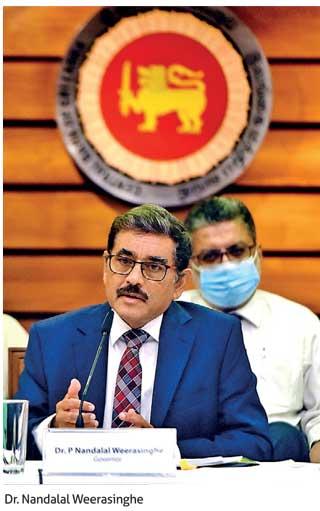
 In an earlier occasion, Central Bank Governor Dr. Nandalal Weerasinghe said any flexibility in the exchange rate should have been preceded by hikes in interest rate to contain the undue pressure on the currency, which can come from rising imports. 


Higher rates would have contained imports and thereby the demand for foreign exchange, limiting the extent of the fall in the value of the rupee against the dollar. 


There is a drumbeat of calls from the people to bring into books, those who were at the front seats of driving the Sri Lankan economy into the abyss and also for constantly lying and misleading the press and public at large in the run up to its crash landing in March. 


Meanwhile, some economic analysts are of the opinion that the guidance provided by the Central Bank is another peg to the US dollar and therefore is counterproductive, as the banks don’t have dollars at the guidance rate but the dollars are available in the black market at higher levels. 


However, the Central Bank yesterday pushed back on that characterisation of the daily guidance rate as a ‘pegged exchange rate’ regime.  … there are clear distinctions between the current transitory arrangement and the pegged exchange rate system,” the statement said. 


Under the pegged exchange rate regime, a fixed middle rate is usually dictated by a central bank, while market-driven variable spot rate being considered as the middle rate under the current arrangement,” it added. 
Meanwhile, the Central Bank also said the measures taken to restrict open accounts and consignment payment terms are also bringing in the desired results by way of curtailing grey market activity and thereby excessive premiums and enhanced inflows from remittances into the banking system. 


The conversions have also increased since the introduction of the new exchange rate arrangement, the Central Bank said. 


The provisional data from the Customs have also shown that the imports had further declined notably in May from the initial easing seen in April, after the clampdown on non-essential and non-urgent imports amid the acute dollar shortage.  The Central Bank also pinned hopes on export proceeds and bridge financing facilities from multilateral and bilateral sources to further alleviate the pressure on the domestic foreign exchange market, as it expects such inflows and other measures would bring further flexibility to the exchange rate. 


Further, the Central Bank expects reaching a staff-level agreement with the International Monetary Fund (IMF) as early as possible on a funding arrangement, as the authorities are looking at US $ 3.0 billion under an Extended Fund Facility programme from the IMF. 


Despite the Central Bank’s claims of a semblance of sanity returning to the forex markets, people are still queuing on the roads for petroleum products and cooking gas and are going through innumerable daily hardships with daily power cuts and sky-high prices, which have pushed many of them into poverty and hunger. 

Cabinet approves to import 231,000 MTs of fertilizer for paddy cultivation

June 7th, 2022

Courtesy The Daily Mirror

The Cabinet had approved to import 150,000 metric tons of Urea, 45,000 metric tons of Muriate of Potash (MOP) and 36,000 metric tons of Triple Super Phosphate (TSP) fertilizers for paddy cultivation for the 2022/23 Maha season.

The Ceylon Fertilizer Company Limited and Colombo Commercial Fertilizer Company Limited to import the relevant quantities of fertilizer and distribute them to the farmers.

Meanwhile, the Cabinet also approved the proposal submitted by the Prime Minister to sign the agreements to obtain a $ 55 million loan through the Export Import Bank of India for the procurement of Urea for the 2022/23 Maha season.(DSB)

Purchase fuel from Russia: Vasu urges Govt.

June 7th, 2022

Courtesy The Daily Mirror

Claiming that fuel can be purchased from Russia 35% lesser than the normal global market price, Parliamentarian Vasudeva Nanayakkara today urged the government to take steps to get down fuel from Russia.

He told Parliament that India, Singapore and Thailand are buying fuel from Russia.

MP Nanayakkara said the Russian Envoy to Sri Lanka has also spoke to the Energy Ministry that they were ready to discuss about a program on purchasing fuel and added that the Ministry has not responded to the request as yet.

He said Sri Lanka had ignored the Russian request due to US-centric ideology.

The government has decided to purchase fuel from countries in the Dollar region whereas we can purchase from Russia at a lower price. We have ignored the long-term credit facility offered by Russia just to maintain friendly ties with the USA,” he lamented. (Ajith Siriwardana and Yohan Perera)

President invited me to accept Premiership hours before Ranil accepted it: SF

June 7th, 2022

Courtesy The Daily Mirror

Prime Minister Ranil Wickremesinghe should give credit to me as he was able to become the premier of this country because of him, SJB MP Field Marshal Sarath Fonseka said today.

He told Parliament that President Gotabaya Rajapaksa called him hours before Mr. Wickremesinghe was sworn in and wanted him to accept the premiership. 

He said however, he laid down certain conditions. 

I told him that I would only accept the Prime Minister’s post only if the majority of SJB MPs backed me. Therefore, Mr. Wickremesinghe should give the credit to me for paving the way for him to become the Prime Minister,” he added.

The SJB Parliamentarian said around 50% of MPs in the present Parliament today are racketeers and   therefore it is not possible to change Sri Lanka’s political culture.

MP Fonseka said that 15% of the MPs who have a vision should be appointed as cabinet Ministers.

Some members of the present cabinet consume heroin and spend their time at night clubs with prostitutes. Therefore the present cabinet is not capable of saving the nation,” he said. (Yohan Perera and Ajith Siriwardana)

Next three weeks will be tough, use fuel and LP gas sparingly: PM

June 7th, 2022

Courtesy Adaderana

The next three weeks will be tough for Sri Lanka, Prime Minister Ranil Wickremesinghe said today (June 07), urging the general public to use fuel and liquefied petroleum (LP) gas sparingly.

Delivering a special statement in the parliament this morning, the Premier stressed the need to limit unessential travel for the time being and to refrain from hoarding the products.

The government is in the process of rectifying the shortages in the country, he said, adding that negotiations are underway with various parties to ensure an uninterrupted supply of fuel, LP gas and fuel. Let’s face these difficult three weeks united and patiently.”

PM Wickremesinghe said the government’s primary focus is on restoring the economic stability in Sri Lanka. However, the economic stabilization alone cannot help the country ride out the crisis situation, he added. We need to revive the economy of our country.”

The country spends USD 500 million per month on fuel. It should be kept in mind that the current global crisis faces a risk of an increase in oil price. Some estimate that global oil prices will rise by as much as 40% by the end of this year. In this context, the idea of introducing a coupon system for fuel cannot be ruled out.  Somehow, we have to find USD 3,300 million worth of fuel for the next six months.”

It costs Rs. 40 million per month to import LP gas consignments, the prime minister said further, adding that the country is in need of USD 250 million to procure LP gas for the next six months. At present, the government utilizes multilateral assistance, local funds and Indian loans to purchase LP gas, he explained.

Speaking on the food shortage in the country, PM Wickremesinghe revealed that there are only 1.6 metric tonnes of paddy in stock at present, although the annual demand is 2.5 metric tonnes. He warned of a looming severe food shortage in the country in the coming months. We need to import food items to meet our daily requirements. It costs about USD 150 million a month.”

We are losing the international market for our export crops.  Action must be taken to prevent this,” the Premier said while stressing the need to supply fertilizer to the farmers without a shortage to uplift the cultivation of paddy, vegetables, fruits and export crops including tea, rubber and coconut. Fertilizer importation requires USD 600 million annually, added. Since manure has to be applied from time to time from the beginning to the end of a harvest. It is essential that fertilizer is exported without any shortages. We must ensure that no money or effort will be wasted.”

Speaking further, the prime minister noted that Sri Lanka needs USD 5 billion to ensure that the daily lives of the people are not disrupted for the next six months. In addition, another USD 1 billion is required to strengthen the rupee. This means we need to find USD 6 billion to keep the country afloat for the next six months.”

Pointing to the need to re-implement the tax structure that was in place prior to the tax cuts introduced in late 2019, the prime minister said the government incurred a loss to the tune of USD 650 billion as a result of this tax relief. We must begin our resurrection from where we fell.”

With regard to the assistance sought from the International Monetary Fund, PM Wickremesinghe said the discussions between the Sri Lankan government and the IMF officials are based on the country’s future economic plan.

We need to achieve economic stability by the end of this year. By 2024, we will have the opportunity to create economic stimulus through fiscal stimulus.  By 2025, our goal is to balance our budgets or create a primary surplus.  This economic program must continue to move towards this long-term goal.  Even if the individuals, groups and parties in power change, it is imperative that we achieve our national goals and maintain the highest level of efficiency in the country.”

Further, the prime minister highlighted the importance of paying close attention to the island nation’s foreign relations. To increase our international support, we are becoming a marginalized country in the world due to poor foreign policies.” 

PM Wickremesinghe said he is currently in constant consultation with foreign ambassadors. He has had telephone conversations with the Secretary-General of the Commonwealth, the President of the United Arab Emirates, the Prime Minister of the United Kingdom, the representatives of international organizations such as the United Nations, the United Nations Food and Agriculture Organization, the World Food Program, the United Nations Development Program and the World Health Organization.

Many representatives of these countries and international organizations have agreed to support Sri Lanka during this difficult time, the Premier added.

The United Nations has arranged a worldwide public appeal on the 9th of June. They are seeking support to provide humanitarian assistance to Sri Lanka. Through this project, they plan to provide USD 48 million over a four-month period to the food, agriculture and health sectors.”

Meanwhile, India, China and Japan are leading the list of countries that provide Sri Lanka with loans and assistance. Relations with these countries, which have always been strong, are now broken. Those relationships need to be rebuilt.”

The prime minister also pointed out that Japan and India had agreed to supply Sri Lanka with two LNG power plants. However, the CEB stopped these two projects without any justifiable reason, he added. Japan had also agreed to provide about USD 3 billion worth of projects to Sri Lanka by 2019. All of these projects were put on hold for no reason.”

Accordingly, the prime minister urged the Parliamentary Committee on Public Finance to conduct an inquiry into the suspension of such valuable projects granted to Sri Lanka by its long-time allies for unstated reasons.

Further, PM Wickremesinghe noted that the interim budget is the first step in rebuilding the country’s system. Once we have taken that step, we will implement a modern system and install safeguards that will protect us from future calamities. But to do all this, we need to restart the system. That is why we are presenting an interim budget to Parliament on the basis of our future economic plan and road map. As I mentioned earlier, our hope is that this budget will lay the foundation for our economy, allowing it to stabilize and recover.”

The interim budget will reduce unnecessary government expenditure while controlling other costs, the Premier continued, adding that the government also focuses on revitalizing many areas affected by the crisis. There is an urgent need to focus on many sectors such as the export economy, tourism and construction, he said further.

Colombo Commercial HC’s fiscal officer interdicted over Aeroflot flight fiasco

June 7th, 2022

Courtesy Adaderana

The Fiscal Officer of the Colombo Commercial High Court, who implemented the court order for the detention of the Russian Aeroflot flight at the Bandaranaike International Airport (BIA), has been interdicted for over-riding his official duties. 

The Ministry of Justice, Prison Affairs and Constitutional Reforms said it has taken steps to suspend the fiscal officer of the Colombo Commercial High Court who has been accused of abusing the judicial process in enforcing the interim order issued by the Colombo Commercial High Court in connection with the detention of the Aeroflot flight Airbus A330-300.

Meanwhile, the Ministry of Justice has also taken steps to inform the Chief Justice that action should be taken against the lawyer who has been charged in connection with this incident.

Aeroflot Airlines Airbus A330-300 flight SU-289, which had been detained at the Bandaranaike International Airport (BIA) in Katunayake for several days, had departed for Moscow last evening following the suspension of the court order.

The Colombo Commercial High Court yesterday suspended the order preventing the detained flight from leaving Sri Lanka, paving the way for the Russian flag carrier’s aircraft to depart for Moscow.

The court had considered a motion filed by the Attorney General and suspended the previous order which had led to the detention of the Aeroflot aircraft.

The Airbus A330-343 aircraft, scheduled to depart from Colombo to Moscow on June 2 with 191 passengers and 13 crew members, was not allowed as the owner of the aircraft — Celestial Aviation of Ireland — had filed a case against Aeroflot, pending arbitration on the lease of the aircraft in London.

World Bank warns of recession risk due to Ukraine war

June 7th, 2022

Courtesy Adaderana

Countries around the world are facing recession as the Ukraine war hits economies already rocked by the Covid pandemic, the World Bank has warned.

Less developed countries in Europe and east Asia face a major recession”, it said.

The risk of high inflation and low growth – so-called stagflation” – is also higher, World Bank President David Malpass said.

Energy and food bills have been rising around the world.

The war in Ukraine, lockdowns in China, supply-chain disruptions, and the risk of stagflation are hammering growth. For many countries, recession will be hard to avoid,” Mr Malpass said.

He warned in the World Bank’s Global Economic Prospects report for June that the danger of stagflation was considerable”.

Subdued growth will likely persist throughout the decade because of weak investment in most of the world. With inflation now running at multi-decade highs in many countries and supply expected to grow slowly, there is a risk that inflation will remain higher for longer.”

The countries in Europe that are most likely to suffer a sharp drop in economic output in 2022 are Ukraine and Russia, the World Bank forecast.

But it warned that the fallout from the war and the Covid pandemic would be wider.

Even if a global recession is averted, the pain of stagflation could persist for several years – unless major supply increases are set in motion,” Mr Malpass said.

Between 2021 and 2024, global growth is projected to slow by 2.7 percentage points, Mr Malpass said, more than twice the slow down seen between 1976 and 1979, when the world last saw stagflation.

The report warned that interest rate increases needed to control inflation at the end of the 1970s were so steep that they touched off a global recession in 1982, and a string of financial crises in emerging market and developing economies.

However, in the 1970s the dollar was weaker and oil was relatively more expensive.


Source: BBC
-Agencies

Sri Lanka: Crisis management will work if the crisis is recognized

June 7th, 2022

By Raj Gonsalkorale

I am a firm believer in the people. If given the truth, they can be depended upon to meet any national crisis. The great point is to bring them the real facts.”  Abraham Lincoln, 16th President of the United States

The Prime Minister has been as frank as he could be about the crisis in Sri Lanka. Neither he, as a previous Prime Minister, nor any other Prime Minister or a President, including the current President provided the unvarnished truth about the crisis to the people of the country till now. Prior to his assuming the Prime Ministership, other government leaders have given a false impression of normalcy and talking and behaving as if things were normal.  The general thrust has been to direct blame for the political instability towards protestors, although it is no secret that some opportunists have ridden on the backs of genuine protestors to advance their own agendas with no regard for the plight faced by the country.

As its evident from news reports, there is still no definitive path and a plan towards some degree of economic stability. There are ad hoc news reports about discussions with friendly governments, ongoing Indian assistance, medicines being sent by some governments, Tamil Nadu providing some support, and now, Bangladesh planning to send potatoes.

It is true that an IMF bailout package could be a reality, although timelines for this, conditions attached to such a bail out and what exactly the package would include is not yet known. Besides this, even if such a package becomes a reality, it would not be a sufficient bail out that will lead the country towards that yet to be seen silver lining. 

The need of the hour is an emergency economic bailout plan identifying countries that have been contacted, and will be contacted for support, the form of support discussed and expected, (money or supplies), countries that have been and should be contacted for oil and gas say for the next 6 months, whether such support could be provided as long term credit lines, a plan for supply of medicines from pharmaceutical producing countries like India and Bangladesh, fertilizer supplies, and essential food items.

No doubt some of these activities have commenced and are ongoing, but the public still has no indication of the progress of such approaches except piecemeal information reported in the press. As the Prime Minister is the person in charge of trying to lift the economic down fall and find ways and means of securing loans/credit lines from different sources, he and his office could produce a plan with ongoing and intended activities, and progress being made and information on specific successes. Such an approach will give confidence to the public and lift their hopes for the immediate future.

The Prime Minister has given a dismal warning about the immediate future and that worse is yet to come. How many have taken notice of this dire warning is unclear. Neither the President nor politicians in Parliament have referred to the Prime Ministers warning. This could even be a plan to undermine the efforts of the Prime Minister.

Be that as it may, the warning given should be followed with a specific rescue plan, identifying the action items mentioned above and any other additional items related to a rescue plan, and daily progress reports relating to the plan.

What of the Prime Ministers assessment that days, weeks and months ahead will be worse than what it is now? Energy and transport costs are on the rise, thanks to the aftermath of COVID and the war in Ukraine. Shipping circles have said that freight costs, which have gone up by some 50%, will increase further. Oil and gas prices will rise further. It would not be rocket science to predict the fall out arising from this and the impact to Sri Lanka. Shortages of fuel, gas, medicines, food items will worsen, and countries that have assisted Sri Lanka, like India and China, will feel the pinch themselves, and they may find it difficult to extend the same level of assistance to Sri Lanka.

What will be the aftermath of such a situation? More power cuts, further folding of industries, large and small? More firewood cooking although firewood is fast becoming as scarce as gas. Reduction in export earnings, foreign remittances, tourism earnings, all leading to mass unemployment, possible unrest, even violence. Queues for passports stretch for kilometers. Would there be mass exodus from Sri Lanka legally or otherwise?

Sri Lanka’s food security has been adversely affected on account of the fertilizer saga, and it has been reported that the country may need to import more than 200,000 tons of rice. The question will be how such an import is going to be paid, if it is not covered by a credit line extended to Sri Lanka. The President’s regular issue of instructions” to officials, as reported in the press will not address the issue of food security. He should appoint a committee that should be chaired by him, to develop a plan that will address the issue of food security and take specific actions to implement the plan and report on the progress being made to the public. He must take responsibility to address an issue that he created.

As part of the rescue plan, the Prime Minister could request high level envoys like former President Chandrika Kumaratunga and former Speaker Karu Jayasuriya, who still have credibility, to meet Heads of State in China, India, Japan, Russia, the USA, Bangladesh, Saudi Arabia and other Middle Eastern countries, to canvass for assistance to Sri Lanka. Doing this through the Ambassadors and High Commissioners of these countries based in Sri Lanka is not high-level diplomacy. It needs to be noted that neither the President nor the former Prime Minister Mahinda Rajapaksa visited any of these countries except India to seek assistance even when the dark economic clouds were very clearly visible in the sky at least 18 months ago. It was either arrogance or stupidity, or both as stupidity leads to arrogance.

In the dire situation the country is placed in, politicians are debating the 21st Amendment. There is no denial that the Executive Presidency has failed the country and that governance should return to the Parliament. However, the question is about priorities. Politicians must surely know that Sri Lanka as the people have known it, may not exist if the situation foreseen by the Prime Minister comes to pass. While every Sri Lankas would hope and pray it will not come to that, it will not be divine help that will take Sri Lanka out of the mess it is in. It is the down to earth focus and a collective effort on the part of every Sri Lankan as to how some oxygen can be pumped into a dying and gasping country.

What happens to the dollars? E-Con-E-News of 21-27 May 2022 tells it all:

June 7th, 2022

Garvin Karunaratne, former GA Matara

Dollars are sold to the highest bidder to keep on importing Luxury goods while refusing $ for food and medicines” reveals what is really happening today.

In reality today dollars do come in to the banks and to the private currency dealers and the bank are charged with handing over twenty percent to the Central Bank. The other eighty percent is left to the banks for sale to customers. As far as I know there is no restriction placed on private currency dealers and they have a heyday of buying and selling foreign currency.

Selling is to the highest bidder. Who gets the profit?

In this connection what did really happen on 25 th January 2001 reveals : I quote

from my book: How the IMF Ruined Sri Lanka & Alternative Programmes of Success(Godages:2006)

On 25 th January2001…the two State banks(Bank of Ceylon and Peoples Bank) had to pay a big import bill and because they did not have sufficient dollars they had to purchase dollars from other banks”

The two banks then went hat in hand searching for dollars from other banks and a foreign bank that had the dollars agreed to sell dollars at Rs 106 to the dollar when that morning the rate was only Rs 85 to the dollar. The Rupee had been free floated and the bank that had purchased the dollars had the right to sell to the highest bidder and that was at Rs 106.00. It caused an immediate devaluation. The Central Bank when questioned, said:

in a free floating regime the market forces determine the exchange rate. The Central Bank does not intervene in the process. The Central Bank has control over the domestic money supply and it could be used to curb inflation.”(The Island: 17/2/2001)

This reveals what does happen to the dollars that are being collected today. The Banks have to hand over 20% to the Central Bank and the rest they can sell, as reported by E Con E News to the highest bidder. The private currency dealers and the bank have a heyday of making fantastic profits. I do not know whether they have to hand over 20% to the Central Bank. In the meantime the dollars get sold to importers to import luxury goods while there are no dollars for importing milk foods, medicines and essential food like flour.

Where goes the dollar profits- of course it is foreign banks who yet have the right to repatriate their profits in dollars and all this while the people starve. Starvation has already commenced with some poor families having to live on a single meal a day. The people are in queues to obtain food, milkfood and even flour is in short supply and it was reported that 2000 bakeries have closed down.

It is upto our Central Bank to control the total intake of foreign funds and to direct the funds for essential supplies- food and medicines etc. If this is not done now the present day sporadic protests will move to become Supermarket break ins and food riots. Let that not happen.

It is time for our leaders and our Central Bank to do some deep thinking.

Garvin Karunaratne, former GA Matara

Author of:

How the IMF Ruined Sri Lanka &Alternative Programmes of Success(Godages:2006)

05062022

MEDIA NEWS REPORTING CAN SOMETIMES BE HARMFUL IF THE CONTEXT IS CONFUSING.

June 7th, 2022

Editorial

 June 6th 2022

The wise seers whose wisdom always prevails comprising mostly of past leaders political analysts of repute and intellectuals are of one mind that things go from bad to worse in Sri Lanka today on an almost continuous basis and perhaps it is, with all due respect to the true media ( not fly by night journalism which seems to be the order of the

day) that there is a conundrum of  presented news which is often confusing, at times garbled and partially worthless towards reality that emerges as a portal of obstruction towards the  desperately needed progress at a time of crisis that Sri Lanka is in presently.

 Sadly the diverse and  at times contradictory news reports from various sources that never attest to uniformity always confounds and confuses the reader to the point of exasperation where only the well being of the Nation is sought but the end result is utter despair projecting the Nation as a failed state which may have a  very temporary leaning towards reality but to persist in its continued broadcasting should be a no no! to  those who propagate it as Broadcast News, where in the name of sanity  the preservation  and rehabilitation of Sri Lanka is of paramount importance and needs  to be veritably toned down towards  the progress it invariably needs.

 The horror stories some of these depict are totally detrimental to Sri  Lanka’s recovery from the near disastrous situation she was faced with  where the truth is often lacking and the presentation of a news item  often takes priority  albeit often cooked up towards credibility and needs to  stop post haste. It even agitates further a turbulent and angered population and constitutes fanning fires that in reality need to be quelled towards posterity and the normal order of things.

 Whether it be the speculated impending famine, the breakdown of the  banking system, the non availability of consumer goods, failed agro-  and hydro projects et al are all contributory towards the detriment  and exasperation of the people when there is so much good news for the  future that needs to be propagated at the dawn of a new era for the  beleaguered Nation that deserves better.

 The evils of past administrations have to be buried in the  expectations towards a new beginning where faith has to be placed in  great intensity with the present administration and its leader with a degree of  optimism of course as nothing can be taken for granted where the  optimism must prevail towards what lies ahead.

 Sri Lanka now has to be confident from every perspective towards the  future in those who make new decisions and the morale of the Nation  has to be lifted to a super high which can only be done through the  presentation of good news based on fact rather than fiction and  speculative innuendo which will surely appease the population of Sri  Lanka and all her well wishers Globally.

 Surely” This is  Our Land, Our Own Native Land” which we need to  preserve to the very core of our existences with positive thoughts and  actions and most importantly good and viable news reporting which encourages progress !!

Sri Lanka’s ham-handedness has dismayed traditional friends 

June 7th, 2022

By P.K.Balachandran Courtesy NewsIn.Asia

Colombo, June 6: With the Colombo Commercial High Court issuing an order for the immediate suspension of it’s injunction against an aircraft belonging to Russia’s Aeroflot Airlines, the aircraft took off for Moscow with 191 passengers on Monday after a five-day detention which soured Russo-Lankan ties.  

With the release of the plane, the spat ended, but not without leaving a bad taste in the mouth of the Russians, who had sided with Sri Lanka in the UN Human Rights Council on war crimes” issue. The Russian Foreign Office and the Russian Ambassador in Colombo had taken the aircraft’s detention very seriously as it had taken place despite the existence of a prior agreement with the Sri Lanka government on the operation of the aircraft. The Sri Lankan Ambassador in Moscow was summoned to the Russian Foreign Office and a protest was lodged. Sri Lanka was warned that bilateral relations would be jeopardized if the plane was not released.

The Russians were not convinced by the Lankan government’s contention that it had nothing to do with the court’s order as it had been given by the court in a commercial dispute between the Ireland-based lessor of the plane and Aeroflot. The Russians perhaps believed that the Lankan State did not do its bit to safeguard its long standing good relations with Russia. Of course, eventually, the Lankan State did what the Russians wanted and intervened in the court to get the injunction withdrawn.

This is not the first time that the Sri Lankan State had not kept its relations with friendly countries in mind to prevent unpleasant situations. In November 2021, Sri Lankan plant quarantine authorities refused to allow the landing of a consignment of 20,000 tonnes of organic fertilizer sent by the Chinese company Qindao Seawin Biotech on the grounds that it contained a harmful bacteria. The court also ordered a bank not to release money (US$ 9 million) for the cargo. But the Chinese company contended that the testing at Colombo was scientifically flawed that, at any rate, there was no quarantine requirement in the contract. The company also went in for arbitration in Singapore. With the Chinese and the Lankan governments intervening, a fresh consignment was brought for which US$ 6.9 million was paid.  

This issue could also have been handled carefully outside the public domain by timely diplomatic engagement, but quarantine officials were allowed to the talk to the media which messed up the issue. Lankans forgot that China had stood by Sri Lanka in the UN on the war crimes issue and had also invested US$5 billion in infrastructure projects.

Later, an ADB-sanctioned US$ 12 million Chinese project to set up solar power plants in three islands off the Western coast of Jaffna was abruptly cancelled because India had raised security issues. This is said to be one of the reasons why China is dragging its feet on financially aiding Sri Lanka in the current forex crisis. It is also refusing to reschedule the repayments of the loans given to Sri Lanka.   

Bad official handling marked two Japanese projects, a Colombo urban rail project and the Bandaranaike International Airport modernization project. The US$ 2 billion urban rail project to be done with a soft loan from Japan, was suddenly cancelled by a two-line order issued by P.B.Jassundara,  the then Secretary to President Gotabaya Rajapaksa. Following this, the Japanese refused to participate in funding the Colombo East Container Terminal.

Just when the Sri Lankan Prime Minister Ranil Wickemesinghe was trying to woo Japan back for financial assistance as well as investments, and India was persuading Japan to join it to help Sri Lanka get out of the current economic quagmire, the Lankan Minister of Aviation, Nimal Sripala de Silva, shot off a letter to the Japanese government lambasting it for delaying the execution of the Bandaranaike International Airport modernization project. He also faulted the Japanese for not installing the required security systems. The Japanese have not reacted to this. But their traditional keenness to help Sri Lanka has faded thanks to the ham-handedness of Sri Lankan officialdom.  

Japanese investments in Sri Lanka are equal to China’s (a little over US$ 5 billion) but Japanese interest rates are lower, according to Prime Minister Wickremesinghe.

Meanwhile, the Lankan media criticized the grant of solar projects in Mannar and Pooneryn in North Sri Lanka to the Indian tycoon, Gautam Adani, who had already been given the contract to build the Western Container Terminal in Colombo port.

It is with deep regret that we note that the Adani Group has chosen the back door to enter Sri Lanka. Avoiding competition is not something we take kindly. It hurts our battered economy, aggravates the balance of payment issues, and causes further misery to our citizens,” The Hindu quoted Ajith P. Perera, chief executive of the Samagi Jana Balawegaya (SJB), Lanka’s largest opposition party.

The agreement was for two large-scale renewable energy projects, with an estimated investment of U$ 500 million. But it had been kept a secret until the Lankan media exposed it.

PM Modi may have given us crucial financial assistance during our current economic crisis, but that doesn’t mean our renewable energy sector’s most valuable lands and resources can be stolen for his friend Adani…The [Rajapaksa] government has many decent ways to thank PM Modi rather than pampering his notorious friends,” Ajith Perera said, but added that a global player like Adani would be most welcome through proper channels.”

SJB MP and economist Dr. Harsha de Silva said the agreement violated the Sri Lanka Electricity (Amendment) Act of 2013 that mandates competitive bidding for all electricity generation projects.

There is already a Sri Lankan nationalist opposition to the India-Sri Lanka deal on the Trincomalee oil tanks. The nationalists’ goal has been to take over the 99 tanks which had been handed over to India for joint development with Sri Lanka, through a bilateral agreement. Some past Sri Lankan governments had tried to take them over but had failed as India insisted that a bilateral agreement could not be terminated unilaterally and arbitrarily.

Such demands persist in Sri Lanka, despite the fact Sri Lanka critically depends on Indian aid now, at the height of the forex and supply crisis. India has this year alone pumped in US$ 3.5 billion worth of aid, while other countries have given only token assistance or have been idle spectators of the tragedy unfolding in front of them.


Copyright © 2026 LankaWeb.com. All Rights Reserved. Powered by Wordpress