To the people of Nepal and beyond

September 13th, 2025

 By Palitha Ariiyarathna

Better than a thousand hollow words is one word that brings peace.” — Buddha

🇳🇵 To the people of Nepal and beyond:

Let us not be swayed by doctrines that promise salvation through division, nor by ideologies—Eastern or Western—that glorify destruction in the name of freedom. History has shown us that when belief becomes blind, it breeds violence. Whether it’s religious extremism, political fanaticism, or social media-fueled rage, the result is the same: suffering.

Buddhism teaches us that true liberation is not won on battlefields or in viral posts—it is cultivated in the heart. Peace is not imposed; it is practiced. Discipline is not oppression; it is the foundation of wisdom.

Nepal is not just a land—it is a legacy. A nation born from the footsteps of the Enlightened One. To burn it in anger is to forget the very soil that gave birth to compassion. To destroy in the name of justice is to betray the teachings that call us to rise above hatred.

Let us reject the seductive noise of ideologies that have led to countless deaths across history. Let us instead embrace the silence of meditation, the strength of unity, and the clarity of wisdom.

Conquer anger by love, evil by good, greed by generosity, and falsehood by truth.” — Buddha

This is not weakness. This is the path of the strongest.

 By Palitha Ariiyarathna

Question -In the event Mazagon shipyard takes over Colombo dockyard in sri lanka can china object as Mazagon is a premiere Indian defence contractor ?

September 13th, 2025

Dr sarath obeysekera ( Ex CEO Colombo Dockyard pvt ltd ) 

Answer

You’re asking whether China could object, from a legal or diplomatic standpoint, if India’s state-owned shipyard (Mazagon Dock Shipbuilders Ltd, MDL) takes over Colombo Dockyard in Sri Lanka—especially given Mazagon’s status as a premier Indian defence contractor. The short answer is: 

Yes, China could object—but such an objection would be political or strategic, not legal under international law.

Legal Perspective

• Sovereign Business Decision

The acquisition—where MDL seeks a controlling (51%) stake in Colombo Dockyard—is a commercial transaction involving a Sri Lankan company listed on the Colombo Stock Exchange, with shares being purchased from Japan’s Onomichi Dockyard and supplemented by new equity offerings    .

• Regulatory Oversight

The deal is subject to standard regulatory approvals in Sri Lanka and India, such as stock exchange filings and capital raising clearances  . China has no legal grounds to invalidate or obstruct this process—unless there are cross-border treaty obligations or foreign direct investment restrictions that specifically involve Chinese interests, which does not appear to be the case here.

• No Multilateral Enforcement Role

Unless revived in international dispute venues or bilateral treaties, there’s no supranational body that China could invoke to halt or reverse the transaction.

In short: From a legal standpoint, it’s between Sri Lanka and India/joint investors.

Political or Strategic Objection

• Regional Geopolitics

China has substantial strategic and economic interests in Sri Lanka—from Hambantota Port’s 99-year lease to investments in Colombo Port City. India’s footprint via MDL’s acquisition is clearly seen as a counterbalance to Chinese influence       .

• Past Chinese Reactions

Sri Lanka’s growing alignment with India on maritime matters has spurred unease. For instance, India raised concerns when Chinese surveillance and research ships (Yuan Wang 5, Shi Yan 6) entered Sri Lankan waters   .

• Diplomatic Pressure

While China has expressed disapproval of other Indian-linked developments in Sri Lanka (e.g., Indian-operated container terminals), their actions have mostly taken the form of political and diplomatic signals—not direct intervention   .

All signs point to China potentially lodging diplomatic protests or exerting influence, but not having legal veto power over the deal.

Regards

Dr Sarath Obeysekera

Safeguarding a Civilization: The Enduring Light of the Buddha Sasana Law

September 13th, 2025

by Palitha Ariyarathna

”We are not here to retaliate with violation, but to rise with reason. The strength of Sinhala Buddhists lies not in vengeance, but in the wisdom of Dhamma, law and the dignity of heritage.” — Palitha Ariyarathna

”When a doctrine teaches sons to forsake their fathers, and subjects to bow before foreign relics instead of their sovereign, the soul of a nation begins to unravel”. – Han Yu, the Tang dynasty Confucian scholar, condemned Buddhism not only as a spiritual threat but as a force that weakened filial piety, drained civic duty, and fostered poverty through monastic withdrawal. He saw it as a foreign ideology that encouraged people to abandon their families, reject ancestral rites, and divert wealth toward rituals that fed neither body nor nation. In just 14 years, 30 million died alone—disconnected from kinship, purpose, and tradition.

Today, Sinhala Buddhist civilization faces a different but equally insidious threat. Foreign academic agents and imported communist ideologies—cloaked in intellectual discourse—have begun to infiltrate Sri Lanka’s cultural landscape. Through lectures, publications, and policy influence, these frameworks subtly reframe our heritage as oppressive, our spirituality as outdated, and our nationalism as dangerous.

Neo-Marxist interpretations cast Sinhala Buddhist identity as a tool of exclusion, rather than a source of resilience and unity. These ideological incursions, often backed by external interests, pose a severe challenge to our cultural continuity.Yet true Buddhists need not respond with violation or vengeance. Justice and strength lie not in retaliation, but in the luminous clarity of reasoned law.

Sri Lanka is blessed with the 9th Article of the Buddha Sasana law—a radiant safeguard against spiritual and cultural erosion. It protects the dignity, continuity, and sacred heritage of Sinhala Buddhists through wisdom, not wrath. In the face of ideological subversion, this law stands as a beacon of lawful resistance—empowering Buddhists to defend their civilization with compassion, clarity, and unwavering resolve.

Let us not be swayed by imported narratives that seek to fracture our foundations. Let us instead honor the legacy of our ancestors, uphold the principles of justice, and protect the soul of our nation through the enduring light of the Buddha Sasana.

by Palitha Ariyarathna

“දුටුගැමුණු” ගේ අනුරාගය ඉතිහාස පොතෙන් හැංගුවේ ඇයි? | Sujith Akkarawatta | Yureshani Getaraluwa

September 13th, 2025

AsianMirror

All the International solutions Sri Lanka tried & tested but all failed – LTTE wanted only terror

September 13th, 2025

Sri Lanka Sovereignty Forum SLSF 

The international community in particular Nations across Africa, Latin America, Middle East, Europe and even Asia Pacific may not be aware that Sri Lanka listened to the international solutions:

Peace Talks & Negotiations – some even held in foreign shores

Cease Fires

Peace Accord with India in 1987

Sri Lanka even had the presence of foreign troops:

Indian Peace Keepers 

Sri Lanka also had foreign monitoring missions:

Sri Lanka Monitoring Mission

ALL THESE FAILED TO DELIVER PEACE

ALL THESE FAILED TO PREVENT LTTE KILLING INNOCENT PEOPLE

·      1. The initial peace talks were held in Thimpu in 1985 

·      2. Peace Talks with President Premadasa -1989 – failed

·      3. Peace Talks with President Chandrika – 1994 – failed

·      4. Ceasefire – 2001

·      5. Ceasefire Agreement under foreign supervision – 2002

Peace talks in Thailand – 2002 – failed

Peace talks in Geneva –  2006 – failed

·      The Indian Peace Keepers were stationed from 1987 to 1990 – they are accused of raping some 3000 Sri Lankan women & indiscriminate killing as they didn’t know the language nor could they identity Sri Lankans.

·      The Nordic Monitoring Mission came after the infamous 2002 cease fire agreement & was stationed in Sri Lanka from 2002 to 2008. The SLMM comprised nationals from Norway, Sweden, Finland, Denmark & Iceland.

They recorded over 3800 violations by LTTE against 356 violations by Sri Lanka Armed Forces a strong argument to deny wild allegations against the Armed Forces.  

https://www.ptsrilanka.org/wp-content/uploads/2017/04/slmm_final_report.pdf

It was during this ceasefire that LTTE assassinated Sri Lanka’s Foreign Minister Mr. Lakshman Kadiragamar inside his residence. He was a Tamil. 

LTTE used every peace talk to recoup, restrengthen itself & the devastation immediately after the talks failed was devastating for the victims. 

The international community must understand that a sovereign state has every right to exercise its legal right to defend its territory & its people. 

The human rights of terrorists cannot come before the human rights of innocent civilians. 

The UN Human Rights Council did nothing to stop LTTE killings. – did nothing to stop LTTE kidnapping Tamil children – did nothing to stop LTTE turning children into child soldiers – did nothing to stop LTTE torturing & killing their dissidents – did nothing to stop LTTE running their own courts, police, taxing system, banks, currency – no country can allow defacto rule within a sovereign state.

It was not the UNHRC who saved 300,000 Tamils being held hostage by LTTE

That they braved LTTE fire to come to the Armed Forces proves they preferred to be with the Sri Lanka Armed Forces than the LTTE.

The main allegation for war crimes & genocide” is a 40,000 figure.

This is just a figure – even after 16 years even the UNHRC has failed to produce names of the supposed to be dead, there are no mass graves and no skeletons. To cover this a propaganda is being made out of a grave site in 1990 which is nowhere near where the battles during the last phase took place.

These are the truths that the UNHRC has to face first – instead of wasting UN funds to call for tribunals of a conflict that has finished 16 years ago. 


UNGA & UNSC must prevent UNHRC exceeding its original mandate 60/251 as these precedents would have dangerous impact for other UN Member states too.

Exercise “Pacific Angel 2025” successfully concludes

September 13th, 2025

Ministry of Defence  – Media Centre

The Exercise Pacific Angel 2025” which commenced on Monday (Sep 08) came to a successful conclusion yesterday (12). The U.S. Embassy in Sri Lanka, together with the Sri Lanka Air Force (SLAF) and the Ministry of Defence, marked the conclusion of Exercise Pacific Angel 2025 at a closing ceremony in Katunayake this evening.

Defence Secretary Air Vice Marshal Sampath Thuyacontha (Retd), graced the closing ceremony along with the U.S. Ambassador Julie Chung, and Air Force Commander Air Marshal Bandu Edirisinghe.

Pacific Angel 2025 brought Indo-Pacific partners together to strengthen disaster response and humanitarian cooperation. The exercise united participants from across the region including U.S. Pacific Forces, Royal Australian Air Force, Japan Air Self- Defence Force, Maldivian National Defence Force, and the Bangladesh Air Force, together with the Sri Lanka Navy and Army.

The program featured eight Subject Matter Expert Exchanges (SMEEs) covering aircraft maintenance, search and rescue, jungle survival, aeromedical patient movement, mass casualty response, and airlift operations. Training at SLAF Katunayake, China Bay, and Ampara gave participants hands-on skills to enhance regional readiness and coordination.

Defence Secretary, Air Vice Marshal Sampath Thuyacontha (Retd), extended his deepest gratitude on behalf of the government of Sri Lanka to all participating Nations to the Exercise Pacific Angel  – 25, which highlighted the vital contribution of regional air forces in enhancing humanitarian assistance and disaster response capabilities. The Exercise strengthens interoperability and knowledge-sharing among Indo-Pacific partners, while also reflecting the longstanding and cooperative relationship between the United States and Sri Lanka. Such engagements provide an important platform to build resilience, strengthen mutual trust and contribute to the peace and stability of the region.

U.S. Ambassador to Sri Lanka, h. E. Julie Chung, highlighting the significance of the Exercise said Pacific Angel 25 is the largest multilateral exercise hosted in Sri Lanka this year, and we are proud to stand shoulder to shoulder with our Indo-Pacific partners. This Exercise demonstrates how we prepare together for real-world challenges from disaster response to humanitarian crises and how cooperation strengthens our collective ability to safeguard peace, stability, and prosperity across the region, she said.

Apart from operations, the Pacific Air Forces Band Final Approach” performed with the Sri Lanka Air Force Band, building camaraderie through music. Meanwhile, the U.S. Air Force and SLAF, working with Sri Lanka’s Ministry of Defence and Ministry of Health, completed a refurbishment of the Divisional Hospital at Akaragama, bringing lasting benefits to local communities.

Pacific Angel 2025 demonstrated how Indo-Pacific partners are working side by side in Sri Lanka the host of the year’s largest multilateral exercise to prepare for crises, strengthen disaster response, and build lasting regional cooperation.

ලංකාවට එරෙහි කුමන්ත්‍රණයක්ද? ඩයස්පෝරාව සහ ජිනීවා ගැන රටම නොදන්න වෙනස්ම කතාව මෙන්න

September 13th, 2025

Colombo Today

ප‍්‍රසිද්දියේ සමාන ගනු.. නැතොත් බිලියනයක් වන්දි ගෙවනු..- වටගලට එරෙහිව නාමල් නඩු යයි…

September 13th, 2025

උපුටාගැණීම මුහුනුපොත

පාර්ලිමේන්තු මන්ත්‍රී නාමල් රාජපක්ෂ මහතා වෙනුවෙන්, නීතිඥ සංඛ කරුණාරත්න විසින් පාර්ලිමේන්තු මන්ත්‍රී සුනිල් වටගල මහතාට එරෙහිව රුපියල් බිලියනයක වන්දියක් ඉල්ලා එන්තරවාසියක් යවා ඇත.

මෙම එන්තරවාසිය යවා ඇත්තේ 2025 සැප්තැම්බර් 10 වැනි දිනයි.

මෙම නීතිමය ක්‍රියාමාර්ග සඳහා හේතු වී ඇත්තේ 2025 සැප්තැම්බර් 6 වැනි දින හෝ ඊට ආසන්න දිනයක හෝමාගම ප්‍රදේශයේ පැවති මාධ්‍ය හමුවකදී සුනිල් වටගල මහතා විසින් සිදු කළ ප්‍රකාශයකි. එහිදී මත්ද්‍රව්‍ය ජාවාරමට සම්බන්ධ බවට සැක කෙරෙන බහාලුම් දෙකක් සහ මෙරට මත්ද්‍රව්‍ය ව්‍යාප්තිය සම්බන්ධයෙන් අදහස් දක්වමින්, නාමල් රාජපක්ෂ මහතාගේ ඡායාරූපයක් මාධ්‍ය වෙත ප්‍රදර්ශනය කරමින් ඔහු මත්ද්‍රව්‍ය ජාවාරම් ජාලයක් පිටුපස සිටින පුද්ගලයෙකු බවට හැඟවෙන ප්‍රකාශ සිදු කර තිබේ.

වටගල මහතා මෙම මාධ්‍ය හමුවේදී මේ උදවිය තමයි මේ මත්ද්‍රව්‍ය සැපයුම් ජාලය පිටුපස සිටින්නේ” යනුවෙන් ප්‍රකාශ කර ඇති අතර, මෙම ප්‍රකාශය අසත්‍ය, පදනම් විරහිත සහ ද්වේශ සහගත බව නාමල් රාජපක්ෂ මහතාගේ නීතිඥවරයා අවධාරණය කරයි. මෙම ප්‍රකාශය නිසා නාමල් රාජපක්ෂ මහතාගේ කීර්ති නාමයට විශාල හානියක් සිදු වී ඇති බවත්, සමාජයේ ඔහු සම්බන්ධයෙන් වැරදි මතයක් ගොඩනැගී ඇති බවත් ලිපියේ සඳහන් වේ.

2025 සැප්තැම්බර් 8 වැනි දින තංගල්ල ප්‍රදේශයේ පැවති විරෝධතාවක් සඳහා ද මෙම ප්‍රකාශය හේතු වී ඇති බව නීතිඥවරයා පෙන්වා දෙයි.

වෘත්තියෙන් නීතිඥවරයෙක් වන නාමල් රාජපක්ෂ මහතා 2010 වසරේ සිට අඛණ්ඩව පාර්ලිමේන්තු මන්ත්‍රීවරයෙකු ලෙස කටයුතු කරන අතර, තරුණ කටයුතු සහ ක්‍රීඩා අමාත්‍යවරයා ලෙසද සේවය කර ඇත.

ශ්‍රී ලංකා පොදුජන පෙරමුණේ ජාතික සංවිධායකවරයා වන ඔහු, 2024 ජනාධිපතිවරණයේදී එම පක්ෂයේ අපේක්ෂකයා ලෙස ඉදිරිපත් විය.

ඔහු දේශීය හා විදේශීය වශයෙන් මහජන සේවය, දේශපාලන නායකත්වය, සහ තරුණ පරපුර බල ගැන්වීම සඳහා විශාල කීර්ති නාමයක් ගොඩනගා ගෙන ඇති බව ලිපියේ වැඩිදුරටත් සඳහන් වේ.

සුනිල් වටගල මහතාට දින තුනක් ඇතුළත මාධ්‍ය හමුවක් පවත්වා තම ප්‍රකාශය සම්බන්ධයෙන් නාමල් රාජපක්ෂ මහතාගෙන් ප්‍රසිද්ධියේ සමාව අයැද සිටින ලෙස නීතිඥවරයා මෙම එන්තරවාසියෙන් දැනුම් දී තිබේ.

එසේ කිරීමට අපොහොසත් වුවහොත්, දින 14ක් ඇතුළත රුපියල් බිලියනයේ වන්දිය ගෙවන ලෙස ඉල්ලා සිටී.

මෙම ඉල්ලීම් ඉටු නොකළහොත් මෙම වන්දිය සමග නඩු ගාස්තු සහ අනෙකුත් වියදම්ද ඉල්ලා නඩු පවරන බවට නීතිඥ සංඛ කරුණාරත්න මහතා වැඩිදුරටත් දැනුම් දී ඇත

Gen Zs have taken down the Nepal regime. Here’s why this will never happen in India

September 13th, 2025

To be truly functional and durable, even eternal, a state doesn’t just need a leader, a party or an ideology. It needs functional and robust institutions.

Illustration: Manali Ghosh | ThePrint

Heart of a functional state is law and order. Functional is the key word here. What collapse in Kathmandu with just one push underlines is it was a non-functional state. Today’s discourse confuses absence of an opposition for a hard-state essential. It’s the opposite

Is there such a thing as a hard or a soft state? What if we said that any state is indeed just that, the state? It has to have it in its guts to stay together, cohesive, orderly. That last is not my line. Who it’s borrowed from, I’ll tell you as we go along.

Take Nepal. The fall of its constitutionally elected government to just over a day of Gen Z protests in the capital is the third such in three years in the Subcontinent, after Sri Lanka (Colombo, July, 2022) and Bangladesh (Dhaka, August, 2024). As we keep saying, invoking the primer of journalism, this conforms to the three-example rule. We can also note much clamour on social media, mostly from the BJP base, which includes many prominent and respected names, that this is just what the powers that be” would want done with the Modi government in India. The regime-change toolkit, as they’d put it.

Let’s also look at exceptions. Not every government collapses under a public protest. I know it is a super-provocative example, but remember Pakistan on 9 May, 2023?

Imran Khan’s supporters rioted not in one city but across many, even stormed Lahore’s Jinnah House, the Corps Commander’s home. The situation had many more ingredients for a ‘regime’ overthrow than Colombo, Dhaka or Kathmandu. A widely hated civilian government, handmaiden of a then reviled army for jailing the most popular mass leader.

https://youtube.com/watch?v=9SYWSuld0BE%3Ffeature%3Doembed%26enablejsapi%3D1%26origin%3Dhttps%3A

That revolution” ended within 48 hours. The leader (Imran Khan) is still in jail, now handed a 14-year sentence, the same coalition is still in power, having been rebirthed through another rigged election, and all socio-economic and democratic grievances remain. More than 250 protest leaders are being tried in military courts. The state looks way stronger.

Did the Pakistan establishment survive because they are a hard state, while Sri Lanka, Bangladesh and Nepal weren’t? Definitely, even Asim Munir doesn’t think so. Or, he wouldn’t have given Pakistan a we have to become a hard state” call in that infamous 16 April speech.

The fact is, the regime survived in Pakistan because it is still a functional state. The heart of a functional state is law and order. Functional is the key word here, not hard or soft. No state can be functional unless it’s capable of maintaining law and order. And when there is law and order, catastrophic state failures like Colombo, Dhaka and now Kathmandu will not take place.


Also Read: Pakistan, Dhaka have played Washington well. Back home, Modi ecosystem has an inner conflict


Regime change can always be a democratic aspiration. But it will take more to achieve it than a few days of protests, riots and arson. It will take long months if not years of toil and struggle to build a political counter, go to the people, and create the revolution you want, through elections or mass movement.

What the collapse in Kathmandu with just one push underlines to us is that it was a non-functional state. It had an elected government, but its leaders did not have the first prerequisite for governance: democratic patience.

The leadership trained as guerrilla fighters through their youth to the middle ages and then ran cynical musical chairs through defection and alliance-switching, as elected politicians had no experience in dealing with ‘other’ angry people. The Maoists were once heroic change agents. Once they came to power they no longer thought the same people could also get angry with them. And when they did, they needed some negotiations to revive trust and credibility, not bullets.

Guns were an instrument of winning popularity and power. Nor had they spent any of the past 17 years since the end of the monarchy in 2008 to build and strengthen institutions of democracy. If they had, the same institutions would have protected them. If in the end the only institution the protesting masses trust is the army, it shows what a colossal failure the revolutionary political class in Nepal has been. They never built a functional state.

A hard state can be quite fragile. My most valuable case study is Georgia, then a Soviet republic. History has rarely seen a state harder than the USSR. It panicked when the first protests broke out in Georgia in 1988-89? It sent out the Red Army with special forces and armed KGB, who unleashed bullets and poison gas. This was a classical bull-headed hard state. It unravelled.

Its discredited party state had a broken economy, and didn’t know how to handle disagreements. Individual dissenters it could kill, or pack off to distant gulags. A mass protest wasn’t its glass of vodka.


Also Read: One person’s Deep State is another’s Non-State actor. And Shallow State is where the real power lies


We got a better understanding shortly afterwards as we were hosted for dinner, with my then editor Aroon Purie by Buta Singh, Rajiv Gandhi’s home minister. He said he had recently hosted Russian foreign minister Eduard Shevardnadze (a Georgian) who asked me how we handled protests by lakhs when his army unleashed poison gas on a much smaller crowd” in Tbilisi.

I said, your excellence,” said Buta Singh, I can lend you a few companies of CRPF.” The lesson is that a state must maintain law and order. For this, it must have three prerequisites: the uniformed forces with the right training, negotiating skills and democratic patience or the willingness to trade spaces.

Today’s discourse confuses the absence of an opposition for a hard-state essential. It’s the opposite. The opposition serves as a pressure-release valve. People can vent through it rather than sack your president, prime minister or corps commander’s homes. All four of our neighbours banished their opposition in different degrees of extreme.

At which point, we return to our earlier question. Could this happen in India? A regime change through any tool kit”? A quick way to explain why it can’t happen is to remind ourselves that constitutional democracies do not have a ‘regime.’

While there are a couple of dozen mutinies going on across India at any point, we have seen two serious challenges to the state from the street” in the past 50 years. The first was Jayaprakash Narayan’s (JP) Navnirman Andolan, beginning 1974 compounded by the George Fernandes-led railway strike that paralysed India. Yet, failed to dislodge Mrs Gandhi. It took an election.

The second was Anna Hazare’s so-called anti-corruption protests fully backed by new TV and strong elements in the Opposition, especially the RSS as was the case with JP’s movement. But even a government as weak as UPA-2 had the strength to ride it out.

A debate on the Jan Lok Pal Bill going well past midnight sealed the issue. It was that line from late Sharad Yadav in response to self-proclaimed Gandhi, Anna Hazare pouring scorn over Parliament and elected leaders. Think of an Indian with the name Pakauri Lal he said, pointing to fellow MP (Samajwadi Party, Forbesganj). In this system a man as humble as him can be here. And this is the system you’ve come to destroy? The Anna movement was over at that moment. Parliament had risen to protect the state.

Finally, I will let you know that a state needing to have it in its gut to stay together” observation. In 2010 when mass stoning and terror had peaked in the Valley many mainstream voices were rising, saying if Kashmiris are so unhappy why don’t we just let them go? M.K. Narayanan, then NSA, spoke this line in a conversation, pointing his fist where else, but at his gut. It was 15 years ago so I hope he’d forgive me for recounting this. See where the Valley is, now. This, by the way, was the same UPA-2, now seen widely to be running a soft state.


Also Read: Subcontinental setbacks have a message for India: Junk victimhood & respect thy neighbour

42 per cent of all employed Sri Lankans are not even O/L qualified

September 13th, 2025

BY HUZEFA ALIASGER  Courtesy The Daily Mirror

As many as 42 per cent of all employed Sri Lankans in the public and private sectors have educational qualification levels only up to grade 10, and only 26.7 per cent of people have qualifications above Advanced Levels, according to the Department of Census and Statistics (DCS).

This statistic is relatively high compared to the European Union (EU), with only 15 per cent of the employed population having a low educational qualification level.

The DCS, in its labour force report for the first quarter of 2025, says Sri Lanka’s current employed people stand at 8.1 million, out of which 1.3 million are public employees and 3.8 million are private sector employees.

Even though 42 per cent of employed people have qualifications up to Grade 10, the data indicates a decreasing pattern of 3.9 per cent from 2019 to the first quarter of 2025.

The DCS further addresses issues in the labour market, saying that 62.4 per cent of total employed individuals are at the ages of 40 and above, and only 15.3 per cent are in the age category of 20 to 29, highlighting that youth participation in the labour market in Sri Lanka remains low.

Male participation in employment has always been higher than females, according to data from the DCS.

The economically inactive population is about 8.6 million. Out of the economically inactive population, 27.6 per cent are males and 72.4 per cent are females.”

The unemployment problem in Sri Lanka is more acute for educated females than educated males, the survey bulletin stated, referring to its consistent observation over the past years.

According to the recent World Bank report on the public finance review, 40 per cent of all secondary sector public employees are non-specialised, which means those with a general secondary school education but no specialised or professional training.

ගමට ගිය මහින්ද පළමු වරට හිරුගෙන් රටට දුන්න ඉඟිය

September 13th, 2025

Hiru News

“රනිල්ව රිමාන්ඩ් කලේ මිනිස්සුන්ට පොඩි චූන් එකක් දෙන්න”

September 13th, 2025

Dasatha News

Gen Z’s Betrayal: Pawns of External Playbooks – Destroying Today, proving unfit for tomorrow

September 12th, 2025

Shenali D Waduge

Nepal’s unrest has exposed the mask of youthful heroism. Each day, footage exposes looting, vandalism, and arson. The very youth who claim to rally for anti-corruption” cannot even control the chaos they unleash. Yet, they stand on podiums declaring themselves champions of the people, blind to the truth that their own hands are stained — not with money, but with the corruption of duty, discipline, and responsibility. Before pointing fingers at others, they must first confront the mirror.

From the Colored Revolutions in Europe to the Arab Spring and the so-called Asian Spring, one fact is clear: youth are recruited, funded, trained, and deployed with slogans designed to inflame. They are hyped as heroes through speeches and social media theatrics, but once the fire is lit, they vanish. Youth reinforcements fuel outrage from safe havens abroad, while the real victims are ordinary citizens. And when the dust settles, it is never these youth leaders” who govern — they are discarded pawns, replaced by another hand-picked team for the next agenda.

Their mission is not to build, but to burn. Once the chaos is ignited and the state brought to its knees, leaders flee, their role ends. They fade into obscurity, leaving behind a trail of destruction, while those who engineered the disorder unveil a different, hand-picked team to seize power. They call for justice from the leaders but why have none of these youths been held to account by the justice system for the arson and damage they have caused?

The cycle repeats — nations weakened, societies divided, futures stolen.

The youth that became stars” in every youth revolt from Europe to Middle East, Sri Lanka, Bangladesh, Indonesia are not to be seen. Nepal’s youth leaders will equally disappear too. Sri Lanka however had one jeenie akka” and a motivation appachchi” and a Pathum – where are they now?

Nepal’s Gen Z have now repeated this same betrayal. Under the banner of anti-corruption,” they torched buses, ransacked government offices, destroyed vital public records, looted shops, that left 19 people dead. They even set fire to Nepal’s Supreme Court, burning land deeds, pensions, school certificates, and files critical to citizens’ lives. Hotels, businesses, and shops — some uninsured — were reduced to ashes, leaving workers jobless and families destitute.

The mental pattern was unmistakable: jealousy, envy, revenge, and hatred.

Their driving motto seemed to be — If I cannot have, you shall not either.”

Instead of striving to improve their own lives, they chose the path of destruction, robbing others of what they possessed.

If wealth had been stolen, there were legal avenues to hold the guilty accountable. But storming homes, destroying property, beating people, stripping them of their clothes, and humiliating them in public is not justice. It is barbarism. https://www.facebook.com/share/v/1BNVZEcmxu/

This is not reform, it is vandalism disguised as revolution.

And if their same ruthless logic were applied to hold the youth accountable for the national loss they have caused — would they accept their fate?

Nepal’s youth did not rise to lead; they rose to ruin.

By wrecking the present, they have disqualified themselves from any claim to the future. The same goes for all the so-called youth who led riots in other nations.

This is not leadership — it is destruction.

A generation that ruins today cannot claim to inherit tomorrow.

Once the chaos is ignited, the first set of hired hands” — the youth mobilized to burn, loot, and destabilize — complete their role. History shows that they are then discarded. Baton is passed on to a different hired team.

The planners always prepare a second set of operatives to take over, knowing that the first set will comply for money or ideology.

Thus, hired hands 1 – the youth are neutralized or sidelined; they are expendable.

But the damage they caused is irreversible.

The nation bleeds, the streets burn, and the youth are left to vanish into obscurity, while the real agenda marches forward.

The Cost of Gen Z’s Betrayal in Nepal

We have questions for all these youth movements to answer

  1. Public Property Destroyed
  2. Will youth pay for the buses, government buildings, and public utilities that were burned?
  3. Will youth rebuild schools and courts where vital public records — land deeds, pensions, and certificates — were turned to ash?
  4. Will youth restore the priceless historical documents and archives that cannot be replaced?
  • Livelihoods Stolen
  • Will youth compensate daily wage earners who lost their income when roads were blocked and shops looted?
  • Will youth repay shop owners, especially those without insurance, for goods and property destroyed?
  • Will youth provide jobs for hotel workers, restaurant staff, and employees of businesses such as Nepal’s Hilton Hotel that were gutted by flames? https://www.facebook.com/share/r/1AkH7tzwEP/
  • Human Suffering Inflicted
  • Will youth take responsibility for the hundreds injured — some permanently disabled — during clashes or for the 19 killed?
  • Will youth leaders visit these grieving families and offer restitution, or will they vanish into the shadows like their counterparts in Europe, the Middle East, and Asia?
  • Economic Collapse Triggered
  • Will youth compensate the state for the loss of revenue from tourism and business disruption – transport, trade and other means of revenue for the State?
  • Will youth pay the investors and small entrepreneurs now forced into bankruptcy because of their anti-corruption” protests?
  • Will the youth bear responsibility for the inflation, shortages, and price hikes that will follow unrest?
  • Moral Responsibility
  • If corruption was the excuse to flood the streets, why did their solution” become looting, arson, and destruction – destroying historic & iconic monuments that were part and parcel of Nepal’s pride & history?
  • How does stealing goods from shops or burning offices fight corruption – is the world not laughing at Nepal seeing the footage?
  • When history records this uprising, will youth be remembered as reformers — or as pawns who sold their nation’s future for chaos?

The Moral Collapse of Gen Z Protestors

  • Disrespect Toward Elders
  • Where is the culture of reverence for elders that has guided Asian and Eastern civilizational societies for generations?
  • Why were elderly citizens and officials shouted down, insulted, and humiliated in public by these so-called youths?
  • What or who gave them the power to raise their hands at elders, based on social media clips circulated to fuel hatred?
  • Will they apologize to the parents and grandparents whose dignity they trampled while claiming to fight corruption”?
  • If youth claim politicians or others are corrupt, why did they not raise funds — even from the same foreign sources that trained them to revolt — to take the accused before a court of law? Is this not better than destroying an entire nation?

https://x.com/TheMorningLK/status/1965815028730196053 (Nepal school principal abused by students)

We challenge the youths in other nations — already being lined up to stir unrest and unleash similar chaos — to first prove their courage in courts of law by taking the corrupt before judges, instead of dragging innocent people to the streets and destroying an entire nation.

  • Ridiculing the Armed Forces
  • What right do these youths have to jeer, mock, and shout at men and women who serve and defend the nation?
  • Who gave them the license to ridicule soldiers and police officers sworn to protect the very freedom these youth abuse?
  • Do they understand that an army mocked is an army weakened — and a weakened army means a vulnerable nation?
  • https://www.facebook.com/share/r/173FAjWiFT/
  • Abandoning Duty for Slogans of Rights
  • Why do they scream about rights” while ignoring their most basic duty — to respect the state, the elders, and the defenders of the nation?
  • Can those who destroy courts, torch buses, and attack institutions that bring revenue to the Nation claim a moral right to demand anything from society?
  • A generation that neglects duties has no ground to demand rights.

Sri Lanka, Bangladesh and now Nepal stands as a warning.

Youth who destroy the present cannot claim the moral right to lead the future.

They have shown themselves not as saviors, but as pawns — and pawns can never be kings or leaders.

Shenali D Waduge

Enhancing strategic and sustainable Corporate Social responsibility endeavours in Sri Lanka

September 12th, 2025

By Raj Gonsalkorale

Globally, Corporate Social Responsibility (CSR) refers to business self-regulation with the aim of being socially accountable.” From a broader perspective this definition includes improving working conditions, reducing carbon footprints, participating in Fairtrade, and many more actions. On its most basic level, CSR is a manifestation of a business’ recognition of a duty to the world and the potential to be a power for good -Casey Schoff, Ecolytics

Sri Lankan organizations have engaged in informal corporate social responsibility (CSR) activities for over 30 years, though public concern and formal CSR policies have only emerged since the early 2000s. However, SriLankan Cares, a specialized branding and institution for charity by SriLankan Airlines, was established in 2003, representing one of the first such initiatives in the country’s commercial sector. 

Some Sri Lankan organizations were involved in informal CSR practices for more than 30 years mainly as informal activities, while public awareness and concern about CSR activities grew in Sri Lanka starting around 2000. Later, in 2013, a revised code of corporate governance by the Securities and Exchange Commission of Sri Lanka (SECSL) and the Institute of Chartered Accountants of Sri Lanka (ICASL) included principles on sustainability reporting, further embedding CSR concepts into the corporate framework. 

Today, several leading private sector entities are engaged in CSR activities, and some contribute a regular percentage their gross profits or nett profits to these activities. Some entities have setup Foundations devoted entirely to CSR activities. While these activities are very noble endeavours, this article would like to present some proposals as to how CSR funding, or at least some of the funds may be employed in a more structured and strategic way in specific national projects such as the Rural Upliftment project or the Praja Shakti Program, the Clean Sri Lanka project, in the education reforms envisaged over the next few years, especially engaging in teacher training support programs and improving learning facilities, climate resilience projects focusing on environment protection activities, in research activities focusing on long term sustainability and profitability of primary export crops, disability awareness and opening more opportunities for disabled persons, more care facilities for the disabled and the elderly, and in supporting long term, sustainable food security endeavours. These are just some projects that the private sector is either already engaged in, or they may consider future engagements.

The private sector being the engine of growth in the country’s economy, many of these projects could be looked at from the prism of self-preservation and growth for the companies engaged in CSR activities while considering community and social responsibility as a duty of care for the community by the private sector, and rightly so as per the classical definitions of CSR. A happier, more content and cared for community, economically and socially uplifted will always remember the services provided to them by a private sector entity engaged in commercial activities that serve the community, and the consequence could be increased loyalty to those entities that provide such much-needed services to the community.

In general, it is felt that the relationship between the private sector and governments of the day has been looked at from narrow political prisms, rather than a broader national prism. Mutual benefits for both parties from such relationships perhaps have assumed greater importance than any particular community service, and often communities too have been drawn towards a particular political party and community projects launched conditional on how the community would support a particular party. Such three-way symbiotic relationships have contributed to the evolution of a partisan political culture rather than a national culture.

One way this situation, by no means applicable to all CSR projects, may be overcome could be by launching discussions with the private sector at central level and regional level, and the government of the day as well as the major Opposition parties participating in such discussions to work towards consensus of what may be identified as national priority projects that would continue even if governments of the day changes, and thereafter how the private sector could be associated with relevant CSR activities.

Global origins and evolution of CSR – It is interesting at this stage to trace the global evolution of CSR. While no doubt many reports and research work is available in this respect, the succinct article by Casey Schoff from Ecolytics titled The Evolution of Corporate Social Responsibility dated 29th January 2024 provides a valuable insight into origins and evolution of this important concept (https://www.ecolytics.io/blog/evolution-of-csr#:~:text =The%20Origins%20of%20CSR&text= The%20term%20%E2%80%9CCorporate% 20Social%20 Responsibility, Social%20Responsibilities%20of%20the%20Businessman).

Due to space considerations, only extracts from this paper are cited here and readers are encouraged to read the full article via the above link.

What is Corporate Social Responsibility (CSR)?

Schoff states that at its core, CSR refers to business self-regulation with the aim of being socially accountable.” From a broader perspective this definition includes improving working conditions, reducing carbon footprints, participating in Fairtrade, and many more actions. On its most basic level, CSR is a manifestation of a business’ recognition of a duty to the world and the potential to be a power for good. He says that while widespread adoption of CSR has been relatively recent, the concept itself has been around for over a century. It has its roots in the late 1800s, when the rise of philanthropy combined with deteriorating working conditions made some businesses reconsider their current production models. Business tycoons began donating to community causes, and some business owners (although somewhat reluctantly) reduced working hours and improved factory conditions, laying the foundation of responsible corporations.

The term Corporate Social Responsibility,” however, was not coined until 1953, when American economist Howard Bowen published Social Responsibilities of the Businessman. In this book, Bowen identified the great power of corporations and recognized that their actions had a tangible impact on society. Therefore, he argued, businessmen have an obligation to pursue policies that are beneficial for the common good. The concept of CSR has changed over time, and it has since widened to include many more social issues that are related to a wider range of business decisions.

As Schoff says this transformation began in the 1960s, when scholars began to approach CSR as a response to the emerging problems of the new modern society, and businesses in turn started implementing these practices. Business adoption of CSR continued steadily in the 1970s and 80s and became all the more important in the 80s due to greater deregulation of business, meaning corporations had to engage in more self-regulation and take responsibility for the social impact of their operations. Increasing globalization in the 1990s was instrumental in widening the scope of CSR and laid the foundation for how we understand CSR today. Several international developments that occurred in the 1990s like the adoption of Agenda 21, the United Nations Framework Convention on Climate Change, and the Kyoto Protocol were also instrumental in reshaping the CSR concept. Throughout the 90s and into the early 2000s, CSR began to shift from minimizing local harm to tackling global issues. Now, companies craft their CSR programs around the UN’s 17 Sustainable Development Goals, ranging from gender equality to the protection of ocean life. CSR is also increasingly related to growing Diversity, Equity, and Inclusion initiatives, as socially responsible corporations must foster a welcoming work environment and combat discrimination. While not every corporation follows CSR principles and those that do are far from perfect, it is encouraging that businesses are beginning to recognize the myriad of ways that they affect society and can change it for the better.

CSR Today: The Way to Do Business

Schoff goes onto say that today, CSR has become an integral part of doing business and is increasingly driving consumer choice. For instance, nearly 90% of consumers would purchase a product because a company supported an issue they care about, while 75% would refuse to buy a product if the company had a different stance on an issue. CSR is also a big factor in attracting talented employees, as people want to work for a company that upholds strong values. Further, a comprehensive CSR program can have the benefits of “increased brand reputation and credibility, improved risk and supply chain management, cost savings from efficiency improvements, and increased revenue.” Companies are thus discovering that CSR is not only better for society, but in many cases better for business as well.

What the Future Holds

CSR is here to stay. As improving technology allows for increased corporate transparency and scrutiny, the incentive to be socially responsible will continue to grow. Also, the increasing severity of climate change and inevitable resource shortages that are in store will reward companies that are sustainable and have a small carbon footprint. Overall, CSR will likely continue to evolve down the line and will become more important in our uncertain future.

Contemporary Sri Lankan context

Sri Lanka’s GDP in 2025 is estimated to be around USD 100 Billion. While the specific percentage of the Sri Lankan national GDP contributed directly by the private sector is not available, the country’s economy relies heavily on private consumption and private investment as key drivers of growth. Private consumption accounted for 73.3% of Sri Lanka’s nominal GDP in September 2024. The private sector also plays a critical role in generating employment and facilitating the adoption of new technologies, although it has faced challenges in translating its potential into a vibrant contribution to national growth. The private sector funds available for CSR projects is therefore very substantial.

Enhancing strategic and sustainable Corporate Social responsibility

‍Based on sparse research data on CSR projects and outcomes publicly available, it is not clear whether projects have had long term sustainable outcomes. It is possible they may have, and an apology is sought from private sector entities who have funded such projects. However, a suggestion is made here that at least some of the funds are employed in national projects, ideally agreed to by the government and the Opposition, and they are strategic in nature, spanning a period of at least five years with guaranteed State and private sector funding to ensure their sustainability.

It is also suggested that CSR funding is provided for research and development in primary export industries and also for interventions related to food security. As an illustration, CSR could look into how the private sector could play a more active role in reducing post-harvest losses in the country. In a report by Nimal Gunathilake published in the Island newspaper,the loss is stated as Rs 180 Billion (https://island.lk/post-harvest-losses-amount-to-rs-180-billion-a-year-study/). It is mentioned that according to a new study by the Department of Agriculture and several partners, the quantity lost is sufficient to feed the entire nation for two to four months. The research has found that more than 500,000 metric tons of produce goes to waste annually, during transportation alone. Of this, around 200,000 metric tons are vegetables, and 300,000 metric tons are fruits. About 30%-40% of harvest is lost in transit, with the heaviest damage occurring between farms and retail markets. Experts add that household-level waste also contributes to the losses.

The study has also revealed that transportation-related waste, which makes up about 10 percent of the Rs. 180 billion annual losses, could be cut down, delivering a 60 percent boost to both the national and farming economies. If recommended practices are followed, the study says that waste could be reduced to as little as 5.7%. These losses naturally enhance food insecurity and also affect export income for produce that is exported. This is an area where the government could engage the private sector in discussions and explore ways and means of assisting the country to reduce this colossal waste. There is no doubt many areas which would benefit from CSR contributions.

Finally, in order to encourage more private sector entities to engage in CSR activities, a suggestion is made that some company tax benefits are afforded as incentives to the private sector for the contribution they make to CSR activities, This will hopefully increase the number of entities engaging in CSR activities and consequently, the amount of funds and expertise available to support projects that benefit the community strategically and sustainably.

In conclusion, the Corporate Social Responsibility theme could become the bridge that links initiatives of the government of the day and the private sector in a non-partisan way and projects undertaken through discussion and mutual agreement, hopefully from a long-term perspective, rather than just for immediate gains. Objective of both entities no doubt is the social, economic, environmental, health and education upliftment of the community so that the country prospers, and when that happens, the private sector prospers and grows being the biggest contributor to the country’s economy. 

Restoring the right kind of reconciliation, post-Geneva

September 12th, 2025

By Rohana R. Wasala

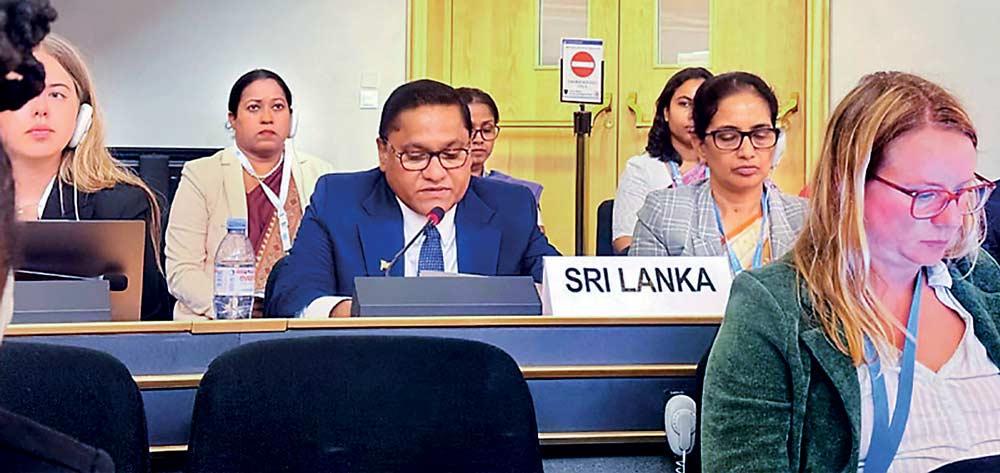
Speaking at the 60th Session of the Human Rights Council in Geneva, Switzerland, on September 8, 2025, Sri Lanka’s Minister of Foreign affairs, Foreign Employment and Tourism, Vijitha Herath, made an unequivocal pledge on behalf of his country, ‘to advance the rights and well-being of all Sri Lankans through our own domestic processes’, thereby rejecting any kind of external intervention or mechanism in investigating alleged human rights violations; all patriotic Sri Lankans must have heaved a sigh of relief, before applauding him. 

This was because, in the lead up to the Geneva session, there were growing fears among concerned citizens of Sri Lanka that the government they elected was going to give in to undue UN coercion  and betray the military and political leaders who saved the country from terrorism sixteen years ago. The menacing, prejudiced behaviour of visiting UN Human Rights Commissioner Volker Turk towards the end of June did nothing to allay these fears. Vijitha Herath concluded his detailed statement with the following words:

The Government is fully cognizant of the responsibility that accompanies the unprecedented mandate it has received from the people, and is committed to fulfilling their aspirations of a just, fair and prosperous society. We sincerely believe that external action will only serve to create divisions, thereby jeopardising the genuine and tangible national processes that have already been set in motion.  The Government is opposed to any external mechanism imposed on us such as the Sri Lanka Accountability Project.

Therefore, Mr. President, my earnest submission to members of this Council, its observers and all stakeholders is to collaboratively join hands with the government, to deepen our mutual understanding and extend your support to Sri Lanka. Our genuine and sincere approach, which is visible, needs to be reciprocated with deeper understanding and noticeable appreciation. We urge that all of you assist us in seizing this historic opportunity to advance the rights and well-being of all Sri Lankans through our own domestic processes.”

But his agreement with the OHCHR on the appointment of a so-called ‘Truth and Reconciliation Commission’ must be reconsidered, because it will be incompatible with the independent stance he’s expressed. Herath’s aides have done a professional job making his speech shipshape. It contained a fairly satisfactory response to Volker Turk’s mostly platitudinal remarks introducing his OHCHR report. Turk touched on some key areas that his report set out to address including ‘delivering accountability, fundamental legal and institutional reforms and eliminating the discrimination and division that have poisoned politics for generations’ (an unsubstantiable allegation). 

A highlight of evidence of ‘the continued suffering of human rights violations and abuses’ that he claimed he witnessed was a mass grave site at Chemmani, but social and political activist of Jaffna Arun Siddharth (a Tamil) pointed out several times that this was a traditional burial place where bodies belonging to ordinary dead residents of the place, and those killed by the LTTE and some by the army in clashes were interred. This gives an idea about the seriousness of the UNHRC boss’s evidential proof of such allegations. 

But he said, at the end of his remarks: I encourage Sri Lanka to seek international assistance with the exhumation of mass graves and other investigations”. What bunkum!

He concluded ‘Together the international community can support Sri Lankans to escape from the twin threats posed by persistent impunity and deep inequality’. I think Turk got a satisfactory answer from Herath. 

But this is not going to be the end of our problems with the UN. Perhaps, a backward look is in place at this point.

In an X post uploaded on June 1, 2025, Volker Turk wrote:

For many, the freedom to be yourself and follow your heart is woven into daily life and goes unnoticed.

For others, it’s been hard-won-with courage day after day

#Pride celebrates how far we’ve come and moves us forward to a world where everyone can live with dignity, equality and pride.

There is nothing more human than who we are and who we love.

He must have realised by now that, as far as Sri Lanka is concerned, this is the least of its problems. 

UN High Commissioner for Human Rights Volker Turk of Austrian nationality, a lawyer by profession,  was on a three-day visit to Sri Lanka from June 23 to 26, 2025. If my memory is correct, he is the fourth UN Human Rights chief to visit the island since the end (in May 2009) of the armed Tamil separatist rebellion. The then UN High Commissioner for Human Rights, South Korean citizen, Ban Ki-Moon, who had earlier been serving his country as a civil servant and a diplomat, rushed to Sri Lanka immediately after the crushing of the three decades long separatist terrorism by the Sri Lankan armed forces, for a two-day visit on May 22 and 23, 2009; his indecent haste was a sign that the UN did not welcome the defeat of separatist terrorism. His apparent bias was an early sign of the poisoning of general UN opinion about Sri Lanka’s successful response to the Tamil separatist terror campaign through both disinformation and misinformation by the so-called diaspora Tamil separatist lobbyists. 

The same anti-Sri Lanka (to be more precise, anti-Sinhala Buddhist majority of Sri Lanka) bias was more pronounced in the second UN High Commissioner for Human Rights to visit Sri Lanka, Navanethem Pillay. Her visit was from August 25 to 31, 2013. The South African jurist of Indian Tamil origin, popularly known as Navi Pillay, visited the island nation at the invitation of the then incumbent president Mahinda Rajapaksa who, in the first flush of victory, was confidently enjoying the undisputed approval and popularity that he had earned  among all Sri Lankans by eliminating mindless LTTE terrorist violence, irrespective of their different ethnicities, religious identities, and political loyalties. Rajapaksa decided to invite the influential UN official (Navi Pillay) to visit Sri Lanka, most probably because he believed that she, coming from Hindu Tamil origins, would be especially empathetic to the culturally kindred Sinhalese Buddhist majority and the Tamil Hindu largest minority of Sri Lanka  to appreciate the truth that the domestic conflict was really between the legitimate government of Sri Lanka and a group of rebels who were resorting to armed violence in order to carve out a separate state within its territory, but NOT between the Sinhalese and Tamil ethnic communities. Demographically, the Sinhalese are the majority, nevertheless a global minority whereas the Tamils are a minority within Sri Lanka but belong to a global majority. This is a truth that was hidden by a thick veil of anti-Sri Lanka false propaganda disseminated by the defeated Tamil separatist rump. 

The following year (2014) saw what could be called the UN-led selective witch-hunt, based on unsubstantiated war crimes allegations, against the hierarchy of the Sri Lankan security forces that brought an end to nearly three decades of armed Tamil separatist violence on May 19, 2009. (Incidentally, Australian media reported June 29, 2025 that Navanethem Pillay, aged 83, had been selected for the Sydney Peace Prize for her contributions to accountability and human rights and that she would be felicitated in Australia in November this year (2025). 

The third UN High Commissioner to visit Sri Lanka after the military victory over terrorism in 2009 was Zeid Ra’ad Al Hussein, a Jordanian diplomat, who came in February 2016, just over a year after the nationally uncalled for, foreign engineered regime change of 2015. According to the spokesman for the Federation of National Organizations, Dr Wasantha Bandara, the Yahapalana government installed through foreign intervention passed seven laws that pushed forward the unilateral UN war crimes allegations process against some selected war winning Sri Lankan military leaders. For that diabolical scheme to be complete, only two more parliamentary bills remain to be passed, as Dr Bandara points out: a bill for establishing a Truth Commission, and an Independent Prosecutor’s Office. The current JVP/NPP administration is required to pass those two final laws.     

Among the top UN panjandrums who visited Sri Lanka during the past sixteen years, Turk easily takes the cake for the most outrageously undiplomatic conduct towards a member country of the United Nations. 

In 2009, we were all hopeful that after the elimination of separatist terrorism, a prosperous and peaceful country would emerge. Instead, Sri Lanka began to face increasing destabilisation schemes launched against it  by meddlesome  geo-political grand strategists (especially US and India working in collusion) apparently under the aegis of the UN, which was created after the end of World War II to stop threats to international peace and security, not to meddle in the domestic security concerns of small vulnerable nations like ours. Superpowers try to get involved in the internal affairs of Sri Lanka in order to promote their own national interests in their home countries and to pursue their economic and military agendas in the geopolitically sensitive Indo-Pacific region where the island is located. 

These attempts have markedly intensified over the years since 2009. America and India find a common enemy in China. They want to contain the rising Chinese influence in the region. Sri Lanka seems to be caught up in the crossfire between China on the one side and America and India on the other. The Tamil diaspora benefits from the vote bank politics exploited by unscrupulous local politicians of those international community  countries. They persecute Sri Lanka  by raising non-existent  issues, such as alleged human rights violations by the Sri Lanka Army during the last phase of its war on terror, domestic communal divisions or instances of religious disharmony. They pretended that the war was fought between the majority Sinhalese and the minority Tamils, whereas the truth was that the legitimate government army fought against a bunch of separatist  terrorists who massacred members of all communities in the name of their macabre goal of creating a separate state on Sri Lankan soil, while the ordinary Sinhalese and Tamil civilians lived together in accustomed peace, along with members of other ethnic communities everywhere in the country, such as Muslims and Burghers.

There was no alienation between the Sinhalese and the Tamils, to put it differently, between the Sinhala speaking community and the Tamil speaking community, which includes Muslims as well as Tamils. But the powers that be conjured up the chimera of ‘reconciliation’ to justify their meddling in Sri Lanka’s internal affairs. At the end of ‘reconciliation’, we have a politically, economically and socially destabilised country, which is a far cry from where, according to Michael Naseby (Sri Lanka: Paradise Lost Paradise Regained, page 167), 

‘PEACE’ was achieved on 18th May 2009 when the Tamil Tigers were finally defeated and nearly 300,000 human shield hostages were rescued into government hands and looked after. Peace is the overwhelming need of the country and the first priority mentioned in a recent poll. There have been no bombings since May 2010 (sic) (still the position at the time of writing in 2018). People of all ethnic groups travel the length and breadth of the country by day or night without fear.” 

Post-Geneva, let’s restore the reconciliation that we achieved on our own in 2009 with sparing external help, and that the international wreckers of our peace set out to destroy soon after.  

Invitation Existential Crisis, Mindfulness and the Middle Path to Social Action by Asoka Bandarage Wednesday 17 September at 6.30pm UK – online only

September 12th, 2025

Asoka Bandarage 

The Buddhist Society   Please join us online to welcome Dr Asoka Bandarage who will be giving a public talk on Wednesday 17th September at 6.30pm UK time. Existential Crisis, Mindfulness and the Middle Path to Social Action
by Asoka Bandarage Dr Bandarage will deliver a public lecture for The Buddhist Society on Wednesday 17th September 6:30pm online through Zoom about the Buddhist Middle Way approach to the social issues and challenges in contemporary life.

Join the online talk through Zoom Wednesday 17th September at 6.30pm
https://thebuddhistsociety.zoom.us/j/81005223686
Meeting ID: 810 0522 3686 Scholar and practitioner Asoka Bandarage has taught at Yale, Brandeis, Mount Holyoke (where she received tenure), Georgetown, and other universities and colleges in the U.S. and abroad. Her research interests include social philosophy and consciousness; environmental sustainability, human well-being and health, global political-economy, ethnicity, gender, population, social movements and South Asia. Prof. Bandarage is the author many books including: The Middle Path to Environment, Society and the Economy; Women, Population and Global Crisis: A Political-Economic Analysis andotherpublications on political-economy, ecology as well as mindfulness and social action. She currently serves on the Advisory Boards of Critical Asian Studies, and Interfaith Moral Action on Climate. Dr. Bandarage has been a student of vipassana meditation teacher S.N. Goenka and a hatha yoga practitioner and currently serves on the Advisory Boards of Critical Asian Studies and Interfaith Moral Action on Climate. www.bandarage.com   Connect With Us: Meditation   The Middle Way   Membership   Buddhism   Donate   Twitter Contact Info: Phone: 020 7834 5858 Email: info@thebuddhistsociety.org Website: www.thebuddhistsociety.org The Buddhist Society, 58 Eccleston Square, London, SW1V 1PH
Company No: 5730715
Charity No: 1113705   Terms | Privacy | Unsubscribe

 Live | Rathu Ira l Bimal Rathnayake | 11th September 2025 | Swarnavahini

September 12th, 2025

Swarnavahini News

‘Ahikuntakas’ islandwide – Part II: Gypsy children need social inclusion strategy

September 12th, 2025

BY Ruwan Laknath Jayakody, Courtesy The Morning

‘Ahikuntakas’ islandwide – Part II: Gypsy children need social inclusion strategy
  • Govt.-wide strategy should cover edu., health, social services taking cognisance of the gypsy ethnicity being a protected trait 

A Government-wide strategy should be formulated to foster the social inclusion of gypsy children, whose ethnicity is a protected trait, in sectors such as education, healthcare, and social services. 

These recommendations were made in ‘A comprehensive study on the discontinuity of the primary school education of children in the gypsy community (with special reference to a primary school in Siyambalagaswewa in the Mihinthale education division sector)’ which was authored by D.O. Meththasinghe (attached as an Assistant Lecturer to the National Institute of Social Development’s School of Social Work), and published in the Student Journal of Social Work‘s Fourth Volume’s First Issue, September 2025.

Conflicts between gypsy community learnings and mainstream edu. 

Gypsy education differs greatly from mainstream education. A gypsy community education is considerably different from education received in a traditional classroom environment, which is where the majority of learning takes place. The bulk of a child’s day is spent in the family camp, at the residence of a family member, or following a family member on work, where he/she may or may not engage with non-gypsy people and their environments. 

In most traditional classrooms, students are not given the opportunity to choose their own educational activities, to spend as much time as they like on them, or to organise their own study groups to complete those tasks. Children are supposed to sit quietly and pay attention to what is being spoken to them in a restricted place, and they are expected to observe precise standards on their behaviour as well as the topics that they may discuss; discipline, regularity, the ability to remain silent, and the aptitude to recall abstract information are the features of a child’s everyday experience that distinguishes them as different from other children. Because the teachers are unfamiliar with the children’s way of life, there are misunderstandings. The interest of children in going to school declines. 

The importance and usefulness of conventional education are not understood by many children. Many children don’t appear to get anything out of education activities like philosophising and asking hypothetical questions. When asked to carry out unfamiliar tasks or make use of abstract concepts, these children exhibit signs of anxiety and frequently lose interest. Camping trips turned out to be the most popular and successful activity for this group. The end of elementary school or the beginning of middle school is when aboriginal/indigenous children start to lose interest in education.

The majority of gypsy communities place a high value on the significance of having a solid family unit and a large extended family network in the process of moulding the lives of children. The media, education, and the culture of the dominant society all have an impact on a child’s understanding of the world around them. Family members teach gypsy children to respect other adults, themselves, and the group by including them in everyday communal life. Children are encouraged to find and make their own meals, dress themselves, and go to bed alone. They are also encouraged to look after younger children.

Lack of funding by the Govt.

Some organisations that support gypsy people’s education are almost entirely run by volunteers and must compete with non-gypsy organisations that nominally provide services for them in order to secure even the most basic funds. In Sri Lanka, the educational needs of children who are always on the go are typically met with band-aid solutions rather than through thoughtful help and programmes. 

Remote education is considered as a last option for children who are forced to attend school. On the other hand, pre-school, primary, secondary, and even tertiary education should all be available to gypsy children through the use of online learning. Colleges that provide distance education make a wide range of educational materials and technological resources available to students, with the goal of supporting the teaching that is provided by qualified teachers of distance education. Despite the fact that nomadic lifestyles are not actively encouraged, the education that a child may acquire through distance learning is seen as being on par with, if not superior to, traditional education. 

The degree to which a group is able to exercise its right to self-determination is directly proportional to the policies of specific Governments as well as the help that such Governments give to meet the requirements of minority groups. Minority groups, such as gypsy people, will not be able to achieve self-determination unless they have greater agency in the formulation of education policies and practices. 

Racism and bullying

Gypsies endure racism and bullying in the school system, both as a technique of exclusion and as a manner of labelling the gypsy diaspora as ‘foreign’ and ‘other’. According to certain academics, the gypsy community ought to be against participation in conventional education. It has been suggested that cultural anxiety and a desire for cultural isolation are key factors that lead to social isolation. 

Gypsies are concerned that if they fully merge into the mainstream culture, their cultural identity would be compromised. Because of this, it is possible that some parents may be less likely to send their children to school, which will have an effect on the overall participation rate.

Parents’ own education 

Parents’ thoughts of the value of a formal education generally reflect their own sentiments towards the value of their own formal education. Only a small fraction of the parents surveyed had finished all years of elementary and secondary education. Their own education was marred by a great deal of difficulty, and as a result, they had negative preconceptions about what their children would go through in the educational system. 

The parents (especially the men) had often become estranged from one another in numerous homes. Despite this, they wished to encourage their children to stay put and complete a fundamental education. As an investment in their children’s future prosperity, they were normally extremely supportive of their children’s education. Nonetheless, there were those fathers who held the opinion that they are unable to force their children to attend school if they so choose. Parents usually provided the same justifications for their children’s absence from school as the children themselves did. The children’s justifications for leaving are consequently given cultural weight.

Educational achievement

All of the parents who participated in the survey expressed excitement about sending their children to school, and the great majority of the parents expressed a wish for their children to complete secondary education. Everyone was in agreement that their children stood to benefit much from an education and training that would make it easier for them to obtain employment in the future. 

There was a worry that a significant portion of the work that had traditionally been associated with the gypsy lifestyle was ‘drying up’ and would not be accessible in the future; as a result, this was seen to be an important issue given cultural weight.

Methodology

For this research study, Meththasinghe applied the qualitative research method. The research design considered the population of the gypsy students (23), who are learning at A/Siyambalagaswewa Primary School of the Mihinthale DS, in the Anuradhapura District of the North Central Province. A total of 12 gypsy students were taken as the sample (which covers four students each from Grades Three, Four and Five with the filtration of two boys and two girls from each class), along with three parents whose children are studying in Grades Three, Four and Five on the basis that the parents were experiencing the pros and cons and also the barriers faced by their children in the continuity of school education, two chieftains of the community because they have ruled the village for a long period of time and are aware of the behavioural pattern of the gypsy community that lives in the village, two villagers because they have experience on the behaviours, status of living, beliefs and ethics of the gypsy community including that of gypsy children, and 11 key informants. The sampling method was non-probability and purposive.

Findings 

Poverty puts parents in a position of not being able to support students in their requirements such as books, bags, the school uniform, shoes, etc., which makes the children refuse attending school. Racism and discrimination make the students create social boundaries towards the rest of the society which diminishes their interest in communicating and interpersonal connection. 

An unsupportive family background gives little or almost no guidance to students in continuing their education. The physical health of the children weakens them both mentally and physically where the ability of endurance, tolerance, cooperating, etc., decreases within the classroom. The school community including the teachers and the principal makes much effort to continue the attendance of the gypsy children.

Gypsy student-centralised approach

A centralised approach in the context of gypsy student management refers to a system or framework where all gypsy student-related information and processes are centralised and managed from a single location or platform. Some steps to create a gypsy student centralised approach include identifying objectives, selecting a centralised platform, gathering gypsy student data, implementing a gypsy student information system, establishing communication channels, streamlining administrative processes, providing training and support, and continuously evaluating and improving. Implementing a centralised approach requires careful planning, coordination, and ongoing support. Therefore, it is essential to involve all the relevant stakeholders and ensure their buy-in to maximise the success of the initiative.

Gypsy child-centred family-based approach

When considering a child centred family based approach for gypsy children, it is important to be mindful of their unique cultural and social context. Some key considerations which require practice and awareness include cultural sensitivity, collaborative engagement, individualised support, holistic development, culturally-responsive education, language support, family support services, community involvement, anti-discrimination and equality, and continuous learning and improvement. 

Gypsy children, like any other children, deserve to have their voices heard, their rights respected, and their potential nurtured within a supportive and inclusive family-based approach.

Gypsy student-centred school-based approach

When implementing a gypsy student-centred school-based approach, it is important to consider the specific needs, culture, and experiences of gypsy students, and such should be based on social and educational approaches. 

The social approach is approached with cultural fluency. Cultural fluency is crucial for supporting the educational journey of gypsy students. It fosters identity affirmation, academic engagement, effective communication, a positive school climate, personalised support, and strong family-community-school relationships. By embracing and understanding the gypsy culture, educators can create an inclusive and empowering educational environment that promotes academic success, social integration, and the overall wellbeing of gypsy students. This approach includes a culturally responsive environment, cultural awareness and training, individualised support, community engagement, and a culturally relevant curriculum.

The educational approach of the model goes hand in hand with personalisation. Personalised education is of utmost importance for gypsy students as it recognises and addresses their unique needs, strengths, and circumstances. Gypsy students often come from diverse cultural backgrounds, and personalised education allows for tailored approaches that cater to their specific requirements. By understanding their individual learning styles, interests, and challenges, educators can design instructional strategies that maximise engagement and promote academic success. The educational approach includes language support, academic support, career and college readiness, safe transportation, and continuous evaluation and improvement. 

A gypsy student-centred school-based approach requires ongoing collaboration, cultural sensitivity, and continuous improvement. By embracing the gypsy culture, valuing diversity, and creating an inclusive environment, schools can help gypsy students thrive academically, socially, and emotionally.

Social worker intervention

A social worker can provide intervention in numerous ways in order to support the continuous school attendance of gypsy students. The intervention can be provided under several approaches: as an educator, a facilitator, and an initiator.

Social workers can play a significant role as educators to support the continuous school attendance of gypsy students. Some ways in which social workers can intervene include home visits and relationship building, case management and advocacy, individualised support plans, parent and community engagement, truancy prevention programmes, crisis intervention and support, and data collection and analysis. 

Social workers can also serve as facilitators to support the continuous school attendance of gypsy students. Some ways in which social workers can intervene in this capacity include collaboration and coordination, attendance monitoring and early intervention, individualised attendance plans, counseling and support, life skills and resilience building, family engagement and education, and advocacy and systemic change.

Social workers can play a crucial role as initiators to support the continuous school attendance of gypsy students. Some ways in which social workers can intervene in this capacity include needs assessment, community engagement, cultural sensitivity training, resource mobilisation, mentoring and support programs, policy advocacy, and data monitoring and evaluation. 

In conclusion, Meththasinghe made a number of recommendations in this regard: Sponsoring a State-wide training program to promote these resources, and to revisit, update, and re-release the materials that were developed under the National Strategy Programme; Allotting funds for the financial assistance of gypsy families and designating a national coordinator for this endeavour; The reestablishment of funding that is particularly designated for Local Authorities and is subject to monitoring in order to provide services to support gypsy populations with educational inclusion, participation, transitions, and opportunities; Ensuring that all initial teacher training courses (primary and secondary) include a section on strategies to facilitate the participation of gypsy, Roma and traveller children and young people as part of the curriculum; Keeping an eye on racial bullying and taking action against it if it is shown to be widespread, issuing warning letters to schools where it has been established that racist bullying takes place on a regular basis, and implementing an anti-bullying policy that is consistent and understandable across the entirety of educational institutions; Ensure that each and every worker receives training on their equality-related responsibilities so that they are informed that the gypsy ethnicity is a protected trait and that it is against the law to discriminate against gypsy students; and Fostering an environment in which school districts are encouraged to interact with families in a manner that is transparent, inclusive, and truthful.

This is the final part of a two-part series of articles. The first was published in an earlier issue of The Daily Morning 

China grants full supply of school uniform materials for 2026

September 12th, 2025

Courtesy The Morning

China has agreed to provide all school uniform materials required for 2026 as a grant, benefiting over 4.4 million students in government and government-aided schools.

The agreement was exchanged between Education Ministry officials and the Chinese Ambassador at a ceremony in Colombo.

Harsha de Silva raises concerns over bribery commission’s financial management

September 12th, 2025

Courtesy The Morning

The Chairman of the Committee on Public Finance (CoPF), MP Harsha de Silva, has questioned the independence of the Commission to Investigate Allegations of Bribery or Corruption (CIABOC), citing its lack of financial autonomy. 

Speaking at a CoPF meeting, Harsha de Silva argued that an institution cannot be truly independent without control over its own finances and staff appointments.

CIABOC Director General Ranga Dissanayake informed the committee that despite a provision for dedicated staff, it has not been implemented for almost two years. 

The Deputy Secretary to the Ministry of Finance, A.K. Seneviratne, also acknowledged the validity of Harsha de Silva’s concerns, agreeing that the issue of financial independence for CIABOC is a serious one.

From Kathmandu To Colombo: The Geopolitical Roots Of Nepal’s Unrest – Analysis

September 12th, 2025

By A. Jathindra, Courtesy Eurasia Review

In South Asia, history shows that setting streets ablaze rarely leads to constructive change. Yet, the region continues to see such upheaval, which only worsens domestic politics in the affected countries. Bangladesh has been a terrible witness,” engulfed by unrest, and now Nepal faces its own crisis.

The tragic death of the wife of Nepal’s former Prime Minister Jhalanath Khanal—killed after her house was allegedly set on fire by protesters, reportedly led by Gen Z activists—has become the latest flashpoint, underscoring how dire the situation has become.

Why do violent protests so often become tools of political manoeuvring in India’s neighbouring countries? The answer is not simple. Political turmoil is often blamed on sudden events, but beneath every eruption lies a deeper cause. Even when spontaneous incidents spark unrest, the roots often run far deeper.

Nepal’s political scene has been in constant flux. Prime Minister K.P. Sharma Oli, a four-term incumbent who once said, Indian Virus Looks More Lethal than Chinese, Italian,” resigned amid worsening unrest following a strict ban on social media. In the shadow of this ban, a youth movement calling itself the ‘Voice of Nepal’s Gen Z’ rose up against the political elite. This raises a critical question: Can a social media blackout alone ignite such an uprising?

Nepal has long maintained close economic and social ties with India. Some even saw Nepal as an informal extension of India, although it has always remained sovereign. Recently, however, Nepal—like other Indian neighbours—has drifted strategically closer to China. Under Prime Minister Oli’s leadership, Nepal’s foreign policy began to resemble Sri Lanka’s approach during Mahinda Rajapaksa’s tenure, when heavy borrowing forced Colombo to pivot toward Beijing. Although China claims to follow a policy of non-interference, its ambassador to Nepal reportedly held a series of meetings with key leaders of the Nepal Communist Party to broker a deal that would keep Oli as Prime Minister for a full five-year term. This shows how China is becoming increasingly involved in Nepal’s domestic politics, pulling the country further into Beijing’s orbit.

In December 2024, Oli visited China, breaking an unwritten diplomatic tradition that neighbouring leaders first visit India. The Nepalese ambassador to China later dismissed claims of such a tradition during an interview in Beijing. During Oli’s visit, Nepal signed several agreements under Beijing’s One Belt One Road” initiative, aimed at transforming Nepal from landlocked to land-linked. This deal promised both virtual and physical connectivity, including roads, railways, aviation, power grids, and telecommunications. It also restarted Nepal-Tibet trade, which had been cut off after China’s occupation of Tibet in 1959.

August 2024 saw a student uprising in Bangladesh that ousted Sheikh Hasina. The head of the caretaker government, Mohammad Yunus, soon met with Xi Jinping in Beijing and invited China to treat Bangladesh as an extension of the Chinese economy, using Dhaka as a maritime conduit to India’s northeastern states, Nepal and Bhutan”. Bangladesh thus became the first country in South Asia to openly invite Chinese expansion into the Indian Ocean region.

There is a visible thread running through the region’s recent turmoil. Is China’s growing interference the common factor? The answer is not straightforward. Increased Chinese involvement often brings a surge of loans and investments, but when these are accepted without oversight, corruption and abuse of power inevitably follow.

Sri Lanka offers a cautionary tale. During Mahinda Rajapaksa’s rule, Chinese loans fueled the construction of the strategic Hambantota port—ultimately trapping Colombo in a debt trap.” The $216 million Pokhara International Airport in Nepal, financed by China Exim Bank, has raised similar concerns and is linked to massive corruption. Just as the Chinese-built Hambantota port faced criticism for potential dual-use, Pokhara Airport has attracted similar scrutiny. Allegations swirl that $71 million from China’s Exim Bank was embezzled through deals between Chinese firms and Nepali politicians. While some individuals have faced charges, investigations have led nowhere. Corruption festers, fueling political instability.

Despite glaring parallels, Nepal’s political elite seems unwilling to heed Sri Lanka’s lessons. Since 2007, China’s presence has grown on India’s periphery—most notably in Sri Lanka and Nepal. During the final phase of Sri Lanka’s civil war in 2008–09, China extended military support to Rajapaksa. Meanwhile, in March 2008, protests and crackdowns swept Tibet, deepening Beijing’s ties with Kathmandu. Since then, China-Nepal relations have revolved around financial support and a tacit understanding: in exchange, Nepal is expected to suppress ‘anti-China’ activities within its borders.

Nepal’s current unrest is a symptom of deeper geopolitical shifts and unresolved domestic issues. The cycle of protests and violence is unlikely to yield positive change unless leaders learn from the region’s troubled history. The fires burning in Nepal are fueled not just by local grievances but by the complex interplay of regional power, debt, and diplomacy.

Sri Lanka loses up to 40 per cent of its agricultural produce after harvest

September 12th, 2025

Arundathie Abeysinghe Courtesy PIME Asia News

Every year, approximately 500,000 metric tonnes of fruit and vegetables are lost – enough to feed the country for up to four months. Among the causes are poor transportation and packaging. Losses could be reduced to 5.7 per cent by following the Ministry of Agriculture’s guidelines. The Circular Project sponsored by the FAO and the EU aims to reduce food waste with a circular economy approach and digital tools.

Colombo (AsiaNews) – According to a new study by the Department of Agriculture in co-operation with other partners, post-harvest losses of fruit and vegetables in Sri Lanka are estimated to be around 180 billion rupees per year (almost US$ 600 million)

More than 500,000 metric tonnes of agricultural produce are wasted per year, especially during transportation, about 200,000 tonnes of vegetables and 300,000 tonnes of fruits, enough to feed the entire country for two to four months.

If best practices and guidelines were followed, including transportation methods and proper packaging, waste could be reduced to 5.7 per cent.

Currently, crop losses are between 30 and 40 per cent, especially during transit; the greatest damage occurs between farms and retail markets.

The research found that transportation-related waste is approximately 10 per cent annually, which could be reduced, thus allowing for 60 per cent growth in the national and agricultural economy.

Researchers have noted, however, that farmers, intermediaries, and retailers have not yet adopted the recommended guidelines and measures introduced to reduce losses, thus perpetuating the problem.

We’ve been growing vegetables for over 15 years. Despite good harvests, we’re unable to provide fresh produce to consumers because most of our produce spoils during transportation,” said Vadivel Aruliah, 56, and Sinnathamby Joseph, 52, vegetable growers in Nuwara Eliya, speaking to AsiaNews.

For example, we harvested cabbages the size of a medium jackfruit. However, when they are ready to eat, they shrink to the size of a breadfruit, with several outer leaves that rot, become damaged, and need to be removed.”

Heenbanda Dissanayaka, 50, and Mahinda Wijepala, 43, fruit growers in Dambulla, also report that fruit spoils during transportation.”

Agriculture experts Daminda Kahawita and Rashmi Mendis note that Sri Lanka has an institution dedicated to this problem, the National Institute of Post Harvest Management (NIPHM), which operates under the Ministry of Agriculture, with the aim of improving post-harvest technologies.

Senior NIPHM officials regularly visit harvest sites and conduct awareness campaigns,” they note. However, most of these guidelines are not followed at the local level to effectively reduce losses.”

Due to poor handling and packaging, some 221,955 tonnes of vegetables and 290,151 tonnes of fruit are wasted during transportation each year. This represents 19 per cent and 20 per cent, respectively.

In more developed countries, packaging is a separate industry. Farmers’ associations or private investments manage packaging in the agricultural sector,” they explain.

In Sri Lanka, There is a critical need to increase storage facilities for fruits and vegetables, as adequate storage allows surplus harvests to be preserved for future use, stabilising prices and benefiting both farmers and consumers,” they added.

Meanwhile, an initiative called the Circular Project, led by the UN Food and Agriculture Organization (FAO) with the assistance of the European Union, seeks to address the problem of food loss and waste using a circular economy approach to reuse, recycle, and optimise resources throughout the food supply chain.

The project will be implemented in Colombo, Nuwara Eliya, and Galle and will include data-driven assessments of food losses and waste.

The project will support the adoption of digital tools to help food supply chain stakeholders identify and address the root causes of waste, contribute to the recovery and reuse of food waste, improve access to food for vulnerable communities, and reduce the environmental footprint of the food supply chain.

By addressing food losses and waste, the project aims to improve food security, rural livelihoods, and support sustainable agricultural growth.

The Sinhabahu Myth through the eyes of Prof. Gananath Obeyesekere

September 11th, 2025

by Dr Ruwan M Jayatunge M.D. PhD 

The rich tapestry of Sri Lanka’s cultural heritage is intricately woven with mythology and legends, which serve as a profound reflection of the island’s history and identity. These narratives, passed down through generations, encompass a diverse array of tales that highlight the values, beliefs, and traditions of the Sri Lankan people.  The mythological tale of Sinhabahu serves as a foundational narrative for the Sinhala nation, intricately weaving together themes of identity, heritage, and cultural pride.

Prof. Gananath Obeyesekere argues that the myth of Sinhabahu serves as a quintessential representation of the Sri Lankan Oedipus narrative. In his notable work, “The Work of Culture: Symbolic Transformation in Psychoanalysis and Anthropology,” Prof. Obeyesekere highlights a particularly striking aspect of the Sinhabahu myth: the complete absence of any expressions of remorse or ethical dilemmas regarding the act of patricide. This lack of moral conflict sets the myth apart, suggesting a cultural framework in which such actions are not only accepted but perhaps even normalized, thereby inviting deeper exploration into the implications of familial relationships and societal values within the context of Sri Lankan folklore.

Sinhabahu Narrative

The myth of Sinhabahu narrates the legendary beginnings of the Sinhala people, an ethnic group indigenous to Sri Lanka. The Sinhalese communicate in Sinhala, an Indo-Aryan language (Lewis, 2009), and the term “Sinhala” itself translates to “lion people.” Central to this mythology is the tale of Princess Suppadevi from the Vanga Kingdom, situated in the eastern region of the Indian Subcontinent, who was abducted by a fierce lion and taken into the wilderness. During her time in captivity, she gave birth to twins: a son named Sinhabahu, which means “hands like a lion’s paws,” and a daughter named Sinha Seevali. The lion confined the family in a cave, sealing the entrance with a massive rock.

At the age of sixteen, Sinhabahu managed to lift the stone and escape with his mother and sister to the Lala Kingdom, evading their captor. Upon discovering their flight, the enraged lion rampaged through nearby villages in search of the princess and her children, prompting the terrified villagers to implore their king for assistance. The king then tasked Sinhabahu with confronting the lion, leading the young hero to track down and slay the beast with a lethal arrow. This act of bravery earned Sinhabahu the admiration of the people, who hailed him as a hero.

Prince Sinhabahu established a city known as Sinhapura, which translates to “The Lion City.” In a significant familial union, he married his sister, Sinha Seevali, and together they welcomed a son named Vijaya. The chronicles of the Mahawansa, a revered historical text, identify Prince Vijaya as the first documented monarch of Sri Lanka, reigning from 543 BC to 505 BC. His ascension marked a pivotal moment in the island’s history, laying the foundation for a lineage that would shape the cultural and political landscape of Sri Lanka for centuries to come. The legacy of Sinhapura and its royal inhabitants continues to resonate in the annals of Sri Lankan heritage, symbolizing the intertwining of myth and history in the formation of a nation.

The tale of Sinhabahu has been passed down through generations, embodying the essence of oral tradition. These narratives often depict the evolution of their heroes through a recurring motif of exile and return, which places them in circumstances that continually test their strength and determination (Scot, 1990). Within these stories, archetypes emerge in various forms, including typical characters, plotlines, imagery, and overarching themes, creating a rich tapestry for analysis. One of the most prevalent archetypes found across cultures is that of the hero and the hero’s journey, a narrative framework that resonates universally. This journey not only highlights the trials faced by the hero but also reflects the values and beliefs of the culture from which the story originates, making it a vital component of storytelling across different societies.

Mythical Stories and Culture

Obeysekara probes into the rich tapestry of traditional folk tales, myths, and narratives that characterize the cultural heritage of Sri Lanka, revealing a world imbued with both myth and enigma. As an anthropologist, he meticulously examines the stories that have been transmitted through generations, recognizing their significance not only as entertainment but also as vessels of cultural identity and collective memory. His analysis reveals underlying sociological and psychological themes, suggesting that these folk narratives reflect societal values, beliefs, and human experiences. Through this lens, Obeysekara highlights the intricate connections between folklore and the social fabric of Sri Lankan life, illustrating how these tales encapsulate the complexities of human nature and community dynamics.

The tale of Sinhabahu is often regarded as a work of mythology, steeped in the rich traditions and cultural narratives of its origins. A mythical story is a traditional narrative that often carries deep symbolic meaning, serving to illuminate the beliefs, historical events, and cultural practices of a particular society. These tales frequently delve into the origins of the world, the exploits of legendary heroes, and the actions of deities, providing insight into the values and moral lessons that shape a community’s identity. Through rich imagery and allegorical elements, mythical stories not only entertain but also educate, preserving the collective memory and wisdom of a culture for generations. They act as a bridge between the past and present, allowing individuals to connect with their heritage while exploring universal themes of existence, morality, and the human experience.

Obeysekara investigates the intricate essence of traditional folk tales, offering a comprehensive examination of their underlying themes and motifs. In his analysis, he not only unravels the narrative structures and cultural significance of these stories but also contextualizes them within their historical and sociological frameworks. By doing so, he provides readers with a deeper understanding of how these tales reflect the values, beliefs, and social dynamics of the communities from which they originate. This multifaceted approach allows for a richer appreciation of the folk tales, highlighting their role as both artistic expressions and vital components of cultural heritage.

Mythical Narratives and the Collective Unconscious

Mythical narratives are deeply connected to the collective unconscious and act as expressions of inherited, universal archetypes that form a shared layer of human experience across cultures and history. These mythical narratives posit a profound, universal aspect of the human psyche that is shared among all individuals. This collective unconscious houses archetypes—fundamental symbols and themes, such as the hero or the nurturing mother—that recur in myths, dreams, and symbols across various cultures. The presence of these archetypes elucidates the striking similarities found in mythological themes and motifs across diverse societies, suggesting a common psychological heritage.

Carl Jung’s exploration revealed that these universal patterns transcend cultural and historical boundaries, leading him to propose that a segment of the human mind contains a collective unconscious, akin to a shared, primal memory that connects all members of the human race. Numerous mythological tales, such as Sinhabahu, exemplify this phenomenon, illustrating how ancient cultures have woven similar narratives that resonate with the collective human experience. It’s unclear if Carl Jung was familiar with the Sinhabahu legend itself; though there is no direct evidence that he wrote about it, his theories are applied to it by later Sri Lankan scholars like Obeysekara.

Mythical narratives play a significant role in shaping the collective unconscious by serving as reflections and manifestations of universal archetypes and patterns inherent within it. Carl Jung posited that these myths unveil the common psychological frameworks that are passed down through generations, highlighting the shared mental structures that define humanity. Archetypes such as the hero, the mother, and the trickster emerge consistently across diverse cultures, illustrating fundamental themes that resonate deeply within the human experience. These motifs not only influence our perceptions and emotions but also guide our behaviors, providing a vital framework for comprehending and integrating the more profound dimensions of the human psyche. Through the exploration of these archetypal stories, individuals can gain insights into their own lives and the collective human experience, fostering a deeper understanding of the psychological forces that shape our existence.

The Lion as a Totem Animal

The lion has emerged as a significant totem animal for the people of Sri Lanka, especially among the Sinhalese community, largely due to the legendary tale of Sinhabahu. A totem is a natural entity, often an object or an animal, that holds profound spiritual significance for a specific community or society. This belief system imbues the totem with a sense of identity and connection, leading the group to adopt it as a symbol or emblem that represents their values, heritage, and collective spirit. The totem serves not only as a marker of cultural identity but also as a source of guidance and inspiration, reflecting the community’s connection to nature and the spiritual realm. Through rituals, storytelling, and artistic expressions, the totem becomes a vital part of the society’s traditions, reinforcing bonds among its members and fostering a sense of belonging and continuity across generations.

The lion, often referred to as a beast, serves as the father of Prince Sinhabahu, who famously abducted his mother from her clan. This lion can be interpreted as a metaphor for a man of extraordinary strength or even as a figure with a lion-like visage, particularly relevant in the context of Hansen’s disease, where individuals may exhibit a leonine appearance.

The lion has emerged as a powerful totem for the Sinhala nation. The lion represents not only the physical prowess associated with the animal but also embodies the cultural identity and heritage of the Sinhalese. This legendary figure, believed to be the progenitor of the Sinhalese people, has established the lion as a significant emblem of both the Sinhalese identity and the monarchy since ancient times. The intertwining of history and mythology has reinforced the lion’s status as a quintessential symbol of strength, courage, and resilience. Over the centuries, this association has culminated in the lion’s prominent depiction on the national flag of Sri Lanka.

The lion, revered as a totem animal, embodies the qualities of leadership, strength, courage, and protection, serving as a powerful source of inspiration for individuals to embrace boldness, resilience, and self-assurance. This majestic creature symbolizes an inner strength that empowers one to confront and surmount obstacles, fostering a spirit of self-expression and active participation within the community. When the lion appears as a spirit guide, it often heralds a significant phase of spiritual development, emerging at pivotal moments when an individual must assert their authority, safeguard their domain, or lead with compassion and integrity. This connection to the Lion encourages a deeper understanding of one’s capabilities and the importance of standing firm in one’s beliefs while nurturing the bonds that unite us with others.

The lineage of Prince Sinhabahu, traced back to a lion, symbolizes the embodiment of masculine power and vigor. Such symbolic representations are deeply rooted in social, ideological, and political constructs, as noted by Miller (2011), which is why the lion has come to represent the ‘Sinhala’ race. Across various cultures, lions are revered for their innate qualities of strength, nobility, and bravery, traits that resonate universally. Their status as apex predators positions them as protectors against malevolence, while their majestic presence conveys dignity, authority, and leadership. This widespread admiration has led to their incorporation into religious practices, mythological narratives, heraldic traditions, and use as guardians in both ancient and contemporary societies.

Carl Jung posited that animals often symbolize instinctual drives, with the lion serving as an archetype for the Sinhalese people. At the core of any symbol lies a vital energy, whether instinctual or archetypal, often referred to as libido or anima, as discussed by Jutta von Buchholtz (2000). Furthermore, Obeyesekere explores the concept of “symbolic remove,” which describes the cultural evolution of symbolic forms. These symbols, although regressive due to their origins in individual psychological development and unconscious processes, also possess a progressive aspect, as they enable the transformation of primitive motivations from early experiences into a more profound understanding of the sacred, as articulated by Nuckolls (1997).

The Lion—the Emblem of Sinhalese Identity

The lion has emerged as a powerful symbol of Sinhalese identity, deeply rooted in ancient folklore and its association with the island’s inaugural monarch, Prince Vijaya. This connection is primarily derived from the Sinhabahu legend, which narrates the tale of Sinhabahu, a lion-man who is said to be the progenitor of the Sinhalese people. According to this legend, Sinhabahu, born of a lion and a human princess, embodies strength, courage, and nobility, traits that resonate with the Sinhalese culture. As Prince Vijaya, a descendant of Sinhabahu, established his reign in Sri Lanka, the lion became an enduring emblem of the Sinhalese heritage, representing not only royal lineage but also the resilience and identity of the Sinhalese people throughout history. This rich tapestry of myth and history has solidified the lion’s status as a national symbol, reflecting the pride and unity of the Sinhalese community.

The lion has long served as a powerful emblem of Sinhalese identity, much like the peacock represented the Mauryas, the fish symbolized the Pandyas, and the tiger stood for the Cholas. This majestic creature is deeply woven into the historical narrative of Sri Lanka, with King Dutugemunu famously carrying a lion flag during his legendary battle against Elara, a moment immortalized in a painting at the Dambulla temple from the Kandyan period. Furthermore, the Sinhalese kings of Anuradhapura minted coins adorned with the lion, reinforcing its significance in their reign. Additionally, King Kashyapa’s creation of a colossal lion statue at Sigiriya exemplifies the lion’s enduring status as a national symbol, reflecting the pride and cultural heritage of the Sinhalese people throughout the ages.

Bestiality Narrated in the Sinhabahu Story

The Sinhabahu legend contains elements that can be interpreted as bestiality, particularly in its portrayal of the protagonist’s origins and the relationships he forms. Bestiality, defined as sexual intercourse between humans and animals, raises significant ethical, legal, and moral concerns across various societies. This practice is often viewed as taboo.

The myth of Sinhabahu delves into complex themes, including the controversial subject of bestiality. This ancient narrative, rooted in the cultural and historical context of its origin, presents a tale that intertwines human and animal characteristics, ultimately exploring the boundaries of morality and nature. Sinhabahu, a character born from a union between a lion and a human, symbolizes the intersection of the primal instincts of the animal kingdom with the rationality of humanity. The story raises profound questions about identity, lineage, and the consequences of transgressing natural laws.

The Mahavamsa recounts the tale of a king from Vanga, an ancient region corresponding to modern-day Bengal, who took as his wife the daughter of the Kalinga monarch, now part of Odisha. This union produced a daughter named Suppadevi, who was foretold to engage with the king of beasts. As she matured, Princess Suppadevi sought to carve out her own destiny and departed from Vanga, joining a caravan that was en route to Magadha. However, their journey was abruptly interrupted when they were ambushed by a creature referred to as Sinha, meaning “lion,” in a forest located in the Lala region, which has been variously identified with either Rarh, an area within the Vanga-Kalinga territory, or Lata, a region in present-day Gujarat. During the chaos of the attack, Suppadevi managed to escape but soon found herself face-to-face with Sinha once more. Captivated by her presence, Sinha was drawn to her, and in a moment of recognition of the prophecy, she reciprocated his affection. Subsequently, Sinha imprisoned Suppadevi in a cave, where they had two offspring: a son named Sinhabahu, which translates to “lion-armed,” and a daughter named Sinhasivali.

The cultural implications of bestiality differ significantly across various societies, encompassing a wide range of historical, mythological, and ritualistic contexts. In some cultures, it is intertwined with specific rites or considered a forbidden practice, while in others, it appears in modern media portrayals that often mirror societal fears or notions of moral transgression. Although bestiality is frequently regarded as a taboo subject in many parts of the world, there are historical instances where it has been recognized as a form of sexual expression. The ancient Egyptian religious customs included elements that could be interpreted as bestiality, illustrating its varied significance throughout history. 

In mythology, the theme of bestiality carries profound cultural implications that extend beyond mere taboo. It serves to delineate the distinctions between human and divine realms, often reflecting societal anxieties surrounding sexuality and the institution of marriage. These narratives frequently delve into the complexities of desire, illustrating how the intertwining of human and animalistic traits can symbolize deeper connections to the natural world. Furthermore, bestiality in myth acts as a powerful metaphor for the primal forces of power and lust, revealing the underlying tensions between civilization and the wild. Through these stories, cultures grapple with their fears and fascinations, using the motif of bestiality to explore the boundaries of morality and the essence of human nature itself.

As Sinhabahu navigates his existence, the myth serves as a reflection on the darker aspects of desire and the societal implications of such unions, prompting audiences to confront their own perceptions of normalcy and taboo. Through its vivid imagery and allegorical depth, the myth invites a critical examination of the human condition and the often-blurred lines between civilization and the wild.

Sinhabahu and the Oedipus Complex

The Oedipus complex emerges during Freud’s phallic stage of development, which typically occurs between the ages of three and six. During this critical period, a young boy begins to experience unconscious feelings of attraction towards his mother, while simultaneously perceiving his father as a competitor for her affection. This internal conflict often leads to intense emotions such as jealousy and anger, as well as a profound fear of castration, which represents the boy’s anxiety regarding potential retribution from his father. According to psychoanalytic theory, resolving these complex feelings is essential for forming a robust psychological identity and developing the superego. This resolution is achieved when the child identifies with the father figure, thereby suppressing his desires for the mother and internalizing paternal values, which ultimately contributes to a healthier psychological framework as he matures.

The term “Sri Lankan Oedipus” refers to the legend of Sinhabahu, a mythical figure credited with founding the Sinhala people, and it draws intriguing parallels to the Greek myth of Oedipus. Both narratives revolve around a central character who unwittingly engages in patricide and incest, resulting in profound consequences that shape their respective cultures. In Sinhabahu’s story, this tragic fate is symbolized through a totemic relationship with a lion, which serves as a powerful emblem of national identity and heritage. Furthermore, the influence of Sophocles’ “Oedipus Rex” is evident in Sri Lanka, where adaptations and performances of the classic play have been integrated into the local cultural landscape. This connection not only highlights the shared themes of fate and familial conflict but also underscores the enduring impact of these myths on the formation of national narratives and theatrical traditions in Sri Lanka.

Dr. Wijaya Dissanayaka, a distinguished consultant psychiatrist and respected lecturer, posits that many narratives center around the theme of a hero vanquishing a formidable beast or dragon. This recurring motif, he argues, serves as a profound representation of the Oedipal conflict, a concept rooted in psychoanalytic theory. The act of slaying the dragon can be interpreted as a symbolic confrontation with paternal authority, where the hero’s triumph signifies a resolution of inner turmoil and the quest for identity. Through this lens, these stories not only entertain but also delve into the complexities of human psychology, reflecting the struggles individuals face in reconciling their desires and familial relationships.

In the narrative of Sinhabahu, parallels can be drawn to the classic tale of Oedipus, particularly in the tragic act of patricide, as Sinhabahu also kills his father. However, a significant divergence exists in their respective stories; unlike Oedipus, who unwittingly marries his mother, Sinhabahu chooses to marry his sister instead. This crucial difference highlights the unique aspects of the Sinhabahu tale, positioning it as a semi-Oedipal narrative. While both stories explore themes of fate, familial conflict, and the consequences of one’s actions, the resolution in Sinhabahu’s story diverges from the archetypal tragedy of Oedipus, offering a distinct interpretation of similar motifs within the realm of mythological storytelling.

Buddhist philosophy, particularly as illustrated in the narrative of Prince Ajatasatru, encompasses profound themes that parallel the Oedipus complex, including elements such as parental abandonment, the act of patricide, and the intense rivalry for parental affection. In this tale, Prince Ajatasatru grapples with the psychological turmoil stemming from his relationship with his father, King Bimbisara, and the subsequent actions that lead to a tragic confrontation. The prince’s journey is marked by a deep-seated conflict, as he seeks to assert his identity and claim his rightful place in the royal lineage, often at the expense of his father’s life. This struggle not only highlights the complexities of familial bonds but also reflects the broader existential questions of desire, power, and the consequences of one’s actions. The interplay of these themes within the context of Buddhist teachings invites a deeper exploration of the human psyche, revealing how ancient narratives continue to resonate with contemporary understandings of familial dynamics and psychological conflict.

Moreover, the Thayo Darma Jātakaya can be viewed as a rich metaphorical tale that encapsulates themes reminiscent of the Oedipus complex, particularly highlighting a son’s tumultuous quest to overthrow his father and ascend to the throne. In this narrative, the father-king embodies a figure who actively stifles the growth of his male heirs, preventing them from reaching maturity and posing a challenge to his authority. However, one son manages to evade this oppressive fate, fueled by a burgeoning animosity towards his father, which is secretly nurtured by his mother’s support. This complex relationship culminates in the son’s violent act of patricide, as he seeks to seize not only the throne but also the companionship of women associated with his father. The story intricately weaves together the fundamental aspects of the Oedipus complex, including the intense conflict between father and son, the rivalry for maternal affection, and the son’s relentless pursuit of power, thereby offering a profound exploration of familial dynamics and the darker facets of ambition.

Patricide in the Sinhabahu Story

Prince Sinhabahu, a figure of both valor and tragedy, found himself in a harrowing situation that would forever alter the course of his life. Sinhabahu confronted his father. The confrontation culminated in a dramatic and fateful encounter, where the prince, fueled by a mix of courage and sorrow, ultimately took the life of Sinha. Finally, he had to kill his own father. He killed the totem animal. 

The act of Sinhabahu killing his father carries profound significance within the narrative, symbolizing a complex interplay of destiny, power, and familial conflict. The act itself can be interpreted as a tragic assertion of autonomy, where Sinhabahu, in a desperate bid to escape the shadow of paternal authority, commits an irreversible act that alters the course of his life and the lives of those around him.

Freud defines patricide as the act of killing one’s father, which he interprets as a manifestation of the unconscious desire to remove the paternal rival within the framework of the Oedipus complex. He further theorizes that this concept extends beyond individual psychology to encompass a collective phenomenon, wherein a group of brothers collectively murders the “primal father” of a primitive horde. This act, according to Freud, serves as a foundational moment in the development of civilization, morality, religion, and social structures. The repercussions of such a primal act lead to feelings of collective guilt among the brothers, which in turn fosters the creation of the totem—a symbolic representation of the slain father that embodies both reverence and remorse. This intricate interplay of familial dynamics and societal evolution underscores Freud’s belief in the profound psychological underpinnings of human culture and social organization.

Patricide, defined as the act of killing one’s father, transcends mere literal interpretation and instead serves as a profound symbolic archetype within the collective unconscious. This concept, introduced by Carl Jung, refers to a deep-seated psychological framework that is universally shared among humanity, encompassing archetypes that reflect common human experiences and conflicts. In this context, patricide symbolizes the struggle against paternal authority, the rejection of established traditions, and the dynamic tension between generations, where the younger generation seeks to challenge and ultimately supplant the older one. This archetype is vividly illustrated in various myths and narratives across different cultures, highlighting a fundamental human conflict that resonates through time and space, revealing the complexities of familial relationships and societal evolution.

Freud proposed a theory centered around the concept of a primitive horde, characterized by an all-powerful father figure. This dynamic culminates in the fratricidal act of the brothers who conspire to kill their father, an event that subsequently paves the way for the emergence of the totemic clan. This theoretical framework explores the psychological conditions that allow such thoughts to manifest.

In the context of the Sinhala Nation, the legend of Sinhabahu plays a pivotal role in establishing totemism, a belief system that fosters a mystical connection between the Sinhala people and the lion, a spirit being. This relationship has evolved into a profound symbol of identity and continuity for the Sinhala Nation, representing not only their cultural heritage but also their enduring spirit.

Patricide Described in the Mahabharata and in the Other Ancient Mythical Stories

The ancient Indian epic Mahabharata and the Sri Lankan myth of Sinhabahu exhibit no recorded parallels in their narratives or themes. The Mahabharata is a monumental text that chronicles the intense dynastic struggle between two factions, the Pandavas and the Kauravas, ultimately leading to the climactic and devastating Battle of Kurukshetra. This epic not only explores the complexities of duty, righteousness, and moral dilemmas faced by its characters but also delves into the broader implications of war and its consequences on society.

In contrast, the Sinhabahu myth serves as a foundational story for the Sinhala people, detailing the legendary origins of their nation through the tale of a princess who unites with a lion, resulting in the birth of twin sons. This narrative emphasizes themes of identity, lineage, and the intertwining of human and animal realms, reflecting the cultural and historical significance of the Sinhala heritage. Thus, while both texts are rich in their respective cultural contexts, they remain distinct in their storytelling and thematic focus.

The narratives found in both the Mahabharata and the Sinhabahu tales prominently feature the theme of parricide, a grave act that carries profound moral and ethical implications. In the Mahabharata, the complex relationships among family members, particularly the conflict between the Pandavas and Kauravas, culminate in tragic events that often involve the betrayal of familial bonds, leading to the ultimate act of killing one’s own father. Similarly, the Sinhabahu story explores the consequences of such actions, where the protagonist’s struggle against his lineage and the resulting violence against his father highlight the tragic dimensions of duty, honor, and the quest for power. These narratives not only serve as cautionary tales but also delve into the psychological turmoil faced by characters who grapple with their identities and the weight of their actions, ultimately reflecting on the broader themes of fate, justice, and the moral dilemmas inherent in human relationships.

In the epic narrative of the Mahabharata, one of the most poignant instances of patricide unfolds when Babruvahana, unaware of his true lineage, fatally wounds his father, Arjuna, with an arrow. This tragic event occurs during the Ashwamedha Yagna, a significant ritual that symbolizes royal authority and sovereignty. The backdrop of this act is steeped in a curse laid upon Arjuna by the river goddess Ganga, who sought retribution for the death of her son, Bhishma, at the hands of Arjuna. Ganga’s curse foretold that Arjuna would meet his end at the hands of his own offspring, a fate that Babruvahana unwittingly fulfills in a moment of conflict. The encounter serves as a profound exploration of destiny and the intricate web of cause and effect that permeates the Mahabharata. However, the narrative does not conclude with this tragic act; Babruvahana, upon realizing the gravity of his actions and the bond he shares with Arjuna, utilizes a magical gem to restore his father to life, thus intertwining themes of loss, redemption, and the complexities of familial relationships within the epic’s broader tapestry.

Patricide emerges as a prominent motif in ancient epics, particularly within the realm of Greek mythology, where it is vividly illustrated through the acts of Cronus, who castrated his father Uranus, and the tragic tale of Oedipus, who unwittingly killed his own father. These narratives delve into the theme of the overthrow of established orders by the younger generation, often fueled by a relentless quest for power or an inescapable fate. Additionally, the Babylonian epic Enûma Elish presents a parallel instance with the god Ea slaying his father Apsu, while in Hurrian mythology, Teshub defeats Kumarbi, both of which signify a recurring divine cycle of conflict and the generational struggle for supremacy. Such stories not only reflect the complexities of familial relationships but also serve as allegories for the broader societal transitions and the inevitable clash between the old and the new.

Parricides Recorded in Ancient Sri Lankan History

The influence of Sinhabahu on the theme of parricide is profound and multifaceted, reflecting deep cultural and psychological undercurrents within the narrative. The earliest documented case of parricide in ancient Sri Lankan history involves King Kashyapa (also known as Kassapa), who infamously killed his father, King Dathusena, in a bid to usurp the throne during the 5th century CE. Historical narratives, including the accounts from Portuguese sources such as De Queros, suggest that King Seethawaka Rajasinghe may have murdered his father, King Mayadunne. This claim, however, remains a subject of considerable debate among historians. The allegation of patricide is often associated with a broader conflict involving Buddhist monks, which subsequently led to Rajasinghe’s notable conversion to Hinduism. This shift in religious allegiance is seen as a significant turning point in his reign, reflecting the complex interplay of power, faith, and familial loyalty during a tumultuous period in Sri Lankan history. The implications of these events continue to resonate in discussions about the political and religious dynamics of the time.

 Sinhabahu and the Laius Syndrome

The Laius Syndrome is a conceptual framework primarily derived from Silke-Maria Weineck’s (Professor of German and comparative literature at the University of Michigan at Ann Arbor) analysis in “The Laius Syndrome, or the Ends of Political Fatherhood.” This term encapsulates the intricate and often detrimental dynamics between a father and his son, drawing inspiration from the mythological narrative of King Laius within the Oedipus mythos. In this context, the father figure is emblematic of various themes, including the exertion of political authority, the propensity for violence, the obsessive desire to dictate one’s lineage, and the tragic inevitability of fate. These elements converge to illustrate a poignant narrative where the father’s attempts to control his destiny ultimately culminate in his own downfall at the hands of his son. Notably, Laius Syndrome shares thematic parallels with the Sinhabahu myth, further enriching the discourse on paternal relationships and the tragic consequences of power and control.

Killing of the Totem Animal

Sinhabahu made a fateful decision to eliminate the totem animal that held significant cultural and spiritual importance to his community. This totem, revered for its symbolic representation of strength and protection, was not merely an animal but a vital part of the tribe’s identity and heritage.

In a courageous quest to rid his village of a menacing lion that had terrorized the inhabitants, Sinhabahu embarked on a perilous journey into the heart of the wilderness. Armed with a finely crafted bow and a quiver full of deadly arrows, he tracked the beast through dense underbrush and treacherous terrain, driven by the cries of his fellow villagers who lived in constant fear. After a tense and arduous pursuit, Sinhabahu finally confronted the formidable creature, his heart pounding with determination. With a steady hand and unwavering focus, he released a well-aimed arrow that struck true, bringing the ferocious lion to a swift end. The villagers, witnessing this act of bravery, erupted in cheers and expressions of gratitude, hailing Sinhabahu as their savior and protector, forever grateful for his valor in liberating them from the clutches of the evil beast that had plagued their lives.

The clan totems hold a significant place within the community, treated with the same reverence as human members of the group. This deep-seated respect extends to the belief that any act of eating, killing, or otherwise harming these totems is not merely a physical act but a profound violation of the clan’s values. Such an offense is thought to have dire consequences, particularly in the form of a decline in the clan’s population. The community believes that breaching taboos associated with the totems can lead to a corresponding reduction in clan size, reflecting a direct connection between the spiritual and physical realms. This belief underscores the importance of maintaining harmony with the totems, as they are seen as integral to the clan’s identity and survival.

Killing a totem animal is considered a profound violation of a sacred taboo, which can result in dire spiritual repercussions for both the individual responsible and their community. Such actions may invite misfortune, illness, or a disconnection from spiritual realms, as the totem is not merely an animal but a symbol of the group’s ancestral lineage, protective spirit, and their bond with the natural world. This act is perceived as an affront to the totem, which embodies the spiritual essence that connects the clan to its heritage and the environment. While the majority of cultures strictly prohibit the killing of a totem animal, some traditions permit this act under specific circumstances or during particular rituals. However, even in these cases, it is imperative that the act is performed with the utmost reverence and respect for the spirit of the animal, acknowledging its significance and the potential consequences of such a grave decision.

Dr. Vamik Volkan, Professor of Psychiatry at the University of Virginia, luminously writes on the killing of the totem animal, or the patricide, thus. 

Long ago, primitive people lived in small tribes led by despotic leaders. With his unlimited power, the leader or father considered all the women of the tribe his exclusive property. If the young men of the tribe, or sons, expressed jealousy, they were killed, castrated, or excommunicated. Their fate unbearable, the young men joined forces, killed the father, and ate him. But the father’s influence would not disappear. In death he became more powerful. Haunted by the ghost of their father, the sons replaced him with a horrible and strong animal, a totem. It absorbed the sons’ ambivalence—the simultaneous hate and love they were experiencing for their dead father. Since the ghost of their father lived in the totem, however, the sons were still not free of his influence, and their hate for him, as well as their love for him, continued. Totemism is thus both a religious and a social system.” (Hence, the totem animal was used to maintain two useful prohibitions—one against killing the totem animal (patricide) and the other against having sexual relations with women of the same totem or clan (incest).(Totem and Taboo in Romania: A Psychopolitical Diagnosis—Dr. Vamik Volkan) 

However, the concept of “killing one’s spirit animal” has emerged in contemporary discourse as a metaphor for personal transformation, suggesting that such an act, whether literal or figurative, can serve as a powerful catalyst for addressing and confronting deeper spiritual or personal challenges. This duality highlights the complexity of the relationship between individuals and their totem animals, where the act of killing can simultaneously represent a violation of sacred bonds and an opportunity for profound self-reflection and growth.

Incest in the Sinhabahu Story

The concept of incest is notably illustrated in ancient Sri Lankan folklore through the tale of Sinhabahu, a significant legend that recounts the origins of the Sinhala people. According to this narrative, Prince Sinhabahu, who is credited with establishing the Sinhala lineage, entered into a union with his sister, Sinha Seewali. This controversial marriage resulted in the birth of their son, Prince Vijaya, who would go on to become the first king of Sri Lanka. The legend not only highlights the complexities of familial relationships in the context of royal lineage but also serves as a foundational myth that shapes the cultural identity of the Sinhala people. Through this story, themes of power, destiny, and the intertwining of familial bonds are explored, reflecting the intricate tapestry of Sri Lankan history and mythology.

The legend of Sinhabahu narrates the tale of a prince who, in a controversial act, wed his own sister, Sinha Seewali, thereby engaging in incestuous relations. This narrative raises intriguing questions about the social norms and familial structures of ancient societies. Sontakke (2017) suggests that in prehistoric times, there were likely no prohibitions against mating among close relatives, indicating a vastly different understanding of kinship and marriage compared to contemporary standards. Such practices may have been influenced by various factors, including the need to preserve lineage, consolidate power, or ensure the continuation of certain bloodlines. This historical context invites further exploration into the evolution of societal norms surrounding incest and the implications these legends have on our understanding of ancient cultures.

Greek mythology often explores the origins of various cultural deities, including those associated with music and dance, through narratives of incestuous relationships among divine figures. For instance, the siblings Shu and Tefnut gave rise to Geb and Nut, who themselves were a brother-sister duo that eventually entered into marriage. This pattern of familial unions continues with their grandson Horus, who, in a strikingly complex twist of mythology, chose his mother, Isis, as his consort. This relationship not only highlights the intricate web of connections among the gods but also symbolizes the intertwining of maternal and romantic bonds within the divine narrative, reflecting the multifaceted nature of love and power in ancient Greek culture.

For over three millennia, incestuous unions among siblings and other closely related individuals were a prevalent cultural norm among the ancient Egyptian pharaohs, primarily aimed at safeguarding the purity of the royal bloodline and reinforcing the divine status attributed to the king. This practice ensured that power and wealth remained concentrated within the royal family, thereby maintaining a sense of continuity and stability in governance. However, the implications of such marriages were dire, as they significantly increased the risk of genetic disorders, resulting in various health complications and physical deformities among the offspring of these unions. A notable example of this is Pharaoh Tutankhamun, whose remains exhibited several signs of genetic abnormalities, underscoring the detrimental effects of these incestuous practices on the health of the royal lineage.

The incest taboo represents a nearly universal cultural norm that forbids sexual relationships among close blood relatives, although its interpretation and enforcement can differ significantly from one society to another. While the majority of cultures uphold this prohibition, the specific relationships deemed unacceptable can vary widely; for instance, some societies may allow marriages between certain cousins, while others strictly prohibit such unions. Additionally, various cultural myths, such as those depicting ancestral siblings who survive cataclysmic events like floods and subsequently repopulate the earth, illustrate the intricate and often contradictory nature of incest within different cultural frameworks. These narratives not only reflect the complexities surrounding familial relationships but also reveal how cultural beliefs shape the understanding and acceptance of incestuous relationships in diverse contexts.

Sinhabahu- the Archetypal Hero

The figure of Sinhabahu exemplifies the archetypal hero, a character type that transcends cultural boundaries and appears in narratives worldwide. This hero embarks on a transformative journey, confronting various challenges that ultimately lead to personal growth and the achievement of significant goals, which often resonate deeply within their society. Central to this archetype is the Hero’s Journey, or monomyth, a narrative framework that encompasses a departure from the familiar world, a series of trials and initiatory experiences, and a return enriched with newfound wisdom or gifts intended for the community. Essential traits of this archetypal hero include unwavering courage, selflessness, a strong moral compass, and a readiness to make sacrifices for the greater good. Through these qualities, Sinhabahu not only navigates his own path but also leaves a lasting impact on those around him, embodying the timeless essence of heroism that inspires and uplifts.

His triumph over the lion firmly established him as the quintessential hero, a notion thoroughly examined by Joseph Campbell in his seminal work, “The Hero with a Thousand Faces” (1968). In this influential text, Campbell articulates the essence of a hero as someone who ventures beyond the confines of the mundane world to undertake a profound and transformative journey. Throughout this odyssey, the hero confronts various challenges and personal fears, ultimately striving to fulfill a quest that not only tests their mettle but also serves to uplift and benefit their community. This archetypal narrative underscores the hero’s role as a catalyst for change, illustrating how their extraordinary experiences resonate with universal themes of courage, sacrifice, and the pursuit of a greater good.

The archetypal hero holds profound significance within a culture, serving as a universal template for both individual and societal advancement. This figure inspires people to confront and surmount obstacles through acts of bravery and selflessness, while simultaneously embodying the fundamental values and aspirations of the culture from which it originates. Narratives such as the Hero’s Journey encapsulate these themes, providing a structured approach to understanding personal transformation, ethical growth, and the victory of human consciousness over various internal and external challenges. Through these compelling stories, cultures foster a sense of collective identity and shared ambition that resonates across generations, reinforcing the importance of resilience and moral integrity in the face of adversity.

Sinhabahu is revered as a quintessential hero within Sri Lankan culture, symbolizing the archetypal journey of triumph over adversity and representing the mythological roots of the Sinhala people. His narrative encapsulates the essence of resilience and the struggle for identity, making him a pivotal figure in the cultural consciousness. In contrast, Madduma Bandara epitomizes the child hero, showcasing remarkable courage in the face of imminent execution, thus highlighting the theme of innocence confronting grave challenges. Additionally, other notable figures such as King Dutugamunu, Keppetipola Disawe and Puran Appu emerge as significant heroes, each embodying distinct archetypes of national resistance, cultural revival, and military strength. These warriors not only reflect the valor and determination of their time but also serve as enduring symbols of the collective spirit and heritage of the Sri Lankan people, reinforcing the narrative of heroism that is deeply woven into the fabric of the nation’s history.

Transformative Journey of Sinhabahu

The transformative journey of Sinhabahu is a profound narrative that encapsulates themes of identity, redemption, and the quest for belonging. Sinhabahu’s early life is marked by a struggle to reconcile his dual heritage, which sets the stage for his eventual metamorphosis. As he navigates the complexities of his existence, he faces numerous challenges that test his strength and resolve. His journey is not merely a physical one; it is also an emotional and spiritual odyssey that leads him to confront his fears and embrace his true self. Through trials and tribulations, Sinhabahu evolves from a being caught between two worlds into a figure of strength and leadership, ultimately finding his place within the societal fabric. This transformation is not only significant for him personally but also catalyzes change within his community, illustrating the power of self-discovery and the importance of embracing one’s roots.

The Connection Between Sinhabahu and Hindu Mythology

The narrative of Sinhabahu, a prominent figure in Sri Lankan folklore, exhibits intriguing parallels with elements of Hindu mythology, particularly in its themes of heroism, divine lineage, and the interplay between human and supernatural realms. Sinhabahu is often depicted as a superhuman with enormous strength and nobility. This dual heritage resonates with the Hindu concept of avatars, where divine beings take on various forms to fulfill cosmic duties. Furthermore, the tale of Sinhabahu’s journey to establish a kingdom in Sri Lanka mirrors the epic quests found in Hindu epics, such as the Ramayana and Mahabharata, where protagonists face formidable challenges and engage in battles that determine the fate of their realms. The lion, a symbol of power and courage in both traditions, further cements the connection, as it appears in various forms across Hindu texts, representing divine protection and royal authority. Thus, the story of Sinhabahu not only enriches the cultural tapestry of Sri Lanka but also reflects the broader themes present in Hindu mythology, illustrating the shared narrative motifs that transcend geographical boundaries.

Beowulf and Sinhabahu

The ancient English epic poem Beowulf shares notable similarities with the tale of Sinhabahu. Beowulf, recognized as the oldest surviving epic in the English language, dates back to around 700 AD and has undergone numerous retellings before being transcribed. This narrative follows the heroic journey of a prince who confronts and defeats the fearsome monster Grendel, ultimately liberating his people from terror. Both Beowulf and Sinhabahu, along with contemporary narratives such as Star Wars, particularly the conflict between Luke Skywalker and Darth Vader, illustrate a recurring theme of paternal conflict. In these stories, the son often rises against the father’s authority, embodying a primal animosity that culminates in acts of patricide. This motif underscores a deep-seated struggle for identity and power, reflecting the complexities of familial relationships across different cultures and eras.

Although Beowulf and the Sri Lankan myth of Sinhabahu originate from different cultural backgrounds and possess unique storylines, they share several notable similarities. Both narratives feature heroic protagonists who are of noble descent, embodying the ideals of bravery and valor. Central to their tales is the confrontation with formidable, monstrous adversaries that threaten their realms, highlighting the theme of the hero’s struggle against chaos and evil. Furthermore, the legacies of these characters are deeply intertwined with their extraordinary feats and the strength they exhibit, which ultimately shape the destinies of their people and kingdoms. Each story serves as a foundational myth within its respective culture, symbolizing a significant era marked by heroic endeavors and the establishment of societal values, thus reinforcing the importance of these figures in the collective memory and identity of their cultures.

Symbols and Cultural Meanings in the Legend of Sinhabahu

In the legend of Sinhabahu, the lion, or Sinha, serves as a pivotal symbol, embodying the origins of the Sinhala ethnic group and representing a powerful male archetype that resonates deeply with the identity of the Sri Lankan people. Within this rich narrative, Sinhabahu himself emerges as a significant figure, symbolizing the collective history and cultural heritage shared by the community. The story also introduces the theme of incest, which not only transgresses established social norms but also signifies a rupture in familial ties, thereby reflecting the totemic roots of the Sinhala nation. This complex interplay of symbols highlights the intricate relationship between identity, history, and cultural values in the context of Sri Lanka’s past.

Cultural symbols encompass a range of objects, words, and actions that embody the shared meanings, values, and beliefs prevalent within a particular society, thereby facilitating communication and reinforcing a sense of group identity. These symbols can take various forms, including tangible items, specific behaviors, and linguistic expressions, all of which offer a window into the collective consciousness of a culture and act as vital tools for both individual expression and communal solidarity. It is important to recognize that the significance attributed to a symbol is not universal; rather, it is shaped by cultural context and can differ markedly between societies or even evolve within the same culture over time. This dynamic nature of symbols underscores their role in reflecting and shaping the identities and experiences of individuals within a cultural framework.

Obeyesekere offers a deep exploration of how symbols, cultural meanings, and individual concepts undergo transformation, adaptation, and redefinition over time, significantly impacting Sri Lankan society. This evolution can manifest on a societal scale, leading to shifts in cultural norms and collective identities, or on a psychological level, where it fosters personal development and the integration of previously unrecognized aspects of consciousness. Such changes are not merely superficial; they reflect a dynamic interplay between tradition and modernity, revealing how individuals and communities navigate the complexities of their cultural landscapes. Through this lens, one can appreciate the intricate processes that shape human experience, highlighting the fluidity of meaning and the ongoing dialogue between the past and the present.

The Application of Psychoanalytic Concepts to the Sinhabahu Myth

The application of psychoanalytic concepts to the Sinhabahu myth is explored through the lens of ethnopsychoanalysis, which interprets the narrative as a profound psychological drama that encapsulates the archetypal conflicts inherent in the human psyche. This approach delves into the myth’s characters and their interactions, revealing the underlying emotional and psychological struggles that resonate with universal human experiences. By examining the myth in this context, one can uncover the symbolic representations of internal conflicts, such as the battle between primal instincts and societal expectations, as well as the quest for identity and belonging. The rich tapestry of the Sinhabahu story thus serves as a mirror reflecting the complexities of human nature, illustrating how these timeless themes continue to shape our understanding of self and society.

Integrating psychoanalytic theories into the field of anthropology enriches the analysis of cultures by delving into the unconscious motivations that shape human behavior. This exploration allows for a deeper understanding of subjective experiences, illuminating how cultural expressions such as myths and rituals are often grounded in universal psychological frameworks. By adopting this interdisciplinary perspective, researchers can uncover the intricate power dynamics and processes of socialization that exist beneath the surface of cultural variances. Such insights enhance ethnographic studies by revealing the often-overlooked dimensions of life, thereby refining our comprehension of why certain experiences resonate with social significance while others remain on the periphery. This approach not only broadens the scope of cultural analysis but also fosters a more nuanced appreciation of shared human experiences across diverse societies.

Symbolic Transformation in the Sinhabahu Myth

Symbolic transformation encompasses the dynamic processes through which symbols, meanings, and cultural elements undergo change and development across various contexts and over time. This phenomenon significantly impacts societal norms, shapes personal identity, and influences our comprehension of the world around us. It manifests in cultural evolution, where symbols adapt to reflect new social realities and dynamics, as well as in individual psychological growth, exemplified by Carl Jung’s exploration of how symbols facilitate the transformation of the individual psyche. Additionally, symbolic transformation is evident in the realms of art and design, where creators skillfully manipulate existing images to forge new symbolic interpretations and convey complex ideas. Furthermore, this concept extends into more technical domains, such as the transformation of mathematical objects within symbolic languages, illustrating the versatility and breadth of symbolic transformation across diverse fields of human endeavor.

Obeyesekere explores the intricate ways in which cultures create and utilize symbolic frameworks, such as myths and rituals, to address and reinterpret fundamental psychological challenges that are universally experienced. His analysis delves into the mechanisms through which these cultural constructs serve not only as coping strategies but also as means of understanding and giving meaning to the human experience. By examining various cultural contexts, Obeyesekere highlights how these symbolic systems reflect the collective psyche and provide individuals with a sense of identity and belonging. This investigation reveals the profound relationship between cultural expressions and psychological phenomena, illustrating how societies navigate existential questions and emotional struggles through the lens of their unique traditions and narratives.

Anthropological Interpretation of the Sinhabahu Myth

Anthropological interpretation involves deciphering the complexities of cultures and human behaviors by exploring the intricate “web of significance” or “webs of meaning” that individuals construct and navigate, rather than attempting to identify overarching universal principles. This approach emphasizes the importance of context and the subjective experiences of people within their cultural frameworks. In this light, Obesekara provides a comprehensive analysis of the Sinhabahu myth, illustrating how this narrative serves as a reflection of the values, beliefs, and social structures inherent in the culture from which it originates. By examining the myth through an anthropological lens, one can uncover the deeper meanings and implications it holds for the community, revealing how such stories shape identity and influence social dynamics.

The Anthropological Interpretation of the Sinhabahu Myth delves into the cultural and social significance of this narrative within the context of Sri Lankan society. Sinhabahu becomes the progenitor of the Sinhalese people and serves as a foundational legend that encapsulates themes of identity and power.   From an anthropological perspective, the myth can be seen as a reflection of the historical and social dynamics of the Sinhalese community, illustrating their quest for legitimacy and unity in a diverse cultural landscape. The lion, a symbol of strength and royalty, represents not only the valor of the Sinhalese but also their aspirations for sovereignty and cultural pride. By examining the myth through an anthropological lens, one can gain insights into how such stories function as vehicles for cultural transmission, reinforcing social norms and collective memory while also addressing existential questions about lineage, belonging, and the human condition.

Sinabahu – A Paradigmatic Myth

A paradigmatic myth serves as a crucial, archetypal narrative that lays the groundwork for understanding the origins, identity, and values of a culture. This foundational story acts as a narrative framework that not only shapes the beliefs and social structures of a society but also influences its worldview. By providing a culturally significant reference point, such myths are often invoked to elucidate contemporary issues and to offer guidance for future directions. A prime example of such a myth is the tale of Sinhabahu in Sri Lanka, which plays a pivotal role in forging a national identity through a shared origin narrative. This myth encapsulates the essence of the culture, reinforcing communal bonds and collective values that resonate through generations.

Cultures are characterized by foundational myths that serve to create and uphold a collective worldview, elucidate the origins and essence of the universe, and define humanity’s role within it. These narratives not only reinforce societal norms and values but also offer essential guidance for navigating life’s complexities. By legitimizing various customs, rituals, and aspects of identity, these myths provide a framework through which individuals can understand their place in the world. They encapsulate the symbolic interpretations of a community’s shared reality, acting as a navigational tool for successive generations as they confront the challenges of existence. Through these stories, cultures transmit wisdom and insights that shape the moral and ethical landscape of society, ensuring continuity and cohesion across time.

The tale of Sinhabahu serves as a quintessential example of an ideal myth, encapsulating the cultural heritage, origins, and identity of a nation. Such narratives are not unique to any single culture; rather, they resonate across various societies worldwide, each offering a unique lens through which to view human experience. These paradigmatic myths function as foundational stories that help individuals comprehend the complexities of existence and human behavior. For instance, the Greek myth of Sisyphus poignantly illustrates the concept of futile labor, while the Old Testament’s Exodus narrative stands as a cornerstone for the identity of Israel. Similarly, the myth of Romulus and Remus provides the legendary backdrop for the founding of Rome. Beyond these examples, myths often encompass creation stories, heroic journeys, and explanatory tales that seek to clarify the underlying reasons for existence and the nature of the world. Through these rich narratives, societies articulate their values, beliefs, and collective memories, thereby reinforcing their cultural identity and continuity.

Conclusion

Gananath Obeyesekere’s “The Work of Culture: Symbolic Transformation in Psychoanalysis and Anthropology” delves into the intricate ways in which cultural symbolic systems in South Asia, with a particular focus on Sri Lanka, serve to navigate and reshape psychological challenges. The book critically examines the Oedipus complex through the lenses of Hindu and Buddhist traditions, juxtaposing these interpretations with Freudian theories to highlight their relevance within specific cultural practices. By investigating the dynamic relationship between psychoanalysis and anthropology, Obeyesekere seeks to illuminate the nuances of human symbolic expression and the deeper meanings embedded in cultural contexts. This exploration not only enriches our understanding of psychological dilemmas but also underscores the significance of cultural frameworks in shaping individual and collective identities.

He explores the notion of “symbolic remove,” a term he uses to describe the intricate process through which symbolic forms, deeply embedded in cultural frameworks, are both created and redefined through the lens of individual cognition. This concept highlights the interplay between personal and cultural symbols, illustrating how they collectively influence individual identity while simultaneously contributing to broader societal meanings. Obeyesekere’s analysis offers a sophisticated perspective on the ways in which cultural symbols evolve, emphasizing the dynamic relationship between individual experiences and the collective cultural narrative.

Obeyesekere highlights a notable aspect of the Sinhabahu myth: the absence of any indication of remorse or ethical concerns regarding the act of parricide, which is the killing of one’s father. This lack of emotional conflict within the narrative is particularly striking, as it raises questions about the moral implications of such a grave act. In many cultural stories, parricide is often accompanied by feelings of guilt or regret, serving as a reflection of the societal values surrounding familial bonds and the sanctity of life. However, in the case of Sinhabahu, the narrative seems to present the act as a straightforward event, devoid of any moral scrutiny or emotional fallout. This absence invites deeper analysis of the cultural context in which the myth was created, suggesting a different set of values or beliefs regarding authority, power, and familial relationships. The implications of this narrative choice are significant, as they challenge conventional understandings of morality and the human experience in relation to familial obligations.

References

Ahmed, S. (2012). Sigmund Freud’s psychoanalytic theory Oedipus complex: A critical study with reference to D. H. Lawrence’s Sons and Lovers. Internal Journal of English and Literature Vol. 3(3), pp. 60-70.

Campbell, Joseph, 1968 & 2004. The Hero with a Thousand Faces. Oxford: Princeton University Press.

Fischer, M. J. and Dirsmith, M. W. (1995), “Strategy, technology, and social processes within professional cultures: A negotiated order, ethnographic perspective”, Symbolic Interaction, Vol. 18 No. 4, pp. 381-412.

Jutta von Buchholtz. (2000). Animals and the Psyche.Quarterly News.

Lewis, M. P. (2009). Ethnologue: Languages of the World, Sixteenth edition. Dallas, Texas.

Loewald, H.W. (2000). The Waning of the Oedipus Complex.J Psychother Pract Res. 9(4): 239–249.

Millar, K. (2011). The Power of Cultural Symbolism. Retrieved from http://www.societyandself.com/the-power-of-cultural-symbolism.html

Nuckolls, C.W. (1997).Review of the work of culture: Symbolic transformation in psychoanalysis and anthropology. Psychoanalytic Psychology, Vol 14.133-134.

Obeyesekere, G. (1990). The Work of Culture: Symbolic Transformation in Psychoanalysis and Anthropology. University of Chicago Press.

Perelberg, R.J. (2009). Murdered father; dead father: revisiting the Oedipus complex.Int J Psychoanal. 90(4):713-32.

Phelan. J.E. (2005). Consequences of the Unresolved Oedipal Paradigm: A Review of the Literature. Journal of Evolutionary Psychology, Vol. 27, No. 3-4.

Scott, A. (1990).The ethics of heroism in medieval and American Indian tales. Am Indian Alsk Native Ment Health Res. 3(3):37-58.

Stenudd, S. (2006). Psychoanalysis of Myth. Retrieved from http://www.stenudd.com/myth/freudjung/

Volkan, V.D. (1995.) Totem and Taboo in Romania: A Psychopolitical Diagnosis. Mind and Human Interaction, 2: 66-83.

Sri Lanka Must Seize the Opportunity in India’s Naval Ambitions

September 11th, 2025

By Dr. Sarath Obeysekera

India’s declaration to become a leading naval and shipbuilding nation by 2047 under its Blue Economy vision marks a strategic shift in the Indian Ocean. With new subsidies, policies and ambitious targets, India is seeking to dominate global shipbuilding and maritime services. This development is not merely an Indian story; it is a regional one — and Sri Lanka stands to gain if it acts now.

Geography Is Sri Lanka’s Greatest Asset

Few countries are as strategically located as Sri Lanka. Sitting at the very centre of the East–West maritime corridor and only 22 nautical miles from India at its closest point, Sri Lanka is the natural hub for shipping, logistics and naval support. As India’s shipbuilding capacity expands, the demand for repair, maintenance and resupply facilities close to major shipping lanes will rise sharply. Colombo, Trincomalee and Hambantota are uniquely positioned to provide this.

Ports as Twin Engines of Growth

Colombo Dockyard has a long history of partnership with international investors. With India’s Mazagon Dock Shipbuilders Limited (MDL) and other firms looking outward, Sri Lanka could host satellite repair yards, dry docks and refitting facilities. Trincomalee, one of the world’s finest natural harbours, could emerge as a joint logistics and fleet base, while Galle could be developed into a specialised dry-dock hub for green fuels, LNG bunkering and submarine servicing. Such diversification would strengthen Sri Lanka’s economy and maritime security simultaneously.

Naval Logistics and Training Opportunities

India’s naval expansion also creates opportunities in logistics, training and supply chains. Sri Lanka can provide refuelling, replenishment and crew rest facilities to Indian and other friendly navies transiting the Indian Ocean. Joint training academies, simulation centres and vocational institutions could be established in collaboration with Indian partners to develop welders, marine engineers and naval architects. This would provide thousands of skilled jobs to Sri Lankan youth.

Synergy in the Blue Economy

Beyond shipbuilding, both countries share common interests in the Blue Economy: marine technology R&D, offshore energy, undersea cables, and sustainable fisheries. By aligning policies and regulations, Sri Lanka can attract Indian private investment into marine services and offshore manufacturing, positioning itself as a complementary hub to India’s industrial base.

Diplomacy and Strategic Balance

Deepening maritime cooperation with India does not mean sacrificing neutrality. On the contrary, it can enhance Sri Lanka’s security guarantees and bargaining power with other major powers, including China and the US. Multi-lateral funding and private investment are more likely to flow when a small country is seen as stable, strategically connected and open to partnerships.

The Road Ahead

To fully capitalise on India’s naval ambition, Sri Lanka should:

  • Conclude Memoranda of Understanding (MoUs) with Indian shipyards for joint training, repair work and supply chain integration.
  • Position Trincomalee as the flagship Indo-Lanka maritime project under a public–private partnership framework.
  • Offer incentives for Indian private shipbuilders to set up satellite operations in Sri Lanka.
  • Streamline security and regulatory frameworks to ensure confidence among international stakeholders.

Conclusion

India’s march toward becoming a naval and shipbuilding power by 2047 is a generational shift in the Indian Ocean. For Sri Lanka, this is not a threat but an opportunity. By acting strategically now, Colombo can turn its geographical advantage into sustainable economic growth, maritime security and long-term relevance in the regional order.

Regards

Dr Sarath Obeysekera

Role of foreign system integrator for Sri Lanka digital ID raising concerns

September 11th, 2025

Courtesy Biometric  Update.com

The Department for Registration of Persons (DRP) in Sri Lanka is raising concerns about the proposed unique digital identity project (SL-UDI), especially pertaining to the role of a foreign master system integrator (MSI) accountable for the project’s delivery, maintenance, and integration.

A senior DRP official told Biometric Update on Wednesday that the DRP has to be aligned with the 1968 Number 32 Persons Registration Act in the country, which is a law that provides for the registration of all citizens and the issuance of National Identity Cards to eligible individuals, and will not do anything that goes beyond this act.

The Indian National Institute for Smart Government (NISG) is seeking bids from Indian companies to appoint an MSI for this initiative, to collect citizens’ demographic and biometric data, similar to India’s Aadhaar system. At least 40 Indian firms have applied for this.

P.T.G. Perera, the Acting Project Director of Sri Lanka’s electronic national identity card (e-NIC) project, raised 22 specific concerns to the Digital Economy Ministry in a letter. A major issue is that the MSI would have control over sensitive data and profile management, which traditionally falls under the DRP’s IT department, potentially undermining established oversight and data security protocols.

The senior official noted that signing off on this will need the Attorney General’s clearance.

The SL-UDI project is positioned as a basis of Sri Lanka’s digital economy, aiming to provide citizens with a unique digital identifier that enables seamless digital transactions and interactions. However, Perera’s letter highlights several risks, including restricted bidding of the MSI to Indian entities, vague clauses regarding data export, and the potential for data leakage during the data migration process. The MSI’s control over critical security components raises further alarms about data sovereignty.

At this point, we need the roles and responsibilities of the DRP to be clearly outlined. There are concerns about data migration and setting up data centers, etc, which need more clarity. Also, the arbitration process outlined in the bid documents would take place in New Delhi, effectively side-stepping Sri Lanka’s judicial system, while intellectual property rights may remain with the contractor,” the senior official further stressed. The limitation of liability clause poses a major risk, as it limits the contractor’s liability to only 10% of the contract value in cases of data breaches, leaving the Sri Lankan government susceptible to substantial financial losses.

Perera’s letter also notes overlaps with existing systems, such as the e-NIC, and warns that the MSI’s management of IT assets could upset governance and security protocols. Legal frameworks for certain biometric data collection, like iris scans, are still not enabled by law, which is also a setback.

The Supreme Court is set to consider a petition challenging the India-Sri Lanka Memorandum of Understanding related to SL-UDI on October 17, underscoring the ongoing legal and governance challenges surrounding this major digital initiative.

4 years, 3 protest movements: How public fury toppled leaders in Nepal, Sri Lanka and Bangladesh

September 11th, 2025

Courtesy The Washington Post

The deadly protests in Nepal that forced the country’s prime minister to resign on Tuesday were a result of long-simmering discontent ignited by the government’s ban on major social media platforms

A protester wearing flak jacket and carrying a shield snatched from a policeman shouts slogans at the Singha Durbar, the seat of Nepal’s government’s various ministries and offices during a protest against social media ban and corruption in Kathmandu, Nepal, Tuesday, Sept. 9, 2025. (AP Photo/Niranjan Shrestha)

NEW DELHI — The swelling wave of public anger first swept through the island nation of Sri Lanka in 2022 and ousted the president. Two years later, it erupted in Bangladesh as protesters toppled the ruling government. On Monday public fury exploded in Nepal , forcing its prime minister to resign a day after.

Get concise answers to your questions. Try Ask The Post AI.

Each protest movement began with a specific grievance that flared up, ending in the rejection of the government or its leaders.

In many ways, the protest movements share a common feature: disillusioned peoples’ resentment against the ruling elite and an entrenched political system they hold responsible for rampant corruption, deepening inequality and economic disparities.

Advertisement

Advertisement

Advertisement

Advertisement

Often led by young people, the protests have sparked deadly violence and sometimes left behind a political vacuum filled by unelected leaders and a worsening law and order situation.

🌎

Follow World newsFollow

A perception of ruling elites as being both corrupt and ineffective at delivering a plausible path forward has created a structural basis for major crises,” said Paul Staniland, a politics professor specializing in South Asia at the University of Chicago.

Nepal’s public fury is largely against the political elite

The youth-led protests in Nepal began on Monday as simmering discontent over years was ignited by the government’s ban on major social media platforms. Many were particularly angry that the children of political leaders seem to enjoy a lavish lifestyle, while most of the population was dealing with economic problems, rising unemployment and widespread corruption.

The unrest has left at least 19 people dead.

Protesters — who have not clearly spelled out their demands apart from rallying under the anti-corruption call — burned the parliament building, presidential house, and residences of several ministers and other politicians. Bending to mounting public pressure, Prime Minister Khadga Prasad Oli reversed the social media ban and quit. However, he will still lead a caretaker government until a new one is in place.

Advertisement

Advertisement

It is unclear what the new government would look like and whether it will constitute the old political guard. Many Nepalis fear a familiar sequence of bargaining among the same political class they want to overthrow.

Nepal is fraught with frequent political instability and each prime minister’s tenure has lasted just a year or two since the new constitution came into effect in 2015. The country abolished its monarchy in 2006, after a violent uprising that forced its former king to give up his authoritarian rule.

Staniland said the violence could make it much harder to determine who should be in charge or how they should proceed.”

The big question now in Nepal will be whether order can be restored and new, stable political dispensation forged,” he said.

Before Nepal there was Bangladesh and Sri Lanka

Those in Nepal looking for answers about its future will not find solace in Bangladesh and Sri Lanka.

The lack of consensus on basic reform demands like elections and anti-corruption mechanisms, and an uncertain road map for the future, have dented the democratic progress in those countries and further exacerbated the problems they face.

Advertisement

Advertisement

Advertisement

Advertisement

In Bangladesh, student-led protests started with anger against rules that limited the number of civil service jobs based on merit. They morphed into a massive nationwide uprising in July last year that culminated in the ousting of Prime Minister Sheikh Hasina. Hundreds of people, mostly students, were killed in violent protests.

Hasina fled to India, and an unelected interim administration, headed by Nobel laureate Muhammad Yunus, was installed. He promised to restore order and hold a new election after necessary reforms.

One year on, Bangladesh remains mired in instability. Politic parties are bickering over election dates. Mob violence, political attacks on rival parties and groups, and hostility to vulnerable minority groups by religious hard-liners have surged.

In Sri Lanka, the then-Prime minister Ranil Wickremensignhe took over the country after protesters forced the powerful Rajapaksa clan out in 2022. The country later had a democratic transition of power after Marxist lawmaker Anura Kumara Dissanayake was elected as president last year. He promised to improve standards of living, clean up government and hold corrupt politicians responsible for their actions.

Almost a year later, Sri Lanka’s problems seem far from over. Its people continue to deal with issues like economic hardships, human rights concerns and foreign-debt default.

Advertisement

Advertisement

There is no sign of the ideals of change desired by the protesters,” said Veeragathy Thanabalasingham, a Colombo-based political expert.

Wider instability in the region

Recent popular revolts have also rocked other nations in the region.

In Indonesia, deadly protests last week over lawmakers’ perks and the cost of living forced the country’s president to replace key economic and security ministers. The protests have led to the death of at least seven people.

In Myanmar, imprisoned former leader Aung San Suu Kyi ’s democratically-elected government was ousted by the military in 2021. Resistance to the military government has grown, and the country is now in the midst of a brutal civil war.

Staniland said while most protests come and go without such dramatic results” as those seen in Nepal, Sri Lanka and Bangladesh, the kindling is there for miscalculations and unexpected events to spiral.”

I think Nepal represents the new politics of instability in South Asia,” he said.

Army Lt. Colonel arrested for selling ammunition to underworld figure

September 11th, 2025

Courtesy Adaderana

The Commanding Officer of the army camp in Palinagar, a Lieutenant Colonel, has been arrested by the Western Province North Police Crime Division.

He has been arrested for allegedly selling 260 rounds of ammunition used in T-56 rifles for Rs. 650,000 to the underworld criminal figure known as ‘Commando Salintha’, who was recently arrested in Jakarta, Indonesia. 

He is currently in the custody of the Criminal Investigations Department (CID).

Police said that the Lieutenant Colonel of the Sri Lanka Army was arrested by officers of the Western Province North Police Crime Division while serving as the commanding officer of the army camp in Palinagar.

It has been revealed that 260 live rounds of ammunition used in T-56 firearms were given by the arrested suspect in two batches of 200 and 60 bullets to the underworld figure, and that he had received a sum of Rs. 650,000 in return for them.

It is also reported that the Lieutenant Colonel had previously served at the Commando Regiment Headquarters in Ganemulla in 2017, where ‘Commando Salintha’ had served under him.

However, it is reported that the arrested army officer was later removed from the regiment due to a disciplinary issue and was assigned to serve in the Light Infantry Regiment.

MAHINDA RAJAPAKSA WELCOMED BY LARGE CROWD AT CARLTON HOUSE

September 11th, 2025

Courtesy Hiru News

MAHINDA+RAJAPAKSA+WELCOMED+BY+LARGE+CROWD+AT+CARLTON+HOUSE

Former President Mahinda Rajapaksa has arrived at his Carlton House residence in Tangalle, where he was greeted by a large crowd of supporters and well-wishers.

The former president arrived at around 5:00 PM this afternoon, after travelling from his Wijerama official residence.

The crowd, which included Buddhist monks, was so large that he had difficulty entering the house.

Buddhist monks chanted blessings for him, and Venerable Pannarathana of the Tangalle Ran Kothmalu Viharaya and Venerable Dhammawansa of the Dangala Vajiragiri Viharaya delivered special addresses.

During the event, former Member of Parliament Sanjeeva Edirimanna gave a vote of thanks, stating that the people gathered had come from their hearts to see their beloved leader.

මහින්ද රාජපක්ෂ වේදනාවෙන් විජේරාම නිල නිවසෙන් ගිය හැටි ”සර් පරිස්සමෙන් යන්න.. බුදු සරණයි”-Hiru News

From Europe’s Colored Revolutions – Arab Spring to Asian Spring: The Repeat Playbook of Youth Manipulated Regime Change

September 10th, 2025

Shenali D Waduge

Across Europe (the Colored Revolutions), the Arab world (Arab Spring), and parts of Asia (the Asian Spring”), movements that appeared as spontaneous youth uprisings often bore the fingerprints of external intervention and local opportunism. Genuine grievances existed, but they were amplified and redirected to produce political outcomes that benefited external powers and selfish local elites, while ordinary tax paying citizens bore the cost — little do the youth realize that the very upheavals they ignite often boomerang back upon themselves.

By the time the consequences hit, the youth often realize too late: they have helped destroy their nation, erased its history, saddled it with debt, allowed foreign actors to dictate policies, and lost all control over their own future — the very same youth, taught to ask what’s the use in learning history”, now see their own place in it erased as ‘mischief makers.

Victim countries:

  • Europe / Eurasia:Serbia (Otpor), Georgia (Rose), Ukraine (Orange/Maidan), Kyrgyzstan, Moldova, Belarus (attempts).
  • Middle East / North Africa:Tunisia, Egypt, Libya, Syria, Yemen, Bahrain.
  • Asia:Hong Kong, Thailand, Sri Lanka (2022), Nepal (2024–25), Bangladesh, Indonesia.

The template (how it’s done)

Youth Manipulated Regime-Change Template” — is the operational playbook:

  1. Select or create a grievance
    — pick a real or small issue (corruption, new laws, social-media ban, fuel shortages) and portray it as existential for youth/public – build momentum.
  • Digital seeding & emotional branding
    — memes, short videos, music, hired influencers and hashtags manufacture outrage. Social media algorithms amplify anger in echo chambers, making dissent appear universal.
  • Mobilize youth physically
    — student unions, campus networks, cultural stars and event organizers are used to get people on the street. Attention seeking pop stars, athletes, celebrities and artists glamorize rebellion, making protest look heroic and fashionable.
  • Insert a hero” or face
    — an outsider (artist, rapper, local celebrity, or a known personality pumped to popularity as the hero”– Maithripala in 2015) is elevated as the clean” political alternative. Nepal’s case a rapper” emerges.
  • Plug in local opportunists seeking political revenge
    — disgruntled elites, corporates, media owners and lobbyists ride the wave to gain contracts, market advantage, or political power.
  • External amplification & enabling
    — NGOs, donor networks, media outlets and diplomatic channels amplify the narrative, provide training/funding, and offer political cover. Often, youth leaders were pre-groomed abroad through scholarships, exchange programs, or activist training camps gifted laptops, smart phones etc.
  • Escalate to delegitimization
    — sustained protest, targeted attacks on institutions or leaders, and international pressure delegitimize incumbent authority. The hit lists are prepare well in advance.
  • Install the preferred outcome
    — forced removals, resignation, caretaker government, or new leadership aligned to external and local stakeholder interests (Bangladesh has Yunus flown from overseas to take over)

Toying with Youth Minds — Psychological Levers

  1. Identity & Belonging
  2. Young people seek meaning, purpose, and power.
  3. Protest culture offers instant identity: I matter, I am part of something big, I am powerful.” offering youth an instant sense of meaning and power without long-term responsibility or even accountability for the violence unleashed.
  4. Moral Champions
  5. Youth are framed as warriors of justice — good vs evil.”
  6. This moral high ground is used to justifyextreme acts, including violence and destruction at times even murder (Sri Lanka murder of a MP & his security), Nepal’s Finance Minister dragged naked across the streets, youth screaming at the faces of armed forces personnel, under the excuse of righteous anger.” this framing allows outsiders to justify funding and media bias under the guise of supporting ‘justice
  7. Social Proof
  8. Viral videos, trending hashtags, and celebrity endorsements create a bandwagon effect.
  9. International media glorifies protest leaders, giving themsuperstar status and amplifying their influence.  illusion of majority support makes dissenters feel isolated or guilty.”
  10. UNHRC head Volk Turk’s statement asks the security forces to exercise utmost restraint” – is he asking them to be onlookers & watch State buildings burn to ground and elected leaders burnt alive?
  11. Anger + Optics
  12. Emotional images (queues, corruption, poverty, repression – Nepali’s emotion was aroused by showing leaders & their families enjoying luxury lifestyles to build envy jealousy & hate) are amplified daily to sustain the protest further
  13. Outrage is deliberately stoked faster than reasoned dialogue — youth are fueled by emotions, not analysis.
  14. Escalation Inertia
  15. Once crowds fill the streets, momentum takes over.
  16. Fear of missing out (FOMO) keeps participation growing, even as protests radicalize.
  17. Media doesn’t help matters by their 24×7 broadcast – automatically lure others to join and be part of the system change”.
  18. Nobody wants to be seen as the one who stayed home – many feeling they may be targeted if they did not take part. Ironically, the system change is a change from national freedom into international fiefdom.

What happens after the riots

  1. Economic collapse and who pays
  2. Markets flee, investors flee, tourists vanish, foreign reserves drain, credit lines freeze.
  3. Ordinary citizens pay: job losses, inflation, shortages, reduced public services, public records burnt or missing,
  4. Public officials too scared to work
  5. Elites who engineered changefrequently reposition to capture privatized assets; the public bears the cost (bailouts, IMF conditionality). often buying public wealth at fire-sale prices during IMF-driven restructuring
  6. Post-protests = Who is now in control & who is now being controlled? – Sri Lanka is today trapped by IMF & international creditors, its Central Bank is now independent & the State has no control over it.
  1. Institutional destruction & loss of sovereignty
  2. When state institutions (finance, security, judiciary) are destroyed or weakened, external actors impose conditionality (loans, advisors, technical” governance). Violent youth cannot touch them.
  3. Sovereignty is replaced by dependency (financial, military, diplomatic).

Youth can never take out their frustrations against them.

  1. Destruction of heritage & iconic symbols
  2. Attacks or cleansing” of monuments, museums, libraries, court houses erase physical memory and civic identity.

Nation’s history erased by their own. No foreign boots are needed.

  • Iconic buildings are targeted not only for symbolic shock but to destroy continuity of law, history and national pride.
  • What colonials invaders did – the nation’s youth have duplicated.
  1. Digitalization as the new control layer
  2. Crises accelerate digital ID, databases, and surveillance systems — usually designed abroad.

Youth have no say to even change.

  • These systems embed foreign leverage into national governance.
  • Once digitized, records can be monitored, altered, or deleted.
  • Protesters become most exposed: their data can be flagged, restricted, or erased with a key stroke.
  1. Erasure of protesters & weaponizing records
  2. If you become listed” as an enemy (legally or administratively), your digital footprint can be narrowed or removed: bank access restricted, social records wiped, travel blocked, even medications restricted.

What can youth do now – nothing?

  • Digital control makes past protests traceable and punishable; it also enables remote control(platform bans, financial blacklists, algorithmic silencing).
  • They could take to the streets for a social media ban – if everything is digitally controlled from abroad & social media is removed – how will these youth take out their anger?

Larger motive: why destroy buildings, erase history and push digitalization?

  • Destroying symbolssevers links to national memory and weakens civic cohesion — easier to re-model society when people lose a shared past.
  • Erasing historiesof radicalized youth or inconvenient movements prevents future mobilization and lets new elites rewrite legitimacy.
  • Digitalizationconsolidates state power in technical systems that are controlled or influenced by external tech companies and advisory networks — a convenient lever to monitor, profile, and neutralize dissent remotely.

Together, these actions move a society from a territorial, community-based polity to an environment where behavior is governed by data, algorithms, and third-party platforms controlled overseas — and where rebels can be made invisible on paper and online.

What this means politically & socially

Short term: regime change or strong concessions to external actors and local winners.

Medium term: economic pain, social fragmentation, brain drain, cultural erosion. Media footage is likely to ensure none of these youth are given passports to live or work overseas after they have completed their task.

Long term: digital dependency and reduced civic freedoms — the ability to protest, dissent, or reclaim history is constrained.

The Boomerang Effect

Across continents, the same playbook has been used: manufacture or magnify grievances, mobilize youth, hijack civic outrage, and exploit the aftermath to weaken sovereignty and capture national assets.

But as the world sinks deeper into economic fragility, cultural erosion, and digital dependency, one question remains: what do the architects of these manipulations ultimately seek — and why engineer more chaos when global stability is already collapsing?

By the time the consequences hit, the youth often realize too late: they have helped destroy their nation, erased its history, saddled it with debt, allowed foreign actors to dictate policies, and lost all control over their future.

Ironically, the so-called system change” transforms national freedom into international fiefdom — the youth themselves have given away the keys to their nation.

Sadly, where are the leaders and key participants of these protests?

Across continents, they are seldom seen or heard — never held accountable, and rarely facing the fallout.

Shouldn’t the youth ask themselves:

What have we truly achieved? What have we unleashed?”

Instead of convincing themselves they did the right thing, they now face outcomes far worse than the injustices they accused those they chased out of committing.

This silence of leaders, combined with the very visible consequences for ordinary citizens, exposes the core manipulation: the youth are used as tools, and then abandoned to bear the cost.

Shenali D Waduge

THE ROOT OF ALL EVIL

September 10th, 2025

By Rohana R. Wasala

Professor Michael K. Jerryson of Youngstown State University, Ohio, USA,  testified on the subject of ‘Human Rights Concerns in Sri Lanka’ before the ‘Subcommittee on Global Health, Global Human Rights, and International Organizations, House Committee on Foreign Affairs (of the U.S. House of Representatives) on June 20, 2018. While delivering his statement, Jerryson submitted a written testimony into the record. He thanked Chairman Smith, Ranking Member Bass, and other Members of the Committee  for ‘addressing a very important issue facing Sri Lanka, which is also a larger issue of peace and stability for South and South Asia today’.

The witness described himself as ‘a professor of religious studies at Youngstown State University’ who had ‘worked on Buddhism and violence for over 20 years’ from 1998 until then (2018). He claimed that he had travelled, and done his fieldwork, in Asia. His work involved ‘living and interviewing Buddhist civilians and monks involved in Buddhist-supported violence’ (!). Then he mentioned a list of his then recent publications including his ‘Mongolian Buddhism: The Rise and Fall of the Sangha (Silk Worm, 2008)……….., and ‘Violence and the world’s Religious Traditions (Oxford, 2016).

Jerryson explained that his ‘position’ as a scholar of religion was ‘not to judge a religion or its adherents, but rather to illuminate the ways in which religious values motivate or influence people and social patterns’. He said that, in his work, he ‘found that religion is one of the most undervalued and misunderstood causes for violence and for reconciliation in the contemporary world’. Moving towards his central topic, he identified ‘strong pervasive identifications’ as the basic cause of the current problems in Sri Lanka. Jerryson asserted that for many Sri Lankan Buddhists ‘a true Sri Lankan is a Sinhala Buddhist’.  He arbitrarily concluded that this was ‘a powerful normative influence throughout Sri Lanka’, and that the same social conformity inducing Buddhist influence was found within the larger South and Southeast Asian societies at present. So he avers that ‘the change necessary in Sri Lanka……… requires a systemic shift in the way Sri Lankans identify themselves and their concept of the nation (and, concurrently, patriotism)’. He told the Committee that, while drawing on the information that he gathered from scholars, journalists and NGO workers, he expressed his own (independent) views in his testimony.  

I (RRW) was surprised to find that he mentions my name in a footnote with an extract from an article of mine published in the online news forum Lankaweb/June 17, 2018, that he uses as an example of what he alleges to be ‘Buddhist propaganda’ (something that I would have confidently challenged, had I known it at that time); but I came across Jerryson’s statement quite by chance only a couple of months ago while scouring the internet for any information about a possible letup in the strong bias against Sri Lanka that still persists in Western countries for no other reason than successfully overcoming mindless separatist terrorism in 2009 against their domestic votebank based unholy expectations. 

The footnote number 8 pertains to the following paragraph in the section of the written testimony under the heading ‘The power of Buddhist monks’:

‘The power behind Buddhist propaganda are Sri Lankan Buddhist monks. The more public and vocal conservative monks have stroked (sic) Sinhala Buddhist fears and angers of minority and marginalized identities. This behavior is distinctly modern. Prior to British colonialism (1815 1948), Buddhist monks legitimated Sri Lankan governments; however, they did not directly participate in any political system. This historic role explains the Sri Lankan Buddhist monk’s  symbol as society’s moral foundation. When Buddhist monks publicly speak, they do so not only as religious voices, but also as political moral authorities.’

The footnote (8) is as follows:

‘A recent editorial by Rohana R. Wasala exemplifies this. Rohana writes, Buddhist monks feel compelled to respond to what they perceive as aggressive acts by non-Buddhist religious extremists that adversely affect the rights of the exceptionally tolerant, accommodative Buddhists. Anti-Buddhist propaganda with an academic veneer – III,” LankaWeb, June 11, 2018,…….’

The word ‘this’ at the end of the first sentence here refers to what is said in the paragraph above, beginning ‘The power behind……’ quoted from Jerryson’s attestation. He says there  that Sri Lankan Buddhist monks, through their ‘Buddhist propaganda’, spread fears among Buddhists while at the same time infuriating ‘minority and marginalized identities’. But he argues that this behaviour of the monks is a new development. Jerryson takes a sweeping view of the Buddhist monks’ relationship with the Lankan state before the period of British colonial rule (1815-1948) as one of ‘legitimating’ governments without participating in any political systems. So the alleged new element in Sri Lankan Buddhist monk’s conduct is that they have started interfering in politics fomenting social unrest to the detriment of so-called minorities and marginalised groups. (This implicit allegation is totally false.) He refers to my Lankaweb article cited above, which he erroneously calls ‘an editorial’ (implying misleadingly that I was the Editor of Lankaweb that he probably saw as a pro-Buddhist website carrying out ‘Buddhist propaganda’). The truth about me is that I am not a professional journalist. I can’t be called a freelancer either, for I don’t write for money. It’s only a post-retirement hobby for me. I write about these things purely  because I love my Motherland. Jerryson has arbitrarily let me be taken for the Editor of Lankaweb. I don’t know why he did that. Further, I abandoned religion at age 15 or 16, when I realised that Buddhism is not a religion at all, except in a cultural sense. I may be called a cultural Buddhist. I don’t subscribe to any particular political or economic ideology. But I believe that the secular democratic system of government is most compatible with Buddhist moral and ethical values. 

I must say at this point that everything that Jerryson maintains against Buddhist monks is false. He relies almost exclusively on questionable sources/biased non-Buddhist informants, while taking casual remarks made by persons like Piyadassi Thera and Dilanthe Vithanage who are highly knowledgeable about the issue involving Buddhist monks vs minority religious extremists as serious but false assertions. It is incredible that a professor who claimed to have done over twenty years’ research about the ridiculously implausible subject of ‘Buddhism and violence’ occurring in many Buddhist countries including Sri Lanka, showed so little knowledge of Buddhism, its history in Sri Lanka, and its vital importance for the majority Buddhist Sri Lanka. Shouldn’t the Sinhalese Buddhist community also enjoy the basic human right of freedom of religion. Buddhism co-exists with any other religion provided that extremist adherents of  other religions do not tread on Buddhists’ toes. 

  Jerryson mentions in his affidavit that, in 2013, he participated in a panel discussion with A.R.M. Imtiaz at the Association for Asian Studies (I found that this is a Michigan/USA based academic NGO, and that Imtiaz, a researcher with an impressive array of academic qualifications acquired in the West, had been teaching in the South Eastern University of Sri Lanka, but is currently, in 2025, serving as a professor at Delaware Valley University, Pennsylvania, USA). At that discussion, Imtiaz read a paper on ‘the persecution of Sri Lankan Muslims in the post-civil war era’, where he argued that ‘the Sri Lankan flag serves as a harbinger for the Sri Lankan ethno-religious strife throughout the last four decades’ (that is, since 1972, the year that Sri Lanka declared itself an independent sovereign republic completely free from British colonial influence, an epoch making event for all Sri Lankans). ‘In his conference presentation, Imtiyaz explained that the Sinhala Buddhists first turned their sword” to the Sri Lankan Tamils during the 26-year civil war against the Liberation Tigers of Tamil Eelam (LTTE, 1983-2009). After the Sinhala Buddhist government conquered the last strongholds of the LTTE, they turned their sword” to the next largest minority in their country: the Sri Lankan Muslims.1 For the last five years,….’ 

I quoted this piece of Imtiaz’s academic brilliance to prove that Jerryson’s testimony about alleged Buddhist propaganda and violence against ‘minority and marginalised identifications’ (there has never been any such problem in Sri Lanka) was not worthy of that august body in America, which claims to the only superpower in the world. Imtiaz’s argument was not original, though probably he didn’t tell Jerryson about it. ‘The lion turning its sword menacingly towards Tamils and Muslims’ meme  was popularly known in Sri Lanka before 2013. When an ordinary Muslim articulated this argument to his Sinhalese friend, the latter retorted: ‘Then let’s ask the government to reverse the picture of the lion, but then, won’t you grumble, saying that the lion is turning its tail-raised backside to Tamils and Muslims?’ 

Incidentally, before I conclude, let me point out a very real form of discrimination or even harassment that the majority Sinhala speakers were or probably still are being subjected to by the powers that be, due to anti- Sinhalese Buddhist prejudice (apparently repeated in Jerryson’s own thesis): the appointment of a local office to keep tabs on Sinhala language FB content during the Yahapalanaya of 2015-2019. The Island newspaper published (Thursday, May 3, 2018) an article by me criticizing this anomaly under the title ‘A local office to monitor FB content: Is it a wise move?’

Following this, I wrote a long article about ‘Anti-Buddhist propaganda with an academic veneer’, which was carried in the online Lankaweb in three installments I, II, and III, respectively on June 5, 8, and 11, 2018. It was prompted by the writing of a similarly ill informed Swedish intellectual

mentioned in the opening paragraph of my ‘Anti-Buddhist propaganda with an academic veneer – I’ published on June 5, 2018, thus:

‘A recent  article titled ‘Why Violent Buddhist Extremists Are Targeting Muslims in Sri Lanka’ by Andreas Johansson of Lund University in Sweden available at ………… is a classic example of the relentless anti-Buddhist propaganda carried on by the Western and allied media outlets for a long time now. Johansson’s inexplicable antipathy towards the Sinhalese Buddhist majority of Sri Lanka is clearly reflected in both the title and the opening paragraph ……’ 

It’s as if Michael K. Jerryson of Youngstown State University, USA, responded to my reply to Andreas Johanson of Lund University in Sweden with a better example of anti-Buddhist propaganda with an academic veneer. 

Whatever social unrest took place in the past in the field of interreligious relations in Sri Lanka, it was not initiated by Buddhists; it was always triggered by non-Buddhist extremists bent on proselytising and on encroaching on the traditional Buddhist religious space. The Tamil Hindu minority faces the same threat from those extremists, who promote separatism and proselytisation, pampered and manipulated by the global geopolitical puppet masters in the Indo-Pacific Ocean region where Sri Lanka is located at such a geostrategically sensitive point. It goes without saying that unity between the religiously nonrigid Sinhalese Buddhist majority and the similarly religiously nonrigid Tamil Hindu minority joined by the non extremist majority of mainstream Christian and Muslim communities is the eminently feasible ideal solution to Sri Lanka’s existing problems, if only our pan-Sri Lankan national political leaders develop the collective will to do so without  unnecessarily succumbing to the temporary regional and global hegemonies that try to exploit our internal divisions and rivalries to their advantage and to our detriment.


Copyright © 2026 LankaWeb.com. All Rights Reserved. Powered by Wordpress