Our Neighbourhood First policy had led to increased economic cooperation with Sri Lanka but its economy is in deep trouble and India’s relations with it have taken a turn for the worse this year
India’s ‘Neighbourhood First’ policy towards Sri Lanka had resonated with Sri Lanka’s ‘India First’ foreign and security policy in 2020. India is Sri Lanka’s third largest export destination, after the US and UK. More than 60% of Sri Lanka’s exports enjoy the benefits of the India-Sri Lanka Free Trade Agreement, which came into effect in March 2000. India is also a major investor in Sri Lanka. India’s development partnership with Colombo has always been demand-driven, with projects covering social infrastructure like education, health, housing, access to clean water and sanitation, besides industrial development. Concessional financing of about $ 2 billion has been provided to Sri Lanka through various Indian government-supported Lines of Credit across sectors (for railway connectivity, infrastructure, supply of defence equipment, security, and counter-terrorism and solar projects, among others). Foreign direct investment (FDI) from India amounted to around $ 1.7 billion over the years from 2005 to 2019 and went into retail petroleum, hotels and tourism, real estate and manufacturing, apart from telecom, banking and financial services.
However, relations between the two neighbours seem to have plummeted since the beginning of this year. In February, Sri Lanka backed out from a tripartite partnership with India and Japan for its East Container Terminal Project at the Colombo Port, citing domestic issues. Later, the West Coast Terminal was offered under a public private partnership arrangement to Adani Ports and Special Economic Zones Ltd.SIMILAR STORIES
Last July, the Reserve Bank of India (RBI) had signed a currency-swap agreement with the Central Bank of Sri Lanka (CBSL) under the Saarc Currency Swap Framework 2019-22, for withdrawals of up to $400 million. The CBSL settled the scheduled facility with RBI in February 2021. Even though the agreement was valid till 13 November 2022, India declined any further renewal of it in the absence of an International Monetary Fund programme to address Sri Lanka’s current macroeconomic imbalances.
On 31 August 2021, Sri Lanka declared a state of economic emergency, as it is running out of foreign exchange reserves for essential imports like food. The CBSL was the first Asian central bank to increase policy rates after the covid pandemic in response to rising inflation in August 2021 caused by currency depreciation. Tourism, a big dollar earner for Sri Lanka, has suffered since the Easter Sunday terror attacks of 2019, followed by the pandemic. Earnings fell from $3.6 billion in 2019 to $0.7 billion in 2020, even as FDI inflows halved from $1.2 billion to $670 million over the same period.
Sri Lanka’s fragile liquidity situation has put it at high risk of debt distress. Its public debt-to-GDP ratio was at 109.7% in 2020, and its gross financing needs remain high at 18% of GDP, higher than most of its emerging economy peers. Following an international sovereign bond settlement of $1 billion in July 2021, its gross official reserves slipped to $2.8 billion, which is equivalent to just 1.8 months of imports. The external debt-to-GDP ratio stood at 62% in 2020 and is predominantly owed by its public sector. More than $2.7 billion of foreign currency debt will be due in the next two years.
As of June 2019, China’s loans to the Sri Lankan public sector amounted to 15% of the central government’s external debt, making China the largest bilateral creditor to the country. Unable to service its debt, in 2017, Sri Lanka lost the unviable Hambantota port to China for a 99-year lease. Nevertheless, Sri Lanka has increasingly relied on Chinese credit to address its foreign debt burden. Many loans have been negotiated between Colombo and Chinese institutions, including a recent syndicated loan for budgetary support of $1.3 billion from China Development Bank and a $1.5 billion currency swap pact with the People’s Bank of China this March. China’s exports to Sri Lanka surpassed those of India in 2020 and stood at $3.8 billion (India’s exports were $3.2 billion). Owing to Sri Lanka’s strategic location at the intersection of major shipping routes, China has heavily invested in its infrastructure (estimated at $12 billion between 2006 and 2019). In May, Sri Lanka passed the Colombo Port City Economic Commission Act, which provides for establishing a special economic zone around the port and also a new economic commission, to be funded by China.
Sri Lanka’s economic crisis may further push it to align its policies with Beijing’s interests. This comes at a time when India is already on a diplomatic tightrope with Afghanistan and Myanmar. Other South Asian nations like Bangladesh, Nepal and the Maldives have also been turning to China to finance large-scale infrastructure projects. Nurturing the Neighbourhood First policy with Sri Lanka will therefore be important for India, albeit with due caution, to preserve its strategic interests in the Indian Ocean region. The Colombo port is crucial for India as it handles 60% of India’s trans-shipment cargo. Regional platforms like the Bay of Bengal Initiative for Multi-Sectoral Technical and Economic Cooperation and the Indian Ocean Rim Association could be leveraged to foster cooperation in common areas of interest like technology-driven agriculture and marine sector development, IT and communication infrastructure, renewable energy, and transport and connectivity. Both countries could also cooperate on enhancing private sector investments to create economic resilience.
Srejita Nandy is an economist with India Exim Bank/ These are the author’s personal views.
Chairman of Sinopharm Group Liu Jingzhen has expressed his enthusiasm in setting up a vaccine refilling plant in Sri Lanka,the Sri Lankan embassy in Beijing said.
According to the embassy, Sri Lankan Ambassador Dr. Palitha Kohona, met with Mr. Liu and the Senior Management Group on September 7, 2021. He also handed over a personal letter from President Gotabaya Rajapaksa to the chairman appreciating the ‘uninterrupted supply of Sinopharm vaccines’ to Sri Lanka.
The chairman said that Sinopharm will continue to collaborate with Sri Lanka and supply vaccines. He was enthusiastic about setting up a vaccine refilling plant in Sri Lanka to take advantage of Sri Lanka’s favourable trade access in the region and beyond.
He said that the Sinopharm Vaccine is being used in over 100 countries and over 50 Heads of State and other highranking officials have been inoculated with the vaccine.
Further, he said that there are no recorded adverse effects to persons who have been inoculated with the Sinopharm vaccine. Ambassador Dr.kohona conveyed his appreciation, on behalf of the President and the Sri Lankan people, to the Government of China for supplying vaccines.(Kelum Bandara)
Police have arrested several persons who had come to the vaccination centre of Sangamitta Vidyalaya in Galle and tried to leave by marking on the card that they had been vaccinated without actually administering the vaccine.
Hiru Correspondent stated that a group of residents from Athiligoda and Kongaha areas in Galle have been arrested in this manner.
The health officials who were present at the vaccination centre at the time of the suspects leaving with only the vaccination card marked and had informed the police about it.
Later, the police detained them and arrested them.
They are due to appear in court on charges of reckless conduct that could spread a dangerous disease.
The suspects have been released on police bail after being summoned to appear in court on 21 September.
The United Rice Growers’ Association alleged that there is no systematic approach in the government’s rice procurement program.
Speaking at a media briefing held today (09), the President of the Association Mudith Perera stated that in order to control the price of the rice properly, a new price of rice should be Gazetted so that the owners of rice mills can profit Rs. 5 and the shop owners can profit Rs. 5.
Meanwhile, Trade Minister Bandula Gunawardena speaking to the media today stated that the owners of rice mills have agreed to release rice to the market at the prices imposed by the government and then take action to create a shortage of rice in the market.
Also, all economic centres on the island and the Peliyagoda Manning Market will remain open tomorrow (10).
The Director-General of Health Services has confirmed another 175 coronavirus-related deaths for September 08 (yesterday), increasing the official death toll in the country to 10,864.
According to the figures reported by the Department of Government Information today (09)the victims include 96 males and 79 females while only one are below the age of 30.
Thirty-five of the Covid-19 deaths are individuals between the ages of 30-59, and the remaining 139 are persons aged 60 and above.
The Epidemiology Unit of the Health Ministry reports that another 910 persons have tested positive for coronavirus, increasing the daily count of new Covid-19 cases identified today to 2,856.
This brings the tally of Covid-19 cases confirmed in the country thus far to 477,636.
The number of infected patients currently under medical care at hospitals and treatment centers and under home-based care is 58,656.
Meanwhile total recoveries from the virus has risen to 408,116 and the death toll stands at 10,864.
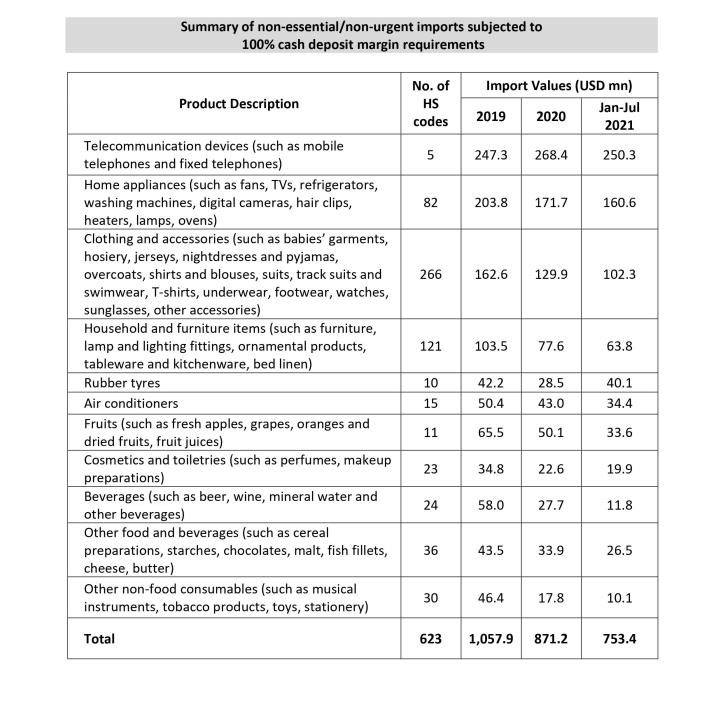
The Central Bank of Sri Lanka has decided to impose a 100 per cent cash margin deposit requirement against the importation of selected goods of non-essential/non-urgent nature made under Letters of Credit and Documents against Acceptance terms with Licensed Commercial Banks and National Savings Bank, with immediate effect.
The decision has been made by the Monetary Board of the Central Bank of Sri Lanka at its meeting held on 08 September 2021 (Wednesday).
The decision to impose the cash margin deposit requirement is expected to support the ongoing efforts to preserve the stability of the exchange rate and foreign currency market liquidity, particularly by discouraging excessive imports of speculative nature,” the central bank said.
A summary of product categories that are subjected to cash margin deposit requirements, along with information on import expenditure under each category in 2019, 2020 and thus far in 2021 (provisional), is given in the Table below:
Defence Secretary Gen. (Retd) Kamal Gunaratne urged the public not to be misled by the various false claims being made regarding the Easter Sunday attacks and that police investigations have progressed rapidly.
A certain group is attempting to create a public opinion that this is a conspiracy by the President to come to power. They are attempting to drag the President into this,” he said during a media brief held on Thursday at the Defence Ministry.
As the Secretary of Defence, I can responsibly say that our police, the CID have carried out investigations to a large extent and are further continuing with the investigations, cases have been filed before court and the Chief Justice has also appointed a Trial-at-Bar with this regard.”
Therefore, I am requesting the public not to be fooled by these false opinions.”
With regard to the Easter Sunday bombings, he went on say that the burden of proof plays a crucial role which is now on state agencies” and he reasoned that is why it seems like time consuming” he also stated responding to further questions from the media personnel present.
Navy Commander Vice Admiral Nishantha Ulugetenne and Inspector General of Police (IGP) Chandana Wickramaratne were also present at the media briefing.
The police chief requested that any information related to the aforesaid incident be submitted to CID for onward legal proceedings. The IGP added that the confidentiality of all informants related to any incident will be assured.
The Defence Secretary Kamal Gunaratne said the present government since its emergence to power in 2019, has crippled all avenues of social threats posed in the face of organized crimes, drug smuggling, underworld activities and extortion through the combined efforts of top level state-run defence agencies under the guidance of President Gotabaya Rajapaksa as stated in the policy framework, ‘Vistas of Prosperity and Splendour’.
Further speaking, he said, in a short span of less than one year and nine months of the government, the law enforcing agencies have nabbed over 3,200 kilos of heroin, a number of illegal weapons from the clutches of underworld kingpins and various other types of narcotics as of today.”
The government would not leave room for anybody to drag the national security into jeopardy under the guise of COVID-19, he asserted.
The Defence Secretary stressed it is pointless conducting isolated media conferences without informing the Criminal Investigation Department (CID), if precise information available related to any case”.
Illustrating all the strategies adopted to overcome the deep-seated corruption and malpractices in the Prison system, he said it has been regulated strictly while jamming the prison intimates’ communication to external wrongdoers”, adding Because we recognized all the crimes being operated through Prisons”.
Describing swift measures introduced to crush the drug and crime network operated behind the bars in prison cells, he said the conversion of Boossa Prison into a ‘High Security Prison’ was instrumental and the high-profile notorious criminals are imprisoned there as of now”.
Moreover, mobile jammers were fixed at the Negombo and Angunakolapalassa prisons and similar precautions would be introduced to Mahara and Welikada Prisons in due course”, he added.
Elaborating the number of narcotics nabbed to date, Gunaratne said 20,949 kilos of Kerala Cannabis, 42,354 drug-embedded capsules and 104,097 related tablets were also taken into the custody following great endeavours exerted jointly by the Defence Ministry and the Public Security Ministry.
All the routes of drug inflow into the island have been identified as well,” he revealed during the briefing.
Navy Chief Vice Admiral Ulugetenne while citing action initiated to educate the fishing community around the island, requested from the owners of fishing craft to be on alert and find whereabouts of their valuable vessels since a section of persons venturing into sea may use their vessels for such illegal activities.
All the assets associated with illegal drug trafficking will be liable for confiscation if proved guilty, IGP Wickramaratne also emphasised.
Responding to why military is also intervening into the prevention of the spread of highly contagious virus, the Defence Secretary said, facing the Nuclear, Biological and Chemical Warfare is a part of the duty of the armed forces personnel and therefore, we have employed our professional medical staffers with them to contain the spread of the pandemic”.
We have informed all our vaccination centres to facilitate all civilians arriving to receive the jabs”, he affirmed.
Revealing on operations in progress, he stated: We are now in the process of netting all persons involved in online advertising of prostitution in the country and they will be produced before the law eventually”.
Meanwhile, replying to a question on a bit relaxed method experiencing in the current quarantine curfew enforced, the Defence Secretary explained we must look into the status quo in a rather humanitarian angle”.
The University of Peradeniya has developed a new low-cost test kit to diagnose SARS-CoV-2 infected patients in a relatively shorter time with a higher accuracy.
Developed by a team led by Dr. Ruchika Fernando of the Department of Veterinary Public Health and Pharmacology, Faculty of Veterinary Medicine and Animal Science, this COVID-19 test kit has been priced at only Rs. 1,500.
The test kit has already received the approval of the technical committee of National Medicines Regulatory Authority (NMRA).
As the test kit is based on the Reverse Transcription-Loop Mediated Isothermal Amplification (RT-LAMP) principle, patients are detected based on amplification of SARS-CoV-2 virus specific RNA in the sample and compatible with patient samples collected for regular qRT-PCR.
According to its developers, the positive agreement of this test kit with qRT-PCR is very high (97%) compared to similar alternatives such as Rapid Antigen Tests (RAT) in which the positive agreement with qRT-PCR can be in the range of 12-71%.
The test kit is equipped with an internal control assay based on human beta actin messenger RNA which can confirm the quality of the patient sample received by the laboratory.
The developers of the COVID test kit have presented it to Minister of Health Keheliya Rambukwella, who commended the new invention.
During the event, the minister stated that Sri Lanka is receiving international acclaim for its national COVID-19 inoculation drive. He assured that the Ministry of Health would take all necessary measures to bring the country back to normalcy as soon as possible.
The World Health Organization called Wednesday for countries to avoid giving out extra Covid jabs until year-end, pointing to the millions worldwide who have yet to receive a single dose.
I will not stay silent when the companies and countries that control the global supply of vaccines think the world’s poor should be satisfied with leftovers,” WHO chief Tedros Adhanom Ghebreyesus told journalists.
Speaking from WHO’s headquarters in Geneva, Tedros urged wealthy countries and vaccine makers to prioritise getting the first jabs to health workers and vulnerable populations in poorer nations over boosters.
We do not want to see widespread use of boosters for healthy people who are fully vaccinated,” he said.
The WHO called last month for a moratorium on Covid-19 vaccine booster shots until the end of September to address the drastic inequity in dose distribution between rich and poor nations.
But Tedros acknowledged Wednesday that there had been little change in the global situations since then.
So today I am calling for an extension of the moratorium until at least the end of the year,” he said.
High-income countries had promised to donate more than one billion vaccine doses to poorer countries, he said — but less than 15 percent of those doses have materialised.
We don’t want any more promises,” he said. We just want the vaccines.”
Appalled”
Despite the call for a moratorium, some countries have been arguing for booster jabs not only for vulnerable people but also for the wider population, citing signs of waning vaccine effectiveness against the highly transmissive Delta variant.
The WHO has acknowledged that an additional dose could be needed for immunocompromised people, but stresses that for healthy people, the vaccines still seem very effective, especially in preventing severe disease.
There is not a compelling case to move forward with a generalised recommendation for booster doses,” Kate O’Brien, the WHO’s vaccines chief, told Wednesday’s news conference.
The UN health agency has set a global target of seeing every country vaccinate at least 10 percent of its population by the end of this month, and at least 40 percent by the end of this year.
It wants to see at least 70 percent of the world’s population vaccinated by the middle of next year.
But Tedros lamented that while 90 percent of wealthy countries have hit the 10-percent mark, and more than 70 percent have already reached 40-percent, not a single low-income country has reached either target”.
He expressed outrage at a statement by a pharmaceutical industry organisation that the world’s seven wealthiest nations, known as the G7, now had enough vaccines for all adults and teenagers — and to offer boosters to at-risk groups — and so the focus should shift to dose sharing.
When I read this, I was appalled,” he said.
In reality, manufacturers and high-income countries have long had the capacity to not only vaccinate their own priority groups, but to simultaneously support the vaccination of those same groups in all countries.”
The fourth country that supported Eelam was Canada. Sri Lanka was
handled at the UNHRC in the 1980s by Canada, said Pathfinder Foundation. Canada
is part of the Core group which put forward resolutions against Sri Lanka at
the UNHRC in Geneva in 2021.
Throughout the 1980s and
1990s, tens of thousands of Tamils arrived in Canada and settled in large
metropolitan cities like Toronto and Montreal. The Tamil asylum claims lodged
with the Canadian Immigration and Refugee Board between 1989 and 1998 had an average acceptance rate of 85
percent, compared to 60-70 percent acceptance rates overall . The largest number of expatriate Ceylon Tamils
therefore are in Canada, totaling 157,000 in 2016. The second largest group is
in UK, totaling 120,000 in 2007.
Canada has provided asylum to LTTE
members convicted of criminal charges. Canada gave asylum to Ravi Sanker Thiagarajah who was
found guilty by Supreme Court of Sri Lanka of terrorist charges. He
disappeared. He is now living safely in Canada.
The plot for
the bomb explosion at the Central Bank (1996) had originated in Toronto. Sri
Lankan intelligence officials tell me they traced the explosives used in the
bomb and found they had come from the Ukrainian shipment purchased two years
earlier with money wired from British Colombia, Canada, reported Ranjit Soyza.
It was
decided that an organization should be created in Canada that could provide
support for the notion of Tamil Eelam as well as the Vaddukoddai Resolution.,
with its separatist platform. The Eelam Society of Canada (TESOC) was
registered as a non-profit organization in 1978.
TESOC
functioned throughout the late-1970s, and gradually developed a very strong
relationship with the Canadian government, reported Amaranth Amarasingham. Stewart Bell in his book Snow Tigers” said that Canadian Government
had helped fund Tesco which in turn funneled funds to the LTTE. One of the
directors of TESCO, Devakumar Sabapathy, issued a threat to kill the former
President of Sri Lanka and his brother.
World Tamil
Movement (WTM) was created in 1986. WTM was the Canadian arm of the LTTE, and
was tasked with not only raising money for the LTTE, but also keeping alive the
sentiment of Tamil separatism among the Tamil in Canada.
WTM employed sophisticated
methods of remitting funds from Canada to the LTTE via Singapore and Malaysia
using Bank of Nova Scotia and Canadian Trust Bank. WTM had once remitted a sum
of 3 million dollars via Singapore to the LTTE. WTM had also deposited
approximately dollars 7,63,000 collected by force from the Tamils in Canada.
Stewart Bell stated
that the LTTE and its fronts used every conceivable tactic, government grants,
front companies, every type of migrant smuggling and drugs. ” Canadian
Security Intelligence Service (CSIS) estimated that $2 million a year, in
collections were funnelled to the LTTE in Jaffna from Canada. Another CSIS study
puts the figure at $ 1 million a month.
Federation of
Associations of Canadian Tamils (FACT) was formed in 1992. It lobbied the
Canadian government about Tamils in Sri
Lanka undergoing persecution by Sri Lanka government. FACT was replaced in 2000
by Canadian Tamil Congress. CTC focused
mainly on facilitating the integration of Ceylon Tamils into Canadian society
but it also supported the political aspiration of the Tamils in Sri Lanka.
Many Tamil organizations
arose in Canada after the end of the war in May 2009 , reported Amaranth Amarasingham .The National Council of Canadian Tamils (NCCT) was set up in 2010 with the expressed purpose of serving
as an ethnic lobby group in Canada. In 2012 it submitted a memorandum to
the UNHRC’s Universal Periodic Review.
The NCCT and
the Canadian branch of Tamil Youth Organization (TYO) organized conferences and meetings to push
the idea of the self-determination of Tamils in Sri Lanka. In February 2012,
they organized an Eelam Tamil Youth conference in Toronto where they brought
together representatives from 14 Tamil student associations in high schools,
colleges and university and they pledged to ‘continue the struggle for Tamil
sovereignty.”
The meeting
passed nine resolutions, two of which
said, we reject the territorial integrity of Sri Lanka state that occupies
Tamil Eelam and we reject the imposition of Sri Lanka identity on Eelam Tamils.
This meeting was opposed to presenting the conflict in Sri Lanka as a civil war.
They rejected the unitary state of Sri Lanka. The conflict is between two nations, and can
only be resolved through a two-state solution.
In 2014 the Canadian ambassador in Sri
Lanka demanded the cancellation of the victory parade, on behalf of all those,
who had been pursuing war crimes allegations, against the Sri Lankan military.”
In 2014, Canadian High Commissioner in
Colombo, sent a strongly worded statement, saying that five years after the end
of the conflict, the time has arrived for Sri Lanka to move past wartime
discourse and to start working seriously towards reconciliation. Canada has
encouraged the Government of Sri Lanka to retire its annual Victory Day Parade,
which perpetuates roles of victors and vanquished within the country, for a day
of remembrance for all those who suffered as a result of the conflict.
Sri Lanka quite rightly rejected this
as blatant Canadian interference in purely a domestic matter, said Shamindra
Ferdinando . Canada then declared that
it would not attend the victory parade.
In August
2021, Canada announced funding to nine
Sri Lanka NGOs to the tune of CAD
300,000 under a programme labeled Canada Fund for Local Initiatives. These nine
Organizations includes Centre of Human Rights and Development, Transparency
International Sri Lanka, Verité Research, as well as Colombo Friend in Need
Society. ( Continued)
In 2019 a
Private Member’s Bill (Bill no104) titled An
Act to Proclaim Tamil Genocide Education Week was placed before Ontario
Legislative Assembly, Canada by Vijay
Thanigasalam, MP for Scarborough-Rouge Park. Vijay Thanigasalam is a LTTE
supporter. The move had been facilitated
by the Committee on Regulations and Private Bills coming under the purview of
Logan Kanapathi also of the Progressive Conservative Party of Ontario. The Bill
claimed that 146,679 were killed in the final days of the Eelam War that
civilians were starved and Tamil children were forcibly taken away from their
homes.
The progress
of this Bill was closely watched by the anti-Eelamists in Canada. Several Sri Lankan organizations strongly
opposed the Bill. Submissions were made in writing to the Standing Committee on
regulations and Private Bills.
The Bill
stalled at the second reading, Only 59 supported it. 66 either refrained from
voting or said ‘No.’ The Bill was then referred back to the relevant committee
for want of required support. In the
meantime anti-Sri Lanka resolutions were passed in Brampton, Pickering and
Toronto Municipal Councils, though the matter was outside local politics.
On May 6,
2021 Ontario Legislative Assembly,
Canada, voted in favor of the Bill. It was carried through without a vote
taking advantage of the Covid-19 pandemic which had restricted the
participation of the majority of members. Vijay Thanigasalam declared the
passage of the Bill ‘a historic event for Tamil people in Ontario and across
the world. Ontario is the first
government worldwide to pass such a law.”
The newly
passed Tamil Genocide Education Week Act establishes a week each year, May 11
to 18, during which Ontarians are encouraged to educate themselves about, and
to maintain their awareness of, the Tamil genocide and other genocides that
have occurred in world history. However, the Bill would not become law until
Ontario Lieutenant Governor General gave her consent on behalf of the Canadian
Government.
Analysts saw
this Ontario move as very significant.
This Bill is an attempt to legitimize the claim that a Tamil Genocide happened
in Sri Lanka. Such projects intended to legitimize war crimes accusations,
should be nipped in the bud, they said.
Canada-based
Dr. Chandre Dharmawardana said that the move in the Ontario Legislative
Assembly was a prelude to the Diaspora grouping seeking to move a similar Bill in
the Canadian Parliament. The provincial move couldn’t be dismissed lightly. He appreciated the fact that the government of
Sri Lanka took up the issue with both Federal and Provincial authorities of
Canada.
It would be a serious mistake, on Sri Lanka’s part, to consider
the genocide rap as a project of the Ontario Legislative Assembly instead of a
Canadian move. The Canadian move is severely inimical to Sri Lanka. The Ontario
project would further strengthen the Geneva-led campaign meant to weaken Sri
Lanka, said Shamindra Ferdinando. The Geneva onslaught will take a new turn
with this Genocide charge.
Sri Lanka
acted promptly. The Sri Lanka High Commission in Ottawa protested. In Colombo, Foreign Minister Dinesh
Gunawardena conveyed Sri Lanka’s deep concern to Canadian High
Commissioner.. Canadian High Commission in Colombo responded.”It is important
to recognize the high degree of autonomy of the federal governments of the
provinces in Canada, including on issues such as this one.
Anti
Eelamists in Canada also responded.
Neville Hewage, went to Supreme
Court against the Act. He said that Ontario Legislative Assembly did not have
the jurisdiction to pass Bill 104 and
the facts presented in Bill 104 were completely false.
Mahinda Gunasekera sent an open letter to.
Prime Minister, Ministers, Premier of Ontario, Members of the Federal
Parliament/ Ontario Legislature and GTA Mayors on the matter It was
titled On the Impact of Ontario’s Bill 104, Tamil Genocide Education Week Act,
2021 and GTA ( Greater Toronto Area)Mayoral Proclamation of Tamil Genocide
Remembrance Day on May 18th..
He pointed
out that Eelam war IV was a civil war not a genocidal one and its was initiated
by the LTTE not the government, that the UN has not declared the Eelam war to
be genocidal and that the Ontario Provincial Legislature does not have the
authority to determine Genocide.
The Ontario
Centre for Policy Research organized a webinar on LTTE Terrorism and Alleged
Tamil Genocide in June 2020 to discuss the Ontario Bill. The panel consisted of
Neville Hewage, Sarath Chandrasekara and Chandre Dharmawardana.
On June 3 2021, the
anti-Eelamists in Canada issued a joint statement. We are pleased to announce that the following
Sri Lankan-Canadian organizations have joined as a united front to fight a
Superior court case against the Ontario law on Tamil Genocide Education Week,
Sri Lankan Canadian Action Coalition (SLCAC) Canadian Sri Lankan Center for
Social Harmony (CSLCSH) Sri Lanka United National Association of Canada (SLUNA)
and Sri Lanka Canada Association of Brampton (SLCAB). A 12-member steering
committee will address aspects of the proceedings and fundraising campaigns, we
hope to draw attention to the misinformation contained in the Act, and see that
Tamil Genocide Education Week Act is repealed,
this group said.
On the 2nd of
October 2020 Gary Anandasangaree, MP for Scarborough tabled a petition in the Canadian
Parliament. He wanted Sri Lanka taken
before the Committee established under the Convention
Against Enforced Disappearances. He said, inter alia, that genocide in Sri
Lanka is unique among genocides in history because it has occurred over several
decades and under different governments before intensifying into a no-
holds-barred war for nearly three decades and culminating in the mass
atrocities of 2009. Sri Lanka’s historic violations against Tamils, such as
1958 and 1983, in addition to the 2009 war must go before an international
court.
At the June 2021 session
of the UNHRC in Geneva, Canada led an alliance of 44 States (mainly Western and
European countries), demanding that China allow meaningful and unfettered
access to investigate credible reports of widespread human rights violations
against China’s Muslim minority Uighur in Xinjiang province.
Immediately after
this China delivered a joint statement, on behalf of eight countries (Belarus,
China, DPRK, Iran, Russia, Sri Lanka, Syria, and Venezuela) expressing ‘[deep
concern] about serious human rights violations against the indigenous people
Canada,’ and demanding a UN investigation into Canada’s serious human
rights violations against indigenous people.’
This was a
reference to the recent discovery of a mass grave containing the remains of
over 200 children, at the site of a former ‘residential school’ for indigenous
children in British Columbia. China argued that the discovery of the mass grave
demonstrates long-standing discrimination against indigenous people in Canada,
and drew particular attention to the treatment of indigenous children from the
1830s to the 1990s. During this period, many children were forcibly taken away
from their parents and sent to boarding schools, where they were often victims
of malnutrition, violence, rape, and abuse.
Canada has this image internationally of a
great defender of human rights violations, the protector of human rights
throughout the world, but in its own backyard it has ’ violated the rights
of the indigenous inhabitants, agreed
critics. Canada’s ugly record of
Genocide is now emerging.
Canada has its
own ugly record of Genocide, critics said. Canada destroyed the indigenous
people of Canada. There was forced sterilization. Canada created a special
school system for the indigenous children, the Resident or Industrial School
system run by the Federal Government and the Church. Residential Schools were
part of a policy to eliminate Aboriginal people as distinct peoples
and to assimilate them into the Canadian mainstream against their will.”
From the 19th century until the 1970s, more
than 150,000 Indigenous children were forced to attend state-funded Christian
schools, most run by Roman Catholic missionary congregations, in a campaign to
assimilate them into Canadian society. Nearly three-quarters of the 130
residential schools were run by Catholic missionary congregations, with others
operated by the United, Presbyterian and Anglican churches.
This school
system removed children from parents, who were not permitted to visit their
children. They in fact never saw their children again. The result was children
who lacked family love and parental guidance.
Over 70% of
the children were tortured, sexually abused by school teachers, priests, and
nuns. When they left school after 10 years, their level of knowledge and
education was at the level of a Grade 2 child. They did not receive higher
education or skills. They often resorted to larceny, drug and alcohol
addiction, ending up as urban poor.
Five
generations of children went through this school system. Between1890-1970 over
100,000 children were forced to attend 139 resident schools. The Truth and
Reconciliation Commission of Canada in 2015 released its final report,
documenting the tragic experience of at least 150,000 residential
school students.
The government has admitted that physical and
sexual abuse was rampant in the schools, with students beaten for speaking
their native languages. Thousands of children died there of disease and other
causes, many never returned to their families.
The discovery of 600 or more remains of
children at the Marieval Indian Residential School, which operated from 1899 to
1997, in the province of Saskatchewan, the remains of 215 children, some as
young as 3, were found buried on the site of what was once Canada’s largest
Indigenous residential school near Kamloops, British Columbia.
Canadians across the country are waking up to
something that quite frankly that Indigenous communities have long known,” Mr.
Trudeau said . Canada’s genocide was camouflaged as state policy and it was
carried out with state patronage and blessings. Former Prime Minister Stephen
Harper issued a formal apology in Parliament in 2008 and Canada offered
billions of dollars in compensation as part of a lawsuit settlement between the
government, churches and the approximately 90,000 surviving students. ( CONTINUED)
In 1927 the Secretary of State for the Colonies announced a special Commission under the Chairmanship of the Earl of Donoughmore to visit Ceylon and submit an account of the Constitution with any difficulties of administration that needed to be surmounted at that time.
The Secretary wanted the Earl of Donoughmore to
consider any proposals for revising the Ceylonese Constitution and to report, if any amendments of the
Orders in Council were necessary.
The Commission’s primary function was to draft a
new Constitution for Ceylon that would satisfy the aspirations of the British
plantation owners so that it would enable all Ceylonese to work in partnership
with the British Empire.
The most significant apprehension of many of the
Ceylonese leaders, both Sinhalese and Tamil, was the recommendation of
Universal Franchise, the right to vote for all adult citizens, regardless of
wealth, income, gender, social status, race, ethnicity, political stance, or
any other restriction. The four Commissioners arrived in Sri Lanka in 1927 and
spent four months and forty days interviewing one hundred and forty Ceylonese
in thirty-four separate sessions.
The Commissioners paid heed to Ceylonese women’s
suffrage and their right to vote in Elections. From the beginning of the
mid-19th century, women intended to participate in the society & getting their
voice heard for their work broad-based on economic and political equality and
social reforms. They planned to seek change in the voting system that allowed
them to vote at elections.
The Commissioners listened to their requests
and appeals and granted educated women over the age of twenty-one suffrage.
Therefore, all citizens of Ceylon, who were over twenty-one years of age, were
granted the Universal Franchise in 1931, unless they were subjected to any
special disqualification. The right to cast a vote was lowered from twenty-one
to eighteen years of age by the Elections Amendment Act No.11 of 1959.
The Commission’s revelations
The four Commissioners noted, Ceylon, even at that
time, was driven by power struggles amongst ethnic groups. Therefore, they
devised a system of Executive Committees to control all Government Departments
and rejected the principle of communal representation to ensure that no ethnic
group could control all power and financial gain. The most significant apprehension
about the outcome came from both Sinhala and Tamil leaders against the
recommendation and implementation of Universal Franchise by the Donoughmore
Commission.
Sir Ponnambalam Ramanathan was a Tamil lawyer,
politician, and SolicitorGeneral of Ceylon. He and most of the ‘conservatives’
believed and argued that allowing the vote to the nonvellala castes and women
was a grave mistake, and it might lead to disturbances. Ramanathan explicitly
suggested that it was anathema to the Hindu way of life”.
According to Jane Russel’s study, the political
leadership of the Ceylon Tamils became dumbfounded by the complete
bouleversement of the policies they had pursued for the previous decade (page
16 & 18). Jane Russel of DC also stated that the Sinhala leaders were
also very dubious about the new franchise, but they were willing to support it
in a quid pro quo for the abolition of communal electorates (page 17).
The All-Ceylon Tamil league first opposed the
Donoughmore Commission’s suggestions because the abolition of the communal (representation)
principle, coupled with the proposed universal franchise would mean ‘death
to the minorities’, as the Sinhalese would receive over 50 per cent of the
seats. Then in 1929, there was a tactical change when the Tamils opposed it and the
Donoughmore Commission did not grant full self-government to any
community.
The report of the Donoughmore Commission was
presented to the British Parliament in July 1928, soon after it was received
and studied at home (Ceylon). One of the most critical issues was the
Constitutional reforms in Ceylon by introducing the Universal Franchise with
the right to participate in the administration of the country by electing their
representatives. Universal Franchise, at that time, was enjoyed by only a
privileged few according to their literal and communal basis. Ceylonese finally
managed to get rid of it in 1947 when the Soulbury Constitution came into being
with the declaration of Independence to Ceylon in 1948.
Oral Evidence
The recordings were obtained at the public
sittings of the Donoughmore Commission in 1928 and did not ‘record’, but
were confined to oral evidence only. It contained some solid and rare evidence
based on the Constitution of Ceylon and consisted of four volumes, which were
in cyclostyled typescripts in duplicated form.
These typescripts were neatly bound with buckram
binding and carried the word ‘Library House of Lords’, on its upper
covers, with morocco gilt labels on covers and spines. This valuable oral
evidence was auctioned at the world-renowned auctioneers in London, Sotheby’s
on Thursday, 27 June 1996 for a reserved price of eight hundred pound sterling
(£800). A Japanese collector of valuable literary property purchased the whole
records and took those to Japan in June 1996. His name remained
anonymous.
Expatriate Sri Lankan Community
Ceylon became a Republic within the Commonwealth,
and its name was changed to Sri Lanka on 22 May 1972 under Sirimavo
Bandaranaike’s premiership. When the Donoughmore Commission Records on Ceylon
were auctioned by Sotheby’s there was a strong Sri Lankan expatriate community
in London.
They became interested in the auction knowing
to what extent those were invaluable pieces of documentary evidence from the
Colonials. They were also aware that it contained four volumes and how
important those were
legally, its validity and beneficial to the Sri Lanka Government at a time when
the Sri Lanka Government was concentrating on making amendments to the existed
Constitution.
President Kumaratunga was very keen to acquire
those records from the Sotheby’s auction for a reserved price. The
archaeological authorities in the UK advised the President that copies of the
same documents were available in the Sri Lankan archives. A letter signed by
Lord Donoughmore accompanied the four volumes of the typed script version of
the Ceylon Report of Special Commission on the Constitution.
Records were bound in half Morocco, 8Vo, and
recorded on a Downing Street headed paper (British Prime Minister’s official
residence) stating that the set of four volumes in cyclostyled typescripts
should be made available at the Library of The House of Lords for public
reference to the public.
The letter by Lord Donoughmore stated thus: We
had hoped to present to you in companion volumes to this report a verbatim
record of our proceedings in public sessions.’ We regret that the
high cost of printing has precluded the adoption of this course. We are,
however, forwarding duplicated copies of this material with the recommendation
that a complete record, which the public may be free to consult, should be made
available both in London and Ceylon.”
The
writer met with the most Venerable Aggamahapandittha Balangoda Ananda Maitreya
Mahanayake Thera in London, when he was 99 years old. The Venerable observed
the rainy season (Vassana retreat) in London at that time.
The
Buddhist Centre organised a religious ceremony on account of his 99th Birthday,
on 23 August. Many Buddhist devotees gathered at the Buddhist Centre to
participate in a religious ceremony. Addressing a large gathering, the
venerable said:
“You
have organised a pinkama on my Birthday to celebrate. I will be 99 years old. That
means my life span is fast coming to an end! Is this a thing to celebrate? It
is an important day for me because the sooner I move towards death, the happier
I feel as death means moving towards a new birth! I could not fulfil my desire
in its pristine purity in this life, but I know in my next life, I will be much
more vigorous in carrying out my services to propagate Buddhism in theworld.”
The
writer had direct access to the Venerable amidst the crowd. Seizing the
opportunity, he wanted to discuss many things with the most eminent monk.
“I
was born on 23 August 1896 to Heenmenike and Mathies Appuhamy. My certificate
of birth carried the name ‘Punchi Mahattaya’. Fourteen days after I was
born, I lost my mother. My grief-stricken father not only left me but the
village altogether. I was orphaned. My uncle Dingirihamy Mudalali and aunt
Yasohamine brought me up.
An
Internal revolution
A representative from the
Mahabodhi Society visited our school in 1905, when I was nine years of age. Mr
Harishchandra Walisinghe delivered a speech on Buddhism that made an internal
revolution in me. I wanted to emulate him. At the age of fifteen, my foster
parents gave their blessings and I ordained as a ‘Samanera‘ priest at
Nandaramaya, Balangoda Udumulla Temple.”
Venerable Sir, with your long experience in life I
would like to hear from you about the moral decadence in Sri Lanka over the years.”
“Towards
the latter part of the British rule, Ceylonese were happy and did not eat beef
at all, because the majority being
Buddhists. When foreign influence began to invade, individuals like Anagarika
Dharmapala fought against foreign influence because he foresaw the impact on
the local community. Such protests gradually continued towards the ousting of
the colonial rule.
But it was rather
unfortunate that once Ceylon gained Independence on 4 February 1948, our
national leaders continued to govern in a worse manner than the Colonials.Foreigners at least listened to peoples’ claims and agitations,
but Lankan leaders turned a deaf ear to any public outcry! The Ceylonese
leaders caused a steep division in society by forming different political
parties and working on their agendas. During the colonial era, local society
was united as one unit and preserved the Buddhist cultural values, but since
the Independence, morality and cultural values became tainted.”
The
writer focussed then on Buddhist stanzas like ‘Eththa Watcha’ and ‘Akastata
Bhummatta’ and wanted to know from the monk whether Buddhists could
transfer merit to various gods (Devas) as is the current practice today; whether it could reconcile with such practices within the concept of
Buddhism?
“Buddhists
do not believe in an Omnipresent or Omnipotent God.” Also, by merely repeating
Gathas ( stanzas) in parrot form, out of habit, or offering alms for the sake
of name and fame, no transference of merit to any god will happen.” Today, when some people want to give alms to priests, they
search for prominent priests (‘big guns’ with an infectious laugh) and
forget about the poor monks who lead sanctified and secluded lives. By offering
alms to the sangha alone, one cannot expect any help from devas! In my personal
opinion every deva has forgotten this country.”
Is
there a difference between the ‘Soul’ and ‘Athma’? The writer
became curious.
In Buddhist philosophy it
does not mention the word Soul or Athma.”
How would you then, Venerable Sir, account for
the cycle of birth and rebirth?
There
are two answers to your question. Let’s take the sun as an example. A
teacher may explain to young children that the sun is rising and setting down,
although no such phenomenon occurs. On mature students he uses a scientific
example. We know that it is the earth that rotates while the sun is stationary.
Therefore, Lord Buddha used the words ‘Soul’ and ‘Athma’ in the
proper backdrops.”
Likewise,
Lord Buddha’s teachings varied according to the level of intelligence of
seekers of the truth. That is why Lord Buddha taught Vipassana Meditation to
deal with this topic to those aspirantswho had opened their intelligence. Also,
according to Buddhist philosophy, a person may be born in one of the six Deva
worlds. To achieve that stage, one needs to lead a moral life in the human
world; mind you, some people have ascended to higher levels of intelligence due
to their good karma!”
The
human being consists of a mind and matter. The mind is a series
of impermanent occurrences as unchanging essence( ‘soul‘). The Physical
body is a stream of material state subject to momentary change.In Buddhist, philosophy the word soul does not
exist at all. This practice of understanding is dependent on one’s level of
intelligence, wisdom, and training.”
The
writer then became curious about ghosts, a subject that the Venerable was
familiar with publicly. Reverend Sir, Currently, there is a Chair for
Parapsychology at the University of Edinburgh to deal with the study of
ghosts. Do you accept that ghosts do exist?
When a person dies, that person will be
born in a different world, sometimes with a subtle body due to his attachment
to his loved ones and property. In that fine (astral) body form the dead person
can live for some time until that astral body ascends to a higher phase with
the help of meritorious deeds done by his relatives. It all depends on the
amount of direct transference of merit to the dead person. Some astral bodies
can travel at a tremendous speed faster than light!”
How is
it that some individuals can see such subtle bodies whereas others do not? The
writer queried.
Some
of the dead could freeze their astral bodies, and others may not, that is why astral
body can be seen.”
Astrologers
do often say that humans belong to various categories, known in Sinhala as ‘Gana,’
meaning Rakksa, Deva and Manussa, Gana. Is there any truth in the saying that
only those born under Manussa Gana can see ghosts?
It is
only an astrological interpretation. Now, I belong to Rakksa Gana, and do you
find me as a horrible person?” (Venerable monk gave my chin a little tickle).
Concept
of worshiping Sai Baba
Many
Buddhists worship Sai Baba these days! Some Buddhists have a different opinion
and say because it is due to devotees’ confused state of mind. What do you
think about this question, Sir?
I
visited Sai Baba some 20 years ago when I suffered a cataract in my eyes. Everyone
advised me against the operation because I was over 70 years of age. I was
confused. But out of the blue, a Dayaka, in our temple, requested me to be his
translator as he could not speak English. He wanted to visit India to see Sai
Baba and promised to look after all my expenses, including my air ticket. I
accompanied him to Bangalore.”
Sai Baba came
straight to where I was standing. Next moment Sai Baba waved his right hand in
the air and wrote something and walked away from me. After taking a few steps
forward, he turned back and walked back towards me, smiled and said, “Get
your eyes operated“. I was stunned. At that exact moment I wanted to
ask him about my eyes! Two weeks after my return from India I went blind.
Immediately, I was admitted to the General Hospital and got my eyes operated
on.
Politics
Some
people spread the rumour that the Venerable was involved in politics ! The
writer was compelled to enquire about it, but the venerable quite calmly said:
“I
am not a politician but a steadfast Buddhist priest. I knew President Premadasa
from his youthful days when he came to our temple to learn Dhamma lessons. I
was in the USA when the President named a village in Balangoda as ‘Ananda
Maitreya Gama in the Gam Udawa programme’. I was clueless about the whole
exercise. When I returned to Sri Lanka, President Premadasa invited me again
and showed me a video of a plot of land and said:
Hamuduruwane,
do you like this place?”
It was a plot of land near
a river and ideal for my meditation. I told him so, and I proceeded to England.
But when I returned home, he phoned me again and requested me to occupy the new
temple he had built (completely without my knowledge). Mr Ranasinghe Premadasa
had already named itThe Battaramulla Chitta Viveka Asramaya.
President
Premadasa said, “Hamuduruwane, this is a personal religious gift to you
from me.”
”
What are your final plans, Venerable Sir?
I want to engage in Dhamma
whenever I get an opportunity. But the problem is that I never get a free
moment whether I am in Sri Lanka, England, or the USA, because people always
visit me seeking advice. My main aim is to accomplish a higher level of mental
development. When I die, I would like to be reborn in Sri Lanka again to
develop Buddhism further and propagate Lord Buddha’s philosophy throughout the
world.”
The
Most Ven. Aggamahapandittha Balangoda Ananda Maitreya Mahanayake Thera expired
at the age of 103!
UNP MP Ranil Wickremesinghe yesterday urged the Speaker to take action against Lawyer Nagananda whom he claimed had insulted Parliament.
Mr.wickremesinghe said the particular Lawyer had made a false allegation that the 14th Amendment to the Constitution which was passed in Parliament way back in 1980s was a false one.
Mr. Nagananda has filed legal action stating that one time Speaker Late E. L Senanayake had put his official signature on a wrong document claiming it to be the 14 th Amendment to the Constitution while the Parliament at that time,had approved a different document claiming it to be the legislation,”he said referring to the Lawyer.
Another doctor of the Health Ministry’s COVID-19 Technical Committee has stepped down from his membership from the committee.
Reportedly, Specialist Dr. Ashoka Gunaratne has resigned from the committee in this manner.
This is the second medical professional to quit the COVID-19 Technical Committee of the Health Ministry.
Recently, Dr. Ananda Wijewickrama also stepped down from the Committee.
Joining the ‘Big Focus’ program on Ada Derana 24 today (September 08), Dr. Anwar Hamdani commented on the resignation of Dr. Ashoka Gunaratne.
There was such a thing this morning. It is informed through an email. That email goes to the Director-General of Health or the Secretary. Several doctors have resigned. It is their personal opinion. But these [doctors] are resources. These are resources that should be with us.”
The Epidemiology Unit of the Health Ministry reports that another 648 persons have tested positive for COVID-19 in Sri Lanka, moving the daily total of new cases to 2,917.
This brings the total number of confirmed cases of coronavirus reported in the country to 474,780.
As many as 389,969 recoveries and 10,689 deaths have been confirmed in Sri Lanka since the outbreak of the pandemic.
The Epidemiology Unit’s data showed that 74,122 active cases are currently under medical care.
The total number of people who fell victim to COVID-19 infection in Sri Lanka soared yet again as 185 more fatalities were confirmed by the Director-General of Health Services on Tuesday (September 07).
The new development has pushed the official death toll from the virus outbreak in Sri Lanka to 10,689.
According to the data released by the Department of Government Information, the latest victims include 102 males and 83 females.
As many as 140 deaths were reported among elderly people who are aged above 60 years.
In addition, 44 individuals aged between 30-59 years and 01 below 30 years have also succumbed to the virus infection.
The government has taken over the stocks of rice owned by large-scale rice mill owners in the Polonnaruwa area today.
Accordingly, the acquisition of stocks of Nipuna, Lathpandura, Temple, Hiru, Nivratna, and Suriya rice mills was carried out under the direct supervision of the Commissioner General of Essential Services, Major General Senarath Nivunhella, and the Chairman of the Consumer Affairs Authority.
With the acquisition of rice stocks that were not issued to the market owned by all large-scale rice mills in the Polonnaruwa area at government-controlled prices, the transportation to Sathosa outlets has commenced at the same time.
The Office of the Commissioner-General of Essential Services stated that the government intends to release these stocks of rice to the consumers as soon as possible.
The owners of the New Ratna rice mills have deliberately objected to the takeover of their stocks and obstructed the duties of officials.
The Office of the Commissioner-General of Essential Services stated that the Commissioner of Essential Services had discussed with the rice mill owners how to maintain adequate production capacity and release rice to the market without shortage after the government sets a control price for rice.
However, President Gotabaya Rajapaksa has instructed the Trade Minister, the Commissioner General of Essential Services, and the Chairman of the Consumer Affairs Authority to take over and distribute the stocks of rice to the government as they have not acted as agreed.
Officers of the Consumer Affairs Authority inspected the four large-scale rice mills with the intervention of the Polonnaruwa District Secretary and the Police.
Accordingly, the government seized nearly 1.2 million kilograms of rice from 4 large-scale rice mills operating in Polonnaruwa at Rs. 03 per kilogram less than the government-controlled price.
Nadu, Samba and Kiri Samba rice stocks have been purchased there. The maximum retail price set by the government is 98 rupees per kilogram for Nadu, 103 rupees per kilogram for Samba and 125 rupees per kilogram for Kiri Samiba.
While inspecting the rice mills, a group of people gathered near a public rice mill and protested against the officials of the Consumer Affairs Authority.
Meanwhile, 200,000 kilograms of rice have been sealed in a joint raid carried out by the Anuradhapura District Consumer Affairs Authority and the police.
However, State Minister for Provincial Councils and Local Government Roshan Ranasinghe speaking to the media today stated that action should be taken to find those who are hiding paddy stocks on a large scale.
Meanwhile, another sugar warehouse in the Peliyagoda area was inspected by officials of the Consumer Affairs Authority and representatives of the Office of the Commissioner-General of Essential Services today.
The Consumer Affairs Authority (CAA) seized 1300 tons of illegally hidden sugar and sealed it.
Meanwhile, it has been revealed that 320 metric tons of sugar have been removed from a warehouse in the Enderamulla area in Wattala which was sealed by the Consumer Affairs Authority.
Police Special Task Force (STF) and Consumer Affairs Authority officers were on their way to inspect the warehouse when they were preparing to transport another consignment of sugar. The STF arrested two warehouse keepers and the driver of the lorry.
The CEO of Epic Lanka Technology, Tharindra Kalpage, who had won the tender to maintain the database of the National Medicines Regulatory Authority (NMRA), has been arrested by the CID a short while ago.
The arrest was made in connection to the incident where the data was lost recently from the database of NMRA.
The tender was awarded to the company during Rajitha Senaratne’s tenure as Health Minister.
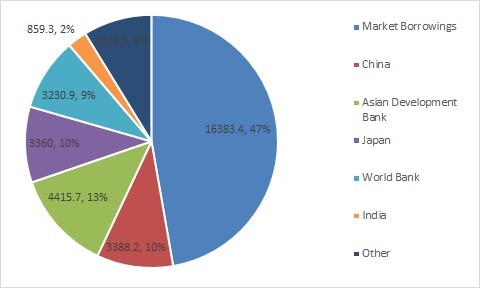
Sri Lanka is at the precipice of an economic disaster. The country’s foreign debt is suffocating the country, it is its biggest immediate problem, and the problem for the foreseeable future unless urgent and drastic action is taken, now. The crisis arises due to several factors, the primary factor being the high component of market borrowings in the form of International Sovereign Bonds (ISBs) in the country’s foreign debt portfolio. ISBs account for 47% of the debt. The following Central Bank chart shows this
ISBs are short term
loans attracting high interest rates (around 6%) with no grace periods while
loans from international institutions such as the World Bank, Asian Development
Bank, IMF, attract low interests and long term repayment terms including grace
periods. ISBs are usually not conditional while others like WB, ADB, IMF have
conditions that a country has to fulfil to qualify for the loans. Besides the
ISBs, the Chinese debt component is stated as 10% of the total debt. These
loans are reportedly similar to short term ones as IDBs, and attract a higher
interest like ISBs. If this is so, 57% of the loan portfolio is in high
interest, short term loans. In the
absence of exports income that brings in a nett inflow to the country after accounting
for the import component of exports, a serious drop in tourist earnings, foreign
remittances and much anticipated FDIs not materialising, Sri Lanka will not
have a choice but to take more loans in the form of ISBs and other high
interest, short term loans, to repay loans and interest components that will be
falling due.
It is perhaps time
that the country came to terms with the fact that we are skating on thin ice
and pretending there is no berg at the bottom of the ice berg and only its tip.
What is visible in an ice berg, it’s tip, is only a small part of the entirety
of the ice berg, and Sri Lanka’s debt problem is that big part of the ice berg
which politicians do not wish to see preferring to see only the tip. The
Titanic sank because of the underestimation of the unseen part of the ice berg
it collided with. Sri Lanka could be the next Titanic.
In the past, Sri
Lanka managed to settle large debt repayments with foreign exchange inflows
from exports, tourism and foreign emittances, and also build a small reserve
for a rainy day. Today that reserve is down to USD 2.5 Billion, while our
accumulated debt is around USD 35 Billion without counting the interest
component of this debt.
The spin that is given to Sri Lanka’s
economic woes reminds one of very commonly used Australian and New Zealand
expression She’ll be right, mate”. This is a frequently used idiom in Australian and New
Zealand culture
that expresses the belief that “whatever is wrong will right itself with
time”. In recent years, the term has taken on a less than flattering
connotation, with “a she’ll-be-right attitude” referring to a
willingness to accept a low-quality or makeshift situation rather than seek a
more desirable solution. This definitely rings a bell with regard to the
situation in Sri Lanka. Postponing the inevitable, and administering stop gap
measures seem to be the modus operandi that seems to be a common thread that
links all politicians.
Sri Lankan
politicians of whatever hue, when they are in power, seems to be experts at
deception with their feigned assessment of the country’s economic situation. It
has never been more evident than now. Internal mismanagement over the years,
the economic situation in the rest of the world on account of the pandemic, and
not having a clear direction for now, and the next 10 -20 years, have all
contributed to this artificial situation.
The President and the
rest of the country, must come to terms with the fact that she, meaning the Sri
Lankan economy is not all right. That is the first thing that must happen. The
Sri Lankan economy, its structural fundamentals, and its financial situation is
in a perilous state and that is a kind word to use to describe an extremely dire
situation. The country has a short term policy of virtually robbing Peter to
pay Paul, and scraping money from any quarter in order to settle foreign debt,
and fund essential imports in order to survive.
The situation outlined
by Moramudali did not start with the Pandemic, nor just the current
administration. Those currently in the Opposition should not clap and gloat
that they would have done a better job. They have had enough opportunities to
fix the problem, but they did not do so. This article is therefore not about
who is to blame for what, but to throw open the question as to how one should
reset the economic fundamentals and why.
The writer is no
economist, but an ordinary pragmatist. It is hoped that readers will use their
common sense and give thought to the issues mentioned here, use their common
sense to question, debate and discuss, but importantly arrive at conclusions
which are solution oriented and not ones that exacerbate the problems.
Firstly, the economic
fundamentals and the foreign policy of the country, which have a relationship
to global political relationships, have to be questioned, assessed, and re set
where necessary. In a sense, one should question which side of the bread slice
is buttered, meaning, if the country’s future is to be based primarily on
export earnings, then questions like, where do we export now, where does the
biggest future potential lie and whether our foreign policy is conducive to
sustain and grow export markets needs to be questioned.
It is understood that
Sri Lanka’s primary export markets are to Western nations and the country has a
trade balance in Sri Lanka’s favour when it comes to these countries. On the
other hand, China, a country very supportive of Sri Lanka at all times when
others virtually abandoned it, reportedly has a substantial trade balance in their
(China’s) favour. While efforts need to be made to address this situation, it
should surely be important to examine whether Sri Lanka’s foreign policy is
conducive or not to support the overall future direction of export markets and
earnings.
The width and depth
of Chinese economic associations with a multiple number of developing countries
is substantial and is a reality that needs to be known and faced. Sri Lanka is
well aware of this, and the extent of their portfolio of direct and indirect
loan facilities, and equity participation is probably not known in its entirety
by the public.
Sri Lanka however
cannot go down the path it has been traversing for a considerable period of
time, and it needs to diverse its own equity and loan facility portfolios with international
bodies and countries who are their primary export markets. China too should
become an investor in Sri Lanka and importer of products and services from Sri
Lanka and not just a lender.
In relation to
exports, it is not clear whether what is being reported as export earnings are
presented as nett export earnings after accounting for the import component of
the exported item/s. A gross export earning is like a mirage particularly where
there is a very high import component. The long term future benefits will
naturally accrue only if the import component decreases in order to give the
exporter and the country a higher earning component. This is where a value
adding export industry is needed and earnings increased either by using more
and more local inputs, or where the exported value has a substantially higher
margin over the imported component. While Sri Lanka has been moving in this
direction, this needs to be the policy that underpins the export industry. Tax
incentives perhaps should be enhanced for export industries that have a
substantial local cost component and/or where the value adding component is
high.
Much has been written
about the need somehow to recommence tourism as soon as possible, and also to
recommence overseas travel for workers employed overseas. Both income earners
are critical for the country’s survival and it is hoped both will commence
soon. However, both have an international dependency and therefore the status
of the pandemic in other countries.
While it is an
understandable reaction when faced with a devastating pandemic that has caused
economic havoc throughout the world, to curtail imports and conserve foreign
exchange, it is a very short term measure as many economists have pointed out.
From all accounts of
expert economists, it appears that Sri Lanka needs a bail out with long term,
low interest loans, with a grace period to tide over the current economic
situation that is going to prevail at least for another 2 to 3 years if not
more. The IMF is the only obvious institution that comes to mind to obtain such
a bail out as that is more or less their core business.
Of course any such a
bail out will be conditional on Sri Lanka agreeing to major structural reforms.
Some of these will be painful in the immediate to short term, but they will be
less painful than the repercussions of an economic collapse or a marginal
existence with adhoc borrowings to sustain the country. A weak economy will
impact on the popularity and the credibility of a government and it will
provide ample opportunities for Opposition parties to destabilise the
government. Political stability, the one key criteria that foreign investors
will look for when they make decisions about investing in Sri Lanka, will be
gravely impacted, and the much anticipated Foreign Direct Investments (FDIs)
will be hard to come by.
All above economic
worries will destabilise the Rupee even further from its present status. Today,
the market rate that commercial banks pay to purchase US Dollars outside of the
Central Bank rate is said to be between Rs 230 to Rs 240 for 1 US Dollar
although the Central Bank rate is Rs 202. This dichotomy is real and it is not
a fantasy according to reports from Sri Lanka. Many suspect that the real value
of the Sri Lanka value is far worse and if allowed to float, it will sink Sri
Lanka. The current defacto devaluation is bound to exacerbate unless the
country’s economy is stabilised, and its economic fundamentals are reset in
such a manner that it can prepare the country for its next many generations and
for them not to live a lie perpetrated on them by the successive governments.
Dr. Sudath Gunasekara Retired Secretary to PM Sirimavo Bandaranayaka,
Part 1
Dr. Sudath Gunasekara Retired
Secretary to PM Sirimavo Bandaranayaka, Past President Sri Lanka Administrative
Service Association (1991 Nov 1994 nov) and President Mahanuwara Sinhala Baudha
Jestha Purawesiyange Sanvidhanaya
The Preamble
(The
task before you is to give a new lease of life, to the ashes of a 2500 year old
great civilization that was murdered in 1815 by the British, burned in 1818 and
1848 and buried 10 feet below, by the same British in 1948, by a vicious fraud called
the Soulbury Constitution, fathered by Jennings and delivered by D.S.Senanayaka,
the midwife, to perpetuate the grip of the colonial hold indefinitely on this
Island , without allowing the Sinhala Buddhist Nation to raise its head from
that grave of the dead, is a Herculean task. But you too can do it, MY SON”, like the Phoenix that rose from the
ashes of an Arabian Desert graveyard; if you have the will and the
determination to do it and if you have the patience to read this article
without prejudice, and finally if you get this proposed Sinhale New Constitution
2022/3 enacted and declared, which four Presidents and thirteen Prime Ministers
could not do for 74 years, since the so-called Independence supposed to have been
given by the British and blindly embraced by our leaders in 1948.
Mother Lanka”).
Mr. President, your decision to have
a New Constitution to this country in this backdrop is most commendable and welcome.
It is an excellent decision on your
part to initiate action to solve a long overdue national problem, going back to
1948, of not having a proper Constitution that safeguards the birth rights of
the Sinhala people (Bhoomiputras) of this country since they were savagely
robbed by the British over a long period of 133 years and which they still
continue to do directly and indirectly, not allowing Sri Lanka to raise its
head. This is a historic opportunity god
has bestowed on you to give a New Constitution to this nation based on their indigenous
system of state craft, legal traditions and customs to usher in a prosperous
era of peace and development that left unresolved for 73 years after we got
relieved from the repressive clutches of British colonial rule and exploitation
in 1948.
Therefore it is history re-making,
Mr. President, and if you do it, you will go down in the annals of history of
this Island nation as the hero of this land who liberated the Sinhale and its
people from 206 years (133+73) of
British rule under their own laws and
system of government that continues even after they left. It also marks the end
of 73 years of negligence and time marking by our own native leaders turned the
faithful proxies of the British, who became a pack of local political betrayers
thereafter, instead of playing the role of national heroes of liberating the
Motherland and the Sinhala nation from
133 years of direct colonial destruction and exploitation by the British and
converting it again to be the Granary of the East and the Pearl of the Indian
Ocean, as it had shined in its glorious days, at least from 307 B.C. to the end
of the 13th Century.
It is this onerous responsibility and
duty of enacting a New Constitution to liberate this country and the Sinhala nation
that has fallen now upon your shoulders by destiny. Once you fulfill that responsibility
it will go down on record as the third post Independent landmark adding to the
other two highlights of this country’s contemporary political history, namely
the declaration of the Independent Republic of Sri Lanka on 22nd May 1972 under
Mrs B and defeating the LTTE in 2009 under MR.
In order to achieve this goal I
propose a two way approach.
Step 1
First method to enact a new
Constitution removing all faults of the two previous and the present within the
same existing Constitutional framework making all changes that could be done to
make the people happy and to make this country a prosperous and vibrant land
where law and peace will reign.
This package has to be completed
within the provisions of the existing Constitution first, with what you can do
with a simple majority and Step2
Second, with what you can do with a
2/3 majority without a referendum.
Step3
Having done that as the next step
should be to go for an overall change in the entire system by getting a New
Constitution enacted based on the indigenous cultural matrix of this Island
nation with suitable adaptations from modern Constitutions to fill the gaps where
the indigenous system is silent, to establish the lost Kingdom of the Sinhala
Buddhist nation in 1815. (This has to be
done by a New Committee that should be appointed after dissolving the present.
For this you need to go for a fresh
mandate from the people in order to fulfill the wishes of Mother Lanka stated
above. This you can do either at the next election or even before after
completing step 1 and 2 as given above, provided you can get the 2/3 within the
present Parliament for step 2.
Step 3
There is of cause a third way of
doing the Step 3 which is faster than the second approach. ?
That is with the detailed manifesto
in hand you suspend this useless alien Parliament set up under the colonial
British Westminster system, that has ruined this country for 73 years and
declare Presidential rule for a period of 05 years and then go for a public
referendum seeking a public mandate for a completely New Constitution to be
made on the foundation of the 2500 year old cultural matrix of this Island
nation.
Once that New Constitution is in
place, the golden Key of your dream Kingdom of Prosperity and Splendor” will
be in your hand, Mr. President.
Whatever approach you select it
should end up
1 First in giving a new form and new life
to a dead and buried Great nation and
2 Second giving it a Constitution by
removing the faults of the 1947, 1972 and 1987 Constitutions and
3 Finally give them completely a New
Constitution enacted on the pillars of its own civilization in keeping with the
aspiration and dreams of the Sinhala nation, with suitable adaptations from
modern Constitutions where the indigenous system is silent, to establish the
lost Kingdom of the Sinhala Buddhist nation in 1815. This entails restoring all
what we have lost to the British in 1815,
for example, the vacant possession of the land free of foreign labour brought
by the British to work on their projects and plantations, our religion,
Language, name of the country, legal system and values, full freedom, sovereignty and our own system of Government
Mr President a word of wisdom, I wish to
remind you the trust and the faith 6.9 million people in this county covering
the whole Island had in you when they voted you in to power and
I request you to keep in mind the message conveyed by them to you on 16th
Nov 2019, as shown in the following map right throughout this noble mission by
your Motherland and the Sinhala nation.
Presidential Election results 2019
Have a closer look at this map
Please have a closer look at the
behavior of the electorate as shown in this map right through out, as
a guiding search light as to who are the people who have voted you and who have
not and why they are against you and the Sinhala nation and what the 6.9 m
Sinhala people aspire you to do. The map
clearly shows that the majority who voted against you are mainly Tamils and
Muslims and ironically they are the only areas won by the Premadasa camp lead
by Sajith. That also clearly reflects the UNP communal vote base as Premadasa
represents the old UNP. However there is a large number of voters within this
areas as well, who are within the 6.9 m, who have voted you. My
conviction is the 6.9 million want you to make the whole map orange
permanently.. It is nothing new. It is only re-making what it had been there for
2500 years since 543 B.C. I have no doubt that all Sinhala people who have voted
the dead UNP will also fully approve your Constitution based on the indigenous
matrix. Thereafter our dream of forming a government without political parties,
the bane British have introduced to this country to divide mother Lanka in to
pieces could also be easily realized. Please treat what I have expressed in
this article as a message to you from all those 6.9 million people living all
over the Island who have made you the President of this country. Thereafter I expect communal politics to
vanish from this country
This map speaks million words on the
burning aspiration of its people in mute terms to its Head of State, the
President and why they have elected you and what they wanted you to do.
But Mr. President, before starting on
that historic mission of Constitution making the following basic issues have to
be clarified first, as it is going to be the supreme law of the country, around
which the unified Lankan nation will gather up as one family and take the
country to political, economic and social stability and prosperity once again
making it the granary of the East and the Pearl of the Indian Ocean.
a) What is the country for which it
is going to be made?
b) Who are the people to whom it is
made and what is their cultural legacy?
c) What are the main objectives of
that Constitution that will lay the solid foundation for the future destiny of
the nation as the supreme law of the land and finally,
d) What is the best way to do it?
These problems have to be carefully sorted
out first. Thereafter having prepared the terms of reference you have to select
the best expert scholars in the country who are thoroughly conversant in the
history, religion, system of government, the law, State craft and geopolitics (local,
regional and International), traditions, customs and social values of the country
and its people, from the beginning of history to date and their future
aspirations to entrust with that yeoman responsibility. In addition to these
experts three other experts who know the failures and weaknesses
of the 1947, 1972 and 1987 Constitutions and modern Constitutional Law and
International Law also have to be included in this Committee in order to make
it a perfect Constitution that will usher in an era of peace, order and prosperity.
I also suggest that you entrust the
compiling of all the three Constitutions to the same Committee. So that there will be uniformity and
conformity without clashes between objects and interests.
In preparing the terms of reference I
propose the following format
Having first decided on the format of
the Nation’s New Constitution as outlined in a, b, c and d, above the next thing you should do
is direct the New Committee to make a thorough study of the following subjects
and prepare a comprehensive document on the following subjects as a
prerequisite for drafting the Constitution.
1The legacy of our state craft from
543 B.C. to 1815 A.D.
2 The ancient legal system in Sri
Lanka
3The Administrative machinery and
hierarchy of Officials
4 Defense and Foreign relations
5 Religions and Education
6 Economic, Social and cultural and
spiritual development
7 Agriculture, Industry, Ports, Trade
and shipping, Land, Forests & Irrigation and Environment with special
reference to the welfare of Animals
8 The Land, Sea and Air space
9 Policy regarding citizenship and
Foreigners
10 Their strengths and weaknesses
11 What should be adapted from modern
Constitutions?
(The Committee should be directed to
give a list of items that should be
included from modern Constitutions in the New Constitution as an annex).
Selecting the Members of the
Committee
Thereafter having prepared the terms
of reference you have to select the best expert scholars in the country who are
thoroughly conversant in things like its
history, religion, system of government, state craft and geo politics (both
local and International), traditions, customs and social values etc from
beginning of history to date. In addition three experts in the 1947, 1972 and
1987 Constitutions, modern Constitutional Law and International Law also have
to be included.
Then dissolve the Experts Committee
already appointed by you to prepare the draft
a) For
not handing over the draft in time as directed.
b) As
it is ill-constituted and it does not have the expertise to prepare a draft of
a Constitution that will meet the requirements of the country and the
aspiration so fth epeople and as such it cannot prepare a draft to meet the
aspirations of the 6.9 million people who voted you
c) As
there is a greater possibility of rejecting their draft by the people
For these reasons there is no point
in proceeding with that Committee wasting public funds. This is why I request you to dissolve it and
tell the country that a new Committee to study and draft a new Constitution will
be appointed soon as the people want and their draft will be ready before the
end of next year
Then what
happen to the Committee already in place.
The Committee you appointed in Sept
last year and expected to have the draft by March this year has already
defaulted.
Therefore considering
the inordinate delay in submitting the draft of the Constitution by the
Committee already in place, it is very unlikely that it will be ready by
October this year as envisaged by you to put it to the Parliament. Even if it
is going to be ready by mid-2022, I can assure you that the Constitution
drafted by the Present Committee will be definitely rejected by the 6.9 people
who had voted you and the government as it will never meet the aspirations and
the needs of the people, I vouch for this statement publicly and openly for the
following reasons.
Why the present Committee cannot do the
expected job
1 This Committee will never be able
to produce a Constitution that will remove the ills of the 3 previous Constitutions
(1947, 1972 and 1987), which is the top priority of the people, including
myself, who voted for you and the Government in to power.
2 This Committee will never be able
to produce a Constitution acceptable to the majority, I guess around 80% or
even more, people since it will not include any provision that meet their
aspirations. For eg the abolition of the 13th A and the Provincial Councils and
the Rajiv/JR Accord of 29th July 198, that was the source of the PCC
and all other divisive provisions like
the Traditional Tamil home land which have put all of us in to a no return political
Bermuda trough.
3 As this Committee will also definitely include many Provisions that will
go against the Sinhala majority to satisfy the International Community, India,
Tamils and Muslims who cry for separation and self- determination, while
betraying the Sinhala majority who voted for
you. Because, they are the true Bhoomiputras of this Island.
Now look at what happened on 21st April 2019 and what is being done in the
Eastern Province and many other places all over the Island like Mawanella, Danakirigala,
Kuragala and many other places in the Eastern Province and what religious and
communal lunatics like Hisbulla, Dr Lafir
of the Kurunegala Hospital, Asad Sali,
Rishard Badurdeen and Rauf Hakiim have done. See what happen in Afganistan and even
in New Zealand. The whole Muslim world is either ISIS or Thaleiban. They want
to kill all others and create one Muslim world. It is even worse with Tamil who
are supported by LTTE Diaspora all over the world and India ignited by
Tamilnadu.
The situation within the country is
even worse. Look at the behavior of men like Sambandan, Vignesvaran, Sumantiram,
weekly shuttling between the American, .Indian and British Embassies and India carrying
tales against the Government asking for separation and self-determination and
parceling out this country belonging to the Sinhala nation. In this backdrop
don’t you think it is sheer
madness to include a Tamils and a
Muslim in this Committee? Don’t you think it is like putting the poultry yard
in charge of a pack of cunning foxes to take care of the chicken? Now that we
are a fully independent country, a Republic of our own since 1972, we must
emphatically and categorically make it very clear that the time of Portuguese,
Dutch and English or their chak golayas
and Tamils and Muslims made Constitutions to this country should end forth
with. No should the Tamils and Muslims who are only transitory minorities who
are looking for greener pastures elsewhere, as the conditions in their own
countries like Tamilnadu and Arabian deserts are far from satisfactory. They
should opt to either live among the Sinhalese as minorities or get back to
those places, from where the hell they have migrated here without trying to rob
this heavenly Island, the Traditional Home land and the abode of the Sinhala
nation for more than 25oo years.
As a Sinhala Buddhist country
certainly anyone who wants to live here should not exceed his or her legitimate
limits. We have tolerated and accommodated them throughout history. Not only we
have allowed them to live here, we have given the land, our women and
everything without any discrimination,
though they have never being grateful. Like in any other country in the world,
they should behave only as minorities. The Sinhalese are a civilized nation. They
are always prepared to tolerate anyone so long as they don’t become a headache
for them. Both Tamils and Muslims want to be separate nations on our land.
Tamils want to make this country, a Tamilnadu and Muslims want to make it an
Arab country. Therefore obviously if you put a Tamil in this Committee he will
definitely want provisions to meet that end and in the same way a Muslim will
also ask for the same provision in the supreme Law Book of the Land of the
Sinhala people. Therefore we hold no Tamil or a Muslim should be appointed to
this Committee.
4 This Committee will also not
include any special provision to protect the birth rights of the Sinhala
Buddhists in this country.
5 This committee will also definitely
propose additional safeguards to Minorities aimed at reconciliation and human
rights as they would argue, eroding whatever birth rights of the Sinhalese, the
British forgot to remove before they left the shores of this Island. Let the whole
world know that this had been the Home Land of the Sinhala Buddhist and they
had been the legitimate Bhoomiputras of this Land who owned it from the
inception of history or at least for 2500 years from 543 BC.
6 Above all, in sum, their proposed
Constitution will be only another sour and salty pickle of the three old
Constitutions, with few silly changes made here and there to suit the terms of
reference and advice coming from the Minister of Justice Ali Sabry (imagine a
hard core Muslim and a National list MP in this Buddhist country) as if
Gothabahya could not find even a puppet Sinhala Buddhist from among the 140 odd
MPP in his party.
7. Since all Lawyer Committee
members, both as students and practitioners of that Law are familiar only with the
Roman-Dutch and English law and it is so even with the other members we can’t
expect them to make a Constitution to suite the indigenous Sinhala Buddhist cultural
matrix of this country.
This outcome is unavoidable, as none of the Committee members is
conversant with the law of the land. They all are only loyal students of Roman
Dutch Law that had its origin in a far corner of the Occidental European
Continent. It is neither your fault nor the fault of the Committee members
The original
blame for this situation should first go to those who meekly and blindly
accepted the Soulbury Constitution and all others who followed the same beaten
track as if we were a set of uncivilized aborigines who had no previous
civilization.
Therefore I
think this is the best opportunity to make a radical change; a complete change
that is acceptable to the Boomiputras as they are the real owners of this
country.
In this
backdrop I would like to make an alternative proposal here for your serious
consideration, for the good of the President, the government the country and
its people at large.
Meanwhile under the prevailing Covid
19 pandemic, the economic depression, sky rocketing cost of living and on the
top of all that the ongoing other festering problems like numerous
anti-Government demonstrations organized by various trade unions and the JVP who
are suspected to have some links with the US strategy of dislodging China from
Sri Lanka, (the way they destroyed Afghanistan by dislodging Russia from it in
2001), obviously, you want be able to give priority for constitution making
either.
In fact it is already a back seat
issue in the government’s agenda as I see it. But a new Constitution is a
crying need to rescue this country from the miserable political and economic abysmal
depths in to which it had been pushed by all politicians since 1948.
New
Constitution to be written by a New Committee
Therefore action should be initiated
for drafting a new Constitution for the nation as promised in your election
manifestoes of 2019 and 2020 as soon as possible, as it will take a long time
to put out the final draft. .
I have already stated above under a,
b, c, and d the issues that have to be clarified and a comprehensive document after
an in depth study of items listed from 1 to 10 under New Committee Above has to
be carried out before the New Committee of Experts start to draft the
Constitution.
A completely new Constitution enacted on the native cultural
matrix with suitable additions adapted from modern Constitutional
literature to meet the present day needs
of the new world is what the people in the country want.
However in adapting new legal concepts it must be said that we
have to update it without killing the spirit of the native system. But it had
to be one law for the whole country. The Thesavalamei and all branches of Muslim
law should be immediately abolished. There should also be only one court system
for all the people irrespective of one’s religion or ethnicity.
I now give you here a brief description of the evolution of
the Sinhale Kingdom from the beginning for the benefit of the makers of the New
Constitution.
The evolution of the Sinhale Kingdom
This country as you know
was a Sinhala Buddhist Kingdom for 2122 years, in spite of trials and
tribulations of short lived Indian invasions from time to time both in
Pre-Christian (BC) and Post-Christian
(AD) times that were precisely defeated at war by our Kings , this country had
been a Sinhala Kingdom of great fame in the ancient world at least from 543 BC
to 1815 AD, until the whole country was annexed to the British Empire, for the
first time in its long history, by intrigue manipulated by John Doily
documented as the Kandyan Convention of
2nd March 1815. It was an International Agreement signed between two
Independent Sovereign countries, the Great Briton on the one hand and Sinhale
on the other. This country never had a written Constitution up to that date or
even up to 1948, though there were occasional royal edicts, made by the Kings engraved
on rock slabs (Mihintala Sellipiya), stone pillars (Badulu stone pillar) and
copper plates (Panaakaduwa) and gold sheets (Vallipuram Gold Plate) in the
yore.
Since 543 BC the Sinhale
Kingdom was governed by traditions, customs and conventions molded on the
principles of Vedic traditions, pre- Vijayan traditions and principles of
Buddhist teaching (after 307.BC) adopted by popular consent. The King in that
Kingdom according to Mahavansa was one with the religion and the people. The
Mahasangha played the role of the guide and preceptor of the nation, guiding
the King, Ministers and the people for the good of the country and the people
and even the animals and the environment
The country was divided in
to villages by using geo graphical (natural) features like mountains and rivers
as boundaries in 427 BC by King Pandukaabhaya. Since 427 BC the village became
the basic administrative unit in the Kingdom and the whole country became a
village Kingdom, in other words a conglomeration of villages governed as a
village Kingdom with its capital at Anuradhapura.
Thereafter the Island was
divided in to three sub-kingdoms called Rhunu, Pihiti and Maya, using Mahaweli,
Deduru and Walave as the boundaries of the three Subkingdoms, which underwent
minor changes from time to time. The two Subkingdoms were governed under two
Sub-Kings who came under the control of the King in Anuradhapura as the King of
the Island nation. In 307 Buddhism was
introduced to the Island with the advent of Arahat Mahinda during the reign of
King Devanampiyatissa. Under his reign the whole country became a Buddhist
Kingdom, the first of its type outside Jambudveepa as India was called at that
time) after Asokas Buddhist Kingdom in India and the nation became the Sinhala
Buddhist Nation.
In each village a Buddhist
temple was established. It was presided over by a Buddhist monk who became the
leader, and preceptor of the village folk ever since, both over their spiritual
and mundane affairs. Not only that, he was also the teacher, physician,
astrologer and advisor in all matters to his village folk. This social system
prevailed all over the country until 1815, the year British got the Island
ceded to the British Empire by intrigue. After 1815 Even the British promised
to rule the country under the Sinhala law and customs and under sec 5 of the
Kandyan Convention they agreed to protect Buddhasasana and all institutions
connected with it, being the religion of the native people.
However they abrogated this agreement unilaterally on Nov 21st 1818 by
Royal Proclamation on the wake of the first freedom struggle by the natives
called the Uva Uprising (1817-1818) and had their own hegemonic rule thereafter
up to 1948 under Royal Proclamations and enactments passed in the Legislative
Council 1833 and the Executive Council 193i under the direct control of the
British Parliament.
It has been said that we got Independence in
1948. This in my opinion is a first class myth. The Soulbury Constitution under
which the Island was governed up to date is another British fraud and a
well-designed colonial trap to perpetuate their control eternally over the
affairs of this Island under the same old British Westminster system of
Government, deceptively designed by Ivor Jennings. The foundation of this
system of government is the Greeko-Roman and Germen traditions to which we are now accustomed to
be governed for the past 69 years as a nation. The Law that prevailed in this
country during this period was the Roman Dutch Law and it has come to stay as
the Law of the land for all purposes. As such a sudden change over from that
Bread and Butter” of the legal world is almost unthinkable for our Westernized
generation. So naturally they will revolt against this proposal. In order to
rebut that argument I give here a bit of a revelation to show how small the Roman–Dutch
law looks in our context when compared with our great and long native
traditions of the yore.
The myth of the legitimacy and supremacy of the Roman Dutch
Law in Sri Lanka
Roman Dutch Law under
which we are governed at present (a Law based on Germanic customs and Roman
Law) was introduced to the Maritime Provinces of the Island by the Dutch in
1652 with their taking over from the Portuguese who occupied it from 1505.
British took over the Maritime Provinces in 1797 from Dutch and declared Roman
Dutch law as the Law of the Maritime Provinces for the first time in 1799 by
Royal Proclamation by Governor Francis North.
The Kandyan Provinces were ceded to
Great Briton in 1815 by intrigue and deception hatched by D’Oyly by the Kandyan
Convention between the two countries by which British agreed again deceptively
to govern this country Sinhale (Ceylon, as they named it in their language,
simply meaning ‘the Land of the Sinhala people’) according to the law of the
Land with special provisions to protect Buddhism and institutions connected
therewith (under sec 5). But this convention was unilaterally abrogated by
Governor Brownwrig by a Royal Proclamation issued on 21st of November 1818 in
the wake of the first Freedom struggle by the Sinhalese under Keppetipola
Disava and thereafter the country was governed under Royal proclamations one
after another and Orders issued by British Governors.
However Roman Dutch Law was
introduced to the Kandyan Provinces only in 1852 in the wake of the 1848 second
Freedom Struggle (Matale Rebellion as they called it) under order No 5 by the
Governor George Anderson. Thereafter the
Island was governed by the British under laws declared in Royal Proclamations
by Governors and a Legislative Council set up in 1833 and an Executive Council (1931)
up to 1948, under their full control to suit their hegemonic rule of the Colony.
History of Roman Dutch
Law in Sri Lanka
Therefore actually the
Roman Dutch Law has been used in our legal system all over the Island only
after 1852. As such the total number of years it has been in use up to date
(2021) is 169 years only. This in brief summarizes the short history of Roman
Dutch Law in Sri Lanka.
So how silly it is to
argue that a 169 year old legal system is more sacrosanct and irreplaceable than
a 2122 year old native system that was in force on this land. Ours has deeper
roots and it was an inherent part of the Sinhala Buddhist Civilization in our
whole social fabric. What is more important is it is firmly and deeply
established in our hearts and minds as a nation for two millennia and has its
roots in Buddhist Tri Pitaka sometimes much older than the Greek and Roman
traditions as evinced from the following quotation.
Marquess of Zetland Viceroy
of India in his introduction to the Legacy of India has stated as follows
Some interesting quotes
on Democracy in Buddhism”,
It is indeed to the
Buddhist that we have to turn for an account of the manner in which the affairs
of early examples of representative self-governing institutions were conducted.
It may have come as a surprise to many to learn that in the assemblies of Buddhist
in India two thousand years and more ago are to be found the rudiments of our
own parliamentary practices of the present day. The dignity of the assembly was
preserved by the appointment of a special officer the embryo of our Speaker in
our House of Commons. A second officer was appointed whose duty was to see that
when necessary a quorum was secured-the proto type of Chief Whip in our own
system. A member initiating business did so in the form of a motion which was
then open to discussion. In some cases, this was done once only, in others
three times anticipating the practice of the Parliament in requiring that a
bill be read a third time before it becomes law. If discussions disclosed a
difference of opinion that was decided by the vote of the majority, the voting
being by ballot”
So how can you say Roman
Dutch Law is irreplaceable and much more important than our own system that was
in full force on this soil for 2122 years under which a glorious Kingdom that
was in par with the Roman Empire in the past, more than 2 millennia ago.
Those who argue against
our indigenous systems are doing so, I think for four reasons. First, their
ignorance of the existence of a native legal
system; Second again their ignorance on the value of our own traditions and
Laws. Third, their servility and superiority notion attached to the European
traditions which most post -colonial generation people are accustomed to and
fourth, their apathy and laziness to dig in to our past and finally their
habitual underestimation of four own traditions.
The following evidence
further confirms the recognition accorded to ancient Lanka and its traditions
and Laws among other nations. In the reign of King Bhaatikaabhaya (38-68 Ad)
his envoy who was sent to Rome was seated next to Augustus Ceaser the Roman Emperor, on his right, when the two
British Kings Karadock and Karattakak in exile as war prisoners were parading
in front of Augustus Ceaser at the public square. (Source Plyni) This shows the
high recognition accorded to Sri Lanka by Rome in its glorious days.
Furthermore I invite you
to read the five lectures by Prof K.N.Jaaytilaka on The Fundamental Principles
of International Law and Buddhism” delivered at the Hague Academy in 1967, to
understand how old and how deep our legal system had been.
In addition I would also like the New
Committee to make a deep study of works of earl Modder, Armour, John D’Oyly,
and Sawyer and T.b.Panabokka and
Lamamesure and Legal Philosophy of Medieval Sinhale by Harischandara Wihetunga. I have no doubt that these sources will help
the New Committee to dig out what is buried under sand. It is the conviction
that matters here. I would like to remind the Sinhala Adage ‘Hita Atnam pata kudada” in this context.
Let us think great of our own heritage and strive forward with
determination and fortitude and work hard day and night until we reach the
desired goal. That is how all great nations are found in world history. Let us
stop degrading and despising ourselves. Isn’t it like spitting while you are
looking up? It falls on your own face. Isn’t
it?
Mr. President although I
address you this note please treat this message as a one coming from all those
6.9 million who have voted and worked hard foryou. In conclusion I would like to remind you of a
famous saying Mao Tsetung has once said it is with the same hands that put you
on the thrown that the people will again lift and throw you on the ground” This
happens to all politicians who don’t listen to people who put them there and
who don’t keep their promises.
Even if you also evade or
neglect this golden opportunity for personal or other reasons, as all the
politicians who are supposed to have ruled this country since 1948, I am
confident that someone will do it someday, either through Constitutional or
unconstitutional methods.
But as a person who was
dreaming for your victory day and night still I like to see you do it so that I
also can die happily as a man who has contributed in my own way for that noble mission..