The 41st War Heroes Commemoration Ceremony of the Police Special Task Force (STF) was held today (1) at the STF Training Camp in Katukurunda, Kalutara.
The event was presided over by the Secretary to the Ministry of Public Security and Parliamentary Affairs, retired Senior Deputy Inspector General of Police Ravi Seneviratne.
The annual ceremony honours the 464 STF personnel and 6 civil workers who sacrificed their lives for the country’s sovereignty, as well as the 774 injured personnel.
In his address, the Ministry Secretary stated that the nation is safe today because of these courageous war heroes, who prioritised the country over personal glory.
He added that the nation is in a debt that can never be repaid and that the pain endured by their parents, wives, children, and relatives reminds us of the true value of peace.
During the ceremony, distinguished guests and the relatives of the fallen heroes laid floral tributes at the War Heroes’ Monument at the STF training camp.
The chief guest also laid a wreath at the statue of former Director Upali Sahabandu.
Among the other dignitaries who attended the event were the Inspector General of Police, Attorney-at-Law Priyantha Weerasooriya; Senior Deputy Inspector General of Police for the Western Province, Sanjeewa Dharmaratne; STF Commandant, Deputy Inspector General of Police Samantha de Silva; and the Director of Training at the Katukurunda STF Training Camp, Nisheed Fernando.
‘Deegawapiya’ graced by the Lord Buddha is renowned as one of the sacred ancient religious sites among the sixteen places of worship of the Buddhist devotees, located in the Ampara District of the Eastern Province.
This Stupa, believed to have been constructed around the 3rd century CE, is recorded in historical sources as having been built during the reign of ‘King Saddhatissa’ and as containing the relics of Lord Buddha. The Stupa was destroyed during various hostile attacks and was first restored in later times during the Kandy kingdom by King ‘Keerti Sri Rajasingha’. After further episodes of destruction, fragments of the Stupa were rediscovered in 1916 by the Venerable Kohukumbure Sri Revatha Thero.
Because of more than three decades of armed conflict, the Deegawapiya Stupa received no attention for many years. Restoration work began on 11 November 2020 under the full supervision of the Ministry of Defence and according to instructions from the Department of Archaeology, and construction has since been carried out with labour contributions from members of the Sri Lanka Army and Civil Security Forces.
From that time construction of the Stupa proceeded continuously. By the end of 2022 the relic chamber had reached a height of about 60 feet, and by the end of 2024 it reached about 70 feet. According to a recent survey carried out up to 25 August 2025, the relic chamber’s height has now been completed to approximately 72 feet 4 inches. Once fully restored, the Deegawapiya Stupa regarded as the largest Stupa in the Eastern Province, will have a total height of 268 feet 6 inches.
Members of the Sri Lanka Army and Civil Security Forces produce the bricks required for the Stupa restoration, manufacturing roughly 6,000 bricks per day. More than 700 members of the Army and Civil Security Forces are providing full labour support for the restoration works, while financial advances for the sputa’s restoration and conservation are being provided through donations from local and foreign Buddhist devotees.
Deputy Minister of Defence Major General Aruna Jayasekara (Retd) paid a visit to Abhimansala-3 in Pangolla, Kurunegala, and Abhimansala-1 in Anuradhapura on 29th and 30th of August. These visits reflected not only the Defence Ministry’s broader welfare vision but also its enduring commitment to the wellbeing of differently-abled war heroes.
The Abhimansala facilities, established by the Sri Lanka Army, stand as sanctuaries of healing and rehabilitation for soldiers who sustained injuries in service to the nation. Offering lifelong care, the centres provide a comprehensive range of services including medical consultations, prosthetic and orthotic support, physiotherapy and mental health counseling, ensuring that every war hero receives the attention, dignity and respect they deserve.
During his visit, the Deputy Minister personally engaged with the residents of both rehabilitation centres, listening to their experiences and assuring them of the Ministry’s unwavering commitment to their welfare. His compassionate approach underscored the government’s recognition of the immense sacrifices made by these heroes in safeguarding national peace and security.
In addition, Major General Jayasekara (Retd) held discussions with the officials overseeing the rehabilitation process, reviewing operations and emphasizing the importance of continuous improvements in services. His observations highlighted the Ministry’s determination to not only maintain but also elevate the standard of care offered at these facilities.
The visits to Abhimansala centres serve as a reminder that the nation’s duty to its defenders extends beyond the battlefield. Through sustained care and holistic rehabilitation, the Ministry of Defence ensures that the bravery and sacrifice of differently-abled war heroes are honoured with dignity, compassion and unwavering support.
Deputy Minister of Women and Child Affairs, Hon. (Dr.) Namal Sudarshana, Members of Parliament Hon. (Prof.) Sena Nanayakkara, and Hon. Nimal Palihena, were also associated with these visits.
The opposition has reportedly appointed a team of representatives to inform and file complaints with the relevant institutions regarding corruption allegations against the current government.
According to former Member of Parliament Tissa Attanayake, the team includes Nalin Bandara, Kabir Hashim, and Dayasiri Jayasekara from the Samagi Jana Balawegaya (SJB).
Other opposition parties have also appointed representatives to the team.
The formation of the team is said to be the result of recent joint discussions held among the opposition political parties.
The country could become bankrupt again in 2028, just as it did in 2022, if it continues on its current path, warns Opposition Leader Sajith Premadasa.
He made the remarks yesterday (31) while addressing the Ampara District Samagi Jana Balawegaya Local Government Councillors’ Forum.
Premadasa stated that the country is currently in a “tragic and regrettable situation.”
He accused the government of misleading the public with false hope and promises, leaving 22 million people stranded.
He highlighted the lack of solutions for the medicine and facility shortages at the Cancer Hospital, the unresolved issue of the brain drain of thousands of doctors, and the government’s failure to accelerate the country’s development.
He described the current administration as an “incompetent and incapable government” that lacks the understanding to implement a vision for the country.
The Opposition Leader also spoke about the country’s economic and agricultural crises.
He claimed that the government is using the ‘parate’ law to auction the properties of Micro, Small, and Medium Enterprises (MSMEs), which provide livelihoods for around 4 million people and contribute 50% to the country’s Gross Domestic Product (GDP).
He also pointed out that Sri Lanka, once self-sufficient in rice, is now forced to import it, with farmers not even receiving a fair price for their paddy due to “rackets” operating under the guise of protecting consumers.
Premadasa warned that to pay the annual foreign debt of $5.5 billion from 2028, the country needs to maintain a 5% economic growth rate from 2025.
He added that current statistics show this target is unattainable.
He reiterated that his party is not willing to use people’s suffering and frustration for political gain.
He also revealed that although his party requested the government to discuss and amend the IMF agreement, the government did not do so, and the public has a right to know about these issues.
For Sri Lanka to overcome its current economic difficulties and bring about prosperity to its citizens, maintaining the trajectory established during Wickremesinghe’s leadership remains crucial. (FILE PHOTO)
With Sri Lanka’s economy collapsing under Gotabaya Rajapaksa in 2022, the country faced unprecedented hardship, threatening society
The Former President, Ranil Wickremesinghe, utilised the experience that he had assimilated throughout his extensive political career, with invaluable insights into crisis management and debt restructuring
Leaders from opposition political camps recognise why Ranil’s policies are important and do not try to stray away from them, which, if done, can lead to dangerous consequences
In the annals of Sri Lankan political history, few leaders have faced the daunting challenge of navigating a nation through complete economic collapse. Former President Ranil Wickremesinghe stands as a unique figure who has twice assumed the monumental responsibility of rescuing Sri Lanka from its worst economic crises—first in 2001 when the economy dropped below zero under CBK, and again in 2022 under Gotabaya. Despite holding just one parliamentary seat during the latter crisis, Wickremesinghe demonstrated the rare combination of expertise and courage required to pull a nation back from the brink of economic catastrophe.
Ranil’s early experience provided him with invaluable insights into crisis management and debt restructuring. The lessons learned during the 2021 period would prove instrumental two decades later when Sri Lanka faced an even more severe economic meltdown.
When Sri Lanka’s economy imploded under the Gotabaya Rajapaksa administration in 2022, the country was plunged into unprecedented hardship that threatened the very fabric of society. Citizens endured hours-long queues for fuel and cooking gas, transforming daily life into a constant struggle for basic necessities. Entire neighbourhoods remained without electricity for up to eleven hours daily, crippling businesses and disrupting education. Ships laden with essential goods sat idle at Colombo harbour, unable to unload their cargo due to an acute shortage of foreign currency that had brought international trade to a virtual standstill.
The crisis had reached such severity that many political leaders hesitated to take responsibility, recognising the enormous challenges that lay ahead. It was during this zenith of economic collapse that Wickremesinghe stepped forward to shoulder the burden of national recovery for the second time in his career, demonstrating the kind of political courage that separates true statesmanship from ordinary politics.
According to former Treasury Secretary Mahinda Siriwardana, who worked closely with Wickremesinghe during this tumultuous period, the former president demonstrated exceptional leadership during the most challenging economic circumstances in the country’s history. I learned a lot from Ranil,” Siriwardana stated, emphasising the valuable knowledge he gained under Wickremesinghe’s guidance. I worked the longest with Ranil Wickremesinghe. He managed the economy during its most difficult period,” Siriwardana noted in a recent televised interview.
Siriwardana’s testimony provides valuable insight into Wickremesinghe’s sophisticated approach to crisis management, refined through his experiences in both 2001 and 2022. Under his leadership, the former Treasury Secretary learned how to make decisions during crises and how to see through their implementation”. This hands-on mentorship proved crucial during complex international transactions and debt restructuring negotiations, where Wickremesinghe provided what Siriwardana described as exceptional leadership”.
Wickremesinghe’s economic management strategy, deep understanding of international financial markets, honed over decades, allowed him to navigate sovereign debt restructuring with unprecedented skill. The former president’s ability to guide negotiations with other nations became particularly evident during Sri Lanka’s debt restructuring process, where his diplomatic finesse and technical expertise proved invaluable. What sets Wickremesinghe apart is his unique ability to learn from each crisis and apply those lessons to subsequent challenges. The methodologies he developed in 2001 were refined when applied to the more severe 2022 crisis, demonstrating his capacity for adaptive leadership in economic management.
Perhaps most remarkably, Wickremesinghe’s economic stewardship has earned praise from across the political spectrum. Minister of Agriculture K.D. Lal Kantha, one of the most senior members of the Janatha Vimukthi Peramuna (JVP) in the current cabinet, offered a candid assessment of Wickremesinghe’s unique capabilities.
When the economy had collapsed, Ranil Wickremesinghe came in and managed things within this system. That’s a fact. At that moment, there was no one else in Sri Lanka who could have done it,” Lal Kantha stated during a YouTube programme. This admission is particularly significant, coming from a member of a party that has historically opposed Wickremesinghe’s economic philosophy.
Lal Kantha drew comparisons with other former presidents, noting that while leaders like Mahinda Rajapaksa possessed skills in managing society and political situations, they lacked the specific expertise required to handle such severe economic crises. He characterised Wickremesinghe as someone deeply connected to the current economic system,” describing him as its clear leader”.
The fact that leaders from opposing political camps recognise the necessity of maintaining these policies speaks volumes about their effectiveness and the dangerous consequences that could arise from abandoning them. The stabilisation framework established by Wickremesinghe includes crucial elements such as fiscal discipline, monetary policy reforms, and structural adjustments that have gradually restored confidence in Sri Lanka’s economy. These policies, though sometimes politically unpopular in the short term, have proven essential for long-term economic stability. The current administration’s commitment to continuing these measures demonstrates a mature understanding that economic recovery requires sustained policy implementation rather than populist reversals.
For Sri Lanka to fully emerge from its economic difficulties and build sustainable prosperity, maintaining the trajectory established during Wickremesinghe’s leadership remains crucial. The policies that brought the country back from the brink of economic collapse must be preserved and refined, not abandoned for short-term political gain.
Lal Kantha’s assessment places Wickremesinghe in a historical context, suggesting that after President J.R. Jayewardene, he represents the most significant figure produced by this system.” This evaluation transcends party politics, acknowledging Wickremesinghe’s unique position in Sri Lanka’s economic landscape.
Today, as Sri Lanka continues its path toward economic recovery, maintaining Wickremesinghe’s policy framework remains crucial. His legacy as the leader who twice prevented deeper economic catastrophe serves as both a historical record and a practical guide for future economic management. The country’s continued adherence to the principles he established will determine whether Sri Lanka achieves lasting stability or risks sliding back into the chaos from which he rescued it—twice!
(The writer can be reached at kksperera1@gmail.com)
Says they are lessons that may offer valuable guidance for Sri Lanka as it navigates its economic development journey
Solidarity, mutual learning, and joint advocacy are central to addressing global economic challenges and advancing inclusive development.
While both countries are recognized exporters of apparel products… we believe that complementarities outweigh competition.
Viet Nam’s experience demonstrates the importance of consistent policies, investment in human resources, and global integration, lessons that may offer valuable guidance for Sri Lanka as it navigates its economic development journey.
Success depends on synergy: the State provides transparent regulations, infrastructure, and enabling policies, while private enterprises contribute efficiency, creativity, and market responsiveness.
Viet Nam has always remembered Sri Lanka’s support during difficult periods, particularly in the struggle for national independence and reunification.
These intensive measures ensure that the high-level commitments and agreements… are translated into actionable, mutually beneficial cooperation.
Vietnamese Ambassador Trinh Thi Tam, in an interview with Daily Mirror, speaks about the way forward for enhancement of bilateral ties. She shares her views in this regard on the occasion of the 80th Anniversary of Viet Nam’s Independence Day (1945-2025) and the 55th anniversary of diplomatic relations between Viet Nam and Sri Lanka (1970–2025).
QDuring the State visit to Viet Nam by President Anura Kumara Dissanayake, there were commitments and agreements to enhance cooperation in various areas. What tangible action has been taken since then to advance ties?
The state visit of President Anura Kumara Dissanayake to Viet Nam in May 2025 was a landmark event, marking the first state visit to Viet Nam by a Sri Lankan President since 2009.
It coincided with the 55th anniversary of Viet Nam-Sri Lanka diplomatic relations, opening a new chapter for partnership and cooperation across multiple sectors.
During the visit, a Joint Statement was released, highlighting key commitments to uplift bilateral relations to the next level. Moreover, five key agreements were signed in trade, agriculture, education, machinery, and customs.
Since then, Ministries and agencies of the two countries have been in active performance to translate these commitments and agreements into concrete outcomes. The Joint Commission for Bilateral Cooperation and the Joint Sub-Committee on Trade have been reactivated to review pending issues, particularly in trade, aiming to facilitate smoother bilateral trade. Most recently, ROX Group from Viet Nam made a study visit in Sri Lanka for possible solar energy investment, and was received by President Anura Kumara Dissanayake.
Business delegations are preparing reciprocal visits this year, focusing on textiles, garments, tea trade, and processed food products, enabling direct partnerships between enterprises.
In agriculture, Viet Nam has shared technical know-how in rice cultivation, aquaculture, and coffee processing, while Sri Lanka expressed strong interest in Viet Nam’s experience with vocational training and agricultural modernization. Intensive discussion has also been ongoing for early direct flights between the two countries. In addition, cultural and people-to-people exchanges have been promoted through commemorative activities.
These intensive measures ensure that the high-level commitments and agreements made during the State visit by President Anura Kumara Dissanayake are translated into actionable, mutually beneficial cooperation.
QHow can Viet Nam and Sri Lanka collaborate to overcome challenges posed to our economies?
Both Viet Nam and Sri Lanka face significant economic challenges, including macroeconomic volatility, supply chain disruptions, fluctuating commodity prices, and climate-related risks.
Collaboration is therefore vital to ensure stability, resilience, and sustainable growth.
There are three main avenues for cooperation. First, policy sharing. Viet Nam’s experience in controlling inflation, diversifying exports, managing fiscal discipline, and promoting structural reforms can provide insights for Sri Lanka as it implements its economic recovery measures.
Second, South–South cooperation in renewable energy, sustainable agriculture, and digital transformation presents opportunities for joint growth.
Viet Nam has developed expertise in solar and wind power, as well as the application of digital technologies in public services, manufacturing, and trade facilitation.
Sharing knowledge and best practices can help both nations strengthen green and resilient economies.
Third, multilateral engagement is essential. Viet Nam and Sri Lanka continue to support each other in international forums to promote fair trading rules and amplify the voice of developing countries. Solidarity, mutual learning, and joint advocacy are central to addressing global economic challenges and advancing inclusive development.
Q Sri Lanka and Viet Nam are competitive economies as apparel product exporters and investment destinations. What are the plans to make our economies complementary?
While both countries are recognized exporters of apparel products and attractive investment destinations, we believe that complementarities outweigh competition. Sri Lanka is known for high-quality, ethically produced garments with sustainable manufacturing practices, whereas Viet Nam benefits from large-scale production, integrated supply chains, and diversified trade agreements, allowing it to compete effectively in global markets.
The strategy is to harness the strengths of both countries to create mutually beneficial partnerships.
For example, Viet Nam and Sri Lanka could co-develop apparel brands that combine Sri Lanka’s premium quality with Viet Nam’s competitive production scale. Supporting sectors such as textiles, accessories, logistics, and e-commerce could be jointly developed to integrate supply chains and expand market reach.
Additionally, the two countries can jointly target new export markets in Africa and the Middle East, broadening their customer base without undermining each other. This shift from zero-sum competition to a win–win framework leverages complementarities, strengthens resilience against global market fluctuations, and encourages innovation and collaboration in both manufacturing and trade.
QViet Nam underwent economic hardships in the 1980s. Today, yours is a major economy. What kind of reforms did you implement? Does it serve as a reference for Sri Lanka?
Viet Nam’s transformative experience began with the Đoi Moi economic reforms in 1986, when the country faced hyperinflation, food shortages, and stagnating growth. The reforms focused on four key pillars: (i) Transitioning from a centrally-planned economy to a socialist-oriented market economy, allowing market forces to drive growth while the state ensured social equity and strategic planning; (ii) Trade liberalization, opening up the economy to global markets and promoting export-led growth; (iii) Encouraging private enterprise alongside the State sector, fostering entrepreneurship, innovation, and competition; and (iv) Actively attracting foreign direct investment through legal reforms, infrastructure development, and stable policies.
The results have been transformative. Viet Nam achieved rapid, sustained economic growth for over three decades, with GDP growth averaging around 6–7% annually, lifted tens of millions out of poverty, and became one of Asia’s most dynamic economies and an important player in global supply chains, especially in manufacturing and agriculture.
Doi Moi also emphasized education, infrastructure, and human capital development, which remain central to sustaining growth.
While no reform model can be directly transplanted, Viet Nam’s experience demonstrates the importance of consistent policies, investment in human resources, and global integration, lessons that may offer valuable guidance for Sri Lanka as it navigates its economic development journey.
QHow do you define the role of the State sector and the private sector in running the economy in both Viet Nam and Sri Lanka?
In Viet Nam, the State sector plays a strategic role in industries critical for national development and security, such as infrastructure, energy, and defense, providing long-term planning and regulatory oversight. The private sector, meanwhile, has become the engine of growth, driving innovation, creating jobs, and expanding competitiveness both domestically and internationally.
Sri Lanka exhibits a similar dynamic. While the State sector retains a central role in certain areas, private enterprises are dynamic in apparel, tourism, and services. Success depends on synergy: the State provides transparent regulations, infrastructure, and enabling policies, while private enterprises contribute efficiency, creativity, and market responsiveness.
A complementary relationship between the two sectors strengthens economic performance, ensures social inclusion, and builds resilience in the face of global challenges.
QHow do you see the evolution of the partnership between Viet Nam and Sri Lanka after 55 years of diplomatic relations (1970–2025)?
The 55-year journey of Viet Nam–Sri Lanka relations has been remarkable. In 1970, Sri Lanka was among the first South Asian nations to establish diplomatic ties with Viet Nam, demonstrating solidarity during a challenging period. Viet Nam has always remembered Sri Lanka’s support during difficult periods, particularly in the struggle for national independence and reunification. This foundation has evolved into a multifaceted partnership, encompassing political cooperation, trade, investment, education, defense, agriculture, and maritime collaboration.
Over the past 55 years, high-level contacts and visits, including those by Presidents, Prime Ministers, Speakers and Foreign Ministers, frequent operation of bilateral mechanisms, as well as the signing of various cooperation agreements have reinforced mutual trust and facilitated strategic planning for bilateral cooperation. Economic ties have gradually strengthened, with bilateral trade expanding nearly tenfold from US $ 30 million in 2000 to about US $ 300 million in recent years.
Sri Lanka has 30 investment projects in Viet Nam with total registerd capital of over US $ 43 million. At the same time, cultural and educational exchanges, Buddhist connections, and people-to-people links have helped to nurture mutual understanding and goodwill at the grassroots level.
In addition, the two countries have consistently supported each other at multi lateral fora, especially the United Nations and the Non-Aligned Movement, as well as in issues of mutual concern such as climate change, energy transition, disaster relief…, for peace, stability, and development in the region and beyond.
Looking back, we can be proud of the achievements gained. Looking forward, the partnership aims to enhance economic linkages, expand maritime cooperation and foster collaboration in technology, renewable energy, aviation, logistics.
This multi-dimensional approach ensures that Viet Nam–Sri Lanka relations will continue to grow, bringing prosperity, stability, and mutual benefits to both peoples.
QWhat are the plans for the development of cultural, religious ties, and people-to-people links?
Cultural and Buddhist connections are central to our bilateral relationship. Buddhism, in particular, forms a strong bond, with Viet Nam hosting Sri Lankan monks, scholars, and students, while Vietnamese pilgrims visit Sri Lanka’s sacred sites, including Anuradhapura and Kandy.
Beyond religion, initiatives are underway to strengthen cultural exchange through festivals, film screenings, art exhibitions, and academic collaborations. Scholarships and training programs for Sri Lankan students in Viet Nam enhance educational links and mutual understanding.
Tourism remains a key pillar of people-to-people relations, not only contributing to economic growth but also playing a vital role in strengthening cultural exchange and people-to-people links.
In 2024, Viet Nam welcomed 14.000 arrivals from Sri Lanka; almost the same number of Vietnamese tourists and pilgrims visited Sri Lanka.
To attract more visitors, both countries should intensify promotional campaigns, develop tailored packages and soon realize direct air links, among others.
NDTV World – Prime Minister Narendra Modi and Russian President Vladimir Putin on Monday travelled in the same car to the destination of their bilateral meeting after the proceedings at the SCO Summit venue in Tianjin, China– a visual statement amid US President Donald Trump’s tariff onslaught against New Delhi’s oil trade with Moscow.
“After the proceedings at the SCO Summit venue, President Putin and I travelled together to the venue of our bilateral meeting. Conversations with him are always insightful,” PM Modi said in a post on X, sharing his picture with the Russian leader.
The timing of the meeting between Prime Minister Modi and President Putin holds significance as it comes amid the United States’ public condemnation of India’s oil trade with Russia, with President Donald Trump accusing New Delhi of funding Putin’s war in Ukraine.
Last month, he imposed 50 per cent tariffs on Indian goods bound for the US, the highest in Asia, to penalise it for those energy purchases.
Despite US pressure, India has not stopped its oil trade with Moscow and said its national interests will guide its energy import policies. New Delhi also labelled US levies as “unfair, unjustified and unreasonable”.
India and Russia have been among the steadiest of the major relationships in the world after the Second World War. New Delhi became one of the biggest Russian oil buyers since the Ukraine war broke out in 2022, and Western nations shunned energy imports from Moscow and imposed price caps on Russian crude trade. However, there is no blanket prohibition on the purchase of Russian oil if the deals meet the parameters of the Western sanctions.
The two nations are also making efforts to simplify the rupee-ruble trade mechanism, aiming to reduce reliance on the US dollar amid growing global financial complexities.
Earlier, PM Modi met President Putin at the Tianjin summit, where the Russian leader addressed India’s role in Ukraine peace efforts. Putin said he “appreciates China and India’s efforts to resolve the crisis in Ukraine,” highlighting the growing role of Asian powers in conflict resolution, traditionally dominated by Western nations.
This is PM Modi and President Putin’s first in-person meeting since October 2024, when they met on the margins of the BRICS summit in Kazan. PM Modi last spoke on a call with Putin after the Russian leader’s summit with Trump in Alaska to seek a peace deal.
Earlier in the day, striking photos of PM Modi’s informal interaction with Chinese President Xi Jinping and Russian President Putin surfaced, capturing a light moment shared between the three leaders on the sidelines of the SCO Summit.
The images showed all three leaders smiling and conversing, reminiscent of a similar photo taken during the BRICS Summit in Kazan, Russia.
In the latest photo, Putin is seen on the left, Prime Minister Modi at the centre, and Xi Jinping on the right, walking together in a relaxed manner to pose for a SCO family photo.
Sharing the picture on X, PM Modi wrote, “Interactions in Tianjin continue! Exchanging perspectives with President Putin and President Xi during the SCO Summit.”
The Prime Minister also posted another image with Russian President Putin, where the two leaders were seen shaking hands and hugging.
PM Modi shared the photo on social media and captioned it, “Always a delight to meet President Putin!”
Additionally, the Prime Minister and Russian President were seen walking past Pakistan Prime Minister Shehbaz Sharif on Monday, who appeared isolated, as both leaders engaged in an informal conversation.
As the two leaders engaged in an animated discussion, Sharif stood alone with a grim expression while watching them pass by. The moment occurred as leaders of SCO member states gathered for a family photo in Tianjin.
Colombo, September 1 (Daily Mirror) – The Supreme Court today granted leave to proceed with a Fundamental Rights petition filed by the Centre for Environmental Justice against former President Ranil Wickremesinghe and several others.
The petition challenges the sale of Eppawala phosphate by Lanka Phosphate Limited to three companies at prices allegedly far below the world market rate, which is said to have caused losses to the government.
The petitioners state that on the 6th of July 2023, Lanka Phosphate Limited communicated via letter addressed to the Additional Secretary (Primary Industries), Ministry of Industries, their decision to sell 10,000 metric tons of ERP (Eppawala Rock Phosphate) to specific companies, as requested by those companies. Lanka Phosphate Limited further recommended the issuance of export licenses for the same quantity, without any legal authority to do so.
Additionally, the letter requested coordination with the Geological Survey and Mines Bureau (GSMB) to issue the necessary permits. The companies for which this arrangement was proposed are: D.M Traders, Disaru International Engineering Company and Ichiban (Pvt) Limited.
The petitioners have cited the Geological Survey and Mines Bureau, former President Ranil Wickremesinghe, Cabinet Ministers of former government and several others as respondents.
President Anura Kumara Dissanayake has laid the foundation stone for the construction of the proposed new international cricket stadium in Jaffna.
Following this, the President is also expected to participate in a public gathering scheduled to be held at the same location, according to a statement issued by the Presidential Media Division.
President Dissanayake participated in several events today (01) in Jaffna, including the inauguration and opening of multiple new development projects in the region.
· Unlike 9/11, a single incident resulting in immediate bombing & occupation of several nations, Sri Lanka’s decision to military deal with LTTE was taken after failure of internationally promoted peace talks, cease fires, negotiations & when LTTE denied water to 40,000 farmers in the Eastern Province.
· UNHRC Action: Special Session resolution (May 2009) welcomes Sri Lanka’s victory and rehabilitation efforts but the Western bloc frustrated by outcome brings another Resolution condemning Sri Lanka.
· High Commissioner –Pillay (2008–2014): Even as war ended, Pillay questioned civilian casualty figures, framed the end as a humanitarian crisis,” and echoed LTTE diaspora narratives — ignoring the fact that Sri Lanka’s National Army rescued nearly 300,000 civilians while engaged in hostilities with the LTTE, the largest humanitarian rescue operation in modern history.
2010–2011 – UNSG’s unprecedented moves
UNHRC/UN Action:
· Despite Sri Lanka appointing the Lessons Learned & Reconciliation Commission (LLRC)in May 2010, without waiting for Sri Lanka to present its report, Ban Ki-moon in June 2010 unilaterally appoints the Panel of Experts (PoE) and later commissions the Petrie Report (2011) — both without UNGA or UNSC mandate.
These reports, leaked to the public, become political tools against Sri Lanka and form the foundation for successive UNHRC resolutions and OHCHR reports.
· First time in the history of the UN, a UN Secretary General had appointed a personal panel report on a conflict that concluded & questions whether 5thCommittee funding was approved.
· High Commissioner –Pillay:
Strongly endorses the PoE; treats its unverified, confidential allegations as fact while ignoring Sri Lanka’s reconciliation programs and the core principle that Sri Lanka was fully within its sovereign right to end terrorism and protect its citizens and territory.
2012– Turning Point
1. LLRC Report released in December 2011 sidelined:
2.Diplomatic manipulation in UNHRC:
· Resolution was aggressively pushed by the US and Core Group, despite opposition from majority Global South members.
· Vote outcome: 24 in favour, 15 against, 8 abstentions — showing clear division and lack of consensus.
3. Bias in framing:
· Resolution called on Sri Lanka to implement the PoE recommendations — even though the PoE had no legal standing and was a leaked report
· It marked the first time a state was targeted with a resolution based on a non-UN mandated report & a conflict that had concluded.
4. High Commissioner’s role (Pillay):
· Used her office to lobby behind the scenes for the resolution.
· Ignored Sri Lanka’s resettlement of 296,000 IDPs, rehabilitation of ex-cadres, demining efforts, and restoration of democratic processes in the North as well as the massive development initiatives taken in some areas where LTTE controlled people lived without electricity.
· Framed the issue as accountability deficit” while sidelining LTTE’s systematic use of civilians as human shields and child soldiers including killing fleeing civilians.
5. Precedent set for future bias:
· 2012 Resolution became the template for subsequent resolutions (2013, 2014), each escalating demands and venturing into non-conflict related, UNHRC non-mandated purely domestic areas.
· Crucially, the UNHRC had no mandate to venture into intrusive investigative or quasi-judicial processes. By doing so, it set a dangerous precedent of mandate overreach.
· It showed how the Council could be used as a political weapon by powerful blocs rather than a neutral body.
2013–2014 – Escalation
UNHRC Actions:
· 2013: Resolution repeats demand for independent investigations.” (a clear example of venturing beyond GA 60/251 mandate when establishing UNHRC
· 2014: Resolution authorizes OHCHR Investigation on Sri Lanka (OISL) — an intrusive probe without Sri Lanka’s consent.
· Pillay: Visits Sri Lanka (2013), issues hostile statements, meets pro-Tamil lobby groups but neglects LTTE victims. Pushes OISL in 2014 as her final act before leaving office.
2014–2018 – Entrenchment of Bias
High Commissioner (Zeid Ra’ad Al Hussein, 2014–2018):
· Continued openly hostile stance against Sri Lanka, ignoring progress on reconciliation and development.
· 2015: OISL Report released, heavily citing LTTE-linked NGOs and unverified testimonies — ignoring standards of evidence.
· Aggressively promotedResolution 30/1 hybrid courtwith foreign judges/ prosecutors — a blatant violation of Sri Lanka’s sovereignty, Constitution, and GA 60/251 which gave UNHRC no mandate to impose judicial mechanisms.
· Dismissed Sri Lanka’s domestic accountability efforts (LLRC, Paranagama Commission) without consideration, and questioned the competence of Sri Lanka’s judiciary and legal system.
UNHRC Actions:
· 2015 (Sept): Resolution 30/1 adopted, co-sponsored by Sri Lanka’s regime-changed government, marking the first time a sovereign state endorsed a resolution against itself.
· 2017 & 2019: Roll-over resolutions (34/1, 40/1) extended intrusive external monitoring, keeping Sri Lanka trapped under UNHRC scrutiny despite the end of conflict.
Impact:
· Entrenched a precedent where UNHRC became apolitical instrument for regime change, external intervention, and erosion of sovereignty, rather than a forum for impartial human rights protection.
2018–2022 – Permanent Case File
High Commissioner – Michelle Bachelet (2018–2022):
· Consistently portrayed Sri Lanka as a permanent case”, signaling an institutionalized, never-ending scrutiny.
· Framed Sri Lanka’s 2020 withdrawal from Resolution 30/1—originally intended for a hybrid court—as a “betrayal of victims”, thereby delegitimizing Sri Lanka’s sovereignty and public mandate to defy foreign-imposed mechanisms.
· Advocated for strengthening international measures and mechanisms against Sri Lanka, positioning accountability as an external demand rather than a domestic possibility.
· 2021 (March): Championed UNHRC Resolution 46/1, granting the OHCHR a prosecutorial, evidence-gathering mandate—a significant overreach, since Sri Lanka is not an ICC member.
The resolution passed with 22 votes in favor, 11 against, and 14 abstentions in the 47-member Council.
Countries voting in favor included Argentina, Austria, Brazil, France, Germany, the UK, and others.
· Countries voting against included Bangladesh, China, Cuba, Pakistan, Russia, the Philippines, Somalia, and others.
UNHRC Actions:
· 2020 (February): Sri Lanka formally withdraws from Resolution 30/1, citing sovereignty violations and constitutional conflicts. The UNHRC and Core Group rejected this as a legitimate exercise of national authority.
· 2021 (March): Resolution 46/1 is adopted, institutionalizing the Sri Lanka accountability project”through OHCHR—effectively granting a permanent external accountability mechanism.
Key Takeaways
· Mandate Overreach:
Resolution 46/1 represents a dramatic extension of OHCHR authority—permitting quasi-prosecutorial functions without national or Security Council mandate.
· Selective Application:
This intrusive mandate was invoked for Sri Lanka despite it not being a party to the ICC—highlighting selective enforcement.
· Entrenched Oversight:
Under Bachelet, Sri Lanka remained entrenched in external oversight even after its withdrawal from earlier mechanisms.
· Deepening Divisions:
The Council remained evenly split on Sri Lanka—reflecting geopolitical cleavages about sovereignty versus international accountability.
2022–Present – Institutionalizing Bias
High Commissioner: Volker Türk (2022–present): Inherits and strengthens OHCHR’s Sri Lanka unit.
· Expands funding/staff for Sri Lanka accountability project,” effectively creating a permanent prosecution mechanism within OHCHR.
· Issues one-sided reports focusing only on alleged state crimes, avoiding LTTE atrocities, post-2009 rehabilitation efforts, or Western double standards in Iraq, Libya, Afghanistan, and Gaza.
· September 2025 visit: 2025 visit: Visits one grave site during 1990 promoted by LTTE narratives, ignores Thunukkai torture chamber graves of 3,000 Tamils documented by families. This selective memorialization reveals bias.
· Interferes in domestic cultural/legal matters: Calls for legalization of same-sex marriage during official meetings — far outside OHCHR’s mandate, disregarding Sri Lanka’s Constitution, sovereignty, and cultural values.
· Fails to acknowledge Sri Lanka’s de-radicalization programs, rehabilitation of 12,000 LTTE cadres, and resettlement of 300,000 displaced civilians as post-war achievements.
· Continues pattern of pressuring Sri Lanka to adopt externally driven constitutional reforms and undermining Article 9 (special place for Buddhism).
UNHRC Actions:
· 2022 (Res. 51/1) & 2023 (Res. 53/1):
Extend 46/1’s evidence-gathering mandate, locking Sri Lanka into permanent Chapter VI surveillance — without UNSC or UNGA approval.
· Funding for OHCHR Sri Lanka unit continues through voluntary contributions” from Core Group states (US, UK, Canada, Germany, EU) — raising questions of conflict of interest and political selectivity.
· 2024–2025:
Core Group insists Sri Lanka remains on the UNHRC agenda, despite global humanitarian crises (Afghanistan, Gaza, Yemen, Ukraine, Sudan) being far more severe but sidelined.
· Demonstrates double standards:
UNHRC refuses to apply 46/1-style evidence units” to US/UK-led wars in Iraq, Afghanistan, Libya, or Israel’s war on Gaza.
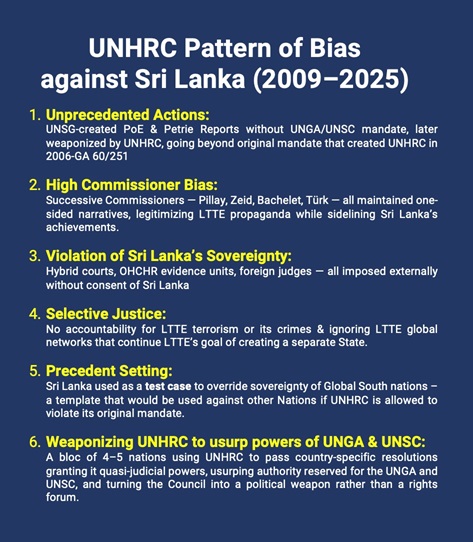
Pattern of Bias (2009–2025)
1. Unprecedented Actions:
UNSG-created PoE & Petrie Reports without mandate, later weaponized by UNHRC.
2. High Commissioner Bias:
Successive Commissioners — Pillay, Zeid, Bachelet, Türk — all maintained one-sided narratives, legitimizing LTTE propaganda while sidelining Sri Lanka’s achievements.
No accountability for LTTE terrorism, nor for Western/NATO atrocities in Iraq, Afghanistan, Libya.
5. Precedent Setting:
Sri Lanka used as a test case to override sovereignty of Global South nations.
We ask all UN Member States: Is Sri Lanka’s real ‘crime’ that it defeated terrorism? Are we being punished for safeguarding our sovereignty and ending 30 years of LTTE bloodshed? If so, does this not set a dangerous precedent — that any Global South nation which defeats terrorism will be punished with regime-change attempts and external intervention? Why is the UNHRC allowed to be weaponized in this way, drafting resolutions through 4–5 nations and passing them without universal mandate?
Why are the UNGA and UNSC watching silently as their powers are being usurped by UNHRC?
No, no one else plays, it is a game purely forone.
Once a chess piece is moved; ‘we’ (USA)
simply turn the board the other way around
– & move the other side’s chess pieces (for ‘them’).
There is ‘no other’ in this game.
– Zbigniew Brzezinski, The Grand Chessboard,
US Primacy & Its Geostrategic Imperatives (1997)
*
A naked woman is waving her hands and jumping up & down in the middle of Thunmulla roundabout at 8am on a sunny day, shouting: ‘You can’t see me… I can say what I want’, etc. It appears this nakedness is what all talk of ‘free speech’, ‘privacy’, etc., amounts to on the US-policed internet, in countries such as Sri Lanka. The internet, as it presently operates, was initiated by the US military (e.g., DARPA; tho early prototypes were mooted by the socialist USSR, Chile, etc). The US internet maybe like the paved Kolomba-Nuvara A1 Road, albeit built by unfree Sinhala labor, to connect port & plantation via the Fort – a creation of an invading English army.
Critics respond that the right to free speech does not guarantee the ‘the right to be amplified’. US tech giants profit from amplifying online harms, spreading false & distorted information, hurting the mental & physical health of children & adults. They also erode any economic basis for a professional & national news media, while toxifying anincreasingly digital public sphere upon which any democracy depends.
*
Meta Digital Government Day in Sri Lanka! – Yes, that’s what it was called – as US Meta (which owns Facebook & WhatsApp) this week trained Sri Lanka’s media secretaries & state media representatives on ‘enhancing’ their use of US social media apps. Meanwhile, the Securities Exchange Commission (SEC) embroiled in its own ‘corruption’ scandals was announcing that its ‘state-of-the-art trade surveillance system’ is from Wall Street, New York-based NASDAQ (National Association of Securities Dealers Automated Quotations). The earlier SEC system was from the London Stock Exchange! The Colombo Stock Exchange (CSE) claims their system is now ‘homegrown’, though before that, it was from the National Stock Exchange of India. (see ee Finance)
Recall the now infamous 2015 Central Bank bond-scam involving the then Central Bank Governor Arjuna Mahendran (a refugee in rule-of-law Singapore, where Sri Lanka recently held an investors’ conference!) & his son-in-law whose company secured most of the bonds issued at that time, acting on confidential information he had access to. In May 2024, then-President Ranil Wickremesinghe, claimed the stock market was being manipulated by ‘some individuals’ spreading contradictory information on economic downturns. And now we get NASDAQ! Meanwhile, the recent postal strike here with the related issues distorted by a capitalist media – that is their job! – may be a harbinger for US ‘logistics’ corporations like Amazon fully privatizing such services.
*
• This week’s local media has been busy faking a feeding frenzy about the arrest, remand, hospitalization & bail of a member of the seemingly-still-ruling dynasty. This media, largely owned by his relatives (family of Ranil Wickremasinghe’s nephew Ruwan Wijewardena, who’s UNP deputy leader), is turning RW into a hero, hoping he’ll be a rallying pivot for the capitalist cause. Meanwhile, US warships enter & leave Colombo, with Maharajah media (News1st) reporting a US embassy press release as their own ‘news’ (see ee Sovereignty, Fast, Armed & Friendly – USS Tulsa Visits Colombo Port!), just as the USAID-funded National Peace Council wants the Sri Lankan Government to share its ‘Plan for National Reconciliation’ with the people; then there’s the Ceylon National Chamber of Industries (another US front), claiming to avoid ‘lobbying for narrow interests’, lamenting that they too are ‘in the dark about what is being negotiated & what the Government plans to offer the US’ with regard to easing tariffs.
*
• In early 2023, the Government of Sri Lanka sought to increase revenues through a Digital Service Tax, to tax the huge digital multinational corporations (MNCs) reaping profits through sales to customers in Sri Lanka. Sri Lanka could generate $104.5million from a 4% digital service tax, as opposed to the ~$29.5mn from the Inclusive Framework on Base Erosion & Profit Shifting (BEPS) pushed by the Paris-based Organization for Economic Co-operation & Development (OECD). According to internationally renowned economists, including Jayati Ghosh, Joseph Stiglitz, et al, the Sri Lankan Ministry of Finance then came under ‘severe pressure’ from the IMF to drop their plans for a digital service tax and to use the OECD solution, as a condition for receiving additional lending from the IMF. The IMF however denied it had any such discussions with the government (see ee Economists).
There are increasing indications that the Sri Lankan government will also ‘cave’ in to the US demands on a digital tax as part of the tariff threats. Our current President AKD recently noted that Sri Lanka may have political sovereignty, but no economic sovereignty. The failure to control these US corporations spreading misinformation, especially without promoting local alternatives, indicates that we lack both political & economic sovereignty.
*
• The USA (& their regional poodles) are escalating war on Iran & Yemen, which threatens to send fuel prices booming, undermining all economic forecasts & IMF prescriptions. This week, saw SL’s Ministry of Defence, as well as the Communist Party of SL celebrating the 80th anniversary of winning the World Anti-Fascist War & the Chinese People’s War against Japanese Aggression, which falls on 03 September (see ee Sovereignty). Meanwhile, the US & its colony Japan stand accused of threatening countries not to attend the grand commemoration in China, with US leaders claiming it is they who have won all the world wars! Well… They certainly are thrilled to begin them. Many of the wars led by the USA now are world wars in the making – if not yet, in the doing. From East & West Africa, East & West Asia, to Eastern Europe (with an increasingly Nazified Ukraine – the 17thC German settlers in the western part now being opposed to the more ancient Russian speakers in the eastern. It would be naive not to understand these wars are largely the doing of the old colonial powers working overtime under the leadership of the US to maintain, if not extend, their old domains.
The US nuked Japan, not to force their surrender as always claimed – when Japan had already begged the Tokyo USSR envoy for surrender terms – but as a warning to their then-allied Red Armies, Soviet & Chinese. The US media now spreads disinformation about the still-free Korea (DPRK) participating on the Russian side in the NATO war on Ukraine. The DPRK has an old relationship with China & the USSR & Russia and have every right to support their trusted & true allies, let alone acquire versatility in the latest materiel. South Korea, Japan, Taiwan, etc, have to pay for 100,000 US troops on their soil, and like most NATO countries are all but US colonies, and have all participated in US wars on China, Korea, Vietnam, West Asia, etc.
*
• In Sri Lanka, a US front group called the Asia Internet Coalition (AIC, note: it’s not called Indo-Pacific Internet Coalition, though representing the same imperialist US designs) has demanded the withdrawal of the SL government’s ‘draconian’ Online Safety Bill. The usual NGO-dollared suspects (CPA, NMSJ, etc.) have also criticized the Bill, claiming it undermines privacy & free speech. None of them mention any need for a mass media truly independent from such imperialist monopolies & agencies from AP to BBC to CNN to Reuters, etc. They have also criticized the Inland Revenue Department (IRD)’s April VAT amendment on foreign digital services, which is set to begin on October 1, after a 6-month delay was ordered, following a Supreme Court challenge by the USA’s Uber. They have also opposed proposals to tax huge e-commerce websites like booking.com, mooted in 2 recent budgets but not implemented. The decision, debated in Parliament, aims to level the playing field between local & foreign service providers. Local hotels have complained that, while they have to pay the high local taxes on hotel bookings, including through these travel platforms, the higher-profiting international websites don’t pay any taxes to the local exchequer. The so-called Sri Lankan online ride-hailing Pickme, whose CEO recently exposed these ‘global’ digital companies for legally stealing billions without paying local taxes, has also joined in the anti-VAT whine; though Pickme has supported Uber being also taxed like them (do note: the US World Bank’s International Finance Corporation made a $2.5million venture capital investment in PickMe in 2018).
The US has been able to force countries (India, Canada, New Zealand etc) to withdraw Digital Services Taxes, claiming they discriminate against the US companies that dominate the internet and supposedly enable ‘free speech’. The Canadian tax was expected to generate $7billion in revenue over the next 5 years. The US government proudly announced that they had forced the Canadian government to ‘cave in’. The US had threatened to ‘terminate all discussions on trade’ with Canada, calling the digital services tax ‘a direct & blatant attack on our country’. (see ee Sovereignty, ee Media) Note: The US has declared a national emergency on trade, because a trade imbalance is harmful to US national security. But what of the rest of the world including Sri Lanka’s colonially wrought ‘imbalances’ & ‘emergencies’?
How much of Sri Lanka’s advertising rupee is paid to foreign companies? The PR business in Sri Lanka has been dominated by English multinationals like Unilever, Ceylon Tobacco etc. In Canada, 70% of advertising expenditures (comprising $13.5bn) was paid to foreign-owned digital media in 2022. In 2023 alone, US tech giants made $20.7billion in Canada from distributing online content. The withdrawal of digital taxes has been demanded by the US Computer & Communication Industry Association (CCIA), which represents: Alphabet, Amazon, Apple, Bookings.com, BT Group, Cloudflare, Deliveroo, Dish Network, eBay, Facebook, Google, Intel, Instagram, Intuit, Meta, Mozilla, Nord Security, NordVPN, Pinterest, Rakuten, Red Hat, Samsung, Shopify, Texas.net, Twitter, Uber, Viagogo, Waymo, What’s App, Yahoo, Zebra, etc.
A Digital Services Tax can ensure foreign tech giants are fairly taxed & held accountable for their enormous power over our societies & economies. The alignment of CEOs of Alphabet, Meta, Apple, Amazon & X Corp with the current US administration’s agenda, threatens all our political & economic independence. Foreign tech giants make massive unfair profits in Sri Lanka and should be taxed to invest in our digital sovereignty, building homegrown alternatives to US monopolies. Sri Lanka must invest in building our own communications infrastructure in the national interest. National companies can help build platforms, networks and tools that advance the country’s values, strengthening cultural and information ecosystems, enabling communities across the country to better serve our own needs to communicate & connect. Even England has not made concessions to its digital services tax to get a trade deal with the US. Sri Lanka should also not make concessions without any gains.
Edward Snowden in 2013 revealed that the rising digital economy also posed serious security dangers. Digital activity concentrated in a handful of US companies effectively grants the US the power to spy on the world. China actively promotes greater digital sovereignty, restricting US monopoly digital services. But a powerful lobby in Sri Lanka and India is instead pushing for greater integration with the US. They claim the economic benefits of using US digital services outweighs the risks of coercion, and can benefit from the global reach of US power by collaborating with US surveillance. Yet, any US administration can at any time threaten to cut off Sri Lanka from intelligence sharing.
Critics of such collaboration with the USA say that US monopolies’ online platforms challenge personal data protection and cultural sovereignty, and are the greatest national security threat. Dependence on US digital infrastructure places sovereignty at risk. Digital sovereignty is associated with safeguarding the autonomy and security of a country’s digital infrastructure. Next to protecting critical physical infrastructure and computer networks, it must guarantee the ‘country’s access to data collected on its territory’. Law-enforcement authorities still ‘struggle to access data held by companies located in other countries’. Digital sovereignty must also ‘maintain a country’s economic autonomy’. Most countries rely on a few large US tech companies for their digital services. The absence of national providers can pose a threat to their economic development in case of any external disruption and leave them at risk of unfair practices, including higher prices.
Dependence on SpaceX’s Starlink services for internet connectivity (as in Ukraine) weakens a country’s negotiations with the US. Digital sovereignty also includes a country’s ability to promote and enforce its digital regulatory preferences. Digital technologies connect economic actors across national borders, and risk ‘regulatory arbitrage’ where companies selectively choose which regulations they want to apply. Over the last 30 years the EU & US have clashed ‘over the protection of privacy rights as the EU attempts to ensure its regulations are respected regardless of where their citizens’ data are processed… As with the recent contract handed over to India to develop Sri Lanka’s digital ID cards, data-localization policies can also compel companies to store data collected in Sri Lanka on our soil, thereby limiting its regulatory autonomy.
US companies provide the majority of cloud services: 60% of Canada’s cloud market is owned by 5 US companies; 2 US companies – Microsoft (65%) & Google (28%) own 93% of their office software market. Other than TikTok, Meta & Google dominate the social media landscape and digital advertising, and can at any time cut the country off from such critical services, as Meta did in response to Canada’s Online News Act, which established a revenue-sharing obligation with Canadian media for Meta and other US companies. Microsoft banned the use of specific digital services in Canada after EU sanctions against Russia. Yes, promoting greater sovereignty would not be without costs. Countries rely chiefly on US companies for digital services because they offer significant economic benefits. Governments & businesses, for example, rely on Microsoft Office, which has inserted ‘backdoors’ in the software, to gather intelligence (see ee Industry)
Sri Lanka can defend its sovereignty by reducing the risks associated with its dependence on the US by focusing on developing ‘cloud-agnostic services’. Building such digital services, public and private organizations can ensure that if there is any disruption in US cloud services, they can easily move their activities to local or other clouds. Developing a domestic digital industry is part of a vast national investment strategy.
*
• ee continues looking at US-occupied Korea’s form of industrialization, enabled under what the authors claim to have been: ‘an especially powerful, transnationally active post-WWII Pacific capitalist class’. Their example is Samsung, founded by a Korean industrialist who collaborated with Japanese colonialism, and was then given access to the US military industrial market. Just like the Japanese capitalists & army who joined in the war on Korea (1950-3), South Korean capitalists were recruited to aid the war on Vietnam, to join US forces as the US shifted toward Southeast Asia and needing more international support for the US-backed puppet regime in Saigon. US-occupied Korea went further than other Asian countries and offered to send troops (along with Thailand, Australia, New Zealand) after the USA in 1965 committed US ground troops. Soldiers were promised 22 times regular Korean military pay and allowed to send US$s home, while Korean capitalists sold cement and other supplies & services to the US war on Vietnam: all packaged under ‘responsibilities to the Free World’.
*
• SBD de Silva analyses were more nuanced & dialectical than ee may make them out to be. He felt such ‘geopolitical’ explanations for US-occupied Korea’s industrialization were not sufficient. ee Focus therefore continues reproducing Chapter 1 from his classic The Political Economy of Underdevelopment (PEU). Here he carefully takes apart all the usual explanations for Sri Lanka’s economy being underdeveloped. Read any news about Sri Lanka’s economy and we are told we lack foreign investments, need to export more, and also diversify. Yet, the types of production that foreigner capitalists have invested in, have never made a positive contribution to the advance of underdeveloped economies. SBD catalogued the destructive effects of plantations and mines, giving examples from Malaysia and Nigeria. Contrary to the nonsense about free trade, he showed how the colonial state power allocated the best land to whites, and crippled local enterprise. The ‘basic nature of the plantation system’ is neither modern nor capitalist, with no spread effects or positive impulses to share with the so-called backward peasant economy. He listed the oversimplifications of economists, who only speak of levels of development, ‘ignoring the fact that some nations not only lack development but are locked into a stagnant state where development is impossible’. He meanwhile also contrasted the state role in the white settler colonies, where it was an ‘engine of growth’. He examined the levels of technology, and the conditions of production, and downplayed the conditions of exchange.
*
Upon being taken to Blackwell’s Island, the Warden
of the Penitentiary asked him the usual questions:
‘What occupation?’ ‘Statesman!’ he replied.
‘What religion?’ ‘None.’
• This ee Focus also continues looking at New York’s political machinery, through Gustavus Myers’ 1917 History of Tammany Hall, that famous New York ‘charity’. It proceeds like a teledrama, with ‘stupendous thefts, forgery, bribing & election frauds, weapons of bribery and intimidation, if not violence’, examining the growth of yet another ‘reform movement’ to overthrow the ruling politicians. In the last ee we watched as New York’s city politicians bought off journalists & editors & media owners, and rose to great power. However, in this ee see how in fact these politicians are but creatures of an even higher power, the monopoly capitalists. When Big Boss Tweed decides to divert municipal advertising budgets into his own media outlet the Transcript’ and a printing house he steps on the toes of the mighty New York Times. The NYT rides in like the US cavalry, to provide ‘the proper machinery’ for the exposure of the ‘villains’ and awakens ‘the dormant public conscience’. We get front row seats into the rise & fall of one set of petty oligarchs: ‘The newspapers which had profited most by his thefts grew rabid in denouncing him and his followers, and urged the fullest punishment for them… If Tweed had died in 1870… Broadway would have been festooned with black, and every military and civic organization in the city would have followed him to Greenwood.’
*
• Those controversial red-flagged 323 containers released uninspected by SL Customs earlier this year – were some of them from that ill-fated ship heading to Sri Lanka that crashed a Baltimore bridge in 2024? Meanwhile, there is still no mention about the Sri Lankan seafarer, still kept under house arrest in Baltimore, USA, over a year and 4 months after the ship Dali crashed into and destroyed the bridge? Grace Ocean Private & Synergy Marine, the owners of the Dali,filed a lawsuit last week against Hyundai Heavy Industries in US District Court for the Eastern District of Pennsylvania.
Baltimore’sFrancis Scott Key Bridge is named after a US slave owner & US national-anthem composer. Oh say, can you see: The Dali ship was made in US-occupied Korea’s Hyundai shipyard, chartered by US-military-linked Danish shipper Maersk. True ownership is kept highly opaque. The ship is supposedly owned by British Virgin Islands-based Grace Ocean Investment, with Singapore-based Synergy Marine ‘overseeing safety’ and managing the crew of 21 mostly Indian nationals. Synergy’s parent, investment holding company, Unity Group Holdings International is based in Hong Kong. It then turns out that the main carriers that also had containers on the Dali are: HongKong’s Gold Star Line, AP Moeller-Maersk, Italy’s MSC, and Israel’s ZIM Integrated Shipping Services. Israel’s Zim’s containers were hidden beneath the other containers to avoid detection. Some speculate those containers contained weapons for Israelis on our East Coast, and a Jihadi-Zionist binary is being promoted, to further weaken the Sri Lankan state…
A new environmental emergency has hit the strait separating the Indian coast from Sri Lanka, threatening to cripple local tourism and fishing. Carried by currents from India, mounds of plastic reach the Mannar region. Monsoon currents, which carry dust, are more difficult to collect, compounding the problem. Globally, the failure to ratify or implement agreements and treaties weighs heavily on the country.
Colombo (AsiaNews) – Sri Lanka is facing a major environmental emergency that threatens to deal a severe blow to tourism and fishing, two of the main industries in the South Asian nation’s economy.
Currently, the coastlines of Mannar (Northern Province) are buried under large mounds of plastic brought in by waves coming not only from within the country, but also and especially from neighbouring India in what constitutes transboundary pollution”.
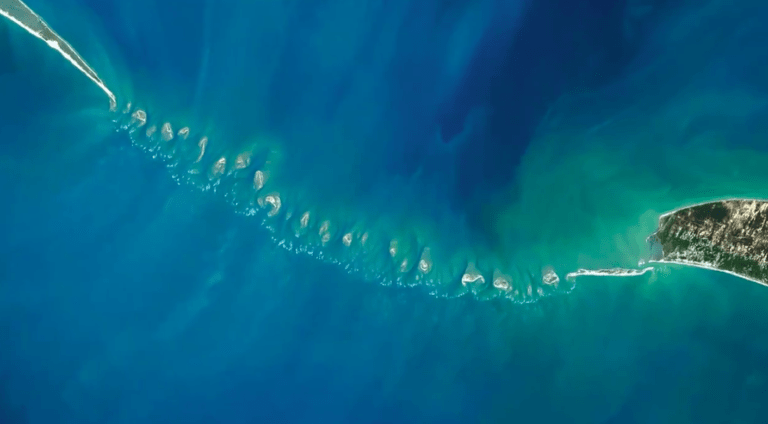
According to many environmentalists, this year’s situation is even worse than in the recent past with the southern coast leading to Adam’s Bridge covered in plastic waste.
Also known as Ram Setu, the 48-kilometre-long limestone shoals connect Pamban Island (also known as Rameswaram Island), the largest of the Tamil Nadu group located between peninsular India and Sri Lanka, to Mannar.
Although the Marine Environment Protection Authority (MEPA) performs regular cleanup to remove plastic pellets (nurdles), the plastic dust dispersed by monsoon winds is harder to collect. For local communities, the problem is getting worse with each season.
Although some plastic debris washes away during the rainy season, monsoon currents typically push the debris toward Sri Lanka,” said Kithsiri Ramanayaka and Anuradha Paranawithana, two environmentalists who spoke to AsiaNews.
Since most countries fail to address their domestic waste management problems, plastic will continue to circulate through ocean currents,” they added. Plastic pollution in Mannar has disastrous ecological consequences,” especially for marine wildlife that ends up ingesting or becoming entangled.”
Habitat degradation and the disruption of production cycles causes “a decline in potential fish populations and health risks for local fishermen who depend on marine resources for their livelihoods.”
The experts warn that, “Addressing this problem requires a cross-sectoral approach involving collaboration between various sectors, including the fishing industry, waste management sectors, and local authorities.”
To this end, Adequate sampling is needed to determine the impact of ‘plastic dust’, which has not been done so far. According to available data, Sri Lanka’s coasts receive plastic from South and Southeast Asia.”
Scholar Ravihari Alwis and Nishantha Gamlath share these concerns, and for them, the issue must be addressed immediately.”
In 2022, the 193 United Nations member states agreed to develop a legally binding international treaty to end plastic pollution, addressing its entire life cycle from production to use and waste disposal.
Despite five rounds of negotiations, the last in April in Kenya, no agreement has been reached, while the follow-up session in Geneva also failed. At the same time, the sixth round of negotiations of the Global Plastics Treaty (legally binding to address the problem of plastic waste) also failed. However, a treaty is still considered crucial, as it would place greater responsibility on the richest plastic-producing nations.
For the experts, there are two key issues, namely whether the entire life cycle of plastics, starting with production, and their health implications, including endocrine-disrupting chemicals, should be included in the treaty. Oil-producing countries oppose these measures.
Overall, island states such as Sri Lanka, compared to producers and users, face the brunt of plastic pollution”, and call for the full cycle to be included.”
Arjun Pathmarajah (46) and Neelan Ravichandrarajah (39), social and environmental activists in Mannar, are aware of the major issues.
Apart from plastic pollution, there’s plastic dust in the air, too, brought by the winds. We usually get a lot of it, but this time it is intense. We speculate that the trash is coming in from India. The pollution has an extremely bad impact on the environment and our ecosystems, including on groundwater, fish, the primary source of income of the community and health consequences.”
The Marine Environment Protection Authority (MEPA) has been coordinating cleanup operations in co-operation with the military, government authorities, including the Central Environment Authority, local NGOs, and communities in several coastal regions. Several teams have been deployed to Mannar to address the debris that washes ashore.
From Africa to Asia to Latin America, billions go hungry while creditors profit.
Protesters shout slogans during a rally against high taxes and increases in electricity and fuel charges, in Colombo, Sri Lanka, Jan. 30, 2024. [AP Photo/Eranga Jayawardena]
Sri Lanka is undergoing one of the most complex economic recoveries in its history. The country’s financial collapse in 2022 was precipitated by a toxic mix of unsustainable borrowing, poor fiscal management, and external shocks.
Mass protests erupted under the banner of Aragalaya, a broad-based citizens’ movement demanding accountability, economic justice, and an end to political corruption.
The uprising ultimately forced the resignation of the sitting president, Gotabaya Rajapaksa. However, following his resignation, the administration of Ranil Wickremesinghe recaptured power.
Delaying calls for new elections, in 2023 the Wickremesinghe administration negotiated $3bn of support from the International Monetary Fund (IMF) under its New Extended Fund Facility (EFF) arrangement. Later that year, to unlock a second instalment of this bailout package, Sri Lanka also reached a debt restructuring agreement with a group of creditors including China, India, and Japan.
Even though, by September 2024, the Sri Lankan people elected a progressive government led by President Anura Kumara Dissanayake, with a historic mandate, the new administration has since been trapped within the constraints imposed by the IMF and the previous political establishment.
The mainstream neoliberal narrative has been quick to highlight the arrangement with the IMF, known as the 17th IMF program, as a sign of stabilisation, praising the debt restructuring agreement and compliance with IMF conditions.
But what of the human cost of this recovery”?
The punitive structural adjustment process includes privatising state-owned enterprises, disconnecting the Central Bank from state control, curtailing the state’s capacity to borrow, and subordinating national development aspirations to the interests of creditors. It has placed the burden of its Domestic Debt Optimisation on working people’s retirement savings, specifically the Employees Provident Fund (EPF), raising concerns among salaried workers whose current real incomes have already been cut by high inflation and higher taxes.
Public sector hiring has been frozen, major rural infrastructure projects in transport and irrigation have been delayed or cancelled, and funding for health and education has stagnated even as costs rise. The reforms undertaken to achieve macroeconomic stability, including interest rate hikes, tax adjustments, the removal of subsidies, increased energy pricing, and the erosion of workers’ pensions, have demanded a great deal from citizens.
The IMF program has also ushered in neoliberal legal reforms that erode the public accountability of the Central Bank, limit the government’s fiscal capabilities, and encourage the privatisation of land, water, and seeds through agribusiness.
To meet IMF targets – most notably, the goal of achieving a 2.3 percent primary budget surplus by 2025 – the Sri Lankan government has introduced sweeping austerity measures. Where else will that surplus come from if not from the money pots of the poor? Bankers may welcome this austerity, but for those living and working in rural areas and coastal villages, it spells hardship and fear. The imbalances within the debt restructuring program prioritise investor profit over the public interest, shrinking the fiscal space needed to rebuild essential services.
Civil society groups estimate that 6.3 million people are now skipping meals, and at least 65,600 are experiencing severe food shortages.
In a noteworthy move, newly elected President Anura Dissanayake has instructed the treasury to reinstate subsidies for the agricultural and fishing sectors. While welcome, this may not be enough. Fishermen report that fuel costs remain steep, eating into their incomes.
Farmers, many locked into chemical input-intensive production, are struggling with rising costs, climate catastrophes, and reduced state support.
Sri Lanka’s 2025 public health allocation accounts for just 1.5 percent of its gross domestic product – five times smaller than the amount allocated to service the interest on public debt. This stark disparity highlights the fiscal constraints placed on basic social spending.
But this is not just a Sri Lankan story.
It is part of a broader global debt emergency draining public finances across the Global South. A vast number of countries in Africa, Asia, Latin America, the Caribbean, the Pacific, and Central Europe have been forced to cede national policymaking autonomy to international financial institutions like the IMF, World Bank, and Asian Development Bank (ADB).
A recent United Nations Conference on Trade and Development (UNCTAD) report reveals that half of the world’s population – approximately 3.3 billion people – now live in countries that spend more on interest payments than on health or education. In 2024 alone, developing countries paid a staggering $921bn in interest, with African nations among the hardest hit.
UNCTAD warns that rising global interest rates and a fundamentally unjust financial architecture are entrenching a cycle of dependency and underdevelopment.
Developing countries routinely pay interest rates several times higher than those charged to wealthy nations, yet existing debt relief mechanisms remain inadequate – ad hoc, fragmented, and overwhelmingly tilted in favour of creditors. The demand for a permanent, transparent debt resolution mechanism – centred on justice, development, and national sovereignty – is gaining momentum among Global South governments.
This issue is also drawing serious attention from global grassroots movements.
In September this year, more than 500 delegates from around the world will convene in Kandy, Sri Lanka, for the 3rd Nyeleni Global Forum for food sovereignty. The gathering will bring together small-scale food producers, Indigenous peoples, trade unions, researchers, and progressive policy think tanks. One of the key themes will be the global debt crisis and how it undermines basic rights to food, education, health, and land.
The forum is expected to serve as a space to chart alternatives. Rather than relying solely on state-led negotiations or technocratic financial institutions, movements will strategise to build grassroots power.
They aim to link local struggles – such as farmers resisting land grabs or workers organising for living wages – with global campaigns demanding debt cancellation, climate reparations, and a transformation of the international financial system.
It is clear to those of us in the Global South that a just recovery cannot be built on fiscal targets and compliance checklists alone. We demand the reclaiming of public space for investment in social goods, the democratisation of debt governance, and the prioritisation of people’s dignity above creditors’ profit margins.
For Sri Lanka – and for countless other countries across Africa, Asia, and Latin America – this may be the most urgent and necessary restructuring of all.
The government’s action has now created a launching pad for the Opposition to form an alliance
In politics, even the right action has to be taken at the right time
The arrest and remanding of former President Ranil Wickremesinghe has become the talking point of politics
Almost all the political parties in the Opposition stood in solidarity with each other to secure bail
The arrest of Mr. Wickremesinghe has now become a unifying factor for the Opposition.
In recent Sri Lankan political history, there were watershed moments that changed the directions of governments.
The past governments sometimes experienced such defining moments when they were at the peak of popularity. The immediate impact of them was minimal, rather invisible. Nevertheless, it started becoming visible in the long run changing the course of government and ensuring its downfall in the end.
Such defining events only sowed seeds to be sprouted up later when conditions develop in favour.
For example, the 2010/2015 Mahinda Rajapaksa government took a radical decision to impeach then Chief Justice Shirani Bandaranayake. She was impeached according to the procedure laid down in the Constitution. A Parliamentary Select Committee was appointed to hear charges framed against her.
Afterwards, a motion was presented in Parliament. She was stripped of her post with the approval of that motion by two-thirds in the House.
The Mahinda Rajapaksa government was at the peak of its popularity in the wake of war victory. There was no major public backlash against the government in the immediate aftermath, although it offered ammunition to the then Opposition to take on the ruling side.
No matter what, the impeachment of the then Chief Justice turned out to be a fatal political mistake for the then government years down the line.
It infuriated the legal fraternity. Meddling with judicial independence and alienation of professional groups are a clear recipe for electoral disaster for any government.
The impeachment was widely interpreted as an assault on judicial independence. The Opposition amplified its protesting voice against the Rajapaksa government. Infringement of the rule of law was one key allegation that led to the downfall of the Mahinda Rajapaksa government in 2015.
The Yahapalana government succeeded the Rajapaksa rule. It was established with the promise to restore the rule of law and root out corruption and fraud.
The Rajapaksa government faced a lot of criticism over that.
Less than two months into office, the Central Bank bond scam occurred on February 27, 2015 rupturing the foundation of the Yahapalana (Yahapalana is the Sinhala word for good governance) government which professed the anti-corruption approach as the cornerstone of running the country.
It was a turning point for that government, a government elected on a platform of eradication of corruption and restoration of the rule of law.
The Gotabaya Rajapaksa government that followed also made policy errors leading to its abrupt end in 2022.
Popularity of the current government is now on the wane. It was proven at the last local authorities’ election. The ruling National People’s Power (NPP)’s vote share has significantly dropped by about two million compared to the last general election conducted last year.
The government is now about to complete its first year in office.
Its recent decision- the arrest and remanding of former President Ranil Wickremesinghe- has become the talking point of politics.
It is now a case before court. Hence, it is not time for anyone to discuss merits and demerits of the case until court proceedings are over.
Still, the event bears political significance, for sure. His arrest and incarceration were unexpected, and therefore it was a shock to his camp. Whispers of such an eventuality had long been in circulation, though.
The Opposition parties remained scattered up until then despite attempts being made in certain political corners to unify them as a viable alternative to the government. Mr. Wickremesinghe’s arrest suddenly turned out to be a rallying cry for them.
Almost all the political parties in the Opposition stood in solidarity with each other to secure bail for Mr. Wickremesinghe.
The arrest was seen by the Opposition as a major attempt by the government to stifle democracy and silence dissent. The old dictum ‘united we stand, divided we fall’ now resonates among them. They were meeting for quite some time to forge unity . In the wake of Mr. Wickremesinghe’s arrest, they have now felt a sense of urgency to form a broad alliance.
However, in politics, political parties come together or part ways under circumstances. There are no permanent friends or enemies in politics. When interests merge, it will decide who should forge ties with whom. In Sri Lankan politics, what was perceived as impossible had happened in the past. At one point, it remained unimaginable for many that the NPP would win national elections. Yet, it was a reality last year.
The coming together of the opposition parties, at this time of crisis, is understandable. The situation demands them to be together.
For them, it is solidarity in time of crisis. Now, they try to strengthen this unity for a possible alliance in view of future elections. However, it is riddled with challenges. Current unity has been forged in the heat of a single issue.
In the future, they have to face practical questions of leadership, policy direction, and electoral strategy. The opposition alliance in the making has to grapple with several challenges.
Who will be the face of such an alliance? Each party carries its own leader with ambitions and followers. Samagi Jana Balawegaya (SJB) is the main party in the opposition. Its leader Sajith Premadasa did not see eye to eye with Mr. Wickremesinghe in the past. Following the latter’s arrest, Mr. Premadasa expressed solidarity. Who will be the leader in case the two parties merged in an alliance?
The government’s action has now created a launching pad for the opposition to form an alliance in the future. The government’s declining popularity provides fertile ground for such an opposition platform. However, its gradual progression into a well-knit alliance will depend on how the government performs in the months to come.
The arrest of Mr. Wickremesinghe has now become a unifying factor for the Opposition. These parties had a meeting on August 27 and decided to stand together in the face of repressive actions by the government.
More and more parties and individuals will be invited to join the Opposition. The event has turned out to be a trigger point for the Opposition to converge.
For the government, Mr. Wickremesinghe’s arrest is an ill-advised action in that sense.
In politics, even the right action has to be taken at the right time. If anyone takes the right action but at the wrong time, he or she will fall flat on the ground in politics.
In Ranil Wickremesinghe’s parlance a cynic would probably describe the former president’s predicament as being the result of an L-Board arrest. Mr. Wickremesinghe himself might have described it as such had he not been weakened and silenced owing to excessive dehydration during and after his police questioning and long court hearing last Friday. As has now been extensively reported, the former president has multiple health issues which given his age would seem to have been concerningly aggravated by Friday’s ordeal. In the circumstances, the granting of bail for reasons of health is a healthy pause in an unfolding drama that has no script for its ending. Keeping Mr. Wickremesinghe in remand would have been pound-of-flesh meanness, with potential risk to his health and continuing headache for the government.
There have been plenty of commentaries on the political fallouts of the episode, but little has been and can be said about the legal precedents that may or may not ensue. While there is much to be said about the government’s amateurishness in the whole matter, it would be an exaggeration to suggest, in my view, that the arrest of Ranil Wickremesinghe is a portent sign of a threat to democracy or drift towards a one-party polity. While These interpretations are obviously far-fetched, what has to be conceded is that the government’s handling of the matter has created a huge and unnecessary distraction to its own agenda and has provided further ammunition to those who constantly question the NPP’s competence for governance.
Mayhem in America
As for the threat to democracy and the danger of a one-party polity, Sri Lanka is nowhere near what is unfolding in America under President Trump’s endless executive orders. Trump has declared executive war on the Federal Reserve, the American Central Bank, because its Chairman and Board are not reducing interest rates as the President wants them to be reduced. He is sending the military to American cities in Democratic states with African American Mayors purportedly to fight urban crime. And he is directing the FBI and the Justice Department to investigate those who worked in the Biden Administration and Republicans who have been critical of him for their alleged acts of treason. The investigations likely will go nowhere but their purpose is to subject the targeted individuals to public slander and force them to expend money defending themselves in investigations.
Yet for all of Trump’s excesses, and there are a lot more than what I have listed above, it would be an exaggeration to say that American democracy is in its death throes. That has been the Democrats’ party line, forever warning the Americans of Trump’s existential threat to democracy but doing nothing about it except getting the people tired of the leadership of the Democratic Party. But there is no denying the massive stress that the American institutions are going through as they respond to Trump’s executive orders and unconventional demands.
None more so than the American judiciary. The FBI and the Justice Department have become Trump’s weapons against his political opponents and policy targets who are mostly immigrants and minorities of all kinds. The judiciary, on the other hand, is torn between those who are constrained to fight Trump’s attacks on them and the government lawyers whose brief is to defend Trump’s actions in the courts.
The stress is especially on the lower tier federal judges who are the first line of defence for those facing the brunt of Trump’s orders. These judges invite Trump’s wrath if they rule against the government as most of them have been doing. The appeal courts are caught in between while the Supreme Court, with its 6-3 conservative majority, decidedly sides with Trump. The conservative judicial agenda is to expand the power of the unitary president over the legislature and the judiciary. That takes priority even if some of the conservative judges might be disgusted by the vulgarity of Trump’s actions. Chief Justice John Roberts has papered over them, calling them transient results and present exigencies.
Sri Lanka is nowhere near the troubled state of the US either in regard to the attacks on democracy or the stresses on the judiciary. It is indeed a sea of calm relative to the political turbulence in America. For all his political assaults on institutions, the undoing of the Trump presidency, if at all, will be precipitated not by his politics but by his mercurial interventions in the economy. The deluge may come after him, but he is quite capable of hastening it a lot sooner than any other political leader.
In Sri Lanka too, it will be the economy that will determine the people’s ultimate verdict on the NPP and not the politically grand projects like Clean Sri Lanka or Constitutional Reform. The government has to keep the economy humming and keep essential goods in steady supply and at affordable prices to win the next election. The implementation of the grand projects will take more than one term, even two, and to complete them successfully the NPP will have to win not only the next but the next two elections. If the economy goes south, food scarcity returns and prices rise, the electorate is not going to reward the NPP for fighting corruption and arresting politicians who are well past their Best Before or Expiry dates.
Much Ado about What?
The arrest of Ranil Wickremesinghe has led to predictable reactions. Government ministers have been touting the precept that law should be applied equally to all citizens and that the NPP government is creating an atmosphere in which law enforcement will not exempt anyone. Wickremesinghe has become the government’s Exhibit A to illustrate the new enforcement regime. A victim of poetic irony in that he had in the past intervened to protect other politicians from prosecution in spite of promising to do the opposite.
To wit, the total betrayal of the yahapalanaya promises when he was Prime Minister and Maithripala Sirisena was President. Now, Sirisena and practically everyone else from the old parliament are now united in solidarity with Wickremesinghe. Yet there is no earth-shattering outrage against the arrest. While a majority of the commentaries are critical of the arrest in varying degrees, there are also a good number of voices that are more measured if not expressively supportive. These viewpoints fall along party lines and along established political alliances.
A common reaction across party lines has been bafflement. Why did the government, or anyone on its behalf, have to do this? Was he arrested merely to prove the point that under the NPP government law will be applied equally to all citizens regardless of their status?
L-Board in Colombo
Wickremesinghe is apparently the first President or Prime Minister to be arrested and charged with a crime. He could also be the first person in Sri Lanka, if not anywhere, to be indicted over travel and accommodation expenses. It is not uncommon for employees, whether in the public or private sector, travelling on official business to piggyback some private engagement involving additional travel or longer stay. Employees are reimbursed according to approved allowances for the official portion of the trip and pay out of pocket for any additional expenses for their private engagement. No one is accused of fraud or sent to jail over travel and per diem expenses. If anyone abuses the system they could be caught and dealt with administratively, including financial penalty, interdiction or dismissal. Not jail.
In the case of government ministers or heads of state, the disbursements will be large because of accompanying staff and security detail, but disbursements will have to be within approved allowances for specific purposes with full reconciliation at the end of the trip. The vaunted SLR 16.9 million that Mr. Wickremesinghe is accused of illegitimately overspending is not money that he or his aides had somehow pilfered from state coffers, or spent on his own and got reimbursed. On the contrary, from what has been reported it would appear that the disbursement has been assessed and provided through the normal back and forth process involving multiple agencies.
The point of contention is whether the London stay by Wickremesinghe on the return leg of an otherwise official travel to Cuba and USA, is private or official. Someone in police or the Attorney General’s office would seem to have determined that the London stay should be deemed private and, therefore, Wickremesinghe should be charged for a non-bailable offense on a Friday afternoon for a weekend sojourn at Welikada.
There is a bureaucratic saying: ‘this is above my pay grade”, to indicate that certain decisions are beyond the purview of officers at certain levels. Someone higher up must make the call. Not so, it seems, in Sri Lanka when it comes to dealing with a former president over his travel itinerary.
What is official or private conduct for an American president has been vigorously debated in courts and by legal scholars for the last four years. There is now a Supreme Court opinion on the matter which many disagree with but all abide by. And President Trump is the principal beneficiary of the Supreme Court ruling. Otherwise, he wouldn’t be president now. And he could be the only beneficiary in history. The ruling differentiates between and deems that all core functions of a president are absolutely immune from prosecution, there should be presumed immunity for conduct that straddles the official and the private spheres, and no immunity at all for conduct that is totally private.
But the debate is all about presidential powers and actions and not about air fare or hotel accommodation. No one is questioning Trump to pay for his weekend flights from Washington to his Florida club. Or for all the time he spends playing golf with full security paid for by the taxpayer. No one is suggesting a Sri Lankan president should be afforded all the luxurious perks of an American president. But whatever perks that Sri Lankan presidents might be availing themselves of, their entitlement should be determined in some proper way and not by officials acting above their pay grade.
There would have been some plausibility in taking legal exception to a London trip by Mr. Wickremesinghe if the trip had been solely for the purpose of accompanying Mrs. Wickremesinghe to a celebratory lunch at the University of Wolverhampton. Even then, it should have been more a socialite question, not a legal one, as to why Sri Lanka’s first couple would bother flying all the way to London town for lunch at a by and large nondescript institution. There is much political hay to be made of the fact SLR 16.9 million were spent when the country was struggling without food and fuel and the coffers were apparently empty to pay for local government elections. But arraigning in court – that is simply beyond the pale.
Ranil Wickremesinghe is perhaps the most serially defeated political leader in the country. Electoral defeats are an indication of people’s judgment on political parties and leaders for their acts of omission and commission. There will never be a specific correlation between a particular act and the voter’s verdict, but in the scheme of things elections provide a way of cleaning the stables for at least another four or five years. Defeat in elections should be punishment enough for political failures and there should be no need for prosecutorial follow through. This was the case in the stripping away of Sirimavo Bandaranaike’s civil rights by President Jayewardene. And it should not have been the example for the NPP government to follow with modifications in the case of Ranil Wickremsinghe.
Ironically, after the UNP parliament in 1980 suspended Mrs. Bandaranaike’s civil liberties, the admixture of executive presidency and the open economy created a political culture of impunity for abuse of power and corruption in government. This culture that was not there before 1977 went on to thrive for long after the UNP was gone in 1994. There have been multiple rebirths of the same old corrupt governments. Until now, that is, the NPP government might say with some justification.
The upshot is that electoral defeats may not be enough to deal with corruption in government. More so when criminal culprits, including two of them convicted for murder, who managed to win elections and find accommodation in government benches. So, there is much to do, plenty to investigate, and many trespassers to be brought to book. My contention is that the arrest, remand and the likely trial of Ranil Wickremesinghe over his luncheon date near London, has devalued rather than advanced the government’s mission of fighting corruption.
It may be that the government may have wanted to test the waters by taking in Ranil Wickremesinghe before going after others who are more capable of creating trouble on the streets than Ranil Wickremesinghe can ever be. Or it may be that someone in the police or the AG’s office decided to act above their pay grade. We can only speculate. Moving forward, the government may want to consider inviting independent lawyers, say people of high calibre from the unofficial bar, to review police files and findings involving political leaders and make recommendations regarding prosecution.
The government may also want to study the application of the Shawcross principle in criminal cases. Named after British Attorney General Hartley Shawcross, who formulated it in 1951, the principle is for the Minister of Justice or Attorney General to act independently in decisions regarding criminal prosecutions without pressure or direction from cabinet. The cabinet could be informed of such decisions but it will have no say in the matter. It is a delicate balance but life will be worthless without delicate balancing. The principle is assiduously followed in Britain, Australia, Canada and New Zealand, but I am not aware of its status in other Commonwealth countries including Sri Lanka. The NPP government may want to take a crack at it if only to show that it is serious about gaining competence in governing in addition to claiming honesty in politics.
The United National Party (UNP) has decided to invite all opposition political party leaders to its annual convention.
A preparatory discussion for the convention, which is scheduled to be held on September 6, was held this morning (31).
A proposal in this regard has been made and is scheduled to be submitted to the UNP’s Working Committee meeting on September 3.
The party has also decided to lift the ban on former members whose memberships were suspended, considering them as having left the party.
This proposal will also be presented at the upcoming Working Committee meeting.
In the coming days, former President Ranil Wickremesinghe is expected to personally invite opposition party leaders to attend the convention.
The UNP has also decided to hold the convention at a neutral location, rather than at Sirikotha, the party’s headquarters, so that opposition representatives can also participate.
However, according to political analysts, this year’s convention is expected to be notably different due to these decisions.
The United National Party has lifted the suspension orders against Opposition Leader Sajith Premadasa and all party members who joined the Samagi Jana Balawegaya, or SJB.
A senior UNP spokesperson stated that the decision was made on the instructions of UNP leader and former President Ranil Wickremesinghe.
The party views this move as the first step toward uniting the opposition. All members, including those from the opposition, have been invited to the UNP’s annual convention on 6 September to discuss the current political situation.
Opposition Leader Sajith Premadasa and former presidents Mahinda Rajapaksa and Maithripala Sirisena have also been invited to the conference.
The move follows a recent visit by Sajith Premadasa and other SJB members to check on Ranil Wickremesinghe’s health while he was in hospital.
Minister Bimal Rathnayake has said Ranil Wickremesinghe should have been arrested about four decades ago over the Batalanda torture chamber, the 1983 racial violence, etc. The former has also flayed the latter for the Treasury bond scams (2015). It is now up to the judiciary to scrutinise charges against Wickremesinghe, arrested and remanded for alleged misuse of state funds, and determine whether he is guilty or not. Those who are keen to have corruption and misuse/abuse of state funds eliminated rejoice when politicians and state officials are prosecuted for such offences—and understandably so. Their concerns should be appreciated and their call for stringent action against the corrupt heeded. But the question is whether the JVP/NPP has any moral right to condemn others for causing losses to the state coffers.
Minister Rathnayake may not have realised that it was self-defeating for him to refer to what happened 40 years or so ago. He has unwittingly reminded the public of the JVP’s wanton destruction of state assets in the late 1980s. The JVP burnt 553 SLTB buses, 15 SLTB depots and workshops, 16 trains, 24 railway stations, and countless transformers and pylons belonging to the CEB, according to media reports published during that period. The human cost of the JVP’s mindless terror and the UNP’s savage counterterror was incalculable.
Maithripala Sirisena, whom the JVP backed in the 2015 presidential election, has revealed that the JVP destroyed 245 out of the country’s 545 agrarian service centres and the warehouses of the Paddy Marketing Board with paddy stocks in them. If those crimes had been properly investigated and criminal proceedings instituted against the perpetrators, many of the present-day JVP leaders would have been thrown behind bars.
As for the Batalanda torture chamber, will the JVP-led government explain why the second part of the parliamentary debate on the Batalanda Commission report has not taken place yet. The first part of the debate was held in April. Is it because the report reveals numerous crimes the JVP committed during its reign of terror in the late 1980s? If the JVP is so concerned about the Treasury bond scams will it explain why it honeymooned with Wickremesinghe’s UNP from 2015 to 2019? During the 2018 ‘constitutional coup’ when President Sirisena tried to sack Prime Minister Wickremesinghe, the JVP leaders were among those who scuttled that move both legally and politically. Why didn’t issues like the Batalanda torture chamber and the Treasury bond scams cause any concern to the JVP at that time?
When the UNP-led Yahapalana government, together with the JVP had politically motivated probes conducted against their rivals, we warned that they were setting a very bad precedent. The then Prime Minister Wickremesinghe, JVP leader Anura Kumara Dissanayake and other JVP stalwarts were on very intimate terms at the time. The JVP vilified the leaders of the previous UPFA government and raised questions in Parliament about allegations against them thereby preparing the ground for their arrests. Some courts were kept open until midnight for the suspects to be remanded. The JVP was represented in the powerful National Executive Council of the Yahapalana government and its leaders frequented Temple Trees, where the Anti-Corruption Secretariat was located. The members of the UPFA government were no doubt corrupt and had to be brought to justice, but the Yahapalana government and the JVP set about the task of doing so the wrong way to gain political mileage. They turned the arrests of their rivals into political circuses. All the cases filed in a hurry at their behest collapsed, and the Rajapaksa played the victim card, regained public sympathy and made a stunning comeback.
The Yahapalana government, just like its predecessors, had the Attorney General’s Department and the CID on a string, with SSP Shani Abeysekera as the CID Director. Today, the JVP/NPP has gone a step ahead; it has pulled Abeysekera out of retirement and appointed him CID director. Abeysekera and ex-SDIG (CID) Ravi Seneviratne joined the NPP and actively took part in its election campaigns as key members of the NPP’s Retired Police Collective. Seneviratne is the incumbent Secretary to the Ministry of Public Security. The CID has been reduced to a mere appendage of the ruling JVP/NPP. No wonder some pro-government social media activists predict impending arrests accurately. Interestingly, the newly appointed Police Chief has gone on record as saying that his department is free from political interference at present!
Ironically, Wickremesinghe is claiming victimisation at the hands of his erstwhile chums and the forces he was instrumental in creating during the Yahapalana government to further his political interests.
Switzerland, long celebrated for neutrality, serenity, and banking secrecy, has also quietly served as a discreet hub for global capital, both legitimate and controversial and the safe haven of dictators’ wealth. Street riots or public unrest has never been linked with Switzerland. Yet, the recent killing of a 17-year-old migrant during a police chase has violently disrupted that image. Riots in Lausanne, fires on streets, and clashes with police show a Switzerland many did not expect to see. It showed that beneath the peaceful exterior was something brewing unpublicized.
This incident is not isolated; it is the latest flashpoint in a continent grappling with deep demographic and cultural shifts. All of the human rights templates preached to Global South need to be re-circulated to Europe, it appears.
Switzerland, despite its wealth, neutrality, and carefully cultivated international reputation, is not immune to the same tensions that have shaken France, Germany, Belgium, UK and Sweden. The very nation that prides itself on order and balance is now staring at the consequences of long-ignored social fractures. We were told they were the civilized states and we needed to take them as examples on coexistence. We are now witnessing their cracks..
Demographic Changes and Social Fault Lines
Switzerland’s immigrant population is significant: over 25% of its residents are foreign-born, one of the highest ratios in Europe. Migrants are essential to the Swiss economy, filling both skilled and low-wage jobs, yet they are also segregated into underprivileged communities with higher unemployment and limited political voice. How is this possible?
The official narrative of harmony masks deeper divides between native Swiss and immigrant-origin youth, who often feel alienated from the wealthy, orderly system around them. So what we have been shown has been a façade – an uneasy coexistence now showing cracks.
These demographic shifts are not unique to Switzerland. Across Europe, the U.S., Canada, Australia, and New Zealand, immigration over decades has created societies far more diverse than in the post-WWII era. With diversity has come enrichment — but also identity crises, cultural tensions, and political backlash.
Assimilation is the key – Integration has often felt one-sided — with natives adjusting, while immigrant communities sometimes resist assimilation, which with time has annoyed natives who have felt their original nations are being turned into a replica of what immigrants left to find better pastures. They say when in Rome be a Roman – such is not taking place & whose fault is it?
Why these flashpoints keep occurring
1. Policing & Trust Deficit: Minority youths often perceive law enforcement as discriminatory and hostile. Incidents like Lausanne’s death — whether accidental, negligent, or deliberate — become lightning rods of pent-up anger. Has law enforcement been discriminatory? Is their validity in such perception or is it being used to gain sympathy & secure more privileges for migrants?
2. Economic Inequality: Many immigrant communities remain locked in cycles of poverty while witnessing the wealth of the societies they live in. This duality fuels resentment, particularly among youth. Has the Swiss govt investigated this. If this is a recurring issue, why has it not been addressed without allowing it to simmer into friction by both sides.
3.Cultural Clash & Integration Gaps: Host societies expect assimilation; migrant communities strive to preserve identity. This tug-of-war leaves both sides dissatisfied, often erupting in conflict. Is it really preserving identity or stretching the freedoms of host societies in ways that fuel resentment. Migrant communities must first respect & honor the existing culture – they cannot expect their culture to be considered on par or even above. No one has denied them to indulge in their cultural traditions & customs within their homes. But it is unfair to demand that they turn their new home into a replica of what they left.
4. Media & Political Amplification: Right-wing groups highlight such incidents to argue migration has failed,” while another set use media to sensationalize the issue & deepen the friction. Activist groups frame these as systemic racism as these are livelihood issues for their sustenance while media bloats anything & everything out of proportion for profit. Both narratives deepen polarization rather than build solutions. The larger blame must fall on the politicians who have been flirting with immigrant lobbyist groups and have used them to advance their political careers & win votes, promising them and even giving them what has later turned into the reasons for natives to hate the immigrants. UK politicians must answer for increasing taxes of the taxpayers but housing boatloads of people in 4 star hotels, giving them buffet meals & a stipend.
Even in Switzerland, where politics prides itself on consensus, the same cycle of exploitation of migration narratives for short-term political gains is visible
Whose Fault Is It?
The blame is shared:
· Governments that welcomed migration but failed to build integration models beyond economics or looked into concerns voiced by natives.
· Host populations that benefit from migrant labour but resist cultural inclusion.
· Migrant community leaders who sometimes foster insularity rather than encouraging bridges.
· Media & elites who exploit incidents to fuel either fear or victimhood narratives, instead of dialogue.
Why it resonates across the West
· From Minneapolis to Melbourne, from London to Toronto, the Lausanne riots echo familiar themes. Migration is no longer a European problem” — it is central to the Western world’s future. Countries built on liberal democracies are discovering their limits when diversity collides with identity, economics, and security concerns.
· Europe: Terror attacks, riots, and ghettoization feed both populism and far-right parties.
· Australia & New Zealand: Immigration debates are increasingly tied to housing crises, wage stagnation, and cultural anxieties.
· Canada: Once the model for multiculturalism, it is now facing pushback on refugee intake and affordability.
· US: The immigration debate is central to every election cycle, shaping policies on border control, policing, and racial justice.
· UK: the nation where the sun never sets is asking what happened to mighty Great Britain. Britain, once projecting global dominance, now grapples with the question of what remains of that identity amid migration-driven change.
Outcomes to Expect
1. Harder Politics: Expect stronger right-wing movements across Europe and the West, using incidents like Switzerland to argue for stricter migration laws.
2. Community Polarization: Riots deepen mistrust between immigrant communities and police, making integration even harder.
3. Identity Crisis of the West: Countries will need to decide whether they truly embrace multiculturalism, or retreat to exclusionary nationalism.
4. Global Image Costs: Switzerland, the supposed neutral haven,” is now a symbol that no nation is immune from the fallout of mismanaged diversity.
More importantly, what if immigrants decide to return back home – taking with them all that they have earned, their knowledge, their experience – Low fertility rates, delayed marriages, and shrinking family structures among native populations promoted by global LGBTQIA agenda add another layer to the demographic challenge the West will face — making immigrant growth appear even more pronounced.
Switzerland’s riots show that no nation, however wealthy or neutral, is insulated from the pressures of migration, identity, and demographic change. The West must decide whether to manage these shifts with foresight — or continue reacting in crisis
When Imran Khan became PM of Pakistan the whole world knew Pakistan will end its rot and turn the tide. However, it was not seen in good light by enemies of Pakistan both internal and external. Imran worked hard to contain corruption. But corrupt politicians, their lackeys, their supporters, extremists and the underworld joined forces to topple him and his regime and condemned him to prison. Since then, Pakistan has again fallen back to corruption, worsening poverty, extremism, war and total hopelessness. It should not surprise anyone if parts of Pakistan successfully agitate for independence tearing it apart. Will this be the fate of Sri Lanka too?
Since 1948 Sri Lankans have not experienced the meaning of equal rights when it comes to the law. They were forced to believe that politicians are a different breed of creatures entitled to more rights than the common man. Using this falsehood politicians robbed the nation to bankruptcy and war. However, since of late Sri Lanka seems to be at least trying to go the right way. It is an abnormal and unusual thing for islanders though it is very common in successful countries and countries that are trying hard to become successful. Recently the Thai PM was removed from post over the violation of the law. A number of Japanese and South Korean politicians including former presidents and PMs were imprisoned for corruption. It is just normal in successful countries. But in Sri Lanka which is destined to doom and failure, these normal acts are seen as unusual acts.
Like in Pakistan, all former political rivals have joined forces in Sri Lanka, not for any benefit for the nation, but for their own survival. Though they lack public support, they can still cause disruption, agitation, violence and racism. Unless the rulers act with determination, it will be the righteous who will end up in prison, not the crooks.


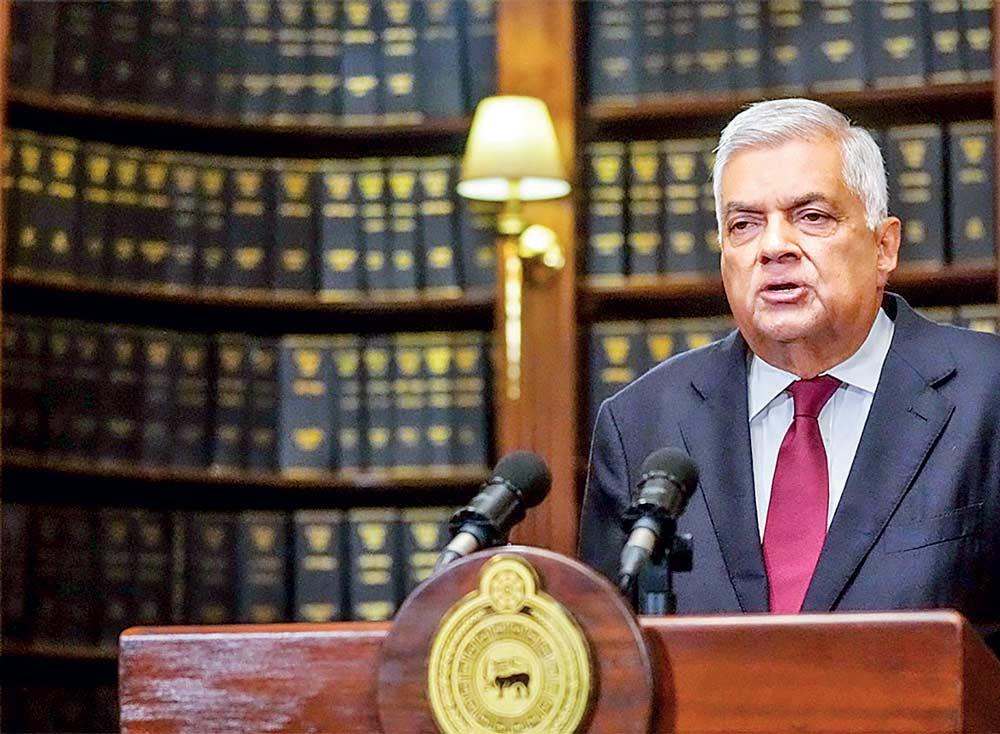
 In the annals of Sri Lankan political history, few leaders have faced the daunting challenge of navigating a nation through complete economic collapse. Former President Ranil Wickremesinghe stands as a unique figure who has twice assumed the monumental responsibility of rescuing Sri Lanka from its worst economic crises—first in 2001 when the economy dropped below zero under CBK, and again in 2022 under Gotabaya. Despite holding just one parliamentary seat during the latter crisis, Wickremesinghe demonstrated the rare combination of expertise and courage required to pull a nation back from the brink of economic catastrophe.
 Vietnamese Ambassador Trinh Thi Tam, in an interview with Daily Mirror, speaks about the way forward for enhancement of bilateral ties. She shares her views in this regard on the occasion of the 80th Anniversary of Viet Nam’s Independence Day (1945-2025) and the 55th anniversary of diplomatic relations between Viet Nam and Sri Lanka (1970–2025).
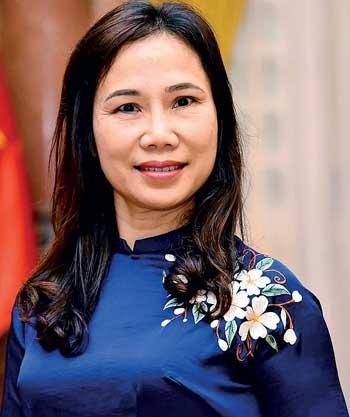 The state visit of President Anura Kumara Dissanayake to Viet Nam in May 2025 was a landmark event, marking the first state visit to Viet Nam by a Sri Lankan President since 2009.