COLOMBO, April 1 (Xinhua) — A batch of Sinopharm vaccines arrived in Sri Lanka from China on Wednesday as part of a donation by the Chinese government to the island nation.
The vaccines arrived at the Bandaranaike International Airport on Wednesday where it was officially handed over to President Gotabaya Rajapaksa by China’s Ambassador to Sri Lanka Qi Zhenhong.
Several Ministers including Foreign Minister Dinesh Gunawardena and Minister of Tourism Prasanna Ranatunga were present at the occasion.
The President, the Chinese envoy, Minister and the Sri Lankan air crew. Photo: Tang Lu/Xinhua
Workers transport packages of Sinopharm COVID-19 vaccine at the Bandaranaike International Airport in Colombo, Sri Lanka, March 31, 2021. (Sri Lankan President’s Media Division/Handout via Xinhua)
An official certificate signing ceremony took place between the Chinese Ambassador and Sri Lanka’s State Minister of Pharmaceutical Production, Supply and Regulation Channa Jayasumana, after which the vaccines were handed over to President Rajapaksa.
Speaking at the ceremony, Jayasumana thanked the Chinese government and its people for the donation and said this was a very important milestone in the friendship between Sri Lanka and China.
Ambassador Qi, at the ceremony, said the arrival of the vaccines once again demonstrated the brotherhood between Sri Lanka and China and once again implemented the commitment of China in making the Chinese COVID-19 vaccines a global public good.
Chinese envoy Qi Zhenhong, and Lankan Ministers Channa Jayasumana and Sudarshani Fernanndopulle at the certificate signing ceremony. Photo: Tang Lu
It also once again declared that solidarity is the only right way for the international community to defeat the pandemic at an early date and build a global community of health for mankind,” the ambassador said.
He further added that Sri Lanka was among the first countries to which China donated the vaccines.
It is particularly worth mentioning that the Sri Lanka government has decided to include Chinese nationals in its vaccination plan. In this regard, on behalf of China, I would like to extend our highest appreciation for this most friendly gesture,” Qi said.
Withstanding the test of the pandemic, the ambassador said, he firmly believed the China-Sri Lanka strategic cooperative partnership based on sincere, mutual assistance and ever-lasting friendship would elevate to a new level. Later the day, the WHO’s Strategic Advisory Group of Experts (SAGE)
Colombo, April 1 (newsin.asia): The High Commission of India, Colombo, invites applications for the following ICCR scholarships for 2021-2022 academic sessions: Nehru Memorial Scholarship Scheme: This scheme covers all Undergraduate courses (except Medical/Paramedical& Fashion Design course) including Engineering, Science, Business, Economics, Commerce, Humanities and Arts.
Maulana Azad Scholarship Scheme: Masters Degrees courses (except Medical/Paramedical& Fashion Design course) including Engineering, Science, Economics, Commerce, Humanities and Arts. However, preference would be given to the fields of Engineering, Science and Agriculture.
Rajiv Gandhi Scholarship Scheme: Undergraduate courses in the field of ‘Information Technology’ leading to a B.E or B.Tech Degree.
Commonwealth Scholarship Scheme: PhD Degrees in all subjects except Medical/ Paramedical& Fashion Design course.
The Government of India selects meritorious Sri Lankan nationals for award of these scholarships. Selection of candidates is done in consultation with the Ministry of Education, Government of Sri Lanka, to pursue undergraduate, postgraduate and PhD Degrees in some of the topmost universities in India. All scholarships cover full tuition fees for the entire duration of the course, monthly sustenance allowance, and annual grant for books & stationary. The Selected candidates would also be provided hostel facility inside the campus.
Besides, all ICCR scholars in India are provided, air fare to the nearest destination in India and an annual grant for educational tours to various parts of the country, apart from several other auxiliary benefits.
The necessary details are available in the website of the Ministry of Education at www.mohe.gov.lk. Prospective students are advised to approach the Ministry of Education,Sri Lanka or High Commission of India, Colombo to learn more about the eligibility criteria and selection procedure.
Sri Lanka’s foreign policy posture is to balance the US and China, being part of both BRI and the Indo-Pacific.
In Geneva, a tough resolution on promoting reconciliation, accountability, and human rights in Sri Lanka was passed with 22 votes out of 47 countries supporting the resolution. The current resolution gives more teeth to the Office of the United Nations High Commissioner for Human Rights (OHCHR) to investigate and collect evidence of human rights violations, not limiting to the past unaddressed concerns by the government but also to the future concerns in President Gotabaya Rajapaksa’s government, which is explained by Elisabeth Tichy-Fisslberger, speaking on behalf of the European Union at United Nations Human Rights Council (UNHRC). Backed by the US Secretary of State Anthony Blinken, he ‘called on the Council to adopt resolutions due to Sri Lanka’s lack of accountability for war crimes.’ Sri Lanka’s Foreign Minister Dinesh Gunawardena was quick to respond soon after the vote, The UN Core Group failed to secure 25 votes from the 47 member UNHRC,” calculating the nations who did not support and abstained as one group; an illogical victory was projected. The result at UNHRC was quickly weaponised by the government in their favour, catering to their majoritarian voter base. The ultra-nationalist political view of the government is a readily available feature that could be used to call it an attempt by Western countries to bully countries such as Sri Lanka.
It has been 12 years since the end of the Civil War and all subsequent governments have failed to implement a domestic mechanism that could win the Tamilian and the international community.
This projection itself gives a bad start to work towards the resolution; the need of the hour is correcting the path towards addressing minority concerns, not narrating an alternative view with unacceptable arguments and rejecting the resolution. Before the vote in Geneva, Sri Lankan foreign secretary assured India will vote for Sri Lanka, this was his own assessment and not a commitment that came from New Delhi. India abstained, with the Tamil Nadu election on the cards and much pressure from the Tamilian polity due to the present Sri Lankan government’s unfulfilled commitments where nothing substantial was spoken or achieved on Tamilian concerns. India to abstain from voting at UNHRC is justifiable due to the internal pressure from Tamilian polity and non-commitment from Sri Lankan government towards the devolution of power and absence of a genuine reconciliation process, clearly highlighted by minister Jaishankar’s visit in early January. It has been 12 years since the end of the Civil War and all subsequent governments have failed to implement a domestic mechanism that could win the Tamilian and the international community. The trust deficit has widened from co-sponsorship of its own resolution in 2015 to a complete withdrawal by the present government. This was due to an inconsistent policy on reconciliation and multiple voices of several foreign ministers pledging its support from different solutions, speaking at previous UNHRC sessions in Geneva. The new feature of the present resolution not only limits to the Civil War, thus giving more emphasis to the last two years of the deteriorating human rights environment, adding new concerns such as on militarisation of the present government.
The danger of this resolution is two-pronged. First, if the Sri Lankan government completely rejects the resolution, which was referred by Sri Lanka’s Ambassador in Geneva, C.A. Chandraprema as unhelpful and divisive.” A similar rejection was expressed after the vote by Foreign Minister Dinesh Gunawardena. President Gotabaya Rajapaksa expressed his displeasure pointing out to geopolitics and India’s devolution plea I will not allow these countries to achieve their geopolitical needs by introducing separatism under the guise of power devolution.” The complete rejection of the resolution could directly impact the relationship with the west and deteriorate Colombo’s commitment towards international norms, moving the foreign policy balance away from rules-based order, Indo-Pacific norms, and its allies. Second, it could impact the overall country’s exports to the western nations, with the EU and the US being its largest export markets. This would also impact the country’s image to attract western investments, initiating an inexorable drift of Sri Lanka towards China.
The new feature of the present resolution not only limits to the Civil War, thus giving more emphasis to the last two years of the deteriorating human rights environment, adding new concerns such as on militarisation of the present government.
Anchorage to IOR
United States (US) Secretary of State, Anthony Blinken, and National Security Advisor, Jake Sullivan, met with China’s most senior diplomat, Yang Jiechi, and State Councilor, Wang Yi, in Anchorage, Alaska, marking the beginning of the Biden administration’s China policy. Both parties were to exchange their views to ease the US-China tension that had exacerbated in the last few years. The US position on China was clearly articulated, highlighting China’s aggressive behaviour and violation of human rights in several geographies. According to senior US diplomat Richard Haass, the discussion was mishandled and a terrible start” to the de-escalation efforts, where both sides accused each other on their respective policies.
A day before the Alaska summit, the US escalated its sanctions on China over its crackdown of political freedoms in Hong Kong. According to Wang Yi, Chinese people are outraged by this gross interference in China’s internal affairs…this is not supposed to be the way one should welcome his guests…this is miscalculated and only reflects the vulnerability and weakness inside the US. And this will not shake China’s position.” Adding to that, Yang Jiechi said, the time had passed when a small group of wealthy Western nations could dictate the shape of the global order and the US no longer represents world opinion…” While both sides depicted the same hostility, it is perhaps a deliberate recalibration, well-orchestrated by the US to continue the anatagonism to build strong relationships with her allies, which is a priority for the Biden administration. A Japanese scholar Satoru Nagao argues that ‘the more China escalates the situation, more the defence capabilities of the Quad will be institutionalised.’ In the meantime, due to US administration’s unfavourable China policies, Beijing is charting a course ahead that depends less on the West, with its ‘dual circulation’ economy which is a more self-reliant economic model.
The recent tripartite agreement between Sri Lanka, the Maldives, and India is considered to be a move in the same direction of minilateral successes.
The tense US–China posture in Anchorage will impact the Indian Ocean Region (IOR). China’s belligerence could propel nations to expand their security footing in the IOR. Strengthening Prime Minister Modi’s Security and Growth for All the Region (SAGAR), the Indian Foreign Minister Dr Jaishankar made repeated visits to the Maldives to establish the coast guard naval operational base in at Sifvaru–Uthuru Thilafalhu (UTF), which will be developed and supported by Indian naval assistance, further extending US$ 50 million credit line for defence. Sifvaru, which is geographically situated closer to the southern Indian shores, is a perfect location for Indian logistics, HADR efforts, and maritime security operations. The Maldives has been a strategic location even during the British Empire where Gan (Addu Attoll) in the Maldives was used for a similar purpose by the Royal Navy and the Royal Air Force. The second leg of Dr Jaishankar’s visit was to Mauritius where security and defence cooperation was further strengthened. The northern island of Agaléga in Mauritius has already been developed by India for military use. A P-8I reconnaissance aircraft could easily land on the newly built runway. All these, and more security partnerships such as those with Japan to access Djibouti are clear security expansions made in the western IOR by India. The recent tripartite agreement between Sri Lanka, the Maldives, and India is considered to be a move in the same direction of minilateral successes.
During the Quad leaders’ summit with India, US, Australia, and Japan, where Joe Biden, Scott Morrison, Yoshihide Suga, and Narendra Modi pledged their commitment to safeguard the interests of democratic nations and to sustain a rules-based order in the Indo-Pacific where Chinese aggression is a concern to the Quad. The US commitment to a rules-based order in the Indo-Pacific was reiterated in Sri Lanka by the most senior US General, Kenneth S. Wilsbach, who visited the island after a decade. The US, along with Quad commitment and the role of the Quad has strengthened due to the assertive behaviour of China in the Indian periphery, the only Quad member who shares a land border with China. In this geopolitical equation, it is vital that India strikes a balance and deter Chinese expansion, especially towards the IOR. Indian scholar, Brahma Chellaney, correctly observed, ‘it is imperative that the Quad gain strategic heft so as to bring an expansionist China under pressure.’
The growing Chinese space in India’s periphery will be of great concern for New Delhi.
Sri Lanka’s foreign policy posture is to balance the US and China, being part of both BRI and the Indo-Pacific. Neither can it afford to move away from India nor the rules-based alliance, where Sri Lanka could play an important strategic role rather than a passive partner, silently accommodating China’s expansion in the island. However, there are clear signs that the Rajapaksa administration will continue to tilt in favour of China in certain sectors due to China’s unconditional support in defending the Sri Lankan administration on its human rights record in Geneva, questioning the OHCHR report. Along these lines, China will support the domestic political position on minority concerns taken by the Rajapaksa regime to make strategic inroads into the politics of the island. Few days ago, President Gotabaya Rajapaksa thanked President Xi for China’s support at UNHRC over the recent telephonic concertation they shared. During which President Xi also gave a firm pledge to stand by Sri Lanka in case of undue pressure exerted by western countries.
This growing Chinese space in India’s periphery will be of great concern for New Delhi. Sri Lankan foreign policy bureaucrats and advisors should clearly understand the geopolitical concerns, not limiting to mere rhetoric of ‘India first’ approach from the front door while welcoming ‘China preferred’ approach from the back door. While the Sri Lankan government has drafted a 20-point Foreign Policy Directive in an attempt to have a more consistent foreign policy, approved by the cabinet without inputs from the Parliament, that is privy to only a few ministers, needs a broader view and a collective approach to calibrate the balance.The views expressed above belong to the author(s).
bySONIA PAUL Courtesy The San Francisco Public Press
With food insecurity predating COVID-19, nonprofit groups see opportunity in subsidizing hybrid business models during the crisis
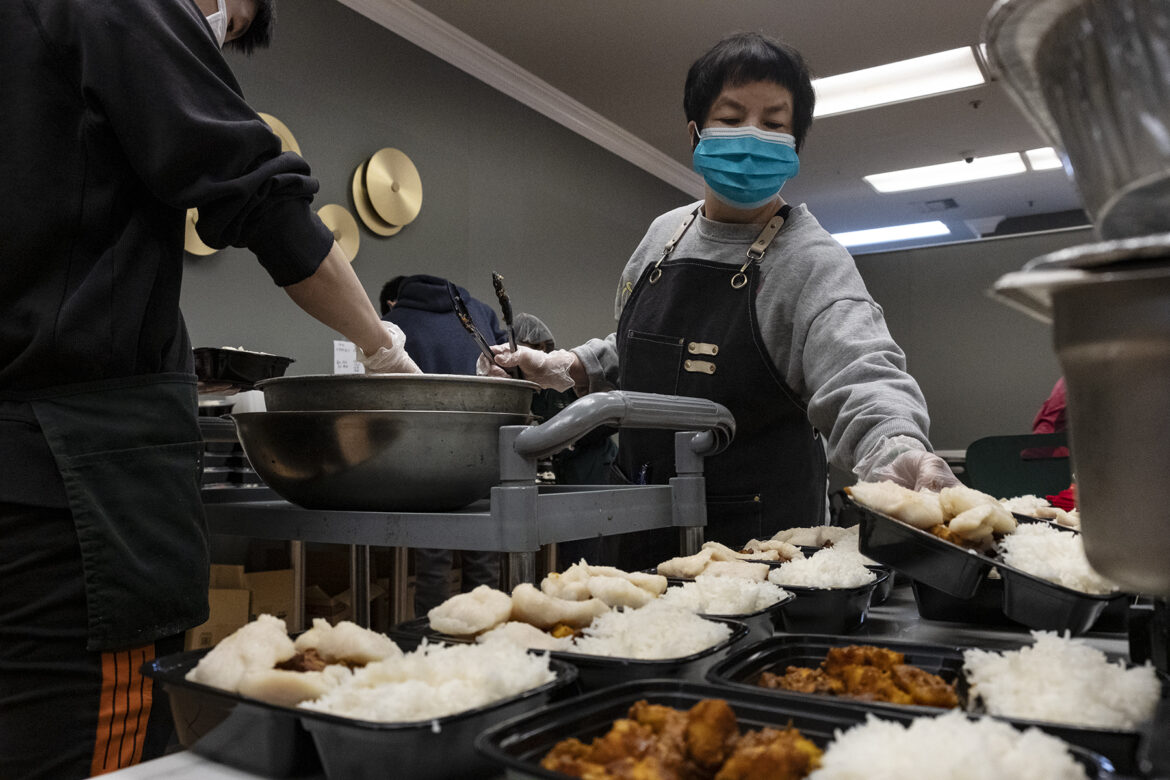
Some restaurants have altered their business model to help feed the poor in the face of coronavirus restrictions. Tilly Tsang, former owner of Washington Bakery, prepares dinner plates of pumpkin fish and rice for Sunday meal distribution in Chinatown. Every Friday, seven people cook more than 300 traditional Chinese cuisine options for breakfast, lunch and dinner.
On a sunny weekday morning in March just shy of the one-year anniversary of San Francisco’s shelter-in-place order, Brian Fernando, the chef and owner of the Michelin-rated modern Sri Lankan restaurant 1601 Bar & Kitchen, was in a rush. He and his only colleagues still working at the restaurant — his wife and one line cook — were busy transferring 105 individual brown paper bag lunches to the trunk of his car. He would then drive them from western SoMa, where his restaurant is located, to Lombard Street, the site of that day’s delivery. The lunches they had prepared were not the restaurant’s typical Sri Lankan-inspired dishes sourced from the foods of his childhood but, as requested by the community-based organizations working to feed residents facing food insecurity, American comfort food.”
We’ve totally transitioned into basically a soup kitchen from normal restaurant operations,” Fernando said.
[Reporter Sonia Paul guest-hosted our daily podcast and radio show, Civic,” this week, interviewing restaurateurs and nonprofit leaders working to save small businesses while addressing hunger. Listen to the three shows on this page or subscribe to the podcast.]
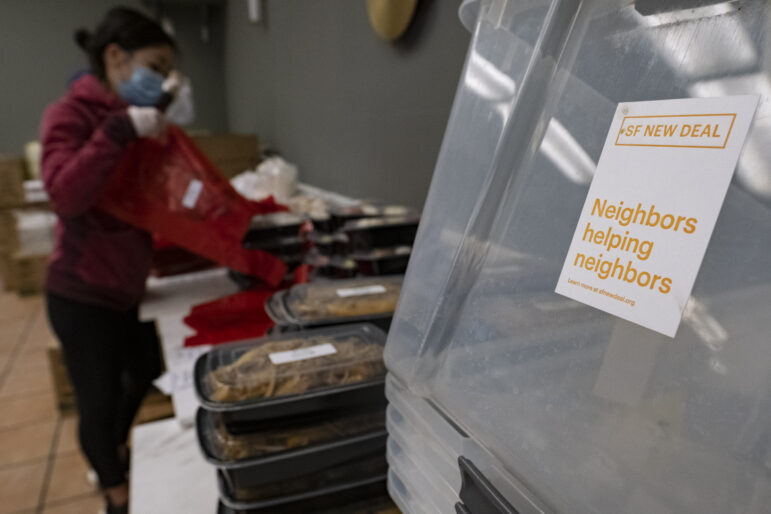
1601 Bar & Kitchen is one of 189 small restaurants working with the pandemic-born nonprofit SF New Deal. Spearheaded by Jacob Bindman, the group’s director of operations, and Lenore Estrada, CEO of the pie-baking business Three Babes Bakeshop, SF New Deal is a grassroots organization that sourced seed money from philanthropy — a $1 million investment from Twitch CEO Emmett Shear — to employ restaurant workers to feed the hungry. The nonprofit serves as a direct-services mediator between restaurants and community-based organizations that have long been doing the work of feeding vulnerable populations, and it continues to add restaurants to its roster on a rolling basis.
But as the coronavirus vaccine rolls out and San Francisco’s commercial eviction moratorium extends at a piecemeal rate — it was scheduled to lift at the end of this month but has now been extended to meet the duration of California’s commercial eviction moratorium through the end of June — questions about the future of SF New Deal and similar programs, and the future of the city’s restaurant industry, are becoming louder.
Organizers in the restaurant industry, including SF New Deal, are well aware that food insecurity is a symptom of a much larger rot — poverty and systemic racism — and that the restaurant industry was in crisis before the pandemic. It is one of the largest employers in the U.S. yet pays the lowest wages out of any industry, according to the Bureau of Labor Statistics. Restaurant profit margins are slim. Workers already driven out of San Francisco because of its high rents can barely afford to work in the industry.
Yesica Prado / San Francisco Public PressChelsea Hung, owner of Washington Bakery, bags breakfast, lunch and dinner meals for distribution through the SF New Deal program.
Against this context, the restaurant industry has suffered more than any other sector in the pandemic. The National Restaurant Association found that as of Dec. 1, 2020, more than 110,000 eating and drinking places in the U.S. had closed either temporarily or for good, and that 2.5 million restaurant jobs had disappeared. In San Francisco, 112 restaurants have shuttered, according to a non-exhaustive list compiled by The Infatuation. The Small Business Administration recently announced it would roll out the $28.6 billion Restaurant Revitalization Fund grant program, part of Congress’s recently passed American Rescue Plan Act of 2021, within 30 days, although the exact details on when and how restaurants can apply for direct aid are still unclear.
Struggling restaurants, meanwhile, are hanging by a thread. The California restaurant industry employs about 1.6 million people, according to the Bureau of Labor Statistics, making it one of the largest private-sector groups in the state, and sales from the California restaurant industry generated an estimated $97 billion in 2018, according to the National Restaurant Association. A recent report from San Francisco’s Budget and Legislative Analyst’s Office — based on data from a number of real estate reports and rent surveys — estimates that from April to December 2020, the retail sector, excluding hotels but including restaurants and bars, may have accounted for 89% to 98% of unpaid commercial rent in San Francisco, and that the total amount of unpaid rent from all retail properties may be between $18.5 million and $39.8 million per month. The city instituted a commercial eviction moratorium in March of 2020, soon after it announced shelter-in-place orders.
Our expectation is that SF New Deal alone is not enough to keep small businesses afloat, but what we’ve heard is that for the majority of the businesses participating, it is enough to close the gap.”
Jacob Bindman
The city allocated about $46 million to address COVID-19-related food insecurity, and SF New Deal is one of a few nonprofits the city is supporting in this response, said Shireen McSpadden, executive director of the San Francisco Department of Disability and Aging Services. While San Francisco has an overall policy to support organizations that distribute food in the community, McSpadden said circumstances will change as more workers go back to their jobs, kids go back to school and older adults return to senior centers.
Right now, our thought is that we will be scaling back a little bit in the next fiscal year, on some of this food support,” she said.
In addition to government contracts from the city, private donations also help to keep SF New Deal funded. This in turn allows the nonprofit to distribute anywhere from $6,000 to $8,000 a week to each participating restaurant for a minimum of 12 weeks, Bindman said.
Our expectation is that SF New Deal alone is not enough to keep small businesses afloat,” he said. But what we’ve heard is that for the majority of the businesses participating, it is enough to close the gap.”
That is the case for Fernando at 1601 Bar & Kitchen. Neither transitioning to takeout nor setting up outdoor dining were viable options for his business, which he said he believes is the only brick-and-mortar Sri Lankan restaurant in San Francisco. It was always a destination restaurant where patrons paid for the atmosphere on top of the cuisine. Support Fernando has received from SF New Deal is the main reason his business survived the past year, he said.
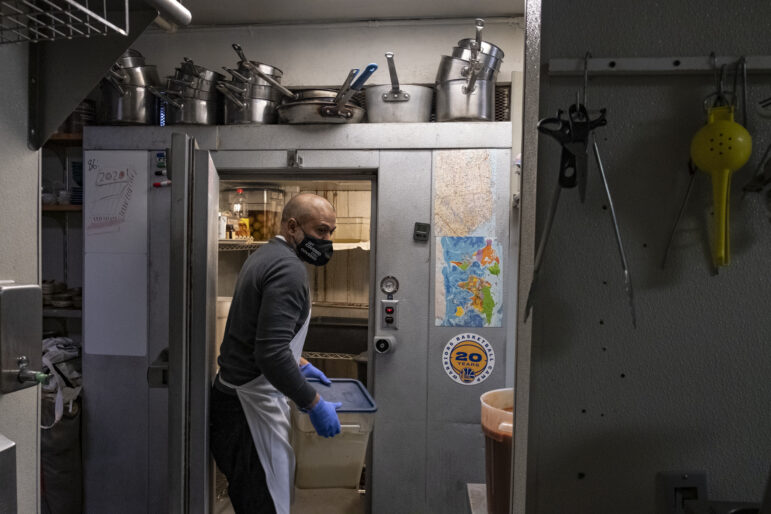
Yesica Prado/San Francisco Public PressBrian Fernando brings out salad dressing from his walk-in refrigerator at 1601 Bar & Kitchen in San Francisco, which distributes meals through SF New Deal. He prepares all his food from scratch.
He has continued to pay all his fixed costs throughout the pandemic including rent, thanks to income from SF New Deal, and has recently requested a rent reduction from his landlord, the Tenderloin Neighborhood Development Corporation. At the time of reporting, the only response he had received was essentially a copy and paste of the city’s commercial eviction moratorium, a policy that is both beneficial and frustrating, he said.
We’re not making any money, we’re getting the money that we’re supposed to be paying now waived to some later date in the future,” Fernando said. In the meantime, there’s no means for us to make up for that money lost.”
Fernando gestured to structural damage in the interior of the restaurant from a car ramming into it at the end of last year, which the landlord has yet to repair. He said it is obvious why so many places are closing: The simple arithmetic of what they are earning versus what they owe gives owners few revenue-positive options.
Providing grants to restaurants to feed people for free isn’t ultimately going to make them sustainable. What is going to make them sustainable is that people in their communities, in their neighborhoods, can afford to eat out, have the ability to consume and eat out. And ultimately, that requires raising wages and increasing equity.”
Saru Jayaraman
Fernando said he would like to see food support programs like SF New Deal embedded in the larger fabric of the restaurant industry long term, and would be glad to make it a part of his business model. But that does not eliminate the stress of trying to stay in business, or worries about the potential displacement of restaurants once the commercial eviction moratorium lifts this summer, despite a number of rent repayment options San Francisco has instituted that extend beyond June 30.
That points to a burgeoning catastrophe within a catastrophe, and organizers are trying to think beyond the pandemic. While food support programs are a worthy cause, Saru Jayaraman, director of UC Berkeley’s Food Labor Research Center and president of One Fair Wage, emphasized that they do not actually tackle the root of the issues.
Providing grants to restaurants to feed people for free isn’t ultimately going to make them sustainable,” she said. What is going to make them sustainable is that people in their communities, in their neighborhoods, can afford to eat out, have the ability to consume and eat out. And ultimately, that requires raising wages and increasing equity.”
Jayaraman is one of the co-founders of High Roads Kitchen, another food program initiated in the pandemic. It offers cash grants to restaurants that commit to participating in the organization’s gender and equity program and providing free meals to the community. While High Roads Kitchen currently has a limited presence in San Francisco, operating in 10 cities nationwide, it started in California. It was launched with the support of Gov. Gavin Newsom.
Now we’re in conversations with the Biden administration about making it a federal program,” Jayaraman said.
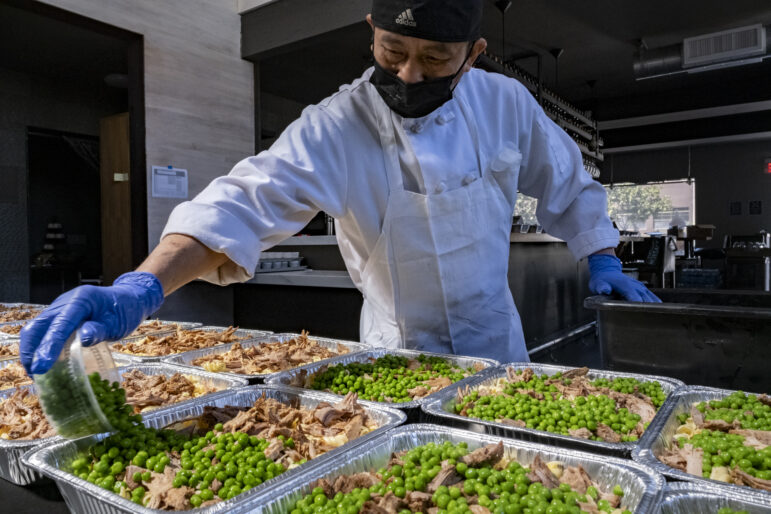
Yesica Prado/San Francisco Public PressOn a Monday morning in March, José Mcha of 1601 Bar & Kitchen assembles 65 turkey and pasta dinners for the next day’s charity food delivery. He is the sole line cook, preparing hundreds of meals weekly with owner Brian Fernando.
As organizers try to influence the future of the industry, restaurant owners are still reeling over how the past year has reshaped their present operations. Over Hong Kong-style milk tea at Washington Bakery in San Francisco’s Chinatown, owner Chelsea Hung, who took over the restaurant from her parents, said she started observing a difference in the neighborhood back in January 2020. While more people are emerging now, the situation is hardly normal.
We’ve noticed a huge decline in foot traffic here,” she said. A lot of it had to do with misconceptions of the virus, a lot of xenophobia and people just avoiding Asian communities.”
Hung, who previously worked in the tech industry, said she had a much bigger appreciation for the sacrifices her parents made to build the restaurant after a roller-coaster year. She has had to lay off and rehire staff, negotiate rent, figure out delivery apps and innovate the menu to offer items people would want in a pandemic, like meal kits for popular noodle soups. SF New Deal is not the only program Washington Bakery is participating in. It is also involved with Feed + Fuel, a program run by the Chinatown Community Development Center.
I really do hope that this program can be long term or permanent,” Hung said of SF New Deal in particular, and food-support programs more generally. She added that her restaurant also used to serve office workers who may be inclined to work from home beyond the pandemic.
I hope that as this becomes long term, more restaurants can be involved, because so many restaurants — it’s going to take them years to recover from this,” Hung said. We’re still currently in this situation.”
Audio segments from our radio show and podcast, Civic.” Listen daily at 8 a.m. and 6 p.m. on 102.5 FM in San Francisco, and subscribe on Apple, Google, Spotify or Stitcher.
Darshana Sanjeewa Balasuriya Courtesy The Daily Mirror
The officers of the Terrorism Investigation Division (TID) had arrested four suspects in connection with the offences of spreading extremist ideologies and Wahabism with the help of social media platforms, police spokesman DIG Ajith Rohana said.
He said the two suspects, a 31-year-old man from Wellampitiya and a 32-year-old male from Thihariya.
They returned from Qatar after working there for a couple of years, he said.
During their tenure in Qatar, they had created a WhatsApp group known as ‘One Umma’ and had circulated various ideologies connected to extremism and Wahabism among the Sri Lankans who were in their group, the spokesman said.
Investigations have brought to light that they had promoted Zahran Hashim’s ideology on extremism and Wahabism, he said.
Accordingly, the Sri Lankan authorities alerted the Qatar authorities about their activities through the social media group which they had created.
Upon the investigations conducted by the Qatari authorities, the suspects had been deported.
Following investigations by the TID, the suspects were arrested yesterday.
Investigations also disclosed that one of the men was involved in publishing the Zahran’s oath-taking of Baiyath soon after the Easter Sunday attack, the police spokesman said.
Also found that he had involved in publishing various photographs and videos relating to extremism and Wahabism.
The suspects are being detained by the TID under the Prevention of Terrorism Act (PTA).
Meanwhile, another two suspects (38, 37) have been arrested in Muthur. The investigations said that the duo has conducted instructions and classes in 2018 for schoolchildren who had done their G.C.E. Ordinary Level (O/L) examination. The classes were conducted by the followers of Zahran Hazim.
The duo was also brought to the TID for further investigations.
A male teacher from Ananda College in Colombo has tested positive for the COVID-19 virus, Public Health Inspectors’ (PHI) Union Secretary M. Balasuriya said.
He told the Daily Mirror that the teacher had tested positive yesterday after being subjected to a PCR test. Balasuriya said the teacher was attached to the school hostel and PCR tests were underway even today on the students.
The PHIs were tracing the associates of the infected teacher.
01. The deceased is an 80-year-old female resident from Katugasthota. She died on 31.03.2021 while undergoing treatments at a National Hospital Kandy. The cause of death is mentioned as lung infection and Covid-19 pneumonia.
02. The deceased is an 80-year-old male resident from Eheliyagoda. He was diagnosed as infected with the Covid-19 virus while undergoing treatments at Base Hospital Eheliyagoda and transferred to Base Hospital Homagama where he died on 31.03.2021. The cause of death is mentioned as Covid-19 pneumonia, sepsis, and acute kidney injury.
03. The deceased is an 85-year-old male resident from Panadura. He was diagnosed as infected with the Covid-19 virus while undergoing treatments at National Hospital Colombo and transferred to Base Hospital Homagama where he died on 01.04.2021. The cause of death is mentioned as Covid-19 pneumonia and fractured neck of femur.
The results of the 1956 election baffled even the
architects of its victory, said analysts. The MEP was stunned by its
victory. SWRD was not expected to win. He had no proper candidates
and the MEP coalition lacked financial resources. The 60 MEP
candidates were facing a solid phalanx of 76 UNP, many of them sitting members.
But MEP did win a landslide
victory. The momentum was unstoppable.
We were left speechless, said Bradman Weerakoon. Unlike in
previous elections, in this election there had been only a few instances of
bribery, violence or impersonation, added Bradman.
The 1956 General
election was
a historic event in the post-colonial world too. This is not well known. The General
election of 1956 was the first peaceful transfer of power from the legatee at
independence to another party, in any
part of the British Empire, said historian KM de Silva. (KM de Silva, Sri Lanka, Come wind come weather”. ICES
(2015) p xvii)
Bandaranaike became head of state at a time when Ceylon and other
post-colonial states were very newly independent. Post-colonial democracy had
not yet been tested, and there were few political models around, said analysts. SWRD understood
this, and called 1956 a period of transition.
When
the MEP government took office, there was a sense of freedom and liberation in
the air among students, peasants, urban workers and the intelligentsia, said
Meegama. It was a time of great happiness. It was Ape Aanduwa.
Analysts point out however, that 1956” did not happen overnight. The Buddhist
Revival and the Left movement also
helped pave the way. People had worked hard for long years to usher in this change, said
Ananda Meegama.
The 1956
Parliament met for the first time on 20th April 1956, amid scenes of
unprecedented popular enthusiasm. Supporters of the government, mainly lower middle and working class crowded
the public galleries. There were enthusiastic cheers as Prime Minister took his
place.
When
Parliament had finished its business, those in
the public galleries, came down into the Parliament area and took turns
to sit on Speakers seat. SWRD, as Prime Minister said ‘let them in.’
This was a once in a lifetime experience for the island and SWRD realized
this. This is a historic event and it
should be recorded as such. It is not something to be sneered at.
1956
was a major event in the political history of Sri Lanka
said Wiswa Warnapala. A
change that this country badly needed at that point of evolution. it was a watershed
in the modern history of Sri Lanka, said I.D.S. Weerawardena.It changed the political landscape, agreed Meegama.Even the Marxist parties saw the 1956
as an advance to further democratic changes in the country.
1956
saw the first real change of regime the young state had ever faced, observed
Bradman Weerakoon. it brought about a total transformation in the political culture of the
country. A new
political leadership emerged.
A
new set of politicians who did not belong to the urban based English educated elite came
to the forefront and began dominating the political landscape. They came from the
rural intelligentsia and were Sinhala
educated. Many came to Parliament straight
from the village. Their manners, life style and leadership style showed their
rural origin.
The rural
intelligentsia, led by the chief priest of the village temple, the village
school master and the Ayurvedic physician, also now came to the forefront of
the political scene. This intelligentsia had become a political force in the
rural areas long before, thanks to the State Council. They now graduated to the
national platform.
1956
gave new life to the village. Neglected and impoverished, the village nevertheless had continued to function as a stable community.
Its social values were intact, observed Wiswa. Language,
religion and culture were emphasised in 1956 election campaign. This generated a great deal of
popular enthusiasm.
In this new
political culture, the common man became important. HM Gunasekera recalls that at the opening of the
Kelani new bridge in 1957, SWRD invited a highly surprised worker in the
audience to perform the opening. There was thunderous applause.
The
common man for the first time found that he could change the government of the
country peacefully, through ballot. He became a
formidable factor. He now found that his
grievances were addressed seriously by the politicians. His
aspirations were taken into account by the new set of legislators who
themselves came from the village and therefore could identify with the ordinary
man.
The public
institutions became more responsive to the needs of the ‘common man’. The Police,
headmen, and Kachcheri officers now found that they had to treat the ‘villager’
with respect and not roughly as they used to do.
The 1956
change of government also led to a cultural
renaissance in literature, cinema, drama and arts. The long neglected Sinhala culture got
recognition only in 1956, observed Sarachchandra. Dance, music, kavi and other forms of the
arts were given an important place in 1956.
The
English speaking intelligentsia had persons who were supportive of Sinhala
culture and wanted to strengthen it. Their products also appeared in 1956. Rekawa” by Lester James Pieris was shown in
cinemas in 1956. Sarachchandra’s Maname” appeared on the stage. Sinhalese
Social Organization by Ralph Pieris, Society
in Medieval Ceylon by MB Ariyapala
and Traditional Sinhalese culture” edited by Ralph Pieris, appeared in bookshops in 1956. These products were
received enthusiastically by an appreciative audience, who saw straightaway
what this elite was trying to do.
The 1956 MEP government unleashed
a process of change which was unprecedented in the history of Sri Lanka. A series of people oriented
policies were introduced. The reforms were
far reaching and made a fundamental impact on public
policy. The changes they introduced reverberate today. The ideas they initiated are now a part of
accepted policy, said analysts.
The political
and social upheaval caused by the 1956 government received a mixed reaction in
Sri Lanka society. It had different connotations for
different groups. For the English
speaking elites in Colombo and a large section of the English educated group in the
island, the world turned upside down. For the first time since
independence Tamils were not included in the cabinet.
To
others it heralded the beginning of a new dawn. It ended the
privileges of the English speaking minority.
The Sinhala educated had long objected to the ‘Mahaththaya’
culture, which treated them as inferior to the anglicized English educated
middle classes. (Continued)
Resolution A/HRC/46/L.Rev.1 dated 16 March 2021 has been adopted by the UN Human Rights Council based on procedures and practices adopted by Committees of the General Assembly. Of the 47 Members in the Council, 22 Member States cast an affirmative vote, 11 members opposed it, and 14 abstained. The procedure adopted does not recognize the number of votes that abstained. Therefore, adoption of the Resolution was based on 22 affirmative votes, which is less than half the 47-members in the Council. This outcome should be a cause to fault the Council for adopting a procedure that permits a Resolution to be adopted even when more than half of its members decided not to support it for whatever reason.
However, other agencies of the UN adopt other procedures. For instance, the 15-member Security Council requires nine affirmative votes for a decision to be adopted. Others who see a moral obligation to the institution they represent require half plus one for a decision to be adopted. Simple majorities in most Parliaments require half plus one of its elected members for a Bill to become Law. Therefore, there is nothing comical if perceived from another perspective, that the resolution did not secure a majority of the 47 Member Human Rights Council and furthermore, that 25 Members did not affirmatively support the Resolution. The lesson, in particular for the Human Rights Council, is that the basis for adopting a Resolution should be revisited, because the current practice allows Resolutions to be adopted by less than half the number in the Council. This is not good enough a threshold for a UN institution as vital as the Human Rights Council where much is at stake for all States.
Notwithstanding all of the above, the hard reality is that the Resolution was adopted. Another hard reality that is of serious consequence is that the adoption of the Resolution comes at a great cost to the purposes and principles of the United Nations Charter. In fact, having stated at the very outset that the Resolution is Guided by the purposes and principles of the Charter of the United Nations …” the Resolution goes on to violate Article 1(2) and Article 2(7) of the Charter. In addition, it recalls co-sponsored Resolutions of 2015, 2017, and 2019, despite withdrawal from co-sponsorship because they violate Sri Lanka’s Constitution; a right granted under the Vienna Convention and furthermore, violates the mandate granted to the Human Rights Council under General Assembly Resolution 60/251. Under these circumstances, such a flawed Resolution should not be adopted, particularly with votes less than half the membership in the Council.
Article 1(2) states: To develop friendly relations among nations based on respect of the principle of equal rights and self-determination of peoples…”. AND Article 2(7) states: Nothing contained in the present Charter shall authorize the United Nations to intervene in matters which are essentially within the domestic jurisdiction of any state…”.
Article 1(2): Right of Self-Determination
The International Covenant on Economic, Social and Cultural Rights AND the International Covenant on Civil and Political Rights state in Article 1 of their respective Covenants:
All peoples have the right of self-determination. By virtue of that right they freely determine their political status and freely pursue their economic, social and cultural development”.
In view of the people’s right to freely determine its political status, the Resolution of the Core-Group states: …to ensure that all provincial councils, including the northern and eastern provincial councils, are able to operate effectively, in accordance with the thirteenth amendment to the Constitution of Sri Lanka” (Preamble to the Resolution)
COMMENT: This is a violation of the right of self-determination of a people to freely administer and govern themselves because it binds the people of Sri Lanka to a particular form of internal Government, and denies them the opportunity to self-determine a form of Local Government that best serves them. Therefore. this provision amounts to a denial of the fundamental freedom of a Peoples to govern themselves under a form of Government of their choosing. For the Human Rights Council to impose restrictions on how a Member State should govern itself is a denial of their fundamental right to self-determination.
The Preamble states: Noting the enactment of the twentieth amendment to the Constitution of Sri Lanka, while stressing the importance of democratic governance and independent oversight of key institutions”.
COMMENT: The need to remind the people of Sri Lanka the importance of democratic governance and oversight key institutions” is an insult in view of the fact that the amendment is a product the people of Sri Lanka have determined in keeping with their right of self-determination. Furthermore, Sri Lanka is not the only country to function under a Presidential system of government under provisions of separation of power and the internal arrangements in each are different as they are with the systems of governance in each state that supported the Resolution. Under the circumstances, the need to draw special attention to arrangements in Sri Lanka is a slur on what Sri Lanka has rightfully determined for itself.
It is indeed comical for the U.K. as the sponsor of the Resolution to stress the importance of democratic governance”, when three-fourths (¾) of U.K. Parliament was for staying in the European Union whereas the majority of the people of U.K. wanted to leave the EU, thus laying bare the U.K.’s deficit in democratic governance.
Article 2(7): Domestic Jurisdiction
Section 2 of the Resolution states: …implement the recommendations made by the Office and to give due consideration to the recommendations made by the special procedures ….”
Section 7 of the Resolution ‘expresses serious concern at the trends emerging over the past year, which represent a clear early warning sign of a deteriorating situation of human rights in Sri Lanka, including the accelerating militarization of civilian government functions; the erosion of the independence of the judiciary and key institutions; ongoing impunity and political obstruction; policies that adversely affect the right to freedom of religion or belief; increased marginalization of persons belonging to the Tamil and Muslim communities; surveillance and intimidation of civil society; restrictions on media; freedom, and shrinking democratic space; arbitrary detentions; alleged torture and sexual and gender-based violence’.
COMMENT: Section 7 of the Resolution is influenced by the Report of the Office of the High Commissioner. It contains comments and observations that violate provisions of Article 2(7) of the UN Charter in respect of issues that are essentially within the domestic jurisdiction of any state” cited above.
Unlike under normal circumstances, the literal interpretation of Article 2(7) that prohibits UN from intervening in issues domestic as enunciated by Professor Kelsen and others of similar view, is justified under the extremely extraordinary background that Sri Lanka and the rest of mankind had to face due to the COVID-19 pandemic. This view was underscored by the UN when it decided NOT to intervene in issues domestic relating to how member states coped with the COVI-19 pandemic. What the Resolution addressed instead was the situation that prevailed in Sri Lanka in the background of a terrorist attack by Muslim extremists in 2019, and the measures adopted to cope with the pandemic in the absence of international guidelines that the UN should have spearheaded.
The extraordinary circumstances referred to above started with a new President being elected in November 2019. A bare two months later, starting January 2020, Sri Lanka encountered its first COVID-19 patient. Until August 2020 when a new Parliament was elected, it was the Executive that had to deal with the unprecedented challenges of COVID-19 pandemic.
In fact, most countries were at a loss as to what strategies to adopt to deal with the pandemic. Furthermore, a fact that should not be overlooked is that during the period of review by the Council, the Legislative and Executive Branches of the government in Sri Lanka had existed only for four months.
At the end of the day, governments have to make hard choices. In the background of a raging pandemic the choice is whether to implement strict controls by deploying personnel known for their ability to ensure strict adherence to health guidelines, or to relax them. Those countries that have decided to leave it to individuals as a matter of individual choice have experienced far more deaths than countries such as Sri Lanka that decided otherwise. Are they guilty of fratricide? To fault elected representatives for the choices they made in the fulfillment of their responsibilities to their people, is to place individual choice at a premium over state-initiated guidelines to contain a global crisis. Not to recognize the positive results in terms of lives saved because of the measures adopted by the government is not to recognize the most fundamental of all human rights which is right to life.
The impression conveyed upon perusing the list of societal shortcomings cited in Section 7 is that they are unique to Sri Lanka. On the other hand, over the span of one year there would be instances of societal shortcomings similar to those cited in Section 7, in every country. For instance, in other countries too, policies exist that affect freedom of religion or belief; marginalization of persons or groups; restrictions on media freedom; shrinking democratic space; sexual and gender-based violence etc. Such shortcomings exist, albeit to different degrees, in all of the 22 countries that supported the Resolution despite the existence of independent institutions, or how liberal and democratic their policies are. Therefore, what is so special or unique about Sri Lanka for it to deserve special attention?
Mandate of the Human Rights Council
Section 6 of the Resolution states: Recognizes the importance of preserving and analyzing evidence relating to violations and abuses of human rights and related crimes in Sri Lanka…and to develop possible strategies for future accountability processes for gross violations of human rights or serious violations of international humanitarian law…and to support relevant judicial proceedings in Member States with competent jurisdiction”.
COMMENT: The Human Rights Council has NO MANDATE nor the COMPETENCE to collect evidence relating to international humanitarian law or to support judicial proceedings in Member States. The Council is expected to function within the mandate stated in UN Resolution 60/251. The relevant provisions are:
3. Decides also that the Council should address situations of violations of human rights, including gross and systematic violations, and make recommendations thereon. It should also promote the effective coordination and the mainstreaming of human rights within the United Nations system;
4. Decides further that the work of the Council shall be guided by the principles of universality, impartiality, objectivity and non-selectivity, constructive international dialogue and cooperation, with a view to enhancing the promotion and protection of all human rights, civil, political, economic, social and cultural rights, including the right to development…”.
The mandate of the Council does not authorize it to share its findings with other Member states for them to engage in judicial proceedings because it violates the principle of equal sovereignty” (Article 1(1) of the Charter. If they do, what about the evidence sequestered for thirty years? Instead, what the Council is supposed to do, is to make recommendations to the states concerned. By focusing on Sri Lanka, the Council is being selective, thus violating the principles it is supposed to follow as stated in Paragraph 4 cited above.
A fact that should be borne in mind is that no investigations that could lead to a prosecution would be possible, using any evidence gathered for the purpose of future accountability exercises because access to victims and witnesses would not be possible due to Paragraph 25 of the OISL Report relating to confidentiality in the OISL Report.
CONCLUSION
Resolution A/HRC/46/L.Rev.1 dated 16 March 2021 has been adopted by the UN Human Rights Council based on the procedures and practices adopted by Committees of the General Assembly. Since the procedure adopted does not take into account the 14 abstained votes, the 22 members who supported the resolution prevailed over the 11 that opposed. Consequently, the procedure adopted enabled the Council to adopt the Resolutions based on votes that were less than half of the 47-member Council.
While the procedure adopted by the Council is acceptable for Committees of the General Assembly, the Human Rights Council is in a league by itself. Since its decisions impact on nearly every aspect of human life, the procedures and practices it adopts should be unique and stand alone. Another Council of similar standing is the Security Council. The procedure adopted by them is that out of its fifteen members at least nine should vote affirmatively for a decision to be adopted. Democratic Parliaments require half plus one of its members for a Bill or decision to have any legitimacy. Therefore, Sri Lanka should take the initiative to table a Resolution in the General Assembly calling on the Human Rights Council to take a fresh approach in the adoption of Resolutions. The outcome of such an approach should as a minimum be that even if the abstaining votes are not recognized, no Resolution should be adopted without half plus one of its members casting an affirmative vote for it to have any legitimacy i.e., more than 24 affirmative votes.
Having stated at the very outset that the resolution is Guided by the purposes and principles of the Charter”, the Resolution goes on to violate Article 1(2) and 2(7) of the Charter, right of a State to withdraw from an undertaking if it is in conflict with the internal law of fundamental importance” to the State based on a right granted under Article 46 of the Vienna Convention, and violates the mandate granted to the Human Rights Council. If a Resolution violates the stated purposes and principles of the UN Charter, the General Assembly should take note and declare such a Resolution unadoptable.
The call on the Sri Lankan government to hold Provincial Council elections and to ensure that all Provincial Councils operate effectively in accordance with the 13th Amendment is a violation of Article 1(2) because it denies the right of self-determination to institute local government arrangements that suit them best and to bind the people of Sri Lanka to internal arrangements of governance set by external entities.
Article 2(7) does not authorize the United Nations to intervene in matters which are essentially within the domestic jurisdiction of any state…”. In keeping with this provision the UN did NOT intervene in the decisions taken by member states to handle the enormous challenges arising from the COVID-19 pandemic. Having stayed in the sidelines they have decided to single out Sri Lanka to document what the Council determines as shortcomings in the manner Sri Lanka coped with the crisis presented by the COVI-19 pandemic in a background of a Muslim terrorist attack that denied the fundamental right to life of hundreds.
The resolution is not binding on Sri Lanka. Furthermore, as stated above it violates certain provisions of the UN Charter and holds Sri Lanka to commitments it withdrew from on legitimate grounds. What Sri Lanka could do is table a Resolution in the General Assembly highlighting the issues at stake and seek redress. In addition, such a Resolution should propose a revision on the lines suggested above to the procedures adopted by the Human Rights Council in respect of how it decides to adopt Resolutions since current procedures are totally inappropriate for an all-important institution as the Human Rights Council.
Politicians bellow rhetoric, making propaganda mountains out
of molehills of achievements, whilst our beautiful island nation of
phenomenal potential aimlessly drifts, forever the land of tomorrow. Given
recent talk about granting licences to Indian fishermen (i.e. CRIMINALS) and
holding elections for parasitic PCs, one wonders when Sri Lanka will be allowed
to thrive.
Let’s have one law and actual progress for Sri Lanka. I
believe that these two Constitutional proposals submitted by concerned citizens
(members of the public) would be of interest for genuine patriots to read and
share. If nothing else, one can enjoy reading them and think of what is
possible. They can be accessed online via the weblinks below:
Why should one trade one tyrant five thousand miles away for
five thousand Indian bootlicking political parasite tyrants one mile away? Hold
a Referendum on such systems instead of pandering to the anti Sri Lankan
agenda.
3. settles Sinhalese, Tamils, Moors and Burghers across the island
such that there is social mixing, communal harmony and zero ethnic enclaves
4. imposes one law across the entire country and restores Section
29 of the Soulsbury Constitution preventing any form of discrimination or
privilege conferred on one that is not applicable to another
5. imposes the Rule of law
6. restores sanity, meritocracy and independence to all branches
of the public service and obliterates politicisation of the country
7. bans ethnic parties
8. bans the criminal, or the corrupt from holding seats, or
official positions
9. ensures lean government
10. ensures recognition of Sinhala as the de jure national
language, the Buddhist philosophy and the unitary state structure. Adopts
Singapore’s official language policy approach and utilises English as a medium
of instruction and official and working language
11. Option 1 has a directly elected ceremonial President that is
reserved/rotated amongst all communities (like in Singapore). Option 1 has an
Executive Prime Minister** (like in Singapore).
12. ensures a limited Cabinet of 18 Ministers (with no more than 9
Parliamentary secretaries/deputies),
13. a Parliament of 101 (first past the post) and Senate of 60 (a
revising chamber akin to the House of Lords). There is zero devolution
whatsoever. There is an age limit on contesting any election.
14. adopts the principle of “to be, not to be and to no
longer be” with rules for qualifications and disqualifications to be an
MP. Crossovers are forbidden and result in a by election.
15. Option 2 has an Executive President (with Cabinet picked from
outside the Legislature to ensure separation of powers)
16. Restores the original Lion flag and name of the country
They also categorically protect property rights, ensure efficiency
in administration and sound business laws to get this nation moving again. With
such a system in place, we
can become another East Asian style powerhouse in next to no time.
Enough is enough
with endless mediocrity. I encourage patriots to read those Constitutions. May
this country finally achieve her potential.
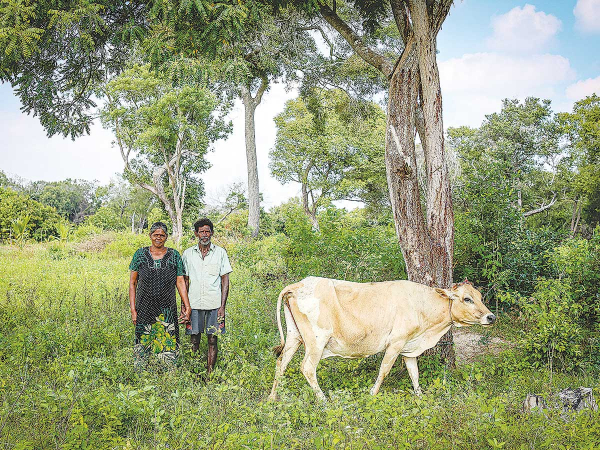
For the first time in their lives, Sri Lankans Nalayini and Chinniah were earning enough money to eat three meals a day and pay for their kids’ education – thanks to one cow and a lot of hard work.
Nalayini and Chinniah, both in their 50s, have overcome more obstacles than most couples do in a lifetime.
They didn’t have an easy life before the civil war in Sri Lanka. They were living in poverty, raising their five children, and were only able to afford one meal a day instead of the usual three.
My husband worked as a labourer in the paddy fields and cut firewood, while I was at home with the children,” says Nalayini.
Life was very difficult…we didn’t have a traditional house with all the furnishings. We lived in a small place made from coconut leaves and slept on a mat on the ground. We would always get wet when it rained. We lived like that for a long time,” she says.
When the civil war started in Sri Lanka, Nalayini and Chinniah with their children fled for their lives. We moved from place to place because the bombs were falling everywhere. We hid in bunkers to protect ourselves. We were convinced we would die.”
The couple managed to make it to one of the camps for displaced people where they stayed for a year.
We were given food and water and other basics, but we couldn’t go anywhere. All we wanted was to go home.”
When the war was over, the family returned to their home village, but they were traumatised.
We were scared all the time. We feared the bombing would start up again—that the whole war would start all over.”
Not only that, when the family returned there was nothing left – home was destroyed and goats and cows were gone.
Nalayini and Chinniah rebuilt their lives step-by-step with determination. They didn’t have any other choice.
At first, we built a kind of makeshift house. After a couple of months, we were able to get some supplies to make our house a little stronger. After three years, we managed to build a sturdy, brick home for our family.”
At the same time, the couple joined Tearfund’s dairy farming programme. They had owned cows before the war and knew the basics of how to care for livestock.
We received a pregnant cow, attended various training sessions on how to care for and raise the cows well so we could increase their milk supply.”
Chaturanga Samarawickrama Courtesy The Daily Mirror
The health sector in the country is now facing a threat of spreading non-communicable diseases and according to the latest records, 64 cancer patients are being detected and 38 patients lose their lives due to cancer every day, Power Minister Dullas Alahapperuma said.
He indicated the vision of ‘Vistas of Prosperity and Splendour’ of the President and while giving priority to localism, a trend has been created to manufacture medicines against cancer.
While drawing the attention of the President, special attention was also drawn to implement a mechanism for early detection of cancers, he said.
Also said that a special proposal in this regard was extended to cabinet ministers.
A total number of 30,000 cancer patients seeking treatment within a year and only 1,600 patients receive treatment.
People in this country are less likely to go abroad for cancer tests and treatment. The Government spends Rs.45,000 on a single cancer patient for importing radioactive drugs from India. If the said drug is manufactured locally, it would cost only Rs. 14,000 per patient.
Most of the main radioactive drugs are imported from India.
Therefore the Government has decided to establish a cyclotron base radioactive drugs centre in the country to minimise the cost and to protect the effectiveness that occurs while importing them.
Sri Lanka on Wednesday (March 31) received a consignment of 600,000 doses of Sinopharm COVID-19 vaccines donated by China.
According to Ada Derana correspondent, a special flight chartered by the national carrier SriLankan Airlines (UL869) carrying the China-made vaccines touched down at the Bandaranaike International Airport (BIA) in Katunayake at around 11.28 am.
The vaccine consignment was ceremonially handed over to President Gotabaya Rajapaksa at the airport premises.
State Ministers Prof. Channa Jayasumana and Dr. Sudarshini Fernandopulle, Ambassador of China to Sri Lanka Qi Zhenhong and several other officials were also present at the airport premises to receive the vaccine stock.
Chinese nationals residing in Sri Lanka are expected to be given priority under the first phase of Sinopharm inoculation drive in the country.
Administration of the Sinopharm jabs to these Chinese nationals will thereby commence next week at four locations; Colombo, Kandy, Puttalam and Hambantota, Chief Epidemiologist Dr. Sudath Samaraweera said.
Sri Lanka on Wednesday (March 31) confirmed another 88 fresh cases of the novel coronavirus in the country as total infections detected within the day reached 244.
This brought the total number of Covid-19 confirmed in the country thus far to 92,706.
According to the Epidemiology Unit, 2,887 patients infected with the virus are currently under medical care at designated hospitals and treatment centres while total recoveries have reached 89,251.
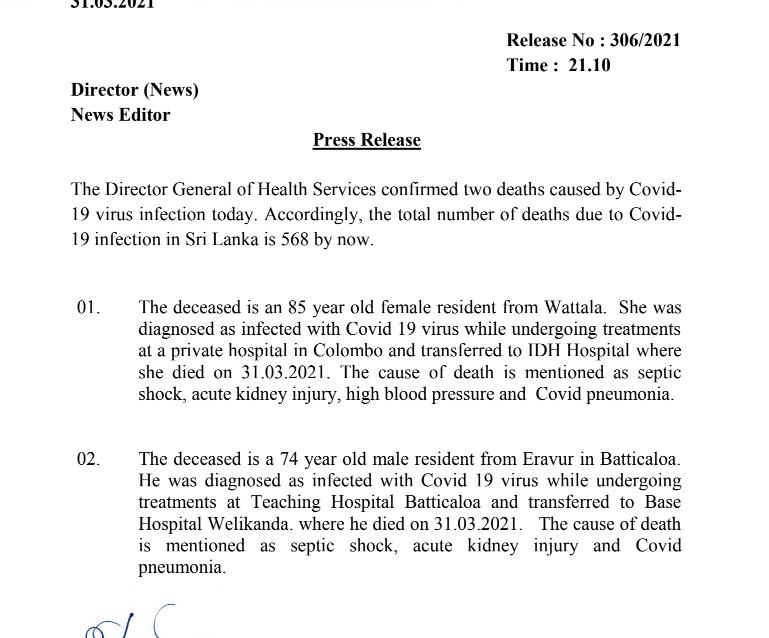
The death toll due to the Covid-19 pandemic in the country stands at 568.
An individual from Chavakachcheri in Jaffna has been arrested on charges of money laundering by hacking into the accounts of banks in the United States.
The 41-year-old has been taken into custody by the officers of Criminal Investigation Department (CID), Police Spokesperson DIG Ajith Rohana said.
Investigators have uncovered that the suspect had hacked into U.S. bank accounts and transferred Rs. 13.4 million to his account in a private bank in Sri Lanka.
The police spokesperson said the suspect’s accomplices are based in the U.S. had aided and abetted him to transfer money from U.S. bank accounts. In return, the suspect had offered a commission to his accomplices.
According to DIG Rohana, since the 20th of April last year, nearly Rs. 140 million had been transferred through similar rackets to local bank account holders based in northern and eastern parts of the country.
In the meantime, nearly 30 suspects who were linked to offences of similar nature were also taken into custody during this period.
The suspect who was apprehended by the Criminal Investigation Department is to be produced before the court under the provisions of Prevention of Money Laundering Act, the police spokesperson said.
Further investigations into the incident are underway, he added.
30th March 2021An invasive water weed has decimated the wildlife and economy of one of Cameroon’s most significant lakes. But a tiny, ravenous weevil could reverse the region’s fortunes.A
A flock of water birds scavenges for insects on the dense, leafy weed that covers much of Lake Ossa, one of Cameroon’s largest lakes. The water weed is so closely packed that it looks like wide, flat green pasture, and the sure-footed birds pick their way freely across it as if they were walking on land.
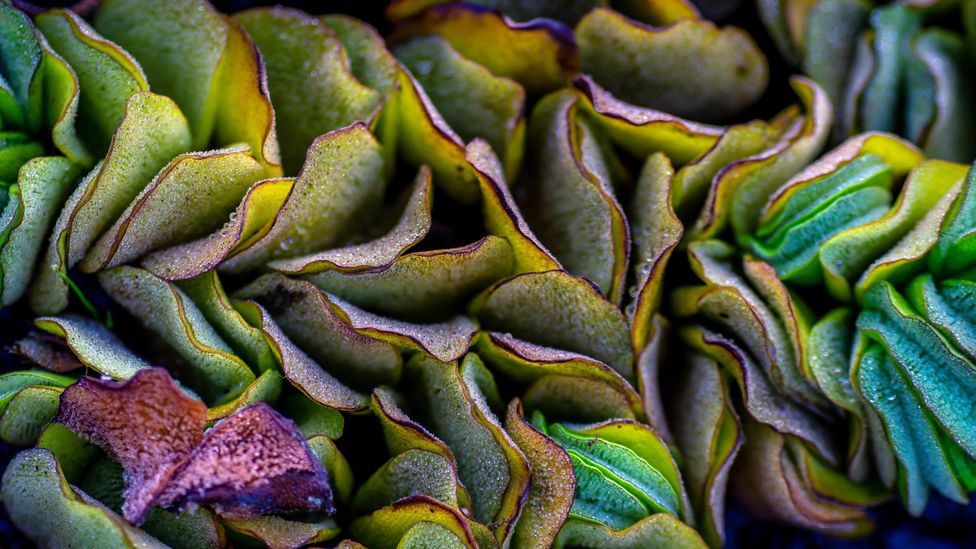
The thick layer of vegetation is Salvinia molesta, a species known locally as kariba weed or simply Salvinia, and it is the cause of this dearth of life in the lake. The invasion has been declared a “conservation emergency” by the IUCN.
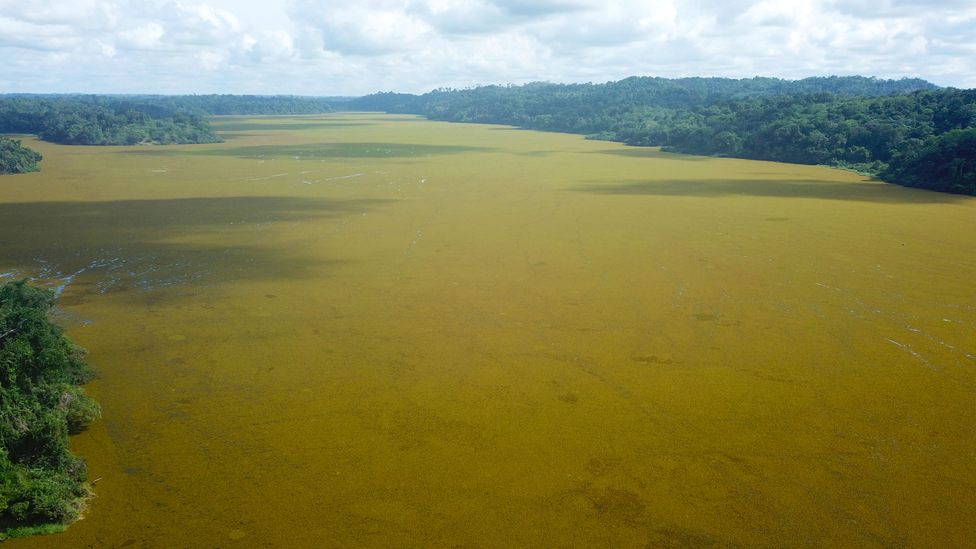
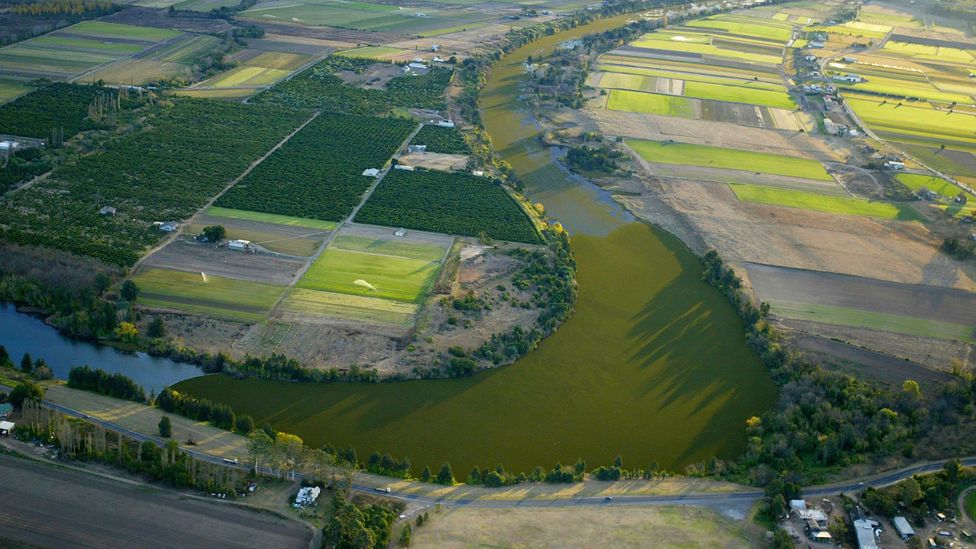
Salvinia, a free-floating, green-brown freshwater fern, has already invaded more than 40% of the lake’s 4,000-hectare (15.4-sq-mile) surface, according to the African Marine Mammal Conservation Organisation (AMMCO), a Cameroonian non-governmental environmental organisation.
Not far from the lake’s shore, an army of weevils is now being mass-reared as a defence against Salvinia
Decimating the lake’s wildlife, and compromising the main source of income for the local population, the Salvinia takeover has been rapid and seemingly unstoppable. Lake Ossa is only one in a long line of freshwater bodies to be engulfed by Salvinia. As this invasive weed has spread around the world, from Brazil and Argentina to Australia, the efforts to control it have struggled to keep pace with the plant’s prolific growth.
But there is hope for Lake Ossa, and it comes in the shape of a small, innocuous-looking but remarkably powerful water-dwelling beetle. Not far from the lake’s shore, an army of weevils is now being mass-reared as a defence against Salvinia.
Lake Ossa is one of the largest lakes in Cameroon, and was home to a wealth of biodiversity before Salvinia arrived (Credit: AMMCO)
Lake Ossa is today littered with weed-laden fishing nets – abandoned by the local fisherfolk out of frustration. Wooden fishing boats have been hauled onto the lake’s shorelines – some have been there so long they are starting to rot. Those local fishermen who are still actively fishing in the lake, and the women who sell the fish caught, say they have lost about 80% of their income.
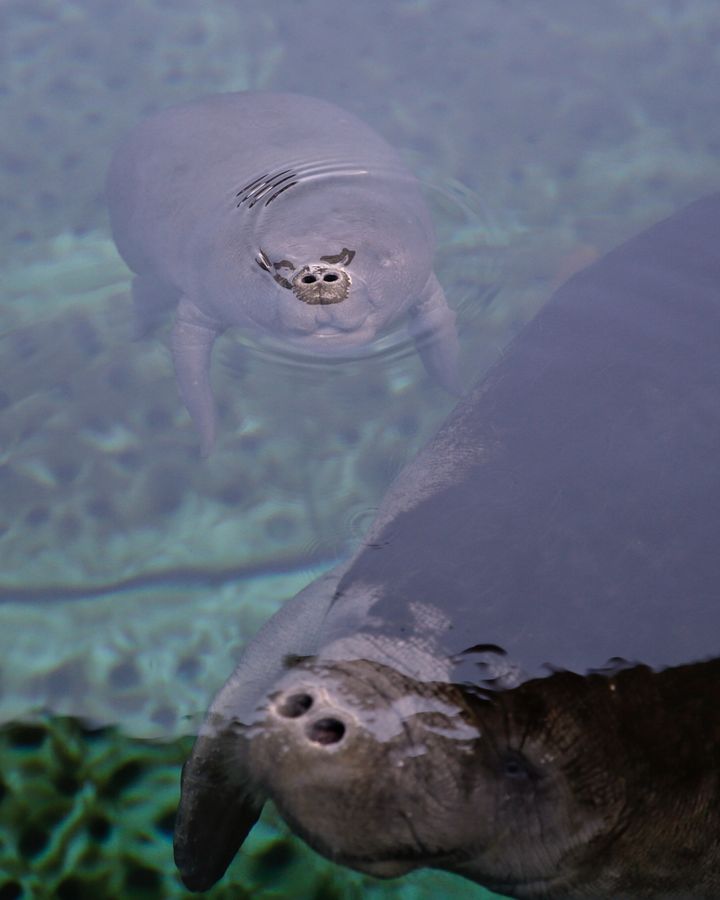
Lake Ossa used to be home to scores of African manatees, one of the most sparsely studied manatee species. Their population in the lake now appears to be declining
In the sweltering late morning heat, I meet Dina Marie-Louise, a fish retailer and resident of the lakeside town of Dizangue, as she disembarks from a wooden fishing boat. In the local business for 22 years, Dina has been visiting fishermen in the lake to buy their catch. Today, she frowns at the few fish in her basket. “Salvinia is killing us,” she says. “Seven of my 12 children have dropped out of school because of financial difficulties caused by Salvinia.”
Roland Ngolle, who has been fishing in the lake for 12 years, paints a similar picture. “We are running out of space to fish in this lake. If nothing is done, Salvinia will engulf all of Lake Ossa,” Ngolle says. “More than 100 fishermen used to visit this lake in a single morning. Today less than five come to fish. Everybody is discouraged.”
As well as fish, Lake Ossa used to be home to scores of African manatees, one of the most sparsely studied manatee species. Their population in the lake now appears to be declining. Many of the manatees are thought to be leaving the lake for its surrounding rivers, where they have better access to food, says Aristide Takoukam Kamla, founder of AMMCO.
The larvae of the Salvinia weevil are highly destructive and can bring a freshwater habtitat back into ecological balance (Credit: Alamy)
Salvinia is native to southern Brazil and northern Argentina, but it can spread between water bodies by wind, water currents, floods, animals and people. “[The] human factor is partly to blame for the presence of the invasive plant in the Cameroon lake,” says Kamla.
As well as physically moving the plant from one place to another, for example when it hitches a ride on boats, human activity is also thought to be responsible for allowing Salvinia to thrive in the lake.
“We noticed a heavy concentration of nutrients such as nitrogen and phosphorous in Lake Ossa in 2016 – doubling from the historical value of 1985,” says Kamla. “This was a signal that something was happening in the lake called eutrophication, which is simply the enrichment of the lake in terms of nutrients.”
That made conditions perfect for Salvinia to proliferate. “The carpet formed by the plant at the surface prevents light from penetrating the water column and therefore reduces photosynthesis of phytoplankton on which most fish species feed,” says Kamla. “This results in a drastic depletion of fish production.”
With a fast-growing plant that can double in size every 10 days, the plant’s growth is almost unstoppable. “The absence of [Salvinia’s] natural enemies in a foreign environment facilitates its fast growth rate,” says Lum Fontem, an independent plant scientist based in Cameroon.
Numbers of the African manatee, pictured here in captivity, are in decline (Credit: Getty Images)
At every strategic corner of the bumpy earth roads around Dizangue, billboards carry messages alerting villagers and visitors to the Salvinia problem. Messages such as “Youths, Let’s Save Lake Ossa”; “Let’s Save Our Lake From Salvinia Invasion” appear on countless signs around the town. This may be Cameroon’s first experience of a Salvinia invasion, but there has already been an intensive response to it.
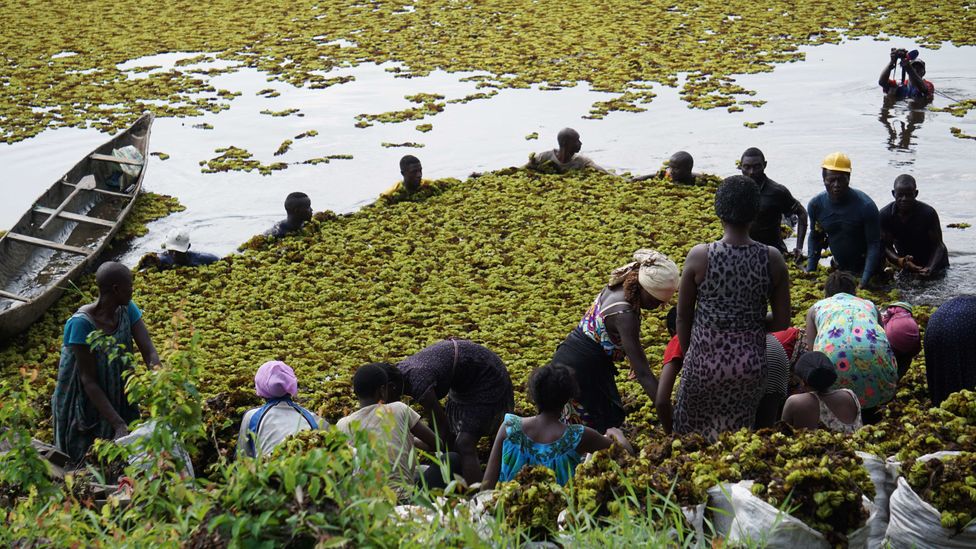
There are three main ways that the weed can be removed. The first, and most physically demanding, is removing it manually. “This includes hand-pulling, mostly for low infestation, and the use of specialised equipment, for high infestation,” says Fontem. “This method is labour-intensive, tedious and time-consuming.”
Since 2019, AMMCO has been mobilising locals to remove the plant manually to reduce the scope of spread. But it has not been without challenges. “This method is very demanding given that the invasive plant multiplies very quickly,” says Kamla. “We removed over 200 tonnes of Salvinia from the lake in 2019 and 2020. Yet, no impact was felt.”
This is because manual removal of Salvinia alone is not enough to control the weed, Lum says. Any plant left in the water will rapidly grow to replenish what has been stripped away.
The second option is chemical control, which involves the application of herbicides to kill the weed. But this comes with its own ecological drawbacks, as the herbicides pose a risk to other plants and could harm the lake’s other organisms. So far, the chemical approach has not been tried at Lake Ossa, and scientists including Fontem caution against trying it.
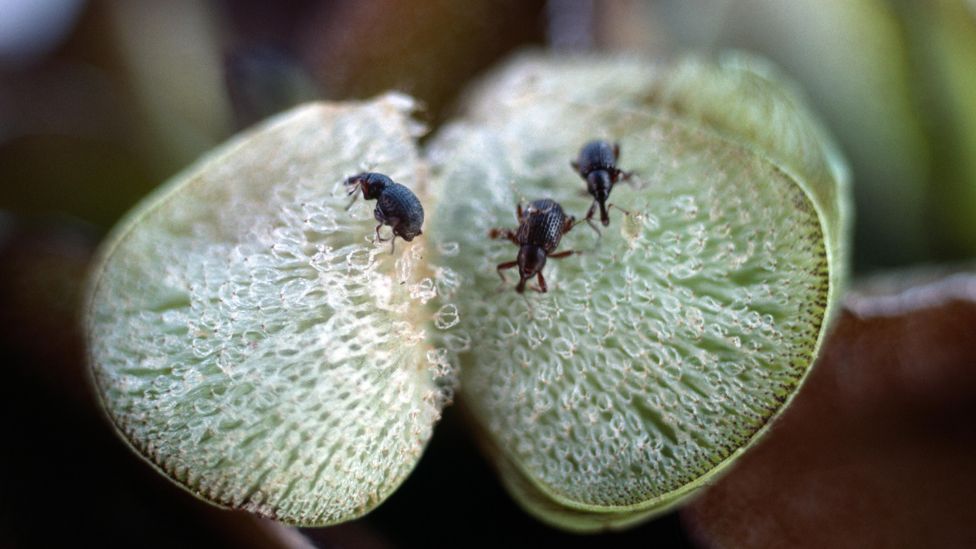
But there is one final option that could relieve Lake Ossa of Salvinia and restore its ecosystem: a small, brown-black water beetle native to Brazil known as the Salvinia weevil, which feeds almost exclusively on the weed. Measuring just 2-3.5mm long in its adult form, this tiny insect is equipped with a long, sturdy snout. But it is the weevil larvae that are devastating to the Salvinia by burrowing into the plant’s rootstalks and causing fatal damage.
Removing Salivinia by hand is very labour intensive, but so far it is the only method that has been attempted at Lake Ossa (Credit: AMMCO)
The Salvinia weevil was discovered by Wendy Forno, a scientist at Australia’s government research agency CSIRO, while carrying out surveys in South America between 1978 and 1982. The first releases of the weevil as a biological agent to destroy Salvinia were at Lake Moondarra, Mount Isa, Australia in 1980, with remarkable success.
“Lake Moondarra is mostly clear of Salvinia today. Fifty thousand tonnes of Salvinia on the lake was killed by weevils over a 400-hectare (1.5-sq-mile) infestation,” says Matthew Purcell, director of the Australian Biological Control Laboratory, a facility run by the United States Department of Agriculture and CSIRO.
“The weevil – both adults and larvae – only feeds on this fern and not on other aquatic plants,” says Purcell. “As the plants increase seasonally, so do the weevils. The weevils [and] Salvinia constantly increase and decrease through the seasons in balance.” The weevils never fully eradicate the weed, but help to “return the system to a balance”, says Purcell.
The weevil was also deployed in the Senegal River in the early 2000s, where it had similar success, says Arnold Pieterse, formerly a senior staff member of the Netherlands’ Royal Tropical Institute, now retired. He, too, underlines that the weevils’ strong preference for Salvinia as a food crop makes it an appealing choice for Salvinia control. “It has irrefutably been proven that the insects do not form any danger to the environment or crops,” says Pieterse.
South Africa, too, has successfully brought Salvinia molesta under control thanks to the release of the weevil into its fresh water systems since 1985. “South Africa had a number of systems infested with the weed throughout the country, mainly smaller impoundments and rivers,” says Julie Coetzee, deputy director and manager of the Aquatic Weed Biocontrol Programme at Rhodes University, South Africa. These waters took between one to three years to clear, depending on the nutrients in the water, and the climate. “We still do have some infestations appearing,” Coetzee says, but “once weevils have been released, we typically get clearing with a season”.
The Salvinia weevil was first tried as a method to control the weed in Australia, where it has also invaded rivers and lakes (Credit: Getty Images)
Though the Salvinia has no defence against the weevil, the weevils themselves have weaknesses. “No drawbacks were experienced initially but nowadays, we have noticed that there are sites where infestations have persisted, particularly in shaded sites,” says Coetzee. “We have also discovered a parasitic alga infecting [the weevil] population.” This alga, called Helicosporidium, reduces the weevil’s ability to reproduce.
Nevertheless, Coetzee is optimistic that weevils could clear Cameroon’s Lake Ossa of Salvinia. “Implementing a biological control programme in Cameroon is the most ecologically friendly, economically sustainable option for control of Salvinia,” she says. “Given the size of the infestation on the lake, it is going to take a while for the control agent populations to build up to sizes that will damage the plants, and cause them to sink. This is not a fast process. Patience is key.”
Purcell, too, is hopeful that the weevils could rejuvenate Lake Ossa. “The weevils should work in Cameroon. Most control is achieved within three years,” he says. “The control lasts indefinitely, much better than spraying which must be reapplied every year and every season, with negative consequences to the aquatic environment.”
It may not be much longer before Lake Ossa becomes the next Salvinia-ridden water body to welcome weevils. A task force involving several of Cameroon’s government ministries has been set up to oversee the eradication of Salvinia in the lake through the release of the weevils.
The local people of Lake Ossa, though, are frustrated at the pace of action. “Fishing is our only source of income. We are running out of patience,” says Jean Pierre Nga, a fisherman. Dora Sih, a fish seller in the business for 25 years, agrees: “Things are not moving.”
But in AMMCO and their partners’ facilities in Dizangue, the stock of weevils is steadily growing. “They will be released into the lake as soon as we receive the authorisation permit from the government,” Kamla says. “And we hope that after two or three years, we will overcome this invasive plant.”
—
The emissions from travel it took to report this story were 41kg CO2, travelling by bus and motorbike. The digital emissions from this story are an estimated 1.2g to 3.6g CO2 per page view. Find out more about how we calculated this figure here.
Colombo, March 30 (Daily Mirror): The human-elephant conflict is a modern phenomenon owning its existence to man’s increasing developmental needs and the expansion of the human population due to improved health and living conditions of people. Pushed by sheer need, if not greed, man has been forcibly intruding into places where elephants once roamed and foraged freely.
Earlier in the pre-industrial developmental era, people and elephants lived in peace and harmony. Elephants were not killed. They were, of course, captured and traded for use as draught animals, in war as mounts for commanders, and as attractions in temple and royal festivals. In the Indic cultures (ie: in India, Nepal and Sri Lanka) and much of South East Asia, elephants were objects of veneration. Indian records show that domestication of elephants dates back to 4,500 BCE. Hannibal, the great Carthaginian General, had crossed the Alps in 218 BCE using elephants as transport.
However, ivory hunting in Africa and the expansion of populations in Asia virtually ended domestication of elephants. Elimination of elephants began either for profit or to acquire and protect property in their natural habitat. In Sri Lanka, the opening up of new lands for cultivation by post-independence governments led to human-elephant conflicts, which in turn, led to mounting deaths on both sides of the divide.
New Awakening
In August 2020, Sri Lankan President Gotabaya Rajapaksa told Wildlife Department officials that 122 human lives were lost and 407 elephants were killed due to the intrusion of elephants into villages in 2019. He pointed out that it was the responsibility of the Department of Wildlife to feed wild animals which live in 1.2 million hectares under the department’s control. He gave officials two years’ time to end the human-elephant conflict, pointing out that the problem has persisted despite talking about it incessantly for 40 years.
Elephant conservationists could not agree more. Their grievance is that their blueprint for conservation and harmonious human-elephant relations submitted to the government in December 2020, is gathering dust on a shelf. They feel that a solution is possible because it has been found that elephants in Sri Lanka do not migrate long distances but live in around 20,000 hectares.
Presently, Sri Lanka has the highest casualty rate in the human-elephant conflict in the world according to Dr. Sumith Pilapitiya, former Director-General of the Wildlife Department. But despite the constant killings, Sri Lanka still has around 7,500 elephants according to the BBC. Elephant density is the highest in Sri Lanka. But about 70% of the elephants live outside the officially Protected Areas (PAs), and thus are a source of conflict with humans. In fact, 85% of elephant deaths are due to clashes with humans.
According to a report in The Island, every year, between 2011 and 2020, 272 elephants had died on an average. In 2020, the toll had hit 407.
The average human death rate due to the human-elephant conflict was 71 between 2005 and 2010 and 54 between 1992 and 2001. The human death rate had increased by about 14% from the previous decade and by about 50% in comparison to the past two decades. The number of human deaths in this connection had spiked to 112 in 2020, a sharp increase. Interestingly, in India, more humans and fewer elephants die in such conflicts. The annual human death number in India is 400 as against 100 elephant deaths.
Writing in Frontiers in Ecology and Evolution, Matt W. Hayward of the University of Newcastle, Australia, says that elephants consume up to 150 kg of forage and 190 litres of water daily. Meeting these basic needs requires a large foraging area to provide a variety of grasses, shrubs, tree leaves, roots, and fruits. A typical family of elephants (5–20) has a home range size of 100 to 1,000 sq. km.
Hayward says that left to themselves, elephants enrich the environment by dispersing seeds over a wide area. There is therefore a requirement to maintain a healthy population of elephants, he argues.
Establishing ecological corridors is one way of approaching the human-elephant conflict. But development and infrastructure expansion in or surrounding elephant habitats are generally executed without concern for their ecological impact. This results in conflicts.
Electric fences, Trenches and Noises
Physical exclusion methods such as electric fences and trenches are commonly used to deter elephants from entering farmland and human settlements. But the cost of construction of these hurdles and their long-term maintenance is heavy. Interestingly, studies in Africa show that once elephants learn that their tusks do not conduct electricity, they use their tusks to break an enclosing electric fence! Physical barriers also negatively affect movement necessary for the elephants’ survival.
Making noises to frighten the elephant is another technique that is adopted. But some studies show that elephants quickly learn to tolerate these sounds and raid farms. Maintaining sound systems also present logistical challenges in remote areas, although the method is 65 to 100% effective. Recent studies in Africa show promising results for bio-acoustic methods such as using beehive fences to deter elephants. Beekeeping is also an income generator for farmers.
Early Warning Systems and Relocation
Early warning systems including placement of detectors are also used. But these require internet connectivity or network coverage to transfer alerts to farmers, which limits the practicality of infrasonic receivers in remote areas. Scientists can also put a radio collar on an elephant and trace its movements to warn farmers.
Removal or relocation of elephants is another method used to keep their movements in check. But elephants have a way of coming back to their homes – their original habitat, reports Malaka Rodrigo on the website www.mongabay.com. He reports that an elephant named Homey”, which was GPS collard in 2006 walked back home from Yala National Park’s Block II where it was relocated. It was then relocated to Udawalawe but came back. It was then dispatched to Maduru Oya. It tried to come back from there too but was shot dead on the way. Elephants detest relocation.
Agricultural Deterrents
Agriculture-based deterrents have proved useful. Chili-grease covered fences have proved to be effective to an extent. But this technique is expensive. Another agriculture-based deterrent involves interspersing commonly raided crops with crops that are less attractive or palatable to elephants. In addition to serving as repellents, these alternative crops, such as chamomile, coriander, mint, ginger, onion, garlic, lemongrass, and orange, can economically benefit farmers.
Sri Lanka Wildlife Conservation Society (SLWCS) has the Project Orange Elephant. Elephants do not like citrus fruits of any kind. They will not approach a home or garden, no matter how food-filled it is if it means passing through a row of citrus trees. So the Project Orange Elephant’s goal is to get as many local farmers as possible to plant orange trees around their home gardens to create a soft buffer and deter invading elephants. According to www.treehugger.com since its inception in 2006, 17,500 orange trees have been planted and the goal is to reach 50,000 by 2025.
In the Hambantota District, the project uses a variety of grafted local orange (Citrus sinensis) known as Bibile Sweet that had been developed in Sri Lanka to suit local climatic conditions. This variety grows well in marginalised land and does not need frequent irrigation. It bears fruit within 1.5 to 3 years. Each tree can provide from 300 to 600 fruits per season. Each tree has a fruiting cycle of two seasons per year. Bibile Sweet is a high-quality fruit known for its fresh sweetness, value-added products, and has good market demand. By planting these trees alongside their crops, particularly in the border areas adjacent to elephant habitats, crop-raiding by elephants can be reduced, while also supplementing farmers’ income.
Saving Elephants by Helping People” is the underlying and overlying philosophy as well as the goal and objective of the Sri Lanka Wildlife Conservation Society’s efforts to develop holistic and sustainable measures to mitigate the Human-Elephant Conflict in Sri Lanka.
Colombo, March 30 (Daily Mirror) – Sri Lanka’s High Commissioner-designate to India, Milinda Moragoda, is yet to travel to New Delhi despite India approving his appointment during the latter part of last year. His office says he will leave soon but with no confirmation of a date.
Sri Lanka and India have already gone through some diplomatic turmoil in recent months with the government refusing to hand over the East Container Terminal (ECT) to an Indian company, instead nominating the Western Container Terminal, then India abstaining from voting at the UN Human Rights Council (UNHRC) resolution on Sri Lanka last week and releasing a strong statement on Tamil issues in the island and now the latest issue of Indian fishermen poaching in Sri Lankan waters heating up once again.
When contacted, Moragoda’s Office confirmed that he will leave to take up his post to New Delhi soon but was unable to say when. An official said preparations were being made for him to leave for Delhi.
Moragoda was not available for a direct comment.
Speculation was rife months ago that Moragoda may be reluctant to take up his position as India had expressed some concerns over his cabinet rank. However the Daily Mirror learns that by the end of last year India had issued the clearance for Moragoda to be welcomed as Sri Lanka’s High Commissioner in New Delhi and with Indian officials maintaining to this date that his cabinet rank was more applicable to Sri Lanka than for New Delhi.
What we heard is this position would come into effect more when he is in Sri Lanka for diplomatic work and to communicate with the Sri Lankan government,” a senior Indian official said.
Moragoda was personally appointed to the post by President Gotabaya Rajapaksa. (Jamila Husain)
Colombo, March 28: The international community, harping on war crimes allegedly committed in Sri Lanka has done the exact opposite of promoting national reconciliation.
While wars, atrocities and human rights violations in many guises continue in the rest of the world where the perpetrators are often powerful nations, millions of dollars have been raised the world over for lobbying and justifying the UN Resolution on Sri Lanka.
Now, the UNHRC is seeking US$ 2.8 million to set up an office to put together information about the so-called war crimes committed here. All this is money that could have been used for the Tamil people in Sri Lanka towards re-shaping their lives.
For the country to move ahead, there is a need for the Tamil Diaspora, now foreign citizens who hardly visit this country but who are lobbyists for the Resolution, to understand the ground realities. Unbiased assistance by the international community would have gone a long way for Sri Lanka to develop genuine reconciliation and peace-building.
All that the UN Resolution on Sri Lanka may do is further divide the people of the country, increase feelings of suspicion and hate while taking the country away from economic, political and social stability and provide ample opportunities for diverse local and international segments to exploit the country’s quest for national unity to serve their diabolical interest.
UN and its effectiveness
With regard to the UN and its effectiveness, there seems to be scant introspection as it enters its 76th year of existence. Some describe the UN as a failed entity, conceptualized and created for the purpose of controlling the non-Western world for resources, human and material.
The intent to form a UN was first declared in 1942 and further discussed in 1943 where ‘a general international organization based on the sovereign equality of all nations’ was agreed upon. In 1944, the post war Charter for ‘collective security’ was mooted. By June 1945, deliberations for a Charter of the United Nations were completed and on July 28, the US which played a major role in the creation of this organization, approved the UN Charter.
Days later, on August 6 and 9, 1945, the United States dropped two atomic bombs over Hiroshima and Nagasaki killing over 200,000 persons and maiming thousands of others (and future generations) for life. The UN with aims for a world that valued human rights came into formal ratified existence two months later, on October 24, 1945.
The international community, however, seems to think, selectively, that certain wars are tea parties; sans the death, the misery and the carnage but others bristle with war crimes and atrocities.
UN Stance
Will the UNHRC resolution against Sri Lanka be a magic wand that will enable justice that the Tamil people? Did they expect justice from the LTTE which tortured and killed anyone who opposed them, insisted on taxes from the Tamil people, recruited children, coerced youth to become human bombs and butchered Sinhala civilians, shot at Tamil civilians who were fleeing for their lives in the last stage of the fighting and drove out Muslims from their homes in North Sri Lanka?
Will this resolution promote any progressive step, like dedicating the month of May to unity, understanding and peace – something Lanka so desperately needs to bring about an honest locally driven discourse between different stakeholders, such as Tamil civilians, Sinhala and Muslim civilians and different political and civilian players.
How will the average life of the Tamil people in the North and the East of Lanka; those without wealthy diaspora relatives and those who are marginalized such as former rehabilitated LTTE cadres, improve as a result of the UN Resolution?
Do these foreign-based persons who created the stage for the resolution to be passed, care about the ensuing danger of the Sri Lankan economy through possible sanctions which would finally be borne by the most vulnerable of its populations, such as Tamil civilians of the North-East?
Much effort has been taken by the Board of Investment (BOI) through the Jaffna office and Tamil officials there to usher in industrial projects during the past 12 years in Jaffna, Killinochchi and Mullaitivu providing jobs for Lankan Tamils of the North East.
The international community had 12 years in which they could have encouraged the Tamil Diaspora to invest in projects that will benefit the Lankan Tamil people, instead of veering off in the opposite direction. During one of the floods that struck the North a few years ago, a Sinhala philanthropist who runs a charity organization was distributing dry rations as well as other goods in the area, quipped that he could not get the Tamil Diaspora to contribute ‘even a single mosquito net.’
Local mechanisms
Sri Lanka needs trust building between communities. Every ounce of strength has to be mustered by Sinhala, Tamil and Muslim intellectuals, politicians and all others in the society at large, including the police and the Security Forces, to represent the wellbeing of the people and country, giving national harmony utmost priority. Each human being should be an ambassador of peace.
The country should seek peace, fairness and unity because these are assets for stability of a nation and not seek them because the UN or the West wants us to. Sri Lanka should implement local mechanisms locally proposed for justice and uphold the law for national unity.
Sri Lanka has done the groundwork and produced objective reports, such as the Maxwell Paranagama Commission report on Inquiry into complaints of abductions and disappearances and the Lessons Learnt and Reconciliation Commission in Sri Lanka which held regular hearings in Colombo and the North and the East. These Commissions of Inquiries were the result of an independent initiative of the then Lankan government. It is imperative that all of its recommendations are carried out for the good of the citizens of the country.
These recommendations covered a vast realm from media freedom, societal freedom and the practical implementation of justice within the context of battling terrorism, including steps to be taken on matters relating to missing persons (Tamils – mostly LTTE cadres and the Sinhalese military personnel).
International community
Most of these recommendations by the LLRC and the Paranagama commission have been hailed by many Lankan intellectuals irrespective of political affiliations, as just and progressive.
If there have been aberrations justice should prevail as recommended. We should never give any Sri Lankan citizen, ever, whether it be Sinhalese, Tamil or Muslim any need whatsoever, reasons to complain to foreign nations about issues faced by them. Any citizen should feel safe complaining to his or her government, whether that citizen voted for it or not.
With regard to foreign countries telling Sri Lanka what should be done within the country, maybe Sri Lanka too can encourage nations such as America, to look into the human rights of its people, beginning with the original people of that land – the Native Americans as well as Black Americans, so that people do not get killed in broad daylight, like George Floyd was. This will need some serious researching so that any advice to another country on human rights should be aimed at unifying the diverse people of that country and not the reverse which will only encourage destabilization of a nation.
If the international community had been serious about unifying the people of Sri Lanka during the past 12 years, one of the first things it could have done is to encourage the Tamil Diaspora to see the importance of this unity forged through peace, inter-ethnic discussions, empathy and development. This may have changed the status quo.
The Diaspora is seen as a constant threat. The use of LTTE flags by the Tamil Diaspora during their protests against the Lankan Government show that they are not neutral but supporting a terrorist group that many of the Western countries had proscribed. Many Tamils may have forgotten the life under the LTTE. The documentary film Demons in Paradise” by Lankan Tamil Jude Rutnam speaks of certain aspects of these realities, beginning with the darkest scar on Lanka, the 1983 riots which should never have occurred. It led to the rise of the master of terror, Velupillai Prabhakaran.
Any Tamil citizen who has lived under the LTTE or any unbiased human rights activist would be able to come up with countless stories of how lands of Tamil citizens were confiscated by the LTTE, often for not paying up what was euphemistically called ‘taxes’ but was in reality extortion.
Everyday issues
No Tamil businessman, either in the North or the East or in Colombo or abroad, was free of the long arm of the LTTE money collectors. The response to not contributing as demanded could be lethal. The killings of hundreds of other Tamils – Tamil intellectuals, such as Rajani Thiranagama and Neelan Thiruchelvam and scores of members of rival militant groups, the forced recruitment of children for terrorism, the butchering of Sinhala villagers in the night are some of the acts of the LTTE.
It is possible for a Diaspora member to dismiss these writings as those of a biased Sinhalese. However, what I am writing is not theatrics. I could write tomes on what the Tamil people went through under the LTTE because I have visited these areas independently countless times from the time of the peace process to date in connection with my work in the media, research and capacity building. My interest in comparative spirituality and national heritage has involved countless visits to the North and the East.
Because I am familiar with the everyday issues of the North, I am aware of the kind of exploitation that goes on there. Wealthy Tamil men of Lankan origin who are now holding foreign passports visit the country for short spans time and lure these women with false promises of marriage. Do human rights activists and the Tamil Diaspora know the number of children born to young North East mothers through these liaisons? Mothers are now helpless, abandoned and culturally ostracized.
It is a senior Tamil government official who gave me the information in detail. This person; a Tamil who has held high ranking government positions based in the North during the last phase of the battle against terrorism, had been frank. These comments were thought of as being ‘traitorous’ to the LTTE to the extent that the social media used by the Tamil Diaspora had denounced this Lankan Tamil using the worst possible foul language, resulting in the traumatizing his children and other family members who were studying abroad.
On the question of the numbers of missing Tamil persons (those also referred to as the disappeared), this Tamil official explained how many parents did not know at the last phase of the fighting in 2009, whether their children who had joined the LTTE were living or dead. They did not know the locations of LTTE camps which kept shifting in the last stage of the battle. Every parent imagined that his or her child escaped alive.
Also described was how large graves were dug daily for hundreds of bodies to be buried during the last lap of fighting. ‘Naturally, the parents were unaware of these developments as they were not eye witnesses. To date, they think that their children were alive on May 18 when the hostilities ceased.
Disappeared
A young girl, an LTTE child recruit who was about 22 years when I interviewed her about five years ago, shuddered when she explained that she too could have been classified as one of the ‘disappeared’ if the LTTE cadre who was carrying her to safety listened to her and left her to die in the jungles. She could have died and animals would have eaten her and there would not be definite proof she was dead. She would be categorized as ‘missing’ by her relatives.
Justice and compassion when it is selective can be sour. Last week, this writer highlighted how Thamilini, the head of the LTTE’s women political wing division who surrendered to the military along with many others, faced difficulty in getting international agencies to give her the same amount of importance as they did to other LTTE members caught in the last phase of the battle.
A well known Sri Lankan Tamil lawyer retorted to Thamilini’s appeal for legal assistance by saying he would be only able to represent her case if she pays him the usual feels charged! Thamilini was finally assisted free of charge by a Sinhala Marxist oriented lawyer, with another Tamil lawyer later supporting them.
There are hundreds of rehabilitated LTTE cadres who cannot get jobs in the North, obstructed by issues such as caste. The LTTE saga can be analyzed in the context of caste, money and class. Lankan Tamils who had the benefit of so-called high caste, money, class and international connections went abroad and supported the battle in the North. The Sri Lankan Tamils who had none of it stayed here and fought. A Tamil commentator once described the Tamil Diaspora’s role as being akin to a spectator ‘paying the ticket’ to watch a war movie. Interestingly, the most vociferous defenders of the LTTE I have heard were those who never lived under them.
Epitome of evil
If the aim of the UN Resolution is justice, this cannot be sought by abnormally sainting one side who spearhead the violence and arbitrarily, making the other which countered it as the epitome of evil.
One cannot talk of alleged civilian deaths by the Security Forces when combatting the Tamil Tigers and be silent on the constant strategy adopted by the LTTE in positioning themselves within large groups of civilians, especially children – a strategy that was increased towards the last days where they dragged children and orphans wherever they set up fighting positions so that they could claim that the air-force was bombing schools and orphanages.
It is time Sri Lankans began creating an active and honest mechanism of dealing with internal issues pertaining to the concerns of our people – Lankans can no longer leave the rights of their people to the impaired judgment of the international community. It is time they realized that every single citizen and their grievance – whatever it is – should be looked into – with honest determination – within this nation – which is a sovereign nation that needs no foreign entity telling us what to do.
Honest determination in doing this will be the defining factor for Sri Lankans. Every human life lost in the past 30 years and before as part of violence was a valuable human resource that could have been used for the betterment of the country if the circumstances were different.
We can take a cue from the man who transformed the fishing village in Singapore and made it one of the richest places in the world. Lee Kuan Yew’s miracle was achieved by carefully drawing up a national framework where no civilian gets trapped in violence. He has maintained Singapore’s national sovereignty, economic independence and the wellbeing and dignity of all of its people.
BEIJING, March 29 (Xinhua) — Chinese President Xi Jinping said Monday that China stands ready to work with Sri Lanka to boost bilateral cooperation and provide robust impetus for the latter’s post-pandemic economic recovery and sustainable development.
In a telephone conversation with Sri Lankan President Gotabaya Rajapaksa, Xi suggested that the two countries steadily push forward major projects like the Colombo Port City and the Hambantota Port, and promote high-quality collaboration in jointly building the Belt and Road.
Xi pointed out that since the onset of the COVID-19 pandemic, China and Sri Lanka have pulled together and helped each other, writing a new chapter of China-Sri Lanka friendship.
China attaches great importance to the development of bilateral ties, and stands ready to work with Sri Lanka to determine the strategic direction and achieve steady growth of their relationship, he added.
China will continue to provide as much assistance as its capacity allows for Sri Lanka’s fight against COVID-19, he said, also suggesting that the two sides seek to gradually carry out cooperation in fields like aviation and education while keeping epidemic control measures in place, and continuously explore new channels and areas of collaboration.
Stressing that China and Sri Lanka are strategic cooperative partners that enjoy sincere mutual assistance and ever-lasting friendship, Xi said China will never forget Sri Lanka’s valuable support for the restoration of its lawful seat in the United Nations.
China, he added, is willing to make continuous joint efforts with Sri Lanka to firmly support each other on issues concerning their respective core interests, defend their legitimate rights, promote international equity and justice, and safeguard the common interests of developing countries.
For his part, Gotabaya said that Sri Lanka warmly congratulates the Communist Party of China (CPC) on the 100th anniversary of its founding and highly appreciates the historic achievements made by the CPC.
Particularly, under President Xi’s strong leadership, China has made great achievements in economic development and the fight against COVID-19, he added.
Sri Lanka, he said, thanks China for its valuable support, and is willing to collaborate closely with China to firmly support each other’s positions on issues concerning their respective core interests and safeguard their common interests.
He added that Sri Lanka hopes to learn from the CPC’s experience in governing the country, and especially looks forward to strengthening exchanges and cooperation on poverty alleviation and the rural vitalization strategy.
The Sri Lankan side is willing to work with China to expand cooperation in fields like infrastructure and tourism, and smoothly advance major projects such as the Colombo Port City, he said, adding that he is confident that these efforts will boost his country’s economic and social development and bring the Sri Lankan people more benefits.(Web editor: Guo Wenrui, Liang Jun)
Breakfast is considered by many to be the most important meal of the day. What you eat in the morning replenishes those sleep jaded energy reserves and fuels your mind and body for the day ahead.
Unfortunately, as our lives become increasingly busy, many of us opt to skip or skimp on breakfast and the traditions and culture that go with it. Modern Western options such as cereals, toast or even granola bars now rule many a breakfast roost.More from AsiaOneRead the condensed version of this story, and other top stories with NewsLite.
Morning dining routines around the world often stem from deep roots. Breakfast culture is alive and kicking in many parts of Asia, even as fast-paced Western alternatives muscle their way in.
Being such a huge and varied continent, Asia is home to culinary and cultural extremes, richly reflected in its choices and attitudes towards breakfast.
1. Turkish delights
Many nations claim to have the best breakfast, but when it comes to traditional morning meals, you would be hard-pressed to upstage the sumptuous Turkish spread.
Straddling the ancient Silk Road has greatly influenced Turkish cuisine, and particularly its breakfast choices. Over about 600 years, it has gradually evolved to embrace elements and ingredients from the distant reaches of historical trade routes and the far corners of the Ottoman Empire (1299 – 1922).
The traditional Turkish breakfast, known as kahvalti (meaning before coffee”), is made up of tapas-sized dishes, and is designed to be shared, bringing together families and friends for a slow easing into the day.
Most modern Turks lead busy lives and often breakfast on a simple simit (a bagel-like hoop of bread covered in sesame seeds), observing the traditional kahvaltionly at weekends and family get-togethers.
Breads, ripened tomatoes, cucumber, fruits, olives, several cheeses, cured meats, eggs, honey, jams and copious amounts of strong Turkish tea are laid out like a banquet fit for a sultan.
You’re unlikely to ever see exactly the same make-up of a Turkish breakfast twice, as each is dependent on available and preferred ingredients.
The kahvalti is decadent and healthy in equally copious measures, and once experienced it’s never forgotten.
2. Top hoppers
PHOTO: Instagram/food_n_love
Heading east towards South Asia, flatbreads and pancakes gradually find their way onto breakfast tables.
A couple of the more unusual breakfast treats are Sri Lankan hoppers (appam) and string hoppers (idiyappam). The origins of hoppers are unclear, although they are believed to have arrived in southern India almost 2,000 years ago with either early Syrian Christian or Jewish settlers.
Hoppers are made from fermented rice flour and coconut milk, which is mixed into a batter and fried in a bowl-shaped pan. An egg is added and softly cooked to finish the crispy bowl-shaped hopper, which is served with sambal (spicy coconut chilli sauce) or curry sauce.
String hoppers are made by mixing rice flour with salt and water and then pressing the dough into noodles, which are knitted together to make small cakes and steamed. The dish is usually served with fresh coconut and curry or sambal.
Both styles of hopper are synonymous with breakfast in Sri Lanka but are also popular in South India and are eaten too at other times of the day.
3. Fusion frenzy
PHOTO: Pixabay
Tracking with the trade winds along the old spice routes brings us to Malaysia, which is perhaps Asia’s greatest culinary melting pot. With bread and dairy produce blending into rice and spice, Malaysians proudly and regularly breakfast on what can be termed their national dish, nasi lemak, and national bread, roti canai.
Fragrant rice (nasi) is cooked in coconut milk with pandan leaves to give it a rich, creamy texture. Traditionally it comes with a hard-boiled egg, anchovies, peanuts, sambal and a side of rich rendang curry (usually beef or chicken), although there are many other variants.
Its origins are unclear, but nasi lemak wrapped in banana leaf in a triangular-shaped package can be found on most morning restaurant tables and at the top of most Malaysian five-star hotel breakfast menus.
The mighty roti canai is another fusion wonder. Early Tamil immigrants discovered that a dough of maida flour, oil and water, swirled around like a pizza base and cooked on a lightly oiled hotplate, then folded, could build in pockets of air.
This process gives the pancake-like bread a crispy yet soft and chewy texture.
The roti is ideally torn apart and dipped in dhal for the perfect simple breakfast. Some diners choose to add ingredients such as an egg (roti telur), a banana (roti pisang), ghee and sugar (roti boom) or even Milo (roti chocolate).
4. Baguettes at dawn
PHOTO: Unsplash
Colonial influences also reflect on the breakfast tables of Vietnam and Laos. Both were once part of French Indochina and inherited the baguette from their former colonial rulers.
The fast food” breakfast of choice in Vietnam is the banh mi, a small baguette that must rank as one of the world’s best sandwiches, sold on stalls across the country.
This Franco-Viet taste bomb came around in late 1950s Saigon, when Vietnam was sliced in half. This was when the Vietnamese were first officially permitted to modify French cuisine, and so Mr and Mrs Le – refugees from the north – decided to add local ingredients to their morning baguettes.Read AlsoTravel through Southeast Asia by dining at these 10 restaurants
The Le family still have a restaurant, called Banh Mi Hoa Ma, serving sandwiches to the people of Saigon (now Ho Chi Minh City).
A typical Vietnamese banh mi might include local ingredients such as cha lua (pork sausage), coriander leaf, cucumber, pickled carrots and pickled daikon combined with French condiments such as pâté and mayonnaise. Added extras may include chopped meat, cheese, eggs and spicy sauces.
Across the border, you’ll find the near identical Laos sandwich.
Pho and bun bo Hue noodle soups are also popular breakfast dishes in Vietnam, while khao soi (flat noodles, ground pork, fresh herbs and vegetables with chilli in a soup) hits the spot for breakfast – and almost any other time of the day – in Laos.
5. Congee convenience
Variations on congee rice porridge are served as a breakfast staple in most of Southeast Asia. In Thailand, the most popular is jok (pronounced joke”), which has a thick, fine consistency.
Minced pork balls and chicken are the meats of choice for most jok eaters, along with an egg and a garnish of ground chilli, coriander and shaved ginger.
The exact origins of jok and regional variations are unclear, although rice porridge in China has been documented as far back as the Zhou dynasty, in 1000BC.
6. Miso-a-gogo
PHOTO: Unsplash
For the most pungent breakfasts, head to Japan. The traditional repast to greet the rising sun is based on several key dishes and is designed to be both healthy and stimulate all five senses. It is the kind of meal you would consider eating at other times of the day, too.
Steamed rice, miso soup (based on fermented soy bean), grilled fish, tsukemono (preserved vegetables and herbs) and omelette are all popular components, although the list of ingredients varies.
Even though travel is not possible right now, you could always kick-start the day by taking your taste buds on a sensory journey around Asia’s finest breakfast tables.
Colombo, Mar 30 (Prensa Latina) Sri Lanka will install seven thousand rural solar plants in an equal number of villages within the framework of a program under the name ‘Electricity for All’, according to the press. The Minister of State for the Development of Solar, Wind and Power Grid Generation Projects, Duminda Dissanayake, explained to the Daily News newspaper the new trends in the field of renewable energy development in the country.
750 megawatts (MW) are intended to be added to the national grid from these emerging facilities, the source said.
Referring to the Electricity for All program, Dissanayake said that there are around 99,675 homes without electricity and they expect to provide the service to the 33,360 families most in need.
He also pointed out that a program to supply rooftop solar panels to 100,000 beneficiary families is under way.
Narrator: Ceylon cinnamon is native to just one region of the world, and producing it requires hours of delicate work. Even the most skilled workers can make only a few pounds of quills a day. One pound of cinnamon quills can cost $27, but not all spices labeled cinnamon are the Ceylon variety. Many in the Western market are actually cheaper types of cinnamon called cassia. So what makes Ceylon cinnamon so favorable? And why is it so expensive?
Ceylon cinnamon is named after the old British name for Sri Lanka, and it is often considered “real” cinnamon. It is made from the dried inner bark of a tree called Cinnamomum verum. Growing these trees is an investment. Farmers must wait four years after a tree is planted before they can begin harvesting. At harvest, workers break down the branches early in the morning, when the bark is still moist. Ruwanpura must continuously care for the trees throughout the year, otherwise the branches won’t be suitable for making cinnamon at all. The rigorous nature of this job has only just begun.
Now peelers must do the delicate and essential work of stripping the inner bark of each branch by hand. This is the most labor-intensive part of the process, and it’s not as easy as simply shaving the outside of the bark as you would the skin from a potato. To produce the most valuable cinnamon, the bark must be made extremely thin. The thinner the quills are, the more costly they will be. Ruwanpura has spent 40 years mastering this skill. Soon after the bark is removed, each piece dries under the sun and curls up within a few minutes. After drying, the small pieces are stuffed inside a straight piece of bark, forming one 42-inch quill. By the end of a long day, workers will have only produced about 3 pounds of quills. Those then need to dry for three to four days before they’re packed into bales and sent off to a separate facility. That’s where there’ll be graded and officially priced based on their width.
PDRomanis and Sons buys bales of cinnamon from various peelers. At its facility, quills are graded over 10 scales. The most valuable quills are classified as Alba. It takes a peeler four times longer to produce one kilogram of Alba than to produce the same quantity of lower grades. The leftover, smaller cuts are turned into ground cinnamon and make up the cheapest form. But even the most valuable quills are often confused with a more widely accessible and cheaper variety of cinnamon.
Cassia comes from another kind of cinnamon tree, called Cinnamomum cassia, and it doesn’t require as much time or effort to make. Cassia bark is hard and sturdy, so quills are made as one curled piece of bark without the fillings. Ceylon cinnamon, on the other hand, is tender and soft and needs those inner layers to prevent the quill from breaking. Cassia is very fragrant and brown, whereas real cinnamon is paler, with a milder flavor. Cassia also contains, on average, higher levels of coumarin, an organic compound that can cause liver damage if consumed in large amounts. This is why researchers say Ceylon cinnamon is ultimately the healthier option. But if you’re buying cinnamon in the US, it can be hard to tell the difference between them.
Part of the confusion between the two comes from the use of the label cinnamon. In the US, it is legal to label both Ceylon and cassia cinnamon as cinnamon, while in the UK and other countries, cassia must be labeled cassia and cannot be classified simply as cinnamon. Regardless of what it’s called in the US, consumers worldwide prefer the real thing. In 2018, Ceylon cinnamon accounted for more global revenue than any other variety. And even as demand is expected to grow through 2025, climate change already poses a serious threat to cinnamon production. In recent years, Sri Lanka has experienced droughts over several months. And these long periods of dry weather can kill cinnamon trees, which need marshy, wet soil to survive. There’s also a shortage of cinnamon peelers, another threat to production that’s likely to drive up prices. This industry relies on experienced peelers who can practice the difficult work of making these quills over many years.
The separatist politician Gajendrakumar Ponnambalam who is supported by the remnants of the LTTE international network is active again. After having masked the horrendous human rights atrocities committed by the LTTE, Gajendrakumar Ponnambalam has started to masquerade as a human rights activist. Gajendrakumar Ponnambalam has written to the German Government using Sri Lanka Parliamentary stationary. Terrorist supporters have historically exploited the free education, other opportunities and privileges the country has offered them, to attack the very country. They receive the security of the State such as security guards, but attack the very Security Forces that restored stability and security for all.
The campaign of Gajendrakumar Ponnambalam was funded by the LTTE fronts. The most respected Tamil journalist D.B. Jeyaraj wrote
‘Tiger’ Diaspora Backs Gajendrakumar Ponnambalam led All-Ceylon Tamil Congress (TNPF) in Polls” http://dbsjeyaraj.com/dbsj/archives/42456 exposed how LTTE funded Gajendrakumar Ponnambalam.
Gajendrakumar Ponnambalam is notorious for promoting the genocide canard developed by
M. A. Sumanthiran and the LTTE lobby leader in Geneva Gary Anandasangaree of the Canadian Tamil Congress, the most resourceful terrorist front in Canada.
During the General Debate on the United Nations Human Rights High Commissioner’s report on Sri Lanka, 26 March 2014 the President of Tamil National People’s Front [TNPF], Gajendrakumar Ponnambalam, said that there is on-going genocide of Tamils in Sri Lanka, said the remedy for violations at the level of gravity that occurred ultimately, cannot be anything short of a judicial process through the ICC [International Criminal Court] or an Ad Hoc special tribunal,” adding, [a]nything less would undermine the concept of international justice and the application of humanitarian law.” Selvarajah Kajendran, General Secretary, TNPF, and Visvalingam Manivannan, National Organiser, TNPF, were investigated for receiving LTTE funds from overseas on behalf of Gajendrakumar Ponnambalam.
The key question should be asked, how much did LTTE fronts pay Gajendrakumar Ponnambalam so, that the LTTE human smugglers can continue the bogus asylum seeking operations?
Why has the Inspector General of Police Chandana D. Wickramaratne not continued the investigation of LTTE funding for Gajendrakumar Ponnambalam and not recommended him for designation under UNSCR 1373?
Selvarajah Kajendran, General Secretary, TNPF, and Visvalingam Manivannan, National Organiser, TNPF, were investigated for receiving LTTE funds from overseas on behalf of .Gajendrakumar Ponnambalam and why have they not been listed?
Why has the speaker of the Parliament and others not drawn attention to Gajendrakumar Ponnambalam for misusing parliamentary stationary to support the human smugglers and bogus asylum speakers? Is this not a crime?
Let us investigate Gajendrakumar Ponnambalam and others who have never done any good for Sri Lanka, but continue to spread venom and hatred to breakup beautiful
Two bowser trucks with coconut oil stocks have been seized by the Dankotuwa Police on suspicion of containing carcinogenic substances.
According to reports, the raid was carried out on Monday night (March 29) following a tip-off received through Hotline 119.
Thereby, 27,500 litres of coconut oil have been taken into custody by the investigating officers. The bowser trucks were found while parked at a mill in the Dankotuwa area.
Two drivers of the bowser trucks were also placed under arrest, however, they were later released after recording statements.
Dankotuwa Police said the samples obtained from the seized coconut oil stock will be directed to the Government Analyst for testing.
In the meantime, Director-General of Sri Lanka Customs has informed the companies, which had imported unrefined coconut oil, to re-export the consignment in question within this week.
Sri Lanka Standards Institution (SLSI) has confirmed through tests that the unrefined coconut oil stocks, imported to Sri Lanka by four companies, contain the highly carcinogenic substance called Aflatoxin.
The SLSI, the Food Safety Unit of the Ministry of Health, and the Industrial Technology Institute (ITI) re-tested the samples of imported unrefined coconut oil, following the appeals made by the importing companies.
However, the test results released on Monday (March 29) reconfirmed that the unrefined oil stocks indeed contained the carcinogen Aflatoxin.
Thereby, Customs Chief Major General (Rtd.) G. Vijitha Ravipriya has ordered the relevant importing companies to re-export the stocks.