අග්‍රාමාත්‍යතුමා අභයාරාම විහාරාධිපති නාහිමියන්ගේ සුවදුක් විමසයි

October 2nd, 2020

අග්‍රාමාත්‍ය මාධ්‍ය අංශය

නාරාහේන්පිට ශ්‍රී අභයාරාම පුරාණ විහාරස්ථානයේ විහාරාධිපති බස්නාහිර පළාත් ප්‍රධාන සංඝනායක, අති පූජ්‍ය මුරුත්තෙට්ටුවේ ආනන්ද නාහිමි බැහැ දැකීමට ඊයේ 2020.10.01 දින විහාරස්ථානයට ගිය  ගරු අග්‍රාමාත්‍ය මහින්ද රාජපක්ෂ මැතිතුමා උන්වහන්සේගේ සුව දුක් විමසා බැලුවේය.

රටේ ආර්ථික, සමාජීය හා දේශපාලන ක්‍රියාදාමයන්ට අදාළ ධර්මානුකූල පිළිවෙත් ගැන පූජ්‍ය මුරුත්තෙට්ටුවේ ආනන්ද නාහිමි මෙහිදී අග්‍රාමාත්‍යතුමාට අනුශාසනා කළහ.

විහාරස්ථානයට පැමිණි සැදැහැවතුන්  හා දරුවන් සමඟ ද සුහද කතා බහක නිරත වූ අග්‍රාමාත්‍යතුමා තමන් සමඟ ඡායාරූප ගැනීමට  දරුවන්ට ඉඩ ලබා දුන්නේය.

මෙම අවස්ථාවේදී කුඩා දරුවෙක්  ගරු අග්‍රමාත්‍යතුමා හමු වී තමන්ට නිවසක් නොමැති බව පවසා ලිපියක් ඉදිරිපත් කළේය.

පසුව දරුවාගේ මව කැඳවා නිවාස ගැටලුව විමසූ අග්‍රාමාත්‍යතුමා ජාතික නිවාස සංවර්ධන අධිකාරියේ සභාපති රේණුක පෙරේරා මහතා හමු වන්නැයි උපදෙස් දී දරුවාට නිවසක් ලබා දීමට පොරොන්දු විය.

මෙම අවස්ථාවට අමාත්‍ය නිමල් සිරිපාල ද සිල්වා, රාජ්‍ය අමාත්‍ය දයාසිරි ජයසේකර මහත්වරු හා සැදැහැවතුන් රැසක් එක්ව සිටියහ.

Herd of wild Sri Lankan elephants have begun eating plastic rubbish dumped near habitat

October 2nd, 2020

Verity Bowman Courtesy The Telegraph

Elephants foraging for food on a refuse facility - Tharmaplan Tilaxan/Cover Images
Elephants foraging for food on a refuse facility – Tharmaplan Tilaxan/Cover Images

Dozens of elephants have begun foraging for food at a dump nestled in a Sri Lankan jungle after it encroached on their habitat.

Photographs captured in the eastern Ampara district show the wild herd, which numbers almost 40, searching through mounds of plastic bags, which have since been discovered undigested in their excrement.

Microplastics and non-digestive polythene were also found in the elephants’ stomachs during postmortem examinations. Such waste poses a serious threat to the health of the herd.

It is thought the elephants gained access to the dump through a broken fence, although according to photographer Tharmapalan Tilaxan the garbage is now strewn through the surrounding forest.

He described the phenomenon as a destructive and unhealthy habit” and warned that no action had been taken to prevent the elephants entering the area in search of food. 

Postmortems have shown the elephants have plastic products in their stomachs - Tharmaplan Tilaxan/Cover Images
Postmortems have shown the elephants have plastic products in their stomachs – Tharmaplan Tilaxan/Cover Images

The herd of elephants are now so accustomed to feeding in the area that they have begun crossing into neighbouring villages and paddy fields, adding to existing tensions between them and the locals. 

For elephants, ingesting plastic can have devastating consequences. 

Microplastics can block digestive tracts, alter feeding behaviour and diminish the urge to eat. Each of these factors can impact on the herd’s ability to reproduce and damage population numbers.

With their stomachs stuffed with plastic bags, herds often die of starvation. 

The herd, which numbers just under 40, has turned to rooting through the rubbish dump - Tharmaplan Tilaxan/Cover Images
The herd, which numbers just under 40, has turned to rooting through the rubbish dump – Tharmaplan Tilaxan/Cover Images

In 2019, Sri Lanka saw the highest number of elephant deaths since records began in 1948, according to environmental activists. 

Around 361 died in Sri Lanka that year, with 85 per cent of these deaths caused by human activity, the Movement for Land and Agricultural Reform said. 

It is thought the country has a wild elephant population of around 7,500. 

Sri Lanka is ranked as the world’s fifth largest producer of plastic waste, with more than 50m kilograms of plastic wasted per day. 

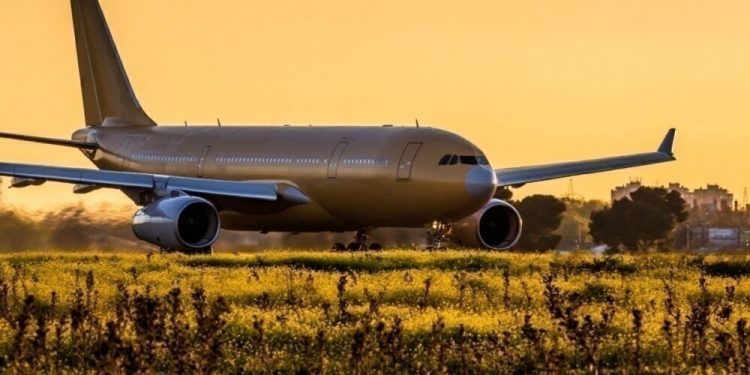
Airline Startup Of The Week: Sri Lanka’s Spark Air

October 2nd, 2020

Courtesy NewsIn.Asia

The new upcoming airline was conceived by four former senior captains with SriLankan Airlines and other international airlines, citing a conducive environment to expand aviation in Sri Lanka.

The new airline startup will utilize two leased Airbus A330 jets. Photo; Airbus

September 30 (Simple Flying) – Sri Lanka will be getting a new airline as of February 2021. The new startup, Spark Air, first plans to launch with cargo operations before expanding to carry passengers from the South Asian nation. These activities will be carried out with two dry-leased Airbus A330s.

According to Sri Lankan media outlet DailyFT, Spark Air’s Uditha Danawatta spoke to journalists in Colombo recently. Danwatte, the airline’s Air Head of Safety Management Systems Captain, says that the new upcoming airline was conceived by four former senior captains with SriLankan Airlines and other international airlines, citing a conducive environment to expand aviation in Sri Lanka.

Monetary investments will come from both local and foreign investors, although the amount has not been disclosed.

With this pandemic situation, we have to diversify operations and not just focus on passengers. There is a huge demand for cargo and this was one of the reasons we decided to go ahead with the project. As per our plan, we have many destinations in mind including even Los Angeles and it covers Asia, Europe, Africa and the Far East. We have also received enquiries for transit cargo,” -Captain Uditha Danawatta, Spark Air via DailyFT.

Airline representatives say that leasing companies have slashed prices providing an excellent opportunity for the startup.

Furthermore, Danawatta says that the new Sri Lankan government has been very supportive of this new startup, adding that there is a plan for new facility development, which will drive aviation development. We also have a very positive Director General of Aviation, who is keen to develop aviation in the country.”

What is happening with the airline now?

It’s probably quite generous to call Spark Air an airline now as it still has a long way to go before flying aircraft and generating revenue.

We know that a public notice has been released for Spark Air’s applications for an Air Operator Certificate and Airline License. These will need to be obtained to conduct International regular Transport Operations and Charter Operations carrying passengers, cargo, and mail. The new airline intends to go international right from the beginning, without any plans to operate domestically.

As mentioned above, Spark Air will launch with cargo operations first. However, the startup hopes to also provide MRO (Maintenance, Repair, and Overhaul) services out of the southern airport of Mattala Rajapaksa Hambantota Airport. Also at Mattala will be an office for Spark Air. The company will also have an office in Colombo – the nation’s capital.

Danwatta adds that this will employ over 2,000 highly-skilled locals. Recruitment for some of the company’s services and operations is expected to take place in December.

Providing more capacity for the country?

The airline says that the national carrier, SriLankan, does not have the capacity to ‘cater to everyone’ with its 26 aircraft and 7,000 staff. Danawatta compares and contrasts this with AirAsia, which has 110 aircraft and 2,500 staff.How can SriLankan make profits? The management has clearly not been successful,”he says.

Danawatta goes on to cite the high frequency and capacity offered by Qatar Airways as justification for another airline:

[SriLankan] was lagging with incompetent people; the right people must go for the right job. Qatar Airways flew five times a week to Colombo from Doha using 777 and [A]340 aircraft. They are carrying all our passengers when we could get those passengers into our airlines. Why are we giving all that money to Qatar? But SriLankan cannot cater to that requirement with the available number of aircraft. We can explore operations to many other destinations, it does not have to be destinations already serviced by SriLankan.” -Captain Uditha Danawatta, Spark Air via DailyFT

From the Simple Flying perspective, this premise is a little bit flawed. Yes, there may have been a respectable demand for travel between Colombo and Doha. However, it’s almost guaranteed that a large portion of that passenger traffic was connecting through Doha and travelling onwards to other destinations in Qatar Airways‘ expansive and diverse global network.

Therefore, unless Sri Lanka’s airlines are willing to do the same, it seems unfair to use only Qatar’s frequency to justify the new airline. If Spark Air can identify and secure the most lucrative international routes for both cargo and passengers, and utilize its A330s for them, it might just have a chance at success.

Chinese and Sri Lankan governments set to discuss Colombo Port City project

October 2nd, 2020

Courtesy Ship Technology

The Chinese and Sri Lankan governments are set to discuss the progress of Colombo Port City project, which is a planned offshore city in Sri Lanka.

The Chinese and Sri Lankan governments are set to discuss the progress of Colombo Port City project, which is a planned offshore city in Sri Lanka.

Valued at $1.4bn, the China Communications Construction Co (CCCC)-funded project was scheduled to be launched on 17 September 2014 by the then Sri Lankan President Mahinda Rajapaska and the Chinese President Xi Jinping.

Under the terms of the agreement between the respective governments, the Chinese developers were due to buy 20 hectares of freehold land under the Port City project.

“China is willing to help Sri Lanka to improve the infrastructure, bring in more employment opportunities and improve the wellbeing of all Sri Lankans.”

However, under the new leadership of Sri Lankan President Maithripala Sirisena, the project remained under review until recently, citing lack of necessary permits and approvals.

According to CCCC, the shutdown of the project would result in losses of more than $380,000 a day, reported Reuters.

Chinese Ministry of Foreign Affairs division Director and Counsellor Chen Feng was quoted by media sources as saying: “The most important factor is to enhance the mutual understanding between the two countries. I think the two governments are now gradually working towards coming back to the normal track and all the projects will restart soon.

“China is willing to help Sri Lanka to improve the infrastructure, bring in more employment opportunities and improve the wellbeing of all Sri Lankans.”

Last month, the Sri Lankan Cabinet agreed to appoint a new committee to address the issues of the Port City project following a recommendation by Ports and Shipping Minister Arjuna Ranatunga, marking the recommence of the project, reported Xinhua News.

New UK Student Visa routes for Sri Lankans

October 2nd, 2020

Courtesy The Daily Mirror

The UK’s new Student route and Child Student route will open on October 5, 2020 to the best and brightest international students from across the globe including from Sri Lanka, the British High Commission said today.

British High Commissioner to Sri Lanka, Sarah Hulton, said, This is a great opportunity for students in Sri Lanka who wish to study in the UK. With four of the world’s top ten universities in the UK and over 150 universities to choose from, the UK offers phenomenal opportunities for students looking for outstanding personal development opportunities.”

The High Commission in a statement said, As a result of coronavirus, some overseas students are choosing to defer their entry onto courses in the UK until the spring semester of 2021. Introducing these new routes now means that students will be able to benefit from the new streamlined process whilst still giving sponsors time to adapt after their autumn intake.

The routes will ensure the UK’s world-leading education sector can continue to welcome talented and high potential students to their globally renowned universities, further education and English language colleges, and independent schools.

There will be no limit on the number of international students who can study in the UK. This will help to increase the total number of international students choosing to study in the UK higher education system each year to 600,000 by 2030, as set out in the International Education Strategy published in March 2019.

Chief Executive of the Russell Group Dr Tim Bradshaw said: We welcome these changes to the immigration rules, which will help to ensure the UK remains an internationally attractive place to study. We will continue to work with the government to ensure our visa system remains flexible and responsive to developing issues, such as those emerging from the coronavirus pandemic.”

The new Student route improves on the previous Tier 4 route by making it more streamlined for sponsoring institutions and their students, creating clearer pathways for students, and ensuring the UK remains competitive in a changing global education market.

Students will require a total of 70 points to be granted leave. They will achieve the required points if they can demonstrate that they have an offer from an approved educational institution, speak English and are able to support themselves during their studies in the UK.

The UK also want to ensure they retain talented students to continue to contribute to the UK post-study, which is why they are launching the Graduate route in the summer of 2021. This additional new route will allow those who have completed a degree at a UK Higher Education provider with a track record of compliance to stay in the UK for two years (three years for PhD graduates) and work at any skill level, and to switch into work routes if they find a suitable job.

Chevening – the UK government’s prestigious fully-funded scholarship programme is now open for applications. Seven scholars are currently making their way to the UK to commence their postgraduate degrees, and the British High Commission are looking forward to receiving a diverse range from Sri Lankan applicants for 2021.

This is a unique opportunity for talented Sri Lankans with leadership potential to develop professionally and academically, network extensively, experience UK culture and build lasting positive relationships with the UK. The application window for Chevening closes on 3 November 2020. Interested applicants can find more information on the programme by visiting www.chevening.org,” the statement said.

Sri Lanka’s largest pharmaceutical manufacturing and research facility declared open

October 2nd, 2020

Courtesy Adaderana

Prime Minister Mahinda Rajapaksa today declared open Sri Lanka’s largest pharmaceutical manufacturing and research facility at Pitipana, Homagama.

Morison PLC, the largest oral solid dosage pharmaceutical manufacturer in Sri Lanka and a subsidiary of Hemas Holdings PLC, has invested a total of USD 18.5 million for the new Research and Manufacturing facility.

Several Cabinet Ministers and dignitaries also graced the event as special guests, including Minister of Health Pavithra Wanniarachchi, State Minister of Production, Supply and Regulation of Pharmaceuticals Prof.  Channa Jayasumana, State Minister of Skills Development, Vocational Education, Research and Innovation Dr. Seetha Arambepola and Secretary to Minister of Trade Dr. Sunil Navaratne.

The new state-of-the-art manufacturing plant and research & development facility is located within the Sri Lanka Institute of Nano Technology (SLINTEC) Park in Homagama.

It is the first European Union-Good Manufacturing Practice (EU-GMP) compliant oral solid dosage manufacturing plant in Sri Lanka.

The facility is ready to commence validation batches and is expected to start commercial production early next year, supporting the Government’s aim to manufacture essential medicines locally.

The foundation stone for the plant was laid on 15th of June in 2017 in the presence of top management officials.

MRCC permits ‘MT New Diamond’ to leave Sri Lankan waters

October 2nd, 2020

Courtesy Adaderana

The Maritime Rescue Coordination Centre (MRCC) in Colombo has granted permission to the owners of the fire-stricken crude oil tanker ‘MT New Diamond’ to tow the vessel away from Sri Lankan maritime border.

Permission has been given subject to the payment of compensation and cost incurred by the Government agencies.

The Spokesperson of Sri Lanka Navy, Captain Indika De Silva said the owners of ‘MT New Diamond’ are already in the process of towing the vessel away from Sri Lankan waters.

It is likely to sail towards the United Arab Emirates (UAE), where its oil cargo would be transferred to another ship for further supplies to Indian Oil Corp.

Two navy ships are shadowing the tanker until it leaves Sri Lanka’s 200 -mile exclusive economic zone,” Captain De Silva added.

At around 8.30 am on September 03, the oil tanker ‘MT New Diamond’, sailing 38 nautical miles off Sangamankanda Point east of Sri Lankan seas, was engulfed by fire following an explosion of a boiler in the main engine room.

The tanker was transporting 270,000 metric tons of crude oil from the port of Mina Al Ahmadi in Kuwait to the Indian port of Paradip when it faced with this unfortunate turn of events. It was also reported that 1,700 metric tons of diesel required for the use of the tanker were stored onboard.

The vessel was subsequently towed to safe waters and the Sri Lanka Navy, Sri Lanka Air Force, Sri Lanka Ports Authority, Sri Lanka Coast Guard, Indian Defence Forces and the Indian Coast Guard had doused the fire in a joint operation.

Owners and the salvors of the ill-fated crude oil tanker had later agreed to immediately and fully settle the government’s claim Rs 442 million for the costs incurred by the Sri Lankan government in the assistance rendered to the ship and other related matters.

The Attorney General’s Department on Thursday (01) announced that the negotiation pertaining to claim regarding marine pollution caused by the oil tanker are pending and that the other claims are yet to be settled by its owners.

The Marine Environment Protection Authority (MEPA) had meanwhile said that approval cannot be granted to the crude oil tanker to leave Sri Lankan waters until the negotiations conclude.

-with inputs from agencies

COVID-19 caseload hits 3,388 with new infections

October 2nd, 2020

Courtesy Adaderana

Six more persons tested positive for COVID-19 this evening (02), taking the total number of confirmed cases to 3,388.

The Department of Government Information said the latest positive cases include 03 arrivals from Oman, Kuwait and the United States.

In the meantime, the COVID-19 recoveries tally reached 3,245 earlier today as 12 more infected with the virus returned to health.

According to statistics, 130 active cases are currently receiving treatment at selected hospitals across the island.

CBSL successfully settles USD 1 billion maturing international sovereign bond

October 2nd, 2020

Courtesy Adaderana

The Central Bank of Sri Lanka (CBSL) today (02) successfully completed the settlement of the maturing International Sovereign Bond of USD 1 billion along with the due coupon payments, on behalf of the Government of Sri Lanka.

In a statement, the CBSL said this settlement reconfirms the Government’s unwavering commitment to honour its foreign liabilities, thereby bolstering investor confidence and dispelling any concerns foreign investors may have in relation to the Government’s ability and willingness to maintain its unblemished debt servicing record.

The domestic foreign exchange market has already reacted positively to this settlement and other recent positive developments in the Sri Lankan economy, the CBSL added.

With the envisaged inflows to the domestic foreign exchange market supported by proactive measures taken by the Government and the Central Bank of Sri Lanka, the market sentiment is expected to further strengthen in the period ahead, it read further.

There is collective responsibility over Easter attacks, Hemasiri tells PCoI

October 2nd, 2020

Courtesy Adaderana

Former Defence Secretary Hemasiri Fernando told the Presidential Commission of Inquiry probing the Easter Sunday terror attacks that the value of national security was put on the back burner behind politics by the leaders of the country at the time.

He alleged that the usual national security chain of command was left in tatters owing to certain officials reporting crucial intelligence information directly to then-President Maithripala Sirisena, bypassing the Defence Secretary.

He further alleged that the open animosity between the former President and former Prime Minister left a massive gap in the chain of command.

During the proceedings, the Additional Solicitor General of the Government asked the witness whether his experience as a naval officer was sufficient for the role despite having served as the Defence Secretary.

Fernando replied: Since I served in the Navy, I thought it would be an additional qualification for the position, but now I believe it puts me at a disadvantage.”

The PCoI then asked him, What additional qualifications did you think this gave you? did you think it was an additional qualification to get the post of Defence Secretary?”

In response, Fernando said he considered it a great honour to have served as a naval officer.

When questioned of the reason for not even attempting to telephone the former President Sirisena regarding the intelligence warning received prior to the Easter attack, Fernando replied, I didn’t call him, and I must explain my reasons for that. Two days after assuming the position, I went to meet the then-President to get his signature on some documents. At that time, I had received the first intelligence report from the State Intelligence Service (SIS) which I informed him about. At that point, the President looked at me and said that Nilantha had informed him about it. On a separate occasion when Nilantha gave me another intelligence report, I told the President about it when I went to meet him, but he told me again that Nilantha had already informed him about it.”

Continuing, he said, When I met Nilantha I asked him of the meaning of this procedure to which he responded by saying that he informs the President about every piece of information he receives. And that he also informs the Defence Secretary too. So, I assumed that he must have already told the President about the attack warnings at the time. After the attacks, I went to meet the President to hand over my resignation as the Defence Secretary, he was reading the newspapers at the time. I asked him then as to why Nilantha, who had informed him about everything else, failed to report him about this information. To this, the President did not offer a response and continued to read his newspaper.

Subsequently, the chairman of the PCoI on Easter Sunday attacks asked the witness if he had asked the former SIS director Senior DIG Nilantha Jayawardena whether he had informed the President, when Nilantha gave him the intelligence warning on April 20.

Why is Modi pushing Rajapaksa on the Tamils?

October 2nd, 2020

By Ambassador M K BHADRAKUMAR Courtesy Rediff.com

Mahinda Rajapaksa is a democratically elected leader who received a massive mandate of 71% of votes, and he owes nothing to Delhi or Washington for staging his political comeback, observes Ambassador M K Bhadrakumar.

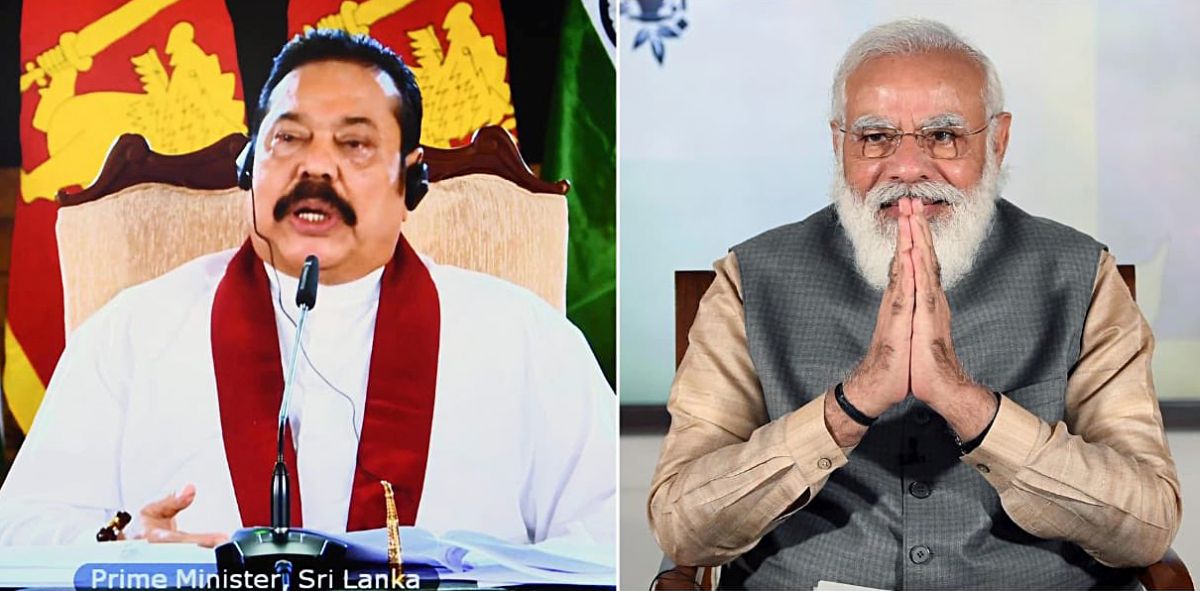
IMAGE: Prime Minister Narendra Damodardas Modi holds a discussion with his Sri Lankan counterpart Mahinda Rajapaksa, September 26, 2020

The virtual summit between the Indian Prime Minister Narendra Modi and his Sri Lankan counterpart Mahinda Rajapaksa turned out to be somewhat surreal.

The summit was the first of its kind Modi has had with any South Asian leader.

The expectations were high. But fault lines have appeared.

On the core issue of the Sri Lankan Tamil problem, the joint statement (external link) issued after the September 26 summit says, ‘Prime Minister Modi called on the Government of Sri Lanka to address the aspirations of the Tamil people for equality, justice, peace and respect within a united Sri Lanka including by carrying forward the process of reconciliation with the implementation of the Thirteenth Amendment to the Constitution of Sri Lanka. Prime Minister Mahinda Rajapaksa expressed the confidence that Sri Lanka will work towards realising the expectations of all ethnic groups including Tamils, by achieving reconciliation nurtured as per the mandate of the people of Sri Lanka and implementation of the Constitutional provisions.’

Clearly, Rajapaksa failed to give any commitment regarding the implementation of the 13th Amendment enacted by the previous government, which came to power in 2015 after his ouster.

Instead, he has spoken of the ‘expectations of all ethnic groups including Tamils’ and has stated his intention to ‘nurture’ national reconciliation ‘as per the mandate’ he received in the February election and the relevant constitutional provisions.

Interestingly, Rajapaksa also called Modi’s attention to the ‘massive mandate’ that he received from the electorate.

Rajapaksa said, ‘It is our responsibility to work for all, with all.’

In sum, he has conveyed to Modi that the reconciliation process must have acceptability among the majority Sinhala community — implying that Delhi is barking up the wrong tree.

The irony is that the Modi government too practises a majoritarian ideology within India.

There is already a demand from the Sinhalese majority community that the 13th Amendment should be scrapped.

Nonetheless, Modi decided to press ahead. Effectively, Rajapaksa has pushed back at Modi’s emphatic demand that the implementation of the 13th Amendment is ‘essential’.

The Sri Lankan Tamil problem has had a geopolitical dimension, historically.

India has been a star performer on that diplomatic turf.

The Indian intervention took different forms at different times.

Since the late 1970s, for a decade Delhi used the Tamil problem to pressure the pro-western Sri Lankan leadership of then president J R Jayewardene (1978-1989).

But Colombo exhibited exemplary diplomatic skill to ward off India’s intrusive policies.

By the mid-1980s Jayewardene brilliantly outmanoeuvred Delhi by enticing it to jettison its previous role as the mentor of the Tamil militant groups and instead be their terminator, and in the process wearing out Delhi so comprehensively that it somehow extricated itself altogether from the Sri Lankan nationality question, finally, to count its losses.

Through the next two decades, geopolitics took a back seat in the Indian calculus, which immensely helped Colombo to successfully defeat the Tamil separatist groups by 2008 after twenty-six years of conflict.

Enter the Modi government.

Geopolitics began staging a comeback almost overnight in 2014, thanks to the animus against China in the Modi government’s foreign policy.

By January 2015, for the first time in Sri Lankan history, external powers orchestrated a regime change in Colombo ousting the staunchly nationalist leadership of Rajapaksa who was perceived as ‘pro-China’ in Delhi and Washington.

A unique feature of the regime change project was that the Tamils organised under the Tamil National Alliance was grated on to it to overthrow an established Sinhala-led government in Colombo.

The TNA will carry this opprobrium for a long time to come.

It was not in Tamil interests to have identified with what was quintessentially a geopolitical project.

In retrospect, although the futility of the 2015 regime change project soon dawned on them, Delhi and Washington decided to double down on the Sri Lankan turf.

This is so because Rajapaksa’s return to power in Colombo has coincided with the surge of the US-Indian ‘Indo-Pacific strategy’ to contain China.

The new agenda is to bring the Rajapaksa government into the orbit of the Quad (Quadrilateral Alliance between the US, Japan, India and Australia.)

But the Sri Lankan nationalists are unwilling to take sides between the Quad and Beijing — as indeed most countries in the Asian continent.

Hence the renewed use of the Tamil problem to pile pressure on Colombo.

The ‘humanitarian intervention’ in Sri Lanka is in pursuit of a geopolitical agenda. But Mahinda Rajapaksa is a democratically elected leader who received a massive mandate of 71% of votes, and he owes nothing to Delhi or Washington for staging his political comeback.

The virtual summit last week reveals that Sri Lankan nationalism continues to militate against Delhi’s intrusive policy.

Delhi has baited the Sri Lankan religious establishment with a $15 million grant ‘for promotion of Buddhist ties’, but Colombo will remain vigilant about Indian intentions in cultivating the powerful Buddhist clergy.

The modus operandi in the 2014-2015 period to destabilise the incumbent government must be still fresh in memory.

Colombo is in a far better position than at anytime before to counter US-Indian intervention in Sri Lanka’s internal affairs.

Fundamentally, there is a contradiction insofar as while Sri Lanka’s external policies are driven by geo-economic considerations, the agenda pursued by India and the US is paramountly geopolitical, drawn from a perspective that the island is a ‘permanent aircraft carrier’, as a former Indian national security advisor once candidly put it.

The induction of Quad into the Indian Ocean region is an urgent necessity for the US’s Indo-Pacific strategy.

An American military presence in Sri Lanka would enable the US to advance a so-called ‘island chain strategy’ to control the sea lanes of the Indian Ocean, which are of vital importance to China’s foreign trade.

Top US officials have been threatening the Sri Lankan government since last year that unless it cooperated with the Indo-Pacific strategy, its human rights record in the war against Tamil separatists in the 2007-2008 period will be held against it and there will be hell to pay.

Without doubt, Rajapaksa accepted Modi’s invitation to the virtual summit anticipating the likelihood of the Sri Lankan Tamil problem being brought to the forecourt of the bilateral discourse.

He was ready with a response.

Delhi should think hard how far it is in India’s interests to be seen hawking the US’s Indo-Pacific strategy in the South Asian region.

Ambassador M K Bhadrakumar, a frequent contributor to Rediff.com, served the Indian Foreign Service for 29 years.

Ethnic Problem and Constitution Reforms

October 2nd, 2020

N.A. de S. Amaratunga

A new constitution is being planned and a committee comprised of leading intellectuals has been appointed to draft it. One of the difficult issues the committee would have to grapple with would be the ethnic issue. Several aspects of the ethnic issue may have to be taken into consideration when tackling this matter; its genesis and evolution,  involvement of foreign powers, attempts at resolution, 13th Amendment and Provincial Councils may be some of these aspects.

Genesis and Evolution

Origin and growth of the Tamil ultra-nationalism could be traced back to the times before independence in the 1920s. During that time there had been cordial relations among leaders of all three communities and they had formed the Ceylon National Congress with Ponnambalam Arunachalam, a Tamil, as its president. The Tamil leaders felt quite comfortable in the Legislative Council as they had equal representation with the Sinhalese though they were a minority community. The devide-and-rule policy of the British rulers had caused this anomaly in the composition of the Legislative Council.  This was due to the fact that only the English educated people were entitled to vote and there were proportionately more English educated Tamils than Sinhalese. However when the Colonial authorities granted voting rights for swabasha” educated people also in 1921 the number entitled to vote increased from 3013 in 1917, to 54207 and this number grew to 189335 by 1924. The Tamil leadership resented the idea  of the Tamils becoming a minority in the Legislative Council . In 1917 they were equal in number to the Sinhalese but by 1921 their proportion fell to 1/4th. This they could not stomach and consequently the Tamil leaders left the Ceylon National Congress. They formed their own Tamil National Congress thereby perhaps causing the first rupture in national unity.

The Tamil leaders did not stop at that, Ponnambalam Ramanathan went to London to request the British authorities not to grant the Donoughmore Commission recommendations in 1931 which included scrapping the communal based voting system and implimenting population based franchise.  Tamils could not reconcile to the fact that Sinhalese becoming a majority and Tamils a minority would be the natural outcome of universal franchise. Tamils did not want to give the rightful place to the Sinhalese as the majority in the country. GG Ponnambalam asked for a 50% represetation for the Tamils in the legislature.

When independence was being considered in 1947 GG Ponnambalam petitioned the British authorities demanding a separate state for the Tamils and if that is not possible not to grant independence to Sri Lanka. Ramanathan as far back as 1916 together with Ambalavanar  Kanagasabe had been for some time engaged in communal politics (see K M de Silva, A History of Sri Lanka, p 393). These activities perhaps were the cause and origin of Tamil communal politics and separatism in Sri Lanka. Sinhalese at that stage were not at all  involved in its causation. Though there were several Sinhalese organisations such as Theosophical Society of Ceylon”, Ceylon National Association” and Anagarika Dharmapala’s anti-alcohol organisation, they had nothing to do with the seeds of dissention and conflict being sown by the Tamil leaders.

As a result of this intransigence of the Tamil leadership and the development of ideas about autonomy the Donoughmore Commission and also the Sinhalese leaders like SWRD started to talk about devolving political and administrative power to provincial councils as a means of appeasing the Tamils. Leaders like SJV Chelvanayagam carried these ideas forward and in 1957 at Vadukodai took the extreme stand of calling the Tamil youth to take up arms to win their rights. This call came to fruition and the LTTE was born in the 1980s. India helped the LTTE to wage an armed struggle. This India did for geopolitical reasons and eventually they forced the JRJ government to accept the 13th  Amendment and provincial councils as a political solution to the ethnic problem. 

However provincial councils and regional autonomy though had been in discussion since 1920s  could never be granted by leaders like SWRD, Dudley, JRJ all of whom withdrew their proposals because they knew granting it was political harakiri. That is how finally it came to be forced down our throats by Rajiv Gandhi who had his local South Indian politics and also geopolitical issues  to contend with. However, there was opposition to this high handed act within the government ranks and the JVP organized wide spread riots which had to be controlled by a declaration of curfew. The people of Sri Lanka have never endorsed the 13th A or regional autonomy.

Western involvement

Western powers for geopolitical reasons have got involved in our internal affairs. They would like to have a foothold on Sri Lanka. They have an intimate knowledge of the ethnic conflict and would not hesitate to make use of it to destabilize the country and create opportunities for their involvement and interference.  Sri Lanka due to its strategic importance has become an arena for global hegemonic rivalry in the Indian Ocean region. Western powers want to thwart the rising power and influence of China in the region. The LTTE was a useful tool in their hands, they helped it to raise funds in their countries and purchase arms. The Tamil Diaspora domiciled in these countries developed into  politically influential pressure groups and consequently politicians in these countries started to raise a voice for the Tamil course. They spoke on their behalf not only in their parliaments but also in UN bodies. Some called for a separate Tamil state. Trumped up charges of human rights violations were liberally utilized to pressure Sri Lanka to fall in line and support their agendas.

Thus the so called Tamil problem was blown out of proportion in the global context. Western countries could not see evidence of discremination or oppression of Tamils in Sri Lanka yet they got involved because of Indian Ocean geopolitics and local politics in their own countries due to the presence of a substantial vote base of Tamil Diaspora. India was involved for similar geopolitical reasons.

Thus the global involvement is not due to the true nature of the Tamil problem in Sri Lanka or its seriousness or importance but due to the hegemonic agendas of  the global and regional powers. Therefore the question arises whether Sri Lanka should take into serious consideration and be influenced by the position taken up by the Western countries regarding the Tamil problem.

The present state of the global power situation will also have to be taken into consideration. How much pressure could the Western countries excert on Sri Lanka, how much could Sri Lanka resist and what would India’s and China’s stand be in this regard are going to be the factors that govern the determination of the course of action Sri Lanka has to adopt. Sri Lanka had to capitulate when India  forced the 13th A on us as USA or any other world power opposed to India did not come to the rescue of Sri Lanka. Today the situation is different, the West is not as powerful as before, China has enormous stake in Sri Lanka in connection with its Belt and Road project and India may not want to get involved as much as it did earlier. Western countries and India would not want to resort to military intervention. The worst they would do is enforcement of trade sanctions. Economic effects of such an action would be mitigated to some degree by Chinese inputs for the latter would not want Sri Lanka to collapse. 

Attempts at resolution and their failure

From the time of its origin there had been serious discussions to find a solution to the Tamil problem. It is unfortunate that the Tamil leadership has refused to understand the real nature of the Tamil problem and see the unfairness of the position they take up when negotiating for  a settlement, for example the non-negotiable conditions comprising Four Principles put forward at Thimphu talks and the proposal for merger of North and East. Moreover the reluctance of governments to grant what is agreed upon at discussions and withdrawal from pacts entered into must also be taken into consideration with greater understanding by the Tamil leaders.

For example SWRD Bandaranayake withdrew from the pact he entered into with SJV Chelvanayagam and so did Dudley Senanayake. JR Jayawardena had discussions with Tamil leaders and also with Rajiv Gandhi and had the 10th  Amendment drafted as a solution but did not take steps to implement any decisions they may have agreed upon until the latter forced him to accept the 13th Amendment. Often the reluctance of Sinhala leaders to implement devolution policies are misconstrued as lacking in political courage and ideological strength whereas the correct reading would be that they did not want to commit political suicide. Even the forceful introduction of the 13th A caused lot of opposition within the government as well as riots by the JVP and boycotts by the SLFP.  Further the full implimentation of the 13th A has not been possible and the once merged North and East PCs have been demerged.

The previous government presented to the parliament a new constitution with federal features. What happened to those responsible for this deceitful deed must be taken into serious consideration by the Tamil political leadership. They were wiped out from the political scene and people gave a 2/3rd majority to the new government to ensure that such things will not happen in the future and a new constitution would be enacted that would secure the integrity of the people’s single sovereignty and the territory of their country.

The Sinhalese may never agree to allow a minority community to have special rights over part of the land that belongs to everybody. Further it is not the fair and just method to solve the ethnic problem. As more than half of the Tamils live outside the North a provincial arrangement with devolved administrative and political powers would obviously be not the best way to solve their problem. There may be better options of sharing political power that suits the country and the people.

13th Amendment

13th A and provincial councils were introduced to Sri Lanka as a solution to the ethnic problem but they were created by foreign vested interests to solve their problems than ours.  Indira Gandhi was tilted towards the USSR in the global power equation and JRJ was pro USA.  JRJ’s  foreign policy was disliked in New Delhi and Gandhi wanted to make JRJ realise the realities of regional geopolitics and she sponsored the Tamil terrorist groups. After she was assasinated  her successor Rajiv continued her policies. Rajiv Gandhi had two issues regarding Sri Lanka which he had inherited from his mother. One was the danger of  Sri Lanka’s  political leadership allowing the USA to use Sri Lanka to destabilize India and the other was the need to keep the South Indian politicians appeased with regard to the Tamil problem in Sri Lanka. He tried to achieve both goals by forcing JRJ to accept the 13th A which was designed to grant regional devolution and also to prevent the USA from using Sri Lanka to act against the interests of India.

However the LTTE did not accept it and waged war against the Sri Lankan government. Negotiations with them always failed as their goal was a seperate state or something close to it. They were militarily defeated but their idealogy is carried forward by the present Tamil political leadership. Obviously Tamil politicians have not come to terms with reality, the impossibility of getting what they want. Or what is more probable is they are abusing the national emotions of Tamil people for political gain. They should know that when they resort to demanding the impossible the Sinhalese will close rank as happened at the recent presidential and general elections and no government can go beyond what is granted at present i.e. 13th A without land and police powers. This arrangement, however, does not solve the problems of the Tamils and other minorities as they are widely distributed in the country.

The 13th A with its Land and Police powers hangs over us like a Sword of Damocles which could eventually pave the way for a separate state.  

Provincial Councils

It is utterly absurd to divide this little island into nine political and administrative areas. It is too small to be divided. More than 50% of the Tamils, for whom one of these areas are demarcated with some autonomy, live outside that area, therefore this division does not serve the purpose.

Several Provinces have existed without their Councils with no breakdown of essential services to the people for more than one year due to elections not being held. PCs were created as a solution to the so called ethnic Tamil problem but the silence of Tamil politicians on the issue of delay in elections to the Northern PC is deafening to say the least. If they can do without their PC there cannot be an ethnic problem of enormous magnitude which necessitated  the introduction by force of the 13th A by India.

Moreover the Provincial Councils do not serve any useful purpose. Instead it is another bureaucratic barrier to the people that increase the red tape, inconvenience, number of corrupt politicians that people have to bribe to get any official work done. The work done by these PCs could easily be carried out by the GA and the kachcheri system we had previously without the involvement of politicians. Similarly administrative power could be devolved to the North through the local government institutions. Thus the 13th A and its offspring the provincial councils could be done away with bringing great benefit to the people including Tamils.

Possible methods of resolving the Ethnic problem

What the Tamils want is political and administrative power that would enable them to manage their own affairs in the areas of their habitation and also have a say in the affairs of their country. Administration can be decentralized via the existing local government institutions. These institutions could be further empowered to attend to the needs of the people at grass root level. District level administration via district secretaries which could be similar to the government agent system of yore could also be strengthened without the yoke of the provincial council. If the local administration which is the system that has to work in intimacy with the people and solve their day to day problems could be comprehensively strengthened and streamlined more than half the problem would be solved. The PCs didn’t do this, instead they made the local administration more cumbersome.

There are several options for solving the political power sharing issue. The methods that have been discussed by political scientists of repute fall under two broad categories: (1) classical”  political power sharing which they like to call Consociationalism and (2) Integrationism which is also called Centrepetalism (Horowitz, 2000) . The former could have four areas of power sharing; 1) coalition government, 2) proportionality at all activities like education, employement etc., 3) minority veto for selected subjects and 4) autonomy at the periphery for minority groups. Autonomy at the periphery has been tried in Sri Lanka with little success.

In Integrationism, which is propounded by those who oppose Consociationalism, there is encouragement for cross ethnic cooperation and fair allocation of resources. Very often a combination of features from the two methods are found to be more effective and moreover are found to have caused less possibility of enhancing ethnic differences and recurrence of conflict (Waller & Wolf,2011).

A study carried out on 62 African and Asian countries has shown that horizontal power sharing, (which means power sharing at the centre), was more successful than vertical power sharing, (which means power sharing at the perphary) (Linder & Bachtiger 2005). Instead of political power devolution at the periphery which has proved to be a failure in Sri Lanka and which doesn’t solve the problem that pertains to the minorities distributed all over the country, an arrangement at the centre may be more suitable.

Sri Lanka may benefit from a method that combines power sharing at the centre and the principle of proportionality in all allocations and appointments. The former could be institutionlized either with a second chamber or ensuring minority representation in proportion to their population ratios in all three arms of the government; the executive, the legislature and the judiciary. The power of the sovereignty which belongs to the people is placed in the custody of the president in a presidential system of government. The president delegates this power to the cabinet, the parliament and to the judiciary. This tenet need not be changed so that the single sovereignty is not jeopardised.

Proportionality which is the other major arm of the power sharing mechanism suitable for Sri Lanka, which has to be based on ethnic ratios as mentioned earlier, could be adopted with constitutional guarantee, with regard to appointments to high posts and allocation of resources for education, employement, culture and religious matters and other vital subjects.       

N.A. de S. Amaratunga

Modi Can Better Defend India by Shedding Tamil Interests and Engaging with Sri Lanka at the National Interest Level

October 2nd, 2020

Dilrook Kannangara

Unfortunately for India, PM Modi follows the outdated approach of using Tamil problems as a negotiation tool with Sri Lanka. It never worked and does not work today. Tamil interests are neither in Sri Lanka’s nor India’s favour. Rajiv Gandhi did manage to gain some temporary leverage in 1985 and 1987 at a time when China played a minor role beyond its boundaries and USA was the biggest threat to India. Even then Sri Lanka reached out to Pakistan and China to counter Tamil interests. In 2009 India made another 1987-style last ditch attempt to save Tamil terrorists but having learned from 1987, Sri Lankan military very cleverly checkmated India. Had India invaded Lanka in 2009 as it did in 1987, a large number of Tamils in Menik Farm and Jaffna would have died in the crossfire. It couldn’t have saved the LTTE anyway and would have implicated India in war crimes.

India’s real interests are in safeguarding maritime trade routes, keeping Indian territory safe from attacks and warding off separatism. Sri Lanka’s national interest perfectly aligns with that of India in all these aspects. Therefore, India must engage Sri Lanka at the national interest level only which will be a sustainable win-win for both countries.

India is basically an island with no land trade routes. This is because India has offended all its neighbors! A sad plight due to India’s appetite to interfere in domestic affairs of neighboring countries. If war breaks out, India will be totally isolated with only sea routes taking and bringing in trade. An adversary only has to attack India’s few ports and Delhi will be forced to surrender (or suffer massive economic and social upheaval). Given these facts, India must not get distracted with wayside issues like Tamil problems.

India’s reliance on USA is not as rock-solid as its past reliance on the Soviet Union. USA will not defend India against an attack but will use India to achieve US interests and then leave it high and dry. The same happened to Pakistan, Iraq, South Vietnam, Georgia, Ukraine, etc. US interests are best served by dividing India. Southern states have the largest economies, most pro-US views, biggest business with USA and no border wars. Splitting India into north and south works best for USA.

Another headache India has is the role of nuclear-armed Pakistan. An India-China war will sufficiently ruin India that it will struggle to face off against Pakistan if another war breaks out over its Pakistani border.

Should India make another enemy towards its south?

If India wants dependable and sustainable safety from its south front, it must shed Tamil issues and negotiate with Sri Lanka on the basis of national interests only. Tamils are without a nation for a very good reason. India must not take it upon itself to change Tamil destiny. All those who attempted it before ended up in the rubbish bin of history.

A Constitution for the country or a few individuals?

October 2nd, 2020

By Raj Gonsalkorale

Sri Lanka’s debt to GDP ratio is expected to be more than 90% this year, and Moody’s have downgraded Sri Lanka’s sovereign credit rating by two notches, saying the South Asian nation would be hard-pressed to secure funding to service its huge foreign debt. Sri Lanka was pushed down from “B2” (high credit risk) to “Caa1” (very high credit risk), as the coronavirus pandemic compounded its economic woes, Moody’s said in a statement.

Brief pre Republic Constitutional history

Sri Lankans should be asking themselves whether the country’s Constitutions have served them and whether they have provided the structural foundation for its democratic, economic and social upliftment after 72 years of independence. Leaving aside COVID and its impact, which is severe and worldwide, it does not appear that Constitutions have provided this anchor of stability. Obviously, the fault lies not with a piece of paper but those who drafted that piece of paper.

Sri Lanka has had some form of constitutional governance for thousands of years.  True, there was no written constitution, but the numerous Kings and Queens of Sri Lanka, although they had absolute power, had varying forms of governance. He or she was head of state but would be aided with high level officials and a board of ministers. The monarch was seen as the supreme ruler of the areas they ruled. The monarch also held judicial power and influence. Judicial customs, traditions and moral principles, in the main, based on Buddhism were used as the basis for the laws promulgated by the Monarchs. The laws and legal measures were proclaimed by the king, and were to be followed by the justice administration. However, the king was the final judge in legal disputes, and all cases against members of the royal family and high dignitaries of the state were judged by him. Though, the king did have to exercise this power with care and after consulting with his advisers (Wikipedia).

One definition of a constitution is that it is a body of fundamental principles or established precedents according to which a state or other organization is acknowledged to be governed. The Merriam Webster Dictionary[A1] [A2]  defines it as the basic principles and laws of a nation, state, or social group that determine the powers and duties of the government and guarantee certain rights to the people in it. Whilst not conforming strictly with these definitions, historically, Sri Lanka cannot say it functioned without Constitutions of some description.

To the best of the writer’s knowledge there was no written constitution in Sri Lanka until the British attempted to develop a representative government on the island in 1833 through a constitution that created a legislative council. This council was largely powerless, and it resigned in 1864 when their censure of the British government was ignored. The British attempted several other Constitutions to appease the populace in 1910, 1920, and 1924, but these constitutions did not provide for local governance by the native population.

The Donoughmore Constitution of 1931 finally gave some degree of authority to the elected representatives. The Soulbury Constitution was introduced in 1945 and Sri Lanka, then Ceylon, was granted independence under that Constitution in 1948. However, the country retained the Monarch of the United Kingdom as its own Monarch, and exercised that link through a Governor General as a Dominion. It took the country another 24 years, till 1972, to come to its own as a Republic.

The Republic of Sri Lanka and thereafter.

The government of Mrs Sirimavo Bandaranaike elected in 1970 with a two thirds majority established a Constitutional Assembly comprising of all elected members of Parliament. After much discussion within and with the civil society, and amidst some opposition from different quarters, promulgated the new Constitution on the 22nd of May 1972. A ceremonial Presidency replaced the Governor General and legislative and executive power was transferred to the Parliament and the Prime Minister.

The government of Mr J R Jayewardene elected in 1977 with a 5/6 majority introduced a new Constitution in 1978 which instituted a Presidential system of government with an all-powerful Executive President as the Head of State, Head of the cabinet and the Head of the Armed Forces. The role of the Prime Minister was reduced to almost nothing and as the Prime Minister who was appointed by President Jayawardena had reportedly commented, an Office Assistant (called a Peon), had more power than the Prime Minister”.

Since the enactment of the 1978 Constitution there have been 19 Amendments to it, with the 20th now tabled in Parliament. The current government has also appointed a Committee to draft a new Constitution to replace the 1978 Constitution.

While Sri Lanka struggles with Constitutions and amendments, it is noteworthy that the Colonial power that introduced formal Constitutions to Sri Lanka, Britain, operates without a written Constitution, but by an unwritten one formed of Acts of Parliament, court judgments and conventions.

Professor Robert Blackburn explains this system, including Magna Carta’s place within it stating we certainly say that we have a constitution, but it is one that exists in an abstract sense, comprising a host of diverse laws, practices and conventions that have evolved over a long period of time. The key landmark is the Bill of Rights (1689), which established the supremacy of Parliament over the Crown following the forcible replacement of King James II (r. 1685–88) by William III (r. 1689–1702) and Mary (r. 1689–94) in the Glorious Revolution (1688)”

Post independent Constitution making in Sri Lanka.

Perhaps with the exception of the 1972 Republican Constitution, it could be argued that Constitution and amendment making have been significantly influenced by personalities, and quests to perpetuate their powers. The 1972 Constitution could be described as an ideology driven exercise that freed Ceylon from the remaining links to its Colonial master Britain, and established the new Sri Lanka as its own master of destiny. While some may argue otherwise, it is difficult to see how it enhanced and perpetuated the power of the Prime Minister who already enjoyed executive power, although answerable to the Parliament.

The 1978 Constitution on the other hand was a major shift where power was transferred to a single individual, a President, invested with broad executive powers and who was not responsible to the Parliament. Legislative power remained with the Parliament but the 5/6th majority that the Presidents political party enjoyed ensured that the legislative agenda was in fact his agenda. In this context, it is difficult to argue against the fact that the 1978 Constitution was personality driven and was a move to enhance an individual’s power.

There have been subsequent attempts to draft new Constitutions and perhaps the most controversial one being the one authored by late Dr Neelan Tiruchelvam and Professor G L Peiris during the Chandrika Kumaratunga Presidency. Dr Tiruchelvam paid with his life for doing this as the LTTE murdered him as its leader Prabakaran regarded Dr Tiruchelvam as a traitor for doing this.  

The 18th and 19th Amendments to the 1978 Constitution show a significant degree of personality politics. The 18th Amendment did away with the term limits specified earlier (maximum of two terms to any individual), and some of its other provisions reverted considerable powers that were modified in the 17th Amendment. The 19th Amendment sought to limit the powers of an individual bestowed with such powers in the 18th Amendment and transferred most executive powers to the Parliament and the Prime Minister.

Even the drafters of the 19th Amendment concede that it had shortcomings and they attribute this to the power rivalry between the President elected in 2015 under the 18th Amendment, and the Prime Minister who wanted executive power shifted to the Office of the Prime Minister. They were from two different major political parties in the country, and naturally, neither could agree on a workable, sustainable solution. Their power rivalry retarded the economic development of the country that had been gathering pace after the war against the LTTE, and also resulted in the return of an Islamic terrorist attack on innocent civilians praying in a Catholic Church killing more than 300 people.

Now, the country has been presented with a draft of the 20th Amendment which intends to return executive power back to the President and limiting the role of the Prime Minister. Besides this, the amendment also changes some other clauses in the 19th Amendment and reverts to what was in the 18th Amendment in some instances. Here again, it is difficult to argue against the contention presented by some that certain clauses in the 20th Amendment have been introduced in order to strengthen the hand of an individual rather than as measures to address anomalies in the 19th Amendment. These contentions also extend to the belief that such clauses erode the independence of the Independent Commissions.

The conundrum facing Sri Lankans is the inability of the society and the people’s representatives to enact a Constitution that is not personality oriented, that is structurally strong, that is democratic and that acts as the anchor that holds the ship of State steady when the water is calm and when it is turbulent.

There are a few fundamental issues that have been pointed out by legal personalities. Firstly, the question of exercise of people’s sovereignty. They contend that there is confusion when two seats of power, the President, and the Parliament and the Prime Minister, claim they represent that sovereignty. While the exercise of that sovereignty can be more clearly defined, and powers assigned, in practice it has proven to be a very difficult and challenging task.

The country witnessed this confusion when Chandrika Kumaratunga was the President and Ranil Wickremasinghe was the Prime Minister in 2002. Unknown to and without any approval from the President, the Prime Minister entered into a peace accord with the LTTE leader Prabakaran. The Parliament too was not consulted and approval obtained for this.

The issues between President Sirisena and Prime Minister Wickremasinghe between 2015 to 2019 are too numerous to mention, and they demonstrated the unworkability of a divided exercise of people’s sovereignty beyond any doubt.

In addition to this major issue, there is also a question mark as to whether Parliament actually exercises people’s sovereignty. The current proportional representation system, while it has its own merits, does not produce Parliamentarians who effectively and for all intents and purposes, represent the people who elect them to Parliament. It is a political party or an independent group that is voted in, and people neither have any say in any parties promises to the people, and programs nor how candidates are picked by the parties to contest within a district. The specific parliamentarians cannot be held accountable to the promises they made, by the people who elected them.

People only have the ability to pick amongst the list of such candidates with their preference votes. Whatever the legal position on this and the view of Constitutional Pundits, the end result for a voter is that no one directly represents them in Parliament and people have no avenue to express their sovereign rights. This major anomaly needs to be addressed.

The other major issue is about how the rights and interests of minorities and women find expression in the Constitution. The notion that all are equal in the eyes of the law and the Constitution is a noble motherhood statement, but in practice and in reality, this is not so. Both sections of society need affirmative action to make sure the majority view does not trample on the rights of these two major groups. Ironically, the female population in Sri Lanka in fact is the majority population (almost 52%), yet, the country is dominated by the male population as seen by the fact that there are only 12 female parliamentarians out of the total 225 in the newly elected Parliament.

While there is no doubt there are many other challenges, the above mentioned fundamental ones need to be addressed in a future Constitution. As opined by some, the Constitution should have some key areas protected by law. Firstly, how people’s sovereignty is to be exercised. Secondly, how the powers of the President, the Parliament and the Prime Minister are to be assigned. Third, how affirmative action is to be assured for minorities and women. The Sri Lankan society will not be a just society unless and until these key policy areas are addressed.

The areas more in the limelight are issues like political devolution, and self-determination for sections of the society. These issues arise due to the weaknesses and/or lack of a coherent policy on the above mentioned three areas. Political devolution to the provinces could become superfluous if a policy on affirmative action for minorities and other disadvantaged groups is enshrined in the Constitution. In its place, one could have more and more administrative devolution as that will matter more for people when it comes to their day to day lives. Something is not right if the President of the country has to intervene to get a culvert done in a village or to get a leaking water pipe fixed. These minor administrative matters, no doubt major ones for the communities involved, has to be attended at grass root level. Administrative devolution, rather than political devolution, and with the minimum of political interference will serve the grass roots far more effectively than now.

Empowering women through an affirmative action program will bring in a kinder society where respect for them and their worth will be recognised as a requirement by law. The unpaid contribution made by women to family welfare is enormous but their contribution is not factored in any economic model. Domestic violence perpetrated by male members of households should attract serious punitive measures as preventive measures, and these need to be enshrined in law.   

Affirmative action need not be a permanent feature once its objectives have been achieved, and there is genuine equality. But without it, there is much less chances of achieving equality for minorities, disadvantaged groups and women.

The fundamental test that should be applied to a new Constitution is whether it has the ability to provide the structural stability to free Sri Lanka from its debt trap, its perilous economic situation, its social inequities and to move forward as a Nation that is proud of its people, its cultures and its languages.


 [A1]

 [A2]

Multi – culturalism breeds conflict, sometimes leading to terrorism

October 2nd, 2020

Senaka Weeraratna

The fundamental duty of all people living in Sri Lanka is to live in harmony with each other and particularly in harmony with the pre- dominant religious culture and beliefs and not hurt the moral sensitivities of the majority, which has made the biggest contribution throughout history to the building of the country and moreover to the civilization that sustains the national ethos. 

This requirement prevails in all Countries influenced by Abrahamic religions, especially in Islamic countries. 

This situation also prevailed in Sri Lanka prior to 1505.

‘When in Rome do as the Romans do’ is a wise way to avoid conflict between communities.

Thisis a proverb attributed to Saint Augustine. The phrase means that it is advisable to follow the conventions of the area in which you are residing or visiting.

It is said that Saint Monica and her son, Saint Augustine, had found out that Saturday was observed as a fast day in Rome, where they had planned to visit. However, it was not a fast day where they lived in Milan. They had consulted Saint Ambrose who had then said “When I am here (in Milan) I do not fast on Saturday, when in Rome I do fast on Saturday.” That reply is said to have led to the saying “When in Rome, do as the Romans do”

The Romans are no more neither are we in Sri Lanka related to the ancient Romans.

Nevertheless, this saying looms large in a country which is grappling with trying to find a solution to a seemingly intractable problem of who should prevail or which community should have the final word or say in recommending standards of conduct for the rest of the country. 

In ancient Rome the majority view prevailed as it should be in any democracy.

It was accompanied by the presumption that the minority and any foreigner or visitor would heed the conventions of the area or the country in which they are living or visiting and not challenge them or try to replace them, which would invariably develop into a conflict.

The Easter Sunday attack and the underlying reasons shown in the attempt to blow up the Buddha statues in Mawanella clearly demonstrate the threat to the entire community when one group smaller in number (a minority) try to override the belief system of the group greater in number (the majority).

This type of conduct has to be prevented or avoided at all costs.

That is when the proverb ‘ When in Rome, do as the Romans do’ becomes doubly applicable.  

There is no other better way. 

This requirement of not trying to displace the prevailing ethos by a later introduced system of religious beliefs under the flag of ‘ multiculturalism’ needs to be stressed to the public by the State in Schools, Media, Public Relations, and be made part of public policy.

We, in Sri Lanka, can no longer afford to take chances with failed models and so called ‘Human Rights’ experiments, not of our own making.

Senaka Weeraratna

අග්‍රාමාත්‍ය උපදේශක තනතුරට වෛද්‍ය සමන් වීරසිංහ මහතා පත්කරයි

October 1st, 2020

අග්‍රාමාත්‍ය මාධ්‍ය අංශය

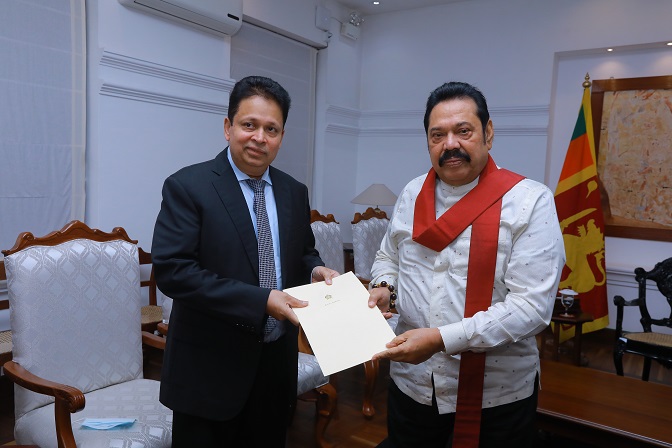
රුසියාවේ හිටපු ශ්‍රී ලංකා තානාපති, කැලණිය රාජමහා විහාරයේ දායක සභාවේ සභාපති වෛද්‍ය සමන් වීරසිංහ මහතා ගරු අග්‍රාමාත්‍ය මහින්ද රාජපක්ෂ මැතිතුමා විසින් ඊයේ 2020.09.30 දින සිට අග්‍රාමාත්‍ය උපදේශක තනතුරට පත්කර තිබේ.

වෛද්‍ය සමන් වීරසිංහ මහතා ඊට අදාළ පත්වීම් ලිපිය අරලියගහ මන්දිරයේදී  අග්‍රාමාත්‍ය මහින්ද රාජපක්ෂ මැතිතුමා අතින් ඊයේ දිනයේදී ලබාගත්තේය.

2010-2015 කාල වකවානුවේ එවකට ජනාධිපති, අග්‍රාමාත්‍ය මහින්ද රාජපක්ෂ මැතිතුමාගේ ජනාධිපති උපදේශක තනතුර හෙබවූ වෛද්‍ය සමන් වීරසිංහ මහතා, 2015 සැප්තැම්බර් සිට 2018 මාර්තු දක්වා රුසියාවේ ශ්‍රී ලංකා තානාපතිවරයා ලෙස කටයුතු කළේය.

2018 මැයි මාසයේ සිට 2019 නොවැම්බර් දක්වා ජනාධිපති ජාත්‍යන්තර කටයුතු උපදේශක ලෙස කටයුතු කළ වෛද්‍ය සමන් වීරසිංහ මහතා පසුගිය වසර 30ක කාලය තුළ ශ්‍රී ලංකා – රුසියානු ආර්ථික, සංස්කෘතික සහ මානුෂීය සබඳතාවන් ඉහළ දැමීම වෙනුවෙන් කැපවී කටයුතු කර තිබේ.

රුසියානු සමූහාණ්ඩුව,රුසියානු ජනාධිපති ව්ලැඩිමිර් පූටින් මහතාගේ නිර්දේශය මත, විදේශිකයෙකු වෙනුවෙන් පිරිනමන ඉහළම සම්මානය වන ”රුසියානු සමූහාණ්ඩුවේ ගෞරව සම්මාන අණාඥාවක් (Order of Honor of the Russian Federation) ” වෛද්‍ය සමන් වීරසිංහ මහතාට පිරිනමා ඇත.

1983 වර්ෂයේදී රුසියානු – ශ්‍රී ලංකා පුර්ණ ශිෂ්‍යත්වයක් හිමිකර ගනිමින් මොස්කව් වෛද්‍ය විශ්ව විද්‍යාලයට ඇතුළත්වන සමන් වීරසිංහ මහතා එහි ප්‍රථම පන්තියේ ගෞරව උපාධිධාරියෙකුද වේ.

ශ්‍රි ලංකා- රුසියානු මිත්‍රත්ව සංගමයේ මහ ලේකම්වරයා වන වෛද්‍ය සමන් වීරසිංහ මහතා ගාල්ල මහින්ද විද්‍යාලයේ කීර්තිමත් ආදි ශිෂ්‍යෙයකි.

රටේ සෑම පළාතකටම ළමා රෝහලක් ඉදිවිය යුතුයි – අග්‍රාමාත්‍ය මහින්ද රාජපක්ෂ මැතිතුමා

October 1st, 2020

අග්‍රාමාත්‍ය මාධ්‍ය අංශය

සෑම පළාතකටම ළමා රෝහලක් ඉදිවිය යුතු යැයි තමන් තරයේ විශ්වාස කරන බව අග්‍රාමාත්‍ය මහින්ද රාජපක්ෂ මැතිතුමා අද 2020.10.01 දින පැවැසීය.

කොළඹ සහ මහනුවරට පමණක් දැනට සීමාවන ළමා රෝහල් මින් ඉදිරියට එක් පළාතකට එක් ළමා රෝහලක් ලෙස සංවර්ධනය කොට පවත්වාගෙන යෑම පිළිබඳව රජයේ අවධානය යොමු වී ඇතැයි අග්‍රාමාත්‍යතුමා සඳහන් කළේය.

ලෝක ළමා දිනය හා රිජ්වේ ආර්යා ළමා රෝහලට වසර 125ක් සැපිරීමට සමඟාමීව මහල් නවයකින් යුතු දැඩි සත්කාර හා ශල්‍ය වාට්ටු සංකීර්ණයට මුල් ගල තැබීම සහ  ඇට මිඳුළු බද්ධ කිරීමේ ඒකකය හා නව ශල්‍යාගාර සංකීර්ණය විවෘත කිරීමේ උත්සවයට එක්වෙමින් අග්‍රාමාත්‍ය මහින්ද රාජපක්ෂ මැතිතුමා මේ බව පැවැසීය.

ගරු අග්‍රාමාත්‍යතුමා හා ශිරන්ති රාජපක්ෂ මැතිනිය ලෝක ළමා දිනයට සමගාමීව දරුවන්ට ත්‍යාග ප්‍රදානය කළහ.

රිජ්වේ ආර්යා ළමා රෝහලේ නිල ‍වෙබ් අඩවිය අන්තර්ජාලයට මුදා හැරීම සහ ඩිජිටල් සායන ක්‍රම ස්ථාපනය කිරීමද ගරු අග්‍රාමාත්‍යතුමාගේ සුරතින් සිදුවිය.

හෙද නිලධාරී ජී.එච්.ජේ.හේවගේ මහත්මිය විසින් රචිත කළුවර අහසට සඳ පායලා කෘතිය ගරු අග්‍රාමාත්‍යතුමා වෙත පිළිගැන්වීම හා ලිට්ල් හාට් අරමුදලට සුජිකල් නිෂ්පාදන පෞද්ගලික ආයතනයේ සභාපති කලන හේවා මල්ලිකා මහතා විසින් රුපියල් ලක්ෂ හතක මුදලක් පරිත්‍යාග කිරීම මෙම උත්සවයට සමගාමීව සිදුවිය.

අග්‍රාමාත්‍ය මහින්ද රාජපක්ෂ මැතිතුමා මෙසේ ද කීවේය.

රාජ්‍ය ළමා දින සැමරුම් උත්සවය එක්ක ළමා රෝහලට එන්න පුළුවන්වීම ගැන මම සංතෝෂ වෙනවා. අද විශේෂඥ වෛද්‍යවරු එකතු වෙලා රෝහල් අධ්‍යක්ෂකතුමාගේ උනන්දුව ඇතුව, කාර්යය මණ්ඩලයේ උනන්දුව ඇතුව, ශෛල්‍යගාර දෙකක් විවෘත කරන්න ලැබුණා. මම හිතන්නේ ඒ තුළින් විශාල සේවයක් සිදු වෙනවා.

දැනට ළමා රෝහල් තියෙන්නේ දෙකයි. ඒ මෙහෙත්, නුවරත්. ළමා රෝහල් අඩු ගානේ එක පළාතකට එකක් වශයෙන්වත් සකස් විය යුතු යැයි අපේ රජය තරයේ විශ්වාස කරනවා. කෙසේ වෙතත් අද දරුවන්ගේ නිරෝගීකම වැදගත්. දරුවෝ තමයි අනාගතයේ අපේ රට භාර ගන්න ඉන්න නායකයින්. දරුවන් ආරක්ෂා කිරීම අපේ කාර්යය භාරයක් වෙනවා.

පාසල්වලට අපේ විශේෂඥ වෛද්‍ය පාදෙනිය මහත්මයා කැද දෙන්න සූදානම් වෙලා තියෙනවා. අපිත් අධ්‍යාපන ඇමතිතුමාට යෝජනා කරනවා සෑම දරුවෙකුටම කැද වීදුරුවක් වගේ ශක්තිමත් පානයක් ලබාදීමට පියවර ගන්න කියලා. අපේ කාලය තුළදී දරුවන් පිළිබඳ විශේෂ අවධානයක් යොමු කරමින් අපි කටයුතු කරන්න සූදානම් බව මතක් කළ යුතුව තියෙනවා.

රිජ්වේ ආර්යා ළමා රෝහලේ අධ්‍යක්ෂකතුමා, විශේෂඥ වෛද්‍යවරු ඇතුළු කාර්යය මණ්ඩලයේ සියලු දෙනාට මේ කටයුතු විධිමත්ව පවත්වාගෙන යාම සම්බන්ධයෙන් අපි ස්තූතිවන්ත වෙනවා. මේ මොහොතේදී ඔවුන්ගේ විශිෂ්ට සේවය මම අගය කරනවා. ඔබ අතින් ඉටුවන්නේ අපේ අනාගත පරපුර රැක ගැනීමේ කාර්යය භාරය” යැයි අග්‍රාමාත්‍යතුමා පැවැසීය.

අග්‍රාමාත්‍ය ආර්යා ශිරන්ති රාජපක්ෂ මැතිනිය, සෞඛ්‍ය අමාත්‍ය පවිත්‍රා වන්නිආරච්චි, රාජ්‍ය අමාත්‍ය සිසිර ජයකොඩි, සෞඛ්‍ය අමාත්‍යංශ ලේකම් මේජර් ජනරාල් සංජීව මුණසිංහ, රිජ්වේ ආර්යා ළමා රොහලේ අධ්‍යක්ෂ වෛද්‍ය ජී.විජේසූරිය, විශේෂඥ වෛද්‍යවරුන් ඇතුළ වෛද්‍ය කාර්යය මණ්ඩල මහත්ම මහත්මීන් හා දෙමාපිය දූ දරුවන් ඇතුළු සම්භාවනීය අමුත්තන් රැසක් මෙම අවස්ථාව සඳහා එක්ව සිටියහ.

අග්‍රමාත්‍යතුමාගේ ප්‍රධානත්වයෙන් “බුදු පුත් සුරක්ෂා” සෞඛ්‍ය ආරක්ෂණ හිමිකම් ප්‍රදානය ඇරඹෙයි

October 1st, 2020

අග්‍රාමාත්‍ය මාධ්‍ය අංශය

බුද්ධශාසන ආගමික හා සංස්කෘතික කටයුතු ආමාත්‍යංශය මඟින් ක්‍රියාත්මක බෞද්ධ ස්වාමීන් වහන්සේලා 15000 ක් ආවරණය වන බුදුපුත් සුරක්ෂා” සෞඛ්‍ය ආරක්ෂණ හිමිකම් ප්‍රදානය කිරීමේ සමාරම්භක උත්සවය අද 2020.10.01 දින ගරු අග්‍රාමාත්‍යතුමාගේ ප්‍රධානත්වයෙන් අරලියගහ මන්දිරයේදී පැවැත්විණි.

ශ්‍රී ලංකා ප්‍රජාතාන්ත්‍රික සමාජවාදී ජනරජයේ ඒකාබද්ධ අරමුදලෙන්, බුද්ධශාසන අරමුදලෙන් සහ පරිත්‍යාග ශීලීන්ගේ පරිත්‍යාග මත මෙම හිමිකම් ප්‍රදානය අඛණ්ඩව ඉදිරියට පවත්වාගෙන යාමට අපේක්ෂිතය.

මෙම වැඩසටහනෙහි සමාරම්භය සංකේතවත් කරමින් භික්ෂූන් වහන්සේලා කිහිප නමක් උදෙසා ගරු අග්‍රාමාත්‍යතුමාගේ සුරතින් හිමිකම් ප්‍රදානය කෙරිණි.

මෙහිදී පහත සඳහන් භික්ෂූන් වහන්සේලා අග්‍රමාත්‍යතුමා අතින් බුදු පුත් සුරක්ෂා” සෞඛ්‍ය ආරක්ෂණ හිමිකම ලැබූහ.

  1. පූජ්‍ය නිකපොත චන්දජෝති හිමි
  2. ජූජ්‍ය දඹගහහේනේ ජිනානන්ද හිමි
  3. පූජ්‍ය කටුවන සෝමරතන හිමි
  4. පූජ්‍ය වැලිකඩ මුල්ලේ ජිනරතන හිමි
  5. පූජ්‍ය ඌරලියේ විමලවංශ හිමි

මෙම භික්ෂූන් වහන්සේලාගේ හිමිකම් ප්‍රදානය සඳහා අතිපූජ්‍ය ආචාර්ය බෝදාගම චන්දිම නාහිමි සහ විශේෂඥ වෛද්‍ය සර්ධා හේමප්‍රිය, විශේෂඥ වෛද්‍ය ප්‍රභා සමරකෝන්, ශ්‍රියානන්ද විජේකෝන්, විශේෂඥ වෛද්‍ය විමලසිරි අබේකෝන්, මහාචාර්ය වසන්ති පිංටෝ, විශේෂඥ වෛද්‍ය නිර්මලා ගුණවර්ධන මහත්ම මහත්මීන් ඇතුළු පරිත්‍යාශීලීන්ගේ දායකත්වය ලැබී තිබිණි.

බුදුපුත් සුරක්ෂා සෞඛ්‍ය ආරක්ෂණ වැඩසටහනට බුද්ධශාසන අරමුදලෙන් රුපියල් මිලියන 40 ක මුදලක් ආරම්භයේදී ප්‍රදානය කිරීමට අග්‍රාමාත්‍යවරයා උපදෙස් දී තිබිණි.  ඒ සඳහා රජයෙන් තවත් රුපියල් මිලියන 50ක දායකත්වයක් ලැබෙන අතර මේ දක්වා පරිත්‍යාගශීලීන්ගෙන් රුපියල් හැත්තෑ තුන් ලක්ෂයක මුදලක් පරිත්‍යාග වශයෙන් ලැබී තිබේ.

මෙම අවස්ථාව සඳහා පූජ්‍ය ගෝණදූවේ ගුණානන්ද හිමි ඇතුළු මහා සංඝරත්නය, රාජ්‍ය අමාත්‍ය පියල් නිශාන්ත, බුද්ධශාසන ආගමික හා සංස්කෘතික කටයුතු අමාත්‍යංශ ලේකම් මහාචාර්ය කපිල ගුණවර්ධන, බුද්ධශාසන අරමුදලේ ලේකම් ඩබ්.ටී.එච්.රුචිර විතාන මහත්වරු ඇතුළු උසස් නිලධාරීන් රැසක් එක්ව සිටියහ.

ජාත්‍යන්තර වැඩිහිටි දින පණිවිඩය

October 1st, 2020

මහින්ද රාජපක්ෂ ශ්‍රී ලංකා ප්‍රජාතාන්ත්‍රික සමාජවාදී ජනරජයේ අග්‍රාමාත්‍ය

ලොව පුරා වැඩිහිටියන් වෙනුවෙන් වූ ජාත්‍යන්තර වැඩිහිටි දිනය ඔක්තෝම්බර් පළමුවැනිදාට යෙදී තිබේ. ශ්‍රී ලාංකීය පුරවැසියන් ලෙස, මෙම දිනය අප සමරනු ලබන්නේ අනාදිමත් කාලයක් පුරා අප රැකගෙන ආ වටිනා ගුණධර්මයන් ලෝකයට පිළිබිඔු කරමිනි.

මාපිය උපස්ථානය අනාදිමත් කාලයක සිටම අප සංස්කෘතියේ සුවිශේෂී අංගයක්ව පවතී. අපේ ආර්ථිකය, සංස්කෘතිය හා සාරධර්ම පෝෂණය කළ වැඩිහිටි ප්‍රජාව පිළිබඳ ලොව අන් කිසිඳු සමාජයකට නොදෙවෙනි ගෞරවයක් හා  ආදරයක් ශ්‍රී ලාංකිකයින් වන අප සතුවේ.

එදා පවුල මුල් කරගත් දැවැන්ත වගකීම් සම්භාරයක් අද ජීවිතයේ සැදෑ සමය ගෙවන වැඩිහිටියන් සතු විය. එදා ඔවුන් ගත් යහපත් තීන්දු තිරණ නිසා දරුවන්ගේ ජීවිතය ආලෝකමත් විය. ජීවිතය තුළින් ඔවුන් උපයා ගත් දෑ බොහෝය. එසේම සමාජය වෙනුවෙන් උපරිම කැපවීමෙන් දායකත්වය ලබා දුන් ඔවුන්ට ආදරය, ආරක්ෂාව, ඇගයීම ලබාදෙමින් ඔවුන්ගේ ජීවිත අත්දැකීම් දැනුම සහ කුසලතා තවදුරටත් සමාජ ප්‍රගමනය වෙනුවෙන් දායක කරගැනීම අපගේ වගකීමකි.

2020 වර්ෂය වැඩිහිටි පුද්ගලයින්ගේ ජාත්‍යන්තර දිනයේ 30 වන සංවත්සරය සනිටුහන් කරයි.        කොවිඩ් – 19 වසංගත තත්ත්වය සමඟ ලොව පුරා කැලඹීමක් මතුව ඇති යුගයක, වසංගත රෝග පැතිරීමේදී වැඩිහිටියන් මුහුණ දෙන ඉහළ අවදානම් සැලකිල්ලට ගනිමින්, ඔවුන්ගේ විශේෂ අවශ්‍යතා පිළිබඳ දැනුවත්භාවය ඉහළ නැංවීම සඳහා ප්‍රතිපත්තිමය මැදිහත්වීම අපි රජයක් ලෙස ක්‍රියාත්මක කරන්නෙමු.

ඒසේම, වැඩිහිටි ප්‍රජාවගේ නිදහස හා රැකවරණය සේම ආත්මාභිමානය ආරක්ෂ කිරීම අප සතු යුතුකමකි. ඔවුන්ගේ  දිවිය තුළ කළ කැපකිරීම් කිසිවිටෙක අපට ගණනය කළ නොහැක. මන්ද, අද අප සංස්කෘතිය හා සාරධර්මවල ලබා ඇති දියුණුව කෘතවේදීව ආවර්ජනය  කිරීම ඔවුනට දැක්විය හැකි උසස්ම ගෞරවයයි.

ආදරණීය දෙමාපියන් වැඩිහිටි නිවාසවල වියපත් වීමට ඉඩ ලබා නොදෙන ආකල්පමය වෙනසක් ඇති කිරීමට මෙවර ජාත්‍යන්තර වැඩිහිටි දිනයේදී අප අත්වැල් බැද ගනිමු!

ආදරණීය අම්මේ, තාත්තේ ඔබට නිදුක් නිරෝගී දිවියක් ප්‍රාර්ථනා කරමි!!

මහින්ද රාජපක්ෂ

ශ්‍රී ලංකා ප්‍රජාතාන්ත්‍රික සමාජවාදී ජනරජයේ

අග්‍රාමාත්‍ය

Intelligence agencies not monitoring specific group of people, Sri Lanka tells UN

October 1st, 2020

Courtesy Adaderana

Sri Lanka reiterates that apart from operating routine security networks in the interest of national security, particularly after the devastating Easter Sunday terrorist attacks, local security forces and intelligence agencies are not engaged in monitoring specific group of people in the country.

Acting Permanent Representative of Sri Lanka to the United Nations in Geneva, Dayani Gamage made this remark during the Interactive Dialogue with the Assistant Secretary General for Human Rights on the report of the Secretary-General on co-operation with the United Nations, its representatives and mechanisms in the field of human rights, during the 45th session of the UN Human Rights Council.

Sri Lanka also urged any party concerned of the alleged intimidating visits”, surveillance”, complaints of harassment” and reprisals” referred to in the report, to make formal complaints to law enforcement authorities or to independent national institutions such as the Human Rights Commission of Sri Lanka or the National Police Commission so that action can be taken to investigate the alleged incidents.

Further, Sri Lanka, noting that the Government has already publicly refuted these allegations, reiterated that it is committed to protecting and promoting freedom of expression and civil society space.

The Government of Sri Lanka is also committed to ensure that complaints received on alleged attacks against journalists, human rights defenders and civil society are investigated and prosecuted, Gamage stressed in her statement.

She also noted that, for any country compromising its national security interests amidst looming sophistication of strategies of radical and extreme elements world around, is bound to face regrettable consequences. Hence, the Government of Sri Lanka requests all parties to be mindful of that ground reality in this context.”

Mobile libraries donated to rural schools, coinciding with Children’s Day

October 1st, 2020

Courtesy Adaderana

President Gotabaya Rajapaksa today (01) joined the World Children’s Day celebrations, donating libraries to schools in five districts, the President’s Media Division (PMD) said.

President stated that the provision of a library and access to sports will help children to maintain the balance between physical and mental well-being. President added that he was convinced of this fact during his recent visits across the country.

Following requests by children, the construction of a large number of playgrounds in remote areas of the country is now underway.  In addition, provision of library facilities for 25 selected schools representing each district has commenced, the PMD added. 

The 1st of October, which marks the World Children’s Day, coincides with the beginning of the Reading Month. President Rajapaksa has summoned students from 5 schools and donated 5 libraries with the intention of simultaneously motivating the next generation to read books.

Accordingly, the President symbolically donated 5 libraries for Lunuwila Anuruddha Central College in Puttalam, Dolosbage Kanishta Vidyalaya in Gampola, Government Tamil Mixed School in Tharmapuram, Vijaya Kumaratunga Vidyalaya in Kuruwita and Pilana Vidyarthodaya Maha Vidyalaya in Galle.

Buses that had been out of commission were repaired in an attractive manner as libraries for school children. Each fully-fledged library cost around Rs. 1 million. Mobitel, the telecom firm has provided e-library facilities, thereby enabling students to study Information Technology and refer e-books online.

The project to provide libraries was sponsored by the Sri Lanka Transportation Board (SLTB), Manusath Derana, National Library and Documentation Services Board and SLT Telecom and Mobitel.

The books donated by the publishers at the annual book exhibition at BMICH were also handed over to these libraries.

The President also engaged in cordial conversation with the students and invited them to visit the Presidential Secretariat as well, the PMD said further.

Sri Lanka committed to protect, sustainably manage natural resources – President tells UN Biodiversity Summit

October 1st, 2020

Courtesy Adaderana

The Government of Sri Lankan is committed to protect and sustainably manage natural resources, President Gotabaya Rajapaksa said addressing the United Nations Summit on Biodiversity on Friday (30).

Sri Lanka is home to two UNESCO Natural Heritage Sites: the Central Highlands, and the Sinharaja Rain Forest Reserve. We are also proud of our six sites recognized under the Ramsar Convention on Wetlands. Sri Lanka firmly stands committed to protect and sustainably manage these natural assets that contribute to our unique and rich biodiversity” President Rajapaksa told the virtual gathering held under the theme of Urgent action on biodiversity for sustainable development”.

The Summit will highlight the crisis facing humanity from the degradation of biodiversity and the urgent need to accelerate action on biodiversity for sustainable development. It will provide an opportunity for Heads of State and Government and other leaders to raise ambition for the development of the post-2020 global biodiversity framework to be adopted at the 15th Conference of Parties to the Convention on Biological Diversity in 2021.

Emphasizing that the concept of biodiversity must be at the very core of the 2030 Sustainable Development Agenda, President Rajapaksa pointed out that despite the rapid decline seen in biodiversity globally, over the recent decades, Sri Lanka is deeply committed to uphold the overarching spirit of the Convention on Biodiversity.

There is a critical need for a transformational change in the relationship between nature and people and contemporary global environmental governance,” he remarked.

The ancient governance of Sri Lanka was built on the concept that the ruler is never the owner of the land; he is merely its caretaker on behalf of his countrymen and all living beings, he said further. This is the very principle that my Government has adopted in our development agenda said the President while stressing as mere trustees of this planet and its resources we must resolve to protect what is in our trust and pass it to future generations as best as we could.”

 
President Gotabaya Rajapaksa’s full speech is produced below:

Mr. President,

Mr. Secretary General,

Excellencies,

Distinguished Delegates,

Ayubowan!

I am deeply honoured to represent the people of Sri Lanka at this High-Level Summit on Biodiversity.

The concept of biodiversity must be at the very core of the 2030 Sustainable Development Agenda.

Despite the rapid decline seen in biodiversity globally, over the recent decades, Sri Lanka is deeply committed to uphold the overarching spirit of the Convention on Biodiversity.

There is a critical need for a transformational change in the relationship between nature and people and contemporary global environmental governance.

Excellencies, Distinguished Delegates,

As a member of the Commonwealth of Nations, Sri Lanka endorsed the Commonwealth Blue Charter in 2018 and as such we will champion the Commonwealth Blue Charter Action Group on Mangrove Ecosystems and Livelihoods.

Further, the Colombo Declaration on Sustainable Nitrogen Management was adopted last year.  We as world leaders, must better manage nitrogen, ensuring the sustenance of humankind.

Sri Lanka is home to two UNESCO Natural Heritage Sites: the Central Highlands, and the Sinharaja Rain Forest Reserve. We are also proud of our six sites recognized under the Ramsar Convention on Wetlands.

Sri Lanka firmly stands committed to protect and sustainably manage these natural assets that contribute to our unique and rich biodiversity.

We have been mindful of conserving ecosystems to the highest extent possible, even during the redesigning of cities and urban areas. The wetland parks that we have created in cities, especially in and around our Capital Sri Jayawardhanapura Kotte, are home to an array of plant and animal species, offering a ‘mini-rainforest experience’ within crowded cities.

The ancient governance of Sri Lanka was built on the concept that the ruler is never the owner of the land; he is merely its caretaker on behalf of his countrymen and all living beings. This is the very principle that my Government has adopted in our development agenda.

Excellencies, Distinguished Delegates,

As mere trustees of this planet and its resources we must resolve to protect what is in our trust and pass it to future generations as best as we could.

Thank you.


-PMD

MT New Diamond will only be granted permission to leave after negotiations are completed – MEPA

October 1st, 2020

Courtesy Hiru News

MEPA informed the Attorney General that relevant authorities have been informed that approval permitting the MT New Diamond to leave will only be granted after negotiations are completed regarding oil pollution damage.

MEPA has stated that they will grant approval to tow the ship away from of Sri Lankan waters as per the authority given to MEPA by the Marine Pollution Prevention Act No. 35 of 2008, once the negotiation process is completed.

This is because they are in the process of negotiating through AG’s Dept., with the Owners / P & I Club and their lawyers to secure a guarantee for the environmental pollution resulted due the oil spill.

MT New Diamond claims have not been settled – AG

October 1st, 2020

Courtesy Hiru News

Attorney General has informed MEPA that negotiations pertaining to the claim regarding Marine Pollution caused by MT New Diamond are pending and  other claims have not been settled.

MEPA informed the Attorney General that relevant authorities have been informed that approval permitting the MT New Diamond to leave will only be granted after negotiations are completed regarding oil pollution damage.

MEPA has stated that they will grant approval to tow the ship away from of Sri Lankan waters as per the authority given to MEPA by the Marine Pollution Prevention Act No. 35 of 2008, once the negotiation process is completed.

This is because they are in the process of negotiating through AG’s Dept., with the Owners / P & I Club and their lawyers to secure a guarantee for the environmental pollution resulted due the oil spill.

Two (02) more persons confirmed for Covid -19: SL Country total increases to 3,382

October 1st, 2020

Courtesy Hiru News

Two arrivals from Oman tested positive for Covid-19, increasing total infected in Sri Lanka to 3,382.

Largest wind power plant in the country to add 100 Megawatt to the national grid (Video)

October 1st, 2020

Courtesy Hiru News

The Minister of Power and Energy Dullas Alahapperuma states that more than 100 mega watts could be added to the national grid using wind power before the end of this year.

The Minister said this while inspecting the construction work of the Mannar Wind Power Plant, the largest wind power plant under construction in the country.

This wind power project is being constructed in the Mannar area with the aim of adding more than 100 mega watts of capacity to the national grid

Launched in 2015, the project stretches 12 kilometers parallel to the coast.

The cost of this wind power project is US $ 135 million.

Spread over an area of ​​320 acres, it has 33 wind turbines.

The expected power to be generated is 103 MW.

If this energy is generated by fuel combustion, the amount of carbon dioxide released per year is estimated at 285 tons.

In that sense, this is a very eco-friendly energy generation project

Minister of Power and Energy Dullas Alahapperuma accompanied by Minister of State Duminda Dissanayake on an inspection tour to inspect the construction work of this wind power plant.

The Minister further stated that more than 80 percent of the work on this power plant has been completed and under the first phase, about 30 mega watts will be added to the national grid before the end of this month.

Threat to World Peace: What if Terrorist Leaders set up ‘Virtual Governments’ like Rudrakumaran/TGTE?

September 30th, 2020

The UN & foreign governments facing some form of terrorist threat should be worried about a new trend taking place with terrorist fronts forming virtual governments and referring to themselves as Prime Ministers.We are looking at shadow world governments setting up across the world where most of these terrorist organizations have kitty’s fatter than the GDP of sovereign states. By virtue of their ability to connect across the board and link international illicit and illegal operations, they would pose a formidable threat in the future. Rudrakumaran has no qualms about putting a terrorist flag alongside the mighty US National Flag and delivering speeches.The manner their illegal money has managed to scoop powerful politicians and professionals to speak on their behalf is also worrisome. That people like Rudrakumaran and his entity are able to mix and mingle with powerful world bodies and lobbies on the strength of their ‘funding’ will soon get copied by other terrorist fronts to do the same. Let it not be forgotten that it was from LTTE that the world’s terrorists copied modern suicide terrorism, child soldiers and other modus operandi that turned a guerilla movement to become FBI’s most dangerous terrorist outfit.

Rudrakumaran is a US citizen living and working in the USA.

Rudrakumaran was terrorist LTTE leader Prabakaran’s legal advisor during 1985 Thimpu talks, 1996 Canberra Conference. Rudrakumaran organized the LTTE Hero’s Day in New Jersey in November 1998 the year after LTTE was designated as a foreign terrorist organization by the US.  Rudrakumaran was also legal advisor for LTTE during Peace Talks in Thailand in 2003. Rudrakumaran was also defending LTTE during the Rajiv Gandhi assassination trial in 1997.

http://www.c-r.org/who-we-are/people/author/visuvanathan-rudrakumaran clearly identifies Rudrakumaran’s role as legal advisor to LTTE – a FTO banned by US since 1997.

Rudrakumaran’s association with LTTE goes further he was LTTE’s chief negotiator in 2006 (Oslo/Geneva Talks). He even delivered LTTE’s policy statement in Switzerland in 2006 and address Tamils in Germany months after LTTE defeat in September 2009. He went on to deliver LTTE’s Heros Day statement in November 2009 – the first time such a statement was delivered without Prabakaran.

No sooner Prabakaran and LTTE were militarily eliminated, Rudrakumaran set up the TGTE in 2010. This entity was banned by Sri Lanka’s Government as a LTTE front in April 2014 and remains banned to date. LTTE is also banned in US since 1997.

How is TGTE registered in US? 

If US has a Presidential system and President Trump is the President, how can Rudrakumaran be Prime Minister? 

What if other terrorist fronts operating from US start calling themselves ‘Prime Minister’ or even President’ what a joke that would be for the US!

Transnational Government of Tamil Eelam website – http://www.tgte-us.org

This youtube video shows Rudrakumaran speaking with the banned LTTE flag next to the US flag .https://www.youtube.com/watch?v=brDnMRWJJvM (2010)

https://www.youtube.com/watch?v=OJecykY5wng (in 2015 in New York again with banned LTTE flag

LTTE lobbies across the world have found it easy to tap people’s weaknesses. Likewise, the bevy of personalities that speak on the LTTE front stages, shows how money can buy” the most respected” of people if they have a penchant to be ‘bought over’.

We all know that LTTE survived to kill over 3 decades on the strength of its foreign lobbying and propaganda primarily as a result of the souls the LTTE kitty could win over.

Rudrakumaran has also been coordinating with South Sudan People’s Liberation Movement – imagine them also creating a virtual government and designating that leader the ‘Prime Minister or President’?

What if all terrorist organizations who create virtual governments & call themselves ‘prime ministers’ or ‘presidents’ also begin to challenge arrests of their combatants as Rudrakumaran did in challenging US designation of LTTE in the Suresh Manikkavasagar trial in Canada?

Can US continue to watch as their citizens who hold allegiance to the US flag and pledge to uphold US values & the US constitution also function as Prime Ministers or Presidents of governments in the sky with parallel laws and objectives?

What if all terrorist organizations start holding virtual elections like TGTE and appointing their cabinet of Ministers? What if these terrorist organizations start dealing in the very same relations that sovereign governments deal in but at a virtual level?

LTTE was banned since 1993 by India and since 1997 by US. Rudrakumaran publicly spoke on behalf of the LTTE

http://tamilnation.co/conflictresolution/tamileelam/cnfZU06/05rudrakumaran.html

If Rudrakumaran & TGTE ‘VIRTUAL GOVERNMENT’ is allowed to continue, it is simply encouraging other terrorist organizations to also set up similar virtual governments and together they can pose a more lethal threat to sovereign governments.

Imagine these terrorists operating Virtual Governments with their own banking, credit card systems, travel/tourism, illegal trade, exchanging illegal armaments & weapons, dealing in illegal narcotics etc?

Shenali D Waduge

If Sri Lanka signs MCC, a Private Company will take over job of Parliament & Politicians

September 30th, 2020

We are living in times when international companies are taking governments to courts and winning millions in compensation. Sovereign governments cannot afford to hold the tax payers to ransom with irresponsible decision making that will only leave the People to suffer consequences. No compensation for wrongs of politicians has ever been paid by them. MCA-SriLankaisto be a private company seup AFTER signing MCC & AFTER the signed MCC Agreement is passed by Sri Lanka’s Parliament.In setting up a private company, the MCC/USA demands that Sri Lanka DELEGATES its POWERS to a private company.If the alarming nature of this has not digested into Sri Lanka’s politicians yet, it should do so. They are likely to soon be jobless. This would mean no requirement for a Parliament, politicians or elections. With powers being passed by politicians to a private company, we are seeing governance of countries pass from people’s representatives to corporate hands.Is Sri Lanka an experiment to see how the political apparatus can be transferred to international corporate hands?

Whether it is this government or the previous government, those flirting with the thought of signing MCC Compact must first realize the dangers they are subjecting Sri Lanka & its citizens for a paltry $480m not even given to Sri Lanka’s Treasury.

A Government is elected to a term in office & expected to function as the guardians of the land & resources and the protector of the People’s sovereignty. Yes or No?

Therefore, the first question is – Do the People elect a government to have them delegate powers the People give to the Government to hand over to a private company? Annex 1-34 of MCC Annex IV

  • How can GoSL allow a Private Company to be the PRIMARY AGENT of the GOSL to legislate on behalf of the Sri Lankan People.
  • How can GoSL allow a Private Company to enter into UNDISCLOSED AGREEMENTS?
  • How can GoSL allow a Private Company to CHANGE LAND POLICY & LAND LAWS of Sri Lanka – [MCC Annex 1V under Independence and Autonomy]
  • Why should Sri Lankasign an agreement with a sub-unit of a foreign country, establish a private company (even if it has foreign-friendly locals working in it) and become the AGENT of the Sri Lankan Government ‘on behalf of the people’. Shouldn’t the GoSL be functioning on behalf of the people not a part-foreign company?
  • Do we know what the powers of this MCA Sri Lanka Private company is? NO.
  • Shouldn’t the GoSL know what the mandate and powers of this private company is before even considering to sign MCC turning a private company to be the PRIMARY AGENT of the GOSL? 
  • How many are aware that the $480m funding is to be channeled by this company not by GoSL. Not a penny will go into the Sri Lankan Treasury!
  • Are Sri Lanka’s Politicians aware that Sri Lanka laws will NOT APPLY when MCC becomes operational. INTERNATIONAL LAWwill apply. WITH NO IMMUNITY FOR SRI LANKANS. Immunity given to only one party to the contract constitutes UNFAIR CONTRACT. With international law being applied and MCC US citizens immune from all wrong doings – no Sri Lankan citizen can go to Sri Lanka’s Supreme Court or seek legal assistance.
  • How can GoSL sign MCC Compact & agree to commit an entire nation to a set of ‘unknown agreements’ to be signed by MCA-SRI LANKA on behalf of GoSL (Annex IV) & MCC Page 6/2.5 Government has already agreed to act according to future agreements”
  • Why is GoSL agreeing to privatize ALL STATE LAND?
  • Who has ownership & patent for all passwords/access codes/security codes and back office changes

Of late we are having unprecedented interferences on Sri Lanka’s internal affairs coming from Quad quarters. We are seeing manipulations in statistics too.

It’s all about Modi, Moragoda and Moodys now.

But more worrying to the politicians should be their future – MCC signed & passed by Parliament means international corporates will rule Sri Lanka under international law.

Shenali D Waduge

Geopolitics of Sri Lankan Tamil Problem

September 30th, 2020

M.K. Bhadrakumar Courtesy Newsclick.in

Expectations were high from the summit with Rajapaksa, the first of its kind PM Modi has had with any South Asian leader, but the fault lines have appeared.

The virtual summit between the Indian Prime Minister Narendra Modi and his Sri Lankan counterpart Mahinda Rajapaksa turned out to be somewhat surreal. The summit was the first of its kind Modi has had with any South Asian leader. The expectations were high. But fault lines have appeared. 

On the core issue of the Sri Lankan Tamil problem, the joint statement issued after the September 26 summit says, Prime Minister Modi called on the Government of Sri Lanka to address the aspirations of the Tamil people for equality, justice, peace and respect within a united Sri Lanka including by carrying forward the process of reconciliation with the implementation of the Thirteenth Amendment to the Constitution of Sri Lanka. Prime Minister Mahinda Rajapaksa expressed the confidence that Sri Lanka will work towards realising the expectations of all ethnic groups including Tamils, by achieving reconciliation nurtured as per the mandate of the people of Sri Lanka and implementation of the Constitutional provisions.” 

Clearly, Rajapaksa failed to give any commitment regarding the implementation of the 13th Amendment enacted by the previous government, which came to power in 2015 after his ouster. Instead, he has spoken of the expectations of all ethnic groups including Tamils” and has stated his intention to nurture” national reconciliation as per the mandate” he received in the February election and the relevant constitutional provisions. 

Interestingly, Rajapaksa also called Modi’s attention to the massive mandate” that he received from the electorate. Rajapaksa said, It is our responsibility to work for all, with all.” In sum, he has conveyed to Modi that the reconciliation process must have acceptability among the majority Sinhala community — implying that Delhi is barking up the wrong tree. The irony is that the Modi government too practises a majoritarian ideology within India.  

There is already a demand from the Sinhalese majority community that the 13th Amendment should be scrapped. Nonetheless, Modi decided to press ahead. Effectively, Rajapaksa has pushed back at Modi’s emphatic demand that the implementation of the 13th Amendment is essential”.  

The Sri Lankan Tamil problem has had a geopolitical dimension, historically. India has been a star performer on that diplomatic turf. The Indian intervention took different forms at different times. Since the late 1970s, for a decade Delhi used the Tamil problem to pressure the pro-western Sri Lankan leadership of President J.R. Jayewardene (1978-1989). 

But Colombo exhibited exemplary diplomatic skill to ward off India’s intrusive policies. By the mid-1980s Jayewardene brilliantly outmanoeuvred Delhi by enticing it to jettison its previous role as the mentor of the Tamil militant groups and instead be their terminator, and in the process wearing out Delhi so comprehensively that it somehow extricated itself altogether from the Sri Lankan nationality question, finally, to count its losses. 

Through the next two decades, geopolitics took a back seat in the Indian calculus, which immensely helped Colombo to successfully defeat the Tamil separatist groups by 2008 after twenty-six years of conflict. 

Enter Modi government. Geopolitics began staging a comeback almost overnight in 2014, thanks to the animus against China in the Modi government’s foreign policy. By January 2015, for the first time in Sri Lankan history, external powers orchestrated a regime change in Colombo ousting the staunchly nationalist leadership of Rajapaksa who was perceived aspro-China” in Delhi and Washington. 

A unique feature of the regime change project was that the Tamils organised under the Tamil National Alliance [TNA] was grated on to it to overthrow an established Sinhala-led government in Colombo. The TNA will carry this opprobrium for a long time to come.  It was not in Tamil interests to have identified with what was quintessentially a geopolitical project. 

In retrospect, although the futility of the 2015 regime change project soon dawned on them, Delhi and Washington decided to double down on the Sri Lankan turf. This is so because Rajapaksa’s return to power in Colombo has coincided with the surge of the US-Indian Indo-Pacific strategy” to contain China.

The new agenda is to bring the Rajapaksa government into the orbit of the Quad (Quadrilateral Alliance between the US, Japan, India and Australia.) But the Sri Lankan nationalists are unwilling to take sides between the Quad and Beijing — as indeed most countries in the Asian continent. 

Hence the renewed use of the Tamil problem to pile pressure on Colombo. The humanitarian intervention” in Sri Lanka is in pursuit of a geopolitical agenda. But Mahinda Rajapaksa is a democratically elected leader who received a massive mandate of 71% of votes, and he owes nothing to Delhi or Washington for staging his political comeback. 

The virtual summit last week reveals that Sri Lankan nationalism continues to militate against Delhi’s intrusive policy. Delhi has baited the Sri Lankan religious establishment with a US$15 million grant for promotion of Buddhist ties”, but Colombo will remain vigilant about Indian intentions in cultivating the powerful Buddhist clergy. The modus operandi in the 2014-2015 period to destabilise the incumbent government must be still fresh in memory. 

Colombo is in a far better position than at anytime before to counter US-Indian intervention in Sri Lanka’s internal affairs. Fundamentally, there is a contradiction insofar as while Sri Lanka’s external policies are driven by geo-economic considerations, the agenda pursued by India and the US is paramountly geopolitical, drawn from a perspective that the island is a permanent aircraft carrier,” as a former Indian national security advisor once candidly put it. 

The induction of Quad into the Indian Ocean region is an urgent necessity for the US’s Indo-Pacific strategy. An American military presence in Sri Lanka would enable the US to advance a so-called island chain strategy” to control the sea lanes of the Indian Ocean, which are of vital importance to China’s foreign trade. 

Top US officials have been threatening the Sri Lankan government since last year that unless it cooperated with the Indo-Pacific strategy, its human rights record in the war against Tamil separatists in the 2007-2008 period will be held against it and there will be hell to pay. (See India’s Quad Dilemma in Sri Lanka

Without doubt, Rajapaksa accepted Modi’s invitation to the virtual summit anticipating the likelihood of the Sri Lankan Tamil problem being brought to the forecourt of the bilateral discourse. He was ready with a response. Delhi should think hard how far it is in India’s interests to be seen hawking the US’ Indo-Pacific strategy in the South Asian region. 

A Tried & Tested method of Agricultural Marketing to solve the high prices of vegetables & also to reduce dependence on imports

September 30th, 2020

By Garvin Karunaratne

The Hon President may please  consider getting the Army to establish the Marketing Department of the Fifties and thereby enable vegetable availability as well as controlling inflation. It can be later developed to be a major department. The total outlay can be recouped including the cost of establishing a Cannery within the first year. I can vouch for this,

My earlier paper is reproduced and if implemented now(can be done in days) will be a great feat. 

It is hoped that our President’s attention is brought to the fact that our country was the only country in the world to  have a system by which the prices of veg and fruit was unofficially controlled. That was the Marketing Department(MD) at work, buying and selling vegetables and fruit, competing with private traders, keeping a low margin of around fifteen percent to cover up cost of transport and wastage in handling.

It would behove of our President to immediately order the Army to buy vegetables from the Producer Fairs, keep a margin of fifteen percent to cover cost of petrol and wastage and sell in the Cities. Traders keep at least a total of one hundred percent  at the buying place, at the wholesale dealer in Colombo and at the retailer’s place.

The Army was entrusted with this task in the days of Premier Mahinda Rajapaksa in about 1998 and then the city was full of army lorries selling vegetables. I have seen them perform this yeoman service.

The Dambulla Economic Centre and economic Centers at many places- is not the answer, because as detailed in the Daily Mirror of 24/2 Take Immediate steps to control Veg prices: Pres. to Officials” because vegetables brought to Dambulla from the areas of vegetable cultivation are distributed back (for sale) to the original areas… these centers are controlled by large scale traders  with vested interests.” Once it was reported that the officer entrusted with the Dambulla Economic Center was severely assaulted.

It is traders that rule. When I once went to Dambulla and walked around, it was only traders. My incessant visits to producer Fairs  for over six years enables me to sniff producers from a fair distance. It will be a difficult task to find a Producer Fair in entire Sri Lanka not visited by me.

In 1955 when I joined the MD as an Assistant Commissioner we did work from small shanty type of  sheds- we called them Packing Sheds. They were all buildings built with timber, a cement floor and a corrugated cladding to keep off the rain and in a corner was housed the Assistant Commissioner working in the air and dust of onions and condiments. There were no DPJ Towers or Setsiripayas for us.  These were shed put up overnight to house the British Army when the Japanaese declared war.

In the MD,our work commenced at 4 AM in the mornings on at least four days a week, visiting Producer fairs and ensuring that we bought produce competing with the traders.

I include parts of my earlier writings, edited to avoid repetition in support.

Once in the pre IMF days, in the days before Sri Lanka started playing poodle to the IMF Sri Lanka did have a method by which it controlled inflation.

That was the Marketing Department at work. There was a  scheme where the Marketing Department purchased vegetables at the producer fairs, brought the produce overnight to the cities and sold the produce keeping a very low margin of fifteen percent to cover up cost of transport and wastage. This Scheme which had been developed by Sri Lankan administrators and politicians was abolished on instructions from the IMF in 1978 when the Jayawardena Government caved in to the IMF. Since then it is the private sector traders that rule trade.

If only the Marketing Department  activities are restored, we can not only control inflation, but we can also reduce imports and also find employment for our people.

It is time that our new Government makes an initiative to re establish the Marketing Department activities- its vegetable and fruit marketing scheme and the Canning Factory. That will be a real achievement.

Inflation- Rising Prices is a major concern today. Sri Lanka had built up the infrastructure to control inflation. What we are seeing today-unbridled inflation, has been caused because we  did away with the infrastructure we had.

For the marketing of essential commodities, in my own words:

The Department for the Development  of Agricultural Marketing”¦ ensured that prices of all essential commodities were indirectly controlled and the traders were compelled to offer fair prices to the producers and the retail shop keepers were compelled to sell at fair prices to consumers.  This is a system that I have never seen elsewhere in the world’ ¦The motto of the Department was to pay the highest possible price to the producer and sell at the lowest possible price  to the consumer.( From: How the IMF Ruined Sri Lanka,”¦ (Godages: 2006)

 I was involved with the entire System because I was appointed Assistant Commissioner for the Development of Agricultural Marketing in 1955, and worked in the Ratnapura, Hambantota, Anuradhapura  Districts as well as was in charge of the Tripoli Market, the Headquarters of the Vegetable Marketing Scheme for a year in 1957.

 This System involved a Network of Retail Shops(Fair Price Shops) in every major city and a Vegetable  and Fruit Marketing Scheme involving purchasing, selling and processing   vegetables and fruits, a Scheme  that covered the entire island.

The entire island was covered by Assistant Commissioners in the Provinces and Marketing Officers posted in producer areas, who had to report the availability of produce, prices at the Fairs, and guide producers to plant varieties in demand.


The Marketing Department established Vegetable and Fruit Packing Sheds(actually purchasing units) in all producing areas. The name given was packing sheds and they were in many places in temporary buildings mostly made with timber. Even some Assistant Commissioners had their offices in these temporary buildings in 1955.

The entire Vegetable Marketing Scheme was administered from Tripoli Market, based in the largest hangar in the Colombo Goodshed.  One part of the Scheme was to purchase vegetables and fruits from producers who brought their produce to our Vegetable Packing Sheds. They were paid immediate cash. The Department was equipped with lorries that were sent to the chief  Producer Fairs in the producer areas. Thus there were mobile purchasing uints at all major fairs like Embilipitiya, Colombage Ara,  Bandarawela, Welimada, Kekirawa to mention just a few. These Purchasing Units comprised Marketing Officers and a staff of purchasing officers and labourers. The produce brought in was weighed and accepted from producers and they were paid cash immediately. The Assistant Commissioners of the Districts were required to visit all major fairs to ensure that the purchases were made regularly. When I worked in the Districts on most days my day commenced at four to get to the Fairs by six in the morning. Vegetables were purchased and packed and dispatched to Triploi by evening either by wagons(by trains) or by special lorry.

At Tripoli Market, the Assistant Commissioner  had a Marketing Officer at the Colombo Wholesale Market. His task was to report the prices at which the wholesale traders sold the produce to the retail traders and to report on the availability of produce. In the Districts, the Assistant Commissioners and the Marketing Officers had to report the prices at which private traders purchased vegetables and fruit.  Generally there was a wide gap between the prices at which the traders purchased goods and the prices at which the Wholesale Traders sold to the retail traders in Colombo. Based on these prices, the Assistant Commissioner at Tripoli Market decided the purchasing prices at which goods were to be purchased at the Fairs. This price was always above the prices offered by the traders who bought goods at the Fairs. This helped the producers and the traders at the Fairs too had to offer a similar price because otherwise they will be out of business.

On a daily basis Tripoli Market received around twenty wagon loads of vegetables and a similar number of lorries bringing in produce. These were checked and had to be in our Retail shops by ten in the morning.  Tripoli Market was a hive of activity from early morning.  Then the Railways ran a very efficient service and brought in produce in time.  For instance curd from Ridiyagama Farm in Hambantota was sent by lorry to Matara and came by night mail train to Tripoli. This was an item in high demand. The retail price we fixed for Ridiyagama Curd effectively controlled the prices of curd in private shops in Colombo.

The Assistant Commissioner at Triploi Market kept a very low margin to cover up cost of transport and handling and fixed a low price for sales to the consumers through the network of Shops. Generally the Marketing Department kept a margin of around 10 to 15% above the purchase price while the private trader at the Fair  kept a margin to 40 to 50% and the Whoelsale Traders too kept around 40% and further the retail trader too kept around 40%.  Thus while the private trader generally kept a margin of 100% or 120% over the purchasing price at the Fair, the Marketing Department kept a margin of 10% to 15%.  

The working of the Marketing Department  meant that the private traders at the Fairs and the Wholesale Traders as well as the Retail Traders in the cities had to be satisfied with a low margin.

The Marketing Department in the Fifties was headed by BLW Fernando, a Chartered Accountant and he would not allow any Assistant Commissioner to keep a higher margin than 15%. That was a rule to be followed. Every month all Assistant Commissioners had to attend a Conference where the Profit and Loss calculations were closely studied and the Commissioner would chastise all Assistant Commissioners that  had a profit of over 10% or incurred a loss.  We were expected to cover up, not to incur a loss or  to get a large profit.

This was the key method by which the prices of vegetables and fruits were kept in check. The Scheme has thus a dual aim- of offering the producer a fair price as well as offering the consumer a low price.  At times it was like walking on a rope but we got used to walk on it.

The Retail Shops had to be well stocked and full of goods otherwise the wrath of the Commissioner had to be faced.

A few years ago on one of my visits I found tomatoes being sold at forty rupees a kilo by a producer on the Mahiyangana Road, when the retail price in Colombo was around rupees eighty to one hundred, a margin of over hundred percent. This could not happen while the Marketing Department was at work. The Assistant Commissioners  were eternally traveling as they had to visit Fairs, inspect purchasing at the Fairs and the Vegetable Purchasing Depots, contact producers and offer advice on items on demand. Generally our traveling allowances exceeded our salaries.

Tripoli Marker had cold rooms where the excess produce could be stored.

This Vegetable Marketing & Fruit Marketingh Scheme  was very successful in ensuring that consumers in cities obtained vegetables and fruits at cheap rates. The Cost of Living was effectively kept in check.

 The Canning Factory

Local producers got a boost with the establishment of the Canning Factory in 1955. At that time Sri Lanka imported fruit juice and fruit from Australia and the task of the Canning factory was to produce fruit juice, jam and jellies. The Vegetable Purchasing Centers sent goods to the Canning Factory. At the initial stages in canning fruit juice many problems were faced and it took over a year to surmount them and get down to production for all Sri Lanka’s requirements. The Marketing Department offered  floor prices for pineapples, red pumpkin and ash pumpkin and producers benefited immensely. Floor prices meant that the Department will purchase everything offered at that price. Pineapple was tinned and even an export trade was built up. Assistant Commissioner Oswald Tilekeratne spread his wings abroad very often. Red Pumpkin was turned into Golden Melon Jam and Ash Pumpkin was turned into Silver Melon jam. The Factory activity made Sri Lanka self sufficient in fruit juice, jam and many other processed food within a few years.

The Marketing Department was called upon to attend to many tasks.

Once Sri Lanka was not self sufficient in eggs. The Marketing Department offered a floor price for eggs and Triploi Market collected eggs from the Negombo-Nattandiya area till Sri Lanka was self sufficient in egg production. Once Self sufficiency was  reached the scheme was disbanded.

With the abolition of the Marketing Department, and the privatization of the canning factory all this achievement was lost. That was the way in which the IMF crippled the development of the Third World and created a situation where we had to import our requirements from the Developed Countries.

Once the tomatoes producers at Hanguranketa made pandals of tomatoes in order to highlight their plight of not being able to sell their tomatoes. This could not have happened while the Marketing Department was functioning. To start with the Assistant Commissioner of the area would be held responsible. If that happened when I was in charge of The Tripoli Market I would have sent a few lorries and the entire stock of tomatoes would have been purchased within a few hours and it would have been turned into Tomatoe Sauce and Juice at the Factory. The MD had a fleet of over a hundred lorries. Today Spain produces tomatoe sauce, tomatoe juice, tomato paste and sun dried tomatoes for most countries in Europe. With a Tomatoe belt in Hanguranketa we cannot produce tomato sauce even for our requirements. Our climate had enabled a variety of crops. There is a mango belt from Anuradhapura to Matale. Even today if action is taken to pluck mangoes and process it, we can be self sufficient in all fruit juice within one year. The Chena cultivators will find sales for their Red Pumpkin,Ash Pumpkin and Melon. There is an Avacado belt from Peradeniya to Gampola and avacado juice can easily be made. The country will benefit by avoiding the millions spent on imports.

Following the liberalization free market economics of the IMF we  created a market for tomatoe sauce from the USA, and fruit juice from as far as Canada and Oregan in the USA.  Our producers have stopped producing large quantities for fear of being unable to sell and we have unemployment and our farmers have low incomes. The Colombo Supermarkets are full of Heinz Tomatoes sauce from the USA and fruit juice and jam from Australia.Even vinegar from the USA! The IMF did its work right to cripple development in our countries and for us to buy goods from the Developed Countries.  That was the Structural Adjustment Programme in action. (For more details: How the IMF Sabotaged Third World Development: Kindle & Godages) It is sad that we have   deaf, dumb and blind  economists who even fail to come to grips with how we were duped by the IMF.

I hope the Army will be enlisted for this task of marketing development. In President Trump’s USA the Army is widely used for irrigation, power station construction, even maintaining levees that keep the sea from flooding New Orleans. In my wide travel in the USA, clocking over 50,000 miles in my Roadtrek motorhome, crossing America thrice I have seen the Army at work doing non military duties on a regular basis. It is we fools that do not enlist the Army for development tasks. If at all we touch the army we call them to the barracks in a short while.

Let the Army experience of Van Sales, this time end with the establishing of a proper Marketing Department with a Cannery. The total cost of establishing a Cannery can be easily recouped in the very first year by the savings of foreign exchange we use today to import fruit juice and fruit preparations   Later on the Army venture can be handed over to a SLAS Department and the Army moved to another task- perhaps the reconstruction of our irrigation tanks.

Let me live in hope.


Copyright © 2026 LankaWeb.com. All Rights Reserved. Powered by Wordpress