Seven (07) more persons confirmed for Covid -19: SL Country total increases to 3,169
September 11th, 2020Courtesy Hiru News
Seven (07) more persons have been confirmed for Covid -19 infection.
The Sri Lanka Country total has increased to 3,169
|
|
 |
Seven (07) more persons have been confirmed for Covid -19 infection.
The Sri Lanka Country total has increased to 3,169
The Speaker nominated the members of the Committee on Public Enterprises (COPE) and the Committee on Public Accounts (COPA) for the 9th Parliament today.
The committees will consist of 22 members each, including 14 members from the ruling party and 8 members from the opposition.
The chairpersons will be appointed at the first meeting of the two committees.
Accordingly, Minister Udaya Gammanpila, State Ministers Duminda Dissanayake, Dayasiri Jayasekara, Lasantha Alagiyawanna, Dr. Sudarshani Fernandopulle, Shehan Semasinghe and Prarasanna Ranaweera are included in the Committee on Public Accounts (COPA).
MPs Tissa Attanayake, Prof. Tissa Vitarana, Harin Fernando, Niroshan Perera, Faisal Qasim, Ashok Abeysinghe, Buddhika Pathirana, Cader Masthan and Sivagnanam Sridharan have also been nominated to the Committee on Public Accounts (COPA).
In addition, Upul Galappaththi, B.Y.G. Ratnasekera, Weerasumana Weerasinghe, Prof. Ranjith Bandara, Mohamed Muzammil and Dr. Harini Amarasuriya were also nominated to the Committee on Public Accounts (COPA).
The Government Medical Officers’ Association states that if action is not taken to protect the independence of the Sri Lanka Medical Council, a severe trade union action will be taken during the week beginning on September 21.
The executive council of the association met yesterday and decided to convene an emergency central committee meeting in the future.
Speaking at a media briefing in Colombo today, the Government Medical Officers’ Association (GMOA) said that Rajitha Senaratne was the only minister who politicized and weakened the Sri Lanka Medical Council.
Meanwhile, the Cultural Center of the Embassy of the Russian Federation had issued a statement today regarding the decision taken by the Sri Lanka Medical Council to remove three universities from the list of recognized universities in Russia.
The statement said that Russia and Sri Lanka have a history of more than 60 years of diplomatic relations, and as a result, Sri Lankan students have been awarded scholarships to pursue higher education in the medical field.
A statement from the Russian Embassy’s Cultural Center said:
It is hoped that the decision will not affect future scholarships to Sri Lanka, and that young people in Sri Lanka will lose access to free higher education at leading Russian universities.
The Russian Center said in a statement yesterday that it was likely to suspend tea purchases in the future as Sri Lanka’s leading tea buyer.
We asked Dr. Hector Weerasinghe, the former Director of the Colombo National Hospital, about the standards that have arisen in Russian medical education.
The Presidential Commission of Inquiry probing into Political Victimisation, issued a stern warning to suspended Kaduwela Magistrate Dhammika Hemapala.
This was when he appeared before the commission for the first time today. The commission accused him of undermining the judicial process and undermining public confidence.
Nihal Jayatilleke had complained to the Commission that his arrest was due to political pressure in connection with the distribution of subsidies under the Prosperous Housing Program and the payment of compensation and gratuity for employees who resigned voluntarily during the conversion of the Divineguma into a Department.
Former Ministers Mangala Samaraweera and Malik Samarawickrema who were named as respondents in connection with the complaint were summoned to the Commission yesterday.
The Commission’s presiding Judge inquired about the National Executive Council approved by the Cabinet of Ministers of Good Governance from Mangala Samaraweera and he testified that he did not know anything about the National Executive Council so far.
Former Supreme Court Judge Upali Abeyratne, the Chairman of the Commission, questioned as to how he was unaware of the Cabinet paper on the appointment of the Anti-Corruption Committee since he was a powerful government minister.
“I do not remember exactly whether I attended the relevant cabinet meeting or not,” the former minister said. Samaraweera also admitted at the commission that he should receive the information whether he attends the cabinet meeting or not. He further stated that he was not aware of the Rapid Response Committee functioning under the Anti-Corruption Committee.
He also stated that he was not aware of the fact that he had been appointed as the Chairman of a sub-committee under the National Executive Council.
The Presiding Judge of the Commission inquired whether he had acted as a responsible Minister.
Mangala Samaraweera replied that he thought he had acted in such a manner.
The Commission questioned whether it was acceptable to have a National Executive Council above the Cabinet, to which Mangala Samaraweera said that every government is appointed on the basis of the call to fight against corruption.
However, he expressed frustration that in the end what his government did was to maintain the existing system.
Judge Chandra Jayatilleke asked whether the ignorance of the Cabinet paper was a breach of collective responsibility.
Mangala Samaraweera said that speaking out against the cabinet paper would be a breach of collective responsibility but not knowing it would not be a breach of collective responsibility.
The Presiding Judge asked if he has ever seen such a Cabinet decision in any government. Mangala Samaraweera replied that perhaps the previous governments were not so stupid.
The presiding judge again asked whether the process of administering justice through another non-legal entity could be accepted while the judiciary was there to administer justice in cases of corruption and fraud.
Then Samaraweera stated that this is what will happen even if the 20th amendment is brought forward.
Then the Presiding Judge stated that they will talk about the 20th Amendment in a future government. Attorney-at-Law Senarath Jayasundara asked Mangala Samaraweera about political victimisation against government officials such as Dr. Nihal Jayatilleke. We submitted a cabinet paper to catch sharks, not sprats. “But in the end, it’s has caught the sprats and not the sharks” he said.
Meanwhile, former Minister Rajitha Senaratne, who was named as a respondent in a complaint lodged by the former chairman of the Ratna Lanka Defense Company, appeared before the Presidential Commission in connection with the allegations regarding a floating armory. ‘’
The Minister of Wildlife and Forest Conservation C.B. Rathnayake states that if there are any politicians who supported the destruction of the Puttalam Anavilundawa Reserve using backhoes, the law will be enforced against them as well.
He expressed these views participating in the ‘Hiru Ettha’ programme.
He also says that no prawn farm will be allowed to be leased to anyone from now on in the Puttalam Anavilundawa reserve .
The Minister also spoke about the road being constructed adjacent to the Sinharaja, a national heritage site.
C.B. Ratnayake also spoke about the reasons for not stopping the construction of the road and a hotel complex being built adjacent to Sinharaja.
The Prime Minister Mahinda Rajapaksa states that the Minister of Education has been instructed to look into the issue of providing an egg daily to improve the nutritional status of school children.
The Prime Minister said this when he met the Bakery Owners Association and the Egg Producers Association today.
The Bakery Manufacturers Association has briefed PM Mahinda Rajapaksa on the impact of egg prices on bakery products
The Prime Minister’s Office announced that the egg producers had explained the high cost of egg production.
The Egg Producers Association emphasized at this meeting that it is possible to provide eggs at a fixed wholesale price to all bakery establishments in the island.
Accordingly, the Prime Minister has instructed the relevant delegation to reach an agreement between the two unions to provide relief to the consumers.
In view of the attempts by our President to boost our agriculture, it may be worthwhile to ascertain what did happen to the excellent agricultural extension service we had in the Sixties- the effort of the combined Agriculture Department and Agrarian Services.
I enclose a chapter from my forthcoming publication: NuwaraKalaviya which details what happened..
I was stunned to read a news item stating that youths from schools in. Anuradhapura are very likely to be the cannon fodder for renal disease. Students in grades 10 to 12 in the North Central Province are prone to contact renal diseases…earlier it was people in the 30s and 40s.”(Daily Mirror (12/4)
My mind lingered to the 25,000 farmers of the North Central Province who have succumbed to the CDKu- the Kidney Disease. Some of them may have been the young farmers with whom I worked in the 296 cultivation committees I set up in 1962. Then there was a hive of activity- discussions and arguments going on for hours at times till late at night-the thrust of it was to use high yielding varieties and supplement with fertilizer. This was accomplished.
Sad to say, some two decades later certain administrative changes that were made did decimate the very effective agricultural extension system that we had. . In addition with the abolition of the Paddy Lands Act in the Eighties, the agrarian services with its overseers and the cultivation committee, the peoples’ organization at the village level ceased to exist. In around 1993, the trained agricultural overseers- the Krushikarma Vyapti Sewakas at the village level who formed the king pin that guided fertilizer and weedicde use at the village level were promoted as Grama Niladharis and till today no extension overseer with any training has taken their place. The farmers have no one to guide them. The closest trained officer is the Agricultural Instructor at the divisional level who has any number from 5000 to 14000 farmers to provide guidance.
To my mind this lacuna in the agricultural extension system is the main cause for the misuse of fertilizer and weedicides that has caused the kidney disease. We have taken many steps, like providing clean water in barrels, establishing water treatment plants, having kidney dialysis machines at hospitals but these do not touch the core cause.
Guiding famers to use the essential fertilizer, weedicides and pesticides is the key, In paddy cultivation we have high yielding varieties that require a fertilizer input. This matter cannot be settled until we have a trained overseer at the village level and also build up a vibrant agricultural extension system. Left to themselves without any technical input the farmers misuse fertilizer, using the wrong fertilizer and unnecessarily large doses of it. The massive subsidy given for fertilizer also helped the misuse of fertilizer.
It is my opinion is that in addition to all other factors that have been identified the excessive use of fertilizer is a major cause.
The problem with the use of fertilizer is that there are three varieties, phosphate, potash and sulphate. Each fertilizer has to be used at different stages of the paddy plant and can have negative results if misused. Further the effect of some varieties like ammonium sulphate and urea is easily visible which make farmers use this variety only and ignore the rest. Thus for best results a vibrant extension service is essential.
Let me draw on my experience as an administrative officer. I handled fertilizer distribution to the entire island in 1962 in the Agrarian Services Department and was instrumental in sending out the first island wide circular which detailed the amount of fertilizer to be used, which fertilizer and at what stage. At that time farmers used very little fertilizer and the green revolution was pursued apace with the introduction of new varieties of paddy that had a high response to inorganic fertilizer.
Later in 1962 to 1964, I was implementing the Paddy Lands Act in the Anuradhapura District, establishing cultivation committees and planning the use of fertilizer and high yielding varieties. The farmers were very enthusiastic and there was great progress.
The use of fertilizer proceeded apace and Sri Lanka almost reached self sufficiency whilst implementing the rice ration scheme, issuing rice at reduced rates by 1970.
During these years of expansion- I was working in Sri Lanka till 1973 and even for another decade later there was no major problem about the negative use of fertilizer.
At that time there were two major Departments that attended to agricultural extension. The long standing department was the Department of Agriculture, which was well staffed with qualified officers. At the District level there were District Agricultural Extension Officers(DAEO) who were authorities in the use of fertilizer. Under them in each District there were Agricultural Instructors at the Divisional level. They had studied agriculture for two years. I have met them again and again on my visits and I was always impressed with their knowledge. Each Agricultural Instructor had a number of Krushikarma Vyapti Sevakas(KVSs)- Field Assistants who were posted at the village level. These officers had an years’ training in paddy cultivation.
With the establishment of the Agrarian Services Department in 1958, to implement the Paddy Lands Act a boost was given to paddy cultivation by the establishment of cultivation committees. Each District was headed by an Assistant Commissioner and under him there were Divisional Officers who had around half a dozen Field Assistants. The Field Assistants were trained in agriculture. This staff guided the work of the cultivation committees and we got down to planning the use of fertilizer at the village level. The KVSs of the Agricultural Departments also worked with the cultivation committees. Peoples participation was foremost in the working of the cultivation committees and this combined strength of the Department of Agriculture and Agrarian Services did create wonders in increasing paddy production.
However this efficient extension service went through four major changes from the Seventies.
Firstly the Agrarian Services Department which was following the socialist concept of people’s participation was given less and less prominence and ultimately the cultivation committees were disbanded with the abolition of the Paddy Lands Act. Though the Agrarian Services yet has petty offices at the divisional level, these offices have hardly any tasks and their work today is a fraction of the work we did in the Sixties. The Cultivation Officers and Yaya Representatives under the Agrarian Services Act were ineffective.
The Department of Agriculture which was the technical department with specialist officers had a major shake up when President Premadasa decided to absorb all KVSs- some 2300 as Grama Niladharis.. Out went the qualified officers who were working at the village level guiding the farmers. For a few years there was no agriculture staff at the village level under the Agricultural Instructors, till President Kumaranatunge created the Samurdhi Niyamakas-O Level qualified youths were appointed and they knew no agriculture. Till today these Niyamakas continue. Some of them have of their own accord mastered something in agriculture due to their enthusiasm but unfortunately to date they have never been trained.
Another change was devolving Agriculture and Agrarian Services to the Provincial Councils by the 13 th Amendment to our Constitution. Thenceforth the efficiency depended on the whims and fancies of the Provincial Minister of Agriculture. Gone are the days when I was in charge of fertilizer extension and distribution for the entire island, when I did send out the first circular detailing the manner in which fertilizer had to be used. That was before e mails and computers came in. The circular was roneoed on a Gestetner machine and posted. Every Field Assistant in every corner of the island received it the next day. That was a time when we had an efficient postal service. The Field Assistants had to summon the cultivation committees discuss, draft plans and get down to implementation immediately. The Field Assistants knew that I or some Assistant Commissioner would pounce on them impromptu, check the progress and they knew what would happen to their service if they were found asleep. That efficient administration was totally lost with the Provincial Councils being devolved with agriculture.
A fourth force was the IMF and the World Bank which came up with their Training & Visit System of Agricultural Extension (TVS) which forbid the use of people’s institutions- cooperatives and in Sri Lanka, cultivation committees and instead dictated a direct role for the Departments of Agriculture. The KVSs were asked to document the number of farmers they met individually. With as much as a few thousands of farmers in their areas the KVS could meet only a few. The only method of meeting a large clientele is by using cooperatives, cultivation committees and such people’s organizations. This did away with popular participation. The participation of the farmers is essential to enable them to use high yielding varieties and fertilizers in the appropriate manner so that they can get the maximum harvest. The farmers have to be consulted; their participation evoked and working with them is an art in itself. Many village level workers handle their work in a directive manner and they prefer to instruct farmers rather than work with their participation. This is what happened with the imposition of the TVS. The TVS system was imposed, with the offer of grants and loans of foreign exchange, with added grace periods, when no payment had to be made and it was immediately adored by our leaders because of the offer of foreign exchange. It sounded the death knell for our excellent and vibrant extension system, done with full peoples’ participation. There is room to think that this move of the World Bank was aimed at crippling the development in agriculture that was taking place apace in the Developing Countries. One will be convinced of this sabotage only when one learns about the ill effects of the Structural Adjustment Programme which the IMF introduced to our countries in the next few years, which I have detailed in my book: How the IMF Ruined Sri Lanka: (Godages)
In 1995 I came back to Sri Lanka and working on my small family farm, I had the occasion to go again and again to the extension offices at Udupila and Kadawata. I have narrated my experience in my book: How the IMF Ruined Sri Lanka”.
The officers there did not know the exact amount of fertilizer I should use and relate it to the high yielding varieties of paddy. At my insistence they raked their files and provided me with details. The circular advised the use of ammonium sulphate and urea at the basal stage and no mention was made of its use as the top dressing.. I brought this to the notice of the Secretary to the Ministry and .months later I got a reply to the effect that the advice given to me was out of date by half a dozen years. About a year later I dropped into one of these Centers and to my amazement I found that even then the top dressing had not been incorporated into the advice. There is not a single farmer who does not know that ammonium sulphate/urea has to be used as the top dressing.”
What this illustrates is a total break down in agricultural extension. This is corroborated by Agricultural Officer Cecil Dharmasena in his very insightful article in The Island of 22/4/13, he states,
The lack of an organized and coordinated extension and advisor system today as we had in the past(prior to the Provincial Council Administration System), where the Department of Agriculture through its comprehensive island wide extension division provided an efficient service appears to be the biggest drawback in agriculture at present.”
He refers to both the decision of President Premadasa to make all KVSs Grama Niladharis leaving a gap at the village level as well as the decision based on the 13 th Amendment to our Constitution to devolve the subject of agriculture to the Provincial Council as the cause. He even states that today all types of agencies of the Provincial Council and private sector offer confusing services.”
These details about the lacuna in the extension services is further corroborated by another Agricultural Officer, Ranjith Mulleriyawa in The Island of 4/6/13, where he states that after the promotion of the KVSs- the Field Assistants at the village level to become Grama Niladhari, the Agricultural Instructors had to supervise and offer extension services to as much as 13,000 farmers at Yodakandiya and 3,500 farmers at Ranoruwa. Covering even 500 farmers is a major task for a single officer and covering thousands mean that the service will be severely crippled. Even today the Agricultural Instructors cannot offer a proper service as their assistants are the Niyamakas who in their ignorance of agriculture are actually the laughing stock of the farmers. Having met a few farmers here and there on my annual visits I can definitely corroborate with both Ranjith Mulleriyawa as well as Cecil Dharmasena for the total breakdown of agricultural extension. The heading of Ranjith Mulleriyawa’s article itself Truth is Stranger than Fiction: Messing up Agriculture” speaks volumes. Further the Niyamakas belong to the Agrarian Services Department while the trained agriculturist, the Agricultural Instructor comes under the Department of Agriculture.
In fact I was convinced for long about the fact that the extension system had broken down with fertilizer being misused but I wanted definite corroboration and this paper emerged after reading their insightful comments. I am most thankful to them. Crusader Ranjith Mulleriyawa is no more. He passed away recently.
The fact that the extension service is broken up is also clearly evident because the planting of paddy is now not adhering to the rainfall pattern, though the bulk of paddy cultivation is rainfed. In the earlier system under the Vel Vidanes of the days when the Government Agents handled minor irrigation and later when the cultivation committees handled paddy cultivation there was a definite system where the farmers met at Kanna meetings at the beginning of each season and decided when to cultivate, what seed to use and when to harvest etc. Even fines were decided which was strictly enforced by courts of law. After the cultivation committees were disbanded the Yaya Representatives under the Agrarian Services Act were ineffective. Now, Kanna meetings are not held systematically, with the result that late cultivation is common and the harvest gets damaged by the oncoming rains.
It would augur well for our Ministry of Agriculture to please consider establishing a people’s institution like the cultivation committee to handle paddy cultivation and the use of fertilizer could be attend to by this organization. This is a prime requirement today.
With the breakdown of the extension service the farmers are left to their own devices. I have spoken to a few farmers on my visit last year and they were using ammonium sulphate and urea at the basal stage, Every one research paper I have read of fertilizer use tells me that ammonium sulphate or urea if used at the basal stage just leaches into the soil in the absence of a standing crop to absorb it. To my thinking this misuse of fertilizer is one of the main causes for the CDUK disease. I have no doubts about it.
Further the Niyamakas have to be trained and may I suggest that this be taken up immediately- at least a months’ crash course in paddy plantation.
I fear that the neglect in agricultural extension which is key to the neglect in the use of fertilizer if not corrected will lead to the kidney disease spreading in Sri Lanka which may kill perhaps millions. Let that predicament not happen to my motherland. We do have the ability to avoid it.”
Garvin Karunaratne, Ph.D Michigan State University,
Former G.A,. Matara
08092020 garvin_karunaratne@ hotmail.com

On 28 June 2019, the Yahapalana Government tabled the State Lands (Special Provisions) Bill. The Bill, if enacted would have privatized 84% of land that belonged to the People (State). Sri Lanka would have become perhaps the only State without land. This would have raised the question of sovereignty, national security, key fundamental rights of the masses and plenty more issues that no politician would have been in a legal position to answer or solve. With no land under the State to control or tax, there would have been no reason to hold elections, to have a Government & it would have nullified the need for a Parliament of 225 Politicians. Envisaging the chaos further, privatization of Sri Lanka would have even led to the declaration of Tamil Eelam after LTTE diaspora begin to buy over lands in North & East. Entire Sri Lanka would have eventually ended up in the auction house. It was fortunate that President Sirisena stood his ground against it while a court case to everyone’s fortune resulted in the Supreme Court declaring the proposed Bill incompatible with Sri Lanka’s constitution. Pathfinding to MCC via privatizing Sri Lanka’s state land is a key component mentioned in the MCC agreement.
The State Land (Special Provisions) Act would have resulted in
The scenario may look absurd now, but had the LSPA been passed in 2019, the above is exactly what would have happened to Sri Lanka within a course of 7 years.
Let us see how this drama unfolded.
Regime change took place in 2015 and a US-India friendly government was installed.
When colonialism ended, former colonies were given only nomenclature ‘independence’. In reality, the international laws, trade agreements, banking laws were all drafted to remain advantageous to the colonial rulers. This debt-interest trap upon former colonies & developing nations remains & will remain.
Every international funding is associated with foreign studies, foreign recommendations & funding to put into action their recommendations.
Incremental reduction of sovereign-state rule should be noted by national policy makers by connecting how every foreign funding is increasingly becoming connected to scorecards associated to human rights, education, rule of law, good governance which are all judged from overseas with little say to decision makers in Sri Lanka.
It is good if at least now, policy makers look at how far they have ignorantly given up state sovereignty for foreign handouts. The givers have larger plans than the handouts they give. MCC has been a culmination of various land acts introduced since 1998 and directly is the developmentcomponent of the US pivot to Asia, where SOFA comprises the diplomaticarm and ACSA comprises the defenseaspect (US 3D strategy)
Take the MCC agreement – the $67m land project clearly insists the requirement for Land Privatization (LSPA is mentioned), Title Registration of all land (State & Private) known as Bim Saviya is the law they require to govern our land when the Mahanayakas’ Bar Association and the Samarasekera Committee appointed by President Mahinda Rajapakse has vehemently opposed this foreign law which takes away the customary laws of the country and laws that are required for cultivation.
Attempts to privatize State lands was launched in 2015 itself, with the legal draftsmen’s department preparing necessary documents.
An Act to grant absolute title to state lands held by citizens who were holders of grants or instruments of disposition and to provide for matters connected therewith or incidental thereto”
Sri Lanka’s constitution does not provide for private ownership of land. How did the AG pass a bill for the complete alienation of government land to private individuals?
Land Grants (Special) Provisions Act 43 of 1979 allowed alienation but retained government’s powers to look after the welfare of the public, providing an impetus to Agriculture. Lands were given to make ‘best use of our land’ to provide food for the people.
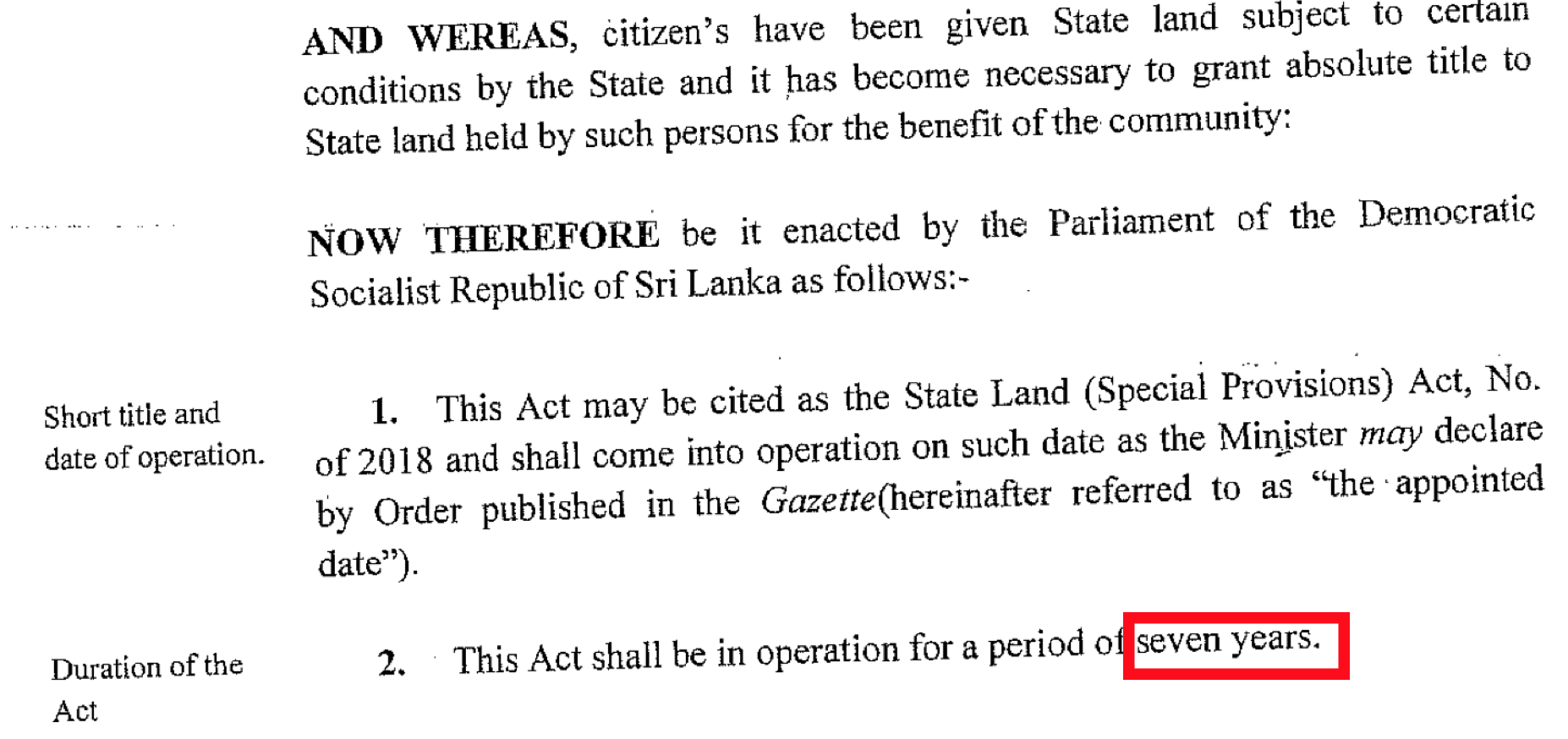
The Act is applicable to holders of grants under Land Development Ordinance, holders of disposition under the Land Grants (Special) Provisions Act 43 of 1979, holders of disposition under the Crown Lands Ordinance (used for agriculture), any land settlement program or colonization scheme and living for more than 10years. State lands coming under Urban Regeneration Project, Urban Development Project, Infrastructure Project or Housing Project will not come under the Act.
The former Government’s argument articulated by Lakshman Kiriella prior to introducing the Bill was that people had been living on State land with permits but because they had only permits they could not obtain loans, apply to schools etc. Without enabling them to take loans and get admissions to schools, the solution adopted was to give outright land ownership in the permit holders name. This was the yahapalana government’s justification to give 2.5million citizens title deeds. Little did this 2.5million citizens think that with a piece of paper that had their name on it, nothing much in reality was solved.
What would happen if they could not repay their loans? The banks would seize their land & sell it. This would have left them with no land, with no livelihood, with no roof over their head and with no one to go to.They would have been in worse condition than they were living for generations as permit holders. This message and this reality needs to go to the permit holders before they are falsely made to dream how lucky they are to own a piece of paper with their name on it.
The former President Sirisena repeatedly voiced objection to the land act claiming that any private party would be allowed to purchase lands in the country. Let us not forget that the former government removed the restriction on 50acres ownership and foreign ownership. All this was aligned to a bigger plan. Former President Sirisena also highlighted that local government bodies were being granted more powers to partition lands
The State Land (Special Provisions) Bill was included into Order Paper without seeking opinion of the Provincial Councils as per Article 154G(3) and tabled in Parliament on 28 June 2019.
However, the privatization of State Land was stopped by a fundamental rights petition that resulted in the Supreme Court making the following declaration.
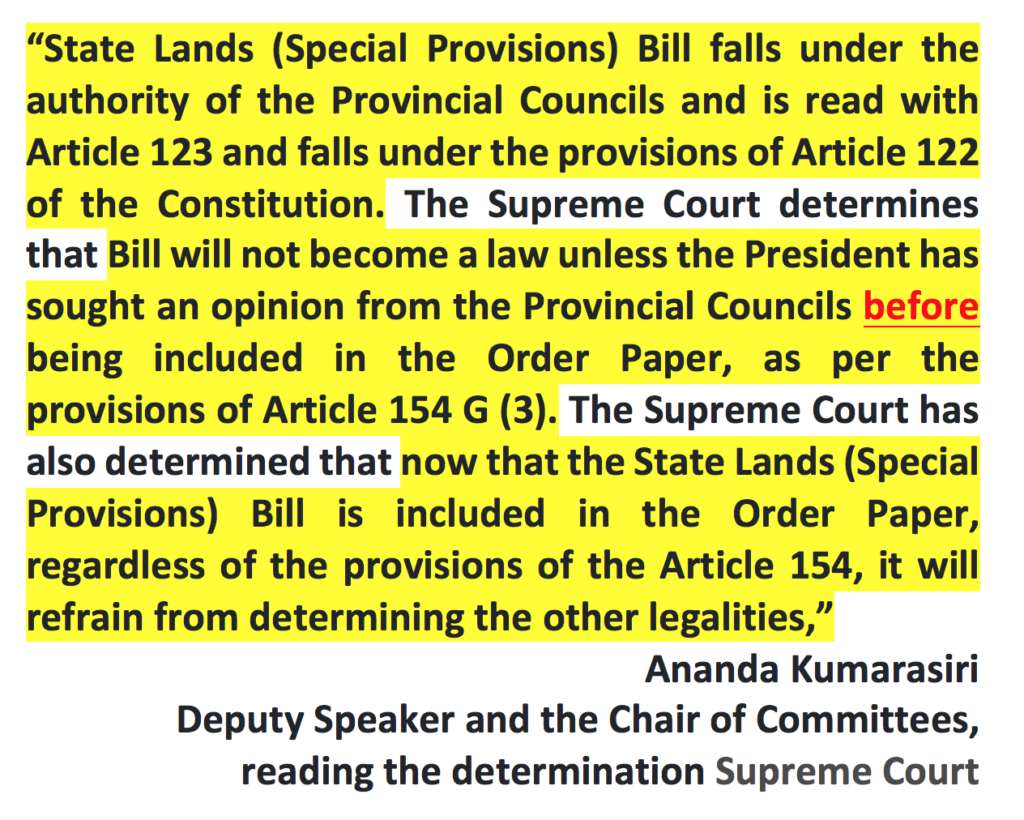
The question is does a Government elected only for a term & is only temporary custodian of State Land (People’s Land) have the right to give complete ownership of the People’s Land to a segment of citizens?
What happens when the capital asset LAND” of a country gets transferred to individual shareholders – how is this transfer going to affect the UNITARY STATE of Sri Lanka, government, ministerial powers & provincial councils?
Have politicians thought of the consequences to their powers – would there be a need for a Land Ministry, Ministry of Public Administration etc? Where are the boundaries of a Unitary State when private individuals can sell, mortgage, excavate & deal with land as they like?
Sri Lanka’s constitution has no provision for private ownership of land. Lands previously given on permits were to make ‘best use of our land’ by growing rather than treating land as a commodity for sale.
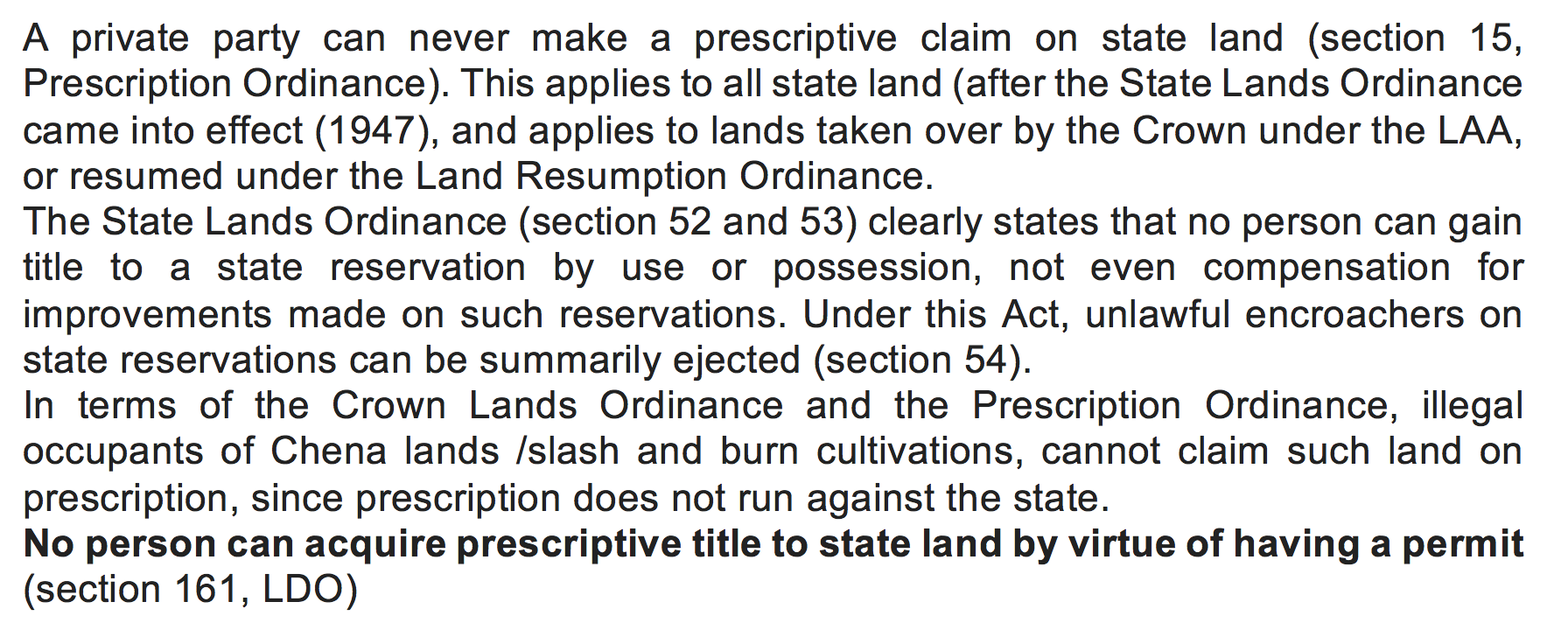
Vienna Convention on State/Land Sovereignty
International law defines sovereign states as having a permanent population,defined territory,one government, the capacity to enter into relations with other sovereign statesand neither dependent on nor subjected to any other power or state.
Would this definition apply if pockets of areas across Sri Lanka ended up sold and owned by foreigners (individuals, foreign governments or companies).
How would Sri Lanka’s Armed Forces/Police be able to function in such a scenario?
What would be the role of the Politicians and Public Service?
These are not scenarios that are likely to come into reality overnight. We know how foreigners grabbed coastal areas of Sri Lanka when the restrictions that denied foreigners to own land was removed.
The politicians think they can fool the people and get away. They have but now the foreign actors have found ways to manipulate them. Sadly not only with the politicians be dealt with, an entire country will suffer too.
The privatization of state land is even now happening, giving permit holders outright deed ownership which will get converted to title registration without the realization of the bigger picture and ignoring the fact that it is part of the MCC, is going to result in dangerous & detrimental scenarios for Sri Lanka unless the leaders and policy makers remove their blinkers and connect the probabilities of the pivot to Asia plan leaving Sri Lanka landless.
Shenali D Waduge
We wholeheartedly welcome the Government’s decision to ban the slaughter of cattle.
We thank the President Hon. Gotabhaya Rajapakse and the Prime Minister Hon. Mahinda Rajapakse for taking this courageous step, and the Government Parliamentary Group for endorsing this move.
It is inspiring to note that the State is now becoming committed to not only the welfare of human beings but also to the preservation of the precious lives of animals. Such a policy enshrines the essence of Buddhism – to refrain from taking life. It also exhibits the flowering of the most noble impulses that humans are capable of generating – that of sympathy and pity towards other living creatures.
We must remember that we in Sri Lanka are the heir to a rich and unique pre-colonial history in respect to Animal Welfare. Historical rock inscriptions and ancient chronicles e.g. Mahawamsa, reveal that extensive state protection was granted to animals and the slaughter of cows was strictly prohibited.
These historical sources further reveal that the ethic of Ahimsa (non-violence towards other sentient beings) a cardinal tenet in Buddhism and Hinduism, was a paradigm of public administration and justice in pre-colonial Sri Lanka.
Cakkavatti Sihanada Sutta
The Buddha’s discourse in the Cakkavatti Sihanada Sutta (Digha Nikaya of the Sutta Pitaka) spells out the duties of an ideal ruler as follows:
” The Cakkavatti King (Righteous King) will give protection, shelter and ward both to the different classes of human beings, and also to birds and beasts”
The social and legal history of Sri Lanka provides innumerable examples of the Buddhist attitude to animal life and the acceptance of State Responsibility for the well – being of animals.
State Responsibility for Animals
Our former Kings established some of the worlds’ first wild life sanctuaries. Five of the kings governed the country under the ‘Maghata’ rule, which banned the killing of any animal in the kingdom.
The five kings were 1) Amanda Gamini (79 – 80 AD), 2) Voharika Tissa (269 – 291 AD) 3) Silakala (524 – 537 AD) 4) Agga Bodhi IV (658 – 674 AD) 5) Kassapa III (717 – 724 AD).
(Vide ‘ History of Buddhism in Ceylon ‘by Walpola Rahula, First Edition, p.73)
King Silakala (524 – 537 AD) decreed the ‘preservation of life for all creatures’ throughout the Island. King Kassappa IV (898 -914 AD) granted safety to all creatures on land and water and in doing so observed in all respects the conduct of the ancient kings.
Several Kings established Animal Hospitals and one King i.e. Buddhadasa (341 AD) became a reputed medical and veterinary surgeon.
Animal Sacrifice banned in pre – colonial Sri Lanka
Ibn Batuta, the 14th Century Arab traveller refers to the sight of a co – religionist (a Muslim) in Kurunegala whose limbs had been amputated as punishment on the orders of the King.
On inquiry Batuta had been told that the King had spared the man’s life but nevertheless had his limbs amputated because he had unlawfully slaughtered a cow, for the purpose of animal sacrifice. This was a criminal offence punishable usually by death.
The above examples illustrate the extent to which the former rulers were prepared to act to protect and enforce the legal rights that animals, particularly the cow, enjoyed in the bygone era.
Ahimsa
The people, influenced by the principle of ‘Ahimsa’ generally kept away from occupations that required the killing of animals to earn a living e.g. hunting, fishing and the slaughter of animals for food. Those who resorted to these activities were usually relegated to the margins of the society. Cattle wealth was protected and not destroyed.
There was also taboo on consumption of meat. Robert Percival says, “They never eat meat, or anything that has had life” and Tennent says, “The mass of the population were nevertheless vegetarians and so little value did they place on animal food” (quoted in Amerasinghe “The Legal Heritage of Sri Lanka, p.132).
The neighbouring countries called our people the Aryavamsa (noble race) largely due to the strict adherence to abstain from causing harm to living beings.
Upon the entry of western influence to Sri Lanka commencing in the 16th Century, the high moral value extended to non – human sentient beings began to decline and the habit of flesh consumption gradually grew among the people.
Furthermore, occupations that were associated with the killing of animals, which fell outside the trades recommended as the means for a Right Livelihood by the Buddha in the Noble Eightfold Path, gained greater acceptance in society.
Anagarika Dharmapala
Despite these incursions, there were wake up calls by Buddhist leaders during the period of the Buddhist Revival.
Anagarika Dharmapala’s resounding call to stop eating beef with a view to preventing the slaughter of cattle had a great influence on our people. Anagarika Dharmapala was the embodiment of the campaign to stop the slaughter of cattle.
Ven. Bowatte Indraratana Thero sacrificed his precious life on Vesak Day (May 24, 2013) in front of the Dalada Maligawa (Temple of the Tooth) in Kandy, to galvanize the public to move rapidly in the direction of ushering in a ban on cattle slaughter. His martyrdom and the blood shed on the precincts of the Dalada Maligawa was meant to be a rallying point against ‘Gava Gathana ‘and cruelty to animals.
Right Livelihood
Today, in Sri Lanka, the State gives wide encouragement to people in both urban and rural areas, mostly Buddhists, to indulge in inland fisheries and rear animals e.g. chicken, goats, pigs and cattle for slaughter.
This policy is far removed from the ennobling ideals that the Buddha proclaimed when he advised rulers that birds and beasts should be given “ward and protection”.
State policies which violate the principle of Right Livelihood in the Noble Eightfold Path too should be abandoned alongside the ban on cattle slaughter.
The world is paying a heavy price for abuse of animals. Isn’t the Coronavirus pandemic a form of Karmic Retribution for slaughter of animals?
It is time to draw the appropriate lessons from this tragic crisis and move forward on a footing of compassion and loving kindness to all living beings as the Buddha taught continuously during his lifetime.
Senaka Weeraratna
Founder Member on behalf of Justice for Animals and Nature
තිරසර සංවර්ධන අරමුණු පිළිබඳ පංච පුද්ගල කමිටු වාර්තාව එම කමිටු සාමාජිකයින් විසින් අද 2020.09.10 දින ගරු අග්රාමාත්ය මහින්ද රාජපක්ෂ මැතිතුමාට පාර්ලිමේන්තුවේදී පිළිගන්වන ලදී.
විදේශ කටයුතු අමාත්යවරයාගේ උපදෙස් මත පත් කළ මෙම පංච පුද්ගල කමිටුවේ සභාපති ලෙස විදේශ කටයුතු අමාත්යංශයේ අතිරේක ලේකම් අහමඩ් ජාවිඩ් මහතා කටයුතු කළේය.
එම කමිටුවේ සෙසු සාමාජිකයින් ලෙස අග්රාමාත්ය අතිරේක ලේකම් ඇන්ටන් පෙරේරා, අචාර්ය ලොයිඩ් ප්රනාන්දු, මහාචාර්ය සී. එස්. වීරරත්න මහත්වරු සහ චාමින්ද්රි සපරමාදු මහත්මිය කටයුතු කළහ.
විදේශ කටයුතු අමාත්ය දිනේෂ් ගුණවර්ධන මහතාගේ උපදෙස් මත වසර 2030 ගෝලීය තිරසර සංවර්ධන ඉලක්කවලට අදාළ ශ්රී ලංකාවේ තිරසර සංවර්ධන අරමුණු සොයා බැලීම පිළිබඳව මෙම පංච පුද්ගල කමිටුව පත් කර තිබිණි. අග්රාමාත්යතුමාට මෙම වාර්තාව පිළිගන්වන අවස්ථාවට කමිටු සාමාජිකයින්ට අමතරව විදේශ කටයුතු අමාත්ය දිනේෂ් ගුණවර්ධන, අග්රාමාත්ය අතිරේක ලේකම් චමින්ද කුලරත්න, මහත්වරු එක්ව සිටියහ
ශ්රී ලංකාවේ නෙදර්ලන්ත තානාපතිනි ටන්ජා ගොන්ග්රිජ් මහත්මිය හා ගරු අග්රාමාත්ය මහින්ද රාජපක්ෂ මැතිතුමා අතර හමුවක් අද 2020.09.10 දින අරලියගහ මන්දිරයේදී පැවැත්වුණි.
මහ මැතිවරණයේ ලද ජයග්රහණය පිළිබඳව අග්රාමාත්ය මහින්ද රාජපපක්ෂ මැතිතුමාට සුභ පැතුම් එක් කළ නෙදර්ලන්ත තානාපතිනිය කොවිඩ් -19 වසංගත තත්ත්වය පාලනය කිරීමට ශ්රී ලංකාව කටයුතු කළ ආකාරය පිළිබඳව රජයට ප්රශංසා කළේය.
අනතුරට පත් MT – නිව් ඩයමන්ඩ් තෙල් ප්රවාහන නෞකාවේ සිටි නෙදර්ලන්ත විශේෂඥයින් පිළිබඳව විමසූ අග්රාමාත්ය මහින්ද රාජපක්ෂ මහතා දෙරටේ සමුද්රීය විශේෂඥයින් අතර පුහුණු වැඩසටහනක් ක්රියාත්මක කිරීමේ වැදගත්කම පෙන්වා දුන්නේය.
ඒ අනුව ඵෙතිහාසික අත්දැකීම් බහුල නෙදර්ලන්ත සමුද්රීය විශේෂඥයන්ගේ දැනුම ශ්රී ලංකාවේ සමුද්රීය විශේෂඥයන්ට ලබාදීමට නෙදර්ලන්ත දූත පිරිස එකඟතාවය පළ කළහ.
රෝහල් සහ පාළම් තැනීම, වෘත්තීය පුහුණුව සහ යාපනයේ දීර්ඝ කාලීන ව්යාපෘතියක් ඇතුළුව ආරක්ෂිත පානීය ජලය සහ කලාපයට වඩා හොඳ වාරිමාර්ග සැපයීම ඇතුළු ශ්රී ලංකාවේ තවත් ව්යාපෘති රැසකට නෙදර්ලන්තය මේ වන විට සහයෝගය දක්වනු ලබයි.
සේවා අංශය සහ ඒකාබද්ධ බහු බෝග කෘෂිකර්මාන්තය අතර ඉදිරියේදී සහයෝගීතාව වර්ධනය කර ගැනීම පිළිබඳවද මෙහිදී සාකච්ඡා කෙරිණි.
The Additional Secretary to the President for Foreign Relations, Admiral Prof. Jayanath Colombage in an interview stated: The foreign policy of the new government is based on some key pillars. The number one is neutrality. President Gotabaya Rajapaksa has repeatedly stated in Sri Lanka and India and in his interaction with the press and the diplomatic community, that his primary responsibility is maintaining neutrality. We don’t want to be labelled or get caught in this power game (Daily Mirror, January 28, 2020).
However, expanding on the above policy in his current position as Foreign Secretary, Admiral Prof. Colombage, during the course of an interview to Derana 24 news channel stated: Very categorically, the President has stated that we have a strategic security-wise ‘India first’ policy because we cannot be, we should not be, we can’t afford to be a strategic security threat for India, period,” (August 20, 2020).
The need for Sri Lanka to conduct foreign relations with other countries in a manner that is not a security threat to India was a bitter lesson Sri Lanka, learnt several decades ago at great cost in terms of blood and treasure that lasted three decades. The lesson Sri Lanka learnt was that if Sri Lanka engages in relations with countries such as the USA, or any other whose interests may be perceived by India to be inimical to the latter’s interests, in particular security, India would not hesitate to convey its displeasure at such developments in a manner of its choosing.
ALTERED LANDSCAPE
However, the circumstances at that time were different. India was a founding member of the Non-Aligned Movement, and global politics was determined by two recognized super powers. While the majority of countries were Non-aligned, others opted to be aligned with either one of the 2 super powers. Today, geopolitics is defined by a single super power, the USA, that is being challenged by a rising power, aspiring to be the other super power or even the sole super power: China. In such a background, India is no longer serious about staying committed to being non-aligned. Instead, it is an integral component of Quad, namely, a security related alliance made up of US, India, Japan and Australia, crafted as a feature of the US Policy ‘Pivot to Asia’. This alliance is preparing itself to counter China’s involvement in the Indian Ocean as part of its multi trillion-dollar Belt and Road Initiative.
It is in such an altered landscape that one has to consider whether India would or would not accept Sri Lanka caving into US pressure and signing the Millennium Challenge Corporation (MCC) Compact, the Acquisition and Cross Service Agreement (ACSA) and Status of Forces Agreement (SOFA). Bearing in mind that India is known to have already signed similar agreements with the US and is a partner of the combined defense arrangements of Quad, would India consider Sri Lanka signing any of these agreements with the US a security threat to India? NO!. On the other hand, India might welcome Sri Lanka signing security related Agreements with the USA, because Sri Lanka would then inadvertently become a part of the Quad security alliance to counter the influence of China.
Under these circumstances, a policy of India First” would mean that India would not have any security concerns with Sri Lanka if Sri Lanka becomes part of Quad by signing the three Agreements presented by the US, notwithstanding the sustained opposition expressed by the Sri Lankan public. For Sri Lanka to be in a position where its interests and that of its public are determined by any other State or States, is unacceptable. Therefore, ‘India First’ must be viewed with apprehension.
A way to overcome such hard choices is to rely on the President’s initial Foreign Policy of Neutrality; a position he declared to the nation and to the world during his inaugural acceptance speech in the hallowed precincts of Anuradhapura. It would only be a policy of Neutrality that would enable Sri Lanka to exercise its sovereign rights and at the same time ensure other States, in particular India and Quad, that Sri Lanka would be Neutral as far as security issues are concerned while engaging with all nations in respect of other issues. Such a policy would mean that when it comes to security no one is first. All are equal. This is of particular relevance in view of the emerging landscape in the Indian Ocean in respect of security issues
EMERGING LANDSCAPE
The Annual Report by the US OFFICE OF THE SECRETARY OF DEFENSE to Congress:” Military and Security Developments Involving the People’s Republic of China 2020 states: Beyond its current base in Djibouti, the PRC is very likely already considering and planning for additional overseas military logistics facilities to support naval, air, and ground forces. The PRC has likely considered locations for PLA military logistics facilities in Myanmar, Thailand, Singapore, Indonesia, Pakistan, Sri Lanka, United Arab Emirates, Kenya, Seychelles, Tanzania, Angola, and Tajikistan. The PRC and Cambodia have publicly denied having signed an agreement to provide the PLAN with access to Cambodia’s Ream Naval Base”.
Whether China is considering and planning additional overseas military logistics facilities” or not, the several Ports already built by China in the Indian Ocean Rim countries could readily be transformed into military logistics facilities. In this regard Sri Lanka is particularly vulnerable because of all the countries referred to above, the uniqueness of the strategic location of Sri Lanka for military logistics in the Indian Ocean is a fact that is indisputable. Furthermore, China already has a logistic facility in Hambantota, even though not a military facility at this point in time. Consequently, Sri Lanka would be hard pressed to avoid the rivalry that is inexorably emerging between Quad and China.
In such a background, would a policy of Non-Alignment or looking East for support from regional organizations such as BIMSTEC and/or SAARC help Sri Lanka to deal with security related countervailing pressures that are engulfing Sri Lanka in various forms; the latest being sanctions imposed by the US on Companies involved with the Port City Project?
Non-alignment was relevant at a different time when the geopolitical construct was also different. During that time, India and Sri Lanka were on the same page as far as Foreign Relations were concerned as partners of the Non-Aligned Movement. Furthermore, no country was interested in establishing their foot print in Sri Lanka, and the Indian Ocean was not the hot bed of rivalry that it is today as a consequence of China attempting to regain its place in the world, and alliances such as Quad attempting to counter China’s efforts. In addition, by being part of Quad, India cannot realistically claim to be non-aligned. In such a context, Sri Lanka has to be specific and state with whom or what aspects of Foreign Relations Sri Lanka is not aligned with, if non-alignment is in fact its policy. In the absence of an unambiguous statement, the message should be that Sri Lanka’s relations with all States would be Neutral in respect of security related issues. Such a policy would enable Sri Lanka to stay clear of major power rivalries.
CONCLUSION
The suggestion that Neutrality was an appropriate policy to guide Sri Lanka’s Foreign Relations was mooted in an article titled Independence: Its meaning and a direction for the future” (Ladduwahetty, The Island,February 14, 2019). This article stated: Traditional thinking as to how small States could cope with external pressures are supposed to be: (1) Non-alignment with any of the major centers of power; (2) Alignment with one of the major powers thus making a choice and facing the consequences of which power block prevails; (3) Bandwagoning which involves unequal exchange where the small State makes asymmetric concessions to the dominant power and accepts a subordinate role of a vassal State; (4) Hedging, which attempts to secure economic and security benefits of engagement with each power center: (5) Balancing pressures individually, or by forming alliances with other small States; (6) Neutrality”.
Continuing, the article stated: Of the six strategies cited above, the only strategy that permits a sovereign independent nation to charter its own destiny is neutrality, as it is with Switzerland and some Nordic countries, not only because domestic rivalries prevent the development of consistent policies for engagement with great powers but also because Sri Lanka does not have the skills or the level of sophistication to emerge unscathed from “grey zone coercion” of the great powers. Neutrality has relevance at this particular point in time because regional cooperation arrangements among countries in the Indian Ocean Rim and South and South East Asia have lost its appeal due to each country attempting to engage in arrangements that suit them best. Under the circumstances, how could neutrality translate itself in real terms”?
Instead of making a public declaration that henceforth Sri Lanka would be neutral in its relations with the great powers, it would be more prudent to express neutrality via the manner in which Sri Lanka engages with the great powers. To start with, Sri Lanka should cease taking outright loans or loans to finance infrastructure projects however attractive the terms from either of the power blocks. Equally important is for Sri Lanka to cease participating in security related land or sea operations with either of the power blocs because they are clearly conducted to further their own security preparedness”.
In the current geopolitical setting where the Indian Ocean with Sri Lanka right in the middle of it has become a theater for rivalry between the security alliance of the US, India, Japan and Australia (popularly referred to as the Quad), and China, the most prudent policy for Sri Lanka, given the prevailing geopolitical particularities is one of Neutrality, as advocated and articulated by the President during his inaugural speech in the hallowed precincts of Anuradhapura.
Neville Ladduwahetty September 8, 2020.
You don’t need to kill the patient to kill the pain –Dr. Andre Bourque University of Montréal

Euthanasia or assisted suicide is a controversial topic that is
defined as deliberate intervention undertaken with the express intention of
ending a life, to relieve intractable suffering. Today several countries have
legalized euthanasia and some view it as a
human right. Those who support euthanasia point
out that the importance of personal autonomy and self-determination, the right
of every human being to have his / her wishes respected in decisions involving
his / her own body and the recognition of every human being is in principle,
master of his/ her own destiny.
In 2002 Holland became the first country in the world to legalize euthanasia and in 2003, 1626 cases were officially
reported from Holland. The Dutch euthanasia law
gives doctors immunity from prosecution if they help to kill patients over the
age of 12 who are suffering unbearably from incurable conditions and who have
repeatedly requested euthanasia.
Euthanasia Guidelines in
Holland
The Dutch laid out narrow guidelines for doctors: The patient, who must be suffering unbearably and have no hope of improvement, must ask to die. The patient must clearly understand the condition and prognosis and a second doctor must agree with the decision to help the patient die.
Euthanasia in Belgium
Belgium legalized euthanasia in 2002, but the laws seem to encompass assisted suicide as well. Since its legalization eight years ago, euthanasia now accounts for 2 per cent of deaths in Belgium – or around 2,000 a year. Two doctors must be involved, as well as a psychologist if the patient’s competency is in doubt. The doctor and patient negotiate whether death is to be by lethal injection or prescribed overdose.
Oregon Death with Dignity law
In 1994, voters in the state of Oregon approved a ballot measure that would have legalized euthanasia under limited conditions. Under the Death with Dignity law, a person who sought physician-assisted suicide would have to meet certain criteria. In order to qualify for physician-assisted suicide, a person must be an Oregon resident, 18 years of age or older, must have decision-making capacity, and must be suffering from a terminal disease that will lead to death within six months.
Forced Euthanasia
A number of reports indicate that some medical practitioners have abused the legal privilege of euthanasiaand reinforced depressive patients to select euthanasia as an option. A study found that a high proportion of deaths classed as euthanasia in Belgium involved patients who did not ask for their lives to be ended. In 1990 government sponsored surveys found that 0.8% of all deaths in the Netherlands were euthanasiadeaths that occurred without a request from the patient. In a 1995 study, Dutch doctors reported ending the lives of 948 patients without their request.
Passive Euthanasia
Although euthanasia is illegal in many countries passive euthanasia (withhold treatment and allow a patient to die) is being practiced. This is unethical and described as a malpractice. The American Medical Association emphasizes that the intentional termination of the life of one human being by another is contrary to that for which the medical profession stands. Human life has an absolute value and it is inhuman for a medical practitioner to terminate it.
Mrs. H a resident from North York Ontario Canada witnessed the agonizing death
of her grandmother who suffered a stroke. When she was admitted to the
…….hospital the doctors said that she would not recover. After several days the
nasal feeding was discontinued. Mrs. H was near her semi-conscious grandmother
all the time and the grandmother responded to her time to time by blinking the
eyes. After removal of nasal feeding tube she was starving and I could see tears
in my grandmother’s eyes. She was dying but the process was accelerated by
discontinuing nasal feeding that led to an agonizing death says Mrs. H
Mrs. VXXX a resident from Colombo Sri Lanka underwent the
same experience when her 92 year old mother was admitted to the ……… hospital.
She was diagnosed with a benign ovarian tumor and had numerous age related
complications. During her stay at the hospital she was only given Brufen
and Vitamin B. Doctors and Nurses often said that she had lived her years
and taken no significant efforts to improve her condition. She was prematurely
discharged and after two weeks she died at home. What worries me is not my
mother’s medical condition but the attitude of the medical staff says Mrs.
VXXX.
Mr. XXX a resident from Negombo met with a road traffic accident
and admitted to the ……………….. Hospital- Intensive Care Unit. He was unconscious
throughout and was on a life support. By the 8th day his
condition remained unchanged. The medical staff decided to remove him
from the life support system in order to accommodate another patient who was
diagnosed with Guillain–Barré syndrome. After removing Mr. XXX from the life
support system less than 24 hours he passed away. His son who is a doctor now
believes that his father was not given a fair chance at the hospital to
recover.
Passive Euthanasia: My Personal Experiences in the Sri Lankan Hospitals
Unfortunately I observed passive euthanasia in a number of Sri Lankan Hospitals. The first experience I witnessed was in 1994 during my internship appointment at the Matale Base Hospital.
A 10 year old school boy was brought to the surgical ward following head injury that was caused by a road traffic accident on the Palapathwala road. I was the house officer who gave primary care for this unconscious child. I immediately realized trepanation of the skull had to be done to evacuate the intracranial hemorrhage that was pressing the vital centers in the brain. The Senior House Officer too agreed with me. This operation is called performing a Burr Hole and had to be done by a Consultant Surgeon. I immediately called the Operation Theater and said we may need the theater facilities to treat a boy with a head injury.
Then I called my Consultant Surgeon who had just finished the evening ward round. The time was about 3.40 pm and he was preparing to go home. The Consultant Surgeon was annoyed that I called the operation theater. He ordered me to give diazepam 5 mg intravenous to the child even without seeing the patient. Again I asked Sir are we going to do a Burr Hole to stop the subdural hematoma. This time he responded to me in very dry language and asked me to give diazepam and monitor the child and maintain the head injury chart. I was powerless and did exactly what he ordered. Then the Consultant Surgeon left for home.
I observed the poor child until midnight. Several times he went in to seizures. Since we were given unofficial instructions not to transfer patients to the Kandy hospital at night, by the Surgeon we had no way of sending the child to the Kandy Teaching hospital for special management. The Surgeon did not respond to our calls that night. So we waited and prayed for his life. At around 1.30 am the child died. According to my opinion we could have saved this child if the Surgeon did the surgery or allowed us to transfer the child to the Kandy Hospital. When I look back at this incident after 18 years I feel that the Consultant Surgeon who was supposed to give us knowledge, ethics, and leadership did nothing but forced us to perform passive euthanasia.
I was trained in Anesthesia by Dr. Priyangani Ariyarathne – Consultant Anesthetist at the North Colombo Teaching Hospital in 1999. I worked in the ICU and in the operation theaters at the North Colombo Teaching Hospital for about a year and observed that when the medical staff get new acute patients to the ICU they sometimes remove the life support systems of the old patients and fix it to the new patients. Due to lack of beds at the ICU the medical staff was compelled to do it. But still I had mixed feelings about this unorthodox practice.
When the Ja Ela bomb exploded on the December 18, 1999, that killed General Lucky Algama, hundreds of patients were brought to the Colombo North Teaching Hospital. The individuals who were critically injured were admitted to the ICU. There was a young man who was on the life support system following organophosphate poisoning and the medical staff removed him from the life support system and his bed was given to a bomb victim. Without the ventilator and other life support system the young man died the following day. One can always argue that the first patient became ill as a result of self-induced poisoning and the second patient became a victim of a terrorist act. But my question was who are we to decide their fate and the duration of their life span.
When I was working at the Chilaw hospital I had the opportunity of working at the ICU and I saw this life support removal occurring there too. Once we had a snake bite case and in order to accommodate him the doctors removed another patient who was in the ventilator with Dengue hemorrhagic fever. The snake bite case survived and the dengue patient died. Again it became a dilemma for me. So instead of working at the ICU I decided to work in the Operation Theater.
Over the years I witnessed how some of my colleagues became indifferent to human lives. I remember one Doctor at the Negombo hospital who was against giving blood transfusions to the severely anemic alcoholic patients. These people are alcoholics and they deserve to die without wasting medical resources he openly stated. Another PHO (Pediatric House Officer) told me that when he suspects cerebral palsy in newborns he cuts off the oxygen supply to them. I am doing a favor for the child and the parents, so they are free of life long suffering with a disabled child, he told me with confidence. I became so disgusted and replied that it was illegal, a crime and under the Hippocratic Oath he was violating professional ethics. I do not know whether he stopped this unethical practice after my brief lecture.
Euthanasia Declines in the quality of care
Euthanasia devalues human life; in the long run euthanasia can become a means of health care cost containment. In Holland legalized euthanasia has led to a severe decline in the quality of care for terminally-ill patients. Dr. Els Borst, the former Health Minister and Deputy Prime Minister who guided theeuthanasia law through the Dutch parliament recently admitted that medical care for the terminally-ill had declined since the law came into effect.
Euthanasia and Murder
According to the Criminal Code a person commits homicide when, directly or indirectly by any means, he causes the death of a human being. In this context euthanasia is mealy a murder. The main aim of the medical practitioners should be focused on improving and enhancing the care of the patient. Under the Hippocratic Oath, medical practitioner cannot engage in euthanasia.
Dr. Jack Kevorkian alias Dr. Death
Dr. Jack Kevorkian is a pathologist who actively support of voluntary euthanasia. He designed a so called death machine (thanatron) that was used by several terminally ill patients to commit suicide. He had helped more than 130 terminally ill people end their own lives. In 1994, he faced murder charges in the death of Thomas Hyde, who suffered from a terminal nerve illness. He was convicted of second-degree murder. Some experts consider Dr. Jack Kevorkian is highly obsessed with mercy killings and gradually lost the human touch. Instead of promoting health as a doctor Dr. Jack Kevorkian promoted death.
Harold Shipman
The British doctor Harold Shipman murdered 215 of his patients using the drug Diamorphine over a period of 20 years. He killed an average of one patient a month during his medical career. Young Shipman observed the painful death of his mother who suffered from terminal cancer. In the later years he killed mainly elderly women who were suffering from various illnesses. He was an addictive serial killer who may have believed that he was helping the patients to end their suffering. Shipman hanged himself in January 2004 while in custody.
NAZI Movement and Euthanasia
Those who support euthanasia should study what the NAZI s did in Germany and in their occupied countries. The NAZI s widely used euthanasia as a social cleansing method. First, they exterminated the mentally ill and disabled Germans. Subsequently they extended euthanasia as a political tool. NAZI s used the medical practice to propagate racial supremacy. Dr. Josef Mengele alias the angel of death used to do horrible experiments euthanizing men, women and children. NAZI genocide machine started fromeuthanasia and it ended up with the Final Solution. During the Hitler’s regime, 6 million Jews were terminated.
Conclusion
Before the advances in medical science diseases like leprosy, syphilis etc.
were considered as incurable and relatives often performed mercy killings to
end the suffering of the patients. Today the doctors are struggling with
terminal cancer and sometimes suggest euthanasia as
a temporary answer. The future advancements in medical science would bring
viable solutions to many incurable diseases andeuthanasia would
be considered as an outdated, inhuman and unprofessional form of practice.
Chera, Chola, Pandya: Using Archaeological Evidence to Identify the Tamil Kingdoms of Early Historic South India Abraham, Shinu Anna. Asian Perspectives, Volume 42, Number 2, Fall 2003, pp. 207-223 (Article) Published by University of Hawai’i Press DOI: 1
Quote
important in the identification of Tamilakam is inscriptional evidence. Within Tamil Nadu, for example, about 80 to 90 rock inscriptions have been discovered in natural caverns. Along with fragmentary epigraphs on potsherds from around 25 sites in southern India (Zvelebil 1992 : 123) and outside South Asia (Mahadevan 1993), they form the strongest linguistic evidence for separating Tamilakam from the rest of South India. The inscriptions range from third abraham . tamil kingdoms of historic south india 211 or second century b.c. to second or third century a.d., and are written in the Bra¯hmı¯ script, which was common throughout the peninsula at the time, but the language is an early form of Tamil. The Tamil inscriptional data varies from the Sangam texts, since they have a di¤erent source and were recorded for di¤erent purposes. These inscriptions were written in what are believed to be Buddhist or Jain ascetic caves, and their purpose seems to be to remind travelers of the bounty of various merchants and kings and their support for these sects (Kennedy 1976 : 6). The inscriptions mostly contain personal and occupational names of donors who endowed the Buddhist and Jain monks with stone beds in caverns (Gurukkal 1989 : 160), and one of their greatest benefits is that they confirm certain king and place names that are mentioned in the earliest Sangam texts (Zvelebil 1992 : 124). Non-Tamil South Asian inscriptions also include references to Tamilakam. Among the most pivotal are the rock edicts of the North Indian Mauryan emperor As´oka, dated to third century b.c. One of the edicts refers to five independent states that presumably existed beyond the southern border of his empire: the Choda (Chola), Pandya, Satiyaputra, Keralaputras (Chera), and Tamraparni (Sri Lanka) (Zvelebil 1992 : 110)—an indication that the polities of Kerala, Tamil Nadu, and Sri Lanka were not incorporated into the Mauryan realm (Fig. 3). Also relevant is the central Indian Hathigumpha inscription (possibly from the second half of the second century b.c.), which discusses the destruction of a ‘‘confederacy of Tamil powers’’ (Zvelebil 1992 : 103). Outside of South Asia, it is the Greco-Roman writings that provide the most detailed historical information about Tamilakam. India is in fact frequently mentioned in the Western classical literature (McCrindle 1971: xxi). The protohistoric period in South India coincides with a phase of South Asian participation in the flourishing maritime networks of the Indian Ocean. The South Asian subcontinent is well known for having had long-standing, varied, and complex forms of interaction with the external world, and South India is no exception. Historical and archaeological reconstructions of South India during its Early Historic period have placed a great deal of emphasis on the long-distance maritime trade networks to which South India belonged—particularly its links with the Roman Empire (Begley 1996; Ray 1989, 1994, 1995). The network incorporated a number of regions along the Indian Ocean littoral—including the Red Sea coast (Saloman 1991; Sidebotham 1986), the Arabian coast (Whitehouse and Williamson 1973), East Africa (Munro-Hay 1996), Southeast Asia (Ray 1994; Smith 1999), Sri Lanka (Munro-Hay 1996), and China (Ray 1994)—and South India acted as a major node in the interregional transmittal of goods during Hellenistic and Roman times (Charlesworth 1926). Of all the historical sources available for Tamilakam, the Greco-Roman references to South India are particularly useful since they are to a large degree datable and help, therefore, to fix the centuries during which overseas trade flourished. However, most of these texts refer not to ‘‘Tamilakam,’’ but to specific trade centers and ports in peninsular India.
the archaeology of protohistoric kerala and tamil nadu Although extensive portions of Kerala and Tamil Nadu have been explored and a number of sites excavated (general overviews of the region’s archaeology can be found in Brubaker 2001; Gurukkal and Varrier 1999; Gurumurthy 1991; Leshnik asian perspectives . 42(2) . 212 fall 2003 1974; Moorti 1994; and Ramachandran 1980), the archaeological record for Tamilakam is far from satisfactory. Relatively few radiocarbon dates are available, and there are, unfortunately, no clear sequences or patterns in artifact assemblages that have permitted the development of internal relative dating sequences. Documentation of sites has been inconsistent at best—most published data on Iron Age burials take the form of brief notices, for example, and when excavations reports are available, they tend to rely on existing ill-defined artifact classification schemes. Another issue is the fragmentary nature of archaeological research in South India. Most synthetic studies are delimited by state, making it di‰cult to understand ancient regional patterns that crossed modern political boundaries. Also, scholars have tended to compartmentalize areas of research, focusing on certain site types, such as Iron Age burials or Early Historic settlements, or on Fig. 3. Polities in early South India (c. 200 b.c.–a.d. 300). abraham . tamil kingdoms of historic south india 213 specific material assemblages, such as cave inscriptions or coins. Although some South Indian historians have understood the need to treat all these elements as interrelated parts of a single past social formation (see, for example, Gurukkal 1995 : 239–240), it is only recently that archaeologists are coming to the same realization. A general over
Even this cursory overview of the sites and material culture from Kerala and Tamil Nadu highlights a key point: despite the common tendency for South Indian historians and archaeologists to speak of ‘‘Tamil’’ material culture, the archaeological evidence that sets Tamilakam as a region apart from the rest of South India has never been clearly identified. If one evaluates Tamil cultural identity using Emberling’s guidelines, then the claims of ethnic di¤erence appear to falter, since nearly all the material culture found in Tamilakam—that is, in Kerala and Tamil Nadu—can be found elsewhere in peninsular India. Similarly configured urban centers and habitation sites are located throughout South India and Sri Lanka. And, although the majority of Iron Age burials are situated in South India, they are widely distributed throughout the Indian subcontinent, and only one or two types are unique to Tamilakam. In the same way, the distribution of ceramics, iron, and other artifacts are dispersed across the alleged past cultural-ethnic, linguistic, and geographic boundaries of South India.
‘‘materializing’’ the tamil identity Given the nature and distribution of sites and artifacts across the Tamil landscape, it has been difficult to discern a pattern of style or symbol or process that stands out, making simplistic normative notions of a Tamil identity appear misplaced.”
Full Article
Emperor Asoka’s pillars
https://www.ancient.eu/Edicts_of_Ashoka/
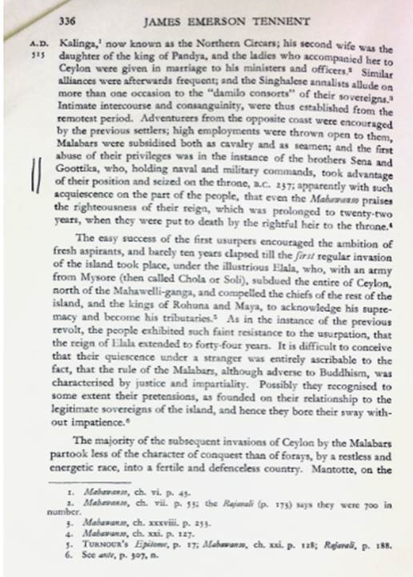
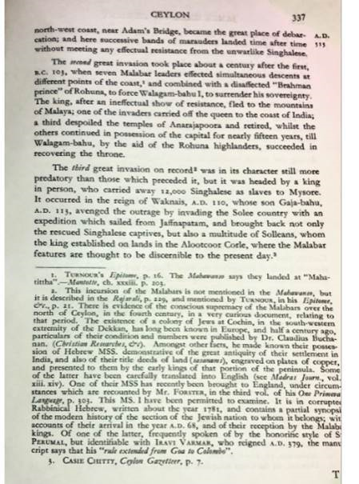
Ceylon by Sir James Emerson Tennent. 1st edition 1859
As you are aware, Muslim marriages in Sri Lanka centre around the Nikah and Walima in accordance with the tenets of Islam.
The Nikah, which is Shariah-based and therefore immutable, is essentially a brief ceremony where, under the guidance of a pious Muslim male, vows are exchanged between the Bride’s guardian (Wali) and the Groom, and is most importantly witnessed (usually) by two pious Muslim males. Additionally, prayers and duas may be recited and a sermon may be delivered by the individual-in-charge, if the persons so desire. That’s it.
This is how it was done during the time of our Holy Prophet (Sal) and this is how it should be done today. There was no ‘certification’ (in written form) of the Nikah done during the time of our Holy Prophet (Sal). The ‘certification’ (in verbal form) was provided by the two witnesses.
However, the need for some form of written ‘certification’ of Muslim marriages grew from the fact that other non-Muslim marriages issued certificates in response to evolving socio-cultural-legal requirements of society, which necessitated proof of marriage.
Unfortunately in Sri Lanka, this need for a certification was permitted to become an integral part of the Nikah ceremony. A certification that a Nikah ceremony had taken place was therefore regarded as the Muslim Marriage Certificate. The conduct of the ceremony and the issuance of the certificate have merged to become a single entity referred to as the ‘Nikah’.
This, Honourable Minister, has resulted in the sanctification of the Nikah certificate to such an extent that it is now deemed to be as inviolable as the Nikah ceremony itself.
As the first step towards bringing the Marriage Laws governing the Muslim Community in line with the policy of One Country, One Law” enunciated by His Excellency The President, one must separate the ‘Nikah’ into it’s two constituent parts – the ceremony and the certification; the former being an obligatory religious act on the part of Muslims, and the latter being a secular, administrative requirement.
Mr Minister, please set the ball rolling by de-sanctifying the certification process. The certification is not Shariah-based. It is merely a written record of the various individuals participating in the Nikah Ceremony (names, addresses and signatures ) and could therefore be amended to suit new conditions.
The Muslim Community should of their own volition propose the following changes to the MMDA (Muslim Marriage and Divorce Act) to make it compatible with the ‘One Country, One Law’ policy.
[1] All Muslim marriages to be registered under the General Marriage Registration Ordinance (GMRO). This would amount to effecting a change only in the certification process.
[2] Additionally, if they so desire, Muslims should be permitted to conduct Nikah Ceremonies (within a stipulated period after the certification process under the GMRO) which should be recorded in a Nikah Register to be maintained by the Department of Muslim Cultural & Religious Affairs. Nikah Certificates should be issued by the Department upon request.
This would ensure that the Marriage would be recognized by the Muslim community.
[3] Muslim Brides and Grooms should be permitted to enter into a legally-valid Marriage Contract which must be signed by both individuals (a kind of Pre-Nuptial Agreement) wherein :
= they agree on the quantum of Mahr to be gifted by the Groom to the Bride
= they agree that in the event of death or on the question of inheritance, they will adhere strictly to the relevant Shariah rulings. This will counter any fears that since the original certification was a ‘civil ceremony’, the parties concerned will opt to follow non-Islamic rules in the cases of divorce or death.
= they state whatever other specific conditions that both the bride and the groom may mutually agree upon. For example, the groom may agree not to take a second wife without the written consent of the first.
= or, in the case of a really progressive couple, where the Husband agrees to the termination of the marriage by the unilateral will of the Wife (known as Isma), by agreeing to delegate the power of Talaq to his wife (Talaq-al-Tafwid). This would ensure that the couple are bound by all the relevant Islamic rules.
This would result in a ‘Win-Win’ situation for the Muslim Community as well as for the President’s Policy of ‘One Country, One Law’. Most importantly, the Muslim Community will be perceived as being willing partners in the efforts of the present Government to foster unity and harmony.
It should be mentioned in this regard that the nearly three million Muslims in the U.K continue to lead their pious lives happily under this ‘dual’ registration system of marriages for Muslims. There should therefore be no doubts whatsoever as to the efficacy of this proposed system.
BISTHAN BATCHA
President Gotabaya Rajapaksa today (10) responded to comments by the Opposition and its allies on the 20th Amendment to the Constitution and the court ruling on Sri Lanka Podujana Peramuna (SLPP) Ratnapura District Parliamentarian Premalal Gunasekara.
Referring to the allegations by the Opposition during today’s meeting with State Ministers held at the Presidential Secretariat President Rajapaksa said the objective of the 20th Amendment to the Constitution is to remove the obstacles imposed by the 19th Amendment and move forward.
Everything cannot be changed overnight. It takes a long time. Various views have been expressed. We want to retain some of the features of the 19th Amendment. The primary objective is to keep the tenure of the President unchanged and to move forward,” President explained.
Responding to the accusations made by the opposition regarding the member of Parliament Premalal Jayasekera, President Rajapaksa emphasized that neither he nor the Prime Minister did intervene in the procedures of the court.
If the intention was to influence in this regard it should have been done at the High Court stage. Something of this nature never occurred. The verdict was given by the judge who was appointed by the Constitutional Council. Members of the Constitutional Council included personnel from Opposition such as Karu Jayasuriya, Sajith Premadasa and Thalatha Atukorale. One decision is acceptable for the opposition while the other is not”. President said.
President observed that Judge of the Court of Appeal was also appointed by the Constitutional Council itself and added that the Opposition is running a false propaganda campaign in this regard.
-PMD
The Government has decided to increase the total number of National Schools in the country to one thousand and to expedite the development of National Schools.
This was stated at a discussion chaired by President Gotabhaya Rajapaksa with all state ministers at the Presidential Secretariat today (10).
Meanwhile, the President and other state ministers have decided to appoint district education committees for the development of the school system.<
It was also agreed to strengthen the coordination between the Education Zonal Offices and the Divisional Offices.
The President pointed out that there is an opportunity for politicians to participate in all activities that contribute to the development of the school system except teacher transfers and enrollment of children in schools, He stated that the participation is aimed at the common good and not for political interference.
Meanwhile, attention has been focused on appointing acting principals to fill the vacancies of principals in schools island wide.
The President pointed out that according to the Teachers’ Constitution, teacher examinations should be held every year. He further stated that the main reason for the vacancy for principals was that it has not been conducted properly.
A statement issued by the President’s Media Division further stated that it was decided to look into the possibility of appointing talented and experienced teachers in schools as acting principals.
03 arrivals from Kuwait, Singapore & the UAE, tested positive for COVID- 19, increasing total infected in Sri Lanka to 3,155.
It was stated today that the weapons found in connection with the arrest of former DIG Vass Gunawardena in the Mohammed Siyam murder case was fabrication by a group including Shani Abeysekera.
This was when Inspector Irosh Villawarachchi testified before the Presidential Commission of Inquiry on Political Victimisation.
The National Joint Committee wish to salute the principled stand taken by Honourable Sarath Weerasekera Minister of Provincial Councils and Local Authorities, that he is against the Provincial Council system and would endeavor its abolition. We hail the Honourable Prime Minister’s bold decision to advise the President under the existing provisions of the Constitution to appoint Honorable Sarath Weerasekera for this office, when it was public knowledge that Mr. Weerasekera was always against the thirteenth amendment and the Provincial Council system introduced by this amendment. We believe that entrusting both Provincial Councils and Local Authorities in one ministry is not an accident but a step that can facilitate to restructure the Provincial Council System and empower the Local Authorities.
We have always opposed the thirteenth amendment and call for its abolition even now, however if that is not favored at this moment, the existing Provincial Council system should be at least restructured. Thus, it is the duty of the Minister of Provincial Councils and Local Governments to dismantle the existing Provincial Council system and empower the Local Authorities so that the Provincial Councils if at all could consist of representatives from the Local Authorities. The Minister should ensure that elections for Provincial Councils are done away with completely. It would be a tremendous waste of public resources to conduct elections and spend large sums of money to pay for salaries and grant benefits to members of the Provincial Councils.
Provincial Councils have been an utter waste of resources of the state with nine boards of Ministers entrusted with executive power in addition to the Cabinet of Ministers at the center. We see no justifiable reason to have ten Ministers of health, one in the center and nine in the provinces. The same applies in the field of education with ten Ministers of education. Provincial Councils have been used by politicians of both sides of the political divide to nurture their sons and daughters, nieces and nephews and to be a practicing ground for them to enter Parliament, and take their place when their parents, uncles and aunts retire from politics. It is repulsive that a section of the Government have orchestrated a campaign against Honourable Weerasekera to achieve their petty personal desires. It is unfortunate, that a spouse of a Cabinet Minister too has joined this selfish campaign.
The abolition of the Provincial Council system presently existing would be in line with the President’s policy; One County-One Law. The existing system with legislative power vested in the Provincial Councils would run counter to this very policy of the President. Under the thirteenth amendment, not only that, Provincial Council could enact legislation that would be effective over Central Government legislation, but the Parliament would not be in a position to amend or repeal Provincial Council legislation without two third support in Parliament. It is necessary that we restore supremacy of Parliament. Even if a Provincial Council is vested with such legislative power, the Parliament should be in a position to amend or repeal such legislation with a simple majority. Vesting Provincial Councils with police and land powers is a threat to national security and the very existence of the structure of the state. Even to date the provisions pertaining to the amalgamation of provinces exist. The National Joint Committee strongly urge the Government to rectify these misplaced clauses in the Constitution when enacting the proposed twentieth amendment, without waiting till a new Constitution is drafted.
If it is the view of the Government that the abolition of the nineteenth amendment is so urgent we see no justifiable reason why it should not forthwith repeal the thirteenth and the sixteenth amendments and the proportional representation system of elections presently existing, in as much as the Government came into power with a mandate to rectify these errors. The National Joint Committee is astonished at the decision of the Government to amend Article 53 of the Constitution which mandatorily requires Ministers to take the oath against supporting and promoting a separate state, (i.e the 7th Schedule introduced by the sixth amendment) and by restricting it to the original oath prescribed in the fourth schedule. Article 61D of the proposed amendment too require the public officers to take the fourth schedule oath that existed in the original Constitution and not the oath prescribed in the seventh schedule introduced by the sixth amendment.
We are not in favor of repealing the provisions which bar dual citizens from being Members of Parliament and the removal of the ceiling placed on the number of Ministers. We see that there is an attempt to accommodate extremists who are citizens of other countries in Parliament and in the Cabinet without taking the required oath under the sixth amendment. We do not expect a Government that came into power with the nationalist vote just a few weeks ago to act in this manner. We are also against the abolition of the National Procurement Commission which can lead to corruption. We are supportive of the abolition of objectionable provisions in the nineteenth amendment but regret that provisions of the eighteenth amendment and certain provisions that existed prior to the nineteenth amendment are being reintroduced to the Constitution by the twentieth amendment.
We consider that the introduction of the provisions relating to enactment of urgent bills within 24 hours which was misused by all previous governments should not be incorporated in the twentieth amendment. The structure introduced by both the eighteenth amendment and the proposed twentieth amendment without the safeguards of checks and balances is an unwise move. Whilst we have the utmost confidence in the President and would not doubt for a moment that he would abuse power, our experiences with the past compel us to urge the Government to have sufficient checks and balances whilst empowering the President to manage his administration. We favour the restoration of the powers of the President including his right to select his Ministers and administrators including Members of these numerous Commissions established by law. However it is our considered view that all appointments should be approved by Parliament. We see no danger in such an exercise as no President can function without the support of Parliament. Although we were against the dubious constitutional council, it does not mean that we support the elimination of checks and balances from the Constitution.
We also note with regret that the government intends to appoint an Ambassador to the Republic of India with cabinet status. We do not consider this as a prudent move especially in view of the conduct of the proposed appointee in the past. Placing Sri Lanka’s Ambassadors on par with a Cabinet Minister will undermine the authority of the foreign minister and other officials that would represent Sri Lanka overseas. Adopting a policy to favour India in preference to other states is totally unacceptable. Therefore we urge the government to reconsider the twentieth amendment and these misplaced decisions relating to external affairs of Sri Lanka.
Lt Col. Anil Amarasekera (Retd.)Mr. K. M. B. Kotakadeniya (Retd. Senior DIG) Co-Presidents National Joint Commission
වර්ෂ 2015 ජනාධිපතිවරණයට, එක්සත් ජාතික පක්ෂය, ජනතා විමුක්ති පෙරමුණ, දෙමල ජාතික සන්ධානය, මුස්ලිම් කොන්ග්රසය යන සියලුම පක්ෂ වෙනුවෙන් තරඟ කල අපේක්ෂකයා වුයේ, මෛත්රිපාල සිරිසේන මහතායි.අවසන් මොහොතේ මහින්ද රාජපක්ෂයන්ගෙන් වෙන්ව, ජනාධිපතිවරණයට ඉදිරිපත්වූ එතුමාට ඒ වෙනවිට දේශපාලන පක්ෂයක් නොතිබුන තත්වයක් තුල ඒ මහා මැතිවරණයට මුළු රටම ආවරණය වන පරිදි වියදම්වෙන මහා ධනස්කන්දය වියදම් කලේ කවුද? ඒ මෛත්රිපාල සිරිසේන නම් නොවේ. එක්සත් ජාතික පක්ෂයද නොවේ. ජනතා විමුක්ති පෙරමුණ හෝ දෙමළ ජාතික සන්ධානය හෝ මුස්ලිම් කොන්ග්රසයද නොවේ.
විදේශීය අදිසි හස්ත ගණනාවක් එකතුව මෛත්රිපාල සිරිසේන මහතාගේ, මැතිවරණ ව්යාපාරයට වියදම් සඳහා විශාල මුදලක් ආයෝජනය කල අතර, ඉහත සඳහන් කරන ලද සියලුම දේශපාලන පක්ෂ හා ඒවායේ නායකයින් විසින් සිදුකරන ලද්දේ, මේ මුදල් වලින් තමන්ට අයත් කොටස ගෙන තමන්ට නියමිත දේශපාලන කාර්යය ඉටු කිරීමය. ඒ අනුව මෛත්රිපාල සිරිසේන මහතාගේ මුළු මැතිවරණ ව්යාපාරයම මෙහෙය වන ලද්දේ විදේශීය ආයෝජන මතය. මෙම ක්රියාවලියම වර්ෂ 2010 ජනාධිපතිවරනයේදීද සිදුවූ අතර, එම ජනාධිපතිවරණය සඳහාද, දේශපාලඥයෙකු නොවන කිසිදු දේශපාලන පක්ෂයක්ද නොතිබූ සරත් ෆොන්සේකා මහතාවද තෝරාගනු ලැබුවේද මෙම විදේශීය අදිසි හස්ත ගණනාවේ එකමුතුවයි.
වසර 30ක් පුරා මෙරට යුද්ධය නිර්මාණය කොට සැලසුම්කර, පවත්වාගෙන ගිය මේ විදේශීය අදිසි හස්ත පරම්පරාව 2005 බලයට පැමිණි මහින්ද රාජපක්ෂ රජයේ යුධකාමිත්වය ඉදිරියේ, අන්ත අසරණ තත්වයට පත්ව වසර 30ක් පුරා අඛණ්ඩව යුද්ධය උදෙසා වැයකළ අතිමහත් ධනස්කන්දයද ගඟට කැපු ඉනි වලට සිදුවූ උරුමයන්ට භාජනය වීම දරාගත නොහැකි විනාශයක් විය. මේ විනාශය ඔවුන්ගේ සියලුම සැලසුම් ව්යාවර්ත කල අතර, ඔවුන්ගේ දකුණු ආසියාවේ සියලුම සැලසුම් උඩු යටිකරලීමට සමත්වූ විය.
යුද්ධයෙන් පැරදුනේ, මෙරට දෙමල ජනතාව නොවන අතර, ඔවුන්ව බිල්ලට දෙමින්, ඉදිරියට ගමන් කල විදේශීය අදිසි හස්ත බලගනයයි. ධනවත් බලවත් බුවල්ලෙක් වන් මේ සංචිතයට ශ්රී ලංකාව වැනි කුඩා රාජ්යකට පරාජය වීම විදදරාගත හැකි කාර්යයක් නොවේ. එබැවින් ඔවුන්ගේ සිය දෙවන ව්යායාමය ආරම්භ කොට බලාපොරෝත්තුවුයේ, රාජපක්ෂ පවුලම විනාශ කොට දමා යලිත් ශ්රී ලංකාව ඔවුනට අවැසි ආකාරයට මෙහෙයවීමට කටයුතු කිරීමයි. ඒ සඳහා ඔවුන් තෝරාගත්තේ යුද්ධයේ ප්රබලම තරුවක් වූ සරත් ෆොන්සේකා මහතාව වන අතර, ඔහුට සහයදීමට මෙරට තිබෙන සියලුම දේශපාලන පක්ෂ එකතුකොට මෙහෙයවීමට තරම් ප්රබල තත්වයක් මේ විදේශීය අදිසි හස්ත සංචිතය ඇති බව මනාව ඔප්පු කොට පෙන්වුහ. රනිල් එක්සත් ජාතික පක්ෂයේ නායකයා නොවන අතර එදා සෝමවංශ ජනතා විමුක්ති පෙරමුණේ නායකයා නොවන බවද අනිකුත් සියලුම සුළු ජාතික පක්ෂ වල නායකයින්ද ඒවායේ නායකයින් නොවන බවද මනාව ඔප්පු කොට පෙන්වූ මැතිවරණය 2010 ජනාධිපතිවරණයයි. දෙමල ජනතාව මැරුවා! දෙමල ජනතාව මැරුවා! යයි මොර දෙමින් සිටිය දෙමල නායකයින්ට, එම දෙමල ජනතාව ඝාතනය කාලයයි කියන හමුදාව මෙහෙයවූ හමුදාපති සරත් ෆොන්සේකා මහතාට චන්දය දීමට සැලස්වීම තරම් බලවත් තත්වයක් මේ විදේශීය අදිසි හස්ත බලගණයට ඇත. රෝහණ විජේවිරයන්ව පණපිටින් පෝරණුවට දමා පිලිස්සු අලුගෝසුවන් සමග ජනතා විමුක්ති පෙරමුණට එකට දේශපාලන කිරීමේ තත්වයක් නිර්මාණය කිරීමට මේ අදිසි විදේශීය හස්ත බලනගනයට හැකි බවද පෙන්වාදී තිබේ.. එවන් බලවත් ජාත්යන්තර බලකායක්ව, මෙරට ජනතාව 2010 පරදා, මහින්ද රාජපක්ෂයන්ව බලයට ගෙන ඒමත් සමග මේ විදේශීය හස්ත බලගනය තවත් ඇති විශාල මුදල් කන්ධරාවක් අහිමි කරගත්හ. මෙය සුළුපටු පරාජයක් නොවේ.
ඔවුනගේ මීලග ඉලක්කය වුයේ, 2015වේ ජනාධිපතිවරණයයි. මහින්ද රාජපක්ෂ යුගයේ නිතරම මැතිවරණ පැවැත්වීම ඔවුනට මහා හිස රදයක් විය. පවත්වන සාම මැතිවරණයකදීම තම කණ්ඩායම් පවත්වා ගැනීමට මුදල් වය වුයේද මෙම ජාත්යන්තර බලවේගයට වූ අතර අවසානයේදී ඔවුන්ට ඔවුනගේ ඉලක්කය කරා ලඟා වීමට හැකිවිය. සියලුම ආයෝජනා ලාභය අරමුණු කරගෙන සිදුකරන මේ අදිසි හස්ත බලගණය. තම ජයග්රහණයත් සමගම මෙරට සාරය ඔවුනගේ බැංකුවලට ගලාගෙන යාමේ සියලුම ක්රමවේදයන් සුදානම්කරගෙන සිටියහ. ඒ අනුව අර්ජුන මහේන්ද්රන් මහා බැංකුවේ අධිපති ලෙස දැමීමට රනිල් බැදී සිටිය අතර, මහා බැංකුව සුද්ද කිරීම හා එහි මුදල් විදේශයන්ට පැටවීම අර්ජුන මහේන්ද්රන්ට පවරි තිබුන කාර්යභාරය විය. ඔහු එය කරන විට එයට විරුද්ධවීමට මෙරට අගමැතිට හෝ ජනාධිපතිවරයාට විරුද්ධවීමට කිසිදු බලයක් නොතිබූ අතර, ඔවුන් ආයෝජනය කල මුදල් කන්ධරාව ඉදිරියේ යහපාලනය අවලංගු කාසියක් බවට පත්ව තිබුණි.
ඔවුන්ගේ පළමු පියවර කාලාන්තරයක් මුළුල්ලේ මෙරට දේශපාලඥයින් වෙනුවෙන් වියදම් කල ඇති විශාල ධනස්කන්ධය එකවර ලබා ගැනීම විය.
1.එහි පළමු පියවර වශයෙන්, වසර දෙකක කාලයක් සඳහා මෙරට සංවර්ධන කටයුතු උදෙසා කිරීමට නියමිත වූ මුදල්, එම සංවර්ධන කටයුතු නවතා ඔවුනට ගෙවීමට යහපාලන රජයට සිදුවිය.
2.රාජ්ය භාණ්ඩාගාරයේ හා වාණිජ බැංකුවල තිබු තැන්පත් මුදල් බැදුම්කර හා වෙනත් උපක්රම හරහා ඔවුනට ගෙවීමට යහපාලන රජයට උපාය උපක්රම සැලසීමට සිදුවිය.
3.විදේශයන්ගෙන් විශාල ලෙස ණය ලබාගෙන එම මුදල් සියල්ලක්ම විදේශීය හස්ත බලගනයට ගෙවීමට යහපාලන රජයට සිදුවිය.
4.මෙරට වැදගත් මර්මස්ඨාන හා ආයතනයන් විදේශයන්ට විකුණා දමා එම මුදල්ද නොරටුන්ට ගෙවීමට යහපාලන රජයට සිදුවිය.
ඒ මෙරට ජනතා මුදල් යහපාලන රජය විනාශ කල ආකාරයයි. ඉන් එහා ගොස්, මේ විදේශීය අදිසි හස්ත බලගනයේ වැදගත්ම ව්යාපෘතියක් වූ දෙමල ඊලාම් යුද්ධය නිමකළ රණවිරුවන්ට හා දේශපාලඥයින්ට අමතක නොවන පාඩමක් ඉගැන්වීමද ඔවුන්ගේ තවත් අරමුණක් විය. ඒ අනුව යුද්ධය ජයග්රහණය කරා මෙහෙයවූ සියල්ලන්ටම දඩුවම්දීමේ යාන්ත්රනයක්ද නිර්මාණය කොට ක්රියාත්මක කරන ලදී.
මිට අමතරව දිගු ලෙස කතා කලයුතු අප්රසන්න කටයුතු රාශියක් සිදුකල යහපාලන රජය ඒ සිදුකල සියලුම කටයුතු, සාධාරණ යුක්තියේ නාමයෙන් බලනවිට බරපතල නීති විරෝධී කටයුතු වන අතර,එවන් කටයුතු වලට චීනයේ අදත් උරුම වන්නේ ප්රසිද්ධ කොට වෙඩිතබා මරා දැමීමයි. මෙවන් අපරාධකාරයින් නීතියෙන් බේරාගැනීමට නම් නිතිය කරවන ආයතන විදේශීය අදිසි හස්තය විසින් මෙහෙයවන ස්වාධින කොමසාරිස්වරුන්ට බාරදීම සඳහාම අරමුණු කරගෙන ස්වාධින කොමිසන් සභා පිහිටුවාලීමේ මුලික අරමුණින්, 19 වෙනි ව්යාවස්තා සංශෝධනය ගෙන එන ලදී. මේ මගින් අවිනීතිය මෙරට නිතිය බවට පත්විය.
ඒ අනුව මෙරට ජනතාව බලයට පත්කරන රජයට උඩින් විදේශීය හස්ත බලගණය විසින් හසුරවන ස්වාධින කොමසාරිස්වරුන්ගේ රජයක්ද ඇති අතර, එය මෙරට නිතිය ක්රියාත්මක කරන්නා හා රට කරවන්නා බවට පත්කොට ඇත.
ගෝඨාභය රාජපක්ෂ මහතා මේ අදිසි රාජ්ය සම්බන්ධව මනා අවබෝධයකින් කටයුතුකරන බව අපට දැනේ. එබැවින් එතුමා තමාගේ සිමාවේ සිටිමින් කටයුතු කරන අතර තමාගේ කටයුතුවලට ස්වාධින සභා ර්පටලවා ගන්නට උත්සහ කරන්නෙම නැත.
මේ වනවිට ස්වාධින සභාවල ,රැකවරණය යටතේ, පොලිස් කොමිසමේ බලසීමාව තුල සිටින පොලිස් නිලධාරින් කුඩුකාරයන් හ සන්ධානගතවී රටපුරා කුඩු පතුරවන අතර, ස්වාධින අධිකරණය කොමිසමේ බල ප්රදේශය තුල සිටින මත් ද්රව්ය ජාවාරමකාර රදවියෝ සියලු පසුකම් යටතේ බන්ධනාගාර තුලම සිටිමින් සිය ව්යාපාර කරමින් ආරක්ෂිතව සිටින අද දකිමු. මේ අතර නඩුකාරයෝ හා නඩුකාරියෝ උසස්වීම් අපේක්ෂාවෙන් දේශපාලඥයින් පසු පස හඹා යන ආකාරය රන්ජන් රාමනායක මහතා රටටම හෙළි .කලහ.
මේ උන් අපිට ලබාදුන් ස්වාධින සභාවල නියම ස්වරූපයයි. පළමුව මෙය වෙනස් කල යුතුය. දෙවනුව යහපාලනය සිදුකල ඒ මහා මුදල් කොල්ල සම්බන්ධව සොයාබලා සියල්ලන්ටම දඩුවම් කල යුතුය.
THIS ESSAY INCLUDES MATERIAL WHICH COULD NOT BE USED IN THE PREVIOUS ESSAY.
BOMBS
SCHOOLS
In Matara students of Rahula College and Sujatha Balika were tear gassed.In Ambalantota an army detachment was attacked with stones by demonstrating school children. In Kalutara the demonstrating school children had been tear gassed and chased away.
Demonstrations spread to Colombo and Kandy as well with Isipatana Vidyalaya in Colombo and Vidyartha in Kandy joining in. Demonstrations erupted in Anuradhapura at St. Josephs College and Anuradhapura Central. In Anuradhapura school children had stoned a police patrol and injured six policemen. In Matale, students of St. Thomas, Wijeya College and Science College had also joined in the street demonstrations.
Soon afterward alls schools were closed indefinitely. Later it was announced that 115 schools would remain closed while others would re-open. The schools to stay closed were the privileged schools in each district. In Colombo it was Ananda, Nalanda, Thurstan, DSS Senanayake, Isipatana, Mahanama, as well as Ananda Sastralaya Kotte, Dharmapala Pannipitiya and Prince of Wales Moratuwa. In Galle it was Richmond, Mahinda, St Aloysius, and Ripon Balika. In Ambalangoda it was Dharmasoka, In Matara it was Rahula, Sujatha, St Thomas and St Thomas Balika.
Later when school reopened, demonstrations erupted again. Schools that were not previously affected now came out on strike. In Colombo district, Carey College, Lumbini, Mahabodhi, St Thomas ,Veluwana Maha Vidyalaya (Dematagoda), Janadhipathi (Kotte), Samudradevi ( Nugegoda).
In remote areas of south and Uva striking school kids were heard calling out ‘Colombata kiri apita kekiri’. These demonstrations centered on the elite schools of the provinces. But none of the English speaking schools such as Royal , St Thomas , Ladies College in Colombo were involved, only the schools of the ‘Sinhala elite’ were in the demonstrations.
UNIVERSITIES
PRISONS
BHIKKHUS
KILLINGS
‘KOKU GAHANAWA’
POLICE HARASSMENT
JVP COMMUNICATIONS
JVP STRONGHOLDS
WEAPONS
JVP VIOLENCE AND STRIKES 1988-1989
DEFEAT
The JVP did not fade away after April 1971 as it would have done, had it been a purely local affair. Instead, JVP met secretly and reorganized. JVP first retreated into their hideouts in the jungles of the North Central Province. They moved the camps from place to place. They did not stay in one place for long. The leader at Namal oya camp was in a separate chena known only to couple of trustworthy members.
There were jail breaks. In November 1971 JVPers escaped from Vidyalankara, Vidyodaya and Weerawila camps. At Vidyalankara, they escaped through a tunnel which they had dug. Prison authorities had earlier reported that there was no tunnel leading to the conclusion that JVP has accomplices in the prison. At Anuradhapura prison as they escaped, JVPers had freed the other prisoners as well.
The plan was to get back the original cadres rather than recruit new ones. JVP prisoners received visits by persons pretending to be relatives. They carried JVP messages in and out of these camps and prisons. JVP cadres met them as they were released. One of the places used for this was the Peradeniya University. It was done discreetly without arousing suspicions of undergrads, said Indradasa.
Cells were established throughout the country except North and East. Cells were set up in Colombo, Galle, Tangalle, Embilipitiya, Ratnapura, Polonnaruwa, Chilaw Kegalle and Moneragala. There were cells of 25 in each police area Cells were all linked with each other, Cells were used for recruitment, indoctrination, and weapons training. Cells were organized in schools as well. JVP also later had cells at Walkers and Central Finance Co in Kandy
The five lectures had originated in 1968 and were developed in 1969. In 1977 the five lectures were revised. They now focused on the need to capture power by force. They were given by specially trained members.
After 1971, JVP made changes in its structure. All key points in the organization were held by those loyal to Rohana Wijeweera. A secret Central Committee was established, which gave the main directions. The identities of this secret committee were known only to the district organizers. The leading JVPers had code names.
The JVP was wary of those who wanted to join them and they were first screened. There was tight control of information. Those who came for lectures were given places to meet at, from where they would be taken to a secret venue. The organization structure of JVP was secretive. It was almost beyond destruction said Rohan Gunaratna.
By 1977, Wijeweera had set-up an organization with thirteen Politbureau members and twenty-nine Central Committee members. The Politbureau Members were Rohana Wijeweera, Upatissa Gamanayake, Piyadasa Ranasinghe, Saman Piyasiri Fernando, P.B. Wimalaratne, Gunaratna Wanasinghe, Sumith Athukorale, Somawansa Amerasinghe, H.B. Herath, D.M. Ananda, Shantha Bandara, Nandatillake Galapatthi and Lalith Wijeratne. Names of the Central Committee members are given in the footnote below. [1]
The JVP Politburo never met in full session. They got together only in ones, twos or threes. It was D M Ananda the functionary number 1 in the JVP’ who conveyed decisions from one group to another.
The organization was divided into three Departments. The departments were directly placed under the Politbureau. Department No1” consisted of Zonal Committees. The island was divided into five zones, (i) Western/Sabaragamuwa; (ii) Central; (iii) Rajarata; (iv) Uva/Eastern, and (v) Southern. Analysts noted that the North and North West were excluded. The names of the Zonal leader are given in the footnote below.[2]
The Zonal Committees were in turn divided into District Committees which were placed under the leadership of members of the Central Committee. The District Committees were headed By Central Committee members. Names of District committee members are given in footnote below. [3]
Each district was divided into a number of Divisions. A district could have two or more Divisions, depending on the size and requirements. Each Division had a Divisional Secretary, and a Secretary each for education, finance, military organization, propaganda, youth, students, workers, bhikkhu and women. Rank wise, the Secretaries of the Divisions were just below the Central Committee. But often, a single person held various ranks simultaneously. The military wing had an operation leader, trainer, intelligence specialist, planner and strategist.
Divisions were classified and numbered . Kandy district was divided into four divisions D1 to D4. D1 contained K 33, K 66 and K 99. K 33 was Mahanuwara, Senkadagala ,K 66 was Udunuwara, Yatinuwara and K 99 was Galaha, Marassana and Talatuoya. D2 was Gampola and Nawalapitiya, D3 was Galagedera and Harispattuwa, D4 was Teldeniya, Ududumbara, Kundasala and Wattegama. With the exception of Wattegama, l these are the polling divisions of the Kandy electorate.
Department No. 2” consisted of National Committees. There were national committees for Education, Finance, Propaganda, and Military Organization. Gunaratne Wanasinghe headed the committee for education; Finance was Somawansa Amerasinghe, Propaganda, Upatissa Gamanayake and Military, Saman Piyasiri Fernando
Department No. 3” consisted of eight Front Organizations. They were Youth, Students, Bhikkhus, Women, Trade unions, Rural, Cultural and Propaganda. Through these JVP expanded its support among school children, university students, unemployed youth, Buddhist monks, the nationalist intelligentsia and intermediate layers of rural Sinhala society” said analysts. The Womens wing was started in 1983 and schools girls joined.
Regarding these fronts, there was the Patriotic Students Movement for secondary schools. This was entirely controlled by the JVP though they avoided getting identified directly with it. Branches of this organization were set up in several schools in Colombo and outstations. The intention was to build up a membership, especially in the ‘A’ level classes, from which these students would enter university. This would ensure a readymade membership from among freshers. JVP had put up posters near smaller schools so that an awareness of JVP would be in their minds when they reached A levels. This was one of their most valued sources of recruitment.
In the universities JVP started with action committees. From these developed a powerful apex organization, the Inter-University Student Federation (IUSF). The IUSF co-ordinated student activities in a national level. The IUSF became the most powerful organization formed by JVP in the universities. By 1985, the JVP came to dominate student politics in school and University.
Analysts noted that the Arts students, who had traditionally given the lead, were now the followers. At the Peradeniya University, it was the Engineering students who took the lead, at the Colombo University it was the Science undergrads and at Ruhuna , it was the medical students.
Two powerful bhikkhu fronts, Deshapremi Taruna Bhikshu Samidanaya and Manava Hitavadi Bhikkhu Sanvidanaya were set up by the JVP in the 1980s Young bhikkhus, some from University joined these fronts and were very active. The possibility of some bhikkhus giving up their robes and joining the JVP/DJV cannot be ruled out, said Attanayake. It is also possible that members of the JVP, posing as priests, went to various temples to propagate their ideology. The robe could be used to great advantage, observed Indradasa. The robe offered cover, and had impact on a Buddhist population.
However, this was not the first JVP bhikkhu organization . Young bhikkhus had participated in the 1971 insurgency. The decision to start the 1971 attack was taken in the Bhikkhu hostel of a university. In Kotmale insurgent activity had centered around the Buddhist temple, where they coordinated the plan to attack the police station. Fifty six bhikkhus had been arrested by 1976. The correct figure could he much higher, said analysts.
These bhikkhus had gone to great lengths to provide all kinds of incidental help, said Attanayake. These bhikkhus had assisted in raising funds for the organization. They had provided shelter in abandoned temples to JVP members on the run. These temples were also used for storing weapons.
For the trade union front, JVP created their own trade unions and also infiltrated the trade unions of other political parties. JVP-led trade union, the Samastha Lanka Sevaka Sangamaya which only had about 500 to start with, benefited by the July 1980 strike where the government dismissed over 40,000 workers. They also benefited from the Nurses strike of 1986. JVP tried to take over the GMOA but failed.
There were 17 JVP dominated or controlled trade unions in 1986. A trade union combine, called Janata Satan Peramuna, comprising all JVP trade unions was formed thereafter. When JVP trade unions were proscribed, JVP infiltrated the service itself.
JVP also set up the Jatika Sisya Madyastanaya and the Jatika Kamkaru Satan Madyastanaya. Jatika Sisiya Madhastanaya handled all JVP action in schools and technical colleges . It formed committees of teachers, parents, and staff. In 1986 JVP had support in over 2000 schools in island except in north and east.
there were also ‘sympathetic organisations’ such as ‘Citizens Committee of Colombo’, ‘HR organization of University teachers’ and ‘international University bhikkhu Federation.
JVP conducted its propaganda at village, district and town level. JVP had monthly, bi weekly and weekly publications. Publications had militant sounding titles, such as Vedihanda”,” Ripalaya” (rifle)” Aragalaya”. Some publications were targeted towards specific groups, such as fishermen, school teachers, or security forces. By 1987 these publications were popular at village level. There was also the JVP radio transmissions. Postersgave time and frequency.
To attract mass support at village level JVP organized several attractive campaigns in late 1970s and 1980s where Wijeweera said that JVP was the leading left movement in the country. The JVP are the only saviors of the workers ,unemployed, students and the masses. Speakers at public meetings of JVP were articulate, they were carefully handpicked, progress monitored. Many listened to speeches even if they did not agree with all of it, to hear the criticisms against those in power in the country. Hundreds joined JVP from 1983-1987 and were indoctrinated.
JVP was a major underground force from1983-1987. JVP had grass roots contacts and knew exactly where to go and whom to meet it was not possible to catch the JVP in a particular area, because there was absolute secrecy. they used five to ten aliases. .
leaders and cadres never operated in an area native to them. Nobody knew them. . there was a rapid transfer of activists from one unit to another or from one zone to another. if the leader was caught, he would be rapidly replaced Even if all are taken from one district those in the other district will oversee, said Rohan Gunaratna.
By 1984, the JVP had decided on a second armed struggle. in 1984 JVP started camps for military training in jungles between Ampara and Siyambalanduwa, there were camps at Hiniduma, Hambegamuva. Hambegamuwa camp was a major JVP training center.
Batches of 30 to 40 were trained for five to seven days. . these temporary training camps familiarized member with various types of weapons such as T56, AK 47, said Indradasa. This was done mainly by hand drawn sketches, and pictures of rifles. A rudimentary military training was given. There were also classes in physical training. At the camp trainees were forbidden to divulge real name, and place of residence, only the leader knew the names.
in 1987 intelligence services had received reports of university students undergoing weaponry training in camps of the Deshapremi Janatha Vyapaaraya DJV. The biggest such training camp was held in the Erathna area, near Sri Pada in January 1987. Maheepala Kodippili, following his arrest, admitted to the CID on June 19, 1987, that he had attended the training camp along with a group of university students under the direction of Sarath of the Colombo University. JVP leader Padmasiri was asked to form an armed student battalion. there were at least 100 combat trained JVPers in University of Ruhuna. Undergraduates had played a key role in the raid on Pallekelle army camp.
A separate military wing was set up in 1986 and JVP started to collect weapons. Weapons were discovered in Ruhuna, Colombo and Peradeniya Universities.
JVP staged a second uprising which lasted from 1987 to 1989. This was not an open revolt, but a low intensity conflict with the JVP resorting to assassinations, raids and attacks on military and civilian targets. With these practices of fear and intimidation, the JVP was able to bring the country to a standstill. This campaign virtually brought the country to a standstill confirmed Indradasa. It was known as period of terror.
JVP had some support initially among the public, especially in the southern and central districts, after JVP challenged the Indo-Sri Lankan Accord. JVP seemed to enjoy public support In Matara, Hambantota, Moneragala, Badulla, Kurunegala and in the Uva Province as well and successfully carried out various strikes, work-stoppages, protests and boycotts, in 1987.
JVP resorted to sheer terrorism to bring about work stoppages, disruption to transport services, and trade JVP burned down post offices, robbed the collections from bus conductors, and destroyed their ticket machines, damaged industrial and domestic electricity and water meters. JVP forcibly collecting vehicle revenue licenses. JVP destroyed records held in kachcheries including files on local taxes and land registers.
Almost two thirds of the country did not have an electricity supply for more than six weeks, because the power pylons in Matale were destroyed by the JVP. JVP repeatedly went for electric transformers. There were other acts of sabotage with the destruction of Government property. There was also a campaign to boycott Indian goods.
JVP crippled the country with violently enforced general strikes for two years. Many individuals or organizations were warned or intimidated with messages dropped in the night in front of homes and with posters or graffiti on walls. Those that did not cooperate were brutally killed, with the repercussions extended to their family members.
JVP issued death threats to professionals, to lawyers and doctors so they could not work. JVP called for hartals and work stoppages. JVPs repeated warning to State-owned media personnel to stay away from work and increasing threats led to resignations. As a result, trains were not functioning properly, schools and college did not hold exams for almost two years. For four years no one had graduated from any of the state universities. Medical College was not functioning for almost five years. Factories and work place were forced to close down for long periods resulting in the workers undergoing severe hardship and production suffered. Strikes paralyzed key government departments. Tourists were walking past immigration and customs counters freely as the officers were not there.
JVP called upon the public to engage in a civil disobedience campaign by refraining from paying taxes and other dues such a bus fares. Posting letters’ without stamps. JVP said people must observe curfew and not leave homes, work places should shut down, transport must cease to operate, blackout must be observed from 6 pm. People should refrain from listening to radio or watching TV. The public were ordered not to go out of their homes. “Lights off” and “switch-off Radio and Television” orders were given.
Schools were targeted. Ellawala Medhananda recalled that when he was principal of Anura Maha Vidyalaya, Getahatta, his pupils informed him that they were ordered not to attend school and to congregate outside. Or they will be killed. They had to go on strike in school. Pupils were told they would be killed if they did not strike for at least three days. The pupils obeyed, after informing Medhananda.
Medhananda also received a letter, from Kirti Vijayabahu”, threatening to kill him. His temple received a letter telling both monks to leave the temple .The two monks did so. Medhananda went back to the school and hid there. In the night the JVP came to the school and searched it, watched by Medhananda who had hidden in a loft in the school.
In June 1989, a group of students at the Peradeniya University seized a jeep, killed the three inside, and burnt their bodies within university premises. A similar incident took place at Sri Jayewardenepura University. In July 1989 all universities were closed down indefinitely.
Initially the public did not take JVP orders seriously. But JVP started killing and the public realized that they dare not disobey these orders. Teachers who resisted interference of JVP activities were assassinated. JVP selectively conducted attacks on shopkeepers, drivers of public and private vehicles, trade unionists, management staff of government and private institutions and burning buses of both private and public companies. These acts of terror served to create fear among the public.JVP made it a point to track down those who resisted opposed or betrayed them and punished them. Principal of Mahakumbura college who opposed JVP was shot and killed together with his two daughters.
From 1987 to 1989, the JVP was able to dominate in the affairs of the country. The UNP government tried to appease it. 1988 JVP Imposed ban on Sinahla New Year shops in south ordered to close before that. University exams not held due to threats . there were spectacular jail breaks at Welikada, Bogambara, Badulla.
At the height of the JVP’s attempted destabilization, police officers in and around Colombo given the task of fighting the JVP had to live at the end of their wits. They found that they could not hold conferences in police stations as the JVP had informants inside. They found themselves having conferences at odd hours in places like Galle Face Green and the Parliament Esplanade.
JVP reacted violently to exposure of their activities by newspapers, TV and radio. Newspaper agents were killed, vehicles transporting newspapers were burned, and employees of TV stations, Rupavahini, ITN and SLBC were threatened and ordered to give up employment. When these were ignored JVP killed important media personnel, including DG of Rupavahini and SLBC, a director of SLBC, a radio and TV announcer. Gladys Jayawardene, Chairman of the State Pharmaceutical Corporation was also assassinated for not stopping the import of Indian pharmaceuticals.
Deshapremi Janatha Viyaparaya (DJV) the military wing of the JVP was the division responsible for the violence of the 1987 period. DJV trained it members, in the jungles in the southern and western quarters, In central highland and a few in India. The training tactics were a closely guarded secret. JVP first said that DJV, was a separate organization which was being supported but not directed by the JVP Later, they abandoned this position. DJV openly received instructions from JVP.
The head of the DJV was Keerthi Wijebahu”. Keerthi Wijebahu was the pseudonym of Saman Piyasiri Fernando leader of the military wing.. There was also another military wing, Deshapremi Sannadha Balakaya also under Keerthi Wijayabahu.
DJV consisted of full time members, they had a cell structure. Communicating between one cell and another was tightly controlled, so that even if one was caught he could not give info on more than ten members. Many gave useless information and stayed silent under extreme pressure when caught.
DJV used the army. Soldiers who went on leave were used to attack security force installations. Some were asked to desert and bring a weapon with them. DJV also roped in those who were suspended from the army. The three who started the JVP military campaign in south were three deserters from the army in the north. DJV also used common criminals and contract killers.
The DJV carried out a large number of murders. It killed more than 70 Members of Parliament between July 1989 and November 1989. The DJV murdered probably thousands of people, said analysts. Killings took place in both urban and rural areas . DJV targeted opponents. On December 15, 1986, the DJV abducted and murdered Daya Pathirana, the leader of the Independent Students’ Union (ISU) of the Colombo University, which was a rival students’ union.. analysts see this as the significant starting point of political assassinations.
Executions were mostly carried out at night with armed groups entering homes of victims and carrying them away to be tortured and executed. Occasional bombings also took place. Funerals of these victims were not allowed to be held. Traditional final rights were not allowed and the caskets had to be carried below the knee level as a mark of disrespect.
There was also a JVP Bhikkhu death squad called Kudahapola Balakaya, operating in the JVP insurrection in 1980s. These were Buddhist monks who were also terrorists. At night they would done civilian clothes and go out and commit murders and as monks would do the last rights later on, said Chandraprema.
JVP Killings
JVP killed 1342 government supporters, 353 government servants, 250 policemen, 284 policemen, 163 servicemen, and 80 home guards. 3 university dons, 2 education officers, 44 principals of schools, and 57 teachers. They destroyed 430 post offices, 78 DDC offices, 59 GA/AGA offices, and 59 agrarian centers, 17 Superintendants of estates were killed.
JVP assassinated some senior monks as well. They included Pohaddaramulle Pemaloka, Thambugala Sumanasiri, Vellatota Pannadassi and Kotikawatte Sadhatissa.
Many civilians including a cultivation officer in Anamaduwa, cooperative chairmen of Weuda and a CTB driver were killed these killings were all in Sinhala areas JVP also killed surrendering JVP cadres. They killed two families of surrendered cadres in Anuradhapura. Heads of some people who were slain were arranged around the Peradeniya University pond.
Wasantha Bandara General Secretary of the Patriotic National Movement (PNM) JVP assassin Lionel Ranasinghe widely believed to be responsible for at least 41 targeted high-profile killings. Ranasinghe’s victims included Sri Lanka Mahajana Pakshaya (SLMP) leader Vijaya Kumaratunga, Professor Stanley Wijesundera, Director, CID, Terrence Perera, UNP General Secretary Nandalal Fernando and UNP Colombo Municipal Council member Jayantha Mallimarachchi. Sub Inspector of Police T.C.D. Rajapaksa attached to the Counter Subversive Unit (CSU), Narahenpita police. Lionel Ranasinghe shot him at Ambagahapura, Maharagama on Sept 22, 1988. .
Here is a list of some persons killed.
GOVERNMENT RESPONSE.
From 1987 to 1989, the JVP was able to dominate the country. On December 12, 1988, 170 JVP detainees escaped after breaching the prison walls in two simultaneous operations launched outside and within the prison. It stunned the UNP Government.
But the attitude changed in 1989. The government decided not to give in. When Thevis Guruge, head of SLBC was assassinated in 1989 for ignoring the threats of the JVP, security forces took charge of the Radio and Television Stations. The news was read by armed service personnel.
The government under President Premadasa responded militarily in 1989. The army and police started shooting suspected JVPers and their families and burning their houses. In Kandy road barriers were put up at night time, in places like Lewella.
At mid-year, 1989 the Government began a massive crackdown on the JVP. It detained several thousand JVP suspects. By the end of the year, security forces had captured or killed much of the JVP’s top leadership.” Anti JVP operations of government after July 1989 were effective and sophisticated. Impact felt only after August 1989.
Initially there were five intelligence agencies working on JVP .They were National Intelligence Bureau, Counter Subversive Unit, Colombo Detective Bureau, Military Intelligence and Operations Combine . They could not function effectively because there were political barriers, bureaucratic intervention, and operation difficulties, said Gunaratna. He does not give further information on the subject.
Earlier the Secretary Defence, Joint Operations Command and the army could give orders for Ops Combine. Army now asked for and obtained full control of Ops Combine . Ops combines restructured. Under single authority, troops better deployed , a new intelligence unit set up and Rapid deployment force was given specialist tasks. Cops combine was to capture special targets covertly. Ops combine in Colombo was given a lot of security forces.
War against the JVP was a hit-job war. It was not superior weapons or training or numerical strength, it was accurate information and element of surprise. It was not difficult to kill off the JVP , observed Chandraprema.. A lot of work was also done by police.
The operations were carried out by platoon commanders and corporal s . Specially trained to work in small numbers army detachments were sent into jungles and villages throughout Sri Lanka . Troops moved light, often out of tents in mini groups. Most of the time they were out on operations moved by foot, keeping enemy under pressure, They divided into three, guard group to guard camp, reinforcement group, and deep penetrating group. JVP now deterred from using small number attacking patrols, forces also operated in small numbers
Troops checked vehicles day and night. There were cordon and search operations as well. Sudden road blocks were set up every time at different places . Troops were positioned there and also undercover . Troops in civil were also at bus stand, tea boutiques and eating houses, trailing suspicious persons, keeping watch on houses. They also engaged in ambushes, these were done mostly at night after 10 pm and would last till early hours of dawn. Persons were picked up late in night or early morning.
Operations teams isolated themselves from the rest and kept mum about their work. Army used code words and were vigilant about infiltration. Army watched soldiers when they went on leave.
The teams were also asked to obtain public support. To encourage information from public, ask them identify infiltrators and to indicate land mines. The teams were told that they should go out and patrol impressively with canopy removed from the truck. They should give the public confidence.
From August 1989 reprisal killings against JVP became common. Bodies began to appear on road daily. 16 decapitated heads were placed around the pond in University of Peradeniya . JVP had killed three army families in Anuradhapura . In retaliation, decapitated heads appeared on stakes, all over Anuradhapura district.
Private armed groups emerged to counter JVP terrorism. JVP were killed by private vigilante groups, such as Black Panthers, Yellow Scorpions and the People’s Revolutionary Red Army, PRRA.
When JVP issued death threats, these vigilante groups issued counter threats. Posters appeared which said ape ekata thope dolahak.” The ‘Deshapremi Sinhala tharuna Peramuna’ circulated a letter to JVP.
This letter said Dear father/ mother/ sister, your son, / brother/ husband has taken the lives of mothers like you, also sisters and innocent children. They have killed the family members of heroic Sinhala soldiers who fought the Tamil tigers to protect the motherland. Is it not justified to put you also to death? Be ready to die. May you attain Nirvana. Sgd Patriotic Youth Front. ( abridged )
Estates employed private defence groups known as Green Tigers. JVP had killed 17 estate superintendants. Lawyers who took up the causes of JVPers were also killed by these vigilantes. It was not possible for the security forces to protect all threatened persons, so they encouraged the creation of these vigilance groups and provided them with shot guns. Political parties were given repeater shot guns for their protection.
By October, 1989 it became clear that although the JVP was still in a position to organize strikes and hit out at key state installations, its capacity to seize state power had weakened considerably. It was running out of weapons and manpower. The fact that the JVP had been unable to kill more than 20 people from the ceasefire on 27th to the end of September, was an indication of their limited strength. ·
Government of Sri Lanka eventually defeated the JVP. Intelligence cells set up in police stations, had good penetration and advance information was received on JVP activities. The government set up the Operation Combine , the Joint Operations of the armed forces(“Ops Combine”) . in July 1989 Ops Combine underwent certain changes. The Rapid Deployment Force (RDF) was given specific tasks and a new intelligence service unit was formed. One of the concepts of the “Ops Combine” was the capture of special targets secretly.
In 1988 a large section of the elite was willing to bend over backwards to accommodate the JVP, but in 1989 JVP’s excesses had upset them. The Government was therefore able to obtain help from a wide spectrum of society including the opposition parties and particularly the Left in crushing the JVP. The Government was thus able to deploy methods from the crudest to the highly sophisticated. They used persons who knew to handle different groups of people accordingly, said Rajan Hoole.
When the security forces and the vigilante groups launched an offensive against the JVP, younger monks were very vulnerable as they had been identified for having spearheaded public agitations. Many monks gave up robes, some died or disappeared. By early 1990, there were 45 Buddhist monks, mostly university students, in detention camps. Some had surrendered. They criticized the JVP for misleading them and started supporting the government. Their statements were given wide publicity in the media.
Analysts had had much to say about the state operation against the JVP. Certain analysts were more upset about the state killings than the JVP killings. This period, according to observers was as bad as the JVP offensive. Death squads were dominant and the government allowed them to function. . There seemed to be no difference between State armed forces and secret death squads. Both had only two objectives: eliminating subversives and injecting as much fear in the public mind as possible. As a result of this double violence the highest number of killings in Sri Lanka took place in August 1989. , the target list of the JVP had also expanded at this time.
Death squads and Joint Operations did not hesitate to take away any youths from their homes and no complaint was accepted by the police or army posts regarding those youths. The authorities kept quiet about the abductions and investigations were closed after the abductions took place. Strict censorship of the mass-media prevented any coverage of events. On the whole, the result was terror and near-anarchy in the country.
From August 1989 onwards, reprisal killings against the JVP became a regular feature. Bodies began to appear on road sides. Bullet riddled and burnt bodies were a common sight in rivers, wells, pits and by the road sides. That was the only evidence about how many youths were abducted per night.
A section of the JVP cadres made use of the ceasefire declared by the government over a period of three weeks and surrendered to the armed forces. The government announced that over 7,200 were under detention for involvement with the JVP.
In October 1989, Raja Mahattaya, the Colombo district division number two leader, was arrested. From information the army received from Raja Mahattaya and from others, they were able to trace D M Ananda to the Ratnapura area. His arrest was a major breakthrough for the government.
D.M.Ananda was the functionary number 1 in the JVP . He was also the political cum military leader of the Colombo/Sabaragamuwa area, the leader of the bhikkhu, women’s and workers’ fronts and the leader of the Jathika Kmart Satan Madyathanaya. These made him the single most powerful person in the organization.”
Ananda was held in the Mattegoda army camp, where he divulged that Araliya Estate in Galaha was the group’s headquarters in the region. A special operations team of the army arrested Piyadasa Ranasinghe and H B Herat in Galaha. they were JVP leaders who met Rohana Wijeweera frequently.
Under interrogation, they told army investigators the whereabouts of Wijeweera and a few hours later Wijeweera was arrested at Ulapane, Kandy, at the estate bungalow where he lived, masquerading as a planter under the name of Attanayake. The next day, Upatissa Gamananayake, who was the General Secretary of the JVP, was also captured. He was captured in Panadura, where he was running a small shop under the pseudonym of Dias.
By November
1989 Rohana Wijeweera and 12 of
the 13 JVP Politbureau members
were arrested. The only
Politbureau member to survive was Somawansa Amarasinghe who had fled the
country as soon as the first arrest took place. ( continued)
[1] Central Committee Members were Gamini Wijegunasekera, Kandewatte, Amarasiri, Lionel Fernando, Ragama Some, Upali Jayaweera, Norman Manawadu, Ananda Idagama, Ruwan, Jayatilaka. Palitha, Jude Anthnny, Mirigama Chandare, P. Thangarajah, Gamini Jayalath, Beligalla Siriwardene, Aruna Wijesuriya, Gunapala Satharasinghe, Ariyasena, Piyasena Ramanayake, Dharmawardhana Munasinghe, Indraratne, Samaranayake, Algiriye Munasinghe, Y.M. Aheyratne, K.G. Jinadasa, Sirimal, Ranjitham Gunaratnam and Kitulagoda.
[2] The Zonal Leaders were 1.Western/Saharagamuwa Zone Political Secretary: D.M. Ananda Military Secretary: Saman Piyasiri Fernando 2. Central Zone Political Secretary: Piyadas:1 Ranasinghe Military Secretary: H.B. Herath 3. Rajarata Zone Political Secretary: Lalith Wijeratne Military Secretary: Lalith Wijeratne 4. Southern Zone Political Secretary: Upatissa Gamanayake Military Secretary: Upatissa Gamanayake 5. Uva/Eastern Zone Political Secretary: Shantha Bandara Military Secretary: H.B. Herath( godahewa probably)
[3] Distdct Secretaries D.M. Ananda (Colombo), Dharmawardana Munasinghe (Gampaha), P.K.B.A. Indraratne (Kegalle), Mahinda (Puttalam), Upali Jayaweera (Kandy), Dhammika ldamegama (Matale), Ranjitham Gunaratnam (Kurunegale), Wimalaratne (Kalutara), S.K. Jayatilaka (Galle), Gamini Wijegunesekera (Matara), Ariyasena (Hambantota), Sumeda (Polonnaruwa), Tissa (AnUradhapura), Premakumar (Trincomalee), Shantha Bandara (Nuwara-Eiiya), Amarasiri (Badulla) and Kandewatte (Monaragale
.
Tamil Nationalists are making their myths, extending their history to ancient times and claiming that they were in Sri Lanka (and even in Africa, Babylon and Egypt) since the beginning of time, and that Tamil language is the source of the ancient Sumarian language. Wigneswaran, the ex-Chief Minster of the Northern province, has captured the lime light by repeating these unsubstantiated fairy tales. He loves the publicity garnered from all this.
Some Sinhalese Nationalist groups are also undermining well-established history and reviving old stories (specifically, the Ravana story) by giving them a huge new dimension. This is driven by popular media and the search for a sense of grandeur. The Sinhalae” is said to be the center of all civilizations, with a history claimed to be going back to even 30,000 years BCE (i.e., some 275 centuries before the Buddha!). The Hela people are claimed to have developed a highly advanced civilization complete with airplanes, nuclear energy etc. The more modest Ravanaa supporters put Ravana’s reign to some 4000 years BCE and not 30,000 BCE!
All this started with people like Raepiyel Tennakoon, Areesen Ahubudu and the “Hela Hawluva” people initially led by Kumaratunga Munidasa. He even attacked the great poet Thotagamuwe Rahula as a plagiarist and a cheat. The Hela Hawala people were against the presence of Sanskrit and other “foreign” words in Sinhala, and wished to write only in pure Hela language. In the ensuing literary debates of the 1920s and 1930s, scholars like Sir Baron Jayatilleke, W. F. Gunawardena, Enulasiri Dharmawardhana, and writers like Martin Wickemasinghe and others wrote against Kumaratunga. A book on those literary debates (written in the early 1960s) appeared posthumously, a decade ago:. See Godage Publishers, 2010 Kukavi Vaada Satya Prakashanee, by Enulasiri Dharmawardhana.
But the Hela Huvala program was a low key linguistic effort, compared to what we have today. Their “plot” has been hijacked from them and highly amplified by modern media savvy operators. A monk who is a SJP graduate, Ven. Manewa Wimalaratne is said to have an 8th century “pus-kola potha” (Ola Leaf book) that he allegedly refuses to show to anyone! The Ola leaf book is supposed to give details of another ancient text (presumably more ancient than the Deepawamsa etc.) called the Vargapoornikaava” that no body had heard of up till now. It is claimed to delineate the story of the Hela Vargaya (Hela genealogy)). The monk has written many books in Sinhala ( I have not read his books) and they are supposed to give intricate details of the royal lineage and deeds of Hela kings and queens since very ancient times. The monk is said to have studied linguistics at the SJP university.
All Indo-Aryan languages (including Pali, Sanskrit) are claimed to be derived from Sinhalese by the Raavana cult. Not surprisingly, there are also a number of kindred Buddhist monks who have identified the Buddha’s birth place to be in Sri Lanka itself. A remarkable literature has been woven with the standard Buddhist history rejected as an anti-national conspiracy to hid the truth. They claim that the various places mentioned in the life of the Buddha are all locations in Sri Lanka.
Tele Drama programs, plays, novels and forth-coming films are minting money using the Raavana story. One novel is said to tell a gripping story of the US forces coming into destroy a Ravana Fortress up in the Mountains, and how Gotabhaya Rajapaksa and his forces saved it in the nick of time, or some thing like that. Gotabhaya rajapaksa had already become a mythical figure of the Ravana movement, even before he came forward to seek votes.
It is amazing that the “political observers of the left, of the Right, and the weekly columnists of the well-funded NGOs that conduct ‘opinion polls” failed to take account of the political dimension of the Raavana narrative. It is a narrative pushed forward, even by English newspapers like the daily Mirror in weekly columns. If Colombo’s political “scientists” follow what ignites the Sinhala media rather than long-dead European writers with failed political programs, then they would have known who is widely regarded as the Avathar” of Raavana today!
Indian tourists also have their own version of the Ravana Myth and they travel to Sri Lanka to visit places related to Ravana and Sita. Place names like “Sheetha Ella” (Cold water fall) have been conveniently changed to “Sita Ella” (Sita’s waterfall). The tourist board is also supporting the Ravana myth and neglects the traditional Buddhist heritage. Important politicians, and some of the nationalist “Chintanaya” people also like to identify themselves with this surge in popularity of Raavana, said to be of the “Soorya Wanasha”. This has become the new new Royal lineage of Lanka. Some of the people of Kelaniya ‘Sarasaviya’ who brought out various types of political “Chinthanaya” that reject rational scientific methodology are also said to support the Raavana belief system. Their spiritual kin in the “Hela Suvaya Vedakama” (which rejects western medicine) wishes to establish a Sinhala medical system based on the revelations of Natha Deviyo and Vibhishaana.
The Raavana cults are very popular with such groups, and a statue of the king Raavana has been erected circa 2014 in Kelaniya. Wigneswaran, during his five years as the Chief Minster also constructed a statue of King Sankili sitting on a horse to put some reality to his Jaffna Kindom” claims and fill the archeological emptiness of the Sankilli rule. Why didn’t the Chief Minister position King Sangkilli on a caparisoned Elephant and follow the South Indian Tradition? In Indian iconography, kings ride in chariots pulled by horses. It is alleged that Wigneswaran was moved by statues of Western Monarchs on horse back!
Exhibitions and big Tamashas to commemorate Ravana have been held in Colombo. Ravana has been the subject of an exhibition of paintings titled ‘Indumini Ravana’ held in about a decade ago in Colombo. The Devram Vihara monk, Ven. Kolonnuwe Sumangala (ex Member of Parliament) conducts an annual procession called the ‘Maha Ravana Perahera’. Gotabhaya Rajapaksa came to its inauguration procession in 2013.
The armed forces are often identified as a “Raavana Balaya”.
One of my old students from Vidyodaya University from the 1970s era who lived in Canada had become a complete convert to the Ravana story. He began to sent me letters attacking “The traitor Mahanama”, and asking me to read various Ravana books, and write articles in support of the nonsense, until we cut off communication. Labeling individuals opposed to the program as traitors is something that the ITAK and later the LTTE also did. The LTTE also decided that the traitors should be executed!
Some government ministry has even given “research funds” to carry out excavations to do “archaeological research” on the Raavana civilization hidden or destroyed by the Mahaviharin monks. Claims that Indian sages like Pulasthi knew how to build Rockets that could go to the Moon is being pushed also by the Hinduthva enthusiasts of Prime Minister Moodi in India. They think that modern science is not needed, and they only have to find what the Rishi’s said, and re-implement them, to recover the past glory of Bharatha. In Sri Lanka we have people who say that modern Science is actually Patta Pal Boru” (a well fabricated lie).
Meanwhile, Wigneswaran is pushing the Dravidasthan Myth (i.e., Greater Eelam that extends all the way from Tamil controlled electorates in North America through UK, EU, Tamil Nadu and to at least Malaysia). This surpasses the Hiduthva myths of Modi and remains only second to China’s Belt Road Initiative. The Sri Lankan Raavana myth has captured the imagination of the Sinhalese far more effectively than the Dravidasthan-Eelamist myth of the Trans National Government of Tamil Eelam (TGTE). The Eelam myth which had its peak under Prabhakaran. Wigenswaran is merely one of the leading Jaffna representatives of the TGTE.
Kmalika Pieris has written about Ramayana and Sri Lanka, where some complementary material relevant to this topic may be found:
Chandre Dharmawardana.
විවිධ ආර්ථික අර්බුධයන්ට ලක්ව සිටින ජනතාව ඉන් මුදා ගැනීම සඳහා ණය ලබාදීමේදී ලිහිල් ප්රතිපත්තියක් අනුගමනය කරන්නැයි විෂය භාර අමාත්ය, අග්රාමාත්ය මහින්ද රාජපක්ෂ මැතිතුමා අද 2020.09.09 දින රාජ්ය බැංකු ප්රධානීන්ට උපදෙස් ලබා දුන්නේය.
මුදල් අමාත්යංශයේ ප්රගති සමාලෝචන රැස්වීම මුදල් අමාත්යංශයේ පැවති අවස්ථාවේ අග්රාමාත්යතුමා මේ බව සඳහන් කළේය.
ණය ගෙවා ගැනීමට අපහසු හා අලුතින් ණය ලබා ගැනීමට පැමිණෙන ජනතාව බැංකු තුළ අනවශ්ය ලෙස අපහසුතාවයට ලක් නොකරන්නැයි අග්රාමාත්යතුමා පැවසීය.
ශ්රී ලංකා ණය තොරතුරු කාර්යාංශයේ (CRIB) දත්ත පරීක්ෂා කිරීමේ කාර්යය තුළ මහජනතාවට සිදු වන අපහසුතාවන් පිළිබඳව මුදල් අමාත්ය අජිත් නිවාඩ් කබ්රාල් මහතා මෙහිදී අවධානය යොමු කළේය.
ණය නොගෙවූ පුද්ගලයෙකුගේ, ඇපකරුවෙකු වූ පමණින් ශ්රී ලංකා ණය තොරතුරු කාර්යාංශයේ (CRIB) නම ඇතුළත් වීම නිසා ණයක් ලබා ගැනීමට එම පුද්ගලයා නුසුදුස්සෙකු කිරීම ඇතුළු කරුණු පිළිබඳව අවධානය යොමු කළ අග්රාමාත්යතුමා ඒ සඳහා සුදුසු සහන ක්රමවේදයන් පිළිපදින්නැයි පැවසීය.
පසුගිය රජය සමෘද්ධි ලබාදීමේදී පාක්ෂිකයින්ට විශේෂිත කොට එම ආධාර පිරිනමනා ඇති බව රාජ්ය අමාත්ය ෂෙහාන් සේමසිංහ මහතා පැවසීය.
මේ පිළිබඳව සොයා බලා දේශපාලන භේදයකින් තොරව අඩු ආදායම්ලාභී සියලුම පවුල් සඳහා සමෘද්ධි ලබාදීමට අවශ්ය පියවර ගන්නැයි අග්රාමාත්යතුමා උපදෙස් ලබා දුන්නේය.
සෞභාග්යයේ දැක්ම යටතේ සපිරි ගමක් ව්යාපෘතිය සඳහා රුපියල් බිලියන 28ක මුදලක් වෙන් කර තිබේ. ඒ අනුව දිවයිනේ ග්රාම නිලධාරී කොට්ඨාස 14021 ක් සඳහා රුපියල් මිලියන 2 බැගින් බෙදා දීමට නියමිතය.
ඒ අනුව අග්රාමාත්යතුමාගේ උපදෙස් මත ග්රාමීය ප්රජා කමිටු විසින් තෝරා ගත් පහත ව්යාපෘති ක්රියාත්මක වේ.
මෙම අවස්ථාවට මුදල් රාජ්ය අමාත්ය අජිත් නිවාඩ් කබ්රාල්, සමෘද්ධි ගෘහ ආර්ථික ක්ෂුද්ර මූල්ය, ස්වයං රැකියා ව්යාපාර සංවර්ධන හා ඌන උපයෝජන රාජ්ය සම්පත් සංවර්ධන රාජ්ය අමාත්ය ෂෙහාන් සේමසිංහ, මුදල් අමාත්යංශ ලේකම් එස්. ආර්. ආටිගල, මහ බැංකු අධිපති දේශමාන්ය මාහාචාර්ය ඩබ්. ඩී. ලක්ෂ්මන්, රාජ්ය බැංකු සභාපතිවරුන් ඇතුළු නිලධාරී මහත්ම මහත්මීහු රැසක් එක්ව සිටියහ.

Rising Buddhist nationalism in Sri Lanka has prompted the government to revisit plans for a cow slaughter ban, with Prime Minister Mahinda Rajapaksa reportedly floating the proposal in a parliamentary meeting. The proposal has brought together Buddhists and Tamils who see such as law as in line with their religious sentiments.
Fresh from last month’s landslide poll victory, Sri Lanka’s ruling party is moving ahead with a longstanding demand of the country’s Buddhist population for a cow slaughter ban, local media has reported.
The proposal will be finalised into law after being approved by the Parliament. If approved, it would make the island nation the first in the world to impose a federal ban on cow slaughter.
The proposal was reportedly mooted in a parliamentary meeting of the ruling party, the Sri Lanka Podujana Peramuna (SLPP), on Tuesday by Prime Minister Mahinda Rajapaksa, who also holds the Buddha Sasana, Religious and Cultural Affairs’ Ministry.
Local English language media outlet the Daily Mirror quoted Trade Minister Bandula Gunawardana, also present at the meeting, as saying that no member of the parliamentary group objected to Rajapaksa’s proposal.
Cruelty towards animals is seen by many as being antithetical to Buddhist teachings, however importing beef for domestic consumption would be permitted once the new law takes effect.
Cow meat is eaten by the country’s minority populations, mainly Muslims and Christians.
The proposed cow slaughter ban has previously got as far as Parliament, but hasn’t seen the light of the day due to a lack of cross-party support, particularly from Muslims who constitute approximately 10 percent of the island’s around 22 million inhabitants.
However, observers say the country’s political landscape has undergone a sea change since the Easter Sunday bombings in April last year.
These were a series of six coordinated attacks targeting three churches and hotels in the capital Colombo that left 269 people dead.
In what has been viewed as a ‘national mandate’ to tackle the menace of Islamic extremism, the SLPP-led Sri Lanka People’s Freedom Alliance won 145 seats in the 225-member Parliament in last month’s elections.
The ban on cow slaughter is imminent and it reflects the sentiment of the Sri Lankan people, not only Buddhists but also the Sri Lankan Tamilian Hindus, who are the largest minority group,” Maravanpulavu Sachchithananthan, the leader of Siva Senai, a Jaffna-based group advocating rights of Sri Lankan Tamils, told Sputnik on Wednesday.
Despite being at odds with the government on many fronts dating back to the Civil War, Buddhists and Tamil Hindus find themselves on the same page when it comes to banning cow slaughter.
Our group had written to President Gotabaya Rajapaksa to demand an end to the practice,” revealed Sachchithananthan.
While individual Indian states have legislated against cow slaughter, there currently isn’t any federal ban on the practice.
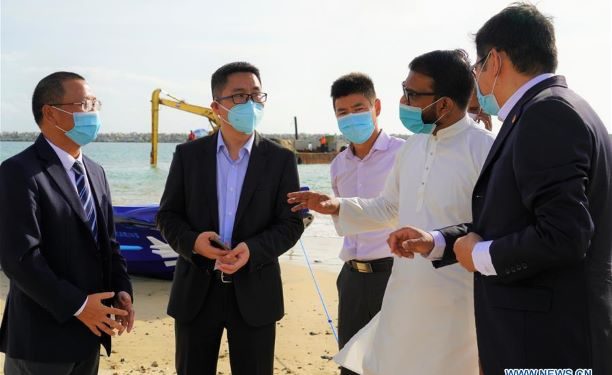
COLOMBO, Sept. 9 (Xinhua) — Sri Lankan State Minister of Regional Cooperation Tharaka Balasuriya said during a tour of Chinese-built projects in capital Colombo on Tuesday that Chinese investment will transform the landscape of Sri Lanka.
Balasuriya led a delegation of senior diplomats from the Ministry of Foreign Affairs on a tour of the 356-meter tall Lotus Tower and the 269-hectare Port City Colombo.
The tour was joined by officials of the Chinese embassy in Sri Lanka including Charge d’Affaires Hu Wei, and representatives of Port City Colombo developer CHEC Port City Colombo (Pvt) Ltd.
In an interview with Xinhua, Balasuriya said that the Sri Lankan government was glad to receive investments from China and would ensure that such investments were protected.
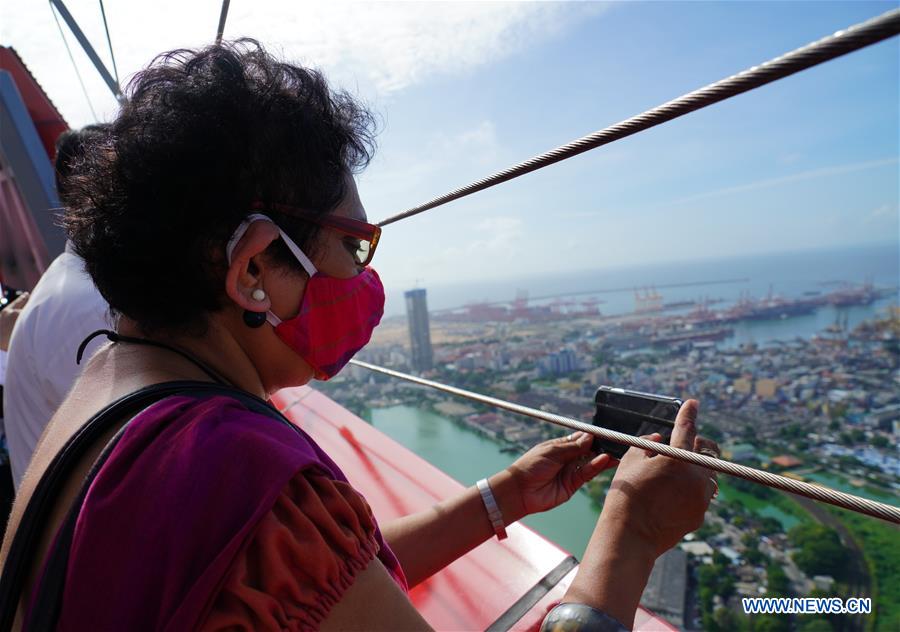
Chinese investments will transform the landscape of Sri Lanka. We want to work in partnership with the Chinese government and Chinese companies,” Balasuriya said.
Balasuriya said that the Sri Lankan government is interested in expediting the Port City Colombo, which was initiated with a 1.4 billion U.S. dollar investment from CHEC, and is projected to bring in 13 billion U.S. dollars worth of investments and over 80,000 jobs.
He added that Sri Lanka would endeavor to provide a suitable investment environment in Port City Colombo and that the project would be open to investors from any country in the world.
Hu Wei said that cooperation between Sri Lanka and China on Port City Colombo and other projects carries forward the spirit of the Ruber-Rice Pact.
The pact was signed between China and Sri Lanka in 1952, which was branded as an agreement of friendship.
05 more arrivals from Saudi Arabia tested positive for Covid-19, increasing total infected in Sri Lanka to 3,147.
Prime Minister Mahinda Rajapaksa in his capacity as the Minister of Finance has instructed the heads of state banks to adopt a lenient policy in granting loans to the people who are facing various crises.
He was participating in the progress review meeting of the ministry.
Former Chief of National Intelligence Sisira Mendis has admitted that it was a mistake to prioritize reconciliation without prioritizing national security during the previous good governance government in which he served as the Chief of National Intelligence.
This was when he testified for the first time before the Presidential Commission of Inquiry probing into the Easter attacks.
Copyright © 2026 LankaWeb.com. All Rights Reserved. Powered by Wordpress