The International Monetary Fund (IMF) has underscored the importance of sustaining Sri Lanka’s reform momentum and safeguarding macroeconomic stability, following a week-long mission to the country.
Speaking at Ada Derana’s current affairs program ‘@Hydepark’, Evan Papageorgiou, the IMF Mission Chief for Sri Lanka, outlined key developments in the nation’s economic program and future challenges.
Papageorgiou expressed satisfaction with the government’s strong commitment to reform, highlighting productive discussions with a wide range of authorities and private sector representatives.
We were very happy always to see the strong commitment of the authorities including the president,” he said.
The mission coincided with the IMF Executive Board’s approval of the fourth review of Sri Lanka’s program. The review focused on several structural benchmarks, including the enactment of the Asset Recovery Law, improved VAT compliance plans, and actions to address electricity cost recovery.
Following earlier concerns over underreported central government expenditure arrears, Papageorgiou explained that the Board was reassured by corrective measures and a clear two-year plan to clear arrears.
Addressing global and regional challenges, the Mission Chief noted ongoing trade negotiations between Sri Lanka and the United States, especially concerning recent tariff changes.
Sri Lanka was set at 44%, and then on July 9th, that level was reduced to 30%. We look forward to seeing the outcome of the negotiations and are paying very close attention to these developments,” Papageorgiou said.
The IMF flagged Sri Lanka’s heavy reliance on limited export markets, notably the U.S., as a systemic risk that underscores the need for trade diversification and increased Foreign Direct Investment (FDI).
Attracting FDI is a multi-prong process that relies on policy continuity, good policies overall, low corruption, strong rule of law and associated other policies,” he noted.
Structural reforms, improved infrastructure, labor policies, and public-private partnerships are key to unlocking growth potential, he said.
When asked about the restructuring of the Ceylon Electricity Board (CEB), Papageorgiou emphasized the need for credible and transparent reforms, balancing fiscal sustainability with consumer affordability.
While the IMF does not prescribe ownership models, private investment and PPPs (Public Private Partnerships) could complement state ownership to expand capacity and promote renewable energy, he noted.
On concerns about the high cost of living, the Mission Chief said inflation has fallen substantially, with expectations to stabilize near the central bank’s 5% target, he said.
The IMF program includes social spending targets to protect vulnerable populations, including electricity tariff structures designed to safeguard low-income households.
When questioned about the available fiscal space within the parameters of the EFF program for Sri Lanka to improve living standards while addressing the rising cost of living, IMF Mission Chief Evan Papageorgiou emphasized the importance of maintaining prudent fiscal policies that prioritize social spending.
So when we talk about rebuilding fiscal space or maintaining a prudent fiscal policy, it already assumes that there will be a certain level of spending. Spending for social purposes and protecting the poor and vulnerable is so important that it is actually an indicative target in our program. Therefore, we are urging and hoping that the authorities will keep up with the type of spending needed to support those who need it the most.”
Papageorgiou also highlighted the importance of supporting small and medium enterprises (SMEs), which are vital for job creation and economic resilience. Efforts to improve tax policy and trade facilitation, such as the National Single Window, are underway to encourage business investment.
Responding to skepticism about the IMF program’s human costs, Papageorgiou praised Sri Lankans’ resilience and ingenuity and emphasized that the program’s second half focuses on long-term sustainable growth, better governance, and stronger institutions.
I have been surprised positively every time I come about the resilience and the ingenuity of Sri Lankans—all the way from the government and the private sector, to the people we meet regularly in academia, think tanks, and other organizations. There is large commitment from everybody to continue seeing things through,” he said.
The restructuring process with private bondholders is complete, and bilateral talks are nearing conclusion, paving the way for a more sustainable debt framework, he added further.
Concluding the discussion, the IMF Mission Chief expressed confidence in Sri Lanka’s growth prospects, noting the country’s progress and the strong reform momentum.
When asked whether Sri Lanka is on track with its reform agenda, IMF Mission Chief Evan Papageorgiou expressed confidence in the country’s direction.
Yes, I do. And I hope that the momentum will continue. The momentum of reforms is firmly in place, and with the assistance of the IMF and other development partners, the authorities will find more opportunities to put in place all that is needed to see it through.”
Eelam — a word that triggered a 30-year conflict — must be urgently re-examined.
The term Tamil Eelam” has come to symbolize demands for a separate Tamil state in Sri Lanka. But few stop to ask: What did Eelam” originally mean? Contrary to separatist claims, historical, linguistic, and literary evidence shows that Eelam” once referred to the entire island of Sri Lanka, long recognized as the homeland of the Sinhalese people. This article unpacks how a term rooted in Sinhalese identity and Buddhist culture was later repackaged into a political slogan to justify ethnic separatism. The United Nations, foreign diplomats, and Sri Lanka’s own Foreign Ministry must take serious note of this historical distortion.
1. Linguistic Roots: ‘Eelam’ and the Hela or Elu People
The term Eelam” (ஈழம்) is widely accepted by scholars to be a cognate of Hela” or Elu”—terms used to refer to the ancient Sinhalese people.
The Madras Tamil Lexicon (University of Madras, 1924) defines Eelam” as a Tamil adaptation of the term for Sri Lanka, without linking it to Tamil ethnicity.
Scholars like Dr. K. Indrapala and Kamil Zvelebil confirm that the word denotes the island of Lanka as a whole, rather than a region specific to Tamil habitation.
Thus, even etymology refutes the notion that Eelam” was ever inherently Tamil.
2. Early Tamil Literature: Eelam as a Foreign Land
Contrary to modern claims, ancient Tamil texts portray Eelam as foreign, distant, and Buddhist island—not as a Tamil homeland.
1.Purananuru (circa 300 BCE – 300 CE)
Verse 56 praises a Tamil king for conquering Eelam, implying it was a separate, external territory. (you do not conquer what is yours – if it is yours)
2. Silappatikaram (2nd century CE)
Refers to Eelam as a land across the sea, confirming its distinctness from Tamilakam.
3.Manimekalai (6th century CE)
The heroine, Manimekalai, sails to Eelam, depicted as an island inhabited by Buddhists, with established shrines and monks.
This aligns with the Sinhalese Anuradhapura Buddhist civilization, not a Tamil Buddhist presence.
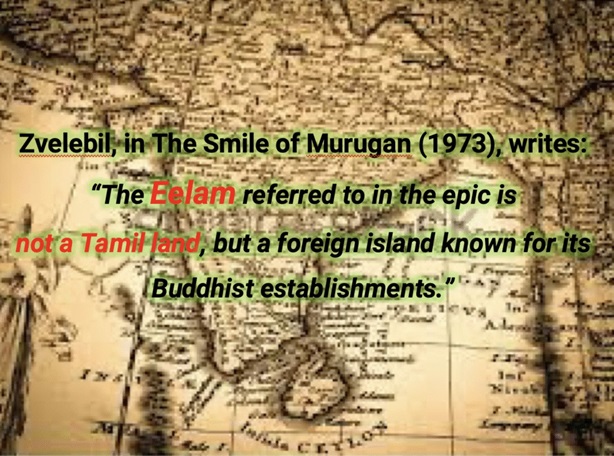
Zvelebil, in The Smile of Murugan (1973), writes: The Eelam referred to in the epic is not a Tamil land, but a foreign island known for its Buddhist establishments.”
Indrapala, in The Evolution of an Ethnic Identity (2005), affirms:
In Manimekalai, the land of Eelam is presented as a distant Buddhist island… [reflecting] Sri Lanka’s Sinhalese Buddhist identity even in early Tamil imagination.”
The classical Tamil literary corpus consistently portrays Eelam as an island distinct from Tamilakam, inhabited by a Buddhist civilization linked to the Sinhalese. This evidence refutes the modern separatist narrative that claims Eelam as a historic Tamil homeland.
3. Colonial and Scholarly Consensus
Both colonial records and modern scholarship consistently affirm that Eelam” referred to the island of Sri Lanka as a whole, and never denoted a Tamil ethnic homeland or separate polity.
Colonial Evidence:
Portuguese (16th–17th century)and Dutch (17th–18th century) administrators referred to the island as Ceilão” (Ceylon) and described the dominant native polity as the Sinhalese Buddhist kingdoms of Kotte, Sitawaka, and Kandy.
The so-called Jaffna Kingdom was regarded by the Portuguese as a subordinate, South Indian-linked outpost, not an indigenous Tamil kingdom. It was militarily subdued in 1619 and was never recognized as a sovereign entity.
No treaties were signed with a Tamil kingdom” as equal parties. The colonial powers negotiated with Sinhalese kings, indicating who held recognized sovereignty.
Scholarly Commentary:
Prof. K. Indrapala, in The Evolution of an Ethnic Identity (2005), states:
In early Tamil literature, ‘Eelam’ appears as a geographic term for the island of Lanka, not as a designation for a Tamil polity or homeland.”
Dr. Kamil Zvelebil, renowned Czech linguist, confirms in The Smile of Murugan (1973):
The usage of ‘Eelam’ in classical Tamil works referred to the island as a whole and did not imply an exclusive Tamil cultural or political domain.”
Colonial Chroniclers and Observers
Even 19th-century British administrators, like Sir Hugh Cleghorn and Robert Percival, made clear distinctions between nations” on the island, consistently identifying the Sinhalese as the majority indigenous people.
Philippus Baldaeus (1672)
In his work A Description of the East Indian Coasts of Malabar and Coromandel”, Baldaeus clearly identifies the island of Ceylon (Sri Lanka) as the land of the Sinhalese, and not as a Tamil homeland.
He refers to the Sinhalese as the original inhabitantsof the island, describing them as having a well-developed civilization with their own language, religion (Buddhism), and system of governance.
The Tamil (Malabar) population is described as migrant, and their presence in the North as relatively recent.
Baldaeus never uses the term Eelam”to describe a Tamil land — nor does he identify any part of the island as a Tamil homeland.
The Chingalese (Sinhalese) are the proper natives of the island, very jealous of their independence…” – Philippus Baldaeus, 1672
Fernão de Queyroz (17th century, translated 1930 by Fr. S.G. Perera)
In The Temporal and Spiritual Conquest of Ceylon”, Queyroz describes the island as a land historically ruled by Sinhala kings, with references to Buddhism, Anuradhapura, and Kandy.
He identifies the island consistently as Ceylon, ruled by a Sinhalese Buddhist monarchic tradition — with no ethnic Tamil kingdom described as native or sovereign.
The northern kinglets are mentioned as tributaries or rebels, not sovereign rulers of an ethnically distinct Tamil homeland.
Ceylon, the land of the Chingalas [Sinhalese], is ancient and noble, long governed by their own kings until our conquest…”
– Fernão de Queyroz
Robert Knox (1681) An Historical Relation of the Island Ceylon”
Knox, an Englishman who lived in Kandyan captivity for 20 years, provides detailed firsthand descriptions of the Sinhalese as the native peopleof the island.
He never refers to the Tamils as native rulers or original inhabitants.
The Chingulays (Sinhalese) are the natural inhabitants of the Island… The Malabars [Tamils] dwell in the North and are fewer in number.”
Sir Emerson Tennent (1859) Ceylon: An Account of the Island
British colonial administrator who described the Sinhalese as the principal raceand custodians of the island’s ancient civilization.
Noted the Buddhist heritage, irrigation systems, and citiesas products of Sinhalese rule.
The Sinhalese are the true representatives of the ancient races of Ceylon… The northern Tamils are comparatively recent immigrants.”
Hugh Cleghorn (1799) – British Colonial Secretary
Famous Memorandum (June 1799):
Often quoted (though sometimes selectively), Cleghorn distinguishes between nations” within the island but emphasizes Sinhalese historical primacy.
…two different nations from a very early period have divided between them the possession of the island… the Sinhalese, the proper natives, inhabit the southern and central parts…”
Key Point:Even though Tamils are acknowledged as a group in the North, they are not described as native to the island in the sense of political or civilizational primacy.
Dr. John Davy (1821) An Account of the Interior of Ceylon
British physician and military officer.
Describes Kandy as the heartland of Sinhalese civilization, with a clearly Buddhist identity and governance structure.
The interior of the island is the stronghold of the Kandyan Sinhalese, guardians of the island’s ancient faith and culture.”
Henry Parker (1909) Ancient Ceylon”
British engineer and historian.
Acknowledges that the island’s irrigation systems, megalithic monuments, and religious institutionsare clearly of Sinhalese origin.
There is no evidence that the Tamils were responsible for the great irrigation works of Ceylon. These are attributed to the ancient Sinhalese kings.”
All these authors — colonial administrators, missionaries, scholars, and captives — independently affirm that:
The Sinhalese were the native and dominant populationacross the island.
Tamil settlements in the North were recognized as South Indian-origin migrant communities, not indigenous rulers.
The island’s name, culture, and identity were associated with the Sinhalese— not with a separate Tamil homeland.
4. The Modern Hijack: From Literature to Militancy
The term Tamil Eelam” as a designation for a separate Tamil state or homeland did not exist historically and was only politicized in the late 20th century, particularly during the 1970s.
TheVaddukoddai Resolution (1976), adopted by the Tamil United Liberation Front (TULF), formally demanded the creation of an independent Tamil state called Tamil Eelam.”
This political demand marked thefirst major appropriation of the ancient term Eelam” for ethnic separatism.
Soon after, theLiberation Tigers of Tamil Eelam (LTTE) emerged as the militant force seeking to realize this separatist agenda, using the term extensively in propaganda and warfare.
Key Points:
The ancient termEelam” originally referred to the entire island of Sri Lanka, with no exclusive Tamil ethnic or territorial connotation.
The modern usage asTamil Eelam” is a retroactive political construction, deliberately designed to fabricate a historical and cultural justification for separatism.
This is aclassic example of linguistic revisionism and political rebranding, which distorts historical facts to serve contemporary nationalist and militant objectives.
Implication:
The political and militant use of Tamil Eelam” today is detached from its historical and linguistic origins, and should be understood as a modern ideological invention rather than an ancient or indigenous Tamil homeland claim.
If the term Eelam” originates from Hela”—the name used for the ancient Sinhalese people—and historically referred to the island ruled by Sinhalese kings, then a critical question arises:
Are Tamil separatists demanding a homeland on behalf of the Sinhalese?
How can international actors and human rights bodies support a movement whose very name undermines its ethnic and historical claims?
This contradiction is not trivial. It exposes the historical and moral bankruptcy of the Tamil Eelam” narrative and its fabricated foundations.
Restore Historical Accuracy
The wordEelam” was never Tamil—not in origin, literary usage, or territorial association.
It consistently referred tothe entire island of Sri Lanka, which was historically inhabited, governed, and defended by the Sinhalese for over two millennia.
Themodern appropriation of this term by separatists is a deliberate distortion—a linguistic hijack aimed at constructing a false historical justification for a political and militant agenda.
Let’s ask the Right Question:
The next time you hear the phrase Tamil Eelam,” ask: Isn’t it, in fact, referring to the island of the Sinhalese?
And how many billions have been spent globally—by NGOs, governments, and lobbies—to fund a separatist campaign for a land whose very name proves it was never theirs but always belonged to the Sinhalese – —who, both in history and today, have always stepped forward to defend it, even sacrificing their lives.
Religion has been a central part of human civilization for thousands of years, shaping cultures, moral systems, and social values. Teaching religion to school children is not about promoting a particular belief but about helping them understand the role religion plays in human life and society. In a world that is increasingly diverse and interconnected, religious education is essential for promoting understanding, tolerance, and moral development. This essay explores the importance of teaching religion to school children and how it benefits individuals and society.
1. Building Moral and Ethical Values
One of the most important reasons to teach religion in schools is to help children develop strong moral and ethical values. Most religions promote universal principles such as honesty, kindness, compassion, respect, and responsibility. By learning about these values, children are guided toward becoming respectful, thoughtful, and responsible individuals. Religious education helps them understand the difference between right and wrong and encourages them to reflect on their actions.
2. Promoting Tolerance and Interfaith Understanding
In today’s multicultural societies, children are likely to interact with people from different religious backgrounds. Teaching religion in schools can promote tolerance, respect, and peaceful coexistence. When students learn about various religious beliefs and practices, they are more likely to appreciate diversity and less likely to develop prejudice or hatred. Understanding others’ faiths reduces fear and suspicion, encouraging empathy and acceptance.
3. Encouraging Personal and Spiritual Growth
Religion often addresses life’s big questions—such as the meaning of life, the nature of good and evil, and what happens after death. Teaching religion provides a space for students to explore these questions in a thoughtful and guided manner. It encourages them to think deeply, search for meaning, and develop their own beliefs and values. This process supports their emotional and spiritual well-being and helps them form a strong sense of identity.
4. Providing Cultural and Historical Understanding
Religion has shaped art, music, literature, architecture, and history. Understanding religion helps students make sense of cultural and historical events, both in their own country and around the world. For example, many important historical movements, festivals, and conflicts have religious roots. Religious education allows children to connect with their own cultural heritage while also understanding the traditions of others.
5. Fostering Respectful Dialogue and Citizenship
Religious education helps children learn how to discuss sensitive topics with respect and care. It teaches them how to listen to others’ perspectives, express their own views thoughtfully, and engage in meaningful dialogue. These skills are essential in any democratic society. By learning to appreciate different viewpoints, students become more informed, respectful, and active citizens.
Conclusion
In conclusion, teaching religion to school children is a valuable part of education. It helps build moral character, promotes understanding and tolerance, supports personal growth, and provides insight into culture and history. Far from being a source of division, religious education—when taught in an open, balanced, and inclusive way—can help unite students of different backgrounds and prepare them to live peacefully in a diverse world. By helping children understand religion, schools contribute to the development of compassionate, thoughtful, and responsible individuals.
Brigadier Franklin Joseph USP officially assumed duties as the new Director Media and Spokesman of the Ministry of Defence on Tuesday (Jul 22). He officially assumed responsibilities from Colonel Nalin Herath, who previously served as the Director Media and Spokesman.
Brigadier Franklin Joseph, a distinguished officer of the Sri Lanka Army Engineers Corps, brings with him over three decades of exemplary service marked by professionalism, leadership and a deep commitment to national security. He served with distinction as the Centre Commandant of the Corps of Sri Lanka Engineers prior takeover the duties as the Director Media
The Sinhala version of the Beena Sarwar’s international documentary film ‘Democracy in Debt: Sri Lanka – Beyond the Headlines’, produced by Priyantha Pradeep Ranasinghe under the title ‘ණය ප්රජාතන්ත්රවාදය: ශ්රී ලංකාව – සිරස්තලවලින් ඔබ්බට” (26 Minutes), will be screened at the Sri Lanka Press Institute, Colombo, this month (July 30) at 4.00 p.m. Beena Sarwa, a Pakistani multimedia journalist and producer currently residing in the US, who produced the original film, will join the event.
Originally produced in English with the support of the Pulitzer Center in the United States, the 25-minute documentary was released last year. Filmed in both Dutuwewa, a remote village in Sri Lanka, and Colombo, the documentary presents a compelling, multi-layered narrative that explores universal issues of governance, accountability, and the resilience of democratic hopes. While deeply rooted in the Sri Lankan context, its message resonates across borders in countries such as India, Bangladesh, and the United States, where people continue to fight for democratic values and transparency.
Ahead of Sri Lanka’s recent presidential election, the film was screened at several venues in Sri Lanka, Pakistan, and the United States. Its critical success led to further screenings at more than 70 venues in nearly 20 countries, spanning five continents. The film received favourable reviews from prominent media outlets, including The Wire in India and Dawn in Pakistan.
The Sinhala version is particularly significant for Sri Lanka, as it is believed to be the first time an international documentary has been produced in Sinhala. The film also predicted the social and political transformation that followed the country’s presidential election in 2024, making it a timely and relevant contribution to the national conversation.
Beena Sarwar is a respected multimedia journalist, editor, and documentary filmmaker. She has held senior editorial positions in leading print and television media in Pakistan and has been a founding member of several key media initiatives, including Himal Southasian magazine and Panos South Asia. She holds a Master’s degree in Television Documentary from Goldsmiths, University of London, and has received prestigious fellowships from the Nieman Foundation for Journalism at Harvard University and the Carr Center for Human Rights Policy at the Harvard Kennedy School.
Since 2011, she has lived in the Boston area in the United States and has taught journalism at institutions such as Princeton University, Brown University, Harvard Summer School, and Emerson College. In 2021, she launched Sapan News, an independent media outlet offering a syndicated features service. The platform evolved from the Southasia Peace Action Network (Sapan), a volunteer-led regional peace initiative launched earlier that year.
The Sinhala production, translation, adaptation and advisory role for the film was undertaken by Priyantha Pradeep Ranasinghe, a seasoned journalist with more than 20 years of experience in print, electronic, and digital media in Sri Lanka. He has worked at leading national media organisations and played a vital role in making the documentary accessible to Sinhala-speaking audiences. ……………
We invite you to provide media coverage on this event and join us in watching the film.
Venue – Sri Lanka Press Institute, 96, Kirula Road, Colombo 5, Sri Lanka Date & Time – July 30 th Wednesday 2025, at 4.00 – 6.00 p.m., For more information – 0717640015
While Sri Lanka is credited with the initial idea behind the Decision Review System (DRS) in cricket, through the work of Senaka Weeraratna, it’s not accurate to say it has brought a significant financial windfall for the country. The DRS has become a standard feature in cricket, but Sri Lanka hasn’t received royalties or significant financial benefits from its widespread use by the ICC.
Here’s a more detailed breakdown:
Sri Lanka’s Contribution:
Senaka Weeraratna, a Sri Lankan lawyer, is credited with proposing the concept of a decision review system in cricket, which was later developed into the DRS.
DRS Implementation:
The DRS allows players to challenge on-field umpire decisions, using technology like ball-tracking and snicko-meter to assist the third umpire.
Lack of Financial Benefit:
While the DRS has improved the fairness and accuracy of umpiring decisions, Sri Lanka has not received any direct financial compensation for its initial concept, despite the system’s widespread adoption by the ICC.
Potential for Future Claims:
There are ongoing discussions about the possibility of Sri Lanka seeking royalties or compensation for the use of DRS, but as of now, no such financial windfall has materialized.
To boost their tourism, the Sri Lankan government has taken a major step by giving visa fee waivers to forty countries.
This sudden change in visa policy is expected to boost the tourism recovery of Sri Lanka. The national policy change also induced the economy of the country.
This visa policy change is expected to attract international visitors to increase the cultural exchange.
The countries to get this visa fee waived include Germany, India, Indonesia, Japan, China, Australia, Spain, Belarus and many more.
This reflects the country’s efforts to improve its international standing and create easier access for travellers, boosting tourism and international relations.
Sri Lanka ranks 91st in the global visa index as of 2024, with access to 42 visa-free destinations. This puts the country in a relatively favourable position for travellers.
The visa-free destinations allow Sri Lankan passport holders to travel to multiple countries in Asia, Europe, the Middle East, and Africa without needing a visa in advance.
List of Countries to Receive Visa-Free Entry to Sri Lanka:
1. United Kingdom of Great Britain and Northern Ireland
A virtual discussion was held this evening (25) between President Anura Kumara Dissanayake and U.S. Trade Representative (USTR) Jamieson Greer regarding the further reduction of trade tariffs imposed by the United States on Sri Lankan exports.
The primary objective of the virtual meeting was to discuss the further reduction of proposed trade tariffs on Sri Lankan exports and to further strengthen trade and investment relations between the two nations.
The Secretary to the Ministry of Finance, Dr. Harshana Suriyapperuma, along with senior officials from the Office of the United States Trade Representative, also participated in the discussion.
Police have stated that further investigations are underway regarding the three individuals, including two police sergeants, arrested for allegedly shooting and killing a pregnant deer in a forest reserve in Matale.
The incident occurred early this morning (25), and the suspects were apprehended by a group of local youths.
Residents tied the three suspects to trees and informed the Galkiriyagama Wildlife Office and the Makulugaswewa Police.
Subsequently, a team from the Makulugaswewa Police arrived at the scene, followed by a team from the Galkiriyagama Wildlife Office.
Our correspondent reported that the three suspects were taken to the Makulugaswewa Police Station
The history of Sri Lanka is deeply intertwined with stories of its diverse peoples, among whom the Tamil community is one. Understanding the origins and arrival of Tamils in Sri Lanka is crucial—not only to appreciate the island’s complex cultural mosaic but also to clarify longstanding myths and contested narratives that have shaped political and social discourse creating unwanted animosity. This article explores ten critical perspectives that shed light on the Tamil presence in Sri Lanka, drawing on linguistic evidence, historical records, archaeological findings, and cultural interactions. By examining these facets, a nuanced, evidence-based understanding of how and when Tamils came to inhabit the island, challenges funded versions of history.
This article refutes the claim that Tamils are indigenous to Sri Lanka or that a historical Tamil Eelam” ever existed. Drawing on linguistic, archaeological, genetic, and historical evidence, it shows that Tamil presence came through migration—in waves of traders, medieval invaders, and colonial-era laborers.
There is no record of a Tamil polity predating the Sinhalese Buddhist civilization.
The term Eelam” itself is rooted in Hela” or Elu,” denoting early Sinhalese, not Tamils.
This clarification matters today, as false narratives are used to justify devolution, separatism, and UN interventions. Reclaiming historical accuracy is essential to preserving Sri Lanka’s sovereignty and national identity.
1. Origins of Tamils & their arrival in Sri Lanka
Homeland & Early Contacts
Tamilakam as Homeland:Tamils evolved in Tamilakam (modern Tamil Nadu, parts of Kerala, Andhra Pradesh, Puducherry).
Sangam Literature (c. 300 BCE–300 CE):Classical Tamil poems center on Tamilakam (Madurai, Kaveri delta)—no reference to any Sri Lankan Tamil polity.
Early Contacts:From the 3rd century BCE to 5th century CE, small groups of Tamil merchants and mercenaries traded with Anuradhapura but left no evidence of mass settlement.
Colonial Census Term
1911 Census Distinction:British administrative records replace Malabar Tamils” with Ceylon Tamils” (long‑settled) vs. Indian Tamils” (plantation migrants), explicitly recognizing Tamil migrants from India—not indigenous inhabitants. This was done by then Tamil registrar Ramanathan.
Linguistic Evidence
Dravidian Roots:Tamil‑Brahmi inscriptions (end of 3rd century BCE) and Ashokan Prakrit loanwords are confined to the Indian mainland.
Tamil‑Brahmi Graffiti in Sri Lanka:1st–2nd century CE rock‑shelter graffiti are only personal names, not administrative texts—indicating isolated visitors, not a Tamil state.
Old Sinhala Substratum:Sinhala shows only a handful of Dravidian loanwords, consistent with sporadic contact, not co‑equal coexistence.
Genetic & Toponymic Evidence
Genetics:Sri Lankan Tamils cluster closely with South Indian Tamils and Telugus, distinct from Veddas and Sinhalese.
Place‑Names:Authentic Tamil toponyms (suffixes –ur, –kudi) emerge in Northern Sri Lanka only after the 11th century Chola invasions.
Textual & Traveler Accounts
Mahāvamsa/Cūḷavaṁsa:Pāli chronicles (5th century CE onward) omit any Tamil‑speaking kingdom until the 11th Chola invasions, and elsewhere refer to Tamils only as traders or mercenaries.
Medieval Travelers:Marco Polo (13th ), Ibn Battuta (14th c.) and Persian merchants describe Tamil merchant enclaves in coastal towns—commercial, not sovereign.
Medieval Tamil Kingdom
1215 CE Arya Chakravarti Settlement:South Indian elites establish the Jaffna Kingdom as a settler polity, paying tribute to Sinhalese monarchs (e.g., Parakramabahu II 1236–1270) and later subdued by Prince Sapumal in the mid‑15th century.
Archaeological Record
Urban Capitals (Anuradhapura, Polonnaruwa):No Dravidian temple inscriptions or architecture appear until post-Chola
Script Continuity:Sri Lankan Tamil inscriptions employ the same South Indian Tamil script, with no unique local evolution.
Summary All lines of evidence—textual, linguistic, genetic, epigraphic, archaeological, and traveler—unanimously show that Tamils originated in Tamilakam and arrived in Sri Lanka in distinct, migratory waves:
traders/mercenaries in the early centuries,
medieval settlers in Jaffna, and
colonial laborers on the plantations.
There is no indication of an autochthonous Tamil polity predating these migrations.
2. When and how did Tamil settlements in Northern Sri Lanka develop?
Chola Military Incursions (993 CE & 1017 CE):
In 993 CE, Rajaraja Iinvaded and conquered Anuradhapura, establishing Polonnaruwa as a Chola provincial capital; by 1017 CE, Rajendra I had fully annexed northern Ceylon as part of the Chola Empire
In 1070 CE, Vijayabahu I(r. 1070–1110 CE) of Polonnaruwa expelled the Cholas and restored Sinhalese sovereignty over the north and center of the island
Pre‑Existing Sinhalese/Buddhist Presence:
Kandarodai (Kadurugoda) Monasteryin the Jaffna Peninsula contains Anuradhapura‑era stupas and an inscription of King Dappula IV (r. 923–935 CE), proving a continuous Sinhalese Buddhist presence there centuries before any settler Tamil kingdom.
Establishment of the Jaffna Kingdom (c. 1215 CE):
Around 1215 CE, Magha of Kalingainvaded, followed by the rise of the Arya Chakravarti dynasty—Tamil‑speaking elites from South India—who founded the Jaffna Kingdom as a settler state, never fully independent of Sinhalese over lordship.
Parakramabahu II(r. 1236–1270 CE) of Dambadeniya records campaigns against the Kalinga Magha” invader but notes that Jaffna rulers paid tribute rather than ruled independently.
Tributary and Viceroyalty Status:
In the mid‑15th century (c. 1449–1453 CE), Prince Sapumal Kumaraya, acting on behalf of Parakramabahu VI(r. 1412–1467 CE), conquered Jaffna and governed it as a viceroy, confirming that the Jaffna elite remained subordinate to the Sinhalese crown
Nature of Tamil Settlements:
The Jaffna Kingdom was a medieval settler polity, with administrative, religious and social systems imported from Tamil Nadu—it did not evolve from a native Sri Lankan Tamil community.
No evidence(inscriptions, chronicle references or archaeology) points to any Tamil‑speaking kingdom in northern Sri Lanka before these 11th–13th events.
Together, these points—brief Chola occupations, continuous Sinhalese/Buddhist sites, the settler Ayra Chakravarti dynasty, and their tributary/viceroy status—demonstrate that Tamil settlement in the north was always migratory and subordinate, rather than the emergence of an indigenous Tamil state.
3. What evidence exists of Tamil presence before the Sinhalese?
There is no credible evidence—archaeological, linguistic, or historical—that indicates a Tamil-speaking polity or large-scale Tamil settlement in Sri Lanka before Sinhalese or proto-Sinhalese presence.
Supporting Evidence:
Ancient Chronicles & Temple Inscriptions
Mahāvaṃsa and Cūḷavaṃsa(5th century CE onward) make no mention of any Tamil polity until the Chola invasions (1017–1070 CE).
Prior references to Tamils describe them purely as merchants or soldiers—not rulers.
Epigraphic and Archaeological Silence
Tamil-Brahmi inscriptionsfrom the 2nd century BCE to 2nd century CE have been found in Anuradhapura, Trincomalee, Tissamaharama, and Vavuniya districts—mentioning Tamil householders and traders, but not rulers (e.g. Damedas, Veḷir clan names).
Anaikoddai seal, dated to circa 3rd century BCE, bears the word Ko‑ve‑ta” (Tamil for king”), but it appears to belong to asmall chieftain/trader, not a state.
Megalithic Culture—Not Tamil Polity
Megalithic urn burials, Red & Black Ware pottery, from sites likeKantarodai, Manthai, Yan Oya, and Ibbankatuwa date from 1000–400 BCE—
Notably, atKantarodai (Jaffna Peninsula), a cluster of 22 Buddhist stupas and monastery remains predates Tamil arrival—confirming Sinhalese-Buddhist presence before Tamil settlements.
Linguistic Substrate in Sinhala
Old Sinhala retains only alimited number of Dravidian loanwords (e.g., familial terms such as marumakān → munubara), consistent with occasional interaction, not long-standing Tamil communities.
Summary Table
Evidence Type
Evidence Description
Interpretation
Chronicles
No Tamil kings mentioned before 11th century
Tamil presence limited to traders or soldiers
Inscriptions
Tamil household names, no administrative texts
Tamil individuals, not polity
Archaeology
Megalithic graves, Black & Red Ware pottery
Cultural influence, not state organization
Buddhist Monuments
Kantarodai stupas predate Tamil settlements
Sinhalese-Buddhist presence precedes Tamil
Linguistic Substratum
Sparse Dravidian loanwords in Sinhala
Sporadic contact, not Tamil-origin dominance
All available evidence points toward sporadic Tamil presence—as small-scale traders or migrants—prior to the Sinhalese state-building process, but no evidence exists of an indigenous Tamil kingdom, polity, or ruling infrastructure in Sri Lanka before the Sinhalese arrived.
4. What is the Origin and Meaning of the Term Eelam”?
According to the Madras Tamil Lexicon, the term Eelam” (ஈழம்) is derived from Elu” or Hela,” which are ancient terms referring to the early Sinhalese or proto-Sinhalese peoples of the island. These terms predate Tamil settlement in Sri Lanka and are linguistically and historically rooted in the early Indo-Aryan linguistic sphere of the island.
Eelam” originally referred to the entire island of Sri Lanka or its early inhabitants and did not possess an exclusive Tamil ethnic connotation.
The modern appropriation of the term Eelam” by Tamil separatists as a reference to a distinct Tamil homeland is therefore a political rebranding, not a reflection of historical reality.
Historical inscriptions and archaeological evidence confirm a long-standing Sinhalese presence in the Northern and Eastern regions, including Anuradhapura-era Buddhist ruins in Mannar, Jaffna, and Trincomalee. These further disprove the separatist claim that the North and East were exclusively Tamil.
The political use of Tamil Eelam” is thus a modern ideological construct, repurposing a term with early Sinhalese roots to manufacture a narrative of exclusive Tamil indigeneity in the North and East — a narrative that disregards centuries of shared and overlapping habitation, trade, religion, and governance under successive Sinhalese kingdoms.
5. If Tamils were brought by Colonial and Medieval Migrations,
How can they claim indigenous rights?
The majority of Tamils in Sri Lanka today descend from two main waves of migration from South India.
The first group, later known as Ceylon Tamils” or Jaffna Tamils,” settled during medieval times, particularly from the 13th century onwards, often accompanying South Indian invasions (notably by the Pandyan and Chola dynasties) and through the establishment of the Arya Chakravarti kingdom in the Jaffna Peninsula.
The second group, referred to as Indian Tamils” or Plantation Tamils,” were brought to Sri Lanka by the British colonial administration in the 19th and early 20th centuries as indentured laborers for tea, coffee, and rubber plantations.
Although these two groups arrived under different historical contexts and centuries apart, both share the same ethnic and geographic origin — Tamil Nadu in South India. As such, neither group can be regarded as indigenous to Sri Lanka in the anthropological or legal sense of the term.
The distinction between Ceylon Tamils” and Indian Tamils” is not one of ethnicity but of chronology and colonial classification:
Period and Purpose of Migration:
Jaffna Tamils arrived mainly through mercantile movement and conquest during medieval times and gradually integrated into the northern socio-political landscape.
Plantation Tamils were forcibly relocated by the British for labor exploitation, with little or no prior historical connection to the island.
Colonial Census and Categorization:
British colonial records categorized these communities separately:
Ceylon Tamils– Long-settled Tamil-speaking communities in the north and east.
Indian Tamils– Recent labor migrants concentrated in the central highlands.
However, this separation was administrative, not based on ethnic or civilizational difference.
No Basis for Indigenous or Sovereign Claims:
The fact that both groups are external in origin negates any claim to autochthonous or primordial rights over the land.
The concept of Tamil Eelam” as a historical homeland is thus unsupported by archaeological or anthropological evidence. Even the early Jaffna Tamil kingdom was a foreign construct arising after the collapse of local Sinhala authority in the north.
Tamil nationalist claims to indigeneity or territorial sovereignty must be critically reassessed in light of this common migratory ancestry. While the Sinhala people have a continuous civilizational and linguistic presence traceable to the pre-Christian era on the island, Tamil presence — whether medieval or colonial — stems from historically documented movements from the Indian mainland.
6. Why was Thesavalamai Law applied to Tamils in Jaffna?
The Thesavalamai law, codified by the Dutch in 1707, was not an ancient or sovereign Tamil legal system. It was a colonial codification by the Dutch VOC for administrative and commercial purposes, particularly concerning land ownership, inheritance, and marriage.
Origin and Nature:
Thesavalamaiwas not transplanted from Tamil Nadu, nor does it reflect a pan-Tamil legal heritage.
It was not a law used in South Indiaand does not appear in Tamil Nadu’s historical legal tradition.
The Dutch created this legal code for Tamil settlers in northern Sri Lanka —who had migrated from South India during earlier periods of Chola/Pandya influence and especially during the time of the Arya Chakravarti dynasty.
Who did it apply to?
It applied only to Malabar (Tamil) inhabitants of the Jaffna region, as defined by the Dutch.
The term Malabar” was used by European colonials (Portuguese, Dutch, and British) to refer generally to South Indians,
It did not apply non-Malabar Tamils living elsewhere in the island, nor to Sinhala, Muslim, or Burgher communities.
Implications for Sovereignty Claims:
The very fact that Thesavalamaiwas created by a colonial power undermines the claim that a pre-colonial Tamil kingdom had a structured, sovereign legal system of its own.
Had there been an unbroken, independent Tamil kingdom in the North at the time of European arrival (like the Sinhala kingdoms in the South and Kandy), there would have been pre-existing, written, codified laws— as we have in Kandyan Lawand Sinhala customary law.
The Dutch did not codify Sinhala law for the Kandyan Kingdom because they recognized existing indigenous sovereignty. The codification of Thesavalamaiinstead reflects colonial administrative control over a settler community, not recognition of a sovereign Tamil legal system.
Should it still exist?
Today, Thesavalamai still exists as personal law, applicable to Tamils of Jaffna origin (Malabar heritage only) in matters of property and inheritance.
However, its continued application raises legitimate questions:
If this law was designed for a settler community of South Indian origin under Dutch rule, what is its relevance in 21st-century Sri Lanka?
Why should a colonial law, applicable only to one ethnic group defined by geography and ancestry from South India, continue to have legal standing in a sovereign, unitary republic?
If Thesavalamaiis recognized, should similar customary or religious laws for other communities also be revived or maintained — or should Sri Lanka move toward a unified civil code?
The existence of Thesavalamai reflects the Dutch colonial need to manage Tamil settler customs in the Jaffna peninsula, not the presence of an ancient Tamil legal or state system. Its continued use today — despite being tied to South Indian colonial-era settlers — invites debate on legal uniformity, national integration, and the risks of ethnic legal exceptionalism.
7. Was there really a separate Tamil Kingdom when the Portuguese arrived?
What is today referred to as the Jaffna Kingdom” was not an indigenous or sovereign Tamil kingdom in the same sense as the Sinhala kingdoms of Anuradhapura, Polonnaruwa, Dambadeniya, or Kandy — which had centuries of continuous rule, written chronicles, and cultural foundations rooted in the island.
The so-called Jaffna Kingdom” emerged only in the 13th century, following South Indian invasions, notably by the Pandyans and later the Arya Chakravarti dynasty, who were foreign mercenaries or vassals with allegiance to South Indian rulers.
When the Portuguese arrived in the early 16th century, they encountered this foreign-established administration in Jaffna, which was swiftly subdued with little or no recorded organized Tamil resistance.
In sharp contrast, Sinhalese monarchs in Kotte, Sitawaka, and especially the Kingdom of Kandy mounted fierce and sustained resistance to European colonization, often forming complex alliances and engaging in guerrilla warfare.
The quick collapse of the Arya Chakravarti regime in Jaffna suggests it was isolated, lacked deep-rooted local legitimacy, and did not enjoy the widespread cultural and political support typical of a true native monarchy.
The so-called Tamil kingdom” in Jaffna was not a sovereign, indigenous kingdom comparable to the historical Sinhala polities. Its foreign origin, shallow roots, and lack of resistance to colonization challenge any claim of an unbroken Tamil sovereignty on the island. It was a short-lived outpost of South Indian expansionism, not an ancestral Tamil homeland.
8. Is there Evidence of Sinhalese presence in the North before and during Tamil Settlement?
Yes. Extensive historical, archaeological, and epigraphic evidence confirms a continuous Sinhalese presence and political authority in the Northern Province — long before and even during the period of Tamil settlement and the establishment of the Arya Chakravarti regime in Jaffna.
Historical Records:
The Mahavamsa, Sri Lanka’s ancient chronicle (compiled in the 5th century CE), records thatKing Devanampiyatissa (3rd century BCE) sent missions to various parts of the island including Nagadeepa (Jaffna peninsula).
King Dutugemunu (161–137 BCE)and King Vijayabahu I (1055–1110 CE) are both recorded to have maintained military and administrative control over the northern regions.
TheCulavamsa (continuation of the Mahavamsa) notes that even during times of South Indian invasions, Sinhalese kings dispatched troops to the North to maintain sovereignty.
During the reign ofParakramabahu I (1153–1186 CE), extensive irrigation and temple restoration were carried out as far north as Elephant Pass and Jaffna, showing that the region was considered part of the Sinhalese heartland.
Archaeological Evidence:
Buddhist ruins, stupas, and inscriptionshave been found across the Northern Province — in Kadurugoda (Kantarodai) in Jaffna, Vavuniya, Murunkan, Nagadipa (Nainativu), Analaitivu, and Mannar.
TheKadurugoda Buddhist site, near Chunnakam in Jaffna, includes more than 60 ancient stupas made of coral stone, dating back to the Anuradhapura period (3rd century BCE – 10th century CE). Excavations by P.E. Pieris (1917) and later by the Department of Archaeology confirm their Sinhalese-Buddhist origin.
NumerousBrahmi inscriptions in Sinhala Prakrit have been found in the North and North Central regions, dating from 2nd century BCE onward, confirming early Sinhalese literacy, governance, and religious activity.
Military and Administrative Control:
The Vallipuram Gold Plate (2nd century CE), discovered in Jaffna, records a land grant made byKing Vasabha, a Sinhalese monarch of Anuradhapura, to a Buddhist monastery in the area — demonstrating direct royal patronage and authority in the Jaffna peninsula.
King Vijayabahu Irestored temples in the North and appointed Sinhala governors to maintain order after defeating the Chola invaders.
Even during the period ofTamil migration and the rise of the Arya Chakravarti dynasty (13th–17th century), Sinhalese kingdoms continued asserting sovereignty, periodically sending military expeditions to the region.
The cumulative evidence — from ancient chronicles, inscriptions, Buddhist monuments, and royal edicts — proves that the Sinhalese were the original inhabitants and rulers of the Northern Province, long before Tamil settlement. Tamil presence, largely resulting from medieval South Indian invasions, did not erase the deep-rooted Sinhala-Buddhist civilization that existed in the North. The narrative of an exclusively Tamil historical homeland in the North is therefore historically inaccurate and politically motivated.
9. Were Tamils ever a Buddhist people — or is Tamil Buddhism” in Sri Lanka a Modern Myth?
Pre-Hindu Tamil religion revolved around animism and folk deities, not the Buddha, Dhamma, or Sangha. Core Tamil literary texts like the Tolkāppiyam, Akananuru, and Purananurureflect this indigenous belief system, devoid of Buddhist themes.
Buddhism never took root in Tamilakam (South India); its limited presence came through external patronage(e.g., Pallavas) but faded without lasting institutions or lay communities.
Any Tamil Buddhist footprint in Sri Lanka was imported through Sinhalese or North Indian channelsand never formed the basis of a Tamil Buddhist state or culture.
The Jaffna Kingdom was Hindu Shaivite, not Buddhist, and the temples of the North were not viharas but converted into kovilsunder Hindu rule.
Sites like Kadurugoda (Kantarodai)are often misused by Tamil separatists as proof of Tamil Buddhism,” but archaeology clearly attributes them to Sinhalese-Buddhist origins based on Pali and early Sinhala inscriptions—not Tamil.
Even leading Tamil historians such as A. Nilakanta Sastriconfirm that Buddhism never deeply penetrated Tamil culture.
There is no historical, religious, or archaeological basis to claim that Tamils were once a Buddhist people or that the North of Sri Lanka was part of a Tamil-Buddhist homeland. This narrative is a modern fabrication aimed at rewriting history to undermine the Sinhalese-Buddhist heritage of the North.
10. What does this mean for contemporary Tamil Nationalist claims?
TheTamil nationalist narrative of an ancient, indigenous Tamil Eelam” homeland in Sri Lanka lacks historical and linguistic foundation.
The term Eelam” itself has beenreappropriated for political ends, diverging from its original meaning linked to early Sinhalese inhabitants.
Both Jaffna Tamils and plantation Tamils havemigrant origins and cannot claim primordial rights to Sri Lankan land.
Sri Lanka’strue ancestral and indigenous identity is closely tied to the Sinhalese and their ancient civilizations.
Do Tamil Nationalist claims to an ancient homeland in Sri Lanka withstand historical scrutiny?
The Tamil nationalist claim of an ancient, sovereign Tamil homeland called Eelam” within Sri Lanka is not supported by historical, archaeological, or linguistic evidence.
The term Eelam” itself was originally associated with the early Sinhalese (Hela/Elu) people and the island of Sri Lanka as a whole — not with a Tamil nation. Its modern use to denote a separate Tamil state is a political rebranding disconnected from its etymological and historical roots.
Both major Tamil communities in Sri Lanka — the Jaffna Tamils (settled via medieval South Indian invasions) and Plantation Tamils (brought by the British in the 19th century) — have documented migratory origins from Tamil Nadu, not indigenous roots in Sri Lanka.
Unlike the Sinhalese, whose language, religion (Buddhism), and civilizational identity are organically native to the island for over two millennia, Tamils in Sri Lanka do not possess a continuous, autochthonous cultural lineage grounded in Sri Lankan soil.
The absence of an ancient Tamil Buddhist kingdom, the foreign origin of the Jaffna regime, and the colonial categorization of Tamils as Malabars or South Indian settlers all weaken the legal and moral basis of any Tamil claim to sovereignty over part of the island.
Tamil nationalist assertions of a historic Tamil Eelam” are rooted in modern political ideology, not historical fact. The Sinhalese are the indigenous people of Sri Lanka, with an unbroken civilizational presence. Calls for Tamil self-determination based on supposed ancestral rights must be re-evaluated in light of the clear migratory origins of Tamil communities and the fabricated nature of the Eelam narrative.
Have Tamils in Sri Lanka ever fought to defend the island from Foreign Invaders?
Historical evidence shows no major Tamil-led resistance to foreign invasion
When thePortuguese arrived in the early 16th century, the Arya Chakravarti regime in Jaffna capitulated quickly. There is no recorded mass resistance movement or prolonged Tamil-led defense of Jaffna or the North.
In contrast,Sinhalese monarchs — from Sitawaka’s Rajasinha I to King Vimaladharmasuriya and later King Rajasinghe II and Sri Vikrama Rajasinha of Kandy — fought prolonged wars against the Portuguese, Dutch, and British to defend sovereignty.
TheKandyan kingdom, sustained by the Sinhala Buddhist population, was the last bastion of native independence until 1815.
During British Colonization:
TheUva-Wellassa rebellion (1818) and Matale rebellion (1848) were Sinhalese-led insurrections against British rule, rooted in defense of land, culture, and Buddhism.
There isno recorded Tamil uprising against colonial powers in the North or East. Instead, Tamil elites cooperated with colonial administrators, often gaining disproportionately from colonial favoritism in civil service and education.
Defending the Nation from Terrorism (1980s–2009):
The 30-year war against theLTTE — a Tamil separatist terrorist movement — was fought almost entirely by the Sinhalese-majority Sri Lankan armed forces.
Over 95%of the Sri Lanka Army, Navy, and Air Force personnel who sacrificed their lives defending the unity of Sri Lanka were Sinhalese Buddhists.
While someTamil and Muslim individuals served in the forces, their numbers were marginal relative to their population share. Most Tamils in the North and East were either supportive of the LTTE, intimidated into silence, or passive bystanders — not defenders of Sri Lankan sovereignty.
Notably,Muslim Home Guards did defend against LTTE attacks in the East, but this was more out of communal self-preservation than national patriotism.
The Principle: One Defends What One Considers Home
Historically and psychologically, people fight and die forwhat they consider their own land, identity, and heritage.
TheSinhalese have proven this repeatedly — from Dutugemunu’s unification campaigns, to resistance against colonialism, to defeating the LTTE in 2009.
Thelack of comparable Tamil-led defense of Sri Lanka at any stage of invasion or conflict calls into question the Tamil nationalist narrative of deep-rooted indigeneity or national belonging.
Tamils in Sri Lanka have no historical record of defending the island from foreign invasion, colonization, or terrorism on a scale that reflects ownership or deep-rooted belonging.
In contrast, the Sinhalese — particularly the Sinhala Buddhist population — have consistently fought, died, and sacrificed to protect Sri Lanka from foreign and internal threats.
This historical pattern is a powerful indicator of who truly sees this land as their ancestral home.
Bill for the amendment or for the repeal and replacement of or which is inconsistent with the provisions of paragraph (2) of Article 30 or of paragraph (2) of Article 62 which would extend the term of office of the President or the duration of Parliament, as the case may be, to over six years,
by A. Abdul Aziz, Sri Lanka Correspondent, Al Hakam, London.8
More than 35,000 delegates from over 90 countries including Sri Lanka are expected to attend the Ahmadiyya Muslim Annual Conference, holding today (Friday 25th July) to Sunday 27th July 2025 at Alton, United Kingdom.
Founder of the Ahmadiyya Muslim Community (Jamaát) Hazrat Mirza Ghulam Ahmad of Qadian, The Promised Messiah and Imam Mahdi (peace be upon him) said:
‘’Do not consider this gathering to be the same as other ordinary, worldly gatherings. Rather the case of this is such, that it is founded upon the pure support of truth and the propagation of Islam. The foundation stone of this community has been laid by Allah Almighty Himself, and such nations have been prepared that will soon come and enter its fold. This is because it is the work of that All- Powerful Being, for Whom, nothing is impossible.’’
International Initiation Ceremony.
This three-day Convention includes a world-wide Initiation (Bai’at) Ceremony that is held every year at the time of Annual Convention in which large numbers of people from different countries gather at some places in their respective countries and then via satellite take an oath of allegiance at the hand of the Caliph (Khalifa) of the Ahmadfiyya Muslim Community Hazrat Mirza Masroor Ahmad. This historical ceremony will be held on Sunday 27th of July 2025 (last day of the Convention) at 5.30 P.M. local time. In Sri Lanka too, Ahmadi Muslims across the country assembling in their mosques situated at Colombo, Negombo, Pasyala Puttalam and Polonnarwa and taking part in this Initiation Ceremony via MTA (Muslim Television Ahmadiyya) – Community’s FREE satellite TV.
In the Convention site in the United Kingdom, the members of the community form five or seven lines in front of the Khalifa at the ceremony to represent the five/seven continents of the world. Officials of the Community and other people who have worked for the Community or are otherwise selected for this ceremony, are present in these lines. The lines proceed to some extent in an orderly manner after which other members are present. The members and those who want to become members place their hands on the back of the person in their front, as is known from the tradition of the early Muslims at the time of Prophet Muhammad (PBUH) and so form chains of physical contact with the Khalifa. This physical contact is seen necessary only for those present at the ceremony.
The oath of allegiance or Bai’at is taken by the Khalifa in the following way: first he reads a sentence or a part of a sentence from the oath in English or in Urdu language, which the members of the community repeat after him. Then the same sentence or part of the sentence is repeated by translators in many languages of the world simultaneously and repeated by the members of the community.
After having gone through the whole text of the oath of allegiance in this manner, the Khalifa leads the members in silent prayers.
The indigenous population in Assam of northeast India continues getting shocking revelations every alternate day from none other than State chief minister Himanta Biswa Sarma. Pursuing a series of eviction drives to reclaim hundreds of thousands of bighas of government lands (including forest and water bodies) during his term as the head of Bharatiya Janata Party-led government in Dispur, Sarma alerted Asomiyas on the fastest changing demography in their localities. The outspoken saffron leader made it public that a conspiracy was hatched to silently change the janagathani (demography) which needs to be halted effectively. “After demographic invasion in western and middle Assam, today we are seeing the beginning of demographic invasion in eastern Assam. If we could have visualized the demographic invasion of lower and middle Assam in the beginning, we probably could have stopped it. But it has become irreversible now,” said Sarma, adding that evictions in various places to reclaim a huge volume of government lands were aimed at preventing the demographic invasion by the people from a particular community (read Bangladesh origin Muslims). Terming the trend as ‘land jihad’, Sarma proclaimed that the government remains committed to liberate every inch of Assam’s land from the encroachment. Lately, Sarma has made a stunning revelation that by 2041 the Muslims in Assam will acquire over 50% stakes in its total population. As per the 2011 census 34 percent of the State population (3.12 crore) remains a religious minority and if 3 % are identified as indigenous Assamese Muslims the rest (31 %) can be termed as migrated Muslims (from Bangladesh to Assam). As the Muslims enjoy high birth-rates, the situation will be worse by 2021 or 2031 and they (Bengali- speaking Muslims) will touch 50 % of Assam’s total populace by 2041, he asserted. The situation has already turned horrible for indigenous (Asomiya) people in many districts of Assam like Dhubri, Morigaon, Barpeta, Nagaon, South Salmara-Mankachar, Goalpara, etc. Once the Asomiyas become a minority in those localities, they have to live under insecurities and constant threats from the Bangladesh-origin Muslim settlers. The eviction drives in Barshola, Lumding, Burapahar, Pabha, Batadrawa, Chapar and Paikan localities have resulted in recovering 1,19,548 bighas of land from the clutches of illegal settlers. However, Sarma reminded that nearly 63 lakh acres of land remain under encroachment across Assam. It may take another 20 years to make Assam completely free of encroachment. However, the prime opposition party Congress vehemently opposed the drive and approached State Governor Lakshman Prasad Acharya with an appeal to halt the ongoing eviction operations. Calling on Governor Acharya, the Assam Congress delegation sought his intervention against the dispossession of tribal, indigenous, minorities and other people from their rightful properties on the pretext of development’. However, the operations against the encroachers went on in full swing, even though the situation in Paikan flared up on 17 July as a group of Assam police personnel and forest guards were attacked during their post-eviction works. A large number of evicted individuals including women started stone pelting over the forces, where 21 personnel sustained injuries. Finally to maintain the law & order situation, the police resorted to firing upon the unruly aggressors. It resulted in one casualty (Shakuar Hussain) and injuries to a few others. Assam police lately arrested over 20 violent agitators from Paikan suspecting their roles in the post-eviction violence. State Congress president Gaurav Gogoi along with their national president Mallikarjun Kharge and Parliamentarian Rahul Gandhi attended a party meeting at Chaygaon on 16 July. They all slammed the government for the eviction drives and assured that the displaced families will be allotted land and houses if the party comes to power after 2026 Assam legislative assembly polls. Sarma hit back on them stating that Gandhi came to Assam only to encourage the encroachers to occupy protected forest lands. Gandhi’s irresponsible rhetoric has directly endangered lives and disrupted peace in the State, he stated. Earlier, All India United Democratic Front and All Assam Minority Students’ Union, Muslim Sangram Parishad, Asom Nagarik Samaj, Raijor Dal, Asom Jatiya Parishad, Communist Party of India, CPI-ML, etc also criticized the government for the eviction drives with separate protest demonstrations.
Defence Secretary Air Vice Marshal Sampath Thuyacontha (Retd), gracing the ceremony as the chief guest delivered special remarks at the Reflection Workshop of the Asian Preparedness Partnership (APP), held at the Cinnamon Life at the City of Dreams in Colombo on Wednesday (July 23).
The two-day workshop, held under the theme Sustaining Collaboration: Advancing the Future of National Preparedness Partnerships,” brought together delegates from seven Asian nations: Cambodia, Laos, Myanmar, Nepal, Pakistan, the Philippines, and Sri Lanka.
Commending the APP for its multi-stakeholder framework since its inception in 2016, the Defence Secretary emphasized the importance of building sustainable, nationally owned disaster preparedness systems. He highlighted Sri Lanka’s experience through the Sri Lanka Preparedness Partnership (SLPP), which has effectively connected government, civil society, and the private sector to strengthen early warning systems and community-based action.
The Secretary also highlighted the critical role of disaster risk reduction and climate resilience in national security, noting that natural and man-made hazards pose serious challenges to stability and development.
Under the stewardship of our three co-chairs, the Disaster Management Centre, Janathakshan GTE Ltd and the Ceylon Chamber of Commerce, the SLPP has emerged as a nationally owned, multi-sectorial platform, he said.
Expressing appreciation to the Asian Disaster Preparedness Centre and the Bill & Melinda Gates Foundation for their leadership and support, he called on participating nations to transform partnerships into enduring systems and ideas into tangible action.
Director General of the Disaster Management Centre (DMC) Major General Sampath Kotuwegoda (Retd) made the welcome remarks. The Executive Director of the Asian Disaster Preparedness Centre, Aslam Perwaiz and Deputy Director of the Emergency Response, Gates Foundation, Dr. Valerie Berno made opening remarks.
This workshop aims to deepen regional collaboration and develop strategies for a safer and more resilient Asia.
NDB Bank proudly reaffirmed its leadership in Sri Lanka’s Islamic banking sector by securing eight distinguished accolades at the Sri Lanka Islamic Banking and Finance Industry (SLIBFI) Awards 2025, held recently. These wins mark yet another milestone in NDB’s ongoing journey of excellence, innovation, and dedication to inclusive financial services.
The 2025 edition of the awards saw NDB Bank being recognised across both institutional and individual categories, underscoring the Bank’s collective and personal achievements within the rapidly evolving Islamic finance landscape. The honours included four Gold awards and four Bronze and Merit distinctions, showcasing a broad spectrum of accomplishments by the Bank and its team.
In the Entity and Miscellaneous category, NDB claimed the coveted Gold Award for Islamic Finance Deal of the Year, a testament to the Bank’s strategic expertise and its ability to structure innovative, Sharia-compliant financial solutions that deliver value and impact. Complementing this win, NDB also secured a Bronze for Islamic Finance Window/Unit of the Year, and a Merit Award for Islamic Finance Deal of the Year, highlighting the consistent strength and agility of its Islamic Banking Unit, NDB Shareek.
Reflecting the Bank’s deep bench of talent, NDB was also recognised in the Individual Category with a series of outstanding honours. Bahar Nayan, Head of Islamic Banking at NDB, was awarded the Gold for Transformative Leadership, celebrating his visionary leadership and pioneering role in shaping NDB’s Islamic banking journey. The Gold for Rising Personality of the Year (Female) was awarded to Mariam Mubarak, whose exceptional contributions continue to inspire excellence across the Bank. Shah Soodin was named Gold Winner for Branch Executive of the Year, reinforcing NDB’s strength in operational excellence and client engagement at the grassroots level.
Additionally, the Bank received two Bronze recognitions in this category: Ashad Ameen for Rising Personality of the Year (Male) and Aslam Fidha for Islamic Banker / Employee of the Year, further reflecting the collective expertise and unwavering commitment of the NDB Shareek team.
These accolades serve as a powerful reflection of NDB’s continued efforts to uplift Islamic banking practices in Sri Lanka through ethical financial solutions, robust governance, and people-led innovation. The Bank remains deeply committed to providing Sharia-compliant services that not only serve the needs of today’s customers but also build a sustainable foundation for future generations.
As the Islamic banking arm of NDB, Shareek continues to deliver meaningful, inclusive banking solutions tailored to a wide range of individuals and enterprises across the country. With over a decade of experience, the unit remains one of the most respected and agile Islamic finance providers in the industry.
NDB Bank extends its sincere gratitude to the SLIBFI Awards Committee for this recognition and congratulates every team member who contributed to this success. With continued focus on ethical finance, customer empowerment, and transformative leadership, NDB remains steadfast in its mission to support Sri Lanka’s journey toward inclusive economic prosperity.
Proponents of soy milk tout it as a natural, plant-based source of protein and point to research that shows that soy milk lowers LDL (low density lipoprotein), or bad” cholesterol in the body, thereby cutting a person’s risk of developing heart diseases. Soy critics argue that soy contains phytoestrogens, which are thought to increase risk of certain cancers.
How do you, as a consumer, make an informed choice? To help you, we discuss here some important questions about soy and cow’s milk, namely:
What is the difference between soy and cow’s milk?
Should people with gout avoid soy?
Is soy or dairy better for patients with cancer?
Difference between soy milk and cow’s milk (dairy)
Soy is a good source of low-fat and plant-based protein. It is cholesterol-free, has less saturated fat than cow’s milk and lowers the LDL in the body. Cow’s milk, on the other hand, has more calcium than natural soy. Calcium, as we know, helps to build bones and prevents osteoporosis. Cow’s milk also contains more vitamins, such as vitamin B12 and vitamin D.
These days, however, commercially made soy milk is often fortified to have calcium and nutrients similar to cow’s milk. At the same time, cow’s milk now comes in low-fat versions and these sometimes have lower saturated fat than commercial soy milk (see table below).
Both calcium-fortified soy milk and low-fat milk are good sources of protein and calcium. “However, there is evidence that soy products, together with a diet low in saturated fat, can help to lower LDL levels, and hence reduce the risk of heart disease,” shares Ms Joey Ho, Dietitian from the Nutrition and Dietetics Department at KK Women’s and Children’s Hospital (KKH), a member of the SingHealth group.
Bill for the amendment or for the repeal and replacement of or which is inconsistent with the provisions of paragraph (2) of Article 30 or of paragraph (2) of Article 62 which would extend the term of office of the President or the duration of Parliament, as the case may be, to over six years,
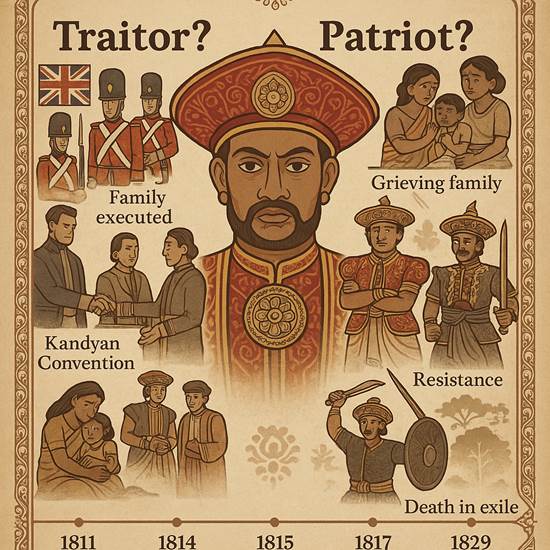
These visuals and accompanying content were created with the assistance of Microsoft Copilot.
Comparison Chart: Ehelepola Nilame – Traitor vs. Patriot
Perspective
Key Arguments
Consequences
Legacy View
Traitor
Allied with British to overthrow Kandyan monarchy; facilitated colonial rule.
Helped end Sri Lanka’s last independent kingdom; led to British colonization.
Seen by some as betraying national sovereignty.
Patriot
Opposed tyrannical king; sought justice after execution of his family.
Gained popular support; viewed as a hero by those opposing the king.
Seen by others as a tragic hero who resisted cruelty.
A Complex Legacy Ehelepola Nilame remains one of the most debated figures in Sri Lankan history. As the First Adigar of the Kandyan Kingdom, he held immense power and influence. His rebellion against King Sri Vikrama Rajasinha followed the horrific execution of his wife and children—an act that shocked the nation and turned many against the king.
Ehelepola’s decision to ally with the British was pivotal in the signing of the Kandyan Convention of 1815, which ended centuries of Sinhalese monarchy. While some view this as a betrayal that opened the door to colonial rule, others argue that he acted out of desperation and a desire to end tyranny.
His later exile to Mauritius after the 1817–1818 rebellion adds another layer of tragedy to his story. Today, Ehelepola is remembered both as a patriot who stood against cruelty and a controversial figure who enabled colonization
Deploying reactor above 600 MW likely to be ‘technically challenging’
Sri Lanka is making progress in establishing nuclear infrastructure and has already identified potential new-build sites as it embarks on the development of its nuclear power programme, according to an International Atomic Energy Agency (IAEA) review mission.
The follow-up Integrated Nuclear Infrastructure Review (INIR) mission, conducted at the request of the government of Sri Lanka, took place from 14 to 18 July 2025.
The INIR team concluded that Sri Lanka has made good progress to address recommendations and suggestions from an INIR mission in 2022.
Sri Lanka has already identified five candidate sites for the nuclear power plant, established a management structure to oversee the procurement process for nuclear reactors, drafted a comprehensive nuclear law and included nuclear power in its current long-term energy planning for the period 2025-2044.
Sri Lanka is actively working on addressing the recommendations and suggestions from the main INIR mission in 2022,” said mission team leader John Haddad from the IAEA’s nuclear infrastructure development section.
This indicates the level of commitment of Sri Lanka to conduct the required studies and make a knowledgeable decision regarding the nuclear power programme.”
In 2010, Sri Lanka approved the initiation of studies for implementing a nuclear power programme in the country. In 2024, the government decided on further actions” to consider a nuclear power programme, the IAEA said.
Nuclear power is included as an energy source in an energy generation plan for 2025-2044.
But according to the plan, accommodating a nuclear power unit above 600 MW to the Sri Lankan network will be technically challenging due to the network’s condition, projected demand growth, and the generation mix which is expected to be dominated by variable renewable energy sources.
The team said that further work is needed related to the finalisation of strategies and studies in various areas of infrastructure development such as, among others, management, human resource development, stakeholder involvement, radioactive waste management and industrial involvement.
In 2024, press reports in Sri Lanka said the country had received six proposals for construction of a commercial nuclear power station.
President Anura Kumara Dissanayake participated in the inauguration ceremony of the 74th Upasampada Vinaya Karmaya (Rite of Higher Ordination) of the Sri Lanka Ramanna Nikaya held at the Mahaweli Grounds in Galnewa, not far from his native village of Tambuttegama, on the afternoon of June 30, 2025. The main Upasampada rite was to be conducted at a different venue, namely, the Sri Vidyadhara Maha Pirivena in Kalawewa, Kalakarambewa from June 30 to July 8, organised by the provincial Sangha Sabhas of the North Central Province and the Upasampada Maha Utsava Committee. During his short guest speech of about twenty minutes, the president tried to explain to the distinguished gathering of the clergy and laity invited to attend the important event two principal concerns that occupied his mind: 1) his determination to overcome ‘nationalism’ (interpreted as jaativaadaya/racism) in order to create national unity among the various ethnic and religious communities, and 2) his government’s supportive role in connection with the problem of maintaining discipline within the Sangha Order as well as the issue of amending Sections 42 and 43 of the Buddhist Temporalities Ordinance as requested by the Mahanayake Theras.
According to the official President’s Office website (accessed July 7, 2025):
President Disanayake pointed out that certain political groups had exploited nationalism as a tool to regain power. However, he stressed that the true victims of such actions were not the politicians themselves, but the innocent children of parents from both the North and the South. He emphasized the need to reject nationalism and work diligently toward fostering national unity. While affirming that everyone has the right to act freely and democratically, The President emphasized that his administration would not permit nationalism to resurface again. If existing laws are insufficient to suppress it, he stated, they would be strengthened to defeat divisive forces. He reiterated that the goal of his government is to build a society where Sinhala, Tamil and Muslim communities can live together in peace and harmony.
Addressing the matter of disciplinary discussions within the Sangha, President Disanayake expressed the government’s willingness to facilitate any dialogue, provided that the Mahanayaka Theras can reach a consensus on the matter. Until then, he said, the request to amend Sections 42 and 43 of the Buddhist Temporalities Ordinance has been submitted to the Minister of Buddhasasana and is already under review by the Legal Draftsman’s Department…..”.
The president was speaking in Sinhala. The two paragraphs quoted above from the English version issued by the President’s Office express what I think is the gist of his speech at that inaugural ceremony. I listened to the president’s live address in Sinhala as available on the internet and I am in a position to comment on what he actually meant to say regarding the ideas covered in the above two paragraphs from his speech.
First, let’s look at the second paragraph. It contains the incoherent phrase: …..the matter of disciplinary discussions within the Sangha….”, etc. What the president was referring to, using similarly vague vocabulary himself, was actually a ‘Sangha katikawata’. It looks like the English translator in the President’s Office (probably the same person who served during Ranil Wickremasinghe’s successor presidency) does not seem to possess any familiarity with Buddhism or any empathetic understanding of Buddhist monks that would enable him/her to supply a clear enough translation of the president’s speech in this instance. Both (the president and the translator) didn’t try to make it clear that the higher ordination rite and the Sangha katikawata are two separate things, though they, especially the president, should have known the difference between the two issues.
A Sangha katikawata is something mooted several times in the not very distant past by some members of the Sangha, but opposed by others including particularly the Mahanayake Theras (of the Malwatte and Asgiriya Chapters of Siyam Nikaya?) as Wijedasa Rajapaksa, a former Justice Minister during the Yahapalanaya years 2015-20, was heard saying in an interview some years ago. The wisdom of this opposition should be clear to anyone with some idea of what could happen to the Sangha Sasana (the Bhikkhu Order) if secular courts were to pass judgement on bhikkhu disciplinary matters that occur within the order, that could have implications outside the confines of that space. In the civil society, outside the monastic order, Buddhist monks are subject to the Roman Dutch law that operates in Sri Lanka, which is normal.
Having said that, introducing or establishing a Sangha katikawata is a complicated subject that will likely require the contribution of civil legal experts as well as specialist elderly monk preceptors. Those who call for a government sponsored katikawata expect it to give enforceability under the normal civil law to punishments like expulsion from the order imposed on monks adjudged guilty of violating vinaya rules by the Mahanayake Theras. An allegation frequently heard is that certain monk offenders (found guilty by the hierarchy of the Sangha Order) are known to continue with their faulty behaviours with impunity, claiming protection in the name of freedom of religion and belief that is guaranteed by the Sri Lankan Constitution.
The katikawata proposed was presumably to be based on the lines of certain historical ‘katikawatas’. The best known among them (according to the author about to be mentioned) is the katikawata proclaimed by king Parakramabahu I (1153-1186). The late anthropology professor Gananath Obeysekere (in his 2017 book ‘The Doomed King’, p.159) translates the term ‘katikawatas’ as ‘royal promulgations’, which, he writes ‘were mostly devoted to the punishment of dussila (impious) monks by expulsion from the order and other kinds of punishment….’. These punishments, however, never included executions, according to him. Obeysekere, apparently, didn’t care to take an unbiased look at Buddhism or Buddhist history and culture as a native Buddhist could or should have done. I don’t know whether he was a Buddhist or not, but his interpretation of ‘dussila’ as ‘impious’ betrays the conscious or unconscious Christian perspective that he inappropriately adopts in the context mentioned above. The Pali/Sinhala adjective ‘dussila’ in the given situation means morally and ethically wrong (because indisciplined, guilty of breaking ‘sila’, violating rules of moral conduct) in terms of tenets of bhikkhu discipline.
Though I had never been impressed by what I thought was his generally eurocentric anthropological take on Theravada Buddhism practiced in Sri Lanka as a conventional religion, that did not diminish my great respect for professor Gananath Obeysekere as a researcher and scholar of utmost intellectual probity in his chosen fields. I sincerely admire his scholarly attempt in the aforementioned book to justly exonerate the last Kandyan King, Sri Vikrama Rajasinha, from the false allegations of ‘cruelty and violence….plunder and destruction’ that the colonial British made against him while being themselves diabolically guilty of those very crimes. It must have occurred to him, or probably he had it at the back of his mind, when he was writing the book, that this criminal act of scapegoating king Sri Vikrama Rajasinha by the British colonial intruders around the beginning of the 19th century for their own villainies and depredations against their victims, is an early instance of what the Western powers are doing today to Sri Lanka that managed, at a stupendous price, to put an end to three decades of mindless armed Tamil separatist terrorist violence. Ironically, Obeysekere also mentions Anagarika Dharmapala (of whom he was not very fond) as ‘the most passionate defender of Sri Vikrama in colonial times..’. Dharmapala is nowadays demonised as the progenitor of the alleged nationalism (wrongly interpreted as jativadaya/racism) that is held to be the root cause of independent Sri Lanka’s inevitable decline to date. President Anura Kumara Dissanayake vowed to ‘suppress’ this alleged evil soon. (I will deal with this in the second part of this article.)
The president, in his speech at the inaugural ceremony, correctly said that dealing with disciplinary issues among the Sangha had better be left to the monks themselves. The other Buddha Sasana related issue that he touched on was the matter of amending Sections 42 and 43 of the Buddhist Temporalities Ordinance (1931), which all four Mahanayake Theras had requested of him in writing, as he mentioned. He said that this task was entrusted to Buddha Sasana Minister Hiniduma Sunil Senevi and that the matter had already been referred to the Legal Draftsman’s Department. The president’s intentions could be genuine, but it’s like asking a donkey to do a dog’s homework, for Hiniduma Sunil Senevi cannot be thought to be suitably knowledgeable about Buddhism or sensitive enough to Buddhist sentiments. The reason is that he is a non-Buddhist, a Catholic in fact (to prove which there is pictorial evidence on social media; he himself boasted that his father or grandfather built the Hiniduma church). That is the truth, though according to the official website of the Sri Lanka Parliament his religion is marked as Buddhism. Some senior positions of his administrative staff are also allegedly held by Catholics. He cannot be specifically called ‘Buddhasasana minister’ either. Officially, he is the Minister of Buddhasasana, Religious and Cultural Affairs. In a recent ‘Rathu Ira’ programme on Swarnavahini TV, Colombo, Sri Lanka (July 17, 2025) Hiniduma Sunil Senevi apparently admitted that there was actually no separate ministry for Buddha Sasana, but only a department. What does it mean to appoint a person like this who doesn’t seem to understand the importance of Article 9 that the late Dr Colvin R. de Silva, legendary legal luminary, historian and Marxist politician, included in the original republican constitution of 1972 that he drafted, to look after Buddha Sasana affairs? Article 9, retained in the currently operative second republican constitution of 1978, gives the foremost place to Buddhism.