Five Slaves and Four Slaveholding Presidents in the Early United States of America

July 22nd, 2020

By Rohana R. Wasala Courtesy The Island

Stop the Runaway. Fifty Dollars Reward…… A Mulatto Man Slave, about thirty years old, six feet and an inch high, stout made and active, talks sensible, stoops in his walk, and has a remarkable large foot…..will pass for a free man…..The above reward will be given any person that will take him……and ten dollars extra, for every hundred lashes any person will give him, to the amount of three hundred.

  • ANDREW JACKSON, ADVERTISING FOR THE RETURN OF A RUNAWAY SLAVE IN THE TENNESSEE GAZETTE AND METRO DISTRICT ADVERTISER, SEPTEMBER 26, 1804

You white folks have easy times, don’t you? ALFRED JACKSON 

Andrew Jackson (1767-1845) was a general in the US army, known for his toughness and determination, before he took to politics; he was the hero of the War of 1812 during which, among other battleground successes, he led the defence of New Orleans against a full scale attack by the British, scoring a surprise victory over them and forcing them to withdraw from Louisiana, which added millions of acres to the present day southern United States. Jackson was elected as the seventh president of America; he was in office from 1829 to 1837. President Jackson sought to promote the rights of the common man” in the face of opposition from a corrupt aristocracy”, and to preserve the Union. He once said, The individual who refuses to defend his rights, when called upon by his government, deserves to be a slave.” It was clearly a given that in that society a slave did not have any rights to defend, which Andrew Jackson accepted without caring to question the contradiction involved in his own reasoning. The early America that he helped in a big way to build was founded on the utter dehumanization of the defenceless Afro-American component of its population/citizenry (but, obviously, the blacks were not considered to be citizens).  

Andrew Jackson owned more than one hundred slaves when he became president, and apparently, he had no qualms about the fact. He was the last surviving American president to have participated in the American Revolution (1765-1783). The American Revolutionary War (1775-1783) in which the American Patriots in the Thirteen Colonies defeated the British with the assistance of the French led to independence from Britain and to the creation of the United States of America. Alfred Jackson was Andrew Jackson’s slave, his legal property. Alfred was born to black parents who were slaves in Andrew Jackson’s Hermitage plantation in Davidson County in Tennessee, US, in 1802. Alfred lived there until his death in 1901. (Incidentally, the Statue of Liberty, standing in Liberty Island Manhattan in New York City, New York, US, dedicated on October 28, 1886, was a gift from the people of France to the people of America.) 

The quote at the top which prompted this short note on Andrew Jackson forms the epigraph to the last chapter (Chapter Seven titled ‘How would you like to be a slave?”: The Story of Alfred Jackson’) of the book ‘IN THE SHADOW OF LIBERTY – The Hidden History of Slavery, Four Presidents, and FIVE BLACK LIVES’ (Henry Holt and Company, New York, 2016) by New York Times best selling author Kenneth C. Davis, known for his ‘Don’t Know Much about History’ series of books for adults and children. It is a book about slavery in the early United States of America that explores the great tragedy ‘that a nation conceived in liberty” was also born in shackles’. The exploration is in the form of a well researched narration of the true, but hardly heard, stories about five enslaved people who, notwithstanding their menial situation, contributed to the shaping of America through their close personal association with, and loyal service to, the four great men or ‘national heroes’ who presided over the epoch-making events that stimulated the birth of the American nation. The author’s purpose is to raise essential awareness among adults and children about a tragic chapter of their history. Appropriately, the book is dedicated ‘To the devoted teachers and librarians who help guide us in our quest for truth’.

‘Us’ here means ordinary American people living today who are just as human as common people living anywhere in the world including ordinary Sri Lankans, who want to enjoy their inalienable rights to ‘Life, Liberty, and the pursuit of Happiness’. The ‘truth’ sought in this book is a historical truth. It is a  truth hidden in the shadows of America’s past, which, though the author does not explicitly refer to it, has useful implications for all humanity, as America’s hegemonic political, economic, and military power affects every human on earth. The truth that the book tries to articulate, particularly for the enlightenment of the new generation of Americans, relates to the historical fact of slavery indulged in by their forefathers of the past few centuries. By 1776, the year of the Declaration of Independence, there were 500,000 enslaved African Americans among a population of 2.5 million in the Thirteen Colonies. What we usually learn as history, Kenneth C. Davis says, is about dates, battles, famous speeches, and court decisions, etc; but, while it is important to understand these things, in the end, history is about people, real people. The book tells the real story of real people – ‘all of them born in slavery’s shackles – who were considered the property of some American heroes’.

The author says in his Note to the Reader that he uses the term ‘enslaved person’ instead of ‘slave’ when referring to individuals who, under the laws of the day, were legal property of other people. The crucial distinction between the two terms here (enslaved person and slave) is that ‘enslaved’ means that slavery was forced on the person; it doesn’t define who they were, unlike the term ‘slave’. Davis means it as a term that expresses respect for the individuality of the people who were unfortunate victims of the slavery system. His book tells the stories of five enslaved persons who closely lived with and served four US presidents, who are remembered to this day with great respect by Americans as national heroes. 

These four heroes were among the Founding Fathers of the United States of America. Quite a number of the Founding Fathers, heroes in the American struggle for liberty, held slaves or profited from slavery in some way. Benjamin Franklin owned slaves, but salved his conscience by calling them servants. Later, in 1790, however, he changed his mind and provided leadership to one of the first societies that aimed at abolishing slavery. Virginia politician Patrick Henry, famous for the words Give me liberty or give me death”, never thought his slaves deserved the same human right. He held that slavery was ‘repugnant’, but did not free any of his slaves because of the ‘inconveniency of living without them’! Henry Laurens of South Carolina, who was the president of the Continental Congress for a term, had become one of America’s richest men. He made his money by shipping eight thousand people as slaves from Africa to America. Some of the most raucous cries for freedom from Britain came from the Founding Fathers, something that provoked Dr. Samuel Johnson to ask, How is it that we hear the loudest yelps for liberty among the drivers of negroes?” (The use of the word ‘yelp’ in this context was bitingly sarcastic, as Davis points out. Bloodhounds were used to track runaway slaves; they made short, sharp barks, or ‘yelped’ on their trail.)

The five enslaved people whose stories are told in the book are as follows (with the names of the four presidents who legally owned them, and some hints of their individuality): William Billy” Lee and a young woman called Ona Judge, in bondage to George Washington (army general and one of the Founding Fathers and 1st president of the United States of America (1789-1797). Billy Lee spent all his life with his owner. But the brave young Ona Judge made her escape from bondage to the most powerful man in America at that time. President Washington inserted an advertisement promising a reward for her return: Ten dollars will be paid to any person who will bring her home” in ‘The Pennsylvania Gazette’, May 23, 1796. No one claimed the ten dollars. The escapee did not leave room for anyone to do so. Ona Judge ‘absconded from the household of the President’ because I wanted to be free…….wanted to learn to read and write”. Isaac Granger grew up among enslaved people on Thomas Jefferson’s plantation during the American Revolution; the principal author of the 1776 Declaration of Independence and third US president (1801-1809) called these people his family”. Though a slave owner, Jefferson held that the enslaved black were destined to be free, but that the two races could ‘not live in the same government’. Isaac Granger was freed in 1834 when he was sixty. After his manumission, Granger worked as a blacksmith and paid taxes. Tax records showed that he even hired enslaved workers to work in his shop! A former slave hired slaves to work for him! That was the system. The next enslaved person whose story is recorded in this book is Paul Jennings. He is the protagonist of a most colourful story.  Born enslaved, Jennings was taken to the White House as a young boy by James Madison, the fourth president of USA (1809-1817). He fought as one of the African American troops in the War of 1812. Paul Jennings later remembered how brave these black soldiers were, although they were still slaves: A large part of Commodore Barney’s ‘men were tall strapping negroes, mixed with white sailors and marines. Mr Madison reviewed them just before the fight, and asked Com (modore) Barney if his negroes would not run on the approach of the British?” No, sir,” said Barney, they don’t know how to run; they will die by their guns first.” (I think the blacks were consciously or unconsciously determined to prove that they were worthy humans capable of bravery.) Like Jefferson, James Madison believed that ‘The two races cannot co-exist, both being free and equal’. After Madison’s death, his widow Dolley (who had once been the nation’s Queen”) temporarily fell on hard times before she got some money from the Congress for some of her husband’s papers. She ran short of even the necessaries of life. Though Dolley had treated Jennings very badly – she had rented out and then sold him to other people to overcome her financial difficulties – he ‘occasionally gave her small sums from my own pocket, though I had years before bought my freedom from her’.  The fifth and last enslaved person whose story is narrated in the book is Alfred Jackson. He was the son of an enslaved cook on the Hermitage plantation, Andrew Jackson’s Tennessee plantation. He survived the civil war and is buried in the family garden near the grave of the seventh president of USA and his wife Rachel Jackson. After Andrew Jackson’s death on June 8, 1845, his son Andrew Jackson Jr and his wife Sarah took over the Hermitage. They hired a tutor for their children, who remembered an encounter with Alfred Jackson: Alfred was a man of powerful physique, and had the brains of a major-general…….He was thoroughly reliable, and was fully and deservedly trusted in the management of plantation affairs.”

According to Davis, thirteen American presidents (including the four mentioned above and nine others among whom feature some  such well known names as Martin Van Buren, Ulysses S. Grant, and Woodrow Wilson) owned enslaved people or grew up in slaveholding households. Six slaves worked in Martin Van Buren’s father’s tavern in Kinderhook in New York. Grant’s slaves were the property that his wife got from her father. Woodrow Wilson, born in Virginia in 1856 before the Civil War began, became the twenty-eighth president in 1913. He was the last US president to have been raised in a slaveholding household. 

IN THE SHADOW OF LIBERTY contains the extremely fascinating stories of the five enslaved people who were the legal property of four of America’s most celebrated men. The four enslaved men and the single enslaved woman whose stories are told in the book lived with these famous men and their families every day, sometimes 24-7 as we say today, and witnessed the great events in which they figured as leaders. The reader gets glimpses of the indomitable courage, dignity, and nobility of the human spirit that persisted in them even in their most wretched state of dehumanization. One cannot be sure that all slaveholders were free from pangs of conscience about their absolutely mean, cruel treatment of a group of fellow humans of a different skin colour and physical traits. Both groups were victims of the evil slavery system, one fully, and the other partly, and were dehumanized in opposite ways. George Washington, in a letter to Robert Morris, dated April 12, 1786, wrote: I hope it will not be conceived from these observations, that it is my wish to hold the unhappy people ….. .in slavery. I can only say that there is not a man living who wishes more sincerely than I do, to see a plan adopted for the abolition of it.” The same Washington got annoyed when his slaves failed to report for work. Once he saw a man with his arm in a sling. He grabbed a rake and told the man: Since you still have one hand free, you can guide a rake”. Deliberate laziness and apathy were actually subtle forms of rebellion, the only ways slaves could fight back. 

The brutal killing of George Floyd, a 46 year old Black truck driver and security guard at Minneapolis, Minnesota, US, by Derek Chauvin, a 44 year old White police officer on May 25, 2020 reminded the Americans and the whole world that the systemic racism that dehumanized USA’s first president George Washington still blights that society. The media started saying that the incident divided the American society. In fact, the incident traumatized all humanity and had a profound polarizing effect on it. This happened in the midst of the Covid-19 global pandemic, whose origin could have something to do with the primarily (white vs coloured) race based East/West economic ‘war’ triggered by the West’s determination to sustain or regain its monetary superiority, where both America and China could have equal claim to be identified as either victim or assailant. The West’s political economic and military domination movement may be seen as a globalized manifestation of white supremacist racism. Responsible grown up people around the world who possess average intelligence and adequate awareness (who form the majority in any country) must, for the sake of the very survival of human civilization, seize this globally critical situation as an opportunity to unite as friends rather than divide as enemies in order to put a stop to this rotten state of affairs. To achieve this, they must peacefully and democratically force the terrorist ruling elite in America that Noam Chomsky identifies (in his writings over more than half a century) and its fawning agents across the globe to reform or, if they don’t budge, elect new leaderships to rule the world. 

In this endeavour, the relatively young but mature adult generation that both George Floyd and Derek Chauvin (automatic victims of a deep rooted systemic evil) come from have a leading role to play before they pass the baton to the young Darnella Fraziers of the world. Darnella Frazier is the brave seventeen year old young Black woman, a high school student, who videoed with her phone the scene of George Floyd’s coldblooded murder ‘from just five feet away’, while all the time imploring and yelling (with other bystanders) at the demon-possessed policeman to let the victim breathe who was being choked with his booted foot  pressing hard on the latter’s neck. 

Kenneth C. Davis’s book addresses both these generations in America and across the world and means to stimulate them to take humanity-saving action. This essay is not intended to be read as a book review. Its purpose is to highlight the importance of Davis’s cogent message to the adult and young people of today’s crisis ridden  world.            
Four arrested over destruction of 1,700 year-old Buddha statue in Pakistan

July 22nd, 2020

Raza Hamdani Courtesy Independent

Idol was uncovered in building works near historic religious site

Police in Pakistan have arrested four people in connection with the destruction of a third-century life-sized Buddha statue.

Four people were detained on Saturday under antiquities law for allegedly destroying the centuries-old statue, police in Khyber Pakhtunkhwa, the northwestern province of Pakistan, told The Independent.

The rare idol was discovered during construction work in a village near Takht-i-Bahi, known around the world for being the main cradle of the Buddhist civilisation. According to initial reports, the contractor and his three labourers destroyed the statue at the behest of local religious leader.

However, a local police official told The Independent at this moment it is not clear why and on whose directives the four accused destroyed the statue”.

The group were arrested after their video, in which they could be seen hammering a statue to pieces, went viral on social media.

Abdul Samad, the provincial director of archaeology, told The Independent the labourers were doing construction work when they discovered the statue.

Instead of informing the archaeology department that they have found a life-sized Buddha statue, they destroyed it and made video,” Mr Samad said.

He said that the police have also taken the pieces of the statue into possession. It was a 1,700 years old Buddha statue. Police have cordoned off the area and we will soon conduct survey whether there are more antiquities in the village or not.”

However, he denied that the four accused hammered the rare statue to pieces on the directives of a local religious leader.

In the video, the people could be heard discussing the statue while it was being destroyed.

One person says: Look it’s a standing doll … look it’s a female and we just broke the thighs. Look this is her belly button … it’s not clean. This is the shirt … you know shirts which are long and hanging.”

Another man asks: Is this of a Hindu or a westerner?”

A man standing next to him replies: Hindu … this is Gautam Buddha.” Then the four men congratulate each other.

Mr Abdul Samad said the village where the destruction took place is not too far from Takht-i-Bahi. Takht-i-Bahi is the most popular tourist destination in Khyber Pakhtunkhwa where a large number of people from Sri Lanka, Korea and Japan come every year.”

The political culture in Sri Lanka is misogynist

July 22nd, 2020

Ambika Satkunanathan

  • We must acknowledge torture is a problem
  •  Laws alone cannot achieve social change
  •  Media should not sexualize and infantilize women
  •  Nationalism has the power to empower as well as to enslave

The normalization of violence in Sri Lanka is a deep seated social problem, says Ambika Satkunanathan, who is a lawyer and human rights advocate on the Tamil National Alliance (TNA) National List for the upcoming parliamentary polls. A former member of the Human Rights Commission of Sri Lanka (HRCSL) and chairperson of the Neelan Tiruchelvam Trust, Satkunanathan has campaigned for gender equality, social justice and peace. She spoke to Daily Mirror on several issues including police violence, women’s rights and nationalism. Excerpts:

 Q  How serious is police violence and torture in Sri Lanka? And what systemic and structural changes are needed to counter it?

Police violence is systemic, spans successive governments and has been identified as such by the Supreme Court (SC), the HRCSL and civil society. In 1995, the SC noted Fundamental Rights (FR) violations by the police were continuing even 18 years after the 1978 Constitution, which contains protections against torture. The reason for police impunity is the immunity enjoyed by those who commit such violations. This immunity creates the belief they can use violence and  never be held accountable. 
We must address the root causes of police brutality. First, we must acknowledge torture is a problem, and not deny it. Secondly, we must hold perpetrators accountable. The 30-year war impacted how we view violence and people became numb to violence to cope with their daily lives. Violence has hence been normalized. 

 Q  Sri Lanka enacted the ‘Convention against Torture Act’ in 1994. Why are such laws so ineffective?

Laws alone cannot achieve social change. Addressing police violence requires reviewing basic police structures and practices, and making them public. We must design preventive, remedial and accountability measures and involve sociologists, criminologists and psychologists in the process. We must invest in communities to address the drivers of crime. For example, increasing job opportunities, preventing homelessness, moving non-violent offenders away from prisons and into rehabilitation, and crafting community responses to non-violent offences and decriminalizing them. 
Promising safety through criminalization, imprisonment and the threat of violence, makes us all more insecure and unsafe.

 Q  The threat of violence is often not seen as a form of violence. How does this contribute to the normalization of violence?

The threat of violence creates fear which society believes will deter ‘bad people’ from committing crimes. Even with children, the threat of violence  – a smack or some sort of physical punishment – is used to discipline them in the belief it will prevent them from further mischief. But instead doesn’t it teach children it’s alright to use violence to achieve outcomes? Doesn’t it make it acceptable in their minds to hit another child in the classroom or push them in the playground? 
Disturbingly, I have found people who have no problem with violence being used against those they believe are ‘bad’. This is of course subjective and shaped by each one’s beliefs and prejudice. It is viewed as violence only when they personally experience it, or when used against those viewed as ‘good’ or ‘innocent’, like the 14-year-old autistic boy from Aluthgama. But if a drug trafficker is tortured, how many would be outraged? 
The selective acceptance of violence normalizes it in our psyche and practice, making society more violent. How this acceptance is entrenched in our psyche is evident in our everyday dealings with each other. Also, when institutions deny remedies to citizens, violence is seen as a means of dispute resolution and accountability. People stoning or setting fire to vehicles in a road accident is an example of them thinking it is normal to engage in violence, which they believe is a means of holding someone accountable. 

 Q  You have also pointed to the police being a masculine and hierarchical institution, and how that contributes to the culture of violence. Isn’t this true of many other Sri Lankan institutions too? 

Yes, very much so. We are a patriarchal society. We pay lip service to women’s equality but treat women in a paternalistic way, as if they don’t know what is good for them. Often, women are not allowed to make life decisions for themselves, and are restricted by rules and practices. Women that challenge these are labelled as having ‘bad moral character’ or being ‘too western’ and so on.
Equality and equal treatment before the law are enshrined in our Constitution, but are often not observed in practice. So the patriarchal nature of society is embedded in the processes and culture of organisations, leading to institutional structures and procedures discriminating against women. For example, there are no cadre positions for women in the Senior DIG and DIG positions in the Police Department, which several women police officers have challenged via FR petitions. 

 Q  What is your take on attempts to improve women’s political participation in Sri Lanka? For example, allocating a 25% quota for women at the 2018 Local Government elections. How effective are such affirmative action measures?

Much more needs to be done in addition to affirmative action measures. Quotas alone cannot increase women’s political participation and representation. Even though women play an important role campaigning and mobilizing support for political parties, they are left out of party decision making and ignored as potential candidates. Furthermore, the political culture in Sri Lanka is misogynist, and women are subject to vicious and scurrilous attacks which are aimed at demeaning them. Addressing this requires changing social attitudes and the media following ethical practices.

 Q  What ethical practices should the media follow in this regard? 

The media should only report verified news and avoid gossip, rumours and fake news. They should stop using sexist, derogatory and judgmental language when referring to women. Stop sexualizing and infantilizing women. Move away from ‘manels’ and have women on talk shows and discussion panels. Have more women in decision-making positions in the media with the power to actually make decisions. 

 Q  The President has empowered the security forces to maintain public order under the Public Security Ordinance (PSO). His predecessor did the same, and people have come to accept it. How do you view this?

In a democracy maintaining law and order is not the function of the military. The PSO provides for this only in times of emergency. When done routinely, it normalizes the exception and militarizes the process of maintaining law and order. This creates space for rights violations and contributes to the overall militarization of society. 

 Q  You are on the TNA National List. Some see politics and nationalism as a harmful combination, some see it in a more positive light. How do you see it?

Historically, Tamil nationalism is a defensive nationalism that emerged in response to Sinhala nationalism. It was based on demands for equal rights in language, education, land settlement, and the right to have a voice in governance through power sharing between the centre and areas where Tamils were a majority, and the right to be free from discrimination or violence.


In Sri Lanka the concept of ‘nation’ is equated with secession. This is a misrepresentation, as illustrated by the late Dr Neelan Tiruchelvam. He says communities, like Tamils, perceive themselves not merely as a numerical minority but a nationality, with a collective identity and rights linked to it. This perception is compounded by oppressive state actions, which can push communities away from a secular idea of themselves and towards a more fundamental identity.


When the state failed to address the demands of the peaceful Tamil movement for rights, it evolved into an armed struggle, based on militant nationalism. This also led to violence against Sinhala civilians, internal violence, and deepened rifts between Tamils and Muslims due to the forced eviction of Muslims from the North and violence against them. 

This shows how nationalism, which under colonialism was anti-imperialist, can become a nationalism constructed on the ‘other’ rather than common citizenship. The tragedy of such nationalism is it makes ‘enemies’ of even allies. Dr Tiruchelvam, was viewed as traitor by many in the Sinhala community for advocating a peaceful, federal solution to the ethnic conflict that addressed legitimate Tamil demands and aspirations. Concurrently, he was viewed as an enemy by the LTTE and sections of the Tamil community for working with the state on constitutional reform, and paid with his life. Hence, this form of nationalism has the power to empower as well as to enslave.
Addressing Tamil nationalist claims requires dealing with the root causes of the ethnic conflict. It requires us to stop being afraid of devolution and falling prey to false equations of it to secession. It requires any constitutional arrangement to respond to the collective perception of the Tamils who see themselves as a nation, which is linked to having a majority territorial presence in certain areas with a distinct history. As Dr Tiruchelvam has stated, there are constitutional arrangements in multi-ethnic societies that preserve unity, while also preserving the collective identity and rights of ethnic groups within a political framework.


Media Terrorism- Not Again?

Palitha Senanayake

The article carried by the Ceylon Daily Mirror on 15th July under the title ‘Sri Lankan Political Culture is Misogynist’,  composed by Gehan de Chickera  with a Q & A session with M/s Ambika Sathkunanathan  deserves  a response as its highly inappropriate contents make partisan and baseless allegation against the Sri Lankan society at large with unfair insinuations.  

To start with, it is difficult for us to justify when this lady calls our political society ‘Misogynistic’; whether she   is referring to the Sri Lankan society that is 75 % Sinhalese or to the Tamil or the Indian societies. As for the Sinhalese society, it is a well-known fact that it is a matriarchal society.  It is the mother that is held in high esteem in the Sinhala family even though the father enjoys the traditional ‘Head of family’ status.  Mother is more emotionally close to the children and therefore often has the power to be the director and the conciliator of family matters. Even the father acknowledges the mother’s role as the provider of meals, the keeper of the house and finally as the link between the father and children.  Therefore, it is unrealistic and also unethical to discount the role of women who invariably would be mothers,  in the Sri Lankan  society, judging merely by the numbers that make representation in a political body.   Politics in Sri Lanka, in the current context of things, is not a very suitable profession for women as it has turned out to be too physical and self- seeking. Thus, even though these representative bodies may be made of more men, it is difficult to envisage a situation where men in these bodies would decide to endanger the position of their wives, mothers or daughters in their political articulations. In India however, where a woman who cannot bear a male heir is considered of no value, and where a young girl gets raped every half an hour, the situation could be different.  On the other hand, if the writer deems political representation to be the primary indicator of gender equality we must not forget that Sri Lanka produced the first woman Prime Minister of the world back in 1960!

The inappropriateness in that article however is that, when a journalist decides to pick a personality to air views on such a broad spectrum, he/she should a personality with some balance and also should be representative of the Sri Lankan society. The irony is that this journalist has picked this lady who represents a racial party that acknowledged the LTTE as the ‘sole representative of the Tamils’ to articulate her views on VIOLENCE!  Have we forgotten that the LTTE was named the ‘most ruthless and organized terrorist organization’ in the world?

 If she was asked to speak about the Tamil society or the hackneyed ‘Tamil grievances’ or ‘Tamil aspirations’, then there is hardly an issue because we know that Tamil politicians still peddle the racial line even after it has caused all that devastation to the Tamil society in particular and to the Sri Lankan society in general.   The issue however is that, what right does she have to pass judgment on  institutionalized violence in the Sri Lankan society when she represents the party that has backed the most violent terrorism, the world ever knew?

This journalist Gehan De Chikera seemed to be having an axe to grind with the police as he seemed keen to elicit some criticism against police violence from the interviewee.  No civilized person would condone violence, specially police violence, in a society. The reality however, is that the police naturally get brutalize to the extent the society, at large, is brutalized in a particular country. For instance when some Muslims carried out the Easter attack it is natural that a few innocent Muslims also may get affected due to they being Muslims. Thus, the more treacherous the society is, the more violent the law enforcement would be in enforcing the law.  In a country like New Zealand where violence is unheard of, the police too could be unheard of. Yet what could we expect in a country like Sri Lanka where the most violent terror group was entertained and justified by the majority of its political leaders, due either to, their crass political opportunism or sheer asinine subservience to the west?

This lady maintains that  ‘Historically, Tamil nationalism is a defensive nationalism that emerged in response to Sinhala nationalism’. This statement indicates that either she does not know the history of Tamil politics in this country or that she is trying to distort the history as many Tamil propagandist have done over the years. It was in 1931 that Ponnambalam  Arunachalam  resigned from the Ceylon National Congress where he was the President  and formed the Tamil Congress, the first communal political party in this country declaring ‘Tamil culture to be the cradle of world civilization’.  It should also be mentioned that when the Donomore reforms proposed to grant the Universal Franchise to Ceylon  in 1931, it was this Tamil Congress that opposed the move on the grounds that ‘one man one vote system is unfair’ as the Sinhalese were in the majority and hence it would result in the Government being taken over by the Sinhalese. Then again in 1945, when the non- fee levying education was proposed to the whole country it was the Tamil Congress and the Catholic Church that canvassed against the proposal to the extent of unseating the then Education Minister from his Parliamentary seat of Mathugama.  Therefore, Tamil Nationalism has been offensive from the day colonialists decided to end their occupation in this country and to maintain that it is defensive is to distort the facts to suit the present context of things. 

Another enigmatic statement the article attributes to this lady is that, ‘late Dr Neelan Tiruchelvam  said communities, like Tamils, perceive themselves, not merely as a numerical minority but a nationality, with a collective identity and rights linked to it’. This again is untenable because the concept of the ‘nation’, as understood the world over, is the body of all the people in a particular country. The Oxford Dictionary also says that, ‘A person’s citizenship in a country is about the sense of nationhood’.   We have a world body called the United Nations and that has only 196 member nations. On the other hand if every community in every country is to call itself a ‘nation’ then there would have been about 1000 members in the UNO with India alone accounting for about 100 ‘nations’. Therefore such theories and interpretations only depict nationalism, in its hubristic form that refuses to assimilate in to the mainstream of the country you live.

This lady is also said to be a ‘human rights activist’. This appears to be a paradoxical position because when Mr Sambanthan, the current TNA leader, declared that, ‘The LTTE is the sole representative of Tamils’ he made all the Tamils in to terrorists. Not just terrorists but the ‘most ruthless and organized terrorists’. In such a context it is indeed paradoxical that Mr Samabanthan and his TNA could also become human rights activists in no time. Are we talking about the ‘human rights’ of terrorists or does human rights activism have a symbiotic relationship with terrorism?

The reality in the international today is that when you say that you are a ‘Human rights activist’ you are essentially a politician because human rights today have become a mere political tool devoid of any human value. It is those that call themselves ‘Human rights crusaders of the world’ that is bombing Afganisthan, Syria and Yemen today. It is when you wish to violate human life that you adorned yourself with the title ‘human rights activist’.

The long and short of this whole scenario is that certain journalist like Gehan De Chikera is trying to portray Tamil politicians now as ‘human rights crusaders’ so that they could continue to denigrate the Sri Lankan state as a human rights violator. Now they expect the people to have forgotten how the LTTE took away the right to life of about 80,000 Sri Lankans over a period of 35 years. It was this same Sri Lankan English media, with journalist like Gehan Perera who justified all that killings stating that the Tamils had a ‘cause’ and that they were discriminated against. They pointed to July 83 as the ‘cause’ of LTTE violence when July 83 was only the effect of LTTE terrorism since 1975. The truth is that, by July 83 the LTTE had killed 42 policemen, 13 bank employees,8 politicians, 13 army offices and 21 civilians. The English media has some powerful writers and most of these English writers, being Christians, had a common cause with Tamils. This was because the Christians, just as the Tamils, were the privileged class under the British and hence it was their duty to prevent this country from being taken over by the majority.

If you kill one, you become a murderer but if you kill 80,000 you are a ‘crusader with a cause’. Thus, the Sri Lankan English media is responsible in no small measure for the terrorism this country underwent for 35years killing almost 100,000 people with an economic loss of about 20 billion US $. We always knew that Prabhkaran was a criminal who liked to act like a cowboy shooting people and to thrill himself with real life action, but it was the media that made him ‘a freedom fighter’, and a ‘Crusader of Peace’. They demonized the SL army and said that ‘War is not a solution’ and allowed Prabhakaran to thrive. They even went to the extent of calling the attempts to censure the LTTE as ‘anti peace’. Despite all that advocacy, how we attained peace  is now history.

However, with this type of articles, it now appears that the media is making an attempt to project the same Tamil politicians who backed the LTTE to be human rights activists and make the violation of human rights the ‘continuing cause’ of a future conflict. We know that ‘The Daily Mirror’ has an anti- Sinhala Buddhist agenda and that all newspapers do have some agenda, in keeping with the wishes of the newspaper owners. Therefore, if Mr Ranjith Wijewardena and Mr Ruwan Wijewardene opts to have an anti- majority view, a reader may not question it, but the issue however is when we try to make terrorist in to human rights crusaders overnight the media could be promoting crimes in the name of ‘human rights’ and demonizing those that try to prevent such crimes as ‘Human rights violators’. Please remember that if we run in to a war situation again the resulting indiscriminate violence will not be a respecter of a particular religion or a race!   

සෞඛ්‍ය නියෝග ක්‍රියාවට නංවන ලෙස ඉල්ලා වැඩබලන පොලිස්පතිතුමන්ට යොමුකල ලිපිය

July 22nd, 2020

රෝහණ හෙට්ටිආරච්චි විධායක අධ්‍යක්‍ෂ

2020 ජූලි 22

වැඩබලන පොලිස්පතිතුමා,
පොලිස් මූලස්ථානය,
කොළඹ-01.

වැඩබලන පොලිස්පතිතුමනි,

2020 අංක 1 දරණ 2019 කොරෝනා වෛරස් රෝගය (කොවිඞ්-19) (ඡන්ද විමසීම්) නියෝග ක‍්‍රියාවට නැගීම පිළිබඳවයි

කොවිඞ්-19 රෝගය පාලනය කිරීම සදහා  ශ‍්‍රි ලංකා පොලිසිය නීතිමය අඩුපාඩුකම් සපුරාගනිමින් සෞඛ්‍යය සේවා අධ්‍යක්‍ෂ ජෙනරාල්වරයා සමග සම්බන්ධවී පසුගිය මාස තුනකට අධික කාලයක් සොෟඛ්‍යය විධිවිධාන ක‍්‍රියාවට නැංවීම සඳහා පොලිස් නිධාරීන් විසින් ගන්නා ලද වෙහෙස සහ කැපවීම අප බෙහෙවින් අගය කරමු.

මේ වන විට සෞඛ්‍යය අමාත්‍යවරිය විසින් 2020 අංක 1 දරණ 2019 කොරෝනා රෝගය(කොවිඞ්-19)(ඡන්ද විමසීම් නියෝග) ගැසට් පත‍්‍රය මගින් ප‍්‍රකාශයට පත් කර ඇත. මෙකී නියෝග ගැසට් පත‍්‍රයේ පලකල ජූලි 17 වන දින සිට මේ දක්වාම අපගේ ක්ෂේත‍්‍ර නිරීක්‍ෂකයින්ගෙන් සහ ජනමාධ්‍ය ඔස්සේ ලැබෙන තොරතුරු වලින් නිරීක්‍ෂණය කල කරුණක් වනුයේ මැතිවරණ රැස්වීම්වලට අදාල නියෝගයක් පිළිබඳව දේශපාලන පක්‍ෂ සහ එකී රැස්වීම් සංවිධානය කරන්නන් කිසිදු අවධානයක් යොමුකර නොමැති බවයි.

මෙම තත්ත්වය බරපතල සෞඛ්‍යය අවදානමකට අතවැනීමක් විය හැකි බැවින් එමගින් ඉදිරි පාර්ලිමේන්තු මැතිවරණයටද අහිතකර බලපෑම් එල්ලවිය හැකි බව අපගේ අවබෝධයයි.

(222 වන අධිකාරය වූ) නිරෝධායනය සහ රෝග වැළැක්වීමේ ආඥාපනතේ 6 වන වගන්තිය අනුව මෙම නියෝග කඩකරන පුද්ගලයන් වැළැක්වීම සහ රඳවාගැනීමට පොලිස් නිලධාරියකුට බලය පවතී. නමුත් දේශපාලන පක්‍ෂ විසින් ප‍්‍රසිද්ධියේ සහ පොලිස් නිලධාරීන් ඉදිරියේ මෙම නියෝග කඩකිරීම් සිදුවන නමුත් කිසිම පුද්ගලයකුට එරෙහිව පොලිසිය ක‍්‍රියාකරන බවක් දක්නට නොලැබේ.

ඉදිරියේදී ඇතිවන සෞඛ්‍යමය වශයෙන් සිදුවිය හැකි අවධානම මෙන්ම නීතියේ ආධිපත්‍යය තහවුරු කිරීම සදහා ද මෙම නියෝග කඩකිරීම් සම්බන්ධව නීතිය ක‍්‍රියාත්මක කිරීම තුලින් මෙම නියෝග ක‍්‍රියාවට නැංවීම සදහා අවශ්‍ය පියවර ගන්නා ලෙස කාරුණිකව ඉල්ලා සිටිමි.

ස්තූතියි.
විශ්වාසී


රෝහණ හෙට්ටිආරච්චි
විධායක අධ්‍යක්‍ෂ
පිටපත්- 1- සභාපතිතුමා, මැතිවරණ කොමිෂන් සභාව,
         2- ජ්‍යෙෂ්ඨ නියෝජ්‍ය පොලිස්පති-මැතිවරණ

දියවන්නාව, පරිසරය, කැළණි ගඟ සහ මුහුද අපවිත්‍ර කල හැකිද?

July 22nd, 2020

සoගදාස අකුරුගොඩ

පාර්ලිමේන්තු මන්ත්‍රීවරුන් 225 දෙනාම දියවන්නා වැවට විසිකල යුතුයයි සමහරුන් පවසනන බවත්, එසේ කළහොත්,  පරිසරය පමනක් නොව කැළණි ගඟද දූෂණය වියහැකි බැව් එක්සත් ජාතික පකෂයේ නායක, හිටපු අගමැති රනිල් වික්‍රමසිoහ පසුගිය දිනෙක බියගම පැවති රැස්වීමක සිනාසෙමින් පැවසූ බැව් වාර්තාවේ.

වරක් තොප්පිගල,  කොළඹ දිස්ත්‍රික්කයටත් වඩා විශාල කැලයක් බවත්,  එය අත්පත් කර ගැනීම නිෂ්එල ක්‍රියාවක් බවත්, 2007 තොප්පිගල  යුධ ජයග්‍රහණය ලැබූ අවස්ථාවේදී ගාල්ලේ රැස්වීමක් අමතා සිනාසෙමින් ඔහු පවසාතිබූ ආකාරය අපගේ මතකයේ තවමත් රැඳීතිබේ. යුධ ජයග්‍රහණ පමණක් නොව වෙනත් බොහෝ වැදගත් දෑ ඔහු විසින් බොහෝ අවස්ථාවලදී හෑල්ලු කර තිබුනද, පාර්ලිමේන්තු මන්ත්‍රීවරුන් පිළිබඳ ප්‍රකාෂය කුමණ අරමුණකින් සිනාසෙමින් ඔහු පැවසුවත්, එහි ගැඹුරු බව කිසි ලෙසකින් හෑල්ලු නොවන්නේ,  කිසියම්  හෙයකින් එසේ  දියවන්නා වැවට විසිකරන මන්ත්‍රීවරුන්  අතර  මෙම ප්‍රකාෂකයා සිටිය හොත් පරිසරය, කැළණි ගඟ පමනක් නොව මුහුදද කෙතරම් අපවිත්‍ර විය හැකිදැයි අපට අනුමාන කළහැකි බැවිනි.

බටලන්ඳ වදකාගාරය සමග සබඳතා පැවැත්වූයේ කවුද?

රනිල් වික්‍රමසිoහ පසුගිය අවුරුදු 43ක කාලයක් පාර්ලිමේන්තුවේ සිටි, සභානායක, විපක්ෂ නායක හා තෙවරක් අගමැති තනතුරු හෙබවූ අයෙකි. 1977 දී පාර්ලිමේන්තුවට තේරීපත්ව ඇමති තනතුරක් ලැබුවද ඔහු ගැන වැඩි වශයෙන් කතාබහට ලක්වූයේ 1988-90 භීෂණ සමයේදීය. ඒ බටලන්ඳ වදකාගාරය සමග ඔහු ඇතිකරගෙන තිබූ අනියම් සබඳතාවය පිළබඳවයි.

ඒ පිළබඳව සොයාබැලීමට පත්කරණලද කොමිසමේ 1998 ජූනි 12 නිකුත්කර ඇති වාර්තාවට අනුව බටලන්ඳ නිවාස යෝජනා ක්‍රමය තුල නීතිවිරෝධීව වදකාගාරයක් පවත්වාගෙන යෑමට රනිල් වික්‍රමසිoහ සහ ජේෂ්ඨ පොලිස් අධිකාරී නලින් දෙල්ගොඩ වක්‍රව වගකිවයුතු බවත්, වික්‍රමසිoහ බලය අනිසිලෙස යොදවා අදාල පොලිස් නිළදාරීන් සමග එම නිවාස යෝජනා ක්‍රමය තුල රැස්වීම් පැවැත්වූ බවත් සඳහන් වේ. වරද කරුවනට එරෙහිව නීතිමය පියවර ගන්නා ලෙස කොමිසම නිර්දේශකලද, එවකට පැවති චන්ද්‍රිකා කුමාරතුoග රජය කිසිදු නීතිමය පියවරක් ගෙන නොමැත.

රට දෙකඩවී යන අදූරදර්ශී ගිවිසුම් ගැසුවේ කවුද?

2001 දෙසැම්බර් මස අගමැති වූ රනිල් වික්‍රමසිoහ, මාස තුනක් ඇතුලත, රටේ ජනාධිපතිනියගෙන්, අමාත්‍ය මණ්ඩලයෙන් හෝ පාර්ලිමේන්තුවෙන් ලත් අනුමැතියකින් තොරව ත්‍රස්තවාදී නායක ප්‍රභාකරන් සමග ගිවිසුමක් අත්සන් කොට ත්‍රස්තවාදීන්ට වෙන්වූ පාලන ප්‍රදේශ ලබාදී ශ්‍රී ලoකා හමුදා මෙහෙවුම් සම්පූර්ණයෙන්ම නවතා දැමුවේය. ජාතියේ වාසනාවට මෙම අඥාන ගිවිසුම ඉවතලා,  රනිල් වික්‍රමසිoහ අගමැති තනතුර දැරූ රජය විසුරුවා හැර, ඔහුව 2005 ජනාධිපති තරඟයෙන්ද පරාජය කොට හමුදාව මෙහෙයවා, එල්ටීටිය පරාජය නොකලේනම් අද රට කෙසේ වේවිද?

ඊනියා යහපාලනරජයේ  දේශපාලන පලිගැනීම්, රණවිරුවන් සිරගත කිරීම්, ත්‍රස්තවාදීන් යලි පෝෂණය කිරීම, රාජ්‍ය දේපල පිටරටවලට විකිනීම, රටේ ස්වෛරීභාවය, භෞමික අඛණ්ඩතාවය සහ ජාතික ආරක්‍ෂාවට හානිකර ගිවිසුම් වලට  එළබීම,  එක්සත් ජාතීන්ගේ මානව හිමිකම් කවුන්සලය ශ්‍රී oකාවට එරෙහිව ගෙන යෝජනාවන්ට සහයදීම ආදියට වගකිවයුත්තෝ කවරුන්ද?

‘යහපාලන’ රජයේ දේශපාලන පළිගැනීම් තිස්වසරක ත්‍රස්තවාදය නිමකොට රට සීග්‍ර සoවර්ධනයක් කෙරෙහි යොමුවීම පිළිබඳව මහත් කනස්සල්ට පත් බටහිරයන්, ඉන්දියානුවන් සහ ඔවුන්ගේ ඔත්තුසේවාවන් ගේ සැලසුම් මගින් ක්‍රියාත්මකවූ කුමන්ත්‍රණයේ සහ බෙදුම්වාදීන්ගේ පූර්ණ සහයෝගයේ ප්‍රතිඵලයක්ව 2015 බිහිවූ ඊනියා ‘යහපාලන’ රජය,  ඔවුන් තේරීපත්වූ මොහොතේ සිටම රටේ ආණ්ඞුක්‍රම ව්‍යවස්ථාව දිගින් දිගටම බරපතල ලෙස උල්ලoඝනය කිරීම්, රටත් ජාතියත් ආරක්ෂාකල ආරක්ෂක අමාත්‍යාන්ශයේ හිටපු ලේකම් ගෝඨාභය රාජපක්ෂ,  හමුදාපති වරුන්බුද්ධි o ඇතුලු විවිධ හමුදා නිළධාරීන්  විවිධ අභූත චෝදනා යටතේ  සිරගත කිරීමට අපමන උත්සහයක් යොදවා නිළදාරීන් රාශියක් ත්‍රස්තවාදය වැලැක්වීමේ පනත යටතේ ඇප ලබාගැනීමට නොහැකිවන පරිදි අත්අඩoගුවේ තබා ගැනීම්, දරුණු මිනිස් ඝාතන සහ දේපල හානි සිදුකල ත්‍රස්තයින්ට සමාව දී නිදහස් කිරීම්, පාර්ලිමේන්තු බලය උදුරා ගනිමින් මහජන නියෝජනය නිහඬ කිරීම් සහ විරුද්ධවාදීන්  නිහඬකිරීමේ අරමුණෙන් නීතිය දේශපාලන පලිගැනීම සඳහා යොදවා ගැනීම් සිදුවූයේ 1965-1970 සහ 1977-1994 එජාප පාලනයුග අපට යලිත් සිහියට නoවමිනි. ඊනියා ‘යහපාලන’ රජය සිදුකල දේශපාලන පලිගැනීම් සොයා බැලීමට පත්කර ඇති ජනාධිපති කොමිසම ඉදිරියේ දැන් හෙලිවන කරුණුවලින් මේ බැව් පෙනීයයි.

කිසිදු ජනතා අනුමැතියකින් තොරව,හම්බන්තොට වරාය අවුරුදු සියයක  බද්දකට චීනයට ගිවිසුම් මගින් ‘යහපාලන’ රජය,  2017 සහ 2018 වර්ෂ වලදී ඇමෙරිකාවත් සමග ඇම්.සී.සී (M.C.C) ගිවිසුමේ අදියර දෙකක් අත්සන්කර මුදල් ලබාගෙන තිබෙන බැව්,  එම ගිවිසුම ගැන සොයා බැලීමට පතකල විද්වත් කමිටුව පසුගිය දිනෙක වාර්තා කර තිබිණ. එම ගිවිසුම රටේ ව්‍යවස්ථාව උල්ලoනය වන රටේ ස්වෛරීභාවයට ඉතාමත් හානිකර බැව් කමිටු වාර්තාවේ සඳහන්වේ.

මහබැoකු මූල්‍ය  oචාව වගකිවයුත්තෝ කවරුන්ද?

‘යහපාලන’ රජය සිදුකල මහබැoකු මූල්‍ය  oචාව හමුවේ රාජ්‍ය බැoකු වලට සහ සේවක අර්ථ සාධක අරමුදලට සිදුකර ඇති මහපරිමාණ අලාභයන්ට වගකිවයුතු වoචනිකයින් මූල්‍ය  නීති උල්ලoඝනයකිරීම හා දූෂණ චෝදනා යටතේ අධිකරණය ඉදිරියට පමුණුවා අත්අඩoගුවට පත්කිරීමට  අපමණ  සාක්ෂි තිබියදීත්, එසේ නොකොට කල්මරමින්, විමසීම් කමිටු, පාර්ලිමේන්තු කමිටු, සහ කොමිෂන් සභා පත්කරමින් වoචනිකයින් ට නිදැල්ලේ හැසිරීමට අවශ්‍ය පසුබිම සකසා දුන් අයුරු ප්‍රකට කරුණකි. ලoකාවේ පුරවැසිභාවය නැති සිoගප්පූරු වැසියෙකු ගෙන්වා මහබැoකුවේ අධිපති කිරීමෙන් සිදුකල හොරකමට වගකිවයුත්තා කව්ද?

පාර්ලිමේන්තුවක ප්‍රධාන කර්යභාරය වනුයේ නීති සෑදීම හා සංශෝධනය කිරීම, රටක පැවැත්මට බලපෑ හැකි කාලීන විෂයන් විවාදයට ලක්කිරීම , රජයේ වැඩකටයුතු නිරීක්ෂණය කිරීම සහ අභියෝගයට ලක්කිරීම,  රජයේ වියහියදම් පිරීක්සීම සහ අනුමතකිරීම  වේ. ආණ්ඩුක්‍රම  විය්‍යවස්ථාව යනු රට මෙහෙයවන නීති පද්ධතිය හෙවත් ‍න්‍යාය පත්‍රයයි. එහි මූලික අරමුණ විය යුත්තේ රටේ අනන්‍යතාව රැක ගනිමින් ස්වෛරීභාවය හා ස්වාධීනත්වය තහවුරු කිරීමයි. එම අරමුණු මොනවාදැයි වටහා ගැනීමට රටේ ඉතිහාසය පිළිබඳවත් කිසියම් ප්‍රමාණයක මූලික අවබෝධයක් තිබිය යුතුය.

එබැවින් ලබන මහ මැතිවරණයේදී හා ඉන් අනතුරුවත් සියලු පර ගැතියන් හා ඔවුන්ගේ ගැත්තන්ද හඳුනාගෙන දේශපාලනයෙන් අතුගාදමා දේශහිතෛෂී නියෝජිතයින් තෝරා පත්කිරීම,  ස්වාධීනත්වය, ස්වෛරිභාවය හා ඒකීයත්වය අගයන සැමොගේ යුතුකම විය යුතුය.

oගදාස අකුරුගොඩ

ගිනිගත් නගරය

July 22nd, 2020

වෛද්‍ය රුවන් එම් ජයතුංග

ග්‍රාමසේවක එන විට හේමපාල හිටියේ බුලත් කොරටුවේ ය. උදයම බුලත් වැල්වලට සාත්තු කිරීම දිනචරියාවේ අංගයක් කරගෙන සිටි හේමපාල ග්‍රාමසේවකගේ හදිසි පැමිණීම අපේක්ෂා නොකළේය. ග්‍රාමසේවකගේ මුහුණේ ඇති බැරෑරුම්කම දුටු ඔහුගේ සිතට අසුබ සිතිවිලි ගලා ආවේය. 

ග්‍රාමසේවක මහත්තයා, මොකද උදේ පාන්දරම? “හේමපාල මුහුණින් වැගිරෙන දහඩිය ඇඟිලි දෙකෙන් සූරා දමමින් මේස් බැනියමේ පිස දමමින් ඇසීය. 

හේමපාලට කියන්න හදිසි පණිවිඩයක් තියෙනවා. කලබල වෙන්න එපා.ග්‍රාමසේවක උපැස් යුගල අතට ගත්තේය. ” මට පොලීසියේ රාළහාමි කෙනෙක් පණිවිඩය ගෙනාවේ. ” ඔහු මොහොතක් නිහඬතාව රැක්කේය. 

පොලිසියේ රාළහාමි කෙනෙක් ” හේමපාල ග්‍රාමසේවකගේ වචන ප්‍රතිරාවය කළේ පොලීසිය සමඟ තමාට ඇති ගනුදෙනුව කුමක්ද යන්න සිතා ගැනීමට නොහැකිවය. 

ඔව්, යාපනෙන් පොලිස් මැසේජ් එකක් ඇවිල්ලා තියෙනවා.

හේමපාලගේ අභ්‍යන්තරය බිඳ වැටුණාක් වැනි හැඟීමක් ඇතිවිය. ලොකු පුතා යාපනයට මාරුවී ගොස් මාස දෙකක් ගතවූවා පමණි. 

කොල්ලාට කරදරයක්වත් වෙලාද? ” ඔහු තැවුණේය.ඉතින් ග්‍රාමසේවක මහත්තයා කියන්නකෝ මොකක්ද පණිවිඩේ කියලා.

හේමපාලට මේක කොහොම කියන්නද මං දන්නේ නැහැ. හේමපාලගේ පුතා ඊයේ බිම් බෝම්බයකට අහුවෙලා අන්ත්‍රා වෙලා. පොලීසියෙන් මට පණිවිඩය කියන්න කිව්වා.

අකුණු පහරක් වැදුණා වැනි හැඟීමක් හේමපාලට ඇති විය. ඔහු වාරු නැතිවාක් මෙන් බිම ඉඳගත්තේය. හමුදාවට ගිය ලොකු පුතා අන්තරා වෙලා. ඔහු අත්දෙක හිසේ ගසා ගත්තේය. 

මේක වෙන්න බැහැ. මේක වැරදීමක් ” ඔහු තොල් මතුලේය. ගිය සුමානේ පුතා ලියුමක් එවලා තිබුණා. 

එම ලියුමේ යාපනයේ සුලු සුලු කලබල තිබෙන බවත්, දැන් හමුදාව ප්‍රදේශය සන්සුන් කර පාළනය කරන බවත්, ලබන වාරයේ නිවාඩුවට ගෙදර එනවිට අනුරාධපුර වන්දනාවේ යාමට සූදානම්ව සිටින ලෙසටත් ලියා තිබුණි. 

“මට හරිම කණගාටුයි හේමපාල, කොටි ඊයේ හමුදාවේ දහතුනක් මරා දාලා කියලයි ආරංචිය. මරණවල කටයුතු හමුදා ගෞරව සහිතව කොළඹ කනත්තේ කරනවලු. පවුලේ ඥාතීන්ට කොළඹ යන්න තමයි තියෙන්නේ. ” ග්‍රාමසේවක දුක්මසු හඬින් කීවේය. 

හේමපාල තවමත් වාඩිවී එකම ඉරියව්වෙන් සිටියේය. කොල්ලා මැරිලා. දැන් ගෑණි පොළොවේ පස් කයි. අනේ කොල්ලට වෙච්ච දේ. වල දාන්ඩ ඉස්සර කොල්ලගේ මුහුණ බලාගන්ඩ ලැබෙයිද? දහසකුත් සිතිවිලි ඔහුගේ සිතට ගලා ගෙන ආවේය. 

හේමපාල දැං යං මාත් එක්ක ගෙදර. පුතාගේ කෑම්ප් එකෙන් කට්ටිය දැන් එයි. කොළඹ යන්න ඇහැක් විදිය බලමු. ” ග්‍රාමසේවක හේමපාල වත්තන් කර ගත්තේය. 

***** 

තවරාණි විදුලි කේතලය අතට ගත්තේ තේ කෝප්පයක් රාජේෂ්ට සාදා දීමටය. වාහනයේ බොනට්ටුව ඇර වැඩකිරීම නිසා රාජේෂ්ගේ අත් වල මජං තැවරී තිබේ. තේ කෝප්පය දීමට ප්‍රථම ඔහුට අත සෝදා ගැනීමට කිව යුතුයැයි ඇයට සිතුණි. සදීපන් හා සුදර්ශනී තව පැය කිහිපයකින් පාසල නිමවී ගෙදර එනු ඇත. සදීපන් ගෙදරට ගොඩ වැදෙන්නේ බත් පිඟාන අපේක්ෂාවෙනි. කෑමෙන් පසු ඔහු බැට් එක අතට ගනියි. අසල්වැසි යහළුවන් සමඟ ක්‍රීඩාවට යන ඔහු යලි ගෙදර එන්නේ සවස කරුවල වැටුණාට පසුවය. සුදර්ශනී කෙළින්ම ඇගේ කාමරයට යන්නීය. ඇඟපත සෝදා ගන්නා ඇය ගෙදරට අඳින ගවුමකට මාරුවී පොතක් කියවීමට පටන් ගනියි. ඇය වැඩිපුරම කියවන්නේ ජේම්ස් හැඩ්ලිචේස්ගේ පොත්ය. දිවා ආහාරය සඳහා ඇයට කිහිප වතාවක් කථාකළ යුතුය. අඬගසන සෑම අවස්ථාවකදීම ඇය කියන්නේ තව විනාඩි පහකින් එන බවය. 

දුරකථනය නාද වූ බැවින් රාජේෂ් දුරකථනය අතට ගත්තේය. දුරකථනයේ මජං නොගෑවෙනු පිණිස ඔහු රිසීවරය අල්ලා ගත්තේ ඇඟිලිතුඩු වලිනි. ඒ අතරතුර වාරයේ ඩ්‍රයිවර් ගේට්ටුව ඇරියේ වෑන් රථය ගරාජයට දැමීමටය. සිල්වා සාප්පුවේ සිට මෙතරම් කලින් ආවේ මන්දැයි තවරා‚ සිතුවාය. වෑන් රථය ගරාජයට දැමූ සිල්වා රාජේෂ් එනතෙක් ගෙයි දොරකඩට වී සිටියේය. 

සිල්වාගේ බුලත්කෑම තවරාණිට අල්ලන්නේ නැත. ඒ නිසා තවරා‚ සිටින විට සිල්වා බුලත් නොකයි. එහෙත් රාජේෂ් සමඟ වාහනයේ යන විට සිල්වා බුලත් කනවා පමණක් නොව වරින් වර කවුළුවෙන් හිස එළියට දමා කෙළ ගසයි. 

කාගෙන්ද කෝල් එක? ” තවරාණි ඇහුවේ කුතුහළයෙනි. එහෙත් රාජේෂ් පිළිතුරු නුදුන්නේය. 

ඔයාට පුළුවන්ද කාර් එකේ ගිහිල්ලා ළමයි දෙන්නව අරගෙන එන්න. මම සිල්වා එක්ක සාප්පුවට දුවලා එන්නං. ” රාජේෂ් කීවේ කලබලයෙනි. 

ඇයි, ඉස්කෝලේ ඇරෙන්න තව වේලාව තියනවනේ, ” තවරාණි මෙහිදී ඇසුවාය. 

කමක් නැහැ, ළමයි දෙන්නව ගේන්න. යාපනයේ කලබලලු. මෙහෙත් කලබල තියෙයිද දන්නේ නැහැ. හදිස්සියක් උනොත් සාප්පුවට කෝල් එකක් දෙන්න. මම යන්න ඉස්සර මිසිස් දේවරාජාට කියලා යන්නං” මෙසේ පවසා රාජේෂ් දෑත් සෝදා ගෙන සිල්වාට කථාකළේය. තවරාණිගේ සිතට දැණුනේ කරදර සහිත බවකි. මේ මොන කරදරද? ඇය සිතුවාය. සිත නිස්කලංකයේ තබා ගැනීමට අවකාශ නැති හැටි. ඇය ළමුන් දෙදෙනා ගෙන ඒම පිණිස සූදානම් වූවාය. 

පාර්වතීට කියන්න දොර වහගෙන ඉන්න කියලා. කාටවත් දොර අරින්න එපා කියන්න. ” රාජේෂ් කඩිනමින් කීවේය. වෑන් එක පණ ගැන්වූ සිල්වා විටක් කටේ දමා ගෙන රථය ගරාජයෙන් එළියට ගත්තේය. වෑන්රථය ගේට්ටුවෙන් එළියට ගත් වහාම ගේට්ටුව වැසූ රාජේෂ් අල්ලපු ගෙදර මිසිස් දේවරාජාගේ නිවසේ සීණුව නාද කළේය. 

******

හේමපාල කොළඹ කනත්තට පැමිණෙන විට හොඳටම හවස් වී තිබුණි. වැළපෙන බිරිඳ හා බාල දියණිය දකින විට ඔහුගේ හදවත කඩා වැටී නෙතග කඳුළින් පිරේ. එහෙත් සිත ධෛර්යවත් කරගත් ඔහු වික්‍රමරත්න රාළහාමි සමඟ කනත්තේ ප්‍රධාන දොරටුවෙන් පියමැන්නේය. විශ්‍රාමික පොළිස් කොස්තාපල්වරයෙකු වූ වික්‍රමරත්න රාළහාමි ඔවුන් සමග කොළඹ පැමිණීම හේමපාලට මහත් උපකාරයක් වූ බව සැබෑය. සිත කම්පනයට පත්වී ඇති නිසා ඔහු කථා කළේ අඩුවෙනි. 

කනත්තේ බොහෝ පිරිසක් රැස්වී සිටියහ. මියගිය සෙබළුන්ගේ ඥාතීන්ගේ අදෝනා හඬ ඇසෙත්ම හේමපාලගේ නෙත්වල කඳුළු රඳවා ගැනීමට ඔහුට නොහැකි විය. ලේන්සුවෙන් කඳුළු පිසදා ගත් ඔහු වටපිට බැලීය. හේමපාල, තවම මිනී ගෙනල්ලා නැහැ” වික්‍රමරත්න රාළහාමි කීවේය. 

මියගිය සොල්දාදුවන් හමුදා ගෞරව සහිතව මිහිදන් කිරීමට වලවල් කපා තිබුණ නමුත් තවමත් එක මිනී පෙට්ටියක්වත් ගෙනවිත් නැත. හමුදා නිළ ඇඳුම් ඇඳගත් භට පිරිස් සීරුවෙන් සිටියහ. ඒ අතර පොලිස් නිළධාරීන් සෙනග පාලනය කළහ. ෆයිල් කවරයක් අතින්ගත් හමුදා නිළධාරියෙක් මියගිය සෙබළුන්ගේ ඥාතීන්ට පෝරම කොළ වගයක් බෙදීය. ඒ අතරවාරයේ වික්‍රමරත්න රාළහාමි වෝකි ටෝකි යන්ත්‍රයක් අතැතිව සිටි පොලිස් නිළධාරියෙකුට කථාකළේ වැඩිමනත් තොරතුරු දැනගැනීම පිණිසය. 

මිනී පෙට්ටි තවමත් ගෙන නොඒම පිළිබඳව රැස් කකා සිටි පිරිස නොසන්සුන් ස්වරයෙන් කතාකළහ. ඒ අතර ජාතික ඇදුමක් ඇඳගත් අයෙක් මැතිඇමතිවරු මෙම ස්ථානයට පැමිණීමට නියමිතව සිටියත් ඔවුන් කිසිවෙකු නොපැමිණීමට තීරණය කොට ඇති බව හඬ නගා පැවසීය. එවිට සෙනග අතරින් එකකු කෑගසා යමක් කීය. 

හේමපාල මිනී ගේන තීරණය වෙනස් කරලා, අපිට රේමන්ඩ් එකට එන්නලු. එතනින් පුතාගේ මිනිය දෙයි. ගමට ගෙනියන්න. මෙතන කලබලයක් යන හැඩයි. අපි රේමන්ඩ් එකට යමු. ” වික්‍රමරත්න රාළහාමි හේමපාල අමතා කීය.

සෙනග අතරින් ඉදිරියට ආ කෙනෙක් උස් හඬින් කතා කළේය. ඝෝෂාව නිසා ඔහු කියූ දේ හේමපාලට ඇසුණේ අසම්පූර්ණවය. 

පර බල්ලෝ, මුං සිංහල කොල්ලෝ කොටින්ට බිලි දීලා අපට කොල්ලන්ගේ මිනීවත් පෙන්නන්නේ නැහැල්ලු, අපිට කමක් නෑ, මිනී විකෘති කරලා තිබ්බත් අපිට අපේ කොල්ලන්ගේ ඇඟිල්ලක් හරි බලාගන්ඩ ඕනෑ.

ඔහුගේ කථාවේ කොටසක් සවනට වැටීම නිසා හේමපාලගේ හිත කීරිවැටී ගියේය. මොනවා මුං පුතාගේ මිනිය විකෘති කරලද, ඔහු මහත්සේ තැවුණේය. අවසන් වතාවට පුතාගේ රත්තරන් මුහුණ දැකීමට තිබූ අවස්ථාවත් නැති කරපු හැඩයි. ඔහු කම්පිතව සිතුවේය. 

හේමපාලගේ අත අල්ලාගත් වික්‍රමරත්න රාළහාමි සෙනග ඈත් මෑත් කරමින් කනත්තෙන් ඉවතට ඒමට උත්සාහ කළේය. ඔවුන් පසුපස හේමපාලගේ බිරිඳ හා දියණියද සිහිනෙන් ඇවිදින්නාක් මෙන් ආවෝය. 

පර්වතයක් මෙන් උසැති, බඩ මහත, පොලිස් නිළධාරියෙකු සෙනග සන්සුන් කිරීමට උත්සාහ කළේ තම තර්ජනාත්මක ස්වරය හා නිළ ඇඳුමේ අධිකාරී බලය පෙන්වමිනි. අඩෝ, අපි මූව වලට දාමු, “ පිරිසක් පසුපස සිට කෑගැසූහ. ඒ සමගම ගල්මුල් ප්‍රහාරයක් ඇරඹූහ. 

පිස්තෝලයක් අතින් ගත් චීවරධාරියෙක් ඉදිරියට ඉදිරියට පැමිණියේය. ඔහු සෙනගට විධාන දෙන්නාක් මෙන් කථාවක් කළේය. උඹලා සිංහ ලෙයක් ඇති, සිංහ සිතක් ඇති සිංහලයෝ. අපේ කොල්ලන් දහතුන්දෙනෙක් යාපනයේ මරා දාලා. උන්ගේ ඇස් පවා උගුල්ලලා. උඹලා තව මොනවද නිවටයෝ වගේ බලාගෙන ඉන්නේ. ආණ්ඩුවට කොටි මර්ධනය කරන්න බැරි නම් අපි හරි දෙමළ කොටි විනාශ කරමු

කනත්තේ කලබලය තීව්‍ර වෙමින් පැවතිණි. වික්‍රමරත්න රාළහාමි හේමපාල සමඟ රේමන්ඩ් මල් ශාලාවට පැමිණියේය. 

*****

රෑ අටද පසුවූ නමුදු රාජේෂ් තවම නිවසට නොපැමිණීම තවරාණි ගේ සිතට බිය උපදවයි. දුරකථනය නාද වූ සෑම අවස්ථාවකම ඇය රිසීවරය අතට ගත්තේ රාජේෂ්ගේ කටහඬ ඇසීමේ අපේක්ෂාවෙනි. අවසන් වරට දුරකතනයෙන් කථාකළේ ජෙයප්‍රකාශ් ය. 

කොළඹ කලබල ඇතිවී ඇති බවත්, දෙමළ ජාතීන්ට පහර දෙන බවත් ඔහු කීවේ සැලෙන හඬිනි. හැකි ඉක්මනට රක්ෂිත ස්ථානයකට යන ලෙස ඔහු උපදෙස් දුන්නේය. තැතිගත් ළමුන් දෙදෙනා නිදන කාමරයේ ඇඳයට රිංගූහ. සේවිකාව දොර අසල බිම වාඩි වී සිටිමින් බියෙන් ඉකි ගැසුවාය. 

සාප්පුවේ දුරකථනය එක දිගට නාද වෙනවා මිසක කිසිවකු පිළිතුරු දෙන්නේ නැත. හදිසියේ දොරට යමෙකු තට්ටු කළේය. විදුලි පහන් නිවා කුඩා මේස ලාම්පුව පමණක් දල්වා තිබූ නිසා නිවසේ කිසිවකු නොසිටින බව ඇඟවීමට තවරාණිට අවශ්‍ය වූවාය. දොරට ගසන හඬ ඇසීමෙන් ළමුන් දෙදෙනා ගැහෙමින් ඇඳ යට ගුලිවී සිටියෝය. සේවිකාව බියෙන් ලතෝනි දුන්නාය. සේවිකාවගේ කෑගැසීම තවරාණිට බියක් මෙන්ම කෝපයක්ද ගෙන දුන්නේය. 

පාර්වතී කටවහපං” ඇය තර්ජනාත්මක ස්වරයෙන් පහත් හඬින් සේවිකාට අණ දුන්නාය. දොරට ගැසීම නැවතුනේ නැත. “තවරාණි, තවරාණි, දොර අරින්න, මම මිසිස් දේවරාජා” එළියෙන් ඇසුණේ ගෑණු කටහඬකි. මිසිස් දේවරාජාගේ කටහඬ ඇසීම නිසා තවරාණිගේ බිය තාවකාලිකව පහ වූවාය. ඇය විදුලි පහන දල්වා දොර ඇරියාය. 

ආරංචිද? කොළඹ කලබල, මෙහේ ඉන්න එපා, යමු අපේ ගෙදර. ” මිසිස් දේවරාජා තවරාණිට කීවාය. “අනේ මිසිස් දේවරාජා, මම කොහොමද ගේ දාල එන්නේ. තාම රාජේෂ් ආවෙත් නැහැ. ” තවරාණිට ඇඬුම් ආවාය. 

“රාජේෂ් එයි, අද රෑ මෙතන ඉන්න එක හොඳ නැහැ. රස්තියාදුකාරයෝ ගෙවල් මංකොල්ල කනවලු, යං අපේ ගෙදර, ඉක්මණට බඩු පැක්කර ගන්න. “

තවරාණි විශාල සූට්කේස් එකකට තම ස්වර්නාභරණ, ලියකියවිලි, මුදල් හා ඇඳුම් දමාගත්තේ කඩිනමිනි. පාර්වතී ඉක්මනට ළමයින්ගේ ඇඳුම් ගනිං.ඇය සේවිකාවට විධාන කළාය. තැතිගෙන සිටි ළමයි හා පැටවුන් සේ තවරාණි අසල දැවටුණාය. 

රෑට කාලවත් නැතිව ඇති නේද? මම ඉක්මනට මොනවා හරි හදන්නම්, ඉක්මන් කරලා යමු. දොර ජනෙල් හොඳට වහන්න. ” මිසිස් දේවරාජාද දොරගුඟ පරීක්ෂා කිරීමට උදව් වූවාය. 

******

සාප්පුවේ තිබුණු වටිනා භාණ්ඩ පෑලියගොඩ තම සිංහල මිතුරාගේ ගරාජයට ගෙන ගිය රාජේෂ් රියදුරා සමග බඩු බෑවේය. බඩු සියල්ල බා අවසන් කරන විට රෑ අට ද පසු වී තිබුණි. රාත්‍රියේ ගමන අවදානම් නිසා අද රාත්‍රියේ තමාගේ නිවසේ නැවතී හෙට යන ලෙස මිතුරා අයාචනා කළද තවරාණි හා ළමුන් දෙදෙනා තනිවම සිටින නිසා වහාම ගෙදර යායුතු බව රාජේෂ් තීරණය කළේය. 

සිල්වා රියදුරු සුක්කානමේ සිටීම රාජේෂ්ගේ සිතට සහනයකි. සිල්වා වෑන් රථය පැදවූයේ විට සපමිනි. මරදාන දක්වා ඔවුන් කිසිදු ගැටළුවකට මුහුණ නොදී පැමිණියහ. තැනින් තැන පොළිස් නිළධාරීන් සිටියද කිසිවෙකු වාහනය නැවැත්වූයේ නැත. 

වෑන් රථය බොරැල්ල මංසන්ධියට හරවන විට විශාල සෙනගක් පාරපුරා සිටීම නිසා සිල්වා වාහනයේ වේගය අඩු කළේය. පාර දෙපස ගිනිගන්නා වාහන කිහිපයකි. බීමතින් කඩු පොලු ගත් දාමරිකයන් සටන් පාඨ කියමින් වෑන් රථයට කිට්ටු වූහ. 

සිල්වා වාහනය යළි හරවා ගැනීමට අසාර්ථක උත්සාහයක යෙදුණු නමුත්, පාර අයිනේ නවතා තිබූ බස්රථය නිසා ඔහුට ඒ සඳහා ඉඩක් නොවීය. ඒ අතරවාරයේ මැරයෝ වෑන ්රථය වට කළහ. 

තමුසෙලා කවුද? සිංහලද? දෙමළද? ” කණ්ඩායමේ නායකයා යැයි සිතිය හැකි අයෙකු ප්‍රශ්න කෙළේය. ඔහුගේ අතේ රටබීම බෝතලයකි. ඔහු වතුර බොන්නාක් මෙන් බෝතලයේ තිබූ මත් පැන් කටේ හලා ගත්තේය. යකඩ පොලු, කඩු අතින් ගත් දාමරිකයන් වාහනයේ වටිනා යමක් තිබේද කියා කර පොවා බැලුවෝය. 

අපි සිංහල, ” සිල්වා තතනමින් පිළිතුරු දුන්නේය. “මහත්තයව ගෙදර බස්සවන්න යනවා.

ආ මෙයාද මහත්තයා, මහත්තයා සිංහලද? ” එක් මැරයෙක් ප්‍රශ්න කළේය. රාජේෂ් කිසිදු පිළිතුරක් නොදී බිම බලා ගත්තේය. “ඒයි මහත්තයා, තමුසෙ සිංහල ද? කියනවා බලන්න මල් පූජා කරන ගාථාව.

රාජේෂ් නළලින් වැගිරෙන දාඩිය කමීස අතේ පිසදා ගත්තේය. සිල්වා ගොත ගසමින් කතාකළේය. 

මේ මහත්තයා සිංහල, අපිට යන්න දෙන්න.

අඩෝ නාකියා, උඹ දෙමලුන්ට . . . . . . . . . දෙනවා නේද? මූ දෙමලෙක්. පේන්නේ නැද්ද මූණ බැලුවම. ” මැරයා තම අත තිබූ මුගුරෙන් වෑන් රථයේ වින්ඩ්ස්ක්‍රීන් එකට ගැසුවේය. එම පහරින් වීදුරු කෑලි සිල්වාගේ හා රාජේෂ්ගේ ඇඟ පුරාම වීදුරු වැස්සක් සේ වැටුණේය. 

ඒයි, මහත්තයා බැහැපං, නැත්තං වාහනේ ඇතුළට දාලා ගිනි තියනවා, “මැරයෝ මෙසේ කියමින් වෑන්රියේ දොර ඇර රාජේෂ්ව බිමට ඇද දැම්මෝය.අනේ අපේ මහත්තයට ගහන්න එපා. ” සිල්වා දෑත් එක් කොට වැන්දේය.අඩෝ නාකියා බැහැපන් උඹත් මැරුම් නොකා, ” මැර නායකයා සිල්වාගේ බෙල්ලෙන් අල්ලා බිමට දැම්මේය. අනතුරුව සුනඛයෙකුට පා පහරක් දෙන්නාක් මෙන් සිල්වාගේ පශ්චාත් ප්‍රදේශයට පා පහරක් එල්ල කළේය. 

මේ අතර මැර පිරිස වටවී රාජේෂ්ට පොලු වලින් පහර දුන්නේය. ලේ වලින් ඔහුගේ මුහුණ තෙත් විය. පහරවල් වලකාලීමට මෙන් ඔහු දුබල වූ දෑත් වලින් මුහුණ ආවරණය කර ගත්තේය. බිම වැතිරී සිටි සිල්වා රාජේෂ් දෙසට බඩගෑමට උත්සාහ කළේය. සෙනග වට වී සිටි නිසා ඔහු රාජේෂ් දුටුවේ නැත. මෝල් ගස් මෙන් ඉහළ යන පොලු ඔහු දිටීය. රාජේෂ්ගේ ශරීරයට ඒවා වැදෙන විට නැගෙන හඬ පමණක් ඔහුට ඇසුණේය. අනේ අපේ මහත්තයාසිල්වා තාර පොලවේ හිස ඇන ගත්තේය. 

****** 

පසු දින දහවල් වනතෙක් රාජේෂ් පිළිබඳ තොරතුරක් නැති නිසා තවරාණි සිටියේ ඇඬූ කඳුළිනි. ළමයි දෙදෙනා ද මව සමග වරින්වර ඇඬූහ. ඔවුන් සැනසීමට උත්සුක වූ මිසිස් දේවරාජා රාජේෂ් ඇඟරි නීතිය නිසා කොහේ හෝ කොටු වී නිරුපද්‍රිතව ඇති බව පැවසුවේ තම සිතේ වූ සැකයට ද වංචා කරමිනි.

නෝනා, නෝනා, මෙහාට මිනිස්සු කට්ටියක් එනවා, ” පාර්වතී මුර ගෑවාය. 

මිසිස් දේවරාජා තවරාණි හා ළමුන් තම නිදන කාමරයට යවා දොරවසා කවුළුවෙන් කරපොවා බැලුවාය. මිනිසුන් සියයක් පමණ ඇයගේ මිදුලේ රැස් වී සිටිති. එක් මැදි වියේ පුද්ගලයෙකු දොරට තදින් තට්ටු කෙළේය. ගැඹුරු හුස්මක් ගත් මිසිස් දේවරාජා දොර ඇරියේ බිය නොපෙන්වමිනි. 

“මොකද ඔහේලා මෙහේ කරන්නේ. ” ඇය උස්හඬින් ඇසුවාය. නෝනා, ගෙදර හංගගෙන ඉන්න දෙමෙල්ලු එළියට දාන්න. මැදිවියේ පුද්ගලයා ගොරෝසු හඬින් කීවේය. ඔහුගේ අතේ විශාල කඩුවකි. ඔහුගේ මුහුණේ ඇති කැපුම් කැළල නිසා ඔහුගේ මුහුණ තවත් බිහිසුණුව පෙණිනි. 

මෙහේ ඇති දෙමලෙක් නැහැ, කරුණාකරලා යන්න. මම නැත්නම් පොලීසියට යනවා.

නෝනා ඕන මළදානයකට යන්ඩ, ගෙදර හංගාගෙන ඉන්න දෙමෙල්ලු ටික එළියට දැම්මේ නැත්නම් අපි මේ ගෙදරත් ගිනි තියනවා. ” ඔහු පෙට්ට්‍රල් බූලියක් අතට ගත්තේය. 

රැස්ව සිටි පිරිස උද්දාමයෙන් ප්‍රීති ඝෝෂා කළහ. අසල්වැසියන්ද වට වී සිටියද කිසිම අයෙකු වචනයක්වත් කීවේ නැත. එහෙත් සෙනග පීරාගෙන මහළු භික්ෂුවක් හැරමිටි ගසමින් පැමිණියේය. භික්ෂුව දැකීමෙන් දේවරාජා මහත්මියට පළමුවෙන්ම පුදුමයක්ද, දෙවනුව සහනයක්ද දැනිනි. හන්දියේ පන්සලේ අසනීප ගතියෙන් සිටින ජිනාලංකාර  හාමුදුරුවෝ මෙතෙන්ට වැඩියෙ කොහොමද ඇය සිතුවාය. 

මහළු භික්ෂුව ඉදිරියට පැමිණ සෙනගට කථා කළේ දුබල හඬකිනි. 

උඹලා, මේ කරන්ට යන තිරිසන් වැඩේ මොකක්ද? කොටි ඉන්නේ යාපනේ, උඹලා මෙහේ ඉන්න අහිංසක දෙමළ මිනිස්සු මරණ එකේ තේරුමක් තියෙනවද? “

මෙහේ ඉන්න දෙමෙල්ලු තමයි හාමුදුරුවනේ, කොටින්ට සල්ලි යවන්නේ.සෙනග අතර සිටි හැඩි දැඩි තරුණයකු කීවේය. 

භික්ෂුව ඔහු දෙස මොහොතක් බලා සිටියේය. 

සල්ලි යවනව ඔහේ දැක්කද? දැක්ක නම් ගිනි තියපං. ” භික්ෂුව ඔහුට ඉඩ දෙන නියායෙන් පසෙකට විය. සෙනග නිහඬව සිටියා මිස කිසිවක් කීවේ නැත. 

උඹලා ඔය විඳින්නේ දදයක් කසලා ඇතිවෙන සහනය. ඒත් මතක තියා ගනිල්ලා මේවාට තව අවුරුදු ගණන් යනකං උඹලාට විඳවන්න වෙන බව. උඹලාට විතරක් නොවෙයි, උඹලගේ දරුවන්ටත්, අහක ඉන්න අපටත් විඳවන්න වෙයි.

රැස්ව සිටි පිරිස හින් සීරුවේ ක්‍රමක්‍රමයෙන් විසිර ගියහ. 

*****

තම පුතාගේ හත් දවසේ දානයෙන් පසු හේමපාල කොළඹ යුධ හමුදා මූලස්ථානයට පැමිණියේ පුතාගේ හිඟ වැටුප් හා දීමනා ලබාගත හැක්කේ කෙසේද යන්න දැනගැනීමටය. 

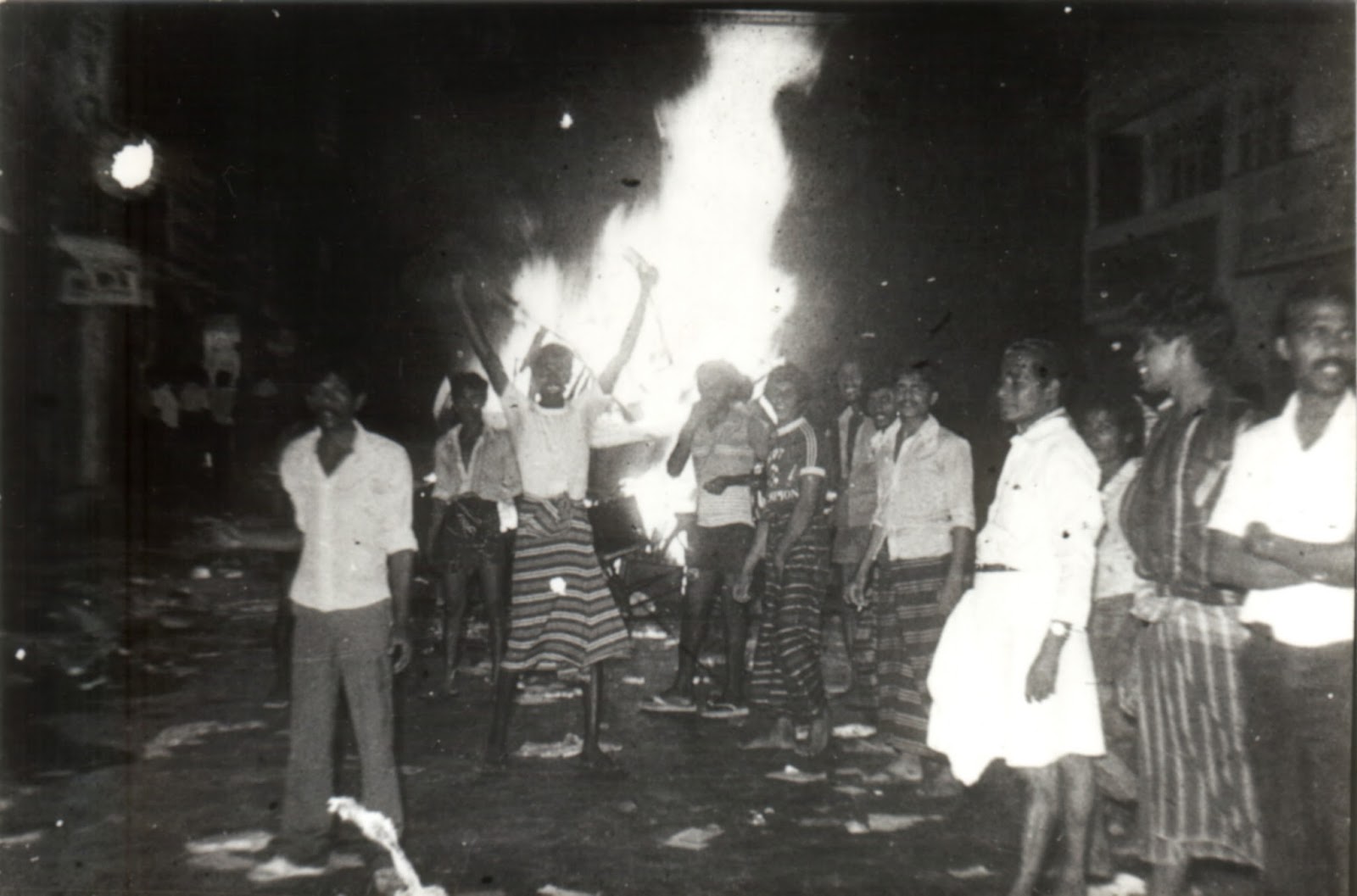
මුළු නගරයම යකුන් නැටූ පිටියක් මෙන් විනාශ වී ගොසිනි. තැනින් තැන ගිනිගත් කඩසාප්පුය. 

දින ගණනක් රෝහලේ නේවාසිකව නතරවී ප්‍රතිකාර ගැනීමෙන් පසු ටිකට් කපනලද සිල්වා අසීරුවෙන් තම හාම්පුතාගේ නිවසට පැමිණියේ ඔහුගේ දරු පවුල හමුවීමේ අපේක්ෂාවෙනි. දොර ජනෙල් වසා නිවසද පාළුවට ගොසින් තිබූ බැවින් සිල්වා අසල්වැසි නිවසට ගොස් මොවුන් පිලිබඳ තොරතුරු විමසීය.

සිල්වා මොකද වුණේ? ” හිසේ ප්ලාස්ටර් හා තවමත් අත එල්ලාගෙන සිටින රාජේෂ්ගේ රියදුරා දුටු දේවරාජා මහත්මිය ඇසුවාය. “නෝන, අහස පොළව නුහුලන අපරාධයක් වුණේ. මගේ ඇස් ඉස්සරහ රාජේෂ් මහත්තයට ගහල මැරුවා. උන් මටත් ගැහැව්වා. මම අමාරුවෙන් බඩගාගෙන මරදාන පැත්තට යනකොට පොලිස් ජීප් එකක් මාව ඉස්පිරිතාලයට ගිහින් දැම්මා. සුමානයක් විතර ඉස්පිරිතාලේ ඉඳලා අදයි ටිකට් කැපුවේ. කෝ තවරාණි නෝනයි, ළමයින් දෙන්නයි? “

දේවරාජා මහත්මිය සුසුමක් හෙලුවාය. රාජේෂ් මහත්තයාගේ මරණය ගැන තවරාණි නෝනා දැන ගත්තේ පොලීසියෙන් ඇවිල්ලා කිව්වමයි. උන් වෑන් එකත් පුච්චලා. පෙරේදා නෝනා ළමයි දෙන්නා සමඟ යාපනේ ගියා. ලබන මාසයේ කැනඩාවට යනවලු. ලංකාවේ ඉන්න එකක් නැහැ.

මහළු රියදුරා තම දෑස් පියා ගත්තේය. හරි අපරාදයක් නේද වුණේ ? හොඳ ලස්සනට හිටපු පවුලක් මොහොතකින් විනාශ කරලා දැම්මා මේ අමනුස්සයෝ. මේවා බලන්න අපිත් ජීවත් උනානේ. ඔහු දෙනෙතින් වැගිරෙන කඳුළු පිසදමා ගත්තේය. මම යන්නං නෝනා, රෑ වෙන්න කලින් ගමේ යන්න ඕනෑ.

රියදුරා පිටත් වීමෙන් පසු දේවරාජා මහත්මිය පාර අද්දරට ගියාය. ඈත මාර්ගයේ ගින්නෙන් විනාශ වූ ගෙවල් හා කඩසාප්පු ඇයගේ නෙතට ලක්විය.හරියට මහා ගිනිකන්දක් පිපුරුණා වගේ ඇය දිග හුස්මක් ගනිමින් තොල් මැතුරුවාය.

වෛද්‍ය රුවන් එම් ජයතුංග 

PRE-HISTORIC LANKA TO UNITED SRI LANKA-Sociological revelation

July 22nd, 2020

By.Dr.Sripali Vaiamon

Hon. Gotabaya Rajapaksa is a very religious conscious kind personality.I saw recently He has gone to UDAMALUWA OF SRI MAHA BODHIYA, ANURADHAPURA and keeping askance of his face on the Bo brach with leaning his head on it in most sentimental devotion. I fully realized he is ideally matching the great Indian King Dhrmasoka who offered us the BUDDHISM to Sri Lanka, through his son, MAHINDA and daughter SANGAMMITTHA and treated every other religion as of his own by propagating through Edicts.

It reminds me I have published so many extracts relevant to his philosophy and activities by Buddhist philosophers  in my VIEWS ON BUDDHISM, parts one to three and also about Mr.Rajapaksa’s experiences and activities on the 28th Oct.  just prior to his electionof the new post in the LANKA WEB as it will provide some help for voters.Our President  with his brother was fully involved in terrorist settlement until  the end of the war which went of for 25 years. For the information of others I will republish that short description  from my book ,PRE-HISTORIC LANKA TO END OF TERRORISM,PUBLISHED IN 2012.TRAFFORD PUBLISHERS,USA.

MOST OF THE COUNTRY PEOPLE ARE NOT AWARE THAT THE DEFENCE SECRETARY ,WHO IS A TOWER OF STRENGTH  TO THE PRESIDENT ,(MAHINDA)WAS APPOINTED TO THE POST NOT MERELY BECAUSE HE IS PRESIDENT’S  BROTHER BUT HE IS A HIGHLY QUALIFIED AND  HAVE  LENGTHY EXPERIENCE ON THE FUNCTIONS OF DEFENCE STRATEGY.

HE WAS A LIEUTENANT COLNEL OF THE SRI LANKA ARMY.HE JOINED THE ARMY IN 1971. HE HAS SERVED IN THE SINHA REGIMENT,RAJARATA RIFLES,GAJABA REGIMENT AND  VIJAYABAHU INFANTARY REGIMENT .HE SERVED IN THE BATTLE FRONT OF VADAMARACHCHI IN 1987.HE HAD MILITARY TRAINING IN RAWALIPINDI AND QUETTA, IN PAKISTAN,JUNGLE WARFARE IN ASSAM,INDIA.FOLLOWED A COMMAND AND STAFF COURSE AT DEFENCE SERVICE STAFF COLLEGE IN WELLINGTON.ADVANCE INFANTARY OFFICERS’COURSE IN FORT BENNINGTON,  USA. HE HAS RECEIVED AWARDS FROM M/S J.R.JAYAWARDANA,RANASINGHE PREMADASA AND D.B.WIJETUNGA.

Such a person was never appointed to the post of the Defence Secretary earlier.The abominable war is now over so he has been added with another massive task,’the urban development.’

Relevant  involvements and experiences I clearly explained perhaps may be useful for present context too. It was something similer to what Dharmasoka regained  after the final war,the war at KALINGA. It was at the Kalinga war he dropped all his armaments and ordered his battalion to drop all their weapons. When he returned to the Palace and seated melancholy  he saw on the road a saint type young priest walking, he commanded a soldier to summon the priest.When he arrived at the Palace king inquired and learnt he is novice NIGRODA.On request He preached pleasant discourse APPAMADA VAGGA from DAMMAPADA  and the king was fully comprehended!Therafter the king  became a saint like personality.Changed his name as DHARMA-SOKHA- Earlier it was Chandasoka . He thereafter engaged in maritorias activities immensely.This has well elaborated by Prof.LILY  DE SILVA IN my  BODU MATHI MATHANTARA,RELEASED BY Rev.KIRAMA Wimalajothi thera,Buddhist Cultural centre,dehiwala.

SANGAMITTA BROUGHT THE BODHI SAPLING

D.C.WIJEWARDANA  IN P.49-THE  REVOLT IN THE TEMPLE.

Sanghamitta THERI,THE SISTER OF MAHINDA THERO,followed her brother to Ceylon that she might establish THE ORDER OF THE BHIKKUNIS in  lanka. She braught with her  a branch of the sacred Bo-tree,under which Gauthama had attained Enlightemment.

The branch ,received by Tissa himself,was planted  with great pomp and ceremony at ANURADAPURA and still flourished there.It is the oldest historical tree in the world,and object of profound veneration  to million of Buddhists throughout the world.To this tree,the symbol of gratitude,Anuradapura,through all its vicissitudes of countries,owes its escape from the oblivion which has  other mighty cities elsewhere.

Within two centuries Buddhism spread into every inhabited part of the Island.

DEVANAM PIYATISSA GUARDED THE botree.

Devanam Piyatissa is reported to have assumed the role of a gate-keeper for 3 days to honour the Bodhi Tree.immediately it was braught to Ceylon. 

p.63-ocial History of Ceylon-Dr.Hema Ellawala.

ASOKA AFTER THE WAR.—Legends of Indian Buddhism ——by.Eugene Burnouf–

The warrior who had spreaddevastation and murder throughout India began to engages in works of peace,in making roads,in digging of wells and planting trees,in establishing charities and providing for their business like distribution.Many were the great monasteries and temples built by the converted Asoka.Throughout the vast dominionwhich his conquest had added to his original empire of MAGADHA.,on pillers and on rocks he engraved the articles of Buddhist belief.These descriptions are described as edicts.They are the only known contemporary documents  for the history of Asoka`s reign and for the study of religion.

On the 12th Sunday ADA carried a pleasant surprise where new look has been given to the  MtLavinia beach which highlighted future development quite similer to the PORT CITY and the 100 projects almost completed duringthe past tenure of the former President with which contry people could have fiture HOPES.– From –sripaliv@gmail.com

Indian High Commission to accept applications for courses under self-financing scheme till July 31

July 22nd, 2020

Courtesy NewsIn.Asia

The applications should be for undergraduate courses in MBBS, BDS, BE, B.Tech, B.Pharm & B.Arch for the year 2020-21

Indian High Commission to accept applications for courses under self-financing scheme till July 31

Colombo, July 22 (newsin.asia): The High Commission of India in Sri Lanka has announced the extension of the last date to receive applications from eligible Sri Lankan students (excluding PIO, OCI Card holders & NRIs) seeking admission to Undergraduate Courses in MBBS, BDS, BE, B.Tech, B.Pharm & B.Arch under the Self Financing Scheme for the academic year 2020-21. The last date now is July 31.

The candidates who wish to apply for MBBS/BDS courses will have to obtain minimum of Marks at 50thpercentile in NEET exam which will be conducted by NTA (National Testing Agency) on 13th September, 2020. B.Arch aspirants are required to pass the aptitude test as prescribed by the Council of Architecture, New Delhi. A copy of NEET mark sheet has to be submitted as and when it is obtained by the candidate.

The interested candidates are requested to fill-up the application forms available at the Education Wing of the High Commission of India, Colombo-03, on any working day between 1400-1600 hrs on production of G.C.E. O/L, A/L” certificates of Sri Lanka (issued by the Department of Examination, Battaramulla) or G.C.E. O/L, A/L” certificates London, and Birth Certificate.

Sri Lanka to do away with race, religion and marital status of parents in birth certificates

July 22nd, 2020

Courtesy NewsIn.Asia

Many children are reportedly facing issues due to details of the marriage of parents, especially when enrolling a child in school.

Colombo, July 22 (newsfirst/newswire): Sri Lanka’s Registrar General’s Department says all new Birth Certificates will be issued as Sri Lankan” and will not refer to any race or religion, Newsfirst reported

Registrar General N. C. Vithanage further said details pertaining to Marriage and Ethnic Group will also be removed from the Application Form for the registration of a birth in Sri Lanka.

Many children in the country are reportedly facing issues due to the details of the marriage of parents, especially when enrolling a child in school.

Vithanage further said the much-awaited Digital Birth Certificate will be issued following the conclusion of the 2020 General Election.

Under the new system, a 12-digit serial number is to be issued for all new birth certificates and this serial number can be used to obtain a NIC when a child completes 15 years of age, he said.

Registrar General N. C. Vithanage said the digital birth certificate will come with a QR Code, a Bar Code, a dedicated watermark to meet international standards and to counter forged documents.

A system is already in place to launch the new birth certificates, he added.

2019 Easter Blasts: Wife of a suicide bomber escaped to India, says Sri Lanka police

July 22nd, 2020

Written by Arun Janardhanan courtesy The Indian Express

Probed by the Colombo Crime Division, Criminal Investigation Department and the Terrorism Investigation Department, the probe into the Easter Sunday blasts has result in the arrest of around 200 suspects, and the investigation is in its final stages.

Sri Lanka Attorney General department, Terrorism investigation division, National Thowheed Jamat ban, World news, Indian Express
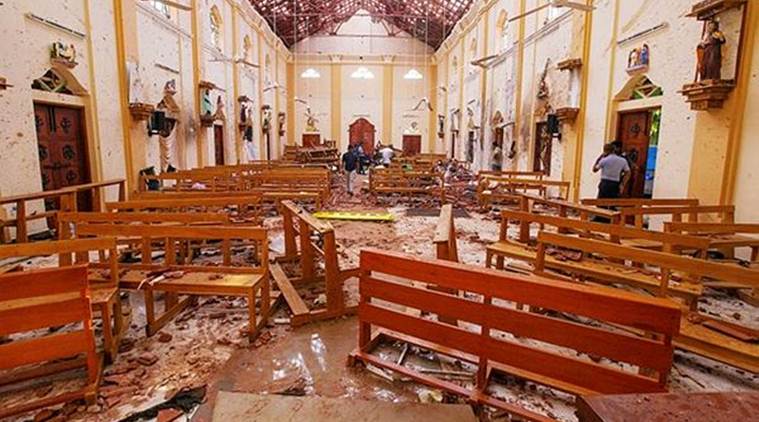
The blasts targeted St Anthony’s Church in Colombo, St Sebastian’s Church in the western coastal town of Negombo, and a church in the eastern town of Batticaloa when the Easter Sunday mass was in progress. (Reuters)

The wife of one of the suicide bombers who struck churches across Sri Lanka on Easter in April 2019, resulting in the death of 260 people, has fled to India fearing arrest, the police of the island nation has said.

Testifying before the Presidential Commission of Inquiry, which is probing the blasts, Chief Inspector of Police Arjuna Maheenkanda said Pulasthini Rajendran alias Sarah — the wife of Atchchi Muhammadu Hastun, who detonated his bomb at the St Sebastian’s Church in Negombo — may have fled to India via sea in September 2019.

His submission was based on an input he received on July 6 this year through an informant. The information was that a woman, believed to be Sarah, who was initially believed to have been killed in the explosion at a house in Sainthamaruthu on April 26, 2019, had actually fled the scene and was in hiding before escaping to India from Sri Lanka’s Mannar coast.

Probed by the Colombo Crime Division, Criminal Investigation Department and the Terrorism Investigation Department, the probe into the Easter Sunday blasts has result in the arrest of around 200 suspects, and the investigation is in its final stages.

According to the Colombo Crime Division, Sarah was hiding in a village called Mankadu in the Kalawanchikudy area.

Jaliya Senaratne, director of the Police Media Division, told The Indian Express, We do not have any concrete information about her whereabouts in India except a report that she managed to escape to India. We arrested two persons on July 13 — her relative and a senior police officer — from Ampara (an eastern province of Sri Lanka) for harbouring that lady before her escape. They are in custody.”

An estimated 15 people, including four women and six children, were killed in the Sainthamaruthu blast. The explosion, which killed the families of at least four of the suicide bombers, had occurred when security forces launched an operation to capture them, a week after the Easter blasts.

When The Indian Express visited Sainthamaruthu blast site two days later, the two known survivors from the explosion were the wife and daughter of Zahran Hashim, the main suicide bomber.

A senior officer said Hashim’s wife, who sustained serious injuries in the blast, is currently under detention.

Eyeing China, India plans solar power park in Sri Lanka

July 22nd, 2020

Utpal Bhaskar Courtesy Livemint

By leveraging the country’ solar expertise, India’s largest power generation utility NTPC Ltd plans to set up this project in the island nation under the aegis of International Solar Alliance

New Delhi: India plans to set up a solar power park in Sri Lanka as part of a concerted strategy to project its presence in the Indian Ocean region, even as China aims to co-opt countries into its ‘Belt and Road’ initiative, said two people aware of the development.

By leveraging the country’ solar expertise, India’s largest power generation utility NTPC Ltd plans to set up this project in the island nation under the aegis of International Solar Alliance (ISA).

This comes in the backdrop of an increasing presence of China in the Indian Ocean region, which India considers its sphere of influence. Also, an aircraft carrier battle group led by USS Nimitz is conducting joint naval exercises in the area at a time of growing hostilities between India and China.

We are looking at setting up a solar park in Sri Lanka,” said a senior Indian government official requesting anonymity.

State-run Ceylon Electricity Board has an installed power generation capacity of around 35.8 gigawatts (GW). India has been working on improving the energy infrastructure in Sri Lanka. Petronet LNG Ltd had earlier announced its plans of setting up a liquefied natural gas terminal in Sri Lanka.

India is also exploring the option of an overhead electricity link with Sri Lanka as part of efforts to create a new-energy ecosystem for the neighbourhood. China is already one of the biggest investors in various infrastructure projects in Sri Lanka.

The proposed solar park follows after state-run NTPC Ltd’s plan to set up a coal-fuelled power project in Trincomalee didn’t make much headway and was eventually scrapped after Colombo asked India to change—for the second time—the location of the stalled $500 million project.

Queries emailed to the spokespersons of NTPC and India’s ministry of new and renewable energy remained unanswered.

With an installed capacity of 62.91 GW, NTPC’ Sri Lanka solar foray is part of targeting similar contracts to help set up 10 GW solar capacity in ISA member countries. Green energy projects now account for more than a fifth of India’s installed power generation capacity of 370 GW.

ISA has empanelled NTPC and will soon be doing another exercise to empanel more public sector units from member countries who have rich experience in solar space,” an ISA spokesperson had earlier told Mint.

India’s plan is to get NTPC win these contracts with the backing of ISA, the first treaty-based international government organization headquartered in India that is increasingly being viewed as a foreign policy tool.

Mint earlier reported about NTPC’ plans to help Gambia and Malawi develop solar power parks and eyeing project management consultancy contracts in Sudan, Mozambique, Egypt, Uganda, Rwanda and Niger. India’s largest power generation utility recently got such contracts in Mali and Togo.

India is also working on setting up the much needed solar wafer and ingot capacity and plans to come out with tenders that may provide for viability gap funding (VGF) to attract manufacturers. Wafers and ingots are the building blocks for manufacturing solar cells and modules, and are essential to India’s clean energy plans. Globally, solar wafer and ingot manufacturing is dominated by China.

To counter Beijing, the US is seeking a bigger role for India in stabilising and maintaining the rule of law in the Indo-Pacific region–a large swathe of land and sea stretching all the way from the west coast of the US to the shores of east Africa.

Interim report proposes action against offenders

July 22nd, 2020

Sheain Fernandopulle Courtesy The Daily Mirror

The interim report compiled by the committee appointed to probe over destruction of a building with archaeological value in Kurunegala, has proposed to take legal action against those responsible.

The interim report was handed over to Prime Minister Mahinda Rajapaksa today by the head of the committee, Director General of Archaeology, Prof. Senarath Dissanayake.

The following recommendations have also been proposed through the interim report;

  • The building should be conserved as soon as possible
  • The building should be taken under the purview of the Department of Archaeology 
  • To propose the Road Development Authority to revise the plan for expansion of this site
  • To recover funds from those responsible to renovate the site

The committee headed by Director General of Archaeology was appointed on Friday to investigate the incident where an archaeological building in Kurunegala was allegedly bulldozed on July 14.

The Committee was appointed by the Buddhasasana, Cultural and Religious Affairs Ministry Secretary on a directive of subject minister Mahinda Rajapaksa.

The history of the building goes back to the thirteenth century of the Kurunegala Kingdom and was believed to be the King’s Assembly Hall at that time and is considered an archaeological reserve under the Antiquities Ordinance No.09 of 1940. 

Committee probing demolishing of 13th-century building hands over interim report

July 22nd, 2020

Courtesy Adaderana

The committee of experts appointed to investigate the demolishing of a building of archaeological value in Kurunegala, has handed over its interim report to Prime Minister Mahinda Rajapaksa.

The Office of the Premier said the report was submitted this morning (22) at the Temple Trees.

In conclusion of their findings, the committee members have proposed the following:

1. Only a part of the roof and the windows on the frontside of the building have been damaged during the demolition, hence it is possible to preserve these damaged parts archaeologically. The building material including wooden beams and bricks at the rear of the building, which was completely damaged, are kept in reserve. Accordingly, this part of the building can also be preserved. 

2. Brining the building under the purview of the Department of Archaeology.

3. Proposing the Road Development Authority (RDA) to revise the plan to expand this site.

4. Taking legal action against those demolished the building in question.

5. Obtaining the necessary provisions for preservation of this building from the institutions or persons responsible for the demolition.

The five-member committee was formed by the Secretary to the Ministry of Buddhasasana, Cultural and Religious Affairs, under the directives of Prime Minister Mahinda Rajapaksa.

Chaired by Director-General of the Department of Archaeology Prof. Senarath Dissanayake, the committee consists of Kurunegala District Secretary R.M.R. Rathnayake, Archaeologist Prof. T.G. Kulatunga, Deputy Director of Archaeology at the Ministry of Cultural Affairs Archaeologist Prasad Ranasinghe and Director (Development) of the Central Cultural Fund Architect Sumedha Matota.

The building, which is also known as the Buwaneka Hotel, dates back to the 13th century and is presumed to be the assembly hall used by the contemporary rulers.

This archaeological site had been preserved as per the provisions of the Antiquities Ordinance No. 9 of 1940.

President assures to free the country of drug menace

July 22nd, 2020

Courtesy Adaderana

President Gotabaya Rajapaksa assured to bequeath the future generation a country free from the drug menace.

While several measures are already in place to prevent drug infiltration and distribution, President emphasized the country will be freed from drugs similar to that of terrorism, stated President’s Media Division.

President made these comments at a public gathering organized near Kiribathgoda Shopping complex today (22) ,to support candidates of Sri Lanka Podujana Peramuna (SLPP) contesting at the General Election.

President heeded to the requests by the public to construct a housing scheme for the residents in Peliyagoda prone to flash floods and to set up a pumping station in Pethiyagoda. People also apprised the President of the current status of the Kiribathgoda Hospital and issues related to lands. They also requested the President not to halt investigations into Easter Sunday attacks.

Minister Prasanna Ranatunge and candidate Sisira Jakody were present on the occasion.

President inspected the jogging path near Siyambalape junction which is in a dilapidated condition due to lack of proper maintenance. People requested the President to renovate it and develop the surrounding area as a self-employment center akin to Diyatha Uyana.

The President, who participated at the public gathering organized by candidate Dulip Wijesekara at Siyabalape Junction, Biyagama, was told by the public that over 400 acres of paddy land can be cultivated by renovating the Biyagama Waduwegama and Kottunna tanks.  They also apprised the President of the difficulties faced by them for a long period of time due to inadequate operations of SLTB buses.

The President also attended a public meeting organized by former State Minister Lasantha Alagiyawanna near Sub Post Office in Dalupitiya Road. The President was warmly welcomed by the people gathered at the venue and appreciated his efforts to eradicate the drug menace from the country.

President Rajapaksa also joined the public meeting organized by candidate Sahan Pradeep near Kadawatha private bus stand. People gathered at the venue requested the President to construct a sports complex in Mahara Kadawatha and to repair the dilapidated roads.

The requests by the people which will take time to be fulfilled will be scrutinized and necessary steps will be taken in the future, stated PMD.

The people in Gampaha district pledged to strengthen the hands of the President by giving him a landslide victory for the SLPP at the forthcoming Parliamentary election so that the initiatives introduced by him to take the country forward in a new direction can be successfully completed, PMD added.

The public made this promise when President Gotabaya Rajapaksa joined a public gathering held in Gampaha district.

The people stressed that it is the responsibility of the people to extend support to the President ensuring a stable and strong Parliament as the upcoming general election is a decisive millstone in framing the future of the country.

Office employees complained of many hardships that they have to face as a result of non-stopping of the Intercity Express trains at the Ragama Railway Station. The people gathered at the public meeting held near the car park of Ragama Railway Station requested the President to look into this matter.

Candidate Madhu Madhawa Aravinda had organized the meeting. Sea erosion has had a major negative impact on the daily life of fisher folk in Uswetakeiyyawa area. A group of fishermen told the President the effect could be minimized with the construction of a fisheries harbor.

President also participated in a meeting organized by candidate Nimal Lanza in Nayakakanda Playground in Wattala. The President was also briefed on the issues faced by the fishing community in the area due to illegal sand mining.

Attending meetings organized by candidates Merali Perera in Ja-Ela and candidate Sudarshani Fernandopulle near Govijana Seva Center in Katana President engaged in cordial discussion with the people present at venues.

President was warmly welcomed by the people in the area when he attended meetings organized by candidate Indika Anuruddha in Divulapitiya town and candidate Kokila Hanrshani in Meerigama Bus Stand.

A group of United National Party supporters present at the venue said that they are pleased with the manner President is leading the country and will support SLPP at the Parliamentary Election, the PMD said.

President invited all the patriotic people to join hands to rebuild the country.

Fourteen arrivals from Saudi Arabia spike COVID-19 case tally

July 22nd, 2020

Courtesy Adaderana

Fourteen arrivals from Saudi Arabia have tested positive for COVID-19 virus, stated the Department of Government Information.

With the new cases, 15 patients of coronavirus have been identified within today (22).

The count of total coronavirus cases reported in the country is now at 2,745.

As per the Epidemiology Unit of the Health Ministry, 670 active cases are under medical care at selected hospitals.

The recovery tally from the disease was pushed to 2,064 cases today as 16 patients regained their health and were discharged from the hospital.

Sri Lanka has witnessed 11 deaths from the virus so far.

AG to file limited objections against FR petition on Aranthalawa Massacre

July 22nd, 2020

Courtesy Adaderana

The Attorney General has informed the Supreme Court that limited objections will be filed against the fundamental rights petition seeking immediate investigations against terrorists responsible for the 1987 Aranthalawa Massacre.

The petition was called before the Supreme Court Judge Bench consisting of Chief Justice Jayantha Jayasuriya, Murdu Fernando, and S. Thurairajah today (22).

Speaking on behalf of the Attorney General (AG), Senior State Counsel Avanthi Perera stated that the AG will submit limited objections requesting the court to reject the relevant petition.

She stated that she received instruction on the petition from the Police this morning, and therefore requested the court to allocate a date to make the relevant submissions.

Accordingly, the Supreme Court ordered the State Counsel to file the limited objections before September 30 and the petitioner to file their objections before October 09.

Subsequently, the case will be heard on November 12, the court passed.

The petition has been filed by Ven. Andaulpatha Buddhasara Thero, who survived the attack while the Attorney General, Acting Inspector General of Police, and the Director of State Intelligence Service (SIS) Suresh Sallay have been named respondents of the petition.

The petitioner points out that, 31 Buddhist monks and several civilians were killed in an attack by the LTTE on July 02, 1987. While many terrorists responsible for the attacks are still alive, no legal action has been taken against them, the petitioner says.

Thereby, the petitioner seeks a court order on the defendants to launch an investigation against the terrorists responsible for the attack and are still alive today. The petition further demands an amount of Rs 20 million to be paid by the government as compensation for the fundamental rights violated by the attack.

Sri Lanka’s COVID-19 cases tally hits 2,731

July 22nd, 2020

Courtesy Adaderana

COVID-19 cases confirmed in Sri Lanka escalated to 2,731 this evening (22) as one more person tested positive for the virus.

The latest case is a close contact of a novel coronavirus patient linked to the Kandakadu cluster, the Department of Government Information said.

According to the Epidemiology Unit’s statistics, a total of 656 patients infected with the virus are currently under medical care at hospitals.

In the meantime, the number of recoveries reported from the disease in the country moved up to 2,064 earlier today.

Sri Lanka has thus far witnessed 11 deaths due to the virus outbreak.

Attorney General calls for comprehensive probes into demolition of historic building

July 22nd, 2020

Courtesy Adaderana

Attorney General Dappula de Livera has advised the Acting Inspector General of Police (IGP) to carry out further comprehensive investigations into the demolition of the 13-century building in Kurunegala.

The Coordinating Officer of the Attorney General, State Counsel Nishara Jayaratne said this instruction was given after consultation with the Police and the Director General of Archaeology.

In the meantime, earlier today (22), the committee of experts appointed to investigate the demolishing of a building of archaeological value in Kurunegala, handed over its interim report to Prime Minister Mahinda Rajapaksa.

In its report, the committee had stressed that legal action must be taken against those demolished the building in question and necessary provisions for preservation of this building should be obtained from the institutions or persons responsible for the demolition.

This five-member committee was formed by the Secretary to the Ministry of Buddhasasana, Cultural and Religious Affairs, under the directives of Prime Minister Mahinda Rajapaksa.

Chaired by Director-General of the Department of Archaeology Prof. Senarath Dissanayake, the committee consists of Kurunegala District Secretary R.M.R. Rathnayake, Archaeologist Prof. T.G. Kulatunga, Deputy Director of Archaeology at the Ministry of Cultural Affairs Archaeologist Prasad Ranasinghe and Director (Development) of the Central Cultural Fund Architect Sumedha Matota.

The building, which is also known as the Buwaneka Hotel, dates back to the 13th century and is presumed to be the assembly hall used by the contemporary rulers.

This archaeological site had been preserved as per the provisions of the Antiquities Ordinance No. 9 of 1940.

The damage caused by Sajith cannot be repaired – PM (Video)

July 22nd, 2020

Courtesy Hiru News

The Prime Minister made this statement while participating in a public meeting held in the Poojapitiya area in Kandy yesterday.

Meanwhile, Prime Minister Mahinda Rajapaksa says that Sajith Premadasa is pursuing a double standard, expressing conflicting views to the people of the North and the South.

The Prime Minister expressed these views while participating in a public meeting held in Homagama today.

Prime Minister Mahinda Rajapaksa this afternoon participated in a public meeting held in Homagama to confirm the victory of the Colombo District candidates contesting from the Sri Lanka Podujana Peramuna for the forthcoming General Elections.

Meanwhile, President Mahinda Rajapaksa visited the Temple of the Tooth in Kandy this morning to pay homage to the Sacred Tooth Relic

Cabinet decides to provide Agrahara health insurance benefits to over 600,000 retired public servants

July 22nd, 2020

Courtesy Hiru News

The Cabinet decides to provide benefits of ‘Agrahara’ medical insurance for over 600,000, all retired government employees

Commission pays attention to transfer of police officers investigating Saindamarudu blast

July 21st, 2020

Courtesy Hiru News

The Presidential Commission to Investigate the Easter Attack has drawn attention to the sudden transfers of two police officers who were initially investigating the Ampara Saindamarudu blast.

The Commission commenced to hear evidence yesterday regarding the explosion that took place in a house in Saindamardu, Ampara on April 26 last year.

SSP Samantha Wijesekera, who was in charge of the Ampara Police Division at the time of the blast, was the first to give evidence.

XXX Landslide for the SLPP and a whitewash for the UNP.

July 21st, 2020

Dr Sudath Gunasekara Mahanuwara

My prediction on the August 5th General Election

Landslide victory for the SLPP and a white wash for the UNP and nemesis for all communal political parties and Independent candidates

What the people of this country should do at the upcoming election to ensure this reality

Before I present my write up on the above topic I give here my prediction made on the last Presidential Election on 14 Oct 2019 in an email I sent to Mr Gothabhaya Rajapaksa.

Your victory as well as that of the country is a foregone conclusion. I am repeating, you will be definitely starting with at least 65 lakhs the minimum that is what the SLPP, UPF and SLFP got at the 2018 Local Government Elections. Looking at the present trend no one should be surprised even if it exceeds 70 lahks”

(This was the opening passage of an email I sent to Gothabhaya on 14.Oct 2019)

The accuracy of my prediction was proved   to the letter when he polled 6,924,255 votes and won that election with a thumping majority and I take pride in that forecast as I was the only man who said so. Even my teacher at the University, an internationally acclaimed eminent scholar emeritus Professor Gerald Peiris expressed his reservations on my conclusion. But I persistently maintained my conviction and finally it was proved correct.

Similarly I am making this prediction this time too on the upcoming General election after making an in-depth study of the political situation on ground by listening to people in the work place, paddy field and on the street. Changes bound to occur in the behavior of the electorate between now and the 5th of August also has been taken in to consideration in arriving at this conclusion. The rousing welcome received by the President at the SLPP’s inaugural election meeting held at Anuradhapura today and all other places he went is good forecast of the prediction I am making in this note.

Dawn of a historic land mark in the political history of this Island nation

I opine the next General Election is going to be an important land mark in the political history of this Island nation for the following reasons. It will also mark a turning point in the post-Independence period of Sri Lankan politics

The beginning of this turning point will dawn with this political revolution that will emerge with the election results on the 6th of August.

A political Revolution

1The SLPP will get over 175 out of 225 seats in the next Parliament (Eg 155 elected and 20 national list)

 2 The divided and disarrayed UNP (R+P camps together) will settle around 35 the most (elected + national list)

3 TNA 12 elected and 1 National list member

4 JVP will get eliminated from the political map of Sri Lanka

5 Others not belonging to 1 to 3 and sometime Ape Janabala Vegaya.

(These figures might slightly vary due to the fact there is always a margin of   error in statistical calculations. But I maintain the overall picture want be much different)

6 All independent candidates will lose and even their deposits will be confiscated

7 The Old UNP will disappear from the political scene in this country and this Election will also mark the end of political carriers of many sitting politicians including those of Ranil and Premadasa, Champika, Rajita, Welgama, Vijitamini Zoysa and Kiriella and many others of the old stock.

8 The old SLFP will emerge as the only national political Party in Sri Lanka under Mahinda Raapaksa if he accepts it cap as the new President

9 Sajit’s camp might get few seats more than Ranil’s camp with the support of Muslims but Ranil will remain as the leader of Opposition in the new Parliament as well with the support of the TNA

10 This Election will also open the doors for a new Political Party completely under a new leadership that stands for full freedom from all foreign intervention and that rejects the original UNP ideology of multi- racial, multi-national and multi linguistic etc. accepted by D.S. Senanayaka in 1947 to get the so-called Independence from Briton and also that  uphold one nation, one country and one Law concept among such other conditions that restore pre-1815  Sinhale geared to take over the country, on a day on the day the new Government fails to meet the full aspirations of the Sinhala majority. But that will be an uphill task for two reasons. The first is the problem of finding a suitable national leader and the second is to formulate a more pro- National and inward looking Patriotic agenda than that of the present SLPP under President Gotabahya Rajapaksa. 

A political vacuum and the need for another new national political party

The demise of UNP at this election will create a big political vacuum. The need for such a new national political party is called for as both traditional parties, the UNP and the SLFP are no more there. Although there is a possibility of SLFP emerging with a new lease of life if MR accepts it’s leadership. But there is no likelihood of emerging a new political party on the old UNP model.  The new Party should be an alternative Sinhala Buddhist national Political force to the SLPP that is more patriotic, inward looking and village based, to take over the country,, when one day the SLPP fails in its duty by the Nation by not making radical changes, the Sinhala Buddhist have been yearning for 72 long years since 1948. The new party invariably will have to be built on the Anagarika Dharmapala concept of the Sinhala nation and the Sinhala State.

The SLPP will however govern the country under the present patriotic regime at least for 15 years. That is at least 10 under GR and 5 years under his successor. I predict this overall result on the basis of two sets of mutually exclusive factors coming in to play at this election, one negative and the other positive. The most significant feature of this political revolution is that the interaction of both these diametrically opposed factors will have negative and disastrous effects on the UNP vote base as a political party. Vituperative and mudslinging at each other, devoid of any substance  or constructive political dialogue by these two Camps (Ranil & Sajith) infested with corrupt, baseless, verbose and vicious political misfits like Sajit, Rajita, Champika, Vijitamuni Zoysa and Kiriella and extreme communalists like Hakim and Badurdeen on one side and Bank robbers, traitors like Ranil, Mangala, Ravi, Range Bandara and jokers like Ranjan Ramanayaka and Mervin Mervin Silva will enhance the chances of the SLPP to unexpected levels, recording a landslide victory never expected by any, including even those in the SLPP and the President’s Office.

Going by the trend it is very unlikely what the SLPP polled at the presidential Election will get reduced. As such when SLPP starts with 6,924,255 the minimum they polled at the Presidential Election, the UNP will be left only something around 2,700,000 (5,564,234–2,900.000 Tamil+ and  Muslim votes) to be divided between R and S factions. It is assumed that even these 2,700,000 might get reduced even to about 2,500,000, due to the prevailing confusion and infighting between the two camps and the overall apathy among the UNP voters. That might also definitely lead to lower turn out of UNP voters at the polling stations resulting in more SLPP candidates getting elected while the number of UNP members will get drastically reduced.

First let us look at the negative factors

1This election is held after a period of 5 years of complete anarchy and political and economic mismanagement in this country under Sirisena–Ranil- Karu three headed Government. Going by the present situation in the country, the UNP could be compared to a sinking and wrecking ship in mid seas caught by a Tsunami, sans a captain to rescue and navigate it in the proper direction for safety. The SLPP will bag the benefits of all these confusions thereby increasing its majority in Parliament.

2 This election is also held at a time when the country is beset with extremely serious crises in a plethora of political, economic and social fields and the collapse of national security and law and order never witnessed before in this country. 

3 The country is going through a serious economic depression after the nation’s Central Bank was robbed by the then ruling UNP, manipulated by none other than the Prime Minister of that so-called Government and subsequently the whole country paralyzed by extremist Muslim terrorist attacks on the economic and religious nerve centers of the country, now in complete disarray and reached its lowest growth level in its 72 years of Independence. On the top of it is a time when the whole  world is undergoing one of the most difficult and unpredictable future due to the world wide Covid 19 pandemic that has almost crippled the whole world and brought it virtually on its knees almost to a non-returnable situation.

4 The country’s economy is also undergoing one of the most difficult times ever in its history more or less facing a national crisis level with no agricultural or industrial production and nor exports, and where the main foreign exchange inflow channels like foreign employment has almost got dried up and printed money has to be pumped in billions to run the country.

5 Scanty domestic FE reserves and worldwide economic depression and limitations and constraints on imports due to global restriction on shipping and international trade mechanisms has badly affected both exports and imports

6 Meanwhile continued interference and competition by powerful countries to take control of the Island’s strategic situation on the great E-W trade route in the Indian Ocean in view of its importance in the context of emerging supremacy of the Indo-Pacific zone in world politics and by various International organizations agencies and countries like UK. Germany, Canada and Norway driven by LTTE Diaspora elements hostile to this country that are trying to create disunity within the country for example between the various ethnic and religious groups also have created many a problem to this country.

 The positive side

1 In spite of this darker side, after 72 years of So-called Independence on the other hand, we as a nation have got a patriotic and strong Sinhala Buddhist Statesman in President Gothabhaya Rajapaksa, as a man with a clear vision and a mission who has a proven capacity  to successfully face all these challenges of  this multifaceted conundrum and take this country out of the Augean mess it has been put in to by all politicians who are supposed to have ruled this country for the past 72 years since the so-called Independence. 

None of them knew the emptiness of fake Independence they got in 1948. As I see it none of them knew that the kind of Independence given by the British was only a transfer of continuation of the same British mechanism of governance to a set of local kalu Suddhas to run the country as their accredited agents. This is exactly what, we are doing even today. But the politicians call it Independence and Democracy.

 Meanwhile the true Bhumiputras of this country charged with a sense of patriotism, that is the Sinhala majority both Buddhists and Catholics have joined hands to elect Gothabhaya Rajapaksa as their newly found Messiah. They expects the new President to make this country a fully pledge Independent and sovereign State after this election.  This perhaps is the priority number one the people of this country expect from him. This long overdue political strategy forms the cornerstone of all the rest, as an Independent, sovereign and free country.

Is  Diyasena Born at last?

Going by his past record as the Secretary of the Ministry of Defense (2005-2015) as to how he defeated the LTTE and how he converted Colombo to be recognized as the best City in South Asia within four years after the war are enough testimonies for his ability and leadership as a task master. His peerless success in these two fields almost made him the Sinhala Buddhist benevolent leader overnight; the nation was desperately looking for seven decades. That is why the whole nation almost unanimously got him elected as the 8th President of this Island nation with 6,924,255 votes that gave him an unprecedented majority of 1,360,016 in spite of numerous false and vicious conspiracies and intrigues’ relentlessly deployed against him until the last moment by anti-national ant-Sinhala forces both from within the country and outside the shores to prevent him from getting even nominations. All such attempts were successfully foiled and finally truth prevailed, justice won and he got him elected as the 8th President of this country to the overwhelming joy of Sinhala nation.

The way how he has conducted in office as well as in personal life since he was sworn in front of the Ruwanwelimahaseya and his short but dignified and patriotic speech from the hallowed precincts of the Great Stupa reminded me ancient traditions of our great Kings who swore in in front of the Mahasangha to rule the Lankan Kingdom according to the Dasaraaja Dhamma. How he set about thereafter by ordering not to exhibit his photo in Government offices, reducing his staff, and even security and banning all state tamasa, reducing the Cabinet to 17 and his simple dress and manners won the admiration and the hearts of the masses of this country. How he managed the Covid 19 pandemic when even countries like USA have miserably failed, has already made him the most outstanding national leader the post Independent Sri Lanka has produced. The majority in the country are unanimous on this consensus. For them he is already a national idol and a hero as well. For the poor and those deprived of their daily bread due to the Covid 19 disaster, the food basket and the 5000 payment given was manna from heaven in their difficult times.  As for me I see in him the legendary Diyasena, eulogized in Perakumbasirita by Sri Thotagamuve Rahula Thera is born at last to rescue this thrice blessed Punyabhuumi, by Lord Buddha.

Patriotic and honest Sinhala Buddhist task master cum – true Statesman

All these actions on his part have convinced the masses that at last after 72 years of so-called Independence they have got a Patriotic and honest Sinhala Buddhist task master cum – true Statesman of proven ability and unblemished character beyond any doubt in Gothabahay Rajapaksa, as the Head of State.

2 At the same time there is an unprecedented emerging unity among the Sinhala nation from west to East and North to South and from the sea to the top of Samangira encompassing the whole country sans all their differences like caste, creed and religion as one nation.

3 A towering sense of belonging together is also emerging among the masses throughout the country as one nation getting polarizes around the exemplary leadership of Gothabha and Mahinda inspired by the support of the Maha Sangha right round the country in unison and Catholic clergy headed by His Eminence Cardinal Malcom Ranjit

4 The splitting of the UNP (a dead party in any case) in to two parts under two Kalusuddhas, Ruinil as someone has named him and Sajit a round peg in a square hole, both of whom have no leadership qualities and don’t feel the pulses of the masses as both of them being direct products of the Colombian society, do not know what Sri Lanka is. Both of the think Colombo is Sri Lanka. They are for personal gain and glory rather than the concern for the common people. This Colombian leadership of right Royal College products has left the grass root UNPers disgusted, dismayed, frustrated and high and dry. Majority of UNPers have already realized that hanging on to out dated UNP will not take them anywhere under the prevailing situation.

In sum all of them know pretty well that there is virtually no UNP as an alternative Political party that can come to power in the foreseeable future. It is already dead and buried under six feet or more, thanks to Ruinil and Sajit Premadasa. No one will hear about the UNP after 5th of August.

5 The patriotic younger generation looking for change and new hopes getting attracted by this new leadership qualities displayed by Gota have already got rallied round him

6 Nationwide hope and the dream for political stability under a joint partnership between the proven and able leadership qualities of the Rajapaksa brothers specially the charismatic MR and proactive and dynamic Gota the task master who does not tolerate humbug and who has aptly proved his capacity in his war against the savages LTTE, as the Defense Sec of the country and as the President of the country from the day he was elected as  the President have made the people confident that at last they have got the leadership they were looking for decades who can rescue this country out of the political, economic and Social mess in to which successive Government have dumped it.

7 The newly emerging wave of unprecedented Sinhala Buddhist nationalism and the sense of patriotism  gathering momentum around this new leadership supported by the three Forces, Professionals, Civil Servants and the Six National Forces sanga, veda, guru, Govi-kamkaru and Ranaviru and the youth votes around the country brimming with new hope like a multi barrel war machine rolling across the battle field is taking the lead  for nation building under the new President.

 At the same time we see all round auspicious sings like anti-national elements getting caught and exposed daily clearing the way for the nation to march forward without any obstacles. In this most encouraging and welcome backdrop, the Pohottuwa will emerge victorious in a landslide victory unheard and unseen in the political history of post Independent Sri Lanka.

My prediction on the 2019 Presidential Election

I predicted Gota will get 69-70 lakhs at the last Presidential poll and he polled 6,924,255. Based on the same argument at this election the SLPP should get it increased to at least 80 lakhs of votes taking in to account the ground reality factors like the defections from the UNP, JVP, Tamil and Muslim votes and new youth segment. Even the minorities who are fed up with their own communal minded extremist politicians who have ruined them over the decades without doing any service to them are seriously looking for a complete change in Sri Lanka politics. Therefore the SLPP should bag at least 155 out of 196 elected seats and it will therefore should bag at least 20 national list pin slots as well, making the total to stand around 175. The UNP disarrayed factions together are very unlikely to get even 25 lakhs this time as against the 5,564,239 Premadasa polled at the Presidential election. Both UNP camps will get 2,500,000 less than what Premadasa got at the Presidential election. This is the Tamil and Muslim and the JVP  components UNP will not get this time.

1 A substantial number out of UNP voters will also vote with the Pohottuwa this time as they are convinced that there is no point in betting a losing horse. Majority of disgusted UNP hard liners will boycott elections and that will also drastically reduce the UNP votes. The JVP as usual will get eliminated at this election for their sins they have committed to this nation and they are also very unlikely to get any national list slots either. The chances of UNP getting Thodamans votes is also not there at this election as Mahinda has played his cards well, the SLPP will get a majority of Estate Tamil votes. With Digambarans help Premadasa might get at least one seat more than Ranils faction on the overall. Even then it is Ranil who will get elected as the Leader of the opposition as TNA will support him. Therefore Sajit and his band of  Mahadenamutta’s golayas’ will not get even that.

 On the other hand even if those brainless Sinhala Budhhist UNPers who are suffering from chronic and incurable UNP constipation syndrome fail to realize the gravity and the seriousness of the crime they are going to commit against the Sinhala nation and the Sinhala Buddhist civilization in this country by voting an anti-Sinhala, anti- Buddhist and anti-national force, that is UNP, now fast disintegrating and disappearing as a political force in no time from the surface of this land, no man or god can  stop the victory of the Sinhala Buddhist forces led by Rajapaksas. There is a likelihood of all Sinhala forces drifting towards this historic goal.

Under these circumstances no one can stop the MR Camp getting at least 175 seats in the 2020 Parliament and it will go down in history as the biggest electoral victory ever in the post Independent Sri Lanka by any political Party. As for me, I am fully confident that this miracle will happen on the 5th of August, the results of which will be obvious by the 6th evening. 

My appeal to the Sinhala Buddhist  voters

The whole nation should rise in unison as a mighty force like the Phoenix from ashes under the new patriotic and vibrant leadership of President Rajapaksa taking the above situation as a stimulant and a blessing in disguise for us to march forward as one united and determined nation. I do not think you will get a better chance than this to get your national aspirations realized again. If you neglect your duty by the nation and the country at this time, I can vouch you, you might never get such an opportunity like this at any time in future. Therefore please remember this might be the last chance you all get to save the Sinhala nation and the Motherland. Going by the words and the deeds of the UNP right from the beginning in 1948 and more particularly after 1977 and the present contenders Ranil and Sajit, expecting any pro- Sinhala and pro- Buddhist action from them is like expecting wings from tortoises (Ibbangen pihatu balaporottuwenna wage), Therefore it is the time for all Sinhalese to get together to vote the SLPP to save  the Sinhala nation the Motherland and the Sasana

Once we do our duty I am confident Gothabhaya and Mahinda will lay the firm foundation to rescue this country and the Sinhala Nation from all misdeeds and omissions committed by all the previous Governments since 1948 at least.

What all of us, the patriotic people of this country have to do at this election

 All the patriotic people of this country have to give the President a strong and stable Government by voting en-block to the SLPP at the forthcoming election to enable them   to have a strong government exceeding 2/3 majority under MR in Parliament to enable it carry out the Presidents avowed mission by the nation and our motherland. That I think is the best lesson patriotic people of this country can teach the communal Tamils and Muslims and also those International predators and local cynics like Rajan Philip and other lunatiks like Rajeewa Jayaweera (see Island 27th 2020 At the centre of it will be Rajapaksa v. Rajapaksa, sounding like Kramer v. Kramer of by Rajan Philip) who are trying to drive a wedge between Mahinda and Gota to deprive this nation of this unprecedented golden opportunity of rescuing the Sinhala nation and the motherland from the Augean mess in to which it has been put in to by all those who were supposed to have ruled this country since 1948.

Lanka Mataavata haa Sinhala Jatiyata Jayaweva! Sambuddha Sasanaya Chirath kaalayak araksha vetwa!

පිටරට ඉදලා ජනාදිපතිවරණ යට ජන්දේ දන්න ආපු රටවිරුවෝ කෝ දැන්?

July 21st, 2020

Federation of Expatriate Sri Lankans

පසුගිය ජනාදිපතිවරණ යට ජන්දය ප්‍රකාශ කිරීමට  වීශාල විදේශ ගත ශ්‍රී ලංකිකයන් පිරිසක් දිවඉනට පැමිනියා . අප, “විදේශගත ශ්‍රී ලාන්කිකයනිගේ සන්සදය”, පුරා දශක 20 ක් පුරාවට ඒකීය ශ්‍රී ලන්කාවක් උදෙසා කටයුතු කල, දේශප්‍රේමී විදේශගත ශ්‍රී ලාන්කිකයන්ගේ කණ්ඩායමකි. අපගේ අරමුණ වන්නේ දේශප්‍රේමී නායකයන් පිරිසක් මෙවර පාර්ලිමේන්තුවට පත් කරගැනීමයි. රටෙහි දියුණුව විශ්වාස කල හැකි රට ජාතිය වෙනුවෙන් සැමවිටම පෙරට එන අපේක්ෂකයන් දසදෙනෙකු සමග අප අත්වැල් බැදගෙන සිටින්නෙමු. අනෙකුත් ජාතීන්ගෙන් අප රටට විවිධ තර්ජන පැමිණි අවස්ථාවලදී ඔවුන් අප රට ආරක්ෂා කිරීමට කටයුතු කලහ. උදාහරණයක් ලෙස, ජිනීවා තුලදී අප රටට එල්ල කල යුධ අපරාධ චෝදනා වලදී නොබියව  ඒයට විරුද්ධව සටන් කල අතර, හම්බන්තොට වරාය විදේශයන්ට විකිණීමට යාමේදී එයට විරුද්ධ , මුහුදු මහා විහාරය රැක ගැනිමට කටයුතු ලෙසය. ඔවුන් අප රට පිළිබදවත්, අප රටෙහි උරුමය පිළිබදවත් හොදින්ම දන්නා පිරිසකි. අපට අවශ්‍ය වන්නේ දූෂන වoචාවලින් තොර රජයක් නිසා, අප ඔබෙන් ඉල්ලා සිටින්නේ මෙම පුද්ගලයනිට ඔබගේ වටිනා මනාපය ලබාදෙන ලෙසය.

උගත් බුද්ධිමත් අපේක්ශකයෙකු පාර්ලිමේන්තුවට යැවීම ඔබගේ අදහසනම්, ඒ පිලිබදව දෙවරක් සිතන්න. මන්දයත්, ඔබ සිතනා උගත් බුද්ධිමතුන් මීට ඉහතදී මහ බැoකු සොරකම, නොයෙක් ආකාරයේ ගිවිසුම් හරහ රට බෙදීමටත්, රටේ සම්පත් විදේශීයන්ට විකිනීමටත්, රාජ්‍ය දේපළ පෞද්ගලීකරණය කිරීමටත් කටයුතු කළෝය. කලින් පැවති ආණ්ඩුවට රටේ ජාතික ආරක්ෂාව තහවුරු කිරීමට අපොහොසත් වූ අතර ශ්‍රි ලන්කාවේ ප්‍රධාන ආගම වන බුදු දහමට නිසි ගෞරවය නොලැබුණි. එබැවින් සෑම උගතෙක්ම දේශ්ප්‍රේමියෙකු නොවේ. ඔබ තෝරා ගතයුත්තේ රටට ආදරය කරන, රට රකින පුද්ගලයෙකි. ඔහු රටේ සෑම පුරවැසියෙකුටම ගරු කලයුතු අතර, රටේ ප්‍රධාන ආගමට මුල්තැන දිය යුතුය. ඔබ ඔබගේ දරුවන්ට සෞභාග්‍යමත් රටක් ඉතිරි කල යුතුය.

පහතින් දැක්වෙන්නේ අප සහයෝගය දක්වන 2020 මහ මැතිවරණයට ඉදිරිපත් වන දේශප්‍රේමී අපේක්ෂකයන් 10 දෙනාය.

පැරණි ආනන්දි යෙකු වන වෛද්‍ය සරත් වීරසේකර කොළඹ දිස්ත්‍රික්කයේ උගත් දේශප්‍රේමී අපේක්ෂකයෙකි. දිනේෂ් ගුණවර්ධන මහතා පාර්ලිමේන්තු මන්ත්‍රීවරයෙක් සහ හිටපු කැබිනට් අමාත්‍යවරයෙකි. එසේම ඔහු මහජනා එක්සත් පෙරමුණෙහි වත්මන් නායකයා වේ. විමල් වීරවන්ස මහතා 2019 දී කුඩා හා මධ්‍ය පරිමාණ ව්‍යාපාර හා ව්‍යවසාය සංවර්ධන, කර්මාන්ත හා සැපයුම් දාම කළමනාකරණ අමාත්‍යවරයා ලෙස පත් කර ඇත. කොළඹ ඩී.එස්. සේනානායක විද්‍යාලයේ ආදි ශිෂ්‍යයෙකු වන උදය ගම්මන්පිල, පිවිතුරු හෙළ උරුමයේ නායකය වන අතර බටහිර පළාත් සභාවේ කෘෂිකර්ම, ගොවිජන සංවර්ධනය, සුළු වාරිමාර්ග, කර්මාන්ත, පරිසර, සංස්කෘතික හා කලා කටයුතු පිළිබද හිටපු පළාත් අමාත්‍ය වරයා වේ. ශ්‍රී ලංකාවේ සුරැකුම්පත් හුවමාරු කොමිෂන් සභාවේ හිටපු සභාපතිවරයා වන පැරණි නාලන්දියානුවකු වන ආචාර්ය නාලක ගොඩහේවා මහතා සුරැකුම්පත් හා විනිමය කොමිෂන් සභාවේ ප්‍රධානියා ලෙස පත්වීමෙන් පළමු සති කිහිපය තුළදී වෙළඳපල තත්ත්වය තෙවන හොඳම කොටස් වෙළඳපොල තත්ත්වයට ඔසවා තබන ලදී. මහාචාර්ය චන්න ජයසුමන ශ්‍රී ලංකාවේ රජරට විශ්ව විද්‍යාලයේ වෛද්‍ය පීඨයේ මහාචාර්යවරයෙකි. උදයෂාන්ත ගුණසේකර මොණරගල දිස්ත්‍රික්කයේ පාර්ලිමේන්තු මන්ත්‍රීවරයෙකි. ලුතිනන් කර්නල් (විශ්රාමික) රත්නප්රිය බන්දු විශ්වමඩුහි සිවිල් ආරක්ෂක බළකායේ සේවය කළ කාලය තුළ පුනරුත්ථාපනය කරන ලද හිටපු එල්ටීටීඊ ත්‍රස්තවාදී සාමාජිකයින් සමඟ දෙමළ තරුණ හා වැඩිහිටි පුද්ගලයින් දිනා ගැනීමට සමත් විය. අනුප පැස්කුවල් මහතා දේශප්‍රේමියෙකු මෙන්ම පරිසර සංරක්ෂණය සඳහා කටයුතු කළ පරිසරවේදියෙකි. ප්රියන්ත පතිරණ මහතා පළාත් ක්‍රීඩා හා අධ්‍යාපන අමාත්‍යවරියක වූ අතර පසුගිය දශකය තුළ නීති සම්පාදකයෙකි.


මෙම අපේක්ෂකයින් සමඟ එකඟ වීමට අපි කොන්දේසි කිහිපයක් ලබා දී ඇත. පහත සඳහන් කොන්දේසි සහිතව ඔවුන් කොන්දේසි විරහිතව පිළිගෙන ඇත.

  1. ශ්‍රී ලංකාවේ ඒකීය තත්ත්වය ආරක්ෂා කිරීම සඳහා සියලු ක්‍රියාමාර්ග ගැනීම.
  • ත්‍රස්තවාදී, බෙදුම්වාදී සහ අන්තවාදී ව්‍යාපාරයන් රාජ්‍යය අස්ථාවර කිරීම වැළැක්වීම සඳහා ශක්තිමත් ආරක්ෂක ආයතනයක් සහ ශක්තිමත් දේශසීමා ආරක්ෂණ ප්‍රතිපත්තියක් සඳහා කැපවීම. ත්‍රස්තවාදය ව්‍යාප්ත කිරීම, ආයුධ ආනයනය කිරීම සහ වැරදිකරුවන්ට මරණ දඩුවම හඳුන්වා දීම පිළිබඳව සලකා බැලීම සඳහා විදේශිකයන් ශ්‍රී ලංකාවට ඇතුළු වීම වැළැක්වීම.
  • රාජ්‍ය නොවන සංවිධාන / අයිඑන්ජීඕ කණ්ඩායම් විසින් සනාථ කරන ලද චෝදනාවලින් සහ දේශීය හා විදේශීය වේදිකාවල බෙදුම්වාදී ගැති චෝදනාවලින් සන්නද්ධ හමුදා ආරක්ෂා කිරීම.
  • ශිෂ්ටාචාරය ගොඩනැඟූ සිංහල බෞද්ධයන්ගේ සාම්ප්‍රදායික අයිතිවාසිකම් ආරක්ෂා කිරීම සහ රටේ පොදු නීතිය තුළ ක්‍රියාත්මක වීමට හැකිවන පරිදි සුළුතර ජනවාර්ගික හා ආගමික කණ්ඩායම්වල අයිතිවාසිකම් සහ නිදහස ආරක්ෂා කිරීම.
  • සියලු අංශ ආවරණය වන පරිදි ශක්තිමත් ජාතික සැලැස්මක් ඇති කිරීම සඳහා කටයුතු කිරීම සහ එහි අරමුණු අධිෂ් with ානයෙන් යුතුව පිළිපැදීම.
  1. ස්වෛරීභාවය හීන වන ආර්ථිකයේ ක්ෂේත්‍ර අන්තර්ජාතිකකරණයට ඉඩ නොදී ශක්තිමත් දේශීය පදනමක් මත ජාතික ආර්ථිකය පදනම් විය යුතුය. ජාතික වත්කම් විදේශිකයන්ට විකිණීම වැළැක්වීම සහ දේශීය නිෂ්පාදනය හා නිෂ්පාදනය දිරිමත් කිරීම ජීවන වියදම පාලනය කිරීමට පියවර ගැනීම.
  1. වර්ධනය වන ඉල්ලීම් සපුරාලීම සඳහා ජාතික අධ්‍යාපන ක්‍රමයක් ගොඩනැගීම. සියලුම සිසුන්ට ඉතිහාසය ඉගැන්වීම, වෙන් කරන ලද අධ්‍යාපන ආයතන හරහා සිසුන් රැඩිකලීකරනය කිරීම දිරිගැන්වීම, විශ්ව විද්‍යාල වල නවක වදය නැවැත්වීම, සියලුම ජාත්‍යන්තර පාසල් අධ්‍යාපන දෙපාර්තමේන්තුවේ පාලනය යටතට ගෙන ඒම, සියල්ලන්ටම ඉගැන්වීම. 8 වන ශ්‍රේණිය දක්වා පාසල්වල භාෂා 3 ක්, සමාන අයවැය අරමුදල් සම්පාදනය කිරීමෙන් හෙළ වෙද කම සහ ඒ හා සම්බන්ධ ආහාර විද්‍යාව පිළිගත් වෛද්‍ය ක්‍රමවේදයන් හඳුනාගෙන ඉගැන්වීම.
  1. ඉතිරි වනාන්තර ආවරණය ඇතුළුව පරිසරය ආරක්ෂා කිරීම සහ පස, වාතය සහ ජලය දූෂණය වීම අවම කිරීමට පියවර ගැනීම. තවද, පුනර්ජනනීය බලශක්ති පද්ධතියක් සංවර්ධනය කිරීම.
  • 13 වන සංශෝධනය සහ 19 වන සංශෝධනය අහෝසි කිරීමට සැලසුම් කිරීම.
  • අල්ලස්, දූෂණ හා ඥාති සංග්‍රහයේ යෙදීම හෝ කෙනෙකුගේ දේශපාලන බලය අනිසි ලෙස භාවිතා කිරීම හෝ අනිසි ලෙස භාවිතා කිරීම නොවේ.
  • මත්පැන් බලපත්‍ර සීමා කිරීමෙන් මත්පැන් පාලනය කිරීමට පියවර ගැනීම, හානිකර ඖෂධ ජාවාරම හා බෙදා හැරීම වැළැක්වීම සහ දුම්කොළ දුම්පානය පාලනය කිරීම.
  • රටේ පුරාවිද්‍යාත්මක ස්ථාන ආරක්ෂා කිරීම සඳහා ඵලදායී පියවර ගැනීම

එබැවින්, නිවැරදි තීරණයක් ගැනීම සඳහා අපේ රටේ සෑම පුරවැසියෙකුටම මෙය කදිම අවස්ථාවක් වනු ඇත. සමෘද්ධිමත් ශ්‍රී ලංකාවක් ගැන සිතන අතරතුර ඔබේ වටිනා ඡන්දය ඥානවන්තව භාවිතා කරන්න. සංවර්ධිත රටක් නොව අපේ දරුවන් සඳහා සංවර්ධිත රටක් අපි සාදන්නෙමු. ඒකීය මාතෘ භූමිය සහ බුද්ධාගම ආරක්ෂා කිරීම සහ අපගේ රණවිරුවන්ව ආරක්ෂා කිරීම සඳහා, මෙම දේශප්‍රේමී අපේක්ෂකයින් 10 දෙනාට ඔබේ ඡන්දය ප්‍රකාශ කර අපේ රට සංවර්ධනය කිරීම සඳහා ජනාධිපතිවරයාට 2/3 බලය ලබා දෙන්න.

Advent and decline of a martial race: The Malays of Ceylon

July 21st, 2020

By P.K.Balachandran Courtesy NewsIn.Asia

Absence of war and expansion of civil, especially, police administration from 1833 onward, led to the Malays giving up soldiering as their dominant occupation

Advent and decline of a martial race: The Malays of Ceylon

Sri Lanka’s tiny community of Malays (40,189 as per the 2012 census) had an overwhelmingly dominant position in the island’s military and police in the colonial period, thanks to the trust the Dutch and the British had in this immigrant group in the context of hostility from the indigenous Sinhalese.

But come independence in 1948, political and State patronage shifted wholesale to the majority Sinhalese community which affected the composition of the forces also. Only one Malay, Brig.T.S.B.Sally, rose to the highest position in the army and that too as an Acting Commander. However, the Eelam Wars in the 1980s and 1990s led to an expansion of the army and police, and a handful of Malays came to hold important commands. In the police, three Malays rose to Deputy Inspectors General level.

Martial Tradition

Sri Lankan Malays came to Ceylon (Sri Lanka was then called) essentially as warriors. The very first notable Malay to arrive was Chandrabhanu, the Buddhist king of Nakhon Si Tammarat in the Isthmus of Kra in the Malay peninsula, who came during the reign of Parakramabahu II (1236-1270). B.A. Hussainmiya author of Orang Regimen: The Malays of Ceylon Rifle Regiment quotes the Chulavamsa as saying that Chandrabahu landed with a terrible Javaka (Malay) army under the treacherous pretext that they were also followers of the Buddha. All these wicked Javaka soldiers who invaded every landing place and who with their poisoned arrows like terrible snakes, without ceasing, harassed the people who they caught sight of, laid waste, raging in their fury, all Lanka.”

The ethnic group we now refer to as Malay’ was, in ancient Lanka, called Javaka or Java, as they were basically from Java in the Dutch East Indies (modern Indonesia). According to inscriptions attributed to the South Indian Pandian king, Jatavarman Vira Pandyan (1235-1275), Chandrabhanu established himself in Northern Lanka. Indian historian Nilakanta Sastri says that in Kudumiyamalai Prasasti there is a reference to a Malayan king (Chavaka maindan) who ruled Jaffna. Hussainmiya says that footprints of Malayan rule can still be found in place names like Chavakacheri (Javaka settlement) and Jaffna (Javagama).

In the 17 th. Century, the Dutch brought Javanese (who had become Muslim by then) from Batavia in the East Indies for various purposes. Some were exiled Princes and banished convicts and others were free Malays. Hussainmiya says that by the end of the 18 th.Century at least 200 princely families and their retinue were in Lanka. Some of the convicts were absorbed in the army of the then ruling Dutch East India Company (Vereenigde Oostindische Compagnie or VOC). In fact, the Malays were the single largest component of that army. As the territorial ambitions of the Dutch grew, the Batavian government dispatched troops annually, apart from reinforcements sent in times of emergencies, Hussainmiya notes.

Malay troops took part in Dutch campaigns against the Portuguese in Galle (1640); Colombo (1655-56); and Jaffna (1658). In 1658, a Malay force under its own Malay commander, went along with Dutch commander Rycklof van Goens, to attack the Portuguese on the Malabar coast in Kerala. Christopher Schweitzer wrote in 1680 that the Malays proved to be very nimble and active in leaping and fencing” and that the Cingulayans (Sinhalese) were mightily afraid” of them.

Ceremonial dress of the Malay Regiment

During the Kandyan wars in which the Kandyans employed guerilla tactics, the Dutch threw the Malays into the front as they could take on the Kandyans in close combat with their kris knives and short swords. By 1764, there were 2500 Malays in the Dutch forces. In 1795-96, when the British began to attack the Dutch, the Malays were the only ones to offer any resistance. Hussainmiya recalls that in 1795, the Malays led by Jaya Bangsa staged a daring attack on the British in Trincomalee, spiked their guns and killed several artillery men. They ambushed British troops as they landed in Beruwela and pushed them back into the sea. The Malays also attacked the British camp in Mutuwal with deadly kisses and adder tongued daggers.”

The British were so impressed, that when they took over the maritime provinces from the Dutch in 1796, they made Malays a permanent source of military manpower”. In 1802, Governor Frederic North sent Malays to fight against the Polygar rebels in Tamil Nadu. They distinguished themselves by their active and indefatigable intrepidity,” North wrote to the Secretary of State in London.

North formed a Malay Corps” with 1200 men and 22 European officers. The Corps was given the King’s Commission on 23/April/1801. On May 31, 1803, North presented the Corps its colors. At the function held in Gale Face Esplanade in Colombo, North said he had great pleasure in presenting these Colors, not to a new Levy, but to a regiment whose past service is an earnest of future glory.”

North formed a Malay Boy’s Regiment to catch them young. The boys were given an English education which was useful when they were discharged in an era, when the British were setting up a civil administration. In addition to local Malays, the British recruited Malays serving with the Raja of Cochin in Kerala and Peninsular Malaya after the Dutch prevented recruitment from the East Indies. North offered Malays good pay and free passage for the family. If a Malay was killed in battle, the government would look after his family, he said.

However, the response from the Malay peninsula was poor. Further, to the disappointment of North, Malay troops defected to the Kandyan side during the First Kandyan War in June 1803. Though this was due to incompetent British military commanders, North blamed the Malays for the British rout.

However, due to alienation from the cruel and insecure King of Kandy Sri Wickrema Rajasinghe, Kandyan Malays swung to the British side eventually. Governor Robert Brownrigg welcomed the Malays from Kandy from 1811 onwards. In 1813, Brownrigg recruited Malays from Java with the help of Sir Stamford Raffles, the British Lt.Governor of Java. The expanded Malay contingent helped the British defeat Sri Wickrama Rajasinghe in 1815 and capture him. This ended native rule in Sri Lanka.

In 1816 a batch of 228 Javanese soldiers of superior quality arrived in the island. In 1818, Malays helped the British suppress the Sinhalese rebellion in Uva. 1819 saw recruitment of Malays form Penang in Malaya.

In 1827, when peace was fully established in Ceylon, the government created a single native regiment, the Ceylon Rifle Regiment (CRR). Governor Edward Paget expanded the wholly Malay First Ceylon Regiment by adding African Roman Catholic Kaffirs and Hindu Sepoys from South India. But this was disliked by the Muslim Malays.

In 1830 there was a pay reduction done at the instance of the Home government even as Governor Edward Barnes protested. In 1833, the original pay was restored but by then, the Malays were seeking and getting employment in the civilian sector. The newly established police paid more than the army. According to Hussainmiya, in 1833, nine of the ten police sergeants were Malays and 75% of the constables were Malay. Writing in Sri Lanka Guardian Tuan M. Zameer Careem says that at that time, every police station became a Malayu kampong” (Malay village).

In fact, the first Ceylonese police officer who died during the course of his duties was a Malay constable named Sabhan who was shot dead on March 21st, 1864 in an attempt to apprehend the Highway Bandit Saradiel,” Careem points out.

With the establishment of peace in the island and falling recruitment, keeping an army proved to be an unnecessary expenditure. Governor William Gregory disbanded the Ceylon Rifle Regiment on August 15, 1873, thereby ending the Malays’ long and deep association with army in their adopted island home. (This article first appeared in Daily Mirror, July 21, 2020)

(The picture at the top shows Malay soldiers. By Packeer Ally/Sri Lanka Guardian)

Friends of virus

July 21st, 2020

Courtesy Editorial Island

A decision by the British government to make it mandatory for everyone to wear facemasks in shops has sparked protests in London. Some protesters staged a march at Hyde Park, the other day, condemning the government move, which they called a severe blow to their human rights. These anti-mask campaigners are not alone in opposing the mandatory use of face coverings. There are many others of their ilk across the pond, and they include US President Donald Trump, himself, who, however, seems to be buckling under pressure. These dyed-in-the-wool liberals insist that governments have no right to tell them what to do with their faces. They are also against vaccination, physical distancing and contact tracing, we are told.

There is no gainsaying the validity of the argument that the state is duty bound to protect and preserve people’s rights and freedoms. But there occur certain situations where the curtailment of these rights and freedoms becomes necessary for sustaining the greater good, and such restrictions are consistent with deontological ethics as well. Otherwise, it becomes well-nigh impossible to ensure public safety in emergency situations. What if persons afflicted with Covid-19 were allowed to move about freely in crowded places without covering their faces?

Liberalism, underpinning liberal democracy, which is widely believed to be an antidote to ethnonational autocracies, is universally cherished, but, if taken to an extreme, it can make governance impossible in any country.

The biggest challenge for liberal democracy is to reconcile conflicting imperatives, e. g. striking a fine balance between safeguarding individual freedoms and ensuring public safety. Crimes, especially terrorism, contagions, social problems arising from economic inequalities and the like have caused liberal democracy to be redefined. The US democracy has undergone a sea change since the 9/11 attacks, which necessitated stringent security measures at the expense of some of the rights and freedoms of American citizens. Covid-19 has posed a new challenge to democracy; in battling the pandemic, democratic nations, even in the Global North, have had to adopt some drastic measures that are in conflict with the liberal values they claim to uphold, and act somewhat like their bete noire, China, which has brought Covid-19 under control.

It is believed that the modern state has emerged from an unwritten social contract, which delimited the authority of rulers and defined the rights and freedom of the ruled on the grounds of self-interest and rational consent. Even political philosophers (including John Locke), who cherished life, liberty and property, which they said could not be taken away, held that people had to abide by the law. Hence the need for rational consent to obey quarantine and disease prevention laws!

Unless the world succeeds in beating coronavirus decisively, Covid-19 will lead to far more serious problems than what we are experiencing at present. Health systems will be overwhelmed, the world over, and we might witness a situation similar to that in Europe, in the mid-1300s, when the Black Death carried off about one third of the Continent’s population; cartloads of corpses were removed several times a day from houses and streets and buried in mass graves, according to historians. We recently saw some chilling pictures of refrigerated trucks deployed in New York to help store bodies as hospital morgues and funeral homes could not cope with the load. The UN has warned that at the present rate of job cuts, about one half of the global workforce will be at risk unless the pandemic is effectively tackled and conditions are created for the ailing economies to recover fast. Job losses entail a steep rise in the poverty level and are likely to give rise to uprisings that threaten democratic governance. People do not behave rationally when their survival is threatened. During lockdowns we saw people jostling to secure essentials even in the developed world, where there were fights over toilet paper. How ugly the situation would get if there happened to be a global food shortage owing to the pandemic is not difficult to imagine. In such an eventuality, liberal values would fall by the wayside and humans would find themselves in a ‘state of nature’, again, where according to Thomas Hobbes, life was ‘solitary, poor, nasty, brutish and short’.

Those who resist the health guidelines in place to battle Covid-19 are the true friends of coronavirus. One can only hope that the anti-mask protesters in London will not inspire people in other countries, especially here, to follow suit.

St Sebastian church suicide bomber’s wife believed to have fled to India

July 21st, 2020

By Rathindra Kuruwita Courtesy The Island

article_image

Pulasthini Rajendran alias Sarah, the wife of Achchi Mohammdu Mohammadu Hasthun, suicide bomber, who blew himself up at St. Sebastian’s Church in Katuwapitiya, most likely had fled to India by sea in September 2019 and a person who helped her escape had been arrested, Chief Inspector Arjuna Maheenkanda, yesterday told the Presidential Commission of Inquiry (PCoI) investigating the Easter Sunday attacks.

Maheenkanda is currently attached to the Investigation Unit of the PCoI. The witness said that in October 2019, he had been detailed by the PCoI to look into what had transpired in the Eastern Province with regard to the attacks and the National Thowheed Jamaat (NTJ) activities. He visited a number of sites and interviewed a large number of people.

The witness said that, on 6 July, 2020, he had received a tip-off from an informant, who said that Sarah, who was in the NTJ safe house in Sainthamaruthu on 26 April, 2019 had escaped and was hiding in Mankadu.

Maheenkanda said he had left for Batticaloa on 8 July 2020 to conduct further investigations.

“When we were in Batticaloa, we met another person who had seen a woman, whom he believed was Sarah. This informant said he had seen a cab parked along Batticaloa – Kalmunai main road, near Beach Road, Mankadu area around 3 a.m. on a day in September 2019. He felt suspicious and slowed down. Then he saw Sarah and two other men walking towards the Batticaloa – Kalmunai main road, from Beach Road. There was a street light there and that’s how the informant saw them. This informant had lived near Sarah’s house for a long time. He also saw that she got into the back seat of the cab parked near the road.”

Maheenkanda said that the informant had felt extremely suspicious and thus he turned the cab he was driving and drove towards the vehicle Sarah got into. When the informant drove near the cab he saw a person he recognized in the passenger seat in front.

“The informant identified this person as Abu Bakr, the OIC of the Kalawanchikudi Police Traffic Division. The informant stopped his cab on the opposite side and tried to speak to Abu Bakr.

Then the cab had sped towards Batticaloa,” the witness said. Abu Bakr was recently arrested by the Colombo Crime Division (CCD.)

Maheenkanda said that there had been information that Sarah had fled to India by boat from the Mannar area. Two persons, Sarah’s mother’s sister’s husband and his brother, had helped her escape

“One of the suspects is currently in custody. The other person has gone abroad. Investigations have also revealed that a person in the Mannar area helped her flee,” the witness said.

The Colombo Crimes Division was currently conducting further investigations, he added.

SLPP faults EC for interfering with CID on behalf of Rishad

July 21st, 2020

By Shamindra Ferdinando Courtesy The Island

article_image

The ruling Sri Lanka Podujana Peramuna (SLPP) yesterday (21) alleged that the Election Commission (EC)was playing politics with the electoral process by interfering in a high level CID investigation into the alleged involvement of ACMC (All Ceylon Makkal Congress) leader and Samagi Jana Balavegaya (SJB) Vanni district candidate Rishad Bathiudeen with those involved in the 2019 Easter Sunday attacks.

The EC consists of Mahinda Deshapriya (Chairman), Prof. Ratnajeevan Hoole and Nalin Abeysekere, PC. SLPP Chairman Prof. G.L. Peiris questioned the basis the EC, in a letter signed by all three Commissioners, requested Acting IGP C.D. Wickramaratne to suspend the investigation pertaining to the alleged involvement of the former minister.

At the time of Easter attacks, Bathiudeen was on the cabinet of President Maihripala Sirisena, having contested the last parliamentary polls in August 2015 on the UNP ticket.

Responding to another The Island query, the former External Affairs Minister, who heads the SLPP National List, said that they were quite surprised by the contents of the EC’s letter. The EC, on behalf of the SJB candidate had requested the Acting IGP to suspend investigations till August 10, 2020, to allow him to spearhead the polls campaign.

Pointing out that the EC wanted Bathiudeen allowed to campaign freely in several districts as his party fielded over 30 candidates on the SJB ticket, Prof. Peiris compared the EC missive with that of General Secretary of ACMC.

The SLPP Chairman said that the ACMC released the EC’s letter dated July 15 to the media as part of its campaign to counter growing accusations regarding the former minister’s alleged involvement. Referring to a recent statement attributed to Police Spokesman SSP attorney-at-law Jaliya Senaratne in a front page story of The Island that dealt with the current status of the Easter Sunday investigation, Prof. Peiris said the politician was being probed whether he knew what Zahran Hashim was planning.

Prof. Peiris said the EC exposed its partiality by quoting a Parliamentary Select Committee (PSC) report to clear the former minister and also justify its request to the Acting IGP.

The EC informed the Acting IGP that it would be writing to the Secretary to the President and the Attorney General regarding its intervention on behalf of the leader of a political party contesting the general election.

Prof. Peiris said he was quite amused by the EC warning to the Acting IGP that obstruction of Baithudeen would distort Sri Lanka’s democratic traditions and freedoms. The SLPP Chairman asked whether the EC really considered such an important police investigation an obstruction to a particular politician under investigation over a heinous crime. SLPP National List nominee said that Bathiudeen’s younger brother Riyaj was in police custody over his alleged involvement with Zahran’s gang. Didn’t a former intelligence officer recently tell the Presidential Commission of Inquiry (P CoI) how Riyaj helped Zahran to flee Sri Lanka to India in 2018?, the former Colombo University law professor asked.

Prof. Peiris said that the EC was working overtime to lose whatever was left of its credibility. The former External Affairs Minister said that the EC taking up cudgels for Bathiudeen should be examined against the backdrop of its failure to inquire into member Prof. Hoole, in an interview with Jaffna based television channel undermining the SLPP. The EC didn’t even bother to reply to its complaint let alone probing it, Prof. Peiris alleged, pointing out that the outfit subsequently ignored Constitutional Council member attorney-at-law Javid Yusuf taking a political stand against the government on civil society movement stage on the eve of the forthcoming national poll. The SLPP Chairman emphasized that some of those responsible for ensuring a level playing field were obviously busy backing the Opposition.

Addressing the regular SLPP briefing at its Nelum Mawatha Office on Monday (20), Prof. Peiris alleged that the independent commissions were nothing but a fraud. Alleging that EC member Prof. Hoole openly backed two candidates, Prof. Peiris said that the powers enjoyed by the President were transferred to Commissions in terms of the 17th and 19th Amendments enacted in 2001 and 2015, respectively. Prof. Peiris said that the SLPP required a two thirds majority to address the crisis caused by the setting up of those purported independent commissions. The parliament needed a two-thirds majority to introduce laws meant to tackle extremism, the former Vice Chancellor of the Colombo University said.

The SLPP Chairman said that a powerful parliament would be able to address the major crisis resulting from the previous government co-sponsoring three resolutions in 2015, 2017 and 2019 in Geneva at the expense of the Sri Lankan State, its armed forces et al. The former minister said that those in the parliamentary polls fray already accepted defeat; hence the SLPP didn’t expect a strong Opposition in parliament.

Pulasthini Mahendran not among the dead in Sainthamaruthu attack, PCoI told

July 21st, 2020

Courtesy Adaderana

The Presidential Commission of Inquiry (PCoI) on Easter Sunday terror attacks heard that there are doubts as to whether Pulasthini Mahendran alias ‘Sara Jasmine’, a converted Islamic extremist and part of Zahran Hashim’s terror group, was among the 16 dead at the Sainthamaruthu safe house raided on the 26th of April last year.

SSP Samantha Wijeseskara, who was in charge of Ampara Police during the Easter Sunday terror attacks last year, told the PCoI on Tuesday (21) that according to new information, none of the DNA samples from the 16 bodies matched the sample from Pulasthini’s mother.

He recalled that on the 26th of April 2019, while searching a safe house in Ninthavur, he had received reports of shots fired at traffic policeman in Sainthamaruthu from a house in the area.

The panel questioned the witness of the warning that were received regarding the suspicious individuals at the location. He responded that 02 female residents at the Voliverian Housing Scheme had on suspicion visited the house along with a mosque representative to question the residents.

At the location, the group was approached by an armed male suspect who stated they are preparing to sacrifice our lives for them.

The trio had then left the premises and informed an on-duty traffic police officer of the matter.

After receiving reports on shots being fired at the police officer, the witness, along with his team, had gathered at the metal bridge near the entrance to the Voliverian Housing Scheme.

The witness revealed that they saw a tracer bullet fired into the air from the house, followed by a loud explosion, which led to a 40-minute gun fight between the suspects and security forces. This was followed by another explosion.

The PCoI was told that the witness’s police team discovered Rs. 980,000 in 5,000 notes lying on the wayside near the house.

He added that while searching the house, they had discovered Central Bank receipts for the issuance of 1,000 Rs. 5,000 notes.

The witness went on to say that the 16 bodies recovered from the house, including 05 males. 05 females, 03 male minors and 02 female minors.

The Additional Solicitor General then showed the witness the photographs of the bodies and asked him to confirm the identities.

He stated that the first suspect shown in the photograph was identified by them as Mohamed Niyaz, who had helped Zahran’s group store material in Ninthavur and Sendalgam.

The witness was then showed the video uploaded to the interned by the individuals who were inside the house prior to the confrontation and asked him to confirm the deaths of the individuals seen in the video.

He revealed that they were able to identify the remains of Zahran Hashim’s father as well as Zahran’s brother Zaini, who was seen in the video holding a child.

He added that they also identified the remains of another brother of Zahran named Mohamed Cassim Mohamed Rilwan, which were recovered on the roof possibly killed while attempting to either escape via or launch an attack from the roof.

Among those who were dead inside the house were Zahran’s eldest son Mohamed Zahran Wasim, Zahran’s pregnant sister Mohamed Cassim Hidiya and his mother Abdul Sakar Siththi Umma.

The witness stated that upon entering they also discovered a heavily injured female child and an adult identified later as Zahran’s daughter Mohamed Zahran Rudeina and her mother Abdul Cader Fathima Hadiya.

The PCoI was also told that a wallet belonging to Pulasthini Mahendran alias ‘Sara Jasmine’ was also found in another room of the house.

When the witness was asked if Pulasthini was identified among the dead, he responded that interrogation of a suspect named Siyam confirmed that this woman had been among the group before the rain on the 26th of April which was corroborated by Zahran Hashim’s spouse.

The witness added that recent information received through intelligence sources revealed that no DNA samples from any of the remains matched the DNA from Pulasthini’s mother.

He said the investigations were then hampered by his sudden transfer on the 24th of July 2019.

He revealed that his replacement, a diligent police officer named Marapana was also transferred after only 06 months, leading him to conclude that the transfers were undoubtedly politically motivated.

There were ample reasons to believe this, as certain information uncovered during the investigations were deemed politically damaging to certain groups at the time, he continued.


Meanwhile, the PCoI heard new evidence regarding the whereabouts of Sara Jasmine Chief Inspector Arjuna Mahilkanda, an investigating officer at the PCoI investigation unit who revelaed information about an eyewitness who had seen the woman in question in September last year.

New evidence that come to light from the said eyewitness claimed that the suspect was seen at around 3.15 am entering the Beach Road from Batticaloa-Kalmunai main road in the company of two males, last September.

The eyewitness has said that Sara Jasmine had then entered a beige coloured pickup truck along with the duo.

The person occupying the driver’s seat was an individual known to the eyewitness, CIP Mahilkanda revealed.

The eyewitness has further stated that the individual in question had been the OIC of the Kalavanchikudy Traffic Police named Abubakar. He had been later attached to the Colombo Crimes Division (CCD), however, he is reportedly now in custody over having links to the attacks.
When the eyewitness had approached the vehicle to speak to him, the pickup had sped away towards Batticaloa.

CIP Mahilkanda said he had received information of 02 individuals who had assisted Sara Jasmine to flee to India by boat.

Investigations later revealed that it was the husband of her mother’s sister and his brother who has assisted her escape.

Rishad ordered to appear before CID

July 21st, 2020

Courtesy Adaderana

Fort Magistrate has ordered former Minister Rishad Bathiudeen to appear before the Criminal Investigation Department (CID) at 9.00 am on the 27th of July.

The All Ceylon Makkal Congress (ACMC) leader will be recording a statement on Easter Sunday terror attacks in 2019.

According to reports, he had been issued notices on two previous occasions to record a statement with the CID pertaining to its probes on the coordinated bombings, however, the former minister had failed to make an appearance.

Notices were issued to Bathiudeen, ordering him to provide a statement to the CID next Monday (27) after the officers presented submissions to the Fort Magistrate in this regard.

The Election Commission, meanwhile, instructed the CID yesterday (20) to postpone the summoning of former Minister Rishad Bathiudeen until August 01 as Bathiudeen is the Wanni District group leader of Samagi Jana Balawegaya (SJB) and is set to contest the forthcoming General Election.

In a letter to Acting Inspector General of Police (IGP) C. D. Wickramaratne, the election body stated that the members of the Commission had taken this decision unanimously.

Appeals Court rejects petition seeking Karuna Amman’s arrest

July 21st, 2020

Courtesy Adaderana

The Court of Appeal today rejected the petition filed seeking the arrest of former deputy minister Vinayagamoorthy Muralitharan alias Karuna Amman, over his recent controversial statement on the killing of Sri Lankan army soldiers.

The decision was delivered by a judge bench comprising President of Court of Appeal Justice A.H.M.D Nawaz and Sobitha Rajakaruna.

The President of the Appeals Court pointed out that it had been reported by the media recently that the Elections Commission had informed the Acting IGP not to summon candidates contesting the upcoming general election for investigations.

He further said that it is evident that police investigations pertaining to the incident in question are at the preliminary stages and therefore they found no reason to continue with the petition.
 
The fundamental rights petition was filed on June 25 requesting the Supreme Court to issue a directive to the Acting IGP to arrest the one time LTTE commander and to enforce the law.

The FR petition had been filed by Kaduwela Municipal Council member and tuition class teacher Boseth Kalahepathirana.

The Attorney General Dappula De Livera, the Acting IGP C.D. Wickramaratne and the Leader of the Tamil United Freedom Front (TUFF) Vinayagamoorthy Muralitharan had been named as respondents in the petition. 

The petition had states that during a public meeting held in Digamadulla on June 19, former LTTE leader turned politician Karuna Amman had openly claimed that he is more dangerous than COVID-19 and also that he has killed 2,000 to 3,000 Sri Lankan soldiers in one night at Elephant Pass.

The petitioner states that through this statement Karuna Ammanhas committed offenses under Articles 293 and 294 of the Penal Code as well as the Prevention of Terrorism Act (PTA) and the International Covenant on Civil and Political Rights (ICCPR) Act.

The petitioner further states that according to Section 17(1) of the Evidence Ordinance, this is an acceptance and a confession to a crime.

However, the Appeals Court today decided to reject the FR petition without taking it up for hearing.


Copyright © 2026 LankaWeb.com. All Rights Reserved. Powered by Wordpress