ශ්‍රේෂ්ඨාධිකරණ නඩු තීන්දුවකට ශ්‍රේෂ්ඨාධිකරණ තීරණයකින් නියම කළ ජනමතවිචාරණයක් අවලංගු කළ හැකිද?

February 7th, 2020

නීතීඥ අරුණ ලක්සිරි උණවටුන (2020.02.04)

http://lankanewsweb.org/archives/22821

http://neethiyalk.blogspot.com/2020/02/blog-post.html

https://www.facebook.com/permalink.php?story_fbid=548258072439956&id=100017673046677

ශ්‍රී ලංකා ජනරජයේ පරමාධිපතය ජනතාව කෙරෙහි පිහිටා ඇත්තේ ය. පරමාධිපත්‍යය අත්හළ නොහැක්කේ ය. පරමාධිපත්‍යයට පාලන බලතල, මූලික අයිතිවාසිකම් සහ ඡන්ද බලය ද ඇතුළත් වන්නේ ය”. යනුවෙන් ජනමතවිචාරණයකින් මිස සංශෝධනය කළ හැකි ව්‍යවස්ථාවක් ආණ්ඩුක්‍රම ව්‍යවස්ථාවේ 3වන ව්‍යවස්ථාව ලෙස ඇතුළත් කර ඇත. ශ්‍රී ලංකා ජනරජයේ පරමාධිපතය එනම් ජනතාවගේ පරමාධිපත්‍ය ක්‍රියාත්මක වීම සහ භුක්ති විදීම සිදු කරන ආකාරය 4වන ව්‍යවස්ථාවේ දැක්වේ. මෙම ලිපිය මගින් සළකා බලන්නේ ජනතාවගේ අධිකරණ බලයට අදාල ශ්‍රී ලංකා ජනරජයේ පරමාධිපතය ක්‍රියාත්මක වීම සහ භුක්ති විදීම සිදු කරන ආකාරය ඇසුරෙන් ශ්‍රේෂ්ඨාධිකරණ නඩු තීන්දුවකට ශ්‍රේෂ්ඨාධිකරණ තීරණයකින් නියම කළ ජනමතවිචාරණයක් අවලංගු කළ හැකිද? යන්න විමසා බැලීමයි.

4(ඇ) ව්‍යවස්ථාවේ ජනතාවගේ අධිකරණ බලය ක්‍රියාත්මක වන ආකාරය දක්වා ඇති අතර නීතිය අනුව පාර්ලිමේන්තුව විසින් ම ක්‍රියාත්මක කළ හැකි පාර්ලිමේන්තුවේ සහ එහි මන්ත්‍රීවරයන්ගේ වරප්‍රසාද, පරිහාර හා බලතල සම්බන්ධයෙන් විනා ජනතාවගේ අධිකරණ බලය, ආණ්ඩුක්‍රම ව්‍යස්ථාවෙන් ඇති කොට පිහිටුවන ලද හෝ ආණ්ඩුක්‍රම ව්‍යවස්ථාවෙන් පිළිගන්නා ලද නැතහොත් වෙනත් යම් නීතියකින් ඇති කොට පිහිටුවන ලද අධිකරණ, විනිශ්චය අධිකාර සහ ආයතන මගින් පාර්ලිමේන්තුව විසින් ක්‍රියාත්මක කළ යුත්තේ ය ලෙස දක්වා ඇත.

ඒ සමගම අවබෝධ කළ යුත්තේ ආණ්ඩුක්‍රම ව්‍යවස්ථාවේ 4 (ඈ) ව්‍යවස්ථාව මූලික අයිතිවාසිකම් සම්බන්ධව විධිවිධාන දක්වන බවත් ආණ්ඩුක්‍රම ව්‍යවස්ථාවේ 17 සහ 118 සහ 126 ව්‍යවස්ථා මගින් මූලික අයිතිවාසිකම් සම්බන්ධ අධිකරණ බලය ශ්‍රේෂ්ඨාධිකරණයට පවරා ඇති බවයි.

ආණ්ඩුක්‍රම ව්‍යවස්ථාවේ 4 (ඈ) ව්‍යවස්ථාව අනුව ආණ්ඩුක්‍රම ව්‍යවස්ථාවෙන් ප්‍රකාශ කොට පිළිගනු ලබන මූලික අයිතිවාසිකම් සියලු පාලන ආයතන විසින් ගරු කරනු ලැබිය යුත්තේ ය. ආරක්ෂා කරනු ලැබිය යුත්තේ ය. වර්ධනය කරනු ලැබිය යුත්තේ ය. තව ද, ඒ මූලික අයිතිවාසිකම් මෙහි මින් මතු විධිවිධාන සලස්වා ඇති ආකාරයට සහ ප්‍රමාණයට මිස සංක්ෂිප්ත කිරීම, සීමා කිරීම හෝ අහිමි කිරීම නොකළ යුත්තේ ය. ලෙස දක්වා ඇත.

ආණ්ඩුක්‍රම ව්‍යවස්ථාවේ 17 ව්‍යවස්ථාවේ දැක්වෙන ආකාරයට මූලික අයිතිවාසිකමක් යම් විධායක හෝ පරිපාලනමය ක්‍රියාවක් මගින් උල්ලංඝනය කර තිබීම හෝ උල්ලංඝනය කිරීමට අත්‍යාසන්නව තිබීම හෝ සම්බන්ධයෙන් 126 වැනි ව්‍යවස්ථාවේ විධිවිධාන සලසා ඇති පරිදි ශ්‍රේෂ්ඨාධිකරණයට ඉල්ලීමක් කිරීමට ඒ තැනැත්තාට හිමිකම් ඇත්තේ ය. (126 ව්‍යවස්ථාම මගින්ද මේ බව දැක්වෙන අතර ලිපිය දීර්ඝවන හෙයින් 126 ව්‍යවස්ථාව මෙහි දක්වා නැත.)

ශ්‍රේෂ්ඨාධිකරණයට නඩු විභාග කිරීමට හෝ කියා සිටින කරණාවලට හෝ ජනාධිපතිවරයා විසින් සිදුකරන යොමු කිරීම්වලට ඇහුම්කන් දීමට අධිකරණ බලය ලැබෙන්නේ 118 ව්‍යවස්ථාව හෝ 129 ව්‍යවස්ථාව හෝ 134 ව්‍යවස්ථාව හෝ 136 ව්‍යවස්ථාව හෝ 157.අ.4 ව්‍යවස්ථාව ඇතුලු ව්‍යවස්ථා සහ වෙනත් නීති මගින් ය.

ශ්‍රේෂ්ඨාධිකරණ නඩු තීන්දුව/ Judgement සහ ශ්‍රේෂ්ඨාධිකරණ තීරණය Determination සහ ශ්‍රේෂ්ඨාධිකරණ මතය/ Opinion අතර වෙනස

ආණ්ඩුක්‍රම ව්‍යවස්ථාවේ 80.2, 118 සහ 124 ව්‍යවස්ථා අධ්‍යයන කිරීමෙන් ශ්‍රේෂ්ඨාධිකරණ නඩු තීන්දුව සහ ශ්‍රේෂ්ඨාධිකරණ තීරණය අතර වෙනස අධ්‍යයනය කිරීම පහසු කරවයි.

ආණ්ඩුක්‍රම ව්‍යවස්ථාවේ  118 ව්‍යවස්ථාව මෙසේ ය.

ශ්‍රී ලංකා ජනරජයේ ශ්‍රේඨාධිකරණය ජනරජයේ උත්තරීතම සහ අවසානාත්මක ලේඛනෝපගත කිරීමේ ජ්‍යෙෂ්ඨ අධිකරණය වන අතර ආණ්ඩුක්‍රම ව්‍යවස්ථාවේ විධිවිධානවලට යටත්ව, මෙහි පහත දැක්වෙන ආකාරයේ වූ අධිකරණ බලය ක්‍රියාත්මක කරන්නේ ය. එනම් :-

(අ) පනත් කෙටුම්පත්වල ව්‍යවස්ථානුකූලත්වය සම්බන්ධයෙන් වූ අධිකරණ බලය

(ආ) මූලික අයිතිවාසිකම් ආරක්ෂා කිරීම සඳහා වූ අධිකරණ බලය

(ඇ) අවසාන අභියාචනාධිකරණ බලය

(ඈ) උපදේශක අධිකරණ බලය

(ඉ) ඡන්ද පෙත්සම් සම්බන්ධයෙන් වූ අධිකරණ බලය

(ඊ) පාර්ලිමේන්තුවේ යම් වරප්‍රසාද කඩකිරීමක් සම්බන්ධයෙන් අධිකරණ බලය සහ

(උ) පාර්ලිමේන්තුව විසින් නීතියෙන් පවරනු ලබන හෝ නියම කරනු ලබන වෙනත් කාරණා සම්බන්ධයෙන් වූ අධිකරණ බලය.

ආණ්ඩුක්‍රම ව්‍යවස්ථාවේ 124 ව්‍යවස්ථාවේ පනත් කෙටුම්පත් සම්බන්ධයෙන් ශ්‍රේෂ්ඨාධිකරණයේ තීරණය සම්බන්ධ විධිවිධාන දැක්වේ.

ආණ්ඩුක්‍රම ව්‍යවස්ථාවේ  80.2 ව්‍යවස්ථාවේ ආරම්භය මෙසේ ය.

යම්කිසි පනත් කෙටුම්පතක් හෝ යම්කිසි පනත් කෙටුම්පතක යම්කිසි විධිවිධානයක් හෝ ජනමත විචාරණයක් මගින් ජනතාවගේ අනුමතය සඳහා ඉදිරිපත් කිරීමට අපේක්ෂා කරන බව අමාත්‍ය මණ්ඩලය විසින් සහතික කර ඇත්තා වූ අවස්ථාවක හෝ, යම්කිසි පනත් කෙටුම්පතක් හෝ යම්කිසි පනත් කෙටුම්පතක යම්කිසි විධිවිධානයක් හෝ ජනමත විචාරණයදී ජනතාව විසින් අනුමත කිරීම අවශ්‍ය බව ශ්‍රේෂ්ඨාධිකරණය විසින් තීරණය කර ඇත්තා වූ අවස්ථාවක හෝ යම්කිසි පනත් කෙටුම්පතක් 85 වැනි ව්‍යවස්ථාවේ (2) වැනි අනුව්‍යවස්ථාව යටතේ ජනමත විචාරණයක් මගින් ජනතාව වෙත ඉදිරිපත් කරන අවස්ථාවක, ඒ පනත් කෙටුම්පත හෝ ඒ විධිවිධානය ජනතාව විසින් ජනමත විචාරණයක දී 85 වැනි ව්‍යවස්ථාවේ (3) වැනි අනුව්‍යවස්ථාවට අනුකූලව අනුමත කර ඇති බව ජනාධිපතිවරයා විසින් සහතික කරනු ලැබූ විට පමණක් ඒ පනත් කෙටුම්පත හෝ ඒ පනත් කෙටුම්පතෙහි එකී විධිවිධානය හෝ නීතිය බවට පත් වන්නේ ය. එසේ අනුමත කරනු ලැබූ සෑම පනත් කෙටුම්පතක ම මෙහි පහත දැක්වෙන ආකෘතියෙහි වූ සහතිකයක්, ජනාධිපතිවරයා විසින් ස්වකීය අත්සන ඇතිව සටහන් කළ යුත්තේ ය:-

ආණ්ඩුක්‍රම ව්‍යවස්ථාවේ  80.2 ව්‍යවස්ථාවේ දැක්වෙන ජනමතවිචාරණය තීරණය කළ හැක්කේ කාටද?

  1. යම්කිසි පනත් කෙටුම්පතක් හෝ යම්කිසි පනත් කෙටුම්පතක යම්කිසි විධිවිධානයක් හෝ ජනමත විචාරණයක් මගින් ජනතාවගේ අනුමතය සඳහා ඉදිරිපත් කිරීමට අපේක්ෂා කරන බව අමාත්‍ය මණ්ඩලය විසින් සහතික කිරීමෙන්
  • යම්කිසි පනත් කෙටුම්පතක් හෝ යම්කිසි පනත් කෙටුම්පතක යම්කිසි විධිවිධානයක් හෝ ජනමත විචාරණයදී ජනතාව විසින් අනුමත කිරීම අවශ්‍ය බව ශ්‍රේෂ්ඨාධිකරණය විසින් තීරණය කිරීමෙන්
  • යම්කිසි පනත් කෙටුම්පතක් 85 වැනි ව්‍යවස්ථාවේ (2) වැනි අනුව්‍යවස්ථාව යටතේ ජනමත විචාරණයක් මගින් ජනතාව ජනාධිපතිවරයා විසින් ඉදිරිපත් කිරීමෙන්.

118 ව්‍යවස්ථාව සහ 80.2 ව්‍යවස්ථා සැළකීමේදී යම්කිසි පනත් කෙටුම්පතක් හෝ යම්කිසි පනත් කෙටුම්පතක යම්කිසි විධිවිධානයක් සම්බන්ධ ව්‍යවස්ථානුකූලත්වය ශ්‍රේෂ්ඨාධිකරණ විසින් පරීක්ෂා කර පනත් කෙටුම්පතක් හෝ යම්කිසි පනත් කෙටුම්පතක යම්කිසි විධිවිධානයක් ජනමතවිචාරණයක් පැවැත්වීම අවශ්‍ය බව ශ්‍රේෂ්ඨාධිකරණය විසින් තීරණය කරනු ලබයි.

යම්කිසි පනත් කෙටුම්පතක් හෝ යම්කිසි පනත් කෙටුම්පතක යම්කිසි විධිවිධානයක් සම්බන්ධව පරීක්ෂා කර ශේෂ්ඨාධිකරණය ලබා දෙන්නේ ශ්‍රේෂ්ඨාධිකරණ තීරණයකි. අනෙක් අවස්ථාවලදී නඩුව හෝ ඉල්ලීම විභාග කර ශේෂ්ඨාධිකරණය නඩු තීන්දුවක් ලබා දේ.

ශ්‍රේෂ්ඨාධිකරණය වෙත උපදේශක අධිකරණ බලය සදහා ආණ්ඩුක්‍රම ව්‍යවස්ථාවේ 129 ව්‍යවස්ථාව යටතේ ශ්‍රේෂ්ඨාධිකරණයේ මතය ලබා ගැනීම අවස්ථාවෝචිත වන ස්වභාවයේ සහ පොදු වැදගත්කමකින් යුත් යම් නීතිය හෝ සිද්ධිය පිළිබඳ ප්‍රශ්නයක් උද්ගත වී ඇති බව නැතහොත් උද්ගත වීමට ඉඩ ඇති බව ශ්‍රී ලංකා ජනරජයේ ජනාධිපතිවරයාට කවර අවස්ථාවක දී වුව ද පෙනී ගියහොත් ජනාධිපතිවරයා විසින් ශ්‍රේෂ්ඨාධිකරණය වෙත ඒ ප්‍රශ්නය සලකා බැලීම සඳහා යොමු කළ හැකි අතර ඒ අවස්ථාවේ දී ශ්‍රේෂ්ඨාධිකරණය විසින් සිය මතය ලබා දේ.

ඒ අනුව ශ්‍රේෂ්ඨාධිකරණ තීරණ, ශ්‍රේෂ්ඨාධිකරණ නඩු තීන්දු සහ ශ්‍රේෂ්ඨාධිකරණ මතය යනු එකි නෙකට අනන්‍ය වූ ශේෂ්ඨාධිකරණයේ අධිකරණ බලය ක්‍රියාත්මක වීම්ය. මේ ආකාරයේ අනන්‍ය වූ බලයක් ඇති අතර ශ්‍රේෂ්ඨාධිකරණ තීරණ, ශ්‍රේෂ්ඨාධිකරණ නඩු තීන්දු සහ ශ්‍රේෂ්ඨාධිකරණ මතය අතර ගැටීම් ඇති කරන්නේ නැත.

2002 ‍ශ්‍රේෂ්ඨාධිකරණ තීරණය සහ 2018 ශ්‍රේෂ්ඨාධිකරණ නඩු තීන්දුව

2002 දී පාර්ලිමේන්තුවට ඉදිරිපත් කළ 19වන ආණ්ඩුක්‍රම ව්‍යවස්ථා සංශෝධනය සම්බන්ධ පනත් කෙටුම්පත සහ එහි විධිවිධාන ජනමත විචාරණයකින් ජනතාව විසින් අනුමත කළ යුතු බවට සරත් නන්ද සිල්වා (අ.වි), වඩුගොඩුපිටිය (වි), බණ්ඩාරනායක (වි) ඉස්මයිල්(වි) එදිරිසූරිය (වි) යාපා (වි) ජේ. ඒ. එන් ද සිල්වා (වි)  ලබා දුන් ශ්‍රේෂ්ඨාධිකරණ තීරණය, 2018 නොවැම්බර් මස 09වැනි දින අංක 2096/70 දරන අතිවිශේෂ ගැසට් පත්‍රය මගින් පාර්ලිමේන්තුව විසුරුවීමට අදාලව මෛත්‍රීපාල සිරිසේන ජනාධිපතිවරයා නිකුත් කළ ගැසට් නිවේදනය අවලංගු කරමින් 2018.12.13 දින ශ්‍රේෂ්ඨාධිකරණය මූලික අයිතිවාසිකම් නඩුවකින් නලීන් පෙරේරා (අ.වි) බුවනෙක අලුවිහාර (වි), සිසිර ආබෲ(වි) ප්‍රියන්ත ජයවර්ධන (වි), විජිත මලල්ගොඩ(වි), ප්‍රසන්න ජයවර්ධන (වි)  සහ මෘදු ප්‍රනාන්දු (වි) විසින් ලබා දුන් තීන්දුවෙන් කිසිම වෙනස්කමකට ලක්වන්නේ යැයි හෝ විශේෂයෙන් පනත් කෙටුම්පත් සම්බන්ධව හෝ එහි යම් විධිවිධානයක් සම්බන්ධව ශ්‍රේෂ්ඨාධිකරණය විසින් ජනමතවිචාරණයක් සදහා නියම කරන තීරණයක් කිසිම අවස්ථාක ශ්‍රේෂ්ඨාධිකරණයේ නඩු තීන්දුවකින් අවලංගු කිරීමට හැකියාවක් ලැබෙන්නේ යැයි විධාන කරන්නේ නැත.

ඒ අනුව 19වන ආණ්ඩුක්‍රම ව්‍යවස්ථා සංශෝධනය සම්බන්ධ පනත් කෙටුම්පත සහ එහි විධිවිධාන ජනමත විචාරණයකින් ජනතාව විසින් අනුමත කළ යුතු බවට සරත් නන්ද සිල්වා (අ.වි), වඩුගොඩුපිටිය (වි), බණ්ඩාරනායක (වි) ඉස්මයිල්(වි) එදිරිසූරිය (වි) යාපා (වි) ජේ. ඒ. එන් ද සිල්වා (වි)  ලබා දුන් ශ්‍රේෂ්ඨාධිකරණ තීරණය මේ වන විටත් වලංගු නීතිය වන අතර එයට පටහැනිව 79 සහ 80.2 ව්‍යවස්ථා උල්ලංඝනය කරමින් ක්‍රියාත්මකවන 19වන ව්‍යවස්ථා සංශෝධනය පාර්ලිමේන්තුවේ 2/3 ඡන්දයෙන් සම්මත වී ඇති පනත් කෙටුම් පතක්ම වේ.

ජනාධිපතිවරයා විසින් මේ ව්‍යවස්ථා විරෝධි ක්‍රියාවලිය නිවැරදි කළ යුතු අතර ශ්‍රේෂ්ඨාධිකරණ තීරණය අනුව 19වන ආණ්ඩුක්‍රම ව්‍යවස්ථා සංශෝධනය සම්බන්ධ පනත් කෙටුම්පත සහ එහි විධිවිධාන ජනමත විචාරණයකින් ජනතාව විසින් අනුමත කළ යුතු බවට ශේෂ්ඨාධිකරණ තීරණය මත පදනම් 19වන ආණ්ඩුක්‍රම ව්‍යවස්ථා සංශෝධනය සම්බන්ධ පනත් කෙටුම්පත සම්බන්ධව ජනමතවිචාරණයක් කැදවීමට ක්‍රියා කළ යුතුය.

CHRISTIANS MUST LEAVE INDIA

February 7th, 2020

ALI SUKHANVER

Though the Christians have been granted leverage in the CAA but practically in their day-to-day life, they have to suffer from a lot of degradation and humiliation in India. The leverage provided to them in the CAA is nothing more than a ‘play-card’ just to please the Western countries like US and UK and win their favours. The Christians there in India are so helpless that they cannot even build their churches. The Hindu extremists don’t allow them to do any type of preaching too and so many times they are barred from performing their religious rituals. Building huge statues of Hindu gods, goddesses and political figures and erecting them at prominent places has ever been a very common practice in India. Moreover, statue making has some religious relevance too with Hinduism but for the minorities statue-making has been made a sin. The ‘credit’ of this action no doubt goes to Mr. Modi and his followers.

At Harobele village in Kanakapura, recently, the construction work on a statue of the Holy Christ had to be stopped soon after it started. Reports say that the extremist Hindus objected that the proposed hill where the statue is set to stand is the abode of a Hindu god, although no temple exists there in the locality. Harobele village is a predominantly Christian locality. The proposed statue is said to be the tallest Christ monolith in the world. Just to get support and cooperation of the Hindu community in peaceful completion of this project, the Congress leader DK Shivakumar was invited to lay the foundation-stone of the statue on December 25, 2019 but even this ‘good-gesture’ proved futile.

On 13th January 2020, the Right wing organizations took out a massive rally at Kanakapura in protests against the construction of that statue. The rally was participated by thousands of workers of BJP, the Vishwa Hindu Parishad and the Rashtriya Swayamsevak Sangh. The protestors were raising slogans that ‘Hindu land must not be Christianized’. They said that the10 acres land allotted for the statue is sacred for the Hindus. On the other hand, the BJP-run state government is blaming the previous administration of Congress party of illegally allotting the plot of land. In short, things are heading towards another Gujarat Massacre like episode.

According to Aljazeera, the area of Kanakapura has a Christian dominating population and it has always been a target of the Hindu extremists. A horrible wave of violence against the Christians of this area was witnessed in 2008 when Hindu extremists blamed that the local Christians were trying to convert Hindus into Christians by giving them heavy cash. The US Commission for International Religious Freedom said in a report last year that religious freedom was on a downward trend”, with a campaign of violence, intimidation, and harassment against non-Hindu and lower-caste Hindu minorities in India”. But the Hindu extremists are not ready to accept any such report. They are adamant rather stubborn in their approach to the matter and try to give nonsense type of justifications to prove them right. Prabhakar Bhatt, a top RSS functionary said talking to media, We want to stop the statue, since it goes against the spirit of communal harmony and encourages religious conversions which are rampantly carried out by Christian missionaries.”

Atrocities against the minorities particularly against the Christians are nothing new in India. The Christian community in India would never forget the callous burning alive of Pastor Graham Steward Stains along with his two minor sons Timothy and Philip in January1999. Pastor Graham was an Australian missionary and the day he was burnt alive he was sleeping in his station wagon at Manoharpur village in Keonjhar district in Orissa. Bajrang Dal’s Dara Siingh aka Rajendra Pal was the man behind that brutality. Javed Akhtar is a very popular poet of India with a large number of his fans all over the world. In a recent tweet he said criticizing the behaviour of the Hindu extremist parties with particular reference to the Kanakapura Statue, They boast they will give citizenship to all the religiously persecuted Christians from the neighbor countries at the same time they claim that they will not allow a statue of Jesus Christ.”

President meets protesters near Presidential Secretariat

February 7th, 2020

Courtesy Ada Derana

President Gotabaya Rajapaksa has met with a group of protesters near the Presidential Secretariat in Colombo today (07).

Workers assisting in the government’s dengue prevention programme had engaged in a protest near the Presidential Secretariat, stating that the former government had employed them under contract basis and that those appointments have been suspended.

President Rajapaksa made a surprise visit to the site of the agitation and met with the protesters. He reportedly assured them that they would be included in the government’s programme to create 100,000 new employment opportunities.

The protesters had then cheered the President as he left the site and returned to the Presidential Secretariat.  

Govt. of Good Governance spent Rs. 2.8 Bn on luxury vehicles, Johnston reveals

February 7th, 2020

Courtesy Ada Derana

The Government of Good Governance had splashed Rs.2.8 billion on luxury vehicles during its tenure, according to a revelation made during today’s parliamentary session.

Minister Johnston Fernando gave an elaborated explanation on the matter to the House, adding that the highest spender was former President Maithripala Sirisena.

He also criticized JVP Parliamentarian Anura Kumara Dissanayake for backing such a government with such extravagant spending.

Accordingly, Rs. 1.65 billion has been spent on vehicles for ministers and their ministries, while another Rs. 625.85 million was spent on vehicles for state ministers.

It was also revealed that Rs. 564.99 million has reportedly been allocated for the vehicles for deputy ministers.

The staggering revelation mentioned that former President Sirisena had spent the highest sum on vehicles under the Ministry of Defence. Accordingly, he has imported a total of 9 vehicles worth Rs. 328.9 million, two bulletproof vehicles worth Rs. 151 million and two BMW X5’s totalling to Rs. 104 million.

Former Prime Minister Ranil Wickremesinghe, in the meantime, had imported a Lan Cruiser V8 worth Rs. 42 million. Former Minister of Health, Nutrition and Indigenous Medicine Rajitha Senaratne has spent Rs. 39 million, also on a Toyota Land Cruiser V8.

Former Minister Ravi Karunanayake has purchased a Mercedes Benz worth Rs. 411 million while Vijayakala Maheswaran imported a Diesel-powered Land Cruiser worth Rs. 42 million.

Rs.2.8bn on ministers’ vehicles since 2015: Johnston

February 7th, 2020

Courtesy The Daily Mirror

The previous government had spent Rs.2.8 billion to purchase vehicles for the use of ministers since 2015, Chief Government Whip Johnston Fernando said in parliament today.

He said a sum of Rs.1.6 billion had been spent on the vehicle purchase of ministers while Rs.652 million had been used to purchase vehicles for state ministers.

A sum of Rs.564 million has also been spent on the vehicle purchase of deputy ministers,” he added.

Airbus deal – Compensation to be obtained from those found guilty: Minister

February 7th, 2020

Ajith Siriwardana and Yohan Perera Courtesy The Daily Mirror

Civil Aviation Minister Prasanna Ranatunge said today steps would be taken to obtain compensation from those involved in the SriLankan airline’s Airbus deal after obtaining legal advice.

He said this in Parliament when responding to a question asked by JVP leader Anura Kumara Dissanayake on the controversial Airbus deal.

The minister said SriLankan airlines has complained to the Bribery Commission (BC) to investigate the bribery charges and that the former SriLankan CEO Kapila Chandrasena and his wife were arrested by the CID in connection with the incident.

Responding to a question whether the government would take steps to officially obtain the reports revealed in a British court, the minister said official documents on the verdict of the British Crown Court had been published by the Serious Fraud Office (SFO) in Britain.

The minister said there were allegations that some ministers of the previous government had obtained various inducements to suppress the investigations though there had been an investigation into the incident.

Former President had appointed a commission into the incident and officials of SriLankan had given statements before the commission. A report had been submitted to the Attorney General but no action has been taken against the culprits,” he said.

The minister said the government had created a situation where the responsible institutions could carry out an impartial investigation and take legal action against those responsible free of political intervention.

JVP leader Dissanayake on Thursday questioned the government whether steps would be taken to officially obtain the reports revealed in a British court and initiate legal action against those involved in the malpractice. 

කොරෝනා – ඇමරිකානු ජීව අවියක් බව රුසියානු විද්‍යාඥයන් කියයි

February 7th, 2020

උපුටා ගැන්ම හිරු නිව්ස්

කොරෝනා වෛරසයේ උපත සත්ත්වයන්ගෙන් සිදුවූ බවට බොහෝ පාර්ශව මත පළ කලද කොරෝනා වෛරසය ඇමරිකාව විසින් නිර්මාණය කළ ජීව අවියක් බවට රුසියානු විද්‍යාඥයන් පිරිසක් පෙන්වා දී තිබෙනවා.

චීනයේ ආර්ථිකය අඩපණ කිරීමේ ප්‍රබල අරමුණින් මාරාන්තික කොරෝනා වෛරසය ඇමරිකාව ගොඩනගා ඇති බවයි අදාළ විද්‍යාඥයන් ප්‍රකාශ කර ඇත්තේ.

රුසියානු විද්‍යාඥයන් විශ්වාස කරන්නේ මෙම වෛරසය හමුවේ චීනය අඩපණ වීමෙන් පසුව වෛරසය මර්දනයට නව එන්නතක් සොයා ගැනීමෙන්, ඇමරිකාව මුදල් උපයා ගැනීමේ අරමුණක පසුවූ බවයි.

එවැනි අනාවරණයක් සිදුකර ඇත්තේ පසුගිය මාසයේ ඇමරිකානු වානිජ ලේකම්වරයා ද, උද්ගතව ඇති වාතාවරණය හමුවේ චීනයෙන් ගිලිහෙන රැකියා අවස්ථා යළි ඇමරිකාවට ලබා ගැනීමට හැකිවනු ඇති බවට ආන්දෝලනාත්මක ප්‍රකාශයක් සිදුකර ඇති පසුබිමක් තුල වීම විශේෂත්වයක්.

මේ අතර, කොරෝනා වෛරසය ව්‍යාප්තිය හේතුවෙන් රටවල් පනවා ඇති සංචාරක තහනම් හමුවේ ගුවන් ගමන් ඉල්ලුම අඩුවීම නිසා රැකියා කප්පාදු කිරීමට සහ වැටුප් රහිත නිවාඩු ලබා ගන්නා ලෙස හොංකොං ගුවන් සේවය තම සේවකයන්ට දැනුම්දී තිබෙනවා.

එසේම, කාර්ය මණ්ඩලයේ 400 දෙනෙකුට රැකියාවලින් ඉවත් වන ලෙස දැනුම්දී ඇති බවයි විදෙස් වාර්තා සඳහන් කළේ.

හොංකොං ගුවන් සේවය එවන් තීරණයකට එළඹ ඇත්තේ හොංකොං හි කැතේ පැසිෆික් ගුවන් සේවය 27,000 ක සේවක පිරිසක් සේවයෙන් ඉවත් කිරිමට ගත් තීරණයෙන් දින කිහිපයකට පසුවයි.

කොරෝනා වෛරසය මේ වනවිට රටවල් 28 ක් පුරා ව්‍යාප්ත වී ඇති අතර, පුද්ගලයන් 638 ක් ජිවිතක්ෂයට පත්ව තිබෙනවා. ඉන් 636 ක්ම චීනයෙන් වාර්තා වන බවයි විදෙස් වාර්තා සඳහන් කළේ.

ලොව පුරා කොරෝනා වෛරසය ආසාදිත මුළු සංඛ්‍යාව 31,500 ක්.

සුරතල් සතුන්ට ද මුඛ ආවරණ පළදවමින් ඔවුන් ද කොරෝනා වෛරසයෙන් ආරක්ෂා කර ගැනීමට චීනයේ වූහාන් හි නගර වැසියන් පියවර ගෙන තිබූ බව විදෙස් මාධ්‍ය වාර්තා කර තිබුණා.

මේ අතර, නව කොරෝනා වෛරසය වැළඳී ඇති බවට සැක කෙරෙන පුද්ගලයින් 14 දෙනෙකු තවදුරටත් දිවයිනේ රෝහල් කිහිපයක ප්‍රතිකාර ලබනවා.

එමෙන්ම, චීනයේ – වූහාන් නගරයේ සිට පැමිණි සිසුන් 33 දෙනාද, මේ වනවිට දියතලාව හමුදා කඳවුරේ තවදුරටත් නිරෝධායන තත්ත්වයේ පසුවනවා.

එමෙන්ම, වානිජ නෞකා හරහා මෙරටට පැමිණෙන විදේශිකයන් අතර, උණ රෝග ලක්ෂණය සහිත කිසියම් පුද්ගලයෙකු සිටී නම්, ඔහුට කිසිදු ආකාරයකින් රට තුළට ඇතුළු වීමට අවස්ථාව නොලැබෙන බවයි සෞඛ්‍ය අමාත්‍යාංශයේ නිරෝධායන ඒකකයේ අධ්‍යක්ෂ එස්.එම්.ආනල්ඩ් ප්‍රකාශ කළේ.

මේ අතර, චීනයේ සිට පැමිණෙන මගීන් කටුනායක ගුවන්තොටුපලෙන් දිවයිනට පැමිණෙන ස්ථානයේ සවි කළ නැනෝ තාක්ෂණය මගින් වාතය පිරිසිදු කරන උපකරණය පිළිබඳව වියත්මඟ සංවිධානය කොළඹදී අද මාධ්‍ය හමුවක් කැඳවමින් පැහැදිලි කිරීමක් කළා.

එම අවස්ථාවට අදාළ උපකරණයේ නිපැයුම්කරු මංජු ගුණවර්ධන ද එක්ව සිටියා.

එමෙන්ම, ජනාධිපතිවරයාගේ උපදෙස් අනුව, ගුවන්තොටුපල අවට සහ කාර්යාල පිරිසිදු කිරීමේ පැය 3 ක ශ්‍රමදානයක් අද පෙරවරුවේ කටුනායක බණ්ඩාරනායක ජාත්‍යන්තර ගුවන්තොටුපලේදී පැවැත්වුණා.

New Evidence for Rainforest Foraging in Sri Lanka ca. 45,000 years ago

February 7th, 2020

Oshan Wedage, Patrick Roberts, Patrick Faulkner, Alison Crowther, Katerina Douka, Andrea Picin, James Blinkhorn, Siran Deraniyagala, Nicole Boivin, Michael Petraglia, Noel Amano courtesy MAX-PLANCK Institute for the Science of Human History

Abstract

Sri Lanka has produced the earliest clear evidence for Homo sapiens fossils in South Asia and research in the region has provided important insights into modern human adaptations and cultural practices during the last ca. 45,000 years. However, in-depth multidisciplinary analyses of Late Pleistocene and Holocene sequences remain limited to just two sites, Fa Hien-lena and Batadomba-lena. Here, we present our findings from the reinvestigation of a third site, Kitulgala Beli-lena. New chronometric dating from the site confirms the presence of humans as early as ca. 45,000 cal. BP. in the island’s Wet Zone rainforest region. Our analyses of macrobotanical, molluscan, and vertebrate remains from the rockshelter show that this early human presence is associated with rainforest foraging. The Late Pleistocene deposits yielded evidence of wild breadfruit and kekuna nut extraction while the Holocene layers reveal a heavy reliance on semi-arboreal and arboreal small mammals as well as freshwater snails as a protein source. The lithic and osseous artefacts demonstrate that populations developed a sophisticated tool kit for the exploitation of their immediate landscapes. We place the rich Kitulgala Beli-lena dataset in its wider Sri Lankan context of Late Pleistocene foraging, as well as in wider discussions of our species’ adaptation to ‘extreme’ environments as it moved throughout Asia.

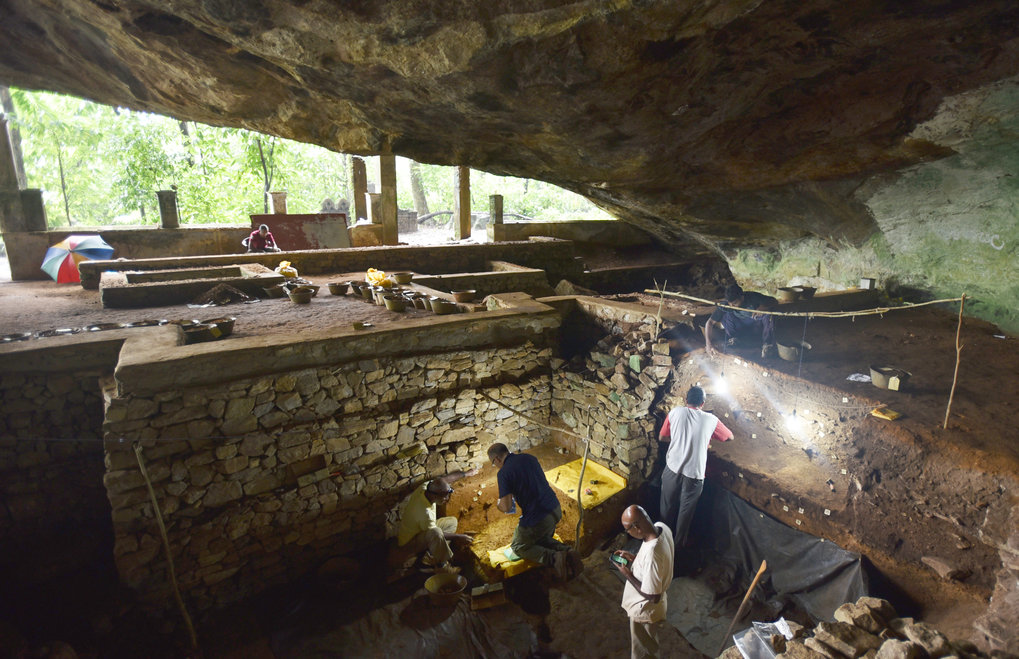
Results of investigations at Kitulgala Beli-lena led by researchers from the Department of Archaeology confirm human occupation of Sri Lanka’s rainforest region as early as ca. 45,000 cal. BP

Sri Lanka has produced the earliest clear evidence for Homo sapiens fossils in tropical rainforest environments in South Asia. However, in-depth multidisciplinary analyses of archaeological sequences remain limited to just two sites. A paper recently published in Quaternary Science Reviews details evidence for modern human adaptations and cultural practices from a third rockshelter site: Kitulgala Beli-lena.

Located in Sri Lanka’s Wet Zone rainforest region, Kitulgala Beli-lena was re-excavated in 2017 by archaeologists from the Max Planck Institute for the Science of Human History alongside researchers from University of Sri Jayewardenepura in Sri Lanka and other international institutions. The excavation aimed to recover new archaeological material in order to refine the chronology of the site and better understand early human culture, technology, and subsistence strategies.

Plant gathering and stone tool production ca. 45,000 years ago

New radiocarbon dates showed that Kitulgala Beli-lena had episodic human occupation, from around ca. 44,000 to 31,000 cal. BP. This early human presence is associated with clear evidence for rainforest plant gathering, specifically of wild breadfruit (Artocarpus nobilis) and kekuna nut (Canarium zeylanicum). Both of these plants provide a rich source of starch, fats, and protein, and require little processing. Sediments from the earliest phase of site occupation also yielded evidence for the manufacture of quartz flakes using the bipolar-on-anvil method, which hints on how the early foragers made use of their landscape.

A Pleistocene preference for monkeys and freshwater snails

Kitulgala Beli-lena saw increased human occupation starting with the Terminal Pleistocene, beginning roughly 17,000-12,000 years ago and continuing to around 8,000 years ago. During this time, the people that utilized the rockshelter relied heavily on small arboreal and semi-arboreal animals, specifically monkeys and squirrels, as well as freshwater snails. Tools made from monkey bones, projectile points possibly used to hunt the arboreal animals, were also found in the same sedimentary layers. Together with the quartz tools dating to the same period, these findings suggest that the Kitulgala foragers developed a sophisticated tool kit for the exploitation of their immediate landscapes.

Specialized rainforest adaptation

The evidence reported from Kitulgala Beli-lena adds to the knowledge of specialized rainforest adaptation of early humans in tropical environments. Considering the results of studies looking at other sites in the region, a complex picture of specialized rainforest occupation and exploitation is starting to emerge. It appears that Kitulgala Beli-lena, and the previously reported sites in the region, all formed part of a network of hunting ranges, plant exploitation routes, and settlement strategies. In addition, the continuous human presence in the region from the Late Pleistocene to the Historic period suggests an ability of foragers to persist in rainforest settings indicative of sustainability of rainforest resource exploitation.

What happens if State Land is Privatized & Farmers are given title deed ownership

February 6th, 2020

Interlinked to the MCC US Government grant of $480m are some crucial topics that the ruling government, the judiciary and citizens cannot ignore. 84% of Sri Lanka’s land belongs to the state. What happens if this 84% state land is privatized? Will the Govt be able to impose tax and gain revenue. Will the bulk money given at purchase of land be sufficient to run a country? Confounding matters is the removal of restrictions prohibiting foreigners to purchase land & property. A Government is only trustee or custodian of the land for a term of office and an overruling principle is the inalienability of land with sovereignty. WITHOUT land no country is sovereign. So if a country’s land is privatized its sovereignty is questioned. That is one aspect that policy makers need to seriously ponder. Sri Lanka managed to salvage itself from 4 attempts by the previous government to privatize State land. Is the distribution of title deeds to farmers an alternative to privatizing state land?

That Sri Lanka lacks a sound and secure land policy is a fact. That Sri Lanka has been depending on proposals and reports given by foreign private contractors is also a fact. How far these proposals gel with the country and its people’s needs or wants is a different question altogether. What these foreign proposals continuously recommend is to view land as a commodity and open up for foreign investments.

Leaving aside the controversies surrounding the proposed MCC economic corridor and the numerous pink dots in a map circulating drawing fear of US bases being set up across the country, let us take the subject of farmers being given freehold title deeds.  

Farmers holding LDO permits given title ownership

The previous government was on a hurricane attempt to dish out 1million deeds to farmers. Why were they in such a hurry to hand over deeds to those holding only permits under Land Development Ordinance of 1935?

Permit holders of the LDO could not fragment land, mortgage the land, dispose of it without the GA’s permission but the land could be passed on to a nominated successor so long as he/she continued the livelihood given to the original allottee.

LDO permits were intended to ensure no State land would be alienated to any other person than citizens of Sri Lanka. But now foreigners can purchase any land and any property. All restrictions upon foreigners was removed by the previous government ahead of attempts to privatize land, ahead of signing ACSA, ahead of launching preconditions given by MCC teams regularly arriving in Sri Lanka since 2015.

Sri Lanka from being known as the Granary of the East has become a country now importing rice and most foods that could easily be grown in Sri Lanka for local consumption. The pride that our ancestors brought to our island in developing agriculture has virtually collapsed. The farmers today are engulfed in poverty & debt. These are sad realities that we have to face. But is giving a title deed to a farmer in poverty & debt the solution?

A farmer holding a LDO permit is in a plot of land that does not belong to him. The land he and his family had been living for generations belong to the State of Sri Lanka.

However, the LDO permit enabled the farmer to have a livelihood, he had a roof over his head, he had a place for his family to live. He had security in the form that as a member of the farmer community, they could make appeals to a government and obtain some form of concessions. The state banks would also assist whenever possible.

Now imagine this farmer getting 100% title ownership to the land.

His links to the government immediately ceases.

He becomes a private owner fending for himself. The government has nothing to do with him and no obligations to him. He is one his own.

Will a bank give a loan to a farmer without consistent monthly income?

What is the collateral security the bank will demand – obviously the land.

What happens when the farmer cannot repay the loan? The Bank confiscates the land and eventually puts it to auction. How many can afford such land up for auction? With foreigners able to purchase land, will it not be them who will come forward and grab the land? (was this the plan all along)

What happens next to the farmer?

He loses the land his family had been living for generations

He has no means of livelihood

He has no place to live

He has lost the land he had been previously living under lease

His family doesn’t have a place to live or a means of indirect livelihood

He and his entire family are displaced.

So if 1million such farmers are to be given title ownership to land – wont this 1million eventually end up without land, without a job and without a place to live?

With their dependents we are looking at a minimum of 4million people who are likely to be displaced, without home and livelihood.

What is a government who doesn’t have any state land because all 84% of state land under its custodianship was privatized going to do about the scenario?

How will a government provide a place to live for this 4milion displaced people?

When 84% state land is privatized – a government has no land under its jurisdiction.

We are living in an island – there is only the sea around us… where will these 4million displaced people without any livelihood, without any money and without any place to live go to and as citizens of Sri Lanka how will the Sri Lankan Government look after them?

Shenali D Waduge

මහා බැදුම්කර හොරා මගෙ ලගම ඥාතියෙක්.. ඒ ගැන මං කණගාටු වෙනවා..- මෙතෙක් හෙලි නොකල රහස කබ්රාල් හෙලි කරයි..

February 6th, 2020

උපුටා ගැන්ම  අද දෙරණ

මහා බැදුම්කර හොරා මගෙ ලගම ඥාතියෙක්.. ඒ ගැන මං කණගාටු වෙනවා..- මෙතෙක් හෙලි නොකල රහස කබ්රාල් හෙලි කරයි..

බැඳුම්කර වංචාවන් සම්බන්ධයෙන් මේ වන විට ප්‍රකාශයට පත්කර ඇති වෝහාරික විගණන වාර්තා සම්බන්ධයෙන් තමන්ගේ නම සම්බන්ධ කර තිබීම පිළිබඳව පැහැදිලි කිරීම සඳහා හිටපු මහ බැංකු අධිපති අජිත් නිවාඩ් කබ්රාල් මහතා ප්‍රවෘත්ති සාකච්ඡාවක් කැඳවා තිබුණේය.

මෙහිදී අදහස් දක්වමින් කබ්රාල් මහතා කියා සිටියේ, තම ඥාතීන් අතුරින් කිසිවකුත් මෙයට සම්බන්ධයක් නොමැති බවත්, සම්බන්ධයක් තිබෙන එකම ඥාතියා රනිල් වික්‍රමසිංහ බවත්ය.

මෙහිදී සිය ඥාතීන් සම්බන්ධයෙන් එල්ල වන චෝදනා පිළිබඳව ඔහු මෙසේ ප්‍රතිචාර දැක්වීය.

වෝහාරික විගණන වාර්තාවේ කියනවා, මගේ පවුලේ අය හිටියා කියලා වෙනම තැන්වල. මම මේ ගැන ඩිව් ගුණසේකර මැතිතුමාගේ, කෝප් කමිටුවට ගිහිල්ලා මගේ පවුලේ අය ඔක්කෝමලා ගැන කිව්වා. මට මතකයි එතනදී මගෙන් ප්‍රශ්නයක් ඇහුවා. මෙන්න මේ මේ අය මගේ පවුලේ ඉන්න අය. මම බොහොම පැහැදිලිව කිව්වා. ඒ ඉන්න අය මොන තනතුරු දරනවාද, ඒ අය ඒ තනතුරුවලට පත්වුණේ කොහොමද කියලාත්, මම පෙන්නලා දුන්නා. මගේ මහ බැංකු අධිපතිධූරය නිසා නෙමෙයි, ඒ එක්කෙනක්වත් ඒ තනතුරුවලට පත්වෙලා තියෙන්නේ.”

නිහාල් ෆොන්සේකා – එයා බැංකු ක්ෂේත්‍රයේ හිටපු ප්‍රවීණයෙක්. එයා HSBC බැංකුවේ ඉතාමත් ඉහළ තනතුරක් දරලා තිබුණේ, මම මහ බැංකු අධිපති වෙන්නවත් හිතලාවත් නැති කාලෙක. ඊට පස්සේ එයා DFCC බැංකුවේ කළමනාකාර අධ්‍යක්ෂ වෙලා හිටියා. ඒත් මම එන්න කලිං.

අමල් කබ්රාල් – එයා හැටන් නැෂනල් බැංකුවේ හිටපු අධ්‍යක්ෂ කෙනෙක් කියලා තමයි චෝදනා කරන්නේ. එයා හැටන් නැෂනල් බැංකුවට එන්න කලිං, යුනිලිවර් එකේ සභාපති.

ෂිබානි තම්බයියා – එයා රේණුකා හෝටල් සමූහයේ කළමනාකාර අධ්‍යක්ෂ. එයා ඇමරිකාවේ විශ්වවිද්‍යාලයක උපාධිධාරියෙක්.

සුනිල් විජේසිංහ – මගේ නෝනාගේ අයියා. එයා NDB සභාපති කියලා තමයි කිව්වේ. ඊට කලින් එයා දංකොටුව පෝසිලේන් සභාපති. ඊට කලින් වටවල ප්ලානේටේෂන් සභාපති. මේ පත්කරලා තියෙන්නේ මම නෙමෙයි.

රනෙල් විජේසිංහ – එයා කළමනාකරණ උපදේශකවරයෙක්. එයා වරලත් ගණකාරධිකාරී ආයතනයේ හිටපු සභාපති. එයා ලංකා බැංකුවේ අධ්‍යක්ෂ කියන එක තමයි මට තියෙන චෝදනාව.

ධාරා විජේතිලක – මගේ නෝනාගේ අක්කා. එයා සැලසුම් ක්‍රියාත්මක කිරීමේ අමාත්‍යාංශයේ ලේකම්. ලංකා වාණිජ මණ්ඩලයේ ලේකම් ජනරාල්. එයා සම්පත් බැංකුවේ හිටියා කියලා තමයි මේ චෝදනාව මට ගේන්නේ.

චතුර කබ්රාල් – මගේ පුතා. එයා ඉංජිනේරුවෙක්. එයා බැංකු ක්ෂේත්‍රයේ කිසිම තැනක නැහැ. චෝදනාව තමයි, වැලිබල් පවර් එකේ සහ ෆෝට්රස් එකේ එයා අධ්‍යක්ෂ මණ්ඩලේ හිටියා කියලා. ඒක සම්බන්ධ කරනවා, ධම්මික පෙරේරාත් එක්ක, වෝහාරික විගණනයේ දී. ධම්මික පෙරේරා ගේ වැලිබල් ෆිනෑන්ස් එකේ ඕපනිං එකට මම ගියා කියලා ප්‍රධාන අමුත්තා හැටියට. එතටෙකාට කියනවා ධම්මික පෙරේරා මහත්තයාගේ කිංග්ස්බරි එක ඕපන් කරද්දී, ඒකට මම ගියාලු ප්‍රධාන අමුත්තා හැටියට. එකේ ප්‍රධාන අමුත්තා වුණේ එවකට හිටපු ජනාධිපතිතුමා, මම නොවෙයි. මම ගියේ සහභාගී වීමට.

ශිරෝමි වික්‍රමසිංහ – මගේ සහෝදරිය. එයා පර්පෙචුවල් කැපිටල් හෝලිංඩිග්ස් එකේ හිටියා කියලා තමයි චෝදනාව තියෙන්නේ. එයා ඒ ආයතනයේ ඉන්න කොට එක සතයක්වත් අරන් නැහැ. එයා මේ මගඩිය ගැන අහගත්ත පළවෙනි දවසෙම 2015 මාර්තු මාසේ 08 වෙනිදා එයා ඉල්ලා අස්වුණා හෝල්ඩිංග්ස් කම්පැනි එකෙන්. පර්පෙචුවෙල් ට්‍රෙෂරීස් එකේ එයා හිටියේ නැහැ.

රෝෂණී කබ්රාල් – මගේ බිරිඳ. එයා හිටියේ ලංකා හොස්ලිට්ල් එකේ නියෝජ්‍ය සභාපති විදියට. මොන හේතුවක් නිසාද දන්නේ නැහැ. එයාවත් මේකට සම්බන්ධ කරලා දාලා තියෙනවා.

රවී තම්බයියා – එයා DFCC බැංකුවේ හිටිය අධ්‍යක්ෂ කෙනෙක්. එයා රේණුකා හෝටල් සමූහයේ සභාපති. ඒක ලංකාවේ ලොකුම සමූහ සමාගමක්.

මගේ පවුලේ අය ගැන මට විශ්වාසයි. මේ වාර්තාවේ පැහැදිලිව ලියලා තියෙනවා, පවුලේ අය සිටින බවට කිසිම සාක්ෂියක් නැහැ කියලා. මගේ පවුලේ අය වෘත්තීයමය අය. ඒ අය එසේ මෙසේ අයත් නෙමෙයි. ඒ ගැන කතා කරලා නැහැ මෙච්චර කල්. නමුත් දැන් කතා කරන්න සිදුවෙනවා.”

මගේ පියා දොස්තර කෙනෙක්. වෛද්‍ය ලෙස්ලි කබ්රාල්. මගේ පියාගේ තාත්තා තමයි විල්ෆ්‍රඩ් ඇලෝෂියස් කබ්රාල්, මේ ලංකාවේ හිටපු පළවෙනි පෝස්ට් මාස්ටර් ජෙනරල්, ලාංකිකයෙක් හැටියට හිටිය. මගේ පියාගේ සහෝදරයා තමයි වෛද්‍ය ෂෙල්ටන් කබ්රාල්. ලංකාවේ හිටපු පළවෙනි ස්නායු ශල්‍ය වෛද්‍යවරයා.”

මේ බැඳුම්කරේට සම්බන්ධ එකම එක්කෙනෙක් ඉන්නවා, මේ බැඳුම්කරේට නෑකමක් තියෙන. ඒ ගැනත් මට කියන්නට ඕනේ. ඒ තමයි මගේ මාමණ්ඩිගේ මල්ලී බැඳලා ඉන්න පුද්ගලයාගේ තාත්තාගේ නංගි තමයි ඒ පුද්ගලයා. කවුද ඒ පුද්ගලයා. රනිල් වික්‍රමසිංහ. මගේ uncle in law මිස්ටර් සෑම් විජේසිංහ. එයා විවාහ වෙලා ඉන්නේ, රනිල්ගේ පියාගේ සහෝදරිය. ඒ සමබන්ධෙ නම් තියෙනවා. මම ඒ ගැන අද හෙළිදරව් කරනවා. අනිත් අය ගැන මම බොහොම උජාරුවෙන් කිව්වට, මේ සම්බන්ධය ගැන කියන්න ලැජ්ජයි.”

– adaderana

SINGING THE NATIONAL ANTHEM IN TAMIL Part 1

February 6th, 2020

KAMALIKA PIERIS

Rev 7.3.20

When Sri Lanka, then Ceylon was getting ready for independence, it had to find a national anthem, since all modern states were expected to have one. National anthems rose to prominence in Europe during the 19th century. D.B.S. Jeyaraj says that when the national anthem was discussed in the late 1940s, D.S Senanayake had proposed that a suitable Tamil translation also be formally adopted.

A committee headed by E.A.P Wijeratne had accepted in principle that there be a Tamil version of the national anthem.  Pundit M. Nallathamby had provided a ‘neat transliteration’, said Jeyaraj. Prof K. Sivathamby had   confirmed that Nallathamby had prepared a Tamil version.

Jeyaraj says when a record was made of the national anthem, a disc was also cut for the Tamil version of the National Anthem.  The melody and music was the same as that of the Sinhala version. The Nallathamby version was sung by two women singers, Sangari and Meena. 

Oliver Goonetilleke, then Minister in-charge of Home Affairs   had submitted a cabinet memorandum dated 22.11.1951  on the National anthem,  where he said that‘Namo namo matha’ had been sung in Sinhala and Tamil at the independence celebrations of 1948.

A printed programme for the 1949 independence celebrations, which Haris de Silva   had seen,  had said that at the inauguration at Torrington Square, the National Song would be sung in Tamil at 4 p.m on the arrival of the Prime Minister, and in Sinhala at 5 p.m. immediately after the Drill Display. At the evening event at the Havelock Race Course, celebrations commenced with the singing of the National Anthem in Tamil, and concluded with the anthem sung in Sinhala, said Haris de Silva.  Lankadipa reporting on 5th February 1949 said that when the anthem was sung in Tamil, some stood but others remained seated.

The Tamil version that was used at Independence was the translation by K. Kanagaratnam, Parliamentary Secretary to the Minister of Education. In 1952, Cabinet wanted a ‘competent authority’ to revise the Tamil translation. This, we are told, was also done by K. Kanagaratnam. Cabinet had wanted Sir Oliver to consult G.G. Ponnambalam, who had nothing to say on the matter.

The Cabinet gave its approval to the anthem on 11th March 1952.  A Press Communique was issued on 12th March 1952, saying that the Cabinet had approved the song ‘Namo Namo Matha’ as the National Anthem, with copies of the approved Sinhala version, and its Tamil and English translations, together with the musical scores. The Tamil translation was the one by Kanagaratnam, said Haris de Silva.

 D.B.S Jeyaraj says on March 12, 1952, the Government published huge advertisements in the Sinhala, Tamil, and English newspapers announcing that Namo Namo Matha” was the National Anthem. While words in Sinhala and Tamil were published in the Sinhala and Tamil newspapers respectively, the English newspapers had Sinhala words written in English.

Satyajit Andradi has examined the Sinhala and Tamil versions. The lyrics of the national anthem of Sri Lanka are composed in highly Sanskritised Sinhala, he said. In that sense, it closely resembles the Indian national anthem, which is written in highly Sanskritised Bengali.

Namo namo matha has numerous words taken from Sanskrit. Most of these loan words are used in their original Sanskrit form, whilst a few are adopted with minor modifications. The former category includes words such as Shri (prosperity), Matha (mother), Namo (salutation), Sundara (beauty ) Ati (beyond), Dhanya (grain ), Dhanaya (wealth), Jaya (victory), Ramya (beauty) Bhakti (devotion), Puja (worship ), Vidya (knowledge, science), Sathya (truth), Shakti (strength), Aloke (light), Anuprana (breath, after breath), Jeevana (life), Mukthi (salvation, release, freedom ), Nava (new), Jnana (wisdom), Virya (diligence, energy), Bhumi (land), Prema (affection), and Bheda (division, disputes), whilst the latter includes Sobamana (beauteous) and Siribarini (sustenance of prosperity). Interestingly, most of these Sanskrit loan words are also found in the Tamil language and are quite familiar to Tamil native speakers.

In the Tamil version, the lyrics, apart from the first stanza, have undergone a thorough translation, so much so that the numerous Sanskrit loan words found in the Sinhala original, which are also in the Tamil lexicon, are nowhere to be found in the Tamil version. The lines of the Tamil version are through and through Tamil, except in the few instances where a couple of new Sanskrit loan words such as ‘Siromani’ (crest jewel) are introduced. However, what is wonderful about the Tamil translation is its preservation of the spirit of the Sinhala original, said Satyajit.

According to D.B.S. Jeyaraj, the Tamil version Namo Namo Thaaye” was   sung in 1952 at Independence Day functions at Jaffna, Vavuniya, Mannar, Trincomalee and Batticaloa kachcheries. I remember, as a grade four student in a leading school in Colombo, I was witness to the National Anthem in the Tamil language sung at the school commemoration of Independence, way back in 1952,” recalled an anonymous writer.

The Tamil version was also sung when Sir John Kotelawela visited Jaffna in 1954. The Tamil version was first broadcast officially on Radio Ceylon” on February 4, 1955.  The Tamil version came into use thereafter and was extensively used in official functions in the predominantly Tamil speaking Northern and Eastern Provinces,   said Jeyaraj

There was a sharp difference of opinion regarding singing the national anthem in Tamil. Sinhala hardliners do not want the National Anthem to be sung in Tamil while Tamil hardliners do not want Tamils to sing the National Anthem in Sinhala, observed D.B.S. Jeyaraj. Prime Minister Sirimavo Bandaranaike had walked out of a function in the north where the national anthem was played in Tamil.  The date is not given. This would have been either in 1960-65 or 1970-77, her two terms of office.

While the Sinhala version was sung in most official functions in Colombo and Sinhala majority provinces, the Tamil version was sung in Tamil majority areas and Tamil medium schools, said Jeyaraj. Ananda Wanasinghe says, A close friend of mine from Nelliyadi Central College tells me that they sang the anthem in Tamil at the beginning of assembly and at all other school functions. He adds that it was sung with emotion and honor.”

The National anthem was not included in the Constitution of 1972. But it was included in   the Constitution of 1978. Article 7 of  1978 Constitution  states: “The National Anthem of the Republic of Sri Lanka shall be “Sri Lanka Matha,”, the words and music of which are set out in the Third Schedule.

The text of the 1978 Constitution was issued in Sinhala, English and Tamil. The Sinhala version had Namo, namo in Sinhala.  The English” version was a    repeat of the Sinhala one,   written in Roman script,  a transliteration.

The Tamil translation was a translation of the Sinhala words into Tamil. it was not a transliteration.   The Tamil version was included, said one source, following an appeal by K.W.Devanayagam. Devanayagam had pointed out that Muslims and Tamils living in the north and east who spoke mostly Tamil wanted that version for use in schools and occasions.

The Tamil version had been played at functions attended by Tamils in Jaffna, Vavuniya, Trincomalee, and Batticaloa. The Sinhala version was played at functions attended by the Sinhala community, However when both parties attended, they avoided the national anthem and only played the tune. (Sunday Times 19.12.2010 p 10.)

The national anthem was sung in Sinhala and Tamil at the 50th anniversary independence celebrations in Trincomalee in 1998. Is this legal asked critics. (Daily News 10.2.1998 p 5) On Sinhala New Year day 1999 at a ceremony in Kantalai they had sung it simultaneously in Sinhala and Tamil. This was scoffed at. Where in the world do we hear national anthems being sung in different languages asked one reader.

In December 2010 the Cabinet decided that Sri Lanka’s national anthem would only be in Sinhala. President Rajapaksa said there could not be two national anthems in a country. He said, “We must think of Sri Lanka as one country.” The Tamil version would no longer be played at any official or state functions. A directive to use only the Sinhala version was to be sent out by the Ministry of Public Administration. All government establishments including district secretariats were to adhere to this decision.

According to Jeyaraj, this ban on singing the national anthem in Tamil was thereafter shelved”. There was no official decree. But there was officially sanctioned unofficial instructions.” Orders went out quietly to government.  Officials and officers of the armed forces  were told that the national anthem should not be sung in Tamil. This resulted in the silencing the Tamil National Anthem, said Jeyaraj.

This unofficial diktat was strictly enforced. Schools and government institutions were discouraged” from singing the national anthem in Tamil. The armed forces in the North and East were tasked with the duty of preventing the National Anthem being sung in Tamil. The Tamil people soon got the message and gave up attempts to sing the National Anthem in Tamil. School children were compelled to sing the Sinhala words, scripted in Tamil, said Jeyaraj

At three different functions at Kilinochchi, in 2010 army had stopped the singing of Tamil version. They ordered that the recorded Sinhala version be played and it was. They had also distributed the Sinhala version of the national anthem to schools and told them that in future they should play the Sinhala version, reported the media.

The  Yahapalana government of 2015 changed this. President Sirisena withdrew the prohibition on singing the national anthem in Tamil.   In March 2015 President Sirisena      announced that there would be no bar to singing the national anthem in Tamil.

 Soon after, on March 23.  2015  at  a function  in Valalai in the Jaffna peninsula to return land taken over by the Sri Lankan armed forces for a high security zone, the national anthem was first sung in Tamil and then in Sinhala. The music was played on tape while a choir from the staff of the Jaffna District Secretariat sang in both languages. This was in the presence of President Maitripala Sirisena, Prime Minister Ranil Wickremesinghe, and former President Chandrika  Kumaratunga,

For the first time, since 1949, the national anthem was sung in Tamil at the Independence Day proceedings in Colombo in 2016. This was repeated in 2017, 2018 and 2019. But  it was sung at the end of the proceedings.

The singing of the national anthem in Tamil at the Independence celebration of 2016 surprised many people . In Hambantota they did not like it. Some did not even know that Tamil was a national language. It came as a shock them, reported Jehan Perera.  Critics said now Sri Lanka has joined South Africa, Canada, Switzerland, New Zealand and Fiji as a country having two national anthems. 

Tamil Separatists were not thrilled either. ‘If Tamils thought that they had gained a status on par with the majority race they are wrong. Their relegation to second class was shown by the fact that the Tamil anthem was sung later at the ceremony, said one analyst.

But others were pleased. After 67 years, the National Anthem was sung in Tamil in 2016, said Mano Ganesan.   It was a very significant act of the government to make the Tamils feel equal, said the National Peace Council of Sri Lanka .

I can still remember that the faces of the bevy of young girls who sang the Tamil version of the National Anthem on Independence Day 2016. That day  they were glowed with pride and self-respect. In addition to these young girls, most of the Tamil people would have felt some sort of complacency and self-respect at the feeling that they had been treated equally said one commentator.

The students whose mother tongue is Tamil enjoyed participating in the singing at the official commemoration of our independence, and was well received by the masses whose mother tongue is Tamil, said another commentator. Each year, a new set of students participated in the singing and I am certain that the younger ones were eagerly awaiting with much expectation, when their turn would come for them to participate in the singing, at the big event.

The singing of the national anthem In Tamil was challenged in Supreme Court as a violation of the constitution. A fundament rights petition challenging the government decision to sing the national anthem in Tamil was filed in 2016. It should be sung only in Sinhala.

The Supreme Court  dismissed the petition. They accepted the reply given by the  government.  Government  pointed out that Tamil is also a national and official language . The words and music of the National Anthem in the Tamil language is constitutionally recognized by Article 7 read with the Third Schedule of the Tamil version of the Constitution of Sri Lanka. The National Anthem that was sung in the Tamil language at the Independence Day celebrations on February 4, 2016 contained the same words and melody as entrenched in the constitution in terms of Article 7 read with the Third Schedule of the Tamil version of the constitution of Sri Lanka.

The legal profession did not agree. Permitting the national anthem to be sung in Sinhala and Tamil, as President Sirisena had done may be a violation of the constitution, said Ladduwahetty. According to Article 7 of the 1978 Constitution the national anthem cannot deviate from the words and music given in the schedule, and the words are the Sinhala words. The national anthem must be sung in Sinhala at state and national functions. Article 7 is a fundamental article which cannot be amended, repealed or tampered with, said Vernon Botejue. Also, it could be added ,there is the rule that where the  texts differ, the Sinhala version shall prevail.

Sri Lanka got a new President in 2019. The new administration  said that according to the Constitution, the national anthem is to be sung  in SInhala. Therefore the national anthem would not be sung in Tamil at the Independence celebration of 2020.A spate of comments arose. Friday Forum urged the government to ensure that the national anthem is sung in both Sinhala and Tamil at the forthcoming Independence celebrations and on similar future occasions. The National Peace Council  urged the government not to stop the Yahapalana practice of singing the national anthem in Tamil at the Feb 04 Independence Day celebrations.

But the administration stood firm. On Feb 4 ,2020, at the Independence celebrations in Colombo,  the national anthem was sung in Sinhala only.  But it was sung in both Sinhala and Tamil at a parallel   function held at Jaffna District Secretariat. ( Continued)

SINGING THE NATIONAL ANTHEM IN TAMIL Part 2

February 6th, 2020

KAMALIKA PIERIS

Rev 7.3.20

There are two opposing sets of views on the matter of the Tamil version. One group firmly wishes to see the anthem sung only in Sinhala. It is imperative to sing the national anthem in one voice not two, they said. A national anthem is a symbol of unity.

When you talk about a National symbol, be it a flower, animal or flag there can only be one of them,” said Sandagomi Coperahewa. There can’t be two or three national symbols. There may be two official languages, but the national anthem is one symbol. If it is sung in a language other than Sinhala, there has to be a Constitutional Amendment as well,” he said.

‘The national anthem of Sri Lanka should be the original song sung in the language it was written in,’ said one commentator.’ That is Namo namo matha and it was written to be sung in Sinhala. . Every citizen, whether Sinhalese, Tamil, Moor, Malay, Burgher, or Veddah should sing in one voice in the language the anthem was written in, in this case Sinhala’,  added another commentator, Stanley Gunaratne. A reader commented,’’ Yes, one national anthem in Sinhala only’.

This group dismisses the notion that Tamils cannot think of themselves as Sri Lankan when the national anthem is in a language that they cannot understand. Why can’t the Tamils learn to sing the national anthem in Sinhala, asked one critic. If they are able to learn other languages in the countries they live in now, why can’t they learn Sinhala? They do not askthat the national anthem of the countries they now live in be translated to Tamil so they can sing it with fervor and loyalty.

There is no need to sing the national anthem in Tamil as singing it in Sinhala is sufficient, said  Ravi Kumar , President of   Tamil Buddhist Association of Jaffna. There was no demand from any Tamil in Jaffna to sing the National anthem in Tamils. It was not an issue, said Rear admiral Sarath Weerasekera, speaking in 2016. When I was the commanding officer of the Karaingar naval base in 1993 Tamils sang it in Sinhala at various functions.  Today the north is all Tamil, and they have with all impunity sung the national anthem in Tamil, he concluded.

These critics point to India. India has Hindi and English as official languages but its National Anthem is highly Sanskritised Bengali. It’s not even Hindi, but all Indians sing it. In India the national anthem is sung in only one language. All Indians sing it regardless of whether they understand it or not. India stipulated that all schools in India have to start the day with the national anthem.

 India’s national anthem was originally a patriotic song  written in Sanskritised Bengali, by Tagore, later adopted as the national anthem. Even before independence the Bengalis had sung ‘Jana gana mana’ at their rallies. The Bengalis played a significant role in the nationalist struggle, more than any other ethnic group. The Tamils did not play that kind of role in Sri Lanka.

The national anthem should be  multi lingual said  some. They suggested a  single  national anthem   with verses in Sinhala and Tamil. A single bi-lingual anthem, with verses in both Sinhala and Tamil.  Let there be at least a few lines in Tamil  incorporated into our national anthem, they said.

One suggestion is to sing one verse of the national anthem in Tamil, whilst the balance is sung in Sinhala. The first two verses can be sung in Sinhala and the last verse can be sung in Tamil. Then the entire anthem is sung by all Sri Lankans, where the Sinhala speaking population sing the Tamil verse in addition to the Sinhala verses, and the Tamil speaking population sing the Sinhala verses in addition to the Tamil verse.‘Including a Tamil verse in the national anthem will also help chauvinistic Sinhalese to remember that there are people other than the Sinhalese living in this country’, said one commentator. 

There is also a request to sing the national anthem in three or four languages. The anthem should be  sung in at least 3 languages , English, Sinhala and Tamil said Mohamad Zaharan . I personally would prefer that the national anthem be sung in four languages , including Arabic he added.

This will be then even understood by the foreign dignitaries from other countries who will be attending this ceremony. The other advantage is that it may even kindle the interest of people to learn these languages. By singing it in three or four languages will give diversity and ensure that people of other faiths are also given due recognition, ours being a multi-religious, multi-racial and multi-ethnic country, Zaharan concluded.

A whole bouquet of examples have been given to justify singing the anthem in Tamil. In South Africa, the national anthem of four stanzas is in five languages, Xhosa, Zulu, Swasotho, Afrikaans, and English. First stanza is in Xhosa and Zulu, two lines each, next stanza in Sesotho, third in Afrikaner, fourth in ‘English.

Canada has English, French and a bilingual version. The lyrics in the English and French versions differ in the Canadian anthem. In the bilingual version beginning and end is in English middle verse is in French. Canada has an Inuit version too.  The national anthem in New Zealand, the first verse in Maori and the second in English. In Belgium the national anthem is sung trilingual in French, Dutch and German.In Suriname, national anthem has two verses, one in Dutch and the other in Sranan Tongo.

Switzerland’s anthem has different lyrics in each of the country’s four official languages (French, German, English, and Romansh). Fiji’ has lyrics in English and Fijian which are not translations of each other.

There were other alternatives. Spain has no words at all in its national anthem. In Spain the national anthem has been played without words since 1978.  In Singapore, there are Tamil, English, Malay and Chinese people, but their National Anthem is sung in Malay. National anthem is in Malay, because Singapore was earlier linked to Malaysia. The Irish national anthem was written in English. An Irish translation although never formally adopted, is now almost always sung.

Those supporting  a Sinhala only national anthem have dismissed these examples. None of these have any relation to Sri Lanka ,they said. Sri Lanka need not take new nations such as Canada, New Zealand and South Africa as examples. Eight of the countries with multilingual national anthems are in Africa, where there is no record of land borders before colonization, they added.

They also pointed out that the United Nations comprises 193 member states. Less than 25 of these countries have multilingual national anthems. The countries with monolingual national anthems   also have minority communities. But the national anthems of such countries are invariably in the language of the majority community. Lastly, some countries, with bilingual national anthems, such as Canada ,are about to break up.

Those who support the singing of the national anthem in Tamil use strong language. It is injudicious and even the wicked decision to sing the National Anthem only in Sinhala, they said.

In an already fractured society, it is difficult to understand  this suggestion of departing from such a simple practice which could be so meaningful to substantial groups. On the contrary, departing from it may convey a message which does not augur well for our future progress as a united and peaceful society, they said.

But others decided to take a more conciliatory line. We have only one National Anthem, and that is in Sinhala. What is sung at the end of the official commemoration is only a Tamil language version of the Sinhala Anthem. A Tamil version of the National Anthem  has been created for this very purpose. This version  is now accepted andhas    been in use for some time. ‘The Tamil version has been in use from 1951 or so, and the practice was  restored in 2015,’ they said.

This group decided to take an emotional approach, emphasizing music and song. The content of the national anthem is universally appealing and can create an emotional response in persons who differ in other respects. It is capable of being a unifying force, said Friday Forum.

Listening to the singing of the national anthem in either or both language is indeed a moving experience. It is most moving when it is sung in our mother tongue or both languages, said Devanesan Nesiah.

We must voluntarily learn the national anthem in each other’s language, so we can all sing it together, said Rev Duleep de Chickera. Far from banning the singing in one language, we must ensure  that it is sung with dignity, in both languages, on Freedom Day and all national occasions..

Satyajit Andradi has looked at the music aspect of the anthem. Music is, in fact, the language of emotions. It could break through language barriers as far as expression of emotions are concerned. It builds bridges and binds people together, he said.

A national anthem, like any other song, is a union of poetry and music. Hence, whilst the musical element is critically important, the linguistic component should not be under-rated. It is a widely accepted view that, a person is able to express her or his innermost emotions through the medium of her or his native language rather than through a different one. Hence, it is important that everyone be actively encouraged to use their native language. Needless to say, this applies in the case of singing one’s national anthem as well. Use of one’s native language will stimulate creativity, whilst learning other languages would enrich it further, continued Satyajit.

We celebrate the fact that Sri Lanka is a bio-diversity hot-spot of the world. Likewise, why cannot we celebrate its wonderful linguistic diversity? The Sinhala and Tamil versions of the national anthem of Sri Lanka epitomizes the immense linguistic diversity of the country. The native Sinhala speaker, who is not very conversant with the Tamil language, would find it extremely difficult to understand the Tamil lyrics. However, this is not a cause for disappointment or alarm. On the contrary, it is a fact to celebrate. It speaks volumes of the linguistic diversity of the country, continued Satyajit.

Singing our national anthem in Tamil as well as in Sinhala at the official Independence Day celebrations is a small but vital step in this journey. Let’s sing it with devotion and enthusiasm in the two main native languages of our land – Sinhala and Tamil. Let us also learn to sing it in the language of each other in the near future, said Satyajit.

Satyajit however, makes doubtful observations on the two languages. The Sinhala language, like Hindi, Bengali, Marathi, and Nepali, is considered to be an offspring of Sanskrit, the sacred language of ancient India. Sinhala is most probably the living eldest daughter of Sanskrit, said Satyajit. He  does not say  anything about the  considerable  Sinhala literature.

 Tamil , on the other hand, says Satyajit, belongs to the Dravidian family of languages. Like Sanskrit, Tamil is an ancient classical language of India. It possesses a great literature. Sinhala and Tamil have been spoken in the country for more than two millennia, said Satyajit,  ending with a flourish, this brief sequence of incorrect statements.

All sort of woolly, sometimes incoherent,  emotional statements, including at least one howler were made by supporters of the Tamil national anthem. Here is a selection.

**to sing our national anthem in both national languages, does not undermine or desecrate either of them. To the contrary, when we venerate Mother Lanka as one people, in both Sinhala and Tamil, we demonstrate the magnanimity of our cultures in which our respective languages flourish.

**What will the Sinhalese majority stand to lose by allowing the Tamil version of the anthem also sung on the Independence Day celebrations following the Sinhala version? In my view this is a simplest gesture to show the Tamil brothers and sisters (who had suffered directly for decades due to the war) that the majority Sinhalese can respect the Tamils’ desire to use their mother tongue to express their sentiments. .

**It is difficult to fathom why it has now become necessary to deny Tamil citizens the privilege of praising our motherland in song, in their mother tongue, especially when the convictions, aspirations, and devotion are identical.

 ** The Tamil community have been hurt so much on the language issue. Firstly in 1956 by not recognizing the Tamil language  The idea sown recently to sing the national anthem at Independence Day celebrations in Sinhala only, is one such sad and recurring wound.

** The constitution provides for singing the National anthem in Sinhala and Tamil, but this is not followed.  The anthem says ‘eka mawakage….’ If we truly believe that we are the children of one mother we must provide the opportune for the Tamil speaking people to sing our national anthem in their mother tongue.’  This is a howler. Children of one mother will not speak in different languages.

**  Other countries having ethnic minorities would have been over the moon had a minority community expressed the wish to sing the national anthem in their own mother tongue. It would have been a matter of national celebration, joy and hope if a minority community once driven to take up arms to establish a separate state on the country’s soil, attendant with its own national flag and national anthem as the sole means of redressing their perceived grievances, should now express their desire to sing with fulsome heart in their own mother tongue the national anthem of the country from which they wish to secede ( Don Manu)

** ex-President Sirisena’s gesture to include the Tamil version also in the day’s agenda spoke volumes to assure the Tamil populous that they were equal sons and daughters of this blessed island and enjoyed the right in the same measure to bask in the self-same rays of the Lankan sun as did the Sinhalese. The President’s extended hand which was quickly grasped by the Tamil minority was a long leap forward on the road to reconciliation between the two communities.The message was sent to all that the sovereign state of Sri Lanka was an undivided co-owned property.( Don Manu)

** Furthermore, even as court proceedings are conducted in Tamil and English in Tamil speaking areas in the north in the same manner Sinhala and English are used as the medium of language in court proceedings conducted down south and elsewhere where the majority language is spoken, so too is the national anthem sung in Tamil in Tamil speaking schools in the north, and sung in Sinhalese in the rest of the country. ( Don Manu)  

** So what’s the fuss? What’s wrong in singing the national anthem in Sinhalese and in Tamil by the Tamils at an official function where both communities meet as but one? Isn’t it far better and more meaningful for the Tamils to sing the nation’s song in their own mother tongue which they can understand and sing with feeling rather than merely give lip and sing the national anthem in Sinhalese in parrot fashion? ( Don Manu) (CONTINUED)

ක්‍රිකට් දූෂණ ගැන අර්ජුන රණතුංග කළ විශේෂ හෙළිදරව්ව

February 6th, 2020

මාධ්‍ය නිවේදන –Media secretary to Arjuna Ranatunga (MP)

ක්‍රිකට් ගැන කළ වෝහාරික විගණනය විශේෂ වාර්තාවක් වුණේ කොහොමද ?තරග පාවාදීම් ගැන තොරතුරු ඇතළත් හඩපට රන්ජන් ළඟත්
ක්‍රිකට් ආයතනයේ දවස් හයක සි. සි. ටි. වී දර්ශන මකා දැමුවේ ඇයි…?
ක්‍රිකට් ආයතනයෙන් මාධ්‍යවේදීන්ට තර්ජන
ක්‍රිකට් ආයතනයට කඩා පනින්නැයි ජනාධිපතිතුමාගෙන් ඉල්ලීමක්…

පසුගිය ආණ්ඩු කාලයේදී විගණකාධිපති දෙපාර්තමේන්තුව ක්‍රිකට් ආයතනය ගැන කළ වෝහාරික විගණනය පසුගිය ආණ්ඩුවේදීම සිතා ගත නොහැකි ලෙසට පාර්ලිමේන්තුවට ඉදිරිපත් වන්නේ විශේෂ වාර්තාවක් ලෙසින් බව හිටපු ටෙස්ට් ක්‍රිකට් නායක, පාර්ලිමේන්තු මන්ත්‍රී අර්ජුන රණතුංග මහතා අනාවරණය කරයි. එලෙස ක්‍රිකට් ආයතනය ගැන කළ වෝහාරික වාර්තාව විශේෂ වාර්තාවක් ලෙසට වෙනස් වීම පිටුපස හොරුන් දූෂිතයින් ආරක්ෂා කිරීමේ කුමන්ත්‍රණයක් පවතින්නට ඇතැයිද ඔහු අවධාරණය කළේය. ඒ අද (06) විශේෂ මාධ්‍ය සාකච්ඡවක් කැඳවමිනි.

”අපි දන්නවා අපේ ආණ්ඩු කාලයේදී ක්‍රීඩා අමාත්‍යාංශයේ ඉල්ලීම මත විගණකාධිපති දෙපාර්තමේන්තුව ක්‍රිකට් ආයතනය ගැන වෝහාරික විගණනයක් සිදු කළා. ඒබව මං ළඟ තියෙන මේ ලිපියෙනුත් සනාථ වෙනවා. මේ ලිපිය එවකට ක්‍රීඩා අමාත්‍යාංශයේ ලෙක්ම්ට යවන්නේ විගණකාධිපති වෙනුවෙට නියෝජ්‍ය විගණකාධිපතිතුමා විසින්. මෙහි පැහැදිලිවම සඳහන් වෙනවා වෝහාරික විගණනය කියලා. නමුත් මේ විගණනය පාර්ලිමේන්තුවට යන්නේ විශේෂ වාර්තාවක් ලෙසට. එහෙම වුණේ කොහොමද ? ඒ වගේම මේ වාර්තාවේ ක්‍රිකට් ආයතනයේ හුඟාක් දේවල් යට ගහලා තියෙනවා. නමුත් මේ වාර්තාවෙන් ක්‍රිකට් ආයතනයේ දූෂණ ගැන හෙළි වන තැන් කිහිපයකුත් තියෙනවා. කැම්පස් එකක් හදන්න කියලා කළ චෙක් ගනුදෙනු ගැන මේ වාර්තාවේ තියෙනවා. හතුරුසිංහ මහත්තයා ක්‍රිකට් ආයතනයට බඳවා ගෙන තියෙන්නේ ක්‍රිකට් පරිපාලනයට ඕන විදියට බවත් මේ වාර්තාවෙන් හෙළි වෙනවා. හරි ක්‍රමවේදයක් බඳවා ගැනීමට අනුගමනය කරලා නැහැ…”යිද අර්ජුන රණතුංග මහතා මෙහිදී පැවසීය. වැඩිදුරටත් අදහස් දක්වමින් ඔහු කියා සිටියේ ක්‍රිකට් ආයතනයේ දින හයක සි. සි. ටී. වි දර්ශන අභිරහස් ලෙසට මැකී ඇති බවයි. ඒ

”ක්‍රිකට් ආයතනයේ සි. සි. ටී. වී. 32ක් තියෙනවා. පුදුම කියන්නේ දවස් හයක දර්ශන මේ සි. සි. ටී. වි. වලින් මැකිලා. මේ ගැන ක්‍රිකට් ආයතනයේ නිලධාරීන් අපරාධ පරීක්ෂණ දෙපාර්තමේන්තුවට පැමිණිල්ලක් පවා කර තියෙනවා. නමුත් දැන් සභාපතිතුමා කියනවා බටන් එකක් ටච් වීමෙන් දර්ශන මැකිලා, ඒ නිසා ඒ ගැන පරීක්ෂණයක් කරන්න එපා කියලා. ඒක පුදුම හේතු දැක්වීමක්. මේ දවස් හයේ දර්ශන මැකුණේ ඇයි ? ක්‍රිකට් ආයතනයෙන් ෆයිල් උස්සන් යනවා මේ දර්ශනවල තිබුණද ? මොකද මේ දර්ශන මැකිලා තියෙනවා කියන්නේ ජනාධිපතිවරණය පැවැති කාලේදී….”

යනුවෙන් පවසමිනි. ක්‍රිකට් තරග පාවාදීම් ගැන තොරතුරු ඇතුළත් හඬපට කිහිපයක් රන්ජන් රාමනායක පාර්ලිමේන්තු මන්ත්‍රීවරයා ළඟ ඇති බවත් එම හඬපට ප්‍රසිද්ධ කරන ලෙසට තමන් ඔහුගෙන් ඉල්ලා සිටි බවත් අර්ජුන රණතුංග මහතා මෙහිදී කියා සිටියේය. වැඩිදුරටත් ඔහු අවධාරණය කළේ ක්‍රිකට් ආයතනයට කඩා පනින ලෙසට තමන් ජනාධිපති ගෝඨාභය රාජපක්ෂ මහතාගෙන් ඉල්ලා සිටින බවයි. ක්‍රිකට් ක්‍රීඩාව විනාශයෙන් විනාශයට පත් වූයේ හිටපු ජනාධිපති මෛත්‍රීපාල සිරිසේන මැතිතුමාගේ කාලයේදී බවද ඔහු අවධාරණය කළේය. ඒ,

”අපේ කාලයේදී සූදුකාරයෝ රාජ්‍ය නායකයෝ ඇල්ලුවා. රාජ්‍ය නායකයෝ හොරු අල්ලන්න කලින් හොරු සූදුකාරයෝ ගිහිල්ලා රාජ්‍ය නායකයෝ ඇල්ලුවා. ඒ නිසා අපේ ආණ්ඩු කාලයේදී ක්‍රිකට් ක්‍රීඩාව හොරුන්ගෙන්, සූදුකාරයින්ගෙන්, දූෂිතයින්ගෙන් බේරා ගන්න බැරිවුණා. විශේෂයෙන්ම මෛත්‍රීපාල සිරිසේන මැතිතුමාව ජනාධිපතිධුරයට ගේන්න මූලික වුණු කෙනෙක් මම. නමුත් කොච්චර සාකච්ඡා කළත් කොච්චර කරුණු පෙන්නුවත් මෛත්‍රීපාල ජනාධිපතිතුමාගේ කාලයේදී ක්‍රිකට් ක්‍රීඩාව හරි මඟට ගේන්න බැරි වුණා. ක්‍රිකට් ක්‍රීඩාව විනාශම වුණු කාලය වුණේ මෛත්‍රීපාල සිරිසේන ජනාධිපතිතුමාගේ කාලයේ. මොකද ක්‍රිකට් ක්‍රීඩාව විනාශ කරන පුද්ගලයෝ එතුමා තමන්ගේ ළඟට ගත්තා. ඒ පවෙන් මෛත්‍රීපාල සිරිසේන මැතිතුමාට ගැලවෙන්න ලැබෙන්නේ නැහැ. මම අදත් මෛත්‍රීපාල සිරිසේන මැතිතුමාට ගරු කරනවා. අපි සෑහෙන්න වැඩ කොටසක් කළා. නමුත් ක්‍රීඩාව පැත්තෙන් බැලපුවාම ක්‍රීඩාවට ගොඩාක් ප්‍රශ්න ආවා. චූදිතන්ව ආරක්ෂා කළා. ක්‍රිකට් ආයතනය විනාශ කළ සූදු කාරයෝ, බුකිකාරයෝ සිටියේ හිටපු ජනාධිපතිතුමාගේ රැකවරණය යටතේ. මම දන්න විදියට අද ක්‍රිකට් බෝර්ඩ් එකට නඩු හතලිකයට වඩා තියෙනවා. අපේ අවුරුදු 19න් පහළ කණ්ඩායම ලෝක කුසලානයේදී දහවැනි ස්ථානයට දක්වා පහු බැස්සා. එදා අපිට වඩා පහළින් සිටි බංග්ලාදේශ සහ ඇෆ්ගනීස්ථාන කණ්ඩායම් ඉදිරියට ඇවිල්ලා. 

ක්‍රිකට් ආයතනයේ හිටපු සභාපතිතුමා අද ගෝඨාභය රාජපක්ෂ ජනාධිපතිතුමාගේ ආණ්ඩුවේ රාජ්‍ය අමාත්‍යවරයකු ලෙසත් ඉන්නවා. ඉතිං රට හදනවා ශුද්ධ කරනවා, ඔක්කොම කරනවා කියලා ආපු අයටත් ඒ වගේ අය එක්කහු වෙනවා නම් එතැනින් එහාට අපිට ලොකු ප්‍රශ්නයක් තියනෙවා. එතුමාත් බස් ඩ්‍රයිවර් මාරු කළාද වගේද කියන ප්‍රශ්නයත් එතැන අපට තියෙනවා. හැබැයි එතුමා ගැන අපට ලොකු විශ්වාසයක් තියෙනවා, එතුමා හොඳ දෙයක් කරන්න හදනවා කියලා. එතුමා ජාතිය අමතා කළ කථාවේ කොටසක් මම දැන් කියන්න කැමැතියි. එතුමා කියනවා මගේ රජය විරුද්ධ මත ඉවසන්නට සෑම විටම සූදානම්. මාධ්‍යවලට අද සම්පූර්ණ නිදහස තියෙනවා. ඕනෑම අයකුට නිදහසේ අදහස් ප්‍රකාශ කිරීමේ අයිතිය අපි ලබා දී තියෙනවා කියලා. මේ ජනාධිපතිතුමාගේ හොඳ තීරණයක්. නමුත් පැතුම් විජේරත්න කියන මාධ්‍යවේදීයාට තහනමක් දාලා ක්‍රිකට් ආයතනයෙන්. මොකද්ද ඒකට හේතුව. එතුමා ක්‍රිකට් ආයතනයේ හොරකම් ලිවීම. එතොකොට ජනාධිපතිතුමා කියනවා මාධ්‍යයට සියලුම පහසුකම් ලබා දෙනවා කියලා. නමුත් ක්‍රිකට් ආයතනය ජනාධිපතිතුමාට වඩා උඩින් ගිහින්. අපි දැක්කා පහුගිය කාලේ ජනාධිපතිතුමා පැන්නා එක එක ආයතනවලට. ආර්. එම්. වී. එකට පැන්නා. තව ආයතන කිහිපයකට පැන්නා. නමුත් ජනාධිපතිතුමා මේ කතාව කළේ ක්‍රිකට් බෝර්ඩ් එක පැත්ත බලාගෙන. එතැන තමයි විශාලම හොරු ගොඩ ඉන්නේ. මම කියන්නේ ඉස්සෙල්ලාම පනින්න ඕන ක්‍රිකට් බෝර්ඩ් එකට. යනකොට ජනාධිපතිතුමා කිව්වොත් අපිත් එන්නම්, අපි හොරු ටිකත් පෙන්නන්නම්…” යනුවෙන් පවසමිනි.

එල්.ටී.ටී.ඊ සංවිධානයේ සිටි ජ්‍යෙෂ්ඨ සාමාජිකයෙකු වූ රහීම් ( ශ්‍රී කුමාර් කනගරත්නම්) තමන් ගේ අත්දැකීම් පිලිබඳව කතා කරයි

February 6th, 2020

සාකච්ඡා කලේ වෛද්‍ය රුවන් එම් ජයතුංග

එල්.ටී.ටී. සංවිධානයේ සිටි  ජ්යෙෂ්ඨ සාමාජිකයෙකු වූ රහීම් ( ශ්රී කුමාර් කනගරත්නම්) වර්තමානයේ ජීවත් වන්නේ කැනඩාවේය. ඔහු සහ සිංහ රෙජිමේන්තුවේ කැප්ටන් ජයන්ත කොතලාවල (පසුකාලීනව ලුතිනන් කර්නල්) අතර අපූරු මිතුදමක්ද තිබුනේය. රහීම් හෙවත් ශ්රී කුමාර් කනගරත්නම් තමන්  එල්.ටී.ටී. සංවිධානයේ ගත කල කාලය පිලිබඳව මෙසේ මතකය අවදි කරයි

1) ඔබ එල්.ටී.ටී.  සංවිධානයේ  සාමාජිකයෙක් උනේ ඇයි

මම ජීවත් උනේ සිංහලයන් අතර. මට සිංහල මිතුරන් හිටියා. එහෙත් 1977 , 1983 ජාතිවාදී කලබල වලදී මම දැක්කා නිරායුද අහිංසක දෙමල ජනයාට පහර දුන් ආකාරය. 1977 දී කළුතර පොලිස් අධිකාරී උනේ මගේ ඥාතියෙක්. එහෙත් ඔහු ද්‍රවිඩ පුද්ගලයෙකු නිසා කළුතර ඔහුගේ නිවසට පවා ජාතිවාදී පිරිස් පහර දීමට ආවා. පොලිස් අධිකාරී කෙනෙක් උනත් ඔහුට තමන් ගේ ගෙදර ආරක්‍ෂා කර ගන්න පොලිස් භටයන් යොදා ගන්න සිදු උනා. ඒ වගේම මා අශ්‍රය කල සිංහල මිතුරන් සමහරක් මගෙන් ඈත් උනා. සමහරක් මාව හැඳින්වූයේ පර දෙමලා කියලා. මේ නිසා කවදාවත් නොතිබුනු ලෙසට මට මම කවුද ? කියන අනන්‍යතාවය ගැන ප්‍රශ්නයක් ආවා. මට සිංහලයන් සමග ද්වේෂයක් තිබුනේ නෑ. 1983 ජාතිවාදී කෝලහලයේදී කොලඹ අපගේ නිවස බේරාගත්තේ සිංහල අසල් වැසියෙක්. නමුත් පොදුවේ ද්‍රවිඩ ජනතාව වෙත මුදා හරින ලද ප්‍රචණ්ඩත්වය නිසා මට එල්.ටී.ටී.ඊ  සංවිධානයට බැඳීමට අවශ්‍ය කෙරුනා. 

2)  ඔබ එල්.ටී.ටී.  සංවිධානයට බැඳුනේ කවදාද

මම එල්.ටී.ටී.ඊ  සංවිධානයට බැඳුනේ 1983 ඔක්තෝබර් මාසයේදී. මහත්තයා හරහා තමයි මම  සංවිධානයට බැඳුනේ. එතකොට මගේ වයස අවුරුදු 16. මේ කාලය වන විට බි‍්‍රගේඩියර් තිස්ස වීරතුංග උතුරේ භීෂණයක් පතුරවමින් හිටියා. 1983 දීම මාව ඉන්දියාවට යවනවා යුද පුහුණුවට. අපිව පුහුණු කලේ ඉන්දියානු හමුදාවේ නිලධාරීන්. ඔවුන් නිල ඇඳුම් අඳින්නේ නොමැතිව සිවිල් පිට තමයි අපිව පුහුණු කලේ. අපේ රහස් කඳවුර තිබ්බේ හිමාචල් ප්‍රදේශයේ. තමිල්නාඩුවේ නොවෙයි. මා සමග ද්‍රවිඩ තරුණයන් 200 පමණ පුරුදු උනා. අපිට අවි භාවිතය , බුද්ධි අංශයේ කටයුතු , සිතියම් කියවීම වගේ දේවල් ඉගැන්නුවා.  පුහුණුව මාස දෙකහමාරයි. ඉන් පසුව මම ගියා තමිල්නාඩුවේ එල්.ටී.ටී.ඊ   දේශපාලන කාර්‍යාලයක සේවය කරන්න.   

3) එතකොට ඔබ නැවත ලංකාවට එන්නේ කවදාද ?

1984 දෙසැම්බර් වලදී මම හොරෙන් ධීවර යාත්‍රාවකින් ලංකාවට එනවා. මම ප්‍රථම වතාවට යුද හමුදාව සමග සටනට යනවා 1985 පෙබරවාරි 14 දින. අපි 115 පමණ පිරිසක් කොක්කුලායි හමුදා කඳවුරට පහර දෙනවා. නමුත් අපගේ ප්‍රහාරය අසාර්ථකයි. අපගේ එල්.ටී.ටී.ඊ  සාමාජිකයන් 16 දෙනෙකු මේ ප්‍රහාරයේදී මිය යනවා. ඔවුන් ගේ සිරුරුවත් අපිට ගේන්නට ලැබුනේ නෑ. අපගේ ප්‍රහාරයෙන් පසුව හෙලිකොප්ටරයකින් රවී ජයවර්ධන කොක්කුලායි වලට එනවා. එහිදී ඔහු දකිනවා මිය ගිය එල්.ටී.ටී.ඊ  සාමාජිකයන් ගේ මෘත ශරීර සහ ඔවුන් ගේ අවි. ඒ අතර නයිට් විෂන් පවා තියනවා. මේක දකින රවී ජයවර්ධන කියනවා We are fighting a sophisticated army කියලා. ඉන් පසුව හමුදාව වටහා ගන්නවා ඔවුනුත් නවීන අවි වලින් සන්නද්ධ වීමට අවශ්‍ය බව. 

4)  ඔබ සහභාගි වූ වෙනත් ප්රහාරයන්  මොනවාද ?  

අප මන්නාරම පොලිස් ස්‍ථානයට ප්‍රහාර එල්ල කොට මන්නාරම පොලිස් ස්‍ථානය අල්ලා ගත්තා. අප මන්නාරම පොලිස් ස්‍ථානයට ප්‍රහාර එල්ල කරන්නේ 1985 මැයි මාසයේදී . එහිදී අපි පොලිස් භටයන්  දෙදෙනෙකු ජීවග්‍රහයෙන් අල්ලා ගන්නවා. පසුව ඔවුන් දෙදෙනාව අප යලි රජයට භාර දුන්නා.  මේ ප්‍රහරයේදී මම තුවාල ලැබුවා. 

ඉන් පසුව අපි යාපය කොටුවට ප්‍රහාර එල්ල කලා. ඒ වාගේම නිරන්තරයෙන් තිබුනු අවි ගැටුම් වලට සහභාගී උනා. 

5) ඔබට ප්රභාකරන් හමුවී තිබෙනවා නේද ? ඔහු කෙබඳු කෙනෙක් ?

මට මුලින්ම ප්‍රභාකරන් හමු උනේ ඉන්දියාවේ පුහුණුවට ගිය සමයේ 1983 දී. පසුව ඔහු සමග මම වැඩ කලා. ප්‍රභාකරන් සෞම්‍ය ලෙස කතා කරන කෙනෙක්. හරි පිරිසිදුයි. පිලිවෙලයි. ඔහුට ඉතා හොඳ මතකයක් තිබුණා. ඒ වගේම හොඳ විනයක් තිබූ කෙනෙක්. ඔහු තේ කෝපි වත් බිව්වේ නෑ. බිව්වේ කිරි වගේ පාන. 1987 අගෝස්තු වලින් පසුව මට ඔහුව හමු වුනේ නෑ.

6) ප්රභාකරන් ගේ වැටීමට හේතු මොනවාද ?

මම හිටපු කාලයේදී වගේ නොවෙයි. පසුව එල්.ටී.ටී.ඊ  සංවිධානය වෙනස් උනා. ගරිල්ලා සංවිධානයක් නොව රජයක් ලෙස කටයුතු කරන්න පටන් ගත්තා. 911 වලින් පසුව ලෝකය වෙනස් උනා. නමුත් ප්‍රභාකරන් වෙනස් උනේ නෑ. 

7) ඔබ දකින හැටියට ප්රභාකරන්  පරාජය කිරීමේදී  මූලික කාර්යභාරය කලේ සරත් ෆොන්සේකාද ගෝටාභය රාජපක්ෂද ?

මගේ අදහස අනුව ප්‍රභාකරන්  පරාජය කිරීමේදී  ගෝටාභය රාජපක්‍ෂ සාධකය සරත් ෆොන්සේකාටත් වඩා ප්‍රබලව ආවා. 

7a) ඔබ ගරු කරන සිංහල යුද හමුදා නිලධාරියා කවුද

ජෙනරාල් ඩෙන්සිල් කොබ්බෑකඩුව. ඔහු නියම සොල්දාදුවෙක්. යුද භූමියෙත් විනය රැක්කා. 

8) එල්.ටී.ටී.  සංවිධානයේ බහුතරයක් කාඩර්වරු කුල හීනයන්. ඔබ වෙල්ලාල ජාතිකයෙක්. මේ සාධකය කොහොමද බලපෑවේ

මුල් කාලයේදී  වෙල්ලාල ජාතිකයන් පවා ප්‍රභාකරන් වටා එකතු වුනා.  ප්‍රභාකරන් අයත් උනේ කරයර් කියන කුලයට. නමුත් ඒක අපිට ගැටළුවක් උනේ නෑ. අපි ඔහුගේ නායකත්වය පිලි ගත්තා. නමුත් පසු කාලයකදී සමහර වෙල්ලාල ජාතිකයන් එල්.ටී.ටී.ඊ  සංවිධානය දෙස බැලුවේ බයෙන් සහ සැකයෙන්. 

9) යලිත් ඊලාම් යුද්ධයක් ලංකාවේ ඇතිවෙයිද ?

මගේ අදහස අනුව යලිත් ඊලාම් යුද්ධයක් ලංකාවේ ඇති වෙයි කියා හිතන්නට අපහසුයි. මිනිසුන් 30 අවුරුදු යුද්දයකින් හති වැටිලා. බොහෝ ද්‍රවිඩයන් ලංකාව අත හැර ගිහින්. දැන් ද්‍රවිඩයන් ලංකාවේ නියම ලෙසින් සුුළු ජාතියක්. ඉස්සර රජයේ ආයතන වල ලොකු පුටු වල ද්‍රවිඩයන් බොහෝ හිටියා. සිංහල ප්‍රදේශ වල තැපැල් කන්තෝරුවල පෝස්ට් මාස්ටර් පවා උනේ ද්‍රවිඩ පුද්ගලයෙක්. නමුත් අද ඒ සංඛ්‍යාව බෙහෙවින්ම පහළ ගිහිල්ලා. ද්‍රවිඩයන්ට එදා වගේ සිවිල් බලයක් නෑ. 

10) ඊලාම් යුද්ධයෙන් පසුව සිංහල ජන මනසේ වෙනසක් ඔබ දකිනවාද

ඔව් මම සිංහල ජන මනසේ ධනාත්මක වෙනසක් දකිනවා. 1977 , 1983 වගේ කාලේ වගේ ද්‍රවිඩ විරෝධයක් බහුතරයක් සිංහලයන් අතර නෑ. ඔවුනුත් යුද්ධයත් සමග වෙනස් උනා. මම මීට වසර කීපයකට ඉහතදී ලංකාවට ගියාම මේ වෙනස දැක්කා. මේ විදියට සිංහල සහ ද්‍රවිඩ මිනිසුන් සහයෝගයෙන් සිටිනවා නම් ලංකාව සීග්‍ර දියුණුවක් ලබයි. 

සාකච්ඡා කලේ වෛද් රුවන් එම් ජයතුංග

අභ්‍යාසලාභී උපාධිධාරීන් ස්ථීර කිරීමේ දී මාස 04 සේවා කාලයක් අහිමි කිරීම අසාධාරණ ක‍්‍රියාවක් බව දන්වමු.

February 6th, 2020

ජනමාධ්‍ය නිවේදනයයි සංවර්ධන නිලධාරී සේවා සංගමය.

ප‍්‍රවෘත්ති කර්තෘ/ ප‍්‍රවෘත්ති අධ්‍යක්‍ෂක
රූපවාහිනිය/ගුවන් විදුලිය/පුවත්තපත

ගරු රාජ්‍ය පරිපාලන හා ස්වදේශ කටයුතු අමාත්‍ය,   ජනක බණ්ඩාර තෙත්නකෝන් මැතිතුමා,
රාජ්‍ය පරිපාලන හා ස්වදේශ කටයුතු අමාත්‍යාංශය,
නිදහස් චතුරස‍්‍රය,
කොළඹ 07.

ගරු අමාත්‍ය තුමනි,

අභ්‍යාසලාභී උපාධිධාරීන් ස්ථීර කිරීමේ දී මාස 04 සේවා කාලයක් අහිමි කිරීම අසාධාරණ ක‍්‍රියාවක් බව දන්වමු.


2018 අගෝ්ස්තු 20 දින අභ්‍යාසලාභී පුහුණු කාලයට ඇතුළත් වූ උපාධිධාරීන් ස්ථීර කිරීමේ දී ඔවුන්ට මාස 04 ක කප්පාදුවක් සිදුවන බවත් එවැනි අසාධාරණ ක‍්‍රියාමාර්ගයක් ගැනීම වැළැක්වීමට පියවර ගන්නා ලෙසත් අප සංගමය ඔබතුමාගෙන් පළමු ව ඉල්ලා සිටිමු.

02. 2018.08.20 දින අභ්‍යාසලාභී පත්වීම් යටතේ අභ්‍යාසලාභී උපාධිධාරීන් සංවර්ධන නිලධාරී තනතුරේ ස්ථීර කිරීම ස`දහා පත්වීම් දිනය ලෙස 2020.01.01 දින බව රාජ්‍ය සේවා කොමිෂම මගින් තීරණය කර ඇති බව වාර්තා වේ.

03. 2018 අගෝ. 20 දින අභ්‍යාසලාභී පදනම යටතට ඇතුළත් වූ උපාධිධාරීන්ගේ පත්වීම් දිනය බවට පත්විය යුත්තේ 2019 අගෝස්තු 21 හෝ ඊට ආසන්න දිනයකි.

04. නමුත් රජය හා රාජ්‍ය සේවා කොමිෂම ස්ථීර කිරීමට නියමිත අභ්‍යාසලාභී උපාධිධාරීන්ගේ පත්වීම් බලාත්මක දිනය 2020.01.01 දින බවට තීරණය ගැනීමත් සම`ග 2019 අගෝස්තු 21 සිට 2019 දෙසැම්බර් 31 දක්වා මාස 04 ක වැඩි කාලයක් ස්ථීර පත්වීම් කාලයට අහිමි කර ඇත.
 
05. අභ්‍යාසලාභී පුහුණු කාලය මාස 12 ක කාලයක් වන අතර රාජ්‍ය පරිපාලන අමාත්‍යාංශය නිකුත් කර ඇති ආකෘති අංක II නිවාඩු වාර්තා ගැනීමේ දී මාස 16 ක නිවාඩු සලකා බැලීම ද සාධාරණ නොවන බවද දන්වා සිටිමු.

06. අභ්‍යාසලාභී උපාධිධාරීන් සංවර්ධන නිලධාරී III ශ්‍රේණියේ ස්ථීර කිරීමේ බලාත්මක දිනය අවම වශයෙන් 2019 සැප්. 01 දින වශයෙන් ක‍්‍රියාත්මක කිරීමට තීරණය කරන මෙන් ඉල්ලා සිටිමු.

අභ්‍යාසලාභී උපාධිධාරීන් සංවර්ධන නිලධාරීන් ලෙස ස්ථීර කිරීමේ දී 2019 අගෝස්තු සිට 2019 දෙසැම්බර් දක්වා අහිමි වන මාස 04 ක සේවා කාලය ස්ථීර පත්වීමට ඇතුළත් වන පරිදි ස්ථීර පත්වීම්

 දිනය 2019 සැප්තැම්බර් 01 බවට පත් කිරීමට රජය විසින් තීරණය කරන ලෙස අප සංගමය ඉතා වගකීමෙන් රජයෙන් ඉල්ලා සිටිමු.

ස්තූතියි.

මෙයට,
චන්දන සූරියආරච්චි
ප‍්‍රධාන ලේකම්

සම්බන්ධීකරණය – 0718 178268
Coordinating – +94718 178268

පිටපත් –
1. ගරු ජනාධිපති – ගෝඨාභය රාජපක්ෂ මැතිතුමා (දැ.ගැ.පි./අ.ක.ස.)
2. ගරු අග‍්‍රාමාත්‍ය ජාතික ප‍්‍රතිපත්ති අමාත්‍ය – මහින්ද රාජපක්ෂ මැතිතුමා (දැ.ගැ.පි./අ.ක.ස.)
3. ලේකම් – මුදල් අමාත්‍යාංශය (දැ.ගැ.පි./අ.ක.ස.)
4. ලේකම් – රාජ්‍ය පරිපාලන අමාත්‍යාංශය (දැ.ගැ.පි./අ.ක.ස.)
5. සභාපති – රාජ්‍ය සේවා කොමිෂම (දැ.ගැ.පි./අ.ක.ස.)
6. ඒකාබද්ධ සේවා අධ්‍යක්ෂ ජනරාල් (දැ.ගැ.පි./අ.ක.ස.)

Identifying Some Threats to Modern Civilization, Our Freedom and the Menace of the ‘New World Order’

February 6th, 2020

Setting The Scene: Threats to us and our survival

For true freedom, people need transparency in all things. The fact is, for democracy (and freedom) to survive we need good information; we need to understand what is around us – our climate, our government and politics. When government hides things or give us false information, our freedom is diminished. In fact, there are so many things we are not told.

For how much longer can human civilization survive? For seventy years we have been living under the shadow of nuclear war.  Several times, we humans have come extremely close to final nuclear disaster, say military experts. We have avoided total destruction by just a few minutes due to misunder-standing or human error, they say. When the doomsday clock of the Bulletin of National Scientists was set last January at just two minutes to midnight, signifying that is now the closest it has been to terminal disaster since the clock was set up in 1947. With the USA and Russia, armed with unstoppable hypersonic weapons, staring each other down, the world is facing total destruction. But it is not spoken about! It may even be suppressed!

Another threat to our continued existence is global warming. It has been slowly getting hotter year by year over the last ten years and shows no signs of slowing down. Experts say it is the sun changing and warming our upper atmosphere – but assisted by our destruction of the Ozone layer, especially at the poles by our emissions of methane, carbon dioxide and other noxious gases. Changes are happening and nobody knows where it will all end. All the other planets around us are bleak, bare of life – just infertile, dry rock.

A third danger facing us all, is the threat from Earth’s N-S Polar reversal. The Earth’s magnetosphere provides us with protection from harmful solar and space radiation. This protection has fallen by 15% over the last ten years, indicating trouble ahead. A full reversal is when the North and South poles switch positions. This is likely to be highly disruptive, causing mountainous tsunamis, violent earthquakes and high winds – another extinction event.

The final, knockout blow is delivered by the sun itself. All stars ‘Nova’ to a greater or lesser extent. This is where they violently explode, sending tons of hot matter into space around them, frying and boiling all that is in the way. Bad news – our sun ‘micro-novas’, too. NASA has seen the evidence on the moon. Experts are searching for the reasons for this but suspect that we cross the plane of our galaxy into dusty space. This dust accumulates on the surface of the sun and causes a violent reaction. 

Those are terminal cataclysms, but there are others of lesser degree.

There is the danger from state tyranny to our freedom.  The price of freedom is eternal vigilance. There is the grave danger facing the free world made by the world’s ruling elites who are busily undermining democracy. On one side is the political left, who secretly plan a ‘New World Order’ ruled by the United Nations. On the other is the political right, who want, country by country, to install right-wing governments into power ruled by dictators, all for the benefit of business! It is a fierce contest.

They want dictators installed into power to implement their agendas of either the left or right, who can rule and imprison all those who oppose their rule. Donald Trump has seriously upset the left’s long-laid plans of re-organizing and oppressing the common man. That explains the animosity directed towards him.

Then, there are the Islamists, who want a Caliphate to rule the world with Muslim Sharia law, putting society back a thousand years. Extremists, idealists all, would be happy to install such a state by Jihad or by terror.

Or, irresponsible researchers playing with viruses which can unleash an epidemic, or other sources of a virus which is unstoppable and wipes us all out. Ebola, or artificial viruses may be unstoppable and lethal.

Little of these threats named above get into the newspapers or on television – governments want the common man to be kept in the dark, vulnerable to the dangers, but entertained by gossip and drama! With our heads empty of meaningful thoughts, they can manipulate and control us like sheep and pigs, and profit from us, too.

How we, ourselves, Undermine Democracy

Philosophers say we cannot have true freedom without personal moral constraint in a democratic society. The only truly free people are those that are ruled by personal moral behavior. Democratic government can be very successful where a population is moral, but it will fail when good standards and practices decline and fall and good order in society breaks down.

RULE: When unrestrained liberty leads to a loss of order, then the demand for order leads to a loss of liberty.

EXPLANATION: In the case of a society enduring moral anarchy, corruption and chaos, even before the arrival of a strong man, people are not truly free. They must be alert and on the defensive.    You can say that those who are unrestrained in behavior; by being corrupt and immoral, are destined to be ruled by a tyrant.

They mistakenly think it is necessary to install a strongman to restore order – a just man – if such a man can be found! But just men or tyrants have few tools in their tool box – when you only have a hammer – you see all problems as a nail to be hammered.

Thus, moral anarchy, corruption and chaos can lead to dictators who have to use strong-arm tactics to solve all the different problems. They have only one response to extreme problems – the police, jails and even torture and death.

The Superiority of Reasoning and Moral Restraint

Strong men are a one-sided response to modern situations of chaos; but society is better reformed by reasoning, explanation and debate for problem solving.

Therefore, the only truly free people are those who are ruled by personal moral behavior. Good, educated people can reason and realize the importance of the best human qualities, trust, truth, moderation, an efficient system of law; recognizing what is good and beautiful and protecting it. There is a need to teach the constituent aspects of a moral society. The Centre for Buddhism, Kandy, has a project to do that by having orators to give talks and reason with Sri Lankan people.

Democratic Society based on Free, Unbiased Information

Free people need accurate, unbiased information with nothing held back by which to form opinions and understand events in this world. Freedom and good information are inseparable necessities for mankind.

It is reality, not illusion or delusion that will determine what the future will bring.

Unfortunately, there are few TV. documentaries to educate and inform people. All we get is TV. news which is severely limited to five minuits of news – supplying what one person thinks are items of importance, all followed closely by advertising and Tele-Dramas. They do not tell us of our dependence on the sun, its power and treachery, nor do they give information of the factual, repeating planetary disasters nor the true history of mankind. Without this, people cannot imagine such events. Many people have only limited awareness of news and events in the wider world.    The main media fails us and most people do not trouble themselves to access smaller, better news providers. We live in a bubble of delusion. Then we act accordingly.

This limited awareness of a fast moving, violent world should not be enough for any normal, educated person. People need more facts about the sun and our planet and truths of political currents and form opinions about them. (For example, Julian Assange distributed information about the massive political corruption in the USA – so he is arrested and maybe sent to prison for life for revealing the truth. Yes!)

The fact is, we live in a turbulent world of man’s inhumanity to man. Who would have dreamed that just before Easter this year, suicide bombers would change our society so deeply?

There was the French Revolution, the Cuban Revolution, the American Revolution, the revolution in Nicaragua. The world seems peaceful, but in fact, like volcanoes, explosions occur! – and driving these are the elites who plan for a New World Order, or world dictatorships or even an Islamic Caliphate.  Be aware of all the dangers facing you!

A Suggested Definition of  ‘Good’ And ‘Bad’

‘GOOD’ is defined as whatever is beneficial or brings social harmony and happiness to society. These actions are good Karma which brings its own good reward. This is important for progress along the ‘Eight-fold Noble Path’ towards a personal wisdom, peace and Nibbana.      

  ‘BAD’ is whatever action(s) or event(s) that result(s) in pain, harm, anger, conflict or causes disharmony in Buddhist society. This slows, hinders or even prevents people following their ‘Eight-fold Noble Path’ to self-development and wisdom.

Most actions of people fall within these limits of ‘GOOD’ or ‘not BAD’ as defined. This can also be seen as a way of minimizing society’s overall unhappiness. (i.e. maximizing overall happiness in society).

Mattala Mahinda Rajapaksa International Airport (MRIA) to receive Rs. 500 mn facelift

February 6th, 2020

RAVI LADDUWAHETTY Courtesy The Daily News

The Government will shortly invest Rs. 500 million for the rehabilitation of the Mattala Mahinda Rajapaksa International Airport (MRIA) to bring it back to international standards within six months.

Despite the Government of President Mahinda Rajapaksa building the Mattala Airport to international standards, the ruination which was taking place during the previous regime was colossal that it will cost around Rs. 500 million, which will also include infrastructure upgrades,” Chairman of Airport and Aviation Services (Sri Lanka) Ltd, Retired Major General G.A. Chandrasiri told Daily News Finance .

He also said that Minister of Industrial Exports, Investment Promotion, Tourism and Aviation Prasanna Ranatunga was expected to present a Cabinet Memorandum requesting for Rs. 500 million for the upgrade.

He said that for starters, there has to be around 1,000 acres of jungle land which has to be cleared by the Sri Lanka Army and the Sri Lanka Air Force was in the process of rebuilding the outer and inner perimeter fence, he said.

Most of the damage has been created outside of the Mattala Airport while there has been little damage to the interior of the airport where it was used even to store paddy, he explained.

Major General Chandrasiri also said that the upgrade will also include the creation of a massive cargo hub and also a Flying Academy which will also recruit and train both local and international pilots as well.

He said that the previous government had been extremely negligent in the maintenance of the Mattala Airport where there has been considerable damage to the outfield there were holes in the external perimeter wall and wild animals such as deer and wild boar and wild animals could easily penetrate into the airport premises which could pose a severe security and safety threat to the airport and its operations.

The AASL Chief also said that huge space was available for cargo and industrial activities and a host of other operations which the airport could make ideal use of.

All these operations were earmarked during the tenure of the Mahinda Rajapaksa Presidency but totally neglected during the tenure of the Sirisena regime,” he explained.

He said that the Mattala airport was continuing its operations where there were 25 aircraft which landed there in January for refueling and other operations but stressed the need was absolutely necessary for higher operational standards if it was to operate at an international level where there were arrivals and departures of around 25-30 aircraft like the BIA on a daily basis.

Sri Lanka to construct new airport terminal to accommodate more arrivals

February 6th, 2020

Courtesy NewsIn.Asia

Entertainment, free WI-FI for waiting passengers at Sri Lankan airport

Colombo, Feb.6 – The Sri Lankan government will soon commence construction of a new terminal at the Bandaranaike International Airport in order to accommodate a larger number of arrivals, Xinhua news agency, citing local media reported here Thursday.

Chairman of Airport and Aviation Services Sri Lanka Ltd (AASL), G.A. Chandrasiri told the Daily News here that currently the passenger capacity of the Bandaranaike International Airport was 6.9 million, but at the end of 2019, there were 10 million passenger arrivals.

However, with the completion of the new Terminal 2” in three years, the airport was planning to accommodate 20 million passengers per year.

Since the end of Sri Lanka’s civil war in May 2009, the country’s tourism sector has seen significant growth with arrivals averaging at 2 million tourists per year.

Last year, Sri Lanka received a little over 1.9 million tourists with India, China and Britain being the largest markets for Sri Lanka Tourism.

This year, the new government has aimed to attract 3 million tourists, increasing it to 10 million within five years.

Sri Lanka to begin construction of 1st large-scale theme park

February 6th, 2020

Courtesy NewsIn.Asia

Colombo, Feb. 6 – Sri Lanka will soon commence construction on a world class theme park along the country’s southern coast in order to promote adventure tourism, local media reported here Thursday.

Sri Lanka to build entertainment park to boost tourism

Leading international theme park developer and operator, Sim Leisure Group Ltd, entered into a non-binding memorandum of understanding (MoU) with Sri Lanka’s Elpitiya Plantations PLC, to set up its world-class ESCAPE theme park in Galle, a statement from Elpitiya Plantations said, according to the Xinhua news agency.

The statement said having been granted the preliminary approval to commence construction and barring unforeseen circumstances, Sim Leisure aims to commence the construction of ESCAPE Sri Lanka” in March 2020.

The theme park will be located halfway between capital Colombo and the main beach resort of Galle.

I see tremendous opportunity in the Sri Lankan market with its population of over 20 million. Sri Lanka is one of the few countries, which is unspoilt and green. The country’s unpolluted coastline and beaches bring tourists from all over the world and its tourism industry is growing at an incredible pace,” said Sim Leisure CEO Sim Choo Kheng.

He also highlighted that Sri Lanka has tremendous untapped potential for family leisure, compared to East Asia, with a natural advantage by setting up the first large-scale theme park in Sri Lanka.

The theme park will include an outdoor adventure theme park and water park and approximately 40 themed rides and attractions in three categories – Adventureplay, Waterplay and Gravityplay. Enditem

Former SriLankan CEO and wife remanded

February 6th, 2020

Courtesy Ada Derana

Former Chief Executive Officer (CEO) of SriLankan Airlines Kapila Chandrasena and his wife, who were arrested on money laundering charges after they surrendered to the CID this morning, have been remanded until February 19 by the Colombo Fort Magistrate’s Court.

The Attorney General on Monday (3) instructed the Director of the CID to obtain an arrest warrant from court and to arrest the former SriLankan Airlines CEO and his wife Priyanka Niyomali Wijenayake as suspects on charges of money laundering in the re-fleet deal between SriLankan Airlines and Airbus.

The Attorney General had issued these instructions after considering the investigative material submitted by the CID on the case. The Fort Magistrate had issued an arrest order against the duo on the same day.

CID officers had visited the residence of Mr. Chandrasena yesterday (05), however, neither he nor his wife was at home at that time. 

Kapila Chandrasena and his wife surrendered to the Criminal Investigation Department (CID) through an attorney this morning (06).

Statements were recorded from both of them before the accused were produced before the court.

Ready to build the country without blaming the past- President

February 6th, 2020

Courtesy Ada Derana

President Gotabaya Rajapaksa says that his government will work with a commitment to save the country from the present chaotic situation without pointing fingers at the past for prevailing problems.

He said that he accepted the challenge of rebuilding the country with a clear understanding that the economy had collapsed.

The President made these remarks addressing the Chairpersons and members of Director Boards of several Plantation and Financial Institutions at the Presidential Secretariat, today (06), stated President’s Media Division.

The ‘Rata Hadana Saubhagyaye Dekma’ policy statement was not prepared with the aim of winning the election. It is a consequence of studies of many years in collaboration with academics and experts in many fields in order to serve the public. Many state entities have become just places for providing employment for many years. The country cannot be taken forward in this manner. It is the responsibility of the new Chairmen and the Board of Directors to make the institutions profitable. Steps should be taken to replace the existing systems with the new system to rebuild collapsed institutions,” President Rajapaksa emphasized.

The cultivation of other crops should be developed along with the development of coconut and tea plantations. The field of agriculture needs to be improved with the support of researches and the use of modern technology. By prioritizing the development of traditional industries, it is possible to generate huge revenue”, the President said.

President Rajapaksa pointed out that a large number of employment opportunities could be created through all these measures.

During the last few days, groups including graduates arrived at the Presidential Secretariat demanding employment opportunities. There are many vacancies that exist in the country in many fields including tourism, and computer technology. However, due to the weakness of the education system, these opportunities are wasted”, the President pointed out.

The President further said that steps would be taken to change the education system to meet the demands of the job market and that Asia is becoming the hub of the world economy. The President stated that one of his primary objectives is to create an environment for the future generation to come out from the universities as graduates who can conquer the modern world.

Secretary to the President, Dr. P. B. Jayasundara and Mr. Lalith Weeratunga, Advisor to the President were also present at this meeting.

Sri Lanka gifts China with Ceylon Black Tea

February 6th, 2020

Courtesy Ada Derana

President Gotabaya Rajapaksa, today (06) at the Presidential Secretariat, gifted a consignment of world-renowned Ceylon Black Tea to the Chinese Ambassador Cheng Xueyuan to be sent to those affected by the Coronavirus. 

Ambassador Xueyuan deeply appreciated the gesture, stated President Media Division. 

The Ambassador, on behalf of President Xi Jinping and the Government of the People’s Republic of China, thanked the Government of Sri Lanka and the Sri Lankan people for the kindness shown to China in this difficult moment. 

He also thanked all the religious and other leaders who organized the all-night Pirith sermon on 05 February. Every divisional secretariat throughout the Island conducted the Pirith ceremony at the same time, blessing those who are affected for a speedy recovery.

President Rajapaksa, in turn, thanked the Ambassador for the assistance extended to bring back the Sri Lankan students from Wuhan province.

As these are students, their parents were worried,” explained the President. So, they really appreciated that they were allowed to leave Wuhan. We hope that this epidemic will soon be brought under control.

Upon the President’s inquiry as to the current status of the disease, the Ambassador explained in detail that the virus was detected soon after the Chinese New Year.

Wuhan is a very large province,” described Ambassador Xueyuan. During the Chinese New Year, a lot of people moved in and out of the province. However, as soon as it came to the Chinese Government’s notice of this new virus and its seriousness, strict measures were taken to contain the virus and to stop it from spreading.”

However, as this virus takes about 7 to 14 days to show its symptoms,” further explained the Ambassador, the records will now show an increase in the number of cases before it starts decreasing.”

The Chinese Government in its efforts to control the virus from spreading had placed under quarantine hospitals, entire villagers and any other place where cases of the virus had been reported. All activities had been stopped and the Government is providing supplies daily to these areas. The Chinese Government had even criminalized leaving Wuhan without informing the authorities.

Out of the total death toll, 99 percent had been from Wuhan,” stated the Ambassador underlying the success of containing the virus. There is only one case out of China, where a patient from the Philippines had succumbed to the disease.”

The Ambassador also noted that since the Chinese New Year is not a holiday in Sri Lanka, most Chinese residing in Sri Lanka had not returned to China for the celebrations. Those who did had been asked to delay their return to Sri Lanka and those who had already returned had been asked to impose self-isolation.

CABINET APPROVAL GRANTED FOR THE PROGRAMME TO PROVIDE JOBS FOR GRADUATES

February 6th, 2020

Courtesy Hiru News

Cabinet approval has been granted to the programme of the government to provide government jobs for all graduates.

Co-Cabinet Spokesman Minister Bandula Gunawardena said that President Gotabhaya Rajapaksa presented the relevant Cabinet Paper to the Cabinet yesterday.

It has been planned to grant these jobs at the Ministries of Education and Health as well as Irrigation, Agrarian Development, Wild life conservation, Ayurveda, Surveys, agriculture and export agriculture departments.

Meanwhile, at the media briefing journalists questioned Co-Cabinet Spokesman Minister Bandula Gunawardena regarding the Forensic Audit report in connection with the Treasury Bond fraud at the Central Bank of Sri Lanka which was tabled in Parliament recently.

IT HAS BEEN REVEALED THAT THE DEATH OF THE POLICE SERGEANT OF VAVUNATHIVU IS A MURDER

February 6th, 2020

Courtesy Hiru News

It has been revealed that the incident of a discovery at Vavunathivu – Mullamunai, of the body of Police Sergeant of Vavuniya is a murder .

A top official engaged in carrying out investigations said that it is conjectured that the murder had been committed due to a conflict regarding a land. This corpse was discovered in the morning today on an anonymous telephone call received by the Vavunathivu Police Station.

The deceased is a 55 year old Tamil national Police Sergeant, and a resident of Batticaloa – Puthur, deployed at the Valachchanei Police Station.

At the time of his death the Police Sergeant was attired in civilian clothing and the Police said that he owned a land close to where he died.

The suspects connected to the murder have been identified as of now and four teams under the Senior Superintendent of Police in charge of the Vavuniya Division have been appointed to take them into custody.

Meanwhile, the Police Media Division said that investigations have been launched into the incident of finding a revolver opposite a house in Mirihana, Talapathpitiya, Udahamulla.

This revolver was discovered yesterday evening on a tip-off received by the Mirihana Police.

අන්තවාදී මුස්ලිම් දේශපාලන නායකයින්ට අල් සබ්‍රිගෙන් කනේ පහරක්..

February 6th, 2020

Sath TV

https://youtu.be/GzujBm-lgJQ

Sri Lanka’s independence: falsehoods and hard facts

February 5th, 2020

By Janaka Perera

The biggest falsehood some of our politicians and some historians have been spreading over the past 70 years is that Sri Lanka won her independence from Britain in a ‘bloodless struggle’.

The hard fact is that there was no independence struggle as such after the Matale uprising of 1848 was brutally suppressed. Thereafter the country saw only agitations for Constitutional reforms.  If there was any bloodshed it was during the 1915 communal riots because the British overreacted to the situation that caused some leaders to be arrested and a prominent patriot to be executed (Captain Henry Pedris).  

One noteworthy exception was E.W. Perera, the ‘Lion of Kotte’, who risked his life taking a petition hidden in his shoe against Governor Robert Chalmers. It was at the height of the First World War that Perera went by sea in submarine infested seas to the England. The petition was a condemnation of the declaration of Martial Law that caused the deaths of many innocent Sinhalese. The petition resulted in the Governor being recalled to England.

Also of significance was the Anagarika Dharmapala’s fierce campaign for a national cultural revival and return to traditional values like India’s Raja Ram Mohan Roy, one of the founders of the Brahmo Sabha in the 19th Century (he is considered the “Father of the Indian Renaissance”)).[

After 1848 we had no freedom fighters like Keppettipola or Puran Appu or India’s Mahathma Gandhi, Bhagat Singh and Subhas Chandra Bose among others.

The definition of a freedom struggle means the activists risking their lives one way or the other. Gandhi’s non-violent civil disobedience campaign led thousands of his followers to be baton charged and jailed and also to be massacred as in Amritsar.

Those like Bhagat Singh and Subhas Chandra Bose who took up arms against the British rule paid with their lives (although there’s a dispute on what really caused the death of Bose).

The external factors that compelled the British to grant independence to India (and therefore to Sri Lanka) and Myanmar much earlier than they ever imagined have been almost totally ignored by our historians.

Likewise were the Freedom fighters of Myanmar, Indonesia, (and after World War II) Cyprus, Kenya, Angola, Algeria etc.

Before 1939, the European colonialists were in no hurry to grant self-rule to these countries despite nationalist movements and uprisings. In Sri Lanka there were no nationalist struggles after 1848 but only appeals for constitutional reforms hoping for greater freedom through the goodwill of the colonial masters.

But it did not take long for the British and other European Imperial powers to wake up from their slumber.   The outbreak of World War II in September 1939 and Japan’s entry to the war in December 1941 heralded the end of the British Raj and the Asian empires of other European powers. Until then its transplanted European life-style had insulated the colonialists from the natives.

Japan’s success in humbling the United States, Britain and the Netherlands in the early days of the Pacific War dealt a mortal blow to the Western prestige in Asia. Japan’s quick victories in 1941-42 proved to the natives that Europeans were not superior to the Asians.

Britain was now fighting with its back to the wall and it desperately sought the loyalty of the natives in conducting the war.  The possibility of sabotage and collaboration with the enemy could not be ruled out.

With the loss of Malaya – now Malaysia – and Singapore, the ports of Colombo and Trincomalee became vital to the British as a link between Europe and the Far East.  The home base of the British Far Eastern Fleet was Trincomalee. This country also played a very significant role as a rubber producer for the Western Allies during the war.

Sri Lanka’s (then Ceylon) importance to the British was such that the Allied South-East Asia Command (SEAC) Headquarters under Admiral (later Lord) Louis Mountbatten was shifted from New Delhi to Kandy in 1944.  

Fr. S.G. Perera in his Ceylon History states that the unstinted support of Sri Lanka’s conservative leaders to the cause of Britain and her allies was a key factor in the demand for constitutional reforms.

In India patriots were in a dilemma.  According to Indian Author Kushwant Singh the crux of the dilemma was whether to go all out to aid Britain and then demand independence for themselves or insist on a declaration of independence and then put their full weight behind the Western Allies.  To the British India’s loyalty was crucial in winning the war.  Indian soldiers played a major role in the war against Axis Powers (Germany, Italy and Japan).

A section of these troops, however, had joined the fiery Indian Nationalist Subhas Chandra Bose who formed the Japanese-backed Indian National Army to fight the British.

Meanwhile, Mahathma Gandhi’s Quit India Movement – a sporadic outburst of anti-British consciousness – was shaking the British Administration in many parts of the subcontinent. Under pressure from the Opposition within the British National Government, London sent Sir Stafford Cripps to India with an offer of a Constitution-making body after the end of hostilities.

Despite military victory World War II left Britain a battered and impoverished nation and not all the rhetoric of Winston Churchill could disguise it. It was the final blow to the British Empire. The British were realists and knew their game was up. Prime Minister Clement Atlee went ahead with what Churchill would not and drew plans to liquidate the empire on which the sun would never set.”

When India – Britain’s Jewel in the Crown – won her independence there’s no point in clinging to small Sri Lanka.  The failure of our historians, educationists and politicians to admit this fact will only result in misleading the younger generations into thinking that it we won independence on our own in a bloodless struggle isolated from events occurring right round our country. It is beyond comprehension why these external factors that led to Britain leaving India and Sri Lanka are still not acknowledged.

Enact tough Laws to curb Separatist Demands

February 5th, 2020

By A.A.M.NIZAM – MATARA

The racist evil trio Sambandan/Sumanthiran/Wigneswaran who are highly dismayed over the GR victory are making use of every petty issue to discredit, defme and project Sri Lanka as an oppressive and autocratic country and the latest issue they have taken as the punching pad to hit at Sri Lanka was their stupid and illegal demand to sing the National Anthem in Tamil as well on the Independence Day function.  Their cohorts, foreign based terrorist scribes NGO ruffians and some fringe political idiots in Tamil Nadualso raised their voice in support of this demand visualising that GR government could also be blackmailed as they blackmailed spinelerss Sirisena/Ranil government since 2015 to sing the anthen in Tamil as well, although there was no constitutional [provision for that.

Admirably the government completely ignored this baseless demand and the Anthem was sung only in Sinhala.  If the government gave in totheir demand, next time these idiots nay even ask to sing a translationof the ‘Jayamangala Gaatha’ in Tamil as well.

In a brilliant address to the mation, President Gotabhaya Rajapaksa said that Rights of all citizens will be protected and extremism and terrorism will not be allowed to raise their heads

Apprnded below is the full text of President Gotabhaya Rajapaksa’s addrerss to the Nation on the 72nd Independence Day held on 4th February, 2020.

Sri Lanka is a Unitary State. It is a free, sovereign, independent and democratic Republic. On this occasion when we celebrate 72 years of Independence after nearly 500 years of imperialist colonial rule, I address you as the Head of the State with a pledge to further strengthen your freedom. I pay tribute to all Sinhala, Tamil, Muslim, Malay and Burgher leaders who dedicated themselves to achieving and ensuring this Independence.

Every citizen living in Sri Lanka has the right to live freely and securely. We will always ensure their right to think freely, hold independent opinions, and express themselves without any hindrance.   We will always respect the right of any citizen to follow the religion of his or her choice. Every citizen has the right of free association and of free assembly. We will always defend the right of every Sri Lankan citizen to participate in the political and governance processes through his or her elected representatives. We consider all these as rights of human beings that no one can challenge.

There are several domains that need to be maintained in equilibrium for democracy to function properly. Maintaining the balance of power between the executive, the legislature and the judiciary is very important in this regard. There needs to be a clear consensus on the responsibilities of the central government and decentralized authorities in the devolution of power. The responsibilities of the civilian and military establishments need to be clearly understood, and we must always remember that citizens have individual as well as collective rights.  Coordination between the State and the public is integral to this.

Following Independence, every leader who came to power in this Republic was elected through universal franchise.  As the current Head of the State elected through the popular vote, I am ready to work with the utmost dedication for the betterment of the country and its people during my term of office.

In a democracy, when the leader is elected following a legitimate process, he becomes the President of all the people of the country.  During his term of office, he must serve the entire Sri Lankan people. He is not bound to serve only the interests of the people who voted for him. I have the vision that I must serve as the leader of the country looking after all citizens rather than serve as a political leader concerned only about a particular community. As the President today, I represent the entire Sri Lankan nation irrespective of ethnicity, religion, party affiliation or other differences.

A strong executive, a legislature and an independent judiciary is essential for the well-being and advancement of any democratic society. If, for whatever reason, there is a loss of public confidence in any of these key institutions fundamental to the functioning of a country, that can give rise to anarchy within the country. Therefore, all such stakeholders must perform their role with the powers they have been granted for the welfare of the country and for protecting the sovereignty of the people with a national vision.

I am committed to working towards fulfilling the needs of the people of this country.  That is my responsibility and my duty. I do not envisage public officials, lawmakers or the judiciary to impede my implementing this commitment.  I not only respect your freedom, but I will work towards improving it and guarantee the political and economic freedom in a truly democratic country. 

Some limitations on the freedoms of the people have arisen because of the way public administration has evolved over time.Those rules and regulations that have been enacted without adequate study and coordination have led to the public facing considerable harassment and inconvenience.  This has led to various irregularities and corruption. Losses to the public in terms of time, resources and livelihood opportunities are enormous.

We must re-examine the need to obtain licenses for things that affect the day-to-day lives of the people. We must refrain from imposing unnecessary restrictions on the majority of the people; instead we must swiftly enforce them against the minority who transgress it. We must give our people the opportunity and real freedom to live law abiding, disciplined and virtuous lives.

Outdated laws, regulations, taxes and charges that prevent people from freely undertaking self-employment, traditional industries or businesses need to be revised swiftly. We will work towards removing unnecessary restrictions imposed on the public to better ensure their right to live freely.

Sri Lanka is a country with an ancient history.   It is a country that has been nurtured by the Buddhist philosophy, and a country that has been a haven for people of all ethnicities and religious beliefs. During my term of office, I will guarantee the freedom of all persons to follow the religion of their choice. 

In the Buddhist philosophy, our leaders always have been advised to ensure a lawful, just and fair governance where no citizen is discriminated. I am committed to protecting and nurturing the Buddhist philosophy of this country during my tenure.

The public will only achieve true freedom when social and economic inequalities are minimized. All citizens within a Unitary State should have equal rights.

Even today, there is a large gap between the haves and have-nots in our society.   The facilities that are available in our urban centers are lacking in rural areas. Education facilities are not equal in all areas. Healthcare facilities are not equally dispersed. Job opportunities have not spread to all regions.  These inequalities are not due to racial or religious reasons. These are common problems that the country faces. In strengthening the ability for people to live freely, we must first address the economic problems that affect the public. That is why the eradication of poverty is a priority of our Government.

President Gotabhaya Rajapaksa receiving Guard of Honoue at the 72nd Independence Day celebrations on 4th February, 2o020,

Thirty years of conflict and various other factors have delayed the progress of development in our country.   We can no longer afford to waste time. We will act to accelerate our development activities in line with new trends in the global economy by making appropriate use of our country’s unique geographical location, natural resources and human resources.

An efficient and corruption- free Public Service is essential for the development of a nation. The public administration and governance must function in a proper manner so as to grant people the maximum benefit of their freedom. The entire public administration must accept responsibility for this.

If due to terrorists, extremists, thieves, thugs, extortionists, women and child abusers, there is impediment to ordinary life of the people, then the people will not be free. We have paid special attention to strengthening the National Security and Public Security. We will not allow extremist organizations that pave the way for terrorism to further function in the country.

Parents will not be free until their children are liberated from the drug menace that has spread throughout the country. The public will not be free as long as there is corruption in state institutions. Therefore, we will strictly enforce the law to eliminate all social hazards that can impact ordinary social life.  The reforms required to increase the efficiency of the law enforcement agencies in order to accomplish this are already being carried out.

I wish to fully strengthen the freedom of people to think and to write freely. It is then that visionaries and quality works of art will be created. My government is always ready to tolerate and accommodate opposing views. The media has complete freedom today. We have ensured that everyone has the right to freely express themselves.

Social media can pose new challenges to democracy. Spending more time online, often with complete strangers, creates situations where people are misled by false information resulting in their swiftly believing the worst of those who bear different views.

I request everyone to act in accordance with one’s conscience. Always think about the country.  Think about your fellow citizens.  Without thinking only about political requirements, think carefully about whether your actions and your words will benefit or harm the country. However, if your conscience tells you that the government is moving in the wrong direction, you always have a duty to point this out boldly.

We must always respect the rule of law. The public will get real freedom only when the law is fairly and equally applied. My government has taken steps to change the culture of political interference in legal matters.

We have many challenges ahead of us. We need everyone’s support for the efforts taken by the government to overcome them. The Policy Statement I placed before you comprises an action plan that will allow us to overcome the challenges before us.  It is our expectation to create a prosperous nation through this. Only the present generation can realize this hope on behalf of future generations. I request all Sri Lankans to join with us in accepting this responsibility that history has bestowed upon us.

I wish you all a prosperous future!

The Island editorial of 5th  said that when one says something, one has to make sure one has said it. This, President Gotabaya Rajapaksa (GR) did, in his address to the nation, yesterday. Unlike his predecessors, who, in their Independence Day speeches, dwelt on the past to the point of queasiness, he spoke of the present and the future.

President GR gave several assurances to the public. He said his government would protect the people’s religious, political and economic rights while ensuring national security and public safety. Terrorism and extremism would not be allowed to raise their ugly heads again, and his government would do everything in its power to rid the country of criminals who caused immense suffering to the citizenry, especially women and children, he said. Vulnerable sections of society live in fear of criminals and it is hoped that the President will get cracking.

In the run-up to the last presidential election, the detractors of GR painted a black picture of him as a dictator, who would suppress all democratic rights of the people, if elected the Executive President. He looks determined to prove his critics wrong; he apparently sought to answer them, yesterday, when he said: “Every citizen living in Sri Lanka has a right to live freely and securely. We will always ensure their right to think freely, hold independent opinions, and express themselves without any hindrance. We will always respect the right of any citizen to follow the religion of his or her choice. Every citizen has the right of free association and of free assembly. We will always defend the right of every Sri Lankan citizen to participate in the political and governance processes through his or her elected representatives. We consider all these as rights of human beings that no one can challenge.” President GR also reiterated his commitment to defending media freedom. “My government is always ready to tolerate and accommodate opposing views. The media has complete freedom, today. We have ensured that the people have a right to express themselves freely.” We hope he will continue to disappoint his critics watching him closely.


One of the biggest threats Sri Lankan democracy is faced with is the severe erosion of public confidence in the three branches of government. President GR promised to strengthen the executive, the legislature and the judiciary, whose independence, he said, his government would ensure. When the people lost their faith in these institutions, the country ran the risk of being plunged into anarchy, he warned. How does he propose to restore public faith in Parliament? Will he see to it that tainted persons won’t be nominated by his party to contest the next general election?

President GR said he had undertaken to minimise political, economic, and social inequalities, which, he said, affected the people regardless of their ethnicity, religion, etc. He has realised the need to do away with the imbalance of development due to the glaring urban bias in resource allocation. He said the facilities available in urban centres were lacking in rural areas; job opportunities were not equally distributed among the regions. He believes that the public will achieve true freedom only when social and economic inequalities are minimised. It is these inequalities that the JVP exploited to incite the rural youth to violence on two occasions.

All citizens within a unitary state should have equal rights, President GR said. This statement can be considered an extension of the opening sentence of his speech—‘Sri Lanka is a unitary state’. His point is clear: rights and freedoms of the people can be guaranteed within a unitary state and his government will endeavour to do so.

The President’s message to the other branches of government and the public service was loud and clear: he said he was committed to working towards fulfilling the needs of the people as the elected Head of State and he expected to carry out his duties and responsibilities without any hindrance from state officials, the legislature and the judiciary. He would respect their freedom, he added. In other words, he wants the principle of separation of powers respected.

The President is apparently in a hurry. He stressed the need to make a serious effort to achieve economic development without wasting any more time. One cannot but agree with him on this score.

Now that the President has talked the talk, it is earnestly hoped that he will walk the walk.

The terrorist grandpa whose dfays are numbered has said that Tamil people are annoyed about not singing the National in Tamil.  Therse selfish huys completelu ignore what happens in other countries and the legal provisions in this country.  He has said that he did not participate in the function because that the anthem will not be sung in Tamil.  It may be the same reason that his buddies Sirisena and Ranil also did not participate.

Jaffgna University which hass becpme a den of separatist and pro terrorist elements and which organises all sorts of terrorist commemorations have kepy c;psed om Fenruary 4th josting black flags and declared the day as Blacj Independence day.  Despite governments conciliatory and goofwill measures the student leaders of this University, proxies of racist politicians, are behaving like Sri Lanka is an alien country.  As nothing constructive is happening from this University and the government isonly wasting itsresourcesit is better tothink seriously about closing down this University and transfer the students and the Academic staff to the Raharata Universuty. 

Meanwhile the Kallathoni descendent MP Mano Ganeshan gas severely flayed the government for not including the singing of the anthen in Tamul in the Independence Day programme and thereby alienating the Tamils.  This nincompoop who was a close confidante of megalomaniac Prabhakaran and very much intimate to Raniil was responsible for creating this unnecessary issue of singing the anthem in Tamil.  Hehas also stated that the policies of the government strengthens the Prabhakaran’s concept that the Tamils need a separate nation and a separate state,  This was not the first time this nincompoop gas espoused separatism in this country and he is also targetingto launch a demand for a separateMalai Nadu State. 

As such this Kallathoni descendant should be charged for treason and disenfranchise for at least for seven years.  At the same time an emergency Bill against espousing separatism and it is hoped that UNP MPs who have an iota of patriotism would wholeheartedly support this Bill,  The Bill should be in the line of Jawaharlal Nehru’s anti-separatism Law which has kept Tamil Nadu politicians completely silenced. 

BUDDHIST TOLERANCE

February 5th, 2020

Dr. Daya Hewapathirane

As a global religion, Buddhism today has expanded worldwide.  What is significant to note is that this expansion has always been characterized by a spirit of tolerance, harmonization and assimilation. In the process, Buddhism has absorbed pre-existing beliefs to a point where a clear distinction is often difficult today. This is clearly evident in China, Japan, India, Korea, Thailand and Myanmar among others. The harmonious assimilation of Taoism, Confucianism and Buddhism is well evident in the Chinese form of Buddhism.  The harmonious adaptation of Shinto divinities into Buddhist pantheon – honji-suijaku”, is seen in Japan. How Buddhism harmoniously integrated with pre-existing Shamanistic beliefs is well evident in Korea. Similarly, in Myanmar and Thailand, Buddhism assimilated well with pre- existing nat” worship and animistic beliefs, respectively.

Greco Buddhism of ancient times reveals vividly the harmony and assimilation Buddhism and ancient Greek spirituality. It was as far back as in the 3rd century BCE, that Emperor Asoka, the greatest of Buddhist leaders, highlighted lucidly in one of his famous edicts, the significance of the spirit of tolerance, acceptance, harmonization and assimilation in Buddhism, when he cited – All sects deserve reverence for one reason or another. By thus acting, a man exalts his own sect and at the same time does service to the sects of other people.”

Wherever Buddhism was introduced, it did not encounter any form of violent confrontation because its approach had always been one of tolerance, acceptance, harmonization and assimilation with pre-existing beliefs and spiritual norms. There may be various schools” among Buddhists of the world. But unlike most other religious denominations, there is a good amount of interaction, understanding, cooperation and cordiality among the Buddhist schools”. The reports of famous Chinese pilgrims to India from the fourth to the ninth centuries CE testify that in spite of the fact that at that time, Buddhists were divided into some 18 different schools, bhikkhus belonging to different schools could be found living together in the same monastery, practicing and conducting communal business in peace and harmony.” There are many Buddhist practices, meditation and mindfulness training in particular which are common to all Buddhist traditions, which enable Buddhists to link up and cooperate more closely, in their pursuit of their common goal. This has been the practice even in ancient times.

PERSECUTION AND DESTRUCTION

Buddhists experienced untold persecution from non-Buddhists during the history of Buddhism. Persecution may refer to unwarranted arrest, imprisonment, beating, torture, or execution. It also may refer to the confiscation or destruction of property, or the incitement of hatred toward Buddhists. Christians, Muslims and Communists were largely responsible for such persecution and destruction. In the late 12 century, Muslim invaders slaughtered thousands of Buddhist monks in places such as Bihar, and Kashmir in India. The Buddhist University of Nalanda with its great library was left in ruins. Countless ancient Buddhist monuments were defaced or destroyed, virtually erasing the Buddhist faith from India.

Atrocities committed by Catholics and Christians in Sri Lanka especially during the 16th to 20th century period were no different. The Evangelical Christian unethical prosetytization menace and Wahhabi Muslim fundamentalism, have become problems for Sri Lankan Buddhists in recent decades. The religious fanaticism and brutality and the unethical and confrontational approaches adopted by some conventional religions in the past and today, to serve their selfish ends, provide a stark contrast to the approach in Buddhism which is reflective of the Buddha’s supreme message of harmony and moderation, of an inspiring middle way” in all human situations in an impermanent world.

FUNDAMENTALISM AND INTOLERANCE

In contemporary times we witness the growing fundamentalism of Wahhabi Islam, aggressively proclaiming its beliefs, zealously proselytizing, and even taking up arms against its opponents. A fundamentalist and intolerant stance, taken by any religion, is offensive to followers of other faiths and to those of no faith at all. Overzealous attempts at conversion disturb peaceful coexistence.

Intolerance is essential only to monotheism. An only God is by nature a jealous God who will not allow another to live. When a religion sees its scripture as revealed and divinely inspired, it finds a basis for exclusivity and intolerance. Justification for intolerance is provided by the very nature of a Supreme Being who is described as a jealous and angry being, who punishes those who defy Him with eternal damnation.

There are stories in the Bible which describe God as committing genocide on unbelievers with violence toward men, women, children, and even the unborn. The Koran says: Slay unbelievers wherever you find them, and drive them out of the places they drove you from…fight them until idolatry is no more and God’s religion is supreme.”

PATIENCE AND NON-AGGRESSION

Buddhism does not accept an omnipotent God, a Creator, nor any revealed scripture. Because faith in God or a savior is not an issue for Buddhists, there is no reason to judge others, to condemn them for their beliefs, or to feel compelled to convert them.

The Buddha Dhamma is described as ehipassiko, inviting one to come and see for himself. There is no concept of coercion or proselytization in Buddhism. Buddha taught the importance of patience, tolerance, and non-aggression, providing a splendid ideal of tolerance for Buddhists to follow. There is not a single occasion in the Buddhist scriptures of the Buddha being less than compassionate, not only to those who accepted his teachings but also to the followers of all faiths, not only to the good but also to the wicked, not only to humans but also to animals and to all living beings. In striking contrast to the spread of other world religions, which are replete with unethical and forcible conversions and sectarian strife, the history of Buddhism is remarkable for the complete absence of bloodshed in the name of the teacher.

Buddhism started to enjoy a strong interest from the general population in the West during the 20th century, following the perceived failure of social utopias including the conventional religions of the West. After the Second World War, the focus of progress tended to shift to personal self-realization, on the material as well as spiritual plane. In this context, Buddhism has been displaying a strong power of attraction, due to its tolerance, its lack of theistic authority and determinism, and its focus on understanding reality through self-inquiry. According to the latest census it is now the fastest growing religion in several countries in the Western world.

THOUGHTS OF JUSTICE CHRISTMAS HUMPHREYS

To quote Justice Christmas Humphreys (1901-1983), the eminent British Judge and Founder of the Buddhist Society, London:  The way of Buddhism is Middle Way between all extremes. This is no weak compromise, but a sweet reasonableness which avoids fanaticism and laziness with equal care, and marches onward without that haste which brings its own reaction, but without ceasing. The Buddha called it the Noble Eightfold Path to Nirvana, and it may be regarded as the noblest course of spiritual training yet presented, in such a simple form, to man. Buddhism is neither pessimistic nor ‘escapist’. It is a system of thought, a religion, a spiritual science and a way of life which is reasonable, practical and all-embracing. For 2,500 years it has satisfied the spiritual needs of nearly one third of mankind. It appeals to those in search of truth because it has no dogmas, satisfies the reason and the heart alike, insists on self-reliance coupled with tolerance for other points of view, embraces science, religion, philosophy, psychology, mysticism, ethics and art, and points to man alone as the creator of his present life and sole designer of his destiny”.

BUDDHIST TOLERANCE IN SRI LANKA

The history of Buddhists of Sri Lanka during the four hundred years of foreign Christian rule prior to the country’s political independence is nothing but a long and poignant chronicle of Buddhist tolerance in the face of oppression and injustice. The undertaking to maintain the Buddhist religion given in 1815 by the British (Christians) was grossly betrayed. In 1884 all the Government schools, which were the only schools to which the Buddhists could send their children for higher education were handed over to the Christian Missionaries. Up till 1886 Buddhists paid by far the largest amount for the maintenance of the Ecclesiastical Department.

Who but the Buddhists tolerated harassment by the Roman Catholic Portuguese for giving shelter and employment to Muslims? Or endured similar treatment from the Dutch for giving shelter to Roman Catholics? Who but the Buddhists tolerated the rank injustice of foreign rulers in the island who used the revenue from one of the most sacred places of Buddhist worship, the Dalada Maligawa, to pay for the construction of St. Paul’s Cathedral? Or the injustice of destroying a Buddhist Vihara in Kotte to erect in its stead a Christian School? Who but the Buddhists tolerated the extortion from them of four hundred pounds a year for the building of Christian Churches?

In more recent years, Sri Lankans in general including the Buddhist majority, have been subjected to various forms of influences from Western and Middle Eastern non-Buddhist countries. With the globalization process they have been exposed excessively to western and other norms and lifestyles. However, it is a well evident fact that these experiences and exposures have not affected negatively the deep-seated spirit of tolerance and accommodation in the hearts and minds of the average Sinhala person in Sri Lanka. This can be attributed to the influence of Buddhism which is the dominant faith in our country. Strong Buddhist values of tolerance and compassion have been ingrained in the Sinhala people irrespective of their religions, owing to the fact that they or their forefathers were followers of Buddhism at a certain time in their past before they were converted to other faiths. History of our country reveals vividly that this spirit of tolerance and accommodation of others irrespective of their religious or other differences has been a common distinguishing characteristic of the Sinhala community  of Sri Lanka from very early times.

Dr. Daya Hewapathirane

දෙමළ බෙදුම්වාදය මතවාදයෙන් පැරදවීම: ලිපි මාලා අංක 4

February 5th, 2020

චන්ද්‍රසිරි විජයවික්‍රම, LL.B,. Ph.D.

රට ගොඩගන්නට වෙහෙසුණු කළුකොඳයාවේ මහනාහිමි

හැඳින්‌වීම

හාමුදුරුවරු දේශ-පාලනයට ඒමට විරුද්‌ධව කතා කරන අළුත්ම උදාහරණය වන්නේ කිරිබත්ගොඩ ඤාණානන්ද හිමියන් ය. 1802 පමණ සිටම නෝත් ආණ්ඩුකාරයා විසින් ආරම්භකල පන්සල කොරු කිරීමේ තර්‌කය එහි උච්චතම හා කැතම ගෙනාවේ රංජන් රාමනායක විසිනි. ඔහු එය කලේ යහපාලන-විදේශ බලවේග වල මෝඩ ඒජන්ත වශයෙනි. ලංකාවේ සුද්දන්ගේ හා 1931 සිට කළු සුද්දන්ගේ පාලන කාලය, පාලක කල්ලි හා පන්සල අතරවූ නිරන්තර අරගලයක ඉතිහාසය නොවේදැයි විමසන විට, නොයෙක් අඩු ලුහුඬු කම් තිබෙන හාමුදුරුවරු රටේ සිටියත්, ලංකාවේ සිංහල බෞද්‌ධ ශිෂ්ටාචාරය, ත්‍රිපිටකය හා භාෂාව රැක ගත්තේ සිවුර හා පන්සල බව සක්සුදක් සේ පැහැදිලිවේ. පන්සල්වල අද දක්නට ලැබෙන පිරිහීමට වගකිව යුත්තේද සුද්දගෙ හා කළු සුද්දගෙ නීතිය බවද පෙනීයයි.

හාමුදුරුනමකට පාර්ලිමේන්තුවට ගිහිල්ලා කරන්න දෙයක් තිබෙනවාද යනුවෙන් උන්වහන්සේ අසණ ප්‍රශ්ණය, මැතිවරණ කොමිසමේ සභාපති, නොයෙක් රාජ්‍ය නොවන ඩොලර් සංවිධාන හා කාදිනල්තුමාද අසණ ප්‍රශ්ණයේම කොටසකි. හාමුදුරුවරු නිසා නොවේ නම් ගෝඨාභය කෙනෙකු ජනාධිපති නොවන බවත්, රංජන්ගේ හඬපට අනුව රනිල්ලාට බලය ලැබුනොත් සිංහල බෞද්‌ධයාට උගන්වන නරක (කුණු හරුප) පාඩම ගැන රංජන් හිරුණිකාට කිව් කතාවත් ගැන සිතන විටත්, යමෙක් හාමුදුරුවරුන් ගැන මේ දක්වන්නේ කිඹුල් කදුළු හෙලීමක්ද යන සැකයක් මතුවේ. ලංකාව බේර ගත්තේ මේ රටේ මුරදේවතාවරුවූ හාමුදුරුවරු වීම මංගල සමරවීර, චන්ද්‍රිකා, හා අශීලාචාර ලෙස වේදිකාවල කතාකරණ දඹර අමිල හිමි වැනි අයගේ ඊර්ෂ්‍යාවට හේතුවී ඇත.

මේ රටේ දේශපාලකයින් ධ‌ර්‍මධර, විනයධර හාමුදුරුවරුන්ගේ උපදෙස් පිළිගත්තේ නැත. කාදිනල්තුමාගේ ටෙලිපොන් කෝල් එකක බලය වැන්නක් ඔවුන්ට නොවීය. නොයෙක් බෞද්‌ධ ශාසන කොමිෂම් නිර්දේශ විහිළුවක් විය. ගංගොඩවිල සෝම, මාදුළුවාවේ සෝභිත වැනි හිමිවරු සැක සහිත ලෙස අපවත් වීම හා ජාතික හෙළ උරුමය හතුරු බලවේග වලට නතුවීම වටහා ගත හැක්කේ ඉහතින් සඳහන් කල පාලක-පන්සල අතර අරගලයේ එක් එක් අවධීන්, අවස්ථා වශයෙනි. සිංහල පක්‍ෂ දේශපාලකයින් සිංහල බෞද්‌ධයාට සළකන්නේ, සමහර පිරිමින් හිත හොඳ ගෑණුන්ට සළකන අන්දමටම යන්න ප්‍රසිද්‌ධියේ පෙන්‌වා දීමට 2012 මැයි මස බිහිවූ බොදු බල සේනාවට සිදුවූයේ කුමක් නිසාදැයි කිරිබත්ගොඩ හිමියන් සිතුවාද? මේ සම්බන්‌ධයෙන් ඉදිරි ලිපි වලින් කරුණු ඉදිරිපත් කරනු ඇත.

ආරණ්‍යගතව සිටි, අවුරුදු හතලිකින් චන්දය පාවිච්චි නොකල හාමුදුරුවරු පවා ගෝඨාභයට චන්දය දීමට ආවේ ඇයිද යන ප්‍රශ්නය අප විසින් වැඩිදුරටත් සළකා බැලිය යුතු නොවේද? ඇල්ලේ ගුණවංශ හාමුදුරුවන් කියන අන්දමට, දේශපාලකයින්ට කොඩි උස්සාගෙන ගොස් අන්තිමට පන්සලට ඉතුරුවුණේ කොඩි පොලු පමණක් නම්, හාමුදුරුවරු පාර්ලිමේන්තුවට යනවා වෙනුවට කල යුත්තේ කුමක්ද යන්න සිවුරු දඩයමේ යෙදී ඉන්නා ගිහි දේශපාලකයින් විසින් යෝජනා කල යුතුය. දේශපාලන බලය නැතිනම් දැනට පවත්‌වා ගෙන යන බොරු නියෝජිත ප්‍රජාතන්ත්‍රවාදය ඉදිරියේ මේ රටේ වැදගත් භික්‍ෂූන්ට දේශ-පාලන බලයක් තිබිය යුතුබව ඔප්පු කරන්නේ මුස්ලිම් දේශපාලකයින් හා දෙමළ ඊළම්වාදීන් විසින්‌ය. කළුකොඳයාවේ ප්‍රඥාශෙඛර නාහිමියන්ගේ කතාන්තරය, විශේෂයෙන් සිංහල බෞද්‌ධයින් විසින් ‌කියවිය යුතුවන්නේ ඒ නිසාය.

ගිහි-පැවිදි භේදය

ශ්‍රී ප්‍රඥාශෙඛර මහානායක හිමියන්ගේ ස්වයංලිඛිත චරිතකථා පොත (1970) කියවිය යුතුය කියා මට සිතුනේ එච් එල් සෙනෙවිරත්න මහතා විසින් ලියූ ද වර්ක් ඔෆ් කින්ස් (1999) යන පොත කියවූ පසුවය. එම පොතෙන් ඔහු කියා සිටියේ රජවරුන් විසින් කලයුතු වැඩ වලට හාමුදුරුවරුන් අත ගසා ඇතිබවය. හාමුදුරුවරු ආරණ්‍යගතව භාවනායෝගීව සිටිය යුතු බවත් දේශය පාලනය කිරීමේ කාරියට අතනොගැසිය යුතු බවත් යනුවෙන් ඔහුගේ පොතේ සඳහන් එක්තරා ගැමියෙකුගේ මතය ඔහුගේද මතයවූ බව පෙනේ. ඔහු විශ්ව විද්‍යාලයේදී මාක්ස්වාදීයෙක්ව සිටියේය. ලෝ වැසියාගේ හිතසුව පිණිස ගම් නියම් ගම් සැරිසරණ ලෙස පස්වග මහණුන්ට බුදුහාමුදුරුවන් දුන් උපදේශය පන්සිල් පද කියාදීමට හැර මිනිසුන්ගේ කුසගිනි නිවීම, සාමය හා සතුට ලබාදීම යනාදී කාරණා ඊට ඇතුලත් නොවන්නේය යන්න මේ මතයේ හරයය. එහෙත් 1916 දී සිටම කළුකොඳයාවේ ප්‍රඥාශෙඛර හිමියන් කියා සිටියේ ආගමකින් කළ යුතු කාර්‍ය්‍යය නම් මිනිසුන්ගේ ජීවිත සකස් කිරීම (හැදීම) බවත්, ඒ සඳහා ජීවිත නොමඟ යාමට ඇති හේතු මොනවාදැයි සොයා බලා එම හේතු වළක්වා ගැණීමට උපදෙස් දියයුතු බවත් ය (ප්‍රඥාශෙඛර චරිතය, 230 පිටුව).

පන්සල හා ගම

තමන්ගේ වැරදි මතය අන්තයටම ගෙන ගිය එච් එල්, ලංකාවේ ප්‍රශ්නවලට (සිංහල-දෙමළ?) වගකිව යුතු වල්පොල රාහුල හා යක්කඩුවේ ප්‍රඥාරාම යන හාමුදුරුවරුන් දෙන්නා යයි කියා සිටියේය. ඔහුගේ පොත ලිවීමේදී රාහුල හාමුදුරුවන් (1907-97) ගෙන්ද උදව් ලබාගත් බව සඳහන් කර තිබූනත් ඔහුගේ මේ බරපතල චෝදනාවට පිළිතුරු දීමට උන්වහන්සේට අවස්ථාවක් නොලැබුණේ පොත පිටවන විට උන්වහන්සේ ජීවතුන් අතර නොසිටීමය. පන්සල හා ගම අතර තිබුණ ගසට පොත්‌ත වැනි බැඳීම නමැති සුද්දන්ට මතුවූ උභතෝකෝටික ප්‍රශ්නය නෝත් ආණ්ඩුකාරයා දැනගත්තේ 1805 දීය (312 පිටුව). දැන් 2017 දී මේ ප්‍රශ්නය කළු සුද්දන්ට හා එන් ජී ඕ මුදලාලිලාට ලොකුම හිසරදයක් වී ඇත. ඔවුන් වටකරගෙන බෞද්ධාගමට හා ශාසනයට පහර දෙන්නේ ඒ නිසාය. පන්සලේ පූජා කිරීමට මල් කැඩීමෙන් මීමැස්සන්ට පැනි නැතිවන නිසා සත්‌ව හිංසාවක් වෙන බවත්, කුඩා ළමුන් මහණ කිරීමෙන් ඔවුන්ගේ මානව අයිතිවාසිකම් කඩවන බවත් කියන තරමට එය උන්මත්‌තක ව ඇත.

බෞද්ධයා රැවටීම

2003 දෙසැම්බර් 12 දින, කුමණ්ත්‍රනයක් සේ පෙනෙන ආකාරයට සිදුවූ සෝම හාමුදුරුවන්ගේ නැතිවීමත් සමඟ යටගිය සිංහල බෞද්ධ බලවේගය, 2012 මැයි මස ඇරඹුණ බොදු බල සේනාව විසින්, පන්සලේ බණ මඩුවෙන්, ප්‍රසිද්ධ වේදිකාවට ගෙන යාමත් සමඟ මේ ප්‍රහාරය අමුතුම වේශයක් ගෙන ඇත. දේශපාලකයින් විසින් සිංහල බෞද්ධයාව හිත හොඳ ගැහැනියක් සේ සැළකීමට විරුද්ධව මිලිටන්ට් ව්‍යාපාරයක ඇති අවශ්‍යතාවය, වතුර සොයා ගොස් ලිප් බොක්කේ හිරවූ බෝධි සත්‌ව නාගයා විසින් දර ඉපලක් ගත් මැහැලියට ඉගැන්වූ පාඩමේ කාලෝචිත භාවය, බොදු බල සේනාව රටටම හා ලෝකයටම එලිකර දුන්නේය. හාමුදුරුවරු දේශපාලනයෙන් ඉවත්‌විය යුතුයයි කී අයගේ සටන අන්තිමේදී ඇමෙරිකන් තානාපතිනි මිචෙල් සිසන් අට පිරිකර සමඟ කෝට්ටේ නාග විහාරයට යෑමෙන් කෙළවර විය. කබරගොයා තලගොයා විය. මාදුළුවාවේ සෝභිත හාමුදුරුවන්ගේ රට වෙනුවෙන් පෙන්වූ හොඳ හිත හා ජීවිතය පරාජිත මනසකින්, සැක මතුකරමින් වෛද්‍ය ගුවන් යානයක් තුල අවසාන විය.

වර්‍ෂ 2001 වනවිට ප්‍රඥාශෙඛර ස්වයංලිඛිත චරිත පොතක් ලංකාවෙන් හොයා ගැනීම හරියට කළුනික සොයනවා වගේ විය. අන්තිමේදී බොහෝ දෙනෙක් හා සම්බන්‌ධකම් තිබූ මගේ බිරිඳගේ සොහොයුරා මේ පොත හොයා ගත්තේ ඔහුට 1970 දී ඒ පොත මුද්‍රණය කල අයව දැන සිටි කෙනෙක්ව හෝටලයකදී අහම්බෙන් මුණ ගැසීම නිසාය. පොත් ලෙස කපා පිළියෙල නොකල එහි මුද්‍රිත කොල මිටි කීපයක් ඔහු ලඟ ඉතිරිවී තිබුණේය. ඉන් එකක් ලබාගෙන ඒවා කපා පොතක් ලෙස බන්ඳවා ඔහු මට එව්වේය. මේ පොත හොයා ගත්තේ කෙසේදැයි මියගිය ආනන්ද ගුරුගේ මහතාද වරක් මගෙන් ඇසුවේය. හිටගෙන නිදා ගන්නා, නිදාගෙන බණ කියන උන්වහන්සේ ගැන මතකයක් අද කාලයේ ලංකාවේ මිනිසුන්ට නැත. හාමුදුරුනමක් වශයෙන් බණ දහම් අංශයෙන් උන්වහන්සේ විසින් කර ඇති සේවය විෂ්මය දනවයි. තනි පුද්ගලයෙක් මේ සියල්ල කලේ කෙසේද යන්න අදහා ගැනීමට පවා අපහසු වුවත්, එතුමාණෝ ඒ සියල්ල දිනපතා දිනපොතක ලියා තබා ඇත.

අනාගාරික ධර්‍මපාලතුමාගේ ආදර්‌ශය

1895 දෙසැම්බර් 30 දා උපන් දොන් ඉඟෝනිස් නමැති දරුවා කළුකොඳයාවේ ප්‍රඥාශෙඛර නමින් පැවිදිවූයේ 1911 පෙබරවාරි 23 වන දාය. සතිපතා සෙනසුරාදා දිනයේ පන්සලට ලැබෙන සිංහල බෞද්ධයා පත්‍රය කියවීම හාමුදුරුවන්ගේ පුරුද්දක් විය. එහි කොටස් වශයෙන් පළවූ අනාගාරික ධර්‌මපාලතුමාගේ දැන ගත යුතු කරුණු නමැති දීර්‍ඝ ලිපිය උන්වහන්සේගේ අදහස් වෙනස් අතකට පෙරළුවේය. <ගිහියා වේවා පැවිද්දා වේවා මේ සිංහල රට ජන්මභූමි කොට ඇත්තෙක් වී නම් සියරට වෙනුවෙන්, ආගම වෙනුවෙන්, ප්‍රජාව වෙනුවෙන් සේවාවක් කළ යුතුයයි මට අවබොධ වූයේ එම දැන ගත යුතු කරුණු කියවීමෙනි. කවර ජාතික ආගමික සේවාවක් හෝ කිරීම ජීවිතලාභයෙහි ඵලයකැයි එම ලියවිලි කියවීමෙන් වැටහී ගිය මා තුළ ඇතිවූයේ අතිශය උද්වේගයකි> (119 පිටුව). මේ වන විට උන්වහන්සේගේ වයස අවුරුදු විස්සකි (1916). ලංකාව අද වැටී ඇති අවාසනාවන්ත අඩිය ගැන සිතන විට මේ හාමුදුරුවන් 1930-50 අතර කාලය තුල ග්‍රාම සංවර්‍ධන ව්‍යාපාරය උදෙසා කල කැප කිරීම රටට ලැබී නැතිවී ගිය දියසේන කුමාරයෙක්ගේ සේවාවක් වැනිය.

බණමඩුව හා පාංශකූලය

ක්‍රිස්තියානි හා මාක්ස්වාදී සම්භවයක් ඇති රාවය පත්‌තරේ වික්ටර් අයිවන් වැනි අය හා නා නා මාදිලියේ දෙස් විදෙස් සුද්දන්, කළු සුද්දන් ඊලම්කාරයින් හා පල්ලි නිකායිකයින්, සිවුර, බණ මඩුවට හා පාංශකූලයට සිරකර තැබීමට දැන් 2017 වනවිට කරගෙන යන අඛණ්ඩ ව්‍යාපාරයට, දැනට අවුරුදු සීයකට පෙර, 1916 දී සිට 1970 ගණන් වනතුරුම න්‍යායාත්මක, ප්‍රායෝගික හා යථාර්‍ථවාදී බෞද්ධ පිළිතුරක් උන්වහන්සේ විසින් දී ඇති ආකාරය අති විශිෂ්ටය. රාහුල හාමුදුරුවන්ගේ භික්‍ෂුවකගේ උරුමය නම් පොතත්, 1956 නිහඬ විප්ලවයට බලපෑ යක්කඩුවේ හාමුදුරුවන්ගේ විද්‍යාලංකාර ප්‍රකාශනයත් පළවූයේ 1946 දීය. 1931-32 වන විට ආරම්භකර ග්‍රාමප්‍රතිසංස්කරණය හා අපරාධමර්දනය නමින් කාරණා 99 කින් යුත් පොත් පිංචක් ලෙස 1942 දී කළුකොඳයාවේ හාමුදුරුවන් විසින් ඒ ව්‍යාපාරය ගැන කල විස්තරය කළු සුද්දන්ගේ හා එන් ජී ඕ පොත්පත් ලේඛනාදියේ සඳහන් නොවේ. එය කූඨ ලෙස යටගසා, වලලා දමා ඇත. අද 2017 දී කොසොල් රජතුමාගේ සීන සැබෑවී ඇති අවධියක හා රටේ ජනාධිපතිවරයා විසින් බෞද්ධ රාජ්‍ය සංකල්පය ලෝකයටම පතුරවාලීමට ක්‍රියාකරමින් සිටිනා අවස්ථාවක (2017 ලෝක වෙසක් දිනය ලංකාවේ පැවැත්‌වීමද සමඟ) 1931 දී ඇරඹූ ඒ අනගි ව්‍යාපාරය කළු සුද්දන් විසින් කඩාකප්පල් කර දැමූ බව දන්නේ කී දෙනාද?

බෞද්ධ දේශපාලනය

ලංකාවට හූනියමක් වී ඇති පක්‍ෂ දේශපාලන බොරු වල, ලංකාවට නොගැලපෙන සුද්දන් ඇටවූ නියෝජිත ප්‍රජාතන්ත්‍රවාදය නමැති නාස් ලණුව, 13 වන සංශොධනය නම් මර උඟුල, දෙමළ ඊලම්වාදය හා මුස්ලිම් ශාරියාවාදය, ගම් මට්ටමින් මහජනතාවට බලය මාරුවන ජන සභා ක්‍රමය, මහජාතිය හා අනිත් ජන වාර්ගික කොටස් සමඟ සංහිඳියාව හා තිරසර සංවර්‌ධන මාවත යන මේ අද ලංකාව මුහුණදී සිටින උභතෝකෝටික නොහොත් අන්තෝ ජටා-බහි ජටා ප්‍රශ්න වලට 1931 දී සිට කළුකොඳයාවේ හාමුදුරුවන් ගත් විසඳුම මිස වෙන විසඳුමක් තිබේද යන්න මේ පොත කියවන්නට ලැබුණා නම් අතුරැලියේ රතන හා ගලබොඩ අත්තේ ඥානසාර හිමිවරුන්ටත් රටේ ජනාධිපතිවරයාටත් ප්‍රත්‍යක්‍ෂ වනවා නිසැකය. දැන් බදාගෙන දඟලන සිංගප්පූරු-ඉන්දියන්-චීන, හෝ දකුණු අප්‍රිකා මොඩල් වෙනුවට මෙම කළුකොඳයාවේ මොඩලය (ක්‍රමවේදය) අපේ උරුමය නොවේද? ගස් කොලන් කපා දමමින් රටට කරනා මෙගාඩීල් විනාශය වෙනුවට පරිසරය රැකගන්නා ගම-වැව-දාගැබ නම් සිංහලේ ත්‍රිත්‌වය මේ මොඩලය මය.

කළුකොඳයාවේ මොඩලය

තවමත් පිරිවෙන් ශිෂ්‍යයෙකු වශයෙන් සිටියදීම දෙමටගොඩ කොලොන්නාව පාරේ කුලී ගෙයක පවත්වා ගෙන ගිය ධර්‌මදාන සමිතියක උප‌අනුශාසකවරයා වශයෙන් 1917 ජනවාරි 21 පත්‌වූ හාමුදුරුවෝ දෙවසරකට පසු එහි ප්‍රධාන අනුශාසකවරයා විය. මෙම සමිතිය විසින් ද්‌විභාෂා (සිංහල හා ඉංග්‍රීසි) රාත්‍රී පුණ්‍ය පාසැලක් ආරම්භ කරන ලදී. ගිහියන් හා පැවිද්දන් ඉංග්‍රීසි භාෂාව ඉගෙන ගැනීමේ ඇති වැදගත්කම (ප්‍රයෝජනය) උන්වහන්සේ නිතරම සඳහන් කර ඇත. 1931-32 කාලයේ ශ්‍රෙෂ්ඨාධිකරණ විනිසුරු එම් ටී අක්බාර් මහතාගේ මාර්‍ගදේශකත්‌වයෙන් පැවති දීප ව්‍යාප්ත අපරාධමර්‌දන ව්‍යාපාරයට හාමුදුරුවන්ගේ එක්‌වීම සිදුවන්නේ 1933 ජනවාරි මාසයේ කොළඹ ආනන්ද විදුහලේ පැවැත්‌වූ මහ සභාවකට අනුශාසනයක් දීමට ලැබුණු අරාධනාවට පසුවය.

පක්‍ෂ දේශපාලනය නම් වසංගතය බෝවීමට කලින් අපරාධම‌ර්‌දනව්‍යාපාරයේ මුල් තැනක් ගෙන ක්‍රියාකල උන්වහන්සේ 1931 න් පසු පක්‍ෂ දේශපාලනය රටට කරන විනාශය මෙහිදී පෙන්වා දුන්නේය. ගම් වැසියාගේ ජීවනත‌ත්වය උසස් කිරීමේ අවශ්‍යතාවයද පෙන්වා දෙමින් කල අනුශාසනය පොතක් ලෙස මුද්‍රණය කිරීමට එය අසා සිටි අක්බාර් විනිසුරු අරාධනාවක් කලේය. එය පියසේන නිශ්ශංක කතුවරයා විසින් පසුදා සිටම ග්‍රාමප්‍රතිසංස්කරණය හා අපරාධමර්‌දනය යන සිරස් තලයෙන් සිළුමිණ පත්‍රයේ කොටස් වශයෙන් පළකරණ ලදී (242 පිටුව).

මෙම පොතේ අදහස් අත්‌හදා බැලීම පිණිස තෝරාගත්තේ (අපරාධමර්‌දන-ග්‍රාමාරක්‍ෂක මහාසංගමය, 1933 අප්‍රියෙල් 30 දා පිහිටුවන ලදී) හේවාගම්කෝරළය ය. 1934 දී කෝරළය පුරා පැතුරුණු මැලේරියා වසංගතය නිසා හැම ගමකම ශාඛා පිහිටුවීමට නොහැකි වුවත්, මුදලිවරු, පොලිසිය, දිසා විනිසුරු හා මන්ත්‍රී ෆොරැස්ටර් ඔබේසේකරද එයට සහාය ලබාදුන්නේය. මේ අතර 1912 දී රටේ මුලින් ආරම්භවුණ අමද්‍ය ව්‍යාපාරයට නව පණ දීමක් 1933 දී සිදුවිය.

මාවනැල්ල පොලිස් සථානාධිපති ඩී අබේවර්‍ණ මහතාගේ මැදිහත් වීමෙන් 1940 සැප්තැම්බර් 27 දා රාත්‍රියේ එලිවනතුරු එවකට කෑගල්ලේ උප පොලිස් සුපිරින්ටැන්ඩන්ට් ව සිටි ඔස්මන් ද සිල්වා සමඟ පැවැත්වූ ග්‍රාම සංවර්‍ධන ව්‍යාපාරයට අදාල සාකච්චාව ඓතිහාසික සිදුවීමක්, කැස්බාවෙන් දෙන්නෙක් දියට දැමීමක් යයි හාමුදුරුවෝ සටහන් කර ඇත (366 පිටුව). කෑගලු දිස්ත්‍රික්කයේ ග්‍රාම සංවර්‍ධන ව්‍යාපාරය ඇරඹුණේ එලෙසය. දිස්ත්‍රික්කයේ පොලිස් ස්ථාන හය පුරාම සමිති බිහිවීම ඇරඹුණේ 1940 නොවැම්බර් 25 ප්‍රසිද්ධ රැස්වීමකට පසුවය. 1941 අප්‍රියෙල් වනවිට දිත්‍රික්කයේ තැන් 73 ක ග්‍රාම සංවර්‍ධන-ජාතිකෝත්සව සංවිධානය කරන ලදී. මේ නිසා සිංහල අවුරුදු කාලයේදී දිස්ත්‍රික්කයේ කිසිම අපරාධයක් සිදු නොවීය. ගම් බිම් කෙත් ‌වතු සරු සාර වෙමින් දිලෙන්නට විය. උන්වහන්සේගේම වචනයෙන් කියතොත් < මෙයට පෙර අවුරුදු දහයක් පමණ කල් ප්‍රත්‍යක්‍ෂාවබොධයක් නැතිව සිහිනයෙන් දකින්නාක් මෙන් රටට අවශ්‍ය සංවර්‍ධන ව්‍යාපාරය නම් මේ යයි සිතා ඒ පිළිඹඳව මම අනුශාසනය කෙරෙමින් සිටියෙමි. ක්‍රියාත්මක ව්‍යාපාරයකට සම්බද්‌ධ වන්නට හැකි වූයේ කෑගලු දිස්ත්‍රික්කයේදීය. මා දකිමින් සිටි සිහිනය ස්වල්පකාලයක් තුළ දීම සත්‍යයක් වූ බව ප්‍රත්‍යක්‍ෂයෙන් දත හැකි වූයේය> (371 පිටුව).

මේ නිසා රටේ ඉතිරි දිස්ත්‍රික් 20 තුළද මේ ක්‍රමය ක්‍රියාත්මක කිරීමටත් ඊට පෙර කෑගලු දිස්ත්‍රික්කයේ ව්‍යාපාරය ආදර්‍ශ ප්‍රදේශයක් වශයෙන් ස්ථාවරත්වයට පත්කර ගැනීමටත් රජයේ සහයෝගය ලබාගතයුතු බව වටහාගත් හාමුදුරුවෝ ඒ සඳහා අමාත්‍ය මණ්ඩලයේ ප්‍රධාන ඇමතිවරයාවූ සර් දොන් බාරොන් ජයතිලක මහතා හමුවිය. දිස්ත්‍රික්කයේ සංචාරයක් කල එතුමා එහි අගය අවබොධකරගත් බව දැන්වූ විට එසේනම් ව්‍යාපාරය ස්ථාවර කරගන්නා තෙක් ඔස්මන්ඩ් සිල්වා මහතාට අවුරුද්දක් දෙකක් මේ දිස්ත්‍රික්කයේම ඉන්නට ඉඩ සලසා දෙන මෙන් ඔහුගෙන් ඉල්ලා සිටියේය. මෙයට හේතුව වූයේ රටට හෝ රටවැසියාට හිතකර ලෙස රාජකාරිය කරණ නිලධාරීන්ට ප්‍රමාණවත් කාලයක් එම ස්ථානයේම රැඳී සිටින්නට ඉඩ නොදීම එදා පාලනතන්ත්‍රයේ උසස් ධර්‍මතාවක් මෙන් ක්‍රියාත්මක වන බව පෙනෙන්නට තිබුණ හෙයිනි. රට හදන්නට උත්සාහ කිරීමේ ප්‍රතිඵලයක් වශයෙන් ඔස්මන්ඩ් සිල්වා මහතාව වෙන පෙදෙසකට මාරුකර යවන්නට යත්න දරණ පිරිසක් ඒ වන විටත් මතුවී සිටින බව උන්වහන්සේට ආරංචිවී තිබුණේය. < එහෙයි, ඔබ වහන්සේගේ ඉල්ලීම ඉටු කරන්නට හැකිතාක් උත්සාහ කරණවා යයි ඔහු කී නිසා එයින් මම තෘප්තියට පත්වීමි> (372 පිටුව).

එසේ වුවත් සිදුවූයේ කුමක්ද? රජයේ සිවිල් නිලධාරියෙකු මේ ව්‍යාපාරය ගැන පරීක්‍ෂාකිරීමට පත්කල බව ප්‍රසිද්ධ විය. කෑගලු දිත්‍රික්කයේ ගමක් පාසා ගොවිතැන්බත් සරුවී ඇත. ගම් රැසක පාලුවට තිබූ ඉඩම් කැබලි වැවිලිවලින් පිරී ඇත. අපරාධ සියේට පනහකින් අඩුවී ඇත. බොහෝ නිලධාරීන් ඔස්මන්ඩ් සිල්වාගේ මේ ව්‍යාපාරයට සහයෝගය දුන්නේ එය අතිශයින්ම සාර්‍ථකවූ නිසාය. නමුත් දේශ ද්‍රොහී ප්‍රබල නිලධාරීන්ට එය ඇහේ කටු ගසන්නාක් මෙන් විය. හාමුදුරුවන්ගේ සහාය නිසා ආගම් භේදය පිළිඹඳ කුමන්ත්‍රණයක්ද ඇතිවුයේ යයි කියති. < අපගේ ව්‍යාපාරය කවර ආගමික ප්‍රචාරයක් සඳහා වත් ආයුධ කර නොගන්නා ලදී. කෑගලු දිස්ත්‍රික්කයේ ඉතා ස්වල්ප දෙනෙකුන් හැර හැම දෙනාම වාගේ බෞද්ධයෝය. ප්‍රදේශයේ සෞඛ්‍ය තත්වයේ සැළකිය යුතු දියුණුවක් ඇතිවිය. සොරකම, වංචාව, දුරාචාරය, සූදුව හා සුරාපානය බෙහෙවින් ම අඩුවිය> (374 පිටුව).

මේ හැර ඔස්මන්ඩ් සිල්වා මහතාගේ පුද්ගලික ජීවිතය පිළිඹඳ කරුණු පවා හුවා දැක්‌වින (පසු කළෙක ඔහු විවාහ වන්නේ පොලිස්පති සර් රිචඩ් අළුවිහාරේ ගේ දියණිය සමඟය). අන්තිමේදී ව්‍යාපාරය කඩා කප්පල් කර දැමූ නිලධාරී වාර්තාවත් සමඟ ඔහුව බම්බලපිටියේ පොලිස් අභ්‍යාසවිද්‍යාලයේ අධිපති ලෙස උසස්කර මාරු කර යවන ලදී. එතැනට ගම් වැසියන් යන්නේ නැත. තමන් දුන් ප්‍රතිඥාව වෙනස් කළේ ඇයිදැයි විමසූ විට ජයතිලක මහතා දුන් ක්‍ෂණික පිළිතුර වූයේ පාලන ව්‍යවස්ථාව අනුව මාරුව කළයුතුම බවය. එහෙත් ප්‍රතිඥාව දෙන විට තිබුණේද ඒ ව්‍යවස්ථාවමය (376 පිටුව). කෙසේවෙතත් කෑගල්ලේ ග්‍රාම සංවර්‍ධන ව්‍යාපාරය කුරුණෑගල හා මහනුවර දිස්ත්‍රික් වලටද ව්‍යාප්තවිය. <එහෙත් රජයේ ප්‍රබල නිලධරයෙකුගේ අවංක හෘදයංගම සහයෝගය නැතිව අපගේ අනුශාසනයෙන් හා මාර්ගෝපදේශකත්වයෙන් පමණක් මෙබඳු පෘථුල ක්‍රියාමාර්‍ගයක් සමෘද්‌ධ කල නොහැකි බව හොඳින් ප්‍රත්‍යක්‍ෂ විය.. කෑගලු දිස්ත්‍රික්කයේ සියළුම ග්‍රාම සංවර්‍ධන සමිති ඒකාබද්‌ධකොට පිහිටුවා ගන්නා ලද ග්‍රාම සංවර්‍ධන සමිති සම්මේලනයේ අනුශාසක ධූරයට ද 1941 දෙසැම්බර් 27 දා මම පත්කර ගන්නා ලද්දේ වෙමි> (386 පිටුව).

ඔස්මන්ඩ් සිල්වා මහතා බම්බලපිටියෙන් උතුරු පළාතට ගොස් ඉන්පසු වයඹ පළාතේ සුපුරින්ටැන්ඩන්ට් ලෙස මාරුවිය. කෑගලු දිස්ත්‍රික්කයේ ග්‍රාම සංවර්‍ධන ව්‍යාපාරයෙන් වඩා ලාත් ප්‍රත්‍යක්‍ෂ ප්‍රතිඵල ලැබූවෝ හීන යයි සම්මත කුලවලට අයත් අයය. ඔවුන් හා සම්බන්‌ධතා ඇති කුරුණෑගල ජනයා ඔස්මන්ඩ් සිල්වාට මේ ව්‍යාපාරය ආරම්භ කරණ මෙන් ආරාධනය කළත් කෑගල්ලේදී උගත් පාඩම් නිසා ඔහු ඒ ගැන යුහුසුලු නොවීය. ඔහු හමුවූ හමුවීමට ගිය හාමුදුරුවෝ කෑගල්ලේදී මෙන් නොව මුලින්ම පොලිසිය හා දිසාපති අතර සම්බන්ධකමක් ඇති කරගතයුතු බව සාකච්චා කළේය. එවකට කුරුණෑගල දිශාපතිවූ බී එෆ් පෙරේරාගේ සහයෝගය ලබාගත්තේ මේ නිසාය. ප්‍රථම රැස්වීම පැවැත්වූයේ 1948 ඔක්තෝබර් 14 දා වාරියපොළ පාදෙණිය විහාරස්ථානයේ දීය. <මෙසේ වන්නි හත්පත්තුවේ කෘෂිකර්‍ම ව්‍යාපාරය කෙතරම් සමෘද්‌ධ වී ද යත්: අනුරාධපුර යුගයෙන් මෙපිට වන්නියේ මෙතරම් දියුණුවක් ඇති නොවූ හෙයින් එයට මූලිකව මං පෑදූ ඔස්මන්ඩ් සිල්වා මහතාට වන්නි දෙවියෝ යයි ඔහු තුමූ නම් කළ හ> (405 පිටුව).

බෞද්ධ, හින්දු, මුස්ලිම්, ක්‍රිස්තියානි ජනයා සිටින හලාවත දිස්ත්‍රික්කයේ කොස්වත්ත පොලිස් කොට්‌ඨාශයට අයත් මොරකැළේ ගම කෙතරම් දුශ්චරිත වලින් යුක්තවූවාද යත් කොස්වත්තේ පොලිසියක් තබන්නට වූයේ ඒ නිසායයි කියැවින. ගමේ පවුල් 175 න් 135 ක්ම හැළි අරක්කු පෙරන, මිනී මර ගන්නා අය විය. එහෙත් ග්‍රාම සංවර්‍ධන ව්‍යාපාරය නිසා ගම වෙනස් විය. කොස්වත්තට දැන් පොලිසියක් අවශ්‍ය නැත, එය වසා දැමිය යුතුය කියන තැනට පත්‌ව්‌ය (407 පිටුව).

මේ වකවානුවේදී 1935 සිට මාක්ස්වාදීන් කලේ සූරියමල් විකිණීම (පොපිමල් වලට එරෙහිව) හා මැලේරියා වසංගතයේදී ආධාර බෙදීමය. එය ඒ කාලයේ ලංකාවේ හැමෝම කල දෙයකි. මෑත කාලයේ සුනාමිය වගේය. මැයි දිනයේදී බිල්ඩින් වලට ගල් ගසන බංගවේවා දේශපාලනය ආවේ 1948 ට පසුවය. බ්‍රේස්ගේඩල් හංඟා ගැනීම හෝ ජේලර්ගේ අනුදනුම ඇතිව හිරෙන් පලායාම හෝ ඉන්දියන් වතුකම්කරුවන් ගැන මිස ලංකාවේ ගැමියන්ගේ දුක් ගැනවිලි ඔවුන්ට අදාල නොවීය. ඔවුන්ගේ කම්කරු ව්‍යාපාරය ව්‍යාජ රතු කළු සුද්දන්ගේ වැඩක් කියා මට සිතෙන්නේ මේ නිසාය. 1971 හා 1988-9 ට පසුව අද වනවිට ජේ වී පී එක කරන්නේත් මෙවැනිම අතරමංවූ දේශපාලනයක් යයි මට සිතේ. මොලය පෑදී කළුකොඳයාවේ හාමුදුරුවන් සමඟ එකතුවූවා නම් ලංකාවට කුමක් වන්නට ඉඩ තිබුණාද? මුදල් ඇමති ලෙස ඇන් ඇම් දළදා මාලිගාවට නෙළුම් මල් බන්දේසියක් අරගෙන ගියේ 1964 දීය.

පක්‍ෂ දේශපාලනයෙන් තොරව, නිලධාරීන් විසින් ඉතා සාර්‍ථක ලෙස ගම්වල ගෙනගිය ව්‍යාපාරයක් ලෙස 2004 දී ආරම්භවුන ගැමි දිරිය වැඩ සටහන හඳුන්වා දිය හැකිය. ගමේ මිනිසුන් එකතුව සාකච්චාකර ගමේ කරන වැඩ සටහන් ගැන තීරණය කරනු ලැබුවේය. මෙය ලංකාවේ උතුරු හා නැඟෙනහිර පළාත් වලටද හඳුන්වා දෙනවා වෙනුවට දේශපාලකයින් එය කඩා කප්පල්කර දමන ලදී. මා මේ බව දන්නේ මෙම ව්‍යාපෘතිය නිර්‍මානය කල නිලධාරියාත් එහි අධ්‍යක්‍ෂක ලෙස අවංක සේවයක් කල නිලධාරියාත් යන දෙන්නාවම මා පුද්ගලිකවම දන්නා නිසාය. 2017 දී ග්‍රාම ශක්ති කියාද වැඩසටහනක් ක්‍රියාත්මක කරණ බව වාර්‌තා විය. ගම කරට ගත්තා සේ හැසිරෙමින් 1970 සිට විවිධ දේශපාලකයින් විසින් කරන ලද ආණ්ඩුවේ ගම් සංවර්‌ධන වැඩ සමෘධි-දිවි නැඟුම යන නම් වලින් තිබෙතත් එය කළුකොඳයාවේ මොඩලය මෙන් සම්මුතිවාදී දේශපාලනයක් නොවේ. ඒවා පක්‍ෂ දේශපාලන බරකරත්‌ත ය. ස්වාභාවික මායිම් සහිත ජන සභා ක්‍රමයක් ඇතිකර (දැනට ඇති 14,020ක් වන ග්‍රාම සේවා නිලධාරී වසම් වෙනුවට) රට ගලවා ගත හැකි ආකාරය තේරුම් ගැනීමට 1933 දී කළුකොඳයාවේ හාමුදුරුවන් පෙන්වා දුන් කාරණා 99 න් අද වනවිට යල් පැන ඇතැයි කිව හැක්කේ ඉතා සුළු ප්‍රමාණයක් පමණය.

2017 දී මෙම ලිපිය ලියුවාට පසු දැන් 2020 දී පක්‍ෂ දේශපාලනය නොකල නිලධාරියෙක් රටේ නායකයාවී සිටී. මෙය බෞද්‌ධ රටක් හමුදා පාලනයකට නොගොස් දූෂිත නියෝජිත ප්‍රජාතන්ත්‍රවාදයට දුන් පිළිතුරක් වැනිය. ඔහුගේ ප්‍රතිපත්ති ප්‍රකාශණයේ, ගම සමඟ පිළිසඳරක් යන කොටසේ සඳහන් කරන්නේ ජන මූල සභා ගම් මට්ටමින් ස්ථාපිත කිරීම පිළිඹදවය. මේ සභා පක්‍ෂ දේශපාලනයෙන් තොරව ගැමි දිරියේදී මෙන් ව්‍යුහගත කරතොත් එය කළුකොඳයාවේ හිමියන් රට වෙනුවෙන් බලාපොරොත්තු වූ දේම නොවේද?

Call for amending Land Development Act

February 5th, 2020

Courtesy The Island

article_image

Environmental organizations urge thegovernment to reform the Land Development Act as it is misused by affluent and powerful politicians to acquire vast extents of land illegally.

Sajeewa Chamikara of Movement for Land and Agricultural Reform (MONLAR) said that the present law should be amended to prevent such rackets.

Chamikara said: “The Land Acquisition Act too should be amended. Under this Act the decisions to acquire land and issue orders to that effect are vested in the State Ministers and the aggrieved party cannot file a court case against the Minister. The law should be amended to provide an opportunity for victimised parties to appeal.”

The law should also be reformed to ensure the rights and plights of the war-displaced people, people displaced as a result of development projects, etc.

It should cover how usage needs of a land is utilized, the manner in which it is developed, duration of occupation, commercial value of the land, cultural and social significance of the land, compensation for those who lose their properties due to development projects, impact assessment of the new places of residence and on the infrastructural development.


Copyright © 2026 LankaWeb.com. All Rights Reserved. Powered by Wordpress