The Government of Good Governance had splashed Rs.2.8 billion on luxury vehicles during its tenure, according to a revelation made during today’s parliamentary session.
Minister Johnston Fernando gave an elaborated explanation on the matter to the House, adding that the highest spender was former President Maithripala Sirisena.
He also criticized JVP Parliamentarian Anura Kumara Dissanayake for backing such a government with such extravagant spending.
Accordingly, Rs. 1.65 billion has been spent on vehicles for ministers and their ministries, while another Rs. 625.85 million was spent on vehicles for state ministers.
It was also revealed that Rs. 564.99 million has reportedly been allocated for the vehicles for deputy ministers.
The staggering revelation mentioned that former President Sirisena had spent the highest sum on vehicles under the Ministry of Defence. Accordingly, he has imported a total of 9 vehicles worth Rs. 328.9 million, two bulletproof vehicles worth Rs. 151 million and two BMW X5’s totalling to Rs. 104 million.
Former Prime Minister Ranil Wickremesinghe, in the meantime, had imported a Lan Cruiser V8 worth Rs. 42 million. Former Minister of Health, Nutrition and Indigenous Medicine Rajitha Senaratne has spent Rs. 39 million, also on a Toyota Land Cruiser V8.
Former Minister Ravi Karunanayake has purchased a Mercedes Benz worth Rs. 411 million while Vijayakala Maheswaran imported a Diesel-powered Land Cruiser worth Rs. 42 million.
The previous government had spent Rs.2.8 billion to purchase vehicles for the use of ministers since 2015, Chief Government Whip Johnston Fernando said in parliament today.
He said a sum of Rs.1.6 billion had been spent on the vehicle purchase of ministers while Rs.652 million had been used to purchase vehicles for state ministers.
A sum of Rs.564 million has also been spent on the vehicle purchase of deputy ministers,” he added.
Ajith Siriwardana and Yohan Perera Courtesy The Daily Mirror
Civil Aviation Minister Prasanna Ranatunge said today steps would be taken to obtain compensation from those involved in the SriLankan airline’s Airbus deal after obtaining legal advice.
He said this in Parliament when responding to a question asked by JVP leader Anura Kumara Dissanayake on the controversial Airbus deal.
The minister said SriLankan airlines has complained to the Bribery Commission (BC) to investigate the bribery charges and that the former SriLankan CEO Kapila Chandrasena and his wife were arrested by the CID in connection with the incident.
Responding to a question whether the government would take steps to officially obtain the reports revealed in a British court, the minister said official documents on the verdict of the British Crown Court had been published by the Serious Fraud Office (SFO) in Britain.
The minister said there were allegations that some ministers of the previous government had obtained various inducements to suppress the investigations though there had been an investigation into the incident.
Former President had appointed a commission into the incident and officials of SriLankan had given statements before the commission. A report had been submitted to the Attorney General but no action has been taken against the culprits,” he said.
The minister said the government had created a situation where the responsible institutions could carry out an impartial investigation and take legal action against those responsible free of political intervention.
JVP leader Dissanayake on Thursday questioned the government whether steps would be taken to officially obtain the reports revealed in a British court and initiate legal action against those involved in the malpractice.
Oshan Wedage, Patrick Roberts, Patrick Faulkner, Alison Crowther, Katerina Douka, Andrea Picin, James Blinkhorn, Siran Deraniyagala, Nicole Boivin, Michael Petraglia, Noel Amano courtesy MAX-PLANCK Institute for the Science of Human History
Abstract
Sri Lanka has produced the earliest clear evidence for Homo sapiens fossils in South Asia and research in the region has provided important insights into modern human adaptations and cultural practices during the last ca. 45,000 years. However, in-depth multidisciplinary analyses of Late Pleistocene and Holocene sequences remain limited to just two sites, Fa Hien-lena and Batadomba-lena. Here, we present our findings from the reinvestigation of a third site, Kitulgala Beli-lena. New chronometric dating from the site confirms the presence of humans as early as ca. 45,000 cal. BP. in the island’s Wet Zone rainforest region. Our analyses of macrobotanical, molluscan, and vertebrate remains from the rockshelter show that this early human presence is associated with rainforest foraging. The Late Pleistocene deposits yielded evidence of wild breadfruit and kekuna nut extraction while the Holocene layers reveal a heavy reliance on semi-arboreal and arboreal small mammals as well as freshwater snails as a protein source. The lithic and osseous artefacts demonstrate that populations developed a sophisticated tool kit for the exploitation of their immediate landscapes. We place the rich Kitulgala Beli-lena dataset in its wider Sri Lankan context of Late Pleistocene foraging, as well as in wider discussions of our species’ adaptation to ‘extreme’ environments as it moved throughout Asia.
Results of investigations at Kitulgala Beli-lena led by researchers from the Department of Archaeology confirm human occupation of Sri Lanka’s rainforest region as early as ca. 45,000 cal. BP
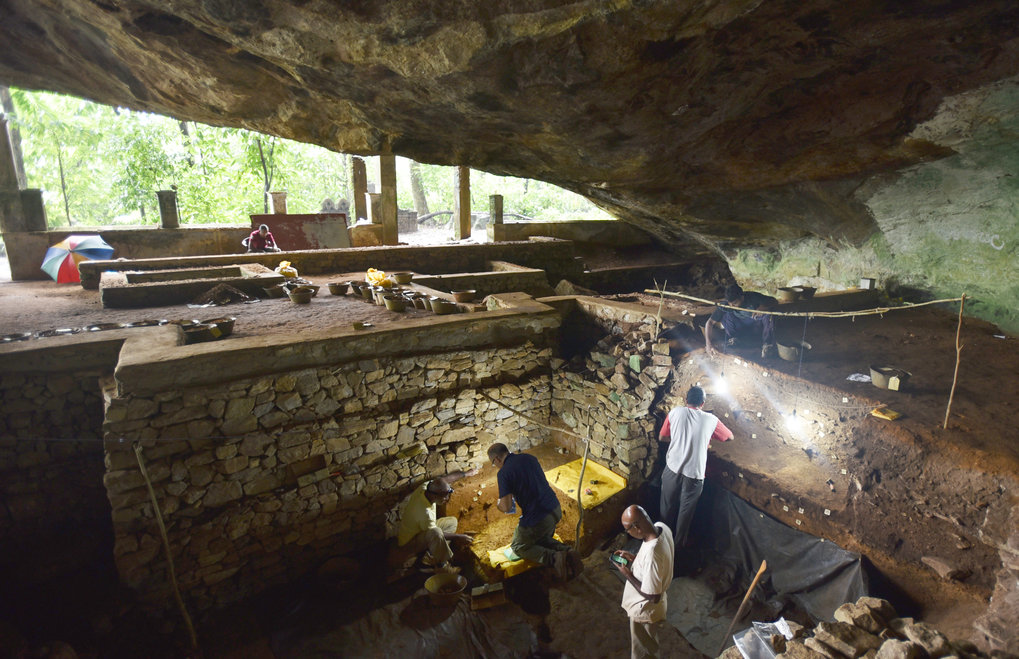
Sri Lanka has produced the earliest clear evidence for Homo sapiens fossils in tropical rainforest environments in South Asia. However, in-depth multidisciplinary analyses of archaeological sequences remain limited to just two sites. A paper recently published in Quaternary Science Reviews details evidence for modern human adaptations and cultural practices from a third rockshelter site: Kitulgala Beli-lena.
Located in Sri Lanka’s Wet Zone rainforest region, Kitulgala Beli-lena was re-excavated in 2017 by archaeologists from the Max Planck Institute for the Science of Human History alongside researchers from University of Sri Jayewardenepura in Sri Lanka and other international institutions. The excavation aimed to recover new archaeological material in order to refine the chronology of the site and better understand early human culture, technology, and subsistence strategies.
Plant gathering and stone tool production ca. 45,000 years ago
New radiocarbon dates showed that Kitulgala Beli-lena had episodic human occupation, from around ca. 44,000 to 31,000 cal. BP. This early human presence is associated with clear evidence for rainforest plant gathering, specifically of wild breadfruit (Artocarpus nobilis) and kekuna nut (Canarium zeylanicum). Both of these plants provide a rich source of starch, fats, and protein, and require little processing. Sediments from the earliest phase of site occupation also yielded evidence for the manufacture of quartz flakes using the bipolar-on-anvil method, which hints on how the early foragers made use of their landscape.
A Pleistocene preference for monkeys and freshwater snails
Kitulgala Beli-lena saw increased human occupation starting with the Terminal Pleistocene, beginning roughly 17,000-12,000 years ago and continuing to around 8,000 years ago. During this time, the people that utilized the rockshelter relied heavily on small arboreal and semi-arboreal animals, specifically monkeys and squirrels, as well as freshwater snails. Tools made from monkey bones, projectile points possibly used to hunt the arboreal animals, were also found in the same sedimentary layers. Together with the quartz tools dating to the same period, these findings suggest that the Kitulgala foragers developed a sophisticated tool kit for the exploitation of their immediate landscapes.
Specialized rainforest adaptation
The evidence reported from Kitulgala Beli-lena adds to the knowledge of specialized rainforest adaptation of early humans in tropical environments. Considering the results of studies looking at other sites in the region, a complex picture of specialized rainforest occupation and exploitation is starting to emerge. It appears that Kitulgala Beli-lena, and the previously reported sites in the region, all formed part of a network of hunting ranges, plant exploitation routes, and settlement strategies. In addition, the continuous human presence in the region from the Late Pleistocene to the Historic period suggests an ability of foragers to persist in rainforest settings indicative of sustainability of rainforest resource exploitation.
Interlinked to the MCC US Government
grant of $480m are some crucial topics that the ruling government, the
judiciary and citizens cannot ignore. 84%
of Sri Lanka’s land belongs to the state. What happens if this 84% state land is
privatized? Will the Govt be able to impose tax and gain revenue. Will the
bulk money given at purchase of land be sufficient to run a country?
Confounding matters is the removal of restrictions prohibiting foreigners to
purchase land & property. A Government is only trustee or custodian of the
land for a term of office and an overruling principle is the inalienability of
land with sovereignty. WITHOUT land no
country is sovereign. So if a country’s land is privatized its sovereignty
is questioned. That is one aspect that policy makers need to seriously ponder.
Sri Lanka managed to salvage itself from 4 attempts by the previous government
to privatize State land. Is the
distribution of title deeds to farmers an alternative to privatizing state
land?
That Sri Lanka lacks a sound and secure
land policy is a fact. That Sri Lanka has been depending on proposals and
reports given by foreign private contractors is also a fact. How far these
proposals gel with the country and its people’s needs or wants is a different question
altogether. What these foreign proposals
continuously recommend is to view land as a commodity and open up for foreign
investments.
Leaving aside the controversies
surrounding the proposed MCC economic corridor and the numerous pink dots in a
map circulating drawing fear of US bases being set up across the country, let
us take the subject of farmers being given freehold title deeds.
Farmers
holding LDO permits given title ownership
The previous government was on a
hurricane attempt to dish out 1million deeds to farmers. Why were they in such
a hurry to hand over deeds to those holding only permits under Land Development
Ordinance of 1935?
Permit
holders of the LDO could not fragment land, mortgage the land, dispose of it
without the GA’s permission but the land could be passed on to a nominated
successor so long as he/she continued the livelihood given to the original
allottee.
LDO
permits were intended to ensure no State land would be alienated to any other
person than citizens of Sri Lanka. But now foreigners can purchase any
land and any property. All restrictions upon foreigners was removed by the
previous government ahead of attempts to privatize land, ahead of signing ACSA,
ahead of launching preconditions given by MCC teams regularly arriving in Sri
Lanka since 2015.
Sri Lanka from being known as the
Granary of the East has become a country now importing rice and most foods that
could easily be grown in Sri Lanka for local consumption. The pride that our
ancestors brought to our island in developing agriculture has virtually
collapsed. The farmers today are engulfed in poverty & debt. These are sad
realities that we have to face. But is
giving a title deed to a farmer in poverty & debt the solution?
A farmer holding a LDO permit is in a
plot of land that does not belong to him. The land he and his family had been
living for generations belong to the State of Sri Lanka.
However, the LDO permit enabled the
farmer to have a livelihood, he had a roof over his head, he had a place for
his family to live. He had security in the form that as a member of the farmer
community, they could make appeals to a government and obtain some form of
concessions. The state banks would also assist whenever possible.
Now
imagine this farmer getting 100% title ownership to the land.
His links to the government immediately
ceases.
He becomes a private owner fending for
himself. The government has nothing to do with him and no obligations to him.
He is one his own.
Will a bank give a loan to a farmer
without consistent monthly income?
What is the collateral security the
bank will demand – obviously the land.
What happens when the farmer cannot
repay the loan? The Bank confiscates the land and eventually puts it to
auction. How many can afford such land up for auction? With foreigners able to purchase
land, will it not be them who will come forward and grab the land? (was this
the plan all along)
What
happens next to the farmer?
He loses the land his family had been
living for generations
He has no means of livelihood
He has no place to live
He has lost the land he had been
previously living under lease
His family doesn’t have a place to live
or a means of indirect livelihood
He and his entire family are displaced.
So
if 1million such farmers are to be given title ownership to land – wont this
1million eventually end up without land, without a job and without a place to
live?
With
their dependents we are looking at a minimum of 4million people who are likely
to be displaced, without home and livelihood.
What is a government who doesn’t have
any state land because all 84% of state land under its custodianship was
privatized going to do about the scenario?
How
will a government provide a place to live for this 4milion displaced people?
When 84% state land is privatized – a government
has no land under its jurisdiction.
We are living in an island – there is only the sea around us… where will these 4million displaced people without any livelihood, without any money and without any place to live go to and as citizens of Sri Lanka how will the Sri Lankan Government look after them?
When Sri Lanka,
then Ceylon was getting ready for independence, it had to find a national
anthem, since all modern states were expected to have one. National anthems
rose to prominence in Europe during the 19th century. D.B.S. Jeyaraj says that
when the national anthem was discussed in the late 1940s, D.S Senanayake had
proposed that a suitable Tamil translation also be formally adopted.
A committee headed by E.A.P Wijeratne had
accepted in principle that there be a Tamil version of the national
anthem. Pundit M. Nallathamby had
provided a ‘neat transliteration’, said Jeyaraj. Prof
K. Sivathamby had confirmed that
Nallathamby had prepared a Tamil version.
Jeyaraj
says when a record was made of the national anthem, a disc was also cut for the
Tamil version of the National Anthem. The
melody and music was the same as that of the Sinhala version. The Nallathamby
version was sung by two women singers, Sangari and Meena.
Oliver
Goonetilleke, then Minister in-charge of Home Affairs had submitted a cabinet memorandum dated 22.11.1951 on the National anthem, where he said that‘Namo namo matha’ had been sung in Sinhala and Tamil at the independence
celebrations of 1948.
A printed
programme for the 1949 independence celebrations, which Haris de Silva had seen,
had said that at the inauguration at Torrington Square, the National
Song would be sung in Tamil at 4 p.m on the arrival of the Prime Minister, and
in Sinhala at 5 p.m. immediately after the Drill Display. At the evening event
at the Havelock Race Course, celebrations commenced with the singing of the
National Anthem in Tamil, and concluded with the anthem sung in Sinhala, said
Haris de Silva.
Lankadipa reporting on 5th February 1949 said that when the
anthem was sung in Tamil, some stood but others remained seated.
The
Tamil version that was used at Independence was the translation by K. Kanagaratnam, Parliamentary Secretary to the
Minister of Education. In 1952, Cabinet
wanted a ‘competent authority’ to revise the Tamil translation. This, we are told, was also done by K. Kanagaratnam. Cabinet had wanted
Sir Oliver to consult G.G. Ponnambalam, who had nothing to say on the matter.
The
Cabinet gave its approval to the anthem on 11th March 1952. A Press
Communique was issued on 12th March 1952, saying that the Cabinet had approved
the song ‘Namo Namo Matha’ as the National Anthem, with copies of the approved
Sinhala version, and its Tamil and English translations, together with the
musical scores. The Tamil translation was the one by Kanagaratnam, said Haris
de Silva.
D.B.S
Jeyaraj says on March 12, 1952, the Government published huge advertisements in
the Sinhala, Tamil, and English newspapers announcing that Namo Namo Matha”
was the National Anthem. While words in Sinhala and Tamil were published in the
Sinhala and Tamil newspapers respectively, the English newspapers had Sinhala
words written in English.
Satyajit Andradi has examined the
Sinhala and Tamil versions. The lyrics of the national anthem of Sri Lanka are
composed in highly Sanskritised Sinhala, he said. In that sense, it closely
resembles the Indian national anthem, which is written in highly Sanskritised Bengali.
Namo namo matha has numerous words
taken from Sanskrit. Most of these loan words are used in their original Sanskrit
form, whilst a few are adopted with minor modifications. The former category
includes words such as Shri (prosperity), Matha (mother), Namo (salutation),
Sundara (beauty ) Ati (beyond), Dhanya (grain ), Dhanaya (wealth), Jaya
(victory), Ramya (beauty) Bhakti (devotion), Puja (worship ), Vidya (knowledge,
science), Sathya (truth), Shakti (strength), Aloke (light), Anuprana (breath,
after breath), Jeevana (life), Mukthi (salvation, release, freedom ), Nava
(new), Jnana (wisdom), Virya (diligence, energy), Bhumi (land), Prema
(affection), and Bheda (division, disputes), whilst the latter includes
Sobamana (beauteous) and Siribarini (sustenance of prosperity). Interestingly,
most of these Sanskrit loan words are also found in the Tamil language and are quite
familiar to Tamil native speakers.
In
the Tamil version, the lyrics, apart from the first stanza, have undergone a
thorough translation, so much so that the numerous Sanskrit loan words found in
the Sinhala original, which are also in the Tamil lexicon, are nowhere to be
found in the Tamil version. The lines of the Tamil version are through and
through Tamil, except in the few instances where a couple of new Sanskrit loan
words such as ‘Siromani’ (crest jewel) are introduced. However, what is
wonderful about the Tamil translation is its preservation of the spirit of the
Sinhala original, said Satyajit.
According
to D.B.S. Jeyaraj, the Tamil version Namo Namo Thaaye” was sung in 1952 at Independence Day functions
at Jaffna, Vavuniya, Mannar, Trincomalee and Batticaloa kachcheries. I
remember, as a grade four student in a leading school in Colombo, I was witness
to the National Anthem in the Tamil language sung at the school commemoration
of Independence, way back in 1952,” recalled an anonymous writer.
The Tamil version was also sung when Sir John
Kotelawela visited Jaffna in 1954. The
Tamil version was first broadcast officially on Radio Ceylon” on February 4,
1955. The Tamil version came into use
thereafter and was extensively used in official functions in the predominantly
Tamil speaking Northern and Eastern Provinces,
said Jeyaraj
There was a sharp difference of opinion
regarding singing the national anthem in Tamil. Sinhala hardliners do not want
the National Anthem to be sung in Tamil while Tamil hardliners do not want
Tamils to sing the National Anthem in Sinhala, observed D.B.S. Jeyaraj. Prime Minister Sirimavo Bandaranaike had
walked out of a function in the north where the national anthem was played in
Tamil. The date is not given. This would
have been either in 1960-65 or 1970-77, her two terms of office.
While the Sinhala version was sung in most
official functions in Colombo and Sinhala majority provinces, the Tamil version
was sung in Tamil majority areas and Tamil medium schools, said Jeyaraj. Ananda
Wanasinghe says, A close friend
of mine from Nelliyadi Central College tells me that they sang the anthem in
Tamil at the beginning of assembly and at all other school functions. He adds
that it was sung with emotion and honor.”
The National anthem was not included in the
Constitution of 1972. But it was included in
the Constitution of 1978. Article 7 of 1978 Constitution states: “The National Anthem of the
Republic of Sri Lanka shall be “Sri Lanka Matha,”, the words and
music of which are set out in the Third Schedule.
The text of the 1978 Constitution was issued
in Sinhala, English and Tamil. The Sinhala version had Namo, namo in
Sinhala. The English” version was
a repeat of the Sinhala one, written in Roman script, a transliteration.
The Tamil translation was a
translation of the Sinhala words into Tamil. it was not a transliteration. The Tamil version was included, said one
source, following an appeal by K.W.Devanayagam. Devanayagam
had pointed out that Muslims and Tamils living in the north and east who spoke
mostly Tamil wanted that version for use in schools and occasions.
The Tamil version had been played
at functions attended by Tamils in Jaffna, Vavuniya, Trincomalee, and
Batticaloa. The Sinhala version was played at functions attended by the Sinhala
community, However when both parties attended, they avoided the national anthem
and only played the tune. (Sunday Times 19.12.2010 p 10.)
The national anthem was sung in Sinhala and Tamil at the 50th anniversary
independence celebrations in Trincomalee in 1998. Is this legal asked critics.
(Daily News 10.2.1998 p 5) On Sinhala New Year day 1999 at a
ceremony in Kantalai they had sung it simultaneously in Sinhala and Tamil. This
was scoffed at. Where in the world do we hear national anthems being sung in
different languages asked one reader.
In December 2010 the Cabinet decided that Sri
Lanka’s national anthem would only be in Sinhala. President Rajapaksa said
there could not be two national anthems in a country. He said, “We must
think of Sri Lanka as one country.” The Tamil version would no longer be
played at any official or state functions. A directive to use only the Sinhala
version was to be sent out by the Ministry of Public Administration. All
government establishments including district secretariats were to adhere to
this decision.
According to Jeyaraj,
this ban on singing the national anthem in Tamil was thereafter shelved”. There was no official
decree. But there was officially sanctioned unofficial instructions.”
Orders went out quietly to government.
Officials and officers of the armed forces were told that the national anthem should not
be sung in Tamil. This resulted in the
silencing the Tamil National Anthem, said Jeyaraj.
This unofficial diktat was strictly enforced.
Schools and government institutions were discouraged” from singing the
national anthem in Tamil. The armed forces in the North and East were tasked
with the duty of preventing the National Anthem being sung in Tamil. The Tamil
people soon got the message and gave up attempts to sing the National Anthem in
Tamil. School children were compelled to sing the Sinhala words, scripted in
Tamil, said Jeyaraj
At three different functions at
Kilinochchi, in 2010 army had stopped the singing of Tamil version. They
ordered that the recorded Sinhala version be played and it was. They had also
distributed the Sinhala version of the national anthem to schools and told them
that in future they should play the Sinhala version, reported the media.
The Yahapalana government of 2015 changed this.
President Sirisena withdrew the prohibition on singing the national anthem
in Tamil. In March 2015 President
Sirisena announced that there would
be no bar to singing the national anthem in Tamil.
Soon after, on March 23. 2015 at a
function in Valalai in the Jaffna peninsula
to return land taken over by the Sri Lankan armed forces for a high security
zone, the national anthem was first sung in Tamil and then in Sinhala.
The music was played on tape while a choir from the staff of the Jaffna
District Secretariat sang in both languages. This was in the presence of
President Maitripala Sirisena, Prime Minister Ranil Wickremesinghe,
and former President Chandrika Kumaratunga,
For
the first time, since 1949, the national anthem was sung in Tamil at the
Independence Day proceedings in Colombo in 2016. This was repeated in 2017,
2018 and 2019. But it was sung at the
end of the proceedings.
The
singing of the national anthem in Tamil at the Independence celebration of 2016
surprised many people . In Hambantota they did not like it. Some did not even
know that Tamil was a national language. It came as a shock them, reported
Jehan Perera. Critics said now Sri Lanka
has joined South Africa, Canada, Switzerland, New Zealand and Fiji as a country
having two national anthems.
Tamil Separatists were not
thrilled either. ‘If Tamils thought that they had gained a
status on par with the majority race they are wrong. Their relegation to second
class was shown by the fact that the Tamil anthem was sung later at the
ceremony, said one analyst.
But others were pleased. After 67 years, the
National Anthem was sung in Tamil in 2016, said Mano Ganesan. It was a very significant act of the government to make
the Tamils feel equal, said the National Peace Council of Sri Lanka .
I can still
remember that the faces of the bevy of young girls who sang the Tamil version
of the National Anthem on Independence Day 2016. That day they were glowed with pride and self-respect.
In addition to these young girls, most of the Tamil people would have felt some
sort of complacency and self-respect at the feeling that they had been treated
equally said one commentator.
The students
whose mother tongue is Tamil enjoyed participating in the singing at the
official commemoration of our independence, and was well received by the masses
whose mother tongue is Tamil, said another commentator. Each year, a new set of
students participated in the singing and I am certain that the younger ones
were eagerly awaiting with much expectation, when their turn would come for
them to participate in the singing, at the big event.
The singing of the national anthem In Tamil
was challenged in Supreme Court as a violation of the constitution. A fundament
rights petition challenging the government decision to sing the national anthem
in Tamil was filed in 2016. It should be sung only in Sinhala.
The Supreme Court dismissed
the petition. They accepted the reply given by the government.
Government pointed out that Tamil
is also a national and official language . The words and music of the National
Anthem in the Tamil language is constitutionally recognized by Article 7 read
with the Third Schedule of the Tamil version of the Constitution of Sri Lanka.
The National Anthem that was sung in the Tamil language at the Independence Day
celebrations on February 4, 2016 contained the same words and melody as
entrenched in the constitution in terms of Article 7 read with the Third
Schedule of the Tamil version of the constitution of Sri Lanka.
The legal profession did not agree. Permitting
the national anthem to be sung in Sinhala and Tamil, as President Sirisena had
done may be a violation of the constitution, said Ladduwahetty. According
to Article 7 of the 1978 Constitution the national anthem cannot deviate from
the words and music given in the schedule, and the words are the Sinhala words. The
national anthem must be sung in Sinhala at state and
national functions. Article 7 is a fundamental article which cannot be amended,
repealed or tampered with, said Vernon Botejue. Also,
it could be added ,there is the rule that where the texts differ, the Sinhala version shall
prevail.
Sri Lanka got a new President in 2019. The new
administration said that according to
the Constitution, the national anthem is to be sung in SInhala. Therefore the national anthem
would not be sung in Tamil at the Independence celebration of 2020.A spate of
comments arose. Friday Forum
urged the government to ensure that the national anthem is sung in both Sinhala
and Tamil at the forthcoming Independence celebrations and on similar future
occasions. The
National Peace Council urged the
government not to stop the Yahapalana practice of singing the national anthem
in Tamil at the Feb 04 Independence Day celebrations.
But the administration stood firm. On Feb 4
,2020, at the Independence celebrations in Colombo, the national anthem was sung in Sinhala
only. But it was sung in both Sinhala
and Tamil at a parallel function held
at Jaffna District Secretariat. ( Continued)
There
are two opposing sets of views on the matter of the Tamil version. One group
firmly wishes to see the anthem sung only in Sinhala. It is imperative to sing the national anthem
in one voice not two, they said. A national anthem is a symbol of
unity.
When you
talk about a National symbol, be it a flower, animal or flag there can only be
one of them,” said Sandagomi Coperahewa. There can’t be two or three national
symbols. There may be two official languages, but the national anthem is one
symbol. If it is sung in a language other than Sinhala, there has to be a
Constitutional Amendment as well,” he said.
‘The national anthem of Sri Lanka should be
the original song sung in the language it was written in,’ said one commentator.’ That is Namo
namo matha and it was written to be sung in Sinhala. . Every citizen, whether Sinhalese, Tamil, Moor, Malay, Burgher,
or Veddah should sing in one voice in the language the anthem was written in,
in this case Sinhala’, added another
commentator, Stanley Gunaratne. A
reader commented,’’ Yes, one national anthem in Sinhala only’.
This
group dismisses the notion that
Tamils cannot think of themselves as Sri Lankan when the national anthem is in
a language that they cannot understand. Why can’t the
Tamils learn to sing the national anthem in Sinhala, asked one critic. If they
are able to learn other languages in the countries they live in now, why can’t
they learn Sinhala? They do not askthat
the national anthem of the countries they now live in be translated to Tamil so
they can sing it with fervor and loyalty.
There is no
need to sing the national anthem in Tamil as singing it in Sinhala is
sufficient, said Ravi Kumar , President
of Tamil Buddhist Association of Jaffna. There was no
demand from any Tamil in Jaffna to sing the National anthem in Tamils. It was
not an issue, said Rear admiral Sarath Weerasekera, speaking in 2016. When I was the commanding officer of the Karaingar naval
base in 1993 Tamils sang it in Sinhala at various functions. Today the north is all Tamil, and they have
with all impunity sung the national anthem in Tamil, he concluded.
These
critics point to India. India has Hindi and English as official languages but its National
Anthem is highly Sanskritised Bengali. It’s not even Hindi, but all Indians
sing it. In
India the national anthem is sung in only one language. All Indians sing it
regardless of whether they understand it or not. India stipulated that all
schools in India have to start the day with the national anthem.
India’s national
anthem was originally a patriotic song
written in Sanskritised Bengali, by Tagore, later adopted as the
national anthem. Even before independence the Bengalis had sung ‘Jana gana
mana’ at their rallies. The
Bengalis played a significant role in the nationalist struggle, more than any
other ethnic group. The Tamils did not play that kind of role in Sri Lanka.
The
national anthem should be multi lingual
said some. They suggested a single
national anthem with verses in
Sinhala and Tamil. A single
bi-lingual anthem, with verses in both Sinhala and Tamil. Let there be at
least a few lines in Tamil
incorporated into our national anthem, they said.
One suggestion is to sing one verse of the
national anthem in Tamil, whilst the balance is sung in Sinhala. The first two verses can be sung in Sinhala
and the last verse can be sung in Tamil. Then the entire anthem is sung by all
Sri Lankans, where the Sinhala speaking population sing the Tamil verse in
addition to the Sinhala verses, and the Tamil speaking population sing the
Sinhala verses in addition to the Tamil verse.‘Including a Tamil verse in the national anthem
will also help chauvinistic Sinhalese to remember that there are people other
than the Sinhalese living in this country’, said one commentator.
There
is also a request to sing the national anthem in three or four languages.
The anthem should be sung in at least 3
languages , English, Sinhala and Tamil said Mohamad Zaharan .
I personally would prefer that the national anthem be sung in four languages ,
including Arabic he added.
This will be then even understood by the
foreign dignitaries from other countries who will be attending this ceremony.
The other advantage is that it may even kindle the interest of people to learn
these languages. By singing it in three or four languages will give diversity
and ensure that people of other faiths are also given due recognition, ours
being a multi-religious, multi-racial and multi-ethnic country, Zaharan
concluded.
A
whole bouquet of examples have been given to justify singing the anthem in
Tamil. In South Africa, the national anthem of four stanzas is in five
languages, Xhosa, Zulu, Swasotho, Afrikaans, and English. First stanza is in Xhosa and Zulu,
two lines each, next stanza in Sesotho, third in Afrikaner, fourth in ‘English.
Canada
has English, French and a bilingual version. The lyrics in the English and
French versions differ in the Canadian anthem.
In the bilingual version beginning and end is
in English middle verse is in French. Canada has an Inuit version too. The national anthem
in New Zealand, the first verse in Maori and the second in English. In Belgium the national anthem is sung
trilingual in French, Dutch and German.In Suriname, national anthem has
two verses, one in Dutch and the other in Sranan Tongo.
Switzerland’s
anthem has different lyrics in each of the country’s four official languages
(French, German, English, and Romansh). Fiji’ has lyrics in English and Fijian
which are not translations of each other.
There were
other alternatives. Spain has no words at all
in its national anthem. In Spain the
national anthem has been played without words since 1978. In Singapore, there
are Tamil, English, Malay and Chinese people, but their National Anthem is sung
in Malay. National anthem is in Malay, because
Singapore was earlier linked to Malaysia. The Irish national anthem was
written in English. An Irish translation although never formally adopted, is now
almost always sung.
Those supporting a Sinhala only national anthem have dismissed
these examples. None of
these have any relation to Sri Lanka ,they said. Sri Lanka need not take new
nations such as Canada, New Zealand and South Africa as examples. Eight
of the countries with multilingual national anthems are in Africa, where there
is no record of land borders before colonization, they added.
They
also pointed out that the United Nations comprises 193 member
states. Less than 25 of these countries have multilingual national anthems. The
countries with monolingual national anthems
also have minority communities. But the national anthems of such
countries are invariably in the language of the majority community. Lastly, some countries, with bilingual
national anthems, such as Canada ,are about to break up.
Those who support the singing of the national
anthem in Tamil use strong language. It is injudicious and even the wicked
decision to sing the National Anthem only in Sinhala, they said.
In an already fractured society, it is
difficult to understand this suggestion
of departing from such a simple practice which could be so meaningful to substantial
groups. On the contrary, departing from it may convey a message which does not
augur well for our future progress as a united and peaceful society, they said.
But others decided to take a more conciliatory
line. We have only one National Anthem, and that is in Sinhala. What is sung at
the end of the official commemoration is only a Tamil language version of the
Sinhala Anthem. A Tamil version of the
National Anthem has been created for
this very purpose. This version is now
accepted andhas been in use for some time. ‘The Tamil
version has been in use from 1951 or so, and the practice was restored in 2015,’ they said.
This group decided to take an emotional approach, emphasizing music and song.
The content of the national anthem is universally appealing and can create an
emotional response in persons who differ in other respects. It is capable of
being a unifying force, said Friday Forum.
Listening
to the singing of the national anthem in either or both language is indeed a
moving experience. It is most moving when it is sung in our mother tongue or
both languages, said Devanesan Nesiah.
We
must voluntarily learn the national anthem in each other’s language, so we can
all sing it together, said Rev Duleep de Chickera. Far from banning
the singing in one language, we must ensure
that it is sung with dignity, in both languages, on Freedom Day and all
national occasions..
Satyajit Andradi
has looked at the music aspect of the anthem. Music is, in fact, the language
of emotions. It could break through language barriers as far as expression of
emotions are concerned. It builds bridges and binds people together, he said.
A national
anthem, like any other song, is a union of poetry and music. Hence, whilst the
musical element is critically important, the linguistic component should not be
under-rated. It is a widely accepted view that, a person is able to express her
or his innermost emotions through the medium of her or his native language
rather than through a different one. Hence, it is important that everyone be
actively encouraged to use their native language. Needless to say, this applies
in the case of singing one’s national anthem as well. Use of one’s native
language will stimulate creativity, whilst learning other languages would
enrich it further, continued Satyajit.
We celebrate the
fact that Sri Lanka is a bio-diversity hot-spot of the world. Likewise, why
cannot we celebrate its wonderful linguistic diversity? The Sinhala and Tamil
versions of the national anthem of Sri Lanka epitomizes the immense linguistic
diversity of the country. The native Sinhala speaker, who is not very
conversant with the Tamil language, would find it extremely difficult to
understand the Tamil lyrics. However, this is not a cause for disappointment or
alarm. On the contrary, it is a fact to celebrate. It speaks volumes of the
linguistic diversity of the country, continued Satyajit.
Singing our
national anthem in Tamil as well as in Sinhala at the official Independence Day
celebrations is a small but vital step in this journey. Let’s sing it with
devotion and enthusiasm in the two main native languages of our land – Sinhala
and Tamil. Let us also learn to sing it in the language of each other in the
near future, said Satyajit.
Satyajit however, makes doubtful observations
on the two languages. The Sinhala language, like Hindi,
Bengali, Marathi, and Nepali, is considered to be an offspring of Sanskrit, the
sacred language of ancient India. Sinhala is most probably the living eldest
daughter of Sanskrit, said Satyajit. He
does not say anything about the considerable
Sinhala literature.
Tamil , on the other hand, says Satyajit,
belongs to the Dravidian family of languages. Like Sanskrit, Tamil is an
ancient classical language of India. It possesses a great literature. Sinhala and Tamil have been spoken in the
country for more than two millennia,
said Satyajit, ending with a flourish,
this brief sequence of incorrect statements.
All sort of
woolly, sometimes incoherent, emotional
statements, including at least one howler were made by supporters of the Tamil
national anthem. Here is a selection.
**to sing our national anthem in both national
languages, does not undermine or desecrate either of them. To the contrary,
when we venerate Mother Lanka as one people, in both Sinhala and Tamil, we
demonstrate the magnanimity of our cultures in which our respective languages
flourish.
**What will the Sinhalese majority stand to
lose by allowing the Tamil version of the anthem also sung on the Independence
Day celebrations following the Sinhala version? In my view this is a simplest
gesture to show the Tamil brothers and sisters (who had suffered directly for
decades due to the war) that the majority Sinhalese can respect the Tamils’
desire to use their mother tongue to express their sentiments. .
**It is difficult to fathom why it has now
become necessary to deny Tamil citizens the privilege of praising our
motherland in song, in their mother tongue, especially when the convictions,
aspirations, and devotion are identical.
** The
Tamil community have been hurt so much on the language issue. Firstly in 1956
by not recognizing the Tamil language
The idea sown recently to sing the national anthem at Independence Day
celebrations in Sinhala only, is one such sad and recurring wound.
** The constitution provides for singing the
National anthem in Sinhala and Tamil, but this is not followed. The anthem says ‘eka mawakage….’ If we truly
believe that we are the children of one mother we must provide the opportune
for the Tamil speaking people to sing our national anthem in their mother
tongue.’ This is a howler. Children of
one mother will not speak in different languages.
** Other countries having ethnic minorities would
have been over the moon had a minority community expressed the wish to sing the
national anthem in their own mother tongue. It would have been a matter of
national celebration, joy and hope if a minority community once driven to take
up arms to establish a separate state on the country’s soil, attendant with its
own national flag and national anthem as the sole means of redressing their
perceived grievances, should now express their desire to sing with fulsome
heart in their own mother tongue the national anthem of the country from which
they wish to secede ( Don Manu)
**
ex-President Sirisena’s gesture to include the Tamil version also in the day’s
agenda spoke volumes to assure the Tamil populous that they were equal sons and
daughters of this blessed island and enjoyed the right in the same measure to
bask in the self-same rays of the Lankan sun as did the Sinhalese. The
President’s extended hand which was quickly grasped by the Tamil minority was a
long leap forward on the road to reconciliation between the two communities.The
message was sent to all that the sovereign state of Sri Lanka was an undivided
co-owned property.( Don Manu)
**
Furthermore, even as court proceedings are conducted in Tamil and English in
Tamil speaking areas in the north in the same manner Sinhala and English are
used as the medium of language in court proceedings conducted down south and
elsewhere where the majority language is spoken, so too is the national anthem
sung in Tamil in Tamil speaking schools in the north, and sung in Sinhalese in
the rest of the country. ( Don Manu)
** So what’s
the fuss? What’s wrong in singing the national anthem in Sinhalese and in Tamil
by the Tamils at an official function where both communities meet as but one?
Isn’t it far better and more meaningful for the Tamils to sing the nation’s
song in their own mother tongue which they can understand and sing with feeling
rather than merely give lip and sing the national anthem in Sinhalese in parrot
fashion? ( Don Manu) (CONTINUED)
For true
freedom, people need transparency in all things. The fact is, for democracy
(and freedom) to survive we need good information; we need to understand what
is around us – our climate, our government and politics. When government hides
things or give us false information, our freedom is diminished. In fact, there
are so many things we are not told.
For how
much longer can human civilization survive? For seventy years we have been
living under the shadow of nuclear war. Several times, we humans have come
extremely close to final nuclear disaster, say military experts. We have
avoided total destruction by just a few minutes due to misunder-standing or
human error, they say. When the doomsday clock of the Bulletin of National
Scientists was set last January at just two minutes to midnight, signifying
that is now the closest it has been to terminal disaster since the clock was
set up in 1947. With the USA and Russia, armed with unstoppable hypersonic
weapons, staring each other down, the world is facing total destruction. But it
is not spoken about! It may even be suppressed!
Another
threat to our continued existence is global warming. It has been slowly getting
hotter year by year over the last ten years and shows no signs of slowing down.
Experts say it is the sun changing and warming our upper atmosphere – but
assisted by our destruction of the Ozone layer, especially at the poles by our
emissions of methane, carbon dioxide and other noxious gases. Changes are
happening and nobody knows where it will all end. All the other planets around
us are bleak, bare of life – just infertile, dry rock.
A third
danger facing us all, is the threat from Earth’s N-S Polar reversal. The
Earth’s magnetosphere provides us with protection from harmful solar and space
radiation. This protection has fallen by 15% over the last ten years,
indicating trouble ahead. A full reversal is when the North and South poles
switch positions. This is likely to be highly disruptive, causing mountainous
tsunamis, violent earthquakes and high winds – another extinction event.
The
final, knockout blow is delivered by the sun itself. All stars ‘Nova’ to a
greater or lesser extent. This is where they violently explode, sending tons of
hot matter into space around them, frying and boiling all that is in the way.
Bad news – our sun ‘micro-novas’, too. NASA has seen the evidence on the moon.
Experts are searching for the reasons for this but suspect that we cross the
plane of our galaxy into dusty space. This dust accumulates on the surface of
the sun and causes a violent reaction.
Those are
terminal cataclysms, but there are others of lesser degree.
There is
the danger from state tyranny to our freedom. The price of freedom is
eternal vigilance. There is the grave danger facing the free world made by the
world’s ruling elites who are busily undermining democracy. On one side is the
political left, who secretly plan a ‘New World Order’ ruled by the United
Nations. On the other is the political right, who want, country by country, to
install right-wing governments into power ruled by dictators, all for the
benefit of business! It is a fierce contest.
They want
dictators installed into power to implement their agendas of either the left or
right, who can rule and imprison all those who oppose their rule. Donald Trump
has seriously upset the left’s long-laid plans of re-organizing and oppressing
the common man. That explains the animosity directed towards him.
Then,
there are the Islamists, who want a Caliphate to rule the world with Muslim
Sharia law, putting society back a thousand years. Extremists, idealists all,
would be happy to install such a state by Jihad or by terror.
Or,
irresponsible researchers playing with viruses which can unleash an epidemic,
or other sources of a virus which is unstoppable and wipes us all out. Ebola,
or artificial viruses may be unstoppable and lethal.
Little of
these threats named above get into the newspapers or on television –
governments want the common man to be kept in the dark, vulnerable to the
dangers, but entertained by gossip and drama! With our heads empty of
meaningful thoughts, they can manipulate and control us like sheep and pigs,
and profit from us, too.
How we,
ourselves, Undermine Democracy
Philosophers
say we cannot have true freedom without personal moral constraint in a
democratic society. The only truly free people are those that are ruled by
personal moral behavior. Democratic government can be very successful where a
population is moral, but it will fail when good standards and practices decline
and fall and good order in society breaks down.
RULE:
When unrestrained liberty leads to a loss of order, then the demand for order
leads to a loss of liberty.
EXPLANATION:
In the case of a society enduring moral anarchy, corruption and chaos, even
before the arrival of a strong man, people are not truly free. They must be
alert and on the defensive. You can say that those who are
unrestrained in behavior; by being corrupt and immoral, are destined to be
ruled by a tyrant.
They
mistakenly think it is necessary to install a strongman to restore order – a
just man – if such a man can be found! But just men or tyrants have few tools
in their tool box – when you only have a hammer – you see all problems as a
nail to be hammered.
Thus,
moral anarchy, corruption and chaos can lead to dictators who have to use
strong-arm tactics to solve all the different problems. They have only one
response to extreme problems – the police, jails and even torture and death.
The
Superiority of Reasoning and Moral Restraint
Strong
men are a one-sided response to modern situations of chaos; but society is
better reformed by reasoning, explanation and debate for problem solving.
Therefore,
the only truly free people are those who are ruled by personal moral behavior.
Good, educated people can reason and realize the importance of the best human
qualities, trust, truth, moderation, an efficient system of law; recognizing
what is good and beautiful and protecting it. There is a need to teach the
constituent aspects of a moral society. The Centre for Buddhism, Kandy, has a
project to do that by having orators to give talks and reason with Sri Lankan
people.
Democratic
Society based on Free, Unbiased Information
Free
people need accurate, unbiased information with nothing held back by which to
form opinions and understand events in this world. Freedom and good information
are inseparable necessities for mankind.
It is
reality, not illusion or delusion that will determine what the future will
bring.
Unfortunately,
there are few TV. documentaries to educate and inform people. All we get is TV.
news which is severely limited to five minuits of news – supplying what one
person thinks are items of importance, all followed closely by advertising and
Tele-Dramas. They do not tell us of our dependence on the sun, its power and
treachery, nor do they give information of the factual, repeating planetary
disasters nor the true history of mankind. Without this, people cannot imagine
such events. Many people have only limited awareness of news and events in the
wider world. The main media fails us and most people do not
trouble themselves to access smaller, better news providers. We live in a
bubble of delusion. Then we act accordingly.
This
limited awareness of a fast moving, violent world should not be enough for any
normal, educated person. People need more facts about the sun and our planet
and truths of political currents and form opinions about them. (For example,
Julian Assange distributed information about the massive political corruption
in the USA – so he is arrested and maybe sent to prison for life for revealing
the truth. Yes!)
The fact
is, we live in a turbulent world of man’s inhumanity to man. Who would have
dreamed that just before Easter this year, suicide bombers would change our
society so deeply?
There was
the French Revolution, the Cuban Revolution, the American Revolution, the
revolution in Nicaragua. The world seems peaceful, but in fact, like volcanoes,
explosions occur! – and driving these are the elites who plan for a New World
Order, or world dictatorships or even an Islamic Caliphate. Be aware of
all the dangers facing you!
A
Suggested Definition of ‘Good’ And ‘Bad’
‘GOOD’ is defined as whatever is beneficial or brings social harmony and happiness to society. These actions are good Karma which brings its own good reward. This is important for progress along the ‘Eight-fold Noble Path’ towards a personal wisdom, peace and Nibbana.
‘BAD’ is whatever action(s) or event(s) that result(s) in pain, harm, anger,
conflict or causes disharmony in Buddhist society. This slows, hinders or even
prevents people following their ‘Eight-fold Noble Path’ to self-development and
wisdom.
Most
actions of people fall within these limits of ‘GOOD’ or ‘not BAD’ as defined.
This can also be seen as a way of minimizing society’s overall unhappiness.
(i.e. maximizing overall happiness in society).
The Government will shortly invest Rs. 500 million for the rehabilitation of the Mattala Mahinda Rajapaksa International Airport (MRIA) to bring it back to international standards within six months.
Despite the Government of President Mahinda Rajapaksa building the Mattala Airport to international standards, the ruination which was taking place during the previous regime was colossal that it will cost around Rs. 500 million, which will also include infrastructure upgrades,” Chairman of Airport and Aviation Services (Sri Lanka) Ltd, Retired Major General G.A. Chandrasiri told Daily News Finance .
He also said that Minister of Industrial Exports, Investment Promotion, Tourism and Aviation Prasanna Ranatunga was expected to present a Cabinet Memorandum requesting for Rs. 500 million for the upgrade.
He said that for starters, there has to be around 1,000 acres of jungle land which has to be cleared by the Sri Lanka Army and the Sri Lanka Air Force was in the process of rebuilding the outer and inner perimeter fence, he said.
Most of the damage has been created outside of the Mattala Airport while there has been little damage to the interior of the airport where it was used even to store paddy, he explained.
Major General Chandrasiri also said that the upgrade will also include the creation of a massive cargo hub and also a Flying Academy which will also recruit and train both local and international pilots as well.
He said that the previous government had been extremely negligent in the maintenance of the Mattala Airport where there has been considerable damage to the outfield there were holes in the external perimeter wall and wild animals such as deer and wild boar and wild animals could easily penetrate into the airport premises which could pose a severe security and safety threat to the airport and its operations.
The AASL Chief also said that huge space was available for cargo and industrial activities and a host of other operations which the airport could make ideal use of.
All these operations were earmarked during the tenure of the Mahinda Rajapaksa Presidency but totally neglected during the tenure of the Sirisena regime,” he explained.
He said that the Mattala airport was continuing its operations where there were 25 aircraft which landed there in January for refueling and other operations but stressed the need was absolutely necessary for higher operational standards if it was to operate at an international level where there were arrivals and departures of around 25-30 aircraft like the BIA on a daily basis.
Colombo, Feb.6 – The Sri Lankan government will soon commence construction of a new terminal at the Bandaranaike International Airport in order to accommodate a larger number of arrivals, Xinhua news agency, citing local media reported here Thursday.
Chairman of Airport and Aviation Services Sri Lanka Ltd (AASL), G.A. Chandrasiri told the Daily News here that currently the passenger capacity of the Bandaranaike International Airport was 6.9 million, but at the end of 2019, there were 10 million passenger arrivals.
However, with the completion of the new Terminal 2” in three years, the airport was planning to accommodate 20 million passengers per year.
Since the end of Sri Lanka’s civil war in May 2009, the country’s tourism sector has seen significant growth with arrivals averaging at 2 million tourists per year.
Last year, Sri Lanka received a little over 1.9 million tourists with India, China and Britain being the largest markets for Sri Lanka Tourism.
This year, the new government has aimed to attract 3 million tourists, increasing it to 10 million within five years.
Colombo, Feb. 6 – Sri Lanka will soon commence construction on a world class theme park along the country’s southern coast in order to promote adventure tourism, local media reported here Thursday.
Leading international theme park developer and operator, Sim Leisure Group Ltd, entered into a non-binding memorandum of understanding (MoU) with Sri Lanka’s Elpitiya Plantations PLC, to set up its world-class ESCAPE theme park in Galle, a statement from Elpitiya Plantations said, according to the Xinhua news agency.
The statement said having been granted the preliminary approval to commence construction and barring unforeseen circumstances, Sim Leisure aims to commence the construction of ESCAPE Sri Lanka” in March 2020.
The theme park will be located halfway between capital Colombo and the main beach resort of Galle.
I see tremendous opportunity in the Sri Lankan market with its population of over 20 million. Sri Lanka is one of the few countries, which is unspoilt and green. The country’s unpolluted coastline and beaches bring tourists from all over the world and its tourism industry is growing at an incredible pace,” said Sim Leisure CEO Sim Choo Kheng.
He also highlighted that Sri Lanka has tremendous untapped potential for family leisure, compared to East Asia, with a natural advantage by setting up the first large-scale theme park in Sri Lanka.
The theme park will include an outdoor adventure theme park and water park and approximately 40 themed rides and attractions in three categories – Adventureplay, Waterplay and Gravityplay. Enditem
Former Chief Executive Officer (CEO) of SriLankan Airlines Kapila Chandrasena and his wife, who were arrested on money laundering charges after they surrendered to the CID this morning, have been remanded until February 19 by the Colombo Fort Magistrate’s Court.
The Attorney General on Monday (3) instructed the Director of the CID to obtain an arrest warrant from court and to arrest the former SriLankan Airlines CEO and his wife Priyanka Niyomali Wijenayake as suspects on charges of money laundering in the re-fleet deal between SriLankan Airlines and Airbus.
The Attorney General had issued these instructions after considering the investigative material submitted by the CID on the case. The Fort Magistrate had issued an arrest order against the duo on the same day.
CID officers had visited the residence of Mr. Chandrasena yesterday (05), however, neither he nor his wife was at home at that time.
Kapila Chandrasena and his wife surrendered to the Criminal Investigation Department (CID) through an attorney this morning (06).
Statements were recorded from both of them before the accused were produced before the court.
President Gotabaya Rajapaksa says that his government will work with a commitment to save the country from the present chaotic situation without pointing fingers at the past for prevailing problems.
He said that he accepted the challenge of rebuilding the country with a clear understanding that the economy had collapsed.
The President made these remarks addressing the Chairpersons and members of Director Boards of several Plantation and Financial Institutions at the Presidential Secretariat, today (06), stated President’s Media Division.
The ‘Rata Hadana Saubhagyaye Dekma’ policy statement was not prepared with the aim of winning the election. It is a consequence of studies of many years in collaboration with academics and experts in many fields in order to serve the public. Many state entities have become just places for providing employment for many years. The country cannot be taken forward in this manner. It is the responsibility of the new Chairmen and the Board of Directors to make the institutions profitable. Steps should be taken to replace the existing systems with the new system to rebuild collapsed institutions,” President Rajapaksa emphasized.
The cultivation of other crops should be developed along with the development of coconut and tea plantations. The field of agriculture needs to be improved with the support of researches and the use of modern technology. By prioritizing the development of traditional industries, it is possible to generate huge revenue”, the President said.
President Rajapaksa pointed out that a large number of employment opportunities could be created through all these measures.
During the last few days, groups including graduates arrived at the Presidential Secretariat demanding employment opportunities. There are many vacancies that exist in the country in many fields including tourism, and computer technology. However, due to the weakness of the education system, these opportunities are wasted”, the President pointed out.
The President further said that steps would be taken to change the education system to meet the demands of the job market and that Asia is becoming the hub of the world economy. The President stated that one of his primary objectives is to create an environment for the future generation to come out from the universities as graduates who can conquer the modern world.
Secretary to the President, Dr. P. B. Jayasundara and Mr. Lalith Weeratunga, Advisor to the President were also present at this meeting.
President Gotabaya Rajapaksa, today (06) at the Presidential Secretariat, gifted a consignment of world-renowned Ceylon Black Tea to the Chinese Ambassador Cheng Xueyuan to be sent to those affected by the Coronavirus.
Ambassador Xueyuan deeply appreciated the gesture, stated President Media Division.
The Ambassador, on behalf of President Xi Jinping and the Government of the People’s Republic of China, thanked the Government of Sri Lanka and the Sri Lankan people for the kindness shown to China in this difficult moment.
He also thanked all the religious and other leaders who organized the all-night Pirith sermon on 05 February. Every divisional secretariat throughout the Island conducted the Pirith ceremony at the same time, blessing those who are affected for a speedy recovery.
President Rajapaksa, in turn, thanked the Ambassador for the assistance extended to bring back the Sri Lankan students from Wuhan province.
As these are students, their parents were worried,” explained the President. So, they really appreciated that they were allowed to leave Wuhan. We hope that this epidemic will soon be brought under control.
Upon the President’s inquiry as to the current status of the disease, the Ambassador explained in detail that the virus was detected soon after the Chinese New Year.
Wuhan is a very large province,” described Ambassador Xueyuan. During the Chinese New Year, a lot of people moved in and out of the province. However, as soon as it came to the Chinese Government’s notice of this new virus and its seriousness, strict measures were taken to contain the virus and to stop it from spreading.”
However, as this virus takes about 7 to 14 days to show its symptoms,” further explained the Ambassador, the records will now show an increase in the number of cases before it starts decreasing.”
The Chinese Government in its efforts to control the virus from spreading had placed under quarantine hospitals, entire villagers and any other place where cases of the virus had been reported. All activities had been stopped and the Government is providing supplies daily to these areas. The Chinese Government had even criminalized leaving Wuhan without informing the authorities.
Out of the total death toll, 99 percent had been from Wuhan,” stated the Ambassador underlying the success of containing the virus. There is only one case out of China, where a patient from the Philippines had succumbed to the disease.”
The Ambassador also noted that since the Chinese New Year is not a holiday in Sri Lanka, most Chinese residing in Sri Lanka had not returned to China for the celebrations. Those who did had been asked to delay their return to Sri Lanka and those who had already returned had been asked to impose self-isolation.
Cabinet approval has been granted to the programme of the government to provide government jobs for all graduates.
Co-Cabinet Spokesman Minister Bandula Gunawardena said that President Gotabhaya Rajapaksa presented the relevant Cabinet Paper to the Cabinet yesterday.
It has been planned to grant these jobs at the Ministries of Education and Health as well as Irrigation, Agrarian Development, Wild life conservation, Ayurveda, Surveys, agriculture and export agriculture departments.
Meanwhile, at the media briefing journalists questioned Co-Cabinet Spokesman Minister Bandula Gunawardena regarding the Forensic Audit report in connection with the Treasury Bond fraud at the Central Bank of Sri Lanka which was tabled in Parliament recently.
It has been revealed that the incident of a discovery at Vavunathivu – Mullamunai, of the body of Police Sergeant of Vavuniya is a murder .
A top official engaged in carrying out investigations said that it is conjectured that the murder had been committed due to a conflict regarding a land. This corpse was discovered in the morning today on an anonymous telephone call received by the Vavunathivu Police Station.
The deceased is a 55 year old Tamil national Police Sergeant, and a resident of Batticaloa – Puthur, deployed at the Valachchanei Police Station.
At the time of his death the Police Sergeant was attired in civilian clothing and the Police said that he owned a land close to where he died.
The suspects connected to the murder have been identified as of now and four teams under the Senior Superintendent of Police in charge of the Vavuniya Division have been appointed to take them into custody.
Meanwhile, the Police Media Division said that investigations have been launched into the incident of finding a revolver opposite a house in Mirihana, Talapathpitiya, Udahamulla.
This revolver was discovered yesterday evening on a tip-off received by the Mirihana Police.
The biggest falsehood some of our
politicians and some historians have been spreading over the past 70 years is
that Sri Lanka won her independence from Britain in a ‘bloodless struggle’.
The hard fact is that there was no
independence struggle as such after the Matale uprising of 1848 was brutally
suppressed. Thereafter the country saw only agitations for Constitutional
reforms. If there was any bloodshed it was during the 1915 communal riots
because the British overreacted to the situation that caused some leaders to be
arrested and a prominent patriot to be executed (Captain Henry Pedris).
One noteworthy exception was E.W.
Perera, the ‘Lion of Kotte’, who risked his life taking a petition hidden in
his shoe against Governor Robert Chalmers. It was at the height of the First
World War that Perera went by sea in submarine infested seas to the England.
The petition was a condemnation of the declaration of Martial Law that caused
the deaths of many innocent Sinhalese. The petition resulted in the Governor
being recalled to England.
Also of significance was the Anagarika
Dharmapala’s fierce campaign for a national cultural revival and return to
traditional values like India’s Raja Ram Mohan Roy, one of the founders of the
Brahmo Sabha in the 19th Century (he is considered the “Father of the Indian Renaissance”)).[
After 1848 we had no freedom fighters
like Keppettipola or Puran Appu or India’s Mahathma Gandhi, Bhagat Singh and
Subhas Chandra Bose among others.
The definition of a freedom struggle
means the activists risking their lives one way or the other. Gandhi’s
non-violent civil disobedience campaign led thousands of his followers to be
baton charged and jailed and also to be massacred as in Amritsar.
Those like Bhagat Singh and Subhas
Chandra Bose who took up arms against the British rule paid with their lives
(although there’s a dispute on what really caused the death of Bose).
The external factors that compelled the
British to grant independence to India (and therefore to Sri Lanka) and Myanmar
much earlier than they ever imagined have been almost totally ignored by our
historians.
Likewise were the Freedom fighters of
Myanmar, Indonesia, (and after World War II) Cyprus, Kenya, Angola, Algeria
etc.
Before 1939, the European colonialists
were in no hurry to grant self-rule to these countries despite nationalist
movements and uprisings. In Sri Lanka there were no nationalist struggles after
1848 but only appeals for constitutional reforms hoping for greater freedom
through the goodwill of the colonial masters.
But it did not take long for the
British and other European Imperial powers to wake up from their
slumber. The outbreak of World War II in September 1939 and Japan’s
entry to the war in December 1941 heralded the end of the British Raj and the
Asian empires of other European powers. Until then its transplanted European
life-style had insulated the colonialists from the natives.
Japan’s success in humbling the United
States, Britain and the Netherlands in the early days of the Pacific War dealt
a mortal blow to the Western prestige in Asia. Japan’s quick victories in
1941-42 proved to the natives that Europeans were not superior to the Asians.
Britain was now fighting with its back
to the wall and it desperately sought the loyalty of the natives in conducting
the war. The possibility of sabotage and collaboration with the enemy
could not be ruled out.
With the loss of Malaya – now Malaysia
– and Singapore, the ports of Colombo and Trincomalee became vital to the
British as a link between Europe and the Far East. The home base of the
British Far Eastern Fleet was Trincomalee. This country also played a very
significant role as a rubber producer for the Western Allies during the war.
Sri Lanka’s (then Ceylon) importance to
the British was such that the Allied South-East Asia Command (SEAC)
Headquarters under Admiral (later Lord) Louis Mountbatten was shifted from New
Delhi to Kandy in 1944.
Fr. S.G. Perera in his Ceylon
History states that the unstinted support of Sri Lanka’s conservative
leaders to the cause of Britain and her allies was a key factor in the demand
for constitutional reforms.
In India patriots were in a
dilemma. According to Indian Author Kushwant Singh the crux of the
dilemma was whether to go all out to aid Britain and then demand independence
for themselves or insist on a declaration of independence and then put their
full weight behind the Western Allies. To the British India’s loyalty was
crucial in winning the war. Indian soldiers played a major role in the
war against Axis Powers (Germany, Italy and Japan).
A
section of these troops, however, had joined the fiery Indian Nationalist
Subhas Chandra Bose who formed the Japanese-backed Indian National Army to
fight the British.
Meanwhile,
Mahathma Gandhi’s Quit India Movement – a sporadic outburst of anti-British consciousness
– was shaking the British Administration in many parts of the subcontinent.
Under pressure from the Opposition within the British National Government,
London sent Sir Stafford Cripps to India with an offer of a Constitution-making
body after the end of hostilities.
Despite
military victory World War II left Britain a battered and impoverished nation
and not all the rhetoric of Winston Churchill could disguise it. It was the
final blow to the British Empire. The British were realists and knew their game
was up. Prime Minister Clement Atlee went ahead with what Churchill would not
and drew plans to liquidate the empire on which the sun would never set.”
When India – Britain’s Jewel in the
Crown – won her independence there’s no point in clinging to small Sri
Lanka. The failure of our historians, educationists and politicians to
admit this fact will only result in misleading the younger generations into
thinking that it we won independence on our own in a bloodless struggle
isolated from events occurring right round our country. It is beyond
comprehension why these external factors that led to Britain leaving India and
Sri Lanka are still not acknowledged.
The racist evil
trio Sambandan/Sumanthiran/Wigneswaran who are highly dismayed over the GR
victory are making use of every petty issue to discredit, defme and project Sri
Lanka as an oppressive and autocratic country and the latest issue they have
taken as the punching pad to hit at Sri Lanka was their stupid and illegal
demand to sing the National Anthem in Tamil as well on the Independence Day
function. Their cohorts, foreign based
terrorist scribes NGO ruffians and some fringe political idiots in Tamil Nadualso
raised their voice in support of this demand visualising that GR government
could also be blackmailed as they blackmailed spinelerss Sirisena/Ranil
government since 2015 to sing the anthen in Tamil as well, although there was
no constitutional [provision for that.
Admirably the government completely
ignored this baseless demand and the Anthem was sung only in Sinhala. If the government gave in totheir demand,
next time these idiots nay even ask to sing a translationof the ‘Jayamangala
Gaatha’ in Tamil as well.
In a brilliant address to the mation, President
Gotabhaya Rajapaksa said that Rights of
all citizens will be protected and extremism and terrorism will not be
allowed to raise their heads
Apprnded below is the full text of President
Gotabhaya Rajapaksa’s addrerss to the Nation on the 72nd
Independence Day held on 4th February, 2020.
Sri Lanka is a Unitary State. It is a
free, sovereign, independent and democratic Republic. On this occasion
when we celebrate 72 years of Independence after nearly 500 years of
imperialist colonial rule, I address you as the Head of the State with a pledge
to further strengthen your freedom. I pay tribute to all Sinhala, Tamil,
Muslim, Malay and Burgher leaders who dedicated themselves to achieving and
ensuring this Independence.
Every citizen living in Sri Lanka has the
right to live freely and securely. We will always ensure their right to think
freely, hold independent opinions, and express themselves without any
hindrance. We will always respect the right of any citizen to
follow the religion of his or her choice. Every citizen has the right of free
association and of free assembly. We will always defend the right of every Sri
Lankan citizen to participate in the political and governance processes through
his or her elected representatives. We consider all these as rights of human
beings that no one can challenge.
There are several domains that need to be
maintained in equilibrium for democracy to function properly. Maintaining the
balance of power between the executive, the legislature and the judiciary is
very important in this regard. There needs to be a clear consensus on the
responsibilities of the central government and decentralized authorities in the
devolution of power. The responsibilities of the civilian and military
establishments need to be clearly understood, and we must always remember that
citizens have individual as well as collective rights. Coordination
between the State and the public is integral to this.
Following Independence, every leader who
came to power in this Republic was elected through universal franchise.
As the current Head of the State elected through the popular vote, I am ready
to work with the utmost dedication for the betterment of the country and its
people during my term of office.
In a democracy, when the leader is elected
following a legitimate process, he becomes the President of all the people of
the country. During his term of office, he must serve the entire Sri
Lankan people. He is not bound to serve only the interests of the people who
voted for him. I have the vision that I must serve as the leader of the country
looking after all citizens rather than serve as a political leader concerned
only about a particular community. As the President today, I represent the
entire Sri Lankan nation irrespective of ethnicity, religion, party affiliation
or other differences.
A strong executive, a legislature and an
independent judiciary is essential for the well-being and advancement of any
democratic society. If, for whatever reason, there is a loss of public
confidence in any of these key institutions fundamental to the functioning of a
country, that can give rise to anarchy within the country. Therefore, all such
stakeholders must perform their role with the powers they have been granted for
the welfare of the country and for protecting the sovereignty of the people
with a national vision.
I am committed to working towards
fulfilling the needs of the people of this country. That is my
responsibility and my duty. I do not envisage public officials, lawmakers or
the judiciary to impede my implementing this commitment. I not only
respect your freedom, but I will work towards improving it and guarantee the
political and economic freedom in a truly democratic country.
Some limitations on the freedoms of the
people have arisen because of the way public administration has evolved over
time.Those rules and regulations that have been enacted without adequate study
and coordination have led to the public facing considerable harassment and
inconvenience. This has led to various irregularities and corruption.
Losses to the public in terms of time, resources and livelihood opportunities
are enormous.
We must re-examine the need to obtain
licenses for things that affect the day-to-day lives of the people. We must
refrain from imposing unnecessary restrictions on the majority of the people;
instead we must swiftly enforce them against the minority who transgress it. We
must give our people the opportunity and real freedom to live law abiding,
disciplined and virtuous lives.
Outdated laws, regulations, taxes and
charges that prevent people from freely undertaking self-employment,
traditional industries or businesses need to be revised swiftly. We will work
towards removing unnecessary restrictions imposed on the public to better
ensure their right to live freely.
Sri Lanka is a country with an ancient history. It is a country that has been nurtured by the Buddhist philosophy, and a country that has been a haven for people of all ethnicities and religious beliefs. During my term of office, I will guarantee the freedom of all persons to follow the religion of their choice.
In the Buddhist philosophy, our leaders always have been advised to ensure a lawful, just and fair governance where no citizen is discriminated. I am committed to protecting and nurturing the Buddhist philosophy of this country during my tenure.
The public will only achieve true freedom
when social and economic inequalities are minimized. All citizens within a
Unitary State should have equal rights.
Even today, there is a large gap between the haves and have-nots in our society. The facilities that are available in our urban centers are lacking in rural areas. Education facilities are not equal in all areas. Healthcare facilities are not equally dispersed. Job opportunities have not spread to all regions. These inequalities are not due to racial or religious reasons. These are common problems that the country faces. In strengthening the ability for people to live freely, we must first address the economic problems that affect the public. That is why the eradication of poverty is a priority of our Government.
President Gotabhaya Rajapaksa receiving Guard of Honoue at the 72nd Independence Day celebrations on 4th February, 2o020,
Thirty years of conflict and various other
factors have delayed the progress of development in our country. We
can no longer afford to waste time. We will act to accelerate our development
activities in line with new trends in the global economy by making appropriate
use of our country’s unique geographical location, natural resources and human
resources.
An efficient and corruption- free Public Service is essential for the development of a nation. The public administration and governance must function in a proper manner so as to grant people the maximum benefit of their freedom. The entire public administration must accept responsibility for this.
If due to terrorists, extremists, thieves, thugs, extortionists, women and child abusers, there is impediment to ordinary life of the people, then the people will not be free. We have paid special attention to strengthening the National Security and Public Security. We will not allow extremist organizations that pave the way for terrorism to further function in the country.
Parents will not be free until their
children are liberated from the drug menace that has spread throughout the
country. The public will not be free as long as there is corruption in state
institutions. Therefore, we will strictly enforce the law to eliminate all
social hazards that can impact ordinary social life. The reforms required
to increase the efficiency of the law enforcement agencies in order to
accomplish this are already being carried out.
I wish to fully strengthen the freedom of people to think and to write freely. It is then that visionaries and quality works of art will be created. My government is always ready to tolerate and accommodate opposing views. The media has complete freedom today. We have ensured that everyone has the right to freely express themselves.
Social media can pose new challenges to democracy. Spending more time online, often with complete strangers, creates situations where people are misled by false information resulting in their swiftly believing the worst of those who bear different views.
I request everyone to act in accordance with one’s conscience. Always think about the country. Think about your fellow citizens. Without thinking only about political requirements, think carefully about whether your actions and your words will benefit or harm the country. However, if your conscience tells you that the government is moving in the wrong direction, you always have a duty to point this out boldly.
We must always respect the rule of law. The public will get real freedom only when the law is fairly and equally applied. My government has taken steps to change the culture of political interference in legal matters.
We have many challenges ahead of us. We need everyone’s support for the efforts taken by the government to overcome them. The Policy Statement I placed before you comprises an action plan that will allow us to overcome the challenges before us. It is our expectation to create a prosperous nation through this. Only the present generation can realize this hope on behalf of future generations. I request all Sri Lankans to join with us in accepting this responsibility that history has bestowed upon us.
I wish you all a prosperous future!
The Island editorial of 5th said that when one says something, one has to
make sure one has said it. This, President Gotabaya Rajapaksa (GR) did, in his
address to the nation, yesterday. Unlike his predecessors, who, in their
Independence Day speeches, dwelt on the past to the point of queasiness, he
spoke of the present and the future.
President GR gave several assurances to the public. He said
his government would protect the people’s religious, political and economic
rights while ensuring national security and public safety. Terrorism and
extremism would not be allowed to raise their ugly heads again, and his
government would do everything in its power to rid the country of criminals who
caused immense suffering to the citizenry, especially women and children, he
said. Vulnerable sections of society live in fear of criminals and it is hoped
that the President will get cracking.
In the run-up to the last presidential election, the
detractors of GR painted a black picture of him as a dictator, who would
suppress all democratic rights of the people, if elected the Executive
President. He looks determined to prove his critics wrong; he apparently sought
to answer them, yesterday, when he said: “Every citizen living in Sri
Lanka has a right to live freely and securely. We will always ensure their
right to think freely, hold independent opinions, and express themselves
without any hindrance. We will always respect the right of any citizen to
follow the religion of his or her choice. Every citizen has the right of free
association and of free assembly. We will always defend the right of every Sri
Lankan citizen to participate in the political and governance processes through
his or her elected representatives. We consider all these as rights of human
beings that no one can challenge.” President GR also reiterated his
commitment to defending media freedom. “My government is always ready to
tolerate and accommodate opposing views. The media has complete freedom, today.
We have ensured that the people have a right to express themselves
freely.” We hope he will continue to disappoint his critics watching him
closely.
One of the biggest threats Sri Lankan democracy is faced with is the severe
erosion of public confidence in the three branches of government. President GR
promised to strengthen the executive, the legislature and the judiciary, whose
independence, he said, his government would ensure. When the people lost their
faith in these institutions, the country ran the risk of being plunged into
anarchy, he warned. How does he propose to restore public faith in Parliament?
Will he see to it that tainted persons won’t be nominated by his party to
contest the next general election?
President GR
said he had undertaken to minimise political, economic, and social
inequalities, which, he said, affected the people regardless of their
ethnicity, religion, etc. He has realised the need to do away with the
imbalance of development due to the glaring urban bias in resource allocation.
He said the facilities available in urban centres were lacking in rural areas;
job opportunities were not equally distributed among the regions. He believes
that the public will achieve true freedom only when social and economic
inequalities are minimised. It is these inequalities that the JVP exploited to
incite the rural youth to violence on two occasions.
All citizens
within a unitary state should have equal rights, President GR said. This
statement can be considered an extension of the opening sentence of his
speech—‘Sri Lanka is a unitary state’. His point is clear: rights and freedoms
of the people can be guaranteed within a unitary state and his government will
endeavour to do so.
The
President’s message to the other branches of government and the public service
was loud and clear: he said he was committed to working towards fulfilling the
needs of the people as the elected Head of State and he expected to carry out
his duties and responsibilities without any hindrance from state officials, the
legislature and the judiciary. He would respect their freedom, he added. In
other words, he wants the principle of separation of powers respected.
The President
is apparently in a hurry. He stressed the need to make a serious effort to
achieve economic development without wasting any more time. One cannot but
agree with him on this score.
Now that the
President has talked the talk, it is earnestly hoped that he will walk the
walk.
The terrorist
grandpa whose dfays are numbered has said that Tamil people are annoyed about
not singing the National in Tamil.
Therse selfish huys completelu ignore what happens in other countries
and the legal provisions in this country.
He has said that he did not participate in the function because that the
anthem will not be sung in Tamil. It may
be the same reason that his buddies Sirisena and Ranil also did not
participate.
Jaffgna
University which hass becpme a den of separatist and pro terrorist elements and
which organises all sorts of terrorist commemorations have kepy c;psed om
Fenruary 4th josting black flags and declared the day as Blacj
Independence day. Despite governments
conciliatory and goofwill measures the student leaders of this University,
proxies of racist politicians, are behaving like Sri Lanka is an alien
country. As nothing constructive is happening
from this University and the government isonly wasting itsresourcesit is better
tothink seriously about closing down this University and transfer the students
and the Academic staff to the Raharata Universuty.
Meanwhile the Kallathoni descendent MP
Mano Ganeshan gas severely flayed the government for not including the singing
of the anthen in Tamul in the Independence Day programme and thereby alienating
the Tamils. This nincompoop who was a
close confidante of megalomaniac Prabhakaran and very much intimate to Raniil
was responsible for creating this unnecessary issue of singing the anthem in
Tamil. Hehas also stated that the
policies of the government strengthens the Prabhakaran’s concept that the Tamils
need a separate nation and a separate state,
This was not the first time this nincompoop gas espoused separatism in
this country and he is also targetingto launch a demand for a separateMalai
Nadu State.
As such this Kallathoni descendant should be charged for treason and disenfranchise for at least for seven years. At the same time an emergency Bill against espousing separatism and it is hoped that UNP MPs who have an iota of patriotism would wholeheartedly support this Bill, The Bill should be in the line of Jawaharlal Nehru’s anti-separatism Law which has kept Tamil Nadu politicians completely silenced.
As
a global religion, Buddhism today has expanded worldwide. What is significant to note is that this
expansion has always been characterized by a spirit of tolerance, harmonization
and assimilation. In the process, Buddhism has absorbed pre-existing beliefs to
a point where a clear distinction is often difficult today. This is clearly
evident in China, Japan, India, Korea, Thailand and Myanmar among others. The
harmonious assimilation of Taoism, Confucianism and Buddhism is well evident in
the Chinese form of Buddhism. The
harmonious adaptation of Shinto divinities into Buddhist pantheon –
honji-suijaku”, is seen in Japan. How Buddhism harmoniously integrated with
pre-existing Shamanistic beliefs is well evident in Korea. Similarly, in
Myanmar and Thailand, Buddhism assimilated well with pre- existing nat”
worship and animistic beliefs, respectively.
Greco
Buddhism of ancient times reveals vividly the harmony and assimilation Buddhism
and ancient Greek spirituality. It was as far back as in the 3rd
century BCE, that Emperor Asoka, the greatest of Buddhist leaders, highlighted lucidly
in one of his famous edicts, the significance of the spirit of tolerance,
acceptance, harmonization and assimilation in Buddhism, when he cited – All
sects deserve reverence for one reason or another. By thus acting, a man exalts
his own sect and at the same time does service to the sects of other people.”
Wherever
Buddhism was introduced, it did not encounter any form of violent confrontation
because its approach had always been one of tolerance, acceptance,
harmonization and assimilation with pre-existing beliefs and spiritual norms. There
may be various schools” among Buddhists of the world. But unlike most other
religious denominations, there is a good amount of interaction, understanding,
cooperation and cordiality among the Buddhist schools”. The reports of famous
Chinese pilgrims to India from the fourth to the ninth centuries CE testify
that in spite of the fact that at that time, Buddhists were divided into some
18 different schools, bhikkhus belonging to different schools could be found
living together in the same monastery, practicing and conducting communal
business in peace and harmony.” There are many Buddhist practices, meditation
and mindfulness training in particular which are common to all Buddhist
traditions, which enable Buddhists to link up and cooperate more closely, in
their pursuit of their common goal. This has been the practice even in ancient
times.
PERSECUTION
AND DESTRUCTION
Buddhists
experienced untold persecution from non-Buddhists during the history of
Buddhism. Persecution may refer to unwarranted arrest, imprisonment, beating,
torture, or execution. It also may refer to the confiscation or destruction of
property, or the incitement of hatred toward Buddhists. Christians, Muslims and
Communists were largely responsible for such persecution and destruction. In
the late 12 century, Muslim invaders slaughtered thousands of Buddhist monks in
places such as Bihar, and Kashmir in India. The Buddhist University of Nalanda
with its great library was left in ruins. Countless ancient Buddhist monuments
were defaced or destroyed, virtually erasing the Buddhist faith from India.
Atrocities
committed by Catholics and Christians in Sri Lanka especially during the 16th
to 20th century period were no different. The Evangelical Christian unethical
prosetytization menace and Wahhabi Muslim fundamentalism, have become problems
for Sri Lankan Buddhists in recent decades. The religious fanaticism and
brutality and the unethical and confrontational approaches adopted by some conventional
religions in the past and today, to serve their selfish ends, provide a stark
contrast to the approach in Buddhism which is reflective of the Buddha’s
supreme message of harmony and moderation, of an inspiring middle way” in all
human situations in an impermanent world.
FUNDAMENTALISM
AND INTOLERANCE
In
contemporary times we witness the growing fundamentalism of Wahhabi Islam, aggressively
proclaiming its beliefs, zealously proselytizing, and even taking up arms
against its opponents. A fundamentalist and intolerant stance, taken by any
religion, is offensive to followers of other faiths and to those of no faith at
all. Overzealous attempts at conversion disturb peaceful coexistence.
Intolerance
is essential only to monotheism. An only God is by nature a jealous God who
will not allow another to live. When a religion sees its scripture as revealed
and divinely inspired, it finds a basis for exclusivity and intolerance. Justification
for intolerance is provided by the very nature of a Supreme Being who is
described as a jealous and angry being, who punishes those who defy Him with
eternal damnation.
There
are stories in the Bible which describe God as committing genocide on
unbelievers with violence toward men, women, children, and even the unborn. The
Koran says: Slay unbelievers wherever you find them, and drive them out of the
places they drove you from…fight them until idolatry is no more and God’s
religion is supreme.”
PATIENCE
AND NON-AGGRESSION
Buddhism
does not accept an omnipotent God, a Creator, nor any revealed scripture.
Because faith in God or a savior is not an issue for Buddhists, there is no
reason to judge others, to condemn them for their beliefs, or to feel compelled
to convert them.
The
Buddha Dhamma is described as ehipassiko, inviting one to come and see for
himself. There is no concept of coercion or proselytization in Buddhism. Buddha
taught the importance of patience, tolerance, and non-aggression, providing a
splendid ideal of tolerance for Buddhists to follow. There is not a single
occasion in the Buddhist scriptures of the Buddha being less than
compassionate, not only to those who accepted his teachings but also to the
followers of all faiths, not only to the good but also to the wicked, not only
to humans but also to animals and to all living beings. In striking contrast to
the spread of other world religions, which are replete with unethical and
forcible conversions and sectarian strife, the history of Buddhism is
remarkable for the complete absence of bloodshed in the name of the teacher.
Buddhism
started to enjoy a strong interest from the general population in the West
during the 20th century, following the perceived failure of social utopias
including the conventional religions of the West. After the Second World War,
the focus of progress tended to shift to personal self-realization, on the
material as well as spiritual plane. In this context, Buddhism has been
displaying a strong power of attraction, due to its tolerance, its lack of
theistic authority and determinism, and its focus on understanding reality
through self-inquiry. According to the latest census it is now the fastest
growing religion in several countries in the Western world.
THOUGHTS OF JUSTICE
CHRISTMAS HUMPHREYS
To quote Justice Christmas Humphreys
(1901-1983), the eminent British Judge and Founder of the Buddhist Society,
London: The way of Buddhism is Middle
Way between all extremes. This is no weak compromise, but a sweet reasonableness
which avoids fanaticism and laziness with equal care, and marches onward
without that haste which brings its own reaction, but without ceasing. The
Buddha called it the Noble Eightfold Path to Nirvana, and it may be regarded as
the noblest course of spiritual training yet presented, in such a simple form,
to man. Buddhism is neither pessimistic nor ‘escapist’. It is a system of
thought, a religion, a spiritual science and a way of life which is reasonable,
practical and all-embracing. For 2,500 years it has satisfied the spiritual
needs of nearly one third of mankind. It appeals to those in search of truth
because it has no dogmas, satisfies the reason and the heart alike, insists on
self-reliance coupled with tolerance for other points of view, embraces
science, religion, philosophy, psychology, mysticism, ethics and art, and
points to man alone as the creator of his present life and sole designer of his
destiny”.
BUDDHIST
TOLERANCE IN SRI LANKA
The
history of Buddhists of Sri Lanka during the four hundred years of foreign
Christian rule prior to the country’s political independence is nothing but a
long and poignant chronicle of Buddhist tolerance in the face of oppression and
injustice. The undertaking to maintain the Buddhist religion given in 1815 by
the British (Christians) was grossly betrayed. In 1884 all the Government
schools, which were the only schools to which the Buddhists could send their
children for higher education were handed over to the Christian Missionaries.
Up till 1886 Buddhists paid by far the largest amount for the maintenance of
the Ecclesiastical Department.
Who
but the Buddhists tolerated harassment by the Roman Catholic Portuguese for giving
shelter and employment to Muslims? Or endured similar treatment from the Dutch for
giving shelter to Roman Catholics? Who but the Buddhists tolerated the rank
injustice of foreign rulers in the island who used the revenue from one of the
most sacred places of Buddhist worship, the Dalada Maligawa, to pay for the
construction of St. Paul’s Cathedral? Or the injustice of destroying a Buddhist
Vihara in Kotte to erect in its stead a Christian School? Who but the Buddhists
tolerated the extortion from them of four hundred pounds a year for the
building of Christian Churches?
In
more recent years, Sri Lankans in general including the Buddhist majority, have
been subjected to various forms of influences from Western and Middle Eastern non-Buddhist
countries. With the globalization process they have been exposed excessively to
western and other norms and lifestyles. However, it is a well evident fact that
these experiences and exposures have not affected negatively the deep-seated
spirit of tolerance and accommodation in the hearts and minds of the average Sinhala
person in Sri Lanka. This can be attributed to the influence of Buddhism which
is the dominant faith in our country. Strong Buddhist values of tolerance and
compassion have been ingrained in the Sinhala people irrespective of their
religions, owing to the fact that they or their forefathers were followers of
Buddhism at a certain time in their past before they were converted to other
faiths. History of our country reveals vividly that this spirit of tolerance
and accommodation of others irrespective of their religious or other
differences has been a common distinguishing characteristic of the Sinhala community
of Sri Lanka from very early times.
Environmental organizations urge thegovernment to reform the Land Development Act as it is misused by affluent and powerful politicians to acquire vast extents of land illegally.
Sajeewa Chamikara of Movement for Land and Agricultural Reform (MONLAR) said that the present law should be amended to prevent such rackets.
Chamikara said: “The Land Acquisition Act too should be amended. Under this Act the decisions to acquire land and issue orders to that effect are vested in the State Ministers and the aggrieved party cannot file a court case against the Minister. The law should be amended to provide an opportunity for victimised parties to appeal.”
The law should also be reformed to ensure the rights and plights of the war-displaced people, people displaced as a result of development projects, etc.
It should cover how usage needs of a land is utilized, the manner in which it is developed, duration of occupation, commercial value of the land, cultural and social significance of the land, compensation for those who lose their properties due to development projects, impact assessment of the new places of residence and on the infrastructural development.
President Gotabaya Rajapaksa, flanked by Lt. Gen.Shavendra Silva and Vice Admiral Piyal de Silva, at the 72nd Independence Day celebrations, on Feb 4, 2020, at the Independence Square, touches his medals.(pic by Kamal Bogoda)
In January, 2015, Sri Lanka gave up its right to celebrate the victory over the Liberation Tigers of Tamil Eelam (LTTE), undoubtedly the country’s greatest post-independence achievement. Having defeated war-winning President Mahinda Rajapaksa, at the January 08, 2015 presidential poll, the UNP-led coalition had no option but to appease those who had backed the change of government. The four-party Tamil National Alliance (TNA), wartime mouthpiece of the LTTE, opposed the annual ‘Victory Day’ parade, inaugurated in May 2009.
Sections of the civil society, too, opposed the ‘Victory Parade.’ On behalf of all those who opposed the ‘Victory Parade,’ Canada demanded the cancellation of the annual event, scheduled to be held in Matara. The then Defence Secretary, Gotabaya Rajapaksa, quite rightly dismissed the Canadian demand. The then Military Spokesman Brigadier Ruwan Wanigasooriya explained as to why Sri Lanka couldn’t heed the Canadian demand. Wanigasooriya, current Security Forces Commander, Jaffna, quite clearly emphasized Sri Lanka’s right to go ahead with the scheduled parade, in Matara.
Last ‘Victory Day’ parade
On a Canadian High Commission request, The Island exclusively front-paged the then Canadian High Commissioner Shelly Whiting’s strongly worded letter to President Mahinda Rajapaksa’s government to cancel the combined security forces parade, or face the consequences.
The following is the text of Shelly’s statement, headlined ‘Canada to boycott Victory Day parade’ with strap line ‘such events won’t help post-war national reconciliation’:
“As in past years, heads of mission, resident in Sri Lanka, have recently received invitations to participate in this year’s Victory Parade, scheduled to be held, in Matara, on May 18. As Canadian High Commissioner to Sri Lanka, part of my role includes celebrating the successes of the country, alongside the Sri Lankan people. However, I will not be attending the Victory Day Parade on May 18. Some commentators will no doubt rush to judge and erroneously conclude that I am doing so out of some misplaced nostalgia for the LTTE. Nothing could be further from the truth.
“Let me be clear the LTTE was a scourge that brought untold suffering to this island nation and all its people.
“Prior to arriving in Sri Lanka, my previous assignment was in Afghanistan where I saw first-hand the terrorist tactics (use of suicide bombers, IEDs) that are sadly the LTTE’s legacy to the world. The LTTE and its supporters were ruthless and single-minded, and did not faithfully represent the political aspirations of the communities they purported to represent. Canada joined the world in welcoming the defeat of the LTTE, in 2009. In fact, the LTTE has been proscribed as a terrorist entity, in Canada, since 2006. To help stop the flow of funding to the LTTE, Canada further proscribed the World Tamil Movement (WTM) in 2008. Both of these organizations remain banned in Canada today.
“However, five years after the end of the conflict, the time has arrived for Sri Lanka to move past wartime discourse and to start working seriously towards reconciliation. It is time to mend relations between communities and to ensure that all Sri Lankans can live in dignity and free from discrimination, based on ethnic, religious or linguistic identities. Fathers and daughters, sons and mothers, all were victims, who were killed or never returned home at the end of the conflict. No community here – whether Sinhalese or Tamil, Muslim or Burgher – was spared during the conflict. In this vein, Canada has encouraged the Government of Sri Lanka to retire its annual Victory Day Parade, which perpetuates roles of victors and vanquished within the country, for a day of remembrance for all those who suffered as a result of the conflict. Indeed, Sri Lanka’s own homegrown Lessons Learnt and Reconciliation Commission report recommends that a solemn day of remembrance for all victims of the war would be more conducive to sustaining peace here. Such a gesture would go a long way towards putting wartime posturing behind Sri Lanka.
“I will not be in Matara, but I will be thinking and remembering all those who lost their loved ones over the 30-year conflict.”
First military parade since prez poll
Sri Lanka celebrated her 72nd Independence Day yesterday, Tuesday, Feb 04, 2020, at the Independence Avenue, with a combined security forces parade. Over a decade after the conclusion of the conflict, the war-winning armed forces remained accused of killing over 40,000 Tamils on the Vanni east front. The Canadian boycott of the ‘Victory Day’ parade, in 2014, should be examined against the backdrop of high profile war crimes accusations directed at the Sri Lankan military.
Kfirs and MiG 27 squadrons, which played a crucial role in bringing the LTTE down to its knees, were not on fly-past.
The Sirisena-Wickremesinghe government unceremoniously cancelled off the May 2015 ‘Victory Day’ parade. The cancellation was clearly part of the then government initiatives to appease those who could not stomach Sri Lanka’s victory over the LTTE. The government bent backwards to appease the lot, regardless of the consequences. President Sirisena, in his capacity as the Commander-in-Chief of the armed forces and the Minister of Defence, never really opposed the treacherous UNP strategies. President Sirisena cannot absolve himself of the responsibility for the situation created by the UNP. Actually, lawmaker Ranil Wickremesinghe and former President Sirisena certainly owed an explanation as to why their administration cancelled the ‘Victory Day’ parade. It would be pertinent to ask whether the then government at least discussed the decision to do away with the annual event at cabinet level or the parliamentary group. Did the National Security Council ever take up this issue?
The cancellation of the ‘Victory Day’ parade was nothing but a slur on those who perished and wounded in the battle against northern and southern terrorism. The Sri Lankan military can be quite proud of quelling both the northern and southern terror groups.
The cancellation of the event didn’t really upset the then Joint Opposition (those now in power). The JO remained largely silent about the despicable UNP decision. There had never been any concerted JO effort against the cancellation of the ‘Victory Day’ parade, during the 2015-2019 period. The termination of the largest combined forces event, in May, 2015, paved the way for the co-sponsorship of the accountability resolution at the Geneva-based United Nations Human Rights Council. The cancellation of the annual May event and the Geneva co-sponsorship should be examined against the backdrop of the TNA strategy. Having backed the LTTE, until the very end, in May 2009, the TNA, in consultation with the US, threw its weight behind the UNP-led campaign to oust Mahinda Rajapaksa. They made an abortive bid at the 2010 January 26 presidential election. Interestingly, the JVP, too, joined the UNP-led grouping. Having accused the war-winning Army of war crimes, they had no qualms in fielding its former commander Sarath Fonseka as the common candidate on the New Democratic Front (NDF) ticket. Fonseka suffered a humiliating defeat. The UNP-led grouping succeeded in ousting Mahinda Rajapaksa at the 2015 January 08 presidential poll. The stage was set to implement their 100-day programme, before calling early general election. The government perpetrated the first Treasury Bond scam, on Feb 27, 2015, causing a major rift between President Sirisena and Premier Wickremesinghe.
In March, 2015, Premier Wickremesinghe, on two occasions, questioned the validity of war crimes accusations. The UNP leader disputed even the primary accusation regarding the massacre of 40,000 on the Vanni east front, in 2009, though his government unceremoniously stopped the ‘Victory Day’ parade.
A treacherous coalition
Cancellation of the ‘Victory Day’ parade was followed by acceptance of high profile allegations as regards war crimes by way of accountability resolution at the Geneva body, in Oct 2015.
Western powers acted on those unsubstantiated allegations though the US and the TNA didn’t have an issue in backing General Fonseka, at the 2010 presidential election, having accused his army of killing civilians. It would be pertinent to reproduce what the then US Ambassador Patricia Butenis said in a classified cable of the war-winning Army Commander. Thanks to Wikileaks, this cable, dated January 15, 2010, authored by Butenis, is in public the domain. Headlined ‘SRI LANKA WAR-CRIMES ACCOUNTABILITY: THE TAMIL PERSPECTIVE’, Butenis said: “There are no examples we know of a regime undertaking wholesale investigations of its own troops or senior officials for war crimes while that regime or government remained in power. In Sri Lanka, this is further complicated by the fact that responsibility for many of the alleged crimes rests with the country’s senior civilian and military leadership, including President Rajapaksa and his brothers and opposition candidate General Fonseka.”
But, Butenis perception didn’t prevent her country advising the TNA to back Fonseka at the 2010 presidential poll.
Ranil quotes Kerry
In the run-up to the co-sponsorship of the Geneva resolution, the then US Secretary of State, John Kerry, visited Colombo. The Sirisena-Wickremesinghe government was keen to follow the US. The US and Sri Lanka political leaderships sought closer relationship/cooperation while the interests of the Sri Lankan military were disregarded. Following Kerry’s visit, Premier Wickremesinghe, in a brief note, addressed to the then Chief of Defence Staff (CDS), General Jagath Jayasuriya, emphasized the importance of some issues raised by the top US official during his two-day visit to Colombo.
In the note to Gen. Jayasuriya, copied to Army Commander Lt. Gen. Crishanthe De Silva, Navy Commander, Vice Admiral Jayantha Perera, and Airforce Commander, Air Marshal Kolitha Gunatilleke, Premier Wickremesinghe highlighted some points, discussed by Kerry, in a public lecture delivered at the Taj Samudra.
Premier Wickremesinghe quoted Kerry as having said: “None of us wants to live in a country where the military is stopping its own citizens at checkpoints. And Sri Lanka’s military has so much more to contribute, in defending this country, protecting vital sea lanes and taking part in UN peacekeeping missions all over the world. And, as your armed forces make that transition, we are going to be very eager to work with you and to work with them and to tender help.”
In a sense, the missive, dated May, 7, 2015, is unprecedented, as no previous Premier/President had issued such a note to the military.
Having drawn the attention of the top brass, to Kerry’s views, Wickremesinghe stressed that the new administration’s stand, on the post-war role of the armed forces, was compatible with that of the US. The CDS, as well as the three service chiefs, were to ensure that the Premier’s message reached all levels of command, and control structure, including those deployed on the ground.
Was Commander-in-Chief and Defence Minister President Maithripala Sirisena aware of Premier Wickremesinghe’s massive? The UNP never explained as to why its stand on our armed forces’ post-war role should be compatible with that of the US. The Premier’s note should be studied against the backdrop of his government co-sponsoring the resolution in Geneva, meant to undermine the war-winning Army.
Western powers resorted to punitive action against senior military commanders in terms of unsubstantiated war crimes allegations. Field Marshal Sarath Fonseka was among those who had been humiliated by way of denial of visa. Fonseka, in spite of being considered by the US to be suitable to be the President, was repeatedly denied US visa. Veteran ground commander, Chagie Gallage, was another victim. Australia denied him visa over unsubstantiated war crimes accusations. The Gajaba Regiment veteran hit back hard, soon after his retirement.
Chagie’s case
“Gajaba was engraved in golden letters of the annals of the history of the Sri Lanka Army, if not in the history of Sri Lanka … and I’m certain it will never be reversed by any. So, I’m happy to be retired being a tiny particle of that proud chapter of the history, though designated as a ‘War Criminal.”
In a few lines, Gallage dealt a devastating attack on all those who had shirked their responsibility in defending the war-winning military. Their failure led to the sections of the Army being categorized criminal. Gallage’s was a case in point. The Gajaba veteran retired, on Aug 31, 2018, three years after yahapalana administration co-sponsored the Geneva resolution.
A week after retirement, Gallage delivered his farewell speech at the Gajaba home in Saliyapura, Anuradhapura. Gallage dealt with a range of issues on the eve of the 35th anniversary of the Gajaba Regiment. There had never been a previous instance of an officer having the courage to declare at a farewell banquet, that he had been categorized as a war criminal. It would be pertinent to examine why Gallage declared: “So, I’m happy to be retired being a tiny particle of that proud chapter of the history, though designated as a ‘War Criminal.’
The writer revealed Gallage’s predicament in the March 23, 2017 edition in a front-page lead story headlined Chagie denied Australian visa over ‘war crimes’ allegations with strap line Unsubstantiated UN claim cited as reason.
Australia found fault with Gallage commanding the 59 Division, from May 7, 2009 to July 20, 2009.
The then treacherous government never intervened on behalf of those officers unfairly treated by Western powers. President Maithripala Sirisena, in spite of assuring the Army he would take tangible measures in this regard, did nothing to reverse the situation. Sri Lanka never took up this issue with Western powers. The Foreign Ministry refrained from taking it up. The head of a mission who served in a country that denied visa selected officers told the writer recently that he never received instructions from Colombo regarding to countering of war crimes accusations.
The Yahapalana administration ruined the reputation of Sri Lanka’s armed forces. The wartime acquisition of MiG 27 was relentlessly attacked until sections of the public really believed the aircraft didn’t help the war effort. The Katunayake-based No 12 squadron caused irreparable damage to the LTTE. The “Once proud No 12 MiG squadron is no more” can be accessed at http://www.island.lk/index.php?page_cat=article-details&page=article-details&code_title=200462)
On the basis of unsubstantiated war crimes, the UN caused obstacles to Sri Lankan peacekeeping missions overseas. Finally, the Sri Lanka Human Rights Commission was tasked to clear the peacekeepers bound for UN missions.
The US reaction to the appointment of Shavendra Silva, as the Commander of the Army last year underscored Sri Lanka’s pathetic failure to counter the high profile political project meant to demoralize the military. Unfortunately, the political leadership lacked a strategy to counter the Western project. There had never been a determined effort so far to clear the military of bogus accusations. However, individual cases should be investigated thoroughly and wrongdoers punished. There cannot be any dispute over Sri Lanka’s responsibility in dealing with cases. Let me reproduce the statement issued by the US in the wake of Shavendra Silva’s appointment to highlight negligence on the part of Sri Lanka to address accountably charges. The strongly worded US statement, issued on August 19, 2019, questioned the appointment given to the General Officer Commanding (GoC) of the celebrated 58 Division. The US statement: “The allegations of gross human rights violations against him, documented by the United Nations and other organizations, are serious and credible. This appointment undermines Sri Lanka’s international reputation and its commitments to promote justice and accountability, especially at a time when the need for reconciliation and social unity is paramount.”
The UN High Commissioner for Human Rights, Michelle Bachelet, too, expressed serious concerns about Shavendra Silva’s appointment. “I am deeply troubled by the appointment of Lieutenant-General Shavendra Silva as Commander of the Sri Lankan Army, despite the serious allegations of gross violations of international human rights and humanitarian law against him and his troops during the war,” Bachelet said. It would be pertinent to mention that Bachelet described Silva’s previous appointment as Army Chief of Staff as a ‘worrying development’ in her last report to the Human Rights Council, in March 2019. “The promotion of Lieutenant-General General Silva severely compromises Sri Lanka’s commitment to promote justice and accountability in the context of Human Rights Council resolution 30/1,” Bachelet said. “It undermines reconciliation efforts, particularly in the eyes of victims and survivors who suffered greatly in the war. It also sets back security sector reform, and is likely to impact on Sri Lanka’s ability to continue contributing to UN peacekeeping efforts.”
President Gotabaya Rajapaksa’s government needs to undertake reappraisal of the entire gamut of issues before the forthcoming Geneva sessions. Sri Lanka is unlikely to get another opportunity to present its case in Geneva if the country squandered the available opportunity.
Emma Davies Courtesy Proactive Investors Australia
he Mannar Island project has power, road and rail infrastructure, is backed by a government supportive of foreign investment and is ideally situated for product export to Asian markets.
Panning of RC aircore samples from below the water table at the Mannar Island project
Titanium Sands Ltd‘s (ASX:TSL) initial assay results from Mannar Island Heavy Mineral Sands (HMS) Project in Sri Lanka’s northwest have confirmed depth resource potential.
A total of 473 RC aircore drill holes were completed in mid-December and results from the first 181 holes have demonstrated heavy mineral concentrations between 3.2% – 7.6% total heavy mineral (THM) down to 9 metres beneath the more than 8-kilometre-long Domain Two mineral resource zone.
TSL managing director Dr James Searle said: These initial RC aircore results are extremely encouraging as they demonstrate the major depth potential to greatly increase the previously reported surface-exposed mineralisation on the Mannar Island Project.”
Further results from the remaining 292 RC aircore holes are being analysed and will be reported as they are received over the next few weeks.
Potential resource upgrade
TSL previously reported visual logging of the drilling indicated that almost all holes contained significant concentrations of heavy minerals all the way to the target depth of 12 metres.
This is below the limit of accurate sampling of the RC holes to date and reveals the potential for a major resource upgrade.
On January 28, the company defined a substantial high-grade inferred and indicated heavy mineral resource of 90.03 million tonnes at 6.60% THM, including 32.35 million tonnes at 7.56% THM on tenure to be acquired subject to shareholder approval on February 21, 2020.
A further drill program of sonic core drilling is planned to sample in water-prone materials and will provide accurate samples for the RC aircore drilling.
TSL aims to release the upgraded resource report once all assay results have been compiled.
The company also anticipates that the project scoping study will be completed in the current quarter.
Prime Minister Mahinda Rajapaksa told Parliament yesterday that those who had received houses in villages built by the National Housing Development Authority (NHDA) between 2015 and 2019 were yet to receive deeds confirming ownership. The Premier said so in response to a query posed by UPFA MP Anuradha Jayaratne.
Premier Rajapaksa said that the actual number of housing units constructed was far less than what was announced. The Premier said that only 9,604 houses had been constructed in 367 villages though the previous government repeatedly claimed that 65,097 new houses had been built in 2,562 villages during yahapalana adinistration.
Premier Rajapaksa said that none of the recipients had been told that deeds would be given once they made the full payment for the houses. So far no one had completed the loan payment, Premier Rajapaksa said, adding that for want of deeds they could not even obtain bank loans or get their children admitted to schools.
State Housing Minister Indika Anuruddha alleged that the vast majority of houses had been constructed in lands belonging to various institutions. Lawmaker Anuruddha charged the NHDA for constructing houses without obtaining approval. Some houses had been constructed on lands belonging to the Wildlife and Forest Conservation departments, the State Minister said, pointing out the difficulty in transferring the ownership of the lands to the recipients of those houses.
“The Wildlife and Forest Conservation departments and Mahaweli Authority are not happy with the NHDA move. The latter is experiencing trouble,” MP Anuruddha said.
The state minister also said that former minister of housing Sajith Premadasa had spent one billion rupees on a propaganda campaign for the 367 model villages. The State Minister said that the new government would launch a housing project to construct 14,022 houses by the end of this year. The lawmaker said that the government spent Rs. 500 000 for publicity.
Opposition Leader, Sajith Premadasa asked the Prime Minister whether he could ask him a question as regards his statement but Rajapaksa told Premadasa to direct his question to the state minister.