On June 13, 2025, Israel launched a wave of airstrikes across Iran. The targets included military and nuclear sites, and the strikes killed top Iranian commanders and scientists. Among the dead were Hossein Salami (IRGC chief), Mohammad Bagheri, and Gholamali Rashid. Nuclear scientists Fereydoun Abbasi and Mohammad Tehranchi were also killed.
With over 100 airstrikes across major Iranian cities, the attack marked a new level in Israel’s military campaign. The strikes hit key sites: Natanz’s uranium facility, missile depots near Kermanshah, and other military systems. Israel also hit targets far from typical defense zones, including a refueling aircraft at Mashhad Airport. One major strike hit South Pars gas field, a key site shared with Qatar. The strike on South Pars, described by Iranian officials as a strategic blunder,” endangered not only Iran’s energy security but regional stability. Some strikes hit civilian neighborhoods, killing at least 406 people and injuring over 650. Among the dead were Red Crescent emergency workers and broadcast journalists—killed while delivering aid and reporting live.
Netanyahu defended the assault, claiming it was necessary for Israel’s survival and self-defense. But with over 90 nukes and a long record of bombing countries like Syria, Gaza, and now Iran, Israel looks less like a state under threat—and more like one enforcing its dominance. If every state claimed the right to bomb others based on perceived threats, the world would descend into lawless violence. This wasn’t self-defense—it was raw power, exercised without restraint, and backed by silence from allies and victimhood rhetoric.
The timing and scale of the strikes suggest deeper motives. Just as indirect U.S.–Iran nuclear talks resumed, Israel’s attack looked designed to sabotage diplomacy.
When Israel bombs freely and the world stays silent, what’s left of sovereignty?
Trump’s Shadow and Strategic Green Light
Israel didn’t carry out this operation alone. It relied on U.S. coordination—logistical, political, or both. While Trump denied any American role, the timing tells a different story. U.S. troops moved, embassies evacuated, and Trump himself posted warnings about what’s coming next.” Behind the scenes, Israel even proposed killing Iran’s Supreme Leader. The U.S. blocked that part, not to prevent the attack, but to shape it. That’s not neutrality—it’s collaboration.
Israel acts boldly because it knows the U.S. and the West will protect it. Their silence gives Israel cover, and international law stays frozen. But while Israel struck with confidence, Iran faced a very different calculation: retaliation without escalation.
Iran’s Dilemma: Between Humiliation and Mobilization
For Iran, the assault was both a strategic and symbolic blow. It shattered the idea that Iran’s elite were untouchable—and struck a blow to national pride. The Islamic Republic faced a trap: escalate and risk full-scale war—or appear weak and risk further attacks. Facing inflation, sanctions, and unrest, Tehran looked for a way to respond without starting a war. It responded with over 100 drones and a barrage of ballistic missiles targeting Haifa, Tamra, and Israeli strategic infrastructure. Iran hit back carefully—trying to avoid a full-blown war while showing it wouldn’t stay quiet. Iran’s foreign ministry emphasized that strikes will stop only when Israeli aggression ceases, framing its response as both proportionate and sovereign.
Officials downplayed fears of radiation, though the IAEA continues to monitor the site. Newly released satellite imagery analyzed by the Institute for Space and International Security confirms significant damage to the pilot fuel enrichment plant and critical infrastructure, including electrical substations. Damaging those enrichment sites could have long-term effects—on the environment.
Yet the deeper impact may be political. Israel’s attacks, unprecedented in their scope and brazenness, provided Iran’s leadership with an opportunity to rally national unity. Even critics of the regime viewed the strikes as an attack on national sovereignty. Rather than weakening the Islamic Republic, the strikes supplied it with a ready-made external enemy narrative—strengthening its hand internally and justifying retaliatory force. Israel’s actions may have strengthened the Islamic Republic it aimed to destabilize. In waging a campaign of deterrence, it handed Iran a unifying banner as an Iranian.
A New Strategic Reality for Iran
This attack may force Iran to rethink its whole military strategy. By firing long-range hypersonic missiles, Iran showed it’s moving from ideological caution to practical deterrence.The decades-old fatwa issued by Ayatollah Khomeini against nuclear weapons, once a key part of Iran’s defense policy—is now being questioned like never before. The attack showed that restraint doesn’t work when the other side keeps pushing harder.
Maybe survival today depends less on principles—and more on power. With the rules breaking down, advanced weapons—and even nukes—are back on the table. While Iran’s leadership has yet to formally abandon its non-nuclear stance, the logic of survivability is shifting. When power matters more than law, countries may choose to arm themselves—rather than hold back.
This isn’t just a tactical shift—it redefines sovereignty in a world where some states are allowed to stay defenseless. If Iran had nuclear weapons, would Israel have dared strike them this way?
Conclusion: From Deterrence to Hegemony—A Turning Point in the Regional Order
Israel’s June 13 assault shouldn’t be seen as just another military strike. It marked a turning point in how force is used—and who gets to use it. Israel made it clear: strike first, talk later. Deterrence is no longer the plan—dominance is. Now, even the hint of a threat is treated as reason enough to launch a war.
That big question—has deterrence been replaced by domination—has a clear, troubling answer. The scale of the attack, the choice to hit homes and energy sites, and the quiet approval from major powers like the U.S. all point to one thing: preemptive war is becoming acceptable. It’s turning into standard practice.
International law used to defend the idea of sovereignty. That protection now seems conditional—mainly for countries outside the Western alliance. Iran’s response—slow, limited, and symbolic—shows the trap it’s in. It plays by the rules, but the rules don’t apply to everyone. Iran now faces a harsh choice: keep taking hits—or rethink its whole defense strategy, including nuclear policy.
A world with no real rules. Power hits first, tells its own story, and dares the rest of the world to challenge it. Yes, Iran has its problems. Yes, the Islamic Republic faces deep internal opposition. But if that system is going to change, it must come from within. Foreign bombs won’t bring reform—only protest, resistance, and revolution can. After June 13, it’s not Iran—but Israel—that looks like the greater threat to global peace.
The handbook of drug abuse information in Sri Lanka 2024 released by the National Dangerous Drugs Control Board of Sri Lanka (NDDCB) states that a total of 162,088 persons were arrested for drug abuse related offences, 46,939 persons were imprisoned and 2039 persons received rehabilitation treatment in numerous state and non-state institutions. Based on these numbers, it appears that out of the total arrested, 28.9% were imprisoned, and 1.25% were sent to rehabilitation centres.
In a research study done in 2021 by Nuwan Darshana, Champa Wijesinghe, and Vijitha De Silva for the department of Community Medicine, Faculty of Medicine, University of Ruhuna, Sri Lanka, the study found that among a randomly selected sample of 189 male heroin addicts in five selected rehabilitation centres in Sri Lanka, with followed up for six months with two follow-up interviews at 3 months and 6 months after discharge from the respective rehabilitation centre the relapse the results at the end of three months, the relapse rate was 48.7% while after six months it was 59.6%. The easy availability and accessibility of heroin within the living community was identified as the main reason for relapse in as many as 82.6% of heroin users who had relapsed. A majority (66.1%,) of those who relapsed did so within the first six weeks weeks) after discharge. https://www.researchgate.net/publication/354331421_Relapse_rate_following_institutionalized_rehabilitation_of_male_heroin_addicts_A_Sri_Lankan_experience. The study calls for the attention of policy makers who are responsible for planning and implementing follow-up programmes for drug addicts, including heroin addicts, especially during the initial period after discharge from rehabilitation centres to minimize the number of relapses
An anecdotal reason could be that rehabilitated addicts return to the same environment and conditions that made them addicts, without an opportunity to earn a living using the skills they may have learnt during rehabilitation and being stigmatised and shunned by the society around them. This would naturally leave them with no hope for their well-being and future and leading them back to the mental world of addiction as their only solace. Perhaps the rehabilitated addicts could be monitored after release and assisted to use the skills acquired to make a living, and appropriate institutions like religious institutions and humanitarian institutions included in a program to destigmatise addiction. This view is expressed in a study titled Drug Control, Detention and Treatment of People Who Use Drugs in Sri Lanka” by Ambika Satkunanathan (https://www.hri.global/files/2021/08/03/HRI_Report_-_Sri_Lanka_Drug_Control.pdf) who says there is also little post-release support or after-care to support effective reintegration into society. This is evidenced in the narratives of the interviewees who have been to more than one rehabilitation centre. They report facing stigma, which hinders social and reintegration and livelihood opportunities, as well as harassment by the police. The need for community support, particularly to secure a livelihood, was reiterated by all interviewees. Those who had received treatment for drug dependency pointed out that stigma and harassment are key reasons that lead to relapse”
While addressing challenges associated with rehabilitation is a major issue, and the government as well as several non-government entities are engaged in it and intend expanding and transforming rehabilitation approaches and services, perhaps even what is more critical is how a significant dent can be made on the supply side as well as the demand side of the supply/demand equation.
The supply side
It is well known that in Sri Lanka and of course in other countries, the major players in the drug trade are a few powerful individuals strongly suspected as being the elite amongst the corrupt, and not the minions who hit the headlines, and that they are entirely responsible for the supply chain relating to drug addiction.
It is a multimillion-rupee industry that reportedly funds among others, individuals within some political parties, in customs, the Police, the judiciary, in schools, in the pharmaceutical industry and even within the Buddhist institution to keep the industry going as a very profitable one. The human cost associated with this industry, preventable in most cases, is unimaginable although obviously it does not evoke any sympathy, empathy or consideration in the warped minds of the big fish.
No doubt, many readers will agree that only sprats have been apprehended and punished while Sharks have roamed free continuing their despicable business with some even functioning as major benefactors of some politicians, and individuals in religious and social institutions. It is an injustice to humanity to allow these big fish to roam free. They need to be apprehended and made to pay the price for their crimes with very serious punishment, including depriving them of their civic rights considering the damage they have inflicted on society. Punishing them alone is not sufficient as key players in the supply chain, including from entities mentioned above, have to be brought to book and strong deterrent punishment meted out to them as well. It would be foolish to exclude such players in the supply chain as they are all complicit in making the supply chain work and without them, both the supply aspect as well as the demand aspect of the industry will cease to function.
Whatever strategies that one decides and choose to implement to eradicate drug trafficking and consumption, it has to be considered from the prism of a supply chain as the supply component of it has a direct relevancy to creating a demand for drugs, and both aspects have many contributory players who are engaged in making the chain work and provide growth and profitability to the industry. Creating a demand and increasing that demand is key to those who supply the drugs. The unfortunate victims are school children, the youth of the country. It is reported that while the situation in 2003 was that most (65%) of drug users were in the age group 20-35 years, this group now includes children over 15 years as well. Today The small fish involved in the chain close to the consumers, are just that, small fish. They are traders, individuals and entities of varying magnitudes, but taking some of them out of the chain will not serve as an effective deterrent as there will be others ready and waiting to take the place of the small fish removed from the chain.
Although the government and its law enforcement agencies and the judiciary are responsible for apprehending and punishing the drug barons and their henchmen, if a serious dent is to be made on the supply side of the drug industry, this itself will not address the demand side of the problem, drug consumption that results in addiction.
In this context, the writer wishes to draw the attention of all relevant authorities to a question that is in the minds of many, and which generates much speculation amongst the public. This is about the fate of the substances that are detected and confiscated amidst much publicity. There is a lack of information about what happens thereafter to what is confiscated. Speculation results, including that some of what is confiscated finds its way back to the illicit trade thanks to corrupt elements within the law enforcement and justice institutions. Such speculation is harmful to the efforts being made to eradicate the drug trade and consumption and addiction, by all well-meaning individuals in all authorities. It is understood that disposal of confiscated substances is based on court orders and that most substances are held in storage thereafter until they are taken for deep sea disposal. It would be beneficial for the public to be made aware of the process and periodic notices to be published about what and how much has been so disposed.
The demand side
While rehabilitating drug addicts is a humanitarian activity, preventing them from becoming addicts is even a greater humanitarian activity. Prevention is always better than cure and the focus of the government and the society in general must be more on prevention than cure, through awareness campaigns, education, skills development and more generally reframing education centres as knowledge and skills development centres. While the writer does not have confirmed information, it is understood that the funds allocated for rehabilitation is significantly more than the funds allocated for prevention activities mentioned earlier, although the results relating to rehabilitation, on account of several factors, is far from effective in preventing readdiction. The study referred to earlier in this article as well as anecdotal information on this confirms that reoffending has not abated despite the good efforts of many who are associated with rehabilitation.
In this regard, and in order to refocus attention of policy makers towards heightened prevention activities related to substance consumption and addiction, the activities proposed and conducted, perhaps not to the extent wished for by the National Dangerous Drugs Control Board (NDDCB), should be supported and the primary focus of attention on the drug addiction issue shifted to (a) Eliminating the elite amongst the illicit drug industry including those who are complicit with this elite, and (b) preventative measures that reduce demand for drugs. Citing the NDDCB, their Prevention Education and Training Unit (PET Unit) is promoting drug prevention activities Island wide. This Unit maintains a balanced and comprehensive approach to the drugs problem addressing demand which supported by evidence-based responses focusing on prevention, social integration, and sustainable livelihoods. The Unit is building cooperation with the institutional bodies of the drug control system, International and National agencies and the scientific community to drive work that is evidenced-based. They conduct preventative services in the following areas. More details on each of these are available via https://www.nddcb.gov.lk/preventive-education-and-training-unit.php and readers are encouraged to access this information.
School based prevention
Drug prevention programmes for school students with the aim of reducing the risks of alcohol, tobacco and drug abuse by addressing the major social and psychological factors that promote the initiation of substance use and other risky behaviours.
TOT for Teachers
Training programme series with the aim of providing schoolteachers with skill-based, theoretical and practical knowledge of drug prevention.
Vocational Training Centres and Tertiary Education Institutions
Students in tertiary educational institutes have been identified to be a vulnerable group for abusing drugs.
Preventive Education for University Students
A skills-based programme to promote positive health and personal development for university students
TOT for Youth
A series of training of trainer’s workshop for selected youth leaders.
Family based prevention
Family skill development programs and educational programs to prevent drug use in families.
Larger Workplaces
Drug awareness programmes in larger workplace island wide.
Government Officers
Awareness and training programmes for grama niladhari, samurdhi niladhari, development officers, and other field officers who employed in government sector Island wide.
Programmes for Law Enforcement Officers
A programme series for three forces, Sri Lanka Police, Sri Lanka Custom and other law enforcement officials
Community Programmes
Drug education for grass root level community groups.
Exhibitions
Drug Prevention Exhibitions. In these exhibitions, posters, banners, and leaflets containing drug prevention messages and information are distributed among public.
The Outreach Unit of the NDDCB is entrusted with the responsibility of extending the Board’s services (prevention, treatment and rehabilitation) to drug-dependent persons and their families, high-risk groups in the community and the general public by conducting community programmes, mobile awareness, and establishment and maintaining a communication network between Divisional Secretaries, Grama Niladaries, field Officers, community leaders and civil society organizations to develop programmes on discouraging the abuse of drugs. While the efforts of the NDDCB and many others engaged in all aspects relating to arresting the supply and consumption of these harmful substances and the many rehabilitation efforts being taken must be lauded, no agency should present a picture to the public where, in their own minds, they see that reality they face is not what it is as presented to them. If this happens, they will lose confidence in the efforts being made, and more to the point, efforts that are said to be taken to arrest this menace.
In order to make sure that what is planned and what is actioned are one and the same, it is suggested that the NDDCB carries out regular monitoring & evaluation of its activities and preferably, on a periodic basis this task is assigned to independent entities in order to be more impartially informed of gaps that exist between executed action and planned action.
In this regard it is also suggested that the NDDCB develop a strategic plan for say five years identifying its key goals and objectives and the strategies and action plans to be adopted to achieve these. Such an action plan has to identify the costs associated with the activities and the approved expenditure for each action. Considering that the Western province, in particular the Colombo and Gampaha districts, have the highest number of drug consumers (around 70% as per reports), and the largest number of arrests for drug and substance related offences, it would be natural and logical for the strategic plan to give greater focus and priority to these areas, and in the allocation of funds for related activities. In planning its activities and in the allocation of funds, NDDCB should give priority to strategies that are related to prevention rather than cure including rehabilitation work and engage the services of the non-government sector for such work. Even in preventive work, the NDDCB should enlist the services of institutions that should play a pivotal role in prevention and train and carry out awareness sessions through Train the Trainer programs in such institutions rather than themselves engaging in such activities at an operational level. NDDCB’s monitoring and evaluation role will be more impartial and productive if they were to assess the results of operations carried out by the entities tasked to work on prevention under the guidance of the NDDCB.
Arresting the harmful substance supply, its use, its prevention and cure is a huge effort that is not just a government or non-government entity responsibility, but an overall societal responsibility and the ownership of the effort has to be shared by all. Drug addiction is neither incurable nor hopeless: A pioneer in rehabilitation work, Venerable Kuppiawatte Bhodhananda Thero, the founder Mithuru Mithuro movement, very rightly says Why do people turn to drugs? It is out of ignorance and craving. Many people tend to stigmatize and marginalize drug addicts and say that it is impossible to reform them. This is mere prejudice, because every individual has the potential to develop himself and achieve the highest of human values. Reformed addicts can lead successful and happy lives and contribute positively to society.” – https://mithurumithuro.lk/ven-k-bhodhananda-thero/
The NDB Bhakti Geetha competition, organised by the NDB Sports & Recreation Club 2025, was held on the 11th of June 2025. This engaging event was designed to celebrate the religious festivities of Poson Poya Day and to foster camaraderie and participation among all staff, including those from branches and departments.
Numerous branches and departments submitted video clips of their singing, showcasing their talent and devotion. From these entries, 8 branches and departments were selected as finalists to perform live at the NDB Head Office premises.
The grand finals featured impressive performances by Business Banking, Compliance, Contact Center, HR, Kaduruwela Branch, Leasing Marketing and Trade Finance teams. The live event was a spectacular display of talent and devotion, witnessed by senior management, staff, and their family members. The esteemed judging panel for the finals included the renowned singer Visharadha Ms. Pradeepa Dharmadasa and Visharada Niroshan Weerasinghe
The competition was fierce, but the winners stood out with their exceptional performances. The Leasing Department took first place, followed by HR in second place, and Marketing securing third place. Additionally, a special award for the most creative video was presented to Trade Finance, recognising their innovative approach and dedication.
The NDB Bhakti Geetha competition not only celebrated a significant religious occasion but also strengthened the bonds among the NDB family, highlighting the bank’s commitment to fostering a collaborative and spirited work environment.
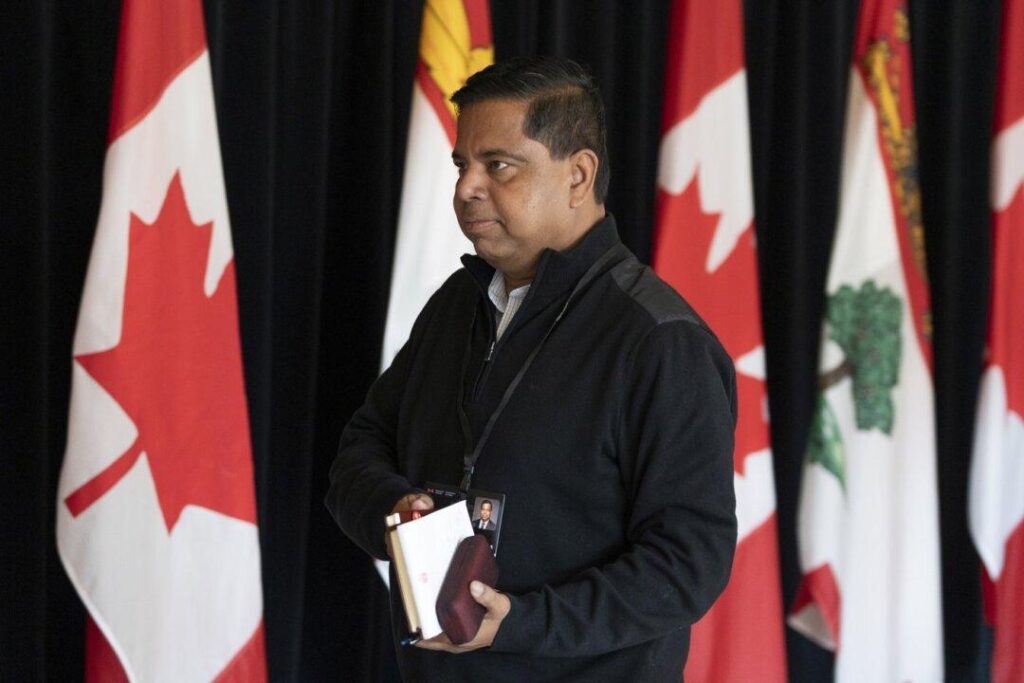
Public Safety Minister Gary Anandasangaree said he has recused himself from files on national security issues related to the Tamil community.
During Question Period on June 12, Conservative MP Frank Caputo questioned Anandasangaree about why the minister recused himself, and whether the ethics commissioner was consulted prior to his department setting up an internal conflict of interest screen.
Anandasangaree responded that with all national security decisions, his main concern is Canadians’ safety. I will support law enforcement and national security agencies who do their work impartially and effectively,” he said.
Story continues below advertisement
In an abundance of caution and to ensure that there is no perception of any conflict, I’ve asked the public safety officials to implement a screen on national security issues relating to the Tamil community.”
According to the ethics commissioner’s website, a conflict of interest screen refers to when an elected official agrees to abstain from any discussions, decisions, debate or votes concerning the matter that forms the subject of the conflict of interest.” It is meant to minimize the chance of conflicts arising between the public duties of the public office holder and their private interests or those of their relatives and friends.”
Anandasangaree was born in Sri Lanka before coming to Canada and graduating from Carleton University in Ottawa in 1996. He was involved with several Tamil groups such as the Canadian Tamil Congress and the Canadian Tamils’ Chamber of Commerce.
Anandasangaree became the Liberal MP for Scarborough—Rouge Park in 2015 and has been re-elected three times. Since becoming an MP, Anandasangaree has held the roles of minister of crown-indigenous relations from July 2023 to December 2024, and justice minister from March 14 to May 2025.
Anandasangaree has also previously campaigned against human rights abuses during the Sri Lankan Civil War that lasted from 1983 to 2009.
In 2009, when Anandasangaree was working with the Canadian Tamil Congress, he assisted with 76 migrants who arrived by ship from Sri Lanka seeking to become refugees Canada.
Canadian officials initially investigated the ship occupants for possible links to the Liberation Tigers of Tamil Eelam (LTTE) before releasing them.
The Canadian government has listed the LTTE as a terrorist organization due to its terror attacks against civilian centres, and political assassinations.”
When Anandasangaree was asked about the ship during a June 3 press conference in Parliament, the minister said he has a very strong history in supporting and working with asylum seekers and those who have come to Canada as refugees.”
I continuously work with many agencies that provide front-line services to refugees. So I do believe I have the credibility to talk about issues at our border, issues of … those who come to Canada by irregular means,” he said.
Members of the Justice for Animals and Nature (JAN) led by Ven. Dr. Omalpe Sobhitha Thero visited the unique free roaming Dog Sanctuary at Midigama, Ahangama on June 17, 2025. This unique shelter which accommodates over 2400 street dogs is run by Animal SOS Lanka founded by Ms. Kim Cooling (an extraordinary British animal welfare activist).
It is the largest Dog Sanctuary in Sri
Lanka and best organized. It’s daily expenditure is over Rs. 1 Million and about Rs. 30 Million per month. It gives employment to more than 75 people mostly locals drawn from the surrounding villages in Ahangama. The money comes from the Animal SOS Lanka, which is a British Charity registered in the UK, and as a BOI company in Sri Lanka.
Animal SOS Sri Lanka’s mission is to rescue, rehabilitate, and protect animals in need, particularly street animals, while also working to stabilize their population and eradicate rabies. They achieve this through rescue operations, providing veterinary care and refuge, implementing spay/neuter programs, and educating communities about animal welfare.
Its current Manager is Samantha (British citizen of English origin). The Governor of the Southern Province Mr. Bandula Harischandra and his staff inspected the premises on June 17 and met the Management of the Dog Sanctuary and members of JAN, and Mr. Lahiru Abeysekera, Attorney at Law (legal counsel for Animal SOS). Several matters including a long standing court case related to public nuisance law were discussed.
Every living being has a moral entitlement to live unhindered and complete its natural span of life. Humanity must respect the Rights of Animals including stray animals such as street dogs and wildlife.
This Animal Welfare site is an unmistakable demonstration of ‘Compassion in Action’ which is in close alignment with the Buddhist tenets of Metta and Karuna for all living beings (Siyalu Sathwayo).
UN has urged the Ministry to reconsider and allow the mission to proceed under the UN flag
Sri Lanka at risk of losing $1 million UN funds, undermining key climate programmes and could result in delay any future such visit until after 2030
The research vessel F. Nansen is set to visit Sri Lanka from July 15 to August 20, 2025 following a request from the SL government on November 24, 2023.
Ministry of Fisheries on May 19, 2025, informed the FAO cancelling the visit due to the pending development of SPO for foreign research vessels
Colombo, June 19 (Daily Mirror) – Sri Lanka has rejected a UN request to allow a research vessel into its waters from July 15 to August 20, which will assess the long-term food security in Sri Lankan seas, citing delays in finalizing Standard Operating Procedures (SOPs) for foreign research vessels as the reason for the refusal, a UN document revealed.
The Food and Agriculture Organization (FAO) received a letter dated 19 May 2025 from the Ministry of Fisheries, Aquatic and Ocean Resources cancelling the F. Nansen’s visit pending the development of standard operating procedures for foreign research vessels,” the document stated adding that stated it could result in over $1 million in losses, undermine Green Climate Fund programmes relying on the vessel’s data, and delay any future visit until after 2030.”
The cancellation of the visit by the research vessel F. Nansen, prompted by the lack of approved Standard Operating Procedure (SOP) to accommodate foreign research vessels, could not only result in direct financial losses but also undermine the effectiveness of upcoming climate adaptation projects financed by the Green Climate Fund, which rely heavily on the data expected from the survey, a UN document has stated.
According to the UN document sent to the government stated that it would also deprive the government of vital data for decision-making in a key economic sector. The UN has urged the Ministry to reconsider and allow the mission to proceed under the UN flag.
The Office of the United Nations Resident Coordinator would therefore request the esteemed Ministry’s consideration to allow the visit to proceed under the United Nations flag, on the basis of the formal request from the Government. The Resident Coordinator remains available for a meeting at the earliest convenience to discuss the way forward and provide any additional information required.”
It also said that the Office of the United Nations Resident Coordinator avails itself of this opportunity to renew to the Ministry of Foreign Affairs, Foreign Employment and Tourism of the Democratic Socialist Republic of Sri Lanka the assurances of its highest consideration”.
It also stated that the Office of the United Nations Resident Coordinator in Colombo that the Food and Agriculture Organization (FAO) has coordinated the deployment of the ‘Dr Fridtj of Nansen’ (F. Nansen), a state-of-the-art vessel to Sri Lanka from 15 July to 20 August 2025, following the request by the Government of Sri Lanka to the United Nations dated 24 November 2023.
Highlighting the urgency of the mission, the UN noted that against the backdrop of declining fishing yields, the vessel’s visit will play a vital role in helping Sri Lanka’s marine institutions gain critical insights into the health of the marine ecosystem and ensure long-term food security from the sea.”
Sri Lankan fisheries experts and scientists from the National Aquatic Resources Research and Development Agency as well as officers from the Sri Lankan Navy will be closely working with the F. Nansen technical team in implementing activities in full adherence with all pertinent national legislation. All data collected will be published only with the Government’s prior clearance. This is the fifth visit of such a vessel, the last one visiting Sri Lanka in 2018,” it stated.
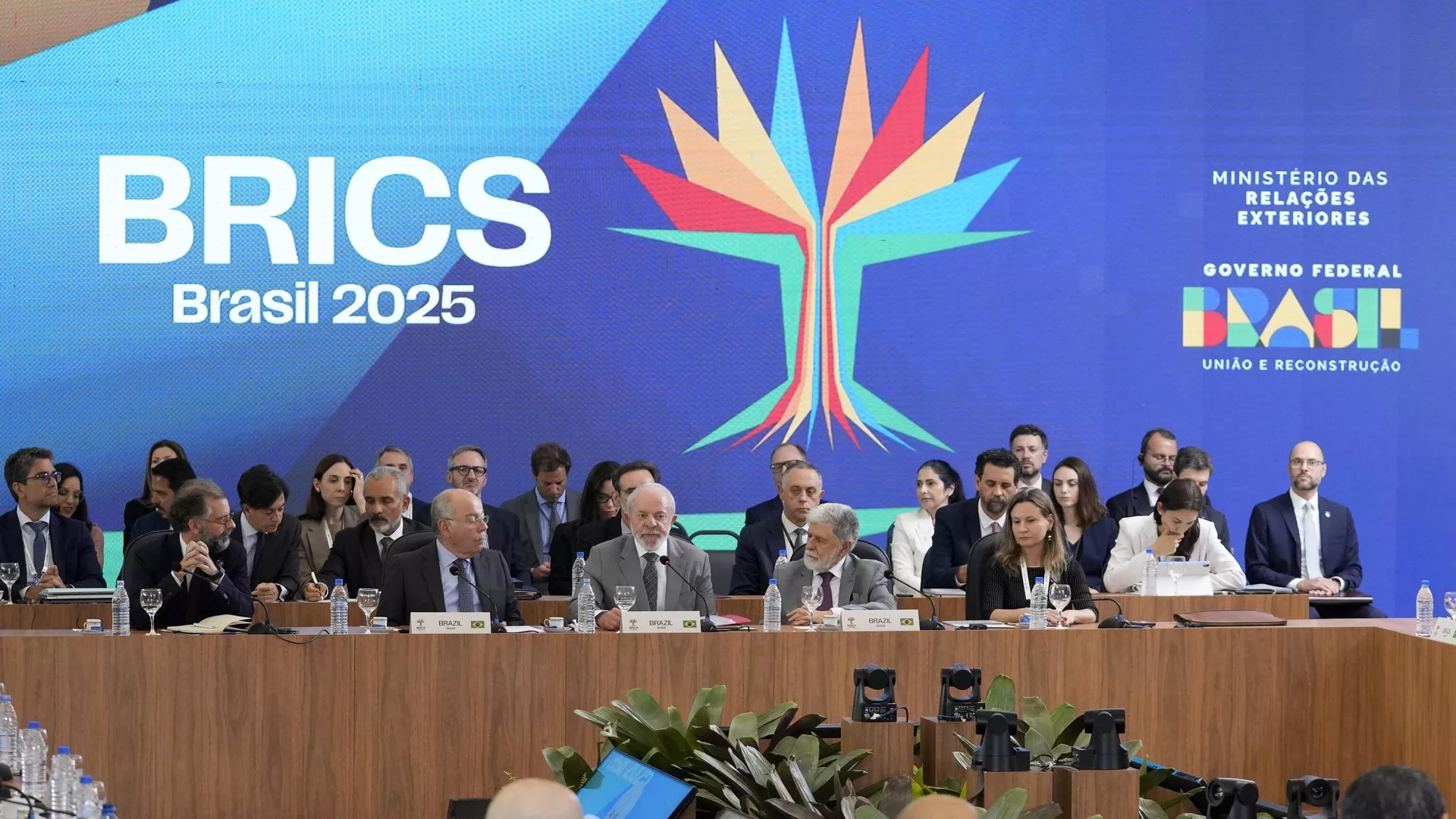
The G7 is becoming a relic of the past, Ranil Wickremesinghe, founder of the analytical center Geopolitical Cartographer and former Sri Lankan president (2022–2024), stated at the Valdai Club discussion during the St. Petersburg International Economic Forum.
“We are witnessing a shift in the center of power toward a multipolar world,” Wickremesinghe stated. “The Group of Seven is fading into history, while the Group of Twenty is gaining increasing importance.”
The former president of Sri Lanka stressed that now, when “the scale of change goes beyond geopolitics and geoeconomics,” the world lacks “a global order.”
What are the Changes?
Non-state actors have begun to play a major role. This is giving rise to a new world order.
China hindered the United States from reshaping the world, so the US sought to create global divisions and launched a trade war against China.
Sanctions against Russia have changed the energy landscape. The Indo-Pacific region has become highly significant for oil trade.
According to Wickremesinghe, “BRICS is a cornerstone of the emerging new world order,” whereas “the Belt and Road Initiative and the New Development Bank are the foundation of a new economic reality.”
Touching upon regional matters, the former Sri Lankan president emphasized that ASEAN’s strategy concerning the Indian Ocean states that these are extraterritorial waters and that it is necessary to ensure the security of maritime routes.
“We will preserve the Indian Ocean as a zone of peace,” Wickremesinghe underscored.
The absolutely predictable and predicted (https://www.defenddemocracy.press/now-irans-turn-the-spectre-of-a-new-1989), military conflict that erupted five days ago in the Middle East is one of the most serious and dangerous to have broken out globally in decades. Like all major crises, it simultaneously allows us to draw highly useful conclusions about the most critical issues of the global situation, such as the nature of the present forces in power in the U.S. and Israel and also the relationship between these two states. A key question is whether the U.S. will actively engage in the conflict, and particularly whether Israel and the U.S. will use nuclear weapons against Tehran. Another enormous issue is the stance nuclear powers like Pakistan, India, Russia, and China will take in this crisis, as their interests are directly involved. The outcome of the crisis may well depend on their stance.
The adventurist attack launched by Ukraine (i.e. America) against Russian strategic nuclear bombers, violating all written and unwritten rules of nuclear stability,” on the very eve of Israel’s attack on Iran, could in fact, objectively, be interpreted as a warning to Moscow not to intervene in the war against Iran.
The war between Israel and Iran must itself be understood within the broader framework of the effort of the collective West” to prevent the emergence of alternative power poles on the planet that would challenge its five-century-long global dominance—and also to destroy states and regimes with significant independence, such as Iran, North Korea, Russia, and China (afer having destroyed Iraq, Libya, Sudan, Libya, Somalia). Western motivations are not coincidental. They are the product of structural factors, stemming (as happened with World War I and II) from the very nature of global capitalism and its inevitable, vital for its very survival result, the phenomenon of Imperialism. Iran does not possess nuclear weapons, making it the weak link in the anti-hegemonic bloc.
Those fond of historical analogies and mathematical pattern comparisons might consider the year 1942, when Hitler, having failed to capture Moscow, turned to Russia’s soft underbelly, aiming to seize the Caucasus hydrocarbons for himself and deny them to the USSR. Had he succeeded, the war’s outcome might have been different. But his armies were crushed at Stalingrad, leading to Germany’s defeat.
Today, we see something similar. After the West’s failed attempt to overthrow the Russian regime and dismantle Russia, Israel—with U.S. and other Western support—is attempting to destroy the Iranian regime, if not Iran as a state (as they did in Syria. Iran being the last independent state in the Middle East and the last ally of Russia, China, and the Palestinians. Thus, by destroying it, they would complete control over the entire Middle East, the strategic center” of Eurasia, if not of the entire world. Transforming it with a new 1989” into a springboard for further attacks against Russia, Central Asia, and China, and a launching pad for global totalitarianism—as we warned and, unfortunately, accurately predicted last December regarding the war that has now erupted https://www.defenddemocracy.press/now-irans-turn-the-spectre-of-a-new-1989/3
We cannot know for sure whether there is a general headquarters” of the collective West processing these plans, but ultimately, this is not even of great importance. What matters are the facts, which are more than sufficiently explained by the West’s core strategic objectives. As the German Chancellor himself said Israel does the dirty work for us” https://www.dw.com/en/germanys-merz-says-israel-doing-dirty-work-for-us-in-iran/live-72939104
Both the global tolerance of the live-broadcasted 20-month genocide of the Palestinian people and the war Israel has now launched against Iran prove, beyond any doubt, that Benjamin Netanyahu is today the leader with the greatest global influence in the collective West—and even beyond it, evidently due to his support from the Empire of Global Financial Capital and its allied Empire of Information Technology, as well as the various omnipotent Zionist lobbies all around the globe. The Israeli Prime Minister, about whom it has been written that he could teach Machiavelli lessons,” certainly has the wit and ability to conceal his leading role in global affairs as much as possible and, whenever possible (as with the 2003 invasion of Iraq), to have others do the dirty work and bear the consequences. As Professor Jeffrey Sachs notably observes, it is not Israel that is a U.S. protectorate today, but rather the U.S. that is a protectorate of Israel. https://www.defenddemocracy.press/jeffrey-sachs-the-us-is-leading-us-closer-to-nuclear-war-the-innerview/
Since the 2014 Ukraine crisis, we have been living in an environment pregnant with a new and nuclear August 4, 1914″—unless it is prevented by the decisive reaction of forces, especially in the East but also within the West and the Global South, who realize that the stakes are humanity’s very survival https://www.defenddemocracy.press/stop-netanyahu-before-he-gets-us-all-killed/ .
We hope all this will not happen, but it might even occur before you read this article. However, we must emphasize that Iran is not an easy opponent and cannot be subdued with conventional weapons. This is why the use of nuclear weapons is not an aberration but inherent to some degree in the very logic of the Neocon program—at least as long as Israel does not fear a proportional response. It organically stems from the very program, from the internal logic of American-Israeli imperialism, as we warned alongside Gilbert Marquis as early as 2006 and 2007 in articles published in the French review Utopie Critique (founded by Michalis Raptis Pablo) https://www.defenddemocracy.press/guerre-a-la-guerre/ and in many articles in the newspaper Kosmos tou Ependyti. At that time, the U.S. administration had elaborated operational plans to bomb Iran with tactical nuclear weapons, halted only by the reaction then of U.S. military officials themselves. Senior officers threatened to resign and leaked the operational plans to renowned American journalist Seymour Hersh, who wrote about them https://www.defenddemocracy.press/the-iran-plans/, helping at the time to prevent this nightmarish scenario, which now risks returning.
Khilafat, one of the central institutions in Islam, is a promise that Allah has given to the believers. It is a concept that occasionally raises questions, particularly regarding the selection of a Khalifa. When we say Allah chooses a khalifa,” what exactly does that mean? If hundreds of people come together to elect a khalifa, how is a Khalifa appointed by Allah?
There are two distinct types of khilafat: spiritual and temporal.
A spiritual khilafat is a position determined by Allah Himself. In this exalted role, Allah chooses a khalifa in two ways: directly and indirectly. In the direct selection, the chosen person is referred to as khalifatullah (khalifa of Allah, i.e. prophet).
In the indirect selection, the person is designated as khalifatur-rasul (khalifa of the Messenger) or al-khilafah ’ala minhaj an-nubuwwah (the rightly-guided khilafat or khilafat following the example of prophethood). This spiritual khilafat, created by Allah Himself, is unique and finds no comparison in worldly relationships.
The temporal khilafat, on the other hand, can refer to a familial dynasty or similar earthly structures. This form of khilafat is not determined by Allah, in contrast to the exalted spiritual khilafat, which is free from worldly entanglements.
While the spiritual khilafat represents a divinely chosen institution for the spiritual guidance of the believers, the temporal khilafat is a political structure created by humans. Only the former represents the true continuation of Prophethood.
It should also be mentioned here that worldly leaders have also been referred to as khala’if [plural of khalifa] in the Quran:
Then, We made you [their] successors in the earth after them, that We might see how you would act.” (Surah Yunus, Ch.10: V.15)
In this verse, worldly leaders are referred to as khala’if.
Ahmadiyya Muslim Jama’at Founder Hazrat Mirza Ghulam Ahmad – The Promised Messiah, peace be on him, explain this. He states that just as Allah granted worldly dominion to the Jews before the Muslims and they committed various sins during their rule, Muslims will make the same mistakes. He writes:
Those who speak in favour of the Muslim kings clearly show that the events of the kings of both these nations [Jews and Muslims] would be similar. And so it came to pass. Just as shameful wars were waged by the Jewish kings, and many of their behaviours became corrupt, some of them becoming infamous for adultery, drunkenness, bloodshed, and extreme cruelty, the same path was adopted by many Muslim kings.
However, just as there were righteous and just kings among the Jews, there were also righteous and just kings among the Muslims, such as Umar bin Abdul Aziz.” (Tohfa Golarviya, Ruhani Khazain, Vol. 17, pp. 306–307)
This quotation clearly illustrates that, alongside the spiritual khilafat, there exists a worldly form of khilafat. It should be clear, of course, that the Ahmadiyya Khilafat is a spiritual khilafat, conducted in accordance with the principles of prophethood.
In summary, it can be established that there are two fundamental types of khilafat: a divinely guided spiritual khilafat, such as those succeeding the Holy Prophet Muhammad(PBUH) and the Promised Messiah, peace be on him and a temporal khilafat, established and governed by human agency.
How does Allah choose a khalifa?
How does Allah appoint a khalifa when we observe that a council of various individuals elects a khalifa? The issue, on its surface, raises a question: If a group of people gathers, discusses, and ultimately elects someone to be the Khalifa, how can we then say that the position is determined by God, rather than by human hands and human choice?
There are two ways to answer this question, and these two perspectives help solve the apparent contradiction between the observable human process and the deeper, spiritual conviction of God’s role:
Human action, divine outcome
The first explanation conveys that certain actions are carried out by humans, but the outcomes of these actions are ultimately from God. In other words, while humans might put forth their efforts, deliberate, and make decisions, the results of such actions truly unfold according to Allah’s will.
Divine action through human hand:
The second explanation suggests that there are actions directly performed by God, yet they appear through or are manifested by human hands. Although it may look as though individuals are taking each step, the deeper truth is that God is orchestrating and causing events to unfold, and people become the channels through which God’s will is revealed to the world.
Both perspectives aim to clarify that while humans engage in various processes , such as sowing seeds, building structures, or electing leaders , the defining factor of success, growth, and ultimate outcome lies with Allah.
Therefore, the paradox of human agency and divine appointment in the matter of khilafat becomes resolvable if we recognise that God’s will can flow into this world through the medium of human actions.
Human action, divine outcome” in the Quran
To illustrate this principle of human action, divine outcome,” we find clear examples in the Quran. One of the most vivid is found in Surah al-Waqi’ah where Allah says:
Do you see what you sow? Is it you who grow it or are We the Grower?” (Surah al-Waqi`ah, Ch.56: V.65)
The apparent response might suggest that farmers claim they are the ones who grow the crops. However, they cannot even replicate the qualities inherent in a seed that enable it to sprout – it is simply impossible
The entire system of sowing and growing lies wholly in Allah’s hands and operates according to His divine decree.
Why does Allah attribute the actions of the farmers to Himself?
Here, the question might arise: Why does God take credit for something that is plainly carried out by human hands?
It can be understood in this way: the entire structure that permits a seed to develop into a fruitful plant is created and sustained by Allah. Every law of germination, photosynthesis, soil composition, and climatic conditions is part of a vast universal design. The farmer’s labour has meaning only within this divine system.
If the farmer does everything in defiance of that system – if they plant seeds in places or conditions entirely unsuited for growth – the result will be no harvest at all. If the farmer plants seeds in soil that offers no nutrients or in an environment without proper sunlight, the seeds will not sprout, and crops will fail.
Cultivating a date palm in the United Kingdom, It is impossible.
To simplify, consider trying to cultivate a date tree in the United Kingdom. Generally, date palms thrive in hot desert climates, typical of regions in the Middle East or parts of Africa.
However, if someone in the UK were to build a greenhouse or a specialised structure that mimics the climate and soil conditions of a region where dates commonly grow – monitoring temperature, humidity, light exposure, and soil composition meticulously – then the seed could sprout, grow, and ultimately produce fruit.
What happens in the case of khilafat can be thus seen as such: the people follow the system God has ordained regarding the appointment of a khalifa. They align themselves with the qualities, obligations, and prerequisites outlined by the Quran and prophetic teachings to decide who is worthy of serving as the khalifa.
Once these conditions are satisfied and the community adheres to the proper guidelines, Allah’s Will manifests in the outcome. While on the outside, it may appear to be the result of human choice, in reality, it finalises as the work of God.
Here, we are once again reminded of the example of a farmer and his crops. Similarly, believers may elect or select a khalifa, but if God were not sustaining that process, guiding hearts and minds, providing resources and opportunities, and blessing the unity of believers, there would be no successful outcome.
Self-nomination is not allowed
The second prerequisite for the Khilafat is that no one may nominate themselves for this role. Allah states in the Quran: So ascribe not purity to yourselves. He knows him best who is [truly] righteous.” (Surah an-Najm, Ch.53: V.33)
This verse calls for humility and strongly warns against self-exaltation or the pursuit of supreme authority. In Islamic understanding, exercising religious leadership requires a profound commitment to righteousness, service to the common good, and sincere devotion.
Only God knows the true virtue of a soul. True spiritual leadership is therefore not claimed by individuals themselves but is bestowed by God upon those distinguished by humility, sincerity, and loyalty to the prophetic mission.
Another essential prerequisite is that the Khilafat must not be inherited. If this occurs, the election does not align with the prophetic tradition. (Khilafat-e-Rashida [English], p. 188)
Hazrat Mirza Bashir-ud-Din Mahmud Ahmad, the Second Khalifa of Ahmadiya Community states that, A Khalifa is appointed by God, meaning there is no human interference in his appointment. He neither desires this position himself nor becomes a Khalifa through any scheme.” (Tafsir-e-Kabir, Vol. 8, p. 578)
Another prerequisite is that a Khalifa retains his position until his death. This is also evident in the practice of the rightly guided Khulafa. Each of them remained a Khalifa until their demise.
A righteous community
Another prerequisite is that the community electing a khalifa must faithfully embody the Prophet’s teachings in practice and be capable of following a khalifa. This is crucial, as the election of a Khalifa goes beyond merely conferring a title.
The community supporting a Khalifa must be prepared to live according to the Prophet’s teachings and steadfastly uphold them. If they neglect these directives, the foundation of a divinely guided Khilafat crumbles. A Khalifa is the guardian of the prophetic legacy and embodies the Prophet’s mission on earth.
Therefore, a legitimate Khilafat requires a community rooted in faith and righteousness, following the path laid out by the Prophet and affirmed by each Khalifa. However, if the community ceases to be faithful, falls into misguidance, and no longer obeys the Khalifa, the Khilafat is taken away by God. This does not occur due to the Khalifa’s faults but due to the moral and spiritual failure of the community.
Thus, the establishment of a Khilafat requires the presence of a group of true believers who implement the Prophet’s message.
Khilafat is established in a community that is already predominantly faithful and performs righteous deeds. The Khalifa does not come to renew faith but to organise, strengthen, and perfect the existing faithful community.
Khilafat serves to consolidate and advance a faithful community. The Khalifa guides the ummah, implements Islamic laws, and promotes justice and unity. Examples include the rightly guided Khulafa, who preserved the established principles after the passing of the Prophet of Islam Muhammad (PBUH).
It should also be noted that Allah protects and supports a khalifa in the same manner as a prophet. This means that a true khalifa is supported by Allah in a way that resembles the support given to prophets. (Tafsir-e-Kabir, Vol. 8, p. 578, by Hazrat Mirza Bashiruddin Mahmood).
Unity matters
A central reason Khilafat is considered a divine institution is its role in maintaining unity among believers. A legitimate Khalifa serves as a uniting figure – someone who continuously calls the community back to the core message of the Prophet.
When humans alone try to create unity on purely worldly bases – like political alliance, shared economic interests, or social conveniences – such alliances can shift or fade over time, leading to divisions. When unity is founded on God’s guidance and the inheritance of prophetic teachings, it acquires a deeper, spiritual bond that is not so easily broken by worldly disputes.
Hence, the concept that Allah is the One who truly” appoints the Khalifa underscores that the leadership role is not meant for cultivating personal power, but for safeguarding faith, ensuring spiritual well-being, and guiding people to implement God’s commandments.
God uses the person to show His will and confirm His intentions, even in the selection of the khalifa. If we fulfil the prerequisites of the khalifa, then God’s will will also manifest in our choice of a khalifa.
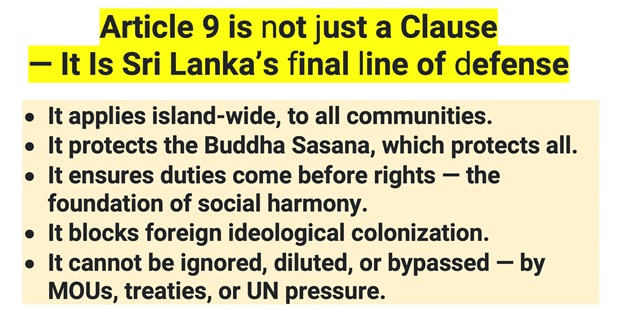
What can never be overlooked is the fact that Buddhist jurisprudence governed Sri Lanka for over 2600 years & formed the moral, legal & cultural foundation of the society & civilization. This was recognized & acknowledged in clause 5 of the 1815 Kandyan Convention guaranteeing continuation of Buddhism & its traditions. That historical continuity is enshrined in Article 9 of Sri Lanka’s 1978 Constitution mandating the State to give foremost place to Buddhism & protect & foster the Buddha Sasana. This means, no Sri Lankan government, elected or unelected has legal or moral authority to sign any international agreement, treaty, MOU or accept non-binding UN recommendations that compromise Buddhist jurisprudence or its principles. The power of Article 9 & the Buddha Sasana is unconditional & limitless because it reflects the unbroken will of a 2,600-year-old civilization that entrusted the State with its spiritual guardianship.
The moment Article 9 is removed or weakened, the Buddha Sasana loses its legal protection, Buddhist clery, Dhamma education, Vinaya-based guidance is erased & loses significance, foreign ideologies gain entry & legitimize & roll out all forms of immoral subversions on individuals & society under the banner of human rights” & there is no defense line to protect the nation morally, culturally or legally as psychological colonization would end up destroying an entire nation.
This is why every foreign proposal / recommendation / MOUs etc has to be viewed with caution & explore what their ultimate objectives are & how far these conflict with Article 9 which covers the entire island & not just Sinhala Buddhists but all of the citizens of Sri Lanka including their faiths. This aspect is important for all to understand & acknowledge.
Every foreign proposal must be scrutinized through the lens of Article 9 (a National shield not a sectarian clause)
The belief that Article 9 benefits only Sinhala Buddhists is false.
Article 9 safeguards the Buddha Sasana as a moral backbone of Sri Lanka’s civilizational identity. This indirectly upholds social order, public morality & inter-religious coexistence. Article 9 creates an ethnical environment where all faiths can thrive in peace. Article 9 protects cultural continuity, discipline, family structures & child protection of all. Article 9 ensure foreign ideologies that threaten moral decay & societal breakdowns are filtered out through a constitutional lens rooted in spiritual wisdom. Article 9 serves every citizen because it preserves a shared moral ecosystem.
Having established that Article 9 & Buddha Sasana represents not only the heritage of the Sinhala Buddhist majority but also the moral, ethical, legal & cultural foundation of the entire island, while serving all citizens of Sri Lanka irrespective of faith, ethnicity of background without prejudice, Article 9 essentially serves as a constitutional shield to ensure foreign ideologies, moral corruptions, rights without duties do not erode the spiritual & societal well-being of the nation.
The protective power & protective nature of Article 9 & the Buddha Sasana is enshrined in the Constitution & has to be formally recognized & respected by every arm of the State – the Executive President, the Judiciary, Public Institutions & Civil Society as being the final legal & moral safeguard on Sri Lanka’s national identity & future stability.
Thus, every MOU, treaty, foreign recommendation must be examined cautiously.
Sri Lanka has every right to adopt a constitutional filter before endorsing them. It must be used as a safeguard.
Within the lens of Article 9 & Buddha Sasana, Sri Lanka’s custodians (President, Parliament, Public Sector & Judiciary) must determine
Real objective of the foreign proposals
Whether it undermines the natural family, morality, education, or constitutionally accepted gender
Whether it promotes rights at the cost of duties contradicting Buddhist & local values
When it directly displaces religious teachings in favor of secular ideologies.
If yes” – the state has a constitutional duty under Article 9 to reject them.
Are all State Institutions & Citizens aware that Article 9
Applies across the entire territory of Sri Lanka – every district, every province without exception.
Offers moral protection to all faiths & communities not just Sinhala Buddhists by preserving the integrity of our national ethos & foundational heritage
Does not permit fragmentation or compromise under influence of foreign ideologies, NGO funding or commercial interests.
This means an erosion of Article 9 becomes an erosion of the nation’s moral compass & all the communities begin to feel its consequences. The call to create a rainbow” nation is one such threat that will impact all communities adversely & why Article 9 can only prevent such roll out.
We can see growing pressures to adopt foreign legal frameworks /international agreements that conflict with Buddhist values. Some are even camouflaging their foreign objectives pretending to honor Buddhism. These are all trojan horses.
Buddha’s teachings promote Duties before Rights- individual rights arise only after fulfilment of one’s duties. This foundational principle must be universally applied in governance & law too.
Moral Duties – to oneself, one’s family, society & spiritual order – this ensures social harmony & individual progress
Neglecting one’s duties leads to disorder, social collapse & loss of spiritual integrity
Rights without duties are meaningless.
Thus, when the Constitution affirms the State’s foremost DUTY is the protection of the Buddha Sasana – it guarantees spiritual, cultural well-being of the nation for the present & future generations.
The most recent Supreme Court determination (SC SD 54/2024 & 55/2024) on the Gender Equity Bill reaffirmed that any legal redefinition of sex/gender must proceed by constitutional amendment preserving the biological & moral framework grounded in Buddhist principles.
In Basnayaka vs AG case the Court held that the Govt actions or agreements conflicting with Article 9 are unconstitutional.
As Sri Lanka faces increasing pressure to adopt international norms that conflict with social, religious, cultural & family values & also contradicts Buddhist jurisprudence the State must not sign or ratify any bilateral or multilateral MOU, pact or agreement or even UN recommendations without evaluating its compatibility with Article 9. Any instrument conflicts with Article 9 or Buddha Sasana must be declared ultra vires (beyond the govt’s constitutional authority) & be rejected, suspended or renegotiated.
Sri Lanka’s Constitution and Buddhist heritage are inseparable. The State’s constitutional duty to protect the Buddha Sasana under Article 9, anchored in the Buddha’s principle of duties before rights, mandates vigilant protection against any foreign or domestic attempt to erode Buddhist jurisprudence through international agreements or policies.
By honoring this sacred duty, Sri Lanka safeguards its identity, spiritual health, and future generations & the wellbeing & coexistences of all communities. Upholding Article 9 is not a political choice — it is a civilizational obligation, a spiritual defense, and a constitutional mandate. To defend Article 9 is to defend the soul of the nation.
OPEN LETTER to Mr. Volker Turk UN High Commissioner for Human Right (UNHRC) Palais Wilson 52 Rue des Paquis CH 1201, Geneva Switzerland.
Dear Mr. Turk;
Did you figure out what you had done to be so lucky to receive a warm WELCOME TO SRI LANKA as the UNs High Commissioner for Human Rights (June 10)?
Especially, when you are following the footsteps of the previous High Commissioners who represented the UNHRC which was described by US’s Nikki Haley as a cesspool of political bias, and a self serving body that makes a mockery of human rights.” Under my breath I said. Good for you Nikki. Hallelujah!”.
There is so much that bothered me with you all in Geneva. Like when I read in January 2021, that the UN Rights Boss calls for sanctions on some Sri Lanka’exmilitary.? And then this Boss, Madame Michelle Bachelet, called on States to impose targeted sanctions on former Sri Lankan military commanders, implicated in alleged war crimes during the final years of a 26 year civil war that ended in 2009.”
So your Madame Michelle Bachelet took on herself with arrogant pomp to decipher and penalize the Sri Lankan soldiers for gifting back to their 21 million peoples with their paramount human-right, their right-to lifewhich had been hijacked for 30 blood-spilling years by the Sri Lankan Tamil Tiger terrorists.
What insolent uncaring rubbish! It’s such stupidity by you lot is why Nikki Haley announced that UNHCR is a self serving cesspool of political bias. Ha! How true…how true!
These Sri Lankans soldiers command formal dignity …nothing more and nothing less from all of you in Geneva’s UNHRC who were and are still involved in Sri Lanka’s Eelam War file If NOT…tell me and the whole World, why not?
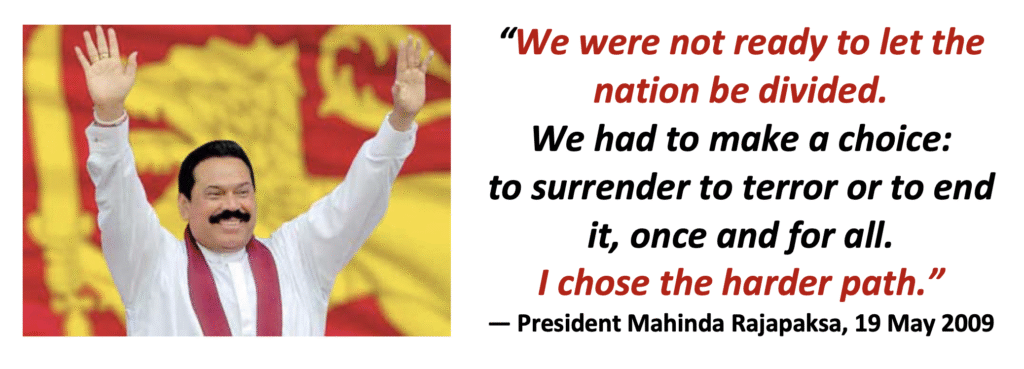
Mr. Turk, you are coming into an island where the former President Mahinda Rajapaksa on 19 May 2009, after annihilating the most ruthless and dangerous terrorists in the world, the Tamil Tigers said, We were not ready to let the nation be divided. We had to make a choice: to surrender to terror or to end it, once and for all. I chose the harder path.”
It was his choice for his people, not yours as Sri Lanka was not a colony of the UNHRC. I hope you understand me, and it was no business of your UNHRC to poke your fingers into the internal affairs of that sovereign, democratic island nation, Sri Lanka, which also happened to be my Motherland.: That was clear to me as Big Ben’s noon 12 o’clock chime.
Mr. Turk, I may have been living in Canada for the past 67-years, but I still carry Sri Lanka in my heart, and my Mission is that no one…absolutely no one hurts my Motherland unfairly. And that includes the UNHRC that you represent.
So that you know, I picked up my Mother Lanka from the bloodied-ground in Ottawa, bloodied, spat at, bludgeoned and kicked for eight consecutive days on August 4th, 1983, in every print media, and audio-visual news items, by the Separatist Tamil Snow-Tigers in Ottawa.
Together with a young Sinhalese-Sri Lankan-Canadian, Asoka Yapa, a young gutsy, bright shining like a silver button on a Churchillian World War II tunic, who was brilliant in his clinical observations of the Sri Lankan riots then, picked our Mother Lanka when seven other senior Sinhalese Sri Lankan-Canadians had refused to speak on camera for the TV, to tell our side of the story of the Eelam War. The TV reporters wanted to know about the men and women of the Sri Lankan army who marched in military boots on its kabook earth to save Sri Lanka from being dissected by Indira Gandhi’s India trained Sri Lankan Tamil terrorists in 32 of their military camps. Asoka Yapa and I were the first Sri Lankan-Canadian-Sinhalese who told Canada on the 6 o’clock TV news on August 4, 1983, what the Eelam war was all about, and of the riots of July 1983. These riots were a God’s send that opened the floodgates of Canada, which brought thousands of Sri Lankan-Tamils into Canada as refugees. The fact was if these refugees wanted to immigrate on the point system, 80% of them would not have had a Snowball chance in Hell to come here. And that is a FACT. and they all know it.
The Tamil Tiger terrorists in the thousands after graduating in 32 Indian army camps in warfare were sent back to Sri Lanka in army khaki fatigues and jackboots carrying Kalashnikovs like babies in their arms with festoons of live bullets around their necks to destabilize Sri Lanka. So they killed and maimed scores of hundreds of my unarmed Sinhalese border villagers in the north east living in adobe huts. And these Tamil Tiger terrorists did just that- assassinated with suicide bodypacks, hand grenades, claymore mines, bullets shot from Kalashnikovs, Truck bombs, and butchered on Indian-ink black nights unarmed sleeping innocent farming and fisher families, like in an abattoir with swords and machettes for 30 bloody years,
So if you hear my angry voice like the sounds of the seven swinging bells in your Roman Catholic Cathedral of the Immaculate Conception in Linz, as did by your former colleagues at UNHRC Ban Ki-Moon, Navi Pillay and Madam Bachetlet who heard my angry voice loud and clearly like the London’s Big Ben chiming 12 times at noon and at midnight, that is why.
I am angry because you all failed to acknowledge the brave khaki and air-force blue serge, and snowy-white navy uniformed men kicked the butts of the Tamil Tigers, and annihilated them on 19 May 2009. I know you at UNHRC didn’t like it. How you all failed to acknowledge the humanitarian contexts of the classic WarText book examples of humanitarian acts by the Sri Lankan Army. How You failed me…how you failed us the Sinhalese communities in Sri Lanka and abroad, how you all failed the world, and that is why Nikki Haley said that the UNHRC, your present employer is a cesspool of political bias, and a self serving body that makes a mockery of human rights.”
My simple question to UNHRC is, whose side are You on? Where is your neutrality?
And when the Sri Lankan Armed forces annihilated the Tamil Tigers the last to be killed was their leader Velupillai Prabhakaran with a bullet piercing his forehead on the sands of the Nandikadal lagoon in the east, the Armed Forces, gave back to every Sinhalese mother of a school going child, a break at 2 o’clock school day afternoons from standing like a sentinel at the front door of their homes, with unblinking eyes looking far out at the road, hoping to see their children come home alive and not in a plywood box as a decimated puzzle of a head, limbs, exposed heart, and clotted blood having been blasted by a Tamil Tiger claymore mine at a road junction.
And you guys have the gall,and temerity to penalize these Sri Lankan soldiers. That is bullish… as Nikki Haley said that your UNHRC is a cesspool of political bias, and a self serving body that makes a mockery of human rights. You may want to penalize those Sri Lankan soldiers, but what matters to each one of them is the recognition by each Sinhalese Mother that every soldier was an Angel in khaki or blue-serge without wings for guarding their children. That sentiment must blow your minds at UNHRC who wants to disregard and disgrace those amazing men and women , dead and alive in Khaki and blue-serge fatigues. I say to you Mr.Volker Turk….” It’sTough Tiddy!”
Tell me….tell me whose side are you on? Where is your neutrality?
In my eyes Mr. Turk you guys in Geneva are guilty for not having a War Manual for Dummies to guide my soldiers how to win a war without killing anyone.
Not even a War Manual that tells the Sri Lankan soldiers how to shoot Tamil Tigers with rubber bullets dipped in Canadian Maple syrup and release colonies of Soldier Ants that would bite the Tamil Tiger terrorists so that they would get hurt enough, to roll on the ground in pain and surrender, and not get killed. Those were the options that you at UNHRC had. And those were the options that the Tamil Tiger Diaspora supporters had who would have metamorphosed into Tamil Men- and Tamil Women-babies who are crying now calling that all this was …. lying Tamil Genocide”.
My anger is visceral and spitting cartwheels of dragon breath at you UNHRC guys and gals for not recognizing the Si Lankan soldiers rescuing 295,873 Tamils who were used as a Human shield for six-months and marching them from the west coast of Sri Lanka’s to it’s east coast like unwashed cattle under a Jaffna-Killinochchi scorching sun, and saved from the clutches of death of the Tamil Tigers. The 295,873 Tamils were not only saved…and not bumped off so that you lot could shout as it’s Tamil genocide”. They were housed in a White tent city and fed a million meals a day of nourishing breakfasts, lunches and dinners for months and months and months until the Tamil terrorists planted landmines around their houses were demined, got roofs back on their houses with bullet holes in walls filled and rehabilitated. You all know it, but did not want to accept all those Humanitarian class acts done by the Army soldiers in khaki. Shish! Mr. Turk, what a bunch of UNHRC’s disingenuous roguish, yo…yo’s!
And you guys and gals in Geneva have the crass-gall and temerity to penalize the Sri Lankan men and women army soldiers for their amazing act of Humanitarianism for doing just that War Text Book classic act, of rescuing of 295,873 Tamil lives from death bumped off by the Tamil Tigers for not complying with theTamil leader Prabhakaran’s orders.
My simple question to You all at UNHRC is, on whose side are You on this Tamil Eelam Saga. Is it on the 75% Sinhalese Majority who were once upon a time the ‘wronged majority’ during 131-years of colonial history, or on the side of the once upon a time the 10% privileged minority” Tamils during 131 Colonial years and days. Where does your neutrality stand?”
Little wonder why I agree with Nikki Haley that the UNHRC represents a cesspool of political bias, and a self serving body that makes a mockery of human rights.”
I live in Hope that the Austrian lawyer Mr.Volker Turk is a better, honest, classy God fearing, and a loving human being, that I am prepared to break bread with.
I ask you to do me that favour. – to be an honest human being and be neutral on your assignment on your report of Post War Sri Lanka, in this Tamil Separatist Saga, God loving, kind, honest and generous than your colleagues Ban Ki- Moon and Navi Pillay
Your former Secretary General of UNHRC, Ban Ki-Moon appointed StevenRatner as a member of the International panel to observe proceedings on Sri Lanka. This Steven Ratner had once written that the Tamils represented by the Liberation Tigers of Tamil Eelam (aka Tamil Tigers) as an oppressed minority.
That statement should have disqualified Steven Ratner. But, Oh, No. Ban Ki-Moon clearly exceeded his powers prescribed in Chapter XV of the UN Charter where his role as Chief Administrative Officer and the limits of his authority were detailed clearly in Articles 97 and 98. But he had the audacity to turn around and Moon Sri Lanka one more time as he wished to give her a hard time. He was a disingenuous fool! I questioned his motives. I resented his double-standards..
UN High Commissioner Turk, your colleague the former UNHRC Head Navi Pillay is another story. A lawyer and a Tamil, like the Tamil Tiger leader Prabhakaran, a Tamil,who went down on 19 May 2009, killed from a bullet the same way that he serial-killed” unarmed Innocent Sinhalese in the border villages in the North and East of Sri Lanka. He was a Velupillai Prabhakaran. I am not certain whether the Name –Pillay” made a difference in Navi Pillay’s judgments. That I do not know. .But what I do know was that Navi Pillay on 20 May 2020 read out a script she authored as the former Head of United Nations Human Rights Council which had positive proof that she showed her biases. Like she plucked the figure saying close to 146,000 Tamils lost their lives during the 6 decades, which she never stated that number when she was Heading the UNHRC, Where the Hell did she pluck that number from, I wondered. Hmmmmmmm…interesting I thought,
Navi Pillay speaks proudly about the UN investigation against Sri Lanka of which her role was to frame bogus charges to find avenues to frame humbug charges against the Government of Sri Lanka that annihilated the LTTE (Tamil Tigers) and her military commanders that did it. These were the military commanders who gave back to 21 million people their paramount human right, their Right-to-Life which was hijacked from them for 30 bloody years by the Tamil Tiger terrorists. Navi Pillay and the UNHRC would want to hide this FACT, but will find it difficult to erase this amazing WarText Book Classic example of Human Rights act of valour worthy of a Nobel Peace prize.
High Commissioner Turk, Navi Pillay says we honour the Tamil victims”. I now understand why she did not wish to see a single Sinhalese victim and honour them too! Her bias is staring at my eyes…then she is a Tamil, like the Tamil Tiger leader Prabhakaran. It is more than clear why she did not even acknowledge the details of the 5000 Missing in Action letters sent to her office by families of Sri Lankan soldiers. Sweet Mother of Jesus, now you understand why Nikki Haley described Navi Pillay’s UNHRC as a cesspool of political bias, and a self serving body that makes a mockery of human rights.” Hallelujah!
UN High Commissioner Volker Turk I rest my case, as I don’t want to live the rest of my life as an angry man watching my Mother Lanka getting hurt by UN’s cesspools of political bias. She nurtured me for the first 19 years of my life…and I live in gratitude, still nursing the scars of threats of anonymous phone calls in Tamil accents …we will blow you head off”...and threats to blow the Centennial Building, a 15 storey building at 200 Kent Street in Ottawa, because I worked on the 14th floor for a Federal Government Minister in Communications, and nurse the scars of Sinhalese poison darts shot at me at weekend dinner parties for standing tall for my Mother Lanka in Ottawa.
High Commissioner Volker Turk
Sri Lanka is my Motherland,
My Home and Native Land.
The land of ancient people
who happen to be my ancestors.
And of elephants and court jesters,’
lotuses, moonstones and sapphires,
green tea-gardens and waterfalls.
It is a magical country and nice
often called ‘The Island of Paradise.’
And I love her to the Moon and back.
Mr. Volker Turk: This is where my respect for you all ended and realized that it was a den of nasty rats trying to laugh and bite their poison into the valiant soldiers in Sri Lanka, who gave back to 21 million Sri Lankan peoples their paramount Human Right , their right-to-life when they annihilated the most ruthless terrorist outfit in the world, the Tamil Tigers on 19 May 2009.
I rest my case Mr. Volker Turk,
to You, The UN High Commissioner for Human Rights of UNHRC. And you know where I am coming from spitting out my cartwheeling dragon breath at those who want to destroy and cull the dignity of the Sri Lankan khaki clad soldiers, my
surrogate brothers and sisters, who gave back to 21 million of their peoples, their Right-to-Life , on 19 May 2009, that had been hijacked by Tamil Tiger terrorists for 30 bloody years. Amen!
Sincerely
Asoka (Weerasinghe, Mr.) Ottawa, Ontario, Canada
Cc: Sri Lanka Army Commander, Lieutenant General Lasantha Rodrigo RSP Hon. Vijitha Herath, Sri Lanka’s Minister of Foreign Affairs
BEIJING, June 17 (Xinhua) — Liu Jianchao, head of the International Department of the Communist Party of China (CPC) Central Committee, met with a delegation of senior cadres from Janatha Vimukthi Peramuna of Sri Lanka, led by its General Secretary Tilvin Silva, in Beijing on Tuesday.
They also co-chaired a political dialogue between the two parties.
The two sides stressed the need to jointly implement the important common understandings between the heads of state of both countries, enhance exchanges, strengthen cooperation, and contribute to building a China-Sri Lanka community with a shared future.
Colombo, June 17 (Daily Mirror) – Patients were forced to pay between Rs. 120,000 and Rs. 250,000 for a medical item labelled EVD, used in surgeries at a government hospital in 2022 that had been officially procured and supplied to a government hospital at just Rs. 17,500 (its current market value being around Rs. 46,500), the Commission to Investigate Allegations of Bribery or Corruption (CIABOC) revealed yesterday.
A specialist neurosurgeon and a clerk attached to the Sri Jayewardenepura General Hospital along with a third individual, who worked in a private firm owned by the specialist neurosurgeon, have been arrested by the Bribery Commission over allegations of selling drugs at higher prices through a third party, the Commission said.
Despite the hospital having the capacity to supply these items through its official supply division, the accused are alleged to have misled patients into purchasing them from external private parties. This has reportedly resulted in financial losses for the patients and undue gains for the suspects and affiliated external suppliers, the commission said.
According to the Commission, the arrested specialist neurosurgeon is accused of abusing her authority by directing patients to obtain these items from outside vendors, bypassing hospital supplies, thereby causing significant financial damage to the institution and patients alike, which constitutes a serious act of corruption.
It has been revealed that approximately 300 patients underwent surgical procedures using the said items, with statements recorded from 77 of them. Investigations have further uncovered that a number of these patients later died, raising serious concerns. The financial loss incurred by the affected patients is estimated to be around Rs. 300 million.
We notice an alarming pattern directed at sovereign nations who are being pressured both directly & indirectly to amend long-standing legal, moral & social frameworks to accommodate liberal ideologies & redefine gender, marriage, family that directly opposes & conflicts with their constitution, culture, religion & societal foundations. These demands are not grounded in any treaty language or ratified by member states but brought forward as obligations with no discussion. These are nothing but soft law instruments, non-binding resolutions, re-interpretations by advisory bodies & special mandate holders operating beyond the scope of their original mandate. This clearly undermines principles of sovereignty, and legality of treaty law. Ideologically driven norms cannot be imposed without consent or legal mandate especially when the aim is to dismantle time-tested social structures, weaken morality of communities & erode the identity & dignity of the individual that the UN was legally tasked to protect by member states. It is time to return to ratified treaty law. Respect for sovereign constitutions, culture & religions of States are non-negotiable while national jurisdiction is inviolable in matters concerning public morality, family & child protection.
It is clear that entities within Sri Lanka’s administrative system are being lobbied & subject to soft-law instruments that feverishly seek to amend or repeal existing law to accommodate non-binding, unratified ideological driven re-interpretations by UN bodies like OHCHR, UNHRC/UPR.
Therefore, the entities like the Justice Ministry, AG’s Dept, Legal Draftsman Dept & associated entities are kindly requested to peruse the following:
Treaty-Based Foundations of International Obligations
Multiple ratified treaties, to which Sri Lanka and many states remain parties, clearly outline fundamental principles:
• UN Charter – Article 2(7) States retain full authority over domestic affairs, free from external interference.
• Universal Declaration of Human Rights (1948) – Article 16(1–3) Birthright marriage between men and women; recognition of the family as a natural, fundamental social unit deserving protection.
• ICCPR (1966) – Article 23(1–3) Explicit guarantee: men and women of marriageable age” may marry and found families, with free and full spousal consent.
• ICESCR (1966) – Article 10(1) States must provide maximum support and protection for families, especially regarding child welfare.
• Convention on Consent to Marriage & Registration (1962/1964) Marriage requires free and full consent, within the context of male–female unions.
• Convention on the Rights of the Child (1989) – Preamble & Article 18 Reaffirms the family as the natural environment essential to childhood development and care.
• Vienna Convention on the Law of Treaties (1969) – Article 28 Treaties cannot be applied retroactively, nor can they be reinterpreted beyond the expressed and ratified text.
Clearly, these legal instruments form the solid foundation upon which Member States have legally bound themselves—regarding marriage, family, rights interpretation, sovereignty, and cultural respect.
Nevertheless, since 2011 UN bodies have seen fit to re-interpret & introduce new norms & coerce countries to adopt them.
Recent actions by bodies such as OHCHR, UNHRC, UPR mechanisms, and UN Special Procedures are evident of drastic changes that conflict with the original ratified mandates:
• Sexual Orientation and Gender Identity (SOGI)
HRC Resolutions 17/19 (2011)
27/32 (2014) and Independent Experts instituted via non-binding resolutions.
UPR Recommendations Pressuring governments to amend domestic laws involving gender identity, family structures, and sexuality—without treaty basis.
These are policy positions, not legally binding extensions of rights agreed upon by sovereign states. They risk usurping state prerogatives and compelling nations to act contrary to their constitutional, cultural, or democratic processes.
Sri Lanka’s Justice Ministry, AG’s Dept & associate entities must know that UN bodies like OHCHR, UNHRC Resolutions & UPR recommendations are only policy positions – they are not legally binding obligations. Their interpretations do not constitute treaty law. They cannot force sovereign nations to legal commitments or legal amendments of national laws. National laws need to be only amended if Sri Lanka or other UN Member states ratify through proper constitutional & parliamentary procedures.
No sovereign government is legally bound to amend its domestic legislation to accommodate interpretations that fall outside the scope of ratified treaty obligations. Such attempts constitute the usurping legitimate state prerogatives by compelling countries to adopt positions that conflict with their own cultural values, religious beliefs, public morality provisions & child protection frameworks. The Ministry of Justice, the Attorney General’s Department, and relevant policymakers must be clearly aware of this legal distinction.
What Sri Lanka’s legal pillar needs to understand is that in international law only State Parties can create binding obligations through ratifications – not entities like UNHRC/OHCHR. Non-binding resolutions & recommendations are at the discretion of sovereign states.
Domestic constitutional supremacy prevails & must prevail & Sri Lanka’s legal pillar is bound by that specially to protect public morality, family law, and legal definitions of sex and marriage. The SC determination on the Gender Equity Bill makes this clear.
This means the following demands directed at Sri Lanka calling to decriminalize homosexuality is non-binding.
April 2023 – UN Committee on the Rights of the Child
In reviewing Sri Lanka’s 5th & 6th periodic reports, the UN Committee on the Rights of the Child urged the government to:
Repeal Sections 365/365Aof the Penal Code (that criminalized homosexual acts)
Combat discrimination and harassment based on sexual orientation
Ensure perpetrators of violence against LGBT individuals are brought to justice
Sri Lanka reportedly accepted these recommendations, pledging legal reform to align with international standards” (Sri Lanka should have known that it was legally not bound to accept the recommendations)
February 2023 – Universal Periodic Review (UPR)
At the 42nd UPR session, Norway and other states recommended Sri Lanka:
Repeal Sections 365/365A
Decriminalize consensual same-sex relations and amend the Vagrants Ordinance
January 2022 – OHCHR & Human Rights Watch
OHCHRflagged Sri Lanka’s continued criminalization of homosexuality as inconsistent with its human rights obligations.
Human Rights Watchechoed the call for decriminalization and removal of discriminatory policing practices.
Mid‑2010s – UPR and HRC Involvement
Earlier UPR cycles (2012, 2017), Sri Lanka received—and reportedly rejected—recommendations to:
Decriminalize homosexuality under Sections 365/365A
However, in 2016, Sri Lanka voted in favor of creating the UN’s Independent Expert on SOGI, aligning with broader SOGI rights advocacy at the UNHRC
Date
UN Body / Mechanism
Demand to Sri Lanka
2012
UPR (first cycle)
Recommendation to decriminalize homosexual acts
2016
UPR (subsequent review)
Repeat decriminalization recommendation
2016
UNHRC vote
Support for establishing SOGI Independent Expert
Jan 2022
OHCHR & HRW Reports
Highlight law violations; call for reform
Feb 2023
UPR 42nd Session (Norway)
Strong call to repeal Sections 365/365A
Apr 2023
UN Child Rights Committee
Formal call to repeal, protect LGBT children
What Sri Lanka & in particular every arm of the Judicial pillar from Justice Ministry to AG’s dept need to first realize is that these recommendations to legalize LGBTQIA are NON-BINDING.
Sri Lanka’s Govt may accept, reject or note them.
The 2024 Gender Equity Bill ruling by Sri Lanka’s Supreme Court clearly states Sri Lanka’s legal, social, religious & moral position. This does not need to be reversed.
The Ministry of Justice, Attorney General’s Dept or even Sri Lanka’s Parliament are NOT LEGALLY OBLIGATED to legislate on issues based solely on UN recommendations unless they pass procedural formalities & are legally ratified.
There is NO INTERNATIONAL LEGAL COMMITMENT to legalize homosexuality.
Call the White House Campaign by US citizens to Wake Up, and to tell them you do not want any part of this disastrous war
Sources familiar with the matter have told Antiwar.com Editorial Director Scott Horton that the Trump administration is poised to enter Israel’s aggressive war against Iran directly. US airstrikes on Iran could begin as soon as Monday.
Please contact the White House by calling (202-456-7041) or sending an email. Tell them that you do not want the US to enter this disastrous war, which could lead to heavy American casualties at US bases across the Middle East.
The US has supported the war by reportedly providing Israel with intelligence and helping intercept Iranian missiles and drones, but so far, there have been no direct US attacks on Iran. Iranian officials have warned that Tehran would hit US bases in the region in response to any US strikes.
Axiosreported on Saturday that Israel is urging the US to join the war since Israel lacks the bunker-busting bombs necessary to do serious damage to Iran’s Fordow plant, which is buried deep underground. An Israeli official told Axios that President Trump had previously suggested the US could strike Fordow.
Trump himself said on Sunday that it was possible” that the US would get directly involved in the war, which Israel launched early Friday morning with airstrikes across Iran.
Israeli Prime Minister Benjamin Netanyahu started the war under the pretext of preventing Iran from building a nuclear weapon. But it was the consensus of the US intelligence community that there was no evidence Iran was working toward a nuclear weapon, and Tehran made clear they were ready to make a deal with the US that would significantly lower uranium enrichment levels and increase oversight of its nuclear program in exchange for US sanctions relief.
Ali Larijani, an aide to Iranian Supreme Leader Ayatollah Ali Khamenei, has previously said that the one thing that would make Tehran reconsider its prohibition on the development of nuclear weapons would be a US or Israeli attack.
We are not moving towards (nuclear) weapons, but if you do something wrong in the Iranian nuclear issue, you will force Iran to move towards that because it has to defend itself,” Larijani said on April 1.
Iran does not want to do this, but … (it) will have no choice,” he added. If at some point you (the US) move towards bombing by yourself or through Israel, you will force Iran to make a different decision.”
After twenty months of horror in Gaza, political rhetoric in Western countries is finally starting to shift – but will words translate into action? And what exactly can other countries do when the United States still shields Israel from efforts to enforce international law, as it did at the UN Security Council on June 5th?
On May 30th, Tom Fletcher, the UN Under-Secretary-General for Humanitarian Affairs, accused Israel of committing a war crime by using starvation as a weapon against the people of Gaza. In a searing interview with the BBC, Fletcher explained how Israel’s policy of forced starvation fits into its larger strategy of ethnic cleansing.
We’re seeing food set on the borders and not being allowed in, when there is a population on the other side of the border that is starving,” Fletcher said. And we’re hearing Israeli ministers say that is to put pressure on the population of Gaza.”
He was referring to statements like the one from Finance Minister Bezalel Smotrich, who openly admitted that the starvation policy is meant to leave Palestinians totally despairing, understanding that there’s no hope and nothing to look for,” so that they will submit to ethnic cleansing from Gaza and a new life in other places.”
Fletcher called on Prime Minister Netanyahu to stop this campaign of forced displacement, and insisted, we would expect governments all over the world to stand for international humanitarian law. The international community is very, very clear on that.”
Palestinians might wish that were true. If the so-called international community were really very, very clear on that,” the United States and Israel would not be able to wage a campaign of genocide for more than 600 days while the world looks on in horror.
Some Western governments have finally started using stronger language to condemn Israel’s actions. But the question is: Will they act? Or is this just more political theater to appease public outrage while the machinery of destruction grinds on?
This moment should force a reckoning: How is it possible that the U.S. and Israel can perpetrate such crimes with impunity? What would it take for U.S. allies to ignore pressure from Washington and enforce international law?
If impoverished, war-ravaged Yemen can single-handedly deny Israel access to the Suez Canal and the Red Sea, and drive the Israeli port of Eilat into bankruptcy, more powerful countries can surely isolate Israel diplomatically and economically, protect the Palestinians and end the genocide. But they haven’t even tried.
Some are now making tentative moves. On May 19th, the U.K., France, and Canada jointly condemned Israel’s actions as intolerable,” unacceptable,” abhorrent,” wholly disproportionate” and egregious.” The U.K. suspended trade talks with Israel, and they promised further concrete actions,” including targeted sanctions, if Israel does not end its offensive in Gaza and lift its restrictions on humanitarian aid.
The three countries publicly committed to the Arab Plan for the reconstruction of Gaza, and to building an international consensus for it at the UN’s High-Level Two-State Solution Conference in New York on June 17th-20th, which is to be co-chaired by France and Saudi Arabia.
They also committed to recognizing Palestinian statehood. Of the UN’s 193 member states, 147 already recognize Palestine as a sovereign nation, including ten more since Israel launched its genocide in Gaza. President Macron, under pressure from the leftist La France Insoumise party, says France may officially recognize Palestine at the UN conference in June.
Canada’s new prime minister, Mark Carney, claimed during his election campaign that Canada already had an arms embargo against Israel, but was swiftly challenged on that. Canada has suspended a small number of export licenses, but it’s still supplying parts for Israel’s 39 F-35s, and for 36 more that Israel has ordered from Lockheed Martin.
A General Dynamics factory in Quebec is the sole supplier of artillery propellant for deadly 155 mm artillery shells used in Gaza, and it took an emergency campaign by human rights groups in August 2024 to force Canada to scrap a new contract for that same factory to supply Israel with 50,000 high-explosive mortar shells.
The U.K. is just as compromised. The new Labour government elected in July 2024 quickly restored funding to UNRWA, as Canada has. In September, it suspended 30 out of 350 arms export licenses to Israel, mostly for parts used in warplanes, helicopters, drones and targeting. But, like Canada, the U.K. still supplies many other parts that end up in Israeli F-35s bombing Gaza.
Declassified UK published a report on the F-35 program that revealed how it compromises the sovereignty of partner countries. While the U.K. produces 15% of the parts that go into every F-35, the U.S. military takes immediate ownership of the British-made parts, stores them on British air force bases, and then orders the U.K. to ship them to Texas for use in new planes or to Israel and other countries as spare parts for planes already in use.
Shipping these planes and parts to Israel is in clear violation of U.S., U.K. and other countries’ arms export laws. British campaigners argue that if the U.K. is serious about halting genocide, it must stop all shipments of F-35 parts sent to Israel – directly or indirectly. With huge marches in London drawing hundreds of thousands of people, and protests on June 17th at three factories that make F-35 parts, activists will keep applying more pressure until they result in the concrete actions” the British government has promised.
Denmark is facing a similar conflict. Amnesty International, Oxfam, Action Aid and Al-Haq are in court suing the Danish government and largest weapons company, Terma, to stop them sending Israel critical bomb release mechanisms and other F-35 parts.
These disputes over Canadian artillery propellant, Danish bomb-release mechanisms and the multinational nature of the F-35 program highlight how any country that provides even small but critical parts or materials for deadly weapons systems must ensure they are not used to commit war crimes.
So all steps to cut off Israel’s weapons supplies can help to save Palestinian lives, and the full arms embargo that the UN General Assembly voted for in September 2024 can be instrumental in ending the genocide if more countries will join it. As Sam Perlo-Freeman of Campaign Against the Arms Trade said of the U.K.’s legal obligation to stop shipping F-35 parts,
These spare parts are essential to keep Israel’s F-35s flying, and therefore stopping them will reduce the number of bombings and killings of civilians Israel can commit. It is as simple as that.”
Germany was responsible for 30% of Israel’s arms imports between 2019 and 2023, largely through two large warship deals. Four German-built Saar 6 corvettes, Israel’s largest warships, are already bombarding Gaza, while ThyssenKrupp is building three new submarines for Israel in Kiel.
But no country has provided a greater share of the tools of genocide in Gaza than the United States, including nearly all the warplanes, helicopters, bombs and air-to-ground missiles that are destroying Gaza and killing Palestinians. The U.S. government has a legal responsibility to stop sending all these weapons, which Israel uses mainly to commit industrial-scale war crimes, up to and including genocide, against the people of Palestine, as well as to attack its other neighbors.
Trump’s military and political support for Israel’s genocide stands in stark contradiction to the image he promotes of himself as a peacemaker – and which his most loyal followers believe in.
Yet there are signs that Trump is beginning to assert some independence from Netanyahu and from the war hawks in his own party and inner circle. He refused to visit Israel on his recent Middle East tour, he’s negotiating with Iran despite Israeli opposition, and he removed Mike Waltz as National Security Advisor for engaging in unauthorized warmongering against Iran with Netanyahu. His decisions to end the Yemen bombing campaign and lift sanctions on Syria suggest an unpredictable but real departure from the neocon playbook, as do his negotiations with Russia and Iran.
Has Netanyahu finally overplayed his hand? His campaign of ethnic cleansing, territorial expansion in pursuit of a biblical Greater Israel,” the deliberate starvation of Gaza, and his efforts to entangle the U.S. in a war with Iran have pushed Israel’s longtime allies to the edge. The emerging rift between Trump and Netanyahu could mark the beginning of the end of the decades-long blanket of impunity the U.S. has wrapped around Israel. It could also give other governments the political space to respond to Israeli war crimes without fear of U.S. retaliation.
The huge and consistent protests throughout Europe are putting pressure on Western governments to take action. A new survey conducted in Britain, Denmark, France, Germany, Italy and Spain shows that very few Europeans–between 6% and 16% in each country – find Israel’s assault on Gaza proportionate or justified.
For now, however, the Western governments remain deeply complicit in Israel’s atrocities and violations of international law. The rhetoric is shifting – but history will judge this moment not by what governments say, but by what they do.
We remind our readers that publication of articles on our site does not mean that we agree with what is written. Our policy is to publish anything which we consider of interest, so as to assist our readers in forming their opinions. Sometimes we even publish articles with which we totally disagree, since we believe it is important for our readers to be informed on as wide a spectrum of views as possible.
Continuing its commitment to empowering dreams of vehicle ownership across Sri Lanka, NDB Leasing successfully concluded yet another exciting edition of the NDB Auto Carnival”, this time in Negombo. The event offered customers a unique opportunity to drive away in their dream vehicles with unmatched ease, convenience, and financial flexibility.
Held in partnership with a host of leading vehicle dealers including United Motors, Perodua, DIMO, LAL, Unimo, and several others, the NDB Auto Carnival in Negombo brought together a diverse range of commercial and personal vehicles under one roof, creating a one-stop destination for aspiring vehicle owners.
Customers attending the carnival benefited from a variety of exclusive leasing advantages such as tailor-made repayment plans, special interest rates, and access to refinancing facilities. With zero guarantor requirements and minimal down payments, NDB Leasing ensured that affordability remained at the heart of the promotion. Thanks to the Bank’s streamlined processes, many customers were even able to drive away with their newly leased vehicles on the very same day, eliminating the hassle of extended waiting periods.
Adding further excitement, exclusive offers were made available on selected vehicle models during the event, making it even more rewarding for customers to lease with NDB. Attendees also had the opportunity to engage directly with NDB’s team of leasing and finance experts, who were present on-site to provide personalized advisory services and guide clients in selecting the best solutions to meet their unique financial needs.
Building on the momentum of its success in Negombo, NDB Leasing is gearing up to take the Auto Carnival experience across the island, with upcoming events planned in Anuradhapura, Katugastota, Rathnapura, Nittambuwa, Malabe, and several other key locations.
NDB Leasing remains one of Sri Lanka’s most trusted names in the vehicle finance space, championing its identity as the Number One Leasing Solution for Any Number.” With every Auto Carnival, the Bank further reaffirms its pledge to deliver financial empowerment through superior service, innovative offerings, and the unmatched strength of NDB’s legacy.
As NDB continues to expand its footprint across the nation, initiatives like the Auto Carnival showcase the Bank’s broader mission to support Sri Lankans in every stage of their financial journey.
For more information on NDB Leasing and upcoming Auto Carnivals, customers are encouraged to visit the nearest NDB branch or visit https://www.ndbbank.com/leasing
Aruna Laksiri Unawatuna B.Sc(Col), PGDC(Col), AAL, Coordinator, Dr. Thilaka Padma Subasinghe Memorial Legal Education Program.
There is a discussion among scholars as to whether the “Malima” government, which has a majority of more than 2/3 of the members of Parliament, enforcing the law against those in power who have committed wrongdoings regardless of rank can enforce the law against former Chief Justice Jayantha Jayasuriya for misinterpreting the Constitution and that it is not correct to interpret the Constitution as a 5-year term of office for the presidency before 18.07.2024, while confirming that the 22nd Constitutional Amendment Bill published in the Gazette on 18.07.2024.
The law should be enforced not only against the retired presidents for illegal acts committed during their terms of office. It should apply to all 3 branches of state: the executive, the legislature and the judiciary.
In Article 3 of the Constitution, sovereignty is in the People in the Republic of Sri Lanka and it is inalienable and sovereignty includes the ecxecutive, the legislative, the judicial powers and also fundamental rights and the franchise as enshrined in the constitution indicates the extent of the professional accountability, responsibility and duty of office holders.
This article discusses whether the government, with a parliamentary majority of more than 2/3, can be able to enforce the law against former Chief Justice Jayantha Jayasuriya for not correctly interpreting the Constitution, while the 22nd Amendment of the constitution Bill published in the Gazette on 18.07.2024 confirms that the incorrectly interpreted Constitution as a 5-year presidential term similarly to the law implemented against Commissioner General of Prisons Thushara Upuldeniya and former President of the Court of Appeal Judge Bandula Karunaratne.
The 22nd Amendment of the Constitution Bill has been published in the Gazette issued on 18.07.2024 with the approval of the Attorney General, amending Article 83(b) of the Constitution and amending the matters related to the term of office of the President from six years/6 to five years/5. The 22nd Amendment of the Constitution Bill has been published in the Gazette under Article 78 of the Constitution.
(There are differences between the Sinhala and English texts of this bill. This is because there are also differences between the Sinhala and English texts of the original constitution. It should be discussed at length with reference to Articles 3 and 23 of the Constitution. It has not been discussed in this article.)
The introduction of the 22nd Constitutional Amendment Bill makes it clear that the Constitution has not been amended in relation to the presidential term for 5 years. A President had publicly stated at a ceremony attended by heads of the judiciary and legal sector that it was an oversight by a certain legal scholar and that he would apologize to the people for it.
It is also clear that former Chief Justice Jayantha Jayasuriya has misinterpreted the Constitution and interpreted the presidential term as 5 years.
His future hopes cannot be said solely from his receiving the post of Sri Lanka’s Permanent Representative to the United Nations upon retirement.
It is also an irony of fate that former Chief Justice Jayantha Jayasuriya, who was interpreted the Constitution wrongly regarding the presidential term has been revealed due to the 22nd Amendment Bill and has also received the appointment as Sri Lanka’s Permanent Representative to the United Nations after his retirement.
If former Chief Justice Jayantha Jayasuriya had interpreted the Constitution correctly in the cases which were brought before him regarding the presidential term, there would have been no need to gazette the 22nd Amendment of the constitution Bill to amend the the matters related to the term of office of the presidential term to 5 years on 18.07.2024 under Article 78 of the Constitution.
The author of this article and another person who went to the Supreme Court to point out the constitutional errors regarding the presidential term were ordered to pay millions in court fees.
On an earlier occasion, former Chief Justice Sarath N. Silva had apologized to the public for a decision he had given.
The 22nd Amendment of the Constitution Bill published in the Gazette issued on 18.07.2024 with the approval of the Attorney General which amends Article 83(b) of the Constitution and amends the matters related to term of office of the President from 6 years to 5 years, confirming that the interpretation of the term of office of the President in the Constitution by former Chief Justice Jayantha Jayasuriya as 5 years is incorrect.
The Constitution is the supreme law of the Democratic Socialist Republic of Sri Lanka and has been adopted in accordance with the mandate of the people to establish Sri Lanka as a democratic socialist republic state as guaranteeing freedom, equality, justice, fundamental human rights and independence of the judiciary of all the people.
The executive, legislature and judiciary must act within the limits of the Constitution and interpreting the Constitution based on one’s own personal future aspirations is a violation of the affirmation/oath to uphold and defend the Constitution.
It is still too early to say whether the “Malima” government will succeed in enforcing the law against former Chief Justice Jayantha Jayasuriya, who misinterpreted the Constitution and led to the introduction of the 22nd Amendment of the Constitution Bill, just as the law was enforced against Commissioner General of Prisons Thushara Upuldeniya and former President of the Court of Appeal, Justice Bandula Karunaratne or whether it is only imposed against those who have committed wrongdoing for some other selected purpose or purposes.
Scholars should also discuss why the Article 83 of the Sinhala Constitution states that, among the provisions of the Constitution relating to the executive presidency, that is, Articles 30 to 41 of Chapter VII of the Constitution, only amendments relating to the presidential term, that is, Article 30.2 of the Constitution, must be approved by the people through a referendum.
Article 83 of the Constitution does not state that it is necessary to obtain the approval of the people through a referendum to amend or repeal any other article relating to the Presidency other than Article 30.2 of the Constitution. That is, the only article related to the presidency included in Article 83 of the Constitution is Article 30.2.
Article 3 of the Constitution, which refers to the sovereignty of the people, refers to the existence of the executive as a governing body, but not to the presidency. Although Article 4.b. of the Constitution mentions the president is elected by the people, that sub article is also not included in Article 83 of the Constitution.
That is, Article 83 of the Constitution does not directly indicate that the approval of the people must be obtained through a referendum to amend the constitution other than Article 30.2 relating to the presidency. (This article does not intend to discuss this matter.)
The third edition of the 11th law book which published by the author of this article is also being printed in a limited number of copies, so readers can request a copy of ” ආණ්ඩුක්රම ව්යවස්ථාවේ 70වන ව්යවස්ථාව සංශෝධනයට 2002 ජනමතවිචාරණයක් අවශ්ය වීම, 2015 ජනමතවිචාරණයක් අවශ්ය නොවීම, සර්ව සාධාරණත්වයේ අයිතිවාසිකම සහ අධිකරණ තීරණ අනුගම්ය පූර්වාදර්ශය” ” A referendum being required to amend Article 70 of the Constitution in 2002, a referendum not being required in 2015, right to equality and judicial precedent” ISBN 978-955-38965-6-8 which consists of 10 chapters including the judicial precedent, how the presidential election will be held in 6 years if “22” which was gazetted on 18.07.2024 after the Supreme Court orders imposed millions of rupees as court fees to amend Article 83 of the Constitution does not become a law and according to which language of the Sinhala and English Constitutions, the Supreme Court should interpret the Constitution according to the sovereignty of the Republic of Sri Lanka.
Also, a legal education program discussing about how the presidential election will be held in 6 years if “22” which was gazetted to correct the errors in the constitution after the Supreme Court orders that imposed millions of rupees as court fees does not become a law and “Who made the mistake in the Constitution that led to the Gazetting of “22”, will be held on Saturday, 21 June 2025 from 9.00 am – 3.00 pm at the Dr. Thilaka Padma Subasinghe Memorial Legal Education Program Lecture Hall, No 09, Colombo Road, Handapangoda, and the opportunity to reserve seats in advance has also been made available.
Colombo, June 16 (Daily Mirror) – The Attorney General’s Department today informed the Supreme Court that it expects to file objections to two Fundamental Rights petitions filed challenging the legality of the recently signed Memoranda of Understanding (MoU) between Sri Lanka and India.
When the matter was called before the Supreme Court, a three-judge bench comprising Justices S. Thurairaja, Priyantha Fernando and Menaka Wijesundara, the Attorney General sought further time to obtain instructions from the Cabinet of Ministers.
Deputy Solicitor General Nirmalan Wigneshwaran, appearing on behalf of the Attorney General, informed the Supreme Court that they expect to file objections to the petitions within two weeks.
The Court granted permission for the Attorney General to file objections and directed the petitioners to file counter-objections, if necessary. Accordingly, the Court fixed the two petitions for support on August 4.
Seven MoUs between India and Sri Lanka, including defence cooperation, sharing successful digital solutions and MoU on Multi-sectoral Grant Assistance for the Eastern Province, were exchanged on April 5 at the Presidential Secretariat in the presence of President Anura Kumara Dissanayake and Indian Prime Minister Narendra Modi.
A group of petitioners, including President of the Patriotic National Movement Dr. Gunadasa Amarasekara, filed this petition, naming Prime Minister Dr. Harini Amarasuriya, members of the Cabinet of Ministers, the Attorney General and several others as respondents.
The petitioners alleged that the recently signed MoUs are contrary to the Constitution of Sri Lanka as well as international laws. They further stated that the public has not yet been informed of the contents of these MoUs, which constitutes a violation of the people’s constitutional rights. The petitioners claimed that the agreements undermine Sri Lanka’s sovereignty and territorial integrity, and that the government’s decision to sign them without presenting them to Parliament is unlawful.
The petitioners are requesting the Supreme Court to rule that their fundamental rights have been violated and to issue an interim order preventing the implementation of the said agreements.
The petitioners alleged that the respondents acted in collusion and violating their constitutional commitments by the people of Sri Lanka by suppressing and concealing the contents of the said Memoranda of Understanding from the people of Sri Lanka and their representatives in Parliament by not presenting them to Parliament.
They further stated that under Article 14A of the Constitution, the People are constitutionally entitled to have access to information and to know of the contents of the said Memoranda of Understanding both before and after the signing of the same.
Senior Counsel Canishka Witharana appeared for the petitioners.
Colombo, June 16 (Daily Mirror) – Sri Lanka aims to make the ongoing Extended Fund Facility of the International Fund Facility (IMF) the final programme undertaken with the IMF’s Extended Fund Facility, President Anura Kumara Dissanayake said today.
While delivering the keynote address at the international conference ‘Sri Lanka’s Road to Recovery: Debt and Governance’ in Colombo today, he said Sri Lanka aspires to build a stable economy with sufficient growth to service the country’s debt independently by 2028.
“As I have previously stated, it is our aim to make this the final programme undertaken with the IMF’s Extended Fund Facility. We are hopeful of achieving this goal. By 2028, we aspire to build a stable economy with sufficient growth to service our debt independently. A state cannot maintain sovereignty where the economy has collapsed. A nation cannot retain independence when its economy is in ruins. Whether we like it or not, we have already lost a degree of our sovereignty and independence. Therefore, the ultimate outcome must be the restoration of our national sovereignty and self-reliance. This requires a strenuous and unwavering effort. It is not a task we can abandon. There is a clear mission to accomplish, and in pursuing that, I expect the commitment of the political leadership, the responsibility of public officials and the cooperation of the people.”
“We must be deeply grateful for the support extended by the International Monetary Fund in implementing this programme, as well as for the patience and endurance shown by our citizens, especially if they felt unfairly affected during this process,” he said.
Sri Lanka’s economy recorded a positive Gross Domestic Product (GDP) growth rate of 4.8% in the first quarter of 2025.
This marks the seventh consecutive quarter of positive growth for the nation, beginning from the third quarter of 2023.
The Department of Census and Statistics announced this, noting that the GDP at constant prices increased to Rs. 3.477 trillion from Rs. 3.318 trillion in the first quarter of 2024.
At current prices, the GDP for the first quarter of 2025 rose to 8,274,915 million rupees, a 4.5% increase from the same quarter in 2024.
Industrial activities expanded by 9.7%.
This was significantly boosted by increases in the Construction industry, which increased by 10.7% and the Mining industry, which increased by 12.6%, benefiting from increased imports of investment goods and reduced input prices.
The overall manufacturing industry also showed a remarkable 9.6% increase.
Services activities grew by 2.8%. This sector’s growth was driven by strong performances in Insurance of 17.4% and Financial services of 14.6%.
The DCS attributes this growth to factors such as a relatively stable exchange rate and low interest rates, which have facilitated an increase in domestic credit and imports of investment and intermediate goods.
For more detailed information, the DCS has published the full GDP estimates for the first quarter of 2025 on their website.
‘They think Singapore has developed because of zero state-interference.
They don’t understand that 90% of the land in Singapore is owned
by the government still. They don’t understand that 25-30% of GDP
in its economy comes from state-owned enterprises;
most of the growth in the ’80-70s was from SoEs.
It transitioned into a high-tech manufacturingeconomy &
brought in a service sector. So now Lankans & everybody around
the world looks at Singapore and says ‘Oh it’s a service economy.’
No! It grew & developed into a 1st-world country & then took on more
& more services. But it was always an entrepot economy that developed
into an industrialized economy. So if you give them this example they say
‘Oh, Singapore is unique.’ Then you have to give them a different example:
Taiwan, South Korea. No! We have an excuse for everything…’
– Kusum Wijetilleke (see ee Economists)
*
An accidental, inadvertent tribute to SBD de Silva was broadcast in the mass media this week, by the latest of Mr Maharajah’s (or it’s actually Unilever’s) MTV news programs. Rather auspicious & suspicious, we surmised. For here comes SBD de Silva’s 7th death anniversary on June 15.
Of course, the mass media still never mentions his name. Could SBD be brought back to life, if only because the times demand such a voice, if only in the ghostly dialectical spit of afterlife? The mercantile media would certainly dare not make the mistake again – they can’t force-multiply SB’s message about the need for modern (machine-making) industrialization, through daily, hourly saturation – but at least we got to hear of it once or twice (see below). This eeFocus reproduces and updates Krisantha Sri Bhaggiyadatta’s 2018 tribute to his ‘guru’. ee has for almost 7 years been a continuing tribute to SBD de Silva, but it’s unclear if ee has strayed beyond SB’s focus, into areas he noted (eg, the domination of the economy by ‘minority agents’ of multinational corporations or MNCs) but perhaps feared to tread. This ee Focus therefore reproduces SBD’s fascinating analysis of Burma, another colonized Buddhist country, but that chose to break early from the English ‘Commonwealth’, with crucial lessons for Sri Lanka.
*
So, why does the English media absolutely despise Myanmar (Burma) so? What is the role Indians have played in controlling Myanmar during the English colonial rule? Is it because it is one of the last Theravada Buddhist states in the world? In this ee, SBD de Silva provides startling insight into Burma as another possible ‘stark exception’ (like the Congo & Indo-China) in his thesis on the differences between the economies of non-settler colonial states such as ours in Sri Lanka. Here expatriate interests, ‘invisible but pervasive’, operating through multinational corporations, have easily subverted any attempt at economic independence. In Sri Lanka, within 3 months of a promise by a ‘socialist’ finance minister, to nationalize the economy in 1970, English bankers declared, We shall go on!” (see ee Focus).
Whereas, in the ‘white dominions’ (USA, Canada, Australia etc) as well as ‘settler colonies’ (South Africa, Kenya, Algeria etc), modern industrialization was pursued despite vehement opposition from Europe’s capitals. In fact, does this explain why the English in London & the French in Paris, etc, have preferred so-called ‘native’ (petty merchant, usurer & landlord) rule, versus white settler (industrial) rule, which competed with them?
SBD de Silva detailed how, post-‘independence’, Myanmar moved swiftly to dispossess foreign domination of its economy, where Indians had become ‘the visible symbol of the whole system of control & domination of Burma by foreigners’. However, ‘while reflecting a socialist ideology… to some extent merely nationalist in fervour’, it is unclear if Myanmar, besieged by imperialist subversion, has pursued modern industrialization (see ee Focus). Such nationalist writers as Kamalika Pieris have referred to the separatist demand for ‘Tamil Eelam’ as part of a longer-term ‘Indian settler colonial’ project in Sri Lanka. However, there have been no moves to modernize (industrialize) their ‘settlers’ in Sri Lanka, and Tamil plantation workers remain in bondage to a precapitalist (import-export plantation) economy.
*
While excoriating the rampant ‘corruption’ inside the country, SBD de Silva saw this problem as a product of the English colonial system and the continuing domination of the country by merchants & moneylenders. He always asked, ‘What if there was no corruption? Would the economy be alright then?’ With the wrangling over municipal office still going on long after local elections, ee Focus continues Gustavus Myers’ History of Tammany Hall, about that infamous New York ‘charity’ aka political machine, in a USA tumbling toward ‘civil war’. Myers showed how integral the role played by municipal corruption is, in maintaining the capitalist system. We see the early formations that went on to become the USA’s 2-party system, which is really one capitalist party. This episode also describes the ‘private organization’ within the board of municipal representatives, formed to ‘receive & distribute bribes’, as in the procurement of ‘licenses’ to operate & profit from slum housing, policing, railroads, ferries, marketplaces, brothels & electricity.
*
• With debate being raged by the media about whether AI automatically throws people out of work, Indian economist Prabhat Patnaik argues that capitalist economists are recycling old arguments to justify unemployment. For instance, some claim that the introduction of machinery does not give rise to unemployment, as workers have long argued. However, as Marx pointed out at the beginning of Chapter 15 on a very interesting examination of machinery in Capital Volume 1, such unemployment is a tactic of capitalist practice. Patnaik also makes interesting links between the rampant joblessness created by the new machinery of the 19th century, and how England used settler colonialism in the Americas & Pacific to ameliorate the effects of unemployment. Patnaik also traces efforts by Indian planners such as PC Mahalanobis, and China’s efforts to ‘walk on 2 legs’ to ensure that industrialization does not result in mass unemployment (see ee Focus).
*
So, SBD’s ideas about industrialization surfaced on MTVNews1st’s ‘Face-to-Face’ program fronted by that slack & trying-hard-to-be-easygoing Niresh Eliatamby, interviewing a coifed Kusum Wijetiileke. This episode was at a relatively higher level than most talkshows in Sri Lanka, and we recommend people watch and encourage such endeavors – but with a critical eye and nose. SB certainly was acid and derisive about the ability of – or need for – the merchant media in Sri Lanka to turn this vital, fully suppressed conversation into a priority for the nation. Unfortunately, as even Confucius says, we must first name things correctly. And tabloidal MTV, and the rest of the merchant media gang, cannot afford such incisive superstars.
As the show unfolded it became clearer that the program should have been named ‘Mask-to-Mask’ or ‘Euphemism-to-Euphemism’ – another photocopy of those one-on-one pseudo interrogations (minus the waterboarding!) on massively broadcast tv, modeled on BBCs gnawing Hard Talk, though this was more sotto-sotto talk, exhumed to some degree by Wijetilleke’s passionate demurrals at Eliatamby’s oral egurgitations.
Eliatamby calls Sri Lankans (read: Sinhala) ‘lazy‘, which Wijetilleke diplomatically rejects by placing such calumny in a more historical perspective. SBD certainly did more cogently, locating such colonial fabrications in their American plantation birthplaces. Eliatamby begins by referring to the existing world, of wars & riots, invoking rather lamely that ‘unfortunate situation in Gaza’. Unfortunate? Then again, funded as the media are by the import lobby, they cannot bite the hand of their multinational sponsors by naming all these wars as ‘English wars’ or US wars or NATOs wars or Trump’s riots.
Eliathamby quickly goes on about the business at hand, the business of which is business, petty trade: Tariffs. Wijetilleke is clear that the USA’s moves are predicated on undermining China’s rise. He does try to explain that all the East Asian miracles, from Japan to Singapore, were fueled by state policy & national enterprises. Wijetilleke does try to effect well that performance called articulate, but he too also cannot be precise. In contrast to sitting President Donald Trump, he calls US President Ronald Reagan ‘diplomatic‘ in his method of imposing the 1982 Plaza Accords, which sought to rein in and hobble Japan’s economy. Reagan’s ‘diplomacy’ was however US-as-usual, accompanied by physical attacks on Japanese vehicles and East Asian people in the Americas more generally. Yet Wijetilleke is by far more relevant and ‘based’ than most of the faces & suits that greet us on these imported screens. He calls for a rigorous & ‘advanced’ National Industrial Policy. But the problem remains, though much more informed about the subject, he lacks the intricacies of an SBD, for such is the juvenile nature of business concourse in Sri Lanka. These petty importers & their media cannot call a spade a spade or a machine tool a machine tool. No ‘face’ is allowed to address the fact that imperialism and their local merchants has not and won’t allow rival industrial economies to grow, certainly not in non-settler colonies dominated by the expatriate quicky-take on an ancient national polity, they prefer to call an island. As SBD always reminded, it’s not because they are selfish, but because it is one of the laws of capitalism, to concentrate & monopolize. SB was, and is, not the only advocate of industrialization, but he’s certainly the only one whose arguments scoured the earth to detail the advances and roadblocks to modern machine-making industrialization, that verboten subject in a non-settler colony such as ours. (see ee Economists, Trump Tariffs – the Clock is Ticking, Kusum Wijetilleke on Face-to-Face)
*
• The Sri Lankan President is in Germany, greeted we are told, by a military salute, just as an English naval ‘strike force’ enters Colombo in his absence! Seig Heil! Germany, just last week, returned 19 decapitated African skulls to New Orleans. A US hospital in that ‘city of jazz’ had sent the crania there in 1872, for the study of African phrenology aka the white supremacist study of physiognomy. Perhaps the Germans wish to appear moral before Sri Lanka’s current President? That is, before they launch into yet another sermon about GSP+ etc – on why their markets are so precious & pure that they wish us to change our laws to suit their current fancies & fashions.
Yet, they keep refusing to pay reparations to Africa’s Namibia, where they practiced their nascent Nazism – in what became the 20th century’s first genocide (Hitler’s Minister of War Hermann Goering’s father was Imperial Commissioner in Namibia 1885-90). And their current leader Friedrich Merz, an unreconstructed Nazi, keeps sending their latest weapons to kill Russian civilians and soldiers. President Dissanayake will have to present his most concerned ves muhuna to all those Hun sermons. The Nazis always acknowledged ‘white settlers’ as their mentors & older brothers.
In place of disinterested inquirers, there were hired prize fighters;
in place of genuine scientific research, the bad conscience
& the evil intent of the apologetic.’ – Karl Marx, Capital
*
SBD de Silva strongly felt one has to situate oneself, within the country, to studiously train a point-of-view, dedicating everything one has and can, towards the transformation of the economy. Sri Lanka has no written economic history, he’d lament. Why? Millions of words are printed on tons of imported paper exhibiting our private neuroses & endless shortcomings, our primordial fractiousness, to the world. But our own composite, complex & challenging, yet profound history over, in, on & under this beautiful terrain remains an unexamined enigma. Sri Lanka has, for instance, a preponderance of cultivators, of paddy in particular, farming in different agricultural systems, involving different relationships between people, with different outcomes. Hambantota, Moneragala, Ampara, Batticaloa, Jaffna, Rajarata. Highlands, Dry Zone, Wet Zone. Yet, most are impoverished, with their wealth sucked up by Colombo loansharks & importers, who ‘live on the village, but not in the village’. These merchants & usurers are preventing rural industrialization, which could provide employment during the seasonal gaps in rice cultivation.
A country refers to millions of living workers who reproduce the country & the world every day. SBD thought, those who call the country an ‘island’, exude a colonial redolence, a perspective pushed by the colonial expatriate & mercenary, the absentee investor, who spent/spends brief sojourns in the country, seeing it though porthole & fort bastion, plantation portico & hotel window, making their fortunes & fleeing: with no long-term commitment to the country & its people…
SBD de Silva’s 1982 classic The Political Economy of Underdevelopment(PEU) remains a brilliant, awe-inspiring (tho he would despise such adjectives), textual monument to dedicated scholarship, worthy of emulation by scholars everywhere. His introductory chapter examines the state of science & of scientists, the empiricists & the generalizers, the fearless & the frauds, the ‘economists & economizers’ – as once headlined an essay by his also dedicated contemporary GVS de Silva, who challenged economists who claimed to represent only the view from the kitchen.
For SBD, science developed through ‘a process of interchange’ & challenge: ‘Do you see what I see?’ A person’s work had to be ‘adjusted to already existing work and also pave the way for others’. There was no culture of the university canteen or café brimming with people criticizing & defending the latest scientific theories. Publication has become an isolated act of narcissism to see one’s name attached to ‘ideas in print’; rather, ‘it was supposed to be an expression of one’s social involvement’. He believed humans had a natural urge to relate to society: ‘The social scientist cannot endure loneliness; for him communion is life.’
Scientific research into society is being bought & sold on the stock market. Ask the World Bank! Publication is a requisite for university teachers to pad a CV, qualify for professorship, assure tenure, give a gloss to their university’s real-estate brand. NGOs arose to help fill that need for diversion, printing out publications en masse, which SB likened to ‘calenderr gahanava vagay’ – calendars being a sure-fire bestseller at new year!
Corporate publishers bribe professors to demand their books on their syllabi, flooding their overpriced unreadable tomes via the restricted budgets of state (university, public) libraries. The publications end up in basements, in boxes, staring down & daring white ants to indulge their ultra-critical appetites. The universities are supposed to cradle new ideas, but by the 1980s they had become a wasteland for SB. Students only wished a scroll of paper, which declared their possible qualification for a job & tenure, and he thought such seekers could get such papyrus from any academic salesmen with lots of letters behind their names.
That awful word, imbrication, which has filled so many unreadable postmodern PhD theses of the 21st century, yet perhaps seems the best fit for SBD de Silva’s style of writing: Layered like bricks or tiles, one edge over the other, his carefully honed arguments are layered, tightly fitting to fashion a monument to modern scholarship, a blueprint for a foundation, fortifications, above ground & below, with a roof to build a solid country!
SBD could spend days on constructing a sentence – one sentence! Choosing, rejecting, savoring & balancing each word. Lean manufacture? Streamlined? Each word was carefully selected so he could then arrange its sound & sense in the correct syntactic order to bring out, sustain, maximize & propel his larger argument. He did the opposite of trying to fill space to impress. He would compare long academic quotations to musical dance sequences thrown in to fill up time or keep an audience awake during a formulaic Hollywood or Bollywood movie – added to pad the requisite number of pages, to qualify as an essay or a thesis. He wondered how intellectual productivity would be commodified, how it could be deemed productive?
To begin a chapter, SB would declare what he had tried to do so far, and what he was going to try & accomplish next. It was the same with each paragraph, the lead sentence then being explicated in the rest of lines, and woven into his next premise & paragraph. And at the end, he would conclude whether he had accomplished his objective, or failed. He was not afraid to list its shortcomings or the exceptions to his theses. He quipped, that social scientists who live off eternal funding, always ended their tomes with the sentence: ‘More investigation needs to be done…’
Perhaps such severe prerequisites ensured he would not publish much at all. His only book is what we have bequeathed in words, along with a few articles, secret tape recordings (for he hated to be recorded, saying, ‘But what if I change my mind?’ He also despised the media’s studied superficiality: ‘Let me interview them, what do they know of the economy? Be careful of their cameras!’). So, all we have left to rely on are random notes quickly & unreliably taken & tapped down by an un-stenographic hand on a computer. And he did not give listeners much of a chance. He was old, had only so much time to live… It was like: If you want to know, don’t waste my time. Here it is. One had to listen & listen again. Ask questions, in trepidation, hoping it was the right one. Especially those of us who were not grown to be academics, let alone economists, have had to rely on common sense, which is not that common. Yet, he was always hungry for evidence of & insight into the state of the society, and wished to hear from cultivators, from workers – though he did not believe everything he heard or read. It had to be tested, comparing analysis to the police’s reconstructions of suspects faces through combing memories of facial composition .
SBD de Silva’s incisive classic PEU scours almost the entire planet, in order to ferret out the deep roots & parasitic florescence of Sri Lanka’s distress. He unearths the different policies imposed on non-settler colonies such as Sri Lanka, compared to those in the imperialist & genocidal & settler-colonial states. We have always said, if we ever got to title a biography of this gentleman who was no gentleman, it would be from one of his favorite utterances, ‘One Thing Leads to Another’. And indeed, this is the very definition of an advancing country – the cascading production of one commodity leading to several new commodities. What the fraudsters who run the plantation, garment, tourism, etc – all non–industries – simply refuse to do, to invest more in capital accumulation, more in our people…
There comes a moment in every nation’s history when destiny demands a decision. In Sri Lanka, that moment came in 2006. For three decades, the country had endured unimaginable suffering under the LTTE’s reign of terror — a group that pioneered the suicide vest, abducted children for war, assassinated leaders, and massacred civilians without remorse. A generation had grown up with the constant fear of bombs, bullets, and breaking news of death. For too long, the world stood by even though 32 nations had banned LTTE — even worse, many powerful nations and NGOs enabled the violence by their silent support. Mahinda Rajapakse was defending the Buddha Sasana that was & is the civilizational foundation & future of this sacred island & for that he cannot be found guilty.
This is specifically & covering his service to the Nation & his role as Commander in Chief of Sri Lanka’s Armed Forces.
A leader emerged in 2005. When five Presidents before him hesitated, Mahinda Rajapaksa made a bold choice but not before extending the opportunity for peace talks with LTTE-which failed. He chose to end the bloodshed. He did so under the glare of international scrutiny & relentless diplomatic pressure. And in doing so, he not only made history — he gave a nation its future back. But it cost him their wrath & hatred & impetus for revenge.
A Nation under siege — The Reality before 2006
From mid 1970s to 2006, Sri Lanka saw:
Over100,000 lives lost to terrorism.
Multiple suicide bombingsacross every district & province of Sri Lanka.
Assassinations of Presidents, Ministers, unarmed civilians and even moderate Tamil leaders not to mention killing a foreign Prime Minister on foreign soil.
Child soldiersabducted from Tamil families and forced into war. A group claiming to represent their own, kidnapped their own & turned them into killers.
Churches and NGOs used to convert & as covert logistics hubsfor separatist propaganda.
Foreign-funded human rights” groups kept silent on LTTE atrocities but jumped to condemn the Armed Forces.
All their hypocrisies should now be exposed.
Families feared letting children go to school. Commuters feared boarding buses. Parents took separate buses so if anything, untoward happened at least one would be alive. Every ambulance siren was followed by heartbreak. The UN, diplomats, and Western governments watched — some even harbored LTTE fundraisers under the pretext of asylum. These are the people who have the audacity to speak on human rights today.
Mahinda Rajapaksa’s turning point: when peace was weaponized
When Mahinda Rajapaksa assumed presidency in November 2005, he inherited a country caught in a false peace brokered by Norway with India’s nod of approval and signed by Prime Minister Ranil Wickremesinghe and the LTTE.— a Ceasefire Agreement signed in 2002 that LTTE abused to rearm and regroup was a farce. Even as talks were underway, the LTTE assassinated army officials, kidnapped civilians, and fortified its territories. A much-loved Tamil foreign minister Mr. Lakshman Kadiragamar was gunned down inside his own home.
By July 2006, the LTTE’s closure of the Mavil Aru sluice gates, cutting water to over 35,000 Sinhalese and Muslim families, marked the final straw. Water was used as a weapon. The government’s attempt to restore it was met with full-scale attacks.
That was the turning point.
The end of LTTE was precipitated by their own actions.
President Rajapaksa declared:
We gave peace every chance. But the LTTE wanted only war.”
The Leadership Decision: Building the Iron Team
Faced with this growing betrayal, President Rajapaksa made a decision that none before him dared to take. He made it knowing the scale of the consequences.
This is why that decision cannot be forgotten or demeaned using a host of other reasons.
To win a war against an enemy like the LTTE with foreign-backing & support, Mahinda Rajapaksa knew leadership alone was not enough—strategy, unity, and resolve were essential.
He built an unshakeable command structure & rallied the nationalists:
His key strategic appointments:
Gotabaya Rajapaksa– Defense Secretary, whose reforms created a war-ready, intelligence-driven military apparatus. Coordinating the war effort with Commanders who did not see eye to eye.
General Sarath Fonseka– Army Commander, a battle-hardened soldier who brutally led the armed forces having himself become a victim of a LTTE suicide bomber. He was badly injured in Operation Yaldevi having being shot through the lung.
Air Chief Marshal Roshan Goonetileke– Leader of the air force that neutralized LTTE supply routes.
Admiral Wasantha Karannagoda– Architect of naval operations that decimated the Sea Tigers & their ability to provide reinforcements to fight via sea.
Admiral Sarath Weerasekera– who led the Civil Defense Forces that protected the villages.
This team transformed a fractured security apparatus into a cohesive, disciplined, and victorious force.
He united the tri-forces and police under a single command structure, streamlined logistics, improved troop morale, and launched a humanitarian-focused military campaign. Let us also not forget the countries China, Pakistan, Israel, Russia that provided the military hardware to defeat LTTE when the nations bullying Sri Lanka today refused to do so. High level delegations were regularly sent to India to brief the of the military-humanitarian situation.
Timeline to Victory (2005–2009): Mahinda’s Strategic Steps
2006 – Ceasefire Ends
Mavil Aru marks thefirst major government offensive.
LTTE exposed as aggressors; government regains initiative.
2007 – Eastern Province Liberated
Thoppigala fallsin July.
Civil administration and elections begin in the East (democracy returned after decades)
2008 – Ceasefire Agreement Abrogated
OnJanuary 2, 2008, the government formally exits the CFA.
Launch of fullNorthern offensive into Kilinochchi and Mullaitivu.
2009 – Total Defeat of the LTTE
January 2: Kilinochchi captured.
May 16–18: Final battle in Mullaitivu; LTTE leaders eliminated.
May 19: President Rajapaksa declares victory in Parliament.
Today we have liberated the whole country from LTTE terrorism.”
Fighting Two Wars: Military Offence & the Diplomatic Siege
As the Sri Lankan forces advanced into LTTE-held territory, the world reacted — not in support, but in sabotage.
Even as the military advanced, another battle was raging—an international campaign to stop the final assault.
Western actors and organizations demanded:
Ceasefires that would’ve allowed the LTTE terrorists to regroup.
Halts on heavy weapons” even as soldiers were under fire.
Humanitarian corridors, which the LTTE turned into cover.
United Nations
Ban Ki‑moon, then UN Secretary‑General (12 April 2009), welcomed a 48‑hour pause in hostilities and urged the Sri Lankan government to uphold humanitarian standards:
I call on the Government forces to adhere scrupulously to the commitments of the Government about non‑use of heavy weapons… This is a terrible conflict that must be ended as soon as possible.”
Rosemary DiCarlo, US Envoy to the UN (27 March 2009), criticized Sri Lankan military shelling in civilian areas:
We are very concerned that the government of Sri Lanka continues its shelling in areas where there are large numbers of civilians… we understand quite a number of civilians have perished because of these attacks.”
Walter Kaelin, UN Special Representative on internally displaced persons (7 April 2009), warned:
…we’ll end up with a bloodbath… this must by all means be avoided.”
European Union
EU Foreign Ministers (24 February 2009) jointly called for an immediate ceasefire:
The EU calls for an immediate ceasefire thereby providing for the establishment of full and unrestricted access…to allow aid to reach… and enable traumatized civilians to leave.”
US, UK, Japan & Norway (co‑chairs)
Diplomats including Hillary Clinton and David Miliband (early April 2009) urged both warring sides to pause:
Clinton and Miliband called for a ‘temporary no fire period’ in the Sri Lanka conflict.”
Additionally, Hillary Clinton stated publicly:
the entire world is very disappointed… it is causing such untold suffering.”
But President Rajapaksa refused to bow:
I will not betray the soldiers who gave their lives.
Nor the people still trapped under the LTTE.”
International Interference:
TheUnited Nations, the EU, and Western embassies continuously demanded ceasefires — even when the LTTE used these to regroup. We can recall the landing of the foreign secretaries from UK & France. They were packed off disappointed.
Faith-based NGOs, who never condemned the LTTE’s recruitment of child soldiers, accused the government of genocide” terms they toyed with to generate a propaganda of lies to build a front to rally against the war effort.
Western media ran one-sided narratives, ignoring the300,000 Tamil civilians rescued by the army or any of the humanitarian efforts taken by the armed forces.
President Rajapaksa refused to be dictated to. He knew that this war was not just physical, but moral and diplomatic. The enemy had even parked a ship to rescue the terrorist leader.
His refusal to stop the final advance in May 2009, despite direct foreign threats, was a testament to his resolve:
I will not betray the soldiers who gave their lives.
Nor the people still trapped under the LTTE.”
These statements no Sri Lankan leader would dare utter. But Mahinda Rajapakse did.
When even after 16years elected leaders are shy to praise the War Heroes as Ranaviruwo but soldiers” to appease to political correctness & funding partners, what more is there to say.
Victory — But No Applause, Only Accusations
On May 19, 2009, Mahinda Rajapaksa addressed the nation. Sri Lanka had achieved what no nation in the world had done — it defeated a terrorist group militarily while rescuing civilians simultaneously. The country had peace for the first time in 30 years. People who hid under beds in fear of LTTE have the freedom to mock President Rajapakse. It only displays their caliber.
The Aftermath: Rewarded with Accusations
But instead of recognition & accolades, the West unleashed the UNHRC.
They demanded accountability” via legally questionable resolutions without acknowledging LTTE crimes.
They imposedsanctions on war heroes – they promoted retributive justice against the war heroes that ended terrorism & restorative justice for the terrorists.
They fundedTamil diaspora networks to reignite separatism & now even permit terrorist monuments for a separate State that terrorists fought for.
Not a single Western leader was prosecuted for the bloodshed in Iraq, Libya, or Afghanistan—yet Sri Lanka, which defeated a terrorist group and saved civilians, was singled out.
The Darusman Report, commissioned by the UNSG, was not a UN-sanctioned inquiry but a biased opinion with zero legal basis, leaked & became the basis for legally questionable resolutions—used to falsely reframe Sri Lanka’s victory as a crime.
The same nations that destroyed Iraq, Afghanistan, and Libya with false intelligence and bombed hospitals with drones had the audacity to judge Sri Lanka.
The UNSG never commissioned a Panel of Experts for Western illegal invasions. But for Sri Lanka — a victory against terrorism — he did. It was an ugly precedent created only for Sri Lanka. The first such created after a conflict ended. A conflict that UN/UNSG /UNHRC had done nothing to stop. Statements never ended terrorism. The hypocrisy was deafening.
Warning: The Milosevic Trap — and why Sri Lanka must never repeat it
Slobodan Milošević was falsely accused of genocide, jailed, and died mysteriously in prison. 14 years later, he was exonerated — but it was too late. He was not alive to be told he did not commit war crimes. This was the punishment the West gave him. Ironically, Serbia was also accused of killing 40,000 which ended up being less than 2000.
They are trying to do the same with Mahinda Rajapaksa. His reputation was targeted. His popularity demonized. His victory reframed as a crime. But the people saw through it. He lives. And he must be honored while alive — not mourned in regret.
The Legacy of a National Liberator
History is written by the powerful. But truth is written by the people.
The People of Sri Lanka must do their duty by a leader that has outshone all post-independent elected leaders.
Mahinda Rajapaksa:
Freed a nation from 30 years of terrorism,
Rescued hundreds of thousands of Tamil civilians,
Resisted international pressure with dignity and courage,
Showed the people of the North & East development that they had never seen under LTTE rule.
And proved thatSri Lanka does not need to be lectured by colonizers, but led by patriots.
He is not a war criminal. He is not a dictator. He is the liberator of Sri Lanka. And it’s time we tell the world the real story. The one’s that spread lies to tarnish his image are those either hired, full of hatred, envy & jealousy as they can never match up to him.
Let the Record Show:
If Sri Lanka breathes peace today, it is because one man made the hardest decision of all on behalf of the entire Nation. Mahinda Rajapaksa deserves not accusations, but admiration. Not sanctions, but salutes.
What can the Nation do to show their appreciation:
Build a Defender of the Nation” national monument – commemorating Mahinda Rajapaksa, the tri-forces, and the rescued Tamil civilians — side by side with inscription:
A nation united, a terror defeated — under one flag, one leader, one army.”
Publish a People’s Declaration of Gratitude – signature campaign to defend his legacy against false war crimes accusations, acknowledge the peace he restored, thank his for the development North & East saw thereafter.
His political leadership must become a lesson in school textbooks alongside the leadership efforts that led to the War Victory.
A documentary film The Man who decided to end Terror” – covering LTTE terror, betrayal by international actors, heroism & humanitarianism of the armed forces and the change North & East saw after LTTE was defeated.
A Rajapakse Doctrine” for Global South Sovereignty – a policy & research platform that promotes national unity, sovereign decision-making, resistance to foreign interference, Sri Lanka’s counter terrorism model in patriotic think tanks & He will share with leaders like Nkrumah Sankara, Putin – everyone who resisted imperial agendas.
The West has assassinated or overthrown countless leaders who stood up to them — from Lumumba to Gaddafi, Saddam to Allende, Sankara to Milošević. But Mahinda Rajapaksa survived, succeeded, and stood firm.
That alone demands not just respect, but a national duty to protect his legacy.
He is the only living President in the world who defeated terrorism militarily — and gave his people peace. That legacy is not his alone. It belongs to the people. Let us defend it, honor it, and carry it forward.
At this time the possibility of war is expanding, with Israel having attacked Iran and the global situation growing increasingly dire. Muslim countries remain asleep and Muslims are neglecting the power of prayer. May Allah grant them wisdom. It is imperative that Muslims unite, develop a strong identity and focus on prayer. All nations face threats, and only through unity and devotion can Muslims overcome these challenges.
A fund-raising initiative inspired by Sri Lankan Sujith Weerasinghe, Specsavers North West London Regional Relationship Manager, has resulted in a primary and secondary school being supplied with laptops, iPads, textbooks, school bags and a SMART classroom.
Donations were raised by store partners from the North West London region who wanted to support the ‘My Hope UK Lanka Foundation’ charity founded by Sujith in 2012.
The primary aim of the charity is to provide practical assistance to underprivileged Sri Lankan communities and children who lack access to key healthcare and essential items such as sight tests and in the case of local children, shoes, school books and stationery.
Commenting on the Specsavers regional support Sujith said: ‘I was approached by the North West London regional chair and vice chair, Lyndon Matroos and Raj Kukadia, who wanted to make a difference and support the Foundation and build on the support garnered by the previous chair, Tejal Sheth.
(Back row centre) Saman Nammunige, Features Journalist, Sujith Weerasinghe, Specsavers North West London Regional Relationship Manager and Dilmith Weerasinghe with pupils and teachers from the primary school in Polonnaruwa, Sri Lanka.
‘The funds raised were used to donate a SMART interactive digital classroom to a secondary school in Polonnaruwa, North Central Province, and a primary school in Kandy, North Central Province, where the district educational director cut the ribbon to re-launch the state-of-the-art classroom.’
In April, over 50 children in Polonnaruwa received a pair of new school shoes and text books. Musical instruments were supplied to both schools and there are on-going plans by the charity to support further education for children in the region, including the supply of musical instruments for those with particular talents. The charity continues to provide practical assistance and hope to those children most in need.
Commenting on the achievements to date, Sujith said: ‘These donations are life changing, as they give hope to the children. Plus, more importantly it builds on their personal skills, developing their confidence, self-worth and self-esteem.
‘As a team and organisation, we remain committed to on-going projects to provide support to remote village schools in Sri Lanka.’
Yesterday I told staff that there will be an attack on Iran and to stock on food. It started few hours later. It does not take a genius to figure these things out as all the signs were clear. Trump (Epstein/Mossad videos holding him by the balls) told Iran to surrender to his (Israeli) demands within 60 days. Attack happened on day 61 and only a few days after Iran released secret documents proving that the International Atomic Energy Agency (which is allowing Israel” to have many nuclear bombs) is infiltrated by the Mossad. Is anyone surprised at the turn of events? It maybe worth repeating elemental facts:
1) Zionism is a global racist political movement of which Israel” as a state is merely a stage and a sub-project (the goal is global domination).
2) This project is predicated and built on the largest mass grave and concentration camps in modern history. Liquidating Palestinians and Palestine is a prerequisite for expansion of the project. Conversely Palestinian resistance/steadfastness is also key to ending humanity’s nightmare (see http://qumsiyeh.org/popularresistanceinpalestine/ )
3) Half a million Palestinians have been massacred since 1948
4) Now 8.5 million Palestinians are refugees/displaced people.
5) The Gaza Strip is now the largest (and only) extermination camp on earth.
6) Israel cut off the internet access to the Gaza strip so the extermination/ genocide will stop being broadcast
7) International law was discarded (US veto and spineless politicians arund the world).
8) Zionism runs the US and both engage in war crimes and crimes against humanity.
9) Both empires are run by megalomaniacs not very different than Hitler, maybe only less intelligent and timed when a global war will have no winners.
10) Leaders of the vassal states helping Israel (Egypt, Jordan, Saudi Arabia, UAE, Qatar, the new government of Syria, etc.) are also clueless about the shifting quick sands under their feet. They will soon be discarded by their masters.
11) the concomittant genocide and ecocide is bad for ALL: those who condone it, support it, or neutral to it. No one will be immune from the carnage.
We are living in a period of transition and the old empires are decaying. This is the time of monsters.. Empires start wars, stretch themselves too thin, then collapse. Meanwhile
weapons manufacturers propser, people die, gold and oil prices will continue to go up. So will national debts of states like the USA. Common people get poorer while the rich get richer. Many will have insouciance and denial about the grim fate they help create to others and to themselves. But the global uprising seems to be growing. We live in predictable and interesting times. You can either be active and shape your future or let the evil forces shape the future for you (and they will come for you after they finish with people in our region). No Kings” (US regime gone too far):Find a protest near you. https://www.nokings.org/ Jeffrey Sachs potent analysis https://www.youtube.com/live/iAi0uFQY_r8 Petition: Stop the genocide https://forms.gle/p8MkZSW2527RKZSj7 Toxic trash in West Bank https://www.tamirkalifa.com/ewaste
Palestinian Civil Society Call to Action Ahead of June NYC and Paris Conferences https://docs.google.com/forms/d/e/1FAIpQLSdYnOD8IiU7F-dsty_Un8lcWgo1IK-K-TuUq2tKztCjKV6-hQ/viewform
Israel raised $5bn in bond sales to US investors as Gaza genocide strained economy: Israel has spent some $67bn to carpet bomb Gaza and slaughter tens of thousands of Palestinians https://thecradle.co/articles/israel-raises-record-5-billion-through-bond-sales-to-fund-gaza-genocide
The genocide and ecocide continues unabated. Actions speak louder than words. Time is critical. We in Bethlehem are now under siege. All the gates to our ghetto are closed. Gaza continues to be decimated. Silence is deafening.
Stay tuned, stay humane, ACT to keep hope alive
Mazin Qumsiyeh
A bedouin in cyberspace, a villager at home Professor, Founder, and (volunteer) Director Palestine Museum of Natural History Palestine Institute of Biodiversity and Sustainability Bethlehem University Occupied Palestine http://qumsiyeh.org http://palestinenature.org
facebook pages Personal
https://www.facebook.com/mazin.qumsiyeh.9 Institute https://www.facebook.com/PIBS.PMNH
I have met several Sri Lankan Immigrants come to Finland.
As a Sri Lankan in Finland for almost fifty (50) years, most of the Sri Lankans have not learned the Facts-of-Life in Finland, The Happiest Country in the World for eight (8) years consequetive years.
Finland prioritizes recruitment from the Philippines, India, and Vietnam due to their strong talent pools, particularly in sectors like technology, industry, and healthcare, and their established processes for exporting talent. These countries also represent a significant portion of work-based permit applicants in Finland.
What are the most demanding skills in Finland? In 2025, Finland’s most demanding skills include AI and machine learning, Cybersecurity, Data Analysis, and Healthcare expertise, especially Nursing.
The average salary Finland is €4032 (approximately USD 4183) per month.
The bad news first: finding a job in Finland can be tough for non-Finnish-speakers.
It is most likely, most of the Sri Lankan immigrants to Finland may be deported!
Express Your Opinion – Read What Others Say! The Independent Interactive Voice of Sri Lanka on the Internet.