Colombo, May 19 (Daily Mirror) – The United National Party (UNP) and the Samagi Jana Balawegaya (SJB) have reached an agreement to work together and administer local bodies in which the Opposition commands a majority.
The two parties have decided to work with other Opposition parties, according to a joint statement signed by SJB General Secretary Ranjith Madduma Bandara and UNP General Secretary Thalatha Athukorala today.
Colombo, May 19 (Daily Mirror)- Sanjeewa Weerawickrama, counsel for IGP Deshabandu Tennakoon today, informed the committee of inquiry probing the charges against his client that he would reveal who is behind the exercise against him.
On behalf of my client, I will reveal who is behind the removal of Deshabandu Tennakoon and who is motivating him in this exercise,” Weerawickrama said.
Counsel Weerawickrama accused Additional Solicitor General Dileepa Peiris of hiding evidence.
We need to study the evidence before we submit our objections,” he said.
Meanwhile, the committee of inquiry rejected three preliminary objections filed by counsel Weerawickrama. The objection that the committee cannot proceed with the inquiry under Standing Orders 92(F) was dismissed on the grounds that the provision applies only to Members of Parliament. The objection that Tennakoon cannot be considered the IGP due to a court-issued stay order was also rejected, as the respondent continues to receive the perks entitled to the IGP.
Requests made by Weerawickrama were also turned down. His request for a representative from the IPU and the Asian Parliamentary Association to monitor proceedings was also denied.
The committee has no mandate to bring in anyone to monitor the proceedings. The media we see today were not invited by us,” Committee Chairman Preethi Padman Surasena said.
An objection to the presence of the Additional Solicitor General was also dismissed, with the chairman stating that he was appointed by the Attorney General to assist the committee.
The Additional Solicitor General has nothing to do with the committee,” Justice Surasena said.
Colombo, May 19 (Daily Mirror) – Racism has begun to raise its ugly head again in the North and the South for the sake of power, President Anura Kumara Dissanayake said today.
Adddressing the 16th National War Heroes’ Commemoration ceremony, he said the war was not natural but it was created to aquire power and to protect and strenthen power for some people.
He said children of parents who never provoked extremism or racism had to sacrifice their lives for the power struggles of some people.
The President said the war is a tragedy and a destruction and added that the responsibility of the government is to prevent any war from emerging.
He said everone must work with firm determination for peace.
The President said Sri Lanka has not gained complete freedom even after the war victory, adding that Sri Lanka is a nation that has lost its economic freedom.
“Soverignty is not a mere word. We need to acheive economic transformation, uphold the rule of law and create a country free of crimes and drug menace to enjoy full freedom,” he said.
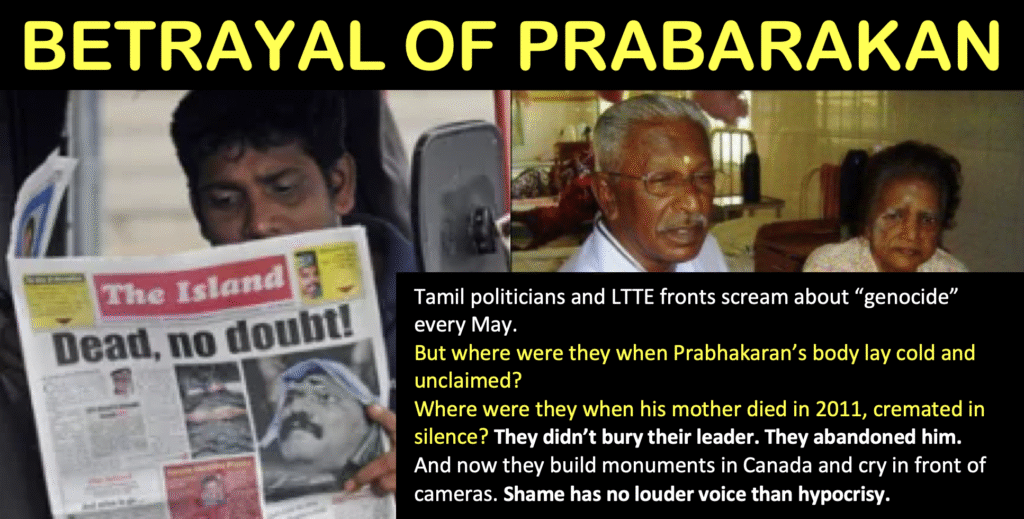
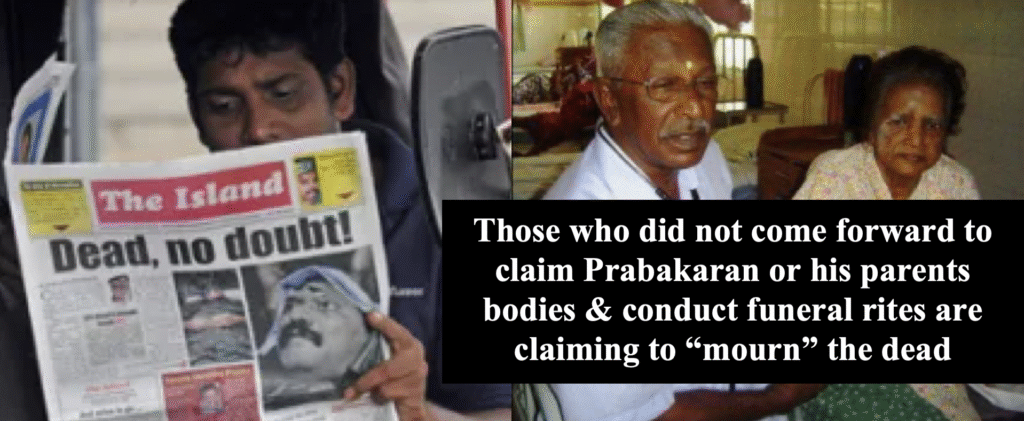
Where were all these LTTE fronts when Prabakaran was declared dead in May 2009, when his father died in 2010 & mother died in 2011? Not even Prabakarans siblings came to conduct his funeral or even the parent’s funeral. Sri Lanka’s Armed Forces cremated Prabakaran & threw his ashes to sea. His father’s funeral was done by TNA MP Sivajilingam who was a relative, while 3 dead dogs were thrown at the cremation site of his mother. In fact, no LTTE front even came forward to look after Prabakaran’s parents who were chased out of the refugee camp by Tamils & had to be looked after by Sri Lanka’s Armed Forces safeguarding them from attacks till their deaths. In fact, Prabakarans ailing mother was not even allowed to disembark from the plane at Chennai airport when she went to get medical treatment to India. Today, the entities that ignored Prabakaran after his death are glorifying him with concrete monuments & crocodile tears! What hypocrites!
Where Were You Then? The Deafening Silence of LTTE Fronts and Diaspora Hypocrites
In the years since the defeat of the LTTE in May 2009, a growing number of Tamil diaspora activists, LTTE fronts, and self-serving politicians have engaged in annual spectacles of performative grief—erecting monuments, lobbying Western governments, and organizing Mullivaikkal commemorations” to canonize terrorists as martyrs. Yet, behind their slogans and slogans of genocide” lies a shocking and deliberate silence.
For Hindus, funeral rites are sacred rituals that honor the dead and guide the soul (atma) on its journey toward rebirth or liberation (moksha). These rites help sever ties with the physical body, ensure peace for the departed, and fulfill religious duties to ancestors and the divine. They also provide comfort and closure for the living, reinforcing spiritual and cultural continuity.
No One Claimed Prabhakaran’s Body — Not Even His Family
On May 18, 2009, LTTE leader Velupillai Prabhakaran was killed by Sri Lankan Armed Forces near the Nanthikadal lagoon. The military found his body and confirmed his identity. Even without the dead LTTE leader, everyone knew that LTTE terrorism had ended though separatist ideology lives on.
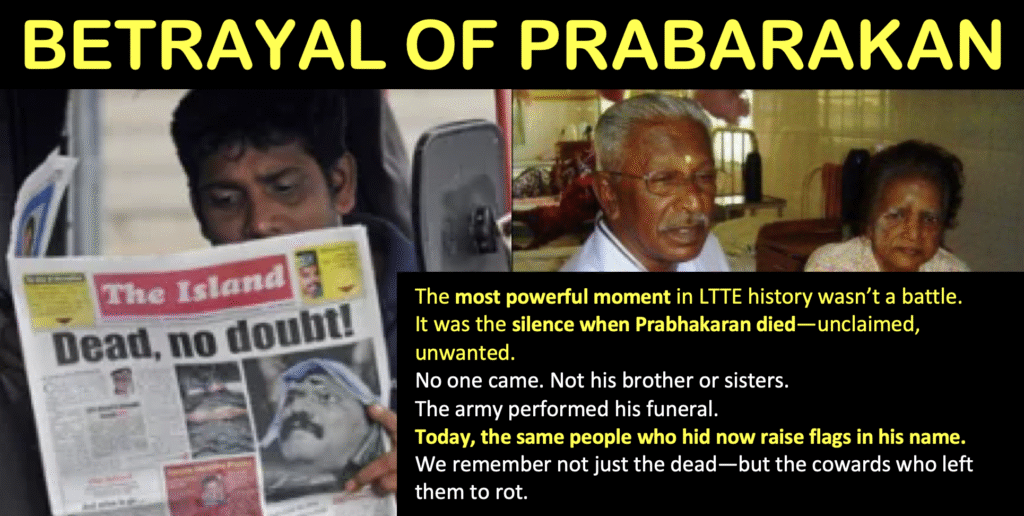
No family member. No LTTE front. No Tamil politician. No human rights champion” came forward to claim Prabakaran – whom they had virtually worshipped for decades.
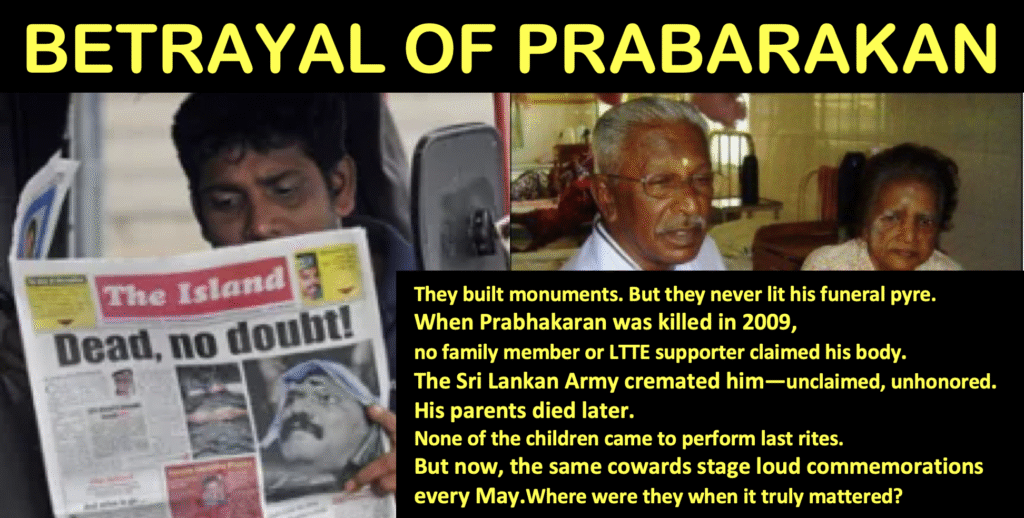
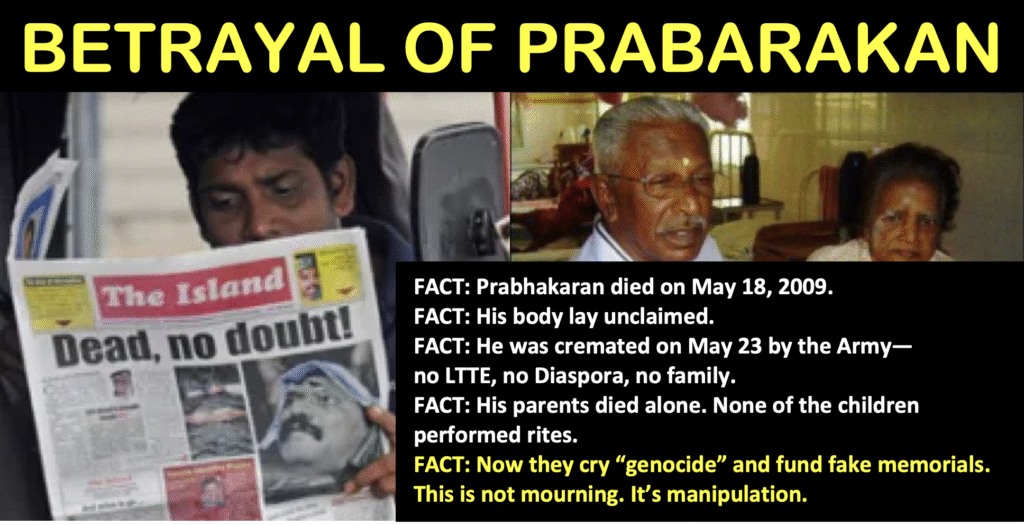
The result: Prabhakaran was cremated by the Sri Lankan Army on May 23, 2009, five days later. His ashes were scattered at sea.
For a man hailed as a Tamil national hero” by LTTE diaspora fronts, not one representative stepped forward to perform even the most basic Hindu funeral rites. Where were those who now speak his name with reverence? Hiding in comfort zones abroad, busy issuing press releases but chickened out of claiming his body to perform the last rites.
When Tamils chased away Prabakaran’s parents
On May 17, 2009, Prabhakaran’s elderly parents entered government-controlled areas and were placed in Menik Farm (Zone IV) for their protection. Ironically, it was not the Sri Lankan state but fellow Tamil civilians who attacked them, now free from LTTE oppression and resentment. The military moved them to Panagoda Army Camp for their safety & protection— a move conveniently forgotten by critics who paint the army as uniformly brutal.
Thiruvengadam Velupillai, Prabhakaran’s father, died on 6 January 2010 at age 86. His body was handed over to TNA MP and relative K. Sivajilingam. His children did not arrive to pay homage to their father. He was cremated on 10 January 2010 in Valvettithurai.
Parvathi Ammal, Prabhakaran’s mother, passed away on 20 February 2011 in Valvettithurai. She too was cremated. Her children did not arrive to pay homage to their mother either — Sadly, the cremation site was desecrated by local Tamils, with three dead dogs dumped at the scene in a gesture of disgust.
None of their children—Manoharan (Denmark), Vinothini (Canada), or Jagdeswari (Denmark)—came to visit or perform rites. None in the LTTE Diaspora arrived either.
Diaspora Fronts: Big Words, Empty Actions
Today, the same diaspora fronts who couldn’t even claim their leader’s body spend millions on:
Monuments in Canada, UK, and Europe,
Genocide campaigns,
Tamil Eelam” curriculum propaganda,
Buying politicians for sympathy votes,
Hosting gala dinners glorifying LTTE figures.
Where were these millions when Prabhakaran’s body lay unclaimed? Where was their courage when his aged parents were attacked by Tamil refugees? When his mother died, cremated in obscurity?
Their silence then was not an oversight — it was cowardice. It was convenient. And it continues today in the form of manufactured narratives, crocodile tears, and hollow symbolism.
Hypocrisy at Its Peak
How dare these fronts demand that foreign governments recognize an LTTE narrative, when they couldn’t show the most basic decency to bury their own dead?
How can they speak of justice when they turned their backs on the very people they now glorify?
How can Tamil politicians weep at staged commemorations, when they lacked the spine to even acknowledge their family ties or perform a final prayer?
No More False Martyrs
The facts are clear:
Prabhakaran died unclaimed.
His parents were chased away by their own
His parents died abandoned.
No LTTE front stepped up.
No diaspora activist offered rites.
No Tamil politician showed up.
Today, they rewrite history — not to honor the dead — but to keep separatist agendas alive. Let this be a wake-up call to the world: those who glorify terror in suits and slogans were silent when duty called.
It’s time to stop mistaking cowardice for sacrifice,
Velupillai Prabhakaran, the man who claimed to lead Tamils, died unwanted, unclaimed, and unhonored by his own family and followers (both in Sri Lanka & abroad).
And those who glorify him today? They glorify not out of loyalty, but for relevance & their own advantage & agendas. For political clout. For funding. For manipulation.
They were absent when it counted, and now, they shout from rooftops highlighting their hypocrisies.
Let’s be clear: it was the Sri Lanka military who cremated Prabakran when his own deserted him. His parents not only died in obscurity their cremation site was even desecrated.
And today? The same people who were cowards to honor their dead demand governments around the world honor them as ‘martyrs’. They want monuments built, textbooks rewritten, international courts moved – but they couldn’t be bothered to even come forward to claim the dead body of their leader with the same gusto that they make demands now.
When Prabakaran & his parent’s bodies were lying cold & unclaimed, their loudest act was their silence.
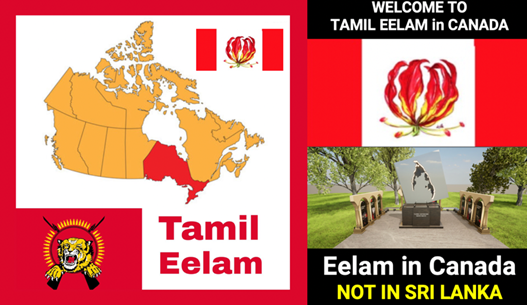
There are 90 million Tamils globally and their population grows by more than 1 million each year. Those are massive numbers and don’t in anyway indicate suffering genocide”. Therefore, Canada’s Tamil genocide monument is a joke. It ridicules actual victims of genocide including original Canadians killed in their millions. In the case of Sri Lanka, Tamil population has grown massively despite the war and hundreds of thousands leaving the country as economic refugees. At least 20,000 Tamils live in each and every district of Sri Lanka. However, Sinhalas and Muslims are not allowed to live in the districts in the Northern Province which is virtually Tamil only. In reality Sinhalas and Muslims are the victims of genocide carried out by Tamil terrorists.
Though Tamils suffered no genocide, Tamil terrorists suffered extermination in 2009. There were 13 Tamil terrorist brigades and regiments and virtually all members were exterminated in war. The 14th brigade called Makkal Padai brigade was made up of civilians up to 11,000 strong. They suffered no extermination. They were rehabilitated, trained in vocations and released back to society.
Canada seems to be rattled by the fact that the entire LTTE Tamil terrorist outfit was exterminated. That seems to be the real grief. It is celebrated in Sri Lanka annually on May 19. It is a noble achievement by Sri Lanka that continues to save 3,950 lives on average each year since 2009. So far over 63,000 Sri Lankans got to live thanks to the war victory in 2009. That is the number of Sri Lankans who would have died had the war not ended in Sri Lanka’s victory in 2009.
On the topic of genocide there are many places around the world where real genocide takes place. Canada should focus on those areas as they too produce refugees who will call Canada their home. If Tamils get genocide monuments for no genocide, a number of Canadian communities of various origins deserves their own genocide monuments for real genocide they suffered. Above all genocide monuments should be erected in Canada to commemorate and condemn the genocide of hundreds of native Canadian tribes.
At the outset let me state that I am not a historian but a Civil and Structural Engineer with some knowledge about computer programming and IT. I have used the latter to gain advantage over others in my profession. However, the AI tools that are being sharpened almost daily in the form of Large Language Models (or Llamas) and made available via mobile phones have made it very easy for us to probe in to past. At the touch of a button these tools would scan data available to them and give info asked for as accurately as possible within a couple of seconds. In this context the Seleucid Empire has been explained on my mobile as follows:
The Seleucid Empire was a major Hellenistic state, founded by Seleucus I Nicator after the death of Alexander the Great in 312 BC. It encompassed a vast territory stretching from Aegean Sea to the Indus Valley, encompassing regions like Syria, Mesopotamia and parts of modern-day Iran and Afghanistan. The empire was characterised by its military strength, Hellenistic culture and its interactions with other Hellenistic states, particularly the Ptolemaic Empire.”
Doesn’t this explain why Ptolemy gave so much details about our country which he named as Taprobana. It must have been ‘Thambara Paany’, whatever thambara means. My thinking is that it was a good source of clean drinking water source for mariners that was flowing down from the hills. This is why we wanted to build Hambantota Port, though it is now becoming more of a military asset for another country, due to unpatriotic and selfish behaviour of rulers since it was built.
The Syrian region mentioned in the description comprised of northern Arabia (all those states like Soudi Arabia, Iraq, Kuwait, Qatar etc.). This empire had lasted about 400 years. So, a significant amount of the populations may have had same culture before the advent of Islam. Seleucid Empire was conquered by Romans at the end but at different times had deals with the Arabs. The Ionians who came to Sri Lanka since 900 BC were in control of trade in Crotone, Italy which was part of Anatolia.
Who was Seleucus Nicator?. His father and Alexander the Great’s father had been brothers and was a trusted general of the great man. He fought alongside Alexander up to India and when they got bogged down in a marshy area in north western Bharatha (present day Peshawar of Pakistan) without being able to defeat the regional king Porus (or Singha), Alexander headed back home leaving the region they acquired in the hands of Seleucus. In honour of the bravery of Porus, Seleucus’ second daughter Hellena were given in marriage to him. Hellena’s mother was a princess from Syria or Bactria as it was known then and in turn was also part of Persia. Ancient Sinhalese kings had lots of dealings with Persia even to the extent of having matrimonial connections at that time. I have mentioned in my previous write up that it was Hellena’s children who came to our country with their followers some of whom were from Mangalore region (according to a Sri Lankan researcher) and established colonies. How was it possible in Alexander the Great’s time for so many people to enter and establish settlements in another country without giving a fight. These people must have had earlier known connections and some leftovers had been here. This is what we find in the city of Anuradhapura. There had been an Ionian settlement around 900 BC in it. The rock inscriptions like stargate in that place seem to suggest that a highly developed civilisation had existed there. The technology to make finest steel had been in this country more than 1500 years before Mohenjo Daro which ended in bronze age. The sword of Damascus and others with trade mark swastika in many parts of Europe is the clue to this claim. What I am trying to point out is not our connections to Europeans, but the possibility that some of them may have actually originated from this land. The findings in a lake in Horton plains covering an area of out 40 Sq.Km seem to suggest this possibility. The Buddhist stories indicate that there was a lake known as Anothaptha wila. There is a sketch of this area with surrounding hills depicted on the walls in the cave temple at Dambulla, Sri Lanka.
Lies that are capable of breaking rock (or ‘Gal Pelena Boru’ in Sinhalese):
In Sinhalese folklore there is saying as ‘gal pelena boru’, similar to the saying ‘its raining cats and dogs’. This seems to suggests that when people say lies loudly even the stones can break. Nobody has seen stones breaking due to sound, but I have seen fish as big as a cat, about 12 inch long, that had fallen to the land we lived when I was about five years old. In a place called Dimbulagala on top a hill which is very difficult to reach there is a rock inscription etched on a rock. The belief is that the ancient people who lived circa 3rd century BC split a rock by some means and recorded a certain important event that took place at that time. The name of a son of king Porus (or a grandson) by the name Mutasiva is mentioned in the inscription which is about 50ft long and 10ft high. Incidentally the tittle of the book the Sri Lankan researcher donated to me contained ‘Mutasiva’. The researcher/author of the book was the principal of a prominent secondary school in the heart of Colombo where my wife was a teacher in late 80s. I do not know whether he is living or dead, but I know I have doing justice to him.
Why did those ancient people select that rock in that particular place which was difficult to reach. It seems there are no any other ruins nearby except to say that the water supply to that area was done by so and so mentioned in the inscription. Perhaps before doing the actual job of writing the text, they would have calculated what length and width is required and looked for the rock. And they found the suitable one at that difficult place. It is now known that sound waves can be amplified until it is big enough to break something. This is similar to cutting metal sheets very accurately using light, as in the case of laser cutters. What happens in laser cutter is a laser beam is sent back and forth in a small cylindrical Ruby between its faces until it gains enough strength due to resonance and burst out to cut the metal. For this to happen its important to get the size of the ruby and the frequency of light right. So, in the same way the frequency of sound wave, its strength (amplitude) that can be gained by resonance (which is determined by the size of the rock) has to be calculated (may be bigger the lie bigger the effect as in politics of today. Maybe we can call it factual inexactitude instead of the lie). What a ‘hightech’ solution that has been forgotten?. Our ancients know the effect of drumming on making clouds to deliver rain. I think they still practice. I think the people of Italy knows that we have some idea about clouds and rain. When I was supervising a road project as the Resident Engineer in West Africa, one morning I was discussing with the Italian project manager whether we should go ahead with concrete work of a certain structure. We saw the sky was overcast but the shape of the clouds told me that it will not rain. Then he said, yes, you people from the east have more knowledge than us and decided to go ahead.
As usual I wind up my writing with some songs our viewers would enjoy:
It looks like its not only our people who are habitual liars. Did this former nurse gave up the job because of lies and became a successful singer?:
Andrea Burg singing ‘Du hast mich tausendmal belogen…’ (you have told me thousand lies, to whom can I tell my feelings)
The next one from Fantasy duo Martin and Fredi on ‘ein weisses boot’ (a white boat)
The white colour or waishaya warna can hide all blemishes in a boat (like many other ugly warts in body) to give a nice appearance and seas are inspirational. Sea water is slightly alkaline and is like a large battery storing and giving back energy in various forms:
Finally, I give a song from an all-time favourite Engelbert Humperdinck, the Chennai born singer who got poplar only after becoming an ‘Angel bird’. Please listen to his rendition of ‘Le Bicyclette de Belsize’, an absolute beauty, to my mind.
In the 1983 film War Games, a supercomputer known as WOPR (for War Operation Plan Response) is about to provoke a nuclear war between the United States and the Soviet Union, but because of the ingenuity of a teenager (played by Matthew Broderick), catastrophe is averted. In the first Terminator film, which was released a year later, a supercomputer called Skynet” decides to exterminate humanity because it’s perceived as a threat to its existence rather than to protect American nuclear weapons.
Although these films offered audiences grim scenarios of intelligent machines running amok, they were also prophetic. Artificial intelligence (AI) is so commonplace that it’s routinely applied during a simple Google search. That it is also being integrated into military strategies is hardly any surprise. It’s just that we have little understanding of the capacity of these high-tech weapons (those that are now ready for use and those in development). Nor are we prepared for systems that have the capacity to transform warfare forever.
Throughout history, it is human intelligence that uses the technology, not the technology itself, which has won or lost wars. That may change in the future when human intelligence is focused instead on creating systems that are more capable on the battlefield than those of the adversary.
An Exponential, Insurmountable Surprise”
Artificial intelligence isn’t a technology that can be easily detected, monitored, or banned, as Amir Husain, the founder and CEO of an AI company, SparkCognition, pointed out in an essay for Media News. Integrating AI elements—visual recognition, language analysis, simulation-based prediction, and advanced forms of search—with existing technologies and platforms can rapidly yield entirely new and unforeseen capabilities.” The result can create exponential, insurmountable surprise,” Hussain writes.
Advanced technology in warfare is already widespread. The use of uncrewed aerial vehicles (UAVs)—commonly known as drones—in military settings has set off warnings about killer robots.” What happens when drones are no longer controlled by humans and can execute military missions on their own? These drones aren’t limited to the air; they can operate on the ground or underwater as well. The introduction of AI, effectively giving these weapons the capacity for autonomy, isn’t far off.
Moreover, they’re cheap to produce and cheap to purchase. The Russians are buying drones from Iran for use in their war in Ukraine, and the Ukrainians have been putting together a cottage industry constructing drones of their own against the Russians. The relative ease with which a commercial drone can be converted into one with a military application also blurs the line between commercial and military enterprises. At this point, though, humans are still in charge.
A similar problem can be seen in information-gathering systems that have dual uses, including satellites, manned and unmanned aircraft, ground and undersea radars, and sensors, all of which have both commercial and military applications. AI can process vast amounts of data from all these systems and then discern meaningful patterns, identifying changes that humans might never notice. American forces were stymied to some degree in wars in Iraq and Afghanistan because they could not process large amounts of data. Even now, remotely piloted UAVs are using AI for autonomous takeoff, landing, and routine flight. All that’s left for human operators to do is concentrate on tactical decisions, such as selecting attack targets and executing attacks.
AI also allows these systems to operate rapidly, determining actions at speeds that are seldom possible if humans are part of the decision-making process. Until now, decision-making speed has been the most important aspect of warfare. If, however, AI systems go head-to-head against humans, AI will invariably come out ahead. However, the possibility that AI systems eliminate the human factor terrifies people who don’t want to see an apocalyptic scenario on celluloid come to pass in reality.
Automated Versus Autonomous
A distinction needs to be made between the term autonomous” and the term automated.” If we are controlling the drone, then the drone is automated. But if the drone is programmed to act on its own initiative, we would say it is autonomous. But does the autonomous weapon describe the actual weapon—i.e., a missile on a drone—or the drone itself? Take, for example, the Global Hawk military UAV (drone). It is automated insofar as it is controlled by an operator on the ground, and yet if it loses communication with the ground, the Golden Hawk can land on its own. Does that make it automated or autonomous? Or is it both?
The most important question is whether the system is safety-critical. Translated, that means whether it has the decision-making capacity to use a weapon against a target without intervention from its human operator. It is possible, for example, for a drone to strike a static military target on its own (such as an enemy military base) but not a human target because of the fear that innocent civilians could be injured or killed as collateral damage. Many countries have already developed drones with real-time imagery capable of acting autonomously in the former instance, but not when it comes to human targets.
Drones aren’t the only weapons that can act autonomously. Military systems are being developed by the U.S., China, and several countries in Europe that can act autonomously in the air, on the ground, in water, and underwater with varying degrees of success.
Several types of autonomous helicopters designed so that a soldier can direct them in the field with a smartphone are in development in the U.S., Europe, and China. Autonomous ground vehicles, such as tanks and transport vehicles, and autonomous underwater vehicles are also in development. In almost all cases, however, the agencies developing these technologies are struggling to make the leap from development to operational implementation.
There are many reasons for the lack of success in bringing these technologies to maturity, including cost and unforeseen technical issues, but equally problematic are organizational and cultural barriers. The U.S. has, for instance, struggled to bring autonomous UAVs to operational status, primarily due to organizational infighting and prioritization in favor of manned aircraft.
The Future Warrior
In the battleground of the future, elite soldiers may rely on a head-up displaythat feeds them a wealth of information that is collected and routed through supercomputers carried in their backpacks using an AI engine. With AI, the data is instantly analyzed, streamlined, and fed back into the head-up display. This is one of many potential scenarios presented by U.S. Defense Department officials. The Pentagon has embraced a relatively simple concept: the hyper-enabled operator.”
The objective of this concept is to give Special Forces cognitive overmatch” on the battlefield, or the ability to dominate the situation by making informed decisions faster than the opponent.” In other words, they will be able to make decisions based on the information they are receiving more rapidly than their enemy. The decision-making model for the military is called the OODA loop” for observe, orient, decide, act.” That will come about using computers that register all relevant data and distill them into actionable information through a simple interface like a head-up display.
This display will also offer a visual environment translation” system designed to convert foreign language inputs into clear English in real time. Known as VITA, the system encompasses both a visual environment translation effort and voice-to-voice translation capabilities. The translation engine will allow the operator to engage in effective conversations where it was previously impossible.”
VITA, which stands for Versatile Intelligent Translation Assistant, offers users language capabilities in Russian, Ukrainian, and Chinese, including Mandarin, a Chinese dialect. Operators could use their smartphones to scan a street in a foreign country, for example, and immediately obtain a translation of street signs in real-time.
Adversary AI Systems
Military experts divide adversarial attacks into four categories: evasion, inference, poisoning, and extraction. These types of attacks are easily accomplished and often don’t require computing skills. An enemy engaged in evasive attacks could attempt to deceive an AI weapon to avoid detection—hiding a cyberattack, for example, or convincing a sensor that a tank is a school bus. This may require the development of a new type of AI camouflage, such as strategic tape placement, that can fool AI.
Inference attacks occur when an adversary acquires information about an AI system that allows evasive techniques. Poisoning attacks target AI systems during training, interfering with access to the datasets used to train military tools—mislabeling images of vehicles to dupe targeting systems, for instance, or manipulating maintenance data designed to classify imminent system failure as a regular operation.
Extraction attacks exploit access to the AI’s interface to learn enough about the AI’s operation to create a parallel model of the system. If AI systems are not secure from unauthorized users, then an adversary’s users could predict decisions made by those systems and use those predictions to their advantage. For instance, they could predict how an AI-controlled unmanned system will respond to specific visual and electromagnetic stimuli and then proceed to alter its route and behavior.
Deceptive attacks have become increasingly common, as illustrated by cases involving image classification algorithms that are deceived into perceiving images that aren’t there, confusing the meaning of images, and mistaking a turtle for a rifle, for instance. Similarly, autonomous vehicles could be forced to swerve into the wrong lane or speed through a stop sign.
In 2019, China announced a new military strategy, Intelligentized Warfare, which utilizes AI. Officials of the Chinese People’s Liberation Army have stated that their forces can overtake the U.S. military by using AI. One of its intentions is to use this high-tech type of warfare to bring Taiwan under its control without waging conventional warfare. However, only a few of the many Chinese studies on intelligentized warfare have focused on replacing guns with AI. On the other hand, Chinese strategists have made no secret of their intention to control the enemy’s will directly.
That would include the U.S. president, members of Congress, combatant commanders, and citizens. Intelligence dominance”—also known as cognitive warfare or control of the brain”—is seen as the new battleground in intelligentized warfare, putting AI to a very different use than most American and allied discussions have envisioned. According to the Pentagon’s 2022 report on Chinese military developments, the People’s Liberation Army is being trained and equipped to use AI-enabled sensors and computer networks to rapidly identify key vulnerabilities in the U.S. operational system and then combine joint forces across domains to launch precision strikes against those vulnerabilities.”
Controlling an adversary’s mind can affect not just someone’s perceptions of their surroundings but, ultimately, their decisions. For the People’s Liberation Army, cognitive warfare is equal to the other domains of conflict, which are air, land, and sea. In that respect, social media is considered a key battlefield.
Russia has also been developing its own AI capacity. As early as 2014, the Russians inaugurated a National Defense Control Center in Moscow, a centralized command post for assessing and responding to global threats. The center was designed to collect information on enemy moves from multiple sources and provide senior officers with guidance on possible responses.
Russia has declared that it will eventually develop an AI system capable of running the world. Russians are already using AI in Ukraine to jam wireless signals connecting Ukrainian drones to the satellites they rely on for navigation, causing the machines to lose their way and plummet to Earth. The Russian Ministry of Defense (MOD) has explored ways in which AI systems can be developed for uncrewed systems for the air, maritime, and ground domains. At the same time, at least in the short term, official policy is predicated on the belief that humans must remain firmly in the loop.
Meanwhile, the Russians are trying to improve UAV capabilities with AI as a mechanism for command, control, and communications. MOD also emphasizes the use of AI for data collection and analysis as a natural evolution from the current digital” combat technology and systems development.
Raven Sentry”: AI in the U.S. War in Afghanistan
The use of AI on the battlefield by U.S. intelligence, while brief, showed promising results. Raven Sentry,” an AI tool launched in 2019 by a team of American intelligence officers (known as the nerd locker”), with help from Silicon Valley expertise, was intended to forecast insurgent attacks. The initial use of AI came at a time when U.S. bases were closing, troop numbers were falling, and intelligence resources were being diverted. Raven Sentry relied on open-source data.
We noticed an opportunity presented by the increased number of commercial satellites and the availability of news reports on the Internet, the proliferation of social media postings, and messaging apps with massive membership,” says Col. Thomas Spahr, chief of staff of the Resolute Support J2 intelligence mission in Kabul, Afghanistan, from July 2019 to July 2020.
The AI tool also drew on historical patterns based on insurgent activities in Afghanistan going back 40 years, which encompassed the Soviet occupation of the country in the 1980s. Environmental factors were also considered. Historically, insurgents attack on certain days of the year or holidays, for example, or during certain weather and illumination conditions,” Spahr notes. He adds, The beauty of the AI is that it continues to update that template. The machine would learn as it absorbed more data.” Before its demise in 2021 (with the U.S. withdrawal from Afghanistan), Raven Sentry had demonstrated its feasibility, predicting an insurgent attack with 70 percent accuracy. The AI tool predicted that attacks were more likely to occur when the temperature was above 4 degrees Celsius (or 39.2 degrees Fahrenheit), when lunar illumination was below 30 percent, and when there was no rain. Spahr was satisfied with the results: We validated that commercially produced, unclassified information can yield predictive intelligence.”
Ukraine as Testing Ground for AI
Ever since the Russian invasion, launched in 2022, Ukraine has become a testing ground for AI in warfare. Outgunned and outmanned, Ukrainian forces have resorted to improvisation, jerry-rigging off-the-shelf devices to transform them into lethal autonomous weapons. The Russian invaders, too, have employed AI, conducting cyberattacks and GPS-jamming systems.
Ukraine’s Saker Scout quadcopters can find, identify, and attack 64 types of Russian ‘military objects’ on their own.” These drones are designed to operate autonomously, and unlike other drones that Ukrainian forces have deployed, Russia cannot jam them.
By using code found online and hobbyist computers like Raspberry Pi, easily obtained from hardware stores, Ukrainians are able to construct innovative killer robots. Apart from drones, which can be operated with a smartphone, Ukrainians have built a gun turret with autonomous targeting operated with the same controller used by a PlayStation or a tablet. The gun, called Wolly because it bears a resemblance to the Pixar robot WALL-E, can auto-lock on a target up to 1,000 meters (3,280 feet) away and shift between preprogrammed positions to quickly cover a broad area.
The manufacturer is also developing a gun capable of hitting moving targets. It can automatically identify targets as they come over the horizon. The gun targets and aims automatically; all that’s left for the operator to do is press the button and shoot. Many Ukrainian drones, which look like those you can find at Walmart, are called First Person View (FPV) drones. Capable of flying 100 miles per hour, FPV drones have four propellers and a mounted camera that uses wireless to send footage of their flights back to operators. With a bomb on board, an FPV can be converted into a weapon that can take out a tank. They’re cheap, too; one manufacturer, Vyriy, charges $400 each, a small price to pay to disable a tank worth millions of dollars. Vyriy derives its name from a mythical land in Slavic folktales.
If one kamikaze drone is good, dozens of them are better insofar as the greater their number, the greater the chance there is of several reaching their targets. In nature, a swarm of ants behaves as a single living organism, whether the task is collecting food or building a nest. Analogously, a swarm of autonomous drones could act as a single organism—no humans necessary—carrying out a mission regardless of how many are disabled or crash to the ground or whether communication from the ground is disrupted or terminated.
Although humans are still in the loop,” these weapons could equally be made entirely autonomous. In other words, they could decide which targets to strike without human intervention.
It isn’t as if Ukraine has adopted AI weaponry without any tech experience. In the words of New York Times reporter Paul Mozer, Ukraine has been a bit of a back office for the global technology industry for a long time.” The country already had a substantial pool of coders and skilled experts who, under emergency conditions, were able to make the transition from civilian uses (such as a dating app) to military purposes. As Mozer reported: What they’re doing is they’re taking basic code that is around, combining it with some new data from the war, and making it into something entirely different, which is a weapon.”
The reality is, there’s a lot of cool, exciting stuff happening in the big defense primes,” says P.W. Singer, an author who writes about war and tech. There’s a lot of cool, exciting stuff happening in the big-tech Silicon Valley companies. There’s a lot of cool, exciting stuff happening in small startups.”
One of those smaller startups is Anduril. After selling the popular virtual reality headset Oculus to Facebook (now Meta), Palmer Luckey, an entrepreneur in his early thirties, went on to found an AI weapons company that is supplying drones to Ukraine. Ukraine is a very challenging environment to learn in,” he says. I’ve heard various estimates from the Ukrainians themselves that any given drone typically has a lifespan of about four weeks. The question is, Can you respond and adapt?” Anduril, named after a sword in TheLord of the Rings, has sold its devices to ten countries, including the U.S.
I had this belief that the major defense companies didn’t have the right talent or the right incentive structure to invest in things like artificial intelligence, autonomy, robotics,” says Luckey. His company’s drone, called ALTIUS, is intended to be fired out of a tube and unfold itself, extending its wings and tail; then, steering with a propeller, it acts like a plane capable of carrying a 30-pound warhead. Luckey believes that his approach will result in more AI weapons being built in less time and at a lower cost than could be achieved by traditional defense contractors like McDonnell Douglas.
Anduril, founded in 2017, is also developing the Dive-LD, a drone that will be used for surveys in littoral and deep water. It’s an autonomous underwater vehicle that is able to go very, very long distances, dive to a depth of about 6,000 meters (almost 20,000 feet), which is deep enough to go to the bottom of almost any ocean,” says Luckey. Ukraine is already making its own sea drones—essentially jet skis packed with explosives—which have inflicted severe damage on the Russian navy in the Black Sea.
As Anduril’s CEO Brian Schimpf admits, the introduction of Anduril’s drones to Ukraine has yet to produce any significant results, although he believes that will change. Once they’re launched, these drones will not require guidance from an operator on the ground, making it difficult for the Russians to destroy or disable them by jamming their signals.
The autonomy onboard is really what sets it apart,” Luckey says. It’s not a remote-controlled plane. There’s a brain on it that is able to look for targets, identify targets, and fly into those targets.” However, for every innovative weapon system the Ukrainians develop, the Russians counter it with a system that renders it useless. Technologies that worked really well even a few months ago are now constantly having to change,” says Jacquelyn Schneider, who studies military technology as a fellow at the Hoover Institution, And the big difference I do see is that software changes the rate of change.”
The War in Gaza: Lavender
In their invasion of Gaza, the Israel Defense Forces (IDF) have increasingly relied on a program supported by artificial intelligence to target Hamas operatives, with problematic consequences. According to an April 2024 reportby +972 Magazine (an Israeli-Palestinian publication) and Local Call, a Hebrew language news site, the IDF has been implementing a program known as Lavender,” whose influence on the military’s operations is so profound that intelligence officials have essentially treated the outputs of the AI machine as if it were a human decision.”
Lavender was developed by the elite Unit 8200, which is comparable to the National Security Agency in the U.S. or the Government Communications Headquarters in the UK.
The Israeli government has defended Lavender for its practicality and efficiency. The Israeli military uses AI to augment the decision-making processes of human operators. This use is in accordance with international humanitarian law, as applied by the modern Armed Forces in many asymmetric wars since September 11, 2001,” says Magda Pacholska, a researcher at the TMC Asser Institute and specialist in the intersection between disruptive technologies and military law.
The data collected to identify militants that were used to develop Lavender comes from the more than 2.3 million residents of the Gaza Strip, which was under intense surveillance prior to the Gaza invasion in 2023.
The report states that as many as 37,000 Palestinians were designated as suspected militants who were selected as potential targets. Lavender’s kill lists were prepared in advance of the invasion, launched in response to the Hamas attack of October 7, 2023, which left about 1,200 dead and about 250 hostages taken from Israel. A related AI program, which tracked the movements of individuals on the Lavender list, was called Where’s Daddy?” Sources for the +972 Magazine report said that initially, there was no requirement to thoroughly check why the machine made those choices (of targets) or to examine the raw intelligence data on which they were based.” The officials in charge, these sources said, acted as a rubber stamp” for the machine’s decisions before authorizing a bombing. One intelligence officer who spoke to +972 admitted as much: I would invest 20 seconds for each target at this stage, and do dozens of them every day. I had zero added value as a human, apart from being a stamp of approval. It saved a lot of time.”
It was already known that the Lavender program made errors in 10 percent of the cases, meaning that a fraction of the individuals selected as targets might have had no connection with Hamas or any other militant group. The strikes generally occurred at night while the targeted individuals were more likely to be at home, which posed a risk of killing or wounding their families as well.
A score was created for each individual, ranging from 1 to 100, based on how closely he was linked to the armed wing of Hamas or Islamic Jihad. Those with a high score were killed along with their families and neighbors despite the fact that officers reportedly did little to verify the potential targets identified by Lavender, citing efficiency” reasons. This is unparalleled, in my memory,” said one intelligence officer who used Lavender, adding that his colleagues had more faith in a statistical mechanism” than a grieving soldier. Everyone there, including me, lost people on October 7. The machine did it coldly. And that made it easier.”
The IDF had previously used another AI system called The Gospel,” which was described in a previous investigation by the magazine, as well as in the Israeli military’s own publications, to target buildings and structures suspected of harboring militants. The Gospel” draws on millions of items of data, producing target lists more than 50 times faster than a team of human intelligence officers ever could. It was used to strike 100 targets a day in the first two months of the Gaza fighting, roughly five times more than in a similar conflict there a decade ago. Those structures of political or military significance for Hamas are known as power targets.”
Weaknesses of AI Weapons
If an AI weapon is autonomous, it needs to have the capacity for accurate perception. That’s to say, if it mistakes a civilian car for a military target, its response rate isn’t relevant. The civilians in the car die regardless. In many cases, of course, AI systems have excelled at perception as AI-powered machines and algorithms have become refined. When, for instance, the Russian military conducted a test of 80 UAVs simultaneously flying over Syrian battlefields with unified visualization, then Russian Defense Minister Sergei Shoigu compared it to a semi-fantastic film” that revealed all potential targets.
But problems can creep in. In designing an AI weapon, developers first need access to data. Many AI systems are trained using data that has been labeled by an expert system (e.g., labeling scenes that include an air defense battery), usually a human. An AI’s image-processing capability won’t function well when given images that are different from its training set—for example, pictures produced where lighting conditions are poor, that are at an obtuse angle, or that are partially obscured. AI recognition systems don’t understand what the image is; rather, they learn textures and gradients of the image’s pixels. That means that an AI system may correctly recognize a part of an image but not its entirety, which can result in misclassification.
To better defend AI against deceptive images, engineers subject them to adversarial training.” This involves feeding a classifier adversarial images so it can identify and ignore those that aren’t going to be targeted. Research by Nicolas Papernot, a graduate student at Pennsylvania State University, shows that a system, even bolstered by adversarial training, may be ineffective if overwhelmed by the sheer number of images. Adversarial images take advantage of a feature found in many AI systems known as decision boundaries.”
These boundaries are the invisible rules that instruct a system whether it is perceiving a lion or a leopard. The objective would be to create a mental map with lions in one sector and leopards in another. The line dividing these two sectors—the border at which a lion becomes a leopard or leopard a lion—is known as the decision boundary. Jeff Clune, who has also studied adversarial training, remains dubious about such classification systems because they’re too arbitrary.All you’re doing with these networks is training them to draw lines between clusters of data rather than deeply modeling what it is to be [a] leopard or a lion.”
Large datasets are often labeled by companies that employ manual methods.Obtaining and sharing datasets is a challenge, especially for an organization that prefers to classify data and restrict access to it. A military dataset may contain images produced by thermal-imaging systems, for instance, but unless this dataset is shared with developers, an AI weapon wouldn’t be as effective. For example, AI devices that rely on chatbots limited to hundreds of words might not be able to completely replace a human with a much larger vocabulary.
AI systems are also hampered by their inability to multitask. A human can identify an enemy vehicle, decide on a weapon system to employ against it, predict its path, and then engage the target. An AI system can’t duplicate these steps. At this point, a system trained to identify a T-90 tank most likely would be unable to identify a Chinese Type 99 tank, despite the fact that they are both tanks and both tasks require image recognition. Many researchers are trying to solve this problem by working to enable systems to transfer their learning, but such systems are years away from production.
Predictably, adversaries will try to take advantage of these weaknesses by fooling image recognition engines and sensors. They may also try mounting cyberattacks to evade intrusion detection systems or feed altered data to AI systems that will supply them with false requirements.
U.S. Preparedness
The U.S. Department of Defense has been more partial to contracting for andbuilding hardware than to implementing new technologies. All the same, the Air Force, in cooperation with Boeing, General Atomics, and a company called Kratos, is developing AI-powered drones. The Air Force is also testing pilotless XQ-58A Valkyrie experimental aircraft run by artificial intelligence. This next-generation drone is a prototype for what the Air Force hopes can become a potent supplement to its fleet of traditional fighter jets. The objective is to give human pilots a swarm of highly capable robot wingmen to deploy in battle. The Valkyrie is not autonomous, however. Although it will use AI and sensors to identify and evaluate enemy threats, it will still be up to pilots to decide whether or not to strike the target.
Pentagon officials may not be deploying autonomous weapons in battle yet, but they are testing and perfecting weapons that will not rely on human intervention. One example is the Army’s Project Convergence. In a test, conducted as part of the project, held in August 2020 at the Yuma Proving Ground in Arizona, the Army used a variety of air- and ground-based sensors to track simulated enemy forces and then process that data using AI-enabled computers at a base in Washington state. Those computers, in turn, issued fire instructions to ground-based artillery at Yuma. This entire sequence was supposedly accomplished within 20 seconds,” the Congressional Research Service later reported.
In a U.S. program known as the Replicator initiative, the Pentagon said it planned to mass-produce thousands of autonomous drones. However, no official policy has condoned the use of autonomous weapons, which would allow devices to decide whether to strike a target without a human’s approval.
The Navy has an AI equivalent of Project Convergence called Project Overmatch.” In the words of Adm. Michael Gilday, chief of naval operations, this is intended to enable a Navy that swarms the sea, delivering synchronized lethal and nonlethal effects from near-and-far, every axis, and every domain.” Very little has been revealed about the project.
About 7,000 analysts employed by the National Security Agency (NSA) are trying to integrate AI into its operations, according to General Timothy Haugh, who serves as the NSA Director, U.S. Cyber Command Commander, and Chief of the Central Security Service. General Haugh has disclosed that as of 2024, the NSA is engaged in 170 AI projects, of which 10 are considered critical to national security. Those other 160, we want to create opportunities for people to experiment, leverage, and compliantly use,” he says.
At present, though, AI is still regarded as a supplement to conventional platforms. AI is also envisioned as playing four additional roles: automating planning and strategy; fusing and interpreting signals more efficiently than humans or conventional systems can do; aiding space-based systems, mainly by collecting and synthesizing information to counter hypersonics; and enabling next-generation cyber and information warfare capabilities.
Ethics of AI Use
Although the use of autonomous weapons has been a subject of debate for decades, few observers expect any international deal to establish new regulations, especially as the U.S., China, Israel, Russia, and others race to develop even more advanced weapons. The geopolitics makes it impossible,” says Alexander Kmentt, Austria’s top negotiator on autonomous weapons at the UN. These weapons will be used, and they’ll be used in the military arsenal of pretty much everybody.”
Despite such challenges, Human Rights Watch has called for the urgent negotiation and adoption of a legally binding instrument to prohibit and regulate autonomous weapons systems.” It has launched the Campaign to Stop Killer Robots, which the human rights organization says has been joined by more than 270 groups and 70 countries. Even though the controversy has centered around autonomous weapons, Brian Schimpf, CEO of AI drone manufacturer Anduril, has another perspective. He says AI weapons are not about taking humans out of the loop. I don’t think that’s the right ethical framework. This is really about how we make human decision-makers more effective and more accountable [for] their decisions.”
All the same, autonomous AI weapons are already under development. Aside from the ethics of relying on a weapon to make life-and-death decisions, there is a problem with AI itself. Errors and miscalculations are relatively common. Algorithms underlying the operations of AI systems are capable of making mistakes—hallucinations”—in which seemingly reasonable results turn out to be entirely illusory. That could have profound implications for deploying AI weapons that operate with deeply flawed instructions undetectable by human operators. In a particularly dystopian scenario, an adversary might substitute robot generals for human ones, forcing the U.S. to do the same, with the result that AI systems may be pitted against one another on the battlefield with unpredictable and possibly catastrophic consequences.
Dr. Elke Schwarz of Queen Mary University of London views the AI weapon dilemma through a theoretical framework that relies on political science and empirical investigations in her consideration of the ethical dimensions of AI in warfare. She believes that the integration of AI-enabled weapon systems facilitates the objectification of human targets, leading to heightened tolerance for collateral damage. In her view, automation can weaken moral agency among operators of AI-enabled targeting systems, diminishing their capacity for ethical decision-making.” The bias towards autonomous systems may also encourage the defense industry to rush headlong into funding military AI systems, influencing perceptions of responsible AI use in warfare.” She urges policymakers to take risks into account before it’s too late.
(T)he effect of AI is much, much more than the machine gun or plane. It is more like the shift from muscle power to machine power in the last Industrial Revolution,” says Peter Singer, a professor at Arizona State University and a strategist and senior fellow at the U.S. think tank New America, who has written extensively about AI and warfare. I believe that the advent of AI on the software side and its application into robotics on the hardware side is the equivalent of the industrial revolution when we saw mechanization.” This transformation raises new questions of right and wrong that we weren’t wrestling with before.” He advocates setting frameworks to govern the use of AI in warfare” that should apply to those people who are working on the design and use.
One of the issues Singer calls machine permissibility” is what the machine should be allowed to do apart from human control. He calls attention to a second issue that we’ve never dealt with before,” which is machine accountability.” If something happens, who do we hold responsible if it is the machine that takes the action? It’s very easy to understand that with a regular car, it’s harder to understand that with a so-called driverless car.” On the battlefield, would the machine be held responsible if the target was mistaken or if civilians were killed as a result?
At a Hybrid meeting hosted by the Pathfinder Foundation, Dr. Liu Zongyi, Senior Fellow & Director, Center for South Asia Studies at the Shanghai Institutes for International Studies (SIIS), elaborated on China’s response to evolving economic policies amidst global uncertainty and its implications for South Asia and beyond.
In his presentation, Dr. Liu at the join from the Pathfinder Foundation Headquarters at Peliyagoda and live conference open for the public via webinar link, focused on the major challenges facing the global economy and their root causes, citing geopolitical risks, the fragility of global financial markets, sovereign debt pressures, climate change and environmental issues, as well as structural challenges. Regarding geopolitical risks, he mentioned that persistent regional conflicts, such as the Russia-Ukraine war, have severely disrupted the supply and price stability of critical global commodities, including energy and food. Additionally, the resurgence of trade protectionism, exemplified by the Trump administration’s high tariffs against China and other nations, has undermined the normal functioning of global industrial and supply chains. He further noted that heightened strategic competition and friction among major powers have exacerbated uncertainties in the global economy.
Regarding the fragility of global financial markets, the speaker highlighted banking crises in the U.S. and Europe, characterised by plunging bank stock prices, inverted bond yield curves, and weakened investor confidence. He noted that weak financial regulation and insufficient oversight of institutional risk management have amplified these vulnerabilities, increasing the likelihood of financial risk accumulation and crises. Additionally, expanding debt burdens, soaring debt servicing costs, and heightened default risks in developing and emerging economies threaten global financial stability; if these issues are left unresolved, they could further destabilise global financial markets and impede worldwide economic recovery, the speaker pointed out.
As for the measures and policies adopted by the Chinese government in responding to global economic challenges, Dr. Liu highlighted specific measures including proactive fiscal policy and prudent monetary policy; expanding domestic demand; tariff countermeasures and trade diversification; industrial upgrading and technological innovation; deepening supply-side structural reforms; and strengthening international cooperation and multilateral trade.
Regarding the recently imposed tariffs by the Trump administration, the speaker expressed the view that the U.S. operates under a flawed assumption of being the indispensable core of the global economic system, which he claims has become profoundly disconnected from today’s interdependent trade landscape. The current global economy has evolved into a multipolar structure, with various trade power centres distributed worldwide, including China, the European Union (EU), ASEAN, and the Gulf Cooperation Council (GCC). The hub-and-spoke system” mindset that once dominated U.S. negotiating strategies, he said, has now been eclipsed by a decentralised new order.
In conclusion, as lessons for developing nations, Dr. Liu declared that developing countries should steadfastly support multilateralism and strengthen trade and investment cooperation with other nations. On this note, he said that China supports Sri Lanka’s application to join RCEP. He stated that developing nations should diversify their economies by building multi-sector industrial systems that encompass both manufacturing and services, thereby improving economic stability and resilience to risk. Cultivating domestic consumer markets, strengthening capacity building to provide robust human capital for economic growth, enhancing infrastructure development, improving the investment climate, and enhancing governance capabilities to create a sustainable foundation for development are critical factors in facing global economic challenges, the speaker noted.
The current interim government of Bangladesh, led by Nobel laureate Professor Muhammad Yunus, remains busy pursuing the final reports by a number of reform commissions with their proposals and subsequent discussions with the political party representatives. Even after nine months of its formation in Dhaka, the situation across the south Asian nation continues to be murky. Needless to mention that a sense of joy and expectation surfaced among nearly 170 million Bangladeshi nationals, when the caretaker government was constituted following a massive student-led uprising compelled sitting Prime Minister Sheikh Hasina to resign and flee (to India) on 5 August last year. Enjoying the overwhelming popularity, Prof Yunus also termed the July-August 2024 rebellion (popularly called as Monsoon Revolution) as the second freedom movement and the octogenarian banker turned social business preacher opined how a new Bangladesh was possible with important reforms in various sectors.
The government maintains its optimism about the exercises and lately declared that the country will go for the next general elections latest by June 2026, even though some political leaders are demanding the polls by December this year. Amid political confusions and continued deterioration of the law & order situation across the Muslim majority nation, the country recently witnessed an uproarious situation after a commission (dedicated for the welfare of women) submitted its suggestions advocating more freedom & benefits to the Bangladeshi better halves. A number of Islamist parties, which are now gaining more grounds across the densely populated country, surrounded by India, Myanmar and the Bay of Bengal, hit the streets with a massive participation of agitators.
Recently, the authorities banned all kinds of activities for Awami League (the party which was instrumental in the freedom movement giving birth to sovereign Bangladesh out of Pakistan) under a revised anti-terrorism law. Later the Bangladesh Election Commission suspended the registration of Awami League, which ruled the country since 2009 (till August 2024), making it almost clear that the deposed premier Hasina may not be able to participate in the up-coming polls. It was followed by a dramatic escape of former Bangladesh President Mohammad Abdul Hamid to Thailand to avoid legal procedures in his home country. The former lawmaker belonging to the suspended party has been co-accused in a murder case and he was under police investigation along with many Awami League top leaders.
Often controversies relating to the integrity of northeast India also surfaced in Bangladesh. The recent one involved Prof Yunus as he recently commented that there should be an ‘integrated economic plan’ for Bangladesh, Nepal, Bhutan and North-east’. He also underlined the potential of cross-border collaboration in various sectors like hydropower, healthcare, tourism and road connectivity. But his comments on the integrated economic plan invited strong reactions from various corners in India. Citing his earlier China visit, where Prof Yunus pursued Beijing for taking a position in making Bangladesh as a key regional partner for production, logistics and trades, the critics expressed annoyance that he unnecessarily brought India’s far-eastern parts under a probable economic roadmap for the advantage of Beijing.
Mentioning northeast India as ‘Seven sisters’, Prof Yunus argued that the landlocked region has ‘no way to reach out’ to the ocean bypassing Bangladesh, even though he avoided mentioning about the under-construction Kaladan multi-modal riverine project, designed to connect Sittwe port in western Myanmar with northeast India for trade related activities. Assam chief minister Himanta Biswa Sarma denounced the statement of Prof Yunus as offensive and condemnable as it endorses the vulnerability narrative for Siliguri corridor (popularly known as Chicken’s Neck) to connect North-east through the land route. Tipra Motha chief Pradyut Debbarma also criticized Prof Yunus for the provocative statement, saying that North-east is not dependent on anyone for its growth. Deputy leader of the Opposition in Lok Sabha, Gaurav Gogoi and former Manipur chief minister N Biren Singh also termed the Yunus statement as irresponsible.
Responding to the controversy, a close aide of Prof Yunus in Dhaka, clarified that he made this observation through the lens of a cross border economic perspective and it has nothing to do with politics or integrity of any nation. Prof Yunus was simply trying to make his point for creating economic opportunities for dwellers of the entire region. He emphasized that the region needs to ‘build things, produce things and market things’. If Nepal (currently supplying 40 megawatt power, whereas over 2,500 Nepali students pursuing higher education in Bangladesh) and Bhutan share adequate electricity, the country would enhance the production quality for the products meant for global markets, stated the Bangladeshi individual, adding that China can also be a useful market for those products, which are usually cheaper even after maintaining the international quality.
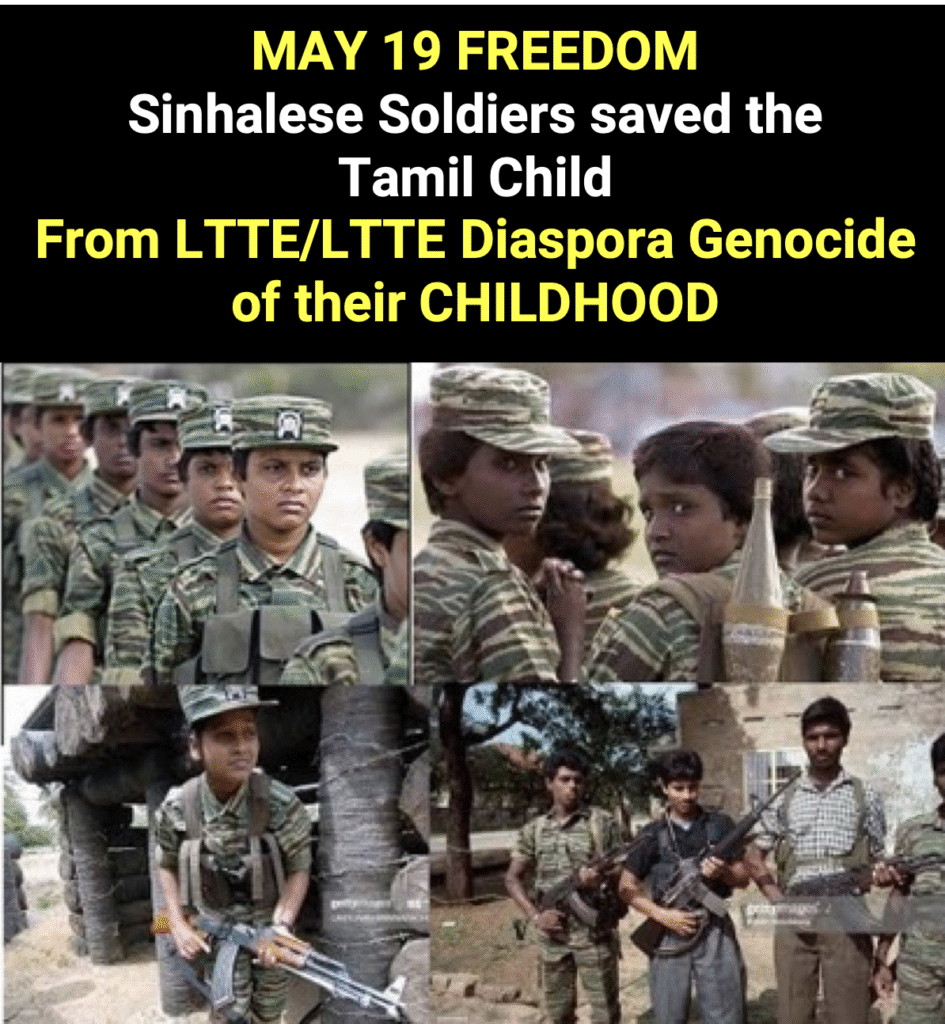
Has it never occurred to the international media or so-called international community or even UN/UNHRC Officials to question the silence of LTTE fronts to LTTE’s recruitment of Tamil children who were turned into child soldiers forming one third of LTTE’s ground force? How can LTTE fronts call for justice when hiding their own crime of creating child soldiers & sending them to their deaths over 3 decades? How can LTTE fronts who funded LTTE guns & watched child soldier recruitment have any moral authority to demand human rights or draft curriculum for bogus genocide week? How can LTTE fronts hide behind human rights rhetoric when for 30 years they encouraged Tamil children to be kidnapped & turned into child soldiers. They claim to fight for a separate state but don’t mind kidnapping their own people’s children & sending them to die. These were their own people’s children who were denied fundamental rights, plucked away from their homes & loved ones & taught to kill. Prabakaran is no more but LTTE fronts must answer for the Tamil children forced into war. Genocide of these Tamil children’s childhood should take international centre stage not a trumped up 40,000 figure for which no names, no skeletons, no police complaints, no birth certificates have been presented even 16 years after the conclusion of the conflict. These hypocrites in exile watched as LTTE kidnapped, trained their own children to kill & die while they happily sought asylum & sent their kids to foreign schools, universities & secured foreign jobs. Now their children are trained to continue the lies so the LTTE can continue their kitty.
LTTE fronts have taken great pains to open websites, hold conferences, panel discussions, woo international media, make documentaries, hold campaigns/fundraises, lobby politicians & retain lawyers – there’s nothing they have not done since end of LTTE ground force in 2009. They have presented themselves as paragons of virtue, fighting for their people & their rights and begging the people of the world to listen to their grievance. Arguments lined up to fit into their goal for a separate state.
Let’s stop there.
Did these paragons of virtue living in foreign shores not feel an iota of sorrow to watch their own people’s children plucked away from their parents, from schools or orphanages or while returning home & dumped into LTTE camps to be trained to kill? Obviously not.
What kind of a separate state is envisaged when one third or an entire generation of Tamil children have been denied their childhood?
Did these paragons of virtue not count the number of children some as young as 7 years as per Human Rights Watch reports, undergo gruesome training while those who fled were shot dead by LTTE?
Why did LTTE fronts — many based in safe, western democratic countries — not campaign against this grave war crime committed by the LTTE against their own community’s children? Because they were complicit & were well aware of the recruitment.
What a crying shame to live overseas, have one’s own children educated in Western schools while one’s own people in rural areas were handed rifles
Why has author Harrison who has been counting the dead since 2009, not bothered to count how many Tamil children were kidnapped from 1980s by LTTE – how many died as a result of LTTE training, how many Tamil children were shot dead by LTTE trying to flee? How many Tamil children were raped or served as sexual toys for LTTE men in bunkers?
The conspicuous silence of the UN Agencies is to also be questioned.
LTTE violated Article 38(3) of the UN Convention on the Rights of the Child & Optional Protocol on the involvement of Children in Armed Conflict (2000) which prohibits recruitment of children under 18?
What did UN do to stop LTTE over 30 years of child soldier recruitment?
According to the Paris Principles & Guidelines on Children Associated with Armed Groups, forcible recruitment of children not only violated humanitarian law but was considered a form of slavery under international law.
In over 30 years of recruitment of Tamil children, did the UN & associated agencies do anything to stop LTTE’s child soldier recruitment other than compile beautifully printed reports?
Why did diaspora leaders not rescue even one Tamil child soldier?
Why did Tamil political parties & Tamil politicians talking big in Parliament also not rescue one Tamil child soldier?
Yet LTTE Diaspora & Tamil politicians are happy to parrot genocide” ignoring their own community’s sin & betrayal of their own children.
A generation of children lost their childhood to satisfy an ideological dream of a handful.
How can LTTE Diaspora justify lobbying under banner of human rights” while conveniently ignoring the first & most sacred right – the Right of a Child to live free from war & forced combat.
The genocide” claim is nothing but a hyped charge sans facts or evidence only pumped by propaganda & sensationalism.
The genocide of the Tamil child used as child labor, for suicide, for ethnic cleansing, for assassinations, for killings is a bigger crime that has not received the international attention it should.
Under UN Security Council Resolution 1612 (2005) parties recruiting or using child soldiers must be held accountable.
Rome Statute of the International Criminal Court (Article 8) lists recruitment of children under 15 as a war crime.
Why was nothing done against LTTE?
The UN Basic Principles & Guidelines on the Right to a Remedy (2005) applies to all victims of human rights violations – not just those on one side of a conflict. Where is the justice for LTTE’s child soldiers denied childhood as well as the children LTTE killed from other communities including foreign children?
UK Govt stands guilty of harboring the woman who trained Tamil children as child soldiers. Why has no legal action been taken against Aunty Adele? Why is the aunty behind the cyanide capsule still free?
Optional Protocol to the CRC on the Involvement of Children in Armed Conflict (2000)
Article 4(1): Armed groups should not recruit or use children under 18 in any hostilities. Article 6: States must take legal measures against those who violate the Protocol.
Why has the UK not prosecuted Adele Balasingham under this Protocol, which it ratified?
Rome Statute of the International Criminal Court (ICC)
Article 8(2)(b)(xxvi) – Conscripting or enlisting children under the age of 15 into armed forces or groups, or using them to participate actively in hostilities = War Crime.
Adele Balasingham trained child soldiers under 15 — and wrote about it. Why no ICC case?
UN Security Council Resolutions on Children in Armed Conflict
UNSC Resolution 1612 (2005) – Calls for accountability for persistent violators of children’s rights in armed conflict.
The LTTE was listed. Adele Balasingham was its face for child recruitment. Why is she not on any sanctions list?
To the UN & Human Rights NGOs:
Why have international investigators failed to name Adele Balasingham, despite her public role in training child soldiers and glorifying their deaths in her books?
How is justice credible if those who armed and trained children — not just used them — face no international consequences?
Why has there been no tribunal, arrest warrant, or even public inquiry into her actions, while she freely publishes and lectures abroad?
Denying a child their childhood is a tragedy & a crime against humanity, a theft of their innocence that no separatist cause can justify.
Turning children into soldiers is a genocide of their childhood. Recruiting children as soldiers is illegal & is a systematic destruction of their childhood, a soul lost forever, a genocide that cannot be ignored. No cause, no ideology, justifies turning a child into a killer.
LTTE fronts accuse the Sinhalese of discrimination. But it was not the Sinhalese who robbed Tamil children of their childhood. It was the LTTE who turned their own sons & daughters into weapons. It was the Sinhala soldier who ensured that from May 2009, not a single Tamil child was kidnapped or recruited & trained to kill.
The LTTE fronts who cry discrimination” are reminded that it was they who forced Tamil children to carry rifles instead of books – not the Sinhalese.
Tamil children were denied schooling by LTTE & LTTE Diaspora not the Sinhalese.
It was LTTE & its Diaspora cheer squads who took the childhood away from Tamil children.
It was the Sri Lankan Army who gave the Tamil child soldier a second chance at life.
If the Sinhalese are accused of injustice & discrimination what do you call those who train their own children to die killing?
The hypocrisy is that those who parrot genocide” were the ones who were happy to force their own children to wear suicide vests & cyanide capsules.
This same LTTE Diaspora made a huge ruckus over the deaths of Prabakaran’s children but not a hum for the thousands of Tamil children who were turned into killers by them.
The international media, the so-called international community & the mighty officials of the UN & associated agencies kindly advised to revisit Sri Lanka’s conflict & ask themselves where the real discrimination lay? Was it not in turning innocent Tamil children into child soldiers? Was this genocide of childhood not a bigger war crime for not only was these Tamil children’s childhood stolen from them, they were forced to kill & taught to commit suicide.
What have the international media/international community/UN done to deliver justice to the perished Tamil child soldiers by holding to account LTTE fronts & Tamil politicians & Political Parties for their role?
JVP won power in 265 LG bodies and the closest rival SJB only managed 14. ITAK and other minority parties are no challengers to the JVP. This is an astronomical election victory. UNP, SLPP, SLFP and others were essentially wiped out unable to win a single LG body! They lost the country and now the village too.
Though defeated, SJB has positioned itself as the next favored regime. Voters’ choice for the next leader is between Anura and Sajith. Others have been rendered irrelevant.
Comparing local government elections with parliamentary or presidential elections is unwise. Local government elections offer hope for small and independent groups and have always caused fragmented election results. However, national elections offer no hope for these groups and they vote for the main contestants only. The other factor is the low voter turnout at LG elections.
Building up grassroots level political structures is very important for all political parties. LG councilors are often the election organizers of their parties, essentially the backbone of any political campaign. SLPP suffered the largest drop in the number of LG bodies and councilors in Lankan history which will cost them dearly.
However, there is no time for celebrations for the government. It must quickly build up foreign reserves that fell to zero in January 2022 in the hope that by 2027 Sri Lanka will have sufficient amounts of dollars to repay foreign loans and their interest unpaid since 2022. Failing that it will be bankruptcy again. Global and regional challenges are unprecedented and will certainly have an adverse economic impact.
Need to think out of the box to attract FDI and offshore sector development This is the single point mooring buoy purchased by Ceylon petroleum corporation in 1986/87 Colombo Dockyard offered to assemble the mooring buoy in Cololmbo Dockyard on behalf of SBM/ IMODCO but due to unknown reasons CPC paid higher price and imported it We made a model in timber to ascertain assembly and welding on Licence and offered to build it That was 40 years ago We were to start offshore sector construction in 1985 since I returned from Norway after working in offshore industry Since that time we could not make a break through to start except few rigs repaired after docking of rigs Now it is 2025 and it is high time that part of Trincomalee Harbour is identified as a potential location Such type of oil rigs are brought to Trincomalee for lay up Sri Lanka should invite our own blue chip companies to invest and build workshop suitable to maintain equipment of rigs or assemble steel modules and re install using floating cranes Such a high value industry which can generate much needed foreign exchange and support retaining of skilled youngsters leaving the country
Clappenburg area in Trincomalee where local company with possible collaboration of foreign investor is already earmarked Both minister of industries and shipping with SLPA should take the lead now
Over to you President and ministers of Industry and shipping and SLPA
Media Unit, Dr. Thilaka Padma Subasinghe Memorial Legal Education Program
Lawyer Aruna Laksiri and another person filed cases in the Supreme Court to correct the errors in the Constitution and tried to correct them. In those cases, they had to pay the millions in legal fees to the state and the lawyer was ordered to pay 500,000 rupees as legal fees.
Lawyer Aruna Laksiri has requested the following information from the Information Officer of the Ministry of Foreign Affairs, Foreign Employment and Tourism.
1. 1. Has the former Chief Justice Jayantha Jayasuriya been appointed as the Permanent Representative of Sri Lanka to the United Nations?
1.2. If the answer is “Yes” or “Appointed”, when was it?
2. If the answer to question 1 above is “Yes” or “appointed”, were the facts that the 22nd Constitutional Amendment Bill was published in the Gazette on 18.07.2024, admitting by the Attorney General that there were 2 errors in Article 83 of the Constitution, before appointing former Chief Justice Jayantha Jayasuriya to Sri Lanka’s Permanent Representative to the United Nations who had imposed hundreds of thousands of rupees in legal fees which persons who had filed cases in the Supreme Court before 18.07.2024 to correct errors in the Constitution by claiming that there are errors investigated?
MSc in Service Management, University of Colombo, Sri Lanka
EMSc in Digital Marketing, Asia E University, Malaysia
BSc (Hons) In Biomedical Science, KAATSU International University, Sri Lanka
EDSMgt (UoC), HNDMLT (MoH), HNDIT (MoHE)
Medical Laboratory Technologist (MLT) Base Hospital – Balapitiya Secretary of CMLS.SL & AHP | Executive Member of SLSMLS | General Secretary (SlagMLT) | Asst. Treasure (JCPSM)
I, as a Sri Lankan Tamil, would like to place my protest against the Brampton Municipal Mayor’s speech and the monument placed in protest of the SL government. I had already sent this protest to Mayor Patrick Brown. The cheapest practice here in the Western developed world is that Tamils who have minimal qualifications migrate to a foreign country, particularly the West, and engage in cheap politics. The weakness in democracy is that political candidates to get support from voters in India, etc., pay a collateral. In the west, it may not be the practice, but to get their vote support, they may stoop to a low level of supporting the migrants like the Tamils, etc.
I throw a challenge: What could be the IQ of Vijay Thanigasalam and Gary? Could it be over 100 or lower?
Mayor Patrick Brown, who may be educated, should not stoop to a low level of speech against Sri Lanka and blame the country as they have committed GENOCIDE. Was he there during the war and witness the genocide? For argumentative sake, my question is: why did the LTTE manufacture heavy weapons? Pictures attached. It was a war that struck in Mullivaykal. The fact that the Tamils lost the war, they are blaming SL for Genocide. They migrate in laks and then shout from Canada, London, as SL committed genocide. This statement is not factual and correct. Once they migrate, they plan to migrate into the politics of the host country and deliver speeches against Sri Lanka.
A question to the Europeans in Canada, the USA, etc. Why the hell did they mass murder native American Indians in millions? Why have they pushed them to areas defined as reservations? Tamils have free movement, and they are everywhere in Sri Lanka, bossing around politicians. Tamil politicians behave like rowdies. Most of the murderers are Tamil politicians now. You are in Colombo. You should be aware of the history of SL.
As per 2021 statistics, there are 240,000 Tamils in Canada. How did they migrate if there was a genocide in SL? Are they all scientists or engineers, or physicists? Maybe three-quarters of them would be coolies and mostly practice through eating houses. Any further tolerance of these Tamils would contaminate the European race in Canada and drive them to be another Asian or African country. These half-baked coolies, came to live in Canada. NOT TO GOVERN CANADA.
It could be assumed that Canada and the UK are opposed to the current government and are trying to destabilize the country. The UK is already contaminated with foreigners and filled with garbage on the roadside. If Canada is not careful, the same will occur and filled with garbage.
I had information that most of them became rich by misappropriating the LTTE funds.
Hope Canada would take steps to be careful, not racial, but practice true honesty with dignity, like Australia.
In our essay titled, Have the Tamil Voters in the North and East (and in thePlantation Regions) Rejected Separatism, Racism and Politicians that Advocated Separatism, Racism?” posted on November 30, 2024, we have stated that it has become an amusing pastime of a plethora of Colombo-based journalists who write to English newspapers and political analysts who cater to the needs of the Western audiences to interpret November General Election as Tamil voters rejecting separatism, racism and politicians that advocated separatism and racism and this has unified the entire Island, a vote against divisive politics, division of the country or separation, a powerful message for national unity, unification of all Sri Lankans. We stated that it is all bunkum to say that it was a blow to those who still pursue separatist agendas. They wrongly attributed voting in the North and East in favour of the NPP, indicates the beginning of the end of divisive politics, dawn of a new, unified political landscape promoting a united Sri Lanka.
They seized thisfallacyeagerly, gleaming with enthusiasm, convinced they had found the lost key to El Dorado, in pursuit of an idealistic goal, perhaps national unity.
Tracing the history of parliamentary elections in Sri Lanka we have elucidated how Tamil and Muslim voters voted with the so-called Southerners in previous occasions, Tamils electing Ponnambalam Kandiah from the Communist Party of Ceylon in 1956 and Tamils and Muslims being elected either from the SLFP or UNP respectively from the North and East. These analysts have forgotten how Jaffna voters voted for Kobbekaduwa, Tamils and Muslims voted for CBK, Fonseka, Sirisena and Sajith Premadasa at the respective Presidential elections.
Similarly, Sinhala voters elected Muslims as their representatives in the past in the Sinhala dominated areas rejecting as they say racial and religious biases” before the active interference of foreign-funded NGO cabal in Sri Lanka. One example is their own Anjana Umma of JVP being elected from Gampaha electoral district.
In 1947 all electorates in the plantation districts were won by Indian Tamils, that included Soumyamurthy Thondaman. After the introduction of the PR system many Tamil politicians of Indian origin were able to get elected from plantation districts. Members belonging to various splinter groups got the opportunity not only to enter the Parliament but to be kingmakers when Ranasinghe Premadasa reduced the cut-off point from 12% to 5%.
Rauff Hakeem of SLMC reminded the new NPP government at the inaugural session of the new Parliament that it was done as requested by his late leader Ashroff. By saying this Hakeem intended to emphasize that JVP/NPP would not have any representation in previous parliaments or an Anura Kumara Presidency or an NPP government would be a never dreamt dream if it not for Ashroff- Premadasa.
This shows relying solely on surface-level statistical indications, ignoring political and geopolitical factors, manipulations of foreign players and the psyche of Tamil and Muslim voters to form conclusions, can be highly misleading and potentially dangerous, leading to flawed judgements and misguided decisions.
In our essay we gave a detailed analysis on how the NPP became the most favourable party to Tamil voters rejecting the established Tamil political parties in the North and East. A repetition is not necessary.
But at the recently concluded Local Government Election the NPP suffered a severe setback in the North and East and the plantation regions.
Within a short period of six months, scarcely had those analysts and armchair theorists tightened their grip to the lost key, cracks began to form and fingers loosened. The excitement turned into confusion and dismay. What had seemed as the key to the closed door suddenly disappeared, leaving them stranded in the ruins of misdirected hope.
2. A Summary of Election Results
2.1 Jaffna District
ITAK secured majority in Jaffna MC, VVT UC, Delft PS, Velanai PS, Valikamam West PS, Valikamam North PS, Valikamam South West PS, Valikamam South PS, Valikamam East PS, Vadamarachchi South West PS, Point Pedro PS, Chavakachcheri PS, Nallur PS, (13); ACTC secured majority in Point Pedro UC, Karainagar PS (2); EPDP secured majority in Kayts PS (1); ITAK and ACTC tied in Chavakachcheri UC (1)
ITAK secured majority in Mannar UC, Mannar PS, Manthai West PS (3); SJB secured majority in Musali PS (1); NPP secured majority in Nanattan PS (6 as against 10)
Total won by Tamil parties-3
Total won by SJB-1
NPP fails to take control over any local body.
2.4 Vauniya District
Vauniya MC (4 each by NPP, DTNA, SL Labour Party and others); Vauniya North PS (NPP 6 as against 15); Vauniya South (Tamil) PS (NPP 6 as against 20); Vauniya South (Sinhala) PS (NPP 7 as against 10)
SJB secured majority in Vengalasettikulam PS.
NPP fails to take control over the administration of any local body.
NPP fails to take control over the administration of any local body.
2.6 Baticaloa District
ITAK secured majority in Baticaloa MC, Eravur Pattu PS, Koralai Pattu PS, Maumunai South & Eruvil Pattu PS, Maumunai Pattu PS, Maumunai West PS (6)
SLMC secured majority in Eravur UC, Kathankudi UC, Koralai Pattu West PS (3)
TMVP secured majority in Koralai Pattu North PS (1)
ITAK and TMVP tied in Maumunai South West PS, Porthiv Pattu PS (2)
Total won by Tamil parties-9 (2 tied)
Total won by Muslim parties-3
NPP fails to take control over the administration of any local body.
It is interesting to note that TMVP, the party headed by Sivanesathurai Chandrakanthan aka Pillaiyan now held in remand prison for the alleged abduction and causing disappearance of the Vice-Chancellor of the Eastern University, winning one PS, tying in two PSs and securing 38 members from Batticaloa District.
In 1989 JVP/DJV assassinated Prof. Stanley Wijesundera, Vice-Chancellor of Colombo University and Prof. Chandraratna Patuvathavithana Vice-Chancellor of Moratuwa University. No one was accountable, only the unidentified gunman.
2.7 Ampara District
National Congress secured majority in Akkaraipattu MC, Akkaraipattu PS (2)
ITAK secured majority in Navithanveli PS, Karaitheevu PS (2)
Majority secured by parties other than NPP- Seruvila PS, Kanthale PS, Thambalagamuwa PS (3)
NPP tied with other Parties in Padavi Sripura PS (1)
Total won by Tamil parties-3
Total won by Muslim parties-3
Total won by NPP-2 (Sinhala dominated PSs)
2.9 Puttalam District (only Muslim/Tamil dominated Councils were taken for analysis)
Majority secured by parties other than NPP – Puttalam MC, Puttalam PS, Wanathavilluwa PS (3)
NPP tied with SJB – Kalpitiya PS (1)
Total won by NPP-8 (Sinhala dominated PSs)
2.10 Nuwaraeliya District
Now let us observe the voter behavior in two plantation districts, Nuwaraeliya and Badulla districts respectively.
Majority secured by parties other than NPP – Nuwaraeliya MC, Hatton-Dickoya UC, Thalawakele-Lindula UC, Maskeliya PS, Norwood PS (CWC tied with NPP), Ambagamuwa PS, Agarapathana PS (CWC and SJB tied with NPP), Kotagala PS (CWC tied with NPP), Nuwaraeliya PS, Kotmale PS, Hanguranketha PS, Walapone PS
Opposition parties secure control over the administration of all local councils (12).
2.11 Badulla District
NPP secured majority in Badulla MC, Bandarawela PS (2)
An Independent Group secured majority in Haputale UC (1)
Majority secured by parties other than NPP – Bandarawela MC, Mahiyangana PS, Soranathota PS, Meegahakivula PS, Kandeketiya PS, Lunugala PS, Uva-Paranagama PS, Haputale PS, Haldummulla PS (9)
NPP tied with other opposition parties- Rideemaliyadda PS, Passara PS, Welimada PS, Ella PS (4)
It should be noted that Mahiyangana, Meegahakivula and Kandeketiya are Sinhala dominated rural areas.
3. Analysis
Anura Kumara turned this election into a national election touring and addressing meetings in every nook and corner, what was not expected by a President of a country, like a top General taking part in training and drills, reconnaissance and patrolling, transporting supplies, maintaining equipment, ambushes, small-scale localized operations and tactical skirmishes. He personally led the campaign without delegating these affairs to his other leaders. This shows two things: he was overly self-assured, with an inflated sense of over confidenceand lack of trust on others. His utterances and promises bordering on arrogance, devalued the presidency into a lower depth. He toured and addressed meetings in former war zones such as Puthukkudiyiruppu and Prabakaran’s birth place Velivettthurai to garner votes of the families of former terrorists.
Colombo-based armchair critics and pseudo-theorists who write to English papers say that local government elections are about local issues; which party or individual close to the people can work with the people to attend to matters at local level; it is a misguided assumption that local government polls are about national issues. Still these so-called pundits live in the coffee age”, dwelling in the past, lost in antiquity.
If it so, why political parties hold mass rallies, transport supporters to distant venues and political leaders including the President address local council election meetings?
As school boys we had witnessed how our humble village folk contested Village Council (VC) elections and knew the work entrusted to and carried out by Village Councils. These simple structures were destroyed by Premadasa who aspired high office creating Pradeshiya Sabhas.
To catch votes in the Jaffna Peninsula the government of Anura Kumara, opened roads, land occupied by the security forces within the Jaffna HSZ was released, gold owned by the Northern people which was forcibly taken by the LTTE, later recovered by the security forces was released to the rightful owners. Imitating his bête noir Mahinda Rajapaksa, Anura Kumara even carried toddlers and fondled them.
At every meeting held in the North and East he said that his government has ended racial politics and there is no room for fomenting ethnic, racial, religious bigotry.
4. NPP Promises to Erect a Bronze Statue of Prabhakaran
The most despicable, disgraceful, abominable, wretched deed was committed by a Jaffna NPP MP as reported by the LTTE mouthpiece Tamil Guardian on May 4, 2025. Tamil Guardian carried a news item that the NPP has released a series of pro-LTTE campaign songs ahead of local elections embracing rhetoric and imagery associated with Tamil nationalism and LTTE.
Accordingly, these songs were circulated by NPP Jaffna District MP Elankumaran Karunanathan in his Facebook account, pledging to erect a bronze statue of Prabhakaran in Velivettithurai; in the name of Velupillai Parvathy Ammal (Mother of Velupillai Prabhakaran) and Prabhakaran’s father a new harbor and a memorial hall will be constructed; the Maveerar Thuyilumillam (Hallowed Ground of the Martyrs”) will be rebuilt; vows all PSs support the reconstruction and upkeep of LTTE cemeteries. The song also promises to rename Nallur’s Sankiliyan Park as Kittu Park”.
One song says that the principles of the NPP and those of the Tamil national leader” are one and the same. Another song compares the ideology of the NPP with that of Prabhakaran;
The ideology of the Tamil
National leader is Communism
The ideology of the National
People’s Party is also Communism.”
Tamil Guardian reported that a total of 28 such video songs have been produced and shared across NPP affiliated social media platforms.
Thereby NPP, invoked the memory of the LTTE armed struggle to win votes. Photographs of Prabhakaran’s former residence, footage of Maaveerar Naal (Day of the Martyrs”) commemorations , references to LTTE martyrs” feature in the music videos; they all contain NPP symbol and party name in three languages, video clips of NPP meetings, Anura Kumara and other leaders addressing rallies, shaking hands, his portrait in front of the Eaalam map, Mullivaikkal, portraits of MGR, Jaffna town, seascapes, kovils, people engaged in different economic activities, Catholic fathers and sisters, combat scenes, dances, parks and other features signifying Tamil culture.
When there was an uproar by the social media against this treacherous act, amidst the conspicuous silence of opposition parties including the so-called nationalists, the NPP General Secretary, true to his nature came to the rescue of his colleague, stating that they were tagged to the said NPP MP’s Facebook account by mischief makers.
This was a childish explanation; nowadays even a primary school child knows that if the account is tagged the account holder can remove the tag, review the tags before they appear on their timeline, block, report and take legal action against the perpetrators.
He only displayed that he was also a big liar, con artist, fabricator in the NPP bandwagon.
But with all these political gimmicks NPP was unable to wrest control in the North and East local bodies. Even the Tamil Guardian which reported this stated that critics have lambasted the NPP which has no historical alignment to Tamil nationalism” for this opportunistic mimicry. Southern parties cannot remain electorally relevant in the North-East without adopting to this language. NPP now appears to be leveraging the imagery of LTTE leaders and invoking the memory of the Tamil armed struggle to win support”. It further stated that this strategy of NPP has drawn criticism from Tamils who accuse the NPP of hypocrisy, trying to use LTTE martyrs” and LTTE history as campaign material”.
It has clearly understood that it is a part of an attempt to rebrand themselves during elections in the North-East, a performative gesture.
Now, would these aforementioned journalists in the English press and foreign-funded political analysts tell us that the Tamil voters in the North and East embraced again separatism, racism, politicians that advocated separatism, racism, divisive politics, division of the country or separation, rejecting national unity, unification of all Sri Lankans within a short period of six months?
The answer was given by Abraham Sumanthiran, ITAK stalwart, Anura Kumara’s one-time friend, political ally and fellow May Day marcher.
The Island” reported on 13 May, 2025 that Sumanthiran stating local government elections have dispelled the Anura Wave” and reaffirmed enduring strength of Tamil nationalism in the North and East, a clear commitment from the Tamil people to their nationalist aspirations, that it underscored the community’s continued faith in Tamil nationalist politics, even amid strong attempt by southern parties such as ruling NPP’s to make inroads into Tamil majority areas.
It is a forgone conclusion that ITAK will collaborate with other Tamil parties where necessary to form local councils.
We have stated in an earlier article that Tamil separatism cannot be advanced by the NPP because there are more seasoned, tried and tested Tamil separatist parties such as ITAK, ACTC or Vigneshvaran’s Thamizh Makkal Tesiya Kootani (TPNA). Readers will remember that the TNA/ITAK declared LTTE as the sole representative of Tamil people. So, the Tamils do not need new Messiahs to take them to the Promised Land and they unlike the Sinhalayas and our Mahanayakas have not forgotten the history of old JVP/DJV although it comes in a new garb as NPP.
4. How did Colombo and Kandy elites become Communists/ Socialists”!
Dear Readers, we refer to our articles titled, Why foreign media dub Sri Lanka’snew President as a Marxist?”, posted on October 3, 2024, Why English press in Sri Lanka in a state of euphoria hail Sri Lanka’s new President?”, posted on 9, November 2024 and 2024 Elections: Is it the defeat of elite politics, power transferred to a non-elite group or the beginning of a rule of lumpen elites? Agrotesque mediocrity playing a hero’s part”, posted on December 20, 2024 respectively. In these articles we have categorically rejected that Anura Kumara is a Marxist/Socialist and JVP/NPP a Marxist/Socialist political outfit.
Recently held local government elections substantiate our thesis with compelling evidence. We take only two examples, Kandy MC and Colombo MC respectively.
In Kandy MC, NPP won Senkadagala, Mavilmada, Mahaveli Uyana and Aruppola (2 wards consisting of massive housing schemes of middle class and upper middle class voters), Ampitiya, Malwatta, Katukele, Wattarantenna, Mapanawatura, Asgiriya, Aniwatte- Dodanwela, Mahaiyawa , Mulgampola, Bowala and Getambe wards, all enclaves of upper middle class and middle class voters, gem merchants, businessmen, old feudal lords, nouveau riche, professionals and wealthy migrants.
Have these voters turned Marxists/Socialists”?
We have no qualms over NPP winning Watapuluwa, Yatiwawala, Galewatta,Poornawatta West, Deiyannewela and Suduhumpola wards, if NPP was a workers’ party.
In Colombo MC, Cinnamon Gardens (Kurunduwatta or Colombo 7), Bambalapitiya, Borella South, Thimbirigasyaya, Havelock Town, Kiriula, Wellawatte North and Wellawatta South wards were gained by NPP.
Have these voters turned Marxists/Socialists”?
Ironically SJB has won Summitpura, Mahawatta, Lunupokuna, Maligawatta East, Kettharama, Masangasveediya, Ginthupitiya, Kocchikade, Fort, Kochchikade South and Hulftsdorf East and UNP Hulftsdorf West and Grandpass North and SLPP Keselwatta respectively, all habitats of lower middle class, proletariat and lumpen proletariat.
In these wards the so-called Marxists/Socialists” have failed to appeal to lower middle class and proletarian voters! Ha! Ha!
The reason is clear. The present top echelon of Sri Lankan voters are brainwashed, conditioned, programmed and hypnotized by the English press, its editorialists and third grade, sensationalist, yellow journalists who had fallen down to the meanest level to describe Anura Kumara as a statesman” and Sirasa English news telecasts and its talk shows.
Go back to Colombo….you are not welcome in Brampton”, Mayor of Brampton chants racist slurs on anti-Genocide supporters. It is truly unbecoming for a Mayor to be making such wild statements. On what basis can he defend the creation of a Genocide Memorial – for whom is it? So far, even after 16 years since defeat of LTTE, no one has produced the names of 40,000 dead, some form of identification, skeletons of the dead or even police complaints of missing. Let it be pointed out that with no proof of the 40,000 killed, no one can point any finger of murder leave alone claim genocide”. Additionally, no LTTE dead can be mourned as civilian”. LTTE was a terrorist movement, a sovereign state has every right to deal with armed terrorists. Moreover, LTTE had a separate trained & armed civilian force. None of these dead can claim to be civilian” either. The LTTE holds annual commemorations for its dead. It’s hilarious to see foreign MPs actually attend these events shedding crocodile tears for ‘dead terrorists” fooling the rest of the world to think they are civilians”. The irony & hypocrisy is that these memorials are all decorated with LTTE symbols, insignia, Eelam flags but the media communications want the world to think they are mourning civilians” instead of dead LTTE terrorists. No wonder Brown wants to lift the ban on the LTTE too. Maybe next year he can pass a motion for a monument for Prabakaran too. Perhaps he can do monuments for all LTTE terrorist key leaders around entire Brampton.
As of the 2021 Canadian Census, approximately 1,555 residents of Brampton are Sinhalese while total Sinhalese living in Canada is said to be 18,000.
As of the 2021 Canadian Census, approximately 237,890 Sri Lankan Tamils live in Canada.
Who is Patrick Brown?
Born 26 May 1978 (just 20 years when LTTE bombed the sacred Temple of the Tooth in Kandy in 1998 / just 30 years when Sri Lanka’s military liberated Eastern Province from LTTE)
51st Mayor of Brampton, Ontario since December 2018
January 2018 – Brown was accused of sexual misconduct by 2 women & resigned as leader of Ontario PC Party
In 2022 he was disqualified from race for federal Conservative leadership due to alleged violations of Canada Elections Act including issues related to campaign financing.
In April 2019, Patrick Brown introduced a motion in Brampton City Council to officially recognize May 18 as Tamil Genocide Remembrance Day. Brown who has never been to Sri Lanka was obviously influenced by the 9375 Tamil residents of Brampton (as per 2021 census). To please 1.6% of Brampton’s population Brown has created a Tamil Genocide Remembrance Day.
It is natural for any to wonder why a person who has not been to Sri Lanka, to be influenced enough to introduce a motion. This question is explained in the support given to him by the 9375 resident Tamil community in his bid for Conservative Party leadership via even financial assistance. His 2018 book he details how he utilized Tamil organizers who were promised appointments to various boards (The Pointer) This was one reason why he was disqualified from the leadership race for breaches of campaign finance rules including vote-buying. Thus, his genocide” claims come from the various sources that led to his disqualification.
Patrick Brown claims genocide deniers, you are not welcome in Brampton, you are not welcome in Canada. Go back to Colombo” – on what facts is Brown claiming genocide? Was he witness? Who are his sources? If it’s the pro-LTTE elements that financed his campaign, there is little that needs to be left to anyone’s imagination.
It is fascinating that the casualty figures of Sri Lanka & the UN Country Team matches with total less than 8000 while all of the sources quoting figures from their pro-LTTE friends claim 40,000 to 200,000 dead. These figures plucked from god knows where are only accompanied by well-funded campaigns with no facts or data. Surely, if anyone claims a figure as dead, they should accompany that with details of the dead. Simply throwing a number & claiming genocide” is unacceptable especially when it is directed at a National Army.
We cannot stop lies. We cannot stop people living in cuckoo worlds. All of the genocide noise comes from Tamils living overseas, holding foreign passports, educating their children overseas, employing their children in foreign jobs & unlikely to ever come & reside in Sri Lanka. While their next generation of children are also continuing the lies, a question the Tamil community never likes to answer is why they never sacrificed a single child to LTTE as a child soldier. Why was it always Tamil orphans kidnapped from orphanages & turned into child soldiers, why was it low caste & poor Tamil children kidnapped from their homes & turned into child soldiers. The Tamils drumming human rights from Canada & other western climes never considered the human rights of a single Tamil child soldier who comprised 1/3 of the LTTE fighting force. From the reports that have emerged these child soldiers served as comfort women, were raped, sexually abused apart from having their entire childhood denied to them. These are live cases and real stories unlike the genocide that Patrick Brown claims. If Brown & Co do not like to take up these real issues but think that putting up a monument is a big deal, they can put monuments all round Canada.
However, Brown’s actions should reach the Brampton Integrity Commissioner & the Ontario Ombudsman, given his controversial past.
Why would a Canadian mayor, who has never visited Sri Lanka, take such a strong stance on a foreign conflict?
Are vote-buying accusations linked to diaspora groups a sign of deeper political manipulation?
If former combatants are honored as civilians, what does that mean for the integrity of war narratives and justice?
Why do diaspora advocates focus heavily on genocide claims but never address LTTE’s use of child soldiers and other human rights abuses?
Should Canadian political figures be involved in foreign ethnic or national conflicts?
Frankly, we do not mind the new Public Security Minister one day becoming the Prime Minister of Canada & using these monuments to declare Eelam in Canada. Yet, Canada has secured all provisions to ensure such separatism cannot take place constitutionally, yet why is Canada advocating for such in other countries?
Deshamaanya Dr. Sudath Gunasekara Former Permanent Secretary to Prime Minister Sirimavo Bandaranaike (1994) President of the Sri Lanka Administrative Service Association (1991-94)
This has reference to the article Defense Agreement signed with Indiaon 05.04.2025. by President Disanayaka, is not second to the Kandyan Convention of 2nd Marh 1815. that appeared in the Sunday Aruna (Sinhala) newspaper.
I do not know whether this title given to that article was selected by the person who wrote the article, the scholar who gave the discussion, or the newspaper editor. Most likely, it could be the newspaper editor in charge of that page. Whoever it may be, first, I must categorically state that this assertion is a malicious and a diabolical lie. All available historical evidence proves that this assertion is a first-class myth, invented by anti-Kandyan elements in order to cover their own betrayals over a period for 310 years.
It must also be pointed out that the title too does not go with the content of this article at all. In introducing the scholar, who gave the opinion in the article, the writer has said last time such an agreement was signed between the two countries was 38 years ago”. I opine here that he is referring to the Rajiv/JR Acord of 29th July 1987.
As such I cannot understand as to why the Kandyan Convention was dragged in, in this context to insult the heroic Kandyan patriots, who defended the Sinhale Kingdom against three powerful Western colonial invaders for 310 years (1505-1815) at very high cost without allowing Sri Lanka becoming another America, Australia, New Zeeland or Philippine. If the heroic Kandyans were not there to defend the Motherland definitely there would have been no Sinhala country on earth today, for us to talk about.
I also pause an open question to this person who invented this myth as to what those who lived in the lowlands did, in contrast, to the Kandyans, to protect the motherland from these savages’ invaders from 1505 to 1815? Isn’t a shame that they befriended with the invaders, instead of defending the country. They took the invaders names, embraced their religion and customs and manners, including their dresses, language and practically all what was European. Thereafter they accepted state office under them and even honorary names like Mudaliyar and Mahamudaliyar conferred by the invaders as bribes for the services they rendered on to them. What is more is they also have worked under them as their loyal servants for 310 years enjoying all the benefits received for being loyal to them.
Therefore, whoever has chosen this topic, he has definitely made an unforgivable and grave mistake. Shouldn’t all these people who still share this mythical view of betrayal by the Kandyans, be ashamed for what they have done and be ever grateful to those who lived in the Sinhala Buddhist Kingdom on the hills, for defending the motherland for 310 years against the most powerful fire powers in the world at that time ,at very high cost and protecting the heritage of the traditional Sinhala Buddhist Kingdom with all its priceless great heritage coming down for millennia, for the present generation to be proud of their great heritage, that was a hallmark in the ancient world.
I also think the writer (or the person who used this derogatory word in this article) may not have read or even seen the Kandyan Convention, even in his dreams perhaps. Because if he had seen or read the Kandyan Convention, he would never have used such a derogatory headline against his own people, the Kandyan Sinhalese who saved this paradise Island for all of us to live cherish and be proud of. The person who chose this topic must be someone, who does not even know that the Udarata–Pahatharata division of the Sinhala nation is a cunning tactic used by the British to divide and rule the Sinhala race and the country. He must also be a person suffering from an anti-Kandyan Sinhala syndrome” who does not even know that there had never been two Sinhalese races in this country throughout its long history until Robert Percival the Englishman invented it in 1803. Thus, it was the British colonial rulers who first divided the Sinhala nation as Uadarata and Pathatharata, to divide the Sinhala nation in to two rival groups in order to make their dream of concurring this country easier and running the country thereafter by invoking the policy of divide and rule.
Udarata-Pahatharata Division
Since the writer has compared the Modi-Anura agreement with the Rajiv/JR agreement in introducing the scholar who expressed his views in this article, I do not understand as to why the Kandyan Convention was brought up here at all in the headline.
It is also, crystal clear from all the agreements signed by the current President with Modi that he has betrayed the motherland to India in a treasonous, anti-national, cowardly manner, in the same way JR did it by the Rajiv/JR agreement of 1987. But I would like to emphasize here that the Kandyan Convention has never betrayed the country or the nation to the British by it. Conversely it was those Sinhalese who lived in the coastal lowlands who first betrayed that part of the country to Portuguese in 1505 as the first step indirectly by yielding to the invader and supporting to consolidate on Lankan ground and second, to the Dutch and finally, to the British for 18 years from 1797-1815,directly by aiding and abetting through decoy and spy services to capture the Kandyan Kingdom.
As a traditional Kandyan Sinhala Buddhist whose brave ancestors had fought tooth and nail to defend the motherland, I express my deep displeasure over that unethical and childish statement the writer has made in that article. I also express my strong objection to this severe insult made to the proud Kandyan Sinhalese.
Whoever had chosen that title for this article, has done a great insult to the brave Kandyan Sinhalese who sacrificed their lives in hundreds of thousands in battles against enemies for 310 years from 1505-1815 while the Sinhalese in the lowlands were already under the invaders as their friends. Therefore, the Anura/Modi agreement has to be compared only with the Rajiv/J.R. and never with the Kandyan Convention. Because, both the Rajiv/JR Accord and the Modi/Anura agreements are very much similar as both have done the same job of criminally betraying the motherland and the Sinhala Nation. Moreover, both have been drafted in India, singed secretly without cabinet or Parliamentary approval. The overall negative consequences of both these agreements very much similar and as such they are like twin brothers that will bring nemesis, to mother Lanka.
Therefore, it is a grave and unpardonable mistake to compare the Modi/Anura agreements with the Kandyan Convention that was singed between two independent sovereign Kingdoms as equal partners after long discussions, where the British have clearly agreed to protect our religion Buddhism and also native political, legal and social institutions in writing, although they violated the mutually greed Convention in 1818, in keeping with their Viking sea pirate practices and carried on with their own system for the rest of their colonial exploitation until 1948.
My request to Aruna
In a country that, does not have an independent press culture, that support native culture or social values and where they only naively support the government in power for their own survival, independent readers of this country expect at least your papers to provide truthful information to the people.
I also request you to publish a public apology in the Sunday Aruna (Sinhala) newspaper for making such a false statement that humiliates the heroic Kandyan Sinhalese, who fought valiantly for generations against the Portuguese, Dutch and English invaders for 310 years from 1505 to 1815, sacrificing hundreds of thousands of lives, to save this country from becoming another America, Australia, New Zealand or Philippine, while the those on the maritime provinces slept with them for whatever reason it may be, without declaring war against them as the Kandyans did.
First of all, I express my deep displeasure and regret to all those who hold this false opinion, and I think that the publication of the myth that the Kandyan people betrayed the country to the British by the Kandyan Treaty of March 2, 1815, should be stopped immediately in all newspapers and other media. All Sinhalese, wherever they live in this world, are one race. I am extremely disappointed by the Sinhalese who do not even know that. Because since the birth of the Sinhalese nation in 543 BC, they have remained as one race called Sinhalese.
They were divided into two hostile camps in this way by the whites only. It was by a white man named Robert Percival in his An Account of the Island of Ceylon” (1803) who first named the people of the Upcountry as Candians (Upcountry people) and those who lived in the coastal lowland areas as Cinglese (Sinhalese).
Thus, it was the British who divided the Sinhalese of this country into two groups, the Kandyans and the Lowcountry Sinhalese. Although the two minorities in this country at that time, the Malabars and the Muslims (who were not citizens in this country by then), they were referred to as Jaathiin by the whites since 1799 (Cleghorn minute to Governor North).
Kandyans
In investigating the origin of the word Kandyans”, it is clear that it was the British prisoner in the Kandyan kingdom, Robert Knox (1660-1679) who used the word Cande for the first time in his book An Historical Relation of Ceylon” to refer to the Kandyan kingdom. It is also used as Candia in some places and the word Cande is used throughout his book up to page 347. It seems that he used Cande to refer to the Kandyan kingdom, what was then known as Kanda-Uda Pasrata. Thus, Robert Knox used Cande to mean the hill country.
On the other hand, the word Kandy was first used by John Davy, in his work An Account of the Interior of Ceylon (1821). Thus, it is clear that Kandyans is only a word used by the whites to refer to the Sinhalese who lived in the hill country. They called this country Ceylon in the sense the land of the Sinhalese”. Therefore, it is clear that all Sinhalese in this country were one nation by the time the Western sea pirates arrived on our shores
Division of the Sinhala nation into two antagonistic groups as Udarata and Pathatharata Sinhalayo.
The Sinhalese had never been divided into two nations, at any time in history, until 1803, when a white man named Captain Robert Percival divided the Sinhalese into two hostile camps, the Upland and the Lowland. The fact that this country had been known as the Thun Sinhale” throughout history confirms this. This also makes it clear that this country has been the land of the Sinhalese nation since the beginning of history. In short one country and one nation” the gospel truth, the present-day Sinhalese are unable to comprehend. The tragedy is there is no Sinhala leader, either political or national, to say this openly and organize the Sinhala rata and the Sinhala nation, at least after 77 years since the North Atlantic Sea pirates had physically left the shores of this Island.
The Heroic Udarata Sinhalayo
The Kandyan Sinhalese fought against the murderous Western invaders the Portuguese, Dutch and English, for 310 years from 1505 to 1815 AD, and saved this country from becoming another America, Australia, New Zealand or Philippines under the European colonial invaders.
It must be clearly stated here with pride as a Sinhalese man, that I have not heard or read of any such successful resistance for 310 years to their invasions any other nation in the whole British Empire. Therefore, as a Sinhalese Buddhist resident of the Udarata, I express my strong objections and displeasure on behalf of all the Udarata people for insulting them in the media in this way, and I request you to immediately stop publishing such false, baseless articles in a responsible newspaper like yours, at least in future.
I must clearly mention it here that there were no two Sinhalese races, called Kandyan Sinhalese and Lowcountry Sinhalese before the arrival of the British. They were all one race from 543 BC. That was, the proud Sinhalese race of the Lion descent. We also proudly declare that the Sinhalese are not a race that originated from a tiger, a wolf or a jackal. Their totem on the other hand is the majestic lion. Therefore, all such vituperative writings against heroic Kandyans should be stopped forthwith at least now.
Resulting from this pathetic and unfortunate background, today we are a nation divided like a scrambled egg or a claypot smashed on a stone in to pieces, that can never be unscrambled or reassembled. The only solution to this seemingly intractable tangle is for all Sinhalese to unite as one nation based on their millennia old Great Sinhala Buddhist civilizational matrix.
What is the Kandyan Convention?
Those who claim to be scholars but who do not even know what the Kandyan Kingdom is and invariably who have never read or seen the Kandyan Convention even in their dreams and also who do not know that there were no two Sinhalese races, ever in the historical past, I think should refrain from making this type of silly statements. The terms Kandyan and the Lowcountry Sinhalese were only inventions of the British to divide and rule the Sinhalese. Those who had lived in the maritime provinces under the white invaders for 310 years, under their repressive rule should understand this gospel truth. They should never try to throw mud at those Sinhalese who lived in the Kandyan Kingdom on the hills, as they were the people who saved this land of the Sinhalese for 310 years for all of us to live as Sinhalese Buddhists today. Such scholars and writers should immediately give up this pro-western mentality and resolve to stand united as one Sinhala nation and one country. Because without doing so, we will never be able to raise our heads once again as a great nation, as we had been for millennia from 543 BC.
What is the Kandyan Kingdom?
The Kandyan Kingdom was the last link of that once pristine and glorious Sinhala Kingdom founded in 543 BC by King Vijaya, and transformed in to a Village Kingdom by establishing village boundaries on the whole island by King Pandukabhaya (394-307 BC) 10 years after he attained the throne, that was 384 BC and still later which was transformed in to a Sinhala Buddhist Kingdom after the arrival of Mahinda in the reign of King Devanam Piyatissa (247-207) in 384 AD.
After the fall of the Rajarta Civilization in the13th century due to Maga invasion, the Sinhale kingdom had been shifting from place to place eg; Yapahuwa, Kurunegala, Dambadheniya, Gampola and Kotte and finally to Kandy ,when Senaasammata Vikramabaahu declared his independence from the King of Kotte in 1474 and it lasted until it was ceded to the British by the Kandyan Convention in 1815, by a mutually negotiated International Convention between Brownrigg, the Governor of the British Empire on behalf of the King of England and the Adhikaaramas, Disawas and the representatives of the Sinhale Kingdom after the King was deposed as agreed.
(Meanwhile, I have recently come across a new view on the birth of the Sinhala nation and the Sinhala kingdom as given below.)
According to that view, the ancient Buddhist Sanskrit texts such as Karandavyuha and Divyavadana, written about a century and a half before the 5th century when the Mahavamsa was written, state that the Bodhisattva named Sinhala, the son of a nobleman named Sinha, who came to Sri Lanka from the Indus Valley region of western India, populated this country and started the Sinhala nation.”
After the discovery of the ancient Mohenjo-daro and Harappa urban civilizations buried underground in the Indus Valley region, the traditions mentioned in the above Sanskrit Buddhist texts were accepted as true, events by great archaeologists and Historians have confirmed this through various surveys.
The account of the origin of the Sinhala nation is recorded in the Divyavadana as follows:
Sinhalena ragna avasitamithi Sinhala Deepa: Sinhala Deepa ithi sangnaasanvurttha. Kin manadhyave, bhikkhu: yo sau Sinhala: ahameva thena Kalena Thena samayena”.
(It was inhabited by the Sinhalese king and the name Sinhala Island came in to being. Oh! Bhikkhus do you know who that Sinhala was? do you think that Sinhalese was? Oh, bhikkhus that was none other than me, during my time as a Bodhisatva.
(Preface. Piruvana pothvahanse. Buddhist Cultural Center. pages 446-464, P.L. Medical Edition😉
Whatever the origin of the Sinhala nation may be, 18 invasions by South India have occurred since the 2nd century BC up to the 13th century AD.
The Sinhalese Buddhist nation, that flourished from the 4th Century BC, was successively invaded by the South Indian invaders from the 2nd century BC Sena Gutthika, Elara and finally the extremely destructive Kalinga Magha (1214-1235 AD). All these invaders were clinically defeated by the local Kings like Dutugemunu, and they saved the country and the Buddhist religion.
The Kandyan Kingdom was the direct lineal successor to the great Sinhala Buddhist Kingdom which had flourished for nearly two thousand years in the Rajarata with its capitals at Anuradhapura and Polonnaruwa. Most importantly the Kandyan Kingdom was last independent, and sovereign Sinhala Buddhist kingdom as well that lasted until 1815. AD.
It was ceded to the British Throne in 1815.
It was the cunning intrigue, cleverly hatched byJohn Doily, the British Civil Servant and clever spy, that finally enabled the British to deceitfully capture the Unconquered Kandyan Kingdom, that lasted for 310 years from 1505 to 1815.
After the crushing defeat of the British in the Kandyan invasion of 1803, the British, realizing that they could not capture the Kandyan Kingdom through war, but through stratagem, only to be done through conspiracy and by dividing the Kandyan Aristocracy and by making the people of the country disillusioned with King Sri Wickrama Rajasinha. The leader of that conspiracy was John Doily. He was known as the most cunning civil servant, spy and the secret agent in the entire British Empire. Doily’s plan was to save Sinhale from the “oppressive and cruel Tamil King”. Doily succeeded to convince the Kandyan Chiefs lead by Ehelepola Maha Adikaarama and on March 2, 1815, the country was ceded to the British Crown as agreed by the Kandyan Convention concluded between the leaders of the Kandyan Kingdom and the British Government, two sovereign nations of equal status.
A few days before, on February 18, 1815, King Sri Wickremesinghe, who was fleeing to Meemure, that was best hideout in the Kandyan Kingdom was captured while hiding in Arachchige’s Atuwa, a house in Udupitiya, Galleha Watta, Medamanuwara, and arrangements had been made to send him to Colombo via the Royal Atuwas, at Teldeniya, Dambarawa and Weuda.
Meanwhile, the Ehelepola Maha Adikaram who met the Governor on February 27th had told him that he would not accept any other position, if he was not given the Sinhale Kingship as promised. Similarly, on the 28th, the Ehelepola Nilame had expressed the same position. This makes it very clear that the English, led by Doyli, had promised to give the Kingship to Ehelepola deceptively and had prepared the Coup de’etat, a master plan to capture the King with the help of the Ehelepola Maha Adikarama.
The agreement to be signed at Magul Maduwa on March 1, 1815 was also prepared and finalized. Before signing it on March 02nd, Mampitiyye, who met the Governor, had demanded that Buddhism be protected and the local administrative system like the country’s Disawa and Ratemahattaya be protected. Another group had requested that a white person be appointed as their leader (King?)
The Adikarams who gathered at Magul Maduwa at 4 p.m. on March 02nd, The Agreement was read to the officers. It is not stated that anyone signed the agreement that day. On the morning of March 3rd, before the chiefs who had gathered at Rajagedara, Walandure Mohottala, who met the governor again at 4 p.m. on the same day, said that no Sinhalese should be appointed to govern them and that even a white military officer would be suitable for that purpose. (This also could be a secret plan of Doily the King maker)
Thus, it is clear that the cunning Doyli had verbally promised to give the Sinhala kingship to Ehelepola Maha Adikarama in return to the services he rendered to the British and with his help, captured both the king and the kingdom, while on the other hand, he built an anti-Ehelepola rebellious group among the hereditary Nilames, and deliberately marginalized Ehelepola, and then took him into custody and sent him to Mauritius Island as a traitor and a criminal of the British government, and pretended to free this Sinhala country and nation, as well as the Buddha Sasana, from the tyrannical Tamil King. Ahelepola Adikarama, an extraordinary national hero, as I see had to die as a war prisoner of the British Empire in a prison cell in Mauritius Island. The cunning and clever spy and liar named Doyly, instead of giving the Sinhala kingship as promised, killed” that heroic Sinhala Aristocrat in a foreign land, and fulfilled his imperialist dream and died in Kandy in 1824.
One day, when the Ehelepola Maha Adikarama was walking around the Mauritius prison, his bodyguard, a French soldier, had asked him, What are you looking for, always looking down Nilame?” He replied, Looking for the freedom that we have lost in our Motherland and the Sinhala Nation.” One can imagine the kind patriotism and nationalism of that noble Sinhala leader even in these few words.
Kandyans Betraying the country is a diabolical myth.
Accordingly, I think you will agree that it is a blatant lie to say that the Kandyan people betrayed this country to the British through the 1815 Kandyan Treaty. The Sinhalese parties agreed to this agreement on the basis of the promises made by the British that the Tamils would be expelled and extinguished” (as stated in the K/Convention (clause 2) from this country and it would be handed over to them.
Since the Aruna paper article had mentioned the Kandyan Convention, a summary of it is given below for the information of my readers.
Summary of the Kandyan Convention of March 2, 1815.
On the 2nd of March, 1815, Robert Brown Rigg, on behalf of the King of England, on the one hand, and the Adikaramas, Disaavas and Sinhalese state and other native officials on behalf of the native Sinhalese on the other hand, have agreed and ordered as follows. (The fact that no Buddhist clergy had been included on behalf of the Sinhale Buddhist Kingdom was big lapse)
Clause 1 and 2 of the Convention indicate that King Sri Wickrama Rajasinha and all those belonging to his tribe have been deprived of all rights and have been removed from power and that the Tamil race has been deprived of all rights to govern this Sinhala country.
(3) The Government of the Sinhala country shall be conducted by the agents of the British Government, with due regard for the rights of the native officials such as Adikaarams, Disavas, other native officials such as Mohottalas, the Koralas and Vidanes and their properties and other liberties will be safeguarded by the British Government, in accordance with the ancient customs and traditions which have existed among them.
5 The Buddha Sasana and the religion of the gods, as believed by the rulers and inhabitants of these countries, must not be violated, and its affairs, Sangha, temples, and shrines must be maintained and protected.
8. The civil rights of the inhabitants of the Sinhalese countries, such as the control of their lands, lands, and property, and the laws of this country and the laws of the country’s government, must be conducted by the nobles authorized by the laws of this country.
9. All civil and criminal cases of all foreigners (British) who are not Sinhalese citizens have been heard according to the legal system of England by the commissioners appointed by the governor according to the law of England.
Postscript 01
Except for the story of betrayal, I agree with all the conclusions and opinions mentioned in the article in the Aruna newspaper on 2025. 04. 06..
I am in full agreement with the opinion that all agreements signed between the Indian Prime Minister and President Anura Kumara are very dangerous and treasonous and blatant betrayals of the first order. That is why I strongly reject equating the Kandyan Agreement with those agreements. Because the Kandyan Agreement is an international agreement negotiated and agreed upon between two independent friendly states of equal status at least at the time of placing their signatures on it. Moreover, it is also not a secret agreement and it was a public document, still valid for that matter. Therefore, I strongly disagree and reject comparing this agreement with the Anura/Modis Agreements as it was a secret document prepared in India by Indian mandarins without the participation of Sri Lankan public officials and imposed on Sri Lanka in the same manner Just like the Rajiv/JR Accord of 29th July 1987.Therefore it is also first class betrayal of the motherland that treacherously has laid down the road map for the division of the country and the establishment of the Tamil dream of the EELAM. What is more treacherous and betraying is the story that all these agreements were made only in Hindi, Arabic, and English while none of them were prepared in the official language of this country which is Sinhala. Isn’t this a first-class betrayal of the motherland and its people. Therefore, this missing link by itself makes them illegal and unconstitutional and therefore, I opine they are not binding on our part.
The agreement signed between the President Anura and the Indian Prime Minister was signed in secret. It is said that the country’s Defense Secretary, Attorney General, the Tri-force Commanders, the Council of Ministers, and the Parliament also did not know anything about it. The biggest betrayal is that all these agreements have been prepared only in Arabic, English and Hindi. That itself makes the Agreements unconstitutional and illegal as it was not inked in the official language (Sinhala) of the first party to the Agreements.
By doing this, the current President, just like J.R. did in 1987, has blatantly betrayed the sovereignty of the people and the territorial integrity of the country and violated the Constitution. It is the responsibility of the opposition and the lawmakers to save the country from this great national disaster.
There is a story that J.R. betrayed this Sinhala country and the nation to India through the treaty because he is descendant of the Thambi Mudaliar dynasty that came from South India. There is also a similar story circulating among the people that President Anura Kumara may also be a Tamil who descends from the 12,000 Tamil prisoners brought here from the Chola country by King Gajaba (174-196 AD)
Many people believe that a true Sinhala Buddhist, could never betray his homeland, the Sinhala country and the nation, to India, without any fear or shame which is trying to swallow this country. On the other hand, for 310 years before the Kandyan Kingdom was ceded to the British by an honorable treaty on March 2, 1815, the entire coastal area had been handed over to the Portuguese in 1505 and since then to Dutch and British by the lowland Sinhalese. They served them as their underdogs with the exception of very few patriotic men like the extraordinary national hero of that era, Anagarika Dharmapala. All others living in the maritime provinces are equally responsible for the sin of betraying the entire coastal region of Sri Lanka to these three white invaders.
The fact that there was no Air warfare at that time had perhaps had greatly helped the Kandyans to keep the enemy at bay for 310 years confined to the lowlands. Even at the end had it not been for the support of the people, living in the maritime belt it would have been a dream for the whites to capture the Kandyan kingdom. The only patriot, nationalist and national hero who fought against the enemy even in the late 19th century in the low country to reclaim this Sinhala Buddhist land and the Buddha Saasana was the unrivaled national hero Anagarika Dharmapala, who was rejected by these people and finally expelled from this country. It was these same lowland Sinhalese people who became their obedient servants to Portuguese, Dutch and English masters from 1505 to 1815.
Postscript 02
The Doyly-Brownrigg conspiracy behind the Kandyan Convention.
When the Colonial Secretary accused Brownrigg for agreeing to some clauses of the Kandyan Treaty, he has said that if he did not agree to some of those demands, he could never have conquered the Kandyan Kingdom. As such it was only a part of a secret strategy to seize the country.
Keeping to their original pan The Kandyan Treaty was violated unilaterally by the British in 1817, even before the ink of the treaty got dried up with the famous Uwa Welassa first freedom struggle erupted as the British violated the provisions of the Kandyan Convention. The appointment of a Muslim named Hajji Marikkar by the Governor on the recommendation of Doyly as the Muhandiram of Madige, among many other violations of the promises made in the convention triggered up the anti-British rebellion. Keppetipola Disaava who was sent to suppress the rebellion, joined with the freedom fighters of Uva and returned the weapons given to him by the Governor.
This incident was followed by one of the most savages and brutal killing spree, arson, suppression, oppression and repressions in which Brownrigg and Doyly acted together in the most inhuman manner as John Davy had said. Under the newly enforced Royal Proclamation of November 21st 1818 declaring the Sovereignty of the British Empire over this Island and thereby threw the Kandyan Convention in to the dustbin of history.
Brownwrigg issued a gazette notification dated on 1st November 1818 under Royal Decree No. 01, ordering the killing of all Sinhalese males over 18 years of age, the breaking down and burning of all houses, the cutting down and destroying of all fruit-bearing trees for human consumption, the confiscation or destruction of all grain, the breaking down and destruction of all irrigation canals and rivers, the burning of houses, the cutting down and destroying of all fruit-bearing trees, the destruction of all tank embankments and rivers, and the immediate killing of all cattle and buffaloes belonging to the people in excess of the needs of the army.”
With the result there was not a soul left to rise up against this massive murder by Torrington in the Kandyan Kingdom in 1848 in the Matale rebellion. That was why Gongalegoda Banda and Puranappu, one from Moratuwa and the other from Kelaniya had to impersonate as Kandyans at the Matale rebellion 1848.
Finally, in 1948, the British constitutional lawyer Jennings, with his Solebury Constitution, imposed a dependent economy on us, relying solely on imports and export of raw materials, leaving us with a divided Sri Lanka, a broken nation, and a country and society burned by ethnic volcanoes, while retaining the three basic requirements of a free state, the Legislative, Executive, and Judicial powers, with them. But they called it independence. Those who took over the country in 1948 as their acolytes and agents also embraced it as Independence. British called it Dominion status within the British Commonwealth of Nations.
Thus In 1948, instead of giving us the freedom to build an independent and free state that we lost in 1815 they further tied our hands to a colonialist octopus called the British Commonwealth of Nations, to keep us trapped in their empire on which the sun never sets. It is a tragedy which our post 1948 politicians failed to understand, until Prime Minister Sirimavo Bsndaranayaka made this country a fully independent Republic in 1972 for the first time since 1815.
Thus, what actually happened in 1815 was an imperialist conspiracy led by John Doyle, with the support of the Sinhalese and Muslims in the maritime provinces. They used the Ahelepola Maha Nilame, as a pawn to capture Sri Wickrama Rajasingha, by promising him that he will be made the King immediately after the Convention was singed and the king was deported. But within no time he was arrested by the British and exiled to Mauritius along with several Kandyan chiefs without any cause. He died there in 1829 from cholera in exile. Thus, the ungrateful Doyly and Brownwrigg left that brave mahakaLu Sinhalayaa to die as a criminal and a prisoner in a prison cell in an Island 2000 miles away from his own land of birth for the crime of trying to defend and regain his own motherland from the South Indian rulers.
Meanwhile, as already stated above, Brownrigg ordered to kill all the males over the age of 18 in the Kandyan Kingdom and all the crimes stated there and plundered all the wealth of the Thun Sinhale for 133 years to build their Empire at home?
Is this Captain Elmo sitting in front of the mausoleum of that Great Sinhala Patriot Ehelepola Maha Adhikaarama?
Who are the real betrayers of the Kandyan Kingdom?
In fact, according to 310 years (1505-1815) of colonial history in this country, it is clear that it was the Sinhalese living in the lowlands, who had been under the white rule for 310 years, and not the Sinhalese living in the highlands, who really paved the way for the betrayal of the country, the Sinhala nation and the Buddha Saasana to the whites, by aiding and abetting the invaders.
Except for a few solitary patriots like the extraordinary national hero of the time, Anagarika Dharmapala (1864-1933), that was long after the Kandyan Kingdom was ceded to the British in 1815 all the others who lived in the coastal lowlands are directly responsible for betraying the country for personal gain and positions under their rule, ever since 1505. They never resisted the invaders, Portuguese, Dutch or the British. Instead, they lived with them, worked for them, made riches and often provided spy services against the Kandyan Kingdom.
But people like the writer of this article in Aruna Sinhala paper cry foul, saying that it was the Kandyan people who betrayed the country to the Western Colonial Invaders.
Doyle-Brownrigg Conspiracy and the annihilation of the Kandyan Sinhala patriots: some more details.
When the Colonial Secretary accused Brownrigg for agreeing to certain clauses of the Kandyan Convention, he has said that he agreed to certain demands of the Sinhalese because he could not have captured this country without doing so. The white men had violated the terms of the Kandyan Convention even before the ink had dried up. The secret plan that had been hidden in their minds was put into full action immediately after the Uva Wellassa rebellion against the British rule broke up in 1817. Despite the Kandyan Convention was legally binding, the whites had begun their immoral, barbaric, inhumane killing spree of suppressing the Sinhalese by the royal Proclamation issued by the Governor Brownwrigg on November 1, 1818 on the recommendation of Doyly, completely ignoring the Kandyan Convention, as if such a document never exist.
In addition to violating the Kandyan Convention they also carried out their colonial subversive agenda of dictatorial and imperialist destructions as listed below, after 1818 to completely subjugate this country, the Sinhala nation and the imprints of Buddhism together with its native Administrative and legal systems.
1.In 1833, the country was divided into 5 Provinces namely North, South, East, West and Central, bringing the entire Thun Sinhale, meaning the entire Island, under their colonial rule. This was the first time the whole Island was brought under any foreign power in its two millennia long history. A closer examination of this division clearly shows that the boundaries of the Northern and Eastern provinces have been drawn in accordance with the Cleghorn Report submitted to Governor North in 1797 which had declared that this country had two nations as Sinhalese and Tamil and two countries (Districts in that note) where the Tamil country starts at Puttlam and extends up to Walaveganga in the South via Jaffna Trinco and Batticaloa to Walave. Gamga.
2.The forcible taking over of all the traditional and prescriptive lands of the native Sinhalese by Act No. 12 of 1840
3.The establishment of Catholic English schools in place of the traditional educational system of this country, the Pirivena education.
(The fact that out of 105 such schools established throughout the island by 1845, 45 were in the Jaffna peninsula and only 3 schools were in the Central Province, located in Kandy and Matale shows the special privileges granted to the Tamils and the discrimination made against the native Sinhalese by the white British.)
4.The killing of all those who survived the 1817 -1818 Uwa-Wellassa Kandyan rebellion was completed during the Matale rebellion of 1848. This was the last uprising by the native Sinhalese. The uncivilized killing spree carried out by Governor Torrington and his men has gone down in world history as one of the most inhuman and savages’ human destruction, not witnessed anywhere else, ever carried out on this planet. Public shooting of monks like Kadahapola priest, the most pious, erudite, brave and patriotic monk who gave leadership to Gongalegoda Banda and Puran Appu without any evidence, even when their own Chief Justice was against it, Torrington saying that” even if the whole world says no I will kill him” and keeping the dead bodies of native Sinhalese who were murdered, hung at the four gates of the towns like Matale and Kurunegala for three four days, bare testimony as to how these brutish, British have built up their often quoted ‘Empire where the sun never set, definitely diving in rivers of human blood specially in Asia and Africa.
5.The forcible seizure of all the lands owned by the temples in 1853. By the Temple Land Ordinance
6.The seizure of all the remaining lands of the Sinhalese by the so-called Waste Land Act in 1897, driving the Sinhalese to the streets and jungle and making the paupers.
7.Deforesting nearly 1.35 million acres of forest land, in the hill country, that had been there since the sun and the moon appeared on this earth, were cut down and burned and coffee and tea cultivation was expanded throughout the hill country and thereby destroyed the physical stability of the Geographical Heartland of the country, resulting total disappearance of the wealth of centuries old fauna and flora, drying up of all 103 rivers that have their source here, that fed the entire Island, , unprecedented soil erosion and land degradation causing flash floods, silting up of all downstream areas.
8.As the proud native Sinhalese in the hills refused to work on those lands, more than 1.2 million Tamil slave laborers were imported from South India and settled in the heartland of this Sinhale Kingdom.
9.When the whites left in 1948, all those 1.2 million Indians labourers were left behind on these lands, looted from the native Sinhalese who were living in this part of the country for millennia.
10 While all such Indian labour gangs taken to countries like Burma, Malaysia, Tanganika, Uganda and other African countries by the British were ordered to go back immediately or integrate with the natives and they all protected the interests of their native people by their new governments as they got independence. Sri Lankan leaders on the other hand slept doing nothing to send them out allowing a massive political, economic, social, demographic and a security time bomb to be planted on mother Lanka. Our so-called leaders did nothing to send them out. With the result, today they are fighting for a Malayaha within the Kandyan territory saying that they have been here for more than 200 years. Just before the last Presidential election all three Presidential candidates, Ranil, Sajith and Anura have openly promised to give them the lands and houses on which they live. Meanwhile India has already completed 60,000 houses for these Indians. They also have a number of Ministries catering only to their needs. For example, the Ministry of Upcountry Villages and infrastructure Development is catering only to the plantation sector Indian Tamils.
Conversely there is no one to speak a single word on behalf of the native Kandyan Sinhala people who owned all these lands before 1815 and fought for 310 years against the enemies to protect these lands, although there are about 75 members of Parliament and thousands Provincial Council and Pradhesiya Sabha Members supposed to be representing the people at different levels.
11.Going back to the North and East, since the beginning of 1800, hundreds of thousands of South Indian Malaba Tamils have been settled in the North and East by the British to reduce the Sinhalese population in those parts of the country.
12.They were Malaba immigrants until 1901, when they were gazetted as Ceylon Tamils under the Colonial instructions and created a new nation called Lankan Tamils in this Sinhala country.
13 Establishing Catholic churches and schools throughout the island
14.Finally, in 1948, Britain is supposed to have granted political independence to this country via the Solebury Constitution, drafted by an English constitutional lawyer named Jennings, retaining their interests. For example, the three basic requisites of an independent country namely the Legislative, Executive and Judiciary, were kept with them and they left the shores leaving behind a legacy of a divided nation and a radar less” society, in the middle of high seas in the Indian Ocean.
Accordingly, from 1818 to 1948, the British ruled this country completely ignoring the clauses of the Kandyan Convention 1815. The British government’s royal decrees, issued in Britain superseded the Kandyan Convention. The British King/Queen remained the Head of the State. Laws were passed in Parliament in the name of the Queen of England and the appellate power of the supreme court was retained with the Privy Council. The Head of the State Governor General was appointed by the Queen.
However, since the 1815 Mar 02 Kandyan Convention was never repealed and was only kept in limbo. It was, an international agreement signed between two independent countries, never repealed. Therefore, I opine it is still a legally binding agreement even at present. As such I wonder whether we can sue the British government for violating the Kandyan Convention and also against all Orders issued by the Governors from 1817 up to 1948.
I leave it to a patriotic Sinhala Leader, if there is any, who loves this country and the Sinhala nation, to go to court and demand compensation for the crimes committed by the British against this country and the Sinhalese nation, more particularly to the Kandyan peasants from 1815 to 1948.
In 1948 they only established a government, an administrative system, run by their own agents and a dependent economy in this country that could fulfill the needs of their own empire only, instead of giving us full freedom to build an independent state with our own system that we lost in 1815.
Above all, handing over this country to a group of brainwashed Kalusudhas from whose heads the most fundamental traits such as patriotism, and the love for their own native language, religion customs and their own civilization had been completely removed and replaced with those of the white men, which they venerated as superior. This in brief was how the British Destroyed this land of the Sinhala Nation and their culture for 133 years of their rule.
J. R, Ranil and Anura Kumara are the best examples of this brainwashed traitor model and the sad legacy, the white men had left behind as they physically left the shores of this Island 1948. All three of them have completed the betrayal of our 2566 years old heritage, jealously guarded and protected by our ancestors from 22 invasions. (19 Indian and 3 Western), to India and the Western plunderers by secret agreements signed by them as dictators without the approval by the people or the Parliament, using the power vested in hem as the Executive Presidents, making this country a shear suzerainty of India and the colonial West.
In addition, they also have pawned this 2500 years old beautiful country to the West and India via the Western colonial imperial institutions such like the World Bank, the IMF, the Blackrock and the Indian government. They have not only completely pawned this country and the present generation but also the unborn generation to come as well, forever.
These three Presidents have completed the destruction of Sri Lanka and it’s Sinhala nation together with its millennia old great and unique Sinhala Buddhist civilization to India and the West that the Indian invaders, including Rama and his monkey army invasion in 5000 BC, followed by their successors starting in the 2nd Century BC and finally the 13th century Maga invasion the most devastating, followed by three Western colonial invasions from the 1505 AD to this day, failed to do.
The following prophecy madein 1931 by Sri Anagarika Dharmapala, the most outstanding patriot, mother Lanka had produced in the late 19th century has now come true.
I am quoting it here in his own words, in Sinhala, for you to fully comprehend as to what a visionary and a patriot that great savant had seen 95 years ago.
Even today the Western imperialist plunderers continue their cultural and economic invasions through their own predatory institutions and agencies such as the World Bank, the International Monetary Fund, the World Trade Organization, the United Nations and its affiliated organizations, and the Asian Development Bank, what they could not do with their guns and swords back in the days when they ruled this country.
The end result of this entire process is, today we have lost our identity as a distinct nation. There are no lay or monastic national leaders or national organization, no national political party with any concern or love for the country, the Sinha race and their religion either. They also ceased to have a nationality, national dress, language or national ideology. They don’t understand the geopolitical and geostrategic value or the natural and human wealth of this paradise Island on earth or the vast stretches of ocean that stretches to infinity right round the Island or its resources. A country that had been a proud mono Sinhala Buddhist state for more than 2500 years, today is often called a multi-ethnic, multi-religious, multi-lingual country by all our political buffoons, who have no vison or a mission and who does not know their own history are not suitable to run even a small sillara kade in a faraway village.
With the result unfortunately, this Island that had been once called the granary of the east, the pearl of the Indian ocean and the paradise on earth by renowned world citizens of has today undergone a complete political economic, social, cultural, moral and spiritual erosion, almost beyond redemption.
Therefore, I call upon all patriots of this country to stop all types of divisions among the Sinhala people and rise as one united formidable force as a nation on regional, political and religious grounds and rise from the ashes like the Phoenix, to save this paradise Island, thrice blessed by the Buddha, the Sinhala nation, the Buddha sasana and its pristine and unique civilization on this earth. That is the golden gate cum the portals to the Kingdom of unity, prosperity, happiness and all-round success.
Obstacle of reconciliation and progress.
Although 77 years have passed since the advent of the so-called bogus political independence in 1948, our so-called leaders never had the vision or the mission to restore the Sinhala nation to its pre-1815 patriotic majestic level. The seeds of divide and rule sawn by the colonial rulers from 1799, such as political, ethnic, linguistic and religious have completely ruined the Sri Lanka nation that was there in the pre-1815 days in our history and today we are a nation in pieces, with a westernized and fully scrambled collection of men and women who has no love to the motherland, its heritage or age-old values.
The main catalysts behind this destruction as I see it, are, a) westernized values adopted by our politicians and social elites, b) the western system of government and Westminster system of party politics and finally c) absence of national patriotic leaders with a far-reaching vision and mission of nation building as found in our neighbor India, Japan or China.
The time has now come for all people living in this Island to integrate and unite as one nation, as we were in the past, without these divisive ethnic, racial, religious or linguistic divisions which[S1] bread divided allegiance to other countries like India, Middle East or the Colonial West.
Tamils and Muslims, who wants to live in this country to earn their living, have to concede to the historical fact the this was the Kingdom of the Sinhala people, founded and civilization built and defended and protected by them for millennia against all invasions both from the neighboring India and the Colonial West. It is high time that the minorities give up their day dreams of carving out separate countries of their own, within the territorial boundaries of this country of the Sinhala nation and integrate with the Sinhalese as one nation in one country as it had been there from the beginning of history.
Tamils and most Muslims first, migrated in search of green pasture and second, were recently brought to this country by the colonial British between after 1840s as slave labour to work on their projects, toddy tapping and newly opened up plantations Sinhalese were original settlers on these lands at least from 543 BC, if not before, and they were the people who established the civilization on this land.They were the people who defended their motherland against all foreign invasions from the 2nd century BC up to 1948 at very high cost and who laid the permanent foundation for the great and unique Sinhala Buddhist civilization, the hallmark of this Island nation. Therefore, anyone who wish to make this country their future home must accept this historical gospel truth as inalienable and be prepared to live cordially with the Bhumiputhra Sinhalese the prescriptive legal owners of this Land. Once that status quo is re- established as it had been there throughout history, we Sinhalese Buddhists are ever prepared to treat all citizens as our own brothers and sisters with no discrimination whatsoever. They can have their own religion and cultural practices without creating problems for the Sinhala Buddhists, the sons of the soil. Those who disagree with this formula has no option but to get back to their motherlands from where they have come. To implement this all-time solution, we need a Sinhala Buddhist Government of patriotic national leaders
Gautama Buddha has been such a towering figure for over twenty six centuries of human history that there is no shortage of authors attempting to put together his life story cast as that of a supernatural being. Asvaghosa’s Buddhacharita” appeared in the 1st century in Sanskrit. It is the story as narrated in the Lalitavisture Sutra that became translated into Chinese during the Jin and Tang dynasties, and inspired the art and sculpture of Gandhara and Barobudur. Tenzin Chogyel’s 18th century work Life of the Lord Victor Shakyamuni, Ornament of One Thousand Lamps for the Fortunate Eon is still a Penguin classic (as translated by R. Schaeffer from Tibetan).
Interestingly, there is no Life of the Buddha” in Pali itself (if we discount Buddhagosha’s Kathavatthu), and the thus have I heard” sutta’s of Bhikku Ananada, the personal assistant to the Buddha, contain only a minimal emphasis on the life of the Buddha directly. This was entirely in keeping with the Buddha’s exhortation to each one to minimize one’s sense of self ” to the point of extinction.
However, it is inescapable that the life of a great teacher will be chronicled by his followers. Today, there is even a collective effort by a group of scholars who work within the Buddha Sutra project”, aimed at presenting the Buddha’s life and teachings in English from a perspective grounded in the original Pali texts. The project, involving various international scholars of several traditions contribute different viewpoints and interpretations.
In contrast, there are the well-known individual scholarly studies, varying from the classic work of E. J. Thomas entitled The Life of the Buddha according to the Pali Canon”, the very comprehensive accounts by Bhikku Nanamoli, or the scholarly work of John Strong that attempts to balance the historical narrative with the supernatural, canonical with the vernacular [1]. Furthermore, a vast variety of books in English cover even the sociological and cultural background related to the Buddha’s life within fictionalised approaches and via fact-seeking narratives. The classic work Siddhartha” by Hermann Hesse, or the very recent Mansions of the Moon”, by Shyam Selvadurai attempts to depict the daily life of Siddartha in the fifth century BCE in fictional settings. Interpretive narratives such as The man who understood suffering” by Pankaj Misra provide another perspective on the Buddha and his times. In fact, a cursory search in a public library in Ontario, Canada came up with more than a dozen different books, and as many video presentations, in response to the search for the key-word Life of the Buddha”.
Interestingly, a simple non-exhaustive search for books in Sinhala on The Life of the Buddha” brings out some 39 books, but most of the content is restricted to a narrow re-rendering of the usual story that we learn from the well-known books by Bhikku Narada, or Ven. Kotagama Vachissra, while others are hagiographic and cover even the legendary life of Deepankara Buddha who, according to traditional belief, lived some hundred thousand eons (kalpa”) ago!
However, as far as I know, there are hardly any books in Sinhala that attempt to discuss the sociological and cultural characteristics of the life and times of the Buddha, or discuss how an age of inquisitiveness and search for answers to fundamental philosophic questions developed in north Indian city states of the Magadha, Anga and Vajji regions that bracketed the River Ganges. In fact, Prof. Price, writing a preface to K. N. Jayatilleke’ s book on the Early Buddhist Theory of Knowledge states that the intellectual ambiance and the epistemological stance of the Buddha’s times could have been that of 1920s Cambridge when Bertrand Russell, Wittgenstein and others set the pace! A similar intellectual ambiance of open-minded inquiry regarding existential questions existed in the golden age of Greece, with philosophers like Heraclitus, Socrates and others who were surely influenced by the ebb and flow of ideas from India to the West, via the silk route that passed through Varanasi (Baranes Nuvara of Sinhalese Buddhist texts). The Buddha had strategically chosen Varanasi, le carrefour of the East-West and North-South silk routes, to deliver his first sermon to his earliest disciples.
This usual narrowness found in the books on the Life of the Buddha” available in Sinhala is to some extent bridged by the appearance of the book Siddhartha Gauthama- Shakya Muneendrayano” (Sarasavi Publishers, 2024) [2] written by Rajendra Alwis, an educationist and linguist holding post-graduate degrees from Universities in the UK and Canada. The book comes with an introduction by Dharmasena Hettiarchchi. well known for his writings on Buddhist Economic thought. Rajendra Alwis devotes the first four chapters of his book to a discussion of the socio-cultural and agricultural background that prevailed in ancient India. He attempts to frame the rise of Buddhist thought in the Southern Bihar region of India with the rise of a rice-eating” civilisation that had the leisure and prosperity for intellectual discourse on existentialist matters.
The chapter on Brahminic traditions and the type of education received by upper caste children of the era is of some interest since some Indian and Western writers have even made the mistake of stating that the Buddha had no formal education. Rajendra Alwis occasionally weaves into his text quotations from the Sinhala Sandesha Kavya, etc., to buttress his arguments, and nicely blends Sinhalese literature into the narrative.
However, this discussion, or possibly an additional chapter, could have branched into a critical discussion of the teachings of the leading Indian thinkers of the era, both within the Jain and the Vedic traditions of the period. The systematisation of Parkrit languages into a synthetic linguistic form, viz., Sanskrit, in the hands of Panini and other Scholars took place during and overarching this same era. So, a lot of mind-boggling achievements took place during the Buddha’s time, and I for one would have liked to see these mentioned and juxtaposed within the context of what one might call the Enlightenment of the Ancient world that took place in the 6th Century BCE in India. Another lacuna in the book, hopefully to be rectified in a future edition, is the lack of a map, showing the cities and kingdoms that hosted the rise of this enlightenment during the times of Gautama Buddha and Mahaveera.
The treatment of the Buddha’s life is always a delicate task, especially when writing in Sinhala, in a context where the Buddha is traditionally presented as a superhuman person – Lord Buddha – even above and beyond all the devas. Rajendra Alwis has managed the tight-rope walk and discussed delicate issues and controversial events in the Buddha’s life, without the slightest sign of disrespect, or without introducing too much speculation of his own into events where nothing is accurately known. We need more books of this genre for the the Sinhala-reading public.
The Ministry of Defence today (May 16) convened a press conference to announce the preparations for the 16th National War Heroes Commemoration Ceremony, which will take place on 19 May 2025 at the National War Hero Cenotaph in Sri Jayawardenepura, Kotte.
The ceremony will be held on the 19th from 4.00 pm to 6.00 pm with the gracious presence of the Deputy Minister of Defence Major General Aruna Jayasekara (Retd) representing the honorable President. A series of island wide community welfare programs will also be carried out by armed forces, Police and Civil Security Department in view of the War Hero Commemorations. The Field Marshal Sarath Fonseka, Admiral of the Fleet Wasantha Karannagoda and Marshal of the Air Force are also scheduled to attend the ceremony.
Defence Secretary Air Vice Marshal Sampath Thuyakontha (Retd) presided over the press briefing. The Defence Secretary underscored the national significance of this annual commemoration, paying tribute to the brave men and women of the armed forces, Sri Lanka Police and Civil Security Department who laid down their lives in the defence of the nation. He reiterated the Ministry’s and the Tri forces steadfast commitment to preserving the memory of fallen heroes, ensuring that their legacy of patriotism, sacrifice, and unwavering commitment to duty continues to inspire future generations.
During the briefing, officials of Ranaviru Seva Authority and Armed forces provided an overview of the ceremonial proceedings, which will include wreath-laying, special tributes, and military honours, with the participation of distinguished guests, military personnel, and the families of war heroes. The event seeks to serve as a solemn occasion for the nation to express its deepest gratitude and unwavering respect for those who selflessly served in country’s sovereignty and national security.
The Ministry of Defence calls upon all citizens to stand in solidarity in remembering the nation’s war heroes, reaffirming collective appreciation for their unparalleled dedication to protecting the country and its people.
Commanders of the Navy and Air Force, Army Chief of Staff, senior military officials, Ministry representatives, and a large number of electronic and print media personnel were present at the occasion.
The newly appointed Ambassador of Israel to India accredited to Sri Lanka Reuven Azar visited the Pathfinder Foundation Headquarters at Riverpoint recently and met with the Founder Milinda Moragoda and Chairman Bernard Goonetilleke. At the Meeting discussion centered on identifying ways and means of expanding cooperation between the two countries in tourism, agriculture, digital technology and logistics. Over the years the Pathfinder Foundation has established a dialogue with think tanks in Israel. He was accompanied by the Hon Consul for Israel in Sri Lanka Dinesh Rodrigo