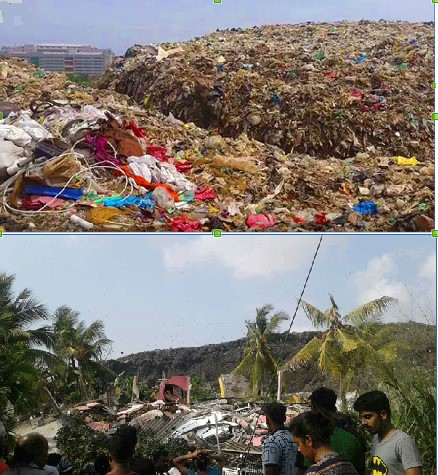
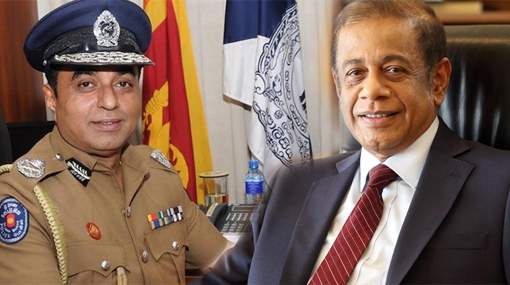
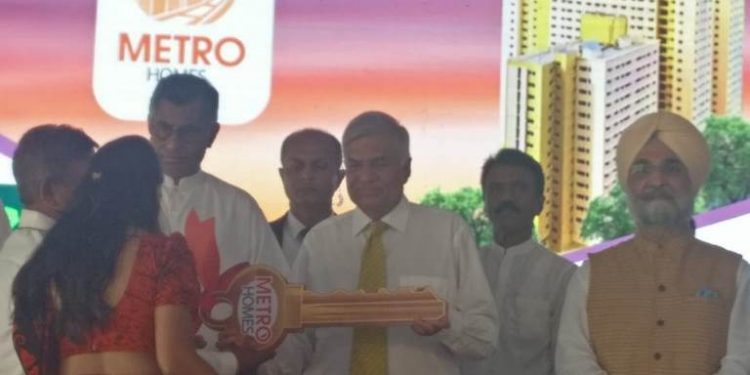
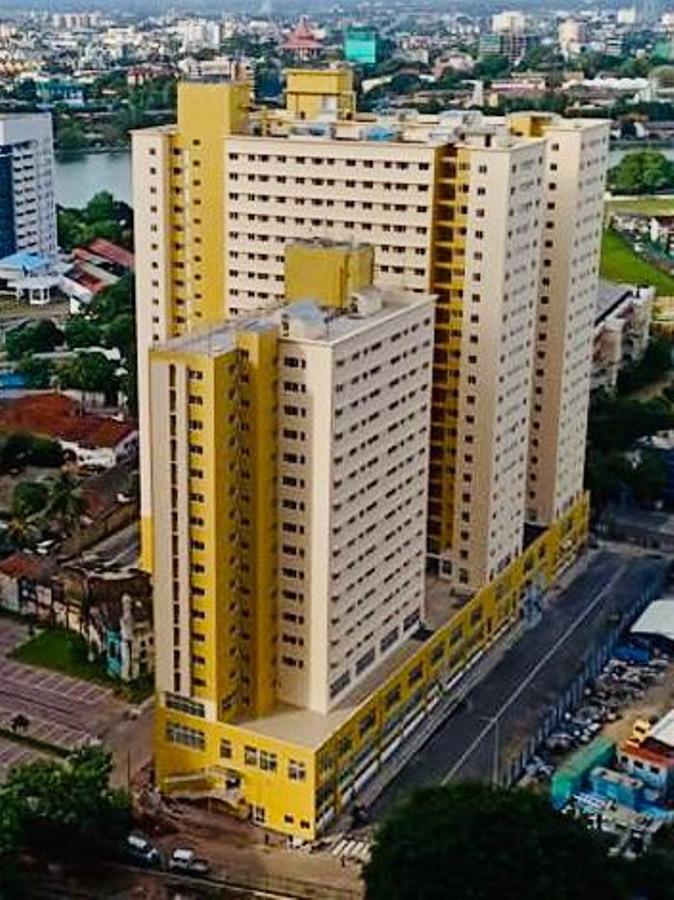
The whole country stinks

August 3rd, 2019

By Dr. Tilak S. Fernando Courtesy Ceylon Today

The latest news, about the import of 130 container loads of waste material to Sri Lanka from UK hospitals has reached every nook and cranny in the country and it has turned the whole country ‘upside down’, as it were. The entire populace of this country is benumbed and looks aghast when such inhuman deeds occur in front of their own eyes. Who are behind and responsible for such mortifying acts? Why has the Sri Lankan business society stooped to such an undignified level merely for the sake of earning a few extra bucks, as if there are no other decent maneuvers available to make an honest and a decent living?


Out of an entire lot of containers,102 are still lying in the Port of Colombo. So far 29 containers have been processed and re-exported, according to news sources, maybe in another illegal modus operandi! The rest of the containers, filled with garbage, are in the open, currently piled up at the Hayleys Free Zone Ltd (HFZ), also known as Advantis in the Katunayake Free Trade Zone.  The stockpile of rubbish inside these containers is piled up in an open space, which was captured by journalists’ cameras and exposed on TV news.


There have been certain speculations too about the presence of ‘some human body parts’ mixed with the garbage inside these containers, for which the UK is supposed to be conducting their own investigations. With so many developments that are taking place within such a short period of time, since the exposure, the Central Environmental Authority (CEA) has taken legal action against those who imported the containers of industrial waste without a proper license. This led to confusion, frustration and resulted in a public outcry. In their petition to Courts, the CEA has highlighted the risk of cancer and kidney disease that can spread out of the germs present in the garbage dump. Consequently, they have appealed to the Courts to rescind the documents used to import such junk, stressing the fact that the importation is in breach of the Provisions of the National Environment Act.


Meanwhile, the consignee, ETL Colombo Private Ltd, has issued a media release denying any involvement in the import of garbage-containers and stressed they are only involved in the freight forwarding business. They seem to claim the containers were imported by the Ceylon Metal Processing (Pvt) Ltd (to be re-exported)! However, none of the parties such as Hayleys Free Zone Ltd., ETL Colombo (Pvt) Limited or Ceylon Metal Processing Corporation (Pvt) Ltd can escape from the fact and responsibility of getting involved in this illegal operation as all of them are responsible and part of this importation to reprocess and re-export  such discarded  hospital waste from the UK, because none of these companies had obtained either the Environmental  Protection Licence or the Hazardous Waste Management Licence from the  CEA.


In view of the above, the CEA has ordered Hayleys Free Zone Ltd (Advantis) to export the waste material to the Country of Origin with immediate effect, quoting Sri Lanka as a signatory to the Basel Convention. The CEA has also issued clear instructions to Hayleys Free Zone Ltd (Advantis) to take immediate and remedial action to prevent any liquid or other effluents polluting the environment where they are piled up in open space.


Judging by the developments of each one pointing a finger at the other, akin to the recent Easter Sunday bomb blasts, critics are sure to come up with their own theories and conclusions to say that similar to other issues such as the Central Bank Fraud and the Easter Sunday bombing the whole issue may  be swept under the carpet like everything else, once garbage containers are re-exported the culprits involved in such illegal maneuvers may get off scot-free without any condemnation, damnation or denouncement for violating the environmental laws of the country.

Anonymous write-up doing Internet Rounds

In the meanwhile, a nameless write up is going viral on  the Internet  under the topic How Billionaire’s Money Silences Presidents, Prime Ministers, and Law and Order” highlighting  that the garbage imported from the UK by a local company is a serious violation of the laws of Sri Lanka.”


The article points out how 13 Laws, Regulations and Statutes have been violated in this operation and the manner the Central Environmental Authority and The Customs of Sri Lanka detected this and forcefully revealed the name of the Company Responsible as Hayley’s Plc. with a Freight Forwarder and a Trader jointly committing a crime under Sri Lankan Laws; furthermore, the goods imported were bonded in a warehouse that belongs to the consignee.


The article points an accusing finger particularly at Hayleys Plc., who prides itself as being a one-billion-dollar company that has won the Best Responsible Corporate Citizen Award for 6 years as having done something that casts a massive shadow on the credibility of such awards by their actions.


The article further goes to explore that ‘‘what has been revealed over the past few weeks is nothing short of the shocking truth behind criminal activity conducted under the direct purview and supervision of this company.’’

Present Trend

Does the article argue how Sri Lanka continues to allow this company to conduct its operations as if nothing has happened? Despite having extremely strong Corporate and Environmental Laws, and a powerful Penal Code, the Directors of those firms appear to be roaming freely at present. Under the circumstances, the Sri Lankan public looks on nonplussed and the local media channels in Sri Lanka and all major International Media Networks continuously expose this preposterous example of Corporate Greed!  It also points to the fact that allegations and suspicions of money laundering must be investigated. The article continues questioning as to what people in Sri Lanka could expect in the present circumstances while emphasizing the fact that this is what has happened to Sri Lanka today!”


In 2015, when the Treasury bond scandal was reported in the media, it was dubbed a witch hunt. It took over a year for the public and the authorities to understand the enormity of the theft of public savings through the EPF (Employees Provident Fund)”.


Finally, what it boils down to is the fact that extremely hazardous waste material has been imported to Sri Lanka and left unchecked, probably for years, before being finally exposed to the hilt, while suspecting that such garbage seems to contain deadly viruses such as Ebola (an infectious and frequently fatal disease marked by fever and severe internal bleeding) that can wipe out thousands, if not millions. Exposing this small island to such risks is seen as nothing but heartless action that angers every citizen”, the article continues.


Finally, it concludes stating that unless justice is done and is also seen to be done in this instance and those responsible are arrested and made to pay the price for their sins, a massive public uprising against the despondency and helplessness, in the face of a weak and useless system of maintaining law and order, cannot be avoided.

tilakfernando@gmail.com

 CT Web 02:00 AM Aug 03 2019

PM Ranil’s quarter century leadership challenged as UNP crisis deepens

August 3rd, 2019

GAGANI WEERAKOON Courtesy Ceylon Today

The cold war prevailing between the two camps within the United National Party (UNP) reached volcanic proportions with Deputy Leader Sajith Premadasa’s camp openly challenging Prime Minister Ranil Wickremesinghe who is holding onto the leadership for over quarter century, at a crucial Working Committee meeting held on Thursday (1), to deliberate on the proposed alliance.


The argument arose with Party’s Chairman Kabir Hashim opposing the idea, when UNP Leader Wickremesinghe sought a mandate of the Working Committee to launch the alliance on Monday (5), as planned without giving time for the members to study the content of the proposed alliance constitution.


The draft of the constitution of the UNP-led alliance, named the Democratic National Front (DNF), was ultimately passed  by the UNP Working Committee, led by Prime Minister Wickremesinghe at Temple Trees.


The UNP Working Committee comprises 77 members. However, only 42 members were present for yesterday’s meeting. Of them, 35 members voted for the constitution of the new alliance.


Seven UNP Members, including UNP Deputy Leader and Minister Sajith Premadasa, UNP Chairman and Minister Kabir Hashim and Ministers Mangala Samaraweera, Malik Samarawickrama, Ranjith Madduma Bandara and Thalatha Atukorale, voted against the constitution.


UNP National Organiser and Minister Navin Dissanayake, Minister John Amaratunga and Parliamentarian Dr. Kavinda Jayawardena had emphasised the importance of forming the proposed alliance.


Ministers Sujeewa Senasinghe and Eran Wickremeratne expressed their strong opposition to the formation of the new alliance, a UNP Working Committee Member told Ceylon Today. It is also reported that Wickremesinghe reprimanded Minister Ajith P. Perera, who expressed strong views in this connection.


Minister Eran Wickremeratne has lamented that the Wickremesinghe, who in 2001 made him (Eran) to meet LTTE’s Thamilselvan to talk about values of democracy, is depriving his own party from practicing democracy.


UNP Members who opposed the constitution had stressed that the Party’s Presidential candidate for the forthcoming Presidential Poll must be nominated prior to forming the alliance.


Speaking at the Working Committee meeting, Premadasa had stated that he would not oppose the formation of the new alliance if he was appointed as the General Secretary of the alliance.


Wickremesinghe instructed Party members to submit any amendments to the new alliance’s constitution to Hashim.


UNP General Secretary and Minister Akila Viraj Kariyawasam said, the new alliance will be formed without delay, and that the Memorandum of Understanding (MoU), on forming the new alliance, would be signed with amendments on 5 August. The majority in the Working Committee agreed to sign the MoU on 5 August, he added.


Meanwhile, Non-Cabinet Minister of Economic Reforms and Public Distribution, Dr. Harsha de Silva, took to Twitter to say that the Working Committee unanimously agreed to build an Alliance, but did not -agree on its proposed constitution.


He added that it has been decided to reconvene discussions after the leaders of the constituent parties agree on the amendments, and that no agreement has been reached yet on the date of the launch.


The objectives of the Front are to foster and protect national independence, safeguard unity, sovereignty and territorial integrity, to uphold and honour the principles of democracy and fundamental human rights and to protect and promote democratic rights and conventions.


Meanwhile, a group of UNP Ministers are planning to boycott the inauguration of a new political alliance slated for 5 August, if the UNP leadership decides to go ahead with its registration sans sorting out the thorny issues, informed sources said.


A few of the Ministers who spoke on condition of anonymity said that currently there were serious disagreements between UNP Parliamentarians on the proposed constitution of the DNF.


They said that any decision taken by the UNP hierarchy to register the DNF without effecting the necessary amendments to its constitution will result in the majority of Ministers boycotting the DNF inauguration which is scheduled to be held in Colombo.


Leader of the House and Minister Lakshman Kiriella asserted that the registration of the DNF will go ahead as planned on 5 August under the aegis of Party Leader and Prime Minister Wickremesinghe. He averred that already a dialogue has been initiated among party leaders of the UNF relating to the proposed amendments to the constitution of the DNF. Kiriella added that neither the UNP Ministers nor its supporters should be unduly concerned about the constitution of the DNF and insisted that the steering wheel will be in the hands of the UNP.

 He further pointed out that not only will Wickremesinghe head the DNF, but its Leadership Council will also be made up of the majority of UNP MPs. He explained that, therefore, the public should not entertain any undue fears that the UNP will be forced to play second fiddle to other political parties within the DNF.


 In the meantime, Ministers Kabir Hashim and Ajith P. Perera have both submitted proposals to Wickremesinghe demanding that he amends the DNF constitution. They have also demanded that the Secretary of the DNF should be from the UNP, while the Party’s Head Office should be ‘Sirikotha’ which is the UNP Headquarters. Among the other requests made to the Party Leader by the duo were that the UNP leadership be given the power to take decisions from within the DNF and that the person chosen to run for President should have his or her candidacy approved by the UNP’s  Working Committee and its Parliamentary Group.


No one will be allowed to hijack the UNP when appointing the Presidential candidate for the forthcoming Presidential election, Minister Senasinghe has said recently.


He claimed that the UNP Working Committee had not granted approval for the formation of the DNF which comprises several recognised political parties even though several UNP sources had said that the approval was granted.


“The UNP leadership was seeking approval for forming the DNF but several members of the Working Committee including myself pointed out that approval can’t be granted for an unseen Constitution. Then the proposal to sign the MoU for the DNF was postponed because the proposal was not duly approved by the Working Committee,” he said.


He added that the UNP should hold the post of Secretary of the NDF, as the UNP is the key party to the alliance. Besides, the alliance headquarters should be “Sirikotha,” but with the draft, the NDF Secretary may come from another political party,” he said.


The disagreement between the two parties erupted mainly due to Wickremesinghe proposing Minister Rajitha Senaratne as General Secretary of the alliance and Minister Patali Champika Ranawake to the post of National Organiser.


Meanwhile, Leaders who represent ethnic minority parties including Ministers Rauff Hakeem, Rishad Bathiudeen, P. Digambaram and Mano Ganesan have also pointed out to PM Wickremesinghe that key posts of the alliance should remain with the UNP. It was also reported that they also spoke in favour of Premadasa’s candidacy as they also prefer a UNP candidate.


However, following the Working Committee meeting, it is learnt that the UNP leadership and his allies may give a serious thought to naming Speaker Karu Jayasuriya as its presidential candidate. The decision to appoint Jayasuriya appears the wisest option in hand as he is from the UNP and would be able to appeal to the Sinhala Buddhist vote; a vote base that UNP has thus far failed to achieve. Jayasuriya’s candidacy may also be able to split the Sinhala Buddhist majority vote that would ideally be drawn to former President Mahinda Rajapaksa’s camp.


Meanwhile, the Sri Lanka Freedom Party (SLFP) last week said, they are likely to decide on their presidential candidate at the party convention to be held on 2 September, insisting they prefer to wait until candidates from the United National Party (UNP) and Sri Lanka Podujana Peramuna (SLPP) are named first.
The DNF is scheduled to be formed on 5 August under the leadership of Prime Minister Ranil Wickremesinghe, and the SLPP will hold their maiden Party Convention on 11 August to name their Presidential candidate.


Speaking to media at the SLFP Headquarters, United People’s Freedom Alliance (UPFA) General Secretary Mahinda Amaraweera said, “We expect to take several crucial decisions during the convention to decide the future of the party. All these decisions will be taken with the approval of Party Members. Therefore, this will be a very productive convention, as we are going to follow a bottom-up approach to decide on the plans of the Party.”


He noted, the Convention will give a new message to the country on how to work according to democratic values, and to listen to ideas of the Members to decide the future of the Party. He said the Party was not in a hurry to name their presidential candidate, or make a call on how to contest upcoming elections. Meanwhile, SLFP National Organiser MP Duminda Dissanayake said they would observe activities of their rival political parties before making a final call on their presidential candidate and plans.  â€œWe are eagerly waiting to see what will happen on 5 August and 11 August before taking a final decision. This will enable us to take a more dynamic decision, which works better for us,” Dissanayake said.


Referring to the Executive Presidency, Amaraweera noted he would back the abolishing of the Executive Presidency, and in his view that can be done before the Presidential Election, if all parties join together.


“This is the best chance to abolish the Executive Presidency. Some argue the Executive Presidency is essential for national security, and the war ended under the leadership of an Executive Presidency, but the conflict started after the Executive Presidency was introduced. Therefore, I do not see any legitimate reason to think the Executive Presidency is essential for national security,” he argued.


Amaraweera noted if the Janatha Vimukthi Peramuna (JVP) does not present the 20th Amendment to abolish the Executive Presidency, he would present a Private Member’s Bill to abolish the Executive Presidency.


He noted that the SLFP had decided to seek the Supreme Court’s opinion on holding Provincial Council Elections before the Presidential Election. According to Amaraweera, that was to prevent any delays of Provincial Council Polls.


“Only a few weeks ago, Elections Commission Chairman Mahinda Deshapriya announced the possibility of holding Provincial Council Polls before the Presidential Election. Under these circumstances, if the President does not go before the Supreme Court and at least try to hold the Provincial Council Elections then the public will point the finger at us and say it was our fault the Provincial Council Polls were delayed. We are planning to go before Court to avoid such accusations,” he added.    


On the other hand, a group of party organisers last week in the presence of SLFP General Secretary Dayasiri Jayasekara requested President Maithripala Sirisena to remove Southern Province Governor Keerthi Tennakoon and Central Province Governor Maithri Gunaratne from their respective posts. President Sirisena has promised them to solve the matter before Monday (5) and it was in the midst of this that reports emerged to the effect Uva Province Governor Marshall Perera handing over his letter of resignation owing to personal reasons. Central Province Governer Maithri Gunaratne also tendered his letter of resignation to the Presidential Secretariat last afternoon.


Basil the Mason


National Organiser of the SLPP Basil Rajapaksa met a group of journalists at a star-class hotel in Colombo last week where journalists asked him about SLPP’s preparations for the Presidential Election and the planned National Convention to be held in a few days. At this point Basil Rajapaksa had turned to Prasanna Ranatunga and asked as to where his invitation card for the Convention is. Prasanna had responded saying “Sir, you are the mason who is building this house. Why do you need a special invitation?”


To this, Rajapaksa has said that he too fears whether he will face the same fate that every mason goes through. When puzzled journalists and Ranatunga asked as to what he meant he responded, “Well, the owners and everybody seek mason’s advice and assistance from the time the foundation was laid till the roof is completed. But on the day of housewarming, the mason becomes nobody and he even has to enter the house from the back door.”  


When journalists asked him whether it is confirmed Gotabaya Rajapaksa being SLPP candidate Basil said it is going to be a surprise and will be revealed only at the National Convention.


Meanwhile, a special discussion is to be chaired by Opposition Leader Mahinda Rajapaksa to seek necessary approval to the new draft Constitution formulated for the Sri Lanka Podujana Ekabaddha Peramuna (Sri Lanka People’s Joint Front) on 6 August, SLPP sources said.


United People’s Freedom Alliance Parliamentarian Dullas Alahapperuma said that this discussion will be attended by all Party leaders representing the Joint Opposition (JO) and MPs from the SLPP.


He said that an initial draft Constitution of the Front has already been given to Party leaders of the JO and added that if they have further proposals and suggestions to be accommodated in the draft Constitution they could do so at the discussion.


The MP said, the current draft Constitution of the Front has already been formulated having taken on board the suggestions submitted by Party leaders of the JO and SLPP MPs.

 GAGANI WEERAKOON 02:00 AM Aug 04 2019

Cardinal Ranjith says has no faith in commissions

August 3rd, 2019

By Gagani Weerakoon Courtesy Ceylon Today


While urging the political leadership to come together to appoint an independent commission to investigate the Easter Sunday attacks, to ensure justice for the victims, Archbishop of Colombo Malcolm Cardinal Ranjith insisted that he will not have an audience with any future Presidential candidate until justice is meted out for the victims. In an interview with Ceylon Today, Cardinal Ranjith explains as to why he has no faith in the appointed commissions that are claiming to investigate the Easter Sunday attacks.Excerpts:


Some religious leaders seem to be much involved in politics and act according to political needs rather than their respective religious affairs. What is your take on this?


A. We can’t definitely say so. As religious leaders, we believe the teachings of religions should influence what is happening in the society. Within the teaching of our religions, the religious leaders should criticise or admire happenings in the society. They should challenge the conscience of people, if it is wrong and should take action to right that wrong. This is not politics. Politics is a party.

 A party believes in a certain philosophy or a theory to be true and works slave-like to promote that theory or philosophy. A party is a weapon used to promote a certain theory. Religious leaders don’t have to join a party to correct the wrong. We are above party politics.


Going by recent remarks, it appears that you are not convinced with the investigations or  the measures taken by authorities to mete out justice to the victims of the Easter Sunday attacks. On what ground do you suggest that things are not on track?


A. The justice we talk about is not repairing their broken houses or treating the injured or giving scholarships to some students. Lots of people who led ordinary and peaceful lives had their lives shattered by this attack. This creates a lot of stress in the minds of the victims. It cannot be cured by just money.


The suffering can be cured by answering some questions the victims have in their hearts. For example, some have lost their entire families. They say that they spend the whole day staring blankly at four walls of an empty house. They ask why such a thing happened. It is hard for us to answer such questions. A deep analysis is needed to answer these questions. That’s why I was adamant that an impartial investigation is much needed.


But there are two committees appointed. One by the President and the other by Parliament…


A. Members of some committees include party leaders. So definitely, the findings of those committees are heavily influenced by those parties.

 We want an unbiased, independent committee. A committee that wouldn’t bow down to the politicians in the Government or in the Opposition, a committee that can take actions independently and possesses the knowledge to answer the particular questions we have.  We can see that there are efforts to hide facts, and we find fault in both the Government and the Opposition for this state of affairs.

 What is happening is that the Opposition and the Government are merely trying to score points off this tragedy. They are all covering up for each other.

 Politics is preventing our people from getting justice


Are you referring to the Parliamentary Select Committee here?


A. I don’t like to dishonour them because it is Parliament. It may be a committee made out of selected Parliamentarians but I see it as something temporary. We don’t know yet whether we can agree 100 per cent with the findings and conclusions.


Why do you say so?


A. The members of that committee are representatives of political parties, actually from the same camp. They will always be biased. It should have been made up with the representation of all parties in Parliament.


That is how it was meant to be. But the Opposition evaded the opportunity?


A. That is true. I believe it was a mistake from their side. They should have participated in the PSC rather than washing their hands off it.


What kind of people should be appointed in an independent committee to be formed?


A. Experienced people from the fields of legal, medical and defence. People who are able to analyse these matters and can reach a conclusion, which can be made available to the people. All three (President Maithripala Sirisena, Prime Minister Ranil Wickremesinghe and Opposition Leader Mahinda Rajapaksa) must come together and appoint the independent commission and should make sure that nothing is swept under the carpet and that the findings are made public.


Government officials who testified before the PSC have proved that the stakeholders in the Government are responsible for the attack. Don’t you think this is some kind of a progress?


A. Proceedings of the committee are published in newspapers. When reading those, it is clear that the whole mechanism operated in a thoroughly disorganised manner. It is clear that they were bothered about personal disputes rather than addressing the big picture, creating a constrained background where proceedings could not go independently.


You repeatedly say that this attack could well have been avoided. On what basis you make such claims?


A. Definitely, this could have been avoided. The main factor is the intelligence information we received from Indian intelligence services. Officials at the Indian High Commission told me multiple times that they have informed the Government about the possibility of an attack. 

The Government could and should have analysed that information. Security could have been tightened on the day. Religious leaders like us should have been informed. But, the Government did none of that. They just swept the whole thing under the rug.  


In your opinion, what could have gone wrong?


A. Maybe the Government thought that this is a joke and not a real threat. But as a responsible party, they can’t really excuse themselves saying that. They can’t point a finger at someone else and pass the blame. When Buddha statues were destroyed in Mawanella, the investigations subsequently led to the revelation of training camp and a massive ammunition dump in Wanathawillu. 

The Government should have been alarmed after finding explosives and detonators in Wanathawillu. That was how parties who are responsible for national security should have acted.


The Government claims they have arrested the whole network of groups who carried out this attack. Don’t you see this as progress made by the Government?


A. One person says so. Another says only 90 per cent is arrested. Some who testify… even the Army Commander says there still are some such members roaming. A few who had received that training were arrested recently. When Sarath Fonseka asked the Army Commander, he clearly said the danger is not yet over. So we can’t really say that this is now over or it is 99 per cent over or it is 95 per cent over. That type of talk is only good for kids.


So you admit the country is still in danger?


A. The issue is not yet over. Therefore, it is justified probing further into the matter and arresting personnel who had received the extremist training in order to prevent another bomb going off in the country. I heard the Prime Minister saying that this month of August is somewhat of a troublesome month.

 He said that we should tighten the security because in this month there is Kandy Perahera, Vel ceremonies in Kovils, and feasts are happening in the Madhu and Thalawila churches. Even the Prime Minister is admitting the danger is not yet over. Therefore, the intelligence sector should be strengthened more, do background checks more and should continue to ensure maximum security.


Some of your statements suggest that some politicians let these devastating incidents to take place for their political gains


A. I don’t think anyone who loves this country or with a conscience can cause such devastation to other people. I don’t think that they have planned this. This is a part of an international organisation. We know such type of bombings took place in multiple locations in Europe. But there are genuine concerns.

 It was revealed that IGP Pujith Jayasundara was not allowed to be present at the National Security Council. If so, it must be made clear who gave the orders. 

National security is not something that should be handled according to the whims and fancies of one individual or a group of people.


Head of CID SDIG Ravi Seneviratne came before the PSC and said there is no concrete evidence to prove the attacks were carried out by the IS. Do you share same sentiments or do you have a different take on this?


A. I was convinced this type of coordinated attack cannot be carried out by a random Muslim boy. There had been ammunition found. It proved to be suicide bombs. So who was behind it? The IS Leader in a video admitted to having carrying out these attacks. A random youth may carry out an isolated incident of stabbing, but not an attack of this scale. Even a juvenile can understand this and I don’t understand what these people say.


If there is a request for you to appear before the PSC to record a statement will you go?


A. No. I will not.


Why?


A. As I mentioned before, I have no faith in the independency of that committee. They are biased. I don’t think I should commit myself to something that does not appear convincing as providing concrete results.


You, in a recent press conference clarified that it was not the President that you implied when you spoke about ‘spineless leaders’. But as it is, it is evident even to a nursery kid that you were referring to President Sirisena?


A. As I said, during that media briefing, I did not direct that remark at the President. I did not say who I was referring to. I was talking about all 225 in the Parliament. If President felt that I was targeting him and he admits to it, I can’t help it.


Easter Sunday attacks clearly disturbed whatever little reconciliation the society had so far. In your opinion what should be the role of the political, civil and religious leaders in neutralising this situation?


A. Political leaders should make sure that truth behind this attack is brought out and measures taken to prevent future catastrophes. Civil and religious leaders should do their part by making sure that people do not take law into their hands and stay within what religion teaches them about peace.


What do you think the role of the Catholic community should be in the forthcoming presidential election?


A. I can’t advocate anything to them. But I can assure one thing. Catholic community in this country is not stupid.


(Pix by Udesh Ranasingha)

 CT Web 02:00 AM Aug 04 2019

Gotabaya’s teacher reminisces his childhood

August 3rd, 2019

Adaderana

JMI Group leader and uni student propagating extremism arrested

August 3rd, 2019

Courtesy Adaderana

Two persons have been arrested over terrorist activities have been arrested, stated the Police Media Spokesperson.

One of the arrestees is the Leader of the Eastern Province Armed Group of the Jammiyathul Millathu Ibrahim  (JMI), an organization which is currently banned in Sri Lanka.

He is a 25-year-old named Mohamed Nawushad Umar, stated the Police.

The other arrestee is a student from South Eastern University in Oluvil.

He was arrested over allegedly carrying out out extremist propaganda.

US Embassy reminds of Travel Advisories on Sri Lanka in line with holidays

August 3rd, 2019

Courtesy Adaderana

The United States Embassy in Colombo reiterating the travel advisory issued on Sri Lanka requests US citizens in Sri Lanka to be more vigilant of probable terror attacks that may occur within the country.

The security alert was issued by the embassy in acknowledgment of the upcoming holidays.

US Embassy reminds of Travel Advisories on Sri Lanka in line with holidays

The United States has issued a Level 2 Travel Advisory (Exercise Increased Caution) on Sri Lanka in line with the April 21 Easter Sunday terror attacks.

The Embassy points out that terrorists may attack with little or no warning, targeting tourist locations, transportation hubs, markets, shopping malls, government facilities, hotels, clubs, restaurants, places of worship, parks, major sporting and cultural events, educational institutions, airports, hospitals, and other public areas.

The Embassy further requests American states in the country to take the following precautions to ensure their safety:

– Be aware of your surroundings when traveling to tourist locations and crowded public venues.
– Follow the instructions of local authorities.
– Monitor local media for breaking events and adjust your plans based on new information.
– Enroll in the Smart Traveler Enrollment Program (STEP) to receive Alerts and make it easier to locate you in an emergency.
– Follow the Department of State on Facebook and Twitter.
– Review the Crime and Safety Report for Sri Lanka.
– U.S. citizens who travel abroad should always have a contingency plan for emergency situations.

A place to escape the crowds in Sri Lanka’s farthest south, Dondra is a beacon of tranquillity

August 3rd, 2019

Anubhuti Krishna  Courtesy The  South China Morning Post

  • Temples, lighthouse, beach. See them in any order and you won’t be disappointed when you visit Dondra, at the southern tip of Sri Lanka
  • Everything here is bright: the white sands, the blue of the Indian Ocean, the green curtain of trees fringing the beach. And there’s hardly a soul around

If you look at the map of the Indian subcontinent, Dondra appears as a tiny dot at its southernmost tip. Sail south from here, and you would reach no land mass before Antarctica.

Its an ideal place to tie up your boat and begin your exploration of Serendib (Island of Jewels), as Muslims called Sri Lanka.

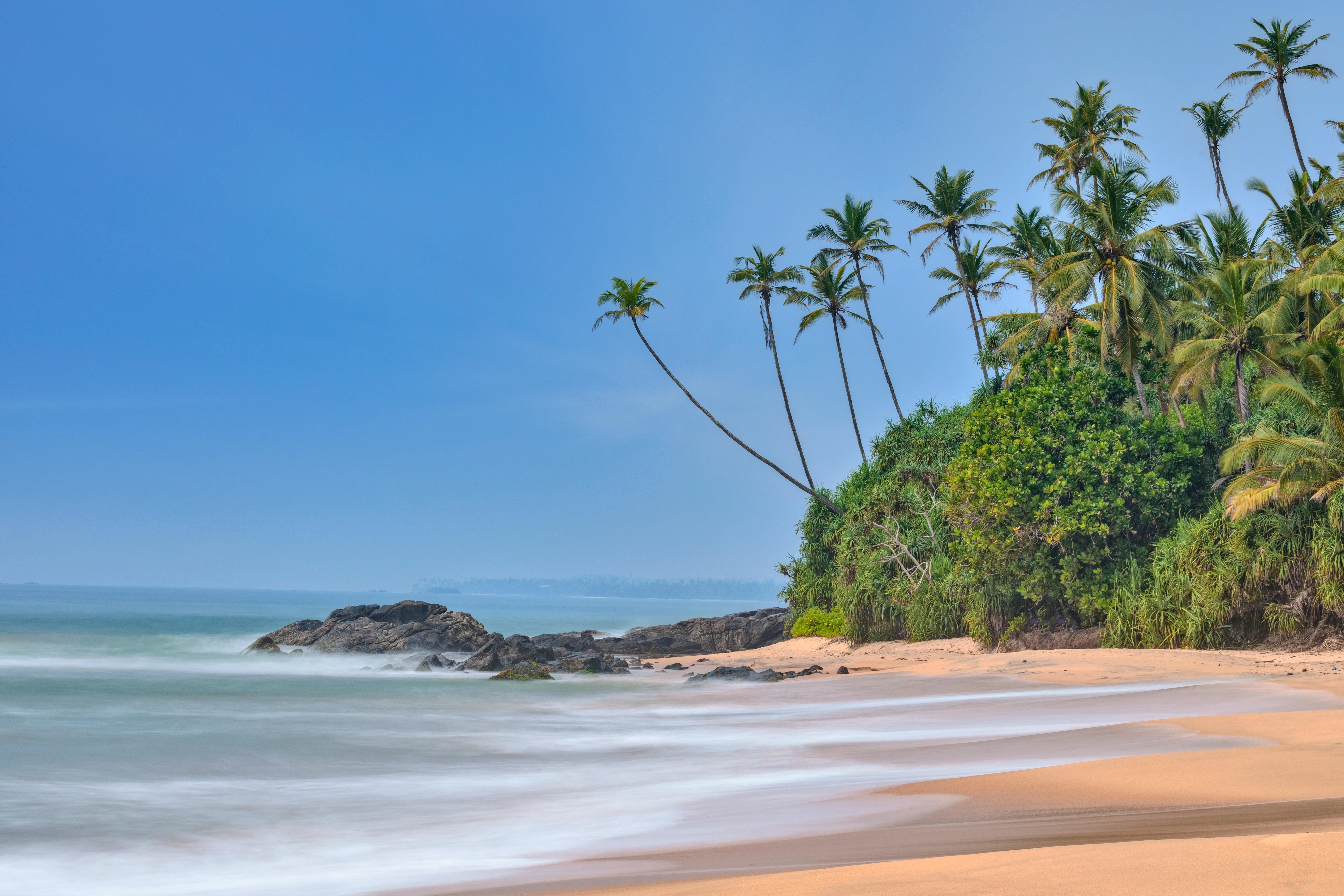
Emerald vegetation, azure waters, and white sands define the beaches here. Colourful fishing boats and untouched nature provide postcard moments, but what makes the town special is its history, seen in its temples and the country’s oldest lighthouse.

Excavations have shown that Dondra was a place of human settlement in the 5th century BC, and it remained one of the most important places in Sri Lanka until the late 16th century. Its international trade prospered, and culture and religion thrived. The temples of Dondra were gilded and their towers covered with gems that glittered so much they could be seen by passing seafarers.

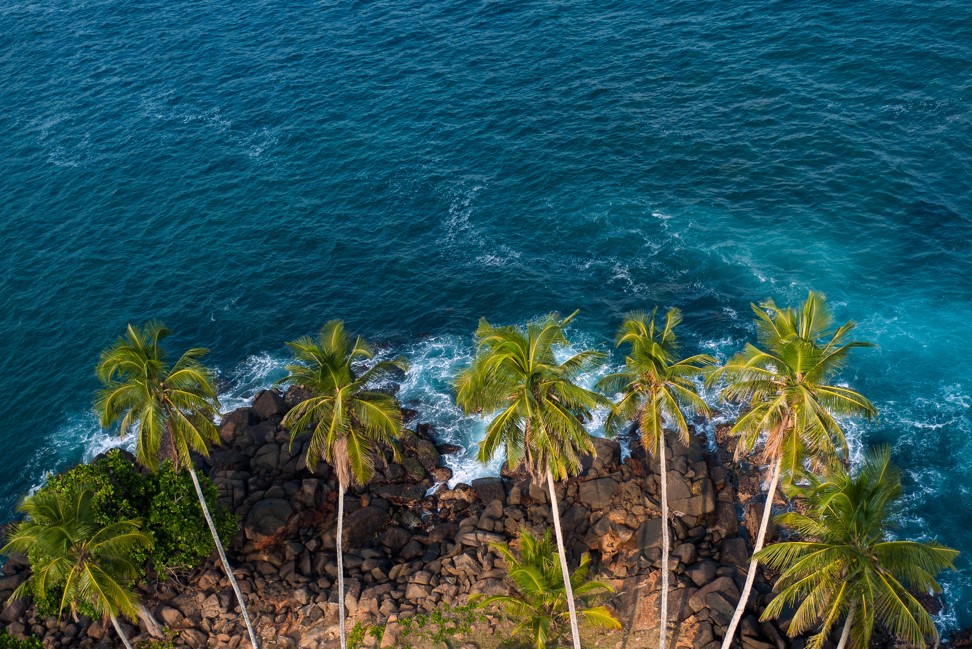
Palm trees, like these next to the town’s lighthouse, fringe the Bay of Dondra. Photo: Alamy

Palm trees, like these next to the town’s lighthouse, fringe the Bay of Dondra. Photo: Alamy

These ancient temples were demolished by the Portuguese in 1587 during a war with the Sinhala king Rajasinha 1, and today Dondra neither has gold nor jewels.Reaching Dondra from New Delhi, my hometown, has taken me a flight, a train and a bus. The train from Galle [1] to Matara, 8km from Dondra, affords the traveller excellent views of the Sri Lankan countryside, as it chugs past rice paddies, streams, colonial buildings and clusters of homes, and time to make friends with fellow passengers.

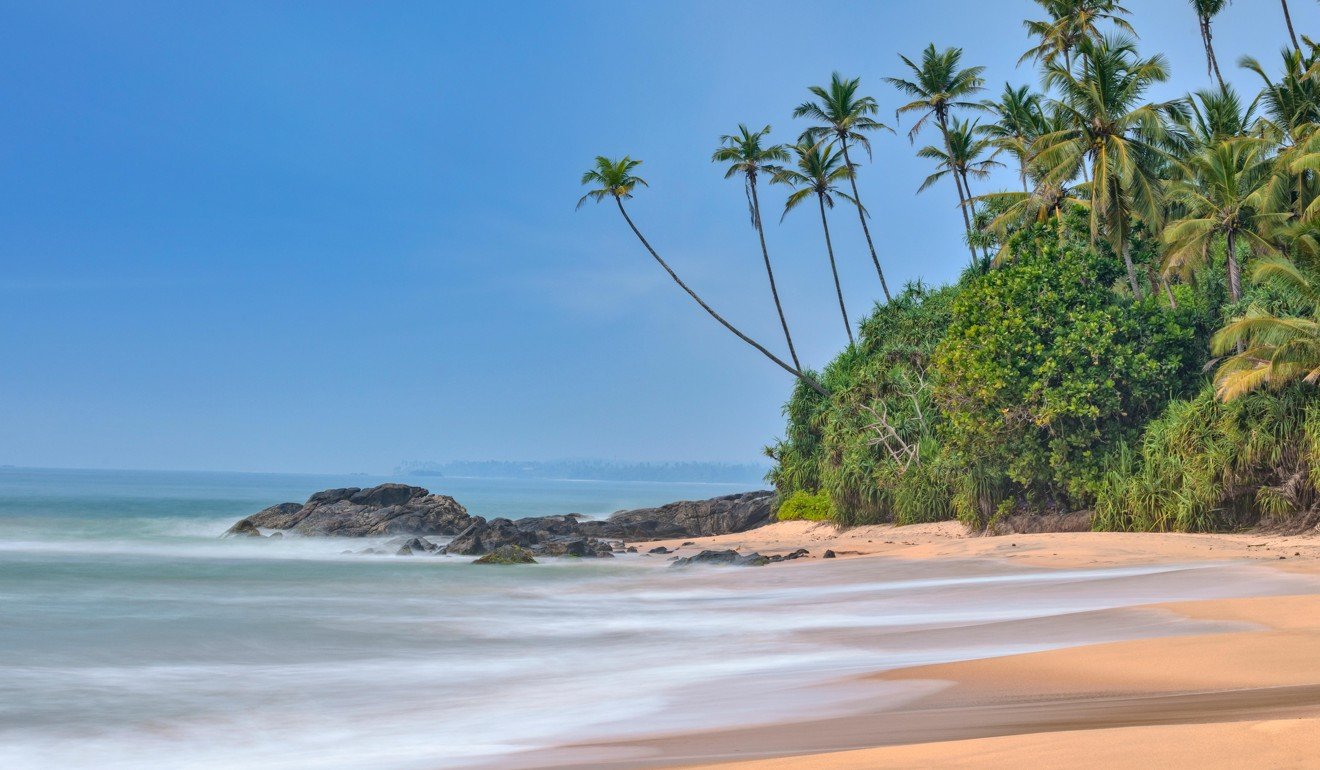
The beach at Dondra, Sri Lanka. The Indian Ocean waves are popular with surfers. Photo: Alamy

The beach at Dondra, Sri Lanka. The Indian Ocean waves are popular with surfers. Photo: Alamy

There are few people to be seen at Dondra when I get off the bus from Matara around noon. There is a clock tower, a few shops, some tuk-tuks and a flagpole flying the national flag. The morning breeze has already given way to bright sun, and the heat seems to have forced townspeople indoors.

Which way is the lighthouse?” I ask the man at an old grocery shop where I stop to buy a bottle of water. Fresh pineapples and plantains hang from its slanted roof, and the ripe mangoes are tempting. The lighthouse is down that road,” says the man, pointing. But you must visit the temples first, they are just around the corner.”

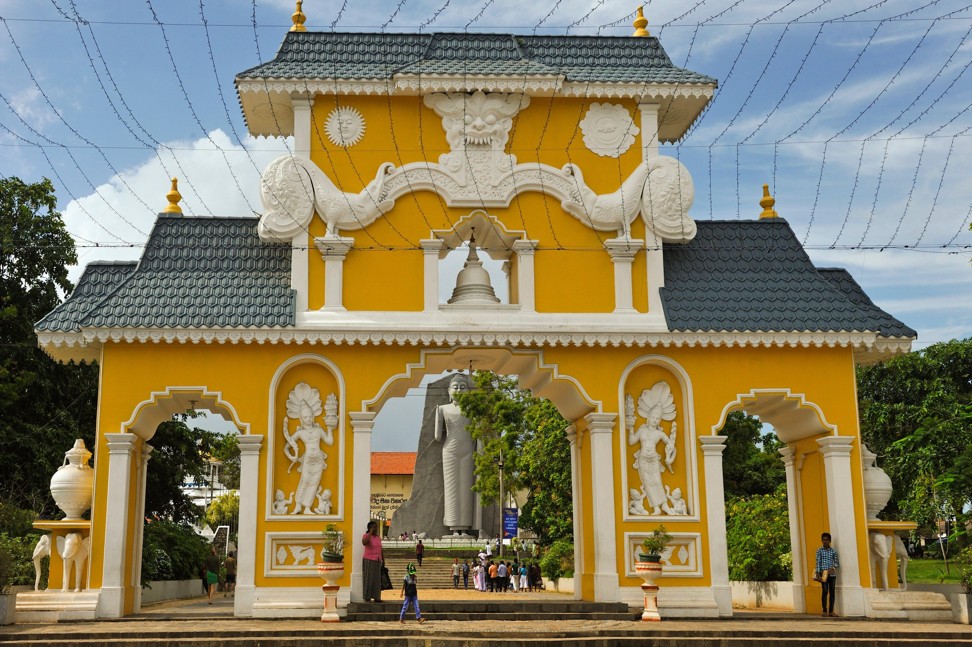
Walking on, I’m debating whether to head first to the temples or the beach when I spot a three-arch gate painted in bright yellow with a slanting blue roof. Its walls are decorated with mythical nymphs and ferocious lions; inside, orange-robed men wander. I’ve stumbled upon a reconstruction of the Vishnu temple the Portuguese destroyed.

The entrance to the Uthpalawanna Sri Vishnu Devalaya Temple at Dondra. Photo: Alamy

The entrance to the Uthpalawanna Sri Vishnu Devalaya Temple at Dondra. Photo: Alamy

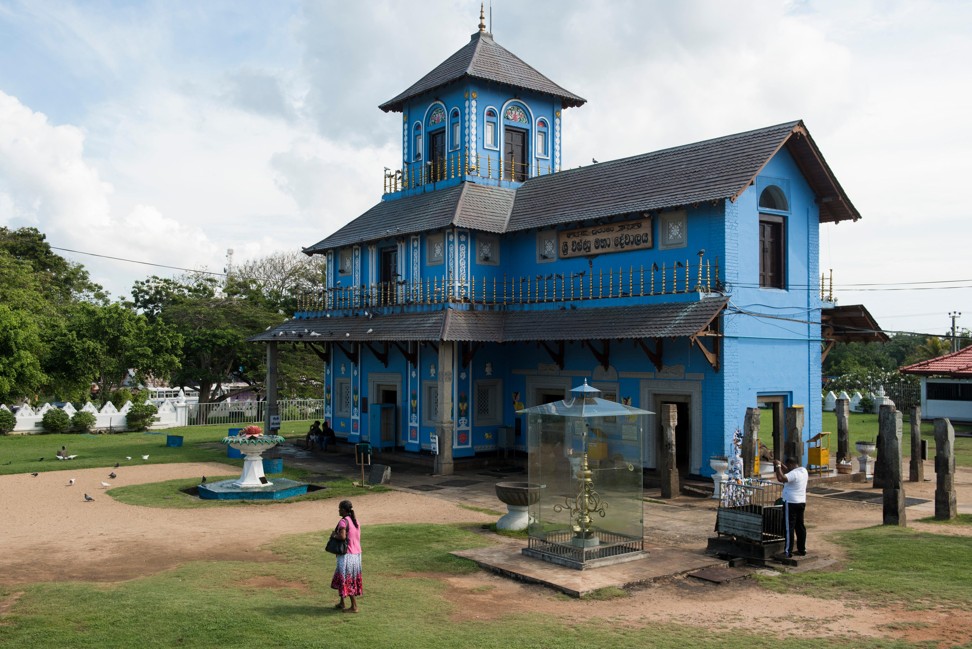
On one side is a towering Buddha, on the other a blue, three-tiered building. Behind the Buddha are long rows of orange- roofed quarters; some worn stone pillars protrude from the ground before me.

The blue building is the reconstruction of the Vishnu temple after which the ancient town of Dondra was named, Devi-nuwara (home of God). The Hindu god is the presiding deity here, represented by a seated blue idol with deep-set eyes.

Its walls are covered in paintings depicting the life of Vishnu and his incarnations. The ceiling is painted with elaborate mandalas – some seem to be fairly new, others are worn with age. Outside, the courtyard is fragrant with incense and fresh flowers.

The devalaya, or temple, to the Hindu god Vishnu at Dondra. Photo: Alamy

The devalaya, or temple, to the Hindu god Vishnu at Dondra. Photo: Alamy

I return to the road, where a handful of tourists with surfboards are making their way to the beach.

Even if it was a large city once, Dondra is a small town now. With few vehicles on the roads and the weather pleasant, it is easy to walk around, and friendly locals are on hand to help you find your way. I enter a quiet, tree-lined street of large colonial bungalows with circular porches and iron gates. Bright pink bougainvillea hang heavy from faded white boundary walls; coconut palms peep from courtyards.

Tired now from the travel and walking, I’m beginning to wonder how long it will take me to reach the lighthouse when I spot a young man on a motorbike.

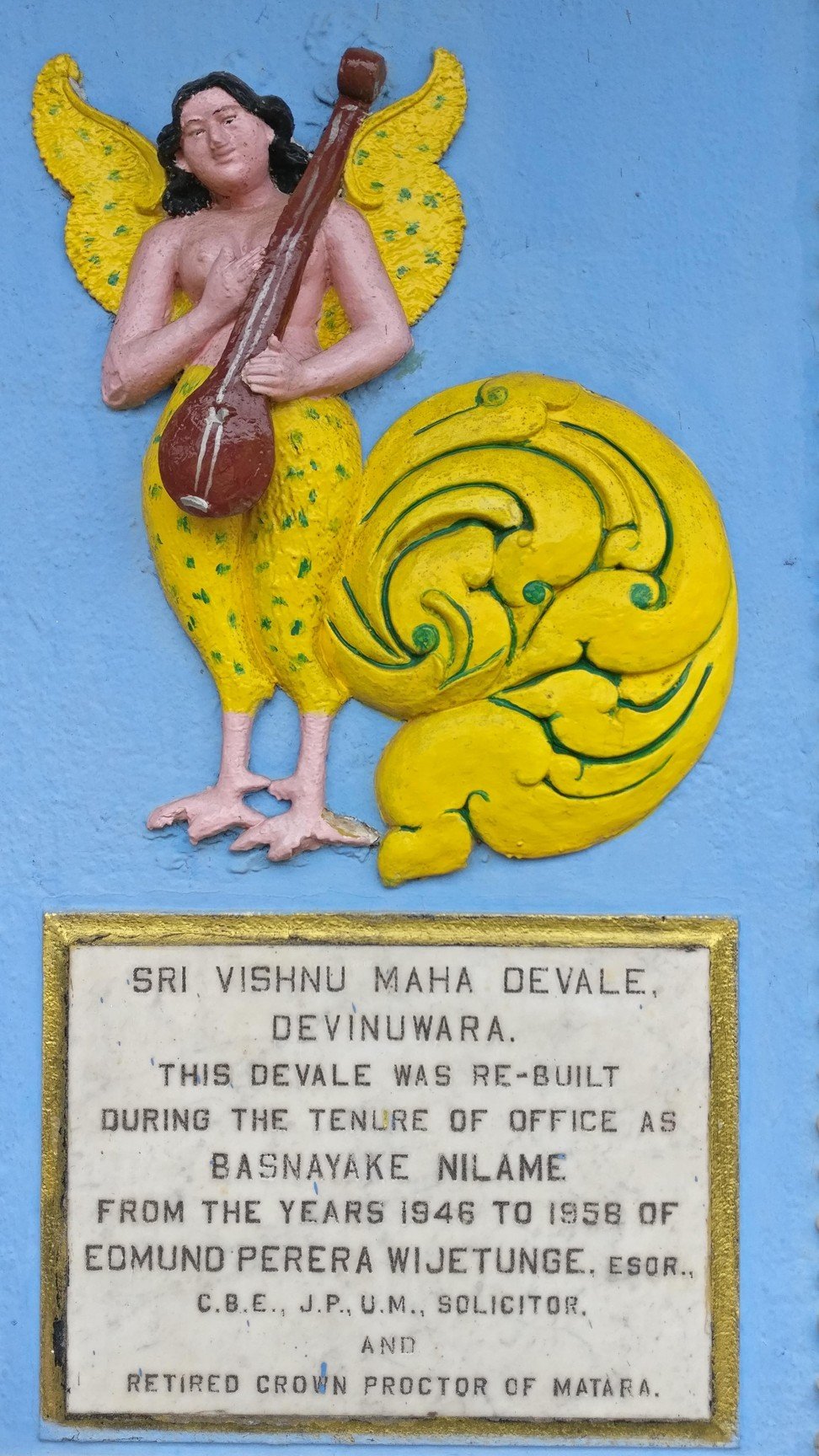
A plaque on the exterior of the Vishnu Devalaya at the Dondra temple recounts its rebuilding in the 20th century. Photo: Anubhuti Krishna

A plaque on the exterior of the Vishnu Devalaya at the Dondra temple recounts its rebuilding in the 20th century. Photo: Anubhuti Krishna

He introduces himself as Sanjiva Kumara, a spice salesman, and offers to drop me at the lighthouse. The lighthouse of Dondra opened in 1890. It is the oldest and the tallest in Sri Lanka at 49 metres,” Kumara tells me, proudly. The lighthouse is controlled by the navy. It’s not accessible without the permission of the harbourmaster. The beach and the cape need no permissions, though.”

In less than five minutes I am standing in front of the lighthouse. To the left is a small beach, devoid of people; to the right is a lawn lined with jasmine trees. Beyond the lighthouse The Indian Ocean stretches as far as one can see. Other than a young couple holding hands shyly, there are no other people around. A lone ship bobs on the horizon.

Getting there: from Colombo or Galle, take an intercity train to Matara. You can buy tickets at the railway station. In Matara you need to get to the bus station, about a kilometre from the railway station, and take a local bus to Dondra, which is a 20- to 25-minute ride. Alternatively, you can travel to Dondra by road from Colombo (about three hours) or Galle (about an hour). The roads are great and cabs are cheap. Book at Lotus Cabs (lotuscabs.lk) or Colombo Cabs (colombocabs.com)

Staying there: To stay like a local, check into any of the mid-range bed-and-breakfasts or homestays near the beach and lighthouse in Dondra. Galle and the nearby coastal towns of Weligama and Mirissa have luxury resorts and hotels, which are a good option. It is also possible to see Dondra in a day trip from Galle or Colombo.Source URL: https://scmp.com/lifestyle/travel-leisure/article/3021164/place-escape-crowds-sri-lankas-farthest-south-dondraLinks

[1] https://www.scmp.com/magazines/post-magazine/travel/article/2186319/what-do-galle-sri-lanka-laid-back-long-weekend

Ideas to make Britain great again.

August 2nd, 2019

Garvin Karunaratne.M.Ed, Manchester, M.Phil.Edinburgh, Ph.D. Michigan State University.

Introduction

In my own life as an automobile owner – all my earlier cars were made in Great Britain- a Hillman Minx,  a Humber Hawk, a Vauxhall Cresta, a Morris Oxford. The Prime Minister of Sri Lanka in the Sixties, That Humber Hawk was a dependable, comfortable great car, comparable to any BMW  of today. Yet Britain lost its grip on its manufacturing base. Now Britain does not make a single car. The Land Rover and a few other makes are all owned by foreigners. British craftsmanship and workmanship has eroded to nothing.

Britain has become a nation of talkers. As a Social Worker in Manchester, a Senior Community Worker in Edinburgh and as a Lecturer at Westminster we did well in providing services, but the manufacturing economy has grounded to a halt. German owned Supermarkets Ali and Lidl sell in the UK many small manufactures made in Germany     at prices lower than Chinese products.  This indicates that there is room for Britain to make a comeback in making items that are imported from China. Today building homes and apartments is talked of as development. There is little talk of rebuilding our manufacturing base to give a strong foundation to our economy.

 In 1980, in Edinburgh,   I was  the Senior Community Education Worker  in Wester Hailes, Edinburgh and  the Warden of Clovenstone Community Center. We then had a repertoire of youth and community development programmes. It is a crime ridden no go area today whereas when I was there we used to  travel all over the housing estate even at midnight.

Then, I was also supervising a few  lads under the Youth Opportunity Programme(YOP) and the Special Temporary Employment {Programme(STEP) of the Manpower Services Commission, the one and only occasion when Britain tried to grapple with unemployment. The lads were to be acclimatized into community and youth work. They acquitted themselves very well, were very useful and I was struck with their ability. They were all school leavers who failed to  enter the portals of higher studies. They were paid a allowance for two years and  thereafter got lost.  The only job they found was to join the army and  later I was sad to come to know  that some lads had become cannon fodder in foreign lands.

The  two premier programmes of the Manpower Services Commission- the YOP and STEP actually took away two of the most formative years of the life of a youth, leaving them nothing other than  to hog the queues of the Social Security System that gave them a meager living grant.

I suggested that instead, these youths should be guided to follow a special intensive course in a vocation of their choice- where they would be able to work towards making something that was imported. Many are the Colleges of Education  in Edinburgh that excel in providing  vocational and technical education which train youths for  a year and award them a certificate. Left on their own to find a job in a free market economy with imports being the order of the day, they inevitably fail and have to be satisfied with  social security grants and end scraping the barrel for life.

I  wrote a  Memorandum detailing how the youths under the Manpower Service Programmes, should instead follow a few tailor made intensive but short six months’ courses run by Colleges of Education in an area of their choice where they would after a grounding in basic skills and use of machinery identify  saleable items that can be made,  and make such items as a part of their course. Then the Marketing Lecturers, the professional in economics of the Colleges of Education who normally held courses in marketing on a simulated basis  with  paper and pen, chalk  and talk, will take charge and get involved in actually  marketing the product made by the youths offering the chance to enable the youth to build up their abilities in the art of marketing. The Vocational Training Units in the Colleges of Education would continue to guide the entrepreneurs till their enterprises become commercially viable.

My Report was submitted to the Director of Community Education,  the late Peter Williamson, who full of enthusiasm submitted it for approval by the Education Committee of the Lothian Regional Council. It was intensely debated, but the Labour Party stalwarts  in power wanted to put off its implementation till Labour ruled the country. That was the time when the Conservatives ruled for long. I was given a commendation and that was all. This happened in 1981.  

I was wasting my time in Edinburgh doing sweet nothing worthwhile and     quit to Bangladesh in two years.

Later,  in 1989, I was a Lecturer at Westminster Adult Education Institute in London- my job was in community education- to assess the needs of the community, draw up courses of study find suitable lecturers and implement them. The Institute had an array of vocational courses – in painting, ceramics, wood work etc and the trainees were trained and for practice purposes they made many a something that were never saleable. I prepared a Report where I urged that the trainees should be  more intensively trained and taught  to make a saleable product . Then the  economics  lecturers of the Institute will guide them in the rigours of marketing and ultimately guide the trainee to become an entrepreneur.  My ideas were booted out  and that idea died a natural death.

Great Britain has in the meantime continued its way down hill.   It is no longer a manufacturing hub. Germany and France have taken over that role.

In 2019, the  citizens of Great Britain decided to get away from  being a member of the European Union. Having joined later, Britain had to play a second fiddle  to both France and Germany.,  The people had got sick of Britain as a member of the EU because immigrants from the poor countries of Europe have swarmed in droves, enjoying the social security system  the health services, with Britain failing to cope.     Great Britain   voted to leave. Instead of acting on it in a straight forward manner, calling it a day and going it alone as advised by  President Trump, Prime Minister Theresa May went licking the boots of EU leaders to get privileges for Great Britain.. She came   back empty handed, ridiculed and ignored. Now on 23 rd July 2019, a new Prime Minister Mr Boris Johnson was elected as the Prime Minister.

2. My experience and achievements

Let me detail two  programmes which I myself created and established  successfully.  This is important because I am suggesting major ideas and those who read should know that I speak through sheer experience as a battle  hardened professional someone who has established at least one employment creation programme that has stood the test of time. It is also necessary that none can say that I speak from hearsay- without facts. Here I was in sole charge in the design and implementation and no one can doubt the success recorded.

One such programme is the Youth Self Employment Programme of Bangladesh. I left my post in Community Education in Edinburgh to assume duties as the Commonwealth Fund Advisor in Youth Development in Bangladesh. The Ministry had an array of youth activities in social,  and cultural areas and also provided vocational training to 40,000 youths a year in an array of some thirty vocations.

The Military took over the country in a bloodless coup  d’etat in one night. The Military viewed youth work activities with scorn,  Within a day or two a meeting was held to abolish or scale down youth activities with the Minister for Labour and Manpower Mr Aminul Islam in the chair. He went through the programmes that were being implemented and was very critical. Realizing me as the only outsider he called for my designation  and when told that I was the Commonwealth Fund Advisor to the Ministry, ordered me  to state the contribution I could make for Bangladesh. I responded that with 40,000 youths being trained annually, with   most of them remaining unemployed at the end, we should have a self employment programme  as an integral part of vocational training to guide the trainees to become entrepreneurs The Secretary to the Treasury, the highest administrator in Bangladesh quoting the miserable failure of an attempt by the International Labour Organization(ILO) to create a self employment programme  a few years earlier, said that I was suggesting something that could  never be achieved which will inevitably result in wasting funds. I contested and said that though the ILO failed I could assure success. My heated arguments with the Secretary to the Treasury and a few other Secretaries of key Ministries went on for over two hours till the Hon Minister had enough of it and  stopped all of us arguing. He said that I had convinced him and immediately approved my designing and establishing a self employment programme.  The Secretary to the Treasury stumped the proposal  by declaring  that he will not provide any funds to which I replied that I needed no new funds and will manage the additional work within the approved youth training budget by finding savings within votes and re-drafting the work remits of officers. This was approved.

 I started training the staff as well as the trainees the very next day. In the next 18 months, before I completed my two year assignment I had trained 2000 youths and of my starter youths easily seventy five percent were all successful entrepreneurs. I had designed a programme that intensively guided the trained you to become entrepreneurs.

I  had trained the entire staff of youth workers in economics and in the art of involving youths in self employment- building their abilities and capacity while working   to become entrepreneurs. This Programme is today the premier programme of employment creation the world has known and had guided two million youths to become successful entrepreneurs by 2011. This Programme today guides 160,000 youths a year. It is a hard programme that does not provide funds for nothing but intensively guided the youths. It provided training and youth workers- now turned to be economic development  specialists guided them on a daily basis to success. Even today(2019) 36 years later, 95% of the work of the Ministry of Youth Development lies in motivating and guiding the youths to become self employed, the only such programme in the world.

This was what I had suggested to establish in Edinburgh. Edinburgh’s failure was Bangladesh’s success.  Great Britain could do with a self employment programme on a national basis making what the country needs by marshalling its youths. Unfortunately youth development has been neglected in Great Britain and many cities have youth unemployment at 40%. . The Colleges of Education have talented lecturers and Community Education officials can easily provide expertise. Community development, the core method of building up the abilities and capacities of people was a discipline taught at the University of Manchester where I was a student and secured the Diploma with Distinction and the Masters Degree, has stopped teaching that subject.

Establising a Crayon Factory. Another achievement  of mine, comes from Sri Lanka. It happened when the Ministry of Plan Implementation refused to approve. import substitution type of  programmes for implementation in my District. As the Commissioner(called Government Agent in Sri Lanka) of the District, I took over the leading school science lab in the evenings for experimenting  to find the art of making crayons. The Leader was my Planning Officer who was a chemistry graduate. We did a myriad of experiments for close upon three months every evening till midnight working locked up in the science lab and found the art of making crayons.

With this success I established a Crayon Factory Cooperative Industry at Morawaka in three weeks working day and night with my Planning Officer  along with a few other  officers training youths in the art of making crayons and in quality control. It was a handmade crayon like most Chinese products today.  This Coop Crayon Factory  was a great success  had expanded to have islandwide sales and became the flagship project of the Divisional Development Councils Programme , the major success of the 1970-77 Government of Prime Minister Sirimavo.

3. Employment Creation Programmes submitted for consideration

(1)  A Self Employment Programme

Great Britain with its excellence and expertise in Universities and Colleges of Education can easily take on the mantle to get the youths in training to get down to production and to guide them till they are successful- a replica of the  Youth Self Employment Programme of Bangladesh, the premier employment creation programme the world has known. The  basis is that the lecturers who train the youth  will also guide the youths if  they are willing to venture out to make things for sale. To my own knowledge the Lecturers at Colleges of Education in Edinburgh as well as at Westminister do have the ability to guide their students to become entrepreneurs. I am doubly certain of this fact.

The science laboratories in Colleges of Education are far more equipped than the Science lab that I used to find the art of making crayons.  It follows that the Colleges of Education can easily find the method of manufacturing imported items and get going with establishing production cooperatives manned by youths working under the guidance of the Lecturers.

This Programme will be following the Buy American pattern pf President Trump. In my working life in the UK I have found  communities rife with patriotism, specially in Scotland. This programme can be charged with patriotism and I can assure success.

I would urge that this Programme be accepted for immediate implementation. I am certain of success and can build this to bring great popularity to anyone that spearheads. It requires only one charismatic utterance from our new  Prime Minister and this will get the Colleges of Education that trains youths in industry cracking and with support from local councilors and politicians,  I can assure  success within a year.

Britain has not had any attempt at national development since the days of the Manpower Commission of the Fifties.  It is time that a new initiative is  made..

(2)Community Cooperatives 

It is necessary  to detail  another essential factor in the task of employment creation. . In Edinburgh, the most successful manufacturing industry was Edinburgh Crystal, a cut glass crystal manufacturer  at Peniquik. Established as far back as 1867, it was a show piece of Scottish workmanship. In 2006, Edinburgh Crystal was purchased lock stock and barrel by Waterford Wedgewood, another Crystal Manufacturer from out of Scotland who inherited its sales, but stopped the Edinburgh Factory. Its trained workforce of some one hundred or more were cast on the heap of the unemployed. On my numerous visits to Edinburgh Crystal I had seen the craftsmen at work. They were really skilled workmen who had been at the task for decades. I consider the closure of such a vibrant and successful manufacturing industry as a disaster for Scotland.

On inquiries I found that Edinburgh Crystal was an industry that was very hale and hearty. It was highly profitable and that was the very reason why another multinational had its eyes on it. It was success for the intruder, but a great loss for Scotland.

A similar loss happened in Canada. That was Blue Mountain Pottery of Ontario an industry that began in 1953. Its animal figurines, vases and jugs etc adorned the show cases at Harrods and Selfridges. Though it was a profitable concern the owners were not satisfied with the profit and closed it down in 2004. I happened to visit it at its closure and spoke to the workers who were being laid out. They were  a hundred or more trained craftsmen destined to the scrap heap of unemployment though their products have today become well priced collectors items.. This was a great loss for Canada as Blue Mountain Pottery had finalized a rare process of fineness in pottery  which could have taken on like the  world famous Lladro of Spain.

The closure of Edinburgh Crystal and Blue Mountain Pottery, both extremely successful enterprises also brings to light the ills of the private sector. In neoliberal economics which UK follows. It has to be understood that the motto of the Private Sector is to make a profit and the development of the country comes second  For systematic development of a lasting nature the Private Sector has to be guided by the State. It is the State that is interested in development. The State has to harness the Private Sector for development.

The answer lies in community cooperatives where the workers as well as communities tie up to establish and run manufacturing industries. Here with success the venture stays in the place of origin providing work for the people and the enterprise can be developed with resources from the community. It will not fall a prey to venture capitalists that may acquire, move it or close it down. The UK has a developed cooperative network which is vibrant in areas like Scotland. This cooperative network can be harnessed for the cause of creating employment under this Programme.

In any attempt to bring about employment creation, it is also necessary to plan for the emergence of cooperatives where the community too will be involved as much as the youth of that community will be the workers. Then the industry that is created will have a community base where members of that community will take the lead to work with the workers to ensure success in manufacture and sales. This is found necessary because even worker cooperatives with success on their hands can  move their ventures  from their area to areas of affluence leaving the area where they emerged.  In this task a major role has to be played by  Community Education, regional and city councils as well as by Colleges of Education.

In WesterHailes, Edinburgh, if by any chance my suggestions of 1980 had been approved to make entrepreneurs out of the youths in training, able experienced community members were always willing to offer a hand to make them a success. Then once an industry is established it will be the guarded treasure of the community.

An important aspect re cooperatives is that the profits go to the cooperative  and the cooperative workers. The funds in the cooperative are for future development of the cooperative enterprise. The current model of enterprise development in the capitalist world is the public company, where the capital is provided by nonworking investors who hold shares and  the payment they expect is in the dividends. In the cooperative model profit making is not the aim. Instead the aim is the development of the country, the creation of employment and bringing about production causing national development.

(3) Harnessing the Private Sector for Development

In development the private sector has to be harnessed for the achievement of development goals. As much as there are private entrepreneurs who may be interested, they are also worried about a possible failure with major losses. This has to be combated by the State identifying areas of activity  with a potential for investment, developing local resources or to combat imports.

 In this connection a further  lesson can be quoted from Sri Lanka. In the Fifties and Sixties the Green Revolution was taking place apace in Sri Lanka and  the country did not have the capacity to mill the paddy to rice. The Department for Development of Agricultural Marketing that handled rice milling imported a few rice mills and installed them at vantage places in the producing areas. Next the Department drafted plans for the establishment of small scale rice mills and called for applications from investors. The machinery that had to be imported was detailed and the Structures and buildings that had to be built like floor space for the machinery and drying floors were detailed. The private sector entrepreneurs were offered an allocation of foreign exchange to import the machinery. At this time foreign exchange allocations were required for imports. An investor  could come forward and was guided in the investment. I happened to be in charge of the Southern Province and many millers who came forward had to abide by the rules in installation. I supervised the rice mills being installed. The rice miller was given an allocation of paddy on a weekly basis for milling for which he got paid. This was a great success and overnight we built up a capacity to mill the paddy.

This details the  strategy for the State to play a major role in development, harnessing the investors in the country.  This leadership is essential as otherwise individual investors will not find the backing to forge ahead. 

(4) Identifying Engines of Growth for Areas of Britain

It is also necessary that the different areas in Great Britain do decide on the  engines of growth, depending on available resources.  To start with Great Britain can be divided into England, Wales and Scotland and a group of experts covering industry, community work, engineering and education should undertake to arrive at the engines of growth for the area. For instance in Scotland, Wales and certain areas in England, tourism is an engine of growth. Accomodation has to be made available at reasonable rates. The equal of Premier Inn and Travelodge have to be opened in areas where  there are glorious views. There has to be parking places where tourists can park their vehicles and enjoy the scenery.  Further there have to be facilities provided to motorists to rent recreation vehicles, motor caravans, motor homes to tour the area. The services of institutions like the Caravan Club  with their caravan parks etc  can be enlisted. In every area a group comprising a few  councilors,  community members, a civil  engineer, a representative of the Caravan Club a representative of the College of Education in the area could draw up what infrastructure has to be provided to encourage tourism.  Similar details have to be worked out on an area basis. Perhaps the City and Regional Councils  can take on this leadership for this task  of development. 

It is my experience that tourists cannot find access to  coastal areas of pristine beauty. Many areas have scenic beauty. These have to be identified and necessary facilities provided. Instead of  British tourists flocking overseas for holidays, they can easily be accommodated in Britain itself.

4. Conclusion

Creating entrepreneurs out of the cadres that are being trained at Colleges of Education all over the UK, and an attempt to establish Community cooperatives out of the trained with community expertise also playing a role, enlisting Colleges of Education and even Universities along with County and City Councils to forge ahead on employment creation tasks can  be the nucleus of a long lasting and useful programme that will give great credence to any personage that establishes it.  

Such an attempt will bring about production, will reduce imports and  equip Great Britain to face the problems that it will have to face from a departure from the EU

Such an attempt at employment creation will also put Great Britain on a path to become the manufacturing hub of the world, which it actually was in the last century.

It is my sincere contention that instead of pleading  and begging from the Garniers and  Merkels, an attempt should be made to revive the British economy and things will then move in the right direction.

May this Paper be debated and appropriately developed on to enable the creation of a sustainable economy. Let me hope that initiatives will commence in a few areas  like Edinburgh, Manchester or London or where there will be interested officers in Colleges of Education,  Universities, in Education Departments, Regional and City Councils and interested politicians.

It is time for a new initiative  for Great Britain to be great again.

Garvin Karunaratne.

M.Ed, Manchester, M.Phil.Edinburgh, Ph.D. Michigan State University.

 1 st August 2019

Applying Brakes on solar energy utilization is not the solution for sustainable development of Sri Lanka

August 2nd, 2019

By IM Dharmadasa, Leslie Dep, Jayantha Silva, Lakshman Dissanayake and Oliver Ileperuma

August 2, 2019, 8:47 pm 

article_image

According to the news items in the local press during the first week of June 2019, the “Surya Bala Sangramaya” programme launched in 2016 seems to be on the verge of collapse. The Ceylon Electricity Board (CEB) and the Ministry of Power & Energy (MPE) officials have decided not to approve rooftop PV connections over 50 kW capacities until further notice and they are planning to build four new coal power plants.

At present those who produce solar energy under the “Net Plus” scheme are paid Rs. 22 per unit for the first seven years and Rs.15.50 for the next 13 years by the CEB. Therefore, the average lifecycle cost of solar electricity is about Rs. 18 per unit. Reports say that the Ministry officials have been pressing producers of renewable energy to reduce their prices further. However, CEB pays Rs. 30-45 for “emergency” power purchasing from private companies which operate on thermal fossil fuel imported to the country.

On behalf of the Sri Lankan general public and the many professionals who live in Sri Lanka and overseas, the authors of this article would like to raise several key questions on this unwise decision detrimental to the development of renewable energy utilization in Sri Lanka in future. This type of ad-hoc decisions would inevitably lead to the “reversal” of the sustainable energy initiatives taken by Sri Lanka so far in complying with the UN Sustainable Development Goal 7: Ensure access to affordable, reliable, sustainable and modern energy for all. In accordance with this goal, one of the best nationally important decisions implemented by the Government of Sri Lanka (GOSL) from 2016 is the “Surya Bala Sangramaya” programme aimed at installing solar panels on roof tops of one Million households. This very important initiative created over 10,000 direct and indirect jobs in many state institutions and private sector companies. To date over 17,000 PV solar systems have been installed all over the country and totalling about 200 MW solar energy capacity had been connected to the National Grid. This was a very impressive beginning for Sri Lanka as per the UN-SD goals. However, due to these most recent ad-hoc policy changes by CEB and MPE, what we see now is that instead of accelerating and expanding this major sustainable development programme, the CEB and MPE is planning to jeopardise this successful and the right programme affecting the country’s future in developing renewable energy and also seriously damaging the sustainable development efforts in Sri Lanka.

We would like to question the CEB and the MPE, the reasons for taking these decisions which would prevent the production of clean renewable energy in the country. These decisions would also create economic disaster in the long run.

While every country in the world is moving forward in implementing UN-SD goals on sustainable and environmentally friendly energy sources for the interest of our present and future generations, our policy makers appear to be interested in reversing this trend for whatever short term gains.

These decision makers appear to be living with their heads buried in the sand without learning from the global trend towards renewable energy development. Solar energy conversion depends on advanced technologies and the initial high-cost has been a barrier in the past. In early 1970s, about U$100 was needed to produce 1.0 Watt of solar energy (~100 U$ per Watt). However, as a result of worldwide research and development, this figure has come down to about 0.4 U$ per Watt today and solar energy has reached on par with grid-parity in several sunny-countries.

The “Solar Energy Revolution” is happening around the globe and even countries with comparatively low sun-shine are producing tremendous amount of clean energy from PV solar technology. For example, Germany produces 42.3 GW, Italy produces 19.6 GW and UK produces 12.8 GW today from PV solar. The worldwide total installation capacity is over 500 GW, but Sri Lanka with abundant sunshine having only about 3 GW total power production capacity is going backwards by considering above mentioned unwise decisions apparently by few self interested individuals. One of their favourite arguments is that more solar power at non-peak hours cannot be handled by the National Grid. However, many countries have found ways and means of overcoming these issues and in Germany over 50% of the energy comes from renewable energy sources today. There are several research programmes undertaken by many countries in developing solar energy as a major renewable energy source and Sri Lanka could work with these countries in gaining the necessary technology to make our country self-sufficient with renewable energy without depending on imported coal as the main source of supplying energy. It appears that the decision makers in the CEB and the Ministry would never learn from the rest of the world in how they are getting rid of coal for generating power and they are planning to continue to produce electricity in the future by burning expensive and imported fossil fuel (Coal, Oil & Gas). They have completely disregarded the “Clean Air Act” and carry on to continue polluting of our atmosphere further by building four more coal power plants.

We are now experiencing the Smog (Smoke + Fog) in Sri Lanka, never observed before mainly due to carbon particulates emitted to the atmosphere due to burning of coal and other fossil fuel. This will create respiratory conditions not good for the health of the general public and it is high time to generate our future energy encouraging renewable energy solutions without polluting our air atmosphere. The fine particles produced are responsible not only for respiratory illnesses but are now known to cause stroke, cancer and a plethora of other health problems.

Smog (smoke+fog=smog) due to air pollution completely covering the Galgiriya Kanda close to Galgamuwa in January/February time. This has been observed in Sri Lanka for the first time in the last 70 years due to air pollution. In the past this type of occurrences happened only in cities like Beijing & New Delhi due to burning of coal.

Air pollution is the leading cause of ischemic heart disease and premature deaths of children worldwide. Indirectly it affects the economic situation of the country too as treating the affected people will cost millions of rupees. CEB policy makers seem to ignore these effects and MPE approves these damaging policies without any consideration the damage it makes to the environment. It is the duty of everyone responsible to wake up to these damaging decisions and act soon to direct the country in the right direction.

The news items also reported that during a meeting, the Minister of Power and Energy had said that plans were underway to introduce a completely new tariff system for roof top solar consumers. This is a good opportunity to increase the payments for clean energy production in the country. As an example, in April 2010, the UK government introduced an incentive by a double payment of 43.5 pence per solar energy unit, against the cost of less than 20 pence charges for the electricity usage from the grid. This sensible policy led to the installation of over one Million solar roofs during the past eight years, thereby increasing the total solar energy production capacity to 12.8 GW in 2019.

Learning from such success stories, we would expect that the Sri Lankan government would also increase the solar tariff at least to match Rs. 30-45 payments during emergency power purchase rather than reducing the renewable energy tariffs. Any solar tariff reduction will appear to the Sri Lankan general public as a foolish decision by the CEB and the MPE and would lead to a detrimental situation in the renewable energy sector, going against the UN-SD goals for which Sri Lanka has a responsibility to adhere to.

In the 1980s, there were over 600 coal mines in the United Kingdom, but these were gradually closed down and the last coal mine was closed in 2018. This is due to the severe pollution of environment and to protect people from the damaging climate change effects. When a major coal producing country takes this kind of right actions, Sri Lankan general public is puzzled by the coal addiction of CEB and their plan to build few more coal power plants utilising imported coal. We should make use of the already operating coal power plants, without building new plants, until the country establish a clean energy technology-mix to produce our required energy. Coal usage should be gradually phased out as the other indigenous and clean energy production increases within the country. The long term goal should be for Sri Lanka to become a “Renewable Energy Island” dependent largely on hydro, solar, wind, bio-mass and other renewable energy sources.

Fossil fuel has done a good job of developing only two thirds of the world population to a certain degree. However, this Carbon-economy has also polluted the environment creating severe problems like global warming and other climate changes including wide spread health related issues. These are well established facts and the whole world is moving away from carbon-economy to achieve a carbon-neutral economy and finally to a hydrogen-economy. It is anticipated that the future energy will generate from burning of hydrogen produced by splitting water using freely available solar and wind energy. Sri Lanka should move forward with this trend rather than going backwards introducing policies which could damage the environment and people’s health.

Some of the authors of this article have carried out extensive research on solar cells and solar energy conversion over past many years. We were actively promoting renewable energy applications in Sri Lanka starting from the early 1990s. With the help of a Higher Education-Link programme, continued over a period of eight years, and several other similar programmes, professionals in Sri Lanka and local universities continue to promote clean energy applications within the country. At least six international conferences were organised in Sri Lanka to discuss solar energy research and to promote solar energy applications.

We have experienced in the past that numerous negative actions taken by the CEB against the successful implementation of the renewable energy policy all the way through. Just to remind a few examples; CEB drew a grid line through “Pansiyagama at Malsiripura” to jeopardise an early stage 500 solar home systems installed in the late 1980s. More recently in 2017, it took about 8 months to receive the first payment for the 6.0 kW solar roof installed at Nochchiya solar village under the “Net Plus” system, sponsored by the two UK based charities, APSL-UK (Association of Professional Sri Lankans in the UK) and Hela Sarana. The project leaders had to write to the CEB chairman several times and finally after appealing through the Prime Minister’s office in Colombo the first payment was made, which is used to develop the village community via humanitarian projects.

Therefore, the Sri Lankan professionals are fully aware of this type of negative attitude of CEB towards the renewable energy development, and we consider that the current decisions are also such actions to prevent and discourage in implementing solar power projects. While condemning the arbitrary and adhoc actions of the CEB to limit solar roof installations, we request the CEB and the Ministry officials to take the correct decisions in the name of the future generations of this country. At the same time, Ministry of Power and Energy should take correct decisive actions and instruct CEB officials to consider the long-term benefits to the country and not short term gains by purchasing power at exorbitant rates from the private sector.

Authors: IMD -Professor of Electronic Engineering & Ex-President of APSL-UK (2009 – 2011).

LD – Professor Emeritus (Physics), University of Peradeniya, & Research Professor, NIFS.

OI – Professor Emeritus (Chemistry), University of Peradeniya, Sri Lanka.

LD – Chartered Surveyor / Civil Engineer & Ex-President of APSL-UK (2013 – 2015).

JS – Mechanical Engineer & President of Hela Sarana UK Registered Charity in UK.

SLPP vows to strengthen independent commissions

August 2nd, 2019

Lahiru Pothmulla Courtesy The Daily Mirror

The Sri Lanka Podujana Peramuna (SLPP) said today it would take the necessary legal steps to strengthen the sovereignty of the independent commissions which have become dormant under the present government.

MP Indika Anurudda told a news conference that the government tried to create an ideology among the people about the independent commissions but was not successful.

“Today, the commissions have become dormant. Regardless of the statements made by the President and the Prime Minister, people question the independence of the independent commissions. The best example is the issues which had cropped up because of the National Police Commission,” he said.

The MP said an impartial and fair investigation had not been carried out into the Easter Sunday attacks because of the politics in independent commissions.

The independent commissions cannot function without politics. This is why even Cardinal Malcolm Ranjith kept urging for a fair investigation,” he said. (

US Push for New Military Agreement Runs Into Fierce Opposition in Sri Lanka

August 2nd, 2019

By Ana Pararajasingham Courtesy The Diplomat

Negotiations over a renewed Status of Forces Agreement sparked local concerns about a possible U.S. base.

US Push for New Military Agreement Runs Into Fierce Opposition in Sri Lanka

A U.S. Marine Corps amphibious vehicle prepares to bring Marines and Sailors aboard an awaiting Landing Craft Utility (LCU) at the end of humanitarian operation efforts in Colombo, Sri Lanka.Image Credit: U.S. Navy photo by Lance Cpl. Joseph Ward

In view of its strategic location in the Indian Ocean, Sri Lanka is of interest to both Washington and Beijing as they seek to increase their presence in the Indian Ocean. Washington’s latest attempt to improve its position in Sri Lanka involves renegotiating the Status of Forces Agreement (SOFA) originally signed in mid-1995 when Beijing was not on the scene.

However, opposition to the renewed SOFA within Sri Lanka has been intense on the grounds that it would involve establishing U.S. bases in the island and thus compromise the country’s sovereignty. Indeed, U.S. Secretary of State Mike Pompeo’s decision to cancel his visit to Colombo on June 27 has been attributed to rising local opposition against the signing of SOFA. Sri Lankan President Maithripala Sirisena, who heads the centrist Sri Lanka Freedom Party (SLFP), has been forthright in ruling out the presence of any American troops or base on the island. Sri Lankan Army Commander Mahesh Senanayake is similarly inclined, telling local media that he would not sign the SOFA. Sri Lankan Defense Secretary Gen (Rtd) Shantha Kottegoda also objected to the SOFA, saying that foreign troops were not needed in Sri Lanka. Opposition to SOFA has also been expressed by Mahajana Eksath Peramuna (MEP), an Sinhala ultra-nationalist party closely aligned to Rajapaksa-led Sri Lanka People’s Party (SLPP) and the Marxist Janatha Vimukthi Peramuna (JVP).

Prime Minister Ranil Wickremesinghe, who heads the right-leaning United National Party (UNP) that enjoys a majority in parliament, is responsible for renegotiating the SOFA. On July 10, Wickremesinghe told parliament that the proposed SOFA was not a military pact but only an agreement establishing the rights and privileges that U.S. military personnel would enjoy if they were in the country,” according to Reuters. The SOFA is a peacetime document,” he said. Wickremesinghe then went onto reassure parliament he would not support any agreement that threatens Sri Lanka’s sovereignty.Enjoying this article? Click here to subscribe for full access. Just $5 a month.

However, according to a leaked version of the SOFA obtained by Sri Lanka’s Sunday Times on June 30, the agreement would permit the free movement and passage of U.S. military personnel, vessels and aircraft in the countrySunday Times drew attention to a clause in the leaked document waiving criminal jurisdiction over U.S. personnel while in Sri Lanka, causing particularly strong criticism.

In an attempt to allay fears about SOFA, the U.S. Mission in Sri Lanka has begun to refer to the proposed agreement as a Visiting Forces Agreement (VFA) giving it a much softer tone by underplaying the notion of U.S. forces becoming a permanent feature in the island’s political landscape. Pushing this line, U.S. Ambassador Alaina Teplitz told the local media that the proposed agreement was primarily designed to address a number of red tape issues. She insisted the United States had no plan or intention to establish a US base in Sri Lanka.” But many in Sri Lanka found it hard to swallow her claim that China is not the motivating factor behind U.S. interest in a military agreement Sri Lanka. It is a common belief among Sri Lanka’s political players and analysts that U.S. interest in Sri Lanka is predicated on the December 2009 U.S. Senate Foreign Relations Committee report, Sri Lanka: Re-charting US Strategy after the War.” That report noted that the United States cannot afford to ‘‘lose’’ Sri Lanka to China. There is no indication that this approach has changed under the current Trump administration.

Also, Teplitz, in her attempt to address concerns about U.S. soldiers enjoying immunity for offenses committed in Sri Lanka, implied that arrangements would be in place for U.S. soldiers to be tried by U.S. courts should they breach any law just like Sri Lankan soldiers accused of crimes overseas were subject to trial in Sri Lankan courts. If she meant this to reassure, it was a bad example. Sri Lanka has never prosecuted a single soldier for sexual misconduct while serving in a peacekeeping mission abroad in Haiti, despite over 100 being accused of running a child sex ring. Thus the U.S. ambassador had only managed to deepen suspicions that U.S. soldiers too may be able to get away with crimes.

Caught between the mounting hysteria about the SOFA and the ambassador’s unhelpful remarks, Wickremesinghe is finding it hard to convince his detractors. As a result the renegotiation of SOFA appears to have run into trouble. However, given Colombo’s significance in the U.S. Indo-Pacific Strategy the United States is unlikely to give up.

Ana Pararajasingham was Director-Programmes with the Centre for Just Peace and Democracy (CJPD). He is the author of Sri Lanka’s Endangered Peace Process and the Way Forward” (2007) and editor of Sri Lanka 60 Years of ‘independence and Beyond” (2009)

Kurunegala DIG’s transfer order cancelled

August 2nd, 2019

Courtesy Adaderana

The transfer of DIG of Kurunegala Kithsiri Jayalath has been cancelled with immediate effect, the National Police Commission (NPC) said.

DIG Jayalath was to be transferred to Trincomalee police division as per the decision taken by the NPC yesterday (01). However, the commission decided to cancel the transfer order today (02).

NPC Secretary Nishantha Weerasinghe stated this speaking to Ada Derana.

DIG Jayalath is reportedly facing an internal inquiry into his conduct over what has resulted in a deeply divisive issue following allegations levelled at Dr. Mohamed Shafi of Kurunegala Hospital of allegedly performing non-consensual sterilisation on several mothers.

The DIG is also facing allegations that he provided information to the media without consulting the Police Chief.

YAHAPALANA AND THE UNITED STATES OF AMERICA Part 10

August 1st, 2019

KAMALIKA PIERIS

The final essay in this series examines the   academic and political reactions to the three agreements discussed, namely, ACSA, SOFA and MCC. All three agreements are with the United States of America and all three Agreements focus on the territorial and military control of the island. Of the three agreements, ACSA is already signed. SOFA and Millennium Challenge Compact are yet to be signed.  The public, specially the intelligentsia are worried.  It looks as though we are about to go into our fourth bout of foreign rule, this time under the United States of America, they said. They do not like the idea at all.

US control of Sri Lanka has become more urgent recently, since US may have to vacate its military base in Diego Garcia. International Court of Justice has ruled that the occupation of Chagos Islands by USA is illegal and that Chagos must be handed back to Mauritius ‘as rapidly as possible.’ Chagos Islands are home to the strategic US military base of Diego Garcia.  If Chargos Islands goes back to Mauritius in accordance with the UN ruling then US will need an alternative base. That will be Sri Lanka.

SOFA and MCC are not the only agreements that the US has been pushing to conclude in Sri Lanka, said Lasanda Kurukulasuriya. The country’s pro-US Prime Minister led government is working hard to conclude or implement a number of other pieces of legislation and policy at the behest of its Western patrons, against all odds.  There is a sense of urgency in these efforts, because time is running out. With a Presidential election only months away, and the government showing a dismal report card on its performance, its Western backers know that its days are numbered. Therefore the pressure is turned up, to fast-track the desired laws and agreements. It is the US-friendly UNP leadership that will be instrumental in this process. The public will need to be on alert because once these laws are passed there is no possibility of judicial review, under the Constitution, warned Lasanda.

Analysts refer to the high profile agreement between the US and Sri Lanka Parliament signed in September 2016 in Washington. Speaker Karu Jayasuriya and Chairman, House Democracy Partnership of the U.S. House of Representatives J.Roskam signed the agreement on Sept 14, 2016 on behalf of Sri Lanka and the US, respectively. They say this also has a bearing on the three agreements.

When the three agreements were discussed, it was pointed out that ACSA is already signed. Sri Lanka must now accept this and respect the decision. Sri Lanka has no intention of accepting it. The public want ACSA revoked.  US aircraft carrier could to dock into Trincomalee under ACSA and USA could use it as a floating base for its military activity, experts said.

Chief of Defence Staff (CDS) Admiral Wijegunaratne  when asked by the media, about ACSA, said,  I refused to  say yes to ACSA when I was Commander of the Navy, because we could not agree to certain matters.  He had reservations also about the manner in which the ACSA was rushed through the Cabinet. Most of the time there are no talks or discussions to get ideas of others. They just go for such agreements,” he said.  In addition, critics wanted to know whether in the USA, the ACSA had the consent of two-thirds of the US Senate, in accordance with US regulations.  If it did not, what would be its status in international law.

The  intelligentsia are objecting to the manner in which the agreements are being negotiated. The agreements   are known to one or two pro-American Cabinet ministers  who then push  the matter through Cabinet. The public  loudly objects to the secrecy involved.  In the case of ACSA, there was no government statement explaining the contents, nor was it tabled in Parliament, they complained. It is outrageous that plans involving such drastic changes are not made available for public debate. The secrecy surrounding them shows that the government knows they will be unpopular, observed Lasanda Kurukulasuriya.

Agreements of that nature should be approved by Parliament, said critics. Parliament should have a role in discussing such agreements because they affect the  sovereignty, independence and territorial integrity of the country.  Were ACSA, SOFA and MCC discussed in Cabinet and in Parliament, by the Parliamentary Sectoral Oversight Committees handling foreign and defense issues. If not, why not.

OBSERVATIONS OF  N.A.DE S AMARATUNGA

 N.A..de S Amaratunga said there is a perceived threat of a major intrusion into the country’s sovereignty and the country being turned into a military base for the US, as part of its strategy for dominance in the Indian Ocean. Several agreements with the US and supportive parliamentary acts are said to be in the pipeline hidden from the public eye. The proposed agreements are (1) Status of Forces Agreement, (2) Acquisition and Cross Service Agreement and (3) Millennium Challenge Corporation Compact.

 The first would enable the US to deploy their armed forces in any part of our country with the freedom of not coming under the law of the country. The second envisages the building of an economic corridor from Colombo to Trincomalee and the third agreement would establish a corporation to utilize the land that comes under the economic corridor.

 Going hand in hand with these agreements are the following proposed parliamentary acts; the Land Special Provisions Act and the State Land Bank Act. These acts of parliament would facilitate acquisition of land by foreign investors and the formation of corporations for the development of these lands.

Obviously, the primary interest of the US is in the military sphere, and the secondary interest is to tighten the grip it has on the country with a strong economic involvement making us dependent on them. Our land would be made available to their armed forces and also to their investors. The economic corridor could eventually be American owned and would connect the two ports also, Colombo and Trincomalee for military and economic purposes. . The US and also our Prime Minister seem to be in a great hurry to get our government to enter into these agreements as there is an election around.

The US has indicated that they want future governments to honour these agreements, probably aiming to take an insurance against a possible defeat of this government at the forthcoming elections. The legality of these agreements and their future validity have to be seriously looked at in relation to the relative powers of the executive and the legislature, given their far reaching and obvious adverse impact on Sri Lanka’s sovereignty and land ownership.

For the US, Sri Lanka has assumed greater geopolitical importance in view of the proposed Chinese Belt and Road Initiative, and the vital role Sri Lanka may be called upon to play in that project. US Secretary of State has stated in no uncertain terms that they would not hesitate to militarily intervene to protect their interests anywhere in the world, including sea routes for trade. Further their global economic policy is to make countries dependent on them rather than improve the quality of life in those countries. Thus they want to get a grip on Sri Lanka’s economy and make us dependent on them, which would make it easy to convert Sri Lanka into a US military base for all practical purposes. The latter is crucial for them for they may soon lose the right to have their base in Diego Garcia, concluded Amaratunga.

 MOUNTING OPPOSITION

 Public opposition is mounting over the Agreements.  The opposition is coming from the very top. President Sirisena declared in July 2019 that he will not allow any foreign agreement that would threaten the country’s independence and sovereignty during his tenure. There are discussions regarding the agreements such as SOFA (Status of Forces Agreement), Millennium Challenge and a land act. These are not suitable for the country,” He would not allow any unsuitable agreements with any country or world power.

A final decision on the Status of Forces Agreement (SOFA) with the US should be delayed till the conclusion of the 2019 presidential election. Similarly, the proposed Millennium Challenge Corporation (MMC) agreement, too, should be delayed till after the next presidential election, said Dayasiri Jayasekera speaking on behalf of the President.

Chief of Defence Staff, Admiral Ravindra Wijegunaratne, who heads the apexbody of the armed services and the police told media in July 2019. These two agreements (ACSA and SOFA) with United States are controversial. We cannot agree to some parts. UPFA said ‘Yahapalana government is ready to commit a great betrayal of the country. The ACSA agreement has been signed. It is now preparing to sign SOFA. Kohona asked why Sri Lanka has to enter into agreements which were not beneficial to it. Kumar David observed that there is simply not enough good reason to sign on for ACSA and SOFA. I believe that in our case the disadvantages outweigh potential benefits, he said.

In July 2019, Sri Lanka Podujana Peramuna held a news conference to protest against the two agreements. It was observed at this conference that there have been many problems wherever SOFA is signed by the US with other countries. An army base will come up in any country that signs a SOFA. We have a trained, experienced and world-recognized armed force which could meet any situation. We do not have any need to get military assistance from any country, said SLPP.

In July 2019 the Bar Association of Sri Lanka (BASL) requested a meeting, with the President and Prime Minister to clarify certain concern they had regarding the agreements. BASL also met Opposition Leader Mahinda Rajapaksa to discuss the ACSA and the proposed SOFA and the Land Bill. They discussed action they could jointly take to protest over the ACSA and urge the government not to go ahead with the SOFA. BASL President Indatissa warned that if the SOFA was signed, Sri Lanka would become a target of anti-American terrorists.

Ceylon Chamber of Commerce, the oldest trade chamber in the country, wrote to the Prime Minister in July 2019. The Chamber said, The Ceylon Chamber expresses its concern with regard to the increasing levels of speculation among its Membership and society at large on the consequences surrounding the proposed  SOFA and MCC.

The Chamber wants the government to clarify the exact position with regard to the current status of these two Agreements. What is the current status of the negotiations and/or execution of these agreements. . The Chamber  wants the government to be transparent with respect to these agreements and their consequences. The Chamber also wanted the agreements to be approved by Parliament. This will ensure that the national interest is protected.

STOP USA”

Concerned members of the public launched STOP USA” campaign In June 2019 to highlight the danger   of these Agreements. At its inaugural meeting, speakers including MP Wimal Weerawansa, Pivithuru Hela Urumaya leader MP Udaya Gammanpila, MP Vasudeva Nanayakkara and former lawmakers A.L.M. Athaulla, Mohammed Muzammil and Sarath Weerasekera.

The speakers said that the US launched this project in 1995, soon after Kumaratunga’s election as President. It then US gradually expanded its military-to-military relations leading to the current situation. ACSA and SOFA were meant to allow the US to set up base here.  The various US military units that would be allowed access were listed. These Agreements were the biggest threat Sri Lanka has faced since it gained Independence.  It would affect Sri Lanka’s sovereignty and territorial integrity. Today, the US plan has received the backing of Prime Minister Ranil Wickremesinghe and Finance Minister Mangala Samaraweera.

Mangala Samaraweera spoke up on behalf of the Agreements. He  defended SOFA  and ACSA. These were military to military” agreements, he said. They were  harmless” and was not a danger.” Samaraweera alleged that those opposed to such agreements were bent undermining bilateral relations with the US, a country that always stood by Sri Lanka. He cautioned that Sri Lanka would lose its exports to the US and also new employment opportunities if these Agreements were not accepted. He drew attention to Sri Lanka’s dependence on exports to the US, particularly garments).

USA RESPONSE

USA was so concerned about the  virulent opposition to its Agreements that its Ambassador conducted a Face book live chat in July 2019  to counter misinformation and disinformation that has been propagated about US-Sri Lanka cooperation. The Ambassador emphasized that when the US extends support and assistance to the people of Sri Lanka, it is only at the invitation of the Sri Lankan government.

The Ambassador responded to public questions on the US-Sri Lanka partnership agreements,  ACSA, MCC and SOFA. The Ambassador said that the MCC Compact  would not be establishing an ‘economic corridor’ between Colombo and Trincomalee.   USA will not buy, sell, or own any actual land under the Compact, either.

SOFA,   now re-branded as Visiting Forces Agreement (VFA) addresses the status of US military and civilian employees of the US Department of Defense, who may be temporarily present in Sri Lanka for exercises or official duty at the invitation of the Government of Sri Lanka,  said the Ambassador. The title ‘VFA” shows that  US has no intention to build a military base or establish a permanent military presence in Sri Lanka, she said.

 The US Forces would only come to Sri Lanka at the invitation of the Sri Lankan government and would then depart. No troops – even under a VFA – would enter Sri Lanka without proper documentation and prior approval. Sri Lanka would retain all sovereign rights to approve or deny entry or exit of U.S. personnel, vessels, and aircraft into Sri Lanka’s territory and territorial waters/airspace,   assured the Ambassador. Regarding immunity  of US defense personnel from Sri Lanka law, the Ambassador said that the two countries would come to an advance agreement on how to deal with such incidents should they arise. However, the draft VFA is still under negotiation and has not been concluded as of yet, she stated.

TREATY OBLIGATIONS

The three Agreements under discussion are treaties between two sovereign  states. Such treaties  have  treaty obligations.” One school of thought  says treaty obligations must be respected regardless of the circumstances under which they are signed. No matter the circumstances, once signed, states are bound to fulfill their obligations.

However, another school of thought thinks that the legitimacy of agreements/treaties depends on  circumstances. Laws relating to treaties between states are governed by the Vienna Convention of 1969.   Article 46 (1)  of the Vienna Convention says  once a treaty is signed,  a country can back out  saying that it was against their laws, only if  that law was one of fundamental importance”. Ladduwahetty argues that  an “internal law of fundamental importance” is  indeed violated in Sri Lanka,  whenever agreements/treaties are concluded by the Executive without reference to Parliament.

He explains that the Constitution of Sri Lanka says that sovereignty is in the people and  it  is  exercised by Parliament and the President acting together in the name of the people. Sovereignty cannot be exercised by Parliament or the President acting separately .

The Vienna Convention authorizes Heads of States, Heads of the Governments and Ministers of Foreign Affairs to sign agreements/treaties. But , says Ladduwahetty, these are designated persons, whose authority is derived from following  the correct procedures which in the case of Sri Lanka is by securing the consent of two-thirds of members of Parliament and the consent of the Executive. Therefore, any agreement/treaty signed in the name of the people by the  Head of state, Prime Minister or Foreign minister without the consent of Parliament amounts to a violation of the sovereignty of the people.

Ladduwahetty says that the Supreme Court must rule, once and for all, on the procedures that should be followed when agreeing to  bi-lateral treaties. The procedures must be in accordance with the Constitution.  This ruling should not be directed at any particular agreement/treaty with any particular country. It should be a common ruling that it would apply to all agreements/treaties.

The intelligentsia  are now frantically looking for a way out of  these Agreements.  National Joint Committee  wrote to Prime Minister Ranil Wickramasinghe saying that they were  concerned about the unity and territorial integrity of our nation. We believe that Sri Lanka should follow a foreign policy of non-alignment. Due to the fact that Sri Lanka is strategically located in the Indian Ocean the country needs to remain non-aligned and refrain from getting involved in the geopolitical confrontation that is developing between America and China, through agreements that would enable these countries to gain a foothold in Sri Lanka, ” said the NJC.

We must maintain good relationships with USA, China and India, but that it should not mean we should sacrifice our independence, said Kohona.  Admiral Wijegunaratne said  ‘We are having big issues in our country. The Indian Ocean can be easily controlled from Sri Lanka. India’s one-time National Security advisor Shiv Shankar Menon noted that Sri Lanka is a permanent aircraft carrier in the Indian Ocean. 

 We have given Hambantota Port on lease to China for 99 years.  The Americans are saying that if you can lease it to China, why you can’t agree to our agreement. They have stated  that  Sri Lanka location is very important for them. Then, Russia is asking if you get into such agreement with America, you should also sign an agreement with us. Admiral Wijegunaratne had just returned from Moscow after leading a military delegation there. We need all of these countries.  

We cannot forget America, he added. If we take American economy on the one hand, and those of other countries on the other, the US is greater in scale. The US economy is strong. Its defence expenditure is higher than the eight other countries that come thereafter. However, this important location, (he means Sri Lanka) , must be protected for the people of our country and future children. That is our responsibility. Therefore, this should not be a playground where international groups engage in their power struggles. We should come to a middle ground and make agreements, said Admiral Wijegunaratne .  

Circumcision of Women is Big Business

August 1st, 2019

Fatima Yasmin

Country: Sri Lanka

Sri Lanka is seeing an alarming rise in female genital cutting among adults.  Ever since a recent health ministry circular prohibiting medical professionals from performing it on baby girls, and strong protests against the ban by leading Islamic organizations, a new movement has gained momentum promoting the practice among adult women.

A group calling itself Muslimahs for Circumcision has produced a video about its supposed benefits while others have started a couple of WhatsApp groups for conservative Muslim women who are interested in the procedure.  Members are continuously bombarded with videos, before and after photos and articles extolling its many sexual and health benefits and once interested are texted the names of doctors and clinics that perform the procedure. Members who have had the procedure done are requested to leave so others can be added or are given the option to stay and recommend to the group administrator other women for the procedure after consulting them, for which we believe they are also paid.

A major selling point is that what they call ‘female circumcision’ is not done in the proper manner by traditional practitioners known as Ostha Maamis on female infants and children, and that therefore Muslim women need to be ‘recircumcised’ in the proper manner to ensure they adhere to this religious practice which they claim to be ‘obligatory’ or as it is often put in their posts ‘Waajib’.

I learned about the existence of two such WhatsApp groups, one called Khitaan Al Banaat which posts in English and another called Pengalukku Khatna which posts in Tamil, apparently run by the same administrators. After feigning interest in it to an informant who was very much for the practice, I was admitted to Khitaan Al Banaat and found that there were from 80-100 women at any given time. Some were leaving and others added on a continuous basis. I also realized that many of them were converts who had either been convinced that it was an Islamic obligation by ongoing propaganda or were being forced by their husbands or mothers-in-law to undergo it. Some others said their husbands wanted it done, and there were a few who posted as if they wanted it for themselves without giving reasons.

The posts by the admin frequently assured members that women’s circumcision was no big deal and not FGM and that it would not impact their sex lives in any way. One said: Sisters, spice up your sex life and please your husband!” and even quoted Prophet Muhammad saying: It (female circumcision) adds beauty to the face of the wife and is pleasing to the husband”. However, I noticed that the main driver they were exploiting was religion, stressing again and again that it was an absolutely necessary Islamic duty.

Within a week of joining, I asked for a good clinic, pretending that I was interested in the procedure. My objective, of course, was to go undercover and witness and report what was happening in these unregulated clinics which obviously did not have a license to perform surgeries. I have messaged the name of a female doctor and her mobile number.  When I called her, she answered tersely and gave me the date and time and the address of her practice which was in Central Colombo, an area that has a large concentration of Muslims. I was also asked to come with my husband in a private vehicle and also preferably to bring my mother or sister since I would not be able to walk properly after the operation and may have to be carried to the vehicle and driven home immediately. My husband was afraid that I may be forced to go through the procedure on admission, but I assured him I wouldn’t let that happen and I would walk out shortly before they called my name.

On the agreed date, my husband dropped me at the clinic and was escorted to the rear where there was a car park with several cars parked, some with tinted glass. I noticed that the so-called clinic had no name, and the name board gave only the name of the doctor and her qualifications identifying her as a Gynaecologist/Obstetrician. The woman who answered the bell quickly ushered me inside and led me to the reception where she wrote down my husband’s name and said that it would be announced once the operation was done so that he could come to pick me up through the backdoor.  She also got me to sign a consent form and told me to pay the entire cost of the procedure which was Sri Lankan Rupees 10,000. She also gave me a number which she said she would call out, initially for the anesthetic injection and later for the operation.

Taking my seat, I looked around and saw there were eight women waiting to be cut.  Two were in niqab like the receptionist and I suspected they might have been wearing it to hide their identity as this was a very delicate and private matter.  Even though this was an all-female environment, they did not take it off except for one woman and I myself regretted not wearing one in case somebody recognized me. Most looked nervous and the one next to me looked absolutely scared. I only kept my cool because I knew I was not going to go through it, but these women did not have much of a choice as they were probably being forced by their husbands or families to get it done.

I started a conversation with the one next to me whom I shall call Bilkis. She was not for it at all and said that her conservative husband was forcing her to do it. She said she was so scared of the pain she would have to go through and was cursing her mother for not doing it when she was little. She was almost in tears and one woman seated opposite who seemed quite composed came over and consoled her, saying there was nothing to worry about and if there was anything that hurt, it would only be the anesthetic injection. She quieted down.

Soon a woman entered from the room next to ours that read SURGERY, and she was sniffing and wiping off her tears.  She had obviously gone through a lot of pain as a result of the anesthetic and was now awaiting her turn to undergo a bigger ordeal of genital cutting in the torture chamber she had just returned from.  The woman next to me, Bilkis was now inconsolable and the receptionist thinking that she would make a scene passed over another patient and read out her name, calling over two assistants to take her to the surgery.  One woman came over to me and said, its good they took her now, or she might have had to be dragged in kicking and screaming.  But she herself was very calm and told me It’s no big deal. This is nothing compared to how our boys are done, nothing!”  Other names were called and they all returned to the reception area to wait their turn for the surgery. They were all tense but were consoling each other saying it’s only the injection that hurt and once the anesthetic takes effect, it would be painless. Bilkis did not return and we were told that the doctor had detained her in the surgery as she was making such a fuss after the anesthetic and that she had been given a sedative. 

The rest of the women’s names were called one after the other at intervals of about 20 minutes after which I never saw them again. They had been released to their husbands or families through the back door of the surgery obviously.  I asked the receptionist why it took such a short time to circumcise and she said there were a couple of beds with two operators at work, the main doctor whom I had spoken to and a qualified medical assistant she had trained.  She said there were some things only the main doctor attended to without any further comment.

At this juncture, I could have walked out but chose to stay and get the anesthetic so I could see what was going on inside the surgery.  I was the last one and when my name was called, I casually walked in and was asked to lie on a surgical bed.  There was another bed further away and I could see a woman, her arms pinned down by two assistants with another two of them stretching open her legs while an operator who I believe was the assistant doctor was at it. She was crying out not to cut her over and over again, but to my surprise, in a few seconds they had gently put her legs down and she quieted down. It seemed they had just finished with her and the main doctor smilingly called out to her husband who was waiting outside We just did the finishing touches on her and she’s still sore down there, so take good care of her while getting her home”.  The husband was taken aback and she explained: What I meant by finishing touches is we just finished with the stitches”.  She gave him some powdered medicine and a booklet and told him it was for aftercare. All the instructions are there in the book and if you follow it properly she will heal within three days”. I looked to see who his wife was and realized it was Bilkis.

Two female assistants came over to me and spread my legs open and seeing that I had not shaved my private area for some time, shaved it clean with a razor and some antiseptic liquid. Having wiped the area dry with a towel, they called the doctor who came over with an injection and advised me to be calm. I asked her what it was and she said it was lidocaine which she also used to circumcise boys with. She jabbed the needle in about four places, mostly over my clitoral hood and a more painful one that seemed to go deeper and hit a nerve. It was really painful and I let go a scream.  I suspected it was the clitoris that she had injected and kept calm questioned her why she had injected the clitoris since we were told it was only the hood that would be taken off in the operation.  She calmly responded saying it’s for the stitches because after the protruding part of the hood is removed, they would have to join the remaining skin with the clitoris, so that there is no skin dangling and it would look nice.

I got up to go back to the reception, telling her that would be nice. My genital area was already getting numb and I took a call to my husband to come to pick me up from the front door. The receptionist was shocked and said, You can’t do that”. I told her Why not, I can choose for myself, and I have already paid for it, so what’s the problem?”. As she went into the surgery to get the doctor I walked out of the door, got into the car and drove away.

On the road I could not help but think of those unfortunate women I saw back there and countless others brainwashed or forced to undergo genital cutting.  I also wondered how much money these clinics might be earning from all this suffering in the name of religion.

MUSLIM PARLIAMENTARIANS SOLD COMMUNITY FOR POSITIONS & PERKS.

August 1st, 2019

By Noor Nizam, Peace and Political Activist, Political Communication Researcher, SLFP/SLPP Stalwart and Convener – The Muslim Voice”, August 1st., 2019

“A RESPONSE” TO JOURNALIST LATEEF FAROOK. https://www.colombotelegraph.com/index.php/muslim-parliamentarians-sold-muslim-community-for-positions-perks/

ONCE AGAIN “THE MUSLIM VOICE” WISHES TO THANK SENIOR JOURNALIST MR. LATEEF FAROOK TO EXPOSE THE DECEPTION OF OUR SO-CALLED MUSLIM POLITICIANS.

 Muslims in Sri Lanka do NOT have a voice – a POLITICAL VOICE for that purpose. The SLMC is dead. The ACMC is busy making money, the Muslim politicians stooging the UNP are ONLY interested in their personal benefits. The ungrateful Muslim politicians who benefited the most from Mahinda Rajapaksa, Basil Rajapaksa and Gotabaya Rajapaksa are now stooging the Yahapalana government and enjoying their best with their kith and kin and henchaiyas, by selling the VOTE BANK of the Muslims who have been deceived lock-stock-and-barrel. The Muslim Civil Society and Muslim Media organizations in Sri Lanka and their leaders will stage dramas by releasing “press statements” because all of them have been well taken care by the Yahapalana government and the foreign interests who are giving them large amounts of funding to keep their mouth shut. Like what happened in Aluthgama and Beruwela, Maharagama and Dambulla, they all will COVER up the TRUTH and the Muslims will be told a “LONG STORY. The ungrateful Muslim politicians who benefited the most from Mahinda Rajapaksa, Basil Rajapaksa and Gotabaya Rajapaksa are now stooging the Yahapalana government and enjoying their best with their kith and kin and henchaiyas, by selling the VOTE BANK of the Muslims who have been deceived lock-stock-and-barrel. The Muslim Civil Society and Muslim Media organizations  in Sri Lanka and their leaders HAVE stage dramas by releasing “press statements” because all of them have DECEIVED THE MUSLIM COMMUNITY for their personal benefits.

 Like what happened in Aluthgama and Beruwela, Maharagama and Dambulla, they HAVE ALL COVERED UP THE TRUTH ON BEHALF OF THE YAHAPALANA GOVERNMENT TILL NOW. The Muslim Voice” WARNED the Muslim Community of this in the run-up to the Presidential Elections and the General Elections of 2015. The above article in Colombotelegraph.com has proved that THE MUSLIM VOICE” was correct then and now  – Alhamdulillah. So now all the TRUTH has been COVERED up and the Muslims have been told a “LONG STORY throughout. WHY HAS NOT THIS unscrupulous UNDEMOCRATICALLY SELF ACCLAIMED SLMC LEADER, THE ACMC LEADER and the NATIONAL CONGRESS LEADERS, MINISTER FAIZER MUSTHAPA, MINISTER KABIR HASHIM and MINISTER HALEEM NOT CALLED FOR A PRESIDENTIAL COMMISSION OR A HIGH LEVEL INQUIRY BY THE YAHAPALAN GOVERNMENT ON THE ALUTHGAMA and BERUWELA VIOLENCES/INCIDENCES UP TO NOW? WHY HAS NOT THE MCSL, THE YMMA CONFERENCE or YMMA MALIGAWATTE or the ALL CEYLON JAMIYATHUL ULEMA TOO HAVE CALLED FOR THIS PROBE. It is time up that a NEW POLITICAL FORCE that will be honest and sincere that will produce “CLEAN” and diligent Muslim Politicians to stand up and defend the Muslim Community politically and otherwise, especially from among the YOUTH, has to emerge from within the Sri Lanka Muslim Community to face any new election in the coming future, Insha Allah.  It is time up that a NEW POLITICAL FORCE that will be honest and sincere that will produce “CLEAN” and diligent Muslim Politicians to stand up and defend the Muslim Community politically and otherwise, especially from among the YOUTH, has to emerge from within the Sri Lanka Muslim Community to face any new election in the coming future, Insha Allah.

Garbage Mounds, Political hounds and the food you eat.

August 1st, 2019

By Chandre Dharmawardana, Canada.

Nearly 4000 metric tons of illegally imported hazardous garbage, contaminated with hospital waste and human organs have been found in Colombo’s free trade zone. The foul stench emanating from the illegal cargo had let the cat out of the bag!

The Island Newspaper Editorial and writers like Dr. Ratnasiri (I29-07-2019, Island)  have discussed the loopholes that have been created by interested parties to make easy money from the increasingly acute garbage problem faced by most countries. Of course, the very same politicians who failed to stave off  suicide attacks that they knew of before hand, and  those  who promised to make Colombo a clean city and get rid of the Meethotamulla garbage dump after it exploded, have risen to exploit the  occasion and promised to take immediate action” and punish the culprits. The public knows very well that these promises by political hounds chasing carrion mean nothing, and that those who shout thief”  may very well be hand-in-glove with the perpetrators bf these very crimes against the public.

Meanwhile, several people who had read my  articles (e.g., Island 6th May, or 17 the June) on the subject of generating sustainable energy using  floating solar panels, coconut husks, rubber  or castor seeds and other ‘dendro biomass’  instead of  fossil fuels,  had written to this writer  inquiring about the practicability of using urban waste to produce bio-energy and fertilizer”, thus  solving at one stroke the garbage problem, the energy problem, and also getting rid of industrial” fertilizers and pesticides which are alleged to be full of toxins.

The claim that our food is dangerously full of toxins is a popular slogan for many public figures including  Venerable Ratana and Dr. Jayasumana. They have more recently found fallopian tubes to be even more politically rewarding to them than grappling with toxins and kidney disease.  The vacuum created has been rapidly taken up by others. So the agriculture minster, P. Harrison,  claims (Island, July 29th, 2019) that:

  “our vegetables are toxic. Our farmers use 300,000 metric tonnes of synthetic fertilizer and 5,000  tonnes of pesticides annually. We have 20,000 CKDu patients in the province. Our farmers put pesticides a few days before the produce is harvested and this places the lives of our people in danger”.

The minister is no scientist, and CANNOT  be blamed because such misleading views have been aired even in some local agricultural journals.  It is easy to blame the farms and the multinationals and change the pillow and claim to cure dysentery or eradicate dengue!

I have discussed such erroneous and fear-mongering claims in detail in articles that were published by the Daily News ( 07-November-2018, and 19-April 2018 http://www.dailynews.lk/2018/11/07/features/167704/toxic-cocktail-myth-and-truth,

http://www.dailynews.lk/2018/11/07/features/167704/toxic-cocktail-myth-and-truth ). Our vegetables and rice are no more toxic than what may be found in UK supermarkets, although some very wealthy people in Colombo fly in their weekly supply of organic food from Brexiting England and drink only Perrier water!

Can garbage be reprocessed into bio-fertilzer and energy cheaply and safely?

Leave aside Sri Lanka, even technically very advanced and organized countries like Japan are straining

under the problem of garbage. In spite of strong legislation, only a small percentage of household garbage is properly sorted out.  Landfills are already strained to capacity, and if left alone produce liquid matter (leachate) which percolates into the underground water table and contaminates drinking wells, rivers, and reservoirs. Even simply burning of garbage is no solution as it is expensive and some 15% of the garbage becomes ash or solid waste. There are no landfills to accommodate even the ash resulting from the incineration of garbage. Furthermore,  incineration adds to global warming and generates toxic gases and dangerous sub-micron particulate dust at levels far worse than from coal-fired power stations. A crisis situation is expected in Japan within 15-20 years, and Japanese businesses have been discretely shipping out their garbage to poorer countries using free-trade” loopholes.

In any case, Sri Lanka does not have the political and administrative discipline of a country like Japan or Germany, and if those countries are failing, one would wonder how countries like India, Bangladesh or  and Nigeria are coping. We only have to go to Chennai, India and drive along the superb  Pullavaram highway taking you to the high-tech IT sector, when the stench from a huge garbage dump which is hundred times bigger than the Meethotamulla looms into view, standing two to three stories high (see the figure of the Colombo and Chennai dump). There are, of course several such dumps in the Chennai area, while garbage is found in every street corner of the pooer districts. Fires and explosions occur every now and then. Poor people die and politicians come and go, but the dumps continue to go.

The public is legislated to sort out” their garbage into several bins to hoodwink the public, but the problem is so massive that the sorted out bins are not processed any further. Most cities do absolutely NOTHING which is effective. However, garbage dumps in advanced countries are not abandoned, but they are supervised and well-controlled, even if environmentally damaging. They do not periodically explode and kill people.

The very same issue of the Island newspaper that carried Dr. Ratnasiri’s article, an article by Mr. Gomi Senadhrira ( an ex-trade negotiator of the government) emphasizes dire consequences” in.

  importing of garbage of all sorts in accordance with the Sri Lanka-Singapore Free Trade Agreement (SL-SFTA). …. Senadhira expressed his views in the wake of  Finance Minister Samaraweera revealing in Parliament last Friday UK  garbage imports began in 2017”.

The question then is, can we use urban garbage, available in plenty, not only in Meethotamulla but also in every major city in Sri Lanka or in all other countries, to make energy, and organic”  fertilizer to feed the world with allegedly toxin-free organic” food, and save all the money used for buying mineral fertilizers and pesticides used in conventional agriculture? If the advanced countries are forced to export their garbage legally or illegally, can we build a thriving industry by processing garbage globally?

One of the individuals who wrote to me inquiring about using garbage to make energy and fertilizer drew attention to some statements by a Colombo environmentalist Vidya Abhayagunawardena. He had stated (Sunday  Observer, 14 October 2018) that:

  Garbage is not rocket science anymore. We have enough technology to solve this issue. What we do not have is the political will to do so,” Abhayagunawardena said, adding, thus far governments have  failed to provide sustainable solutions to the matter.”.

The present writer has to  strongly disagree with Mr. Abhayagunawardena. There is in fact NO AFFORDABLE, SAFE technology currently available anywhere in the world for handling urban garbage at the scale and rate it is produced all over the world.  Solving the garbage problem at an affordable cost is utterly more difficult than rocket science which is mostly based on well understood classic engineering practice.

What the developed world has been doing in most localities, except in some extremely technologically and educationally sophisticated and wealthy cities (like Santa Barbara California) is to hoodwink the citizens. Even in cities like Toronto, Canada, the citizens have been told for years to separate out their household garbage into plastic, paper, and food waste, hazardous waste and so on, claiming that municipal contractors will recycle the plastic and paper while recovering energy and bio-fertilizer (compost) from the bio-waste. But only a tiny fraction of the waste is actually properly handled. The rest, including hazardous waste,  has been illegally shipped to third-world” countries like Malaysia, Philippines, Bangladesh and probably Sri Lanka. The recently detected 230 illegal containers in the Colombo free-trade zone is only like the visible tip of the iceberg. It is alleged that much more money had been made by some  powerful Perera’s” for at least a decade!

After a decade of being tricked, the Philippines has arm-twisted Canada and re-shipped  Canadian garbage to Vancouver, at a cost of nearly CAN $1.5 million to the Canadian taxpayer and loss of face to Canada. If the technology is as simple as  Mr. Vidya Abhayagunawardena.says, Canada would not have simply incinerated the waste – an environmentally unacceptable and expensive last case”  solution. It will not be possible to to arm-twist the UK as the UK  too has no effective and responsible government, with Boris Jonson, a jingoist politician who was at one time a reporter who established a reputation of inventing false news that fitted the appetite of the foolish British  public as well as the style of the BBC channel-4 propaganda. 

Simple nostalgia and cottage solutions will not work.

Many goodhearted but technologically naive individuals believe that all this can be solved by going back to the past, by turning the industrial model of food production into a village enterprise,  with revived tanks centered around the temple, with household garbage and animal droppings providing compost for the farm, while the Gambaedda” and Chena” providing firewood and fodder and herbal medicine. Work is done communally and manually, usually under the hegemony of a feudal social structure that imposed discipline by controlling the food supply to the peasants by a land tenure system. Such simple pastoral societies eat what is known today as organic food”, but are notoriously susceptible to famine and sickness, pestilence, poverty, and conquest. The average life expectancy in such societies was about 35 years. Furthermore, agrarian societies were far more environmentally damaging (per capita) than modern societies, or  hunter-gatherer societies where humans lived in harmony with nature, at a demographic level strictly controlled by the food supply available in virgin forests as well as the dangers to life due to natural causes” like epidemics and wild animals.  The environmentalists of today do not wish to return to the ecologically sound hunter-gatherer society, as they want their computers, cars, cell phones, and air conditioning and longevity while being wedded to ancient ideologies!

Composting, whether it be done in with modern vermicular methods etc., or in the old fashioned way, is no longer environmentally friendly as compost heaps produce a lot of greenhouse gases. Unlike in agrarian societies, modern urban waste has old batteries, shampoos, leftover medicines, birth control pills, cortisone, statins, rancid oil, kitchen waste, paint, plastic, and ‘YOU-NAME-IT’. Even if the city asks you to separate hazardous, toxic, chemical, electrical, medical and kitchen waste, that is mostly to make it easier to ship the problem to a poorer nation.

Some of these poor nations like India actually do make compost out of urban garbage, and sell the compost back to wealthier nations under the label of organic fertilizer”, especially if the garbage has been composted with some Neem leaves!  Garbage is often fed to swine and chicken, and the compost made from their droppings is extremely high in industrial toxins and heavy metal residues. Unfortunately, there is no legislation requiring that organic fertilizer importers or producer reveals the chemical composition of the market product. The usual organic certification does check on the METHOD of composting but no chemical analysis of the raw materials is done. In Sri Lanka, any given organic fertilizer producer is ready to indict his competitor claiming that the rival is using sludge from the bottom of tanks, or using urban garbage (Sidaadiyen genapu jaraava”).

So if tomatoes or rice is grown using such compost when the plant takes up water, all those toxins go up into the vegetables, or paddy, or whatever. Experiments show that if the soil has broken torch batteries, then Nikel and cadmium from those batters get absorbed by the rice and as plants don’t have kidneys, the toxins ACCUMULATE in the rice. If the soil or the added fertilizer is such that 5 micrograms of cadmium is present in a kilo of soil, the plant and its seeds may have some hundred times more toxins due to photo-accumulation. But such rice may still be sold as “organic rice”, and such tomatoes are sold as “organic tomatoes”, at 5 to 10 times the price of conventional vegetables.  Consumers are told, even by ministers of agriculture,  to not to eat the normal vegetables because the normal vegetables (grown with fertilizers, pesticides, etc) are full of trace amounts of toxic pesticide and fertilizer residues.

In Sri Lanka, some parts of the Rajarata soil is full of fluoride naturally (i.e., geology) and the water is hard (Kivul”). People who drink such water get kidney disease called CKDu, while those who drink water from agricultural canals do NOT get CKDu! Nevertheless,  the authorities and politicians like Ven. Rathana blames pesticides instead of providing the people with clean piped water. It is cheaper to blame glyphosate and ban it, instead of doing something positive.

Is there something we can do with the Garbage?

The garbage in open dumps like Meethotamulla is too wet, mixed and too polluted for use in energy production efficiently. The first step is to protect it and supervise it. Birds and animals feeding on open garbage dumps collect toxins in their bodies. Micro-organisms, worms and scavenger creatures that feed on their carcasses distribute the toxins into the food chain. So open garbage dumps have to be eliminated long before coal-power plants are eliminated. However, the focus in many parts of the world has been on the presence of a few parts per BILLION  of glyphosate in the environment!

We must PREVENT the garbage being used for making compost to grow FOOD, for humans or for livestock, chicken or fish and any contamination of the food chain must be prevented. However, landfills will contaminate the water table surely and certainly in warm humid climates. So it is essential to move and bury the garbage AWAY  from human habitations so that micro-organism will work on them. Shipping them to covered landfills in arid or desert-like areas and harvest the methane and other gases arising from bacterial action as such gas must NOT escape. Such a process can in the long term help to bring deserts and arid lands back to less arid conditions but they are by no means cheap.

So, the only way to make money from wet garbage is to CHARGE money for its disposal from households, and charge money from citizens to take them away to isolated places and guard them and seal them from the environment and the food chain until bacterial decay sets in. As citizens and politicians realize the cost of garbage, they will sort the garbage and so a  fraction of the garbage can indeed be recycled and reused in a sensible way. It is not clear if populist democracies subject to the sway of demagogues and crooks will solve these problems.

India’s energy challenge.

August 1st, 2019

BP Advertisement

As billions of people lift themselves out of poverty, we’ll need a lot more energy. But at the same time emissions need to reduce dramatically. This is the dual challenge the world faces.

India, with its growing, increasingly prosperous population – and where emissions have risen sharply – captures the complexity of this challenge better than anywhere.

The dual challenge

Despite strong, determined investment in renewable energy, coal is still likely to play a big role in India’s future energy mix.

In a small family bungalow outside Kerala, four ceiling fans spin overhead, a TV sits in the corner of the living area, and a fridge buzzes in the kitchen. This average Indian home is only modestly powered – but the electricity it’s using mostly comes from coal.

156% – Growth in Indian primary energy consumption by 2040.

India’s robust economic and population growth means that energy demand is rising more quickly here than anywhere else.

Although investment in renewable power sources like solar and wind continues at a rapid pace, coal continues to dominate; as the growth in consumption cannot be met with renewables alone – at least not in the near future.

116% – Growth in India’s net CO2 emissions by 2040.

Carbon emissions are projected to climb even further in the coming decade, but the growth rate will slow.

Learning from the lessons of the West – building smarter, more efficient buildings and cities, for example – and replacing coal with lower carbon natural gas alongside renewables will play a crucial role. But it’s the Government’s ambitious policies that will predominantly drive change, and India is showing ingenuity and determination in developing smart solutions – and rolling them out on a massive scale.

Critical steps

A radical response to provide cleaner-burning LPG, more efficient LED lights, and broad investment in solar are just a few examples of India’s ingenuity and incredible ability to deliver rapid change.

20 Gigawatts – Government solar target 20GW capacity in 2022.

Sweeping solar

India wants 40% of its electricity to be renewably sourced by 2027, and most of that growth is likely to come from solar. The Government isn’t wasting any time: in a country where sunshine is in abundance, India is on track to become the world’s third-largest solar power generator after China and the United States.

In 2017, the Government began a massive effort to deliver power to every home in the country. Part of the ‘Saubhyga’ scheme includes supplying off-grid, remote households with low-cost, or even free home solar kits – enough electricity for lighting, a fan, and one DC power plug. The wider scheme has been transformative, with the government claiming over 99% of the country is now electrified.

In 2018, for the first time, India’s investment in solar power outpaced coal. The speed of this transition is driven by a combination of sweeping government initiatives and the rapidly decreasing cost of solar panels. This cost-reduction has also fuelled large-scale solar projects across the country. The results speak for themselves: last year, solar accounted for nearly 53% of new energy capacity additions in the country.

LPG: Cleaner cooking

On a dusty street on the outskirts of Chandīgarh, a mother in a vibrant green sari prepares a fire for dinner. Tonight it’s sarhon dā sâg – mustard leaf dhal served with roti. She’s using coal, a typical fuel source, along with dung cakes, firewood and kerosene.

Emissions from these dirty burning fuels are lethal for those living in close proximity to the cooking quarters. The latest report from the Collaborative Clean Air Policy Centre claims nearly a million people in India die annually from direct and indirect exposure of this kind of household pollution.

In 2014, the Government rolled-out a scheme to deliver cleaner-burning LPG to every household, and the results are nothing short of staggering.

The program, a straight-forward application process for a small, refillable LPG tank, has resulted in close to 80% of Indian homes having access to LPG in 2018, up 56% since 2016 according to the FGE.

In 2011, 89% of rural households used solid fuels for cooking

The government introduced 35 million LED lightbulbs.

LED: Increased efficiency

This year 30,000 existing incandescent streetlamps in the small north-eastern province of Tripura will make the switch to LED. It’s a sweeping and industrious change, but this massive government initiative is not the first from the Energy Efficiency Services Limited (EESL), part of the Union Ministry of Power in India.

In 2015, they introduced a radical scheme to deliver subsidised LED lights to every single household in the country through a simple online application. 35 million lightbulbs have been distributed under the scheme so far, each consuming about 80% less energy and resulting in annual savings of over 45 thousand kWh. The ultimate target of 770 million bulb replacements would mean a staggering 60 million tonne reduction in CO2 emissions.

Project director Saurabh Kumar says, “We hope to continue building on the momentum generated through this effort to continue scaling the Indian and global energy efficiency market”.

The future

“For countries where average energy consumption is less than 100 gigajoules per person, increases in energy consumption tend to go hand-in-hand with significant improvements in human well-being.”Bob Dudley, IP Week 2019

The world is facing a colossal dual energy challenge and countries like India are working hard, but everyone – particularly developed economies – must play their part.

According to BP’s 2019 edition of the Energy Outlook, improving energy efficiency in developed countries where consumption per person is considerably higher will be key to helping solve the dual energy challenge globally.

India and other developing countries do have an advantage, says Sashi Mukundan, BP’s Head of India. “New economies have the benefit of starting fresh with less polluting energy sources. For instance, switching to electric vehicles and distributed renewable energy across emerging economies. The reality is that a massive effort by all is needed to transition to a low carbon world and limit global warming.”

The Dual Energy Challenge is one of the world’s greatest challenges, but India proves that smart initiatives and robust action can deliver real change – and it’s offering great hope for the future.

Claims, counterclaims and confusion

August 1st, 2019

Editorial  Courtesy The Island

Several key witnesses, testifying before the Parliamentary Select Committee (PSC) on Easter Sunday tragedy, have frowned on the participation of Opposition MPs at the National Security Council (NSC) meetings. One cannot but agree with them on this score. There is absolutely no need for the presence of Opposition politicians or even government MPs, for that matter, at the NSC meetings where highly sensitive information is discussed and shared and no one other than those who are responsible for handling national security should be privy thereto.

President Maithripala Sirisena should discontinue the absurd practice of bringing his cronies to the NSC meetings. If he wants to make them feel important or show them how close he is to them, he can invite them to tea parties or dinners at his official residence. He has to get serious.

The President has also drawn flak for debarring some of those whose presence is required at the NSC meetings from attending them. IGP Pujith Jayasundera has claimed that he was not invited to the NSC meetings prior to the Easter attacks as the President was not well disposed towards him. However, it is being claimed in some quarters that former Defence Secretary Kapila Waidyaratne’s testimony before the PSC, on Wednesday, gave the lie to the IGP’s claim and proved that he had been prevented from attending only a single NSC meeting (on 23 Oct. 2018); he had been present at the next one in November. Is it that no NSC meetings were held thereafter until the Easter attacks, as claimed by the critics of President Sirisena?

Immediately after the April terror strikes, the UNP claimed that Prime Minister Ranil Wickremesinghe had not been invited to the NSC meetings. It obviously sought to lay the blame for the tragedy solely at the feet of President Sirisena. Strangely, it has not repeated that claim, recently.

It is not clear who is telling the truth about the circumstances that led to the Easter attacks as no proper investigation has been conducted to find out how the NTJ succeeded in striking with such ease. The on-going PSC is a very poor substitute for a thorough probe in that its members represent political parties which have shored up the present government. One can only see that the President’s longstanding feud with the UNP-led government has taken its toll on national security. It is unbecoming of those tasked with ensuring national security to let their prejudices get the better of them. If they really want to settle their personal or political scores, they had better do so without placing national security in jeopardy. What one gathers from the information being revealed before the PSC is that they fought their personal battles at the expense of national security.

The Attorney General’s Department and the Police are blaming each other for the serious lapses that prevented the arrest of the NTJ terrorists for nearly two years. The army blames the TID for non-cooperation, and the STF says that if it had been informed of the warnings of the Easter attacks, it would have prevented the carnage. The AG’s Department told the PSC, yesterday, that the TID could have arrested terror suspects without waiting for its instructions. Did it tell the TID so when the latter sought its opinion?

The President and the Prime Minister insist that they had not been forewarned of the Easter attacks. This kind of discombobulation at the highest level of government as well as the security establishment is proof that yahapalana leaders had been living in cloud cuckoo land, prior to the Easter attacks, thinking that terrorism was a thing of the past. After all, Zahran was their man; he had campaigned for them at the 2015 elections, according to former Eastern Province Governor M. A. L. M. Hizbullah’s testimony before the PSC. They may not have expected Zahran to resort to terrorism. (They are lucky that he did not do a Babu!)

The NTJ was able to make the most of the situation to plan and execute coordinated bomb blasts because the yahapalana leaders, sought to trifle with national security, which is not their long suit and made a mess of the intelligence system in the process. The result was the rise of the new form of terrorism the country has had to contend with.

Powers of President under 19A

August 1st, 2019

By Neville Ladduwahetty Courtesy The Island

August 1, 2019, 9:00 pm 

article_image

According to a media report, the former President, Mahinda Rajapaksa speaking during the adjournment debate on a new Constitution is reported to have stated: ‘this country could not move forward without clearing up the confusion created by the 19th Amendment’.

He is stated to have added: “Once a new government takes office we hope to obtain the support of all political parties represented in Parliament for the new Constitution”. (Daily Mirror, July 27, 2019)

The public is however not aware whether the fundamentals of the “new Constitution” would be based on a Presidential system or a Parliamentary system. If the new Constitution is based on a Presidential system, the hope is that it would be an improved Presidential system, and if it is the latter, it would amount to reverting back to a Parliamentary system that would be along the lines that existed in 1972.

However, if these good intentions do not materialize due to the inability to meet constitutional constraints such as a two-thirds approval of Parliament and a referendum, the country would continue to be governed by existing constitutional provisions of the 1978 Constitution together with the amendments introduced by the 19th Amendment (19A), notwithstanding all the confusion created by it as stated by President Sirisena, former President Mahinda Rajapaksa, and also more recently admitted by the architect of 19A. Therefore, it is of vital importance that 19A is revisited in order to ascertain whether the 19A as it currently operates is in violation of the Constitution or not, and furthermore, a clearer understanding of the powers of a President under 19A.

REASON for CONFUSION

Apart from several shortcomings in 19A the common perception is that 19A has derogated the powers of the President thereby creating two Heads of government responsible for Executive functions; one being the President and the other the Prime Minister and the Cabinet of Ministers drawn from Parliament. The question that arises is whether the notion of two Heads of government is due to a constitutional provision in 19A or due to the manner 19A is interpreted by constitutional experts that powers of the President were derogated by 19A, creating the impression that there are two Heads responsible for Executive functions.

The question of two Heads of government is not an issue if the President who is the constitutionally the Head of the Executive and the Prime Minister and the Cabinet of Ministers belong to the same political party. However, if and when the President and the Prime Minister and the Cabinet of Ministers are from two different political parties and therefore ideologically different, as it is under the present dispensation, the recognition of two Heads where both believe that they are constitutionally entitled to exercise Executive functions, leads to chaos and confusion. Therefore, it is imperative that the Judgment of the Supreme Court relating to 19A is scrutinized carefully to ascertain whether in fact two Heads of government could be charged with the responsibility of exercising the Executive functions of the People.

RELATIONSHIP between

PRESIDENT and CABINET

The relationship between the President, the Prime Minister and the Cabinet of Ministers is the cause for the current confusion within the government. Setting aside personality traits and ideological differences between them, the confusion stems mainly from a total misreading of the constitutional authority of the President in relation to the Prime Minister and the Cabinet. This relationship was made crystal clear by the Supreme Court during its determination on the 19A Bill. The Supreme Court stated thus:

“The People in whom sovereignty is reposed having made the President as the Head of the Executive in terms of Article 30 of the Constitution entrusted in the President, the exercise of the Executive power being the custodian of such power. If the people have conferred such power on the President, it must be either exercised by the President directly or someone who derives authority from the President.…. It is in this backdrop the Court in the Nineteenth Amendment Determination, came to a conclusion that the transfer, relinquishment or removal of a power attributed to one organ of government to another organ or body would be inconsistent with Article 3 read with Article 4 of the Constitution. Though Article 4 provides the form and manner of exercise of the sovereignty of the People, the ultimate act or decision of the executive functions must be retained by the President. So long as the President remains the Head of the Executive, the exercise of his powers remain supreme or sovereign in the executive field, and others to whom such power is given must derive the authority from the President, or exercise the executive power vested in the President as a delegate of the President. The President must be in a position to monitor or to give direction to others who derive authority from the President in relation to the exercise of the Executive power. Failure to do so would lead to a prejudicial impact on the sovereignty of the People. The constitutionality of the following Clauses are examined keeping in mind the observations referred to above” (Siripavan C.J. S.D. No. 04/2015).

The following conclusions could be drawn from the determination of the Supreme Court:

1. “As long as the President remains the Head of the Executive others derive their authority from the President as a delegate of the President”.

2. “the ultimate act or decision of the Executive functions must be retained by the President”

3. “The President must be in a position to monitor or to give direction to others who derive authority from the president in relation to the exercise of the Executive power”.

In view of the conclusions cited above, it is beyond comprehension how Articles 43 (1) and (2) in the 1978 Constitution and 42 (1) and (2) in 19A that call for the Cabinet to be “responsible and answerable to Parliament” and also be “responsible for the direction and control of the Government”, came to be incorporated in the original Constitution and repeated in 19A when in fact it is only the President that is answerable to the People and responsible for direction and control of government as determined by the Supreme Court.

The more important question though, is how is the Judiciary to respond in the event these Articles were to influence a determination. Are they to accept them because they are included as part of the supreme law despite being conscious of their inappropriateness, or would they knowing that they contradict core principles of separation of power ignore their existence?

PRESIDENT – THE CUSTODIAN of

EXECUTIVE POWER

If the “ultimate act or decision of the executive functions must be retained by the President” as determined by the Supreme Court and as reported, he is opposed to agreements relating to ACSA, SOFA, MMC Compact, and for handing over of the East Container Terminal to Japan and India, his decision should prevail notwithstanding pressures from the Cabinet. Is the reason for not asserting his authority due to lack of awareness of his constitutional power or any other reason, is the burning question. Whatever, the case may be, in the final analysis it is the President and only the President who is answerable and responsible for the Executive action entrusted by the People as part of their sovereignty and stated in Article 4 (b). This Article states: “the executive power of the People, including the defence of Sri Lanka, shall be exercised by the President of the Republic elected by the People”.

Under these guidelines, the confusion associated with two Heads of government cannot exist. The only explanation is that those to whom Executive power has been delegated have usurped the powers of the President. Therefore, there is an urgent need for the President to assert himself and exercise constitutional powers entrusted by the people. This goes for the current President as well as any future President as long as the People are governed by a Presidential system of government.

CONCLUSION

The intention of 19A was to transfer power from the President to the Prime Minister. The Supreme Court ruled that the Constitution does not permit the “transfer, relinquishment or removal of power attributed to one organ to another” without a Referendum. Since the coalition government did not want to face a Referendum, the project to transfer power to the Prime Minister failed, which means the President retains his powers. Despite this, 19A contains provisions that confuse the President versus Prime Minister relationship. A few key areas of this confusion were clarified by the determination of the Supreme Court.

For instance, there are Articles in the 1978 Constitution and 19A that contradict core principles of separation of power on which Presidential systems of government are based. These need to be amended if confusion is to be avoided. Another issue that adds to the confusion is the total misreading of President/Cabinet relationship in the field of Executive action. The Supreme Court determination made it crystal clear that all Executive power reposes with the President, and that all others associated with him in executive action derive their authority from the President as delegated powers. Therefore, the President is constitutionally required to assert himself and make sure that the “ultimate act or decision of Executive function must be retained by the President”. This means that the notion that 19A divided power between the President and the Cabinet is absolutely a wrong interpretation of the fundamentals of the Constitution.

Terrorists can be arrested without AG’s advice – DSG PSC probe on Easter Sunday attacks: AG flays TID

August 1st, 2019

By Saman Indrajith Courtesy The Island

Deputy Solicitor General Dileepa Peiris yesterday found fault with the Terrorist Investigation Division (TID) for waiting for instructions from the Department of Attorney General without arresting terrorists connected to the National Thowheed Jamaath (NTJ).

Testifying before the Parliamentary Select Committee probing the Easter Sunday carnage DSG Peiris said that the TID was empowered to arrest suspected terrorists. The TID did not need to wait for instructions to proceed with their arrests. The fault lay with the TID. “The TID has a trump card for every delay. They say that they sought advice from the AG Department and the latter did not provide instructions to proceed.”

Dr. Nalinda Jayatissa, Prof Ashu Marasinghe, Field Marshal Sarath Fonseka, M.A. Sumanthiran, Minister Rauff Hakeem and Dr. Jayampathi Wickremaratne were present at yesterday’s PSC sitting.

DSG Peiris: A file referred to the Department of Attorney General by the TID was subjected to discussion at the PSC. A wrong impression with regard to the matter had been created in the minds of the people. We requested the Department’s Administrative Division to seek an opportunity to appear before the PSC to set the record straight. The Department is empowered by the Section 393 of the Chapter 33 of the Criminal Procedure Act to instruct and to provide legal advocacy to police and other investigators. We provide advocacy to proceed with the cases if there is a reasonable prospect of conviction of the suspects named in the case. We do not usually address matters forwarded to us by the general public. However, we receive public petitions and if the matter contained in the letter is leading to a serious offence or violation of laws then we may open a file. Similarly, we received a letter from Al Haj Abdul Jawadh Alim Waliyyullah Trust signed by Moulavi K.R.M. Sahlan. That was a letter addressed to the IGP and copied to us. The letter had been hand delivered. It requested the involvement of law enforcement authorities to investigate the threats against innocent Muslims from the National Thowheed Jamaath. Some pictures had been attached to the letter, showing mobs carrying swords marching on the streets of Kaththankudy. We asked the police on June 22, 2017 to update us on all investigations with regard to the NJT. So far we have not received any response from the IGP or any police station or any other law enforcement agencies. Later, I came to know that the TID had investigated the NJT and Zahran Hashim.

Dr Jayatissa: From where and when did you came to know of that investigation? Was it after the attacks?

DSG Peiris: Yes, after the attacks. We found that Moulavi Sahlan on the very same day he handed over the letter to our department had gone to the TID too and handed over a copy of the same letter with two CDs containing video clips. However the police had not recorded a statement from Moulavi Sahlan. It took two years for them to do so.

M.A. Sumanthiran: Yes, we could suppose that particular letter was not attended to. But there have been several other investigations by the Police and TID. As a part of those investigations, investigators have sought your instructions to proceed with. According to those witnesses who came to the light that the AG Department could not furnish them with the instructions they had sought.

DSG Peiris: The TID should have arrested them. They do not need to consult others. They could have done that on their own if they suspected them to be terrorists. They sent us three files. They are incomplete files. Those files did not have anything to form an accusation and to take legal action. The files referred to us by the TID did not have substance for a case. One of the files contained nothing but two speeches and printouts of posts taken from Zahran’s Hashim’s Facebook page. Could we file a case on the basis of that?

 M.A. Sumanthiran: Was there a revision application or bail application in the Batticaloa High Court?

DSG Peiris: Yes, it seems. There had been a bail application. Police objected to the application.

 M.A. Sumanthiran: The State Counsel in Batticaloa attended to that case and sent you a report. Did you enter that report in the file you had opened?

DSG Peiris: No, it was in another file. It is in bail application file.

 M.A. Sumanthiran: So the two documents in two separate files?

DSG Peiris: Yes. 

M.A. Sumanthiran: All these reports are about a single issue and single group. Reports on the websites, reports on the street violence and reports on bail applications and several officials are dealing with the same issue and same group and they are three separate files. Is it a system error?

DSG Peiris: It depends on the investigative officers. For example, the CID, they keep in touch with us in investigations. The TID does not have that discipline. There was a time that we did not have contact with them.

Dr. Jayatissa: When was that time?

DSG Peiris: They do not usually cooperate with us. They carry out their investigations. They do not contact us. They claim that they sought our instructions and the AG Department delays the process.

 Dr. Jayatissa: A copy of the same letter was sent to the Minister of Justice. Do you remember that the then Justice Minister Dr. Wijeyadasa Rajapakse sending you any reminder or any communiqué with regard to that issue and that letter.

DSG Peiris: No. He sent us many letters on various other issues but not a single letter or reminder on this issue.

 M.A. Sumanthiran: There are systemic problems. We are not here to pinpoint or level allegations against others. We know there are many lapses in many departments. To sum up, we all have failed. That was why the unfortunate incidents occurred. That is the truth. We the PSC is here to find what went wrong and to take remedial measures to prevent the recurrence. We may remedy the mistakes.

DSG Peiris: The TID has not mentioned of any terror activities in their reports. They mentioned only of religious violence. The TID did nothing in this regard.

Ethiopia, China, Sri Lanka to spur cooperation in renewable energy technologies

August 1st, 2019

Xinhua

ADDIS ABABA, July 31 — Officials from Ethiopia, China and Sri Lanka on Wednesday vowed to spur trilateral partnership under the South-South cooperation modality in the renewable energy technologies sector.

They disclosed the joint commitments in the renewable energy technologies sector in here on Wednesday during a high-level workshop, which focused on a trilateral South-South cooperation that will focus on enhancing access to renewable energy technologies within the global commitment to achieve the global Sustainable Development Goals (SDGs).

As part of the trilateral South-South cooperation which was discussed on among officials from the three countries, Ethiopia and Sri Lanka are partnering with China on a trilateral South-South cooperation that will focus on enhancing access to renewable energy technologies within the global commitment to achieve the SDGs.

According to the UN Development Program (UNDP) Ethiopia office, the trilateral cooperation project among the three countries “seeks to promote sustainable energy solutions by focusing on demonstrating the applicability of biogas and solar photovoltaic technologies for communities in Ethiopia and Sri Lanka.”

“Close technical cooperation between countries could be the key to acquire sustainable energy technologies for developing countries,” Harsha Wickramasinghe, Deputy Director-General of Sri Lanka’s Sustainable Energy Authority, told the high-level inception workshop organized by UNDP and the government of Ethiopia.

“It will speed up the dissipation of technologies vital for the global energy transition. This project could be a good start for similar actions all over the developing world,” Wickramasinghe added.

Financing for the three-year project comes from the Ministry of Commerce of China with the provision of two million USD, which will be equally shared between Ethiopia and Sri Lanka.

UNDP and the government of Ethiopia are also expected to contribute resources for the implementation of the project, which is expected to be officially launched later this year.

Ethiopia’s State Minister of Water, Irrigation and Energy Frehiwot Woldehana emphasized the significance of the imminent trilateral South-South cooperation among the three countries and the UNDP to Ethiopia’s vision to close the energy gap by 2025 by providing access to clean renewable energy to its citizens.

UNDP Ethiopia Resident Representative, Turhan Saleh, also stressed the project’s vital importance to UNDP’s engagements in Ethiopia.

“As we support Ethiopia to improve access to the renewable energy mix, we help the country to promote a climate-resilient green economy and foster inclusive growth that is strongly gender-sensitive as women and children bear the brunt of a country’s energy challenge,” the UNDP Ethiopia Resident Representative said.

Liu Yu, Economic and Commercial Counselor at the Chinese Embassy in Ethiopia, also reaffirmed China’s progressive role as one of the major funders of renewable energy technologies and green economy globally.

“China is always a strong supporter of international cooperation. We are a long-term supporter of the multilateral mechanism with the UN at its core. We want to make better use of international organizations,” said Liu.

Liu further underscored the growing Ethiopia-China partnership in multilateral cooperation platforms, which she said will help the East African country to benefit from technical and financial support in renewable energy technologies as an essential imputes for achieving the SDGs.

The high-level workshop also explored possible plans of action to address question around barriers to access to energy solutions, tackle issues around sustainability in terms of production and consumption, while touching upon topics like how to scale up on market access opportunities.

Ravana World’s First Aviator, Says Sri Lanka, Launches Initiative to Study His Voyage 5,000 Years Ago

August 1st, 2019

Courtesy News18

Civil Aviation Authority vice-chairman Shashi Danatunge said they had irrefutable facts to prove that Ravana was the pioneer and the first to fly using an aircraft.

Bengaluru: The Sri Lankan government believes that King Ravana was the first aviator in the world and flew over 5,000 years ago and the country’s Civil Aviation Authority has now launched an initiative to understand the methods used by him to fly in ancient times.

Speaking to News18 over telephone from Colombo, Civil Aviation Authority vice-chairman Shashi Danatunge said they had irrefutable facts to prove that Ravana was the pioneer and the first to fly using an aircraft.

King Ravana was a genius. He was the first person to fly. He was an aviator. This is not mythology; it’s a fact. There needs to be a detailed research on this. In the next five years, we will prove this,” he said.

A conference of civil aviation experts, historians, archaeologists, scientists and geologists was held at Katunayake, where Sri Lanka’s biggest international airport Bandaranaike is located on Wednesday.

The conference concluded that Ravana first flew from Sri Lanka to today’s India 5,000 years ago and came back. However, many dismissed the stories that Ravana had kidnapped Lord Rama’s wife Sita, claiming that it was an Indian version, and Ravana was a noble king.

There is renewed interest about the ancient Lanka king in Sri Lanka these days. Sri Lanka has recently sent a satellite called Raavana to outer space in the first space mission.

Many in Sri Lanka believe that Ravana was a benevolent king and a scholar. Even some Indian scriptures describe him as “Maha Brahmana”, meaning a great Brahmin or a great scholar.

Gota no longer has legal obstacles: SLPP

August 1st, 2019

Courtesy The Daily Mirror

Former defence secretary Gotabaya Rajapaksa no longer has any legal obstacle to contest the upcoming presidential election, the Sri Lanka Podujana Peramuna (SLPP) said yesterday.

MP Kanchana Wijesekara said United National Party (UNP) MP Thushara Indunil has pointed out that Mr. Rajapaksa was unable to contest the presidential election because he was a US citizen.

“Mr. Indunil is challenging us saying Mr. Rajapaksa cannot contest because he is a US citizen. Mr. Rajapaksa never abandoned his Sri Lankan citizenship. If he had any legal obstacle, its all over now,” Mr. Wijesekara told a news briefing held at the SLPP head office yesterday.

Shangri-La bomber’s telecon proves April 21 a retaliatory attack: Ruwan

August 1st, 2019

Yohan Perera and Ajith Siriwardana Courtesy The Daily Mirror

A telephone conversation between the Shangri-La Hotel bomber and his wife on April 21 reveals the series of explosions had been carried out in retaliation to Christchurch Mosque shootings and harassment against Muslims, State Minister of Defence, Ruwan Wijewardene told parliament yesterday.

Speaking during the emergency debate held yesterday, he said the CID was able to recover excerpts of telephone conversations held between the Shangri-La Hotel bomber and his wife just before the attack was launched.

I had the opportunity of listening to the phone conversation where he clearly states the attacks on April 21 were in retaliation to harassment against Muslims including the attack on the Christchurch Mosque. He also talks about harassment against Syrian Muslims and the plight of Rohingya in Myanmar. He clearly states that the attack he was going to launch was in retaliation of all these. Zahran’s group had been following the ideologies of ISIS though it did not have direct links with the terror group,” he said.

On a different note, he said the government had decided to extend emergency regulations for another month following the advice of defence officers. Besides, he said emergency was needed because of the Kandy Perahera and Madhu Feast which are to be held in the month of August. )

HC rejects Hemasiri and Pujith’s preliminary objections

August 1st, 2019

Courtesy Adaderana

HC rejects Hemasiri and Pujith’s preliminary objections

The Colombo High Court today rejected the preliminary objections presented by attorney on behalf of former Defence Secretary Hemasiri Fernando and IGP Pujith Jayasundara stating that the High Court does not have the authority to hear the revision application filed by the Attorney General.

The Attorney General on July 18th filed a revision application requesting the Colombo High Court to issue an interim order against the granting of bail by the Colombo Magistrate’s Court to Fernando and Jayasundara, who were arrested for failing to prevent the terror attacks on Easter Sunday.

The former Defence Secretary and the IGP, who has been sent on compulsory leave, are charged with criminal negligence by failing to prevent the attacks despite the receiving of prior information on the impending suicide blasts, among other charges.

Delivering his decision High Court Judge Vikum Kaluarachchi stated that the magistrate had granted bail despite the fact that charges have been drawn under article 296 of the penal code. He pointed out that a magistrate’s court does not have the authority to grant bail to defendants charged with murder as only the High Court has the authority to do so. 

The HC Judge said that the preliminary objections will be rejected and permission will be granted to hear the petition as the Magistrate’s bail order could lead to a deviation of the law and thereby considering this as a special instance.

The court also ordered to present any objection pertaining to the petition before August 30 while the hearing of the petition was fixed for September 06

Bill to repeal death penalty tabled at parliament

August 1st, 2019

Courtesy Adaderana

A Bill on repealing the death penalty was presented to the parliament today (01) by MP Bandula Lal Bandarigoda.

The Bill was tabled as a Private Member’s Bill.

The proposal was seconded by UNP MP Mylvaganam Thilakarajah.

The Terrorist Investigation Division (TID) and the Inspector General of Police acted irresponsibly from the beginning, AG’s Dept tells PSC

August 1st, 2019

Courtesy Adaderana

The police have not taken any action against Zahran Hashim, the Attorney General’s Department alleged today (01).

Testifying before the Special Parliamentary Select Committee, Deputy Solicitor General Dileepa Peiris said the Terrorist Investigation Division (TID) and the Inspector General of Police had acted irresponsibly from the beginning.

State Counsel Malik Azeez testified before the Select Committee on behalf of the Attorney General as Deputy Solicitor General Azath Navavi was reported to be overseas at the time.

The Attorney General’s Department today requested the Select Committee to grant permission to Deputy Solicitor General Dileepa Peiris to give evidence today as there are misconceptions about the testimonies of State Counsel Azeez.

Deputy Solicitor General Peiris said that then-Attorney General, who is the current Chief Justice, had received a letter from Al-Haj Abdul Jawad Alim Valiyullah Trust, dated 3rd of April 2017.

He revealed that this letter, which was personally handed over to the AG’s Department, had contained information on the extremist activities of the Zahran Maulvi of National Thowheed Jama’ath (NTJ) and the severity of these activities.

The letter had requested the Attorney General take action on the provided information stating that these extremist activities of the NTJ had disrupted the peaceful environment of the area and that it could escalate to a serious situation in the future.

Several photos that had captured persons carrying swords and several others who had sustained injuries during an extremist activity carried out by the NTJ.

Deputy Solicitor General Dileepa Peiris further stated that, under the instructions of then-Attorney General, he had directed a letter dated 22nd of June 2017 to the IGP calling for a report on the NTJ if the police had conducted any investigations on the organization.

However, the IGP nor any law-enforcing unit has not submitted any report to the AG’s Department as a response to the letter.

Although a complaint was lodged with the TID on the matter, yet it took more than two years for the TID to record a statement from the complainant.

Hence, the deputy solicitor general alleges the IGP and the TID had acted irresponsibly from the beginning.

Meanwhile, Deputy Solicitor General Azath Navavi, giving evidence before the Select Committee, stressed that he vehemently refutes the allegations levelled at the AG’s Department over Zahran Hashim and Easter Sunday attacks

UNP split over constitution of proposed new alliance

August 1st, 2019

Courtesy Adaderana

According to several MPs, the draft constitution for the proposed new alliance has not been approved at the United National Party (UNP) Working Committee meeting, contrary to the statements made by UNP General Secretary Akila Viraj Kariyawasam.

The meeting was held at the Temple Trees chaired by Party Leader Prime Minister Ranil Wickremesinghe at 9.45 am this morning (01).

It had been previously announced that the United National Front (UNF) and several political parties will sign Memorandums of Understanding (MoU) to enter into a new alliance on the 5th of August.

However, the group supporting Minister Sajith Premadasa as the UNP Presidential candidate had requested the Committee not to sign the relevant MoUs on August 5th.

The group supporting Premadasa further stated that they are against the draft constitution of the proposed new alliance over several weaknesses such as the General Secretary of the alliance, the address of the alliance, and the majority power of the alliance.

According to Minister Ajith P. Perera, Minister Sajith Premadasa had volunteered to take up the post of the General Secretary of the alliance.

Perera stated that Party Leader, Prime Minister Wickremesinghe, had requested proposals on the relevant weaknesses and amendments to the constitution.

He further stated the majority’s opinion was that signing the MoU on the 5th of August was not suitable, yet no agreement was reached on the matter.

Minister Harsha de Silva stated that, although a vote on the matter was proposed, the Committee didn’t go for a vote as the decision has to be taken together as a party.

However, when Ada Derana inquired UNP General Secretary Minister Akila Viraj Kariyawasam, he stated that it was agreed upon that the MoU on the alliance would be signed on the 5th of August as planned.

Kariyawasam stated that several members objected to the constitution of the new alliance and amendments to the constitution will be discussed with input from Party Leaders.

Minister Kariyawasam and former Opposition leader of the Southern Provincial Council Tennakoon Nilame stated that the nomination of the UNP Presidential Candidate was not discussed at the meeting.

However, Minister Ajith P. Perera stated that they proposed to the Committee that the Presidential Candidate must be chosen before entering into any alliances and senior members of the party such as Ministers Kabir Hashim and Mangala Samaraweera agreed on this.

Speaking to the media following another event today in Colombo, Minister Ajith P. Perera stated that all in the Working Committee unanimously agree to form a new alliance; however, there were objections to the content of the constitution drafted for the new alliance.

He says that a heavy objection was towards not appointing a UNP member for the post of General Secretary of the alliance.

There is no mention of the presidential election in the draft constitution, which is a grave matter, he said.

The scale of the event organized for the signing of the MoUs was also debated, according to Perera.

The Majority, except for 12 Working Committee members and Party Leader Prime Minister Wickremesinghe, disapproved of rushing into signing the agreement for the alliance on August 5.

Perera also added that the statements that a vote was taken on the matter of the draft constitution are completely false. This was in reference to a statement made by Minister Akila Viraj Kariyawasam that a vote was taken on the constitution and the proposal was passed with 35 votes in favor and 7 against. Kariyawasam had further said that Minister Sajith Premadasa refrained from voting.

Tatas complete first phase of US$ 40 million mass housing project in Colombo

August 1st, 2019

Courtesy NewsIn.Asia

Tatas complete first phase of US$ 40 million mass housing project in Colombo

Colombo, August 1 (newsin.asia): The first phase of the Slave Island Redevelopment Project named Metro Homes” executed by the Tatas of India, was completed on Thursday. Sri Lankan Prime Minister Ranil Wickremesinghe handed over completed houses to 626 families. 114 shops were handed over to shop owners. The families and the shop owners had previously lived and done business in that area

They had been temporarily displaced to modernize and rehabilitate the congested inner-city area of Slave Island. The new Metro Home houses are well-built with modern amenities. The total cost of the project is Rs. 7000 million or US$ 40 million.

The Minister of Megapolis and Western Development, Patali Champika Ranawaka, Minister of Power, Energy & Business Development, Ravi Karunanayake, High Commissioner of India, Taranjit Singh Sandhu, Member of Parliament, Mujibur Rahuman, MD & CEO, Tata Housing, Sanjay Dutt and other dignitaries were present at the inaugural.

The Tatas’ Metro Homes

Prime Minister Wickremesinghe thanked the Government of India for its development partnership over the years. He specially mentioned the visit of Prime Minister of India Narendra Modi to Sri Lanka after the Easter bomb attacks, which provided a big boost to Sri Lanka’s confidence. Wickremesinghe added that he looked forward to further strengthening connectivity and people-to-people ties between Sri Lanka and India.

In his inaugural speech, High Commissioner Sandhu thanked the Government of Sri Lanka for giving the status of Strategic Development Project” to this housing project. The High Commissioner pointed out that this was yet another manifestation of the confidence that Indian firms have in the Sri Lankan economy. He stressed that India and Sri Lanka are going through a phase of rapid urbanization and there was a need to ensure smart development of their cities with due emphasis on ‘inclusivity’ and ‘sustainability’.

The Tatas are a well-known name in Sri Lanka and are a global enterprise with an annual revenue of more than US$ 100 billion with operations in more than 100 countries across the globe. They have had a presence in Sri Lanka since 1961 in several fields like transport, communications and hospitality.

(The featured image at the top shows Prime Minister Ranil Wickremesinghe symbolically hands over the key to a house in the presence of Minister Champika Ranawaka and High Commissioner Taranjit Singh Sandhu)

NAZIS, NARCISSISTS AND NINCOMPOOPS!

July 31st, 2019

By Rohana R. Wasala

‘I am an entertainer, albeit one with the temerity to deal frequently with serious ideas, concepts or – as we say in the theater, where I came from – the spines” of drama. Simple things like the abuse of power, the conspiracies of manipulators, the debasers of the public weal, the sanctimonious screamers hell-bent on transforming their personal morality into everyone else’s legality, the bastards of the social contract who corrupt the agreements between the governing and the governed. Not exactly buck-and-wing stuff.’

  • Robert Ludlum (1927-2001), American novelist/thriller writer, opening his Introduction to the ‘Ludlum Triad’ published by WINGS BOOKS, New York, 1989

Issues associated with the ‘serious ideas, concepts or…….. the spines” of drama’ that Robert Ludlum set himself to deal with in his fiction have largely contributed to the evil realities that the 21 million hapless Sri Lankans are plagued with today. However, few present day Ludlum readers, if any, among Sri Lanka’s English readers might know that there is a connection between  Sri Lankans’ present predicament and the evils that the late American novelist criticized in his fiction. Even if there was such awareness among the elitist dominated English language reader minority, it might be ignored as something insignificant. The real tragedy, though, is that most ordinary Sri Lankans are still not adequately informed about the evil impositions surreptitiously made on them from outside with the servile acquiescence of a bunch of petty local Nazis and narcissists who are guilty of many offences including all those mentioned in the Ludlum extract.  

 What Ludlum next says is about his engagement with those themes in his entertainment- oriented professional novel writing:

‘Yet, although privileged to have received a decent education, I am certainly no scholar in those areas that so disturb me – nay, outrage me. Therefore, like a painter with his oils, I can only interpret my impressions and reactions with words, expressing themes through the depiction of people framed in a succession of scenes that form the stories in which they are intensely involved…’

 He adds that this may not make sense to judges of literature, but that it does make sense to him. Ludlum is not unconscious of his vulnerability to be treated with suspicion as a professional literary artist with a past theatrical background.

 ‘Then again, I come from the theater and we’ve always been suspect. They tell their demon stories with mirrors and smoke! Beware the jongleurs!” 

 He can’t help it if readers are sceptical about the authenticity or seriousness of his ‘impressions and reactions’ in respect of the social and political problems he deals with in his novels. 

Ludlum’s relevance to Sri Lanka today is obvious. I have pretty much similar things to say in this instance about my topic and my purpose, though both are different from the bestselling author’s. The serious problems that Ludlum says he tackles in his narratives, we find duplicated in the political social context in Sri Lanka today, at least forty years after he wrote them (The three novels in the 1989 trilogy were first published in the period 1978-1980). I am not writing a story, but I am going to direct the readers’ attention to a mildly entertaining, but actually disconcerting, scene currently taking place in Sri Lanka against a somber backdrop of impending doom, as reflected in the online media (on which I depend for news from Sri Lanka). Some players in what I enjoy conjuring up  as now being enacted in my country of birth that could be called ‘Janadhipati Koloma’ or ‘Presidential Masquerade’ are from diverse fields of activity including mainly the business domain, its close relative the political arena, and the lawyer community that shares a special affinity with both, education, entertainment and media. They are joined by some non-presidential buffoons as well. The last mentioned come from the media and the entertainment worlds, which I find indistinguishably mixed. Fortunately, however, the most popular young social media activists such as Iraj W and Lahiru J, have begun to identify with the emerging broad national cause of rescuing Sri Lanka for Sri Lankans.       

Nearly all of the negligible lot hinted at before, in my opinion, display most or all of the following symptoms of Narcissistic Personality Disorder (NPD) as outlined by Dr Steve Bressert (psychocentral.com): a grandiose sense of one’s own importance, preoccupation with unlimited success, power, brilliance, etc., a strong belief that one is special” and unique,  great yearning for excessive admiration, an unreasonable sense of entitlement, being exploitative of others, arrogance, lack of empathy with others, that is, unwilling to recognize or identify with the feelings of others, being envious of others or believing that others are jealous of one, being arrogant and haughty in one’s social behaviour and attitudes. Intelligent voters have no difficulty in identifying affected individuals both among the old hands in the political game, and the crowd of little known upstarts associated with the aforementioned fields, who fancy that they are fit to rule or lay down moral laws merely on the strength of their personal successes in their careers. They have no track record to show in politics or in administration; neither do they have any practical visionary plans to implement in the future. But they are able to impress a few thousand gullible voters among the millions of ordinary citizens with the help of their NPD-inspired pretentions. Neither these vain upstarts nor their silly admirers seem to know that there were far more insightful articulators of the same shortcomings half a century ago, and national leaders of proven ability since, who did a lot to move the country away from Western hegemony. 

NPD brings suffering to the affected persons, and might cause some inconvenience to their close associates. At the individual level, however, there is nothing to worry, for it can be tackled by consulting relevant specialists when the persons become aware of it and decide to take treatment. But when people who aspire to play important public roles such as giving political leadership to the country, or projecting  it as a sovereign nation to the outside world, or managing the religious identities and freedoms of the diverse communities, or educating the young, and offering them moral advice, etc. are afflicted with NPD, the potential harm it could cause to millions of people need not be elaborated, as evident to any Sri Lanka observer at this juncture.

Like Ludlum did about American politicians of his time, I express here my sense of distress and disgust at the disordered tragic-comic display  put up by this motley crowd of middle-aged or old male individuals in the current Sri Lankan political theatre who are probably suffering from Narcissistic Personality Disorder (But I don’t include all contesting politicians, media persons, and social activists in this crowd.There are many honourable exceptions). This is no time for  clowns and jokers. Yet, they seem to be taking centre stage at the present moment at least in the media. What is unacceptable is that their antics draw undue attention while the real burning issues are relegated to the backburner and the potential saviours with the necessary experience, vision, and love of the country are patiently waiting in the wings until Democracy, that is being temporarily suppressed, allows them to enter the stage. It is my fervent hope, as it is sure to be that of all patriotic Sri Lankans, that the narcissistic nincompoops will be pushed to the periphery in due course. They will simply be forgotten along with the unsolicited comic relief they have already begun providing, when the serious contest for president is hopefully over in less than four months’ time. 

Readers who differ, please bear with me. These are only my personal opinions for what they are worth.


Copyright © 2026 LankaWeb.com. All Rights Reserved. Powered by Wordpress