Police investigating the 2019 Easter Sunday carnage have taken former State Minister Sivanesathurai Chandrakanthan, alias Pilleyan, into custody.
Police said that he had been arrested in Batticaloa and brought to Colombo. The CID questioned the former lawmaker on 20 November, 2024 following the accusations made by Hanzeer Azad Maulana, one time spokesperson for the Tamil Makkal Viduthalai Pulikal, led by Pilleyan, that his former leader had arranged for a meeting between a senior military intelligence officer and Muslim extremists detained at the Batticaloa Prison. Moulana made the accusation in a documentary produced by UK’s Channel 4.
By Yohan Perera and Ajith Siriwardana Courtesy The Daily Mirror
Colombo, April 10 (Daily Mirror) – This government will not lay their hands on either Mahinda Rajapaksa or Ranil Wickremesinghe though they brag about apprehending robbers, MP Chamara Samapth Dassanayake told Parliament.
“You will only catch few small fish instead of big ones. I am the only sitting MP which the present government has arrested,” MP Dassanayake added.
He said the Beragala detention camp was the most dangerous though the government is harping only on Batalanda.
India’s plan to develop a major energy hub in Trincomalee, Sri Lanka, marks a strategic move to strengthen its presence in the Indo-Pacific and counter China’s growing influence in the region. Trincomalee’s deep-water harbour, historic oil tank farm, and strategic location near India make it ideal for energy storage, supply, and transit. Partnering with the UAE brings financial muscle and technical expertise, helping ensure reliable energy access for both India and Sri Lanka. The project supports regional energy security, boosts Sri Lanka’s economy, and serves as a counterbalance to China’s debt-trap diplomacy,” especially after Beijing’s control of Sri Lanka’s Hambantota Port. Beyond energy, the initiative deepens India-Sri Lanka defence ties, including a five-year military cooperation agreement, and signals India’s broader aim to be Sri Lanka’s most dependable partner in development and security
Foreign Militaries and Mercenaries Dirty War Operations, Paramilitary terror and Torture House Training Operations a la the Jakarta Method” and Operation Colombo” to Bolster ‘Yankie Dickie’ Jayawardena against India, then allied closely with the Socialist block and Soviet Union/ Russia.
Is history repeating with the setting up of Chabad Houses all over Sri Lanka?
ISRAEL SAID TO AID SRI LANKA FORCES—New York Times Archives
Credit…The New York Times Archives
Israeli intelligence agents and former British Army commandos are training Sri Lanka’s security forces as part of a new drive by the Government to combat a violent Tamil separatist movement in the north, the country’s National Security Affairs Minister says.
The minister, Lalith Athulathmudali, said in an interview this week that the training programs were aimed at overhauling the organization of intelligence gathering, building an effective information-gathering network and training a paramilitary unit to combat the Tamil insurgents.
(In Israel, Government officials denied any role in military training aid to Sri Lanka. A Sri Lanka official on a private visit to Israel had hinted earlier at assistance from the Israelis in an antiter rorist intelligence program.)
Mr. Athulathmudali, reiterating statements made last month by the President of Sri Lanka, Junius R. Jayawardene, said Sri Lanka had turned to the Israelis as a final resort after the United States, Britain and West Germany rejected official requests for aid in improving the intellligence system and training troops in counterinsurgency. Diplomatic Ties Broken in ’70
Since June 1 Sri Lanka has allowed Israel, with which it broke diplomatic relations in 1970, to maintain a special interests section under the protection of the United States Embassy here.
”Our intelligence system was not geared to this kind of thing,” said Mr. Athulathmudali. About 10 Israeli agents have trained about 100 Ceylonese in intelligence tactics in the last two months, he said.
”They come in batches and give a course,” the minister said. ”They do not go outside the classroom.” The training is being conducted in Colombo at a site that Mr. Athulathmudali declined to identify.
The minister said that former members of Britain’s Special Air Service, now working for a private security company based in the Channel Islands off Britain, had already trained a group of paratroopers who took part in a recent antiterrorist operation. They performed ”quite well,” and ”have come back for further training,” he said. Britons’ Presence Confirmed
A British diplomat said he did not know much about the British training team although he confirmed that they were here.
The presence of the Israelis, the Security Affairs Minister said, drew a few initial protests from ambassadors of nations proclaiming nonalignment, especially from the Middle East. The displeasure eased, he said, after President Jayewardene summoned the Arab diplomats and told them this was an internal matter.
But the Moslems of Sri Lanka were offended, and there has been rioting this summer to protest Mr. Jayewardene’s announcement about Israeli assistance. ”The Moslems are still angry,” a senior Government source said, ”although they have become quieter on the issue.”
The matter has been complicated by the recent visit of a high Government official to Jerusalem, where he spoke of Arab pressure on Sri Lanka to end dealings with Israel and of how the Government had resisted it. The official is Douglas Liyanage, secretary in the Ministry of State and the chief censor of domestic news reports.
In an apparent attempt to head off a possible outburst of Arab irritation, a Government spokesman said Thursday that Mr. Liyanage had not been authorized to visit Israel and that his statements represented his private views. Israelis Deny Training Role
JERUSALEM, Aug. 25 – Israeli Government officials have denied any role in military training aid to Sri Lanka.
A Sri Lanka official on a private visit here a few days ago hinted at Israeli antiterrorist intelligence help.
Officials here, when asked about reports of help in military training, have always said there was no operative aid, suggesting Israel was not involved in current military operations against Tamil dissidents.
Last week they said the only Israeli experts in Sri Lanka were two diplomats manning the new Israeli interests office in the United States Embassy in Colombo and three agricultural experts.
Mr. Liyanage, secretary of the Sri Lanka Ministry of State, the official who was on a visit here, said his country was benefiting from Israel’s broad experience in antiterrorist intelligence and that British military experts who had served in Oman were also helping Sri Lanka.
Mr. Liyanage said in an interview in The Jerusalem Post that Israeli security experts had not been involved in sea patrols or other operational activity, but had helped improve intelligence efforts in the civil strife. Gandhi Voices Concern
NEW DELHI, Aug. 25 (Reuters) – Prime Minister Indira Gandhi said today she was deeply concerned over reports that Israeli aid was being provided to the Sri Lanka Government in its fight against Tamil separatists.
The Press Trust of India news agency quoted Mrs. Gandhi as telling the lower house of Parliament, ”We do not like the presence of foreign troops or any type of interference.” She said that British experts were also understood to be providing antiguerrilla training to Sri Lanka’s security forces.
The news agency quoted the Prime Minister as having said the Indian Government was trying to help bring an early end to the tensions in Sri Lanka.
”We are doing everything possible to try to bring people to the negotiating table, offering our good offices to Sri Lanka as a friendly neighbor,” she said.
She denied accusations by Sri Lanka that India had planned an invasion of the island republic last year after ethnic violence in which 400 people, mainly Tamils, died. ”There was no such plan,” she said.
On Sunday, the New York Times published an extensive article on US involvement in the Ukraine war entitled The Partnership: The Secret History of the War in Ukraine,” which admits that America was woven into the war far more intimately and broadly than previously understood.”
The United States” was woven into the killing of Russian soldiers on sovereign Russian soil,” the Times report asserts.
The article is an admission that the United States waged, and is waging, an undeclared, unauthorized and illegal war against Russia. It makes clear that American officers, some deployed inside Ukraine, have been selecting targets for attack and authorizing individual strikes, making them, for all intents and purposes, combatants.
The article documents how, over the course of the war, the Biden administration systematically violated its own restriction on the conduct of war, up to the point of authorizing the attacks on Russian territory, using American weapons, ordered by American commanders.
The Times report explains that American officers decided what Russian troops and civilian targets would be attacked, transmitted their coordinates to the Ukrainian military, then authorized the attacks using weapons provided by the NATO powers themselves. It reports that American and British soldiers were deployed to Ukraine to personally direct combat operations.
The article presents a picture of the Ukraine war in which the American military planned everything from large-scale strategic troop movements to every individual long-range strike. As the article explains, American and Ukrainian officers planned Kyiv’s counteroffensives. A vast American intelligence-collection effort both guided big-picture battle strategy and funneled precise targeting information down to Ukrainian soldiers in the field.”
The US command center in Wiesbaden, Germany would oversee each HIMARS [long-range missile] strike” against Russian troops. US officers would review the Ukrainians’ target lists and advise them on positioning their launchers and timing their strikes.”
So tight was the US oversight that The Ukrainians were supposed to only use coordinates the Americans provided. To fire a warhead, HIMARS [missile] operators needed a special electronic key card, which the Americans could deactivate anytime.”
As the Times account explains, Each morning, U.S. and Ukrainian military officers set targeting priorities—Russian units, pieces of equipment or infrastructure. American and coalition intelligence officers searched satellite imagery, radio emissions and intercepted communications to find Russian positions. Task Force Dragon then gave the Ukrainians the coordinates so they could shoot at them.”
As a result of this arrangement, the United States military was, in the words of one European intelligence official quoted in the article, part of the kill chain,” i.e., making decisions about which Russian troops and infrastructure would be attacked.
Among the targets provided by the US to Ukrainian troops was the Moskva, the flagship of the Black Sea fleet, which was attacked and sunk on April 14, 2022. The US also provided coordinates for a long-range missile attack on the Kerch bridge from the Russian mainland to Crimea. For the first time, the Times reports that the Ukrainian attack on the 2024 Toropets arsenal west of Moscow was directed by the Central Intelligence Agency. As the article explains, C.I.A. officers shared intelligence about the depot’s munitions and vulnerabilities, as well as Russian defense systems on the way to Toropets. They calculated how many drones the operation would require and charted their circuitous flight paths.”
The article points to the lengths to which American officers went to obfuscate their direction of the war. As the Times explains, The locations of Russian forces would be ‘points of interest.’ As one official cited in the article explained, If you ever get asked the question, ‘Did you pass a target to the Ukrainians?’ you can legitimately not be lying when you say, ‘No, I did not.’” The Times wrote that HIMARS strikes that resulted in 100 or more Russian dead or wounded came almost weekly.”
Just as importantly, the Times article also admits that an undisclosed number of active duty US troops were deployed to Ukraine. Time and again, the Biden administration authorized clandestine operations it had previously prohibited. American military advisers were dispatched to Kyiv and later allowed to travel closer to the fighting.” And the British military had placed small teams of officers in the country after the invasion.”
In addition, the article provides extensive details on the conflicts between various US and Ukrainian officials, and within the US military itself, over the direction of the war. If a single, unified theme emerges from these various conflicts and disagreements, it is the consistent pressure by the United States for Ukraine to mobilize a broader share of its population, and in particular more and more young people, to fight and die in the US-led war.
The article recounts the demand by General Christopher Cavoli, then NATO’s supreme allied commander for Europe, to get your 18-year-olds in the game.” It noted the demand by Defense Secretary Lloyd Austin to Ukrainian President Zelensky to take the bigger, bolder step and begin drafting 18-year-olds.” As one American official complained, it’s not an existential war if they won’t make their people fight.”
Indeed, it is not an existential war.” It is not a war of self-defense. It is a US-NATO war, directed and led by NATO officers, with Ukrainians doing the dying.
This report contradicts nearly everything that the Biden administration, and the New York Times itself, had told the public about the Ukraine war since it began over three years ago.
The official position of the White House throughout the Biden administration was that NATO is not involved” in the war in Ukraine, as White House spokesperson Jen Psaki stated in 2022. It is not a proxy war,” Psaki said, This is a war between Russia and Ukraine.” Those who claimed the contrary were, in the words of the White House, repeating Kremlin talking points.”
The New York Times systematically supported the Biden administration’s false claims about the degree of US involvement in the war, condemning true assertions that the United States was waging war against Russia as Russian propaganda.” As the Times wrote in March 20, 2022, Using a barrage of increasingly outlandish falsehoods, President Vladimir V. Putin has created an alternative reality, one in which Russia is at war not with Ukraine but with a larger, more pernicious enemy in the West.”
But the Times does not attempt to reconcile its own admission now that America was woven into the war far more intimately and broadly than previously understood” and its earlier statement that claims of American involvement in the war constituted an alternate reality.”
To be blunt, the New York Times deliberately lied to the American public for years.
Why did the Biden administration engage in war against Russia, without telling the American people? And why did the Times, which obviously knew all of this in real time, never tell the public?
In War, the book by journalist Bob Woodward on the Biden administration, National Security Advisor Jake Sullivan explained the Biden administration’s thinking on the Ukraine war:
Biden felt his ability to really support Ukraine fully, have their back with weapons and consequential levels of support, rested on his ability to reassure the American people that they were not going to get their country dragged into that war. The president has essentially created the necessary permission structure for sustained American support to Ukraine.
In other words, the ability of the United States to fight a war with Russia was premised on the American public not knowing that the United States was fighting a war against Russia. And the Times saw it as its duty to enable this war by covering up the real extent of US involvement.
Had the Times acknowledged the extent to which Washington was directing the war, it would have burst the propaganda bubble about Ukraine waging a defensive fight for democracy” against Putin’s unprovoked war of aggression.” The fact of the matter is that the war was and remains a US-led imperialist war aimed at subjugating Russia to the status of a semi-colony, and seizing control of key natural resources and geostrategically significant territory in a new redivision of the world.
The Times is not a newspaper in a strict sense of the term—a sort of fourth estate” independently reporting in the public interest. It is the quasi-official publication of sections of the state. As such, what it reveals, and what it lies about, are dictated by the interests of those factions.
The lies of the Times must be contrasted to the coverage of the World Socialist Web Site. Each and every one of the major points belatedly admitted by the Times was reported in real time by the WSWS. Since the 2022 invasion, the WSWS consistently referred to the war in Ukraine as the US-NATO war against Russia in Ukraine”—a characterization that is completely consistent with the latest account published in the New York Times.
The lasting legacy of the Ukraine war, beyond the countless number of Ukrainian and Russian lives lost—which collectively number in the hundreds of thousands—is the breaking of an effective prohibition, in place since the end of World War II, on a direct war against a nuclear-armed state by the United States.
Whatever the future course of the Ukraine war —which is far from certain despite the efforts of the Trump administration to refocus US resources on war with China—a precedent has been set. In the event that the Trump administration provokes a crisis over the Taiwan Strait, or anywhere else in the world, this precedent will be invoked as the basis for ever further military escalation.
We remind our readers that publication of articles on our site does not mean that we agree with what is written. Our policy is to publish anything which we consider of interest, so as to assist our readers in forming their opinions. Sometimes we even publish articles with which we totally disagree, since we believe it is important for our readers to be informed on as wide a spectrum of views as possible.
United Republican Front (URF) leader Patali Champika Ranawaka, on Monday (07), said that the signing of MoUs/agreements with India seemed to be a unilateral decision taken by President Anura Kumara Dissanayake at the expense of his government, as well as the country.
The former Minister alleged that the relevant ministers and officials hadn’t been consulted in this regard. Ranawaka was addressing a public gathering, in Batticaloa, in support of URF candidates contesting the forthcoming LG polls, under the ‘Pencil’ symbol.
The ex-lawmaker said that some of these MoUs would require passage by a two-thirds majority in Parliament, and a referendum, in case they were contrary to the Constitution.
Ranawaka said that nothing was known about the MoU on defence cooperation. The URF leader accused the NPP of betraying the country and pursuing an agenda inimical to the country’s interests. The ex-Minister asked President Dissanayake whether he would give into President Trump’s demand to station US troops here to do away with increased tariffs on Sri Lankan exports, (SF)
Colombo, April 9 (Daily Mirror) – Former Health Minister Rajitha Senaratne claimed that if someone like President Ranil Wickremesinghe were currently in government, he would have directly engaged with Elon Musk, Senior Advisor to the U.S. President, to negotiate a reduction of the 44% tariff imposed on Sri Lankan goods.
Addressing the media, Senaratne said that U.S. President Donald Trump operated under the influence of Elon Musk, who he claimed was the person proposing tariff rates to the President.
“Ranil Wickremesinghe is the only Sri Lankan who has had a cup of tea with Elon Musk and the only person to invite him to bring the Starlink satellite internet service to Sri Lanka,” he said.
He further said that Musk’s provision of Starlink internet in Sri Lanka wouldn’t earn him any significant profit. “The revenue from Starlink isn’t even enough for Elon Musk’s pocket money. Yet, he agreed to provide it out of friendship with Ranil Wickremesinghe,” Senaratne added.
Although the Telecommunications Regulatory Commission of Sri Lanka (TRCSL) had approved Starlink, the government was toppled before the project could move forward. At the time, NPP Economic Council member Sunil Handunnetti referred to Elon Musk as an “economic hitman.”
Senaratne also noted that Indian Prime Minister Narendra Modi successfully negotiated a tariff reduction to 27% after speaking with the U.S. President. Similarly, the Presidents of Cambodia and Vietnam held direct phone conversations with the U.S. President.
Colombo, April 10 (Daily Mirror) – India has proposed a land connectivity project with Sri Lanka once again during the visit of Indian Prime Minister Narendra Modi, but the Sri Lankan government has not committed yet, the Daily Mirror learns.
In 2002, the then Sri Lankan government proposed a land bridge between Rameswaram in Tamil Nadu, India, and Talaimannar in Sri Lanka. That was based on the ancient land link called Ram Setu or Adam’s Bridge.
According to the plan, road and rail bridge links were proposed to be developed.
Later, the two sides again started talks on the project, and it even crept into the joint statement issued during the time of the last government. It was not included in the joint statement issued after the visit of President Anura Kumara Dissanayake to New Delhi last year, though.
During the latest visit of Prime Minister Modi, the Indian side proposed it. The Sri Lankan government did not respond to it immediately, as reported.
Prime Minister Modi, on his way back from Sri Lanka, had a Darshan of Ram Setu, also known as Adam’s Bridge, a vast chain of natural limestone shoals that spans an impressive 30 miles (48 km) over the Indian Ocean. This ancient land bridge is celebrated for its geological, historical, and mythological significance. The ancient limestone bridge is believed to have been built by Lord Ram.
Meanwhile, India is ready to consider Sri Lanka’s request to increase the apparel export quota to 50 million units only in terms of the proposed Economic and Technology Cooperation Agreement (ETCA), the Daily Mirror learns.
In the wake of the United States slapping 44 percent tariffs on Sri Lankan exports, Sri Lanka is currently in the process of exploring fresh avenues to support businesses now grappling with U.S. tariffs.
Recently, Foreign Minister Vijitha Herath is reported to have said that Sri Lanka requested India to expand the quota to export under the Indo-Lanka Free Trade Agreement to 50 million units from the current 8 million.
However, Daily Mirror learns that this is a demand made by the Sri Lankan side during talks on ETCA.
India is ready to look at Sri Lanka’s request only when negotiations resume on ETCA.
Colombo, April 9 (Daily Mirror) – SJB MP Jagath Vithana alleged in Parliament that former President Ranil Wickremesinghe funded Maithripala Sirisena’s 2015 Presidential campaign-on the condition that Arjuna Mahendran be appointed Central Bank Governor.
The MP said he will reveal much more of a fresh investigation being held into the Bond Scam if he is summoned for it.
President Anura Kumara Dissanayake emphasized that since assuming office, the current government has taken decisive steps to free the process of combating bribery and corruption from political interference.
He emphasised that while the political mechanism has been liberated from engaging in such crimes, it is now the responsibility of the administrative machinery operating beneath that political structure to fall in line and correct its course without delay.
He explained that a grace period of six months has already been provided for the state officials to adjust to this new direction. The President firmly warned that if the public service mechanism fails to act appropriately within this period, the government will not hesitate to take firm legal action against those officials from May onwards.
President Dissanayake expressed these views today (09), participating in the launch of the National Anti-Corruption Action Plan 2025–2029, held at the Bandaranaike Memorial International Conference Hall (BMICH) in Colombo, according to the President’s Media Division (PMD).
Bribery and corruption have proliferated, undermining the integrity and values of the country’s state institutions, the President said. He observed that over the past six months of the present government, no section of the public service has been allowed to collapse and that if officials continue to resist change, the government will proceed to remove and replace them after May.
The President pointed out that bribery and corruption have caused the nation to fall behind for decades in the eyes of the world. He reiterated that enforcing the law against these crimes is not an act of political revenge but a profound human responsibility.
The President stressed the need to build a society that respects the law and fears wrongdoing, adding that conducting lectures or workshops alone would not suffice in achieving this goal. He emphasised that people must practically witness that any person who commits a crime will be subjected to punishment under the law.
President Dissanayake noted that corruption in Sri Lanka ranges from minor bribery, from the village level to bringing poor quality medicinal drugs. Bribery and corruption have escalated from minor instances to grave financial crimes, extending from local councils to looting the Central Bank.
The President further said that previous rulers safeguarded and protected those engaged in corrupt activities.
He also revealed the emergence of a network of thieves within several state administrative institutions and certain bodies responsible for enforcing the law, comprising underworld elements involved in bribery and corruption. He confirmed that these criminal networks have already been identified and assured that measures will be implemented in the future to dismantle and eliminate them.
President Dissanayake solemnly pledged that the responsibility of eradicating bribery and corruption will not be passed on to the next generation but will be resolved within this generation itself, under the leadership of the present government.
Drawing a comparison with India, which gained independence a year before Sri Lanka, the President noted that through a consistent national policy framework, India has successfully achieved space exploration and built a massive workforce in the software industry.
In stark contrast, he pointed out that Sri Lanka, due to poor decisions made by its political leadership, was declared a bankrupt state in 2022.
He further stated that the current government has taken on the responsibility of leading Sri Lanka towards the international stage through a national policy framework that ensures transparency and accountability for every rupee spent from public funds.
The President added that by implementing this framework, it is possible to build public trust in law enforcement and judicial institutions and that it must be made clear to the people that there will be no mechanism available for anyone to escape the law after committing a crime.
He stated that the purpose of the National Anti-Corruption Action Plan 2025-2029 is to guide the country towards becoming a nation of integrity. The government plans to establish Internal Affairs Unit within all state institutions including the Presidential Secretariat and implement a system for monitoring these units through digital technology to ensure accountability and transparency.
The Action Plan has been designed around four key strategic priority areas: prevention and public participation, institutional strengthening and the enforcement of law along with reforms in law and policy.
The President highlighted that eliminating bribery and corruption is one of the most decisive factors in a country’s development and progress. In Sri Lanka, the Commission to Investigate Allegations of Bribery or Corruption (CIABOC) has been identified as the leading state institution entrusted with strengthening this mechanism. Accordingly, it was recognised that a robust national anti-corruption policy that operates across all sectors is essential to creating a corruption-free society.
In preparing this Action Plan, CIABOC engaged all relevant stakeholders by conducting extensive programmes at both national and provincial levels. A broad public consultation process was carried out, including a comprehensive survey to assess public opinion on corruption through media announcements in all three languages and via social media networks, the statement said.
This process gathered proposals from a diverse range of participants, including Members of Parliament, judges, state officials, the private sector, international organisations, civil society organisations, community-based organisations, religious groups, persons with special needs, media professionals, youth, children and the general public. Additionally, foreign state experiences and suggestions from various groups across all provinces were taken into consideration when formulating the Action Plan.
By implementing this National Anti-Corruption Action Plan, the government hopes to foster a committed citizenry determined to combat corruption, a political will fully supportive of this effort, a comprehensive legal framework and a disciplined, transparent public service across all sectors, with the shared vision of building a country of integrity for future generations.
Addressing the event, the Japanese Ambassador to Sri Lanka, Hideaki Mizukoshi, stated that Corruption remains a great challenge for many countries, including Sri Lanka as it undermines economic growth, weakens public trust in government institutions and discourages foreign investment. However, he noted that due to the reform initiatives of the present government, investors are once again showing increasing interest in Sri Lanka.
Ambassador Mizukoshi further stated that Japan has always believed that transparency and good governance are fundamental pillars for sustainable economic development and therefore, has supported anti-corruption initiatives globally for over a decade.
Meanwhile, the UNDP Resident Representative in Sri Lanka, Ms. Azusa Kubota, stated that according to Sri Lanka’s first-ever National Taxpayer Perception Survey conducted last year, 84% of respondents indicated that corruption directly affects their willingness to pay taxes.
She further noted that corruption deters investment, increases the cost of doing business, undermines sustainable development and human security, and causes an estimated annual loss of USD 1.3 trillion for developing countries.
Referring to the Budget Speech delivered by the President, Ms. Kubota emphasised that the State must be accountable for every cent of taxpayers’ money and stated that this Action Plan would serve as a roadmap for transforming Sri Lankan society.
The event was attended by the Chief Justice, Supreme Court Justice Murdu Fernando; the Attorney General, Parinda Ranasinghe PC; the Secretary to the President, Dr. Nandika Sanath Kumanayake; the Chairman of CIABOC, former High Court Judge Neil Iddawela; the Director General of CIABOC, R.S.A. Dissanayake; the Commanders of the Tri-Forces; the Inspector General of Police; senior officials from the security forces and a large number of state officials.
Health officials urge the public to remain vigilant and seek immediate medical attention if they experience symptoms linked to mosquito-borne diseases, as cases of Chikungunya, dengue, and malaria are back on the rise in Sri Lanka.
Officials warn that the global spread of Chikungunya — now reported in over 115 countries — is also being observed locally. So far, 190 suspected cases have been reported in Sri Lanka, of which 65 have been clinically confirmed.
The highest number of cases has been recorded from the Western Province.
Medical professionals stress that with the current increase in mosquito populations, proactive measures are essential to control the spread. They recommend eliminating mosquito breeding grounds as a key step in prevention.
Meanwhile, health authorities are also battling a resurgence of dengue.
At the Ratnapura Teaching Hospital, 87 individuals, including 37 staff members, are currently being treated for the disease. In response, urgent cleaning operations are reportedly underway at the hospital premises and surrounding areas.
In a separate development, a confirmed case of malaria has been detected at the Horana District Hospital. The patient, a resident of Ellakanda in Horana, had recently returned to the country from overseas.
According to the Kalutara Malaria Control Unit, while no primary vector mosquitoes were found in the area, secondary vector species were detected.
The Health Entomology Division has since launched an awareness campaign in the neighborhood, educating residents and distributing mosquito nets as a preventive measure.
Although Sri Lanka was declared malaria-free in 2016, the National Malaria Control Campaign has reported 14 cases so far this year — all involving Sri Lankans returning from abroad.
Colonialism stands as one of history’s darkest legacies—a calculated system of exploitation that left entire nations scarred. From Asia to Africa, the Americas to the Pacific, powerful empires such as Britain, the Netherlands, Spain, and others plundered lands, oppressed their people, and devastated centuries-old cultures. This legacy also includes the systematic erasure of indigenous populations, often amounting to acts of genocide. Though colonialism is often relegated to history, the echoes of these atrocities still resonate through the structural inequalities it left behind. It is imperative to call attention to these crimes, not only through acknowledgment and reparations but as a reaffirmation of human dignity. By holding colonial powers accountable, the voices of the oppressed can find justice, and humanity can confront one of its darkest chapters.
Colonial empires spanned continents, using similar methods to consolidate power and exploit resources. These systems of oppression often blurred the lines between war crimes, human rights abuses, and genocide. Examples of colonial atrocities include the Irish Famine, during which over a million Irish citizens perished due to British policies that prioritized exports over local food needs, and the Bengal Famine of 1943, where wartime policies caused the starvation of 2–3 million Indians. British colonialism also witnessed the genocide of Tasmania’s Indigenous populations, a near-total annihilation during British colonization. The Mau Mau Uprising in Kenya is another tragic chapter in Britain’s colonial history, where tens of thousands of Kenyans seeking independence were arrested, tortured, or executed in British-run concentration camps.
Similarly, the Dutch Empire’s history is marked by violence, including the massacre of nearly 15,000 inhabitants of the Banda Islands to monopolize the nutmeg trade, and the brutal forced labor practices in the Dutch East Indies that devastated local populations. Under both Dutch and later Indonesian control, the indigenous Papuan people experienced near-total erasure through violence and cultural destruction.
Colonial atrocities extend far beyond Britain and the Netherlands. Portugal dominated much of the transatlantic slave trade, forcing the migration and deaths of countless African slaves in colonies like Angola and Mozambique. Spain’s colonization of the Americas decimated Indigenous populations through warfare, enslavement, and diseases like smallpox. France’s colonial history includes the brutal massacre of Algerians seeking independence, and King Leopold II’s Congo Free State, under Belgian rule, reduced the Congolese population by millions due to forced labor, disease, and widespread killings. These are only a few examples that demonstrate the systematic atrocities perpetrated by colonial powers across the globe.
Sri Lanka’s experience under colonial rule tells a tale of sustained exploitation. Conquered successively by the Portuguese, Dutch, and British, the island became a battleground for resource extraction, cultural subjugation, and systematic manipulation of its people. The British colonial administration implemented divide-and-rule policies that fostered ethnic divisions by restructuring Sri Lanka’s provinces and falsely claimed Tamil homelands, an idea still echoed by separatist movements today. The British also introduced Indian Tamil laborers to work on tea plantations, forever altering Sri Lanka’s demographics and sowing the seeds for lasting ethnic tension.
Colonial accounts, such as those from John Davy, document the brutality inflicted on Sri Lanka’s Kandyan Kingdom. Following the 1818 rebellion, Davy noted that “none of the leading families survived.” Smallpox, starvation, and punitive measures decimated entire populations, while events like the 1848 Matale rebellion exemplify the systemic efforts to break the spirit of the Sinhalese nation.
Dr. Sudat Gunsekara, a prominent scholar and advocate for the preservation of Sri Lanka’s sovereignty, has deeply critiqued the colonial legacy and its effects on the nation’s ongoing struggles. Gunsekara highlights how British colonial policies, especially the introduction of ethnic divisions, laid the foundation for the ethnic tensions that still plague Sri Lanka today. His work calls for a deeper understanding of the way colonial powers intentionally fractured the unity of the Sinhalese nation, causing divisions that continue to impact Sri Lanka’s national identity and political landscape. In his influential works, Gunsekara urges a reevaluation of colonialism’s role in shaping the contemporary challenges Sri Lanka faces, particularly in terms of ethnic strife and the manipulation of historical narratives by foreign actors.
Shenali Waduge, a prominent writer and advocate for Sri Lanka’s sovereignty, has documented the dangers posed by Tamil separatist movements. Her writings highlight the historical inaccuracies and geopolitical manipulations underpinning the Tamil Eelam narrative. For instance, she critiques the Vaddukoddai Resolution of 1976, which transitioned Tamil separatism from political demands to armed militancy, and exposes how foreign governments, NGOs, and diaspora groups have perpetuated separatist agendas, often at the expense of Sri Lanka’s unity. Waduge also dismantles the myth of a Tamil homeland, emphasizing that the Northern and Eastern provinces were historically part of the Sinhala Buddhist civilization, as evidenced by archaeological and historical records.
Sri Lanka’s strategic location and abundant natural wealth have made it a target for external invaders since ancient times. From the era of King Ravana to the colonial period, Sri Lanka’s struggle for sovereignty against foreign domination has remained constant. Today, political complexities arising from the British-imported Tamil labor force continue to create social tensions, while regional interests from India add to the challenges faced by the Sinhalese people, who have defended their identity for over 12,000 years.
Modern manifestations of colonial legacies include international travel bans imposed on Sri Lankan military personnel, often based on alleged war crimes. These actions reflect outdated imperial mindsets that seek to undermine Sri Lanka’s sovereignty. Accusing Sri Lanka of genocide without acknowledging colonial crimes reveals a hypocritical disregard for the oppressive histories of those imposing such sanctions.
The legacy of British colonial rule in Sri Lanka is deeply intertwined with systemic atrocities that sought to dismantle the island’s cultural identity and sovereignty. The scorched-earth policies during the Uva-Wellassa rebellion not only annihilated entire villages but also caused mass starvation, leaving generations scarred by loss and destruction. The Kandyan Convention’s promises, including the protection of Buddhism and cultural traditions, were blatantly breached, showcasing the colonial administration’s disregard for its own agreements. Furthermore, divide-and-rule strategies cemented ethnic divisions, fostering tensions that persist to this day. Modern repercussions of these colonial policies are evident in the accusations of war crimes levied against Sri Lankan military personnel, which often ignore the genocidal brutality of colonial powers. Such hypocrisy underscores the need for justice, accountability, and acknowledgment of these historic crimes to pave the way for meaningful reconciliation.
The current travel bans imposed on Sri Lankan military personnel attempt to misrepresent the victory over the LTTE as a war crime, undermining the immense sacrifices made by the Sinhala Buddhist nation to defend their state. Furthermore, there is a growing trend at certain governmental levels to frame any action taken to protect the country as barbarism, rather than recognizing it as a necessary act of safeguarding the nation’s sovereignty and identity.
The survival of Sri Lanka’s leaders, such as Shavendra Silva, Jagath Jayasuriya, and Wasantha Karannagoda, is extraordinary, given the genocidal brutality committed by British colonial rulers. These crimes, including mass killings, rapes, the burning of temples, and the destruction of paddy fields, aimed to obliterate the Sinhala Buddhist state and erase its cultural identity. Yet, these leaders not only exist today but rose to defend their motherland against the LTTE, a Western-backed separatist insurgency. Their survival is a testament to the resilience of the Sinhalese people. They can hold the UK government accountable for the genocide of their ancestors and expose the hypocrisy of vilifying them for protecting their nation.
As the author, I have explored and addressed these critical issues in works such as Invisible Destructive Force Behind Vanishing Nation, New Challenge for Buddhism, A Sinhala Buddhist Reply to the Lessons Learnt and Reconciliation Commission, Sinhala Vimasuma, and Sihala Investigation. These books aim to dismantle historical myths, expose covert agendas that threaten the Sinhala Buddhist nation, and advocate for the preservation of Sri Lanka’s heritage, sovereignty, and unity.
Colonial powers must be held accountable for their systemic oppression, genocide, and cultural destruction. This requires truth commissions to provide a complete record of oppression, legal recourse through international trials, reparations for nations subjected to exploitation, and education reforms to ensure future generations never repeat these horrors. Sri Lanka’s history mirrors the struggles of other native populations worldwide, and by addressing the legacies of colonialism, Sri Lanka can amplify its call for global justice. Together, we must unite to ensure that no nation suffers in silence, and no voice goes unheard.
One of the gravest disservices to our nation’s history lies in the distorted narratives taught in many schools, where children are misled to believe that Sri Lanka’s independence was achieved without any bloodshed. This fabricated version of events erases the sacrifices of countless national heroes who fought and died to free the island from colonial oppression. Such distortions are often part of hidden educational agendas designed to suppress the truth and align with external influences. By propagating these lies, we risk denying future generations their right to understand the true struggles that shaped the nation’s identity. Rectifying these historical inaccuracies is not just about truth—it is about preserving the legacy of those who laid down their lives for Sri Lanka’s freedom.
“Let us stand united to preserve our heritage, protect our sovereignty, and honor the sacrifices of those who built and defended our nation. Together, we can pave the way for a future where justice prevails, and humanity thrives in harmony.”
By Palitha Ariyarathna
Note: The atrocities of colonial rule were actions of imperial administrations, not reflective of ordinary citizens, past or present. Modern governments of former colonial powers must address these historical injustices and their lasting effects.
References:
John Davy, An Account of the Interior of Ceylon (1821) – Chronicles British brutality post-1818 Kandyan rebellion.
Madhusree Mukherjee, Churchill’s Secret War (2010) – Highlights the Bengal Famine caused by British policies.
Shenali Waduge – Critiques Tamil separatism and historical inaccuracies (LankaWeb).
Dr. Sudath Gunasekara – Explores British-created ethnic divisions in Sri Lanka (LankaWeb).
Mau Mau Uprising Records (Kenya, 1952–1960) – Details British violence during Kenya’s decolonization.
Caroline Elkins, Imperial Reckoning – Documents atrocities during colonial rule.
Studies on British divide-and-rule policies – Examine ethnic divisions in Sri Lanka (Academic Analyses).
Reports on modern travel bans and accusations – Address international allegations against Sri Lanka’s leaders (Global Reports).
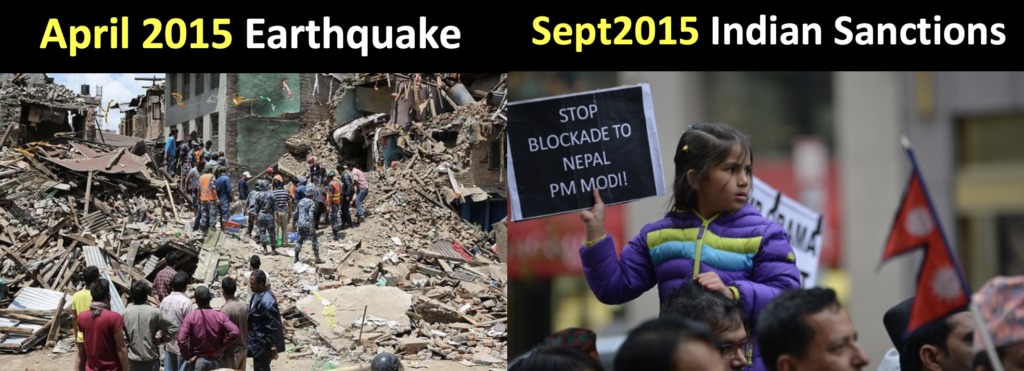
India does not want South Asian nations to develop ties with China, but India is happy to expand relations & economic partnerships with China. This logic is hard to comprehend but is a fact. Nepal’s ties with China improved following the 2015 earthquake. The same year Nepal was formulating a new constitution. India demanded changes to certain clauses which Nepal refused resulting in India closing its borders & disallowing food, medicines, essentials & fuel to reach Nepal. The embargo lasted 6 months (Sept 2015-Feb 2016) Slapping Nepal with an economic embargo at a time when Nepal was recovering from the April 2015 earthquake is inhumanity at a new level. Close to 9000 people died from the earthquake, over 25,000 were injured, and over 2.8m were displaced. Imagine being denied food, fuel, medicines 5months after the earthquake?
What led to Indian embargo
India’s claim to territories under Nepal – Kalapani, Lipulekh, Limpiyadhura
Nepals increasing ties with China via BRI projects, investments, infrastructure development – which India viewed as undermining its position as Nepal would no longer be reliant on India.
2015 Nepali constitutional change with Nepal refusing to accommodate changes India wanted inserted. India claimed it was concerned about the Madhesi community that India was aligned to. Madhesi’s demand a separate province. India expressed solidarity with them. Nepal accused India of sponsoring Madhesi protests. India demanded Nepal amend its constitution. So many similia rites to how India functions in Sri Lanka using the concern for Tamil people against Sri Lanka.
Eventually, in 2020 Nepal issued a new map including Kalapani, Lipulekh & Limpiyadhura as territory of Nepal. As per the Sugauli Treaty signed between Nepal and British East India Company in 1816, Limpiyadhura, Lipulekh, and Kalapani, all the areas situated to the east of the Mahakali River, belong to Nepal.
India now claims Kalapani as India’s Uttarakhand state.
This is no different to the demand for Sri Lanka’s Kachchetivu by India.
India’s demand that Nepal amend its constitution, include greater provisions for communities aligned with India was viewed by Nepal as interference in its internal affairs. Eventually Nepal had to agree to some amendments. Such was the bullying tactics India adopted.
The flipside of India’s treatment towards Nepal has been a rise in nationalist sentiment among Nepali’s against India & their realization they need to unite to assert their sovereignty & to distance from India’s obsessive influence on Nepal as a result of appeasement policies of their leaders which had weakened Nepal & its people.
A scenario Sri Lankans need to also ponder.
Indian imposed sanctions began after Nepal adopted its new constitution on 20 September 2015 & officially ended in February 2016 (after 6 months) but the humanitarian crisis continued as Nepali people suffered from the damage of the previous 6 months. The situation was confounded as a result of the devastating earthquake in April 2015 in Nepal.
FUEL – Nepal’s fuel supplies come through India. When India stopped allowing fuel trucks to pass its borders, fuel shortages took place across Nepal. Lack of fuel disrupted transport, emergency services-hospitals, operations etc, food supply chains, Transport came to a halt. People had to walk to get basic supplies. Ambulances, fire trucks, were all impacted. Factories & businesses were forced to shut down.
MEDICINES / MEDICAL SUPPLIES – Entire Nepali healthcare system came to a halt. Hospitals which were already weakened following the April earthquake, were further impacted & doctors & nurses struggling to help their people. Patients requiring chronic medications, surgical procedures, emergency care were the most vulnerable. There were no life-saving drugs or painkillers to give. Due to fuel shortages, doctors or medical care providers could not reach remote areas. Rural Nepal suffered the most
FOOD SHORTAGE – Entire food supply chain was impacted. Nepal’s food supplies also come through Indian borders. Nepali’s had to begin rationing food intake. Prices of food skyrocketed. Farmers could not transport their agricultural produce because there was no fuel. So agricultural products could not reach the people & were wasted.
Closure of Businesses/Factories – Businesses that relied on imports (from India) had to shut down resulting in job losses & an economic downturn. As Nepal’s biggest trade partner was India, the Indian sanctions severely affected Nepalis (another lesson for Sri Lanka over reliance on Indian imports)
Social & Psychological Impact – The blockade resulted in frustration leading to resentment & tensions & protests across the country. People feared for their basic survival. These are key issues Sri Lankans need to also ponder.
India’s punitive action against Nepal impacted 30million Nepalis.
Nepal shares a long border with India (over 1800 km) India’s concern is Nepal becoming a strategic base for China. However, India’s security concerns do not deem India has any right to undermine Nepal’s sovereignty. Nepal has every right to pursue its foreign policy. That foreign policy does not have to be what India demands. Moreover, if Nepal has not done anything to undermine India’s security, why should India interfere in Nepal’s sovereignty?
In inviting the self-appointed policemen of the world to South Asia/Asia, is it not India who has made the entire region vulnerable by becoming its strategic partner & going so far as to sign strategic defense pacts? Is it not this country together with its multiple minions who will one day destroy India’s defenses?
Weren’t these very minions all involved with the LTTE after India secretly trained them in India & are the one’s calling for war crimes against Sri Lanka? These agents are the ones who will undermine India’s national security. Sri Lanka or Nepal has never done so. The way India treats its neighbors, none of these citizens would even come forward to defend India in such a future scenario. All of India’s goodwill gestures to its neighbors are seen as ulterior motives by India without sincerity or genuine goodwill.
In 1987 India violated Sri Lanka’s territory with a parippu drop. There was no international condemnation & no UNHRC to hold red cards about violating international norms.
In 2015 India launched an economic blockade preventing food, essential goods, fuel, medicines passing India’s borders to Nepal. India closed all its entry/exit points to Nepal preventing goods reaching Nepal. Nepali people only suffered. Depriving civilians of essential goods in times of peace or even conflict is a violation of human rights under the International Covenant on Civil & Political Rights (ICCPR).
These laws are good only on paper. Nothing was done against India.
India had violated Article 2(1) – the Principle of Sovereignty (UN Charter)
India had violated Article 2(7) – UN Charter prohibiting intervention in the domestic affairs of sovereign states
Nepal reached out to the international community following Indian imposed economic blockade & the humanitarian crisis that ensued. Nepal appealed to the UN, other countries, & international human rights organizations to pressure India to lift the blockade. Only diplomatic responses were forthcoming. Even the UNSC did not intervene.
What this means for Sri Lanka too is that, after allowing India to exceed interference in internal affairs in Sri Lanka, if it comes to even an India-created humanitarian crisis, the world would only issue the usual emotionless statements & Sri Lankans would suffer like Nepalese did. In handing over everything to India, Sri Lankans must prepare for a similar eventuality as that which Nepal faced. Nothing is enough for India.
While the world just looked on. It was China who came forward to supply fuel & humanitarian aid to Nepal. Several thousand metric tons of fuel was supplied via the Kerung border in Tibet (by Nov2015 20,000 metric tons of fuel sent) China sent over 1000 metric tons of medicines & humanitarian aid including blankets. China opened Rasuwa & Kerung border routes to supply rice, wheat flour & other foods to Nepal & even supplied construction materials (cement & steel)
Pakistan & Bangladesh showed solidarity with Nepal & even made fuel available through alternative routes.
Sri Lankans cannot suffer because its politicians/political parties fail to identify friends from foes & ensure diplomatic actions are taken to ensure Sri Lanka’s sovereignty, territory & resources are protected. Allowing foes access to anything that makes Sri Lanka vulnerable via secretly signed agreements will eventually make only Sri Lanka & its people suffer, the culprits will shake off all responsibility & the reactions of the UN/International community is a good example of what we can expect in the future.
Today holds special significance as it coincides with the state visit of the Indian Prime Minister underscoring the profound historical, cultural, and strategic ties that unite our two nations and reaffirming the shared vision of our leaders for a prosperous and secure Indian Ocean region.
Deputy Minister of Defence Major General Aruna Jayasekara (Retd) made these remarks during his visit to the Indian Naval Ship Sahyadri at the Colombo port on Sunday (Apr 06).
The Deputy Minister was received by the Commanding Officer of the ship Captain Rajat Kumar. Indian High Commissioner HE Santosh Jha was also present at the occasion.
Speaking further, Deputy Minister Maj. Gen. Jayasekara said that the Indian Ocean remains a strategic lifeline for global commerce, necessitating collaborative efforts to combat security threats. We deeply appreciate India’s unwavering support in strengthening Sri Lanka’s maritime capabilities, ensuring safer seas for both our nations and beyond, he added.
He acknowledged India’s continued assistance in infrastructure development, capacity building, and humanitarian efforts that have played a pivotal role in Sri Lanka’s progress.
He further said that as we navigate the challenges of the 21st century, we must continue expanding our defence and security collaboration, particularly in addressing emerging threats such as maritime security challenges, drug trafficking, transnational crimes, and climate change.
Commanders of the Sri Lanka Army and Navy, members of the diplomatic corps, senior military officers and Defence Attachés from India, USA, Australia, Japan, Russia and Bangladesh, were among those present at the event held onboard the ship last evening.
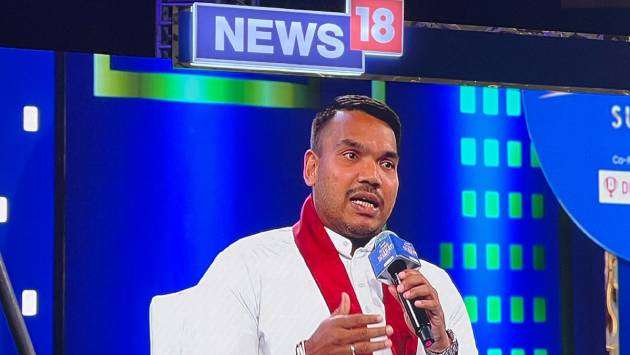
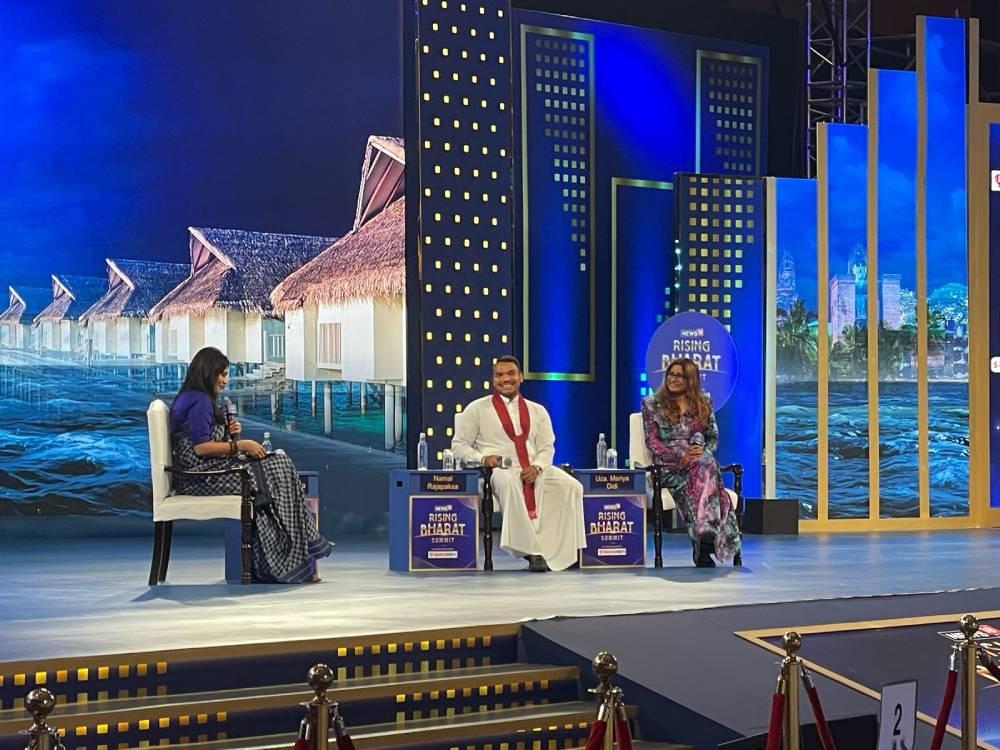
SLPP MP Namal Rajapaksa participated in the ‘Rising Bharat Summit 2025’ in New Delhi today, which aims at strengthening trade, security, and diplomatic ties between India and Sri Lanka.
The summit, which brings together influential leaders and thinkers, focuses on key regional issues and future collaborations.
Namal delivered a speech during a panel discussion on the topic ‘Strengthening Indo-Sri Lanka Ties Through Dialogue, Collaboration, and Shared Progress.’ His remarks highlighted the importance of fostering deeper cooperation between India and Sri Lanka for mutual growth and stability in the region.
Indian Prime Minister Narendra Modi is also expected to join the summit later today, further underscoring the significance of bilateral ties between the two nations.
Organizers said the summit is a crucial platform for discussing future avenues for trade, security, and diplomatic engagement between India and Sri Lanka.
A specially deployed Sri Lankan Humanitarian Assistance and Relief Team, comprising Tri-Service personnel, has been mobilized in Myanmar to support post-disaster recovery efforts following a powerful earthquake that recently struck the country, the Ministry of Defence said in a statement.
Upon arrival at Yangon International Airport, the team had proceeded to the disaster-stricken region approximately 450 km away and is currently stationed in Nay Pyi Taw province.
On Monday (Apr 7), they were deployed to Pobba Thiri Township to conduct two mobile medical clinics with transport support provided by local authorities, the statement added.
After reaching Pobba Thiri, the team conducted a rapid situational assessment to identify urgent medical needs and has since commenced providing medical services to the affected population. Their efforts are focused on delivering essential healthcare, addressing injuries, and supporting the well-being of communities impacted by the disaster.
The Sri Lankan troops have been commended for their swift response, professionalism, and unwavering dedication to humanitarian service. Their presence reflects Sri Lanka’s strong commitment to regional cooperation and solidarity during times of crisis, according to the Ministry.
The Ministry of Defence of Sri Lanka said it continues to monitor the mission and has reaffirmed its full support, expressing confidence in the contingent’s capacity to provide timely and effective assistance to those in need.
The death toll from Myanmar’s devastating March 28 earthquake has passed 3,600 with scores injured.
Sri Lanka Podujana Peramuna (SLPP) Member of Parliament Namal Rajapaksa says that politically driven delays in development projects in Sri Lanka resulted in an energy crisis that ultimately led to the country’s worst financial crisis.
Speaking during a special address themed The South Asian Platter: Menu for Growth” at the ‘Rising Bharat’ Summit held in India today (April 8), Rajapaksa stressed that development efforts must be carried out without delay, highlighting the importance of acting when the moment demands it.
We must implement and execute what has to be done at that given time.”
What we saw in the past couple of years—because we purely ignored certain development projects based on political reasons—for example, Sampur was supposed to be started in 2015, and similarly many other projects were delayed like Uma Oya from the Iranian funding—and as a result, in 2022 we faced an energy crisis that later turned into a financial crisis”, MP Rajapaksa stressed.
Commenting on the impact of US trade tariffs to the South Asian region, Namal Rajapaksa urged South Asian nations to move beyond political divisions and pursue regional cooperation to tackle shared development challenges.
Highlighting the urgency of regional partnerships, Rajapaksa emphasized the potential of South-South collaboration, especially among Indian Ocean nations, stating, This is the time that the region should get together, and Indian Ocean countries have to get together and build new partnerships on trade.”
…What has happen in Washington will not only affect directly to Sri Lankan apparel or the exports—but also the maritime industry in Sri Lanka. You know, we are heavily depending on trade and logistics as well at the same time”, Rajapaksa added.
The parliamentarian also underlined the importance of strengthening ties with regional powers. This is something we need to work together with countries like India, to see how we can work new alliances and build new partnerships within the region,” he added.
When asked about the challenges of advocating reform while being linked to a prominent political family, Rajapaksa acknowledged the complexities, and expressed, It’s how you project yourself and how you face it, because it’s going to be always challenging. Politics is not an easy profession to be in. The circumstances change. As politicians and as political parties, we should reform around it.”
It will be challenging, but it’s all about how we face it and understanding the global context as well—because politics is no more conceited on your own constitution or only to your own country”, he added.
President Anura Kumara Dissanayake has personally written to United States President Donald Trump on ways to mitigate the impact and reduce the tariffs imposed recently, Deputy Minister of Economic Development Anil Jayantha Fernando announced in Parliament.
Deputy Minister Fernando said the White House has also acknowledged the letter sent by the Head of State.
Deputy Minister of Economic Development Anil Jayantha stressed that the new government is focused on reducing the trade deficit with the United States in response to the reciprocal tariffs announced by US President Donald Trump.
In response to a question raised by New Democratic Front (NDF) Parliamentarian Ravi Karunanayake in Parliament today, Deputy Minister Fernando noted that data from the last five years indicate the trade deficit with the US is at 88 per cent.
The Deputy Minister of Economic Development noted that apparel, food and three other items account for 85 per cent of the total exports to the United States.
He said they are subject to tariffs and paratariffs, but the recent levies announced by President Donald Trump were calculated based on the trade deficit between countries and the US.
Deputy Minister Anil Jayantha Fernando defended the actions of the incumbent government saying they took proactive and reactive measures to lessen the adverse impact of the tariffs on local businesses.
The Deputy Minister confirmed another round of discussions will be held tonight (8) with the Office of the US Trade Representatives.
Deputy Minister Fernando noted that the Sri Lankan Ambassador to the US has been actively discussing with the Trump administration since February this year.
He said discussions were held previously with US representatives where it was acknowledged that the on-going situation is not merely between Sri Lanka and the US.
Deputy Minister Anil Jayantha Fernando said countries like India did not manage to reduce the tariffs as the calculation was made by a common formula.
He said therefore the government will take pragmatic decisions to lessen the impact the tariffs will have on local businesses.
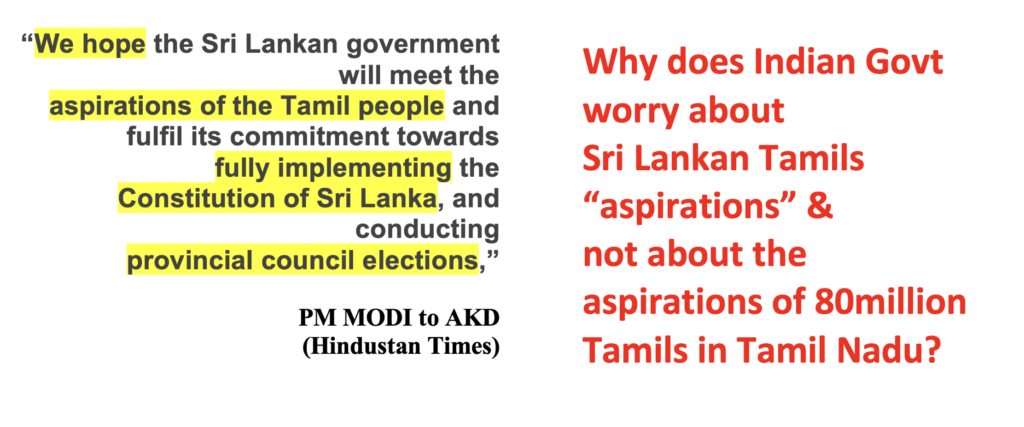
In a slap to Sri Lanka’s hospitality, the Indian PM chose to single out only Tamils who account for less than 2.5million in an island of 22million asking the Govt to fulfill the aspirations of only Tamils. Sadly, he said after accepting a prestigious award by the Sri Lankan President. As far as we know Sri Lanka remains a sovereign state, no Sri Lankan leader tells Indian govt how to treat Indian citizens in India. If Mr. Modi feels that the Sri Lankan Tamils are not happy in Sri Lanka, Mr. Modi is more than welcome to give residency in Tamil Nadu to Tamils in Sri Lanka. Let us see how many will accept such an offer. Citizens in Sri Lanka have been living in harmony & that harmony has only been dented by external indoctrinations & poisons fed into the minds of people. There would have been no armed struggle or LTTE had India not secretly trained Tamil youth in India. There would have been no bloodshed or terror beyond May 1987 had Prabakaran been allowed to be captured. Even Rajiv Gandhi would have been alive today.
Thus, the armed militancy had nothing to do with Tamil aspirations & everything to do with India’s aspirations.
The Indo-Lanka Accord, the mention of Trinco Port, Trinco Oil Tanks had nothing to do with the Accord, its annexure but were only mentions in a letter from India PM Rajiv Gandhi to Sri Lankan President JR Jayawardena. These were India’s aspirations not Tamils or even LTTE.
Road, rail, ferry, bridge – all these connectivity’s are not part of Tamil aspirations but India’s aspirations & part of a new ideological Arkhand Bharath initiative.
Therefore, are Sri Lankan Tamil aspirations the same as that of India’s geopolitical aspirations?
Why does Indian Govt worry about Sri Lankan Tamils aspirations” & not about the aspirations of 80million Tamils in Tamil Nadu?
We have been repeatedly asking to clearly lay out what are the grievances of Tamils that are exclusive to them & not shared by the other citizens. As per our constitution, no community can be treated differently where the law must apply equally. So far other than some issues about getting letters in Sinhalese language nothing substantiate has been forth coming. In that case the Sinhalese, especially the Sinhalese children living in the North have a long list of grievances where they are administratively discriminated. Why doesn’t anyone speak on behalf of them?
Who can present a list of grievances that only Tamils suffer that Sinhalese, Muslims or Burghers do not also suffer which warrant a demand for a separate mono-religious state?
No Tamil can claim to have suffered the way the Blacks were treated in US, UK & western countries or how Blacks lived under apartheid rule in their own land. Those who are history savvy should read up on how Blacks were treated & continue to be treated in the West.
Aspirations are vague – aspirations differ from person to person. No Govt can meet aspirations of all its citizens.
The aspiration for a Tamil homeland was first mooted by the TULF & hijacked by Prabakaran to justify armed militancy. All he wanted to initially do was go against the caste system of which he was victim. Prabakaran’s aspiration was to reign supreme over his people as a despot & all Tamils lived in fear under his rule, so much so that all of the present overseas LTTE fronts only established themselves after his death. Had they independently set themselves up, they would have faced their waterloo like many Tamils did. Ironically, it is only those living overseas holding foreign passports who are wailing for a Tamil Eelam. Those that do so in Sri Lanka are the hired lot emerging only before Geneva sessions or when some handout is given.
We have always wanted to know why India started to train Tamil youth in guerilla warfare. We have yet to receive an answer. However, the oft quoted reason is that India wanted to palm off India’s headache in Tamil Nadu to Sri Lanka.
What was that headache? That headache was the self-determination bid.
The same ethnic group cannot evolve in 2 different countries & claim self-determination in 2 different countries using the same arguments?
Which brings us to the question which country Tamils were first birthed in. This brings us to Tamil Nadu, thus the original demand for self-determination by Tamils began in 1938 in Tamil Nadu & not Sri Lanka.
Madras Province (Tamil Nadu, parts of Andhra Pradesh, Karnataka, Kerala) was ruled by British. Tamil Nadu spoke Tamil, Andhra Pradesh spoke Telugu, Karnataka spoke Kannada, Kerala spoke Malayalam.
The other parts of Andhra, Karnataka & Kerala were ruled by Kings. These kings were subservient to the British.
Madras Province became Madras State in 1947 after Indian independence.
It is also important to note that the term Dravida Nadu was coined by colonial missionaries Bishop Caldwell as part of divide & rule mischief. In all probability the Tamil Eelam homeland” must have also been coined & promoted via missionaries who were very active in Sri Lanka.
It would be worthwhile to see the actual missionary brains behind these homeland” movements though India is using the same to advance its empire building agenda.
The Justice Party was formed by Periyar E V Ramaswamy in 1925.
In August 1938 T P Vedachalam of the Justice Party founded Tamil National Liberation Association.
The Justice Party was renamed Dravidar Kazhagam in 1944. Dravidar Kazahagam was an offshoot of the Self Respect Movement.
Dravida Munnertra Kazhagam (DMK) was formed on 17 September 1949 by C N Annadurai.
T M Parthasarathy of DMK went on to say Tamil Nadu, Kerala, Karnataka, Andhra should each SEPARATELY become independent countries and THEN the four should join to form a ‘Dravidian Federation”.
Then on 18 December 1949 S J V Chelvanayagam formed ITAK (Federal Party) calling for a Tamil State in Sri Lanka.
But, it was Periyar & Annadurai who called for Tamil Nadu independence in December 1938. Periyar declared the aim was the separation of Tamil Nadu from the rest of India.
Addressing a meeting in October 1938, Periyar declared
The best way to preserve the liberty of Tamils is to agitate for separation from the rest of India and the proposed All-India Federation”.
Tamil Nadu’s bid for self-determination has been a long process:-
British India” was formed putting together independent princely kingdoms and territories.
Tamils lost their sovereignty with the fall of the 3 major kingdoms of Chera, Chola and Pandya around 1311 by Sultans, Nayaks, Maharaashtrians & Nawabs followed thereafter by arrival of Europeans – all of Tamil Nadu was ruled by colonial Britain while Pondycherry was ruled by the French.
1947 – At independence, Muslims in northwest and northeast objected to the creation of one country and so Britain created 2 countries – Pakistan & India. Tamil Nadu objected to this though Britain ignored this.
1938 August – Formation of Tamil National Liberation Association (Tamil Desa Viduthalai Sangam) by T P Vedachalam of the Justice Party became the 1st Tamil Nadu independence movement.
1938 October – E V Ramaswamy (Self-Respect Movement & later leader of Justice Party which became DK in 1944) declared the best way to preserve the liberty of Tamils is to agitate for separation from the rest of India and the proposed All-India Federation”.
10 December 1939 C N Annadurai (founder of DMK) demanded independence – ‘Tamil Nadu for Tamils’
17 December 1939 Periyar of DK raised slogan Dravida Nadu for Dravidians” changing his earlier Tamil Nadu for Tamils’ but changed again to Tamil Nadu for Tamils’ in 1960s evidenced in the Viduthalai magazine. Periyar died in 1973.
27 December 1939 – Provincial Tamil Conference in Vellore discussed Tamil Nadu independence.
24 August 1940 – Justice Party State Conference in Thiruvarur passed a resolution that to protect Dravidian culture, arts and economy Dravidian homeland of Madras Province needed. Thus the Tamil Nadu Independence Movement transgressed into Dravida Nadu Independence Movement. (refer article on DMK & the Tamil Nadu Independence Movement”) From 1940 – 1962 calls for Dravida Nadu by DMK. The reason for this is said to be due to Telugu leaders A C Parthasarathy Naidu, Ragavaiah Naidu, K V Reddy Naidu all striving for Dravida Nadu independence.
The British delegation (Cripps Mission) that came in 1942 refused the request for a separate Tamil state upon Indian independence.
1944 – C N Annadurai at DK Conference in Trichi India is a continent and it should be divided into separate nations(countries).” There is no need for it to be under a single government”. India should be divided according to racial lines to prevent future bloodsheds”. Aryan dominance grows under a single Indian country. Other races are destroyed”. Dividing India into separate countries would allow for each to develop its economy according to its circumstances and prevent one region taking the wealth of another”.
14 October 1947 – Dravida Nadu Separation Conference held in Cuddalore, Tamil scholar V Kalyana Sundaram speaking about Aryan-Dravidian problem. Resolution calling for Dravida Nadu independence passed.
V Kalyana Sundaram unveiled a map of Dravida Nadu at Dravidar Kazhagam Conference in Erode.
8 November 1950 – Madras State DMK Students Conference passed resolution for the independence of Dravida Nadu.
12-16 December 1951 – DMK State Conference called for ‘Dravida Nadu for Dravidians’
DMK leaders demanded independent Dravida Nadu during 1952, 1957 and 1962 election campaigns.
13-16 July 1961 – DMK General Conference in Madurai called for ‘Dravida Nadu for Dravidians’
16-17 December 1961 – DMK Special Election Conference in Coimbatore ahead of February 1962 General Elections called for ‘Dravida Nadu for Dravidians’. DMK won 50 seats at the State Legislative Assembly & 7 seats in the Indian Parliament. DMK founder C N Annadurai was elected to the Rajya Sabha in 1962 and in his May 1st maiden speech he reiterated demand for ‘Dravidians demand the right of self-determination….we want a separate country for Southern India’ His response to Indian President Dr. Radhakrishnan who said India was one country because Rama & Krishna are worshipped from Kanyakumari to Himalayas was Jesus is worshipped throughout Europe, yet there are many countries in Europe”.
11 August 1962 – What is noteworthy is that when a by-election was held in Thiruchengodu following the resignation of Dr. Subarayan of Congress Party, Congress leaders campaigned asking people not to vote for DMK as it was a separatist party but the DMK candidate won leading to DMK leaders claiming it was a victory for ‘independence’.
22 September 1962 – DMK celebrated ‘Dravida Nadu Independence Festival’ in Chennai with over 200,000 participating.
1963 – Bids for separate independent Dravida Nadu & Tamil Nadu had to be abandoned when Indian Centre passed 16th amendment prohibiting anyone to advocate separatism.
13 November 1963 – DMK abandoned independence for Dravida Nadu after Indian Centre threatened to ban it from contesting elections if it continued with the independence demand.
However, the 1967 election manifesto of DMK included the demand for increasing the devolution of powers of state governments. It won them a landslide victory no different to how TULF in SL won following the racist/separatist Vaddukoddai Resolution in 1976.
1994 – Poet Pavalareru carried sentiment of freedom for Tamil Nadu till his death in 1994.
However, Thamizaharasan formed the Tamil Nadu Liberation Army (TNLA) in the mid-1980s though he was killed by the Indian Army though the group remains active.
As Mr. Modi can see there is a very active self-determination movement in Tamil Nadu. Sri Lanka’s only openly began in 1976 with the Vaddukoddai Resolution.
It is also important for Mr. Modi to realize that when their innocent” demand to cede was rejected, they changed tactics to ask for devolution without interference by the Centre. This is what they are seeking via 13thamendment which India is the architect of. It is also India asking for PC elections to be held, knowing that the separatist components are seeking autonomy of governance without interference of Colombo.
Exactly, what is India planning?
Whose side is India on?
By meeting only, a bunch of racist & opportunist Tamil politicians what is the message PM Modi is giving to the Tamils?
Take each of these Tamil leaders & the votes they have obtained. It is hardly anything to boast of. They are only in Parliament due to the proportional representation system.
More questions to answer
Where did the ethnic group Tamils” originate”?
Where did the Tamil culture” originate
Where did Tamil language” originate
Where these originated, is where the right to self-determination is allowed. That place is nowhere else but Tamil Nadu.
What about the aspirations of these 80million or more Tamils?
Will Mr. Modi fulfill their aspirations first, given the quest for separatism began in Tamil Nadu.
One & the same ethnic group cannot demand several mono-ethnic homelands in different continents/countries. If allowed, it will only create an ugly precedence.
‘Before you study the economics, study the economists!’
e-Con e-News 30 March – 05 April 2025
The notorious King Leopold II of Belgium, as a young Duke of Brabant, rode the first English train in Ceylon from Veyangoda to Ambepussa and back to Colombo, drawn by an imported English locomotive engine in 1864. But more importantly, as English Queen Victoria’s first cousin, Leopold enabled the mass murder and enslavement of the Congo people to extract their palm oil for William Hesketh Lever, who created the Huileries du Congo Belge (HCB), a subsidiary of the soap-manufacturing Lever Brothers Co.
Unilever, of course, is a major if not the principal lubricator of the media & the public relations (aka advertising & marketing) companies that sustain misinformation & disinformation in Sri Lanka. It is they who, unfortunately, provide the nation with our daily mental bubble gum & bile plus the deities & demons, who appear to switch places with every government that is elected with great hope and then overthrown with great distaste. Whatever great changes or chaos, or big talk and broken promises, it turns out that the old imperial plantation system bestowed by the likes of Unilever, and more recently the IMF, carries on regardless…
It is Unilever (actually their former CEO, Paul Polman) who has called themselves, ‘The biggest NGO in the world’! And herein lies the reason behind such ‘charitable’ appellations, which claim they are better than nation-states. And it is such NGOs, or rather, the creation of such mammoth multinational corporations (MNCs) to avoid the taxes & exchange controls of nation-states, ably assisted accountants, that is the subject of one of this ee’s Focuses (Foci?), as ee continues looking into the creation & function of British American Tobacco (BAT), which controls the monopoly called the Ceylon Tobacco Co (CTC).
*
‘There is more bloody nonsense talked on this subject than on any
other business topic… it has become the oh-so-fashionable subject…
there’s an avalanche of books & conferences on the subject, but little
common sense… we have to be better behaved than anyone else… we
are put upon in all sorts of outrageous ways… you can fall over
backwards to be a good citizen of the countries where you operate,
and then find yourself denounced as exploiters… something sinister
seems to have attached itself to the title ‘multinational corporation’; well,
whatever you call it governments have killed a hell of a lot more people
than companies… governments tend to make the world companies their scapegoats,
partly because they don’t realise the limitations of their own power.’
Richard P Dobson, Chairman British-American Tobacco (1970-76)
*
Formed in London in 1902, BAT was set up to control the domestic ‘home’ markets of other countries, controlling trademarks & brands outside of England, Ireland, and the USA (excepting the socialist countries, of course). By the 1970s, BAT was operating 140 factories manufacturing tobacco products in 54 countries. The accusations of causing an epidemic of cancer, inflating state expenditures on health, was also the principal reason for their control over paper manufacture, printing & packaging but a policy of planned investment in industries not directly related to tobacco, food, pharma & life insurance etc.
CTC was in the news this week, if not in name, at least in spirit, with the headline ‘Container declared as office furniture turns out to be Rs435bn worth of cigarettes.’ Cigarette companies have been known to smuggle cigarettes to avoid taxes, helping the formation of gangster networks known for their smuggling of other substances.While an Island editorial declared, ‘Political parties are the ground zero of corruption’, ee believes it is their multinational sponsors who are the real zeroes… Meanwhile, a seeming spokesman for the Ceylon Tobacco Co parading as ‘interested reader’ of ee (see Comments) insists that the company abides by the laws & regulations. So be sure they do, after helping to frame those ineffective legalities!
*
• If England is criticizing Sri Lanka’s ‘human rights’, why don’t England’s principal representatives in Sri Lanka tell us and their rulers in London what they really think of us? ee is referring of course to the great English multinational banks & corporations, with budgets larger than Sri Lanka & most countries – such as Standard Chartered Bank, Hongkong & Shanghai Bank, Unilever, Ceylon Tobacco Co. England is so concerned about truth & reconciliation it seems, here as in South Africa & Canada, for instance. Isn’t it time then, that Unilever tell the truth about its operations in Sri Lanka? Isn’t it time Unilever reconcile with the people of this country, from whom it has sucked out great profits? There’s an ’inescapable need to deal with the past’, says USAID’s National Peace Council spokesman, one Perera. If this is case, then these corporations such as Unilever surely must stand in front of the line, for it is in the enslaving plantations that we find Sri Lanka & Unilever’s history & truth, and not just here. After all, it became a literary industry & internet meme to blame Belgium’s King Leopold for the horrors that beset Africa’s great Congo, a horror that continues to this day, just across the ocean from us, as a US and Europe-backed Uganda & Rwanda invade the Congo. As well as the UAE & their US sponsors who are funding the war on Sudan. All just across the water from us, ready to set the world aflame.
Setting the world aflame to maintain & reassert their imperialist supremacy is also the principal reason behind the ‘tariffs’ announced by US President Don Trump, despite his clamorous claims that it is an attempt to reverse the de-industrialization of his country. And yet, ‘Within the IMF, the term ‘industrial policy’ is met with outright hostility’, according to the economists Bram & Howard Nicholas (see ee Economists, Following IMF policy recommendations will lead to yet another debt crisis).
What is the role such multinational banks and corporations play in our exports that the USA claims is causing them such industrial pain? They certainly cause us pain and prevent local industry! And why doesn’t the so-called Asia Internet Coalition – AIC (representing the USA’s Meta, Google, X, Booking.com, Amazon, etc) pay taxes in Sri Lanka? Tell us, dear Donald, tell us! Is that why your tariffs included only the export of goods and not services. And we hear that your IMF prevented Sri Lanka’s Internal Revenue Department and the Fiscal Policy Department from insisting on a digital service tax for all these companies. They told the government that it simply cannot be allowed to happen. Instead, the government now has to impose a digital service VAT to be paid by the consumer. Imagine that! The IMF blocked a tax!
ee Focus also continues with US Vice President JD Vance’s speech, where he calls for preventing the industrialization of countries such as ours. Vance is also known as a ‘Trump tweeter’, whose position is so far insecure (though a earlobe away from the presidency), who has to continually repeat Trump’s name to keep in his good books. Known as an ‘anti-China hawk’ beholden to his sponsors such as PayPal’s Peter Thiel who funded his political career, portraying this Yale graduate as a p’or lil white boy, the settler Vance’s anti-immigrant rhetoric is heightened by his marriage to a non-resident Indian (NRI)immigrant who apparently did not come cheap…
Meanwhile, eeFocus also offers an intriguing excerpt of Manuka Wijesinghe’s more detailed implication of the US ambassador ‘extraordinaire’ Bernhard Gufler in the murder of PM SWRD Bandaranaike in 1959… ee already recalled Gufler’s involvement in ‘Exposing the Real Assassins of SWRD Bandaranaike, 12 October 2019. Wijesinghe, however, also places the murder in the context of the role played by Indonesia’s Muslim head of state, President Sukarno (also later deposed midst the US, Dutch & English stage-managed genocide of 1965) who had insisted that the Buddha’s ‘ahimsa’ should be the binding that held the Non-Aligned Movement founded in Bandung in 1955, together.
eeFocus starts by reproducing the economist WA Wijewardena’s recall of the ‘Marxist’ Philip Gunawardena’s ‘Visionary Economic Policies in 1930s’ which offer a benchmark for what politicians can accomplish when truly truly truly dedicated to their country’s upliftment….
Sri Lanka stands on the brink of transformation. A newly elected government has vowed to root out corruption, favouritism, and wasteful governance. These commitments have kindled hope for a more just and accountable state. Yet, while political will is necessary, it alone cannot secure the nation’s renewal. For real and lasting change, the unwavering commitment of the civil service is indispensable.
A New Political Mandate, a Familiar Challenge
The political winds have shifted. From high-level appointments to legal actions against past misconduct, a more principled approach to governance appears to be taking root. Encouragingly, this reformist zeal is being channelled through the proper legal frameworks, avoiding the trap of political retribution.
But the machinery of government does not rest solely in Parliament. True reform lives or dies in the offices of ministry secretaries, regional administrators, and the countless public officials who carry the weight of the state’s day-to-day functioning. Without their full engagement, even the most ambitious national plans will struggle to reach the people they aim to serve.
The Role of the Civil Service: Between Skepticism and Responsibility
Many civil servants continue to perform their duties with quiet excellence. However, the wider institutional response has been mixed. There is hesitancy in some quarters—a wait-and-see approach shaped by decades of political churn and unfulfilled promises. Understandably, career officials have become cautious, having seen reforms launched with fanfare only to fizzle out with the next electoral cycle.
Furthermore, civil servants rightly value institutional integrity and are wary of excessive political interference. Their concerns are not without merit. But there is a difference between skepticism and disengagement. The moment calls for vigilance and action.
Time for Active, Principled Leadership
Now more than ever, Sri Lanka needs its civil servants to be more than implementers—they must be reformers in their own right. Here’s how they can help steer the country toward lasting progress:
Lead with transparency. Make openness the default in all administrative processes.
Cut red tape that feeds corruption. Where outdated procedures hinder efficiency, advocate for change.
Uphold meritocracy. Ensure appointments and promotions are based solely on qualifications and performance.
Stand up to undue influence. Record and report inappropriate requests to sidestep rules or bend procedures.
Foster inter-agency cooperation. Government services improve when departments work together, not in isolation.
A Collective Endeavour
National renewal is not a solo act—it is a collective mission. Politicians can set the tone, but civil servants must carry the tune. Your institutional experience, policy knowledge, and operational insight are vital for embedding reforms that outlive any administration.
To the many public officers already working quietly and persistently for a better future: your contribution matters deeply. You are the unseen scaffolding of our national rebuilding effort.
To others still unsure of their place in this moment: reflect not only on your responsibilities, but on the legacy you will leave. Will you have helped shape a fairer, more effective public service? Or will you have watched passively as yet another opportunity for reform passed us by?
A Defining Moment
The road ahead will be uneven. Setbacks are inevitable. But this moment—this fragile but powerful window for renewal—is too precious to waste on doubt or detachment.
Sri Lanka deserves a public service that reflects the best of its people: principled, committed, and courageous. The decision rests not in speeches or manifestos, but in the daily actions of those who serve.
The question remains: when this chapter is written, what role will you have played?