To transform Sri Lanka from a consumption-based economy into the industrial and maritime hub of the Indian Ocean through technology, engineering, education, discipline, and productive investment.”
Pillar 1 – Industrial Renaissance
Make industrialisation the highest national priority.
Establish heavy engineering parks.
Develop shipbuilding, offshore engineering, steel fabrication and precision manufacturing.
Encourage local manufacturing instead of unnecessary imports.
Double industrial exports within ten years.
Pillar 2 – Trincomalee: The Economic Capital
One of the flagship promises could be:
Trincomalee will become the Singapore of the Indian Ocean.”
Develop:
Offshore engineering complex
FPSO conversion facilities
Rig repair
Ship repair
Marine logistics
LNG and natural gas industries
Renewable energy
Blue economy industries
International maritime universities
This has been one of your strongest recurring proposals.
Pillar 3 – Blue Economy
Expand beyond fisheries.
Include
Offshore oil and gas support
Deep sea engineering
Marinas
Cruise industry
Ocean research
Aquaculture
Seaweed
Marine biotechnology
Ocean renewable energy
Pillar 4 – Vocational Revolution
One of your strongest policy areas.
Promise:
Every school leaver should have an opportunity to gain an internationally recognised technical qualification.
Expand training in
Welding
Pipe fitting
CNC machining
Robotics
AI-assisted manufacturing
Offshore engineering
Marine engineering
QA/QC
NDT
Industrial safety
Create thousands of internationally employable technicians rather than unemployed graduates.
Pillar 5 – Women’s Industrial Empowerment
Move beyond traditional vocational training.
Train women in
Welding
Electrical work
Mechanical engineering
QA/QC
CAD
Robotics
AI
Offshore inspection
Industrial management
Pillar 6 – National Infrastructure
Modernise
Ports
Railways
Waterways
Canals
Airports
Energy systems
Digital infrastructure
Focus on execution rather than announcements.
Pillar 7 – Foreign Investment
Adopt a pragmatic policy.
Welcome investment from
India
Japan
UAE
Qatar
Oman
Saudi Arabia
Norway
South Korea
Singapore
Vietnam
China
Europe
Evaluate projects on national benefit while protecting Sri Lanka’s strategic autonomy.
Pillar 8 – Justice and Governance
Your articles frequently argue that government needs the ability to implement long-term reforms efficiently.
A democratic manifesto could frame this as:
Faster justice
Merit-based appointments
Reduced political interference
Strong anti-corruption measures
Professional public administration
Clear accountability for public officials
Stable policy environment for investment
This emphasises effective governance while remaining consistent with constitutional democracy.
Pillar 9 – Education Reform
Replace rote learning with
Engineering
Innovation
Entrepreneurship
Artificial Intelligence
Robotics
Manufacturing
Maritime studies
Digital technologies
Every university to work closely with industry.
Pillar 10 – Energy Security
Develop
Mannar natural gas
LNG
Solar
Wind
Green hydrogen
Offshore renewables
Reduce dependence on imported fuel.
Pillar 11 – Agriculture as an Industry
Modernise farming through
Mechanisation
Precision agriculture
Food processing
Export-oriented production
Cold chain logistics
Pillar 12 – Clean Sri Lanka
National programmes for
Waste management
Canal rehabilitation
Flood control
Water recycling
Coastal protection
Sustainable urban development
Pillar 13 – Digital Government
Every government service to be available online.
Use AI to improve
Licensing
Customs
Taxation
Healthcare
Education
Agriculture
Public administration
Pillar 14 – National Character
One theme that appears repeatedly in your writing is that development depends not only on policies but also on national attitudes. A manifesto could therefore promote:
Discipline
Respect for law
Merit
Professionalism
Civic responsibility
National unity across communities
Pride in productive work
A Possible Presidential Pledge
I do not promise a richer Sri Lanka through borrowing. I promise a richer Sri Lanka through building. We will manufacture more than we import. We will export more than we consume. We will train our youth for the industries of tomorrow. We will transform Trincomalee into the maritime and offshore hub of the Indian Ocean. We will create a nation that is respected not for its speeches, but for its ships, factories, engineers, and skilled people. My vision is simple: a Sri Lanka that executes, innovates, and prospers.”
This would give your campaign a distinctive identity. Rather than competing on short-term welfare promises, it would present a long-term national development agenda rooted in engineering, industrialisation, vocational excellence, maritime strategy, productive foreign investment, and execution-oriented governance—the themes that consistently run through your LankaWeb articles and broader body of work.
By Sarath Wijesinghe PC., Solicitor of the U.K., Former Ambassador to the U.A.E. and Israel and The President, Ambassadors Forum U.K. and Sri Lanka.
BAR ASSOCIATION OF SRI LANKA AND THE RECENT RESOLUTION UNANIMOUSLY ADOPTED ON THE EXTENTION OF THE JUDICIARY BY TWO YEAR
The Bar Association of Sri Lanka is the professional body of all lawyers in Sri Lanka with Honorable objectives that includes protect the Constitution, Human Rights, Encourage Rule of Law, independence of the Judiciary amongst many other objects included. The Constitution of Bar Association which was set up as a continuation of the age-olden Law Society established during colonial rule and continued as an amalgamated profession as attorneys at law. Any lawyer enrolled as an Attorney- at Law is entitled to be a member of the association, however, a membership fee has to be paid and other requirements are to be completed to obtain the membership of the professional body. BASL in shorten form is a powerful body including judges, members of the executive legislature and judiciary and leading lawyers living world over continue to be members.
The recent meeting of all lawyers in Sri Lanka with regard to the extension of the period of judges with a constitutional amendment has united all the lawyers to meet and express their views at the Head Office with all the branch organizations connected online. From the membership of 26,000 lawyers countrywide about 6,000 were physically present or communicated via online.
The decision of the lawyers is loud, clear and was unanimous. They opposed to the said proposal in a emphatic and significant manner, who have not taken part to this magnitude before. The decision taken by the Bar Association of Sri Lanka amongst opposing the proposed amendment is to canvas the issue at the Supreme Court which gives rise to a academic and constitutional complication. There is a legal principal ‘Nemo debet esse judex in propria causa‘where it is stated one could not be the judge of his own case. Therefore, it is a very unusual situation in the Supreme Court whether the judges could or will allow the case before them in which the ultimate goal of the Bar Association of Sri Lanka is seeking a constitutional referendum on the matter. At the same time as matters appear, apparently the Executive is determined to go through the process despite facing a referendum against the wishes of Bar Association of Sri Lanka membership, judges’ professional body and many for the reason that this will amount to bribery and corruption undermining the independence of the judiciary. We invite you to browse the net for articles by this write on this issue, Laws Delays, Legal Education, Independence of the Judiciary which are easily accessible by the name of the topic and or the name of the author.
This complexity of the facts will indicate in turn the complexity of issues and concerns of the Bar Association as to why this amendment is to be legalized in the hurry. The allegations against some senior lawyers are that they are planning another stunt adopted by Late President J.R.Jayawardene to extend the period of the government by a referendum, thereby the country was made a pool of blood by two JVP insurrections and a war that was prolonged for three decades due to denial of justice to the people on due date. The defense and explanation of the executive and minister of justice is that the amendments are for the purpose of law delays which is incorrect. We invite readers once again to refer to the article as stated above on Laws Delays which deal with those delays in detail which proves main reason is not due to judges’ delays. There are many reasons due to the inefficiency of the governance, malpractices of justice and the institution connected to the legal system. These affect institutions that helps the process freely and hamper the proper judicial system. It appears everything is complicated and it does not seem that there is no solution and the Governance and the Minister of Justice are incapable of handling the situation.
Therefore, we are of the view that no drastic changes are necessary currently and to allow ‘sleeping lions sleep’. It is advisable to maintain the status- quo awaiting a proper consultation with the judiciary, lawyers. Executive and other organizations including international organizations who are concerned in SL and it’s judicial system which is currently in some form of maturity. We urge the governance, the proponents of the changes for a cooling period to discuss matters in a better atmosphere considering there is no urgent need unless the government has motives to keep the current judges for two more years for reasons the lawyers allege. The judiciary is considerably qualified and of high standard. There is no need to extend the period by two years because the junior judges are equally able, competent qualified and exposed to the world in their best energetic age. The age alone is not a criteria for ability, efficiency and far thinking. Current young lawyers are exposed to the world via internet and are excellent junior lawyers. The elderly senior judges could be lethargic as the they are not expose to modern changes in the legal system. There is some valid reason in what the proponent say on seniority as in many countries such USA elderly senior judges are allowed to remain and continue in the system if they wish to. But the Sri Lankan system is different. We have limited resources. There are law delays in other countries which they look for quick solutions in their own way. We have to device our own methods and if the extension of the period of judges is definitely is not the solution, and thereby unnecessary unless the Executive has ulterior motives to keep Senior Judges including the Chief Justice in position, for certain ulterior purposes. Therefore, we urge the executive to think of the nation, the people and not maintaining presidential power at any cost. We request him not to take short cuts to continue be in power and to maintain the status-quo that we have been enjoying so far as a Democratic Nation, enjoying Democracy in South Asis, including judicial freedom.
Sir Garfield Sobers and Senaka Weeraratna met face-to-face during a chance encounter in Melbourne, Australia, in 1983. At the time, Weeraratna—a Sri Lankan lawyer who would later become known as the conceptual architect of cricket’s Player Decision Review System (DRS)—was working in Melbourne as a legal officer for the Federal Special Prosecutor’s office. [1, 2, 3]
Key Details of the Encounter
The Setting: The meeting took place in Melbourne in 1983. Weeraratna was part of a white-collar crime prosecution review team under Robert Redlich, QC. [1]
The Context: Sir Garry Sobers had a deeply rooted connection to Sri Lankan cricket around this time, having served as the head coach of the Sri Lanka national team in the early 1980s, including leading them during the 1983 Cricket World Cup. [1, 2]
The Shared Connection: Weeraratna later documented the personal encounter in a retrospective piece titled “Your Sobers Story” on LankaWeb. [1]
Overview of the Entities
Figure
Primary Legacy & Significance
Connection to the Meeting
Sir Garfield Sobers
Renowned as one of cricket’s greatest all-rounders; coached Sri Lanka’s national team in the early 1980s.
Met Weeraratna during a personal trip/stint in Australia.
Senaka Weeraratna
Sri Lankan lawyer, legal officer, and the unsung conceptual designer of the Decision Review System (DRS).
Initiated the chance face-to-face meeting as a professional working in Melbourne.
* Who are the masterminds who, during the 19th Amendment in 2015, deprived the people of the referendum required by the Constitution to change the presidential and parliamentary terms to 5 years?
Who are the masterminds who deprived the people of their referendum voting rights in 2015 by reducing the presidential and parliamentary terms to 05 years, using the flawed Paragraph 83(b) of the English version of the Constitution, while even the Election Commission stated in 2025 that Article 83(b) in the English version of the Constitution and Article 83(ආ) of the Constitution are different?
There are a number of wars raging g around the world and a few more are on the planning stage. Drone warfare dominates every one of them. Among drones, the king is inevitably the mighty Shaheed drone. Shaheed and its copies in many countries, including its Russian, American, Chinese, Indian, Israeli, Turkish, etc. variants are highly effective due to low cost, simplicity, high impact, versatility, short time it takes to launch and hit targets and range. Why waste manned aircraft and artillery when a cheap but sizable enough drone can do the job at a fraction of the cost and with deadly precision. Sri Lanka must also clone the successful Shaheed-136 drone, customize it to specific needs and manufacture it locally in sufficient numbers. Peace time is the best opportunity to modernize the military and upgrade national security.
The purpose of having a strong miliary is not to wage war but to deter and prevent war. A strong and well-equipped military prevents war. A weak military invites trouble. Singapore for instance allocates 3.5% of the economy (GDP) to defense against the world average of around 2.5% of the GDP. Sri Lanka must invest 2.5% of the GDP in defense annually and at least 10% of the defense budget should go into equipment. Until Tamil terrorists struck in 1978 bombing a passenger plane in Ratmalana (which was an act of war and terrorism by international law), Sri Lanka was not ready for war. Only a very small percentage of its economy was allocated to defense that shocked Lee Kwan Yeu in the 1970s. Sri Lanka gradually increased it to match world average which helped bring about peace.
Sri Lanka faces a significant threat from drones launched by internal terrorist groups. Drones can disable its ports, particularly the Colombo port, oil storage facilities, key economic centres, transport nodes, telecommunications infrastructure and diesel and coal powerplants. This is due to the presence of massive populations that politically supported various terrorist groups in the past living close to these locations. Any medium to large scale attack on them can bring the nation to its knees.
In order to counter these, Sri Lanka needs counter drone weapons but these are highly inaccurate and expensive. Their success rate is very low and range is much shorter than attack drones. Bringing them down is also dangerous. Battling against attack drones is a battle that is bound to end in defeat for the defender. Instead, Sri Lanka must have its own attack drones that can be used to attack, punish and retaliate, thereby deter, aggressors. All aggressors have a soft underbelly of concerns. All aggressors live in a society that put pressure on them when faced with punishing conditions. In addition to attack drones, Sri Lanka also needs plenty of spy drones that can observe large extents of land, air and sea space in vulnerable areas for extended periods of time. Terror groups do not have effective anti-drone capabilities as they are not very effective, bulky and very expensive. Another advantage of attack drones is that non-state actors can be tasked to use them against suspected terror cells which avoids war crimes issues. Linking the political and military hierarchy to specific drones that actually committed alleged war crimes is not just difficult but impossible. AI-driven drones make waters even muddier. Due to the high degree of hostility between UN’s permanent five, there is not likely to be any agreement in this aspect of the international law. Military camps have been withdrawn in large numbers since winning the war in 2009 which puts national security at risk. However, this deficit can be easily overcome by the use of attack drones.
Hoping, praying and chanting for peace never brought about peace to the island. If they did, Sri Lanka would not be celebrating its great kings and achievements. Retaining the ability, upgrading it and having the means and courage to use military might to ensure national security matter most. Tried and tested, low-cost and versatile attack drones have a tremendous role to play in keeping Sri Lanka safe and making it too costly for those who wishes to attack it.
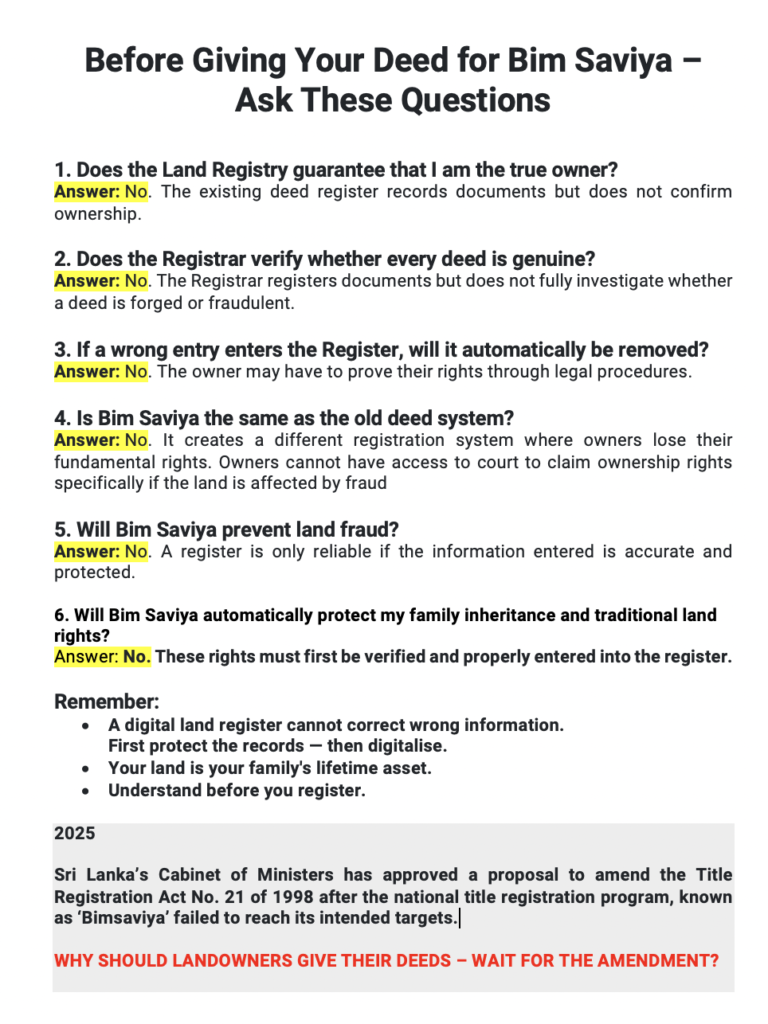
The Article clearly shows (as has been the experience of all other nations which had practiced the deed system) that the Deeds Register like that under Ord 23 of 1927 is the only practical path to achieve international standards.
Since the enactment of Act No. 21 of 1998 (Bim Saviya), Sri Lanka has remained well below internationally recognized benchmarks such as the ‘Doing Business Index’ and the ‘Property Rights Index’.
Even with amendments, Bim Saviya cannot provide a comprehensive register for all landowners; the reasons for its unsuitability are discussed at length in Ms. Waduge’s article.
The main Amendments Required to the old register under the Registration of Documents Ordinance No. 23 of 1927, to achieve ‘International standards’, are listed below (they have been included in the reports adduced to, also given hereunder]. They are:
1) The Registrar should be responsible to reject forged deeds. (the Registrar is presently not responsible)
2) The Registrar should be responsible for the proper maintenance of the books in the land registry; this includes the replacement of the damaged books. (Presently, landowners, at their expense, attend to the damaged books).
3) The Registrar should be provided with biometric tools to identify owners before registering new deeds; for example, face recognition systems, alerts to mobile phones of owners and many other methods have been described in the above article referred to above.
Act 21 of 1998 has been introduced without any knowledge or understanding of our land systems and culture. I am sure the learned Minister will instruct the relevant officials to refer to the important reports, listed below, to establish an internationally accepted land Register.
1) ‘Digital Biometric Solutions’ (a paper submitted to detect fraud in land registries submitted to the ‘Information Communication Technology Agency of Sri Lanka’ by lawyers); the paper recommends digital security for the Land Registry transformation through technologies such as AI and block chain, practiced by other nations. This is an initiative that will strengthen the public trust and confidence in the Land Registry.
5) Technical and Institutional Studies (a report as requested by the government) by Harmons Solutions (Pvt) Ltd.
6) E-Land Hub Business Re-engineering report and several other presentations, as requested by the Ministry of Lands (2015). The Report is available at the Ministry of Land.
7) Cabinet Memorandum 20/2100/322/007 24.12.2020 re establishing one land register; the memorandum requires that research be done to study the methods adopted by some of other nations, especially those of Australia and South Africa.
8) National Committee Reports of 2013 and 2022.
9) The Registrar General’s letter (reference RG/TRB/03/278[2]) dated 6/4/2016; it is an explanation given to the Prime Minister with regard to the neglected provisions of Ord 23 of 1927 and the neglected infrastructure of the registry.
A country’s diaspora should naturally be one of its greatest strategic assets. Living in developed nations, overseas citizens gain access to advanced infrastructure, cutting-edge technology, and global networks. In an ideal scenario, they leverage these advantages to bring facilities, expertise, and investment back to their motherland.
Regional neighbours offer clear examples of this in action—diaspora communities actively contributing to building schools, hospitals, airports, and modern road networks in their homelands.
Unfortunately, Sri Lanka’s experience often tells a different story.
Where the Focus Lies
Instead of channelling knowledge and capital into nation-building, a significant portion of resources continues to fund past divisions and prolong disharmony. At the same time, opportunistic local actors exploit these funds for personal gain, prioritising financial handouts over genuine national progress.
Ironically, the rare moment of unity among the diaspora occurs on the cricket field. When Sri Lanka plays against their adopted home nation, the stadium comes alive—flags wave, baila hits like “Surangani” resound, and the passion is undeniable.
Imagine if even a fraction of that shared energy and spirit were redirected toward tangible development back home.
Looking Ahead, Not Behind
Constantly unearthing past conflicts achieves little. As the famous adage goes, “History is a set of lies agreed upon.” Lingering in the past will not build a future for the next generation.
To the Diaspora: It is time to shift focus from legacy grievances to constructive investment—infrastructure, education, healthcare, and economic development.
To Local Beneficiaries: Dependent on diaspora funding tied to division, the path forward requires seeking meaningful, productive employment that contributes positively to society.
Sri Lanka’s future depends on moving forward together.
Let us look toward tomorrow, learn from regional success stories, and turn global potential into real progress at home.
Governments are rarely defeated by their opponents alone. More often, they are weakened by divisions from within
There are examples in Sri Lanka in the past
The Bolshevik Revolution succeeded because its leaders were united in achieving a common objective. Lenin, Trotsky and others worked together to overthrow the old regime and defend the revolution during its formative years. It was only after Lenin’s illness and death that deep divisions among the leadership intensified, leading to a destructive struggle for power. Whatever one’s opinion of Soviet history, one lesson remains clear: internal discord can derail even the most powerful political movements.
Sri Lanka should reflect on that lesson.
The National People’s Power (NPP) Government came to power with an overwhelming public mandate to transform the country. Millions of Sri Lankans voted not merely for individuals but for a promise to eradicate corruption, strengthen institutions, revive the economy, and restore confidence in public administration.
The country is only beginning to emerge from an unprecedented economic crisis. Debt restructuring, attracting foreign direct investment, creating employment, modernising industries, strengthening vocational education, and reforming public institutions require consistency and stability. This is not the time for avoidable public divisions.
The recent debate concerning proposals relating to the retirement age of judges has generated considerable discussion. It is entirely legitimate for lawyers, constitutional experts and citizens to express differing legal opinions. Indeed, healthy democracies depend on informed debate. However, when individuals holding influential positions within or closely associated with the governing party publicly challenge major policy decisions before internal mechanisms have been exhausted, questions inevitably arise regarding unity, discipline and collective responsibility.
This is not an argument against freedom of expression. Nor is it a suggestion that members should blindly accept every decision of the leadership. Democracies thrive on constructive criticism. Policies become stronger when subjected to rigorous examination.
However, there is an equally important democratic principle: collective responsibility.
Within every successful government, disagreements should first be debated frankly in cabinet meetings, party committees and policy forums. Once a decision has been reached through democratic discussion, those entrusted with implementing that decision have a responsibility to preserve public confidence while continuing to seek improvements through established channels.
The public judges governments not only by the quality of their policies but also by their ability to govern with coherence and purpose. Investors observe political stability before committing billions of dollars. International development partners seek predictability. Civil servants require clear direction. The business community values certainty over confusion.
Sri Lanka’s greatest challenge today is not political rhetoric but economic transformation.
The nation needs large-scale industrial investment, expansion of the marine and offshore engineering sectors, modern vocational education, export-oriented manufacturing, energy security, digital transformation, and the development of Trincomalee and other strategic regions into engines of growth. None of these objectives can be achieved if political energy is consumed by unnecessary internal conflict.
The Government was elected to govern, not to become distracted by internal disagreements played out in the public arena.
Political maturity demands balancing two equally important values: the freedom to question and the responsibility to unite behind decisions once they have been democratically reached.
History teaches us that reform movements lose momentum when internal divisions overshadow their national mission. Sri Lanka cannot afford such a distraction.
The country stands at a critical crossroads. The mandate given by the people is too valuable to squander. If the Government remains united, disciplined and focused on delivering results, it has a genuine opportunity to reshape Sri Lanka’s future. If internal divisions become the dominant narrative, that historic opportunity may gradually slip away.
Unity is not the enemy of democracy. When combined with openness, accountability and respect for differing views, it becomes the foundation upon which lasting national progress is built.
History repeatedly demonstrates that nations achieve rapid transformation when the institutions of the State work towards a common national purpose rather than pulling in different directions.
Singapore under Lee Kuan Yew, South Korea during its industrialisation, and China under Deng Xiaoping all illustrate how determined executive leadership, supported by functioning state institutions, accelerated economic development, attracted investment, built infrastructure, and lifted millions out of poverty. While their political systems differed, they shared one characteristic: the machinery of government acted with a common national objective.
Sri Lanka today faces a different reality.
Successive governments have often announced ambitious reforms only to see them delayed or weakened by bureaucratic resistance, prolonged litigation, political rivalry, or institutional disagreement. Investors value certainty. When governments cannot implement policies efficiently within the law, investment, employment, and economic growth inevitably suffer.
This raises an important constitutional question.
In every democracy, the Executive is elected with a mandate to govern. It is therefore reasonable to expect public institutions—including the civil service, regulatory agencies, and the judiciary—to respect that democratic mandate while faithfully carrying out their constitutional responsibilities.
This does not mean that judges should become politically loyal to a government or abandon their independence.
Judicial independence is a cornerstone of the rule of law. Rather, it means that all branches of government should share loyalty to the Constitution, the sovereignty of the nation, and the long-term public interest. Courts should be free to review whether executive action complies with the law, but should not become substitutes for elected policymakers or unnecessarily frustrate lawful reforms that serve the national interest.
Many democratic countries seek to maintain this balance. In the United States, for example, judges of the Supreme Court are nominated by the President and confirmed through a constitutional process. The expectation is not personal loyalty to an individual President, but commitment to the constitutional order while exercising independent judicial judgment.
For a developing country such as Sri Lanka, prolonged institutional conflict carries a heavy price. Delayed infrastructure, uncertain regulations, postponed reforms, and inconsistent policy signals discourage both local entrepreneurs and foreign investors.
The lesson from successful nations is that development requires more than elections. It requires institutions that are professional, efficient, and capable of working within the constitutional framework towards shared national goals.and supports the executive
Sri Lanka therefore needs:
● A strong Executive with a clear development vision.
● An independent Judiciary but supportive to the elected executive that upholds the Constitution impartially and provides legal certainty.
● A professional public service committed to implementing lawful government policy efficiently.
● Mutual respect among the Executive, Legislature, and Judiciary, each operating within its constitutional role.
● A national commitment to economic progress above partisan confrontation.
The objective should never be blind allegiance to individuals. It should be institutional commitment to constitutional governance, national development, and the welfare of the people.
If Sri Lanka can achieve that balance, we can replace paralysis with progress, conflict with cooperation, and uncertainty with confidence. That, in my opinion, is the path towards becoming a prosperous nation.
Addressing National Cadet Corps (NCC) cadets at the opening ceremony of the NCC Inter-Provincial Youth Exchange Programme, held at St. Joseph’s College, Trincomalee, on 30 July as the Chief Guest, Deputy Minister of Defence Major General Aruna Jayasekara (Retd) urged the youth to transform diversity into a catalyst for nation-building.
In his address, the Deputy Minister underscored the vital role of youth in fostering national reconciliation and lasting unity, emphasizing that peace is built not merely through the absence of conflict but through trust, understanding and meaningful engagement among communities. Highlighting Sri Lanka’s multicultural heritage as a symbol of coexistence, he encouraged the youth to embrace diversity, build lasting friendships and preserve harmony within their communities for the betterment of the country.
Drawing attention to the Government’s ‘Clean Sri Lanka’ initiative, the Deputy Minister noted that the programme’s vision extends beyond environmental cleanliness to promoting an ethical, inclusive and united society. He stressed that nation-building depends not only on infrastructure and economic development but also on cultivating mutual respect and strengthening coexistence. Calling on the youth to carry the values of the programme into their daily lives, he urged them to become the generation that transforms Sri Lanka’s diversity into a source of national strength and shared progress.
The Deputy Minister of Foreign Affairs and Foreign Employment, Mr. Arun Hemachandra, Director of the National Cadet Corps, Director of the National Youth Corps, senior tri-forces officers, NCC cadets, and distinguished guests were present on the occasion.
Sri Lanka is being rapidly moved towards a digitalisation of its land records. Digital technology can undoubtedly improve efficiency, but digitalising an unreliable legal system will not create a reliable land register or any relief for land owners and even a government who has to answer long term consequences. Before investing billions in digital transformation, a Government must first correct the legal defects that have existed for decades. Why have the digital gurus tasked to roll out digitalization not seen this stark reality and commenced remedies to this issue first?
Currently, Sri Lanka operates two separate land registration systems, neither of which establishes a complete, reliable compulsory register that landowners, investors, banks or the State can confidently rely upon.
Two Statutes – Two Registers
Sri Lanka’s land registration system is governed by:
Registration of Documents Ordinance No. 23 of 1927
Registration of Title Act (Bim Saviya) No. 21 of 1998
Instead of replacing one system with another, Sri Lanka now operates two parallel registers, creating legal uncertainty and administrative complexity.
The Existing Deeds Register Does Not Prove Ownership
The Registration of Documents Ordinance No. 23 of 1927 was never designed to establish ownership.
Ownership cannot be confirmed from the Register
The Registrar has no statutory authority or duty to determine whether a deed presented for registration is genuine or forged.
The Registrar records deeds presented for registration but does not certify ownership.
As a result, the Register may register both valid and invalid deeds.
Registration is Optional
A deed remains legally valid even if it is never registered.
Registration merely gives priority between competing transactions.
The Supreme Court in SC 93/2022 confirmed that the Register established under the Ordinance is only a priority register, not a register of ownership.
The Court further held that a registered Deed of Gift may lose priority to an earlier unregistered transfer for valuable consideration, demonstrating that registration alone does not conclusively establish ownership.
Even the Registrar General Acknowledged the Defects
In 2016, the Registrar General formally informed the Prime Minister (Ref. RG/TRB/03/278) that:
ownership cannot be determined from the Register;
the legal framework under the 1927 Ordinance is inadequate;
the Land Registry infrastructure requires substantial reform before Sri Lanka can establish an internationally recognised land registration system.
These warnings have remained largely unaddressed.
Landowners must maintain the Register
An extraordinary feature of the present law is that innocent landowners—not the State—carry much of the responsibility for maintaining the integrity of the Register.
Under the Land Registers (Reconstructed Folios) Ordinance No. 18 of 1945, owners must:
discover whether folios have been damaged or lost;
apply for reconstruction;
bear the associated costs.
The Registrar has no general statutory duty to reconstruct damaged folios on his own initiative.
Digitalising an Unreliable Register will not prevent Fraud
A digital database is only as reliable as the information entered into it.
If the underlying Register contains:
forged deeds,
incomplete records,
damaged folios,
inaccurate entries,
digitalisation merely transfers those defects into electronic form.
Technology cannot correct legal defects.
Without first creating an accurate base register, digitalisation risks preserving errors permanently.
Bim Saviya created a Second Register without Reforming the First
The Registration of Title Act No. 21 of 1998 introduced the Bim Saviya title registration system without first reforming the 1927 deed registration system.
The result is two parallel systems operating under different legal principles.
The Act has generated significant legal and practical difficulties.
Among the concerns raised are that it:
cannot adequately accommodate many ownership arrangements recognised under Kandyan, Thesawalamai and Muslim personal laws;
has difficulty accommodating certain customary village rights, co-ownership arrangements and cultivation rights;
limits the judicial remedies available where fraudulent registration occurs;
repealed important aspects of earlier land legislation, including provisions affecting partition and prescription, creating practical legal complications.
Two National Committees Reached Similar Conclusions
Because of these problems, Government appointed:
the Presidential Committee (2013);
the Ministry of Justice Committee (2022).
Both examined the shortcomings of the Registration of Title Act.
Significantly, the Ministry of Justice Committee recommended changing the name of the proposed legislation to the Voluntary Title Registration Act, recognising that compulsory registration was neither practical nor suitable for every category of land ownership.
Despite more than twenty-five years of implementation and substantial expenditure, Sri Lanka still lacks a complete national land register.
The Bim Saviya programme has also been the subject of observations by the Auditor General and assessments by the World Bank.
Cabinet itself recognised the Need for Reform
Cabinet Memorandum No. 20/2100/322/007 dated 24 December 2020 recommended:
introducing a compulsory land registration framework; and
appointing a committee to amend the Registration of Title Act.
The Ministry of Justice subsequently appointed that committee.
This demonstrates that Government itself recognised that legislative reform was necessary before a comprehensive national register could be achieved.
At present, lawyers, registry administrators and ICT specialists largely work independently.
Technology alone cannot solve problems created by defective legislation.
Before any further digitalisation, Government should first establish an accurate legal foundation.
This includes:
reconstructing damaged and missing folios;
introducing owner verification before registration;
implementing biometric identity verification;
sending SMS/mobile alerts whenever deeds affecting land are lodged;
using artificial intelligence to identify suspicious transactions;
introducing tamper-evident technologies such as blockchain where appropriate;
maintaining complete electronic audit trails of every transaction.
What Sri Lanka needs is not simply a digital land register.
Sri Lanka needs a legally reliable land registration system.
Unless the legal, administrative and technical defects in both the Registration of Documents Ordinance and the Registration of Title Act are first addressed, digitalisation will simply computerise the existing weaknesses including fraud. The situation is confounded in Bim Saviya certifications where Courts have little or no jurisdiction to intervene & resolve land issues.
A modern land registry should protect ownership—not merely record documents. Only after comprehensive legal reform can digitalisation deliver the certainty, security and public confidence that Sri Lanka’s landowners and investors deserve.
by Maung Maung Nyunt, The Buddhist Channel, 12 July 2026
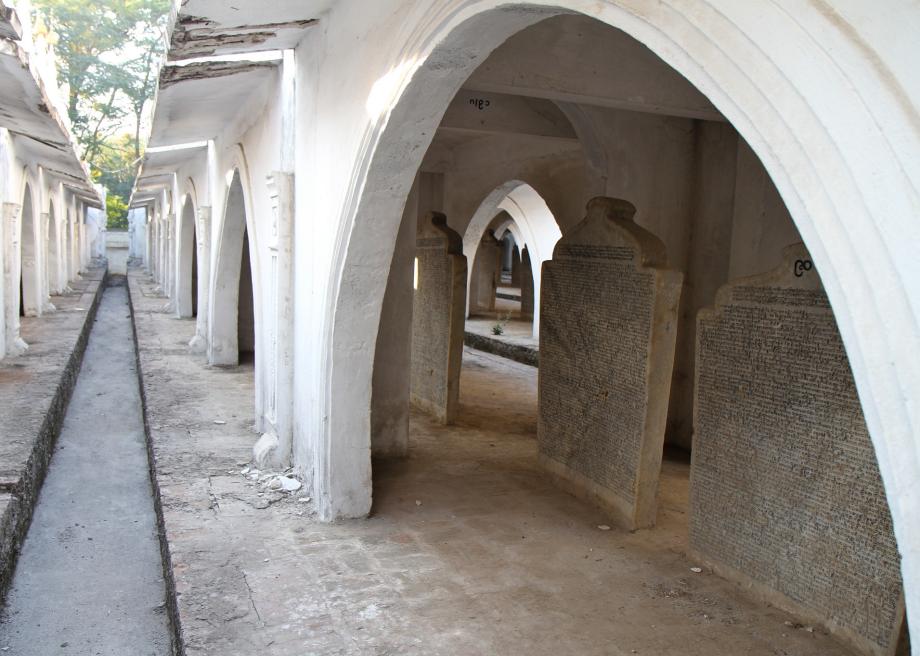
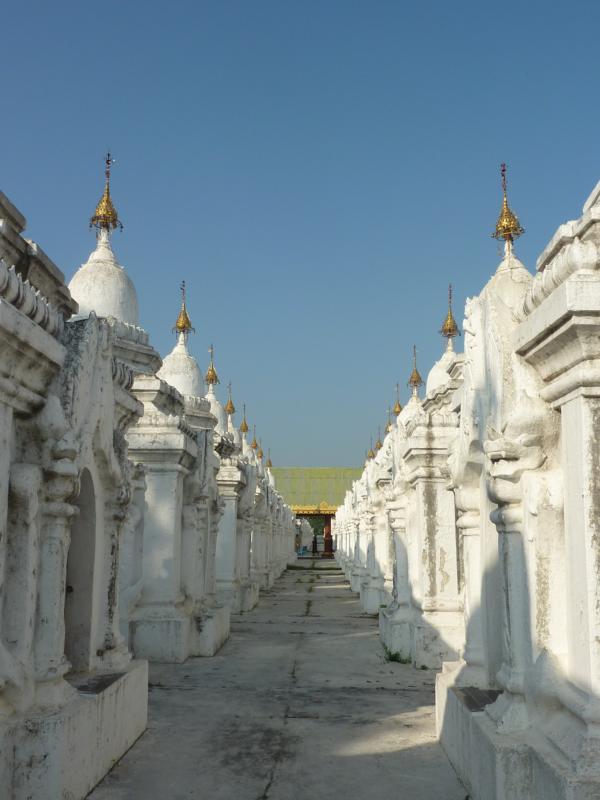
Yangon, Myanmar — The 729 marble slabs at Kuthodaw Pagoda in Mandalay, often called “the world’s largest book,” represent one of the most ambitious projects of Buddhist preservation ever undertaken. Completed in 1868 under King Mindon, these stone tablets contain the complete Pali Tipiṭaka, the Vinaya, Sutta, and Abhidhamma Piṭakas, inscribed across 1,460 pages, each slab five feet tall and five inches thick, housed in its own small shrine arranged around a central golden pagoda.
Yet the question of why this monumental work was commissioned points to a deeper historical reality: the Kuthodaw inscriptions were, in significant measure, a response to the British colonial threat and an attempt to safeguard Buddhism from potential erosion under foreign rule.
The Historical Context: A Kingdom Under Threat
King Mindon ascended the throne in 1853 following the Second Anglo-Burmese War (1852), which had resulted in the British annexation of Lower Burma [1]. His kingdom was fractured, cut off from the coast, and deprived of rich teak forests and rice-growing regions. By the mid-19th century, Britain had gained control over the lower half of the country, leaving Mandalay and Upper Burma completely isolated from the outside world. Many believed that only divine intervention could save Burma from being entirely conquered.
It was in this context of political crisis and territorial loss that King Mindon conceived his vision for Mandalay. Historian François Tainturier argues that Mindon aimed to materialize in his capital a “sanctuary for Buddhist believers” and to reassert his power over Buddhist land in a non-confrontational way [2]. The systematic planning of Mandalay and construction of its potent landscape constituted “the expression, not formulated in words but in tangible form, of the throne’s claim of Burma as a ‘Buddhist land’ (Buddhadesa) at a time when Lower Burma had been annexed by non-Buddhist believers” [3].
The Fifth Buddhist Council and the Marble Inscriptions
To understand the marble slabs, one must understand the Fifth Buddhist Council, convened by King Mindon in 1871. According to Burmese tradition, the council brought together 2,400 scholarly monks to recite, examine, and verify the received Pali Tipiṭaka [4]. Its purpose was not to create new teachings but to purify, verify, and stabilize the canon, to reduce corruption, variant readings, and scribal errors.
The council and the marble inscriptions are closely linked. Work on the slabs had actually begun in 1860, years before the council convened. The text was meticulously edited by tiers of senior monks and lay officials consulting palm-leaf manuscripts kept in royal libraries. Scribes carefully copied the text onto marble, and stonemasons chiseled the inscriptions by hand, working at an average rate of ten lines per day. The marble was quarried from Sagyin Hill, thirty-two miles north of Mandalay, and transported by river to the city.
The council subsequently ratified this recension, and the completed slabs were opened to the public on May 4, 1868. [5] The project reflected a distinctly Buddhist understanding: palm-leaf manuscripts decay, burn, or are lost; stone endures much longer. Inscribing the canon on marble was both an act of merit and a way of protecting the Buddha’s teaching against impermanence.
Defiance or Defence? The British Factor
The evidence that the Kuthodaw project was motivated by the British threat is substantial. Multiple sources confirm that when the British invaded southern Burma, Mindon was concerned that Buddhist dhamma (teachings) would also be detrimentally affected in the north where he reigned.
The Kuthodaw Pagoda Project, an academic initiative documenting the site, notes that Mindon initiated these projects as part of his attempt to “consolidate Buddhism as the state religion and ensure its centrality to the identity of the Myanmar people in the face of the threat of British territorial ambitions in Myanmar.” [6] Similarly, an academic thesis on the Fifth Council explains that the council was “a response during the European colonial period to the fear of the disappearance of the sāsana.” [7] The king’s aim was to prevent the disappearance of the Buddha’s teachings by inscribing them on the durable medium of stone.
Some scholars go further, arguing that the Fifth Buddhist Synod “was not necessary for the Religion” and that Mindon convened it only “to defy the British who had annexed Lower Myanmar” and to assume the title “the Convener of the Fifth Buddhist Synod.”
The British annexation of Lower Burma in 1852 had already demonstrated the destructive potential of colonial rule on Buddhist institutions. Under the monarchy, ecclesiastical lands were tax-exempt and overseen by a royal commissioner, while the Thathanabaing (supreme patriarch) provided central authority to the Sangha. [8]
The British systematically dismantled these structures: they abolished the patriarchate, removed tax exemptions for temple lands, and introduced a new secular legal framework that stripped the monastic order of its historical role as an autonomous arbiter of Buddhist law. The symbiotic relationship between the monarchy and the Sangha, in which the king served as defender of the faith with authority to appoint the patriarch and maintain a register of monks, was broken, leaving the monkhood fragmented and without institutional support [9].
A Pragmatic and Spiritual Response
Mindon’s response to the British was not purely confrontational. He signed a commercial treaty in 1867 [10] that gave the British economic concessions and sent diplomatic missions to London, Paris, and Rome to secure international recognition of Myanmar’s independence. He was pragmatic, seeking to avoid further conflict while strengthening Buddhism from within.
Yet the deeper motivation was the preservation of the sāsana, the Buddha’s dispensation. In Buddhist thought, the disappearance of the teaching is regarded as inevitable, taking place in stages over the 5,000 years following the Buddha’s death. Mindon’s project was a direct response to this anxiety: he wanted the Tipiṭaka to endure for the full five millennia.
This is why the Kuthodaw inscriptions matter. They are not merely a monument or an act of royal merit. They are a civilizational expression of saddhā, confidence in the Buddha’s teaching, and appamāda, diligent care in preserving what supports liberation. The project combined devotion with realism: one cannot stop decay entirely, but one can act wisely to preserve conditions for future practice.
The Irony of History
The British annexed Upper Burma in 1885, just seven years after Mindon’s death [11]. The gems and gold ink from the marble slabs were looted, and the buildings were vandalized by troops billeted in the temples. The original gold writing disappeared from all 729 tablets, and the inscriptions were later filled with black ink [12]. Ironically, the very threat Mindon sought to forestall, the British conquest of his kingdom, became the cause of the desecration he had hoped to prevent.
Yet the words of the Buddha remain preserved. The slabs still stand, their inscriptions legible, and in 2013 UNESCO added the Kuthodaw Inscription Shrines to its Memory of the World Register. The “world’s largest book” continues to serve as an authoritative reference and a site of pilgrimage for Buddhists and scholars alike.
Conclusion
Was the Kuthodaw marble inscription created to protect Buddhism from British colonial rule? The evidence strongly suggests yes. King Mindon’s project was born of a specific historical moment, the loss of Lower Burma to the British, and reflected a deep concern for the survival of the Dhamma. The marble slabs were both a practical response to the fragility of palm-leaf manuscripts and a symbolic assertion of Buddhist identity in the face of colonial threat. They represent a king’s effort to preserve what supports liberation, using the most durable material available, in the hope that the teaching might endure beyond the reach of empires.
2,3. François Tainturier, Mandalay and the Art of Building Cities in Burma, https://nuspress.nus.edu.sg/collections/books/products/mandalay-and-the-art-of-building-cities-in-burma
4. The Post Pagan Period – 14th To 20th Centuries, https://seasite.niu.edu/burmese/Cooler/Chapter_4/Part3/post_pagan_period__part_3.htm
5. Encyclopedia of Buddhism, https://encyclopediaofbuddhism.org/wiki/Fifth_Buddhist_council
9. Melissa Crouch, Constructing Religion by Law in Myanmar, https://www.tandfonline.com/doi/full/10.1080/15570274.2015.1104961
10. Myint, Myo, The Politics Of Survival In Burma: Diplomacy And Statecraft In The Reign Of King Mindon, Cornell University, https://www.proquest.com/openview/4778ca75758c1476aaed75efc305a8a6/1?pq-origsite=gscholar&cbl=18750&diss=y
11. Third Anglo-Burnmese War, Grokipedia, https://grokipedia.com/page/Third_Anglo-Burmese_War
12. Tripiṭaka tablets at Kuthodaw Pagoda, Wikipoedia, https://en.wikipedia.org/w/index.php?limit=500&title=Tripi%e1%b9%adaka_tablets_at_Kuthodaw_Pagoda
For decades, Sri Lanka has proudly spoken about women’s empowerment. Every government has launched programmes under this banner, and millions of rupees have been spent on training and awareness. Yet one fundamental question remains:
Have we truly empowered women, or have we merely confined them to traditional occupations under a new label?
Most vocational programmes offered to women still revolve around cake making, beauty culture, tailoring, housekeeping, food processing, childcare and elderly care. While these are respectable professions, they represent only a narrow segment of the opportunities available to women in today’s industrial world.
If Sri Lanka is serious about becoming an industrialised nation and attracting foreign direct investment (FDI), women must become part of the country’s skilled technical workforce.
Looking Beyond Traditional Boundaries
Many countries have already demonstrated that women can excel in industries once considered exclusively male.
In Kenya, vocational institutions, supported by international organisations and industry, deliberately recruit young women into industrial welding and fabrication. These programmes have shown that, given the opportunity and proper training, women perform exceptionally well in precision engineering and industrial manufacturing. (International Labour Organization)
The question is simple:
If Kenyan women can become certified welders, why not Sri Lankan women?
The Industries Waiting for Skilled Women
Sri Lanka is preparing for major investments in shipbuilding, ship repair, offshore engineering, renewable energy, LNG, petroleum, steel fabrication and advanced manufacturing.
These industries require thousands of skilled personnel, including:
● Welding and fabrication
● Pipe fitting
● Mechanical fitting
● CNC machining
● Electrical installation
● Instrumentation
● Non-Destructive Testing (NDT)
● Quality Assurance and Quality Control (QA/QC)
● Welding inspection
● CAD drafting
● Robotics-assisted manufacturing
● Industrial safety and HSE
● Offshore operations
There is absolutely no technical reason why women cannot excel in these professions.
Women Often Possess Natural Advantages
Industrial employers increasingly recognise that many women possess qualities highly valued in manufacturing:
● Excellent attention to detail
● Patience during repetitive precision work
● Strong quality consciousness
● Better documentation practices
● High levels of discipline
● Lower accident rates in many industrial environments
● Commitment to following procedures and standards
These characteristics are particularly valuable in welding inspection, QA/QC, laboratory testing, precision fabrication and electronics assembly.
Modern Welding Is Not What It Used to Be
Many people still imagine welding as standing in the scorching sun carrying heavy steel sections.
That stereotype is decades out of date.
Today’s fabrication workshops use:
● Welding manipulators
● Positioners
● Robotic welding systems
● Automated cutting machines
● CNC equipment
● Laser measuring devices
● Digital inspection equipment
● Welding simulators for training
Much of the work depends more on technical competence than physical strength.
Women around the world are successfully working in aerospace, automotive manufacturing, shipbuilding, offshore engineering and oil and gas fabrication.
Sri Lanka should not be left behind.
A Missed Economic Opportunity
Thousands of skilled welders and fabricators from Sri Lanka leave annually for the Middle East, South Korea, Romania, Israel and other countries because of strong international demand.
If women were trained in these same disciplines, they too could access well-paid international careers or support the development of Sri Lanka’s own industries.
Higher household incomes, greater foreign remittances and stronger industrial productivity would follow.
What Should Be Done?
Sri Lanka needs a national policy to encourage women to enter technical trades by:
● Offering scholarships specifically for women in engineering trades.
● Establishing women-friendly welding and fabrication workshops.
● Providing modern personal protective equipment designed for women.
● Creating mentorship programmes with successful female engineers and technicians.
● Encouraging industries to recruit more women into technical roles.
● Promoting success stories through schools and the media.
● Including offshore engineering, shipbuilding and advanced manufacturing in vocational training programmes.
Empowerment Means Opportunity
Women’s empowerment should not be measured by the number of seminars conducted or certificates issued.
It should be measured by how many women become:
● Certified welders
● Welding inspectors
● QA/QC engineers
● Pipe fitters
● Offshore technicians
● Marine engineers
● Fabrication supervisors
● Industrial entrepreneurs
That is genuine economic empowerment.
Sri Lanka possesses one of the highest literacy rates in South Asia and produces thousands of capable young women every year. What many of them lack is not ability—but opportunity.
The future of Sri Lanka’s industrialisation cannot depend solely on half of its workforce.
If we truly believe in equality, then our daughters should be seen not only in kitchens, hospitals and offices, but also in shipyards, fabrication workshops, offshore platforms, engineering laboratories and quality control departments.
Only then can we honestly say that Sri Lanka has moved beyond talking about women’s empowerment and has finally begun to practise it.
Regards
Dr Sarath ObeysekeraBeyond Cakes and Caregiving and garment industry It Is Time to Redefine Women’s Empowerment in Sri Lanka
By Dr. Sarath Obeysekera
For decades, Sri Lanka has proudly spoken about women’s empowerment. Every government has launched programmes under this banner, and millions of rupees have been spent on training and awareness. Yet one fundamental question remains:
Have we truly empowered women, or have we merely confined them to traditional occupations under a new label?
Most vocational programmes offered to women still revolve around cake making, beauty culture, tailoring, housekeeping, food processing, childcare and elderly care. While these are respectable professions, they represent only a narrow segment of the opportunities available to women in today’s industrial world.
If Sri Lanka is serious about becoming an industrialised nation and attracting foreign direct investment (FDI), women must become part of the country’s skilled technical workforce.
Looking Beyond Traditional Boundaries
Many countries have already demonstrated that women can excel in industries once considered exclusively male.
In Kenya, vocational institutions, supported by international organisations and industry, deliberately recruit young women into industrial welding and fabrication. These programmes have shown that, given the opportunity and proper training, women perform exceptionally well in precision engineering and industrial manufacturing. (International Labour Organization)
The question is simple:
If Kenyan women can become certified welders, why not Sri Lankan women?
The Industries Waiting for Skilled Women
Sri Lanka is preparing for major investments in shipbuilding, ship repair, offshore engineering, renewable energy, LNG, petroleum, steel fabrication and advanced manufacturing.
These industries require thousands of skilled personnel, including:
● Welding and fabrication
● Pipe fitting
● Mechanical fitting
● CNC machining
● Electrical installation
● Instrumentation
● Non-Destructive Testing (NDT)
● Quality Assurance and Quality Control (QA/QC)
● Welding inspection
● CAD drafting
● Robotics-assisted manufacturing
● Industrial safety and HSE
● Offshore operations
There is absolutely no technical reason why women cannot excel in these professions.
Women Often Possess Natural Advantages
Industrial employers increasingly recognise that many women possess qualities highly valued in manufacturing:
● Excellent attention to detail
● Patience during repetitive precision work
● Strong quality consciousness
● Better documentation practices
● High levels of discipline
● Lower accident rates in many industrial environments
● Commitment to following procedures and standards
These characteristics are particularly valuable in welding inspection, QA/QC, laboratory testing, precision fabrication and electronics assembly.
Modern Welding Is Not What It Used to Be
Many people still imagine welding as standing in the scorching sun carrying heavy steel sections.
That stereotype is decades out of date.
Today’s fabrication workshops use:
● Welding manipulators
● Positioners
● Robotic welding systems
● Automated cutting machines
● CNC equipment
● Laser measuring devices
● Digital inspection equipment
● Welding simulators for training
Much of the work depends more on technical competence than physical strength.
Women around the world are successfully working in aerospace, automotive manufacturing, shipbuilding, offshore engineering and oil and gas fabrication.
Sri Lanka should not be left behind.
A Missed Economic Opportunity
Thousands of skilled welders and fabricators from Sri Lanka leave annually for the Middle East, South Korea, Romania, Israel and other countries because of strong international demand.
If women were trained in these same disciplines, they too could access well-paid international careers or support the development of Sri Lanka’s own industries.
Higher household incomes, greater foreign remittances and stronger industrial productivity would follow.
What Should Be Done?
Sri Lanka needs a national policy to encourage women to enter technical trades by:
● Offering scholarships specifically for women in engineering trades.
● Establishing women-friendly welding and fabrication workshops.
● Providing modern personal protective equipment designed for women.
● Creating mentorship programmes with successful female engineers and technicians.
● Encouraging industries to recruit more women into technical roles.
● Promoting success stories through schools and the media.
● Including offshore engineering, shipbuilding and advanced manufacturing in vocational training programmes.
Empowerment Means Opportunity
Women’s empowerment should not be measured by the number of seminars conducted or certificates issued.
It should be measured by how many women become:
● Certified welders
● Welding inspectors
● QA/QC engineers
● Pipe fitters
● Offshore technicians
● Marine engineers
● Fabrication supervisors
● Industrial entrepreneurs
That is genuine economic empowerment.
Sri Lanka possesses one of the highest literacy rates in South Asia and produces thousands of capable young women every year. What many of them lack is not ability—but opportunity.
The future of Sri Lanka’s industrialisation cannot depend solely on half of its workforce.
If we truly believe in equality, then our daughters should be seen not only in kitchens, hospitals and offices, but also in shipyards, fabrication workshops, offshore platforms, engineering laboratories and quality control departments.
Only then can we honestly say that Sri Lanka has moved beyond talking about women’s empowerment and has finally begun to practise it.
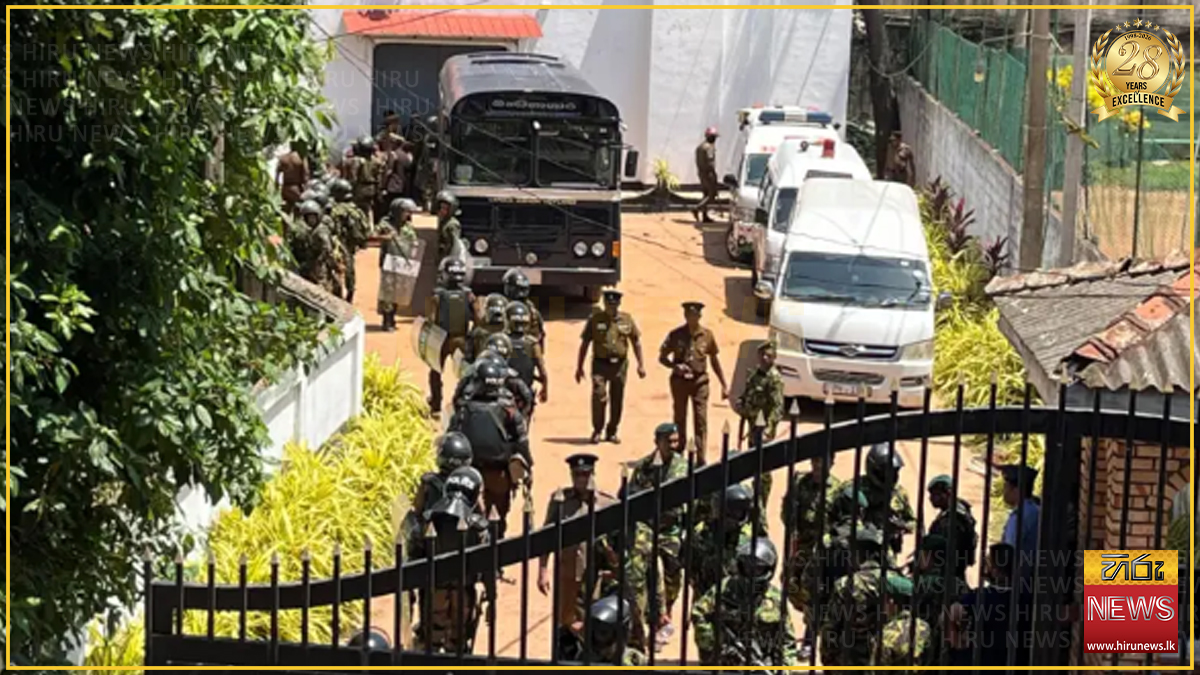
Negombo Magistrate Shilani Perera instructed media outlets today to refrain from publishing details stemming from the testimony of the chief jailer on duty during the Negombo prison clash, citing potential risks to national security given the sensitive nature of the evidence. The magistrate further directed the court registrar to secure the testimony safely within a safe. These disclosures emerged as Wickrama Jayantha Kumara, serving as the chief jailer at the time, testified at the Negombo Magistrate Court regarding the incident involving ten officers and twenty-two inmates. The testimony commenced around 1 p.m. and concluded close to 3 p.m. Additionally, prison authorities submitted a detailed report concerning 89 prison police officers transferred from Welikada to Negombo alongside individuals receiving treatment at the Colombo National Hospital and Negombo Hospital.
The headline attracting issue in Sri Lanka at present appears to be the proposed two-year extension to the retirement age of judges which the government argues could assist in making a reduction in the massive backlog of pending cases amounting more than 1.1 million as per the Ministry of Justice. Few seem to be realising that this is only a symptom of a far more deep-seated issue arising from years of neglect of the judiciary system where under funding, inadequate remuneration, understaffing and under development of infrastructure has resulted in the accumulation of such a huge backlog.
The Sri Lankan government argues that one immediate strategy to make some reduction in the massive court case backlog, is by utilizing the expertise of senior legal minds serving as judges now by extending the term of Supreme Court judges from 65 to 67 years and Court of Appeal judges from 63 to 65 years, alongside parallel increases for lower courts. However, while retaining legal expertise for an additional two years is one thing, unless current vacancies are filled expeditiously, and perhaps the cadre of judges at all levels is increased, the mathematical result will be a zero net increase in number of judges to tackle the huge backlog of cases. The government argues that the extension is to maintain the total volume of daily judicial work and prevent a catastrophic spike in the backlog caused by upcoming mandatory retirements. While an extension does not instantly add new seats to the bench, the government argues it acts as a stabilizing measure to protect the system’s current capacity.
Rationale and Objectives presented by the government
Reducing Delays: Officials state that keeping judges on the bench longer helps process stagnant court cases and ease public hardships caused by slow legal proceedings. This makes sense unless the recruitment of judges to fill vacancies arising from judges who retire at the current retirement age is done expeditiously.
Benefitting from experience: The policy builds on the premise that experienced senior judges still have the ability and capacity to continue contributing productively.
Life expectancy increase and broader public sector trends: Similar extensions have been proposed or implemented across other specialized public service sectors, such as medical professionals. In a general sense, life expectancy has increased and a case could certainly be made for public officials including judges to work longer and continue serving the public productively. Following information on life expectancy is relevant here.
Life expectancy milestones: According to historical World Bank data, Sri Lanka’s overall life expectancy at birth was about 61.9 years in 1965 and rose to 64.35 years by 1970 when the retirement age for lower-court judges (such as District Court and Magistrate judges) was set at 60. In 1970, the mandatory retirement age for a Supreme Court judge in Sri Lanka was 62 years. The retirement age of Court of Appeal judges (once it was set up in 1971), was 63.
The current total life expectancy at birth in Sri Lanka is approximately 78 years. This marks an increase of about 15 years compared to the era when the retirement age for lower-court judges was set at 60. In terms of the ability and competency for judges (and other public officials) to extend their working life in the public sector has to be consistent with increase in life expectancy which is a result of a better quality of life. This is a point that critics of the government’s proposal must take note.
Impact of a potential exacerbation of the crisis if large numbers reach their current retirement age
The core logic of the extension is to maintain the total volume of daily judicial work and prevent a catastrophic spike in the backlog caused by upcoming mandatory retirements. While an extension does not instantly add new seats to the bench, the government argues it acts as a stabilizing measure to protect the system’s current capacity in the event of retirement of many judges. This point has validity depending on the number of judges at all levels who will reach their current retirement age.
The government uses several key points to argue that this policy helps lower the backlog:
1. Retaining Highly Efficient “Powerhouses”
In higher appellate courts, a massive chunk of the case backlog is cleared by a small percentage of highly experienced, fast-working judges who understand complex legal bottlenecks. Forcing them to retire right as they reach peak efficiency stalls complex trials. Keeping them on the bench for two more years preserves this critical momentum.
2. Eliminating the “Transition Lag”
Whenever a judge retires, a vacancy is created that frequently takes 6 to 12 months (or longer) to fill due to political stalemates, executive delays, and constitutional reviews.
During this empty period, that judge’s entire active caseload grinds to a complete halt, drastically worsening the backlog.
Extending the retirement age bypasses this transition gap entirely for two years, keeping those active courtrooms functioning without interruption.
3. Mitigating the severe recruitment shortage
As highlighted by the Ministry of Justice, Sri Lanka is facing a critical brain drain and a lack of qualified applicants willing to join the public bench (e.g., only 33 applicants for 50 magistrate openings). Because the state cannot find enough new, qualified legal minds to fill traditional exits, extending the tenure of existing judges prevents the overall number of active judges from shrinking even further.
4. Maximizing Return on Institutional Knowledge
A judge’s value to the legal system increases with their years on the bench. The state argues that letting senior judges retire early forces the system to spend time and resources training replacements (if they can find them), whereas keeping veteran judges utilizes fully developed judicial expertise to dispose of backlogged cases at a faster rate
Concerns and Opposition
Judicial Independence: Groups like the Bar Association of Sri Lanka (BASL) and the Commonwealth Lawyers Association have raised concerns that ad-hoc or piecemeal constitutional changes affect judicial neutrality and public trust.
Lack of Consultation: Critics argue that altering tenure parameters should only happen through broad, transparent structural reforms rather than isolated amendments.
It is reported that Sri Lanka faces a severe shortage of judges and an overwhelming backlog of over 1.1 million pending court cases, with the crisis spanning the entire legal framework, from local Magistrate’s Courts up to the Supreme Court.
The breakdown of the number of pending cases amounting to 1,134,474 according to an official Ministry of Justice report released in Sri Lanka, across 293 courts as of June 30, 2025, are as follows
Magistrate Courts: 818,869 cases (where the acute shortage of field applicants leaves local courts overwhelmed)
District Courts: 260,007 cases
High Court (Criminal): 27,376 cases
Civil Appellate High Court: 6,591 cases
Commercial High Court: 6,330 cases
Supreme Court: 5,396 cases
Court of Appeal: 5,216 cases
It is also reported that there is a severe institutional deficit with only one Magistrate’s Court for approximately every 315,000 citizens. For context, India has one judicial hall per 65,000 people and the UK has one per 115,000 people. To add to this, Sri Lanka faces a low recruitment crisis with a recent government recruitment drive aiming to hire 50 magistrates attracting 33 applicants, leaving immediate vacancies unfilled at the bottom of the judiciary ladder. For reasons best known to the government, the Supreme Court and the Court of Appeal have eight unfilled seats and filling these with competent judges would greatly help in reducing the backlog of cases.
Underfunding appears to be a core issue impacting on the judiciary system, as Sri Lanka reportedly allocates just 0.57% of its total government expenditure to the administration of justice (roughly Rs. 2,500 per citizen).
Reasons for the shortage of Judges
The Severe “Brain Drain” (2022–2024): The residual effects of Sri Lanka’s intense economic crisis triggered a massive wave of professionals migrating out of the country. This severely depleted talent across the entire public sector, including the legal and judicial fields.
Delays in Executive Appointments: Critics and legal observers note that the executive branch frequently delays filling open seats in the Supreme Court and Court of Appeal.
Inadequate financial & physical Infrastructure: Low public spending has left courts with aging infrastructure, minimal technological capacity, and uncompetitive compensation packages. This discourages top-tier legal minds from the private Bar from transitioning into public judicial roles.
Compounded Public Sector Retirement Rules: Previous sweeping policy shifts, such as lowering the public sector retirement age to 60, accelerated an exit of institutional knowledge across state organs, straining administrative support structures that judges rely on
SUMMARY
In respect of the BASL argument that a more holistic approach is needed to address the many issues impacting on the current judiciary system, a case does exist to move towards a well-functioning (including the required infrastructure), well-funded, well trained and well remunerated judiciary. However, it is difficult to understand why and how an extension to the judge’s tenure could be seen as interfering with the judiciary. Perhaps the BASL could have argued for a comprehensive plan with guaranteed funding, that addresses key issues impacting on the judiciary with the extension of the judge’s tenure by two years being one part of such a plan that could be implemented immediately. Such a plan, perhaps spread over 5 years, could have been developed after relevant stakeholder consultations.
It is understood that the Sri Lankan government has an active plan to address severe court delays and backlogs through expanding judicial capacity, digitising courts, which includes raising the mandatory retirement age of judges. The government established three new High Courts for bribery and corruption cases, expanded Colombo Commercial High Court capacity, and added a new court to the Civil Appellate High Court. Digital workflows have been completed for the Supreme Court and Court of Appeal, with rollouts planned for the rest of the court network. Steps are underway to boost judicial numbers, including appointing new magistrates.
While these are commendable, the government should engage in developing a long-term plan to address issues facing the judiciary and include all of above in such a plan plus other strategies to enable it to serve the people with greater efficiency and effectiveness, justly, impartially and fearlessly. A backlog of over 1.1 million cases is not justice but an injustice to the people.
As the seventh President of the USA, Andrew Jackson said, “All the rights secured to the citizens under the Constitution are worth nothing, and a mere bubble, except guaranteed to them by an independent and virtuous Judiciary.”
‘Before you study the economics, study the economists!’
e-Con e-News 19-25 July 2026
*
‘Why did no one see it coming?’
– England’s Queen Elizabeth asked
the London School of Economics (LSE)
about the 2008 capitalist meltdown
*
‘The Government is preparing to restore criminal sanctions
for serious foreign exchange offences after investigations
into approximately $715mn remitted overseas through
fraudulent import transactions exposed a gap
in Sri Lanka’s legal framework.’ – ee Finance,
Govt to Bring Back Criminal Sanctions for FX Violations
*
Headline news this week about an apparent ‘leakage’ or legal ‘gap’, which actually amounts to far more than admitted, was written to read like a detective novel, with the CID hounds sniffing at the Colombo Fort’s always fishy seaside airs more deeply:
The Criminal Investigation Department’s (CID) is said to be investigating ‘approximately $715million transferred overseas between January 2023 & March 2026 [a curious timeframe] through 105 shell companies using import documentation that did not result in actual goods brought into Sri Lanka. The CID has identified 55 individuals, 227 bank accounts, & approximately 24,300 telegraphic transfers (TTs) processed through 13 State & private banks as part of the alleged scheme.’ The blame is also placed on the proverbial Dubai drug traffickers…
Meanwhile Central Bank scammer, footnote fetishist & favorite media go-to, the Ceylon Tobacco Co’s main parliamentary lobbyist & SJB MP, Harsha de Silva is desperately trying to divert blame on to ‘failing to enforce existing laws & poor technical coordination, rather than a lack of legislation’. And CBSL officials rushed to assure financial finaglers & ‘laundry’ owners that any legislative ‘changes would not reverse the liberalization of Sri Lanka’s foreign exchange regime’.
The Asian Development Bank (ADB) was also thanked for, albeit belatedly, alerting the government to such criminality even as ‘the abuse of advance import payments may have begun much earlier. The ‘leakage’, which feels like a flood, followed the enactment of the Foreign Exchange Act of 2017, which decriminalised foreign exchange offences & replaced the previous enforcement regime with a predominantly civil framework; that is: allowed criminals accused of such frauds to escape jail. Moral hazard, anyone? So, what’s going on? 2017 suggests the presently ruling JVP was also part of the then ruling coalition that passed this leaky Foreign Exchange Act.
Serendipitously, we came across ee September 2023 Part 3, which offers a treasure trove of information that makes clear that such legislative changes to capital controls, ie, permitted leakages, were demanded from ‘up high’, possibly reaching beyond, to the gods themselves but more related to the everyday accounting practices of multinational corporations (MNCs):
‘Unnamed ‘senior officials of the Asia/Pacific Group on Money Laundering (APG)‘ were in Colombo [in September 2023], just before the IMF arrived. The APG is permanently located in Australia. The Central Bank of Sri Lanka was a rotating APG co-chairperson, 2016-18, when Indrajit Coomaraswamy was CB Governor. It was during his charge in July-Aug 2017 that the Exchange Control Act of 1953 was scrapped, leading to the haemorrhage of billions of dollars out of the country, & bankruptcy in 2022’:
Coomaraswamy says he did not draft the bill,
it was done by ‘outside’ forces:
*
‘The Parliamentary Select Committee, assigned to investigate the 2019 Easter Sunday carnage, raised the Foreign Exchange Control Act of 2017, with the Central Bank, on 26 July 2019.’ Then Power, Energy & Business Development Minister Ravi Karunanayake (later implicated in the 2015 bondscam) strongly countered CBSL condemnation of the new Foreign Exchange Act. Commenting on funds received from Saudi Arabia on 21 occasions, the CBSL stressed that the new Act weakened the CBSL regulatory role, vis-a-vis illegal transactions by institutions linked with those blamed for the attacks. The CBSL took an unwavering stand that the new law impeded its regulatory powers, thereby facilitating illegal transactions.
Ravi Karunanayake (RK): Where does it say such transactions cannot be inquired into in terms of the new Act?
CBSL: In accordance with 2017 Exchange Control Act, Section 30, action cannot be taken.
RK: You prepared that Act. Why are you pretending as if you don’t know anything about it? CBSL amended it several times & sent it back.
Coomaraswamy: No Sir. The Act actually was not drafted by us.
RK: Why not?
Coomaraswamy: No Sir. It was done outside. We were actually very upset about it. We were not included. That was drafted without the CBSL being involved.’ (see ee September 2023, Part 2)
So, who drafted the new Act? The Island report does not say. Let us recall that Suresh Kumar Shah, chair of British American Tobacco’s Ceylon Tobacco Co (BAT-CTC) was appointed chair of the SoE Restructuring Agency in September 2022. ‘A separate agency to restructure state enterprises’ had been announced rather quietly by President Ranil Wickremesinghe in US media outlet EconomyNext. These SoEs are ‘eating up people’s taxes’, Ranil wailed.
Shah was Chair of the Ceylon Chamber of Commerce (CCC, 2013-15) and was replaced by Rajendra Theagarajah, who backed by ‘independent economists’, pushed the infamous Foreign Exchange Management Act (FEMA), which removed capital controls:
‘Foreign investors wooed to invest in Sri Lanka, gain & take profits away at whim‘ – an excited CCC headline announced after the new Foreign Exchange Act No12 was imposed in July 2017, during the US-funded Yahapalana regimen:
‘The concept of foreign-exchange control has now disappeared from our dialogue’, Rajendra Theagarajah, Ceylon Chamber chair told a visiting New Zealand business delegation in Colombo. ‘That 5-decades-old Act has been repealed & replaced by a much more investor-friendly FEMA’, announced the ‘Veteran Banker’. ‘FEMA allows you to invest your money in your chosen ventures, make gains & take your profit away as & when you wish, without having to obtain any formal, regulatory approval from the authorities.’ Theagarajah, once CEO of 3 private commercial banks, is also a ‘Senior Visiting Fellow’ of Milinda Moragoda’s Rockefeller-funded Pathfinder Foundation.
‘Rajendra Theagarajah has chaired the Sri Lanka Banks Association, the Asian Banks Association and Lanka Financial Services Bureau, and served on the boards of Lanka Clear and Colombo Stock Exchange, USA Chamber of Commerce (Ancham), Sri Lanka Institute of Directors and Chairman of Ceylon Chamber of Commerce (2017-19). He is now also on the Boards of Siam City, Sri Lanka, Professional Insurance Corporation of Zambia, Chairman of First Capital Holdings, Janashakti Finance, Payable, and the Board of Trustees of Colours of Courage. In 2022, he was titled Chairman Emeritus” of The Asian Banks Association…and has ‘made significant contributions towards policy advocacy issues such as the Corporate Governance Framework for Banks, Basel III adoption and Fair Value Accounting by Banks, Financial Inclusion and more recently development of Fintec Sand Box-framework for Banks.’
By January 2022, Theagarajah’s pal Shah was complaining about a ‘foreign currency crisis’ making it difficult for corporates to open Letters of Credit (LCs): ‘The path ahead of us is to restructure debt, set out a credible plan to improve our financial position, use this plan for an IMF program, get affordable bridging finance from multilaterals & implement the plan vigorously.’
So, will the APF investigated the Theagarajahs & Shahs? No way. They are faithful servants of empire: The APG Secretariat is permanently located in Sydney, Australia. The permanent Co-Chair is Australia, now represented by Australian Federal Police’s Ian McCartney, and the current rotating Co-Chair is Julien Brazeau, Associate Assistant Deputy Minister of Finance in Department of Finance Canada.
The APG’s visit came a month after the SL Cabinet of Ministers approved the Anti-MoneyLaundering & Countering the Financing of Terrorism National Policy for 2023-28.
11 APG members are also members of the Financial Action Task Force (FATF): Australia, Canada, India, China, Hong Kong. APG observers include: Asian Development Bank, European Commission, FATF, IMF, UN Office on Drugs & Crime (UNODC), & World Bank.’
So, there it is! We have the word of that Royalist rugby player, former CBSL governor & present Japan Cement director, Indrajit Coomaraswamy, that it was ‘outside forces’, ‘up high’ who punctured the leak in the ship of state. Will the CID oblige and sniff them down? We won’t hold our breath, cos that may mean another fact-finding mission to London or New York, or…
*
The government in Sri Lanka is sending troops to Haiti to join the UN’s ‘Gang Suppression Force’. This ‘force’ is commanded by the USA & Canada, etc. But… but, who are the realgangsters in Haiti? The USA, Canada, along with France, organized the kidnapping of Haiti’s sitting President Jean-Bertrand Aristide in 2004. They have continued to assassinate leaders who do not conform to their commands. Haiti President Jovenel Moïse was assassinated in July 2021, when Julie Chung was Assistant Secretary of State for Western Hemisphere Affairs. Chung was removed a few weeks after, perhaps due to the bloody messiness of the hit, and the dismal optics, and therefore posted to Sri Lanka, an ocean away, as envoy, in February 2022, to accelerate an almost bloodless coup against then-President Gotabaya Rajapakse.
Just over 200 years before the kidnapping of Aristide, in 1802 (just as England was unsuccessfully attacking the highland kingdom of Sinhalé) France kidnapped Toussaint L’Ouverture, the leader who had expelled 3 European Armies, French, Spanish & English, from Haiti. France had invited L’Ouverture to talk ‘peace’ on a ship, then whisked him away. He was killed in a French prison. Henry Wadsworth Longfellow was prompted to even pen a poem about L’Ouverture.
The Europeans were befuddled by the ability of supposedly illiterate African ‘slaves’ to defeat the 3 armies. They blamed the Haitian victories on ‘Black Magic’, on the occult powers of superstitious savages – they called it ‘Voodoo’.
The English expelled from Haiti then resorted to its own ‘voodoo’ in Sri Lanka by enacting a coup d’etat in 1815, opening the highlands, after murdering & expelling the Sinhala, to the ravages of coffee (& later, tea) plantations. The handbook, which was used to teach planters in Ceylon, and advocated torture & murder, was a text authored by a French coffee planter in Haiti, and republished in Colombo in 1842.
‘Voodoo Economics’ was the term used by the corporate media in Sri Lanka to describe the Gotabaya Rajapaksa (GR) administration’s massive tax cuts imposed in late 2019, to appease so-called entrepreneurs, which led to a drop in government revenue, that was exacerbated by the Covid-19 pandemic (not to mention the legal ‘drain’ of dollars from the country that occured after 2017). The term was then extended to covering ‘money printing’ to discourage the government from directing Central Bank funds to invest in the country’s modern industrially productive energies.
‘Voodoo Economics’ is a term imported from the USA. Former CIA leader George Bush, when he ran in the 1980 US presidential primaries, taged his opponent Ronald Reagan’s proposed policies as ‘voodoo economics’ (aka Reaganomics based on supply-side economics or ‘trickle-down economics’). Reagan claimed a cut in tax rates would result in an increase in tax revenue, and thus not increase the government deficit. Regan called it ‘free-market economics’.
Shiran Illanperuma feels the use of the term ‘voodoo economics’ by the ‘economic establishment’ in Sri Lanka to describe GR policies links more to its white supremacist origins, to add to the English Colombo’s denigration of (meaning to treat as a ‘Negro, to blacken’) the Rajapakse family as rustic rural rubes. He recalls that ‘plantations came to Sri Lanka after slavery was outlawed in the Caribbean’ and ‘labour practices in Sri Lankan & Caribbean plantations were not that different’ (see ee Focus).
However, Illanperuma’s interest in his latest essay (‘Can Sri Lankans Do Economics’) is the miseducation promoted by ‘mainstream economics’ in Sri Lanka, which steadfastly ignores the ‘longer-term structural crisis’ of Sri Lanka’s colonial import-export plantation economy:
The spectre of ‘voodoo economics’ became a convenient way
to discredit anything that challenged the cookie-cutter prescriptions
ofneoclassical economics. In a sense, it was theeconomics
establishment’sway of absolving itself from blame.
*
Illanperuma also takes aim at the Ministry of Education & the Central Bank, which claim to be promoting ‘financial literacy’ blaming the state of the economy on people’s idiocy. Yet he points to United Nations Conference of Trade & Development (UNCTAD) reports where Sri Lanka’s situation is not at all different from most of the world – trapped in debt bondage. Yet, we are lectured:
You are in debt because you have misbehaved,
taxed too little, & printed too much money.
You have been corrupt – as if there is no corruption
in the USA, the European Union, & Japan.
It’s a strange assertion.
*
He then traces the ‘75 years since the birth of modern Sri Lankan economics’. Most interesting is the recall that the Central Bank, at the moment of its birth in 1950 under the US economist John Exter, devalued the Sri Lankan rupee by 30% against the US Dollar. However, Illanperuma does not mention the devaluation helped the USA buy rubber inexpensively, for its war waged to divide Korea… nor that Exter promoted (not modern industrial production), but widespread conspicuous consumption in order to bribe the so-called middle class to remain tied to colonialism.
Illanperuma suggests ‘voodoo economics’ could well translate as ‘Yaka Economics’ in Sri Lanka. Yaka, translated by the English as ‘devil’, actually relates to ancestral worship. We need a true Yaka Economics, that will not only finally expel the English (& their US & EU avatara) but also free us from the deadly embrace of their slave plantation & incessant ‘export’ prognoses.
*
This week saw ‘tea smallholders’ accuse traders of stealing their foreign-exchanged dollars. Meanwhile, the Planters’ Association accused gangs of stealing crops (see ee Agriculture). They seek to divert from the backwardness of the plantation economy, and its need to rip off unfree workers, which immiserates the economy and all workers as a whole, in Sri Lanka.
This low-wage economy remains the main focus of SBD de Silva’s 1982 classic ThePolitical Economy of Underdevelopment, as ee Focus continues his Chapter 12 on ‘Labour Relations in Plantations’. In this brilliant excerpt, SBD examines the ‘extra-market forces’ that conditioned the ‘wage levels and working conditions’ of Indian labour in plantations. And just as interestingly, he compares the relatively ‘better’ treatment of Chinese workers, due to the different ways in which workers were ‘recruited, organized & controlled.’ He provides a fascinating glimpse into the Chinese in Malaysia, who were much better organized, demanding, and receiving better wages & conditions.
This week saw the merchant media in Sri Lanka excavate old colonial English tropes such as ‘triads’ to explain a dispute between 2 groups of Chinese people in Colombo. SBD traces the origins of such dubious terms, in the role played by ‘mutual aid societies’ in protecting workers, as well as the policies pursued by the English authorities to divide Malay, Chinese & Indian workers. He also describes the structured impediments to solidarity among Indian workers, sabotaging their ability to bargain with employers. He examines the curious role Christianity played among enslaved Africans, which made them assume an equality with the planters, whereas the retention of Hindu practices enabled the planter to promote deep divisions among workers.
*
‘On 20 Jan 2025, a small Chinese AI startup called DeepSeek sent shockwaves
through Silicon Valley by releasing an AI model that matched the most advanced
US models built by Google, OpenAI, & Anthropic – systems that had required
$10billions & the most advanced chips… Within days, Nvidia’s stock began cratering,
wiping out $600bn in market capitalisation on 27 Jan,
the largest single-day loss in stock market history.’
This ee Focus also continues Bappa Sinha’s intriguing deep dive into ‘China’s rapid technological advances’, which he says offers ‘hope for the Global South to break the dominance & dependence imposed by the West’. Sinha’s ‘Breaking the Stranglehold: How China is Shattering US Technological Hegemony’ examines the sharp difference between the differing national approaches, between ‘Embodied Intelligence’ and ‘Algorithmic Rent-Seeking.’ He also outlines ‘competing AI visions’ midst the desperate efforts by the US & EU’s ruling classes to sabotage China’s & the rest of the world’s paths to economic advance.
‘China’s socialist planning system identified renewables
as strategic industries, directed massive subsidies &
cheap finance, absorbed early failures, & scaled up
successes. State enterprises, public banks, grid overhauls
& industrial policy allowed coordination on a national scale’
*
Sinha provides a snapshot of the latest nodes in the tech wars, involving AI & data centers, robotics, renewables, nuclear reactors, & rare earths. He points out that the issue about rare earths is not its actual sparseness & extraction – it is available across the earth’s crust – but in its intricate processes of ‘separation & refinement’. The USA, sitting on its past laurels, closed its rare earth processing sites and instead, has chosen to make money from money, rather than invest in modern production. With an ageing infrastructure & outdated technologies, their main aim right now is to prevent China’s (& Cuba’s, etc.) threat of a good example.
Imperial control has historically operated
through energy scarcity – restricting
hydrocarbon access, controlling
shipping routes, & manipulating prices.
*
The USA’s biggest fear is that other countries will adopt China’s model of growth, hence the resort to tariffs and export & import controls, while promoting ‘free trade’ for over a century! As numerous analysts point out, China’s economy & AI is rooted in ‘the material base’ of industrial production & application, using automation to lower costs, improve quality & increase capacity, while lifting their people’s quality of life.
Many observers, however, see the USA’s massive investments in AI as suckering investors to create a bubble & burst it, so as to further monopolize the latest technologies, which it hopes, by hook or by crook, to take full control.
*
Imperialism (or hyper-imperialism) has adopted a variety of strategies and tactics to prevent the coming together of the world majority to confront and overcome their repressive. ee Focus’s latest excerpt of ‘Hyper-Imperialism: A Dangerous Decadent New Stage’, looks at those countries (excluding Sri Lanka) that have played a current or historically progressive role in the world – ‘The relative degree to which they are targets of regime change and their role in publicly advancing international anti-imperialist stances.’ From Brazil to South Africa, Algeria to Nepal & Zimbabwe & Namibia, as well as many others, the Tricontinental Institute tabulates their role in independence struggles, and the countries that still seek to control them, via sanctions & military interventions (demanding bases, etc.), as well as their striving to form wider alliances to overcome subjugation.
*
• The media coverage of the killing of 5 workers by fire, in a safety helmet factorythat apparently flouted environmental rules, lasted 2 days at most. It’s hard to avoid the exaggerated claims about environmental concerns (amid incessant conferences in air-conditioned rooms, wearing woolen suits & asphyxiating ties – who pays for them?) by the USA’s & EU’s lip services in Sri Lanka, like their Chambers of Commerce, their thinktanks & economists. They claim to be promoting ‘green’ & ‘sustainable alternatives’, but in truth they are efforts to prevent us from adopting the latest & more inexpensive techniques from China. The same goes for the promises to harness Sri Lanka’s mineral & energy resources. Companies are buying up access not to develop these resources like graphene, according to an industrial plan, but to hoard & prevent competitors from gaining control. The fire at the factory in the Katuwana Industrial Zone, ‘manufacturing’ safety helmets, reminds that the white man, and their honorary white allies, have only permitted labor-intensive & toxic-material-related production in our countries.
*
• The resort to lawfare, constantly crying about corruption without naming the real thieves ‘up high’, arresting or threatening arrest of political opponents to keep them and the country off-balance, buzz like flies swarming around an open wound that is kept suppurating. While promoting the rule of rent-seeking merchants who are fronts for MNCs, this constant stream of accusations appears to be more about appeasing the white man’s hallucinatory demons, and a narrow minority’s thirst for revenge, than removing the merchant & moneylender mafia that block our road to industrialization.
Meanwhile, the English media in Sri Lanka, seemingly written largely for white diplomats, who can order the removal of an editor or journalist, at the flick of a keyboard, is clogged with the telegraphed largesse about all the wonderful aid & goodies they keep promising. No media dares deconstruct this ‘aid’ – with no mention that it involves paying for services & parts to be obtained from the donor forever…
*
• The imperial beast is holding (stalling) our development under its clawed paw. They know well about our abundant resources, diverting from our needed destiny by blabbering about our being a ‘small island’ etc. It is unclear what the government’s actual plan is for industrialization, with no mention of supply chains, etc. Then again, consider the accomplishments of a TB Illangaratne, Philip Gunawardena, William Silva, G Ponnambalam, etc, in setting up industries with the USSR’s help. The present ‘rulers’ seem almost incompetent & incoherent, but perhaps we live in another more straitened time…yet…
A recent Daily News story about China helping to build agricultural machinery, reminds that much of the media is written, especially headlines, in the future tense, using infinitives, i.e., the timeline for implementation, usually extending to infinity, like an Alabama jail sentence for African Americans, over several lifetimes, never to be served or seen to served within our own brief sojourn in samsara. The story does not elaborate on what if they do proceed, and what would the small private armies of finance companies, sales agents for Kubota & Massey Ferguson & Mahindra, do to sabotage its progress?
The internet must be overflowing with the multitude of promises to ‘manufacture’ machines in Sri Lanka? Though of course, they mean assembly right? Handicraft & manufacture are not modern production. Our idiot media and related politicians can’t or won’t say exactly when such dreams will materialize? Which reminds, RW, who promised to manufacture Volkswagens, with the German envoy in tow, should be renamed VW?
*
• Knock off Starlink – There are calls for Russia to ‘take out’, ie, blow the white supremacist Elon Musk’s Starlink satellites out of the sky, because they are being used to wage wars & guide missiles to bomb civilians & infrastructure from Palestine to Iran and from East & West Africa to Russia. The ‘celebrity’ Musk, playing the role of hyper individualist & uber man, is just a front man for the white supremacist military & media industrial complex. He qualifies as a terrorist. It is also becoming clearer that fascism & Nazism is not just restricted to Eastern & Western Europe – ‘capitalism puking out undigested barbarism’ – but is rooted in the history & practices of the settler colonial states beginning with the USA, Canada, Australia, New Zealand, north & South Africa, and now most evident in the genocidal occupation of Palestine. The old dichotomy of Germans vs Jews can be laid to rest. There were Germans who fought Nazis, and Jews who promoted Nazis. Zionism has proved to be another version of Nazism. With the USA & EU goading Russia & China into open warfare, there are constant predictions the USA will use, or get their satrapies to use, nuclear weapons, spark a bigger fire to douse the growing small & big fires of resistance & revolution. Meanwhile, diplomats from the EU, Germany, Holland & France – all countries from a continent still afraid to offer reparations through industrial reconstruction, for horrors lasting over 500 years of forever colonial warfare, producing new bones every day – are traveling to Chemmani in the Jaffna peninsula, to rustle through even more new bones…
*
• The sabotage of underwater cables, many of which surreptitiously slither data in & out of Sri Lanka, may soon also become permissible & admissible targets. With the USA, and its killer pitbulls & poodles, escalating their wars on Eastern Europe & West Asia, slouching towards possible nuclear war, making no distinction between military & civilian, all bets are off. Having sabotaged the Nordstream pipeline to block Europe’s access to Russian oil, the USA has proceeded to hijack Venezuela’s oil, block Cuba’s access to oil, get Panama to seize China’s legal assets there, demand Canada & Greenland prevent access to their seas by other countries – proclaiming the Western Hemisphere as their own, even as they demand a ‘free & open’ Indian Ocean, while blocking the Persian Gulf, stepping up attacks in the Black Sea, fighting open & covert wars in Africa, east & west, and Southeast Asia (Myanmar, Thailand, Cambodia), pushing Japan & the Philippines, and the renegade province of Taiwan, to goad China… yes, all bets are off…
*
• Memory Matter – When Memory Dies is the title of a novel about 20th century Sri Lanka by London-based A Sivanandan, a novel which credits Kumari Jayawardena’s classic The Rise of the Labour Movement in Ceylon. But did memory ‘die’ or was it ‘killed’? England’s ‘Operation Legacy’ demanded that all files, held abroad, & related to England’s colonial depredations, be burned (en.wikipedia.org/wiki/Operation_Legacy). Someone should write about how the English High Commission carried out ‘Operation Legacy’ in Sri Lanka, exactly how & where the files were burned, and the ensuing amnesia that made the past melt away…
*
• Keeping the World Off-Balance – Meanwhile, oligarchies across the world whose moneys and assets are invested in the USA & Europe, keep blaming a single US President, whose flatulent tweets shift from day-to-day, not realizing that such vacillating reflects the strategies of a ruling class that is uncertain about which way or method to wield to maintain their hegemony. These same vested-interest oligarchies, particularly in Asia, like to blame Israel, for what are long-standing European & Anglo-American policies. Israel is an expendable white settler colonial satellite that would not last a day without US and EU funds and weapons. The USA’s so-called ‘Democratic Party’ would be just as bad as the Republicans for the rest of the world, if not worse, in the long run. Trump has stolen his cadences from earlier dictators like Mussolini, & comedians past. Just as Obama stole Malcolm X’s postures & spacing. Hollywood has an army of such coaches for the expensive theatre of fake electoral freedom & democracy. Democrat or Republican matters little, they are all wings of the US Capitalist Party (UCP). ‘If you stick a knife in my back 9 inches and pull it out 6 inches, that’s not progress,’ quipped Malcolm X, when asked about any differences.
Sri Lanka’s ruling merchants & related wannabes, and their media, also wallow in a dream world, decorated with imported fantasies & hallucinations. The rumours & threats and actual horrors seem not to deter their prognoses of progress or ‘growth’.
Sri Lanka foreign reserves fall to $6.4bn
amid higher imports, CB expects recovery
*
‘Responding to questions on the decline in official reserves
during June, [CBSL governor] Weerasinghe rejected
suggestions that vehicle imports alone were responsible.
‘It was not only vehicle imports. Overall import demand
has been elevated across a broad range of categories’
(see ee Economists, CBSL sees demand cooling after
rate hike, expects inflation to return to 5% target)
*
The USA’s IMF and related ‘capital market’ & economists, keep making predictions of ‘growth’, demanding Sri Lanka adhere to their prescriptions, even as the IMF’s paymasters, the USA, are desperately trying to prevent the rise of Asia, constantly threatening & waging wars, declared & undeclared, hot & cold. Their unswerving optimism in the face of their negative actions, undeterred by reality, suggests that they could easily be replaced by robots, which can conjure optimism as prompted.
While foreigners are buying up properties in Sri Lanka, which for them are bought at fire-sale prices, our citizens are being forced to leave the country, with the ruling party even gaily announcing they have arranged for 100s if not 1,000s to go work in war-torn Israel, etc. Meanwhile Europe & Anglo-North America, are building more jails, detention centres and internment camps, to prepare for more war, signalling they will soon make military recruitment mandatory, and bring back the draft as the USA had during their war against Vietnam. So good luck with the reliance on remittances then… Corpses don’t tell tales or make money transfers, using undiyal, hawala, Western Express, or Unilever’s transfer-pricing mechanisms…
A recent article published in LankaWeb argues that an economic downturn is inevitable for Sri Lanka. While I appreciate the concerns expressed, I respectfully disagree with that conclusion.
Sri Lanka has already emerged from one of the darkest economic periods in its post-independence history. The country has restored macroeconomic stability, inflation has been brought under control, debt restructuring has progressed, and confidence among international lenders and investors has gradually returned. The road ahead is certainly challenging, but an economic downturn is not inevitable. (youtube.com)
The real issue lies elsewhere.
Our greatest weakness today is not a lack of opportunity but a lack of bold execution.
The present Government has assembled many young ministers and appointed new heads of state institutions with the sincere intention of bringing fresh thinking into public administration. That deserves recognition. However, enthusiasm alone is not enough. Running a ministry or a strategic state institution requires experience, commercial judgment, and the confidence to make unconventional decisions.
Too often, officials are reluctant to think beyond established procedures. Decisions are delayed. Files move from desk to desk. Investors become frustrated. In some cases, institutional ego or fear of criticism may prevent practical solutions from being adopted.
Sri Lanka cannot afford such hesitation.
Foreign Direct Investment (FDI) is not attracted merely by speeches, conferences or investment forums. Investors seek speed, certainty and confidence. They want to know that when they bring billions of rupees into the country, approvals will be granted promptly, regulations will be clear, and Government agencies will work together rather than operate in isolation.
Throughout my career in the marine, offshore and heavy engineering industries, I have seen countries transform themselves by making bold decisions.
Singapore had no oil. Yet it became one of the world’s largest offshore engineering and rig repair centres.
The United Arab Emirates looked beyond its oil wealth and diversified into logistics, aviation and finance.
Norway used its offshore petroleum resources to build one of the world’s most advanced engineering industries.
Sri Lanka also has unique advantages.
Trincomalee possesses one of the finest natural deep-water harbours in the world. Colombo Port continues to expand. Port City offers the opportunity to attract regional headquarters. Our strategic location on the busiest East-West shipping lane remains unchanged.
Yet these advantages alone will not create jobs.
They must be supported by bold policies that encourage investment in:
● Offshore engineering and ship repair.
● FPSO conversion and maintenance.
● Oil and gas support services.
● Renewable offshore energy.
● Marine manufacturing.
● Heavy engineering industries.
● Modern vocational education to produce internationally recognised skilled workers.
I have repeatedly advocated the establishment of Trincomalee as an offshore industrial hub, capable of servicing drilling rigs, FPSOs and large commercial vessels. Such projects would generate thousands of high-paying technical jobs while creating opportunities for local suppliers, universities and vocational training institutions.
Similarly, the Government should accelerate approvals for strategic investments in energy, logistics and manufacturing instead of allowing projects to remain trapped within administrative procedures.
Economic success rarely comes from doing only what everyone else has done before.
It comes from thinking differently.
It comes from calculated risk-taking.
It comes from empowering experienced professionals, both within Sri Lanka and among our overseas experts, to contribute without unnecessary bureaucracy.
This is not the time for institutional pride or personal ego.
This is the time for collaboration.
Sri Lanka possesses capable engineers, entrepreneurs, academics and professionals who have delivered world-class projects across the globe. Their expertise should be welcomed into national development.
I therefore remain optimistic.
Provided that the Government continues economic discipline while simultaneously embracing bold investment policies and faster decision-making, Sri Lanka can achieve sustainable growth instead of another downturn.
The opportunity is before us.
History will judge whether we had the courage to seize it.
European slaughterhouses are facing unprecedented scrutiny, with video monitoring becoming a primary tool to enforce animal welfare standards. Several European nations have shifted from voluntary camera usage to legally mandating Closed-Circuit Television (CCTV) systems. This legislative push ensures that livestock are treated according to strict humanitarian and legal guidelines in their final moments. [1, 2, 3, 4, 5]
Key Countries Mandating Video Surveillance
United Kingdom: England pioneered the movement by making CCTV mandatory in all slaughterhouses in November 2018. Scotland followed in 2021, and Wales fully implemented its mandatory CCTV laws in June 2024. [1, 2]
Spain: Spain became the first country in the European Union to pass a nationwide law requiring video surveillance across all abattoirs. The law took full effect for all operations, large and small, by August 2024. [1, 2]
Germany: In early 2026, Germany introduced new regulations mandating video monitoring for all its larger slaughter facilities to bridge “blind spots” in animal protection law. [1, 2]
Where Cameras Are Positioned
To effectively protect animals, cameras must capture all critical handling and processing checkpoints, including: [1, 2]
Unloading Zones: To monitor the initial arrival and movement of livestock from transport trucks.
Driving Aisles: To check how staff herd and guide animals through the facility.
Stunning and Bleeding Pens: To verify that animals are rendered fully unconscious and processed humanely.
Scalding Tanks: Specifically for pigs and poultry, ensuring no animal is subjected to processing while still alive. [1, 2, 3, 4]
How the Scrutiny is Enforced
The recorded footage is tightly regulated to ensure it leads to real accountability rather than just passive storage: [1, 2]
Data Retention: Facilities are typically legally obligated to store high-quality footage for 30 to 90 days. [1, 2]
Veterinary Access: Official Veterinarians (OVs) and government inspectors are granted unrestricted access to review real-time and archived footage during random audits. [1, 2]
Legal Penalties: Breaches captured on camera lead to immediate welfare enforcement notices, the revocation of staff slaughter licenses, or criminal prosecution. [1]
Broadening European Protections
Beyond video surveillance, European nations are tightening animal safety through stricter legal frameworks. For example, countries like Belgium and Greece have upheld landmark bans on slaughtering animals without prior stunning, prioritizing ethical progress over historical traditions. Concurrently, the European Commission continues to review its overarching EU Animal Welfare Legislation to phase out cages, ban systematic culling, and increase transparency. [1, 2, 3, 4, 5]
Sri Lanka’s new Animal Welfare Bill (gazetted on July 17, 2026) does not explicitly isolate and regulate local slaughterhouse conditions under its main enforcement clauses. This omission has drawn sharp criticism from animal rights advocates, given the notoriously poor welfare standards in the country’s abattoirs. [1, 2, 3, 4, 5]
While Clause 47 and other parts of the bill specifically enumerate up to 20 detailed areas for strict regulation—including pet shop licensing, illegal breeding, animal fighting, and live transit—actual slaughterhouses remain a highly contentious loophole. [1, 2, 3, 4, 5]
The Regulatory Disconnect
The exclusion of direct, modernized slaughterhouse oversight stems from deep-rooted conflicts between animal welfare objectives and the livestock sector:
Separation of Laws: The legal framework splits abattoir management away from the core Animal Welfare Bill, leaving it primarily under the archaic Butchers Ordinance of 1893 and the Animals Act of 1958. [1, 2]
Industry Pushback: The livestock and meat industries aggressively lobbied to dilute meat-production clauses. This ensured that daily abattoir operations were not subjected to the strict, invasive scrutiny of the newly proposed Animal Welfare Advisory Committee. [1, 2, 3]
Administrative Bias: Recent amendments placed heavily livestock-focused government entities, such as the Department of Animal Production and Health, into high-ranking administrative roles for the bill. Critics argue this creates an inherent conflict of interest that prioritizes commercial meat production over strict welfare enforcement. [1]
What the 2026 Bill Does Cover
Instead of sweeping slaughterhouse reforms, the draft legislation explicitly filters its regulatory powers into other distinct areas:
Cruel Killing Controls: It introduces a heavy fine of up to Rs. 500,000 and up to 3 years of jail time specifically for killing any animal in an “unnecessarily cruel manner” outside standard exemptions.
Protection for Pregnant Animals: It strictly criminalizes the sale or delivery of pregnant animals for slaughter.
Livestock Transit Guidelines: It outlines harsh penalties (fines up to Rs. 300,000) for overcrowded or harmful transit of farm animals before they reach the abattoir.
Domestic and Commercial Trade: It establishes comprehensive licensing mandates for puppy mills, pet stores, and animal entertainment. [1, 2, 3, 4, 5]
Because the bill avoids naming “slaughterhouse conditions” as a standalone category for regulation, activists fear that systemic cruelty inside these facilities will continue to evade meaningful legal consequences under the guise of standard industrial practice. [1, 2]
The Special General Meeting of the General Membership of the Bar Association of Sri Lanka (BASL) today unanimously passed a resolution strongly opposing the proposed amendment to increase the retirement age of judges.
Given the available demographic trends, an economic downturn is inevitable for Sri lanka if it continues the way it does, doing very little for development, but leaning heavily towards luxuary celebrations and tourism which is increasingly threatened by global trends of high jet-fuel costs, and due to the need for imported hotel supplies and international food and primium alcohol, fuel etc.
The recent fertility rates of Sri Lanka are such that births do not repleace deaths. The population profile is such that the number of retired people (including a very small number of expats in SL) has begun to exceed the number of working people who are the tax payers (these include those who are temporarily abroad as immigrant workers). So, increasingly, the government will NOT be able pay pensions and wages.
Unless there are more workers, or unless thier productivity is increased drastically, the Government will become bankrupt within decades.
It already has no money to meet with disasters such as Ditwah. Of course, the govt. might report 3% GDP growth, but the growth lines the pockets of the rich who are leading hyperscale luxury life styles.
I give below a more detailed discussion.
Sri Lanka is correctly identified as the fastest-aging nation in South Asia.
According to data from the Sri Lanka Department of Census and Statistics and the World Health Organization (WHO), Sri Lanka is experiencing a demographic transition much earlier and faster than its regional neighbors (such as India, Pakistan, and Bangladesh).
The structural transition is defined by the following metrics:
The Speed of Aging
Rapid Demographic Surge: The country’s elderly population (defined as individuals aged 60 and over) rapidly surged from 12% in 2012 to 18% in 2024. [Government Cesus Data]
The 25% Threshold: Projections show that by 2040–2041, 1 in 4 Sri Lankans (25%) will be over the age of 60. [Study by Dr. de Silva, University of Colombo]
Global Standing: Outside of South Asia, Sri Lanka ranks as the fifth fastest-growing elderly population in all of Asia, trailing only behind hyper-aged economies like Japan, South Korea, Thailand, and China.
Primary Drivers of the Shift
Unlike many developing nations that experience population growth alongside economic expansion, Sri Lanka is “aging before it gets rich” due to a unique blend of historical social successes and modern economic pressures:
Advanced Health Indicators: Long-standing public healthcare initiatives since the mid-20th century successfully lowered infant mortality and raised life expectancy.
Plunging Fertility Rates: Sri Lanka’s total fertility rate has dropped sharply to 1.3 births per woman, falling drastically below the standard population replacement level of 2.1. [UN population data on Fertility Rates]
Youth Migration: Sustained economic instability has led to a massive brain drain of working-age professionals, accelerating the proportional representation of older citizens left behind. [see data from: SL Dept. of Census and Statistics]
Major Socio-Economic Challenges
The speed of this shift has caught the state’s economic and social systems unprepared:
Fragile Social Safety Nets: Only about 31% of Sri Lankan seniors receive any form of pension. Nearly two-thirds of informal economy workers have no retirement security, leaving them highly vulnerable to poverty.
Healthcare Strain: Non-communicable diseases (NCDs) like diabetes and cardiovascular conditions account for 90% of deaths among those over 60, placing immense financial strain on a public healthcare system structurally built around maternal and infectious disease care.
A shrinking taxpayer base combined with a rapidly aging population poses a severe structural threat to Sri Lanka’s public finances, often described by economists as a “demographic time bomb.”
Because Sri Lanka is aging at a lower per-capita income level than nations like Japan or South Korea, it lacks the financial reserves to easily cushion the blow. However, the crisis does not automatically guarantee an economic catastrophe if the state successfully navigates a combination of targeted fiscal, technological, and labor reforms.
1. The Fiscal Strain: The Scissors Effect
The government faces a dual budgetary squeeze:
Plunging Revenues: A smaller formal workforce naturally shrinks the collection pool for personal income tax, value-added tax (VAT), and corporate taxes.
Skyrocketing Expenses: Simultaneously, state expenditure must scale up exponentially to fund public pensions, social safety nets (like the Aswesuma welfare scheme), and specialized geriatric healthcare.
2. Strategy A: Importing Foreign Labor
While importing migrant workers is a standard solution in Western Europe and the Gulf States, it faces steep hurdles in Sri Lanka:
The Wage Gap: Sri Lanka cannot easily compete for global labor. Its current minimum and average wages are significantly lower than alternative destinations in Southeast Asia or the Middle East.
Currency Constraints: Foreign workers typically send remittances back to their home countries. For a nation managing a fragile balance-of-payments recovery and tight foreign exchange reserves, a massive remittance outward-flow could trigger renewed currency devaluation.
Political Obstacles: Sri Lanka has historically protectionist labor laws and strong nationalist sentiments, making large-scale immigration structurally and politically difficult to implement. Culturally, it may attempt to import labour from Myanmaar and other buddhist countires with low incomes. Unlike in earlier times, Indians today have a higher per capita income and will not come to work in Sri Lanka.
3. Strategy B: Boosting Domestic Productivity
To avoid catastrophe without relying on immigration, Sri Lanka must aggressively extract higher economic value from its existing, smaller population. Economists point to three necessary pillars which are hard to implement due to the well-known lethagy of Sri Lankan Labour.
The Digital Shift: The government must transition from a labor-intensive economy to a knowledge-based economy. Expanding the Information Technology (IT) and tech-enabled services sector allows fewer workers to generate higher export revenues. This involves a significant Foreign Exchange investment.
Mechanizing Agriculture: Nearly a quarter of the Sri Lankan workforce remains tied to agriculture, which contributes less than 10% to the GDP. Mechanizing farming can free up labor for higher-output manufacturing and service jobs. However, even the TRI has failed to rise to the occassion and introduce effective mechanization of tea plucking.
Female Labor Force Participation: Sri Lanka has a major untapped resource at home. While women are highly educated, female labor force participation stagnates at just 32%–35%. Implementing accessible childcare, safe transit, and flexible workplace laws could instantly inject hundreds of thousands of qualified workers into the tax pool. However, the intial capital does not exist, as it is directed to tourism and high-end luxuary applications.
4. Alternative Safety Valves (minor impact).
Instead of choosing only between immigration and productivity, the state is also forced to consider structural adjustments to its fiscal architecture:
Raising the Retirement Age: In recent years, the state pushed the public sector retirement age to 60, and further increases may be required to keep healthy citizens paying taxes longer.
Automated Tax Compliance: Shifting the tax burden away from easily evaded income taxes toward automated consumption taxes (VAT) and digital financial transaction tracking can maximize revenue even with a smaller formal workforce.
Garvin Karunaratne, Ph D Michigan State University, formerly SLAS, GA Matara 1971-1973.
It all happened in the Bangladesh Secretariat, three days after General Ershard took over the country in a bloodless coup on the 24 th of March 1982. The Minister for Youth Development was clamped in prison and the work of the Ministry was in jeopardy. The third in command, Air Vice Marshall Aminul Islam, the Minister for Labour and Manpower evaluated the work done by the Ministry. Suddenly at the close, he realized that I was an outsider and inquired who I was and I was then introduced as the Commonwealth Fund Advisor to the Ministry of Youth Development.
What can you contribute for Bangladesh”. It was more a military command. I could have spoken in support of the youth training programmes done by the Ministry but decided otherwise. I replied.
I would like you to consider approving a new programme aimed at making the 40,000 youths who are being trained every year to be guided to become self employed.”
The Secretary to the Treasury, the highest officer in the land, objected.
The Creation of self employment can never be done. The ILO of the United Nations has just folded up a self employment programme which they have been trying to establish in Tangail, Bangladesh over the past three years with a massive loss. They brought experts from all parts of the world to guide the programme but it was a total failure. The Bangladesh Treasury has no more funds to waste. The ILO are the experts. They hold the last word on employment creation.
I replied that though the ILO failed I had the experience as well as the academic qualifications, which was contested by the Secretary to the Treasury. He was adamant that I would fail. I argued with the Secretary to the Treasury explaining how I had successfully established employment projects in Sri Lanka and how I held the academic qualifications at doctoral level. The heated battle went on for over two hours. The Minister allowed the two of us to argue; he was making notes and finally commanded us to stop.
Are there any development programmes in Bangladesh that train people to become self employed?”
The Secretary to the Treasury replied: None”
How many youths are trained in vocations every year.” The Minister inquired.
The Secretary to the Treasury rattled out the number that were being trained by all Government Departments and it totalled to some two hundred thousand. This included the 40,000 the Ministry of Youth trained a year.
Tell me the number of youths that pass out every year and fail to find either employment or a place for further study and continue being unemployed and destitute, living scraping the barrel for life.”
The Secretary to the Treasury replied. Sir, It is in the millions.”
The Minister without batting an eyelid ordered, staring at me, in my face.
I approve you establishing a self employment programme. Go ahead and show what you can do, which the ILO. failed to do.”
Before I could thank him the Secretary to the Treasury replied;
I will not provide any funds from the Bangladesh Treasury. The failure of the ILO attempt was a massive waste of funds and the Treasury has no more funds to waste.”
I replied even without consulting the two Secretaries of the Ministry with whom I worked, who were present.
I need no new funds. I will find savings within approved youth training programme budgets to hold training sessions. I need approval to divert savings from approved training budgets to create this new programme and approval to alter the remits of officers to include training for self employment.”
The Minister approved my request.
I got cracking with training youth directors and lecturers of training institutes in economics. It included detailed studies on the economy of Bangladesh to identify areas where there was a propensity to create employment in a manner that also helped the economy in terms of production.
We had no funds to offer subsidies of any sort.
Youth Directors were all veteran workers who knew the art of relating to the youth. They moved with the youth and introduced ideas of how the youth could find incomes by rearing chicks and live with the chicks and see them grow. Some youths persuaded their brothers and sisters- even those who had migrated to the UK to help them. Till then they had not known what to with what they had studied in their three months training.
Yousoof Ali, a youth who had been trained did not know what to do with what he had learned and he became a nuisance to his brothers and sisters at home. His elder brother who could not tolerate him even went to the office of the Deputy Director of Youth at Jamalpur and accused the Department of indoctrinating his brother with ideas they could not follow. He even threatened to burn the office down. Instead of reporting to the Police who would have arrested him for public disorder the Deputy Director for Youth Development got in touch with us. I instructed the Deputy Director to somehow placate him and request him to attend our training sessions on self employment with his belligerent brother This was in a weeks’ time. When I marched into the training sessions I was shown his brother who was really breathing fire at us and the Department. Our sessions ran into hours of activity where we inspired the youths to save and commence any enterprises on their own. Some were motivated to even save the small daily stipend we paid for attendance to buy chicks which they could rear and see how the value increased. Our sessions were more inspiring the youth to save and take action to grow something, buy a chick and see it grow. The belligerent brother too joined us in our sessions because we related to them as brothers and sisters, as equals and the brother was so convinced that he immediately coughed up funds for his belligerent brother to buy a cow, ducklings and chicks and rear them. His brother got down to work under our supervision. Ten months later, on a surprise inspection, I met the belligerent lad- he had , 190 layer ducks, one milk cow, 2 goats, earning a net income of Taka 1496 in December1982, all achieved in eight months. Our aim was to make them earn Taka 500 the then salary of a Clerical Officer in the Government Service.
We built up the momentum not by offering money and subsidies, but by relating to them day in and day out. One word of a problem- it could be small farm of a dozen chicks two hundred miles away in an inaccessible village but we were there within hours to share the burden with the youth. We were inspiring the youth to become entrepreneurs and it was never instructing, but in youth work language participating with the youth, make the youth think and act -to educate them informally.
We were building up the abilities and capacities of the youth to become entrepreneurs,perhaps the only such programme the World has known.
It was non formal education in action where officials were never instructors but providers of ideas for the youth to think and become motivated. The staff was totally trained in non formal education methods of inspiring the youths to think and act on their own and become productive.
By the time my service period of two years was over, I had trained officials to continue the employment programme as a youth movement. It really paid high dividends. I last met the Minister Air Vice Marshall Aminul Islam just before I left Bangladesh. My request to him was to make an order that youths on our Youth Development Programme who had within months created incomes and earned more than the tax level should be given a reprieve to be exempt from taxes for a few years. The Minister said he will get that done.
These were the beginings of a youth self employment programme that commencing in 1982 has created over three million youth entrepreneurs within four decades. 1982 to 2022, the only such programme of development the world has known. In a letter to me on June 20, 2005, a full twenty two years after I had established the Self Employment Programme, MrAsafuddowlah, the Secretary to the Ministry of Youth Development wrote:
You will be happy to learn that the Self Employment Programme of the Youth Department has expanded across the country and attained great success. I have not forgotten your valuable contribution to the success of this great programme.”(Muhammed Asafuddowlah: June 20, 2005)
The Fifth Five Year Plan of the Planning Commission of Bangladesh, makes glorious references to this Programme and devotes eight pages to detail its success. It is a Programme that has achieved accolades in all the subsequent Five Year Plans of the Planning Commission of Bangladesh.
It is important to note that for the first four years we had no funds from the Bangladesh Treasury. We found funds through savings in approved training budgets . But once we proved ourselves though hard work in training youths and inspiring them to become productive the Government funded it aided by the IFAD(FAO)
The youth self employment programme became a national programme and many helped. Way back after my work in Bangladesh I was working in Edinburgh. Whenever I went to London I took bulky and heavy dress pattern books which I handed over to Bangladesh Biman to be taken to the poor youth entrepreneurs in dress making at Jamalpur. That was the contribution made by Bangladesh Biman. Once six cows, all what a youth had died. I with Golam Atahar the Director for Livestock marched to the Insurance Corporation of Bangladesh. The two of us held the floor for an hour, In three days the Insurance Corp approved an insurance programme for cattle on our employment programme. I am dead certain that I could not do such things in my own country, Sri Lanka. In Bangladesh, administrators were dedicated and worked unruffled despite odds.
By now(2023)over three million youths have become entrepreneurs on this programme. Many thanks are due to the officers of the Bangladesh Civil Service and officers of the Ministry , trained by me, who carried on the programme initiated by me to achieve to reach the World Stature of today. The Youth Self Employment Programme of Bangladesh is a world class programme that has found a definite place within the sands of time.
It is high time that the Government of Sri Lanka seeks to establish a similar programme to create employment for our youth and also create the production that will allay the economic meltdown of today. Take employment creation out of the vagary of party politics- these are national programmes that have to be invariably supported, despite changes in Governments.
In 2011,when His Excellency Milinda Moragoda, till recently our Ambassador at Delhi made a bid for the Mayorship of Colombo in his Manifesto stated that if elected, he would seek to implement the Youth Self Employment Programme of Bangladesh which incidentally was am amazingly successful scheme introduced to that country by a distinguished son of Sri Lanka, Dr Garvin Karunaratne, who served in Bangladesh as an international consultant.”(The Nation: 11/9/2011)
It will be a pleasure to serve my Motherland again and I look forward to establish an employment creation programme if called upon. . It will be done in nineteen months- the exact time I took to establish that Programme in Bangladesh.
Garvin Karunaratne, Ph D Michigan State University, formerly SLAS, GA Matara 1971-1973.