
Friedrich Nietzsche and the Buddha
Posted on August 8th, 2026
Source: AI Overview
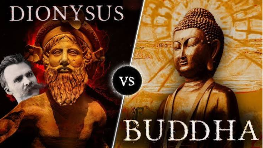
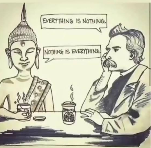
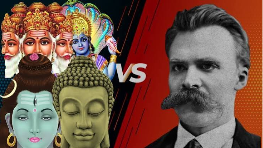
Friedrich Nietzsche and the Buddha both began with the exact same realization: life is inherently full of suffering. However, they arrived at completely opposite conclusions on how to deal with it. While the Buddha sought to understand suffering to completely transcend and liberate human beings from it, Nietzsche demanded that we embrace, endure, and transform suffering into a tool for ultimate personal greatness. [1, 2]
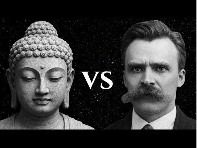
Core Philosophies compared
| Philosophical Core | The Buddha | Friedrich Nietzsche |
| Primary Goal | Liberation from suffering (Nirvana). | Self-overcoming (Übermensch). |
| View on Suffering | A problem to be diagnosed and cured. | The forge necessary for human greatness. |
| Approach to Desire | Extinguish craving to find peace. | Affirm the Will to Power and creative passion. |
| Ultimate Reality | Impermanence and No-Self (Anatta). | Eternal Recurrence of the exact same life. |
Key Similarities
Despite their massive divergence, they shared radical overlaps that set them apart from Western religious traditions: [1]
- The Illusion of the Self: Both thinkers rejected a permanent, unchanging soul. The Buddha taught Anatta (no-self), viewing the ego as a fluid, changing process. Nietzsche similarly viewed the ego as a social fiction or a collection of competing biological drives. [1, 2]
- Rejection of God: Neither relied on a creator deity. In works like The Antichrist, Nietzsche praised Buddhism for being objective, realistic, and free from the concept of a punishing God. [1, 2]
- Psychological Approach: Both treated philosophy as a practical tool for the mind rather than abstract metaphysics. Nietzsche even called Buddhism a “system of mental hygiene.” [1, 2]
Radical Differences
The defining split between the two lies in their ultimate response to the chaos of the world:
- Affirmation vs. Cessation: The Buddha outlined the Four Noble Truths, identifying craving (Tanha) as the root of suffering and advocating for its cessation. Nietzsche strongly rejected this, arguing that extinguishing desire and seeking Nirvana was a passive, “life-denying” form of nihilism. [1, 2, 3]
- The Will to Power: Nietzsche believed human excellence requires tension, conflict, and ambition. To him, a life without desire was a spiritual death sentence. He championed Amor Fati (love of one’s fate), choosing to live the exact same painful life repeatedly rather than trying to escape it. [1, 2, 3, 4, 5]
Note: Many scholars point out that Nietzsche’s critique of Buddhism was heavily biased by his reading of Arthur Schopenhauer, who presented an overly pessimistic, Westernized interpretation of Buddhist Nirvana as literal annihilation. [1, 2]
No one comes to Christianity of one’s own free will – Nietzche
Friedrich Nietzsche believed that Christian values arose from a “slave morality” born of resentment. He argued that weak people created these beliefs to tame the strong. In his view, people do not freely choose this faith because of truth. Instead, social pressure, fear, and weakness pull them into it. [1, 2, 3, 4, 5]
Nietzsche’s Core Ideas
- Resentment: Weak groups create Christian rules to punish strong people.
- Guilt: Faith makes humans feel bad for basic natural urges.
- Blind Faith: People follow it because they fear true freedom and power.
Different Views
- Christian View: Believers say they choose God with an open heart and free mind.
- Other Philosophers: Some thinkers argue that faith is a deep, personal choice.
Would you like to explore Nietzsche’s idea of the Ubermensch (Overman)
https://share.google/aimode/IInxlFbIhOsHmjZLv
Source: AI Overview