Vast discretionary powers granted to Chief Accounting Officers

July 14th, 2018

By Lakshman I. Keerthisinghe Courtesy Ceylon Today

An auditor is not bound to be a detective, or, as was said, to approach his work with suspicion or with a foregone conclusion that there is something wrong. He is a watch-dog, but not a bloodhound.
– LOPES L.J. In re Kingston Cotton Mill Company
(No. 2)  (1896) (Court of Appeal)

Recently, the much awaited National Audit Act setting up the National Audit Service Commission was passed in Parliament with Amendments. Transparency International Sri Lanka (TISL) releasing a legislative brief on the National Audit Bill detailed some key Amendments to be made in committee stage.


There are three major areas of concern which include: 1.The surcharge powers, being the power to recover monies related to any fraud, negligence, misappropriation or corruption, have been vested in the Chief Accounting Officers (e.g. Secretary to a Ministry or Department Head) instead of the Auditor General; 2. Vast discretionary powers have been vested in Chief Accounting Officers in determining the final surcharge; 3. Persons subject to an inquiry by the Auditor General are entitled to nominate others to appear on their behalf.

It was originally envisaged that the National Audit Bill would grant powers of surcharge to the Auditor General to hold public officials financially accountable for any loss emanating from fraud, negligence, misappropriation or corruption in transactions for which they were responsible. This would have been in line with international best practices as espoused in the Lima Declaration adopted by the International Organization of Supreme Audit Institutions (INTOSAI). The Gazetted Bill however vests the final determination on surcharge with the Chief Accounting Officers (CAOs) – which highlights a potential conflict of interest.

Furthermore, in the event that the CAOs themselves are subject to an inquiry, surcharging power has been vested in the President as the appointing authority. However, should the President choose to impose a surcharge, the Act does not provide a right of appeal for the CAO. While the Audit Service Commission investigates and reports on the amount of loss incurred and the individuals determined to have caused the loss, a CAO can choose to reduce the amount to be recovered, with no restriction and providing no justification.

Additionally, any person who is the subject of an inquiry, is able to nominate any other person ‘conversant on the subject’ to appear on such person’s behalf if they are unable to appear by themselves. This provision could be abused by those seeking to avoid accountability – especially since the refusal to appear before the Auditor General is no longer an offence, as was provided in previous versions of the Bill. The provision making the refusal to appear before the Auditor General a punishable offence must be included as mandatory if the Act is to be effective.

However, the positive revisions incorporated in the gazetted Bill, including the appointment of the surcharge appeals committee being placed under the purview of the Constitutional Council instead of the Audit Service Commission, ensuring the independence of the body from the Auditor General, are commendable
It is apparent that the Appeal Procedure is incomplete in the gazetted Bill as it has a lacuna with regard to the appeal procedure available to an affected Chief Accounting Officer.

Further, empowering the President to impose the surcharge on a Chief Accounting Officer would limit his ability to challenge such decision in the same manner as would any other affected person under the gazetted Bill, because of the unique protection afforded to the decisions of the President. Further there is no explicit provision for the Audit Service Commission to appeal against a decision of the Chief Accounting Officer to the Surcharge Appeal Committee or thereafter to the Court of Appeal, Surcharge Appeal Committee can allow, disallow an appeal, or amend, alter or vary the decision of the Chief Accounting Officer. There is no provision to specify reasons or the basis for the decision. To ensure impartiality it is essential that the Surcharge Appeal Committee record reasons and the basis for their decision.

As quoted at the outset the dicta of Lopes LJ are very relevant and as Lopes LJ in Kingston Cotton Mill Company case further referring to employees noted : ’He (Auditor) is justified in believing tried servants of the company (public officers in this instance) in whom confidence is placed by the company (government in this instance). He is entitled to assume that they are honest, and to rely upon their representations, provided he takes reasonable care.

If there is anything calculated to excite suspicion he should probe it to the bottom; but in the absence of anything of that kind he is only bound to be reasonably cautious and careful.’ In conclusion if the Act is to function smoothly the attitude of the Auditor should not be to go on a witch-hunt but conduct the audit with an open mind.


(The writer is an Attorney-at-Law with LLB, LLM, MPhil (Colombo)
keerthisinghel@yahoo.co.uk

Rice, banana leaves and lamprais

July 14th, 2018

By Dr. Tilak S Fernando Courtesy Ceylon Today

The response to one of my articles titled ‘Burgher Community in Sri Lanka,’ some time, ago has been appreciated by many of my Burgher friends both abroad in Australia and in Sri Lanka. My good friend, Egerton, decided to comment on it,  in typical old school ‘Sri Lankan English’ as he put it by saying thus: My friends join me in saying a big thank you to you for your ever interesting, highly informative, authentic, brazenly outspoken and lucidity of style of your column, which acted as a ‘prophylactic’ against an exacerbated degree of hebetudinosity in this personalised Super Nova of an exalted terrain deluged with languorous survival kit,” some of which, I must admit, went completely over my head!

The most interesting part of the article was identified as the section on ‘Lamprais,’ which was referred to in a special souvenir designed as a ‘valuable keepsake’ during the 90th Anniversary of the Dutch Burgher Union Celebrations in 1998. The interesting aspect of the ‘Dutch Lamprais’ was about the menu and ingredients that went to make a comprehensive meal, along with the invention of the banana leaf, with its high porosity, used to wrap curries and sambols, much prior to the invention of polythene.

Evolution of lamprais

Despite my research on lamprais, I was unable to give a comprehensive breakdown on the history and the authentic menu due to the restriction of words in the column. However, once the article was published, a very senior Burgher friend was kind enough to send me an impressive history of the original lamprais in which he stated that ‘it was the Dutch who brought lamprais to Ceylon from Indonesia, which also had been a colony of the Netherlands till about seven
decades ago. In fact, the Dutch ruled Indonesia from around 1600 till 1949, whilst they ruled Ceylon from about 1640 to 1796.

Since polythene was not invented at that time, and paper was not suitable for wrapping all the accompaniments of rice such as curries and sambols, which tended to seep through on account of the high porosity of paper, banana leaf was utilized  as an ideal alternative with its hygienic attribute as its waxy nature minimized permeability. It was found out that banana leaf did not only permit seepage, but also preserved the food wrapped in it for longer periods. The leaf was also found to impart a desirable flavour and fragrance to the rice wrapped in it, which is very distinctive in lamprais, and, in fact, makes it taste better after about 24 hours of being kept wrapped. The latest finding about the banana leaf is that it contains a high percentage of polyphenols, like in green tea, encompassing other health benefits too.

Old Dutch Recipe

My Burgher friend recalls his mother mentioning how the lamprais curry should consist of five meats, i.e. chicken, pork, beef, mutton or lamb and liver. However, the Old Dutch Recipe” offers two options. The first choice is mutton pork and chicken, and the second with just beef and pork. His sister also seems to remember the ‘five-meat’ recipe their mother used to follow. Perhaps she (sister) may have improvised, as these special little touches were passed on from mother to daughter, and generally not put down in writing.

In the Old Dutch Recipe” it is mentioned that, apart from the curry, the Blachung” sambol, the onion [seeni] sambol and the frikadelles, a combination of finely chopped beef and pork (compressed and immersed in a solution of beaten egg) before being fried, what is currently termed as ‘ball cutlets,’ made out of compressed beef, or a combination of beef and pork – but never with fish)! This was because these items did not get spoilt easily, due to non-availability of refrigeration, then. Now, one may use one’s discretion by including brinjal pahi and a dry ash plantain preparation as part and parcel of lamprais.

Usually, each lamprais has just a large cup of rice, with the accompaniments, which really is just the right amount for a person, as it does not make one feel too full. However, Sri Lankans tend to need more rice to fill their bellies and, therefore, the tendency has been to include more rice, these days.

My friend makes it a point to stress the fact that just because a rice meal is wrapped in banana leaves these days, it cannot be called lamprais, other than really calling it a ‘glorified packet of rice and curry’, with full pieces of chicken, coconut sambol, lunumiris, fish cutlets, hard-boiled eggs, sweetened Blachung (what was in the DBU menu) and a huge serving of rice to satisfy the Sri Lankan desire.

Commercialism

Lamprais making today appears to have lost its originality!  In the olden days, the whole preparation had been a labour of love and an accomplishment of pride made and savoured almost exclusively by Dutch Burgher families till around the 1960s where each component was prepared with personal care in accord with recipes handed down from mothers to daughters, but now, even in the ‘mixed’ variety, the curry is made up mainly of chicken (as it is the cheapest meat), with a smattering of beef and pork, if at all.

When the popularity of lamprais increased, it was tainted by commercialism, and every Tom, Dick and Harry started mass producing them, with scant regard for authenticity, but charging for them outrageously, merely for the ‘brand name’. Sometimes even 5-star resorts, served up what was an absolute excuse for a lamprais.

My Burgher friend maintains that those who have not tasted the original Dutch lamprais are not qualified to comment on it or make comparisons because the only authentic lamprais in recent times, in his opinion, was made by a husband and wife team – who have now taken retirement a few years ago, as age was catching up, and they could not cope with the demand of orders. Lamprais made by them were with all the components and personally prepared by them without leaving to the domestics to handle, as it is done at
present.

A New Survey

Some of these revelations were surfaced after a young law undergrad, Panchali Illankoon, who is also a travel enthusiast, revealed after a survey she did in Colombo, embracing the history, and the preparation of lamprais.

In her write up young Panchali had mentioned how this ‘Dutch-Burgher influenced dish,’ which had been a staple diet in Sri Lankan cuisine for many years, has become a popular meal among Sri Lankans. It was apparent, even in her survey, that the recipe had changed and developed over the years, by various food outlets in Colombo where seeni sambol and boiled eggs have been added to lamprais, and chicken meat and cutlets have substituted frikkadels.

Those senior Burghers, who have experienced and tasted the authentic Dutch lamprais, do not appear to be in total agreement with everything Panchali had divulged in her survey conducted and published under the caption Going Dutch – The Best Lamprais in Town’.  Certainly, the statements and comments that come out of the old generation of Dutch families in Colombo, who have experienced and tasted the authentic lamprais hold water, when the young who have not tasted the original Dutch recipe, appear to be the connoisseurs of lamprais, because the authentic lamprais were those lovingly prepared by Dutch-Burgher housewives up to the 1950s and 1960s.

(tilakfernando@gmail.com)

Regulating campaign money – the need of the hour

July 14th, 2018

By Arjuna Ranawana Courtesy Ceylon Today

The reaction from Social Media to recent revelations about the sources of funding that our politicians got during the 2015 elections range from derision to anger.

One of the most popular posts on this subject on Twitter is a quote from the wacky American actor and comedian, Robin Williams who said, Politicians should wear sponsor jackets like NASCAR drivers, so we know who owns them”, translated into Sinhala this quote spread like wildfire.

NASCAR is a type of car racing in America and drivers wear jackets, bearing the logos of their sponsors which are prominently displayed. The sponsor who gives the most amount of money has the right to demand that their logo will be dominant and the other sponsors logos will appear as smaller emblems.


Let’s for a moment imagine what our politicians’ jackets – or shirts – would look like if Williams’ suggestion is implemented here in Sri Lanka. The logo of the tainted Perpetual Treasuries financial trader would be emblazoned on the jackets of candidates from almost all political parties in the country, ranging from Field Marshall Sarath Fonseka to Sujeewa Senasinghe to Dayasiri Jayasekara, although the logo would be pretty small because the sums were small to middling. But the logos of the alleged big contributor, China Harbour, which according to multiple newspaper accounts, donated to both sides in the last presidential election would have its logo dominating the jackets of these parties.

Seriously, we as citizens have to be concerned that there are no laws governing political campaign donations in Sri Lanka, despite our boast that we are the oldest democracy in Asia.

In effect, politicians can accept donations even from drug lords, criminal gangs and even foreign entities pushing their own agenda and not be prosecuted. Right now in Sri Lanka our candidates can accept any amount from anybody.

In all democracies, campaign funding is an issue. In England, the first laws regulating funding and spending to elect candidates were passed in 1883 and despite that, scandalous allegations for instance that Honours – Knighthoods, Life Peerages and such – were handed out for hefty donations or ‘loans’ have deeply wounded the country’s vaunted democracy and brought down powerful leaders. Many of the lacunae in these laws have been closed, but it is an on-going process.

Younger countries like Canada and the United States have robust laws and regulations with Canada, prohibiting any organization societies or Corporations from making contributions and allowing only individuals to donate up to a certain limit. US laws are similar and regulations governing campaign money are strict and violators can go to jail. These days US Federal Investigators are trying to figure out whether the sum of US$ 130,000 ‘hush money’ paid to an a movie star to stay quiet about an affair that she says she had with then Presidential candidate, Donald Trump can be construed as a campaign donation.

In neighbouring India, a broad coalition of election watchdogs, Rights activists, lawyers and academics waged a decade-long struggle and finally had Parliament pass a law regulating campaign expenditure in 2003. But, activists say that the law does not go far enough and that all political parties have argued that the Right To Information Act (RTI) has no purview over them.

Niranjan Sahoo of the Observer Research Foundation in New Delhi writes that there is A long history of delay, subterfuge and dilution by successive governments at the Centre and there is amazing unanimity among political parties – Left, Right and Centre – to stall any possible progressive reforms to bring greater transparency and accountability in political donations and their expenditures.” He adds that Even electoral trusts and their sources of contribution suffer from opacity and no government of the day has shown the political will to end the anonymity. The current Bharatiya Janata Party Government is also trying to introduce some regulation but appears more concerned about the presence of Black Money emerging as campaign donations. It is trying to ensure that all donations have come through Banks.”

In Sri Lanka, the struggle is on to try and regulate campaign money. The charge is being led by the watchdogs People’s Action for Free and Fair Elections (PAFFREL) and the Centre for Monitoring Election Violence (CMEV). They have now produced a draft Bill which has been handed over to Members of Parliament.

Executive Director of PAFFREL, Rohana Hettiarachchi told Ceylon Today that discussions had been held over the past four years or so and the draft was given to MPs about a year ago. He said discussions had been held several times with all stakeholders, they include the Elections Commission, all Secretaries to  political parties, academics, lawyers and activists.

The draft, seen by Ceylon Today does not say campaign funding cannot be taken. It seeks to limit how much and from whom these donations can be taken. For instance we want to stop donations to parties from entities which are foreign-funded or do business with the Government,” Hettiarachchi says.

He says even when laws are promulgated, Politicians will take money from various sources. We cannot prevent that, but at present there is no way for us to legally challenge the donations that various entities have made to political parties or individual politicians as there is no legal framework covering these donations.”

Hettiarachchi says that in several rounds of discussions held with various stakeholders the reaction to the draft Bill has been positive. He said some of the smaller political parties had said their local level supporters would provide meals or cups of tea when they campaign and donations such as those are very small and would be arduous to document and report. The really hard part of this mechanism is how would election spending be monitored? How would we track how much a candidate or party was spending? Our suggestion is that candidates open separate Bank accounts for campaign spending and all donations be deposited there and expenses disbursed from that account. At the end of the day, these accounts should be audited and the results filed.

But in the case of Local Government elections and other smaller groups, the question arises as to whether they can find auditors and many would say they cannot take that step.”

Hettiarachchi is enthused by the positive reaction from politicians he has discussed the draft Bill with. After it was revealed that MP Dayasiri Jayasekara had also received a donation from Arjun Aloysius, he offered to bring this draft to Parliament as a Private Member’s Bill. He may have done that to minimize the damage done to him by this fact becoming public, but he did make the offer. Another MP who has offered to do this is Tharaka Balasuriya, who is part of the MPs Collective for Clean Politics. We handed the draft over to Minister Faiszer Mustapha because he had offered earlier to bring the proposal to Cabinet, to set campaign spending ceilings for the Local Government elections.

In Sri Lanka, sometimes one single businessman offers to fund the entire campaign of a particular politician. When that happens, the politician is obliged to help business interests of that one person.  In our draft we have proposed that there be a ceiling such as five per cent of a campaign expenditure that one individual can donate. Then the politician will not be in the grip of that one individual.

There is already widespread disappointment about the conduct of our politicians as they are seen by the public as incompetent, mostly corrupt and some hand in glove with criminals. One sure way of cleaning up the system somewhat is to have some regulation of campaign funding.

So, all of us should lobby for the current draft to be put before Parliament as well as the people so that it is debated widely and eventually made into law.

Is Vijayakala above the law?

July 14th, 2018

By Udaya P Gammanpila Courtesy Ceylon Today

UNP MP Vijayakala Maheswaran told a public rally on 2 July that the LTTE should be resurrected if the Tamil people are to get their freedom.  Although this controversial statement is two weeks-old, law enforcement officers have done nothing against her.

The LTTE have committed brutal terrorist activities to set up a separate State within Sri Lanka.  Promotion of separatism is a punishable offence under Article 157A of the Constitution.  If a person is found guilty,  he/she will lose their civic rights for seven years and assets will be confiscated.  If the person is a parliamentarian, he will lose that office as well.

Since the LTTE promoted separatism through terrorist activities, Vijayakala has abetted an armed struggle against the State.  In terms of Section 114 of the Penal Code, it is an offence punishable with capital punishment in addition to confiscation of assets.

In terms of Section 3 of the International Covenant on Civil and Political Rights (ICCPR) Act No 56 of 2007, no person shall propagate war or advocate national, racial or religious hatred that constitutes incitement to discrimination, hostility or violence.  It is an offence where only the High Court can grant bail for the suspect under exceptional circumstances.  Hence, the suspect should be in remand prison until the conclusion of the trial.  The LTTE instilled fear in Sinhala and Muslim communities by lashing out violence and even including massacring the Sinhalese and Muslims.  Hence, Vijayakala’s statement is an advocation of racial hatred.  There is a similar provision in the Prevention of Terrorism Act as well.

In this backdrop, Vijayakala’s controversial statement is a gross violation of the Constitution, Penal Code, ICCPR Act and Prevention of Terrorism Act.  In terms of these laws, Vijayakala should be arrested and remanded until the conclusion of the trial.  She should be punished with the death penalty after confiscation of her assets.  Alternatively, she can be imprisoned after expelling her from Parliament.  She will be stripped of her civic rights for seven years.

According to the above legal analysis, promotion of separatist terrorism is a dangerous act with disastrous consequences.  Let us now review, how these laws have been applied to Vijayakala.

Police have so far failed to arrest Vijayakala.  In the least, she has not even been questioned by Police regarding the controversial statement.  The only outcome of the incident was her tendering her resignation from the post of State Minister on the advice of Prime Minister, Ranil Wickremesinghe.

However, the loss of a ministerial portfolio has not been stated as a punishment when separatist terrorism is advocated.  The punishment that should be meted out is much more severe than that.  Unfortunately, it seems that she is above the law!
It is true that the UNP has appointed a disciplinary committee to investigate Vijayakala’s statement.

However, it has not even failed to suspend her membership.  When UNP MPs supported the Rajapaksa government in support of the war against the LTTE, the UNP rushed to suspend their membership.  However, when a member publicly makes pro-LTTE speeches, the UNP shows no interest to suspend the membership.  This duplicity clearly demonstrates the UNP’s pro-LTTE stance.

This duplicity is found not only in the UNP but also in the action taken by government.  After anti-Muslim riots in Digana, several hundreds of people were taken into police custody.  The majority of those arrested have nothing to do with the violence.
The only sin they have committed was being in the wrong place at the wrong time! Hence, they were just on CCTV camera footage on that fateful day.

Over a 100 persons so arrested are still in remand custody.  They have been refused bail.  Since they have been charged under the ICCPR Act, the Magistrate has no authority to grant bail.  Even the High Court can only grant bail under exceptional circumstances.  When 105 persons are  in remand custody without a shred of evidence, Police fail to arrest Vijayakala for her pro-terrorist public statement witnessed by the entire nation.

Vijayakala has attempted to justify her speech by saying she was under tension after hearing the rape and murder of a young girl.  However, she protected and granted the opportunity for Mahalingam Shashi Kumar alias Swiss Kumar, the prime suspect for the rape and murder of Sivaloganathan Vidya to make good his escape which was confirmed by the suspect himself in his confession in the High Court of Jaffna on 29 August 2017.

Why did she not feel any tension hearing the rape and murder of Vidya?
The LTTE kidnapped schoolchildren and tied cyanide capsules around their necks after providing military training by force.  Thousands of Tamil fathers were killed labelling them traitors by the LTTE.  An infant who was suckling was grabbed and his head was crushed by hitting it on a nearby coconut tree at Gonagala.

Thirty novice monks were slaughtered in cold blood in Aranthalawa by the LTTE. Why was Vijayakala not under tension after hearing any of these incidents?  Hence, her justification that she was under tension when she made the controversial statement is unacceptable.

She also made a second justification for her statement that Jaffna was free of crime during the time of the LTTE.  Jaffna has been under government control since 1995.  The entire North has been under government control since 2009.  There was no record of widespread criminal activities in the North until 2015.  Criminal activity in the North commenced during the government of Vjayakala’s party.

In the light of above, none of the justifications put forward by Vijayaka are acceptable.  Hence, law enforcement agencies should immediately take action against Vijayakala.

Over 27,000 infected with dengue in Sri Lanka

July 14th, 2018

So far in July, 1309 patients have been diagnosed with dengue from across the island while 5114 patients were reported last month.

Over 27,000 infected with dengue in Sri Lanka

Some of the other worst affected districts were the Central Hills of Kandy and Ratnapura, in the south central part of the island country.

The National Dengue Control Unit, on Thursday warned there was an increase in the number of dengue patients this year due to the active South West monsoon rains.

As a result, the National Dengue Control Unit said it had launched a special two day programme, starting Friday, to eradicate dengue breeding grounds in eight districts, including the north and east, which were identified as the most vulnerable districts.

The National Dengue Prevention Unit urged the public to seek immediate medical attention if they suffered from high fever, uncontrolled vomiting, abdominal pain, dizziness and reduced urinary.

Over 300 people were killed and more than 136,000 were infected by the dengue epidemic last year in one of the country’s worst-ever outbreak of the disease in recent times

15 Chinese scholarships for Lankans to study oceanography and climatology under Belt and Road Initiative

July 14th, 2018

Courtesy NewsIn.Asia

Colombo, July 13 (Xinhua):  Fifteen Sri Lankan university students have been awarded scholarships by the Chinese Academy of Sciences (CAS) to pursue higher studies on climatology and oceanography under the Belt and Road Initiative (BRI) to strengthen educational ties between China and Sri Lanka.

The scholarships were handed over on Wednesday under the Belt and Road” Master Fellowship Program. The program is run by the China-Sri Lanka Joint Center for Education and Research (CSL-CER), which is based in the South China Sea Institute of Oceanology of the CAS.

Out of the 15 students, three students have been awarded scholarships to pursue their PhD degree while the remaining 12 will pursue their master’s degree.

15 Chinese scholarships for Lankans to study oceanography and climatology under Belt and Road Initiative

This is the third year that the CAS has awarded these scholarships to Sri Lankan university students.

The students this year are selected from the University of Ruhuna, the University of Peradeniya, the University of Sabaragamuwa, the University of Jaffna and the University of Wayamba.

Speaking at the handing over ceremony, Professor. Gamini Senanayake, vice chancellor of the University of Ruhuna, said it was vital that Sri Lankan students pursue their higher studies in oceanography, as Sri Lanka being an island country deepens mostly on its sea.

However, he said Sri Lanka lacked the human resources to explore the opportunities of the ocean.

As Sri Lanka also faced natural hazards such as heavy rains every year followed by strong winds, it was vital that Sri Lanka studied the ocean surrounding it, Senanayake said.

Being a very friendly nation, China has always helped us in various fields and especially the Chinese Academy of Sciences has a very big programme ongoing with Sri Lanka. We thank them for that as it benefits our students,” Senanayake said.

Professor Mohan de Silva, Chairman of the University Grants Commission, said it was important for Sri Lankan students to pursue a higher education in marine sciences and oceanography, as it would benefit the island country.

We are glad that the University of Ruhuna along with the CAS is taking efforts to develop this expertise in this country,” de Silva said.

Rivindu Vithana, a PhD student awarded the scholarship, said it was a great honour for her to be accepted to study in a prestigious Chinese university. She assured that she would use this opportunity diligently and with care to enhance her knowledge.

(The featured image at the top shows Chinese scientists on board the research vessel Quan Sanqiang” making a presentation to Sri Lankan oceanographers and marine geologists in February 2017) 

When All India Radio banned film music from its broadcasts

July 14th, 2018

By Radhika Iyengar/Livemint Courtesy NewsIn.Asia

New Delhi, July 14: It was in 1952 that the Minister of Information and Broadcasting (I&B) of newly independent India, B.V. Keskar, decided that All India Radio (AIR)—the information and entertainment lifeline of the nation—would not air film songs as they were degenerate and far too Westernized”. He believed they would hinder the cultural growth of a young nation on the cusp of a bright future. Instead, he proposed, the country could lend its ears to highbrow classical music.

In an article in The Hindu (19 July 1953), Keskar argued that the country’s appreciation for classical music had fallen” and was on the point of extinction”—particularly in north India. The onus of making his countrymen intimate with (classical music)”, therefore, was bestowed on AIR. We must make (ourselves) familiar with our traditional music,” he declared.

When All India Radio banned film music from its broadcasts

(Dr.B.V.Keskar, the then Information Broadcasting Minister is in the middle wearing the Indian achkan) 

In 1952, the Indian National Congress party had just had a landslide victory in the first general election and Keskar—a staunch Brahmin and a classical Indian music purist—was given charge of the I&B ministry. To his mind, Indian film songs were straying from their responsibility of instilling national pride in people. The lyrics, aside from being in Urdu, were generally ‘erotic’,”writes radio historian David Lelyveld in Upon The Subdominant: Administering Music On All-India Radio. In addition, there was a steady rise in the use of Western instruments and Western melodies in the songs, which Keskar identified with a lower stage of human evolution”.

David Lelyveld, South Asian historian who wrote on the ban on film music.

Songs like Tadbeer Se Bigdi Hui Taqdeer Bana Le, ghazal which S.D. Burman turned into an upbeat, guitar-sporting number for Baazi (1951), and Mur Mur Ke Na Dekh for Shree 420, 1955, which featured an orchestra of Western instruments and had flamenco-style tunes, would not have passed Keskar’s test. He wanted songs that were infused with the sound of the flute, tanpura or sitar instead. And so it was chiefly through radio, he thought, that the country’s musical heritage could be rescued. Keskar would go on to become the longest-serving I&B minister from 1952-62.

To begin with, he mandated that all songs aired on AIR would be screened, and, according to Lelyveld, he imposed a quota of 10 percent of all program time”. In addition, Keskar ensured that if a film song was played, the film’s title would not be announced, since he considered that advertising. Only the singer’s name would be mentioned.

Amin Sayani speaking in the Binaca Geetmala program on Radio Ceylon

The film industry was up in arms, of course. Filmfare magazine characterized Keskar as a devious man whose decision was a calculated blow at the reputation of the Indian film industry, as much as one aimed at ousting film music from the market” (August 1952 issue). In response, film producers who owned the rights to the songs decided to rescind the broadcast licences given to AIR. And, as Keskar anticipated, film music completely disappeared from radio within a mere three months. The void was filled by AIR broadcasting classical music.

Across the shore, Radio Ceylon rose to the occasion—and the opportunity. It created the legendary musical countdown Binaca Geetmala—a show entirely dedicated to Indian film songs. Every Wednesday, Indian listeners would tune into Radio Ceylon and listen to their favourite songs with their favourite show host—the iconic and charming Ameen Sayani, who would engage them with complementary film trivia.

Legendary announcers of Radio Ceylon in the 1950s

A former editor of Femina, Sathya Saran, who was a young girl growing up in Guwahati at the time, recalls what the show meant to her. Every Wednesday, I would go and sit near the radio from 8-9pm to listen to Binaca Geetmala,” she reminisces over the phone. I had this little black diary in which I wrote down every song that played, how many times it was featured, whether it had gone up or down—I would keep tabs, and always sing along, because I knew all the lyrics. And Ameen Sayani was like god to me. I would hang on to every word he said.” Geetmala ran from 1952 to 1988.

In 2010, Sayani, in an interview with Aswin Punathambekar (professor of communication studies at the University of Michigan-Ann Arbor), recounted how his team would record the show on tapes every single day. And every week’s quota used to fly by Swiss Air, Air Ceylon or Air India to Colombo. Sometimes, we did get into trouble, especially with Geet Mala, because with Geet Mala we were not supposed to record too much in advance. The popularity poll had to reflect a current mood…(Binaca Geetmala) became an absolute rage… Just like how the streets would be empty when B. R. Chopra’s Mahabharat (1988) or Ramanand Sagar’s Ramayan (1986) would be on television, the same thing happened to Geet Mala... Wednesdays came to be known as Geet Mala day.”

As Radio Ceylon’s popularity grew in India, Keskar’s influence waned and the government was forced to lift the ban. In 1957, Vividh Bharati was conceptualized as a service on AIR that offered non-stop film music broadcast. Vividh Bharati had a tremendous blend of heritage and modernity, parampara and pragati, let’s say. And this soon became quite popular,” noted Sayani in the 2010 interview. By 1967, Vividh Bharati had turned commercial and began accepting advertisements. By the late 1970s, it had become a cultural behemoth, functioning as the primary source of entertainment in Indian cities.

Keskar would be outraged if he heard the music the Indian film industry makes today, but it is ironic that some of the country’s most iconic and memorable songs, produced during the golden era of Hindi cinema”, were once considered objectionable and would have possibly been stifled by one man’s draconian policies if a radio channel from a neighboring country hadn’t stepped in.


India’s attempts to control world’s emptiest airport in Sri Lanka hit after rounds of negotiations end in stalemate

July 14th, 2018

Chathuri Dissanayake Courtesy The First Post

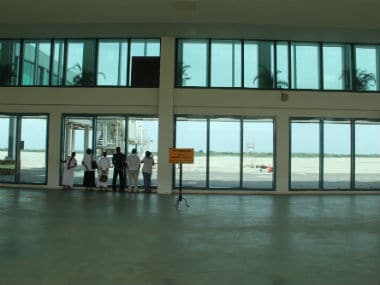
Colombo: Questions are now being raised in Sri Lanka over the seriousness of India’s intent to set up a joint venture for Mattala Rajapaksa International Airport in Hambantota, which has the dubious distinction of not having any scheduled flights.

Almost one-and-a-half years after India submitted a proposal for gaining control over the airport, talks between the two countries have stalled after repeated rounds of negotiations ended in a stalemate.

India had submitted an unsolicited investment proposal to Sri Lanka’s ministry of civil aviation after the latter closed the call for expressions of interest for a business venture to turn around the airport, dubbed the world’s emptiest, in December 2016.

After China got the port, India wanted the airport

The airport is located close to the Chinese-run Magampura Mahinda Rajapaksa Port and that explains India’s strategic interest in the desolated airport.

Mattala Rajapaksa International Airport has become a popular destination for many Sri Lankan pilgrims. Image courtesy: Chathuri Dissanayake

Mattala Rajapaksa International Airport has become a popular destination for many Sri Lankan pilgrims. Image courtesy: Chathuri Dissanayake

Sri Lanka had signed a framework agreement to lease Hambantota Port to Chinese state-owned China Merchants Port Holdings Company (CMPort) in December 2016.

The two infrastructure projects were carried out by the Rajapaksa government with Chinese loan funding. Struggling to repay the loans, the current Sri Lankan government called for investments to lease out both the airport and port, resulting in a lease agreement with China for the latter.

Since then, although several meetings have taken place between the Airports Authority of India (AAI) and its Sri Lankan counterpart, the discussion is not taking off.

It seems the Indian government just wanted to block China from leasing the airport in the same region as the port.

According to Sri Lankan deputy transport minister Ashok Abeysinghe, a request was made by them for a detailed business plan for a joint venture with Airports Authority of India (AAI). However, the Indian counterparts are yet to come through with the plan.

Last week, an Indian team, including AAI officials and representatives from the Indian government, met Sri Lankan transport ministry officials. Designing of a business plan was, however, not featured in the discussions.

The Indian high commission in Sri Lanka had not responded to a request for more details on the talks at the time of publication.

Negotiations stalled

The Sri Lankan Cabinet had approved the start of discussions on the proposal submitted by India for Mattala. According to the Cabinet paper presented by the ministry of civil aviation, AAI proposed to invest $205 million for a 70 percent stake in the venture for 40 years, while its Sri Lankan counterpart was expected to share the balance $88 million, totaling $293 million, as per India’s assessment of the net worth of the Mattala airport.

The Sri Lankan government was determined to renegotiate the amounts and shareholding ratio, Abeysinghe said. They wanted a 60:40 ratio depending on the business plan.

As talks regarding the airport between the two nations failed to take off, the only airline flying to Mattala, Flydubai, ceased its flights from 8 June, pushing the Sri Lankan government to look for alternatives.

Analysts are also wondering if India is genuinely interested in committing large sums of capital in high-risk projects such as Mattala. A New York Times article on the Hambantota Port pointed out that India indeed turned down opportunities to invest in the port venture when the Rajapaksa government approached it.

China tightening grip on Sri Lanka, India gets wary

For decades, India has played the role of big brother to its southern neighbour Sri Lanka, not just because of its geographical proximity and strategic location but also because people of the two countries are bound by centuries-old cultural and religious ties.

Since Independence, India and Sri Lanka have also kept diplomatic relations tight, followed non-aligned policies, with India always making sure that Sri Lanka turns to big brother in times of need and keeps others, particularly China and the US, at an arm’s length.

All that has changed in the past ten years with the rise of China as a global economic power, and Sri Lanka coming under its spell, tempted by its willingness to fund massive projects – no questions asked.

The Sri Lankan government’s decision to award a contract to a Chinese company for construction of 40,000 houses in the northern province is another flashpoint for India.

According to sources, India has raised concerns against the opaque” awarding of tender to China Railway Beijing Engineering Group Co, which has no experience in construction in the northern region.

There are also fears of influx of Chinese labour in the northern province — traditionally affiliated to India owing to its ethnic makeup.

Two weeks ago, Indian representatives met minister of rehabilitation DM Swaminathan to raise concerns over the increasing Chinese presence but he said all fears has been dispelled.

There will not be a single Chinese worker in the north. The company has agreed to employ 5,000 workers in the construction field and another 2,000 in two factories,” he assured, quickly adding that I am a Tamil myself and would be worried if there was a sudden influx of foreign workers”.

He also pointed out that the call for housing has been there for three years; no one offered to build them till now”.

Analysing Sri Lanka’s reliance on China, former diplomat S Palihakkara says in The Island of the Lion and the Land of the Dragon that the former government in Sri Lanka had unwisely placed most, if not all, of their ‘eggs in the Chinese basket’ entailing serious debt management issues at home and troubling strategic concerns abroad involving India and the US”.

(Chathuri Dissanayake is a Sri Lanka-based freelance writer and a member of 101Reporters.com, a pan-India network of grassroots reporters.)

Minimum support price(MSP) increase could hit non-basmati rice exports in India

July 14th, 2018

Written by Harish Damodaran | New Delhi |Courtesy The Indian Express

Updated: July 15, 2018 3:40:08 am

The government’s decision to raise the minimum support price (MSP) of common paddy from Rs 1,550 to Rs 1,750 per quintal this crop season may benefit farmers ahead of elections, but could impact the country’s export of non-basmati rice.

The government’s decision to raise the minimum support price (MSP) of common paddy from Rs 1,550 to Rs 1,750 per quintal this crop season may benefit farmers ahead of elections, but could impact the country’s export of non-basmati rice, annually worth almost Rs 23,000 crore.

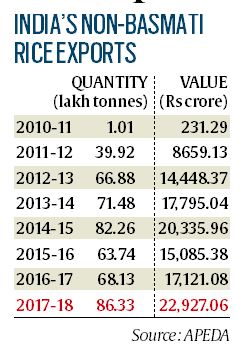
Much of India’s non-basmati exports — which have zoomed from just one lakh tonnes to over 8.6 million tonnes (mt) in this decade — are to African nations, both West (Benin, Nigeria, Niger, Togo, Ghana, Ivory Coast, Liberia, Guinea and Senegal) and East (Somalia and Djibouti), and also to Bangladesh, Nepal and Sri Lanka.

These are poorer countries relative to West Asia, UK, Europe, US, Canada and Australia, the main markets for the more premium basmati rice.

In 2017-18, India shipped out 4.05 mt of basmati rice, which was less than half the quantity of non-basmati (8.63 mt), but of higher value (Rs 26,841.19 crore versus Rs 22,927.06 crore for the latter). Unlike basmati, non-basmati rice is a highly price-sensitive segment. The MSP increase will totally erode India’s price competitiveness,” said an official from a major agri-commodity exporting firm.

Currently, long-grain (6 mm) parboiled rice with 5% broken grain content – which is what India largely exports – is quoting at $385-390 per tonne free-on-board (FOB, or the point of shipment). Paddy yields roughly two-thirds rice, with the milling costs – including salaries, interest and overheads – more or less recovered from sale of husk and bran. If paddy is sourced from Chhattisgarh, Odisha or Andhra Pradesh at an MSP of Rs 1,550 per quintal, the equivalent price of milled rice will be around Rs 23.25 per kg. After adding commission fees, local levies and transport charges of Rs 1.25, the delivered cost at Kakinada port will come to Rs 24.50/kg. On top of this are fobbing costs” (towards bagging, warehousing, inspection, customs clearance and cargo handling/stevedoring) of Rs 1.50, which takes the final FOB price to Rs 26/kg or $380 per tonne at Rs 68.5-to-the-dollar.

READ | Centre’s MSP hike decision betrayal of promises made to farmers: AIKSCC

But with the new paddy MSP of Rs 1,750 per quintal, the basic rice cost itself will go up by Rs 3/kg or nearly $44 per tonne. At this rate, we will be completely priced out. Today, even long-grain white raw rice with 5% brokens from Thailand is selling at below $400 per tonne FOB,” the earlier-quoted exporter pointed out.

The implications of it aren’t small. India produces about 110 mt of rice, out of which 36-38 mt is procured by government agencies and 12.5-12.7 mt is exported. The higher MSP is not applicable on basmati paddy and would anyway make little difference to the four-mt exports of this premium rice. But to the extent the 8.5-8.7 mt of non-basmati rice exports are affected, there will be that much of surplus grain in the domestic market, which may end up in government warehouses. This, when public rice stocks, at 23.25 mt as on July 1, are way above the normative buffer of 13.54 mt required to be maintained before the start of the new agricultural year.

ALSO READ | MSP hike: Farmers yet to reap gains on the ground

The entire 8.5-8.7 mt exports may not take a hit, but at least 3 mt or so can be impacted. The two offsetting factors could be a further depreciation of the rupee and a bumping up of prices by Indian exporters,” noted Ashok Gulati, agriculture economist and former chairman of the Commission for Agricultural Costs & Prices.

India, according to US Department of Agriculture data, accounted for 12.8 mt out of the total global rice trade of 48.98 mt in 2017-18, making it the world’s largest exporter, ahead of Thailand (10.5 mt), Vietnam (7 mt), Pakistan (4.2 mt), Myanmar (3.5 mt) and the US (3.05 mt). Being a large exporter, India can set prices. But the ability to pass on the higher MSP is limited by the low purchasing power, especially of African countries who may even switch to cheaper cereal substitutes like cassava. Besides, Thailand and Vietnam may respond by ramping up their supplies and grabbing our market share,” added Gulati.

But there could also be a third possibility – of rice meant for the public distribution system (PDS) getting diverted for exports. This, if trade sources are to be believed, is already taking place. Given that the Central issue price for rice under the National Food Security Act is just Rs 3/kg – states like AP, Telangana, Odisha and Chhattisgarh are offering it at Rs 1/kg – the incentives for diversion are obviously huge.

PDS rice typically has 20-25 % brokens. There are traders/millers who manage to get these through collusion with food department officials and transporters, which they then convert into 5% brokens (by adding unbroken or head rice bought from the market) and sortex (to remove discoloured and damaged grain) for achieving export quality,” explained an exporter, who, however, couldn’t quantify the extent of such PDS-diverted shipments.

Leading non-basmati exporters from India include the Singapore-based Olam International and also not-so-well-known domestic players such as Satyam Balajee Rice Industries, Pattabhi Agro Foods, HRMM Agro Overseas, Amir Chand Jagdish Kumar Exports and Sukhbir Agro Energy.

Fake passport racket helping Sri Lankans fly abroad as Indians busted in TN

July 14th, 2018

Courtesy The Asian Age

Two Sri Lankans, including a 38-year-old woman, suspected to be part of the racket, have been arrested, police said

Chennai: Police have busted a fake passport racket in Tamil Nadu, which helped Sri Lankan nationals fly abroad from the city as Indian citizens.

Two Sri Lankans, including a 38-year-old woman, suspected to be part of the racket, have been arrested, police said.

Earlier, the crime branch wing had arrested 11 people, including a travel agent, for allegedly preparing fake passports by collecting amounts of up to Rs 10 lakh from Sri Lankan nationals.

Police said investigations revealed that the woman had come to Tamil Nadu from the island nation on a tourist visa some time back and had been staying here well past its expiry date.

She had sought the help of the travel agent, who prepared a fake passport for her.

Her accomplice, who also possessed a Sri Lankan passport, managed to get a fake Aadhar card for her, police said.

The woman and her accomplice were arrested from a house in the city on Friday and produced before a local court, which later sent them to Puzhal central prison.

Describing the modus operandi, police said the travel agent used to prepare fake Indian passports for Sri Lankan nationals, based on the information he received from his aide in Colombo.

The man, with the help of his gang, collected expired passports from people of economically weaker sections and sold them to Sri Lankan nationals as valid Indian passports for a monetary consideration.

Police also recovered 77 Indian passports, 12 Sri Lankan passports and machines used to prepare them and cash of Rs 85,000.

Veteran female singer K Rani passes away

July 14th, 2018

Amrutha Vasireddy Samayam Telugu | Jul 14, 2018, 01.12 PM IST

HYDERABAD: Veteran female singer K Rani, who is famous for her song ‘Anthaa Braanthi Yena’ for Devasau movie, passed away on Friday night at her daughter’s residence in Kalyan Nagar, Hyderabad, at 75. K Rani, the most popular singer in the olden times, has sung more than 500 songs in Telugu, Tamil, Kannada, Malayalam, Hindi, Bengali, Sinhala and Uzbek.

She started her singing journey when she was eight years old. She also sang the national anthem of Sri Lanka. Rani’s initial films in 1951 were Roopavathi (Telugu) and Mohana Sundaram and Singari (Tamil). A year later, she was singing for the lead characters in films like Kalyani, Kalyanam Panni Paar, Pelli Chesi Choodu, Dharma
Devadhai and Dharma Devadha. Rani’s “Antha Bhranthi Yenaa” (Telugu) and “Ellaam Maayai Thaanaa” (Tamil), from 1953’s Devadasu, became very popular.

She also gave a performance at Rashtrapathi Bhavan during the time of Sarvepalli Radhakrishnan. Congress leader K Kamaraj called her “Innisai Rani”. Rani was invited to perform at the Mokshagundam Visvesvaraya centennial, travelling in a plane chartered by the government of Karnataka. Raj Kapoor provided the rhythms when she sang Hindi songs, including “O Maine Pyar Kia, Mai Kya Karu Ram Mujhe Budda Mil Gaya”, at a stage show.

She first performed in Sri Lankan cinema for Sujatha in 1953 under the direction of composer Ananda Samarakoon, and contributed to Seda Sulang in 1955 and Sirimali in 1959. She sang Dravida Munnetra Kazhagam (DMK) songs and recorded Tamil Islamic songs with Nagore E. M. Hanifa.

After marrying Seetha Rami Reddy in 1951, she stayed away from singing.

Prime Minister taking advantage of President’s lack of knowledge of English is selling Sri Lanka behind the President’s back.

July 13th, 2018

By Charles.S.Perera

On the 3 July, 2018 the Prime Miniter speaking in the Parliament on  the statement made by  State Minister Vijayakala Maheswaran on the necessity to revive terrorism, said  that there is no need for a revival of terrorism and that he would take action against the Minister after listening to why she made that statement.

That was a reasonable statement but what followed after made light of that most serious statement with perhaps dire consequences, and certainly uncalled from a  Prime Minister to be made in the well of the Parliament .

In his usual circus clown style  turning round looking into the faces of his party yes men”,  who readily laugh at his  jokes and Wild Life Minister Sarath Fonseka the UNP’s Official Rajapakse vilificator” stated that the Joint Opposition that raised this issue made it to cover up the situation created by the New York Times report.

The Prime Minister  then added that the Joint Opposition has no right to make an issue of it as it was they who made a Minister of Karuna Amman who killed more than 600 police men,  and that they bribed the terrorist leader to win the Presidential election. What he said was quite irrelevant as Karuna gave up terrorism and said that he was opposed to terrorism as a means  to win the rights of the Tamil people. And there is no proof what so ever of any one bribing the terrorist leader to stop terrorism.

How ever  such arguments to blame the previous government  when they have no arguments to answer questions of  their mismanagement of  the country, have become  the UNP official methodology of  answering  their interlocutors ,  and in TV political debates. UNP has now  been provided further  ammunition by the New York Times,  and that is what  Maria Abi Habib  the American Journalist wanted.

A leading news paper in America providing material to be used against  popular leaders to make them unpopular and help the puppets put in place by America. That is how things have been done to remove leaders from countries like Ecuador, Panama, Chile, Iran, Congo etc. They also had the CIA and Economic Hit Men.

About this Mahinda Rajapakse’s presidential campaign fund of 7.6 million paid by China Harbour Company, the UNP makes a big issue of it, without answering what they did with the 585 Million Dollars  John Kerry said USA shared with Nigeria, Burma and Sri Lanka in January,2015, which was paid for the UNP  election campaign fund to change the  Rajapakse Regime.

If ,  the  Chinese Harbour Company paid  Campaign Funds to Mahinda Rajapakse  it should be a lesson to the ungrateful Sri Lanka voters  who voted out a great President a man with a vision to bring peace and Security to the people of Sri Lanka ,who had been suffering for thirty years from a ruthless terrorism, and develop the country for it to be in par with any developed country.

The  Chinese are a grateful people who know a good leader when they have one. They made Xi Jinping their President for life.

One should not allow UNP go scot free accusing Mahinda Rjapakse getting Chinese money for his  election campaign when the US State Secretary  of John Kerry himself stated that America gave 585 Million dollars  to be shared amoung Nigeria, Burma and Sri Lanka in 2015 on promoting democracy- for regime change .

Every one opposing the Rajapakses easily wag their tongues to  spit poison at  President Mahinda Rajapakse, when Rainil Wickramasinghe  and company are  neck deep in corruption.

The Yahapalanaya leaders are doing every thing to please the separatist Tamil politicians when unknown to them they are  clearing all obstacles in the North and East preparing the ground  for a resurgence of terrorism.

The UNP MP Vijayakala Maheswaran who openly demand a come back of terrorism should have been sacked from the UNP, removed from he Parliament  and taken into custody by the Prime Minister Ranil’s  FCID.

But they would not do it because  that is also a part of the American Agenda to divide Sri Lanka and both Sirisena and Ranil are undoubtedly  a party to the American strategy. The President Sirisena who should have demanded the MP Vijayakala Maheswaran to quit, has still not made any statement on the issue.

Both President Sirisena,  and Prime Minister Ranil Wickramasinghe who support each other , one because he became the President because of the other,  and the other  because he was made the Prime Minister by the other, are unpatriotic leaders walking  hand in hand to ruin Sri Lanka, selling the economic centres of the Country to India, China, Bangladesh and Singapore.

Ranil Wickramasinghe who did not consult the then President and the Parliament when he signed the CFA with the terrorist Prabhakaran , will not hesitate to sell even the whole of Sri Lanka to foreigners if he could be the President of Sri Lank in 2020 .

He has already signed a 1500 page trade agreement with  Singapore , the contents of which is not known to most of the Parliamentarians and not at all to the President Sirisena.  Ranil the Prime Minister- now in Singapore ( for what ?),  will sign many other agreements such as the Ecta with India and another with India to sell the oil wells in Trincomalee. He will soon begin writing the new Constitution and the President Sirisena will have no word to say on that as well.

If  Maithripaala Sirisena who calls himself a son of the land coming from a poor farmer’s family has an iota of patriotism should sack the Prime Minister, who is acting on his own without consulting the President,  taking advantage of the President’s   having no sufficient knowledge of English to understand the agreements and other documents.

The President who has already been made  powerless under the 19A is unable to sack the President or even dissolved the Parliament.  The only alternative the President Sirisena has if he can use his intelligence  at all is to get together with the President Mahinda Rajapakse and the Opposition,  and stop  further political activities of the Prime Minster and force him to resign.

KASHMIR-A BLIND ALLEY OF DESIRES

July 13th, 2018

ALI SUKHANVER           

Yes —-they push us into a blind alley with no way out when our desires and wishes are not supported by logic and wisdom. Most of us are misguided when we are ruled and governed by the gods of our wishes and desires. Same thing is happening there in the paradise like valley of Indian Occupied Kashmir. There is no concept of a normal life in that valley; every day is a day of bloodshed; every night full of incidents of rape and molestation.

You would find countless mothers waiting for their disappeared sons and daughters waiting for their fathers whose names are in the long lists of missing persons. Certainly if the police stations are asked about them, they would say, The disappeared and the missing ones were all terrorists. They were militants; we too are searching for them.” But matter of the fact is that they are neither the disappeared ones nor the missing ones, they are simply the murdered ones.

If some day the international peace-keepers start excavating the valleys of the Indian Occupied Kashmir, they would find thousands of unmarked graves and unidentified dead bodies hidden under the rotten leaves and in the depths of stagnant water ponds. Two things are the least important for the Indian soldiers deputed there in the Indian Occupied Kashmir; life of the Kashmiri people and honour and chastity of the Kashmiri women.

In short it is their hobby to play with these two. The people of Kashmir are so helpless that they have no power and force to save themselves from these atrocities. All they could do is to gather at some place and raise slogans in protest against the cruelties of the Indian forces. This situation of helplessness is no doubt very painful and agonizing for the Kashmiri youth. Some of them come forward and add aggression to this protest movement. Burhan Wani was also one of such youngsters who could not bear this sight of helplessness of their people.

The Indian forces labeled him as a terrorist though he was simply a social media activist. The Indian government blamed that he was a Commander of Hizbul Mujahidin, a Kashmiri militant group. He was kidnapped and then killed in a fake encounter with the Indian security forces on 8 July 2016. That time his age was just 22. His people worship and praise him like a hero because he fought for them with his words. His death anniversary is observed every year not in Jammu Kashmir but also in every part of the world where lives even a single Kashmiri.

Last July, a protest rally was organized by the Kashmiri people living in Birmingham to commemorate the martyrdom of Burhan Wani with the permission of the local city council. It is an old tradition of UK that it always stands with all the crushed ones; the government of UK as well as the people feels pride in supporting all those who have been deprived of the basic human rights; same tradition was followed when Kashmiri people asked for permission of organizing a protest rally on Wani’s first death anniversary. India, through its foreign office in UK tried to do all possible for stopping that rally but could not succeed. Even this year, a very successful rally was organized again.

The India authorities in UK were well aware of the fact that like 2017, in 2018 too, the lovers and followers of Burhan Wani would again stage a protest at his death anniversary. So to stop them from doing so, India’s deputy high commissioner in UK Dinesh Patnaik wrote a letter to the city council. The letter said, We have no objection to peaceful events on political issues but take serious objection to any effort to glorify terrorists.” He further said, Would any council give permission to glorify terrorists who commit acts in the United Kingdom, such as the person who committed the Westminster Bridge attack last year.” But his plea and arguments could not be entertained.

Earlier the minister of state for home Kiren Rijiju also expressed his concerns over anti-India forces functioning in Britain during his meeting with the security minister Ben Wallace in January. Here it is something very strange that the government of India exerted all its pressure on the local council of Birmingham for stopping the Kashmiris from protest on Wani’s brutal murder but it could not control the protest of the local Kashmiris. Indian authorities are misguided by their own designed notion that protesting voices could be crushed by use of force. If such voices could have been crushed by use of force, the valley of Kashmir would never have given birth to immortal characters like Burhan Wani.

IT professionals: Are we going to surrender our country in the name of free trade?

July 13th, 2018

Lasantha Wickramasinghe 

SriLanka and Singapore signed FTA in Jan 2018

The Association of Information Technology Professionals of Sri Lanka has flayed the government over Free Trade Agreement with Singapore and planned economic agreement with India. The following is the full text of the statement issued by  Lasantha Wickramasinghe, secretary of the association: Recently, President Maithripala Sirisena promised that his government would safeguard the local industrialists. On several occasions, he has mentioned that the government does not want to go for trade agreements that are deleterious to the country’s economy. However, on the 23rd of January 2018, the president was seated in the high chair clapping when the bilateral trade agreement with Singapore was signed, which liberalized the country’s service sector effectively for the first time.

The Ministry of Trade and Industry of Singapore has divulged that the pact has saved at least 10 million USD per year for that country. This means that the government of Sri Lanka loses at least 1500 million rupees of annual tax revenue by importing from Singapore.

What Sri Lanka got in return from this agreement is hilarious as 99% of the goods which were included in the Singapore offer to reduce tax were already tariff free for any country including Sri Lanka. This reflects the stupidity of the officials who are negotiating such pacts. The Rule of Origin which measures the value addition by the partner country to a certain product to be eligible for the tariff wavering has been poorly incorporated in the agreement. This will encourage transshipments leading to goods manufactured in other countries to flow into Sri Lanka via unilaterally tariff free Singapore. This will be a grave blow to the local producers though the president insisted that the local producer should be defended against foreign investments and products.

The only benefit the Ministry of Development Strategies and International Trade of Sri Lanka had to mention about the Singapore-Sri Lanka Free Trade Agreement was that it could give the world a message of Sri Lanka’s openness to the international trade. However even the so-called benefit was nullified when majority of the Sri Lankans abnegated the government’s economic policy at the local government poll few days after signing the FTA.

The guideline published by Asian Development Bank named “How to Design, Negotiate and Implement a Free Trade Agreement in Asia” suggests conducting national feasibility studies, impact assessments and public hearings before starting negotiations with the counterparts. Unfortunately for Sri Lanka, none of these has been performed by the authorities concerned. All they wanted was to complete the trade agreements at any cost to the current and future generations of Sri Lanka.

Meanwhile the next round of talks for the controversial Economic and Technology Co-operation Agreement (ETCA) between India and Sri Lanka which is yet to be concluded will be held from May 23rd to 25th in Colombo.

In an interview with a newspaper, the lead negotiator of Sri Lanka for ETCA, Mr. K. J. Weerasinghe, expressed that “It is a decision by both governments at high political level that ETCA should be negotiated and completed.” In other words, he says that they are not responsible for the consequences of this economic pact and they are conducting the negotiation process because of a political decision. When the writer asked Mr. Weerasinghe, who is responsible for the consequences of this agreement, the latter replied, it is the Cabinet who will make the final decision and they should be responsible. We all know that Sri Lanka-Singapore FTA was approved by the Cabinet of Sri Lanka without properly studying the content or the consequences.

In such a background, the President’s eminent declaration that the government won’t sign agreements unfavorable to the country is likely to become just a bogus promise. For the sake of current and future generations of Sri Lanka, we should all protest and demand justice, transparency and rationality that the regime has been vociferously promising, but totally ignored in the process of entering into economic agreements which will have a huge impact on the lives of everyone.

The direct impact of a trade agreement will be reflected on the Balance of Payment account of the Central Bank annual report. Quite simply, balance of payments reflects how the money has moved in and out of the country during the year concerned. When there is a deficit in the current account which is a part of the balance of payment, that deficit must be balanced out somehow.

In the current account, Sri Lanka’s annual trade deficit, the gap between imports and exports is around US $ 9 billion out of which nearly US $ 4 billion is ensued from the trade with India. That is outflow of money due to commodity trading with India in a single year is four times as much as the money inflow by Hambanthota port, located at the center of the maritime silk route, being sold for 99 years.

India is very keen on reducing the trade deficit with China and it is not interested in entering a free trade agreement with China though the latter is their biggest trading partner in the region. The reason is quite simple. China is too competitive for India in cost of production, Production capacity and comparative advantages. Sri Lanka on the other hand, having all these disadvantageous and being too small for a tariff free competition is still incoherent enough to negotiate bilateral free trade agreements with both these giants not only for commodities but also for services as well.

ETCA suggests 90% of imported commodities from India to be completely exempted from tax. Negotiations with such a trade agreement with China are also taking place. Hence, the local industrialists will have to close their factories and watch the competition between Indian and Chinese tariff free commodities in the Sri Lankan market. It is obvious that after implementing these agreements, the crisis in the trade deficit will intensify due to the increment in imports and the reduction in exports

India is taking advantage of Sri Lanka’s harvest even before signing ETCA. Recently, Sri Lanka agreed to provide laundry service of the hospitals of the Western province to an Indian company. Many misunderstand that ETCA will bring a solution for labor shortage issue in certain industries, but it is not. ETCA and this type of agreements are articulated to get the market access for bigger players like multinationals replacing the small and medium entrepreneurs in local markets and to obtain government owned institutions when they are privatized. Indian companies will replace Sri Lankan entrepreneurs, CEOs, managers, clerks and laborers with their men. Laundering service agreement with an Indian company is a good prototype to understand what would happen in all other sectors like education, transportation, financial services, sanitary services, energy, telecommunications, entertainment, information technology and tourism. Nobody has estimated or cared about the number of job losses to Sri Lankans from these FTAs.

In the current context, net value of US $ 6.5 billion annual inflow of foreign remittance is there to cope up with Sri Lanka’s US $ 9 billion annual trade deficit. The positive inflow of foreign remittance is recorded under a great deal of social cost as almost half of the remittance is received from Sri Lankan women working in West Asian countries.

If ETCA is implemented, many Indians will serve in Indian service companies or branches established in Sri Lanka, sending a large amount of money back to India, reducing the net value of foreign remittance.

It is quite clear that ETCA will increase the amount of money leaving Sri Lanka as trading of commodities, services, and remittances. As a result, the current account deficit in the balance of payment account will be further increased. The deficit in the current account of Sri Lanka will have to be balanced out in the financial account where the impact can be seen. Foreign reserves will be decreased. The rupee will be further depreciated. National assets which are regular income sources will have to be sold to meet the deficit of a single year. Foreign debt will be increased. The control of the economy will be further taken away from the Sri Lankan government and the foreign powers will start imposing many conditions on the country.

They will decide what are the national assets and institutions that Sri Lanka should sell. They will start advising us on how our constitution should be changed with greater authority using the increased soft power over Sri Lanka. They will advise or even decide what we should do for alleged war crimes and human right issues.

One need not be a rocket scientist to understand that the ETCA is deeply detrimental to Sri Lanka’s economy. Consequently, the President should decide to culminate the ETCA negotiations with India, diplomatically bringing the conversation of immense bilateral trade deficit with India following the current global trends in international trade. Otherwise it is inevitable that the president will have to clap when the ETCA treachery is signed, seated in a high chair on the stage.

Book launch: Deliberations on Sinhala Grammar -වියරණ විවරණ

July 13th, 2018

Janaka Perera

‘Viyarana Vivarana’ වියරණ විවරණ a book covering some debates that took place from the 1920s to the 1930s on Sinhala Grammar will be launched at the National Archives Auditorium, 14, Nidahas Mawatha, Colombo 14 on July 18, 2018 at 2.30 p.m.

The manuscript of the book, which the late Pracheena Pandith Bemthota Enulasiri Dharmawardhana authored and published by Sarasavi Publishers, last year, was prepared for publication by Dr. Nande Dharmawardena.

Pandith Enulasiri Dharmawardhana was nourished in the literary traditions set by the well-known centers of learning that prevailed in the Buddhist temples of the south. The author associated with the Bemthota-Yaathramulla Vanavasa group of temples, and the Vidyalankara Pirivena, where Rhys Davis, Wilhelm Geiger, Sir D. B Jayatilleke and many other scholars also learnt their “Praacheena Bhasha” or “oriental languages”, as they were known at the time.

In addition to his duties as a School Teacher, Pandith Dharmawadhana served in the pioneer editorial team of the Sinhala Dictionary, with Sir D. Baron Jayatilleke as the Editor in Chief, during the period 1932-1938.

The debates involve Sinhala literary figures like Munidasa Kumaranathunga, Baron Jayatilleke and others as well as the author.

 A previous book by Pandith Dharmawadhana dealing with the literary debate on Kumaratunga Munidasa’s accusation that the Ven. Sri Rahula was a plagiarist, entitled “Kukavi Vaada Sathya Prakashanee” (Godage Publishers) was published in 2011. The book was reviewed by Prof. K. N. O. Dharmadasa, the late Prof. Tissa Kariyawasam, and the Late Prof. A.V. Suraweera at its launch.

Prof. K.N.O. Dharmadasa and Prof. Kulathilaka Kumarasinghe will deliver specialist orations.  Prof. J.B. Dissanayake will deliver the oration from the chair.

The new book which Dr. Nande Dharmawardana arduously edited using an unpublished draft manuscript written in 1970 will be reviewed by Prof. J.B. Dissanayake, Prof. K.N.O. Dharmadasa, Prof. Sandagomi Coperahewa and Prof. Kulathunga Kumarasinghe.

The material, culled from the literary pages of the “Swadesha Mithrayaa” newspaper and other sources, gives a detailed view of the thinking of the Sinhala Scholars of the 1920s — 1930s era. Such material has been hither to inaccessible to the general public. As the first half of the 20th century was the formative period of modern Sinhalese, this period with its many literary debates, and this book itself should be of great interest to literary historians, linguists, grammarians as well as the interested public.

Some members of civil society heroin dealers – Finance Minister

July 13th, 2018

by Shyam Nuwan Ganewatte  Courtesy The Island

Finance and Media Minister Mangala Samarawweera yesterday alleged the major heroin dealers were key members of the civil society.

Addressing the media at his ministry, Samaraweera claimed that the narcotics menace couldn’t be eradicated by executing those already behind bars after being found guilty by courts as major dealers were among civil society organisations.

article_image

The minister identified members of three organisations including two international groups as heroin dealers. Samaraweera said that those drug kingpins held key positions in those organisations.

Reiterating his strong opposition to President Maithripala Sirisena’s decision to resume judicial executions, Samaraweera said that only the second level dealers were behind bars.

The minister said that he was aware of the civil society involvement in the narcotics trade. According to the ministers, some female members of these organisations were involved in the narcotics trade, he stressed.

A Perpetual Problem

July 13th, 2018

Editorial Courtesy The Island

A revelation that Perpetual Treasuries (Pvt.) Ltd. (PTL) sponsored an event conducted by the Bar Association of Sri Lanka (BASL) has made the legal fraternity squirm. We reported yesterday that the PTL was among the companies which sponsored the three-day Law Asia 2016 Golden Jubilee Conference in August, 2016. The second bond scam had been committed by that time and the PTL was already under a cloud. Besides, the media had given wide publicity to its illegal operations. The BASL, being at the forefront of a campaign to combat corruption and so forth, should have known better.

The image of Parliament, or what remains thereof, has been sullied due to lawmakers benefiting from the PTL largess. Sadly, lawyers have also failed to be different. It looks as if only the judicial officers had not benefited from PTL’s fraudulently acquired funds.

Crooks and other anti-social elements such as drug dealers, in most cases, are not known for what they really are; they masquerade as successful businessmen and even philanthropists. They generously give away part of their illegal gains. It may be recalled that a drug czar, currently behind bars, had a palatial house at Ward Place, where he entertained business tycoons and political leaders in the early Noughties. His guests may not have been aware of his underworld connections. A massive heroin haul weighing as much as 20 kilos, was detected at his house, and he threatened to sue this newspaper out of existence when we reported the drug detection. He was sentenced to death and his wife to life imprisonment.

In 2004, this newspaper revealed that food and beverages, served at a judicial officers’ function, had been provided by Kudu Nauffer, a drug lord, who was later found guilty of ordering the assassination of High Court Judge Sarath Ambepitiya. In 2003, we revealed that the then IGP had attended the birthday party of a drug dealer’s daughter, as a special guest, at a five-star hotel in Colombo. Our expose cost the police chief an extension in service. In 2013, the then Prime Minister D. M. Jayaratne issued a letter to the Customs requesting priority clearance for a container, which was subsequently found to have a huge stock of heroin. A minister of the previous government helped a drug kingpin, known as Kudu Lal, flee the country; the former escorted the latter all the way to the airport.

No less a person than President Maithripala Sirisena has revealed that the tobacco industry tried to bribe him when he was the Minister of Health. He may not have made that claim without evidence to back it though it has been denied by the fag Mafia. There have been instances where the tobacco industry provided funds for constructing police stations. The Big Pharma, notorious for fleecing the sick, lavish funds on the medical fraternity by way of sponsorships.

The BASL has reportedly undertaken to set guidelines as regards sponsorships. (If only it had cared to heed the media reports on the PTL, in 2016.) However, better late than never. It is hoped that other professional organisations and state institutions will follow suit.

There is nothing called a free lunch. The PTL, obviously, did not loosen its purse strings for nothing. We have seen how some lawmakers made spectacles of themselves, trying as they did to defend the PTL. It will be interesting to know who else has been in the pay of the bond racketeers. Only a list of the recipients of PTL cheques will reveal how far the racketeers’ tentacles have reached. Will President Sirisena honour his much-touted commitment to transparency by taking steps to have the List of Shame disclosed? He never misses an opportunity to wax eloquent on the virtues of good governance, of which transparency is an integral part. Let him be urged to fish or cut bait.

කුමාර වෙල්ගම මහා පාවාදීමක.. ගෝටාට විරුද්ද හේතුව මෙන්න..

July 13th, 2018

 lanka C news

එක්බද්ද විපක්‍ෂය නියෝජනය කරන පාර්ලිමේන්තු මන්ත‍්‍රී කුමාර වෙල්ගම මහතා ආණ්ඩුව විසින් බ්ලැක්මේල් කර ඇති බව මවුබිම වෙනුවෙන් රණවිරුවෝ සංවිධානය පවසයි.

එම සංවිධානයේ කැදවුම්කරු අජිත් ප‍්‍රසන්න මහතා පෙන්වා දෙන්නේ වෙල්ගම මහතාට ඇති නඩු කිහිපයක් පෙන්වා මෙම බ්ලැක්මේල් කිරීම සිදු කර ඇති බවත් එමගින් ඔහු හරහා ඒකාබද්ද විපක්‍ෂයේ සියළු තොරතුරු ආණ්ඩුව විසින් ලබා ගන්නා බවත්ය.

වෙල්ගම මහතා ගෝටාභය රාජපක්‍ෂ මහතා ජනධිපතිවරණවට එනවාට විරුද්ද වන්නේ පෙර හොරකම් නැවති කිරීමට නොහැකි නිසා බවද ඔහු පෙන්වා දෙයි.

ලෝකයේ පලමු අගමැතිනිය වූ සිරිමාවෝ බණ්ඩාරනායක මෙන්ම, මහතීර් මොහොමඩ්, ලිකුවාන් යු ආදී නායකයින් බිම් මට්ටමේ දේශපාලනයක් සිදු නොකල බවත් එක්වරම නායකත්වයට පැමිණි බවත් ඔහු කියා සිටී.

කොළඹදී පැවති මාධ්‍ය හමුවක් අමතමින් ඔහු මෙම අදහස් පල කලේය.

Govt using Welgama to divide Joint Opposition – Ajith Prasanna

July 13th, 2018

ඒකාබද්ධ විපක්ෂය භේද කිරීමට ආණ්ඩුව වෙල්ගම යොදා ගන්නවා

Mass grave with 38 skeletons discovered in Mannar

July 13th, 2018

Courtesy Adaderana

A mass grave with 38 skeletons has been discovered in Sri Lanka’s former war zone, officials said today.

Skeletal remains of around 38 people have been found during the ground digging to build a new construction at the old cooperative store site in the northeastern town of Mannar.

Following the discovery in late March, the site was kept under the supervision of Mannar magistrate M Prabhakaran for further digging.

While the judicial medical officers are carrying out investigations, the skeletal remains are being kept at the Mannar hospital. The construction site has been cordoned off, the police said.

The town was occupied by the LTTE during Sri Lanka’s civil war between 1983 and 2009.

Source: PTI

Politicians react to Vigneswaran’s statement (English)

July 13th, 2018

Politicians react to Vigneswaran’s statement (English)

UK and US should withdraw human rights motion against SL – Lord Naseby

July 13th, 2018

By Charunya Rajakaruna Courtesy Adaderana

Lord Naseby from the British House of Lords calls upon the United Kingdom and United States of America to withdraw their human rights violations motion against Sri Lanka.

He stated this joining in a discussion on human rights violation allegations on Sri Lanka ‘At Hyde Park’ program on Ada Derana 24×7.

Lord Naseby stated that it was obvious that there never was a policy (in Sri Lanka) to kill Tamil civilians and secondly, the numbers killed were certainly not 40,000, which is what the UN suggested. Figures there were 5000-6000.”

What was happening in Sri Lanka which was a war, yes, but not with all these torture and other dimensions on top”.
At the same time when Sri Lanka was doing that as a country, the UK and US were doing some of these horrendous humanitarian activities. So I thought that was wrong”

And I now call upon the UK and USA to withdraw their motion against Sri Lanka because the Sri Lankans were not involved in this sort of thing. And it is quite wrong of this motion.”

Lord Naseby goes on to say that he had talked to International Committee of the Red Cross (ICRC) officials who were stationed in Sri Lanka regarding the torture allegations against Sri Lanka. He points out that ICRC members are everywhere in Sri Lanka.

I have asked the ICRC , quietly and privately, three different senior people, on three different visits ‘have you seen any evidence of genuine torture as defined by the Human Rights Convention?’. The answer each time was ‘no, we have seen some heavy handling and that is debatable; but not real torture’.”

The Lord Naseby further said, There is a big difference on what the West allows to happen in relation to terrorists and what Sri Lanka has done in relation to terrorist”.

Athul Keshap US Ambassador an Economic Hit Man ? Did he sponsor the New York Times’ article ? World Bank too is a client of Economic Hit Men.

July 13th, 2018

By Charles S.Perera

How ignorant we are ? Do you  really know the white man or woman  who  knocked against you some where in  Colombo ?

Was he or she just a tourist, an Economic Hit Man , a C.I.A sanctioned Jackal- a killer who would not hesitate to remove a politician dangerous to USA Strategy  for the making of the Global Empire, an undercover journalist, or a spy for the American State Department ? They come in different forms incognito, as a tourist, a Journalist, a highly paid specialist, or  professional from an American Multi Million Company.

One has to read John Perkin’s book The new confession of an Economic Hit Man ” , to understand how America prepares for the making of a global empire. ( www.amazon.com/The New confessions of an Economic Hit Man eBook:John Perkins:Kindle Store)

John Perkins when he completed his tour of Peace Corps,  was offered a position as an economist at MAIN an American Company in Engineering business. His tutor Claudine” introducing him to his job told him that he was expected to justify international loans  that would funnel money back to MAIN( the employer) and their US Companies through massive engineering and constructive projects that would work to bankrupt the countries that receive those loans so that they would be forever beholden to their creditors and would present easy targets when we (US) needed favours such as military bases , UN Votes, or access to oil  and other natural resources…..and persuade the leaders  of those countries  not to align with  Soviet Union ( now China and Russia), and assure  loyalty  of governments around the world.

Below is an extract from the Preface to John Perkin’s book, which itself is a store house of information that discredits stories based on news items in the American  written media  repeated by the loud mouthed  UNP Ministers and deputy Ministers as Gospel truth, in their television debates or press conferences  to discredit the opposition- specially  the former President Mahinda Rajapakse .

Economic hitmen (EHMs) are highly paid professionals who cheat countries around the globe out of trillions of dollars. They funnel money from the World  Bank, the US Agency for International Development(USAID), and other foreign aid organizations,  into the coffers of huge corporations and the pockets of a few wealthy families who control the planet’s natural resources. Their tools include fraudulent financial reports, rigged elections, payoffs, extortions, sex, and murder. They play a game as old as empire, but one that has taken on new  and terrifying dimensions during this time of globalization. I should know ; I was an EHM

I wrote that in 1982, as the beginning of a book with the working title Conscience of an Economic Hit Man.  The book was dedicated to the heads of states  of two countries, men who had been my clients, whom I respected and thought of as kindred spirits-Jaime Roldos of Ecuador and Omar Torrijos of Panama. Both had just died in fiery crashes . Their deaths were not accidental. They were assassinated because they opposed that fraternity of corporate, government, and banking heads whose goal is  global empire. We EHMs failed to bring  Roldos and Torrijos around, and other type of hit men, the CIA-sanctioned jackals who were always right behind us, stepped in.

I was persuaded  to stop writing that book, I started it four  more times  during the next twenty years. On each occasion , my decision  to begin  again was influenced  by current world events: the US invasion of Panama in 1989, the first Gulf War, Somalia, the rise of Osama bin Laden or bribes  always convinced me to stop.

In 2003, the president of a major publishing  house  that is owned by  a powerful international corporation read a draft of what  had now become  Confession of en Economic Hit Man.  He described  it as a riveting  story that needs to be told.” Then he smiled sadly, shook his head, and told me  that since the executives at the  world headquarters might object, he could not afford to  risk publishing it. We could market you in the mold of a novelist like John le Carré or Graham Green.”

But this is not fiction.  It is the true story  of my life. It is the story of the creation of a system that has failed us. A more courageous  publisher  one not owned by an international corporation, agreed to help me tell it.”  End of fist extract.

John Perkins was told by his informant Claudine of the MAIN Staff ”, that the educated men in the exploited countries will oppose America, burn the US flag  and demonstrate in front of US Embassies , but those who demonstrate may be educated people, however, they will have no clue that the main reason  why we (US) establish Embassies  around the world is to  serve our own interest  which during the last half of the  twentieth century  meant creating history’s first truly global empire- a corporate empire supported and driven by US Government.

John Perkin continues his Preface, ……………….This book is the confession of a man who, back when I was an EHM, was part of a relatively small group. People who play similar roles  are much more abundant now. They have euphemistic titles; they walk the corridors  of fortune 500 companies like Exxon,Walmart, General Motors, and Monsanto; they use the EHM system to promote their private interests………”

Let’s now go to the Introduction, The New Confessions.”  John Perkins states I am haunted every day by what I did as an economic hit man(EHM). I am haunted by lies I told them about the World Bank. I’m haunted by the ways  in which that bank,  its sister organisations , and I empowered  US Corporations to spread their cancerous tentacles  across the planet. I am haunted by the payoffs to the leaders of poor countries, the blackmail, and the threats, that if they resisted , if they refused to accept  loans that would enslave  their countries  in debt, the CIA’s jackals would over throw or assassinate them….”

Claudine Martin, Special Consultant to Chas.T.Main, Inc.,  Perkins’ tutor says , We’re a small exclusive club, we’re paid-well paid- to cheat countries around the globe  out of billions of dollars. A large part of  your job is to  encourage world leaders to become part of a vast network  that promotes  US commercial interests. In the end, those leaders  become ensnared  in a web of debt that ensures their loyalty. We can draw on them when ever we desire – to satisfy  our political, economic, or military needs. In turn, these leaders bolster their  political positions by bringing industrial parks, power plants, and airports to their people. Meanwhile ,the owners of US engineering and construction companies  become fabulously wealthy…….”

Economic Hit Men draw their salaries from the private  sector . As a result , their dirty work , if exposed ,would be chalked up to corporate greed rather than to (US) government policy. (Chapter three of  John Perkins The New Confession of an Economic Hit Man.)

The World Bank which advices the Yahapalanaya on its financial management  is not so clean as it appears. It appears on the list of clients  of the Economic Hit Man John Perkins designated as  International Bank for Reconstruction and Development. The World Bank and the IMF are not friendly towards developing countries they have their own agenda which is the preparation for the Global Empire. The World Bank helps poor countries to be indebted to  America and move away from the influence of China and Russia.

The Americaan Ambassador Athul Keshap was not a friend of Sri Lanka. He was in the regime change business, if he was not an EHM. Before he left Sri Lanka after the end of his tour of service, he made a  call on the TNA Leader Sampanthan to tell him to continue to agitate for the writing of a new Constitution knowing very well that the majority Community of Sri Lanka opposes the writing of a new Constitution. But the  Kith Athul the American Ambssador  had told  Sampanthan that it is only with the writing of a new Constitution that Sri Lanka could expect development of the country.

American Ambassador Athul Keshup  was working for the separation of communities in Sri Lanka and not for their unity. That is the object of the EHM,  the CIA and the Jackals coming after them. The Sri Lankans should be happy that at last Kith Athul  is leaving Sri Lanka even though there is no reason to be happy knowing already what  we will get in return is not any different from the one who is leaving.

With the withdrawal of America  from the membership of the UN Human Rights Council in Geneva , the resolution against Sri Lanka which was moved by America becomes legally ineffective and further action on it should come to an end.

But the American Ambassador had said that America’s withdrawal from the Council does not end America pursuing the effective implementation of the resolution. But it is incorrect  for America to now  interfere into the activities of the Council when it has rejected all interest in the Human Rights Council calling it a cesspool of  political bias.

How can USA come back to the Council which it insulted as a cess pool and a biased institution to dictate terms as to what it should or should not do with regard to the Resolution it  moved against Sri Lanka?

In the  chapter 25 of his book John Perkins seems melancholic. He had decided to resign from MAIN. He says ……..I came face-to-face with the shocking fact that I too had been a slaver, that my job at MAIN  had not been just about using debt to draw poor countries into global empire. My inflated fore casts were not merely  vehicles for assuring that when my country needed oil we could call in our pound of flesh, and my position as a partner was not simply about enhancing the firm’s  profitability.  My job was also about people and their families , people akin to the ones who died  to construct the wall I sat on, people I had exploited…….”

After leaving the MAIN and giving up his role of an EHM, John Perkins was later called to be a witness to support over estimated development projects proposed to poor countries. He was however a sad man  because he had seen people friendly leaders like Jaime Roldos of Ecuador  and Torrijos Herrera of Panama assassinated by the Jackals of the CIA.

John Perkins says that America wanted them removed, as they were not  ready to allow to be manipulated by America with its EHM, the CIA , the World Bank and the IMF and deprive their people of the benefit from the oil in Ecuador, and from nationalisation of the Panama Canal in Panama.

They were called Dictators by America like they call the people friendly leader Mahinda Rajapaksa in Sri Lanka by the West and American Funded NGOs. John Perkins says  now that he is a father of a young girl, he feared for the future she would inherit , and that he was weighed down with the guilt for the part he had played.

This book has to be read by every one in Sri Lanka who thinks that the West friendly  Yahapalanaya of Sirisena and Ranil still has a role to play as leaders of Sri Lanka. Longer the Yahapalany continues to lead the country more difficult will it be to recover Sri Lanka  from the disastrous political abyss into which it has fallen.

It is the duty of every one in politics in Sri Lanka,  including the young UNP back benchers in the Parliament to read every page of this book The new Confessions of an Economic HitMan by John Perkins.”

Sri Lanka’s Presidential Elections: Western Province/Colombo District – Voters & Demographic Influence

July 13th, 2018

A crucial election is forthcoming. Since 1948 Sri Lanka has been a vibrant democracy evidenced by the stream of elections held. We’ve had 1 referendum, 5 local government elections since 2002, 7 provincial council elections since 1999, 16 General Elections since 1947 & 7 Presidential Elections since 1982. Numbers play an important game in deciding the strategies & political campaigning. Here are some factors that many readers may like to look through & form their own observations & opinions.


Western Province comprises 3 districts (Colombo, Gampaha & Kalutara)


Electoral Polling Divisions = 15

Divisional Secretariats = 13

Grama Niladhari Divisions = 557

No of Villages = 357

Municipal Councils = 5

Urban Councils = 5

Pradeshiya Sabha = 3


Keeping to the official census statistics of 2012 the island’s population stood at 20,359,439 (20m)


5,851,130 (5.8m) or 28.7% of the Islands 20m live in the Western Province.

2,324,349 (2.3m) or 11.4% of the Islands 20m live in the Colombo District.

1,061,315 (1m) or 5.4% of the Islands 20m live in the Northern province which is the lease populated province.

PRESIDENTIAL ELECTIONS IN COLOMBO DISTRICT

Main 2 contestants at the 7 Presidential Elections held 

  1. 1982 – JR (UNP) / Hector Kobbekaduwa (SLFP)
  2. 1988 – R Premadasa (UNP) / Sirimavo Bandaranaike (SLFP)
  3. 1994 – Srima Dissanayake (UNP) / Chandrika Bandaranaike (PA)
  4. 1999 – Ranil Wikcremasinghe (UNP) / Chandrika Bandaranaike (PA)
  5. 2005 – Ranil Wikcremasinghe (UNP) / Mahinda Rajapakse (UPFA)
  6. 2010 – Sarath Fonseka Common Candidate / Mahinda Rajapakse (UPFA)
  7. 2015 – Maithripala Sirisena Common Candidate / Mahinda Rajapakse (UPFA)
  1. 1982 – JR Jayawardena (UNP) won 14 out of 15 polling divisions
  2. 1988 – R Premadasa (UNP) won 9 out of 15 polling divisions with Sirimavo Bandaranaike winning 6
  3. 1994 – Chandrika Bandaranaike (PA) won all 15 polling divisions
  4. 1999 – Chandrika Bandaranaike (PA) won 9 polling divisions while Ranil W (UNP) won 6
  5. 2005 – Mahinda Rajapakse (UPFA) won 7 polling divisions while Ranil W (UNP) won 8
  6. 2010 – Mahinda Rajapakse (UPFA) won 9 polling divisions while Sarath Fonseka Common Candidate won 6
  7. 2015 – Maithripala Sirisena Common Candidate won 10 polling divisions with Mahinda Rajapakse winning only 5


7 Presidential Election Results

JR = JR Jayawardena

RP = R Premadasa

HK = Hector Kobbekaduwa

SB = Sirimavo Bandaranaike

CB = Chandrika Bandaranaike

RW = Ranil Wickremasinghe

MR = Mahinda Rajapakse

SF = Sarath Fonseka

MS = Maithripala Sirisena


  1982 1988 1994 1999 2005 2010 2015
Colombo District Winner 436,290 57.71% JR 361,337 49.14% RP 557,708 64.8% CB 474,310 49.18% CB 569627 51.12% RW 614740 52.93% MR 725,073 55.93% MS
Loser 274,476 36.30% HK 339,958 46.23% SB 288,741 33.6% CB 425,185 44.08% RW 534431 47.96% RW 533,022 45.90% SF 562,614  43.40% MR
COLOMBO Polling Divisions 1982 1989 1994 1999 2005 2010 2015
1 Colombo-North JR RP CB RW RW SF MS
2 Colombo Central JR RP CB RW RW SF MS
3 Borella JR RP CB RW RW SF MS
4 Colombo-East JR RP CB RW RW SF MS
5 Colombo-West JR RP CB RW RW SF MS
6 Dehiwela JR RP CB RW RW SF MS
7 Ratmalana JR RP CB CB MR MR MS
8 Kolonnawa JR SB CB CB RW MR MS
9 Kotte JR SB CB CB RW MR MS
10 Kaduwela JR SB CB CB MR MR MR
11 Avissawella JR RP CB CB MR MR MR
12 Homagama JR SB CB CB MR MR MR
13 Maharagama JR SB CB CB MR MR MR
14 Kesbewa HK SB CB CB MR MR MR
15 Moratuwa JR RP CB CB MR MR MS

Out of the results of elections in Colombo District since 1982-2015 in a total 105 polling divisions the SLFP/UPFA/PA candidate has won 52 polling divisions while UNP candidate has won only 37 polling divisions, with Sarath Fonseka winning 6 and Maithripala Sirisena winning 10 polling divisions at the last 2 Presidential Elections


At the 7 Presidential Elections, of the 70 elections held in the 10 polling divisions of the Colombo District from 1982 to 2015 (other than the 5 Colombo Municipal areas)

  • UNP Candidate has won 17 (24.2%)
  • UNP’s Common Candidate has won 6 (8.5%)
  • UPFA/PA/SLFP Presidential Candidate has won 47 (67.1%)


Colombo District Voter Turnout at the 7 Presidential Elections


  1982 1988 1994 1999 2005 2010 2015
Registered voters 972,196 1,088,780 1,235,959 1,337,083 1468537  1,521,85  1,586,59
Total Votes polled 764,021 78.59% 746,610 68.57% 876,446 70.9% 993,731 74.32% 1127129 76.75% 1,172,776 77.06% 1,311,694 82.67%
Valid votes 756,031 98.95% 735,315 98.20% 860,386 98.2% 964,534 97.06% 1114250 98.86% 1,161,382 99.03% 1,296,360 98.83%
Rejected votes 7,990 1.05% 11,295 1.51% 16,060 1.8% 29,197 2.94% 12879 1.14% 11,394 0.97% 15,334 1.17%
Did not vote 208,175 342,170 359,513 343,352 341,408 349,078 274,904


The voter turn-out has been steadily increasing in the Colombo District the highest 82.6% at the 2015 Presidential Elections & the lowest in the 1988 Presidential Elections with 68.5%.

 Rejected votes or voters rejecting their vote was the highest at the 1999 Presidential elections with 2.94% rejected votes.

 Taking the difference in the registered voters & the votes polled, voters who chose not to go to vote may be considered which was highest in the 2010 presidential elections (349,078).


Colombo District – Religious Composition


Colombo District Buddhists Hindus Islam Roman C Christian Other
Colombo-North 175,335 126,991 176,467 60,693 21,019 809
Colombo Central
Borella
Colombo-East
Colombo-West
Dehiwela-Mt. Lav 48,310 10,783 20,109 5,976 3,684 100
Ratmalana 66,808 5,739 10,837 7,183 4,847 92
Kolonnawa 123,787 13,050 44,189 7,360 3,260 41
Kotte 83,162 4,883 6,798 7,857 5,060 165
Kaduwela 227,939 3,524 3,735 12,519 3,879 445
Avissawella 154,502 10,927 2,189 8,874 2,533 49
Homagama 228,829 1,827 1,484 3,618 2,097 50
Maharagama 180,631 2,921 2,780 6,618 3,285 188
Kesbewa 228,138 2,260 2,160 8,297 4,271 106
Moratuwa 114,784 3,549 3,339 33,319 13,059 230
Total 1,632,225 186,454 274,087 162,314 66,994 2,275

Religious composition in Colombo Municipal Areas


1.      Islam  176,467 31.40%
2.      Buddhists  175,335 31.20%
3.      Hindus 126,991 22.60%
4.      Roman Catholics 60,693 10.80%
5.      Christians 21,019 3.70%
6.      Other 809 0.14%
Total 561,314


Religious composition in non-CMC areas


1.      Buddhists 1,456,890 82%
2.      Roman Catholics 101,621 5.70%
3.      Islam  97,620 5.50%
4.      Hindus  59,463 3.30%
5.      Christians  45,975 2.50%
6.      Other 1,466 0.08%
TOTAL 1,763,035


In the Colombo District

  • Muslims are the majority in the Colombo Municipal Areas with 31.4% while in non-CMC areas they are 5.5%
  • Buddhists are in the minority in the Colombo Municipal Areas with 31.2% while they are the Majority in the non CMC areas with 82%
  • Hindus are 22.6% in the Colombo Municipal Areas whereas they are 3.3% in non-CMC areas
  • Roman Catholics are 10.8% in the Colombo Municipal areas while they are 5.7% in non-CMC areas however their numbers are more in the non-CMC areas.
  • In terms of numbers more Roman Catholics live outside the CMC areas (101,621) than in the CMC areas (60,693) similarly more Christians live outside the CMC areas (45,975) than in the CMC areas (21,019)


Source: http://www.statistics.gov.lk/PopHouSat/CPH2011/Pages/Activities/Reports/FinalReport/FinalReportE.pdf

Let us look at how the Colombo Municipal area has voted at the 7 Presidential Elections held from 1982 to 2015.


JR = JR Jayarwardena

RP = R Premadasa

CB = Chandrika Bandaranaike

RW = Ranil Wickremasinghe

SF = Sarath Fonseka

MS = Maithripala Sirisena


Colombo District 1982 1988 1994 1999 2005 2010 2015
Colombo-North 29,380 69.0% JR 22,389 63.26% RP 26,250 61.6%

CB

32,714 61.53%  RW 45,161 / 75.1% RW 42,896 69.51% SF 51,537 75.07% MS
Colombo Central 68,346 72.8% JR 58,795 65.77% RP 56,219 61.8%

CB

59,234 60.11% RW 78,908   78.5% RW 73,152 75.55% SF 82,495 81.28% MS
Borella 21,383 62.9% JR 16,452 52.67% RP 20,837 60.4%

CB

19,151 50.12% RW 25,784  61.6% RW 23,636 57.46% SF 31,469 66.97% MS
Colombo-East 21,367  60.5% JR 16,480 51.09% RP 23,867 60.4%

CB

22,281 52.09% RW 28,832  62.4% RW 28,334 58.67% SF 35,167 67.45% MS
Colombo-West 22,115 77.5% JR 14,670 62.36% RP 14,329 61.4%

CB

16,531 65.35% RW 20,475  79.1% RW 19,211 73.80% SF 23,915 78.99% MS


Colombo North – The UNP candidate has secured 4 out of 7 Presidential elections (1982/1988/1999 & 2004). Mahinda Rajapakse has never won the Colombo North vote.


In the 2014 Provincial Council elections

Colombo North UNP 16,165 28.03%
  UPFA 10,873 18.86%


What is interesting is that the Democratic National Front came 2nd

Democratic People’s Front 12,795 22.19%


Colombo Central – The UNP candidate has secured 4 out of 7 Presidential elections (1982/1988/1999 & 2004). Mahinda Rajapakse has never won the Colombo Central vote.


In the 2014 Provincial Council elections

CMB Central UNP 40,170 45.94%
UPFA 17,472 19.98%


Borella – The UNP candidate has secured 4 out of 7 Presidential elections (1982/1988/1999 & 2004). Mahinda Rajapakse has never won the Borella vote.

In the 2014 Provincial Council elections

Borella UNP 15,302 41.82%
  UPFA 11,750 32.11%


Colombo-East – The UNP candidate has secured 4 out of 7 Presidential elections (1982/1988/1999 & 2004). Mahinda Rajapakse has never won the Colombo-East vote


In the 2014 Provincial Council elections

Colombo East UNP 13,092 32.74%
  UPFA 12,806 32.02%


Colombo-West – The UNP candidate has secured 4 out of 7 Presidential elections (1982/1988/1999 & 2004). Mahinda Rajapakse has never won the Colombo-West vote


In the 2014 Provincial Council elections

Colombo West UNP 7,073 32.97%
  UPFA 4,783 22.29%


What is interesting is that the Democratic National Front came 2nd

Democratic People’s Front 5,703 26.58%

UNP vote base in Colombo Municipal Area


Apart from 1994, all Colombo Municipal election results have favoured the UNP or the UNP promoted common candidate as was in 2010 & 2015.


Only at the 1994 Presidential Elections has the UPFA/SLFP/PA won all 5 Colombo Municipal Areas.


Colombo District 1982 1988 1994 1999 2005 2010 2015
Dehiwela 23,730   60.7% JR 18,326 50.03% RP 23,977 64.0% CB 19,126 47.58% RW 24,660  57.2% Ranil 24,441 55.07% SF 30,955 65.63% MS
Ratmalana 21,280  55.8% JR 18,409 47.82% RP 28,666 69.0% CB  22,868 52.02% CB 25,004   50.8% MR 26,215 53.16% MR 29,554 55.76% MS
Kolonnawa 25,221  51.3% JR 25,050 48.78% SB 40,296 64.5% CB 36,907 52.62% CB 40,744  49.6% Ranil 46,002 53.19% MR 56,835 58.39% MS
Kotte 25,129  56.6% JR 22,607 51.85% SB 31,646 64.7% CB 24,782 49.93% CB 27,106   49.7% Ranil 29,125 52.17% MR 34,614 58.09% MS
Kaduwela 27,963 / 48.8% JR 30,600 55.06% SB 51,876 67.4% CB 50,535 55.24% CB 65,829 / 57.8% MR 76,103 62.24% MR 70,970 50.46% MR
Avissawella 26,648 / 50.9% JR 24,292 49.36% RP 31,132 55.9% CB 33,957 52.10% CB 41,936v/ 53.0% MR 53,664 64.09% MR 51,351 54.12% MR
Homagama 27,981 / 51.7% JR 27,570 55.02% SB 45,072 65.7% CB 46,823 55.66% CB 64,433 / 59.1% MR 80,799 66.62% MR 77415 54.61% MR
Maharagama 26,967 / 49.4% JR 31,396 57.69% SB 47,818 69.8% CB 43,584 56.54% CB 53,681 / 59.3% MR 59,360 62.32% MR 53,327 50.62% MR
Kesbewa 26,553 / 47.9% Hector 35,184 55.88% SB 54,327 70.0% CB 51,240 57.17% CB 66,660 / 60.8% MR 77,474 65.10% MR 74,189 54.56% MR
Moratuwa 32,096 / 54.6% JR 31,546 48.77% RP 45,403 64.3% CB 41,380 52.16% CB 48,047 / 52.1% MR 52,627 57.99% MR 48,599 50.63% MS
All Colombo Winner 436,290 57.71% JR 361,337 49.14% RP 557,708 64.8% CB 474,310 49.18% CB 569627 51.12% RW 614740 52.93% MR 725,073 55.93% MS
Loser 274,476 36.30% HK 339,958 46.23% SB 288,741 33.6% CB 425,185 44.08% RW 534431 47.96% RW 533,022 45.90% SF 562,614  43.40% MR


Dehiwela-Mt Lavinia – The UNP candidate has secured 4 out of 7 Presidential elections (1982/1988/1999 & 2004). Mahinda Rajapakse has never won the Dehiwela vote. Dehiwela is the only polling division that voted for the UNF Common Candidate in both 2010 & 2015 Presidential Elections.


As per 2012 census religious composition of Dehiwela is

  • Buddhists 53%
  • Muslims 16%,
  • Hindu 9%
  • Christians/Catholics 5%

(the figures are likely to have changed by 2018)

However at the 2014, Provincial Council Elections UPFA got 12,361 36.09% & beat UNP who got 11,629 33.95%

Ratmalana – The UNP candidate has secured only 1982/1988 vote. UPFA/PA Candidates Chandrika Bandaranaike secured Ratmalana in 1994 & 1999 while Mahinda Rajapakse secured 2005 & 2010. In 2015 Ratmalana voted for Maithriapala Sirisena


In the 2014 Provincial Council Elections UPFA got 17,396 44.65% while UNP got 11,347 29.12%


Kolonnawa – UNP Candidate JR won in 1982 / Ranil in 2005, while in 1988, 1994, 1999, 2010 was secured by Sirimavo Bandaranaike, Chandrika Bandaranaike & Mahinda Rajapakse. In 2015 Kolonnawa voted for Maithripala Sirisena


In the 2014 Provincial Council Elections UPFA got 35,813 46.50% while UNP got 22,072 28.66%


Kotte – UNP candidate JR won in 1982 & Ranil won in 2005, while in 1988, 1994, 1999, 2010 was secured by Sirimavo Bandaranaike, Chandrika Bandaranaike & Mahinda Rajapakse. In 2015 Kotte voted for Maithripala Sirisena


In the 2014 Provincial Council elections UPFA got 20,217 47.56% while UNP got 10,970 25.81%


Avissawella – UNP candidate JR & Premadasa won in 1982 & 1988 but all other elections (1994, 1999, 2005, 2010 & 2015) were won by UPFA/PA candidates

In the 2014 Provincial Council elections UPFA got 42,635 60.86% while UNP got 15,363 21.93%


Kaduwela – UNP candidate JR won Kaduwela only in 1982 – all other elections  (1988, 1994, 1999, 2005, 2010, 2015) were won by the UPFA/PA candidates


In the 2014 Provincial Council elections UPFA got 58,259 57.48% while UNP got 20,713 20.44%

Homagama – UNP candidate JR won Homagama only in 1982 – all other elections (1988, 1994, 1999, 2005, 2010, 2015) were won by the UPFA/PA candidates


In the 2014 Provincial Council elections UPFA got 53,983 52.28% while UNP got 32,890 31.85%


Maharagama – UNP candidate JR won Maharagama only in 1982 – all other elections (1988, 1994, 1999, 2005, 2010, 2015) were won by the UPFA/PA candidates


In the 2014 Provincial Council elections UPFA got 42,883 56.02% while UNP got 14,666 19.16%


Kesbewa – Since 1982 all Presidential Elections have been won by SLFP/UPFA/PA candidates


In the 2014 Provincial Council elections UPFA got 55,372 54.58% while UNP got 27,499 27.11%


Moratuwa – UNP candidates won in 1982 & 1988 while UPFA candidates CBK & Mahinda won in 1994, 1999, 2005, 2010 & in 2015 Moratuwa voted for Maithripala Sirisena


In the 2014 Provincial Council elections UPFA got 38,305 50.71% while UNP got 24,366 32.26%


At the last Presidential Election all 5 Electoral Polling Divisions of Colombo Municipality voted for the Common Candidate Maithripala Sirisena while of the 10 other Polling Divisions Dehiwela, Ratmalana, Kolonnawa, Kotte, & Moratuwa voted for Maithripala Sirisena.


Ratmalana, Kolonnawa, Kotte & Moratuwa had voted for the SLFP/UPFA/PA candidate at the 1994, 1999, 2005 & 2010 Presidential Elections but voted for Maithripala Sirisena in 2015.


Comparison of 2014 March Provincial Council Elections & 2015 January Presidential Elections

Colombo District Presidential Elections 2015 Provincial Council 2014
MS (SWAN) MR (UPFA UNP UPFA
Colombo-North 51,537 75.07% 16,423 23.92% 16,165 28.03% 10,873 18.86%
Colombo Central 82,495 81.28% 17,779 17.52% 40,170 45.94% 17,472 19.98%
Borella 31,469 66.97% 15,148 32.24% 15,302 41.82% 11,750 32.11%
Colombo-East 35,167 67.45% 16,601 31.84% 13,092 32.74% 12,806 32.02%
Colombo-West 23,915 78.99% 6,164 20.36% 7073 32.97% 4783 22.29%
Dehiwela 30,955 65.63% 15,932 33.78% 11,629 33.95% 12,361 36.09%
Ratmalana 29,554 55.76% 23,144 43.66% 11,347 29.12% 17,396 44.65%
Kolonnawa 56,835 58.39% 39,767 40.86% 22,072 28.66% 35,813 46.50%
Kotte 34,614 58.09% 24,663 41.39% 10,970 25.81% 20,217 47.56%
Kaduwela 70,970 50.46% 70,970 50.46% 20,713 20.44% 58,259 57.48%
Avissawella 51,351 54.12% 51,351 54.12% 15,363 21.93% 42,635 60.86%
Homagama 77415 54.61% 77,415 54.61% 32,890 31.85% 53,983 52.28%
Maharagama 53,327 50.62% 53,327 50.62% 14,666 19.16% 42,883 56.02%
Kesbewa 74,189 54.56% 74,189 54.56% 27,499 27.11% 55,372 54.58%
Moratuwa 48,599 50.63% 46,885 48.85% 24,366 32.26% 38,305 50.71%


When looking at the 2014 Provincial Council election results & the 2015 Presidential Election Results it is clear that the UNP/Common Candidate vote base has significantly increased by over 400,000. Can this be sustained is the challenge that the UNP/Common Candidate faces at the 2020 Presidential elections.


UNP / Common candidate votes – Comparison of 2014 & 2015 results

Electoral Polling Division Status of voting Difference of votes in 2 elections
Colombo-North Increase by 35,372
Colombo Central Increase by 42,325
Borella increase by 16,167
Colombo-East increase by 22,075
Colombo-West increase by 16,842
Dehiwela increase by 19,326
Ratmalana Increase by 18,207
Kolonnawa Increase by 34,736
Kotte increase by 23,644
Kaduwela increase by 48,173
Avissawella increase by 27,365
Homagama increase by 30,673
Maharagama increase by 36,814
Kesbewa increase by 33,617
Moratuwa increase by 24,233
Total increase by 429,569


What is important to note is that in the 2015 Presidential Election the UNP did not contest but put forwarded a Common Candidate partnering with a coterie of parties all of whom got their vote bases to pool their vote to the common candidate & this explains the wins in all electoral polling divisions of Colombo as well as Dehiwela, Ratmalana, Kolonnawa & Kotte.


Poignant to note is that these same 4 polling divisions voted for the UPFA at the 2014 Provincial Council elections.


UPFA votes – comparison of 2014 & 2015 results

Colombo-North Reduced by 5550
Colombo Central Reduced by 307
Borella Reduced by 3398
Colombo-East Reduced by 3795
Colombo-West Reduced by 1381
Dehiwela Reduced by 3571
Ratmalana Reduced by 5748
Total Reduced by 23,750
Kolonnawa Increased by 3954
Kotte Increased by 4446
Kaduwela Increased by 12,711
Avissawella Increased by 8716
Homagama Increased by 23,432
Maharagama Increased by 10,444
Kesbewa Increased by 18,817
Moratuwa Increased by 8580
Increased by 91,100


UNP voting at 5 elections (Presidential / General)


UNP/Common Candidate Presidential 2005 GeneralE 2010 Presidential 2010 Presidential 2015 GeneralE 2015
Colombo-North 45,161 / 75.1% 30,825 60.55% 42,896 69.51% 51,537 75.07% 50,571 50.03%
Colombo Central 78,908 / 78.5% 51,421 63.73% 73,152 75.55% 82,495 81.28% 79,968 84.64%
Borella 25,784 / 61.6% 16,421 48.07% 23,636 57.46% 31,469 66.97% 28,968 64.23%
Colombo-East 28,832 / 62.4% 19,241 49.34% 28,334 58.67% 35,167 67.45% 31,450 65.44%
Colombo-West 20,475 / 79.1% 13,056 64.28% 19,211 73.80% 23,915 78.99% 22,060 80.11%
Dehiwela-Mt. Lav 24,660 / 57.2% 15,831 44.14% 24,441 55.07% 30,955 65.63% 28,153 63.57%
Ratmalana 23743 48.28% 15,384 38.21% 22,589 45.80% 29,554 55.76% 26,412 53.47%
Kolonnawa 40,744 49.67% 23,949 33.93% 39,497 45.67% 56,835 58.39% 49,196 53.72%
Kotte 27,106 49.73% 16,374 35.47% 26,129 46.81% 34,614 58.09% 30,247 54.16%
Kaduwela 47,025 41.32% 23,546 24.72% 45,082 36.87% 68,886 48.98% 56,154 42.70%
Avissawella 36,227 45.8% 16,730 25.81% 28,875 34.49% 42,728 40.03% 39,106 45.00%
Homagama 43,477 39.93% 26,841 28.16% 39,414 32.50% 63,563 44.84% 52,336 40.03%
Maharagama 36,093 39.91% 18,937 24.97% 35,162 36.91% 51,480 48.86% 41,374 41.98%
Kesbewa 42,042 38.36% 21,953 22.83% 40,474 34.01% 61,116 44.94% 49637 39.01%
Moratuwa 43,207 46.92% 25,356 34.03% 37,233 41.03% 48,599 50.63% 43,665 48.49%


Analysis based on numbers voting for UNP voting trend


Colombo North  –  Over 15,000 voter reduction seen in Colombo North from 2004 Presidential Election to 2010 General Election though increasing in both 20100 & 2015 Presidential Election though slight reduction at the 2015 General Election


Colombo Central – Major drop in voter at the 2010 General Election from the 2005 Presidential Election though increasing at the 2010 & 2015 Presidential Elections to further increase at the 2015 General Elections.


Borella – Major drop in voter at the 2010 General Election from the 2005 Presidential Election though increasing at the 2010 & 2015 Presidential Elections but a slight reduction at the 2015 General Elections.


Colombo East – Major drop in voter at the 2010 General Election from the 2005 Presidential Election though increasing at the 2010 & 2015 Presidential Elections but a slight reduction at the 2015 General Elections.


Colombo-West – Major drop in voter at the 2010 General Election from the 2005 Presidential Election though increasing at the 2010 & 2015 Presidential Elections & further increasing at the 2015 General Elections.


Dehiwela – Major drop in voter at the 2010 General Election from the 2005 Presidential Election though increasing at the 2010 & 2015 Presidential Elections but a slight reduction at the 2015 General Elections


Ratmalana – Major drop in voter at the 2010 General Election from the 2005 Presidential Election though increasing at the 2010 & 2015 Presidential Elections but a slight reduction at the 2015 General Elections


Kolonnawa – Major drop in voter at the 2010 General Election from the 2005 Presidential Election though increasing at the 2010 & 2015 Presidential Elections & further decreasing at the 2015 General Elections.


Kotte – Major drop in voter at the 2010 General Election from the 2005 Presidential Election though increasing at the 2010 & 2015 Presidential Elections & further decreasing at the 2015 General Elections.


Kaduwela – Major drop in voter at the 2010 General Election from the 2005 Presidential Election though increasing at the 2010 & 2015 Presidential Elections & further decreasing at the 2015 General Elections.


Avissawella – Major drop in voter at the 2010 General Election from the 2005 Presidential Election though increasing at the 2010 & 2015 Presidential Elections & further increasing at the 2015 General Elections.


Homagama – Major drop in voter at the 2010 General Election from the 2005 Presidential Election though increasing at the 2010 & 2015 Presidential Elections & further decreasing at the 2015 General Elections.


Maharagama – Major drop in voter at the 2010 General Election from the 2005 Presidential Election though increasing at the 2010 & 2015 Presidential Elections & further decreasing at the 2015 General Elections.


Kesbewa – Major drop in voter at the 2010 General Election from the 2005 Presidential Election though increasing at the 2010 & 2015 Presidential Elections & further decreasing at the 2015 General Elections.


Moratuwa – Major drop in voter at the 2010 General Election from the 2005 Presidential Election though increasing at the 2010 & 2015 Presidential Elections but a slight reduction at the 2015 General Elections


UNP votes has seen a slight reduction in 6 electoral polling divisions:

Colombo North / Borella / Colombo East / Dehiwela / Ratmalana / Moratuwa


UNP votes has seen a decrease in 7 electoral polling divisions:

Kolonnawa / Kotte / Kaduwela / Avissawella / Homagama, Maharagama / Kesbewa


UNP votes have increased in 2 electoral polling divisions:

Colombo Central / Colombo West


UPFA voting at 5 elections (Presidential / General)


UPFA Presidential 2005 GeneralE 2010 Presidential 2010 Presidential 2015 GeneralE 2015
Colombo-North 14,270 23.74% 15,976 31.38% 17,605 28.53% 16,423 23.92% 10,256 16.23%
Colombo Central 20,395 20.31% 21,794 27.01% 21,824 22.54% 17,779 17.52% 11,489 12.16%
Borella 15,644 37.42% 13,662 39.99% 16,909 41.11% 15,148 32.24% 11,842 27.08%
Colombo-East 16,919 36.62% 14,662 37.60% 19,107 39.56% 16,601 31.84% 12,917 26.88%
Colombo-West 5104 19.73% 5,169 25.45% 6,350 24.39% 6,164 20.36% 4,204 15.27%
Dehiwela-Mt. Lav 18,005 41.8% 15,472 43.14% 19,457 43.84% 15,932 33.78% 13,273 29.97%
Ratmalana 25,004 50.84% 19,486 48.40% 26,215 53.16% 23,144 43.66% 19,203 38.88%
Kolonnawa 40,616 49.51% 37,782 53.53% 46,002 53.19% 39,767 40.86% 35,300 38.55%
Kotte 26,987 49.51% 22,799 49.39% 29,125 52.17% 24,663 41.39% 20,797 37.24%
Kaduwela 65,829 57.84% 56,539 59.35% 76,103 62.24% 70,970 50.46% 62,136 47.25%
Avissawella 41,936 53.02% 42,259 65.20% 53,664 64.09% 51,351 54.12% 42,895 49.36%
Homagama 64,433 59.18% 57,951 60.80% 80,799 66.62% 77,415 54.61% 66,450 50.83%
Maharagama 53,681 59.37% 44,200 58.28% 59,360 62.32% 53,327 50.62% 47,049 47.74%
Kesbewa 66,660 60.82% 60,139 62.53% 77,474 65.10% 74,189 54.56% 65,243 51.28%
Moratuwa 48,047 52.17 40,369 54.17% 52,627 57.99% 46,885 48.85% 40,142 44.58%


Analysis based on numbers voting for UPFA voting trend


Colombo North – Major increase in voter at the 2010 General Election from the 2005 Presidential Election though decreasing at the 2010 Presidential Election & further decreasing at the 2015 Presidential Elections & further decreasing at the 2015 General Elections (vote base declining since 2010 Presidential Elections)


Colombo Central – Major increase in voter at the 2010 General Election from the 2005 Presidential Election though decreasing at the 2010 & further decreasing at the 2015 Presidential Elections & further decreasing at the 2015 General Elections (vote base declining since 2010 Presidential Elections)


Borella – Slight increase in voters at the 2010 General Elections from the 2005 Presidential Election & a slight increase at the 2010 Presidential Election but major decrease at the 2015 Presidential Election & further decreasing at the 2015 General Elections. (vote base declining since 2015 Presidential elections)


Colombo East – Slight increase in voters at the 2010 General Elections from the 2005 Presidential Elections & a slight increase at the 2010 Presidential Election though declining at the 2015 Presidential Elections & further decreasing at the 2015 General Elections.(vote base declining since 2015 Presidential Elections)


Colombo West – Increase in voters at the 2010 General Elections from the 2005 Presidential Elections but slight decrease in 2010 Presidential elections & further decrease in both 2015 Presidential & General Elections (vote base declining since 2010 General Elections)


Dehiwela – Slight increase in voters at the 2010 General Elections from the 2005 Presidential Elections & a slight increase at the 2010 Presidential Elections & further decrease in both 2015 Presidential & General Elections (vote base declining since 2010 Presidential Elections)


Ratmalana – slight reduction in voters at the 2010 General Elections from the 2005 Presidential Election though increasing at the 2010 Presidential Election but further decreasing at both the 2015 Presidential & General Elections. (vote base declining after the 2015 Presidential Elections)


Kolonnawa – Slight increase in voters at the 2010 General Elections from the 2005 Presidential Elections & further increasing at the 2010 Presidential Elections though further decreasing at the 2015 Presidential & General Elections. (vote base declining from 2015 Presidential Elections)


Kotte – Slight reduction in voters at the 2010 General Elections from the 2005 Presidential Elections though increasing at the 2010 Presidential Election but further decreasing at the 2015 Presidential & General Elections. (vote base has been declining from 2015 Presidential Elections)


Kaduwela – Major reduction in voters at the 2010 General Elections from the 2005 Presidential Elections though increasing at the 2010 Presidential Elections but decreasing at the 2015 Presidential Election & further decreasing at the 2015 General Elections. (vote base has been declining since 2015 Presidential Elections)


Avissawella – Slight reduction in voters at the 2010 General Elections from the 2005 Presidential Elections though increasing at the 2010 Presidential Elections but declining at the 2015 Presidential Elections & further decreasing at the 2015 General Elections. (vote base has been declining since 2015 Presidential Elections)


Homagama – Slight reduction in voters at the 2010 General Elections from the 2005 Presidential Elections though a major increase at the 2010 Presidential Elections but a slight decline at the 2015 Presidential Elections & further decreasing at the 2015 General Elections.


Maharagama – Slight reduction in voters at the 2010 General Elections from the 2005 Presidential Elections though a major increase at the 2010 Presidential Elections but a slight reduction at the 2015 Presidential Elections & further decreasing at the 2015 General Elections.


Kesbewa – Slight reduction in voters at the 2010 General Elections from the 2005 Presidential Elections though a major increase at the 2010 Presidential Elections but a slight reduction at the 2015 Presidential Elections & further decreasing at the 2015 General Elections.


Moratuwa – Slight reduction in voters at the 2010 General Elections from the 2005 Presidential Elections though a major increase at the 2010 Presidential Elections but a slight reduction at the 2015 Presidential Elections & further decreasing at the 2015 General Elections.


UPFA votes have seen reductions in all 15 electoral polling divisions in terms of numbers going to vote though percentage in comparison to voters polled/registered may differ:


These are all areas that the strategists & campaign teams must take stock of.

What can be concluded is that the Colombo Municipal Vote base has remained more or less secured for the UNP & given the ethno-religious composition of the area it explains why UNP are pro-minority.

With voters increasingly getting disgusted with the Parliamentarians they are voting to Parliament, political parties are advised to not take voters for granted. Party loyalty is one thing but many are beginning to realize that having a stable country is far more important than one’s loyalty to a political party & voters are now seeing things from different angles as a result of social media wherein they are now relying more on alternate media than the mainstream media that have often tended to play the politicians fiddle. Many of the so-called civil society organizations & their heads too have become exposed and though they played a key role in the 2015 elections they are unlikely to command the same attention of the voting populace as before. There are certainly new entrants either promoted by parties with vested interests to break the votes but voters who desire to have a stable country would keep in mind that it is pointless wasting one’s vote on any party or candidate that cannot secure an islandwide outcome.


Shenali D Waduge


Crucial to note is that the census statistics figures depicted in various sites differ in numbers & therefore it raises the question of which numbers are factually correct & how reliable they are.


ජන්ද අයිතිය ලබා දෙනු – හොර ව්‍යවස්ථා අකුළා ගනු – සම්මන්ත්‍රණය

July 13th, 2018

ජන්ද අයිතිය ලබා දෙනු – හොර ව්‍යවස්ථා අකුළා ගනු – සම්මන්ත්‍රණය

ඉන්ධන මිල හැසිරවීම තුළින් ජනතාව සූරාකෑම

July 12th, 2018

මාධ්‍ය නිවේදනය මහින්ද රාජපක්‍ෂ ශ්‍රී ලංකාවේ හිටපු ජනාධිපති

සති අටක කාලයක් ඇතුළත දෙවෙනි වරටත් ඉන්ධන මිලේ වැඩි වීමක් අපි අත්දකින පළමු අවස්ථාව මෙය විය හැක. අද පෙට්‍රල් ලීටරයක මිල රු.145ක් වන අතර ඩීසල් ලීටරයක මිල රු. 118 ක් වේ. බොරතෙල් බැරලයක අද දවසේ ලෝක මිල ඇමරිකානු ඩොලර් 74 ක් පමණ වේ. මීට අවුරුදු 10 කට පෙර 2008 දී, අද පවතින මිලට වඩා ‍බෙහෙවින්ම ඉහල මිලක් වූ ඇමරිකානු ඩොලර් 97 කට බොරතෙල් බැරලයක් මිලදී ගන්නා අවස්ථාවේදී පෙට්‍රල් ලීටරයක දේශීය මිල රුපියල් 120 ක් වූ අතර ඩීසල් රුපියල් 70ක් විය. අපේ ආණ්ඩුව රට පාලනය කළ අවුරුදු 09 ඇතුළත ලෝක බොරතෙල් මිල හැමදාම පැවතියේ ඉහල මට්ටමකය. මහ බැංකු වාර්තා වලින් පෙන්වා දෙන පරිදි 2005 නොවැම්බර් මාසයේදී මා මුල්වරට බලයට පැමිණෙන විට බොරතෙල් බැරලයක මිල ඇ.ඩො. 73ක් විය. ඉන්පසු දිගටම එම මිල වැඩි වූ අතර අපේ පාලනයේ අවසන් අවුරුදු හතර වන 2011, 2012, 2013 හා 2014 යන වසර වලදී බොරතෙල් බැරලයක සාමාන්‍ය මිල ඇ.ඩො. 109 කට වඩා වැඩි විය. එම නිසා බොරතෙල් බැරලයකට ඇ.ඩො. 74 ක් යනු අපේ ආණ්ඩුව රට පාලනය කළ සමයට වඩා බෙහෙවින්ම අඩු මිලකි.

අද දේශීය ඉන්ධන මිල අසාමාන්‍ය ආකාරයට වැඩි වී ඇත්තේ ඇයි දැයි ආණ්ඩුව ජනතාවට පැහැදිලි කළ යුතුය. නවතම මිල වැඩිවීම සාධාරණීකරනය කිරීමට මිල සූත්‍රයක් ගැන කතා කරනු අපට ඇසුනත් කිසිවෙකුත් එවැනි සූත්‍රයක් දැක නැත. ආණ්ඩුව මේ සැරසෙන්නේ ඉන්ධන මිල නිතරම අඩුවැඩි කිරීම තුළීන් අවුරුද්ද අවසාන වන විට ඉන්ධන අලෙවියෙන් වැඩි ආදායමක් ලබා ගැනීමටය. මේ ආකාරයෙන් මිල හැසිරවීම, මහා පරිමාන සිල්ලර වෙළඳ සමාගම් වැඩි ලාබයක් ලබා ගැනීම සඳහා යොදන  උපක්‍රමයකි. ආණ්ඩුව මේ ඉන්ධන මිල වැඩි කිරීම සිදුකල සූක්‍ෂම ආකාරයද ජනතාව නිරීක්‍ෂණය කල යුතුය. මුලින්ම ඉන්දීය තෙල් සමාගමට මිල වැඩි කිරීමට ඉඩ දී ලංකා ඛණිජ තෙල් සංස්ථාව පැරණි මිලටම විකුණයි. ටික දවසක් ගොස් ඉන්ධන වලට වැඩි මුදලක් ගෙවීමට ජනතාව හිත හදාගත් පසු ඛණිජ තෙල් සංස්ථාවේ මිලද වැඩි කරනු ලබයි. එක් වරම ඉන්ධන මිල වැඩි කිරීමට වඩා ඒ ආකාරයට වැඩි කිරීමෙන් ජනතා විරෝධය පාලනය කර ගැනීමට ඔවුන් මාන බලයි. මේ සියල්ල කරනු ලබන්නේ ඉන්ධන මිල හැසිරවීම තුළීන් ජනතාව මහා පරිමාන සූරා කෑමකට ලක් කිරීමට බව පැහැදිලිය.

මහින්ද රාජපක්‍ෂ

ශ්‍රී ලංකාවේ හිටපු ජනාධිපති

Fleecing the public through fuel price manipulation

July 12th, 2018

Mahinda Rajapaksa Former President of Sri Lanka

Fuel prices have been increased yet again within a period of about eight weeks – a situation we have never experienced earlier. Now the price of petrol is Rs. 145 and diesel Rs. 118 while today’s price of crude oil in the world market is around USD 74 per barrel. In 2008, when Sri Lanka was buying crude oil at the much higher rate of USD 97 a barrel, petrol was sold at Rs. 120 and diesel at Rs 70. During the nine years in which we ruled the country, world crude oil prices were always high. According to the Central Bank reports, when I first assumed office as President back in November 2005, crude oil was imported to Sri Lanka at around USD 73 per barrel. Thereafter the price of crude oil increased steadily and during the last four years of my government, in 2011, 2012, 2013 and 2014, the average price of crude oil imports was over USD 109 per barrel. Hence the present crude oil price of USD 78 is very low compared to the prices that prevailed when we were in power.

The government should explain to the public why the retail price of fuel is disproportionately high today. The latest price increase is being justified in terms of a price formula which nobody has seen. It is quite clear that this government is aiming to collect more tax revenue from fuel by increasing and reducing fuel prices frequently so that at the end of the year, more revenue would have been collected from consumers. This kind of price manipulation is a standard practice in the large scale retail industry. The public should also take note of the devious manner in which the government implemented the fuel price increase. The Indian Oil Company was first allowed to increase their prices while the Ceylon Petroleum Corporation held back. After a few days when the people had reconciled themselves to a fuel price increase, the government increased the prices at the CPC stations as well. They sought to diffuse public outrage by such means. Such practices are all part of a government strategy to fleece the public through the manipulation of fuel prices.

Mahinda Rajapaksa

Former President of Sri Lanka

කැලෑහඳ, දෝන කමලාවතී තුළින් මතුවන සිංහල දෙමළ නොරිස්සුම

July 12th, 2018

වෛද් රුවන් එම්.ජයතුංග

වර්ගවාදීන් නොවූ ඇතැම් සිංහල නවතකාකරුවන්ගේ ප්‍රසිද්ධ නවකතාවලින් දුවිඩ මිනිසුන් කෙරෙහි සිංහල මිනිසුන් තුළ තිබූ නුරුස්සනාභාවය ප්‍රකට වී ඇත. නමුත් ඒවා වැඩි සැලකිල්ලට යොමු වී නැත. ඩබ්ලියු. ඒ සිල්වාගේ කැලෑහඳ” හා ගුණදාස ලියනගේ ලියූ දෝන කමලාවතී” නවකතාවලින් මෙසේ සිංහල මිනිසුන්ගේ සාමූහික අවිඥානය නිරූපණය වී ඇති ආකාරය විචාරකයින්ගේ අවධානයට යොමු නොවූයේ එය එදවස ඒ හැටි අපූරුවක් නොවූ නිසාද?

ජනවාර්ගික ගැටුම තුළ සිංහල හා ද්‍රවිඩ ජාතීන් තුල පවත්නා සාමූහික අවිඥානයේ බලපෑම අධ්‍යනය කොට ඇත්තේ අඩුවෙන් බව පෙනේ. මෙම ජාතීන් දෙක අතර අවිඥානිකව පවත්නා සතුරු බව හා ගුටුම්කාරී බව ඇතැම් විට වර්තෙමාන ජනවාර්ගික අර්බුධයට තලුලුවක් වන්නට ඇත. එම නිසා ගැටුම් නිරාකරණයේදී සහ ජාතීන් දෙක අතර සාමය හා සහජිවනය ගොඩනැගීමේදී මෙවැනි අවිඥානික සාධක කෙරෙහි සැලකිලිමත් වීමද එවැනි සාධකයන් නිශේධනය කිරීමට ඉවහල් වෙයි.

මේ ශත වර්ෂයේ මුල් භාගයේ හෝ ඊට පෙර සිට සිංහල අවිඥානය තුළ දුවිඩයන් කෙරෙහි තිබුණේ සතුරු බවක් මෙන්ම පිළිකුලකි. එය දුටුගැමුණු එළාර යුද්ධය පිළිබඳව සියවස් ගණනාවක් පුරා ඇසූ සොලීන් පිළිබඳ විරෝධය අපගේ සාමූහික අවිඥානය තුළ තැන්පත් වී තිබේ. ඔවුන් තුලද සිංහලයන් පිළිබඳ ඇත්තේ එවැනිම චිත්‍රයකි. ඔවුන් සිංහලයන් අභිබවා ගොස් අපව යටත් කරගනු ඇතැයි අහේතුක බියක් අප තුළ තිබේ. මහජාතිය වන සිංහලයන් සුළුතරය වූ තමන් ගිලගනු ඇතැයි ඔවුන් තුළද එවැනි අහේතුක බියක් තිබේ.

නිදහසින් පසු මෙම ජාතීන් දෙක අතර ජාතිවාදී කෝලාහල ඇති විය. ජාතීන් දෙකටම අයත් පුද්ගලයන් කුරිරුකම්වල යෙදුනහ. එම නිසා වඩාත් කුරිරු වූයේ කුමන ජාතියද යන්න එතරම් වැගත් නොවේ.

මෙම හැසිරීම හැඳින්විය යුත්තේ සාමූහික අවිඥානයෙන් මෙහෙයවන්නක් හැටියටය. මේ සාමූහික අවිඥානය collective unconscious  පිළිබඳ අප මෙහි අධ්‍යනය කර ඇත්තේ නැති තරම්ය. මේ පිළිබඳ ලෝකයා මුලින්ම දැනුවත් කළේ කාල් ගුස්ටාව් යුංය. හේ පුද්ගල අවිඥානය හා සාමූහික අවිඥානය වශයෙන් ස්ථර දෙකකට අවිඥානය බෙදුවේය. සාමූහික අවිඥානයේ අනාදිමත් කාලයක් පුරා ජනවාර්ගික වශයෙන් හා සංස්කෘතිකමය වශයෙන් මෙන්ම පොදුවේ මානව වර්ගයා ලුළ පැවැති ස්මරණයන්ද එක් රැස්ව පවතින බව ඔහු පෙන්වා දුන්නේය. අපි දැන් ඩබ්ලියු. ඒ සිල්වාගේ කැලෑහඳ” නවකතාවේ මුල්පිටු කිපය පෙරළා මේ ගැන හොයමු.

මාලිනී ද සීයාගේ නියමයට අනුව නිතරම තම කනකර ගැන සෝදිසියෙන් සිටියාය. ඇ‍යට තම ගමේ උත්සවයන් හා රුස්වීම්වලදී මහ සෙනග අතර හැසිරුණු පළපුරුදුකම් ඇතිවත්, ඒ පළපුරුදුකමක වග මෙහිදී නොදැ‍නේ. මේ දකුණු කොළඹ මෙන්ම හින්දු දේවස්ථානයද වෙයි. බොහෝ සේ හැසිරෙන දෙමළ ජනයාද ඇයට අපූර්ව දර්ශෙනයකි. ඈ සිංහල පිරිසකට නම් කැමතිය. සිංහල පිරිසක් අතර තෙරපෙන්නෙකුට ලැබෙන්නේ තෙරපීමේ පීඩාව පමණකි. දෙමළ සෙනඟක් අතර තෙරපෙන්නෙකුට තෙරපීමේ පීඩාව සමඟ වැස්මක් නැති ඇඟෙන් නික්මෙන දෙමළ දහදිය ගඳද ඉවසන්නට සිදුවේ.”

ඩබ්ලියු. ඒ. සිල්වා මහතාගේ විස්තර වර්ණනාව අනුව දෙමළ ගඳ පතුරුවන මිනිසුන් එක්තරා ආකාරයක මනුෂ්‍ය කොටසකි. ඔවුන් අප මෙන් පිරිසිඳු නැත. අපිරිසිදු ජන කොටසකි. ඩබ්ලියු. ඒ. සිල්වා මහතා පිළිබඳව නොදත් පුද්ගලයෙකු ඔහු ඉතා වර්ගවාදියකු ලෙස හෙළාදකිනු නිසැකය. එහෙත් ඔහු කුරිරු ගතිවලින් තොර යහපත් මිනිසෙක් විය. ඔහුගේ පෑන් තුඩින් ලියැවෙන්නේ සිංහල මධ්‍යම පන්තියක ආකල්ප විය හැක. ඔවුන් දමිළයන් කෙරෙහි වෛරයක් නැති වුවද යම් ආකාරයෙක පිළිකුලක් හෝ ප්‍රතික්ෂේප කිරීමක් පෙන්වූහ. මෙම මානසික ශේෂයන් අද දක්වාම සිංහල සාමූහික විඥානයේ රැඳී තිබෙයි. එම නවකතාවේ තවත් තැනෙක දැක්වෙන විස්තරයක් මෙසේය.

ඔන්න….. ඔන්න….. වේල් එනෝ….. වේල් එනෝ….. සිංහලෙන් මාලිනියට ශ්‍රවණය වූ එකම ජනරාවය මෙපමණයි. එයින් මේ වේල් පෙරහැර එන කලබලය බව ඈ තේරුම් ගත්තාය. ඇය කෙරේ ද වේ ල් පෙරහැර දකින ආශාව බලවත් විය. එහෙත් ඇයට එය තවමත් නොපෙනේ. ඇයට වරින්වර පෙනෙන්නේ සෙනඟ සැඩපහර මැදින් පෙම් කෙළින මත්ස්‍යයන් මෙන් උඩ නැගෙන වේවැල් පහරවල් හා බැටන් පොලු පමණකි. කෙළිලොලින් මත්ව විගඩ වෙසින් නටන දෙමළ ජනයා සංසිඳුවන ‍පොලිස් භටයන්ගේ හා පෙරහර නායකයන්ගේ මේ බැටන් පොලු හා වේවැල් සරඹය අන් කාහට කෙසේ වුවත් මාලනියට නම් සිත් පිනවන දර්ශනයක් නොවීය.”

මෙම විස්තරයෙන් ගම්‍ය වන්නේ වේල් පෙරහර නිාස කලබලයට පත් වූ ද්‍රවිඩ සෙනගට පොලිස් භටයන් විසින් පහරදීමය. එකල එවැනි පහරදීම් නිබඳවම සිදු වූ බව පැරණි පොලිස් නිලධාරීන් අවංකවම පිළිගනියි. එය ඩබ්ලියු. ඒ. සිල්වා මහතගේ විස්තර වර්ණනාවටද එක්විය. මෙම විසත්රය බෙහෙවින්ම කිට්ටුවන්නේ බර්මිංහැම් හි 60 දශකයේ මාටිං ලුතර් කිංගේ සාමකාමී පෙළපාළියට පොලිස් භටයින් විසින් පහරදීමය.

දශක ගණනාවක් පුරා කැලෑ හඳ කියවන පාඨකයන් මේ වන තෙක් එවැනි පහරදීමක් හෙළාදැක නැත. කිසිඳු ප්‍රශ්න කිරීමකින් තොරව අපි දශක ගණනාවක් කියවූයෙමු. එසේම චිත්‍රපටයට ද නැගුණි. කිසිවකු මෙම ඡේදය පිළිබඳ කිසිදු ප්‍රශ්න කිරීමක් නොකළහ. එ මන්දයත් අපගේ ලෝකයේ මෙය සුළු සිද්ධියකි. කිසිසේත්ම ගණන් ගත යුතු නොවන්නකි.

අපගේ සංස්කෘතිය කේන්ද්‍ර කොට සිතීමේදී අප එය පිටස්තර අහඹු සිද්ධියක් ලෙස සලකමු. එහෙත් 1915 බෞද්ධ පෙරහරකට යෝනකයන් ගල් ගැසූ විට අපි සසල වූයෙමු. ආගමික පෙරහරකට අවහිරතා ඇති කළ හැක්කේ කෙසේද? යන්න අපි ප්‍රශ්න කෙ‍ළෙමු. එහෙත් කැලෑ හඳ නවකතාවේ පොලිස් භටයන් ද්‍රවිඩ බැතිමතුන්ට බැටන් පහරදීම අපගේ චින්තනය අනුව සුළු සිදුවීමකි.

එවැනි පහර දීමක් ඔවුන්ගේ කෝණයෙන් බලමු. ‘දුප්පත් ද්‍රවිඩ බැතිමතුන් පිරිසක් වන අප වේල් පෙරහැර නැරඹීම සඳහා පැමිණියෙමු. අපගේ උනන්දුව තීව්‍රර වීමෙන් පාර මදක් අවහිර විය. එහි රාජකාරියේ නිරතව සිටින සිංහල පොලිස් භටයන් අපට නිර්දෙය ලෙස පහර දුන්හ. අප දුප්පත් නිසාත්, අසරණ නිසාත්, කළ හැක්කක් නොවීය. බැටන් පොලු පහර වැදීම නිසා තඩිස්සි වී ගිය අත් පාවල අපි තෙල් ආලේප කළෙමු.’

මෙවැනි සිද්ධියක් දැන් දුටු පුද්ගලයෙකුට ඇතිවන හැඟීම කුමක්ද? එසේම තමාගේ පියා එලෙස නිර්දය ප්‍රහාරයකට ලක්වනු දැකීම තුළින් දෙමළ ළමයා තුළ ඇතිවන හැඟීම කෙබඳු වේද? අපි අපගේ සදාචාරයෙන් ප්‍රශ්න කිරීමේ කාලයට එළැඹී සිටිමු. මෙයට ප්‍රතිඋත්තර ලෙස දෙමළුන් ගෝමරන්කඩවලදී හෝ ගෝනාගලදී සිංහල දරුවන් පෙති ගැසූ බව කිවහැක. එක වරදක් තවත් වරදක් මකා නොදමයි. කුඩා වතුර බින්දු බිඳු එක්වීමෙන් මහා ජලාශයක් සෑදෙන අයුරු අපි පාසලේදී උගත්තෙමු. සිංහල, දෙමළ, වාර්ගික අර්බුධය එලෙස කුඩා ජලබිඳු එක්වීමෙන් සැදුනු මහා ජලාශයකි. අපි යලිත් කැලහඳ කෘතියට පිවිසෙමු.

මාලිනියට කැලෑ හඳේ දෙමළ ගඳ ඉවසිය නොහැකි විට හටගන්නා තත්වයයි මේ ‘සෙනඟ මැදද නොයෙක් ගැටුම් ගැටෙන බව ඇයට දැනේ. එහෙත් ඒ කිසිවක් ඇයට නොපෙනේ. ඇය ඉදිරියේ තාර ගා කළු කළ තාප්පයක් වැනි උරයෙන් උර පැහැර සිට එකම දෙමළ සරණියක් හැකිතාක් උස් වෙමින් ඒ දෙමළ පෙළට ‍උඩින් කරනගා ඈ මේ නැටුම් බලන්නට වෑයම් නළාය. ඇයගේ වෑයම සඵල නොවීය. ඇය වැනි බොළඳ වියේ සිටි මිටි තරුණියකට තබා උස පිරිමියකුටවත් මේ සෙනග සරණිය ඉක්මවා කිසිවක් දෙස බැලිය නොහැකියි. ඈ සුසුම් හෙලුවාය. සුසුම් හෙලීමට විනා ගැනීමටවත් ඇයට අවකාශයක් නැති දෙමළ ඇඟවලින් නික්මෙන දුගඳ එතරම්ම පිළිකුල් විය.’

ඩබ්ලියු. ඒ. සිල්වා මහතා දමිළයන් ගැන වර්ගවාදී පිළිකුල් කෝපයකින් බැලූ පුද්ගලයකු නොවීය. ඔහු සඳහන් කරන්නේ එකල සිංහලයකු දෙමළ ජනකායක් ග්‍රහණය කරගන්නා ආකාරයයි. හැබැවින්ම ජාතීන් දෙක අතර තදබල හිඩැස් තිබූ බව මේ අනුව පෙනීයයි. කැලෑ හඳ නවකාතාවේ සිංහල සාධූ නාදය සහ හින්දු හරෝ හරා නාදය සන්සන්දනය කරයි.

අපි ආගම්වලිනුත් දුරස්ව සිටියෙමු. අපගේ ආගම ශ්‍රේෂ්ඨ බවත්, අන්‍යන්ගේ ආගම මිත්‍යා දෘෂ්ටික බවත් උපකල්පන කරන්නේ තත්ත්වය උග්‍ර වූ විටදීය.

රත්තරන් සොයා දකුණු ඇමරිකාවට ගිය ස්පාඤ්ඤ ජාතික පිසාරෝ ස්වදේශික ජනයා මරා දැමුවේ ඉතා කෲරත්වයක් පෙන්වමිනි. එහෙත් එම ඝාතන පිළිබඳව ඔහුට කිසිඳු වරදකාරී බවක් නොවීය. ඒ මන්දයත් ස්වදේශිකයන් ක්‍රිස්තු භක්තික නොවූ මිත්‍යා දෘෂ්ටිකයන් වූ නිසාය.

දොන් ජෙරනිමෝද අසවේදු ඇතුළු පෘතුගීසී සෙන්පතියන් සිංහල ගම් විනාශ කළේත්, මිනිසුන් කිඹුලන්ට ආහාර පිණිස දැමූවේත්, බිළිඳුන් උඩ දමා කඩු තුඩින් අල්ලා කඩුගෑවේත්, ඔවුන් මිත්‍යා දෘෂ්ටිකයන් වූ නිසාය. ඔවුන්ගේ කෝණයෙන් බලනවිට ඔවුන් ඝාතකයන් නොවේය යන නිගමනයට පහසුවෙන් එළැඹිය හැකිව තිබුණි.

කැළෑ හඳ කෘතියට බොහෝ කලකට පසුව 1971 වසරේ පළකරන ලද ගුණදාස ලියනගේ මහතාගේ දෝන කමලාවතී නවකතාවේ දෙමළ වතු කම්කරුවන් ගැන මෙසේ කියයි.

කඩයට ආගිය අයගෙන් මා වඩාත් පිළිකුල් කළේ හල්වතුර වත්තේ දෙමළ මිනිසුන් සහ ගැහැනුන්ය. දෙමළ මිනිසකු හෝ ගැහැනියක කඩයට එන විට මා ඇස් පියාගෙන සිටියත් ඔවුන් ගඳින් ඇඳින ගැනීමට මට ශක්තියක් තිබුණි. ඔවුන් ළඟ තිබුණේ පුදුම හඬු ගඳක්, හඬු ගඳගසන වේට්ටිවල, සාරිවල ගැටගසා ඇති සල්ලි දිග හැර මා අතට දුන් විට මා ඒවා ගත්තේ අදං ආතාගේ සල්ලි ගන්නවාටත් වඩා පිළිකුලෙනි.”

ගුණදාස ලියන්ගේ මහතා බොහෝ ඇසූ පිරූ තැන් ඇති වියත් ලේඛකයකු විය. ඔහු ජාතිවාදියකු නොවීය. මෙම නවකතාවෙන් ප්‍රකාශ වන්නේ ද්‍රවිඩ වතු කම්කරුවන් පිළිබඳව ගැමියන් තුළ තිබූ චිත්‍රයයි. ඔවුන් අසරණ නමුත් පිළිකුල් සහගත කොටසක් බව ගැමියෝ විශ්වාස කළහ.

ඩබ්ලියු. ඒ. සිල්වා මහතාත්, ගුණදාස ලියනගේ මහතාත් පෙන්වාදෙනුයේ දමිළයන් පිළිබඳ සාමාන්‍ය ජනතාව තුළ තිබූ හැඟීම්ය. ඔවුන් පිටස්තරයන් බව සිංහල අවිඥානයේ තිබුණි. එම නිසා ජනවාර්ගික ගැටුම්වලදී සහකම්පණීය අවබෝධකයින් තොරව ඔවුනට පහරදීමට ගැමියන්ට හැකි වූහ.

වාර්ගික වශයෙන් එකිනෙකා ප්‍රතික්ෂේල කරන හෝ සතුරු බව පෙන්වන අවිඥානික ශේෂයන් සිංහල හා ද්‍රවිඩ මනැස්වල රැඳී පවතියි. එම නිසා එවැනි අවිඥානික ශේෂයන් පිළිබඳ දැනුවත් විම හා විශ්ලේශනය මඟින් මෙම ජාතීන් දෙක අතර පවත්නා දුරස්ථ බව අවම කළ හැක. එබැවින් ගැටුම් නිරාකෙරණයේදී මෙකී අවිඥානික ස්කීමාවන් (Schema) කෙරෙහි අවධානය යොමු විය යුතුය.

වෛද් රුවන් එම්.ජයතුංග  

Sri Lanka is in need of friends

July 12th, 2018

N.A de S. Amaratunga 

Sri Lanka is badly in need of a friend. There are big powerful countries, some nearby and others far away, who say they are our friends, but going by what they are doing to us,  if they are our friends we don’t need enemies. We  know that these countries have their geopolitical imperatives and that we must not rub them on the wrong side. We don’t need to make enemies unwittingly. Yet in this time and age a country needs independence and sovereignty. Colonialism is dead and gone and imperialism is being fought against in every front. We also fought against it quite successfully in our glorious past and also recently when we defeated the LTTE. Further several times in our history we have also capitulated to the diktat of foreign powers and similarly now we have surrendered and are almost a subject nation courtesy the government. It is true that if we elected the government we are the cause of our predicament though it is more probable that it was installed by the same powers that exploit the country now.

Now the country seems to be in great peril due to the actions of our so called friends. The most serious and far reaching problem is the proposed constitutional changes which the Prime Minister presented to the parliament recently. This constitution is not of our making. It is probably made in USA in consultation with the Tamil diaspora. Though Mr Jayampathi Wickramaratne claims authorship , he may have fine tuned it but the basic concepts must have originated in the USA. Mr.Wickramaratne must have crafted the deceptive clauses in order to hide the federal nature. The unitary status has been deceptively altered. His claim that the unitary status has not been changed cannot hold water because in that case there is no need to change the existing clauses that describes the nature of the state as unitary. Land and police powers are also to be devolved to the periphery. Further the concurrent list is to be removed which would further weaken the controlling powers of the central government over the provincial councils. Moreover the presidential powers would be further pruned or totally removed and the governor who is the representative of the executive president would also be removed thereby delinking the periphery from the centre. The result would be a federal state for all practical purposes.

The government was forced by the imperialist West, who had helped it to come to power,  to cosponsor a UNHRC resolution against its own country, the first time in the history of the UN such a thing has happened. Our friendly countries China et al  were bemused and had felt betrayed for they had always voted in support of Sri Lanka and against such resolutions in the past. Our friends were further spurned by verbal denigration and stopping of their big projects like the Colombo Port City project. Ironically the government was forced to go on its knees to China  and beg for assistance as their new friends in the west were not raising a finger to help the government to overcome its financial difficulties. China graciously obliged but the relations were not the same. As long as the UNHRC Resolution 30/1 remains in force the western countries via the UN could interfere in our domestic affairs. The Resolution is not binding and the government need not implement its proposals if it doesn’t want to but this government is in no mood to refrain from doing what the West wants it to do. It has started the process, the constitution reforms are on track, the proposals of the Resolution are being implemented, the Office for Missing Persons  Bill has been passed and its Commission has been packed with LTTE sympathizers, Protection of All Persons from Enforced Disappearance was passed hurriedly on the 7th March 2018 while the country was in turmoil due to attacks against Muslims, and several other similar laws are in the pipeline. These when in place would complete the noose round Sri Lanka’s neck. The country would totally lose its independence and with a federal constitution  may even undergo separation into pieces. This is the design the West has on Sri Lanka. The West has done this kind of destabilization in several countries which are strategically important to them, to make them fall in line with their neo-conservative agenda.

Sri Lanka could avoid this fate if it can get back to its earlier foreign policy frame work which the previous regime put into practice to good effect. The leaders of the previous regime had correctly understood the global geopolitical situation and also who Sri Lanka’s true friends are and who are just pretending and working against our interests. They knew who was helping our enemies the LTTE and trying to destabilize our country and why. They knew if they were to win the war and develop the country they have to stop obeying the orders of the Western countries and strengthen the relations with the opposite camp China et al which was rapidly developing as a world power and changing the global balance of power equation. This policy worked quite well for the previous regime as results show, the war was won and a huge development programme was undertaken. The previous regime of course earned the wrath of the Western powers for finishing off the LTTE  and tilting towards China. The local political opportunists with personal vendetta colluded with the West to topple the previous government. The results are on display, the economy is in ruins and we are fast becoming a subject nation.

The Chinese cannot be called non-imperialists, they have their agenda, they do not give free lunches. They do not, however, interfere in the internal affairs of countries with whom they develop close economic and cultural relations. What they want in their dealings may be raw materials and such. They are not hegemonic and domineering. One may argue this is because China is not interested in human rights concerns, minority rights and justice and fair play while the West is. For this argument to hold the actions of the West in this regard has to be above suspicion and not inimical to the countries they deal with. We know that the West uses the human rights issue as a bludgeon, an imperialist tool to force countries to fall in line with their geo-political agenda. The West has put in place in the UN their armament such as the Right to Protect, the Transitional Justice process etc which they use to destabilize and dominate countries. They themselves, however, seem to be immune to these measures and they commit the world’s worst human rights violations. On the other hand China does not engage in such practices and their foreign relations are designed for mutual benefit and not domination or exploitation. China in this sense is a  friend in deed.

If Sri Lanka is to be secured for its people before it is too late our foreign policy has to be completely overhauled. In the present context of geo-politics and global power play no small country could strictly adhere to a non-alignment policy. At present, though our government including the president claim that with the advent of the present government we have established good relations with all countries what has happened is we have been taken in a hegemonic grip by the western powers. This relationship is not good for the country as shown by the adverse effect it has in the areas of the economy, security, constitution etc. It is the Western powers who had caused all this damage. The government is helplessly obeying the orders of the West in all its important activities. This is not non-alignment but enslavement. Non-alignment cannot free us from this bondage. On the contrary alignment with powerful good friends may help us to be independent and develop our country the way we want.  Countries like ours which are strategically important for the world powers must design their foreign policy carefully. It could have a non-alignment facade but must have a strong relationship with the lesser evil so to speak, an evil who would protect us from the greater dangers and help us to live and develop our country keeping it in one piece. However the people of this country must realize that that would not happen as long as this government lasts.

N.A de S. Amaratunga

Chinese company says contribution to Pushpa Rajapaksa Foundation was part of Corporate Social Responsibility

July 12th, 2018

Courtesy NewsIn.Asia

Colombo, July 12 (newsin.asia): The  Colombo International Container Terminals Limited (CICT), which is a joint venture of the China Merchants Port Holdings Company (CMPort) and the Sri Lanka Pots Authority (SLPA), has  said that the payment of Rs.19,410,000/-to the Pushpa Rajapaksa Foundation was a donation  for the construction of houses for the under-privileged as part of the company’s Corporate Social Responsibility (CSR).

The Pushpa Rajapaksa Foundation is in the name of the wife of Basil Rajapaksa, former Economic Development Minister and brother of former Sri Lankan President Mahinda Rajapaksa.

Denying that the payment was bribe to get the contract to build the Colombo South Terminal, the CICT said in a statement on  Thursday : the donation was made long after the project concession agreement for the Colombo South Terminal had been signed and construction work on the terminal had already commenced.”

This payment is clearly reflected in our audited accounts for the relevant year. We therefore categorically reject the implication that the payment is tantamount to a bribe.”

This issue had already been brought up in the media and was investigated by the relevant authorities three years ago. However, in the wake of these latest reports, we reiterate and bring to the notice of the media and the general public that CICT made a donation to the said foundation, as part of its commitment to Corporate Social Responsibility (CSR), and did not intend it to be, nor believe it to be otherwise.”

CICT has already provided the required information on this matter to the relevant authorities. The company has no further information to provide on the matter, other than for what has already been provided.”

For the record, we wish to reiterate that this donation was a part of CICT’s CSR commitment, and in keeping with this commitment, we have also supported other deserving projects such as providing support to the victims of the Koslanda landslide in 2016 with cash donations and rations; major sponsorship of the Wheelchair Tennis program of Sri Lanka Tennis Association (SLTA); and a donation through the China Merchant Charity Foundation of foldable intraocular lenses and cartridges worth $ 60,000 along with an allocation of $ 200,000 for cataract surgeries for needy patients under the ‘Tribute to love, China – Sri Lanka Free Cataract Surgery Campaign’ etc.”

Once funding is allocated, CICT believes that the funding allocated would be utilized for the said projects by the receiving agencies, without CICT having to play a supervisory role as to the implementation of such projects,” the statement said.

Charge Against CHEC Denied

Earlier, the Chinese embassy denied a New York Times  report that the China Harbor Engineering Company (CHEC), which built the US$ 1.1 billion  Hambantota port in south Sri Lanka, had given US$.7.6 million to former President Mahinda Rajapaksa ahead of the January 8, 2018 Presidential election as a contribution to his campaign.

The embassy and the CHEC both said that the allegation was investigated in 2015 itself by the successor government of President Sirisena and that the company had given strong evidence” refuting the charges. The matter was dropped thereafter.

However, in view of the fact that a fresh probe had been ordered, it would face it as it had done before, the embassy and the CHEC said.

Political Angle

Accusations of Chinese companies bribing  the Rajapaksas were made in the election campaign of the Joint Opposition candidate Maithripala Sirisena in 2014 and early 2015.

After Rajapaksa lost to Sirisena in the election, the Chinese companies were probed. But nothing came of these probes and the   Chinese companies CHEC and CMPort not only continued with their projects but got new ones too.

However, with provincial, parliamentary and Presidential elections due between now and 2020, sections of the government have begun a campaign to tarnish the image of the Rajapaksas.

With the Sri Lanka Podujana Peramuna (SLPP) of the Rajapaksas sweeping  the February 2018 local government elections, the necessity to step up the campaign against Rajapaksas has heightened.

Chinese company says contribution to Pushpa Rajapaksa Foundation was part of CSR


Copyright © 2026 LankaWeb.com. All Rights Reserved. Powered by Wordpress