A Perpetual Problem

July 13th, 2018

Editorial Courtesy The Island

A revelation that Perpetual Treasuries (Pvt.) Ltd. (PTL) sponsored an event conducted by the Bar Association of Sri Lanka (BASL) has made the legal fraternity squirm. We reported yesterday that the PTL was among the companies which sponsored the three-day Law Asia 2016 Golden Jubilee Conference in August, 2016. The second bond scam had been committed by that time and the PTL was already under a cloud. Besides, the media had given wide publicity to its illegal operations. The BASL, being at the forefront of a campaign to combat corruption and so forth, should have known better.

The image of Parliament, or what remains thereof, has been sullied due to lawmakers benefiting from the PTL largess. Sadly, lawyers have also failed to be different. It looks as if only the judicial officers had not benefited from PTL’s fraudulently acquired funds.

Crooks and other anti-social elements such as drug dealers, in most cases, are not known for what they really are; they masquerade as successful businessmen and even philanthropists. They generously give away part of their illegal gains. It may be recalled that a drug czar, currently behind bars, had a palatial house at Ward Place, where he entertained business tycoons and political leaders in the early Noughties. His guests may not have been aware of his underworld connections. A massive heroin haul weighing as much as 20 kilos, was detected at his house, and he threatened to sue this newspaper out of existence when we reported the drug detection. He was sentenced to death and his wife to life imprisonment.

In 2004, this newspaper revealed that food and beverages, served at a judicial officers’ function, had been provided by Kudu Nauffer, a drug lord, who was later found guilty of ordering the assassination of High Court Judge Sarath Ambepitiya. In 2003, we revealed that the then IGP had attended the birthday party of a drug dealer’s daughter, as a special guest, at a five-star hotel in Colombo. Our expose cost the police chief an extension in service. In 2013, the then Prime Minister D. M. Jayaratne issued a letter to the Customs requesting priority clearance for a container, which was subsequently found to have a huge stock of heroin. A minister of the previous government helped a drug kingpin, known as Kudu Lal, flee the country; the former escorted the latter all the way to the airport.

No less a person than President Maithripala Sirisena has revealed that the tobacco industry tried to bribe him when he was the Minister of Health. He may not have made that claim without evidence to back it though it has been denied by the fag Mafia. There have been instances where the tobacco industry provided funds for constructing police stations. The Big Pharma, notorious for fleecing the sick, lavish funds on the medical fraternity by way of sponsorships.

The BASL has reportedly undertaken to set guidelines as regards sponsorships. (If only it had cared to heed the media reports on the PTL, in 2016.) However, better late than never. It is hoped that other professional organisations and state institutions will follow suit.

There is nothing called a free lunch. The PTL, obviously, did not loosen its purse strings for nothing. We have seen how some lawmakers made spectacles of themselves, trying as they did to defend the PTL. It will be interesting to know who else has been in the pay of the bond racketeers. Only a list of the recipients of PTL cheques will reveal how far the racketeers’ tentacles have reached. Will President Sirisena honour his much-touted commitment to transparency by taking steps to have the List of Shame disclosed? He never misses an opportunity to wax eloquent on the virtues of good governance, of which transparency is an integral part. Let him be urged to fish or cut bait.

කුමාර වෙල්ගම මහා පාවාදීමක.. ගෝටාට විරුද්ද හේතුව මෙන්න..

July 13th, 2018

 lanka C news

එක්බද්ද විපක්‍ෂය නියෝජනය කරන පාර්ලිමේන්තු මන්ත‍්‍රී කුමාර වෙල්ගම මහතා ආණ්ඩුව විසින් බ්ලැක්මේල් කර ඇති බව මවුබිම වෙනුවෙන් රණවිරුවෝ සංවිධානය පවසයි.

එම සංවිධානයේ කැදවුම්කරු අජිත් ප‍්‍රසන්න මහතා පෙන්වා දෙන්නේ වෙල්ගම මහතාට ඇති නඩු කිහිපයක් පෙන්වා මෙම බ්ලැක්මේල් කිරීම සිදු කර ඇති බවත් එමගින් ඔහු හරහා ඒකාබද්ද විපක්‍ෂයේ සියළු තොරතුරු ආණ්ඩුව විසින් ලබා ගන්නා බවත්ය.

වෙල්ගම මහතා ගෝටාභය රාජපක්‍ෂ මහතා ජනධිපතිවරණවට එනවාට විරුද්ද වන්නේ පෙර හොරකම් නැවති කිරීමට නොහැකි නිසා බවද ඔහු පෙන්වා දෙයි.

ලෝකයේ පලමු අගමැතිනිය වූ සිරිමාවෝ බණ්ඩාරනායක මෙන්ම, මහතීර් මොහොමඩ්, ලිකුවාන් යු ආදී නායකයින් බිම් මට්ටමේ දේශපාලනයක් සිදු නොකල බවත් එක්වරම නායකත්වයට පැමිණි බවත් ඔහු කියා සිටී.

කොළඹදී පැවති මාධ්‍ය හමුවක් අමතමින් ඔහු මෙම අදහස් පල කලේය.

Govt using Welgama to divide Joint Opposition – Ajith Prasanna

July 13th, 2018

ඒකාබද්ධ විපක්ෂය භේද කිරීමට ආණ්ඩුව වෙල්ගම යොදා ගන්නවා

Mass grave with 38 skeletons discovered in Mannar

July 13th, 2018

Courtesy Adaderana

A mass grave with 38 skeletons has been discovered in Sri Lanka’s former war zone, officials said today.

Skeletal remains of around 38 people have been found during the ground digging to build a new construction at the old cooperative store site in the northeastern town of Mannar.

Following the discovery in late March, the site was kept under the supervision of Mannar magistrate M Prabhakaran for further digging.

While the judicial medical officers are carrying out investigations, the skeletal remains are being kept at the Mannar hospital. The construction site has been cordoned off, the police said.

The town was occupied by the LTTE during Sri Lanka’s civil war between 1983 and 2009.

Source: PTI

Politicians react to Vigneswaran’s statement (English)

July 13th, 2018

Politicians react to Vigneswaran’s statement (English)

UK and US should withdraw human rights motion against SL – Lord Naseby

July 13th, 2018

By Charunya Rajakaruna Courtesy Adaderana

Lord Naseby from the British House of Lords calls upon the United Kingdom and United States of America to withdraw their human rights violations motion against Sri Lanka.

He stated this joining in a discussion on human rights violation allegations on Sri Lanka ‘At Hyde Park’ program on Ada Derana 24×7.

Lord Naseby stated that it was obvious that there never was a policy (in Sri Lanka) to kill Tamil civilians and secondly, the numbers killed were certainly not 40,000, which is what the UN suggested. Figures there were 5000-6000.”

What was happening in Sri Lanka which was a war, yes, but not with all these torture and other dimensions on top”.
At the same time when Sri Lanka was doing that as a country, the UK and US were doing some of these horrendous humanitarian activities. So I thought that was wrong”

And I now call upon the UK and USA to withdraw their motion against Sri Lanka because the Sri Lankans were not involved in this sort of thing. And it is quite wrong of this motion.”

Lord Naseby goes on to say that he had talked to International Committee of the Red Cross (ICRC) officials who were stationed in Sri Lanka regarding the torture allegations against Sri Lanka. He points out that ICRC members are everywhere in Sri Lanka.

I have asked the ICRC , quietly and privately, three different senior people, on three different visits ‘have you seen any evidence of genuine torture as defined by the Human Rights Convention?’. The answer each time was ‘no, we have seen some heavy handling and that is debatable; but not real torture’.”

The Lord Naseby further said, There is a big difference on what the West allows to happen in relation to terrorists and what Sri Lanka has done in relation to terrorist”.

Athul Keshap US Ambassador an Economic Hit Man ? Did he sponsor the New York Times’ article ? World Bank too is a client of Economic Hit Men.

July 13th, 2018

By Charles S.Perera

How ignorant we are ? Do you  really know the white man or woman  who  knocked against you some where in  Colombo ?

Was he or she just a tourist, an Economic Hit Man , a C.I.A sanctioned Jackal- a killer who would not hesitate to remove a politician dangerous to USA Strategy  for the making of the Global Empire, an undercover journalist, or a spy for the American State Department ? They come in different forms incognito, as a tourist, a Journalist, a highly paid specialist, or  professional from an American Multi Million Company.

One has to read John Perkin’s book The new confession of an Economic Hit Man ” , to understand how America prepares for the making of a global empire. ( www.amazon.com/The New confessions of an Economic Hit Man eBook:John Perkins:Kindle Store)

John Perkins when he completed his tour of Peace Corps,  was offered a position as an economist at MAIN an American Company in Engineering business. His tutor Claudine” introducing him to his job told him that he was expected to justify international loans  that would funnel money back to MAIN( the employer) and their US Companies through massive engineering and constructive projects that would work to bankrupt the countries that receive those loans so that they would be forever beholden to their creditors and would present easy targets when we (US) needed favours such as military bases , UN Votes, or access to oil  and other natural resources…..and persuade the leaders  of those countries  not to align with  Soviet Union ( now China and Russia), and assure  loyalty  of governments around the world.

Below is an extract from the Preface to John Perkin’s book, which itself is a store house of information that discredits stories based on news items in the American  written media  repeated by the loud mouthed  UNP Ministers and deputy Ministers as Gospel truth, in their television debates or press conferences  to discredit the opposition- specially  the former President Mahinda Rajapakse .

Economic hitmen (EHMs) are highly paid professionals who cheat countries around the globe out of trillions of dollars. They funnel money from the World  Bank, the US Agency for International Development(USAID), and other foreign aid organizations,  into the coffers of huge corporations and the pockets of a few wealthy families who control the planet’s natural resources. Their tools include fraudulent financial reports, rigged elections, payoffs, extortions, sex, and murder. They play a game as old as empire, but one that has taken on new  and terrifying dimensions during this time of globalization. I should know ; I was an EHM

I wrote that in 1982, as the beginning of a book with the working title Conscience of an Economic Hit Man.  The book was dedicated to the heads of states  of two countries, men who had been my clients, whom I respected and thought of as kindred spirits-Jaime Roldos of Ecuador and Omar Torrijos of Panama. Both had just died in fiery crashes . Their deaths were not accidental. They were assassinated because they opposed that fraternity of corporate, government, and banking heads whose goal is  global empire. We EHMs failed to bring  Roldos and Torrijos around, and other type of hit men, the CIA-sanctioned jackals who were always right behind us, stepped in.

I was persuaded  to stop writing that book, I started it four  more times  during the next twenty years. On each occasion , my decision  to begin  again was influenced  by current world events: the US invasion of Panama in 1989, the first Gulf War, Somalia, the rise of Osama bin Laden or bribes  always convinced me to stop.

In 2003, the president of a major publishing  house  that is owned by  a powerful international corporation read a draft of what  had now become  Confession of en Economic Hit Man.  He described  it as a riveting  story that needs to be told.” Then he smiled sadly, shook his head, and told me  that since the executives at the  world headquarters might object, he could not afford to  risk publishing it. We could market you in the mold of a novelist like John le Carré or Graham Green.”

But this is not fiction.  It is the true story  of my life. It is the story of the creation of a system that has failed us. A more courageous  publisher  one not owned by an international corporation, agreed to help me tell it.”  End of fist extract.

John Perkins was told by his informant Claudine of the MAIN Staff ”, that the educated men in the exploited countries will oppose America, burn the US flag  and demonstrate in front of US Embassies , but those who demonstrate may be educated people, however, they will have no clue that the main reason  why we (US) establish Embassies  around the world is to  serve our own interest  which during the last half of the  twentieth century  meant creating history’s first truly global empire- a corporate empire supported and driven by US Government.

John Perkin continues his Preface, ……………….This book is the confession of a man who, back when I was an EHM, was part of a relatively small group. People who play similar roles  are much more abundant now. They have euphemistic titles; they walk the corridors  of fortune 500 companies like Exxon,Walmart, General Motors, and Monsanto; they use the EHM system to promote their private interests………”

Let’s now go to the Introduction, The New Confessions.”  John Perkins states I am haunted every day by what I did as an economic hit man(EHM). I am haunted by lies I told them about the World Bank. I’m haunted by the ways  in which that bank,  its sister organisations , and I empowered  US Corporations to spread their cancerous tentacles  across the planet. I am haunted by the payoffs to the leaders of poor countries, the blackmail, and the threats, that if they resisted , if they refused to accept  loans that would enslave  their countries  in debt, the CIA’s jackals would over throw or assassinate them….”

Claudine Martin, Special Consultant to Chas.T.Main, Inc.,  Perkins’ tutor says , We’re a small exclusive club, we’re paid-well paid- to cheat countries around the globe  out of billions of dollars. A large part of  your job is to  encourage world leaders to become part of a vast network  that promotes  US commercial interests. In the end, those leaders  become ensnared  in a web of debt that ensures their loyalty. We can draw on them when ever we desire – to satisfy  our political, economic, or military needs. In turn, these leaders bolster their  political positions by bringing industrial parks, power plants, and airports to their people. Meanwhile ,the owners of US engineering and construction companies  become fabulously wealthy…….”

Economic Hit Men draw their salaries from the private  sector . As a result , their dirty work , if exposed ,would be chalked up to corporate greed rather than to (US) government policy. (Chapter three of  John Perkins The New Confession of an Economic Hit Man.)

The World Bank which advices the Yahapalanaya on its financial management  is not so clean as it appears. It appears on the list of clients  of the Economic Hit Man John Perkins designated as  International Bank for Reconstruction and Development. The World Bank and the IMF are not friendly towards developing countries they have their own agenda which is the preparation for the Global Empire. The World Bank helps poor countries to be indebted to  America and move away from the influence of China and Russia.

The Americaan Ambassador Athul Keshap was not a friend of Sri Lanka. He was in the regime change business, if he was not an EHM. Before he left Sri Lanka after the end of his tour of service, he made a  call on the TNA Leader Sampanthan to tell him to continue to agitate for the writing of a new Constitution knowing very well that the majority Community of Sri Lanka opposes the writing of a new Constitution. But the  Kith Athul the American Ambssador  had told  Sampanthan that it is only with the writing of a new Constitution that Sri Lanka could expect development of the country.

American Ambassador Athul Keshup  was working for the separation of communities in Sri Lanka and not for their unity. That is the object of the EHM,  the CIA and the Jackals coming after them. The Sri Lankans should be happy that at last Kith Athul  is leaving Sri Lanka even though there is no reason to be happy knowing already what  we will get in return is not any different from the one who is leaving.

With the withdrawal of America  from the membership of the UN Human Rights Council in Geneva , the resolution against Sri Lanka which was moved by America becomes legally ineffective and further action on it should come to an end.

But the American Ambassador had said that America’s withdrawal from the Council does not end America pursuing the effective implementation of the resolution. But it is incorrect  for America to now  interfere into the activities of the Council when it has rejected all interest in the Human Rights Council calling it a cesspool of  political bias.

How can USA come back to the Council which it insulted as a cess pool and a biased institution to dictate terms as to what it should or should not do with regard to the Resolution it  moved against Sri Lanka?

In the  chapter 25 of his book John Perkins seems melancholic. He had decided to resign from MAIN. He says ……..I came face-to-face with the shocking fact that I too had been a slaver, that my job at MAIN  had not been just about using debt to draw poor countries into global empire. My inflated fore casts were not merely  vehicles for assuring that when my country needed oil we could call in our pound of flesh, and my position as a partner was not simply about enhancing the firm’s  profitability.  My job was also about people and their families , people akin to the ones who died  to construct the wall I sat on, people I had exploited…….”

After leaving the MAIN and giving up his role of an EHM, John Perkins was later called to be a witness to support over estimated development projects proposed to poor countries. He was however a sad man  because he had seen people friendly leaders like Jaime Roldos of Ecuador  and Torrijos Herrera of Panama assassinated by the Jackals of the CIA.

John Perkins says that America wanted them removed, as they were not  ready to allow to be manipulated by America with its EHM, the CIA , the World Bank and the IMF and deprive their people of the benefit from the oil in Ecuador, and from nationalisation of the Panama Canal in Panama.

They were called Dictators by America like they call the people friendly leader Mahinda Rajapaksa in Sri Lanka by the West and American Funded NGOs. John Perkins says  now that he is a father of a young girl, he feared for the future she would inherit , and that he was weighed down with the guilt for the part he had played.

This book has to be read by every one in Sri Lanka who thinks that the West friendly  Yahapalanaya of Sirisena and Ranil still has a role to play as leaders of Sri Lanka. Longer the Yahapalany continues to lead the country more difficult will it be to recover Sri Lanka  from the disastrous political abyss into which it has fallen.

It is the duty of every one in politics in Sri Lanka,  including the young UNP back benchers in the Parliament to read every page of this book The new Confessions of an Economic HitMan by John Perkins.”

Sri Lanka’s Presidential Elections: Western Province/Colombo District – Voters & Demographic Influence

July 13th, 2018

A crucial election is forthcoming. Since 1948 Sri Lanka has been a vibrant democracy evidenced by the stream of elections held. We’ve had 1 referendum, 5 local government elections since 2002, 7 provincial council elections since 1999, 16 General Elections since 1947 & 7 Presidential Elections since 1982. Numbers play an important game in deciding the strategies & political campaigning. Here are some factors that many readers may like to look through & form their own observations & opinions.


Western Province comprises 3 districts (Colombo, Gampaha & Kalutara)


Electoral Polling Divisions = 15

Divisional Secretariats = 13

Grama Niladhari Divisions = 557

No of Villages = 357

Municipal Councils = 5

Urban Councils = 5

Pradeshiya Sabha = 3


Keeping to the official census statistics of 2012 the island’s population stood at 20,359,439 (20m)


5,851,130 (5.8m) or 28.7% of the Islands 20m live in the Western Province.

2,324,349 (2.3m) or 11.4% of the Islands 20m live in the Colombo District.

1,061,315 (1m) or 5.4% of the Islands 20m live in the Northern province which is the lease populated province.

PRESIDENTIAL ELECTIONS IN COLOMBO DISTRICT

Main 2 contestants at the 7 Presidential Elections held 

  1. 1982 – JR (UNP) / Hector Kobbekaduwa (SLFP)
  2. 1988 – R Premadasa (UNP) / Sirimavo Bandaranaike (SLFP)
  3. 1994 – Srima Dissanayake (UNP) / Chandrika Bandaranaike (PA)
  4. 1999 – Ranil Wikcremasinghe (UNP) / Chandrika Bandaranaike (PA)
  5. 2005 – Ranil Wikcremasinghe (UNP) / Mahinda Rajapakse (UPFA)
  6. 2010 – Sarath Fonseka Common Candidate / Mahinda Rajapakse (UPFA)
  7. 2015 – Maithripala Sirisena Common Candidate / Mahinda Rajapakse (UPFA)
  1. 1982 – JR Jayawardena (UNP) won 14 out of 15 polling divisions
  2. 1988 – R Premadasa (UNP) won 9 out of 15 polling divisions with Sirimavo Bandaranaike winning 6
  3. 1994 – Chandrika Bandaranaike (PA) won all 15 polling divisions
  4. 1999 – Chandrika Bandaranaike (PA) won 9 polling divisions while Ranil W (UNP) won 6
  5. 2005 – Mahinda Rajapakse (UPFA) won 7 polling divisions while Ranil W (UNP) won 8
  6. 2010 – Mahinda Rajapakse (UPFA) won 9 polling divisions while Sarath Fonseka Common Candidate won 6
  7. 2015 – Maithripala Sirisena Common Candidate won 10 polling divisions with Mahinda Rajapakse winning only 5


7 Presidential Election Results

JR = JR Jayawardena

RP = R Premadasa

HK = Hector Kobbekaduwa

SB = Sirimavo Bandaranaike

CB = Chandrika Bandaranaike

RW = Ranil Wickremasinghe

MR = Mahinda Rajapakse

SF = Sarath Fonseka

MS = Maithripala Sirisena


  1982 1988 1994 1999 2005 2010 2015
Colombo District Winner 436,290 57.71% JR 361,337 49.14% RP 557,708 64.8% CB 474,310 49.18% CB 569627 51.12% RW 614740 52.93% MR 725,073 55.93% MS
Loser 274,476 36.30% HK 339,958 46.23% SB 288,741 33.6% CB 425,185 44.08% RW 534431 47.96% RW 533,022 45.90% SF 562,614  43.40% MR
COLOMBO Polling Divisions 1982 1989 1994 1999 2005 2010 2015
1 Colombo-North JR RP CB RW RW SF MS
2 Colombo Central JR RP CB RW RW SF MS
3 Borella JR RP CB RW RW SF MS
4 Colombo-East JR RP CB RW RW SF MS
5 Colombo-West JR RP CB RW RW SF MS
6 Dehiwela JR RP CB RW RW SF MS
7 Ratmalana JR RP CB CB MR MR MS
8 Kolonnawa JR SB CB CB RW MR MS
9 Kotte JR SB CB CB RW MR MS
10 Kaduwela JR SB CB CB MR MR MR
11 Avissawella JR RP CB CB MR MR MR
12 Homagama JR SB CB CB MR MR MR
13 Maharagama JR SB CB CB MR MR MR
14 Kesbewa HK SB CB CB MR MR MR
15 Moratuwa JR RP CB CB MR MR MS

Out of the results of elections in Colombo District since 1982-2015 in a total 105 polling divisions the SLFP/UPFA/PA candidate has won 52 polling divisions while UNP candidate has won only 37 polling divisions, with Sarath Fonseka winning 6 and Maithripala Sirisena winning 10 polling divisions at the last 2 Presidential Elections


At the 7 Presidential Elections, of the 70 elections held in the 10 polling divisions of the Colombo District from 1982 to 2015 (other than the 5 Colombo Municipal areas)

  • UNP Candidate has won 17 (24.2%)
  • UNP’s Common Candidate has won 6 (8.5%)
  • UPFA/PA/SLFP Presidential Candidate has won 47 (67.1%)


Colombo District Voter Turnout at the 7 Presidential Elections


  1982 1988 1994 1999 2005 2010 2015
Registered voters 972,196 1,088,780 1,235,959 1,337,083 1468537  1,521,85  1,586,59
Total Votes polled 764,021 78.59% 746,610 68.57% 876,446 70.9% 993,731 74.32% 1127129 76.75% 1,172,776 77.06% 1,311,694 82.67%
Valid votes 756,031 98.95% 735,315 98.20% 860,386 98.2% 964,534 97.06% 1114250 98.86% 1,161,382 99.03% 1,296,360 98.83%
Rejected votes 7,990 1.05% 11,295 1.51% 16,060 1.8% 29,197 2.94% 12879 1.14% 11,394 0.97% 15,334 1.17%
Did not vote 208,175 342,170 359,513 343,352 341,408 349,078 274,904


The voter turn-out has been steadily increasing in the Colombo District the highest 82.6% at the 2015 Presidential Elections & the lowest in the 1988 Presidential Elections with 68.5%.

 Rejected votes or voters rejecting their vote was the highest at the 1999 Presidential elections with 2.94% rejected votes.

 Taking the difference in the registered voters & the votes polled, voters who chose not to go to vote may be considered which was highest in the 2010 presidential elections (349,078).


Colombo District – Religious Composition


Colombo District Buddhists Hindus Islam Roman C Christian Other
Colombo-North 175,335 126,991 176,467 60,693 21,019 809
Colombo Central
Borella
Colombo-East
Colombo-West
Dehiwela-Mt. Lav 48,310 10,783 20,109 5,976 3,684 100
Ratmalana 66,808 5,739 10,837 7,183 4,847 92
Kolonnawa 123,787 13,050 44,189 7,360 3,260 41
Kotte 83,162 4,883 6,798 7,857 5,060 165
Kaduwela 227,939 3,524 3,735 12,519 3,879 445
Avissawella 154,502 10,927 2,189 8,874 2,533 49
Homagama 228,829 1,827 1,484 3,618 2,097 50
Maharagama 180,631 2,921 2,780 6,618 3,285 188
Kesbewa 228,138 2,260 2,160 8,297 4,271 106
Moratuwa 114,784 3,549 3,339 33,319 13,059 230
Total 1,632,225 186,454 274,087 162,314 66,994 2,275

Religious composition in Colombo Municipal Areas


1.      Islam  176,467 31.40%
2.      Buddhists  175,335 31.20%
3.      Hindus 126,991 22.60%
4.      Roman Catholics 60,693 10.80%
5.      Christians 21,019 3.70%
6.      Other 809 0.14%
Total 561,314


Religious composition in non-CMC areas


1.      Buddhists 1,456,890 82%
2.      Roman Catholics 101,621 5.70%
3.      Islam  97,620 5.50%
4.      Hindus  59,463 3.30%
5.      Christians  45,975 2.50%
6.      Other 1,466 0.08%
TOTAL 1,763,035


In the Colombo District

  • Muslims are the majority in the Colombo Municipal Areas with 31.4% while in non-CMC areas they are 5.5%
  • Buddhists are in the minority in the Colombo Municipal Areas with 31.2% while they are the Majority in the non CMC areas with 82%
  • Hindus are 22.6% in the Colombo Municipal Areas whereas they are 3.3% in non-CMC areas
  • Roman Catholics are 10.8% in the Colombo Municipal areas while they are 5.7% in non-CMC areas however their numbers are more in the non-CMC areas.
  • In terms of numbers more Roman Catholics live outside the CMC areas (101,621) than in the CMC areas (60,693) similarly more Christians live outside the CMC areas (45,975) than in the CMC areas (21,019)


Source: http://www.statistics.gov.lk/PopHouSat/CPH2011/Pages/Activities/Reports/FinalReport/FinalReportE.pdf

Let us look at how the Colombo Municipal area has voted at the 7 Presidential Elections held from 1982 to 2015.


JR = JR Jayarwardena

RP = R Premadasa

CB = Chandrika Bandaranaike

RW = Ranil Wickremasinghe

SF = Sarath Fonseka

MS = Maithripala Sirisena


Colombo District 1982 1988 1994 1999 2005 2010 2015
Colombo-North 29,380 69.0% JR 22,389 63.26% RP 26,250 61.6%

CB

32,714 61.53%  RW 45,161 / 75.1% RW 42,896 69.51% SF 51,537 75.07% MS
Colombo Central 68,346 72.8% JR 58,795 65.77% RP 56,219 61.8%

CB

59,234 60.11% RW 78,908   78.5% RW 73,152 75.55% SF 82,495 81.28% MS
Borella 21,383 62.9% JR 16,452 52.67% RP 20,837 60.4%

CB

19,151 50.12% RW 25,784  61.6% RW 23,636 57.46% SF 31,469 66.97% MS
Colombo-East 21,367  60.5% JR 16,480 51.09% RP 23,867 60.4%

CB

22,281 52.09% RW 28,832  62.4% RW 28,334 58.67% SF 35,167 67.45% MS
Colombo-West 22,115 77.5% JR 14,670 62.36% RP 14,329 61.4%

CB

16,531 65.35% RW 20,475  79.1% RW 19,211 73.80% SF 23,915 78.99% MS


Colombo North – The UNP candidate has secured 4 out of 7 Presidential elections (1982/1988/1999 & 2004). Mahinda Rajapakse has never won the Colombo North vote.


In the 2014 Provincial Council elections

Colombo North UNP 16,165 28.03%
  UPFA 10,873 18.86%


What is interesting is that the Democratic National Front came 2nd

Democratic People’s Front 12,795 22.19%


Colombo Central – The UNP candidate has secured 4 out of 7 Presidential elections (1982/1988/1999 & 2004). Mahinda Rajapakse has never won the Colombo Central vote.


In the 2014 Provincial Council elections

CMB Central UNP 40,170 45.94%
UPFA 17,472 19.98%


Borella – The UNP candidate has secured 4 out of 7 Presidential elections (1982/1988/1999 & 2004). Mahinda Rajapakse has never won the Borella vote.

In the 2014 Provincial Council elections

Borella UNP 15,302 41.82%
  UPFA 11,750 32.11%


Colombo-East – The UNP candidate has secured 4 out of 7 Presidential elections (1982/1988/1999 & 2004). Mahinda Rajapakse has never won the Colombo-East vote


In the 2014 Provincial Council elections

Colombo East UNP 13,092 32.74%
  UPFA 12,806 32.02%


Colombo-West – The UNP candidate has secured 4 out of 7 Presidential elections (1982/1988/1999 & 2004). Mahinda Rajapakse has never won the Colombo-West vote


In the 2014 Provincial Council elections

Colombo West UNP 7,073 32.97%
  UPFA 4,783 22.29%


What is interesting is that the Democratic National Front came 2nd

Democratic People’s Front 5,703 26.58%

UNP vote base in Colombo Municipal Area


Apart from 1994, all Colombo Municipal election results have favoured the UNP or the UNP promoted common candidate as was in 2010 & 2015.


Only at the 1994 Presidential Elections has the UPFA/SLFP/PA won all 5 Colombo Municipal Areas.


Colombo District 1982 1988 1994 1999 2005 2010 2015
Dehiwela 23,730   60.7% JR 18,326 50.03% RP 23,977 64.0% CB 19,126 47.58% RW 24,660  57.2% Ranil 24,441 55.07% SF 30,955 65.63% MS
Ratmalana 21,280  55.8% JR 18,409 47.82% RP 28,666 69.0% CB  22,868 52.02% CB 25,004   50.8% MR 26,215 53.16% MR 29,554 55.76% MS
Kolonnawa 25,221  51.3% JR 25,050 48.78% SB 40,296 64.5% CB 36,907 52.62% CB 40,744  49.6% Ranil 46,002 53.19% MR 56,835 58.39% MS
Kotte 25,129  56.6% JR 22,607 51.85% SB 31,646 64.7% CB 24,782 49.93% CB 27,106   49.7% Ranil 29,125 52.17% MR 34,614 58.09% MS
Kaduwela 27,963 / 48.8% JR 30,600 55.06% SB 51,876 67.4% CB 50,535 55.24% CB 65,829 / 57.8% MR 76,103 62.24% MR 70,970 50.46% MR
Avissawella 26,648 / 50.9% JR 24,292 49.36% RP 31,132 55.9% CB 33,957 52.10% CB 41,936v/ 53.0% MR 53,664 64.09% MR 51,351 54.12% MR
Homagama 27,981 / 51.7% JR 27,570 55.02% SB 45,072 65.7% CB 46,823 55.66% CB 64,433 / 59.1% MR 80,799 66.62% MR 77415 54.61% MR
Maharagama 26,967 / 49.4% JR 31,396 57.69% SB 47,818 69.8% CB 43,584 56.54% CB 53,681 / 59.3% MR 59,360 62.32% MR 53,327 50.62% MR
Kesbewa 26,553 / 47.9% Hector 35,184 55.88% SB 54,327 70.0% CB 51,240 57.17% CB 66,660 / 60.8% MR 77,474 65.10% MR 74,189 54.56% MR
Moratuwa 32,096 / 54.6% JR 31,546 48.77% RP 45,403 64.3% CB 41,380 52.16% CB 48,047 / 52.1% MR 52,627 57.99% MR 48,599 50.63% MS
All Colombo Winner 436,290 57.71% JR 361,337 49.14% RP 557,708 64.8% CB 474,310 49.18% CB 569627 51.12% RW 614740 52.93% MR 725,073 55.93% MS
Loser 274,476 36.30% HK 339,958 46.23% SB 288,741 33.6% CB 425,185 44.08% RW 534431 47.96% RW 533,022 45.90% SF 562,614  43.40% MR


Dehiwela-Mt Lavinia – The UNP candidate has secured 4 out of 7 Presidential elections (1982/1988/1999 & 2004). Mahinda Rajapakse has never won the Dehiwela vote. Dehiwela is the only polling division that voted for the UNF Common Candidate in both 2010 & 2015 Presidential Elections.


As per 2012 census religious composition of Dehiwela is

  • Buddhists 53%
  • Muslims 16%,
  • Hindu 9%
  • Christians/Catholics 5%

(the figures are likely to have changed by 2018)

However at the 2014, Provincial Council Elections UPFA got 12,361 36.09% & beat UNP who got 11,629 33.95%

Ratmalana – The UNP candidate has secured only 1982/1988 vote. UPFA/PA Candidates Chandrika Bandaranaike secured Ratmalana in 1994 & 1999 while Mahinda Rajapakse secured 2005 & 2010. In 2015 Ratmalana voted for Maithriapala Sirisena


In the 2014 Provincial Council Elections UPFA got 17,396 44.65% while UNP got 11,347 29.12%


Kolonnawa – UNP Candidate JR won in 1982 / Ranil in 2005, while in 1988, 1994, 1999, 2010 was secured by Sirimavo Bandaranaike, Chandrika Bandaranaike & Mahinda Rajapakse. In 2015 Kolonnawa voted for Maithripala Sirisena


In the 2014 Provincial Council Elections UPFA got 35,813 46.50% while UNP got 22,072 28.66%


Kotte – UNP candidate JR won in 1982 & Ranil won in 2005, while in 1988, 1994, 1999, 2010 was secured by Sirimavo Bandaranaike, Chandrika Bandaranaike & Mahinda Rajapakse. In 2015 Kotte voted for Maithripala Sirisena


In the 2014 Provincial Council elections UPFA got 20,217 47.56% while UNP got 10,970 25.81%


Avissawella – UNP candidate JR & Premadasa won in 1982 & 1988 but all other elections (1994, 1999, 2005, 2010 & 2015) were won by UPFA/PA candidates

In the 2014 Provincial Council elections UPFA got 42,635 60.86% while UNP got 15,363 21.93%


Kaduwela – UNP candidate JR won Kaduwela only in 1982 – all other elections  (1988, 1994, 1999, 2005, 2010, 2015) were won by the UPFA/PA candidates


In the 2014 Provincial Council elections UPFA got 58,259 57.48% while UNP got 20,713 20.44%

Homagama – UNP candidate JR won Homagama only in 1982 – all other elections (1988, 1994, 1999, 2005, 2010, 2015) were won by the UPFA/PA candidates


In the 2014 Provincial Council elections UPFA got 53,983 52.28% while UNP got 32,890 31.85%


Maharagama – UNP candidate JR won Maharagama only in 1982 – all other elections (1988, 1994, 1999, 2005, 2010, 2015) were won by the UPFA/PA candidates


In the 2014 Provincial Council elections UPFA got 42,883 56.02% while UNP got 14,666 19.16%


Kesbewa – Since 1982 all Presidential Elections have been won by SLFP/UPFA/PA candidates


In the 2014 Provincial Council elections UPFA got 55,372 54.58% while UNP got 27,499 27.11%


Moratuwa – UNP candidates won in 1982 & 1988 while UPFA candidates CBK & Mahinda won in 1994, 1999, 2005, 2010 & in 2015 Moratuwa voted for Maithripala Sirisena


In the 2014 Provincial Council elections UPFA got 38,305 50.71% while UNP got 24,366 32.26%


At the last Presidential Election all 5 Electoral Polling Divisions of Colombo Municipality voted for the Common Candidate Maithripala Sirisena while of the 10 other Polling Divisions Dehiwela, Ratmalana, Kolonnawa, Kotte, & Moratuwa voted for Maithripala Sirisena.


Ratmalana, Kolonnawa, Kotte & Moratuwa had voted for the SLFP/UPFA/PA candidate at the 1994, 1999, 2005 & 2010 Presidential Elections but voted for Maithripala Sirisena in 2015.


Comparison of 2014 March Provincial Council Elections & 2015 January Presidential Elections

Colombo District Presidential Elections 2015 Provincial Council 2014
MS (SWAN) MR (UPFA UNP UPFA
Colombo-North 51,537 75.07% 16,423 23.92% 16,165 28.03% 10,873 18.86%
Colombo Central 82,495 81.28% 17,779 17.52% 40,170 45.94% 17,472 19.98%
Borella 31,469 66.97% 15,148 32.24% 15,302 41.82% 11,750 32.11%
Colombo-East 35,167 67.45% 16,601 31.84% 13,092 32.74% 12,806 32.02%
Colombo-West 23,915 78.99% 6,164 20.36% 7073 32.97% 4783 22.29%
Dehiwela 30,955 65.63% 15,932 33.78% 11,629 33.95% 12,361 36.09%
Ratmalana 29,554 55.76% 23,144 43.66% 11,347 29.12% 17,396 44.65%
Kolonnawa 56,835 58.39% 39,767 40.86% 22,072 28.66% 35,813 46.50%
Kotte 34,614 58.09% 24,663 41.39% 10,970 25.81% 20,217 47.56%
Kaduwela 70,970 50.46% 70,970 50.46% 20,713 20.44% 58,259 57.48%
Avissawella 51,351 54.12% 51,351 54.12% 15,363 21.93% 42,635 60.86%
Homagama 77415 54.61% 77,415 54.61% 32,890 31.85% 53,983 52.28%
Maharagama 53,327 50.62% 53,327 50.62% 14,666 19.16% 42,883 56.02%
Kesbewa 74,189 54.56% 74,189 54.56% 27,499 27.11% 55,372 54.58%
Moratuwa 48,599 50.63% 46,885 48.85% 24,366 32.26% 38,305 50.71%


When looking at the 2014 Provincial Council election results & the 2015 Presidential Election Results it is clear that the UNP/Common Candidate vote base has significantly increased by over 400,000. Can this be sustained is the challenge that the UNP/Common Candidate faces at the 2020 Presidential elections.


UNP / Common candidate votes – Comparison of 2014 & 2015 results

Electoral Polling Division Status of voting Difference of votes in 2 elections
Colombo-North Increase by 35,372
Colombo Central Increase by 42,325
Borella increase by 16,167
Colombo-East increase by 22,075
Colombo-West increase by 16,842
Dehiwela increase by 19,326
Ratmalana Increase by 18,207
Kolonnawa Increase by 34,736
Kotte increase by 23,644
Kaduwela increase by 48,173
Avissawella increase by 27,365
Homagama increase by 30,673
Maharagama increase by 36,814
Kesbewa increase by 33,617
Moratuwa increase by 24,233
Total increase by 429,569


What is important to note is that in the 2015 Presidential Election the UNP did not contest but put forwarded a Common Candidate partnering with a coterie of parties all of whom got their vote bases to pool their vote to the common candidate & this explains the wins in all electoral polling divisions of Colombo as well as Dehiwela, Ratmalana, Kolonnawa & Kotte.


Poignant to note is that these same 4 polling divisions voted for the UPFA at the 2014 Provincial Council elections.


UPFA votes – comparison of 2014 & 2015 results

Colombo-North Reduced by 5550
Colombo Central Reduced by 307
Borella Reduced by 3398
Colombo-East Reduced by 3795
Colombo-West Reduced by 1381
Dehiwela Reduced by 3571
Ratmalana Reduced by 5748
Total Reduced by 23,750
Kolonnawa Increased by 3954
Kotte Increased by 4446
Kaduwela Increased by 12,711
Avissawella Increased by 8716
Homagama Increased by 23,432
Maharagama Increased by 10,444
Kesbewa Increased by 18,817
Moratuwa Increased by 8580
Increased by 91,100


UNP voting at 5 elections (Presidential / General)


UNP/Common Candidate Presidential 2005 GeneralE 2010 Presidential 2010 Presidential 2015 GeneralE 2015
Colombo-North 45,161 / 75.1% 30,825 60.55% 42,896 69.51% 51,537 75.07% 50,571 50.03%
Colombo Central 78,908 / 78.5% 51,421 63.73% 73,152 75.55% 82,495 81.28% 79,968 84.64%
Borella 25,784 / 61.6% 16,421 48.07% 23,636 57.46% 31,469 66.97% 28,968 64.23%
Colombo-East 28,832 / 62.4% 19,241 49.34% 28,334 58.67% 35,167 67.45% 31,450 65.44%
Colombo-West 20,475 / 79.1% 13,056 64.28% 19,211 73.80% 23,915 78.99% 22,060 80.11%
Dehiwela-Mt. Lav 24,660 / 57.2% 15,831 44.14% 24,441 55.07% 30,955 65.63% 28,153 63.57%
Ratmalana 23743 48.28% 15,384 38.21% 22,589 45.80% 29,554 55.76% 26,412 53.47%
Kolonnawa 40,744 49.67% 23,949 33.93% 39,497 45.67% 56,835 58.39% 49,196 53.72%
Kotte 27,106 49.73% 16,374 35.47% 26,129 46.81% 34,614 58.09% 30,247 54.16%
Kaduwela 47,025 41.32% 23,546 24.72% 45,082 36.87% 68,886 48.98% 56,154 42.70%
Avissawella 36,227 45.8% 16,730 25.81% 28,875 34.49% 42,728 40.03% 39,106 45.00%
Homagama 43,477 39.93% 26,841 28.16% 39,414 32.50% 63,563 44.84% 52,336 40.03%
Maharagama 36,093 39.91% 18,937 24.97% 35,162 36.91% 51,480 48.86% 41,374 41.98%
Kesbewa 42,042 38.36% 21,953 22.83% 40,474 34.01% 61,116 44.94% 49637 39.01%
Moratuwa 43,207 46.92% 25,356 34.03% 37,233 41.03% 48,599 50.63% 43,665 48.49%


Analysis based on numbers voting for UNP voting trend


Colombo North  –  Over 15,000 voter reduction seen in Colombo North from 2004 Presidential Election to 2010 General Election though increasing in both 20100 & 2015 Presidential Election though slight reduction at the 2015 General Election


Colombo Central – Major drop in voter at the 2010 General Election from the 2005 Presidential Election though increasing at the 2010 & 2015 Presidential Elections to further increase at the 2015 General Elections.


Borella – Major drop in voter at the 2010 General Election from the 2005 Presidential Election though increasing at the 2010 & 2015 Presidential Elections but a slight reduction at the 2015 General Elections.


Colombo East – Major drop in voter at the 2010 General Election from the 2005 Presidential Election though increasing at the 2010 & 2015 Presidential Elections but a slight reduction at the 2015 General Elections.


Colombo-West – Major drop in voter at the 2010 General Election from the 2005 Presidential Election though increasing at the 2010 & 2015 Presidential Elections & further increasing at the 2015 General Elections.


Dehiwela – Major drop in voter at the 2010 General Election from the 2005 Presidential Election though increasing at the 2010 & 2015 Presidential Elections but a slight reduction at the 2015 General Elections


Ratmalana – Major drop in voter at the 2010 General Election from the 2005 Presidential Election though increasing at the 2010 & 2015 Presidential Elections but a slight reduction at the 2015 General Elections


Kolonnawa – Major drop in voter at the 2010 General Election from the 2005 Presidential Election though increasing at the 2010 & 2015 Presidential Elections & further decreasing at the 2015 General Elections.


Kotte – Major drop in voter at the 2010 General Election from the 2005 Presidential Election though increasing at the 2010 & 2015 Presidential Elections & further decreasing at the 2015 General Elections.


Kaduwela – Major drop in voter at the 2010 General Election from the 2005 Presidential Election though increasing at the 2010 & 2015 Presidential Elections & further decreasing at the 2015 General Elections.


Avissawella – Major drop in voter at the 2010 General Election from the 2005 Presidential Election though increasing at the 2010 & 2015 Presidential Elections & further increasing at the 2015 General Elections.


Homagama – Major drop in voter at the 2010 General Election from the 2005 Presidential Election though increasing at the 2010 & 2015 Presidential Elections & further decreasing at the 2015 General Elections.


Maharagama – Major drop in voter at the 2010 General Election from the 2005 Presidential Election though increasing at the 2010 & 2015 Presidential Elections & further decreasing at the 2015 General Elections.


Kesbewa – Major drop in voter at the 2010 General Election from the 2005 Presidential Election though increasing at the 2010 & 2015 Presidential Elections & further decreasing at the 2015 General Elections.


Moratuwa – Major drop in voter at the 2010 General Election from the 2005 Presidential Election though increasing at the 2010 & 2015 Presidential Elections but a slight reduction at the 2015 General Elections


UNP votes has seen a slight reduction in 6 electoral polling divisions:

Colombo North / Borella / Colombo East / Dehiwela / Ratmalana / Moratuwa


UNP votes has seen a decrease in 7 electoral polling divisions:

Kolonnawa / Kotte / Kaduwela / Avissawella / Homagama, Maharagama / Kesbewa


UNP votes have increased in 2 electoral polling divisions:

Colombo Central / Colombo West


UPFA voting at 5 elections (Presidential / General)


UPFA Presidential 2005 GeneralE 2010 Presidential 2010 Presidential 2015 GeneralE 2015
Colombo-North 14,270 23.74% 15,976 31.38% 17,605 28.53% 16,423 23.92% 10,256 16.23%
Colombo Central 20,395 20.31% 21,794 27.01% 21,824 22.54% 17,779 17.52% 11,489 12.16%
Borella 15,644 37.42% 13,662 39.99% 16,909 41.11% 15,148 32.24% 11,842 27.08%
Colombo-East 16,919 36.62% 14,662 37.60% 19,107 39.56% 16,601 31.84% 12,917 26.88%
Colombo-West 5104 19.73% 5,169 25.45% 6,350 24.39% 6,164 20.36% 4,204 15.27%
Dehiwela-Mt. Lav 18,005 41.8% 15,472 43.14% 19,457 43.84% 15,932 33.78% 13,273 29.97%
Ratmalana 25,004 50.84% 19,486 48.40% 26,215 53.16% 23,144 43.66% 19,203 38.88%
Kolonnawa 40,616 49.51% 37,782 53.53% 46,002 53.19% 39,767 40.86% 35,300 38.55%
Kotte 26,987 49.51% 22,799 49.39% 29,125 52.17% 24,663 41.39% 20,797 37.24%
Kaduwela 65,829 57.84% 56,539 59.35% 76,103 62.24% 70,970 50.46% 62,136 47.25%
Avissawella 41,936 53.02% 42,259 65.20% 53,664 64.09% 51,351 54.12% 42,895 49.36%
Homagama 64,433 59.18% 57,951 60.80% 80,799 66.62% 77,415 54.61% 66,450 50.83%
Maharagama 53,681 59.37% 44,200 58.28% 59,360 62.32% 53,327 50.62% 47,049 47.74%
Kesbewa 66,660 60.82% 60,139 62.53% 77,474 65.10% 74,189 54.56% 65,243 51.28%
Moratuwa 48,047 52.17 40,369 54.17% 52,627 57.99% 46,885 48.85% 40,142 44.58%


Analysis based on numbers voting for UPFA voting trend


Colombo North – Major increase in voter at the 2010 General Election from the 2005 Presidential Election though decreasing at the 2010 Presidential Election & further decreasing at the 2015 Presidential Elections & further decreasing at the 2015 General Elections (vote base declining since 2010 Presidential Elections)


Colombo Central – Major increase in voter at the 2010 General Election from the 2005 Presidential Election though decreasing at the 2010 & further decreasing at the 2015 Presidential Elections & further decreasing at the 2015 General Elections (vote base declining since 2010 Presidential Elections)


Borella – Slight increase in voters at the 2010 General Elections from the 2005 Presidential Election & a slight increase at the 2010 Presidential Election but major decrease at the 2015 Presidential Election & further decreasing at the 2015 General Elections. (vote base declining since 2015 Presidential elections)


Colombo East – Slight increase in voters at the 2010 General Elections from the 2005 Presidential Elections & a slight increase at the 2010 Presidential Election though declining at the 2015 Presidential Elections & further decreasing at the 2015 General Elections.(vote base declining since 2015 Presidential Elections)


Colombo West – Increase in voters at the 2010 General Elections from the 2005 Presidential Elections but slight decrease in 2010 Presidential elections & further decrease in both 2015 Presidential & General Elections (vote base declining since 2010 General Elections)


Dehiwela – Slight increase in voters at the 2010 General Elections from the 2005 Presidential Elections & a slight increase at the 2010 Presidential Elections & further decrease in both 2015 Presidential & General Elections (vote base declining since 2010 Presidential Elections)


Ratmalana – slight reduction in voters at the 2010 General Elections from the 2005 Presidential Election though increasing at the 2010 Presidential Election but further decreasing at both the 2015 Presidential & General Elections. (vote base declining after the 2015 Presidential Elections)


Kolonnawa – Slight increase in voters at the 2010 General Elections from the 2005 Presidential Elections & further increasing at the 2010 Presidential Elections though further decreasing at the 2015 Presidential & General Elections. (vote base declining from 2015 Presidential Elections)


Kotte – Slight reduction in voters at the 2010 General Elections from the 2005 Presidential Elections though increasing at the 2010 Presidential Election but further decreasing at the 2015 Presidential & General Elections. (vote base has been declining from 2015 Presidential Elections)


Kaduwela – Major reduction in voters at the 2010 General Elections from the 2005 Presidential Elections though increasing at the 2010 Presidential Elections but decreasing at the 2015 Presidential Election & further decreasing at the 2015 General Elections. (vote base has been declining since 2015 Presidential Elections)


Avissawella – Slight reduction in voters at the 2010 General Elections from the 2005 Presidential Elections though increasing at the 2010 Presidential Elections but declining at the 2015 Presidential Elections & further decreasing at the 2015 General Elections. (vote base has been declining since 2015 Presidential Elections)


Homagama – Slight reduction in voters at the 2010 General Elections from the 2005 Presidential Elections though a major increase at the 2010 Presidential Elections but a slight decline at the 2015 Presidential Elections & further decreasing at the 2015 General Elections.


Maharagama – Slight reduction in voters at the 2010 General Elections from the 2005 Presidential Elections though a major increase at the 2010 Presidential Elections but a slight reduction at the 2015 Presidential Elections & further decreasing at the 2015 General Elections.


Kesbewa – Slight reduction in voters at the 2010 General Elections from the 2005 Presidential Elections though a major increase at the 2010 Presidential Elections but a slight reduction at the 2015 Presidential Elections & further decreasing at the 2015 General Elections.


Moratuwa – Slight reduction in voters at the 2010 General Elections from the 2005 Presidential Elections though a major increase at the 2010 Presidential Elections but a slight reduction at the 2015 Presidential Elections & further decreasing at the 2015 General Elections.


UPFA votes have seen reductions in all 15 electoral polling divisions in terms of numbers going to vote though percentage in comparison to voters polled/registered may differ:


These are all areas that the strategists & campaign teams must take stock of.

What can be concluded is that the Colombo Municipal Vote base has remained more or less secured for the UNP & given the ethno-religious composition of the area it explains why UNP are pro-minority.

With voters increasingly getting disgusted with the Parliamentarians they are voting to Parliament, political parties are advised to not take voters for granted. Party loyalty is one thing but many are beginning to realize that having a stable country is far more important than one’s loyalty to a political party & voters are now seeing things from different angles as a result of social media wherein they are now relying more on alternate media than the mainstream media that have often tended to play the politicians fiddle. Many of the so-called civil society organizations & their heads too have become exposed and though they played a key role in the 2015 elections they are unlikely to command the same attention of the voting populace as before. There are certainly new entrants either promoted by parties with vested interests to break the votes but voters who desire to have a stable country would keep in mind that it is pointless wasting one’s vote on any party or candidate that cannot secure an islandwide outcome.


Shenali D Waduge


Crucial to note is that the census statistics figures depicted in various sites differ in numbers & therefore it raises the question of which numbers are factually correct & how reliable they are.

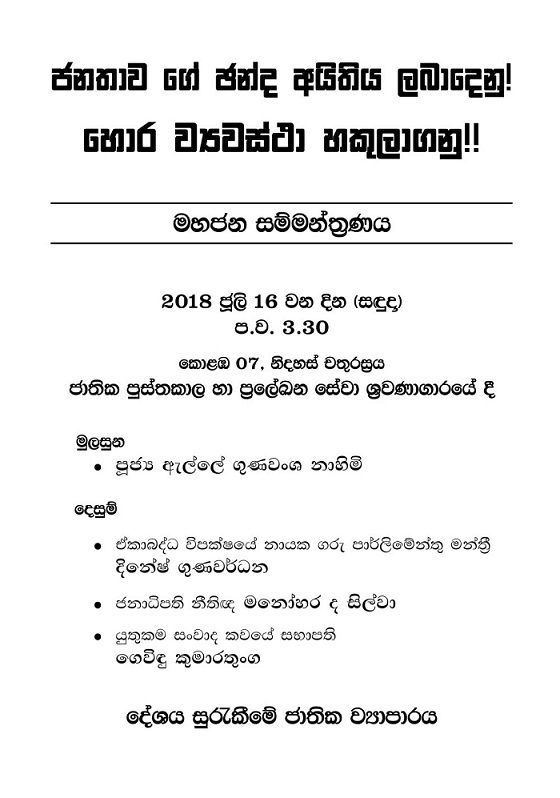


ජන්ද අයිතිය ලබා දෙනු – හොර ව්‍යවස්ථා අකුළා ගනු – සම්මන්ත්‍රණය

July 13th, 2018

ජන්ද අයිතිය ලබා දෙනු – හොර ව්‍යවස්ථා අකුළා ගනු – සම්මන්ත්‍රණය

ඉන්ධන මිල හැසිරවීම තුළින් ජනතාව සූරාකෑම

July 12th, 2018

මාධ්‍ය නිවේදනය මහින්ද රාජපක්‍ෂ ශ්‍රී ලංකාවේ හිටපු ජනාධිපති

සති අටක කාලයක් ඇතුළත දෙවෙනි වරටත් ඉන්ධන මිලේ වැඩි වීමක් අපි අත්දකින පළමු අවස්ථාව මෙය විය හැක. අද පෙට්‍රල් ලීටරයක මිල රු.145ක් වන අතර ඩීසල් ලීටරයක මිල රු. 118 ක් වේ. බොරතෙල් බැරලයක අද දවසේ ලෝක මිල ඇමරිකානු ඩොලර් 74 ක් පමණ වේ. මීට අවුරුදු 10 කට පෙර 2008 දී, අද පවතින මිලට වඩා ‍බෙහෙවින්ම ඉහල මිලක් වූ ඇමරිකානු ඩොලර් 97 කට බොරතෙල් බැරලයක් මිලදී ගන්නා අවස්ථාවේදී පෙට්‍රල් ලීටරයක දේශීය මිල රුපියල් 120 ක් වූ අතර ඩීසල් රුපියල් 70ක් විය. අපේ ආණ්ඩුව රට පාලනය කළ අවුරුදු 09 ඇතුළත ලෝක බොරතෙල් මිල හැමදාම පැවතියේ ඉහල මට්ටමකය. මහ බැංකු වාර්තා වලින් පෙන්වා දෙන පරිදි 2005 නොවැම්බර් මාසයේදී මා මුල්වරට බලයට පැමිණෙන විට බොරතෙල් බැරලයක මිල ඇ.ඩො. 73ක් විය. ඉන්පසු දිගටම එම මිල වැඩි වූ අතර අපේ පාලනයේ අවසන් අවුරුදු හතර වන 2011, 2012, 2013 හා 2014 යන වසර වලදී බොරතෙල් බැරලයක සාමාන්‍ය මිල ඇ.ඩො. 109 කට වඩා වැඩි විය. එම නිසා බොරතෙල් බැරලයකට ඇ.ඩො. 74 ක් යනු අපේ ආණ්ඩුව රට පාලනය කළ සමයට වඩා බෙහෙවින්ම අඩු මිලකි.

අද දේශීය ඉන්ධන මිල අසාමාන්‍ය ආකාරයට වැඩි වී ඇත්තේ ඇයි දැයි ආණ්ඩුව ජනතාවට පැහැදිලි කළ යුතුය. නවතම මිල වැඩිවීම සාධාරණීකරනය කිරීමට මිල සූත්‍රයක් ගැන කතා කරනු අපට ඇසුනත් කිසිවෙකුත් එවැනි සූත්‍රයක් දැක නැත. ආණ්ඩුව මේ සැරසෙන්නේ ඉන්ධන මිල නිතරම අඩුවැඩි කිරීම තුළීන් අවුරුද්ද අවසාන වන විට ඉන්ධන අලෙවියෙන් වැඩි ආදායමක් ලබා ගැනීමටය. මේ ආකාරයෙන් මිල හැසිරවීම, මහා පරිමාන සිල්ලර වෙළඳ සමාගම් වැඩි ලාබයක් ලබා ගැනීම සඳහා යොදන  උපක්‍රමයකි. ආණ්ඩුව මේ ඉන්ධන මිල වැඩි කිරීම සිදුකල සූක්‍ෂම ආකාරයද ජනතාව නිරීක්‍ෂණය කල යුතුය. මුලින්ම ඉන්දීය තෙල් සමාගමට මිල වැඩි කිරීමට ඉඩ දී ලංකා ඛණිජ තෙල් සංස්ථාව පැරණි මිලටම විකුණයි. ටික දවසක් ගොස් ඉන්ධන වලට වැඩි මුදලක් ගෙවීමට ජනතාව හිත හදාගත් පසු ඛණිජ තෙල් සංස්ථාවේ මිලද වැඩි කරනු ලබයි. එක් වරම ඉන්ධන මිල වැඩි කිරීමට වඩා ඒ ආකාරයට වැඩි කිරීමෙන් ජනතා විරෝධය පාලනය කර ගැනීමට ඔවුන් මාන බලයි. මේ සියල්ල කරනු ලබන්නේ ඉන්ධන මිල හැසිරවීම තුළීන් ජනතාව මහා පරිමාන සූරා කෑමකට ලක් කිරීමට බව පැහැදිලිය.

මහින්ද රාජපක්‍ෂ

ශ්‍රී ලංකාවේ හිටපු ජනාධිපති

Fleecing the public through fuel price manipulation

July 12th, 2018

Mahinda Rajapaksa Former President of Sri Lanka

Fuel prices have been increased yet again within a period of about eight weeks – a situation we have never experienced earlier. Now the price of petrol is Rs. 145 and diesel Rs. 118 while today’s price of crude oil in the world market is around USD 74 per barrel. In 2008, when Sri Lanka was buying crude oil at the much higher rate of USD 97 a barrel, petrol was sold at Rs. 120 and diesel at Rs 70. During the nine years in which we ruled the country, world crude oil prices were always high. According to the Central Bank reports, when I first assumed office as President back in November 2005, crude oil was imported to Sri Lanka at around USD 73 per barrel. Thereafter the price of crude oil increased steadily and during the last four years of my government, in 2011, 2012, 2013 and 2014, the average price of crude oil imports was over USD 109 per barrel. Hence the present crude oil price of USD 78 is very low compared to the prices that prevailed when we were in power.

The government should explain to the public why the retail price of fuel is disproportionately high today. The latest price increase is being justified in terms of a price formula which nobody has seen. It is quite clear that this government is aiming to collect more tax revenue from fuel by increasing and reducing fuel prices frequently so that at the end of the year, more revenue would have been collected from consumers. This kind of price manipulation is a standard practice in the large scale retail industry. The public should also take note of the devious manner in which the government implemented the fuel price increase. The Indian Oil Company was first allowed to increase their prices while the Ceylon Petroleum Corporation held back. After a few days when the people had reconciled themselves to a fuel price increase, the government increased the prices at the CPC stations as well. They sought to diffuse public outrage by such means. Such practices are all part of a government strategy to fleece the public through the manipulation of fuel prices.

Mahinda Rajapaksa

Former President of Sri Lanka

කැලෑහඳ, දෝන කමලාවතී තුළින් මතුවන සිංහල දෙමළ නොරිස්සුම

July 12th, 2018

වෛද් රුවන් එම්.ජයතුංග

වර්ගවාදීන් නොවූ ඇතැම් සිංහල නවතකාකරුවන්ගේ ප්‍රසිද්ධ නවකතාවලින් දුවිඩ මිනිසුන් කෙරෙහි සිංහල මිනිසුන් තුළ තිබූ නුරුස්සනාභාවය ප්‍රකට වී ඇත. නමුත් ඒවා වැඩි සැලකිල්ලට යොමු වී නැත. ඩබ්ලියු. ඒ සිල්වාගේ කැලෑහඳ” හා ගුණදාස ලියනගේ ලියූ දෝන කමලාවතී” නවකතාවලින් මෙසේ සිංහල මිනිසුන්ගේ සාමූහික අවිඥානය නිරූපණය වී ඇති ආකාරය විචාරකයින්ගේ අවධානයට යොමු නොවූයේ එය එදවස ඒ හැටි අපූරුවක් නොවූ නිසාද?

ජනවාර්ගික ගැටුම තුළ සිංහල හා ද්‍රවිඩ ජාතීන් තුල පවත්නා සාමූහික අවිඥානයේ බලපෑම අධ්‍යනය කොට ඇත්තේ අඩුවෙන් බව පෙනේ. මෙම ජාතීන් දෙක අතර අවිඥානිකව පවත්නා සතුරු බව හා ගුටුම්කාරී බව ඇතැම් විට වර්තෙමාන ජනවාර්ගික අර්බුධයට තලුලුවක් වන්නට ඇත. එම නිසා ගැටුම් නිරාකරණයේදී සහ ජාතීන් දෙක අතර සාමය හා සහජිවනය ගොඩනැගීමේදී මෙවැනි අවිඥානික සාධක කෙරෙහි සැලකිලිමත් වීමද එවැනි සාධකයන් නිශේධනය කිරීමට ඉවහල් වෙයි.

මේ ශත වර්ෂයේ මුල් භාගයේ හෝ ඊට පෙර සිට සිංහල අවිඥානය තුළ දුවිඩයන් කෙරෙහි තිබුණේ සතුරු බවක් මෙන්ම පිළිකුලකි. එය දුටුගැමුණු එළාර යුද්ධය පිළිබඳව සියවස් ගණනාවක් පුරා ඇසූ සොලීන් පිළිබඳ විරෝධය අපගේ සාමූහික අවිඥානය තුළ තැන්පත් වී තිබේ. ඔවුන් තුලද සිංහලයන් පිළිබඳ ඇත්තේ එවැනිම චිත්‍රයකි. ඔවුන් සිංහලයන් අභිබවා ගොස් අපව යටත් කරගනු ඇතැයි අහේතුක බියක් අප තුළ තිබේ. මහජාතිය වන සිංහලයන් සුළුතරය වූ තමන් ගිලගනු ඇතැයි ඔවුන් තුළද එවැනි අහේතුක බියක් තිබේ.

නිදහසින් පසු මෙම ජාතීන් දෙක අතර ජාතිවාදී කෝලාහල ඇති විය. ජාතීන් දෙකටම අයත් පුද්ගලයන් කුරිරුකම්වල යෙදුනහ. එම නිසා වඩාත් කුරිරු වූයේ කුමන ජාතියද යන්න එතරම් වැගත් නොවේ.

මෙම හැසිරීම හැඳින්විය යුත්තේ සාමූහික අවිඥානයෙන් මෙහෙයවන්නක් හැටියටය. මේ සාමූහික අවිඥානය collective unconscious  පිළිබඳ අප මෙහි අධ්‍යනය කර ඇත්තේ නැති තරම්ය. මේ පිළිබඳ ලෝකයා මුලින්ම දැනුවත් කළේ කාල් ගුස්ටාව් යුංය. හේ පුද්ගල අවිඥානය හා සාමූහික අවිඥානය වශයෙන් ස්ථර දෙකකට අවිඥානය බෙදුවේය. සාමූහික අවිඥානයේ අනාදිමත් කාලයක් පුරා ජනවාර්ගික වශයෙන් හා සංස්කෘතිකමය වශයෙන් මෙන්ම පොදුවේ මානව වර්ගයා ලුළ පැවැති ස්මරණයන්ද එක් රැස්ව පවතින බව ඔහු පෙන්වා දුන්නේය. අපි දැන් ඩබ්ලියු. ඒ සිල්වාගේ කැලෑහඳ” නවකතාවේ මුල්පිටු කිපය පෙරළා මේ ගැන හොයමු.

මාලිනී ද සීයාගේ නියමයට අනුව නිතරම තම කනකර ගැන සෝදිසියෙන් සිටියාය. ඇ‍යට තම ගමේ උත්සවයන් හා රුස්වීම්වලදී මහ සෙනග අතර හැසිරුණු පළපුරුදුකම් ඇතිවත්, ඒ පළපුරුදුකමක වග මෙහිදී නොදැ‍නේ. මේ දකුණු කොළඹ මෙන්ම හින්දු දේවස්ථානයද වෙයි. බොහෝ සේ හැසිරෙන දෙමළ ජනයාද ඇයට අපූර්ව දර්ශෙනයකි. ඈ සිංහල පිරිසකට නම් කැමතිය. සිංහල පිරිසක් අතර තෙරපෙන්නෙකුට ලැබෙන්නේ තෙරපීමේ පීඩාව පමණකි. දෙමළ සෙනඟක් අතර තෙරපෙන්නෙකුට තෙරපීමේ පීඩාව සමඟ වැස්මක් නැති ඇඟෙන් නික්මෙන දෙමළ දහදිය ගඳද ඉවසන්නට සිදුවේ.”

ඩබ්ලියු. ඒ. සිල්වා මහතාගේ විස්තර වර්ණනාව අනුව දෙමළ ගඳ පතුරුවන මිනිසුන් එක්තරා ආකාරයක මනුෂ්‍ය කොටසකි. ඔවුන් අප මෙන් පිරිසිඳු නැත. අපිරිසිදු ජන කොටසකි. ඩබ්ලියු. ඒ. සිල්වා මහතා පිළිබඳව නොදත් පුද්ගලයෙකු ඔහු ඉතා වර්ගවාදියකු ලෙස හෙළාදකිනු නිසැකය. එහෙත් ඔහු කුරිරු ගතිවලින් තොර යහපත් මිනිසෙක් විය. ඔහුගේ පෑන් තුඩින් ලියැවෙන්නේ සිංහල මධ්‍යම පන්තියක ආකල්ප විය හැක. ඔවුන් දමිළයන් කෙරෙහි වෛරයක් නැති වුවද යම් ආකාරයෙක පිළිකුලක් හෝ ප්‍රතික්ෂේප කිරීමක් පෙන්වූහ. මෙම මානසික ශේෂයන් අද දක්වාම සිංහල සාමූහික විඥානයේ රැඳී තිබෙයි. එම නවකතාවේ තවත් තැනෙක දැක්වෙන විස්තරයක් මෙසේය.

ඔන්න….. ඔන්න….. වේල් එනෝ….. වේල් එනෝ….. සිංහලෙන් මාලිනියට ශ්‍රවණය වූ එකම ජනරාවය මෙපමණයි. එයින් මේ වේල් පෙරහැර එන කලබලය බව ඈ තේරුම් ගත්තාය. ඇය කෙරේ ද වේ ල් පෙරහැර දකින ආශාව බලවත් විය. එහෙත් ඇයට එය තවමත් නොපෙනේ. ඇයට වරින්වර පෙනෙන්නේ සෙනඟ සැඩපහර මැදින් පෙම් කෙළින මත්ස්‍යයන් මෙන් උඩ නැගෙන වේවැල් පහරවල් හා බැටන් පොලු පමණකි. කෙළිලොලින් මත්ව විගඩ වෙසින් නටන දෙමළ ජනයා සංසිඳුවන ‍පොලිස් භටයන්ගේ හා පෙරහර නායකයන්ගේ මේ බැටන් පොලු හා වේවැල් සරඹය අන් කාහට කෙසේ වුවත් මාලනියට නම් සිත් පිනවන දර්ශනයක් නොවීය.”

මෙම විස්තරයෙන් ගම්‍ය වන්නේ වේල් පෙරහර නිාස කලබලයට පත් වූ ද්‍රවිඩ සෙනගට පොලිස් භටයන් විසින් පහරදීමය. එකල එවැනි පහරදීම් නිබඳවම සිදු වූ බව පැරණි පොලිස් නිලධාරීන් අවංකවම පිළිගනියි. එය ඩබ්ලියු. ඒ. සිල්වා මහතගේ විස්තර වර්ණනාවටද එක්විය. මෙම විසත්රය බෙහෙවින්ම කිට්ටුවන්නේ බර්මිංහැම් හි 60 දශකයේ මාටිං ලුතර් කිංගේ සාමකාමී පෙළපාළියට පොලිස් භටයින් විසින් පහරදීමය.

දශක ගණනාවක් පුරා කැලෑ හඳ කියවන පාඨකයන් මේ වන තෙක් එවැනි පහරදීමක් හෙළාදැක නැත. කිසිඳු ප්‍රශ්න කිරීමකින් තොරව අපි දශක ගණනාවක් කියවූයෙමු. එසේම චිත්‍රපටයට ද නැගුණි. කිසිවකු මෙම ඡේදය පිළිබඳ කිසිදු ප්‍රශ්න කිරීමක් නොකළහ. එ මන්දයත් අපගේ ලෝකයේ මෙය සුළු සිද්ධියකි. කිසිසේත්ම ගණන් ගත යුතු නොවන්නකි.

අපගේ සංස්කෘතිය කේන්ද්‍ර කොට සිතීමේදී අප එය පිටස්තර අහඹු සිද්ධියක් ලෙස සලකමු. එහෙත් 1915 බෞද්ධ පෙරහරකට යෝනකයන් ගල් ගැසූ විට අපි සසල වූයෙමු. ආගමික පෙරහරකට අවහිරතා ඇති කළ හැක්කේ කෙසේද? යන්න අපි ප්‍රශ්න කෙ‍ළෙමු. එහෙත් කැලෑ හඳ නවකතාවේ පොලිස් භටයන් ද්‍රවිඩ බැතිමතුන්ට බැටන් පහරදීම අපගේ චින්තනය අනුව සුළු සිදුවීමකි.

එවැනි පහර දීමක් ඔවුන්ගේ කෝණයෙන් බලමු. ‘දුප්පත් ද්‍රවිඩ බැතිමතුන් පිරිසක් වන අප වේල් පෙරහැර නැරඹීම සඳහා පැමිණියෙමු. අපගේ උනන්දුව තීව්‍රර වීමෙන් පාර මදක් අවහිර විය. එහි රාජකාරියේ නිරතව සිටින සිංහල පොලිස් භටයන් අපට නිර්දෙය ලෙස පහර දුන්හ. අප දුප්පත් නිසාත්, අසරණ නිසාත්, කළ හැක්කක් නොවීය. බැටන් පොලු පහර වැදීම නිසා තඩිස්සි වී ගිය අත් පාවල අපි තෙල් ආලේප කළෙමු.’

මෙවැනි සිද්ධියක් දැන් දුටු පුද්ගලයෙකුට ඇතිවන හැඟීම කුමක්ද? එසේම තමාගේ පියා එලෙස නිර්දය ප්‍රහාරයකට ලක්වනු දැකීම තුළින් දෙමළ ළමයා තුළ ඇතිවන හැඟීම කෙබඳු වේද? අපි අපගේ සදාචාරයෙන් ප්‍රශ්න කිරීමේ කාලයට එළැඹී සිටිමු. මෙයට ප්‍රතිඋත්තර ලෙස දෙමළුන් ගෝමරන්කඩවලදී හෝ ගෝනාගලදී සිංහල දරුවන් පෙති ගැසූ බව කිවහැක. එක වරදක් තවත් වරදක් මකා නොදමයි. කුඩා වතුර බින්දු බිඳු එක්වීමෙන් මහා ජලාශයක් සෑදෙන අයුරු අපි පාසලේදී උගත්තෙමු. සිංහල, දෙමළ, වාර්ගික අර්බුධය එලෙස කුඩා ජලබිඳු එක්වීමෙන් සැදුනු මහා ජලාශයකි. අපි යලිත් කැලහඳ කෘතියට පිවිසෙමු.

මාලිනියට කැලෑ හඳේ දෙමළ ගඳ ඉවසිය නොහැකි විට හටගන්නා තත්වයයි මේ ‘සෙනඟ මැදද නොයෙක් ගැටුම් ගැටෙන බව ඇයට දැනේ. එහෙත් ඒ කිසිවක් ඇයට නොපෙනේ. ඇය ඉදිරියේ තාර ගා කළු කළ තාප්පයක් වැනි උරයෙන් උර පැහැර සිට එකම දෙමළ සරණියක් හැකිතාක් උස් වෙමින් ඒ දෙමළ පෙළට ‍උඩින් කරනගා ඈ මේ නැටුම් බලන්නට වෑයම් නළාය. ඇයගේ වෑයම සඵල නොවීය. ඇය වැනි බොළඳ වියේ සිටි මිටි තරුණියකට තබා උස පිරිමියකුටවත් මේ සෙනග සරණිය ඉක්මවා කිසිවක් දෙස බැලිය නොහැකියි. ඈ සුසුම් හෙලුවාය. සුසුම් හෙලීමට විනා ගැනීමටවත් ඇයට අවකාශයක් නැති දෙමළ ඇඟවලින් නික්මෙන දුගඳ එතරම්ම පිළිකුල් විය.’

ඩබ්ලියු. ඒ. සිල්වා මහතා දමිළයන් ගැන වර්ගවාදී පිළිකුල් කෝපයකින් බැලූ පුද්ගලයකු නොවීය. ඔහු සඳහන් කරන්නේ එකල සිංහලයකු දෙමළ ජනකායක් ග්‍රහණය කරගන්නා ආකාරයයි. හැබැවින්ම ජාතීන් දෙක අතර තදබල හිඩැස් තිබූ බව මේ අනුව පෙනීයයි. කැලෑ හඳ නවකාතාවේ සිංහල සාධූ නාදය සහ හින්දු හරෝ හරා නාදය සන්සන්දනය කරයි.

අපි ආගම්වලිනුත් දුරස්ව සිටියෙමු. අපගේ ආගම ශ්‍රේෂ්ඨ බවත්, අන්‍යන්ගේ ආගම මිත්‍යා දෘෂ්ටික බවත් උපකල්පන කරන්නේ තත්ත්වය උග්‍ර වූ විටදීය.

රත්තරන් සොයා දකුණු ඇමරිකාවට ගිය ස්පාඤ්ඤ ජාතික පිසාරෝ ස්වදේශික ජනයා මරා දැමුවේ ඉතා කෲරත්වයක් පෙන්වමිනි. එහෙත් එම ඝාතන පිළිබඳව ඔහුට කිසිඳු වරදකාරී බවක් නොවීය. ඒ මන්දයත් ස්වදේශිකයන් ක්‍රිස්තු භක්තික නොවූ මිත්‍යා දෘෂ්ටිකයන් වූ නිසාය.

දොන් ජෙරනිමෝද අසවේදු ඇතුළු පෘතුගීසී සෙන්පතියන් සිංහල ගම් විනාශ කළේත්, මිනිසුන් කිඹුලන්ට ආහාර පිණිස දැමූවේත්, බිළිඳුන් උඩ දමා කඩු තුඩින් අල්ලා කඩුගෑවේත්, ඔවුන් මිත්‍යා දෘෂ්ටිකයන් වූ නිසාය. ඔවුන්ගේ කෝණයෙන් බලනවිට ඔවුන් ඝාතකයන් නොවේය යන නිගමනයට පහසුවෙන් එළැඹිය හැකිව තිබුණි.

කැළෑ හඳ කෘතියට බොහෝ කලකට පසුව 1971 වසරේ පළකරන ලද ගුණදාස ලියනගේ මහතාගේ දෝන කමලාවතී නවකතාවේ දෙමළ වතු කම්කරුවන් ගැන මෙසේ කියයි.

කඩයට ආගිය අයගෙන් මා වඩාත් පිළිකුල් කළේ හල්වතුර වත්තේ දෙමළ මිනිසුන් සහ ගැහැනුන්ය. දෙමළ මිනිසකු හෝ ගැහැනියක කඩයට එන විට මා ඇස් පියාගෙන සිටියත් ඔවුන් ගඳින් ඇඳින ගැනීමට මට ශක්තියක් තිබුණි. ඔවුන් ළඟ තිබුණේ පුදුම හඬු ගඳක්, හඬු ගඳගසන වේට්ටිවල, සාරිවල ගැටගසා ඇති සල්ලි දිග හැර මා අතට දුන් විට මා ඒවා ගත්තේ අදං ආතාගේ සල්ලි ගන්නවාටත් වඩා පිළිකුලෙනි.”

ගුණදාස ලියන්ගේ මහතා බොහෝ ඇසූ පිරූ තැන් ඇති වියත් ලේඛකයකු විය. ඔහු ජාතිවාදියකු නොවීය. මෙම නවකතාවෙන් ප්‍රකාශ වන්නේ ද්‍රවිඩ වතු කම්කරුවන් පිළිබඳව ගැමියන් තුළ තිබූ චිත්‍රයයි. ඔවුන් අසරණ නමුත් පිළිකුල් සහගත කොටසක් බව ගැමියෝ විශ්වාස කළහ.

ඩබ්ලියු. ඒ. සිල්වා මහතාත්, ගුණදාස ලියනගේ මහතාත් පෙන්වාදෙනුයේ දමිළයන් පිළිබඳ සාමාන්‍ය ජනතාව තුළ තිබූ හැඟීම්ය. ඔවුන් පිටස්තරයන් බව සිංහල අවිඥානයේ තිබුණි. එම නිසා ජනවාර්ගික ගැටුම්වලදී සහකම්පණීය අවබෝධකයින් තොරව ඔවුනට පහරදීමට ගැමියන්ට හැකි වූහ.

වාර්ගික වශයෙන් එකිනෙකා ප්‍රතික්ෂේල කරන හෝ සතුරු බව පෙන්වන අවිඥානික ශේෂයන් සිංහල හා ද්‍රවිඩ මනැස්වල රැඳී පවතියි. එම නිසා එවැනි අවිඥානික ශේෂයන් පිළිබඳ දැනුවත් විම හා විශ්ලේශනය මඟින් මෙම ජාතීන් දෙක අතර පවත්නා දුරස්ථ බව අවම කළ හැක. එබැවින් ගැටුම් නිරාකෙරණයේදී මෙකී අවිඥානික ස්කීමාවන් (Schema) කෙරෙහි අවධානය යොමු විය යුතුය.

වෛද් රුවන් එම්.ජයතුංග  

Sri Lanka is in need of friends

July 12th, 2018

N.A de S. Amaratunga 

Sri Lanka is badly in need of a friend. There are big powerful countries, some nearby and others far away, who say they are our friends, but going by what they are doing to us,  if they are our friends we don’t need enemies. We  know that these countries have their geopolitical imperatives and that we must not rub them on the wrong side. We don’t need to make enemies unwittingly. Yet in this time and age a country needs independence and sovereignty. Colonialism is dead and gone and imperialism is being fought against in every front. We also fought against it quite successfully in our glorious past and also recently when we defeated the LTTE. Further several times in our history we have also capitulated to the diktat of foreign powers and similarly now we have surrendered and are almost a subject nation courtesy the government. It is true that if we elected the government we are the cause of our predicament though it is more probable that it was installed by the same powers that exploit the country now.

Now the country seems to be in great peril due to the actions of our so called friends. The most serious and far reaching problem is the proposed constitutional changes which the Prime Minister presented to the parliament recently. This constitution is not of our making. It is probably made in USA in consultation with the Tamil diaspora. Though Mr Jayampathi Wickramaratne claims authorship , he may have fine tuned it but the basic concepts must have originated in the USA. Mr.Wickramaratne must have crafted the deceptive clauses in order to hide the federal nature. The unitary status has been deceptively altered. His claim that the unitary status has not been changed cannot hold water because in that case there is no need to change the existing clauses that describes the nature of the state as unitary. Land and police powers are also to be devolved to the periphery. Further the concurrent list is to be removed which would further weaken the controlling powers of the central government over the provincial councils. Moreover the presidential powers would be further pruned or totally removed and the governor who is the representative of the executive president would also be removed thereby delinking the periphery from the centre. The result would be a federal state for all practical purposes.

The government was forced by the imperialist West, who had helped it to come to power,  to cosponsor a UNHRC resolution against its own country, the first time in the history of the UN such a thing has happened. Our friendly countries China et al  were bemused and had felt betrayed for they had always voted in support of Sri Lanka and against such resolutions in the past. Our friends were further spurned by verbal denigration and stopping of their big projects like the Colombo Port City project. Ironically the government was forced to go on its knees to China  and beg for assistance as their new friends in the west were not raising a finger to help the government to overcome its financial difficulties. China graciously obliged but the relations were not the same. As long as the UNHRC Resolution 30/1 remains in force the western countries via the UN could interfere in our domestic affairs. The Resolution is not binding and the government need not implement its proposals if it doesn’t want to but this government is in no mood to refrain from doing what the West wants it to do. It has started the process, the constitution reforms are on track, the proposals of the Resolution are being implemented, the Office for Missing Persons  Bill has been passed and its Commission has been packed with LTTE sympathizers, Protection of All Persons from Enforced Disappearance was passed hurriedly on the 7th March 2018 while the country was in turmoil due to attacks against Muslims, and several other similar laws are in the pipeline. These when in place would complete the noose round Sri Lanka’s neck. The country would totally lose its independence and with a federal constitution  may even undergo separation into pieces. This is the design the West has on Sri Lanka. The West has done this kind of destabilization in several countries which are strategically important to them, to make them fall in line with their neo-conservative agenda.

Sri Lanka could avoid this fate if it can get back to its earlier foreign policy frame work which the previous regime put into practice to good effect. The leaders of the previous regime had correctly understood the global geopolitical situation and also who Sri Lanka’s true friends are and who are just pretending and working against our interests. They knew who was helping our enemies the LTTE and trying to destabilize our country and why. They knew if they were to win the war and develop the country they have to stop obeying the orders of the Western countries and strengthen the relations with the opposite camp China et al which was rapidly developing as a world power and changing the global balance of power equation. This policy worked quite well for the previous regime as results show, the war was won and a huge development programme was undertaken. The previous regime of course earned the wrath of the Western powers for finishing off the LTTE  and tilting towards China. The local political opportunists with personal vendetta colluded with the West to topple the previous government. The results are on display, the economy is in ruins and we are fast becoming a subject nation.

The Chinese cannot be called non-imperialists, they have their agenda, they do not give free lunches. They do not, however, interfere in the internal affairs of countries with whom they develop close economic and cultural relations. What they want in their dealings may be raw materials and such. They are not hegemonic and domineering. One may argue this is because China is not interested in human rights concerns, minority rights and justice and fair play while the West is. For this argument to hold the actions of the West in this regard has to be above suspicion and not inimical to the countries they deal with. We know that the West uses the human rights issue as a bludgeon, an imperialist tool to force countries to fall in line with their geo-political agenda. The West has put in place in the UN their armament such as the Right to Protect, the Transitional Justice process etc which they use to destabilize and dominate countries. They themselves, however, seem to be immune to these measures and they commit the world’s worst human rights violations. On the other hand China does not engage in such practices and their foreign relations are designed for mutual benefit and not domination or exploitation. China in this sense is a  friend in deed.

If Sri Lanka is to be secured for its people before it is too late our foreign policy has to be completely overhauled. In the present context of geo-politics and global power play no small country could strictly adhere to a non-alignment policy. At present, though our government including the president claim that with the advent of the present government we have established good relations with all countries what has happened is we have been taken in a hegemonic grip by the western powers. This relationship is not good for the country as shown by the adverse effect it has in the areas of the economy, security, constitution etc. It is the Western powers who had caused all this damage. The government is helplessly obeying the orders of the West in all its important activities. This is not non-alignment but enslavement. Non-alignment cannot free us from this bondage. On the contrary alignment with powerful good friends may help us to be independent and develop our country the way we want.  Countries like ours which are strategically important for the world powers must design their foreign policy carefully. It could have a non-alignment facade but must have a strong relationship with the lesser evil so to speak, an evil who would protect us from the greater dangers and help us to live and develop our country keeping it in one piece. However the people of this country must realize that that would not happen as long as this government lasts.

N.A de S. Amaratunga

Chinese company says contribution to Pushpa Rajapaksa Foundation was part of Corporate Social Responsibility

July 12th, 2018

Courtesy NewsIn.Asia

Colombo, July 12 (newsin.asia): The  Colombo International Container Terminals Limited (CICT), which is a joint venture of the China Merchants Port Holdings Company (CMPort) and the Sri Lanka Pots Authority (SLPA), has  said that the payment of Rs.19,410,000/-to the Pushpa Rajapaksa Foundation was a donation  for the construction of houses for the under-privileged as part of the company’s Corporate Social Responsibility (CSR).

The Pushpa Rajapaksa Foundation is in the name of the wife of Basil Rajapaksa, former Economic Development Minister and brother of former Sri Lankan President Mahinda Rajapaksa.

Denying that the payment was bribe to get the contract to build the Colombo South Terminal, the CICT said in a statement on  Thursday : the donation was made long after the project concession agreement for the Colombo South Terminal had been signed and construction work on the terminal had already commenced.”

This payment is clearly reflected in our audited accounts for the relevant year. We therefore categorically reject the implication that the payment is tantamount to a bribe.”

This issue had already been brought up in the media and was investigated by the relevant authorities three years ago. However, in the wake of these latest reports, we reiterate and bring to the notice of the media and the general public that CICT made a donation to the said foundation, as part of its commitment to Corporate Social Responsibility (CSR), and did not intend it to be, nor believe it to be otherwise.”

CICT has already provided the required information on this matter to the relevant authorities. The company has no further information to provide on the matter, other than for what has already been provided.”

For the record, we wish to reiterate that this donation was a part of CICT’s CSR commitment, and in keeping with this commitment, we have also supported other deserving projects such as providing support to the victims of the Koslanda landslide in 2016 with cash donations and rations; major sponsorship of the Wheelchair Tennis program of Sri Lanka Tennis Association (SLTA); and a donation through the China Merchant Charity Foundation of foldable intraocular lenses and cartridges worth $ 60,000 along with an allocation of $ 200,000 for cataract surgeries for needy patients under the ‘Tribute to love, China – Sri Lanka Free Cataract Surgery Campaign’ etc.”

Once funding is allocated, CICT believes that the funding allocated would be utilized for the said projects by the receiving agencies, without CICT having to play a supervisory role as to the implementation of such projects,” the statement said.

Charge Against CHEC Denied

Earlier, the Chinese embassy denied a New York Times  report that the China Harbor Engineering Company (CHEC), which built the US$ 1.1 billion  Hambantota port in south Sri Lanka, had given US$.7.6 million to former President Mahinda Rajapaksa ahead of the January 8, 2018 Presidential election as a contribution to his campaign.

The embassy and the CHEC both said that the allegation was investigated in 2015 itself by the successor government of President Sirisena and that the company had given strong evidence” refuting the charges. The matter was dropped thereafter.

However, in view of the fact that a fresh probe had been ordered, it would face it as it had done before, the embassy and the CHEC said.

Political Angle

Accusations of Chinese companies bribing  the Rajapaksas were made in the election campaign of the Joint Opposition candidate Maithripala Sirisena in 2014 and early 2015.

After Rajapaksa lost to Sirisena in the election, the Chinese companies were probed. But nothing came of these probes and the   Chinese companies CHEC and CMPort not only continued with their projects but got new ones too.

However, with provincial, parliamentary and Presidential elections due between now and 2020, sections of the government have begun a campaign to tarnish the image of the Rajapaksas.

With the Sri Lanka Podujana Peramuna (SLPP) of the Rajapaksas sweeping  the February 2018 local government elections, the necessity to step up the campaign against Rajapaksas has heightened.

Chinese company says contribution to Pushpa Rajapaksa Foundation was part of CSR


“Be a Hitler” comment – Blown out of proportion

July 12th, 2018

N.A. de S. Amaratunga

Venerable Vendaruwe Upali Thera the Anunayaka of the Asgiriya Maha Viharaya had  at Gotabaya Rajapakse’s birthday ceremony commented that if some of Gota’s detractors call him a Hitler, so be it as the country needs a strong leader if it is to come out of the rut it has been dragged into and at the same time be a dhami nayakayek” – a righteous leader. Obviously the Venerable Monk was not asking Gota to kill millions if necessary to develop this country. Also the Anunayaka’s comment is not a sign of a deeper plot to intricate Gota in a dark matrix” of Sinhala Buddhist extremism aimed at creating a fascist dictatorship. Dr.Dayan Jayathilake is surely seeing theliye kimbullu” – crocodiles in the pan – as the pithy Sinhala saying goes, for he says the Monk’s comments are the most dangerous he had heard or seen in his lifetime pertaining to the politics in Sri Lanka and that it portends a developing trend which could engulf Gota and create a fascist dictatorship in Sri Lanka (The Island, 22.06.2018). The Monk and several leading members of the Sangha have subsequently placed the comments in the correct context and perspective and denied that he had meant that the country should have a dictator as bad as Hitler.  Mahinda Rajapakse also has come out in protest against this attempt to blow out of proportion the Monk’s well intended advise.

Dayan has taken the comments so seriously that he even goes onto show that Hitler did not develop Germany but the country declined during his dictatorship. Further Dayan draws a parallel between the support that Hitler received from the industrialists, Krupps and Thyssens, when he was planning to establish the Aryan super race in Germany and the congregation of businessmen at Hotel Shangrila at the anniversary celebrations of Viyathmaga” in support of Gota’s project. We remember how Dayan spoke in praise of what happened at Shangrila, he said it was Gota’s election manifesto if ever there was one. On numerous occasions he wrote to say Gota was the best option Sri Lanka has as the next president who could salvage this country.  What has happened since then to make him  change his opinion ?  We don’t see any changes in Gota, what he stands for or his support base.

He says the Buddhist clergy advocates a dictatorship under their guidance as the best arrangement to govern this country. On the contrary none of the leading Buddhist monks who support Mahinda and also Gota have said in public anything to that effect. Buddhist monks who support the UNP have not seen a dictator in the making in the phenomenon that is Gota. Dayan says retired military officers have suggested that Sri Lanka must have a leader like Netanyahu in Israel. However none of the leading retired military officers have made such comments, certainly Major Sarath Weerasekera who is the closest retired army officer to Gota has not even hinted about the desirability of a dictatorship in the style of Hitler or a ruthless leader like Netanyahu.  Dayan’s theory is baseless.

If Dayan has referred to the Monk’s comments en passe while on the subject of Gota  one would not mind it but he has attempted to amplify the significance of it beyond imagination and make a huge issue of it. He says that the Monk’s comments and the growing trend of Buddhist extremism is not an insignificant side show but main stream politics. This is a figment of imagination and is totally baseless.  Given the fact that Dayan Jayathilake was an ardent supporter of Gotabaya Rajapakse one is at a loss to think of the reason what has made Dayan metamorphose in this manner for we do not see the phenomenon that he apparently perceives.

His remedy for the imagined dark matrix”, the Buddhist extremist threat, is not to nominate Gota for the presidential election but for Mahinda to contest after changing the constitution or nominate Chamal. Dayan must know that changing the constitution to enable MR to contest again is not easy and also that Chamal has less chances of winning than Gota.  If he is genuine in his support for the Rajapaksas, who he must see as the saviours of the country at this juncture, though they are not perfect, he must not attempt to rock the boat at this crucial moment.

N.A. de S. Amaratunga

“CHINA ONE – ROAD ONE- BELT SILK ROUTE – SUB INITIAVE IN THE ISC REGION”

July 12th, 2018

Sarath Wijesinghe – former Ambassador to UAE and Israel

A FUTURE HUB FOR TRADEAND LOGISTICS IN THE INDIAN SUB CONTINENT”

It is now certain cemented and unstoppable that Sri Lanka Port City” is the future Hub of business activities and foundation of the success of new Sri Lanka in the new world and business order in par with world giants exploiting the geographical situation and historical/traditional links with China and other business leaders. Sri Lanka has many advantages over other counterparts of landfilling projects in the world with ideal strategic and geographical situation in the Indian ocean with full of future potential. Despite concerns it is our duty and mandate to complement the project in the best interest of Sri Lanka and the rest of the world including neighbors and beneficiaries in the orbit. It is with this in the agenda that the seminar on TOWARDS THE MAIN FINANCIAL HUB OF ASIA” special seminar is organized on 14th July at Light house Auditoriums” in order to plan out strategies in the implementation process of this mega project. Series of serious discussions and projects are due to launch in due course.

SECOND WORLD ECONOMIC GIENT”

China is the second world economic giant and an emerging economic superpower helping the members of the world family with no ulterior or any political considerations as many economic/political giants with geographical considerations/interests on small and neighboring nations. She has 1.379 billion with GDP 112.2 Trillian (in dollars) to feed compared to the immediate neighboring economic competitor – India with a population of 1.324 billion with GDP2264 million. China is historically and traditionally whose traders travelled worldwide as merchants and Cultural and Business Ambassadors” with no plans or schemes of control other states or extract wealth as the Western Colonial Masters” colonized other states exploitation the wealth/resources and disturbing the religious and cultural values of inhibitions. Belt Road initiative (BRI) is initiated and launched setting an international cooperation platform for the global public good following the traditional silk route for the 21st century with the rest of the world with initial and substantial funding from China with the vision of President XI Jinpig” as the leading personality on the multibillion operation in which five trillion global trade pass through South China Sea. China Sri Lanka relations runs back to centuries with religious cultural and close friendships uninterrupted

despite the asymmetrical size and the distance recorded in historic and religious documents by traders and Buddhist monks voyaged in hundreds exchanging knowledge and customs with close bonds based on religious principles and teachings of Lord Buddha. BRI is initiated for global public good forming an international cooperation initiative (ICP) platform. Sri Lanka is one of the first few countries to receive a loan of 7 billion with 1.8 million (all in dollars) in 2015 with close relations maintained between the two friendly nations. ICP initiative is the largest platform on economic growth connecting China, Persian Gulf, Mediterranean, and the Indian Ocean at the cost of 900 billion for an era of global world order costing 8 Trillian for infrastructure benefiting 92 countries which is 65% of global population, will benefit these countries at a cost of 9500 billion. India is concerned about the Chinese presence in Dokalm” (Bhutan), Nepal, Sri Lanka, Maldives Islands, Myanmar, and other small states in the Indian Ocean and on the silk belt maintaining economic bonds when the Chinese Leader has changed the constitution to be the life lime.

CONNECTIVITY THROUGH MODANIZED SILK ROUTE”

One of the main aims of the initiative is connectivity and cooperation between Euro Asian countries for the economic benefits of all targeting the entire world economy to be on the doorstep of Asia the booming and upcoming economic zone. Silk route will be transferred to a vibrant and mega economic route reviving the traditional silk route existed over thousands of years connecting the people’s countries and contentment’s economically socially and culturally. China is the second world economy trusted by the small nations as friendly with proven historically by no ulterior hidden political agendas except trade business and investment on long term plans. India with her regional supremacy mentality has antagonized many neighbors and small nations, being an important factor on the management of the foreign policy of small nation and more especially the neighbors, due to the cold war between the giants on the supremacy of the Indian Ocean coupled with economic and political competition. It is time for us to manage diplomatically political and ideological differences if any at all and use the friendly relations and Good Offices of the Sri Lankan professionals abundantly available in Sri Lank and worldwide for a coherent vibrant and Sri Lanka friendly Foreign and Trade Policy” initiative in political and economic fronts. It appears that there are constant disagreements on Indian and Chinese trade, foreign and policy on small states with detrimental effects on the small nations sandwiched in their trade and geopolitical war. India is demanding a better foothold in Sri Lanka due to Chinese effective presence economic corporation; the new Road/Belt initiative will irk and worry India further planning closely with the common enemy for supremacy on trade and geo political power. In any event connectivity will help the countries in the belt including India and the success of the initiative will be for the best interest of many counties on the belt and the region mostly benefiting Sri Lanka a close friend and ally of China historically.

HUB DIPLOMACY”

China has two way trade of 3.5 Trillian aiming to be a leader in the digital age having the digital giant Alibaba” based in her country making use of world languages while uplifting Chinese language, is planning HUB DIPLOMACY” encouraging trade HUB’s on the proposed Silk Road with the new venter one road one belt initiative. In the circumstances Hambantota-Magama Harbor is a WIN WIN” situation for centuries for China to have a foothold in the most strategically important point on the sea route in Asia – a Dubai, Singapore, Pakistan, are developed Hubs due to the strategic situation and manmade mega developments, out of which Hambantota-Magama” is the Hub Leader” being the center of the Indian Ocean and a main stopover in the traditional Silk road rejuvenated by modern Belt/Road initiate by China pumping trillions for development of 92 countries around the route. Dubai once has been a fish market with no oil (only 4% oil unlike rich Abu Dhabi) but strategic with sea and air routes which the visionary leader exploited. In any event the new Road/Belt initiative will be a boom on Hub Diplomacy and formation of new HUBS on the silk route with improved business for the surrounding nations as satellites of modern economic China initiative.

FOREIGN POLICY

Foreign Policy of a nation is a pre requisite for development and prosperity. It has direct and impact on commerce and trade relations among members of the world family and the world, in the set of rules outlining the behavior of a particular country. Sri Lanka has had excellent relations for thousands of years with the world especially China molded on religious and cultural Values and developed on the traditional silk route which is still continuing. Rev Faxian” came to Sri Lanka in 5th century with 200 monks and 256 Sri Lankan monks visited China in return and there were subsequent visits continuously. Sri Lanka supported China in 1950 at the United Nations when she needed our help and Rubber Rice Agreement is a main milestone on SL China relations. Though asymmetrical in size and economy the friendship was on equal grounds and both countries are friends in need helped each other in international and UN deliberations. Let this be an eye opener for India and the other countries close to the belt and in Broader Asia” to think Asian” and come forward with similar innovative products and initiatives as Asians. Contact 0777880166-0779824007-0772016641-775904821-and 0777706056 for further information on the seminar on 14/7/2018 at Light House Auditorium, 24 Horton Place Colombo 7 on TOWARDS THE MAIN FINANCIAL HIB OF ASIA PORT CITY 2018. (Reading Materials- China Sri Lanka relations SL Guardian on 15/ 8/2015,Economic Diplomacy 4/8/ 2015 Colombo Tribunal, Madam B’s Charm and Firm diplomacy with China 16/4/2015 Telegraph, Is Sri Lanka foreign policy effective and productive 5/4 2015 Telegraph/ all by the author who is the former Ambassador to UAE and Israel)

Kumar David’s Gota-phobia

July 12th, 2018

N.A.de S. Amaratunga

Kumar David (KD) in a virulent mood says Gotabaya Rajapakse must be defeated, has to be defeated and can be defeated (Sunday Island, 10.06.2018).  Title of his article is Stop Gotabaya-Rex” which is perhaps to suggest that Gotabaya Rajapakse in his activities resemble the dinosaur named Tyrannosaurus-Rex” or T-Rex for short who is a predatory flesh eating killer! The word Rex in T-Rex means king for the latter was a king among dinosaurs. However KD who wants to defeat Gota may not have meant to be complementary and he must have meant that Gota would not hesitate to use violence to achieve his end. By the way recent research shows that most of the dinosaurs were vegetarian and T-Rex was an exception rather than the rule. Dinosaurs had very small brains and were eliminated by a comet impacting on earth. Gota is a very intelligent person and a strong personality more like an elephant than a dinosaur.

KD must have contracted  Gota-phobia from the LTTE who attempted to kill Gota during the height of the war. All LTTE sympathizers have a fear of Gota and also an equally strong animosity. Now they want to defeat him as they cannot kill him. KD does not say in clear terms why he has to be defeated at a future presidential election. Instead he gives a plan how to defeat Gota. Well may be he needs a comet to kill this dinosaur but what he has seems to fall far too short.

His plan is simple. Twenty three percent of votes would come from the minorities and 25% from the UNP vote base in the Sinhala Buddhist majority. The balance 2.1% needed to make the required 50+%  might come from the JVP votes which do not belong in the aforementioned groups. Well that’s fine and  now he looks for a candidate which he says is crucial for his plan.  And he has two options, Ranil Wickramasinghe and Anura Kumara Dissanayake. His choice shows how empty his basket is. Ranil Wickramasinghe backed out twice from the contest and got others to fight his battle. Let us leave that aside. RW had an excellent opportunity to prove his capabilities, when he was the prime minister, once in 2002 and then in 2015. He not only squandered both opportunities but brought the country to near ruination. Today the economy, in its negative aspect, is similar to that in 2002 and is sliding down fast. KD must be frantically desperate to defeat Gota. Why else must he clutch at straws. His other prospective candidate Anura Kumara Dissanayake is no presidential material and may not be acceptable to the people even if he is to the UNP.  Sajith Premadasa has indicated that if RW is not contesting he could step in. Sajith would certainly be a better candidate than either RW or AKD. UNP may not agree to put forward an outsider for the presidential election. The party suffered twice due to such blunders. Though their candidate won in 2015 they are in utter despondency now not knowing what to do with what they created. Would they take that risk again and ask their supporters to vote for AKD? Most unlikely. It is most likely that the UNP would nominate RW which is KD’s choice as well, for the UNP is as bereft as Kumar David.

Kumar David says Gota is a doer though he may not approve of the methods adopted by the latter which perhaps is why he has given Gota a dinosaur’s name. Why? Did Gota commit atrocities or war crimes in winning the war against the world’s most brutal terrorist organization? There is no evidence to support such a determination. On the contrary there is overwhelming evidence to prove that the army took maximum precautions to minimize civilian deaths and did its utmost to rescue civilians from the clutches of the LTTE who were using them as human shields. The Paranagama report, Sir Desmond de Silva’s report and Lord Naseby’s findings provide enough and more evidence  to prove that war crime allegations against the armed forces are baseless.

Further did Gota behave like a dinosaur in developing the city of Colombo to be named the number one developing city in the whole world? Are there in Colombo people who have been evicted from their properties without adequate compensation? Land acquisition is required for the greater good such as building of highways etc and is provided in the laws of the country. There is nothing illegal as long as adequate compensation is paid. Unauthorized constructions and squatters cannot be allowed at the expense of the citizens and have to be evicted for beautification of the city. If there are people unfairly treated in this connection by now they would have come forward and created a din as there is no Gota in power to make them disappear and the UNP and the JVP would have paraded them in their campaigns.

Did Gota cause any inconvenience or harass anybody in garbage disposal when he made Colombo spic and span? Do we hear anybody complaining? This government could not even prevent the accumulation of garbage leave alone maintaining what was achieved by Gota in the city of Colombo. If winning the war and making Colombo number one city in the world are the achievements that make Gota a doer in the eyes of KD isn’t that proof of the pudding. Neither in the war nor in the Colombo city has Gota behaved like a T-Rex. He did everything in a quiet, intelligent and efficient manner with least damage.

KD has rubbished the economic programme presented by Gotabaya Rajapakse at the anniversary celebrations of the Viyathmaga”. He says it is full of platitudes and banalities. If the present government had been successful in carrying out the policies described in those platitudes and banalities the country would not be in the present economic crisis. This is exactly what Gota said when it was pointed out to him that his programme was not different from that of the government. It is a question of implementation which the present government cannot do due to its internal strife and contradictions.

Popularity of the government in general and RW in particular, due to all misdeeds worst of which was the Bond scam, is on the decline and cannot be expected to recover by 2019. The younger generation who was promised a  million jobs has not got any. The youth according to KD himself have no party affiliations and would use their brains to decide whom to vote. Will they vote for RW?  KD’s arithmetic may not hold at the next presidential election in 2019. MR lost the 2015 election not due to the efforts of people like Kumar David but due to the fact that his development efforts had not accrued the people then and the cost of living was very high. Due to these reasons MR’s party suffered an electoral setback at the PC election in the Monaragala district which is 95% Sinhala Buddhist. That result should have been a forewarning to MR and he should not have gone for a presidential election at that time. But by now things have turned around as was seen at the recent LG polls.

But more importantly KD has not explained why Gota has to be treated like a dinosaur. He has not said specifically why, a doer in his own words, has to be defeated and not allowed to use his talents and take this country out of the abysmal situation it is in courtesy RW and his team. RW is full of warts KD says, yet he prefers RW to Gota. Reason for this preference is not explained in his letter. Let KD tell us why he prefers MR to Gota.

N.A.de S. Amaratunga

Fallacious assumption of symmetry in the resolution of the  so-called National Problem

July 12th, 2018

R Chandrasoma

It is a widespread belief entrenched both among political leaders and civil analysts that that the insurrectionist instincts in the North are matched by equally obnoxious attitudes of racial exclusiveness in the South. Indeed, it is openly stated by the Southern Political Leadership – that includes such luminaries as Ranil Wickramasinghe and Chandrika Kumaranatunga – that violence and confrontational politics in the North will not abate until and unless the Sinhala Majority abandon their claim to autochthonal status – that they have rights and privileges in virtue of the historical fact they not only the original inhabitants of the Nation-State of Sri Lanka but also the creators of a culture and a civilization that made this land unique among the ancient nations of the world. The Tamils made episodic forays into ancient Sri Lanka and were either assimilated or driven out – the advent of the White Colonialist made the invading Tamils a parasitic presence that has distorted the true ethnic composition of Sri Lanka – the Land of the Sinhala People.

Let us re-examine the ‘symmetry issue’ in the light of of this indubitable historical record. Surely the Sinhala People have claims and privileges that cannot be matched by those  who arrived later as cultural intruders – the claim of symmetry in the political expression of the right to life can be granted, but the culture and character of this Island Nation cannot be ‘divided’ or ‘balanced’ on the basis of the numerical strength. militancy or political clout of intemperate minorities. Indeed, the latter is the sure way to reduce this historic nation to global insignificance, That some of our political leaders and learned analysts of the ‘Sinhala Kalu-Suddha’ kind are ‘batting’ for the Principle of Political Equivalence should not occasion surprise as our insular status and the battering we have received from invading aliens have made our leaders better at finding fault  than in cherishing our uniqueness.

It is in the light of these historical facts that we must make sense of the current fears about the possible  rise to power of a powerful leader such as Gotabaya R  in Sri Lanka. The fear is atavistic rather than political – the fear that the Sinhala Nation will be proud again after the recent abnegation and shameful humbling before an international caucus determined to reduce to insignificance one of the oldest civilizations in the World.

රු. 16-18 ට දෙන බවට ගිවිසුම් අත්සන් කළ කෙරවලපිටිය වෙස්ට් කෝස් විදුලි ඒකකයට රු. 29.85 ක සාමාන්‍ය ගෙවීමක් කරලා. විදුලිබල මණ්ලයට සිදුවූ පාඩුව රු.බිලියන 18 ඉක්මවයි.

July 12th, 2018

මාධ්‍ය ඒකකය CaFFE

2018 ජූලි 12

රු. 16-18 ට දෙන බවට ගිවිසුම් අත්සන් කළ කෙරවලපිටිය වෙස්ට් කෝස් විදුලි ඒකකයට රු. 29.85 ක සාමාන්‍ය ගෙවීමක් කරලා. විදුලිබල මණ්ලයට සිදුවූ පාඩුව රු.බිලියන 18 ඉක්මවයි.

කෙරවලපිටිය වෙස්ට් කෝස් ඩීසල් විදුලි බලාගාරයේ විදුලි ඒකකයක් සදහා ගෙවිය යුතු මිල යාවත් කාලීන නොකිරීම නිසා ගෙවී ගිය වසර 8 තුල රු. බිලියන 18 කට වැඩි මුදලක් ලංකා විදුලි බල මණ්ඩලයට පාඩු වී ඇතැයි ශ්‍රී ලංකා මානව හිමිකම් කේන්ද්‍ර‍ය නිවේදනයක් නිකුත් කරමින් පවසයි.

කෙරවලපිටිය විදුලි බලගාරයේ ගනුදෙනුව ආරම්භයේ සිටම දුෂිත ගණුදෙනුවක් වන අතර, ඒ සදහා වැය වන මුදල ඇමරිකානු ඩොලර් මිලියන 225 ක් ලෙස සදහන් කොට අදාළ ටෙන්ඩරය ලක්දනවි සමාගම විසින් මිලදී ගෙන ඇති නමුත්, සැබෑ ලෙස ඒ සදහා සමාගම විසින් ඇ.ඩො. මිලියන 294 ක් වැය කර ඇත. එම පාඩුව දැරීමට සිදුව ඇත්තේ ද, විදුලිබල මණ්ඩලය හරහා මේ රටේ බදු ගෙවන ජනතාවටය.

වෙස්ට් කෝස් විදුලි සමාගම විසින් නිෂ්පාදනය කරන එක් විදුලි ඒකකයක් සදහා 2008 සිට 2017 දක්වා වසර 9 තුල එක් ඒකකය රු. 29.85ක සාමාන්‍ය අගයක් ගෙවා ඇත.  2013 වසරේ දී ඒකකයක් සදහා රු. 46.93 ක් ද, 2014 දී ඒකකයක් සදහා රු. 42.55ක් ද, ගෙවා ඇත.  2015 දී ඒකකයට රු. 36ක් ද, 2016 දී ඒකකයට රු. 33ක් ද බැගින් ලක්දනවි සමාගමට ගෙවා ඇත.

ශ්‍රී ලංකා මානව හිමිකම් කේන්ද්‍රයේ විධායක අධ්‍යක්ෂ කීර්ති තෙන්නකෝන් මහතා පැවසූවේ,  ඩීසල් විදුලි මාෆියාව ලෙස ව්‍යවහාරයේ හදුන්වන හදිසි විදුලිය මිලදී ගැනීම් සදහා විදුලිබල මණ්ඩලය ගෙවනු ලබන්නේ රු. 30 ක ආසන්න මුදලකි.  සුළං බලයෙන් විදුලි උද්පාදනයේ දී ඒකකයක මිල රු. 10.07 ක් වන අතර, සූර්ය බලයෙන් නිපදවන විදුලිය සදහා විදුලිබල මණ්ඩලය මේ වන විට ගෙවමින් සිටින්නේ රු. 11.86ක මුදලකි.  ඒ අනුව, ස්වභාවික විදුලි ප්‍ර‍භවයන්ගෙන් විදුලිය උද්පාදනයේ දී වැය වන මුදලට වඩා තුන් ගුණයක් වැය කරමින් විදුලිය මිලදී ගැනීම සිදුව ඇත.  

විදුලිබල ජනන කේෂ්ත්‍ර‍ය ලංකාවේ දුෂිතම මාෆියාවයි.  අප පසුගිය වසර 5 තුල ලබාදී ඇති ටෙන්ඩර් 18 ක් විමර්ශනය කර තිබෙනවා.  ඒ සියල්ලම ආරම්භයේ සිට අවසානය දක්වා විවිධ අධියරවල දී දුෂණයන් සිදුව තිබෙනවා. යැයි ද තෙන්නකෝන් මහතා පවසයි.

මාධ්‍ය ඒකකය

2018 ජූලි 12

Joint opposition will become Joint Podujana Peramuna in the future

July 12th, 2018

ඒකාබද්ධ විපක්ෂය ඉදිරියේදී ඒකාබද්ධ පොදුජන පෙරමුණ වෙනවා

THE CONTRADICTING ROLE OF CIVIL SOCIETY ACTIVISTS IN SRI LANKA

July 11th, 2018

BY EDWARD THEOPHILUS

Civil society is generally considered as an instrument that works as unions of civilians, which organized for the benefits of civilians in a country.  The meaning of civil is similar to the definition of the word civil” in law, for example, the law is basically divided into civil law and criminal law. The meaning of civil also applies to the word of civil in the term of civil society. Civil society defines in Wikipedia as” the aggregate of non-governmental organizations that manifest interest and will of civilians”. The civil society organization in Australia defines that “civil society comprises the relationship and activities that make up the life at the grassroots level of society, in families, communities voluntary associations'(www.civilsociety.org.au).  It clearly indicates that the term civil society does not refer to politeness or civility in public life.

According to the general definitions of civil society, the role of civil society activists appears to be complex at the global level, but I feel that it shouldn’t be a political role or a government role or an attempt to bring an interested person or a political party to form a government. As ordinary people, the general public has an understanding that civil society activists should not play politics in the society, which focused on activities that aiming to bring a political party or a preferred figure to power in an election. Obviously, the behavior of civil society activists in Sri Lanka has come to light that they have seriously aligned to some form of party politics and attempt to mislead international community that they are playing the right role, which could be justified and accepted by the citizens of Sri Lanka. The hidden motive of these activists is to attracting funds for their survival.

Civil society in Sri Lanka has been working since the colonial rule, various type of voluntary organizations such farmers groups, cooperatives, religious groups, benevolent societies, and many others were working in the society without open or hidden political motives.  Therefore, the public appreciated the role of them and generously contributed to fundraising attempts and worked with them in common activities such as Sramadana, Cultural events, sports events and many others.  Currently so-called civil society activists don’t play a role extending supports to traditional civil society, despite they do play selfish   and hidden role for international hegemony related politics.

By the definition of civil society, any member of political parties or army forces could work with activists of civil society as they are too civilians of the country.  Accordingly, members of UNP, SLFP, SLPP, CP, TULF, or any party could be worked with civil society without party differences. However, there is a doubt whether civil society activists in Sri Lanka, are playing an impartial role to the community or are they playing a hidden role to attract funds for own enjoyment from international funding agencies, is an unresolved problem to the general public.

The funding solicits for activities cannot ignore the accountability to taxpayers in foreign countries and they cannot use foreign funds for political activities. The other vital aspect is that NGO funding cannot treat as similar to giving money to beggars on the roads and they should be accounted with the outcomes from the use of them.  In many developed countries, there is an open question from electors, what sort of work have done using in developing countries using aids and some years ago in Australia restricted donations to the third world on the basis of accountability actor.

Recently I watched a TV program in Sri Lanka, a former civil society activist, who participated in the program was reluctant to express what kind of role was specifically played by civil society using foreign funds and also rejected to clearly express the amount of money received from so-called President Obama’s USD millions of funds, which spent to re-establish democracy in Sri Lanka and what they have done with that money? Was that role within the meaning of civil society or a role that is relating to party politics in Sri Lanka?  I don’t think taxpayers in any country would like to hear that that their tax contribution was used to give bribery or play politics in third world countries.

The other example was, a few weeks ago civil society activists had a gathering in Sri Lanka Foundation Institute and President Sirisena was also there.  Mr. Keerthi Tennakoon, an activist of Civil Society attempted to blame ordinary voters of Sri Lanka addressing the meeting that voters did not vote for their political favorites at the Local government election held in February 2018.  If he is a civil society activist who is acting within the framework of the definition of civil society, he cannot blame voters for their voting preference.  Voting is a fundamental right of citizens in a democratic society, which is recognized by the United Nations. Why this guy is talking and working against the fundamental rights of citizens and the concept of civil society.  It is obvious from the speech of this activist that the so-called civil society activists are playing a contradictory role.  They play politics and when the favourites of them lost the election blame to voters.

The concept of civil society publicly emerged in Sri Lanka during the era of Mr. Rajapaksa’s rule and activists attempted to show that they were playing a right role and the saviours of democracy.  Although people in the country had an experience of genuine civil society work in the country, average people were misled by technical jargon called civil society. Later the true picture of these activists revealed that they were playing a political role against the concept of civil society and now people reject them. Why were civil society activists rejected by people?

  • Many of civil society activists had Marxist – Leninist political background and they were defeated and rejected at the general election in 1977. When the market economic system was gradually attracted by people, Marxists were further pushed to a plateau. Civil society became an apparatus for old Marxist-Leninists to come out of the cave and during the past several decades, they have given up the revolution and lined up with capitalist movement. People are doubted by civil society activists
  • Rajapaksa had a clear vision and policies for economic future of Sri Lanka and China supported to Mr. Rajapaksa’s trust providing financial supports. The economic progress of the country under the Rajapaksa regime was visible to the public and now people of the country firmly believe that they were bluffed by civil society activists during the presidential election in 2015.
  • Civil society activists couldn’t bring economic supports from the Western world as people expected and the promises of civil society activists have confirmed to hallucinations. It further confirmed that civil society activists are interested in bringing money into their own pockets from international NGOs rather than working for the citizens of the country.
  • Civil Society activists are not accountable to public or political parties or international community or any other organization.
  • Neither the activists of civil society nor Mr. Sirisena had an economic development vision and plan and a strategy to implement reforms in the political, legal and reconciliation process. In fact, they were not knowledgeable, skilled and experience to bring a miracle to people.  The effort of civil society activists was similar to bringing rice from the moon as stated during the election period of 1970.

It seemed that the recent meeting of civil society activists at the Sri Lanka foundation institute was an attempt to reengineering another mirage for next presidential election.  They participate in various television programs and many of them attempt hide from people. The demeanour of these activists are clearly known to international NGOs and can they beguile international community again?

The Macabre Irony of Tamil Politics

July 11th, 2018

Palitha M Senanayake 

The dust has still not settled on the recent controversial statement made by the UNP MP Ms Viyayakala Maheshwaran on ‘rekindling the LTTE’ and the chances are that it will reverberate for some time, given the legal and political overtones associated.  To add insult to injury, the Chief Minister of the Northern Province Mr. CV Vigneshawaran has issued an official statement in defence of the beleaguered MP stating that ‘Vijayakala Maheshwaran should not be penalized for telling the truth’.

In order to view of these two statements in a more objective vein, as Ms Maheshwaran has contended in many of her subsequent statements, it is necessary to analyze the context in which these two statements had been made. The issue that was under discussion on that particular day was the gang rape and murder of a 6 old female child and of the delay of bringing the perpetrators to justice. It was in this context that Mrs Maheshwaran maintained that, ‘this type of incidents would not dare take place during the LTTE period as the punishment then would have been swift’. Thus, what Ms Maheshwaran is implying in her statement is the breakdown in law and order under the present regime in which she herself is a part.  The defenders of the current regime may come out stating that the law and order is a matter for the judiciary and since there is more democracy now there is no interference in the judiciary. Such defenders would even go to the extent of declaring that such situations are in evidence that ‘the present regime has ushered in five-star democracy’! However, what these supine defenders of the current regime fail to appreciate is that the proper conduct of law and order is the hallmark of a democratic society and without the timely and impartial implementation of justice, a democratic society could well become anarchic. Therefore, the Government, with the Police and Prisons being execution arm of justice, and also with a Minister in charge of justice, can not absolve itself from the state of justice and its execution in the country.

That fact apart, the issue that bedeviled the Jaffna UNP MP’s statement is whether this situation warranted a call for an LTTE type of despotic rule back in the Tamil society? It is a well-known fact that the justice that prevailed under the LTTE rule was ‘Kangaroo Court’ justice. Therefore, the irony here is that not just Mrs Vijayakala being an MP, but also the current Chief Minister of North,  Mr. CV Vigneshwaran, a former judge of the Sri Lankan judiciary, making statements in preference of the Kangaroo Court dispensation of justice.  What is even more anachronistic is that the LTTE rule was not confined to justice alone and it had more to do with democracy and human rights in the Tamil society. The LTTE leader made his entry into Tamil polity by assassinating the elected popular mayor of the Jaffna Municipal Council Mr Alfred Duraiappah back in 1976 and since then the LTTE killed two elected mayors of the Jaffna MC in the 90’s making democratic politics not possible in Jaffana and the north. This was so since the LTTE scuttled the DDC elections in 1981 and even though the Indo- Lanka accord brought about Provincial councils such PCs functioned in all provinces except in the North and East as the LTTE prevented members being elected to those councils.  Thus, it is an undeniable fact that both current MP Vijayakala and the current Chief Minister owes their present positions to the ‘absence of the LTTE’. This being the truth then what makes Viayakala and Vigneshwaran eulogise the virtues of the LTTE rule?

To go a little further, the inquiry in to the killing of Mr. T Maheshwaran revealed that the LTTE had hired a contract killer as the popularity of bilingual Maheshwaran, sitting MP at the time, was not to the liking of the LTTE who sought to be the ‘sole representative’ of the Tamils in Sri Lanka. The other point is, if Mr Vigneshwaran who is bending over backwards to make himself popular with his racial overtones would certainly have not been tolerated if the LTTE had been active with its role as the ‘sole representative’ of Tamil racialism. Therefore, now we have a situation where two politicians elected  to their office who owe not just their office, but even their very existence to the absence of the LTTE , eulogising the virtues of the LTTE rule. How does anybody rationalise this situation and how do we explain this Tamil psyche? This is certainly a situation of macabre irony in Tamil politics!

This is not to talk about the recruitment of thousands of child soldiers by the LTTE as fodder for war over a period of 30 years, exhorting Tamil commercial enterprise and the rich at will, arbitrary occupation of schools and hospitals ostensibly for a ‘national struggle’ and other uncertainties associated with absence of peace.  Any visitor to the north, soon after the end of LTTE rule, could witness huge holes on the building walls and roofless buildings in schools, offices and residencies; a hall mark of LTTE rule in the area.  As a result of all this the once cultured, educated and nonviolent Tamil community that represented 12.5% of the Sri Lanka population in 1982 had been reduced to a community, violent ridden and wanting in education, numbering less than 11 % of the SL population; thanks to the shenanigans of the LTTE.  Jaffna that was the second most commercialised city (MC) in Sri Lanka in the 1970’s and 80’s is an insignificant town today falling behind even the UC cities in the rest of the country.  It is despite this reality that this so-called Tamil leaders are paying homage to the LTTE and its rigid rule. This is simply beyond comprehension but we need to find an explanation to this situation, if anybody is to advocate a solution to this ‘Tamil problem’ in Sri Lanka.

The problem, as far as we could see is that the Tamil politicians by advocating Tamil racism since 1923 has made racism the be all and end all of Tamil politics. Ponnambalam Arunachalam, having formed the Tamil Congress (the first communal political party in SL), after relinquishing his leadership with the multi ethnic Ceylon National Congress in 1923 declared that,  The Tamils are more intelligent, hardworking and civilised and therefore racially superior to the other races in Ceylon including the Sinhalese”. Further he also maintained at this address that, the Tamil history in Sri Lanka is more than 3000 years old” (Communal politics- J Russel) making this historical claim of 3000 years for the first time.

The Tamil leaders since then have been trying to justify this statement by imbibing racial superiority among the Tamils with the creation of a Tamil history in Sri Lanka to suit the agenda. Thus, over the years this passion for communal superiority grew and hence the Tamil leaders found it convenient to bash the Sinhalese leaders for the privileges they lost since independence in a progressive Sri Lanka. Even with 1956 reforms the education was broad based and the average Tamil student was given the right to have education in his/her own language and the average Tamil was bestowed the right to communicate with the Government in his own language.  The Tamil leaders however opposed all that on the grounds of Sinhala majoritization preferring to maintain their privileged position at the cost of national progress. SJV Chelvanayagam was on record on many an occasion posing the question, How could the Sinhalese govern us the Tamils?’

30 yers of military shenanigans by Prabhakaran boosted the Tamil ego to no end proving the claim of racial superiority. They saw Prabhakaran as a military genius who wiped out Government military camps with 1200 soldier strength.  The likes of Vijayakala and Vigneshwaran has no words for the brutality of the LTTE when they massacred innocent unarmed civilians in 236 instances because such cruelties get buried in the racial superiority demonstrated by the LTTE in wiping out army camps. Therefore, until and unless the average Tamil man breaks the genealogical shackles of racial superiority and accept humanism or Sri Lankanism, the Tamil politicians will ignite the flames of communalism at the cost of social and economic development, even of their community. Tamils believe the Tamil culture is the cradle of world civilisation and it is advocated that a Tamils who dye for their race is borne in Heaven. Therefore, for a Tamil, his race is his number one priority in life. Entrenched in a caste system where members of a lower castes are being killed for making overtures in marriage, Tamil society is culturally and traditionally trained to seek contentment in separation than in assimilation. They view Tamils as one body and thus it matters little whether a few are being killed as long as Tamils as a communal body maintain its racial superiority.  It is only by attributing such a psyche that we could explain the behaviour of the likes of Vijayakala and Vignashvaran.

Palitha M Senanayake 

Hemantha Warnakulasuriya PC passes away

July 11th, 2018

Senaka Weeraratna 

2018-07-11 06:56:28

Presidents Counsel Hemantha Warnakulasuriya passed away this morning at the age of 74 while receiving treatment at a private hospital in Colombo, Deputy Minister of Industry and Commerce Buddhika Pathirana said.

Speaking to the Daily Mirror he said Mr Warnakulasuriya’s final rites would be held at the Borella cemetery on Saturday (14).

Mr Warnakulasuriya also served as a Director of the Telecommunications Regulatory Commission (TRC) from August 1, 2016

Mr Warnakulasuriya took oaths as an attorney at law in 1972 and began his practice at the Colombo Magistrate’s courts, where he became the Secretary of the New Courts Law Chambers.

He was appointed convener of the ‘Professional Affairs Committee’, which drafted the Code of Conduct and Etiquette for Attorneys-at-Law’.

In 1989 he was elected the Secretary of the Bar Association and served as chairman of the Legal Aid Commission for ten years before being elected as Deputy President of Bar Association.

He is noted as one of the leading criminal lawyers in the country and taken up many notable cases at the Magistrate‘s Court of Colombo. In 2006 he was appointed as a President’s Counsel. The same year he was appointed as Sri Lanka’s Ambassador to Italy.

He was an old boy of Royal College.

http://www.dailymirror.lk/article/Hemantha-Warnakulasuriya-PC-passes-away-152516.html

Presidents’ Counsel Hemantha Warnakulasuriya dies aged 74

https://www.youtube.com/watch?v=Oa_D7wOFObI

https://www.newsfirst.lk/2018/07/11/presidents-counsel-hemantha-warnakulasuriya-has-passed-away/

Written by Staff Writer    11 Jul, 2018 | 8:59 AM

COLOMBO (News 1st) – Distinguished diplomat and well known Legal Expert, President’s Counsel, Hemantha Warnakulasuriya has passed away while receiving treatment at a Private Hospital in Colombo.

Warnakulasuriya was 74 years old at the time of his demise. He rendered a great service in order to ensure the Independence of the Judiciary and the Rule of Law in the country.

President’s Counsel, Hemantha Warnakulasuriya was on a mission to educate the public about the legal system of the country and led the battle against injustice.

He possessed an intense and deep understanding of the law and its application. Although his fearless and outspoken views have by now become legendary Mr.Warnakulasuriya had the expertise and the passion to take issues of a national interest to the very boundaries of democratic debate without fear and without prejudice.

Hemantha’s outspoken nature where he never hesitated to call a spade didn’t appear to augur well in the role as Sri Lanka’s representative as Ambassador of Italy and the Vatican.

He served his country extremely well and his passion for all matters legal was matched only by his passion for patriotism, and his firm belief in one country one nation with an equitable playing field for all.

Mr. Warnakulasuriya never shied away from giving his expert legal opinion on many contentious national issues and his contribution to criminal law will be appreciated by generations to come as Sri Lanka prepares to face the myriad of challenges ahead.

His final rites will be conducted this Saturday.

https://www.newsfirst.lk/2018/07/11/presidents-counsel-hemantha-warnakulasuriya-has-passed-away/


  සිංහල කොටි රෙජීමය ගැන සිංහල ජනමතය කුමක්ද?

July 11th, 2018

මතුගම සෙනෙවිරුවන් 

දෙමළ කොටි සංවිධානය ශක්තිමත් කිරීමට සහ ත්‍රස්තවාදයට අනුබල දීමට උතුරේ සහ දකුණේ රජ්‍ය නොවන සංවිධාන  මෙන්ම දේශපාලන සංවිධානයන්ද සහාය පළ කරන ලද ආකාරය පසු ගිය කාලයේදී මනා ලෙස හෙළි විය.විකල්ප මාධ්‍ය භාවිතාවේදී එම සහාය මැනවින් ලැබී තිබුණි.යුද්ධය අවසාන වීමෙන් පසු ඔවුනතරින් ඇතෙමෙක් රටින් පිටව පලා ගියහ. ඊනියා දෙමළ අයිතිවාසිකම් දෙමළ නිජ භූමිය ඇතුළු මනංකල්පිත ඉල්ලීම් සත්‍යයක් යැයි   තේරුම් ගෙන කරන ලද පාවා දීම් අනන්තය අප්‍රමාණය. ත්‍රිවිධ හමුදාව තුළ පවා මෙම පිරිස් ස්ථාන ගත වෙමින් කොටි පැරදවීමේ අවස්ථාව වරින් වර මග හැරියහ.කොටි සංවිධානය විසින් මුදලට ලබා ගන්නා ලද සිංහල ඔත්තු කරුවන්ද සිටි බව නොරහසකි. කෙසේ වෙතත් මෙම ගැටළුව මනා ලෙස හඳුනා ගත් එකම පුද්ගලයා හිටපු ආරක්ෂක ලේකම් වරයා වෙයි. කොටි පරදන මග පිළිබඳව එදා ජාතික හෙළ උරුමය ශාස්ත්‍රීයව කතා කළහ. ඒ අතර හමුදාව ශක්තිමත් කරමින් බුද්ධි අංශ ශක්තිමත් කරමින්  යුද්ධයකට අවශ්‍ය නිවරදි පසුබිම සකස් කරන ලද්දේය. මාවිල් ආරු සොරොව්ව වැසීම සහ ඇරීම යනු කොටි පරදන මග ආරම්භ කළ හෝරාවයි.

         ප්‍රභාකරන් මරණයට පත් වීම කොටි ත්‍රස්තවාදය අවසන් වීම නන්දිකඩාල් ජයග්‍රහණය මේ සියල්ලට සිංහල ජන මතය එකහෙලා පිළිතුරු දුන්හ. සියළු භය බිරාන්ත වීම් අවසන් බව ජන සමාජය තේරුම් ගත්හ.තම යුධ නායකයා මිය පරලොව යෑම දෙමළ කොටි සමාජය කම්පනයට පත් කළද බහුතරයක් දෙමළ වැසියන් එයින් ලැබූ නිදහස මනා සේ අත්වින්දාහ.එම මතය වැඩි දියුණු වූයේ උතුරේ සහ නැගෙනහිර කරන ලද විශාල සංවර්ධනයෙන් ඔවුන් ලැබූ ප්‍රතිළාභ නිසාය.මෙම සියළු ජන මතයන් රටේ නිදහසේ නායකයා බවට පත් වූ මහින්ද රාජපක්ෂ මහතා වෙත යොමු විය .2010 වසරේ ජනාධිපතිවරණයේදී ඔහු ලැබූ ඓතතිහාසික ජයග්‍රහණයෙන් ඒ බැව් සනාථ වෙයි. උතුරේ සහ නැගෙනහිර කරන ලද සංවර්ධනයට සාපේකෂව දෙමළ සමාජයෙන් වැඩි යමක් බලාපොරොත්තු වුවද  ලැබූ චන්ද ප්‍රතිශතය තුළින් ගම්‍ය වූයේ බුද්ධිමත් දෙමළ සමාජය බේද වලින් තොරව ජාතික ගමනකට මුල පුරන්නට කැමැති බවයි.2005 වසරේ මහින්ද රාජපක්ෂ මහතා ලැබූ චන්ද ප්‍රමාණයට වඩා වැඩි ප්‍රමාණයක් එනම් චන්ද 345221(යාපනය වන්නි මඩකලපුව ත්‍රිකුණාමලයසහ දිගා මඩුල්ල ) ලැබීමෙන් ඒ බැව් සනාථ වෙයි. 2005 දී ඔහු ලැබූවේ චන්ද 226009 කි. එහෙත් පැවති රජය වරද්දා ගත්තේ මේ වෙනස් කම් නිසි පරිදි අවබෝධ කර නොගත් බැවිනි.ඔවුහු අනපේක්ෂිත ආකාරයට දෙමළ දේශපාලනඥයන්ගේ ජාතිවාදයට සහ මුස්ලිම් අන්තවාදයට නතු වූහ.එහි බලාපොරොත්තුව වැඩි මනත් යමක් චන්ද ගොඩක් අපේක්ෂාවයි.එහෙත් මෙම සමාජ ස්ථරයන් දෙක විසින් සහජීවනය හා සංවර්ධනය පිළිබඳ කරන ලද පිළිගැනිම පැවති රජයට තෙරුම් ගැනීමට නොහැකි විය.විග්නේශවරන් වැනි උග්‍ර දෙමළ ජාතිවාදියෙකු සහ බද්යුදීන් වැනි උග්‍ර මුස්ලිම් අන්තවාදියෙකු ළන් කර ගැනීමෙන් සිංහල සමාජය කළ කිරීමට පත් වූ බව ද පැහැදිලි සත්‍යයකි.එහි අවසාන ප්‍රතිඵලය වූයේ  මැදිහත් දෙමළ මුස්ලිම් සමාජයෙන් පිරිසක්ද ජාතිවාදය සහ අන්තවාදය තූළ කිඳී යෑමයි.

               2015 ජනාධිපතිවරණයේදී මහින්ද රdජපක්ෂ මහතා  පරජයට පත් වූයේ චන්ද හාර ලක්ෂ හතලිස් නවදාහක ප්‍රමාණයකිනි.යහපාලන කණ්ඩායමට එකතු වූ මුස්ලිම් දෙමළ චන්ද නිසා මෙම  ජයග්‍රහණය සිදු වූ බව ප්‍රකdශයට පත් වුවද සම්පූර්ණ සත්‍යය එය නොවේ.විශේෂයෙන්ම කොළඹ ගම්පහ සහ කළුතර යන ප්‍රධාන දිස්ත්‍රික්ක වල චන්ද 123167 ක ප්‍රමාණයක් අඩු වීම දක්නට ලැබුණු අතර පොළොන්නරුව පුත්තලම ත්‍රිකුණාමලය නුවර සහ බදුල්ල යන දිස්ත්‍රික්කයන්හි චන්ද විශාල ප්‍රමාණයක්ද මහින්ද රජපක්ෂ මහතාට අහිමි විය.නමුත් දෙමළ ජනතාව වැඩියෙන්ම ජිවත්වන යාපනය වන්නි මඩකලපුව දිගාමඩුල්ල  සහ ත්‍රිකුණාමලය යන දිස්ත්‍රික්කයන්හි මහින්ද රජපක්ෂ මහතාට චන්ද 323600 ක් ලැබුණු බව සිහිපත් කළ මනාය. එය 2010 වසරේ ලැබූ චන්ද ප්‍රමාණයට වඩා චන්ද 21 621 ක අඩු වීමක් පමණකි.මෙයින් අප තේරුම් ගත යුත්තේ කුමක්ද උතුරේ වැඩිමනත් ජනතාව ජාතිවාදයෙන් තොරව ඒකීය ලංකාවක් තුළ ජීවත් වන්නට තිබෙන කැමැත්තයි.සැබවින්ම මහින්ද රජපක්ෂ මහතාට එරෙහිවූයේ දකුණේ සිංහල ජනමතයයි. වංචාව දූෂණය පගාව ආදී කරුණු නිසා දකුණේ මධ්‍යම පන්තික සමාජ මනස් ඔද්දල් වීමේ ප්‍රතිඵලයක් ලෙසට එය දැකිය හැකිය. එසේම දෙමළ ජාතිවාදී දේශපාලඥයන්ට සහ මුසලු දේශපාලනඤයන්ට වඩාත් ගැති වීමෙන් සමාජයේ ඇති වූ කල කිරීම ද එහිදී ප්‍රකශයට පත් විය.2013 -2014 වසර වල සිංහල ජන සමාජය අත්විඳි අත් දැකීම් මේ වෙනස් කමට හේතුවකි. සැබවින්ම යුද්ධය ට නායකත්වය දෙමින් රට නිදහස් කළ ජන නායකයා ලෙසට සාදාදරණීය හැඟිමක් මහින්ද රාජපක්ෂ කෙරෙහි සිංහල ජන මනස තුළ වැඩී තිබේ. මහින්ද රජපක්ෂ මහතාට 2010 වසරේ දී නුවර එළිය දිසිත්‍රික්කයෙන් චන්ද 151604 ක් හිමි වූයේ එනිසාය.2015 දී ඔහුට එම ප්‍රදේශයෙන් අහිමි වූයේ චන්ද හයදහස් දෙසිය හැටපහකි. මේ නිසා අප කවුරුත් තේරුම්  ගත යුතු සත්‍යය නම් මේ රටේ ප්‍රධාන ජන නායකයා වීමට කැමැත්තෙන් සිටින කවුරු හෝ බහුතර සිංහල ජන සමාජය දිනා ගැන්ම කළ යුතු බවයි. ශ්‍රී ලංතා නිදහස් පක්ෂය වේවා එක්සත් ජාතික පක්ෂය වේවා එහි සිටින්නේ සිංහල ජන මතය නියෝජනය කරන පිරිසයි. පක්ෂ භේද හදා ගෙන සිටියද රටේ සුභ සිද්දිය උදෙසා ඔවුහු වාද භේද අමතක කරති. 2010 ජනපතිවරණයේදී මහින්ද රජපක්ෂ මහතාට එක හෙළා ඔවුන් ගේ වැඩි පිරිසක් සිය කැමැත්ත ප්‍රකාශ කරන ලද්දේ එහෙයිනි.

       යහපාලන රජය බිහිවන්නට කලියෙන් පැවති එක්සත් ජාතික පක්ෂ රජයයන් කොටි සමග ගැසූ ගිවිසුම් ස්වයං පලනයට කැමැත්ත පළ කිරිම් පොලිස් භටයන් 600 ක් පාවා දීම වැනි සිදු වීම් වලින් ප්‍රකාශ කෙරෙනුයේ එම පක්ෂයේ නායකයන් ගේ ස්ථාවරයයි.  පස්යොදුන් කෝරලය ගැන හෝ මහාපරාක්‍රමබාහු ගැන නොදන්නා එහි නායකයන් දෙමළ නිජ භූමිය ගැන දනී. ඔස්ලෝ සම්මුතියේ දී ඇති වූ එකඟතා පිළිගනී. එසේම 2009 වසරේ යුද්ධය පැවති කාලවකවානුවේදී මෙම පක්ෂයේ නායකයා ගේ ප්‍රකාශයෙන් ගම්‍ය වූයේ යුද්ධයේදී 40000 ක් ඝාතනය වීමට ඉඩ ඇති බවයි.මේ බැව් විකිලිස් වෙබ් අඩවියේ සටහන්ව ඇත. මේ කේලම දඩමීමා කර ගෙන ජිනීවා මානව හිමිකම් මුළුවේදී 40000 ක් ඝාතනය වූවා යයි බොරු චෝදනා එල්ල කළහ. යහපාලන රජය පත් වූවායින් පසු  ජිනීවා 30/1 යෝජනාවට ලංකාවේ විදේශ ඇමැති මංගල සමරවීර එකඟතාවය පළ කොට අත්සන් කලේ පළමු කී චෝදනාවද පිළිගනිමිනි.එසේම යහපාලන ආණ්ඩුවෙන් පසුගිය වසර කීපය තුළ හමුදා ප්‍රධානීන් බුද්ධි නිළධාරීන් අත් අඩංගුවට ගැනීම සලාව අවි ගබඩාව පුපුරුවා හැරීම හමුදාව සතු අවි මුහුදට ඇද දැමීම ආදී සියයල්ල කරන ලද්දේ උතුර සහ නැගෙනහිර ප්‍ර දේශ වල දෙමළ සaවයං පාලනයක් ස්ථාපිත කිරීමට අවශ්‍ය පසුබිම සකස් කිරීමටයි. එසේම ජිනීවා යෝජනා ක්‍රියාත්මක කොට විදේශිකයන්ට රට ගොදුරු කර ලීමට පසුබිම සකස් කිරීමටයි.අද වන විට උතුරේ පැවති හමුදා කඳවුරු  විශාල ප්‍රමාණයක් ඉවත් කරමින් ඇත.සමස්ත හමුදාවේම භට පිරිස් අඩු කිරීමට චක්‍රෙල්ඛන නිකුත් කර තිබේ..ඔවුහු හමුදාව දුර්වල කිරීම සිදු කරන්නේ උතුරේ  අවි දරන තරුණයන්ට රිසි සේ ඉඩකඩ සැලසීමටයි.එසේ නම් අපි සිංහල කොටි රෙජිමය කවුරුදැයි  හඳුනා ගත්තා වෙයි.

        යහපාලන රජය පත් වූ පසු උතුරේ මහ ඇමති විග්නේශවරන් සම්බන්ධන් යන දෙදෙනාම දෙමළ ජනතාව අවුස්සමින් ජාතිවාදය වපුරමින් සිටිති. යහපාලන රජය දුන් පොරොන්දු නිරතුරු සිහිපත් කරති.නව ව්‍යවස්ථාවක් ගෙන ඒමෙන් සිංහල බලය බිඳ දැමිය හැකි බවට ඔවුහු විශ්වාස කරති. මෑතකදී විජයකාල ඇමතිවරියගෙන් පිටවූයේ ඔවුන් බලාපොරෙත්තු වන ස්වයං පාලනය පිළිබඳ අදහසයි. එම අදහස් දෙමළ ජනතාව වෙත කවමින් දකුණේ නායකයන්ට චන්ද වැටීමේ ප්‍රතිශතය අඩු කිරීම එහි අරමුණයි.විජයකලා හුදකලාව තමන්ගේ ආතතිය පිට කලා යයි යමෙක් සිතන්නේ නම් එය මුලාවකි.මේ සියල්ලට මුනිවත රකිමින් දකුණේ යහපාලනය අරක් ගත් සිංහල කොටි රැළ බලා සිටින්නේ ඒ චන්ද පොදිය තමන් වෙත ලබා ගැන්මටයි.රාජිත. සේනාරත්ත සියයට විසිපහේ සුළු ජන චන්ද ප්‍රතිශතයක් ගැන කියන්නේ ඒ නිසාය.මේ සිංහල කොටි රෙජීමය මේ අවුරුදු තුනට රටට කළ අපරාධ නිමක් නැතිය. ආර්ථිකය වැට්ටවීමට පිණිස මහ දවාලේ මහ බැංකුව මංකොල්ල කෑමම මහා අපරාධයකි.ඒ මෙහෙයුම් සියල්ල රටේ සම්පත් විකිණීමට දෙමළ ජාතිවාදින්ට භූමිය බෙදා වෙන් කිරීම ආදී කරුණු ඉටු කර ගැන්මටයි.ප්‍රගීත් එක්නැලිගොඩ සිංහල කොටියා හඳුනාගත්තා  මෙන්ම යහපාලන සිංහල කොටියාද හදුනාගැනීමට දැන් කාලය පැමිණ ඇත්තේ එහෙයිනි. ඔවුන් ට එරෙහිව දකුණේ සිංහල ජනමතය පෙළ ගැස්වීම කළ යුතුය.රාමසාන් වලට පල්ලි ගානේ ගොස් බුරියානි කෑවාට මේ ජනමතය පෙළ ගැස්සවිය නොහැකිය.එවැනි  සිදුවීම් වලින් සිංහල ජන ප්‍රතිශතයක් නැවතත් කළ කිරීමට පත්වේ. උතුරේ සහ නැගෙනහිර මැදිහත් ජනතාව දිනා ගනිමින් දකුණේ  සිංහල ජන මතයෙන් බහුතරයක් දිනා ගන්නා  පුද්ගලයා 2020 ජන නායකයා වෙන බව සිකුරුය. එහෙත් සිංහල ද්වීපයේ ඉදිරිගමන පවතින්නේ එය බෞද්ධ රටක් බවට පත් වීමෙනි.එය 2020 ඉලකක්ය නොවේ.

මතුගම සෙනෙවිරුවන්

People’s power

July 11th, 2018

Chandrasena Pandithage

Nowadays Sri Lankan government need 250 billion rupees for its monthly operations. These 250 billion rupees monthly flow from people’s pocket to the government treasury. This is the Powerball and Its always give strength for ongoing government operations. The government and the people of Sri Lanka must understand their relationship to this Powerball clearly. These 250 billion rupees are the power of government and this money is the essence of people of Sri Lanka too. This is a circulation process and the Powerball must roll in both courts equally. But under established Sirisena government, the established circulation process stopped and introduced a flow mechanism. The newly established mechanism started to flow the people’s essence for government operations continuously without giving any benefit to the people. Mostly this is similar to the olden days’ slavery system with a modern outlook. This system cannot improve people’s earning capacity and now its reach to the end. Now it has no power to move beyond this point anymore. People strongly stand against established the new system and they show their anger through the local government elections held on 10th of February 2018. Since then the people have been waiting for the new era with high hopes.

But the people’s message is ignored by losers and winners too and accelerate the government oppression much higher than earlier. The tax commissioner starts to threat to people. The circumstances force people’s to think new technics to fight against the government’s brutalism. People know very clearly about their power and the way to use it wisely. The Powerball is the real power of people and they can turn the Powerball into a fireball easily to burn down the government under strong leadership. The question is who got the power to give leadership at this stage? People look at the sky keep searching a bright star who could light their path for a bright future.

65-pct of Sri Lanka state workers do not have A-Levels. “Also   the politicians who rule the country “ ??

July 11th, 2018

Dr Sarath Obeysekera

ECONOMYNEXT – Less than seven percent of Sri Lanka’s 1.1 million public sector workforce have university degrees in commerce, management or science related areas, while 35 percent passed their A Levels, the government census and statistics office said.

The Department of Census and Statics on Tuesday released the final report on the Public and Semi-Government Sector Employment Census conducted in 2016.

“One in four of public sector employees hold degrees. Of the roughly 290,000 degree holders, more than half have arts degrees, while 14 percent have obtained degrees in management or commerce related fields and 10 percent in science,” the census and statistics office said in a statement.

Only 35 percent had passed high-school, or the GCE Advanced Level Examination.

The census excluded uniformed staff of the army, navy and air force.

Of the 1.1 million public sector workers, 65 percent are employed by the central government.

Female employment overall was at 45 percent: a low 36 percent in central government but a higher 62 percent representation at provincial and local government level.

Sri Lanka’s graduates are also a net burden on society, who seek state jobs with tax payers, who have already funded their degrees being forced to pay lifetime salaries and pensions critics have said. (COLOMBO, 11 July, 2018)

Unless Sri Lankan government changes the policies to impose a rule regarding qualifications of politicians when they place deposits to contest elections to demand that contestants should possess qualification with higher education .

We have seen news item just after the local council elections where some three wheeler drivers. Fish mongers .grass cutters and natami’s have contested and  selected as members of the council. Obviously these law makers at lower level tend to employ their own kith and kins who have no education to public sector using their influence .

First of all we need to have new  rules in the country to   impose on three wheeler drivers to have at least A level qualification and knowledge in English.

I am sure when they are forced to pass such examination, they will find it difficult to pass .

They may give up being three where drivers and move to skill /unskilled labour jobs.

We also need to have labour rules and minimum salary scale of labour so that they are enticed to work as labourers than three wheeler drivers,

As Sri Lanka has a high shortage of labourers ,and most of the construction companies tend to bring people from their countries such as  China .Our labour force can fill the gap .

Prime Minister and some Harward Educated /trained ministers keep talking about higher growth rates and future prosperity, but none of them have any idea about changing grass root level policies .

In our trade of ship building and repair industry skilled labourers can earn over 100,000 rupees in equivalent of $600 ,which is the same salary paid in middle east

With an advantage of being with  family they may opt to stay in Sri Lanka and work .This is another solution to solve problems among Sri Lankan Families where family relationship are strained due to bread earners leaving the country leaving wife and children at home .

In the future there should be a minimum education qualification level for any job in government sector .

New Item in India

PhD holders among 23 lakh applicants for peon jobs in UP INDIA

Graduates, post graduates and even Phd holders are among the 23 lakh applicants vying for the post of a peon in Uttar Pradesh government secretariat.

Graduates, postgraduates and even PhD holders are among the 23 lakh people who responded to an advertisement seeking applications for 368 posts of peons in the Uttar Pradesh government secretariat.

The response has been a record of sorts, with more than 150,000 applications sent in by graduates and 24,969 by postgraduates. There were also more than 250 doctorates among the applicants, officials said.

Aren’t we lucky ??

Hang that move

July 11th, 2018

Editorial Courtesy The Island


President Maithripala Sirisena has had a sudden urge to hang drug dealers on death row. He seems unable to resist his impulses, which are legion. It was only the other day that he caused fuel price hikes to be put on hold. Then, the Cabinet implemented the price increases and he acquiesced, trotting out some excuses. He seems to think only after leaping. He announced a ban on glyphosate and asbestos and then made a volte-face. Another example of his fickle behaviour was his change of heart anent the Chinese-funded projects, which he and his yahapalana allies undertook to scrap. So, the death row prisoners can rest assured that they will never be hanged on President Sirisena’s watch.

Ruses, damned ruses and yahapalana pronouncements. President Sirisena’s move, reportedly sanctioned by the Cabinet on Tuesday, to carry out judicial executions, selectively, smacks of a diversionary tactic. The government has incurred public opprobrium over its unfulfilled promises, draconian tax laws, corruption, abuse of power, the increasing high crime rate, fuel price hikes, the soaring cost of living etc. Water tariff increases are also said to be in the pipeline. Now, the focus of the public will be shifted to the issue of judicial hangings. Civil society big guns will let out howls of protests and even take to the streets, and all other issues will get eclipsed.

The number of death row prisoners keeps increasing and this, certainly, is an intractable problem, which successive governments have chosen to ignore. There have been several protests in prisons, where the convicts, condemned to death, demanded that they be either sent to the gallows or given formal life sentences. The problem remains unsolved.

Some big-time underworld figures on death row operate their crime syndicates via mobile phones. A suspect arrested with a massive haul of heroin, the other day, was working for a drug baron who is currently in jail. If the government thinks it can solve problems through judicial executions then, first of all, it ought to hang the corrupt prison officials who have sold their souls to criminals.

Law-abiding citizens are so resentful owing to the rise of the netherworld of crime and drugs that they want all criminals hanged. Drug addiction is prevalent even among students and underworld elements have the ability to strike anywhere at will. Not even policemen are safe. Desperate situations are said to call for desperate measures. The country has come to this sorry pass because successive governments have not cared to restore the rule of law and take action to neutralise the underworld. Instead, they have used underworld figures to do political work for them.

Curiously, the government is toying with the idea of resuming judicial executions in spite of Sri Lanka’s assurance to the UN and the EU that the death sentence will not be implemented. The EU has declared that the universal abolition of the death penalty is one of the key priorities of its human rights external policy. It will be interesting to see the reaction of the UN and the EU to the yahapalana attempt to resume juridical executions.

What is urgently needed is action to ensure effective crime prevention, combat crime efficiently and improve the conviction rate, which remains as low as four per cent mostly due to serious lapses on the part of the law enforcement authorities and allied institutions. The police must be provided with adequate resources and training to face emerging new threats. Hanging is no substitute for such measures.

Sushma Swaraj’s gumption and India’s abiding arrogance

July 11th, 2018

Malinda Seneviratne Courtesy The Daily Mirror

The Indian External Affairs Minister Sushma Swaraj, addressing top diplomats posted in neighbouring countries (July 3, 2018), opined that India should not focus on competing with China on resources. That’s sensible considering resource-mismatch. She also said that India must closely watch all Chinese activities. That’s sensible too, considering India’s economic and strategic interests in the region. This (and what follows) has been reported in the Hindustani Times of July 8, 2018.

She has also said, ‘India must push ahead with full vigour its own work, presumably in neighboring countries. That also makes sense if ‘work’ is about building houses, bridges, roadways and railways, or if it is about trade agreements that are mutually beneficial and not heavily tilted in India’s favour nor scripted in ways that India can interfere in Sri Lanka’s domestic affairs.

‘Debt trap’ is not something that naive leaders of nations walk into blindly

‘Work’ on the other hand can include things like violating airspace, dropping dhal, helping out a terrorist organization that India helped create, funded, trained and armed. Work could also mean something like the Indo-Lanka Accord, clearly an abrasive encounter which left Sri Lanka scarred, courtesy of a) giving a new lease of life to the LTTE and dragging for a further 22 years a war that took a heavy toll on the country and the citizens.

Let’s be generous and assume that Swaraj was talking about hospitals, ambulances and sharing of technology. I don’t think anyone would object.

Here’s the rub, though. Swaraj says that India ‘must educate friends in the neighbourhood about how a certain kind of engagement with Beijing can have negative consequences for them.’ The Hindustani Times describes the discussion Swaraj had with the diplomats as follows: ‘The broad sense in the meeting was that in Pakistan, China’s economic and political dominance had only grown; in Bangladesh, while the Chinese have made huge economic commitments, many in Dhaka were wary of the ‘debt trap’ Sri Lanka found itself in; in Sri Lanka, while the government remained politically friendly to India, its economic ties with China had continued apace.’

Let’s limit this discussion to Sri Lanka. We can understand India’s apprehension about China’s economic ties with any country in her neighbourhood. The concerns about ‘growing economic and political dominance’ is understandable. The observation regarding Sri Lanka’s ties with China is a statement of fact. Nothing wrong in that. Dhaka being wary of the ‘debt trap Sri Lanka found itself in’ is an observation too. Nothing wrong with that, except of course that term (debt trap) needs to be fleshed out a bit, especially the ‘trap’ part of it.

The New York Times article about a Chinese state-owned company getting the previous regime ‘to cough up a port’ mentioned the term. It’s not new though. ‘Debt trap’ is not something that naive leaders of nations walk into blindly. In many cases, the trap is seen but concerns of personal gain have frequently outweighed the interests of the particular country and citizenry. The literature on the pernicious role of the Bretton Woods institutions and how the trappers used coercion, threat and bribes to obtain agreement for representatives of those intended to be trapped is extensive. Much has been coughed up in the past 74 years.

In short ‘debt trap’ is not news. The identity of the ‘trapper’ is only of academic interest. India’s concern is the identity given economic and strategic ramifications, Sri Lanka’s concern should be about the fact of entrapment, but that again, as pointed out, is old news. It is not that Sri Lanka was unfettered a la debt before China moved in.

The broad sense in the meeting was that in Pakistan, China’s economic and political dominance had only grown; in Bangladesh

‘Trapping’ is not only about debt. It can come in the form of trade agreements. It can also take the form of arm-twisting weak leaders lacking both imagination and confidence in the people to extract constitutional amendments that serve the arm-twister. That’s what India did in July 1987. Rajiv Gandhi, who bragged that it marked ‘the beginning of the Bhutalization of Sri Lanka,’ trapped Sri Lanka in a constitutional amendment (13th) that gave credence to Eelamist myth-modelling as per the boundaries (drawn by the British and not supported by history) demarcating an imaginary ‘traditional homeland’ and, as things turned out, a long drawn struggle to eliminate terrorism, an exercise which, as pointed out, cost Sri Lanka much.

What’s most objectionable about Swaraj’s position is the condescension. She wants her diplomats to tutor the neighbouring countries. Sure, it’s not that the leaders of the countries mentioned (Pakistan, Afghanistan, Nepal, Bangladesh and Sri Lanka) are rare intellectuals also endowed with courage and enjoying the full backing of the respective peoples, but this stated need ‘to educate’ them is clearly out of order, especially considering Swaraj is the minister in charge of external affairs and was addressing a group of diplomats. Nothing diplomatic there, but even if she had couched her directives in ‘diplospeak’ it is still obnoxious and objectionable.

India has always treated her neighbours as though they were poor cousins, to be ‘looked after’ since ‘they are helpless and can’t take care of themselves’ or worse, treat them like glorified slaves relegated to menial work to serve their rich and powerful cousins who they can address as ‘brother’ or ‘sister’ but who nevertheless operate as lord and lady.

So, India knows what’s best for Sri Lanka or is it that India knows what Sri Lanka should or should not do to deliver what’s best for India? I believe it is the latter. That’s fine, because India should (as it always does) look after India’s interests. However, Sri Lanka doesn’t need India to tell what’s best for Sri Lanka.

India has always treated her neighbours as though they were poor cousins, to be ‘looked after’

Perhaps Sri Lanka should re-think all relations with all countries. I say ‘all countries’ for a reason. For example, the current regime believed that the West would bail it out, but as things turned out the regime found out that the West was broke. So they opted for the Chinese debt trap or rather to remain fettered to China rather than to the West (the preferred slave-master).

However, the traps agreed to and the getting out of such traps should be Sri Lanka’s business, not India’s. And not least of all because India hasn’t really been a friend. It has always been a pound-of-flesh friend who, unlike China, wanted Sri Lanka to inhabit India’s version of Sri Lanka’s reality.

Sucks. To put it bluntly.
malindasenevi@gmail.com. malindasene (twitter). www.malindawords.blogspot.com 

Govt. will never find any wrong doing of former President: Cabraal

July 11th, 2018

Sheain Fernandopulle Courtesy The Daily Mirror

While claiming that the Government was attempting to find fault with former President Mahinda Rajapaksa, former CB Governor said they would never find any wrong doing of the former President.

He expressed these views at a news briefing held yesterday at the Western Province Aesthetic Resort where they launched a new organization called ‘Voice for Justice’ with the membership of former secretary to Prime Minister Sirisena Amarasekara, Dr. Nalaka Godahewa, Rohan Weliwita and several others.

Addressing the media, Former CB Governor Ajith Nivard Cabraal said the incumbent government was attempting to create some wrong allegations against the opponents of this government.

We saw how Minister Rajitha Senaratne was saying that he has seen in a document which shows that there is US$ 80 billion in the account of Mahinda Rajapaksa. These are all false,” Cabraal said.

The Government wants to create a false ideology amongst the general public on certain individuals who have become a threat to this government,” Cabraal added.

He further said the new organization mainly aims at becoming a voice against the organized political victimization that was widely taking placing in this country.

Meanwhile, Dr. Nalaka Godahewa said the underworld was on the rise and the government had been unable to tackle with this issue properly.

It is clear that the police have been unable to control the underworld because the police have to work according to the whims and fancies of the political agendas,” Dr. Godahewa said.

මාධ්‍යවේදියා කබ්රාල්ට අනින්න ඇවිත් නැව් ඩීල්, රූපවාහිනි සංඛ්‍යාත ඩීල් ගැන රෙදි ලිහාගනී..

July 11th, 2018

 lanka C news

අද වනවිට මෙරටේ රාජ්‍ය නිලධාරින් විශාල සංඛ්‍යාවක් අසරණ කොට තිබෙනවා, ඒ පසුගිය රජය සමයෙහි මහන්සියෙන් කැපවීමකින් වැඩකිරීම නිසා ඔහුන් එෆ් සී අයි ඩී ය මගින් අත් අඩංගුවට ගෙන ප්‍රශ්න කිරිම් නිසායි , වසර තුනහාමාරක් තිස්සේ රාජ්‍ය නිලධාරින් අසාධාරණයට ලක්ව ඇති බවත් අපිට චෝදනා කල සමහරු කෝටි ගනනාවක් වටිනා මහජන මුදල් රූපවාහිනි නාලීකා සහ මේ ආණ්ඩුවට නැව් ගෙනනා වංචා කොට ඇතැයි චෝදනා ලැබු අය බවත්, එහෙත් අපිට මහජන මුදල් කොල්ල කෑ ඇතැයි චෝදනා නොමැති බවත් රාජ්‍ය නිලධාරින් ලෙස අපිට ඇත්තේ රාජකාරි කිරීමේදි නියමිත ක්‍රීයා පරිපාටියෙන් බැහැරව එය සිදු කොට ඇත්ද යන්න විමර්ශනය කිරීම යයි හිටපු මහා බැංකුවේ අධිපති අජිත් නිවාඩ් කබ්රාල් ඊයේ මාධ්‍ය ඉදිරියේදී පැවසීය.

අසාධාරණයට ලක් වු රාජ්‍ය නිලධාරින්ට සෙත සෑදීම සඳහා ” යුක්තියට හඬක්’ නැමති සංවිධානය බිහිකිරීම වෙනුවෙන් පැවති පලමු මාධ්‍ය හමුවේ දි හෙතෙම මෙසේ ප්‍රකාශ කර සිටියේ හිටපු මහා බැංකුවේ අධිපති අජිත් නිවාඩ් කබ්රාල් මහතා අපහසුවට පත්කිරිමට මාධ්‍ය ආයතනයක් වෙනුවෙන් ප්‍රශ්නයක් ඇසූ අවස්ථාවක දීය.


Copyright © 2026 LankaWeb.com. All Rights Reserved. Powered by Wordpress