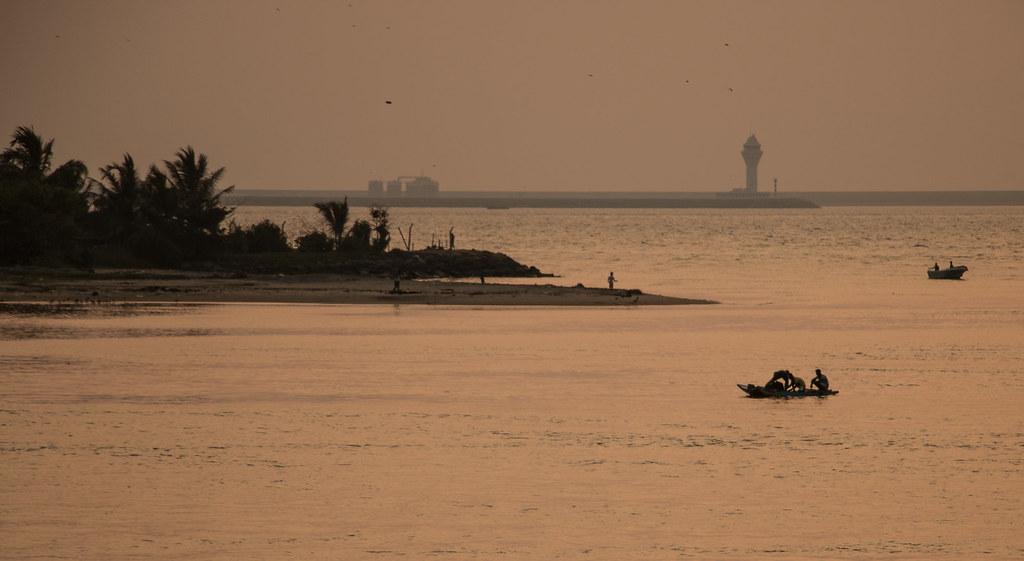
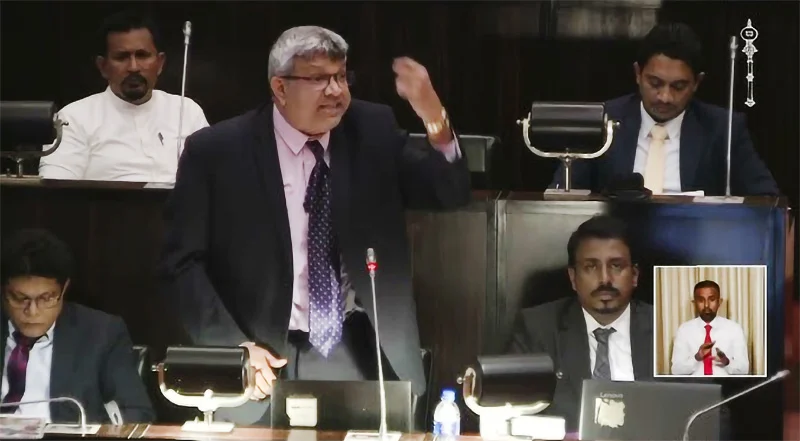
Fisheries, Aquatic and Ocean Resources Minister Ramalingam Chandrasekar yesterday (13) emphasised that only the Central Government of India could prevent the Tamil Nadu fishing fleet from poaching in Sri Lankan waters.
The Minister said that the Central Government of India in consultation with Tamil Nadu should without further delay deploy the Indian Navy and Coast Guard to prevent large-scale organised crossing of the Indo-Lanka maritime boundary.
The JVPer said so when The Island asked him what he intended to do to curb poaching and the destructive fishing practice known as bottom trawling practised by the Tamil Nadu fishing fleet in our waters. Our Navy and Coast Guard regularly conduct operations in the northern waters to deter the TN fishing fleet. But only India got the wherewithal to stop this menace,” Chandrasekar said.
Responding to another query, the lawmaker stressed that the NPP government would not hesitate to take a firm stand on the issue. We believe that India should prevent TN fishing fleet from crossing the maritime boundary,” Minister Chandrasekar said, adding that during his interactions with relevant Indian authorities and diplomatic staff, including High Commissioner Santosh Jha, he had taken up the issue.
The Minister said that he had explained the difficulties experienced by the northern fishing community due to the Indian fishers stealing their catch, when Charles Callanan, Director, UNOPS South Asia paid a courtesy call on him recently. They may not intervene or comment on this matter but there was no harm in briefing them of the actual situation on the northern seas, the Minister said.
The people of the northern and eastern regions, too, overwhelmingly voted for the NPP, the lawmaker said, adding that therefore the problems faced by the northern and eastern fishers should be addressed.
Minister Chandrasekar said that President Anura Kumara Dissanayake had, during his three-day official visit to New Delhi in January, raised the issue at the highest level.
Asked whether he was aware of the protests that had been directed at Tamil National Alliance (TNA) leader S. Sritharan, MP, over his recent visit to see Tamil Nadu fishermen held at the Jaffna prison, Minister Chandrasekar said an NPP lawmaker too visited them. We never sought media coverage for our visit to Jaffna prison,” Minister Chandrasekar said, adding that the government was determined to push for tangible solutions for recurring issues.
Acknowledging that various interested parties both here and in India sought political mileage at the expense of poaching by the Tamil Nadu fishing fleet, Minister Chandrasekar said that Sri Lanka had no option but to continue naval operations to deter encroachments.
Quoting northern fishers, Minister Chandrasekar alleged that at the rate Tamil Nadu fishing fleet stole Sri Lanka’s fisheries resources nothing would remain in 15 to 20 years’ time. The minister appreciated the efforts made by the navy to protect the interests of Sri Lankan fishermen.
Tamil Nadu poaching can be an issue at the forthcoming Local Government polls. There had been several incidents involving the navy and Tamil Nadu fishing vessels during the past couple of years. One incident claimed the life of a Special Boat Squadron man while two Indian fishers were shot and wounded in another. The second incident prompted India to summon Sri Lanka’s Acting HC in New Delhi to the Foreign Office where a warning was issued over the incident.
Minister Chandrasekar said that India should take meaningful measures to stop illegal fishing, thereby avoiding unnecessary incidents. The minister acknowledged that in spite of quite a number of arrests over the years, the Tamil Nadu fishing fleet seemed bent on continuing with the lucrative practice.
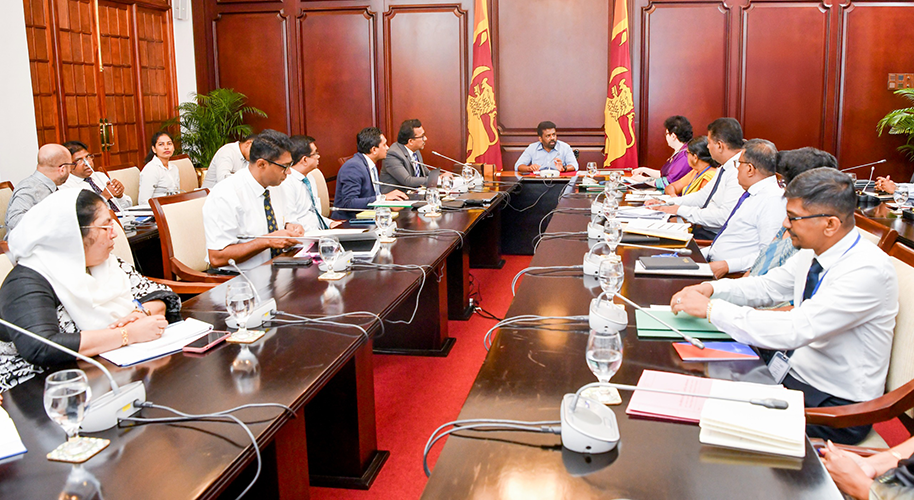
A meeting between President Anura Kumara Disanayake and officials of the Ministry of Industry and Entrepreneurship Development was held today (14) at the Presidential Secretariat.
Discussions focused on enhancing the efficiency, integration and development of the manufacturing sector to strengthen the national economy, as well as addressing the challenges associated with these efforts.
Key topics included government-led initial investments and proper regulation to empower small and medium-scale entrepreneurs, the establishment of local small-scale industries within investment zones and challenges related to business loans faced by small and medium-scale enterprises.
The President directed officials to expedite the release of lands allocated to the Ministry of Industry that have not been released so far.
Further discussions were held on maintaining and regulating import restrictions to strengthen local industries, prioritizing local suppliers in construction industry procurement and resolving issues in the gem and jewellery sector to ensure its full contribution to the national economy.
The President also instructed officials to swiftly implement tax exemptions for tourists to boost the gem and jewelry industry.
Minister of Industry and Entrepreneurship Development Sunil Handunnetti, Deputy Minister of Industry and Entrepreneurship Development Chathuranga Abeysinghe, Secretary to the President Dr. Nandika Sanath Kumanayake, Secretary to the Ministry of Industry and Entrepreneurship Development Thilaka Jayasundara and several other ministry officials attended the meeting.
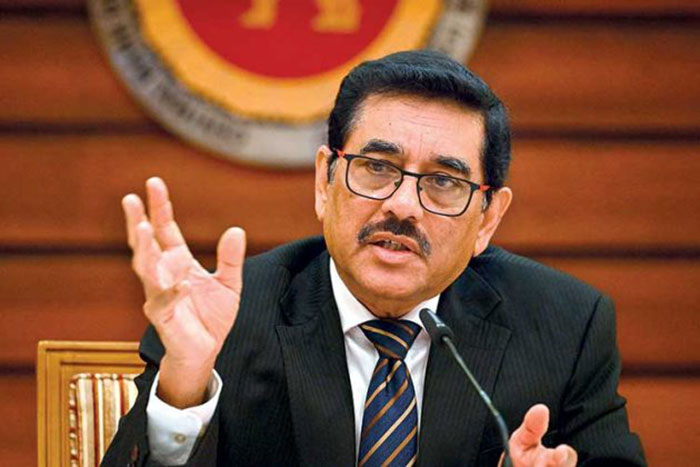
Governor of the Central Bank Dr. Nandalal Weerasinghe yesterday (14) emphasized the importance of promoting a sustainable and cost-effective construction industry in the country, highlighting key challenges and opportunities in the sector.
Speaking at ‘Construction Expo 2025’, Dr. Weerasinghe underscored the need for Sri Lanka to align with global trends in sustainable construction, integrating cost-effective energy solutions and eco-friendly building practices.
I must say my views here are not necessarily as a Governor of the Central Bank of Sri Lanka, but as a person looking at this construction industry and how this can be developed and what the issues are. Sustainability in construction is essential, not just for new projects but also for existing buildings,” he noted.
Dr. Weerasinghe acknowledged that the construction sector has been one of the hardest-hit industries due to multiple economic pressures in recent years, including the decline in public investments, high material costs and the industry being dependent on government projects.
The CBSL Governor, who acknowledged that the government faced fiscal constraints, limiting infrastructure spending and delaying payments to contractors, said that, however, the outstanding arrears had now been settled.
Government did not have space to spend money for public investment, especially construction, and that had a significant impact on the industry, in the last couple of years, plus the government inability to pay the arrears for a long period. That was other issue we all recognize
that has been one of the adverse impacts the industry had in the past”, he expressed.
Also the cost of materials went up significantly, partly because of foreign exchange shortages. As a result, the shortage had shot up the prices of construction materials, as well as depreciation of the currency, high interest rates, finance costs, and other factors. We all recognize that it had an adverse impact on the industry. It’s one of the worst affected industries because of all these factors.”
Former President Ranil Wickremesinghe is to make a special statement on the Batalanda Commission report which was tabled in Parliament by Leader of the House Bimal Ratnayke earlier today.
Wickremesinghe’s office said he will reveal some matters with regard to the Commission report on Sunday (16).
Leader of the House, Minister Bimal Ratnayake said that steps will be taken to forward the ‘Batalanda’ Commission report to the Attorney General and appoint a Presidential Committee for necessary advice to proceed.
After tabling the commission report in the Parliament today (14), Ratnayake also said that a two-day debate will be held in the Parliament regarding the matter at a suitable time.
Furthermore, the Minister stated that the report will be printed in all three languages and released to the public in the future.
With the fall of the Kandyan Kingdom, the Kandyan Convention, ceremonially signed on March 10, 1815, completed the annexation of the island to the British Empire. This brought an end to the rule of Lankan Royalty.
British propaganda successfully portrayed King Sri Vikrama Rajasinghe as a cruel Tamil tyrant” despite evidence of his achievements in developing Kandy
How did the British succeed in conquering Kandy when the others failed? To learn from the insights, we browsed through once again the pages of The Doomed King: A Requiem for Sri Vikrama Rajasinghe”, where the eminent author/anthropologist Gananath Obeyesekere had made an extensive study of how the conquest was made possible.
Being trounced roundly during their only military expedition conducted in 1802 to capture the Kandyan Kingdom, the British had ruled out further military attempts. But having captured the Maritime Province from the Dutch in 1796, the existence of an independent kingdom in Central Sri Lanka was viewed as a threat to their imperial aspirations when John D’Oyly, a tax collector for the British government in Southern Sri Lanka turned master-spy, replaced military warfare with the dynamics of espionage in the conquering of Kandy.
A spy-system aimed entirely at perpetrating a cruel image of the reigning King Sri Vikrama Rajasinghe, the author Obeyesekere writes that at the end of the day not only among the British but there were natives too who believed that the king was a cruel Tamil tyrant and the British saved the nation from a brutal king,” a representation that dismayed the author driving him to resurrect his image.
The loss of a large number of soldiers, along with the financial costs of the British expedition to Kandy, had convinced D’Oyly that there were alternative ways of subjugating the Kandyan Kingdom. Having arrived in Ceylon in 1801 at the age of 27 years, armed with a Matriculation from Corpus Christ College, Cambridge (1793) and BA and MA qualifications, he was posted to the South as a Revenue officer of the Ceylon Civil Service. While serving in Matara, he learnt Sinhala under the scholar monk Karatota Dhammarama of Veragampitiya (1803-1805) when he, knowingly or unknowingly, trained himself for the role of a master spy.
Author Obeyesekere, quoting historian Paul E. Pieris, wrote, The English treated Karatota with much consideration as a likely agent for destroying the King’s influence among the Sinhalese in the South and he enjoyed a great reputation for scholarship.”
By 1805, the Sinhala-speaking D’Oyly was made the Government’s Chief Translator. His linguistic skills and the knack he displayed for manipulations with the Kandyan Chieftains led Governor Maitland to appoint him the Intelligence Chief. Author Obeyesekere found D’Oyly’s diaries he maintained from 1810-1815 (with some blank spaces in between) a great source of information which revealed the systematic surveillance and the gradual undermining of the Kandyan Kingdom without the use of weapons until the right moment arrived.
Sri Vikrama Rajasinghe governed the Provinces of his Kingdom through the nobility, such as Pilimathalawa, Molligoda, Ehelepola and Puswella. But when his relations with them went sour, he got into the habit of transferring them from one Province to another, especially to areas vulnerable to British influence.
Ehelepola entered the scene when he succeeded as the First Adigar in 1811, on the execution of Pilimathalawa. Ehelepola imagined he would become the next king with the help of the British without realising that there was no space for a Kandyan king in the British scheme of things. D’Oyly, while building a friendship with Ehelepola, who was holding the highest position in the kingdom next to the King, allowed him to fancy himself as the next king and carried on his discourse with him initially through mediators, thereafter via correspondence. And on his escape from Kandy, through direct meetings.
Ultimately, having been used by D’Oyly, he cut a sorry figure on being discovered as having suspected designs on the new colonial government. He was imprisoned and banished by the British to Mauritius, where he spent the rest of his life.
D’Oyly’s spy network covered influential Mudaliyars” who provided direct information to D’Oyly or who communicated vital information gathered by their agents. What was striking was that the network ranged from those of the highest strata of society, such as provincial governors or Disawas, to those of varied castes. He also had several Javanese Tamil Muslims (Tambi Mudaliya of Chilaw) and monks in his secret service, who, like the Muslims, had no requirement of permission of the King to move from place to place. In fact, a monk gave details of the firearms being collected in Kandy with no qualms that he is undermining the independence of Kandy”. With the spy-maestro getting into full gear, he even resorted to playing the racist card, identifying the King and family members as Malabars. And therefore were outsiders!!!
D’Oyly’s secret service was regarded so perfect by now that a remark had been made that he, while stationed in Colombo, was even able to foretell the King’s movements within the kingdom. The author, however, interjects that no spy system is impeccable as D’Oyly’s informants had also been guessing their way around.
The news of the gruesome execution of Ehelepola’s family was conveyed to D’Oyly by Major Davie, who was taken prisoner during the 1803 war in Kandy. All efforts to find the whereabouts of the British prisoner proved futile. The King moved him from place to place, and D’Oyly’s spy-ring failed to get a clue of his location.
What dismayed Obeyesekere was the impact of British propaganda and the bad press the King received as a result, even from scholars. Ingirisi Hatana,” a paean of praise, on the other hand, confirmed the King’s obsession with the expansion and embellishments of his cosmic city—Senkadagala Nuwara with mansions, the Kiri Muhuda”, and the Paththirippuwa that rose in the shape of a tall parasol. According to these verses, the King was a compulsive builder of dams, ponds and tanks, and by 1813, he had completed an irrigation reservoir near Pallekele.
Contrary to the image bult by the British, the King who ascended the throne at the age of 16 years and reigned from 1798-1815, had completed his cosmic city in 1812 and remained popular with some of the aristocrats and minor officials in the four Korales which showed British influence but who were not enticed by D’Oyly.” It had been these supporters of the King, author Obeyesekere adds, who participated in the 1817-1818 rebellion against the British.
However, it is acknowledged that D’Oyly had some sympathy for the Kandyan aspirations and hence, when drafting the Treaty, showed his commitment to foster the Religion of Boodoo”, an idea for which he found little support in the Protestant-dominated Britain.
It had also been mentioned in the hypothesis that D’Oyly, who remained single, might have been gay as suggested by Brendon and Yasmine Gooneratne in their This Instructable Englishman”. However, while he was serving in the South as a young officer, D’Oyly had been reprimanded by his Home Government for gifting state land to the famed Sinhala poetess Gajaman Nona as requested by her, an episode which had been given a romantic twist by some historians.
Sir James Mackintosh, a school mate of D’Oyly, while on a visit to then Ceylon in 1810, had sorrowfully” recorded that D’Oyly had almost become a native in his habits of life.” D’Oyly never returned to his home country despite repeated requests from his mother to come back and enter matrimony. Finally, in 1817, she had suggested a marriage in Ceylon when his return seemed unlikely.
He, however, settled down in Kandy after the completion of his task, had an untimely death in 1824 at the age of 50 years and was buried at the Garrison Cemetery in Kandy.
(Given below is an excerpt of the Friday Sermon delivered by Hazrat Mirza Masroor Ahmad, Supreme Head of the world-wide Ahmadiyya Muslim Community in Islam, on 7 March, 2025, gave a discourse on Ramadhan: Faith, Prayers and Righteous Deeds.)
After reciting Tashahhhud, Ta‘awwuz and Surah al-Fatihah, His Holiness, Hazrat Mirza Masroor Ahmad (May Allah be his Helper) recited the following verse from the Holy Qur’an:
‘And when My servants ask thee about Me, say: ‘I am near. I answer the prayer of the supplicant when he prays to Me. So they should hearken to Me and believe in Me, that they may follow the right way.’’ (Holy Quran 2: 187)
Increased Attention to Prayer During Ramadan
Ahmadiyya Khalifa said that with the start of the month of Ramadan, one’s attention is drawn towards prayers, because this is a month where prayers are especially accepted. Generally, people are more drawn to the mosques and attendance increases as compared to other times in the year. God says that during Ramadan, He closes the gates of hell, chains Satan and opens the door of Paradise.
His Holinesssaid that some may think that it is only during Ramadan that they must offer supplications and that it is only during this time that their prayers will be heard. However, this is not the right mentality. Allah the Almighty has drawn increased attention towards prayers during Ramadan so that it may become a lasting habit for the rest of the year as well. Hence, it is not enough to simply offer prayers and attend the mosque solely during Ramadan. The Holy Prophet Muhammad, peace and blessings of Allah be upon him, said that one who supplicates in the nights of Ramadan to fulfil their rights of their faith and for the sake of blessings then their previous sins are forgiven. When a person tries to make these virtuous habits a regular part of their lives, then their attention will increase during Ramadan towards these things.
Acceptance of Prayer Requires Love for God
His Holiness Ahmadiyya Khalifa said that man is prone to make mistakes; however, Allah the Almighty is very Gracious and Merciful. As such, He has given us an opportunity to renew our vows during Ramadan to act according to God’s commandments for the rest of the year as well. Ramadan is for one to attain guidance, and that is not something that can be established just for one month; rather, guidance is something which is meant to be permanently established. Since humans are forgetful, Allah has made Ramadan a recurring time, each year, so that people may be reminded about their duties and rights owed to God and the rights owed to His creation. In the above verse, where God refers to ‘My servants,’ it means those who hold God to be their Beloved – not just for a month but throughout the year.
His Holinesssaid that true lovers are those who adhere to everything their beloved says. One can be disappointed with worldly love, but by loving God, one can never be disappointed and finds nothing but continuous benefit. Hence, we should strive to beseech God for His nearness. We should not only pray for things of our own benefit; rather, we should also pray to attain nearness to God. We should pray that God grants us His nearness, enables us to make supplications that are granted acceptance, grants us a rank of His approval, and that He accepts our fasts. When we do this, then we will be saved from making mistakes even after Ramadan; rather, we will be granted the continuous ability to do virtuous deeds.
Become a Friend of God
His Holiness Ahmadiyya Khalifa said that special attention has also been drawn towards reciting the Holy Qur’an. Hazrat Mirza Ghulam Ahmad, Founder of the Ahmadiyya Muslim Community in Islam – The Promised Messiah, peace be on him, said that there are more than 700 commandments in the Holy Qur’an. A true believer not only recites the Holy Qur’an, but they search for those commandments and then make every effort to implement them. Complete belief entails complete obedience to God’s commandments and the teachings of His Messenger Muhammad (PBUH) As a result, God becomes a person’s Friend, as it is stated in the Holy Qur’an, ‘Allah is the Friend of those who believe.’
His Holiness said that this nearness to God is something that never ends; rather, it only increases. Hence, during Ramadan, we must try to attain this rank and consider that if, after Ramadan, we regress and do not offer supplications as we did during Ramadan and do not strive to attain the nearness of God, then how can God become our friend?
Ahmadiyya Khalifa said that there is the example of Chaudhry Zafrulla Khan (Former, Foreign Minister of Pakistan and President, UN Assembly), who was once visiting the Queen’s palace and seemed worried as he constantly looked at his watch. When some officials asked him what the reason was, he replied by saying that it was nearing the time for prayer, a commandment of God which he must fulfil. Upon hearing this, the official made arrangements for him to offer his prayers. This is the confidence that everyone must have.
Ahmadiyya Supreme Head (Khalifa) said that there are countless examples of instances where the Holy Prophet Muhammad (PBUH) has drawn our attention towards acting with virtue. Similarly, in this era, the Promised Messiah, peace be on him. has also drawn attention towards acting with virtue and towards fulfilling the rights owed to God and the rights owed to His creation. Hence, we must focus on these things, which will result in God becoming our friend and answering our prayers.
The Need for Patience When Praying
His Holiness said that God listens to the prayers of those who are patient and who do not say that they have been praying a great deal but God has not answered them. Sometimes people complain that despite offering many prayers, they have not been heard. However, they pray not to attain nearness to God but to fulfill their worldly desires. They prayed only when they had worldly issues. True friendship denotes honouring the friendship even under ordinary circumstances and listening to one another. This is something which should always be remembered – we should not turn to God only for the fulfilment of worldly needs, but we must turn to God in order to seek His nearness as well. Then God hears and answers such supplications.
Sri Lanka, strategically located at the crossroads of ancient global trade, flourished as an economically vibrant and culturally independent nation. Its ability to engage in cultural exchanges on its own terms ensured the preservation of its unique spiritual and cultural heritage. The island’s thriving civilization, led by its Mahārath—visionary leaders and scholars—and guided by Buddhist principles, exemplified self-reliance and harmony.
In this article, the profound cultural and philosophical depth of Sri Lanka explains why transformative figures like Jesus Christ and Prophet Muhammad may have focused their teachings elsewhere. Sri Lanka’s commitment to peace and its resistance to external religious ideologies highlighted its identity as a self-sustaining and spiritually enriched society. This argument serves as a powerful reminder of Sri Lanka’s enduring legacy, emphasizing the importance of preserving cultural independence, fostering peace, and celebrating spiritual harmony. It calls upon humanity to draw inspiration from Sri Lanka’s history in the pursuit of coexistence and global understanding.
Sri Lanka stands as a testament to the resilience and brilliance of a nation deeply rooted in its cultural, spiritual, and historical identity. Known to the ancient world as Taprobane, Sri Lanka gained recognition not just for its geographical beauty but also for its advanced civilization, self-reliance, and monumental achievements. From the era of King Devanampiya Tissa to King Aggabodhi I, Sri Lanka’s rulers prioritized the growth of Buddhism, non-violence, and intellectual development, making the island a beacon of spirituality and wisdom. The Mahārath—visionary leaders and scholars—stood as protectors of its philosophy, ensuring Sri Lanka’s identity remained unshaken by external influences. These principles are embodied in the architectural marvels such as the Ruwanwelisaya Stupa and the Jetavanaramaya Stupa, one of the tallest man-made brick structures in the world, showcasing the ingenuity of the Sinhalese civilization.
The Great Stupas, such as Ruwanwelisaya and Jetavanaramaya, were not just architectural achievements but symbols of devotion and harmony. For instance, Jetavanaramaya, built during King Mahasena’s reign, stood at a towering height of 122 meters (400 feet), rivaling the grandest structures in the world, like Egypt’s Great Pyramid of Giza. These accomplishments highlight Sri Lanka’s commitment to its cultural and spiritual identity.
Sri Lanka’s mastery of ancient engineering is also reflected in the construction of Yodha Ela (Giant’s Canal), an incredible irrigation channel built during the 5th century CE. This canal, which stretches approximately 54 miles (87 kilometers), is notable for its exceptionally low gradient—about 10 centimeters per kilometer or 6 inches per mile. This engineering precision ensured a steady flow of water across vast distances without modern tools, demonstrating the ingenuity and skill of ancient Sinhalese engineers. Yodha Ela, which connects the Kala Wewa reservoir, another 5th-century marvel built by King Dhatusena, revolutionized agriculture in ancient Sri Lanka by supplying water to extensive farmlands. Together, these feats of engineering exemplify Sri Lanka’s ability to harmonize innovation with sustainability.
Sri Lanka’s strategic location positioned it as a key participant in ancient global trade networks, enabling the island to flourish economically while firmly preserving its unique identity. Cultural exchanges with other civilizations were conducted on its own terms, ensuring the continuity and protection of its spiritual and cultural heritage. This historical backdrop illuminates why figures like Jesus Christ and Prophet Muhammad, while transformative in their regions, did not focus on spreading their teachings to Sri Lanka. The island’s thriving civilization, guided by its Mahārath and philosophical depth, was a self-sustaining and harmonious society. Rooted in Buddhist principles and values of peace, Sri Lanka remained resistant to external religious ideologies.
Sri Lanka’s cultural innovation extended to music and games. The Ravanahatha, a one-stringed, bowed instrument, is considered the earliest ancestor of the violin and is associated with the legendary King Ravana. This ancient instrument symbolizes Sri Lanka’s ingenuity and its contributions to the global heritage of music. In addition, Sri Lanka has a strong tradition of sports and games that have influenced modern-day activities. Traditional games like Buhukeliya and Madukeliya are believed to have influenced the development of cricket, which later gained global popularity through British influence. These examples highlight the island’s cultural vitality and adaptability.
The Roman author Pliny the Elder was an unparalleled observer of global cultures, documenting them extensively in his Natural History. His reference to Sri Lankan ambassadors from the Anuradhapura Kingdom visiting the Roman Emperor Claudius in 52 CE has captivated historians worldwide. This account dispelled the Roman notion that societies beyond Europe were barbaric, showcasing that ancient Sri Lankans were just as advanced and civilized as their Roman counterparts. Pliny’s writings underscored the cultural and technological advancements of the Anuradhapura Kingdom, highlighting Sri Lanka’s influence and standing in ancient diplomacy. This global acknowledgment reflected the brilliance of the island’s governance, infrastructure, and trade networks.
Although geographically distant, the Anuradhapura Kingdom and Rome evolved along fascinatingly parallel trajectories. Both civilizations showcased remarkable technological achievements, but with different priorities—while Rome developed advanced naval fleets for conquest, Sri Lanka mastered hydraulic engineering to enhance life for its people. Despite external invasions, Sri Lanka, with its Mahārath, navigated challenges with resilience and adaptability, maintaining its autonomy for a period that surpassed Rome’s influence. This longevity highlighted Sri Lanka’s focus on cultivating harmony rather than domination.
Adding to its pride, Sri Lanka is home to breathtaking landmarks like the Sigiriya Rock Fortress, built by King Kashyapa (477–495 CE), which stands as both a defensive structure and a masterpiece of art and architecture. This UNESCO World Heritage Site is an enduring symbol of the country’s creativity and ability to balance beauty with functionality.
Moreover, Sri Lanka’s geographical isolation, surrounded by the Indian Ocean, naturally limited the influence of foreign religious movements during their formative phases. Unlike regions that experienced the conquest-oriented expansions of new religions, Sri Lanka was shielded by both its physical location and its resilient philosophical framework. This spiritual and cultural autonomy allowed the island to evolve along its own unique path, safeguarding its identity and becoming a sanctuary for Buddhist teachings. Sri Lanka’s great kings also played a vital role in preserving this cultural and demographic integrity. Recognizing the impact of foreign settlers, these visionary rulers implemented specific laws to regulate external immigration and maintain harmony. For instance, in ancient Ceylon, foreign families were required to limit their number of children to one. Families exceeding this limit were subject to the Ulian tax,” which amounted to 10% of their monthly income and could be paid in goods, money, or by contributing to government-prescribed development work two days a week. Failure to comply with these requirements led to deportation. These policies reflect the wisdom of the kings in fostering a balanced society while mitigating external influences. This further highlights the profound spiritual richness and proactive governance of Sri Lanka during those times, positioning the island as a beacon of philosophical depth and harmony in a rapidly changing world.
The Anuradhapura Kingdom’s emphasis on innovation over conquest reflects a philosophy of coexistence and sustainability. Its global recognition during Pliny’s time juxtaposed with Rome’s militaristic ambitions offers a valuable lesson in prioritizing peace and prosperity. Sri Lanka’s story is one of self-reliance, resilience, and profound spiritual richness. The island’s refusal to adopt external religious doctrines associated with violence or conquest highlights its commitment to peace and harmony. Figures such as Jesus Christ and Prophet Muhammad, while transformative in their respective regions, may have seen no necessity to spread their ideologies to a land that already embodied supreme autonomy and spiritual depth.
Today, Sri Lanka’s legacy inspires the world to cherish cultural independence, celebrate spiritual harmony, and pursue global coexistence. Despite its peaceful philosophy, Sri Lanka has faced numerous invasions throughout history, primarily from neighboring regions and colonial powers such as the Portuguese, Dutch, and British. The island also endured a prolonged and devastating civil conflict with the LTTE (Liberation Tigers of Tamil Eelam), which marked one of the darkest chapters in its modern history.
It is crucial for Sinhala Buddhists to remain vigilant in safeguarding the cultural, economic, and security aspects of the Theravada Buddhist state. In the face of increasing international and political influences that aim to undermine Buddhism and Sinhala identity, proactive efforts are needed to preserve the unique heritage, values, and principles of the nation. By addressing these challenges with unity and foresight, the integrity of the Theravada Buddhist state and the identity of its people can be protected for future generations.
By Palitha Ariyarathna
Note: Geopolitical Analyst – On the Medin Full Moon Poya Day
3/13/2025
References:
JSTOR: Sri Lanka’s Ancient Governance Policies – Insights into cultural preservation and societal regulation. Source
Ceylon Watch: Addressing Refugee Challenges: Lessons from Ancient Ceylon and the Path Forward – Details on immigration laws and the Ulian tax. Source
Following the incident many doctors took to social media, describing the hardships faced when posted to rural areas on transfers
Two days after gala International Women’s Day events concluded, a dark day dawned in Sri Lanka when a female doctor was allegedly sexually assaulted at the Anuradhapura Teaching Hospital on Monday (March 10). The incident was revealed by Opposition Leader Sajith Premadasa in Parliament who raised concerns about the safety of females employed in the public service.
The fact that a female doctor was threatened with a knife by an outsider before allegedly sexually assaulting her inside her duty room marks glaring loopholes that need to be addressed to ensure workplace safety for women. The incident sparked outrage among doctors’ unions that were quick to announce the launch of trade union action if the government fails to arrest the perpetrator within 24 hours. The suspect has been identified as an army deserter and was arrested in Galnewa on March 12.
Following the incident many doctors took to social media, describing the hardships faced when posted to rural areas on transfers. Several of these doctors described how doctors’ quarters in rural areas are not up to standard. Many are isolated from the main hospital building and are usually deserted during evenings. An On Call doctor has to be present to attend to any emergencies and it is a daunting task for most female doctors.
It was also a worrying sight to see many individuals continuing to objectify women and blaming the victim for arousing the perpetrator. On March 11, a 36-year old man was arrested for allegedly attempting to sexually assault a patient who had come to seek treatments at a psychiatric ward at the Tellipalai Mental Hospital, Jaffna. The suspect who had been employed through a private cleaning service had been taken into custody. On March 7, the Aralaganwila Police arrested a math teacher from a school in the Aralaganwila Education division in connection with the sexual assault of eight Grade 10 female students.
At this point it is apt to recall how the wheels of justice turned slowly to mete out justice to a 23-year old garment factory worker who was raped, strangled and pushed down from the sixth floor of the Negombo General Hospital in November 2007. In 2014, the Negombo High Court found the accused, a medical officer of the hospital guilty of rape and murder. He was reportedly imprisoned for seven years and later released on bail.
Incidents of rape, sexual abuse and murder should no longer be just headlines in newspapers or news items that would bring the highest views and ratings for media channels for the day. The unethical approach to sensationalism on certain mainstream media channels is indeed disgusting. Re-victimisation of victims on media has become so frequent that Health Minister Dr. Nalinda Jayatissa issued a statement requesting media to respect the privacy of the victim. It is a sad state of affairs to have a minister remind the media about their ethics despite having a designated code of ethics, at least for print media journalists. According to the code of ethics journalists shouldn’t disclose the name of a victim of abuse, suicide, harassment or rape, shouldn’t disclose the method in which a murder, suicide, rape or sexual assault had occurred.
In 2017, the #MeToo movement initiated by activist Tarana Burke went viral with its hashtag empowering more women to speak about the sexual assault and violence that they had experienced. This Movement significantly impacted workplace safety for women, prompting employers to strengthen anti-harassment policies, and creating a greater awareness of sexual misconduct. But in the post #MeToo era, a majority of Sri Lankan women, including professionals in environments once believed to be safe spaces for women to work are becoming increasingly vulnerable to incidents of rape, sexual assault and harassment. So, what is the guarantee from the new government to ensure safety of women?
A copper and brass factory is contaminating the Kelani River in Pethiyagoda, harming the environment and the health of residents. Sri Lanka’s fourth-largest waterway provides 80 per cent of Colombo’s drinking water. Despite complaints, the factory continues to operate without the necessary environmental licence. Environmentalists complain that the damage is irreversible.
Colombo (AsiaNews) – A copper and brass mining plant is dumping heavy metals into the Kelani River, Sri Lanka’s fourth-largest waterway, near Pethiyagoda (Kelaniya), north of Colombo, contaminating groundwater and soil.
Residents complain that gases like sulphur oxide, nitrogen oxide and carbon dioxide released into the river and the surrounding area cause breathing problems, particularly for children and the elderly.
The factory is about 40 metres from the Kelani River, which is the main source for the Labugama and Kalatuwawa reservoirs. The latter are located in the homonymous forest reserve, and provide about 80 per cent of the drinking water to the city of Colombo and its suburbs.
The electrolysis process, which involves copper sulphate and sulphuric acid, is the main threat to the environment and the river.
The factory established as a Board of Investment (BOI) project is not located in an industrial zone, but in Kelaniya-Pethiyagoda River Valley, in a hamlet which has been inhabited for centuries,” explain environmentalist Aditha Gamage and Shirantha Navinna, speaking to AsiaNews.
Previously, a plywood factory operated in the village as a BOI project, but after its closure, a copper factory was established in the same location. For this factory, an Environmental Protection Licence (No. A 16969(R2)) was obtained from the Central Environmental Authority (CEA) on 18-01-2023, but it expired on 01-11-2023.”
According to the provisions of the National Environment Act (Act No. 47 of 1980) and the regulations outlined in Extraordinary Gazette No. 1534/18 dated 02.02.2008 and Extraordinary Gazette No. 2264/18 dated 27.01.2022, industries that release or deposit pollutants and cause large-scale environmental pollution must obtain an environmental protection licence.”
Yet, the relevant company has not submitted such an application. Hence, residents have filed complaints with the CEA, alleging that the electrolysis process is causing large-scale environmental damage”.
The relevant authorities obtained licences for copper and brass extraction and production from scrap materials while concealing the truth,” lament social activists Cyril Mendis, Kusuma Attanayaka and Roshan Alwis.
This made it possible to increase copper production through the electrolysis process. Various chemicals, including copper sulphate and sulfuric acid, both byproducts and substances used in the process, mix with the water and soil of Kelani River. The introduction of these highly toxic chemicals is harmful to human health and to drinking water sources.”
Despite repeated complaints to the relevant authorities regarding the environmental and health damage caused by the factory, no proper action has been taken,” the social activists noted.
Even as irreversible harm is being done to the environment and public health, authorities hesitate to take decisive action due to the influence of a former politician from Kalutara District as one of his relatives has shares in the factory.”
Residents questioned the wisdom of setting up a plant in a residential area rather than in an industrial zone. For its part, the Ministry of Environment said that I had instructed the CEA to review the licence.
There are endless things to consider when moving to another country. What is the culture like? How easy is it to find work? How are the transport links? How happy are the locals? And for families hoping to move abroad, there are even more questions – think safety, healthcare, or education systems, for example.
Remitly, an American remittance company helping users send money worldwide, has launched a new immigration index designed to help inform those considering relocating. The report, released in March 2025, ranks 82 countries across 24 factors, from healthcare quality and economic strength to safety metrics and digital connectivity, assigning each with a total score of 100.
One such factor considers how family-friendly a country is, looking at data points such as the quality and accessibility of education in each nation. The company used statistics including the average years of schooling adults have completed, the expected years of schooling for children in each country, and the average cost of childcare per year. The report then generated a score for each nation to establish the most family-friendly country.
Is the UK on the list of family-friendly countries?
The UK does not feature in this report for family-friendly countries. However, it does feature in the list of best countries to relocate to. Coming in 19th place with a score of 46.5, losing out to the likes of the US in 7th place, Germany in 11th place and Japan in 18th place.
What is the most family-friendly country in the world?
Sri Lanka came in first place. The island nation achieved an impressive score for its education system (0.7 out of 1.0) and a low annual childcare cost of $354.60 per year (compared to $16,439.40 in the US, which ranked in 10th place).
It’s no surprise that Sri Lanka ranked so highly in this list – in fact, we named the country one of our favourite places to go for multi-gen megatrips in 2025, due to its welcoming nature, focus on outdoor activities and family-friendly Sri Lankan hotels. The country is home to some incredible wildlife, from vast national parks and sprawling beaches, plus there is fascinating history, creative coastlines, delicious food and an excellent shopping scene.
These are the most family-friendly countries in 2025
10. USA 9. Australia 8. Denmark 7. Finland 6. Germany 5. Iceland 4. New Zealand 3. Norway 2. Sweden 1. Sri Lanka
BITTER BREW PRODUCED BY A TEAM OF WALL- EYED JOURNALISTS AT ABC’S FOREIGN CORRESPONDENCE HAVING A TUNNEL VISION WHICH EXCLUDED CRITICAL FACTS AFFECTING THE TEA INDUSTRY IN THE PROGRAM. For them, nothing mattered, only that next spin whatever the consequences.
The name used for the documentary on the Tea Industry of Sri Lanka smacks of prejudice when the ABC attempts to convey directly that the Sri Lankan cup of tea, is bitter. The ramifications Sri Lanka faced in her economy recently and critical issues the Tea industry confronted internationally were completely ignored as the agenda of the documentary was highly questionable.
Tea was introduced to Sri Lana by the British white people who forcefully brought indentured Indian labour in chains to work on the tea estates in slave-master relationship when the indigenous Kandyan people refused to work as labourers on their own lands which were appropriated by the British under the Waste Land ordinance which they themselves enacted. The Indian labourers were treated as inanimate objects by the British. Even though the living standards are low among the labour population of the Tea industry even at present, one should compare the situation relating to many in the other plantation sectors and small-scale farmers in the country. Sri Lanka being a low-income developing country the payments they receive and the welfare services on which they can count- on are not satisfactory at all. The similar situation can be seen and experienced in most of the countries in the global South.
However, the workers in the plantation industry are in receipt of legally approved wages and medical facilities which are not shared by small time farmers and other labourers who depend on varying and unenviable payments without the paid holidays unlike Tea industry workers. The problems in getting drinking water in the dry season and sanitary facilities too are common issues faced by many who sell their labour. In short, the story of the third world workers who sell their labour is simply unenviable. But, when wage levels in tea growing countries in the developing world are compared, Sri Lankan tea industry labourers’ wage level is within the range of payments made in the global south,
In evaluating any industry rationally, one should discuss the effective productivity of the product, the competition in the market for the product, the prices the product will attract. Tea industry in Sri Lanka is facing continuous drop in productivity while facing stiff competition in the world market and attracting decreasing profit margins. Further, Sri Lanka presently is on a bailout program of the IMF under which wage increases have to be controlled in keeping with the stipulations.
The ABC and their producers of the Foreign Correspondence on Sri Lanka’s tea were blind to the relevant issues and did not provide space for a fair discussion in a balanced manner while unfortunately, the stress was on the painting of negative pictures with a biased mind.
If the Australian and the international market for Tea reacts to the negative picture painted by ABC regards the Tea industry, Sri Lanka will lose a good chunk of the foreign exchange earnings compelling closure of marginal tea plantations with the loss of employment for thousands of labourers.
ABC journalists’ rational mind were too busy to control their impulses!
The nationwide project to clean and refurbish 1,000 selected schools as part of the government’s ‘Clean Sri Lanka’ program is progressing with the dedicated involvement of the Tri-Forces. This initiative is being closely supervised by Deputy Minister of Defence, Major General Aruna Jayasekara (Retd) and Defence Secretary, Air Vice Marshal Sampath Thuyacontha (Retd).
The school cleaning and renovation project, which commenced on February 20, 2025, has now entered its second phase. As of March 10, 2025, renovations have been successfully completed in 432 schools with the contribution of Army personnel, 25 schools with the support of Navy personnel and 34 schools with the assistance of Air Force personnel. The project, conducted under the guidance of the Ministry of Defence, has also benefited from the active participation and labour contribution of the Civil Security Department (CSD).
In conjunction with the school cleaning initiatives, essential refurbishments are undertaken, including repairs to deteriorated school buildings and infrastructure, the application of fresh paint and restoration of boundary fences. Additionally, school equipment such as desks, chairs, bookshelves and other essential items are being repaired and repurposed for continued use.
Through these social responsibility efforts, the Tri-Forces aim to enhance the learning environment in schools across the country. Their continuous involvement in the ‘Clean Sri Lanka’ national initiative aligns with the government’s vision of “A Prosperous Country, a Beautiful Life,” under the comprehensive supervision of the Ministry of Defence.
Furthermore, these cleaning and renovation efforts have been met with strong support from the civilian community, including school principals, teachers, students and parents, who have actively contributed to the success of the initiative.
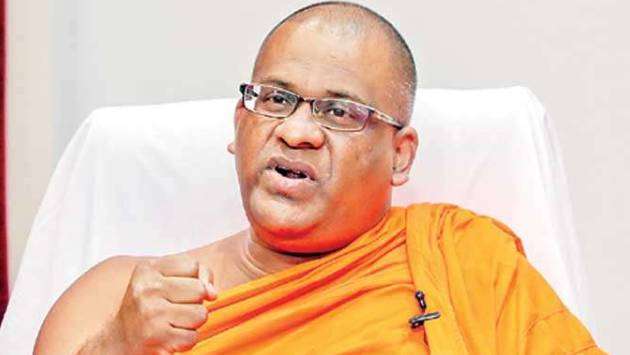
Colombo, March 11 (Daily Mirror) – The Bodu Bala Sena (BBS) today questioned the government on the criteria used as the basis for lifting the ban on the import of religious books into the country.
Addressing the media, BBS General Secretary Galagoda Aththe Gnanasara thera said Buddhasasana, Religious and Cultural Affairs Deputy Minister Gamagedara Dissanayake had taken the above decision following the approval of the Defence Ministry.
Earlier, the importing of religious books into the country was banned after the Easter Sunday bomb attacks, he said.
“During several occaions even before and after the Easter Sunday attacks we stricketly mentioned this to the previous governments,” he said.
“It is very dangerous to make such a decision in an environment where the global terrorist threat, brought into the country through the misinterpretation of Islam, has not yet subsided. On two occasions, I have strongly said that a large number of murderous gangs operate in Sri Lanka, killing people for money,” the Thera said.
He also said that the USAID had funded the printing of these textbooks for Grades 1 to 13 and printed by the Educational Publications Department.
“These textbooks contain the ideas of current Islamic leaders who have misinterpreted the Quran, which is a mind-altering text that should not be taught to a child, and who have provided ideologies to build religious terrorism around the world,” the Thera said.
“Without solving the text books issue the government has permitted the import of religious books into the country. This textbook will lead to change the minds of the inncocent and traditional muslim comminity in Sri Lanka and will turn them into those like Zahran Hashim,” the Thera said.
Gnanasara thera also claimed that no one from the government side had reached him to get the details of the mastermind behind the Easter Sunday attacks.
The National Child Protection Authority (NCPA) has launched an investigation into a case where a teacher at a private tuition class had forced a male student to kneel and then instructed another female student to assault the kneeling student with a cane.
Additionally, a video showing the tutor assaulting other students in his classroom is widely circulating on social media.
Accordingly, the NCPA has summoned the tutor who assaulted the students to report to its office today (March 11).
However, it is reported that he has disregarded the notice and failed to appear before the NCPA.
Much research has been done by numerous experts on the future of the plantation industry involving tea, rubber and coconut. While very valuable strategic options have been provided and focus shifted to existing and emerging technology as a futuristic vision, critical grass roots activities have not been adequately addressed. Who will pluck the tea, tap the rubber and pluck coconuts in say 20 years’ time. How will they do it?
A major, but yet unmet challenge exists with the tea, rubber and coconut industry even now but definitely futuristically as to who will pluck the tea, tap the rubber and pluck coconuts now and in 20 years’ time, and how will it be done. The answer to this poser, and how it will be done efficiently and effectively and economically will have a longer-term impact on industry. The highly labor-intensive nature of these three industries and the long-term challenge in finding the required labor does not seem to have been adequately addressed. In the plantation sector, the numbers seeking higher education and technical education, numbers seeking employment in other vocations and locations internally and numbers seeking overseas employment have and are bound to increase progressively posing a major challenge to the industry.
The immediate reaction would be to say that mechanization and other technologically driven advances would be the answer although specifics are yet to be identified. While machinery for tea plucking, rubber tapping and coconut plucking are perhaps a major requirement as labor replacement items, machinery for weeding and fertilizing are also important as they are labor intensive activities. Currently, as far as the writer is aware, all these activities are done manually
In writing this article, the author has referenced a very well written and presented one by W A Wijewardena in February 2022. https://www.ft.lk/columns/The-Future-of-the-Agriculture-and-the-Agriculture-of-the-Future/4-731185 where he has used a publication titled The Future of the Agriculture and the Agriculture of the Future’. Its subtitle, ‘From Beaten Track to Untrodden Paths” by Professor Ranjith Senaratne, formerly Vice Chancellor of the University of Ruhuna and presently Chairperson, National Science Foundation as the basis for his article. W A Wijewardena’s article and the publication by Professor Senaratne are well worth reading and referencing and the intention of the author here is not to challenge or repeat what has been stated but use some key pointers taken from the article to present a few challenges faced by the industry at a very grassroots level, even now and most definitely in years to come. Lack of consultation with growers and farmers at grassroot level has been lacking and decisions imposed on them as top-down directives by politicians, genuine experts as well as so called experts”. The resulting lack of ownership of decisions and the decision-making process has followed as inevitable outcomes resulting in the absence of a coherent futuristic, but practical plan.
Few key pointers to note here are
Unwise political decisions where grassroots are powerless– The attempt to organic farming overnight. 30 agricultural scientists had presented a joint memo to then President highlighting its disruptive features urging the president to defer it or implement it over a period.
How could grassroots be part of the decision-making process regarding the statement that The challenge before the modern agriculture, is to make agriculture ‘more productive, more resource-efficient, more resilient, more environment-friendly, less wasteful and more profitable”
Research and development facilitated by the private sector. The private sector’s participation in research and development is needed because it will facilitate innovative commercial production of such research outcomes. However, information and knowledge sharing is a two way process and the private sector should take note of this and the wealth of historical and environmental knowledge that grassroots have.
Ban on pesticides – While no direct evidence between pesticides and kidney diseases appear to exist, and rather than the use of pesticides per se that will have adverse impact on health but its overuse and misuse, requires the grassroots to be provided with proper education of farmers on the correct use of these essential inputs.
Soil degradation and impoverishment or soil erosion is a threat to food production, and it is caused by both natural reasons and human interventions. Again, education, advice, monitoring will be essential.
Disseminating knowledge and information on water usage. The water problem in agriculture is as critical as the problem of soil erosion. This is because the main crop in Sri Lanka, rice farming, is not only a water guzzler but also a crop for which water is overused. Rice uses 3,442 litres of water to produce a kilogram of rice, tea uses 7,334 litres, and rubber 18,124 litres. The need for producing more foods requires the use of more water in greater volumes. Due to competing demand by households, industry, and for hydropower generation, there would be insufficient water available for agriculture. Hence, it is necessary to devise methods of more efficient use of water in agriculture and to do this in discussion with the grassroots.
Producing more with less – The future of agriculture depends on the improvement of productivity and efficiency of resource use to produce more with less as there is no unlimited resource availability for any economic activity. A nation which ignores this crucial requirement is to suffer in the long run with declining outputs and incomes of people who are engaged in it.
Modernising agriculture and using digital technology for eco-friendly, resource efficient, knowledge driven agriculture. This calls for a cultural shift amongst the grassroots, for the efforts to succeed and it is perhaps the biggest challenge of all challenges. The possibilities which have been suggested are the use of sensors, software, digital connectivity, location tracking, robotics, data analytics, and digital devices in agriculture. One plus point in using digital technology is the decline in the cost of data use when the costs of all other inputs are rising. These high digital technologies can deliver the inputs needed, namely, water, fertilisers, and pesticides more efficiently to plants when they most need such inputs. What this means is that the agriculture of the future is not small-farmer based traditional farming, but smart-farmer based modern farming. This is a must and agricultural policy authorities should prepare the farmers as well as the systems in agriculture to embrace this.
The Tea Research Institute had undertaken preliminary testing of imported tea harvesting machines in Sri Lanka as far back as 1940’s. https://www.tri.lk/motorized-selective-tea-harvester/. As reported, the most recent experiments of the TRISL on mechanical harvesting focused on the physiological impacts of motorized harvesting and identified three basic impacts leading to crop losses. In addition to crop loss, quality of made tea produced by mechanically harvested shoots was also poorer than that of manually harvested crop. The higher % of coarse leaf content shoots of different maturity, cut-leaf pieces and damaged leaves present in the mechanically harvested crop were responsible for reduction in the quality of made tea. Poor manoeuvrability with the presence of shade trees, drains etc, sloping terrains, high plucking table (near-pruning fields), high capital and running (fuel) cost, frequent breakdowns and high ware & tare etc., were some of the common problems faced during motorized tea harvesting to date”.
Strategies to address challenges associated with the future of the tea, rubber and coconut industry perhaps needs to be based on immediate/short term, medium term and long-term basis. Further, such strategies should not be politically driven as the consequences of a failure of the industry to provide vital revenue to the country and provide employment to many people will be detrimental to the entire country and not just a political party. In addition to the key posers presented referencing the article written by W A Wijewardena, and addressing the challenges mentioned, the following suggestions too needs to be considered from the perspective of grassroot participation in decision making.
Subsidised fertiliser – How long should subsidies continue?
An uninterrupted fertilising program is vital to resurrect the drawbacks the industry faced during the last 3 -4 years. It will be necessary to provide subsidised high quality chemical fertilisers to growers during this period. Beyond this and in the long term, subsidising may have to be stopped or the cost to the government recovered in some way if subsidies are to continue. Alternatively, farmers who need financial assistance to buy fertiliser given short term loans. The costs associated with production and sale of produce will have to include the fertiliser cost and bank loans recovered from sale proceeds.
Supply and demand issues
Regarding coconut, with demand remaining as it was or increasing, a supply issue exists during lowest yielding period known as හමස් කාලේ or some call it හනසු මාස. Lack of nourishment over the past four years due to the fertiliser saga and the high prices thereafter exacerbated the supply/demand gap.
In the short/medium term, until the extent of coconut cultivation bears results, the supply shortfall could be addressed with imports to bring about price stability.
During this period, and even during other periods, the sale of young coconuts (kurumba) has a direct impact on the supply situation of mature coconuts. The general demand for mature coconuts has increased in the last few years due to the production of coconut oil for exports, coconut oil-based products for exports, coconut fibre and fibre-based exports and activated carbon. This is in addition to increase in coconut products like desiccated coconuts. It is logical therefore that a practice that impacts on the mature coconut supply situation has an overall detrimental effect on the supply of mature coconuts and pricing. It is therefore necessary to consider imposing a ban on young coconut plucking and selling and instead encourage people to grow more king coconut or thambili, the young of which are plucked and consumed as a pleasant drink.
Menace of theft, in particular theft of coconuts and rubber latex.
Coconut – This is one of the most pressing problems facing growers, large and small. The situation worsens when supply issues dominate the market as stealing young and mature coconut is easy and quick money for the thieves.
Rubber – Theft of rubber latex is reportedly a common problem for many small holders, although large holdings are also not spared by thieves. In many instances, robbed latex is even turned into rubber sheets and sold to buyers by such thieves.
There are no means particularly for small holders to take any action against such thieves. If stealing goes on unabated, it is very likely that many small growers will give up cultivating coconut and rubber and replace them with other crops, thus making the supply situation even worse when it comes to coconut and rubber estates becoming wasteful land. All relevant authorities will have to give thought to this and take appropriate action. There are no deterrent mechanisms by the state to prevent such thefts and these thefts are considered minor offenses. Litigation process for such thefts is very cumbersome resulting in growers do not make any official complaints.
Mechanisation of tea harvesting, rubber tapping and coconut plucking
Tea – As has been the experience of the Tea Research Institute, several factors had impacted on the outcome related to mechanised tea harvesting. Impact on the quality of the tea had been a major drawback, and for Sri Lanka and its earnings on tea, a detrimental impact on quality will pose a major challenge for the tea industry and the country. However, mechanised harvesting will have to be considered, perhaps even selectively where the tea growing terrain will facilitate mechanisation, and where it does not, employment of traditional methods.
Rubber – It is interesting to note that Malaysia moved to mechanised rubber tapping as long ago as 1991. In a news items titled Malaysia Modernizes Rubber-Tapping to Remain No. 1 : Southeast Asia: Government hopes to stay competitive by reducing production costs by 20% – https://www.latimes.com/ archives/ la-xpm-1991-06-02-mn-338-story.html). The RRIM-Tap is a device attached to the tree and, when switched on, begins fully automated tapping in a spiral around the circumference of the trunk. It can be removed and attached to another part of the tree or even to the surface it has tapped before because of its non-damaging piercing mechanism”. While the rubber industry and the Sri Lankan Rubber Research Institute very likely has carried out research on this device and any other mechanised device that can reduce labour costs, it is well worth for the industry to perhaps investigate further and have a dialogue with the Malaysian Rubber Board which appears to have moved quite far in introducing mays and means on improving tapping methods and production costs (https://www.lgm.gov.my/webv2/ coreActivities /latexHarvesting/(physiology:research)
Coconut– As evident, the demand for mature coconuts has increased and the challenge is about ensuring an adequate supply to meet this demand. In the longer term, the basic act of plucking coconuts could become an issue unless there are enough Plucker’s, and they are adequately compensated. It is difficult to see how mechanisation could be introduced to address this issue. Perhaps more research and development of species of coconut trees that do not grow very tall and where harvesting could even be mechanised could be an answer.
Conclusion
In conclusion, the way forward with regard to many of the challenges identified in W A Wijewardena’s article, and other challenges mentioned like mechanisation, labour issues, supply issues, competitiveness, value adding processes, and the overall viability and the future of the tea, rubber and coconut industry rests with commercially oriented research and development and long term planning based on research findings and projections. The responsibilities assigned to the respective research institutes will have to be widened and the institutes converted to government owned, but independent entities outside of any administrative control of ministries.
The planning process and challenges associated with implementation of plans have to be widely discussed with grassroots growers and farmers and the plans freed from political manoeuvring and control. The contemporary idea and understanding about democracy itself and what it means, and importantly what it should mean is a subject that needs discussion but perhaps as a separate discussion. In essence, bottom-up consultation and decision making rather than top down decision making should be the fundamental ethos of democracy if US President Abhram Lincolns much quoted but least practiced, especially in his own country the USA, government of the people, by the people, for the people” is to become a truism.
A delegation from the Japanese Defence Ministry visited Pathfinder Foundation headquarters at Riverpoint in Peheliyagoda to meet with Founder Milinda Moragoda, Chairman Bernard Goonetilleke and senior members of the organization.
This interaction was part of an ongoing dialogue and exchange of ideas between the Pathfinder Foundation and the Japanese Government on areas of mutual interest related to the Indian Ocean Region.
The Japan has been a regular sponsor of the biennial Pathfinder Indian Ocean Security Conference a pioneering initiative that the foundation first launched in 2019.
(Excerpted from Rendering Unto Caesar, by Bradman Weerakoon)
In April 1971, there occurred the JVP insurrection which assumed significant proportions in the Ampara district. Rohana Wijeweera, the leader of the JVP at the time, had been arrested in Ampara, at the bus-stand a few months earlier and was in remand in far-away Jaffna. However, the cells he had initiated in the district schools, specially those with selected teachers and some of the best of the senior students continued to thrive — in Ampara those following science subjects were very active specially in the predominantly Sinhala areas.
On the night of April 4, 1971, the police station at Uhana — five miles away from where we lived — was attacked by a band of JVP militants. Shooting and grenade throwing had continued on both sides for or about two hours and some policemen suffered injuries. One JVP cadre had been killed and the police had seen others who were injured being carried away by the raiding party. As soon as the news was conveyed to me at daybreak, I motored up to Uhana and had my first sight of a dead militant.
He was a strong, strapping lad of about 20 years, dressed in a dark blue uniform. His body was still lying on the lawn of the police station grounds awaiting the post mortem. It had not been moved, and the weapon – a .303 rifle was lying by his side. His Che Guvera blue cap had fallen off and blood from the bullet hole in his forehead stained his face. I would never forget my first sight of the encounter of young militant against the state.
The police reacted very effectively in raiding the JVP hideouts in the jungles and I saw a group of captured students and a science teacher at the Maha Vidyalaya in Ampara being brought into the kachcheri cowering in the police jeep. The ‘boys’ had been camping out in the forest for a few days and appeared very dispirited and downcast having been badly assaulted.
Down towards the bottom of the district on the Moneragala border, a local JVP leader had set himself up as ‘Siyambalanduwa Castro’. His forte was the hijacking of government lorries laden with produce from the Eastern province bound for Badulla. Bags of rice and coconuts from Akkaraipattu were the main items of his brigandry. Soon, I had one of the cooperative department lorry drivers producing to me an official-looking receipt duly signed and sealed by ‘Castro’ which declared that the JVP had taken the twenty bags of rice being carried in lorry number such and such. It stated that the bags had been requisitioned at a time of emergency and acute food shortage for distribution to the poor. The driver should not be held responsible for any loss.
I gave the benefit of doubt to the lorry driver and absolved him from causing any loss to the state. I kept Castro’s receipt with me for a while as a memento of those stirring days of the beginning of the movement for the liberation of the poor of Uva.
The counter-action against the JVP uprising was intensive for the first month or so. Then in the month of May, there came an amnesty in which many thousands of young men and women surrendered. They were incarcerated, several, for quite some time. Many stories were later circulated about the number of young persons killed and the methods used by the military and the police in extracting information. My office and home became a place where anxious parents came to relate their tales of woe.
One morning, I was awakened by the sounds of heavy sobbing outside my gate. It was Jayawickrema of Uhana, whose house was a few yards away from the police station that had been attacked. He said his young son, Mihira, aged 23 had been taken in for questioning by the police and had been assaulted throughout the night. Jayawickrema had gone to the station and spoken to Weerasena, the OIC, who he knew well, but the OIC had denied that Mihira was taken in.
Later Jayawickrema found out that his son and three other boys had been taken away in a van to Batticaloa. I had the story inquired into and found that young Jayawickrema had indeed been taken in, beaten up badly and taken to the Batticaloa Hospital. On the way he had succumbed to his severe injuries. He had thereafter, been cremated in the Batticaloa cemetery. Old Jayawickrema was completely devastated and consoling him proved exceedingly difficult. He remained a constant friend until he passed away a few years ago.
Other stories also began to come from the colonies about police brutality. One that was particularly haunting was that of a group of youngsters from the 26 Colony shot in the presence of others as an example of what would be the fate of those who rebelled against the state. One of the mothers, whom we also began to know quite well, lost her mind on the death of her two sons and spent most of her time thereafter around the Buddangala Arannya where we used to meet her.
Once those who had surrendered came in, I was asked to find accommodation for about a thousand of them in Ampara. The only available site I had was the Malwatte Farm which was five miles away on the road to Samanthurai. I had earlier denuded the farm of all its goats and poultry, having to cater to the insatiable demands of the police for meat, when supplies stopped coming in from outside.
I sought authority from no one for my actions in dealing with an emergency but was certain I could adequately explain this to the government audit, if ever that were to arise. I remembered that Sir Oliver Goonetillake, when he was the Civil Defence Commissioner in war time, had done all manner of similar things and had had apparently 999 audit queries against him. I thought that if he could get away with it and yet go on to become governor-general, what had I to worry about?
We turned Malwatte Farm into a really effective rehabilitation center. Of course, the camp was heavily guarded and encircled with barbed wire and sentry points and looked like something out of an album of a prison camp in World War 11. But I was determined to make the inmates feel that they were to be rehabilitated and not imprisoned. I got them gifts of sports equipment and books from the local Rotary Club and some reconditioned two-wheel tractors from the department of agriculture which, along with the farm equipment, the boys began to use for their work on the farm. I used to drop by as often as I could to chat with them along with Esala, my 10-year-old son who became quite a favourite with the `boys’ since he was, as they said, the GA’s son and not the ASP’S son.
One day the camp inmates approached me and inquired if they could have a monk to visit them preferably on a Poya Day as some of them wanted to observe ‘sil’. This, I thought was such a good idea, that I prevailed upon the Nayake Priest of the Ampara Temple to come along with me to the camp and give a sermon to the inmates. It was a wonderful occasion when on that full moon night of Poson, the camp took on a most peaceful appearance and the boys used their bed sheets sewn together as ‘pavada’ which they laid for the priest to walk on to the platform from which he delivered a very appropriate sermon.
The atmosphere and the faces of the devout young men were indescribable. During that whole year there was only one case of a break out, when one night, a group of four boys had tunneled their way under the barbed wire fence and got away under the noses of the sentries.
Ampara Gets a CO
After the initial shock of the attack on the Uhana police station had been withstood and the police had mobilized their own defences however inadequately, the government imposed a coordinating officer for the district. He was a young Lieutenant Commander, Fernando, of the Navy who wanted to make a big impression. He migrated to Australia soon after his Ampara assignment. The coordinating officer had his own methods of imposing his leadership over me.
He set himself up at the Kondawattuwan Circuit Bungalow and had it ringed round by several concentric circles of armed sentries. It was very impressive. Consequently, it was quite an effort even to pay a call on him. I was received with great formality and courtesy but made to undergo quite an ordeal entering his fortress. My official driver, poor Weerasekera, was made to halt the car at least a 100 yards away from the entrance and wa1k.30 paces with his hands raised high above his head. It was only on his completely satisfying the sentries that he was indeed the driver of the GA that we were able to proceed inside. All this after informing them of my time of arrival in advance!
My own defence tactics were much more primitive. All I had were my faithful kachcheri staff officers: Piyadasa Liyanaarachi, U G Jayasinghe, Lakshman Perera, S B Niyangoda, A P Dainis, and the late Ananda Herath. They were duly mobilized and served with distinction as my personal bodyguards and doing night duty protecting the residency, smartly dressed in multi-coloured sarong and short-sleeved banian.
Damayanthi was persuaded to accommodate them, some on beds and some on camp cots, and feed us all for about three weeks at the residency. They provided great companionship and some much-needed good humour during a time of danger. Padmaseela de Silva — one of the braver ones — volunteered to act as the outdoor watchman choosing as a look-out point the hood of the balcony, which was, as he himself made out, both safe and from where he could not be seen. Everything went well for a couple of nights until Dainis going out for a ‘call of nature’ early one morning heard sounds of loud snoring. He discovered it came from Padmaseela, fast asleep and with his ancient 12 bore shot-gun, recently borrowed from the kachcheri, lying snugly by his side.
By Professor G. L. Peiris D. Phil. (Oxford), Ph. D. (Sri Lanka);Courtesy The Island
Minister of Justice Harshana Nanayakkara speaking in Parliament. (File photo)
By Professor G. L. Peiris D. Phil. (Oxford), Ph. D. (Sri Lanka);
Rhodes Scholar, Quondam Visiting Fellow of the Universities of Oxford, Cambridge and London; Former Vice-Chancellor and Emeritus Professor of Law of the University of Colombo.
Civilisations since the dawn of history have engaged in search for the right balance between security and liberty — both elemental needs of society through dramatically changing conditions and priorities.
The Minister of Justice, Mr. Harshana Nanayakkara, announced last week the appointment of a Committee headed by Mr. Rienzie Arsecularatne, PC, to undertake a review of the current law, to assess proposals for reform over the decades and to recommend the content of an appropriate statutory regime.
On the conceptual plane, several approaches are possible.
I. Adequacy of the General Law
It is an arguable proposition that the general law suffices as the framework of an effective apparatus for security, any special legislation being not only unnecessary but harmful.
In the decades prior to 1979, Sri Lanka, without recourse to any special legal regime, was able to withstand crises including a military coup and a widespread insurrection involving armed attacks on police stations lslandwide. In its report of February 2022, the Law Commission of Sri Lanka was emphatic in its insistence that terrorism, in its multiple manifestations, should continue to be dealt with under the general law.
II. A Special Statutory Regime
The Prevention of Terrorism (Temporary Provisions) Act, No. 48 of 1979, was enacted experimentally for the brief period of 6 months. Ironically, it has survived for 46 years. An integral part of our legal system today, it has invited harsh condemnation: It was abused from day one, because the very provisions in the Act are for abuse, not to prevent terrorism.” (Mr. M. A. Sumanthiran, Hansard of 22 March 2022, Column 804).
Negative appraisal of this law has been prompted by generous scope for onslaught on fundamental values of a democratic society. Among the dangers are laxity encouraged in the investigation process, intrigue and corruption among officials of intelligence agencies intent on self-advancement, resort to impunity even to the extent of condoning torture, and alarming use of its provisions against media personnel, civil society activists and others for extraneous purposes.
The criticism is not unfair that the manner of its application contributed to impairment of harmony among ethnic, religious and cultural communities and powerfully impeded the emergence of a national consciousness.
While this was a disastrous consequence domestically, external dimensions have been no less disquieting. These impinge on the nation’s solidarity and stability, collective initiatives towards economic advancement and deep-seated cynicism regarding commitment to universally acknowledged human rights.
This was seen to inflict grave jeopardy on Sr Lanka’s vital interests in the fields of trade, investment and tourism. In Brussels, the continuity of GSP+ benefits, enabling access for the country’s exports to the vast markets of the European Union, came under threat. In Geneva, the Human Rights Council, in contentious proceedings, approved the setting up of a uniquely intrusive mechanism to target the human rights situation in Sri Lanka.
As these circumstances deteriorated, it seemed prudent to focus on the more serious infirmities and to expunge them as a matter of urgency.
III. Enactment of Amending Legislation
This task was undertaken in 2022.As Minister of Foreign Affairs at the time, I presented to Parliament, with the fullest support of the President and the Cabinet, a series of amendments designed to make the law more compliant with a civil and political rights culture.
(i) An egregious weakness of the existing law was the unjustifiably long period of imprisonment consequent on a Detention Order.
There were instances of an interval as long as 6 to 9 months between one date of trial and the next. This was remedied by clear provision that Every trial under this Act shall be held on a day to day basis” (Section 8). Any departure had to be justified by compelling reasons.
(ii) Flagrant abuse was sought to be controlled by a series of mandatory safeguards which included a certified copy of the detention order being furnished to the Magistrate of the area within 48 hours (Section 3); a non-delegable duty imposed on the Magistrate to visit the detainee at least once a month to ensure absence of torture or maltreatment (Section 13); and provision for a report by a Judicial Medical Officer to be forwarded to the Inspector General of Police and the Attorney-General, with a view to criminal proceedings, where appropriate (Section 6 (ID)).
(iii) In the previous law access to Counsel as a legal entitlement was confined to judicial proceedings (Section 260 of the Criminal Procedure Code). This gap, entailing considerable vulnerability, was filled by explicit provision guaranteeing the right to Counsel during the police interrogation (Section 5).
(iv) In addition to Counsel, communication with family or close relatives was also ensured (Section 5).
(v) Unlike the earlier law which required mandatory remand of a detainee until conclusion of the trial, the amending legislation specifically conferred on the Court of Appeal jurisdiction to enlarge the detainee on bail after 12 months (Section 10).
(vi) There was, as well, a significant expansion of judicial review as a check on arbitrary or capricious administrative action. In contrast with the ouster clause contained in the pre-existing law, the door was explicitly opened to judicial challenge in Fundamental Rights, writs and habeas corpus proceedings (Section 4).
(vii) Power conferred on the Executive to prevent a detainee from making any communication – which had a potentially chilling effect on the media in particular – was not merely whittled down but removed entirely. (Section 7)
(viii) The ambit of protection was appreciably enhanced by widening the definition of torture” to bring it in line with contemporary developments deriving from international experience (Section 13).
IV. A Necessary Qualification
In presenting these amendments to Parliament, I candidly conceded that the solution proffered was provisional in character, pending overhaul of the entire statutory regime and its replacement by new legislation. This task, daunting in its challenge, was undertaken in collaboration by all relevant Ministries of Government, with active inputs by the Attorney-General, the Defence Secretary, the Inspector General of Police and Heads of the Armed Forces. This work was already under way.
A practical point of view, it seemed, was that the best should not be made the enemy of the good: my plea to colleagues was that a set of amendments, salutary in their impact for the time being, should not be jettisoned in cavalier fashion in pursuit of the ideal.
Parliament enacted the amendments into law by a majority of 86 against 35 votes.
V. The Future Path of Reform
The quest for a more satisfying version of the law was motivated by resolve to deal with the remaining deficiencies.
(a) The most striking of these blemishes was one which violated the very substance of criminal justice by infringing such seminal principles as the constitutionally entrenched presumption of innocence, the privilege against self-incrimination and established rules governing the burden of proof.
The offending provision enabled the reception in evidence of confessions made by a detainee to a police officer not below the rank of an Assistant Superintendent of Police (Section 16 (i)). This introduced the very real danger of wrongful convictions based on coerced confessions.
This indefensible peril, unfortunately, could not be removed because of strong resistance by defence authorities on the ground of overriding security concerns.
(b) Regarding the duration of custody under a detention order, on account of divergence of opinion which could not be reconciled, the maximum reduction which could be effected was from 18 to 12 months — the resulting mitigation still inadequate without proper judicial oversight.
(c) A conflict of jurisdictions brought about the inexcusable anomaly that, even where the Court of Appeal had granted bail, the Hight Court – lower in the judicial hierarchy – continued to be empowered to order remand.
Since these anomalies could not be expunged at the time, I took the initiative, with full concurrence of President Gotabhaya Rajapaksa, to give a solemn undertaking to the Human Rights Council in Geneva in March 2022, that a moratorium would be imposed on use of the PTA until the new, promised legislation comes into effect. It is much to be regretted that this assurance received short shrift after the change of government later that year.
VI. An Aborted Attempt
Based on conviction of the need for a completely new point of departure, a Counter Terrorism Bill was drafted and gazetted in October 2018.
The high watermark of authoritarianism, the repugnant features of the Bill included a grotesquely overbroad definition of terrorism (Section 3); compulsory programmes of rehabilitation as a condition of deferment of indictments (Section 72); authority conferred on the Executive to make ‘Proscription Orders’ incompatible with fundamental rights (Section 81); ‘Restriction Orders’ purporting to prevent, inter alia,”travelling outside the normal route between the place of residence and the place of employment” (Section 82); Orders relating to ‘Prohibited Spaces’ preventing journalists and others from taking photographs., video recording and making sketches” (Section 84); and such vague criteria as the impact on peaceful coexistence of the people of Sri Lanka” (Section 87) as factors aggravating the severity of a sentence.
Unsurprisingly, the proposed legislation failed to make any progress towards enactment.
VII. The Way Forward
In his intervention in the Debate in Parliament in March 2022 on the PTA Amendments, the current Foreign Minister, Mr. Vijitha Herath, then speaking from the ranks of the Opposition, strongly advocated wholesale repeal of the PTA, which he characterised as unreservedly evil. This is in line with the announcement a few day ago by the Minister of Justice that the Government is committed to the early enactment of entirely new legislation in place of the existing Act.
A useful word of caution relates to futility of reinventing the wheel. A profusion of material already in existence makes it superfluous to add yet another leaf to the thicket. The Law Commission Report compiled by three eminent President’s Counsel – Mr. Romesh de Silva, Mr. Sanjeewa Jayawardena and Mr. Manohara de Silva – has received less attention than it warrants.
It is vital to appreciate that upgrading and modernising the law is only one component of the overall effort required. No law, however sound, will accomplish its objective unless it is accompanied by an honest attempt to further professionalise the intelligence services and to provide systematic training, access to technology and connectivity with institutions around the world.
Thirty-seven senior police officers have been transferred with immediate effect. They include 28 Officers-in-Charge (OICs) and five Senior Superintendents of Police (SSPs). Four SSPs have been appointed Deputy Inspectors General (DIGs).
The police transfers have caused concern to the Opposition. Pivithuru Hela Urumaya leader and Attorney-at-Law Udaya Gammanpila yesterday asked the government to explain why it had transferred 37 police officers with an election only a few weeks away. The spokespersons for other Opposition parties, such as the SJB and the SLPP, said they were studying the issue and would make their positions known soon.
Gammanpila said: This is an election period as deposits are being collected for the forthcoming Local Government polls. Public servants cannot be transferred during this period. The IGP has transferred 37 senior police officers. The time duration between the date of announcing an election and the date announcing election results is considered as an election period. It is not only unethical but also unlawful to effect transfers in the public sector during the election period unless it is approved by the Election Commission (EC). It is irrational to conclude that transferring police officers were approved by the EC because such transfers have a direct impact on election activities. Hence, we urge the government to disclose whether these transfers were approved by the EC. If the transfers were approved by the EC, then the EC will have to explain the rationale behind the transfers.”
The police transfers have been made in the following manner: IP HHY Madhusankha from Galle Division to OIC of Pitigala, CI PHSC de Silva from Galle Division to OIC-Habaraduwa, IP WVCP Wijeratne from Negombo Division to OIC-Nungamuwa, IP BD Colombage from OIC-Baduraliya to OIC-Akkarayankulam, CI PP Wedisinghe from OIC-Udasirigama to OIC-Baduraliya, IP WDB Fonseka from Trincomalee Division to Udasirigama-OIC, IP CD Wickremaratne from OIC-Lunugamvehera to general duties of Moneragala Division, CI LLA de Silva from Elpitiya Division to OIC-Lunugamvehera, IP TCA Rajakaruna from OIC- Alubomulla to OIC-Anguruatota, IP WKSL Wijeweera from OIC- Panadura North to OIC-Alubomulla, CI WAT Sarathchandra from Panadura Division to OIC-Panadura North, CI HRHN Bandara from Kuliyapitiya Division to OIC-Hettipola, CI KOP Abeyratne from Terrorist Investigation Division to OIC-Kiribathgoda, CI KA Darshana, from Panadura Division to OIC-Thebuwana, CI PL Keerthisinghe from OIC-Uragasmanhandiya to OIC-Morawewa, IP HSJ Ranga from Tangalle Division to OIC-Uragasmanhandiya, CI AC Rajapaksa from OIC-Weerawila to OIC-Bandaradoowa, IP DMN Pushpakumara from Trincomalee Division to OIC-Weerawila, CI MWBJ Bandara from Matale Division to OIC-Harbour Police, CI KKJ Thushara from OIC Ruwanwella to HQI-Talaimannar, CI HGSPKA Chandrasiri from OIC-Human Rights Division to OIC-Ruwanwella, IP SADDSP Dissanayake from OIC-Pindeniya to OIC-Kodikamam, WCI AAAK Abeysekera from Kegalle Division to OIC-Pindeniya, CI ULDS Priyantha from Galle Division to OIC-Ratgama, CI WPA Sanath Kumara from OIC-Hakmana to HQI-Weligama, IP HMJ Ratnayake from Matara Division to OIC-Hakmana, IP JMDH Jayathunga from Badulla Division to OIC-Kandeketiya, CI R Amila from Embilipitiya Division to OIC-Ambalantota, SSP AHN Asanka from Director Commission to Investigate Allegations on Bribery and Corruption to OIC-Division Kelaniya, SSP RGAB Gunatilake from OIC-Division Kelaniya to OIC-Division Teldeniya, SSP KKK Gunasekera from Director Communication Division to OIC- Division Bandarawela, SSP NRHP Gunasekera from Transport Division to Director same division, SSP MNS Mendis from Director- Research and Development to Batticaloa Division, SSP WPJ Senadheera from Director Human Resource Management and International Relations Division to Western Province (Traffic) Division, SSP DMMAB Mahagirigalla from Director Transport to Ratnapura Division and SSP KMUP Kalupahana from OIC-Division Bandarawela to Moneragala Division.