Sri Lanka Police has launched its first-ever training program aimed at educating officers about the LGBTQ+ community.
The course, held at the Katana National Police Training Institute, is designed to enhance officers’ understanding of LGBTQ+ rights and ensure fair treatment in law enforcement, the Police Media Division said.
The inaugural session took place this morning (07) under the patronage of the Ambassador of the Netherlands to Sri Lanka, Ms. Bonnie Horbach, alongside Acting Inspector General of Police Priyantha Weerasuriya. The initiative is supported by the Embassy of the Netherlands in Sri Lanka, according to the police.
A total of 24 officer trainees commenced their studies as the first batch of participants in this five-day introductory course, conducted by expert instructors from Equite, a Sri Lankan organization advocating for LGBTQ+ rights.
The program aims to equip officers with the knowledge and sensitivity required to handle issues concerning the LGBTQ+ community—both within police stations and in broader society.
Speaking at the event, officials emphasized the importance of ensuring that all Sri Lankans, regardless of gender identity or sexual orientation, receive equal protection under the law.
Among those present at the launch were Equite Chairman Thushara Manoj, Senior DIG in charge of the Training and Advanced Training Directorate Sajeewa Medawatte, Executive Director of the Katana National Police Training Institute DIG Jaliya Senaratne, and DIG in charge of the Children and Women Bureau, Renuka Jayasundara.
Former Governor of the Central Bank of Sri Lanka (CBSL), Dr. Indrajith Coomaraswamy, addressed allegations regarding the surge in International Sovereign Bond (ISB) borrowings during his tenure that led to the country’s debt default, clarifying that much of the debt was used for liability management and to avert an earlier default.
Speaking at a public lecture on A New Paradigm in Macroeconomic Management,” Dr. Coomaraswamy responded to claims that his administration’s borrowing policies contributed to Sri Lanka’s eventual default. He acknowledged that ISB borrowings increased from USD 5 billion in early 2015 to USD 15 billion by the end of 2019 but argued that nearly half of this was due to switching financial instruments for better cost management and stability.
Commenting further, he clarified: Thank you very much for asking me that question, giving me a chance to explain. One is I think the ISBs went up from 5 billion in the beginning of 2015 to 15 billion by end of 2019. So there’s a 10 billion increase in the ISBs outstanding.”
Of the USD 10 billion increase in ISBs, USD 5 billion was due to switching instruments. In 2015, USD 3.5 billion of portfolio investment was in rupee securities, which are highly volatile. We reduced that to USD 600 million by 2019, and we also cut down SWAPs from USD 2.5 billion to USD 500 million. By shifting from these short-term and expensive options to ISBs, which had lower interest rates and longer maturities, we improved both cost efficiency and financial stability.”
He also defended the controversial USD 4.5 billion raised in 2019, noting that the issuance was intended as a buffer in anticipation of potential policy shifts under a new government.
The second thing to say is that 4 billion that was raised in 2019, the practice was to have one issuance – usually at the beginning of the year, somewhere in February-March and we were used to raise about 2 and a half billion. That was actually successfully completed in March. Then we had the Easter bombing and it was clear as night follows day that the government was going to change. It was also clear that the incoming government and the people who are going to be doing economic policy in that government were likely to change policy significantly.”
I shouldn’t talk for others, but my own thinking at the time was that the IMF programme will be discontinued. We may have difficulty in retaining our access to capital markets. We were told by our advisors that the markets were willing to give us some more money which was very surprising to me because we had had the constitutional crisis in the fourth quarter of 2018, we had the Easter bombing and people were still saying you know, we can give you money.”
Mainly because at that time, we had passed the Active Liability Management Act, we had published the medium term debt management strategy and the national exports strategy was published. All those things had been put out as to explain how we are going to manage this situation. Our line was – yes we have a very fragile debt dynamics, but we know how to handle it and this is what we are doing to handle it. Because of that, the markets were willing to give us more money.”
So, we took the money to build up our reserves that even if there is a reversal in policy as there was, we would have a bit of a buffer and give the government a bit more time to go back to the IMF. We thought they would leave the IMF, but then we thought that would be the wrong policy and that it would leave into a lot of reserves eventually, but we gave a bit more time for the government to switch course by building up our reserves, by taking a second ISB. So, that’s how the 4.5 billion came in 2019 to give really a buffer for the government which was likely to come in, to basically as to how they wanted to proceed”, he added.
Dr. Coomaraswamy emphasized that much of the borrowing under his tenure was used to service existing debt rather than fund new spending.
There’s also some Vérité research that was published that the total debt undertaken between 2015 and 2019, 89% of that was accounted for by repaying previous debt and in fact, in the World Bank’s development update I think… a couple of years ago there was a development update had a box in which they said that in 2017, 90% of the total borrowings went to repay previous debt. The government was basically borrowing to repay debt”, Dr. Coomaraswamy noted.
If we hadn’t continue to borrow, issue ISBs and borrow, the maturity will have been increased, the cost would have been gone down. If we didn’t continue to do that, we would have I think defaulted much earlier.”
He concluded by stressing that CBSL’s debt strategy at the time aimed to gradually reduce external borrowings while extending maturities to avoid sudden rollover crises.
We were trying to contain the situation. The medium term debt management strategy says basically that we must gradually reduce our external borrowings, because if you suddenly reduce it, you have a rollover problem. That’s what we had in here. We were trying to gradually reduce it and increase time to maturity, get rid of SWAPs and the short term stuff. I think we were on course, then markets recognized it. That’s why they gave us a second ISB and that was really to build up a buffer in terms of reserves in case the government wanted to change course”, he added.
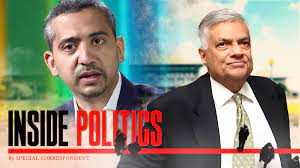
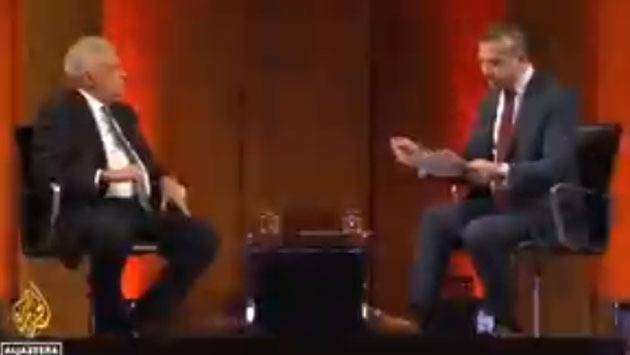
A much-looked forward to interview was aired. Prior to delving into the details of the interview, it was clear by the panelists & a quick look at the audience that the interview was not only well planned but questions were also well prepared & RanilW was unknowingly entering the tigers den. All of the questions were sensational sans any trace of evidence, claims were pure conjecture and clearly a witch-hunt. Ranil must have wondered why a diaspora that threw bouquets over decades were now throwing bricks! Some food for thought for the former President. But the role of Mehdi in this drama completely erased his credibility as an unbiased journalist.
Ranil claims the interview that lasted 2 hours was edited to 45minutes. He also claims Al Jazeera lied about the panelists who were present.
What we can agree with Mehdi
Former Ranil Wickremasinghe was always part of the very establishment” that people were trying to get rid of. This would inevitably answer his next question as to why people did not elect the former president as President in 2024.
Factually incorrect statements by Mehdi
Sri Lanka’s conflict was never a CIVIL WAR – the UN defines it as a Non-International Armed Conflict. The perpetrators, the LTTE who were all Tamils killed scores of Tamils while also endangering the lives of scores of Tamil children denying them their human rights & fundamental freedoms by turning them into child soldiers. Mehdi’s next interviewee should be Adel Balasingham who lives happily in London after training innocent children to kill & commit suicide too.
Mehdi mentions Civil War” at least 20 times.
The anti-Rajapakse” slur is unbecoming of a supposed to be unbiased & independent journalist going so far as to say I’ll challenge him (RanilW) on his relationship with the Rajapakses”.
Questionable panelists
Mehdi selected 3 panelists of which Niranjan Devadithya has also faced criticism for supporting pro-Tamil eelam ideology & pro-LTTE groups, echoing calls for war crimes after LTTE defeat while ignoring 30 years of war crimes by LTTE though he was an envoy of RanilW.
Francis Harrison (former Amnesty International reporter) the next panelist author of Still Counting the Dead” from UK. She has written 5 books all only on Tamil Tigers. Interesting why!
Her BBC documentary Sri Lanka’s Unfinished War”2013 eventually exposed the asylum seeker racket taking place in manipulating the UK govt. Nandani’s story featured 1st post-conflict rape. Her mother living in Sri Lanka’s story was far different. BBC would not have expected her mother to be traced. BBC says Nandai was kidnapped in early 2013, her mother says she left for UK in 2012. Nandani had been lodged in Colombo from 2006 to 2012. So how could she have been picked up at her home in Jaffna. The documentary does not mention she was married to a pro-LTTE activist Uhan Padmarasa who was sent to UK in 1995. He went to marry Nandani in India in mid 2000. Her attempts to join him failed. Rape was the last option & crediting blame to the armed forces was the best solution. The training for asylum seekers costs minimum 5000-6000 pounds & excludes processing fees. This racket needs to be investigated instead of spreading fake documentaries.
The last panelist was Dr Madura Rasaratnam whose research is alleged to be sympathetic to Tamil eelam which was the goal of the LTTE terrorists. Her husband Dr. Shanth is allegedly linked to LTTE’s ideologue Anton Balasingham, a claim RanilW has also made following his interview.
The hypocrisy is that all of the human rights activists” were silent when LTTE committed war crimes but became active only after LTTE defeat.
Mehdi Questioning Justice
While Mehdi is questioning justice” & accountability in Sri Lanka, being a Brit he may like to question why Bloody Sunday accountability took 35 years. The massacre that took place in 1972 only had an inquiry appointed in 1998 (26 years after the incident) though David Cameron apologized there was no criminal justice against the soldiers who were found guilty. Where was the justice for this war crimes, Mehdi?
Mehdi & panelists who are throwing all sorts of wild allegations at Sri Lanka’s soldiers may like to be reminded of the scores of war crimes that UK soldiers were accused of but did not get any jail terms.
As for Sri Lanka’s soldiers simply screaming war crimes & genocide & holding biased interviews cannot erase the key fact that no dead bodies – no war crimes. Where are the 40,000 dead – where are their names – where are their skeletons … with none to prove no one can claim 40,000 civilians were killed while LTTE dead cannot be counted as civilian dead though LTTE & LTTE supporters annually shed crocodile tears for terrorists.
Ranil’s role in Economic Crisis
Mehdi carried away in throwing personal attacks at RanilW completely omitted to mention the $12.5billion ISBs and the amendment of Foreign Exchange Act that largely contributed to the catastrophe that unfolded in 2022 with creditors demanding their dues & country having no foreign exchange with exporters/importers parking their profits in overseas banks instead of depositing back home as was mandatory while a campaign was launched discouraging expats to send their earnings home falsely claiming the Govt would cease the money. This important aspect was never touched by Mehdi.
With the expose by the Trump administration on USAID funding it is not difficult to assume the role that foreign funded local entities played in the 2022 people’s protest” that justified going to IMF & agreeing to all of its neo-liberal capitalist conditions to which Sir Lanka is now trapped for a paltry $2.9b loan which is given in tranches & which has to be paid back with interest from 2028 while a former Minister was on record to say that Sri Lanka’s exporters/importers are keeping a minimum $55b in off shore accounts! No one especially the Central Bank seem to be bothered to recover this money or willing to reverse the 2017 amended Foreign Exchange Act.
Who is to blame for Sri Lanka’s Economic Crisis?
Rather than who the question should be what. Unmonitored ad hoc ill-planned & ill-advised open economic policies since 1980s where the nation’s deficit kept widening due to excessive imports killing any form of self-sustainability while virtually killing local producers where eventually imports & commissions became the name of the game.
Mehdi on Ranils handling of protestors
Mehdi says you had an opportunity to listen to young protestors who were out on the streets in Sri Lanka & you squandered it”.
Sri Lanka has been regularly holding elections pre & post-independence. Representatives of the people are voted out not thrown out of their homes or offices by people stampeding & destroying public property.
Mehdi also claims within hours of becoming President ……you called in the military, …..to do whatever is necessary to restore order”
Mehdi may recall the use of excessive force by UK police which included beating protestors during the 1990 Poll Tax riots in Trafalgar Square which led to PM Thatchers resignation. What about the 2009 G20 London Protests against austerity measures & corporate greed resulting in police beating protestors inhumanely with batons & led to the death of Ian Tomlinson, a newspaper vendor,
Then in 2010 students across UK protested against govt decision to raise tuition fees. Police beat these students too. Then there is the London riots in 2011 following the police shooting of Mark Duggan which later led to looting & arson. The same year saw more anti-austerity protests in London resulting in clashes with police.
When people protested during Covid lockdowns, UK even changed its protest laws in 2021 (Police, Crime, Sentencing & Courts Bill) The bill included clauses on right to protest & introduced new laws to allow police to impose conditions on protests & protestors including their ability to block roads & use loud speakers, police could stop protests that would last too long & slapped harsher penalties for those found guilty. Imagine if these laws existed in Sri Lanka in 2022?
Ranil Wickremasinghe’s response was quite correct. What will you do if the Parliament is being taken over by a mob” which translates to Will Mehdi or UK govt allow protestors to storm & throw out the UK PM or King Charles from Buckingham Palace?
Mehdi’s counter to RanilW’s question was to quote Amnesty International – this is an entity that accepted $50,000 from a banned d LTTE front. Its 2019 report on Saudi Arabia execution allegedly failed to distinguish individuals involved in terrorism. Its 2011 reporting on Assad’s Massacre” was allegedly exaggerated with unreliable sources while it was also pointed that some sources had questionable credibility. Its 2016 ISIS Recruitment in the Philippines” report claiming Philippine military used torture was also said to be exaggerated/fabricated using unreliable sources. Its 2017 Myanmar Rohingya Report was criticized for insufficiently covering context of the conflict even by analysts with disproportionate blame on the Myanmar Govt overlooking the role of insurgent groups & the historical context of the conflict. Its 2015 European Migrant Crisis Report that highlighted the mistreatment of refugees by European Union was also questioned. Amnesty’s 2014 report on Sri Lanka was also accused of being one-sided & based on unverified sources & completely ignored terrorist tactics used by LTTE & not addressing any of the crimes committed by LTTE.
RanilW quite correctly reminded Mehdi what the protestors committed – killing one Member of Parliament & nearly killing another MP while also burning a large number of houses, & went on to attack Parliament.
Mehdi’s response was to claim that the European Union claimed the GoSL used unnecessary violence” against protestors. We can give another list of excessive force used by police in EU nations against peaceful protestors to question EUs handling of their own people.
RW went on to claim that the same EU funded some of the agencies that called for his resignation but praised RW as the man who took the nation out of the economic crisis.
Mehdi must take a look at the figures & statistics on the vandalism & destruction to state & private property by the so-called peaceful protestors” of 2022.
Mehdi’s raising of not holding local government elections is valid & RanilW did not adequately respond to that question. Mehdi did not mention how US-India funded regime change in 2015 that brought Sirisena-Ranil to power also held no local govt elections until 2018.
Mehdi on Rajapakse’s
From the tone & content of the questions it is quite obvious that Mehdi holds a bias against the Rajapakses. He questions why RanilW has not taken action against them for corruptions. The financial crimes division was created, bribery commission were created. If Mehdi & co must file evidence.
What is Mehdi’s problem in RanilW attending the birthday party of Mahinda Rajapakse? Mahinda Rajapakse remains the only President who had the guts as Commander in Chief of the Armed Forces to order the troops to defeat a 30 year old terrorist outfit banned by 32 nations including the UK. This ban remains active even 16 years after LTTE defeat even in the UK.
There is a legal maxim innocent until proven guilty” (Ei incumbit probatio qui dicit, non qui negat”) – this internationally accepted fundamental principle holds a person INNOCENT of any crime unless evidence is presented in a court of law to prove their guilt.
The responsibility of the prosecution or anyone accusing like Mehdi falls on the accuser to prove the guilt of who he is accusing. The accused does not have to prove their innocence. This concept is tied to presumption of innocence in criminal law.
Thus a biased journalist like Mehdi cannot use his program to make anyone guilty unless he goes to court with the evidence & the court declares the person guilty. So just because Mehdi may hate the Rajapakse’s he cannot demand RanilW or anyone else refrain from associating the Rajapakses. What a bizarre logic!
Mehdi may recall Queen Elizabeth’s letter to Ugandan dictator Idi Amin when he invited her to attend their independence in 1972. Her letter to him ended I am your good friend … Elizabeth R” (anyone is welcome to google) Pity Mehdi couldn’t bring the Queen on his show & question her!
Mehdi let slip I have been opposed to the Rajapakse’s all this time” (why, on what basis, heresay or where is his evidence) is this some kind of international criteria to be accepted into some inner circle only if one hates the Rajapakses?
This statement automatically removes his claim to be unbiased or independence.
Factually incorrect remarks by Dr. Madura Rasaratnam
She claims RanilW was made President by the Rajapakses. This is not true. Parliament voted – Ranil received 134 votes & Dullas Alahapperuma received 82.
She claims the protestors wanted total system change”. This was how the LTTE ruled their own people. The protestors in total were hardly 300,000 in a total population of 22million people. So the protestors were no majority or even voiced the will of the whole of the Nation. Sri Lanka is a democracy not a nation where a bunch of hooligan’s stampede buildings and demand who they want to be placed in power.
She is loosely using words like grave crimes” genocide” but these are sans evidence & baffling is how a Tamil population figures can increase statistically while being accused of committing genocide”. Must be mathematics of people living in UK.
Ranil’s envoy Niranjan Deva Dithya pointed out how the civil service stopped working because RanilW tried to take action.
Francis Harrison asks why RanilW did not hold Gotabaya Rajapakse accountable. Accountable for what? He was elected to power in Nov 2019, Covid struck in 2020, lockdowns ceased productivity, he did not take a single loan. He did not waste state funds. On what grounds is she asking Gotabaya Rajapakse to be held accountable? If she claims there are cases against him, these can be taken up now that he is no longer President. She also mentioned misusing pension fund. Valid question which she must also pose to the US investors who used US pension fund for the ISBs in 2019.
RanilW quite rightly says there’s no charge against him” when Mehdi asks him why Gotabaya Rajapakse was allowed back to Sri Lanka.
It is very clear from the interview that Mehdi was using the interview to attack the Rajapakses & questioning RanilW for not taking action against them. Head to Head may be a kangaroo court but that is not how decent nations go about governance.
Mehdi claims they are accused of massive crimes” – what are they, where is the evidence?
Easter Sunday attacks
RanilW claims that the Supreme Court has cleared him. Mehdi says that the Presidential Commission of Inquiry finds both President & Prime Minister accountable for dereliction of duty”. But RanilW says the Supreme Court found President responsible not PM.
Mehdi next comes to Channel 4 & no wonder as the main culprit of that is seated grinning away in a front seat row. So we can guess how prepared the questions against Ranilw would have been with all pro-LTTE inputs. Irony is that they all held RanilW is high esteem and supported him for decades & the curious thing is why they are now all ganging up against him?
The blockbuster thriller” by private funded C4 timed annually for Geneva sessions presents one Hamsa (we can recall their previous star witness Vany K who claims she mixed blood & water to give patients-anyone knows the ultimate outcome of that – she turned out to be a former LTTE)
The C4 fiction attempting to tie a respected intelligence official to Easter Sunday through an asylum seeking Hamsa who can go running to a private foreign media but did not produce his evidence before the presidential commissions. The Justice Imam report declared C4’s allegations as hoax though the Cardinal was quick to congratulate C4 in a 3 page letter hours after their program was released. C4, Hamsa & Cardinal has failed to prove the alleged official was in Sri Lanka in February 2018, failed to affirm he visited a coconut estate in Puttalam, failed to affirm that he spoke to Hamsa & failed to provide he was in Sri Lanka during the Easter Sunday attacks. These constitute character assassination filled with lies & fabrications. Moreover the former SIS head claims 15,000 knew something would happen” before the attacks took place. Does this not warrant to even why the heads of the Church did not fall into this 15,000 list?
The Imam Committee actually refers to Channel 4 broadcast as yellow journalism” & calls to restore journalistic integrity by media when reporting matters of national security using credible sources & verifiable data instead of using journalism as a tool for harm & character assassinations.
Hereto Mehdi’s attempt is to pinpoint Easter Sunday attacks on the Rajapakses. Being a Muslim he must surely wonder how 7 Muslims would commit suicide attacks on orders of a Sinhala Buddhist to make him President.
Mehdi says no one has faith in the Committees” – are we supposed to have faith in what Mehdi & his pro-LTTE panelists say?
Mehdi claims the Catholic Church has rejected the reports.
RanilW says that he knows the politics of the Catholic Church. If the Church has evidence where is the evidence. They too cannot be like Mehdi making wild allegations & expecting people to accept what they say as facts”.
Let’s go back to the conflict.
Firstly, Sri Lanka did not have a civil war – we had a terrorist conflict.
LTTE killed Sinhalese, Muslims, Foreigners & even Tamils
Sri Lanka’s conflict started with a wave of killings by LTTE militants – where was Mehdi and where were these panelists or human rights activists or even the UN.
Let’s get the facts right first
If LTTE in civilian clothing died engaged in hostilities – they are not civilians.
If LTTE child soldiers in civilian clothing died engaged in hostilities – they are not civilians
If civilians” were engaged in hostilities voluntarily or forced – they are not civilians
All above cannot be categorized as CIVILIAN DEAD
Who can distinguish the dead when LTTE fought in civilian clothing, when LTTE had a civilian armed force and LTTE child soldiers also fought in civilian clothing. Can Harrison or anyone else count this first.
Next, why are all the dead been credited to only the armed forces. There is sufficient evidence that LTTE even killed their own injured cadres putting them into buses & setting fire to the buses.
LTTE blurred the distinction of civilians”. A civilian not involved in any form of hostilities can only be categorized as civilian as per Geneva Conventions.
Therefore, can Harrison count & tell Mehdi
How many LTTE died fighting in civilian clothing or LTTE uniforms?
How many in LTTE CIVILIAN ARMY died
How many actual civilians died after being forced to engage in hostilities. How many actual civilians died after voluntarily engaged in hostilities.
Can Harrison, Mehdi or Dr. Ramaswamy tell how many civilians who were not members of LTTE, not members of LTTE Civilian Army & who did not engage in hostilities either voluntarily or by force died – how they died & whether they died because of LTTE fire or Sri Lanka Army.
Without making these distinctions – how can anyone accuse a national army of war crimes or genocide? No one not even UN officials or UNHRC officials have any right to flog the term genocide” without proper evidence.
So far the claim of 40,000 has only been a number – no one using this figure can provide names of the 40,000 dead, there are no skeletons of the 40,000 dead either. Those who throw numbers & claim that to be genocide should produce the names of the dead & ensure these dead are CIVILIAN and not LTTE dead. No one can scream war crimes & genocide against terrorists when they were given 3 opportunities to lay down arms & surrender but they refused.
Interestingly Dr. R whose organization PEARL claimed 70,000 to 169,796 were killed. Can this panelist produce the names of the dead?
Mehdi also questioned RanilW on the Missing Persons Commission. In 2013 the Paranagama Commission was appointed there were only 18590 complaints of which 5000 were missing Sri Lankan soldiers. How come Mehdi or human rights activists omit looking for these missing soldiers & want to look only for terrorists?
Why has PEARL not filed 70,000 or 169,796 missing with the commission?
Mehdi may like to look back at the records.
The UN Country Team said 7721 civilians died between Aug 2008 & 13 May 2009.
Indian embedded Journalist Murali Reddy confirmed that from 13 May 2009 to 19 May 2009 there were no civilians in the 1.5km strip LTTE were confined to.
Sri Lankan Govt census by Tamil teachers in Feb/Mar 2012 placed war related deaths at 7432.
The 3 member panel on a personal capacity by UN Secretary General in their 2012 report claimed civilian deaths could be” as high as 40,000. Could be does not mean 40,000 died. However former UN Spokesman Weiss ran off with the 40,000 number which he used to launch his book & reduced the number to 10,000 when questioned at the launch.
Even LTTE website Tamilnet put casualty figures at 2972 until 5 April 2009 while UNHRC head Navi Pillay put civilian deaths at 2800 in her 13 March 2009 report.
So now Mehdi & his panelists must show how from 2800 dead in 13 March 2009 the figure rose to 40,000 by 19 May 2009 when 2 days later UNSG Ban Ki Moon landed & took a helicopter ride over the war terrain. No one reported newly dug graves. So where did these 40,000 newly dead bodies vanish to? Asking these basic & fundamental questions should make readers realize that this figure accompanied by war crimes/genocide chorus is nothing but fake news simply to keep their money making entity alive. Janes Intelligence claimed LTTE profits in the mid 2000 was around $300-400. That LTTE kitty must be treble the amount with the sale of souvenirs and other eelam programs being launched while fooling the Tamil people back home of working for a Tamil Eelam while holding foreign passports. Thus the question is who are these diaspora commemorating – LTTE dead or civilians killed by LTTE as Maaveer Naal is a commemoration for LTTE dead.
So Mehdi needs to realize if he & his panelists are claiming an x number are dead or missing then they have to prove who are the missing who are the dead & numbers. Mehdi cannot be demanding justice without providing x number dead.
On Shavendra Silva
Next Mehdi questions why Ranil reappointed Gen. Shavendra Silva as the Chief of Defense staff because the US govt backlisted for gross violations of human rights, namely extra judicial killings. Perhaps Mehdi has forgotten that Sri Lanka is a sovereign country & just because another country backlists people, Sri Lanka is not bound by that. For that matter UK has banned LTTE but UK police does nothing against pro-LTTE protestors brandishing LTTE flag & LTTE paraphanelia? LTTE is banned in both US & UK. US banned foreign terrorist organizations which are also on UK watchlists include Al Qaeda, ISIS, Hezbollah, Lashkar-e-Taiba, Jaish-e-Mohammed, Hamas, Al-Shabaab, Kurdistan Workers’ Party who are allegedly operating even from UK. Has Mehdi questioned this too?
Mehdi cannot claim surveillance, intimidation, harassment or land grabs without proof. To claim any land belongs to x, y, or z they cannot go to Medi, the UN or foreign missions & cry this is our land” they must present a valid & unforged land deed. No one claiming land has been able to provide such. In terms of surveillance only the guilty have a problem.
Is Mehdi aware that UK has 6m CCTV cameras that is 89.5 cameras for 1000 people (6m/67m people) There is 1 CCTV camera for 11 people in public spaces.
In US, there are 50m surveillance cameras (50m/333m population = 150 cameras per 1000 people) this excludes the cameras used by govt for surveillance.
Mehdi seems to repeatedly claim Mahinda & Gotabaya Rajapakse are accused of multiple war crimes – accused by whom? Who has found them guilty? Is it Mehdi court, Madura’s Court or Harrison’s Court?
Has Mehdi conveniently forgotten that President Rajapakse defeated LTTE terrorists & not Tamils.
Has Mehdi forgotten that LTTE scores of Tamils – that list is longer than the names Harrison & Madura can produce to claim civilian dead.
Why should President Rajapakse be put on trial or sent to prison for defeating LTTE? Is this anger & interview to seek revenge against them. Are they all angry that LTTE leader & LTTE military was defeated by President Rajapakse & the Sri Lankan military.
Why should President Rajapakse be put on trial for defeating terrorists what right do pro-LTTE separatists have to demand people be put to trial.
Mehdi has not mentioned a word on LTTE crimes.
UN did not estimate 40,000 dead – this is an abject lie.
Madura should refer UN records before making such poor statements.
So far none of those pointing fingers can produce facts or figures with evidence.
Mehdi finally tries to corner RanilW on Batalanda. Ranil must be wondering what happened as the forces that treated him as their darling are now all ganging up on him.
A member of the audience questions Ranil on self-determination. What is ironical is that no Tamils living in Sri Lanka are asking for separatism or self-determination except for Tamil politicians funded by the LTTE Diaspora and foreign passport holding Tamils living in foreign shores. Shouldn’t we all be wondering why people living overseas want to separate Sri Lanka & not Tamils living in Sri Lanka.
A woman in the audience who claims to be a survivor of the mullaivaikkal” next raises a question. What we have to first wonder is, was she one of the 297,853 Tamils that Sri Lanka Army saved, was she one of the 12,000 LTTE combatants that surrendered to the Sri Lanka Army, was she one of the 594 child soldiers that surrendered to the Sri Lanka Army? Now she is living in UK, if there was genocide how come 297,853 people were brought to safety sacrificing 6000 soldier lives? Why would the Sri Lankan Army kill an x number of people (who have no names, & there are no skeletons to prove they were even alive) but save 297,853 people? Readers please ask this question.
The co-sponsorship of the UNHRC Resolution has now backfired on RanilW as he & Mangala not only agreed to co-sponsor but also delisted LTTE fronts who are now ganging up on RanilW.
Callum McCrae’s question was on Gaza on an article titled Rajapakse plan for the complete destruction of Hamas’ suggesting Israel should adopt the same tactics that Rajapakse applied. Clearly, he wanted to bring up the No Fire Zone. The status quo of the NFZ needs to be also brought to the attention of the readers. An official NFZ is agreed & signed off by both parties. In this case the Sri Lanka NFZ was created only by the Armed Forces for Tamil civilians to come to. LTTE went to the NFZ fired from inside it putting people in jeopardy. By compromising the lives of Tamils LTTE is at fault & not the Army. The Army dropped leaflets in Tamil too. It’s a first if Israel has to learn from the Rajapakses!
Mehdi is totally wrong about humanitarian aid being blocked because all the details are available. Most of his quotes are unverified too. Mehdi must look up all the crimes the UK soldiers accused in Iraq.
What about the destruction of the Buddhist sacred sites as well as archaeological heritage sites? Why is no one speaking about these?
Playing the Buddhist card
Eventually RanilW sought salvage in Buddhism because that was the only way he could twist the argument in his favor.
However, what is clear is that this Al Jazeera interview by the supposed to be unbiased Mehdi Hassan was nowhere near that. It was well planned and questions were well prepared & Ranil fell for the tiger trap.
‘Before you study the economics, study the economists!’
*
US Blackrock’s Capture of the State of Sri Lanka
e-Con e-News 02-08 March 2025
*
‘Dear Julie, I am writing to you in the softest electronic print, just in case you don’t already know what we are writing you about… We notice you are constantly running here and there in Sri Lanka, in places we don’t really expect to or should see a foreign diplomat, showing off your pale overworked knees, which it seems you like to expose below skirts, to perhaps distract our sex-starved or oversexed officials – the hetero males in particular, but not just that gender orientation – to help lubricate US deals (like Exxon Chevron lubes our imported cars). Imagine if our ambassador in Washington’s Embassy Row, Hippie Mike Samarasinghe, wearing well-hung tights, took pictures with little white girls (or boys) in Poughkeepsie or Baton Rouge, claiming he was standing up erect for their rights or equality. What on this white god’s earth would them good ole boys think? Lynch? Then again, who remembers all your sermons about ‘rule of law’? Not your latest leader, and payroll officer. And then, I hear you’ve been meeting judges, too. Poor fellows, you may be causing a lot of rustling under their august robes & woolly wigs… Approach the bench, indeed!
Dear, dear Julie, we are yours, truly, truly. Until next week, then…’
*
IMF warns Sri Lanka trade unions against strike over pay demand
*
IMF: ‘Sri Lanka can decide public sector size with limitations’
*
‘IMF wishes you have a happy women’s day!’
Welcome to the 360th almost-weekly edition of ee. And we too wish our readers a thoughtful & happy International Women’s Day (IWD) – and not just for today but for the rest of the year & the rest of your life & the next one too, if you don’t take the exit ramp off samsara. For unless we take action soon, if we are reborn in Sri Lanka, we will be born in chains, shackled to an unpayable debt. For look, how the IMF is acting viceroy, warning trade unions and ‘rightsizing’ ‘human resources’….
*
International Women’s Day is only celebrated as a national holiday in the socialist countries. Outside such countries, it has been hijacked like most holidays, almost wholesale by corporations. Though, with the US government signaling wildly that their DIE (Diversity, Inclusion, Equality) agenda is off the table (In fact, that third headline about the IMF wishing women is clearly fake. For unlike other years, the US-dominated IMF did not wish women happy days. Or did not make a big fuss about it. After all, ‘gender equality’ – even as the capitalist media has befogged what exactly gender means – has been an almost hourly business headline, alongside saving elephants & leopards & oxygen… Such virtuous talk of course is always being waylaid by those gentlemen who would offer you their seat in the bus – tho gentlemen don’t take buses or trains in Sri Lanka – but once you get to work, they pay you a whole lot less than other workers!
*
All these economists & politicians who get daily-by-daily play in the media, due to being funded by the u-know-who, and have been promoting ‘export-led growth’, are now scrambling to revise their philosophies and soundbites (see ee Economists, ‘Harsha calls on Govt to prepare for US reciprocal tariffs). After decades of this free-trade business, their great father-funder in the Northwest Atlantic is about to slam the door shut, and worse, kick them out, dollar-less and handcuffed to boot. So, what’s an unemployed de-dollarized free-trader and virtue-signaler to do?
The Asia Progress Forum‘s Shiran Illanperuma in his latest computation of ‘The Price of Losing Economic Sovereignty’ has other ideas (see eeFocus). He believes the hour is long past due – in this age and art of the no-deal deal – the only way we can get ‘a better deal’ is to sign up with the rest of the world – this time, with a South-South coalition of the more-than-willing – to take ‘coordinated multilateral action‘ through forming a ‘debtor’s club’, looking to fora like BRICS to provide a platform, especially when the US and its killer poodles have been pivoting their gunsights from Russia back on to the new powerhouse Asia and its ocean called Indian, with Sri Lanka trapped sitting squat in the middle.
We have no choice – the ‘loss of monetary sovereignty remains the single most damaging element of the IMF’s conditions’. With ‘mammoth 41% of [budgetary] expenditure taken up by interest payments’ and ‘private bondholders’ accounting for 70% of these interest payments, with the government claiming ‘to restore economic sovereignty’, a confrontation with these capitalist bondholders is inevitable. ‘To pretend otherwise is either naïve or dishonest.’
So who may these private bondholders be? Our monkey media won’t tell us. This week saw US ‘fund manager’ Blackrock grab 43 ports around the world, including 2 at either end of the Panama Canal from HongKong’s CK Hutchison, with a wink from the Don, who BlackRock nudged to publicly demand the Canal back (to see who was really behind it, see Random Notes). Not one word has been heard from the Panamanian government or its people. BlackRock is also the lead loanshark to which we must pay huge ‘interest’ payments. BlackRock is not just behind Adani’s ‘Green’ gas & wind, but also a major shareholder in our old fair&lovely Unilever, etc.
Please bear with us. When we refer to monkeys, we are refer to our brand of merchants. Darwin’s theory of evolution, Marx quipped, was not talking about monkeys, but was referring to the survival of the craftiest English capitalists. ‘The capitalist state is a band of warring brothers’ (thus spake Marx). And Sri Lanka’s economy is also controlled not just by New York fund mangers and the Washington-dominated IMF, but also by the Japan Automobile Manufacturers Association (JAMA), who dump their rickety cars on the country. ‘Sri Lankan is a cemetery for Japan’, a Japanese professor once told SBD de Silva. The philanthropy & largesse exhibited in the last weeks by Japanese NGOs (search eeNews Index below) was due to Sri Lanka being forced to open the hatch of yet another ship bearing luxury vehicles: the MV Jupiter Leader, operated by Japan’s Nippon Yusen Kabushiki Kaisha (NYK). The MV stands for Motor Vehicles. And the MV Jupiter is registered in Panama!
And see how the IMF’s Senior Mission Chief Peter Breuer speaks not just with a tongue that is forked but spooned with silver as well (‘He stated that reopening the vehicle imports would increase demand for dollars, whilst stressing that the country’s reserves have improved significantly under the ongoing bailout program.’ So welcome MV Jupiter, by Jove (which also means Jupiter)!
*
Politics is 10% ideas & 90% implementation (aka 1% inspiration & 99% perspiration). If we are to confront this blatant usury (for as President AKD rather belatedly remembered, ‘Our economy is running on conditions. There is no economic independence or sovereignty – it is under probation and being monitored’), there is little use just talking about ‘economic democracy’ and ‘economic sovereignty’. A budget (or some other plan) guides industrialization, by targeting specific sectors and activities conducive to technological change, and long-term productivity gains. Targeting firms by size (SMEs) is not really a priority, and not transformational. Praising and protecting the small business and the small farmer maybe good for elections to pull the wannabe petit-bourgeois to the booths, but there are larger forces which control these lovely ‘small’ people, which media columnists can only hint at. Take ‘Emeritus Professor Ranjith Senaratne, Department of Crop Science, University of Ruhuna’ on ‘Our rice crisis: A holistic solution’. He proclaims: ‘Needless to add that the hapless farmers are at the mercy of the large-scale rice millers and traders, including input and service providers.’ Note: ‘input and service providers’. Exactly who are they? And why are we not allowed to make these inputs here?
*
Nestlé Lanka inaugurates new Rs1.1bn biomass boiler at Kurunegala factory
‘Nestlé Lanka has been delighting consumers with much-loved brands
such as Nestomalt, Milo, Maggi, Milkmaid for over 118 years’
*
Look at these copy&paste corporate press releases, which are really advertisements or infomercials paid for to the ‘fair&lovely’ media under the table (corruption anyone?). And while it is dangerous to criticize anyone who has more ink & pulls more eyeballs than you, the media in Sri Lanka is one big sensationalist tabloid, posturing a fake gravitas, repeatedly insulting people and villages with Sinhala names as gangsters, etc, while diverting from the real gangsters. This eethereforeexamines the capture of the Sri Lankan state & its agriculture, and the prevention of modern industrialization by capitalist banks and corporations. We also direct our readers’ attention again to our News Index(eeAgriculture) which overflows with worries, not about the state of agriculture or farmers, but about elephants, monkeys & leopards, etc.
*
‘The Trust’s desires are modest. All it wants is the earth
with a barbed wire fence around it. The Tobacco Trust is
a hog, and wants all the swill. The tobacco crop is short
this year. It ought to have brought 12 cents a pound,
but the Trust fixed it at 7 cents or 8 cents,
and that is all that is being paid.’
– Raleigh News & Observer, 1907
This ee Focus looks at the creation of monopolies and their restrictive policies that underdevelop agriculture in Sri Lanka, and elsewhere. It is not just a tale about British American Tobacco (BAT)’s Ceylon Tobacco Co (CTC) who puppeteer politicians like Harsha de Silva, etc, it is also the story of Unilever & Nestles and ICI’s CIC & Booker etc, who also operate through their local agents (Hayleys, Keells, etc.)
The policies of BAT’s CTC by the 1980s, aided by the government, were mimicked by other multinational corporations (MNCs, or transnationals) like Nestles (milk) & Booker (sugar) in Sri Lanka. They sought to maintain the relative impoverishment of peasants and isolate them further, making them depend on a package of inputs: finance, machinery, chemicals, processing & marketing, etc, forcing them to sell their produce to MNCs alone at fixed prices.
In 1936, the colonial government had set up a separate division within the Department of Agriculture to promote tobacco crops, permitting the Department to function as an adjunct of the CTC monopoly. CTC, rather than increase their own investment, then got the 2 state banks, with the country’s largest network of branches – the People’s Bank & the Bank of Ceylon, to finance the peasants, based on CTC approval.
ee’s concluding segment of Charles Abeysekera’s study, recalls how peasants formed the All-Ceylon Tobacco Growers Association to push the government to end the CTC monopoly, as the peasants were trying not to be at the mercy of monopoly ‘market forces’. Abeysekera examines how the CTC reacted to break such collective action by shifting tobacco cultivation to the dry zone, and when peasants sought to sell to whom they chose, the CTC illegally got the police and other state authorities to search vehicles for ‘independent’ tobacco! They broke up barns into mini barns, creating barn owners as tools to harness peasant production to the needs of international capital, creating ‘entrepreneurs’ & ‘middle peasants’ linked to the state bureaucracy, to hide CTC’s actions from the peasant grower.
Most importantly, the large sums of money accumulated were not productively invested in agriculture. The village were also hemmed in by tea plantations, unable to increase cultivable land. Instead, investments are made in trade & transport (imported tractors and lorries, etc. A shoutout to Sarvodaya, here). CTC’s manipulation of peasant agriculture in Sri Lanka was replicated elsewhere in Africa & the Americas. Corporate & state policies have not resulted in expropriation to proletarianize the peasantry, however they have caged them in their diminishing plots, under moneylenders & merchants, subject to international capital.
The study also examines the limited nationalization of tea plantations in Sri Lanka in 1972-74, the difficulties of cheapening wages midst growing labour strength, and the resort to smallholder production, which amounts to a type of isolated wage labour, shaping ‘another trajectory along which agriculture is transformed along capitalist lines’.
The Maduru Oya settlement project of September 1, 1983, led by Dimbulagala Hamuduruwo started well. Gamini Dissanayake, Minster of Mahaweli Development had suggested it and the Mahaweli Ministry staff responded enthusiastically. It was a settlement created at Ministry level. It should have been a great success. But it was not . The organizers blundered, the settlers were removed and the project crushed.
The Dimbulagala led Maduru Oya settlement venture was completely crushed. The settlers were chased away from the Right Bank.[1] They were then assembled in groups of 200 and 300 and resettled elsewhere. [2] Some were sent to Dollar farm where they were killed by the LTTE .
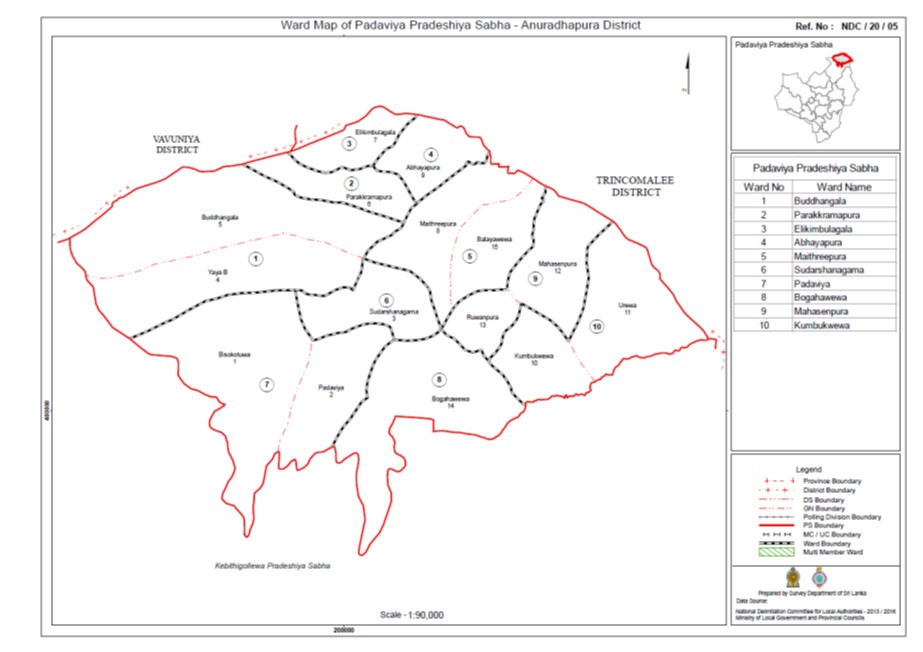
Most were re-settled along the Padaviya border . This would form a line of Sinhala defense from Padaviya to Nedunkerni, complained the Tamil Separatists who were watching the activity.[3] Jungle areas are being cleared close to Ariyakundam, Dollar Farm and other places. Four roads have been opened up from Padaviya to the Dollar Farm, Kumbakarnan Malai, Ariyakundam, Kokkuchchankulam, Kokkuttoduwai and Veddukkan malai.
Jeeps and vehicles belonging to the Army, Agrarian Services, Illmenite Corporation, Tobacco Corporation and Petroleum Corporation are being used for this project. Some Sinhala families have already been installed near the Dollar Farm.
Neither the Government Agents of Vavuniya or Mullaitivu, nor AGAs nor Land Officers who are Tamils know anything about what is being planned. The area is well protected by the army and an air of secrecy surrounds the district, Tamil Separatists said.
The Sinhala settlers who had been encouraged to come to Maduru Oya were in great distress. They wrote to Ven Seelalankara (Dimbulagala Hamuduruwo) in 1984 from Weli Oya saying we did not ask to come here. We came because the army burnt our houses in Maduru Oya and then gave us permits for Padaviya. We are now shivering in fear. Please get us land in Polonnaruwa or Badulla districts.
The Maduru Oya fiasco should be treated at a case study. The first thing it shows is that there are two forces at work, one force for Sinhala colonization of the east and another force opposing Sinhala colonization. The opposition comes from the Tamil Separatist Movement . Tamil Separatists are fiercely against the Sinhalisation of the north and east. They are frantically trying to create the sovereign state of Eelam to complete the ‘settler colonialism’ of the British.
The Tamil Separatist Movement greatly objected to the Maduru Oya Sinhala settlement but the forces against them were too strong. The Accelerated Mahaweli scheme was a national project, which included many provinces and the Sinhalese were determined to benefit from it.
There was strong support in the Mahaweli Authority for Sinhala settlements at Maduru Oya. Tamil officials were secretly settling estate Tamils in the Right Bank of Maduru Oya so that there would be no land left for the Sinhalese. The engineers and administrators at Mahaweli saw this. They also saw that the government was deliberately looking the other way. They were concerned.
Officials in the Mahaweli Ministry wanted the Minister to know that they will be 100% supportive behind the government in any stand against Eelam.” Malinga Guneratne conveyed this to the DG Panditeratne and to Gamini Dissanayake, Minister for Mahaweli.
When the Maduru Oya Sinhala settlement project started Mahaweli officers supported it wholeheartedly. The Mahaweli Authority had done everything openly, observers noted. Its fleet of lorries transported the peasants from the Dimbulagala temple to the settlement site. It ferried poles, tin sheets, cadjan and other materials needed to put up sheds to house the settlers. It carried stocks of cement and provisions needed for the settlers. The Mahaweli Authority’s tractors and bulldozers cleared the land needed to put up the sheds. [4]
Mahaweli officers did so, because they were supported by their superiors, from the Minister downwards. Gamini Dissanayake was the Minister for Mahaweli. His role in settling Sinhalese in Mahaweli deserves special mention.
Gamini Dissanayake was supportive of Sinhala settlements in Maduru Oya. In 1982, Sampanthan had asked him to cancel the newly planned Mahadivulwewa colonization scheme, in Trincomalee , since a Tamil village was already there. Gamini agreed, but told his secretary, to telephone Trincomalee Government Agent Bandaragoda and tell him to expedite the settlement so that it would be completed by the time the cancellation order reached him. [5]
Gamini was an experienced politician and knew to issue strategic instructions. When told of the illegal Tamil settlements on the Right Bank, he wanted an army post set up there. This was not done.
The initial suggestion of creating a Sinhala settlement at Maduru Oya Right Bank was also made by Gamini Dissanayake. Gamini had suggested to Malinga , why don’t you settle people in Maduru Oya. He expected it to be done quietly under Ministry supervision. That also did not happen.
Malinga Gunaratne gave the task to Dimbulagala Hamuduruwo. Dimbulagala did not know how to do things quietly . He put a newspaper advertisement, 3000 arrived at the temple. They departed noisily to Maduru Oya, attracting maximum attention. They saw no need for secrecy.
There was an uproar and the next day Gamini Dissanayake phoned Gunaratne and asked, ‘what is happening at Maduru Oya. I told you settle on the land, not to make a song and dance of it’.
The Maduru Oya project was all over the Press and was the talk in the diplomatic circuit”, noted Rajan Hoole.[6] Gamini stood solidly by the project. He defended the project when JR started to inquire into it. When Ranil stated, correctly that there were 40,000 in the Dimbulagala led settlements, Gamini said that there were only 5000 of them. Gamini also joined in the press discussion, supporting the settlement.
Gamini wanted to have two more settlements at Yan Oya and Malwatu Oya, modeled on Maduru Oya settlement and had persuaded several rich business men to fund it. I am not going to remove a single settler from Maduru Oya. We are also going ahead with Yan Oya settlements he said in October.
N.G.P. Panditeratne, Director General of Mahaweli authority, when informed of the Maduru Oya plan initially had doubts about it ever happening. Panditeratne had told Malinga You wait and see what happens”. But when the settlement actually took place, Panditeratne released Rs 2 lakhs from Mahaweli funds for the project.
Panditeratne was solidly behind the project once it had materialized. He defended it before JR and in October 1983, summoned a high-level meeting of senior public servants drawn from different disciplines , who were against eelam. The attendees included WAS Pieris, then Director Census, and Ananda Meegama said Malinga Guneratne.
When he was ordered to dismantle the Maduru Oya settlement, Panditeratne decided to keep 500 at Maduru Oya and send the rest to Vavuniya, Mullaitivu and Trincomalee. Instead of retreating , he was going deeper into Eelam. He sent officials to identity suitable tanks for settlement in these provinces.
Panditeratne also had an elaborate plan for the 500 left at Maduru Oya. Tamil Separatist Movement was sure to attack the settlement. It needed security, but no assistance could be expected from the army. The settlers would have to look after their own security. Panditeratne asked Malinga to get ex-service types to join the settlement.
Panditeratne next got the names of officers recently dismissed from the Navy. Thirty turned up. They had elected as their leader petty officer Abeygunasekera. They were told that they would each have 3 acres of land in Maduru Oya outer periphery towards Batticaloa, and assistance would be given to build houses. They would be paid Rs1000 per month with food. The money came from the 2 lakhs allocated to the project by Panditeratne.
This group was directed to move to the Maduru Oya delta immediately. They must set up a security unit of about 30-50 ex service personnel. Also set up road blocks and bring the whole delta under security. They must also establish a communication system among the 40,000 settlers and develop a sense of camaraderie among the settlers.
The navy group must give the settlers basic training in use of weapons, unarmed combat, surveillance and defiance postures, they were to create combat preparedness in all the settlers including women and children. With the LTTE using superior fire power and deciding the place, time and date of attack, the settlers will have to be prepared all the time. The settlers were repeatedly told that terrorist gunmen would come for them some time and they should be prepared to repulse the attack. They were to fight only if they were attacked, not otherwise. Their training was to be used for defiance only.
One person was to be selected from ten families each and given a thorough military training, arms would be provided. The authorities were reluctant to arm civilians and asked Abeygunasekera to select only those who could be given that responsibility, and indicate what arms would be needed.
The navy group were bold and eager. They had already prepared a plan. They carried out regular reconnaissance missions deep into Batticaloa. Abeygunasekera devised and innovated weapons and techniques suitable for the terrain of Maduru Oya. Gamini Dissanayake supported this venture. He said that that he had recruited dismissed naval officers to look after the security of the settlers at Maduru Oya. This unit was probably chased out by the army, when the army subsequently took action against the settlement. ( continued)
[1] Malinga Gunaratne. For a sovereign state (most of the text is from this book)
Tamil Separatist Movement had to go to India again to get the settlement removed. JR definitely knew of the project. Gamini Dissanayake had informed him. It was only when India voiced strong objection to the settlement , that JR got alarmed and ordered the project dismantled. the illegal Tamil settlements in the same area were allowed to continue.
Work on the Right Bank channel was discontinued. No work had been done at the time of JR’s death in 1996, said GH Peiris. [2] JR was condemned for his action in dismantling the Sinhala settlement, he added.
The Tamil Separatist Movement was determined to see that an operation like Maduru Oya , ugeopen, enthusiastic, popular, well supported, huge, 40,000 persons, would never take place again in their Eelam. The Maduru Oya project, which was a straight forward land settlement project was therefore distorted into a criminal operation. It was blown up into a conspiracy against JR .
The President was told that the Maduru Oya operation was a conspiracy against him. He was told that Cyril Matthew, Gamini Dissanayake and NGP Panditeratne were creating a massive Sinhala movement to unseat him. Tamil Separatist Movement would have been responsible for this tactic. JR fell for it. He wanted Gamini and Panditeratne punished.
Gamini Dissanayake was close to the President and was considered his successor. He held the prestigious Mahaweli Ministry. But after Maduru Oya, JR sidelined Gamini and gave Lalith Athulathmudali the job of managing the Yan Oya settlement. Gamini was surprised and upset. He washed his hands off Maduru Oya . He asked Malinga Guneratne not to contact to him and made no attempt to help the arrested Mahaweli officials.
Panditeratne and Gamini had initially wondered why JR was taking such a serious view of this settlement. Gamini said that he could not understand this inquiry. He had informed the President of the Maduru Oya operation. Why did the President have to unleash the police on us. Then they found out why. President is convinced this is a conspiracy by Cyril Matthew and me. Nothing will convince him that this is not true, said Panditeratne.
JR asked UNP to investigate Panditeratne’s involvement in the Maduru operation. The UNP committee exonerated Panditeratne and stated that the President had been mis-directed. Though ‘officially’ exonerated by a presidential subcommittee on Maduru Oya, Panditeratne resigned from the position of Chairman UNP and DG Mahaweli, in 1984.
The Tamil Separatist Movement had to ensure that there would be no repeat of this type of operation. Therefore, the Maduru operation was converted to a tainted operation. This was probably done through the media where there had been much discussion on the subject, making it look controversial and suspicious.
At state level, the Maduru Oya operation was treated as a criminal activity. The charge was that state funds were used to for the Maduru Oya operation. It was illegal to do so. State funds should not be used for Sinhala settlements in the east.
The police were asked to investigate the matter . The Criminal Investigation Department was brought in. They identified Malinga Gunaratne as the leader. He was told, We know how you mounted this operation, how you used government funds to send people to the Right Bank. Dimbulagala was merely a figure head, you were the chief man behind it.
The main charge was that he had used state funds for the Maduru operation. They were only interested in how it was funded, not the settlement itself or how it was mounted, observed Malinga.
Malinga Herman Gunaratne was a tea planter who owned his estate. He had held several other positions as well. He was the Chairman of Lanka Fabrics at the Sri Lanka Ministry of Textile Industry Development. He had been an Independent Non-Executive Director at Kahawatte Plantations Plc, and a Senior Plantation Manager at Sterling Securities.[3]
Malinga Gunaratne had joined the Central Engineering Consultancy Bureau (CECB), of the Mahaweli Ministry, in 1980 as Additional General Manager, on the invitation of Gamini Dissanayake. Malinga was put in charge of the high-powered battery of media men at Mahaweli Authority.
Malinga had direct access to the Minister, whom he seems to have known personally and also access to the Director General of the Mahaweli Authority, NGP Panditeratne. Panditeratne and Gamini messaged each other through Malinga.
Malinga had complete freedom to enlist the support of any official in the Ministry from Secretary downwards to complete the tasks allotted to him. He was able to cut through red tape and get many things done at Mahaweli. He had a certain amount of clout at Mahaweli.
But Malinga was quite unprepared for a police inquiry on the Maduru operation. I truly believed that the Madur Oya was an operation that had the blessings of all, he said. We were wondering why we were being persecuted for puncturing Eelam. A seasoned politician would have crushed the inquiry and chased the police out, but not Malinga.
Malinga underwent a protracted ordeal. He was put in a police cell and interrogated. He was also summoned to the 5th floor of the CID where questioning went on for 15 hours nonstop. He was kept under house arrest. He was asked to make a confession . Otherwise he would face a court case on the matter. JR had wanted this matter taken to court, though it was an internal Mahaweli matter, because, he said, everybody at Mahaweli had supported the activity.
Malinga fiercely resisted all this. He spoke to various influential people He related the whole story to Ranil Wickremesinghe who conveyed it to JR . JR wanted a written statement from Malinga which Malinga readily provided. Then in May 1985 JR summoned Malinga to his home in Ward Place , exonerated Malinga of any wrongdoing and asked Malinga to come to him if Malinga needed any help.
Tamil Separatist Movement was also smarting over the fact that the Mahaweli staff had enthusiastically supported the Maduru operation. They had to be scared off from setting up any more Sinhala settlements in the east.
The police launched a massive investigation over Maduru, over 500 people were questioned. They includedfriends and relatives of Malinga and minor officials of the Mahaweli. Four senior Mahaweli officers including Hemapriya and Karunatilleke (whose MPhil research I supervised,) were arrested and kept incarcerated for almost a year, said GH Peries.This was clearly punishment for meddling in Tamil Separatism.
The police were able to clearly establish the presence of Mahaweli officials in Maduru Oya area in August 1983. The PROs had not been told to be secretive and they had left a trail of evidence behind. There were photos of the PROs measuring the land. The police had also easily obtained full disclosures from them.
Those who had worked enthusiastically for the Maduru operation were scared, they were reluctant to talk. The one other official present when Gamini suggested a Sinhala settlement at Maduru Oya now said he could not remember such an instruction.
Gunaratne was very resentful about the way he was treated. We had committed no crime. We had mounted a massive settlement . We who moved 45,000 people at the cost of only 2 lakhs were now running like rabbits. We should have been congratulated, not pursued by police.
Malinga commented that while had he had been kept in a prison cell, Amirthalingam and Sampanthan, who had illegally settled Tamils in Vavuniya, were given police escorts and protection and stayed as honored guests in hotels when in Colombo.
When Sampanthan says he had settled estate Tamils in north and east he is given a police escort in Colombo. When we settled 45,000 Sinhala in Maduru Oya we were arrested.
When armed terrorists slaughter innocent civilians on Dollar and Kent farm they are called freedom fighters and liberators. When a priest leads a weaponless people, he is called a rabble rouser said Gunaratne indignantly. ( continued)
[1] Malinga Gunaratne. For a sovereign state ( this is the main source for this essay).
The question of women’s rights has long been a contentious issue, with debates often swinging between the realms of religion and secular society. Each side seeks to establish its superiority in promoting women’s liberation. This controversy is not unique to any single faith but is a subject of debate among various religions, each aiming to demonstrate its egalitarian principles.
While other faiths may quarrel over theology, Islam speaks with one voice: But whoso does good works, whether male or female, and is a believer, such shall enter Heaven, and shall not be wronged even [as much as] the little hollow in the back of a date-stone.” (Surah an-Nisa‘, Ch.4: V.125). The Holy Quran very clearly indicates that righteousness alone elevates an individual’s spiritual station; gender plays no role.
Despite this divine decree, questions remain about how effectively contemporary society adheres to the principle of gender equality, as enshrined in various constitutions and religious teachings. Issues such as pay equity and pregnancy rights continue to demand our attention and action.
In Islam, women are recognised for their pivotal role in the perpetuation of humanity, a role that remains unaltered through time. The financial responsibility of raising one’s family is placed upon the man, and although the woman’s main priority is raising children, alongside that she’s given the freedom to choose her path. How is then a woman to prioritise her role as a nurturer, particularly during the formative years of a child’s life?
The moral and intellectual development occurring in early childhood undoubtedly represents one of humanity’s most consequential phases. A child deprived of maternal care risks permanent developmental impairment. For example, the first three years of life constitute a protected period wherein a woman need not balance competing priorities. Society must support mothers in focusing exclusively on nurturing during this critical window.
The question then arises: how can society support a mother in her role? The answer lies in providing equal education and ensuring that she does not have to worry about provisions while nurturing her child. Expanding workplace protections – including legislating minimum maternity leave – coupled with subsidised childcare programmes and flex work options can help relieve the burden currently falling on women seeking both a family and a career. Similarly, fields such as law, business, technology, and government should actively recruit and promote qualified women to normalise their participation and leadership in areas traditionally dominated by men.
In the political or business sphere, there is no religious barrier preventing women from assuming leadership roles. Islam encourages men and women to excel in all fields, especially those which can directly benefit the growth of humanity. (Surah al-Maidah Ch.5: V.49)
To truly comprehend the Quranic concept of gender roles and equity, it is imperative to examine many verses of the Holy Quran dealing with women in society holistically and interpret them within their proper social context.
Equity means giving people access to the same opportunities by accounting for the challenges and barriers that make it more difficult for some groups. Equality means treating everyone the same without addressing circumstances. The key distinction is that equality focuses on equal treatment, while equity focuses on ensuring equal access to opportunity so that all individuals and groups can reach equal outcomes. The Holy Quran promotes the concept of equity.
Understanding this difference is crucial because the individual verses of the Holy Quran(Holy Quran: Ch.2: Verse .188; Ch.2: V.223-224; Ch.2: V.229; Ch.2: V.234; Ch.3: V.15; Ch.3: V.196; Ch.4: V.8;s Surah an-Nisa‘ Ch.4: V.20, Ch.4: V.22; Ch.4: V.26; Ch.4: V.33, Ch.4: V.35; Ch.4: V.36; Ch.4: V.125; Ch.4: V.128-131; Ch.4: V.177; Ch.16: V.59-60; Ch.16: V.98; Ch.24: V.32; Surah Ch.24: V.61; Ch.33: V.36; Ch.33: V.60; Ch.40: V.41; Ch.60: Ch.65: V.7) are not standalone texts but part of a larger narrative that promotes a just society based on the inherent nature of humanity. When verses are interpreted in isolation and out of their proper context, they can lead to misinterpretations of gender roles in the Quran. Such misinterpretations can foster theories of women’s physical and intellectual inferiority, resulting in women’s legal and social subordination.
The Quranic concept of gender equity is nuanced. It advocates for a society where women are respected, valued, and given the opportunity to fulfil their potential, whether as mothers, professionals, or leaders. It is a vision of a society where equality is not just a constitutional right but a lived reality. This interpretation aligns with the broader Islamic principles of justice and fairness, emphasising that all individuals, regardless of gender, are equal in the eyes of God and should be treated as such in society.
Deputy Minister of Public Security and Parliamentary Affairs Sunil Watagala has stated that the assets of former IGP Deshabandu Tennakoon may be frozen if he continues to evade court appearances. Despite an arrest warrant being issued several days ago, police have yet to locate Tennakoon. Watagala emphasized that if the former IGP fails to present himself before the court, legal steps to freeze his assets may be taken.
The incumbent Government of President Anura Kumara Dissanayake can thank its stars and also the West-dominated ‘Sri Lanka Core Group’ at the UNHRC for the latter extending ‘diplomatic goodwill’ towards Colombo and welcoming the ‘peaceful elections and smooth transition-of-power’, as if they were expecting/anticipating something different this time (too). They have acknowledged that the new Government ‘has only been in place for four months’, a grace-period they have always given in the past during every ‘regime-change’, especially when the Rajapaksas were the losers.
Yet, without losing their ‘focus’ from the past decade and more, the Core Group has also urged the Government ‘to use the opportunity that this transition represents to address the challenges it faces’. In saying so, it did ‘appreciate the Government’s commitment to making meaningful progress on reconciliation and the initial steps taken, including returning land, lifting road-blocks, and allowing communities in the North and East to commemorate the past and to memorialise their loved ones’.
In the same vein, they did ‘welcome commitments to implement devolution in accordance with the Constitution and to make progress on governance reforms’. Ask the ‘affected communities’, particularly the war-affected Tamils, you will have ‘nay’ for a response to every one of the accolades that the Core Group has conferred on this Government as used to be the case with every new Government barring the Rajapaksas’.
Yet, as if to set the future agenda for the new Government, the Core Group, Canada, Malawi, Montenegro, North Macedonia, and the UK, said that ‘in order to build and sustain trust, it is essential to ensure the protection of civil society spaces, including by ending surveillance and intimidation of civil society actors and organisations’. They took ‘note the Government’s stated intention to replace the Prevention of Terrorism Act and emphasise that any new legislation should be in line with Sri Lanka’s international obligations’.
As the ‘Government seeks to make progress on human rights and corruption cases, we urge that any comprehensive reconciliation and accountability process carry the support of affected communities, build on past recommendations and meet international standards’, the group’s brief statement read. The victory, if it’s any, this time for the Sri Lankan State as an institution, independent of political identities, is that the Core Group has also sought to ‘encourage the Government to re-invigorate the work of domestic institutions focused on reparations and missing persons’.
Carrot and hidden stick
Therein also concealed is the stick that the West would want to wield or the brickbats that it would want to throw at Sri Lanka even while their hands seemingly offer carrots and bouquets, instead. By reaffirming their ‘willingness to work with the Government to ensure that any future transitional justice mechanisms are independent, inclusive, meaningful, and meet the expectations of affected communities’, the Core Group is actually telling the new rulers to ‘behave’ as told, politely for now but not always so in the future.
It is the kind of treatment that past governments in the post-war period have been dealt with, with each new resolution moved by them and passed by the Council against Colombo’s protests and abstentions. They have often added a new element for investigation by the even more controversial Office of Human Rights Commissioner (OHRC) that had nothing to do with the LTTE war, which was what their maiden resolution was all about.
For instance, it is anybody’s guess how ‘corruption’ can become a part of the UNHRC Charter or a Council resolution or even a statement of the Core Group kind. It may be a different matter if it’s about the impact of large-scale corruption over the years on the nation’s economy, but that is for the IMF to worry about as far as Sri Lanka is concerned at present.
Transitional justice
It is another matter that the Core Group’s insistence still on ‘transitional justice’ again has a loaded meaning under international human rights contexts as selectively applied by the West, that too at the time and place of their choosing – and as a diplomatic tool, for which lesser members of the Core Group, too, have no real use in the Sri Lankan context, especially. The same is true of their continued reference for ensuring that ‘transitional justice mechanisms are independent, inclusive, meaningful’, as if implying the deployment of foreign investigators, lawyers and judges – a less-veiled proposal that was rejected by Sri Lanka even when first made and repeated in the past.
That way, even the reference for the ‘transitional mechanism…. to meet the expectations of the affected communities’ does not have much meaning far away from the war-period that is still fifteen years young. If the reference is to the war-affected Tamils, their polity and society is so much divided within themselves, owing mainly to ego clashes, since the end of the war. Their place, especially that of the ‘non-Tamil’ Tamil parties in the Tamil-majority areas of the North and the East, has gone to the ruling centre-left JVP-NPP in the Parliamentary elections last year.
With the nation-wide Local Government Elections and the nine Provincial Council elections, both due later this year, will the West accept it as the voice of the ‘affected communities’ if the JVP-NPP records substantial victories in the Tamil areas, in either or both? And if the rulers in Colombo cite the endorsement of the elected representatives from the ‘affected communities’ for the Governments schemes on the reconciliation front, will the Core Group and the rest of the West be willing to accept it as all that needed doing?
Ritualistic, predictable
It is in this context that the Dissanayake Government’s concerns over UNHRC’s ‘inconsistent application of human rights principles’ needs to be viewed and understood. Of course, it is a repeat of all that the previous Governments had told the international community from the UNHRC and elsewhere, but coming as it does from the incumbent dispensation that is new to political administration, such a construct also implies a ‘national consensus’ that is a rarity in this country and mostly elsewhere.
The Government’s reaction was in response to the OHCHR’s ‘oral update’ to the full Council on Sri Lanka, a ritual that has become ritualistic for its predictability, and hence has become unexciting and boring for those who are all served the same old stuff in the same old bottle. Suffice to point out that any regular newspaper reader in Sri Lanka could tell you what more to expect in terms of incidents and episodes in the next instalment of the OHCHR’s report or the Core Group response or even a new resolution that they place before the full House for vote and approval.
We remain steadfast in our belief that national ownership with gradual reforms, is the only practical way forward to transformative change,’ Ambassador Himalee Arunatilaka, Sri Lanka’s Permanent Representative (PR) to the United Nations in Geneva said, responding to the OHCHR’s oral update. What her political masters back home however have to remember is that when their honeymoon with the West is over – whatever the fate of the same in the domestic context – the Core Group would dust past OHRC reports of the kind, and haul up Sri Lanka over the coals for ‘past sins’ that had been left ‘unpunished’.
It is this inevitable fall-out on an undated future that successive governments have ignored or overlooked or have deliberately left it behind as a ‘legacy issue’ for their successors to tackle in their time. It is also in this unsaid background that the Sri Lankan PR had this to tell the UNHRC, matter-of-factly: ‘We regret the continuing inconsistent application of human rights principles through the work of the Council. This has resulted in the erosion of trust in the human rights architecture making countries less likely to respect the noble purposes for which the Human Rights Council was created.’
In context, Ambassador Arunatilaka recalled how Sri Lanka has consistently spoken out against country-specific resolutions that do not have the concurrence of the country concerned. As she pointed out, the ‘external evidence-gathering mechanism on Sri Lanka within the OHCHR is an unprecedented and ad hoc expansion of the Council’s mandate, and contradicts its founding principles of impartiality, objectivity and non-selectivity’. After all, as she further pointed out, ‘No sovereign State can accept the super-imposition of an external mechanism that runs contrary to its Constitution and which pre-judges the commitment of its domestic legal processes’.
Rewind to the all-but-forgotten Darusman Report supposedly for the personal understanding of then UN Secretary-General Ban Ki-moon, but whose preliminary and final reports uncannily found their way to the media with persistent consistency, and you would also remember where it all was meant to head. Much of it became known when Ki-moon broke the ‘personal use’ charade and forwarded the reports officially to the then UN Human Rights Commissioner, Navi Pillay, who was as controversial as the OHCHR that she headed and the UNHRC that she served – or, did she?
Hey, it’s the MIC, right? I’m thinking, of course, about the military-industrial complex. In this century, it’s taken more taxpayer dollars than perhaps any other part of the government, with a Pentagon budget” that’s now heading for $900 billion a year. At this moment, President Trump has dispatched Elon Musk to do some cutting there (as at so many other places in the government) and Secretary of Defense Pete Hegseth is planning to lend him a hand. I have no doubt that they’ll find some immediate funds to slash and staff to obliterate. Still, I’d count on something else as well: Musk is a tech billionaire in an administration that simply loves tech billionaires — and this country’s tech billionaires like Peter Thiel of Palantir and Palmer Luckey of Anduril are clearly planning to make further fortunes off the MIC, as they provide the latest drone and AI weaponry to the place whose greatest skill in this century has been spending money while losing wars.
Oh, by the way, the Republicans in Congress recently released a blueprint for adding a future $150 billion to that very Pentagon budget! And count on one more thing: significant parts of that sum will undoubtedly go to producing futuristic high-tech weaponry. So don’t for a second think that the Pentagon will truly be cut back (no matter what future headlines may tell you), not — as TomDispatch regular Norman Solomon, author of War Made Invisible, suggests today — while the MIC is transformed into the MITC (for military-industrial-tech complex).
As Solomon makes clear, this country has become a warfare state (even if it’s been incapable of winning a war in this century) and that is indeed one way to pave a path to greater authoritarianism. Tom
How the Warfare State Paved the Way for a Trumpist Autocracy
Donald Trump’s power has thrived on the economics, politics, and culture of war. The runaway militarism of the last quarter-century was a crucial factor in making President Trump possible, even if it goes virtually unmentioned in mainstream media and political discourse. That silence is particularly notable among Democratic leaders, who have routinely joined in bipartisan messaging to boost the warfare state that fueled the rise of Trumpism.
Trump first ran for president nearly a decade and a half after the Global War on Terror” began in the wake of the 9/11 attacks. The crusade’s allure had worn off. The national mood was markedly different than in the era when President George W. Bush insisted that our responsibility” was to rid the world of evil.”
Working-class Americans had more modest goals for their government. Distress festered as income inequality widened and economic hardships worsened, while federal spending on war, the Pentagon budget, and the national security” state continued to zoom upward. Even though the domestic effects of protracted warfare were proving to be enormous, multilayered, and deeply alienating, elites in Washington scarcely seemed to notice.
Donald Trump, however, did notice.
Pundits were shocked in 2015 when Trump mocked the war record of Republican Senator John McCain. The usual partisan paradigms were further upended during the 2016 presidential campaign when Trump denounced his opponent, Hillary Clinton, as trigger happy.” He had a point. McCain, Clinton, and their cohort weren’t tired of U.S. warfare — in fact, they kept glorifying it — but many in non-affluent communities had grown sick of its stateside consequences.
Repeated deployments of Americans to war zones had taken their toll. The physical and emotional wounds of returning troops were widespread. And while politicians were fond of waxing eloquent about the fallen,” the continual massive spending for war and preparations for more of it depleted badly needed resources at home.
Status-Quo Militarism
President Barack Obama and Hillary Clinton represented the status quo that Trump ran against and defeated. Like them, he was completely insulated from the harsh boomerang effects of the warfare state. Unlike them, he sensed how to effectively exploit the discontent and anger it was causing.
Obama was not clueless. He acknowledged some downsides to endless war in a much-praised speech during his second term in office. Our systematic effort to dismantle terrorist organizations must continue,” he affirmed at the National Defense University. But this war, like all wars, must end. That’s what history advises. That’s what our democracy demands.”
New Yorker journalist Jane Mayer hailed that instance of presidential oratory in a piece touting Obama’s anguish over the difficult trade-offs that perpetual war poses to a free society.” But such concerns were fleeting at the White House, while sparking little interest from mainstream journalists. Perpetual war had become wallpaper in the media echo chamber.
President Bush’s messianic calls to rid the world of evil-doers” had fallen out of fashion, but militarism remained firmly embedded in the political economy. Corporate contracts with the Pentagon and kindred agencies only escalated. But when Hillary Clinton ran for president in 2016, being a rigid hawk became a negative with the electorate as pro-Trump forces jumped into the opening she provided.
Six weeks before the election, Forbes published an article under the headline Hillary Clinton Never Met a War She Didn’t Want Other Americans to Fight.” Written by Doug Bandow, former special assistant to President Ronald Reagan, the piece exemplified how partisan rhetoric about war and peace had abruptly changed. Clinton almost certainly would lead America into more foolish wars,” Bandow contended, adding: No one knows what Trump would do in a given situation, which means there is a chance he would do the right thing. In contrast, Clinton’s beliefs, behavior, and promises all suggest that she most likely would do the wrong thing, embracing a militaristic status quo which most Americans recognize has failed disastrously.”
Clinton was following a timeworn formula for Democrats trying to inoculate themselves against charges of being soft on foreign enemies, whether communists or terrorists. Yet Trump, deft at labeling his foes both wimps and warmongers, ran rings around the Democratic nominee. In that close election, Clinton’s resolutely pro-war stance may have cost her the presidency.
Even controlling in a statistical model for many other alternative explanations, we find that there is a significant and meaningful relationship between a community’s rate of military sacrifice and its support for Trump,” a study by scholars Douglas Kriner and Francis Shen concluded. Our statistical model suggests that if three states key to Trump’s victory — Pennsylvania, Michigan, and Wisconsin — had suffered even a modestly lower casualty rate, all three could have flipped from red to blue and sent Hillary Clinton to the White House.” Professors Kriner and Shen suggested that Democrats might want to reexamine their foreign policy posture if they hope to erase Trump’s electoral gains among constituencies exhausted and alienated by 15 years of war.”
But such advice went unheeded. Leading Democrats and Republicans remained on autopilot for the warfare state as the Pentagon budget kept rising.
On the War Train with Donald Trump
In 2018, the top Democrats in Washington, Nancy Pelosi and Chuck Schumer, boasted that they were fully aligned with President Trump in jacking up Pentagon spending. After Trump called for an 11% increase over two years in the already-bloated defense” budget, Pelosi sent an email to House Democrats declaring, In our negotiations, congressional Democrats have been fighting for increases in funding for defense.” The office of Senate Democratic leader Chuck Schumer proudly stated: We fully support President Trump’s Defense Department’s request.”
By then, fraying social safety nets and chronic fears of economic insecurity had become ever more common across the country. The national pattern evoked Martin Luther King’s comment that profligate military spending was like some demonic destructive suction tube.”
In 2020, recurring rhetoric from Joe Biden in his winning presidential campaign went like this: If we give Donald Trump eight years in the White House, he will forever alter the character of our nation.” But Biden said nothing about how almost 20 years of nonstop war funding and war making had already altered the character of the nation.
At first glance, President Biden seemed to step away from continuing the war on terror.” The last U.S. troops left Afghanistan by the end of August 2021. Speaking to the United Nations General Assembly weeks later, he proclaimed: I stand here today, for the first time in 20 years, with the United States not at war.” But even as he spoke, a new report from the Costs of War Project at Brown University indicated that the war on terror” persisted on several continents. The war continues in over 80 countries,” said Catherine Lutz, the project’s co-director. The war’s cost to taxpayers, the project estimated, was already at least $8 trillion.
Biden’s designated successor, Vice President Kamala Harris, displayed a traditional militaristic reflex while campaigning against Trump. In her acceptance speech at the Democratic convention she pledged to maintain the strongest, most lethal fighting force in the world.” Such rhetoric was problematic for attracting voters from the Democratic base reluctant to cast ballots for a war party. More damaging to her election prospects was her refusal to distance herself from Biden’s insistence on continuing to supply huge quantities of weaponry to Israel for the horrific war in Gaza.
Supplementing the automatic $3.8 billion in annual U.S. military aid to Israel, special new appropriations for weaponry totaling tens of billions of dollars enabled mass killing in Gaza. Poll results at the time showed that Harris would have gained support in swing states if she had called for an arms embargo on Israel as long as the Gaza war continued. She refused to do so.
Post-election polling underscored how Harris’s support for that Israeli war appreciably harmed her chances to defeat Trump. In 2024, as in 2016, Trump notably benefitted from the unwavering militarism of his Democratic opponent.
Overseas, the realities of nonstop war have been unfathomably devastating. Estimates from the Costs of War Project put the number of direct deaths in major war zones from U.S.-led actions under the war on terror” brand at more than 900,000. With indirect deaths included, the number jumps to 4.5 million and counting.” The researchers explain that some people were killed in the fighting, but far more, especially children, have been killed by the reverberating effects of war, such as the spread of disease.”
That colossal destruction of faraway human beings and the decimation of distant societies have gotten scant attention in mainstream U.S. media and politics. The far-reaching impacts of incessant war on American life in this century have also gotten short shrift. Midway through the Biden presidency, trying to sum up some of those domestic impacts, I wrote in my book War Made Invisible:
Overall, the country is gripped by war’s dispersed and often private consequences — the aggravated tendencies toward violence, the physical wartime injuries, the post-traumatic stress, the profusion of men who learned to use guns and were trained to shoot to kill when scarcely out of adolescence, the role modeling from recruitment ads to popular movies to bellicose bombast from high-ranking leaders, and much more. The country is also in the grip of tragic absences: the health care not deemed fundable by those who approve federal budgets larded with military spending, the child care and elder care and family leave not provided by those same budgets, the public schools deprived of adequate funding, the college students and former students saddled with onerous debt, the uncountable other everyday deficits that have continued to lower the bar of the acceptable and the tolerated.”
While the warfare state seems all too natural to most politicians and journalists, its consequences over time have been transformational for the United States in ways that have distinctly skewed the political climate. Along the way, militarism has been integral to the rise of the billionaire tech barons who are now teaming up with an increasingly fascistic Donald Trump.
The Military-Industrial-Tech Complex
While President Trump has granted Elon Musk unprecedented power, many other tech moguls have rushed to ingratiate themselves. The pandering became shameless within hours of his election victory last November.
Congratulations to President Trump on a decisive victory,” Meta’s CEO Mark Zuckerberg wrote. We have great opportunities ahead of us as a country. Looking forward to working with you and your administration.” Jeff Bezos, the owner of Amazon, Whole Foods, and the Washington Post, tweeted: wishing @realDonaldTrump all success in leading and uniting the America we all love.”
Amazon Web Services alone has numerous government contracts, including one with the National Security Agency worth $10 billion and deals with the Pentagon pegged at $9.7 billion. Such commerce is nothing new. For many years, thousands of contracts have tied the tech giants to the military-industrial complex.
Musk, Zuckerberg, Bezos, and smaller rivals are at the helm of corporations eager for government megadeals, tax breaks, and much more. For them, the governmental terrain of the new Trump era is the latest territory to navigate for maximizing their profits. With annual military outlays at 54% of all federal discretionary spending, the incentives are astronomical for all kinds of companies to make nice with the war machine and the man now running it.
While Democrats in Congress have long denounced Trump as an enemy of democracy, they haven’t put any sort of brake on American militarism. Certainly, there are many reasons for Trump’s second triumph, including his exploitation of racism, misogyny, nativism, and other assorted bigotries. Yet his election victories owe much to the Democratic Party’s failure to serve the working class, a failure intermeshed with its insistence on serving the industries of war. Meanwhile, spending more on the military than the next nine countries combined, U.S. government leaders tacitly lay claim to a kind of divine overpowering virtue.
As history attests, militarism can continue for many decades while basic democratic structures, however flawed, remain in place. But as time goes on, militarism is apt to be a major risk factor for developing some modern version of fascism. The more war and preparations for war persist, with all their economic and social impacts, the more core traits of militarism — including reliance on unquestioning obedience to authority and sufficient violence to achieve one’s goals — will permeate the society at large.
During the last 10 years, Donald Trump has become ever more autocratic, striving not just to be the nation’s commander-in-chief but also the commandant of a social movement increasingly fascistic in its approach to laws and civic life. He has succeeded in taking on the role of top general for the MAGA forces. The frenzies that energize Trump’s base and propel his strategists have come to resemble the mentalities of warfare. The enemy is whoever dares to get in his way.
A warfare state is well suited for such developments. Pretending that militarism is not a boon to authoritarian politics only strengthens it. The time has certainly come to stop pretending.
Norman Solomon is co-founder of RootsAction.org and executive director of the Institute for Public Accuracy. His books include War Made Easy, Made Love, Got War, and most recently War Made Invisible: How America Hides the Human Toll of Its Military Machine (The New Press). He lives in the San Francisco area.
Dear Friends, Greetings from the desk of Tricontinental: Institute for Social Research. Yes, the headline of this newsletter is accurate. As far as the International Monetary Fund (IMF) is concerned, each person in the Global North is worth nine people in the Global South. We get that calculation from IMF data on voting power in the organisation relative to the population of the Global North and Global South states. Each country, based on its ‘relative economic position’, as the IMF suggests, is given voting rights to elect delegates to the IMF’s executive board, which makes all of the organisation’s important decisions. A brief glance at the board shows that the Global North is vastly overrepresented in this crucial multilateral institution for indebted countries. The United States, for instance, has 16.49% of the votes on the IMF’s board despite representing only 4.22% of the world population. Since the IMF’s Articles of Agreement require 85% of the votes to make any changes, the US has veto power over the decisions of the IMF. As a result, the IMF senior staff defers to any policy made by the US government and, given the organisation’s location in Washington, DC, frequently consults with the US Treasury Department on its policy framework and individual policy decisions. Armando Reverón (Venezuela), Ranchos (Ranches), 1933. For example, in 2019, when the United States government decided to unilaterally cease recognising the government of Venezuela, it put pressure on the IMF to follow suit. Venezuela – one of the founding members of the IMF – had turned to the IMF for assistance on several occasions, paid off outstanding IMF loans in 2007, and then decided to no longer come to the IMF for short-term aid (indeed, the Venezuelan government instead committed itself to building the Bank of the South to provide bridge loans for indebted countries in case of balance-of-payments shortfalls). During the pandemic, however, Venezuela, like most countries, sought to draw on its $5 billion reserves in special drawing rights (the ‘currency’ of the IMF) that it had access to as part of the fund’s global liquidity-boosting initiative. But the IMF – under pressure from the US – decided not to transfer the money. This followed an earlier rejection of a request by Venezuela to access $400 million from its special drawing rights. Though the US said that the real president of Venezuela was Juan Guaidó, the IMF continued to acknowledge on its website that Venezuela’s representative to the IMF was Simón Alejandro Zerpa Delgado, then the minister of finance in the government of President Nicolás Maduro. IMF spokesperson Raphael Anspach would not answer an email we sent in March 2020 about the denial of the funds, though he did publish a formal statement that the IMF’s ‘engagement with member countries is predicated on official government recognition by the international community’. Since there is ‘no clarity’ on this recognition, Anspach wrote, the IMF would not allow Venezuela to access its own special drawing rights quota during the pandemic. Then, abruptly, the IMF removed Zerpa’s name from its website. This was entirely due to US pressure. In 2023, at the New Development Bank (BRICS Bank) in Shanghai, China, Brazil’s President Luiz Inácio Lula da Silva pointed to the ‘asphyxiation’ of IMF policy when it came to the poorer nations. Speaking of the case of Argentina, Lula said, ‘No government can work with a knife to its throat because it is in debt. Banks must be patient and, if necessary, renew agreements. When the IMF or any other bank lends to a Third World country, people feel they have the right to give orders and manage the country’s finances – as if the countries had become hostages of those who lend them money’. Ben Enwonwu (Nigeria), The Dancer, 1962. All the talk of democracy dissolves when it comes to the actual basis of power in the world: control over capital. Last year, Oxfam showed that the ‘world’s top 1% own more wealth than 95% of humanity’ and that ‘over a third of the world’s biggest 50 corporations – worth $13.3 trillion – [is] now run by a billionaire or has a billionaire as a principal shareholder’. Over a dozen of these billionaires are now in the cabinet of US President Donald Trump; they no longer represent the 1%, but in fact the 0.0001% or ten-thousandth percent. At the current rate, by the end of this decade, the world will see the emergence of five trillionaires. They are the ones who dominate governments and who, therefore, have an extraordinary impact on multilateral organisations. In 1963, Nigeria’s Foreign Minister Jaja Anucha Ndubuisi Wachuku expressed his frustration with the United Nations and other multilateral organisations. African states, he said, had ‘no right to express their views on any particular matter in important organs of the United Nations’. No African country – and no Latin American country – had a permanent seat at the United Nations Security Council. At the IMF and the World Bank, no African country could drive an agenda. At the United Nations, Wachuku asked, ‘Are we only going to continue to be veranda boys?’. Though the IMF included one more chair for an African representative in 2024, this is far from adequate for the continent, which has more IMF members (54 out of 190 countries) and more active IMF lending programmes than any other continent (46.8% from 2000 to 2023) but the second-lowest voting shares (6.5%) after Oceania. North America, with two members, has 943,085 votes, while Africa, with 54 members, has 326,033 votes. Alioune Diagne (Senegal), Rescapé (Survivor), 2023. In the aftermath of the 2007 financial crisis and at the start of the Third Great Depression, the IMF decided to start a process for reform. The incentive for this reform was that when a country went to the IMF for a bridge loan – which should have been seen as non-prejudicial – it ended up hurting that country in capital markets because seeking a loan held the stigma of poor performance. Money was then lent to the country at higher rates, which only deepened the crisis that had set in motion the request for a bridge loan in the first place. Beyond this issue lay a deeper one: all of the IMF’s managing directors have been European, which means that the Global South has had no presence in the upper ranks of the IMF’s leadership. The entire voting structure at the IMF degraded with the quota votes (based on the size of the economy and the financial contribution into the IMF) increasing in scale while the more democratic ‘basic votes’ (one country, one vote) collapsed in impact. These different votes are measured in two forms: calculated quota shares (CQS), which are set by a formula, and actual quota shares (AQS), which are set through political negotiations. In a 2024 calculation, for instance, China has an AQS of 6.39%, while its CQS is 13.72%. To increase China’s AQS to match its CQS would require reducing that of other countries, such as the United States. The US has an AQS of 17.40%, which would have to be reduced to 14.94% to accommodate the increase to China. That decrease of the US share would, therefore, erode its veto power. For that reason, the US scuttled the IMF reform agenda in 2014. In 2023, the IMF reform agenda failed again. Antonio Souza (Brazil), Cadê minha praia? O mar levou (Where Is My Beach? The Sea Took It Away), 2019. The text in the painting reads, from top left to bottom right, ‘love’, ‘peace’, ‘us and the sea’, ‘save’, ‘planet’. Paulo Nogueira Batista Jr. was the executive director for Brazil and several other countries at the IMF from 2007 to 2015, vice president of the New Development Bank from 2015 to 2017, and is a contributor to the international edition of the leading Chinese journal Wenhua Zongheng. In an important paper called AWay out for IMF Reform (June 2024), Batista offers a seven-point reform agenda for the IMF: Make conditionalities on loans less stringent. Cut surcharges on longer-term loans. Bolster concessionary lending to eradicate poverty. Increase the IMF’s overall resources. Increase the power of basic votes to give the poorer nations more representation. Give the African continent a third chair on the board. Create a fifth deputy managing director position, to be filled by a poorer nation. If the Global North ignores such basic, sensible reforms, Batista argues, ‘Developed countries will then be the sole owners of an empty institution’. The Global South, he predicts, will exit the IMF and create new institutions under the aegis of new platforms such as BRICS. In fact, such institutions are already being built, such as the BRICS Contingent Reserve Arrangement (CRA), which was set up in 2014 after the failed attempt to reform the IMF. But the CRA ‘has remained largely frozen’, writes Batista. Until a thaw, the IMF is the only institution that provides the kind of financing necessary for poorer nations. That is why even progressive governments, such as the one in Sri Lanka, where interest payments make up 41% of total expenditure in 2025, are forced to go to Washington. Hat in hand, they flash a smile at the White House on their way to the IMF headquarters. Warmly, Vijay
After 25 years since its compilation, the Government led by President Anura Kumara Dissanayake is set to discuss the controversial Batalanda Commission Report, a long-contested document detailing human rights abuses and alleged political involvement in torture and extrajudicial killings during the late 1980s and early 1990s, at this week’s Cabinet meeting, according to Minister of Health and Mass Media and Cabinet Spokesperson Dr. Nalinda Jayatissa.
The report, which implicates former President and United National Party (UNP) Leader Ranil Wickremesinghe in the abuses at the Batalanda Housing Scheme, has resurfaced in public discourse following a recent interview with Al Jazeera and political developments calling for his accountability.
When contacted by The Sunday Morning, Dr. Jayatissa acknowledged the allegations against Wickremesinghe, stating: We all know that Wickremesinghe was involved in the Batalanda case, so it is a common truth. We cannot deny the allegation.”
However, he refrained from specifying the precise actions the Government would take, noting that a decision would be made after the Cabinet discussion.
When asked whether Wickremesinghe’s civic rights could be revoked based on the report’s findings, he confirmed that the report’s existence was sufficient grounds for action.
During the interview with Mehdi Hasan telecast on 6 March on Al Jazeera, Wickremesinghe addressed several allegations including those related to the Batalanda Commission Report.
When confronted about a Government report naming him as a key figure in illegal detention and torture at Batalanda in the 1980s, he denied the allegations and questioned the report’s validity, stating that it was never tabled in Parliament.
Wickremesinghe emphasised that the accusations were unfounded, reiterating his stance that he had no involvement in the alleged activities at Batalanda.
The Batalanda Commission, established in 1994 by then President Chandrika Bandaranaike Kumaratunga, investigated allegations of torture, illegal detentions, and extrajudicial killings at the Batalanda Housing Scheme, which was used as a detention and interrogation centre during the Government’s crackdown on the Janatha Vimukthi Peramuna (JVP) insurrection.
The commission’s report, submitted in 1997, implicated security forces and political figures, including Wickremesinghe, who was then a senior Minister.
The report alleged that he had knowledge of the activities at Batalanda and had visited the site, although it did not conclusively prove his direct involvement in the abuses. It recommended legal action against those responsible, including revoking civic rights and filing cases in court, but these recommendations were never implemented.
The report’s findings have remained a contentious issue, with critics accusing Kumaratunga of protecting Wickremesinghe by not tabling the report in Parliament or pursuing its recommendations.
Frontline Socialist Party (FSP) Propaganda Secretary Duminda Nagamuwa recently highlighted this in a scathing critique of Wickremesinghe’s political career. Kumaratunga protected Wickremesinghe by concealing the Batalanda Commission Report without bringing it to Parliament or revoking his civic rights,” he stated.
Nagamuwa also accused Wickremesinghe of manipulating the legal system during his tenure, citing the withdrawal of cases against political allies as evidence of his influence over the Attorney General’s (AG) Department.
He further stressed the need for accountability, urging the current Government, which includes members of the JVP, to act on the report’s recommendations. There is no need for a gazette or new legislation. Simply enforce the report, present it in Parliament, revoke Wickremesinghe’s civic rights, and file a case,” he said.
Beijing will resolutely counter” U.S. pressure on tariffs and the fentanyl issue, China’s foreign minister said on Friday, adding that major powers should not bully the weak”, in a veiled swipe at the Trump administration’s foreign policy.
Top diplomat Wang Yi also presented China as a reliable global power in the midst of geopolitical turmoil and U.S. President Donald Trump’s withdrawal from international institutions, part of a clear appeal from Beijing to Europe and countries in the Global South.
The U.S. levied an additional 10% tariff on Chinese imports this week over the continued flow of the deadly opioid fentanyl into the country, threatening to worsen an escalatory spiral of trade actions.
If one side blindly exerts pressure, China will resolutely counter that,” Foreign Minister Wang Yi said at a press conference on the sidelines of China’s annual parliamentary meeting.
The U.S. should not repay kindness with grievances, let alone impose tariffs without reason,” Wang added, referring to the various assistance” Beijing has provided Washington on tackling the flow of fentanyl precursor drugs into the U.S.
No country can suppress China on the one hand and develop good relations with China on the other, said Wang, when asked how China would engage with the Trump administration over the next four years.
Such a two-faced” approach is not helpful to stable ties, he said, without identifying any individual in the U.S. administration.
Wang’s largely subdued remarks on the U.S., without mentioning Trump once by name, suggested Beijing wishes to keep the prospect of potential future trade talks alive, said Wen-Ti Sung, a Taiwan-based nonresident fellow at the Atlantic Council’s Global China Hub.
They want to pursue any room for de-escalation with Trump when it comes to trade,” Sung said. One way of doing it is to keep the level of rhetorical intensity down to manageable size to preserve room for manoeuvre for both sides.”
UKRAINE STANCE
On resolving the Ukraine war, China wants to achieve a fair, lasting and binding peace agreement” acceptable to all parties, Wang Yi said.
China is willing to continue to play a constructive role in the final resolution of the crisis and the realisation of lasting peace, in accordance with the wishes of the parties concerned, together with the international community.”
Western countries have urged Beijing to take a more active role in using its economic leverage over Russia to stop the war, but Beijing has so far refused to publicly criticise its strategic partner or halt its economic support of Moscow.
China-Russia relations are a constant in a turbulent world, not a variable in geopolitical games,” Wang told the press conference.
Chinese President Xi Jinping recently reaffirmed Beijing’s no limits” partnership with Moscow in a telephone call with his Russian counterpart on the third anniversary of Moscow’s 2022 full-scale invasion of Ukraine.
Trump has upended U.S. policy on Ukraine after taking office last month, showing a more conciliatory stance towards Russia that has unnerved Washington’s traditional allies in the West.
Secretary of State Marco Rubio said on Wednesday the Ukraine conflict is a proxy war” between Washington and Moscow that needs to end, and has previously said that Washington wishes to peel off” Moscow from Beijing.
Analysts say Beijing wishes to exploit the growing transatlantic rift to bolster its ties with European countries, which have been strained over Ukraine and trade tensions.
China still has confidence in Europe, and believes Europe can still be China’s trusted partner,” Wang said.
GLOBAL SOUTH
Wang also urged developing countries to continue to improve our representation and discourse power in global governance”.
If every country emphasizes its own national priorities and believes in strength and status, the world will regress to the law of the jungle, small and weak countries will bear the brunt,” said Wang in a veiled reference to Washington’s actions.
Major powers … should not be profit-driven, and they should not bully the weak.”
Within the first two months of taking office, Trump has withdrawn the U.S. from several multilateral organisations and climate agreements, suspended most foreign aid, and voted against a United Nations resolution condemning Russia for the Ukraine invasion.
At a time when the Trump administration’s foreign policy is revising a lot of established expectations, China wants to present itself as preserving the status quo,” said Sung, the analyst.
When the Global South sees a retrenching, inward-looking U.S., there’s a fear of a strategic vacuum – one that China intends to help fill.”
Minister of Justice and National Integration Harshana Nanayakkara has announced that steps will be taken to swiftly pass a bill prohibiting the corporal punishment of children.
The Minister made this statement in Parliament today (March 8) during the Committee Stage Debate on expenditure head of the Ministry of Women and Child Affairs, in response to a statement made by Opposition Leader Sajith Premadasa.
During the debate, Premadasa emphasized the importance of incorporating children’s and women’s rights into the country’s fundamental rights chapter.
He proposed amending the Constitution to guarantee these rights and strengthening Sri Lanka’s commitments to international agreements on women’s and children’s rights.
I also specifically propose the announcement and implementation of two special presidential task forces—one for children and the younger generation, and another for women in this country,” he said.
Minister Nanayakkara, in his response, acknowledged the necessity of a robust legal framework to protect women and children.
He agreed with the Opposition Leader’s call for constitutional amendments but pointed out that legal measures alone may not be sufficient to change societal attitudes.
Can attitudes be changed solely through law? These attitudes are shaped during childhood,” Minister Nanayakkara said.
A child’s character develops based on what they see in their environment. If we want to create a society where women are safe and respected, it starts at home. While we can enact laws and amend the Constitution, I believe that if every mother and father teaches their children to respect women from a young age, we will gradually build a society where men stand up for the protection of women.”
The Minister also reiterated his commitment to addressing corporal punishment in children’s upbringing.
We specifically need to ban corporal punishment that harms children,” he stated.
A bill has already been drafted, and as the Minister of Justice, I will take the necessary steps to present it to Parliament as soon as possible,” Minister added.
Sri Lanka is unique in that she adopted a piece of land-legislation – Act 21 of 1998 – while it yet remained under the Jurisdiction of the previous land-legislation, Ordinance 23 of 1927.
The two laws are dissimilar, and no serious attempt has been made to reconcile the two, even after a lapse of a quarter century.
The register maintained by the Land registry is prone to fraud and legislation requires the digitalization of land records even though it may be fraudulent.
The necessity to digitalize came not from within the country but from outside; the World Bank funded the project initially; thereafter the funding came from Australia; reportedly, the funding thus far has amounted to about 12 million dollars.
Act 21 of 1998 has come under much criticism and has been described in circles, as a mechanism that was slyly introduced, to enable external forces to grab Sri Lanka’s land and deprive the Sri Lankans of their land; with digitalisation, proprietary rights of land would no longer be identifiable by name; land would be identified by a number and the owner by a nomenclature.
In Sri Lanka, the digitisation of the land registry was devised under the much-decried MCC intrigue whose modus operandi of obtaining land ownership was declared unconstitutional by the Supreme Court;
The land-grab scheme is now masquerading under a political catchphrase; the pressure to digitalise, without the necessary security precautions, is gaining momentum with President AKD distributing large tracts of land in a scheme that is not dissimilar to the outlawed MCC project.
In his book ‘Equality and Freedom- Some Third World Perspectives’ Justice C G Weeramantry discusses how Sri Lanka has embarked on vital changes to land administration, in a manner ‘the next-door Jones’ would have; viz the superficial attraction to electronics and paperless transactions [ sans a dress] without a proper understanding of the law that works well for Australia.
Australia has taken precautions to – if not eliminate – minimise fraud with daily revision programs and to assess and audit the methods of fraud adopted, thereby facilitating effective management of the Register.
In Sri Lanka, there were moves afoot to do research and establish an internationally recognised, compulsory, and comprehensive digital register.
The World Bank granted a loan of $ 5 million to do research to improve the Register under the ‘Learn Innovative Loan’ (LIL) scheme.
Unfortunately, the ‘Chandrika – Government’ in 1998 very abruptly introduced a statute to duplicate the land register by Act 21 (of 1998) resulting in the discontinuation of the research and the pilot projects undertaken.
The inexplicable action of the government resulted in two separate registers operating simultaneously, one governed by Act 21 of 1998 and the other by Ord 23 of 1927; both registers are not compulsory and both are not comprehensive.
Yo-yoing between the two pieces of legislation, there were sporadic attempts to reconcile the two.
In 2021 there was a Cabinet memorandum (2o/2100/322/007 of 11 Jan 21) which recommended research to be done with reference to other jurisdictions and to introduce an internationally recognized land register; the memorandum specifically mentions the South African model which would be ideal for our country that has long operated with the land registry law provided by Ord 23 of 1927.
During a period of listless wandering, to resolve the issue, various opinions were sought from those who had a stake in the ‘Land ownership process’.
In 2016, the Registrar General giving his opinion on Ord 23 of 1927 by his letter of 06 Apr 16 (ref RG/TRB/03/278[2] PM Advisor ref JCR/SEC/PMO), apprises the senior advisor to the then Prime Minister Ranil Wickremasinghe, The register is not suitable to determine owners; it is a ‘Priority register’ and not a compulsory register where all owners are registered.” Continuing, the Registrar General added, Under Ord 23 Section 7[4] the Registrar has no power to reject invalid forged deeds.”
It was indeed ludicrous when the notaries, in 2024, were instructed to register all deeds. This instruction carried no weight whatsoever, because instructions cannot override any provision of the law including what the Registrar General had adverted to.
A while before, two committees, independent of each other, were appointed by the President and the Minister of Justice respectively to give an opinion on Act 21 of 1998. Both committees were of the opinion, that the Registrar cannot, under the Act, accommodate all owners. Special reference was made to the fact that the Act repeals the right to access court when affected by fraud.
Both committees also opined that the Act repealed many customary laws and laws relating to land usage.
Act 21 was roundly categorised by the two committees as one that would result in ‘an incomplete register’.
In the wake of the many negative comments on Act 21 of 1998, the World Bank too said, It is the opinion of the World Bank that Sri Lanka’s land registry under the Act is not reliable and comprehensive to introduce e-registration.
In the light of the many warnings Sri Lanka has received (as indicated afore) it would be foolish to digitalise the Land Registry without taking the necessary precautions. The Hans Wijesuriya committee, must make serious note of this.
As the first step in the project, a single compulsory Register needs to be introduced as advised by Cabinet Memorandum No. 20/2100/322/007 of 11.01.21.
registering under Act 21 of 1998 should be terminated; many are of the view that Ord 23 of 1927 – the manual – should be considered as the bed-rock of the country’s single compulsory Register.
It should be the Registrar’s responsibility to ensure the physical security and good condition of the records and equipment in the registry; if despite his best efforts some records are damaged, mutilated, soiled, or stained, it should be the Registrar’s responsibility to reconstruct those records as indicated in the Reconstruction of Folios Ord 18 of 1945.
There is a serious lacuna in the land-administration in the absence of a standing-research team of qualified and competent stakeholders. It would be the responsibility of the standing-research team to keep themselves updated on the latest, laws, judicial determinations, systems and practices, and relevant equipment, used in land registries globally; they would recommend those, which are useful and in harmony with the country’s laws, and customs.
It would be the responsibility of the Registrar to establish interdepartmental coordination and data interchangeable mechanisms between key departments administering land.
If it is considered prudent, the amended Ord 23 of 1927 could be digitalised and maintained by the Land registry once approval has been obtained.
Considering that satellite systems, digital platform-systems etc are beyond Sri Lanka’s control, for legal purposes the Manual land register only, will be considered the ‘original’ and shall prevail over the digital if the two are at variance with each other.
The Registrar shall ensure the spatial and cyber security of the registers as appropriate; he would draw up a graded system of access, for persons referring to the data in the two registries.
The Registrar is responsible to perform random audits on a regular basis to ensure there is no discrepancy between the manual and digital records.
With land frauds prevalent the world over, the need of the hour is to prevent fraud; for this purpose, zero tolerance needs to be applied against any stakeholders found contravening the legal systems and the laws laid down.
After Ranil Wickremasinghe and Anura Kumara Dissanayake became president one after the other (in 2022 and 2024 respectively) without any sign of full-hearted public approval, though, their social media admirers shared posts that claimed that they both had made a substantial contribution to ending the separatist terrorism that had plagued the country for decades. They may have their arguments to support their claims. Those who know the facts, however, would hardly agree with them. But there is one distinguished UNP politician, who was opposed to the SLFP-led UPFA, about whom such a claim can probably be safely made. He is none other than Karu Jayasuriya.
In an interview with The Island’s Shamindra Ferdinando (‘Parliament approved USAID and other foreign funded projects: Karu J’/February 25, 2025), former UNP MP and Speaker of Parliament during the Yahapalanaya government (2015-20), Karu Jayasuriya, showed the least awareness of or concern about the subversive agenda run by the USAID (United States Agency for International Development) projects launched in Sri Lanka. In response to the recent flurry of criticism against the USAID, veteran politician Karu Jayasuriya (84) pointed out that all agreements with the USAID implemented during the 2016-20 period had full parliamentary approval and that there was nothing secret about the projects. He also mentioned that Parliament received assistance and expertise from many foreign countries other than the US, including China.
Jayasuriya refused to comment on domestic criticism in America itself about taxpayer money being squandered by the USAID in Sri Lanka on wasteful subversive projects as alleged by Elon Musk, head of the Department of Government Efficiency (DOGE) newly formed by president Donald Trump. I am not surprised. Jayasuriya is wise. He has one thing in common with Trump and Musk: He’s been a successful businessman like them. Both he and Trump are professional politicians as well; but I don’t think Musk is one. Trump seems to be rewarding him for funding his election campaign as well as speaking at his rallies, though Musk is not in need of material rewards, as Trump himself said. Musk has found a chance to avenge himself on the LGBTQ+ lobby and the USAID that supports it for causing him to reluctantly agree as a parent to a sex change operation that turned 18 year old Griffin Musk, his eldest son by his first wife Vivian Wilson, into a woman (dead named Vivian Jenna Wilson) in 2022. Musk called the USAID a criminal organisation” that ought to be terminated forthwith, for he said, (It was) ……time for it to die!”. Whereas Trump’s conclusion was different. He didn’t find fault with the USAID itself, but with those who have been running it lately. So he described it as having been run by a bunch of radical lunatics, and we’re getting them out”. Unlike the younger Musk stricken by personal tragedy, Trump hadn’t forgotten the fact that the USAID was set up in 1961 by president John F. Kennedy to unite a number of US aid agencies into one body and that it is a vital instrument of US foreign policy. A shrewd politician himself, Jayasuriya must have understood whose utterances should be taken more seriously in this context. Clearly, Trump’s utterances indicate the importance Trump attaches to the perpetuation of the USAID itself.
In my perception, during his interview with The Island, Jayasuriya tries to let it appear as if he didn’t have enough information about the controversy to express an opinion about it. However, it can’t be that he is unaware of what actually is the problem about. It involves, as he surely knows, the locally hotly disputed subject of expressly planned promotion of non-binary gender identities ideology that remains culturally unacceptable to the overwhelming majority in our deeply religious {Buddhist, Hindu, Christian and Muslim} society. The promotion of the LGBTQ+ ideology is allegedly done in ways including teaching young YouTubers and other journalists to avoid the use of the normal, established gender binary in language. The gender binary uses the pronouns ‘he’ for male and ‘she’ for female. LGBTQ+ lobbyists want to avoid using these established masculine and feminine pronouns on themselves in the accepted way as the usual gender binary pronouns (that recognise only the two sexes that really exist) do not accommodate the multiplicity of sexual identities they want to adopt or claim, against nature.
If confronted with an explicit explanation of the controversy and pressed for a response, Jayasuriya might give an evasive answer like ‘Let Americans sort out their own unique gender identity problems, leaving us free to solve our real problems in our own way’.I won’t be surprised by such an answer. But his ignorance of the issue is fake. Jayasuriya was a key local collaborator of the regime change operation of 2015, which was a good example of political subversion by America of a vulnerable small nation that is of strategic importance for maintaining its global hegemony. Located at a geostrategically critical point in the Indo-Pacific Ocean, Sri Lanka has great attraction for America in pursuing its central goal in the region of containing China’s influence. This harks back to how the perceived need to curb the growing power of the Soviet Union outside its own borders during the Cold War period (1947-1991) gave rise to the setting up of the USAID organisation in 1961, in the first place.
While judiciously avoiding the LGBTQ+ issue, Jayasuriya dwelt on the immense benefits that Parliament allegedly derived from foreign funded programmes. Explaining how this happened, he said that Parliament was able to maintain good relations with both the US and China. He asked the reporter: Don’t you think having nearly 200 out of 225 lawmakers (get) an opportunity to visit China on a familiarisation tour in groups is an achievement on our part?”. Jayasuriya stressed that even the parliamentary staff benefited from the various projects implemented with the financial backing of external parties (meaning, no doubt, USAID and others). Both parliamentarians and senior officials were secured laptops from China, justifying which, he said: An MP may serve one term, but parliamentary staffers may continue for 20 or 25 years. Therefore they should have received proper training and been given the opportunity to develop contacts”.
Is subjecting parliamentarians who are democratically elected for a short five years and unelected, state appointed civil functionaries like the parliament staffers who serve indefinitely long until retirement to the manipulative influence of powerful foreign governments on equal terms, good diplomacy or sound statecraft?
Strangely, Jayasuriya never once mentioned whether or how or in what form these benefits were transmitted to the general public who should be the true legitimate beneficiary of whatever material help or expertise that a friendly nation makes available to the country. Countries maintain diplomatic relations for mutual benefit. Foreign diplomats work to promote their own national interests, when necessary, even to the detriment of the host country’s interests, which is what Sri Lanka is experiencing today with the US, India and China (perhaps the last should be excluded from this list). When countries are unequal partners, the weaker nations become subject to various forms of subversion (political, economic, cultural, etc.,) exerted by the stronger nations. Willing submission to international subversion seems to be Jayasuriya’s creed.
Tamil Separatist Movement steadily established new Tamil settlements in the north and east after Independence. The purpose was to strengthen the Tamil population on the Eastern coast. The northern and eastern provinces were under populated and there was lot of empty space which had to be filled up.
J. D. Arudpragasam’s father, J. Arulappu, bought land owned by the Catholic Church in Kannadi near the Madhu Church and set up his own farm in 1964. That encouraged others to migrate to the agriculturally rich Vanni. [1]
Vavuniya district had many small and large farms owned by Tamils or held on long lease by Tamil-owned business enterprises. [2] The 99-year lease was granted by the government in 1965. The individual holdings varied from ten to fifty acres. Business concerns held large farms and 16 of them were a thousand acres and more. Among the large farms were: Navalar farm, Ceylon Theatres farm, Kent farm, Railway Group Farm, Postmaster Group Farm and Dollar arm. the rich Jaffna Tamils who had obtained these large tracts of land employed illicit immigrants to work the land.[3]
New Tamil settlements were also created. In the late 1960s there was new colonization scheme in the North, at Muthuiyyan Kaddu kulam, near Oddusuddan.
When there was competition for settlement between Sinhala and Tamil, the Tamil Separatist Movement managed to obtain something. In 1966 the Youth League of the Federal Party heard that Sinhala farmers were to be settled around a renovated tank in Kithul Oorttu in Trincomalee district, Tamil youths forcibly occupied the settlement.
Government Agent, Trincomalee a Sinhalese, ordered them to evacuate the area. When they refused, with the help of the police and his officials set fire to the huts and got them arrested. The Federal Party, which was in the Dudley Senanayake government, persuaded the Prime Minister to work out a settlement whereby some of the allotments were given to the Tamils, said Sabaratnam.
Gamini Iriyagolle in his book ‘Tamil claims to land[4] said that though the Bandaranaike-Chelvanayagam Pact (1957)and Dudley Chelva Pact (1965) were publicly torn up, the government secretly permitted Tamils to exclusively settle in the north and east.
Since 1957 ,there were secret agreements between successive governments and Tamil political parties, that land in the north and east would be exclusively given to Tamils. Neville Jayaweera who was GA in Jaffna, Trincomalee and Vavuniya in the 1960s confirmed this. The BC and DC pacts were torn up but their contents were applied scrupulously,” he said.[5]
The Tamils in Jaffna were not interested in helping to start new settlements. They wanted government jobs. Young Tamil school leavers refused to join new settlements . [6] Therefore Tamil refugees from the hill country were settled in these areas.
Estate Tamils were willing to settle down in the northeast and do agriculture. Their lives had been disrupted following the nationalization of British-owned estates in the 1970s. Some had been forcibly evicted from the estates where they had lived for generations and were unemployed. They drifted towards the northeast, especially to Vavuniya and Batticaloa.
Estate Tamils due for repatriation to India were also taken into the north and east. The Sirima-Shastri Pact of 1964 had agreed that 525,000 estate Tamils would be repatriated to India. The period of repatriation was 15 years starting 1964.These persons were picked up from the estates and taken away, but they never got to India . The Tamil Separatist Movement intercepted these Tamils and settled them in the north and east, such as the Vanni. This was done silently without the knowledge of the public
Anil Ameresekera said, at Menik Farm, I found several Indian Tamils who spoke good Sinhalese. They were estate Tamils who had lived in the hill country, they were to be repatriated under the Sirima Shastri pact to India, but had been resettled in Mullaitivu and Kilinochchi by NGOs such as Redd Barna.[7]
Jayatissa Bandaragoda noted that a large number of families of estate Tamils had been settled on state land in Mannar, Vavuniya, and Kilinochchi district between 1971 and 1981. about 80,000 people had been added to the population of these three districts. They were persons repatriated in Sirima- Shastri pact. They were presumably stopped on their way to India and taken to these areas for settlement, A number of NGOs were involved in providing financial and organization assistance to these settlers.
Ceylon Workers Congress had given leadership to this and had retained the full loyalty of the Tamils. Each house we visited in the new settlements had Thondaman’s photo and each house donated a rupee per month to the CWC fund. The new land cleared by the settlers was cultivated with green gram. The government did not eject them and later they were given citizenship.[8]
Jayatissa Bandaragoda was GA Trincomalee in the period 1978- 1981. During this time Bandaragoda had come across clandestine Tamil settlements in jungle areas insideTrincomalee, in China Bay, Kuchchaveli, Morawewa and Tampalagamam areas. This was a well-planned scheme intended to colonize vacant land with Tamils, he said.
The estate Tamils who had been chased out of the hill country by Sinhalese mobs during the 1977 riots also ended up in the north and east. One settler, Pandian was from a rubber estate in Avissawella. The line room he lived in was burnt down during the 1977 riots. He lived in a refugee camp for some time and then migrated to Vavuniya, where he had learnt Indian Tamil refugees were being settled. [9] We were doing well. We cultivated black grams and chillie. We had good harvests., he told the interviewer.
Dimbulagala told ‘ Weekend’ newspaper in 1983 that illegal settlers of Indian origin were settled on state land in Vavuniya, Trincomalee and Batticaloa[10] .
He gave them information on Tamil settlements in Batticaloa area. There were large areas of barren land there which have been encroached on by Indian Tamils from the tea estates. They were illegal settlers. Nearly 15,000 acres have been colonized in this manner in Pullimalai, Unnichchai, Rugama and Pumnakuda. Devanayagam when he heard this replied that Batticaloa was part of the Tamil homeland. It is the Sinhalese, who are encroaching into Kalkudah.
Dimbulagala also recalled that in 1971 K.W Devanayagam brought estate Tamils to Kalkudah and settled them in the area. I opposed this. Tamil in Batticaloa carried out a smear campaign against me. I wrote to Prime Minister Sirimavo Bandaranaike. Prime Minister summoned a meeting in which I participated. I explained the position and Prime Minister agreed to send officials to look into the matter.
There was an inquiry and it was decided to remove the squatters but Devanayagam intervened and asked for time for the arrivals to reap the harvest. They were given three months but instead of leaving, the encroachers went into the jungle and hid. Later they got land in Vadumunai area and assistance from Sarvodaya, World Food Programme and Gandhian Movement.
Devanayagam admitted at the press conference called by him in September 1983 that there were Tamil settlements at Maduru Oya. In 1974. Ten Tamil families of Indian origin were allocated land in Wadamunai under an agreement Devanayagam had reached with the Irrigation Ministry. After the 1977 riots, 48 estate Tamil families were allocated 50 acres of land at Wadamunai under another agreement with Gamini Dissanayake, reported Sabaratnam. [11]
A further 200 Sri Lankan Tamil families from these villages had encroached on 600 acres of the land earmarked for development under the Maduru Oya Right Bank Development Scheme, admitted Devanayagam. They have not been regularized but these encroachments are long standing, he said . Under the scheme of regularization of encroachments of state land implemented by Gamini Dissanayake in 1979, these families were entitled to those lands.
Tamils were settled at Wadamunai and Uthuchanari by KW Devanayagam in 1960s to protect the boundaries of Batticaloa district from Sinhala settlers said S Hisbullah. [12] The colonization scheme of Wadamunai had begun in 1958. It continued in he 1970s.
48 families of stateless estate Tamils sent by GA Hambantota , were settled on 50 acres at Meerandavillu in Wadamunai. Meerandavillu had are 5 LDO ( Land Development Ordinance) allotments and 52 enumerated allotments .
AGA report as given in Malinga Gunaratne’s book, said, there was 200 encroachments of about 600 acres by person from the purana villages of Kallichenai and Oothuchenai in Wadamunai .These encroachments are of long standing and would have been regularized except that they now fell within the Mahaweli area. Kallichenai and Oothuchenai described as purana villages are not purana at all, the villagers are estate Tamils who came after 1977. Karadiurichakulam, near Punani has lands that have been alienated under Land Development Ordinance to local residents.
In the 1980s LTTE had encouraged Tamils to bring relatives from Tamilnadu over. Grama Niladhari was then bribed to state in an affidavit that they had been long time residents of Kilinochchi.[13]
Redd Barna has carried out a resettlement programme of Tamil people from up country to Vavuniya in 1985, with the assistance of Sarvodaya, said Vijitha Herath. in his 2008 interim report to Parliament as Chairman, Select Committee of Parliament for investigation of the operations of NGOs and their impact.[14]
Tamil Separatist Movement also suppressed the Sinhala settlements started in the north and east . Padaviya was started by Prime Minister D.S.Senanayake in the late 1950s. Padaviya was one of the first post-independence Sinhala settlements in the north . Padaviya had around 50,000 people in 1984.
Padaviya was created and then ignored, said critics. . It is only two miles to the sea from Padaviya as the crow files if the Padaviya settlement had gone up to the sea, Eelam would not have been possible, critics observed.
Ma Oya which flows into Kokkilai, lies between Padaviya in its south and the districts of Mullaitivu and Vavuniya in the north. Tamil politicians had for years objected to the linking up of Mullaitivu district with Padaviya . But a small causeway had been built across the Ma Oya river, linking Padaviya to Mullaitivu during the Accelerated Mahaweli project. BH Hemapriya had initiated this, using a cable wire obtained from Victoria dam.
Padaviya was bursting at the seams by 1980. The area could not accommodate the 2nd and 3rd generations. They would have had to fan out to Vavuniya and Mullaitivu on the north, Kokkilai on the east and Yan Oya on the south. Tamil Separatist Movement saw this and started installing Tamil settlements on the border of Padaviya leaving a massive buffer zone between the new Tamil settlement and Vavuniya and Mullaitivu. They were creating a buffer for Eelam.
In 1983 two Mahaweli Authority officers, Karunatilleke and Hemapriya reported to Mahaweli Director General, NGP Panditeratne that the second generation of Padaviya settlers were in serious difficulties. They are doing chena and rain fed paddy in about 10,000 to 15,000 acres in the last piece of chena land available to Padaviya settlers in the south. They cannot expand to west, east or north as these are occupied by Tamil villages and encroachments.
At the rate of expansion of Tamil encroachments, this land will also go within a few months, they said. Tamil settlements will spread up to the boundary of Padaviya in a few months. Very soon the Padaviya settlement will be threatened. Settlers live in fear and some settlers are thinking of returning to their place of origin, they said in 1983.
Tamil settler colonialism was actively at work during the Accelerated Mahaweli project. Tamil Separatist Movement had studied the Accelerated Mahaweli plan carefully and had marked out two strategic locations where Sinhala settlements could puncture Eelam .They were Maduru Oya and Yan Oya deltas. At Yan Oya illegal Tamil settlements were established by 1983.
there were Tamil settlements in Maduru Oya as well. In1980 the engineers at Maduru Oya had informed Mahaweli authorities that the Tamil officials in Batticaloa were creating illegal Tamil settlements at Maduru Oya. These settlements were known to the Tamil politicians. Sinhala politicians in the government were also supporting. There will not be an inch of land left by the time the project is ready, they told him.
In August 1983 Malinga Guneratne received information of a massive encroachment of lands on Maduru Oya right bank. Maliga dispatched two Mahaweli officials to Maduru Oya to report. They reported back that organized settlements around numerous small tanks were taking place in Maduru Oya. They were being made in a systematic and methodical manner. Food supplies were coming to the settler from an organized body. Houses were e coming up overnight. Villages were given Tamil names, district boundaries were altered. The Tamil officials in Batticaloa were behind this.
It was not possible to fill up all the land with settlers, there were not enough Tamil settlers for that, therefore another strategy was used. Large tracts of land in the area were demarcated as elephant corridors, forest reserves, national parks and no settlement was allowed in them. There are more elephant corridors and forest reserves here than in the rest of Sri Lanka, said Hemapriya.
This is confirmed in the report made to KW Devanayagam, MP for Kalkudah, by GA Batticaloa, regarding the Maduru Oya Sinhala settlement led by Dimbulagala Hamuduruwo in September 1983. GA Batticaloa complained in a report dated 4.9.83 that the new Sinhala settlement at Meeranadavillu came within the Barons Gap proposed reserve, and Mathavanai Mahaella settlement came within the Umunugala Forest reserve. Punani settlement came under Koralai forest reserve .
There was also another tactic , that of declaring grazing lands for cattle. The Barons Gap proposed reserve had also been used as traditional grazing land for cattle in the Kalkudah electorate, said Tamil officials. ( continued)
Music has been essential to human culture for thousands of years, evolving through different civilisations, technological advancements, and cultural influences. From ancient tribal chants to the digital streaming age, music reflects human emotions, traditions, and innovations.
My attempt to explore the historical development and transformation of Papare music in Sri Lanka takes me back to the day I first witnessed the Royal Thomian cricket match at Colombo Oval in 1961, the year I entered Royal College.
My dad thought I was too young to go for the big match alone and arranged for two of my cousins and their friend (a Chinese guy) to take me to the match. They are much older than me and from Wesley College (Wesleyites). Their eldest brother was the captain of the Wesley cricket team that year. They dropped me at the Boys Tent entrance and proceeded to the visitors’ entrance.
I located and joined my friends and joined the cheering squad chanting, Come on, Nanda” (Senanayake), ball him out! Come on, Darrell” (Lieversz), ball him out, etc., and when the Thomian batsman whacks the ball to the boundary, the cheerleader shouts, Are we worried?” and we shout, No, no.” When a batsman was given out leg before, Thomians shouted Umpire Hora.” (Thank God that problem is not there now because of Senaka Weeraratne’s concept of Decision Review System, or DRS.)
Later my cousins came looking for me and took me to their visitors’ pavilion.
There was a makeshift tent next to their pavilion. I noticed the spectators of this tent were a bunch of old codgers. My cousins whispering to each other identified some of the prominent elites of the time. Some of them, as I understood, were politicians and captains of the business world of the time.
They were enjoying the music played by a Naga Salang Band.” Naga Salang was probably a Sinhala term for the Carnatic music of southern India played in the Sri Lankan Hindu Temples (Kovils). The main instrument of the group was a double-reed wind instrument called Nadaswaram, which was among the world’s loudest non-brass acoustic instruments. The other instruments, as I remember, were the Mridangam (drum), Tabla, and Violin.
Later came to know the tent was called Mustang Tent.”
The Mustang is the oldest exclusive tent at the Royal-Thomian cricket match, which started over 100 years ago. Only the distinguished gentlemen from both schools were allowed to enroll at this tent. One needs to be invited to be part of the Mustangs. During the colonial era, the custom was to invite the governor, who invariably came to watch the match and have a cup of tea at the tent on the second day of the match.
During the lunch interval, some senior students and prefects from both schools invited the Naga Salang Band” members to join a parade going around the ground. They also brought bands that provided music at the boys’ tents of two schools. These bands, generally called funeral bands,” were organised by dedicated senior students, brought from the Jaela Wattala area and paid through hat collections.
When the Naga Salang Band” joined the parade, they immediately changed over to the then-popular song Vanga Machan Vanga” from the MGR movie Madurai Veeran. As a ten-year-old, I was flabbergasted by the way students of both schools danced. There was Baila, rock & roll, Kavadi, and then popular Twist all mixed in their dancing.
I believe this was the beginning of the now-popular Papare music.
The big-match culture of parading around the grounds would have originated from early influences of the colonial era when military bands introduced brass instruments to Sri Lanka and conducted parades to demonstrate the might of the British Empire.
In the early days, big-match bands used to play popular tunes, initially mainly English numbers like Glory, Glory, Hallelujah—popularised during the American Civil War” and Get Me to the Church on Time—from the film My Fair Lady.” Later came Tamil Dingiri Dingale Meenakshi Dingiri Dinkale,” which had a similar Sinhala song sung by Jothipala. In the late sixties, the tunes of songs like Uma Pocha’s Bombay Meri Hai” and C.T. Fernando’s Sihina Love” became very popular at big match bands, not only at Royal Thomian but also at all other school big matches.
The inaugural men’s Cricket World Cup was in 1975, organised by the ICC and officially called the Prudential Cup ’75, and was held in England. Sri Lanka was not a test-playing nation at the time but participated as an associate. The format was a 60-over-day match played with a red ball. At the second World Cup in 1979, Sri Lanka beat India by 47 runs under the leadership of former Nalandian Captain Bandula Warnapura, played at Old Trafford, Manchester, England.
This victory and Sri Lanka being granted test status in 1981 were two of the greatest achievements in Sri Lanka’s cricketing history up to then. As a result, more and more people were interested in the game, but the spectators at the matches were not many. The school’s big matches drew more crowds than Test matches or limited formats because of the amount of entertainment they provided.
Then came Arjuna Ranatunga and his team winning the World Cup in March 1996.
Kumar Sangakkara, in his MCC Spirit of Cricket Cowdrey Lecture, said, The leadership of Arjuna during this period was critical to our emergence as a global force. It was Arjuna who understood most clearly why we needed to break free from the shackles of our colonial past and forge a new identity, an identity forged exclusively from Sri Lankan values, an identity that fed from the passion, vibrancy, and emotion of normal Sri Lankans. Arjuna was a man hell-bent on making his mark on the game in Sri Lanka, determined to break from foreign tradition and forge a new national brand of cricket.”
Arjuna’s teammate Sanath Jayasuriya was named the Most Valuable Player of the 1996 Cricket World Cup. Sanath together with his opening partner Romesh Kaluwitharana is credited for having revolutionized one-day international cricket with their explosive batting in the 1990s, which initiated the hard-hitting modern-day batting strategy of all nations. The late Tony Greig, former England captain and well-known cricket commentator, called Sanath the Master Blaster” and Romesh Little Kalu.” He used to say, Sanath was a butcher and Aravinda de Silva was a surgeon. For they had two different styles of batting. Sanath had the ability with the bat to brutalize pretty much any attack, and Aravinda, a natural and just gifted with supreme timing, good technique, and skill.
The spectators realised Sanath’s type of attacking batting provided good entertainment and flocked together to see “Ape Kollo” or our boys playing.
They moved in tens and thousands and brought the Big Match Bands” to the venue. Playing popular tunes of Sinhala songs and Baila together with dancing changed the cricketing culture in Sri Lanka. The trumpet and drums were the main instruments used.
Later these bands added cymbals, trombones, saxophones, rabana, etc., which created a unique brand of music. A veteran of the Papare band once said, Even if the song is slow, we can increase the beat and create a fast tempo.”
As kids, we used to imitate the sounds of Trumpet” with our mouths, similar to Papara pan, pan pan.” I believe the name Papare” was derived from this practice.
The Calypso bands from Caribbean islands are now seen playing at West Indian matches.
The Papare, a vibrant and energetic form of street music, has evolved from Naga Salang bands played at Royal-Thomian Mustang Tent to a symbol of national pride. This showcases Sri Lanka’s rich cultural heritage and the genre’s enduring appeal across different contexts.
This signature music of Sri Lanka has now expanded internationally. Sri Lankans living in countries like Australia, the UK, New Zealand, the USA, and Canada have formed their own Papare Bands.
Former MP Chandima Weerakkody, speaking at a press briefing at the Samagi Jana Balawegaya (SJB) headquarters on Wednesday, claimed that public expectations of President Anura Dissanayake and the National People’s Power (NPP) government have now faded.
He stated that many who had placed their hopes in President Dissanayake and the NPP for change were now feeling disillusioned.
What has happened to many groups today is similar to moths drawn to light. All the country’s teachers united to elect Anura Dissanayake as President. Advanced Level teachers urged students to vote for him, believing he would bring about change. Teachers even visited students’ homes to convince parents to support the NPP,” he said.
During the election campaign, the NPP had promised executive-level salaries for teachers. While salary revisions have been made, the increment is negligible, he said.
Doctors played a key role in enabling the NPP’s victory. However, allowances previously granted for extra services and leave have now been cut, leaving doctors frustrated. Nurses, who campaigned for Anura Dissanayake in uniform, are now facing cuts to their additional allowances.
Similarly, graduates without employment were assured that immediate steps would be taken to provide them with jobs. However, when unemployed graduates took to the streets demanding employment, the government deployed the police to suppress them. These very graduates who played a crucial role in electing Anura Dissanayake are now being treated inhumanely. Their hopes have been shattered,” he said.
Weerakkody further criticised the government for focusing on issues that do not address pressing national concerns. He stated that instead of conducting a census to assess the number of people living in poverty or carrying out the necessary survey to address unemployment, the government is prioritising the counting of monkeys and langurs.
This raises serious concerns about the direction in which the country is heading.”
Colombo, March 6 (Daily Mirror) – Expressing his dissatisfaction with the interview with Al Jazeera which was broadcast today, former President Ranil Wickremeisnghe raised questions on the integirty of the panelists who were part of the interview.
Speaking to the media soon after the interview was released, Wickremesinghe claimed that two of the three panelists, who joined broadcaster Mehdi Hasan, had pro-LTTE stances.
I was informed that Human Rights Lawyer and Former Commissioner of Human Rights Commission of Sri Lanka Ambika Sathkunanathan will participate in the interview. I was happy as I have known her, though our ideologies were different. However I found out that there were two other panelists instead of Ms. Sathkunanathan. I have been told that the two of them had pro-LTTE links,” he said.
This interview was different. Interviews which I do with local media are different. They go live and everything good and bad comes out. However Al Jazeera interviewed me for two hours but they have released a one-hour interview. The best part was missing,” Wickremesinghe said.
“I was asked about the happenings during the reign of the Rajapaksas. I said I was not in power then. Also, I told them that the Mahanayaka of Malwathu chapter is the foremost religious leader in Sri Lanka while others including Cardinal Malcolm Ranjith is just another religious leader,” he added.
Former Sri Lankan President and six-time Prime Minister Ranil Wickremesinghe denied shielding ousted president Gotabaya Rajapaksa from prosecution, during an interview for Al Jazeera English’s ‘Head to Head’ that aired today. He also rebuffed renewed accusations that his own administration failed to credibly investigate alleged government links to deadly terrorist attacks that rocked Sri Lanka in 2019.
Wickremesinghe, who was voted out of office in 2024, threatened to leave 8 minutes into the hour-long interview with Mehdi Hasan, but ultimately remained seated for a heated debate that also covered the government’s handling of war crimes investigations following the country’s civil war, and allegations of torture committed under his watch in the late 1980s.
In my country, it’s the attorney general, who is not a political figure, who decides on prosecution – We can only send the evidence before him,” Wickremesinghe said when asked if he’d covered for ex-president Gotabaya Rajapaksa, who fled the country in 2022 following mass protests.
Both Gotabaya and his brother Mahinda Rajapaksa, a former Prime Minister and President, have been widely accused of corruption and war crimes and driving the country into a major financial crisis.
On letting Gotabaya Rajapaksa back into the country without arrest after Wickremesinghe took over the presidency in 2022, the latter said: He could come [back] in. There’s no charge against him. How could I? Am I a dictator?”
Hasan also pressed Wickremesinghe on renewed accusations by the Catholic Church that his own government had protected other forces” involved in the 2019 Easter Sunday bombings carried out by an ISIS-affiliate.
In response, Wickremesinghe called the allegations all nonsense” and an example of the politics of the Catholic Church.”
The head of the Catholic Church [in Sri Lanka] is talking nonsense?” Hasan clarified. Yes,” Wickremesinghe said.
Wickremesinghe, who was Prime Minister in 2019, was responding to public statements by local Cardinal Malcolm Ranjith, as well as exclusive comments the Cardinal had made to Al Jazeera’s Head to Head team before the TV recording. In a phone call with Al Jazeera, Ranjith said Wickremesinghe had failed to heed the Church’s request for a truly independent investigation and called an earlier inquiry and report during Wickremesinghe’s presidency not worth the paper it was written on”.
Turning to truth and reconciliation for Sri Lanka’s civil war with the LTTE (also known as the Tamil Tigers), Hasan asked if justice had been served to the thousands of victims of the conflict that ended in 2009. Wickremesinghe conceded: No. Justice has not been served to any of the communities.”
He accepted that aid had been blocked to war victims and some hospitals had been bombed but denied that such bombings were systematic.
There had been occasions where the Air Force had bombed [hospitals] and action was taken against some of them. But on a large-scale, this thing? I wouldn’t say that.”
According to a U.N. panel […], Sri Lankan government forces blocked the delivery of aid to victims of the war,” Hasan prompted.
I admit that took place,” Wickremesinghe conceded, who was the opposition leader at the time of the final phase of the war.
Pressed on why, as President, he reappointed General Shavendra Silva – whom the US State Department accuses of war crimes – to head Sri Lanka’s armed forces, Wickremesinghe said, It’s a practice not to replace military commanders during [an] election.” He added, When I took over, I checked on it and I was satisfied that General Silva was not involved in it.”
Wickremesinghe went on to deny allegations made by a government commission that he knew of illegal detention, torture and killings happening at Batalanda, a housing complex he was living in as a minister in the late 1980s.
I deny all those allegations,” he said when confronted with a government inquiry that named him as a main architect” of securing the housing complex and alleged he, to say the least, knew” about the violations taking place there.
Wickremesinghe first denied the existence of the report, of which Al Jazeera had obtained a copy, and later questioned its validity, saying it had never been discussed in parliament. That was not tabled in Parliament and there is nothing to be found against me.”
Wickremesinghe, who was appointed president by parliament in 2022 amidst one of the biggest political and financial crises in Sri Lankan history, defended his own presidency and 2024 election loss:
In two years, I put the economy back on track. And that means disinflation, compression. It’s very, very difficult. Will you survive that? No, I can’t see that,” he said about last year’s election in which he finished third.
I’m quite happy. I did the job,” he said, referring, in part, to a landmark IMF deal he brokered as president. There would have been a political and economic collapse of the country” (if he hadn’t taken over the Presidency).
Hasan and Wickremesinghe were joined by a panel of experts:
Former BBC Sri Lanka correspondent and author of ‘Still Counting the Dead’, Frances Harrison; Former UK MP and envoy to Mr Wickremesinghe during his presidency, Nirj Deva; and Madura Rasaratnam, Executive Director of human rights organization PEARL and Senior Lecturer in Comparative Politics at City, University of London.
Sri Lanka is facing a significant demographic shift as its population ages rapidly. Currently, about 12.3% to 12.4% of the population is over 60 years old, but this figure is projected to rise dramatically to 22% by 2037 and potentially reach 25% by 2041. This rapid ageing poses substantial economic, healthcare, and social challenges for senior citizens, exacerbated by the ongoing economic crisis.
Economic Vulnerability
Senior citizens in Sri Lanka face higher poverty rates compared to other age groups. Limited coverage of social protection programs and pension schemes, particularly for those in the informal sector, further exacerbates their economic vulnerability. The economic crisis has severely impacted their income security, with many struggling to afford necessities due to inflation and shortages. Those who worked in the private sector or informal sectors are particularly affected, as they often rely on dwindling savings to survive.
Healthcare Challenges
Access to healthcare is another significant challenge for older adults. Shortages of essential drugs and medical tools, compounded by the economic crisis, make it difficult for them to receive necessary care. Chronic illnesses are prevalent among seniors, but many cannot afford the travel costs required for healthcare, further complicating their situation.
Social Challenges
Changes in family structures and migration patterns have reduced support networks for older adults, leading to social isolation. There is also a potential for neglect and abuse, though precise data is lacking. The economic crisis has intensified these social challenges, as families struggle to support their elderly members financially.
Food Security
Food insecurity is a critical issue for seniors, as the economic crisis has led to severe shortages and inflation, affecting their ability to access nutritious food. Many have had to reduce their meals to one or two per day, with some relying on water and sleep when they cannot afford food.
Social Protection
The need for stronger social protection systems is evident, as current measures are insufficient to support vulnerable older populations. The government offers temporary monthly allowances to over 650,000 elderly individuals, but these are often inadequate given the scale of the crisis.
Coping Mechanisms
Despite these challenges, seniors are finding ways to cope. Many spend hours queuing for essentials like cooking gas, kerosene oil, fuel, and food items, which is particularly challenging due to their frailty and existing health conditions. Charitable organizations like HelpAge Sri Lanka provide support, including mobile medical units and home care services, though these efforts are insufficient to meet the growing demand. Some elderly individuals have resorted to begging or seeking help from charities as their families can no longer support them financially. Promoting home gardening has been suggested as a strategy to improve food security by increasing local agricultural production.
Potential Solutions
To alleviate these challenges, several potential solutions have been proposed. One approach is to exempt all individuals above the age of 60 from taxes, including value-added, capital gains, and withholding taxes, and offer them better interest rates for their savings. Historically, there was a provision for this, but it was scrapped. Recently, the government indicated some extra payments for seniors with fixed deposits, though this initiative seems to have stalled.
Collective Action
For these solutions to be implemented effectively, seniors need to unite and demand change. By using their collective bargaining power and voting wisely, they can influence policy decisions that affect their lives. If opposition parties are willing to address their grievances, seniors should seek written pledges that are contestable in a court of law before committing their support.
Sri Lanka’s ageing population faces significant economic, healthcare, and social challenges. Addressing these issues requires urgent action from policymakers, including strengthening social protection systems, improving healthcare access, and supporting economic security for seniors. Collective action by seniors themselves can also play a crucial role in advocating for policies that better support their needs.