Of those young hackers

August 30th, 2016

Editorial Courtesy The Island


Hackers are like snakes. When one realises one has been attacked it is often too late; damage is irreversible in most cases. They haven’t even spared institutions which boast of having best cyber security in the world. The Pentagon, too, is fighting quite a battle to keep hackers at bay. How vulnerable others are goes without saying.

Friday’s cyber attack on President Maithripala Sirisena’s official website came as no surprise. Not even eternal vigilance pays in most cases vis-à-vis hackers who like terrorists have to be lucky only once. When the news of the hacking of the President’s website went viral, various conspiracy theories were concocted. Some of those theorists even claimed there was a foreign hand in it. But, a schoolboy of Kadugannawa was taken into custody, on suspicion, two days later.

Hacking is a menace and everything possible must be done to prevent it and bring the culprits to justice. It is heartening that the government has acted so fast to trace the suspect.

Among notorious hackers the world over are many young people, who are nimble-minded risk takers blind to the consequences of their actions. A 15-year-old boy hacked the NASA computers. Many teenagers have become expert code crackers. Stringent punishment for cyber crimes does not seem to have constituted an effective deterrent if the alarming increase in those offences, both here and abroad, is any indication.

No sooner had the CID been called in to investigate Friday’s hacking incident than it closed in on the suspect. Its efficiency is to be highly appreciated. It has silenced its critics who accuse it of lethargy. The question, however, is why the government did not detail the CID to investigate the two mega bond scams and the coal racket which ‘shocked the conscience of the Supreme Court’. Strangely, the CID sleuths lack this kind of high octane performance when they investigate offences committed by ruling party loyalists.

The schoolboy cum suspected young hacker in hot water has obviously raised the hackles of the powers that be. On no grounds can what he is alleged to have done be justified though he looks still wet behind the ears for a hacker. Is it that having seen notorious lawbreakers responsible for far worse offences than hacking handled with kid gloves and even taken off the hook in most cases all these years, the teenager thought he would be safe even if he got caught? He may have thought so because the incumbent janadipathi mama had come to power promising compassionate governance and even forgiven a terrorist who conspired to assassinate him!

On the other hand, this is a country where the Executive Presidents have pardoned convicted criminals such as a rapist thrown behind bars for harming a schoolgirl, murderers and drug dealers. They have also abused their powers to shield many more anti-social elements who deserve to be behind bars. Some leaders of the present government, it may be recalled, went so far as to give VVIP treatment to the terrorists at the very airport the latter had attacked, destroying several lives and causing a loss of billions of rupees to the state coffers. It will be interesting to see how the case of the schoolgoer suspected of hacking the President’s website will be handled.

Meanwhile, let Friday’s hacking incident and the predicament of the schoolboy concerned serve as a warning to all irresponsible netizens in this country, especially teenagers, who seem to think the sky is the limit. The onus is on parents, teachers and other responsible adults to impress on youngsters the gravity of committing cyber related offences which the latter tend to take very lightly.

Who monitors the monitors? – II

August 30th, 2016

by Neville Ladduwahetty Courtesy The Island

The mandate of the Geneva based 47 Member Human Rights Council installed in 2006 is to promote, protect and prevent Human Rights violations. Given below are instances where the UN has admitted that it failed to live up to its mandate,together with instances where the UN failed to admit its inability to fulfill its mandate.

These failures have resulted in the death of 800,000 in Rwanda, 10,000 dead in Haiti and 800,000 sick; as well as unreported numbers in other zones of conflictwhere it has failed to prevent non-state actors from using children as combatants.

ADMITTED FAILURES by UN

1. RWANDA: The report of the Independent Inquiry appointed by the UN Secretary General Kofi Annan, into the actions of the United Nations in Rwanda where over 800,000people were killed in the 100 days between April and May 1994 stated:

“The international community did not prevent the genocide, nor did it stop the killing once the genocide had begun. The failure has left wounds within Rwanda society and in the relationship between Rwanda and the international community, in particular the United Nations. The failure by the United Nations to prevent and subsequently, to stop the genocide in Rwanda was a failure by the United Nations system as a whole”.

2.BOSNIA: Commenting on the failure of the UN in Bosnia, the then Secretary General, Boutros Boutros-Ghali stated:

“…the tragedy that provoked UNPROFOR’s involvement remains an affront to the world’s conscience. Abstention is not an acceptable option for the international community at such a time”.

3.HAITI: A recent letter to the Editor of The Washington Post stated:

“In a country that is extremely vulnerable to disease outbreaks and that has limited capacity to respond to them, the introduction of cholera resulted in a major and ongoing disaster, with more than 10,000 deaths and 800,000people sickened”, (The Washington PostAugust 19, 2016

A report in The Washington Post of the same date stated:

“…the U.N. is finally acknowledging its complicity in Haiti’s cholera crisis. Breaking a steely silence, a spokesman for Secretary General Ban Ki-Moon told the New York Times that the organization “needs to do much more regarding its own involvement in the initial outbreak and the suffering of those affected by cholera.” A new policy will be prepared after consultations with Haitian officials and other governments”.

“It is difficult to overstate the damage the U.N. has done to its own prestige and moral standing by its pig-headed denialism. The disease, absent from the country for at least a century, struck soon after the arrival in 2010 of several hundred peacekeeping troops from Nepal, which at the time was struggling with a cholera outbreak. Untreated waste from the peacekeepers’ base was discharged into a nearby river and, in short order, Haitians in nearby villages began to get sick and die. In a nation with paltry infrastructure and an anemic public health system, the disease spread quickly”.

FAILURES NOT ADMITTED byUN

1. SOUTH SUDAN: A report in The Washington Post of August 7, 2016 titled “”Where Will We Run This Time” stated:

“The United Nations operates 16 peacekeeping missions around the world, many of which exist primarily to protect vulnerable civilians. That mandate was reinforced after the genocide in Rwanda and Bosnia in the mid – 1990s occurred as outnumbered U.N. peacekeeping forces stood by”.

“But 20 years later, the United Nations is once again facing sharp criticism for failing to protect civilians, this time in South Sudan, where 160,000 people are living in camps….For civilians in the camp, it was like trying to escape from a prison set aflame, the barbed-wire fences penning in wailing mothers and children with swarms of gunmen”.

“The U.N. mission, known as UNMISS, said it would shelter anyone fleeing from the violence, and it created six makeshift tent cities in late 2013 and early 2014. It was the right thing to do, the U.N. peacekeeping chief, HerveLadsous, would later tell reporters… Over time, the camps became so neglected – its latrines overflowing, its food in near-perpetual shortage – that it failed to meet the minimum humanitarian standards governing the world’s refugee and displacement camps”.

“The women saw how peacekeepers ran from the fighting or refused to use their weapons. “What will the internationals do to protect us this time” asked one woman”.

“It’s the U.N. now who can protect us”, she said firmly. “Last time they said they weren’t ready. This time they have to be”.

“The United Nations, in an internal investigation, would eventually conclude that peacekeeping failed in Malakal through a “combination of inaction, abandonment of post and refusal to engage”.

2. SRI LANKA: A report titled “Report on Secretary General’s Internal Review panel on United Nations Actions in Sri Lanka” of November 2012 headed by Charles Petrie states:

“…the Panel’s report concludes that events in Sri Lanka mark a great failure of the UN to adequately respond to early warnings and to the evolving situations during the final stages of the conflict and its aftermath, to the detriment of hundreds of thousands of civilians and in contradiction with the principles and responsibilities of the UN. The elements of what was a systemic failure can be distilled into the following: (i) a UN system that lacked an adequate and shared sense of responsibility for human rights violations; (ii) an incoherent internal UN crisis-management structure which failed to conceive and execute a coherent strategy in response to early warnings and subsequent international human rights and humanitarian law violations against civilians…”.

A reliable source, on condition of anonymity, informs me that: “from 1987 to 2003, 60% of the fighting force of the LTTE were underage children. From 2006 to 2009 UNICEF had a data base on Child Soldiers. These were documented by name on information given to UNICEF officials in conflict affected areas, there were over 6000, one third girls and two thirds boys. All had to carry a suicide capsule and bite it if caught. They told me this and I am witness. No NGOs ever refer to them!!! Nor did any NGOs help them. The funding was by the state, and the programme was done through the Ministry of Justice and the Commissioner General of Rehabilitation. Every single child was released at the end of the conflict”.

Clearly, over the years, neither the UN nor any members of the International Community who were associated with the peace process such as Norway and the Co-Chairs, did anything to call a halt to the LTTE, who as a party to the armed conflict should have been held responsible for the use of child soldiers in the armed conflict. Even today the subjectis simply glossed over.

Furthermore, the UN Secretary General, Ban Ki Moon, “abstained” from visiting Sri Lanka in January 2009, neglecting use of his international influence to prevail on the LTTE to release the nearly 350,000 civilians the group had taken hostage during the separatist armed conflict. Had he done so, many lives could have been saved. For this he has to be held accountable. Instead, he visited Sri Lanka one week after the fighting was over in May 2009, and wanted GoSL to initiate an accountability process. The UN is sure to follow the same procedure after it fails to prevent human rights violations in South Sudan.

3. YEMEN: An Associated Press report in The Washington Post of August 26 states:

The U.N. human rights chief called for an international investigation of rights abuses and violence in Yemen’s civil war, which has killed thousands of people…The call from ZeidRa’ad al Hussein came as his Geneva office released a 22-page report chronicling abuses on both sides in the conflict, which pits the internationally recognized Yemeni government, backed by s Saudi –led coalition, against Shiite rebels…”. In a statement, Zeid’s office said he “called on the international community to establish an international, independent body to carry out comprehensive investigations in Yemen”.

A UN News Center report dated January 5, 2016 had already stated:

“Civilians are suffering a “terrible toll” in the fighting tearing Yemen apart, with casualties now topping 8,100, nearly 2,800 of them killed, amid Saudi-led coalition airstrikes, shelling by Houthi groups and other clashes, the United Nations reported today”.

“Airstrikes have continued into the New Year, with around 11 strikes taking place in the capital Sana’a on Sunday and Monday (3 and 4 January), and further airstrikes are reported to have been carried out in the early hours of this morning,” UN High Commissioner for Human Rights (OHCHR) spokesperson Rupert Colville told the regular news briefing in Geneva.

A Reuter’s World News report of January 2016had also stated:

“It is extremely concerning (sic) that many transfers are still continuing, in particular the governments of the United States, the UK and France have authorized and are continuing to export very large quantities of weapons, including explosive weapons, bombs which are being used daily against civilians in Yemen”, said Anna MacDonald, director of the Control Arms Coalition.

CONCLUSION

Cited above are 3 instances where the UN has admitted that it failed to live up to its mandate to “promote, protect and prevent”, and 3 instances where the UN has yet to admit to failures. However, the UN cannot deny that the camps run by them in South Sudan have overflowing latrines, shortage of food, besides other shortcomings that do not meet minimum humanitarian standards for refugees; that in Sri Lanka the UN failed to prevent the recruitment and use of nearly 6000 child soldiers by the LTTE; that the death of nearly 10,000 in Haiti were due to infectious diseases transmitted by UN peace keeping forces, and for its failure to stop the US, the UK and France supplying weapons to the Saudi-led coalition (as reported above), to be the cause of civilian deaths in Yemen.

The common thread in the latter 3 instances is the presence of civilians in zones of conflict. The fact that the UN has over decades failed to develop a strategy to separate and isolate civilians from conflict zones is the reason for thousands of civilians being put in harm’sway. For this the UN has to be held accountable.

The most serious charge against the UN relates to the use of child soldiers by the LTTE in Sri Lanka’s separatist armed conflict. The UN should have brought to the attention of the LTTE and their backers that it was a criminal offence to use children in combat. For this the UN should be held accountable.

According to a press release relating to the conflict in Sri Lanka,dated November 14, 2012 (SG/SM/14639) the Secretary General is reported as having stated:

“This morning, Mr. Petrie briefed me on the report’s findings and recommendations.  The report concludes that the United Nations system failed to meet its responsibilities, highlighting, in particular, the roles played by the Secretariat, the agencies and programmes of the United Nations country team, and the members of the Security Council and Human Rights Council”. (http://www.un.org/press/en/2012/sgsm14639.doc.htm).

In view of the Secretary General’s own admission, the UN should abandon all activities associated with implementation of provisions in the resolutions on Sri Lanka passed by the UNHRC. Not to do so is unconscionable.

Triangle of conflicts in Tamil Politics

August 30th, 2016

 By Kusal Perera Courtesy The Daily Mirror

An elderly Tamil gentleman, who in his retired secluded life in a rural village seems eager for company, surprised me with his perfect Sinhala. Curious about his background, I asked how he learned Sinhala so well. He said he had worked in a private company as an area sales supervisor. Spanning a period of 40 years, he had lived in Kurunegala, Kalutara South, Galle and finally in Colombo.  I asked his opinion on the January 8 change. This was what he had to say on the re-establishment of democratic life: Sir, It is the same old merry-go-round. Only ticket sellers and drivers have changed. They painted it like it was something new. Now we go around faster. Do you think we don’t feel that change? Everything else is the same. We are taken round and round the same old track.

That summed up everything I had heard from people during my two recent visits to the North-East. They dealt with the contradictions left to fester as simmering dissatisfactions, disgust and anger in war-affected Tamil society (Colombo Tamils perceive these contradictions differently). They revolve around the TNA leadership, the two Provincial Councils and the past and present Colombo government creating a triangle of contradictions.

Their story begins with the defeat of the armed liberation” struggle for a separate Tamil State. The 30-year separatist LTTE intervention proved this an unattainable project, despite its ruthless monopoly over Tamil nationalism. The conclusion of the war left a bloody tragedy in the North-East. The survivors were thrown back 30 years into the pre-Thimpu era as a defeated, wounded and disintegrated population. They were left with no political leadership to talk of a Tamil homeland”, a Tamil nation or to demand even a Federal State”.
This once again led the Tamil people to vote in deciding the Colombo regime. As the TNA and Indian engagements with Rajapaksa proved meaningless, they were compelled in January 2015 to decide on a regime change” in Colombo to renegotiate their political future.
This anti-Rajapaksa Tamil mindset was cemented by the Rajapaksas themselves. They offered no decent answers to the socio-political and economic grievances of the people in the North and East. Instead, Rajapaksa played with Sinhala supremacist jargon by way of offering answers.
Yet, the LLRC established by him six years ago in 2010 with his own choice of Commissioners, accepted that the North and East had issues that required addressing and that reconciliations were needed to heal wounded Sri Lanka.
It accepted that demilitarisation, the vacating of all private and public land occupied by the security forces, the solving of land ownership disputes through special land commissions, the establishment of a politically independent civil administration and the long-standing Tamil grievances had to be provided with a political solution in terms of strengthening democratic governance within devolved power.

Despite its limitations in addressing accountability, war crimes and crimes against humanity, the LLRC recommendations if implemented, would have created space for a collective socio-political life with regained respect and dignity in the North-East.

Therefore, despite local agitations and international pressure, the Rajapaksa presidency shelved its own LLRC recommendations with continued military dominance in the North-East. The Southern urban Sinhala middle class would not have enjoyed the luxury of defeating Rajapaksa with their belated calls against mega corruption unless the Tamil and

Muslim N-E population had not decided to rid themselves of Rajapaksa by then

.   What the North-East wanted was not merely the social space that the Colombo middle class was happy with.
They wanted answers to their pressing concerns. Even the LLRC knew these grievances should be effectively answered. However, no serious attention has been given to these questions by the Sirisena-Wickramasinghe government. All Tamil issues have been bundled into one single resolution, co-sponsored at the last UNHRC Sessions in Geneva. The manner in which the government went about honouring this OISL Resolution has not won the confidence of the North-East nor the trust necessary to effectively implement the four mechanisms promised to ensure the much- promised reconciliation.

“A privilege ITAK has never had since its inception in 1950 is the adaptation of TNA parliamentarians that the Wickramasinghe government is happy using to its advantage, even in centralising politics and bypassing provincial councils. Secondly, the blind faith the TNA leadership places in an unprincipled coalition government that continues to compromise on Sinhala votes.”

Though the Sinhala activists of the Colombo middle class who led anti-corruption campaigns promised a return to democracy, what they didn’t understand was that a trust deficit had begun to grow within the North-East Tamil polity not soon after Rajapaksa was voted out.

The fear in the Sinhala anti-Rajapaksa camp in taking up the North-East issues while thinking it would rob them of required Sinhala votes was a reason for this mistrust and lack of confidence. Thus, it established that the Yahapalanaya government was for the Sinhala urban middle class. It wouldn’t even address the rural Sinhala voters, who were left with nothing but poverty and alienation from the Colombo-centred economic development that the urban middle class was so ready to settle into.
Meanwhile, this coalition government keeps promising immunity to the military on account of them being war heroes”.
The government leaders-and President Sirisena in particular-promised to keep out foreign assistance from OMP investigations. The Northern Governor, a Sirisena appointee, justifies the establishment of new temples in the North and goes beyond his mandate in promoting investors to the North.
PM Wickremesinghe and his government work directly in the North-East and Chandrika Kumaratunge’s ONUR funded by foreign donors go about spending money on unsolicited livelihood projects, further centralising and controlling Northern life from Colombo, when more devolved power for the North-East is what has to be worked out.
For the N-E, the purpose of voting Rajapaksa out was thus completely lost. This brings into the spotlight the role of the TNA leadership, which is very much in question among the ordinary Tamil people.

The TNA leadership has been questioned on several occasions regarding their unreserved support of the government, not just in parliament but in the handling of ground issues. They are seen to be very much in complicity with the Wickramasinghe’s government’s projects that bypass the N&E provincial councils, no different to Basil Rajapaksa’s Uthuru Vasanthaya” and Negenahira Udhanaya”.

They have been questioned about the 2016 Budget that is in tatters for which they voted without even questioning the 306 billion rupee defence allocation.
The crucial question is what the TNA leadership can have in return for the Tamil people who voted Rajapaksa out by supporting this coalition government unreservedly. The 200 detainees who MP Sumanthiran told parliament the government should release are still in detention without any charges against them. The TNA leadership has failed to secure their release even after Sampanthan discussed the issue with both the President and PM in late October 2015. This was despite Sampanthan going on record during the August parliamentary elections and promising the Tamil people a political solution before the end of 2016.
One of two reasons for this is that most Tamil MPs now have access to State power and have learned to enjoy its comforts.
This is a privilege ITAK never had since its inception in 1950. It is this new adaptation of TNA parliamentarians that the Wickramasinghe government is happy to use to their advantage, even in centralising politics and bypassing provincial councils. Secondly, there is the blind faith the TNA leadership keeps in an unprincipled coalition government that continues to compromise on Sinhala votes.

“Despite its limitations in addressing accountability, war crimes and crimes against humanity, the LLRC recommendations if implemented, would have created space for a collective socio-political life with regained respect and dignity in the North-East”

This has led to a power-hungry UNP backed by big money in coalition with the Sirisena faction of the SLFP that can keep them in power for a further four years, without TNA support.

This begs the question why the TNA leadership has so much faith in this coalition government to find a durable, workable and an acceptable” solution as Sampanthan asks. In plain language, the ITAK leadership that prevails over the TNA believes a political solution can be bargained for, if they don’t upset the Sinhala platform of this government by demanding answers to other issues on the ground. Issues they believe can be managed, if a political solution is worked out and brought into effect. While this allows the Southern Sinhala mainstream politics to ride further on Sinhala supremacy unchallenged, it also leaves the TNA absent on the ground. It keeps the TNA away from issues that burden the daily life of people who still cannot get on their feet independently with a guarantee of safety and freedom, seven years after the war. In short, the TNA leadership does not want to depend on the strength of its own voters.

Thus, the trust deficit that grows larger by the day between the N&E Tamil polity also reaches the TNA leadership that exists as an ally of the present government.

This leaves a political void that the provincial councils can step in to but will not be able to fill completely. The provincial councils can nevertheless without much difficulty, declare a five year Provincial Development Plan and publicly lobby the government into demanding necessary funds and allocations. Such public lobbying for a sustainable development plan can give the people of the N&E a platform to push their demands for redress on immediate issues such as the need for special support schemes for war widows and orphaned children. Such lobbying for allocations are necessary for provincial development through provincial councils and will also challenge the Colombo government’s intrusions into provincial politics through numerous unsolicited funded projects.
Their absence leaves space for the centralising of State functions on a growing Sinhala platform and has led to a triangle of contradictions in Tamil politics that leave the Tamil people with no other option than to grudgingly tag along with the TNA. Contradictions the TNA leadership is happy to exploit and this government is comfortable living with.

“PM Wickremesinghe and his government work directly in the North-East and Chandrika Kumaratunge’s ONUR funded by foreign donors go about spending money on unsolicited livelihood projects, further centralising and controlling Northern life from Colombo, when more devolved power for the North-East is what has to be worked out”

– See more at: http://www.dailymirror.lk/114869/Triangle-of-conflicts-in-Tamil-Politics#sthash.dpGweOqQ.dpuf

This is how SWRD ‘gave the country back to its people’

August 30th, 2016

 By  Ranga Jayasuriya Courtesy The Daily Mirror

Former President Chandrika Bandaranaike Kumaratunga says her father the late Prime Minister SWRD Bandaranaike brought the Sinhala Only Act to ‘give the country back to its people’ after centuries of colonial rule. She should sincerely be believing so, so do a sizeable portion of the Sinhalese majority who think the late prime minister was genuine. Ms. Kumaratunga vouches that her father’s move was not racist, though she now wishes that both languages should have been made official languages. That was achieved under the 13th Amendment, though some constitutional experts prefer to pick on the semantics of the wording, which states that the official language of Sri Lanka is Sinhala” and Tamil shall also be an official language.” However, making Tamil an official language could not satisfy Tamil political demands nor could that end a brutal terrorist campaign. Perhaps it was too little too late, or that the Tamil political campaign, in addition to real grievances, also lives on a host of imaginative and inflated grievances.
Back to late Prime Minister SWRD Bandaranaike; he could have been genuine or perhaps not in his i

ntentions. However, what matters is not so much the intentions, but the outcome. He aimed for the high heavens and produced a veritable hell for the generations to come. Much has been written about the ethnic dimension of his decision, and how it ignited the flames of a ruinous ethnic conflict that consumed this country for three decades. However, there is another element in his decision, which for generations had devastating consequences — the economic dimension which not only deprived the competitive advantage Sri Lanka (then Ceylon) had vis a vis the other countries, repercussions of which served to multiply a host of other grievances that enveloped this country in the latter decades.
To have an objective analysis of SWRD Bandaranaike’s legacy, one should look into not only the social economic dynamics at the time, but also, how they compared with the countries in the region and afar; that is our relative position vis a vis other states at the time.
At the time of our independence, and even when SWRD won the elections in 1956, we were doing fairly well. Per Capita income at $80 US in 1948, we were only behind Japan, which was a pre-war industrial power and Malaysia, which was still then a British colony with a strong commodity economy. However, per capita income comparison would not alone do justice to us for our social economic indicators were far above the others. Those achievements were a product of the welfare legacy that predated the independence. We had an impressive school system, comprising prestigious city schools and a network of thriving Madya Maha Vidyalayas which conducted classes in the English medium. Our students fared well above their counterparts in the British Commonwealth in competitive exams; we had a flourishing new university, which was then world class and an efficient civil service.
Of course, as most of us who were not born with a silver spoon in the mouth have learned it through hard way, a child’s familial economic and social environment mattered a greater deal in his or her educational, and later economic and social achievements. Thus those with different social backgrounds had to put different levels of effort to reach certain levels of achievements. It was so then, and it is the same now. And it is not unique to us. (Ox-Bridge universities still admit a disproportionately larger share of their annual student intake from British fee-levying public schools). The solution to those disparities is to increase opportunities for the kids from disadvantaged groups: Madya Maha Vidyalayas (Central Colleges) were indeed meant to take English medium education to the villages. Thus our relative strength at the time of independence and the projected glory (Opposition leader Sampanthan reminded in a recent interview that we were destined to be a Switzerland in Asia) were founded on the British legacy — its institutions, social welfare and above all, pragmatism.
Mr. Bandaranaike was himself a product of that legacy. He went to Oxford, ran for the Oxford Union and served as its treasurer. Instead of fostering the strength of that inheritance and making it accessible to the others, he chose to bring the whole edifice down. That, in some people’s eyes, would make him a hypocrite. Still to assume that he had sincere intentions; then, one could not ignore the other fallacy of his decision. He who brought down the entire institutional structure miscalculated with devastating consequences to the country’s ability to build an alternative structure which was equally efficient and upward mobile. SWRD alone cannot be singled out for that miscalculation for the compulsory Swabasha education was hatched by the father of free education, C.W.W. Kannangara, when he introduced the free education bill.
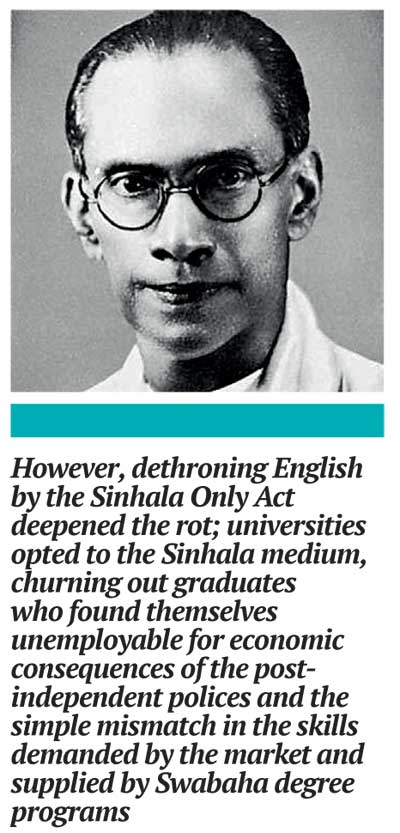
However, dethroning English by the Sinhala Only Act deepened the rot; universities opted to the Sinhala medium, churning out graduates who found themselves unemployable for economic consequences of the post- independent polices and the simple mismatch in the skills demanded by the market and supplied by Swabaha degree programs. Those grievances exploded with deadly consequences in three youth uprisings during the subsequent decades.
The Sinhala Only Act did not give back to people. Rather, it took back from the people, their chance to aim high. It deprived the children of average folks to give a real shot at the higher echelons of academic, professional and corporate sector. Today, Sinhala is the official language , but the corporate sector hires its executives on the merit of English rather than Sinhala or Tamil. In other areas, his policy saw the quality plummeted to rock bottom. See the mediocre performance of universities which hire Sinhala medium graduates as academics, whose promise for genuine excellence was robbed by the independent leaders even before the former was born.
There are ingrained constraints in native languages which multiply when the world moves forward. SWRD knew that. That was why he sent his children to English schools and later to London and Sciences Po. But, his polices deprived millions of other children to seek excellence and the country at large to build on the successes of the colonial legacy. That was a terrible mistake, for which we are still paying. See the contrast in the countries such as Singapore that chose to build on the colonial inheritance.
At the end, it was President Chandrika Kumaratunga who put in genuine effort to address some of the disparities created by the old folly. Her administration relaunched English medium education in some schools. Her government was fighting a ruthless terrorism at home, thus the resources were limited. However, her successors did not build on her initiative for they thought it was not politically advantageous. The real problem in this country at present is that the average folks, who know they are disadvantaged, are still confused as to what places them at the receiving end. One of the most determining factors is English language. A drop out from an international school is more likely to land in a corporate job than a Sinhala medium graduate from a local university. What the government should do is to channel an adequate share of the education budget (which it has pledged to increase to a 6 per cent of the GDP) to foster the initiative that Mrs Kumaratunga launched some fifteen years back –and to set a target that at least all Central Colleges within a set time frame would be able to conduct English medium classes. That is the only way to address an historical mistake. Lamenting over spilled milk would not help.

Follow Ranga Jayasuriya @Ranga Jayasuriya

– See more at: http://www.dailymirror.lk/114925/This-is-how-SWRD-gave-the-country-back-to-its-people-#sthash.fPSb72d3.dpuf

Treasury officials’ dilemma

August 30th, 2016

ගාමිණි මැරුවේ කවුද? සිරිසේන රහස් හෙළිකරයි

August 30th, 2016

https://youtu.be/8AjsY6tfUpY

රණවිරුවෙක් මහින්ද වෙනුවෙන් ගයන අපූරු ගීයක් මෙන්න

August 30th, 2016


https://youtu.be/3RXdhXQK4mk

රනිල් ගැන ඔබ නොදත් හෝ ඔබට අමතක බොහෝ දේ තිබිය හැකිය

August 30th, 2016


https://youtu.be/8Wh0VpeqmfU

Sri Lankan Politics after the Presidential Election speech by Hon Mahinda Rajapaksa

August 30th, 2016


https://youtu.be/nqkX73jL2h0

Social activists flays Prez, PM for suppressing political freedom of rivals

August 30th, 2016


Both President Maithripala Sirisena and Prime Minister Ranil Wickremesinghe have failed to honour their promise of ensuring democratic rights of the public by depriving Kumar Gunaratnam of his, say political parties, trade unionists, artistes and civil society activists.

“Depriving Gunaratnam of his rights to engage in political activities is not an isolated issue; it points to the suppresion of freedom in this country,” political party leaders, trade unionists, artistes and civil society activists have said in letters sent to the President and and the Prime Minister.

The letters seeking an appointment to discuss ways and means of securing the release of Gunaratnam say the requests made by the Frontline Socialist Party for the restoration of citizenship of Gunaratnam has not received any favourable response from the government. Gunaratnam has been languishing behind bars for one year on the charges of violating immigration regulations. Gunaratnam had to flee the country using another name to save his life under those circumstances that had prevailed then. Not only Gunaratnam but also many other Sri Lankans had to leave the country to save their lives in the late 1980s. Those who could not leave the country became victims of summary executions by government sponsored killer groups.

article_image

The letter says: “The incumbent government and the President came to power, promising to ensure the democratic and political rights of all Sri Lankans. Soon after coming to power they extended an open invitation to all Sri Lankans who had fled the country for their safety to return home. They were promised their political rights and freedom. It is doubtful as to how and why the government called upon those expatriate Lankans to come back while harassing and incarcerating those who returned home.

“Therefore, we seek an appointment with the President and the Prime Minister to discuss the government’s position on the political rights of the Sri Lankans who fled the country because of suppression including comrade Gunaratnam.”

The letter has been signed by Mahinda Devage (Socialist Party), Sirithunga Jayasuriya (United Socialist Party), Widarshana Kannangara( Praxis Collective), MGK Athula (Joint Federation of Trade Unions), PD Saranapala (State United Management Services Union), Dhammika Munsinghe (Combined Association of Unemployed Graduates), Sarath Kahagalla (Ceylon Independent Teachers’ Union), JB Gurusinghe (Information and Telecommunications Workers Union), Sylvester Jayakody (Ceylon Mercantile Industrial and General Workers Union -CMU), Susantha Thillekaratne (Printing Technicians’ Union), Mayura Senanayake (Lanka Pragathi Teachers’ Union), Sarath Preethilal (Sri Lanka Janaraja Health Services Union), Gayan Ganakadhara (Musician), Lal Hegoda (Artist), Indrachapa Liyanage (Musician) Kaushalya Kurukulasuriya (Writer), Kingsley Lose (Actor), Charith Lorensuhewa (Musician), Madhawa Sudantha (Musician), Dharmasena Pathiraja (Film Director), Prasanna Withanage (Film Director), Priya Ranasinghe (Actress) Asela Rangadeva (Lecturer), Samanali Fonseka (Actress), Saumya Liyanage ( Actor), Shakya Weerasinghe (Musician) and Wiraj Liyanarachchi (Firm Director).

Only a few will know the truth….EXCLUSIVE – ‘JFK assassination was an inside job’: Ex-government agent claimed ‘someone from his team’ killed the president in remarkable deathbed confession to director Oliver Stone (DAILY MAIL UK)

August 30th, 2016

UK News

Some interesting news about the JFK assassination…only a handful of people will know what really happened and all other witnesses have been got rid of in what can only be called a classic cover up. Then they propagate many theories so that no one is able to work out what actually happened. This methodology probably first tried out with JFK and then implemented many many times over and over with great success….like the

9/11 debacle which made it possible for the US to appoint itself as the Global Police Chief and to round up and get rid of those who did not support them.

http://www.dailymail.co.uk/news/article-3762617/JFK-assassination-inside-job-Ex-government-agent-claimed-team-killed-president-remarkable-deathbed-confession-director-Oliver-Stone.html

EXCLUSIVE – ‘JFK assassination was an inside job’: Ex-government agent claimed ‘someone from his team’ killed the president in remarkable deathbed confession to director Oliver Stone

  • An ex-presidential guard contacted Oliver Stone, who directed JFK biopic
  • He claimed ‘somebody from his team’ assassinated the president in 1963
  • Stone said he was convinced by his ‘military jargon’ and intricate details
  • Lee Harvey Oswald was accused of shooting JFK from a nearby building

The assassination of John F Kennedy in 1963 was an inside job, according to a deathbed confession given to the veteran film director Oliver Stone.

After making his acclaimed film JFK – which was sympathetic to conspiracy theories about the murder – Stone was contacted by a man claiming to have been a former member of the presidential security team.

Dying of cancer, the man wanted to share a secret that he had until then only told his son – that ‘somebody from his own team… had fired on the President’.

A former presidential security team member told director Oliver Stone that one of his team assassinated JFK (pictured, moments before his death)

A former presidential security team member told director Oliver Stone that one of his team assassinated JFK (pictured, moments before his death)

Read more: http://www.dailymail.co.uk/news/article-3762617/JFK-assassination-inside-job-Ex-government-agent-claimed-team-killed-president-remarkable-deathbed-confession-director-Oliver-Stone.html#ixzz4IoPQbjDd
Follow us: @MailOnline on Twitter | DailyMail on Facebook

CONCEPT PAPER INTERMEDIATE SOLUTION FOR SOLVING CRISIS IN MEETHOTAMULLE COLOMBO MUNICIPAL DIPSOSAL SITE

August 30th, 2016

Prepared by Dr Sarath Obeysekera ( Ex-Chairman SLLRCDC )

I have proposed the most effective and fastest solution to the garbage issue and wrote many opinions .But none of the decision makers are willing to listen

Quote

CONCEPT PAPER

INTERMEDIATE SOLUTION FOR SOLVING CRISIS IN MEETHOTAMULLE COLOMBO  MUNICIPAL DIPSOSAL SITE

1.    Purpose

Meethotamulle in Kollonawa area is being used by Colombo Municipal Council  ( CMC)  as a garbage dumping ground ,which has created an extremely hazardous environment ,which led to mass scale protests by the residents in the area .The matter has been taken to courts by some people seeking legal redress due to the fact the authorities have not been able to find a long lasting solution.

A company with majority shareholding held by Western Power (a subsidiary of Aitken Spence ) has mooted a project to segregate garbage  to compost and dry burnable material with plans for generating electricity. The project is on stand still due to non-availability of an investor. Many other private investors are trying to find an economically viable solution and unfortunately none has come with a viable plan.

1.    Immediate Requirement

It is ESSENTIAL to find an alternative site to dump almost 1200 tons garbage delivered daily by CMC to, calm the public down ,but neither UDA nor CMC has been able to find a land for above .Over 2-3 million tons of old and new garbage are lying in Meethotatamulle and the immediate requirement is get rid of part or the whole heap to some other place in close vicinity.

It is not advisable to carry raw wet garbage to any land nearby to dump as it may not be cost effective but also it may generate public outcry. Hence solution below will be the most suitable option providing that the Government and the Authorities who have a land bank and the resources agree with the plan proposed

2.    Intermediate Solution

Sri Lanka Land Reclamation and Development Corporation ( SLLDC) –holds a land bank near Colombo.In Muthrajawela .SLLRDC developed a 400 acres as am Industrial park ,by reclaiming a marsh with Sea sand in 1996 after obtaining Environment Clearance .and now fully occupied by various companies as fuel and gas storage ,ware housing and power generation etc .SLLRDC lately obtain environment clearance to reclaim 200 more acres between the buffer zone and the 400 acre developed plot and now ready to offer to investors for various industries.

SLLRDC has also pumped over 2.5 million Cu M of Sea sand which is now stock piled next to the 200 acre plot and being sold   to retail buyers .This stock pile of sand can be used to reclaim the 200 acres and offer to investors, and SLLRDC has advertised the land calling for offers.

Government can initiate a action plan to remove the OLD garbage which has already being party composted lying in the southern part of the Meethotamulle Dump using trucks to the 200 acre plot for reclamation .It is advisable to use part of the available sand to lay a 1-2 feet layer in the marshy layer  of 200 acres prior to dumping of the OLD GARBAGE and fresh layer of either sand or earth ( being excavated in many building sites in Colombo) can be used to cover the garbage payers one by one .SLLRDC has a large fleet of equipment and trucks  which are idling and the workforce can undertake this work…Government via Treasury and also from CMC coffers funds should be made available to SLLRDC to carry out above work. It is anticipated that removal of the OLD GARBAGE can be completed within 3- 4 months.Land which is cleared in Meethotmualle dump may be used to install a Garbage sorting ware house and compacting unit  for further transportation either for incineration or  degasifying else where

Residents in the area can have employment for segregation of the garbage, which is now being practiced in Karadiyana Site in Moratuwa

Part of the 200 acre land can be used for installation of the incineration plant which can be the source to generate steam for power generation.

The land reclaimed by above means can be offered to Investors who may come with a investment plan to generate power using the raw garbage which can be transported after compacting and bailing

3.    Executing Agencies


 CMC ,UDA ,SLLRDC and a Treasury Representative shall form a committee headed by a high powered authoritative person  who shall report to Prime Minister for speedy execution of the project .

Government shall appoint a high powered officer who can undertake to manage and  above task providing absolute authority is given to  executing above, subject to agreement by all three agencies above .

Treasury Representative shall provide avenues to source funds for the above project 

sarath30081601A

2.    Conclusion

During a reason visit to Maldive Island .the writer has witnessed how garbage is carried by landing crafts to an area closed to the city ,and over 500 acres has been reclaimed by du ping garbage and covering with sea sand .This newly generated land is now an Industrial Estate in Male .Maldives has very stringent environment rules and yet they opted to do above to solve the problem

Therefore reclaiming the land observing proper guidelines not to pollute the area for Industrial Purpose is the ideal short term solution for above problem

sarath30081602A

RECLAIMED LAND IN MALE USING GARBAGE

Prepared by Dr Sarath Obeysekera ( Ex-Chairman SLLRCDC )

Building up Our Industries and Creating Employment-  Perfume Making

August 29th, 2016

By Garvin Karunaratne

On my recent travel to Snowdonia in Wales, I happened to visit the Corris Industrial Unit.  What was most interesting was a Mini Distillery using many ingredients, including an array of spices, turning out special alcoholic drinks

I kept wondering  what I could have done if I had known this mini Distillery equipment when I was the Government Agent at Matara, in 1971,  when we were charged with creating employment for our youth.  Those were the days of the Divisional Development Councils Programme for which Dr N.M.Perera, the Minister for Finance had high hopes of developing employment for the youth.

Once I was traveling in  North India and I was charged with the task of buying some perfumes from Sugandhika in Lucknow. From Lucknow we were due to proceed to Sravasti on pilgrimage and I told our driver to take us to Sugandhika. It was a small sales outlet selling a special variety of perfumes, doted on by Indian damsels. What was most interesting was that the perfumes were all made in India itself. After buying some perfumes, I approached the staff and requested that I may be allowed to see their distillery- where the flowers will be distilled into perfumes. Out came an answer that defied me, theirs was a mini distillery, portable which was taken to the places where flowers were available and at that time the flowers were not in bloom. India has developed its perfume making industries on a grand scale.

At Corris in Machynlleth,  in Wales, I saw the two mini Distillery machines functioning in one large room. Of course they were not making perfumes which would have required more space. But that distillation equipment could have been utilized to make perfumes. It is called the DYFI Distillery, led by Pete Cameron (dyfidistillery.com- telephone 01654761551.)

I quote from a Report I wrote for the Chief Minister of the Central Province, Hon Mr P.C.Imbulana back in 1993, A Programme for Self Employment Creation & Poverty Alleviation in the Central Province of Sri Lanka”

A Perfume making Industry can only be established in the Central Province  as this is the ideal climate area for planting flowers. In my stay of an year at Nuwara Eliya I got a good income from flowers that grew wild in my garden. After an identification of small scale machinery and a study of its feasibility the plans drawn for local production can also include flowers  to be processed into perfumes. This can be established immediately  with the flowers offered at Dalada Maligawa”( From  How the IMF Ruined Sri Lanka and  Alternative programs of Success, (Godages). My Report was accepted by the Chief Minister who immediately commenced implementing it at two Divisional Secretary areas, but the Programme was shelved with the United National Party losing the General Election.

My find of the machinery for a small scale distillery at Corris in Wales is significant and holds a great deal of hope to establish a perfume industry in Sri Lanka. If I had known of this machinery when I was the Government Agent at Matara I would have commenced a perfume making industry based on the flowers offered at the Matara Bodhi . I could  have found employment for easily twenty youths. The plan is extremely feasible and I would urge the Government to take immediate steps to get going with establishing  perfume industries.  in Kandy, with the flowers offered at the Dalada Maligawa (can easily find employment for fifty or more), at Anuradhapura with flowers offered at Sri Maba Bodhiya and Ryuwanveliueya-( this can find employment for thirty or more).

Once the perfumes are made the second step will be to encourage people to plant flowers and for a collection arrangement to be made.

On my world wide travel since leaving the Administrative Service in 1973 I have trailed behind lorry loads of sugar cane and manioc  in India and Thailand, lorry loads of flowers in Southern France.  Flowers are collected and transported to perfume making factories. France has developed a massive perfume making industry.

It beats me why we cannot establish a perfume making industry with the flowers offered at various temples. It was just the other day that a Pichha mal ceremony was done at the Sri Maha Bodhiya at Anuradhapura.

Often one hears that people are caught trying to take away Sandlewood from Sri Lanka.

It needs to be emphatically stated  that a perfume making  industry cannot be established in a piecemeal manner, with a stray perfume making unit being established. There is an essential infrastructure necessary. Firstly the Government must seriously take steps to curtail the import of perfumes by charging a high tax on all imports but this has to be done after good quality perfumes are made. If Sugandhika can establish a perfume industry in Lucknow without a permanent distillery, working on a make shift temporary factory, we can easily achieve it at two places, in Kandy and Anuradhapura because flowers are available in plenty.

Secondly the Government must establish a unit to attend to research and guide the factories that make perfumes in the Districts. My mind travels back to my days when I served in Kegalla in 1968 and 1969 and Matara in 1971 and 1973. The Government Agent was held in charge of the Powerlooms in the area and if I remember right there were five Powerlooms in each District and this offered employment to hundreds of youths, This was possible because the Small Industries Department had a Research and Helping Unit at Velona, at Moratuwa to provide the necessary expertise to the Powerlooms all over the island. With one master stroke, the IMF dictate of making us  follow the Structural Adjustment Programme in 1977 abolished all public sector effort at employment creation. And with that one decision out went Velona and our Powerlooms. And sad to say with that a country that was self sufficient with fabric and textile manufacture became a  country that imported all textiles. No one, then realized  that the IMF was playing the sinister  role of making all our Third World Countries indebted so that the countries  to which we are indebted can call the shots and dictate to us.

Making perfumes is a far easier industry than the Crayon Factory that we established in Deniyaya in 1971. We did not know how to make crayons, but the craze in me to establish a manufacturing industry from scratch made me direct the Planning staff to conduct experiments. This commenced initially in my Residency and when we required sophisticated equipment we took over the science laboratory at Rahula College from around six P.M. to mid night when our scientists, the Planning Officer in the katcheri, Vetus Fernando, aided by the science teachers did a myriad of experiments for close upon two months till we finalized the art of making crayons. It was easily comparable in quality to Crayola Crayons. The only difference was that each crayon was handmade, like most industries in China. The Minister of Industries Mr Subasinghe was surprised when I showed him a crayon, and readily agreed to preside over the sales commencing ceremony.  Mr T.B.Illangaratne the Minister for Trade too was mesmerized by its quality and authorized an allocation of foreign exchange to enable the industry to import essential colouring. He gave that allocation from the funds earmarked for the import of crayons. He had the capacity to understand that  our making crayons meant that we can immediately reduce imports- saving valuable foreign exchange.  It was a great industry run by the Morawaka Cooperatives under the leadership of Sumanapala Dahanayake, the Member of Parliament who was also the President of the Cooperative Union. This Crayon Industry became the flagship industry of the Divisional Development Councils Programme and the crayons were sold islandwide till 1977, the day when the IMF took control of our country and dictated us to abolish national planning, stop all public sector run industries, abolish the infrastructure already established for development, allow all imports and allow the free use of foreign exchange and dictated us to live on loans, which has paved the path for our country to become indebted.  Making the Third World countries indebted was the method by which the Third World countries were subjugated. This is the sad story unfolded in my book: How the IMF Ruined Sri Lanka.

The history of establishing the Crayon Industry has been highlighted to show the difficulty of establishing an industry. The other day I was searching to buy a step ladder  at Nawala and found that we make only a small percentage of step ladders. The rest is imported from Thailand and China. A country that cannot make its own step ladders can never establish its own perfume industry. At times I think I am wasting my time writing these ideas of mine.

If we could have successfully established the Crayon Industry I do not see how we can go wrong with establishing a perfume making industry.

We only need some foreign exchange to pay for the mini distillery equipment, which can easily be recouped from the sales that will be generated within the very first year.

Leaving development in the hands of the Private Sector, the recommendation of the IMF, means that we will never develop our industries.  The Private Sector aim is to make a fast buck like venturing on establishing Supermarkets. It is the public sector that has to take on the difficult task of establishing import substitution type of industries. Let this fact be engrained into the thinking of our leaders. It is my finding that the aim of the IMF is not the development of our countries. Instead, their task is to restructure  our economies to contribute to the economies of the developed countries. It is our Third World economies that run the Developed Economies by sending our foreign exchange to them in various forms like imports, funds for university education- many Universities in the UK depend on the funds charged from foreign students.  Most of our experts do not have the capacity to think of how the IMF  ruined our economies.

Let me hope that the ideas in this paper will be  read by people of worth, those who have the authority to do something to build up our lost industries and create employment for our own youth.

Garvin Karunaratne

Former Government Agent, Matara District

27 th August 2016


Double standard SMILING  SATAN -UNSG Ban KI moon is on his way to Sri Lanka

August 29th, 2016

Malin Abeyatunge

 Double standard SMILING  SATAN -UNSG Ban KI moon is on his way to Sri Lanka. God knows what’s up in his sleeves this time on the eve of his departure from UN. Whilst there were many trouble spots with all kinds of atrocities like in Iraq, Yemen, Libya, Afghanistan, Syria committed by the western block, he used his authority to appoint a so called Panel of Experts to advise him on the issue of accountability with regards to any alleged violations of international human rights and humanitarian law during the final stages of Sri Lankan war against terrorist outfit LTTE and report to him which was infamously known as  Darusman Report . It is also alleged that one of the three panel members appointed by Ban Ki-moon was the South African judge Yasmin Sooka who was alleged to have supported LTTE and was seen in LTTE platforms in South Africa. But UNSG never called for a experts’ report on the atrocities committed in the countries mentioned above by USA, UK and other countries in the western block. He was deaf, dumb & blind and never raised fingers nor appointed any expert panels to investigate into those atrocities .Though UNSG wanted this report for his personal knowledge as he says, subsequently it was leaked to the UN Security Council which they made use of it at every turn to humiliate Sri Lanka’s victory against the most brutal  terrorist organisation on 19 May 2009 and made the basis of facts to bring UN Resolution against Sri Lanka. There is no doubt that under UNSG Ban ki Moon , the Security Council became a mere rubber stamp of the western block.  Because of Ban ki Moon’s double standard attitude towards Sri Lanka during the war and after, we are still trying to come to terms the with the past.

UNSG never uttered a word against the LTTE’s child soldiers, killing of unarmed villages , bombing public transport, public buildings, killing thousands  and maiming thousands of ordinary civilians. He was also deaf, dumb and blind when it came to atrocities committed by this terrorist group called LTTE.

What’s his intention of his visit on the eve of his departure? There will definitely be a hidden agenda to see whether he still can find inaccurate facts with Sri Lanka to enable his successor to tighten the grip on Sri Lanka. Mr Ban-ki Moon,  Now that he is leaving the  UN after damaging Sri Lanka’s reputation by his double standard, Sri Lanka does not need any of his character certificates for good behaviour. Such certificate is worth only if it comes from a credible genuine source but not double standard source.

It is also learnt that he is going to be the next president of South Korea.  Well, if you try your pranks with North Korea  like the way he handled Sri Lanka to appease America & the western block, within no time he will face grim music from President of North Korea. Good Luck.

Malin Abeyatunge

ඕස්ට්‍රේලියා අල්ලස් චෝදනාවේ ‘මෛත්‍රීපාල සිරිසේන’ නම වෙනුවට ‘මහින්ද රාජපක්‍ෂ’ නම තිබුනා නම් වෙන දේ මෙහෙමයි..

August 29th, 2016

lanka C news

අද ( 29) අල්ලස් හෝ දූෂණ චෝදනා විමර්ශන කොමිසමේදී පැය තුනකට අධික කාලයක් ප්‍රශ්න කිරීම්වලට භාජනය කිරීමෙන් අනතුරුව මාධ්‍ය වෙත අදහස් දක්වමින් ඒ මහතා මෙසේ පැවසුවේය.

එහිදී වැඩිදුරටත් අදහස් දැක්වූ මුසම්මිල් මහතා මෙසේ ද සඳහන් කළේය.

ආණ්ඩුව වොක්ස්වැගන් කර්මාන්ත ශාලාව ලංකාවේ පටන් ගන්නවා කීවත් ඊයේ නිවේදනය කළා ‘ඒක පටන් ගන්නේ නැහැ’ කියලා. මේක මේ ආණ්ඩුව ලබා දුන් විශාලතම පොරොන්දුවක්. මෙවැනි කර්මාන්ත ශාලා මගින් තරුණ තරුණියන්ට රැකියා දශලක්ෂයක් ලබා දෙන බවයි මේ ආණ්ඩුව පැවසුවේ. රැකියා ලබා දීම කෙසේ වෙතත් ආණ්ඩුව දුන් පොරොන්දු නම් කඩකරමින් සිටිනවා. දැන් ඉතා පැහැදිලියි, පසුගිය ඡන්දයේදි මේ ආණ්ඩුව හිතාමතාම බොරු පොරොන්දු දුන් බව.

ආණ්ඩුව කුලියාපිටියෙන් වොක්ස්වැගන් කර්මාන්ත ශාලාවක් ඉදි කරලා තරුණ තරුණියන් ලක්ෂ ගණනකට රැකියා ලබා දෙන තෙක් බලා සිටි කොළ අලිපැටවුන්, නිල් අලි පැටවුන්, රතු අලි පැටවුන්ට අපි අපගේ සාතිශය සංවේගය පළකර සිටිනවා. ජනතාවට කප්පරක් පොරොන්දු දුන්නු මේ ආණ්ඩුව අද ඒවා අමු අමුවේ කඩා බිඳදමනවා. ඒ අතරතුර ජනතාව මත අධික බදු බරක් පටවමින් ඉන්නවා. මේ ආණ්ඩුව මුදල් අමාත්‍යාංශයේ නිලධාරීන් FCID වැනි මර්දන ආයතනවලට යවලා සිදු කරන පීඩාවන් හින්දා ඔවුන් අද සේවයෙන් ඉල්ලා අස්වෙන තැනට mussammilaපත් වෙලා තිබෙනවා. ඒ නිලධාරීන් දෙස සානුකම්පිතව බැලීමටවත් මේ ආණ්ඩුව සූදානම් නැහැ.

මේ සියලු අඩුපාඩුකම් පෙන්වා දෙන හීලෑ නොවුණු විපක්ෂය හෙවත් ඒකාබද්ධ විපක්ෂය මර්දනය කිරීම පමණයි අද මේ ආණ්ඩුවේ එකම කාර්ය බවට පත්වෙලා තිබෙන්නේ. එකම කාරණයට FCIDයට , අල්ලස් කොමිසමට හා ජනාධිපති පරීක්ෂණ කොමිසමට ගෙන්වලා ඒකාබද්ධ විපක්ෂයේ දේශපාලනඥයන් පීඩාවට පත් කිරීම තමයි මේ ආණ්ඩුව කරන්නේ. මෙවැනි ක්‍රියා මගින් අපව බියවැද්දවීමට බැහැ.

විජය රජ්ජුරුවෝ ලංකාවට පැමිණිය දා පටන්ම මෙරට කිසිම රාජ්‍ය නායකයකුට පිටරටකින් අල්ලස් හෝ දූෂණ චෝදනා එල්ල වී නැහැ. වර්තමාන පාලකයාට එවැනි චෝදනාවක් එල්ල වී තිබෙනවා. ඒක රටේත් ජනතාවගේත් ගෞරවය පිලිබඳ ප්‍රශ්නයක්. ඒ නිසා මේ පිළිබඳව නිවැරදි මතය රට හමුවේ තැබීම ඔවුන්ගේ වගකීමක්. ඒ වගේම ‘රන්ජන් රාමනායක, සරත් විජේසූරිය, රජිත් කීර්ති තෙන්නකෝන් හා වසන්ත සමරසිංහ වැනි ‘දූෂණ විරෝධීන්’ මේ ප්‍රශ්නයේදී නිහඬ මොකද ?’ කියා අපි අහන්න කැමතියි. මේක ඕස්ට්‍රේලියාවේ පුවත්පතක පළවූ ප්‍රවෘත්තියක් කියා ජනාධිපති මාධ්‍ය අංශය ඇඟ බේරගන්න හදනවා. ඕස්ටේ්‍රලියාවේ ෆෙඩරල් පොලිසිය මගින් සිදු කරන මහා පරිමාණ දූෂණ චෝදනා පිළිබඳ විමර්ශනයකදී හෙළි වූ කරුණු තමයි මේ ඕස්ට්‍රේලියානු ජනමාධ්‍ය මෙසේ අනාවරණය කළේ. මේ ප්‍රවෘත්තිය ඕස්ට්‍රේලියාවේ සියලු ජාතික මධ්‍ය මගින් ප්‍රචාරය කරනු ලැබුවා.අද මේ විමර්ශන වාර්තාවේ මහින්ද රාජපක්ෂ කියන නම තිබුනා නම් රන්ජන් රාමනායකලා, සරත් විජේසූරියලා, රජිත් කීර්ති තෙන්නකෝන්ලා, වසන්ත සමරසිංහලා නටන්නේ කොහොමද කියලා කියන්න ඕනේ නැහැ. මහින්ද රාජපක්ෂගේ නම වෙනුවට මෛත්‍රීපාල සිරිසේනගේ නම තිබෙන නිසා මේ මහා දූෂණ විරෝධීන්ගේ කටවල අද පිට්ටු හිර වෙලා”

– අනුරුද්ධ බණ්ඩාර රණවාරණ

ඕස්ට්‍රේලියානු ෆෙඩරල් පොලිසියේ නවතම අල්ලස් චෝදනා විමර්ශන වාර්තාවෙහි ‘මෛත්‍රීපාල සිරිසේන’ යන නම වෙනුවට ‘මහින්ද රාජපක්ෂ’ යන නම සඳහන්ව තිබුනා නම් අද නිහඬව සිටින ශ්‍රී ලංකාවේ මහා දූෂණ විරෝධීන් වන රන්ජන් රාමනායක, වසන්ත සමරසිංහ, මහාචාර්ය සරත් විජේසූරිය, රජිත් කීර්ති තෙන්නකෝන් යන අය මේ වන විට ‘නටන නැටුම්’ බලාගත හැකිව තිබුණු බව ජාතික නිදහස් පෙරමුණේ ප්‍රචාරක ලේකම්, හිටපු පාර්ලිමේන්තු මන්ත්‍රී මොහොමඞ් මුසම්මිල් මහතා පවසයි.


ඔස්ට්‍රේලියානු අල්ලස් චෝදනාවේ සුල මුල තව තවත් හෙළිකරයි..

August 29th, 2016

අරවින්ද අතුකෝරල

පිවිතුරු හෙළ උරුමය පක්‍ෂයේ ප‍්‍රධාන ලේකම් උදය ගම්මන්පිල මහතා එම පක්‍ෂ මූලස්ථානයේ පැවති මාධ්‍ය හමුවකදී මෙම අදහස් පල කලේය.

ජනපතිට එල්ල වූ ඔස්ට්‍රේලියානු අල්ලස් චෝදනාවේ සුල මුල උදය හෙළිකරයි

මේ දිනවල ලංකාවේ ප්‍රමුඛතම සිදුවීමක් විය යුතු නමුත් අවාසනාවට එසේ සිදුවී නැති ඔස්ට්‍රේලියානු අල්ලස් සිද්ධිය ගැන මම මුලින්ම ඔබේ අවධානය යොමු කරනවා. මේ පිළිබද පසුගිය බුහස්පතින්දා මම පාර්ලිමේන්තුවේ කතා කලාම විදේශ ඇමති මංගල සමරවීර මහතා කියනවා පාර්ලිමේන්තු ඉස්තාවර නියෝග අනුව ජනාධිපතිවරයාගේ හැසිරීම ගැන කතාකරන්න බෑ. ඒ නිසා මගේ කතාව හැන්සාඩ් වාර්ථාවෙන් ඉවත් කලා. නමුත් මා ඒ අවස්ථාවේදීත් පෙන්වා දුන්නා මම මේ කතා කරන්නේ ජනපතිතුමන් ගැනවත් එතුමන්ට චෝදනා නැගීමක් ගැනවත් නෙමෙයි කියන එක. මම මේ කතා කරන්නේ ඔස්ට්‍රේලියානු මාධ්‍යවල හැසිරීම ගැන . ඒ වගේම මේ සිදුවීම සම්බන්දව ඒ වන විටත් ප්‍රතිචාර දක්වා නැති විදේශ අමාත්‍යන්ශයේ හැසිරීම ගැනයි මා මේ අදහස් දක්වන්නේ කියා මම පැහැදිළි කලා. ඒ වගේම රටේත් ජනපතිතුමන්ගේත් කීර්තිනාමය ආරක්ෂාකරගැනීම ගැනයි මේ කතාකරන්නේ කියල කිව්ව.

එතැනදී මූලාසනයේ හිටපු දෙමල ජාතික සංධානයේ අඩෙක්කලෛයිනාදන් මැතිතුමන් මගේ කතාව පිළිඅරගෙන මගේ කතාව කරගෙන යන්න ඉඩ දුන්නා. ඒ අවස්ථාවේදී මගේ කතාවේ අග හරියට යද්දී පිටතින් පණිවිඩයක් ඒ මහතාට ආවා. ඉන්පසු එතුමන් කියනවා ජනපතිතුමන් සම්බන්ධයෙන් මා කල ප්‍රකාශ හැන්සාඩ් වාර්ථාවෙන් ඉවත් කරන්න කියලා. මේ සිදුවීම් හරහා පේන්නේ මේ චෝදනා යටපත් කරන්න මේ ආණ්ඩුව මේ වන විට දැවැනිත උත්සහයක් දරන බවයි.

ජනපතිවරණ සමයේ දී ජනපති මහින්ද පරදවන්න මෙගා ඩීල් පිලිබඳ මෙගා බොරු කිව්වා. ආණ්ඩුව පත් වී මාස 20ක් සම්පූර්ණ වෙනවා. එක මෙගා ඩීල් එකක් පිලිබඳ නඩු දැමීම තබා විමර්ශනයක් වත් තබා තිබෙනවා ද? අධිවේගී මාර්ග වලින් 90%ක් තිබෙන්නේ කොමිස් කියලා පා ච රණවක ඇමතිතුමා කියන විට වත්මන් ආණ්ඩුව කොළඹ නුවර අධිවේගී මාර්ගය හදන්න කලින් ආණ්ඩුව කොන්ත්‍රාත්තුව ලබා දුන් සමාගමටම ඊට වඩා වැඩි මිලකට ලබා දෙනවා. කලින් වතාවේ කොමිස් මුදල් 90% නම් දැන් එය 95%ක් විය යුතුයි. ඒ වගේම මහ දූෂණ කියූ අධිවේගි මාර්ග, නොරොච්චලේ, මත්තල ගුවන් තොටුපල මාගම වරාය පිලිබඳ අඩුම ගණනේ විමර්ශනයක් වත් තිබෙනවා ද?

දැනට නඩු පවරා තිබෙන්නේ මොනවාට ද ? පලාත්පාලන ආයතන වලට කොඩි කණු බෙදීම, සිල් ඇත්තන්ට සිල් රෙදි බෙදීම වැනි හැම ආණ්ඩුවක්ම කළ දේවල් වලට. අද මෙගා ඩීල් පිලිබඳ කතා කරපු අයගේ කටේ පිට්ටු ද කියන ප්‍රශ්නය මතු වෙනවා. කල කල දේ පල පල දේ යන සිංහල කියමන සිහිපත් කරමින් එදා බොරු කියූ අයට අද පව් පලදෙන්න පටන් අරන්.

දෛවයේ සරදමක් කියන්නේ මට විරුද්ධව බොරු චෝදනා නැගීමට යොදා ගත් ඔස්ට්‍රේලියාවේ පර්ත් නගරයෙන්මයි ජනපතිට එරෙහිව චෝදනා එන්නේ. මුළු රටම කම්පනයට ලක් කරමින් රටේ ජනාධිපතිවරයා අල්ලස් ඉල්ලූ බවට ඔස්ට්‍රේලියානු පොලීසිය විසින් පරීක්ෂණයක් ආරම්භ කර තිබෙනවා. අපේ එෆ්සීඅයිඩී එකට ලැබෙන සුරංගනා කතා වගේ පැමිණිල්ලක් නොවේ මේක. වෙනත් පැමිණිල්ලක් පිලිබඳ විභාග කරන විටයි මේ සිද්ධිය පිලිබඳ සාක්ෂි මතු වෙන්නේ.

ස්මෙක් නමින් හඳුන්වන ස්නෝවි මවුන්ටන්ස් ඉංජිනියරින් කෝප් නමැති පර්ත් පදනම් කර ගත් ඉදි කිරීම් සමාගම එහි ප්‍රධාන විධායක නිලධාරියා වූ ජැක් බොනිෆස් 2001 දී ඉවත් කරනවා. ඔහු ඊට එරෙහිව නඩු දානවා. 2007 දී ඒ නඩුවේ දී තමන් කොන්ත්‍රාත් දිනා ගැනීම සඳහා විදේශීය ආණ්ඩු වලට පගාව දුන් බව ජැක් හෙලි කරනවා. ඒ පාරේ ගිහින් ලෝක බැංකු අරමුදල් යොදා බංගලිදේශයේ කල ව්‍යාපෘතියක් තමන්ට ලබා ගන්න ස්මෙක් එම ආණ්ඩුවට පගාව දුන් බවට ලෝක බැංකුව සොයා ගන්නවා. 2013 සැප්තැම්බර් 12 දින මේ බව ඔස්ට්‍රේලියානු පොලීසියට දැනුම් දෙනවා. ඒ පිලිබඳ පරීක්ෂණ පවත්වන විට තමයි ජනාධිපති සිරිසේන අල්ලසක් ඉල්ලූ බවට සඳහන් ඊමේල් අනාවරණය වන්නේ.

පරීක්ෂණය අනුව ස්මෙක් සමාගම වේල්ලක් ඉදි කිරීම ඩොලර් මිලියන 1.82ක් වටිනා කොන්ත්‍රාත්තුවක් දිනා ගන්නවා. ප්‍රසම්පාදන මණ්ඩලය මෙම සමාගම තෝරා ගත්තත් ටෙන්ඩරයේ දැවැන්ත වටිනාකම නිසා ඊට ඇමති මණ්ඩලයේ අනුමැතිය ලබා ගත යුතුයි. නමුත් සිරිසේන ඇමතිතුමා අත්සන් කරන්නේ නැතුව කල් මරනවා. ඊට පස්සේ සමාගමේ නියෝජිතයින්ට එන්න කියා පණිවිඩයක් යවනවා. ඒ අනුව ස්මෙක් සමාගමේ ලංකාවේ ඒජන්ත ඇමතිතුමා හමු වෙන්න යනවා. ඇමතිතුමාගේ හමුව පිලිබඳ ලංකාවේ ඒජන්ත ඔස්ට්‍රේලියාවට යැවූ විද්‍යුත් තැපෑලේ ඒ හමුව පිලිබඳ විස්තරයක් තිබෙනවා. මම ඇමතිතුමා හමු වුණා. ඉදිරි මැතිවරණ සඳහා ආධාරයක් ඉල්ලුවා. ඒ පිලිබඳ විස්තර සම්බන්ධිකරණ ලේකම් සමග සාකච්ඡා කරන්න කිව්වා. ඇමති මණ්ඩල පත්‍රිකාවක් අත්සන් කරන්න කලින් මෙහෙම කරන්න වෙනවා කියා සම්බන්ධිකරණ ලේකම් කිව්වා. ටෙන්ඩරයේ වටිනාකමෙන් ප්‍රතිශතයක් යෝජනා කරන්නැයි ලේකම්වරයා මට කිව්වා.

ජූනි 15 ඒජන්ත විසින් ඔස්ට්‍රේලියාවට තවත් විද්‍යුත් තැපෑලක් යවනවා. ඒකේ කියනවා කොන්ත්‍රාත් එකෙන් 1%ක් ඉල්ලුවා. ඒ කියන්නේ ලංකාවේ මුදලින් ලක්ෂ 25ක් කියලා. මේ මුදල ගෙවීම උඩයි ඇමතිතුමා ඇමති මණ්ඩල පත්‍රිකාවට අත්සන් තැබීම සිදු වන්නේ. ඒ නිසා මේකට ප්‍රමුඛතාවය දෙන්න කියා. ඒ අයම අපිව හොයා ගෙන ආව නිසා මේක මහඟු අවස්ථාවක්. අපිට ඉදිරියටත් මේ ඇමතිතුමා හරහා තවත් කොන්ත්‍රාත් ගන්න පුළුවන්.

ඔස්ට්‍රේලියාවේ පොලීසිය මේ පිලිබඳ පරීක්ෂණ කර ගෙන යනවා. ඔස්ට්‍රේලියාවේ පොලීසිය සොයන්නේ දූෂණ විරෝධි වීරයා කියලා ලංකාවේ කෙජ්රවාල් කියලා බටහිර විසින්ම ඔසවා තැබූ නායකයාට වුණු දෙයක්. ලංකාවේ ජනාධිපතිවරයෙකුට තබා ප්‍රාදේශීය සභාවක සභාපතිවරයෙකුටවත් විදේශීය පොලීසියක් විසින් අල්ලස් ගැනීම පිලිබඳ විමර්ශනයක් පැවැත්වී නෑ. මේ වගේ නින්දාවක් ලංකා ඉතිහාසයේ කවර කාලයක වත් සිදු වී නෑ.

මෙතරම් දැවැන්ත සිදුවීමකට ජනාධිපතිගේ ප්‍රතිචාරය කුමක්ද? මම මේ චෝදනා ප්‍රතික්ෂේප gammanpilaකරනවා. මේ පිලිබඳ නීතිමය ක්‍රියා මාර්ග ගන්න නීතිපතිට උපදෙස් දුන්නා. මොක්කද නීති පතිට කරන්න පුළුවන්. කිසිම දෙයක් නෑ. ලංකාවේ නීතිපතිට පුළුවන් අපේ රටේ දූෂණයක් නම් හොයල බලන්න. ලංකාවේ නීතිපතිට ඕස්ටේලියාවේ මාධ්‍යවලට එරෙහිව කටයුතු කරන්න බලයක් නෑ. මේ පිළබද ඔස්ට්‍රේලියාවේ සිදු වන්නේ එම සමාගම පගාව දුන්නා ද කියන පරීක්ෂණය විතරයි. ඒ සමාගම කියන්නේ ඇමතිතුමා ඉල්ලුවත් අපි දුන්නේ නෑ කියා. එම සමාගම දුන්නා කියා ඔප්පු නොවුණොත් ඒ ඔස්ට්‍රේලියානු පොලීසියේ පරීක්ෂණය ඉවරයි. නමුත් අපේ රටේ කීර්තිය රැක ගන්න නම් තවමත් ඉතුරු වෙලා තිබෙනවා නම් ජනාධිපතිගේ කීර්තිය රැක ගන්න නම් මේ පිලිබඳ ලංකා ඉතිහාසයේ සිදු වුණු දැවැන්තම විමර්ශනය සිදු විය යුතුයි. ඒ නිසා ලංකාවේ දැනට ජීවත් වී සිටින සියළුම හිටපු අගවිනිසුරුවරුන් සහ විගණකාධිපතිවරුන්ගෙන් සමන්විත ජනාධිපති විමර්ශන කොමිසමක් පත් කර තමන්ගේ නම කෙසේ වෙතත් රටේ නම රැක දෙන ලෙස අපි ජනාධිපතිතුමාගෙන් ඉල්ලා සිටිනවා.


Committee should probe bribery charges against MS: PHU

August 29th, 2016

Courtesy The Daily Mirror

A commission comprising former Attorney Generals and Auditor Generals should be appointed to probe the bribery charges against the President as reported in the Australian media, Pivithuru Hela Urumaya (PHU) General Secretary Udaya Gammanpila said today.

He said this was vital to protect the country’s image from being tarnished. Australian media last week reported that Australian Police are investigating allegations that the overseas staff of Snowy Mountains Engineering Company (SMEC) had bribed officials to secure a US$2.3 million aid-funded sewerage project in Sri Lanka in 2011 when President Maithripala Sirisena was the then Agriculture and Agrarian Services Minister.

The MP told a news conference that the President’s response to the allegation was to seek the Attorney General’s opinion but said this was not practical or adequate. The AG’s opinion and instructions hold no value when it comes to an investigation launched by a foreign country.

The AG can’t take action against Australian media institutions. Australian police are only probing whether the company had bribed the President.

If the company proves they didn’t bribe the President though he asked for one, the probe will end. But, we need to probe the allegations in an extensive manner with the participation of former senior officials to save the country’s reputation,” he said. (Lahiru Pothmulla)

– See more at: http://www.dailymirror.lk/114897/Committee-should-probe-bribery-charges-against-MS-PHU#sthash.PMqf6fQi.dpuf

Attacks on journalists: Elephant in the room and can of worms

August 29th, 2016

Editorial Courtesy The Island

Investigations into attacks on journalists under the previous government took a dramatic turn last week with former Rivira Editor Upali Tennakoon and his wife, Dhammika, identifying a military intelligence officer who assaulted them on Jan. 23, 2009 in Gampaha. But for resistance offered by Upali and his wife courageously, the incident would have had a tragic ending.

It cannot be claimed by any stretch of the imagination that the assailants including the one identified by Upali and his wife, at an identification parade, acted on their own. They obviously carried out orders from on high and it is up to the investigators to stop beating about the bush and find out who really wanted journalists harmed. Let them question former UNP MP Joseph Michael Perera, who in his capacity as the Chief Opposition Whip, told Parliament on July 28, 2008 that a special army unit controlled by the then Army Commander Lt. Gen. Sarath Fonseka was responsible for attacks on journalists. Perera, on behalf of the then UNP-led Opposition, called for arresting those responsible forthwith. Now, the UNP is in a position to make arrests!

Strangely, the UNP, which levelled the aforesaid serious allegation, not only agreed to field Fonseka as the common opposition presidential candidate in 2010 but also backed him to the hilt. It enlisted his support to ensure President Maithripala Sirisena’s victory at the last presidential election, promoted him to the rank of Field Marshal and brought him to Parliament through the backdoor (read the National List) following his defeat at the last general election and made him a Cabinet Minister. He is now in the UNP!

It is not being argued that Fonseka is guilty as alleged so to speak. But, it behoves the UNP top guns who wept buckets for the media persons in distress under the previous government to make their position clear on their allegation against the army and Fonseka at that time. It is puzzling why the media rights groups have chosen to remain silent on this vital issue. Is it that they who are accused of toeing the government line do not want to open up a can of worms for their political masters?

Now that Upali and his wife have taken the trouble of coming all the way here from the US, where they are domiciled, to help bring those who harmed journalists to justice, the onus is on former Deputy Editor of The Nation, Keith Noyahr, to follow suit. Upali and his wife only saw their attacker for a few seconds while struggling to save their lives, but Keith was abducted, taken somewhere and ‘put to the question’ for a couple of hours in May 2008. So, being an experienced scribe, he must have been able to gather from the questions he was asked who was really behind his abduction. Having fled the country he is currently living in Australia. If he is wary of coming here for security reasons let him be urged to divulge information about his abductors from down under electronically.

Besides attacks on journalists, some of whom perished at the hands of their assailants, newspaper offices/printing presses and MTV and Siyatha TV studios were set on fire by goons loyal to the Rajapaksa government. Those incidents must also be reinvestigated thoroughly and the perpetrators of violence brought to justice. Better late than never! The government has rushed through Parliament a constitutional amendment, camouflaged as an ordinary Bill, to pave the way for setting up an office to investigate enforced disappearances since 1971. Why doesn’t it put in place a mechanism to investigate attacks on the media during the same period as well?

It is fervently hoped that, given the possible political ramifications of the probes being conducted into the attacks on journalists, the investigators won’t come up against a brick wall sooner or later.

Germany: Khalifa of Islam arrives in Frankfurt

August 29th, 2016

By A. Abdul Aziz.

Hazrat Mirza Masroor Ahmad travels to attend Annual Convention of the Ahmadiyya Muslim Community in Germany

The World Head of the Ahmadiyya Muslim Community, the Fifth Khalifa, His Holiness, Hazrat Mirza Masroor Ahmad arrived at the Baitus Subuh Mosque in Frankfurt on 27 August 2016.

The Khalifa (Caliph) travelled from London by road and after crossing into Germany he was greeted by the National President of the Ahmadiyya Muslim Community in Germany, Abdullah Wagishauser and various other officials who then escorted His Holiness to Germany.

His Holiness travelled onwards to Frankfurt and he arrived at the Baitus Subuh Mosque at 8.30pm local time where he was greeted by hundreds of Ahmadi Muslim men, women and children all overjoyed to see their spiritual leader once again. Shortly after arrival, His Holiness led the Maghreb and Isha prayers.

His Holiness has travelled to attend the 41st Jalsa Salana (Annual Convention) of the Ahmadiyya Muslim Community in Germany, taking place in Karlsruhe, in which around 30,000 delegates from various countries are expected.

During the 3-day event (2-4 September) His Holiness will address both Ahmadi Muslims and non-Ahmadi guests about the true and peaceful teachings of Islam.

ඇත්තටම මේ පනත මොකක්‌ද ?

August 29th, 2016

නීතිඥ කණිෂ්ක විතාරණ උපුටා ගැන්ම දිවයින

අතුරුදන් වූ තැනැත්තන් පිළිබඳ කාර්යාල පනතට කථානායක විසින් 2016-08-23 දින අත්සන් තබන ලදී. ආණ්‌ඩු ක්‍රම ව්‍යවස්‌ථාවේ 80 (1) වගන්තියට අනුව සම්මත කරන ලද පනත් කෙටුම්පතක්‌ මත කථානායකවරයාගේ සහතිකය ඔහුගේ අත්සන ඇතිව සටහන් කරනු ලැබූ විට එය නීතියක්‌ බවට පත් වන්නේය. එම කෙටුම්පතට අත්සන් නොතබන ලෙසට පොදු විපක්‌ෂය විසින් ලිතව කථානායකවරයාගෙන් ඉල්ලා තිබුණි. මෙම සම්මත වීම වලංගු නොවන බව ඔවුන්ගේ තර්කය විය. එය සම්මත කරන බවට ප්‍රකාශිත 2016-08-11 දින හැන්සාඩ් වාර්තාව පිටවූයේද 23 වන දිනදීමය. ඊට සංශෝධන ඉදිරිපත් කර සහය දැක්‌වූ මන්ත්‍රීවරුන්ට හා පක්‌ෂවලට සත්‍ය වැටහී ගියේ එවිටය. ඒ ඔවුන් විසින් ඉදිරිපත් කළ සංශෝධන පනතට ඇතුළත් නොවීම නිසාය. යෝජිත සංශෝධන 31 කින් හැන්සාඩ් වාර්තාවේ සඳහන් වන්නේ 5 ක්‌ පමණි. (11,12,21 වගන්ති සඳහා) ඒවායින් 12 හා 21 වගන්ති සඳහා සංශෝධන 2 බැගින් ඉදිරිපත් වී තිබුණද ඒවාද එකිනෙක සමග ගැටෙන බැවින් ඒවා කෙසේ බලාත්මක වන්නේද යන්නද අපැහැදිලිය. එබැවින් එකී ඊනියා පනත ක්‍රියාත්මක කිරීමට පෙර නැවත සංශෝධනය කළ යුතු බවට පාර්ලිමේන්තු=ව තුළ ඊට සහය දැක්‌වූ හා නොදැක්‌වූ මන්ත්‍රීන් බොහොමයක්‌ම විසින් ඉල්ලා ඇත. අගමැතිවරයාද මෙය සංශෝධනය විය යුතු බවට පිළිගෙන ඇත. එබැවින් කථානායකගේ සහතිකය ලබා දී ඇත්තේ පාර්ලිමේන්තුවේ යෝජනාවට පටහැනි වූ නීතියකටය. මෙවැනි අවස්‌ථාවකදී අභිනව සංශෝධනයක්‌ ගෙන ඒම සාමාන්‍යයෙන් කළ හැකිය. එහෙත් මෙම ඊනියා නීතිය මුල පටන්ම ව්‍යවස්‌ථාවට පටහැනිවූත් අක්‍රමික හා ගුප්ත පටිපාටියක්‌ ඔස්‌සේ පැමිණ ඇත. එබැවින් මෙම නීතිය සම්මත කිරීමේදී පාර්ලිමෙන්තුවේ ස්‌වාධීනත්වය හා උත්තරීතරභාවයද, ප්‍රජාතන්ත්‍රවාදයේ මූලධර්මද ආරක්‌ෂා වී තිබේද යන්නද විමසිය යුතුය. ඒ මත මෙම පනතේ වලංගුභාවය තක්‌සේරු කළ හැකිය.

අපේ පනතක්‌ නොවේ

මෙම නීතියේ සම්භවය කෙදිනක වූවද එය මෙරටදී නොවුනු බවනම් පැහැදිලිය. අප රටේ හා ජනතාවගේ ස්‌වෛරිත්වයට මරුපහරක්‌ වූ 2015 සැත්තැම්බර් මස 16 දිනැති ශ්‍රී ලංකාව පිළිබඳ එක්‌සත් ජාතීන්ගේ මානව හිමිකම් මහ කොමසාරිස්‌ගේ කාර්යාලයේ පරීක්‌ෂණ වාර්තාවේ ශ්‍රී ලංකාවේ සමූලඝාතනයන් හා අතුරුදන් වීම් සිදුව ඇති බවත් ඒවාට හමුදා අංශ සම්බන්ධ බවටත් සාවද්‍ය විග්‍රහයක්‌ කර ඇත. මෙම වාර්තාව හරස්‌ ප්‍රශ්ණවලට භාජනය නොවූ ඒක පාර්ශ්වික ප්‍රකාශ මත පදනම් වී ඇත. එබැවින් එහි ඇති කරුණු මත විශ්වාසයක්‌ තැබිය නොහැකිය. එහෙත් මෙම වාර්තාවේ නිර්දේශයන් 39 ක්‌ සඳහන්ය. ඒවා අතරින් හයිබ්‍රිඩි අධිකරණයක්‌ ඇති කිරීම හා අතුරුදන් වූ පුද්ගලයන් සම්බන්ධයෙන් ක්‍රියාත්මක වන ජනාධිපති කොමිෂන් සභාව අහෝසිකර එහි කර්තව්‍යයන් ස්‌වාධීන ආයතනයකට බාරකරවීම, අතුරුදන් වූවන් පිළිබඳ දත්ත ගබඩාවක්‌ ඇතිකිරීම හා අතුරුදන් වූවන් පිළිබද පළනොකරන ලද වාර්තා ප්‍රසිද්ධ කිරීම දේශය තුළ පිහිටුවන ඇතැම් ආයතන විදේශ ආයතන වලින් සෘජුව හා නිදහස්‌ව ලබාගන්නා මුදල්/ආධාර මත මෙහෙයවීම යනාදී නිර්දේශ මෙම පනතට ජීවය ලබා දී ඇත. එසේම එහි ඇති 11,12,13 නිර්දේශයන් අනුව එහි සඳහන් විස්‌තරයට ගැනෙන ආරක්‌ෂක අංශවල ප්‍රධානීන් එම තනතුරුවලින් ඉවත් කිරීම හා හමුදා නිලධාරීන් සාම සාධක හමුදාවල නිරත වීම වලක්‌වාලීම සිදුවිය යුතුය. අපගේ හමුදා අංශවල සිටින නිලධාරින්ට හා ප්‍රධානීන්ට සෘජුව හා වක්‍රව අහිතකර බලපෑම් ඇතිකරන තවත් නිර්දේශ ගණනාවක්‌ද ඒ අතර තිබේ.

2015 සැත්තැම්බර් 25 දින විදේශ අමාත්‍යවරයා පෙරටුකොටගෙන ඇමරිකාව බ්‍රිතාන්‍ය ඇතුළු තවත් රටවල් කිහිපයක්‌ සමග ශ්‍රී ලංකාව සම අනුග්‍රහය දැක්‌වු එක්‌සත් ජාතීන්ගේ මානව හිමිකම් කවුන්සලයට ඉදිරිපත් කරන ලද සම්මුතියේ 1 වන ඡේදය මගින් පෙර සඳහන් පරීක්‌ෂණ වාර්තාවත් එහි කර ඇති නිර්දේශත් පැසසුම් සහගතව පිළිගෙන තිබේ. එහි 4 වන ඡේදය මගින් අතරුදන් වූවන් පිළිබඳ කාර්යාලයක්‌ පිහිටුවීමට ශ්‍රී ලංකාව විසින්ම බාරගෙන තිබේ. මෙය ශ්‍රී ලංකාවේ ස්‌වෛරිත්වයට, ස්‌වාධීනත්වයට හා ආරක්‌ෂාවට අගතිදායකය. එම සම්මුතියේa සඳහන් නිර්දේශ සඳහා එකඟවීමට හෝ ඒ සඳහා සම අනුග්‍රාහකත්වය දැක්‌වීමට ශ්‍රී ලංකා ආණ්‌ඩුවේ නියෝජිතයන්ට කිසිදු අනුමැතියක්‌ ශ්‍රී ලංකා පාර්ලිමේන්තුවෙන් ලබා දී නොතිබුණි – ආණ්‌ඩුවේ නියෝජිතයින් විසින් ශ්‍රී ලංකාව පිටතදී ආණ්‌ඩුක්‍රම ව්‍යවස්‌ථාව උල්ලංඝනය කරමින් ගිවිසුම්වලට හෝ එකඟතාවලට ඇතුළු වුවද ඒවායින් රජය බැඳී නොමැති බව සිංහරාසා නඩුවේදී ශ්‍රේෂ්ඨාධිකරණය විසින් පැහැදිලිව තීරණය කර තිබේ. කෙසේ වෙතත් පාර්ලිමේන්තුව මගින් වෙනම නීති පැනවීමකින් තොරව එම යෝජනා සම්මතයේ සඳහන් එකඟවීම් හෝ කොන්දේසි රට තුළ ක්‍රියාත්මක කළ නොහැකිය.

මානව හිමිකම් පිළිබඳ මහකොමසාරිස්‌ගේ පරීක්‌ෂණ වාර්තාව එක්‌සත් ජාතීන්ගේ ප්‍රඥප්තියේ 2 (7) වගන්තියටද පටහැනිය. එකී ප්‍රඥප්තියට අනුව එක්‌සත් ජාතීන්ගේ සංවිධානයට (හෝ එහි කිසිදු අනු සංවිධානයකට) රටක අභ්‍යන්තර කාරණා සම්බන්ධයෙන් මැදිහත් වීමට බලයක්‌ නොමැත. එසේ තිබියදී ශ්‍රී ලංකාව පමණක්‌ ඉලක්‌කකොටගෙන ශ්‍රී ලංකාවේ අභ්‍යන්තර පරිපාලනයට මැදිහත් වන හා බලපෑම් ඇති කරවන නිර්දේශ පැනවීමට මානව හිමිකම් කවුන්සිලයට හෝ මහකොමසාරිස්‌ට කිසිදු බලයක්‌ නොමැත.

2016 ජූනි 28 දිනැති මානව හිමිකම් මහ කොමසාරිස්‌ගේ වාචික දේශණයේදී ශ්‍රී ලංකා රජය නව ආණ්‌ඩුක්‍රම ව්‍යවස්‌ථාවක්‌ සම්පාදනය කිරීමත් අතුරුදන් වූවන් පිළිබඳ කාර්යාලයක්‌ ඇති කිරීමත් සමගාමීව හා කඩිනමින් සිදුකරමින් සිටින බව සඳහන් කර තිබේ. ඒ අතර 2016-05-24 දින එවැනි කාර්යාලයක්‌ පිහිටුවීම පිළිබඳව කැබිනට්‌ මණ්‌ඩලය විසින් ප්‍රතිපත්තිමය තීරණයක්‌ ගෙන තිබේ (මෙය කෙටුම්පත සඳහා අනුමැතිය ලබා දීමක්‌ නොවේ). 2016-05-27 දින ගැසට්‌පත්‍රයේ ප්‍රථම වතාවට මෙම කෙටුම්පත පළ කෙරුනි. ඒ අනුව දින තුනකදී කෙටුම්පත සකස්‌ කර ඊට නීතිපතිගේද අනුමැතිය ලබාගෙන ගැසට්‌පත්‍රයේ පළකර ඇත. මෙය කෙසේ වුයේද යන්න අපැහැදිලි නමුත් මානව හිමිකම් කොමසාරිස්‌ගේ අනුදැනුම මත ඉතාම හදිසියේ සිදුකරන ලද කටයුත්තක්‌ වන බවනම් පැහැදිලිය.

පාර්ලිමේන්තුව තුළ ප්‍රජාතන්ත්‍රවාදය

2016-06-22 දින මෙම කෙටුම්පත පාර්ලිමේන්තු න්‍යාය පුස්‌තකයට ඇතුළත් කර ඇත- අග්‍රාමාත්‍යවරයා විසින් කෙටුම්පත පාර්ලිමේන්තුවට ඉදිරිපත් කරන ලදී. එහෙත් එම කටයුත්ත ස්‌ථාවර නියෝග 133 ට අනුකූලව සිදුවී නොමැත. මෙවැනි සුවිශේෂි කෙටුම්පතක්‌ ඉදිරිපත් කිරීම සම්බන්ධව කිසිදු ජනමාධ්‍යක ප්‍රසිද්ධියක්‌ ලබා දී නොමැත. එසේ වූයේ නම් ඕනෑම පුරවැසියෙකුට දින 7 ක්‌ තුළ ශ්‍රෝෂ්ඨාධිකරණයට ගොස්‌ එහි ව්‍යවස්‌ථානුකූල භාවය හබ කිරීමට තිබුණි. මෙය හිතාමතාම කරන ලද සැඟවීමක්‌ද නැතහොත් ජනමාධ්‍යවල ඇති නොදැනුවත්කම හෝ නොසැළකිල්ලද හේතුවෙන් සිදුවූ අතපසුවීමක්‌ද යන්න ගැටලුවකි. කෙසේ වෙතත් ස්‌ථාවර නියෝග 133 අනුව අග්‍රාමාත්‍යවරයා විසින් ප්‍රකාශයක්‌ කළේ නම් මෙවැනි අතපසුවීමක්‌ සිදු නොවන්නට ඉඩ තිබුණි. ව්‍යවස්‌ථාදායක පටිපාටියට අදාළ නීති අකුරටම පිළිපැදීමේ අවශ්‍යතාවය හා වැදගත්කම මෙම සිද්ධිය නිසා මනාව පැහැදිලි වෙයි. වැට්‌ නඩු තීන්දුවේදී ශ්‍රේෂ්ඨාධිකරණය විසින් තීරණය කළේ එවැනි ව්‍යවස්‌ථාමය වගන්ති අනිවාර්යයෙන්ම පිළිපැදිය යුතු බවය.

2016 අගෝස්‌තු 4 වන දින වන විට පක්‌ෂ නායකයින් විසින් එකඟව තිබුණේ ඕ.එම්.පී. කෙටුම්පත පිළිබඳ විවාදය අගෝස්‌තු තුන්වන සතියේ දින දෙකකදී පැවැත්වීමටය. මෙවැනි පනතක්‌ විවාද කිරීමට පෙර සූදානමක්‌ තිබිය යුතුය. එහෙත් 2016-08-09 දින හදිසියේ පක්‌ෂ නායක රැස්‌වීම්ක්‌ කැඳවා ඕ.එම්.පී පනත පිළිබඳ විවාදය අගෝස්‌තු 11 හා 12 දිනවලට නියම කර ඇත. (පැය 48 කින්). මෙම හදිසියට ඒකාබද්ධ විපක්‌ෂය හා ජ.වි.පෙ. විරුද්ධ විය. අගෝස්‌තු 10 දින නැවතත් පක්‌ෂ නායක රැස්‌වීමක්‌ කැඳවු අවස්‌ථාවේදී ජ.වි.පෙ. ද 11 හා 12 දිනවලදී විවාදය පැවැත්වීමට කැමැති වී ඇත – නමුත් ඒකාබද්ධ විපක්‌ෂය තමන්ට ප්‍රමාණවත් කාලයක්‌ අවශ්‍ය බවට පවසා ඇත. එම ඉල්ලීම නොතකා 11 වන දින කෙටුම්පත විවාදයට ගැනින.

11 වන දින ආණ්‌ඩු පක්‌ෂය විසින් 12 වන දින පාර්ලිමේන්තු කටයුතු සීමා කරමින් යෝජනාවක්‌ ඉදිරිපත් කරන ලදී. එමගින් පනත සම්බන්ධ විවාද කාලය තවත් සීමා වන්නේය. ඒකාබද්ධ විපක්‌ෂය විසින් ඊට විරුද්ධ විය. එහෙත් එම යෝජනාව ඒ ආකාරයෙන්ම සම්මතකර ගැනීමට කථානායක හා ආණ්‌ඩු පක්‌ෂය එක්‌ව දැඩිව ක්‍රියා කර ඇත.

11 දින අදාළ කෙටුම්පත පිළිබඳ විවාදය ගෙන පැය කිහිපයකින් (ඒකාබද්ධ විපක්‌ෂ මන්ත්‍රිවරුන්ගේ විරෝධාතාවය මධ්‍යයේ) අදාළ පනත සම්මත කර ගත් බවට කථානායක විසින් ප්‍රකාශයට පතAකර ඇත – එහෙත් ඒ පිළිබඳව ඡන්ද විමසීමට නියමිතව තිබුණේ 12 වන දිනටය. (මෙම විමසීම ස්‌ථාවර නියෝග වලට පටහැනි බවට ඒකාබද්ධ විපක්‌ෂය චෝදනා කරයි). එදින අදහස්‌ ප්‍රකාශ කරන්නට උත්සාහ කළ දිනේෂ් ගුණවර්ධන හා විමල් වීරවංශ මන්ත්‍රීවරුන්ට කථානායක විසින් ඒ සඳහා අවස්‌ථාව ලබා දී නැත. කථානායකගේ අදහස වී ඇත්තේ එම අවස්‌ථාවේදී හිටගෙන සිටි අනෙක්‌ මන්ත්‍රීවරුන්ව අසුන් මත හිඳුවීමේ වගකීම කථා කිරීමට ඉල්ලා සිටින මන්ත්‍රීවරුන්ගේ වගකීමක්‌ වන බවයි. එහෙත් පාර්ලිමේන්තුව හසුරුවා ගැනීමේ වගකීම ඇත්තේ කථානායකට වන අතර පාර්ලිමේන්තුවට නිසි පරිදි කටයුතු කළ නොහැකිනම් එය තාවකාලිකව කල් තැබීම සාමාන්‍යයෙන් සිදුවන්නකි. කථානායක විසින් එසේ කටයුතු නොකළේ මන්දැයි ජනතාව හමුවේ ඇති ප්‍රශ්ණයකි. (8-11 හැ.වා. 1135 තීරුව) මේ අනුව අදාළ ඊනියා සම්මත කිරීම සිදුව ඇත්තේ එදින පාර්ලිමේන්තු ගර්භය තුළ සිටි බොහෝ මන්ත්‍රීවරුන්ගේ අදහස්‌ විමසීමකින් තොරවය. මෙවැන්නක්‌ ප්‍රජාතන්ත්‍රවාදී මූලධර්ම අනුව කටයුතු කරන පාර්ලිමේන්තුවක්‌ තුළ සිදුවිය නොහැක්‌කකි.

නීතියට අනුව පනතක්‌ තිබේද?

ඕ එම් පී කෙටුම්පතේ 19 හා 20 වගන්තිවලට අනුව අදාළ කාර්යාලය පවත්වාගෙන යාම සඳහා අවශ්‍ය මුදල් ඒකාබද්ධ අරමුදලට වැයබරක්‌ විය යුතුය. ඒකාබද්ධ අරමුදලට වැයබරක්‌ වන කරුණක්‌ අඩංගු කෙටුම්පතක්‌ ආණ්‌ඩුක්‍රම ව්‍යවස්‌ථාවේ 152 වන වගන්තිය අනුව කැබිනට්‌ මණ්‌ඩලයේ අනුමැතිය ලබාගැනීමකින් තොරව පාර්ලිමේන්තුවට ඉදිරිපත් කළ නොහැක. එසේ අනුමැතිය ලැබුණු බව ස්‌ථාවර නියෝග 133 අනුව අදාළ අමාත්‍යවරයා විසින් පාර්ලිමේන්තුවට පැවසිය යුතුය. වැට්‌ බදු පනත සම්බන්ධයෙන් ලබාදුන් ශ්‍රෝෂ්ඨාධිකරණ තීන්දුව පාර්ලිමේන්තුවට ඉදිරිපත් කරමින් කථානායකවරයා විසින් පැහැදිලිව ප්‍රකාශ කර සිටියේ ව්‍යවස්‌ථාවේ 152 හා ස්‌ථාවර නියෝග 133 අනුගමනය නොකර ඉදිරිපත් කරන ලද කෙටුම්පතක්‌ බලශුන්‍ය වන බවය. ඕ.එම්.පී. පනත් කෙටුම්පතටද කැබිනට්‌ මණ්‌ඩලයේ අනුමැතිය ලබාගෙන නොතිබුණි. එබැවින් එම කෙටුම්පත 2016-08-11 දින දෙවන වර කියවීම සඳහා පාර්ලිමේන්තුවට ඉදිරිපත් වූ අවස්‌ථාවේදී බලශුන්‍ය තත්වයේ තිබුණි. එබැවින් එය සම්මත වූ බවට කථානායක විසින් සහතික කර ඇත්තේ බලාත්මකව නොපවතින පනත් කෙටුම්පතක්‌ වනහෙයින් එමගින් බලාත්මක කළහැකි නීතියක්‌ බිහිකළ නොහැකිය. කෙසේ වෙතත් ශුන්‍ය තත්වයේ පවතින කෙටුම්පතක්‌ මත වලංගු නීතියක්‌ ජනිත වී තිබේද යන්න යම් දිනයකදී ශ්‍රෝෂ්ඨාධිකරණය විසින් තීරණය කළ යුතුය. අනාගත ශුන්‍යභාවයකට ඉඩ නොතබා මෙම ඊනියා පනත පාර්ලිමේන්තුව විසින්ම ප්‍රතිශෝධනය කිරීම සියලු මන්ත්‍රීවරුන්ගේම වන්නේය.

පනතේ යටි අරමුණු

විපක්‌ෂයේ ප්‍රජාතන්ත්‍රවාදී අයිතිවාසිකම්ද යටපත් කරමින් මෙම පනත ගෙන ඒමේ තිබූ අදිසි හදිසියට සැබෑ හේතුන් දන්නේ ඒ බව ප්‍රසිද්ධියේ ප්‍රකාශ කළ මානව හිමිකම් මහකොමසාරිස්‌වරයාත්, අග්‍රාමාත්‍යවරයා හා එම පනත 2 වන වර ඉදිරිපත් කළ මංගල සමරවීර අමාත්‍යවරයාත්ය. මෙම පනතේ ප්‍රමුඛ කාර්ය අතුරුදන් වූවන් සෙවීම නොවන බව නම් පැහැදිලිය. එය එහි ද්වීතික කාර්යයක්‌ පමණි. පෙර කී නිර්දේශ අනුව මෙතෙක්‌ ක්‍රියාත්මකව පැවැති ජනාධිපති කොමිෂමද (පරණගම කොමිෂම) විසුරුවා හැර තිබේ.

ඕ එම් පී යේ සැබෑ යටිඅරමුණ පැහැදිලි වන්නේ මානව හිමිකම් මහකොමසාරිස්‌ කාර්යාලයෙත් ඕ.එම්.පී. යේත් යාන්ත්‍රණයන් සන්සන්දනය කිරීමෙනි. මහකොමසාරිස්‌ කාර්යාලය විසින් නිකුත් කළ පරීක්‌ෂණ වාර්තාව සකස්‌ කළ පටිපාටියම ඕ.එම්.පී. යේ යාන්ත්‍රනයට ඇතුලත්ය. ඕ.එම්.පී. ස්‌වාධින හා සංස්‌ථාගත ආයතනයකි. (3 වග). එයට ලේකම් කාර්යාලයක්‌ද සෙවීම් ඒකකය නැමැති විශේෂ ඒකකයක්‌ හා තවත් අනු ඒකක හා අංශ තිබේ. (16 හා 17 වග). ඒවාට බලය ලබා දී නිලධාරින් හා සේවකයින් තම අභිමතය පරිදි පත්කරගත හැක. ඕ.එම්.පී. ද විවිධ තැනැත්තන්ගෙන් හා ආයතනවලින් ලැබෙන තොරතුරු මත පරීක්‌ෂණ හා විමර්ශන සිදුකරයි. (12 වග) ඒකපාර්ශ්විකව හා රහසිගතව සාක්‌ෂි විමසීම් සිදුකරනු ලබයි (12 වග). ඊට සාක්‌ෂි ආඥා පනත අදාළ නොවන අතර ඉදිරිපත් කරන සාක්‌ෂි හරස්‌ ප්‍රශ්ණවලට භාජනය කර සත්‍ය තහවුරු කරගැනීමේ අවස්‌ථාවක්‌ නොමැත.

අතුරුදන් වූවන් ලෙස ප්‍රමුඛතාවය ලැබෙන්නේ උතුරු නැගෙනහිර ගැටුම්වලදී අතුරුදන් වූ අයටය. එයින්ද මෑතකදී (අවසන් අදියරේදී) වූ අතුරුදන්වීම්වලට වඩාත් ප්‍රමුඛතාවය ලැබේ. මානව හිමිකම් මහකොමසාරිස්‌ද ප්‍රමුඛතාවය දී ඇත්තේ මෙම කොට්‌ඨාශයටමය. එසේම විදේශ රටවල සැඟවී සිටින තැනැත්තන් වුවද අතුරුදන් වූවන් ලෙස ගණනය කිරීමටත් ඔවුන්ගේ පැවැත්ම හා අනන්‍යතාවය වසන් කර තැබීමටත් මෙම කාර්යාලයට හැකිය.

මානව හිමිකම් කවුන්සිලයට හා වෙනත් බටහිර රටවලට මෙතෙක්‌ විදේශගතව සිට කළ නොහැකිව තිබූ බොහෝ කටයුතු කරවා ගැනීමේ රහස්‌ පරීක්‌ෂක ආයතනයක්‌ ලෙස මෙම කාර්යාලය පාවිච්චි කළ හැකිය – රාජ්‍ය හා හමුදා අංශවල තිබෙන අභ්‍යන්තර තොරතුරු රැස්‌කිරීම ඒවා විශ්ලේෂණය කිරීම එම තොරතුරු දේශීය හා විදේශීය සංචිතවල ගබඩා කිරීම හා ඒවා මත පදනම්ව වාර්තා පළකර දේශීයව හා විදේශීයව ප්‍රසිද්ධ කිරීම, රජයේ ආයතනවලට සෘජුව නිර්දේශ නිකුත් කිරීම, සේවකයින් හා විශේෂඳයින් ගෙන්වා ගැනීමේ මුවාවෙන් විදේශ විමර්ශකයින් ගෙන්වා ගැනීම ඒ අතරින් ප්‍රමුඛ වේ.

මෙසේ බැලීමේදී ඕ.එම්.පී. ය මානව හිමිකම් කොමසාරිස්‌ කාර්යාලයේ දේශීය කාර්යාලයක්‌ විදේශයේ සිට මෙහෙය වීමට හැකිය. ඕ.එම්.පී. යෙන් ලබා දෙන නිර්දේශ හෝ හෙළිදරව් කරන සාක්‌ෂි හා කරුණු මත පිහිටා ඉලක්‌කගත තැනැත්තන් (උදා හමුදා නිලධාරීන්) සම්බන්ධයෙන් අභ්‍යන්තර විනය ක්‍රියාමාර්ග ගැනීමට හෝ එවැනි ක්‍රියාමාර්ග මුවාවෙන් දඬුවම් පමුණුවීමට බාධාවක්‌ නොමැත. මෙහි පහසුවෙන්ම දේශීය-විදේශීය බද්ධ (දෙමුහුන්) පරීක්‌ෂණ යාන්ත්‍රයක්‌ ක්‍රියාත්මක විය හැකිය- අදාළ නිර්දේශ අනුව ක්‍රියාකරන වෙනත් අධිකරණමය බලය ඇති ස්‌වාධීන යාන්ත්‍රණ අනාගතයේදී නීsතිවලින් බිහිකළ හැකිය- එවිට මෙම කාර්යාලයෙන් ලබා දෙන නිර්දේශ සත්‍ය වශයෙන්ම තීන්දුවක/තීරණයක ආකාරයෙන් ක්‍රියාත්මක වනු ඇත

එහි 11 වන වගන්තිය සංශෝධනය කර ඇත – එහෙත් එමගින් ගිවිසුම්වලට එළඹීමට පනවා තිබූ සීමා ඉවත් කර ඇත- එහි තවත් අනතුරක්‌ ඇත. ඕ.එම්.පී. ය විසින් ලබාගන්නා දත්ත විදේශීය දත්ත ගබඩාවල සංචිත කිරීම පමණක්‌ නොව විදේශ රසායනාගාර තුළ විශ්ලේෂණයද කිරීමටද හැකි වන පරිදි ගිවිසුම් ඇති කරගැනීමට ඕ එම් පීයට හැකිය. අතුරුදන් වූවන් පිළිබඳ ජාත්‍යන්තර කොමිෂමක්‌ ඇත- එමගින් ලෝකය පුරා සිටින විවිධ ජනකොටස්‌ වල වෛද්‍ය විද්‍යාත්මක දත්ත, විශේෂයෙන්ම ඩී.එන්.ඒ. දත්ත එකතු කර විශ්ලේෂණය කරනු ලබයි. එම ක්‍රමවේදයේදී අතුරුදන් වූවන්ගේ ඥාතීන්ගේ හා පැමිණිලි කරන්නන්ගේ ඩී.එන්.ඒ. සාම්පල ගෙන ඒවා විවිධ ස්‌ථානයන්හීදී සොයාගන්නා මියගිය තැනැත්තන්ගේ කොටස්‌වල ඩී.එන්.ඒ. සමග සැසඳීම කර ඥාතීත්වය සම්බන්ධ කරයිs. මේ ආකාරයෙන් ලබාගන්නා ලක්‌ෂ සංඛ්‍යාත ඩී.එන්.ඒ. දත්ත රටා බාවිතාකොට ඒ ඒ ප්‍රදේශවල ජනතාව ජීවවිද්‍යාත්මක වශයෙන් වර්ග කිරීම සිදුකළ හැකිය. ස්‌වයංපාලනයක්‌ ඉල්ලා සිටින ටී.එන්.ඒ. සංවිධානයේ ප්‍රතිපත්ති ප්‍රකාශවල අවධාරණය කර ඇත්තේ මෙරට උතුරු නැගෙනහිර වෙසෙන (ද්‍රවිඩ) ජනතාව අන් ප්‍රදේශවල වෙසෙන ජනතාවගෙන් වෙනස්‌ ජනවර්ගයක්‌ වන බවය. බටහිර පරීක්‌ෂණාගාරවලදී ඇඳෙන ඩී.එන්.ඒ. රටා පිඹුරුපත්වල මෙම වාර්ගීක වෙන්කිරීම සාවද්‍ය ලෙසට හෝ පෙන්විය හැක. තාක්‌ෂණික මෙවලම් අප සතුව නොමැතිකමින් මෙම පිඹුරුපත්වල නිරවද්‍යතාවය අභියෝග කිරීමද දුෂ්කරය. එහෙත් ස්‌වයං පාලනයක පදනම සාධාරණීකරණය කිරීම සඳහා බෙදුම්වාදීන්ට මෙම (පක්‌ෂග්‍රාහී විද්‍යාත්මක) සාක්‌ෂි ජාත්‍යන්තරය හමුවේ තැබිය හැකිය.

ඕ.එම්.පී. ය විසින් නිකුත් කරන වාර්තා මෙරට සමූලඝාතන සිදුවූ බවට හෝ යුධ අපරාධ සිදුකළ බවට හෝ ජාත්‍යන්තර නීතියට අනුව මෙරටට එරෙහිව එල්ල කර ඇති අභූත චෝදනා සනාථ කිරීමට අවභාවිතා කළ හැකිය. ඕ.එම්.පී. යේ යාන්ත්‍රණය තුළ ඉදිරිපත් වන සාක්‌ෂි විශ්වාසනීය භාවයෙන් දුර්වල වුවද පාර්ලිමේන්තුවේ නීතියක්‌ යටතේ එහි කටයුතු සිදුවන බැවින් එහි වාර්තාවන්ට හා නිර්දේශයන්ට ජාත්‍යන්තර වශයෙන් වලංගුභාවයක්‌ ආරෝපණය කළ හැකිය. මෙහි සොයාගැනීම් හා වාර්තා විදේශ අධිකරණවල සාක්‌ෂි වශයෙන් ආවේශ්‍ය කරගැනීමටද හැකිය – මෙම ක්‍රියාවලිය අවසානයේදී මෙරට ඒකීයභාවයද අභියෝගයට ලක්‌වනු ඇත.

මෙම සියලු කරුණු සලකා බලා මෙම නීතිය නැවත වරක්‌ සලකා බැලීමේ වගකීමක්‌ පාර්ලිමේන්තුවේ සියලු මන්ත්‍රීන් වෙත පැවරී ඇත.


The ‘Yahapalana method’ of doing things: Crooked machinations in Rs. 60 billion coal tender

August 29th, 2016

By C. A. Chandraprema Courtesy The Island

It was only since last year that people have gradually become aware that the supply of coal to the Norochcholai power plant is by far the country’s biggest single tender worth more than Rs. 60 billion for a three years’ supply of 6.75 million metric tonnes. On 18 June 2014, a tender was floated to procure three years’ supply of coal. The price of coal fluctuates and in order to ensure a constant supply at a fixed price the government adopted the practice of giving out three-year supply contracts. The tender procedures took several months and by that time, a new government was in power. The new government seemed determined that the tender should go to a new party and not to the company that had been the main supplier of coal since the inception of the Norochcholai power plant.

The contention of the new government was that one company had been supplying coal since the Norochcholai plant began operations and that Nobel Resources Ltd had somehow been bagging the contract every time. Needless to say this huge contract gave rise to a great deal of competition between the bidders, each leaving no stone unturned, no appeal unmade, no court unmoved, in order to win the contract. From the first tender onwards, Nobel Resources had emerged as the most successful competitor being able to bag the contract even if it did not win in the first round by putting in appeals and pleading its case in every available forum. Even with regard to the tender floated on 18 June 2014, despite an unprincipled effort by the yahapalana government to award the tender to another company, Nobel Resources appealed successfully to the Procurements Appeal Board saying that the rival company Swiss Singapore Ltd had been given the contract after altering the bidding criteria.

The Procurements Appeal Board recommended the cancellation of the tender and calling for fresh bids. However, the new government brought a cabinet paper to override the recommendation of the Procurements Appeals Board and to award the tender to Swiss Singapore Ltd. The cabinet paper recommended that a long term contract for the supply of 4.5 million metric tonnes be awarded to Swiss Singapore Ltd at USD 68.72 per metric tonne and for the procurement of 2.25 million metric tonnes of coal on the spot tender procedure through the Standing Cabinet Appointed Procurement Committee. Nobel Resources Ltd filed a fundamental rights case against the Minister of Power and Renewable energy and the whole Cabinet saying among other things that cabinet bad been misled into approving the cabinet paper at issue.

Noble Resources International Pte Limited v Minister of Power and Renewable Energy et al, became a landmark case because the Supreme Court heard it as a matter of national interest despite arguments by the Minister of Power and Renewable Energy and other respondents that the Petitioner did not have the locus standi to invoke the jurisdiction of the court because it was a foreign company acting on its own without a local agent.


article_image

Chief Justice K. Sripavan stated that the court had decided to go into the merits of the case as some of the events that took place in the award of this tender ‘shocks the conscience of the Court’. Nobel Resources had said in their petition to the Supreme Court that the tender criteria had been altered after the bids had been opened.

First the cudgel

The bidding criteria were changed after the bids had been opened not under the Rajapaksa government but under the present government that came into power promising good governance. Hence what had ‘shocked the conscience’ of the Supreme Court was not crookedness of the previous government but that of the present one. The supreme court observed that the Standing Cabinet Appointed Procurements Committee had received a letter dated 29.06.2015 from Swiss Singapore Ltd and a meeting of SCAPC was convened on the same day and they directed the Technical Evaluation Committee to re-evaluate the Bids ignoring two steps of the Evaluation Procedure. The lower granular size limit was among the two criteria removed from the bidding documents so that more powdery coal would be accepted. Swiss Singapore Ltd was thereupon awarded the tender by the SCAPC.

The Supreme Court observed that ‘no one, neither the State nor the SCAPC shall act contrary to the bid documents and the Government Procurement Guidelines’ and stated that the Standing Cabinet Appointed Procurements Committee should have rejected the bid of Swiss Singapore Ltd for influencing the tender procedure. The SC stated very clearly that ‘the decision made by the SCAPC was outside its jurisdiction and therefore null and void’ and further that the decision taken by the Cabinet of Ministers on 22 September 2015 to award the contract to Messrs Swiss Singapore Ltd ‘could not be considered a valid decision’. One would think that after an unequivocal statement from the Supreme Court like that, the government would back down and cancel the tender and call for fresh bids. But, what the government did was exactly the opposite. It tried to justify before the public the retention of Swiss Singapore Ltd as the coal supplier.

The first step in this was for the Minister of Power of Renewable energy to appoint a Committee to look into the question whether the government has suffered any monetary loss due to the way coal was purchased after the present government came into power. The committee was appointed on 12 July 2016 and comprised of K. K.Y. W. Perera, Lakshman R.Watawala and Janaka B. Ekanayaka. The committee observed that during 2015, there had been two kinds of coal procurement – main long term bulk tender and spot tenders for immediate procurements as per the cabinet decision mentioned earlier. On this basis, 1,126,805 tonnes of coal had been bought on four spot tenders after the cabinet decision up to 5 April 2016 at a cost of USD 56,075,563. Under the long term tender, 1,064,724 tonnes of coal had been purchased for USD 57,932,356. The average cost of coal was USD 49.76 under spot tenders. While it was 54.41 under the long term tender.

The Perera committee decided that there had been a total gain of 7.6 million USD from spot tenders as against the long term tender. The report observes that spot prices depended on day-to-day market conditions and that in 2016 there had been a slight upward trend in coal prices and that there should be a balance between the spot purchases and long term supply. The Perera committee report observes that the original price quoted by Swiss Singapore Ltd was USD 68.72. Later it was decided to change two of the bidding criteria. The index used was changed from the Australian index to the South African index and it was decided not to consider the grain size when purchasing the coal. After further negotiations with Swiss Singapore on the basis of the changed criteria, the price was reduced to USD 58. All other criteria such as the ash content, the moisture content, volatile matter and sulphur content were the same.

Noble Resources had quoted for coal with the particle size below 2 mm being 10% or less while Swiss Singapore had put in bids to supply coal where the grains below 2mm was as high as 25%. The Perera committee observed that the ash content, moisture content, volatile matter and sulphur content had a bearing on the operation of the coal power plant, but the size of the granules had only a minor role to play in plant efficiency. If the size of the coal is too large a separate crusher had to be used to crush the coal. However, if coal particles were too small below 2mm, it behaved like dust. When stocked in the coal yard this coal would blow away with the wind and settle on nearby houses and trees. The probability of self ignition in storage increases in the case of the smaller particles. The Perera committee itself recommended that the powdery coal dust had an environmental impact which was ‘not quantifiable’ and that the amount of fine particles in the coal supplies had to be controlled. By making this recommendation, the Perera committee was in fact saying indirectly that the step that the yahapalana government took to disregard the granular size of the coal in order to award the contract to Swiss Singapore Ltd was wrong.

Then sweet talk

The Perera committee observed that the quality of each coal shipment differs and that Swiss Singapore had delivered 18 coal shipments after the removal of the penalties for granular size and the amounts actually paid after negotiation had been different to the originally agreed amounts. In the case of nine shipments the amount actually paid had been less than the original amounts and in the case of the remaining nine, it had been more than the originally tendered amounts. After balancing out the losses against the gains, they had calculated that a sum of USD 287,029 had been gained by the Sri Lankan government. The problem is that this study on coal procurement carried out in 2015 and 2016 to determine whether there was ‘loss or damage’ to the government has not dealt with the most essential question.

This whole controversy arose in the first place, because the coal tender had been awarded to Swiss Singapore Ltd after changing the bidding criteria so as to accept the more powdery coal. One of the contentions that Nobel Resources made in their petition to the Supreme Court was that serious environmental damage would result from importing the more powdery coal – a point that the Perera Committee has also accepted as we saw earlier. Yet the Perera committee has argued perhaps tautologically that the government had saved USD 287,029 (around Rs. 42 million) in monetary terms by buying cheaper, lower quality coal from Swiss Singapore Ltd. The question that we have to ask ourselves is whether a paltry benefit of Rs. 42 million is adequate compensation for the environmental damage caused. It is worthy to note that the committee itself has recommended that the government should have suitable criteria regarding the granular size of the coal in future tenders. It should be borne in mind that the contract awarded to Swiss Singapore Ltd was for three years during which lower quality coal would continue to be imported.

The very terms of reference given to the Perera committee were loaded in such a way that the yahapalana government would get the conclusion they wanted from it. According to minister Ranjith Siyambalapitiya’s letter to Prof. K. K. Y. W. Perera inviting him to chair the committee, the only matter they were asked to look into was whether the government had suffered any monetary loss due to the way coal was purchased after the present government came into power. After thus appointing a committee to state the obvious that there was a monetary saving by buying cheaper, lower quality coal, and thus trying to convince the public that there was nothing wrong with the manner the new government procured coal, the government is now trying to devise ways and means of keeping Swiss Singapore Ltd as the main supplier of coal despite the Supreme Court ruling.

Bending the law

The Minister of Power and Renewable Energy has written to the Attorney General requesting advice on how the Supreme Court decision should be implemented. The Attorney General’s Department has written back that while dismissing the application made by Noble Resources Ltd, the Supreme Court has observed that there were ‘flaws’ in the decision to award the tender to Swiss Singapore Ltd. The SC had stated that the court had no alternative but to declare the decision to award the tender to Swiss Singapore was ‘invalid in the eye of the law’ and that the decision of the Standing Cabinet Appointed Procurement Committee in that regard was outside its jurisdiction and, therefore, ‘null and void for all purposes’. Furthermore, the SC had said that the decision taken by the Cabinet to award the contract to Swiss Singapore Ltd ‘cannot be considered a valid decision’.

Despite these observations, the AG stated that the SC did not make any order to cancel the agreement entered into with Swiss Singapore Ltd. The AG has covered himself by saying that in view of the adverse comments made by the SC ‘it may be appropriate’ to terminate the agreement with Swiss Singapore after giving adequate notice in terms of that agreement. But in the same breath the AG says that any move to abrogate the agreement without a court order could result in arbitration proceedings, and claims for damages. The AG has advised the Minister of Power and Renewable energy that he should apprise the cabinet of the options available and the possible repercussions of terminating the tender and to decide whether the tender should be cancelled after giving adequate notice or whether fresh tenders should be called after the contract with Swiss Singapore expires in April 2017.

Finally, the AG has advised that if a decision is made to terminate the contract that it should be arrived at after a discussion with Swiss Singapore Ltd to avoid costly arbitration proceedings. The funny thing here is that this case was filed in the Supreme Court by Noble Resources Ltd, against the Minister of Power and Renewable Energy saying among other things that he had misled Cabinet into awarding the contract to Swiss Singapore Ltd and the AG defended the Minister of Power and Energy in that case. The SC gave leave to proceed in this case only because they determined that there was a matter of public interest involved and they deliberately refrained from dismissing it on the grounds of the lack of locus standi of the petitioner to file such a case.

Though they dismissed the case, in the course of the judgement, the SC held among other things that the tender had been improperly awarded to Swiss Singapore Ltd which in fact was also the contention of the petitioner. Now the main respondent in that case obtains advice from the AG who defended him in court about how to work around the SC ruling! On top of it all the main respondent also appoints a Committee of experts asking them a tautological question whether the government received a monetary benefit when the tender criteria was lowered and cheaper coal obtained! The idea seems to be to retain the coal supplier selected by the yahapalana government by hook or by crook. By observing the moves made by the government in relation to the coal tender a clearly identifiable way of doing things becomes apparent, which this government has applied not only to the coal tender but to other matters as well.

Major Shortage of Skilled Workers in the Domestic Construction Industry; Is India the Answer?

August 28th, 2016

Dr. Chandana Jayalath

We hear in media that many big infrastructure development projects are on the pipeline. Many contracts have been already begun to kick. However, we are not ready to take up the challenge of undertaking these jobs mainly because of shortage of skilled labor. The very message is that the construction sector is facing a major crisis in finding skilled workers.  In fact, this is true as we feel finding a carpenter for example to get a small work done in our houses is a difficult thing. Has any politician raised this issue to provoke any state intervention, especially the subject minister of construction?

What made me write this article is the recent interview on the sidelines of the ‘Lanka Infrastructure ‘16 Expo’ at the Sri Lanka Exhibition and Convention Centre in Colombo last Friday. A group of officials from the construction and engineering sector in Sri Lanka conducting an interview said the answer is India. Central Engineering Consultancy Bureau Chairman G.D.A Priyatilake, Water Resources Board Chairman Zulfikar Cader and National Water Supply and Drainage Board Chairman K.A. Ansar were among the few officials present at the interview, Business Times reports.  Mr. Cader has said that while there is enough unskilled labour here, there is a shortage of semi-skilled workers (masons and carpenters) which requirement could be obtained from India.  Another official has stated that today’s generation doesn’t want to become a mason, carpenter or farmer because of the social status of the job. I think this question warrants a clear explanation, leaving the personal opinions of those politically appointed aside.

In many countries, the governments requires its customers to be fully qualified and registered operatives, whose registration/skills cards show the status and categories of work that the holder is competent to do. Registration and skills cards are issued by the National Highway Sector Schemes (NHSS) and the Construction Skills Certification Scheme (CSCS) in UK for example. Highways England contractors and sub-contractors are usually required to attend workshops. They outline the latest information about skills cards and provide details of operatives’ minimum qualifications and training that are acceptable to Highways England and other overseeing organizations.

In Sri Lanka we have about 600,000 or even more tradesmen, like carpenters, plumbers, masons and so on, working in this sector informally. Most of them have no proper training, no certificates, no recognition, no liability, no audit nor appraisal. It is a considerable labour pool scattered informally throughout the island. However, Construction Industry Development Authority, CIDA being a regulatory body has to address all this issue along other ministries such as, Vocational Training. I must say, what the former Minister of construction simply wanted was to hold a lucrative session of appreciation and hand deliver certificates in front of the media. He or his officials (who are still working in the Ministry and the relevant authority) did not want to take up this matter holistically and they are free to disclose any such effort to curb the situation that is worsening on daily basis.

I have been writing, saying and arguing since three to four years that it is time the entire construction service sector underwent a comprehensive revamping process including minimum qualifications for tradesmen, proper training by licensed instructors, educating on public rights, law and procedures, constant vigilance on violations, periodical tests on medical fitness, licensing the job profile, introduction of a uniform, delivering a safety tool set etc. Such steps must be made inevitable since construction tradesmen offer a significant service in Sri Lanka’s overall development. Such a broad mechanism will only help avoid recklessness and bad image and boost up discipline and evolve occupational recognition. It is not merely of some importance but is of fundamental importance, that recognition should not only be seen in certificate award ceremonies under political patronage, but should manifestly and undoubtedly be seen to be done via a comprehensive accreditation scheme. The best carpenter or mason can be found only when the foregoing is fulfilled in good faith.

Ultimately, each country’s prosperity depends on how many of its people are in work and how productive they are, which in turn rests on the skills they have and how effectively those skills are used. Skills are a foundation of decent work. The cornerstones of a policy framework for developing a suitably skilled workforce are: broad availability of good-quality education as a foundation for future training; a close matching of skills supply to the needs of enterprises and labour markets; enabling workers and enterprises to adjust to changes in technology and markets; and anticipating and preparing for the skills needs of the future. When applied successfully, this approach nurtures a virtuous circle in which more and better education and training fuels innovation, investment, economic diversification and competitiveness, as well as social and occupational mobility – and thus the creation of more but also more productive and more rewarding jobs. Good-quality primary and secondary education, complemented by relevant vocational training and skills development opportunities, prepare future generations for their productive lives, endowing them with the core skills that enable them to continue learning.

The construction industry, being predominantly labour intensive, heavily relies on the adequate supply of workforce and their skills. With the speedy growth of Sri Lankan construction industry after the ethnic war, demand for skilled workforce has been increased. This has been known to everyone. Studies revealed that the most significant causal factor for skilled labour shortage is the inadequate number of trained personnel coming out from training institutions and joining with the labour market and the resulting effect is time over-run of construction projects. The current shortage for concrete workers and masons are 70% and 67% respectively. Generally, labour in almost every trade is in short supply. This has prompted several Chinese and Indian construction companies to bring in skilled workers from their own countries. Such migrant workers can create long-term issues and will increase the cost of construction in Sri Lanka. It is important that the Government takes necessary action to attract youth completing GCE (O/L) and those who drop out from schools before GCE (O/L) to join vocational training institutes to get trained for the above trades.

It must not be bewildering that the shortage of people in this industry is attributed to the reluctance of the youth to take up to this type of employment. However this industry is one of the most well-paying with the average mason being paid approximately Rs 1,500 per day and a helper Rs 1,000. The domestic construction industry would be providing employment for more than 700,000. Tsunami has created a wide gap between the supply and demand in the construction skills market. Many of the skills required by the industry are not catered for in the vocational training and education systems of the country so that employers are left with the only option of taking on an unqualified local. The difficulty in obtaining a continuous flow of work is a problem both for contractors and consultants alike. The nature of construction work is such that it is always variable and companies have difficulty retaining well qualified staff as workloads vary rapidly. The inability to attract people to these jobs has greatly hindered the construction industry. Construction workers are normally portrayed as poorly dressed and low class citizens and this should have to be changed. The image of these workers has to be uplifted and it would be a long process. Tertiary and Vocational Education Commission said there are about 50,000 trained in various trades annually, but the numbers trained on construction skills are very low, less than five percent.

The shortage of skilled labour is becoming a hindrance in effective service delivery in the construction sector.  There is need to consider this problem as a priority, otherwise this would seriously affect the service delivery capacity of the construction industry. Of course, we need to build capacity locally. The present generation is not at all interested in joining the construction industry especially at the skilled level and there is thus need for appropriate human resource development strategy involving all the relevant authorities.  On the other hand, there is consensus that there is a mismatch between training available and the needs of the construction sector.  The relevant authorities responsible for human resource development should work out a common strategy with CIDA to resolve the human resource constraints in the construction industry.

A national sensitization campaign should be undertaken to promote awareness about career prospects in the construction industry. This could start at the secondary school level whereby students should be informed and guided towards careers in the construction sector. This program should not only show the opportunities in the industry but should also endeavour to clear the social stigma about jobs in the construction industry. It is high time a national strategy is brought forward to make use of the youth gainfully. The lack of such a strategy to direct the youth in the right path is the root cause for the shortage of labour in the country. We have 600,000 youths riding three wheelers and 600,000 women working in the Middle Eastern countries as house maids while we effort to import Indian labourers to fill up this gap. What a pathetic shameless sage is this? The message is that those who have taken up the steering role of construction industry have clearly failed in discharging their role and responsibility towards the general public.

Definitely there will be a slowdown or downfall of Sri Lanka’s construction sector in the long term if no proper measures are taken right now. We are always a late nation. However, I have to disagree with the recent argument that the government must allow Indian workers to come to Sri Lanka to overcome the shortage that came in a proposal called ETCA. I consider ETCA, the Economic and Technology Cooperation Agreement is an accord wearing Sri Lanka none other than the Ambudaya for Atheesaraya. Governments must pursue hard and sustainable instead of entering into buying and selling business accords following traditional Arabian concept for kurundu and gammiris.

My method of application of science in cooking in order to save about 60% energy wasted in cooking

August 28th, 2016

Dr Hector Perera      London

Heat energy can be transferred by conduction, convection, and radiation. The loss of heat from poorly insulated homes wastes energy resources and costs money. There are several ways to insulate homes against heat loss. It is possible to evaluate different ways to save energy by calculating their payback times. This is mainly applicable to cold weather countries only.

Has anybody worried about the energy wastage in cooking? Energy is used in keeping the houses warm, for hot water then also for cooking in many different ways. In some kinds of cooking one cannot save any energy for example in baking, microwave cooking, grilling and saunting. In direct heat application of cooking such as in cooking rice and curries one can save a reasonable amount of energy if cooked scientifically. I have cooked and demonstrated this in a few TV programmes in Sri Lanka.

Has any British TV chef cooked saving energy?

Sometimes the people do not believe certain things because they think they are scams. In my case I am prepared to demonstrate again for the benefit of the public how to cook and save energy. In case an energy saving expert or a so called British TV chefs stepped forward and disproved my scientific energy saving cooking, then there is a substantial amount of money to give away. I have mentioned this several times but so far no one came forward, why? That means people like to waste energy in cooking or burn money wastefully? There are so many so called expert chefs appear in British TV cooking shows so why not any of those chefs step forward to disprove my scientific energy saving cooking technique?

Use of Aluminium cook ware

We accept that aluminium oxide is amphoteric because it is able to behave as a base in the presence of an acid and behave as an acid in the presence of an alkali. This is called amphoteric nature of aluminium.

According to Health Canada, cooking a meal in an aluminium pan can add about 1 to 2 mg aluminium to your food. The World Health Organization estimates that people can safely consume about 50 mg a day without harm, and the U.S. Food and Drug Administration has not set an upper intake limit.

Alzheimer’s disease

In the 1970s, a Canadian researcher published a study stating that he had found high levels of aluminium in the brains of Alzheimer’s patients. Since then, the research has gone back and forth on the possible connection between aluminium and Alzheimer’s. Some studies seem to suggest a link between the disease and high levels of aluminium in groundwater, while others show none. So far, there is no clearly proven connection between the two, but many people still prefer to avoid aluminium cookware and cans.

Illnesses

The most common health issue due to aluminium overexposure has more to do with inhaled aluminium dust than aluminium dissolved in food. People who work for a long period of time in an environment contaminated with aluminium dust may develop a cough or abnormal chest X-rays. People with kidney problems may have difficulty removing excess aluminium from their bodies, so it builds up over time, which can lead to bone and brain disorders. Aluminium, however, has not been proven to cause cancer.

Prevention

To minimize the amount of aluminium that dissolves into your food from cookware, avoid cooking acidic foods like tomatoes and rhubarb in aluminium pans. Don’t store leftovers in aluminium, because the longer the food sits, the more aluminium it can absorb from the pan. Since more aluminium will dissolve out of old, pitted and worn pans, throw away your aging aluminium cookware. When you replace your old pans, consider upgrading to anodized aluminium pans.

Alternatives

Aluminium pans are lightweight and inexpensive, which makes them a great choice for people just setting up a kitchen or for camping. Other frequently used cooking pan materials include copper, iron, anodized aluminium, stainless steel, ceramic or glass. Copper and stainless steel still carry some risk of metal transfer into food. The hard coating on anodized aluminium reduces the amount of aluminium that dissolves into food, making it a good choice. If you’d like to get an added health benefit from pan-to-food transfer, consider using cast-iron cookware; doing so can provide close to 20 percent of your recommended daily allowance of this blood-building metal.

Transferring heat energy

Heat is thermal energy. It can be transferred from one place to another by conduction, convection and radiation. Conduction and convection involve particles, but radiation involves electromagnetic waves.

Conduction

Heat energy can move through a substance by conduction. Metals are good conductors of heat, but non-metals and gases are usually poor conductors of heat. Poor conductors of heat are called insulators. Heat energy is conducted from the hot end of an object to the cold end. People used clay pots for cooking and still some people use them in Sri Lanka and many other countries even though they are poor conductors of heat. Some people use Aluminium pots and pans for cooking rice and curries. This meatal has a special property called amphoteric that means it reacts with acids and alkali media.

Metals consist of metal ions and free electrons. Ions are charged particles formed when the metal atoms lose their electrons – and these become free electrons. The ions are packed closely together and they vibrate continually. The hotter the metal, the more kinetic energy these vibrations have. This kinetic energy is transferred from hot parts of the metal to cooler parts by the free electrons. These move through the structure of the metal, colliding with ions as they go.

Convection

Liquids and gases are fluids. The particles in these fluids can move from place to place. Convection occurs when particles with a lot of heat energy in a liquid or gas move and take the place of particles with less heat energy. Heat energy is transferred from hot places to cooler places by convection.

Liquids and gases expand when they are heated. This is because the particles in liquids and gases move faster when they are heated than they do when they are cold. As a result, the particles take up more volume. This is because the gap between particles widens, while the particles themselves stay the same size.

The liquid or gas in hot areas is less dense than the liquid or gas in cold areas, so it rises into the cold areas. The denser cold liquid or gas falls into the warm areas. In this way, convection currents that transfer heat from place to place are set up.

Heat transfer by radiation

All objects give out and take in thermal radiation – also called infrared radiation. The hotter an object is, the more infrared radiation it emits. This infrared radiation can be reflected by shiny surfaces. Infrared radiation is absorbed best by black, dull – not shiny – surfaces.

Infrared radiation is a type of electromagnetic radiation. It involves waves, rather than particles. Unlike conduction and convection, radiation can even work through the vacuum of space. This is why we can still feel the heat of the Sun even though it travels through a vacuum for 150 million km to reach the Earth.

Convection currents in liquids

When a fluid is heated, its density decreases then it rises on the other hand when a liquid cools the density increases so it falls down within a liquid. This creates a circle and the heated liquid molecules rises and cold ones come down in the liquid to gain some heat. This is how heat is carried from bottom to the top and how the top liquid molecules fall down. This creates a circle of molecules going up and down within a liquid. This is due to convection currents.

When you left a kettle to boil some water or a pan with some water to boil this is the process taking place, hot molecules rises and cold molecules go down to gain heat. This is due to convection currents. Would you stir the water with a spoon so that hot ones come up and cold ones go down?

If we add some rice into a cooking pan allow to cook then again the same process takes place. Hot water molecules rise between the rice grains then some rice grains try and absorb some of the heat then rest of water molecules rise to the top. By nature heat get transferred from hot to cold so the cold rice grains gradually or absorb some heat. This convection currents rise in between the rice grains in the cooking pan, no need to keep on stirring the pot of rice.

Is it a traditional secret aroma beauty therapy?

The same principle applies in cooking other things such as chicken, beef and fish curries. There is plenty of water in chicken, beef and fish then it is surrounded by some more water in the cooking pot. When different hot liquid molecules come up between these things, chicken, beef or fish gradually absorb some heat. Heat comes up due to convection currents in the liquid. Now you see how heat get transferred from bottom of the cooking pan to the rest of the things in the cooking pot or the pan. Now please tell me why some people keep on stirring continuously when the curries are piping hot. I wonder if they try to shower with chemicals in chicken and other curries. Would they keep on stirring the pot of rice as well when it is boiling? No wonder sometimes it goes pair shaped or attakuna”. Be patient and wait until it attains the same heating condition throughout. If one needs to stir some curries or mix then do it before it really boils then leave it to the convection currents to do the rest? This is a bit of application of science in cooking. So far which British TV chef has explained cooking this way with respect to science? Actually they are good jokers, jugglers and fire eaters.

Where are these energy saving experts and British TV chefs?

One other point is when a cooking vessel is closed, the pressure inside increases then automatically there is an increase of some temperature as well. I am putting these ideas backup from well-established good old scientific gas laws. That is why I confidently put forward a large sum of money as a challenge in case someone step forward to disprove my scientific energy saving cooking idea. I have demonstrated this kind of cooking in a few TVs in Sri Lanka. The one I did with Sirasa TV lasted nearly 45 minutes live cooking. So far I didn’t get a chance to appear in any British TVs to show my work, have I discriminated? Who would learn driving by one driving lesson, similarly if I could repeat a few more times in the TVs, I am sure many people would benefit and save nearly 60% energy in cooking. By the way I am not a chef or a cook but a University educated chemistry teacher and I apply my knowledge in energy saving and avoidance of smell depositing on you while cooking. Your comments are welcomed perera6@hotmail.co.uk


Evening OPD for journos continues

August 28th, 2016

By Our Correspondent

Guwahati: The second episode of ‘Evening with a Doctor’ Program, organized by Guwahati Press Club in its campus on Saturday, was graced by two physicians from the city Down Town Hospital.  Conducting the OPD,  Dr Swapnav Barthakur (Medicine) and Dr Ruma Dutta (O& G) provided free healthcare consultations to around  40 media persons along with their family members.

They were supported by nursing staff of the hospital Ankita Bora & Anusmita Das with Sajal Sinha, Pranjit Sarma and Mayuri Bora, where the participants got their basic health status checked during the program (5 to 8 pm).

Emphasizing on preventive healthcare initiatives for the member-journalists of the press club, the weekly evening OPD program was launched on 20 August 2016. The first program under the series was graced by Dr Kashyap Kr Das (Department of Medicine, Dispur Hospitals, Guwahati).

Mentionable is that the doctor’s chamber in the press club premises was constructed with sponsorship of Dr Jayanta Bardoloi of Dispur Hospitals. The room was inaugurated by young citizens Dhiman, Kristi, Shantanava, Arya, Shambhavi, Nistha and Arunava on the occasion of 70th Independence Day.

සාහිත්‍ය සහ මනෝ විද්‍යාව පිලිබඳ පොතක්

August 28th, 2016

මහාචාර්  මේරි සීමන්  ටොරොන්ටෝ විශ්ව විද්යාලය  කැනඩාව  

වෛද්‍ය රුවන් එම්. ජයතුංග විසින්, අතිවිශේෂ ගණයේ ලා සැලකිය හැකි ග්‍රන්ථයක් එළිදක්වා ඇති අතර, එමගින්, බටහිර සාහිත්‍ය ධාරාවේ, නිර්මාතෘ වරුන්ගේ සංකල්ප, මනෝ වෛද්‍ය චිකිත්සාව සමග, දාම සබඳතාවක් ඇති කරගනිමින්, බටහිර සම්භාව්‍ය සාහිත්‍යධරයන් (ක්ශේක්ස්පියර්, ඩන්ටේ,  ගතේ , ඔස්කාර් වයිල්ඩ් ) විසින්, සිය නිර්මාණයන් තුළ, මනෝ ව්‍යාධි පිළිබඳව සංකල්ප, අසාමාන්‍ය ලෙස ගැඹුරින් අවබෝධ කරගැනීමට හැකිවන සේ, සිත්තම් කර ඇති ආකාරය පැහැදිලි කරයි. එසේම මෙම කෘතිය තුළින්, ශ්‍රී ලාංකික සාහිත්‍යධරයන් වන, කුමාරතුංග මුනිදාස, මාර්ටින් වික්‍රමසිංහ, කේ.ජයතිලක, සයිමන් නවගත්තේගම, සහ මංජුල වෙඩිවර්ධන, සිය නිර්මාන කාර්යයේදී, මානව චර්යා ස්වභාවය පිළිබඳව මනෝවිද්‍යාත්මක සාධක ග්‍රහණය කරගැනීම අතින්, අද්විතීය වන බවද, පෙන්වා දෙයි. මෙම ග්‍රන්ථය, සායනික මනෝවිද්‍යාව සහ ඒ ආශ්‍රිත මානසික සෞඛ්‍යය පිලිබඳ අධ්‍යයනයේදී නිර්දිෂ්ඨ ග්‍රන්ථයක් විය යුතුයැයි සිතමි.


ruwan090816


Norwegians abandoned  peace for a  “peace” PROCESS  that  enthroned  Prabhakaran.

August 28th, 2016

Bodhi Dhanapala, Quebec, Canada.

The Norwegian intervention in Sri Lanka had only one answer to every terrorist act orchestrated  by Prabhakaran, the late LTTE leader. When Kadirgamar, the internationally respected  Sri Lankan Foreign minster was assassinated  during a peace-process” monitored by the Norwegians, the latter sought to shield the Tigers from their crime in the name of the peace process, as stated by  the veteran journalist Sharminda Ferdinando who backed his claim using Wiki-leaks revelations.  Mark Salter is an apologist who  defends such crimes of  the Norwegians and the controversial Eric Solheim. Salter claimed (e.g.,  20th August, Island)  that  the crisis provoked by Kadirgamar’s assassination clearly necessitated redoubled efforts to bring the two sides back to the negotiating table. And this is exactly what the Norwegians did, including via the ‘secret’ letter to LTTE leader Prabakharan”.

When I pointed out the criminality and rank immorality of this attempt to shield the blood-stained hand of  a proven serial killer who began  killings as a teenager,  Mark Salter replied (25 August) with an implicitly  racist opening, stating that  a voice from the Sinhala diaspora” had taken  issue with  his endorsement of Norway’s misconduct. So, had I not been a Sinhalese would I have endorsed the Norwegians and ignored accountability to negotiate peace with a proven mass murderer?

Sebastian Rasalingam, a well known voice from the Tamil Diaspora wrote in 2008 about the Norwegian brokered cease-fire agreement (CFA) as follows: (http://www.srilankaguardian.org/2008/12/lessons-unlearnt-by-our-journalists.html):
But the CFA, imposed without the consent of anybody, did NOT bring any relief to the ordinary Tamils living in the Vanni, ever under the Jackboot of Piraharan. In fact, the CFA sealed the fate of the Tamils, until Karuna took a decisive step and broke off from that Tyranny. Tamils will for ever be thankful to Karuna for that death-defying act”.

Should I remind Salter how the Norwegians reacted to Karuna’s break away and worked feverishly to restore Prabhakaran’s hegemony? It is not just the voices from the Sinhala diaspora”, but many significant voices among the Tamils, e.g., the journalist JBS Jeyraj, who  continually  clarioned against Prabhakaran’s tyranny.  However, the Norwegians never wanted to hear from the Tamil or  Sinhala peoples. Instead the Norwegians spent close to half a billion dollars setting up NGOs whose job was to spread the Norwegian gospel, hold workshops for journalists and opinion makers, hold rallies for the public, and collect statistics that re-affirmed the political message that they themselves had spun and spread! When Kadirgamar or  the army commander was shot  by the Tigers, the Reuter and AFP reporters never failed to quote  NGO-funded  spin doctors  like  Jehan Perera or  Saravanamuttu who sounded very like replaying Mark Salter!  Salter justifies this  mega-dollar-funded political purchase  of  public opinion in a country where the average monthly income is a few hindered dollars. He  claims that support for the CFA in particular was needed within the majority Sinhala community”, admitting that there was no support. Here again he targets the Sinhala community, just as he saw in me a Sinhala Diaspora” voice. Is he convinced that there was no need to promote peace” among the Tamil politicians who had become the mouth pieces of Prabhakaran and Anton Balasingham?  Anton and his wife were allegedly  privy to every political assassination of the Tigers, but they were also the partying buddies of Eric Solheim who conveniently paid for the Whiskey and the international jaunts!

The retired diplomat Izeth Hussein writes (27-Aug) that  the foreign presence in our ethnic problem has been far too intrusive”. But he asserts that I have never had the slightest doubt that Norway was impelled by nothing but the noblest motives …”. However, I hold that their good motives were propelled  by a moral blindness and a blinding desire to be dominant  players in world affairs.  There is no doubt  that the  medieval Christian fathers who advocated the massacre of thousands of heretics were impelled  by the Noblest Motives of executing God’s will”. But they were totally and completely morally blind. The Norwegians too were acting with the conviction that they are doing the right thing”. They knew that Prabhakaran had reneged every promise, starting from those made to his political associates  that he conveniently assassinated afterward, be it an Amirthalingam,  Uma Maheswaran or a Rajiv Gandhi. When Prabhakaran reneged Rajiv,  he sent the Indian military to  disarm the Tigers and contain them. Rajeev understood the limits to negotiations, unlike the Norwegians who advocate negotiations, and even more negotiations to cover up the latest layer of blood on Prabhakaran’s hand. The Norwegians had NO MECHANISM to ensure that Prabhakaran honoured promises made via his agents who went to Oslo  or Geneva at the behest of the peace process”. Prabhakaran had become so imperial that  co-chairs visiting the Tiger  counted a diplomatic success if they even got an audience” with the Tiger boss, let alone beg him to become a good boy!

Although Izeth Hussein diplomatically says that we should thank the Norwegians, he is savvy enough to know that the peace process prolonged the agony of the Vanni and soured the south, taking  thousands of victims from 2002 to 2009 when the bloodbath was ultimately stopped by the one and only method of dealing with mass murderers.

Did the Norwegians, or apologists like Mark Salter think that if a CFA were to hold  under the aegis of the co-chairs, then the Tamils  can live under Prabhakaran and thrive as a people?   Tamils living in the Vanni knew that to be sheer pie in the sky”. Prabhakaran was useful to the upper-class (upper-caste) land-owning Tamil politicians living in the safety of Colombo, and to the Tiger Diaspora who fed the war with millions of dollars worth of armaments, as reported by the Canadian Royal Mounted Police and by Jane’s military analysts. Izeth Hussein, being an old-generation diplomat, would know that what mattered to the Norwegians was not PEACE, but the peace PROCESS.  Living under Prabhakaran’s Jackboot even if sanctioned by a negotiated peace was not peace”, but the sheer subjugation of a people to an armed cabal  led by a serial killer. In the best CFA scenario, the Tiger cabal  can reign for many years  conducting  low-intensity killings, while the Norwegians continue to  successfully avert higher-level conflagrations.  Thus  the Norwegians can become  the long-term  deal maker and  CEO of peace” in this corner of the planet.

When Kumar Rupasinghe, the CEO of a Norwegian-funded NGO  cajoled  the Tigers to some type of peace without going though the Norwegians, the Norwegians struck him down and reneged funding agreements with Rupasingha. The Norwegians did not want Peace, but wanted the peace PROCESS only if run by them, for them, and in their hands alone.

The diplomatic clout of the Norwegians maximizes when they run the peace machinery”.  It is the peace PROCESS”, and  not peace” itself, that the Norwegians wanted  to sustain for as long as possible, on the back of the Tamil people while the Sinhalese  are kept drowned in well-funded propaganda that labels any one who calls for the elimination of Prabhakaran as a Sinhala racist war-monger”. The Noway-funded NGOs  and their  associates would label Izeth Hussein as a Muslim Chauvinist-racist”  in the pay of the Sinhala government”, if he were to criticize Tamil militancy”. The Norwegians feted the LTTE in the name of negotiations, when the rest of the world banned them.

A peace process  may begin with pure motives, but when it fails to recognize evil, and begin to  kiss the blood-stained hand of a monster, then  Goodness has morphed  to its exact dialectical opposite, namely,   pure Evil. This was, and is, the moral failure of Norway, Erik Solheim and  apologists like Mark Salter.

Bodhi Dhanapala, Quebec, Canada.

ශ්‍රී ලංකා නිදහස් පක්‍ෂයේ 65වන සංවත්සරය 3

August 28th, 2016

චන්ද්‍රසේන පණ්ඩිතගේ විසිනි

අතිගරු එස්. ඩබ්ලිව්. ආර්. ඩී. බණ්ඩාරනායක චරිතය මුල සිට අගටත්, අගසිට මුලටත්, පියවරින් පියවර හැදෑරීම, තුලින් ලැබෙන දැනුමේ අගය ඉතා ඉහලය. . ජනතාවට සේවය කිරීමට රාජ්‍ය බලය තමා අතට එනතෙක් බලාසිටින නායකයෙකු නොවූ එතුමා ඉතා වැඩි කාලයක් ජනතාවගේ ශුභ සිදධීන් සඳහා අදාල වන ව්‍යාපෘතීන් ගනනාවක්ම නිර්මාණය කලේ ඉංග්‍රීසි පාලන සමය තුල එම පාලන රාමුවට බද්ධව බව ඉතිහාසය අපට පෙන්වා දෙයි

එස්. ඩබ්ලිව්. ආර්. ඩී. බණ්ඩාරනායක නම්වූ සුර නිර්මාණයට ඉටු කිරීමට පැවරී තිබුණේ, ඉහල අධ්‍යාපනයක් ලබාගෙන සමාජ පදනමක් ගොඩනංවා ගැනීම හා ඒ සමාජබලවේගය උපයෝගී කරගෙන, සිංහල ජාතියටත් බෞද්ධ සංස්කෘතියටත් රටටත් බලපාන විනාශකාරී තත්වයන් නිමා කොට සියලුම ජන කොටස් වලට ජීවත්වීමට හිතකර රටක් නිර්මාණය කිරීමටය.

ඒ කටයුත්ත ඉටුකිරීම සදහා ඇවැසි සෑම දෙයක්ම එතුමාට ලබාදී තිබුණ අතර, එතුමා ඒ හැම දෙයක්ම මනාව කළමනාකරමින් දේශපාලන පිටියටද අවතීර්ණ විය. මෙතුමා, තමා සිටින්නේ කොතනද? ඒ සීමාව තුල තමාට කලභැකි දේවල් මොනවාදැයි මනාව හඳුනාගනිමින්, ඒ ඒ කාර්‍යයන් නිම කරමින්, ඉදිරියටම ගමන් කල පුද්ගලයෙක් විය. රටේ ගැටළු යනු මේ රටේ ජීවත්වෙන ජනතාවගේ ගැටළු බව එතුමා මැනවින් දැන සිටියහ. ඒ නිසා ජනතාවගේ ගැටළු ජනතාවටම විසඳාගත හැකි පාලන ක්‍රමයක් නිර්මාණය කිරීමටද වෙහෙසුනහ. පවතින යටත් විජිත පාලනරාමුව තුල, ජනතාවට ඔවුන්ගේ කාර්‍යයන් විසඳා ගැනීමේ පහසුම ක්‍රමය ගම්සභා හා පලාත් පාලන ආයතන ගොඩනංවා ඒවායේ පාලනය ඒ ඒ ගම්වල ජනතාවට පවරාදීම බවද අවබෝධ කරගෙන සිටියහ.මෙතුමා, මේ කටයුත්තේදී ඉතා උද්‍යෝගීමත්ව, දිවා රෑ වෙහෙස නොබලා කටයුතු කල අයෙකි. මේ අනුව වර්‍ෂ 1925 දෙසැම්බර් මස 16 වෙනිදා, ආතර් වී දියෙස් හා ඩී. එච්. එස්. නානායක්කාර යන මහත්වරුන්ගේ පුරෝගාමිත්වයෙන් කොළඹ ආනන්ද විද්‍යාලයේදී පවත්වන ලද, “සමස්ත ලංකා ගම්සභා සම්මේලනය”ටද බද්ධ වෙමින් වර්‍ෂ 1929 වර්‍ෂයේදී එම සංවිධානයේ සභාපති ධුරය හොඹවමින් ග්‍රාමීය සංවර්ධනයට නවතම ජවයක් ලබාදුන්නේය.

වර්‍ෂ 1931දී හා වර්‍ෂ 1936දී එතුමා රාජ්‍ය මන්ත්‍රණ සභාවට වේයන්ගොඩ ආසනය වෙනුවෙන් නිතරගයෙන් පතවූ අතර, සෞඛ්‍ය හා පලාත් පාලන ඇමතිවරයා ලෙස කටයුතු කලේද එතුමාය. මේ කාලය තුලදී, ලංකාවේ පලාත්පාලන කටයුතුවල මහා පෙරලියක් සිදුකරමින්, මෙරට ගම්වාසීන්ගේ, සුභ සිද්ධිය සඳහා කල මෙහෙවර අමරණීය වේ.
ඒ තුලින් රැකී රක්‍ෂා නොමැති අයට රැකී රක්‍ෂා ලබාදීමේ ක්‍රමවේදයක්ද ඇතිකල අතර, ඊට අමතරව, මාතෘදාරක අභිවෘදි කටයුතු, ග්‍රාමීය ආයුර්වේද බෙහෙත්ශාලා පිහිටුවා ජනතාවගේ සෞඛ්‍ය තත්වය නගා සිටවීම, වැනි කටයුතු සිදුකරමින් අනාගත නිදහස් ලංකාවේ පාලනයන් සිදුකරන ආකාරය සම්බන්ධව ජනතාව පුරුදු පුහුණු කරමින් ජන විඤ්ඤාණය ඉහල තලයකට ඔසවා තබන්නට එතුමාට හැකි විය.

සමස්ත ලංකා ගම්සභා සම්මේලනයට වසර 25ක් පිරෙන අවස්ථාවේදී, එස්. ඩබ්ලිව්. ආර්. ඩී. බණ්ඩාරනායක මහතා එම සම්මේලනයේ, සභාපතිවරයාද වූ අතරම රටේ සෞඛ්‍ය ඇමතිවරයා හා පලාත් පාලන ඇමතිවරයාද විය. එම සම්මේලනය අමතා බණ්ඩාරනායක මහතා මෙසේ සිය අදහස් පලකරන ලදී.

“පුරවැසියෙකු වශයෙනුත්, ගම්සභා සාමාජිකයෙකු වශයෙනුත්, ගම්සභාපතිවරයෙකු වශයෙනුත්, රාජ්‍ය මන්ත්‍රණසභාවේ මන්ත්‍රීවරයෙකු වශයෙනුත්, පලාත්පාලන ඇමති වශයෙනුත්, අවුරුදු කීපයක්ම මේ සම්මේලනයට මැදිහත්ව ක්‍රියාකරන්නට ලැබීම, විශාල ආඩම්භරයකි. සම්මේලනයේ කටයුතු වලට මැදිහත්වෙන්නට යෙදුන මේ දීර්ඝ කාලය තුල අපේ ස්වතන්ත්‍රක්‍රමය ප්‍රදේශාණ්ඩුක්‍රමයේ වැඩි දියුණුව සඳහා යම් ආධාරයක් කිරීමට මට පුළුවන් වී තිබේනම් එය මාගේ රට වෙනුවෙන් කරන ලද, ඉතාමත් වැදගත් සේවයක් ලෙස සලකමි. මේ සේවය අවංක ලෙසත් හිතවත් ලෙසත් හැකිතරම් හොඳටත් ඉටුකිරීමට ඉදිරිපත්වීමි.”

(අපේ සටහන: ඉහත සටහන් කරන ලද්දේ,  බණ්ඩාරනායක මහතා, සිය ජීවිතයේ මහත් වෙහෙසක් දරා, යටත්විජිත පාලකයින්ගේ යකඩ සපත්තුවට පෑගී සිටි ජනතාවට සිය ගම්වල දෙෙනික කටයුතු නිදහසේ කරගෙන යෑමට මං විවර කරදීමට පලාත්පාලන ක්‍රමය හඳුන්වාදීමට හැකිවීම නිසා ඇතිවූ සතුට විසින් මුදාහල උදාන වාක්‍ය පෙලයි. වර්තමානයේ, වසර 65ක ශ්‍රී ලංකා නිදහස් පක්‍ෂ සංවත්සර සභාවට පැමිණෙන එතුමාට අද දකින්නට ඇත්තේ කුමක්ද? ඒ අන් කිසිවක් නොව,

“නිදහස් ලංකාවේ, විධායක ජනාධිපති ලෙස කටයුතු කරන ශ්‍රී ලංකා නිදහස් පක්‍ෂ සභාපතිවරයාගේ හං සෙරප්පුවෙන් පාගා ගෙන වසරකට අදික කාලයක් අකර්මන්‍ය කරන ලද පලාත්පාලන පද්ධතියයි. පොඩ්ඩක් සිතන්න; ඔබට සිතෙන්නේ මොනවදැයි බලන්න. හැකිනම් අපටත් කියන්න.)

SLFP was snatched from me: MR

August 28th, 2016

Courtesy The Daily Mirror

Former President Mahinda Rajapaksa last evening said Sri Lanka Freedom Party (SLFP) which was headed by him until 2015 when he lost the Presidential Election, was forcibly snatched by his successor President Maithripala Sirisena.

Addressing a public meeting held in Anamaduwa, former president and Kurunegala District MP Mahinda Rajapaksa said he did not offer the leadership of the party at any occasion.

He said President Sirisena called a separate convention for SLFP members where new Central Committee was formed under his own consent in an attempt to destroy the party.

He keeps asking me to leave saying I have lost twice. But, he was the one and only SLFP President who lost his own electorate at a Parliamentary Election. I did not lose twice, but once,” he said.

Meanwhile, he said the government to protect the souls of the general public who elected the government by voting. (Hiran Priyankara)

– See more at: http://www.dailymirror.lk/114842/SLFP-was-snatched-from-me-MR#sthash.5wGw7e2X.dpuf

Need for SL to tread with caution

August 28th, 2016

By Lasanda Kurukulasuriya Courtesy The Daily Mirror

The Joint Opposition must surely be faulted for having neglected to challenge the constitutionality of the Office of Missing Persons (OMP) Bill in the Supreme Court during the time available to do so. The JO’s theatrics in the well of the House on the day the Bill was passed, amidst chaos, hardly compensate for this lapse. The OMP is the first of the so-called reconciliation mechanisms being implemented by the government in compliance with the 2015 Geneva resolution. Before the Bill was taken up in Parliament, critics had already expressed serious misgivings about aspects of it they said bypassed the law of the land and potentially undermined sovereignty.

The OMP needs to be seen as part of a larger process whereby the architecture of Sri Lanka’s institutions will undergo radical transformation – a transformation not of its own making but carried out at the behest of western powers. It is increasingly clear that introducing new legislation is a key element in the strategy. In the absence of a system of judicial review it becomes a matter of paramount importance for Sri Lankans to scrutinise proposed new Bills relating to the Geneva commitments, and challenge them in court if necessary, before it is too late – as it has become, in the case of the OMP. Once the groundwork is laid in the form of new laws, western meddling will be protected by law and very difficult to reverse, by any means short of a popular uprising.

It’s not without reason that ‘security sector reform’ is a key element in the resolution. It contains clauses aimed at taming the Sri Lankan armed forces by holding an axe over the heads of the war-winning military and political leadership in the form of Special Courts for prosecution of alleged war crimes. The resolution calls for an administrative process to root out those even suspected of human rights violations, but against whom there is no evidence with which to bring them to court. It seeks to discredit the war effort, project it as some great tragedy and destroy the heroic image of the Sri Lankan forces, as a prelude to subordinating them to US diktat.

Ironically, while arm-twisting the Sri Lankan security forces the US simultaneously seeks to induct them into joint military operations. These exercises are marketed as collaboration in ensuring maritime security and protecting the Indian and Pacific oceans from drug trafficking, smuggling, piracy etc. But the long-term objective is to lay the groundwork for a military alliance. US ambassador Atul Keshap in a speech on board a warship docked in Colombo last month openly said the US is working to strengthen ties with the Sri Lankan military.

It is intriguing to observe how seamlessly the US pursues its geopolitical objectives through increasing military ties with Sri Lanka, while at the same time hauling the Sri Lankan military over the coals, under the guise of advancing ‘reconciliation.’

Keshap’s Op Ed hailing the OMP was up on the embassy website the very day after its peculiar passage on the 11th. All stages of the Bill were rushed through Parliament in less than an hour with government MPs shouting Aye” and the Speaker quickly saying Sammathai” (‘Passed’) while the JO engaged in noise-making.

In his article Keshap referred to the horrors of the past, the violence of three decades and the anti-democratic governments,” and then said Compare that situation to today.” Nowhere does he mention the role of the Sri Lankan armed forces who, by ending the scourge of terrorism, made change possible. This glaring oversight becomes perfectly logical however, when it is understood that the post-war heroic status of SL military is incompatible with the US project.

The main focus of Keshap’s piece was the US Air Force’s ‘Operation Pacific Angel,’ a program to renovate schools and provide medical services in Jaffna. Seeing that there is no shortfall in medical or educational services by the state to the North, nor any natural disaster or emergency, the timing of the mission involving US Air Force personnel is interesting. Till now military contacts were mainly through US Navy.

A closer look at some simultaneous developments helps to form a clearer picture of what is happening. On 10th August cabinet approval was announced for the purchase of 8–12 multirole fighter aircraft with weapons for the Sri Lanka Air Force. The cabinet spokesman’s explanation for this seemingly unnecessary peace-time military expenditure, by a cash-strapped government, was that the SLAF had to upgrade its ageing fleet and maintain ‘operational readiness’ for any ‘unexpected aerial threat.’ What is the potential aerial threat that Sri Lanka faces? The LTTE threat is over, the country is not at war with any other state and there is no danger of attack by a foreign force. The only possible explanation is that Sri Lanka is readying itself to undertake operations on behalf of, or in alliance with, some other more powerful state as a junior partner. Are Sri Lanka’s Northern and Eastern Provinces to become beachheads for future US military activity in the region?

The new fighter aircraft are said to have the capability to fly ‘over the horizon’, meaning presumably to engage in operations beyond Sri Lanka’s airspace. In April it was reported that the government had commissioned two ships to be built in India and that the SLN was to be trained in deep sea operations. Prime Minister Ranil Wickremesinghe, appearing to take on the role of Defence Minister, declared a 10-year plan for the Navy to ‘protect sea routes from the Maldives to Malacca Straits.’

On April 11, 2016, this column commented on another speech in Trinco where PM Wickremesinghe said Sri Lanka would have to ‘buy more ships, planes and weapons’ for the Navy to fulfil this new ‘duty.’ It asked if the PM, not only expects the country to surrender its sovereignty to support the ambitions of the world’s sole superpower, but that he is ready to subsidise that project as well?” (http://www.dailymirror.lk/108132/Red-carpet-in-Beijing-Blue-Ridge-in-Colombo). Sri Lanka’s recent military purchases seem to establish that this ‘subsidising’ has indeed come to pass.

Recent US military contacts with Sri Lanka seem to point to some plan to use Sri Lankan personnel in amphibious operations. From 7 -17 April, SL Navy divers underwent training at the US naval base in Guam, coordinated by Commander, Task Force 75 of the US Navy in the 7th Fleet area of responsibility. Both the US war ships that recently visited Colombo – the USS Blue Ridge and USS New Orleans – are high tech amphibious assault ships, with Blue Ridge being described in Wikipedia as having the ‘most advanced joint amphibious command and control centre ever constructed.’ And last month Sri Lanka’s Navy Commander Vice Admiral Ravindra Wijeguneratne was invited to attend the ‘Pacific Command Amphibious Leaders Symposium’ in California.

The Yahapalana leadership seems to grossly underestimate the consequences of entering into military ties with the world’s sole superpower. Only the politicians of the Old Left like Tissa Vitarana and Vasudeva Nanayakkara have warned of the neo-imperialist designs of Sri Lanka’s new best friend. The US exercise is part of its bigger plan to curb the maritime expansion of China. Deeper engagement with the US military will unnecessarily drag Sri Lanka – a supposedly Non-Aligned nation of the global South – into uncharted territory of big power rivalry, with all the attendant dangers posed by such an alignment.

– See more at: http://www.dailymirror.lk/114800/Need-for-SL-to-tread-with-caution#sthash.8KeHPX0H.dpuf

කුරුණැගල නිල් අලි සමුළුවට ඒකාබද්දයේ කිසිම ශ‍්‍රීළනිප මන්ත‍්‍රීවරයෙක් නෑ..

August 28th, 2016

lanka C news

එම මන්ත‍්‍රීවරුන් සම්මේලනයට සහභාගී වීම හෝ නොවීම ගැන තම බිම් මට්ටමේ පාක්‍ෂිකයිනගේ අදහස් විමසමින් ඇති අතර ඔවුන් සියළු දෙනා දන්වා ඇත්තේ සමුළුවට සහභාකගී නොවන ලෙසයි.

මේ වන විට ඇතැම් ආසන බල මණ්ඩලවල සමුළුව වර්ජනය කිරීමේ යෝජනාද සම්මත කර ඇති අතර ඉදිරි දින කිහිපයේදී තවත් බල මණ්ඩලවල එසේ යෝජනා සම්මත වනු ඇතැයි වාර්තා වෙයි.

සැප්තැම්බර් 04 වැනිදා කුරුණැගලදී පැවැත්වෙන ශ‍්‍රී ලංකා නිදහස් පක්‍ෂ 65 වන සංවත්සරය සඳහා ඒකාබද්ධ විපක්‍ෂයේ සියළු ශ‍්‍රීලනිප මහජන නියෝජිතයින් සහභාගී නොවනු ඇති බව වාර්තා වෙයි.


Copyright © 2026 LankaWeb.com. All Rights Reserved. Powered by Wordpress