Don’t use Easter Sunday to destroy Sri Lanka’s Nation Security apparatus – Remember Millennium City!

October 23rd, 2024

Shenali D Waduge

What is taking place under the guise of Easter Sunday is nothing but a repeat of the 2002 raid on the Millennium City Safe House in Athurugiriya goes down in history as one of the greatest betrayals.

Just as Commission reports on the 2019 Easter Sunday massacre are being repeatedly rejected in 2002, a discharged former Colonel (P. Dissanayake who has now joined up with S Deshapriya the LTTE sympathizer in Geneva) filed application with the Court of Appeal against the Commission of Inquiry report on the 2002 Millennium City debacle, but Justice Sriskandarajah dismissed it.

How is the Easter Sunday attack & the 2002 Millennium City debacle linked one may ask?

The raid was as a result of a false rumor about an attempt to assassinate then PM Ranil which resulted in disclosure to the public & media of the names of Sri Lanka’s intel operatives who were using the venue as a Safe House & carrying out attacks on LTTE. Exposure of the names of intel who had sacrificed their life to infiltrate into LTTE areas & carry out dangerous covert operations, resulted in LTTE gunning down over 50 intel operatives & their informants.

The Commission was mandated to see if any information was given by personnel inside the Armed Forces to expose the Safe House & the Commission found that the very petitioner was a source.

It is important for citizens to read back on this horrific event.

https://www.newsfirst.lk/2023/01/24/millennium-city-scandal-court-rejects-request-to-release-defendant

The Easter Sunday is somewhat different, yet the repeated innuendos being made & the demand for sensitive information of how intel carries out its covert operations are subtly to expose the manner the intel agencies operate & make public their modus operandi. The Cardinal & Church are clearly aware of this as a number of Fathers openly sided with the LTTE.

Lionel Balagalle was the Army Commander, Lucky Kodituwakku was IGP, Tilak Marapana was Defense Minister, Austin Fernando was Defense Secretary & John Amaratunga was Minister of Internal Affairs. President Chandrika appointed retired Judge D. Jayawickrema to report on the incident which found DIG Udugampola’s action in raiding the safe house illegal & immoral” & he was demoted to ASP. He was also asked to pay compensation after a FR filed in SC by soldiers. Even the State was ordered to pay. Udugampola was interdicted & arrested in March 2005 (3 years after the incident) Udugampola was backed with political patronage & betrayed the soldiers defending the nation as they were rounded up & even tortured by police & treated as common criminals. It was the same government that asked 600 police officers to give themselves up to the LTTE to be gunned down.

Returning to the Easter Sunday, no amount of conspiracy theories or rejections can erase the fact that prior warnings had been given & received to the top posts in the country. Whatever, they say the written circulars are evidence that they have received the communication of an attack. If they had not read the circulars it also shows they are unsuited for their roles. These circulars would undoubtedly have come marked ‘FOR URGENT ATTENTION” or something similar.

Those who are rejecting the reports appear to want to for some unexplained reason, single out only the intelligence apparatus & pin blame on them. Let us all understand that the SIS & Military intelligence & even police intelligence only gather information from ground sources & pass them to the units who are mandated to take action & who have the authority to take action. Is it not strange that those venting hate at the intel & demanding to know how they operate are silent about the inaction of the entities that knew about an attack and did nothing.

Each statement they make articulates a hidden objective to want to be privy to how the intel apparatus operates on the excuse that they seek justice” for Easter Sunday victims while ignoring to demand explanation from all those who were heading units that had the power to take action & prevent the crime. All that required to be done was to stop people entering the Church & ask hotels to beef up security.

We return to the disclosure of SIS head Nilantha Jayawardena who in his evidence to the Presidential Commission said that by 11th April at least 15,000 knew of an attack on targeted churches & hotels.

It is baffling that none of the 15,000 (Church goers who avoided Church that fateful day) informed the Cardinal or Cyril Gamini – or did they? This is something that also needs to be unearthed just as the need to investigate if the money sent by Vatican & well wishers were distributed to the victims though conflicting figures are being given to raise doubts! Why are those demanding transparency silent about transparency in the disbursement of money sent to be given to victims. Perhaps the victims must come forward to acknowledge they have received amounts from the Church other than what was given by the State.

It is pretty clear that when Cardinal & Cyril Gamini are repeatedly rejecting reports they believe someone else is guilty. They must stop making a mockery of renowned people who are paid by the taxpayer to investigate & present their findings. Instead the Cardinal & Co must go to Courts with evidence they have to claim their version is correct instead of not only asking for more Commissions & investigations but also demanding to know how the intel operates & have these details made public to enable another Millennium City type debacle to bump off another set of gallant men who sacrifice their life to defend the nation. The role of any intel operative is never easy & the manner they operate cannot be publicized as Cardinal appears to demand. Would any of the foreign intel ever disclose how they operate & none of their Governments or their Opposition will demand disclosure of these details to the public.

It is difficult to call for international investigations because foreign intel agents were in Sri Lanka & took most of the evidence & even the US State Dept & Australia have issued their statements regarding the attack. None of these findings collaborates with the Cardinal.

99% of the world’s terrorists are Islamic & the only molakaru behind these attacks is the Books from which they are indoctrinated into killing & becoming martyrs. There is no evidence that such terrorists have ever committed suicide for anything other than what their books advocate. Unfortunately, innocent Muslims who have no ties to extremism are victims too.

Politicizing of the Easter Sunday must end. It is unfair by the victims but also unfair by all other victims of LTTE attacks too.

146 Buddhist theros & Buddhists meditating at the Sacred Sri Maha Bodhi on 14 May 1985 were killed by LTTE. Did these victims get 5 reports paid by the taxpayers as Easter Sunday attack has got?

147 Muslims were killed inside the Kattankudy mosque on 3 August 1990. Did these victims get 5 reports paid by the taxpayers as Easter Sunday attack has got?

Some victims cannot be more special than the others!

The Government must take action against ALL officers who were given prior warning of attacks but did not take action. This is the crux of the entire entire issue.

We know who committed the crimes – 8 Jihadis

Why does Cardinal not demand to know why they targeted 3 churches & 3 hotels

We know prior warnings were given

Why does Cardinal not question who knew but who did not take action to prevent the mass murders. Those who knew could have saved 261 lives – This is an unforgiveable crime & no such person should be given any public role.

Premalal Ferdinando Says

Well said! Didn’t Jesus tell on the cross to forgive those who killed him <if someone hits you on the left cheek give the right cheek also>. This is what the head of the Catholic Church in Sri Lanka should be preaching and not play the <Who is the Maha Molakaru> record all the time. I am myself a Catholic living abroad and we Christians should remember the harm that the European Christians did to the Muslims through the Crusades in the middle ages.

Sri Lanka needs a Marshall Plan and SJB has better Economic policies/team

October 23rd, 2024

Chanaka Bandarage

After the WW II the Western Europe was in utter shambles. Most of the countries were bankrupt. US President Truman introduced the Marshall Plan to develop Western Europe. The US gave them aid in the tune of $ $13.3 billion (equivalent to $173.8 billion in 2024). The biggest beneficiary was the UK (26% of the total aid).

The Western Europe took the chance and developed themselves. Today they are all advanced economies.

What is important is that they were direct aid not loans.

For Sri Lanka to come out of this gigantic economic mess we need a similar Marshall Plan.

The only recipe for our survival – injection of a large chunk of US dollars into our economy.

We need direct aid at least in the tune of US$ 7.5 billion. Also, we must receive substantial debt cuts for  the existing (frozen) loans.

In the 2003 Tokyo summit aid in the tune of US$ 4.5 billion was pledged for Sri Lanka. Owing to the change of government we missed it out.

Who can effect a Marshall Plan for Sri Lanka? The writer believes out of the all political parties SJB is best equipped.

The SJB has already stated that upon winning the government it will convene a World Donor Conference. They are geared to seeking active economic support from the West (US/Canada, UK/Europe, Australia/New Zealand). Then, Japan, South Korea China and India.

Out of all the political parties, SJB has the best economic team – Harsha D, Eran W and Kabir H. They are very versatile, articulate  people.  They have an in-depth knowledge about both local and international economics. They are not ‘frogs in the well’. Then, they have – Nalin B, Sujiva S, Kavinda J, Rehan J, M Marikkar, Thushara I etc, all very capable people. Hopefully Sajith can give them good leadership.

The NPP failed in the recent IMF talks (see our article, 10/10/24). It seems they do not have capable persons who can sit in equal footing with international teams. Now they say they are going to invite the Prime Minister of a certain Latin American Marxist state to visit Sri Lanka as the first head of state after the NPP has come to power. This poor country has enormous economic problems. They have  very long food and fuel queues. Recently they encountered non-stop power cuts.

Rajapakse government boasted that it had excellent foreign friends. Who were they? Very poor African nations. People wise, they are very nice, but they cannot  help us. They are in deeper economic pit than us. They do not have money even to feed their children.

The writer has previously stated that Sri Lanka should be the ‘Hong Kong’ of India. For saying this he  was severely criticised.

The writer never articulated that we should become a satellite state of India.  What he stated was that since India is now a global economic powerhouse, we must become a hub for them – supply them goods and services. When China was growing under Chairman Deng, Hong Kong was the main provider of chips for  China’s computer manufacturing industry. True, Hong Kong – an ex-British colony, was always rich; but thanks to Capitalist China it became richer.

Though the writer suggested this, no government was keen to embark on it. Now we hear that Bhutan has succeeded in becoming a hub for India – for certain goods and services. Mr Modi has reciprocated to Bhutan’s request positively.

But, we must not give up.

India did not help Ranil much. Perhaps Mr Modi favours Sajith over Ranil?

India did give aid to Ranil’s government but they were of rudimental nature. India now has deep pockets. If wants, it can give us substantial aid (and loans/credit swaps).  

Given the NPP’s close affinity with communist nations, it is not sure whether or not India will be  generous to Anura K.  Let’s wait and see.  Anura K is scheduled to visit India later next month.

We, the electorate want our country developed. We are not concerned about party politics.

What we want is to see Sri Lanka becoming a 1st world nation within our own lifetime. Under good leaderships this is a possibility.

It is really good that Anura K is determined to end bribery and corruption. There is no doubt that he is genuine about it. But, that itself is not enough.

During his first month of power, sadly he has failed to show good economic results/progress.

Like Ranil, the NPP government seems to rely on raising taxes to generate revenue. This is disastrous for the people, especially the poor and the middle class. The government selling treasury bonds/bills non-stop means the rise of the country’s debt burden.

Our leaders lack new ideas.

 Can a SJB government under Anura K’s (NPP) presidency take Sri Lanka to prosperity? A possibility.

It is true Maithree/Ranil combination was a disaster. The two of them went in two different roads.

But, if the NPP government is incompetent (sadly this seems to be the case), a Anura K/Sajith P combined government will be the only way out.

The two of them must not be selfish and greedy to stack the government with their own henchmen/favourites. This is what happened in the Maithree/Ranil government. In any case, the number of cabinet positions must not exceed 30.

Again – we desperately need assistance from rich nations – US, UK, Canada, EU,  Australia, India, Japan, China, etc.  A huge injection of funds into the economy in the form of aid (grants) is a must. Otherwise, we would never come out of this mess. The current debt burden (about US$100 billion) is too big. Only a government that can be diplomatic/friendly with the West, Japan India and China can bring us these benefits. SJB is the best to do this.   

Sri Lanka’s Passport Language Controversy: A Call for Cultural Inclusivity

October 23rd, 2024

By Palitha Ariyarathna

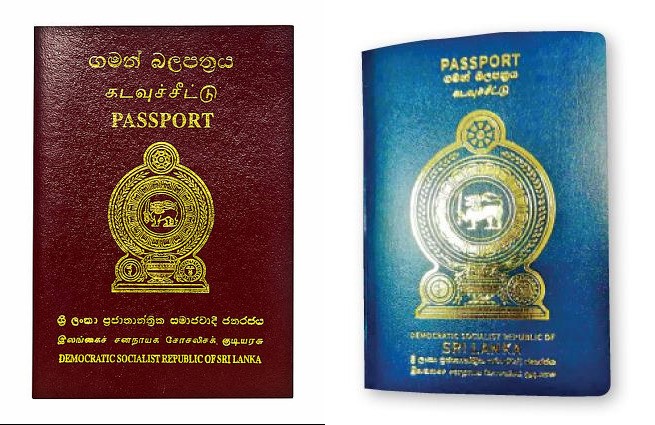
The recent changes by Sri Lanka’s Department of Immigration and Emigration regarding the language used in the new passport series have sparked important discussions among citizens and officials. While the decision to print passports primarily in English—with Sinhala and Tamil as secondary languages—aims to facilitate international travel, it has also raised concerns about cultural identity and linguistic rights.

Advocates for the use of English highlight its role as a link language, which can enhance recognition and ease of use for travelers. However, it is crucial to recognize that prioritizing Sinhala and Tamil equally in passports is vital for preserving the rich cultural heritage of Sri Lanka. As the official languages of the country, Sinhala and Tamil are a reflection of its diverse identity, and their equal prominence in official documents signifies respect and inclusivity.

Passports serve as more than mere travel documents; they are symbols of national identity and sovereignty. Even though the new machine-readable passport (MRP) introduces modern features and a slimmer design with 48 pages compared to the previous 64-page ‘N’ series passport, it is essential to maintain the dignity of its holder. For many citizens, the language on their passport embodies their cultural heritage and personal identity. By ensuring that all national languages are represented equally, we can foster a greater sense of belonging and respect among the diverse populations of Sri Lanka.

The Importance of Native Language in Passports

There are several compelling reasons to advocate for the inclusion of native languages in passports:

Accessibility: All citizens should be able to read and understand their own travel documents, enhancing inclusivity.

Official Use: Local authorities, who may not be fluent in English, will find it easier to process documents in their native languages.

Cultural Identity: Preserving and promoting the national languages reinforces national pride and identity.

Legal Accuracy: Accurate representation of legal terms and personal details is essential for all citizens.

International Recognition: While reflecting the country’s official languages, we can still comply with international standards, showcasing Sri Lanka’s unique identity on the global stage.

The recent court rulings in Sri Lanka emphasizing the importance of the Sinhala language in legal proceedings further underline the necessity of prioritizing native languages in official documents, including passports.

Balancing National Identity with International Standards

While the global recognition of English presents practical advantages, such as facilitating international travel, the challenge lies in balancing these standards with the need to honor our cultural identity. The current government must understand that simplifying every cultural aspect in a sudden move or political campaign can lead to significant misunderstandings and controversies. Decisions made without a deep understanding of the basic cultural dynamics may alienate communities and provoke unnecessary backlash.

As Sri Lanka navigates its recovery from economic challenges, this debate over passport languages serves as a reminder of the importance of preserving our cultural heritage while adapting to global norms. It is essential for the government to correct any missteps promptly and to honor those who feel hurt by these decisions, thereby demonstrating a commitment to inclusivity and respect for all cultural identities.

In conclusion, the passport language controversy is an opportunity for Sri Lanka to reaffirm its commitment to cultural pride and inclusivity. By embracing national languages equally, we can create a more united and respectful society that honors the rich tapestry of identities that make up our nation.

By Palitha Ariyarathna

Elon Musk – How Should the Richest Person on Earth Behave?

October 23rd, 2024

Prof. Hudson McLean

Is this How the Rickest Person on the Planet Should Behave in Public or even in Private?

Please Read His Comments and You Decide!

For context, Musk was responding to a post about a Der Spiegel article that compared him to a media mogul who helped Hitler climb to power.

It was hardly Musk’s first, and certainly not his most offensive, statement involving the Third Reich or their White supremacist progeny. Just last month, Musk promoted Tucker Carlson’s widely condemned interview with a Nazi apologist who said the murder of Jews in concentration camps was humane” and that Winston Churchill was the chief villain” of World War II. Musk later deleted his X post that called the interview very interesting” and worth watching,” per the Independent.

Express Your Opinion – Read What Others Say!
The Independent Interactive Voice of Sri Lanka on the Internet.

Please visit -: http://www.lankaweb.com/

High Commissioner of Maldives calls on Defence Secretary

October 23rd, 2024

Ministry of Defence  – Media Centre

High Commissioner of the Republic of Maldives to Sri Lanka, His Excellency Masood Imad, paid a courtesy call on the Defence Secretary, Air Vice Marshal Sampath Thuyacontha (Retd), at the Defence Headquarters Complex in Sri Jayewardenepura, Kotte, today (Oct 23).

The Defence Secretary warmly received the Maldivian envoy and engaged in a cordial discussion.  Discussions were focused on strengthening bilateral ties and cooperation between the two countries.

Mementoes were also exchanged to mark the occasion.

Military Liaison Officer of the Ministry of Defence Air Vice Marshal Padman De Costa and Defence Advisor of the Maldivian High Commission Colonel Hassan Amir were also present.

INTERVIEW: More BRICS in the wall

October 23rd, 2024

George Galloway

Countries are queuing up to get into BRICS, says former Pentagon official Michael Maloof. There is no strategic vision coming out of the US. You can’t spend a dollar when you’re dead

රවි සෙනෙවිරත්නට එරෙහිව අධිකරණයට මෝසමක් ගොනු කෙරේ…

October 23rd, 2024

උපුටා ගැන්ම ලංකා සී නිව්ස්

මහජන ආරක්ෂක අමාත්‍යාංශයේ ලේකම් වන රවී සෙනෙවිරත්න මහතා යටතේ පාස්කු බෝම්බ ප‍්‍රහාරයට අදාළ විමර්ශන සිදුකිරීම පිළිගත නොහැකි යයි අගතියට පත් පාර්ශව වෙනුවෙන් අධිකරණයට මෝසමක් ගොනු කර ඇත.

ලේකම්වරයා පාස්කු ඉරිදා ප්‍රහාරය සම්බන්ධයෙන් පත් කළ විමර්ශණ වාර්තාවක සැකකරුවෙකු ලෙස නම් කර ඇති නිසා මෙම මෝසම ගොනු කර ඇත.

නීතිඥ සජිත ගමගේ මහතා විසින් කොටුව මහේස්ත්‍රාත් තනූජා ලක්මාලි මහත්මිය හමුවේ මේ් බව දැනුම් දී ඇ.

පාස්කු ප‍්‍රමාරය සම්බන්ධ කොමිෂන් වාර්තා තුන අධිකරණය හමුවට කැඳවන ලෙසත් සිදු කරන විමර්ශන සම්බන්ධයෙන් මැදිහත් වන ලෙසත් නීතීඥවරය අධිකරණයෙන් ඉල්ලා සිටියේය.

සිදුවීමට අදාළව නිකුත් කර ඇති බී වාර්තාවේ කරුණු සම්බන්ධයෙන් මාධ්‍යවේදියෙකුට එම ලේඛණ ලැබුණු ආකාරය ගැටළු සහගත බවත් ප්‍රහාරයේ විමර්ශන සම්බන්ධයෙන් සෑහීමකට පත් විය නොහැකි බවත් කියමින් පාස්කු ඉරු දින ප්‍රහාරයේ විමර්ශන සදහා අධිකරණයේ මැදිහත් වීමක් සිදු කරන ලෙස නීතිඥවරයා අධිකරණයෙන් ඉල්ලීමක් කර ඇත.

එම ඉල්ලීම සලකා බැලූ මහේස්ත්‍රාත්වරිය ඒ සම්බන්ධයෙන් කරුණු දැක්වීමට ලබන නොවැම්බර් මස 13 වනදා අධිකරණයේ පෙනී සිටින ලෙස අපරාධ පරීක්ෂණ දෙපාර්තමේන්තුවට නොතීසි නිකුත් කළේය.

මෝසමක් ගොනු කරමින් මෙම ඉල්ලීම සිදු කළ නීතිඥවරයා එම ප්‍රහාරයට අදාළ වාර්තා තුන් අධිකරණය හමුවට කැඳවන ලෙසත් ඉල්ලා සිටියේය.

‘මෙම සිද්ධිය සම්බන්ධයෙන් සැකකරුවන් ලෙස නම් කළ අය මහජන ආරක්ෂක ලේකම් ලෙස කටයුතු කරනවා. ඔහුට මේ සම්බන්ධයෙන් නියෝග දිමේ බලයක් නැති බවත් කියමින් විමර්ශන සම්බන්ධයෙන් සෑහීමකට පත් විය නොහැකියි’ යයි නීතිඥවරයා අධිකරණයට දන්වා සිටියේය.

‘මේ නඩුවට අදාළව ප්‍රසිද්ධ මාධ්‍යය මගින් මාධ්‍යවේදියෙක් අදහස් දැක්වූවා. විමර්ශන නිලධාරියා මාරු කරන බව ඔහු මාධ්‍යට කියා දිනකින් එම නිලධාරියා පොලිස් මූලස්ථානයට මාරු කලා. මෙම සිද්ධිය සම්බන්ධයෙන් පත් කළ කමිටු වල විනිසුරුවරුන්ට එරෙහිව යම් යම් ප්‍රකාශ නිකුත් කරනවා. මෙලෙස ප්‍රකාශ ප්‍රසිද්ධ කිරීම සුදුසු නැහැ. දක්ෂ විනිසුරුවන් මේ වාර්තා සකස් කලේ.  මේ වාර්තා ගිය ආකාරය සම්බන්ධයෙන් විමර්ශන කරන්න. ඔහුව අත්අඩංගුවට ගැනීමට බලයක් අධිකරණයට තිබෙනවා’ යයි කී ඒ මහතා අගතියට පත් මිය ගිය වින්දිතයන් වෙනුවෙන් මෙම ඉල්ලීම සිදු කරන බව කීවේය.

Eastern Container Terminal Project given ‘special project’ status

October 23rd, 2024

By Nuzla Rizkiya Courtesy The Daily Mirror


The government announced efforts to accelerate the development of the Eastern Container Terminal (ECT) at the Port of Colombo, a highly anticipated initiative managed by the Sri Lanka Ports Authority (SLPA).

This week, Transport, Highways, Ports and Civil Aviation Minister Vijitha Herath received the Cabinet approval to designate the terminal’s construction as a ‘special project’. This designation aims to streamline the development process by minimising the bureaucratic delays and expediting the necessary permits and approvals required by the SLPA.

The authority previously indicated plans to complete the construction by the end of 2024. Initiated in March 2023, the ECT is projected to become the largest container operations terminal at the Port of Colombo.

Covering an area of 75 hectares, the terminal will feature a 1,320-meter-long jetty capable of accommodating three mega vessels simultaneously. Additionally, it will be equipped with 12 ship-to-shore cranes and 40 rail-mounted gantry cranes to facilitate efficient operations between ships and the land.

Designed to handle three million containers annually, the ECT will incorporate semi-automated systems and advanced technology to enhance operational efficiency. The SLPA has allocated a total of US $ 585 million for the terminal’s development, with China Engineering and Access Engineering appointed as the contractors for the project.

Troops deployed to Jewish community center in Sri Lanka surfing town after U.S. warns of possible attack in area

October 23rd, 2024

Courtesy CBSNews

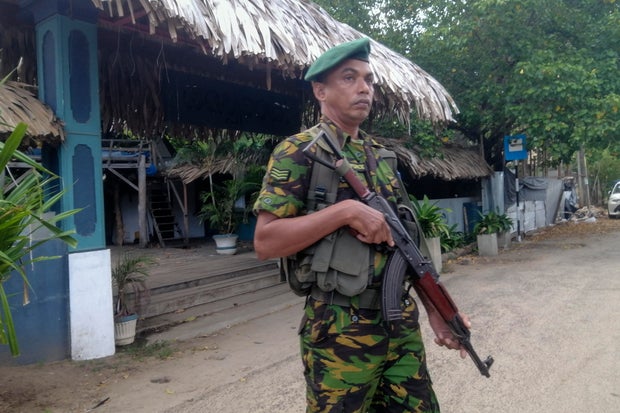
Sri Lanka deployed troops and increased police patrols around a Jewish community center in a popular surfing town on Wednesday after the U.S. embassy warned American citizens of a possible attack on popular tourist sites in the area.

The stepped-up security and warning came after social media posts called for a boycott of Israeli-owned businesses in eastern Arugam Bay.

“The information was that a place called ‘Chabad House’ run by Israelis could be a target and we have taken measures to strengthen security,” said police spokesman Nihal Thalduwa.

He said there had recently been tensions between the Jewish tourists visiting Chabad House and the bay’s Muslim-majority population.

The army and the navy along with police commandos were deployed in the area to step up patrols and man roadblocks, he said.

Sri Lanka Security Threat
A police commando stands guard in front of a restaurant in Arugam Bay, Sri Lanka, Wednesday, Oct. 23, 2024.Wasantha Chandrapala / AP

Protests by local Muslim groups against Israel’s fighting of Iran-backed Hamas in Gaza and Hezbollah in Lebanon have drawn support from the wider community in the predominantly Buddhist South Asian nation.

Israelis accounted for less than 1.5% of the 1.5 million tourists who visited the island in the first nine months of this year — or around 20,000 people altogether.

But Arugam Bay, a hotspot for surfing around 250 miles east of Colombo by road, is a popular destination for Israeli tourists.

In a rare notice of an imminent threat, the U.S. embassy in Colombo said Wednesday that it had “received credible information warning of an attack targeting popular tourist locations” in eastern Arugam Bay.

“Due to the serious risk posed by this threat, the Embassy imposed a travel restriction on Embassy personnel for Arugam Bay effective immediately and until further notice,” the embassy said, adding that “U.S. citizens are strongly urged to avoid the Arugam Bay area.”

Britain and Canada shared the U.S. warning on their own websites, while the Russian embassy advised its nationals to avoid crowded places while visiting the island.

Israel’s National Security Council meanwhile “raised the travel alert level for Sri Lanka due to credible terrorism threats at the tourist and coastal areas.”

Israel urged its citizens in Arugam Bay and other southern and western coastal areas to “leave the country or at least to the capital Colombo, where there is a high presence of local security forces.” The Level 4 travel alert included the Sri Lankan cities Ahangame, Galle, Hikkaduwa and Weligama. 

Along with Arugum Bay and the other coastal regions, Israel’s National Security Council raised the travel risk for the rest of Sri Lanka to Level 3. The National Security Council ranks travel warnings on a scale of 1 to 4, with warnings assigned Level 4 indicating a “high threat level” and warnings assigned Level 3 indicating a “moderate threat.” A place given the latter ranking means Israeli security recommends avoiding unnecessary travel to the destination.

“In addition, the NSC stresses that Israelis in Sri Lanka must exercise increased precaution,” the travel notice said. It urged citizens currently in Sri Lanka to “avoid openly exhibiting anything that could identify you as Israeli, such as t-shirts with Hebrew writing, or any symbol that discloses your religion or nationality.” 

Security officials also cautioned against “gatherings of Israeli citizens in public places where there is no security.”

New hotline

There have been no attacks in Sri Lanka since the 2019 Easter Sunday bombings, which killed 279 people, including 45 foreign nationals.

The coordinated attack against three luxury hotels and three churches was blamed on a local jihadist group that pledged allegiance to the Islamic State group.

Tourism numbers fell sharply afterward, and took another hit during a 2022 economic meltdown that precipitated widespread civil unrest.

But foreign visitor numbers have picked up after an International Monetary Fund bailout last year helped stabilize the economy.

Following the U.S. embassy warning, police said they were unveiling a new security plan to protect tourists island-wide.

“In view of the war situation in the Middle East and Eastern Europe, the police, together with intelligence agencies, are working on a plan to protect tourists and resorts,” said a statement issued by the Sri Lanka Police.

It did not give details, but said a hotline had been established for tourists to alert authorities of any safety concerns.

අග විනිසුරුවරියගේ කමිටු වාර්තාව ප්‍රතික්ෂේප කරන්නේ නම් ඇය ලබා දුන් නඩු තීන්දුත් ප්‍රතික්ෂේප කරනවාද? අගරදගුරු තුමා තමන්ට අවශ්‍ය අයගේ නම් කියවෙන පාස්කු කොමිසම් වාර්තාවක් බලාපොරොත්තු වෙනවාදැයි සැකයි!-ගමන්පිල අසයි.

October 23rd, 2024

උපුටා ගැන්ම  ලංකා ලීඩර්

පිවිතුරු හෙළ උරුමය අද කොළඹ පැවැත්වූ මාධ්‍ය හමුවකට එක් වෙමින් හිටපු පාර්ලිමේන්තු මන්ත්‍රී උදය ගම්මන්පිල  මහතා පරශන කළේ පාස්කු ප්‍රහාරය සම්බන්ධ විමර්ශන කමිටුවේ වාර්තාව තමන් පිළි නොගන්නා බවට ඇමති විජිත හේරත් මහතා පවසන්නේ එහි සභාපති විනිසුරු වරියට විශමාචාර චෝදනා එල්ල වූ බව පවසමින් නම් ඇය විනිසුරුවරියක ලෙස ලබාදුන් නඩු තීන්දු ප්‍රතික්ෂේප කරන්නේදැයි කියායි.

එහිදී වැඩිදුරටත් කරුණු දැක් වූ ඒ මහතා තමනට පක්ෂපාති පුද්ගලයන්ට චෝදනා එල්ල වලට එවන් වාර්තා ප්‍රතික්ෂේප කරන බව නොකියා එහි වරදක් ඇත්නම් ශ්‍රේෂ්ඨාධිකරණය හමුවට යාමට හැකි බව නීතිමය ක්‍රමවේදය බවත් පෙන්වා දුන්නේය. 

අගරදගුරුතුමන්ද මෙම වාර්තා ප්‍රතික්ෂේප කරන බව පැවසු ගම්මන්පිල මහතා එසේ ක්‍රන්නේ ඔවුන් බලාපොරොත්තු වන පුද්ගලයන් ගැන සඳහන් නොවන නිසාදැයි සැකයක් මතුවන බවද අවධාරණය කළේය.

විජිත හේරත් ඇමැතිතුමා මේ වාර්තාව ව්‍යාජ වාර්තාවක් කිව්වේ නෑ. ඒ වගේම අල්විස් වාර්තාවේ අඩංගු කරුණු ප්‍රතික්ෂේප කළෙත් නෑ. එතුමා මේ වාර්තාව ප්‍රතික්ෂේප කරන්නේ කමිටුවේ ප්‍රධානත්වය දැරූ විනිසුරුවරිය 2004 දී විෂමාචාර චෝදනාවක් මත රැකියාවෙන් ඉවත් වෙලා 2006 සිට නැවත සේවයට පැමිණියා කියන කාරණය මත.

වසර දෙකක් සේවයේ නොසිටීම පදනම් කරගෙන මේ වාර්තාව ප්‍රතික්ෂේප කරනවා නම් 2006 සිට 2023 දක්වා වසර 17ක් එතුමිය විනිසුරුවරියක් ලෙස ලබා දුන් සියලු නඩු තීන්දුත් ප්‍රතික්ෂේප කරනවාද? එතුමිය සිර දඬුවම් ලබා දුන් සිරකරුවන් නිදහස් කරනවාද? අය කළ දඩ නැවත ඒ පුද්ගලයන්ට ගෙවනවාද? දික්කසාද කළ අය නැවත කසාද බන්දනවාද කියන කාරණයත් විජිත හේරත් මැතිතුමා රටට පැහැදිලි කළ යුතුයි.

කමිටුව ගැන විවිධ චෝදනා නගන ඇමැතිතුමා කමිටුවේ හරය ගැන වචනයක් කතා කරන්නේ නෑ. පාස්කු ප්‍රහාරය පිළිබඳ ලැබුණු ලිපියට කිසිදු ප්‍රතිචාරයක් නොදක්වා දවස් 12ක් සිටීමෙන් පාස්කු ප්‍රහාරය නොසැලකිල්ලෙන් සිදුවීමට ඉඩහැරීමේ වරදට රවී සෙනෙවිරත්න මහතා වැරදිකරු ද නිවැරදිකරුද? මට හෝ විනිසුරුතුමියන්ට පහර දීමෙන් රවී සෙනෙවිරත්නගේ නොසැලකිල්ල නිසා මේ මහා අපරාධය වුණා කියන චෝදනාව වෙනස් වෙන්නේ නෑ.”

Ranil demands immediate implementation of salary raise for public workers

October 23rd, 2024

Courtesy The Daily Mirror

Former President Ranil Wickremesinghe said that the legal Cabinet decision taken by him as Finance Minister to increase the salaries of public servants should be implemented immediately.

The former President said that if he had won the Presidential election, he had planned to give the salary increase from next January, and that if the salary increase is not given, then the government should immediately reveal where the money allocated for it is.

Former President Ranil Wickremesinghe mentioned this in a special discussion held today (23) with representatives of the State Employees Trade Unions.

The discussion was held at the New Democratic Front office at Flower Road, Colombo.

Former President Ranil Wickramasinghe, who further commented there, also said:

I thought I would clarify the facts about the legality of our government increasing the salaries of public servants.  If we explain about the cabinet decision we have taken to increase the salaries of public servants, we have done that work under Article 43 of the Constitution.  We made the salary increase after considering the requests received from all public servants.

The demand for salary increase is reasonable.  By the year 2022, the value of people’s wages has decreased by fifty percent.  They lived hard.  They had to go into debt.  Some people had to sell their property.  In the early days when I took over, they were not in a position to give relief.  I announced it to the country.  Some asked to increase the salary by twenty thousand. 

 In 2024, I increased the wages by ten thousand rupees.  But those ten thousand rupees are not enough.   When the value of money decreases by fifty percent, people will have problems.  There are times when some children come to school without breakfast.  Children in many families stopped attending tuition classes.  Good or bad or need tuition classes today.  I did not want these social systems to collapse.  Accordingly, Ma Udaya Seneviratne Committee was appointed to look into the increase in government employee salaries.  They were given three months to make a decision.  But the committee gave the report before that. 

I asked the committee chairman Mr. Udaya Seneviratne about it.  He also mentioned that since this is a big problem, it should be helped.
I asked how much money would be spent on increasing the respective wages.  When I asked the Treasury Secretary if he was able to give the amount he said, he said that it is not possible to give that amount.  The Treasury Secretary also informed that our budget will not be able to support this amount.  I told Mr. Udaya Seneviratne to inform that matter.  I also told them to discuss with the President’s Secretary and find out how to increase the relevant salaries.

Later, they informed me that they have discussed and reached an agreement and that it is possible to give fifty percent in one year and the remaining fifty in the other year without giving the salary increase all at once. 

At that time, I first discussed with Saman Ekanayake who was my secretary.  I also discussed with my economic advisor Dr. Samaratunga and Finance Ministry Secretary Mahinda Siriwardena.   In the end, we came to an agreement to give this salary increase.
Even if we increase the wages as agreed, we will not be able to cover the disadvantage of the decrease in the value of the currency.  But we knew that this decision would bring some significant relief. 

Accordingly, I presented the cabinet paper on increasing the remuneration of public servants.  I have signed that cabinet document as the president.  Accordingly, this decision does not require comments from the treasury.  The cabinet can take any decision.  We now generally operate according to the UK Cabinet Manual. 

It is stated that it is assigned to the Chairman of the Council of Ministers to summarize what the collective decision is and it is prescribed by the Secretariat of the Council of Ministers in notes.

That means we don’t ask for votes to make a decision.  The decision will be announced by the Chairman of the Cabinet.  It is mentioned in section 4:3.  We have reported that decision. 

Article 4:7 states that it is for the incumbent Government to determine the specific arrangements for collective decision-making.

Sometimes we make decisions without papers.  Opinions against the views of the minister in charge of the subject are obtained. 

I don’t think that my friend Mr. Vijitha Herath has been in a cabinet before.  The decision taken by our government to increase the salaries of public servants is completely legal. 

A ministry is an organization.  The organization has no laws.  The ministry is headed by the minister under section 52 of the constitution.  The Ministry is run by the Secretary under the order of the Minister.

As the Minister of Finance, sometimes when papers are sent to be sent to the Cabinet according to the Ministry’s proposals, I sometimes agree and sign them.  If I do not agree with certain papers, I will say my opinion.

As the President, when I sign the relevant salary increase resolution, I am not only signing as the President.  As the minister of all ministries belonging to the President.

I presented this salary increase as the Finance Minister.  When signing the relevant paper as the President, there is no need to submit letterheads as the Ministry of Finance again.   It is legal to sign as the President.

Accordingly, the relevant government employee salary increase should be paid.  We can provide that salary increase.  We have approved this salary increase only after due consideration. 

And there is another matter that I have considered while giving this salary increase.   That means we need to increase our state income from twelve percent to thirteen percent by next year.  I have accordingly approved this salary increase.

There is money to provide the relevant wage increase.  If they say that there is no money, that is a strange story.  The government should explain where the money to increase salaries is. 

Do not postpone this salary increase.  Because the people are not able to live.

If you can’t fulfill the promises made by the compass, then fulfill the promises made by us.

This government employee salary increase should be implemented from January.

My idea was to pass this salary increase in December or the first two weeks of January if I won the presidential election and pay the salary at the end of January.  Don’t try to delay this salary increase now. 

People should have money in hand to celebrate the Sinhala year.  This salary increase is legal.

Now the civil servants have to take this fight forward.  This battle is now in your hands.  Now Sajabe has gone and said that he will support President Anura Dissanayake and will not clash.

Former President Ranil Wickramasinghe further stated that you should take this responsibility and carry it forward.

Government should reappoint a National Security Advisor: Sagala

October 23rd, 2024

Courtesy The Daily Mirror

Colombo, October 23 (Daily Mirror) – A National Security Advisor should be reappointed to the country to prevent potential threats from terrorist groups, former Presidential advisor Sagala Rathnayaka said.

Addressing the media today, he said that as the country’s tourism industry is growing, news of such threats could severely harm the nation. The current government must ensure these situations do not arise, he said.

“Our government had established an intelligence-sharing network with other countries. Through this network, we ensured the safety of the country while exchanging critical information. As a result, Sri Lanka did not face any major threats in recent years. We received information about potential threats, but we took necessary action in a timely manner,” he explained.

He further said that if the current government had taken the required measures, these threats would not have emerged. 

“Issuing statements that cause harm to the country’s image will negatively impact the economy, create issues in securing foreign exchange and hinder job opportunities and business activities. Such announcements will directly affect the tourism industry, which is crucial to the country’s economy,” he added.

Udaya Gammanpila claims inaction could link to Easter attack mastermind

October 23rd, 2024

Courtesy Hiru News

Udaya Gammanpila, leader of Pivithuru Hela Urumaya and former Member of Parliament, asserted that identifying who motivated former Senior DIG Ravi Seneviratne to remain inactive for 12 days on a critical letter could lead to uncovering the mastermind behind the Easter Sunday attacks. He made these comments during a special news conference in Colombo on the 23rd.

On the 14th, Gammanpila urged the President to release two presidential investigation reports regarding the Easter Sunday terror attack. He warned that if the reports are not disclosed, he would make them public within a week.

During a subsequent news conference on the 21st, he shared details from one of the reports. However, Cabinet Spokesperson Minister Vijitha Herath countered this, stating that the government would not accept the findings of the Alwis Committee report, which includes the discussed facts, during the Cabinet decisions announcement on the 22nd.

‘The hero of the’Easter performance’ would be the Cardinal’ – Udaya Gammanpila

October 23rd, 2024

Courtesy Adaderana

Dilith says ‘Sarvajana Balaya’ is the only viable opposition

October 23rd, 2024

Courtesy Adaderana

Leader of the ‘Sarvajana Balaya’ alliance and Gampaha District candidate, entrepreneur Dilith Jayaweera says that the only opposition remaining in the country’s politics is the ‘Sarvajana Balaya’ alliance.

He made this statement when a group of representatives of the United Republic Front from the Matara District joined the ‘Sarvajana Balaya’ alliance today (23).

Today, we have become the only opposition remaining country. That is why we say we are a brave opposition,” Dilith Jayaweera said.

He also stated that he aims to clarify the existing political reality to the public and make the impact necessary for democracy. He further stated that it’s crucial to guide the government in the right direction that aligns with the people’s expectations and to work toward a parliament that can fulfil those needs. 

Meanwhile, a group of representatives from the United Republican Front in the Matara District joined ‘Sarvajana Balaya’ alliance today.

Accordingly, A.H Netthikumara accepted his appointment letter as the Matara District Organizer, N.G.S. Hettiarachchi was appointed as the National Trade Union Coordinator, and Lakshmi Kodithuwakku was appointed as the Matara District Women’s Affairs and Constituency Organizer. 

Additionally, H.M Punyathilaka as Matara District Farmers’ Organizations and Voluntary Organizations Coordinator and H.A. Mahinda as Matara District Pitawalgamuwa Divisional Organizer accepted their appointments from the leader of the ‘Sarvajana Balaya’ alliance, entrepreneur Dilith Jayaweera. 

Furthermore, Prasanna R. Jasingha has been appointed as the Digital Media Coordinator for the ‘Sarvajana Balaya’ alliance, and Mohamed Thowfeek Sirajudeen will serve as the Hambantota District Coordinator for Muslim Relations within the alliance.

Security forces fully aware of Arugam Bay threat; Security tightened days ago

October 23rd, 2024

Courtesy Adaderana

Sri Lanka’s security forces were reportedly fully aware of the information warning of a possible attack targeting popular tourist locations in the Arugam Bay area, as mentioned in the U.S. Embassy’s security alert for American citizens in Sri Lanka today (23). 

Is it stated that consequently, steps were taken several days ago to bolster security in the region.

Around 500 police officers and Special Task Force (STF) personnel had already been deployed to enhance security in the Arugam Bay tourist zone.

https://youtu.be/Tk9Cf1DpbXo

Police Media Spokesman DIG Nihal Thalduwa also confirmed that intelligence agencies and other security forces are focused on strengthening security measures in the area.

He further emphasized that no intelligence reports have been received regarding such threats in Colombo or any other areas of the country thus far, and therefore urged the public not to have any undue fears.

Additionally, special attention is being given to ensure the safety of tourists visiting Arugam Bay and other provinces.

He indicated that recent information had indicated a potential threat to Israelis in the area. In response, the Senior DIG in charge of the province has initiated necessary preliminary measures, which involve securing the area by deploying roadblocks and periodically conducting checks on vehicles and individuals.

Special security units, including the Police, STF, Navy, Army, and intelligence officers, have been deployed to ensure safety in the area. If any further information is received, immediate action will be taken,” Thalduwa reassured. 

He emphasized that police stations have been instructed to coordinate and provide security for tourists, regardless of nationality.

If we receive any information, we will take immediate action. Even now, necessary measures have been taken for that area. To other areas…that is why we are giving these instructions to the police stations because it is our responsibility to provide security to the tourists regardless of the country they belong to, so we are doing the necessary coordination and giving the necessary instructions to those police stations,” he said. 

Sri Lanka Tourism assures safety of all visitors

Meanwhile, the Sri Lanka Tourism Promotion Bureau has issued a statement today extending a warm invitation to travelers from around the world to visit Sri Lanka during the upcoming tourist season and assuring that all tourists can enjoy a safe and secure experience while exploring the beauty of the island. 

The highest levels of safety and security will be maintained for all visitors throughout their stay in Sri Lanka,” the statement by Sri Lanka Tourism said.

The Ministry of Defense has also assured Sri Lanka Tourism that necessary measures have been taken to guarantee the safety of tourists across all areas of the country, ensuring peace of mind for those currently staying in Sri Lanka and for those planning their visits.

We look forward to offering every traveler a memorable and enjoyable stay in Sri Lanka,” Sri Lanka Tourism said.

Acting IGP assures security of foreigners in Sri Lanka

October 23rd, 2024

Courtesy Adaderana

Sri Lanka’s Acting Inspector General of Police (IGP) Priyantha Weerasooriya stated that the security of all foreigners in the country has been assured and that diplomatic missions have been informed.

He made these comments while addressing a special press conference today (23) at the Polonnaruwa SSP’s Office, regarding the security measures taken following the information received warning of a possible attack targeting popular tourist locations in the Arugam Bay area.

https://youtu.be/_VDySUivdHA

As there was a suspicion that there could also be a threat to Sri Lanka, the intelligence agencies did very good surveillance duties in that regard. We received intelligence regarding that by October 07.”

The Acting IGP said that the possibility of attempts to carry out attacks targeting a specific nationality of tourists was discussed in the Security Council chaired by the President from 3 weeks ago. We received instructions in that regard.” 

Weerasooriya stated that according to those instructions, security was provided to those foreigners, specific places, and places of religious worship under a special security plan jointly by the police, Special Task Force (STF) and intelligence officers.

He stated that a specific security plan was launched since yesterday (22) and that the reason for that was because the information was confirmed.

The Acting IGP stated that the Security Council met this morning too and that the security chiefs and the commanders of the three armed forces discussed the matter there as well. According to the information received there, the security of the foreigners has been assured. We informed the embassies in this regard.”

He further added that no threats targeting locals have been observed thus far, however, he requested the public to immediately notify the police regarding any terrorist threat, any sudden changes, and any information regarding an attack or an individual. He stated that information can be provided at any moment via the ‘1997’ emergency hotline. 

At present, adequate security has been deployed. Raids and searches are underway, but no suspicious person or property has been found,” the police chief said.

There is no problem in Sri Lanka regarding national security. There was a certain issue with regard to foreign nationals. It is common in other countries of the world as well. However, we have taken necessary measures to prevent this from happening.”

He added that a special security program is currently in place at the airport and its access roads.

Russians Embassy alerts citizens in Sri Lanka over threat of attacks in Arugam Bay

October 23rd, 2024

Courtesy Adaderana

In connection with the official statement by Sri Lanka Police regarding the possible threat of attacks against foreign tourists in Arugam Bay, the Russian Embassy in Colombo has requested Russian citizens in Sri Lanka to remain vigilant and to avoid large gatherings.

Meanwhile, the United Kingdom (UK) had also updated its travel advice for Sri Lanka based on the latest travel alert issued by the U.S. Embassy regarding potential threats in the Arugam Bay area.

The U.S. Embassy in Colombo also today issued a security alert for American citizens in Sri Lanka strongly advising them to avoid the Arugam Bay area until further notice, citing credible information warning of an attack targeting popular tourist locations in the Arugam Bay area.

The Embassy says it has received credible information warning of an attack targeting popular tourist locations in the Arugam Bay area. 

Due to the serious risk posed by this threat, the Embassy imposed a travel restriction on Embassy personnel for Arugam Bay effective immediately and until further notice.”

U.S. citizens are strongly urged to avoid the Arugam Bay area until further notice,” the security alert said.

Meanwhile, Sri Lanka Police had announced special measures to bolster security in the Arugam Bay area following information received regarding potential threats to tourists in the area.

It is reported that around 500 police officers and Special Task Force (STF) personnel have been deployed to enhance the security of the Arugam Bay tourist area.

Intelligence agencies and other security forces are also focusing on strengthening security in the region, the police spokesman said. 

Police Spokesman DIG Nihal Thalduwa clarified that Israelis frequent the Arugam Bay and Pottuvil areas due to popular surfing locations in those areas, and that recent information received has indicated a possible threat targeting them.

He further emphasized that no intelligence reports have been received regarding such threats in Colombo or any other areas of the country thus far, and therefore urged the public not to have any undue fears.

In the Arugam Bay area, there is a building established by the Israelis, a hall-like structure. Israelis are often attracted to both Pottuvil and Arugam Bay, especially because of surfing. They love that area, which is why they have set up a special place there,” said the Police Media Spokesman.

He indicated that recent information suggested a potential danger to Israelis in the area. In response, the Senior DIG in charge of the province has initiated necessary preliminary measures, which involve securing the area by deploying roadblocks and periodically conducting checks on vehicles and individuals.

UK updates travel advice for Sri Lanka

October 23rd, 2024

Courtesy Adaderana

The United Kingdom (UK) has updated its travel advice for Sri Lanka based on the latest travel alert issued by the U.S. Embassy regarding potential threats in the Arugam Bay area.

The U.S. Embassy in Colombo today issued a security alert for American citizens in Sri Lanka strongly advising them to avoid the Arugam Bay area until further notice, citing credible information warning of an attack targeting popular tourist locations in the Arugam Bay area.

The Embassy says it has received credible information warning of an attack targeting popular tourist locations in the Arugam Bay area. 

Due to the serious risk posed by this threat, the Embassy imposed a travel restriction on Embassy personnel for Arugam Bay effective immediately and until further notice.”

U.S. citizens are strongly urged to avoid the Arugam Bay area until further notice,” the security alert said.

Meanwhile, Sri Lanka Police had announced special measures to bolster security in the Arugam Bay area following information received regarding potential threats to tourists in the area.

It is reported that around 500 police officers and Special Task Force (STF) personnel have been deployed to enhance the security of the Arugam Bay tourist area.

Intelligence agencies and other security forces are also focusing on strengthening security in the region, the police spokesman said. 

Police Spokesman DIG Nihal Thalduwa clarified that Israelis frequent the Arugam Bay and Pottuvil areas due to popular surfing locations in those areas, and that recent information received has indicated a possible threat targeting them.

He further emphasized that no intelligence reports have been received regarding such threats in Colombo or any other areas of the country thus far, and therefore urged the public not to have any undue fears.

In the Arugam Bay area, there is a building established by the Israelis, a hall-like structure. Israelis are often attracted to both Pottuvil and Arugam Bay, especially because of surfing. They love that area, which is why they have set up a special place there,” said the Police Media Spokesman.

He indicated that recent information suggested a potential danger to Israelis in the area. In response, the Senior DIG in charge of the province has initiated necessary preliminary measures, which involve securing the area by deploying roadblocks and periodically conducting checks on vehicles and individuals.

Strategic Solutions Needed for Resolving Human-Elephant Conflicts, Not Reactive Measures

October 22nd, 2024

Sasanka De Silva Pannipitiya

The recent tragedy involving a train collision that killed three elephants and derailed carriages along the Batticaloa-bound night train has sparked an intense outcry on social media.

In response, the railway authority’s decision to run trains on that line only during the day appears to be more reactive than strategic.

While it may appease online critics, it overlooks the deeper issue at hand and sets a worrisome precedent for decision-making based on social media pressures rather than thoughtful, long-term solutions.

Limiting train operations to daylight hours may seem like an immediate fix, but it’s far from practical or sustainable.

Such a change will inevitably disrupt schedules, affect freight deliveries, and impact communities that rely on these transport services.

Economically, this shift could be detrimental to regions dependent on nighttime rail operations, as increasing the number of carriages to offset the loss of commercial capacity isn’t feasible with the current locomotive pulling power.

Not to mention, it doesn’t address the core problem, elephants continue to cross these tracks, day or night.

There are far more nuanced and effective solutions that could be implemented. For one, electronic tagging of elephants, already a proven method in wildlife conservation, could be introduced.

GPS systems and handheld units in locomotive engines could alert train operators when tagged elephants are near, allowing them to slow down or take precautions.

Another viable option is using high-frequency sound-emitting devices that only elephants can hear, warning them to steer clear of oncoming trains without disturbing other animals or nearby residents.

Additionally, trains could slow down considerably in accident-prone areas while speeding up on open stretches to make up for the time lost, or train schedules could be adjusted in a more precise manner to avoid passing through these zones during peak elephant movement hours.

These measures would mitigate the risk to elephants without compromising the region’s economic stability or social connectivity.

What we need are real, innovative solutions, not rushed decisions aimed at quelling public outcry.

Addressing human-elephant conflict in the modern world requires thoughtful integration of technology, careful planning, and a genuine commitment to coexistence.

Sasanka De Silva

Pannipitiya.


STOP Corruption from the Top Downwards!

October 22nd, 2024

Prof. Hudson McLean

STOP Corruption from the Top Downwards!

If Anura Kumar Dissanayaka President of Sri Lanka wants to Keep to his Word, he  may follow the examples of Singapore & Peru, to start with.

Former Singapore minister sentenced to a year in prison in rare corruption case

Former Singapore minister sentenced to a year in prison in rare corruption case

Peru’s ex-president Toledo was sentenced to more than 20 years in prison for corruption

https://yle.fi/a/74-20119319

—-ENDs After Justice——

Express Your Opinion – Read What Others Say!
The Independent Interactive Voice of Sri Lanka on the Internet.

Please visit -: http://www.lankaweb.com/

“SETTLER COLONIALISM” AND TAMIL EELAM Part 2B

October 22nd, 2024

KAMALIKA PIERIS

In the 20th century too, the British   rulers continued to colonize the island with Tamils from India. At a Durbar with Tamil chieftains of Jaffna peninsula in 1911 British Governor Henry McCallum told them that he had reserved the Tank Country and the East for the people of Jaffna. He would bring immigrants from South India, if the Tamils in Jaffna did not comply.[1]

Ponnambalam Ramanathan told the Governor at this same meeting in 1911 that Jaffna people had colonized the land up to Anuradhapura and wanted the government to open up the railways so that more Tamils could come south.[2]

 Denham observed in 1911 that Jaffnese do not emigrate as cultivators and settlers but for jobs as educated persons.  They are not interested in working to open up the country where they have to work for at least two years before they got a return. [3]

Hennayake looked at the   position of the Sinhalese in Vavuniya, Mannar, Anuradhapura and Trincomalee in 1921. In Vavuniya, in 1921 of the four DRO divisions, Vavuniya south had a clear Sinhala majority    but this is the smallest of the four divisions, [4]  said Hennayake. 

In Mannar, in 1921, there was not a single Village Headman/Grama sevaka area where the Sinhala were in a majority. Manner was mainly Tamils and Muslims, and in the southern part of the district, the concentration of Muslims was very high. Only three VH areas in Mannar district had a Sinhala population even above 10%. They were Talaimannar, Pesalai and Musali division.  This pattern continued for the next 50 years.  The VH/GS areas of the northern part of Mannar was overwhelmingly Tamil, with some Muslim concentrations, said Hennayake. 

Anuradhapura district was largely Sinhala in 1921. All the AGA divisions of Anuradhapura have reported a Sinhala majority since the census started in 1871, he said. The Tamil population in Anuradhapura was very low, but they were there. Anuradhapura town has always had a relatively large Tamil population. They were largely engaged in business and related activities, observed Hennayake .The rest of the Tamils were concentrated in Anuradhapura district, Kekirawa and a few rural areas, concluded Hennayake.

Tamil settlers eventually dominated the whole of the Northern Province. Kilinochchi town was colonized in 1936 by residents from Jaffna in order to reduce overpopulation and unemployment in Jaffna. 

Tamils and Muslims also became dominant in the Eastern Province in the 20 century. Tamil colonization was only 8 to 16 miles into the interior, on the east coast and the west, said P.A.T. Gunasinghe. [5] That is because the British administration was only interested in access to the Bay of Bengal. They were not interested in the interior of the Eastern Province.

the position in the Eastern Province until Independence,  was neglect and decay of the extensive  but sparsely populated Sinhala areas and development of the coastal areas (other than the Sinhala Panama Pattu) populated by Tamils and Muslims, said Gamini Iriyagolle .[6]  Therefore the population migrated in large numbers to the coastal areas.  

The high point for Tamil dominance in Trincomalee was 1920.  In 1920, Tamil population In Trincomalee was at a high level and the Sinhala population was at a low level, noted Hennayake. The Tamil separatists argue that the 1920 position should be taken as the ideal and there should be no deviation from this, he observed in 2009.

While Tamil population prospered in the Eastern Province, it was quite the reverse for the Sinhalese, said GH Peiris. Caught by their traditional occupation rice cultivation and reluctant to move from their traditional Purana villages, the Eastern province Sinhalese of the late 19th century and early 20th century, simply wilted, said GH Peiris. The government records of the period show the retreat of these ‘purana’ villages, the depopulation through famines, epidemics, drought and finally, cultural assimilation by other ethnic groups.[7]

Tamil and Muslim populations are thriving, Sinhala villages are dying, said S. O Kanagaratnam, in 1921 in his Monograph on the Batticaloa District.”  One of the saddest features is the decay of the Sinhalese population in the west and south of the Batticaloa District. At one time there were flourishing and populous Sinhalese villages, as evidenced by the ruins and remains dotted about this part of the country. Now most of the Sinhalese villages that are left are little better than names.  The Batticaloa District had very old stone inscriptions, such as the Nuweragala inscription dated 4 BC found in Bintenne, he observed.[8].

 Isolated attempts were made to rescue the Sinhala villages in Batticaloa. In 1922 the British created new Sinhala division In Batticaloa area, Wewgampattu North, taking away the Sinhala villages from Tamil and Muslim domination and placing them under a Kandyan Sinhalese divisional administrator, said Gamini Iriyagolle.

The British authorities continued to favour the Tamils in Trincomalee. The diary of the AGA, Trincomalee for July –August 1933 recorded that the migrant Sinhala fishermen who had come into Trincomalee had   clashed with the Tamil fishermen regarding use of the beach.

The British GA had given a decision against the Sinhala fishermen. The Sinhala fishermen had appealed to the Fisheries Department in Colombo. AGA mentioned the continuous succession of interviews; the longest was with a Mr. Subramanian ‘who is still advocating the cause of the Tamil fishermen”, the AGA said, while the AGA was making the entry in his diary.

The population of Tamils in Trincomalee started declining from the 1920s. it was 52.2% in 1921, 46.6% in 1931[9]  It went down further  in the 1940s when Trincomalee harbor was used by the British  South East Asia command, in 1942, during World War II.

The Second World War brought many migrants from all parts of the island to the naval establishment and the Dock Yard at Trincomalee. They also arrived in Trincomalee town.  This brought many non-Tamils into Trincomalee, said Peiris and led to a rapid increase of the population. Trincomalee became a major commercial centre as well added DGB de Silva[10]

The food shortage during World War II led to the opening of land in the Trincomalee district for cultivation under the emergency food drive. Land development was carried out in a number of projects in Malaria infested jungles employing southern youth many of whom died of fever. Padaviya and Allai schemes were born as a result of this enterprise. The land Department then functioned under the respected Tamil Civil Servant, Sri Kantha, said DGB de Silva.

The 1946 Census showed that the total Tamil population in 1946 was less than in 1921. In all Tamil districts including Jaffna the Tamils had lost ground between 1921 and 1946. In 1946, Tamils were in a minority,  In the Eastern Province except for Trincomalee and Batticaloa Urban Councils where they were in the majority. But Tamil population had increased in all Sinhala districts except for Chilaw, particularly in Badulla, Matale and Nuwara eliya.[11] Michael Roberts noted that in 1946, 22% Tamils resided outside North- East. [12]

Gamini Iriyagolle pointed out that there was no land hunger in Trincomalee, Jaffna, Mannar and           Vavuniya districts in 1946.      There were few Tamil applicants for the later Allai and Kantalai, colonization schemes of the 1950, he said. [13] Mannar and Vavuniya did not have landlessness in 1951 and Jaffna was adequately served by the Iranamadu colony, observed BH Farmer.[14]

RMAB Dassanayake nostalgically recalls life in Trincomalee in the period 1940-1950 when he used to visit his home in Trincomalee while studying at Kandy. Dassanayake had a special connection with Trincomalee. His grandfather had been Rate Mahatmaya there. Grandfather’s proficiency in the Tamil language was the envy of some of the Tamil officers in the Trincomalee kachcheri. [15] 

Dassanayake’s father was at  that time Korale Mahatmaya.  Father had grown up in Trincomalee .He had studied at Rama Krishna Mission Hindu College at Trincomalee as a resident student and was fluent in spoken and written Tamil. Father conducted his official correspondence in English and Tamil.  Dassanayake and father would have received a certain amount of deference and recognition due to grandfather’s status as well as father’s own.  That may explain the son’s nostalgic recall.

My father was a connoisseur of the Tamil cuisine, said Dassanayake. During school holidays I remember accompanying my father on a couple of occasions when he visited Trincomalee town where he drew his salary at the kachcheri or attended to other official duties. On one such visit my father took me to a simple Tamil eating house patronized usually by visiting villagers to Trincomalee town. We were served with rice and a variety of fish curry – fried (poriyal) white (vellai) and hot and spicy – (kulambu). We relished those tasty preparations, recalled Dassanayake.

Dassanayake said he can recollect vividly the very peaceful and harmonious co-existence that prevailed between the Sinhala and Tamil communities in his time in those village areas. They interacted like members of closely knit family units. Those who lived in that region then would endorse this statement.

However, Dassanayake’s recall shows the ethnic divisions of the time. ,Kattukulam-Pattu comprised of two sub-divisions, namely Kattukulam-Pattu East and K. P. West, said Dassanayake. The eastern sector comprised mainly of Tamil villages with a sprinkling of two or three Muslim villages, extending from Nilaveli to Pulmoddai along the North eastern coastal belt, .

 The western sector-consisted mostly of Sinhala villages with one Muslim and three Tamil villages extending from Morawewa/Pankulam along with Trinco-Anuradhapura road area up to Rotawewa. Branching off on a by-road cross connecting Tiriyaya are the villages of Gomarankadawala, Tavuluwewa, Madawachchiya, Kivulekada and about ten other village units – some of which were then mere hamlets consisting of forty to fifty households in each. The Sinhala sector was supervised by  the – Korale Mahatmaya who had five village headmen under him to assist in his duties.

Dassanayake shows the   gradual Tamilisation  of the administration in Trincomalee district. He said, after my grandfather’s demise the Rate Mahatmayas, then known as Vanniyar Mudaliyars were all Tamil.   They were replaced by DROs who were also Tami.. Dassanayake  recalls two of them, T. Balasanthiran and V. R. Navaratnarajah

Present day Sri Lankans have swallowed the false statement that the Tamils are the original inhabitants of the Eastern Province. A reader  wrote to the “Island’ newspaper, saying that he can find Tamils and Muslims who can  trace their ancestry to the North and  Eastern province, but that  he  cannot find any Sinhalese who can do so.

Emil Van der Poorten (b.1939) said I have spent all my holidays since I was a child in Kuchchaveli area, where a maternal uncle was living. His Sinhala wife was to my recollection the only Sinhala speaker for miles around. As an adult I was familiar with the east coast between Verugal and Batticaloa, Panchchankerni area in particular. There   were very few Sinhalese there either. [16]

Trincomalee    town had Sinhala mudalalis he recalled. The larger towns in Batticaloa also had Sinhala merchants from the south.  Apart from them and the migrant fishermen in the wadiyas, there were no other Sinhalese, he said.   ‘It is a gross misrepresentation of fact to rewrite history and settle Sinhalese in what was originally Tamil and Muslim country. There was never a significant concentration of Sinhala speakers in those parts of the country,’ he concluded.

  Tamil presence in Trincomalee continued to reduce after 1950.  In the 1981 Census, there were only 33.8% Tamils in Trincomalee district.  Critics pointed out that   in 1981 there was only one AGA division, namely Town and Gravets’ division, which is predominantly Tamil.[17]              

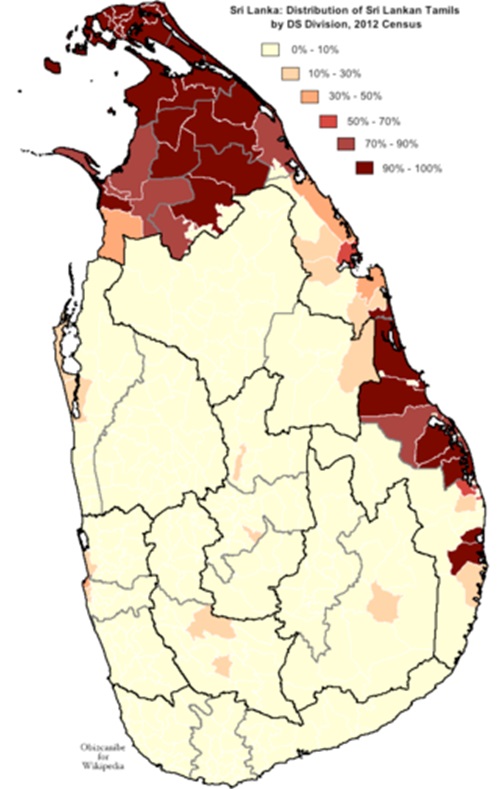
Census of Sri Lanka 2012 showed Trincomalee district having 26.7% Sinhala 31.1 % Tamil and   41.8% Muslim.  Wikipedia map showing Distribution of Sri Lankan Tamil people in Sri Lanka by DS Division according 2012 Census” is given below.  (Continued)


[1] Bandu de Silva.   Tobacco gold that made Jaffna assertive. Island  sat mag. 1.4.2006 p 1. Records of the Durbar with Tamil chieftain 1911(SLNA)

[2] Bandu de Silva.   Tobacco gold that  madke Jaffna  assertive. Island  sat mag. 1.4.2006 p 1. Records of the Durbar with Tamil chieftain 1911(SLNA)

[3] Denham, Census of 1911 p 69

[4] Shantha Hennayake. Island 2.5.2009 p 10 

[5] P.A.T Gunasinghe ‘Tamils of Sri Lanka’ p 44

[6]Gamini Iriyagolle  The Eastern Province, Tamil Claims and “Colonisation”https://fosus2.tripod.com/fs20000614.htm

[7]  GH Peiris p 19

[8] S.O. Canagaretnam “Monograph on the Batticaloa District of the Eastern Province of Ceylon” p vi

[9] GH Pieris  p 25, 29.

[10] DGB de Silva Island Sat Mag  11.6.2005

[11] Census 1946 Vol 1 Pt 1 p  156, 157

[12] M Roberts confrontation in Sri Lanka .  p 232

[13]  Iriyagolle p 1.’Island’ 18.6.95 , P 7.

[14] Farmer p 218

[15]R. M. A. B. Dassanayake  Memories of better days — pre-1960 era in Trincomalee  districthttps://www.infolanka.com/org/srilanka/hist/84.htm

[16] Sunday Leader.1.3.2009 p 15

[17] Cecil Dharmasena. ‘Irrigation and settlements schemes in Northern and East’ Daily News 26.10.95 p 23.

“SETTLER COLONIALISM” AND TAMIL EELAM Part 3

October 22nd, 2024

KAMALIKA PIERIS

This essay looks at Settler Colonialism in action using the writings of Jayatissa Bandaragoda, a SLAS officer who came in contact with aggressive  Settler Colonialism many times  in the course of his ofifical work. He is mentioned  fleetingly in the writings of  the Tamil Separatist Movement,   as a person who keeps on obstructing  Tamil Separatist  activity.

 Jayatissa Bandaragoda’s biography titled    Path of destiny: autobiography of a farmer’s son’ was published in 2011 by Godage international. One reason I wrote this autobiography was to refer to some events relating to the ethnic issue in Trincomalee and elsewhere,” said Bandaragoda. This was a key motivating factor behind my autobiography.  I thought I should place some of my personal experiences and related view points in the public domain.”[1]

Bandaragoda’s brush with the Tamil Separatist Movement started with his appointment as Government Agent, Trincomalee.  Bandaragoda was Government agent, Trincomalee from 1978-1981. [2]

This was not a happy period, he said. [3]  A few days after assuming duties, he was invited, as Chief Guest to the prize giving of St Josephs College, Trincomalee. It was certainly not the usual school prize giving”, he said.  Large posters had been put up, threatening people not be part of a ceremony to receive a Sinhala chief guest and to boycott the function. There was a boycott, but the principal, Father Gnanaprakasam wanted to hold the   prize giving because   there were   a few children from the lower classes, a few parents and teachers present.  Bandaragoda made a speech gave away prizes and the ceremony concluded quickly ‘without any mishaps.’ [4] But the incident shattered my confidence, Bandaragoda said.

During my first year of tenure as GA Trincomalee, there were a number of other unpleasant and anti national incidents as well. Independence Day celebrations were limited to Kachcheri only, due to poor attendance said Bandaragoda. Other occasions of national importance, were marred by ugly incidents such as the burning of the lion flag in a school in town. Some phosphorus had been tied to the flag and ignited as the flag went up. There was a spate of such anti national incidents in Trincomalee. [5]  In 1980 on National Day in Trincomalee, many of the schools did not hoist the national flag. [6]

Trincomalee was considered a hostile environment for a state administrator to work in, but Bandaragoda found that the public in Trincomalee were cooperative and appreciative. [7]  However, ethnically charged aggressive and arrogant behavior was clearly    evident among some of the Tamil elites , he said.[8] This domineering had the objective of relegating the Sinhalese to an inferior status, socially and economically. [9]

The AGAs (Assistant Government Agents) at the time were Tamil. A Sinhala AGA was appointed to Kuchchaveli and the Tamil elites did not like it.[10]  The Sansoni Commission appointed to inquire into the Tamil riots 1977 was sitting in Trincomalee when Bandaragoda arrived. He was told that Sampanthan, then MP for Trincomalee had given evidence before the Commission and had said that Tamils could not bear the sight of Sinhalese officials. [11] 

The Urban Council of Trincomalee was dominated by the Tamil community. Documents such as building applications were only in Tamil language.  The district’s budget was allocated mostly to roads,    schools   and so on, which benefitted the Tamil community. The Urban Council was not supportive of  the Sinhalese in Trincomalee. The Sinhala public in Trincomalee complained to the Kachcheri, regarding this[12]. Whenever some harassment occurred in Urban Council the Sinhalese rushed to the Kachcheri, recalled Bandaragoda[13]

The Sinhalese in Trincomalee had    grievances. The vegetable and fish market in Trincomalee were run by Sinhalese business men who had come from south. Most of the prominent traders in the town were also Sinhalese. The authorities regularly tried to shift the markets from their current location, the Sinhalese   refused to allow it. [14]

During his stay as GA in Trincomalee, Bandaragoda found anti-Buddhist activity going on, particularly the planned destruction of Bo trees. He observed that the newly set up places of Hindu worship, with lingam and statues, were destroyed in retaliation. [15]

The destruction of the Kilveddi Bo tree in April 1978 took place when Bandaragoda was the GA in Trincomalee. It was believed that this Bo tree was one of the saplings planted in the country, with the Sri Maha Bodhi at Anuradhapura.[16]  The destruction had led to a minor ethnic riot in Mutur area[17]

There was much agitation in the villages in Seru Nuwara AGA’s division at the time.  [18] At Allai a Sinhala farmer was shot and killed in the area and the ‘already burning emotions erupted’.  8 persons died. The Allai irrigation scheme had been done in such a way that aSinhala settlement was adjacent to a Tamil settlement. [19]

 A Buddhist monk, reportedly from Kurunegala was injured by gunshot in the same area.   The monk was brought to Trincomalee hospital and an attempt to smuggle his blood stained robes out of the hospital was foiled by the authorities who impounded the clothes and prevented a major communal riot in the country. [20]

The tension was kept under control at local level in Mutur, Kilveddi, Dehiwatte, and Neelapol areas with help of navy and police, but there were still some skirmishes in the Kilveddi area[21].   The tension remained in Mutur and Seruwila areas, said Bandaragoda. [22]

In 1979, Bandaragoda had been called before Victor Tennekoon Commission on District Development Councils. He had been called because of complaints made against him by the MP for Trincomalee.  While responding, Bandaragoda had spoken about the Kilveddi incident and about the mushrooming of small places of Hindu worship.   Neelan Thiruchelvam who was a member of the Commission had not liked his exposing these facts. He wanted Bandaragoda’s evidence be expunged, as ‘communally biased’.  Tennakoon had refused to do so. [23]The Commission instead had thanked Bandaragoda for his detailed and balanced description of the situation in Trincomalee [24]

Bandaragoda stated that the first objection to his appointment as GA Trincomalee came from the Sinhala Buddhists. After the Kilveddi incident, the second priest of Seruwila and a delegation from the area had rushed to see the President.[25] They complained against Bandaragoda, blaming him for the Mutur incidents, saying that he had allowed AGA Sivanathan to bring in the navy to act against the interests of the Sinhalese in the area. Bandaragoda was not in Trincomalee at the time. AGA Sivanathan had acted on his own. This was explained to the delegation. [26]

 The bhikkhu led delegation had obviously been fed the information that Bandaragoda was responsible, in order to get Bandaragoda removed from Trincomalee, using the Buddhists of Trincomalee. The gullible Buddhists had  readily fallen for this.

Some months later, in September 1978, Bandaragoda was invited to lay the foundation stone for a new stupa which Ven. Rambukkana Saddharmalankara, chief priest of Sri Bodhirajaramaya temple in China Bay was constructing.  Bandaragoda observed that this bhikkhu was later shot and killed by either the LTTE or the IPKF [27]

Bandaragoda   had come across clandestine Tamil settlements in jungle areas in China Bay, Kucchaveli, Morawewa and Tampalagamam areas. In most of these, the people reported that a Catholic priest, an MP and his brother were helping. The one in China Bay was in the form of a religious peace haven or retreat and people settled there were all Tamils from tea estates.  This was a campaign to colonize vacant land with Tamils. This was a   well planned anti government effort, he said. [28] 

A number of housing schemes were started in Trincomalee town at this time.MP for Trincomalee had selected state land at Love Lane,   to put up one housing scheme. Love Lane was situated in front of another existing housing scheme, Sirimapura given to Sinhala fishing families. [29]

Bandaragoda and others thought that it was not good to have a housing scheme for Tamils so close to Sirimapura which had been a regular place of ethnic tension. We offered alternative state land within the town limits. But they were adamant that it should be Love Lane and in a specific location. [30]

Two senior officers of National Housing Scheme, Dunstan Jayawardene and Susil Sirivardana visited Bandaragoda and pursued the request.  They were shown the location and Bandaragoda   had explained that it could lead to great trouble later.  Ignoring my view that it was a time bomb, they pressed me to release the land and said that it had been asked for by the MP and it was a request from the Prime Minister himself and if I wished to I could refer the matter back to the Prime Minister. The Prime Minister however, he was told, ‘had been very angry’ and the land was released. Later, as anticipated, the Sirimapura housing scheme was attacked. [31]

The Mahaweli scheme had a settlement   project in Mahadiulwewa in Seruwila electorate. The Mahadiulwewa project was historic because it was decided that settlement should reflect the ethnic ratio in the district. [32]  This was the first time such a policy had been enunciated. A land Kachcheri was held, the selection made and the selected allottees informed. Most were landless chena cultivators, who had been living in the project area for a long time.

Then an objection was raised by MP for Trincomalee that   persons from Trincomalee electorate should also have been selected. However, the selection already made could not be altered for legal reasons.  Ponraja   of the Irrigation Department suggested that the blocking out plan could be redrawn to increase the number of allotments by reducing the area allocated to an allotment.[33] 

Gamini Dissanayake, Minster for Mahaweli, accompanied by   NGP Panditeratne and Gamini Iriyagolle, came to investigate. Amirthalingam and Sampanthan were also present. I also participated at this unprecedented meeting, said Bandaragoda. It was agreed that applicants from Trincomalee electorate should also be interviewed and selected and the final list should reflect the district’s ethnic ratio. The plan would be redrawn to include more allotments by reducing the extent of land per allotment [34]

Bandaragoda found that Fort Frederick was once a Buddhist monastery on which a Hindu shine had been built.  There was enough evidence in the literature to suggest that Gokanna Vihara was the dominant feature of this region. [Gokanna temple had long since disappeared] and more recently, the Bo tree that had stood on top of the hill had been cut down. The dispute had been settled by an earlier GA, MB Senanayake. I saw the concrete slab   over the spot where the Bo tree had probably been, said Bandaragoda.

Buddhist wanted to set up at their own expense, a stupa and standing Buddha statue within the    army premises of Fort Frederick.  Bandaragoda had no objection and with the support of philanthropists led by a gem merchant from Ratnapura the two shrines were completed in less than three months. [35]

Sometime later there was a hue and cry over the loss of a Siva lingam that had been placed on a small rock within the Fort Frederick area. The spot was a bare land, a few yards away from the compound of Koneswaram temple. The leading politicians blamed the theft on Bandaragoda and President Premadasa came to check escorted by Sampanthan. At the investigation Bandaragoda had strongly denied any involvement in the matter. [36]  Many had wondered why a Siva lingam had been placed there. They thought that this had been done to block the government using this land for some other purpose. [37]

 Bandaragoda found that he was considered ‘anti-Tamil [38]  by journalists and the University Teachers for Human Rights. He was blamed for many matters. [39] In 1981 Bandaragoda was selected to be Additional Secretary to Ministry of Lands. But Amirthalingam, of TULF and Sampanthan, MP for Trincomalee objected as  the Ministry  dealt with national land policy and  Bandaragoda  was considered anti –Tamil. [40] So he was sent as Additional Secretary, Mahaweli Ministry. [41]

Bandaragoda‘s appointment as Additional Secretary, Mahaweli Ministry, started in 1982. [42] Bandaragoda recalled that in 1985, I was in the field inspecting the work on the future settlement, at Mutugala area north of Welikanda. The area was to be settled by those living in Mutugala and adjoining villages, mostly Tamil and Muslim families.  A greatly agitated field officer arrived to tell me what he had just heard on radio.  He had heard on Eelam Radio that the LTTE was opposed to these settlements and that the person entrusted with this was Jayatissa Bandaragoda. Bandaragoda together with the rest, would be killed. Bandaragoda listened to the radio broadcast himself and   reported the matter to the Ministry.[43]

 In 1985 Bandaragoda was on a field visit to Mahaweli System H when he heard the news of the LTTE attack on Anuradhapura. He had made inquires and was able to trace the carnage starting from the bus stand.  Nobody knew where the LTTE had come from but the exit route was clear, it was along the Anuradhapura- Puttalam road up to the turn off to Wilpattu National Park. LTTE  had shot and killed people at random on the way, including a beggar who was sleeping on a mat at the verandah of a small shop at Wilpattu junction. [44]  At the Wilpattu Park bungalow we heard how all the employees were lined up with their hands tied at the back and shot one by one.

Some settler families of system H at  Nochchiyagama has been killed at the bus stand in  Anuradhapura. Three persons had entered the bus and fired shots.     We went to the funeral house of one woman who had been killed on the bus. It was one of the most pathetic scenes I had ever seen with the father and other children crying over the mother’s body and the child who escaped death still looking dazed and confused. [45] 

In 1984 Bandaragoda was appointed Deputy Commandant for civil affairs in the Joint Services Operations in which the Commandant was the Commander of the navy.  Bandaragoda’s team of four SLAS officers travelled to all the villages in districts of Mannar, Vavuniya, and Kilinochchi to find out development  needs that could be attended to in the short term. They did not visit the fourth district Trincomalee, as they all knew the district well.

In the process of this survey we found that a large number of families of estate Tamils had been settled on state land in these districts. We had prepared a map of the districts giving the ethnic composition of each grama sevaka division..[46]

They found that in the period 1971 to 1981 about 80,000 people had been added to the population of these three districts in addition to the normal growth.  They were persons repatriated in Sirima Shastri pact. They  were presumably stopped on their way to India and taken to these areas for settlement, apparently with the knowledge of the government servants of the area. A number of NGOs were involved in providing financial and organization assistance to these settlers. [47]

Ceylon Workers Congress had given leadership to this and had retained the full loyalty of the Tamils. Each house we visited in the new settlements had Thondaman’s photo and each house donated a rupee per month to the CWC fund. The new land cleared by the settlers was cultivated with green gram. The government did not eject them and later they were given citizenship. [48].

Bandaragoda was also given another special assignment during this period, as Chairman of a newly formed National Settlement Advisory Board. This Board ratified the recommendation  made by the  Bandaragoda  group that had visited the four districts of Vavuniya, Mannar, Kilinochchi and Trincomalee as part of the  Joint service Operation mention  earlier. [49].

The Board decided that it was necessary to halt the settlements [of the Tamils] in  the area. .One strategy would-be to have a buffer zone of [Sinhala settlements] along Yan Oya.  Some abandoned land which had been given to entrepreneurs on a Marginal Land Alienation Scheme, were divided into smaller units for settlement of ex-prisoners. These were the ill-fated Kent and Dollar farms that were later attacked by the LTTE. Bandaragoda‘s team had suggested that if a buffer zone was formed, adequate protection should be given. Also that those already settled in the area should not be ejected. [50]

When the Dollar and Kent farms were attacked in 1984,  President Jayewardene   sent Bandaragoda to attend to the funeral rites of those killed. Bandaragoda wondered why those who did this project without providing security were not asked to go instead. [51]  Anyway Bandaragoda went, and found that arrangements had been made by the Chief priest of the Padaviya temple  to bring the bodies to Padaviya School. there were        62 bodies of men women and children . Their hands had been tied at the back and each had been shot at close range on the head. Bandaragoda and others had made arrangements for coffins.  Bandaragoda  noted that there were no visitors from Colombo and no media persons to observe the event. [52] ( continued)


[1]  Jayatissa Bandaragoda, Path of destiny  Godage 2011 p 255

[2]  Jayatissa Bandaragoda, Path of destiny  godage 2011 p 130

[3]  Jayatissa Bandaragoda, Path of destiny  godage 2011 p 130

[4]  Jayatissa Bandaragoda, Path of destiny  godage 2011 p 130

[5]  Jayatissa Bandaragoda, Path of destiny  godage 2011 p 137

[6]  Jayatissa Bandaragoda, Path of destiny  godage 2011 p 151

[7]  Jayatissa Bandaragoda, Path of destiny  godage 2011 p 165

[8]  Jayatissa Bandaragoda, Path of destiny  godage 2011 p 132

[9]  Jayatissa Bandaragoda, Path of destiny  godage 2011 p 133

[10]  Jayatissa Bandaragoda, Path of destiny  godage 2011 p 160

[11]  Jayatissa Bandaragoda, Path of destiny  godage 2011 p 208

[12]  Jayatissa Bandaragoda, Path of destiny  godage 2011 p 132

[13]  Jayatissa Bandaragoda, Path of destiny  godage 2011 p 160

[14]  Jayatissa Bandaragoda, Path of destiny  godage 2011 p 160

[15]  Jayatissa Bandaragoda, Path of destiny  godage 2011 p 134

[16] P134

[17]  Jayatissa Bandaragoda, Path of destiny  godage 2011 p 135

[18] P134

[19]  Jayatissa Bandaragoda, Path of destiny  godage 2011 p 135

[20]  Jayatissa Bandaragoda, Path of destiny  godage 2011 p 135

[21]  Jayatissa Bandaragoda, Path of destiny  godage 2011 p 135

[22]  Jayatissa Bandaragoda, Path of destiny  godage 2011 p 136

[23]  Jayatissa Bandaragoda, Path of destiny  godage 2011 p 209

[24]  Jayatissa Bandaragoda, Path of destiny  godage 2011 p 209

[25]  Jayatissa Bandaragoda, Path of destiny  godage 2011 p 135

[26]  Jayatissa Bandaragoda, Path of destiny  godage 2011 p 135

[27]  Jayatissa Bandaragoda, Path of destiny  godage 2011 p 150

[28]  Jayatissa Bandaragoda, Path of destiny  godage 2011 p 159

[29]  Jayatissa Bandaragoda, Path of destiny  godage 2011 p 162

[30]  Jayatissa Bandaragoda, Path of destiny  godage 2011 p 162

[31]  Jayatissa Bandaragoda, Path of destiny  godage 2011 p 163

[32]  Jayatissa Bandaragoda, Path of destiny  godage 2011 p 161

[33]  Jayatissa Bandaragoda, Path of destiny  godage 2011 p 161

[34]  Jayatissa Bandaragoda, Path of destiny  godage 2011 p 161

[35]  Jayatissa Bandaragoda, Path of destiny  godage 2011 p p 155

[36]  Jayatissa Bandaragoda, Path of destiny  godage 2011 p p 156

[37]  Jayatissa Bandaragoda, Path of destiny  godage 2011 p 156

[38]  Jayatissa Bandaragoda, Path of destiny  godage 2011 p 165

[39]  Jayatissa Bandaragoda, Path of destiny  godage 2011 p 160

[40]  Jayatissa Bandaragoda, Path of destiny  godage 2011 p 170

[41]  Jayatissa Bandaragoda, Path of destiny  godage 2011 p 171

[42]  Jayatissa Bandaragoda, Path of destiny  godage 2011 p 171

[43]  Jayatissa Bandaragoda, Path of destiny  godage 2011 p 185

[44]  Jayatissa Bandaragoda, Path of destiny  godage 2011 p 183

[45]  Jayatissa Bandaragoda, Path of destiny  godage 2011 p 183-184

[46]  Jayatissa Bandaragoda, Path of destiny  godage 2011 p 190

[47]  Jayatissa Bandaragoda, Path of destiny  godage 2011 p191

[48]  Jayatissa Bandaragoda, Path of destiny  godage 2011 p 191

[49]  Jayatissa Bandaragoda, Path of destiny  godage 2011 p 191

[50]  Jayatissa Bandaragoda, Path of destiny  godage 2011 p 192

[51]  Jayatissa Bandaragoda, Path of destiny  godage 2011 p 195

[52]  Jayatissa Bandaragoda, Path of destiny  godage 2011 p 197

Jeffrey Sachs Interviews – A Must-Listen Analysis

October 22nd, 2024

Jeffrey Sachs Of Fans

Jeffrey Sachs is a well-known American economist, academic, and public policy analyst who has made significant contributions to the fields of sustainable development and economic development. He has held various prestigious positions throughout his career, including serving as the director of The Earth Institute at Columbia University and as a special advisor to the United Nations Secretary-General on the Millennium Development Goals. Sachs has authored numerous books and articles on topics related to economics, poverty reduction, and sustainable development. Website: jeffsachs.org

“Absolute power has failed all leaders”

October 22nd, 2024

Courtesy The Daily Mirror

Milinda Rajapaksha

Even though the Sri Lanka Podujana Peramuna (SLPP) faced a major defeat at the last Presidential Elections, many of its members have entered the race to contest for the upcoming Parliamentary Elections. Milinda Rajapaksha is among some of the main SLPP candidates contesting from Colombo. As a former member of the Colombo Municipal Council and a founding member of the SLPP and its Youth Wing, Rajapaksha is determined to make a change in the political system if elected. 


In a candid interview with the Daily Mirror, he spoke about what happened to the SLPP during the last Presidential Elections, what he would do differently to clear the black mark on the Party and his plans for Colombo. 

  • My foundation is liberty because liberty is the foundation of self-worth
  • Colombo’s becoming a place where I cannot perform based on what I know, but whom I know. We have to stop that
  • I have never taken even a 50 cent worth advantage selling the Rajapaksa name
  • The man we thought could take over the country was Sajith, but he lost. AKD on the other hand only got 42%, so nobody actually won this game
  • Let’s have a diverse, democratic and a beautiful parliament where all opinions are represented
  • We need to bring about a child and youth friendly governance for Colombo

Excerpts: 


Q  Let’s take a look at the last Presidential Elections. What happened to the SLPP?


Nothing particularly happened to the SLPP. But what happened to this country is more about what happened to the political elite of this country. This defeat is a defeat of the political establishment of this country. The Rajapaksas, Wickremesinghes, Premadasas, Bandaranaikes, Senanayakes and even the Wijeweeras lost at the election. The man who rebuilt the economy of this country is Ranil Wickremesinghe, but he utterly lost. The man we thought could take over the country was Sajith Premadasa, but he also lost. Anura Kumara Dissanayake on the other hand only got 42%, so nobody actually won this game. We need to look at the individual who won at politics and in this game I think Namal Rajapaksa gained some sort of victory in politics. If you take today’s political environment, not a single party we knew are contesting. Where is SLFP, UNP and the JVP? Where are the parties we grew up with? Today all parties have new names and new faces. For some reason we have the social democratic camp which is the SLPP, the logo, the Party and the Party head office, we are funding ourselves and struggling as a Party in an environment where the biggest business tycoons have taken over political parties. Big entrepreneurs have fielded candidates, so it’s a very volatile environment. Therefore, rather than reviewing what happened to the SLPP it’s time that the political establishment of this country or the liberal democratic camp of this country look at what happened to our politics; what happened to politics the way we saw it and in this fragile environment, what type of people have vested interests are entering this political arena. I think the problem today isn’t just an economic problem. It is a problem related to leadership. Today no party has a proper leader other than AKD who leads National People’s Power (NPP). No other political group has a visible leader who can give national level political leadership. I think that is the crisis. 

I have been living with diabetes since I was 22. Half of the Sri Lankan population will be diabetic and I’m fighting for NCDs. I’m going to champion it as a person who’s living with it. From the food being sold on the road side to the affordability to healthcare and obtaining proper medical advice, I’m going to address the entire spectrum because a lot of young people at risk of being diagnosed with NCDs


Q  Do you think Namal Rajapaksa would be a solid leader for SLPP?


I think Namal proved a few things given the opportunity. He proved that during a worse crisis he could take over the challenge and work under immense pressure. He showed that he had a political idea. He wasn’t making mistakes and he showed that he’s not a ‘nepo-baby’ anymore and that he has his own political aura. The result that Namal got wasn’t unexpected and anyone who understands politics knew he was going to lose. But still he decided to contest. So for his fortune, most of the known, corrupted faces also left the Party. Some are not even contesting and some are retiring forever. So Namal got an opportunity to give electorates or candidacy to hundreds of young people including myself. In every list there are at least 50% young people contesting. 


Q  But we saw how Namal scored during the Presidential Elections from Colombo for example. He was in fourth place. Do you think there would be a big difference in voter behaviour in less than two months; now that we are already in the run-up to the Parliamentary Elections? 


I think two unfortunate things happened to us. One is that there was an SLPP voter base which genuinely thought we should help Ranil Wickremesinghe. This is for a few reasons; he helped recovere the economy and he saved the lives of many SLPP members because we were experiencing a hard time. He respected the SLPP and he never spoke ill of the SLPP after we supported him. So there were thousands of voters who thought that they should support him. But that factor doesn’t work anymore. Ranil Wickremesinghe has lost. But the voters never supported our corrupted team of politicians. Then there was another set of voters who didn’t go to the polling booth because by the last week of the election we were irrelevant in the game. It was very obvious that the fight was between Sajith and AKD. Since our voters didn’t want to vote for Sajith or AKD they didn’t go to the polling booth. They decided to go back to politics on a day where the SLPP camp is in the forefront. These two groups of people will come back and support SLPP at the next elections. 


Q  Even though people loved Mahinda Rajapaksa, after 2009, they eventually started to hate him and the Rajapaksa family. You are known to be a staunch Rajapaksa loyalist. Won’t this label affect your campaign?


Very much. But this is how I look at it. I have never taken even a 50 cent worth advantage selling the Rajapaksa name when it (the name Rajapaksa) was in the peak. When it is at a disadvantage it won’t affect me much. I have always taken the middle path. But there’s a bigger lesson to learn in this instance. We know how Ranil Wickremesinghe was treated in this country. He was labeled as the man who was selling the country to LTTE, the man who robbed the Central Bank. But today people are celebrating him. At one point R. Premadasa was regarded as a person who killed 60,000 youth and a man who gave weapons to LTTE, but during present times Sajith Premadasa was about to become the President of this country. It’s his fault that he couldn’t do it. From 1970-1977 people hated Sirimavo for her economic policies. So one day people would celebrate and on the next day they would hate politicians and it all depends on the political narrative. One day people will say that today we are all living a peaceful life because of Mahinda Rajapaksa. As young politicians we shouldn’t be attached to this flicker or flame; you mentioned earlier that I was very loyal to the Rajapaksas. But I would like to rephrase it as a person who is very loyal to that ideology. So the name and what is happening to people will not affect me because my cause is towards the ideology. 

Today what my generation is expecting from politics is different to what my parents expected from politics. My parents would have expected a proper road network, electricity, water supply all of which Mahinda Rajapaksa completed. Today my generation is expecting good governance, liberty, equality and rights. I’m moving away from the politics we knew to this governance-oriented, policy and ethics oriented politics and today my main concern is to run a decent campaign


Q  Colombo is known to be a UNP, SJB stronghold. What are the challenges and opportunities you see when contesting from Colombo?


For me, Colombo has few layers; the lower middle class who keeps the city clean and operational for you and me to come in the morning. They are a very essential part of this city and they live in the heart of the city. While at the Colombo Municipal Council, I was exposed to this completely different world. Then you have a Colombo with a large migrant population that comes from the outskirts such as Avissawella, Homagama and Kaduwela. They have a different relationship with Colombo and they are the middle class. They are the economy of Colombo. Even though I was born in Kurunegala, I was a part of that Colombo. Then we have the Colombo elite who owns big lands etc., and they are heavily involved in politics. I’m not worried about them, but I’m actually worried about Colombo people who are trying to make fake addresses, trying to buy a fake house to send their kids to a so-called popular school. This is the real issue in Colombo city. So the political opportunity and threat lies in understanding this variety of people in Colombo. Therefore Colombo needs policymakers. The relationship between policymakers and people is all about attending funerals, weddings, distributing rice packets and I’m very much against that. I don’t have any capability or capacity to do that. What I am promising to these different layers is that I will represent you in Parliament for the policies, laws and regulations related to you and I will bring them back to you for your comments, suggestions and input. In my campaign I’m running on three pillars; my foundation is liberty because liberty is the foundation of our self-worth, and if we have our self-worth the people, city and country will be developed. The other point is equality. This is not about everyone getting an equal share, but equality on the lines of overcoming natural disadvantages, whether the city of Colombo allocates the right resources. The last one is justice. Colombo is becoming a place where I cannot perform based on what I know, but whom I know. We have to stop that.


Q  Ever since the ‘aragalaya’ people (those who took part in the protest) started to reject family politics, none of the Rajapaksas are contesting from Hambantota. Do you think that this (Family politics) would be revived at any point?


Just because your father is a lawyer there is no disadvantage to his son in becoming a lawyer. The same theory applies when it comes to politics. But because your father is a politician you don’t have a right to force that power on others. You don’t have a right to get elected to Parliament and be a disadvantage to others. Namal, himself, got elected to Parliament from Hambantota. Shehan, Pramitha and Kanchana too have surpassed their fathers and have become bigger and better politicians than their fathers. But even in the NPP, Chathuranga Abeysinghe and his father are contesting, Bimal Ratnayake and his wife too are contesting. I’m not criticising that. 

Power has corrupted a lot of people and systems. We have to correct it and address it and have our measures to do that. The rest is the propaganda and the stories made about the money allegedly hidden in Uganda. Everyone knew these are just stories. So we need to tackle both these issues. If you ask me what I would do differently, I have no choice, but to be different today


Q   As you said there is a corrupt team of politicians in the SLPP; many of whom are not contesting today. We saw public outrage and how people went to the extent of burning down houses, pulling down statues etc. What would you do differently to clear this black mark on the party? 


Power has corrupted a lot of people and systems. We have to correct it and address it and have our measures to do that. The rest is the propaganda and the stories made about the money allegedly hidden in Uganda. Everyone knew these are just stories. So we need to tackle both these issues. If you ask me what I would do differently, I have no choice, but to be different today. Today what my generation is expecting from politics is different to what my parents expected from politics. My parents would have expected a proper road network, electricity, water supply all of which Mahinda Rajapaksa completed. Today my generation is expecting good governance, liberty, equality and rights. I’m moving away from the politics we knew to this governance-oriented, policy and ethics oriented politics and today my main concern is to run a decent campaign.


Q  Former President Mahinda Rajapaksa recently said that the SLPP could easily win 113 seats at the upcoming Parliamentary Elections. Is this an achievable target?


One day. This election is a tough call. We have seen how absolute power has failed all leaders. It could be Mahinda, Ranil or Gotabaya Rajapaksa. So at the next election, my request to voters is to give reasonable power and a reasonable share to everyone. Let’s ensure that AKD, Sajith Premadasa, SLPP, Nuwan Bopege, Dilith Jayaweera and everyone else have their own share of power. Let’s have a diverse, democratic and a beautiful parliament where all opinions are represented. 


Q  So what are your plans for Colombo?


I’m looking at four areas. One is education. I’m a complete result of free education and when I look at my generation the biggest suffering they have is their children’s education. Sending them to a good school, cost of tuition, transport, security, lack of quality teachers, infrastructure etc. Unless we address these issues immediately we are going to lose one entire quality generation. I also have a different approach to address non-communicable diseases. I have been living with diabetes since I was 22. Half of the Sri Lankan population will be diabetic and I’m fighting for NCDs. I’m going to champion it as a person who’s living with it. From the food being sold on the road side to the affordability to healthcare and obtaining proper medical advice, I’m going to address the entire spectrum because a lot of young people at risk of being diagnosed with NCDs. The other important aspect is mental health. The other area of focus is infrastructure development. Colombo is such a mess and there’s no plan anywhere. We also need to bring about a child and youth friendly governance for Colombo. You and I have a big problem dealing with the Gen Z. So my policy making and representation in Parliament should be relevant to them as well. They need to feel they are represented. 


Q  What’s your message to voters? 


Change always comes from within us. Don’t expect 225 people to solve all problems, to perform miracles and do magic. There are so many limitations in Parliament and the Executive. The ‘protest’ is a fantastic example where people came together and showed what they can do peacefully and transform the political culture. How can we transform this energy into a positive movement? How can we convert this energy to transform Sri Lanka into a more powerful island nation? Let’s start making a change and then we all can be proud of ourselves. 

Sri Lanka’s long road to recovery

October 22nd, 2024

Courtesy The Strategist

The economic and political upheavals Sri Lanka has faced in recent years, including its 2022 debt default and the mass protests that ousted former President Gotabaya Rajapaksa, serve as a stark reminder of the dangers posed by poor governance and rampant inequality.

2023 report by the International Monetary Fund attributes the country’s ongoing crisis to widespread corruption and fiscal mismanagement, underscoring the urgent need for the new president, Anura Kumara Dissanayake, to implement bold structural reforms aimed at restoring public trust and promoting social justice.

At the heart of Sri Lanka’s ongoing crisis is a deeply flawed institutional framework, plagued by inefficiencies and susceptible to political interference. The IMF report highlights the erosion of independent institutions such as the Public Service Commission, the National Police Commission, the Audit Service Commission, the Commission to Investigate Allegations of Bribery or Corruption (CIABOC), the Finance Commission and the Delimitation Commission, which led to the mismanagement of public resources and a chronic lack of transparency. Unless, and until, these fundamental governance issues are addressed, economic recovery will remain out of reach.

To revive Sri Lanka’s economy, Dissanayake, the leader of the left-wing National People’s Power alliance, should pursue three major reforms. First, he must strengthen institutions like the CIABOC and improve oversight of public appointments. Second, improving fiscal transparency and procurement policies could reduce inefficiencies and increase trust in public spending. Lastly, limiting government officials’ discretionary power over tax incentives would curb corruption, boost revenue and promote fiscal responsibility.

Dissanayake must also confront the deeply entrenched structural inequalities that have long impeded Sri Lanka’s GDP growth. In his 2012 book The Price of Inequality, economist Joseph E Stiglitz argues that inequality is ‘not just a moral issue, but an economic one’, with the potential to stifle growth and trigger social unrest. Sri Lanka, where rising income inequality has been a major cause of socioeconomic instability, is a prime example of this dynamic. As the IMF report suggests, corruption-fuelled financial mismanagement and opaque tax policies have deepened Sri Lanka’s income disparities.

Reducing inequality is critical for Sri Lanka’s long-term economic and political stability. Building on Stiglitz’s insights, the new administration must pursue progressive tax reforms to ensure that the burden does not fall disproportionately on lower-income households. This approach also aligns with the IMF’s call for greater transparency in tax incentives and exemptions.

Another way to reduce inequality is to invest in public goods such as education, health care and infrastructure. Sri Lanka must redirect resources from the inefficient capital investments favoured by the Rajapaksas toward projects that directly benefit underserved communities. Establishing a transparent and competitive investment process could help direct resources to where they are most needed, in line with the IMF’s recommendations.

Labor-market reforms are equally important. Sri Lanka’s economic recovery hinges on creating equitable job opportunities by guaranteeing fair wages and safe working conditions, particularly in sectors like manufacturing and services, where inequality is most pronounced.

Weak, poorly designed institutions often allow wealth to be concentrated in the hands of a few. As the IMF report reveals, the lack of independent governance structures in Sri Lanka has caused corruption and inefficiency to flourish. To reverse this trend, Dissanayake’s administration must bolster regulatory frameworks, protect independent agencies and the judiciary from political interference, and create a level playing field that provides equal opportunities to everyone.

Civil society can play a pivotal role in this transformation. As Stiglitz notes, inclusive governance holds the key to reducing inequality. The IMF report criticises the absence of platforms for public participation, emphasising the importance of citizen engagement in holding institutions accountable.

A vibrant civil society and a free press are crucial to restoring trust in the country’s institutions. But reforming Sri Lanka’s draconian and outdated security and anti-terrorism laws—remnants of the decades-long war against the Liberation Tigers of Tamil Eelam—Dissanayake could encourage greater public participation and promote accountability.

In sum, to accelerate its economic recovery, Sri Lanka must revitalise its institutions and tackle the systemic inequities that have fuelled much of its recent turmoil. Implementing the IMF’s technical recommendations would help stabilise the country’s finances, while drawing on Stiglitz’s insights could help reduce income and wealth gaps.

But long-term growth will require bold leadership. Fostering transparency, accountability, and meritocracy would help Sri Lanka build a stronger, more resilient economy, laying the groundwork for a more just, prosperous and sustainable future for all its citizens.

Is Sri Lanka a cybercrime hub? Foreign Minister warns of impact on fragile economy

October 22nd, 2024

Source: Computer Crime Research Center

Sri Lanka’s foreign minister Vijitha Herath acknowledged the growing problem of the island becoming a hub for international cybercrimes, warning that its shaky economic recovery might be impacted.

“We have to see if Sri Lanka is a cyber crimes hub,” Herath told reporters,”and whether our financial system is being affected by this.

His remarks came as police raids in recent weeks have led to the arrests of over 200 foreign nationals, predominantly Chinese, along with Indian and Thai nationals, who were operating sophisticated cyber fraud networks across multiple locations, including Kandy, Avissawella, Rajagiriya, and Negombo.

Sri Lankan Police Spokesman Nihal Thalduwa seemed more frank in his assessment alongside the minister, stating that

It could be a sociological reason; many groups in Sri Lanka are easily enticed by messages, and are gullible.

People in economic difficulties can be enticed into earning quick money.

He went on to warn those that were renting out properties on the island. “When renting out a property to foreigners, pay attention to what it will be used for,” he said, though added that many landlords are well aware of the criminal activity taking place. That’s the sad part.

Don’t think only of the money, Herath added.

One such scam operation was discovered in Kandy, where over 70 rooms in a hotel were booked to house individuals involved in these illicit activities.

The raids are so large that it has prompted the Chinese embassy in Sri Lanka to issue a statement.

These crimes not only endanger the property of our two peoples but also damage China’s international image and affect the traditional friendship between our countries, the embassy said in a statement. “We stand ready to strengthen our cooperation in law enforcement to tackle this issue jointly.

Ironically, while Sri Lanka is becoming a haven for foreign scammers, its own citizens are falling prey to similar schemes abroad. A growing number of Sri Lankans, desperate to escape the country’s economic collapse, have been trafficked into cybercrime camps in Myanmar, where they are forced to engage in”pig butchering” scams.

These scams, which target victims through emotional manipulation and false promises of romance or investment opportunities, have ensnared countless people worldwide, and the Sri Lankan government is now working to rescue its citizens from these exploitative camps. Earlier this year, Sri Lankan authorities rescued 20 Sri Lankans who were trapped in cybercrime operations in Myanmar, following cooperation with ASEAN countries.

Government not ready to accept Presidential Committee’s report in its entirety

October 22nd, 2024

Courtesy The Daily Mirror

Colombo, October 22 (Daily Mirror) – The government will not accept the report of the Committee headed by retired Judge A.N.J. De Alwis that probed the Easter Sunday bomb attacks in its entirety as it is politically motivated, Minister Vijitha Herath said today.

He told the weekly media briefing to announce Cabinet decisions that the committee only targeted former Senior Deputy Inspector General (DIG) Ravi Seneviratne and former CID Director Shani Abeysekara after they joined the National People’s Power’s (NPP’s) Retired Police Forum.

He said the NPP’s Retired Police Forum was formed on June 09, 2024 and the said committee was appointed on June 12, 2024, just three days after the Retired Police Forum was formed.

The Minister said the committee was expected to submit its report within three months, on September 15, just before the Presidential Election.

Ravi Senaviratne or Shani Abeysekera will not be removed for any reason: Minister

October 22nd, 2024

Courtesy The Daily Mirror

Colombo, Oct 22 (Daily Mirror) – Secretary to the Public Security Ministry former Senior Deputy Inspector General (DIG) Ravi Senaviratne and Director of Crimes of Sri Lanka Police, former Director CID, SSP Shani Abeysekera will not be removed from their positions for any reasons, Minister Vijitha Herath said today.

He told the weekly media briefing to announce Cabinet decisions that those who had forced to remove the two officials were doing this with vested interests and that the government will not succumb to such attempts.

Responding to a question whether the government will remove the two officials prior to a fresh probe, the Minister said neither the Presidential Commission led by Supreme Court Judge Janak de Silva nor the Parliament Select Committee (PSC) had held Ravi Senaviratne or Shani Abeysekera as being responsible for the Easter Sunday bomb attacks.

He said even the Supreme Court in its judgment on the Fundamental Rights petition filed by victims of the Easter Sunday bomb attacks had not convicted any of them, adding that only former President Maithripala Sirisena, Chief of State Intelligence Service (Sri Lanka) Nilantha Jayawardena and former IGP Pujith Jayasundara were convicted in the case.

The Minister said, however, that the government will not hesitate to take action against any officials if found guilty following a proper investigation.

Ranil to make special statement on committees he appointed to probe Easter Sunday attacks

October 22nd, 2024

Courtesy The Daily Mirror

Former President Ranil Wickremesinghe is to make a special statement tomorrow on the two committees he had appointed to probe the Easter Sunday bomb attacks.  

Sources close to Wickremesinghe said he has decided to come up with a statement following the revelations made by former Minister Udaya Gammanpila on Monday. 

Gammanpila said two officers, Shani Abeysekera and Ravi Seneviratne, whom incumbent President Anura Kumra Dissanayake has appointed to start a fresh probe on the Easter Sunday attacks have been held responsible for ignoring prior warnings on the Easter Sunday bomb attacks, while calling for their removal. 

Gammanpila, who revealed the findings of the committee appointed by Wickremesinghe to look into the actions taken by the intelligence units on the warnings given on the Easter Sunday bomb attacks have held Abeysekera and Seneviratne responsible for neglecting prior warnings.

Cardinal Malcolm Ranjith also commented on the committee, saying that he found it suspicious that Wickremesinghe appointed this committee, led by retired Judge Ms. Janaki Alwis, earlier this year, believing it to be an act of political victimization against Abeysekera and Seneviratne.


Copyright © 2026 LankaWeb.com. All Rights Reserved. Powered by Wordpress