
Reaffirming Continuity, the Anura Way
December 20th, 2024N.Sathiya Moorthy Ceylon Today 20 December 2025
Shorn of the frills, President Anura Kumara Dissanayake’s India visit this week has demonstrated continuity in Sri Lanka’s foreign policy independent of the expectations and anticipation that followed twin elections in three months. Earlier, by accepting the IMF agreement, as negotiated by the predecessor Ranil Wickremesinghe regime, the current NPP dispensation had clearly indicated that it was not a ‘disruptor’ who would put the nation’s medium and long-term interests in jeopardy.
In many ways, the Joint Statement issued at the end of President Dissanayake’s talks with Indian Prime Minister Narendra Modi and his ministerial colleagues was a rather a reiteration of what all was said in the bilateral ‘Vision Document’ brought out at the end of Wickremesinghe’s Delhi visit in July last year. Together, the two documents may provide the blueprint for future relations between the two South Asian neighbours. As a stand-alone, the visit and the Joint Statement were reassuring, full and proper.
The Joint Statement goes beyond the Vision Document’s commitment to pursue cooperation on the economic and development fronts, including aid, assistance and energy security, in both conventional and non-conventional sectors, connectivity, digitalisation and people-to-people contacts. Yes, some specifics from the previous document, like a land bridge, have not been specified in the Joint Statement now, but that does not have to mean that it is not on.
On specifics, suffice, is to point out that President Dissanayake told an Indian media interviewer how his government would approach an otherwise controversial Indian conglomerate Adani Group as a stand-alone Sri Lankan issue. He recalled how the group had brought in their own money for work on the Colombo Port’s Western Container Terminal after withdrawing an application for funding from an American international agency. In particular, he clarified that on the Adanis’ green energy project in the North, environmental concerns were as important as investments, which was required after all.
The Adani group’s dealings in other countries were of no concern to Sri Lanka, the President said. In particular, he claimed that no commitment had been made at Delhi and they would only be reviewing past decisions inherited from the predecessor. Naturally, specific issues and projects like those of the Adanis did not find a place in the Joint Statement.
Where the Joint Statement adds significantly to what was not mentioned in the Vision Document but iterated on earlier occasions is what PM Modi mentioned as a ‘defence cooperation agreement’, which he said the two nations should conclude early on. For the uninitiated, such an effort found early mention in Track 1.5 consultations in the week after the conclusion of the ethnic war in Sri Lanka or a little before that.
It is possible that the two sides moved very cautiously in the matter, given the domestic dynamics, especially in Sri Lanka. Today, with a JVP-NPP regime in power, Sri Lanka could not have hoped for a better environment to carry the local constituency with it.
When taken forward, such an agreement can provide a framework for regional security and keep extra-territorial powers out of the picture, though not out of the reckoning. In context, it remains to be seen how far such an agreement would go beyond India’s continued supply of security platforms and training more defence personnel of Sri Lanka, and how it would coalesce with the existing Colombo Security Conclave (CSC), in which other regional nations are also partners.
Putting the past behind
India rolled out the red carpet for Dissanayake in the form of a State visit – which is how it should have been and which is what it was. In line with the precedent set by his predecessors, the President chose India as his first overseas destination when some supporters expected it to be anything but India, even if not China. New Delhi too was ready to wait as it understood his compulsions and priorities, in the form of the impending parliamentary election, which conferred greater legitimacy on his presidency and government.
Especially from an Indian and more so Indian strategic community’s perspective now, President Dissanayake’s reiteration of his pre-poll commitment, that they (too) were concerned about India’s security and would not allow Sri Lankan territory to be used for anti-India activities, adds value. As a prospective presidential candidate, he had said as much during a February visit to India, on a rare invitation by New Delhi.
In context, his reiteration of the earlier view as President reaffirms that his JVP-NPP had put their blinkered perceptions from the past, both as an insurgent group and a democratic party, behind, with a promise to look at the future with realistic responsibilities of a ruling party sans ideologies that had been rendered irrelevant both in the country and elsewhere, too. In more ways than one, the JVP and in continuation, the NPP, needed ‘closure’ and they initiated the same after full realisation that they might have been wrong all along.
First, it was the economy, where the Dissanayake government went back on its pre
-poll commitment to ‘renegotiate’ the IMF deal originally negotiated by the Wickremesinghe government, and signed the inherited piece of document. Now, it’s the nation’s foreign and security policy that hinged on the Indian neighbour, where they had made no such illogical commitment.
They might have felt too shy to acknowledge it until their moment arrived, but over the past two years, they too have been witness to what India did and did not do to Sri Lanka, and not just in matters of sovereignty and security, once their perceived prime concern. Haltingly, the process had started two decades ago to the month, when India rushed military assistance for post-tsunami rescue, relief and rehabilitation operations at the shortest possible notice, and the troops that landed here defied the JVP campaign and returned home as fast as they came.
It was also proof that India would not demand a military base hereabouts for all times to come, unlike the likes of China, which, for instance, used decoy developmental projects, to drive the nation into debt and at the same time come in possession of Sri Lankan territory – first in Hambantota, and now in the Colombo Port City (CPC) project. Instead, India’s commercial projects are commercial projects, good and proper, where in the case of the promised refurbishment of the Trincomalee oil tank farms, New Delhi would end up pledging its own energy security in the face of Sri Lankan sovereignty.
Today, as President, Dissanayake would have had the occasion to reminisce about the recent past and recall how India was the only nation or institution to rush economic and financial assistance when Sri Lanka needed them the most in the midst of the multiple crises of 2022. With aragalaya (protests) at times threatening not only political stability but also nationhood at one stage, there was no guarantee that Sri Lanka would at all be able to repay the debt to India any time soon, if at all. Yet, India was the only nation to put its money and more so faith in the country as none other, including many Sri Lankans to date, were ready to bet on.
Of greater significance, though in theoretical terms and hence not acknowledged enough, was the way India’s Finance Minister Nirmala Sitharaman took time off during her Washington visit at the time, to argue Sri Lanka’s case for a ‘bail-out package’ with the IMF. It is possibly only one of its kind in the history of IMF that any one nation was kind of standing guarantee, even if oral guarantee, for another nation, which was already down in the dumps with no hopes of an early and full recovery.
De-hyphenating ties
Briefing newsmen after the summit talks, India’s Foreign Secretary Vikram Misri indicated that President Dissanayake’s declaration that Sri Lanka would not allow its territory (including Ocean territory) for anti-India activities would have a bearing on granting permission for foreign ‘research vessels’, starting with Chinese ships. Considering that the year-long moratorium on foreign research vessels, imposed by the previous government, comes up for revocation or review in the New Year, the Dissanayake dispensation’s decision in the matter will be keenly watched, and not just in New Delhi and Colombo, and not necessarily in that order.
Yet, it is time for the Indian strategic community to de-hyphenate neighbour’s relations (Sri Lanka or whoever) with China or other nations. They should learn from their nation’s experience vis a vis the US, whose de-hyphenation of India-Pakistan relations, contributed much to the fast-tracking of bilateral ties with New Delhi. Yes, the argument that the US also snapped its strategic ties with Pakistan too, helped, but bilateral, regional and geo-strategic priorities were the guiding matters.
It does not mean that there were/aren’t any differences. The Joint Statement mentioned the fishers’ issue in some detail, but at the end of the day, it did not come out with any solution. It did not mention the ethnic issue. PM Modi made a brief reference to the same and expected the new government in Colombo to address their ‘aspirations’ without using the term ‘Tamil’. President Dissanayake, whose JVP-NPP had won substantial votes and parliamentary seats in the Tamil areas of the North especially, skipped the topic altogether.
However, that does not mean that the President does not intend to offer a solution acceptable to all stakeholders, if not now but when his government starts work on a promised new Constitution. He is on record that he does not intend to kick-start the process any time soon, before addressing the current issues (on the economic front), two of his three predecessors in a row, starting with one of their own and not completing it in their time!
(N.Sathiya Moorthy is a Chennai-based Policy Analyst and Political Commentator. Email: sathiyam54@nsathiyamoorthy.com)
‘UN fudged Lankan casualty figures’ – Lord Naseby
December 20th, 2024by Palitha Senanayake Courtesy The Island
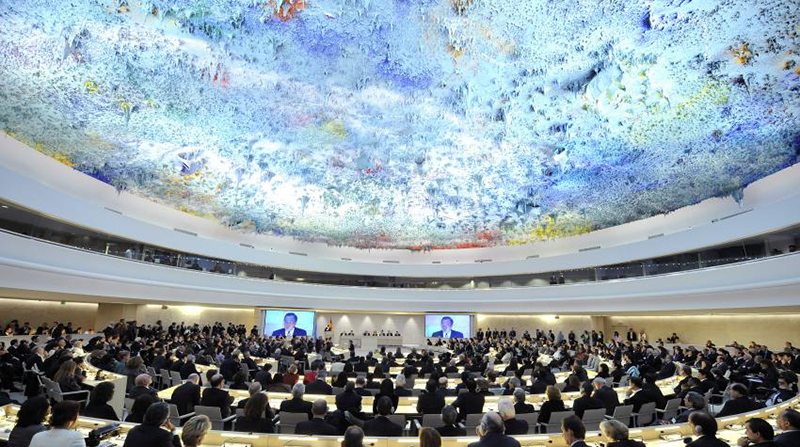
The United Nations Human Rights Council at its 57th session adopted a resolution extending the mandate of the Office of the High Commissioner for Human Rights (OHCHR) Project on Sri Lanka Accountability by one year. Babu Ram Pant, Deputy Regional Director for South Asia at Amnesty International, has commented extensively on this resolution.
International perversion
The source of these allegations of human rights violations against Sri Lanka is the controversial report called the ‘Dharusman (UNPOE pr United Nations Panel of Experts.) report,’ which the UN Secretary-General commissioned in 2010 after Sri Lankan forces defeated LTTE terrorism. The Secretary-General justified the commissioning of this report, stating that ‘the report is for his personal knowledge.’ This is a strange move to start with because in the UN, HR violation investigations are commissioned by resolutions of the UN Security Council and never by the UN Secretary-General ‘for his knowledge’ in his personal capacity. However, since the report was published, it received authenticity and UN and international blessings to make a case against Sri Lanka.
This ‘international perversion’, however, does not end there. In its mandate, the report further maintained that its task was to look into the ‘accountability to the International Humanitarian and Human Rights law, on the final stages of the Sri Lankan conflict’. This, again, is twisted advocacy to suit one’s agenda as what logically applies to the situation is only international humanitarian law and certainly not Human Rights law.
Expert Opinion
Confronted by these allegations of the UNSG and his ‘experts’, the Sri Lankan government in 2012 hired a team of independent experts, whose expertise in international conflicts and international law was beyond question. This team comprised
Professor DM Crane
Sir Desmond De Silva QC
Rodney Dixon QC
Professor Michael Newton -Professor of the Practice of law, Vanderbilt University School of Law.
Major General Sir John Holmes DSO OBE MC- UN Under-Secretary for Humanitarian Affairs 2007-2010
These eminent persons had served on various international investigation panels. After studying the issues in detail, they submitted their reports to the government of Sri Lanka. They were all in agreement that the Sri Lankan case should be viewed under International Humanitarian Law and not under International Human Rights law.
The applicability of IHRL and its relevance can be explained as follows. It is an accepted fact that the LTTE was the most organized terrorist unit in the world. This fact signifies that the conflict in Sri Lanka was an armed conflict between two sets of forces, namely the SL security forces and the LTTE.
In such a context, international law, as spelt out by the ICRC statute, is very clear in stating that the law that applies to an armed conflict is international humanitarian law, and not International Human Rights law.
Further, as the above experts on international law have pointed out, International law provides civilian protection while simultaneously allowing for military objectives to be fulfilled, which is the central goal of International Humanitarian Law (IHL). The death of civilians during a conflict, no matter how grave or regrettable, does not in itself constitute a war crime. In particular, the three principals
1. Distinction
2. Military necessity and
3. Proportionality
should guide the legality of action under IHL.
Distinction means that no civilians should be targeted intentionally, Military necessity means that targeting of the particular object should be necessary for the advancement of the troops, and Proportionality is that, the collateral damage (civilian and property) should be justifiable to the military advantage anticipated to be achieved’ – Sir Desmond de Silva QC Page 23.
Therefore, if Sri Lankan forces are to be made guilty of war crimes, charges may have to be brought either on the grounds of intentionally targeting civilians, attacking with no military necessity or for disproportionate killings, over and above the military advantage.
Tendentious allegation
In addition to the above, the Darusman report, makes another tendentious allegation against the Sri Lankan forces. It says in paragraph 137:
137. In the limited surveys that have been carried out in the aftermath of the conflict, the percentage of people reporting dead relatives is high. The number of credible sources has estimated that there could have been as many as 40,000 civilian deaths. Two years after the end of the war, there is still no reliable figure for civilian deaths, but multiple sources of information indicate that a range of up to 40,000 civilian deaths cannot be ruled out at this stage. Only a proper investigation can lead to the identification of all of the victims and the formulation of an accurate figure for the total number of civilian deaths.
Now, this is the figure that is widely quoted to discredit Sri Lanka’s armed forces. Further a figure of 40,000 appears somewhat ‘disproportionate’ in a conflict of this nature and therefore it can be used to make the Sri Lankan forces out to be guilty under international law although the claims made by the UNPOE have not been substantiated.
The Darusman report contradicts the number of ‘dead persons during the conflict’ furnished by the UN country team stationed in the conflict zone for that specific purpose. The US State Department report says the number of deaths is 6,710 from January 2009 to April 2009. The UN’s Country team report prepared by Gordon Weise, the country team leader, states that the figure of casualties is 7,714 from January 2nd to 13th May 2009. The two reports have a basis on daily counts, and they were prepared on the current basis while the conflict was raging, whereas this Darusman report, having come after two years since the end of the battle, presents a figure of 40,000 casualties without a basis or naming a source for the same.
Here is how the Panel justifies its reasons for questioning the first COG (UN Country team) figure:
135.
The number calculated by the United Nations Country Team provides a starting point but is likely to be too low for several reasons. First, it only accounts for the casualties that were observed by the networks of observers who were operational in LTTE-controlled areas. Many victims may not have been observed at all. Second, after the United Nations stopped counting on May 13th, the number of civilian casualties likely proliferated. Due to the intensity of the shelling, many civilians were left where they died and were never registered, brought to a hospital, or even buried. This means that, in reality, the total number could easily be several times that of the United Nations figures.
The country team was stationed in the war zone to prevent and record violations of the international laws of conflict, and the most crucial part of that operation was recording the number of dead in the fighting.The members of this panel, before casting aspersions on the quality of the information found on the Country-Team report, should do well to re-examine the authenticity of their own information sources because their sources, such as the Tamil Diaspora and the ‘Peace’ NGOs, could be highly partisan since they have lost their relevance (and also contributions) since this conflict came to an end.
Lord Naseby
On 01 November 2017, Lord Naseby, a member of the British House of Lords, moved a resolution in the British Parliament to the effect that the number of civilians killed in the final stage of the Sri Lankan conflict was around 7,000 and not 40,000. Accordingly, he suggested to the Parliament that Britain should change its perspective towards the Sri Lankan issue at the UN Human Rights Commission.
Even though Lord Naseby’s assertion is based on the reports of the Defense Attaché of the British Embassy in Colombo at the time of the war, it needs loads of optimism to expect that the British Government will accept these statistics and change its official position towards Sri Lanka at international forums, especially at the UN Human Rights Council where they have co-sponsored the US resolution against Sri Lanka.
Lord Naseby, subsequently airing his views to Mandy Clerk of the British media, stated, I went into the civilian factor of this war because the figures I had did not add up to the official figures. So, I applied under the freedom of information, requesting the reports of the Defense Attaché of our embassy in Colombo at the time of the war. I received 26 reports, but that did not include the final few days of the war situation. So, I made another appeal, and there I received a further 12 reports. These reports had enough evidence to prove that nobody in the Sri Lankan government ordered to kill people and that was not the intention. The reports said that the casualty figure is around 7,200 civilians and the report further mentioned that a quarter of those casualties could be the LTTE cadres because they did not wear a uniform towards the last stages of the conflict. Then I went to the University Teachers of Jaffna, which is a professional organization of Tamil University teachers, and they said, ‘ it is about 7000’.
Verified Official Statistics
The Department of Census and Statistics performs its customary population survey for the whole of Sri Lanka every 10 years, but due to the LTTE activity, it has not been able to collect data in the North and East since the 1981 survey. Thus, during these years, the officers of respective kachcheries have been issuing population estimates when required for official purposes. However, since the conflict ended in 2009, and given the conflicting claims made by interested parties, including the Catholic Church, the Department commenced an exclusive survey for the northern province in June 2011. This survey was specially designed to ascertain, with verification, the number of people living as well as those who have died, especially during 2009 so that death certificates could be issued on account of them to their next of kin.
This survey was spearheaded by the following officers for each of the regions as follows,
Jaffna – S Udayakumaran (Head of the District Statistics office)
Mannar – M. Vithiyananthaneshan (Head of the District Statistics offic)
Kilinochchi – K.Velupillai (Head of the District Statistics office)
Vavuniya – M. Thyagalingam (Head of the District Statistics office)
Mullaitivu – N. Gangatharan (Head of the District Statistics office)
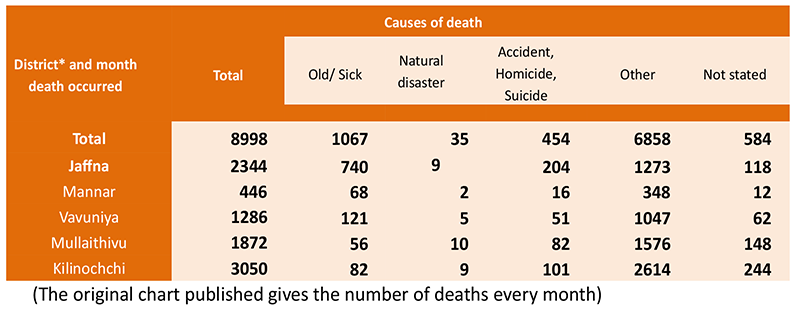
Following are the results of this survey
Thus, the above schedule gives the death toll as 8,998 during the period, including 1,067 who died due to old age/sickness, and the numbers are enumerated on the house-to-house survey regarding the cause of death. Death certificates were issued to all persons in this schedule and even those that did not explain their cause of death and stated as ‘not stated.’ People do not disclose the cause of death for various reasons, and most of such undisclosed deaths fall into the category ‘other’, meaning deaths due to terrorism. Therefore, it is possible that the number of deaths due to conflict situation was 7,442 (6,858+ 584).
Now, these death counts are reported of persons who were born and lived in the five districts where the conflict raged and also in the districts from where the LTTE used human shields. Therefore, when the Darusman report claims 40,000 deaths, such additional deaths have to be of people who were not born or did not live in these districts.
In modern times, dominant nations do not have to use weapons to subjugate others. They could just as well ‘Weaponize human rights’ to achieve the same end. That way, they could wear the cloak as the Champions of Human rights,” hiding their authentic characters as killers, decimators and dominators.
Right to Reply: Implement Indo-Lanka agreement as soon as possible, says Moragoda
December 20th, 2024Shenali D Waduge
Sri Lanka’s former High Commissioner to India, Milinda Moragoda is pushing for the full implementation of the Indo-Lanka Agreement, an agreement that was signed under virtual duress in 1987 after India secretly trained & armed Tamil militants & they began unleashing terror after hijacking the elite Tamil politician’s quest to create a separate Tamil state. It is no secret that the threat of Tamil Nadu seeking self-determination was what prompted India to transfer that quest to Sri Lanka, while the Agreement cleverly merged several districts into 2 provinces namely North & East as the much-eyed Trincomalee harbor was in the East. Sri Lanka had only a district system till the 13th amendment created 9 provinces in 1987. The most important take away from the Indo-Lanka Accord is that it does not mention the creation of a Provincial Council System, amending Sri Lanka’s Constitution with 13th amendment or even Devolution. The Agreement only refers to North East Provinces & merging them & holding an election & referendum in them. The 13th amendment is separate to the Indo-Lanka Accord. Both were forced on Sri Lanka by India. Why should Moragoda promote its full implementation?
Whose side is Moragoda on?
http://island.lk/implement-indo-lanka-agreement-as-soon-as-possible-says-moragoda/
Anyone with a knowledge of the background to the Indo-Lanka Accord would realize the intervention that took place going so far as to even violate Sri Lanka’s sovereignty while also threatening Sri Lanka, not to take action.
This is a violation of Article 2(4) of the UN Charter refrain …. from the threat or use of force against the territorial integrity or political independence of any state”.
India prevented the capture of Prabakaran in May 1987 by forcibly halting the Vadamarachchi military operation, this was followed by the infamous parippu drop in June 1987 violating Sri Lanka’s sovereignty, Sri Lanka’s Tamil militants were freely using India as a logistics hub. India even airlifted Prabakaran & family to Delhi in special aircrafts & kept him there till the Accord was signed. Prabakaran was flown back only on 2 August 1987. Rajiv Gandhi even gifted Prabakaran his bullet proof vest. However, Rajiv Gandhi was assassinated on Indian soil under orders of Prabakaran on 21 May 1991 & since, the LTTE has asked India to forgive & forget what LTTE did. India banned LTTE in 1991 & has continued the ban even after defeat of LTTE showcasing India continues to regard the threat of separatism impacting India via Tamil Nadu.
It was in the background of above actions that the Indo-Lanka Accord was signed on 29 July 1987 forcing Sri Lanka to even tweak its constitution & create the 13thamendment & dividing Sri Lanka into 9 provinces based on a bogus history and making Tamil the official language as well. Indian army arrived on 30 July 1987 & went on to commit grave crimes that included raping of Tamil women.
The primary reason for the signing of the Accord was to defeat LTTE in 48 hours which India assured Sri Lanka but failed to do.
It is important for readers to refer the Indo-Lanka Accord as well as the exchange of letters between Indian PM Rajiv Gandhi & Sri Lankan President J R Jayawardena. A country of 1.4billion laid out strict demands to the nation of 20million. Where is the respect for Sri Lanka’s sovereignty?
6 point annexures make up the Indo-Lanka Accord.
The letter drafted by PM Rajiv is not part of the Accord though signed on the same day.
The letter does not even mention Indo-Lanka Accord”. Therefore, contents of this letter cannot claim to be part of the Accord.
Trinco Port / Trinco Oil Tanks/reference to foreign broadcasting (Voice of America) is not mentioned in the Accord but only in Indian PM’s letter.
Accord does not mention letters being part of the Accord. Thus, Sri Lanka is not bound by these letters signed between 2 former heads of State who are no more.
India did not establish peace & normalcy” in Sri Lanka as assured while India only raises concern for one community (Tamils) though India assured safety, well-being & prosperity of people belonging to all communities in Sri Lanka”.
The objectives of the Agreement are broken down
- says India only desires” to preserve unity, sovereignty & territorial integrity of Sri Lanka. There is no firm commitment.
- / 1.3 / 1.4 refers to Sri Lanka as a multi-ethnic, multi-lingual plural society, recognizes that each ethnic group has a distinct cultural & linguistic identity / recognizes North & Eastern provinces as areas of historical habitation of Sri Lankan Tamil speaking people. The then Govt & advisors should have presented facts on colonial settler colonization” that resulted in South Indians being brought & colonized in these areas while displacing the Sinhalese who lived originally. If Muslims are included as Tamil speaking, they were chased out of the North in 1980s/1990s.
1.5 Reference to plural society” has always been to sheepishly remove the Buddhist civilizational identity of Sri Lanka. The draft uses aspiration” which connects to different people possessing different dreams. Everyone’s dreams cannot be fulfilled by any document.
2. Thereafter 1.1 to 1.5 objectives are turned into Resolutions, thus
2.1 The Agreement claims the GOSL agreed to joining two provinces into one administrative unit till 31 December 1988 & thereafter holding a referendum to separate from each other. No such referendum was held. In fact, in 1990, President Premadasa had to annul the merger after Varatharaja Perumal Chief Minister of the merged NE declared unilateral independence. Democracy for the North prevailed only after 2009 & PC elections was held in 2013 (a gap of almost 25 years).
2.2 Until Dec 1988 the merged NE would function as 1 Provincial Council with 1 Governor & 1 Chief Minister & 1 board of Ministers.
What was the reason to merge 2 provinces / hold elections & a referendum when the Accord was signed to preserve the sovereignty of Sri Lanka by defeating LTTE?
2.3 This clause of the Indo-Lanka Agreement gave discretion to the Sri Lankan President to indefinitely postpone the referendum in the East. Only in 2006 that the merged NE was de-merged. Indian army failed to defeat LTTE in 48 hours. Sri Lankan Army defeated LTTE in May 2009.
2.4 India assured necessary conditions” to enable the displaced to return to areas from where they were displaced. Muslims & Sinhalese were chased out from the North but no measures were taken to rehouse them.
2.5 of Agreement says the Referendum when held was to be monitored by a Committee headed by Chief Justice, Presidential nominee, nominee of GOSL & a member representing the Tamil speaking people of the East.
2.6 of Agreement claimed a simple majority sufficient to declare results
2.7 of Agreement was regarding meetings & propaganda ahead of the referendum
2.8 of Agreement stated that the referendum was to be held 3 months prior to 31 Dec 1987 with Indian observers present.
Clauses 2.1 to 2.8 & 2.17 of the Indo-Lanka Accord was only about merging NE provinces, holding PC elections before Dec 1987 & a referendum before 31 Dec 1988 which Sri Lankan President could postpone.
Why should only 2 provinces of Sri Lanka continue to get prominence & preference over the other 7 provinces?
2.9
- Declared emergency will be lifted only in the N E by 15 Aug 1987 but not the other provinces.
- Declared cessation of hostilities within 48 hours of signing Agreement & militants had to surrender arms
- Sri Lankan Army were to be confined to barracks from 25 May 1987
2.10
Allows the GoSL to use the same law enforcement & security mechanisms in the NE as used in the rest of the island.
2.11
Allows President of Sri Lanka to grant a general amnesty to political & other prisoners in custody under the PTA & other emergency laws as well as to combatants. GoSL agrees to rehabilitate militant youth & India is to co-operate”.
2.12
Commits the GoSL to accept & abide by the provisions
2.13
If framework for resolutions is accepted, GoSL will implement relevant proposals immediately. This offers a window of opportunity for GoSl to object to clauses of the Agreement & it is the failure of GoSL not to have removed the detrimental clauses that continue to haunt Sri Lanka.
2.14
India guarantees by the resolutions & to cooperate in the implementation of the proposals. guarantees” holds India accountable for its commitments.
2.15
An important clause as the proposals are conditional to proposals negotiated between 4 May 1986 & 19 Dec 1986. Residual matters were to be finalized within 6 weeks of signing the Accord & proposals are condition to India cooperating DIRECTLY with Sri Lanka in the implementation of the Accord.
2.16
This clause claims proposals are conditional to India taking following actions if militant groups in Sri Lanka do not accept the framework” of proposals.
a) India to ‘take all necessary’ steps to ensure Indian territory is not used for activities prejudicial to the unity, integrity, security of Sri Lanka. (India failed)
b) Indian Navy/Coastguard to cooperate with Sri Lanka Navy in preventing Tamil militant activities from affecting Sri Lanka (India failed)
c) If Sri Lanka requests India for military assistance to implement the proposals, India would provide if & when requested (India failed)
d) India will expedite repatriation of Indian citizens in Sri Lanka alongside the repatriation of Sri Lankan Tamils living in Tamil Nadu (India failed)
e) Both Sri Lanka & India will cooperate to ensure physical security & safety of all communities inhabiting North & East provinces (Sri Lanka & India failed)
Clause 2.16 sets further actions by the Government of India if Militant Groups do not accept the outlined framework of proposals (NE merger/NE Elections/Referendum)
Condition A:
India assures Indian territory is not used for activities prejudicial to the unitary, integrity & security of Sri Lanka.
India did not keep assurance.
LTTE used Tamil Nadu as its logistics hub with even support of the TN govt.
Condition B:
Indian Navy/Coastguards did not cooperate with Sri Lanka Navy to prevent Tamil militant activities against Sri Lanka
India did not keep assurance
Condition C:
Indian Govt committed to providing military assistance to implement proposals upon request by Sri Lanka.
President Jayawardena used 2.16 (C ) to request Indian Peace Keepers to disarm LTTE.
Condition D:
Indian Govt commits to expediting repatriation of Indian Citizens living in Sri Lanka while repatriating Sri Lankan refugees to Sri Lanka from Tamil Nadu.
India did not keep assurance.
Condition E:
Both Govts to cooperate to ensure physical security & safety of all communities living in N E provinces.
Both India & Sri Lankan Govts failed as the Sinhalese & Muslims who were living in the North were chased out by militants.
India failed because the Indian army began arbitrarily killing & raping people of all communities as they could not identity who was who & IPKF soldiers did not speak Tamil.
IPKF rapes & killings have never been investigated.
2.17 Sri Lanka assures a free, full & fair election with cooperation of India.
2.18 Note this clause.
The clause says official language of Sri Lanka shall be Sinhala” while a COMMA separates Tamil & English will also be official languages”. What is the legal implication of writing Clause 2.18 in this manner & how has it been written in Sinhala?
The Agreement & Annexures were to come into force upon signature.
Clause 3 stipulates that the above clauses plus annexures will come into effect with the signing of the Agreement on 29 July 1987.
There were 6 Annexures to the Indo-Lanka Agreement
- Both leaders agreed that the referendum mentioned in para 2 & subparagraphs will be observed by a representative of the Election Commission of India. Para 2 was dedicated to merging NE & holding referendum observed by Election Commission of India – is this not undermining Sri Lanka’s Election Commission?
- Both leaders agreed that elections to Provincial Council mentioned in para 2.8 will be observed, and all para military will be withdrawn from N E. How was all para military to be withdrawn from NE when the Sri Lanka Army was confined to barracks?
- President of Sri Lanka was given discretion to absorb para military into the regular security forces of Sri Lanka. What was the purpose of this insertion?
- Both leaders agree that Tamil militants shall” surrender their arms to authorities designated by Sri Lankan President & shall take place in the presence of a representative from SL Red Cross & Indian Red Cross. There was no clause that addressed the question of Tamil militants not surrendering arms & what to do thereafter.
- Both leaders agreed that a joint Indo-Lanka Observer Group consisting of qualified representatives of both Govts would monitor the cessation of hostilities from 31 July 1987. Who comprised this Group & how were they selected and where is there report?
- Both leaders agreed that terms of para 2.14 & para 2.16(c) regarding Indian Army is on invitation by the Sri Lankan President to guarantee cessation of hostilities.
Noteworthy is that annexure 6 aligning to 2.16C of Agreement was with intent to deploy Indian soldiers in Sri Lanka.
Now that we have gone through the Accord & the 6 Annexures, we come to the most controversial part – the exchange of letters between the two heads of State.
The letter from PM Rajiv to President Jayawardena dated 29 July 1987
- Did not mention that the letter was part of the Indo-Lanka Agreement.
Areas highlighted in the letter:
Joint agreement:
- Not allow territories of both nations to be used for anything that impacts the unity, territorial integrity & security of either country
Sri Lanka makes 4 commitments (addressing India’s concerns) subject to Sri Lankan President confirming commitment via response to PM Rajiv’s letter which is not available.
- Foreign military & intelligence personnel to not prejudice Indo-Lanka relations
- Trinco or any other port in Sri Lanka to be given for military use by any country against India’s interest
- Restore & operate Trinco Oil Tank as a joint operation between India & Sri Lanka
- Sri Lanka’s agreement with foreign broadcasting organizations reviewed are only used for public broadcasting & not military or intelligence purposes.
India’s commitment
- Deport all Sri Lankans in India who are engaging in terrorist activities or advocating separatism or secessionism (India did not fulfil this)
- Provide training & military supplies for Sri Lanka security services
India & Sri Lanka to set up a joint consultative mechanism to review matters & monitor implementation.
If the letter is not part of the Accord, Sri Lanka is not bound to abide by them.
- Eternal use of India’s security concern”
- Giving Trinco Port to any party & not requiring to seek ‘permission’ of India
- Not bound to operate Trinco Oil Tank as a Joint venture (an error that successive Sri Lankan govts continue to make – SL first leased 99 oil tanks to India for 35 years in 2003)
The most important take away from the Indo-Lanka Accord is that it does not mention the creation of a Provincial Council System, amending Sri Lanka’s Constitution with 13th amendment or Devolution.
The Agreement only refers to North East Provinces & merging them & holding an election & referendum in them.
India forcing Sri Lanka to sign Indo-Lanka Accord is a violation of Article 51 of the Vienna Convention of the Law of Treaties:
expression of a state’s consent to be bound by [a] treaty which has been procured by coercion of its representative through acts or threats directed against him shall be without legal effect.
India has also violated Article 52 of the same Convention
a treaty is void if its conclusion has been procured by the threat or use of force in violation of the principles of international law embodied in the Charter of the United Nations.”
India committed to 5 clauses under the Indo-Lanka Accord. India did not honor any of them. This is a violation of Pacta Sunt Servanda’ (pacts are meant to be honored for agreements to be valid) If India did not honor the pact, that pact is no longer valid under this legal maxim.
The political dynamics of the 1980s/1990s do not exist presently.
Both leaders are no more.
LTTE leader is dead
LTTE terror outfit was defeated in May 2009.
Only the Tamil political/LTTE Diaspora secessionist/political separatist quest exists.
India was a closed economy at the time of the signing
India was not pro-US during this period which is why clauses referred were directly applicable to US.
Fast forward to 2020s … India is now a key ally of the US. India has no issue with US using Trinco harbor which it opposed in 1987. India has no issue to US military planes landing in SL. India did not object to Sri Lanka’s signing of SOFA, ACSA or even MCC. Yet, what if this honeymoon between US & India collapses? Many of the clauses in the Indo-Lanka Accord were written directly targeting the US. Does Sri Lanka have to dance to double standards & diplomatic hypocrisies?
There is absolutely no requirement to continue with the Indo-Lanka Agreement leave alone honor it as the clauses were only relevant to the North East. It is a violation of the Constitution to treat one community above the rest of the communities and some provinces given prominence over the others. There is no mention of any other provinces in the Accord. The Accord does not mention a word about 13th amendment or devolution or even provincial councils in other parts of the island. Take the Accord & read it to see for yourself.
The Accord or Annexures do not mention Trinco Port, Trinco oil tanks – these are only appearing in the letter from Rajiv Gandhi to President JR. Read the letters for yourselves.
Why would diplomats push for the implementation of an Accord that is defunct and legally non-binding in view of India not honoring any of its commitments?
Shenali D Waduge
කුමාරයාගේ ඉන්දියන් සන්චාරය
December 19th, 2024ජයන්ත හේරත්
කුමාරයා
ආසනේ ඉඳ ගත්ත ගමන්
හා හා පුරා ආරාධනාව
ආවේ
ඉන්දියාවෙන්ය
මේ ඉන්දියානු ගමන
විජේය මහප්පා
අවුරුදු 60 කට පෙර
දෙසූ
පංචාර්ය සත්යයේ
ඉන්දියානු ව්යප්තවාද සත්යයට
ඉඳුරා පටහැණිය
මහප්පාට තිබූ නුවණෙන්
අරික්කාලක්
කුමාරයා
ආසනේ ඉඳ ගන්නට පෙර තිබුනා සේ පෙනුනේය
දැන් ඒ කාලත් කොහේ ගියාද නැත
කුමාරයා ට
ආසනය වෙන් කර දෙන්නට
ඉන්දියානු ව්යාප්තවාදය
බලපෑවේ නැතැයි කියා
කියන්නට බැරිය
මෙතැන්
පටන් මේ ලැබෙන්නට යන්නේ
මහප්පා දුටු
ඉන්දියානු ව්යාප්තවාදය
තහවුරු කර ගන්නා තෙක්,
හාල්
බිත්තර
එළකිරි ආධාරය
ගුරුහරුකම්ය
හිතවත්කම්ය
කරේ අත දා ගත් සහයෝගයන්ය
මට හිතෙනෙව්වා,
අම්මප!
මෝඩ නැති මෝඩි සමඟ ගණුදෙනුවේදී අනුර කුමාරට නැතුවම බැරි වීරයෙක්! (Milinda Moragoda to the rescue!)
December 19th, 2024චන්ද්රසිරි විජයවික්රම, LL.B., Ph.D.
පාත් ෆයින්ඩර් මිලින්ද මොරගොඩ ට්රෝජන් අශ්වයෙක්ද?
Lanka Web, April 19th, 2020
Implement Indo-Lanka agreement as soon as possible, says Moragoda
Island Newspaper, 2024/12/19
Sri Lanka’s former High Commissioner to India Milinda Moragoda has emphasised the pivotal importance of Colombo and Delhi quickly moving to the implementation phase of the agreement on ‘fostering partnership for a shared future.’ The former Minister said that the implementation should begin as fast as possible.
He said so in response to The Island queries regarding the Indo-Lanka relations in the wake of President Anura Kumara Dissanayake’s meet with Indian Premier Narendra Modi. Referring to the joint statement that had been issued on 16 Dec., Moragoda said: It is a comprehensive statement that covers a number of areas that are important to the Indo-Lanka relationship and Sri Lanka’s own economic development.
The statement has a significant number of action points, the execution of which can now be monitored by the two leaders during their future summits to ensure timely implementation.
The statement blends the positive foundations and trajectory set by previous joint-statements with aspects that are important components of President Dissanayake’s own policy agenda. One such example is the focus on people-centric digitization.
Speedy economic integration and connectivity with India while safeguarding our sovereignty and territorial integrity is the only way in which Sri Lanka can become a fast growth economy and come out of the present crisis. Sri Lanka needs to grow at 6% -7% pa to deliver a better life for our people. This understanding between the two leaders is a good beginning.
It is now important that the two sides move to the implementation phase as fast as possible.
The financial resources required to achieve these objectives are available and can be mobilized and harnessed.
The joint statement indicates that the UAE has expressed interest in investing in the multi-product pipeline. This is an important development towards trilateral cooperation in investment between India, Sri Lanka and third countries.
Trilateral cooperation of this nature could be explored with other countries, including Japan, the US, etc., as well.” (SF)
======
පාත් ෆයින්ඩර් මිලින්ද මොරගොඩ ට්රෝජන් අශ්වයෙක්ද?
Posted on April 19th, 2020
චන්ද්රසිරි විජයවික්රම, LL.B., Ph.D.
මෙහි පහතින් දැක්වෙන්නේ මිලින්ද මොරගොඩ ගැන අන්තර්ජාල විකිපීඩියාවේ සඳහන් වාර්තාවකි. මෙහි ඇත්ත-නැත්ත මම නොදනිමි. එහෙත් ගින්නක් නැතුව දුමක් නඟින්නේද නැත. ඒ කාලයේ තමන්ට එල්ලවූ අල්ලස්-දූෂණ චෝදනා වෙනුවට අද රටේ විශාල ඩොලර් බලයක් සහිතව මහ ඉහළින් වැජඹෙන මිලින්ද ගෙන් ප්රවේශම් වන ලෙස හාමුදුරුවරු වත්මන් ආණ්ඩුවට ප්රසිද්ධියේම අනතුරු ඇඟවීමක් කලේය. නිදහස් සංවාද වැඩබිමේ චපා බණ්ඩාර විසින් මිලින්දව සළකන්නේ මිලේනියම් උගුලේ ඔත්තුකරුවෙකු ලෙසය. මෙහි පහතින් ඇති ඇමෙරිකන් තානාපති කාර්යාලයේ රහස් කේබල් පණිවුඩය අනුව මිලින්ද නියමම, කදිම ඇමෙරිකන් ඒජන්ත කෙනෙක් බවට විවාදයක් නැත. මිලින්ද ගැන තොරතුරු රට වැසියාට පෙන්වාදීමට වගකීමක්, යුතුකමක් ඒ ගැන යමක් දන්නා අයට ඇත. මිලින්දට කරුණු පැහැදිලි කිරීමට අචස්ථාවක් ලැබෙන්නේද මෙසේ ඔහු ගැන ලිව්වොත් පමණය.
ඇමෙරිකාව ඒජන්තලා සොයා ගන්නා ආකාරය විෂ්මය දණවයි. එය ඔවුන්ගේ දක්ෂතාවයයි. උදාහරණයක් වශයෙන් 2010 රොබට් බ්ලේක් ගෙනා සරත් ෆොන්සේකා වෙනුවට 2019 දී හදිසියේම කඩාවැටුන මහේෂ් සේනානායක, ඇමෙරිකන් තානාපතිනියගේ ඉත්තෙක් බව දැනගන්නට ලැබුණේ චන්දයෙන් පසු මහේෂ් ඇමෙරිකා යුද කඳවුරක පරණ රක්ෂාවට පලාගිය පසුවය. සර්වෝදයේ වින්ද්යා ආරියරත්න හා තවත් ඉංජිනේරුවෙක් සමඟ මහේෂ් තානාපතිනිය මුණ ගැසී තුන්වන බලවේගයක් වශයෙන් නොමිනේෂන් දුන්නේය. සිදුවූයේ ඒ නිසා ගොඨාභයගේ චන්ද කැඩීයාම නොව තව තවත් වැඩිවීමය!
මිලින්ද උපන්නේ ඇමෙරිකාවේය. මිලින්ද විවාහ වුනේ ඇමෙරිකන් කාන්තාවක් සමඟය. ඒ කාලයේ කතාව වුනේ ඇය ජනාධිපති බුෂ් පවුලටද දුරින් සම්බන්ධ කෙකෙන් යනුය. මිලින්ද සුරතලෙක්වූයේ ඇමෙරිකන් රිපබ්ලිකන් පක්ෂයේ සෙනේට් සභිකයින් අතරය. ඔහු ප්රසිද්ධකල, විත් අ වෝම් හාර්ට්, අ කූල් හෙඩ් ඇන්ඩ් අ ඩීප් බ්රෙත්, (With a warm hart, cool head and a deep breath) නම් ලිපි එකතුවට (2003) පෙරවදනක් ලිව්වේ 2008 ජනාධිපති අපේක්ෂකවූ ජෝන් මැකේන්ය. සරත් ෆොන්සේකාට, රොබට් බ්ලේක් හෝ මාදුළුවාවේ සෝභිත හිමියන්ට මිචෙල් සෙසන් හෝ රංජන් රාමනායකට ඇලිනා ටෙප්ලිස් හෝ මෙන් නොව මෙවැනි මිලින්දගේ සම්බන්ධකම් හොඳින් අක් මුල් සහිතය. උදාහරණයක් වශයෙන් සමන්තා පවර්ස්ගේ මුද්ද ඉම්බ මංගල සමරවීරව, ඇමෙරිකන් රහස් සංදේශයේ සඳහන් කර තිබෙන්නේ ජෝකර් කෙනෙක් කියාය.
බිම් බෝම්බ ඉවත් කිරීමේ, පාත් ෆයින්ඩර් ක්රියාවෙන්, ලංකාව හැදීමේ පාත් ෆයින්ඩර් කමට මිලින්ද ඉබේම පාත් විය. මිලින්ද හා කෙළින්ම සම්බන්ධ දෙන්නෙක්ම (ජෙනරාල් දයා රත්නායක හා අද්මිරාල් මහාචාර්ය ජයන්ත් කොළඹගේ) ගෝඨාභය පාලනයේ ඉහළම තනතුරු දෙකක් දරණ බව චාපා බණ්ඩාර එලිකලේය. හාමුදුරුවරු එකනමක් වත් (ඔහුගේ සංවිධානයේ පඩි ලබන?) මිලින්දට ස්ත්රොත්ර ගායනා කලත් (ලිට්රෝ ගෑස් සල්ලි ලබාගෙන දඹරාවේ අමිල හිමි යහපාලන වේදිකාවේ සිවුර ගැලවෙන තරමට යකා නැටුවා මතකද), 2019 නොවැම්බර් 18 දා ගෝඨාභය දිනවා රටේ හාමුදුරුවරුන් කල විප්ලවය බකල් කිරීමට, මිලේනියම් හුටපටය කෙසේ හෝ රටට රිංගවීමට ඇමෙරිකාව ගන්නා නොනවතින උත්සාහයට ජනාධිපති අසුවේද යන සාධාරණ බියක් රටේ සිංහල බෞද්ධයින්ට ඇත. මහින්ද රාජපක්ෂ මහතා නම් දැන් නැතත්, අතීතයේ නම් හොඳ මිලින්ද වාදියෙකි. [ගෝටාභය ජූලි චුංගේ යාඥාවට (ඇමෙරිකන් ඥායා මෑණියෝ? ) රැවටී මිලින්දට අරුම පුදුම බලයක් සහිත ඉන්දියන් තානාපතිකම ලබා දුන්නේ ලණු කෑමේ සීමාවද ඉක්මවාය. ඔහු ලංකරගත් කොළඹගේ ද ඔහුගේ විනාශයට පිටිපස්සෙන් සිට පිහියෙන් ඇන්න දුෂ්ඨයෙකි].
මිලින්දගැන ඇති බියට හේතුව නම් ඔහුගේ අතීත හා වත්මන් ක්රියා යුරෝපය උතුම්ය යන ආකෘතිය මත පදනම්ව තිබීමය. ඔහු යෝජනා කරණ පාත් එක (ප්රතිකර්ම) ලෝක බැංකු පාරය. කොරෝනාවට පෙර තිබූ දුප්පත් රටවල් සූරා කෑ කොම්පැනි ධනවාදයට, මොන අන්දමින් හෝ පැලැස්තර දමා කොරෝනාවට පසු ලෝකයේ ඒවා දිගටම ගෙන යාමේ ඇමෙරිකන් ප්ලෑනට අඩතැබීම මිලින්දගේ අළුත් ප්රොජෙක්ට් එකේ අරමුණ බව පැහැදිලි වන්නේ, දැන් ඒ අළුත් උපක්රමය සඳහා ඔහු පත් කල 20 දෙනාගේ කොමිටියේ සාමාජිකයින්ගේ වතගොත සොයා බලන විටය. ඉන් බොහෝ දෙනෙක් යහපාලන කාලයේ රනිල්-මංගල-මලික්-රවි ගැත්තන්විය. මේ අය ඇල්ලේ ගුණවංශ හාමුදුරුවන් කියන බුදු අම්මෝ අයද, ඕ මයි ගෝඩ් අයද? පැහැදිලි එකම දේ නම් රටේ සිංහල බෞද්ධයින් වෙනුවෙන් ප්රසිද්ධියේ කතාකරණ එක් අයෙක්වත් මිලින්දගේ කොමිටිවල නොසිටීමය. එවැනි සුදුස්සන් නැද්ද, එවැනි අය ආරාධනාව ප්රතික්ෂේප කලාද,එසේත් නැත්නම් එවැනි අයවළුන් මේ වැදගත් කොමිටිවලට සහභාගි කරගන්නවාට විරුද්ධ බලවේගයක් යටින් තිබෙනවාද?
උදාහරණයක් වශයෙන් සංවර්ධනය සඳහා, නාස්තිය, කුණු කසළ හා වස-විස කළමනාකරණය පිළිඹදව ධර්මපාල පරපුරේ නිර්මාතෘ ඉඳුරාගාරේ ධම්මරතන හිමිඳුන් හා, අතුරැලියේ රතන, බොදු බල සේනාවේ ඥානසාර යන හාමුදුරුවරුන් ඉදිරිපත් කරණ පාත් එකට මිලින්දගේ පාත් එකේ ඉඩක් තිබේද? ග්රාම රාජ්ය සංකල්පය ගැන මිලින්දගේ අදහස කුමක්ද? රට යායුතු මෙග ව්යාපෘති පාරේද, නැත්නම් කර්ක් පැට්රික් සේල් ගේ හියුමන් ස්කේල් නම් පරිසරවාදී තිරසර සංවර්ධන පාරේද? මේ සියල්ලටම වඩා වැදගත් වන්නේ මිලින්ද, ජනාධිපතිට දෙන සංදේශ ප්රසිද්ධ නොකරන්නේ මන්ද යන කරුණය. ඒවා රහස් ලියවිලි වන්නේ මොන ප්රජාතන්ත්රය යටතේද?
තවද මිලින්දගේ ඩී.එන්.ඒ (ජානDNA) වල මහාවංශ විරෝධී අංශු තිබිය හැකිය. ඔහුගේ සීයාගේ පියා රෙස්ට්හවුස් කීපර් කෙනෙකුගේ පුතෙකි. මේ පුතා (එන්. යූ. ජයවර්ධන) ඉගෙනගෙන අන්තිමේදී මහ බැංකුවේ අධිපති විය. ජේ. ආර්.මුදල් ඇමතිව සිටියදී නීති විරෝධි වැඩක් කරණ ලෙස ඔහුට කල ඉල්ලීම ඔහු ප්රතික්ෂේප කලේය (සර් ජෝන්ට එංගලන්තයේ වත්තක් ගන්නට විදේශ විනිමය දීමට). මේ නිසා ඔහුගේ රක්ෂාව අහිමි කලේය. ඔහු ලුනාව දේවාලයේ භාරයක් වෙමින් දේවාල මිදුල දිනපතාම අතුගෑවේය. පසුව බණ්ඩාරනායක අගමැති ඔහුව එම බොරු අල්ලස් චෝදනාවෙන් නිදොස් කලේය.
එහෙත් මේ දක්ෂ, අවංක සීයාගේ පුතා (ලාල්) හා ලේලි (විශාඛා කුමාරි සොයිසා) යුවල රට කැඩීමේ ඊළම් ව්යාපාරයට වක්රව හෝ දායක විය. තම්බයියාගේ (බොරු කරණාද ඇතුලත්) බුඩිසම් බිට්රේයිඩ් (1992) යන පොතේ පිටකවරයට තරුණ මාදුළුවාවේ සෝභිත හිමියන්ගේ යක්ෂාරූඪ වූවා වැනි පින්තූරය සැපයූවේ සුදු මවක් සමඟ එංගලන්තයේ හැදී වැඩුණු මේ විශාඛා තොමෝය. සමහරු හිතුවේ ආනන්ද තිස්ස ද අල්විස් ගේ නම මෙන් මැයද ඇගේ නම අනුව හොඳ සිංහල බෞද්ධ උපාසිකාවක් කියාය! බෞද්ධයින් කුහකයින්ය යන ලේබල් [chauvinist) එක ගෙනා ආ ඈ උග්ර මාක්ස්වාදියෙකි (ඒ පොත ලංකාවේ තහනම් කිරීමට මේ පින්තූරයද හේතුවක් විය. ගණනාත් ඔබේසේකරලා පොත තහනම් කිරීමට විරුද්ධ ලිපි ලියුවේය). ලාල්, ඊට යූ. එන්. ඕ. සරසවියේ වයිඩර් ආයතනය හරහා අරමුදල් සපයා, දිග පෙරවදනක්ද ලිව්වේය.
ඇන්.යූ. ජයවර්ධනගේ දුවගේ සැමියා, පින්තු මොරගොඩ (මිලින්දගේ පියා) ලෝක වාර්තාවක්ද තැබු අයෙකි. ගුණපාල මලලසේකර මහතා යූ.එන්.ඕ. සභාපති ධූරයට චන්දය ඉල්ලූ අවස්ථාවේදී එවකට එහි සේවය කල පින්තු, මලලසේකරට චන්දය දෙන ලෙස ඉල්ලා, ඔහුට පක්ෂ යයි සිතූ රටවලට යැවීමට පිලියෙල කල සංදේශය, මලලසේකරට විරුද්ධව චන්දය දේය සිතූ රටවලට යවා, මලලසේකරට පක්ෂව චන්දය දේයයි සිතූ රටවලට, ඔහුට විරුද්ධව චන්දය දේ යයි සිතූ රටවලට යැවීමට පිලියෙල කල අනිත්, වෙනස් සංදේශය යැව්වේය! මෙසේ පින්තු සිදුකල බරපතල අකරතැබ්බය අත්වැරදීමක්ද නැද්ද යන්න ගැන මලලසේකර මහතා සිතුවේ කුමක්දැයි අපි නොදනිමු. දිණන්නට සිටි මලලසේකර පැරදුණේය. පින්තෝ තවමත් ජීවත්ව සිටින නිසා ඔහුට අවංකව මෙය පැහැදිලි කල හැකිය. යූ.එන්.ඕ. වනාහි ලෝක හොර ගුහාවකි. යම් රහසක් කතාකරන්න ඕනෑ නම් ඒ සඳහා බිල්ඩිමෙන් ඉවත්ව මිදුලට එන්නේ චරපුරුෂ සේවය ඒතරමටම උග්ර නිසාය!
Political career of Milinda Moragoda
United National Party
During his political career of almost 10 years, Moragoda has worked in a number of key areas. He was a principal Government negotiator in the peace talks of 2002–2004. He was Minister of Economic Reform. He also gave leadership to the development and implementation of Sri Lanka’s ICT policy, E-Sri Lanka.
Moragoda was first entered to Parliament as a National List Member in 2000 with the United National Party (UNP) and was re-elected in 2001 and in 2004 from the Colombo District.[6]
Sri Lanka Freedom Party
Upon crossing over the government Moragoda was appointed as the Minister of Tourism by President Mahinda Rajapaksa. During his tenure, he was able to successfully implement the Tourism Act of 2001. In July 2009 he was appointed as Minister of Justice and Law Reform. Even though he sat and voted with the government, he remained a member of the opposition UNP until 2010 when he started the Sri Lanka National Congress (SLNC). The SLNC was disbanded in 2011 when Milinda joined the Sri Lanka Freedom Party, the main party of UPFA led by President Mahinda Rajapaksa. In the 2010 general election he lost his parliamentary seat.
In 2011 he became the UPFA’s mayoral candidate in the October 2011 municipal election in Colombo. He was elected to Colombo Municipal Council, becoming its opposition leader.
Allegations of Corruption
In 2007 Moragoda’s party was in the opposition having lost the 2005 elections to the UPFA. As the UPFA Government sought to expose corruption during the UNP regime the Parliamentary Committee on Public Enterprises (COPE) released a report accusing Moragoda of widespread corruption and abuse of power.
Mercantile Credit Ltd, a subsidiary of Mercantile Merchant Bank, founded by Moragoda was found to defaulted on loans of 4.7 Billion Rupees (which had been obtained by providing false information) while Moragoda was Minister for Economic Reform. COPE conducted three inquiries into these loans and their defaulting but on each occasion the investigations were never allowed to reach the final stages due to political pressure.
In 2002 Lanka Marine Service (Pvt) Limited owned by state-owned Ceylon Petroleum Corporation which sat on an 8.5-acre plot in the Colombo harbour was sold to the Sri Lankan conglomerate John Keells Holdings. The Supreme Court ruled that as then PERC chairman, Dr. P.B. Jayasundara and Executive Director of JKH Susantha Ratnayake had acted with dishonest intent in the sale of LMSL shares. The Bribery Commission also began investigations into criminal charges against Dr. Jayasundara, former Ministers Milinda Moragoda (PERC was under him) and Karu Jayasuriya (CPC was under him) on the charge of abusing public property in connection with this deal.
Before the investigation could reach conclude both Moragoda and Jayasuriya crossed over to the government. Reporting on the privatisation of Lanka Marine Service COPE stated that by his actions Moragoda had at the very least incurred a loss of 1.7 Bn rupees for the government.
The COPE report also alleged severe irregularities in the privatisation of Sri Lanka Insurance which happened under the tenure of Moragoda. The report stated that Moragoda created a loss of over 3 Bn Rupees for the government solely through non-compliance with the 4th term of the contract. These investigations too were not concluded before Moragoda crossed over to the government.
Links to the USA
US Embassy cables released by WikiLeaks show Moragoda to be a long-time information source of the US Embassy in Colombo. The cables also state the US Government’s interest in Moragoda as their key partner in Sri Lanka. Writing to Washington in 2003, then US Ambassador to Sri Lanka Ashley Wills says of Moragoda:
[Regarding] the U.S., the intelligent, articulate Moragoda is a perfect fit. born in Washington, D.C, he is a dual national Amcit (please protect) married to an American, with plenty of Washington connections, many from his days as a visiting fellow at the Heritage Foundation and at Harvard. A big picture” person, Moragoda is also highly aware that the U.S. is the most powerful country in the world, and he feels that it is better that Sri Lanka recognize that fact and work within it.
Other work
Moragoda has served as a member of the Commission on Legal Empowerment of the Poor, which was co-chaired by Madeleine Albright and Hernando de Soto.
He has founded a number of non-profit organisations. Among them is the Milinda Moragoda Institute for People’s Empowerment, under whose aegis operates a humanitarian de-mining programme in the North and East which has been in operation since 2002 and Apeksha, a free English Education Programme for children of low income families.
Honors….
One Response to පාත් ෆයින්ඩර් මිලින්ද මොරගොඩ ට්රෝජන් අශ්වයෙක්ද?”
- Hiranthe Says:
April 19th, 2020 at 11:07 pm
This Moragoda cannot be considered as a son of the land and a true son of Mother Lanka.
I agree 100% with Chapa of Nidahas web programme. MM is a dangerous virus you should not associate closely. I also feel very uncomfortable to see this fellow with the President because his organisation is like Corona Virus, waiting to infect and grab the land of Mother Lanka for their masters in the US.
Path Finders are very clever in recruting Kolambage and Daya Ratnayaka. Who knows how many other patriots have been recruited by them??? Traitors never rest.
Germany’s fascination with Buddhism
December 19th, 2024Senaka Weeraratna
Germany’s fascination with Buddhism
Buddhism has been growing in popularity in Germany for the past 50 years. Some reasons for this include:
Tolerance: Buddhism is a tolerant religion that is open to anyone.
Buddhism is the most animal friendly World Religion.
” Buddhism ought to be an animal rights religion par excellence. It has long held that all life forms are sacred and considers kindness and compassion the highest virtues. Moreover, Buddhism explicitly includes animals in its moral universe”.
Norm Phelps
The Great Compassion: Buddhism and Animal Rights Paperback – June 1, 2004
by Norm Phelps
Compassion
Buddhists strive to show compassion and loving-kindness to all beings, including animals.
- Non-harm
Buddhists try to do as little harm as possible to animals, and avoid killing or hurting them.
- Respect
Buddhists treat the lives of animals with equal respect to those of humans.
- Karma
Buddhists believe that cruel acts towards animals will be paid for in a future life.
Emphasis on empathy and wisdom: Buddhism’s emphasis on empathy, wisdom, and the “love your neighbor inclusive of all living beings ” credo has an enduring appeal for Germans.
Influence of early German Buddhists: The influence of early German Buddhists, such as Anton Gueth, Karl Eugen Neumann, Dr. Paul Dahlke, and Georg Grimm, are still very much alive in present-day Germany.
Buddha’s teachings: Germans have always been fascinated by the Buddha’s teachings.
The remarkable commemoration of the 100th anniversary of Das Buddhistiche Haus (based in Berlin – Frohnau), founded by Dr Paul Dahlke in 1924, in both Berlin and Colombo on August 3rd and 4th, 2024, under the patronage of the Govt of Sri Lanka and the support of the German Dharmaduta Society, led to launch of new books, issue of new commemorative postage stamps and first day covers, and the holding of an International Buddhist Conference Academic in Berlin (August 04, 2024). The resident monks of DBH led by Ven. Pelane Dhamma Kusala with the support of the Sri Lanka Embassy in Berlin led by the Ambassador Ms. Varuni Muthukumarana, Manager of DBH, Mr. Tissa Weeraratna, and the lay patrons of DBH including Mr. Lankananda Perera (who acted as the Moderator of the International Buddhist Conference) and a handsome grant from Dr. Elizabeth Bhikkhuni (USA) to finance the publication of the book ‘ 100 years Das Buddhistische Haus’ ensured the success of the event. Special mention must be made of Dr. Winfrid Liebrich (Librarian, Historian and Archivist of DBH) who conceived the idea of a Festschrift (collection of writings in honour of a person or institution) to honour the DBH. His initiative finally resulted in the publication of two books in English and German. The voluntary German organization Buddhistischen Hauses in Berlin Frohnau ( led by Herr Tobias Siesmayer also supported the organizing of this memorable event.
The growth of Buddhism in Germany is a testimony to the pioneering efforts of German nationals and latter day Buddhist Missions from the East particularly from Sri Lanka namely the German Dharmaduta Society founded by Asoka Weeraratna that rescued Das Buddhistiche Haus (then in a dilapidated condition)by buying it (assisted by a grant from a German Buddhist Walther Schmits) and helped to keep the flame of the Dhamma alive in Germany.
Buddhism has come to stay in Germany and is now poised to become the fulcrum of Buddhism in Europe.
German Dharmaduta Society
Das Buddhistische Haus (1924 – 2024)
Over 40 Buddhist Monks from all over the world but mainly from Sri Lankan Theravada Buddhist Temples
based in various European Cities attended the event. Here is the Photo of the bulk of the visiting monks
taken in the compound of the Das Buddhistische Haus in Berlin – Frohnau.
The lay person in front is Mr. Tissa Weeraratna (caretaker of the Temple and nephew of Asoka Weeraratna (founder of the German Dharmaduta Society)
Royal Thai Embassy in Berlin participated in the International Buddhist Conference Academic to commemorate the 100th Anniversary of Das Buddhistische Haus, the first Buddhist House in Europe.
https://berlin.thaiembassy.org/de/content/das-buddhistische-haus-2?cate=63e3b66399f31647f419e342
100 Jahre Buddhistisches Haus in Reinickendorf
https://x.com/DCRGunawardena/status/1819781697313079312
The 100th anniversary of Das Buddhistische Haus in Berlin, also known as the Berlin Buddhist Vihara, was commemorated at Temple Trees on August 03, 2024
The highlight of the celebration was the launch of the book titled ‘100 Years—Das Buddhistische Haus’. The publication, compiled by the German Dharmaduta Society, features a collection of articles that explore both historical and contemporary perspectives, drawing material primarily from Sri Lanka and Germany.
German Embassy Colombo
edoSnrspot68hiiaa45aa9tut6mffm thggAtftih01l5h11uut576us9t3g ·
Celebrating a Century of Cultural Harmony 

It was an honor to commemorate the 100th Anniversary of Das Buddhistische Haus in Berlin-Frohnau or the Berlin Buddhist Vihara, a symbol of Germany’s multicultural and inclusive spirit.
Founded by Dr. Paul Dhalke in 1924, this historic site has served as a vital hub for Buddhist laypersons and monks from both Sri Lanka and Germany, fostering deep connections and cultural exchange. 

Ambassador Dr. Felix Neumann highlighted Germany’s long-standing respect for diverse beliefs and the strong ties between Germany and Sri Lanka dating back to even 100 years, nurtured through cultural and religious exchanges. 
The event was held under the patronage of Prime Minister Hon. Dinesh Gunawardena, and the German Embassy extend s its heartfelt gratitude to the German Dharmaduta Society for their unwavering dedication to promoting interfaith and cross-cultural understanding and for the launch of its book, “100 Years: Das Buddhistische Haus (1924-2024).” 
https://www.facebook.com/photo/?fbid=814224084225680&set=pcb.814224650892290
German Ambassador Dr. Felix Neumann
100 Years Das Buddhistische Haus : Berlin – Frohnau ( 1924-2024 ) by
GERMAN DHARMADUTA SOCIETY
Is this How the Richest Person on the Planet Should Behave in Public or even in Private?
December 19th, 2024Prof. Hudson McLean
Is this How the Richest Person on the Planet Should Behave in Public or even in Private?
Please Read His Comments and You Decide!
For context, Musk was responding to a post about a Der Spiegel article that compared him to a media mogul who helped Hitler climb to power.
It was hardly Musk’s first, and certainly not his most offensive, statement involving the Third Reich or their White supremacist progeny. Just last month,
Musk promoted Tucker Carlson’s widely condemned interview with a Nazi apologist who said the murder of Jews in concentration camps was humane” and that Winston Churchill was the chief villain” of World War II.
Musk later deleted his X post that called the interview very interesting” and worth watching,” per the Independent.
Rich & Sick!
Express Your Opinion – Read What Others Say!
The Independent Interactive Voice of Sri Lanka on the Internet.
Please visit -: http://www.lankaweb.com/
“Puppet on a String!” – Elon Musk the Puppet Master, dangling Donald Trump!
December 19th, 2024Prof. Hudson McLean
“Puppet on a String!”
https://lnkd.in/gGvzP2-8
New York Rep. Dan Goldman As the shadow Pres-Elect, Elon Musk is now calling the shots for House Rs on government funding while Trump hides in Mar-a-Lago behind his handlers,” Goldman wrote. It increasingly seems like we’re in for 4 years of an unelected oligarch running the country by pulling on his puppet’s strings.”
Express Your Opinion – Read What Others Say!
The Independent Interactive Voice of Sri Lanka on the Internet.
Please visit -: http://www.lankaweb.com/
Addressing the Mental Health Issues of Post-War Sri Lanka
December 19th, 2024Dr. Sarath Panduwawala and Dr Ruwan M Jayatunge

The ‘Post-War Period’ can be defined as the years following a major war, characterized by significant changes in the individuals as well as in the society. The Eelam War in Sri Lanka erupted in 1983 and ended in 2009. Following these years, Sri Lankan society experienced a collective trauma. The Sri Lankan conflict caused widespread human suffering and population displacement. Many individuals were physically and mentally traumatized, and war trauma still echoes in society.
Mental health is a state of mental well-being that enables people to cope with the stresses of life, realize their abilities, learn well and work well, and contribute to their community (WHO). Optimal mental health is important to personal, community, and socio-economic development. Prolonged armed conflict can extinguish the mental well-being of people.
There is a high prevalence of mental disorders in post-conflict situations. War has a catastrophic effect on the health and well -being of nations (Murthy & Lakshminarayana, 2006). War creates acute and long-lasting mental health problems (Kastrup,2006). Combat trauma has negative social and clinical outcomes. As a result of war-related collective trauma, people experience lower levels of mental well-being. The armed conflict in Sri Lanka has caused negative consequences in the general population (Somasundaram & Sivayokan,1994). Following war trauma, social equilibrium is shattered and it affected the mental health continuum.
The Eelam War impacted both military and civilian lives and destroyed the social fabric. War-affected regions were left with weakened infrastructure, increased poverty, and dramatically under-functioning education and healthcare systems (Dissanayake et al., 2023). Armed conflicts produce a wide series of distressing consequences, including death, all of which impact negatively on the lives of survivors (Carpiniello ,2023). The Eelam War drastically and detrimentally affected the mental health of the people, and many victims still need treatment and psychosocial support. Although the war in Sri Lanka is over, the communities are still affected by the postwar consequences.
There is poverty, wrecked social capital, and mental and psychosocial disorders in conflict settings. Carpiniello (2023) highlights a series of war-related, migratory and post-migratory stressors that contribute to short- and long-term mental health issues in the internally displaced, asylum seekers and refugees. Following war trauma, social violence, child abuse, high rates of substance misuse, breakdown in relationships, and mood disorders, grief symptoms follow, and the risk of suicide increases. Furthermore, unemployment, low productivity and poor coping strategies are evident. There is a significant association between psychiatric disorders (depression and PTSD) and disability among war victims. Some of the war victims have greater engagement in risk-taking behaviors and a tendency towards re traumatization. The collective trauma in Sri Lanka can lead to a generational trauma, and it can have a ripple effect beyond the immediate victims.
The burden of mental disorders is high in conflict-affected populations (Charlson Et al., 2019). The war has disintegrated the existing protective networks in the communities. The community leaders have lost their designated positions in society. Due to poor social support, war-affected people are still struggling to build their lives. They experience high levels of psychosocial problems. The mental health consequences caused by armed conflicts are still underestimated in Sri Lanka. People are still experiencing the consequences of war, and it is essential to build resilience and establish supportive environments for mental health in war-affected areas with sustainable development goals.
Mental health can play an important role in effective post-conflict reconciliation and reconstruction (Baingana et al., 2005). Murthy and team (2006) indicate that populations in war and conflict situations should receive mental health care as part of the total relief, rehabilitation and reconstruction processes. Social support and resilience could be protective factors against mental health issues prevailing in victims (Dissanayake et al., 2023). Organizing mental health services in conflict and in post-conflict situations requires many skills and complex work across sectors (Piachaud, 2007) and it is a formidable challenge for mental health professionals. Culturally sensitive interventions have to be developed to meet the mental health needs of the population (Ghosh et al., 2004). Strengthening Coping strategies and promoting maternal psychosocial well-being in war-affected regions. Provide fruitful ways of coping with the conflict situations.
In post-conflict situations there are six levels of interventions needed: first, increasing resilience; second, making the family the focus for effective support; third, encouraging community solidarity and traditional methods of support: fourth, using the media in mental health promotion; fifth, the integration of mental health skills of caring for the population with general services; and sixth, focusing on long-rather than short-term measures. (Ghoshet al.,2004).
Improving mental health facilities and providing psychosocial support for war affected communities are important. Mental health care must be prioritized, and effective community interventions should be implemented. Psychosocial rehabilitation is important, and these programs will encourage empowerment, self-management and autonomy in daily activities. These interventions would mitigate the harms caused by the armed conflict in Sri Lanka.
(Dr Sarath Panduwawala is a retired Consultant Psychiatrist who served as a visiting psychiatrist of the Sri Lanka Army)
References
Baingana F. Fannon I. Thomas R. Mental health and conflicts – Conceptual framework and approaches. Washington: World Bank; 2005.
Carpiniello B. (2023). The Mental Health Costs of Armed Conflicts-A Review of Systematic Reviews Conducted on Refugees, Asylum-Seekers and People Living in War Zones. Int J Environ Res Public Health. 6;20(4):2840. doi: 10.3390/ijerph20042840.
Charlson F, van Ommeren M, Flaxman A, Cornett J, Whiteford H, Saxena S. (2019).New WHO prevalence estimates of mental disorders in conflict settings: a systematic review and meta-analysis. Lancet. 20;394(10194):240-248. doi: 10.1016/S0140-6736(19)30934-1.
Dissanayake L, Jabir S, Shepherd T, Helliwell T, Selvaratnam L, Jayaweera K, Abeysinghe N, Mallen C, Sumathipala A. (2023).The aftermath of war; mental health, substance use and their correlates with social support and resilience among adolescents in a post-conflict region of Sri Lanka. Child Adolesc Psychiatry Ment Health. 2023 Aug 31;17(1):101. doi: 10.1186/s13034-023-00648-1. PMID: 37653394; PMCID: PMC10472617.
Ghosh N. Mohit A. Murthy SR. Mental health promotion in post-conflict countries. J Roy Soc Promot Health. 2004;124:268–270. doi: 10.1177/146642400412400614.
Kastrup MC. Mental health consequences of war: gender specific issues. World Psychiatry. 2006 Feb;5(1):33-4. PMID: 16757990; PMCID: PMC1472268.
Murthy RS, Lakshminarayana R. (2006).Mental health consequences of war: a brief review of research findings. World Psychiatry. ;5(1):25-30. PMID: 16757987; PMCID: PMC1472271.
Piachaud J. Mass violence and mental health–training implications. Int Rev Psychiatry. 2007 Jun;19(3):303-11. doi: 10.1080/09540260701349514. PMID: 17566908.
Somasundaram DJ, Sivayokan S. War trauma in a civilian population. Br J Psychiatry. 1994 Oct;165(4):524-7. doi: 10.1192/bjp.165.4.524. PMID: 7804667.
Sri Lanka, China to jointly advance high-quality development of Belt and Road
December 19th, 2024Xinhua
COLOMBO, Dec. 19 (Xinhua) — China and Sri Lanka expressed willingness to jointly advance high-quality development of Belt and Road during meetings held here between Sri Lankan leaders and a senior Chinese political advisor.
Sri Lankan President Anura Kumara Dissanayake and Prime Minister Harini Amarasuriya met with Qin Boyong, vice chairperson of the National Committee of the Chinese People’s Political Consultative Conference, executive vice chairperson of the Central Committee of the China National Democratic Construction Association, on Wednesday and Tuesday, respectively.
Qin said China was willing to deepen the high-quality development of Belt and Road with Sri Lanka, and practical cooperation under the strategic guidance of the heads of state of the two countries, to push forward their strategic cooperative partnership featuring sincere mutual assistance and a lasting friendship.
The Sri Lankan leaders thanked China for its assistance to the economic and social development of the country, saying that the new government will firmly adhere to the one-China principle and is willing to maintain high-level exchanges with China, jointly build the Belt and Road with high quality and deepen cooperation in various fields.
Qin, whose delegation visited Sri Lanka from Monday to Thursday, also met with Sri Lanka’s parliament speaker Jagath Wickramaratne.
More Symbolism and Less Substance in President’s Visit to India
December 19th, 2024Courtesy The Daily Mirror
Courtesy France 24
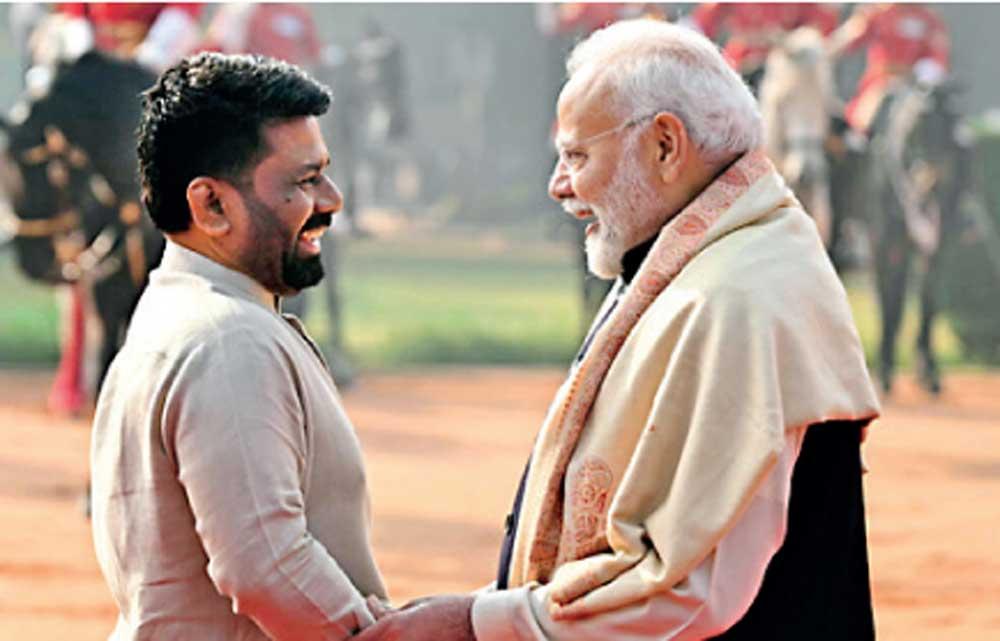
 New Delhi laid out a red carpet welcome for President Anura Kumara Dissanayake, who is on his first state visit outside the country. The President was ceremoniously welcomed by Indian President Droupadi Murmu and Prime Minister Narendra Modi at Rashtrapati Bhavan, where he received a 21-gun salute and inspected a guard of honour presented by the Indian armed forces.
During his visit, he also met, among others, Indian foreign finance ministers and health ministers. He also visited the Mahatma Gandhi Memorial at Rajghat, where he planted an Ashoka tree to mark the occasion.
Allaying Indian Anxieties
The symbolism of the visit is as important as its substance. For the JVP, which he hails from, this completes its transformation from runway anti-Indianism of its past, from Wijeweera’s text books on Indian expansionism to violent opposition to Indo-Sri Lanka Peace accord in 1988-89- to a party now in the state power and confronted with foreign policy realism.This is also the beginning of its socialisation in the high politics of foreign policy in the international system. Traditionally, the Sri Lankan Presidents, when elected, ,have made India the first stop of their diplomacy. President Dissanayake followed that tradition.
In Delhi, the President reassured not to allow our land to be used in any way in a manner that is detrimental to the interest of India. The cooperation with India will certainly flourish, and I want to reassure our continued support for India.”
This is a commitment that successive Sri Lankan governments have made. However, considering that the JVP/NPP are untested newcomers, such symbolic reassurance will have an added weight. More so, some Indian foreign news commentators, had been harping on JVP’s perceived Marxist bent, which they have pre supposed would be more amenable to Communist China and its historical record during the Indo-Lanka Peace Accord.
Since these pundits, and not the steller old guard, seem to be the source of foreign policy wisdom to the aspiring Indians, and also due to shared ideological predisposition may have ears of the decision-making circles, President Dissanayake’s reassurances may help alleviate certain Indian anxieties which could otherwise mothball.
Symbolism for India
For New Delhi itself, the symbolism of the visit is not missed. It is a considerable feat in India’s ‘Neighbourhood First’ Policy, which has seen strains in the political change in Bangladesh recently and in the election of the government of Mohamed Muizzu in the Maldives previously. The raptures in the latter relationship seemed to have patched up with Muizzu’s state visit to India in October, but the essential Islamist character and worldview of the ruling establishment in the Male would continue to hold reservations about India. Whereas in Sri Lanka, New Delhi now has a more amenable leader, whose amenability may be due to a realistic understanding of Sri Lanka’s economic challenges but also due to suddenly being thrust upon with the supreme political power of the state with little practical experience.
India read the Sri Lankan election better than most of us, including the SJB and UNP pundits, to predict the NPP candidate’s victory. Mr Dissanayake had visited India before the elections at the invitation of Foreign Minister S. Jaishankar.
If symbolism is the key to the President’s state visit, another element is of greater significance for the new government in Sri Lanka.
By hosting President Anura Kumara Dissanayake on a state visit, New Delhi is legitimising the new administration of Sri Lanka in the international system. One might say elections accord legitimacy. They do, indeed. However, how far and fast it transpires in the international system is a different story. The major international players, with their ideological bias, when hear of a Marxist-leaning President of a small state, are less forthcoming to embrace him.
However, one perk of being a great power, which India surely is, is the ability to grant international recognition- or rescind it- togenerally less powerful states. This is a practice the United States indulge in quite often. India, being the preeminent power in the Indian Ocean region, a key ally of the United States and seen as a bulwark against China, has the ability not only to accord recognition, but also to influence ideologically aligned major and small players to do so. One might say the recent invitation to the President by the UAE, a key Indian partner, maybe in line with these developments. In terms of the substance of the visit, it is all about the continuation.The agreed programmes and action plans look like Ranil Wickremesinghe visited New Delhi to preschedule it.
Some areas of cooperation highlighted in the joint statement are as follows:
Building Connectivity
i. While expressing satisfaction at the resumption of the passenger ferry service between Nagapattinam and Kankesanthurai, the leaders agreed that officials should work towards the early recommencement of the passenger ferry service between Rameshwaram and Talaimannar.
ii. Explore the possibility of jointly working on rehabilitation of Kankesanthurai Port in Sri Lanka, which will be implemented with grant assistance from India.
Energy Development
i. Take steps towards the implementation of the solar power project in Sampur and further augment its capacity as per the requirements of Sri Lanka.
ii. Continue consideration of the several proposals which are in different stages of discussion including:
(a) Supply of LNG from India to Sri Lanka.
(b) Establishment of a high-capacity power grid interconnection between India and Sri Lanka.
(c) Cooperation amongst India, Sri Lanka and UAE to implement a multi-product pipeline from India to Sri Lanka for supply of affordable and reliable energy.
(d) Joint development of offshore wind power potential in Palk Straits, while prioritising environmental protection, including fauna and flora.
iv. The development of Trincomalee as a regional energy and industrial hub.
Energy connectivity through pipelines and power grid connectivity has been a key area in recent Indo-Sri Lanka cooperation. The key JVP/NPP leaders at times opposed those proposed measures, citing loss of energy independence. Yet, new responsibilities seem to have mellowed the opposition.
Loss of Domestic Friction
The Indian policy of the new administration represents the continuation of the past, which is welcoming news. There is probably another reason why the new government could better harness its relations with India than its predecessors.That is the erosion of domestic friction against greater economic and security cooperation with India. One of the major actors of that friction itself of the JVP itself. The other, like Wimal Weerawansa and political opportunists in the Pohottuwa, have been discarded into the dustbin.
That would release the new administration, provided it has control over its own party members, from substantial domestic pressure that always stood on the path of greater cooperation with India.
However, the continuation of the policies of the predecessor is the least one could expect from the new administration. It should view New Delhi as a window of opportunity, more so now that India is expected to be the fastest-growing large economy in the coming decade. It should come out of the shadows of protectionism and link the Sri Lankan economy with India through networks of interdependency.It should seek Indian government assistance to woo world-beating Indian tech companies to open shops in Sri Lanka and enter into the much delayed Economic and Technology Cooperation Agreement. It should woo major Indian manufacturing companies and offer land on long-termleases to set up economic zones, similar to the practices adopted by forward-looking emerging economies like Vietnam.
Now that President Anura Kumara Dissanayake has taken the first symbolic step forward, he should follow up with more substance, leading to greater economic cooperation and enabling Sri Lanka to benefit from rising prosperity in India.
He might also have to stop listening to the usual idiots in local chattering classes, whose world view has not changed since the 1960s.
Preparations underway to welcome President during visit to China: Chinese envoy
December 19th, 2024Courtesy The Daily Mirror
Colombo, December 18 (Daily Mirror)- Preparations are underway to warmly welcome President Anura Kumara Dissanayake during his future visit to China, Vice Chairperson of the National Committee of the Chinese People’s Political Consultative Conference (CPPCC) Qin Boyong said.
She said this during a meeting held with the President at the Parliamentary Complex today, the Presidential Media Division (PMD) said.
The President expressed his gratitude to the Chinese government for its support during the debt restructuring as well as in the face of the economic crisis.
He stated that his appreciation extends to China’s assistance in the debt restructuring programme and its provision of loans to Sri Lanka during the economic challenges.
President Dissanayake made these remarks during a meeting with Ms. Qin Boyong, Vice Chairperson of the National Committee of the Chinese People’s Political Consultative Conference (CPPCC), held today (18) at the Parliamentary Complex.
Ms. Qin Boyong noted that China looks forward to continuing its work with the new government of Sri Lanka, further strengthening the longstanding relationship between the two countries.
The President also expressed his gratitude for China’s assistance during Sri Lanka’s disaster situations and the provision of school uniforms for children. He emphasised the continued need for China’s support in the future.
President Dissanayake highlighted the importance of completing the unfinished sections of the Central Expressway under Chinese management and expressed hopes to expedite the commencement of supply hubs and institutional projects centered around the Colombo Port City and Hambantota District.
Ms. Qin Boyong stated that there are plans to restart maritime research activities, which were temporarily halted for various reasons, along with initiating relevant projects.
Furthermore, she mentioned that Chinese companies intend to establish themselves in the Hambantota investment zone, aiming to provide Sri Lanka with better global access.
The media is not to blame, Prime Minister!
December 19th, 2024Courtesy The Daily Mirror
-There was no word from the Prime Minister explaining why she turned up for the event late, keeping the Ambassador and the officials waiting for an hour
Colombo, Dec 19 (Daily Mirror) – Last week, the government faced a diplomatic blunder when Prime Minister Harini Amarasuriya accepted a consignment of school uniforms from China and ended up thanking the ‘Republic of China’ which Taiwan is officially known as instead of the ‘People’s Republic of China’, in the presence of the Chinese Ambassador and other officials.
Taiwan has been China’s arch rival and Sri Lanka too has no diplomatic ties with Taiwan and in fact does not recognize the breakaway state.
To top it off, Prime Minister Amarasuriya turned up an hour late for the event, keeping the Ambassador waiting at the Colombo Port. The Ambassador eventually went back to the Embassy and returned when the Prime Minister was about to attend the event.
This matter was exposed by our sister paper The Sunday Times over the weekend. The Daily Mirror reproduced it, giving all credit to The Sunday Times.
The Daily Mirror learns that while a ‘slip of the tongue’ is possible by any individual, what was not expected was that instead of owning up to her mistake, the Prime Minister instead saw it fit to use up her Parliament time to blame the media for her mistake.
On Tuesday, in her statement in Parliament, the Prime Minister said that while the government has taken steps to provide the full school uniform requirements for 2025 with the support of the Chinese government and while unfortunately, the government was working tirelessly to resolve issues, opposition groups were trying to sabotage their efforts.
The Prime Minister further went on to criticize the coverage given to this event by “certain media groups”, alleging that it was an attempt to create issues between Sri Lanka and China.
The opposition and certain media institutions aligned with them are trying to create the impression that our government’s international relations are weak. However, all such attempts have been consistently defeated,” she said.
Well, one would have expected Prime Minister Amarasuriya to utilize her time in Parliament admitting her mistake but it was most unfortunate to see her blame the opposition and media for her slip of the tongue. In addition, there was no word from the Prime Minister explaining why she turned up for the event late, keeping the Ambassador and the officials waiting for an hour.
To err is human and while we accept it, blaming others for one’s fault is not. The Daily Mirror learns that Prime Minister Amarasuriya had no intention to cause a diplomatic blunder and even regretted her mistake and apologized to the Chinese Ambassador thereafter.
The matter should have graciously ended there. But instead, the media was always blamed for reporting the truth.
ඉන්දියාවට අවශ්ය ශ්රී ලංකාව සෑම අතින්ම ඔවුන් මත යැපෙන රාජ්යක් බවට පත් කිරීමටයි- හිටපු පාර්ලිමේන්තු මන්ත්රී විමල් වීරවංශ
December 19th, 2024උපුටා ගැන්ම ලංකා ලීඩර්
විදුලි බලය අතිරික්තයක් දැනට තිබුණත් අනාගතයේ ශ්රී ලංකාවේ ඇතිවන විදුලි බල ඉල්ලුම හමුවේ සැපිරිය නොහැකි තත්වයට පත්වෙන බවත් එවිට ඉන්දියාවෙන් විදුලිය මිලදී ගැනීමට සිදුවන තත්වයට පත් වන බවත් හිටපු පාර්ලිමේන්තු මන්ත්රී විමල් වීරවංශ මහතා පවසයි.
ඒ මහතා මේ අදහස් පල කළේ ඊයේ (18) ජාතික නිදහස් පෙරමුණේ මූලස්ථානයේදී ජනාධිපති අනුර කුමාර දිසානායක මහතාගේ ඉන්දියානු සංචාරය සම්බන්ධයෙන් අදහස් දැක්වීමට පැවැති මාධ්ය සාකච්ඡාවකට එක් වෙමිනි.
එහිදී වැඩිදුරටත් අදහස් දක්වමින් ඒ මහතා පැවසුවේ ඉන්දියාවේ අදානි සමූහ ව්යාපාරයෙන් විදුලිය ලබාගත් බංගලාදේශය විදුලි බිල ගෙවා ගත නොහැකි තත්වයට පත් වී රටම කළුවරේ වැටෙන තත්වයට පත්වූ බවයි.
එහිදී වැඩිදුරටත් අදහස් දැක්වූ ඒ මහතා ඉන්දියාවට අවශ්ය ශ්රී ලංකාව දේශපාලන වශයෙන්, සංස්කෘතිමය වශයෙන් බලශක්තිමය වශයෙන් ඉන්දියාව මත යැපෙන තත්වයට පත් කිරීමටයි යනුවෙන් පැවසූහ. විමල් වීරවංශ මහතාගේ සම්පූර්ණ මාධ්ය සාකච්ඡාව පහතින්…
ලක්ෂ 50 කට ආසන්න පිරිසකට රැඳවුම් බදු බර පැටවීම සහාසික ක්රියාවක්- මාතලේ දිස්ත්රික් පාර්ලිමේන්තු මන්ත්රීණී රෝහිණී කවිරත්න
December 19th, 2024උපුටා ගැන්ම ලංකා ලීඩර්
මැතිවරණ සමයේ දී රට රවටමින් උපයන විට ගෙවීමේ බදු සීමාව රු. ලක්ෂ දෙකක් කරන බව පැවසූ අනුර කුමාර දිසානායක මැතිතුමා ඊයේ(18) එය රු. 150,000 ක් කරන බව නිවේදනය කළ බව මාතලේ දිස්ත්රික් පාර්ලිමේන්තු මන්ත්රීණී රෝහිණී කවිරත්න මහත්මිය පවසයි. එලෙසම අදාළ බද්ද ගෙවන පුද්ගලයින් 121,000 කට එමගින් වාසියක් සැලසෙන බව ඇය අවධාරණය කරන්නීය. මාසිකව හෝ අර්ධ වාර්ෂිකව තැම්පත් පොලිය ආහාර, බෙහෙත් ඇතුළු දෛනික අවශ්යතාවයන් සඳහා ලබා ගන්නා ලක්ෂ 50 කට ආසන්න පිරිසකට රැඳවුම් බදු බර පැටවීම සහාසික ක්රියාවක් බව ඇය අවධාරණය කරන්නීය. ඇය එලෙස පවසන්නේ පුවත් පත් නිවේදනයක් නිකුත් කරමිනි.
ඇය නිකුත් කළ පුවත්පත් නිවේදනය පහතින්…
බදු සංශෝධනය – අටුව කඩලා පුටුව හැදීම
ආණ්ඩුව විසින් ප්රකාශයට පත් කර ඇති බදු සංශෝධන මගින් උපයන විට ගෙවීමේ බද්ද (PAYE TAx) ගෙවූ 121,000 කට සහන ලබා දී, ස්ථීර සහ ඉතිරිකිරීමේ ගිණුම් ලක්ෂ 161 කට බලපාන පරිදි රැදවුම් බද්ද 5% කින් ඉහත දමා ඇස්බැන්දුමකින් රටම රවටා තිබේ.
මැතිවරණ සමයේ දී රට රවටමින් උපයන විට ගෙවීමේ බදු සීමාව රු. ලක්ෂ දෙකක් කරන බව පැවසූ අනුර කුමාර දිසානායක මැතිතුමා ඊයේ එය රු. 150,000 ක් කරන බව නිවේදනය කළේය. අදාළ බද්ද ගෙවන පුද්ගලයින් 121,000 කට එමගින් වාසියක් සැලසේ.
ඒ සමඟම රජය දැනට 5% ක් වන රැදවුම් බද්ද 10% දක්වා වැඩි කර ඇත. ලංකාවේ ඉතිරිකිරීමේ ගිණුම් ලක්ෂ 161 ක් පවතින අතර එයින් ගිණුම් ලක්ෂ 50 ක් මාසික ක්රියාකාරී මට්ටමේ පවතී. මේ සියළුම ගිණුම් සඳහා ලැබෙන පොලිය 5% ක බදු වැඩිවීමට යටත් කොට ඇත.
වත්මන් අර්බුදය හමුවේ මෙරට ආර්ථිකය දිගින් දිගටම හැකිලෙමින් තිබේ. සමාජයේ පහළ මැද පන්තිය සිය දෛනික අවශ්යතාවයන් සපුරා ගැනීමට නොහැකිව ලත වෙමින් ඇත. එසේ තිබිය දී, රටේ පහළම ආදායම ලබන පිරිසක් ද ඇතුළත් වන ලක්ෂ 161 ක් වන සියළුම ඉතිරි කිරීමේ ගිණුම් හිමියන්ට අතිරේක බදු බරක් පැණවීම කිසි ලෙසකින් හෝ අනුමත කළ නොහැකිය.
මාසිකව හෝ අර්ධ වාර්ෂිකව තැම්පත් පොලිය ආහාර, බෙහෙත් ඇතුළු දෛනික අවශ්යතාවයන් සඳහා ලබා ගන්නා ලක්ෂ 50 කට ආසන්න පිරිසකට රැඳවුම් බදු බර පැටවීම සහාසික ක්රියාවකි.
රෝහිණී කවිරත්න මාතලේ දිස්ත්රික් පාර්ලිමේන්තු මන්ත්රී
ඇමති ලාල්කාන්තට, ආනන්ද විජේපාලට ළගම කෙනෙක්ගෙන් ලොකු පහරක්..
December 19th, 2024උපුටා ගැන්ම ලංකා සී නිව්ස්
ලාල්කාන්ත හා විජේපාල ක්රමය වෙනුවට වන සතුන්, ගොවියා සහ වගා බිම් සුරකින ක්රමයක් අවශ්යය
සජීව චාමිකර
ඉඩම් හා කෘෂිකර්ම ප්රතිසංස්කරණ ව්යාපාරය
වගා හානි කරන වන සතුන්ට පෞද්ගලික වගා බිමක දී ඕනෑ ම ක්රියාමාර්ගයක් ගැනීමට කිසිදු නෛතික බාධාවක් නැති බවට කෘෂිකර්ම, පශු සම්පත්, ඉඩම් හා වාරිමාර්ග අමාත්ය කේ. ඩී. ලාල්කාන්ත පාර්ලිමේන්තුවේ දී සිදු කළ නීති විරෝධී ප්රකාශයත් සමඟ සමාජය තුළ වගා හානි කරන වන සතුන් පිළිබඳ ව විශාල ආන්දෝලනයක් ඇති විය. ඒ අතරතුර මහජන ආරක්ෂක හා පාර්ලිමේන්තු කටයුතු අමාත්ය ආනන්ද විජේපාල සඳහන් කරන්නේ කුරුණෑගල දිස්ත්රික්කයේ සිටින සියලූ ම අලි – ඇතුන් හමුදා මෙහෙයුමකින් විල්පත්තුව ජාතික වනෝද්යානයට ගෙන ගොස් ගාල් කරන බව ය. ඒ සඳහා වන සැලැසුම් මේ වන විට සකස් කරමින් පවතී. මේ සියලු කරුණු දෙස බැලූ වීට පෙනී යන්නේ වත්මන් ආණ්ඩුව විද්යාත්මක, පුළුල් ප්රතිපත්තිමය හා තිරසර, ප්රායෝගික විසදුම් ලබා දිය යුතු ඉතා ම සංවේදී ගැටළුවලට අවිද්යාත්මක හා අමනෝඥ විසදුම් ලබා දීමට ක්රියා කරමින් සිටින බව ය.
වන සතුන් ගෙන් සිදු වන වගා හානි පාලනය කිරීම, වන සතුන් බහුල ව වගා බිම්වලට පිවිසීමට බලපෑ හේතු සාධකවලට පිළියම් සෙවීම පමණක් නොව සමස්ත කෘෂිකර්ම අර්බුදයට ම විසදුම් සෙවිය යුතු බව අප දනිමු. මේ නිසා පසුගිය ඉතිහාසය පුරා ම අප මේ පිළිබඳ ව අඛණ්ඩ ව අරගල කළෙමු. පසුගිය කාලය තුළ බලයට පත් වූ ආණ්ඩු විසින් සිදු කරන ලද වැරදි සංවර්ධන ව්යාපෘති, වැරදි ආයෝජන ක්රියාවලීන් සහ ඒ සඳහා වන වැරදි ප්රතිපත්ති හා අනපණත් සංශෝධනය කිරීම ඇතුළු බෝහෝ හානි කර ක්රියා සඳහා අප ගොවි ජනතාව සමඟ එක් ව ඊට එරෙහිව නැගී සිටියේ මේ සියල්ලේ ම අවසාන ප්රතිඵලය ගොවිතැන හා ගොවියා අර්බුදයකට මුහුණ දීම බව ඉතා ම හොඳින් දන්නා නිසා ය. නමුත් වගකීම් විරහිත ව හා ගැටළු ව නිවැරදිව තේරුම් නොගැනීම මත ව්යවස්ථාදායකය තුළ මෙවන් ප්රකාශ නිකුත් කිරීමෙන් හා අමාත්යවරු සතු බලය වැරදි ලෙස භාවිත කිරීමෙන් පෙනී යන්නේ වත්මන් ආණ්ඩුව ජනතාව සමඟ සම්මුති ගත වූ පොහොසත් රටක් ලස්සන ජීවිතයක්” ප්රතිපත්ති ප්රකාශනයේ සඳහන් වන ශිෂ්ඨසම්පන්න පුරවැසියෙක්, දියුණු මානව සම්පතක් මෙන් ම නීතියේ ආධිපත්යය සුරකින සමාජයක් ගොඩනැගීමේ පරමාදර්ශය ආණ්ඩුවේ අමාත්යවරුන් විසින් ම බිඳ දමන බව ය. මීට ප්රථම බලයට පත් වූ ජාවාරම්කාරී, ඒකාධිපති ආණ්ඩු පරාජය කර ප්රගතිශීලී ආණ්ඩුවක් ගොඩනැගීමට ජනතාව සතු ව්යවස්ථාදායක බලය බහුතර ජනතාවක් වත්මන් ආණ්ඩුවට ලබා දුන්නේ ජනතාව සමඟ ඇති කර ගන්නා සම්මුති කෙටි කලකින් බිඳ දමන ආණ්ඩුවක් ගොඩනැගීමට නොව රටේ පවතින ගැටළු සඳහා ජනතාව සමඟ සාකච්ඡා කර, විද්යාත්මක පදනමක් මත, සැබෑ තිරසර විසදුම් ලබා දෙන පාලන ව්යුහයක් ගොඩනැගීමට ය.
වන සතුන් වගා බිම්වලට පැමිණීමට හේතු
වන සතුන් වගා හානි කරන තත්ත්වයට පරිවර්ථනය වූයේ අප ගේ වැරදි ක්රියා මාර්ග හේතුවෙන් බව අප පිළිගත යුතු ය. ස්වාභාවික පරිසර පද්ධති විනාශය හා ඒවා ඛණ්ඩනය කරමින් ජනාවාස, වාණිජ වගා බිම් හා සංවර්ධන ව්යාපෘති ක්රියාත්මක කිරීම, වන සතුන් ගේ වාසස්ථාන හෝ ආහාර නොවන ඇකේසියා, පයිනස්, යුකැලිප්ටස්, තේක්ක වැනි වන වගාවන් ඇති කිරීම මෙන් ම ඒක භෝග වාණිජ වගාවන් ලෙස තේ, රබර්, කටුපොල්, උක් හා බඩඉරිගු වැනි වගාවන් ව්යාප්ත කිරීම සහ වන සතුන් ගේ වාසස්ථාන තුළ එම සතුන්ට වාසස්ථාන හා ආහාර නොවන ආක්රමණික ශාක ලෙස යෝධ නිදිකුම්බා, ගඳපාන, ගිනිතණ, කටුපතොක්, කහදියපර, කලපු අන්දර, කටු උණ වැනි ශාක ව්යාප්ත වීම වැනි තත්ත්වයන් රිලවුන්, දඩුලේනන්, ඉත්තෑවන්, වල් ඌරන් හා මොනරුන් ගේ වාසස්ථාන හා ගොදුරු බිම් අහිමි වී වගා බිම්වලට පැමිණ වගා හානි සිදු කරන තත්ත්වයට පත් වීමට හේතු සාදක වී ඇත. මීට අමතර ව ස්වාභාවික වාසස්ථාන සීමා වීම හා ඛණ්ඩනය වීම නිසා මෙම සතුන් ගේ ස්වාභාවික විලෝපිකයන් සීමා වීමෙන් මෙම සතුන් ගේ ගහනයන් වර්ධනය වීම ද සිදු වේ. එපමණක් නොව වන සතුන් ගේ වාසස්ථාන ආශ්රිත ව කසළ රැඳවීම මෙන් ම සංචාරක හා ආගමික වන්දනා ක්රියාවලීන්වල දී ස්වාභාවික පරිසරයේ ජීවත් වන, වන සතුන්ට බාහිරින් ආහාර ලබා දීම ඇතුළු ක්රියා නිසා ස්වාභාවික පරිසරයෙන් පිටතට පැමිණෙන මෙම සතුන් වගා බිම්වලට පිවිසීම වර්ධනය වීම සිදු වී ඇත. මෙම සාදක සියල්ල ම වගා හානි කරන වන සතුන් ඇති වීමට හා ගොවි බිම්වල ඵලදායීතාව බිඳ වැටීමට හේතු වී තිබේ. එබැවින් විසදුම් සෙවිය යුත්තේ මේ සියල්ලට ම ය.
වන විනාශය හා සංවර්ධන ව්යාපෘති හේතුවෙන් වන සතුන් වගා බිම්වලට පැමිණීම වර්ධනය වීම
ලිඛිත සාධකවලට අනුව යටත්විජිත යුගයේ වර්ෂ 1881 වන විට මෙරට වනාන්තර ආවරණය මුළු භූමි ප්රමාණයෙන් සියයට 84 ක් විය. වර්ෂ 1900 දී එය සියයට 70 දක්වා පහළ වැටී තිබුණි. ඊට හේතුව කෝපි හා තේ වගාවන් ව්යාප්ත කිරීම සඳහා ශීඝ්රයෙන් තෙත් කලාපයේ වනාන්තර එළි කිරීමයි.
ශ්රී ලංකාවට නිදහස ලැබීමෙන් පසුව වනාන්තර පිළිබඳ ව පුළුල් සමීක්ෂණයක් සිදු කෙරුනේ 1956 – 1961 වසර වල ය. එහි දී වන ආවරණය සියයට 44.2 ක් නැතහොත් හෙක්ටයාර 28,98,842 ක් බව හඳුනා ගැනින. වනාන්තර මහ සැලැස්ම සැකසීම සඳහා 1982 – 1985 වසර වල ලෝක ආහාර හා කෘෂිකර්ම සංවිධානය මගින් නිදහසින් පසුව සිදු කරන ලද දෙවන වනාන්තර සමීක්ෂණයට අනුව ලංකාවේ වන ආවරණය සියයට 37.5 ක් නැතහොත් හෙක්ටයාර 24,58,250 ක් බව අනාවරණය විය. ලෙග් හා ජුවෙල් විසින් සකස් කරන ලද සිතියම් අනුසාරයෙන් වන සංරක්ෂණ දෙපාර්තමේන්තුවෙන් සකස් කළ පරිපාලන වාර්තාවලට අනුව වර්ෂ 1992 වන විට ලංකාවේ වන ආවරණය සියයට 31.2 ක් නැතහොත් හෙක්ටයාර 20,46,599 ක් වන බව හඳුනා ගැනින. වන සංරක්ෂණ දෙපාර්තමේන්තුවේ 1996 වසරේ වාර්තා වලට අනුව වන ආවරණය සියයට 29.6 ක් නැතහොත් හෙක්ටයාර 19,42,219 ක් බව සඳහන් වේ. 2010 වසරේ දී අවසන් වරට සිදු කළ වන ආවරණය පිළිබඳ වන සංරක්ෂණ දෙපාර්තමේන්තුවේ අධ්යයන වාර්තාවලට අනුව ලංකාවේ වන ආවරණය සියයට 29.7 ක් නැතහොත් හෙක්ටයාර 19,51,472 ක් බව සඳහන් වේ. 1960 සිට 2010 වසර දක්වා ගෙවුණු වසර පනහ තුළ දී ලංකාවේ වනාන්තර හෙක්ටයාර 9,47,370 ක් එළිපෙහෙලි කර තිබේ.
ඉන් පසු ව ගෙවී ගිය අද දක්වා වසර 14 ක කාල සීමාව තුළ දී එළිපෙහෙලි කර ඇති වනාන්තර ප්රමාණය ඉතා විශාල ය. ඒ සඳහා ප්රධාන පදනම සකස් වී ඇත්තේ ජාතික භෞතික සැලැසුම මත ය. මෙම සැලැසුම ක්රියාත්මක කරන මේ කාලය තුළ සංවර්ධන ව්යාපෘති ලෙස ක්රියාත්මක කළ යාන් ඔය වාරි ව්යාපෘතිය සඳහා අක්කර 15000 ක වනාන්තර, මොරගහකන්ද හා කළු ගඟ බහුකාර්ය වාරි ව්යාපෘති සඳහා අක්කර 25000 ක වනාන්තර, දකුණු පළාතේ හම්බන්තොට දිස්ත්රික්කයේ ක්රියාත්මක කළ මාගම්පුර වරාය, මත්තල ගුවන්තොටුපොළ, දකුණු අධිවේගී මාර්ගය පුළුල් කිරීම, ජාත්යන්තර සම්මන්ත්රණ ශාලාව, ජාත්යන්තර ක්රිකට් ක්රිඩාංගනය ඇතුළු භෞතික සංවර්ධන ව්යාපෘති සඳහා වනාන්තර අක්කර 25000 කට වැඩි ප්රමාණයක් එළිපෙහෙළි කර තිබේ. මීට අමතර ව 2010 වසරේ උතුරු – නැගෙනහිර පැවති යුද්ධය අවසන් වීමෙන් අනතුරු ව නැවත පදිංචි කිරීමේ කටයුතු නිසි පරිදි ක්රියාත්මක නොකිරීම හා ජනතාව භාවිත කළ ඉඩම් වෙනත් සංවර්ධන භාවිතයන්, සංචාරක ව්යාපෘති හා දැඩි ආරක්ෂක කලාප පවත්වාගෙන යාම සඳහා භාවිත කිරීම හේතුවෙන් අලුතින් ජනාවාස ව්යාප්ත කිරීම සඳහා වනාන්තර අක්කර 17800 ක් පමණ එළි පෙහෙළි කිරීම සිදු විය. මීට අමතර ව අද වන විට ක්රියාත්මක කරන පහළ මල්වතු ඔය වාරි ව්යාපෘතිය සඳහා අක්කර 10000 ක වනාන්තර එළිපෙහෙලි කරමින් තිබේ.
මීට අමතර ව මහවැලි අධිකාරිය හා ඉඩම් ප්රතිසංස්කරණ කොමිෂන් සභාව යටතේ පාලනය වන වනාන්තර මහ පරිමාණ සමාගම් හා ව්යාපාරිකයන්ට පැවරීම සහ ඒවා නිරන්තරයෙන් එළිපෙහෙළි කිරීම යන මේ සියල්ල ම වන සතුන් ගේ වාසස්ථාන අහිමි වීමෙන් එම සතුන් අවතැන් වී වගා බිම්වලට පිවිසීමට ප්රධාන වශයෙන් බලපා තිබේ.
මහ පරිමාණ වාණිජ වගාවන් හේතුවෙන් සුළු ගොවීන් ගේ වගා බිම් වන සතුන්ට ගොදුරු වීම
අප රට දේශීය නොවන වාණිජ වගාවන් ගේ ස්ථාපිත කිරීම ආරම්භ වන්නේ බි්රතාන්ය යටත්විජිත යුගයේ ය. පළමු ව මෙය කෝපි වගාවෙන් ආරම්භ විය. නමුත් කෝපි පළමු ව වගා කරන්නේ බි්රතාන්යයන් නොව 1740 දී ලන්දේසීන් ය. එතැන් සිට ලන්දේසීන් විසින් මෙරට කෝපි වගාව ක්රමානුකූල ව වගා කිරීම අත්හදා බලා ඇති අතර 1833 දී බි්රතාන්යයන් විසින් කෝල්බෲක්-කැමරන් ප්රතිසංස්කරණ කොමිෂම ගෙන ඒමෙන් පසුව මහ පරිමාණ වාණිජ වගාවක් ලෙස මෙම වගාව ස්ථාපිත කෙරින. ඒ සඳහා කඳුකරයේ වනාන්තර ශීඝ්රයෙන් එළි කර කෝපි වගාව ස්ථාපිත කර තිබේ. 1860 වනවිට ලංකාවේ කෝපි නිෂ්පාදනය කරන ප්රධාන රටවල් අතරට එක් වූ අතර 1870 වනවිට මෙරට කෝපි වගාව අක්කර 275,000 ක් දක්වා පැතිර තිබේ. ඒ අතර තුර කෝපි වගාවට දිලීර රෝගයක් පැතිරීම හේතුවෙන් ශීඝ්රයෙන් මෙම වගා බිම් විනාශ වීම ආරම්භ විය.
මේ අතරතුර 1867 දී ජේම්ස් ටේලර් විසින් නුවර, ලූල්කඳුර ප්රදේශයේ හෙක්ටයාර 8 ක භූමි ප්රදේශයක පළමු ව තේ වගාව ආරම්භ කෙරින. ඉන් පසුව 1872 දී පළමු තේ කර්මාන්තශාලාව ස්ථාපිත කළ ජේම්ස් ටේලර් පළමු ව තේ අපනයනය කළේ 1873 වසරේ දී ය. එසේ ආරම්භ කළ තේ වගාව අද වන විට කඳුකරයේ හා පහතරට තෙත් කලාපයේ හෙක්ටයාර 221,969 ක් පුරා පැතිර තිබේ. 1867 වසරේ දී හෙක්ටයාර 8 කින් ආරම්භ වූ තේ වගාව අද වන විට මෙතරම් භූමි ප්රමාණයක් දක්වා ව්යාප්ත කිරීමට නොයිඳුල් කඳුකර වනාන්තර හා පහතරට තෙත් කලාපීය වනාන්තර සම්පූර්ණයෙන් ම එළිපෙහෙළි කර තිබේ. අද වන විට තවදුරටත් කඳුකර වනාන්තර හා පහතරට තෙත් වනාන්තර එළිපෙහෙළි කරමින් අඛණ්ඩ ව තේ වගාව ව්යාප්ත කරමින් පැවතීමට ප්රධාන හේතුව ඒ සඳහා පවතින වෙළෙඳපොළ ඉල්ලුම ය. ඒ හේතුවෙන් මේ වන විට රක්ෂිත වනාන්තර පවා නීති වීරෝධී ව එළිපෙහෙළි කරමින් තේ වගාව ව්යාප්ත කෙරේ.
ලංකාවේ තේ වගාව ව්යාප්ත කිරීමට සමගාමී ව තෙත් හා අතරමැදි කලාපයේ වනාන්තර එළිපෙහෙළි කරමින් රබර් වගාව ව්යාප්ත කෙරින. 1876 දී ගම්පහ, හෙනරත්ගොඩ උද්භීද උද්යානයේ පළමු රබර් ශාකය රෝපනය කරමින් ආරම්භ කළ රබර් වගාව අද වන විට හෙක්ටයාර 133,668 ක් පුරා ව්යාප්ත ව පවතී. ජාත්යන්තර වෙළෙඳපොලේ රබර් මිල ගණන් වර්ධනය වීම හා පහළ බැසීම අනුව රබර් වගාව ව්යාප්ත කිරීම හා රබර් වගා බිම් වෙනත් භාවිතයන් සඳහා යොදා ගැනීම තීන්දු වේ.
යටත්විජිත යුගයේ දී බි්රතාන්යයන් විසින් ලංකාවේ ස්ථාපිත කළ හැකි වාණිජ බෝග පිළිබඳ ව පර්යේෂණ සිදු කිරීමේ දී උක් වගාව පිළිබඳ ව ද ඔවුන් ගේ අවධානයට ලක් ව තිබේ. උක් වගාව පිළිබඳ ව පළමු පර්යේෂණ සිදු කර ඇත්තේ ගාල්ල ප්රදේශයේ ය. නමුත් එම කාල වකවානුවේ දී වාණිජ වගාවක් ලෙස උක් වගාව ව්යාප්ත කර නොතිබුණි. 1948 දී නිදහස ලැබීමෙන් පසුව වාණිජ වශයෙන් උක් වගාව ව්යාප්ත කිරීම ඇරැඹිනි. 1956 වන විට වියළි කලාපයේ වාණිජ වගාවක් වශයෙන් උක් වගාව ව්යාප්ත කර තිබේ. 1973 හා 1994 වසරවල දී වියළි කලාපයේ වනාන්තර විශාල වශයෙන් එළිපෙහෙළි කර උක් වගාව මහ පරිමාණයෙන් ව්යාප්ත කෙරින. මේ වනවිට පැල්වත්ත, හිඟුරාන, සෙවණගල, කන්තලේ, මොණරාගල හා අම්පාර යන ප්රදේශවල හෙක්ටයාර 30,530 ක භූමි ප්රමාණයක උක් වගා බිම් ව්යාප්ත කර තිබේ. මෙම වගාව ව්යාප්ත කිරීමේ දී වසර කිහිපයක් තුළ පස නිසරු වීමත් සමඟ ඵලදායිතාවය බිඳ වැටෙන අවස්ථා වල දී සමාගම් උත්සාහ දරන්නේ අලුතින් වගා බිම් ස්ථාපිත කර ඵලදායීතාව වැඩි කර ගැනීමට ය.
අද වන විට වාණිජ වගාවක් ලෙස බඩඉරිඟු වගා බිම් වියළි කලාපය ආක්රමණය කරමින් තිබේ. මිශ්ර බෝග වගා කළ හේන් වගා බිම්වල අද වන විට වගා කෙරෙන්නේ බඩඉරිඟු පමණි. 1961 වන විට හෙක්ටයාර 12,957 ක් ව පැවති බඩඉරිඟු වගා බිම් ප්රමාණය අද වන විට හෙක්ටයාර 72,390 ක් දක්වා වර්ධනය වී තිබේ. මිනිසුන්ට දෛනික පරිභෝජනය සඳහා වැදගත් වන බෝග නිපද වූ හා යල කන්නයේ දී වන සතුන් ගේ ආහාර බිම් වන හේන් වගා බිම්වල අද වන විට සත්ත්ව ආහාරයක් ලෙස ඒක බෝග වගාවක් ලෙස බඩඉරිඟු වගා කෙරේ. මේ සඳහා පවතින ඉල්ලුම හා මිල ඉහළ අගයක පැවතීම නිසා ශීඝ්රයෙන් බඩඉරිඟු වගාවට ගොවීන් ප්රවිෂ්ඨ වෙමින් සිටී.
මෙරට පළමු වරට වාණිජ බෝගයක් වන කටුපොල් වගාව ආරම්භ කළේ යුරෝපීය වැවිලිකරුවකු වන ජෙරී වොලස් විසිනි. 1968 දී වටවල වැවිලි සමාගමට අයත් නාකියාදෙනිය වතු යායේ හෙක්ටයාර 0.5 ක භූමියක කටුපොල් ගස් 68 ක් සිටුවා පළමු වගා බිම ආරම්භ කරන ලදී. වර්තමානය වන විට හෙක්ටයාර 8781 ක පමණ කටුපොල් වගා බිම් ස්ථාපිත කර තිබේ.
මේ වන විට වාණිජ වගාවක් ලෙස ඩෝල් සමාගම අපනයනය කිරීම සඳහා කැවැන්ඩිස් කෙසෙල් ප්රභේදය වියළි කලාපයේ ප්රදේශ ගණනාවක වගා කර තිබේ. කන්තලේ, කුඩා ඔය, දෙමෝදර, බුත්තල ආදී ප්රදේශ ගණනාවක අක්කර 7000 ක් පමණ මේ වන විට කැවැන්ඩිස් කෙසෙල් වගාව සඳහා යොදා ගෙන ඇත. මෙම වාණිජ වගා බිම් සියල්ල ම වන සතුන්ට අහිමි වූ එම සතුන් ගේ වාසස්ථාන වෙති.
ගොවිතැනේ සැබෑ අභියෝග වන සතුන් පෙන්වා මඟහැරීම
පසුගිය කාලය පුරා ම සුළු පරිමාණ ගොවි ජනතාව වගා බිම්වලින් සූක්ෂම ව ඉවත් කර මහ පරිමාණ වාණිජ වගාවන් ස්ථාපිත කිරීමට උත්සාහ ගැනින. මේ නිසා ගොවීන්ට වගා කටයුතුවල දී ප්රධාන අභියෝග ගණානවකට මුහුණ දීමට සිදු විය. එම අභියෝග අතර කෘෂි රසායනික හා බීජ නිෂ්පාදන සමාගම්වල ග්රහණයට නතු වීම, ජල අර්බුද, ගොවියා වගා බිම්වලින් ඉවත් කරන ප්රතිපත්ති ක්රියාත්මක කිරීම, ගොවි බිම් මහ පරිමාණ ඒක බෝග වාණිජ වගාවන් සඳහා සමාගම්වලට හා මහ පරිමාණ ව්යාපාරිකයන්ට ලබා දීම, ගොවි බිම් වෙනත් ආයෝජන හා සංවර්ධන ව්යාපෘති සඳහා යොදා ගැනීම, මහවැලි ව්යාපෘතිය ඇතුළු වාරි ව්යාපෘති මගින් ජලය සපයන වගා බිම් සමාගම්වලට හා මහ පරිමාණ ව්යාපාරිකයන්ට ලබා දීම, පසු අස්වනු විනාශය, අස්වැන්න අලෙවි කර ගැනීමේ අභියෝග, අස්වැන්නේ මිල තීන්දු කිරීමේ දී වෙළෙදපොළ මාෆියාවට ගොදුරු වීම, අනවශ්ය පරිදි ආහාර ආනයනය කර ගොවීන් අතර වෙළෙදපොළ තරගයක් ඇති කිරීම මෙන් ම වන සතුන් ගෙන් සිදු වන වගා හානි යන සියල්ල ම පවතින බව අප දනිමු. මේ සියල්ල අවබෝධ කර නොගතහොත් සමස්ත ගොවිතැනට ඇති සැබෑ අභියෝග සියල්ලට පිළියම් සෙවීම වෙනුවට වන සතුන් පාලනය කිරීමෙන් පමණක් ගොවිතැනේ අභියෝගවලට පිළියම් සෙවිය හැකි වන බව බොහෝ දෙනෙකු විශ්වාස කරනු ඇත. එමගින් බොහෝ දෑ මඟහැරී යනු ඇත. මේ නිසා ගොවිතැන ගොඩනැගීමට හා ගොවියා ගේ පැවැත්ම සුරක්ෂිත කර වගා බිම්වල හා වගා අස්වැන්නේ සුරක්ෂිතතාව ඇති කිරීමට පළමු ව කළ යුතු වන්නේ වගා හානි සිදු කරන වන සතුන් විනාශ කිරීම නොවන බව අපි පිළිගනිමු. එපමණක් නොව මෙම වන සතුන් පරිසර පද්ධතියේ තුළිත පැවැත්ම පවත්වාගෙන යාමට දායකත්වයන් බොහොමයක් ලබා දෙන බව ද අප තේරුම් ගත යුතු ය. මේ නිසා අප ගොවිතැන දෙස බැලිය යුත්තේ මානව කේන්ද්රීයව නොව ජෛව කේන්ද්රීයව ය.
වනජීවී ආඥාපනත උල්ලංඝනය කිරීම
භූමියේ මෙම යතාර්ථයන් සියල්ල පවතින අතර තුර ගොවීන් ගේ හා වන සතුන් ගේ රැකවරණය වෙනුවෙන් නීති සම්පාදනය කර තිබේ. 2022 අංක 07 දරන පනතින් අවසන්වරට සංශෝධිත 1937 අංක 02 දරන වන සත්ත්ව හා වෘක්ෂලතා ආරක්ෂක ආඥා පනතේ 53අ උප වගන්තියට අනුව වන සතෙකු මැරීම හෝ මත් කිරීම සඳහා වස හෝ පුපුරණ ද්රව්ය හෝ මත් කිරීමේ ද්රව්ය භාවිත කිරීම නීති විරෝධී වේ. පනතේ 52 වගන්තියට අනුව කෘත්රිම ආලෝකය භාවිත කර වන සතෙකු ගේ පෙනීම මුලා කිරීමෙන් හෝ සතා ඇද ගැනීමට සැලැස්වීමෙන් හෝ අල්ලා ගැනීමට පහසු කිරීම සඳහා ක්රියා කිරීම ද නීති විරෝධී වෙයි. එපමණක් නොව පනතේ 52ආ උප වගන්තියට අනුව සතෙකු අල්ලා ගැනීම සඳහා පෙළැඹවීම හා ආකර්ෂණය කර ගැනීමට ආහාර වර්ග, සුවඳ වර්ග, වර්ණයන් හෝ වෙනත් ද්රව්යක් හෝ උපකරණයක් භාවිතා කිරීම ද නීති විරෝධී ක්රියාවකි. පනතේ 53ආ උප වගන්තියට අනුව වස හෝ පුපුරණ ද්රව්ය හෝ මත් කිරීමේ ද්රව්ය මගින් මරණු ලැබූ හෝ අල්ලාගනු ලැබූ සතෙකු සන්තකයේ තබා ගැනීම ද තහනම් වේ. මෙවන් නීති විරෝධී ක්රියාවකට වරදකරුවකු වන අයෙකු පනතේ 58 වගන්තියට අනුව රුපියල් 15,000 ත් 30,000 ත් අතර දඩයකට හෝ වසර 1 ත් 2 ත් අතර බන්ධනාගාර ගත කිරීමකට හෝ මේ දඩුවම් දෙකට ම යටත් කළ හැකි ය. මීට අමතර ව විශේෂිත කරුණක් වන්නේ පනතේ 59 වන වගන්තියට අනුව මෙවන් නීති විරෝධී ක්රියාවක් සිදු කිරීමට තැත් කරන හෝ වරදක් සිදු කිරීමට අනුබල දෙන ඕනෑ ම තැනැත්තෙකු ඒ වරද ම සිදු කරන අතර එම දඩුවමට ම ලක් කළ හැකි වීම ය.
ඒ අනුව ලාල්කාන්ත අමාත්යවරයා සඳහන් කරන පරිදි පෞද්ගලික වගා බිමකට පැමිණෙන වන සතුන් ව වෙනත් වගා පළිබෝධකයන් පාලනය කරන ආකාරයෙන් ම පාලනය කිරීමට ක්රියාමාර්ග ගතහොත් හෝ එසේ මරණ ලද හෝ අල්ලා ගනු ලැබූ සතෙකු සන්තකයේ තබා ගත හොත් සිදු වන්නේ වන සත්ත්ව හා වෘක්ෂලතා ආරක්ෂක ආඥාපනතට අනුව දඩුවම් ලැබීමට ය. මේ නිසා මෙම අමාත්යවරයා ගොවීන් නීති විරෝධී ක්රියාවලට පෙළැඹවීම ද සිදු කර ඇත. මේ නිසා වන සත්ත්ව හා වෘත්ෂලතා ආරක්ෂක ආඥාපනතේ 59 වන වගන්තියට අනුව ලාල්කාන්ත අමාත්යවරයාට එරෙහි ව නීතිය ක්රියාත්මක කළ හැකි ය. නීතිය නොදැන සිටීම සමාවට කරුණක් නොවන බවට ඇති නීතියේ ආප්ත ලාල්කාන්ත අමාත්යවරයාට ද අදාළ බව අවධාරණය කළ යුතු ය. එපමණක් නොව අමාත්යවරයා ගොවීන්ට වැරදි මඟ පෙන්වීම තුළින් සිදු කර ඇත්තේ විශාල අසාධාරණයකි.
ආරක්ෂිත නොවන වන සතුන්
වගා හානි ඇති කරන වන සතුන් ගෙන් වගා බිම් ආරක්ෂා කර ගැනීමට වන සත්ත්ව හා වෘක්ෂලතා ආරක්ෂක ආඥා පනතේ 30 වන වගන්තියට අනුව පළමු වන උප ලේඛනයේ සහ 31 වන වගන්තියට අනුව තුන් වන උප ලේඛනය යටතේ ආරක්ෂිත නොවන ක්ෂීරපායී සතුන් හා ආරක්ෂිත නොවන පක්ෂීන් නම් කර ඇත. පළමු උප ලේඛණය යටතේ ක්ෂීරපායී සතුන් පස්දෙනෙකු ආරක්ෂිත නොවන සතුන් ලෙස නම් කර ඇත. ඊට හේතු ව මෙම සතුන් වගා හානි කරන සතුන් ලෙස සැලැකීම ය. රිලවා, අළු වදුරා, වල් ඌරා, ඉත්තෑවා, හාවා ආරක්ෂිත නොවන ක්ෂිරපායී සතුන් වේ. තුන්වන උප ලේඛණයට අනුව ආරක්ෂිත නොවන පක්ෂීන් වන්නේ රෑන ගිරවා, කොළඹ කපුටා, ගං කපුටා, තිත් වී කුරුල්ලා සහ පිට සුදු වී කුරුල්ලා ය.
මෙම ආරක්ෂිත නොවන සතුන් අනාරක්ෂිත වන්නේ පෞද්ගලික වගා බිමක දී පමණි. නමුත් එම සතුන් වෙනත් වගා පළිබෝධකයන් පාලනය කරන ආකාරයෙන් කිසිදු උපකරණයක් හෝ රසායනික හෝ විදුලි සැර යොදා හෝ මදු තැබීමෙන් හෝ පාලනය කළ නොහැකි ය. නීතියට අනුව එම සතුන් පාලනය කළ හැකි වන්නේ බලපත්ර සහිත ගිනි අවියකින් පමණි.
වන සත්ත්ව හා වෘක්ෂලතා ආරක්ෂක ආඥා පනත ඉදිරියේ දී සංශෝධනය කර ආරක්ෂිත නොවන ක්ෂීරපායී ලේඛණයේ ඇතුළත් වගා හානි සිදු කිරීමට වැඩි දායකත්වයක් ලබා නොදෙන අළු වදුරා හා හාවා ඉවත් කර ඒ වෙනුවට දඩුලේනා සහ අනාරක්ෂිත පක්ෂි ලේඛණයේ කොළඹ කපුටා, ගං කපුටා හා පිට සුදු වී කුරුල්ලා ඉවත් කර ඒ වෙනුවට මොණරා ඇතුළත් කිරීමට පියවර ගත යුතු වන්නේ වගා හානි සිදු කිරීමට දායක වන සතුන් පමණක් එම ලේඛණවලට ඇතුළත් වීම ප්රමාණවත් වන නිසා ය.
පොහොසත් රටක් ලස්සන ජීවිතයක් අහිමි නොකිරීමට නම්,
වත්මන් ආණ්ඩුවේ පොහොසත් රටක් ලස්සන ජීවිතයක්” ප්රතිපත්ති ප්රකාශනයේ තිරසර ජෛව ලෝකයක්, සදාහරිත ජීවිතයක් කොටසෙහි සඳහන් කර ඇත්තේ සියලූ ම ජීවීන් ගේ පැවැත්ම තහවුරු කෙරෙන තිරසර පරිසරයක් දැක්ම කොට ගෙන ජාතික ජන බලවේගය ක්රියාත්මක වන බව ය. එපමණක් නොව මෙම ප්රතිපත්ති ප්රකාශනයේ මෙන් ම ජාතික ජන බලවේගය ජනතාව සමඟ සම්මුති ගත වූ මිහිකත, ඔබ, අප, මතු පරපුරේ ද උරුමය වෙනුවෙන්” වන පරිසර ප්රතිපත්ති ප්රකාශනයේ ද සඳහන් කර ඇත්තේ පාරිසරික යුක්තිය හා සාධාරණත්වය, පරිසර පද්ධතික ප්රවේශය, පාරිසරික යහපාලනය යන මූලධර්ම මත ක්රියාත්මක වන බව ය. ඒ අනුව ඒකාබද්ධ කළ හැකි වනජීවී හා වන සංරක්ෂණ කලාප හඳුනාගෙන මංකඩවල් ස්ථාපිත කිරීම, සියලු වන සතුන් ගේ ආහාර හා ජල අවශ්යතාව සැපිරීමට අදාළ පාරිසරික පද්ධති සුපෝෂණය කිරීම, ආක්රමණික ශාක ඉවත් කිරීම, අලි – මිනිස් ගැටුම පාලනය කිරීමට වන අලි ගහනය, සංචරණ රටා හා වාසස්ථාන පිළිබඳ ව අධ්යයනය කර ජීව විද්යාත්මක හා නව තාක්ෂණය භාවිත කරමින් ජන සහභාගීත්ව වැඩසටහන් ක්රියාත්මක කිරීම, මොනරුන්, රිලවුන්, දඩුලේනන් වැනි වගාවන්ට හානි පමුණුවන වන සතුන් ගේ වර්ධනය පිළිබඳ ව නිවැරදි අධ්යයනයක් සිදු කර ජීව විද්යාත්මක ක්රමවේදයක් මගින් ගහනය පාලනය කිරීමට පියවර ගන්නා බව ය. නමුත් ලාල්කාන්ත හා විජේපාල අමාත්යවරුන් ගේ ප්රකාශ සමඟ මෙම ප්රතිපත්ති ප්රකාශන මීට ප්රථම පැවති ආණ්ඩුවල ප්රතිපත්තිවලට සිදු වූ ආකාරයෙන් ම ලේඛණවලට පමණක් සීමා වන බව පෙනෙන්නට තිබේ. එය පෙර පැවති ආණ්ඩු මෙන් ම වත්මන් ආණ්ඩුව ද බලය ලබා ගත් පසු ව ජනවරමට පිටතින් කටයුතු කිරීමකි. එවන් තත්ත්වයක් ඇති වුවහොත් සිදු වන්නේ පොහොසත් රටක් ලස්සන ජීවිතයක්” බලාපොරොත්තු වූ බහුතර ජනතාවට එය අහිමි වීම ය.
මේ නිසා වගා බිම් වන සතුන් ගෙන් ආරක්ෂා කිරීමට හා අලි – මිනිස් ගැටුම පාලනය කිරීමට කළ යුතු ක්රියාමාර්ග බොහොමයක් වේ. ඒ අතර ප්රධාන වන්නේ වන සතුන් ගේ වාසස්ථාන සුරක්ෂිත කිරීම හා ඒවා ජාල ගත කිරීම ය. වන සතුන් ගේ වාසස්ථාන වන මහවැලි අධිකාරිය යටතේ පවතින වනාන්තර හා ඉඩම් ප්රතිසංස්කරණ කොමිෂන් සභාව යටතේ පාලනය වන වනාන්තර සියල්ල ආරක්ෂිත තත්ත්වයට පත් කළ යුතු ය. වන වගාවන් තුළ වන සතුන් ගේ ආහාර වන දේශීය ශාක වර්ධනය වීමට අවස්ථාව ඇති කළ යුතු ය. ඒක බෝග වාණිජ වගා බිම් වෙනුවට ශාක ස්ථර ලෙස සකස් වූ බහු බෝග වගා බිම් ඇති කළ යුතු වේ. එපමණක් නොව ආක්රමණික ශාක ව්යාප්ත වී ඇති ප්රදේශවල එම ශාක ක්රමාණුකූල ව ඉවත් කර ස්වාභාවික පද්ධති ඇති වීමට අවස්ථාව ලබා දිය යුතු ය.
වනජීවී වාසස්ථාන ආශ්රිත සියලූ ම කසළ රැඳවුම් ඉවත් කර ඒ වෙනුවට රට තුළ කසළ කළමනාකරණ ව්යුහයක් ඇති කළ යුතු ය. වනජීවී වාසස්ථාන තුළ පිහිටි සියලූ ම සංචාරක හා ආගම්ක ස්ථානවල මිනිසුන් පරිභා්ජනය කරන ආහාර රැඳවීම සම්පූර්ණයෙන් ම පාලනය කළ යුතු ය. ඒ අතරතුර වගා බිම්වලට වන සතුන් පැමිණීම වැළැක්වීමේ උපායමාර්ග සඳහා ගොවීන්ට පහසුකම් ලබා දිය යුතු වේ. එය සමාගම්වලට වාසිදායක තත්ත්වයට පරිවර්තනය කිරීම ද වැළැක්විය යුතු ය. එසේ නොමැති වුවහොත් සිදු වන්නේ නැවත වරක් ගොවීන් වන සතුන් පාලනයට ද සමාගම්වල ග්රහණයට නතු වීම ය. මේ සියල්ල අතරතුර ජනතාව ගේ අදහස් මත ඉඩම් පරිහරණ ප්රතිපත්තියක් සහ තිරසර සංවර්ධන ප්රවේශයක් ඇති කර දැනට ක්රියාත්මක කරන වැරදි ජාතික භෞතික සැලැසුම ද සම්පූර්ණයෙන් ම ඉවත් කළ යුතු ය. එසේ නොවුනහොත් ගොවියා, ගොවිතැන හා පොදු ජනතාව මුහුණදෙන කිසිදු ගැටළුවකට විසදුම් සෙවීමට නොහැකි වනු ඇත.
Cabinet approves review of government-owned non-commercial institutions
December 19th, 2024Courtesy Hiru News
The Cabinet has approved a proposal by the President to review government-owned non-commercial institutions, citing the need for modernization and the alignment of functions with current needs. Many of these institutions have outdated structures, insufficient powers, and overlapping functions, with some tasks being more efficiently performed by the private sector.
Currently, the government manages 86 departments, 25 district secretariats, 339 divisional secretariats, 340 state-owned enterprises, and 115 non-commercial state statutory institutions. The national budget for 2024 allocates around 140 billion rupees for these institutions.
A committee, led by the Secretary to the Prime Minister, has been appointed to conduct the review. The committee includes officials from various ministries, the Department of National Budget, and the University Grants Commission, with the task of submitting recommendations for improving efficiency and operations.
Is Sri Lanka ready to face a possible dementia epidemic?
December 18th, 2024By Raj Gonsalkorale
Sri Lanka has become one of the fastest aging countries in the world. Its share of the population over 60 years of age, which was 12% in 2014, has exceeded the average of all countries in the South-East Asian region. According to population projections, this proportion will reach 28.5% by 2050. With ageing as the major non-modifiable risk factor for dementia, an epidemic of dementia is a certainty in Sri Lanka” – The National Institute of Health’s National Library of Medicine (NIH/NLM)- https://pmc.ncbi.nlm.nih.gov/articles/ PMC9469587/#:~:text= According%20to%20an%20epidemiological%20study,was%20found%20to%20be%204%25
As stated by the Alzheimer’s Association (https://www.alz.org/alzheimers-dementia/what-is-dementia) dementia is not a single disease. It’s an overall term to describe a collection of symptoms that one may experience if they are living with a variety of diseases, including Alzheimer’s disease. The social impacts of dementia include stigma and dementia patients being treated as outcasts and not being treated the same way as other people. Gradual worsening of dementia conditions will have an overall effect on health, financial circumstances, employment status and relationships with those around them may also have a negative impact on self-esteem.
Dementia is reported as a group of brain disorders that cause a gradual decline in mental abilities. As the disease progresses, people with dementia may experience the following: Memory loss: Difficulty remembering recent events, names, and making new memories, Communication difficulties: Difficulty speaking, understanding, reading, and writing, Movement problems: Difficulty moving around, losing balance, and having trouble walking , Behavior changes: Acting impulsively, becoming aggressive, or having disturbed sleep, Personality changes: Losing interest in activities, losing empathy, or having aspects of their personality change , Hallucinations: Seeing or hearing things that aren’t there, Incontinence: Losing control of their bladder and bowels, Difficulty with daily tasks: Taking longer to complete tasks, having trouble eating and drinking, or forgetting how to eat or drink, Social difficulties: Finding social situations difficult or losing interest in relationships. There is no cure for dementia, but some treatments can help manage symptoms. People with dementia will usually need help from friends or relatives, and it’s important to plan for the future early on”
Dementia indeed is a very sad disease where the personality, habits and the routine of a loved one could drastically change, and family members would find it extremely stressful to recognise and deal with this new person” who has evolved from the one they once knew. Dementia persons are by and large helpless and needs care for even the most mundane tasks. In an increasingly changing extended family life situations where home care for dementia patients has, and is becoming a major challenge, anecdotal evidence relating to how even dementia afflicted parents have been driven away from their homes or kept locked in rooms, are abound. Traditional religious beliefs tend to ascribe dementia to a karmic consequence or a condition where God would continue to love a person despite the persons dementia. Whatever the reasoning, the afflicted person is still a human being and needs love, care and compassion as any other human being.
PubMed Central® (PMC), a free full-text archive of biomedical and life sciences journal literature at the U.S. National Institutes of Health’s National Library of Medicine (NIH/NLM) goes on to say that according to an epidemiological study done on dementia in semi urban and sub-urban populations in Sri Lanka, the prevalence of dementia was found to be 4%. In comparison with studies conducted in the region, this prevalence is much higher and despite having a well-established health care system in Sri Lanka almost in par with developed countries, it is not geared to handle medical and social issues of rapidly expanding elderly people and notably that of dementia patients. This situation is worsened by the scarcity of knowledge based on research, on the current status of patients with dementia”
These statistics and statements are indeed frightening as Sri Lanka does not have the political or social preparedness, infrastructure nor trained staff to manage dementia patients and associated medical and social issues. There is very likely scant knowledge about dementia related conditions, and the extent of dementia cases in the country as there is inadequate research on this topic. Chances are that in a predominantly rural based population setting, this situation is possibly even worse than imagined. Given this disturbing situation, and hitherto neglected mental condition which requires a care approach very different to other diseases, Sri Lanka must give very high priority to developing a policy setting and a long-term plan to address the many medical and social issues associated with dementia.
According to the World Bank, 80.97% of Sri Lanka’s population lived in rural areas in 2022. The rural sector is also home to four-fifths of the country’s poor people, with almost half of them being small-scale farmers. Sri Lanka’s urban population is relatively small, with only around 18% of the population living in urban areas. The International Fund of Agricultural Development (IFAD) states that although the rural population is large, there is a dearth of research on health and socioeconomic issues in this group.
People with dementia in rural areas face many challenges, including, limited access to care and rural areas have fewer local providers and fewer resources for primary care, specialized care, and other support services. This can lead to delayed diagnosis and treatment. Transportation issues is another major challenge in rural areas, as long distances and transportation issues can make it difficult to access care. Not just rural areas, the entire country lacks support services for caregivers, both domestic and external, and including family members who basically are the current caregivers. Currently, as far as the writer is aware, there are no respite centres in the country with professionally trained personnel to look after dementia patients.
Social isolation is common in rural areas, which makes it harder for families to connect with others and use community resources. In this regard, beliefs and attitudes, including religious beliefs and general stigmatisation of people with mental conditions, impacts on seeking help from family, friends, or formal providers and this has a direct impact on the adequacy of dementia care. Limited education in rural areas arising from limited resources for education about dementia and dementia care, and general societal attitudes linked to lack of education, has a major impact on dementia, including recognition of dementia as the cause for mental conditions, and caregiving for those afflicted. Rural areas tend to have more older people, which resulting in a higher prevalence of dementia.
Global situation
Key facts from the WHO (https://www.who.int/news-room/fact-sheets/detail/dementia) illustrate the global situation related to dementia
- Currently more than 55 million people have dementia worldwide, over 60% of whom live in low-and middle-income countries. Every year, there are nearly 10 million new cases.
- Dementia results from a variety of diseases and injuries that affect the brain. Alzheimer disease is the most common form of dementia and may contribute to 60–70% of cases.
- Dementia is currently the seventh leading cause of death and one of the major causes of disability and dependency among older people globally.
- In 2019, dementia cost economies globally US$ 1.3 trillion, approximately 50% of these costs are attributable to care provided by informal carers (e.g. family members and close friends), who provide on average 5 hours of care and supervision per day.
- Women are disproportionately affected by dementia, both directly and indirectly. Women experience higher disability-adjusted life years and mortality due to dementia, but also provide 70% of care hours for people living with dementia
In an article titled Primary Health Care Reforms in Sri Lanka: Aiming at Preserving Universal Access to Health, Dr Susie Perera, Director, Organization Development, Ministry of Health, Sri Lanka (https://www.hsep.lk/index.php /downloads/publications-docs/34-reorganizing-primary-health-care-in-sri-lanka) states that Sri Lanka’s model of primary health care, available free through a government health system with island wide availability, forms a sound basis for providing universal health coverage. However, this system is increasingly under pressure notably from the high burden of non-communicable diseases (NCDs), increasing elderly care needs and the growing out of pocket expenditure for chronic diseases. Whilst the government’s commitment to maintaining universal health services of good quality for all continues, the need for change has been recognized. The government is exploring now how a rational model of care can best be instituted given limited resources.
The primary health care system in Sri Lanka has a community health service, (focusing mainly on maternal and child health and on communicable diseases and adopting prevention and health promotion strategies, based on the health unit system. The health units have defined catchment areas that coincide with local government administrative units and currently number 341 areas. Also known as MOH areas, they are managed by a medical doctor, supported by public health field staff), and a curative service (consisting of 496 Divisional hospitals providing both hospitalization and ambulatory services and 474 Primary Medical Care units providing only ambulatory care which function with non-specialist medical doctors and other staff).
Arguably, Sri Lanka has more than a basic infrastructure for its communicable diseases. As mentioned by Dr Perera the challenge now is increasingly from non- communicable diseases (NCDs) and elderly care needs including such needs for persons with dementia.
The social dimension
The following abstract from a paper titled social aspects of dementia and dementia practice byIrja Haapala , Simon Biggs, Susan Kurrle (https://pubmed.ncbi.nlm.nih.gov/30475199/) is a good summary relating to the social dimension associated with dementia.
Social aspects of dementia are becoming increasingly important as part of a wider shift in emphasis from cure to care. This is partly because approaches based on finding a cure have proved far more difficult and complex than originally imagined (WHO, 2016). New evidence on the effectiveness of public health measures, that while incidence is growing as the proportion of older people in society increases its prevalence amongst older adults is actually falling, has also led to increased interest in social dimensions of prevention, lifestyle change, and practical intervention in community settings (Prince et al., 2016; Kivipelto et al., 2017). This, in turn, has led to a rediscovery of the role of supports to people living with dementia in their daily lives, the needs of informal carers, and professional activities that can maintain the social engagement of each party (Winblad et al., 2016). The expansion of practice around person-cantered care, beyond traditional institutional settings, has also contributed to a socialized view of how interactions in dementia care are thought about (Bartlett et al., 2017), as has an increased awareness of the effects of the social construction of dementia in the public mind (Biggs, 2018). Most recently, people living with dementia, and particularly with respect to younger onset dementia, have begun to find a voice and to make connections to the wider disability movement (Dementia Alliance International, 2017). Each of these developments, in their different ways, have led to a re-emphasis on psycho-social elements of dementia, its experience, and how that might translate into clinical practice and service delivery.
The emphasis on rediscovery of the role of support to people living with dementia in their daily lives, the needs of informal carers, and professional activities that can maintain the social engagement of each party, the expansion of practice around person-cantered care, beyond traditional institutional settings, has also contributed to a socialized view of how interactions in dementia care are thought about, as has an increased awareness of the effects of the social construction of dementia in the public mind” is a good guide for Sri Lankan politicians, civil society leaders, religious leaders, health experts and health officials to take a cue from in viewing interventions for dementia care. It rightly stresses the importance of the wider society and key players in the society playing a greater role in dementia patient management.
Although the shared cluster system” mentioned in Dr Perera’s paper is an important component in primary and curative care, discussions should be had whether it is a suitable model for a disease like dementia which appears to require more social and family, and caregiving approaches considering the nature of the disease and the increasing challenges it poses as a patient advances with dementia.
In this regard, it is felt that the a system should consider how best the patient could be assisted to manage his or her life and how the immediate family and the community in which the patient and caregivers live and how associated challenges like stigmatisation, disowning of patients even by close family members, lack of suitable accommodation and facilities could be provided to the patients. In all this, the stress and pressures on those close to dementia patients cannot be and should not be overlooked as it is a major challenge that has and can have a serious ripple effect leading to kindness to patients becoming the unfortunate victim.
In looking at those within societies who could provide a significant psychological, and a coordinating role between the patients, the family caregivers, the community at large and the numerous service providers at rural level including mid wives, health officials, grama sevaka’s officials, various provincial council officials, are the clergy belonging to all religious denominations. They could play a major role within the society as they are the closest to the general public and on whom the public has the most confidence and trust. In this regard, considering that a majority of the population are Buddhists, in excess of 70%, the Buddhist clergy and rural temples could play a vital role in supporting dementia caregivers.
Rather than attributing dementia as a consequence of Karma but providing much required solace to the patients, caregivers and families of people with dementia, the Buddhist clergy and Buddhist temples could lead the way in expounding the practice of the fundamental tenant of Buddhism, Metta, loving-kindness; Karuna, compassion; Mudita, sympathetic joy; and Upekkha, equanimity. to those affected and those around the affected. The care giving approaches essentially have to be a combined effort involving primary health care institutions and experts, as well as society leaders like the clergy from all religious denominations and institutions including Christian churches, Hindu temples, Islamic mosques and Buddhist temples.
Dementia is a mental condition that has to be recognised for what it is, and appropriate care provided to persons with the it. It is well to remember that no person, however rich or powerful, is immune from being afflicted with this very unfortunate mental condition.
මම එංගලන්තේ අධි නීතිඥ.අධිකරණ ඇමති කිරිඇල්ලගේ දුවත් ඒක්ක පැටලෙයි.ඔයා මහාචාර්ය උනත් මට වැඩක් නෑ
December 18th, 2024මෝදි කරට අත දැම්මම කැමති වෙලා.. වෙන කොහෙටහරි අත දැම්මනම් කොහොම තියෙයිද? – විමල්ගෙන් ප්රශ්න වැලක්
December 18th, 2024Courtesy Hiru
ලෝභ-ද්වේෂ-මෝහයෙන් පිරි පංචස්කන්ධ හෙවත් මාලිමා පක්ෂය අල්ලාගත් කොටි වලිගයක්!
December 18th, 2024C. Wijeyawikcrema, B.A. (Hons.), LL.B., M.A., Ph.D.
වෙස්වලාගත් භාග්යයක් (crisis & opportunity)
කතානායකතුමාට (ව) ඇන්දවීම
Posted on November 25th, 2024
ඉහතින් සඳහන් කෙටි ලිපිය ලියා සති තුනක් යාමටත් පෙර මෙවැනි අළුත් මාතෘකාවකින් කථානායක රන්වලගේ ජවනිකාව ගැන ලියන්නට සිදුවේ යයි මා හීනෙන්වත් සිතුවේ නැත. ඔහු වංචාවක් කලාද නැද්දට වඩා වැදගත් වන කරුණු රාශියක් ඒ මඟින් මතුවිය. මෙහිදී මට මතක් වන්නේ චන්ද්රිකා තම උපාධි සහතිකය නිවසට ආ හිතවතාට පෙන්වන්නට එය ගේන්නට උඩ තට්ටුවට ගොස් ප්රමාදවන විට පහල සිටි ඇගේ සැමියා, නැති සහතික හොයන්නේ නැතිව පහලට එන්නැයි කිව්වා යයි යාළුවෙක් මට කී කතාවය. එහෙත් රන්වල හරහා එලිවන වෙනත් කාරණා කොසොල් රජතුමා දුටු හීන දාසැය සිහිපත් කරවන්නේය. අනුර කුමාර ආණ්ඩුව විසින් මෙම උපාධි අර්බුදය කොටි වලිගයක් කරගන්නවා වෙනුවට එය තම පක්ෂ සාමාජිකයින්ගේ දුර්වලකම් (ලෝභ-ද්වේෂ-මෝහ) අඩුකර ගැනීමට ලැබුණු අවස්ථාවක් ලෙස සළකා ක්රියා කල යුතුය. යම් දේශපාලකයෙක් ඓතිහාසික රාජ්ය නායකයෙක් වන්නේ එසේය (from politician to a statesman).
අධ්යාත්මය (හෘදශාක්ෂිය)–à JVP–à npp
අනුර කුමාරලාගේ (jvp) හෘදය ශාක්ෂිය ගැන යලි යලිත් ප්රශ්ණ කලේ නාගානන්ද කොඩිතුවක්කුය. ජනතා විමුක්ති පෙරමුණට (jvp) යාහැකි මඟ-part 1 (20/11/2023), ජාතික විමුක්ති පෙරමුණ හා සිංහල බුද්ධාගම (jvp &Buddhism) – part 2 (2/12/2023) යනුවෙන් ලිපි දෙකක් මා අනුර කුමාරට හා පක්ෂයට යැවූවේ jvp විසින් මාලිමාවට අධ්යාත්මය සපයනවා යයි අනුර කුමාර කල ප්රකාශ හා එක්තරා භික්ෂු සංවිධානයක් ඔවුන්ට සෙත් පිරිත් කියමින් රටවටේ යාමද නිසාය. 1935 සිටම අඩුවැඩි වශයෙන් රටපුරා වෛරය වැපුරූ මාක්ස්වාදී කළු සුද්දන් වෙනුවට 2024 වනවිට මෛත්රීයෙන් පිරිණු හෘදය ශාක්ෂියක් පිළිඹද විශ්වාසයක් අනුර කුමාර චන්දදායකයින් තුල ගොඩනගා ගත්තේය. මෙම හෘදය ශාක්ෂිය පළුදු කර ගැනීම ඔහු කර නොගත යුතුය,
වික්ටර් අයිවන්, ලයනල් බෝපගේ, නන්දන වීරරත්න, සුනන්ද දේශප්රිය යනාදීන් විසින් දැන් වයස ගියවිට කරණ පාපෝච්චාරණ අනුව බලනවිට, 1971 අප්රේල් jvp කැරැල්ල ගැන 1971 දෙසැම්බර් මාසයේදී මගේ වයස 25 දී මා දැරු අදහස් කෙතරම් යථාර්ථවාදීද කියා මට සිතේ. 1971 හා 1987-90 කාලයේ JVP ට උපකාර කල ප්රින්ස් ගුණසේකර මහතා දරා තිබෙන්නේ ද මෙවැනිම අදහසක් (ආයුධ අතට නොගන්නා ලෙස) බව මා දැනගත්තේ අදය (RNK ලංඩන් TALKS). දිලිත් ජයවීර හැරෙනවිට අනිත් විරුද්ධ පක්ෂ මන්ත්රීන් අවලංගු කාසිය. එහෙත් ආණ්ඩුවේ මන්ත්රීන් 159 දෙනා ඉගෙන ගත යුතු පාඩම් බොහෝය. (NPP JVP අධිමානය- ලයනල් බෝපගේ, සාලිය ගලප්පත්ති සමඟ කල සාකච්චාව, විශ්ව වාහිනී TV 20/3/2024; දේශප්රිය, සන්නස්ගල සමඟ කල සාකච්චාව).
ඩෝබිලා හා දායක සභා
රසික ජයකොඩි දේශපාලකයින්ගේ විනාශයට හේතුවන කරුණු දෙකක් සඳහන් කලේය. එකක් නම් බලය ලැබුණු විට ඇතිවන උද්දච්ච කමය. අනික නම් ඔවුන් වටකරගෙන ඉන්නා මැටි මොල් රැලය. මොවුන් ඩෝබිලා හෝ දායක සභා හෝ විය හැකිය. ඩෝබිලා කරන්නේ උදාහරණයක් වශයෙන්, ආරම්භයේදී රන්වලට කඩේ ගොස්, රෙදි සෝදා ඉන් පසු ඔහු අමාරුවේ වැටුණ විට ඔහුට අවාසිවන ලෙස රෙද්දේ අනිත් පැත්ත සේදීමය. මොවුන් AKD ආණ්ඩුවට කරන්නේ බලවත් හානියකි (ලියනගේ අමරකීර්ති, නිර්මාල් රංජිත් දේවසිරි- ජානක අධිකාරි යන ඔරිජිනල් jvpකාරයින් තුන් දෙනාගේ සමාජ ජාලා සංවාදය බලන්න, 13/12/24).
පන්සිල් පද පහ හා රංවලලාගේ ටයිටල්
රන්වල නොබෙල් තෑග්ගක් දිණු අයෙක් වුනත් කථානායක <හවරිය> දාගන්නා හැටි අසා දැන නොගත් එක උද්දච්ච්කම හෝ නූගත්කම අතර අර්බුදයක් බව මීට කලින් ලියූ කෙටි ලිපියේ සටහන් කලෙමි. ඔහු විසින් කල යුතුව තිබුනේ සිස්ටම් චේන්ජ් යටතේ එම ලෝගුවට විශ්රාම දීම නොවේද? හිසට දාඩිය දමද්දීත් නඩුකාරයින් නම් එය දමාගෙන ඉන්නේ සමහරවිට තට්ට හිසකට යම් ගාම්භීරකමක් ලබා දීමටය.
සමහර ඇමතිවරු ත්රීපීස් සූට් ඇඳගෙන යනවිට එය ඔවුන්ට පුරුදු නැති නාඩගමක් බව වීඩියෝ වලින් පෙනේ. අනිත් කාරණය නම් ඔවුන්ටත් සජිත් ප්රේමදාස ගාය (පොල් පරාල ඉන්ගිරිස් වලින් කතා කිරීම) වැළදී තිබීමය. රජා මරන්නේ නැතිව සිංහලෙන් කතා කර භාෂා පරිවර්තකයෙක් යොදා ගැනීම ලැජ්ජාවට කරුණක්ද? සිරිසේන ජනාධිපති පෝප් ඉදිරියේ කටුනායක ගුවන් තොටුපල අසලදී කරගත්තා මෙන් විහිළු සැපයීම සඳහා ඇමති ධූර පාවාදිය යුතු නැත. මෙය එක්තරා අන්දමක හීනමානයක් නොවේද? දැන් බලාගෙන යනවිට ආණ්ඩුවේ ඉන්නා අවංකම පංචස්කන්ධය ලාල් කාන්ත පමණක්ද කියා මට සිතේ. ඩයානා, කුමාරීයක් වූ පසු ඇයට ඉංග්රීසි කතාකරන්න ඉගැන්වූයේය. ඒත් ඇය රැජිනට කිව්වේ ටොප් ලේඩි කියාය. ඇමෙරිකන් ජනාධිපති දෙවෙනි බුෂ් යේල් යුනිවර්සිටි එකට ගියත් හරි හැටි ඉංගිරිස් දැන සිටියේ නැත.
කොසොල් රජතුමා- හොබ්/ලොක්/රූසෝ/ කාල් මාක්ස්
කොසොල් රජතුමා දුටු හීන දාසැය පිළිඹඳව මහා සුපින ජාතකයේ දැක්වෙන විවරණය ලෝකයේ ප්රථම දේශපාලන විද්යා සූත්රයක් වැනිය. රන්වල නිසා රටේ මතුවූ උපාධි අර්බුදය ලංකාවේ සිංහල බෞද්ධයයි කියාගන්නා පක්ෂ දේශපාලක කළු සුද්දන් විසින් රටට කල විනාශයේ තවත් සිස්ටම් හුටපටයකි. ලංකාවේ තිබෙන ලොකු කුඩා දුෂ්ඨ ත්රිකෝණ වල නිලධාරියා යන අංශයට අයත්වන අනු සිස්ටම් තුනක් වන, ප්රොපෙසර්, දොස්තර හා ලෝයර් මාෆියා ගැන ක්රියාකිරීමට AKD ආණ්ඩුවට අනගි අවස්ථාවක් දැන් ලැබී තිබේ. ඔහුගේ ආණ්ඩුවට මුක්කුගසන මේ කොටස් තුන ශුද්ධ කිරීමට ඉඩක් ලැබේවිද යන සැකය ඇතිවන්නේ රන්වල සිද්ධියේදී ආණ්ඩුවේ මැති ඇමතිලා හැසිරෙන ආකාරය නිසාය.
දණ හිස්සෙන් පහල
නලින්ද ජයතිස්සට අනුව රන්වල සිද්ධිය දණ හිසෙන් පහල කතාවකි. මෙය මිනී දණ හිස්සෙන් ඉහලට ඔසවා ගෙන යාම තහනම් කල jvp යුගය සිහිකරවයි. මෙය රසික ජයකොඩි කියන උද්දච්චකම නිසා පාලකයින් විනාශවී යෑම නමැති මිනිස් දුර්වලතාවයට උදාහරණයකි. රන්වල ගැන අසත්ය කරුණු සැපයූ අයට විරුද්ධ ක්රියාකරණවා යයි නලින්ද දුන් උත්තරය ගහේ අත්තේ අග ඉඳගෙන ගහමුලින් අත්ත කපා දැමීමක් වැනි යයි ජනප්රිය කාරිගේ චැනල් 1 න් දුටු දේ අනුව මට සිතේ. මෙවැනි ආකල්ප දැරීමේ භායනක කම නම් තමන්ගේ ශාඛා සමිති 13,000 මඟින් ගම්වල ජනතාව එක් රැස් කර ගම පාලනය කරනවා යන කතාවට වෙන්නේ කුමක්ද යන්නය. පක්ෂ දේශපාලනයෙන් තොර ස්වාභාවික මායිම් සහිත ජන සභා ක්රමයක් මඟින් රටේ ප්රශ්ණ සියේට හැට හැත්තාවක් පමණම විසඳාගත හැකිව තිබෙද්දී නලින්දලාගේ ආකල්පය ගම්වල jvp/npp නායකයින්ද අනුගමණය කලොත්, 1972 කාලයේ ආරම්භකල ජනතා කොමිටි සංකල්පය, ජනතා කොටි වශයෙන් අභාවයට ගිය අන්දම සිහිපත් කරලන්නේය.
සුගන්ධිකා ප්රනාන්දු විසින් දර්ශන හඳුන්ගේ සමඟ කල සාකච්චාවේදී පෙන්වා දුන් අන්දමට මුළු යුක්තිය පසිඳලීමේ සිස්ටම් එකම (උසාවි, නඩුකාරයින්, ලෝයර්ලා. පොලිසිය, හිරගෙවල් යනාදී) අතිශයින් දූෂිත මහජනයා පීඩාවට පත්කරන්නකි. සෞඛ්ය සේවය වගේම විශ්ව විද්යාල ගුරුවරුන්ද කරගෙන යන මාෆියාව දැන ගැනීමට ඒවායේ සිසුන්ට පුද්ගලිකව කතා කලයුතුය. මොවුන් නෝට්ස් කියවනවා මිස රටට වැඩක් ඇති පර්යේෂණ කරනවාද? වාරවසානයෙදී මොවුන්ගේ සේවය තක්සේරු කිරීමට සිසුන්ට අවස්ථාවක් ලබාදිය යුතුය.
චතුරංග අබේසිංහ වැනි jvp තරුණ මන්ත්රීලා රන්වල සිද්ධිය ගැන කියන කතා ඩෝබි කතාය. කෙසේ හෝ පක්ෂයට සිදුවූ හානිය අවමකර ගත හැකියයි සිතා ඔවුන් කරණ කතා වැල්ලේ කඩදාසි ගෙවල් හදනවා වැනි බව ඔවුන්ට නොතේරේ. හර්ෂණ නානායක්කාරට ඔහුගේ නමට ආචාරිය කියා දැමීම ප්රශ්ණයක්වී CID ගියේ ඒ ගැන කතාවක් මතුවුනාට පසුවය!
රොනී ද මැල් සින්ඩ්රෝම්
නිලධාරියාගෙන් දේශපාලකයාට බලය මාරුවීමේ උපනතිය කල්තියාම දැක, ඒජන්ත රක්ෂාවේ ඇති රස දැනසිටි සිය බිරිඳගේ දිගුකාලීන විරෝධය ජයගත් වහාම විශ්රාම වැටුපත් එපා කියා සිවිල් සේවය අතහැර දේශපාලනයට බැස පක්ෂ මාරුකිරීමේලා වාර්තා තැබූ රොනී ද මැල්, මෙම උපාධි කලබගෑනියේ එක් පැත්තක ආරම්භය සනිටුහන් කරයි. සිංහල මාධ්යයෙන් OL, AL හා විශ්ව විද්යාවලට ගිය ගම්බද දුගී පිරිස් තමන්ට රාජ්ය සේවයට, විශ්ව විද්යාල ගුරුකම් වලට ඉඩකඩ ලැබුණත් ඉංගිරිස් නැතිකමේ හීනමානයෙන් පීඩා වින්ඳේය. රොනී දුටු උපනතියට ඔවුන් මුහුණ දුන්නේ දේශපාලකයා ගොනාට අන්දවමින් තමන්ගේ බඩගෝස්තරය රැකගැනීම හරහාය. දේශපාලකයා හත පාස් නැති, කසිප්පු මුදලාලි යනාදී වශයෙන් ඒම JR/RP ගේ චන්ද ක්රමය අනුව 1978 න් පසු ප්රචලිත විය.
ගංගොඩවිල සෝම හිමිඳුන්
තමන්ගේ අණසක යටතේ ඉන්නේ උපාධිකාරයින් යන කාරණය නූගත් මන්ත්රීලාට මෝඩ අභිමානයක් ගෙනාවේය. මාකටින් දෙපාර්තමේන්තුවේ කඩයක බඩු විකුණමින් සිට ඇමතිකෙනෙක්වූ මර්වින් සිල්වා මෙම හීනමානය වසාගත්තේ සල්ලිදී ආචාර්ය සහතිකයක් ලබාගෙනය. ඔහු කියා සිටියේ ඔහුටත් G. L පීරිස්ටත් ආචාර්ය උපාධි තිබෙන බවය! මෙවැනි කාරණා නිසා හොර උපාධිකඩ හතු පිපෙනවා මෙන් මතුවිය. එක්තරා උපකුලපති කෙනෙකුගේ ඥාති සහෝදරයෙක් ලක්ෂ දෙකකට ආචාර්ය සහතික විකුණුවේය. දකුණු පලාතේ ආණ්ඩුකාරයෙක්වූ විලී ගමගේ නමත් මීට අයත්ද යන සැකය දුරු කල හැක්කේ ඔහුටම පමණය. පාසැලට දමා ගැනීම සඳහා කුඩා ළමයාට පදිංචි ලිපිනය ගැන බොරුවක් කියන්නට සලස්වන දෙමාපියන් සිටින සමාජයක වෙනත් නොයෙක් දූෂණ අක්රමිකතා අතර හොර අධ්යාපන සුදුසුකම් පෙන්වීමට හිරි-ඔත්තප්ප භාධාවක් වන්නේ කෙසේද? වෙනකක් තබා ලංකාවේ ජනාධිපති වීමට තරම් ජනප්රියවූ සෝම හාමුදුරුවෝ රුසියාවේ අපවත්වූයේ උපාධියකට තිබූ ගිජුකම නිසා උගුලකට අසුවිමෙන්ය.
කොටි වලිගය
අනුර කුමාරට අතිමහත් රාජ්ය පාලන බලයක් ලැබීමට මූලිකම හේතුව වූයේ පක්ෂ දේශපාලක හොරුන් විසින් ඇතිකල දූෂිත, අශීලාචාර, ආත්මාර්ථකාමී, සමාජයක් වෙනුවට විනය ගරුක රටක් බිහිකිරීමට ඔහුට හැකිය යන විශ්වාසය නිසාය. රටේ තිබෙන අනිත් හැම අර්බුදයක්ම මෙම සදාචාරය, අවංකභාවය හා විනය ගරුක සමාජයක් පිලිඹද රටවැසියාට ඇති ආශාවට යටය. උදාහරණයක් වශයෙන් ගම් නගරවල ඇති සෑම වගා නොකල, පහසුවෙන් වගා කල හැකි හිස් බිම්වල වගාකිරීමට නීතියක් පනවා එය රජයේ ප්රාදේශීය ලේකම්ලා යටතේ නිලධාරීන් මඟින් ක්රියාත්මක කර (සෑම GSN කොට්ථාශයකම නිලධාරීන් 6 සිටී), එම ක්රියාවලිය මොනිටර් කිරීම සඳහා දැනටමත් සංවිධානය කර තිබෙන JVP ශාඛා සමිති 13,000 උපයෝගී කරගත හැකිය. මෙම ශාඛා සමිති විනය ගරුක, සාධාරණ පුදගලයින්ගෙන් සමන්විත විය යුතුය.
AKD ආණ්ඩුවේ සෑම මන්ත්රී කෙනෙක්ම පත්වූයේ පක්ෂය මඟින් ක්රියාත්මක කල සංවිධානාත්මක සැලැස්මක් හා දැඩි විනයක් යටතේය. මේ නිසා යම් පංචස්කන්ධයක් බොරු තොරතුරු චන්ද දායකයින්ට පැවසුවා නම් ඔවුන් දුසිමක් දෙකක් වුවත් මන්ත්රීකමින් ඉවත් කර ලිස්ට් එකේ ඊලඟ මනාපකරුව/කාරියව පත් කල යුතුය. මීට හේතුව ඔවුන් වංචාකර ඇත්තේ පක්ෂයට හා මහජනයාට යන දෙකොටසටම වීමය. මෙවැනි එඩිතර දැඩි තීරණයකින් මිස AKD ආණ්ඩුවට මෙම අර්බුදයෙන් ගැලවීමට නොහැකිය. මෙසේ කලොත් 1958 දී SWRD බණ්ඩාරනායක අගමැති ගෙන් පසුව මෙවැනි පියවරක් ගත් රාජ්ය නායකයා වන්නේ 2024 දී AKD ය. වෙඩිකෑ ඌරන්සේ හැසිරෙන පරාජිත දේශපාලක රොඩු මෙය අත අරින්නේ නැත. මැති ඇමතිලා හා පක්ෂයට කඩේ යන අය කියන නොයෙක් නිදහසට කරුණු පැස්බරා වැල්ලේ හිස ගසා ගන්නවා වැනිය.
Sri Lanka to give free visas to 39 countries – Foreign Minister.
December 18th, 2024Courtesy Adaderana
Sri Lanka’s Minister of Foreign Affairs, Vijitha Herath, has provided an update on the country’s strategic efforts to revitalize its tourism sector, which has faced unprecedented challenges in recent years due to the Easter Sunday attacks, the COVID-19 pandemic, and the economic crisis.
Speaking at the India Foundation Program, Herath stated, We too had such a big tourism before the Easter Sunday attack, 2018. We got (the) highest amounts of tourists. And at that time, according to my memory, we earned four billion (dollars).”
Herath pointed out the compounding challenges Sri Lanka faced due to these crises: After the Easter Sunday attack, there was a COVID-19 situation. After that, the economic crisis was there. Because of those three factors, we faced so many difficulties. The first one was the Easter Sunday attack. The second one was COVID-19. The third one was the economic crisis. Now, all those factors are not there,” he explained, adding that these barriers are no longer present.
Looking forward, the Minister expressed hope for boosting tourism, particularly from India: We can increase our tourism industry. And we hope to open our hands to India. And we hope the Indian tourists will come.”
A key part of the strategy to boost tourism involves a policy change set for January 2024. Herath revealed, At the beginning of next January, we will pass some cassette notification in the parliament. In that cassette notification, we will give free visas to 39 countries.”
This move is expected to make it easier for tourists, including those from India, to visit Sri Lanka.
Additionally, Herath made an appeal regarding travel facilities for Sri Lankans to India, stating, Then the most of the Indians, not only Indians but also so 39 other countries, tourists can visit us easily. And apart from that, I feel from your country, you asked also for that facility. India has not given that facility yet. Therefore, please inform your government to give that facility to Sri Lankans.”
(ANI)
–Agencies
President expresses gratitude to China for debt restructuring support and economic assistance
December 18th, 2024Courtesy Adaderana
President Anura Kumara Dissanayake has expressed his gratitude to the Chinese government for its support during debt restructuring as well as in the face of the economic crisis.
He stated that his appreciation extends to China’s assistance in the debt restructuring program and its provision of loans to Sri Lanka during the economic challenges.
President Dissanayake made these remarks during a meeting with Ms. Qin Boyong, Vice Chairperson of the National Committee of the Chinese People’s Political Consultative Conference (CPPCC), held today (18) at the Parliamentary Complex, the President’s Media Division (PMD) reported.
Ms. Qin Boyong noted that China looks forward to continuing its work with the new government of Sri Lanka, further strengthening the longstanding relationship between the two countries.
The President also expressed his gratitude for China’s assistance during Sri Lanka’s disaster situations and the provision of school uniforms for children. He emphasized the continued need for China’s support in the future.
President Dissanayake highlighted the importance of completing the unfinished sections of the Central Expressway under Chinese management and expressed hopes to expedite the commencement of supply hubs and institutional projects cantered around the Colombo Port City and Hambantota District.
Ms. Qin Boyong stated that there are plans to restart maritime research activities, which were temporarily halted for various reasons, along with initiating relevant projects, the PMD said.
Furthermore, she mentioned that Chinese companies intend to establish themselves in the Hambantota investment zone, aiming to provide Sri Lanka with better global access. She also revealed that preparations are underway to warmly welcome President Anura Kumara Dissanayake during his future visit to China.
Sri Lanka’s Foreign Affairs, Foreign Employment, and Tourism Minister Vijitha Herath, Deputy Speaker Dr. Rizvie Salih and committee member of the Chinese People’s Political Consultative Conference, Mr. Ma Youxiang, among others, were present at this event.
–PMD
මගේ උපාධිය ගැන හැමෝම දන්නවා.පාඨලීගේ අධ්යාපනය ගැන කතාකරයි. ලාල්කාන්තගේ ජනකාන්ත කතා එපා
December 18th, 2024Madyawediya
Chamindranee Kiriella responds to allegations regarding her qualifications (Video)
December 18th, 2024Courtesy Hiru News
During yesterday’s (17) parliamentary session, MP Chamindranee Kiriella addressed allegations about her educational qualifications, posting a statement on her Facebook page in response to questions raised in Parliament.
Kiriella stated that recent social media allegations had made baseless and malicious claims about her qualifications, aiming to damage her reputation for narrow political reasons. She clarified her status as a barrister, explaining that she passed the bar exam at Lincoln’s Inn, UK, in 2000, and underwent 12 months of training (pupillage) with leading barristers in the UK, which allowed her to practice in any UK court. She emphasized that well-known figures, such as former British Prime Ministers Margaret Thatcher and Tony Blair, are also barristers from Lincoln’s Inn.
Kiriella further explained that in Sri Lanka, titles obtained due to foreign educational qualifications are accepted, citing examples like the use of “Dr” by individuals with a Ph.D. from abroad. She also clarified that the term “barrister” is not used in the Sri Lankan Supreme Court, as the Sinhala translation of “barrister” is understood as “Adineethinga” in local language translations.
She reaffirmed her legal credentials, stating that she was sworn in as an advocate of the Supreme Court of Sri Lanka in 2003. Kiriella also provided details of her academic background, including her Bachelor of Laws (LL.B Honours) from the University of Buckingham, UK, and a Postgraduate Diploma in International Finance and Law (LL.M) from the London School of Economics and Political Science.
In conclusion, Kiriella reiterated her commitment to upholding the trust placed in her by the people of Sri Lanka.
Sajith Premadasa presents educational qualifications in parliament
December 18th, 2024Courtesy Hiru News
Opposition Leader Sajith Premadasa addressed parliament today (18) to present and clarify his educational qualifications in response to questions raised by Minister Nalinda Jayatissa.
Premadasa detailed his educational journey, starting with pre-school at St. Bridget’s Convent, primary education at St. Thomas Primary School (Grades 1-5), and secondary education at Royal College (Grades 6-9), after which he moved abroad without sitting for the Ordinary Level examination in Sri Lanka.
He explained that he completed his O-Level studies at Millhill College in England between 1983-1984, achieving 2 A passes, 2 B passes, and 3 C passes, while also receiving the School Prize for Political Science and Economics in the Upper 6th class, equivalent to the Advanced Level. He passed the A-Level examination with 2 B grades and 1 C grade.
Premadasa stated that he was admitted to the London School of Economics and Political Science, where he completed his degree in 1991. He later joined the University of Maryland College Park in the United States for a Master’s program in Public Management but discontinued it due to his father’s passing.
He also disclosed that in 2021, he enrolled at the Open University of Sri Lanka to pursue a Master’s degree.
Premadasa denied allegations of falsifying his qualifications and displayed his records to substantiate his claims. He refuted rumors of a fake W9 result attributed to him, affirming the authenticity of his credentials.
The Opposition Leader asserted that he would resign as a Member of Parliament, Opposition Leader, and politician if anyone could prove that the educational qualifications he presented were fabricated.
I am a degree holder, says Sajith
Courtesy The Daily Mirror
Opposition Leader Sajith Premadasa claimed today that he is a degree holder and tabled all his certificates in Parliament.
“I attended Kindergarten at St. Bridget’s Convent and then joined S. Thomas Prep for my Primary Education. I studied at Royal from Grade six but sat for my Ordinary Level and Advanced Level examinations at Milhill College UK. I joined the University of London and obtained by first degree. However, I could not complete my Masters as I returned to Sri Lanka in 1993 after my father’s death and took up politics. However, later I joined the University of Maryland, US and then did a Masters degree at the Open University. Prime Minister Harini Amarasuriya was my lecturer at the Open University,” he said.
Premadasa tabled all his educational cirtificates in the House.
Public Service – Snippets
December 17th, 2024Sugath Kulatunga
Sri Lanka Public Service (PS) is a massive organization with 1.3 million public servants in a ratio of 1to16 members of the population. It costs the government Around LKR 1 trillion annually on salaries and approximately LKR 300-400 billion annually on pensions. As a percentage of GDP Public sector expenditure represents about 10-15% of Sri Lanka’s GDP.
The largest service within the PS is the clerical service (CS), with 28,000 members which plays an important role in the PS by maintaining records and facilitating decision making. As subject clerks, they are the keepers of information.
The locus in which information is stored, analyzed, and decisions are recorded is the FILE, which is treated with reverence.
A file is like a book but with the difference that the first page of a file is the bottom/last page. On the left of a file are a few folios where minutes are recorded. The standard procedure is when letters are received (called Tappal) the OA or the Chief Clerk distribute the mail to the relevant subject clerks.
In the olden days the subject clerks used to submit minutes quoting relevant rules and precedents and even pros and cons of a decision to be made. Most staff offifcers were over dependent on the recommendations of the subject clerks who were the jealous controllers of information leading to a tyranny of the subject clerks.
On the other hand, today most subject clerks submit files to staff officers with a perfunctory minute or the favorite submission of ‘for orders please’. At present minute sheets are not maintained, and endorsements are made on the letter received.
A popular criticism of the office procedure is that public servants are dictated to by the the contents in the ‘in-tray’.
The cyclic movement of Files are upwards for instructions and downwards for action.
In every office the daily attendance of personnel is recorded in an attendance register. Which is a farce. It is manipulated to accommodate late comers. It should be replaced with time recording machines. In city offices clock watching is a common practice towards closing times. Hardly any work is done during the last half an hour. In Colombo train times determine the office times of many public servants.
The average daily routine of many public servants is signing the attendance register, spending 10 minutes in the washroom, 20 minutes at breakfast in the canteen, another 30 minutes to browse through newspapers. These times may differ between males and females, but the fact is that they start work only after 40 to 60 minutes. There many exceptions.
The cost per hour of a public servant earning Rs 50,000 per month, works out to be
Rs 30 per hour or 50 cents per minute.
Can the public servants be blamed for this waste of time? Most of them who work in the City spend at least an hour on travel to office in jam-packed buses, perhaps standing. They do not have time in the morning to have breakfast at home. By the
time they come to office they are exhausted.
The urban travel time cannot be reduced due to traffic congestion which has no easy solution. The better answer is to decentralize the office system. There are two solutions. One is to move departments where the work is more relevant to a particular region to those regions. For example, Colombo District has no major irrigation works but this big department is located in Colombo. It can be shifted to Anuradhapura. The very large Department of Agriculture is in Peradeniya operating efficiently and effectively. This is necessary even as a measure of decentralized administration.
The second solution which becomes easier with digitalization is to establish satellite secretariats in the peripheral towns around Colombo. These can be located in towns which already have hospitals, schools and other facilities, like in Negombo, Minuwangoda, Homagama, Horana and Panadura. An example of such a possible set-up is given below. This will be a systems change to make the PS more effective and more public servant friendly.
Central Office:
- Fiber optic line connects to a switch/router.
- LAN devices (desktops, servers, printers) connect locally via Ethernet or Wi-Fi.
- Satellite Office:
- The other end of the fiber optic line connects to another switch/router.
- LAN devices at the satellite office are integrated into the network.
- Routing and Security:
- A secure link (e.g., VPN or MPLS) ensures that data between the two offices is encrypted and safe.
- IT teams might set up firewalls, VLANs, and QoS (Quality of Service) to prioritize traffic.
Where necessary CCTV cameras can also be installed for monitoring.
Sugath Kulatunga
Prins Gunasekara ‘අහිමි පරපුර’ !!! Lost generation : මහින්දගේ හීනමානය නිසා විජේදාස ලියනාරච්චි මරුවා.
December 17th, 2024London Talks
1971 මෙන්ම 1987 -1990 අතර කාලය ශ්රී ලාංකාවාසින් නැවත මතක් කරන්නට අකමැති මුසල දේශපාලකයන් මෙන්ම අවස්ථාවාදී මිනිස් වෙස් ගත් වෘකයන් ජිවත් වූ යුගයකි. අනෙක් අතින් සිය යුගයේ මිනිසුන්ගේ සහ ගැහැණුන්ගේ ජිවිත වලට යහපත් දවසක් උදා කිරීමේ හුදු අරමුණින් යුතුව සමාජ ශෝධනයක් සහ නව සමාජයක් උදෙසා සිය දිවි පරදුවට තබා සටන් වැදී මානව හිතවාදී, දේශ හිතැති, සිය ජිවිත මෙන්ම ඒ හා බැඳුනු සියළු දෑ අහිමි කර ගත් තරුණ පරපුරකි. එහෙත් අවි ආයුධ සහිත සහ ආරක්ෂක බල ඇණි සිය පාලනය යටතේ තමනට රිසි පරිදි මෙහෙයවා ගත් බල ලෝභී, කුරිරු, අධම කපටි දේශපාලකයන් ඔවුන් සතු බලය යොදවා උක්ත තරුණ නැගිටීම් අවි බලයෙන් මෙල්ල කලහ. එත් ඒවා තාවකාලික මෙල්ල කිරීම් වූ බව ඉතිහාසය මෙන්ම වතමානයද සාක්ෂි ගොනු කොට ඇත. 1971 මෙන්ම 1987-90 කාලයේදී සිය නිර්ධන පන්තියේ මිනිසුන්ගේ අයිතීන් රකින්නට තමනට ගෙවන්නට හැකිව තිබු සුඛෝපබෝගී ජීවිතය පවා අමතක කරමින් අධිටනින් කොට, ජේ ආර් ජයවර්ධනගේ රාජ්ය ත්රස්ත වාදී ආණ්ඩුවේ දැඩි උදහසට පත්වූ ඒ සුන්දර මිනිසා නමින් ප්රින්ස් ගුනසේකරය.ඔහු නීතිඥවරයෙකි වෘත්තියෙ වරයෙකි. ඔහු විසින් එංගලන්තයට පිටුවහල් කොට සිටියදී ලියන ලද ‘අහිමි පරපුර’ කෘතියේ දෙවන සන්ස්කරණය ජනගත කිරීම වෙනුවෙන් පවත්වන ලද සම්මුඛ සාකච්චාවකි. වැඩසටහනේ සම්පත්දායකයන්: ජ්යෙෂ්ට මාධ්යවෙදී, ගත් කතුවර නන්දන වීරරත්න නීතිඥ රන්ජිත් පනාමුල්ලේ ගාමිණි මුතුකුමාරණ වැඩ සටහන මෙහෙයවීම : හේම සිරිවර්ධන , හිටපු ජ්යෙෂ්ට කථිකාචාර්ය ජනමාධ්ය
WESTERN LEADERS ARE TAKING EMERGENCY EXITS
December 17th, 2024By Nalliah Thayabharan
Canada’s deputy Prime Minister and Minister of Finance, Chrystia Freeland, quit her job, just before she was set to deliver the latest budget, like calling in sick before an important meeting that you know you can’t handle. The $62 billion deficit that was set to be announced – $22 billion more than finance minister Chrystia Freeland’s projected target – might have had something to do with it.
Chrystia Freeland claimed that she was pushed out first, though, writing in her resignation letter to Prime Minister Justin Trudeau, On Friday, you told me you no longer want me to serve as your Finance Minister and offered me another position in the cabinet.” Chrystia Freeland also informed that she rejected costly political gimmicks” like sales tax holidays and one time cash handouts, presumably, which she herself had spent months relentlessly promoting. Chrystia Freeland makes it sound like she was a sudden voice of reason, and referred to strenuous efforts this fall to manage our spending in ways that will give us the flexibility we will need to meet the serious challenges presented by the United States.”
The first person to descend at any random bus stop in Canada is about as qualified as Chrystia Freeland to manage Canada’s finances, and this would explain why inflation, cost of living, and unemployment have skyrocketed on her watch. But it’s really just a vibecession,” she recently suggested. Damn Canadians just need to shift their mindset and stop pretending that her economy sucks.
Canadians are always the problem for Chrystia Freeland, particularly when Canadians stand in the way of whatever agenda this World Economic Forum protégée and trustee is trying to force feed them. When Canadians pushed back against Covid jab mandates through the Freedom Convoy trucker movement, Chrystia Freeland ordered their bank accounts blocked.
Chrystia Freeland’s expertise seems to come from the financial journalism that she did, from Ukraine, where her grandfather once ran a World War II-era Nazi newspaper. Maybe she could just go be the finance minister there now, since the Ukrainian Canadian Congress just issued a statement calling her one of the key leaders in the G7 and international community in developing the plan to use frozen Russian assets to support Ukraine, she ensured continued and predictable support for Ukraine’s defense of the freedom of Europe.”
German Chancellor Olaf Scholz called for a no-confidence vote against himself on Monday, officially asking the parliamentarians of the Bundestag whether they might wish to do him the honor of taking a foot to his arsch – a case of political suicide-by-cop. Chancellor Olaf Scholz wanted them to put his current mandate out of its misery because he’s totally impotent, politically speaking. Why? Because the yellow light centrists of his traffic light coalition bailed on him and he no longer has the majority needed to ram things through parliament.
All this came about because Scholz’s finance minister, Christian Lindner, from the centrist Free Democratic Party, decided back in November that he wasn’t interested in a career as a magician attempting to work miracles with Scholz’s spending priorities. Germany virtue-signaled itself right into economic devastation following along with EU sanctions to impress their girlfriend Vladimir Zelensky. Then Scholz told his finance minister to just lift his foot up off the debt brake a bit so he can go on another €15 billion ($15.7 billion) spending joyride for Ukraine. And Lindner was like, nope, how about you just dust off some of those long-range Taurus missiles in the closet and give those to your girlfriend instead? Yeah, they’re dangerous, but they’re also just sitting there like an unused exercise bike with laundry hanging off it, so it’s a win-win – well, except for that World War III risk.
Chancellor Olaf Scholz didn’t want to do that because it would mean babysitting Kiev so it didn’t start a third world war against Russia. It would also mean sending German troops to Ukraine so Zelensky could sit on their lap and pretend to drive the Tauruses. And it’s never the toddler who gets blamed for those accidents.
So Scholz and Lindner had a falling out over a month ago that ultimately led to a breakup, with Lindner and his yellow light centrists walking away from Scholz’s coalition table like a teenaged clique in the school cafeteria.
German lawmakers welcomed the opportunity to kick Scholz in the lederhosen and out of the Biergarten. One down, one more to go. Because next up (probably) is Christian Democrat leader Friedrich Merz, currently topping the polls ahead of an expected February election. He seems keen on giving Washington and Brussels even more power over German decision-making. Yeah, maybe Washington can advise Berlin on nail placement for its economic coffin, too? As if that’s really Germany’s big issue right now – that it wasn’t sycophantic enough under Scholz, with Merz saying how it was embarrassing how Scholz acted in the European Union.” Scholz shrugged off Nord Stream being blown up, putting the German economy at the mercy of pricey American gas, and Merz doesn’t think Scholz was enough of a team player?
Ukrainians sound about as well-off now as a result of Chrystia Freeland’s efforts as Europeans are free,” so she’s clearly done a bang-up job on both fronts. Just like she has in Canada.
Next up to pop the escape hatch: Prime Minister Justin Trudeau himself. Maybe. He’s reportedly considering his options. Ziplining into oblivion behind Chrystia Freeland sounds like a good one. If all these globalists could please just form an orderly line for a permanent express checkout, they’d be doing their citizens and the entire Western world so much more of a service than their presence ever has.
The Western political establishment is in crisis. The dominoes are falling, and it’s the leaders who once championed the very agendas driving their countries into economic and political disarray who are now jumping ship. German Chancellor Olaf Scholz and Canadian Finance Minister Chrystia Freeland have already taken the emergency exits, leaving behind chaos and fractured coalitions. The big question now is who else will flee soon.
Western leaders are pushing the world towards a global economic collapse and military conflict which could cost millions of lives. In the Middle East despite overwhelming evidence of fundamentalism and genocide, and also deliberately antagonizing China into conflict through escalated militarization in the Pacific, South China Sea and Indian Ocean.
Because the Global South is unifying economically and strategically, and with time will challenge the Western dominance which enables it to extract wealth and resources from poorer nations like Sri Lanks. Western imperialism is threatened, and Western governments clearly see war as the means for maintaining the status quo.