1) Between Literature and Psychology ( Foreword by Professor Mary V. Seeman, OC MDCM, FRCPC DSc. Professor Emerita , Department of Psychiatry, University of Toronto)
3) Shell Shock to Palali Syndrome: PTSD Sri Lankan Experience (Foreword by Professor Richard N. Lalonde, Department of Psychology, York University, Canada)
– AFF draws 4,000+ global political and business leaders, inaugural Global Business Summit showcases Hong Kong’s strengths in financially empowering industry
HONG KONG, January 27, 2026 – (ACN Newswire) – The 19thAsian Financial Forum (AFF), jointly organised by the Hong Kong SAR (HKSAR) Government and Hong Kong Trade Development Council (HKTDC), concluded successfully today. The forum attracted an enthusiastic response, drawing over 4,000 leaders from governments and business sectors across over 60 countries and regions. Over the two-day forum, over 150 financial officials, leaders of multilateral organisations, representatives from financial institutions and enterprises took the stages as speakers. The forum also launched the inaugural Global Business Summit to further integrate finance with key industries, driving innovation and economic development, while injecting strong momentum into Hong Kong as it embarks on a new chapter in the year ahead by strengthening its role through financial empowerment.
The Asian Financial Forum kicked off International Financial Week 2026, marking the first significant financial event in the region this year. AFF’s various sessions, including Plenary Sessions, Keynote Luncheons, a Breakfast Panel and thematic workshops, were all well attended. Guests engaged actively in exchanges on a wide range of trending topics, offering valuable insights and forward-looking perspectives.
At the Keynote Luncheon on the first day of AFF, Dr José Manuel Barroso, Former President of the European Commission, Former Prime Minister of Portugal, and the Chairman of the Advisory Board of Goldman Sachs International, delivered a keynote speech on Hong Kong’s pivotal role in fostering regional cooperation and how Asia can draw on Europe’s experience to deepen economic integration. Dr Barroso said: What we are seeing now is a technological race. This creates instability. And so, the major companies in the world – American, European, but also in Asia – the leaders want to see how they can position their corporations in a favourable position facing the geopolitical risk and the technological risk.”
Furthermore, at the Panel Discussion on Global Economic Outlook, Dr Zhu Min, Member of the Senior Expert Advisory Committee of the China Center for International Economic Exchanges (CCIEE), spoke about the opportunities that renminbi internationalisation will bring to Hong Kong. He said: I see competition among the three major currencies. RMB internationalisation requires liquidity and a bond market – Hong Kong is perfectly positioned to provide this service.”
At the forum yesterday, the Financial Services and the Treasury Bureau signed a cooperation agreement with the Shanghai Gold Exchange, marking a significant milestone in strengthening collaboration between the Hong Kong and Shanghai gold markets. The agreement established a high-level cooperative governance framework for Hong Kong’s central gold clearing system, explored opportunities for coordinated development of physical infrastructure, and enhanced market connectivity. This initiative represented an important step forward in Hong Kong’s development as an international gold trading hub.
The inaugural Global Business Summit, co-organised by the Financial Services and the Treasury Bureau of the HKSAR Government, HKTDC and the Office for Attracting Strategic Enterprises (OASES), was held today as part of AFF. The summit opened with welcome remarks delivered by Paul Chan, Financial Secretary of the HKSAR Government, and Prof Frederick Ma, Chairman of the HKTDC.
Prof Ma said: Financial services help industries and investors maximise their investments and their impact. This will have far-reaching benefits, supporting continued technological breakthroughs, as well as closer integration and sustainable development. In this sense, the Global Business Summit reflects the greater emphasis we are placing on co-creation at this year’s AFF. In these unpredictable times, working together on shared goals adds to the agility and resilience of our economies, our industries and businesses, and our communities. Hong Kong, under the One Country, Two Systems” arrangement, is perfectly suited to host these conversations and promote cross-sector collaboration, as a superconnector, super value-adder and supercollaborator. Our city is home to businesses from around the world. It is a bustling two-way gateway between the Chinese Mainland and the rest of the world – helping high-growth enterprises from the Chinese Mainland to go global, while enabling high-growth foreign enterprises to enter China.”
A Pledging Ceremony today demonstrated the commitment of HKSAR Government, the HKTDC and AFF Partners in working together to assist Chinese Mainland enterprises in going global via the Hong Kong platform and to integrate into overall national development. AFF Partners included EY, HSBC, Bank of China (Hong Kong), Standard Chartered, UBS, CICC, Huatai Securities, Bank of Communication (Hong Kong) and China CITIC Bank International. During the summit, a series of plenary sessions were held, including Business Plenary I – Chinese Mainland Enterprises Going Global, and Business Plenary II – Strategic Collaboration for Shared Growth, focusing on the latest opportunities in global market expansion and inbound foreign investment.
In Business Plenary I – Chinese Mainland Enterprises Going Global, chaired by Victor Chu, Chairman and Chief Executive Officer, First Eastern Investment Group, and prominent business leaders from XPENG, Zhejiang Geely Holding Group, LONGi Green Energy, Wusawa Advisory, Alibaba Group, Seres Group, and Shanghai Industrial Investment (Holdings), discussed how Chinese Mainland enterprises are formulating global expansion strategies amid shifts in the macroeconomic landscape. The speakers explored challenges these companies face and emerging opportunities in their pursuit of international growth.
Leading global investment institutions and business executives shared their observations and strategies for entering the Chinese Mainland market in Business Plenary II – Strategic Collaboration for Shared Growth. With national policies promoting stronger domestic demand and high-quality development, the Chinese Mainland offers abundant opportunities for international enterprises to expand cross-border collaboration and deepen their positions along industry value chains. The session featured remarks by Liu Haoling, President, China Investment Corporation and was chaired by Lincoln Pan, Chief Executive Officer, Jardine Matheson. Speakers included representatives from Banking Circle, Infineon AG, Investcorp, JP Morgan, Revolut and Triton Partners. They engaged in an in-depth discussion on how international companies can develop new business roadmaps in the Chinese Mainland through investment, partnerships and joint ventures. They examined Hong Kong’s critical role as a gateway for international enterprises entering the Chinese Mainland market.
During the session, Mohammed Alardhi, Executive Chairman, Investcorp, said: The China-Gulf Cooperation Council corridor is vital. We’re connecting companies throughout the corridor, implementing Chinese technology there, and buying Chinese vehicles for logistics. It bridges the world’s second-largest economy and the Gulf region, which is transforming with vast opportunities and capital. When you compare the valuations of Chinese companies and technologies with those from the West, there’s no comparison. There is a significant appetite in the Gulf region to partner with them.”
The summit featured a series of discussion sessions covering high-growth, high-value sectors, including biomedicine and healthcare, green energy, new consumer trends, artificial intelligence and robotics. The speaker lineup was powerful. In the session titled Biomedicine 2026: Trends, Challenges and Opportunities”, Amgen and Merck highlighted key challenges facing the industry; notably the high cost and lengthy cycles of R&D. They emphasised the need to build diversified and internationalised financing channels, enabling financial services to play an empowering, multiplier role in accelerating technological translation and commercialisation.
The sessions AI Infrastructure: Powering the Intelligent Supply Chain” and AI Driven Robotics and Autonomous Technologies Revolutionising Industry” featured a who’s who of business leaders with speakers from DexForce Technology, JD.com and Pictet Group discussing scalable application strategies, key investment priorities and growth momentum generated through ecosystem collaboration. The latter session, chaired by Dr Allan Wong, Chairman and Group Chief Executive Officer, VTech Holdings Limited; leaders from AI² Robotics, Galbot and Tencent offered forward looking insights into how AI driven robotics can integrate into the real economy, transforming sectors such as healthcare, manufacturing and services, while creating entirely new investment opportunities.
Polling on Future Technology Trends and Asset Allocation Strategies
AFF conducted real-time polling across multiple sessions to gauge participants’ views on the global economic outlook, their expectations for future financial and technological trends, and their asset-allocation strategies. More than 70% of attendees were neutral to optimistic about the global economic outlook for this year. Meanwhile, 51.2% of participants believed that in today’s rapidly evolving international landscape, priority should be given to developing artificial intelligence and AI-driven applications, followed by energy transition and sustainable development (20.3%).
Onsite deal-making sessions and online platform extend outcomes
The HKTDC has long positioned AFF as a vital platform for facilitating international investment and driving substantive cooperation, proactively connecting enterprises with potential partners and providing business-matching opportunities. During the forum, HKTDC and the Hong Kong Venture Capital and Private Equity Association continued to co-organise AFF Deal-making. This year, AFF Deal-making attracted over 280 investors and over 600 investment projects, resulting in more than 800 one-on-one meetings that successfully connected global capital with investment opportunities. Among them, a returning participant from Thailand, who joined the event to explore new funding sources and co-investment opportunities, said he was pleased to have met several promising potential partners. An Australian food processing project owner also reported positive outcomes, noting that the platform helped identify potential partners who can provide support beyond financial investment, including practical expertise and technical guidance. The matching services will move online on Wednesday 28 and Thursday 29 January, allowing investors and project owners to continue connecting via the online platform.
This year’s Project Investment Sessions highlighted several strategically essential development initiatives in Hong Kong. These included the Northern Metropolis, which drives cross-sector collaboration and industry upgrading; SKYTOPIA, the Airport City development shaping the future international aviation hub at Hong Kong International Airport; and the Hong Kong–Shenzhen Innovation and Technology Park, which accelerates the growth of the I&T ecosystem in the Guangdong-Hong Kong-Macao Greater Bay Area. Representatives of the respective organisations presented the latest project updates and investment opportunities on-site, offering participants deeper insights into Hong Kong’s long-term plans for regional connectivity, innovation-driven development and infrastructure enhancement, underscoring the city’s unique strengths as a premier international investment destination.
In addition, on the first day of this year’s AFF, Hong Kong food-tech company Techvalue International and Australia’s Gryph Holdings signed a Memorandum of Understanding to establish a joint venture that will launch innovative plant-based products that can be prepared instantly with either cold or hot water. The collaboration was facilitated by the HKTDC Sydney Office, building on business connections the two parties developed through previous editions of AFF. The joint venture will first introduce its products in Papua New Guinea before gradually expanding into the Australian and New Zealand markets. It demonstrates Hong Kong’s pivotal role in enabling cross-border collaboration in food-tech innovation.
Four zones showcase new opportunities in innovation, sustainability and investment
This year’s AFF featured four key thematic zones – the FutureGreen Showcase, FintechHK Start-up Salon, InnoVenture Salon and Global Investment Zone – bringing together some 150 exhibitors, including EY (AFF’s Knowledge Partner), HSBC, Bank of China (Hong Kong), Standard Chartered, CICC and Huatai Securities. The newly introduced FutureGreen Showcase highlighted the latest applications in green finance and green technology, fostering capital matching and collaboration with sustainable development projects. Exhibitors showcased solutions spanning green certification and standards, climate-risk assessment and reporting, carbon-credit trading and management, regulatory compliance and ESG monitoring, demonstrating robust market demand for green transformation across different sectors.
Two roundtable meetings were also held during AFF. The Hong Kong International Fundraising Roundtable 2026, held today, brought together senior executives from Chinese Mainland and overseas enterprises, as well as leaders from Hong Kong’s financial and professional services sectors, to discuss how to meet financing needs across various industries. The Attracting Strategic Enterprises: Roundtable on Hong Kong Opportunities held on the first day of the AFF was co-organised for the first time by the HKTDC and the OASES. The session provided a dedicated platform for key Chinese Mainland and international enterprises interested in establishing or expanding their presence in Hong Kong to connect with local financial and professional service providers.
2026 International Financial Week kicks off, showcasing Hong Kong as a leading international financial centre
International Financial Week 2026 officially commenced on 26 January, featuring 14 industry events that span a wide range of globally watched financial and business topics, including ASEAN opportunities, digital finance, green finance, family offices, private equity and alternative investments. Together, these events underscore Hong Kong’s unique role as the region’s most comprehensive and diversified international financial centre.
Senior Buddhist prelates have urged President Anura Kumara Dissanayake to appoint a qualified officer from within the Auditor General’s Department to the post, warning against selecting an external candidate.
They recommended Dharmapala Gammanpila, a senior departmental officer with long experience, as a suitable choice and called for an urgent appointment.
The Auditor General position has been vacant since April 2025, and delays have raised concerns over public finance oversight and transparency.
Comments Off on Chief prelates urge internal appointment for Auditor General
Sri Lanka has stepped up monitoring measures following reports of a Nipah virus cluster in India’s eastern state of West Bengal.
Patients in hospital used to illustrate the story
Sri Lanka has stepped up monitoring measures following reports of a Nipah virus cluster in India’s eastern state of West Bengal.
Health authorities across parts of Asia have also heightened vigilance over the emerging situation, the Daily Mirror reported.
Health officials said Sri Lanka is tracking developments at the regional level and remains in contact with international health monitoring systems.
While no cases have been reported locally, authorities have indicated that preparedness measures are in place should the situation evolve.
The alert follows confirmation by Indian authorities of at least five Nipah virus infections in West Bengal, including cases among healthcare workers.
The development has prompted several countries in the region to strengthen preventive measures, particularly at international airports.
Nipah virus is a zoonotic disease transmitted between animals and humans and, in some instances, through human-to-human contact.
It is classified as a priority pathogen by the World Health Organisation due to its epidemic potential and the severity of illness it can cause. Past outbreaks of the Nipah virus have been associated with high fatality rates, ranging from 40 per cent to 75 per cent.
Comments Off on Sri Lanka keeps watch as Nipah virus cases emerge
According to health authorities, the move is expected to reduce the cost barrier associated with fertility treatment.
IVF Chart used to illustrate the story [Credit: News-Medical]
Sri Lanka’s public healthcare system is set to offer in vitro fertilization (IVF) treatment for the first time, with a new facility to be established at the Castle Street Hospital for Women in Colombo.
According to health authorities, the move is expected to reduce the cost barrier associated with fertility treatment, which is currently available almost entirely through private medical providers.
In the private sector, a single IVF cycle typically costs between two million rupees ($6,460) and three million rupees, limiting access for many couples.
According to Ajith Kumara Danthanarayana, director of Castle Street Hospital, work is underway to set up the IVF unit, which is scheduled to begin operations within approximately three months.
He said the initiative is intended to make advanced fertility treatment accessible to couples who have been unable to pursue private options due to financial constraints.
The service would be integrated into the hospital’s existing maternal and reproductive health programmes, which are a leading public maternity institution in the country.
Comments Off on Sri Lankan public hospital to offer IVF treatment for first time
There are two groups who’ll get reductions too, first is commercial organisations, but the biggest beneficiary are those households who consume large amounts of electricity (over 180 units per month) who will see close to 50% reduction, with those who consume more, seeing larger reduction. When that happens, they will steeply increase their consumption, while the poor people will have to reduce consumption even for essentials
If you have a solar rooftop, you will be converted into time-of-use tariff – so your solar generation will only be offset against the daytime consumption. Evening use will be billed at Rs 67/unit and overnight consumption at Rs 21/unit. For many solar prosumers, this is going to be a steep increase of costs which will even compromise their ability to pay the loans they have procured for solar system installation
Concerns have been flagged regarding the incumbent government’s draft National Electricity Policy which had been tabled with the objective of ‘ensuring an efficient electricity supply at cost-effective prices.’ However, according to industry stakeholders and energy experts, imposing mandatory time-of-use tariffs for solar power users, removing feed-in tariffs and removing cross-subsidies are certain proposals that could possibly weaken access to sustainable and affordable energy. In a candid interview with the Daily Mirror, renewable energy expert Dr. Vidura Ralapanawe pointed out several alarming concerns in the draft Policy, simplifying certain technical terms and explaining in detail how certain proposals would affect normal electricity consumers and solar power users. Excerpts:
QDoes the draft National Electricity Policy address the needs of the normal consumer?
No, it does not appear to do that. It increases the cost for the large majority of consumers – for quite a lot of them by significant amount. Some of the other measures in the policy will keep the overall electricity costs high, which will then be passed to the consumers.
Could you explain about lifeline tariff and cost reflective pricing mentioned in the Policy?
The majority of consumers in Sri Lanka consume very small amounts of electricity. This electricity is provided at affordable prices to the consumers. The tariff policy asks for multiple changes that impact the current pricing. They include;
a) Removal of consumption bands (0-30, 31-60 etc) to go to a flat tariff irrespective of consumption
b) Cost reflective pricing” for each category of consumers
c) Calculation of fixed rates based on the cost to service each consumer group
d) Lifeline tariff restricted to consumers with consumption less than 30 units per month
The first three will result in steep electricity cost consumption for majority of Sri Lankan consumers (5.2 Million households – about 17 million citizens). The policy says a subsidy will be given to those who consume less than 30 units per month. This means those between 31-90 units will see sharp price increases-a staggering 3.4 million households which is more than 50% of the population.
In addition, the changes to the fixed rates envisaged above will disproportionately impact poorer households with lower consumption, with steep increases for them.
Alongside that, religious institutions will also see a steep increase with some getting bills as much as 600% increase. Hotels and factories will see steep rises too, affecting their competitiveness.
There are two groups who will get reductions too, first is commercial organisations, but the biggest beneficiary are those households who consume large amounts of electricity (over 180 units per month) who will see close to 50% reduction, with those who consume more, seeing larger reduction. When that happens, they will steeply increase their consumption, while the poor people will have to reduce consumption even for essentials.
This even goes against the policy which is supposed to promote conservation and efficiency. These changes in consumer tariff will lead to electricity deprivation (through high cost) for less affluent people, while the affluent people lose all incentives to conserve and increase efficiency.
This is a deeply inequitable tariff approach that would be bad policy for any government let alone the current NPP government who wears their progressive credentials on their lapels.
QCould you explain about cross subsidies?
We have a differentiated tariff system where we look at equity, ability to pay and competitiveness as part of tariff principles. This means some consumers pay more than others – so that their excess payment is used to provide a subsidy to others. This is called the cross subsidy. Historically, CEB provided direct subsidies to keep overall tariffs low, in addition to cross subsidies, and these became large losses for the treasury to take over from tax revenue (or go bankrupt).
This is not an unfair system – as our system has a high marginal cost. Hydropower which produces 30-35% of our electricity is quite cheap – about Rs 3 per unit, and at the higher end, diesel based generation of Sobadhanavi is Rs 75 per unit. When consumption increases, that increase is coming from the higher cost generators such as Sobadhanavi. Thus people who consume less paying a lower cost cannot be considered unfair.
From 2022, the total cost of CEB is covered through the income keeping CEB from defaulting on their payments or creating a dependency on the treasury.
The policy is asking for a range of direct treasury subsidies to the sector, including lifeline subsidy (for consumers with less than 30 units per month), connection subsidy for SME industries, competitiveness subsidy for factories etc. These may come or not come creating a dependency on the treasury to keep the power system operational, and increasing risk of deferred payments and default.
There is no need for this rather than rightwing economic fundamentalism. Plenty of countries do cross subsidies, including our neighbours and even Europe.
QWhat is the demand for electricity by 2030?
As per CEB it’s about 21,245 GWh.
QWhat is the current demand and do we have the capacity to meet this demand with existing issues?
It is 18,100 GWh for 2025.
Yes, we have capacity to meet current demand, thanks to renewable energy and rooftop solar growth in the last 3 years. If you remember, we were plagued with energy shortages, and what used to be routine emergency power procurement” which were steeped in corruption and insider deals. This got stopped from 2024 due to the high renewable energy especially rooftop solar addition. We saw multiple coal plant breakdowns in 2025 including instances where two coal units were not operational (it is the case even now), and we were able to operate the grid without any hitch or shortages.
Renewable energy – especially rooftop solar – has removed oil use during the daytime and also drastically reduced the use of hydro power during daytime. This gives CEB extra water to generate electricity during evening peak hours, reducing high cost oil generation. These have helped us to operate the grid smarter and at a lower cost. The current tendered battery storage will also increase the power capacity in the evenings, and reduce oil.
So in addition to meeting the demand, renewable energy has done an amazing job of reducing costs, especially by reducing oil use for electricity generation.
QHow does this policy affect solar power users?
In two ways for existing system holders.
If you have a solar rooftop, you will be converted into time-of-use tariff – so your solar generation will only be offset against the daytime consumption. Evening use will be billed at Rs 67/unit and overnight consumption at Rs 21/unit. For many solar prosumers, this is going to be a steep increase of costs which will even compromise their ability to pay the loans they have procured for solar system installation. For some, removing the solar system and going back to the standard tariff system will be more financially better than moving to time-of-use tariff with a solar system.
For a company with a ground mounted solar system, or any other renewable energy system for that matter, policy is blocking CEB for paying if the CEB asks them to stop generating. As you may know, CEB has an excess power problem during daytime on weekends and holidays (in part created by CEB not building battery storage as per their own plan), and they order renewable energy power producers to stop generating. Since their power purchase agreements does not allow this, this policy directive is against the contract, in addition to being arbitrary. It is also against specific clauses in the Electricity Act that guarantees all power companies financial viability.
So the policy is attempting to punish anyone who is involved in renewable energy by pure vindictiveness. This tells a whole lot about the real author” of this policy.
Policy also proposes abolition of solar net metering (where we offset our own consumption with solar) and solar net accounting (where we offset our consumption and sell excess to the grid) – two very popular schemes. With these changes, it will not be worthwhile for many consumers to install solar systems, which will also collapse the industry with companies going out of business. Even your existing solar plant may not have someone to service and provide spare parts.
Policy also proposes cancelling of Feed-in-Tariff methodology of buying renewable energy – this mechanism accounts for over 80% of ground mounted solar and wind power and 100% of mini-hydro and biomass power plants in this country. CEB has tenders but they do not add sufficient capacity to the grid with low success rate especially for solar. This is a singular attempt to kill future of renewable energy in Sri Lanka.
There is one direct beneficiary of this policy – that is LTL Holdings, who is the owner of the two (expensive) private oil based generators with a third one on the way. Renewable energy developers will get wiped out and general public will see a continuous increase of electricity costs for a foreseeable future.
QWhat are the biggest concerns about this policy?
In addition to the above there are few major concerns.
The policy is not forward looking, and is backward looking. The sector is evolving fast and there is nothing in this policy that advances Sri Lanka’s energy sector to be in par with the global transition. What we are seeing is massive democratization of energy generation, storage and system services (mainly from rooftop solar, batteries etc) which the policy reverses. Energy security is now measured from a lens of energy independence – for example, India plans to be energy independent (not just with electricity) by 2047 – this policy misses the point, and actively works against it. Many provisions in the policy are Orwellian – for example provisions under the section heading enhancing renewable energy share of the grid” is actually mechanisms to reduce the renewable energy in the grid. The section under open access are studies, and rules that are designed to delay and block viable implementation of this mechanism.
This is also a badly written policy. In addition to providing a policy framework, this document goes to minute implementation details and timelines which are not part of a policy, and has the result in straightjacketing the Minister himself and the regulator. It has multiple provisions which are legally ambiguous, which will lead to confusion, conflict and block action. It gets technical terms wrong, and is written with poor understanding of technical terms. It has multiple contradictions. It is shockingly bad scholarship that I would die of shame if my name was in there.
This policy is bad for investment in the sector for both local and foreign investors, and will see the sector starved of investment. Not only we are signaling massive policy reversals (for example in renewable energy), it takes a bold step to destroy financial viability of existing renewable energy projects (including rooftop solar). Why would any investor think this is a good environment for future investment?
QThere is a question about affordability of electricity. The government said it would reduce electricity tariff by 30% or so. Is this doable? Where did we go wrong?
It is quite difficult to do 30%, because quite a lot of the power system costs are tied to the dollar. So one main problem is the Rupee depreciation which drives up the costs of electricity. But this does not mean that the costs cannot be reduced.
The largest cost of generation is going to oil plants, and the way to reduce the costs is to replace this with renewable energy, local, small scale contracts that are in Rupee terms. Rooftop solar is the best here, because it does not require transmission upgrades. Then we also have projects with Feed-in-tariffs, which are also Rupees. The same projects the current policy is trying to block. Some large scale renewable energy projects are also tagged to the exchange rate, so they are not as cost saving as Rupee tariffs, though cheaper than coal or oil.
These coupled with battery storage is what we need to rapidly develop – this has the possibility for reducing tariffs, but 30% is simply not a serious number in any timeframe.
Where we went wrong is government policy. As soon as they came, they said LNG is the path to go, and promoted an unviable project for now almost 18 months, even when we pointed out that this is going to increase costs. But they went on this charade, probably to promote the completely unviable Sahasdhanavi combined cycle diesel plant, which got cabinet approval by showing artificially low costs. Now the government has announced that LNG project is unviable. This makes Sahasdhanavi unviable too (but that doesn’t get cancelled because it is a LTL project).
They used future LNG as an excuse to significantly dismantle renewable energy development pipeline – this policy is a continuation of this – and we are still going down this road even without the cover of LNG.
QWhat does the future look like for power generation through renewable energy in Sri Lanka ?
There is no future coal, or nuclear plants for Sri Lanka, nor do we need them for electricity or for lowering costs. Nor can we bring/afford LNG. So the pathway that is in front of us is renewables, of which we have all types (water, wind, sun) and with which we can create a low cost electricity system. We can also export if we have the courage to dream big.
But with these types of policies in place, we will be forever dependent on oil based generation, and higher electricity costs.
Comments Off on Draft National Electricity Policy is backward looking – Dr. Vidura Ralapanawe
”Mr. Prabhakaran had a huge problem in accepting a compromise. The peace process can only be a compromise. He wanted everything in his own way. You cannot get that in the peace process.”
”Prabhakaran was fundamentally a military man whereas Balasingham was fundamentally a political man. They clashed.”
Erik Solheim, a Norwegian diplomat and former Cabinet minister best known in Sri Lanka for his role as the chief international facilitator of the Sri Lankan peace process during the 2002–2006 ceasefire talks, shared his views in an interview with Daily Mirror about the pitfalls of the process . Also, in his current role as an international commentator and adviser on climate change, geopolitics and sustainable development, he said Sri Lanka has enormous potential for green economic development. He also served as UN Under-Secretary-General and Executive Director of UN Environment. He now serves as the President- Europe Asia Centre.
QYou have been a visitor to Sri Lanka quite often, right from your days as a peace facilitator. What brought you here this time?
Just to keep a friendship with many, many old friends, and of course to meet new friends. But I will also attend a number of meetings.
There will be a meeting in Sigiriya focused on green tourism, because Sri Lanka is a fantastic tourist destination, but we discussed how to make it even greener. I will make a speech at a Think- Tank event about renewable energy in the Indian Ocean. I will also attend the launch of the book about the peace process by my old friend Prof. G.L. Peiris.
QThe book by Prof. Peiris is already out. Did you read it?
I have read it, absolutely.
QWhat is your impression about the book and the peace process?
The book is a very good overview of all the difficulties in the peace process.
I think it points to the major difficulties, like the lack of cooperation between the main political actors in the South- between the SLFP and the UNP at that time. It points to all the difficulties at the sea. There were weapon smugglings, that created difficulties with the Navy.
It points to the difficulty of coordinating the peace process with an economic policy, which created short-term pain for many people. Then people tended to see that as a result of the peace process. I wish he could also be a little bit more personal about his own experiences because it’s more like academic work rather than the work of an actor in the peace process.
QHow do you see the genuineness of the LTTE?
That’s, of course, a very good question, where there is not one answer. The LTTE started the peace process at the peak of their power.
It was right after they attacked the Bandaranaike international airport and crippled the Sri Lankan economy. It was right after they had been close to overtaking the entire Jaffna Peninsula, right after they had taken over the Elephant -Pass . So, it came at a time of the maximum military, political strength of the LTTE.
They started the peace process, when they were strong, not when they were weak. I tend to believe it was genuine. However, I think also Mr. Prabhakaran had a huge problem in accepting a compromise. The peace process can only be a compromise. He wanted everything in his own way. You cannot get that in the peace process.
Also, he didn’t understand that he can come so far by military means. He tended to see everything as a military problem. If you didn’t like someone, better kill them, rather than look for a compromise and a political solution. He over-focused on military means and not so much on politics.
QAre you aware of reasons for the break-away of Vinayagamurthy Muralitharan alias Karuna from the LTTE? Some people say it was a direct result of the peace process. Others say Karuna went outside the country to attend the peace talks ,saw the world and got carried away. What is the reason?
I’m very much aware of the last reason because Karuna, as far as I know, hardly ever been out of the north and the east of Sri Lanka.
I think when he came to Bangkok and saw how big, how modern life was in Bangkok, and how fast development is in Thailand, he was carried away. He was understanding that Sri Lanka also needed to change.
But, of course, only Karuna himself can answer the question.
QWhen you selected world capitals for hosting peace talks, was there a particular reason?
We selected Thailand for the very simple reason that it was a place which was agreeable to both the government and the LTTE. It was a bit surprising, because Thailand is a fundamentally Buddhist country. I thought the LTTE would have difficulties, but they accepted Thailand.
One reason may also be that when it comes to weather, nature, food and everything, Thailand is quite familiar to Sri Lanka. Europe is much colder. I still recall when we had some meetings in Norway where some of the Sri Lankan delegates were absolutely scared of the ice, the slippery ice.
They were as scared of the ice as I would have been scared of, say, a tiger. The most of the talks were in Thailand.
We also had talks in Japan, Germany and Norway, but these were mainly for political reasons to carry the message of the peace process to different places. Thailand was the main venue, and I think it was mainly about weather and food. People felt comfortable there.
QWere you aware that there was a conflict between LTTE leader Velupillay Prabhakaran and its chief negotiator Anton Balasingham ?
I don’t think Balasingham would ever split from the LTTE, but very clearly there were huge disagreements. For example, Balasingham went public and apologised for the killing of Rajiv Gandhi to Indian media. He got a strong negative reaction from Prabhakaran.
Balasingham accepted that the final result of the peace process should be Federalism. Prabhakaran was not comfortable with that. There were clearly disagreements, but they were like an old couple who had been together their whole life.
”I think when he came to Bangkok and saw how big, how modern life was in Bangkok, and how fast development is in Thailand, he was carried away. He was understanding that Sri Lanka also needed to change.”
Lack of political unity in south , Prabhakaran’s military mindset hindered peace process
Anton Balasingham, Prabhakaran had clear disagreements
When they disagreed, they didn’t speak to each other for quite some time. They just closed the phone and didn’t speak. Balasingham also understood that with the politics of the LTTE at the time, they were very likely to lose. He told me that the LTTE will lose the East, and even the North if it continues on this path. Prabhakaran was fundamentally a military man whereas Balasingham was fundamentally a political man. They clashed.
QBecause of this adamant attitude of Prabhakaran, was there any possibility for a durable solution?
I think, throughout the peace process, the two main obstacles were the lack of unity in the south and the character, as you say, of Prabhakaran. His lack of flexibility and his priority of military rather than political solutions. I still believe there was an opportunity for a peaceful end. There were two main opportunities which were wasted. First, when the peace process started in 2002, there was an enormous support. Everyone supported the peace process.
It was like 90 percent support from all communities in Sri Lanka. For two years, there were no killings. That kind of momentum was lost.
The other was the tsunami, which was in December, 2004. There was a kind of national feeling after the tsunami.
The army helped LTTE. The LTTE helped the Sinhalese. There was very much a national coming together after the tsunami. But that momentum was also lost due slowness and bureaucracy.
QHow do you see the situation of minority communities today in Sri Lanka?
I think Sri Lanka still has a long way to go to create rights for minorities like Tamils and Muslims. However, of course, economic development also helps.
If there can be more economic development in Jaffna, Trincomalee, Batticaloa, that will help. People also want economic and social uplifting. Jaffna once was the most educated place in Sri Lanka.
With the enormous flow of Tamils out of Sri Lanka, it’s today much less developed than many other cities in Sri Lanka.
QHad the peace process continued at a particular time, do you believe that LTTE would have been diluted with many factions breaking away like the Karuna faction?
If the peace process had been successful, the LTTE would have necessarily had to make a transformation from a fundamental military group to a political party or a group.
That would also have been a difficult and painful process. But, of course, after peace, there could not be a huge separate army in Sri Lanka, at least not for a long time.
QI would like to move to the next subject- climate change. You remained the international climate change advisor to former President Ranil Wickremesinghe. There were talks about the setting up of an international climate change university. How relevant is such a university for Sri Lanka?
I’m in doubt that there should be a separate climate university. I think what is more needed is to strengthen a climate department or climate work in the already existing universities like Colombo or Peradeniya Universities.
To set up a separate university, you need to focus on buildings, recruiting staff and a lot of other activities.
It is better to make climate an important integrated part of an already existing university.
QHow far had the then government progressed as far as such a university was concerned?
It was mainly a good idea. It didn’t really materialise. It was just an idea.
What is most important is intellectual output, the ideas from universities, ideas as to how Sri Lanka can prepare better for future cyclones and natural catastrophes. That’s the most important, not to spend the time on constructing buildings, recruiting staff which will necessarily come from other universities, etc.
That’s why I recommend it strongly. Let this be a unit, a department, a faculty in one already existing university! Then, you don’t need to construct the buildings. You don’t need to recruit new staff.
QHow do you see the potential of Sri Lanka’s green economic potential?
It has a huge potential for green economics in many, many different ways. Being a tropical nation, it has enormous potential for solar and wind energy- both onshore and offshore wind energy.
Sri Lanka is blessed with a lot of sun. Solar energy is by far now the fastest sort of energy in the world. For the first time last year, the world produced more solar and wind energy than coal.
For the first time last year, both in India and China, the use of coal went down. It was the first time in the history of both nations that they reduced coal. The reason is the massive investments in solar energy.
That is the number one opportunity for Sri Lanka. The second opportunity is, of course, tourism. That’s the number one source of foreign currency in Sri Lanka today.
Potentials are enormous because Sri Lanka has so much to offer- beaches and national parks with elephants, fantastic cultural sites like the Temple of Tooth (16:44) or the Bodhi Tree in Anuradhapura , Sigiriya and Dambulla. It’s a very, very beautiful place.
It has all these in a very, very small area. There is more to offer in India, but India is virtually a continent. China is virtually a continent.
With three, four hours’ drive, you can go to all these places in Sri Lanka. That’s absolutely unique. But tourism, more and more, will demand green solutions; that the beaches are free of plastic; that transportation is happening with electric cars and electric buses; and that hotels are providing the services in an eco-friendly way.
All this will be demanded. Sri Lanka should develop the concept of eco-tourism.
QWhat is your observation of the current status in Sri Lanka?
There have been a lot of steps in Sri Lanka, but there’s also a lot more to be done.
In China now, basically all transportation is electric. If you go to a tourist place there, all buses, all cars, all scooters, and even a lot of lorries will be electric. That creates a very calm, no noise, no pollution atmosphere.
Sri Lanka should try to catch up with that. By the way, in Nepal, which is much poorer than Sri Lanka, 80 percent of all new cars are now electric.
QBut for us to realise these green economic goals, our investment climate should also be improved. What is your assessment about Sri Lanka’s investment climate?
Many of these investments are not costly. Investing in solar energy is not a cost. Solar is the cheapest energy anywhere in the world. So, it’s like changing the mindset to develop solar energy.
QThe previous government sought investments from India’s Adani company. (19:11) And they finalised the agreement and the project was about to take off the ground. But then suddenly there was a change of government. The new government scrapped the project. How will lack of policy consistency affect the country in this regard?
I don’t want to go into disputed issues in domestic politics in Sri Lanka. But clearly if you wish to develop renewable energies, foreign investment will make it much easier.
The two main sources of foreign investment in Sri Lanka will be India and China. There is also opportunity for investment from Japan, Europe, and also from the United States. But at the end of the day, if you look at the map, India is very, very close.
China is now the biggest trade partner with every single nation in Asia. Absolutely everywhere China is the number one trade partner. China is the indispensable nation for green solution.
Adani in my view is a fantastic Indian company. If you look at what they are now doing in Gujarat, they are developing the largest solar and wind plant everywhere in the world. Sri Lanka should absolutely look into how we can maximise investment from both India and China.
QBut it is a very difficult task because of competing geopolitical interests?
But Sri Lanka is for Sri Lankans. Sri Lanka is not there for India or for China.
The only meaning for both economic and foreign policy for Sri Lanka is Sri Lanka first. If Sri Lanka can benefit from Chinese investment, Sri Lanka should say yes.
If it can benefit from Indian investment, also yes. It can be balanced with more investment from the West. It’s just that the United States are now so inward looking.
Sri Lanka is very, very far from the United States.
-Are you going to meet some government leaders this time during your visit? I hope so, but the programme is not exactly finalised yet.
But for sure, I’m very eager to meet the present government.
I want to meet with everyone.
-You look passionate in working for Sri Lanka or working with Sri Lankans. What is the reason ? Because I’ve spent so much time here. I have so many friends here. I consider Sri Lanka second home. It’s the most beautiful place in the world. It’s one of the most beautiful places in the world. It has so many nice, friendly, hard-working people. If I can be of any help to them, I’m very happy to do that.
QWhat do you like most in Sri Lanka-beaches, mountains, wildlife, or food?
The combination of all of these. That’s what makes Sri Lanka unique, again. You can be at the beaches in Matara or Galle. In a couple of hours’ time, you are in the most beautiful national parks. In another a couple of more hours, you are at the most beautiful cultural sites, or the tea plantations of central Sri Lanka, or the Temple of Tooth and Kandy. Everything is such a small place. You can enjoy all aspects of life with a good beer at the beach.
QWhen Mr. Ranil Wickremesinghe was arrested and put behind bars, you defended him in a message on X . What prompted you to do it?
Quite simply, it was because even if all the accusations that were made against Ranil were true, he had done nothing illegal by the standards of any other country. The main allegation was that he had undertaken a private visit to the University of Wolverhampton, which incurred costs due to security arrangements.
When Mr. Trump goes golfing, he receives full security provided by the American state. When Mr. Modi attends a yoga session, the Indian state provides full security. When you are the head of state, security accompanies you in whatever you do.
You cannot protect against terrorism only when you are at work. Heads of state must also be protected against criminals and terrorists during private or non-official activities. Therefore, even if all these accusations were true, what he did would not be considered illegal in Norway, the United States, or India.
Comments Off on Karuna broke away from LTTE after seeing life, development in Bangkok – Erik Solheim
This was the first time that a Portuguese army was completely wiped out in battle. This gave King Senarat the possibility of ending Portuguese domination by taking the fortress of Colombo. As we have seen, he failed to do so because the Sinhalese forces lacked the necessary artillery power and the naval power
We have already seen how Constantino de Sa, perhaps the ablest Portuguese captain general to arrive here, worked hard to stabilise the Portuguese position in the coastal and low-country areas under their control before finally setting off to invade Kandy. Conquest of the troublesome kingdom in the hills would have pleased the viceroy of Goa as well as the king of Portugal, and consolidated his position as Jaffna was already under his control.
De Sa’s unconventional invasion route of 1630
Source: Derived from C.R. de Silva’s book ‘The Portuguese in Ceylon 1617-1638’
After putting down a plot to hand over the fort of Colombo to King Senarat’s forces by stealth, De Sa began his ambitious invasion of Kandy on August 3, 1630 with high hopes. He had assembled a large army for the 17th century – 628 Portuguese soldiers (including 120 armed landowners enlisted for the invasion), and 4,500 lascarins.
Portugal’s principal problem in running a far-flung empire was manpower. In 1500, the country had only 1.1 million people. This led to a policy of hiring local mercenaries to fight their wars in colonies. In Sri Lanka, this was the Achilles’ heel in Portuguese military strategy. The loyalty of the lascarins (local mercenaries) was crucial to both their defences and offensives. If the lascarins deserted, De Sa had less than 700 soldiers to rely on. Thus, he had done his best to secure the lascarin commanders’ loyalty.
Why he didn’t take the traditional invasion route via Balane Pass to Kandy remains a mystery. He had already led an expedition to Balane, taking the Sinhalese stronghold, and then retreating to Colombo. He did this in late June 1629, during the southwest monsoon, losing many men to sickness, soldiers having to fight leeches and reptiles as well the Kandyans. His army reached Kandy and burnt it, but his men were exhausted and the army retreated to Manikkadawara with both sides claiming victory. De Sa is known to have fallen ill before this, and one can only conclude his judgement was impaired as a result.
It is possible that (this is my own theory), being a nobleman, he may have read about Rome’s wars with Carthage, and about Carthagian general Hannibal crossing the Alps to attack Rome from the rear. As all traditional invasions of Kandy had failed, he may have believed that a very daring and unconventional approach might succeed.
He chose to take a very difficult southern route to Uva across the Idalgashinna Pass. This expedition is the best documented of all Portuguese invasions of Kandy, and we have a very clear picture of what happened. The army started from the fort at Menikkadawara on August 3, 1630, and marched leisurely to Sabaragamuwa. From there, they began marching into Kandyan territory on August 9.
The army had to take a circuitous route through the Pelmadulla Gap to avoid the tough Rakwana Hills. After marching sixty miles through forests with no roads and having to forge streams, it arrived at Haldummulla (1000 metres above sea level); the worst parts lay ahead, a climb of 2,500 feet within two miles through jungle up to the frontier post at Idalgashinna. This was ideal country for guerrilla warfare.
But the Kandyans withdrew, drawing the Portuguese army further into the trap. Anyone who has trekked in these areas would know how tough the climb is, and this was an army carrying weapons, gunpower and provisions. After Idalgashinna, though, they were in open country with gently undulating hills.
This is the Uva Basin, with Badulla at its centre. De Sa reached Badulla on August 15, and set fire to the settlement. By the time he realised that he was being encircled by King Senarat’s Kandyan army of 12,000 men, he was already trapped. The Kandyans had only 1000 muskets, but even so, the Portuguese had reasons to worry. De Sa realised that the invasion would have to be cancelled and retreat was the best course.
He had another worry; news of a planned defection by his lascarin commanders. Trying to pacify them, De Sa promised to reward them when they reached Colombo safely. He kept the lascarin soldiers at the front and the rear as the retreat began on August 21, thus keeping his Portuguese force intact.
But his retreat was blocked by forces led by princes Kumarasinha and Vijayapala; and Dom Jeronimo Rajapakse, one of the lascarin commanders, defected, leaving De Sa’s flanks unprotected. This was the signal for the others to follow. Dom Cosmo, killing the Portuguese nearest to him, deserted with his forces, followed by the other lascarin commanders Dom Aleixo, Dom Theodosio and Dom Balthazar.
De Sa’s position was now desperate. Some of the lascarins were still with him, but he could not trust them not to desert. As the Idalgashinna route was now blocked, he was forced to retreat southeastwards, even further away from safety.
By superhuman efforts, the Portuguese managed to reach the Lunugala Hills, suffering heavy losses. The next day, the Kandyans cut off the rear guard led by disava Luis Texeira Macedo and took 22 prisoners. Finally, on Tuesday August 22, the remnants of De Sa’s army were completely surrounded in an open field at Randeniwela. By 2 p.m., after two hundred Portuguese had fallen, the captain general himself was killed. The remainder surrendered an hour later.
This was the first time that a Portuguese army was completely wiped out in battle. This gave King Senarat the possibility of ending Portuguese domination by taking the fortress of Colombo. As we have seen, he failed to do so because the Sinhalese forces lacked the artillery power to batter down the fortress walls, and the naval power necessary for a maritime blockade.
Thus, this tug of war continued, and led to the next Portuguese disaster in the battle of Gannoruwa which, as historian C. R. de Silva points out in his ‘ThePortuguese in Ceylon 1617-1638,’ signalled the end of Portuguese dominance in the island, though not the end of Portuguese rule.
Comments Off on Why the Portuguese lost the battle of Randeniwela
Colombo, Jan. 27 (Daily Mirror) – The Parliamentary Select Committee appointed to inquire into the release of 323 containers from the Port of Colombo without mandatory physical inspection has decided to meet weekly and aims to complete its investigation within three months.
The Committee, which will report its findings, proposals and recommendations to Parliament, will meet every Wednesday at 2.00 p.m. to conduct its inquiry.
The decision was taken at the Committee’s inaugural meeting held under the chairmanship of Minister of Justice and National Integration Harshana Nanayakkara. The Committee is scheduled to meet again on Wednesday, January 28, 2026, at 2.00 p.m.
During the meeting, members held preliminary discussions on the conduct of future proceedings and the parties to be summoned before the Committee.
The meeting was attended by Minister of Ports and Civil Aviation Anura Karunathilaka; Deputy Minister of Industries and Entrepreneurship Development Chathuranga Abeysinghe; Deputy Minister of Public Security and Parliamentary Affairs, Sunil Watagala; Deputy Minister of Power Arkam Ilyas; and Members of Parliament Dayasiri Jayasekara and Lakmali Hemachandra, along with Ajith P. Perera, D.V. Chanaka, Mujibur Rahuman and Mayilvaganam Jegatheeswaran.
Comments Off on Select Committee to probe 323 containers, conclude in three months
The Mahanayake Theras of the Three Chapters addressed a letter to President Anura Kumara Dissanayake recommending that Dharmapala Gammanpila receive the appointment for the position of Auditor General.
In their formal communication, the prelates emphasised that Gammanpila possesses extensive experience as a senior officer within the Auditor General’s Department, making him the most suitable candidate for the role.
The chief prelates explicitly advised against appointing an officer from outside the department to this critical oversight position, noting that the vacancy has persisted since the retirement of W.P.C. Wickramaratne on April 8, 2024.
Dharmapala Gammanpila previously served in an acting capacity from April 9 until December 5, but a permanent appointment has yet to be finalised. The prelates noted that the absence of a permanent head for several months had allowed various parties to raise concerns about the transparency of state financial management, fueling negative perceptions of the government’s economic programmes.
While the President previously suggested names to the Constitutional Council, those nominations reportedly faced rejection due to concerns over the candidates’ professional capacity for such a significant responsibility.
The Mahanayake Theras stressed that state financial discipline and transparency remain best served by a senior internal official with deep institutional knowledge.
They warned that continued delays in making a permanent appointment could further undermine public trust in state fiscal oversight.
Comments Off on Mahanayake Theras urge president to appoint AG
Bandula Kendaragama Independent Dam and public safety Consultant Melbourne, Australia
20260126 – Questions Raised by the Independent Dam Safety Consultant Bandula Kendaragama at the QA session of the inaugural meeting of the Water Forum of the Institute of Engineers, Sri Lanka (IESL) held on 26 January 2026
Last night, I participated online inaugural meeting of the IESL Water Forum. During the very limited Q&A session, I raised several critical issues concerning the Emergency Action Plan (EAP) of the Kotmale Dam. I also shared approximately 20 slides in the feedback section highlighting these concerns. My key points were as follows: 1. Non-availability of the EAP Despite being formally assigned by the Presidential Secretariat to deliver a series of three-hour training presentations on dam-related matters—and despite the Director General of the Mahaweli Authority being tasked with organising these training programmes—the Mahaweli Authority has, even after nearly two months, failed to provide me with a scanned copy of the Kotmale Dam EAP. 2. Outdated contact information The contact numbers listed in the EAP should be mobile numbers, not landline numbers, to ensure reliable communication during emergencies. 3. Lack of updates since 2011 I personally saw and photographed four pages of the EAP, including the cover page, on 27 October 2016. The document was originally issued in August 2011 and was a white colour bound document—not a red loose-leaf folder. This indicates that the EAP has not been updated for at least five years, and likely much longer, possibly till to-date. 4. Insufficient dissemination among key stakeholders If the EAP has not been shared with or internalised by the following officials and institutions, then it must be considered outdated and ineffective: o Governor of the Central Province; o Disaster Management Centre officials; o District Secretaries of Kandy and Nuwara Eliya; o Divisional Secretaries in potential inundation areas;
Police officials (DIGs, ASPs, IPs); o Dam Safety Officials of the Mahaweli Authority; and o Grama Niladharis in potential inundation areas. 5. Absence of inundation maps at grassroots level A large-scale inundation map showing Grama Niladhari Divisions should be prominently displayed in every relevant Grama Niladhari office. 6. Critical service providers not covered adequately The EAP should also clearly involve and inform: o Directors of hospitals in potential inundation and adjacent areas; o Depot Managers of CTB depots in affected and nearby areas; o Tuition class operators; and o School principals in potential inundation and adjacent areas. Given these gaps, it is evident that the current version of the Kotmale Dam EAP is outdated and inadequate for effective emergency preparedness and management. Dear President and Members of the Executive Committee, Water Forum – Institution of Engineers, Sri Lanka (IESL), Unfortunately, insufficient time was allocated during the inaugural meeting of the Water Forum to elaborate on several critical issues raised during the Q&A session concerning the Emergency Action Plan (EAP) of the Kotmale Dam. At the conclusion of the session, the organisers indicated that they would contact me subsequently regarding these matters. Given the seriousness of recent and past incidents—particularly the opening of spillway gates at the Kotmale Dam without providing sufficient advance warning to residents and visitors living in the potential inundation areas—I respectfully request the President and the Executive Committee of the Water Forum to allocate three hours or more, at the earliest practical opportunity, for a dedicated online workshop.
This proposed session would focus specifically on: • The current status of the Kotmale Dam EAP; • Identified shortcomings and gaps; and • The urgent need for reviewing, updating, and strengthening the EAP in line with present-day realities and stakeholder responsibilities. I strongly believe that such a focused technical session will contribute meaningfully to dam and public safety, professional discourse, and institutional preparedness in dam safety and emergency management. Thank you to the Water Forum of the IESL for your kind cooperation and continued commitment to addressing critical national issues. Yours sincerely, Bandula Kendaragama Independent Dam and public safety Consultant Melbourne, Australia WhatsApp +61403204066 26 January 2026
Comments Off on To Residents and visitors of the Potential Inundation Area of the Kothmale DamQuestions Raised by Bandula Kendaragama at the QA session of the inaugural meeting of the Water Forum of the Institute of Engineers, Sri Lanka (IESL) held on 26 January 2026
President Anura Kumara Dissanayake should listen at least to the views of the Mothers’ Front on proposed educational reforms.
I was listening to the apolitical views expressed by the mothers’ front criticising the proposed educational reforms of the government and I found that their views were addressing some of the core questionable issues relevant to the schoolchildren, and their parents, too.
They were critical of the way the educational reforms were formulated. The absence of any consultation with the stakeholders or any accredited professional organisation about the terms and the scope of education was one of the key criticisms of the Mothers’ Front and it is critically important to comprehend the validity of their opposition to the proposed reforms. Further, the proposals do include ideas and designs borrowed from some of the foreign countries which they are now re-evaluating in view of the various shortcomings which they themselves have encountered. On the subject, History, it is indeed unfortunate that it has been included as an optional, whereas in many developed countries it is a compulsory subject; further, in the module the subject is practically limited to pre-historic periods whereas Sri Lanka can proudly claim a longer recorded history which is important to be studied for the students to understand what happened in the past and comprehend the present.
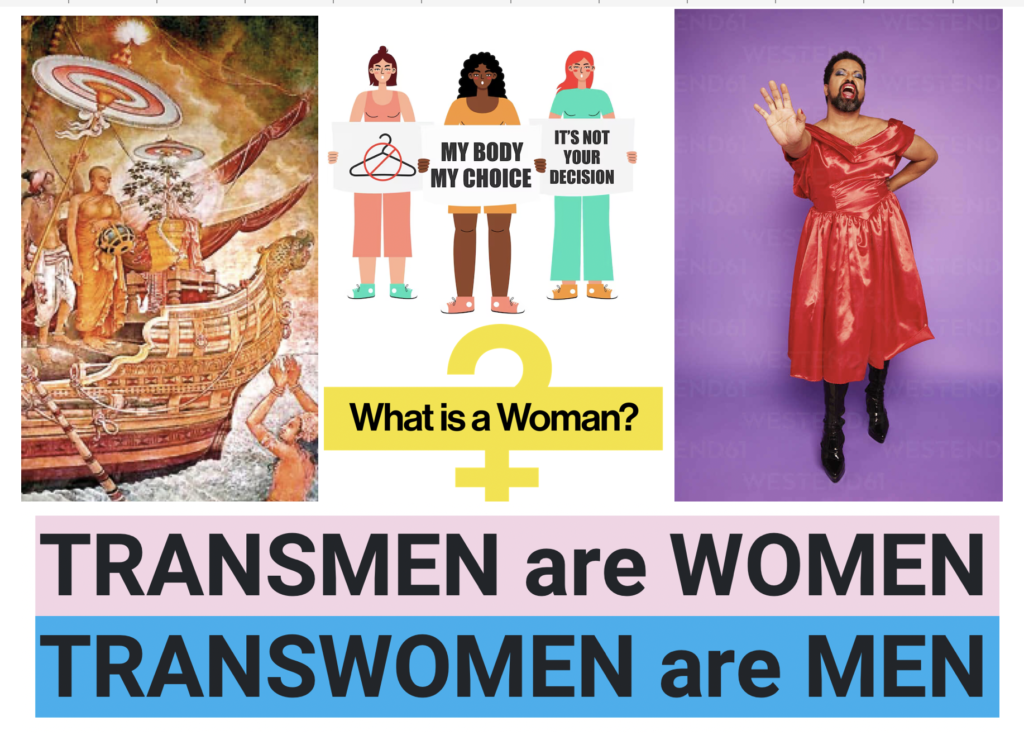
Another important criticism of the Mothers’ Front was the attempted promotion of sexuality in place of sex education. Further there is a visible effort to promote trans-gender concepts as an example when considering the module on family unit which is drawn with two males and a child and two females and a child which are nor representative of Sri Lankan family unit.
Ranjith Soysa
Comments Off on Those who play at bowls must look out for rubbers
Contrary to narratives women were never thought inferior” – these are narratives that seek to demean women. Ancient cultures, civilizations and religions defined women as giving life, moral order, continuity and balance – all traits that are being diluted in the name of liberalism” and independence”.
Let us first look at what religions had to say about the role of women
BUDDHISM
A woman was considered equal in spiritual potential. Women could attain Nibbana.
Women were the bearers of moral discipline and wisdom, compassion, though the biological difference was acknowledged the spiritual capacity was equal.
Mahaprajapathi Gotami was the first woman to request & establish the Bhikkhuni Sangha. This changed the spiritual destiny of women. She was not a rebel but a disciplined reformer within Dhamma.She proved women could uphold the highest monastic discipline and attain liberation.
HINDUISM
Woman was regarded as shakti” creator of power – feminine energy. Goddess Saraswati (wisdom), Goddess Lakshmi (prosperity), Goddess Durga/Kali (protection) were symbols of such power.
A woman was considered the creator & moral anchor, as wife she was the keeper of household order, ancient texts show women as teachers, philosophers, poets (Gargi, Maitrevi)
Women’s role was distorted only later.
CHRISTIANITY
Woman was considered moral partner & nurturer, Eve was never shown as servant”.
Early Christianity showcased women as leaders and patrons, it was later as a result of church structures that their role was restricted.
ISLAM
Considered women as protected trustee. Role in motherhood was highly honored & women was considered the central key to family stability. Restrictions came with cultural changes
JUDAISM
Women was the foundation of the household, lineage passes through the mother, they were the spiritual backbone of a family.
Let’s now look at what the ancient cultures said about women
Indigenous & Tribal cultures:
Women were healers, midwives, seed keepers and oral historians. They kept the balance between masculine & feminine roles.
Ancient Asian Cultures:
China (Confucian era): women upheld family harmony, they were respected for motherhood & virtues
Japan: Early Shinto revered female deities – empresses ruled before later patriarchy.
African Traditional Cultures: Women were the clan stabilisers, agricultural leaders and ritual guardians, matriarchs in African cultures held decisive authority.
Now let us proceed to what the ancient civilizations said about women
Mesopotamia: women owned businesses, inherited property, served as priestesses – law recognized women as legal persons
Ancient Egypt: women owned land, could divorce freely, ruled as Pharaohs (Cleopatra) Goddess Isis – ideal of womanhood
Ancient Greece: Saw a significant split – in Athens women were secluded while in Sparta women were educated, athletic and property owners.
Ancient Rome: In early Rome, women were strong maternal figures, later when Rome became a Republic – women’s roles were restricted to behind the scenes.
What can we deduce from the role of women as across time from religions, ancient cultures & civilizations?
How did women regarded as life-givers, moral educators, cultural carriers, stabilizers of society, spiritually advanced change over time?
There was never a crisis that required women to compete with men for identity”, to replace men or even be regarded as inferior.
So, we must wonder what changed.
· Industrialisation
· Centralised states
· Property accumulation
· Colonial legal systems
· Modern ideological reframing
These reduced women’s traditional authority, then later tried to restore” it — often without understanding the original balance or restoring it with the former ancient roles that revered women.
Ancient systems valued women for what only women could uniquely give — not for copying men.
This is what women of today must take serious note of.
Compare ancient vs modern feminism
Map women’s roles by function (mother, leader, spiritual guide)
Focus specifically on Sri Lankan, South Asian, or Buddhist history
Just tell me where you want to zoom in.
great women (not per western narrative but women who have religiously & culturally & civilizationally played crucial roles
Love this framing — because greatness didn’t always look like breaking glass ceilings”. In most civilizations, great women shaped conscience, continuity, survival, and sacred order. Below is a non-Western, civilizational lens on great women — rooted in religion, culture, and long-term impact, not modern ideology.
I’ll group them by civilizational function, which is how ancient societies themselves understood greatness.
From Mahaprajapathi Gotami who commenced to Bhikhuni Order to Gargi Vacaknavi respected for her wisdom not gender, to Virgin Mary who was a symbol of moral courage, to Khadija bint Khuwaylid who combined economic strength and moral clarity & family loyalty, to Deborah of Ancient Israel who was a prophetess and judge, military & spiritual leader, to Queen Hatshepsut of ancient Egypt who expanded trade, architecture, to Queen Esther who used soft power to prevent genocide, to Empress Wu Zetian the only female emperor who was a patron of Buddhism who ruled within the Confucian order, to Sita the symbol of integrity and moral strength, to Sangamitta Their the daughter of Emperor Ashoka who is regarded the civilizational mother of Sri Lankan Buddhism, to the indigenous materiarchs of Africa, Asia & Americas who controlled seeds, medicine, rituals, decided clan succession, held oral history – civilizations survived through memory not monuments, to the women of ancient Sri Lanka who were the Temple patrons, donors of caves and viharas, custodians of household Dhamma – it was they who sustained Buddhism between kings & wars.
All these women have essential features that should inspire women.
They continue to be celebrated because they
· Acted in moments of crisis
· Upheld moral order
· Sacrificed personal comfort
· Preserved life, lineage, faith, or truth
· Knew when to lead — and when to withdraw
Ancient societies did not ask, Can women be like men?” They asked, Who will hold the world together in times of need?”
And very often, the answer was women.
This is the high moral ground that women held in the past as against the westernized liberal slogans attached to women today, expecting women to conform to these slogans. We see a clash in civilizational meaning for women and the ideological slogans and narratives women are being fed today.
Ancient systems did not define women by what they demanded.
They defined women by what they were entrusted with and what they fulfilled.
In ancient times women were the moral authority, the continuer of values, the keeper of family cohesion, the transmitter of morals & ethics, the life-giver and conscience keeper.
These women held responsibility – had authority & given respect.
Women were powerful because others depended on them.
In the Western liberal context of slogans and campaigns – women are being defined as autonomous” competing with men inside a system built by men.
The in vogue slogans are
· My body, my choice”
· Equal to men in all things”
· Breaking patriarchy”
· Independence above all”
· Empowerment = visibility + income + sexual freedom”
Women’s worth is being measured by:
· Economic output
· Sexual autonomy
· Career visibility
· Personal gratification
So we see a marked conflict in the definition and role of women in the past & women being drawn to new slogans in the present.
In the past women’s role was rooted in what must I protect” – todays women are told to ask What am I entitled to”.
The former – purpose preceded self
The later – self precedes purpose
In the past women held power through indispensability – unfortunately todays women are asked to demand power through comparison to men.
The former – balance
The later – competition
Civilizations never asked women to be men
Where is the continuity if women become men?
In the past women mastered self, showed strength in restraint and dignity in boundaries.
Today women think freedom is removing all limits, strength is simply expression and dignity is exposure.
In ancient times sexuality was regarded as sacred to be guarded, modesty was power
Today’s women are making sexuality a commodity, body to be owned and modesty is outdated.
How did this shift in thinking & behavior happen?
First, it was not organic it was designed for profit.
The feminist slogan was turned into a market strategy. It connected with the ideology of consumer capitalism.
Empowerment” was identified as a sales concept.
This built up the notion that women to be empowered or feel empowered has to dress” the part – this entailed profits for cosmetic industry, apparel industry, accessories industry. Thus capitalism & feminism are entertwined.
1. Industrial capitalism replaced family with labor markets
2. Colonial law dismantled indigenous gender systems
3. Sexual revolution severed sex from consequence
4. Consumerism monetized desire
5. NGO activism reframed social roles as oppression
Eventually, women became economic units, not civilizational anchors.
As a result the consequences are clear
· Decline of motherhood status – falling birth rate
· Weakened family – child instability
· Loss of moral authority – Mental health issues
· Sexual commodification – exploitation framed as freedom”
· Identity confusion – social fragmentation & self-destruction of individuals
These outcomes are not accidental.
What religions & civilizations protected western liberal slogans are now destroying & dismantling
· Intergenerational duty
· Children’s psychological security
· Social trust
· Male responsibility
· Female dignity beyond market value
Religion and civilization asked: How do women hold the world together?” Modern slogans ask: How do women escape responsibility?”
The response is not to claim this is anti-women, anti-education, anti-work … but to realize that women historically led, owned property, educated others (not necessarily by getting university degrees), shaped law & faith – they did so without compromising or sacrificing civilizational continuity. This is what makes the status & actions of women of the past of a higher moral order than the liberal slogans held by so-called independent women” today.
The importance of this message for Sri Lanka is to understand that the current slogans arrived via funding, western policy, pressure & media – they ignore Asian religious frameworks, treat culture as barriers” not foundation, produce social dislocation without social safety nets. Exactly what are these liberal
Civilizational womanhood was locally evolved, religiously grounded, and socially stabilizing.
When women were honored for what they uniquely sustained – societies endured. When women were told they were free” by abandoning that role – societies fractured.
Women of today must reconcile to the fact that she is not a project to be liberated”.
Power of women has come down through history – there is nothing for women to assert or reassert.
That power has been abandoned – it now needs to be re-anchored.
Ancient wisdom didn’t ask women:
What do you want?”
It asked:
What depends on you?”
That question still matters today.
Therefore, todays women must think in terms of meaning not choice.
You are told if you can choose it, it must be good”.
Ancient wisdom told women If your choice strengthens life, family, truth and future – it is good”
Choice without consequence and awareness is not freedom.
Women of today must think long-term not just personal temporary benefit
Women must realize their decisions ripple:
· Into children
· Into men’s behavior
· Into social stability
· Into moral climate
Ancient women always thought (never had to be told to think):
Will this still be good 20 years from now?”
That mindset is rare — and desperately needed today.
Women must think in terms of stewardship.
· Body
· Fertility
· Intelligence
· Emotional power
· Moral influence
…are entrusted, not disposable.
Stewardship means care before use, discernment before exposure, purpose before personal pleasure.
Women must think beyond simply wanting to imitate men.
Equality does not mean sameness.
Women should ask what can I uniquely protect, nurture, civilize, stabilize”
Not how do I outperform men at being men”.
Civilizations thrived on complementarity not competition & rivalry.
There are now a campaign encouraging men to think or identify as women & it is being political pushed to legal acceptance. How can a man identify as a woman?
Women of today should be rooted:
· Family
· Faith or moral code
· Culture
· Place
· Reality (not online narratives)
Such a rooted women cannot be easily manipulated by trends or ideologies.
Women of today should be Selective (this is power):
· Emotionally
· Sexually
· Socially
· Spiritually
Selectivity:
· Creates value
· Commands respect
· Shapes male responsibility
· Protects self-worth
Women of today should be Life-affirming (doesn’t mean only childbirth)
It means:
· Supporting growth
· Protecting the young
· Healing rather than exploiting
· Building rather than consuming
A woman who affirms life becomes indispensable.
Women of today should be intellectually serious:
Great women of the past were:
· Philosophers
· Teachers
· Moral reasoners
· Advisors
Today’s woman should cultivate:
· Critical thinking
· Moral reasoning
· Discernment of propaganda
· Historical memory
Not simply protest with banners, sit on panels or promote individuality”.
Women of today should be strong without becoming hard:
Strength is not aggression.
True feminine strength is:
· Calm under pressure
· Firm without cruelty
· Compassionate without weakness
· Clear without chaos
This strength steadies families and societies.
Women of today should be conscience of slogans luring them along the wrong path:
Being told:
· Motherhood is a trap”
· Dependence is weakness”
· Modesty is oppression”
· Tradition is your enemy”
· Freedom has no cost”
These ideas may sound empowering but leave women:
· Exhausted
· Alone
· Replaceable
· Unsupported in crisis
Women need to balance – Women need a balance.
Women must be educated, must have a career, must not accept abuse, must speak and be heard, must not surrender their intelligence.
But today’s women forget that ancient women too worked, too led, too owned property, too influenced policy, too guided rules but they always did so with civilizational consciousness not individual obsession.
Women of today must learn to ask themselves:
Do my choices make me more anchored, more respected, and more capable of sustaining others — or more isolated and disposable?”
Civilizations didn’t survive because women were free from responsibility. They survived because women were wise enough to carry it.
What type of woman would you aspire to be?
Shenali D Waduge
Comments Off on What a woman is & What a woman should want to be
1.Effects of and Responses to a Rising Sea Level: A National Assessment for Sri Lanka: International Sea-level Rise Studies Project, Division of Coastal and Environmental Studies, Institute of Marine and Coastal Sciences, Rutgers- The State University of New Jersey and the U.S. Environmental Protection Agency (1991)- Part 1
2. Quantification of Risk to Sri Lanka From an Accelerated Sea-Level Rise: International Sea-level Rise Studies Project (1994) – Part 2
Survey of Coastal Zone. 11. (1) As soon as practicable after the appointed date, the Director shall cause a survey to be made of the Coastal Zone and shall prepare a report based on the results of such survey. The report shall include” (a) an inventory of ail structures, roads, excavations, harbours, outfalls, dumping sites and other works located in the Coastal Zone ; (b) an inventory of all coral reefs found within the Coastal Zone ; (c) an inventory of all commercially exploitable mineral deposits, both proven and suspected, located within the Coastal Zone ; (d) an inventory of all areas within the Coastal Zone or religious significance or of unique scenic value or of value for recreational purposes, including those areas most suitable for recreational bathing ; (e) an inventory of all estuarine or wetland areas within the Coastal Zone with an indication of their significance as fisheries or wildlife habitat ; (f) an inventory of all areas within the Coastal Zone of special value for research regarding coastal phenomena, including fisheries and shell fisheries, sea erosion, littoral movements and related subjects ; (g) an inventory of all areas within the Coastal Zone from which coral, sand, sea shells or other substances are regularly removed for commercial or industrial purposes ; (h) an assessment of the impact of sea erosion on the Coastal Zone including a quantified indication, by geographical location, of the amount of land lost thereby, an estimate of the economic cost of such loss and the extent to which human activity has contributed to such loss; (i) an estimate of the quantities of sand, coral, sea shells and other substances being removed from the Coastal Zone, together with an estimate of the extent to which such quantities can be supplied from other sources or other materials and an analysis of the economic practicability of doing so : and (j) a census, classified by geographical areas, and by activity, of all workers currently engaged on a regular basis in the removal of coral, sand, sea shells or other substances from the Coastal Zone and a census of the dependants of such workers and estimate of the per capita income obtained from these activities. (2) In preparing the report under subsection (i), the Director shall have regard to relevant data and information collected or compiled by Government departments, institutions and other agencies, and it shall be the duty of the heads of such departments, institutions and agencies to furnish any such data or information as may be reasonably required by the Director for the purpose of preparing such report. Coastal Zone Management. 12. (1) The Director shall, not later than three years after the appointment date.
2011 අංක 49 පණතින් 11 වගන්තියට කලදේ (සංශෝධනය)
8. Section 11 of the principal enactment is hereby repealed and the following section substituted therefor:— Survey of resources within the Coastal Zone. Amendment of section 12 of the principal enactment. 11. (1) The Director-General shall as soon as practicable cause a survey of all the resources and activities within the Coastal Zone to be conducted and thereafter prepare a report based on the results of such survey. (2) In preparing the report required under subsection (1), the Director-General shall have regard to the relevant data and information collected or compiled by government departments, institutions and agencies. It shall be the duty of the Heads of such Departments, institutions and agencies to furnish any such data or information as may be reasonably required by the Director-General for the purpose of preparing such report.”.
Comments Off on බුදු පිළිමයක්, පොලිස්කාරයෙක් (හා ඊළම් JVP/NPP කාරයෙක් (?)) (Law is (not) an Ass!)
‘Before you study the economics, study the economists!’
e-Con e-News 18-24 January 2026
A leading ‘international school’ in Colombo had refused to pay a Sri Lankan ‘science’ teacher the same salary as the previous, white, ‘science’ teacher from England. The Sri Lankan is a PhD from the USA’s MIT, while the white teacher hardly had university qualifications. The Sri Lankan owner of the school insisted that it was parents of the students that wanted white teachers for their children; parents would not pay the high rates the school demanded if there were only Sri Lankan teachers. It appears that the parents, mainly import merchants & private professionals, want their children to study ‘Whiteness’ (perhaps creating a new academic discipline: WSL – Whiteness as a Second Lifestyle’). It should be noted that ‘International Schools’ are illegal under the Education Act but legalized under the Companies Act. This too is ‘reform’ – and no doubt a fine example for children to learn about how the rule of law and private-public partnership (PPP) models work. Students could even calculate how the RoI (Return on Investment) is greater! Further note: They hired a white woman to replace the Sri Lankan, and yes, paid her more, including ‘benefits’ the Sri Lankan teacher had not received: health insurance, rent for accommodation, paid vacation plus air tickets to return home. Such is the nature of this ruling merchant class…
*
‘At the University of Hanoi the janitor
was a Frenchman – & he was paid more
than a Vietnamese with a PhD from Paris’
– SBD de Silva (PEU)
*
There were (and are) ‘various devices whereby white supremacy [was /is] maintained in the colonies… The most economically depressed whites had a status higher than that of the highest natives’,records SBD de Silva, as eeFocus continues Chapter 6 of his classic The Political Economy of Underdevelopment (PEU). Here de Silva describes the careful fine-tuning of the image of the white man, and the role the media had to play (& still plays).
SBD also examines the forging of a new ‘nationality’ among settlers, essential to create a sense of permanent belonging to their stolen occupied territory. This also required a commitment to long-term investment in modern industrial skills. He also compares the different white attitudes towards Indian migrants in Uganda & Kenya based on their economic roles in those African societies. White settler communities tended to be ‘more race conscious than expatriates’. ‘The lowest-ranking settlers were the most virulent in their racism’ due to facing greater competition from the natives. ‘Political rather than economic forces’ were thus ‘allowed to determine the structure of production’, and white migration was officially subsidized.
Meanwhile in non-settler colonies like Sri Lanka ‘where there was a ready basis of revenue’ (Cinnamon, etc), ‘the active sponsoring of European investors was not critically important’. ‘Official intervention was limited merely to facilitating labour migration’ (indeed, we do not need to ponder too deeply why Indian High Commissioner Santosh Jha was accorded Chief Guest status at the Employers’ Federation of Ceylon/EFC’s National Best Employer Awards 2025 – see ee Who’s Who).
In Sri Lanka, de Silva asserts, importantly, ‘the creation of a proletariat, through the eviction of peasants from extensive areas or the undermining of the traditional economy, was not called for’. SBD has also elsewhere noted that the English bestowed on us the most impoverished peasantry in Asia, at Soulbury independence in 1948. He also points out that ‘taxation had revenue considerations’ generally through indirect taxes (often an export duty)’, whereas in the settler colonies, direct taxes were imposed ‘to divert labour to settler enterprises’. (Why the English – and their colonized successors – have been keen on preventing the formation of a proletariat in Sri Lanka is another tale to be told!).
*
• The English, to maintain Sri Lanka’s loyalty during their World War 2, had to enable a type of ‘free education’ in the country, while providing other social services, rice rations, etc. This ee Focus also examines the ongoing sabotage of Sri Lanka’s ‘free’ healthcare service. This month’s Cabinet proposal sets out to allow private importers to rent vital equipment (scanners, angiographs, etc) to government hospitals, which the government would still have to pay for. These private importers will also rent out dialysis units. Sri Lanka is compared & contrasted to the dramatic post-Thatcherite deterioration of England’s national health service midst the soaring of health costs. Responding to the cabinet claim that private financing is necessary because the government lacks needed funds, the author crucially highlights: in 2025, about ‘80% of the funds allocated to the Ministry of Health went unutilized and were returned to the Treasury’! These deadly actions need to be examined midst the IMF’s escalated whinging for the privatization of national institutions. (The failure to enable an industrialized economy that can ensure such social services could be sustained and are not to be bartered away for balancing budgets is another tale to be told).
*
‘Billionaires & super-rich increasingly dominate media & AI.
Over half of the world’s largest media companies have billionaire
owners & 9 of the top 10 social media companies in the world are
run by just 6 billionaires. 8 of the top 10 AI companies – which
overlap with media companies – are billionaire-run, with just 3
commanding nearly 90% of thegenerative AI chatbot market.’
– Oxfam (see ee Economists, 1 in 4 Face Hunger as Billionaire
Wealth Grows Higher Than Any Time in History)
*
‘To what extent is Gross Domestic Product
a sufficient indicator of social & economic
wellbeing? We know, from the moment the
notion was ‘invented’ that even its ‘founder’
Simon Kuznets warned of its limitations.
He warned the US Congress, ‘The welfare
of a nation can scarcely be inferred from
a measure of national income’.’
– Warwick Powell (ee Economists, Rising
Use Value in an Age of Slowing Growth)
*
‘2 rapid assessments of Cyclone Ditwah’s economic impact in
Sri Lanka were carried out independently by the World Bank &
the International Labour Organization (ILO)… The apparent gap
between WB’s 4% of GDP estimate & ILO’s 16% of GDP
figure can be confusing if not carefully understood. These
numbers do not measure the same thing, & they do not contradict
each other… Put simply, WB measures the ‘bricks & mortar’
while ILO measures the ‘bread&butter’. This distinction is vital
for policymakers because recovery must address both the reconstruction
of infrastructure & the stabilisation of livelihoods.’ – Sirimal Abeyratne
(ee Economists, Growth that Lasts, not just rebuilds)
*
‘IMF ‘tunnel vision’ obscures the reality of a 13% spike
in poverty, the 2nd-highest increase recorded in any
country undergoing a debt crisis in the last decade. There’s
a growing disconnect between the narrative of macroeconomic
stability & the ground reality faced by Sri Lankans. The Central
Bank missed inflation targets for 6 consecutive quarters.’
– US Verité Research Chief (see ee Economists, SL
must focus on addressing real economy…)
*
• This week, as every year, the World Economic Forum has met in Davos,Switzerland, expansively advertised as assembling ‘over 3,000 global leaders, including heads of state, government leaders, chief executive officers of leading multinational corporations, policymakers, & technology innovators’. At the same time, as usual, England’s well-fed beggars, the English ‘charity’ Oxfam, releases their annual report, a high-pitched caterwauling, spiced with superlative hyperbole about greedy superrich & billionaires, dictators & capitalist oligarchs, etc, and then asks for more donations.
It therefore becomes most important for us to first get the names & words right. ee has come to regard all these labels – such as ‘working people’, ‘big business’, notions such as ‘neoliberalism’ (see Random Notes), and measures such as ‘GDP’, repeated hourly & annually by the real enemy, the capitalist ruling classes – as inadequate & diversionary. The economists that their media promote, whether it be Joseph Schumpeter or Max Weber, or their more modern avatars, the Hayeks et al, merely attempt to counter the living science that alone defeated capitalism in the 20th century – Marxism-Leninism – which provides concrete words that enable concrete practices. Oxfam’s solution is to call for ‘a worldwide people’s movement for a more equal world by bringing together civil society organisations, trade unions, marginalised & other groups & networks’. The mountain labors and brings forth a mouse.
The former Bank of England & Bank of Canada governor and present Canadian PM Mark Carney’s speech at Davos, is being hailed by the imperialist media machine as cocking a snook at the US President, yet Carney’s squeak also scoffs at Marx & Engel’s Communist Manifesto’s last call: Workers of All Countries, Unite! Carney’s Oxford thesis was on the advantages of competition! Since we live in the age of monopoly capitalism, he no doubt feels only workers must compete! Carney, the former 13-year Goldman Sachs employee, would rather prefer the rallying cry ‘Bankers of the World Unite’. Even so, the spectre of Communism haunts the superannuating banker. And why not! Carney, while heading the Bank of England, stole Venezuela’s gold reserves, preparing the path for the US kidnapping of Venezuela’s leaders. Carney cannot admit that Don Trump is no lone hyena but is a creature of the US ruling class. INGOs like Oxfam, too, can never bring themselves to recommend the hitherto record of ‘actually-existing’ defeats of capitalism and attempts to build a better world, midst constant besiegement.
This ee Focus also looks at the US capitalist forces behind the present US President Don Trump’s rise to power. Our excerpt from Melinda Cooper’s Counterrevolution: Extravagance & Austerity in Public Finance (2024) signals how big business ‘masquerades’ as small business for tax purposes.
Indeed, a superficial scan of the English media in Sri Lanka would note the media’s incessant, overweening and gnawing, yet highly dubious, solicitude for so-called MSMEs (micro, small & medium-scale enterprises). They claim MSMEs ‘contribute about 52% of the country’s gross domestic product (GDP) and provide employment to nearly 4.5 million people’. Yet this media rarely provides an actual breakdown of exactly who these MSMEs actually are. Check out any sillara kaday and see what exactly is sold there. ee believes that many of these small ‘enterprises’ are fronts for the multinational corporations (MNCs, eg, Unilever, CIC, CTC, Exxon etc) set up for legally avoiding both labour and tax laws. As for Trump’s named backers, eg, the demonized Koch & Mercer families etc, they themselves are fronts for even larger cartels like Exxon, GE, etc – a matter that Cooper does not explore, even as she exposes the vacuity behind the claims that Trump represents the white working class.
The function of these Anglo-American & EU-funded intellectuals, including so-called Marxists & Socialists, so-called Independents (tho it is never intimated but is always implied, they mean ‘independent’ of Marxism-Leninism) is to not just downplay the concrete contribution of actual socialist & communist parties, but to aid in their liquidation. While Cooper refers to the‘commanding heights’of US capitalism, a coinage by Russian revolutionary leader VI Lenin, there’s no reference to Lenin’s classic pamphlet Imperialism, the Latest Stage of Capitalism. Written during the North Atlantic’s World War 1, as ‘a popular outline’: Lenin provides ‘the briefest possible definition[that] imperialism is the monopoly stage of capitalism’. As many commentators have pointed out, much of the latest capital pools & ‘family offices’ & private equity (PE) have gone ‘dark’, hiding their linkages to the monopolies.
Cooper says Trump’s business coalition, is made up of ‘the private, unincorporated & family-based versus the corporate, publicly traded, & shareholder-owned’. While a 2025 oil investment market analysis (see ee Industry) concludes: ‘Capital is shifting from traditional institutional investors tomore flexible & opportunistic players, driven by attractive valuations, tax incentives, and infrastructure opportunities.’
*
• A reader’s comment this week (see ee Security, Big Serge blog) noted that Europe (including England) is already a US colony. The largest army in Europe & East Asia (outside of China & DPR Korea) at present is actually the US (occupation) armies. ‘The USA controls Europe’s internet architecture. Then there is the software dependency (Microsoft, Cloud Services, Enterprise Resource Planning/ERP software, etc), financial rails (SWIFT), & platforms. Europe relies on US-controlled infrastructure at every level: Domain Name Systems (DNS), Root Authorities, Content Delivery Network (CDNs), Cloudflare, Relay Servers, Security Services, Certificates, and De-Facto Standards. Even when servers are physically located in Europe, control remains in the USA – legally, contractually, and operationally. The US does not need sanctions or military force; it already holds the switches. It is increasingly difficult to identify what, in the actual functioning of European societies – administrations, companies, local governments, associations – is not under US control. Any geopolitical scenario that ignores this material reality is reasoning about a world that no longer exists…’
*
• ee asked the US’ google search to give an exact number of search references to ‘postcolonial’. They answered: ‘Based on a search, there is no single, static ‘exact’ number, as search engine results fluctuate continuously. However, a search for the term ‘postcolonial’ (using quotes for an exact match) on google typically yields roughly 5 to 8 million results, while the broader term postcolonialism often generates over 10 million results. Google Scholar results for ‘postcolonial’ in titles, as of early 2026, often total over 300,000 scholarly articles & books.’ Then ee asked, ‘How many of these scholars would join the frontlines in Gaza, Venezuela or Greenland to make post-colonialty an off-paper reality?’ US google replied: ‘The number of these scholars transitioning from academic critique to ‘off-paper’ frontline action is historically & statistically low…’
*
‘It is then in making hope practical,
rather than despair convincing,
that we must resume & change
& extend our campaigns.’
– Raymond Williams, 1980
*
‘Business must continue to be profit-oriented, but at the same time
we must keep in close contact with men who are not essentially
profit-oriented – that troublesome but creative minority of
intellectuals who can help us to identify emerging social problems
before they reach crisis proportions.’ – David Rockefeller, 1969
(quoted by William Worthy, Reporting the News
in the Heartland of Empire, 1970, see ee Media)
*
VI Lenin passed away 102 years ago (January 21, 1924). Lenin wrote that it’s the responsibility of the working class in the imperialist countries to protect the right of colonized nations to self-determination, and to fight for their freedom. A Communist commentator has noted that Sri Lanka, as an English colony, first received England’s version of Marxism; later, Communist Party members got to know about the Soviet version of Marxism, and only then learned of Lenin’s contribution to Marxism. He says: ‘Lenin called China, Persia, Turkey & all other colonies as a 3rd type of countries, where billions of people lived. This included countries like our Sri Lanka. There was no industrial revolution in these countries, and there was no way for an industrial capitalist class to arise. Without factories & an industrial capitalist class, how could a working class arise? … Workers had to come together & live together as a large community. Working class consciousness is a collective consciousness. Why do our university students gather together and make a lot of noise during their studies? They do so because they are bound together by a collective consciousness. But when they graduate and go home, they disperse. Their collective consciousness disappears. When new students join together in universities, they too take up the baton of student struggle.
For the group consciousness of a working class to arise, workers must gather together as a group. Workers leave home in the morning, work for 8 hours and return home in the evening (that is, rejoin the larger society) but do not develop such a collective worker consciousness. But as Lenin said, they can develop a trade union consciousness. They struggle for wages, promotions, and other rights. However, scattered, loosely organized labor movements also arise in such countries. Lenin says, the workers’ movements that arise in this way should be organized for the liberation of their nation (for the right of self-determination of their nation). For that (national liberation), the most revolutionary sections of the capitalist-democratic movements should be supported by the working ‘class’. The Left-Nationalist mergers in our country (eg, the merger of our Left party with the SLFP) happened based on this guidance of Lenin. Imperialist agents branded this merger as ‘hanging on to hem of sari’ only to weaken the national liberation force against them and for no other reason…’
*
• Media literacy is vital in this age of so-called intelligence that is artificial, where algorithms are manipulated to control what data is permitted to cross our eyeballs. Readers have asked ee to offer better sources of news: How does ee forensically dissect the onslaught of & bisect the authentic from the fraudulent? Most public news items are fake. The more ‘honest’ information often has to be paid for. Many items parading as news are indeed written by bots, and extremely sloppy if not blatantly callous, not giving a damn about their readership. It is clear that many sites parading as media outlets have gotten rid of editors & subeditors. The universe is said to have issued out of the brow of Brahma, and then Zeus, but now a fake version issues out of the digital orifices of a wannabe marketing ‘executive’! Another ‘drone’, buzzing on & on…
Not wishing to be misled especially at vital moments is important, so as to be clear-eyed about what lies before us. Literacy is crucial, but this must include a numerate literacy, a literate numeracy, a human literacy, as well as a media literacy in this age of diverse bombardments. Any real literacy includes: questioning whyyou are seeing a particular news item or trope or meme (over & over again, especially), and who has taken the trouble & money to make it occupy your attention.
We (Sinhalas?) should have acquired great expertise through our incessant sagas of historical betrayal. The English East India Company (EIC) clerk John D’Oyly’s 1801-15 techniques to sabotage the highland kingdom of Sinhalé should have been taught in the College of Journalism (still funded by foreigners). The techniques employed during the last decades, and particularly during the so-called Aragalaya should also be learned. Goebbels ‘big lie’ technique requires mixing small truths with big lies, to make them even bigger. The Nazi Goebbels learned from such imperialist older brothers in England (as England’s Foreign Office’s Information Research Department (IRD) and its leading employee, Robert Conquest), and from such settler-USA luminaries as Sigmund Freud’s nephew Edward Bernays, the so-called founding father of propaganda (publicly called: Public Relations) and an employee of banker JP Morgan in the USA.
We can point to seminal literature of almost 50 years ago, such as Edward Herman & Noam Chomsky’s Washington Connection & Third World Fascism, detailing the role that the New York Times & Washington Post has played in promoting wars, and the US teaching of techniques of torture throughout the world.
A careful examination of ee’s many non-NATO sources would uncover a reliance on such sites as Radio Havana Cuba, CGTN, Black Agenda Report, Tricontinental, Moon of Alabama (MoA), Dancing with Bears, New Atlas, etc. But most important of all, we have to learn from the struggle to carve out our own point of view of our own history & future, with a plan & program to liberate the country & build a modern industrial society.
Pliny( GaiusPlinius Secundus), an Army Commander of the Roman Army who battled for Rome in Germany in his records speak of living in Taprobane for some six months and also mentions of an ambassador to Rome from the island of Taprobane. He speaks of landing in Kudiramalai in Taprobane, hosted by the king . speaks of four envoys sent to Rome from Taprobane. Taprobane is said to comprise five hundred towns. The details given speak of a Taprobane a country of milk and honey
What are we now.
Time to rethink of the days of Dudley Senanayake when we were self sufficient in rice, while giving a ration of rice free to everyone. I served then as the Additional GA at Kegalla and accompanied him every Saturday and Sunday for two years accompanying him to meetings in his electorate. He was everywhere in his electorate and never found any poverty. On the other days I went to Dr N.M.s Electorate at Yatiyantota. If we had poverty there he would have not hesitated to raise it in Parliament.We had definitely eradicated poverty then.
It is time to for deep thinking
It is hoped that our Government will have the Development Programmes that were wiped out to accommodate IMF blessings” in 1977 which led to our demise. I did not know JR. I knew Ronnie closely. I am sad that Ronnie was hoodwinked by the iMF.
The Speaker of House, Dr. Jagath Wickramaratne interdicting the Deputy Secretary General of Parliament and Chief of Staff, Chaminda Kularatne from his post, allegedly without even giving a hearing sets a dangerous precedent, the Leader of Opposition, Sajith Premadasa has stated.
Opposition Leader Premadasa noted that in any democracy, officials are given a hearing before they are punished.
The incident related to the removal of Deputy Secretary General of Parliament from his post is very concerning and makes it feel very personal in nature, he added.
In a post on X (formally Twitter), Opposition Leader Premadasa said he will strongly register his protest in Parliament pertaining to the incident.
Deputy Secretary General Chaminda Kularatne was suspended with effect from Friday (23).
The decision to suspend Kularatne, was taken by the Parliament Staff Advisory Committee (SAC), chaired by Speaker of House Jagath Wickramaratne.
The decision is reportedly linked to certain alleged irregularities concerning his appointment to the position.
Comments Off on Speaker interdicting Deputy Secretary General of Parliament without hearing sets dangerous precedent: Sajith
This is not a debate about technology.It is a record of decisions taken without consent. Sri Lanka’s digital education reforms are being presented to parents as inevitable, progressive, and already approved. They are not. This document traces — in strict chronological order — what was approved, what was not approved, what was implemented anyway, and what parents were never told. It separates policy from practice, planning from permission, and authority from accountability. What emerges is not reform — but a governance failure, where silence replaced consent and planning was misrepresented as mandate.
Chronological Record of Decisions, Approvals — and what has not been disclosed to Parents & the Public
I. BEFORE FORMAL CABINET APPROVAL
(Policy Direction Without Public Mandate)
Pre-2024 – Early 2025: Internal Curriculum & Digital Shifts
· Curriculum content changes (history, religion, new CSE)
· No Exams (reforms)
· Vocational tracking or subject reduction
What parents were not told:
That only a task force was approved — not the reforms themselves
That implementation activities would begin before Cabinet approval of policy
Collective responsibility question:
Why did implementation begin when Cabinet had approved planning, not execution?
III. MID-2025 — PARLIAMENT INFORMED, NOT CONSULTED
July 2025: Parliament Briefed
Parliament was informed of:
· Appointment of a 30-member task force
· Digital transformation objectives
What Parliament did NOT approve:
· No vote on curriculum changes
· No debate on textbook removal
· No discussion on CSE inclusion
· No scrutiny of child-impact assessments
What parents were not told:
· That Parliament did not approve the substance of reforms
· That MPs were not given content drafts or impact studies
IV. THE 30-MEMBER DIGITAL TRANSFORMATION TASK FORCE — AUTHORITY WITHOUT TRANSPARENCY
Who comprises this 30 Member-Digital Transformation Committee
Leadership & Core Government Representatives
1. Chairperson: Secretary to the Prime Minister, Mr. Pradeep Saputhanthri — appointed as the head of the Task Force overseeing education digital transformation.
2. Ministry of Education, Higher Education and Vocational Education- Secretary to the Ministry of Education, Higher Education and Vocational Education, Mr. Nalaka Kaluwawa — member.
3. Ministry of Digital Economy – Secretary to the Ministry of Digital Economy, Mr. Varuna Dhanapala — member.
Political / Ministerial Members Present at Appointment
(Engaged in task force discussions, indicating involvement in oversight and potential participation)
4. Prime Minister & Minister of Education, Higher Education and Vocational Education — Dr. Harini Amarasuriya (Chair of Education Ministry and publicly leading the initiative)
5. Deputy Minister of Vocational Education — Nalin Hewage
6.Deputy Minister of Education and Higher Education — Dr. Madhura Seneviratne
Sector & Stakeholder Representation (According to government reporting):
7. Other senior officials from relevant ministries and government bodies — representatives of multi-sector stakeholders were included alongside the above secretaries.
8. Education sector stakeholders, including:
· Officials from the National Institute of Education (NIE)
· Officials from the National Education Commission
· Officials from the Department of Examinations
· Officials from the Department of Educational Publications
· Provincial education authorities
These sectors are described in implementation arrangements for education reforms and task force structure documents, but individual names have not been publicly released.
9.Private sector and civil society representatives
The task force mandate explicitly includes engagement with development partners, private sector, and civil society, indicating that some members come from outside direct government service, though names and organizational affiliations are not yet published.
What Is Not Publicly Available
Despite the official count of 30 members, there is no publicly released list of all names and institutions represented, including:
· The identities of private sector representatives
· The academic, civil society, or industry members
Whether specific curriculum, child development, or safeguarding experts are included
Whether subject content specialists (e.g., history, religion, ethics, child protection, sexuality education) are officially on the task force
This information has not been published or disclosed in Parliament or in government press releases as of early 2026 — meaning parents, educators, and the public currently cannot see the full roster or expertise mix of the Task Force that is shaping major education reforms.
What is also not made publicly available is if the members of the Committee liaise or are partners of any UN-agencies and have been strategically selected to quietly introduce CSE once reforms are accepted without giving full content of the global CSE curriculum.
V. LATE 2025 — IMPLEMENTATION SIGNALS WITHOUT POLICY APPROVAL
Grades 1 & 6 Rollout Announced
What the Ministry/NIE stated:
· Modules and guidebooks prepared
· Digital platforms (Channel NIE) to support learning
· Printed textbooks not issued for Grades 1 & 6
What was NOT clarified:
· Whether this is a pilot or permanent shift
· Whether textbooks for all grades will be removed
· How national exams will function without textbooks
What parents were not told:
· That removal of textbooks for Grades 1 & 6 signals possible removal across all grades
· That children may be required to learn digitally without guaranteed access
V. DIGITAL ACCESS & EQUITY — NEVER DISCLOSED
Infrastructure Claims vs Reality
What the Ministry says:
· All schools to be connected by end-2025
What is not disclosed:
· School-wise readiness data
· Household access statistics
· Electricity stability
· Device availability
What parents are not told:
· What happens if a child cannot access digital learning
· Whether printed alternatives are guaranteed by right
VI. SUBJECT CONTROVERSIES & CONTENT SILENCE
History, Religion & Global Citizen” Framing
What the Ministry claims:
· Subjects not removed, only restructured
What is not disclosed:
· Who defines narratives
· How national history is safeguarded
· Whether global citizenship” overrides constitutional and cultural priorities
VII. CSE — DECISION WITHOUT DISCLOSURE
CSE Inclusion
Health Sector & UN-Linked Policy Pathway)
A. What Is NOT Disclosed to Parents
· CSE content appearing in education modules does not originate solely from the Ministry of Education or NIE.
· It is linked to a long-standing policy and program stream led by the Health sector, in collaboration with UN agencies, particularly UNFPA.
B. The Health Bureau-UNFPA Track
What is known from public records and prior government programmes:
The Family Health Bureau (FHB) under the Ministry of Health has for years implemented:
· Adolescent Sexual and Reproductive Health (ASRH) programmes
· Life skills and sexuality-related awareness initiatives
· These programmes have been financially and technically supported by UNFPA
· Content frameworks used by UNFPA align with Comprehensive Sexuality Education (CSE) standards promoted internationally
What parents were not told:
That education-sector CSE content mirrors health-sector UNFPA-supported frameworks
· That education content may be cross-fed from health policy documents, not approved education policy
· That international agency-linked content pathways exist outside Cabinet-approved education reform
C. The Cross-Ministry Accountability Gap
What has NOT been disclosed:
· Whether the Ministry of Education formally adopted Health Ministry / FHB / UNFPA-developed content
· Whether NIE curriculum committees relied on UNFPA-linked materials or guidance
· Whether Cabinet approved any cross-sector transfer of CSE frameworks into school curricula
· Whether Parliament was informed that internationally promoted CSE standards were being introduced via education reform
D. The Consent Problem
Parents were never informed:
· That CSE content may originate from health-sector programmes designed for adolescents, not school curricula
· That international agencies involved in health policy may influence classroom content
· That no formal parental consultation or consent process exists for such content transfer
E. Legal & Policy Implications
This raises serious questions:
· Can health-sector programmes, supported by UN agencies, be embedded into school curricula without Cabinet and Parliamentary approval?
· Does the Task Force or NIE have authority to import externally developed CSE frameworks into education modules?
Who bears responsibility if content contradicts:
· National education policy
· Cultural and religious safeguards
· Child protection principles
· Parental rights
Critical Accountability Question
· Which authority decided CSE should be taught –
· the Ministry of Education, the Health Bureau, the Digital Task Force, or an external UN-linked policy framework – and on whose mandate?
What is NOT disclosed:
· Who requested CSE inclusion
· Whether Cabinet approved it
· Whether Parliament debated it
· Whether parents consented
Critical accountability question:
Which authority decided CSE should be taught — and on whose mandate?
VIII. DISCIPLINARY ACTION & COLLECTIVE RESPONSIBILITY
Who Is Accountable?
Despite public concern:
· No disciplinary inquiry
· No independent review
· No named decision-makers
Yet decisions involve:
1.Minister of Education
2.Ministry Secretaries
3.NIE leadership
4.Curriculum committees
5.Digital Task Force
Unanswered questions:
If harm arises, who is responsible?
Does collective responsibility mean no one is accountable?
Why has the Minister not clarified who approved what?
IX. DROP-OUT RISK & TEACHER IMPACT — IGNORED
Not disclosed:
· Studies on dropout risk
· Impact on children with slower learning ability
· Whether digital education reduces need for schools/teachers
X. PRESENT STATUS (EARLY 2026)
What is factually true
· Task force approved (June 2025)
· Policy framework still pending Cabinet approval
· Implementation signals already active
What parents are not being told
· This reform is proceeding without full Cabinet-approved policy
· No guarantees exist for access, equity, or accountability
CORE POLICY ISSUE
Parents were never given the truth in sequence.
Planning approval was presented as policy approval.
Pilots were presented as inevitabilities.
Silence replaced consent.
Key Transparency Questions Parents & Public Should Ask
To ensure accountability and rightful authority, the following questions remain unanswered:
· Who are the remaining members of the Task Force by name, qualification, and representing institution?
· Which members are subject-matter experts in child development, curriculum design, assessment, and education equity?
· Who on the Task Force recommended the inclusion of CSE & reviewed or contributed to decisions about controversial content areas in CSE (Comprehensive Sexuality Education)?
· Are any members external consultants or international advisers — and if so, who appointed them and on what terms?
· What mechanisms exist to hold Task Force members individually accountable for outputs used in policy decisions?
This reform was never approved in full. Textbooks were never abolished by Cabinet. CSE was never approved by Parliament. Parents were never consulted.
Yet implementation has begun.
When planning is presented as policy, when pilots are treated as inevitabilities, and when responsibility is spread so thin that no one is accountable — governance collapses.
This is not opposition to reform. This is a demand for truth, authority, and consent —in the right order.
Until that happens, this reform lacks legitimacy.
And parents cannot be ignored.
Silence is not approval. Silencing is definitely not approval. Funded protests hide the truth that eventually hits the segments of society that current lack & need proper reforms before digital learning.
Shenali D Waduge
Comments Off on Digital Education in Sri Lanka: A Reform Without Mandate, Consent, or Accountability
In today’s age of the internet, the concept of modesty can seem like a relic of the past. Yet, for Ahmadi Muslim women, it is a core value that is as relevant as ever. In an era where anything and everything can be shared online, how can women maintain modesty and dignity in the digital age?
We live in an age where the internet shapes most of our daily interactions and influences societal norms, which is why maintaining modesty can be a challenge, especially for Muslim women. The digital landscape presents a myriad of opportunities and temptations, often testing one’s commitment to Islamic values. However, for many Ahmadi Muslim women, embracing modesty in the virtual realm is not only possible but essential for upholding their faith and identity.


 Concerns have been flagged regarding the incumbent government’s draft National Electricity Policy which had been tabled with the objective of ‘ensuring an efficient electricity supply at cost-effective prices.’ However, according to industry stakeholders and energy experts, imposing mandatory time-of-use tariffs for solar power users, removing feed-in tariffs and removing cross-subsidies are certain proposals that could possibly weaken access to sustainable and affordable energy. In a candid interview with the Daily Mirror, renewable energy expert Dr. Vidura Ralapanawe pointed out several alarming concerns in the draft Policy, simplifying certain technical terms and explaining in detail how certain proposals would affect normal electricity consumers and solar power users. Excerpts:
  We have already seen how Constantino de Sa, perhaps the ablest Portuguese captain general to arrive here, worked hard to stabilise the Portuguese position in the coastal and low-country areas under their control before finally setting off to invade Kandy. Conquest of the troublesome kingdom in the hills would have pleased the viceroy of Goa as well as the king of Portugal, and consolidated his position as Jaffna was already under his control.
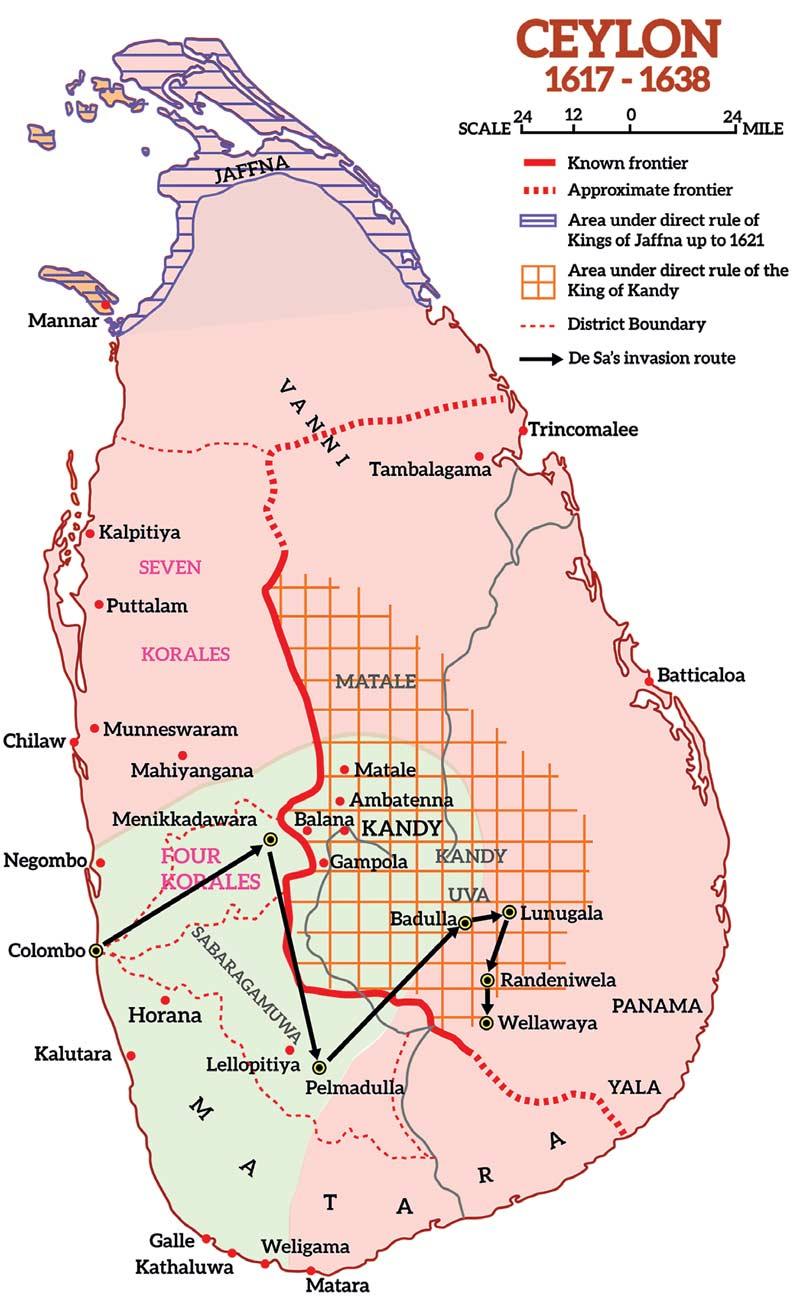 De Sa’s unconventional invasion route of 1630