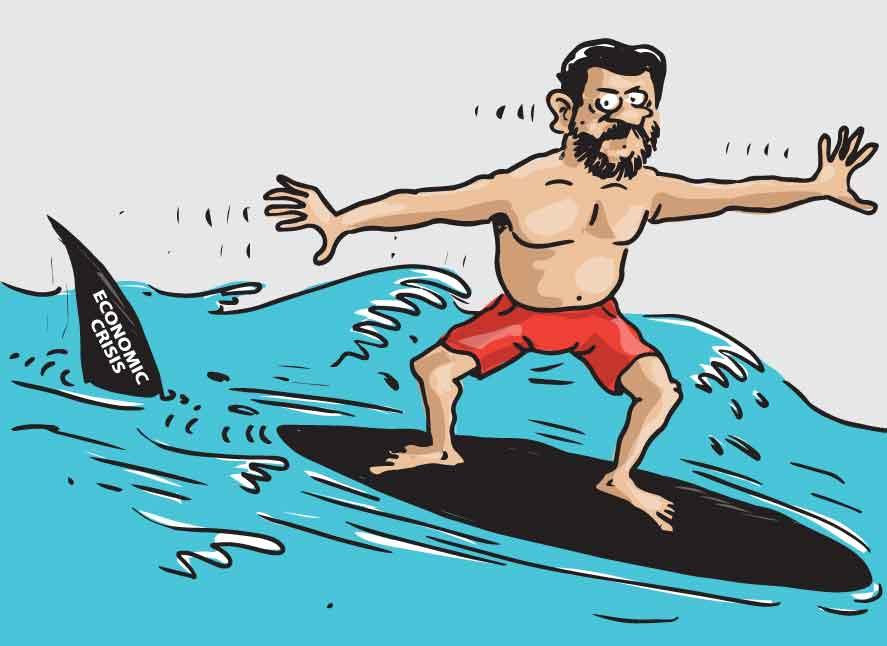
President Ranil Wickremesinghe’s manifesto for the 2024 Presidential Election was officially launched in Colombo, a short while ago.
The ceremonial event of unveiling the manifesto titled ‘Five Years of Winning the Country with Ranil’ commenced at the Taj Samudra Hotel in Colombo this morning (29), with the arrival of President Ranil Wickremesinghe at the venue.
This document outlines five principal components: Theravada Trade Economy,” Operation – Beyond 2025,” Make a Radiant Society,” Win the Motherland,” and Unite Sri Lanka.”
The ceremony is also attended by Prime Minister Dinesh Gunawardena, Ministers Ali Sabry, Bandula Gunawardena, Nimal Siripala de Silva, and other ministers, parliamentarians and political leaders supporting the President as well as religious leaders.
In a post on his official social media accounts this morning, the President said: Today, I lay out my manifesto to rebuild our country. I promise only what I can deliver, and I will do my best for our nation in the next five years. I will rebuild this country, and the next five years will be a triumphant time for Sri Lanka.”
The website www.ranil2024.lk, which features the manifesto of President Ranil Wickremesinghe who is running as an independent candidate in the upcoming presidential election, was also launched during the ceremony today.
In his policy statement, President Wickremesinghe outlines the priorities of the five-year plan: easing the cost of living, creating jobs, offering tax relief, promoting economic growth and implementing the ‘Aswesuma’ and ‘Urumaya’ programs.
As the first step, 100,000 new sources of employment will be created, thereby expanding the job market. Additionally, the manifesto mentioned that new income generation opportunities will be developed.
he Samagi Jana Balawegaya’s (SJB) presidential candidate, opposition leader Sajith Premadasa has handed over his presidential election manifesto to the Chief Prelates of the Asgiriya and Malwathu Chapters this afternoon (29).
Accordingly, Premadasa’s presidential election manifesto will be released to the business community and the public on 04 September, 2024.
The manifesto, titled Win For All” has focused on five key points – Building a resilient economy, Empower every citizen, enhance government service, Protect quality of life and safeguarding the nation.
COLOMBO, Aug. 28 (Xinhua) — In August, the scorching midday sun bakes the land in the central region of Sri Lanka, and the once plentiful river in Galewela has shrunk into a few small shallow patches, with dozens of egrets wandering around in the puddles.
However, not far away, clear water is flowing through an open canal over four meters wide and two meters deep, continuously irrigating the farmland, which is North Central Province Canal Project (NCPCP) undertaken by China State Construction Engineering Corporation (CSCEC) Sri Lanka Branch.
To address severe droughts in certain areas, the Sri Lankan government devised the Mahaweli Water Security Investment Program, aiming to divert the abundant water resources of southwestern Sri Lanka to the relatively water-scarce central, northern and eastern regions, with NCPCP being a significant component.
In May this year, the main part of the project was completed, covering 10 villages surrounding Galewela town and capable of irrigating nearly 400 hectares of farmland.
“In the past, we could only rely on deep well water to irrigate our fields during the dry season. With this canal built by China, our rice will be harvested twice a year instead of once, and we can even grow an additional season of vegetables,” said Kulasekara, a 58-year-old villager from Aluthwewa, Galewela.
Building the canal was not a smooth sail. Since construction began at the end of 2018, the project has faced challenges. Project Manager Guo Bingkui recalled that, due to the mainline of the canal passing through residential areas with much infrastructure, the construction process was fraught with difficulties.
“There was a section of the canal near a school and a mosque, so we had to find suitable times for construction, minimize vibrations, and reduce noise to avoid disrupting the school’s and mosque’s regular activities,” Guo said.
Liu Bingquan, deputy general manager of CSCEC Sri Lanka Branch, said that the project has consistently integrated construction with social responsibilities, providing over 600 local jobs and implementing the platform of the Luban workshop to train more than 80 local technical workers.
The sincerity and respect from the Chinese side have earned the trust of the locals.
“After the Chinese complete the construction, they restore and green the roads or do repairs for the villages, benefiting the villagers, so I’m willing to do my best to mobilize villagers from surrounding towns to support and cooperate with them,” said P.W. Wijekoon, president of the farmers’ association in Aluthwewa.
For many locals, the canal has also brought new joy to life.
In the evening, 24-year-old Mohammed Nurshad eagerly rushes to the canal to swim with friends after getting off work. “This canal benefits the town’s agricultural production and also brings joy to our lives,” he said.
Playing in the water, walking, washing…there’s always plenty to do by the canal after the sunset. ■
Two recent court cases have raised uncomfortable questions about diplomatic immunity.
Advocates claim to have helped as many as 20 domestic workers suffering unfair conditions in diplomatic households in Canberra over the years (Getty Images)
Australia has seen two extraordinary cases brought before the courts in recent months that have tested the limits of diplomatic immunity. This is not the cliché of foreign envoys flaunting traffic fines in Canberra, but a weighty clash involving the rights of workers and the posts that employ them.
The claims have tangled up a previous deputy head of mission from Sri Lanka and a onetime Indian high commissioner to Australia. Both these senior diplomats, along with their governments, opted not to engage with the legal proceedings.
The court, however, ruled that diplomatic protections do not apply.
The cases are separate, yet the facts as determined by the court are similar. Each case features a woman brought from their home country to work as a house cleaner and cook, only to have her passport taken away, be held in Canberra in effective isolation, and barely paid.
These are not stories about the contours of global affairs or the intricacies of treaty negotiations. Yet this kind of issue carries the potential to generate an international incident.
There is a prospect that similar cases will arise, or that resentments will be harboured that might rebound in unexpected ways.
On 15 August, judgement was handed down in an unpaid wages case against Sri Lanka’s former deputy high commissioner to Australia, Himalee Arunatilaka. The case was brought by Priyanka Danaratna, who travelled from Sri Lanka to Canberra in 2015 to work as a domestic servant for Arunatilaka. Danaratna had at the time never been overseas and had no English-language skills.
I worked seven days a week. I woke up at 5:30am, and by 6am I was working”, Danaratna told the court in an affidavit. I prepared breakfast at home and lunch for Ms Arunatilaka to take to the High Commission. I laid out the clothes for Ms Arunatilaka to wear to work.”
Danaratna would clean the house, do laundry and work in the garden but was not allowed to go to the shops by herself.
On one occasion during my employment with Ms Arunatilaka, I burned my hand on hot oil in the kitchen. It was badly burned. I called Ms Arunatilaka at work, and she came home and took me to the hospital. I had two days off work. Apart from these two days, I did not take any time off.”
Over the course of almost three years in Canberra, Danaratna was paid a total of $11,212 – less than 65¢ per hour.
Complicating the case was the question of diplomatic immunity. If the case had been brought against the Sri Lankan government, it would have had no chance. But the court found no basis to argue” that Danaratna was engaged to perform work for a foreign state. Nor did Arunatilaka’s conduct form part of her functions as a member of the mission” – so again, no immunity. The relationship between Arunatilaka and Danaratna was found to be a private contract between individuals. It followed a ruling in a 2021 case involving a domestic worker for Pakistan’s high commissioner to Australia.
Arunatilaka was found to have contravened the Fair Work Act in Australia as an employer, including requiring in excess of 10 ordinary hours of work in any one day, more than an average of 38 hours a week full-time, failing to pay overtime or penalty rates, or provide a monthly salary or payslip.
Arunatilaka was ordered to pay Danaratna $374,151.90, plus interest – a hefty amount that has caught attention in legal circles. A penalty hearing is expected in the coming days.
Arunatilaka is now Sir Lanka’s permanent representative at the United Nations in Geneva. She did not appear at the hearings or respond to a question I sent asking if she would comply with the ruling. Sri Lanka’s foreign ministry backed her conduct, stating Danaratna absconded” on the eve of her employer’s departure.
The statement also said it was standard practice” for diplomats to take domestic assistants abroad and the salary was mutually agreed”.
If standard practice, this points to a bigger question. How many similar arrangements are hidden in Canberra’s leafy suburbs? Or indeed, in other capitals around the world?
The visa category that allows full-time domestic workers to accompany someone who holds a diplomatic visa to Australia specifies a requirement to have an employment contract that meets Australia’s workplace laws” (Steven Tritton/Getty Images)
Advocates claim to have helped as many as 20 domestic workers suffering unfair conditions in diplomatic households in Canberra over the years. An ABC Four Corners investigation in 2018 also highlighted the problem. The visa category that allows full-time domestic workers to accompany someone who holds a diplomatic visa to Australia specifies a requirement to have an employment contract that meets Australia’s workplace laws” but advocates want stronger monitoring to ensure conditions are met.
Another recent court case also made significant findings.
In March, the federal court fined India’s former high commissioner Navdeep Suri $97,200 for breaches of the Fair Work Act following a case bought by his previous housekeeper, Seema Shergill. The circumstances of this case fall within this definition of slave-like conditions,” the court ruled, also rejecting that immunity provisions applied.
The evidence revealed that Ms Shergill was not employed by the High Commission nor performed any duties for the Commission.”
The court heard that Shergill had travelled from India to Canberra to work for Suri at his residence in September 2015, had endured long hours with no time off, whether for holidays or a sick day, and suffered ill-treatment, including not being allowed to leave the residence. The court also heard that the visa documents Shergill was required to sign were in English, though at the time she could not read the language.
The ruling in the Sri Lanka case included a passing jab at the perplexing” lack of bureaucratic attention for the visa application that saw a domestic worker brought to Australia.
Ms Shergill was paid every three to four months directly into a bank account in India, which had been set up for her by Mr Suri. Ms Shergill received only the equivalent of $2,496.08 during the entirety of the employment claim period [ending in May 2016],” the judgement said.
Suri did not appear in court, nor did he pay Shergill the $136,276.62 plus interest ordered by the court as compensation for unpaid wages.
I had no financial resources to engage lawyers in Australia to defend my reputation,” Suri told me in response to questions, denying wrongdoing.
And the Government of India chose not to contest as a matter of principle. They did not recognise the jurisdiction of an Australian court over an Indian diplomat or over a diplomatic service staff.”
Suri retired from India’s foreign service in 2019 and is now a visiting fellow with the Observer Research Foundation. He said the Indian government had taken up the matter vigorously” via diplomatic channels, while he also wrote to Australian officials ahead of the judgement, setting out a detailed response, and asked for letters to be passed to the court.
Suri said he had neither resources or the intention to pay the costs ordered.
A spokesperson said that Shergill had wilfully deserted her post” in a bid to say in Australia, that she had travelled on an official passport, was granted an Australian diplomatic visa, and urged Australia to uphold the Vienna Convention on Diplomatic Relations.
Foreign Minister Penny Wong was quizzed by local media about the case last year while in New Delhi, and was careful not to inflame any Indian response, saying only that the court had engaged substantively” with the scope of immunities under the Vienna Convention.
Diplomatic immunity is intended to protect open communication between countries, not be a catch-all excuse (Getty Images Plus)
The court was not asked to consider the role of the Australian government in either case. But the ruling in the Sri Lanka case included a passing jab at the perplexing” lack of bureaucratic attention for the visa application that saw a domestic worker brought to Australia.
There was no apparent attempt to conceal the arrangement,” the court observed, yet it should have been clear from the application that Danaratna was not going to paid nor enjoy the protections entitled to in Australia. It may have been the case,” the judgement said, that insufficient scrutiny was given by the [Immigration] Department prior to the inception of this arrangement. If there had been, the circumstances of Ms Danaratna’s employment may have been very different.”
The risk is now abundantly clear.
In Shergill’s case, the court heard she first slept on Canberra’s cold streets after leaving her job, and was then assisted by the Salvation Army. She was later offered residency in Australia under what is known as a Class DH, Subclass 852 Referred Stay Permanent visa. This plain technical label belies the seriousness of the visa category – intended for eligible victims or witnesses of trafficking who have contributed to an investigation or prosecution of a human trafficking related offence, and as a result would be in danger if they returned to their home country.”
The grant of this visa type indicates an assessment and awareness inside government of a problem with personal staff brought to Australia by foreign diplomats. An earlier court case in the United Kingdom involving a Filippino cleaner employed by a Saudi envoy also highlighted the risk.
A foreign worker in Australia without a passport can only obtain a replacement via their local embassy or high commission.
Neither of the recent judgments has led to a serious flare up in tensions for Australia with either India or Sri Lanka.
Local media in Sri Lanka acknowledged that the court ruling raises questions about exploitation, while arguing cultural context matters: For many Sri Lankan housemaids, such wages might be perceived as relatively high compared to local salaries,” one editorial said.
But this ignores the danger of entrapment that is at the heart of the issue. A foreign worker in Australia without a passport can only obtain a replacement via their local embassy or high commission.
Diplomatic immunity is intended to protect open communication between countries, not be a catch-all excuse. The issues raised by these cases clearly create the potential for friction between governments. The easiest answer would be to stop the practice of allowing domestic staff to accompany diplomats. That hasn’t happened.
The legal requirement to meet local workplace laws involves scrutiny of the arrangements by Australian authorities – this should not just as a box-ticking exercise at the outset, but carry the potential for monitoring. The anti-slavery Mercy Foundation has called for measures to ensure such workers are paid in accordance with local entitlements. Without such guarantees, there is a prospect that similar cases will arise, or that resentments will be harboured that might rebound in unexpected ways.
The United States and India fell out in 2014 after an Indian consulate official was arrested in New York on charges of visa fraud and underpaying a maid. Ironically enough, India retaliated by cracking down on parking around the US embassy in New Delhi.
The brutal crackdown on the Bangladeshi protestors led to the ouster of Shiekh Hasina, the ruling queen of Bangladesh. Well, my area of expertise is not Bangladeshi political sensitivities. I want to discuss a broader perspective on the right to protest, especially in developing countries like Bangladesh, Pakistan, Sri Lanka, and India.
The addition of India to the list may not be appropriate for developing countries, but considering the recent outrage of its citizens against the brutal violations of citizen rights whether they are farmers, doctors, or athletes adding India to the list is also making sense as the people condition is similar as the people of south Asia as well.
The part that worries me about that protest is how these protests are hijacked by the big geopolitical crisis when they are actually about the violations of local and domestic abuse of human rights and ignorance of sustainable development goals. at the same time, their authoritarian leaders are enjoying economic progress at the cost of sustainable development goals.
Whenever these big leaders like Hasina are ousted from power they accuse big power politics for their ouster as well, and the recent trends that were witnessed in Sri Lanka and Pakistan when there was a wave to uphold the rule of law against the violation of human rights. The protest turns into riots and very incendiary scenes appear on the television and because of the social media, it goes viral. These heated images of chaos take away the rights of people who have been protesting and give an opportunity to leaders like Hasina to escape from the exploitation that they have been doing for ages and using their powers to silence the protest against them.
Well, what is important in this age, the right to protest is a vulnerable right and it can be easily hijacked by the miscreant elements in society who seek to disrupt the polity and maintain the status quo. Well, the job of protestors is not finished with the change of leadership or the one man. The protesting is a perpetual struggle against the injustice and deprivation of human rights when they ignore sustainable development.
The caution is not to be fooled by the statistics of economic data, but to see the matter holistically to improve the polity so that leaders like Hasina cannot exploit the sanctity of protest. The examples of Syria, the Arab Spring and the recent uprising in Sri Lanka are a testament that protesting is a double-edged sword and it can be easily exploited by the global big powers, geopolitics and the politicians who exploit the rights of the people. In order to do meaningful protest finding the right leadership and guidance is also crucial to save the protest from conspiracies and global geopolitics.
Sana Khan is a lecturer from the School of Law at the University of Karachi, Pakistan.
The Central Bank of Sri Lanka (CBSL) said it expects inflation to remain well below its upper target of 5 percent until early next year, supporting the ongoing economic recovery by providing some relief to both livelihoods and business activities.
Based on current projections, inflation is expected to stay below the 5 percent target until the first quarter of 2025 before stabilising around the targeted level.
Although technically a miss on the lower bound (3 percent), the economy could benefit from this extended period of low inflation as it recovers from its deepest crisis following historic inflation levels,” CBSL Governor Dr. Nandalal Weerasinghe said at the Organization of Professional Associations of Sri Lanka’s (OPA) annual conference.
He emphasised that low inflation has created a favourable environment, alleviating a significant bottleneck previously faced by various economic sectors.
During the peak of the economic crisis, inflation surged to an all-time high of 70 percent in September 2022. However, it returned to single digits within a year due to monetary policy tightening and has remained close to or below the targeted level since then.
Considering the low inflation, well-anchored inflation expectations, and moderation of external sector pressures, the Central Bank began easing the monetary policy in mid-2023 to support the economy in reaching its potential. Our monetary policy stance remains accommodative, aligning with softened inflationary pressures,” Dr. Weerasinghe noted.
Under the current low interest rate environment, the Governor observed a gradual pickup in private sector credit, which has recently reinvigorated economic activity.
We expect a notable expansion in lending to productive sectors, particularly those focused on exports and to Small and Medium Enterprises (SMEs), which have long been the backbone of the economy,” he said.
Dr. Weerasinghe also highlighted the importance of the Central Bank of Sri Lanka Act, enacted in September 2022, in curbing record-high inflation. The Act formally recognized Flexible Inflation Targeting as the Central Bank’s monetary policy framework.
The independence of the Central Bank has been reinforced by limiting monetary financing and ensuring independent decision-making without fiscal influence, thereby strengthening both monetary policy formulation and governance,” he added.
Regarding the financial sector, the Governor noted that the Central Bank provided regulatory guidance to banks and non-bank financial institutions during the crisis to ensure their resilience with adequate capital and liquidity.
An Asset Quality Review (AQR) was conducted as part of a bank diagnostic exercise. Based on the AQR, the expected impact of debt restructuring, and forward-looking stress testing, the Central Bank developed a roadmap to address issues related to capital and foreign currency shortfalls. We expect the financial sector’s resilience to improve further as macroeconomic vulnerabilities dissipate,” he elaborated.
While the country has rebounded faster than expected from the economic crisis, Dr. Weerasinghe stressed that sustained growth depends on consistent reforms, targeted policies and addressing grassroots-level challenges. (NF)
Colombo, August 28 (Daily Mirror)- A future National People’s Power (NPP) government will develop the Trincomalee oil tank farm as a joint venture with Ceylon Petroleum Corporation (CPC) and a foreign investor, NPP leader Anura Kumara Dissanayake said today.
Speaking at a rally in Kanthale, he said a refinery would be constructed in Trincomalee and fuel would be exported through the Trincomalee harbour.
“We have 99 oil storage tanks. We can store 10,000 metric tonnes in one tank and one million MTs in the entire tank farm. We have excessive storage capacity than our requirement. Trincomalee harbour is situated in a strategic location .So, We can be an oil exporting country. We want to establish a refinery in Trincomalee and store refined fuel in our storage tanks and send to the market through the harbour,” he said.
Dissanayake said CPC cannot initiate the project alone and added that the NPP government will give life to the Trincomalee oil tank farm as a joint venture with CPC and a foreign investor.
“The Oil tank farm has gone to waste now. We will give life to it,” he said.
National People’s Power (NPP) presidential candidate Anura Kumara Dissanayake vowed to create a government committed to eradicating the influence of drugs and the underworld.
Speaking at a public rally held in Negombo, Dissanayake drew attention to the deep-rooted connection between local politicians and organized crime.
Drugs and the underworld lie together in our country. There were never organized crime gangs in Sri Lanka in the distant history. Crimes happened, but there were no organized crime gangs. But how are there crimes now? Now they carry out murders while hiding in Dubai. You can conduct drug operations while sitting in jail. These organized crime gangs were created by local politicians,” he said.
Commenting further, Dissanayake promised that a government led by the NPP will take swift and decisive action against these organized criminal networks.
The Executive Director of the Institute for Democratic Reforms and Electoral Studies (IRES) Manjula Gajanayake raised concerns about three candidates who have submitted nominations for the upcoming presidential election but remain unaccounted for.
Speaking during Ada Derana’s current affairs programme Big Focus”, Gajanayake pointed out that 39 candidates have entered the presidential race, with one of them recently passing away. However, he also raised concern about no official replacement been named for the deceased candidate.
I see a weakness in not naming an official replacement for the candidate who passed away,” Gajanayake stated. If the process was organized, there would have been a replacement. There should be a ‘Plan A’ and a ‘Plan B’. The lack of transparency is dishonest.”
Meanwhile, he went on to highlight multiple issues among the remaining candidates as well. Out of the 38 remaining candidates, only 15 have at least organized meetings. Of the 23 who haven’t, at least a meeting of 10 people has not taken place. I am very responsible in making this statement; only 15 candidates have organized at least a pocket meeting.”
After calling the phone numbers provided to the Election Commission by them, we found that two of the contact numbers were incorrect, and one candidate just hung up”, Gajanayake added.
Additionally, the IRES Executive Director said: Five of the 23 candidates don’t even have a Facebook account. At least three of the candidates have not made any public statements about their candidacy. Although they’ve signed nomination papers and deposited bonds, they have not introduced themselves as candidates anywhere.”
Furthermore, Gajanayake expressed displeasure that the efforts of relevant authorities to obtain at least the basic information of the aforesaid candidates have been hindered, highlighting that We wanted to upload a passport-sized photograph of each candidate on our website, but for the said 24 of the 39 candidates, it has been impossible to even get a picture of them,” Gajanayake signed off.
Opposition Leader Sajith Premadasa has pledged to take legal action against those responsible for enforcing forced cremations during the Covid-19 pandemic. Speaking at a rally in Akkaraipattu, Premadasa also promised that a future Samagi Jana Balawegaya (SJB) government would provide compensation to those affected by the forced cremations.
President Ranil Wickremesinghe announced that the government has reached an agreement with the International Monetary Fund (IMF) to revise the Pay As You Earn (PAYE) tax, a significant concern for the public. He assured that following further discussions, relief measures would be implemented as soon as possible. The President made these remarks while addressing the “Puluwan Sri Lanka” victory rally held near the new market in Eheliyagoda this afternoon (28).
The rally, organized to affirm President Wickremesinghe’s candidacy in the upcoming presidential election, saw a large turnout from the Eheliyagoda area. During his speech, the President emphasized the government’s awareness of the challenges faced by the citizens and stressed the importance of providing relief while safeguarding the country’s economy. He warned that if the economy were to collapse, there would be no country left for people to live in.
Furthermore, the President criticized Sajith Premadasa and Anura Kumara Dissanayake for making unrealistic promises about reducing taxes and easing the people’s burdens. He cautioned that following their proposed path could lead to severe shortages, leaving the public once again without essential supplies such as gas, fuel, and medicine.
Expressing his views further, the President said: I have previously visited Eheliyagoda and held meetings where the focus was often on blaming and criticizing one another. However, today, we stand united on the same platform, having chosen to come together to save our country. When we faced a crisis with shortages of gas, medicine, and financial resources, we worked collectively to rebuild the nation. Unfortunately, the Jana Balawegaya, led by my friend Mr. Anura Kumara Dissanayake, and the Samagi Jana Balawegaya, led by my former deputy Mr. Sajith Premadasa, chose not to join us. They accused us of coming together for personal gain. This highlights a fundamental difference between us: while they prioritize their party interests, we remain committed to the country and its people.
I am running in this year’s presidential election to seek a public mandate to continue the efforts we have made over the past two years to rebuild the country. There are two main political forces in this country, and although they may move quickly, they fail to grasp the struggles of the people. In contrast, we understand these struggles, which is why we have worked to stabilize the economy. Over the last two years, we have systematically reduced prices and provided relief to the public. However, we recognize that the people deserve even more support. This additional relief can only be achieved by strengthening the rupee and gradually advancing the economy.
With the appreciation of the rupee, the cost of goods can be reduced, allowing us to provide relief to the people. This is the path we must follow. Currently, income tax has become a significant issue. We have reached an agreement with the International Monetary Fund (IMF) on the need to revise it, and I can confirm that a basic decision has already been made. Both parties have submitted proposals, and once we have discussed and agreed on a common approach, we will be able to provide relief to the public.
As President, my mandate is to strengthen the country’s economy and reduce the cost of living for our citizens. We aim to provide relief through tax reforms and cost-of-living adjustments. Additionally, we are focused on creating employment opportunities for young people and accelerating Sri Lanka’s development to build a robust economy. I will outline this vision in my manifesto, which will be presented tomorrow.
Anura Kumara Dissanayake and Sajith Premadasa have recently claimed that they will reduce taxes and provide relief to the public. However, we must ask: is it truly possible to lower taxes and still offer relief? Lowering taxes would decrease government revenue, making it difficult to manage expenses and potentially increasing inflation. If revenues decline while expenses rise, the economy risks collapsing again. Therefore, Mr. Dissanayake and Mr. Premadasa must explain how they intend to sustain the economy under these conditions. People need to recognize that the path they propose could lead to a situation where essential resources, such as gas, fuel, and medicine, are unavailable. I urge everyone to consider this carefully.
The Divisional Crimes Detective Bureau of Panadura Police has arrested the second gunman and the driver involved in the double murder case in Athurugiriya, known as the “Club Wasantha” murder. The suspects were apprehended in the Pinwatta area of Panadura.
The arrested individuals, aged 29 and 32, are residents of Nagoda and Ahugalla. They were detained at a bus stop in Pinwatta after Panadura SSP received information about their location.
Investigations have revealed that after the shooting, the suspects switched from a car to a van and traveled along the Southern Expressway to Matara before heading to Kadawata.
The suspects will be handed over to the Athurugiriya Police for further investigation.
Previously, police had arrested eleven suspects, including the owner of the tattoo studio where the shooting occurred on July 8, and a 21-year-old female accused of aiding the suspects.
The shooting, which took place during the opening ceremony of the tattoo and piercing studio near the Clock Tower in Athurugiriya, resulted in the deaths of 55-year-old businessman Surendra Wasantha Perera, known as “Club Wasantha,” and a 38-year-old male. Six others were hospitalized following the incident
Even the middle aged Assamese nationals remember that Assam agitation was initially propagated as ‘Bohiragata Kheda Andolan’ (literarily meaning agitation to deport outsiders) and later redefined as an agitation against illegal migrants (from East Pakistan/ Bangladesh) by the intellectuals and media barons based in Guwahati. After decades, the issue of outsiders (read non-Assamese Indians) came alive with an incident in Sibsagar of eastern Assam, where a community was compelled to apologize for a crime committed by some individuals (belonging to that group). The accused individuals, who physically assaulted a minor female arm wrestler at Babupatty were already arrested but even then the entire community (read Marwari) was made responsible for the crime. Shockingly a responsible State minister was also present on the occasion, where some aged male & females were forced to kneel down to convey their apology.
The Sibsagar incident was enjoyed by a number of parochial Assamese individuals terming it as an example of Asomiyagiri (domination of Assamese community). They made it clear that anyone living in Assam must respect the Asomiya language and culture. Otherwise they have to leave the State, the exact narrative that inspired the people of Brahmaputra valley to join the students led agitation. Amazingly, some people in Assam still nurture a day-dream of crafting the State as a land of Assamese speaking people only. They bluntly defy the argument that hundreds of thousands of Assamese families (precisely students) today live outside the State as proud Indians. The development however annoyed a large number of logical Assamese personalities who outrighly denounced the attitude of the agitators to construct a strong divide between Asomiya and non-Asomiya nationals. Many social media users pointed out them as senseless and trouble makers in the society. Some urged them to raise voices against the illegal Bangladeshi Muslims, who have emerged as a threat to the locals of Assam where no Asomiyagiri will be allowed if those illegitimate foreigners start dominating the politics of Bharat in future. The Sibsagar incident was immediately followed by a horrific rape incident of a minor at Dhing area in central Assam. The high school student faced the gang rape as she was returning home from tutorial classes in the evening hours. At least three youths belonging to the Muslim community on a two-wheeler chased the victim girl and finally overpowered her. Locals found her in an unconscious condition on a roadside and sent her to a nearby health centre. Later she was shifted to Nagaon town for better treatment. Expressing serious concern over the incident, hundreds of Assamese women spontaneously hit the street and condemned the police forces for its repeated failure to protect the women in their locality. They accused the habituated rapists as being suspected nationals and demanded justice for the victim girl. Assam chief minister Himanta Biswa Sarma, also in charge of the State home portfolio, made a stern comment through his social media handling over the Dhing incident and directed the State police chief GP Singh to rush to the location and ensure swift actions against the monsters. He asserted that the Dhing incident was a crime against humanity and the government will not spare the perpetrators. Shockingly, the very next morning news broke that the prime accused in the gang-rape Tafajjul Islam died by drowning as he tried to escape police custody by jumping into a pond. He was taken to the location to recreate the crime scene. Tafazzul reportedly attacked the police personnel on duty and tried to flee. After two hours of search by State Disaster Response Force personnel, his body was recovered from the pond. Meanwhile, a number of protest rallies were organized in different parts of Assam supporting the demand of Dhing-lady agitators. A group of indigenous people’s organisations even issued a deadline to Miyas (indicating Muslims of Bangladesh origin) to leave upper Assam within a week. They were loud & clear that the Dhing rape was committed by the Miyas and urged the government to do the needful to safeguard the indigenous population in Assam. A serious issue that the government needs to deal with, carefully and urgently !
Colombo, August 25: Nominations have closed for the long awaited 2024 presidential election. 39 candidates are in the fray.It is widely acknowledged by the press and public that the chief presidential contenders are incumbent president Ranil Wickremesinghe,leader of the opposition Sajith Premadasa and JVP/NPP leader Anura Kumara Dissanayake. Two others expected to make a mark are Namal Rajapaksa and Dilith Jayaweera.
However the icing on the winning candidate’s cake would be the minority vote. In a keenly contested poll that is likely to trifurcate the Sinhala vote in near equal proportion, the minority community vote could very well provide the necessary numbers to clinch victory. In such a situation the voting pattern of the premier numerical minorities assumes crucial importance.
ADVERTISEMENT
Sri Lanka’s last official census was taken in 2012. According to that census, Sri Lanka’s majority ethnic community the Sinhalese comprises 74.9 % of the island nation’s population. Numerically, the second largest ethnicity is the Sri Lankan Tamils who are 11.1% of the population. The third largest ethnicity is the Sri Lankan Muslims or Moors who comprise 9.3% of the population. The fourth largest ethnic group is the Tamils of Indian origin known as Malaiyagath Thamizhar” (Hill Country Tamils) who are 4.1%.
The three numerical minorities namely the Sri Lankan Tamils, Muslims and Indian Tamils together are 25.5% of the population. Since the people of all districts vote together in the Presidential elections, the entire island is transformed into a single” constituency with a 74.9% Sinhala majority and 25.5 % non – Sinhala minorities.
It is against this backdrop that this week’s column examines the impact of the 2024 presidential election on Sri Lankan Muslim politics. The focus of this two-part article would be on the three Muslim political parties represented in Parliament and their response towards the presidential poll. The roles played by Tamil political parties would be discussed in future articles.
Three Muslim Parties
While there are Muslim MPs from different political parties in the current Parliament , there are only three Muslim Political parties represented in Parliament. They are the Sri Lanka Muslim Congress (SLMC) led by Rauff Hakeem MP, National Congress(NC)led by AHM Athaullah MP and All Ceylon Makkal Congress(ACMC) led by Rishad Bathiudeen MP. Their respective tallies in Parliament after the 2020 elections were SLMC – 5 ACMC – 4 and NC-1.
Of these parties the SLMC and ACMC have thrown in their lot with SJB leader Sajith Premadasa. They have joined the Samagi Jana Sandhanaya (SJS) alliance and have pledged their support for Sajith Premadasa in the presidential election. The NC is committed to Ranil Wickremesinghe and will back him at the presidential poll.
In a bizarre turn of events , several Muslim MPs who were elected to Parliament on the SLMC or ACMC ticket have revolted against their party decision to support Premadasa. These MPs have declared their support for Wickremesinghe.The 2024 presidential election therefore has created a split in the main two Muslim parties with some MPs defying their leaders.
Among these are three MPs from the ACMC and one from the SLMC.There is uncertainty over another Muslim Congress MP. The SLMC leadership however has commenced disciplinary action against both MPs. One of these MPs has been appointed as a minister by President Wickremesinghe. The three MPs who were affiliated to the ACMC conducted a press conference where they were sharply critical of leader Bathiudeen.
While the SLMC and ACMC are caught up in the Ranil-Sajith divide, realities on ground indicate that a sizeable number of Muslims will support the JVP/NPP leader Anura Kumara Dissanayake at the elections. It appears that even as the Muslim party leaders are losing their hold over their MPs, the Muslim parties themselves are beginning to lose their grip on their voters.
The Muslim public is also much bemused by this recent turn of events. Although the SLMC and ACMC were part of the Samagi Jana Balavegaya(SJB) alliance at the 2020 elections and remained as part of the Sajith-led opposition in Parliament, both parties were expected to cross over to President Wickremesinghe’s side when the presidential poll took place. That did not happen. Both parties remained with Sajith and joined his SJS alliance. The decision taken by the leaders has led to an open rebellion by some MPs elected from these parties.
Athaullah’s National Congress
When Ranil Wickremesinghe became prime minister in 2022 May and executive president in July 2022, he extended an invitation to all political parties to support him in his efforts to repair and revive the economy.One of the earliest Muslim parties to do so was the National Congress(NC) led by AHM Athaullah.
The NC was aligned to the Sri Lanka Podujana Peramuna(SLPP) at the 2020 elections. It contested separately at the poll because the SLPP master strategist Basil Rajapaksa wanted a predominantly Sinhala candidate SLPP list for Amparai district. Athaullah got elected in 2020 due to the Tamil vote getting divided between the TNA list and the list headed by Vinayagamoorthy Muraleetharan alias Karuna.The NC contesting under the Horse symbol polled 38,911 (10.08%). Party leader Athaullah re-entered Parliament.
Despite winning Athaullah was not given any ministerial post though he had earlier been a senior cabinet minister in the Mahinda Rajapaksa Governments. It was said then that Athaullah’s loyalty was suspected by Basil because the NC leader had alleged secret dealings with former president Maithripala Sirisena. A disgruntled Athaullah marked time in the SLPP government until the Aragalaya”crisis erupted. He then broke away and joined the group of independents”led by Wimal Weerawana and Udaya Gammanpila
When Ranil took over the reins of Govt, Athaullah split from the independents group and backed the Ranil Govt. He expected a ministerial post but that did not materialise. Though disappointed Athaullah remained with Wickremesinghe and was one of the first to pledge support to Ranil’s presidential candidacy.
Athaullah’s decision to support Wickremesinghe was bitterly criticized by his political rivals. Apparently the legendary Muslim Congress leader MHM Ashraff was strongly opposed to Ranil Wickremesinghe in 2000 when Parliamentary polls were held. Ashraff refused to align with the Wickremesinghe-led United National Party(UNP) and opted to remain with Chandrika Kumaratunga’s Peoples Alliance(PA). Ashraff is reported to have then said in Tamil Ranil Saarathiyaai Irukkum UNP busil Naan Aeramaattaen”( I will not get on board the UNP bus if Ranil is the driver) Ashraff died in a helicopter crash in September 2000.
In later years when SLMC leader Rauff Hakeem joined the UNP Govt led by Wickremesinghe, Athaullah referred to Ashraff’s saying and mocked Hakeem for going against the late SLMC leader’s thinking. Now with Athaullah backing Ranil,it is the turn of the NC leader’s detractors to roast him for flouting Ashraff’s wishes.
The important question is whether Athaullah would be able to deliver a sizeable chunk of votes to Wickremesinghe at the presidential elections. Athaullah hails from Akkaraippatru in Amparai district and has a lot of support there. He has even elevated Akkaraippatry town to a municipality and got his own son elected as Mayor. This blatant act of nepotism eroded Athaullah’s Akkaraippatru vote bank.
The NC also enjoyed support in areas like Addalaichenai and Sainthamarudhu earlier. The NC got an MP seat in 2020 due to substantial votes from areas other than Akkaraippatru. This vote base has now shrunk with National Congress stalwarts like Uduma Lebbe from Addalaichenai and Saleem from Sainthamarudhu joining the Muslim Congress. Nevertheless Athaullah the uncrowned King of Akkarapipattru is capable of garnering a minimum of 25,000 votes for Ranil in his fiefdom opine political observers. This is only a portion of the Muslim votes in Amparai district.
Endorsing Premadasa’s Candidacy
While the NC is backing Ranil, the other two Muslim parties are supporting Sajith. The Muslim Congress led by Rauff Hakeem and Makkal (Peoples) Congress led by Rishad Bathiudeen have joined the SJB alliance endorsing Premadasa’s presidential candidacy. Earlier both parties contested the 2020 poll on the SJB ticket and remained in the opposition.
As mentioned earlier both parties were expected to cross over to Ranil’s side and back the incumbent president at the 2024 poll. Most unexpectedly SLMC leader Hakeem and ACMC leader Bathiudeen have supported Premadasa and as a result face an inner-party revolt. How did this state of affairs come about?
Let us take the Sri Lanka Muslim Congress first. As is well known the SLMC is the premier political party representing the Sri Lankan Muslims especially in the Eastern province. The Muslim Congress aligned with the SJB in the 2020 elections. The SLMC contested on the SJB ticket in all districts except Batticaloa where it contested on its own under the party’s tree symbol.
The SLMC obtained five MP seats in 2020.Party leader Rauff Hakeem won in Kandy. HMM Harees and Faizal Cassim won in Amparai district.MS Thowfeek was elected in Trincomalee. Zainulabdeen Nazeer Ahamed was Elected MP in Batticaloa. He contested as SLMC while the other four contested as SJB.
20th Amendment Crisis
The SLMC was faced with an inner-party crisis within a few months of the 2020 election. Re-visiting this crisis and its consequences are very necessary to understand the reasons behind SLMC leader Rauff Hakeem’s current stance in the 2024 presidential poll. What happened in 2020 was this. The ruling Sri Lanka Podujana Peramuna Govt introduced the 20th amendment to the Constitution.
This amendment was brought in mainly to dilute some provisions of the progressive 19th Constitutional amendment passed by the previous Yahapalanaya”Govt. Among these were clauses relating to dual citizenship. The 19th Amendment had forbidden dual citizens from contesting in elections.Gotabaya Rajapaksa had to renounce his US citizenship to contest the presidency in 2019.
His brother Basil Rajapaksa also a US citizen wanted to re-enter Parliament in Sri Lanka but did not want to renounce US citizenship. Basil the master strategist of the SLPP wanted to enable dual citizens like him to become MPs through the 20th amendment. The SLPP had 145 MPs of its own and 6 MPs from parties affiliated to it. This was enough to have a two-thirds majority.Yet Basil did not want to take chances. So he engineered an arrangement with nine MPs from the opposition to get more supportive votes for 20 A.
The MPs consisted of four from the SLMC, three from the ACMC and one each from the SJB and SJB affiliated Tamil Progressive Alliance(TPA). While SLMC leader Rauff Hakim and ACMC leader Rishad Bathiudeen voted against the 20th amendment their party MPs numbering seven voted for it.
This embarrassed SLMC leader Rauff Hakeem greatly. Furthermore two Muslim Congress MPs Nazeer Ahamed and Harees alleged that they had voted for the 20th amendment with the consent and approval of leader Hakeem. This placed the SLMC leader in an unenviable position. His own MPs were now undermining his integrity by making such allegations after undermining his authority y voting for the 20th Amendment. In short they were adding insult to injury.
With four out of five MPs defying the party leadership, Rauff Hakeem was in a predicament. If the party were to take disciplinary action against them,it would be a case of penalizing 80% of its Parliamentary strength.
SLMC Counter Campaign
So Hakeem swallowed his pride and quietly began a counter campaign of re-integrating his prodigal MPs. The party went through the motions of seeking explanations from the errant MPs but was more interested in reconciliation as opposed to retribution. This attempt met with success in stages.
Trincomalee District MP Thowfeek long regarded as Hakeem’s most devoted disciple was the first to return to party folds. He was followed by Faizal Cassim. The mercurial Harees was a tough nut to crack. Ultimately, he too was back. It was Harees and Nazeer Ahamed who had openly accused Hakeem of having encouraged their voting for 20 A. Harees finally apologized openly for this. He was rehabilitated” and appointed senior vice president of the party.
Nazeer Ahamed
But Nazeer Ahamed known as Hafiz for having memorised all 6236 verses of the Holy Quran did not fall in line like the other SLMC parliamentarians. Nazeer a former Eastern province chief minister was also the SLMC deputy leader. Yet he remained defiant of the SLMC leader and ingratiated himself further with the Gotabaya Rajapaksa Govt. He was appointed a cabinet minister for Environment in April 2022. Nazeer Ahamed continued as cabinet minister in the Govt headed by Ranil Wickremesinghe too.
Meanwhile the SLMC’s apex body known as the High Command (Athi Uyar Peedam) took a decision to vote against the 2022 Budget (Appropriation Bill) . Nazeer Ahamed breached party discipline by voting for it. The SLMC then expelled him from the party after going through the due process of calling for an explanation. Nazeer filed a petition in the Supreme court challenging his expulsion. After protracted legal proceedings, a three judge bench of the Supreme Court dismissed the petition and upheld the expulsion. The 62 page judgement delivered on 5 th October 2023 was a unanimous ruling.
As a result Nazeer Ahamed was unseated as an MP and ceased to be a cabinet minister. The SLMC’s Seyed Ali Zaheer Moulana replaced Nazeer Ahamed and was sworn in as Batticaloa district MP. Moulana had polled the second highest number of preference votes on the SLMC list at the 2020 hustings.
Supreme Court Ruling
The Supreme Court ruling on Nazeer Ahamed was a double delight to the Muslim Congress then . The SLMC has over the years established itself as the premier political party representing the Muslim people of Sri Lanka. While the party has an island-wide membership, the SLMC’s stronghold was the Eastern Province of Sri Lanka. Of Sri Lanka’s nine provinces, it is the East that has the largest concentration of Muslims.
Unfortunately, the SLMC has in the past been plagued by defections and cross-overs mainly from Eastern Province party MPs. Even though the SLMC rank and file along with supporters remain faithful to the party and its Tree” symbol, such loyalty has not been displayed by some frontline leaders.
Muslim Congress leader Rauff Hakeem has been struggling to cope with this breakaway tendency and maintain party discipline. The SC ruling and consequent fate of Nazeer Ahamed strengthened the hands of leader Rauff Hakeem and the party hierarchy to maintain party discipline.
When the judgement regarding Nazeer Ahamed’s expulsion was delivered, I wrote an article about it in the Daily FT”. In that I quoted Rauff Hakeem about the case and its implications. What Hakeem said then was as follows –
The judgement by their Lordships have very lucidly compared and contrasted both local and foreign judgements relevant to the ‘Audi alteram partem’ rule and have concluded quite convincingly that duplicitous conduct by the Petitioner in deliberately avoiding to provide a written explanation for his conduct as a precursor to an inquiry by itself absolves the Party in that it had given the Petitioner the fair opportunity to be heard as required by the rule.”
Though there was precedent for this in Gamini Disanayake case 30 years ago, it was frustrating experience for affected political parties ever since then as technicalities, procedural lapses and failure to follow the dictates of the party constitution had been cited by the judges to invalidate expulsions.”
Rauff Hakeem’s comments indicate the his satisfied state of mind at that point in time. The SC ruling upholding the expulsion of Nazeer Ahamed and its consequent unseating of him as MP was a shot in the arm for the SLMC and its leader. A prickly thorn in the flesh had been removed. Nazeer Ahamed like Humpty-Dumpty had had a great fall and been cut to size.
Nazeer Ahamed’s Rise”
But to Hakeem’s utter chagrin , Nazeer Ahamed did rise again from that fall due to Ranil Wickremesinghe. It is this rise”aided by the president that has contributed to the current state of affairs in which the Hakeem-led SLMC opposes Ranil and supports Sajith.
President Wickremesinghe appointed Nazeer Ahamed as Governor of the North-western province in May 2024. This may have irritated Rauff Hakeem but it was well within the rights of the president to do so . But what Nazeer Ahamed started doing after being appointed Wayamba governor was provocative to the SLMC in general and its leader in particular.
Nazeer Ahamed reportedly began canvassing”for Ranil within the SLMC with the blessings of the president. The idea seemed to be that of promoting a split in the SLMC and getting MPs to support Ranil’s candidacy if the party leadership decided to support Sajith Premadasa. SLMC MPs were allocated large sums of money under the district de-centralised budget for development projects in their electoral districts
Rauff Hakeem
According to informed Muslim Congress sources, Rauff Hakeem had not intended to support Sajith over Ranil until the president began reaching out to SLMC MPs over the head of the party leader . Until then the SLMC leader was trying to bring about rapprochement between Ranil and Sajith and promote a re-unification of the UNP and SJB. Wickremesinghe going behind the back of the SLMC ledership with the alleged collaboration of Nazeer Ahamed had hurt and angered Hakeem say SLMC circles.”It became a prestige issue for the Thalaiver”(leader) they say. While addressing the media after the party decision to support Sajith, the SLMC leader was critical of the president communicating with Muslim Congress MPs independently/
Rishad Bathiudeen
It is against this backdrop that the SLMC officially backed Sajith Premadasa;s candidacy as opposed to that of Ranil Wickremesinghe. This in turn has led to Muslim Congress MPs revolting against the leader’s decision to support Sajith over Ranil. What happened thereafter and also matters concerning Rishad Bathiudeen and the CMC will be related in the second part of this article.
Ranil seems to assume that he is IMF’s sole representative! IMF has not appointed Ranil as their sole agent or spokesperson so he should stop acting like one. And Ranil is not the only party the IMF deals with. The IMF already held independent discussions with the JVP and the SJB where Ranil was not invited. There is no need for the JVP and the SJB or any other party to discuss with Ranil what they discussed with the IMF. Why a middleman when they independently reach out to the IMF for own discussions?
Ranil’s program for the IMF is not the only program. Any party can have their own IMF program as long as it achieves IMF’s broad outcomes. Ranil goes around with a false IMF boogeyman that only his IMF program can be there. Manifestly untrue. The IMF is open to any program by any government in power as long as the program meets IMF’s economic criteria.
For instance, the program Ranil presented to the IMF relies on selling profitable state-owned corporations and investments, taxing the middle class to death and depriving the poor of basic essentials so that inflation will stay low (as they can’t afford essentials). That is like killing the taxpayer to avoid paying tax. This is not the only way to meet IMF outcomes. In fact, this is not the way to meet IMF outcomes at all! There are many better ways. JVP and SJB can easily and most probably have much better ways than Ranil’s program for the IMF. There is no earthly reason to reveal them before assuming office.
Once again, the IMF has not appointed a sole agent or its spokesman among politicians in Sri Lanka.
Killing the hen that lays golden eggs is not a solution. It is a very temporary and foolish plaster solution with catastrophic consequences. For instance, Ranil says he plans to sell off Sri Lanka Insurance Corporation, National Insurance Corporation, Sri Lanka Telecom, Hilton Hotel Colombo and a number of other profit-making government-owned businesses for a paltry sum of $3 billion. This is not sufficient even to repay the $2.9 billion IMF loan he borrowed since 2002 which has to be repaid with interest. Once sold off, their profits now received by the government, state concessions and benefits now received from them by the government, state policy implementation support which they provide now and vital national security and national economic levers will be lost for good. Billions of dollars of management fees, transfer pricing, profits and dividends will leave the country making both the trade deficit and budget deficit worse.
Instead of uplifting the local poultry industry, capacity and supply, Ranil’s policy was to import eggs and chicken meat from India! That permanently scaled down the local industry and now no one will invest in the local poultry industry. Killed the hens and the economy, literally.
No wonder Ranil’s policies failed to bring foreign investors to Sri Lanka – no Volkswagen, no Google and no Starlink investments just to name a few, despite fanfare. They only serve Sri Lanka as a customer! Sri Lanka gets no employment, taxes, manufacturing plants, etc. Port City was open for foreign investors for years but no foreign investor has invested any money in it. Some promised to do so but later pulled out.
Instead of killing the hen that lays golden eggs, partly divesting the government share of their ownership has worked wonders in the past. Srilankan Airlines, Sri Lanka Telecom were highly profitable under foreign investors who owned part of the corporation while the government owned the rest. World’s best airline operator then (Emirates) managed the former while the world’s best telecommunications company then (NTT Japan) managed the other. Both partnerships were destroyed by politicians by appointing their own people into mismanaging them and wresting them back into total government control.
JVP and SJB obviously have a workable policy as it is a no-brainer. Anyone understands that selling some eggs while using others to produce more hens is a sustainable business model than killing the hen for chicken meat and selling it for a quick dollar. Sadly, Ranil and his 92 highly paid advisors including Paskeralingam who was behind so many economic disasters in the past and director generals don’t seem to grasp it. Or they do grasp it but have another agenda where Sri Lanka and its people have no place in it.
The unusually strong transhipment cargo gains by Sri Lanka’s Colombo port this year, driven by Red Sea-linked vessel diversions, seem to be ebbing.
The port saw a 6% year-on-year drop in transhipment volumes in July following the 5% decline reported for June, according to the latest data.
Still, Colombo ended H1 24 with a 9.6% rise in transhipment cargo handling, seeing double-digit percentage upswings from January through April.
The port is poised to become a key transhipment hub serving the Middle East, as many shipping lines are rerouting vessels to avoid prevailing risks in the Red Sea and Suez Canal,” confirmed Sri Lanka Ports Authority chairman Keith Bernard.
But the pace of trade reversal for Colombo is more pronounced in its vessel call data: containership visits were down 18% in July.
The port’s inability to keep up with stronger-than-expected increase in transhipment calls, due to capacity constraints, forced many regular and ad-hoc liner customers to reroute, and some Indian ports benefited.
For example, DP World Cochin, also known as Vallarpadam Terminal, more than doubled its container transhipments between April and July – the first four months of Indian fiscal year 2024/25 – to 70,701 teu, from 29,358 teu in the period a year ago, according to new port data.
Cochin has handled a raft of ultra-large ad-hoc calls, including the MSC Aurora, MSC Darlene and MSC Mariagrazia.
Terminal CEO Praveen Thomas Joseph said: In Q1 24, we introduced new STS [ship-to-shore] cranes, e-RTGs [rubber-tyred gantry cranes] and expanded the yard space, boosting our capacity to approximately 1.4m teu a year, solidifying DP World Cochin as one of the largest terminals in South India.”
Similarly, Chennai Port saw its April-July transhipment movements rocket to 35,417 teu from the usual 6,848 teu.
Meanwhile, Adani Group’s Vizhinjam Port in southern India is being touted as a strong potential hub contender” in the subcontinent market, due to its strategic location.
It recently began trial operations with a Maersk call, logging some 6,900 teu moves at the new terminal, which is due to launch phase-one operations at full scale shortly.
To seize the opportunity presented by a diversifying port market, Adani is offering attractive service rates for transhipment calls at Vizhinjam, arguably lower than the scale of vessel-related charges at Colombo.
While Colombo undoubtedly continues to be the focal point of transhipment calls for the subcontinent trade, the battle for market share is set to heat up in the region, as alternatives emerge.
Maersk said recently: As a transhipment hub, Vizhinjam will help us bring more flexibility to our customers’ supply chains that need to move cargo in and out of India.”
Dr. Nandalal Weerasinghe, the Governor of the Central Bank of Sri Lanka, has cautioned that political or social uncertainties, or reversals of recent achievements, could significantly disrupt the country’s economic reform agenda. He warned that such disruptions could lead to deviations from the planned policy trajectory, potentially resulting in severe and lasting negative impacts on the economy, as well as a recurrence of the economic and social crises experienced in Sri Lanka over the past two years.
Dr. Weerasinghe made these comments during his address at the 37th Annual Conference of the Organisation of Professional Associations of Sri Lanka, held on Monday (26) at the Shangri-La Hotel in Colombo. The conference’s theme was “Towards Sri Lanka’s Sustained Economic Growth.”
He emphasized that the current reform agenda includes measures designed to enhance the economy’s resilience and stability, which are crucial for medium- to long-term growth. Maintaining macroeconomic stability is essential for ensuring a sustained growth trajectory, according to the Central Bank Governor.
Dr. Weerasinghe acknowledged that while the reforms may be challenging in the short term, it is vital for all stakeholders to remain dedicated to their swift and effective implementation. This commitment is necessary to guide the economy toward sustainable and inclusive growth.
He reiterated that despite efforts to implement these reforms, any political or social instability, or setbacks in achieving goals, could threaten the intended policy trajectory. This could result in adverse and irreversible effects on the economy and could potentially lead to a recurrence of the crises experienced in recent years.
Furthermore, Dr. Weerasinghe pointed out that achieving macroeconomic stability alone would not be enough to drive the economy to a high-growth path that could quickly advance Sri Lanka to developed status. He highlighted that, given the current sovereign debt crisis, the government lacks the fiscal space to stimulate economic growth through increased spending or reduced taxes. Reinstating fiscal and debt sustainability remains the primary focus both now and for the future.
Colombo, August 26 (Daily Mirror) – Whilst highlighting that eradicating corruption during the Yahapalana government was a success to some extent while there were failures at the same time, President Ranil Wickremesinghe said over the weekend that laws are now in place to rectify the shortcomings.
President Wickremesinghe who met lawyers during the weekend compared tackling corruption to catching mice, stating that a toothless cat cannot catch mice. You need a cat with sharp teeth to catch mice. Criticizing me for inadequacies beyond my control is useless,” he said while emphasising that effective action against corruption requires not just criticism but the right tools and capabilities.
I should also address the ongoing discussions about tackling corruption. Back in 2015, various parties united to support former President Maithripala Sirisena’s candidacy. After his victory, although all parties were invited to join the government, the Janatha Vimukthi Peramuna (JVP) was designated to stay in the opposition. The Tamil parties pushed for political solutions, while the JVP was given the responsibility of addressing corruption. J.C. Weliamuna strongly advocated for taking action, while the JVP also expressed their commitment to the cause. Weliamuna led these efforts from the Presidential Secretariat, and Ravi Seneviratne and Ravi Waidyalankara were appointed by the police. The Bribery Commission and an Anti-Corruption Secretariat were established, with funding provided by the Prime Minister’s Office. Ananda Wijepala from the JVP was appointed to lead the initiative, despite not being a police officer or lawyer. He managed 400 cases—some met with success, others did not,” he said.
My role was simply to ensure the necessary funding was in place. To catch mice, you need a cat with teeth. If the cat is toothless, that’s not my concern. I stand firmly against corruption, but our legal framework had significant shortcomings that were not adequately addressed. However, since I became President, we have worked with the International Monetary Fund to draft both an anti-corruption law and legislation targeting property acquired through criminal activity. These laws are now being implemented, with support from the World Bank for training the necessary human resources. Once fully enforced, Sri Lanka will have the strongest anti-corruption laws in South Asia. This is why we must focus on the future of our country. To that end, we have introduced the Economic Transformation Act. After the election, we need to reassess and continue moving forward,” he added.
The Commissioner General of the Excise Department M.J. Gunasiri has dismissed claims of significant arrears in three major government revenue sources namely the Inland Revenue Department, Sri Lanka Customs, and the Excise Department as myths.
Speaking at the press briefing titled Collective Path to a Stable Country” held at the Presidential Media Centre (PMC), today (26), he clarified that the outstanding tax amount for these three institutions totals only Rs.90 billion. He also noted that it is typical for any country to have 3%-5% of its total tax revenue in outstanding taxes.
Commissioner General Gunasiri further highlighted that these three institutions achieved record revenue in 2023, surpassing Rs.3 trillion. Additionally, after 25 years, they succeeded in creating a surplus in the primary account.
Addressing the media personnel, Commissioner General of Excise further explained;
The three institutions under the Ministry of Finance the Inland Revenue Department, Sri Lanka Customs, and the Excise Department work within a legal framework to collect state revenue. Despite some groups spreading misinformation about large tax arrears, the actual total unpaid taxes for these institutions are under Rs.90 billion. Most of these arrears are from government entities, and legal actions are underway to recover the funds, meaning these amounts should be considered deferred taxes. Once the judicial process is completed, recovery is possible. Additionally, a tax deficit of 3%-5% of total tax revenue is typical for any country. Nevertheless, overall state tax revenue has seen a significant increase over the past two years.
In 2023, the Inland Revenue Department, Sri Lanka Customs Department, and Excise Department collectively achieved the highest revenue in history, surpassing Rs.3 trillion. Notably, after 25 years, they managed to create a surplus in the primary account.
Focusing on the Excise Department, it generated an income of Rs.179 billion in 2023, with a target set at Rs.232 billion for 2024. By August 22, 2023, the department had earned Rs.106.5 billion, whereas by August 2024, it had earned Rs.132.7 billion. This represents a growth of 24.6% compared to the previous year.
The Excise Department generates revenue through license fees: Rs. 15 million for a municipal council, Rs. 12.5 million for another municipal council, and Rs. 10 million for a Pradeshiya Sabha. Licenses for manufacturing plants are set at Rs. 25 million each. As of August 20 this year, the department has earned Rs. 132.4 billion. In 2023, the department had an outstanding tax amount of Rs. 1.04 billion, with Rs. 609 million collected by February of this year. The remaining tax arrears are currently under court proceedings”.
Deputy Commissioner General (Tax Policy, International Affairs and Legal) of the Inland Revenue Department B.K.S. Shantha;
With the country’s recovery, tax revenue targets were surpassed last year. The Inland Revenue Department’s revenue target for 2024 is set at Rs.2, 024 billion, with plans to collect 40% of this amount in the first four months and the remaining 60% over the last six months.
To enhance efficiency, a Risk Management Unit has been established to streamline the tax revenue process. Currently, Rs.1, 066 billion in tax revenue is suspended due to on-going court cases. The department also had Rs.188 billion in tax arrears, of which Rs.104 billion are being recovered thanks to the dedicated efforts of the Excise Department’s employees. The remaining Rs.84 billion in outstanding taxes are in the process of being recovered through legal actions.
The Inland Revenue Department had Rs.188 billion in tax arrears, of which Rs.104 billion are being recovered thanks to the dedication of the Excise Department’s employees. Another Rs.84 billion in outstanding taxes remains, and the necessary legal processes to recover this amount have already been initiated.
In 2023, the number of tax files increased from 450,000 to 1.15 million. Additionally, 4.7 million new TIN numbers were issued this year.
Recently, social media has been spreading rumours that Inland Revenue Department officers are visiting institutions in disguise to collect taxes. However, department officials do not visit institutions to collect taxes; they only go for awareness purposes. Therefore, it is important to note that no one should give money to individuals claiming to be tax collectors in disguise. The police have been alerted to investigate any complaints related to this issue, and security forces have been notified”.
Finance Officer of Sri Lanka Customs Department, Anura Muthukude;
The Sri Lanka Customs Department is expected to generate Rs.1, 533 billion in revenue for 2024. By August 25 this year, the department had already collected Rs.963.7 billion. Media reports indicate that the department has Rs.58.6 billion in outstanding taxes, with Rs.57.6 billion owed by government institutions, effectively rendering that amount non-recoverable. The department has taken legal steps to recover the remaining taxes, some of which have been pending for over a decade.
To enhance transparency, the Sri Lanka Customs Department has established a new Smat Unit,” where the public can submit complaints. It is important to note that despite a workforce shortage of 940 employees, the department’s staffs have ensured that no tax revenue has been evaded”.