The Holocaust, at the Heart of the Gaza Genocide

February 11th, 2024

  Courtesy The Unz Review

Since the establishment of a Zionist home in Palestine in the early 20th century, Jewish settlers have massacred tens of thousands of Palestinians – mainly women, children and the elderly – whose lands and homes they have plundered and robbed with impunity.[1][2][3]

Never in the history of mankind has a race of people gone so quickly from being exceptional victims to exceptional murderers determined to exterminate the Palestinians under the pretext of recreating their homeland, the biblical Israel.

But Palestine was never the homeland of the Jews. Biblical accounts are not supported by historical or archaeological discoveries.[4] It’s a romantic fantasy,”[5] admits Jewish historian Norman F. Cantor in his book on Jewish history, The Sacred Chain. The whole notion of Israel and its history is a literary fiction,” says Professor Thomas Thompson in his book The Mythic Past: Biblical Archeology and the Myth of Israel.[6]

The glorious kingdom of David and Solomon, the promised land stretching from the Euphrates to the Nile that Zionists claim to want to recreate, is a total fabrication. Solomon and his kingdom never existed. Jerusalem was never the capital of Israel. Modern archaeology has completely demolished these myths.[7] As Laurent Guyénot says in his book Our God is your God too, but he Has chosen us. Essays on Jewish Power,

For full Report

The Holocaust, at the heart of the Gaza genocide, by Pierre Simon – The Unz Review

The Anatomy of Default and the IMF in Sri Lanka: Of Elections, Bond Scams, and Money Politics

February 11th, 2024

By Darini Rajasingham-Senanayake InDepthNews

COLOMBO, Sri Lanka | 7 February 2024 (IDN) — With the wisdom of hindsight, the Root Causes of Sri Lanka’s first-ever Sovereign Default, staged three years ago on the eve of 75 years of ‘Independence’ from the British Raj are clear.

When the Default happened in March 2021, there was too much Aragalaya protest hype and confusion to discern the deep structures, transnational financial networks, and vested interests (including members of the Lankan Diaspora who belong to the global financial elite) embedded in Sri Lanka’s debt pile up:

Amid protests at the soaring cost of living, the claim was that Sri Lanka, South Asia’s wealthiest country with the region’s best human and social development indicators, was bankrupt” because it lacked exorbitantly privileged U.S. dollars to buy food and fuel. This was after the shadowy off-shore Hamilton Reserve Bank had filed a case in the New York courts against the country for non-payment of a small amount of interest owned.

The Default in the lush and fertile geostrategic Indian Ocean Island was staged just in time for the International Monetary Fund (IMF) and World Bank’s Spring Meetings in Washington DC, where Sri Lanka because the posterchild for 56 other Global South countries, also caught in post-Covid-19 Eurobond debt traps as Cold War tensions escalated between the West and China that is often accused of debt-trapping countries because of its Belt and Road Initiative (BRI).

Hybrid Economic Warfare

As the World Bank had named Sri Lanka an Upper Middle Income Country (MIC) in 2019, compelling borrowing from private Eurobond capital markets that charge predatory interest rates, the country appeared to have been pumped and dumped” into a ‘Middle Income Trap’. This was in the wake of a series of hybrid economic war-style exogenous shocks to make the economy scream”, such as the mysterious Islamic State (ISIS) claimed terror attacks on tourist hotels followed by two years of brutal COVID-19 lockdowns.

Sri Lanka’s first (and one hopes last Default) after 74 years of independence” at this time has enabled the Washington Consensus (IMF and W.B.) to take control of the strategic island’s economic sovereignty and policy autonomy in the name of ‘debt restructuring’. Meanwhile, the IMF’s External debt restructuring has rapidly crept into domestic debt, conflating and inflating a debt data numbers game even as the IMF claimed to be deeply concerned about good Governance, democracy, and its elections in the geostrategic Indian Ocean Island.

Bond Scams for Elections?

After the International Monetary Fund (IMF) Staff Visit to Sri Lanka last month, Mission Chief Peter Breuer noted Sri Lanka is showing the first signs of recovery as it finds itself in an election year, and therefore, what happens before the elections as well as after them will be crucial for the economic recovery”.[1]

As Sri Lanka marks 76 years of purported ‘Independence” amid renewed Eurobond U.S. dollar debt colonization and financial Lawfare, with an IMF Firesale of Strategic national assets ( coastal and highland land, energy, transport and telecom infrastructure), ongoing, some fundamental questions arise about the role of the IMF and its debt restructuring operations: Of particular concern is the lack of transparency regarding the names of Sri Lanka’s Sovereign Bondholders, past and present, particularly in the context of previous Central Bank bond scams in 2015 seemingly also to fund elections and Ranil Wickramasinghe’s United National Party’s electoral campaigns.

Elections are a time of ‘Bread and Circuses” or handouts and religious pageantry for the masses, with bond scams to buy votes for the political and business elites who dish out freebies for votes. With elections scheduled for later this year, the bankrupt” Ranil Rajapakse regime recently asked the United Nations (U.N.) for help to fund Vesak Celebrations (Buddhist celebrations) in May, seemingly taking a cue from Indian Prime Minister Modi’s Ram Temple extravaganza in ahead of the election to be held later this year.

During the 2015 Central Bank bond scam, members of the ruling United National Party and related political and business elites benefited handsomely from the sovereign bond debt to the country.

Breuer also noted, During our visit, we listened to political parties, their perspectives and angles of their economic policy perspectives. So, of course, what takes place in Sri Lanka in the run-up to the elections and afterwards will impact the country’s recovery and growth path and how it disengages itself from the ongoing crisis,” he said.

The strong expectation, Breuer noted, is that Sri Lanka would reach a deal with its commercial Eurobond creditors by the following IMF review on Sri Lanka.

Central Bank Bondscams and Assassinations

While the IMF and its advisors have shown great interest in Sri Lanka’s election outcomes governance and corruption reduction, there was no mention of the fact that back in 2015, ahead of the Presidential and General Elections, two bond scams were conducted at the Central Bank of Sri Lanka (CBSL), which was then headed by Singapore citizen Arjuna Mahendran, a school friend appointed by then Prime Minister Ranil Rajapakse, now President. They were advised and in the thrall of the Washington Consensus and related advisors and Economic Hitmen on bond trades.

The 2015 CBSL bond scams took place at a time when the U.S. Millennium Challenge Corporation (MCC), Compact was co-incidentally being prepared, along with the Special Operations Forces Agreement (SOFA), while Ranil Wickreamsinghe a.k.a Ranil Rajapakse was in power.

Both agreements were, however, later rejected by the people of Sri Lanka and then President Sirisena, fearful of the possibility of U.S. boots on the ground and military bases in the strategic Indian Ocean island back in 2019. This, of course, necessitated a regime change operation, and voila, the mysterious hybrid economic war style ISIS claimed Easter Sunday attacks were manifest—to ‘Make the Economy Scream’!

Once the bond scam fraud at the country’s highest financial institution, CBSL, was exposed to have been carried out by Mahendran’s son-in-law of Perpetual Treasuries, Mahendran was sacked, and there were various local investigations, and Bondscam Reports written with numerous footnotes by Ministers, Dr Harsha de Silva among them

However, the Forensic Audit Report by international firms that investigated the bond scams which could have revealed the names of the Bond Holders who benefited from the primary placement scams and ensured accountability, were buried by the new CBSL governor—Dr. Indrajit  Coomaraswarmy.

Had the culprits of the 2015 CBSL Bond scam been identified and held accountable, likely, Sri Lanka would not have ended up in a Eurobond debt trap and Default in 2021, which has enabled the IMF to effectively dictate economic policy to the hapless and beggared citizens whose currency crashed with the Default. Ironically, Coomaraswarmy now provides IMF advice to the Government of Sri Lanka regarding its Debt Servicing while enabling the IMF mission to creep into domestic debt restructuring.

The final blow to any investigation into the CBSL bond scams of 2015 was the mysterious assassination a little over a year ago of the primary witness in the court case, Mr Dinesh Shaffter, in broad daylight in Colombo. So much for accountability and good financial Governance!

The Million Dollar Question: A Moratorium and Ban on GoSL Borrowing from Private Creditors

The million-dollar question at this time is will the bankrupt Ranil Rajapakse regime form a bipartisan or multi-partisan pact to borrow from the same predatory private market bond traders that caused the Default in the first instance to fund elections this year as part of its IMF debt restructuring deal with commercial creditors?

The IMF’s debt restructuring operations are conducted in tandem with the colonial Club de Paris, which represents Eurobond traders that charge predatory interest rates, along with selected firms like Lazaad, Clifford and Chance that have a long history of deal-making sans transparency and debt-trapping developing countries through local-global networks of financial corruption and insider trading as happened during the Bond scams at the Central Bank of Sri Lanka (CBSL), also with elite members of the S.L. Diaspora in 2015.

While some discerning civil society organizations and academics have called for a ten (10) year moratorium and eventual ban on ALL Government borrowing from private creditors as they charge predatory interest rates, the largest being BlackRock (fronted by Adani in South Asia), will the politicians form a multi-partisan pact to borrow from Eurobond markets in the name of Democracy” and elections—turning vice into a virtue–what some political scientists call money politics” and corruption rackets?

In other words, would the bankrupt Ranil Rajapakse regime, with so many bond scams to their credit, persuade the opposition parties to have recourse to borrowing from the same private market, Eurobond traders that caused the 2021 Sovereign Default, to fund their election campaigns and the elections? Would not such an attempt amount to a bi- or multi-partisan corruption racket in a devil’s bargain to fund electoral ‘democracy’ among the various political parties anxiously jostling for power?

Would the ends (elections) justify the means (more borrowing from predatory commercial lenders to heap more debt on the people with a second default soon) in the name of electoral democracy?

Funding elections with bond scams may be legitimate and justify stashing away some derivatives in off-shore banks listed in the Panama Papers! The IMF and its gravy train of advisors and economic hitmen are well known for making hard bargains to extract from the people while de-risking and bailing out predatory bond traders.

Who benefits from Bond scams and Financial Crime?

Sri Lanka’s first-ever sovereign Default in 2021, which triggered rapid rupee depreciation against the exorbitantly privileged U.S. dollar and instantly impoverished the working people, enabled international creditors, Eurobond traders, and related financial networks represented by the colonial Club de Paris and the International Monetary Fund that had already made a killing with predatory interest rates, to effectively take over the peoples’ economic sovereignty and national policy autonomy in the name of debt restructuring”.

Since the 2021 Default, there have been endless talks and numbers games played around the volume and quantum of debt and the haircuts” to be dished out among various creditors amid talk of parity of treatment, but few outcomes that benefit the people.

With the wisdom of hindsight and the statement of 183 International Economists and development experts released in January 2022 (available at the Debt Justice, UK website), it is now quite clear that Sovereign Bond Commercial creditors that charge predatory interest in partnership with local and Sri Lanka Diaspora networks of elite political, business and financial corruption were the principal beneficiaries and root cause, of and for the country’s first-ever Sovereign Debt Default in 2021.

After all, the Default was caused by recent borrowing from private markets and bond traders, the largest being BlackRock, with Norway’s Sovereign Wealth fund a close second.

Although throughout its 75 years of independence”, Sri Lanka had borrowed for development work, the country was able to pay back because the loans from bilateral or multilateral lenders, taken at concessionary rates, until the Default in 2021.

Once the World Bank upgraded the country to a MIC and forced it to borrow from private Eurobond markets during times of exogenous crisis, debt mounted, and the Government was cast into a MIC trap and Defaulted.

The million-dollar question now is: would the IMF’s contribution to debt restructuring, democracy and good Governance entail forcing Sri Lanka to once again borrow from predatory private markets to hold elections this year despite the history of bond scams? And if so, would these be Green and Pink Washed Environmental, Social and Governance (ESG) Bonds to also fund Asswessuma poverty alleviation payments to entrench Aid Dependency?

Finally, in the age of Artificial Intelligence (AI), with easily gamed debt data fiction, Sri Lanka’s first Default at this time increasingly looks like a form of ‘hybrid economic warfare’ waged by the Sovereign-wealth-fund-holding-global-elite and the BlackRocks of the world against the systematically impoverished peoples of the Global South.

Indeed, Default as a form of hybrid economic warfare against the Global South as a new round of Euro-American Debt Colonialism ramps up appears to be just the most recent iteration of Richard Nixon’s infamous instructions to the Central Intelligence Agency (CIA) to Make the Economy Scream” in Chile in 1973 to destroy Dr. Salvador Allende, South America’s first socialist President and head of state at the height of the Cold War. [IDN-InDepthNews]

Photo: IMF’s Senior Mission Chief, Peter Breuer. Source: The Island.

IDN is the flagship agency of the Non-profit International Press Syndicate.

[1] https://island.lk/imf-what-happens-now-and-after-elections-will-be-crucial-for-sri-lanka/

අගමැති, ජාතික චෙස් ශූරයාගේ ජාත්‍යන්තර ජය අගයයි….

February 11th, 2024

පාර්ලිමේන්තුවේ සභානායක කාර්යාලය

එක්සත් අරාබි එමීර් රාජ්‍යයේ පැවති 2024 ආසියානු යොවුන් චෙස් ශූරතාවලියේ (අවුරුදු 18න් පහළ) රන් පදක්කම දිනාගත් එල් එම් සුසල් ද සිල්වා දරුවා අග්‍රාමාත්‍ය දිනේෂ් ගුණවර්ධන මහතාගේ ඇගයීමට ලක්විය. ඒ, මෙම යොවුන් ක්‍රීඩකයා පාර්ලිමේන්තුවේ අග්‍රාමාත්‍ය කාර්‍යාලයේදී 2024.02.09 දින හමු වූ අවස්ථාවේදීය.

කොළඹ නාලන්දා විද්‍යාලයේ ඉගෙනුම ලබන මෙම යොවුන් ක්‍රීඩකයා, රටට ගෙනදුන් කීර්තිය ඉහළින් අගය කළ අග්‍රාමාත්‍යවරයා, ඔහුට ඉදිරි ක්‍රීඩා කටයුතු සඳහා ආශිර්වාද කළේය.

මෙම අවස්ථාවට එම යොවුන් ක්‍රීඩකයාගේ මව, Youth Circle of Sri Lanka හි සභාපති මහීම් දිසානායක, සණස  ව්‍යාපාර  පුළුල් කිරීම් ප්‍රධානී (සණස ජීවිත රක්ෂණ සමාගම) තුසිත් වීරවර්ධන, සණස පුහුණු කිරීම් ප්‍රධානී (සණස ජීවිත රක්ෂණ සමාගම) සාලිය සිල්වා යන අයද සහභාගි වී සිටියහ.

සුසල් ද සිල්වා,වයස අවුරුදු 15 දී,(2021) ශ්‍රී ලංකාවේ ලාබාලතම ජාතික චෙස් ශූරයා බවට පත් වි, 2022 දී අඛණ්ඩව දෙවන වරටත්, 2023 දී තුන්වන වරටත් ඔහු ජාතික ශූරතාව දිනා ගත්තේය. ඔහු, ශ්‍රී ලංකාවේ පමණක් නොව විදේශයන්හි පැවති ජාත්‍යන්තර චෙස් තරඟ ගණනාවක්ද ජයග්‍රහණය කර ඇත.

UN Chief Urges Reform of IMF, World Bank, Stresses BRICS’s Role

February 11th, 2024

By Arul Louis InDepthNews

UNITED NATIONS | 8 February 2024 (IDN) — The international financial and development institutions should be reformed to reflect the interests of the Global South, Secretary-General Antonio Guterres has said.

While the BRICS can play an important and complementary role for developing nations, he stressed that it should not contribute to a fragmentation of the world economy.

The international financial institutions—the International Monetary Fund and the World Bank—and the Security Council that were created in the 1940s after World War II reflect what the power relations and the global economy were at that time” but aren’t relevant to today’s world, he said at a news conference here on 8 February.

Since they don’t correspond to the power relations and to the global economy as it is today”, he said, it will be very important for those institutions to reform in order to represent today’s global economy, to be truly universal and truly inclusive”.

We obviously need that those institutions reflect more obviously the interests of the Global South”, he emphasised.

Asked about the role of BRICS, he said, that it is important to have a multiplicity of different organisations to support developing countries” in the finance and trade sectors.

Avoid fragmentation of the global economy

But”, he added, it is essential that [it] doesn’t correspond to a fragmentation of the global economy”.

One of the most important aspects that we need to preserve today is One Global Economy, One Global Market, One Global Internet and to avoid the fragmentation of that global economy”, he said.

Within a united global economy, I think that many of these institutions [like BRICS] can play an extremely important and complementary role”, he added.

BRICS, made up originally of emerging economies Brazil, Russia, India, China and South Africa, has expanded to include Ethiopia, Egypt, Iran, Saudi Arabia and the United Arab Emirates with membership queries from 34 countries pending.

The group, which aims to foster trade and financial cooperation has created the New Development Bank to fund development projects and help financial stabilisation in the member countries, functioning in some ways like the established financial institutions.

About the fitness of the Breton Woods Institutions—as the World Bank and the International Monetary Fund are known for the venue of their founding—to meet contemporary needs, Guterres said that besides the unrepresentative character of their power structure and orientation, they are undercapitalized and too small for the current global needs.

The truth is that they became too small”, he said, pointing out that the paid-in capital of the World Bank as a percentage of global GDP today is less than one-fifth of what it was in 1960”.

So we obviously need a meaningful capitalisation of those institutions”, he said.

On way to the multipolar world in a very chaotic situation”

While the UN cannot reform them, Guterres said that he would like to see the United Nations Summit of the Future in September give some directions for the way those institutions should structurally move”.

Assessing the global political situation, Guterres said, We are no longer in a bipolar or unipolar world, as I said, we are in a kind of on the way to a multipolar world, but in a very chaotic situation”.

Power relations became unclear and what we see today in the world is political actors doing whatever they want and with total impunity”, he said.

To end the multitude of conflicts and divisions and to effectively address threats posed by Artificial Intelligence, to act on climate action and to achieve the Sustainable Development Goals, a serious conversation between developed and developing countries; between rich and emerging economies; between north and south, east and west” is needed, he said. [IDN-InDepthNews]

Photo: UN Secretary-General António Guterres speaks at the press conference at the UN Headquarters, in New York. UN Photo/Loey Felipe

IDN is the flagship agency of the Non-profit International Press Syndicate.

ජනාධිපතිවරුන්ගේ කළු සල්ලි

February 11th, 2024

Kaarige Channel Eka | Dharmasri Kariyawasam

Air quality in several districts drop to unhealthy levels

February 11th, 2024

Courtesy Adaderana

The National Building Research Organization (NBRO) has warned that the quality of air in parts of the island has dropped further to unhealthy levels.

Accordingly, the NBRO highlighted that apart from Nuwara Eliya, the air quality in all other districts is at an unhealthy level, with Colombo, Kandy and Jaffna recording particularly high levels of unhealthy air quality.

The NBRO further warned that according to the US Air Quality Index (AQI), the quality of air recorded in Colombo, Kilinochchi, Jaffna, Trincomalee, Badulla, Kurunegala, Kandy and Matale is likely to cause adverse health effects.

The NBRO says that an influx of dust particles contaminating Sri Lanka’s air space through strong winds from neighbourng countries and the extreme dry weather are likely causes for this alarming drop in air quality.

Thus, the NBRO urged for those suffering from respiratory or cardiac diseases, and elderly persons and children to wear face masks when outdoors.

BUDDHIST VIHARAS AND EELAM Part 13B5a.

February 10th, 2024

KAMALIKA PIERIS

According to the Mahavamsa, the Buddha visited Sri Lanka thrice.  His second visit was to Nagadipa to settle a quarrel between Chulodara and Mahodara over the possession of a gem-studded throne. .Nagadipa is therefore one of the solosmastana, the 16 places of worship to which Buddhists go on pilgrimage.

Mahavamsa records many Buddhist shrines at Nagadipa.  Devanampiyatissa had built several viharas at Jambukola. Mallaka naga had founded Sali pabbata vihara and Aggabodhi I built the relic house, Rajayatana.    Mahavamsa also records that Mangala vihara was restored by Dhatusena, Vijayabahu I repaired Jambukola vihara and Voharaka tissa built walls around the vihara named Tissa.  Kanitta tissa   had repaired a temple at Nagadipa. 

Paul. E. Pieris  (1874-1955) researched into the location of ‘Nagadipa’. He found that the main embarkation point to north India in ancient times was ‘Jambukola’ in ‘Nagadipa’. From Jambukola it took seven days to get to Tamralipti, a port at the mouth of the Ganges. Jambukola therefore had to be in the Jaffna peninsula.

Pieris stated in a paper read before the Royal Asiatic Society, Ceylon Branch, that ‘Nagadipa’ was the name given to the Jaffna peninsula and its islands. He pointed ouit that Ptolemy had called  the Jaffna peninsula   ‘Nagadiboy’.    His paper was published as ‘Nagadipa and Buddhist remains in Jaffna’  in  the Journal of the Royal Asiatic Society, Ceylon Branch, 1917.

 The Vallipuram gold plate, of  king Vasabha (67-111)  settled the matter. It confirmed that ‘Nakadiva’ was the ancient name for Jaffna. The Vallipuram gold plate was found in 1936,   under the foundation of  a building next to the Vishnu temple at Vallipuram..

The sheet was brought to Paranavitana in 1937, by Ven. Walpola. Rahula who had got it from S. Thangarajah, who had got it from his cousin Rajah of Puloli, the finder of the sheet. After taking the necessary estampages and photographs, the sheet was returned .

In the 1950s or so, the National Museum  wanted to buy  the item.The  finder was prepared to sell the sheet for 500 rupees,but suddenly   the sheet vanished  it remained out of public view, conveniently forgotten,  for years.

Then   when the  Eelam cry started, the Vallipuram  gold plate suddenly emerged. it was handed over by an unnamed Tamil  person, to a leading bhikkhu who made it public. I recall listening to  the announcement,  but cannot remember the date,  the year or name of bhikkhu. The media carried it. The information should be available.

Paul. E. Pieris also  greatly helped to establish  that ancient Jaffna was  Buddhist .  Pieris was  traveling by train to Jaffna in 1913  when he spotted an interesting mound at Chunnakam. He investigated it and found it to be a dagoba. It was the first dagoba to be found in Jaffna. Then he excavated at Kantarodai (Kadurugoda), six miles southwest of Kankesanturai, adjoining Uduvil.

At Kantarodai, he found a vast area containing mounds of dagobas  and several badly destroyed Buddha images. A Buddha image of ‘heroic size’ was found abandoned, in sections, in a field.   Another large   Buddha statue measured nearly five and a half feet across the shoulders and weighed nearly three quarters of a ton.  The size indicated ‘the high degree of sanctity once attached to this place’.

There was evidence of a huge building complex at Kantarodai. One building had a floor area of fifty six feet by thirty six. A religious establishment of great importance had been established here, said Pieris. It had extended on to the adjoining lands as well. The complex was within a shout’s distance of Uduppili tank.

Kantarodai appeared to be a miniature Anuradhapura buried in Tamil country”, said Pieris. No attention had been paid to this complex and instead it was getting systematically erased. The villagers were regularly removing stones from the site to use for other purposes. The materials and images were used as doorsteps, stepping stones, aids for washing at wells and for Hindu worship. Pieris found a large fragment of the torso of what must have been at one time a gigantic stone statue, being used at a well for washing clothes. Pieris renovated some of the dagobas . Total cost was Rs 100.

Pieris  noted that Kantarodai, Uduvil and Chunnakam were in the centre of an extensive Buddhist ‘chunk’ located in the Valikamam division of the Jaffna peninsula.  Valikamam is ‘Weligama”. A chain of other Sinhala place names, converted to Tellipalam, Vimankam, Chunnakam and Kokuvil can be seen in this Division, going up to Kankesanturai, said Pieris . 

Pieris   communicated these findings at the RAS talk mentioned earlier,  ‘Nagadipa and Buddhist remains in Jaffna’ .  John M Senaveratne who was present at the talk said that Pieris has ‘confirmed for us what was for long suspected and indicated’ by B. Horsburgh and J.P.Lewis, that Jaffna was a part of the ancient Sinhala Buddhist civilization. 

Senaveratne  said that Vallipuram should also be investigated. There seems to be another centre of Buddhism there. Vallipuram had sand heaps with masses of broken blocks extending 3 miles in length. 

Evidence of this Buddhist civilization had emerged earlier. A stone image of the Buddha about 8 feet in height was unearthed near Vishnu temple in Vallipuram, in 1903, together with ruins of buildings, pottery and coins.  The statue was kept in the lumber room of the temple. J.P.Lewis, then Government Agent, Jaffna, placed it in the Old Park at Jaffna.

 Another image of the Buddha found at Chunnakam was also placed there. In 1906, the Vallipuram Buddha was presented by Governor, Sir Henry Blake, to the King of Siam who was particularly anxious to have it, owing to its antiquity. It is now in Bangkok.

Ceylon Observer (14.October 1949) noted that Buddhist remains were found at Delft  and that Pieris had  discovered a remarkably fine image of the Buddha at Makayappiddi, in the courtyard of the Meenachchi Amman Temple.

E.T. Kannangara in his book Jaffna and the Sinhala heritage (1984) has provided a list of the places in the Jaffna peninsula where Buddhist remains have been found in modern times. Several Buddha images were found at Puttur. Some were in Dhiyana mudra, one was 8 ft tall.  Remains of a dagoba and Buddha statue were found at Mahiyapiti.  Buddha images, shrine and yantra gala were found at Mallakam.  Buddha image, moonstone, door frame, pillars and three mounds of earth were found at Vavunikulam.

A Buddha image and dagoba was found at Koddiyawattai, a hamlet in Chunnakam, continued Kannangara. Buddha image was found in the village of Navakiri at Nilavarai. A Buddha footprint   was found at Puloli, two miles from Point Pedro.    Remains of dagobas have been found at Nilavari,   Tellipali  Uduvil  and Uruthirupuram. There is evidence of a Buddhist vihara in Keerimalai.  Buddhist ruins were also found at Anakottai,  Chulipuram    and Uruthirupuram. Vallipuram contained old bricks, foundations of buildings, damaged Buddha images, ruins of a Buddhist vihara and a place named ‘sakkawattai’, said Kannangara. 

Kannangara said that there were Buddhist temples on the sites of some present day kovils.  Kandasamy kovil at Nallur was earlier a Buddhist shrine with an altar for Skanda.  Buddha images were found quarter mile from this kovil. The Hindu kovil at Mawatupuram, a village near Kankesanturai, was earlier Mawatupura vihara. An ancient Buddhist vihara near the 9th mile post along Jaffna-Karaingar road across Manipay is now a Hindu kovil.

Kannangara stated that place names also showed that Jaffna had been Buddhist. Places named Sakkavattai (sangha watta) are found at Kankesanturai, Mawatapuram and the adjacent villages. Until the 1980s a hamlet close to Tellippalai was known as ‘Buddha Walauwwa’. Puttur is ‘Budugama’. ‘Ur’ means village in Tamil . .There is ‘Gothamaluwawatta’ about a quarter mile from Ponnalai.  There is ‘Pinwatte’  and also ‘Buddhawattai’ close to Kantarodai.

In 1982 M. H. Sirisoma, Asst. Commissioner of Archaeology,   compiled a map  of the Buddhist ruins in the north and east. The following places in the Jaffna peninsula were listed  Allaipitti,   Chummakam, Delft, Gotamaluwawatta (  Kattupulam) Kadurugoda, Kilinochchi.  Oddiyawattai, Mahaiyapitti,    Mallakam,  Nagadeepaya,  Nagaviharaya, Nilavarai, Puloli,  Puttur  , Sambiliturai ( Jambukolapatuna) Uduvil,   Urutiruputam,  Vallipuram,  Vavunikulam,   Viralai, and   Waddumakaddu,

Ven. Ellawela Medhananda  explored the Buddhist monuments of Jaffna Peninsula, starting in 1978. He   found that the following places contained Buddhist ruins: Accuveli, Analutivu,  Anei kottai,Ariyalei,  Buddha valavva, Buddhatotttm, Culipuram,  Cunnakam, Delft, Elvativu,   Gotamaluva watta,  Araitivu,  Kodiyavatta, Mahiyapiddi, Mallakam ,Manipai, Aratamadam ,Mavaddiputam, Nagacca kovil  area,  Nagarkovil,  Nainativu, Nallur , Nilavarai, Pinvatta, Ponnalai, Puloli, Punarin,  Punkudutivu, Puttur, Sambiliturai,  Telippali, Tenavali, Tiruadiniilei, Tisamalei, Tondamannar, Tunukai,  Uduppidi, Uduvil, Uratota, Vadukkode, Vakaveli, Valikanam, Valvetiturai and  Vangane.

Medhananda  said that Vallipuram,  known earlier  as Valipura, had been a flourishing town. The evidence is in the massive wall encircling the whole area of the ruins, running more than a mile towards the North east. Most of the Buddhist ruins are now buried under the Vishnu kovil that has been built on top of these Buddhist ruins.

Ven. Medhananda had  visited Kadurugoda . The site was bisected, he said. The Uduvil Kantarodai main road runs in between. There are more ruins  outside these boundaries too,  in coconut and talipot palm groves.  An area of about  50 acres can be said to contain ancient Buddhist   ruins, he said.

Ven. Medhananda looked at the  literary  evidence  and decided that Kadurugoda was a part of a religious complex known as Nagavehera. He thinks that all these stupas were  around one important central monument. He was told by his informant that this site had earlier been known as  ‘Rajayatana cetiya’ Ven. Medhananda re-visited Kandarodai again in 2001. It was much changed, he said,  the site had been encroached on all sides, new houses had been built.

Ven. S. Dhammika (2007) observed that the pinnacles found at Kantarodai indicate that there would have been many more stupas than the ones seen today. Today, there are   only 20 complete stupas.

The largest stupa is about 23 feet in diameter and the smallest about 6 feet. The base of each stupa is made of coral stone moulded into four bands and the domes are made of coral rubble coated with plaster fashioned to look like blocks of stone.

The hamikas and spires are made of stone, with the pinnacle fitting into a hole in the hamika. The site had been in use from about the 2nd century BC to about the 13th century AD concluded Dhammika. 

D.G.B de Silva (2002, 2012) said a fragment of a bowl inscribed in brahmi Prakrit containing the legend ‘Dataha-pata’ (Datha’s bowl) was found by the Jaffna University team at Ucchapanai in Kantarodai.

Kadurugoda complex would have extended well beyond the three acres recovered, he said.  It is unlike other viharas. It has a collection of small stupa,. The available stupas, which have not been precisely recorded, are clearly only a part of the total number of stupas in the original complex.  The stupas are different to the usual stupas and merit closer examination . He saw some similarity between Kantarodai and Borobudur (8 century ) and asked could Kantarodai have been a centre for Tantric (Vajrayana).

Three acres of the Kantarodai complex were  declared an archaeological reserve and excavated further. Some stupas had been renovated in 1975 and 1976. But even after Kantarodai was declared an archeological reserve, some stupas disappeared and others are in ruins, DGB de Silva  concluded. 

Researchers have repeatedly noted that  the Buddhist ruins in Jaffna peninsula were systematically destroyed. When  Paul E. Pieris examined some of the ruins of the former Buddhist places of worship in Jaffna peninsula,  they  were  being progressively obliterated but they were identifiable from what remained as well as from some of the place names, said DGB de Silva.

Most of the Buddhist religious sites have vanished   from Jaffna, said Ven. Medhananda  in 2005 . Nearly all the Buddhist remains in the Jaffna peninsula have now disappeared, due to neglect, pilfering or deliberate destruction, added Ven.  Dhammika in 2007 .  The extensive ruins at Chunnakam, with stupa, monastery and several large Buddha images are not there now.

The island of Nagadipa is no longer located in Jaffna. The present Nagadipa  is located in a small islet, 2 by 1 ½ miles wide, adjoining the Jaffna peninsula,  known in Tamil as Nainativu. This islet is smaller than Delft, Karaitivu or Kayts. Buddhist pilgrims are today, worshipping happily in this small, insignificant island, away from the mainland, accessible only by boat.

Mahavamsa reference to  the Chulodara-Mahodara contest at Nagadipa  indicates that there was a  community of Nagas  settled at Nagadipa.”   This settlement, which had to be a  large one  to accommodate such a fight, could  not have existed on the present Nainativu, which is only two square kilometers in extent. 

E.T .Kannangara (1984) observed that the meeting between Chulodara and Mahodara would not have been on such a small islet when the Jaffna peninsula was within easy reach. Jaffna is the largest of the islands and the one closest to the mainland. Jaffna was originally an island separated from the mainland by a narrow strip of water.   It was linked to the mainland only in the 18th century by the British administration.

Jaffna was the original Nagadipa. Buddhist pilgrims would have gone there to worship. This would not have suited the British who wanted to turn Jaffna into a Tamil enclave. The transfer of ‘Nagadipa’ from Jaffna to    a remote island would have taken place during British rule.  

Nainativu had no historical buildings whatsoever when I, then a schoolgirl, visited in the 1950s with my parents.   It only had a small, insignificant temple which definitely was not ancient.  There was nothing of archaeological interest there and no pilgrims either.

It must be emphasized once again that   Nainativu cannot be the Nagadipa mentioned in the Mahavamsa .it is too small. The Jaffna peninsula is the real Nagadipa. The Vallipuram gold plate clinched the issue. Vallipuram manuscript called Jaffna peninsula, Nakadiva.

Today, Jaffna is known as Yalpanam’. Its population is Hindu and Christian, not Buddhist .Buddhists must insist, without delay, that a reversal  takes place. Jaffna   must be renamed  ‘Nagadipa’.  Jaffna must  replace Nainativu in the list of   ‘solosmastana’ and facilities must be provided for Buddhists to worship in Jaffna on a ‘solosmastana’ pilgrimage.

 Buddhists should have asked for this long ago.  They must not delay any longer.  The  Maha Sangha including  all three Nikayas and the main Buddhist associations, such as All Ceylon Buddhist Congress must take up  this matter immediately.  ( Continued)

Putin debunks Tucker Carlson’s warmongering anti-China propaganda, mocks his CIA ties

February 10th, 2024

Geopolitical Economy Report

Russian President Vladimir Putin condemned the “boogeyman” anti-China propaganda that Trump ally Tucker Carlson spewed in his interview in Moscow, while also mocking Tucker for applying to join the CIA. Ben Norton documents the former Fox News host’s long history of pushing for war on China.

BUDDHIST VIHARAS  AND  EELAM  Part  13B5b.

February 10th, 2024

KAMALIKA PIERIS

Jaffna  already has a vihara which could be used for a solosmastana pilgrimage, Naga Vihara. I am unable to find out the year in which  this vihara  was established. My guess is that it would have been built in the 1950s or possibly late 1940s when Buddhist worship was  sent  across the sea to Nainativu.

The Vihara somehow survived the Eelam wars and  bounced back after the war ended. The pinnacle for Naga Vihara chaitya  was received in 2002. This made news. It was handed over to the Viharadhipathi by two Catholics, Dr Jayalath Jayawardene and Fr. Ranjan Silva. Buddhist organizations objected. It should have been done by a monk or Buddhist leader, they said. The  objections were from  National Council of Buddhist women, ACWBC, International Buddhist centre, Dayake Sabhawa, Sadaham charika, SUCCESS Colombo, Dhammacharini, Lanka Buddha Sanrakshana Sabhawa, Dharmavijaya Foundation, and Buddhist Doctors Society.

Naga Vihara  resumed its Katina Puja in 2009.   The next available news was that the Katina puja was held on a grand scale in 2012. It attracted thousands, said the media. The religious activities were conducted by the Naga Vihara Development Foundation, Jaffna, and the Tamil Buddhist Association. The Nandarama Tamil Dhamma School under the auspices of the Association also participated.  The army helped. Bhikkhus from many parts of the country participated.

Naga Vihara   held its first Perahera on Esala poya day, 2003, with participation of Sri Lanka army.  There was  a Perahera in 2012, with elephants and dancers.  The elephants were sent from Gangaramaya in Colombo, said the media.

Wesak celebrations were organized in Jaffna in 2005 by Army commander, Jaffna and his   team.  Religious activities were at Naga Vihara and Kadurugoda temple. Large crowds had thronged to Jaffna for Wesak to view the celebration. There were lanterns and dansala at the Alfred Duraiyappah stadium.

Jaffna celebrated Wesak in 2009 too. Families of the forces personnel in Jaffna observed sil at the Naga Vihara Jaffna. The celebration lasted for three days. Wesak lanterns were lit along the main trunk roads,  main junctions and at the army camp. Wesak was also celebrated   at Lumbini Vihara, Kilinochchi.  Daily News carried a photograph showing the Perahera there.

In 2014, Wesak celebrations were organized by the Jaffna Buddhist Society” with the assistance of the army. This too attracted large crowds. There was a special Wesak zone  with a giant pandal  and a dansela run by the army.   The Wesak zone attracted over 100,000 on first day.  Bhakthi Gee were sung by soldiers, students of Jaffna schools and the students of the Manipay Nandarama Tamil Buddhist Dhamma School.

Wesak celebrations organized by the Jaffna Security Force Headquarters in 2018 were very popular, judging from the crowd turnout.  The Wesak Dansela catered to over 15,000 people each day. The Wesak pandals attracted large crowds.

 Previously, if a person from Jaffna needed to witness the Wesak celebrations, they would have to travel either to Anuradhapura or Colombo, but now with the Wesak celebrations being held in the North, the Northern people too could enjoy this festival,” said viewers.  Both the young and old come for the Wesak celebrations. They enjoy seeing the lanterns and pandals and it also gives them an understanding of the Buddhist culture, they said. Tamil politicians, however, objected to the Wesak celebrations.

Sunday Leader also  objected to Wesak in Jaffna. Sunday Leader said in 2010 that  Wesak in Jaffna started  only in 1950. Celebration is centered on the display of lights and lanterns and  elaborate sponsored displays in the streets.  Jaffna MP Suresh Premachandran  complained to the media that the  military had organized Buddhist celebrations in traditionally Tamil Hindu areas of the country including Jaffna. They are trying to show that the north is a Buddhist area. This could be seen as communal triumphalism  and the desire to make the whole country -Buddhist , concluded  Sunday Leader.

There appears to have been two  short lived Tamil Buddhist Associations, in Jaffna ,  one after the other. A Tamil Dhamma Buddhist Association was started around 1959 by Maruthar Vairamuttu (1918- 2012). He lived in Manipay and was a handicrafts teacher. He had converted to Buddhism and had associated with Ven Akuretiye Amarawansa, Madihe Pannaseeha, Kanaweththewe Nandarama and Ganegama Saranankara.  Vairamuthu had worked with Nissanka Wijeratne when Wijeratne was    Government Agent, Jaffna. He had also helped individuals from depressed castes  obtain jobs.This Association   seems to have died a natural death.

 A second Tamil Buddhist Association started by A. Ravi Kumar of Manipay, Jaffna. This was launched in 2010 at the All Ceylon Buddhist Centre in Colombo.  ‘Divaina’ newspaper, May 11, 2014   told his story.

Arunnethwaraththam Ravi Kumar’s father was an Inspector of Police. The permanent residence of the family was in Jaffna, but he studied till Grade 10 in Bandarawela.  I associated mostly with the Sinhalese”. He thereafter lived in Jaffna where he clashed with Prabhakaran, received death threats and for his safety went to India.  He lived in Chennai and Mumbai, working as a travel agent. His wife was abducted and his daughter was taken in by relatives. He was depressed and looked for solace. He tried Hare Krishna, Pentecostal and Sikhism. ‘One day I chanced upon a meditation centre. I practiced meditation for ten days. I liked it’. He then turned to Buddhism.

On his return to Sri Lanka, he wanted others also to share ‘the feeling of the soothing peace of mind Buddhism brings’. He  founded the Jaffna Buddhist Association. Tamil politicians had  told the Tamils in Jaffna that Buddhism is a Sinhalese Religion. They misled the Tamil people, and made them keep away from Buddhism and the temple. They should not be deceived any longer. They should experience the Dhamma for themselves, he said.

Ravi Kumar started Nandarama Tamil Dhamma School, in Chunnakam in 2012 in his home..  It is  the first Buddhist Dhamma School in the Tamil Language.” When I started the Buddhist Dhamma School, Suresh Premachandran accused me of trying to destroy the Tamil culture by doing so. I pointed out that the Christian religion had already done that.

 Ravi Kumar carries on with his work by himself, said Divaina in 2014. 50 Tamil children are taught the Dhamma at this school. The school manages with difficulty. It lacks a suitable building. They study under a thatched roof.  There is no offer of help, Ravi told Divaina.  11 students  of this school, under the patronage of Chief Incumbent of Naga Viharaya Ven. Megahajadure Siri Vimala went on a pilgrimage to Bodh Gaya in 2013.N  In 2014 the  students observed sil on the Poson poya day. Around 53 children participated in the sil progamme. The  progamme was    organized by Naga Vihara, ACBC, Sambodhi Vihara, Colombo with the help of the security forces in Jaffna. There is no further news about these schools.

Jaffna was used as the venue for a Buddhist conference  in 2015. The Karuna International Buddhist Convention organized by the Triple Gem Foundation, Bengaluru,   held its annual conference in 2015 at Weerasingham Hall, Jaffna.  The co-sponsors of the event are Tripitaka Tamil Foundation, Chennai, Dhamma Vijaya, Maha Vihara, Madurai, Buddhist Trust of Andhra Pradesh, East Godhavari, Sarvodaya Wisvaanikethan, Sri Lanka, Sri Lanka Mahabodhi Society, Sri Wardanarama Purana Vihara and Naga Vihara, Jaffna.  Chief Organizer of Karuna International Convention   Ven. Bodhipala said he had been visiting Sri Lanka three times a year since 1999 and was a guest of Siri Perakumba Viharaya, Pita Kotte.

The Nagadeepa Purana Rajamaha Viharaya  in Nainativu also survived the Eelam war. The head priest at Nainativu was a very strong character, even the  LTTE left him alone. Ven. Nawadagala Padumakitti Tissa has  looked after the Nainativu temple for fifty  years. In 2023 he was felicitated on  completing fifty  years. He was also Chief Sanghanayake for Northern Province for his Nikaya. 

The  Katina Pinkama ceremony of the Nagadeepa Purana Rajamaha Viharaya on the island of Nainativu was successfully held with the assistance of the Northern Naval Command  of the Sri Lanka Navy on October  2022, reported the media.

 Katina Cheewara was carried in a colourful procession.  Starting from the Naval Detachment of Nainativu, the procession marched along the streets of the island, for people to pay their homage, amidst pirith chanting. The cheevara was taken  to the Vihara  and Katina Cheewara Puja was conducted.

The Navy offered morning alms and ‘Pirikara’ to 25 members of Maha Sangha and also provided lunch to the  devotees. A statue  depicting the self-mortification  stage of the Buddha’s life was erected. The foundation stone for  a replica of Aukana Buddha statue was also set down on that occasion. Former Commanders of the Navy, Admiral Daya Sandagiri and Admiral Ravindra Wijegunaratne, as well as senior officers, sailors from the Northern Naval Command and a group of devotees were  present on this occasion.

However, Nainativu is now turning Hindu. It now has a large, impressive Hindu kovil, the   Nainativu  Nagapoosani Amman Temple. This  new kovil  is strategically located at the tip of  the island. It has four tall gopurams ranging from 20–25 feet in height, the tallest being the eastern gopuram soaring at 108 feet high.  This  gopuram is clearly visible   from  miles away and  gives the impression that Nagadipa is a Hindu island. 

There are at least two fanciful accounts attributed to this temple. This kovil  is one of the prominent 64 Shakti Peethams of Hinduism , and was identified as such in the  9th century  by Adi Shankaracharya,said  Wikipedia .The present structure was built during 1720 to 1790. This is utter  nonsense. This kovil was not there in the 1950s when I visited Nagadipa . It was probably built during the Eelam wars.

Daily News (2021) gave  an interesting account of the origins of the newly built temple.  Daily News said that the kovil been visited by people from all Northern islands as well as faithful devotees from across Sri Lanka..The temple attracts around 1,000 visitors a day. The annual 16-day Mahostavam  festival celebrated  in June attracts over 100,000 pilgrims. There is an estimated 10,000 sculptures in this newly-renovated temple.

An oral tradition states that, many centuries ago, a cobra (Nagam) was swimming across the sea towards Nainativu from the nearby Puliyantivu Island with a lotus flower in its mouth, for the worship of Bhuvaneswari Amman. An eagle (Garuda) spotted the cobra and attempted to attack and kill it. Fearing harm from the eagle, the cobra wound itself around a rock in the sea about half a kilometre from the Nainativu coast. The eagle stood on another rock  some distance away.

A merchant by the name of Maanikan who was a devotee of Sri Bhuvaneswari Amman, was sailing across the Palk Strait noticed the eagle and the cobra perched upon the two rocks. He pleaded with the eagle to let the cobra go on its way without any harm. The eagle agreed with one condition that the merchant should construct a beautiful temple for Sri Bhuvaneswari Amman.

Nagadipa is the only ‘solosmastana’ temple to be located in the  Northern Province . The new Hindu kovil   is clearly an attempt to wrest this particular solosmastana from Buddhist worship and convert the location into Hindu worship.  Buddhist pilgrims ,do not seem to mind. When I visited Jaffna a few years back, as part of a tour group.  Those who went to Nagadipa returned speaking admiringly of the new  Hindu kovil.

The  annual Festival of Sri Nagapoosani Amman Temple was  supported by  the state. The Navy media unit   said in 2019, the annual festival began on July 2 in Nainativu Island. As in previous years, a large number of devotees are arriving for this year’s festival too. Sri Lanka Navy provides assistance for making the festival a success. Naval assistance is extended from providing sea transportation for VIPs, coordinating the ferry service between Kurikadduwan and Nainativu, providing drinking water for devotees, arranging safe bathing locations, life-saving assistance for devotees, and providing pier security and security checks. ( Continued)

India is our World Market

February 10th, 2024

By Rohan Abeygunawardena ACMA, CGMA

Recently Montek Singh Ahluwalia, the Indian economist and civil servant who was the Deputy Chairman of the Planning Commission of India from 2004 to 2014 was interviewed by Sanjaya Ariyawansa on Front Row of The Ceylon Chamber of Commerce.  As the Deputy Chairman, Ahluwalia carried the rank of a Cabinet Minister.

He explained the strategies and policies adopted and the kind of challenges India faced in building a strong economy.  According to Ahluwalia India was pretty behind the curve compared to other countries in East Asia in infrastructure development. Since resources available to the public sector were limited India introduced ‘Public Private Partnership in infrastructure development’ as a major change. The selection of the Private Partner was based on competitive bidding and an important criterion was the lowest capital subsidy the bidder was agreeable to accept or the highest revenue share the government would get from some other projects. There have been a lot of projects taken off the ground such as the construction of new terminals in ports, highway and railway projects, construction of airports, electricity generation projects, etc.

Sanjaya asked him, how Sri Lanka could strengthen its economic ties with regional and global partners. The eminent Indian economist pointed out that the most important regional ties (economic perhaps) are trade and investment. Since Sri Lanka is following an open policy and is located near the huge Indian market that continues to expand should see how it is to be exploited. It’s not only trading goods but there is a huge potential for services, especially for tourism. The emergence of a prosperous middle class in India that needs foreign holidays with the cheapest air transport from their home city to their destination is an opportunity for Sri Lanka with its excellent hotels, wonderful climate, and beaches. Sri Lanka at the moment attracts Indian tourists, but it’s only a fraction and there is much more potential, he said.

  • Soviet Model and Protectionist Policies

India was a country whose successive governments followed a Soviet model and promoted protectionist policies until 1991. (Sri Lanka too followed a similar policy during the sixties and early seventies center-left governments of Mrs. Sirimavo Bandaranaike, until the economy was opened in 1977 by J.R. Jayewardene’s government.) By 1990 India experienced a balance of payment deficits leading to an economic crisis. It created a situation where India had to implement various, not-so-popular measures, including the pledge of a significant portion of India’s gold reserves to the Bank of England and the Union Bank of Switzerland as collateral to secure much-needed foreign exchange to meet India’s debt obligations. With the collapse of the Soviet Union in December 1991 and at the end of the Cold War India decided to look at a different model.

India accepted the conditions imposed by the World Bank and IMF, which included structural reforms. As a result, the Indian economy was opened up to foreign participation in various sectors, including state-owned enterprises.

India adopted a broad economic liberalisation and indicative planning in which the state plays a strong directive (policies) role, contrary to a merely regulatory interventionist role, over a market economy. This is where Sri Lanka went wrong. Despite opening the economy in 1977 the interventionist role of the Sri Lankan government was weak.

  • India Today

The Indian economy witnessed a great year, closing 2023 with a GDP of US$ 3.73 trillion, GDP per capita at US$ 2,610, and a projected GDP growth rate of 6.3 percent against the global average of 2.9 percent. According to FORBES INDIA published on January 2, 2024, India is the fifth largest economy in the world behind the USA $27 trillion, China US 18 trillion, Germany US 4.4 trillion and India has pushed its former colonial master UK (with a GDP of US$ 3. 3 trillion) to the sixth place.

India’s economy boasts diversity and swift growth, fuelled by key sectors such as information technology, services, agriculture, and manufacturing. The nation capitalises on its broad domestic market, a youthful and technologically adept labour force, and an expanding middle class.

The Goldman Sachs Group, Inc. the leading global investment banking, securities, and investment management firm in New York predicts that India will become the world’s second-largest economy by 2075. Martin Wolf of FT suggests that by 2050, its purchasing power will be 30% larger than that of the U.S.

World Bank’s latest India Development Update (IDU) indicates that India continues to show resilience against the backdrop of a challenging global environment (October 3, 2023).

  • Opportunities for Sri Lanka

With such predictions from internationally recognised institutions and personalities, the potential for Sri Lanka to capitalise on the opportunities of a fast-developing India is immense. More fully just 38km away from the island, the Indian state of Tamil Nadu (TN) stands as the second-largest state economy in India with a GDP of US$294 billion contributing 8.8 percent to India’s GDP. TN’s nominal Gross State Domestic Product (GSDP) is estimated to expand to around US$ 2.6 trillion by 2047-48.

Sri Lanka and TN are culturally somewhat similar. Though there had been political differences in the past forget and forgive and join hands with them to rebuild our economy. Young people today have no borders and their outlook and aspirations are the same whether they are from Europe, America, or Asia, especially the middle class.

India, though produced almost all the products in the world the volumes are insufficient for the domestic market of over 1.4 billion people. They imported US$ 723 billion worth of items such as gems, precious metals, electrical machinery, and electronic equipment including computers, petroleum, and organic chemicals. Its main import partner is China, amounting to US$ 102 billion contrary to the belief of many Sri Lankans, both India and China follow an open policy in trading.  From Sri Lanka US$ 1 billion worth of goods were imported by India according to published statistics of 2022. These statistics provide the potential in the Indian market to us, Sri Lankans.

  • Why Sri Lankans Dislike or Suspect India

Sri Lankans especially the Sinhalese were always suspicious of Indians mainly because many personalities who decided the Indian foreign policy during the forties thought that Sri Lanka was part of India. For example the great Hindi film ‘Mother India,’ directed by Mehboob Khan and released in February 1957 there was a map showing Sri Lanka as part of India.

Some knowledgeable Sri Lankans feel that the father of the nation, D.S. Senanayake negotiated for Dominion status with Britain at the time of independence because of this fear. He also got into a defense pact with Britten and it was not abrogated when Sri Lanka became a Republic on the 22nd of May 1972 introducing a new constitution under Sirimavo Bandaranaike’s premiership.

It’s important to note that the circumstances surrounding defense pacts and alliances are often influenced by the geopolitical context of the time, and leaders make such decisions based on perceived national interests and security considerations.

  • Indian Help for Sri Lanka

However, India came to Sri Lanka’s rescue many times during the last 75 years. In 1971 when an insurrection broke out, India sent a platoon to guard Katunayake Airport and four frigates to guard the sea of Sri Lanka to prevent any external support from another country to the insurgents. India also helped Sri Lankan forces to overcome the LTTE terrorist threat mainly by providing intelligence.

Even in sports, India supported Sri Lanka to get ‘Test Status’ and admitted to ICC as a full member. Also in 1996 when several countries refused to send their teams to play in Sri Lanka in the World Cup matches due to LTTE terrorism and anti Sri Lankan propaganda, India and Pakistan formed a joint team that toured the island to enable our cricketers to get match practice. We became world champions in 1996.

Then in 2022 when we were facing the worst economic crisis in its history, India provided a facility of US$ 4.5 billion to ease off the situation.

  • Free Trade Agreement

Sri Lanka and India signed the India-Sri Lanka Free Trade Agreement (ISFTA) on 28th December 1998, as the first bilateral free trade agreement of Sri Lanka which came into force with effect from 01st March 2000. The Sri Lankan government should discuss with India and improve the terms in favour of Sri Lanka as Montek Singh Ahluwalia mentioned in his interview with Sanjaya. This is something that President Ranil Wickramasinghe, his cabinet of ministers, and all other political leaders should take note of.

For economic development Indians need electricity and Sri Lanka has already made arrangements with the Adani group to invest in solar power and to take over the excess electricity. A wise move for a country lacking funds for such a huge investment. Sri Lanka would continue to earn forejgn exchange by selling excess electricity to India.

  • India’s Neighbourhood First Policy

Indian Prime Minister Shri Narendra Modi’s Neighborhood First Policy, a core component of India’s foreign policy now, focuses on peaceful relations and collaborative synergetic co-development with its South Asian neighbours. This is also an opportunity for Sri Lanka.

Indian External Affairs Minister S. Jaishankar is all out to help us, addressing an event in India, he said, “My first advice to you, the next time you want to take a holiday, go to Sri Lanka. I’m serious. Please go to Sri Lanka. I say this to all of you.” – Daily Mirror 31st January 2024.

Let us as Sri Lankans capitalise on the opportunities offered by this giant economy of India in general and TN in particular.

We shall now change the famous song sung by the late Uma Pocha, ‘Bombay Meri Hai’ and say ‘Come to Lanka, Come to Lanka for a pleasant holiday.’

Comments on the President’s Policy Statement

February 10th, 2024

Garvin Karunaratne former SLAS, GA Matara. 

What the country needs immediately is a programme of employment creation and poverty alleviation where the unemployed will be making things that are being imported today. Last week I saw a packet of pastry sheets made in Malaysia for sale at Cargills.  An industry to make pastry sheets can be set up in one day.  I see Jam and Fruit Drinks made in Austraila- we did once make these ourselves and can make them within weeks. I see Aloe vira drinks made in India. That can be made in days. We must immediately have a crash programme to make things ourselves and this will achieve both poverty as well as reduce imports. We even imported kirilala. We must also have an effective import control.

Half our people are hungry and live on two meals a day. It is sheer poverty that we can easily avoid.  Very soon the poor will storm the bastille. Our President and Prime Minister , the highest elected person should open their eyes before it is late. This is a task that has to be done and can be done. 

Archaeologists Discovered the Largest Inscription Ever Found in Sri Lanka

February 10th, 2024

Courtesy Arkeonews

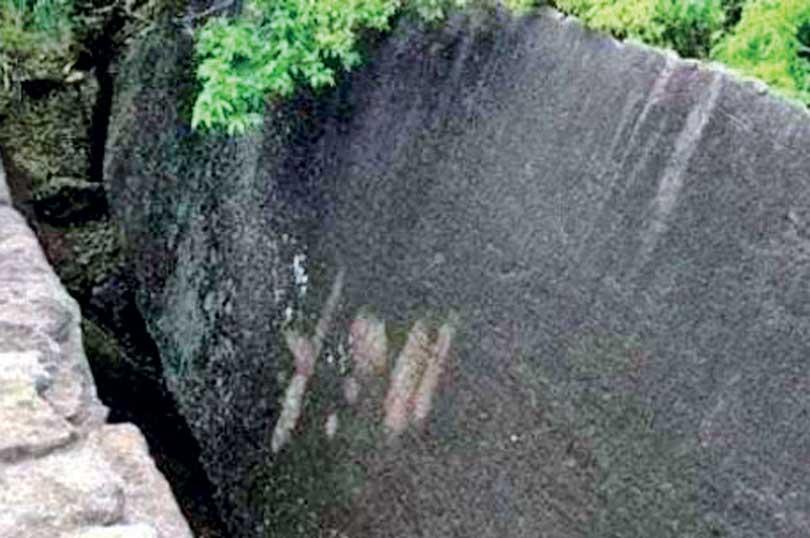
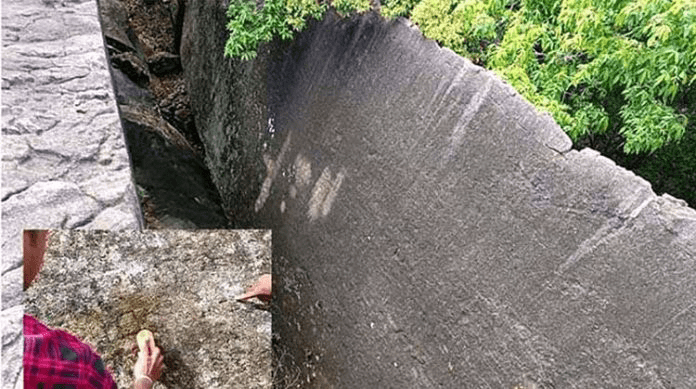
Archaeologists discovered the largest inscription ever found in Sri Lanka. The largest inscription ever discovered in Sri Lanka was found at the ruins of the Dimbulagala monastery, dating back to the early second century BC.

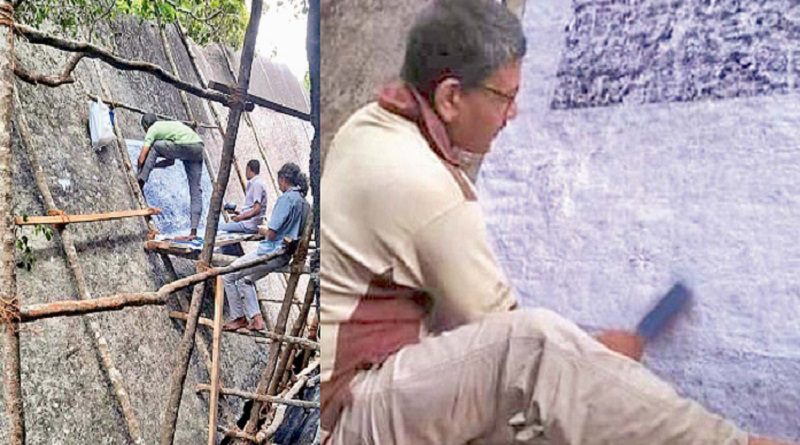
This discovery was made by officers attached to the Inscriptions Section of the Archeology Department Head Office and the Polonnaruwa Archaeological Survey Team.

Dimbulagala Monastery, also known as Dimbulagala Raja Maha Vihara, is located 16 kilometers southeast of the ancient city of Polonnaruwa in Sri Lanka. The Dimbulagala range houses a number of caves cut into the rock with Brahmi inscriptions over their drip ledges.

The Sri Lankan government appointed eleven expert committee members to investigate the inscription on 17 January 2024, including Ms. Malini Dias, Vice President of the Royal Asiatic Society of Sri Lanka Archaeologists, who specializes in epigraphy, and Professor Karunasena Hettiarachchi.

According to the signs, characters, and unique symbols, the committee announced that the inscription belonged to the beginning of the second century BC or earlier than that.

Source

Sri Jayawardenapura University History and Archaeology professor Karunasena Hettiarachchi said 60 percent of this inscription was unreadable and 40 percent was readable.

This inscription was written in Brahmi characters. We found that 24 Brahmi characters were used on the inscription. At least 1,000 characters were used. Moreover, there are several rare symbols, which have never been seen by officials through their previous inscriptions,” he said.

Meanwhile, the professor stated that the inscription contains six extremely rare symbols that have not previously appeared in the country’s inscriptions.

The professor said that because water is essential for the monks, the inscription also mentions the supply of water to the top of the mountain. Meanwhile, he mentions that this inscription mentions about offering a cave to the Maha Sanfha and offering a pagoda.

Source

Also, the inscription mentions a devotee of the Sangha. Meanwhile, the professor further said that the committee that investigated the matter had a note about any harvest tax.

It is also mentioned here about making a hut called Barajaya and offering it to the Sangha. The professor mentioned that it was difficult to read the letters mentioned in the first and second lines and further mentioned that they mention a king named Diparaja, a person named Shiva, and the wife of a monk named Baghubashiga.

The dating of the inscription may indicate the period of King Lanja Tissa, also known as Lamani Tiss, who was the first ruler of Sri Lanka under the Kingdom of Anuradhapura (119 BC to 109 BC).

The inscription also includes the names of 3 princes named Tissa, Vishaka, and Suratissa.

The Sri Lankan Royal Dynasty, also known as the Ceylon Kings or Kings of Sri Lanka, is arguably the longest in history. It lasted from 543 BC, or more than 2350 years, until 1815 when the British invading forces captured Sri Wickrama Rajasinghe, the last Kandyan king.

Sri Lankan Navy arrests 19 Indian fishermen for illegally fishing in its waters: Report

February 10th, 2024

Courtesy The Indian Express

The Sri Lanka Navy in the operation with the Sri Lanka Coast Guard on Wednesday also seized 2 Indian trawlers alongside the arrest of 19 Indian fishermen poaching in Sri Lankan waters, the Navy said in a statement.

Sri Lankan navy Indian fishermenSo far this year, the Sri Lankan Navy has arrested 88 Indian fishermen in the island’s waters and seized 12 Indian trawlers, the statement said. (Representational/ Express Photo)
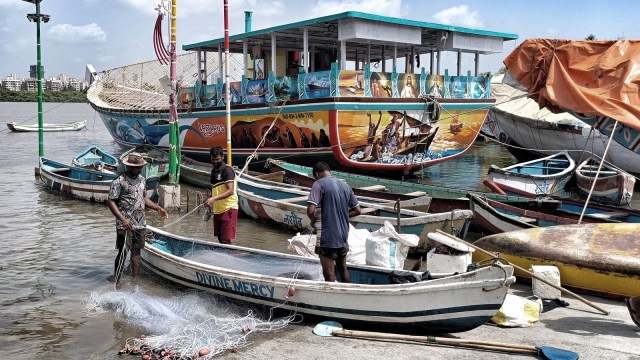
Sri Lanka has arrested 19 Indian fishermen and two trawlers for illegally fishing in the island nation’s waters near Delft Island in northern Jaffna province, the country’s Navy said on Thursday, in the second such incident this month.

The Sri Lanka Navy in the operation with the Sri Lanka Coast Guard on Wednesday also seized 2 Indian trawlers alongside the arrest of 19 Indian fishermen poaching in Sri Lankan waters, the Navy said in a statement.

The apprehended fishermen and their two trawlers were escorted to the Kankesanthurai Harbour and will be handed over to the Mailadi Fisheries Inspector for further action, it said.

The Navy continues to conduct regular patrols and operations in Sri Lankan waters to curb illegal fishing practised by foreign fishermen as they have a direct impact on the livelihood of locals, it said.

As an extension of these operations, the Northern Naval Command deployed Fast Attack Craft of the Navy and Coast Guard to chase away a cluster of Indian poaching trawlers which were engaged in illegal fishing in Sri Lankan waters close to the Delft Island.

So far this year, the Navy has arrested 88 Indian fishermen in the island’s waters and seized 12 Indian trawlers, the statement said.

The Navy has handed them over to authorities for further legal action.

The fishermen issue is a contentious one in the ties between India and Sri Lanka, with Lankan Navy personnel even firing at Indian fishermen in the Palk Strait and seizing their boats in several alleged incidents of illegally entering Sri Lankan territorial waters.

The Palk Strait, a narrow strip of water separating Tamil Nadu from Sri Lanka, is a rich fishing ground for fishermen from both countries.

There have been periodic instances of Indian fishermen being arrested by Sri Lankan authorities for allegedly crossing the International Maritime Boundary Line and fishing in Sri Lankan waters.

In 2023, the island nation’s Navy arrested 240 Indian fishermen along with 35 trawlers for allegedly poaching in Sri Lankan waters

BUDDHIST VIHARAS  AND  EELAM  Part  13B4A

February 9th, 2024

KAMALIKA PIERIS

Ven. Ellawala Medhananda paid special attention to the Buddhist archaeological remains in the North and east. He explored as much as he could in these two provinces, using his own resources. He found that the north and east had many Buddhist ruins and many explorations were needed, before they could be fully examined and recorded.

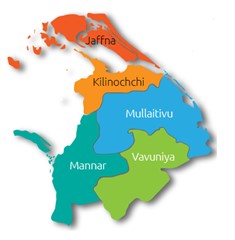
Ven. Ellawala Medhananda was not able to explore the North as much as he would have liked, due to LTTE control. The Northern Province consists of Jaffna, Kilinochchi, Mannar, Mullaitivu and   Vavuniya districts.

Medhananda   gave the historical background to the Buddhist civilization of the North. He   stated that Jaffna, Elephant Pass and the islands around it was known originally as Nagadipa. Ptolemy had called it   ‘Nagadiboy’.  Vallipuram manuscript of Vasabha called it Nakadiva.

Medhananda says the North is full of Buddhist remains, every hill, every mound has a Buddhist   building.  Every village had an aramaya. .  Medhananda  said that there were over 1500 Buddhist archaeological sites in the districts of Vavuniya, Kilinochchi, Mullaitivu and Mannar. He has found foundations of buildings, lived in caves, inscriptions, pada lanjana and bricks. He says there are many more sites. Medhananda  said there are more than 20  archaeological sites on  the small Dollar Farm village alone.

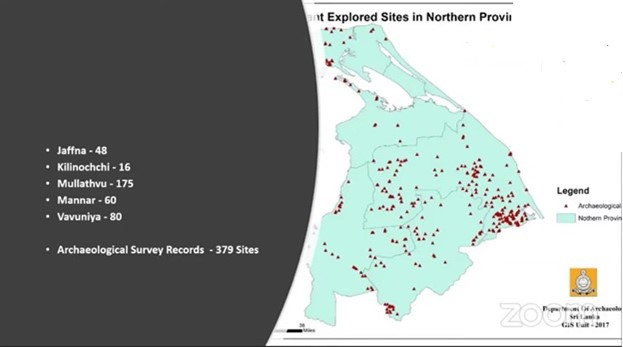
Medhananda also   named 48 places in  Jaffna   and 90  places in Vavuniya and Mullaitivu  which had Buddhist ruins. Each time I went to  Vavuniya and Mullaitivu  I found new ruins. He says this list is not complete, there are other unexplored places. There are more than 20 archaeological sites on Dollar Farm alone. Most are in private lands. The ruins showed  remains of stupas, foundations of buildings, statues, pada lanjana, bricks,  tiles,  potsherds. 

Vavuniya and Mullaitivu Buddhist  ruins have not been examined  fully by anyone., said Medhananda . Most of these are not  recorded by Department of Archaeology.  ‘We have never explored these areas, said Medhananda . Our archeology only concentrated on Anuradhapura, Polonnaruwa   and a few other places. Each time I went to  Vavuniya and Mullaitivu  I found new ruins.

Vavuniya is  full of Buddhist  ruins. There are  hundreds of  Buddhist ruins In Vavuniya there are three sets of ruins in a straight line, at Mahakachca kodiya,    Erupotana,  and  Periyapuliyam kulam malai. Odiamalai, Thadda malai, Kurundam malai had  inscriptions. Kurundammalai ,  originally Kurunvashoka vihara, had a  lot of ruins. Medhananda said that this was the place  where he saw the most ruins. Have not seen so many ruins in any other place I  have gone to.

From Jaffna to Wilpattu, all along the ocean strip, one sees places with over 100 ruins. No explorations have been done in this area. These sites were never examined carefully, other than presenting a random report.

 in the Northern Province. The viharas seen by Medhananda in his northern explorations include Atambagaskada kiri vihara , Buddhanehela Raja Maha Vihara , Galgiriyagama kanda vihara ,  Iratperiyakulam vihara ,  Kadurugoda vihara ,  Kurundammalai vihara ,  Madukande Dalada vihara , Mahakachcha kodiya vihara,   Mangana vihara . Piyagukatissa vihara , Paribhoga chaitya, Salavana vihara ,  Tonigala vihara ,   Valli vihara, Vedikinarimalai Vaddamana parvata vihara .

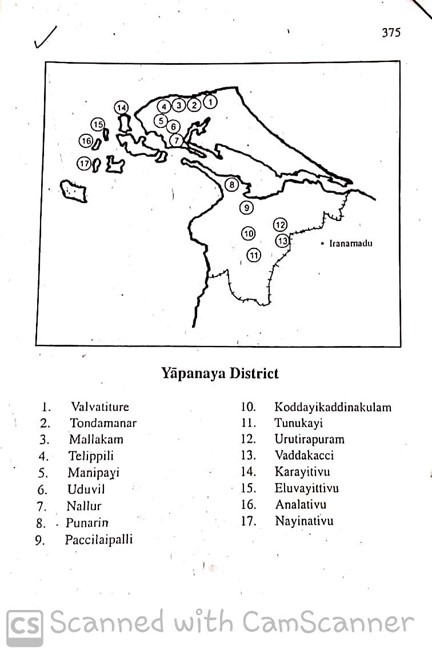
Medhananda  gives  48 places  in Jaffna where he has seen Buddhist ruins He says there are others as well. the places listed are Algiriya, Anai kottai, Analativu,Ariyalai,  Atchuveli, Buddhatottam, Buddhawalawwa,  Chakaveli,  Changanai, Chulipuram,  Chunnakam, Delft,  Elavativu, Gotamalu watte,  Karaitivu,Kodiyavatte Mahiyapiddy,  Mallakam, Manipai, Marattamadam,Mavaddipuram,  Nagachcha kovil precincts,   Nagarkovil, Nainativu,Nallur, Neelavarai, Pinwatte, Ponnalai, Poonaryn,  Pukuditivu, Puloli, Puttur,Sambaturai,Tellipilai,  Tennavali, Tiruadanilai,    Tisamalai,   Tunukai, Udupiddy, Uduvil,  Uratota,Uraturai, Vadukkodai, Valikamam and Valvettiturai. Medhananda says these ruins show bricks, tiles, statues, potsherds, inscriptions.   Most are in private lands, Medhananda observed..

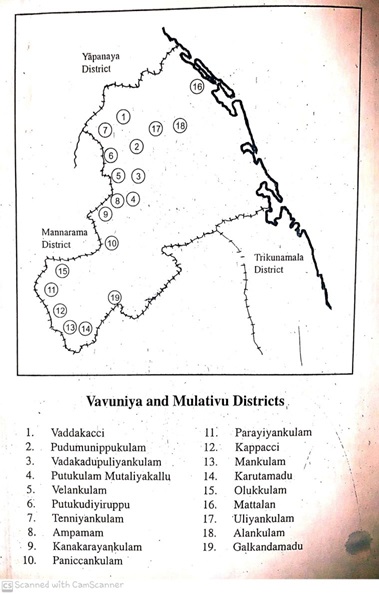
In Vavuniya and Mullaitivu Medhananda has explored the following places: Ariyamadu,Atambagaskada,  Bogaswewa, Buddha kovil,  Bumaya, Chelliyar villu, Chenkal veddi kulam,Chenmadu, Dollar farm, Eeratperiyakulam, Erupothana, ,   Iluppu kulam,  Iranai illupun kulam, Iranamadu, Irasattiram kulam,Iruvil,Kachchilamadu, Kallaru, Kalnattan kulam, Kalukundammaduwa, Kanagarayam kulam, Kanchiramuddai,  Karadikulam,  Karavil kulam,   Karidikkulam, Kokkavelliya, Kongaraya kulam,  Kontaka karnakulam, Kovil puliyan kulam,Kumbakarna malai,Kurum puliyan kulam, Madukanda, MahakachchkodiyaMahamailan kulam, Mamaduwa Manikai,  Maniyar kulam,Mankalkeni,Mannan kadal,Manthri vihara,  Maradamadu,Maratamadu, Menik farm, Mohonnan kulam, Molliyavela,  Mudaliyakulam,Namban kulam, Navagama Kirivehera,  Nayaru,Nedunkerni, Nelukkulam, Nochchiya moddai,Oddusuddan,  Odiyamalai,  Olumaduva, Omandan, Paddikudiirippu, Padivettukulam, Palamoddai, Panaiyan kulam,Panangama,   Patta kattuveli,  Pavattakulam,  Periyakulam,  Periyamar iluppai,Periyauttukai, Pokkaravanni  tunukai, Pudukudi iruppukulam,Puleliya, Pumaduva,   Puravasan kulam,  Puvarasankulam, Ruvanmadu, Samalankulama, Sirappanmaduva,Tachcankulam,Tadikkulam,  Tambankulama, Tapassavellliya,  Tiranamadu,  Tiraviyamalai,Tonigala,Tukkumarattadi, Tuntimuruppu wewa, Udavelikulam, Ulakkulam,Unjaral kaddi, Vadamarachhci, Variyakuddiuru, Veherabanda  wewa, Vettilkulam,  Vettiyakulam and   Yakumadu yaya.

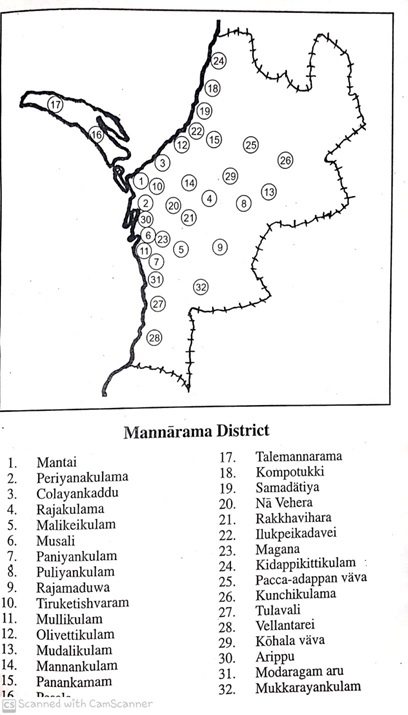
In Mannar  Ven. Medhananda has visited Arippu , Cholayan kaddu,  Compotukki,      Ilukpeyikadachei, Irantivu, Kadappiditti kulam,   Kohala wewa, Kunchi kulam, Magana, Malikai kulam, Mannankulam, Mantota,  Moderagam ara, Mudalikulam, Mukkarayakulam, Mulliyakkulam, Musali, Na vehera,  Olivettikulam, Pachcha addappan wewa,  Paniyankulam,  Pannankamam, Periyanavakkulam, Pesalai, Puliyankulam, Rajakulama, Rajamaduva,Rakkha vihara,  Samadetiya,  Talaimannar, Tiruketiswaram, Ttuvavali,  Valli vihara , Vachinikulam    and Vellantarai. 

Medhananda has also  found ruins of some 1538 tanks form Vavuniya, Kilinochchi, Mullaitivu, Elephant pass, Pooneryn Omanthai and Mannar. Medhananda had also made a list of the wewas found in the Northern Province. They are listed by name in his book. He has listed 340 wewa in Vavuniya, mostly called kulam, and 15 wewa in Mannar Iranamadu in  Kilinochchi district,  was  originally Ranmadu wewa. 

Medhananda has given  a detailed description of the sites he has visited. In Vavuniya,  Medhananda   explored Buddanehela  Raja Maha Vihara  . Ruins are fast   deteriorating he said. Galkiriyagama kande vihara, had  remains of a huge stupa , a  Siripatula and ponds. Inscriptions show king Uththiya’s queen had  built   a structure here.

Kirivehera at   Atambagaskada, 6 km from Vavuniya, has a Samadhi Buddha statue, which is  far superior to those found in this area. According to villagers was brought from elsewhere; it is 2’ 21/2” high   the head dress or ketumala is unique. Eeratiperiyakulam   ruined vihara, Vavuniya, ruins show avasa, vihara and 150 year old  Bodhi tree. Medhananda had found a stylish statue in pieces and  had put it together.  ( continued)

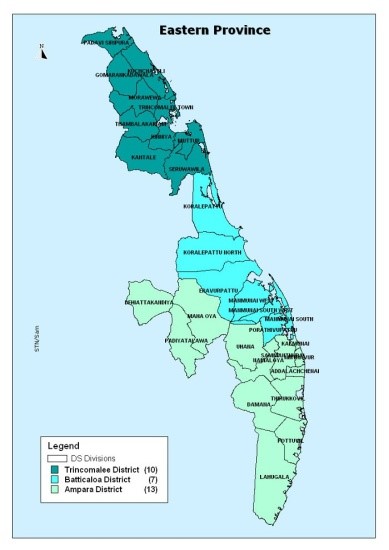
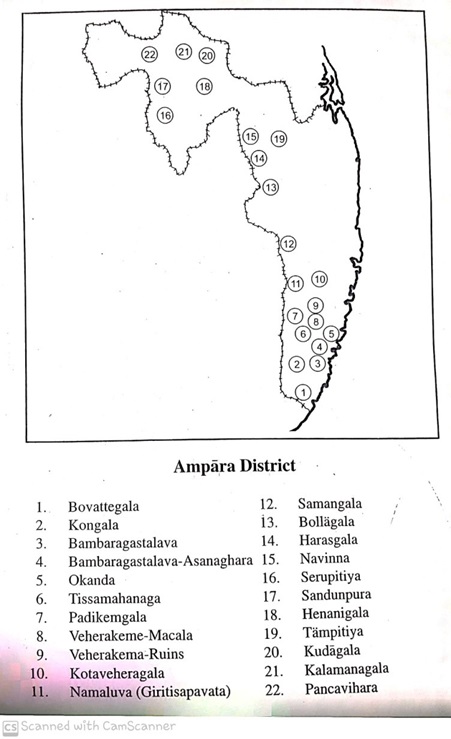
HERE ARE THREE MAPS. YOU COULD DECIDE WHETHER TO USE HTEM.

BUDDHIST VIHARAS  AND  EELAM  Part  13B4b

February 9th, 2024

KAMALIKA PIERIS

Medhananda was able to explore the Eastern Province with greater freedom than the north.  Medhananda has explored 80 Buddhist sites In the Eastern province. They included Agbo Raja Maha Vihara,  Ariyakara Raja Maha Vihara, Bollegama Raja Maha Vihara,    Balahandu vihara, Bambaragastalawa vihara, Boralukanda temple, Nilaveli. Bowattegala vihara,   Buddhangala hermitage,     Dighavapi,  Diviyagala vihara ,   Ganegama vihara ,  Girikumbara vihara ,  Habutala Karandahela vihara ,  Harasgala vihara , Henanegala cave temple,  Illukpitiya kanda len vihara Ampara. Kalkulam Udagala Dagoba,  Kiliveddi bodiya, Kirivehera  Raja Maha Vihara,    Kombanachhi Ruhunu Somawathi vihara , Kongala natabun vihara ,  Kopavela vihara , Kotaveheragala vihara ,    Kuchchaveli Maha vihara,   Kudimbigala  hermitage,  Kukuluvagala vihara, Lankapatuna Samudragiri vihara , Linemalai Sipavata vihara , Malayadikanda vihara,  Namalu vihara , Nawinna  Raja Maha Vihara ( Ampara),   Neelagiri  vihara and cave,  Niyaguna kanda vihara ,  Okanda vihara ,  Omunugala cave temple,  Panama raja maha vihara , Piyangala vihara ,  Pulakunava Maha vihara ,  Rajagala Maha vihara , Ratgala vihara ,  Rugama  Piyakalutota vihara,  Ruhunu magul maha vihara ,  Samangala hermitage, ,Samudragiri,  Sastravela vihara , Seruwila vihara ,  Sri Pana Raja Maha Vihara, Potuvil, Tilapola pansala,   Tiriyaya, Udayagiri Raja Maha Vihara ,     Vedikkinarmalai rock temple,  Veheragala cave temple, Veheragama kubira therun vanaya Ampara,  Veherakema  Mavala vihara , Velatti badda   aramaya and  Velgam vihara.     

Medhananda has also looked at ruins. These are generally of monasteries or vihara, but some were settlements. Medhananda found ruinsat Ananda kulam ,  Agbo Raja Maha Vihara  , Allai, Arantawala  Balagala, Bandaraduva Buriyakulam kanda , Dighavapi,    Etha bandi wewa, Galkanda ,  Hingurana sugar factory (ruins near it).  Ichchalanpattai, Kadolupotana kanda  Kandikudichchi aru, Kondavattavana,   Koravanvadu, Kantalai  track 6 and track 13 ruins,   Kivulevatta ,  Kulankullimalai  , Kunchinamalai, Mulgama kanda. Moraha Pokuna, Mundikulam malai    Narakamulla, Nuwaralagala,  Padi kemgala, Pallewela, Paragahakele,  Pulmoddai ,  Punyadi  ,  Ridikanda  Ranankaduwa,  Sembumalai Serupitiya, Seruwila, Sunetra wewa, Taravakulam,   Tirumangala, Toppigala , Valmandiyagala  Veheragala, Veheragoda ,  Veherakema, Veheratenna, and  Vilankulam.  

Medhananda has also looked at ancient wewas in the Eastern Province.  He found 115 ancient  wewa in Ampara district, 64 in Batticaloa district  and 300 in Trincomalee district.  In  Batticaloa and Trincomalee most of the  wewa were known a ‘kulam’. Medhananda has also listed  66 ancient wewas mentioned in  inscriptions.

Medhananda  made it a point to record the ancient names of the places he explored. Mahakaccakodiya vihara in Vavuniya was Tittavalkada,  Kuchchaveli maha vihara was Samudradevi vihara.  Verugal was originally Veheragala. Kottiyar pattu was Kotthasara.   Panama   was known as Vajana rata  in 7th century.  A Gama donated to an aramaya become ‘aramagam’ which became ‘Arugam’. Rugam is the Tamilisation of this, said Medhananda . 

Medhananda  commented on the ruins he saw. The Yan Oya valley is studded with many stupas and other buildings, he said.   Inscriptions show that there were Buddhist settlements there. At Lankapatuna Medhananda Found  an unprotected  moonstone, the rest have been destroyed. I found 6 inscriptions  there. After I told them the Department of Archaeology went and copied the  inscriptions.

The most number of ruins were found at Ampara. One and a half miles to the east of the preset Devalahinda school, Ampara, there are many ruins of stupas, ponds, Buddha foot prints, and asnagharas. There is a wall fortification 7’ wide, stretching for a distance of about 600 feet.

Sembumale monastery complex spreads over an area of more than hundred acres. Somawathi vihara, Kombanachchiya had ruins no one has seen before. Places like Diviyagala, Damana and Timbirigolle in the vicinity also have inscriptions and ruins. Budu patum kande is  ‘full of ruins’. Medhananda  found a sandaka pahana there, also interesting  bricks.  

Veherakema,  originally known as  Mavala vehera   is in the middle of the Lahugala forest. Medhananda took four hours to travel  the 7 or 8 miles to get there. He was the first to explore  Veherakema. He found a huge rock with the ruins  of a probable padhanaghara, columns  6 or 7  feet high and a plain moonstone without decoration.

In the Veheragoda ruins at Ampara, there is a   stupa which shows the earlier style of  stupa building. This  style is also seen at Buddhangala and Rajagala.  Veheragoda wewa  had a  kalugal sorrowwa.

At Karandahela, Medhananda found a  lotus petal moonstone,  very old bricks, a  huge cave, 512 feet long, 30 ft wide,  and 82 feet height   and a rock carved gal vangediya, one foot deep  with circumference of  7’ 2”.

At Veheragalkanda, Medhananda   saw a foundation , 50’ x50’ with stone door frame facing the east 9’8” in height There was another structure,  18’8’  by 14 ‘1”  with ten pillars in the middle, this could be a  gigantic doorway, said Medhananda . When I first visited  the place  there was a torso of a statue lying  there but ‘now it is not to be seen’.

Bambaragastalawa has  acres of  ruins, many, many stupa on hill tops and flat ground,  also remains of viharas,  image houses, as well as steps, pillars and   caves. There was no  road access to Bambaragastalawa. Medhananda had to go thorugh dense forest inhabited by wild animals. 

Medhananda  said that many of the places he saw have not been looked at by the  Department of Archaeology. There are far more Buddhist ruins in Trincomalee district than the 54 given  by the Department, Medhananda said. In our exploration at Digamadulla, too we found many inscription and ruins never seen before. The ruins around Dighavapi have not been explored, either.

Medhananda   had explored Bambaragastalawa,      Lenama, Budubava, Nalitta,   and found ruins which the Department of Archaeology had not found. There are no reports in the Department of Archaeology as to the ruins at Mahapattuva , 8 km from Timbirigolla Vidyalaya.  I found very fine archaeological  ruins at Kadavat maduva near Batticaloa  railway station.  No one had looked there.

Toppigala has not  been properly explored by the Department  of Archaeology .   Medhananda found 150 archaeological sites in Toppigala. All hillsides around Toppigala  such as Motagala, Vesibandagala,  Atubandagala, Varakamulla,  Kunchinamalai,  Devinigala,  Kavinigala, had vihara on it. Every hill side  around Thoppigala has a ruin of  an aramaya. There were inscriptions too. I spend 8 days exploring in Toppigala jungles, said Medhananda .

Viharagal kanda at Trikonamadu  has ruins extending for 10 acres. These have not been explored before. The  ruins of  stupa, walls, caves,  asanaghara could be seen. There is an ancient wewa near ruins. The archaeological sites   at Vasi bandagala,  Aatubandagala, Iddagala, Nelugala,  Mavulivala, have not been explored before. There are lots of ruins . Siripalena, Siluminiseya, Devagala in Maduruoya  valley also  have unseen ruins.

The area north of Badulla –Eravur has not been  explored. Lots of  Buddhist      sites there in the forests, also ruins of irrigation schemes. There are Buddhist ruins also at Perillaveli in Eravur pattu, Batticaloa district. These are in dense forest and have not been seen by the  Department of archaeology.

If one travels north along the sea coast road, starting from Trincomalee town, one can see many Buddhist ruins, even at present, he observed. Many ruins can be seen at Ridikanda area in Trincomalee district as well. In Batticaloa district, in the deep forest, there is Vasibandagala,   Atubandagala, Iddagala, Nelugala, and Mavulivala, full of ruins which have not been explored.

Medhananda  found 114 wewas at Dimbulagala  as well as an area which had held paddy fields in the  ancient  period. Harasgala and Serankada vihara  near Maha oya were prosperous in ancient times said Medhananda. Veherapokuna in Maduru oya valley was an important  stopping place between Magama and Jaffna.  Ruins at Velatti badda       aramaya in Uhana, shows that this was a very developed aramaya.

Medhananda  said that many of the places he has seen have not been looked at by the  Department of Archaeology. There are far more Buddhist ruins in Trincomalee district than the 54 given  by the Department, Medhananda said. In our exploration at Digamadulla we found many inscription and ruins never seen before. The ruins around Dighavapi have not been explored, either.

Viharagal kanda at Trikonmadu  has ruins extending for 10 acres. These have not been explored before. The  ruins of  stupa, walls, caves,  asanaghara could be seen. There is an ancient wewa near ruins. The archaeological sites   at Vasi bandagala,  Aatubandagala, Iddagala, Nelugala,  Mavulivala, have not been explored before. There are lots of ruins . Siripalena, Siluminiseya, Devagala in Maduruoya  valley also  have unseen ruins.

The area north of Badulla –Eravur has not been  explored. Lots of  Buddhist      sites there in the forests, also ruins of irrigation schemes. There are Buddhist ruins at Perillaveli in Eravur pattu, Batticaloa district. These are in thick forest and have not been seen by the  Department of archaeology. 

There are no reports in the Department of Archaeology as to the ruins at Mahapattuva , 8 km from Timbirigolla Vidyalaya. Found very fine archaeological  ruins at Kadavat maduva near Batticaloa  railway station.  No one had looked there.  Medhananda   had explored Bambaragastalawa,      Lenama, Budubava, Nalitta,   and found ruins which the Department of Archaeology had not found.

Toppigala has not  been properly explored by the Department  of Archaeology .   Medhananda found 150 archaeological sites in Toppigala. All hillsides around Toppigala  such as Motagala, Vesibandagala,  Atubandagala, Varakamulla,  Kunchinamalai,  Devinigala,  Kavinigala, had vihara on it. Every hill side  around Thoppigala has a ruin of  an aramaya. There were inscriptions too. I spend 8 days exploring in Toppigala jungles.

Medhananda   found  that many areas, now thick forest,  had been populated in ancient times. The whole Thottama area was  populated.  A part was at Digamadulla under Ruhuna, a part was under Wellassa. Irrigation channels at Valmandiyagala showed that this was a large settlement. Periyakulam is actually Manamatta wewa and is part of the Sinhala irrigation  schemes.

Medhananda  found 114 wewas at Dimbulagala  as well as an area which had held paddy fields in the  ancient  period. . Harasgala and Serankada vihara  near Maha oya were prosperous those days, said Medhananda. Veherapokuna in Maduru oya valley was important  stopping place between Magama and Jaffna, s said Medhananda .  Ruins at Velatti badda       aramaya in Uhana, shows that this was a very developed aramaya. At Pulukunava  there are ruins all over the place. You see caves all over the hillside, with and without drip ledge and inscription. There are About 70 caves of different sizes.    This whole area has been a developed Sinhala Buddhist area, said Medhananda .  ( Continued)

BUDDHIST VIHARAS  AND  EELAM  Part  13B4C

February 9th, 2024

KAMALIKA PIERIS

Ven Ellawala Medhananda has  explored the present day  Buddhist ruins of the Eastern Province.  He found  evidence in today’s Eastern   Province , to show  that the Eastern Province had a vibrant Buddhist civilization in the ancient and medieval period.  He has also shown that it had special features, such as hillside monastic complexes and a series of ‘Muhudu Maha vihara.

Monastic complexes

Medhananda found evidence of huge monastic complexes in the Eastern province. There was a  monastic complex at Bambaragastalawa in Kumana. This monastery extends to over 450 acres.

At Bambaragastalawa he found over ten stupas,  on hill tops and flat ground.  He found rock cut steps,   Buddha statues, asanaghara,  pillars, caves, viharas, image houses, chaitya  and  very old bricks. There was a stone seat, 15’ by 5’9”, beautifully carved at the edges. This may be an asanaghara, said Medhananda. He also saw a stupa 50 ft wide and 23 ft high. He  found a rectangular arrangement of six rows of six columns each.  

There is a huge pilima lena surrounded by smaller lena, said Medhananda.  In it there was a reclining Buddha image, 36 feet in length, built with brick, mud and lime plaster, vandalized by treasure hunters. There is a  drip ledge all round the cave. Brick walls were built dividing the cave into many rooms, with the top decorated with swan sculptures. The bricks used were excellently  burned ones.  There was a vestibule 16 by 48 ft in front of cave. It had  ten square holes  for wooden beams. There was a stone pillar in front, and  stone steps indicating two entrances,  a  wooden door frame and  a wooden pillar, of milla wood, concluded Medhananda..   

Medhananda  had  also explored Sembumale monastery,  in  Kuchchaveli,  which covered over hundred acres. He  visited the monastic complex at Mahapattuwa in Veheragoda area. This has not been explored by the Department of Archaeology and there is no official record of it. Bovattegala showed ruins of a monastery, said Medhananda . 

Medhananda went to Omunugala Cave Monastery ( ‘len vihara’ ) at Ampara.The meditation caves at Omunugala extended from the foot of the mountain to a level little below the summit.  They  were very  impressive. Every cave had its   drip ledge inscription.  Most caves had remains of walls. There are ancient  paintings in one cave. One cave is startling, said Medhananda .  The cave and the rock in front have been combined to make something like a two storey house. another cave had rectangular holes drilled into it probably to support beams to an upper storey. 

The largest cave, a shrine cave, is about 120’ in length, had walls on three sides and a window. There was a  flight of steps leading to a door frame to enter the cave.  It had a makara thorana.  There are more undiscovered   caves but access was very difficult  and  I did not climb them, said Medhananda.. 

There was also the magnificent monastic complex at Rajagala. The Rajagala monastery was known as Girikibalavi Tisa Mahavihare. The Rajagala hill range, also known as  Rassehela kanda,  is  1030 feet above sea level. Both north and south slopes have many ruins. All over the hills there  are   ruins of stupa.  There is a hermitage to the  north. Many stone pillars of various heights and sizes, circular, rectangular, octagonal are seen scattered. Stone ponds, one had a sluice. Medhananda noted its special features such as the two water spouts to fill large stone cisterns.There were decorated urinal stones.

There were over hundred caves. Brick and stone walls created separate rooms inside the caves. One cave had a bed and pillow cut out of rock. Cave walls were plastered and painted, paintings have faded. One cave has a roof carved in shape of an umbrella and handle of the umbrella is done in most exquisite fashion, said Medhananda .

Rajagala yielded 70 cave inscription, 20 slab inscription and rock inscriptions. One huge inscription said that the ashes of Mahinda and Ittiya are enshrined there. Another inscription spoke of Saddhatissa and Lanjatissa. (This is not king Lanjatissa). Inscriptions spoke of donations of tanks, caves, fields. Inscription also made reference to statues, taxes and coins. One inscription refers to tilling the land with a  golden plough. One Inscription has been tampered with, concluded Medhananda.

Forest hermitages

The eastern Proivnce hosts many forest hermitages  today. There is Kudimbigala. Medhananda said that there were  Buddhist ruins extending over at least    600 acres around Kudumbigala   with numerous stupas  on the rocks. Kudimbigala has  the only cylindrical stupa known in Sri Lanka, said Medhananda . inscriptions show that Kudimbigala was established by  king Kavantissa. 

The  cave architecture of Kudimbigala was astounding, said Medhananda . The cave technique is amazing. Cave after cave, placed on top of each other for 100 acres or so. He had counted 105 caves. one cave was a Budu madura.   One cave was named Maha Sudarsana ,another was Yoda lena. Sita pokunu lena had paintings of  7th century.

There was a huge cave project at Samangala forest hermitage, Ampara. This was a high level hermitage. Inscription  indicates that this was started by Saddhatissa. One cave is 60 feet in height and can shelter about 500 people.  All caves had drip ledges. There were many inscriptions which have not yet been  recorded. No archaeological  explorations have been done here. An attempt to turn this into a meditation centre, some years ago, failed, said Medhananda.

There has been a monastery at present day Namalu chetiya. Namalu chetiya was huge, almost as large as Ruvanveli. The villagers used to worship there. The monastery of 150 acres  occupied flat ground , rock, hill and forest. There were ponds, flights of steps, heaps of inscriptions and several stone beds.  The monastery ended at Heda oya. This would have been a developed, scenic, large monastery, said Medhananda . A monk was living by the stupa in a small  hut when Medhananda went there.

Buddhangala aranya Senasana,  Ampara has 200 acres of ruins,  on  five hills. Stone bridges connect one rock to the other. Caves were partitioned into three by walls. Bricks with decorations and inscribed are found in plenty. There was a fine siripatula, circular , 11 feet and well carved.  In 1964 Buddhangala was restarted as a hermitage.

Piyangala vana Senasuna,  Ampara has over 100   meditation caves with and without drip ledges. Some of the old walls remain. The old badama is there,  this is worth examining, said Medhananda.  

Cave shrines.

Medhananda has drawn attention to the existence of   cave shrines. The most notable  of the cave shrines explored by Medhananda  was   the Karandahela  cave complex, in Hulannuge, Ampara, 633 feet above sea level. Karandahela has the biggest cave in Asia. .https://roar.media/sinhala/main/features/caves-in-karandahela-sri-lanka/

At Padikemgala Medhananda found many caves first inhabited by monks, then turned to shrines. There were many shrines in these caves, the paintings on the walls could  still be seen. One  cave had brick wall with many niches and no windows.   Neelagiri  pilima lena  had    two important caves at the top, both are shrines.  The caves had walls, one wall was of stones. The walls  had been plastered, the plaster can be seen, also the  paintings.

Muhudu Maha viharas

Muhudu Maha viharas could be seen in abundance on south, east and northern coastal areas, said Medhananda These  shrines were built  to be seen  from the sea. Medhananda drew attention to the Muhudu maha viharas built along the coast of the Eastern province

Kucceveli Maha vihara was one of these muhudu viharas, he said. Magul Maha vihara , Kirinda  had rows of caves with walls and  drip ledge. The viharas at Bundala,  Gokanna, Gotha pabbata, Jambulkolaptuna  Kirinda, Lankapatuna,Okanda, Potuvila, Sangaman kanda, Sastravela, were in existence  until recently, he said. Stupas were also  built at the mouths of the rivers where they  meet the sea, as at Walawe ganga.

Ariyakara viharas

Ruhuna has had several Ariyakara vihara where venerated arahats lived and Ariyawansa sutra was preached. This was very popular in Ruhuna, there is evidence to prove this., said Medhananda . There was Ariyakara Raja maha vihara   at Kettama village, in the Eastern Province.  It has steps, siripatul, gal vangediya, faded inscription, naga carvings on rock as well as  carvings of horse and  bahirawa.

Ariyawansa sutra was  also preached at Mulhitiya Velegoda near Pulligoda, said Medhananda . this was Pelegama vihara originally. Veheragala, at Rajagala, had Ariyawansa preached there. Inscription says Kubira bhikkhu stayed there. This inscription is still there. Bovattegala Inscription  indicates that the  Ariyawansa sutra was preached there.

There were other viharas where the Ariyawansa sutra was preached from a seat set on a hilltop. There are such open places with a seat at Molhitiya, Velegala, Mutugalla ,  Panama, Sastravela, said Medhananda .

Medhananda thinks that there was also an Ariyakara building at ‘Punchi Sigiriya” in Digamadulla. Punchi Sigiriya is not a rock, it is a cave. With a one  Sigiriya like painting, seen by Paranavitane, which is fading away. Medhananda was more interested in a ruined building  on a hill close by, reached by a flight of steps. Medhananda  thinks  this was for preaching Ariyawansa sutra.  

Forgotten viharas

Medhananda has  discovered  many forgotten viharas, in the eastern province such as Boralukanda vihara ,Nilaveli. Illukpitiya kanda len vihara, Ampara. Sri Pana Raja Maha Vihara, Pottuvil.

Another forgotten vihara is Kotaveheragala vihara in Yalpota village, Lahugala, the village has just four families doing chena cultivation. Kotaveheragala vihara has a cave second only to that in Karandahele. It has a carved drip ledge. It is divided into four  rooms and the walls are still standing.  there is an  inscription on the steps, faded which says the steps were donated by a monk. It must have been an image house .  there are lovely overflowing ponds on the rock . Lots of bricks all over.  It is possible to go round the rock to the caves on the other side,  but it is dangerous, because   bears and leopards come there. This vihara  has not been seen by the Department of Archaeology.

Medhananda  has  explored Somawathi vihara at Kombanachchiya, near Kiliveddi. It has ruins no one has seen before. Malayadikanda vihara  has  27 caves and ruined stupa. Niyagunakanda vihara   has caves near it with drip ledge inscription. Site has never been examined. Both viharas  are near Hingurana sugar factory. In Gal len vihara at Giribawa, Kurunegala the caves had specific names such as sheeta guhe, two caves were maha lena.

Kappangamuyaye Kadurugoda vihara by Namal oya had stupa, columns, and moonstone. There were  ruins in the forest around. Ganegama vihara, Ampara had veddha paintings of crocodiles, elephant and other figures . it had a simple sandakada pahana,  and a doratupala with  punkalasa. there were many Veheragalas in the island, observed Medhananda . Medhananda    has also looked at Balahudu , Kukuluvagala   and Galaba len vihara.

Some forgotten viharas catered to small populations. Kirivehera Raja Maha Vihara   Lahugala,  was in village where a few families were living off     banana plantations. It was reached  by a footpath from Hulannuge junction.

Medhananda also commented on  some of the  objects found in his explorations. Medhananda took special interest in the bricks that lay in abundance in the sites he explored.Around Verugal ara  near Uppar lagoon there are  hillocks  full of old bricks, he said.   At Henangala  he found three types of ancient bricks.. At Veheragoda, Ampara ,  in the ‘Pansal kalla’ section there were bricks measuring 2’1” and 1’2”. Kudagala  had  bricks some  1’4’x8”x 2 ½ and others 8”x9”x 2 ½ .Buriyakulam kanda ruins would have had  very attractive steps judging by  the decorative  bricks found there.  

Medhananda found two clay puvaru 14” by 11” by 1 ½ at Medagama kanda Aranya senasanaya. On one puvaru there was garadi veta carved, resembling the veta at Sanchi. Also an attractive line  of flowers. The  carvings have been  done before firing. These puvaru  were probably used for decoration .

The rock cut  steps at Padi Kemgala ruins are unique. there are  several flights of steps. The first consists of 52 steps   which were  2’6” long and 1’2’ wide. This was followed by several sets of 7 steps each, with a resting stone between,  ending with a set of rounded steps .the resting stone was 10” by 5 with three circles in it,  and a lotus design in the center. The last step was decorated with a curled elephant trunk. I have never been seen such a flight of steps, before exclaimed Medhananda . There was also an inscription which said how the steps were made.  That inscription was  decorated with two lotus buds on stems.  Padi Kemgala ruins  also had a moonstone carved  in the  rock.

Neelagiri  pilima lena  was probably a very important aramaya.  There is set of steps all the way up the hill. there seem to be more than 200 steps. It has breaks in it, for people to stop and rest every   50 feet or so, with arukku gal. There are moon stones at the breaks. the only other flight of steps like this is at Hachchikuchi, said Medhananda .

Medhananda found a special siripatul gala at  Konduvattavana ruins in Inginiyagala. It was a round siripatula gala, and siripatula is elevated in the middle of the  sculpture. This is rare. the upper terrace of the stupa  at Panama Raja Maha Vihara has siripatula on it.  I have seen this only in two other places, Vehera galkanda and Dammina, said Medhananda .

In early Buddhism, the  Buddha was depicted symbolically by an empty chair. This was one of the earliest symbols used for the Buddha. These empty chairs were housed in Asanghara. The Asanagara found at  Pulunkunawa is unique, and not found anywhere else in the country, said Medhananda . It was owalankara  in shape. Veheragoda ruins, Ampara     had an  asanaghara. Medhananda saw a possible asanaghara at Bambaragastalawa too. 

Diviyagala vihara in Ampara district has a beautiful moonstone and umbrella stone in good preservation as well as a complete chatragala, and three siripatul. Tampitiya vihara by Tampita wewa, off Pullumalai junction, Batticaloa district,    has a very unique guard stone with 9 snake heads, a person holding a pun kalasa and a woman bending down and collecting water. ( continued)

Exclusive: Tucker Carlson Interviews Vladimir Putin

February 9th, 2024

https://sputnikglobe.com/20240209/watch-in-full-president-putins-interview-to-tucker-carlson-1116683752.html

Farmers and pastoralists hit by double whammy of corporate farming and tourism projects in Tanzania

February 9th, 2024

Is Sri Lanka headed in the same Direction with the Bill and Melinda Gates Foundation setting policy in the President’s Office as did the MCC in when the Central Bank Bond scams occurred?

by Bharat Dogra Courtesy Countercurrent.org

At a time of increasingly adverse weather conditions, there is growing urgency of adopting protective policies towards small farmers and pastoralists. Unfortunately, the Tanzanian government has been adopting policies which are further increasing the difficulties of small farmers and pastoral people.

According to a recent study by GRAIN, a Europe-based organization known for its commitment to protecting small farmer communities, there was an earlier wave of corporate based farming in the post-2008 years which was promoted by multinational companies and donors and led to several land conflicts and destruction of livelihood of small farmers. Several of these projects collapsed, leaving behind a trail of misery spread across many villages.

Despite this terrible experience behind them, now the Tanzanian authorities are repeating a somewhat similar phase of export-led, large farm based agriculture by aggressively turning thousands of hectares into block farms that produce export crops. One difference now is that this more recent change is linked more closely to China. As GRAIN states, With China looking to Tanzania as a new supply source of soybeans, the stage is set for another wave of land grabs, with dire consequences for small farmers.”

This report recommends that instead of wasting scarce public resources on failed model of corporate agriculture” the Tanzanian government should instead focus on efforts to address the real needs of the country’s millions of small food producers.

Meanwhile, this country’s other important rural group of pastoralists have been increasingly threatened by projects which are often publicized as conservation projects but in reality are often more oriented towards the commercial aspects of safari tourism and related activities. The US-based Oakland Institute has been repeatedly drawing attention to the increasing problems of pastoralists, small cultivators and indigenous communities threatened by such projects in terms of displacements, curtailment of livelihood rights and harassment by park authorities and rangers.

Last year the Oakland Institute had released reports regarding several such communities of people facing increasing problems in some conservation and park project areas, including those linked to generous funding from the World Bank.

Now in more recent information releases, the Oakland Institute has stated that problems in some of these areas are intensifying further. In the Ngorongoro Conservation Area (NCA), for example, in mid-January a new plan was announced to remove about 100,000 pastoralists. A big concern is that they are being asked to move away to areas where there is scarcity of water and grazing land. Moreover, already people are living here. Where will they go? So if this displacement takes place it is likely that a series of new land-conflicts can get imposed on two vulnerable rural groups who may be devastated by this. It may be recalled here that at the root of several conflicts in Africa are several land disputes triggered by wrong and distorted policies going back to colonial and neo-colonial legacies.

A little earlier rangers raided a village near Tarangire National Park, shooting several Maasai villagers, arresting 80 of them and seizing nearly 800 of their cattle. In the Ruaha Park area the harassment reported earlier has been increasing.

It is clear that such distorted tourism and conservation policies need to change, and instead new policies should seek to include people as partners in any such initiatives, utilizing the rich local biodiversity knowledge of indigenous and local people to take forward conservation, enhancing livelihoods instead of diminishing or threatening them.

Is Sri Lanka headed in the same Direction with the Bill and Melinda Gates Foundation setting policy in the President’s Office as did the MCC in when the Central Bank Bond scams occurred?

Bharat Dogra is Honorary Convener, Campaign to Save Earth Now. His recent books include ‘India’s Quest for Sustainable Farming and Healthy Food’, ‘Man over Machine’ and ‘Protecting Earth for Children’.            

https://countercurrents.org/2024/02/tanzanian-farmers-and-pastoralists-hit-by-double-whammy-of-corporate-farming-and-tourism-projects/

ආර්ථික අර්බුදයෙන් ගොඩඒමට අනුගමනය කරන්නේ ප්‍රයෝගික මොඩලයක්; සභාග ආණ්ඩු දේශපාලනයේදී ප්‍රවේශමෙන් වැඩ කළ යුතුයි  – අග්‍රාමාත්‍ය දිනේෂ් ගුණවර්ධන මහතා

February 9th, 2024

පාර්ලිමේන්තුවේ සභානායක කාර්යාලය

ශ්‍රී ලංකාවේ ආර්ථික අර්බුදය විසඳීම සඳහා නව මොඩලයකට යාමට ජනපති ප්‍රමුඛ ආණ්ඩුවට හැකිවූ බවද, ආණ්ඩුව අනුගමනය කරන්නේ ප්‍රයෝගික මොඩලයක් බවද අග්‍රාමාත්‍ය දිනේෂ් ගුණවර්ධන මහතා ප්‍රකාශ කළේය. පාසල් හැරයන, පාසල් අධ්‍යාපනයෙන් හැලෙන සෑම දරුවෙකුටම වෘත්තීය පුහුණුව දෙන වැඩපිළිවෙළක් මේ වසරේ ක්‍රියාත්මක කරන බවද ඔහු පැවසීය. සභාග ආණ්ඩු දේශපාලනයේ පාර්ලිමේන්තු ක්‍රමය අනුගමනය කිරිම්මේදී ප්‍රවේශමෙන් තීරණ ගතයුතු බවත්, මන්ත්‍රීවරුන් සහ රටවැසියාගේ බලාපොරොත්තු මෙන්ම රට මුහුණ දෙන තත්ත්වය  යුතු බවත් අග්‍රාමාත්‍යවරයා සඳහන් කළේය.

ඔහු මේ බව කියා සිටියේ, නව වැනි පාර්ලිමේන්තුවේ 5 වැනි සැසිවාරය විවෘත කරමින් ජනාධිපතිවරයා කළ කතාව සම්බන්ධයෙන් පාර්ලිමේන්තුවේ පැවැත්වෙන කල්තැබීමේ විවාදයට 2024.02.09 දින එක්වෙමිනි.

ප්‍රධාන රාජ්‍ය බැංකු දෙක මුහුණ දෙන දැවැන්ත අර්බුදයෙන් මුදාගත යුතු බව පැවසූ අග්‍රාමාත්‍යවරයා, පුනර්ජනනීය විදුලි බලයට යොමුවී එමගින් විදුලි බල මණ්ඩලය මුහුණ දෙන ප්‍රශ්නවලට විසඳුම් දිය යුතු බවද පැවසිය. රජය දුන් සහාය සහ සහයෝගය තුළින්, මෙරට ගොවි ජනතාවට අහාර නිෂ්පාදනය වැඩිකිරීමට හැකිවූ බවද, ආර්ථික අර්බුදයේදී බොහෝ රටවල රාජ්‍ය සේවක කප්පාදුවක් සිදුවුවත්, මෙරට රාජ්‍ය සේවක හෝ විශ්‍රාම වැටුප් කප්පාදුවක් සිදු නොවූ බවත්, ප්‍රකාශ කළේය.

ඔහු මෙසේද කීය.

“ගරු කතානායකතුමනි, ජනාධිපතිතුමා විසින් පවත්වන ලද නව වැනි පාර්ලිමේන්තුවේ පස්වැනි සැසිවාරය විවෘත කරමින් කරන ලද ප්‍රතිපත්ති ප්‍රකාශනය මේ අවස්ථාවේදී විවාදයට ලක්වී තිබෙන මොහොතේදී එක්වීමට ලැබීම අග්‍රාමාත්‍යවරයා හැටියට මම අගය කරනවා.

ජනාධිපතිතුමා විසින් ඉතාමත් සරලව සහ නිශ්චිත කරුණු ගැබ් කර ගනිමින් රට මුහුණ දුන්නු අර්බුදයත්, අර්බුදයෙන් ගොඩ එන මාර්ගයේ ගමන් කිරීම සඳහා ගත්තා වූ පියවරයන්, ඒ වගේම ඒවායේ ප්‍රගතිය පාර්ලිමේන්තුව ඉදිරියේ තැබීම, පාර්ලිමේන්තු මන්ත්‍රීවරුන්ගේ මහා වගකීම ඉෂ්ට කිරීමට තිබෙන ‍ක්‍රියාමාර්ගයන් සඳහා ඉතාම පැහැදිලිව පාරදෘශ්‍ය භාවයෙන් ඉටුකර තිබෙනවා.

පාර්ලිමේන්තුව පසුගිය අවුරුදු දෙක තුළ ඉතාම බැරෑරුම්ම,  ආර්ථික, මූල්‍යමය වාගේම ව්‍යවස්ථාමය අර්බුදයන් හරහා ගමන් කළා. ඒ සඳහා ජනාධිපතිතුමාට ලබාදෙන ලද සහයෝගයට අපි යළිත් ආණ්ඩු පක්ෂයේ විශේෂයෙන් පාර්ලිමේන්තු මන්ත්‍රීවරු හා ඒවාගේම විපක්ෂයේ බොහෝ අවස්ථාවල අපට සහයෝගය ලබා දුන් මන්ත්‍රීවරුන්ට මේ අවස්ථාවේදී යළිත් ස්තූතිවන්ත වෙනවා.

මේ රටේ ආර්ථික දැවැන්ත කඩා වැටීම ඉදිරියේ තිබුණු තත්ත්වය එතුමාගේ වචන වලින්ම කියනවනම් 2022 පෙබරවාරි මෙරට තිබුණු තත්ත්වය අප කාටත් මතකයි. 2023 පෙබරවාරි වෙද්දී ඊට වඩා යහපත් තත්ත්වයකට මේ රට ගෙන එන්නට අපට පුළුවන් වුණා. මේ පෙබරවාරි වෙද්දි ගිය අවුරුද්දේ පෙබරවාරිවලට වඩා යහපත් මට්ටමකට අප රට පැමිණ තිබෙනවා.

මා විශේෂයෙන් මේ කාරණාවන් සඳහන් කළේ මේ ඉදිරිපත් කරපු කරුණු එසේ නොවන බවට කිසිම පාර්ලිමේන්තුවේ අභියෝගයට ලක් කරනවා කියලා ප්‍රකාශ කරන මන්ත්‍රීවරුන්ට කියන්නට බැරි වුණා. ගිය වසරේ උද්ධමනය එතුමාගේ ප්‍රකාශයේ 50.6% යි. අද එය 6.4% දක්වා පහළට වැටිලා තිබෙනවා. ආහාර උද්ධමනය 54.4% යි. අද එය 3.3%ක්  දක්වා අඩුවී තිබෙනවා. එදා ඩොලරයක අගය රු. 362යි. 

අද රු. 314 යි. අපි මේ යන ගමනේ නිදහසෙන් පසුව ගෙවුණු අවුරුදු 76 තුළම ප්‍රාථමික අය වැය අතිරික්තයක් හැටියට ගන්න ශ්‍රී ලංකාවට හැකි වුණු 6වැනි අවස්ථාව මෙයයි. ඒ වගේම එදිනෙදා ව්‍යාපාරික, පෞද්ගලික ආදී අපි කවුරුත් බැංකු ක්‍රමය හරහා මුහුණ දෙන 2023 දී 28% ක් වූ පොලි අනුපාතය දැන් පහළ වැටී තිබෙනවා. එය 12% ක් අවට අනුපාතයේ අද පවත්වා ගෙන යනවා. මේ ආකාරයේ ජනාධිපතිතුමා ඉදිරිපත් කරපු විශේෂ ප්‍රකාශනයේ මේ තත්ත්වයන් ගැන පැහැදිලිව සැලකිල්ලට ගෙන මේ යන ප්‍රතිපත්තිමය කරුණු, ඒවාගේම වැඩපිළිවෙලට යළි යළිත් සහයෝගය දීමට අපි කැපවී තිබිය යුතුයි කියන එක විශේෂයෙන් අපි පාර්ලිමේන්තු මන්ත්‍රීවරුන්ගේ කුමන විවේචනයක් තිබුණත් සඳහන් කරන්නට කැමති. සංචාරක ව්‍යාපාරය ඉතා කැපීපෙන ප්‍රගතියකට පත්වුනා. ගරු කතානායකතුමනි, අපේ රටේ කෘෂිකර්මික වර්ධනය 3.9% කින් වැඩි වී තිබෙන බව සියලු සංඛ්‍යාලේඛන පිළිගන්නවා. ඒ ඇයි? ඒ සඳහා දෙන ලද සහයෝගය හා මඟ පෙන්වීමයි. ඒ සඳහා දෙන ලද විවිධ සහනයන් හා සහයෝගයන් නිසා ගොවි ජනතාවට පුළුවන් වුණා මේ බලවත් වර්ධනය ඉටු කරන්න.

Agriculture has shown and impressive 3.9 growth year on year. We all that all know importantly especially main payable half of the population.

ඒවගේම සංචාරක සේවය 12% වර්ධනයකට පරිවර්තනය කරලා තිබෙනවා. ‍‍ කරුණු දෙක නිසා ආර්ථිකයේ යළි පණ ගැන්වීමේ ක්‍රියාමාර්ගයට දැවැන්ත නිෂ්පාදන ශක්තියක් ලබා දීලා තිබෙනවා. කෘෂිකර්මාන්තයට ජනාධිපතිතුමා ඉදිරිපත් කරපු කරුණු අනුව කෘෂිකර්මය නිෂ්පාදනය විශේෂයෙන් සහල් ගොවිතැනේ දෙගුණයක් කිරීමේ ඉලක්කයට ගමන් කරන්න බලාපොරොත්තු වෙනවා.

අපි භූමි භාගය වැඩි කර නොගත්තත් අපිට නිෂ්පාදනය එලෙස වැඩි කරගන්නට ගොවිජනතාවට සහයෝගය දැක්වුවහොත් ගොවිජනතාවගේ ආදායම් මට්ටම් තවත් වැඩිවෙනවා. ඒ සඳහා යන වැය අඩු කර ගැනීමේ නව ක්‍රමවේදයන් දැනට කුඹුරට ගෙනයාමට පුළුවන් තත්ත්වයකට අපි සාකච්ඡා කර තිබෙනවා. මෙය ඉතාම වැදගත්.

මොකද අපේ රටේ අතිමහත් බතුතරය වැවිලි ආර්ථිකය වගේම ආහාර ගොවිතැනින් ලබාගත හැකි ආදායම් මාර්ග වැඩි කිරීමත්, ඩොලර් වලට යන මුදල අපේ රටේ ගොනු ජනතාවට ඉතුරු කර ගැනීමටත් පුළුවන් වෙන තත්ත්වයකට අපිට රට ගේන්න පුළුවන් කමට පැමිණෙනවා.

දැන් මම තවත් වැදගත් කාරණාවක් මතු කරන්න කැමතියි. අස්වැසුම අපට බොහෝ සේවය විවේචනයට ලක් කරනවා අඩු ආදායම් ලබන්නන්ගේ දුක වේදනාව අමතක කරලා කටයුතු කරනවා කියලා. අස්වැසුමට වැඩි කිරීමෙන් ලබාදෙන සහනය විශාල ශක්තියක් වී තිබෙනවා.

දුප්පත්කම මේ හැම රටකම පවතිනවා. දුප්පත්කම තුරන් වුනු රටවල් අතලොස්සක් පමණයි ලෝකයේ තවම තියෙන්නේ. නමුත් දුප්පත්කමෙන් අතිරේකව විවිධ දේවල් වලට සෞඛ්‍ය, නිරෝගී භාවයට තිබෙන බාධාවන් වලට ආධාර දෙන වැඩපිළිවෙළවල් ලෝකයේ හැම රටකම ඒ වෙනම කණ්ඩායමක් ලෙස තෝරාගෙන ඉටු කිරීමට බැඳී සිටිනවා. ඒ වැඩපිළිවෙළවල් කිසිවක් අපි නවතා නැහැ.

මෙහි ප්‍රධාන වන්නේ ගරු කතානායකතුමනි,  අපි අස්වැසුම ප්‍රධානය කරන වෙලාවේ,  අපේ රටේ බැංකු ක්‍රමය අවුරුදු 60ක්,  අවුරුදු 50ක් පසු කරපු බැංකු,  මහජන බැංකු අවුරුදු 60යි. තවත් රාජ්‍ය බැංකු ගණනාවක දීර්ඝ බැංකු ක්ෂේත්‍රයක කටයුතු කර තිබුනත්,  අපේ රටේ බැංකු ක්‍රමයට ගිණුමක් විවෘත කරන්න මේ ලබන අස්වැසුම ප්‍රතිලාභීන්ට ඉඩකඩ විශාල ලක්ෂ ගණනාවකට තිබුණේ නැහැ.

අපේ රටේ බැංකු ක්‍රමයට සම්බන්ධ කර ගැනීමේ අවශ්‍යතාවය අපේ රට මුළු රටවැසියන් පරිවර්තනය කර ගැනීමේ සුදුසුකම් ලබන වයසේදී පරිවර්තනය කර ගැනීමට අපේ බැංකු ක්‍රමයේ ලිහිල් විය යුතු කියන කාරණය පටන් ගැනීමට අස්වැසුම දැවැන්ත සහනයක් බවට පරිවර්තනය කළා.මේ තුළින් මූල්‍යමය වෙන්කිරීම් කෙළින්ම බැංකුවට අදාල හිමියන්ට ලබාදීම සඳහා වූ ක්‍රියාමාර්ගයට අප අවතීර්ණ වුණා.

ඒ වග ද  තවදුරටත් බැංකු ක්‍රමය හරහා අස්වැසුමට ලබා දිය හැකි නිවැරදි තොරතුරු ද ලබා ගනිමින් තවද සහනයන් ලබාදීමට රැකියාව සඳහා කටයුතු කිරීමට පුළුවන්කම දැනට ගරු රාජ්‍ය ඇමතිතුමාලා ප්‍රකාශයට පත් කරා.

මම විශේෂයෙන් මේ රටේ අප මුහුණ දෙන ප්‍රබල ආර්ථික අවපාතය ගැන මෙසේ සඳහන් කළා. මේ ගමනේ සාර්ථකත්වයට රැඳී ඇති අරමුණ සඳහා කැපවීම සඳහා සියලු දෙනාටම සහයෝගය අවධාරණය හා බැඳියාවට එක්වන ලෙසද ජනාධිපතිතුමා ආයාචනය කරා.

අපි  2019 වන විට යළිත් බැලුවොත් එතරම් ශක්තිමත් තත්ත්වයක නොපැතනු සමස්ත ආර්ථිකය 2010 කාලය තුළ සාමාන්‍යයෙන් ඉතා අඩු වර්ධන වේගයකට පරිවර්තනය වෙන්නට පටන් ගත්තා.

ඒ වගේම අපි මුහුණ දුන්න ගෝලීය වසංගතයට මුහුණ දීමට ගෝලීය ආර්ථිකය පවා වර්ධන වේගයෙන් අඩුවෙන්නට පටන් ගත්තා. එයින් පසුව ඇතිවුණු තත්ත්වයට යළි ගෝලීය ආර්ථිකය පැමිණ නැති බව සියලු ආර්ථික විශේෂඥයන් අද වන විටත් ලොවපුරා ප්‍රකාශය කරනවා. එවැනි ආර්ථික පසුබෑමකට ලෝක ආර්ථිකයන් වැටෙද්දී ශ්‍රී ලංකා ආර්ථිකයේ ඒ වැටුණු බරපතල කඩා වැටීමෙන් අපි ප්‍රතිකර්ම වට්ටෝරුවක් ස්ථීරවම ලෝකය නැති බවත්, නමුත් ජාත්‍යන්තර මූල්‍ය අරමුදලත් ජාත්‍යන්තරව මුහුණ දුන්නු මූල්‍ය ක්‍රමය සමඟ අඩපණ වුණු තත්ත්වයන් යළි ගෙන එන්නට ජනාධිපතිතුමාට පසුගිය වසරේ පුළුවන්කම ඇතිවුණා. එතුමාගේ ප්‍රකාශයේ ඉතාම වැදගත් තව කොටසක් තිබෙනවා.

මම විශ්වාස කරනවා පාර්ලිමේන්තුව නොදන්නා කාරණාවක් නොවේයි, නමුත් පාර්ලිමේන්තුවට හොඳ උදාහරණයක් හැටියට යළි වෙන්නේ  දියුණු යුරෝපයෙන්, ආර්ථික ක්‍රමය දියුණු යුරෝපයේ ග්‍රීසියට මුහුණ දෙන්නට බැරිවුණු  ණය ගෙන්වා ගෙවීමේ ආර්ථික කඩා වැටීමයි. ඒ සිදුවුණේ 2009 දී එතුමා සඳහන් කරනවා යලිත් වරක් පසුගිය අවුරුදු ගණනාවම ගත කරන්න සිදුවුණේ මේ අමාරු තත්ත්වයෙන් හිස එසවීමටයි. ග්‍රීසිය සමගම ස්පාඤ්ඤය ආර්ථික හා මූල්‍ය කඩා වැටීමකට පත්වුණා ගරු කතානායකතුමනි. පෘතුගාලය දැවැන්ත කටා වැටීමකට පත්වුණා. මම රාජ්‍ය පරිපාලන අමාත්‍යවරයා හැටියට සඳහන් කරන්නට ඕනේ, ආසියාවෙත් මලයාසියාව අපි දන්න කාලේ එවැනි අර්බුදයකට පත්වුණා.

නමුත් මේ පිළියම් මොඩලය යම් යම් විශේෂඥයෝ බාහිරව ඉඳගෙන කරුණු කිව්වත්, එසේ ස්ථාවර ඒකාකාර පිළියම් මොඩලයක් නැති බව තේරුම් ගනිමින් ඒ රටවල්වලට ඇති කරපු දේට හා වෙනස් වුනු පිළියමකට ජනාධිපතිතුමාට ගමන් කරන්න පුළුවන් වුනා. එය අපේ ආණ්ඩුව හැටියට අපි පැහැදිලි කරලා දෙනවා. රජයේ සේවකයන් දහතුන් ලක්ෂයක් වෙනුවෙන් මැදිහත් වෙන්නතා ඕන කියලා ලක්ෂ්මන් කිරිඇල්ල ගරු නියෝජ්‍ය විපක්ෂ නායකතුමා සඳහන් කළා. රජයේ සේවකයන් කිසිවෙකු මේ අර්බුද කාල පරිච්ඡේදයේ අපි සේවයෙන් අස් කරල නෑ.

මේ තරම් ජයග්‍රහණයන් අපේ රටේ රාජ්‍ය සේවය හා රාජසේවය හරහා ජනතාවට ඉෂ්ට වෙන සියලු සේවාවන්ට ලබා දෙන්නට මේ ආර්ථික හා මූල අර්බුදයේ දරුණුකම හරහාත් අපට පුළුවන්කම ලැබුණා ගරු කතානායකතුමනි.

එපමණක් නොවේ. රජයේ සේවකයන්ගේ පසුගිය අයවැය ‍ලේඛනයෙන් ඔවුන්ගේ දීමනාව වැඩි කර තිබෙනවා. ඒ සම්පූර්ණයෙන් වැඩි කිරීමට පුළුවන් වුනු තත්ත්වයට අපි එන මාසයේ ගමන් කරනවා. ඊට අතිරේකව රජයේ සේවකයන්ගේ වෙනත් ඉල්ලීම් රාශියකට ඉඩකඩ ලබා දීලා තිබෙනවා.  අපි හැරී බලමු විශ්‍රාමිකයන් ගැන. විශ්‍රාමිකයන්ගේ  අයිතිවාසිකම් ආරක්‍ෂා කරමින් විශ්‍රාමිකය ගෙවීමට විශ්‍රාමයේ ඉතිරි හිඟයන් ගෙවිමට පුළුවන් තත්ත්වයකට අද විශ්‍රාම දෙපාර්තමේන්තුවට අවශ්‍ය මූල්‍ය ප්‍රතිපාදන ලබාදීලා තිබෙනවා.  පැත්තෙන් හැරිලා බලන්න කියවල බලන්න. අනිත් පැත්තෙන් හැරිලා බලන්න. කියවලා බලන්න ඔය කියන මොඩලයන්.

ඒ හැම මොඩලයකම රාජ්‍ය සේවය කප්පාදු කළා සියයට පනහ හැටක් සමහර තැන්වල. ග්‍රීසියේ ගරු කතානායකතුමනි රාජ්‍ය සේවකයන් කප්පාදුව දරුණුතුම සිදුවුණා. විශ්‍රාමිකයන්ගේ විශ්‍රාම කප්පාදුව දරුණුවටම සිද්ධ වුණා. ඒ නිසා ඒවා උදාහරණ නොවේ කියන ටික  අපි අනුගමනය කරන ඉතාම ප්‍රවේශම් මොඩලයක් වශයෙන්, ඉතා ප්‍රායෝගික ක්‍රියාමාර්ගයන් තුළින් මේ තත්ත්වයෙන් ගොඩ ඒමට පුළුවන් අවස්ථාවට රට පැමිණ තිබෙනවා අභියෝග වැඩි. අප පිළිගන්නවා. ඒ අභියෝග ජනාධිපතිතුමා ප්‍රකාශ කළා. ඒ අභියෝග හරහා අපේ රටේ අලුත් පරම්පරාවට අපේ රටේ අනාගතය වූ අලුත් පරම්පරාවට මේ රටේ ඉඩකඩ ලැබෙන අවස්ථාව අපි දැනුම සඳහා වු නව දැනුම එකතු කිරීමේ ක්‍රියාමාර්ගයට බැසීමයි. තරුණ තරුණියන්ට පසුගිය අයවැය ‍ලේඛනය වගේම දැන්ද තවදුරටත් මම විශ්වාස කරනවා.  අපේ වෙන් කරලා තිබෙනවා විශාල මුදලක් දිස්ත්‍රික් සංවර්ධනයේ.

ජනාධිපතිතුමා අපි වෙන්කරලා තිබෙනවා විශාල මුදලක් ආසනවල සංවර්ධන කොමිටිවලට. ප්‍රාදේශීය සංවර්ධන කොමිටිවලට. අපි බලාපොරොත්තු වෙනවා. එතුමා ප්‍රකාශ කළා පාසල් හැර යන හෝ පාසලේ හැලෙන හැම දරුවෙක්ටම අනාගතය සඳහා පුහුණු වෘත්තීය හා තාක්ෂනික පුහුණුව ලබාදීමේ වැඩපිළිවෙළක් මේ වසරේ ක්‍රියාත්මක වෙනවා. එය අපේ රටේ තරුණ පරම්පරාව වෙනුවෙන්. තරුණ පරම්පරාවට අලුත් අවස්ථාවල් ඇති කරගැනීමට ඉඩකඩ සඳහා.

මගෙත් එකඟ වෙයි කියලා මම විශ්වාස කරනවා අපේ විරුද්ධ පක්ෂය. අපේ ඔබේ ආණ්ඩුකාලවල පාසලේ හමාර කරන පාසල් ජීවිතය අතරමග හැලී යන ලක්‍ෂ සංඛ්‍යාත දරුවන්ට මේ පුහුණුව ලබාදීම අනිවාර්යයෙන්ම අලුත් ශක්තියක්  අනාගතයට ගමන් කරන තරුණ පරම්පරාවට ලබාදීමයි. අනිත් පැත්තෙන් පාර්ලිමේන්තුව තුළ අවශ්‍ය නීතිරීති අප ගෙනවිත් මහා බැංකුවට ස්වාධීනව තීරණ ගැනීමට අවශ්‍ය කටයුතු පවරලා තිබෙනවා.

මේ පාර්ලිමේන්තුවට එම සංශෝධනයන් ගෙන ඇවිත් එය අනුමත කළා.  මහා බැංකුවට එසේ කටයුතු කරන්න පුළුවන්කම සඳහා වූ ඉල්ලීම් මේ කාරණය තුළ ඉටු කරලා තිබෙනවා. ඒ නිසා ගරු කතානායකතුමනි ආර්ථික ස්ථාවර භාවයත් විදේශ විනිම අනුපාතය යහපත් තත්ත්වයක පවත්වා ගැනීමට පිළිගත හැකි ලෙසින් වර්ධනය ආර්ථිකය තුළ සිදුවෙමින් පවතිනවා.

ආර්ථිකය අද දළ වර්ධනයකට පරිවර්තනය කරන්න පුළුවන් බව ඉතාමත් පැහැදිලිව ජනාධිපතිතුමා පාර්ලිමේන්තුව ඉදිරියේ ප්‍රකාශ කළා. එය දැවැන්ත විශ්වාසයක් ආර්ථිකයේ. ආයෝජකයන් ගෙන්වා ගැනීමට අවශ්‍යතාවයක්.  ආයෝජකයන් ගෙන්වා ගැනීමට අවශ්‍යතාවය මත අපේ ආර්ථිකයේ ස්ථාවරභාවය පවත්වා ගැනීමට හා ශක්තිමත් කිරීමට හා වර්ධනය කර ගැනීමට වෙළඳපොළට පුළුවන්වේය කියන විශ්වාසය අපි ඇති කරගෙන තිබෙනවා.

ඒ නිසා මූල්‍ය වෙළඳපොල ස්ථාවර කිරීමේ පියවර සඳහා මහ බැංකුවට ලබාදී තිබෙන ඒ බලතල හා නීතිමය වරප්‍රසාදයන් හරියාකාර ක්‍රියාත්මක කිරීමට හැකි ක්‍රියාමාර්ගයකට අපි රට ගමන් කරවීම සඳහා එතුමාගේ පාර්ලිමේන්තුව අමතා කළ කතාව අපට මග පෙන්වන බව සඳහන් කරන්නට ඕනේ. විවිධ ආර්ථික ගැටලූ හරහා අපේ ප්‍රධාන බැංකු දෙක. මහජන බැංකුවත් ලංකා බැංකුවත් ගැන සඳහන් වුණා. අපේ පිළිගත යුතු යථාර්ථයක් ආණ්ඩුකාල දෙකකම කුමන දේශපාලන නායකත්ව තිබුණත් රාජ්‍ය සංස්ථාවල්වලට තවදුරටත් බොහෝ රාජ්‍ය සංස්ථාවල්වලට භාණ්ඩාගාරයෙන් යැපෙන්නට ඕනෙ කියන කතාවෙන් මිදෙන්නට පුළුවන් වැඩපිළිවෙළකට අවතීර්ණ වෙන්නට ඕනේ. ඒක පාර්ලිමේන්තුවෙත් මතය. මේක ආණ්ඩුවේ මතය විතරක් නෙවෙයි. මේක පාර්ලිමේන්තුවේ හැම කාරක සභාවකම ඉන්න මන්ත්‍රීවරු කියාපාන මතය.

ඒ සඳහා වූ ක්‍රියාමාර්ගය ඉතා පැහැදිලිව ඉෂ්ට කිරීමෙන් අපේ බැංකු දෙක මුහුණ දෙන දැවැන්තම අර්බුදය මහජන බැංකුවත්, ලංකා බැංකුවත් මුදවා ගන්නට පුළුවන් ක්‍රියාමාර්ගයන්ට අපට අවතීර්ණ වෙන්න පුළුවන්කම ඇති කරගෙන තිබෙනවා.

අපි විශ්වාස කරනවා, ඒ අතරතුර විකල්ප ආර්ථික දොරටු අපි විවෘත කරගන්නට ඕන. අපි බොහෝ කතා වුණා. නමුත් විදුලිබල මණ්ඩලයට හෝ විදුලිය නිෂ්පාදනය කිරීමේදී අප මූණ දෙන පුනර්ජීවන විදුලිය කෙරෙහි අපි අවධානයක් යොමු කර යුතුයි. එය වැඩි කිරීම සඳහා පසුගිය අයවැය ‍ලේඛනයත් අලුත් ආයෝජකයන් ගෙන්වා ගැනීම සඳහතේ, ජනාධිපතිතුමා ආයෝජන මණ්ඩලයෙන් විශාල ප්‍රතිසංවිධාන ඒකක කටයුතු කිරීමේ ක්‍රියාමාර්ගය සඳහන් කළ යැයි ඒ තුළින් ආයෝජකයන්ට ඉතා ඉක්මනින් පැමිණීමටත් ඒ බාධාවල් හමාර කිරීමට තීරණ ගෙන ආයෝජනය කරන්න පුළුවන් වාතාවරණයට පුළුවන් වෙයි කියලා අපි බලාපොරොත්තු වෙනවා, මේ රටේ පුනර්ජීවන විදුලිය අපේ විදුලි පද්ධතියට එකතු කරගන්නට.

ලෝකයේ හැම රටක්ම ඒ ක්‍රමවේදයට අද වේගයෙන් පරිවර්තනය වෙන්නේ ඉන්ධන සඳහා වූ දැවැන්ත වියදමත්, ඒ දැරීමට නොහැකිතාවය සමස්ථ ආර්ථිකයේ  ඒ සෑම අංශයකටම නිෂ්පාදනයට, සේවාවට සහ සෑම ජන කොට්ඨාසයකටම බලපාන නිසයි. ගරු කතානායකතුමනි,  මම කතාව අවසන් කිරීමට මත්තෙන් අපේ රටේ සමස්ථ ජනතාව මුහුණ දෙන ආණ්ඩුක්‍රම පරිවහන ක්‍රමය ගැනත් සඳහන් කළා. මගෙත් එක්ක විරුද්ධ පක්ෂය එකඟ වෙයි. අපි හැරී බැලුවොත් පාර්ලිමේන්තුව පාර්ලිමේන්තු මන්ත්‍රීවරුවරුන්ට ඉතාම වැදගත් වෙයි.

අපි 1947 ඉඳලා ඩී.එස්.සේනානායක  මැතිතුමා පළවෙනි අග්‍රාමාත්‍යතුමා හැටියට පිහිටෙව්වේ හවුල් ආණ්ඩුවක්. හවුල් ආණ්ඩුවක්. අමතක කරන්න බෑ. පසු කාලයකදී ඒ ආණ්ඩුවේ යම් යම් ඇමතිවරු විශේෂයෙන් ම උතුරු ඇමැතිවරු ඉවත් වෙලා ගියා. නමසිය පනස් එකේ ජනාධිපති අග්‍රාමාත්‍යවරයා හැටියට ඩී.එස්.සේනානායක මැතිතුමාගේ බණ්ඩාරනායක අමාත්‍යතුමා සභානායකතුමා පාර්ලිමේන්තුවේ, අයින් වෙලා ගියා. ඒ අනුව අලුත් ආණ්ඩුවක් අතරතුර අලුත් ආණ්ඩුවක් පිහිටුවන්න සිදුවුණා ඩඩ්ලි සේනානායක මැතිතුමාට. ඉක්මනින් මහ මැතිවරණයකට ගියා.

එතුමාට ඒ අවස්ථාවේදී පාර්ලිමේන්තුවේ බහුතර බලයක් දිනා ගැනීමට හැකිවුණත්, එතුමා පනස්තුනේ හර්තාලයේදී ඒ දිනා ගත්ත බහුතර බලය ඇති ආණ්ඩුවක් විදියට තිබුණත්, අගමැතිකමෙන් අස්වෙලා ගෙදර යන්න වුණා. එතුමාගේ කැමැත්තෙන්ම ඉල්ලා අස්වෙලා අර්බුදයට මුණ දෙන්න බැරුව ගෙදර ගියා.

ඒ නිසා මා සඳහන් කරන්නේ සභාග ආණ්ඩු අපේ පාර්ලිමේන්තු ක්‍රමය විසින් නිර්මාණය කරන ලද අප හමුවේ තියෙන අභියෝගයක්. ඒ අභියෝගය ජය ගැනීමට හැකියාව දේශපාලන අත්දැකීම හා පරිණත භාවය හා ආර්ථික යථාර්ථවාභාවයන් එක්ක කටයුතු කිරීම සඳහා වූ අලුත් අලුත් නව ක්‍රියාමාර්ගවලට අවතීර්ණ වීමයි.

නමසිය පනස් හය ඒ වගේම සභාග ආණ්ඩුවක්. ඒ ආණ්ඩුවේ විවිධ දේශපාලන මතධාරීන් හිටියා කැපවුණු වැඩපිළිවෙලක ඉදිරියට ගෙනයාමට බැරිවීම නිසා නමසිය පනස් නමය පාර්ලිමේන්තුවේ ප්‍රධාන කණ්ඩායම ලෙස පිලිප් ගුණවර්ධන මැතිතුමා, එම්.ඩබ්.එච් ද සිල්වා පළවෙනි නිර්මාණකයෙක් ඒ හවුල් ආණ්ඩුවේ. ඇමති මණ්ඩලයෙන් ඉවත් වී ගියා.  අග්‍රාමාත්‍ය ටික කාලයකින් ඝාතනය කරනු ලැබුණා. අග්‍රාමාත්‍යතුමාගේ කැබිනට් මණ්ඩලය වෙන්න හිටපු අය අත්අඩංගුවට ගන්න සිද්ධ වුණා, තාවකාලිකව හදපු ඊළඟ ආණ්ඩුවේ.

එවැනි අස්ථාවර තත්ත්වයන් හරහා හවුල් ආණ්ඩු බිහිවීම අපේ ලක්ෂණයක් වී තිබෙනවා. අපේ මැතිවරණයේ ජනතාව දෙන තීන්දු නිරූපණය වෙන්නෙ පාර්ලිමේන්තුවේ. ඒ නිසා පාර්ලිමේන්තුව හැටියට අප ජනතාව ලබා දී තිබෙන මේ ජනවරම ආර්ථික ස්ථාවර භාවයත්, දේශපාලන ස්ථාවර භාවයත් ඒ වාගේම ආර්ථික ගමනේ රට බලාපොරොත්තු වෙන අනාගතය කරා ගෙනයාමේ විශ්වාසය ජනිත කරන්නට හැකියාව තිබෙන්නට ඕන. ඉන් පස්සෙත් මම ඒ විස්තර කියන්නේ නෑ. 1960 අස්ථාවර ආණ්ඩුවක් හවුල් ආණ්ඩුවක් ඇති කරගන්නට උත්සාහ දැරුවා.

1960 ජූලි මැතිවරණයේදී බණ්ඩාරනායක මැතිනියට සුවිශේෂ ජයග්‍රහණයක් ආවා. නමුත් ආණ්ඩුව ගෙනයන්න බැරි වුණා ලංකාවේ සම සමාජ පක්ෂයේ,  කොමියුනිස්ට් පක්ෂයේ මන්ත්‍රීවරු එහා පැත්තෙන් මෙහා පැත්තට ගත්තා. ඒ නිසා අතරතුර මේ කිසිම ආණ්ඩුවක් තමන්ගේ ජනවරමේ ආරම්භය මෙන් හැසිරිලා නෑ. ඉන්පස්සෙත් කාරණාව දේශපාලන විචාරකයන්ගේ අවධානය යොමු කරන්නට ඕන නිසයි මම මේ කාරණාව ගත්තේ.

1964 සභානායකතුමා අයින් වෙලා එහා පැත්තට ගියා. ‍ප්‍රවෘත්ති පත්තරවල ඒ දවස්වල ප්‍රශ්නය 1965 ආණ්ඩුව හවුල් ආණ්ඩුවක්. සම්පූර්ණ කාලයක් ගෙවන්නට ඩඩ්ලි සේනානායක මැතිතුමාට පුළුවන්කම ඇතිවුණා. නමුත් ඒත් සභාග ආණ්ඩුවක්. එනිසා සභාග ආණ්ඩු දේශපාලනයේ පාර්ලිමේන්තු අනුගමනය කිරීමේදී ඉතාම ප්‍රවේශමෙන්  මන්ත්‍රීවරුන් සහ රටවැසියන් අතර තිබෙන බලාපොරොත්තුත් රට මුහුණ දෙන තත්ත්වයන්ගෙන් ගන්න වෙන තීරණයන්ගෙන් ගැනීමේදී අනුගමනය කර තිබෙන ප්‍රජාතන්ත්‍රවාදී ඒ යථාර්ථික පිළිවෙත තුළ අපි රජයක් හැටියට ඒ විශ්වාසය ස්ථාවරව අනුගමනය කරමින් පාර්ලිමේන්තුවට සෑම තීරණයක්ම ඉදිරිපත් කරල තිබෙනවා.”

අපි බලාපොරොත්තු වෙනවා පාර්ලිමේන්තුවේ සහයෝගය, විවේචනය සහ මේ රටේ අනාගතය වෙනුවෙන් මෙම ක්‍රියාමාර්ග ඉදිරියට ගමන් කරවීම සඳහා. අපේ අනාගතය අද ඩිජිටල් තාක්‍ෂණයෙන් සමාජ ප්‍රතිසංස්කරණයන් භෞතික වශයෙන් රටේ කෙරෙන්නට අවශ්‍ය ප්‍රතිසංස්කරණයන් physical infostructures, digital infostructures, social infostructures අනිවාර්ය වෙනස්වීමක්  වෙන අනාගතයකට රට ගෙනයා යුතුමයි.

අපි එසේ යන්නට බැරි නම් අපේ රට පසුගාමී රටක් ලෙස මේ ආර්ථික  වෙනස්කම්වලට අසල්වැසි රටවල් සියල්ල යොමු වෙනකොට පරිවර්තනය වෙමින් පවතිනවා. එය එසේ ජයගත හැකි ආනාගතයක් යැයි අපි විශ්වාස කරනවා. මම අපේ අමාත්‍යතුමාලාව, කිසිවෙකු විවේචනයට හෝ දෙපාර්තමේන්තුවක් විවේචනයට ලක් වෙන්නේ නෑ. නමුත් අපි වෙනස් විය යුතුයි. නව තාක්ෂණය ගෙනා ආ යුතුමයි. රාජ්‍ය සේවයට ඒ අවශ්‍ය වූ තොරතුරු තාක්ෂණය, ඩිජිටල් තාක්ෂණය ජයග්‍රහණ ගෙන ආ යුතුමයි.

මේ වගේම අපි බලාපොරොත්තු වෙනවා, අපේ ප්‍රවාහන ක්ෂේත්‍රයේ වියදම් අඩු කරගන්නට නම් අපි පුනර්ජීවන තාක්ෂණය ඒකාබද්ධ කර ගත යුතුයි. විදුලි දුම්රියක් දුවන දවස,  විදුලි වාහන දුවන දවසට අදට වඩා අඩුවෙන් අපේ විදේශ විනිමය පිටට යවා ගැනීමට පුළුවන් වෙනවා. එසේ නැත්නම් එහෙම වැඩ පිළිවෙලක් සාර්ථක කර ගන්නට ඒ තීරණවලට අපි ප්‍රතිව්‍යුහගත කිරීමේ වැඩපිළිවෙළකට අත්වැල් බැඳගෙන වැඩ නොකළොත් අපි මේ ආකාරයෙන්ම මහා විදේශ විනිමයක් අපෙන් විදේශ කරා ගමන් කිරීමේ දරුණු ප්‍රශ්නයට අපි මුහුණ දෙනවා.

අපේ රටේ එම අනාගතේ සඳහා වූ ගමනට, එම අනාගත විශ්වාසය සඳහා වූ ගමනට අපි රජයක් හැටියට ජනාධිපතිතුමාගේ කැපවීම අද ප්‍රකාශයට පත් කර තිබෙන මේ විවාදයෙන් විවාදයට ලක් කරන අතර ඒ වාගේම එයින් ඔබ්බට තිබෙන ගමන 2024 සඳහා ඒ විශ්වාසය මත ජනතාව තබා තිබෙන වරම අපි සාර්ථක කරගන්නට පාර්ලිමේන්තුවේ සහයෝගය ලබාදීමට අපි බැඳියාව අනාගත ලංකාව වෙනුවෙන්, අනාගත පරම්පරාව වෙනුවෙන් මේ වර්ධනය වෙමින් පවතින ආර්ථිකය යළි දුර්වල කිරීමට පරිවර්තනය නොකර කටයුතු කරමු. ස්තුතියි.

State Minister of Defence visits KDU

February 9th, 2024

Ministry of Defence  – Media Centre

•           New higher education institute to be established at Dambulla

State Minister of Defence Hon. Premitha Bandara Tennakoon, visited the General Sir John Kotelawala Defence University (KDU) in Ratmalana today (Feb 8).

State Minister was warmly received by the Vice Chancellor (VC) of KDU Rear Admiral Dammika Kumara. Arriving at the University, he made floral tribute at the War Heroes’ monument of KDU.

After the arrival of KDU Headquarters Complex, Minister Tennakoon had a cordial discussion with the KDU authorities. Afterwards, the Deputy Vice Chancellor (Defence and Administration) conducted a briefing at the VC’s conference hall.

During the discussion, the Minister was also briefed on the progress of the establishment of ‘City College of Technology’ at Dambulla as an expansion to the KDU Wing at Kurunagala District, since he was keen to learn of this new higher educational institute that would open new avenues to the youth in the region.

After the briefing, State Minister had an interaction with the Academic Staff, Foreign students, Officer Cadets and undergrads at the Officer Cadet’s Mess.

Minister Tennakoon together with the Headquarters officials visited the faculties of KDU, museum and new auditorium construction site.

Concluding the official visit, the State Minister made remarks on the Visitor’s Book and also exchanged mementoes with the VC to mark the significance of the event.

Maldivian Chief of Defence Force meets Defence Secretary

February 9th, 2024

Ministry of Defence  – Media Centre

Maldivian Chief of Defence Force Lieutenant General Abdul Raheem Abdul Latheef met Defence Secretary General Kamal Gunaratne today (Feb 8). The meeting was held at the Defence Headquarters Complex at Sri Jayewardenepura, Kotte.

During the interaction, Lt. Gen. Latheef expressed eagerness to foster a closer relationship in defence cooperation with Sri Lanka. The discussion was centred on enhancing collaboration in areas including military training, strategic partnerships and security initiatives.

The Defence Secretary praised the historical alliance between the Maldives and Sri Lanka and highlighted the shared commitment to regional stability and security. Both sides emphasized the importance of sustained dialogue and exchange programs to further fortify defence capabilities and promote peace in the region.

Lt Gen. Latheef is a graduate of the Defence Services Command and Staff College, Batalanda and was recently appointed as the Chief of Defence Force by H.E. the President of the Republic of Maldives Dr. Mohamed Muizzu.

The meeting concluded with the sharing of souvenirs to mark the event and the Military Liaison Officer of the Ministry of Defence Maj. Gen. Dhammika Welagedara also present at the occasion.

Does India see NPP as a major political force in shaping Sri Lanka’ s future?

February 9th, 2024

By Veeragathy Thanabalasingham Courtesy NewsIn.Asia

Colombo, February 8: The five-day visit of National People’s Power (NPP)  leader Anura Kumara Dissanayake and his three comrades to India has drawn a flurry of attention in the political arena in Sri Lanka. It is commonplace for Sri Lankan politicians to make visits to India, but the visit of the leaders of the NPP to India has a special significance.

Dissanayake and his comrades were officially invited by the Government of India for discussions. Indian government leaders engaging in talks with Sri Lankan political leaders is nothing new. However, this must be the first time in recent decades that New Delhi has officially invited the leaders of a Sri Lankan leftist political party.

It is reported that the Indian Minister of External Affairs Dr. Subramaniam Jaishankar, National Security Adviser Ajith Doval and Foreign Secretary Vinay Mohan Kwatra discussed the Island nation’s economy, political situation, future politics and regional security with the NPP leaders.

After the meeting on Monday, Dr Jaishankar took to ‘X’ and said ” Pleased to meet @anuradisanayake, Leader of NPP and JVP of Sri Lanka this morning. A good discussion on our bilateral relationship and the mutual benefits from its further deepening. Also spoke about Sri Lanka’s economic challenges and the path ahead.”

During the five-day visit, the NPP delegation toured Prime Minister Narendra Modi’s home state of Gujarat and the Communist Party-ruled South Indian state of Kerala and held discussions with various parties including think tanks.

It is very significant that at time when Sri Lanka prepares for two national elections later this year, the Indian government invited  Dissanayake who  has announced his candidature for the Presidential election and who is widely believed to have increased his popular support.

The Janata Vimukti Peramuna (JVP), the flagship party of the NPP,  has a history of not translating its impressive rhetoric and media dominance into votes in elections. People turn out in large numbers for its rallies and processions but don’t vote for it. However, it cannot be said that history will be repeated after the 2022 mass uprising called Aragalaya” with its left wing overtones.

According to the January survey conducted by the Institute of Health Policy, a Colombo-based research institution, Dissanayake is the most preferred candidate in a Presidential election this year. Fifty percent of respondents said they would vote for him , while 33 percent of the respondents chose the Leader of Opposition Sajith Premadasa and only 9 percent chose President Ranil Wickramasinghe. The survey reiterated the findings of multiple local opinion polls conducted over the past year. 

However it is very difficult to believe that Dissanayaka, who got only a 3 percent of the vote in the 2019 Presidential election, will be able to tremendously increase his vote base to cross 50 percent in the coming election. If he does it will certainly be a miracle not only in Sri Lanka but in the region as well.

In any case, it is clear that the Indian government sees the NPP as an important political force in the current political situation in Sri Lanka. As for the JVP, it has a history of adopting a rabid anti-India policy from its inception. Anti-Indianism was an important element in the policies of the JVP, which was started by Rohana Wijeweera in the late 1960s after breaking out of the pro-China Communist Party led by the Late N.Shanmugathasan on communal grounds.

Wijeweera described the Upcountry plantation workers of Indian origin as India’s fifth column  and agents  of Indian expansionism. He was also said to have talked about clearing the tea plantations and planting potatoes.

In the late 1980s, the JVP led a second armed insurgency following the Indo -Lankan Peace Accord. Many a southern politician who supported the provincial council system in the hope of finding a political solution to the protracted ethnic conflict was assassinated. Former President Chandrika’s husband actor turned politician Vijaya Kumaratunga was one of them. The JVP also called for a boycott of Indian goods.

After several years, the JVP contested the provincial council elections and its members served as  members of these councils. At the same time the JVP and its modern avatar NPP have not given up their strong opposition to the 13th Amendment to the Constitution.

When President Wickremesinghe announced his intention to fully implement the 13th Amendment last year,  NPP vehemently opposed it as the hard line Sinhala nationalists did.

The fact that New Delhi officially invited NPP leaders for talks shows, that India, in the current geopolitical context, is not bothered about their past anti-Indian policies.

The NPP has also changed its stance towards India. In an interview given by Dissanayake last December to the Colombo Correspondent of  ‘The Hindu’, Meera Srinivasan, he said, ” We do know that India,  our closest neighbour, has become a major political and economic centre. So, when we take economic and political decisions, we will always care about how it will impact India.”

What is noteworthy is how the leaders of the NPP, who have been maintaining close ties with China for a long time will deal with China after their visit to India.

In an interview with a Colombo-based English daily  last week, NPP Member of Parliament Dr Harini Amarasuriya was asked how NPP  would handle relations with the superpowers, particularly China and India.

She said, ” The ideal position for us to take is one where we are not aligned with any country but one which allows us to be open to every country. We must engage with a country based on an agenda that suits us. Whether it’s India, China or America, no other country is going to come and work with us or engage with us without an agenda. If we don’t have an agenda of our own, we will have to act according to their agenda.”

Be that as it may, there is no doubt that the anti-Indian political forces in South Sri Lanka will take this opportunity  to carry out a campaign against the NPP accusing it of being pro-India. People like Wimal Weerawansa have already shown signs of it. It remains to be seen how NPP leaders will handle that.

Can we expect any softening in the stance of the NPP regarding the political solution of the ethnic problem after their visit to India?  It can be presumed that Indian officials would not have shown any interest in taking up the issues related to the ethnic problem with Dissanayake’s team.

While the visit to India is a major political and diplomatic victory for the NPP, many observers wonder whether it is prudent and appropriate on the part of India to consider NPP as a major political force in shaping Sri Lanka’s future.

India is trying to co-opt Janatha Vimukthi Peramuna in its foreign policy scheme

February 9th, 2024

By P.K.Balachandran Courtesy NewsIn.Asia

India is trying to co-opt Janatha Vimukthi Peramuna in its foreign policy scheme   

Anura Kumara Dissanayake with S.Jaishankar

Colombo, February 8: The visit of a delegation of the Sri Lankan leftist political alliance, the National Peoples’ Power (NPP), to India at the invitation of the Indian government, has raised a lot of interest in Sri Lanka. Commentators are wondering if this means a significant shift in India’s policy vis-à-vis political parties in Si Lanka.

Thus far, India has regularly interacted only with the large, mainstream political parties like the United National Party (UNP), the Sri Lanka Freedom Party (SLFP) and the Sri Lanka Podujana Peramuna (SLPP), besides the Tamil National Alliance (TNA) and the Indian Tamil and Muslim parties. The Janata Vimukthi Peramuna (JVP), which is the main constituent of the NPP, was taboo because it had been rabidly and consistently anti-Indian.   

ADVERTISEMENT

The JVP had lambasted the India-Sri Lanka Accord of 1987 and India’s solution of the problem of the Tamil minority through the full implementation of the 13 th. Constitutional Amendment which gives a modicum of autonomy to the Tamil-speaking provinces.

The JVP had opposed India’s plans to enter into a Comprehensive Economic Partnership Agreement (CEPA) and the Economic and Technical Cooperation Agreement (ETCA) with Sri Lanka.

But since Anura Kumara Dissanayaka took charge of the party in 2014, there has been a change. He had personally told the capitalist class that his leftist party stood for private enterprise too.

Dissnayaka told an interviewer that Sri Lanka cannot but take note of economic development in India and his NPP colleague Harini Amarasuriya said that Sri Lanka should have ties with all countries based on its own interests.

With the corruption and misrule characterising the regimes of Mahinda Rajapaksa, Maitripala Sirisena, Gotabaya Rajapaksa and the rise in prices associated with the rule of Ranil Wickremesinghe, people began to yearn for a new leader and a new party. There is therefore a tendency to name the JVP as a possible alternative.

According to the January survey conducted by the Institute of Health Policy, a Colombo-based research institution, 50% of the respondents said they would vote for Dissanayaka, 33% chose the Leader of Opposition Sajith Premadasa and only 9% chose President Ranil Wickramasinghe in the coming Presidential election, expected in September 2024.

However, according to political commentator V.Thanabalasingham, it is very difficult to believe that Dissanayaka, who got only a 3% of the vote in the 2019 Presidential election, will be able to increase his vote base to cross the required 50% in the coming Presidential election.

However, since there is a high possibility of the JVP (or its alliance NPP) getting a fair number of seats in the parliamentary elections which would follow the Presidential poll.

It is in view of these possibilities that India and the US started cultivating the JVP/NPP. US Ambassador Julie Chung had a meeting with Dissanayaka. This was followed by an invitation from India to visit New Delhi, Gujarat and Kerala. In New Delhi, Dissanayaka met the Foreign Minister S.Jaishankar, Foreign Secretary Vinay Kwatra, and National Security Advisor Ajit Doval. Dissanayaka also interacted with researchers in the pro-government security oriented think tank Vivekananda Foundation.

During his trip to Gujarat, he met the Chief Minister Bhupendrabhai Patel, who showcased the economic achievements of his state, known for private enterprise. Dissanayaka’s visit to Kerala, was meant to show how a communist-ruled State is successfully running a government following liberal policies.

Jaishankar, Kwatra and Doval would have impressed upon Dissanayaka, India’s concerns about developments in the Indian Ocean region with the Chinese imposing their will on the littoral states including Sri Lanka, and how Chinese investments could chain these countries to Chinese interests.

They would have impressed upon the Sri Lankan visitor the advantages in tying up with democratic India instead of authoritarian and opaque China.

Some commentators in Sri Lanka feel that India is wooing the JVP/NPP because it wants to look for an alternative party to support to ensure their interests are served. But it appears that the Wickremesinghe government is fully backing Dissanayaka’s Delhi trip. The President is keen on securing the JVP/NPP’s cooperation for his economic policies and the IMF package so that Sri Lanka merges form the economic mire it got into in 2022. These chime with India’s interests.

Wickremesinghe told parliament that he was seeking JVP’s help since in 2015-2019 it cooperated with the Maithripala Sirisena government for the common good. He appealed to the Samagi Janata Balavegaya and the JVP to unite in the pursuit of our nation building dream.”

India would like a united and stable Sri Lanka with consistent policies so that it can collaborate with it to reach common goals. If all parties have the same commitment to facilitate foreign investments on sound principles and follow security policies taking into consideration India’s interests, it would be ideal for New Delhi.

Just as President Wickremesinghe is seeking the cooperation of all parties, India is also attempting to secure the same to further its interests in Sri Lanka.

However, Tamil public opinion is hostile to India’s dalliance with the JVP as the latter has consistently opposed a federal system and even the mild federalism in the 13 th.Amendment. The Tamils see the JVP as a majoritarian Sinhala chauvinist party.

But an argument in favour of India’s cultivating the JVP is that India may be able to change the outlook of the JVP in favour of the Tamils in course of time.

Of course, as stated earlier, India has its own over-riding interests, which are primarily economic and geopolitical. It has to stem China’s intrusions into its backyard and for this, it needs the cooperation of all Sri Lankan parties including the JV/NPP.

ඉන්දීය උගුලේ ජවිපෙ වැටුනා.. ඔවුන්ව ගෙනියන්නේ මෙරට දේපල ගන්න සමාගම්වලටයි..

February 9th, 2024

උපුටා ගැන්ම ලංකා සී නිව්ස්

අද වන විට ඉන්දියාව ඉතාම තක්කඩි ලෙස මෙරට විපක්ෂය නිහඬ කිරීමේ වැඩපිළිවෙලක නිරත වී සිටින බව පෙරටුගාමී සමාජවාදී පක්ෂය සඳහන් කරයි.

එම පක්‍ෂ ප්‍රචාරක ලේකම් පුබුදු ජයගොඩ මහතා සඳහන් කරන්නේ ජනතා විමුක්ති පෙරමුණේ නියෝජිතයින් කණ්ඩායමක් ඉන්දියාවට ගෙන්වාගෙන සිදුකරන කාර්ය ද එහි එක් කොටසක් බවයි.

ජවිපෙ කණ්ඩායමට ඉන්දියාවේදී පෙන්වන්නේ ශ්‍රී ලංකාවේ බලහත්කාරී ව්‍යාපෘති ක්‍රියාත්මක කිරීමට නියමිත සමාගම් බවද ඔහු සඳහන් කළේය.

මෙරට ඉඩම් පැහැර ගැනීමට උත්සාහ කරමින් සිටින ටාටා සමාගමට, විද්‍යුත් හැඳුනුම්පත් ව්‍යාපෘතිය ලබාදීමට නියමිත සමාගම, මිල්කෝ සමාගම මිලදී ගැනීමට හදන අමුල් සමාගමට මෙම පිරිස රැගෙන ගොස් ඇති බවද හෙතෙම පෙන්වා දුන්නේය.

ඉතාම පැහැදිලිව මෙය ඉන්දියාව විසින් අටවන උගුලේ කොටසක් බවද හෙතෙම සඳහන් කළේ පෙරටුගාමී සමාජීපාදි පක්ෂය විසින් කොළඹදී පැවති මාධ්‍ය හමුවකදීය.

Tourism  can save us

February 8th, 2024

By Garvin Karunaratne

I am quoting an earlier paper of mine which if considered can develop the sad state of tourism in our country. 

The only addition I make is about the takeover of hotel bookings on the Internet by giant foreign companies that have also taken over advertising. Our tourist board authorities have to think very seriously about the fact that these foreign booking companies advise the payment by the tourist to the hotel- which happens in rupees, but the booking company sends an invoice for fifteen percent to the hotel which the hotelier takes to his bank and the bank pays that invoice in our dollars. In short, our country has lost the dollars from our reserves.

In my foreign travel, I have always paid for hotels in India, Cambodia, Vietnam, and Thailand in dollars.  The hotels take over our passports and immediately they see a foreign passport they insist on payment in dollars.  Time to think deeply.

The Palestinian flag at Acropolis, How about Independence Square Sri Lanka?

February 8th, 2024

World

Palestinian flag unfurls at the historical Acropolis Temple and the Monument to the Unknown Soldier in Athens

Feb 5, 2024

In the capital Athens, a group unfurled the Palestinian flag in front of the historical Acropolis Temple and the Monument to the Unknown Soldier and sent a message of support to Palestine.

The anarchist group called Ruvikonas” posted on social media, We stand not only with the Palestinians, but also with the heroic Jews who are on the black list of ‘traitors’ by taking a firm stand against a crime committed in their name with their own awareness, especially in Israel.”

The post, which also included photographs of the Palestinian flag unfurled in front of the historical Acropolis Temple and the Tomb of the Unknown Soldier, included the slogan Life and freedom for Palestine”.

Grim Milestone: Over 100,000 Killed, Wounded, Missing in Gaza

Feb 3, 2024

More than 100,000 Palestinians are either dead, injured, or missing and presumed dead in the besieged Gaza Strip, the World Health Organization (WHO) has announced.

This follows more than three months of intense Israeli bombardment of the enclave, with Gaza’s Ministry of Health confirming a total of 27,131 Palestinians killed, and 66,287 wounded in Israel’s ongoing genocide in Gaza starting on October 7.

At the same time, the risk of famine is high and increasing each day,” the WHO Director-General, Tedros Adhanom Ghebreyesus, said on Thursday.

Ghebreyesus said the agency’s teams on the ground report increasing food shortages for medical staff and patients with only one meal per day.”

The WHO chief stressed, We continue to call for safe access for humanitarian personnel and supplies.”

He said the organization has faced great difficulty” in trying to reach hospitals in southern Gaza, with heavy fighting reported near hospitals in Khan Yunis, severely impairing access to health facilities, for patients, health workers and supplies.”

During a UN mission on Monday, the WHO delivered medical supplies to Nasser Medical Complex.

Other missions to deliver fuel and food were denied,” he said.

Despite challenges, Nasser Hospital continues to offer health services, although at reduced capacity.”

The hospital is operating with a single ambulance, and donkey carts are being used for transporting patients.”

He also shared that yesterday we made another attempt to get food to Nasser, but due to delays the food was taken from the trucks by crowds who are also desperate for food.”

We continue to call for health care to be protected and not attacked or militarized, and we continue to call for a ceasefire,” the WHO chief said.

Earlier on Saturday, he said on X that 22,000 people are sheltering in Gaza’s European Hospital due to the ongoing intensive fighting in Khan Yunis, which also impedes access to the hospital.”

The WHO team and partners have witnessed extreme crowding inside the facility — truly inhumane conditions for patients, health workers, and those without a safe place to shelter,” he added.

Ghebreyesus also said he was Horrified by the reports about the killing of civilians, including Palestine RCS  staff, at the Al Amal hospital compound today and in the past two days in Khan Yunis, Gaza.”

He stressed, We cannot say it louder: hospitals must be protected, not attacked nor militarized. Ceasefire!”

Grim Milestone: Over 100,000 Killed, Wounded, Missing in Gaza

BUDDHIST VIHARAS  AND  EELAM  Part  13B1.

February 8th, 2024

KAMALIKA PIERIS

The North and east  of Sri Lanka was   Sinhala and Buddhist   throughout the ancient, medieval and modern period, right up to the start of British rule in 1815.There is plenty of evidence to prove this, if proof is necessary.

To start  with, the north was an integral part of the Raja Rata of the Anuradhapura kingdom. The Raja Rata was divided into uttara passa (north) dakkhina, (south) pacina, (east) and pajjima (west). Uttara passa consisted of today’s Vavuniya, Mullaitivu, Kilinochchi, Mannar, and Jaffna. Each division was ruled by officer appointed by king. 

The Northern Province was under the Sinhala king in the ancient and medieval periods. Periyakulam inscription says that during the time of Devanam Piyatissa, Vavuniya was ruled by ‘Naga’ and ‘Uti’ and Mannar was ruled by ‘Kana’. During the time of the Sinhala attakatha, Nagadipa ruler was under   Sinhala king, as diparaja.

In Vasabha’s time ((67-111 AD) Jaffna was ruled by Vasabha’s Minister Isigiri. Nelugala inscription indicated that a minister, also named, Asgiri administered the north under Bhatiya Tissa II   (143-167) and Kanitta Tissa (167-186). Inscription  of Kassapa IV((898-914) at Kadurugoda said Kassapa was the ruler of the south as well as the north.  Mannar pillar inscription of Kassapa IV spoke of three Buddhist viharas in the area, Bahaduru Sen Piyangala, Na Vihara and Rakkha vihara.

Kokila sandesaya (15th century) gives a route from Kotte to Jaffna via   Mannar.  Mannar was a part of the  Sitawaka kingdom in the 16th century . During the time of Rajasinha  I, (1581-93)  Manamperi Mohottala administered Mannar. Baldeus (1632-72)  writing during the Dutch occupation, gave a list of places under the Sinhala king. It included Trincomalee, Mannar, Batticaloa,  and Jaffna. 

When the British, Danish and French envoys  came to meet the Udarata king  in the 18th  century ,they came in through the harbours at   Trincomalee and Batticaloa. These ports were under the Udarata king. Batticaloa port was an unfamiliar  port and the  Udarata king sent experts to guide the  ship into Batticaloa  port, when it brought in  the foreign envoys, who were   from Denmark or France, I forget which.

The Northern and Eastern Provinces remained within the last  Sinhala kingdom, the Udarata kingdom until the Udarata  kingdom came to an end in 1815. The Udarata kingdom was huge, about three times the size of the Portuguese and Dutch possessions.

Another way of showing that the  North was ruled by the Sinhala king was by comparing the language and script in northern inscription and those elsewhere, said Ven. Ellawela Medhananda. Medhananda  found two     cave inscriptions  dated to 2 ADat Kandakudichchi aru ruins( Ampara). The script and language resembled that at Ritigala, Vessagiriya,  Mihintale.  inscriptions  of Kassapa IV were found in  south, east and northwest  of the island. The script and language was the same.  Language  and script were the same in the Mailagastota ,    Kallampattuva  and  Tunukai  inscriptions   . Mailagastota was in the   south,  Kallampattuva in the east and  Tunukai  in the north of Sri Lanka . 

.Not only was the  north- east  Sinhala, it was also Buddhist . It was a  part of Sri Lanka ‘s Buddhist heritage. Inscriptions show that  in the Anuradhapura period, Abhayagiri Nikaya  had monasteries all over the island. They were at Kantaroda in Jaffna,  Nedunkerni and Ottimalai in Vanni, also at Badulla, Yapahuwa, Panduvasnuwara and Ramba vihara in Hambantota.

 Kannimaduwa inscription found near Kongarayam kulam , Vavuniya   speaks of Salapavu vehera and its villages. Vavuniya still retains evidence of this civilization. Kirivehera at   Atambagaskada, 6 km from Vavuniya, has a Samadhi Buddha statue, which is  far superior to those found in this area. It is 2’ 21/2” high.   The head dress or ketumala is unique ,said Ellawela Medhananda. Villagers says it was brought from elsewhere.

Medhananda says the North is full of Buddhist remains, every hill, every mound has a Buddhist   building.  Every village had an aramaya.    Medhananda  said that there were over 1500 Buddhist archaeological sites in the districts of Vavuniya, Kilinochchi, Mullaitivu and Mannar. Each time I went to  Vavuniya and Mullaitivu  I found new ruins. He has found foundations of buildings, lived-in caves, inscriptions, pada lanjana and bricks. He says there are many more sites. Medhananda  said there are more than 20  archaeological sites on  the small Dollar Farm village alone.

Vavuniya and Mullaitivu are  full of Buddhist  ruins. There are  hundreds of  Buddhist ruins in Vavuniya. there are three sets of ruins in a straight line, at Mahakachca kodiya,    Erupotana,  and  Periyapuliyam kulam malai. Odiamalai, Thadda malai, Kurundam malai had  inscriptions. Kurundammalai ,  originally Kurunvashoka vihara, had a  lot of ruins. Medhananda said that this was the place  where he saw the most ruins. Have not seen so many ruins in any other place I  have gone to.

Vavuniya and Mullaitivu Buddhist  ruins have not been examined  fully by anyone., said Medhananda . Most of these are not  recorded by Department of Archaeology.  ‘We have never explored these areas, said Medhananda . Our archeology only concentrated on Anuradhapura, Polonnaruwa   and a few other places.

From Jaffna to Wilpattu, all along the ocean strip, one sees places with over 100 ruins. No explorations have been done in this area. These sites were never examined carefully, other than presenting a random report.

In his book Pacina passsa, uttara passa, nagenahira palata  ha  uturu palate Sinhala Bauddha Urumaya” Medhananda  gives a list of Buddhist ruins seen by him  in the Northern Province. The viharas seen by Medhananda in his northern explorations include Atambagaskada kiri vihara , Buddhanehela Raja Maha Vihara , Galgiriyagama kanda vihara ,  Iratperiyakulam vihara ,  Kadurugoda vihara ,  Kurundammalai vihara ,  Madukande Dalada vihara , Mahakachcha kodiya vihara,   Mangana vihara . Piyagukatissa vihara , Paribhoga chaitya, Salavana vihara ,  Tonigala vihara ,   Valli vihara, Vedikinarimalai Vaddamana parvata vihara , 

Medhananda  gives  48 places  in Jaffna where he has seen Buddhist ruins He says there are others as well. the places listed are Algiriya, Anai kottai, Analativu,Ariyalai,  Atchuveli, Buddhatottam, Buddhawalawwa,  Chakaveli,  Changanai, Chulipuram,  Chunnakam, Delft,  Elavativu, Gotamalu watte,  Karaitivu,Kodiyavatte Mahiyapiddy,  Mallakam, Manipai, Marattamadam,Mavaddipuram,  Nagachcha kovil precincts,   Nagarkovil, Nainativu,Nallur, Neelavarai, Pinwatte, Ponnalai, Poonaryn,  Pukuditivu, Puloli, Puttur,Sambaturai,Tellipilai,  Tennavali, Tiruadanilai,    Tisamalai,   Tunukai, Udupiddy, Uduvil,  Uratota,Uraturai, Vadukkodai, Valikamam and Valvettiturai. Medhananda says these ruins show bricks, tiles, statues, potsherds, inscriptions.   Most are in private lands, Medhananda observed.

Medhananda has given  a detailed description of the sites he has visited. In Vavuniya,  Medhananda   explored Buddanehela  Raja Maha Vihara  . Ruins are fast   deteriorating he said. Galkiriyagama kande vihara, had  remains of a huge stupa , a  Siripatula and ponds. Inscriptions show king Uththiya’s queen had  built   a structure here.

In Vavuniya and Mullaitivu Medhananda has explored the following places: Ariyamadu,Atambagaskada,  Bogaswewa, Buddha kovil,  Bumaya, Chelliyar villu, Chenkal veddi kulam,Chenmadu, Dollar farm, Eeratperiyakulam, Erupothana, ,   Iluppu kulam,  Iranai illupun kulam, Iranamadu, Irasattiram kulam,Iruvil,Kachchilamadu, Kallaru, Kalnattan kulam, Kalukundammaduwa, Kanagarayam kulam, Kanchiramuddai,  Karadikulam,  Karavil kulam,   Karidikkulam, Kokkavelliya, Kongaraya kulam,  Kontaka karnakulam, Kovil puliyan kulam,Kumbakarna malai,Kurum puliyan kulam, Madukanda, Mahakachchkodiya, Mahamailan kulam, Mamaduwa, Manikai,  Maniyar kulam,Mankalkeni,Mannan kadal,Manthri vihara,  Maradamadu,Maratamadu, Menik farm, Mohonnan kulam, Molliyavela,  Mudaliyakulam,Namban kulam, Navagama Kirivehera,  Nayaru,Nedunkerni, Nelukkulam, Nochchiya moddai,Oddusuddan,  Odiyamalai,  Olumaduva, Omandan, Paddikudiirippu, Padivettukulam, Palamoddai, Panaiyan kulam,Panangama,   Patta kattuveli,  Pavattakulam,  Periyakulam,  Periyamar iluppai,Periyauttukai, Pokkaravanni  tunukai, Pudukudi iruppukulam,Puleliya, Pumaduva,   Puravasan kulam,  Puvarasankulam, Ruvanmadu, Samalankulama, Sirappanmaduva,Tachcankulam,Tadikkulam,  Tambankulama, Tapassavellliya,  Tiranamadu,  Tiraviyamalai,Tonigala,Tukkumarattadi, Tuntimuruppu wewa, Udavelikulam, Ulakkulam,Unjaral kaddi, Vadamarachhci, Variyakuddiuru, Veherabanda  wewa, Vettilkulam,  Vettiyakulam and   Yakumadu yaya.

In Mannar  Ven. Medhananda has visited Arippu , Cholayan kaddu,  Compotukki,      Ilukpeyikadachei, Irantivu, Kadappiditti kulam,   Kohala wewa, Kunchi kulam, Magana, Malikai kulam, Mannankulam, Mantota,  Moderagam ara, Mudalikulam, Mukkarayakulam, Mulliyakkulam, Musali, Na vehera,  Olivettikulam, Pachcha addappan wewa,  Paniyankulam,  Pannankamam, Periyanavakkulam, Pesalai, Puliyankulam, Rajakulama, Rajamaduva,Rakkha vihara,  Samadetiya,  Talaimannar, Tiruketiswaram, Ttuvavali,  Valli vihara, Vachinikulam    and Vellantarai. ( continued)

BUDDHIST VIHARAS  AND  EELAM  Part  13B2

February 8th, 2024

KAMALIKA PIERIS

The Eastern Province played a special role in the political life of ancient Sri Lanka. The eastern  Province    functioned as a refuge  while the Sinhala state was in formation. Whenever they were in trouble, not only princes but also monks ran to Ruhuna, said Medhananda.

In the period between  Devanampiyatissa and Dutugemunu,( 250 BC to 161 BC) the Eastern Province nurtured a second independent kingdom, the Ruhuna kingdom ruled by the Magama kings. The first Magama king, Mahanaga,  was the  brother of Devanam piyatissa.  He left Anuradhapura and founded a separate unit at Ruhuna. The Magama   dynasty was therefore closely related to the Anuradhapura kings. They were not a rival dynasty either. There is no evidence of that.

King Kavantissa , a direct descendant of king Mahanaga, united the Ruhuna region  under him. The capital of Ruhuna south was Magama, Ruhuna north was Dighavapi, said Medhananda. Kavantissa’s son,   Saddhatissa was put in charge of Dighavapi.  Medhananda found that Gal Oya was the boundary between Ruhuna and Pihiti ,    Uva province extended to Pottuvil    and  Digamadulla included Ampara and Batticaloa.

Dutugemunu, the last Magama king, re-united Ruhuna and Anuradhapura, kicking out Elara, who had done absolutely nothing for Anuradhapura in his time there.   The Eastern Province quickly  became an asset to the Sinhala king. Thantilage observed that  there was high grade copper at Seruwila, Trincomalee was a   major port and  Ilankaturai had the potential to be a second   international port.

The Eastern Province continued under the Sinhala king  in ancient and medieval times. Kumachola inscription at Eravur   said that the eastern coast (pajinikara) was administered in king Vasabha’s time (67-111 AD) by minister Asigira. Velendagoda Salavana vihara had an inscription dated to Mahinda 1 (730-33). An inscription near Allai wewa is dated to Dappula IV (924-35). Vijayabahu I (1055–1110) fought the Cholas from Ruhuna. Vikramabahu I  (1111-32)  had hidden in Ruhuna. Kanichchigala in Beerihorowwa division, Ampara district,   had an inscription by Nissanka Malla (1187-96). Dathuvamsa (13 century) mentions 27 Sinhala villages around Kotthasara. Kotthasara is present day Kottiyar pattu, in the Trincomalee district. Kottiyar Pattu consists of Muttur, Seruwila and Eechchilampattu.

The Eastern Province  continued to be under the  Sinhala king. Baldeus (1632-72) writing during the Dutch occupation, gave a list of places under the Sinhala king. It included Trincomalee, Mannar, Batticaloa and Jaffna.

The Eastern province came under the Udarata king as part of the Udarata kingdom. The Udarata kingdom was huge, about three times the size of the Portuguese and Dutch possessions. Envoys from Britain, Denmark, France and Netherlands entered the Udarata kingdom in the 17th and 18th centuries, through the ports of Trincomalee and Batticaloa. The Eastern Province remained with Udarata until the kingdom came to an end in 1815.

The Department of archaeology  stated, at a talk I attended, that the Eastern Province had many prehistoric settlements and at least 40 sites of the early brahmi period. It has had a long standing, substantial civilization. There was an unbroken sequence of inscriptions from 3rd century BC to 13 century AD.

The evidence indicates that there were at least 25,000 settlements in Ruhuna, said Medhananda. Medhananda estimated that there was a huge population at Piyangalla vihara. He said Arantalawa was populated in ancient times. This whole area has been populated said Medhananda  when he explored Mudugala pilima lena. The area was partly under Ruhuna and partly under Wellassa.

Villages were established close to rivers, as they needed water, observed Medhananda. Medhananda gave the names of some of the villages. Kamboja gama, near  Kumbukkan oya, Mayvelesa gama near Heda oya , Dighavapi near  Gal oya, Dahadiya near Verugal aru ( Vihara gala ara), Gonagamaya,  Uruvela,  Magana near Mahaweli.There was alsoKasaba nagara, Giritisa gama, Karaginitisa gama, Vilagama, Malu gama. 

Eastern Province was very suitable for agriculture, observed Medhananda. It had flat land, water and excellent drainage. There was evidence of many irrigation schemes.  There have been many urban centers.

Eastern Province was part of the Buddhist civilization of Sri Lanka from the very beginning. The ashes of Ven. Mahinda are interred in a stupa at Rajagala, in present day Ampara .Dighavapi is one of the solosmastana of Buddhist worship. There is also Girihandu Seya at Tiriyaya, considered the first stupa and  Kukkuta giri parvataya which held Buddha’s lalata dhatu.

Inscriptions show that Eastern Province was Buddhist said H.G Dayasiri and C.B. Ambanwela.  They found inscriptions at Kiripokunakanda, Lunubokke, Moralagommana, Imbuldeniyagodakanda and Pahala mawela kande Raja Maha Vihara, which showed this. Medhananda said that inscriptions at Seruwavila, Kulankallumalai, and Ichcilanpattai showed that there were Buddhist settlements there. Kulankallumalai is 3 miles from Ilankathurai. The inscription near Allai wewa speaks of Kavudul Vehera, he added. Sipavata vihara inscription indicated that this area was once a Buddhist agricultural area.

Archaeological Department has listed 54 ancient religious places in the   Trincomalee  district, but  Medhananda says there are many more such sites. If one travels north along the sea coast road, starting from Trincomalee town, one can see many Buddhist ruins even at present. Kucchaveli is one such place. It was once Kanikaravellika samudda vihara. This area included present Sembumale, said Medhananda. Sembumale monastery complex spreads over an area of more than hundred acres. 

Many ruins can be seen at Ridikanda area in Trincomalee district said Medhananda. Pulukunawa Maha vihara has ruins all over” indicating that this whole area has been a developed Sinhala Buddhist area.   The Yan Oya valley is studded with many stupas and other buildings.  Panama pattu forest range is full of archaeological ruins. There is no protection for any of it, continued Medhananda.  

The hills in the belt between Karanda oya and Gal oya is full of viharas. Every paddy field,     empty land is full of archaeological remains and inscriptions. Wewas and canals which were part of ancient irrigation systems could be seen.

There are Buddhist ruins over at least    600 acres around Kudumbigala.  Numerous stupas can be seen today, on the rocks.   Madakande Dalada vihara was full of ruins. There are Buddhist ruins at Kusalana kanda, Kudulupothana malai and Othiya malai.

Diviyagala, Damana and Timbirigolle have inscriptions and ruins in the vicinity. Kudimbigala, Veheragoda, Panama vehera also had Buddhist ruins. These were watered by Kudimbigal Ara,   Halava oya, Vil oya and Heda oya. Medhananda explored the Thoppigala ruins.  He went in 1983 With three others. Every hill side  around Thoppigala has a ruin of  an aramaya, he said.

Medhananda also found ruins at Nawinna Raja Maha Vihara      and Kombanachchi or Ruhunu Somawathi vihara. there are hillocks full of old bricks around Verugal ara near Upparu lagoon, Medhananda said. Medhananda also looked at the Buddhist ruins at Icchilanpathi,  Kanchimalali, Kivulevatta, Kulankallumalai, Moraha Pokuna, Naraka mulla, Ranankaduwa, Ratugala  and Thottama. Medhananda had explored Boralukanda temple, Nilaveli,  Illukpitiya kanda Len vihara, Ampara, Malayadi kanda vihara, Digamadulla    and Sri Pana Raja Maha vihara, Pottuvil. 

Medhananda emphasized that many of the sites he had explored have not been seen by the Department of Archaeology. No exploration as been done at Samangala forest monastery. There are no reports in the Archeological Department as to the ruins at Mahapattuva or the Ovagiriya temple complex. These places have been ignored in archaeological investigations and it is difficult to get at any prior data, complained Medhananda.

Thottama, Manthottama, Pannala oya and Ambalan oya has archaeological  remains  which  are not registered. There are lots of ruins at Vasi bandagala,   Atubandagala, Iddagala, Nelugala, Mavulivala, in Eravur area, which have not been explored before, said Medhananda. Ruins at Pillumalai, Kopavali, Tamketiya have never been investigated. The area north of Badulla –Eravur has not been explored.  There are lots of Buddhist sites there in the forests, Also ruins of irrigation schemes. The ruins at Perillaveli are in thick forest. They have not been seen by the Archeological Department. Sipavata vihara inscriptions have not been examined. There are no reports in the Archeological Department  as to the ruins at Mahapattuva which are about 8 km from Timbirigolla Vidayalya.

 There has been no systematic explorations of Welikanda to Batticaloa , Batticaloa to Badulla, Maduru oya area. these are now deep forest. Viharagal kanda at Trikonmadu has ruins for 10 acres. These have not been explored before. Even the ruins around Dighavapi have not been explored. Serupitiya ruins were examined for the first time by me, no one had gone there before, said Medhananda. Pallewela ruins were also discovered by me, he said. Medhananda has also visited the Bandaraduva and Balagala ruins, ruins near Higurana sugar factory, Veheragala ruins, Mulgama kanda ruins,  Koravanvadu ruins.

Medhananda has written extensively of his findings in the Eastern Province. a selection of these are given here.

  • Neelagiri pilima lena  was probably a very important aramaya.  There is set of steps all the way up the hill. there seem to be more than 200 steps.  It has breaks in it, for people to stop and rest every   50 feet or so. There are moon stones among it. the only other flight of steps like this is at Hachikuchi. There are two important caves at the top, both are shrines.  Walls are well built one of stones. They have been plastered. And the plaster is still there, it was then painted over.
  • Omunugala len vihara, Ampara  had astonishing number of caves. They extended from the foot of the mountain to a level little below the summit. One cave is startling.  The cave and the rock in front have been combined to make something like a two storey house. The largest cave is about 120’ in length, with walls on three sides and a window. Also an entrance. There is a flight of steps leading to a door frame to enter shrine.
  • Bambaragastalawa vihara area is full of ruins. This monastery has been over 450 acres. More than ten stupa, very old bricks, rock cut steps,   Buddha statues and asanaghara.  in one place there was a rectangle of six rows of six columns each, with four feet four inches between each column.
  • Kudimbigala has Ruins for about   600 acres. Numerous stupas on the rocks can be seen today. The caves technique is amazing. Cave after cave for 100 of acres. I counted 105 caves. 2 are worth describing. There is a trident in one inscription.  One cave is called Mahasudarsana. The other cave is Yoda lena. Kudimbigala also has the only cylindrical stupa.
  • Veheragoda ruins,  Ampara. There is  stupa which shows the earlier style of building with bricks and lumps of stone this is also seen at Buddhangala and Rajagala. Veheragoda had large bricks which are    2’1” by 1’2”.
  • Sastravela vihara had 22 stupa. The name originally  was Bodigiri naga pabbata Vihara’
  • Tampitiya vihara had  a very unique guard stone with 9 snakes heads, pun kalasa, a woman bending down and collecting water.
  • Velgama vihara  had a new type of relic chamber.
  • Karandahela vihara. Ampara,. Moon stone is only lotus petal. Bricks of the stupa are very old. There is a rock carved gal vangediya circumference 7 feet. 2 inches deep middle one foot deep. There is on huge cave. 512 feet long, wide 30 ft, height 82 feet.
  • Konduvattavana ruins. The siripatula is special. It is round, and siripatula is elevated in the middle of the  sculpture. This is rare. Kodavattuvana  is Tamilised version of ‘Kandewattavana’
  • Malayadikanda vihara had 27 caves and a ruined stupa.
  • There are ruins near Kodavattuvan army camp.  There is a  siripatula there which is round. There is an inscription  which names this monastery as Ahali Araba. Its tam lipiya names this area as Aram agama.  
  • Diviyagala vihara in Ampara district has a beautiful moonstone and umbrella stone in good preservation. also three siripatula.
  • Punyadi ruins.   .  stupa had  ancient bricks, they were of different types. Some had rounded edges.
  • Kappangamuyaye Kadurugoda vihara near Namal oya had Stupa, columns, moonstone. More in the forest around.
  • One and a half miles to the east of the present Devalahinda school, there are many ruins of stupas, ponds, Buddha foot prints, asanagharas. There is a wall fortification 7 feet wide stretching for a distance of about 600 feet.
  • In Punani Grama Sevaka division, there is a ruined panchamaha vihara. 2 miles beyond ,  Padiettena malai also had  Buddhist  ruins.
  • Etha bandi wewa ruins.  there have been   very attractive steps, judging by  the decorative  bricks.
  • Samangala   forest monastery provided  an inscription  where three  of the five Magama kings, namely,  Uparaja Mahanaga, the  brother of Devanam piyatissa, Gotabaya,Kavantissa were listed together. Such inscriptions are rare, said Medhananda.
  • Inscriptions showed that Linemalai originally had an aramaya known as Sipavata, hosting many monks. One inscription stated that Mahadatika Mahanaga had donated two channels named Dakapunaka and    Girigamaka and its taxes to the vihara.
  • Pulukunawa Maha vihara, all over the hillside you see caves. With and without drip ledge and inscription. About 70 caves of different sizes.      Medhananda  found 17 inscriptions, there may be more.      ( continued)

BUDDHIST VIHARAS  AND  EELAM  Part  13 B3

February 8th, 2024

KAMALIKA PIERIS

With the rise of the Tamil Separatist Movement, Buddhists feared for the Buddhist ruins in the north and east. They wanted them listed and shown on maps. Several persons then started to list the Buddhist sites in the north.  M. H. Sirisoma, Asst. Archaeological Commissioner prepared a map of Buddhist sites in 1963. This was much valued and greatly used. It is   still cited as a pioneer contribution.

Buddhist  ruins  kept appearing in the north.In 1965, when a  Kurukkal chief priest was clearing the jungle in Kilinohchi he had come across the ruins of a Buddhist temple, some Buddha statues, stone carving as well as a Bo tree.

A map drawn up by the Dept of Archaeology in 1980 showed 18 Buddhist sites in Jaffna, 2 in Kilinochchi, 77 in Trincomalee, 27 in Batticaloa and 28 in Ampara. There were 109 sites in Vanni, mostly in Mullaitvu and Vavuniya.

In 1983, Cyril Mathew prepared a 167 page document, titled An appeal to UNESCO to safeguard and preserve the cultural property in Sri Lanka endangered by racial prejudice, unlawful occupation or willful destruction.” it is a privately published monograph, carrying the address. Barnes Place, Colombo 7.”

Cyril Mathew’s book has a large map which shows the location of the Buddhist sides of the north and east. Map lists 21 places   in Jaffna, 4 in Mannar, 105 in Vavuniya and Mullaitivu.’

The book also contains information on 24 selected sites, with supporting documents, showing the destruction of these Buddhist monuments. Among the monuments destroyed he lists Kurundanmalai where in 1981 there was an attempt to turn the image house into a Hindu kovil. A siripatula found there was used as a base to light camphor.

Further, the stupa at Nellikulam in Vavuniya had been leveled and cemented and a trident placed there.  A Hindu kovil has been constructed in the vihara premises at Mohantankulam in Vavuniya. The entire area, including ruins has been fenced in and turned into a large cattle shed, said Cyril Mathew.  A Hindu kovil was to be set up at Samalankulam in Vavuniya.

Cyril Mathew’s book ends with a set of photographs showing the damage caused to several Buddhist monuments in the north and east. The photographs include a wantonly damaged Buddha image from Etambagaskada. Cyril Mathew acknowledged the support of several others in preparing this document. He speaks of the support and cooperation he received from colleagues, friends and well wishers. (See last page)

Starting in 2003 and continuing into 2013 Ellawela Medhananda explored and wrote up his findings on   Buddhist  ruins in the north and east. Medhananda prepared a set of maps which showed those Buddhist ruins found by him, which are NOT shown on the Buddhist monument map compiled by the Department of Archaeology.

Medhananda‘s map shows 17 new locations   for Jaffna, including 4 on the smaller islands  and 19 for Vavuniya and Mullaitivu.   Mannar has 32 places, of which 15 are lined along the sea coast.  The map of the Eastern province showed Ampara 22 places, many along the coast or near it, Trincomalee   6, and Batticaloa 4.  Medhananda says this list is incomplete. ‘There should be much more than we found.’

In 2010 the Department of Archaeology initiated a survey of the Buddhist sites in the north. In 2010, the Department of Archeology sent a team to the North, to map out the Buddhist remains in Mullaitivu, Kilinochchi, Vavuniya, Mannar and Jaffna. Their task was to find and list all the Buddhist monuments they found    and bring those areas under the authority of the Department of Archaeology. The purpose was to protect these archaeological sites from possible damage by the development projects planned for the Northern Province. See  https://www.youtube.com/watch?v=zNeaiDsTBoY for a talk in this project given to Institute of Archaeology and Heritage Studies, Colombo.

The Department   obtained a grant from UNDP and started work in 2010. The UNDP grant ended in 2014, but the project continued to 2015.The team   paid 14 visits to the Northern Province, staying   10 days per month. We were unable to walk the full area of a site, as we should, said Vasana. The army did not allow us to do so. We were confined to the areas the army permitted us to go, but this included high security forested areas as well. However, they were able to cover 80% of Mullaitivu area and 60% of Vavuniya.

The team first looked at the 44 known sites, but more sites emerged and the project went on to discover a total of 379 sites. They found 48 in Jaffna 16 in Kilinochchi 175 in Mullaitivu 60 in Mannar and 80 in Vavuniya.

We were the first civil unit to go into these areas after the war, Vasana said. It was very difficult. There were no local informants. Also the Department of Archaeology had not been active there for the last 30 years. Therefore, the team did not follow the usual procedure of working with the administrators serving in that district.

Instead,   they worked in consultation with the army, who were firmly in control in the north.  The army had three regional commands at Jaffna, Wanni and Mullaitivu. The archaeological team worked closely with the brigades under these Commands. The brigades consisted mainly of infantry battalions. The army had been very supportive. They made sure that the team was comfortable. The army had given up their rooms to the archaeological team and had built toilets for the female members. The navy and the civil arakshaka Balakaya had also helped.  .Vasana and Kalpa expressed grateful thanks to the armed forces for their support.

The army and the archaeological team had worked together very harmoniously.  There was much dedication and cooperation on both sides in executing the project. The army was also very helpful in the actual search. ’They would call us to come and look at the things they had found.’

Once the team had identified a site as a Buddhist archaeological site, they erected an Archaeological Department column there. This concrete column was very heavy, but officers carried it willingly. The team also set boundary stones and put up a board announcing in all three languages.  that the place was now an archaeological site. Back in Colombo, the team recorded their findings in three ‘district books’.   They also had a large collection of photographs.

The team prepared maps containing the location of these sites. These maps were given to the other Departments to be included in their maps of the north. The locations were also put on the Department   website https://archaeologysl.maps.arcgis.com/home/index.html. Wont these ruins disappear in ten years, now that they have been identified,” they were asked. Vasana replied ‘that is why we have put them on the website, so now they cannot do away with them’.

The team obtained   GPS positions for all the sites.  The team was asked, when you give GPS locators won’t that help people to destroy these places.  The team replied that most of these places are in  high security forests or high security zones, also we have not publicized the GPS locations.

Vasana said , in answer to a question,that the Department  did not take  the Sangha along to inspect sites. If we took them that could have created problems”. The only bhikkhu who had explored the area  successfully was Ellawela Medhananda.

The team found various types of evidence in these Buddhist sites. The team found a ketarama with brahmi script at Konagaharayan kulam   and Vedikumarimalai cave temple. They found a karanduwa of a stupa at Marandankurni, a huge vihara complex, with stupa mound at Sonanochcha kulam, a siripatula at Periyamadu Muttumani Ambal kovil, a pabbata vihara at Mutiyankattakulam and a guard stone at Kokilai.  In Mullaitivu, the ruins spread over  large areas. There were remains of stupa and many image houses. The Buddhist sites found in Mullaitivu and Mannar were  mainly Anuradhapura period , some were early Anuradhapura, some  middle Anuradhapura .

 In Mullaitivu the team found 175 archaeological sites, but not all were Buddhist, some were pre-Buddhist.  The team found 44 huge ( ‘visala’) monasteries , 34 sites where the Buddhist ruins could be identified and another 55 where they could not identify what the function of the Buddhist   ruins was.  

Here are some of the findings at Mullaitivu. Ambakamun ruins had a standing Buddha statue, stupa mound and ruins of monastery. At Andankulam the team found Buddhist ruins in 4 places there was a stupa 6 meters tall circumference 20 meters, a Buddha statue and asanaya. There was a monastic complex at Janakapura.

 Kachchidu had a large ruin complex, with Buddha statue and asana. Kalvilan was a monastery.

At Kalvilan, villagers had built houses over the whole monastic site using material from the Buddhist ruins. Various religious objects were found in the houses such as siripatula gala for washing clothes near the well. The team spoke to the villagers and persuaded them to part with these religious objects. Ruins were  found in a paddy field at Kalvilan.

 Kanyarkovil had Buddhist ruins. At  Kiribbanwewa there was a  seat  and a cave with ketarama . The site also had two pre-brahmi inscriptions.   Koddiyamalai site held two caves with  ketarama . There has been a huge  monastery at Kokavil. A complete guardstone was found .. Rupavahini is there now.  Komalamunai had a huge stupa mound; it has been a monastic complex.Kumbakarna malai also appears to have been a huge monastic complex. There were lots of ruins..the team thought this was probably Kumbaselaka vihara. Kurundavashoka vihara in Komalamunai site had a moonstone and steps.

Mutiankattikulam  has been a huge monastery. The  team found a korawakgala and  asana there.  A stupa  had emerged  in the wewa when the water went down. The Oddusuddan area had lots of Buddhist ruins spread about the area,  as at Keridamadu, Kachchilamadu, and Muniyan Kaddikulama. Materials from Buddhist ruins were used for the Oddusuddan kovil.

Buddhist pillars  were seen beside the Sivapuram Sri Malai Kovil also stone edict dated to 8 to 10 AD which has been published. Vannammaduva had a complete Buddhist statue in Samadhi, the army took it and it is now kept in the  army camp.

Buddhist sites were found in several places in Mannar. Maligapitti had lots of ruins with a  stupa mound. Place is surrounded by houses. A Buddha statue was  found near Murungan,  also  a stupa in a banana plantation. Buddhist ruins were found near Murungan hospital including siripatula, an inscription and stone columns. The inscription  and siripatula were used for  patients to sit on.  There were  Buddhist sites at Mardamadu  Pudalpitti,  Neeravi kulam and Pokkaravanni  .A. Buddha statue was found at Koviyamadu. The army had placed it inside a hut and were looking after it.

The team found 6  firmly established monasteries in Mannar. They were monastic complexes. They belonged to the Anuradhapura period,  but the team  did not have the time  to accurately identify which Anuradhapura period they belonged to. The large complexes were always  near water.    The team also found a vast number of inscriptions in Mannar which were not known earlier. The script  used in the northern inscriptions was the same as  the script found in the southern inscriptions.

In  2013   Sunday Tijmes reported that National Heritage Ministry has gazetted 83 ancient monuments in north and east many of them being ruins of Buddhist temples, Situated in villages in Mannar, Mullativu Jaffna and Vavuniya districts. There are nearly 30 such monuments Majority were in the Mullativu district with one in Jaffna district.

in 2014 Island  newspaper reported that the  Department of Archaeology  had accnouced that it has so far discovered 341 ancient sites neglected due to the war in the Northern Province.  125 in Mullaitivu, 68 Vavuniya district, 66 Mannar district, 15 Kilinochchi district, 67 Jaffna district.  They are now exploring the Sapumalgaskada and Ruwanmaduwa area in Vavuniya district. Already they have discovered 19 sites with stone inscriptions siripatulas and Buddha statues of the Anuradhapura period. 

the Department had also   found 84 new sites with inscriptions     in 13 divisional secretariats in Ampara district. . They have also  found 71 inscriptions in Padiyatalawa, Damana, eragama uhana lahugala, maha oya and Ampara division secretariats. Some inscriptions , of great importance have been fenced off for safety concluded Island. Daily News reported in 2014 that  Buddhist ruins dating to Polonnaruwa period have been found at Kilinochchi.

In 2016, the Integrated Strategic Environment Assessment for the Northern Province of Sri Lanka (ISEA-North) 2016-2017 prepared a map of the Buddhist remains in the north. It can be accessed at

https://www.researchgate.net/figure/17-Archaeological-sites-in-the-Northern-Province-Based-on-data-provided-by-the_fig14_340451884 (2016)   ( CONTINUED)

උතුරේ නව දේශපාලන ප්‍රවණතා සහ සිංහල ජාතික ව්‍යාපාරය

February 8th, 2024

මතුගම සෙනෙවිරුවන්

         යාපන අර්ධ ද්වීපයේ දේශපාලනය අරුම පුදුම ක්‍රියාවලියකි.යාපන රජ පවුල නැතහොත් ආර්ය චක්‍රවර්තී රාජකීයත්වය අවසන් කර පරංගින් ගේ ආධිපත්‍ය පිහිටුවීම තුළ යාපනයේ සිටි බ්‍රාහ්මණයන් ගේ හැසිරීම විවිධාකාර විය.කතෝලික ආගම පැතිරවීම නිසා ඔවුන් ඇතැමෙක් සිය ලබ්ධිය වෙනස් කළහ. ලන්දේසි සමයේ දී කතෝලික ආගම වෙනුවට රෙපරමාදු ඇදහීම් පෙරට ඒමේ දී දකුණු ඉන්දියාවෙන් ආනයනය කරන ලද වහල් ශ්‍රමිකයන් අතර වූ වෙල්ලාලර් සහ වෙල්ලාලස් යන ගෝත්‍ර ද සිය ලබ්ධිය වෙනස් කර ගනිමින් කුල වතුන් ලෙසට නම්බුනාම ලබා ගත්හ. ඒවා ලබා ගත්තේ කාසි පොට්ටනියක් ප්‍රදානය කිරීමෙන් යැයි යාල්පාන වෛපමාලය කියයි.පරංගීන් විසින් විනාශ කරන ලද බෞද්ධ වෙහෙර විහාර අභිමුව ලන්දේසි පල්ලි ඉඳි වන්නේ මේ කාලවකවානුවේ දී බව බල්දෙයස් නම් ලන්දේසි පූජක තැන සිය ග්‍රන්ථයේ දක්වා තිබේ.මලලගම නැතිනම් මල්ලාකම් ප්‍රදේශයේ තිබූ සංඝ ඝණ විහාරය අබියස තිබෙන චෙන්ගානේ පල්ලිය අදටත් දැක ගතහැකිය. විහාරයේ නටබුන්ද ශේෂව පවතී.තොගපිටින් මලබාරයෙන් ගෙනා විවිධ කුල වලට අයත් ජනයා යාපන සිංහල ගම් වල පදිංචි කර දුම්කොළ වගාවලට සහ වෙනත් වෘත්තීන් කරා යොදවන ලද්දේ ලන්දේසීන් විසිනි.මේ මලබාර් වහලුන් පැමිණෙන  විට යාපනයේ ඉතිරිව සිටියේ කිසිවක් කරකියා ගත නොහැකිව සිටි සුලු කුල වල ජනයා පමණකි. ඔවුන්ගෙන් ඇතැමෙක් අසුර නාග ගෝත්‍ර වලට අයත් වූහ.මලබාර් වහලුන් උදෙසා පැණවුණු තේසවලාමෙයි නීතිය සමස්ත අඩු කුල ජනතාවටම ආදේශ කරලීමට ලන්දේසීන් සමත් විය. ඒ නිසා අලුත් ආගම වැළඳ ගත් බ්‍රහ්මණයන්ටද මුදල් දී කුල වතුන් බවට පත් වූ වෙල්ලාලරයන්ටද සිය දෙවනි පෙලේ ආධිපත්‍ය ගෙන යෑමට හැකි විය.

       ලන්දේසීන් පාලනය කල මුහුදුබඩ පළාත් ඉංග්‍රීසීන් විසින් පවරා ගත් පසු තත්වය තව දුරටත් වෙනස් විය.1796 සිට 1798 දක්වා උතුරේ තිබුණේ මදුරාසි පාලනයකි. මේ නිසා දකුණු ඉන්දියානු ද්‍රවිඩයන් තව දුරටත් උතුරට සංක්‍රමණය විය.ඔමින්දාර් නම් මදුරාසි පාලක පනිතියක්ද උතුරට පැමිණියහ.මදුරාසි නීති රීති අනුවද උතුර පාලනය විය. උතුරේ ජනතාව ආගමට හරවා ගැනීමේ ව්‍යාපාරයට නව මුහුණුවරක් දීමට මේ අවස්ථාවේ දී ඉංග්‍රීසීන් සමත් විය. ඇමරිකන් මිෂනරි කණ්ඩායම් වලට උතුරට පැමිණීමට ආරාධනා කරන ලදී. එහි පල්ලි පිහිටුවීමටද පාසල් ඇති කිරීමටද ඔවුන් සමත් විය. ඉන් බලාපොරොත්තු වන ලද්දේ උතුරේ ප්‍රභූ පන්තිය සිය අණසක යටතට ගැනීමයි.මේ තුළින් අනාගතයේ දී සිංහල ජනතාවට විරුද්ධ දෙමළ නායකයන් ඇති කිරීම ඔවුන්ගේ ශූර උපායමාර්ගය විය.1819 දී ගාල්ලේ දී රැස්වූ මිෂනාරීන් උතුර දෙමළ රටක් ලෙසටද දකුණ සිංහල රටක් විදියටද පිළිගෙන ඒ අනුව ආගම් ප්‍රචාරක වැඩ ආරම්බ කළහ.වර්තමාන දෙමළ නායකයන් වන බොහෝ පිරිස් මලබාරයෙන් පැමිණි වෙල්ලාලර් ගෝත්‍රයන්ට අයත් වූහ. ඔවුහු ලන්දේසීන් ගෙන් ලබාගත් වරප්‍රසාද තවත් දියුණු කර ගනිමින් ඉංග්‍රීසීන්ට සමීපව සිටිමින් ඉංග්‍රීසි අධ්‍යාපනය ලබා රජයේ ඉහළ තනතුරු වලට පැමිණියහ.ඒ අතර  උතුරේ මලබාර් සමාජයේ බහුතරයක් වූ කුලහීන ජනතාව තව දුරටත් පාගාගෙන සිටීමට ඔවුහු තේසවලාමේ නීතිය භාවිතා කළහ.එහිදී වෙල්ලාලයන් කවුරුද යන්න ප්‍රශ්ණයක් විය හැකිය.වෙල්ලාල නාමය සිංහල ගොවි කුලයට සහ බ්‍රාහ්මණයන්ටද යෙදූවකි.උතුරේ පමණක් නොව දකුණේ පාණදුරයේ ද ඇතැම් මුහුදු බඩ පළාත් වලද වෙල්ලාල කුලයේ  අය අදටත් සිටී.මේ දේශීය කුල සහ මලබාර් කුල පටලවා නොගත යුතුය.

        ලංකාවේ දෙමළ ජාතිවාදය බිහි වීමට පසුබිම සකස් වූයේ ඉංග්‍රීසීන් විසින් ව්‍යවස්ථාදායක සභාවට සිංහල මන්ත්‍රීවරයෙකු සහදෙමල මන්ත්‍රීවරයෙකු පත් කිරීමෙනි..ලන්දේසීන් සහ ඉංග්‍රීසීන් යටතේ ප්‍රභූ පන්තියක් ලෙසට වර්ධනය වූ වෙල්ලාරයන් සයිමන් කාසි චෙට්ටි ගේ මග පෙන්වීම යටතේ ඉංග්‍රීසි පාලනයේ මුල් තැන් වලට පත් වූහ. මේ අය අතර සිටි දෙමළ උගතුන් උතුරේ වෙනම දෙමළ රාජ්‍යයක් තිබූ බවට පොත් ලිවූහ.ඒවාට මුල් වූයේ යාල්පාන වෛපමාලය ඇතුලු පැරණි පොත් කීපයක් වුවද පියසිරි අමරකෝන් මහතාගේ පර්යේෂණ අනුව පැහැදිලි වන්නේ ඉංග්‍රීසින් ගේ මෙහෙයවීම මත මේ පොත් ලිවූ බවයි.මෙකී දෙමළ උගතුන් මුල්වී වෙල්ලාලර් සමාජය සිංහල ජනතාවට එරෙහිව සංවීධානය කළහ.යාපන සංගමය ඉන් බිහිවිය.ඉංග්‍රිසීන් ගෙන් ඔවුන් විශේෂ වරප්‍රසාද බලාපොරොත්තු වූහ. දෙමල ජාතිවාදයට මූලිකව අඩිතාලම වැටුණේ එලෙස වුවද දකුණු ඉන්දියාවේ ද්‍රවිඩ මුන්නේත්‍රම් කසාගම් පක්ෂය බිහිවීම තුළ එයට පන්නරයක් ලැබුණු බව කිව යුතුය.1947 න් පසු ඉන්දියාවට නිදහස ලැබුණි. දකුණු පෙදෙසේ  ආධිපත්‍ය ඉසුලූවන් අතර බ්‍රහ්මණයන් ප්‍රමුඛ වූහ.අයියර් අයියනාගර් ශාස්ත්‍රී  සහ භාරද්වාජ වැනි බ්‍රාහ්මණයන් ඉන්දීය දේශපාලනයේ සුපිරි පන්තිය සමග ගනුදෙනු කළහ. නිදහස ලැබීමෙන් පසු රාමසාමි නායක්කර් නම් පුද්ගලයෙකු විසින් මේ ද්‍රවිඩ මුන්නේත්‍රම් කසාගම් ව්‍යාපරය ආරම්භ කරන ලද්දේ හීන කුල වල ජනයා  බ්‍රාහ්මණ ආධිපත්‍යයෙන් මුදවා ගැන්මටයි. ඒ නිසා ඉහළ ගෝත්‍ර විසින් අදහන විවිධ දෙවිවරුන් කෙරෙහි ඔවුන් ගේ විරෝධය එල්ල විය. නුමුත් ශිව සම්බන්ධව එසේ නොවීය. පසුව අන්නදොර් විසින් මේ ව්‍යාපාරය පසුබිම් කරගෙන ද්‍රවිඩ මුන්නේත්‍රම් කසාගම් පකෂය පිහිටුවා ලීමෙන් පසු ඉන්දීය දේශපාලනයට කේවල් කිරීමට හැකි ශක්තිමත් ජන බලවේගයක් බිහිවුණි.මදුරාසි ආන්ද්‍ර කේරල සහ මධ්‍ය ප්‍රදේශ් හි ජීවත් වූ කුල අතරින් බහුරතයක් හීන කුල වලට වර්ග කර ඇති පිරිසක් බැවින් මේ කාර්යය ඉතා පහසු විය.නිදහස් ඉන්දියාවේ අභිනවයෙන් බිහිවුණ මේ බලවේගය විසින් ඇති කරන ලද අභියෝගය මැනවින් තේරුම් ගත් බ්‍රාහ්මණයන් අවසානයේ තමන්ගේ ගෞරවයන් නොසලකා මෙකී පක්ෂයට එක් වූහ. එක් වූවා පමණක් නොව එහි නායකත්වයටද පත් වී වෙනම දෙමළ රටක් නම් සංකල්පය පෝෂණය කිරීමටද දායක විය.මේ බලපෑම එකල ශ්‍රී ලංකාවට ද බලපෑය.1949 දී තමිල් අරසුපක්ෂය බිහිවන්නේ ඒ නිසාය.  මලබාර් හි සිට පැමිණි වෙල්ලාලර් සහ වෙල්ලාලස් වැනි හීන කුල ජනයා මෙයට එක් විය.නමුත් මේ දෙමළ නායකයන් උතුරේ පවතින ජන පීඩනය පෙරසේම නොතකා හැර ප්‍රභූ පන්තියක් ලෙසට වැජඹීමට කළ උත්සාහයන් නිසා දෙමළ විමුක්ති කොටි සංවිධානය බිහිවිය. අවසානයේ දී ඒ සංවිධානය යටතේ ඇති වූ ත්‍රස්තවාදයත් එයට ඇති වූ විදේශ  සහයෝගයත් එය මර්ධනය කිරීමට ශ්‍රී ලංකා රජය ගත් උත්සාහයත් පිළිබඳ අප මැනවින් දනිමු.

     දැන් වසර ගණනාවක් ගෙවී ගොස් මේ දෙමළ නායකයන්ගේ ආධිපත්‍ය සහ ඔවුන්ගේ හැසීරීම යාපන දෙමළ ජනයා නොපිළිගන්නා තත්වකට පත්ව තිබේ. ඔවුන්ට අවශ්‍ය දකුණේ සිංහල ජනයා සමග එක්ව ජීවත් වීමටයි. ඒ සඳහා බලය බෙදීම පාදක කරගත් පොලිස් ඉඩම් බලතල අනවශ්‍ය වේ. යාපන අර්ධද්වීපයේ ජීවත් වන බහුතර සාමන්‍ය ජනතාව සිංහලයන් සමග එක්වීමට බලවත් කැමැත්තක් දක්වති. උතුරේ විහාරස්ථාන විසින් සිදු කරන පින්කම් වලට බලවත් කැමැත්කක් දක්වති. දන්සැල් පැවැත්වීම ඉතා ආශාවෙන් බලපොරොත්තු වෙති. නුමුත් වෙල්ලාලර් දෙමල නායකයන් විසින් ඇති කරවනු ලබන දෙමළ ජාතිවාදී දේශපාලනය නිසා තවමත් උතුරත් දකුණත් යාකරන සැබෑ පාළමක් නිර්මණය වී නොමැත.මෙලෙස පාළමක් නිර්මාණය විය යුත්තේ වසර තිහකට අධික කාලයක් උතුර සිංහල ජනයාගෙන් ඈත්ව පැවතීම නිසාවෙනි.අරූන් සිද්ධාර්ථන් නමැති තරුණ සිවිල් නායකයෙකු සමාජය ඉදිරියට පැමිණෙන්නේ මෙවැනි කාලවකවානුවයි. ඔහු උපතින් බෞද්ධයෙක් නොවුණද ඔහුගේ පියා අම්බෙඩ්කාර් තුමාගේ මග ගත් පුද්ගලයෙකු බව කියැවේ ඒ අභාෂය නිසාදෝ අරූන් බෞද්ධ සමාජයට සිය සුරත දික් කර ඇත.අරූන් නියෝජනය කරන නලවර් කුලය ඉන්දියාවේ නැත. ඒ කුල දකුණේ දුරාව කුලවල කාර්යයන්ට සමානය. නුමුත් එකී හීන කුලවලට දකුණේ නැති පීඩනයක් නලවර් කුලයට උතුරේ තිබූ බව ඔහු කියන සත්‍ය්‍ය සමාන වන්නේ දකුණු ඉන්දියාවේ තිබූ තත්වයටයි.

          යාපනන සිවිල් සංවිධානය විසින් පැවැත්වූ නිදහස් උත්සවයක් පසුගියදා පැවැත්වුණි.දකුණේ ජාතික ව්‍යාපාරය නියෝජනය කරන පිරිසක් සරත් වීරසේකර මන්ත්‍රී තුමා අනුරාධා යහම්පත් හිටපු ආණ්ඩුකාර තුමිය ඇතුලු දකුණේ භික්ෂූන් වහන්සේලා ඊට සාභාගි විය.යාපනයේ සිවිල් සංවිධානය දේශපාලන අරමුණකින් ගොඩ නැගී තිබෙන්නක් වුවද එහි පදනම කුල පීඩනයයි.දකුණු ඉන්දියාවේ ද්‍රවිඩ මුන්නේත්‍රම් කසාගම් ව්‍යාපාරයට මෙය සමාන බව කීවේ එහෙයිනි.යාපන සිවිල් සංවිධානයේ නැගී සිටීම පිළිබඳව ඉන්දියාව මෙතෙක් අදහසක් පළ කර නොමැත.නමුත් රනිල් වික්‍රමසිංහ ජනපතිවරයා යාපනයට පැමිණි අවස්ථාවේ දී අරූන් සිද්ධාර්ථන් කොරෙහි ඔහුගේ අවධානය යොමු විය. උතුරේ බිඳි වැටුණු පාසල් ගොඩ නැන්වීමට යාපන සිවිල් සංවිධානයේ සහාය රනිල් බලාපොරෙත්තු විය.රනිල් වික්‍රමසිංහ බටහිර දේශාපලන නියෝජනය කරන එයට ගැති පුද්ගලයෙකි. ඔහුට අවශ්‍ය සිංහල ජනතාවගේ හෝ දෙමල ජනතාවගේ සමගියෙන් යුතු ශක්තිමත් ලංකාවක් නොව බටහිර විසින් පෝෂණය කරන ඔවුන් විසින් පාලනය කරන ලංකාවකි.නුමුත් ඉන්දියාවෙ බලාපොරාත්තු වන්නේ උතුරේ වෙල්ලාලර් නායකයන් වෙනුවෙන් වෙන් කරන ලද පළාත් සභා දෙකක් ඒ යටතේ ඉන්දියාවට ගැති පාලනයක් ඉන් පසුව සමස්ත ලංකාවම හැසිරවිය හැකි ආර්ථික සහ මූල්‍ය යාන්ත්‍රණයකි.මේ අවස්ථාවේ දී ජවලාහල් නේරු ගේ න්‍යාය පත්‍රයට වඩා නරේන්ද්‍ර මෝදි ගේ න්‍යාය පත්‍රය වඩාත් පුලුල් වී තිබේ.එක්ටා වැනි ගිවිසුම් හරහා ඉන්දියානු කම්කරුවන්ට සහ වෘත්තිකයන්ට ලංකාව විවෘත කර දී ඉන්දියානු රුපියල මෙහි භාවිතයට පැමිණවීම මගින් ලංකාව පාලනය කිරීම ඔහුගේ අදහසය

ද්‍රවිඩ මුන්නේත්‍රම් කසාගම් ව්‍යාපාරයට මදුරාසි ප්‍රාන්තය තුළ බලය හිමි වීමත් සමග ජාතික කොන්ග්‍රසයේ නායකයෙකු වූ රාජගෝපාලචාරි මහතා සූක්ෂමව කටයුතු කරමින් අන්නදොරේ සමග එකතුව බ්‍රාහ්මණ ආධිපත්‍ය නැවත එම පක්ෂය තුළට ඇතුලු කළහ. මේවාට ආධාර කරන ලද්දේ නොයෙකුත් තානාපති කාර්යාල බව ප්‍රකටය.මෙවැනි තත්වයක් වර්තමාන යාපනයේ වුවද ඇතිවිය හැකිය. ද්‍රවිඩ සංවිධානය විසින් ඒ පක්ෂයේ නායකත්වයට ශ්‍රී ධරන් පත් කරන ලද්දේ යාපන සිවිල් සංවිධානයේ නැගීසිටීම නිසාය.ද්‍රවිඩ සංන්ධානය ඉන්දියාවේ බළල් අතකි.අනෙක් පැත්තකින් මිෂනාරීන්ගේ බළල් අතකි. අරූන් සිද්ධාර්ථන් බෞද්ධයන්ගේ පැමිණීම සාදරයෙන් පිළීගෙන උතුරේ යළි පන්සල් ඇති කිරීමට සහාය දේ.ඔහු සමග එකතු වන සිංහල ජාතික ව්‍යාපාරය මේ පිළිබඳ අමන්දානන්දයට පත්ව සිටිති. නුමුත් ආර්ථික වශයෙන් දුර්වල කේවල් කිරීම අතින් දුර්වල මේ ජාතික ව්‍යාපාරයට උතුරේ කල හැකි දේ පිළිබඳ තක්සේරුවක් නැතිය.කෝසල පත්තිනිගේ මහතා කියන පරිදි උතුරෙන් අවතැන් සිංහලයන් නැවත පදිංචි කිරීමට සහ සිංහල පාසල් යළි ඇති කිරීමට උනන්දුවන්නන් අතලොස්සකි.යාපනයේ අඩුකුල ජනයා දේශපාලන වශයෙන් නැගී ඒ මේදී ඒ පිරිස ඉන්දීය දේශපාලනයේ ගැත්තන් වීමට තිබෙන් ඉඩකඩ වළක්වාගත හැක්කේ උතුරේ සිංහල ජනයා ශක්තිමත් කිරීමෙන් සහ දේශපාලන බලයක් ස්ථාපිත කිරීමෙනි. ඒ නිසා ඒ සඳහා  ලබන මැතිවරණයේදී අවස්ථාවක් ලබා ගත හැකිය.නුමුත් ඊට පෙර යාපන සිවිල් සංවිධානයත් සිංහල ජාතික ව්‍යාපාරයත් අතර යම්කිසි සම්මුතියක් බිහි විය යුතුය.

මතුගම සෙනෙවිරුවන්


Copyright © 2026 LankaWeb.com. All Rights Reserved. Powered by Wordpress