
ගෝඨා කළ කැත වැඩ ගැන විජේදාස කෙළින්ම කියයි – දූෂණය නවත්තන්නේ කොහොමද ? PB සහ මිලින්දගේ මගඩි…
November 23rd, 2023අනුර බණ්ඩාරනායක මහතාව බෝතලයට ඇබ්බැහිකලේ කවුද? (Who made Anura B a drunkard?)
November 23rd, 2023චන්ද්රසිරි විජයවික්රම, LL.B., Ph.D
බෝතලයට ඇබ්බැහිවන අය කොටස් දෙකකි. මාර්ටින් වික්රමසිංහ මහතා පොත් ලිව්වේ අඩියක් ගසාගෙනලු. චන්ද්රිකා මැතිණිය ඉඳහිටවත් විස්කි බිව්වේය. බෞද්ධ දර්ශණය පිලිඹද මහාචාර්යතුමෙක් බෝතලය නිසාම ලෙඩවී මියගියේය. අනුර බණ්ඩාරනායක අකාලයේ මියගියේ ඔහුගේ යාළුවන් ඔහුව ලොස් ඇන්ජලීස් ගෙන්වාගෙන හොඳට සප්පායම් කල නිසාය, මෙම කොටසට ලංකාවේ කියන්නේ බේබ්ද්දන් කියාය. මහගම සේකර, ප්රේමකීර්ති ද අල්විස් යන අය නිර්මාණකලේ පොඩි අඩියක් ගහගෙනද කියා මම නොදනිමි.
එහෙත් මෙම සටහන ලිවීමට හේතුව මේ දිනවල සේපාල් මහතා විසින් වාරණ ආනන්ද මහතා සමඟ කරණ යූටියුබ් සාකච්චාවේදී කරණ ලද බලවත් චෝදනාවක් සම්බන්ධයෙන් මා දන්නා කරුණක් රටවැසියන්ට වාර්තා කිරීම පිණිසය. තමන්ට බොන්න පුරුදුකලේ මහින්ද රාජපක්ෂ යයි අනුර බණ්ඩාරනායක වරක් ඔහුට පැවසුවේ යයි වාරන ආනන්ද සේපාල්ට කියා සිටියේය. JVP එකට සුදුහුණු ගෑමේ ව්යාපාරයක් සඳහා සේපාල් වාරනව යොදා නොගන්නවා යයි සිතීමට මම කැමතිය. එහෙත් එහිදී සත්ය සිද්ධි වෙනුවට අර්ධ සත්ය හෝ අසත්ය හෝ අතිශයෝක්ති කෙරෙනවා නම් එය වාරනගේ චේතනාව වන JVP අය අහිංසකයින්ය යන්න පෙන්වීමට ඔහුගන්නා වෑයම පළුදු කරන්නේය.
1971 දෙසැම්බර් මාසයේදී ආණ්ඩුව විසින් JVP කැරළිකරුවන්ගේ ශාක්ෂි සටහන් කරගැනීම සඳහා නිලධාරීන් 200 ක් යොදාගත්තේ රැඳවුම් කරුවන්ට නිදහසේ තම අදහස් ප්රකාශ කිරීමට ඉඩක් ලබාදීම පිණිසය. ඊට සහභාගීවූ නිලධාරියෙක් වශයෙන් (ඒ වනවිට මගේ වයස 26 කි, අනිත් අය අවුරුදු 40 ක් වත් පිරුණු අයවිය) මගේ අත්දැකීම නම් කැරැළ්ලට සහභාගීවු හැමදෙනාමවාගේ රටේ සිස්ටම් චේන්ජ් එකක් උදෙසා අවංකවම සටනට ආ තරුණ-තරුණියන් බවය. එසේ ආ බොහෝ අය සටනින් මියගියේය. වංක නායකයින්ද සිටි බව ඔවුන්ගෙන් එලිදරව් විය. සටන් අවස්ථාවලදීම සෙසු අය පාවාදී, අත්හැර දමා ගිය අය පසුව ආචාර්ය මහාචාර්යලා, මන්ත්රීලා, ඇමතිලා, ලොකු නිලධාරීන් හා ආණ්ඩුකාරයින්ද විය.
වාරණ කියන්නේ මහින්ද අනුරව බේබද්දෙක් කර විනාශ නොකරන්නට මහින්දට දේශපාලනයක් ඉතුරු නොවන බවය. එය ඔහු හිතාමතාම කලා යයි වාරණ පවසයි. මේ සම්බන්ධයෙන් මා දන්නා සිද්ධියක් මෙසේය. එය මට පුද්ගලිකවම කිව්වේ මා සිමෙන්ති සංස්ථාවේ සේවය කරද්දී එහි සේවයට එහි සභාපති ඇල්කඩුවේ මහතා විසින් ගෙනා රාජ්ය නිලධාරී අබේසේකර නම් මහතාය. නාගනාදන්ලා යාපනේ කච්චේරිය වටකරණ විට එහි දිසාපතිව සිටි නිස්සංක විජේරත්න කල්තියාම කොළඹට පැනගත් නිසා ඉතිරිවුනේ උපදිසාපති ඇල්කඩුව හා සහායක (Office Assistant) අබේසේකරත්ය. පසුව අගමැති බණ්ඩාරනායක අබේසේකරව රජගෙදරට ගෙන්වා ඔලිවර් ගුණතිලක ඉදිරියේ විස්තර අසා දැනගත්තේය. සර් ඔලිවර් ඇඳිරිනීතිය දැම්මේ ඉන් පසුවය.
අබේසේකර පසුව සෙනේට් සභා කාර්යාලයේ සේවය කලේය. මේ කාලයේ අගමැතිණි ගේ කාර්යාලය තිබුණේ සෙනේට් සභා කාර්යාලයේය. එහි තිබු කැන්ටිමට අනුරව ගෙන ගොස් ඔහුට විස්කි ෂොට් එකක් දෙකක් ලබාදීම සිරිමාවෝ විසින් අනුරව බලාගැනීම භාරදී සිටි ලක්ෂ්මන් ජයකොඩිගේ පුරුද්දක් විය. මෙය මවට හොරෙන් ඇගේ ඥාතියා විසින් ඇගේ පුතාට කල දේය. අනුරව රැස්වීම් වලට ගෙනයාම යනාදිය පුහුණු කිරීමද ලක්ෂ්මන්ට භාරව තිබුණි. එවකට අවුරුදු 50 ක් පමණවන අබේසේකර මහතා මට කිව්වේ අගමැතිණිය හැර සෙනේට් බිල්ඩිමේ හැමෝම දැනසිටි රහසක් විය යුතුය.
මෙම කරුණ සේපාල්ට ඊමේල් මඟින් දැන්වූවිට ඔහු එය ඔහුගේ යූටියුබ් එකෙන් එලිකරතැයි මම නොසිතමි. නමුත් මේ දිනවල මහින්දලාට මඩ ගැසීම සේපාල්ගේ JVP ට සීමාවකින් තොරව කඩේයෑමේ කොටසක්ද කියා රටේ ජනයාගේ අවධානයට ලක් විය යුතුය. මහින්දලා රටේ කල වැරදි නිසා අනුරව ඔහු විසින් බේබද්දෙක් කලා යයි කීම සාධාරණද කියා මට සිතේ.
අනුර කෙරෙහි පැවති අසීමිත ආදරය නිසා මව විසින් ඔහුට හානියක් කලා යයි මම සිතමි. ඔහුව ගම සභාවට දමා මහජන සේවය ගම්මට්ටමින් ආරම්භ කරන්නට සැලැස්සුවා නම් චන්ද්රිකා වෙනුවට ඔහු ඉදිරියට එන්නට ඉඩ තිබුණි. චීනයේ සංචාරයකදී, අනුර නිසා නිල සාකච්චාවක් පවා ඇය විසින් අවලංගු කලා යයි ඒ ගමනට සහභාගීවූ ගුවන් විදුලි සංස්ථාවේ රිපෝටර් පසුව කියා තිබෙනවා මම දුටුවෙමි.
ලලිත් ඇතුලත්මුදලි ඔක්ස්ෆර්ඩ් වල ඉගෙන ගනිද්දී සල්ලි නැතිව සිටිබව දැනගත් අගමැති බණ්ඩාරනායක පාර්ලිමේන්තුවෙන් ආධාරමුදලක් සම්මත කරදුන්නේය. ලලිත් මහපොල අරමුදල ආරම්භකලේ මේ මතකය නිසාය. එහෙත් ලන්ඩන් සිට ආ පසු ඔහුව SLFP එකට බඳවා ගන්නට එහි තරුණ පිරිස්, විශේෂයෙන් අගමැතිණිය අකමැතිවූවේ අනුරට, ලලිත් භාධයක් වේයයි ඇය සිතූ නිසායයි මට කිව්වේ ඇමති T.B. ඉලංගරත්නගේ ලඟින්ම සිටි, පසු කලෙක මහවැලි මණ්ඩලයේ සභාපතිව සිටි ජයතිස්ස සමරනායක නම් විශ්රාමික සිවිල් නිලධාරියාය.
තොරතුරු මඟින් දැණුම වර්ධනයවී හා ඥානය අවදිවේ (data-> information-> knowledge-> wisdom). මෙවැනි තොරතුරු අපත් සමඟ වැළලී යාමට නොදී වාර්තාගත කිරීම සඳහා හුදී ජනයාගේ පහන් සංවේගය පතා මෙසේ ලියන ලදී.
Explaining Supreme Court Decision: Mismanagement of Economy Leading to Breach of Public Trust
November 23rd, 2023Dilrook Kannangara
On November 14, 2023 Sri Lanka Supreme Court found Gotabaya, Mahinda, Basil and a few others have breached public trust owing to their mismanagement of the economy from 2019 to 2022. The general public has not been educated sufficiently on the facts of the case. News media were too lite in reporting the gravity of the case. In fact, the gravity of the decision is yet to sink in.
The main thrust of the case is that the persons mentioned above were found to have violated the principle of equal rights (Article 12(1)). This is a very serious violation of the Constitution.
Article 12(1) states, All persons are equal before the law and are entitled to the equal protection of the law.”
This is what sets Rajapaksas (and others) found guilty by the Supreme Court apart from other politicians who have also committed many crimes. Other politicians were not in a position to violate equal rights of citizens.
Supreme Court also referred to Article 27 of the Constitution, particularly Articles 27(1) and 27(2). Although the executive president has wide powers, they too are guided by Article 27(1) of the Constitution. They have no power to disregard their obligations of Article 27.
The decision states that the mismanagement of the economy by Rajapaksas (and the others) led to a total breakdown of economic and social life of the entire society. Such breakdown ultimately led to the collapse of the public order and the complete undermining of the rule of law.”
This is yet another very serious offence that sets them apart from other offending politicians, insurgents and other disruptive elements. None of the other elements caused a total breakdown” of the economy or social life of the entire society”. Their actions affected a section of the society and caused some disruption of economic and social life. Never a total breakdown” affecting the entire society”.
That’s not all. It was their mismanagement of the economy that ultimately led to the collapse” of the public order and the complete” undermining of the rule of law.
Once again other actors, political and militant, never managed to collapse” public order through their actions. They only managed to disrupt public order. Further, no person or group ever completely” undermined the rule of law. Violent actors only managed to undermine the rule of law in limited instances.
The court dismissed Rajapaksas’ defence trying to attribute their actions (and inaction) to policy decisions.
The court emphasised that they possessed the authority and knowledge to prevent such an outcome but failed to act in the public interest. The cumulative actions and inactions of the respondents (Rajapaksas and others) were identified as key contributors to the economic debacle.
27. (1) The Directive Principles of State Policy herein contained shall guide Parliament, the President and the Cabinet of Ministers in the enactment of laws and the governance of Sri Lanka for the establishment of a just and free society.
(2) The State is pledged to establish in Sri Lanka a Democratic Socialist Society, the objectives of which include –
(a) the full realization of the fundamental rights and freedoms of all persons;
(b) the promotion of the welfare of the People by securing and protecting as effectively as it may, a social order in which justice (social, economic and political) shall guide all the institutions of the national life;
(c) the realization by all citizens of an adequate standard of living for themselves and their families, including adequate food, clothing and housing, the continuous improvement of living conditions and the full enjoyment of leisure and social and cultural opportunities;
The Supreme Court decision can be found in the following link.
http://www.supremecourt.lk/images/documents/sc_fr_195_and_212_2022.pdf
There is another powerful reason why the actions of Rajapaksas and their associates caused total breakdown” of the economic and social life of the entire society”. There were no checks and balances. Established checks and balances were also breached. The parliament, executive president and the Cabinet are kept separate for a good reason. It is the principle of segregation of duties essential to correct government action when it goes awry. However, it cannot happen when the president, the head of parliament (the prime minister) and the most powerful ministries of the Cabinet are held by three brothers (plus more of their own family). This has not happened in any other country, not even in North Korea for good reasons; segregation of duties is essential for any organization to function properly, even a charity.
Supreme Court decision clearly debunks the theory that there was an external conspiracy that led to the complete undermining of the rule of law. The decision states it was the actions of the guilty parties that caused it. Anecdotal evidence supports it. Rule of law vastly improved almost immediately upon the replacement of the said guilty parties. If fueled by an external conspiracy chaos won’t end abruptly (as can be seen in other nations where there were external conspiracies to disrupt them). People in Sri Lanka and armed forces were measured and reasonable in their action though a small number of them exceeded their limits on two days of violence.
The decision must serve as a reminder to future politicians that they too will be found at fault if they follow Rajapaksas. Article 27 of the Constitution should be their only guide in governing the nation. They cannot have their own policies, chinthanaya” or priorities that are not consistent with Article 27.
BUDDHIST VIHARAS AND EELAM Part 10E.
November 23rd, 2023KAMALIKA PIERIS
The Mullaitivu judge T. Saravanaraja who heard the case relating to the Kurundi vihara, resigned from his position of District judge and Magistrate, on September 23rd 2023. He said there were threats to his life due to the orders he delivered in the Kurundi case. Saravanaraja submitted his resignation letter to the Judicial Service Commission on September 23 and went abroad on September 24.
Saravanaraja resigned without formally informing the police or the Judicial Service Commission about the alleged death threats against him. His action is baffling, Justice Minister, Wijedasa Rajapaksa said. As a judge he had the power to deal with death threats. Sri Lankan judges had power to issue summons and take action against those who attempted to exert influence over them. He asked why the judge concerned had not used his powers.
Saravanaraja has stated on social media,” I have had to resign from all my judicial posts due to life threats, pressures, and harassments that I have been subjected to since delivering the order. Constant pressure was applied by the government to reverse the orders I had issued in Kurunthoormalai case. Members of Parliament and others belonging to the majority community have issued threats against my life, both in Parliament as well as outside it. The police protection afforded to me (the judge) was recently reduced, whilst the intelligence officers continued to surveil me. The Attorney General invited me (Judge) to meet him in his office on 21.09.2023 and during the meeting he compelled me to reverse the orders that I had issued in the Kurunthunmalai case. The above said are just a handful of examples of the threats, pressures, and harassments I received. Two cases have been filed against me personally in the Court of Appeal in connection with the Kurunthoormalai case.
President Ranil Wickremesinghe ordered a comprehensive investigation into the abrupt resignation. CID reported that Mullaitivu Police Station has provided all necessary security to him. No safety or life threatening issue has been raised at any time by him.
Police Inspector Thilakaratne has given a statement that two officers with arms were deployed for the personal protection of the Magistrate and four officers were deployed daily for the security of the official residence including 12 hour shifts.
Mullaitivu SSP D.U.P.Amaratunga has in a statement said that since last January, he has been closely associated with the judge while on duty and personally and at no time has he mentioned that there are any problems related to the judges’ security.
Mullaitivu Magistrate’s Court Registrar has stated in a statement that he has been working in Mullaitivu Court since January this year and the judge never informed him that there was a death threat.
The Judge’s personal security officer, Police Constable Preman has stated that the Judge had never said the security is not adequate and that the judge has never mentioned to him that there is a threat to life.
Court Clerk P. Suchikan, Fiscal S. Sivakumar, Mullaitivu Court official J. Linton Raja, had all said that Judge had never mentioned that there were any threats against him.
Legal authorities told Sunday Times, that Saravanaraja had asked for a lawyer to appear for him in court in the cases against him. The Attorney General could have refused to appear for the Judge and asked him to retain his own Counsel. Instead, as a courtesy to a judge, a consultation was held in the Attorney General’s Chambers with the participation of the three Senior Counsel who are handling these cases.
The meeting was very cordial. Saravanaraja attended as a client. The submissions to be made to the Court of Appeal were made known to him. Saravanaraja gave instructions and we discussed with him various issues. At no stage was any pressure exerted on the Judge to change his orders.
There was no threat to life or any other threat to the former Mullaitivu District Judge and Magistrate T. Saravanaraja and his sudden departure abroad was a pre-planned one, concluded CID. He had sold his car a week before going abroad. It is reported that he had come to Colombo and met two ambassadors of western countries, added Wijedasa Rajapaksa.
The CID report said that the judge had applied for leave to travel to India on September 25. This was approved but the judge had instead departed for Dubai on September 24. The return ticket was for travel via Sharjah, Nairobi and Delhi, but the Magistrate has not proceeded to Nairobi after Sharjah.
Payment for the air ticket was made from Kalmunai area. Ticket was purchased through an American phone number. A Kenyan telephone number had been provided to the ticket sales agent to call back if the given telephone number is not operational.
Anti-Eelamists took a dim view of this departure. Saravanaraja is seeking asylum in a foreign country. Now that he has jumped ship and escaped probably to the West, we will hear that he will be granted asylum as he is facing human rights abuses in Sri Lanka, observed Ranjith Soysa.
Sunday Times reported that there are seven (7) Writ Applications filed in Supreme Court on the Kurundi court case. Saravanaraja is the 1st Respondent in three (3) of these Writ Applications nos 474, 482 and 528 of 2023. He has been named in person. There is also another case in the Court of Appeal, unconnected to Kurundi, where Saravanaraja was named as a respondent, by another judge.
Jayantha Samaraweera said that he has gone to Supreme Court against the judgments given by Magistrate Saravanaraja on the Kurundi matter. We have made a complaint against Saravanaraja to the Judicial Services Commission too. The Kurundi issue should be transferred to another court, Samaraweera said.
Saravanaraja supports the notion of Hindu kovil at Kurundi, continued Samaraweera. He sent an order to break down the stupa. Further, Saravanaraja permitted the arguments in court to be in Tamil only. He did not get a translator for the Sinhala lawyers. The OIC, Mullaitivu Police had asked for an order to prevent the Pongal ceremony planned for 18.8.2023. The OIC had waited till evening but did not get the order. Instead on the 18th Saravanaraja gave permission for the Pongal. ( https://youtu.be/O1HJKrFIvyw )
A new campaign that has been launched in social media abroad, over the resignation of Mullaitivu District Judge and Magistrate T. Saravanarajah, noted amused observers. Tamil Separatist Movement depicts Saravanaraja as a hero. Saravanaraja is presented as a righteous judge, and the Kurundi excavation as an utter fraud. The Tamil Separatist Movement is using Saravanaraja as yet another example of persecution of Tamil separatists.
University Teacher’s Association, University of Jaffna issued an emotional, highly exaggerated statement on the matter. Judge T. Saravanarajah, District Court Judge of Mullaitivu, has resigned from all his positions in the judicial system and fled the country amidst threats to his life and political pressure from the top, shouted the UTA.
Judge Saravanarajah condemned the illegal nature of the archaeological excavation carried out in Kurunthurmalai and issued rulings that are considered fair. He also ruled in defense of people’s right to demoralization, whenever there were attempts to abort commemoration events organized by the Tamil community.
Recently, extreme Sinhala nationalist forces in the South launched a hate campaign and issued threats against this judge who is widely perceived as a person of integrity and great courage. Judges and administrators who refuse to support or connive with the Sinhala-Buddhist agenda face intimidation and come under heavy political duress, declared UTA.
It is reported in the media that the Attorney General summoned Judge Saravanarajah to his office on the 21st of September 2023 and, in the guise of advising the judge, exerted pressure on him to change his ruling in the Kurunthurmalai issue. If a judge who carried out his responsibilities in line with the law of the land is facing such an unsettling, dangerous situation, what is the predicament of the minority communities who face and resist racism on a daily basis, asked UTA.
The University of Jaffna Teachers’ Association strongly condemns the intimidation and the hate campaign against Judge Saravanarajah and the pressure applied on him to prevent him from discharging his responsibilities in an independent manner. The Association demands that all those who are involved in the hate campaigns and the acts of interference and intimidation against the judge be held accountable. ( End of statement)
The Bar Association of Sri Lanka demanded an inquiry into the resignation. There were serious questions and concerns about the independence of the judiciary following the resignation of Mullaitivu District Judge T. Saravanarajah, citing threats and harassment BASL said. Government replied that the JSC was the relevant body to handle the matter. If anyone had any issue, they could complain to the Judicial Service Commission. Government had no powers to investigate a matter involving the Magistrate .
In the Northern and Eastern provinces lawyers boycotted courts , condemning the recent incident where Mullaitivu judge T. Saravanarajah claimed he was forced to resign and flee the country due to threats to his life. A ‘human chain’ protest was held, organized by civil society organizations, political parties and lawyers collectives calling for an independent probe over the resignation of the magistrate. The human chain protest was from Jaffna town to Maruthanarmadam covering some ten kilometers along the main Kankesanthurai (KKS) road. Observers noted that while Bar Associations of Northern and Eastern districts protested, Bar associations in the south did not.
Sarath Weerasekera managed to entangle himself in the Kurundi issue. He had gone to Kurundi when Saravanaraja had gone there to check on the stupa. The Magistrate went because the Chief justice had ordered him to, but the Tamil Separatist Movement said that he went there to investigate the complaint made by Adisivan Iyer Temple that the construction of the Kurundi stupa was being carried out despite court orders, Parliamentarian Sarath Weerasekera was also present there along with others. They had come to look after the interests of Kurundi vihara.
The magistrate had ordered some monks worshipping at the stupa to leave as he had come on official business. He also refused to allow Sarath Weerasekera to speak on their behalf. Justice Saravanaraja, emphasized that since it is a judicial matter, only the submissions of the lawyers could be entertained.. This incident can be viewed on https://youtu.be/w68HPcfxJJ8
On July 4th 2023, Mullaitivu magistrate T Saravanaraja visited the site to determine whether the court order was being observed or not, just as a group of monks and politicians were preparing to carry out a religious ceremony. When the magistrate ordered the ceremony to be stopped, parliamentarian Sarath Weerasekera tried to intervene. The magistrate pointed out that this was a judicial proceeding, only lawyers could speak, not parliamentarians or religious leaders or politicians, reported media.
Sarath Weerasekera spoke on this in Parliament on 11.July 2023. A few days ago, this Tamil magistrate came to Kurundi vihara on an observational tour. I was also there. I objected to the magistrate asking the monks to leave the stupa on his arrival. Why was this necessary. We must remind this magistrate that this is a Buddhist country, he said.
The Magistrate does not have the power to decide whether clay, cement or concrete or whatever was used in the restoration, continued Weerasekera. I would add, probably not the knowledge either. Further, the Magistrate does not have the power to give permission for Hindus to worship a trisula put there . This is how ethnic disputes start and magistrates of this sort are also responsible, not only politicians , said Sarath Weerasekera in Parliament.. (https://youtu.be/w68HPcfxJJ8)
Tamil Separatist Movement pounced on this joyfully. This was just what the Tamil Separatist Movement was waiting for. University Teachers Association of the University of Jaffna said that Sarath Weerasekera, MP, made vituperative statements against the judge. The Mullaitivu Bar Association, unanimously passed a resolution condemning the statement of Rear Admiral Weerasekera, and planned to hold a protest in front of the Mullaitivu Court.
Lawyers from the North protested in front of several court complexes saying that SLPP MP Dr. Sarath Weerasekera had undermined the judicial system by making a hateful statement in Parliament in a way that belittled the name and judgement of the Mullaitivu Magistrate.
These protests were held in front of court complexes in Jaffna, Kilinochchi, Mannar, Mullaitivu and Vavuniya districts. Lawyers said that even though Sarath Weerasekera is a MP, he should bow to the court’s decision and if any decision given by the Mullaitivu court is wrong, they can seek the help of another court and challenge the original decision according to the law of Sri Lanka. Due to these protests which lasted for about two hours in the morning, hearings of all cases in courts in the North came to a standstill.
In Parliament MA Sumanthiran said that the judge went to Kurundi with other parties to see if the court order related to the Kurunthurmale archaeological site has been violated. He condemned Sarath Weerasekera’s threatening statement of the government member. Wigneswaran said that Sarath Weerasekera was inciting Sinhala racism saying this is the country of Sinhalese Buddhists.
Jehan Perera said, Parliamentarians have made use of parliamentary privilege to criticize the judiciary, including by naming them individually. The conduct of some parliamentarians has now reached a point where a judge who was deciding on controversial cases involving ethnic and religious conflict has chosen to resign and even leave the country.
, Parliamentarians have made use of parliamentary privilege to criticize the judiciary, including by naming them individually. The conduct of some parliamentarians has now reached a point where a judge who was deciding on controversial cases involving ethnic and religious conflict has chosen to resign and even leave the country, concluded Jehan Perera.
The Bar Association of Sri Lanka (BASL) issued a statement objecting to Sarath Weerasekera’s speech in Parliament. They said the statement made by MP Sarath Weerasekera in Parliament, on 07 July 2023 was an unfounded, brazen attack on the judiciary The BASL says it is of the view that the judiciary should be allowed to operate free from external pressure, threats or any interference we find the recent statement by Sarath Weerasekera MP in Parliament, on the 7th of July 2023, currently circulating in social media platforms, as an unfounded, brazen attack on the Judiciary . The concluded by referring to the United Nations Basic Principles on the Independence of the Judiciary,
Sarath Weerasekera, replying the BASL statement rejected the allegation that his speech in Parliament was a brazen attack on the judiciary. Weerasekera said I think your press release was to show your solidarity with the lawyers in Mullaitivu without probing the relevant incident at Kurundi Buddhist Temple Complex.”
Every citizen in the country is fully aware that the judiciary should be allowed to operate independently, free of external pressures, etc., which the Bar Association doesn’t have to emphasize, continued Weerasekera.
I would like to remind the Bar Association of the report submitted by the Special Rapporteur Monica Pinto on Sri Lankan judiciary” to the UNHRC, where she made critical observations on the judiciary. BASL did not make any statement against this derogatory report.
I, as a parliamentarian, am fully aware how to conduct myself in parliament. I request the BASL to visit the North and observe how the Buddhist ruins are being plundered and destroyed by ruffians and how the Chaithyas are raised to the ground. The archaeological officers are threatened with death and cases filed with the help of Mullaitivu lawyers to delay renovations and then destroy what has been already done. Lawyers have a moral obligation to think twice before appearing for goons who destroy our heritage.” ( Continued)
Prez addresses SLPPer’s concerns over new Uni and permanent land deeds to farmers
November 23rd, 2023By Shamindra Ferdinando Courtesy The Island
SLPP MP Sarath Weerasekera yesterday (22) said that he voted for the 2024 Budget after having received an assurance from President Ranil Wickremesinghe that his concerns over the proposed move to allow Provincial Councils to establish Universities on their own and the issuance of permanent deeds to farmers would be addressed.
The former Public Security Minister said so when The Island asked him what made him vote for the Budget after having had expressed serious concerns over the above mentioned issues. During the Budget debate, the former Navy Chief of Staff strongly protested against both proposals.
The Colombo District MP Weerasekera was among 122 lawmakers who voted for the second Budget presented by President Ranil Wickremesinghe, in his capacity as the Finance Minister. In Sept. 2022, the UNP leader presented an interim budget for 2023. Seventy-seven voted against whereas 26 abstained.
Lawmaker Weerasekera said that President Wickremesinghe gave him an opportunity to meet him at the Presidential Secretariat immediately after he informed Prime Minister Dinesh Gunawardena and Chief Government Whip Prasanna Ranatunga on Tuesday morning (21) that he was contemplating skipping the vote. The move was meant to underscore his opposition to dangerous projects, the MP said.
Responding to another query, MP Weerasekera said that he reminded President Wickremesinghe the crisis caused by the enactment of the 21st Amendment. The former Minister said that he voted against the 21st Amendment, enacted on Oct 21, 2022, primarily because it denied the Head of State the opportunity to appoint the Inspector General of Police and judges to the Supreme Court without being subject to the approval of the Constitutional Council.
Of the 225-member parliament, 179 voted for the 21st Amendment, one voted against whereas 45 abstained.
Very much appreciating the opportunity to make representations to the President, MP Weerasekera said that Provincial Councils shouldn’t be allowed to set up Universities without recommendation/approval from the University Grants Commission (UGC). Even in terms of the 13th Amendment to the Constitution enacted at the behest of India, the degree awarding institutions are in the Concurrent List and not in the Provincial Council List, the ex-Minister said.
The former Law and Order Minister has warned that if the Provincial Councils were granted the authority, they could even set up Sharia and Wahhabi universities.
MP Weerasekera said that he received an assurance from the President that opening of Universities by Provincial Councils would be only on the basis of the UGC.
The MP said that the land issue should be addressed carefully. Weerasekera told The Island that even parliamentarians haven’t really understood the implications. The former Minister said that he urged the President to keep land powers with the State. Issuing permanent deeds can cause quite a crisis. If the government issued permanent deeds, debt ridden farmers will be able to sell their land and multinational companies will exploit the situation.”
The MP quoted the President as having said that foreigners wouldn’t be allowed to buy land and only a person in the same village could buy the available land to cultivate the same crop. The President has said that he was ready to discuss the issues at hand.
Asked whether he received instructions from the SLPP regarding the vote on the Second Reading, MP Weerasekera said that the party never took a decision on this matter. In fact, I asked the higher-ups to give MPs an opportunity to discuss the issues at hand before taking a stand but they didn’t bother to call a meeting. Therefore, I had to inform the Premier and the Chief Government Whip of his decision to abstain.”
Except for a few, the majority of SLPP parliamentary groups voted for the Budget on their own, MP Weerasekera said. That shouldn’t have happened under any circumstances, the ex-Minister added, urging the party leadership to give MPs an opportunity to discuss the entire gamut of issues before the vote on the Third Reading of the Budget on Dec 13 at 6 pm.
Aragalaya led to rise in underworld, drugs: Minister
November 23rd, 2023Courtesy The Daily Mirror
COLOMBO (Daily Mirror) – The Aragalaya has increased underworld activities and drugs in the country, Public Security Minister Tiran Alles said today.
He told Parliament that police had to fully focus on Aragalaya and related incidents for about a year, which prevented them from engaging in other activities.
Drugs and underworld activities had increased during this period. We are taking measures to gradually curb the underworld and drugs,” he said.
The Minister said there were more than 20,000 vacancies in the Police Department and that steps were being taken to fill these vacancies step by step due to the economic crisis.
We have recruited 2,000 police personnel this year. We are planning to recruit 5,000 police personnel next year,” he said.
President Ranil says Sri Lanka does not allow ‘spy ships’ to dock
November 23rd, 2023Courtesy Adaderana
President Ranil Wickremesinghe says there was no evidence indicating that the Chinese research vessels that had docked in Sri Lanka were ‘spy ships’.
We asked for evidence, and there was none. These were civilian ships.”
https://www.facebook.com/watch/?v=359472059822114
In an exclusive interview with the Indian news agency Firstpost, the Sri Lankan leader said the island nation would not allow ‘spy ships’ to make port calls here.
Responding to a question on the arrival of two Chinese research vessels in Sri Lanka amidst the concerns raised by India and the United States, Wickremesinghe emphasized that Sri Lanka always welcomes both research and military vessels, not only from China but also from other countries as well.
He pointed out that only the arrivals of Chinese vessels make headlines, despite Sri Lanka often allowing the entry of vessels from other countries as well.
When asked if he thinks Sri Lanka is caught in the ‘great power battle’ between China and India, Wickremesinghe assured that the island nation would not do anything that would compromise the national security of its neighbour.
Commenting on the progress of the debt restructuring process, the President said China, despite being the biggest bilateral creditor, opted to negotiate with Sri Lanka separately because it was not satisfied with the terms of the International Monetary Fund (IMF) and the World Bank. They feel that they should have a bigger role to play in the IMF. So they decided to opt out of it. It is making life more difficult for all of us who are in debt.”
He mentioned that it was not easy to negotiate the terms of Sri Lanka’s debt restructuring in international geopolitics.
In response to a question about India’s efforts to bring all creditors of Sri Lanka to one platform and China’s refusal to join it, Wickremesinghe said dealing with two groups [for debt restructuring] was not easy”, adding that the outcome would nonetheless be the same.
On October 11, the Sri Lankan government said it had reached an agreement on the key principles and indicative terms of a debt treatment with the Export-Import (Exim) Bank of China, noting that the agreement in principle covers approximately USD 4.2 billion of outstanding debt.
Wickremesinghe told Firstpost that the terms of the Colombo-Beijing debt deal have been shared with other creditors.
When asked about the country’s economic recovery, the President said Sri Lanka got through although the past year has been challenging. We are not out of the woods yet but will come out.” He said Sri Lanka still has to balance the budget and trade and increase its revenues. He expressed hopes that things would get better in 2024-2025.
Wickremesinghe is confident that there would not be any problems in unlocking the remainder of the IMF’s bailout package as Sri Lanka has fulfilled the global lender’s benchmarks.
Responding to a question on the upcoming presidential election, which he earlier said would definitely be held in 2024, Wickremesinghe said his priority is to get the economy in shape. Thereafter, I can decide what I want to do.”
Thousands of Sri Lankan workers set to depart for Israel amid war with Hamas
November 23rd, 2023Courtesy Adaderana
Minister of Labour and Foreign Employment, Manusha Nanayakkara, has revealed that the Ministry has received over 10,000 applications to work on Israeli farms.
Supermarket manager Laknath Dias says the economic crisis in his native Sri Lanka is too much for him to bear. He is getting ready to fly to Israel in December to work as a farmhand for nearly 10 times the pay, despite the war with Hamas.
Dias is among 20,000 workers that Sri Lanka, desperate for dollars and remittances, plans to send to Israel starting early next month to work in the farm and construction sectors, a Sri Lankan minister told Reuters on Thursday.
Israel’s farms, most of which are in the centre and south of the country, traditionally rely on thousands of Thai and Palestinian workers to till the land and bring in the crops.
But many Thais fled Israel after the Hamas assault on Oct. 7, while the Palestinians have largely been banned from the workforce, forcing farms to send out an SOS for workers during the harvest.
Dias, 39, said he has experience living through conflict.
We lived during a war in Sri Lanka,” he said, referring to Sri Lanka’s civil war against Tamil separatists between 1983 and 2009.
I have worked in Colombo where there were suicide bombs going off at one point and even in conflict areas in the east around 2005. So I think we can manage. We are familiar with working on a farm so I’m confident we can face anything.”
He says his monthly salary of 72,000 rupees ($219) is not enough to sustain his family of five because of the high cost of living. Dias expects to make about 700,000 rupees as a farmhand in Israel, where he plans to work for five years.
Sri Lanka’s labour and foreign employment minister, Manusha Nanayakkara, said they had received more than 10,000 applications to work on Israeli farms and workers’ security would be considered.
We are also looking at sending another 10,000 workers for the construction sector next.”
Israel launched its war in Gaza after gunmen from Hamas burst across the border fence, killing 1,200 people and seizing about 240 hostages, according to Israeli tallies. Since then, more than 14,000 Gazans have been killed by Israeli bombardment, according to health authorities in the Hamas-ruled territory.
The Sri Lankan workers will join some 9,000 compatriots already in Israel, working in farming and care for the elderly.
Sri Lanka, an island of 22 million, saw its economy contract 7.8% last year during the country’s worst economic crisis in more than seven decades, pushing 2.5 million people into poverty, according to the World Bank.
It has seen a steep increase in the number of people migrating since the crisis, with about 312,000 leaving in 2022 and 268,000 this year, government data shows. They have gone to countries including Saudi Arabia, the United Arab Emirates, Britain, Canada and New Zealand.
Source – Hindustan Times
President Ranil unveils plans to revive Sri Lanka’s agricultural exports; establish Agro–Technology University
November 23rd, 2023Courtesy Adaderana
In a significant and forward-looking speech at the 25th Presidential Awards of the Export Development Board (EDB), held today at the Bandaranaike Memorial International Conference Hall (BMICH), President Ranil Wickremesinghe outlined a comprehensive plan to revitalize Sri Lanka’s agricultural sector for export, acknowledging past challenges and missed opportunities.
The President also underscored the importance of modernizing agricultural practices and enhancing research capabilities. He revealed plans to restructure and modernize existing agricultural research institutes, culminating in the establishment of the Agro-Technology University of Sri Lanka. This institution aims to support extension services and further innovation in the sector.
Reflecting on historical setbacks in the agricultural sector due to land reforms in 1972, President Wickremesinghe emphasized their adverse impact on agricultural exports. The President cited missed opportunities to focus on exports during key periods, such as the 60s, early 70s and post-war periods, attributing these lapses to internal conflicts and policy choices. The President expressed regret for not capitalizing on the country’s inherent strengths in agriculture, which other successful nations like Singapore had recognized.
Acknowledging the past neglect of agriculture due to various constraints, he emphasized the need to reposition the sector as a key player in the nation’s export strategy.
The President outlined a multi-pronged approach to agricultural development, targeting both small and large-scale farmers. He stressed the importance of providing financial support for smallholders to embrace agro-technology, aiming to enhance productivity. Additionally, plans were revealed to grant freehold status to individuals holding land development permits, fostering a sense of ownership and incentivizing further development.
In a bid to create opportunities for large-scale agriculture, President Wickremesinghe announced the allocation of previously undeveloped areas, including portions of the Mahaweli scheme and lands owned by government plantation corporations, for agricultural purposes. This strategic move is expected to bring approximately 300,000 acres of land under cultivation within the next few years, requiring significant capital investment.
To ensure the success of these initiatives, President Wickremesinghe emphasized the need for extension services, collaboration with the private sector and the establishment of an agro-technology university. He outlined plans to review the performance of regional plantation companies and shift towards contract farming in the tea and rubber sectors.
Turning to broader economic challenges, President Wickremesinghe acknowledged the country’s lack of growth and opportunities over the past two years. He attributed these issues to a historical imbalance in the trade and emphasized the critical need to address the budget deficit and balance of trade and highlighted the urgency of increasing exports. The President elaborated on measures to improve the country’s fiscal situation and the availability of funds for small and medium industries affected by the economic crisis.
In a global context, President Wickremesinghe acknowledged the challenges posed by international competitors such as China, Vietnam, Thailand and Malaysia in the export-oriented industries. Despite this, he stressed the urgency of the current export drive, emphasizing the need to secure the country’s future and prevent further brain drain.
The President highlighted the importance of attracting investments, both foreign and domestic, to drive innovation and expand export markets. He announced financial support for small and medium industries, underlining the government’s commitment to preserving and strengthening the supply chain.
President Wickremesinghe reiterated Sri Lanka’s historical strength as an exporter of agricultural goods. He urged a return to these roots, emphasizing the potential for value-added exports in tea, rubber and coconut. The President encouraged stakeholders to explore new areas of exports, inviting investments and partnerships to ensure the sustained growth of the country’s export-driven economy.
Concluding his address, President Ranil Wickremesinghe positioned the revival of Sri Lanka’s agricultural exports as a requirement for the nation’s economic turnaround. By combining support for smallholders, large-scale agricultural initiatives and strategic planning for export diversification, the President set forth a comprehensive vision aimed at harnessing Sri Lanka’s rich agricultural legacy for a prosperous future.
The ambitious plans outlined by President Ranil Wickremesinghe signal a pivotal moment for Sri Lanka’s agricultural sector, offering a roadmap for economic revitalization and a renewed focus on export-driven growth.
President Ranil Wickremesinghe conferred the Presidential Awards to recognize the exceptional contributions of Sri Lankan exporters to the export sector and overall economic advancement. In addition to the awards ceremony, President Ranil Wickremesinghe presided over the launch of the Sri Lanka Export Brand, the online application https:pea.edb.gov.lk dedicated to Presidential Export Awards.
The event was attended by Ministers Nimal Siripala de Silva, Bandula Gunawardena, Mahinda Amaraweera, Douglas Devananda, Jeevan Thondaman, State Ministers Dilum Amunugama, Taraka Balasuriya, Kanaka Herath, Aravinda Kumar, Secretary of the Investment Promotion Ministry, M. M. Naimuddin, Dr. Kingsley Barnard, Chairman/Chief Executive Officer of the EDB, Foreign Ambassadors and other officials.
Thailand-Sri Lanka free trade talks set to start next week
November 23rd, 2023Courtesy Adaderana
Thailand and Sri Lanka plan to conclude negotiations for a bilateral free trade agreement (FTA) by the end of this year, with the pact scheduled for signature in early February 2024, says the chief of trade negotiations of Thailand.
Chotima lemsawasdikul, director-general of the Thailand’s Trade Negotiations Department, said Thai and Sri Lankan officials are slated to meet Nov 27-29 this year for the eighth round of FTA talks, with Thailand hosting the discussions, the Bangkok Post reported.
The negotiations aim to reach a substantial conclusion, with another round of talks in December hosted by Sri Lanka, she said.
Ms Chotima said a final round of negotiations hosted by Sri Lanka is slated for January, aligning with the goal set earlier for a FTA signing on Feb 3, 2024, coinciding with the anniversary of Sri Lanka’s independence.
The FTA signing is likely to take place in Sri Lanka, she said.
Despite Sri Lanka’s relatively small size and population of only 22 million, studies by the department found the country holds an important geographic position in the Indian Ocean, making it a hub for maritime transport, the report said.
The island also possesses an abundance of natural resources, such as precious minerals and seafood.
A Thailand-Sri Lanka FTA is projected to expand Thailand’s economy by 0.02%, equivalent to US$80 million. This includes the expansion of investments and the value of Thai exports to Sri Lanka, the Bangkok Post reports.
Products that could benefit from the pact include automobiles and auto components, machinery, electrical appliances, metals, sugar and plastics, according to the department.
Industries in which Thailand could expand its investments in Sri Lanka include processed foods, beverages, textiles, garments and jewellery.
Two-way trade between Thailand and Sri Lanka amounted to $358 million in 2022, down 16.5% from 2021. Thailand exported goods worth $271 million to Sri Lanka and imported goods valued at $86.9 million.
In the first nine months of this year, two-way trade between Thailand and Sri Lanka tallied $285 million, up 1.79% year-on-year, with exports from Thailand worth roughly $188 million, a decrease of 12.4%, according to the Bangkok Post.
Sri Lanka and Thailand first considered establishing an FTA in 2016 when Somkid Jatusripitak, then deputy prime minister of Thailand, made an official visit to the island nation.
The countries signed a memorandum of understanding on technical cooperation, a letter of intent on cooperation in the area of small and medium-sized enterprise development, and a joint programme on tourism for the period 2016-18.
The Thai cabinet approved the negotiation framework for the PTA talks with Sri Lanka on May 8, 2018. The framework covers trade in goods, services, investment and comprehensive economic cooperation.
Source: Bangkok Post
–Agencies
Ada Derana First At 9.00 – English News 23.11.2023
November 23rd, 2023Ada Derana
KANDYAN CHIETAINS UNDER THE BRITISH – FINAL PART (PART IX)
November 22nd, 2023By Sena Thoradeniya
(Continued from 24, October, 2023)
Some Land Claims of Kandyan Chieftains
1. SABARAGAMUWA AND UVA
In 1875 a vast quantity of valuable forest land was claimed by Chiefs and Headmen what were known as British Grants” – conferred upon them soon after the Kandyan War of Independence in 1817-1818 for the services rendered to the British Crown in quelling the uprising. In many cases the extent of field held by virtue of the deed was far in excess of what was specified. This was the observation made by A.R. Dawson, Assistant Government Agent of Sabaragamuwa on land claimed by Kandyan chiefs. At this time Sabaragamuwa was a part of Western Province.
How Kandyan Chieftains claimed Crown” land, their extent and administrative work with regard to land claims and dilemmas faced by British Civil Servants are being discussed in this article that shows the unquenchable greed of Chieftains for land. It is evident that they abused their high office to claim more and more land.
In 1895 Herbert Wace reported, at Vikiliya, Welange Banda Aratchi claimed a whole village and cut forests showing that he possessed a certificate of authority; but Wace found that Governor Brownrigg had authorised him only 1 amunu, 3 pelas and 5 kurunis and ordered that Welanga Banda had no right to cut forests. Wace gave the same order to the claim of Mahavalatenna for forest lands along the ridge from Detanagala towards the Dickoya ridge; Mahavalatenna held Medagama lands on a similar certificate and sold timber to planters in Bogawantalawa tea district.
In 1895 H. White, Acting Government Agent of Uva Province had reported on several unsettled land claims; disputed Thaldena Sannasa, Rambukpotha Sannasa and Ketawela Nindagama claim, grants made to Katugaha by Edward Barnes and Thelenis Dias claim were few examples.
2. EKNELIGODA CLAIMS
A close friend of Ehelepola, Ekneligoda was the leader of the Sinhala troops who went to capture the last King. He was amply rewarded by the British for his treachery with land and a post of Muhandiram. Later he was made a Disava. He informed D’Oyly that some Bhikkhus headed by Ihagama Unnanse were conspiring to overthrow the English Government. During the 1817-18 freedom struggle he along with English troops was engaged in a mopping up operation devastating the entire Uva region in search of the so -called Pretender to the Throne. He was awarded land and a gold pendant. British took care of his son and a nephew to give them an English education converting them to Christianity.
He was granted Muttettu fields of Hiramadagama, 4 amunus and 6 kurunis in the Meda Palatha of the Atakalan Korale in the Disavony of Saffragam by Governor Brownrigg, signed by George Lusignan, Secretary for Kandyan Provinces. Whereas the loyalty and good conduct of Eknelligoda Maheepawle (Mahipala) Akkrak Kooroppoo (Kuruppu) Wickrema Singhe Basnayake Moodiyanse (Mudiyanse) have entitled him to some mark of royal favour and munificence and it is our desire to mark the sense we entertain of the same by a permanent Grant of Lands which by enduring to his posterity shall be a proof for the future of the estimation in which their Ancestor was held …”
This was extended to his Heirs and Assigns forever in full right as Paraveny or heritable property, free of duty to Government”.
Later, one of his heirs claimed lands called Weerahinga Panguwa, Bawhinne Panguwa, Weerkuttige and Ranahinga Panguwa situated at Embilipitiya and Diyapotagam Panguwa and Pallebedda Gewathu Panguwa under a sittuwa. As the claim was for a large one it was referred to H. C. P. Bell, the Archeological Commissioner. This land has been treated as a Crown” land for a long time. The sittuwa has been examined in 1866 by one Muhandiram and was certified as genuine.
Government Agent was smart enough to declare it as fake. He said, calculations that the waning moon on the said month and year falls on a Friday and not on a Saturday and this discrepancy throws a great deal of doubt on the genuineness of the sittu.”
Bell stated in 1904 that it was virtually a royal sannas granting specified lands to Wijesundara Mudaliya of Pallededda in recognition of his military service granted in the year of 1636 by Samaradivakara Wickremasinghe Mudiyanse Ralahami Maha Adikaram of Mahanuwara who held the positions of Udunuwara Rata Atapattuwa and Gilimale, Bambarabotuwa and Sabaragamuwa Disava.
According to Mandaranpura Puwatha during this period Arave Samaradivakara was the Maha Adikaram.
The petition sent to Governor McCallum by Ekneligoda Molamure Kumarihami, daughter of Ekneligoda Disava and widow of the late J. C. Molamure, Police Magistrate, shows how servile even the females of these chieftains’ families were.
That Your Excellency’s memorialist is the only daughter of the Venerable Ekneligoda Disava of Saffragam whose claims government for preferment have begun since his ancestor was instrumental in the capture of Sri Wickrama Rajasinha the last Kandyan king for the British Government in A.D. 1815”.
Unashamedly the petitioner says that her ancestor was instrumental in capturing the last king.
She affirms that she was married to J. C. Molamure, the Police Magistrate of Sabaragamuwa at the time of his demise in A. D. 1902 and her son-in-law J. A. Rambukpotha the present Rate Mahattaya of Patha Hewaheta was also a descendent of Kandyan chiefs. She begs to appoint him as Rate Mahattaya of Kadawath and Meda Koralas rendered vacant by the retirement of Mahavalatenne.
In 1912 Mahavalatenna also sent a petition to the Governor mentioning that he will retire shortly pleading: That according to the usual privileges of Kandyan chiefs to appoint one of petitioner’s two sons-in-law to succeed him in office”. His one son-in-law was A.O. Jayawardena, acting Muhandiram of Negombo married to his elder daughter in a binna marriage in 1905. He was made a Korala after marriage.
3. DULLEWA CLAIMS
In 1895 Dullewa Adigar claimed Welivita lands in Laggala Pallesiyapattuwa for himself and his brother which the Assistant Government Agent, took down in writing, just a few months before his retirement. Laggala Pallesiyapattuwa is the eastern division of Matale East, bounded by the Mahaveli Ganga on the east, far away from Dullewa’s village.
In 1899 he claimed for (i) Beligamuwa and Medabedda villages (ii) Wahakotte (iii) Kinigama (iv) Haduwa and (v) Kumbiyan Ela lands. Beligamuwa and Medabedda were claimed on Ehelepola Sannasa under the will of his adoptive mother (aunt by relationship), Ehelepola Tikiri Kumarihami and her late husband Golahela Rate Mahattaya. Wahakotte land was claimed as it was been the property of his family. Although he claimed for Kinigama paddy fields he was not sure which fields he owned. For Haduwa land his claim was the whole village, as an appurtenant to his paddy lands, the extent being 34 acres 3 roods and 32 perches. The extent of the village was 1100 acres and 0.22 perches. Kumbiyan Ela was claimed in 1885. The then Assistant Government Agent Burrows reported that Dullewa had no legal claim whatsoever. This was reported to him by L. W. Booth, Special Officer. But of the Haduwa claim he was granted 355 acres, 3 roods and 3.36 perches.
Dullewa asked for permission to purchase 40 acres at Kinigama, from his original claim at an upset price of Rs.10/= or even Rs. 15/= per acre as he claimed that it was almost surrounded by his own land and as a consequent, he would be forced to buy it if it were put up for sale at whatever price it might raise for.
Dullewa claimed land at 15 more places such as Ehelepola, Polgolla, Dambogama, Galagama and Weliwita.
Later the Assistant Government Agent S. M. Burrows wrote in his Diary that Dullewa behaved disingenuously about a large grant of land which was promised to him on certain conditions carefully explained to him by me. Instead of attempting to carry them out he slipped into kachcheri when my predecessor’s back was turned and got the Head Clerk to give him the CQP” (Certificate of Quiet Possession).
According to the documents we have perused Dullewa claimed 5 acres of Hapugahalanda lands also, which was also known as Hapugahalanda Aswedduma at Madawala in Matale South.
Dullewa claimed land from Kandamulla Mukalana in North Western Province. The Surveyor General wrote in 1908 that the land that Dullewa claimed were scattered all over 280 square miles in Matale District and amply suffice for a 5-year programme! He had claimed villages of Akarahediya, Galgediula, Amunuwela and Welivita amounting to 9000 or 10000 acres. These cases were investigated even after his death. In 1917 one of his heirs who resided in Kandy revived this claim.
4. Katugaha Claims
Katugaha Mohottala who was appointed by Sylvester Douglas Wilson to administer King’s Gabadagam in Uva was an arch-enemy of Keppetipola, the Dissava of Uva. He was suspended by Keppetipola. After Uva was divided into several regions he was appointed by Lusignan as Dissava of Medakinda, Uva.
In 1903 J. G. Fraser, Land Settlement Officer recorded that T.B. Katugaha, Rate Mahattaya of Yatikinda, Uva, claimed for 8167 acres of land in Yatabowa and Randenigoda in Wellawaya. Earlier in 1822 two grants were made by Edward Barnes to this claimant’s grandfather.
5. Ratwatte Claims
In 1909, Ratwatta Dissava wrote to T. G. Tyrrell Assistant Government Agent Matale, seeking his approval to kill game claiming that Rambukkoluwa Nindagama in Laggala Udasiyapattu belongs to him. His father in 1821 had stated to the Judicial Commission that Rambukkoluwa lands were given to his father by his great – grandfather and he had a firelock as a Sannasa for the land.
6. Mahavalatenna Claims
Mahavalatenna Mohottala was appointed by Brownrigg as Chief of Gon Badda (cattle department). He was a chieftain who served loyally to British Government during the 1817-1818 freedom struggle. Ekneligoda and Mahavalatenna were sent to repel attacks in Sabaragamuwa. Simon Sawers had praised what was done by Ekneligoda in opposing Kandians”. Mahavalatenna boasted that he would not return until he had killed or captured all the enemy leaders (Sinhale freedom fighters). Sabaragamuwa was divided into three parts and Mahavalatenna was given Kolonna, Meda and Kadavathu Koralas.
As he had provided information about a conspiracy in 1834, this S. D. Mahavalatenna Banda (Mahavalatenna Mudiyanse/ Mahavalatenna Mohottala) was appointed as the Maha Adikaram in 1835, a case of a lower ranker, a Mohottala receiving the highest position as Adigar. In 1837 Governor Wilmot Horton gave around 7000 acres of land to Mahavalatenna, (confiscated Morahela Nindagama land belonged to Dissava of Wellassa and Batticaloa who joined the freedom struggle) on the birthday of King William IV together with a silver urn.
In 1912, Government Agent Sabaragamuwa, when Mahavalatenna Rate Mahattaya of Kadawathu and Meda Koralas was on leave prior to retirement, forwarded an application and recommended Mahavalatenna’s son-in-law Barnes Ratwatte (Clerk, Class IV, Grade II, employed at Kandy Kachcheri) as his successor. Appointment of one of the same family would be welcomed by the native population and by the planters” was GA’s opinion. He further wished in recognition of Mahavalatenna’s long service and the services of his father and grandfather who was especially honoured by the Government with the work of Adigar and in view of the extensive interact which he possesses on landed property in the district, His Excellency may appoint him JP and UM for Meda and Kandukara Koralas”. Thus, Mahavalatenna was appointed as Justice of the Peace for the district of Ratnapura and Unofficial Police Magistrate. Barnes Ratwatte was appointed in August 1912.
A printed document compiled by Mahavalatenna Bandara in 1907, Memorandum on the No. of Kandyan Adigars in the Kandyan Government at one and the same time” sheds some light to that another Mahavalatenna had pleaded to the English Government to appoint him as an Adigar. This was referred to H. W. Codrington, Assistant Government Agent of Kegalla District at the time. Codrington had made his observations to Colonial Secretary on this matter. A third Adigar was appointed for the first time by the Government in 1832 in the person of Mullegama. After the abolition of a separate administration for the Kandyan Provinces Molligoda and Dullewa were dismissed for treason and Mahavalatenna Disava who had given information was made First Adigar”.
A book printed by The Colombo Apothecaries Co. Ltd. In 1913 titled, The Mahavalatenna Family of the Sabaragamuwa Province: Services and Ancestral Clans, compiled for the Exclusive Purpose of Submitting to the Government” is one of our most interesting finds. At the outset it gives the history of Mahavalatenna family during the last 500 years from 1410 A. D., records of John D’oyly, services rendered by the Mahavalatenna First Adigar during the Kandyan Wars. We quote: In 1835 Mahavalatenna was appointed First Adigar of Palle Gampaha for his services during the wars of 1815 and the rebellions of 1817 and 1834”. He was the first individual to awaken the vigilance of Government to the existence of any treasonable intention”.
Treachery to his own country was cited as heroic deeds to curry favour with the colonialists and gain more power and higher office. Their descendants who publish books in English for example, Four Kandyan Families from the Maha Disawani of Matale, Dumbara and Uva” (2005) have completely forgotten or hidden the sources or had not explored the available sources how their ancestors were elevated to higher positions by the British colonialists. The title of this publication itself is wrong as Dumbara was neither a Maha Disawani nor a Sulu Disawani in ancient provincial administration. It was a Rata.
7. Rambukpotha Claims
Rambukpota Mohottala surrendered to the British and gave valuable information about the freedom fighters. He said he was kidnapped and compelled to declare his allegiance to the Pretender”. Younger Rambukpota accompanied a party in search of the Pretender” scaling mountains of Mandaran Nuwara.
In 1903 a claim for the entirety of Rambukpotha village was made by the Rambukpotha family upon a sannas written in 1766 and a claim for the whole village of Dambavinna upon a copper sannas.
Rambukpotha Rate Mahattaya and his family when asked to produce evidence for their land claims mentioned that they claimed lands under Rambukpotha Sannasa. The Attorney General wanted to see a copy of it. It was sent to the Colonial Secretary by Acting Attorney General with an English translation. It was submitted to H. C. P. Bell, Archeological Commissioner for his opinion as to its genuineness.
Templer, the Crown Counsel reported that the sannasa should be rejected in his opinion. Archeological Commissioner had condemned it as there was no collateral evidence.
The claimant was called upon to furnish any collateral evidence in August 1895 by Herbert White, Government Agent of Uva. But he failed to do so.
With all these problems the Surveyor General was asked to survey the land claimed. The extent was 4000 acres. Survey General reported in 1900 that it will take at least a year to do cadastral survey in the unhealthiest district in the Island.”
The sannasa on which Rambukpotha claim was based was written in 1767, gifting 158 amunams of land to Wasanahami Etana on faithful service in the Palle Maha Wasala.
Bell reported on 26, September, 1900 from Topawewa (as dispatches to him were sent to his work station), that this lady was probably a lady-in-waiting or she may have stood in closer communication with the King himself”.
Genuine sannas of this reign (Kirthi Sri Rajasinha) engraved on copper plates are not uncommon. In these King’s name is usually written in full. The present ola document is deficient in this respect, following the style common to sannas of a century earlier. It is neatly and correctly written and the form of Sinhalese characters is not too modern for the period.”
I am not prepared to condemn the document but it should not be accepted without the production of collateral evidence tendering to support its genuineness”.
English translation of the sannasa is inaccurate. It was translated by Charles Taldena Rate Mahattaya of Yatikinda in 1898. Its Sinhala version says that Wasanahami Etana was the daughter of Rambukpotha Seneviratne Mudaliya. Palle Wahalata sonda sithin duggena sitina nisa” means that she was a Dugganna Unnanse or a Yakada Doli of the King. Taldena may have thought that it was a disgrace to her present-day descendants presenting Wasanahami Etana as a concubine of the King. Palle Wahalata sonda sithin duggena sitina nisa” is not exactly on faithful service in the Palle Maha Wasala”. All parties if employed at the palace considered it as a faithful service”.
Wasanahami Etana’s name does not appear in Kapila Pathirana Wimaladharma’s (2003) Directory of Office Holders of the Kandyan Kingdom, Sri Lanka” (under Duggana Unnanses or Yakadadolis). Most of the Duggana Unnanses had hailed from nearby Ratas of Mahanuwara. The most famous being Alutgama Chandra Rekhava.
Rambukpotha was called upon to produce evidence by Government Agent of Uva G. A. Baumgartner. He wrote in 1910, this claim was based on a sannasa of 1776 A. D. conveys fields of several villages. As regards to Rambukpotha village 11 fields were granted aggregating 48 amunams in extent. Rambukpotha was asked by the Government Agent to give particulars of other land and proof of possession. But he replied that he could not do so because he does not have the sannasa. Government Agent writes: Mr. Rambukpotha has shown himself very obstructive when called upon to give proof of his possession of right of the land claimed”. Again (he) put forward the bold assertion that all land within the boundaries be named belonged to him”.
Now our modern theorists, if they read this essay can theorise that Rambukpotha challenged the colonial master!
The Government Agent wrote in 1899, that Rambukpotha in September 1898 has applied to the Local Board for payment for gravel taken from a quarry in one of his unsettled lots without mentioning that his claim was still awaiting enquiry and received payment: a worthless one that other members of his family did not join him.”.
Our modern theorists can theorise again that Rambukpotha defied the colonial authority!
8. Meedeniya Claims
In 1920 the Survey General, Ingles reported that Meedeniye Adigar had made an application for 573 acres at Embilipitiya in Kolonna Korale. The survey was completed and plans sent in November last”.
9. Complaint Against Nugawela
Although not about a land claim, this is a very interesting and a rare tussle between a colonial administrator and a Kandyan chieftain.
Punchi Banda Nugawela was the Rate Mahattaya of Galaboda and Kinigoda Koralas of Kegalle. Assistant Government Agent of Kegalle, Bertram Hill in a confidential report complained against Nugawela that he was squeezing the villagers more than his predecessors did and owing to inexperience he had not treated Headmen as he should have been”.
Hill urged his removal from Kegalle District at once suggesting he be appointed a Korala, a demotion, in some other district under a good and experienced Rate Mahattaya where he may in time retrieve his character”. Hill says Nugawela was appointed only in August last and he was not Government Agent’s nominee.
Hill, I suppose was unaware that he was the son of Nugawela Disava, the then Rate Mahattaya of Harispattuwa. Disava’s brother was Rate Mahattaya of Udunuwara and Diyawadana Nilame of Dalada Maligawa who went to London to attend Diamond Jubilee Celebrations.
Nugawela Loku Banda Dissava, who was presented a gold medal on the occasion of the Diamond Jubilee 12 August 1903 prayed the government that his son may be eligible for an appointment under government. In consideration of the loyalty to the throne of the several members of the family who are holding positions of the trust and responsibility under government”.
This reveals that there were many other avenues to be appointed to high office, behind the back of the top administrator of the Province, the Government Agent. Nugawela was a very young Rate Mahattaya, appointed to high office when he was only 30.
During Hill-Nugawela tussle, the Government Agent Wace, recommends that he (Nugawela) would be of no use if he was made a Korala” and it would be better in consideration of his family to ask him to resign or be dismissed finally”.
This matter had gone to the deliberations of the Executive Council, may be because of the influence Senior Nugawelas had. The Executive Council had decided to give the option of improving out of consideration for his father”, Government Agent reported.
What was the allegation levelled against Nugawela? In order to celebrate the receipt of Act of Appointment you invited all your headmen and many of the public to your walawwa at Manikkawa on July 27, 1901 and receive from your headmen and the public as presents sums of money ranging from Re. 1/= to Rs. 20/=”.
In this instance also, the ignorant British administrator was not aware that it was the usual practice of the office holders. Hill examined 40 witnesses in different parts of the district and framed charges against Nugawela and reported that Nugawela was guilty of corruptly receiving presents and of other illegitimate dealing with the Headmen under him”.
Nugawela sent a petition to Governor General making counter allegations against the Assistant Government Agent, that he had received presents such as fowl from him and was in the habit of buying provisions from the minor Headmen.
Nugawela, a shrewd customer, attached letters he received from the wife of Hill, Addie P. Hill, to substantiate his allegations. Many thanks for the turkey and other nice things you kindly sent me”. I am much obliged to you for the jaggery and fish. I am sending the former to England”.
He sent a printed document in book form to Colonial Secretary. Colonial Secretary asked for explanations from poor Hill. He was charged for misconduct!
Nugawela was re-instated and appointed Rate Mahattaya in Kandy district, a more important post carrying with it a higher salary than that he received in Kegalle prior to his dismissal. Colonial Secretary wrote the time has come for showing mercy”.
Now is the time for our pseudo- theorists to arise! Is this an example of defying, subverting, repudiating, opposing colonial authority, expressing resistance to British colonialism as they had theorised or something else? It was nothing more than Colonial administrators giving kid glove treatment to the progeny of those servile chieftains who were loyal to the throne at the expense of their own civil servants!
10. Summary and Conclusions
Our series of articles reveal more than enough that after the brutal suppression of freedom struggles in 1818 and 1848 respectively the native Chief Headmen acted as cronies of British Colonial Government, seeking higher ranks in the administrative hierarchy and above all else more and more land for themselves and their family members.
In the first part of this series we have discussed how Dullewa Dissava, later Adigar, made preparations for 48 days for the visit of His Imperial and Royal Highness the Arch Duke of Austria in 1893 which lasted only four and half hours and how Dullewa traversed for 13 days in the entire Matale district in search of a somana cloth fancied by the Duke.
At the outset we have explained that our analysis is not based on village gossip invented by the adversaries of these office holders or their families or family lore or anecdotes prevalent in the ancient villages or satire invented by victimised villagers or modern myth making or figments of our imagination or absurd theorising based on isolated fragmentary evidence such as looking at a floor tile in a manorial house. What we have discussed were well documented; our sources were generated by British colonial administrators themselves.
We have diagnosed the unholy alliance” that existed between Kandyan chieftains and British colonial administrators which include the Colonial Governors perpetuating colonial rule in Ceylon.
We debunked the myth invented by English media columnists that Kandyan chieftains showed to the peasantry that they followed an anti-colonial stance. They did not show any mercy to the peasantry following colonial Ordinances to the letter, prosecuting defaulters of Grain Tax and Poll Tax, illegal” chena cultivators, those who had not branded their cattle, those not adhering to rinderpest control measures, owners of unlicensed dogs, parents and guardians of children who failed to attend school. They prohibited peasants collecting forest produce, their ancient right. They made a tremendous effort to implement amendments to Kandyan Marriage Law. Dullewa as a member of the Provincial/District Committee appointed under Buddhist Temporalities Ordinance instituted legal action against Buddhist prelates.
Treachery to their own country was cited as heroic deeds to curry favour with the colonialists and gain more power and higher office. Unashamedly even their ladies in their petitions stated that their ancestors were instrumental in capturing the last king.
It was an irony of history that among the highest office holders under the British were the descendants of those who were tortured, imprisoned, executed, exiled and pauperised owing to land confiscation by the British, for taking part in freedom struggles.
The British colonialists also created a plethora of new offices providing opportunities” for the lesser known” who had not held office in palace, revenue, military and regional administration under Kandyan kings.
British colonialists granted special privileges to Kandyan chiefs; unusual and peculiar promotions what were unheard under Kandyan kings were given to them; sons and other close relatives succeeded office holders after their retirement or demise making the office hereditary. Promotions were given to junior officers; some were made honorary Dissavas unheard in the ancient provincial administrative structure. Promotions to higher ranks brought unchallenged power, monetary rewards and many other psychic rewards such as praise, recognition and status glorified with swords, medals and other insignia. A lower ranker, a Mohottala was promoted as First Adigar. Mahavalatenna was his name. Land was granted to them in addition to high office.
They helped British planters to acquire land and native labour; actively participated in the propagation of cocoa cultivation and controlling cocoa stealing and facilitated hunting expeditions.
Chieftains including Maduwanwala organised elephant kraals for the pleasure and amusement of the visiting Royalty, Governors and Government Agents; organised peraheras and other celebrations to receive Royal dignitaries and Governors and presented them with Addresses; attended durbars/levees in full Kandyan dress; celebrated Empire Day, Ascension Day, Kings’ Coronation, Kings’ birthdays, Victory Day and Armistice. Some of them were selected to represent Kandyan community at Coronation Celebrations and Diamond Jubilee Celebrations held in England.
Resistance to British colonialism”, repudiating colonial authority” are just sloganeering of those pundits who do not understand Kandyan affairs and those who have a shallow knowledge of it merely gathered from theories put forward by Colombo-based NGO-Marxists and US- based anthropologists.
CONCLUDED
Dissenting judgement on MR, GR, BR, PB & Cabraal
November 22nd, 2023by. C. A. Chandraprema Courtesy The Island
The manner in which Justice Priyantha Jayawardena’s dissenting judgement on the two fundamental rights cases numbered 195/2022 and 212/2022 was reported on by sections of the media would convey the impression that it was based entirely on the technical point that the petitioners had not come before the SC within the time frame specified by the Constitution. Justice Jayawardena’s dissenting judgement does state that: I hold that the parties have not invoked the jurisdiction of this court within one month of the alleged infringements as required by Article 126(2) of the Constitution”. However, that is not the only reason for him to dissent. His dissenting judgement also states, I am of the view that the petitioners have not established on a balance of probability that the respondents have infringed the Fundamental Rights of the petitioners.”
One of the ways in which the dissenting judgement shows that the petitioners had not approached the SC within the time frame stipulated in the Constitution can be summarised as follows:
* The SC/FR Application No. 195/2022 was filed in the Supreme Court on the 3rd of June, 2022 and SC/FR Application No. 212/2022 was filed on the 17th of June, 2022.
* The reduction in taxes was based on a Cabinet Paper dated 26 November, 2019.
* According to the petitioners, the rating agencies downgraded Sri Lanka immediately after the tax cuts were announced. Hence, according to the petitioner’s own showing, the alleged infringement took place on the day that the Commissioner General of the Inland Revenue published the public notices informing the tax cuts in the years 2019 and 2020.
* Furthermore, the tax reductions referred to in the two petitions were enacted into law in terms of the Inland Revenue Act of 2021, the Value Added Tax Act of 2021, the Economic Service Charge Act of 2021 and the Nation Building Tax Act of 2021, etc.
* Some of these Bills relating to fiscal legislation were challenged in the Supreme Court. However, the petitioners did not challenge any of the said legislation during the legislative process. Hence, they are now estopped from challenging the legislative process. In any event, anyone who sleeps over their rights is not entitled to challenge any decisions after the stipulated time period imposed by law.
* The dates and events referred to above in this judgment show that the said events took place long before the two Fundamental Rights Applications were filed in court.
Quoting the Auditor General’s Report which had drawn attention to a presentation made by Prof. W D Lakshman on 06 January 2020, the judgement observed that the …tax relief measures are expected to stimulate the economy while actively contributing to improve business confidence …” A segment in the judgement titled Fiscal Policy elaborated as follows:
Tax cuts are expected to free up disposable income and the circulation of money in the economy and push positive growth values in the medium and long term. Furthermore, reducing taxes improves the economy by boosting spending. Moreover, a corporate income tax cut leads to a sustained increase in Gross Domestic Product (GDP) and productivity. Tax cuts also increase funding available for businesses and may increase production and investment. Moreover, high taxes discourage work and investment. Taxes create a wedge” between what the employer pays and what the employee receives, so some jobs are not created. High marginal tax rates also discourage people from working overtime or from making new investments. However, tax cuts reduce government revenue and lead to budget deficits or growth in government debt … In his first address to the Congress on the 28th of February, 2001, George W. Bush said, To create economic growth and opportunity, we must put money back into the hands of the people who buy goods and create jobs.”
Going to the IMF
With regard to the question of going to the IMF to seek a bailout package, the dissenting judgement observed that the decision not to go to the IMF had been communicated to the Parliament on the 10th of December, 2021 by the then finance minister and that the Cabinet of Ministers had decided on 3 January, 2022, not to get the assistance of the IMF and to have a homegrown solution to the fiscal and economic issues that were faced by the country at the time. A Cabinet Memorandum dated 2 January, 2022 had observed that It would not be incorrect to state that an IMF programme will require the country to accept conditions that will further disrupt the social fabric of the country. While it is acknowledged that an IMF programme will enable the country to access the capital markets with better ease, it is our experience that none of the IMF programmes since the late 60s, have resulted in any lasting reforms being implemented in the country.”
The dissenting judgement observed that The IMF assists member nations in different capacities. Its most important function is the ability to provide loans to member nations in need of bailouts. Further, if a country has a deficit in its balance of payments, the IMF can step in to fill the gap. However, borrowing governments must adhere to the conditions attached to these loans by the IMF, including prescribing economic and fiscal policies … Moreover, such conditions may cause severe hardships to the general public of the country that seeks assistance from the IMF. Hence, some countries are reluctant to seek the assistance of the IMF. Furthermore, there are instances where countries seek the assistance of the IMF as a last resort and may give up the IMF programmes without completing them due to their inability to comply with the stringent conditions imposed by the IMF. In fact, on several occasions, Sri Lanka has discontinued IMF programmes due to its inability to comply with the conditions laid down by the IMF….”
In the circumstances, I am of the view that the petitioners have not established that the policy decision of the government not to go to the IMF was grossly arbitrary or irrational. On the contrary, the Auditor General’s Report tendered to court, and the material filed by the respondents, particularly the aforementioned Cabinet Memoranda and the decisions of the Cabinet of Ministers, show that the government has considered the pros and cons of going to the IMF, the past experiences with the IMF, the effects of obtaining assistance from the IMF will have on the economy and the people, and thereafter taken the policy decision not to go to the IMF.”
Matters of govt. policy
The dissenting judgement has taken into account the report of the Auditor General, where the latter is quoted in Sinhala as having stated that the three issues on which the SC had ordered the Auditor General to report back on, pertained to policy decisions of the government and that different parties may give varying interpretations as to the favourable or unfavourable consequences of a policy decision. The Auditor General has also observed that any assessment of the consequences of those decisions will have to take into account the situation created by the Covid pandemic which affected not only Sri Lanka but the entire world. He has further stated that he is not in a position to determine the best way in which limited foreign reserves should be used in a given set of circumstances. The dissenting judgement further observed:
… the Auditor General … has evaluated the three issues on which he was directed to report to this court. In his report, he has stated that it is not possible to determine whether a loss had been caused to the Central Bank. Further, he has not specified any violations with regard to any of the matters that were referred to him by the court …. However, though the said report stated there are delays in taking decisions by the Monetary Board and the government, it does not set out any specific violations of the law by the respondents. Hence, I am of the view that there is no expert evidence before this court to decide on the economic and fiscal issues raised in the said two applications.”
The dissenting judgement observed that when it comes to policy matters, the court would leave policy matters for those who are qualified to address the issues, unless the policy or action is inconsistent with the Constitution and laws, grossly arbitrary or irrational … Furthermore, the courts cannot express their opinion as to whether, at a particular point in time or in a particular situation, any such policy should have been introduced or not, or repealed, particularly when a policy is accepted by Parliament either at reading of the budget or in any other instances. Hence, it should be left to the discretion of the government …”
Moreover, complex executive decisions in economic matters may be empirical or based on experimentation. Its validity cannot be tested on rigid principles or the application of any straitjacket formula. In such matters, even experts may seriously or doubtlessly differ. Courts cannot be expected to decide them, even with the aid of experts. Thus, the courts do not interfere with policy matters or economic decisions, as such matters are highly technical and even experts in that field hold different opinions on the same point.”
The debt trap
The dissenting judgement quotes a Cabinet Memorandum dated 2 January, 2022 under the heading Economy 2022 and the way forward” which stated the following:
In fact, it would be pertinent to note that the economic challenges of today are due to two key decisions of the Yahapalana government, which are;
The aggressive borrowing in the International Bond markets resulted in the country borrowing USD 12 billion dollars during 2015-2019 with USD 6.9 billion being borrowed during a 14 months period of April 2018 to May 2019. As a result, the country’s foreign currency debt stock reached almost 50% of the total debt stock at the end of 2019 with the stock of ISB’s at wound USD 15 billion. This has now reduced to USD 13 billion”.
Reduction in the price of Petrol and Diesel in 2015, without any thought to recouping the losses of Ceylon Petroleum Corporation (CPC) or the Ceylon Electricity Board (CEB) or to the possibility of an increase in global oil prices”.
It is noted that of the USD 12 billion so raised only around USD 2 billion had been utilized to settle ISBs, while the bulk seems to have been utilized to finance the imports, especially cars and other passenger vehicles. In fact, consumption of fuel which had decreased by the end 2014 has increased surpassing the previous consumption volumes although economic growth saw a steady decline”.
Impact of the pandemic
The dissenting judgement also draws attention to the Auditor General’s Report furnished to court which had stated: The Executive Board of the International Monetary Fund (IMF) concluded the Article IV consultation with Sri Lanka on 25 February 2022. The press release No. 22/54 in this regard had been issued on 02 March 2022. Highlights of the press release are as follows. Sri Lanka has been hit hard by COVID-19. On the eve of the pandemic, the country was highly vulnerable to external shocks owing to inadequate external buffers and high risks to public debt sustainability, exacerbated by the Easter Sunday terrorist attacks in 2019 and major policy changes including large tax cuts at late 2019. Real GDP contracted by 3.6 percent in 2020, due to a loss of tourism receipts and necessary lockdown measures. Sri Lanka lost access to international sovereign bond market at the onset of the pandemic”.
The dissenting judgement further observed that: Moreover, it is pertinent to note that the effects of COVID-19 were similar or more adverse to the effects that were caused during the ‘Great Depression’ economic crisis in 1929. It adversely affected our export income, which brought forex to the country. Similarly, the said pandemic reduced foreign employment opportunities and thereby adversely affected one of Sri Lanka’s main foreign earnings”.
In fact, the effects of the Easter Sunday bombings and the adverse effects of COVID-19, particularly, the unexpectedly large expenditure incurred for island-wide vaccination programmes and quarantine centres, long periods of lockdowns, island-wide curfews, political uncertainty and rivalry, public protests against implementing the economic policies of the government, specifically with regard to privatisation, litigation challenging the privatisation of State entities and geopolitical issues, disturbed the implementation of the policies of the government. Further, such matters adversely affected the income from tourism and witnessed the withdrawal of overseas and local investors from Sri Lanka. Hence, all such unexpected intervening factors immensely contributed to the economic and financial collapse in Sri Lanka”.
The IMF country reports and the Cabinet Memorandums filed in court show that the fiscal and economic issues that arose in the year 2022 were partly as a result of accumulated debts that have taken place for several decades. Thus, it is not ‘just and equitable’ to hold the respondents responsible for violations of Fundamental Rights only by considering limited materials filed in court for the period commencing from 2019”.
ජනාධිපති කඩිමුඩියේ ගොවියන්ට රජයේ ඉඩම් වලට සින්නක්කර ඔප්පු දෙන්නේ ඇයි
November 22nd, 2023ෂෙනාලි ඩී වඩුගේ
පුද්ගලික ඉඩම් අයිතිය පිළිබඳ සංකල්පය බටහිර න්යායවාදීන් විසින් යටත් විජිතකරණයෙන් පසුව නිර්මාණය කරන ලදී. කිසිවකුට අයත් නොවූ භුමිය, හදිසියේම තෝරාගත් පුද්ගලයන් අතළොස්සකට ලබා දුන් අතර යටත් විජිත වකවානුවෙන් පසුව තේරී පත් වූ රජයන් භූමියේ භාරකරුවන් බවට පත් විය. පැහැදිලිව තේරුම් ගත යුත්තේ – භුමියේ අයිතිය පුද්ගලයින්ට හෝ ආණ්ඩුවකට හෝ ජනාධිපතිට අයත් නැති බවයි. ආණ්ඩුවක් පත් කරන්නේ මහා ජනතාවයි. ආණ්ඩුව තාවකාලික භාරකරුය. ජනාධිපතිද තාවකාලික භාරකරුය. රටක භුමිය හා එහි සම්පත් සියල්ල කාටවත් අයිති නැත. භුමිය හා සම්පත් තාවකාලිකව ආණ්ඩුවටත්, ජනාධිපතිට මහා ජනතාව තාවකාලික භාර දී ඇත. එක පරම්පරාවකට භුමියේ අයිතිය හෝ සම්පත් විනාශ කිරීමේ අයිතිය දී නැත. මෙයින් පැහිදිලි වන්නේ පුද්ගලින්ට රජයේ ඉඩම් අයිති නැති බවත්, ආණ්ඩුවටවත් ජනාධිපතිටවත් රජයේ ඉඩම් සින්නක්කර ත්යාග දී නොහැකි බවත්ය.
රජයකට ජාතියක භූමියේ ව්යවස්ථාපිත අයිතියක් නොමැති අතර, රජයකට, ජනාධිපතිවරයෙකුට හෝ දේශපාලකයෙකුට සම්පූර්ණ අයිතිය සහිතව ඉඩම් බෙදා දීමට සදාචාරාත්මක හෝ නීත්යානුකූල අයිතියක් නොමැත. භූමිය වත්මන් පරපුරට පමණක් නොව අනාගත පරපුරට ද භුක්ති විඳීමට ඉතිරි විය යුතු බැව තේරෙන්නේ කීදෙනාටද? නමුත් රජය විසින් බද්දට දුන් ඉඩම්වල ඔප්පු හිමිකම ගොවීන්ට ලබා ගැනීමේ උදාර ක්රියාවලිය ගැන රතිඤ්ඤා පවා පත්තු කරන්නේ, අනාගත ගැන කිසිම බැල්මකින් තොරව.
තවද අප තේරුම් ගත යුතු වැදගත් කරණක් ඇත. සාරවත් ඉඩම්, සම්පත් උදුරා ගැනීමේ සැලැස්මක් ඇත. එය බොහෝදුරට සාර්ථක වන්නේ ස්වදේශිකයන් ගෝලීය ආයතන අතලොස්සක වහල්භාවයක් බවට පත් කිරීමෙනි.
භූ දේශපාලනය තේරුම් ගැනීම, ජාතියේ ණය, දූෂණය සහ නායකයින්ගේ මෝඩකම ඔවුන්ගේ වාසියට උපයෝගී කර මහා ඉඩම් මංකොල්ලයක් අප රටේ පමණක් නොව සියලු තුන්වන ලෝකයේ රටවල් ගොදුරු වී ඇත.
ගොවීන්ගේ වෘත්තීය සමිති ගෝලීය ඉඩම් කොල්ලකරුවන්ගේ හෝ ජාත්යන්තර මූල්ය ආයතනවල හෝ දූෂිත දේශපාලකයන්ගේ සාක්කුවේ ඇත්ද සොයා බැලිය යුතුය. මෙම ය ගොවීන්ට වැරදි උපදෙස් දී ඉඩම් හා ගොවිතැන් අතහැර යාමේ සැලසුමක ඇත්ද කාටත් ප්රශ්නයි.
වත්මන් ජනාධිපතිවරයාගේ මෙම ඔප්පු සින්නක්කර දීමේ අදහස කාලයක් තිස්සේ වැයම් කරන උත්සාහයකි – ඔහුට අවශ්ය වූයේ අපේ ගොවීන් ජීන්ස් ඇඳගෙන, බුලත් වෙනුවට චුයින්ගම් කමින්, සියලුම කෘෂිකාර්මික ඉඩම් ඉවත් කිරීමජනාධිපතිවරයාගේ සිහිනය විය. කුප්රකට යහපාලන පාලන සමයේදී ඔහුට කිරීමට නොහැකි වූ ඔප්පු අයිතිය පැවරීමත් ඔහු දැන් ක්රියාත්මක කරනු ඇත.
මෙම ප්රශ්නය දෙස කෝණ කිහිපයකින් බැලිය යුතුයි – ගොවියා, බැංකු සහ රජය සහ වඩාත් වැදගත් ලෙස රජය රාජ්ය බදු හිමිකරුවන්ට සම්පූර්ණ අයිතිය ලබා දීම පිටුපස ඇති සැබෑ අරමුණ කුමක්ද. මෙම උත්සාහය MCC ඉඩම් ගිවිසුමේ ප්රධාන අංගයක් වූ බව අපට අමතක කළ නොහැක.
දැනට බදු ඉඩම් හිමි ගොවීන්ගේ ගැටලු මොනවාද?
• රජය සහනාධාර නතර කර ඇත
• රජය පොහොර දීම නවතා ඇත
• රජය ජල සැපයුමට උදව් කරන්නේ නැත
• රජය ඔවුන්ගේ භෝග මිල දී ගන්නේ නැත
• නිෂ්පාදනයෙන් ලැබෙන ආදායම සහ පොලී ආපසු ගෙවීමේ හැකියාව මත රාජ්ය බැංකුවලින් ණය ලබා ගැනීමට රජය ඔවුන්ට සහාය නොදක්වයි.
ඉහත සදහන් ප්රශ්න ඔප්පු සහතිකයක් දීමෙන් විසදන්න පුලුවන්ද?
බැංකු – ඇපකරුවන් 2ක්, ආදායම් ආදිය ඉල්ලන්නේ නැතිව හිමිකාරිත්ව සහතිකයකින් පමණක් ණයක් ලබා දෙයිද?
හිමිකාරිත්වය මත පදනම්ව බැංකුව ණයක් ගොවියාට දීමට බැංකුව එකග අනුමානය කරමු – ගොවියාට පොලී ගෙවීමට නොහැකි නම්, බැංකුව කුමක් කරයිද? බැංකුව ඉඩම සතු කරයි.
ඉඩම අත්පත් කර ගැනීමෙන් පසු – බැංකුව කරන්නේ කුමක්ද? බැංකුව ඉඩම විකුණනු ඇත (වෙන්දේසි කරනු ඇත)
සිතා බලන්න ඉඩම් කීයක් විකිණීමට තිබේද?
මෙම ගොවි බිම් මිලදී ගන්නේ කවුද?
• කෘෂිකාර්මික ඉඩම් විකුණුවොත් — මේ ඉඩමට මොකද වෙන්නේ?
• කෘෂිකාර්මික ඉඩම් බැංකු විසින් Parate ක්රියාත්මක කිරීමේ බලතල සහිතව විකුණන්නේ නම්, ගොවීන් වෙනුවෙන් අධිකරණයට මැදිහත් විය නොහැක.
• ගත් ණයට පොලිය ගෙවීමට නොහැකි වූ පසු සහ බැංකුව ඔහුගේ ඉඩම බැංකුසන්තක කළ පසු ගොවියාට කුමක් සිදුවේද?
• ගොවීන් සහ ඉඩම් හිමිකම් සහතික ලබා දීම සඳහා අත්පුඩි ගසන සියලු දෙනා මෙම විය හැකි තත්ත්වය ගැන සිතා තිබේද?
මෙය සිතා බැලිය යුතු සහ පිළිතුරු ඉල්ලා සිටිය යුතු තීරණාත්මක ප්රශ්නයක් නොවේද?
බැංකු දැනට ගොවීන්ට ණය දෙනවාද?
බැංකු ගොවීන්ට ණය නොදෙන බව ප්රසිද්ධ කරන කොටසක් ඇත. නමුත් බැංකු වෙබ් අඩවිවල බැංකු ණය සේවා ගැන ලියා ඇත. නමුත් රාජ්ය උකස් බැංකුව, කෘෂිකාර්මික කර්මාන්ත ණය සංස්ථාව හැදුවේ ගොවීන්ට ණය දෙන්න.
දැනට රාජ්ය බැංකු ගොවීන් සඳහා ණය යෝජනා ක්රම ඇති අතර එම නිර්ණායක දෙස බැලීය යුතුය.
එක් රාජ්ය බැංකුවක් ගොවියෙකුගෙන් 27% පොලියක් ගෙවීමට අපේක්ෂා කරයි – මෙය කෙතරම් සාධාරණද? ජනතාව පෝෂණය කරන ගොවියාට රජයක් පහසුකම් සපයන්නේ මෙහෙමද?
ගොවීන් බොහෝ දුෂ්කරතා මැද ආහාර වගා කරන ආකාරය අපි කවුරුත් දනිමු.
ඔවුන් ආහාර වවන්නේ තමන් පෝෂණය කිරීමට නොව ජාතිය පෝෂණය කිරීමට ය.
අපි ඔවුන්ගේ අවශ්යතාවලට වඩා මානුෂීය විය යුතු නොවේද?
නිදහසින් පසු ආණ්ඩු ඇත්ත වශයෙන්ම එම වර්ධනයේ කොටස්කරුවන් වී තිබේද?
කෘෂිකර්මයට ප්රමුඛත්වය දෙන ජාතීන් සහ ගොවි ප්රජාවන්ට දෙන දිරිගැන්වීම් දෙස බලන්න.
අපි පෙරදිග ධාන්යාගාරය කියා හැඳින්වූයේ නැද්ද – දැන් සාමාන්ය සිරිත වී ඇත්තේ ලංකාවේ කෘෂිකර්මාන්තය විනාශ කරන අතරම, කෘෂිකර්මාන්තයට ඉඩම භාවිතා නොකරන බවට සහතික වන අතරම, සෑම ආහාර ද්රව්යයක්ම ආනයනය කිරීමෙන් අතළොස්සක් කොමිස් ගසා ගැනීමයි.
පළිබෝධනාශක සහ වෙනත් රසායනික ද්රව්ය වසර ගණනාවක් තිස්සේ අපේ සාරවත් භූමිය විනාශ කර ඇත.
අපට ස්වභාවිකව ආශීර්වාද කර ඇති දේ ආරක්ෂා කර තබා ගැනීමට පවා අපට නොහැකිය.
රජයට ගොවීන්ට සේවය කිරීමට සහ ඔවුන්ට සහාය වීමට අවශ්ය නම්, ජනාධිපතිවරයාට සහ රජයට කළ හැකි හොඳම විකල්පය වන්නේ ඕනෑම නීතියක් වෙනස් කර රතු පටි සහ නිර්ණායක අඩු කිරීම, ගොවීන්ට ණය ලබා දීමේදී බැංකු විසින් ප්රකාශ කරන පොලී අනුපාත අඩු කිරීමයි.
ගොවීන් විශේෂ ජන වර්ගයක් ලෙස සැලකිය යුතුය.
ජනාධිපතිවරයා සහ පාර්ලිමේන්තුව ගොවීන්ට උපකාර කිරීම සඳහා බැංකු නීති වෙනස් කරයිද?
• ඔප්පුව පරීක්ෂා නොකර ණය ලබා දීම
• ආපසු ගෙවීමේ මූල්ය හැකියාව පරීක්ෂා නොකර ණය
ඇපකරුවන් නොමැතිව ණය ලබා දිය යුතුය
• පොලී රහිත ණය (ගොවීන්ට මුදල් නොමැති බැවින්)
ණය/පොළිය හිඟ නම්, ගොවියාගෙන් ඉඩම් අල්ලා නොගෙන සහ බැංකු මගින් පාර්ටේ ක්රියාත්මක කිරීමෙන් ඉඩම් විකිණීමෙන් තොරව ණය ලබා දිය යුතුය.
සේ වුවද, රාජ්ය බද්දට ගත් ඉඩමකට (ආණ්ඩුවට/ජනාධිපතිට සදාචාරාත්මක අයිතියක් නැති) ඔප්පු අයිතිය ලබා දීමෙන්, ආණ්ඩුව/ජනාධිපති විසින් ගොවියා පෞද්ගලික ඉඩම් හිමියෙකු බවට පත් කර ඉඩමේ, කෘෂිකාර්මික ව්යාපෘතියේ, ගොවියාගේ සියලු වගකීම් සම්පූර්ණයෙන්ම අත්හැර දමයි. ජාතියට ආහාර සපයන්නා – ආණ්ඩුව උදව්වක් හෝ ආණ්ඩුවේ වගකීමක් නොමැතිව ගොවියා සහ ඔහුගේ පවුල ඔවුන්ට අවශ්ය පරිදි කිරීමට පාහේ අත්හැරීම.
එවිට ගොවියා කෙටි කලක් ඇතුළත පෞද්ගලික ඉඩම් හිමියෙකු ලෙස, ආණ්ඩුවේ සහනාධාර හෝ කිසිදු උපකාරයක් ඉල්ලා සිටිය නොහැකි බව දැන ගත් පසු, අවසානයේ ඔහු අසරණ වී ඔහුගේ ඉඩම විකිණීමට සිදුවේ. මෙය සැලැස්මේ කොටසක් බැව තේරුම්ගන්නේ ඉඩම අහිමු වූ පසුවය – ගොවියාට සිදුවෙන්නේ සුළු මුදලකට ඉඩම විකිණීම හෝ බැංකුව ඉඩම අත්පත් කිරීමයි. ගොවියාට සින්නක්කර ඉඩම් දීමෙන් පසු ඔහුට වගාව පුද්ගලිකව විකිණීමට නොහැකි වන පරිදි වැඩසටහන් මාලාවක් ක්රියාත්මක කිරීම සැලැස්මේ තව අප නොදන්නා කොටසකි.
පැහැදිලිව තේරුම් ගත යුතු කරුණ වන්නේ – රජයේ ඉඩම සින්නක්කර ඔප්පු දෙන්නේ ගොවියාට තියන ආදරයට නොව ගොවියාව පුද්ගලික ඉඩම් හිමිකරුවෙක් බවට පත් කොට, ණය ගෙවීමට නොහැකි කර, ඔහුම ලවා ඉඩම විකිණීමේ සැලැස්මයි.
එහි අවසාන ප්රතිඵලය වන්නේ රටේ කෘෂිකර්මාන්තය විනාශ කිරීමත් සමගම, රජයට ඉඩම් අහිමි කිරීමයි. ගොවීන්ට ජීවනෝපායක් නැති වේ. ගොවියාට සහ ඔහුගේ පවුලට ඉඩමක් නොමැති අතර අවසානයේ ඔහු තම පවුල සමඟ ඉඩමේ වහල් සේවකයෙකු බවට පත්විය හැකිය. ඔහුට රජය විසින් ලබා දී ඇති බදු ඉඩමේ රජු වීමේ සිට වහල් සේවකයෙකු බවට පත් වනු ඇත.
ගොවීන් මේ තත්ත්වය ගැන සිතුවාද?
ඉඩම් අයිතිය ලබාදීමේ ජනාධිපතිගේ අයවැය ප්රකාශයට අත්පුඩි ගසන මන්ත්රීවරුන් කල්පනා කලාද?
ඉඩම් නැති දහස් ගණන් ගොවීන් හා පවුල් මන්ත්රීවරුන්ගේ කාර්යාලට පැමිණි විලාප නඟද්දී ඔවුන් දෙන උත්තර මොනවාද?
රජයේ ඉඩම් සින්නක්කර ඔප්පු දීමට සහය දක්වන අනෙක් සියල්ලන්ම මෙය ප්රවර්ධනය කිරීමට දැඩි ලෙස අනුග්රහය දක්වන කුමන්ත්රණයේ කොටසක් වන අතර එය MCC වැඩසටහනේ කොටස්කරුන්ය. එහි අවසාන අරමුණ වූයේ MNC යටතේ ශ්රී ලංකාවේ කෘෂිකාර්මික ඉඩම් දූෂිත දේශීය හවුල්කාරිත්වයන් සමඟ ජාත්යන්තර සමාගම් අත්පත් කිරීමයි. ඇමෙරිකාවේ ආණ්ඩුව හසුරන්නේ එම සමාගම්ය.
ශ්රී ලංකාව වැනි භූ-දේශපාලනික වශයෙන් බැට කන රටකට තෑගි අශ්වයන් මුව දෙස බලා සිටිය යුතු බව සෑම දෙනාටම අවබෝධ විය යුතු කාලයයි!
ෂෙනාලි ඩී වඩුගේ
The deal behind giving land ownership certificate to Sri Lanka’s farmers
November 22nd, 2023Shenali D Waduge
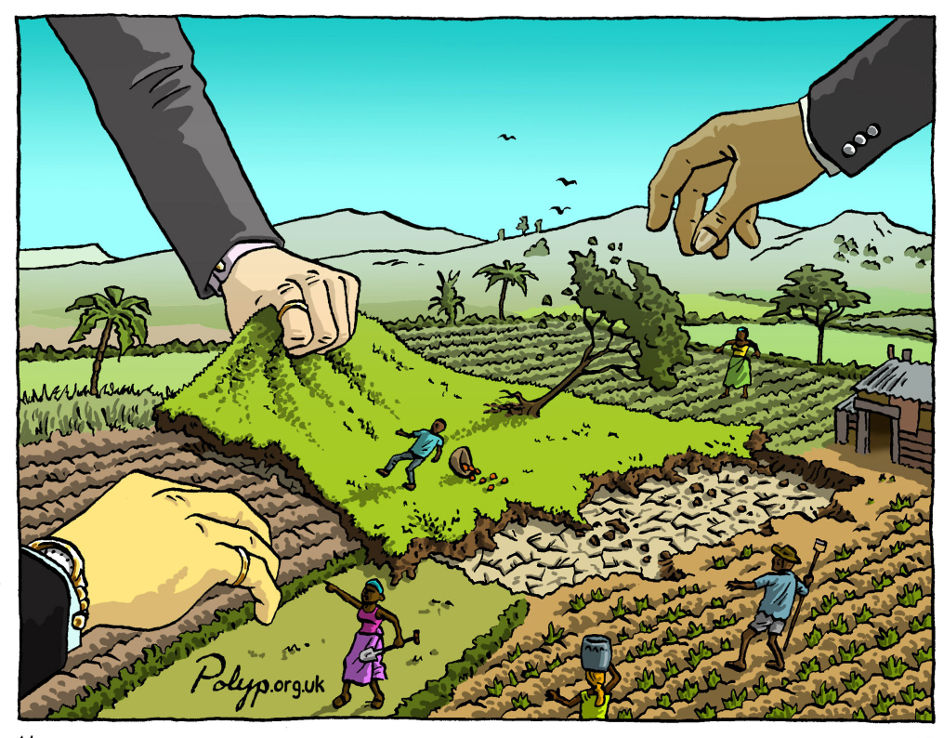
The Govt PR channels and clueless politicians are not surprisingly going to town about the magnanimous gesture about farmers getting deed ownership to lands that were given to them by the State as a lease. While a government has no constitutional ownership to the land of a nation, a Government, President or Politician has no moral or legal right to disburse of land with complete ownership. This is because the land of a nation must remain to be enjoyed not only by the present generation but by future generation. This much, everyone should be able to understand.
It may be too much to understand the geopolitics that constitute the efforts to grab fertile land, resources and turn natives into servitude of a handful of global entities using a nations debt, default, corruption and stupidity of leaders to their advantage to take over & control them. So, let’s just park this thought for a while.
How far the trade unions of these farmers are in the pockets of global land grabbers or international monetary entities or even corrupt politicians and are used to woo and brainwash the farmers is also a thought that should be kept in mind as we move forward.
Coming to the crux of the argument – the magnanimous gesture by the current president has had a long journey of effort – he wanted our farmers in jeans, eating chewing gum instead of betel leaves, he want to remove all agri lands and his dream is likely to get complete with the handover of deed ownership which he failed to do during the infamous yahapalana rule. Land issue was one of the reasons why he was sacked as PM, if we have not forgotten.
We need to look at the issue from several angles – the farmer, the banks & the govt & more importantly what is the real objective behind the government giving outright ownership to the state lease owners. We cannot forget that this effort was a key part of the MCC land agreement.
What are the problems of the farmers who currently own lease lands?
- Govt has stopped subsidies
- Govt has stopped fertilizers
- Govt is not helping with water supply
- Govt is not buying their crops
- Govt is not supporting them to get loans from state banks based on their income from product & ability to payback interest
Can giving an ownership certificate address the above?
Will banks give a loan with an ownership certificate without asking for 2 guarantors, income etc?
Presuming banks do give a loan based on the ownership only – if the farmer cannot pay the interest, what will the bank do? Bank will acquire the land
After acquiring the land – what will the bank do? The Bank will sell the land
Imagine how many lands will be up for sale?
Who will be buying this land?
If agricultural lands are sold — what will happen to this land?
If agricultural lands are sold by the Banks with Parate execution powers, the Court cannot intervene on behalf of the farmers.
What will happen to the farmer after he cannot pay the interest on the loan taken & the bank confiscates his land, leaving him & his family with no land, no livelihood and no place to live?
Have the farmers & all those clapping at the gesture to give land ownership certificates thought about this likely scenario?
Is this not a crucial question to think about and demand answers?
Are banks currently giving loans to farmers?
The publicized claim is that banks are not giving loans to farmers. However the State Mortgage Bank, the Agricultural Industrial Credit Corporation were created to give loans to farmers. Currently the State Banks do have loan schemes for farmers & those who claim there are no such provision may like to look at the criteria for a loan. One state bank is expecting a farmer to pay 27% interest – how fair is this? Is this how a government facilitates the farmers that feed the people?
We all know how farmers toil with many hardships to grow food. They grow food not to feed themselves, but the nation. Should we not be more humane to their needs? Have Governments actually being a partner of that growth since independence?
Look at the nations that give prominence to agriculture and the incentives given to the farming communities. Were we not called the Granary of the East – now the norm is for a handful to make commissions out of importing every food item while killing the agriculture in Sri Lanka and ensuring the land is not used for agriculture. The pesticides and other chemicals have over the years destroyed our fertile land. We are one of the few nations that are blessed to eat a fruit & throw the seeds and more fruits emerge naturally. We cannot even protect & preserve what we have been naturally blessed with.
If the government wants to serve the farmers and assist them, the better option for the President & Government to do is to change any laws & reduce the red tape and criteria, adjust the interest rates declared by banks in giving loans to farmers.
They must be considered as a special category of people.
Will the Government/President agree to new bank laws passed by Parliament
- Loans to be given without checking deed
- Loans to be given without checking financial ability to pay back
- Loans to be given without guarantors
- Loans to be given without interest (as farmers have no money)
- Loans to be given without seizing land from farmer & selling land by Parate execution by banks if loans/interest are in arreas.
Nevertheless, by giving deed ownership to state leased land (which the Govt/President has no moral right to do), the Govt/President makes the farmer a private land owner & completely abandons all responsibility of the land, the agriculture project, the farmer who provides food for the nation – virtually leaving the farmer & his family on their own to do as they want with no state help or no state responsibility.
Then the farmer within a short time finds that as a private land owner he cannot demand subsidies or any help from the govt & eventually he is wooed to sell as the sharks are all prepared for the outcome (as this is part of the plan) – either the farmer sells to an outside party for tuppence or the banks cease the land. The eventual outcome is that the nation’s agriculture is destroyed. The farmers have no livelihood. The farmer & his family have no land & eventually he may become a slave worker on the land alongside his family. He would have turned from being the king of the leased land that has been given by the state, to a slave worker.
Have the farmers thought of this scenario?
Have the MPs clapping for the President’s budget declaration on giving land ownership thought about what they are going to do when thousands of farmers in their electorates come wailing to them for relief when they find out too late, that they have no land, no livelihood and no place to live?
All the others supporting this are part of the plot, heavily sponsored to promote this & it is a carry forward of this quest from the MCC program where the ultimate aim was to secure Sri Lanka’s agri-lands under MNCs with corrupt local partnerships.
Time for everyone to realize that a geopolitically sensitive nation like Sri Lanka, gift horses must be looked in the mouth for sure!
Shenali D Waduge
Mahaveerar Naal (Great Heroes Day) / ‘Maaveerar Vaaram’ (Great Heroes Week)– Is it a LTTE event?
November 22nd, 2023Shenali D Waduge
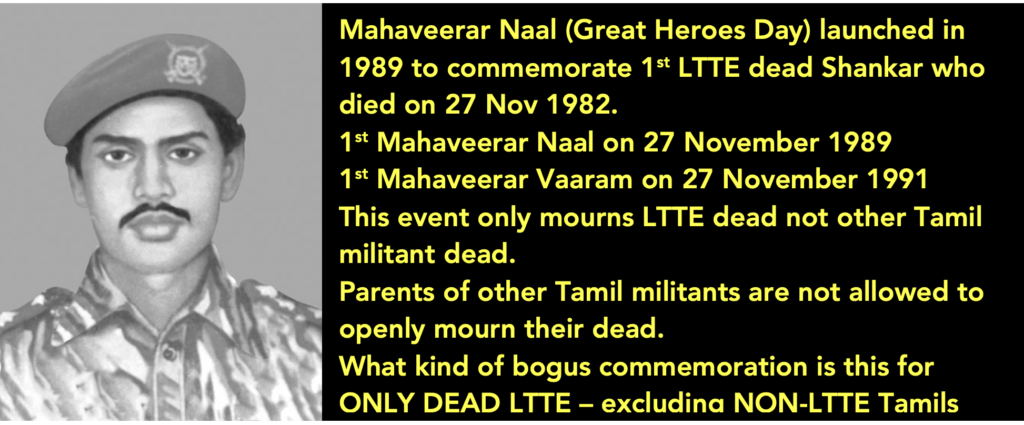
Mahaveerar Naal is a LTTE mourning event – it does not mourn Tamils & certainly not Tamils killed by LTTE. Mahaveerar Naal is an event annually organized by LTTE supporters to commemorate all LTTE who died for terrorist cause. Other Tamil militant groups are not allowed to commemorate their dead on this day – 27 November. It is only dedicated to LTTE dead. All those gathered for Mahaveerar Naal commemorations are LTTE only. The LTTE families mourning LTTE dead are known as Maaveerar Kudumbangal.
Why 27th November becomes Maaveerar Naal Day?
It is the day the first LTTE died fighting the Sri Lanka Army. He was Sathiyanathan or Shankar. He died on 27 November 1982. Shankar’s sister is married to Sea Tiger Soosai.
Therefore it commemorates the first terrorist to be killed.
What is the background to 27 November Mahaveerar Naal commemoration!
Shankar was a friend of Prabakaran. Shankar visited Nithiyanandan’s residences in Jaffna to warn him & his wife Nirmala that the army was looking for those sympathetic to LTTE. Nithiyanandan was a lecturer at the Jaffna University & Nirmala was a teacher at a leading girls school. The army arrived while Shankar was inside & tried to shoot his way out but was shot. Nithiyanandans were arrested. Sivakumar (Anton Master) took Shankar by boat to Tamil Nadu for urgent treatment & left him in a safe house provided by Nedumaran (Member of Tamil Nadu Legislative Assembly). Sivakumar went to Madurai where Prabakaran & others were staying following court order after the shoot out with PLOTE leader Uma Maheshwaran at Pondi Bazaar in Chennai. Shankar died in Madurai on 27 November 1982.
Then, 7 years after Shankars death in 1989 – Prabakaran and around 600 LTTE gathered in the jungles of Nithikaikulam, Mullaitivu to declare the Great Heroes Day or Mahaveerar Naal day.
When was the 1st Mahaveerar Naal commemoration?
27 November 1989 in Mullaitivu (7 years after Shankars death)
Subsequently from 1991 it was turned into a week-long commemoration (Great Heroes Week) from 21-27 November. It was turned into a week to cover Prabakaran’s birthday which fell on 26 November (day before Shankar died)
There have been 34 Mahaveerar Naal (Great Heroes Day) since 1989
There have been 32 Mahaveerar Vaaram (Great Heroes Week) since 1991
- 1989 – https://tamilnation.org/tamileelam/maveerar/1989.htm
- 1990 – https://thaikural.com/podcast/3/national-remembrance-day-speech/episode/4
- 1991 – https://tamilnation.org/ltte/vp/mahaveerar/vp91.htm
- 1992 – https://maaveerarnaal.wordpress.com/2013/07/21/maaveerar-naal-address-1992/
- 1993 – https://tamilnation.org/ltte/vp/mahaveerar/vp93.htm
- 1994 – https://tamilnation.org/ltte/vp/mahaveerar/vp94.htm
- 1995 – https://tamilnation.org/ltte/vp/mahaveerar/vp95.htm
- 1996 – https://tamilnation.org/ltte/vp/mahaveerar/vp96.htm
- 1997 – https://tamilnation.org/ltte/vp/mahaveerar/vp97.htm
- 1998 – https://tamilnation.org/tamileelam/maveerar/1998.htm
- 1999 – https://tamilnation.org/ltte/vp/mahaveerar/vp99.htm
- 2000 – https://tamilnation.org/ltte/vp/mahaveerar/vp00
- 2001 – https://tamilnation.org/tamileelam/maveerar/2001.htm
- 2002 – https://tamilnation.org/tamileelam/maveerar/2000.htm /https://www.tamilnet.com/art.html?catid=13&artid=7880 / https://www.tamilnet.com/art.html?catid=13&artid=7885 – 2002
- TNA National List MP Thurairetnasingham participated in the 2002 event in Trincomalee. TNA Leader R Sampanthan declared that LTTE had proved its military might to the Sri Lankan govts in power by defeating the State Armed Forces in several bttles in NE
- 2003 – https://tamilnation.org/tamileelam/maveerar/2003.htm
- 2004 – https://tamilnation.org/tamileelam/maveerar/2004.htm
- 2005 – https://tamilnation.org/tamileelam/maveerar/2005.htm
- 2006 – https://tamilnation.org/tamileelam/maveerar/2006.htm
- 2007 – https://tamilnation.org/tamileelam/maveerar/2007.htm
- 2008 – Mahaveerar Naal was held in London https://tamilnation.org/tamileelam/maveerar/2008/london.htm
- 2009 – 1st Mahaveerar Naal without Prabakaran https://sangam.org/2009/11/Mavareer_Naal.php?uid=3744#:~:text=27%20November%202009%20marks%20the,Tamil%20resistance%20to%20alien%20rule.
- 2010 – https://www.bbc.com/news/world-south-asia-11846369
- 2011 – Toronto, Canada https://www.ninaivukal.com/Portfolio/Tamileelam/Maveerar-Naal-2011-Toronto/i-6JqbM9h/
- 2012 – https://www.tamilnet.com/art.html?catid=13&artid=35799 – UK & Australia
- 2013 – https://www.youtube.com/watch?v=Mjd4EyQFNhA
- 2014 – https://www.tamilguardian.com/content/british-tamils-commemorate-maveerar-naal UK
- 2015- https://www.tamilguardian.com/content/maaveerar-naal-2015
- 2016 – https://www.dailymirror.lk/article/-Great-Heroes-Day-Maaveerar-Naal-is-an-LTTE-event-not-a-Tamil-National-Day-of-Mourning-120153.html
- 2017 – https://www.tamilguardian.com/content/tamils-mark-maaveerar-naal-2017-worldwide
- 2018 – https://www.tamilguardian.com/content/maaveerar-naal-mourning-human-right – what about the human rights of non-LTTE Tamils to mourn too!
- 2019 – https://www.tamilguardian.com/content/thousands-british-tamils-mark-maaveerar-naal-across-uk
- 2020 – a British MP commemorating LTTE dead https://www.facebook.com/watch/?v=309095456845750
- 2022 – https://www.tamilguardian.com/content/tamil-nation-marks-maaveerar-naal-2022
Mahaveerar Naal – evidence that establish it is a LTTE event
- Is always inaugurated by LTTE military commanders
- Tamil Eelam flag is hoisted
- Flame of sacrifice is lighted
- Homage is paid to LTTE dead members by constructing several cemeteries with tombs & names engraved of the dead LTTE called Maaveerar Thuyilum Illangai” (abode where great heroes sleep)
- LTTE marked this event as it motivated other youths to join LTTE
- LTTE families – Maaveerar Kudumbangal gather to mourn their dead sons & daughters (families of other Tamil militant groups are not allowed to openly mourn their dead)
- Great Heroes Day address by Prabakaran on 27 November (his birthday) – this was a policy statement written by Anton Balasingham & read out by Prabakaran. Prabakaran’s address stars at 0605p.m. (the time Shankar died)
- The speech was relayed by LTTE’s Voice of Tiger radio station – Puligalin Kural
- LTTE TV – Nitharsanam also telecast to the world from Vanni.
- LTTE colors – red & yellow flags were always used at Mahaveerar Naal commemorations.
- LTTE flag & emblems were a key highlight.
- In 2003 LTTE declared Senkaanthal flower as Kaarthigai Poo (flower of Tamil Eelam) – it is known as the Gloriosa Lily & this flower also takes a prominence place at Mahaveer Naal commemorations since 2003.
- Prabakaran garlanded the picture of Shankar the 1st great hero thereafter flowers & lamps are placed before other martyrs by others. Nowadays, we even see foreign MPs placing lamps & flowers in front of dead LTTE in western shores! If only there was a garland for stupidity.
Not only is Mahaveerar Naal a LTTE event that mourns LTTE dead, it is a dad that does not commemorate or mourn the dead of other Tamil militant groups.
Mahaveerar Naal does not regard dead of other Tamil groups as heroes.
Mahaveerar Naal only regards LTTE dead as martyrs not members of EROS, PLOTE, EPRLF etc… parents of these dead are not allowed to mourn their dead.
These parents can only mourn their dead children in private. They are not included into the Mahaveerar Naal commemorations.
Mahaveerar Naal excludes other Tamil militant dead
Mahaveerar Naal excludes mothers & fathers of other militant groups to mourn their sons & daughters.
Parents of other Tamil militant groups have to mourn their dead children in private.
Mahaveerar Naal (Great Heroes Day), Mahaveerar Vaaram (Great Heroes Week) are only for LTTE dead ending on LTTE leaders birthday after a weeklong comemoration of LTTE dead.
When TNA goes to commemorate Mahaveerar Naal – they are commemorating/mourning dead LTTE & considering them as martyrs.
LTTE is banned & as such everything associated with LTTE should also be banned (LTTE flag, flowers, emblems) etc.
Clearly, Mahaveerar Naal is not only a LTTE commemoration it is only for LTTE Tamils. Non-LTTE Tamils are excluded. Therefore, this cannot be allowed at all.
It is not an event that is relevant to ALL TAMILS and only a segment of Tamils aspiring to separate Sri Lanka by hook or by crook.
No Government should allow commemorations of this nature.
For a mother or father – it is irrelevant whether their son or daughter is a terrorist or a patriot. However, no mother or father can demand that they must mourn their dead child surrounded by terrorist paraphernalia. No parents mourning can become greater with the presence of LTTE flags, flowers or emblems! No parent is forbidden to mourn their dead LTTE in private – why do they need to make a tamasha out of it with foreign media, foreign press releases, foreign MPs, political speeches etc? This shows a political agenda behind the move.
Moreover, these LTTE parents should have some empathy to the other parents of Tamil militant groups who have died but who are not allowed to commemorate their dead. If the parents of EROS, PLOTE, EPRLF etc mourn their sons & daughters in private, why can’t LTTE parents? https://www.lankaweb.com/news/items/2021/11/22/if-maaveerar-naal-hails-ltte-dead-what-do-we-call-event-to-commemorate-tamils-killed-by-ltte/
Why should only LTTE be given exclusivity or exceptionalism among Tamils? Moreover, Prabakaran & LTTE’s Tamil Eelam is ONLY for LTTE Tamils and not for other Tamils…. How many Tamils are ready to accept this reality?
Shenali D Waduge
BUDDHIST VIHARAS AND EELAM Part 10D
November 22nd, 2023KAMALIKA PIERIS
The Tamil Separatist Movement has tried to use the law courts to try and stop the revival work on Kurundi. They have used the Mullaitivu police and the Mullaitivu Magistrate court for the purpose.
On 4. September 2018. Santhabodhi accompanied by Department of Archaeology officers from Vavuniya and Colombo set off for Kurundi, to make arrangements to set up a guard house at Kurundi. They were not allowed to proceed to Kurundi.
The police stopped them halfway and told them that they did not have permission to erect any new structures. There was a police post at the Norochcholai tank and a Tamil police officer had come and questioned them. He was also was in conversation with someone by phone, in Tamil recalled Santhabodhi.
They turned back to go to Sapumalgaskada. On the way, a group of Tamil demonstrators on scooters blocked the vehicle, scolded in strong language and tried to pull Santhabodhi out. They assaulted the driver and ordered him to turn the van round and follow the demonstrators. They were taken to the tank bund where a waiting media team filmed them. Also waiting were about 100 Tamils on scooters. Santhabodhi and his group were taken before their leaders, who Santhabodhi thought were Tamil MPs and Tamil separatists.
The Archaeology Department staff informed the police and army. After several hours trapped with this group, Oddusuddan police came and took us to the police station for a statement. Archaeology officers showed documents and said they came on legitimate business. We returned to Sapumalgaskada about 7 pm.
On 2018.09.05 Oddusuddan police filed a case at Mullaitivu Magistrate court (AR-673/18) against Santhabodhi on the charge of disturbing the peace . Peace was broken by the Tamil Separatist Movement but they were not charged, observed Santhabodhi . The event was presented as a clash between two parties.
It appears that there was also a second complaint made by a group of Kurundi residents asking that that the excavation be stopped. The complainants were N Ruchikka, T Radhika, A Nirojini, Subha Viduran, and K. Ganeshwaran.
The case was called on September 27, 2018 at Mullaitivu Magistrate court. Ven. Bengamuwe Nalaka accompanied Santhabodhi. ACBC had sent lawyer Samith Kalhara. A husband and wife team of lawyers Nuwan Ballantudawe and his wife Piyumi also appeared for him
Case was called again on October 1.2018. Both sides state their cases. The Tamil side said that, the Police, Army, Archaeology Department and a Buddhist monk are trying to build a Buddhist temple at Kurundi. They say that they have got permission to set up a guard house, but no such bulling has come up.
Kurundi was in a majority Tamil area .There are no Buddhists in the area. There is a small kovil there where the Hindus worshipped. Buddhists are trying to erect a Buddhist temple here. This will obstruct the worship at the Hindu kovil. This was an attempt to erase the Hindu tradition and impose Buddhism here. This is a violation of the rights of the Hindus. The ruins at Kurundi are Hindu ruins. We agree that the ruins should be protected that there should be no new temple. That could create ethnic disharmony, concluded the Tamil lawyers.
Magistrate ordered Department of Archaeology, Vavuniya to make a report within 3 weeks, as to what exactly they were doing at Kurundi. By October 16th a three month archaeology plan for Kurundi was ready. The Vavuniya office worked round the clock with much dedication to complete this. They treated it not as a religious smatter but as a national matter, said Santhabodhi.
In September we built the guardhouse with the assistance of 25th Singha Regiment, based at Alampil, Mullaitivu, continued Santhabodhi . The day before, Tamil Separatist Movement had gone to courts as they knew that the work on the guard house was starting the next day. Department of Archaeology told court that they were following a court order. Magistrate threw out the case. Thanks to the generosity of patrons, the guard house and well were built and generator installed.
The case AR-673/18 was next heard on 22October 2018. Ven. Panamura Tilakavansa of Tammankaduwa, who had set up Arisimale vihara attended. A delegation from ACBC led by its Vice President Wakista also attended the hearing. Afterwards ACBC group went to see Kurundi.
The police told court that the guard house had been built and there was no need to continue with the case, also that the construction was legal. Order was given to proceed with the work at Kurundi on the basis of the plan submitted by the Department of archaeology .
The Tamil lawyers then raised an objection. They said the plan was in Sinhala and wanted a Tamil or English translation. Magistrate agreed and we agreed to provide our report in English. The case was postponed but permission was given for Department of Archaeology to proceed. An English translation was prepared by ACBC subsequently and sent to courts.
The hearing ended with Court ordering Department of Archaeology to proceed with the plan they had provided to court but they must inform the relevant local authorities. Also they must not create an ethnic disturbance or disturb the peace.
The order did not make any reference to the Santhabodhi group or to what they had said, observed Santhabodhi. And all the documents we received were in Tamil including the court orders, he said.
However, the Department of Archaeology was now free to carry on with its work. Santhabodhi asked Department of Archaeology to resume work and informed Secretary, Buddha Sasana Ministry as well.
On February 2nd 2021. Tamil Separatist Movement said that they intend to go to courts re Kurundi.
The Tamil Separatist Movement tried again July 2021. The Magistrate was told that a new stupa was coming up over the ruins. Without making proper inquiries’, Magistrate gave a special order on 7 July 2021. He said that police must remove all new additions to the stupa. The Director, Archaeology promptly ordered that all work at Kurundi be stopped.
The Magistrate’s ruling was publicized in the media . The media reported that courts had ordered that the Kurundi stupa be broken down. There was an immediate howl from the public. Many contacted Santhabodhi.
Police told the Magistrate that this order could not be obeyed. There would be a huge public protest. In the meantime, Director of Archaeology and the Solicitor General met the Chief Justice in Colombo. On an order from Chief Justice, the case was recalled on July 19 at Mullaitivu.
The Magistrate then went to Kurundi personally to see for himself. He was met by Director of archaeology , Aruna Manatunga. Additional Solicitor General was also present on order of chief justice . This inspection was shown on https://youtu.be/V2IrcOEzD-4 where the Magistrate could be heard speaking in fluent Sinhala. On 2022.7.19 the Magistrate revoked his earlier order and told the Archaeology Department that they could proceed with their work in Kurundi.
M. A. Sumanthiran MP filed a petition in the Supreme Court in August 2021 against the commencement of excavations at the Kurundi naming Prime Minister Mahinda Rajapaksa, Minister of State Vidura Wickramanayake and Commissioner General of Archeology Prof. Anura Manatunga as respondents.. Buddha Sasana Minister Vidura Wickramanayake stated that their activities at Kurundi was governed by the Antiquities Ordinance.
Case no AR-673/18 came up again in October 22, 2022. This case which had started as disturbing the peace now became an archaeology issue, observed Santhabodhi . I contacted lawyers and three including Nuwan agreed to come. They wanted transport and dayaka were ready to provide this, recalled Santhabodhi . Ven. Kiribbanwewa Upaneetha and Matugama Seneviruwan came to support Santhabodhi .
The Kurundi lawyers took the position that a Magistrates court cannot question a decision of the Director of Archaeology. Court seems to have accepted this.
The Kurundi lawyers said that they wished to speak in Sinhala and English. The Tamil lawyers objected. They wanted the discussion in Tamil only. The lawyers protested that they had the right to speak in all three languages. But Magistrate upheld the objection of the Tamil lawyers. Since there were no translators present, he ended the hearing . Work on Kurundi vihara was stopped again.
The final order was given on 24.11.2022. The Order said that Department of Archaeology was to continue with the order given earlier on 19.7.2022.This meant that conservation work on Kurundi could continue. This was a victory for Kurundi and a defeat for the Tamil Separatist Movement .
But the legal harassment is not over. Tamil protestors stormed a pinkama at Kurundi on 18.8.2023 and wanted to conduct a pongal there. They were turned away after one pongal. Media then reported that Mullaitivu politicians had filed a case saying this was a violation of Human rights and an obstruction of religious freedom. Hindu devotees had been informed that a pongal festival was being held at this kovil.
on 22.8.23 Mullaitivu magistrate ordered police to submit a report giving reasons for police and officers of the Archaeology Department turning away residents who had gone to attend the pongal festival at the Hindu kovil located at Kurundi. Case was to be taken up for hearing. ( Continued)
Secretary Defence graces 52nd Bangladesh Armed Forces Day Ceremony
November 22nd, 2023MOD Media Centre
Defence Secretary, General Kamal Gunaratne graced the 52nd Bangladesh Armed Forces Day ceremony as the Chief Guest at the Cinnamon Grand Hotel in Colombo last evening (Nov. 21).
The host, High Commissioner of Bangladesh to Sri Lanka HE Tareq Md Ariful Islam received the Defence Secretary on his arrival at the venue.
Addressing the distinguished gathering the Defence Secretary praised the existing bilateral ties between Bangladesh and Sri Lanka and also stressed the importance of maintaining the longstanding relations.
While mentioning the cooperation and camaraderie that have defined the relationship between the militaries of both nations he recalled the efforts to combat terrorism, piracy, other transnational threats that endanger collective security, collaboration in disaster relief operations, humanitarian assistance, bilateral knowledge exchange and fostering a culture of mutual learning and growth.
Defence Advisor at the Bangladesh HC Commodore M Moniruzzaman made the welcome address.
The Bangladesh High Commissioner presented a memento to the Defence Secretary during the occasion.
Members of the diplomatic corps including High Commissioners of India and Nepal, chargé d’affaires of Maldives, Navy Chief of Staff, Military Liaison Officer of the Ministry of Defence and many distinguished guests were present at the event
It is not Cricket
November 22nd, 2023Sugath Kulatunga
The controversy on the activities of the Sri Lanka Cricket Board (SLBDC) has gone viral. It is one issue which has involved all three pillars of the government, the executive, legislature and the judiciary. It has brought the warring political parties on common cause of saving the game of cricket. However, one aspect of this issue which is the role of the ICC is not revealed. It entails essential principles national sovereignty and good governance.
Although the ICC was London based the ICC memo And Articles were registered in the British Virgin Islands. Now the ICC headquarters are based in Dubai. The rationale for the location of organizations in Tax Havens does not need no amplification.
ICC deals only with a “National Governing Body” that is recognised by the ICC as the governing body responsible for the administration, management and development of Cricket in a Cricket Playing Country.
- Among the Obligations of Members is to manage its affairs autonomously and ensure that there is no government (or other public or quasi-public body) interference in its governance, regulation and/or administration of Cricket in its Cricket Playing Country (including in operational matters, in the selection and management of teams, and in the appointment of coaches or support personnel); and
- Adopt, implement and enforce within its Cricket Playing Country a set of regulations (including anti-doping and anti-corruption regulations) that are consistent with the Memorandum of Association, these Articles of Association, each Members’ Resolution that is passed, and the Regulations.
The consequences of any breach of these obligations are severe and if in the opinion of the Board of Directors of the ICC the membership of a member likely to be suspended with immediate effect where, in the opinion of the Board of Directors (in its absolute discretion), the Member is in serious breach of any of its obligations as a Member.
- Any suspension of a Member by the Board of Directors in accordance with Article 2.10(A) shall be subject to such terms and conditions as the Board of Directors may determine, including terms and conditions that the Member must satisfy (in accordance with a deadline specified by the Board of Directors) in order to have its suspension lifted (‘Reinstatement Conditions’). (It is noted that in the FIFA, which is a much bigger organization A suspension of a member association by the Congress requires a three-quarter (3/4) majority of the member associations present and eligible to vote).
- Any Member that has its membership suspended under this Article 2.10 shall, unless the Board of Directors decides otherwise in its absolute discretion, and for the period of such suspension, be deprived of all of its rights as a Member (whether set out in these Articles of Association or otherwise), including its right to receive distributions of surplus ICC revenues, its right to participate in Events sanctioned by the ICC and its right to attend and vote at Meetings. The Register of Members will be amended to record the suspension. Any contractual or other obligations owed by that Member to the ICC which have accrued prior to suspension or under clause 11 of the Memorandum of Association shall continue to remain legally valid, binding and in full force and effect.
- During the period of such suspension, the Board of Directors may make such arrangements for the governance, regulation and administration of Cricket in the relevant Member’s Cricket Playing Country as it sees fit, including (without limitation) exercising (or delegating to another to exercise) the rights previously exercised by the suspended Member to sanction (or not sanction) Cricket events staged in that Cricket Playing Country.
- If the suspended Member does not meet the Reinstatement Conditions in full by the specified deadline, and/or where the Board of Directors otherwise deems it appropriate, the Board of Directors may pursue termination of the suspended Member’s membership in accordance with Article 2.11.
The obligation of a member to ensure the prevention of government interference is a tall order. It infringes on the sovereign authority of a national government. In Sri Lanka Sports are regulated under the Sports Law of the country which is administered by the Minister responsible for the subject. Lawful directions given by the Minister are valid and cannot be considered as interference. The present predicament arose with the Minister appointing of an Interim Committee on cricket headed by Arjuna Ranatunga was appointment. The SLBDC has challenged it before the courts and allegedly canvassing the ICC to suspend the SLBDC by resorting to misinformation on the action of the Minister.
On the appointment of Interim Committees to replace National Boards of Control of cricket it must be noted that in 2013 Pakistan’s Prime Minister appointed an interim management committee (IMC) to supersede the Pakistan Cricket Board in order to reorganise the country’s cricket structure.
in 2020 in the midst of administrative and governance failures by Cricket South Africa an Interim Board was mandated by the Minister of Sport to reform CSA’s governance structure, while providing the usual oversight function over CSA’s operations.
In 2017, the Supreme Court of India held the powerful Board of Control for Cricket in India to account and appointed a special Board to overhaul the Constitution of the BCI and debarred the BCI amending its constitution without the permission of the SC of India.
In these radical interventions the ICI has not attempted to prevent the interventions by the government and the judiciary.
The ICI seem to operate like a secret organization where confidentiality is given high priority and members are prohibited to give out information on its proceedings. Even meeting papers, the agenda and minutes of meetings have to be kept confidential by all members. There is no such confidentiality provision in the FIFA rules.
The ICI is committed to uphold, respect and advance the unique culture, ethic and spirit of Cricket. But it has failed to even to ensure that the SLBDC fulfil the obligation to adopt, implement and enforce a set of regulations (including anti-doping and anti-corruption regulations) that are consistent with the ICC Memorandum of Association, these Articles of Association, each Members’ Resolution that is passed, and the Regulations. Instead, ICI has closed its eyes on the corruption, mismanagement and waste exposed by the Auditor General and the report of the committee chaired by a retired judge of the supreme court.
It seems that the SLBDC has been playing Pandu.
Colombo calling Beijing: ready for Phase 2 of the Belt and Road Initiative
November 22nd, 2023by Arundathie Abeysinghe Courtesy PIME Asia News
Sri Lanka is increasingly tying its fragile economy to China. After the debt agreement with the Export-Import Bank of China, Sri Lankan President Wickremesinghe said he was ready to expand the direct corridor with China bypassing India. Xi Jinping’s special envoy, State Counsellor Shen Yiqin, used her visit to the island to “lay out” China’s cards.
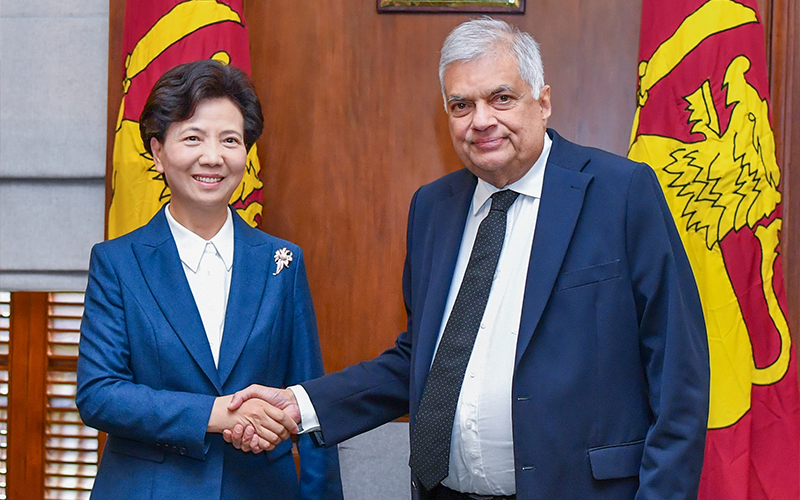
Colombo (AsiaNews) – Sri Lanka is set to launch Phase 2 of the Belt and Road Initiative (BRI) with China, starting with the existing China-Myanmar Economic Corridor (CMEC), to include the island.
Sri Lanka’s economic policy aims to have a direct route to China, bypassing current trade links involving Bangladesh, China, India, and Myanmar (BCIM), which are currently stalled due to political tensions between China and India.
In Colombo Chinese President Xi Jinping’s special envoy, State Counsellor Shen Yiqin, met with Sri Lankan President Ranil Wickremesinghe on Monday to lay out” China’s cards.
Shen’s visit follows the recent tête-à-tête between Wickremesinghe and Xi in Beijing, aimed at consolidating bilateral relations.
Analysts believe that this visit is of utmost importance for the country’s economic future.
On 12 October, Sri Lanka reached an agreement with the Export-Import Bank of China to cover about US$ 4.2 billion of the country’s outstanding debt.
Sri Lanka is currently trying to finalise a plan with its creditors to secure additional aid from the International Monetary Fund (IMF) to pursue its economic recovery.
Although China has decided to remain an observer during debt restructuring talks, it will be one of the crucial players for the future of the country’s economy.
During his meeting with Shen, President Wickremesinghe expressed Sri Lanka’s aspiration to increase cooperation with China in other fields, like tourism, agriculture, and sports, stressing that the Hambantota international port – under a 99-year lease to China – and Colombo Port are currently ready to expand business between the two countries.
For its part, China is prioritising” the extension of the China-Myanmar Economic Corridor (CMEC) to Sri Lanka. Indeed, Mr Wickremesinghe noted that his country is prepared to embark on the second phase of the initiative, which is expected to make a more substantial economic contribution.”
Sri Lankan Prime Minister Dinesh Gunawardena also met with State Councillor Shen, highlighting the vast potential to expand China-Sri Lanka economic cooperation. He also noted that Sri Lanka values China’s investments in agriculture, renewable energy, education, and infrastructure.
During the meeting, the president stressed the need to maintain the Indian Ocean as a freely navigable and peaceful region, free from global geopolitical rivalries,” political analysts Sachintha Tennakoon and Medhavi Attygalle told AsiaNews. Yet, the development of the BRI points instead to China’s intention to strengthen its influence in South Asia.”
SC ruling on economic crisis: Parliament also responsible, says Foreign Minister
November 22nd, 2023By Shamindra Ferdinando Courtesy The Island

Foreign Minister Ali Sabry, PC, yesterday said that Parliament like other institutions should bear responsibility for the unprecedented economic crisis caused during President Gotabaya Rajapaksa’s administration.
Minister Sabry said so when The Island sought his response as regards the responsibility of Parliament for the developing situation against the backdrop of the country being bankrupted mainly due to overall mismanagement of the economy.
At the time of the eruption of public protests in early 2022, Minister Sabry served as the Foreign Minister of the Gotabaya Rajapaksa government.
Addressing the media at the President’s Media Centre (PMC), the SLPP National List MP dealt with the 2024 Budget presented by President Ranil Wickremesinghe, in his capacity as the Finance Minister.
Having compared the period leading to President Gotabaya Rajapaksa’s ouster with the significant improvements made under incumbent President Ranil Wickremesinghe’s resolute leadership, the top lawyer explained how successive governments ruined the economy by resorting to utterly irresponsible strategies.
The first time entrant to Parliament, following the last general election held in Aug. 2020, Minister Sabry emphasized how flawed tax strategies over the years caused the economic ruination. The Minister questioned the rationale in 80:20 ratio in indirect and direct taxes when the acceptable radio was 60:40 world over. The Minister went on to highlight the circumstances that led to the drop in revenue to just over 8 percent of the Gross Domestic Product (GDP) from 23% to 25% ahead of 2019/2020 crash.
Asked whether he had been present in the parliamentary chamber when a section of the ruling SLPP went berserk over a statement made by SJB and Opposition Leader Sajith Premadasa in respect of the landmark Supreme Court judgment on economic crisis and what was his response to such unruly behaviour, the Minister said that he was there.
The SC on Nov 14 in a 4 to 1 verdict declared that former President Gotabaya Rajapaksa, former Finance Ministers Mahinda Rajapaksa and Basil Rajapaksa, ex-Governors of the Central Bank Prof. W.D. Lakshman and Ajith Nivad Cabraal, ex-Finance Secretary S.R. Attygalle, Presidential Secretary Dr. P.B.J. Jayasundera and the then Monetary Board were responsible for the economic collapse.
They were directed to pay Rs 150,000 each to those who filed fundamental rights applications.
The Minister emphasized that he never condoned such conduct and he never behaved that way or intended to do so in the future. That was one side of the issue. We see various interested parties interpret the SC ruling the way they want. I read this judgment entirely. The ruling doesn’t say there had been fraud and money robbed. Funds had been sent overseas and measures should put in place to recover the money. It doesn’t say so. The SC found fault with the respondents for their failure to take timely action to avert the crisis. One specific issue artificial measures to control Rupees. I have pointed this out even last year. The other issue was the tax cut. They were policy decisions. The third issue was the timing of the IMF intervention. The fallout of those decisions should be political.”
The Minister said that there was no harm in prosecuting if there were fraud and robbery. But the Rajapaksas had already taken responsibility for those decisions, Minister Sabry said, pointing out that Gotabaya Rajapaksa, who won a five-year term, had to quit, and the Prime Minister, too, had to go. The entire government had to be handed over. They have to face the people, the Minister said.
We genuinely believed the government should have sought the IMF intervention at that time, the depreciation of the Rupee should have been allowed to some extent. Perhaps those who decide on policy may have felt they were right,” Minister Sabry, said reminding that Sri Lanka sought IMF interventions on 16 previous occasions.
Minister Sabry insisted that no one would come into politics if those who had been found fault for lapses on their part in respect of policy decisions were dealt with in terms of criminal liability. Reiterating that the fallout should be solely political, the Foreign Minister said, adding that in case someone engaged in fraud, corruption and crime he should bear criminal responsibility.
Parliamentary caucus on cricket to be formed: Speaker
November 22nd, 2023BY YOHAN PERERA AND AJITH SIRIWARDANA Courtesy The Daily Mirror
PARLIAMENT (Daily Mirror)- A special parliamentary Caucus will be appointed to revive cricket in Sri Lanka, Speaker Mahinda Yapa Abeywardena announced today.
He told Parliament that it will be appointed following a request by Opposition Leader Sajith Premadasa.
USD 55,000 given by Jay Shah, Siraj for ground staff yet to be paid: Sajith
November 22nd, 2023BY YOHAN PERERA AND AJITH SIRIWARDANA Courtesy The Daily Mirror
 PARLIAMENT (Daily Mirror)- A sum of USD 50,000 donated by Asian Cricket Council chief Jay Shah and USD 5,000 given by Indian cricket star Siraj for the ground staff of Pallekele and R. Premadasa stadiums have not been paid yet, Opposition Leader Sajith Premadasa told Parliament today.
“The ground staff have not been paid to date. What has become of this money,” he asked.
President assures to look into three letters sent by SLC to ICC
November 22nd, 2023BY AJITH SIRIWARDANA AND YOHAN PERERA Courtesy The Daily Mirror
 PARLIAMENT (Daily Mirror)- President Ranil Wickremesinghe said today that he will look into the three letters that were sent by Sri Lanka Cricket (SLC) to the International Cricket Council (ICC).
The President requested Opposition Leader Sajith Premadasa to send him the three letters and assured to look into them.
He said this in response to a statement by the Opposition Leader that the SLC had sent three letters dated November 6, 7 and 9 to the ICC requesting it to suspend the SLC, alleging that there was undue interference in the activities of the SLC.
Premadasa said he had tabled the three letters in Parliament.
“Send me the three letters. I will follow up on them,” the President told Premadasa.
Rekawa is a UNP stalwart; President questions why he was verbally attacked in Parliament
November 22nd, 2023By Ajith Siriwardana and Yohan Perera
 Claiming that he was saddened by the verbal attack on Ariya Rekawa and his son in Parliament, President Ranil Wickremesinghe said Rekawa was a UNP stalwart since 1970.
He told Parliament that Ariya Rekawa and his son were good people and that he never think that Rekawa’s son would be involved in any bad practices even though he was connected to the SLC.
“Who is Rekawa? He has worked with us in the UNP since the 1970s. Ranasinghe Premadasa requested him to contest the election and he was elected to Parliament. Why should we attack him? He is someone who has won the faith of me and Ranasinghe Premadasa. I even appointed him as the Ambassador to Vietnam,” he said.
Referring to a photograph shown by Sports Minister Roshan Ranasinghe in the House showing that Ariya Rekawa and Bandula Karunaratne were there, the President said it was he who was there in the middle of that photograph.
“It is not a secret. It is I who was there in the middle of that photograph, asked Rekawa to come to President’s House when Bandula Karunaratne came to take oath as the President of the Appeal Court,” he said.
The President said criticizing the order given by the Court of Appeal staying the Interim Committee of the SLC was wrong and that Bandula Karunaratne was criticized as he was handling MP Diana Gamage’s case as well.
’I was forced to swollow screw nails in Saudi’ – abused Sri Lankan maid reveals
November 22nd, 2023Courtesy The Daily Mirror
KATUNAYAKA (Daily Mirror) – Darshani, a Sri Lankan maid who returned from Saudi Arabia said she was forced to swallow screw nails with water by her employer which resulted in her being hospitalized.
Making an emotional statement at the Katunayake airport upon her arrival, the housemaid said she was continuously abused and assaulted by her employer. The victim, a resident of Mathugama is a mother of three children.
Coming to her rescue, Marimuthu Nilantha Kumara, the husband of the victim, who earns a living as a coconut plucker in the vicinity, came to Katunayake airport to receive Darshani.
The housemaid also said that when she had complained to the recruitment agency in Sri Lanka, the agency had verbally abused her.
I slipped and fell after stepping on shampoo in a bathroom, causing injury to my back and head. Then, the woman of the house physically assaulted me and locked me in a room,” she said.
Furthermore, the victim revealed that she was forcibly taken to a washing machine room where she was confined and subjected to further abuse.
Tri-forces collect Rs. 8.6 million expressways toll revenue amid strike
November 22nd, 2023Courtesy The Daily Mirror
COLOMBO (Daily Mirror) – More than Rs. 8.6 million in revenue has been earned as expressway toll by 3 p.m. today after the tri-forces were deployed for operations at ticket counters since the launch of a strike by the Expressway Worker’s Union.
The All-Island Expressway Workers’ Union initiated the strike today, citing various demands, including concerns about the privatization of the highway network.
In response to the 24-hour token strike, tri-force personnel were deployed to manage ticket counters and provide security on the expressways.
Accordingly, the Sri Lanka Army which had been deployed for the Southern Expressway operations collected Rs. 1,635,940 while Sri Lanka Air Force personnel on the Katunayake Expressway collected Rs. 5,951,090 and the Sri Lanka Navy on the Central Expressway (Kurunegala) collected Rs. 1,022 900 despite the challenges such as the union membere taking away the ticket issuing machines and not handing over cards.
There are other offenders in addition to Rajapaksas: Ranil
November 22nd, 2023By YOHAN PERERA Courtesy The Daily Mirror
PARLIAMENT (Daily Mirror) – Referring to the recent judgment given by the Supreme Court where former Presidents Gotabaya Rajapaksa, Mahinda Rajapaksa former Minister Basil Rajapaksa and others were held responsible for the economic crisis, President Ranil Wickremesinghe today said one has to look into whether others are also responsible for the economic debacle and have engaged in a breach of public trust.
One must note that even the opposition has engaged in a breach of trust. It is the duty of the main opposition to take over the government once those in the existing government resign. However, the current leader of the opposition and the main opposition had engaged in a breach of public trust by failing to form a new government in 2022. We can also probe these matters,” he said.
He also referred to an error in the court case number in the question submitted by Opposition Leader MP Sajith Premadasa. The number of cases which the Opposition Leader referred to a case in Trinomalee,” he said in a lighter vein.
Mr. Premadasa said error in the case number was not a major issue and accused the President of dodging his question.
SLPP MP Gevindu Kumaratunga who spoke later said the President should not have taken a question with regard to the economic crisis in a lighter vein. ‘ President should not have come up with dirty jokes,” he said.
Using too many antibiotics may cause death to everyone within about 50 years: Pediatrician
November 22nd, 2023By CHATURANGA PRADEEP SAMARAWICKRAMA Courtesy The Daily Mirror
 COLOMBO (Daily Mirror) – Using antibiotics without a doctor’s prescription could cause the death of necessary bacteria that are needed for the survival of the body, and the diseases caused by the creation of resistant bacteria in the body spreading throughout society could cause death for everyone within about 50 years, Lady Ridgeway Hospital (LRH) Consultant Paediatrician Dr. Deepal Perera said.
Commenting on the ‘World Antibiotic Awareness Week’ from November 18 to 24, he further said that the world’s antimicrobial experts have discovered this through research.
Dr. Perera points out that antibiotics weaken and kill bacteria, and in excess, beneficial bacteria too are killed.
He requested parents not to give antibiotics to children unnecessarily other than in the most required situation. Giving antibiotics unnecessarily to children will create resistance to antibiotics in their bodies.
Antibiotics should be used only if necessary in cases of bacterial infections. Doctors recommend this while taking into consideration many factors, including the age and weight of the person concerned.
“Antibiotics are not necessary for viral fevers and diarrhea. For coughs, colds, and minor injuries, antibiotics should be taken only on a doctor’s prescription,” Dr. Perera said.
It is necessary to take the prescribed dose of antibiotic during the particular period.
He further mentioned that due to the high cost of antibiotics, research on antibiotics worldwide is minimal.
If we are unable to find new antibiotics in the future, everyone will die due to bacterial infections, he added.