I had assumed duties as the Additional Government Agent at Kegalla in 1967 and the first assignment given to me by the Government Agent, Maralanda was to meet the Hon Prime Minister every Saturday and Sunday at 9 AM at the Warakapola Rest House and be with him till dusk, accompanying him in his electorate. It was a tough task. Earlier I would pore over files for hours before meeting Minister MD Banda for say half and hour- then I was Senior Assistant Commissioner of Agrarian Services and this task of being with the Hon Prime Minister was to be a ten hour meeting every Saturday and Sunday. It looked a forbidding task.
I was there in good time and was worried. I had never met him earlier. When I greeted him at the Rest House it was a charming nod of acceptance, it was not a stern look I had got earlier from some politicians. I had to be on my guard however as one word wrong could send me out of my job. However that was not to be.
Off after a cup of tea to meet his political henchmen in the electorate and also to officiate at a number of meetings organized by my staff, the Prime Minister was full of questions and instructions but never put me on the spot.
Accompanying him was always a pleasure, he was full of questions and when people had concerns and posed a question I had to explain matters and he always listened and gave me instructions. I would note them and attend to it in the following days if it was not an immediate decision. I would meet him every two weeks at Temple Trees when I would tell him what I had done with every request. He always listened and caringly decided always for the people he loved.
On one of those days, I was beside him at a meeting, possibly at Tolangamuwa Central. The Prime Minister was presiding and I think it was a meeting organized by the rural development society.
The speaker from the rural development society was speaking and used the word: aru”. The Prime Minister turned to me What is the meaning of aru”. I replied that it was a derogatory manner of referring to a person. The Prime Minister kept on listening, when the speaker used the word mu”. GA what does that word mu” mean?. It is also a derogatory manner of referring to a person.” I replied. Stop him speaking at once” ordered the Prime Minister. He was angry. I got up, snatched the microphone away from the speaker and pushed him out of the stage. I was about to get back to my seat beside the Prime Minister when he ordered me. Apologise to the people for the use of such foul language at this meeting” .
I grabbed the microphone and said that the Prime Minister ordered me to apologise for the use of that foul language at this public meeting.
That was the Prime Minister the people loved.
He was full of questions more about the paddy cultivation in the District. He was organizing paddy cultivation and brought in the District Head, the Government Agents to lead the task of paddy cultivation. Earlier paddy cultivation was an attempt by two major departments the Department of Agriculture that dealt with all technical matters and the Department of Agrarian Services with its elected cultivation committees that organized paddy cultivation- use of fertilizer, supplied it via cooperatives and organized the farmers to use it according to specifications. I was an Assistant Commissioner in the Agrarian Services and later Senior Assistant Commissioner for the entire island and we spared no pains at the task. This effort got a tremendous push with the Prime Minister bringing in the Government Agents of the Districts to attend to agriculture. He appointed Additional Government Agents to take over the normal duties of the Government Agent so that the GA could devote his full time to paddy cultivation.At Kegalla I got dragged in to attend to agriculture because of my background in agrarian affairs. We had the task of organizing the use of fertilizer the use of new methods like row seeding and the Prime Minister would inquire from farmers whom he met and make me note down points to take action and to keep him informed.
He had a vast knowledge of agriculture and it was this effort of his that enabled Sri Lanka to become self sufficient in paddy within three years 1967 to 1970
Today in 2023, Sri lanka is in a sad situation of food shortages. All that was because we did not follow the footsteps of Prime Minister Dudley Senanayake in attending to development. He was exact and persevering. The Government Agents were even told to organize crop cutting surveys to be done in plots arrived at random sampling done by gazetted officers of departments other than Department of Agriculture to ensure that paddy yields reported by the Dept of Agriculture were correct.. This was done with great precision till 1970. Once later in 1980 I met the Secretary to the Ministry of Agriculture and when he boasted of paddy cultivation achieved, I asked him for evidence- asked for the random sampling results. He replied that it was an expensive task and they had stopped it. Naturally the yields dropped and we are now faced with shortages of food. The Prime Minister Dudley was always upto the task. Once at a GAs Meeting a GA complained that every District had only one jeep and requested an additional jeep. The Prime Minister listened and ordered that every district should be provided not with one but three jeeps. This was done.
It would serve useful for our present agricultural administrators to step back and look at how Prime Minister Dudley ruled and organized development before our country stands fully ruined.
Prime Minister Dudley Senanayake stands in my mind as a true gentleman, a leader and a personage to be admired, who made a major contribution to our country.
Among the charge-sheeted persons are C Gunashekharaan alias Guna and Pushparajah alias Pookutti Kanna, Sri Lankan nationals who run a drug syndicate in the island nation and work closely with Pakistani drugs and arms supplier Haji Salim, the NIA said.
The National Investigation Agency (NIA) has filed a charge sheet against 13 persons, including Lankan nationals, in its probe into the India-Sri Lanka illegal drugs and arms trade case relating to attempts to revive the activities of Liberation Tigers of Tamil Eelam (LTTE) in both countries, the agency said on Friday.
The NIA has filed a charge sheet against 13 persons in its probe into the India-Sri Lanka illegal drugs and arms trade case (HT File)
Among the charge-sheeted persons are C Gunashekharaan alias Guna and Pushparajah alias Pookutti Kanna, Sri Lankan nationals who run a drug syndicate in the island nation and work closely with Pakistani drugs and arms supplier Haji Salim.
Salim, as reported by HT on April 30, works with the Pakistani spy agency ISI and handles almost the entire maritime smuggling of drugs and arms to India, Sri Lanka, Maldives and other nearby countries.
The agency said that the charge sheet was filed on Thursday against three Indians and 10 Sri Lankan nationals as they conspired with each other to exploit the illegal drugs trade in India and Sri Lanka for funding, amassing and stashing weapons for the revival of LTTE in India and Sri Lanka.
The drugs were being sourced from one Haji Salim, who is suspected to be residing in Pakistan. The accused persons had been using various foreign WhatsApp numbers to carry out the clandestine trade,” said an NIA statement.
Investigations in the case had exposed their conspiracy to fund the revival of LTTE through the drug trade. They were arrested (last year) at the Trichy Special Camp. Investigations had further revealed that the accused were using the proceeds of crime to live a lavish life. Several mobile phones with pre-activated Indian SIM cards were seized from them. NIA also seized various digital devices, documents relating to drug transactions, cash to the tune of ₹80 lakh and nine gold bars during the investigations. This cash and gold were proceeds from the sale of narcotics and were being channelled through hawala networks between Chennai and Sri Lanka. Several transactions using Crypto platforms were also unearthed between the accused,” the statement added.
Three Indians named in the charge sheet are Selvakumar M, Vigneshwara Perumal and Iyyapan Nandhu.
Besides Guna and Kanna, eight Sri Lankans named include Mohammad Asmin, Alahapperumaga Sunil Ghamini Fonseka, Stanly Kennady Fernando, Dhanukka Roshan, Ladiya, Vella Suranga, Thilipan and Danarathnam Nilukshan.
While Vicky and Nandhu were arrested in April this year, the others were arrested in December 2022.
The federal agency is probing at least four cases related to conspiracy to revive the activities of LTTE.
In October 2021, a former intelligence officer of LTTE – Satkunam alias Sabesan was arrested in a probe into the seizure of five AK47 rifles, thousands of rounds of 9 mm ammunition and 300 kg of heroin from the fishing vessel Ravihansi, which was intercepted by the Coast Guard off the coast of Minicoy in Lakshwadeep on March 18, 2021.
Exactly one year after political chaos and economic crisis hit Sri Lanka, President Ranil Wickremesinghe is visiting India for a day on July 21 to consolidate ties with New Delhi, which gave nearly USD 3.5 billion in emergency aid to stabilize the island nation.
While the economic and political situation of the country is headed towards stabilization with the post-Covid return of tourists and increased US dollar remittances from the Sri Lankan diaspora. During his visit, President Wickremesinghe will call on the entire Indian leadership from President Droupadi Murmu and Prime Minister Narendra Modi apart from holding delegation-level talks.
Although the political situation is in flux in Sri Lanka with President Wickremesinghe in no hurry to call the general election and serve the mandate given to Gotabaya Rajapaksa till November 2024, the economic situation in the Pearl nation will take time to improve with IMF second loan tranche out of a total package of USD 2.9 billion due at the end of this year.
Sri Lanka today remains a net debtor country with large external liabilities and depleted external assets. As per the IMF report, Sri Lanka’s net external liabilities increased sizably from 51 per cent of the GDP on average during 2017-2018 to 74 per cent of GDP in the third quarter of 2022. This was primarily due to a jump in gross external liabilities from 64 to 86 per cent of the GDP amid high government borrowing and substantial rupee depreciation, in particular in 2022.
The gross external assets dropped from 15 per cent of GDP in 2019 to 11.7 per cent of GDP in 2022. Foreign Direct Investment accounted for about a quarter of the next external liabilities and other investments (debt portfolios and bank loans) accounted for about 60 per cent. About 85 per cent of the total external debt liabilities (74 per cent of the GDP) are long-term, with the government remaining the largest debtor, holding 70 per cent of the total external debt liabilities.
It was during the political and economic crisis last year that India gave an emergency aid package to Sri Lanka out of which some USD 3 billion still remains outstanding apart from the bilateral aid extended in the past amounting to another billion dollars. Apart from India, Sri Lanka owes multi-billion amounts to both Japan and big brother ally China, who funded white elephant projects of the Rajapaksas on high interest loans. It was Ranil Wickremesinghe as a Prime Minister in 2017 who changed terms of agreements and gave the Hambantota deep seaport on lease to China for 99 years.
It is understood that President Wickremesinghe will travel to China in October to attend the Belt-Road Initiative and meet President Xi Jinping for the first time after his appointment as Sri Lankan President.
While Sri Lanka has assured India that it will not allow military use of Hambantota by China, Colombo is still to move on New Delhi’s request to develop the Trincomalee seaport to push economic revival of north Sri Lanka.
The President Wickremesinghe must be thanked and congratulated for sharing his vision and plan to restore the failed State and economy of Sri Lanka with the people. His participatory approach to development has to be commended.
His comprehensive statement of June 1 on sounds very inclusive but excludes the Parliament and specially the National Council which only a few weeks back he sponsored enthusiastically to undertake development planning. Another observation is that the four pillars on which his road map rests is in essence cover the five pillars indicated in the IMF proposals. While in the IMF proposals, under their first pillar of revenue based fiscal consolidation mentions only cost recovery-based energy pricing, President’s statement incudes a 4th Pillar, which is the – State Owned Enterprises Transformation. He also makes his second pillar as the Investment Drive.
The The President appears to be very sensitive on the accusation against him that he is selling the country. In fact the media has given him an epithet as Wikunumsinghe. He has tried to vindicate himself vigorously by rhetoric. It must be noted that selling the country includes selling national assets, endangering security and compromising the sovereignty and territorial integrity of the country. His opponents would point out that his past record on them is not without blemish.
The The President harps on the provision of relief to the needy and vulnerable segments of the society. This country has always followed pro poor policies. IMF has adopted it to shield themselves from the criticism that IMF discriminates against the poor. It is a new IMF approach which the President also has gladly accepted. The President grieves that all citizens have suffered with the economic crisis and its aftermath. It must be conceded that it has also been an opportunity for traders and racketeers to fleece the citizens with impunity.
With the revenue to GDP ratio of only 8.3 percent in 2021 and expenditure was 19.9 percent SL had to agree with the IMF drastic measures to take steps to bring about a balance between and expenditure and revenue. As the President points out, the county has to accept higher taxes to make this possible. If the present opportunity is missed there would be more deprivation and social and political unrest in the future.
When the President declares that” In order to foster a conducive environment for investment, we also need to reform Sri Lanka’s trade practices, which have been structured under strict protectionist policies. It is time to remove these barriers that have discouraged investors and to promote a more open and welcoming approach” he is echoing the much repeated IMF prescription. So far the trade liberalization has been justified by the IMF in that import restrictions, exchange restrictions, and other restrictions related to balance of payment discourage export development. The President has extended it to investment promotion. Most Asian Economic Tigers had import substitution and restrictions on imports in the early days of their economic takeoff. The President or his economic advisors should explain how protection of domestic industries discourage investments. In the ealy phase of development most countries protected their domestic industries with high tariffs on imports of manufactured products. According to the World Bank publication:
https://documents1.worldbank.org/curated/en/958161468770740374/pdf/multi0page.pdf as late as 1980s, the effective pro- tection rate for manufacturing was nearly 30 percent in Korea, 50 percent in Thailand, and 70 percent in Indonesia.
The President states that ‘the burden of covering losses incurred by state owned enterprises will no longer be placed on the people’. There cannot be disagreement on this reasonable stand. But he also proposes to deprive the people of the profits made by some SOEs like the SLT and SLIC. SOEs were established by different government at different times to answer market failures of not providing adequately essential service to the public. They have failed due to politicians capturing them for power, to provide employment to henchmen and for illegal incomes. The success or failure of any business venture depends not on the ownership but its management. The answer to SOE failure is to remove the political nexus and establish a SOE management service of professionals to run the SOEs like what Singapore has done through Temasek.
In judging the future of SOEs there must be a proper cost/benefit analysis done including that of externalities and social benefits. For example, in evaluating Srilankan airline its contribution to Tourism and middle east employment should not be discounted. It is important to avoid the privatization swindle of the 1977 era. is manifold; includes sellin
The The President emphasizes that he will not allow anyone to drag our motherland back to where we were a year ago.” The blame for the economic debacle of last years should be accepted by all previous government. It would have been deeply appreciated if he also said mea culpa too.arity, compromise the sovereignty and territorial in
Mr. Wickremesinhe’s acceptance of the Prime Ministership when everybody refused is greatly appreciated. He was also the person who was best suited to act as interlocuter with IMF and the international agencies.
The President acknowledges the financial assistances provided and promised by several countries and agencies to support us to meet our debt obligations. But the fact is that they are also safeguarding the debts due to them. H
The following suggestions are made for consideration in the implementation of the several Pillars of the Road Map for economic salvation. Under the 1st Pillar –of Fiscal and Financial Reforms it is suggested that in addition to reforms in tax policies, revenue administration, and public financial management, reforms in Public Administration should also carried out simultaneously.
In addition, the following suggestions could save unnecessary costs and make the public service less costly and more efficient.
One of the costly items in public administration is the cost of vehicles. It is proposed that in future, all government vehicles are standardized in a few makes preferably in electric vehicles. The government should call for competitive tenders with the condition that the supplier should also agree to progressive manufacture of the vehicle locally.
Even today internal correspondence of the government is not digitalized. This should be done to save the use of paper and make the system more accessible and efficient.
It is time that concentration of government administration in Colombo City be dismantled by establishing satellite offices in the periphery and some departments which have no rationale to be in the City be moved into the districts. Please visit the following website for more information and justification of these proposals. Vide-https://vicharasl.wordpress.com/2023/06/12/plight-and-prospects-of-our-public-service-2/
The President has rightly stated that the aim is to prioritize efforts such as renewable energy, green hydrogen, and digitization. On renewable energy the government should first operationalize the 4000 MW of renewable energy as disclosed by the Minister of Power and Energy in Parliament where the investments have been approved but the CEB has failed to enter into power purchase agreements. It is appreciated that the government proposes to draw inspiration from the Andhra Pradesh in India, which has excelled in developing these areas. The Government of Andhra Pradesh has always been at the forefront of leveraging information technology to provide services to Citizens and businesses in an efficient and optimal manner through its various e-Governance initiatives and programs.This was possible as the Chief Minister was technology savvy and the state had an abundance of technical talent to undertake the innovations. Sri Lanka has not been able to digitalize the data bases in many departments. Many Departments do not even maintain their websites up to date. We need to first develop the technology talent base. We can also learn from Andhra micro irrigation techniques and crop hybridization such as in Murunga.
The President intends to invitate the private sector to submit their own business proposals that align with his vision of modernization and sustainability. This is a timely and constructive proposal. In the selection criteria it would be useful to include technology upgradation and spread effects.
However, it must be pointed out that a better proposal of recognition and support for pioneering investment was implemented by the EDB in the 80s. This scheme also had a venture capital element in that EDB could take shares in the investment in pioneering projects up to 49 % of the capital. Unfortunately, a later Chairman, a retired CBSL staffer, who was a trade promotion expert scrapped the scheme and followed up with dismantling the Projects Division with trained personnel in project formulation and evaluation. That Chairman did not understand the difference between development and promotion. To add to the damage the Treasury withheld the bulk of the EDB cess proceeds on imports.
Such support for projects of pioneering projects existed in Malaysia and is there in India where the Indian Government extends comprehensive support to Champion projects with a view to make them world leaders.
The President’s faith in public engagement is over optimistic. No serious discussion of development issues cannot be fruitfully take place on public platforms. It will end up in show of oratory and nit picking. Even as members in the executive boards of public corporations the contributions of private sector representatives are zero. In ten years of experience in the EDB where leading business representatives were members of the Board other than on issues affecting their narrow business areas their contributions on general development issues were nil. In the CTB of pre-Anil Moonesinghe era and in the Oils and Fats Corporation there were members who did not open their mouths throughout their occupancy as Board Members.
It is better to open the Lab discussions’ through dedicated websites with interested and informed public to express their views. It would be worthy to commence Economic Development Forums in the Universities under the guidance of senior teachers in the relevant areas. Universities should be involved in undertaking research in selected areas to allow more informed discussions. It may be wise to try out both the private sector initiative on investments and the novel Lab process in pilot project on a few selected sectors like agriculture.
It is noticeable the there is no mechanism to involve the much talked about National Council or Sectoral Committees in Parliament in this vital exercise. The President my have realized that they are incapable of generating innovative plans on development.
On the third Pillar on governance the strict action contemplated on corruption is appreciated as it has been a cancer on our economy and society. On this subject credibility of the government could be restored only by taking action to revisit the cases rejected on technical grounds including the Central Bank scam. An immediate administrative action could be the withdrawing the 100 odd pages of the Bond commission hidden in the Archives and tabling that in the Parliament. It is incredible that no member of Parliament has called for it.
It would help in public cooperation in detecting tax dodgers if the Asset declarations and Income taxpayers list is made public at least in specific websites.
The President proposes a Presidential Delivery Bureau (PDB) comprising of high-ranking officials from both the public and private sectors to coordinate the implementation of these plans. Would it not be better to reinstitute the time-tested Committee of Development secretaries who would be more familiar with the proposals and operations.? It could be reinforced with a few private sector leaders.
The President’s focus on the Four Pillars mirrors the conditions stipulated by the IMF but provides a methodology for implementation. In particular the President’s emphasis on public participation is novel and innovative. But it must be appreciated that the success of the cutting-edge proposal on investment depends on a number of policy reforms on key areas like Education, Agriculture, Industry and Technology. This need must be addressed simultaneously with other reforms.
Taiwan is an Island smaller than Sri Lanka with a similar population. Today it is a high tech powerhouse with a per capita income of over US$ 36000, leading the world in a number of high tech industries. At the beginning of the 1980s, Taiwan increased the ratio for senior vocational schools and general high school to 7:3. By 2012 there were 155 senior vocational schools, 14 junior colleges, and 77 universities/colleges of science & technology, totaling 246.
The President has faith in the social market economy model in Germany. He should also learn from the time tested and successful dual education system in Germany. Vide -https://wordpress.com/post/vicharasl.wordpress.com/553. The President may direct the newly appointed Committee on Education Policy to examine the systems in Germany and the East Asian countries.
Whatever the shortcomings embarking on this ambitious reform agenda to put the economy back on a trajectory for stable and inclusive growth will in the end be much better for the country than not undertaking these reforms and prolonging the crisis and making it permanent.”
Sugath Kulatunga
For FB
COMMENTS ON THE SPECIAL STATEMENT OF THE PRESIDENT.
The President Wickremesinghe must be thanked and congratulated for sharing his vision and plan to restore the failed State and economy of Sri Lanka with the people. His participatory approach to development has to be commended.
His comprehensive statement of June 1 on sounds very inclusive but excludes the Parliament and specially the National Council which only a few weeks back he sponsored enthusiastically to undertake development planning. Another observation is that the four pillars on which his road map rests is in essence cover the five pillars indicated in the IMF proposals. While in the IMF proposals, under their first pillar of revenue based fiscal consolidation mentions only cost recovery-based energy pricing, President’s statement incudes a 4th Pillar, which is the – State Owned Enterprises Transformation. He also makes his second pillar as the Investment Drive.
The The President appears to be very sensitive on the accusation against him that he is selling the country. In fact, the media has given him an epithet as Wikunumsinghe. He has tried to vindicate himself vigorously by rhetoric. It must be noted that selling the country includes selling national assets, endangering security and compromising the sovereignty and territorial integrity of the country. His opponents would point out that his past record on them is not without blemish.
The President harps on the provision of relief to the needy and vulnerable segments of the society. This country has always followed pro poor policies. IMF has adopted it to shield themselves from the criticism that IMF discriminates against the poor. It is a new IMF approach which the President also has gladly accepted. The President grieves that all citizens have suffered with the economic crisis and its aftermath. It must be conceded that it has also been an opportunity for traders and racketeers to fleece the citizens with impunity.
‘’’’’’’’’’’’’’’Continued
The President’s focus on the Four Pillars mirrors the conditions stipulated by the IMF but provides a methodology for implementation. In particular the President’s emphasis on public participation is novel and innovative. But it must be appreciated that the success of the cutting-edge proposal on investment depends on a number of policy reforms on key areas like Education, Agriculture, Industry and Technology. This need must be addressed simultaneously with other reforms. Taiwan is an Island smaller than Sri Lanka with a similar population. Today it is a high tech powerhouse with a per capita income of over US$ 36000, leading the world in a number of high tech industries. At the beginning of the 1980s, Taiwan increased the ratio for senior vocational schools and general high school to 7:3. By 2012 there were 155 senior vocational schools, 14 junior colleges, and 77 universities/colleges of science & technology, totaling 246.
The President has faith in the social market economy model in Germany. He should also learn from the time tested and successful dual education system in Germany. Vide -https://wordpress.com/post/vicharasl.wordpress.com/553.
At the recent ceremony on presenting appointment letters to teachers the President stated that the challenge is to make education system relevant to the 21st Century. To make that chane the President may direct the Education Policy makers to examine the systems in Germany and the East Asian countries.
Whatever the shortcomings of the reform proposls, embarking on this ambitious reform agenda to put the economy back on a trajectory for stable and inclusive growth will in the end be much better for the country than not undertaking these reforms and prolonging the crisis and making it permanent.”
Ben Norton discusses the rise and fall of US-led neocolonial financial order, from the 1944 Bretton Woods conference that established the US dollar as the global reserve currency; to the 1971 Nixon Shock that ended the gold standard, Volcker Shock, Third World debt crisis, and emergence of neoliberalism; and finally to the historic growth of China and consolidation of the Global South-led BRICS bloc.
Jun 16 (TM) The use of palm oil and the cultivation of oil palm have remained a controversial topic for years, with back and forth debates as to whether the potential harms of palm oil or oil palm cultivation outweigh their potential benefits. I
The knee-jerk ban on Oil Palm was another decision taken without proper investigation, perhaps based on a biased CEA report on the subject. Firstly, the very composition of the CEA team report was defective. The lead members of the team were from CRI and RRI which had a direct stake in the spread of oil palm, in the marketing of coconut oil and land for both coconut and rubber. Scientists who had done extensive work on oil palm had no place in this Committee.
The proposal at the time of the decision to introduce oil palm was to identify 20,000 ha of suitable land in the major plantations for the purpose. This extent was adequate to produce the island’s requirement which was at that time was 80,000 MT. It was also noted that while coconut gave a return of Rs 175, 000 per ha, oil palm generated Rs 514,000 per annum. A major criticism of the oil palm is that it has a high evapotranspiration rate than that of rubber which is not scientifically confirmed in the local scene. This claim deliberately ignores the fact that the density of trees per hectare is very different which is 123 in oil palm and 520 in rubber. This reduces the difference of evapotranspiration to less than 10 percent.
We should be pleased that the Minister has not yielded to the subterfuges of the western vegetable lobby. They started by protesting that thousands of hectares of natural forests were causing environmental damage. They did not worry about the massive damage done to the Amazon forests. The next objection was that the natural habitat of the Orangutan was destroyed. The current objection is on human rights that labor rights are denied. Despite all these machinations, the oil palm industry is today meeting around 50% of the global needs of vegetable oil.
It is incomprehensible (like on many other recent issues) why this product which is a winner was totally banned based on unscientific and biased information. The bans inspired by pseudo professional like this one, the mini railway and the chemical fertilizer has done serious damage to this country.
Jun 15 (CT) A top official of Dept of Railways said applications from prospective investors to lease around 14,000 acres of land belonging to the Dept have been called and said it will be in effect till 24 June
Sri Lanka Railway is vastly underutilized. The track and the stations are hardly used during the night. Railway has plenty of land located centrally but unused.
It has been estimated that the post-harvest loss in fruits and vegetables is over 40 percent which is due mainly to faulty packaging and transport. One problem in this system is the cost of transporting the empties back to the production areas. This can be eased if the Railway system is used as a collection, packing, and warehousing facility. They have the land and cheap transport. The empties can be transported back in open wagons to the collection centers.
Railway land, in the centers of production of fruits and vegetables could be used with as collection and packing centers of fruits and vegetables. Thereafter the products could be transported in nestable crates to wholesale distribution centers in consumption areas in wagons with cooling facility. Railway also has the advantage of transporting back the empty crates. It is suggested that the Railway learn from the Assam Rail which uses Reefer wagons to transport perishable products all the way to Calcutta from Assam. GMR is perhaps the biggest landowner of developed land in the country. All that idle land from Dematagoda to Fort could be used for a central wholesale center. It will be a profitable venture for the Railway.
Are the laws in Sri Lanka curtailing the freedom of expression, in the guise of protecting Buddhism? Convenor of Lawyers for Buddhist Rights Attorney-At-Law Krisantha Nissanka joins Mahieash Johnney on Get Real. Original on-air date – 13th June 2023
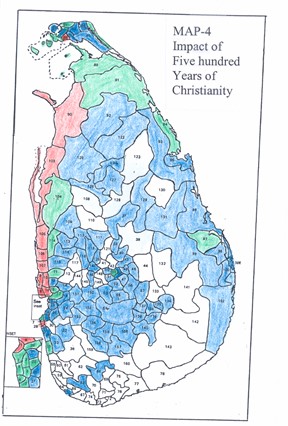
This map shows the Catholic Belt” in Sri Lanka. Red color indicates electorates with Christian over 30%. Between 10-29 is in green and 1-9 is in blue. Not a single church was attacked during the past 100 years until after 1977 the unethical conversion workers began to abuse religious tolerance and started smashing Buddha statutes and urinating on broken pieces.
Source: Merchants of Moderate Aspirations – parts I & II (August 4, 2007)
The Born Again Movement traces its origin early in the 19th century. In reaction to Protestant Liberalism a group of Protestant theologians from various denominations (Baptist, Methodist, Episcopalian, Presbyterian, and Evangelicals etc.) wrote a 12 volume book entitled The Fundamentals.
The book contains a compilation of essays of Protestant doctrines and the Born Again Movement adapted their doctrines from this 12 volume books that is why some of their doctrines are similar to those of mainline Protestants. In the strictest sense Born Again Christians is an offshoot of mainline Protestantism, no wonder they claimed to be a non-denominational Church.
Born Again Movement arrived in our shores in the late 1930’s and gained its popularity in the 70’s and 80’s which is considered the golden era of Born Again Movement in the Philippines. During this years membership in various Born Again Churches increase because they where able to infiltrate mainline Protestant Churches and had lured nominal Catholics into their fold.
However their steady growth ceases starting the year 1990 and their membership declined in the succeeding years. In the year 2000 Born Again Churches in the United States send their missionaries in the Philippines to re-established the Born Again Movement and this time their primary mission is no longer to infiltrate Protestant and Catholic Churches but targeted the youth in schools particularly college students.
In Davao City there are various Born Again Churches, the following are the most common Born Again Churches that is actively recruiting students to join their ranks: House hold of Faith, Victory Chapel, G12, PSALM and Maranatha Family Church.
Born Again evangelist does not want to discuss the history of the Christian church, in their Bible studies with their prospects, they intentionally limit the discussion to the Bible alone. They conceal the history of the Christian religion because it will show that their movement did not originate from the apostles. It is necessary for them to negate history because St. Paul warned us not to accept teachings that did not originate from the apostles Gal.1:8 and Born Again Movement evidently cannot trace the history of their church into the time of the apostles.
Method of Evangelization
Born Again evangelists employ the basic principles of human psychology in order to lure people into their fold. Their method is both manipulation and deception, let me explain why.
There are two principles that work behind their method emotion and common ground (music). Born Again evangelist realized that music is a common ground among youths, so they adopted music to attract young adults into their churches. If you attend the service of one of these Born Again Churches you can see that their music ministry is like a rock and roll band, they intentionally composed alternative type gospel songs in order to add attraction to their service. In this way those people whom they invited will experience a pleasurable feeling and will come back for more.
Aside from music they add into their arsenal the appeal to the emotions of the people. The sermons of their pastors are directed to stir up the emotions of the listeners and sometimes they would even come to the point of crying in the pulpit that is the reason why their pastors must be a good public speaker.
Born Again evangelist knew that once they where able to touch the person’s emotion it will be very easy to manipulate him. Through music they grant pleasure and through emotional manipulation they control the people, this is a classical example of psychological conditioning (this is also used to train dogs).
Clearly Born Again evangelization has deception as its chief foundation and they even used selected passages from the Bible to deceive people. They usually start evangelizing by asking ambiguous questions such us Are you saved?” or Are you born again?”, if the person answers no or I don’t know” they will tell you that you must accept Christ as a Lord and Personal Savior in order to be born again otherwise you will be damned to hell. And if the person will answer yes” they will invite you to their church and worship with them. And if the person is a Catholic that would mean that you have to leave the Catholic Church and do away your Catholic beliefs about Mary, the Saints, confession etc. Let us be vigilant not to fall to the snares of the Born Again movement.
Exposing the Born Again Doctrines
Bible Alone Doctrine
Following the battle cry of the Reformers Sola Scriptura!” or Bible alone, Born Again Christians will only believed what they can find within the pages of Sacred Scripture. Hence for them historical records, writings of the early church fathers are superfluous. It is virtually impossible to argue with a Born Again in the realm of history because they will just dismiss it as irrelevant to our salvation.
Born Again Christians view the Bible as the final authority for a Christian’s faith and moral not the Church, aside from this they also view the Bible as sufficient for everything related to salvation. They are also strict literalist they have no regard for the historical background of the passages in the Bible. And they take most of the passages as literal unless in contradicts their doctrines.
In support of their false doctrine of Bible alone they frequently quote 2 Timothy 3:16 which says; All scripture, inspired of God, is profitable to teach, to reprove, to correct, to instruct in justice: a close analysis of this passage will bring out the truth that the Born Again Christians erred in their interpretation of the said passage.
What does Paul mean when he said all scripture is inspired? First and foremost the scripture that Paul is referring here is not the Bible as what we have now but the Old Testament. In verse 15 of the same chapter Paul said to Timothy from thy infancy thou hast known the holy scriptures”, and during Timothy’s infancy not a single New Testament was ever written yet therefore Paul is clearly referring to the Old Testament as God-breathed or inspired.
Furthermore it states that scriptures that is inspired by God is profitable for teaching, reproving, correcting and instructing, clearly this denotes that Scripture is a tool used by the man of God in the four corners of his ministry to teach, reprove, correct and instruct. The Contemporary English Version of the Bible brings out the clear meaning of this passage Everything in the Scriptures is God’s Word. All of it is useful for teaching and helping people and for correcting them and showing them how to live.”
Nowhere in this passage states that Scripture is sufficient for teaching, reproving, correcting and instructing but rather Scripture is profitable or useful. In John 21:25 it says, But there are also many other things which Jesus did which, if they were written every one, the world itself. I think, would not be able to contain the books that should be written.
Every thing that Christ did is important for our salvation and those things that Christ did that were not written down were preserved in the Apostolic Tradition.
The passage 2 Timothy 3:16 does not also prove that Scripture is the only and final authority for a Christian’s faith and morals, because this passage speaks of the nature of Scripture that it is inspired by God and it is a tool used by the man of God for his ministry.
Born Again Christians must rethink and reconsider these questions in their search for the truth; did Christ instruct the Apostles to write the Bible? When Christ ascended to heaven did he left us a Bible or a Church? And lastly did Christ instruct us that the Bible is the final authority or the Church? (cf.Mt.18:18).
The Bible is very clear that the Church founded by Christ is the final authority. In Mt.16:17-19 Christ founded the church and he gave to Peter the keys which symbolize authority and in Mt.18:17-18 this authority is extended to other apostles. In 1 Timothy 3:15, the church is called the pillar and bulwark of truth therefore if we want to know the gospel of Christ go to the Church that He himself founded.
The Church was able to give us the Bible because it is the pillar and bulwark of truth, the contents of the Bible is the very gospel that the church has been preaching for 300 years before the Bible was compiled in 397 A.D at the synod of Carthage.
Furthermore the Bible also tells us that it is not sufficient because not all teachings of Christ where written down.
In 2 Thessalonians 2:15 Paul said Therefore, brethren, stand fast: and hold the traditions, which you have learned, whether by word or by our epistle.” In this passage Paul urges us all to hold on to the traditions that they handed over to us both by word (Apostolic Tradition) and by epistle (Bible).
Therefore it is absolutely wrong to believe that the Bible alone is sufficient because it is recorded in the Bible the teachings of Christ are handed over to us through Oral/Apostolic Tradition and Sacred Scripture. The Catholic faith is this that we have Sacred Scripture, Apostolic Tradition and an infallible interpreter the Magisterium.
Faith Alone Doctrine
Like any other Protestant Churches, Born Again Christians also believed in the invented doctrine of the Reformers the so called Faith Alone doctrine. Born Again Christians is fond of quoting the Scripture out of its context especially the verses that emphasized the importance of faith.
However Born Again Christians do not express the totality of the Biblical doctrine of salvation since they only select the verses they read and used in their Bible studies. The Born Again always make it a point in their Bible study and preaching that you don’t need to perform good works since God would look into your faith not on your good works.
Protestants divorce faith from good works because part of doing good is obedience, since they do not want to obey the Vicar of Christ the pope hence they dismissed the importance of good works. This doctrine is not only contradictory to Scriptures but it is also heretical (cf. Js.2:24).
The Catholic Church taught us that faith and good works is complementary to each other, we put our faith into action by doing good works. In James 2:26 it clearly denotes that faith cannot be separated from good works since faith without good works is dead.
Even in the time of Christ there were people who believes in faith alone but Christ rebuked them for this erroneous belief. In Mt.7:21, Christ said not every one who calls me Lord, Lord will enter the kingdom of Heaven but he who does the will of my Father in heaven”, in this passage Christ rebukes those who have faith in him alone but does not do the will of the Father.
But what is the will of the Father? In Eph.2:10 we are created for a life of good works since it is through good works that we can put our faith in action, as what St Paul said faith that works through love (cf. Gal.5:6). Although faith is necessary for salvation (cf. Heb.11:6), it must be united with good works.
In Acts 16:30-31 it shows the unity of faith and good works. The jailer asked Paul what must I do to be saved? The phrase must I do” denotes an action, something the jailer must perform in order to be saved. And Paul answered the jailer believe on the Lord Jesus”, which connotes that he must have faith in Jesus Christ. Thus combining the thought in the jailer’s inquiry and Paul’s answer it tells us that the act of believing or having faith is not just a mental assent but a good works by itself.
Hence it proves that faith and good works is inseparable from each other. A faith accompanied by good works is a living faith that is why in Paul’s epistle to the Romans 2:7, he told the Romans that eternal life is the reward for those who persevere in doing good works. This is proved by the example of a man named Zacchaeus wherein he put his faith into action by doing good works (cf. Lk.19:8-9).
The Danger of Faith Alone
The belief in faith alone doctrine of Martin Luther is very dangerous, because it undermines the very fundamental way of cultivating values and putting our faith in practice that is through charity.
If we have faith alone there exist no difference between the devil and us. Because even the devil believes in God (cf. Js.2:19), the fundamental difference between us and the devil is that we are capable of putting our faith into practice by being charitable. And being charitable is being a loving person but the devil is incapable of being charitable hence if we have faith alone and does not have love there is no difference between the devil and us.
In the end of times God will judge us by how we put our faith in action. In Mt.25:32-46, the criteria of God’s judgment will be base on our good works not by faith alone. If we die having our faith alone and faces God for judgment (cf. Heb.9:27) on what basis would God judge us, if we have not done any good works in our life? Would such dead faith saved him? Certainly not!
Conclusion
Being a faithful Christian means that we must be obedient to God and to the people he mandated to tend His flock. In Luke 10:16, Christ told the seventy two people He mandated to go house to house that those who rejects them also rejects Christ and the Father. In Mt.28:18-20, before he ascended to heaven He mandated his apostles to make disciples to all nations thus those who rejected His disciples also rejects him. And the successors of Christ’s apostles are the bishops that we have now. Hence to reject the bishops and the pope is also rejecting Christ.
In 1815, the locals consented to hand over the Governance to the British to govern Ceylon. The social standards maintained during the 16, 17 and 18th centuries were challenged mainly by foreigners such as Solis, Portuguese and the Dutch. Some of the social norms were deep-seated in Sinhala traditions. However, from 1815 to 1918 British exerted much pressure so that Sinhalese could not counterattack or think of quashing it, and emotions died down. When Ceylon was at the peak of being an independent sovereign with the highest culture, the British did a tremendous skilful act in taking over an independent ruler. The question remained unresolved as to why the Sinhalese tolerated and remained quiet. However, collecting various economies and producing history is the central theme in compiling this book (author’s comment). Up to 1832, economic progress in Ceylon was the central theme of this book. Therefore, the author decided to explain various financial situations in this chapter.
Towards the beginning of the 18th century, the British possessed a substantial part of the East India Company assets. At the same time, the British were engaged in a battlefront to fight against Holland to form an independent nation.
On January 5th, 1782, Sir Edmond Fuse, an admiral, was sent to Ceylon with a platoon (by foot) with American Lord Hector McCarthy Monroe – the Governor of Madras. During this period, the Dutch captured Northern Beachfront, and an English Brigade in Trincomalee captured Trincomalee. By this time, the British, who favoured the Sinhala Government, decided to send an Englishman as an Ambassador with the blessings of Lord McCarthy, to the up-country in Ceylon to have a meeting with the King and come to an agreement
Any way Heugh Boyed returned from Kandy, deeply disappointed having met the king. Meantime, Admiral Ballie de Supfriend took Trincomalee back from the British with a whole load of Naval soldiers. Still, in 1787, Britain, France and Holland signed a Paris Agreement in 1787 so that the French, British, French and Dutch Trincomalee. According to the Paris Agreement, it was possible to access Trincomalee to all parties, such as the British, Dutch and French.
In 1794, with the extraordinary powers of the French government, they managed to expel the Dutch King and formed a self-rule -government. At this junction, King William looted to England. British cunningly sent a message to Dutch administrators (Palaka) that if battles could not be settled, Colombo the British would take over Colombo by force. In no time, the Parliamentarians wanted to avoid contacting King William but sought the self-rule government. Accordingly, in August 1795, with the signatures of two Colonels, Peter Rayner and George Stewart signatures, issued a notice. The notice requested Dutch to remove flags and ‘to get out’ from Colombo Fort forthwith.
Further, the notice said the document should be signed and handed to the British within half an hour. Immediately, the document was signed and handed over to the British. Similarly, the British occupied various regions systematically.
Gradually, the British occupied various sections of the country as follows:
0n 18th September Batticaloa
27th September Point Pedro.
28th September Jaffna.
13thNovembero-Kalpitiya.
On February 16th 1796, the British and the Dutch agreed that as ordinary residents, Dutch officials would stay in Ce for 18 months to pay all debts to an Indian East India Company. Because of the war in Europe, lands acquired by the Dutch company promised to pay all debts in Dutch currency to the Indian Company to avoid blood-shedding. Also, the British company knew that the grounds that the Dutch acquired land had to be handed back. Therefore, the resettlement of the residents was arranged quickly. The company became excited because the provision was not available to execute so speedily. After all, the provincial income needed to be improved.
An East Indian British company, by this time, carried on business in Madras. Therefore, they applied the same action in Ceylon. By this time, the employment of Vidanas was not used in Ceylon. As a result, the British asked all vidanes to resign and employed Madras officials. For both of these actions, Ceylonese did not agree. It resulted in not only the practice of people being sacked who were sincere and faithful. The Ceylonese despised sacking their leaders and, instead, employing Tamil officials. The Eastern British company gradually followed a procedure for the auction of tax. Therefore, the tax became an auction procedure. Those who could pay a higher rate became very successful.
From September 1st, 1796, the British demanded that each coconut tree be paid a new tax, which should be delivered in coins. It was mentioned that coconut trees, which did have a single coconut, even had to pay the appropriate tax.
In April 1800, Governor North introduced an embellishment tax. It was decided to tax all men and women who wear Jewellery. Any person who wears a ring or pendant made out of gold and embedded in Jewellery had to pay this tax, irrespective of sex (a man one Dollar and a woman half a dollar). In 1799, the government received 3,800 gold English sovereigns. Indian Company raised income for three northern beaches, Trincomalee, Batticaloa, and Mullaitivu, as one sector, Jaffna as a separate area, and Chilaw and Matara, including Colombo, as a central area. In these areas, the British made what was known as Kachcheri. In 1797 there was a rebellion against the British, and to investigate the matter, Colonel Mauryan sent the Mauryan Commission to Ceylon.
These were the findings of the Commission:
Disband the Madras procedure and re-introduce the official method.
Discontinue (Omladur) Tax Collector from the posts and appoint Vidanes instead.
To discontinue the new tax system and disband the auctioning of tax procedure.
Afterwards, the following clauses, as mentioned above, were put into practice. Although Mauryan Commission was dispersed, Governor North objected to making any changes. If the official (Rajakari) is completely renounced, Governor North pointed out that the paddy farmer will lose all his lands. He pointed out that it was a way to encourage the paddy farmer, and the production would increase.
There was an overlooked aspect of this. Duty bound part of the workers was constrained. Those people who were employed as farmers did not do any work. Agriculture neglected. Farmers sold their plots of land. People turned to crime due to unemployment. Governor North realised his failure but blamed the Sinhala farmers for being lazy.
Governor Maitland succeeded Governor North. His duty was to increase the living conditions of the locals and feed acquaintance with the people who had managed to be approachable to Governance. His first move was to give back all the farmland to farmers. Secondly, he was aware that the country needed the best civil servants. As a result, he increased their salaries, divided the civil service into three sections and awarded promotions and allocated the provision of intermingling with people and looking for any requirements of the people and reporting back to Governor Maitland regularly. Governor Maitland attempted to eradicate all corruption.
In 1802, the British India Company was taken over by the British. In doing so, the British divided each area and appointed a cashier as a civil servant in each area. Under the civil servants, the British developed what is known as a Koraleto account for Korale Patttuwa and Athu-Korale etc. There was a Vidane in charge of every village.
tilakfernando@gamail.com
Courtesy: The writer translated into English from Sinhala, the text of the late Prasad Milinda Siriwardena – Ceylon Economic Analysis between BC 543 to 1832. Only the relevant parts were translated.
There is a raging controversy on the proposal to privatise SLT. The Sectoral Committee in Parliament has said that it will be a threat to national security. The Sectoral Committee on Finance has stepped in to declare that it is not. There are comments supporting the privatization proposal from some professionals. It seems the debate has become political and not evidence based. The following excerpt from a longer article on the ban on Huawei in the USA may help to clear some of the doubts whether a telecom company can become a national security threat.
Cyber espionage. The main concern, according to U.S. intelligence agencies, is that the Chinese government could use Huawei to spy.
Officials, primarily in the United States but also in Australia and several other countries, point to intentionally vague Chinese intelligence laws that could be used to force Huawei to hand over data to the Chinese government. (The United States has not publicly provided evidence that this has happened.) There are also concerns that Huawei’s 5G infrastructure could contain backdoors that allow the Chinese government to collect and centralize massive quantities of data and give Beijing the necessary access to attack communications networks and public utilities. In 2022, an FBI investigation found that Huawei equipment can be used to disrupt U.S. military communications, including those about the U.S. nuclear arsenal.
Congress began receiving warnings about Huawei as early as 2012, when a U.S. House Permanent Select Committee on Intelligence report [PDF] concluded that using equipment made by Huawei and ZTE, another Chinese telecommunications company, could undermine core U.S. national security interests.” In 2018, six U.S. intelligence chiefs, including the directors of the CIA and FBI, cautioned Americans against using Huawei products, warning that the company could conduct undetected espionage.”
At the heart of Washington’s concerns is 5G, the latest technology standard for cellular networks, which provides faster download speeds for smartphones, connects devices in smart cities, and supports autonomous vehicles and robots. 5G is a different type of risk versus 4G or 3G. It’s much harder to separate the core from the periphery,”
says CFR’s Adam Segal. Once you have those risks, you have to trust the company much more. But it is difficult to trust Huawei, given the relationship between companies and the Communist Party.”
I checked the meaning of the word ‘Beira’ in Portuguese using Google.
The answer given by Google is that it means ‘ Border ‘.
The Portuguese word for Lake is ‘ Lago ‘
Using the word ‘ Beira’ for a lake to signify a ‘ border’ between Portuguese-held areas and the areas held by the Sinhalese whose lands were conquered by the Portuguese, makes sense.
Major Rivers form International Borders.
Almost half of the international borders in South America are formed by rivers. In particular international river borders of Brazil, Colombia, Venezuela, Suriname, Guyana, French Guiana, Bolivia, Paraguay, and Uruguay are all notable.
The Guadiana River separates Portugal from Spain
The River ‘ Oder’ separates Germany from Poland.
King Sitawaka Rajasinghe drained the Beira Lake in 1587
” The most ‘fascinating’ story about the Beira would be the 1587 draining of it by the engineers of Sitavaka Rajasinghe I, to enable the Sinhala onslaught on the Portuguese encampment. And it is more than odd to claim the lake was built to protect it from ‘invasion’ when the Portuguese Fort itself was meant as a base from which to continue their invasion of the rest of the country” ( Krisantha Sri Bhaggiyadatta)
By 1587, King Rajasinghe of Seethavaka was the master of almost all of Sri Lanka, except Jaffanapattanum and Colombo Fort. The Portuguese who had arrived on the island in 1505, after a series of humiliating military defeats at his hands, lost the kingdom of Kotte to him in 1565. Withdrawing from Kotte with their puppet King Dom Joao Dharmapala, the Portuguese were reduced to a bunch of sea pirates, stationed in the environs of Colombo fort. From here, they conducted sudden attacks on seaports and coastal villages, killing civilians, destroying temples, mosques and kovils, and plundering the riches of merchants and holy places.
To drive away this menace forever, King Rajasinghe launched an unprecedented attack on the Colombo fort in 1587. If not for a deadly epidemic which is scantly mentioned in history, he would have succeeded in overrunning the fort, and driving away a brutal enemy, making Sri Lanka a free country, within 82 years of its invasion by the Europeans.
As this period of Sri Lankan history is not well documented in Sinhala chronicles, one has to turn to the documents of historians of the Portuguese. Father Fernao De Queiroz writing of Rajasinghe says he was a man so warlike and valiant that so far as his person was concerned he could be compared to Caesar at the same age, and to Alexander”.
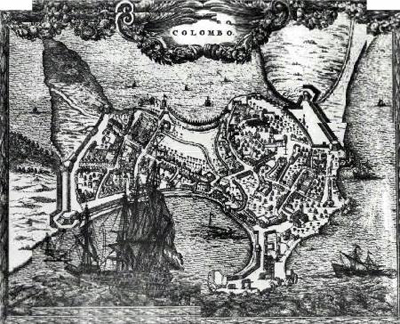
In April 1587, there were rumours that Rajasinghe was planning a massive attack on Colombo Fort. In that era, the Colombo Fort was confined to the current location of Fort, Colombo and surrounded by the Bairai Lake. Fortified with strong walls and bastions, there were about 60,000 people within the fort. Upon receiving information of the impending attack, Portuguese Captain Joao Correa who was in charge of the fort ordered its walls, watch towers and gun platforms to be repaired. They began to clear all the vegetation outside the fort, to have a better view of enemy movement. The island of Antonio de Mendoca (currently Slave Island)which was outside the city was made empty and all soldiers were withdrawn to the fort. The captain sent messages to the Portuguese garrisons in Mannar and Nagaputtanum, requesting them to send soldiers to save Colombo.
In May 1587, Rajasinghe began to march from Seethavaka with a 61,000-strong army divided among 187 captains. There were 1600 well-trained gunmen, 10,000 ordinary gunmen and 400 bombardiers. They had 2200 bronze guns, big and small, 150 massive artillery guns, some of which were of 30 to 44 calibre and many more weapons. He also had a large amount of gunpowder, lead, and cannonballs of different sizes. There were 150 war elephants and 2,080 ordinary elephants in his army and 4,000 oxen pulling carts. He also brought 600 blacksmiths to make arrowheads and 1000 carpenters for construction work. He brought along 10,000 levers, 2,000 pickaxes, 20,000 large knives, and 6000 mattocks to make trenches and dig the walls of the fortress. His army consisted of many nationalities – Sinhalese, Tamils, Muslims, Malayalis, Javanese, Kaffirs, and even some Portuguese defectors. To launch a seaborne attack from different parts of the island, he had 60 large and small ships and 200 small boats sail toward Colombo.
Rajasinghe’s massive army crossed the river Kelani and headed towards Colombo. Artillery guns began to fire at them from the fort but they took cover. On May 29, 1587, Rajasinghe encamped within the sight of the Colombo fort. Queiroz says they were so orderly, no commander in the world would have surpassed him.
Rajasinghe was encamped at a higher point of land within the firing distance of the fort. The main obstacle for his army to get closer was the large body of water now known as Beira Lake which was much wider at that time and deep enough for six ships. During a previous siege on Colombo, these small ships caused immense losses to the Seethavaka armies. Thus Rajasinghe began to make a large ditch, strengthening it with two lines of mats and making a wall with junk. This ditch and the protective mound were about 3 km long. During its construction, the Portuguese were continuously firing from the ships and fort, killing many workers.
After making this temporary fortification Rajasinghe planned to drain the lake. He re-dug the previous canal he had made in his 1581 siege, which was nine meters deep and half a kilometer long, and made another one-kilometre-long ditch. The canal was dug within 20 days, and the lake drained fast to the marshy lands around Colombo. The ships stranded in the middle of the lake were quickly brought toward the fort, where there was more water.
After fully draining the lake, Rajasinghe brought his men and material within six meters of the fort walls. He made stone walls, slanting walls, wooden barricades, trenches, small fortresses, and rubble, which rendered the Portuguese cannon fire ineffective. A siege on the impenetrable Colombo fort began with most of Rajasinghe’s soldiers engaging in trench warfare.
In the smoke and noise of the bombardment of the fort with artillery and counter-fire by the Portuguese, the men could not see or hear each other. At times the Seethavaka soldiers climbing the walls of the fort were killed by gunfire, spikes and firepots thrown by the Portuguese and their local allies. War elephants attacking the walls with much ferocity and attempting to pull down the cannons too faced gunfire and fire pots and some turned on their masters. While the fighting was going on stone masons under cover of shields were attempting to dig the walls of the fort. Attacks and counterattacks continued for the next few months.
With limited food and water within the fort, soldiers and civilians began to eat anything available and sometimes resorted to cannibalism, eating the flesh of dead Seethavaka soldiers fallen close to the walls of the fort. A few ships arrived with soldiers and provisions intermittently from Goa, the Portuguese capital of the East and other Portuguese strongholds but these meagre supplements could not turn the tide.
Realizing that the situation in Colombo was extremely precarious, the Viceroy of Goa decided that he should prepare the largest force that had taken part in any battle in the east, to be sent to Colombo. Manuoel de Souza, a former captain of Colombo who had encountered Rajasinghe in 1581, was made Captain-Major of the Sea of India and ordered to make preparations to land in Colombo. He sent messages to Melaka, Malaysia to send a large number of soldiers who were engaged in a war in Melaka to Colombo and attack Rajasinghe along with the troops from India.
Turning the tide of the war, an unknown epidemic began to spread across the country in December 1587. By then a major drought had occurred – it had not rained for one year. In Portuguese historian Cuoto’s words, there appeared a new and cruel sickness, which was general among the people of the country and it was so terrible, that on the account of the many that died, they thought that it was a poison that they (Portuguese) cast into their wells, wherefore all went about affrighted. The disease commenced in the feet with a swelling, which went ascending to the legs, and thence to the belly, and to the breast, there as soon as it touched the heart, it proved fatal, leaving those bodies deformed.”
This disease had all the features of an epidemic of a severe and fatal viral infection, which caused liver failure within a short span of time. Influenza viruses are major causes of such viral infections. Cuoto says, As the sickness was new in that country and not known, nor had ever been seen by the natives, the physicians made an anatomy on one of those bodies to see if they could understand the disease in order to cure it because it was going on increasingly greatly, and many were dying; and having viewed the intestines they found the livers apostemated (Pustule formation)”.
It was inferred that heat and humidity caused the illness. Many medications were given to victims, to no avail. In the end they made use of a fruit which they call gorsas (Goraka) which had some virtue, and with some other herbs; but as this also came to be exhausted, there did not fail to die many”.
As the Seethavaka soldiers were from the countryside, living in close quarters and trenches, this disease would have spread like wildfire among them depleting their ranks. Portuguese historians do not say that it affected their soldiers – if so, it would have been definitely mentioned in their chronicles.
The effect it had on Rajasinghe’s camp is reflected by an incident in early January 1588, when a few ola leaves attached to arrows descended upon the fort. They carried a message from the King to the captain of the fort, requesting him to send an ambassador to discuss a peace treaty. In Rajasinghe’s military career spanning about four decades this is the only occasion he was agreeable to a truce. Knowing that he would receive help from Goa soon, the Portuguese captain decided to ignore the message. As the Portuguese were silent, the Seethavaka forces attacked the fort again on the 10th of January 1588. But subsequent attacks on the fort were weaker than before.
On the 18th of February Manuoel de Souza arrived in Colombo with 1,600 soldiers in great pomp and pageantry, saluting the city with cannon fire. Part of the armada which was sailing from Melaka was expected at any moment. On arrival, de Souza made preparations to attack the armies of Seethavaka, encamped just outside the fort walls.
Taking the Portuguese by surprise, on the night of 21st February around 9 p.m., a great fire was observed in the Seethavaka camp. Rajasinghe had decided to withdraw and had set fire to all the barricades, tents, and trenches they had occupied for ten months. Burning was the main method of quelling disease spread in the medieval era and it is very likely Rajasinghe would have burned his entire camp to stop the deadly disease from spreading.
The next few years were catastrophic for the king. His wife died the following year and there were a series of coups to assassinate him. In retaliation, he mercilessly punished perpetrators, some of whom were Buddhist monks. This made him unpopular with his people. Finally, the kingdom of Kandy which was under him, was snatched by the joint forces of Kandyans and Portuguese. Returning from a battle in the Kandyan kingdom Rajasinghe died in March 1592, probably by poisoning of an inflicted wound.
Within two years his kingdom was captured by the Portuguese, who occupied the country extracting its riches, until they were expelled by another colonial power, the Dutch.
If not for the great epidemic of 1587, Rajasinghe would have captured Colombo, and expelled the Portuguese, totally freeing the country from foreign domination.
(Dr. AjithAmarasinghe is a medical consultant and an independent researcher on history. He is a life member of the Royal Asiatic Society of Sri Lanka)
The Sri Lankan Rupee today (16 June) appreciated against the US Dollar, as per the reports of the Central Bank of Sri Lanka (CBSL).
Accordingly, the buying rate was reported at Rs. 300.51, while the selling rate of the US Dollar was recorded at Rs. 319.66.
The selling rate of the US Dollar soared to Rs. 335.000 at several licensed commercial banks on Wednesday (15 June), with the buying rate having jumped to Rs. 315.00
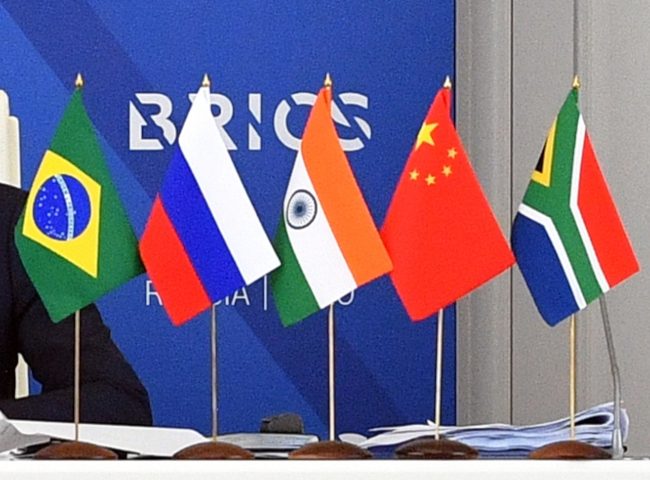
After the Briton-Wood agreement international financial system has created many issues for many countries, developing countries have been major victims, because small and developing countries got caught into in a trap of developed countries where there have hard currencies, and BRICS wants to introduce a new international currency unit despite the existing power of the US dollar. Many major countries have abandoned the US Dollar in large payments as a settling currency, and the Chinese Yuan, Indian Rupee, Euro, Saudi Rials, the Brazil Currency Unit, Russian Currency Unit and the US Dollar are used as key international currencies for international settlements. When creating a credible currency unit for international settlements, the entire world needs to work together and divide into seven zones and every country in the zones is included in the way given below and international settlements within the zone should be affected by using the currency unit related to the zone.
Zone A–The USA, Canada, Iceland, Greenland, Ireland and the United Kingdom- Currency Unit is the US Dollar
Zone B–Portugal, Spain, France, Germany, Norway, Sweden, Finland, Poland, Austria and Sweden, Hungary, Italy, Greece, Bulgaria–Currency Unit is Euro
Zone C-All African countries, Madagascar, Jordan, Syria, Iraq, Israel, Saudi Arabia, Yemen, Oman, Iran, and Iraq-Currency Unit is Saudi Rial
Zone D-India, Pakistan, Sri Lanka, Bangladesh, Maldives, Australia, New Zealand, Fiji, PNG and All South Pacific Islands–Currency Unit is Indian Rupee
Zone F- Brazil, Mexico, and All Islands in the Atlantic Ocean, Venezuela, Colombia, Paraguay, Chile, Argentina and Falkland–Currency Unit is–Brazilian Dollar
Zone G–China, Japan, North Korea, South Korea, Taiwan, Mongolia, Kazakhstan Malaysia, Indonesia Kirgizstan, Brunei, Singapore, Myanmar, Vietnam, Thailand, Bhutan, Laos, Currency Unit–Chinese Yuan
Countries in a zone included without political division or differences, this categorization is purely for making a reasonable international financial system disregarding any difference. The world needs a reasonable international financial system with a maximum 5% fluctuation, possibly for administration cost. This system will give justice to all countries of the globe. The current international financial system created after the Briton-Wood Agreement was disliked to consider giving justice to all humans around the globe and many countries have pushed to difficulties and a negative aspect of the current system is encouraging speculation and making billionaires.
The operation of the current international financial system has created injustice for the world and it should be corrected by the new system.
This proposal works against currency speculation and becoming billionaire out of poor people.
This is the time to consider justice for the world.
In 1515, the locals consented to hand over the Governance to the British to govern Ceylon. The social standards maintained during the 16, 17 and 18th centuries were challenged mainly by foreigners such as Solis, Portuguese and the Dutch. Some of the social norms were deep-seated in Sinhala traditions. However, from 1815 to 1918 British exerted much pressure so that Sinhalese could not counterattack or think of quashing it, and emotions died down. When Ceylon was at the peak of being an independent sovereign with the highest culture, the British did a tremendous skilful act in taking over an independent ruler. The question remained unresolved as to why the Sinhalese tolerated and remained quiet. However, collecting various economies and producing history is the central theme in compiling this book (author’s comment). Up to 1832, economic progress in Ceylon was the central theme of this book. Therefore, the author decided to explain various financial situations in this chapter.
Towards the beginning of the 18th century, the British possessed a substantial part of the East India Company assets. At the same time, the British were engaged in a battlefront to fight against Holland to form an independent nation.
On January 5th, 1782, Sir Edmond Fuse, an admiral, was sent to Ceylon with a platoon (by foot) with American Lord Hector McCarthy Monroe – the Governor of Madras. During this period, the Dutch captured Northern Beachfront, and an English Brigade in Trincomalee captured Trincomalee. By this time, the British, who favoured the Sinhala Government, decided to send an Englishman as an Ambassador with the blessings of Lord McCarthy, to the up-country in Ceylon to have a meeting with the King and come to an agreement
Any way Heugh Boyed returned from Kandy, deeply disappointed having met the king. Meantime, Admiral Ballie de Supfriend took Trincomalee back from the British with a whole load of Naval soldiers. Still, in 1787, Britain, France and Holland signed a Paris Agreement in 1787 so that the French, British, French and Dutch Trincomalee. According to the Paris Agreement, it was possible to access Trincomalee to all parties, such as the British, Dutch and French.
In 1794, with the extraordinary powers of the French government, they managed to expel the Dutch King and formed a self-rule -government. At this junction, King William looted to England. British cunningly sent a message to Dutch administrators (Palaka) that if battles could not be settled, Colombo the British would take over Colombo by force. In no time, the Parliamentarians wanted to avoid contacting King William but sought the self-rule government. Accordingly, in August 1795, with the signatures of two Colonels, Peter Rayner and George Stewart signatures, issued a notice. The notice requested Dutch to remove flags and ‘to get out’ from Colombo Fort forthwith.
Further, the notice said the document should be signed and handed to the British within half an hour. Immediately, the document was signed and handed over to the British. Similarly, the British occupied various regions systematically.
Gradually, the British occupied various sections of the country as follows:
0n 18th September Batticaloa
27th September Point Pedro.
28th September Jaffna.
13thNovembero-Kalpitiya.
On February 16th 1796, the British and the Dutch agreed that as ordinary residents, Dutch officials would stay in Ce for 18 months to pay all debts to an Indian East India Company. Because of the war in Europe, lands acquired by the Dutch company promised to pay all debts in Dutch currency to the Indian Company to avoid blood-shedding. Also, the British company knew that the grounds that the Dutch acquired land had to be handed back. Therefore, the resettlement of the residents was arranged quickly. The company became excited because the provision was not available to execute so speedily. After all, the provincial income needed to be improved.
An East Indian British company, by this time, carried on business in Madras. Therefore, they applied the same action in Ceylon. By this time, the employment of Vidanas was not used in Ceylon. As a result, the British asked all vidanes to resign and employed Madras officials. For both of these actions, Ceylonese did not agree. It resulted in not only the practice of people being sacked who were sincere and faithful. The Ceylonese despised sacking their leaders and, instead, employing Tamil officials. The Eastern British company gradually followed a procedure for the auction of tax. Therefore, the tax became an auction procedure. Those who could pay a higher rate became very successful.
From September 1st, 1796, the British demanded that each coconut tree be paid a new tax, which should be delivered in coins. It was mentioned that coconut trees, which did have a single coconut, even had to pay the appropriate tax.
In April 1800, Governor North introduced an embellishment tax. It was decided to tax all men and women who wear Jewellery. Any person who wears a ring or pendant made out of gold and embedded in Jewellery had to pay this tax, irrespective of sex (a man one Dollar and a woman half a dollar). In 1799, the government received 3,800 gold English sovereigns. Indian Company raised income for three northern beaches, Trincomalee, Batticaloa, and Mullaitivu, as one sector, Jaffna as a separate area, and Chilaw and Matara, including Colombo, as a central area. In these areas, the British made what was known as Kachcheri. In 1797 there was a rebellion against the British, and to investigate the matter, Colonel Mauryan sent the Mauryan Commission to Ceylon.
These were the findings of the Commission:
Disband the Madras procedure and re-introduce the official method.
Discontinue (Omladur) Tax Collector from the posts and appoint Vidanes instead.
To discontinue the new tax system and disband the auctioning of tax procedure.
Afterwards, the following clauses, as mentioned above, were put into practice. Although Mauryan Commission was dispersed, Governor North objected to making any changes. If the official (Rajakari) is completely renounced, Governor North pointed out that the paddy farmer will lose all his lands. He pointed out that it was a way to encourage the paddy farmer, and the production would increase.
There was an overlooked aspect of this. Duty bound part of the workers was constrained. Those people who were employed as farmers did not do any work. Agriculture neglected. Farmers sold their plots of land. People turned to crime due to unemployment. Governor North realised his failure but blamed the Sinhala farmers for being lazy.
Governor Maitland succeeded Governor North. His duty was to increase the living conditions of the locals and feed acquaintance with the people who had managed to be approachable to Governance. His first move was to give back all the farmland to farmers. Secondly, he was aware that the country needed the best civil servants. As a result, he increased their salaries, divided the civil service into three sections and awarded promotions and allocated the provision of intermingling with people and looking for any requirements of the people and reporting back to Governor Maitland regularly. Governor Maitland attempted to eradicate all corruption.
In 1802, the British India Company was taken over by the British. In doing so, the British divided each area and appointed a cashier as a civil servant in each area. Under the civil servants, the British developed what is known as a Koraleto account for Korale Patttuwa and Athu-Korale etc. There was a Vidane in charge of every village.
tilakfernando@gamail.com
Courtesy: The writer translated into English from Sinhala, the text of the late Prasad Milinda Siriwardena – Ceylon Economic Analysis between BC 543 to 1832. Only the relevant parts were translated.
During the Portuguese Era in Sri Lanka the Portuguese referred to the lake in Colombo as ‘Beira’. This is just the Portuguese word for ‘lake’. They did not give it a special name.
All the lakes throughout Sri Lanka have special names. Such as, ‘Nuwara Weva’, Tisa Weva, Yoda Weva, MInneriya Weva, Parakrama Samudraya etc. Isn’t it time that the lake in Colombo is also named appropriately to remove its Portuguese name?
Let’s invite suggestions from the public. The name I suggest is, “MIHINDU WEVA” to commemorate the arrival of Mihindu Rahathanvahanse who introduced Buddhism to Sri Lanka.
Embracing with love – Priyangika with her biological mother
Adoption cannot and should not be a solution for poverty says Priyangika Samanthie
I didn’t grow up as a European and then got interested in Sri Lankan culture as most diaspora kids around me have
The love and connection with a mother doesn’t focus on poverty or privilege
My adoptive parents always raised me to know that I would one day find my way back home
Priyangika Samanthie was another ‘brown child from abroad’ when she landed in Norway, seven weeks after she was born. Even though many Sri Lankans thought that she grew up white for a better opportunity, she was searching for her roots since her childhood. Her adoption was based on false documents following which she lodged a complaint at the Criminal Investigation Department (CID). Investigations are still underway. In a recent Al Jazeera documentary titled ‘No Place Like Home’ Priyangika confronts the painful secrets of international adoptions. In an exclusive interview with the Daily Mirror, she revealed the difficulties she experienced as an adopted child, loopholes in her adoption process, baby boxes and illegal adoptions that need to stop right away. Excerpts :
QHow was it like growing up in Norway?
The first thought that came to mind was ‘lonely’. Incredibly lonely. Even though I grew up in a household that tried their best to acknowledge my fundamental needs in life — I felt as though my nature was different from my circumstances. I grew up in a small town. My adoptive brother Prishantha and I were one of the first brown children. I remember feeling as if I was a statue when people crossed us. As children, we had big curls and hair and people used to touch our hair and skin. I remember experiencing angry stares, but I couldn’t understand what was going on. Later in life my Norwegian family members told us about the difficult experiences of the surroundings. One day, our adoptive grandmother had walked with me in my stroller and experienced that someone questioned why her son had gotten one of those”. One of those brown children from abroad.
I didn’t grow up as a European and then got interested in Sri Lankan culture as most diaspora kids around me have. I grew up spending time with their family members. It wasn’t until Tamil families started to migrate to our small town in the Midwest in Norway that I felt a sense of belonging. I spent lots of time on a family friend Archie Amma’s lap who was telling me about Sri Lanka and fairytales in Tamil. It was a mix between Tamil and our hearts connected. As a child and as a human, I seek a community; a belonging deeper than luxury. Love has always triumphed over luxury. It was the love and care that my adoptive parents put into learning about Sri Lankan food culture and culture, connecting us with the Tamil families and attending cultural events, that made me feel a sense of belonging. Whilst most Sri Lankans I meet think that I’ve focused on my opportunities to better my life in Europe, my only focus as a child and adult was to deepen my roots. I went to the school library as a child to try to find books to study Sinhala and would have tantrums when they didn’t understand what I meant. Before I graduated secondary school, my librarian showed me that she had found a book about Sri Lankan birds for me. For the first time, I felt seen for my Sri Lankan identity except for my family. It’s been incredibly hard to explain my focus on Sri Lankan people because they thought I grew up white as a better opportunity, but my only dream was to grow up like them; even if that meant that I had to suffer. Later on in life, my adoptive family told me that I would have had a better childhood if I grew up with my Sri Lankan family. You might suffer, but you would’ve been able to breathe the same air as amma and we know that it would’ve been enough for you”, I have heard from Norwegian family members.
Q Since when did you start looking for answers regarding your adoption?
I think it already started on the plane to Norway. After breastfeeding me for seven weeks, Amma was suddenly gone. My Norwegian parents said that I reacted to the formula they gave me, but kept crying and searched for the breast. It’s been an ongoing joke around me my whole life that She cried on the way from Sri Lanka till Norway, and never stopped crying”. Which I think is actually true in my case. My soul has been grieving my whole life. The love and connection with a mother doesn’t focus on poverty or privilege. I could feel her feelings on my skin and when I spent time with her later in life, it felt as if I could finally be in my body without a storm within. In kindergarten I used to refuse to come home with my Norwegian parents because I noticed that other children had parents whom looked like them. I was constantly waiting for Amma. I had continuously stated since then that I was kidnapped and wasn’t meant to be in Norway. My Norwegian family and their community tried their best to calm me down, but nothing worked.
I was five when the Norwegian family started to prepare me for a reunification or deportation. We spoke about the pros and cons of finding amma. I realised early that they didn’t have the talk with Prishantha. They handled my feelings completely differently and for that, I’ll always have my deepest respect for them as humans. I searched for answers while he became silent. I think that’s what has been the greatest challenge with our adoptions, that most people forget that our bodies cry for our fundamental needs even if our circumstances become more ideal. Would it have been more ideal for me to be in survival mode with my family? Everything within me screams yes.
As a seven year old, I knocked on my adoptive fathers door and wondered if he could help me write letters to the government, adoption agency and orphanage for answers to find Amma. This was the start of twelve longyears of searching. My adoptive parents always raised me to know that I would one day find my way back home. Even if I couldn’t find my relatives. I think it’s the main reason why I’ve seen myself as a foster child and not as an adoptee. In the documentary No Place Like Home” Prishantha states that he was never scared that I would find answers, he was more scared if I didn’t. It wasn’t until fall 2013 that a group of Muslim men in Sri Lanka found her. I never thought I would see the day of light with her when they found her. I had recently become a mother to my eldest son Nishantha and my only wish was for him to have his Archie. To sit on the lap and get the same stories as I did. In high school, I had some Buddhist and catholic men searching for me. They went to the greatest length and travelled over the island (for free) to find answers. Most of them have become my lifelong friends back home. Whilst searching, then came across concepts such as baby farms but they also discovered that my documents were falsified. I remember one of them calling me and saying It seems as though you never left”. I did not understand what he meant, until he explained that my court document of adoption and passport were fake. My whole world fell apart — because it confirmed my instincts, I wasn’t meant to be adopted.
Amma and I met at IndependenceSquare on Independence Day in 2014. We attended Good Morning Sri Lanka later the same day. It wasn’t until I was in the recording studio that I realised that the men wanted me to do an interview. Suddenly our faces were on the main newspapers in the country. People in the street showed their love and support. Men would whistleblow to me and ask me if they could trade places. It was a rollercoaster and the reunion turned into everything else than I had imagined. I wanted us to have a mother-daughter relationship, but she was full of grief and anger. She kept apologising for losing me. It wasn’t until I moved to Sri Lanka in 2015 that she told me that I wasn’t meant to be adopted. In the beginning of recording No Place Like Home”, she told us untold stories that she hadn’t shared with anyone. It wasn’t poverty that made her seek alternative care, it was the connection from family members on half of my family side to the underworld. She wanted to protect us which is why she wanted us to move into the home together. The Salvation Army worker who had told her about the alternative of care, had shared that we would live in an NGO-house together. In the documentary, Amma kept stating that she went back to search after losing me. While I listened to her stories and calculated the years, I realised that we were searching for each other at the same time. I went back to my school diary and read about mutual experiences in similar time periods. I told her that I used to look at the moon and say goodnight every night, because at least we stared at the same moon. She answered I found comfort knowing that the moon would raise you”.
The director chose to leave out the kidnapping story from the hospital, Salvation Army workers purposely misleading and the corruption in our case. The story is twisted because it would be too comfortable and challenging to watch, she thought. The consequence is that the audience is confused but the comment section on Al Jazeera witness’s YouTube channel has reduced amma to be a useless poor person which is nothing like the woman I have known her to be.
Q In the recent Al Jazeera documentary, your Norwegian parents claim that they were paid extra to shorten their stay in the country. Could you tell us how the adoption took place?
My Norwegian parents were in Sri Lanka for five weeks to complete a court case for the adoption. Their lawyer had offered to shorten the case by paying a bribe. They had refused to take the offer, but when I asked them why they did not change the lawyer, they have been honest about mainly focusing on their own wish. It seems to be that they deep within knew that it was a possibility that it could’ve been a corrupt case, but not in their wildest dreams do I think they realised that it was a kangaroo court. After almost twenty years of research on the adoption fraud, I have experienced that Norwegian parents heard about the corruption to other countries while going through the same channels. I have also experienced having to share with the adoptees and adopters that the translation was purposely misleading. In our case, they reacted strongly to the courts mistreating Amma. After being reunited, she could confirm that she was told a completely different story in court than what took place. She was told that we would live in the NGO-couples house and whilst she built up our life, she would receive 1Lk to figure our situation out in the early 90s. After a couple of years, we could return home. In reality, they fled the country after the court case.
Q How was it dealing with Lankan authorities during the process? Were they helpful and what were the challenges?
I have always been warmly welcomed in Sri Lanka by the population, it has however not been the same experience with the authorities. In our case, the orphanage has been the most untruthful and difficult, but I learnt early that there was no such thing as getting help from the authorities. Until I met my lawyer and went to CID to file a complaint. CID started the process of following up the trace of my illegal adoption. I have yet to receive an update on the investigation. My lawyer and I hope to connect thousands of more cases to the investigation in the future.
Q Some authorities including the hospital have been maintaining manual records that were eventually destroyed. What are your comments regarding such lapses in the system?
I wasted years of search based on finding basic information because the hospital has not digitised the information. It would be a lot easier to confirm the information if the books or information were not destroyed. The only solution to this now, to be able to reunite potential kidnapping cases and in reunions would be a DNA-system. Over the years of research many adoptees and researchers have experienced that hospital workers were a part of the adoption fraud.
I wanted us to have a mother-daughter relationship, but she was full of grief and anger. She kept apologising for losing me. It wasn’t until I moved to Sri Lanka in 2015 that she told me that I wasn’t meant to be adopted” – Priyangika Samanthie
Priyangika running a campaign against illegal adoptions during the ‘Aragalaya’
Q Sri Lanka has certain laws for adopting. The eligibility criteria are different when it comes to foreign parents. Are you aware of these criteria? What other changes/ reforms are required in the adoption process?
The investigation of inter country adoption to foreign countries has proved that the third parties in an adoption process opens up for an illegal market of children. Even if the laws and regulations seem to regulate the market, it keeps it well alive. There are no reforms that can regulate the market overseas. The only solution to end trafficking is to stop with the financial costs in adoption and rather focus on it as alternative care for families.
As long as the international market is overseas and has interpretation, it won’t be possible to regulate adoptees wellbeing and human rights. Laws and regulations seem to be symbolic in the adoption market from Sri Lanka. The law specifies that the receiving country must send reports of the child, but there’s not enough capacity to ensure this. What if it doesn’t? Should the child be sent back? Who should pay for this? Isn’t it possible to falsify these reports? The check-ups done by social workers in Sri Lanka can always be improved, but the focus should be there, to strengthen and improve the system on the island; not to repress the island by continuing the neo-colonial market of children overseas. The consequences of losing one’s cultural and identity of origin has major consequences for adoptees. Only a very small percentage of children seem to achieve the aim of an adoption — to create stability for the child. Most of the foreign parents lack the cultural background, knowledge and equipment to raise a foreign child.
As the consequence, the European parents raise them as white Europeans which reduces their origin to only becoming a skin colour. A skin colour most of them grow up hating because of the amount of racism they experience. Research underscores that adoptees are twice as likely to need mental health treatment compared to biological children living with their family of origin. After 11,000 illegal adoptions from Sri Lanka through brokers and concepts such as baby farms, the authorities should not allow children to be sent abroad. By law, poverty is not seen as a valid reason alone for adoption yet Sri Lanka seems to use it as a solution instead of fixing the problem. Adoptees and diaspora must therefore use our positions to put pressure on the reforms. For as long as the market involves financial compensation it should be seen as trafficking and not as an alternative to have children. Even though many families on the island need an alternative care — it should be focused on finding and creating alternatives on the island. This is one of the main reasons why my team and I recently started Roots Search Center. We will set up family programmes to strengthen one parent households to achieve the stability within. If it’s not possible, we can ensure to be a support system for the family after the child has been given to alternative care.
It’s easier for authorities within the country to regulate families even if it’s not as much of a priority as it should be. If anything happens to the child while being overseas it’ll be under another authorities’ responsibility and the Sri Lankan authorities will not be informed. Norway has experienced two of the main racist murders in the country on two adoptees. Their countries and family of origin are unaware.
Q There was a time when Sri Lankan parents gave away their children to foreigners due to poverty. Do you think this is still happening in rural areas of Sri Lanka?
Unfortunately we experience that this is still happening and with concepts such as baby boxes, the authorities try to fix an issue that is deeper with temporary solutions. No one seems to think how it’ll influence the child to learn that they were left in a box at the hospital. That the concept violates every single act of their fundamental human rights to know about their origin. In the worst cases, it can have a medical consequence to not know about one’s medical history.
It’s mind blowing to me that instead of implementing free medical abortion, sexual education to learn about protection, parenting programmes, financial support for families by the government with extra support for one parent households and tries to improve the shame culture for victims of rape or children upside marriage, the authorities rather implement a baby box as a solution to shame-culture. I constantly handle cases of the children from baby farms or door-step” cases through kidnapping and the victims are heavily affected by their birth stories. Too many of them have chosen to commit suicide after learning that they were found and saw themselves as unloveable. No one seems to think about how the victims of baby boxes will be affected. I receive requests from domestic adoptions in Sri Lanka who have found out that they were adopted as an adult. It has heavily affected their lives and I see similarities within their struggles with foreign adoptees. Adoption cannot and should not be a solution for poverty. As mentioned, it’s legally not a valid reason alone. Most of the parents from rural areas have shared that they would be willing to handle the stigmatization and upbringing of a child if they had financial support; to end the issue, the authorities must focus on strengthening families. The other options will eventually end up with mass lawsuits against the government.
Q Following your investigation have there been any positive outcomes/ responses with regards to the inter-country adoption process in Sri Lanka?
I have received tons of messages on social media and feedback from authorities, both in Sri lankan and globally, that the focus on the adoption market has taught them the downside of it as well. It has been a romanticised alternative to have a family, but also purely been seen as a great solution for children’s current situation. The feedback has been that they are reconsidering adoption and rather would like to find other solutions to help families. Either strengthen them or become a foster parent.
Q What’s your message to parents willing to give their children for adoption?
If adoption is mainly a solution to stigmatization and financial difficulties, I suggest contacting NGOs for family support before seeking a permanent solution. However, if the situation is unbearable and alternative care is a must, make sure to go through proper channels with a trustworthy lawyer to create solid documentation of the domestic adoption. Ensure that you get separate copies and insight of the follow up reports. It’s important to state that the adoption is permanent and you would give up your connection/contact to be the guardian of the child, so be sure that you’re willing to accept this sacrifice.
After the adoption, seek professional help to get support for the mental toll that this sacrifice has had on you. Just because you had to give up your child does not make you less of a parent and parents who’s in the separation of a child are allowed to acknowledge their grief as well. Roots search center can provide mental health programs if needed. It’s important to remember that a financial crisis and the current state of the country leaves families in desperate positions. It’s crucial to not accept a growing market which takes advantage of this. If anyone witnesses concepts such as collecting centres, baby boxes, trafficking on Facebook marketplace etc, it’s important to take action. Children and families should receive support without being a victim of crimes.
The significance of their findings cannot be understated. Water samples collected from the North Central Province revealed shocking levels of calcium, reaching up to 200 mg per litre, and fluoride concentrations of 2-3 mg per litre—both far exceeding acceptable limits
CKDu’s impact on Sri Lanka has been staggering. Its discovery over three decades ago thrust the nation into a public health crisis, with rural farming communities in the dry zone bearing the brunt of its devastation
Delving into the depths of Sri Lanka’s North Central Province, the Chinese scientists embarked on an elaborate research mission, collaborating with the renowned Joint Research Centre at the University of Peradeniya, with support from the Chinese Academy of Sciences
Water samples collected from the North Central Province revealed shocking levels of calcium, reaching up to 200 mg per litre, and fluoride concentrations of 2-3 mg per litre—both far exceeding acceptable limits
The total affected population surpasses 400,000 and the death toll exceeds 20,000
In Sri Lanka’s dry zone, a silent epidemic – Chronic Kidney Disease of Unknown Etiology (CKDu)- has plagued communities for three decades. The deadly disease has left a trail of suffering, primarily affecting those engaged in agriculture and posing a significant burden on the nation’s healthcare system. For years, experts have grappled with unraveling the enigma surrounding its cause, with the prevailing belief pointing to the toxic presence of heavy metals like cadmium and arsenic in agrochemical-contaminated groundwater. However, a groundbreaking study conducted by a team of Chinese scientists challenges this long-held perception, introducing a fresh perspective that could reshape our understanding of CKDu.
Delving into the depths of Sri Lanka’s North Central Province, the Chinese scientists embarked on an elaborate research mission, collaborating with the renowned Joint Research Centre at the University of Peradeniya, with support from the Chinese Academy of Sciences. Their exhaustive investigations into the quality of groundwater shed light on an unexpected culprit—high concentrations of calcium and fluoride ions.
Professor Min Yang, a prominent figure in the research team, shared exclusive insights with Daily Mirror, shedding light on their journey. Prompted by their Sri Lankan counterparts’ grave concerns about CKDu’s prevalence in the dry zone, the Chinese scientists set out on a mission in 2014, united by a shared determination to unearth the truth. Collaborative efforts paved the way for groundbreaking discoveries that have challenged the existing narrative.
What emerged from their meticulous exploration was a compelling case linking CKDu to the hardness of water and the presence of excessive fluoride. Prof. Yang emphasized the seriousness of the issue, describing it as a very serious problem” afflicting the dry zone’s vulnerable population. Through inter-disciplinary collaboration, the team meticulously pieced together evidence, building a robust case that elevated calcium and fluoride levels in groundwater, surpassing certain thresholds, stand as key factors contributing to this grave health hazard.
The significance of their findings cannot be understated. Water samples collected from the North Central Province revealed shocking levels of calcium, reaching up to 200 mg per litre, and fluoride concentrations of 2-3 mg per litre—both far exceeding acceptable limits. This contrasted starkly with samples from other parts of the country, shedding light on the localized nature of the problem. CKDu’s impact on Sri Lanka has been staggering. Its discovery over three decades ago thrust the nation into a public health crisis, with rural farming communities in the dry zone bearing the brunt of its devastation. The government has faced an uphill battle, grappling with soaring healthcare costs and a significant loss of productivity from affected individuals who would otherwise contribute to the national economy.
CKDu stands distinct from other chronic kidney diseases, with no direct correlation to common risk factors such as obesity, hypertension, diabetes, or even snake bites. This elusive nature has confounded researchers for years. However, according to the unpublished results of their research, the simultaneous presence of calcium and fluoride ions might be the main reason for the high CKDu prevalence rates from a mere two percent to an alarming 15 percent in certain areas.
The urgency to address this crisis cannot be overstated. The World Health Organization (WHO) has issued recommendations for providing safe water to the CKDu-affected regions, aligning with Sri Lanka’s commitment to achieving the UN Sustainable Development Goals by 2030, which prioritize safe water and sanitation.
Recognizing the limitations of the national water supply grid in reaching all affected areas, decentralized water-treatment plants have emerged as a practical solution, particularly in rural villages where centralized systems prove unsustainable. While concerns regarding the excessive use of agrochemicals have long dominated the discourse surrounding CKDu, Prof. Yang dismisses this notion. Drawing on his team’s research, he counters that groundwater contamination by heavy metals from industrial chemical waste does not exist in Sri Lanka as it does in other countries. Furthermore, the presence of CKDu in certain parts of Latin America is attributed to a natural chemical called ‘aristolochic acid.’ These revelations challenge the previously held assumptions, urging a re-evaluation of strategies for tackling CKDu. As the total affected population surpasses 400,000 and the death toll exceeds 20,000, the need for immediate action looms large. The Chinese experts advocate for the establishment of community-based water-treatment systems, incorporating a modified electro-dialysis technology to remove the hazardous ions. These solutions offer promising avenues for providing safe drinking water to small villages in the affected regions with a low cost, addressing maintenance challenges and ensuring long-term access to clean water.
We came to Sri Lanka in 2014 because of CKDu. Sri Lankan colleagues informed us about this serious kidney disease in the dry zone. They said it might be associated with groundwater quality. That is why we started working together with our Sri Lankan colleagues,” he said.
Groundwater can be contaminated with heavy metals if there are a lot of industrial chemical wastes. In your country, we don’t find such industries. Also, agro-chemicals are used in other countries. But, this problem does not exist,” he said. Responding to a query about the prevalence of it in some parts of Latin America, he said it was triggered by a natural chemical. Since most areas of the dry zone are not covered by the national water supply grid of Sri Lanka, he rebuffed it saying it is triggered by a natural chemical called ‘aristolochic acid’.
The battle against CKDu is far from over, but the findings of the Chinese research team serve as a beacon of hope in a sea of uncertainty. By challenging prevailing beliefs and shedding new light on the complex interplay of water quality and CKDu, they have opened doors to innovative approaches that hold the potential to alleviate the suffering of countless individuals and safeguard the future of Sri Lanka’s dry zone communities. As the nation strives towards its sustainable development goals, the pursuit of safe water and improved healthcare in the affected areas must remain at the forefront, guiding efforts to eradicate this debilitating disease once and for all.
MP Udaya Gammanpila said that he intends to write to the United Nations Educational, Scientific and Cultural Organization (UNESCO) to help safeguard Sri Lanka’s national heritage from its own government.
The public has been forced to protect archaeological heritage sites in the North and East from its own government, Gammanpila charged.
The MP was referring to the recent controversy surrounding the resignation of the Director General of the Department of Archaeology Prof. Anura Manatunga. Prof. Manatunga tendered his resignation after a public reprimand by President Ranil Wickremesinghe concerning an issue pertaining to the allocation of lands to an archaeological site.
“We are forced to protect heritage sites not from separatists or extremists, but our own government,” he said. He charged that the President has accepted false and misleading reports of Tamil National Alliance (TNA) MPs without any hesitation or query.
Gammanpila also explained his party’s intention to visit a disputed land in Mullaitivu to expose false statements made by opposition groups. “Rather than trying to prove their lies from Colombo, members of the Pivithuru Hela Urumaya will visit the Kurundi Raja Maha Vihara on June 21, to expose the lies of the TNA,” Gammanpila said.
He also called for the citizens of the country to act now to protect the country’s heritage. At this rate, MP Shanakiyan Rasamanickam will be appointed as the Director General of Archaeology and M. A. Sumanthiran will be appointed as the Minister of Cultural Affairs by the President. It is imperative that we act now before such a disaster takes place,” he said.
Gammanpila said that citizens in other countries usually request for the government to protect their national heritage and observed that the opposite is the reality in Sri Lanka. He also charged that the Ranil Wickremesinghe administration of 2001 to 2004 and 2015 to 2019 saw the most damage to archeology sites in the North and East of Sri Lanka. We will be making a written request to UNESCO to help us protect our heritage from our own government,” he added. (Kalani Kumarasinghe)
Sri Lanka has reached a deal with Russian nuclear giant Rosatom to build a nuclear power plant that may run two reactors and generate 300 megawatts of energy, the Sri Lankan ambassador in Russia said Wednesday.
“We will go for a nuclear power plant … There are options actually … two sources, 300 megawatts,” Janitha Abeywickrema Liyanage told Sputnik on the sidelines of the St. Petersburg International Economic Forum.
The ambassador said that having its own power plant would allow the Indian Ocean island nation to overcome the energy crisis. The government will speed up the approval process to begin construction in the near future.
“There is a proposal and there is approval to follow the procedures from the Sri Lankan cabinet, and the International Atomic Energy Agency is also now looking at it, and they have set up certain working groups. Rosatom has set up four working groups in four different areas,” she said.
President Ranil Wickremesinghe is to appoint a committee to determine whether Kurundi Vihara of Mullathivu and Thiriyaya Vihara of Trincomalee historically owned 2,000 and 3,000 acres of land respectively, sources close to President’s office said.
The President intends to find out how these two Viharas could own land more than Mahavihara which has been historically considered as the foremost centre of Buddhism in Sri Lanka.
President Wickremesinghe is of the opinion that it is essential to find out why the two Viharas need land which come under the Department of Forestry, Department of Lands etc.
It is reported that the Task Force on Archaeological Affairs appointed by former President Gotabaya Rajapaksa had recommended the release of land to Kurundi Vihara and Thiriyaya Vihara.
The committee which is to be appointed will be tasked with finding out historical evidence with regard to land owned by the Kurundi and Thiriyaya Viharas.
The President is expected to appoint the committee before departing to Europe on June 17.
Sri Lanka’s economy shrank 11.5% in the first three months of 2023 from the previous year, government data showed on Thursday.
The Department of Census and Statistics (DCS) today released the estimated Gross Domestic Product (GDP) at the current price and at constant (2015) price in the Production approach and the other macroeconomic indicators for the first quarter of 2023, which is the period starting from January 01 to March 31, 2023.
Thus, the GDP for the first quarter of 2023 at the constant price (2015) has declined to Rs. 3,114,187 million from Rs. 3,519,400 million which was recorded in the first quarter of 2022.
Meanwhile, the year-on-year GDP growth rate for the first quarter of the year 2023 has been reported as 11.5% of negative growth rate.
In addition, the Gross Domestic Product for Sri Lanka for the first quarter of 2023 at current price has increased up to Rs. 7,328,574 million from Rs. 5,543,306 million which recorded in the same quarter in year 2022 registering 32.2 percent of positive change in the current price GDP.
The three major economic activities of the economy; ‘Agriculture’, ‘Industry’ and ‘Services’ have contributed their share to the GDP at current prices by 8.0 percent, 28.7 percent and 58.2 percent respectively, while ‘Taxes less subsidies on products’ component has contributed 5.1 percent of share to the GDP in the first quarter of year 2023.
The Agricultural activities have been expanded by 0.8 % while Industry and Services activities declined by 23.4% and 5% respectively in the first quarter of 2023.
The Secretary to the President, Saman Ekanayake has informed archaeological expert Ven. Dr. Ellawala Medhananda Thero that the land belonging to the historical Kurundi Viharaya in Mullaitivu is a government land and that no decision has been taken to distribute it to anyone, the President’s Media Division (PMD) reported.
Meanwhile, President Ranil Wickremesinghe today refuted the media reports claiming that he is going to settle a group of Tamil people within the land belonging to the Kurundi Viharaya in Mullaitivu.
He made this remark while speaking at the ceremony to launch the new online passport application system at the Homagama Divisional Secretariat this evening (15).
Commenting further on the matter, President Wickremesinghe emphasized that he instructed to inform Ven. Dr. Ellawala Medhananda Thero that neither Sinhalese, nor Tamils or Muslims will be settled within the land belonging to the historical Kurundi Viharaya in Mullaitivu.
The Supreme Court today (June 15) refused to grant leave to proceed with two fundamental rights (FR) petitions filed against the restructuring of Sri Lanka Telecom (SLT) PLC.
The petitions had been filed by Sri Lanka All Telecommunication Employees’ Union president J.B. Gurusinghe, its secretary H.K. Hettiarachchi and the president of SLT Samagi Sewaka Sangamaya president Indika Priyadarshana.
Following a lengthy trial, the Supreme Court’s three-judge bench comprising, Justices Murdu Fernando, Kumudini Wickamasinghe and Priyantha Fernando, decided to dismiss the two petitions.
The SLT trade union leaders, in their petitions, had deemed the decision taken by the Cabinet of Ministers to divest the government-owned shares in the SLT a violation of fundamental rights.
When the petitions were called before Supreme Court today, Deputy Solicitor General Rajeeva Gunathilake told the judge bench that the Cabinet of Ministers, in March 2023, gave its approval to go ahead with the restructuring of SLT, adding that the proposal was also green-lighted in the budget speech delivered by the President in his capacity as the Finance Minister.
He also deemed the concerns raised by the petitioners, about the potential threats to the national security posed by privatization of SLT, baseless.
The Deputy Solicitor General went on to note that the move would not be prejudicial to the shareholders nor the subscribers of SLT, as mentioned in the petitions, and requested the judge bench to refuse to grant leave to proceed with the two FR petitions.
Later, President’s Counsel Romesh de Silva presented submissions on behalf of Sri Lanka Telecom