Facing a dire national financial crisis and an urgent need to generate foreign currency income, state-owned SriLankan Airlines (SL) is restructuring and expanding its network to markets that were strong in the pre-Covid period, including Australia, and China. India remains the flag-carrier’s largest market, though flights have been reduced from 125 to 90 each week.
With negligible domestic business, the airline is aggressively tapping the Indian market to fly via Sri Lanka to international destinations. Around 55 to 65 percent of our flights [in Airbus A330-300s] to Sydney with three dailies and a daily to Melbourne comprise passengers from Bangalore, Hyderabad, Delhi, Mumbai, and several secondary Indian cities,” Dimuthu Tennakoon, SL’s head of worldwide sales and distribution, told AIN. SL flies to nine destinations in India, which before the pandemic accounted for around 15 percent of revenues, and plans to add three more soon.
SL carries significant numbers of passengers to Middle Eastern countries from South India as its fares have been competitive with those of Indian and Gulf carriers. Many of the people on these flights are migrant workers in locations including Qatar and the UAE.
The demand from India is so strong and growing,” said Tennakoon, as the airline continues to consolidate routes. In its quest for restructuring, SL released a request for proposal for five A320 narrowbodies and five A330s on a six-year dry lease. The bids, which were opened on February 7 and are now under discussion, could add significantly to the present fleet strength of 17 aircraft.
Last year, Sri Lankan President Ranil Wickremesinghe, who was then Prime Minister, called for partial privatization of SL and the need for restructuring as it faces payment obligations to suppliers. It has now been almost 15 years since the Sri Lankan government reacquired all the shares in SL from Emirates, which had partially purchased the carrier in 1998.
In August, the government said it would sell a 49 percent stake in its catering and ground-handling business units. The State-Owned Enterprises Restructuring Unit is currently working on recommendations for the cabinet.
Now, as China reopens its borders, SL is to restart operations in the first week of April with tri-weekly services to Shanghai, Beijing, and Guangzhou. It has also begun offering international flights to Paris; Frankfurt, Germany; Kathmandu, Nepal; and Seoul, Korea.
The Board of Investment of Sri Lanka (BOI) has issued a letter of approval to India’s Adani Green Energy Limited for the two wind power plants to be set up in Mannar and Pooneryn at a total investment of USD 442 million.
The project will add 350 MW of electricity to the national grid within two years, the BOI said.
Thus, the wind power plant in Mannar will operate at a capacity of 250 MW while the wind power plant in Pooneryn will operate at a capacity of 100 MW.
The two wind power plants of 350 MW are scheduled to be commissioned in two years and accordingly, they will be added to the national grid by 2025, the BOI mentioned.
Furthermore, the new project will generate 1500-2000 new employment opportunities.
Earlier today, Minister of Power and Energy Kanchana Wijesekara had tweeted that the progress of the Renewable energy project of 500 MW in Pooneryn and Mannar was discussed with the visiting Adani Group officials this morning at the Ministry of Power and Energy, with the participation of officials of the Ministry, Ceylon Electricity Board (CEB) and Sustainable Energy Authority.
A national study conducted by local researchers has revealed that Sri Lanka has the highest rate of diabetes in Asia, with almost one in four adults having being diagnosed.
The survey, done in 2019 by researchers from several local universities, the Medical Research Institute (MRI) in Colombo and the Institute for Health Policy (IHP), was the first national survey of diabetes in Sri Lanka that used the gold standard method of an oral glucose tolerance test to diagnose diabetes.
Results of the study, which were published this week in the London-based British Medical Journal (BMJ) Open Diabetes Research and Care, revealed that almost one in four Sri Lankan adults (23%) had diabetes, while another one in three (31%) had high blood sugar levels.
Meanwhile, the results also showed that almost two in five persons with diabetes (38%) have not been diagnosed.
The findings also indicated that geographically, the highest number of cases were reported in the Western Province , with as many as one in three cases (34%) being reported from Colombo, while Jaffna and some other parts of the Northern and Eastern Provinces also reported high numbers.
These findings indicate that Sri Lanka has the highest rate of diabetes in Asia, and in fact one of the highest in the world, since there are only a few countries – some small Pacific Islands and places like Egypt and the Gulf states – with higher rates”, Dr. Ravi Rannan-Eliya, Executive Director of IHP and the lead investigator of the study, said.
He further urged all persons to maintain healthy diets, and healthy weights and that they get tested on a regular basis, adding that the study further showed that diabetes develops at lower body weighs in Sri Lankans than in Europeans, with one in five locals (21%) of normal body weight having diabetes, while over one million Sri Lankans remain unaware of the fact that they have the disease.
Dr. Rannan-Eliya noted, however, that despite these efforts, it is inevitable that millions of Sri Lankans will develop diabetes in the next few decades.
That’s a reality our health system is going to have to deal with for many years to come. At a time when many diabetes patients are struggling to obtain their medicines, this really underlies the importance of raising taxes in the long-term to properly fund the Ministry of Health medicines budget so that everyone can have access to the needed treatment”, he said, commenting on the severity of the issue amidst Sri Lanka’s political, economic, financial and medical crises.
The Secretary to the Ministry of Finance and the Ambassador of Japan today (22 Feb.) signed an exchange of notes for a grant of USD 46 million.
Accordingly, Finance Secretary Mahinda Siriwardena and Ambassador MIZUKOSHI Hideaki signed an exchange of notes for the USD 46 million grant to provide 20 million litres of diesel for the operation of state hospitals across the country.
The signing took place at the Presidential Secretariat today in the presence of President Ranil Wickremesinghe, the President’s Media Division (PMD) reported.
Ask the majority of so-called Tamil leaders & they will claim Tamils have problems. They will quote problems that is not exclusive to them & examples that do not even exist. Ask them to name present problems exclusive to Tamils, they will get stuck, so everyone asking the problem are careful not to put them on the spot, while they make sure no one dares ask them what they cannot answer. Put the same question to Tamil Nadu, LTTE Diaspora, the foreigners supporting LTTE Diaspora including foreign MPs or even India, they too would wriggle out with some irrelevant koheda yanne, malle pol answer. Such is the situation, Sri Lanka is faced & no wonder we are running around the mulberry bush trying to find solutions to problems that do not exist or solutions to problems that are not exclusive to Tamils.
Claim of Homeland
What Tamil politicians initially & terrorists thereafter are claiming is a piece of land that was demarcated by colonial Britain in 1833, but of a period of rule that is centuries old & of areas that had been under rule of others before them & thereafter. If someone is claiming as homeland a period during X century, if that area had been ruled for centuries of years thereafter by others & even before that by others – how valid is this claim, when for centuries different communities had been living in this area & continue to do so, while following South Indian invasions and European invasions, people had been imported & settled in these areas too.
This is like a used doll given to a child & then held by other children over the years.
Can the child claim that used doll as only hers!
Given that we accept the out of Africa theory, with man drifting to different corners where depending on the location, environment their traits, habits, physique changed & they began evolving themselves into different ethnic groups based on the language they spoke etc, the question arises where did Tamils evolve originally – is it in Tamil Nadu or Sri Lanka. With 72m Tamils already living in Tamil Nadu it is without a doubt that Tamils evolved in Tamil Nadu as evidence from colonial records show that all 3 colonial invaders transported large numbers of Tamils from South India to Sri Lanka to work as coolies/indentured labor.
Did the ethnic group known as Tamils evolve/emerge & spread from Tamil Nadu or Sri Lanka?
Discriminations & Aspirations
Discriminations has a history & began with colonial rule where divide & policy meant segregating people as blacks/browns/whites, separating people according to ethnicities, religion & dividing people as minorities & majority. The psyche of division was embedded into minds of people by colonials. The most horrendous discriminations, human rights violations, crimes against humanity, war crimes & genocide were committed by colonials & modern day crimes cannot match what colonials did over 500 years. Ironically, these perpetrators present themselves as beacons of virtue & upholders of human rights without atoning for their crimes upon millions of people across all nations around the globe.
Colonials gave minorities education & position depriving same for majority. They found it easier to rule controlling smaller groups. This was discrimination but it was acceptable to the minorities & at post-independence, minorities deemed it their right to rule over the majority. To continue the divide & benefit from the division, colonials who had given privileges to minorities turned the tables to hand power to the majority, so that they could pretend to be safeguarding the minorities & continue to interfere in nations using minorities to back them. Did the minorities want to take over from colonials to rule over the majority? Was this not discriminating the majority?
There is frequent reference to Tamil aspiration. Is a govt bound to only deliver to the aspirations of one community disregarding aspirations of other communities? That too only the aspirations of one group within one community. The supposed aspiration for a Tamil Eelam is to satisfy just a handful of Tamils while the rest are happy to live with other communities. How many Tamils are going to live in supposed Tamil Eelam, how many Tamils are living outside this Tamil Eelam & how many who don’t even live in Sri Lanka are asking for Tamil Eelam? By now you should be able to realize that this whole issue has nothing to do with discrimination or aspirations.
Language issue / Social Disabilities Act / Standardization /Riots
Was Tamil an official language before 1505 or after 1505 to claim grievance? Why did Tamils not object when English was used as official language & not Tamil? Is their animosity only with the Sinhalese language?
During colonial rule – best of education & automatically best of jobs went to minorities & the Sinhalese who converted to Christianity & studied in English. This group constituted the elite & they were very happy to enjoy privileges knowing the suffering of the rest of the masses. Only this elite gained admission to universities, obtained scholarships & enjoyed the best of jobs.
2 incidents shook those enjoying unfair privileges
The 1957 Prevention of Social Disabilities Act which allowed low caste Tamils to gain school education & enter kovils that was denied to them. This resulted in uproar by high caste Tamils against their own. So much for wanting to have a separate state for them own!
Standardization in University Admissions – this allowed non-elite amongst Tamils & Sinhalese to enter universities & gain higher education. This narrative is also being unfairly promoted by many who belonged to the elite class & did not like nonelites to gain university admissions as their quotas were taken by non-elite Tamils & Sinhalese.
The same incidents of riots is being repeated as an argument to claim Eelam. These are all in the past and every incident has its own story & there is no smoke without a fire. However, what needs to be said is that inspite of scores of killings by LTTE, no riots took place against Tamils as people knew that while all LTTE were Tamils – all Tamils were not LTTE. In fact, there have been more caste related riots amongst Tamils than the handful of incidents repeatedly quoted. There has been no riots for over 40 years.
With the economic crisis aggravated after the covid-19, all communities in Sri Lanka are suffering some form of hardship. Just because Sinhalese are the majority, they do not enjoy any special privileges at all. In fact, they are the most marginalized community when looking at the ownership of wholesale/retail & other segment business units/industries across Sri Lanka. Those in the majority & in important roles are made to flag reconciliation” & together” mottos while the minorities are claiming separate lands, separate privileges, separate this that & the other. No one is taking these demands & looking at the merit of the demands & the validity of the demands. All are using the demands for political gain & personal agendas.
The bottom line is – how can Sri Lanka solve or provide solutions to a problem that does not exist & why should Sri Lanka provide political solutions advantageous only to politicians & not the people. Solutions must be to problems that exist in the present & solutions must be advantageous to the people not to politicians.
A digital voting system should be introduced in the country as soon as possible as it would benefit the country in a variety of ways, including a significant cost reduction when conducting polls, Sri Lanka Digital Citizen Association said.
Sri Lanka Digital Citizen Association Convener Amanda Ranasinghe emphasized that it would bring down the cost of election sharply and the election staff required.
Speaking at a press conference today, Ranasinghe pointed out that digitizing the voting system should not be considered as a cost incurred, but as a future investment.
He added that a digital voting system has to be introduced without thinking of political advantages or disadvantages if democracy and the people’s supremacy are respected.
It is said that the Local Government Elections would get postponed due to the inability to print and hand over the ballot papers for the postal vote on the required date. The printing bill amounts to millions. Why cannot we move to a digital system? Digital voting will save a considerable amount of money spent on transport, staff payments and security,” he said.
The Government envisions to make this country prosperous by 2048. Digitizing the public service is necessary for that. What steps has the Government taken in that direction?” he questioned.
He pointed out that India introduced a mobile-based e-voting system in 2021 during the COVID-19 pandemic, aiming at senior citizens, people with physical disabilities and those working in remote areas. It was a pilot project and it was 95 percent successful. At the same time, it has been using an electronic voting system to prevent crowding at polling stations since 1989. If India can do it, why cannot Sri Lanka, which has a population of only 22 million, do it?” he asked.
The Association requested to go for an electronic postal voting system, a mobile-based voting system or a web based system for e-voting. Our proposal is to initiate a pilot project in three selected cities. Change the laws where necessary to accommodate e-voting. Not only voting, time has come to digitize all services,” he commented.
by A.Abdul Aziz. Press Secretary, Ahmadiyya Muslim Jama’at – Sri Lanka.
On 20th February 1886, the Founder of the Ahmadiyya Muslim Community (Jama’at) in Islam Hazrat Mirza Ghulam Ahmad (peace be on him) – the Promised Messiah and Imamal-Mahdi, claimed to have received a divine revelation informing him that an exceptionally gifted and pious son would be born to him. This prophecy came to be known as the prophecy of ‘Musleh Maud’, meaning the ‘Promised Son’. In fulfilment of this grand prophecy, on 12 January 1889, his son, Hazrat Mirza Bashir-ud-Din Mahmood Ahmad was born. This Grand Prophecy is as follows:
Under Divine inspiration Hazrat Mirza Ghulam Ahmad (peace be on him) traveled to Hoshiarpur – a city about 60 km away from Qadian on January 22nd, 1886 to perform Chilla (period of forty days spent in secluded place for prayers and worship). He stayed in a house for forty days, all his time was spent in intense meditation, devotion & prayer. These supplications resulted in God Almighty giving him the news of a grand prophecy. According to this prophecy Allah the Exalted will bestow him a son in the next nine years who would bring awesome progress to Islam and Ahmadiyyat. This Promised Reformer would spread the message of Islam to farthest corners of the Earth. A part of the grand prophecy reads as follows:
I confer upon thee a Sign of My mercy according to your supplication. I have heard thy entreaties and have honored thy prayers with my acceptance through My mercy and have blessed this thy journey. A Sign of power, mercy nearness to Me is bestowed upon thee, a Sign of grace and beneficence is awarded to thee and thou art granted the key of success and victory……………..He will be accompanied by grace, which shall arrive with him. He will be characterized with grandeur, greatness and wealth. He will come into the world and will heal many of their disorders through his messianic qualities and through the blessings of the Holy Spirit. He is the Word of Allah for Allah’s mercy and honor has equipped him with the Word of Majesty. He will be extremely intelligent and understanding and will be meek of heart and will be filled with secular and spiritual knowledge…………………………”.
Behold a light cometh, a light anointed by God with the perfume of His pleasure. We shall pour Our spirit into Him and he will be sheltered under the shadow of God. He will grow rapidly in stature and will be the means of procuring the release of those held in bondage. His fame will spread to the ends of the earth and people will be blessed through him. He will then be raised to his spiritual station in heaven. This is a matter decreed. (Announcement February 20th 1886)
As foretold by the prophecy Hazrat Mirza Bashiruddin Mahmud Ahmad was born within the prescribed period of nine years, on January 12th, 1889. Promised
Messiah(as) announced in his treatise ‘Siraje Muneer’ that the promised son whose advent had been foretold to him, had been born. Subsequently during the caliphate of Hazrat Mirza Bashiruddin Mahmood Ahmad, it became quite apparent that the prophecies were fulfilled in his person.
The characteristics explained in the revealed words of this prophecy regarding this illustrious son were evident in his person; thus fulfilling the prophecy with grandeur. Praise the Lord.
In 1914 the ‘Promised Son’ was elected as the Second Khalifa of the Ahmadiyya Muslim Jama’at and his period of spiritual leadership lasted for more than 50 years until his demise in 1965.
In 1944, Hazrat Mirza Bashiruddin Mahmood Ahmad declared that he was indeed the Promised Son whose birth was foretold by God Almighty to Hazrat Mirza Ghulam Ahmad, peace be on him, as mentioned above.
Before mentioning these great achievements, it is important to first preface them by saying that growing up, he endured very frail health during his childhood; his eyesight was very weak and he even started losing vision in one eye. Furthermore, he did not have any conventional education, in fact, he himself mentions that his formal education was only at the primary level. However, God Almighty had decreed that he would be filled with spiritual and secular knowledge and as such, he was enabled to deliver such lectures and pen such books that were remarkable and unmatched.
This promised son Hazrat Mirza Bashir-ud-Din Mahmood Ahmad (may Allah be pleased with him) proved to be a leader of infinite wisdom, courage and piety. His Khilafat (Caliphate) was laden with countless achievements as he spread the true and peaceful message of Islam to the corners of the world.
Throughout his life, the Second Khalifa extolled peace, love, tolerance and mutual understanding as the cornerstones of Islamic teachings and he proved this through his magnificent commentaries of the Holy Qur’an.
Ahmadiyya Supreme Head (Khalifa) His Holiness Hazrat Mirza Masroor Ahmad (may Allah be his Helper) in his weekly Friday Sermon of 17 February 2023 delivered in United Kingdom said:
This Promised Reformer’sbooks, speeches, lectures, sermons, which have been published in book form or are prepared and ready to be published number 1,424. They are in the form of a set called Anwarul Uloom which has 38 volumes. The total number of pages is 20,340
The total number of pages spanning his work on the commentary of the Holy Qur’an is 28,735. He delivered 1,808 Friday Sermons, which span 18,700 pages. He delivered 51 Eid al-Fitr (Ramazan Festival Sermons which span 503 pages. He delivered 42 Eid alAdha (Hajj Festival) Sermons which span 405 pages. He delivered 150 Nikah (Islamic marriage announcement) Sermons, which span 184 pages. His addresses to Shura (consultative body) have also been published which span 2,131 pages. There are various other categories as well, and if all the pages of his works are added together, they amount to about 75,000 pages The Promised Reformer’s(ra) commentary is also published in English, in the form of the Five Volume Commentary………….
He also presented the views of Western and European scholars regarding Hazrat Mirza Bashiruddin Mahmud Ahmad’s(may Allah be pleased with him) commentary on the Holy Qur’an. For example, AJ Arberry, a renowned scholar, said that this commentary was a great achievement. He said that it would not be an exaggeration to say that this work stands distinct in the history of Islamic academics. Ahmadiyya Head also presented the views of various other scholars and publications…………
Non-Ahmadis have also lauded the various speeches delivered by the Promised
Reformer. For example, he delivered a speech which was then published under the title A
New World Order. A renowned Egyptian journalist and professor Abbas Mahmoud alAqqad said that upon studying this lecture, it is clear that the lecturer had full knowledge of fascism, nazism, communism and other world orders, however, he also presented the very correct belief that politicians and governments alone cannot solve problems such as poverty and hunger, rather a spiritual power is required in order to solve these problems and they can only be solved when all people come together. Ahmadiyya Head also said that the Promised Reformer(may Allah be pleased with him) also presented a very just view of the various orders and presented a new order which can be universally accepted and with sound proofs has shown that it is only Islam which possesses the ability to solve all of the world’s issues……………..
All the qualities foretold to Hazrat Mirza Ghulam Ahmad – the Promised Messiah and Iman-al-Mahdi, peace be on him, about the Promised Reformer were all found in Hazrat Mirza Bashiruddin Mahmud Ahmad- the second Caliph of the Ahmadiyya Muslim Community. God granted him knowledge and understanding, such that no other scholar could compete or compare with. All of his works are a treasure for this Community, and a great deal of work continues to be done to translate his works into English. Ahmadiyya
Head prayed that may we benefit from these work (Source: Friday Sermon 17.02.2023 by Ahmadiyya Head)
No need for alarm but be warned that some Turmeric Manufacturers Add Lead to the Spice The golden spice is one of the most potent natural ingredients out there, and the active ingredient in turmeric, curcumin, has been shown to have antimicrobial and cancer-fighting properties, among many other health benefits. Unfortunately, several manufacturers have been adulterating the spice since the 1980s by adding lead chromate, a lead-based yellow dye that enhances the natural bright gold color of the spice, as reported in a recent article by Stanford researchers. Lead, a heavy metal, is a known neurotoxin that interferes with brain development, so it’s especially dangerous for children, but it also significantly contributes to brain, endocrine, and heart disease in adults, which is why it has been banned from the food supply for decades. Despite the ban, high blood lead levels were consistently found in children and women in Bangladesh, creating a serious threat to public health. After years of trying to find the source of the lead poisoning, Stanford researchers managed to spot the culprit. The source of this mass lead poisoning was turmeric, a culinary staple in Bangladesh. Like This prompted a new study, where the researchers tested a total of 524 samples from 9 of the major turmeric manufacturing districts across the country. The researchers used X-rays to scan the samples and locate traces of lead in those samples, and found lead cadmium in 7 out of the 9 districts. A ban on lead cadmium in the food industry in Bangladesh has existed since 1999, but it appears that the ban needs further and urgent enforcement. On a global scale, Bangladesh is the fifth largest exporter of turmeric in the world, producing an estimated 3% of turmeric powder in the world. This may seem like a small percentage, but Bangladesh isn’t the only country caught adding lead to turmeric in the past. In fact, a total of 15 manufacturers in India and Bangladesh have been refused certification by the FDA in the past few years due to lead-based dye use. Furthermore, many of the worst offenders found by the study discussed above had plans to export their products abroad. The authors of the article also pointed out that many potentially adulterated products may have flown under the radar of international regulatory authorities due to the lack of awareness about the possibility of lead contamination in the products. This is extremely alarming knowing that turmeric is a staple in cuisine worldwide and a common ingredient in ready-made foods and condiments, such as mustard and macaroni and cheese, for example. Like The study prompted global awareness of the issue of lead contamination in turmeric and suggests conducting X-ray testing by the regulatory authorities before approving the import of turmeric into a certain country. As a consumer, the authors of the study point out, you should avoid low-cost and potentially-unregulated goods and get rid of old turmeric powder, if you have any, as these powders have a higher likelihood of containing lead. This is why it’s better to purchase turmeric in-store or from trusted websites and from a reliable mainstream brand. Also, it’s best to avoid turmeric that originated in Bangladesh for the time being, so look at the manufacturing label on the packaging before purchasing a new packet of turmeric. Finally, try to avoid low-cost spices you can buy in bulk, as these have a greater chance of being diluted or containing added dyes.
Sri Lanka’s President Ranil Wickremesinghe has suggested that local government polls in Sri Lanka should be postponed, in view of the economic crisis faced by Sri Lanka. The government has explained the difficulty in mobilising necessary funds to hold elections. The Government Printer, too, informed that it was unable to print ballot papers due to lack of funds.
Instead of appreciating the issues and cooperating with the government, some political parties and some activists in Sri Lanka are demanding that local body election should be held as per the schedule. They are threatening to organise protests and launch agitation to demand elections.
The entire world knows that Sri Lanka is facing unprecedented level of economic crisis , bordering bankruptcy The country is facing humiliating condition of having to ” beg” for loans from international financing institutions and appeal to those countries which have earlier extended loans to defer the repayment schedule, so that Sri Lanka will not end up as a loan defaulter.
In such circumstances, Mr. Wickremesinghe was elected as the country’s President in July 2022. With long years of exposure to political and economic scenario in Sri Lanka and with reasonable level of personal credibility, the President has been trying his level best to sail Sri Lanka out of the rough water and restore it’s dignity as a vibrant nation in the global arena. The task is not easy, as the President has to start virtually from a scratch.
In such conditions, in a matured democracy, all political parties and citizens in various walks of life are expected to show understanding and support to the President, as the urgent task and challenge is to retrieve Sri Lanka from the brink of economic collapse.
Several elections have taken place in Sri Lanka in the past and delay of one more election for a few months in such adverse scenario should not be viewed in any irresponsible manner as to state that such attempts to prevent elections mandated by law represent an unprecedented attack on democracy and the rule of law and pose a grave threat to the electoral process in the future”
The ground reality is that democracy in any country can not thrive on empty stomach”. Therefore, giving precedence to exercise people’s franchise, at the cost of national economy which is on the brink and is facing distress conditions impacting day today life of millions of poor people, is absolutely unacceptable and against the national interest.
The commitment of some politicians and civil society members and the members of the Bar Association of Sri Lanka to the nation’s interest and their capability to appreciate and understand the grim situation, has created some doubts about them, in the view of discerning observers not only in Sri Lanka but across the world.
It is particularly disturbing to note that some politicians have written to Colombo-based diplomats seeking their intervention in ensuring the timely conduct of local body elections. What to make of the mindset and approach of these politicians in Sri Lanka? Is it their case that international intervention is necessary to ensure local body elections? Can there be more humiliating act for the people of Sri Lanka than such approach of such politicians who want global intervention in Sri Lanka’s internal affairs?
It is seen in many democratic countries that the politicians are not the best of people among the citizens and they occasionally cause havoc due to self centredness, parochial approach and sometimes even adopt unethical methods to grab power. In such circumstances, many thinkers and political researchers across the world are veering to the view that a controlled democracy will do world of good particularly to developing countries , in place of uncontrolled and chaotic democracy.
Today, if the elections were to be held in Sri Lanka, there would be acrimonious debates, hate politics, corrupt methods to win elections and perhaps even violence due to political clashes. These are the possible developments that Sri Lanka need to avoid at any cost.
The focus of the country has to be on economic development and economic development only.
Sri Lanka has the most experienced person as the President and he needs time and support to restore Sri Lanka’s glory. This is the time for less democracy in Sri Lanka. If postponement of local body polls would mean less democracy, let it be so and it is in the interest of Sri Lanka.
N. S. Venkataraman
N. S. Venkataraman is a trustee with the “Nandini Voice for the Deprived,” a not-for-profit organization that aims to highlight the problems of downtrodden and deprived people and support their cause. To promote probity and ethical values in private and public life and to deliberate on socio-economic issues in a dispassionate and objective manner.
Claims opportunity to do business with foreign countries may also disappear
Says current tax policy is no normal tax policy but a rescue operation
The current tax policy in Sri Lanka is not a normal tax policy but a rescue operation, and any disruption to this process will result in Sri Lanka not being able to secure the International Monetary Fund (IMF) funding, which may also result in the opportunity to do business with foreign countries being lost, warned President Ranil Wickremesinghe yesterday (21).
He made these comments while delivering the keynote speech at the Tax Forum 2023. The forum, held at the Kingsbury Hotel in Colombo today (21) was organised to discuss the
taxation policies introduced by the Government in the 2023 budget.
In addition to his comments on the tax policy, President Wickremesinghe also stated that the budget presented for the year 2023 in Sri Lanka is not an ordinary budget, but an operation to rescue the economy.
The President highlighted that, apart from the Sri Lanka Chamber of Commerce, no other party, person, or institution has submitted any proposals or alternatives to the IMF.
He added that once an agreement with the International Monetary Fund is reached, it will be presented to Parliament and it will have the option to pass or reject it, and if the proposal is rejected, the relevant parties should submit alternative proposals to the International
Monetary Fund.
Commenting on the debt restructuring process with the main creditors of Sri Lanka, the Paris
Club, India and China, the President said that the Paris Club has guaranteed its financial support for Sri Lanka, and India is following its own method, but China has not expressed agreement about its method so far. However, President Ranil Wickremesinghe mentioned that their stand will be announced at the G-20 Finance Ministers’ meeting on the 23rd in Bangalore, India.
The Court of Appeal today further extended its interim order preventing Justice Ministry officials from deducting the Advance Personal Income Tax (APIT) from the monthly salaries of the High Court Judges until February 24. (Lakmal Sooriyagoda)
Sri Lanka is tangled in the worst financial crisis in over seven decades, triggered by a severe shortage of foreign exchange that forced the country to annouce a suspension of foreign debt repayments in April 2022.
Sri Lanka’s cabinet has approved loan repayments worth $2.6 billion in the first half of this year, in line with its debt suspension plans, its cabinet spokesperson said on Tuesday.
The island of 22 million people is tangled in the worst financial crisis in over seven decades, triggered by a severe shortage of foreign exchange that forced the country to annouce a suspension of foreign debt repayments in April 2022.
However, Sri Lanka will continue to repay multilateral loans from several organisations including the World Bank and Asian Development Bank, cabinet spokersperson and Transport Minister Bandula Gunawardana told reporters. The loan repayments will include $2 billion in foreign loan repayments and $540 million in interest payments.
Repayments will also include $709 million in dollar-denominated Sri Lanka Development Bonds and $46 million in interest payments, Gunewardana added.
Sri Lanka signed a preliminary agreement for a $2.9 billion bailout with the International Monetary Fund (IMF) last September but has to put its debt on a sustainable path before disbursements can begin.
Talks with the IMF are at the final stage but they have not been concluded so it is imperative that public finances are handled carefully. These debt repayments will be done within the borrowing limits set in the budget for 2023,” Gunawardana said.
India and Paris Club members have declared support to help Sri Lanka’s debt restructuring but the island is still in negotiations with China, which is the largest bilateral lender, for simmilar financing assurances, Gunawardana said.
A petition has been filed against the decision taken not to release the funds allocated through the 2023 Budget to the Election Commission for holding the Local Government (LG) election.
The fundamental rights petition has been filed with the Supreme Court requesting a verdict that the basic human rights of the public have been violated through the related decision.
The petition has been submitted by the General Secretary of Samagi Jana Balawegaya (SJB), MP Ranjith Madduma Bandara, naming a group of individuals including the Secretary of the Ministry of Finance, the Chairman and the members of the Election Commission as the respondents of the petition.
The petition seeks a court order declaring that the respondents have violated the fundamental rights of the public through the relevant decision.
Election Commission unable to reissue election deposits
Despite having informed the Supreme Court of the difficulties pertaining to the holding of the 2023 Local Government election, the Election Commission of Sri Lanka has stated that they are unable to refund the election deposits which have already been placed.
Speaking to Ada Derana about the matter, Chairman of the Commission, Attorney-at-Law Nimal. G. Punchihewa stated that the deposits could be refunded only in the event the nominations submitted for the upcoming election are cancelled.
He further stated that in order for the nominations to be cancelled, the Government is required to table a Bill in this regard before the Parliament, else, nominations will be cancelled only by way of a gazette notification.
Punchihewa noted, however, that no official statement has been made confirming that the LG election will not be held this year, but only that the Supreme Court has been informed of the difficulties to hold the election on the currently scheduled date – 09 March 2023.
The Cabinet has approved the President’s proposal that the Secretary to the Treasury be given the authority to take all measures required pertaining securing the necessary funds within the set borrowing limit.
As per the Appropriation Act No. 43 of 2022, a cap of Rs. 4,979 billion was set as the borrowing limit for the year 2023, with the intentions of using the funds for the repayment of loans, interests and the financing of development projects.
Sri Lanka is expected to borrow a total of Rs. 3,562 billion from domestic sources and Rs. 1,453 billion from foreign sources this year, while debt service payments due to be made in foreign currencies within the first six months of 2023 is estimated at USD 2,609 million.
The USD 2,609 million is reportedly inclusive of the Sri Lanka Development Bond loan of USD 709 million and a USD 46 million interest.
President Ranil Wickremesinghe has stated that he is ready to arrange a meeting with officials of the International Monetary Fund (IMF) and Sri Lanka’s opposition parties including the Samagi Jana Balawegaya (SJB) and Janatha Vimukthi Peramuna (JVP).
Speaking during a meeting held with a group of businessmen, the Head of State also noted that he is willing to implement those proposals presented by the two political parties that are considered beneficial.
Janatha Vimukthi Peramuna (JVP) MP Sunil Handunnetti has revealed that his party is not in agreement with the 13th Amendment to the Constitution.
Speaking on the 13th Amendment during an interview with Ada Derana, Handunnetti revealed that the National People’s Power (NPP) does not accept the Amendment to any extent, adding that the JVP too is vehemently against the legislature.
The difference between the current state of Provincial Councils and that following the implementation of the 13th Amendment is the devolving of police and land powers. Where are these police and land powers now? They are within the constitution, but cannot be implemented as the people do not want this”, the JVP MP stated.
Both the Sinhalese and Tamil communities have historically opposed the 13th Amendment, with the former claiming that the legislature devolved too great an extent of powers, while the latter countered that not enough powers were devolved.
Meanwhile, speaking on the upcoming Local Government election, the MP stated that they are contesting the election not just as the JVP, but as a coalition of parties.
The National People’s Power (NPP) is not proposing ideals in line with their 1979 policies, but they have new manifestos for 2023. However, not everyone is in agreement with these ideas”, Handunnetti said.
Decades of looking to the IMF for salvation has yielded only crises. Sri Lanka’s economic crisis demands urgent relief measures for a desperate citizenry and a new, self-sufficient model of development
Sri Lanka has been subject to a great lie: the IMF solution! For close to a year now, the country has been implementing the International Monetary Fund’s recommendations with complete obedience. The sudden devaluation of the Sri Lankan rupee, a drastic increase in interest rates, the withdrawal of fuel subsidies and severe cuts to state expenditure all amount to harsh austerity measures. The consequence is economic devastation as the country sinks into a depression. Millions now suffer dwindling incomes, tremendous increases in the cost of living, food insecurity and even starvation.
Yet the much-touted IMF funds presented as a way to salvation, a meagre USD 2.9 billion over four years under the proposed agreement, have proved elusive. Compare this amount to Sri Lanka’s foreign earnings for last year, which added up to USD 18 billion. The IMF insists that Sri Lanka first convince a range of creditors to commit to restructuring its defaulted external debt before the organisation’s Executive Board will release the funds. But Sri Lanka’s economy is in free fall. Its GDP contracted by roughly a tenth last year and is on the path to continued contraction this year. Under these circumstances, the IMF agreement and its paltry funds may as well go into the dustbin.
Some of us have seen this crisis coming for a long time. A few months after the end of the civil war in May 2009, Sri Lanka obtained an IMF Stand-By Arrangement of USD 2.6 billion. This gave the green light to a considerable inflow of speculative foreign capital, in addition to commercial borrowings at extremely high interest rates in the form of International Sovereign Bonds (ISBs). At that point, the warning bells began ringing for critical analysts who could see the consequences. But back-slapping and self-congratulation among Sri Lanka’s elites continued amid a boom in economic growth built on a dubious basis, including speculative investment in urban beautification and needlessly large infrastructure projects. This debt-driven boom soon petered out.
Sri Lanka’s lop-sided economic structure, with a bloated import bill and unrestrained financial speculation, now faces a reckoning. The years of conspicuous consumption through imports from abroad are over.
Sri Lanka then faced balance-of-payments problems, which pushed it towards an IMF Extended Fund Facility of USD 1.5 billion in June 2016. Some of us sounded the alarm again as the government at the time, led by Ranil Wickremesinghe, pursued another IMF-led solution. But, again, our critique fell on deaf ears. Worryingly, the following month, with the IMF’s approval, Sri Lanka went ahead and floated another USD 1.5 billion in ISBs. Indeed, the latest IMF agreement – the 16th deal between Sri Lanka and the organisation over the decades – offered nothing new. Rather, it promoted Sri Lanka’s continued liberalisation of trade and capital accounts, dating back to the opening of the economy in 1978. The crisis tendencies in the Sri Lankan economy were ramified through adherence to IMF packages.
Historical memory is short in Sri Lanka, particularly among the elite. The crisis accelerated with the onset of the Covid-19 pandemic three years ago. Again, we warned of the imminent dangers of an unsustainable balance of payments and the need to drastically reassess and reprioritise imports for the purpose of maintaining foreign reserves, given decreasing streams of foreign earnings. That would have meant restricting the import of luxury consumer goods while using the available foreign exchange for essential supplies and intermediate goods necessary to boost domestic production. The arrogant Rajapaksa regime then in power nevertheless persisted in the blind hope that fortunate times were just around the corner. It argued that tourism, for example, would soon pick up. Meanwhile, the opposition and neoliberal think-tanks proposed yet another IMF agreement as the magic bullet. Worse, they even started calling for an early default on Sri Lanka’s external debt. Their convoluted logic was that once the country defaulted, it would have to surrender to the IMF and all its conditionalities, such as austerity and fiscal consolidation. There could be no way forward other than with the IMF.
The reality is that tourism will not be enough to revive Sri Lanka’s growth during a period of painful austerity. The same goes for any number of hare-brained ideas that may now be touted by the country’s economic establishment
That is exactly what the government led by Gotabaya Rajapaksa did in April 2022. It prematurely defaulted on its external debt while the finance minister went on pilgrimage to Washington DC to the annual meetings of the IMF and the World Bank. The default was premature because only USD 78 million in debt-servicing was due that month, while the next large ISB repayment, of USD 1 billion, was due in July 2022. Only in Sri Lanka could the elite celebrate when the country defaulted on its sovereign debt for the first time in its history. They were confident that Sri Lanka would get bridge financing from donors, an IMF agreement with additional funds in three months, and a rapid process of debt restructuring. Ten months later, the outcome of these expectations remains a shameful zero. There is no more bridge financing. No IMF funds. And an agreement on debt restructuring appears uncertain at best.
Given all the above, Sri Lanka is a case in point of consistently insipid economic policymaking. It is also a study in how the myth of an IMF quick-fix can paralyse a country, putting on hold policies and relief measures urgently needed to help a citizenry drowning in economic depression. As the country awakes to the great lie of an IMF solution, it is forced to go back to the drawing board – not just to deal with the social devastation and political backlash that the IMF agreement is bound to generate, but also because the global order that provided its reference points is unravelling.
From debt to a new development model
Sri Lanka’s long engagement with the IMF and the broader neoliberal policy consensus – austerity, privatisation, and the liberalisation of trade and capital markets – has been an utter and complete failure. Nevertheless, for the IMF and Sri Lanka’s establishment, resolution of the crisis appears to call for the introduction of austerity measures like the ones applied to many other countries that have experienced sovereign default, along with restructuring of defaulted debt. The idea is that Sri Lanka’s problems are rooted in a fundamental mismatch between its macroeconomic indicators and the debt it has accumulated.
The port of Colombo before the 1970s. Sri Lanka was once sceptical of subordination to global capital, but JR Jayewardene’s open-economy reforms in 1978 turned the tide. Photo: AGSL Digital Photo Archive / University of Wisconsin-Milwaukee Libraries
This framework is being applied, however, in the context of a world order that is fast breaking down because of the contradictions of neoliberal globalisation. Over the last decades, the push for free trade, unfettered global financial flows and the privatisation of essential services has continued to expose countries to the crisis-ridden dynamics of global capitalism. But everything appears to be coming to a head, epitomised in many ways by the case of Sri Lanka. As major publications such as the Financial Times have noted, although exogenous shocks such as the Covid-19 pandemic and war in Ukraine have played a role, these have interacted with underlying trends in the global economy. This includes extreme wealth inequality and an unsustainable model of growth driven by financialisation, exposed most vividly by the global financial crisis of 2008.
In the aftermath of the 2008 crisis, however, and coincident with the end of the civil war, Sri Lanka was one of a series of emerging market success stories” celebrated by boosters of neoliberalism. Now that the country’s shaky financial structure has been exposed, establishment commentators around the world are instead using Sri Lanka as an example of crony capitalism and corruption. Supposedly, such bad actors can only be routed by further imposing the rationality of the market on public institutions. Whereas the big banks in the United States responsible for the 2008 crisis obtained bailouts from the state because they were too big to fail,” Sri Lanka is apparently small enough that the rules of moral hazard once again apply. The failed logic of the neoliberal development model – including the reliance on external-oriented policies, from tourism to foreign commercial borrowings – here justifies further entrenching it through austerity. Because of the country’s severe economic crisis, however, such a remedy means that people suffer and possibly even perish from what the sociologist Karl Polanyi called social exposure.” Child malnutrition is skyrocketing and food insecurity is becoming pervasive – recent estimates from the UN’s Food and Agriculture Organisation indicate that roughly a fourth of Sri Lanka’s population is food insecure. Even this extreme suffering is unlikely to dislodge the elite consensus about an IMF solution. But the disruptive political and social consequences, and resulting waves of agitation, will continue.
The question is, how can investment be channelled into those sectors necessary for the country to achieve self-sufficiency in the goods and services ordinary people need for survival?
Moreover, Sri Lanka’s crisis is occurring at the conjuncture of major global developments. Global growth, especially in trade, is likely to continue slowing in the face of a complex set of challenges, from geopolitical polarisation to the impact of climate change. In this scenario, how can Sri Lanka’s debt be made sustainable by further exposing the country to these chilling headwinds? The central plank of the IMF solution – that Sri Lanka achieve a primary surplus by 2025 – stands in direct contradiction to the lack of the public investment needed to cope with these shocks. Conventional debt-sustainability analysis is predicated on the belief that by engaging in macroeconomic reforms such as fiscal consolidation, defaulting countries can regain their financial footing by having the surplus funds to both repay old loans and service new ones. However, in the case of Sri Lanka, which is already undergoing an economic depression, national private investment is withdrawing, and speculative capital is fleeing the country. The idea that foreign investors will step in to fill the breach flies in the face of Sri Lanka’s long experience with similar false projections.
Sri Lanka did not always have an unshakeable belief in the benefits of subordination to global capital. After the 1956 general election, there was a clear push to challenge the colonial relations in which the country’s comprador elites were embedded. Through a new balance of class forces, there was much greater emphasis on industrialisation focussed on import substitution, to try and diversify the economy away from plantation exports. Sri Lanka undertook major investments in critical industries, such as those producing intermediate and capital goods, including with support from socialist countries. But even these efforts were constrained by over-reliance on a narrow political base among the urban working class and a lack of rural mobilisation. By the time of the global economic downturn of the 1970s, the radical wing of the left-leaning United Front was led by NM Perera, the finance minister. It made a belated attempt to prioritise self-sufficiency in food production and address the immediate concerns of working-class people, especially given rising global prices for essential goods. But these efforts failed due to internal contradictions within the ruling coalition led by the bourgeois Sri Lanka Freedom Party, the consolidation of Sinhala Buddhist nationalism and state repression, external pressure from the West and the rising frustration of the electorate.
The idea that Sri Lanka can achieve higher stages of development by pursuing the same growth path rooted in dependency on the external sector is a non-starter.
The subsequent regime, led by JR Jayewardene, introduced the open-economy reforms in 1978, which meant a strong emphasis on liberalisation. Sri Lanka’s engagement with the outside world reverted to subordination to powerful institutions that represented the interests of global capital. The IMF and the World Bank provided the necessary justification in terms of access to external finance. Meanwhile, the Jayewardene regime suppressed organised labour, including by crushing the general strike of 1980. In this and other ways, the regime prepared a more conducive terrain for extraction and exploitation. The beginning of the civil war between the government and Tamil separatists in the country’s north and east in 1983 put some constraints on this approach, as the state continued to rely on mobilisation in the south. But the overall trajectory was epitomised by the collapse of any real alternative to neoliberal policies. The consensus was that for Sri Lanka to develop it would have to import its economic vision from outside – a vision clearly shaped by the interests of global capital. The processes of financialisation and debt-driven growth accelerated with the end of the civil war.
This strategy has failed to bear fruit in terms of real improvements in working people’s livelihoods. It has also triggered the current crisis. Nevertheless, in the many years since Sri Lanka embarked on liberalisation, justification for foreign commercial borrowing has been rooted in the enduring assumption that the country need only unlock its growth potential”. A range of services and industries meant to earn foreign exchange have been bandied as model opportunities. After the early days of the open economy, it became clear that a developed garment industry was not a precursor to moving up the global value chain.” This was especially true in the absence of a clear, concerted intervention by the state in the form of industrial policy. Global institutions and policy-makers then pivoted to celebrating the rise of the service economy, including the boom in tourism. Sri Lanka continued to depend, however, on a hidden economy of remittances from migrant workers abroad, which is also now under strain.
Workers at a garment factory. The focus on the garment industry as a path up the global value chain,” just like neoliberal strategies, has failed to bring real improvements to working people’s livelihoods. Photo: Asian Development Bank / Flickr
The idea that Sri Lanka can achieve higher stages of development by pursuing the same growth path rooted in dependency on the external sector is a non-starter. The neoliberal development model has collapsed. The Sri Lankan establishment has practically admitted as much by seeking lower-income status for the country to obtain more concessional financing from international donors and aid agencies. At the same time, the government, led by Ranil Wickremesinghe, is eager to celebrate the return of tourists after a long absence caused by the Covid-19 pandemic and the Easter Sunday terror attacks in 2019. But the reality is that tourism will not be enough to revive Sri Lanka’s growth during a period of painful austerity. The same goes for any number of hare-brained ideas that may now be touted by the country’s economic establishment in the absence of serious thinking about an alternative development model.
Sri Lanka’s lop-sided economic structure, with a bloated import bill and unrestrained financial speculation, now faces a reckoning. The years of conspicuous consumption through imports from abroad are over. The question is, how can investment be channelled into those sectors necessary for the country to achieve self-sufficiency in the goods and services ordinary people need for survival? This perspective is a far cry from the IMF solution, which presupposes Sri Lanka’s continued subordination to a global economic structure that has clearly failed. Taking up the question of an alternative means returning to issues that had supposedly been bypassed with the triumph of neoliberal globalisation. It requires revisiting the many reforms” – from the push for trade and capital-account liberalisation to the promotion of foreign direct investment and privatisation – that it has entailed.
Towards self-sufficiency
Under these circumstances, the idea of self-sufficiency offers a crucial response to the rapidly changing, uncertain global order. This churn may provide an opportunity for foresighted actors within Sri Lanka to demand a fundamental re-conceptualisation of how external engagement fits into the country’s development model. If it is imperative to revive the country’s domestic food production, for example, how would this flow into a broader rethinking of the composition of intermediate imports needed for production? What type of external financing would be necessary to develop the domestic food system?
Global growth, especially in trade, is likely to continue slowing in the face of a complex set of challenges. In this scenario, how can Sri Lanka’s debt be made sustainable by further exposing the country to these chilling headwinds?
Sri Lanka’s domestic debt is also a critical part of the equation for overcoming the current economic depression. That includes the need for counter-cyclical spending, as opposed to pro-cyclical policies of fiscal consolidation. But external development finance would also continue to play a role. The key question is whether such borrowings are integrated into a process of planning, so that an alternative development vision takes precedence over the mainstream understanding of market-steered investment that has long shaped countries such as Sri Lanka. The country must push back against global capital geared towards the sole end of financial extraction. Indeed, the lion’s share of foreign direct investment into Sri Lanka went into speculative investment in real estate rather than ventures that increased local industrial production. Development financing should be reconfigured as part of a bottom-to-top restructuring of the economy, along with changes in trade policy away from excessive imports. That is necessary both to repay the current debt – with deep haircuts for creditors, if not debt cancellations – and as a means to develop Sri Lanka in the long run.
This alternative goes back to similar points made by development economists such as Ha-Joon Chang and Abhijit Sen, who were early critics of the Washington Consensus. Such critical economists recognised the flaws in the previous model of import substitution, but they framed it as an ongoing concern of the balance of social and class forces required to ensure that capital, as it grows, is also disciplined to invest in critical sectors. In Sri Lanka’s case, that process of disciplining capital must now include prioritising imports of essential and intermediate goods necessary for production. It also requires revamping the defunct public-distribution system to ensure food security and prevent outright starvation. As the economy stabilises, further measures must also include redistribution and investment through a wealth tax on existing property and assets.
A farmer works a paddy field amid Sri Lanka’s economic crisis. Rising food insecurity and other forms of deprivation call for urgent relief measures and an overhaul of the country’s development model, including a rethink on relations between its rural and urban arenas. Photo: NurPhoto / IMAGO
Sri Lanka has to have stronger debates about its development vision, including a rethink on relations between its rural and urban arenas. There must be greater room for rural industries rooted in the livelihoods and reproductive needs of ordinary people. This is a far cry from the elites’ vision of the economy, which has repeatedly driven Sri Lanka into financial difficulties. There is now tremendous anger in the country because of the devastating fall in living standards. This discontent, in addition to the unravelling global order, may finally trigger a break with liberalisation.
For the IMF, of course, a programme rooted in self-sufficiency with wealth taxes and reinvigorated public investment will be a step too far. It is entrenched in its own institutional processes, despite the organisation’s fuzzy rhetoric around its newfound supposed awareness of the social implications of austerity-driven bailout agreements. Nevertheless, Sri Lanka’s crisis may offer a turning point for those global and domestic coalitions that are aiming to push back against renewed subordination to global financial capital. That means rethinking a number of trends that have long coalesced under the banner of economic liberalisation. After decades of repeated mistakes and failures, with consequences for the people on an unprecedented scale, will the establishment at last be forced to reconsider Sri Lanka’s development model?
While levying an income tax on individual earnings to supplement government revenue is a necessity to meet government expenditure, the issue in question is the perception and/or the reality of its unfairness and the lack of confidence and trust that people have about the way the tax they pay is spent by the government. There is no evidence that just and equitable approaches have been taken by politicians to address revenue raising and the curtailment of unaffordable expenditure in a systematic manner.
On the question of unfairness, many are of the opinion that there are a significant number of individuals who operate in a cash economy, with black and/or white cash, who either do not pay any tax, or pay a miniscule amount by declaring an income far less than their real income. Big guns in this group are said to include some specialist doctors, architects, engineers, lawyers, customs officials, tuition teachers, and officials of the department of motor traffic among others. A report of a specialist doctor who charges a huge amount of money in cash per patient for a procedure that takes less than 15 minutes underscores the massive earnings of some and the under reporting of income by professionals and government officials, the latter category obviously making their money via bribes, depriving the government of much needed revenue. There is anecdotal evidence of properties and luxury motor vehicles purchased for large sums of money, and extravagant expenditure incurred for weddings and other functions by individuals who apparently pay for these with cash.
On the same side of the coin of lost revenue, but on the corporate side, the Morning newspaper reported on the 13th of February (https://www.themorning.lk/articles/226383) that the government lost Rs. 560 mn in revenue due to tax concessions for listed companies in 2021/22.
Imesh Ranasinghe writing in the Morning stated that the Government of Sri Lanka missed out on Rs. 560 million in corporate income tax in the financial year 2021/22 from 13 companies that enjoyed a 50% tax concession for being listed on the Colombo Stock Exchange (CSE) in 2021, financial statements of the listed companies revealed. As per the financial statements of the said 13 companies to which the concessions were granted for being listed on the CSE between May-December 2021, First Capital Treasuries PLC and Capital Alliance PLC recorded losses for the financial year 2021/22, while Lanka Credit and Business Finance PLC LOLC General Insurance paid deferred taxation charges. Some of the major companies that enjoyed higher taxation benefits include LOLC General Insurance PLC, which had earned a profit before tax (PBT) of Rs. 1.2 billion and had only paid Rs. 170.6 million under the concessionary tax rate after paying Rs. 413.5 million as taxes in 2022. Prime Land Residencies PLC had made a PBT of Rs. 1.8 billion and had paid Rs. 162 million as taxes from Rs. 289 million in 2020 and Cooperative Insurance PLC paid Rs. 97 million as corporate income tax from a PBT of Rs. 933 million after paying Rs. 260 million as taxes in 2020”.
This example of loss of tax revenue from 13 companies maybe the tip of an iceberg as there could be other companies, smaller and bigger, who have paid less tax although their revenue was higher and their profit before tax was higher, and companies which are unlisted who may have not paid or paid less taxes although their revenues and profit before tax were higher than previous years.
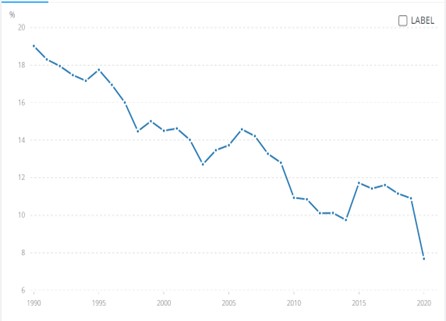
In the context of the individual and corporate situations noted, increasing income tax from those at the bottom end of the income/revenue scale cannot be regarded as a fair proposition. As per the International Monetary Fund, Government Finance Statistics Yearbook and data files, and World Bank and OECD GDP estimates, the tax revenue in Sri Lanka had dropped to 7.7% of GDP in 2020 from 19% in 1990 as illustrated in the graph below. The revenue in 2022 was reported at 7.6 % of GDP in Sep 2022. As the graph depicts revenue has been steadily declining since 1990
Economynext in an article state that quote Sri Lanka has aimed at increasing tax revenue by 69 percent to fund government spending in the crisis-hit economy, but analysts say the 2023 budget failed to address core issues on excess spending and articulate strong policies on restructuring loss making state owned enterprises (SOEs). The budget has aimed at increasing tax revenue by 69 percent to 3,130 billion rupees next year from this year’s 1,852 billion rupees while bringing down the budget deficit to 7.9 percent in 2023 from this year’s revised 9.8 percent. The high tax revenue target comes as millions of Sri Lankans face the impacts of the ongoing economic crisis – 66 percent inflation, job losses, and shrinking disposable income, unquote (https://economynext.com/crisis-hit-sri-lanka-targets-more-tax-revenue-in-2023-budget-concerns-on-soes-spending-remain-102740/).
These factors portend even more of a difficult period in the coming years as no one appears willing and/or able to take the difficult decisions that must be taken to yield an effective course correction that will take the country out of the economic mess it is in. However, the pain of such decisions cannot fall unjustly on ordinary people who are already in great pain, while some segments of the society enjoy a largesse that is both embarrassing and unkind to those who are struggling to find their next meal.
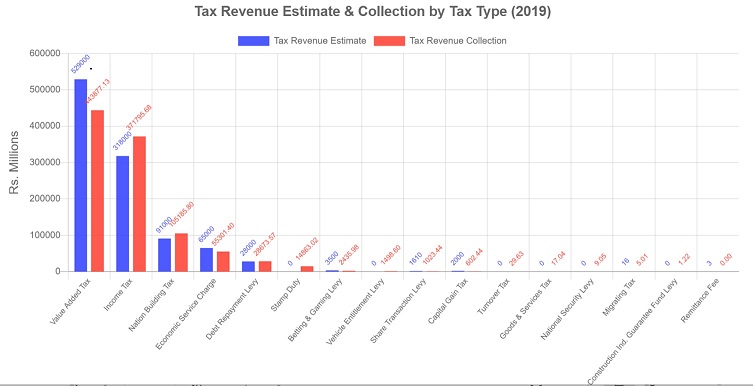
The following table on tax revenue estimate and collection by tax type (2019) published in lankastatistics (https://lankastatistics.com/economic/tax-revenue-by-tax-types.html) gives an insight into the contribution to tax revenue from different categories. As can be seen, value added tax and income tax comprises nearly 90% of the tax estimated and collected.
Value added tax also contributes to the unfairness of tax because of its regressive nature. The Tax Policy Centre, a joint venture of the Urban Institute and Brookings Institution made up of nationally recognized experts in tax, budget, and social policy who have served at the highest levels of government.
In a briefing book (https://www.taxpolicycenter.org/briefing-book/who-would-bear-burden-vat), it states, because lower-income households spend a greater share of their income on consumption than higher-income households do, the burden of a VAT is regressive when measured as a share of current income: the tax burden as a share of income is highest for low-income households and falls sharply as household income rises. Because income saved today is generally spent in the future, the burden of a VAT is more proportional to income when measured as a share of income over a lifetime. Even by a lifetime income measure, however, the burden of the VAT as a share of income is lower for high-income households than for other households. A VAT (like any consumption tax) does not tax the returns (such as dividends and capital gains) from new capital investment, and income from capital makes up a larger portion of the total income of high-income households”.
If Sri Lanka is serious about an equitable and a fair tax system, it needs a complete overhaul of the system and not patchwork changes at the behest of external agencies. The morally and politically bankrupt politicians and special interest groups may not wish for such an overhaul and the country would continue its debilitating slide into further trouble despite the best efforts of a few.
Firstly, if as suspected, a significant number of high earners are either not paying their fair share of income tax or not paying any income tax, that loophole needs to be fixed. There are measures that could be considered. The idea of levying a tax at the source could be considered for professionals who deal in cash payments. For example, unless a law exists, a new law could be brought in to make it compulsory that doctors see patients only in hospitals or certified medical or home practices, and that ALL cash or credit card transactions are recorded as auditable, legal documents. If patients are seen or treated at a hospital or a similar medical institution, the attending doctor SHOULD be paid by the institution and no direct patient transactions should be permitted. The hospital in these instances could be compelled by law to deduct a percentage of the doctor’s fee as a tax, with the doctor permitted to disclose this payment in their annual tax returns. A similar methodology could be adopted with some variations to other high earners by way of a registration process where and all such registered individuals are required to submit periodic returns to the Inland Revenue department.
Government officials who become high earners through bribe taking will be harder to rope in although in their case as well as in the case of professionals, strict asset tests conducted by the tax office, and also bank disclosures on ALL cash deposits over a given amount, plus a tax levy imposed when deposits are made, for deposits over a given value, could be some of the plugs that can be used to close loopholes.
In all cases it is vital that penalties for violating existing and new tax laws are very stringent and they include jail terms and confiscation of assets including any unlawfully held cash assets in the name of the individuals. As suspected, if such assets are written in the name of relatives or friends of the individuals concerned, such persons should be called upon to explain and justify how they managed to acquire such assets.
Secondly, value added taxes needs to be revised and redress given to individuals when they purchase essentials. Instead, a tax overhaul could investigate increasing value added taxes for functions held in hotels and function halls. It is no secret that vast sums of money are spent on these functions. Many such spending is unconscionable and an affront to the hundreds and thousands of ordinary people who do not have money for their basic, routine meals. However, rather than focusing on the morals and ethics of such high spenders, as that would be more or less water off duck’s backs, charging a high value added tax would at least allow the government to support the most vulnerable with such funds. To the best of the writer’s knowledge, no surveys have been carried out to ascertain the revenue to hotels and function centres from such functions.
The tax office could undertake such a survey to ascertain the current and potential value added tax collection from such venues. A tax overhaul should naturally include corporate taxation and a re look at concessions provided and how a situation reported in the Morning newspaper described earlier could be addressed. CEIC Unlimited
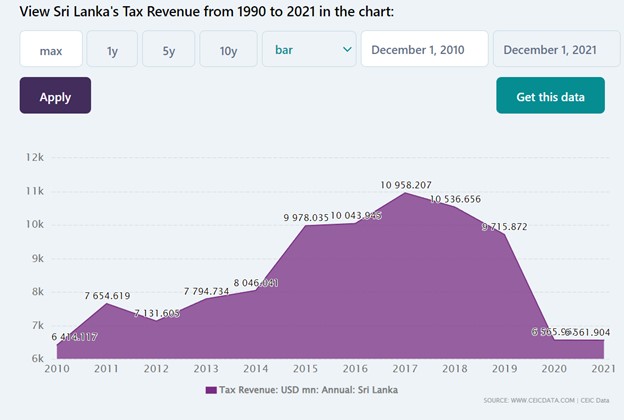
Sri Lanka Tax Revenue was reported at 6.562 USD bn in Dec 2021.
This is a decrease from the previous figure of 6.566 USD bn for Dec 2020.
The decline in tax revenue is shown in the illustration below. The corporate tax component and individual income tax component is not mentioned here, and this is something that needs to be examined to ascertain the contribution from the corporate sector and if the Morning article is to be taken as perhaps the tip of the iceberg, the potential loss of income tax from the corporate sector.
Clearly, it appears that there are some individuals who earn vast amounts of money but hardly pay reasonable income taxes, corporate earnings and profits are not consistent with taxes paid, there is no assessment of the income of some individuals who purchase high value properties and other assets and whether they have fulfilled their tax commitments. On the other hand, successive governments seem to have and still are taking the easy way out by taxing wage earners.
If the country is serious about increasing its revenue base from taxes, it should engage in a complete overhaul of the tax system, strengthen the hand of the tax department by way of suitable legislation and introduce serious punitive measures to punish individuals and corporate entities who firstly do not declare their real income, and secondly who do not pay their fair share of taxes. The VAT system too should be revised in such a way that the most vulnerable are safeguarded from the regressive nature of the VAT system.
Ever since a regime change was choreographed in 2015 January, the US has been using its lackeys in government to exert tremendous influence in 3 areas – Sri Lanka‘s economy, Sri Lanka‘s Parliament and Sri Lanka‘s armed forces. Based on media articles, press releases and whatever other information has been made available to the public, an overview of the extent to which Sri Lanka’s sovereignty has been compromised can be deduced. Sri Lanka is a sovereign nation and Sri Lanka must uphold that sovereign status. Any new government must understand the fundamentals of what it means to be sovereign and ensure national policy is drafted to ensure that and that sovereignty is not compromised. Somehow politically, socially, cutturally & economically US & India have made inroads & Sri Lanka’s policy makers are as guilty as the politicians for not upholding the nations sovereignty.
Timelines:
1950s – United States Information Service (USIS) set up cultural centers in Colombo, Kandy and Jaffna (objective to instill American values” among Sri Lankans – 5 live concerts also held
1951 – US-Ceylon agreement for Voice of America station to broadcast to all of Asia
1952 – US- Sri Lanka Fulbright Commission founded – scholarships awarded for postgraduate studies to US
1956 – US objects to Rubber-Rice pact with China (which JRJ opposed too) & cuts off aid as punishment. US forced France, Italy & Japan to withhold supply of Sulphur fungicide needed for rubber plantations.
1950s – when Sri Lanka sought Rs.50 aid US refused
1977 – President Jayawardene permitted US naval ships to enter Trincomalee and wanted to give the Trincomalee oil tanks to America. Voice of America started to broadcast from Iranawila.
2004 – US tried to persuade Sri Lanka to sign US Tropical Forestry Conservation Act of 1998 (claiming to reduce debt by allowing a committee of representatives from US & INGOs to manage forest – if signed US would control our forest assets, have exclusive access to our medicinal plants) heavy protests stopped signing of agreement.
US & Asia / China’s Maritime Silk Route
US interests were on the Pacific Ocean, Atlantic Ocean, South East Asia (5 out of 7 US security alliances are with Asia-Pacific countries / defense pacts with 69 countries which account for 75% of world economy)
With China’s focus on Indian Ocean, the strategic location of Sri Lanka came into play as Sri Lanka had the ability to control or impede free flow of resources to & from China. Half the world’s container traffic passes Sri Lanka. US needed a weak Sri Lanka to dominate & force its presence.
ANTI-US sentiments has a background
USA has supported dictators like Pinochet, Marcos, Suharto, Somoza, Pol pot.
Both Saddam Hussein & Osama Bin Laden were former CIA agents
US has been involved directly/indirectly covertly/overtly in coups, invasions, regime change, election interferences etc.
US was the only country to drop the atomic bomb twice (on Japan) and used chemical agent Orange in Vietnam which continues to disable Vietnam children.
US support to Tamil separatism
US envoy James Spain told Sri Lanka’s Foreign Minister not to refuse India’s Indo-Lanka Agreement (Izeth Hussein)
We were hounded & intimidated by the US to stop the war against the LTTE” (envoy N. Godage)
US used satellites to spy on Sri Lanka during final conflict to incriminate them for war crimes
US allegedly tried to rescue trapped Prabakaran using US ship in May 2009.
US did not expect LTTE to be annihilated. US Senate Committee on Foreign Relations sent 2 Senators to Sri Lanka in Nov 2009 – they reported – Rajapakse was a ‘threat to US as he was drifting towards China. US was advised to adopt a ‘less confrontational approach’.
US is part of the secretive intelligence alliance called – FIVE EYES” (UK, Australia, New Zealand, Canada, US) Singapore also partners with them.
The 5 Eyes became 9 Eyes with Denmark, France, Holland, Norway joining. Then 14 Eyes with Germany, Belgium, Italy, Spain & Sweden joining.
US & Yahapalana
(themes used: US committed to peace, reconciliation, accountability)
Immediately after overthrowing Rajapakse govt US indicated its role in regime change.
John Kerry Secretary of State arrived in May 2015 Your country sits at the crossroads of Africa, South Asia, and East Asia. The Indian Ocean is the world’s most important commercial highway. And with its strategic location near deep-water ports in India and Myanmar, Sri Lanka could serve as the fulcrum of a modern and dynamic Indo-Pacific region….. The US could play a leadership role in making this happen”.
Regime Change in Sri Lanka, Nigeria, Burma cost $585 from US Complex Crisis Fund (CCF) of which USAID gave $3.4m to Yahapalana’s 100 day program.
Yahapalana visits to US
Jun 2016 – PM Ranil paid a quiet visit to New York – reason given to the Sri Lanka public was that Wickremesinghe was visiting New York for medical purposes – he went to meet two officials from the White House. PM Ranil also addressed the United Nations Ocean Conference & you cannot address a conference without it being planned ahead.
Sept 2016 – Speaker Karu Jayasuriya to Washingtonto signagreement with J. Roskam, Chairman House Democracy Partnership, of House of Representatives.
Sept2018 – Sagala Ratnayake Minister of Youth Affairs and Chief of Staff to the Prime Minister visited USA & met Thornberry, also Ted Yoho, Chairman of the House Foreign Affairs Subcommittee on Asia and the Pacific, as well as senior officials of the National Security Council, the Department of State, the Department of Defence, the U.S. Agency for International Development (USAID) and the U.S. Millennium Challenge Corporation (MCC).
Visits of US officials to Sri Lanka
2014 – Stephen J. Rapp , the US Ambassador on War Crimes – Rapp heads the Office of Global Criminal Justice at the US State Department.
July, August, December 2015 – Nisha Biswal, US Assistant Secretary for South Asian Affairs
July 2015 -Tom Malinowsky US Assistant Secretary for Democracy & Human Rights
November 2015– Samantha Power, US ambassador to the UN
December 2015 -Thomas Shannon Under Secretary of State for Political Affairs
Jul2016 – Nisha Biswal, Assistant secretary of state for South and Central Asian Affairs, had visited Sri Lanka six times by July 2016
Feb2017 – US House of Representative delegation (3days) part of House Democracy Partnership (HDP) program in which 20member US House of Representatives work directly with partner countries. 8-member delegation from Democrats & Republicans. US signed a Collaboration Agreement with Sri Lanka’s Parliament on 14 September 2016 in Washington.
March2017 – US Congress delegation visits Hambantota Port & Yala National Sanctuary. US Sri Lanka sign 2 programs –
Aug2017 – Alice Wells US Assistant Secretary of State for South and Central Asian Affairs meets government officials, business leaders and civil society representatives. She joins candlelight vigil at Vihara Maha Devi Park, to mark the UN Day of the victims of Enforced Disappearances accompanied by US Ambassador in Colombo Atul Keshap & joined by the top representatives of the Tamil National Alliance
Sept2017 – Assistant U.S. Trade Representative Mark Linscott to ask SL Govt to implement policies that will increase trade and improve the business climate he wanted 1 year resident visa for foreigners changed to 3 years.
Sept2017 – Alice Wells Acting Assistant Secretary of State for South and Central Asian Affairs, told a Congressional Sub Committee, the US was seriously concerned over unsustainable debt burden on Sri Lanka due to non-concessional loans from China” US was the largest grant provider of assistance channeled primarily to NGOs working to the US agenda
2017 – Rear Admiral Donald D. Gabrielson, of the US Navy, declared at the Galle Dialogues that every country should be cautious when working with China for want of transparency in certain engagements.
2017 – 5 member USAID team led by Davnie Eston arrived to map out how USAID could collaborate on ventures of the Ministry of Industry and Commerce including working with private sector.
Feb2019 – Thomas J. Vajda US Acting Principal Deputy Assistant Secretary of State dealing with South and Central Asia
May 2019 – former envoy Robert Blake visits Sri Lanka
June 2019 – US Secretary of State, Mike Pompeo but last minute visit was cancelled due to public uproar over US controversial pacts
October 2019 – US State Dept holds ‘Human Rights in South Asia” hearing on Burma and Congressman Brad Sherman announced they would focus on human rights situation in Sri Lanka too.
After Gotabaya Rajapakse becomes President in Nov2019 & SLPP forms Govt in August 2020
October 2020– US Secretary of State Mike Pompeo
22 Mar 2022– US Secretary of State for Political Affairs Victoria Nuland & meets Govt, business & civil society leaders (immediately after her departure aragalaya unrest starts)
June 2022 (26-29): US Dept of State & US Treasury officials Robert Kaproth, Deputy Assistant Secretary of Treasury for Asia, and Ambassador Kelly Keiderling, Deputy Assistant Secretary of State for South and Central Asia. They met political representatives, economists, and international organizations. US announced $120m for SMEs, $27m to dairy industry, $5.75m humanitarian assistance, $6m to livelihood assistance
September 2022– United States Agency for International Development (USAID) chief Samantha Power – her focus helping 1million farmers” with $40m aid – $40 per farmer.
Feb 2023– US Secretary of State for Political Affairs Victoria Nuland makes 2nd visit to SL in a year (another protest starts after her departure & request for US-India military base in Trinco is mooted)
US funding projects to realign their agenda in Sri Lanka
$135m for Youth Empowerment grants covering over 100 programs since 2010 (leadership training / advancing ‘rights of marginalized communities’
US Senate Committee sought $43m ($35m economic support fund / $6.8m non-proliferation and anti-terrorism & $500,000 in foreign military financing and $500,000 for training military personnel
US plan was to work with YOUTH, use civil society groups (indirectly to create subversive groups)
$1m for 2 projects – strengthen media / reconciliation identifying youth & women
2016-$13.7m by USAID to 8 civil society organization to ‘strengthen accountability & good governance) (SDGAP) administered by private US company – Development Alternative Inc (DAI) – a CIA front’ Office of Transition Initiatives(OTI). DAI is set up to destabilize governments. SDGAP project is not subject to Sri Lankan law but to the laws and regulations of the US. SDGAP does not come under the purview of Sri Lanka’s Auditor General. DAI also plans to ‘engage’ with the Sri Lanka Institute of Development Administration (Public Service) Note: SDGAP also implemented in Afghanistan, Colombia, Georgia, Haiti, Indonesia, Iraq, Kenya, Kosovo, Kyrgyzstan, Lebanon, Liberia, Macedonia and Mongolia. USAID STAIR program in AG’s dept (project claiming to reform public financial management)
2016 – US plan to provide aid to Jayawardenapura University to document historical buildings in Galle Fort. Cheryl Edison arrived in 2017 & was holding free classes for representatives from ICTA – SLASSCOM and held seminars for University students from Jayawardenapura & University of Jaffna.
2017 – Youth Climate Summit funded by US embassy
Feb2017 – Mojo, an American band arrive on a U.S. Embassy sponsored visit – public performances in Jaffna and Colombo; workshops for music students; and master classes for Sri Lankan musicians.
3m aid offered for flood victims – disaster experts from USAIDOFDA and Civil Military Support Element attached to US embassy also involved.
Sri Lanka to receive only US$ 3.38 million for its USAID programmes in 2018, a drop of 92% percent from 2016
March2017 – 2 programs signed Strengthened Partnership for Democratic Reform & Social Integration” & Increased & Equitable Growth and Public Financial Management”
23 Aug2019 – The Ministry of Development Strategies and International Trade together with the USAID-SAIL project hosted a Public-Private Dialogue (PPD) on Global Trade for businessman in Kandy District at Hotel Suisse, Kandy.
Oct 2021– USAID $2.5m covid-19 assistance (USAID has contributed $17.9m since Mar 2020)
Sept 2022– USAID signs $65m over 5 year agreement following Samantha Power visit. This is in addition to $60m for humanitarian & fertilizer assistance (was the fertilizer issue created to facilitate this assistance”) as US envoy after signing stated that US wishes to promote a ‘free & open Indo-Pacific’. US development aid $2b since 1965.
Other notable CIA fronts include
International Republican Institute (IRI),
National Endowment for Democracy (NED),
National Democratic Institute for International Affairs (NDI),
Freedom House
These organizations transfer US funds to opposition parties and other pro-American local groups in countries of strategic interest, using the pretext of ‘promoting democracy’.
The OTI’s charter is to finance civil society groups (NGOs) for use in their subversive activities including regime change in strategically important nations with governments unwilling to succumb to US dictates.
https://www.ned.org/region/asia/sri-lanka-2021/
US & USAID INTERFERENCE in Sri Lanka (YOUTH – WOMEN TARGETS)
5-member USAID team led by Davnie Eston arrived in 2017 and mapped out ways and means in which USAID could collaborate on ventures of the Ministry of Industry and Commerce. We are empowered to work with the private sector” said USAID.
USAID was asked to improve the soft skills of Lanka Sathosapersonnel
Sept2017 – U.S. Department of State’s Export Control and Related Border Security (EXBS) Program and the World Customs Organization (WCO) trained 34 Customs Officials from Sri Lanka in strategic trade controls
October2017 – USAID & business leaders and Sri Lankan Government launched the $12m ‘You Lead’. a new employability and skills development project to create a more market-oriented, skilled and flexible youth workforce (ages 16 to 35). You Lead’s regional focus is on the provinces with the highest youth unemployment, Sabaragamuwa, Central, Southern and Northern Provinces.
USAID YouLead” program and Microsoft Sri Lanka signed a partnership to launch the new $12m YouthWorks” information technology portal at the Ministry of Skills Development and Vocational Training in Colombo).
YouLead is implemented by the International Executive Service Corps (IESC) and administered by the Volunteers for Economic Growth Alliance (VEGA).
YouLead will work with Microsoft, the Ministry of Skills Development and Vocational Training, and the private sector to develop and upload content for the YouthWorks portal in Sinhala, Tamil and English. The portal is currently being used in 18 countries
Mar2018 – U.S. Embassy launched American Innovation Hub (iHub) in partnership with the Matara District Chamber of Commerce and Industry. The iHub is located in the Matara Chamber of Commerce building. The iHub offers thematic programs, all free of charge, and a selection of U.S. books and DVDs. It is intended to promote English language learning, encourage study in the United States, and introduce the local community to American culture and values. (American English – American VALUES!)
The U.S. Embassy also has American Spaces in Colombo, Kandy and Jaffna. These locations offer books, DVDs, English language programs, entrepreneurship programs, U.S. speakers, and more.
2017 USAID funded a project for more female representation in local government bodies.
Harvard Centre for International Development (HCID) helping Sri Lanka to attract foreign direct investments (FDIs) promoting emerging exports, targeting new non-existent industries, identifying and engaging with potential new investors, fixing the investment climate for new emerging industries and figuring out how to create new tourist destinations.
BOI staff receiving training programmes conducted by Harvard University’s Centre for International Development, McKinsey Consulting and the World Bank Group.
August 2020 – Top Gem Lapidary partnership with NAITA (women-led enterprise started by 8 unemployed youth in Central Province)
200 gem cutters identified
Aug 2020 – USAID-Youth-ICT (USAID’s Youth Employment & Business Start-up Program – YouLead) Sri Lanka Association of Software & Services Company (SLASSCOM) is a counterpart of YouLead. USAID launched ICT Future Careers Bridge Program in Mar 2019. It identified school leavers & aims to reach 1500 youth.
March 2021 – US organizes innovative entrepreneurship training program with Samurdhi Development for 21 women from Matara. To be expanded across 6 districts for 7500 participants.
Oct 2022 – USAID Pizza Hut launch 28 Training kitchens for Sri Lanka Youth
Vocational training kitchen at Technical College Kuliyapitiya. 6month Curriculum developed by USAID, Yum Brands Foundation provided $1.3m grant. Partnered by YouLead, Gamma Pizzakraft Lanka (owner of Pizza Hut franchise) & Sevalanka Foundation. Aims to train 2100 youth annually in fast-food industry. NVQ3 certification.
USAID funding project in Election Commission with Vasu Mohan being a paid member
US EMBASSY INTERFERING IN SRI LANKA’S ELECTIONS
US intervened in Presidential Elections in Jan2010 and Jan2015
Former US Envoy Michelle Sisson openly talking politics at embassy functions – she had insisted that the candidate to challenge Mahinda Rajapaksa should not be a UNP candidate but a common candidate
US Senate Dept finance report (2016) – US invested $585m in 2015 for regime change in Myanmar, Sri Lanka & Nigeria under ‘Democracy, Human Rights & Governance’. US focus was to partner with civil society, citizen’s movements, faith leaders, entrepreneurs, innovators.
USAID had given $3.4m to Yahapalana’s 100-day program from the US Complex Crisis Fund (Hassina Leelaratne – America’s Freedom of Information Act)
US INTERFERING IN SRI LANKA’S CONSTITUTION
MP Keheliya Rambukwella said ‘there is no point in debating the interim report of the Constitutional Assembly Steering Committee as the final draft of the new constitution has already been prepared by the US and given to the government. A group of Sri Lankan MPs including me visited the US recently. We were attending a Congress meeting on Sri Lankan affairs. David Price, a US Congressman, told us that the
US had prepared the final draft of the new constitution and sent it to the Sri Lankan government” Price said almost everybody had accepted the draft except a bunch led by Mahinda Rajapaksa.
US interfering in Sri Lanka’s Parliament
House Democracy Partnership (a bipartisan, twenty-member commission of the U.S. House of Representatives) of the US House of Representatives launched a Collaboration Agreement with the Parliament of Sri Lanka. Speaker Karu Jayasuriya signed for Sri Lanka. The purpose was to strengthen partnership between the two legislatures – exchange of information on the legislative systems of each country, sharing knowledge, and offering consultations on effective legislative management; and cooperating and assisting each other through training programs for the members and staff of the legislatures. The program is operating in Afghanistan, Myanmar, Colombia, Georgia, Haiti, Indonesia, Iraq, Kenya, Kosovo, Kyrgyzstan, Lebanon, Liberia, Macedonia, Mongolia, Pakistan, Peru, Timo-Leste and Ukraine.
US-Sri Lanka Open Government Partnership (Oct2015)
Sri Lanka is the only South Asian participating country in the OGP.
To be eligible for OGP governments must demonstrate commitment to open government principles in – Fiscal Transparency, Access to Information, Income and Asset Disclosures, and Citizen Engagement.
Sri Lanka is supposed to have scored 14 of a total of 16 points.
The NGOs involved in the OGP in Sri Lanka – Center for Policy Alternatives, (CPA) International center for Ethnic studies (ICES), Sarvodaya, Transparency International, Management Development Centre and Consortium of Humanitarian Agencies (CHA).
‘Strengthening Democratic Governance and Accountability Project’ (SDGAP) a $13.7m project for the reform of Sri Lanka’s public sector. US has selected Development Alternatives, Inc (DAI) of Maryland, to implement the project.
DAI would work closely with Sri Lanka’s Parliament, Independent Commissions and related ministries.
USAID allocated $3 million for project in September 2016 and the program was launched in November 2016.
SDGAP was subject to the laws and regulations of the United States, with oversight from USAID’s Office of Inspector General.
SDGAP claims to help GOSL increase transparency, accountability, good governance, strengthen systems and processes for public accountability & policy development.
June2019 – Prasad Kariyawasam was appointed by Parliament as an International Affairs advisor to the Speaker – first time a Speaker has had such an advisor and such a position did not exist in the list of officials in Parliament while being paid by a foreign country. Speaker Karu admitted that Kariyawasam was paid by DAI – Development Alternatives Institute (a CIA front) & implementing agency for USAID. DAI is paying the salaries of Prasad Kariyawasam and G. Hettiarachchi former Additional Secretary to the Ministry of Public Administration.
DAI had given Rs.2000m for Parliamentary Diplomacy program which funds MPs for ‘study tours’ overseas.
Due to objections in July 2019 Speaker Karu informed that Prasad Kariyawasam’s salary would be paid by Parliament funds reconfirming he was paid by foreign funding.
PrasadK had also arranged to have ambassadors of the Organization of Islamic Cooperation countries to meet Speaker Karu though this task has to be done by Foreign Ministry or Foreign Secretary. The IGP and Intelligence chief was also summoned by the Speaker, another first. How can PrasadK run a parallel operation which should be done by the Foreign Ministry?
US / Sri Lanka Partnership Dialogue – strengthen and enhance bilateral relations in the widest sense.
US INTERFERING IN PUBLIC SECTOR – National Labor Advisory Committee (NLAC)
July2017 – Govt informs decision to appoint World Group on Labor Law Reforms proposed by Ministry of Development Strategies & International Trade in collaboration with USAID. Trade Unions objected claiming the Ministry nor USAID had any right to intervene in reforming labor laws in Sri Lanka.
US INTERFERENCE IN SRI LANKA’S LAW & ORDER
US State Department Special Project made provision for a Resident Legal Advisor in Colombo to provide anti-corruption and asset recovery training and also support the Commission to Investigate Allegations of Bribery and Corruption (CIABOC)
(The Global Forum on Asset Recovery: Assistance for Combating Corruption in Nigeria, Sri Lanka, Tunisia, and Ukraine)
US PEACE CORPS IN SRI LANKA
Feb2018 Yahapalana signed an agreement with the US to re-establish a US Peace Corps programme in Sri Lanka. first 25 American Peace Corps Volunteers to arrive in late 2019 and undergo three months of comprehensive cultural, language and technical training before they are given their assignments to serve for two years. Peace Corp volunteers will focus on supporting the Education Ministry, schools, and community groups in coordination with the Sri Lankan English Teachers’ Association. They will be given diplomatic privileges The Diplomatic Privileges Act provisions have been invoked to accord equitable treatment to the Volunteers and persons performing functions under contract with the Peace Corps and their dependents. Government will provide to the Peace Corps the same exemptions with respect to taxes on payments that they receive to defray their living costs, on income derived from their officials duties, and on income from other sources outside Sri Lanka; customs duties or other charges on their personal property introduced into Sri Lanka for their own use; and all other taxes or other charges (including immigration/visa fees), except licence fees as provided to members of the administrative and technical staff of the Embassy of the United States in accordance with the Vienna Convention on Diplomatic Relations.
GOSL will exempt all taxes (including value-added taxes) customs duties, and other charges all equipment, supplies, and other goods and services introduced into or acquired in Sri Lanka by the US Government or any contractor financed by it, for use to enable the US Government to discharge its responsibilities under this agreement.
GOSL will exempt such persons, members of their families forming part of their households who are not citizens or permanent residents of Sri Lanka from all taxes or income derived from their Peace Corps work or other sources outside Sri Lanka, from all customs duties and other charges on their personal property introduced into Sri Lanka for their own use, and from all other taxes or other charges (including immigration/visa fees) except license fees.
Why is America arriving to teach English to remote Sri Lanka so close to elections?
US Peace Corps was in Sri Lanka from 1962-64 / 1967-70 / 1983-1998
PM Sirimavo Bandaranaiake kicked them out after she became PM in 1970. They came back with every UNP govt.
US Peace Corps evolved from a CIA Front known as International Voluntary Services Inc. (IVS), during war against Vietnam. The US Peace Corps has been expelled from a number of countries for spying for the CIA and covert activities, meddling in local politics, and running drugs.
In September 2017, Cambodia’s Prime Minister demanded the withdrawal of the US Peace Corps for conspiring with the opposition leader Kem Sokha to overthrow his government.
In 1965, Indonesia ordered US Peace Corps out after 16 months.
In 1966, Guinea asked PCs to leave.
In 1967, Mauritania asked PCs to leave.
Pakistan and India also refused to renew approval of PC projects in their countries in the early 1970s.
Burkina Faso Peace Corps programme was closed in 2017
US INTERFERENCE IN SRI LANKA’S MILITARY
US-Sri Lanka Military Collaborations
2002 – US Pacific Command team invited to report on the Sri Lanka armed forces
2012 US officials in Colombo meet business executives representing companies importing/exporting to/from US. The US embassy wanted regular feedback about security related matters in SL. The meeting was sponsored by the Overseas Security Advisory Council of the US State Department which looked after US business interest.
2015 – Sri Lanka Marine Corps set up
2016 – Head of the US Pacific Command Admiral Harry B. Harris Jr. even attended the Sri Lanka Navy’s Galle Dialogue 2016.
US 7th fleet in Trincomalee – held joint public concerts at the Galle Fort, Tangalle City Centre, Hambantota Beach Park, Bata Atha Agro Park, Matara Beach Park and several schools. Pacific Partnership team attended a pinkama at Ambalantota Sunadararamaya.
Mar2016 – USS Blue Ridge (first US ship to arrive) arrived with over 900 sailors (many felt Sri Lanka was being turned into another Philippines by US)
Aug2016 -US war ship USS Frank Cable, a submarine tender vessel
Aug2016 – US Pacific commands Operation Pacific Angels stayed a week in Jaffna providing medical care to 4000 people and renovating 6 schools.
Nov2016 – Theatre Security Cooperation (TSC) project with Sri Lankan Navy’s newly formed marine force & US 11th Marine Expeditionary Unit.
Dec2016 – US navy Poseidon aircraft, an advanced US maritime patrol aircraft, left Mattala
Jan2017 – US guided missile destroyer USS Hopper arrived on a goodwill visit
March2017 – USS ‘Comstock’ arrived for a four-day trainingworkshop at Colombo harbor. ‘USS Comstock’ is part of the 7th fleet. This is the third such military-to-military exchange between U.S. Sailors and Marines and their Sri Lankan counterparts in the past 12 months, the authorities observed, ‘and this will form the basis of further cooperation between our militaries.’
Mar2017 – USNS ‘Fall River’ a transport ship of U.S. Pacific Fleet arrived in Port of Hambantota to engage in the first Pacific Partnership goodwill mission. Chief of US Pacific Fleet, Rear Admiral Gabrielson said Sri Lanka was selected as the first of four nations for the 2017 Pacific Partnership programme because Sri Lanka government had made the request. The Pacific Partnership medical teams will join Sri Lankan doctors and nurses for training at the General Hospital and Nurses Training School in Hambantota, the Tissamaharama Base Hospital and other local clinics and hospitals. Free public medical and dental clinics in select cities. Some 325 US marines were in Sri Lanka.
May2017 – Officers of the US 7th Fleet and Sri Lanka Navy met for 2nd time at the Naval Headquarters – US wants to establish base in Trinco for its 7th fleet (Island newspaper Sept2015)
Jun2017 – 33 US army cadets from US Army Reserve Officers Training Corps arrive on familiarization tour visiting SL Military Academy, SF HQ, SL Light Infantry HQ, Regimental HQ of SL Engineers, Army School of Artillery at Minneriya
2017 -Institute of National Security Studies Sri Lanka (INSSSL) briefed a delegation from the Young Alakai Warriors of the U.S. Army Pacific on Security Challenges of Sri Lanka in the Next Decade”
Oct2017 Sri Lanka included to Cooperation Afloat Readiness & Training (CARAT) exercise in Trinco by US Navy & Marines.
Oct2017 – A Group of US ships visit – warship USS Nimitz, cruiser USS Princeton, destroyers USS Howard, USS Shoup, USS Pinckney, USS Kidd. USS Nimitz is one of the world’s largest war ships – 23 stories high and 333meters long and accommodating 5000 US Marines. It was parked 150 nautical miles off Colombo.
Oct2017 – 3rd Annual Colombo Air Symposium United States Air Force Major General James Eifet called for increased partnership and information sharing among nations in the Indo-Pacific region in the face of a nuclear threat from North Korea. Eifet castigated China over its claims in the South China Sea
Galle Dialogue 2017 – Admiral Scott Swift, Pacific Fleet Commander expressed desire to expand military relations.
Galle Dialogue 2017 Rear Admiral Donald D. Gabrielson, of the US Navy, declared that every country should be cautious when working with China for want of transparency in certain engagements.
April2018 – A 17-member delegation of the United States Land Forces in the Pacific Command arrived in Sri Lanka for participation in ‘Land Forces Pacific Programme’ sessions.
25April2018 – The U.S. Navy hospital ship USNS Mercy” arrived in Trincomalee to conduct the 2018 Pacific Partnership mission.” Pacific Partnership is the largest annual multilateral Humanitarian Assistance and Disaster Relief (HA/DR) preparedness mission conducted in the Indo-Asia-Pacific. Personnel from the United States, Canada, the United Kingdom, Australia, France, Peru, and Japan took part. USNS Mercy” contains 12 fully-equipped operating rooms, a 1,000 bed hospital facility, digital radiological services, a medical laboratory, a pharmacy, an optometry lab, a CAT-scan and two oxygen producing plants. The ship is equipped with a helicopter deck capable of landing large military helicopters. The team successfully completed a cholecystectomy, or gall bladder removal, on a Sri Lankan citizen using a Da Vinci XI Robot Surgical System. This was the first time I have ever operated aboard a ship,” said Dr. Vyramuthu Varanitharan, a general surgeon at the Muttur Base Hospital. They also treated over 5,500 patients conducting medical clinics at various locations in and around Trincomalee in addition to over 500 veterinary surgeries and vaccinations. From medical clinics to free public concerts, our sailors will bring the best of America to local communities,”
During the ship’s stay, USN doctors along with Lankan doctors performed 24 varying surgeries onboard, out of which the robotic surgery performed onboard was the 1st in the world.
Jun2018 – Sri Lanka participated for the 1st time in biennial Rim of the Pacific (RIMPAC) maritime exercise 2018 held in Hawaii and Southern California in June 2018.,
Jun2018 Army Commander Lieutenant General Mahesh Senanayake attended the US Army’s ‘LANPAC Symposium and Exposition’, organized by the Institute of Land Warfare in Honolulu, Hawaii. The theme was ‘The Future of Land Force Integration; Multilateral Approaches across the Indo-Pacific’. Army Commander called on US Army Commanding General, Pacific Command, General Robert B. Brown and discussed matters relating to continuing defence cooperation. Senanayake was also among the invitees to a special banquet, hosted by General Brown. Lieutenant General Senanayake’s retinue to Hawaii included Military Assistant to the Army Commander Colonel K.A.A. Udaya Kumara and Regimental Sergeant Major (RSM) Warrant Officer I.W.M.S.P. Wijesinghe, perhaps for the first time in the Army history in a Commander’s entourage”.
US Air Force Airmen from across the Indo-Pacific met with their Sri Lanka Air Force (SLAF) counterparts at the SLAF Headquarters in Colombo. According to Maj. Gen. Eifert the engagement was very successful.
June2018 – Geoffrey F. Gresh, Department Head of International Security Studies – National Defense University in Washington, D.C and Associate Professor at the College of International Security Affairs (CISA), paid a courtesy call on Chief of Defence Staff (CDS) Admiral Ravindra C. Wijegunaratne. He was accompanied by LTC Douglas Hess, Defense attache, US Embassy.
Aug2018 Amphibious transport dock USS Anchorage (LPD 23), and 13th Marine Expeditionary Unit (MEU) arrived at Trincomalee Port
Apri2019 – last joint US-SL naval exercise Cooperation afloat readiness and training exercise CARAT) saw participation of 2 US shops (USS Spruance & USS Millinocket) & SLNS Sayurala & SLNS Samudra participated.
US embassy also wanted to have display of US Air Force aircraft in Colombo with an air parade over Galle Face Green but was disproved by the Foreign Ministry
Noteworthy:
US-India partnership to curtail China.
US has even created a new region – ‘Indo-Asia-Pacific Region’, which includes the Indian Ocean and the Pacific Ocean.
Jun2016 Joint trilateral military exercise US-India-Japan
2016 US-India signed agreement allowing use of each other’s land, air, naval bases for repair & resupply.
2016 US-India military exercises near Indo-Sino border
US National Defense Authorization Act 2017 recognizes India as a major US defense partner.
11 May 2022
US expresses concern over deployment of SL Military – during the protests.
Joint Naval Exercises
May 2018, delegation from the House Armed Services Committee of the U.S. Congress visited. The House Armed Services Committee, a standing committee of the United States House of Representatives, is a powerful Committee, responsible for the supervision of armed forces and the Department of Defense. The delegation was led by its Chairman Mac Thornberry and US embassy arranged for them to meet civil society organizations and TNA privately.
June/Aug2018 – The world’s largest international maritime warfare exercise (Rim of the Pacific – RIMPAC) took place in the Hawaiian Islands and Southern California
Jul2018 – visit of US Army’s Pacific Region Head Gen. Robert B. Brown
Jul2018 The Joint Combined Exchange Training (JCET) exercise inaugurated at the Special Boat Squadron Training School (SBSTS) in Trincomalee.
Jul2018 – third KDU-CNA Track 1.5 Dialogue on Naval at the Faculty of Graduate Studies, General Sir John Kotelawala Defense University (KDU). Discussing collaborative initiative between KDU and the Center for Naval Analysis (CNA), USA, facilitating interaction between the navies of Sri Lanka and the United States, along with the participation of relevant academics.
Aug2018 – United States to provide nearly $300 million in security assistance to improve security relationships across the Indo-Pacific region, including Sri Lanka announced Secretary of State, Mike Pompeo at the ASEAN Regional Forum
Bay of Bengal Initiative launched – United States to ‘work with other partners in the Bay of Bengal, including Bangladesh
Aug2018 U.S. Department of State announced approximately $39 million in Foreign Military Financing for Sri Lanka, pending Congressional approval
Aug2018 – The U.S. Coast Guard handed over a high endurance cutter, formerly the USCGC Sherman, to the Sri Lankan Navy
Aug2018 a joint humanitarian assistance mission called Pacific Angel, sponsored by US Pacific Command (USPACOM) at the Alagalla School in Vavuniya to provide humanitarian civic assistance and carry out civil-military operations in the Pacific region,
Air Logistics Hub concept using Sri Lanka’s strategic location to ensure the quick availability of relief supplies, equipment and other material when needed by the US and partner militaries and humanitarian organizations.
Jan 2023 – US Navy & Marine Corps to commence Cooperation Afloat Readiness & Training (CARAT/MAREX) exercise with SL Navy & SL Airforce. 5th CARAT/MAREX training between US & SL. Japan & Maldives also join. Training in Trinco & Mullikulam.
US sanctions
2020 – US imposed sanctions on SL Army Commander – Chief of Defense Staff Shavendra Silva
2021– US State Dept listed Navy officer Chandana Hettiarachchi & SLA Staff sergeant Sunil Ratnayaka & sanctions them over human rights violations.
Dec 2022 – Sri Lanka lamely agrees to Joint-US military training while US sanctions SL Military
US imposed sanctions on Prabath Bulathwatte head of Tripoli Platoon (citing Section 7031c) for torture of Keith Noyahr in May2008.
US INTERFERING IN SRI LANKA’S ECONOMY
US-Sri Lanka & Economy
25% of our exports go to US and 70% of that is garments.
Jan2016 – 3 year plan revealed at Sri Lanka Economic Forum by team led by Harvard University academic Ricardo Haussmann funded by Open Society Foundation head George Soros. (locals highlighted its dangers)
June2018 – US Dept of Agriculture with GOSL launched Market-Oriented Dairy Project to strengthen and grow SL’s dairy sector. The 4.5-year, US$14.1 million initiative is implemented by US-based International Executive Service Corps.
STATUS OF FORCES AGREEMENT (SOFA)
1995 US-SL sign agreement regarding status of US military personnel & civilian employees of the Department of Defense. SOFA seeks to update 1995 agreement to include Annex B.
Jul2019 PM Ranil announced in Parliament that Govt was negotiating a fresh military deal with US replacing 1995 SOFA giving US military easier access to Sri Lanka.
US embassy Colombo sent new draft SOFA – a 5page document dated 28 Aug 2018 to Foreign Secretary Prasad Kariyawasam who initiated discussions with support of Foreign Minister Mangala Samaraweera. Discussions was between only US embassy & Foreign Ministry and excluded Ministry of Defense. The US draft claimed that the acceptance of the US draft by the Secretary of the Ministry of Foreign Affairs constituted ‘acceptance’ of the GOSL as disclosed to a select local media by the US embassy Public Affairs Office.
President Sirisena responded by recalling Prasad Kariyawasam who returned on 31 Oct 2018 and SOFA was put on hold though negotiations continued.
May2019 – SOFA was listed for discussions at the SL-US Partnership Dialogue in Washington at which new Foreign Minister Tilak Marapana & US Secretary of State Mike Pompeo discussed. Marapana sought to change 2 clauses – diplomatic immunity for US troops in Sri Lanka & subjecting all actions to US laws.
Jun2019 – President Sirisena declared he was against proposed SOFA & would not accept military agreements with US including SOFA. President Sirisena phoned Marapana in Washington & asked not to sign SOFA without his approval.
SOFA puts Sri Lanka’s independence, territorial integrity & freedom of action at stake. Treaty once signed is binding. The Agreement provides diplomatic immunity for US troops & contractors and employees of US armed forces.
DANGERS OF SIGNING SOFA for SRI LANKA
(Sri Lanka Abdicating its Sovereignty & US legally invading Sri Lanka)
Sri Lanka transformed into a US military facility – Signing SOFA means US does not require setting up a military base in Trincomalee because US has been given access to entire island. US will be using Sri Lanka’s territory as a permanent transit point for military activities.
A virtual ‘separate state’ as US troops/officials/staff will run a defacto rule with US laws not abiding by Sri Lanka laws. Sri Lankan Govt, Parliament, Judiciary, Armed Forces, Police will have no control over US troops/contractors/employees in Sri Lanka
American men/women and anyone working for America (individually or collectively) US troops wearing uniform will be able to enter / leave / remain /use their vehicles/vessels/aircrafts in any part of Sri Lanka and carry their weapons. US civil & armed personnel will be able to move anywhere across the island and be above Sri Lankan laws. US armed forces & civilian personnel will be governed by US laws not Sri Lankan laws but they will enjoy privileges, exemptions & immunities that even Sri Lanka’s President, Mahanayake Theros, Sri Lanka’s Judges or Generals do not have.
US Defense Dept is also authorized to construct buildings and not be subject to any local taxes. Property / equipment, supplies, material, technology training will all be exempt from license, restrictions, customs duties, taxes or any charges within Sri Lanka.
US Defense Dept is also authorized to construct buildings and not be subject to any local taxes. Property / equipment, supplies, material, technology training will all be exempt from license, restrictions, customs duties, taxes or any charges within Sri Lanka.
Dept of Defense will be allowed to operate its own telecommunications systems. Use of radio spectrum will be functioning in parallel to Sri Lanka’s communication systems.
The US list of contractors is open-ended and includes all contractors/their employees signed with the US Defense Dept in the future.
US envoy to Sri Lanka called SOFA the ‘Visiting Forces Agreement’ however Visiting Forces Act (VFA) of 1949 empowers Sri Lanka’s Head of State to declare emergencies & receive emergency assistance but there was red tape before allowing foreign forces into the country.
As per 1949 VFA US troops & civilian components in Sri Lanka were not subject to Sri Lankan criminal or civil laws.
There is no emergency in Sri Lanka to have any SOFA or VFA.
Acquisition and Cross-Servicing agreements (ACSA)
SOFA is a follow-up of the ACSA agreement (83page) signed by UNP Govt & USA in 2017. ACSA allows US troops to make use of any military bases & ports whenever they want & Sri Lankan Govt must provide necessary support. Joint training exercises under US directives. Our Armed Forces have to take orders from US Armed Forces hierarchy.
SOFA provides facilities & conditions to implement ACSA agreement. With SOFA US troops, support staff, contractors can enter Sri Lanka without visa or passport merely by showing their US identity card. They will not be checked. Their equipment will not be checked. Their civil/military planes, vessels, vehicles will not be checked and they can bring anything without paying any duties /levies or taxes.
Full text of draft SOFA agreement dated 28 Aug 2018 was published by Sunday Times on 30 June 2019
Why are these agreements kept secret from public before signing?
SALLYPORT – US firm offering jobs
SALLYPORT a US firm offering a comprehensive range of global protective, security & mission support solutions to both US govt and foreign allies of US govt as well as to private & commercial clients announced full time and part time jobs in Sri Lanka. Another company Michael Baker Global Service owned by Caliburn International is also outsourced protection of building materials, furniture, fixtures etc.
ACQUISITION AND CROSS SERVICING AGREEMENT (ACSA)
In 2002 US tried to finalize ACSA formerly known as ‘NATO Mutual Support Act’ with Sri Lanka after signing CFA on 21 February 2002 but failed.
ACSA is a bilateral agreement which involves combined exercises, training, deployments, allows US troops to obtain food, fuel, transport, ammunition (logistics supplies) – reimbursement in cash or in kind.
US Deputy Secretary of State Richard Armitage announced plans for ACSA after meeting with PM Ranil in Washington 2002 with Minister Milinda Moragoda playing a key role in the project. In December 2002 Ambassador Wills requested use of Sri Lanka’s port & air space to invade Iraq, Foreign Minister Tyronne Fernando explained the country’s objection and ACSA was shelved.
Foreign Minister Kadiragamar visiting Washington in 2005 demanded that ACSA not to be included into agenda talks.
ACSA was signed in March 2007 (almost identical to ACSA US signed with Australia in 2010). ACSA Australia is a public document but ACSA Sri Lanka is not. US wanted it to be kept secret as it did not wish for Sri Lanka to request features in the agreement during the LTTE operation.
The agreement allowed US to transfer & exchange logistics, supplies, support & refueling during peace keeping missions, humanitarian operations or joint exercises. Excluded from 2007 ACSA were weapons systems such as missiles, naval mines, torpedoes, nuclear ammunition & items such as warheads, chemical ammunition etc. subject to the Atomic Energy Act 1954. US assured there would be no US bases in Sri Lanka. US provided vital information to the Sri Lanka Navy to apprehend 6 LTTE vessels in 2007 (Memoirs of Admiral Karannagoda) The the 8 page ACSA signed in 2007 ended in March 2017 and on 4 August 2017 PM Ranil entered into a new ACSA with 83 pages & over 50 annexures. Annexures included all US military establishments that could have boots on the ground in Sri Lanka. This list was available in the Sunday Times of May 2019.
The 2017 ACSA features had inserted that Sri Lanka was to be used for ‘unforeseen circumstances or exigencies’ for supplies, support & services.
This means Sri Lanka’s Armed Forces have to comply as part of US military operations. It also allows every single security or military apparatus in the United States access to Sri Lanka. These security commands are listed & Point of Contact is also defined. Though it says RECIPROCITY – will Sri Lanka’s Armed Forces require similar military facility in the US?
While 2007 ACSA was for 7 years (ending 2014) 2017 ACSA was open ended – its termination required mutual written consent of both or one party giving 180 days’ notice in writing.
2007 ACSA allowed US military vessels to enter SL on a ‘one-off’ basis
2017 ACSA is ‘open-ended’
Ambassador Hettiarachchi is on record to say that during renewal negotiations of ACSA in 2017 Prasad Kariyawasam then SL envoy to US & then Foreign Minister Mangala S pressurized to expedite ACSA. Their pressure led to draft ACSA sent for cabinet approval. The armed forces commanders/officials were not given time to study it. Admiral Ravi Wijegunaratne had expressed reservations on ACSA. Defence Secretary Kapila Waidyaratne, a former Additional Solicitor General said that he had been compelled to sign the document since the Cabinet had approved it. ACSA was not discussed in Cabinet or presented to Parliament. A brief to the President on ACSA on 30 June 2017 in Sinhala was 9 pages with no annexures. The Sinhala version of ACSA given to Cabinet had no translations of annexures. English version was 83 pages with over 50 annexures.
ACSA 2017 was kept secret with US envoy Atul Keshap denying media coverage or publicity. Bar Association President Kalinga Indatissa wrote to the Foreign Minister Marapana in June2019 under Section 3(1) & Section 24 of Right to Information Act 12 of 2016 and Article 14A of the Constitution requesting copy of the ACSA.
Millennium Challenge Corporation
A US foreign aid agency established by US Congress in 2004. Through MCC US offers grants to foreign countries.
MCC is regarded as a US govt ‘arm twisting’ tool aligned to US foreign policy and explains why the secrecy of the agreement.
MCC is like a Treaty as it does not come under Sri Lankan Law.
MCC receives cabinet approval 29 October 2019 (has Sri Lanka’s sovereignty been sold for $480m as MCC has to be taken along with SOFA & ACSA provisions)
Dec2016 – Board of Directors of US Govt’ss MCC compact selected Sri Lanka to develop a 5-year development grant (Compact)
$7.4m original funding
Jul2017 – MCC US officials visit Sri Lanka & meet Govt officials, industry representatives, civil society. $700m was announced. Sri Lanka established a Compact Development Team’ in the PM’s Office.
3year economic plan done by Ricardo Hausman, Director of Harvard Centre for International Development & Robert Z Lawrence, Professor of International Trade & Investment in Sri Lanka to restructure Sri Lanka’s economy (Funded by Open Society Foundation of George Soros). Harvard Business School & World Bank are advising BOI.
25Sept2018 – Chief Operating Officer Jonathan Nash visited Sri Lanka for discussions on the proposed MCC Sri Lanka Compact. MCC informed they were giving Sri Lanka a grant of USD 480 million as development aid.
13 Aug2018 – MCC informs US Congress a Congressional Notification of intent to negotiate MCC Compact with GOSL.
25 Apr2019 – MCC Board approves 5year $480m Compact to GOSL (days after Easter Sunday attacks)
1 Jul2019 – World Bank classifies Sri Lanka as an upper middle income country
To qualify for MCC grants, countries must be low income or lower middle income countries.
Compact Development Team was set up in the PM’s Office.
Has the President signed MCC Compact as Chairman of the National Physical Planning Council & has it been gazette? No one knows. In June 2019 the PM’s office denied it has been signed.
GOSL claims it sought help of Centre for International Development at Harvard University to do a constraints analysis to identify what hampered economic growth – access to land, weakness in transport/logistics infrastructure & planning / policy instability (were concluded) – did they have to go all the way to Harvard to find this out!
GOSL & MCC herded the same ‘civil society’ private sector ‘pro-US’ groups and held meetings to justify seeking public opinion.
MCC Transport Development Proposal
Set up Advanced Traffic Management System covering Colombo Metropolitan area – to reduce travel time, congestion, reduce traffic emission, accidents & improve efficiency & safety
Bus Transport Sector Modernization – improve public bus system combining state-private buses.
Developing & improving 137km road sections in Central Ring Road covering & connecting Sabaragamuwa, Uva, North Central, Central Provinces to markets in Western Province.
Relocate & finance locations for wholesale storage of agro produce in collaboration with private investors at locations on the CRR Road Network
MCC Land Administration Proposal
Parcel Fabric Map & inventory of State Land.
Improving Deeds Registry
Improving land valuation system
Land Grants Registration & Deed Conversion Activity
Land Policy & Legal Governance Improvement Activity
Land Policy & Legal Governance Improvement Activity
Above to be implemented in 7 districts –Kegalle, Kandy, Matale, Kurunegala, Anuradhapura, Polonnaruwa, Trincomalee (Gampaha was also included) (Economic Corridor)
Colombo to Trincomalee (covering Negombo, Kurunegala, Dambulla – 1.2m acres physically dividing Sri Lanka into 2 parts via an electric railway line.
Jaffna-Kilinochchi (North)
Galle-Tissamaharama (South)
Chenkaladi-Ampara (East)
Anuradhapura & Kandy to be developed separately
The corridors will be based on New National Physical Plan (2018-2050) replacing the 2011-2030 Physical Plan prepared in 2011 covering entire Sri Lanka.
The National Physical Plan has to be prepared under the Town & Country Planning (Amendment) Act 49 of 2000 and 2011 Plan followed these procedure which required Draft Physical Plan and hearings with experts, professionals & general public with provisional approval of Minister after which it is gazette with maps & plans for public scrutiny to propose revisions to the Draft Plan. Only thereafter that the final version is submitted to the National Physical Planning Council for approval.
The National Physical Plan 2050 was prepared by National Physical Planning Dept of Megapolis & Western Development Ministry & approved by the NPPC and National Economic Council and was to be gazette in February 2019. It has not been made public even by Jun2019.
If the National Physical Planning Council has not approved following required procedure – how valid is this final Plan and a future President can nullify it!
MCC Land Deeds
Is the Govts plan to dispose state land connected to the MCC land projects?
State Land (Special Provisions) Bill was gazette on 27 March 2019 to grant absolute title to state lands held by citizens given land grants. It will enable them to sell their land. The yahapalana govt is setting up a 20-member ‘Land Grants Committee’ consisting Ministry Secretaries, Heads of relevant institutions & 2 nominees of the President & PM to administer the Act.
The Bill was opposed claiming it did not have cabinet approval. The Land (Special Provisions) Bill will remove the Land Development Ordinance of 1935, Crown Land Ordinance & Land Grants Act. State land will no longer come under the State. Under the previous Land Laws the grant holder could not fragment the land, mortgage the land, dispose of it without the GA’s permission. Land Ordinance ensured State land was given only to citizens of Sri Lanka.
Giving title deed to land to a land grantee will lead to him selling the land when in financial trouble & likelihood of multinational companies buying the land is imminent. Factories would emerge. Gama, Keth Yaya, wewa, dagoba, pansala” concept around which villages were built would be destroyed along with agriculture. Displaced people living on state land for generations without lands or homes is a looming crisis.
The same Govt in 2003 attempted to change land laws but the 2003 Supreme Court ruling prevented it claiming that the Bill required 2/3 majority & a referendum. In 2015, the same Govt revived the Bill rejected in 2003. Land is held in TRUST as determined by Supreme Court in 1999 via Eppawela Phosphate case (SC884/99) State land is an inalienable right of the sovereignty of the People. Thus, absolute land grants cannot be given to some of the people as it is an asset that belongs to all.
The State Land (Special Provisions) Bill was challenged in Supreme Court in July 2019 the petitioners claiming Bill contained 36 clauses & a schedule violating the Constitution’s Articles 3, 4, 12(1), 12(2), 75, 154G. MCC Economic Corridor from Colombo to Trinco covering land mass of 1.2m acres to be leased to US for 200 years for a sum of $480 was also challenged.
MCC COLOMBO-TRINCOMALEE ECONOMIC CORRIDOR
Part of the MCC Compact is an Economic Corridor from Colombo Port to Trincomalee Port known as the Colombo-Trincomalee Economic Corridor (CTEC)
Road link – Central Expressway is to connect the two & is about 280km long.
Electronic Rail link – On either side of the rail track 50km has been selected which would cut across 6 provinces & 10 districts. Colombo, Negombo, Kurunegala, Dambulla, Trincomalee covers 1.2million acres of land. It will divide Sri Lanka into two with parts of Anuradhapura also going to North.
Thus 42% of Sri Lanka’s land would be owned eventually by foreigners for 200 years. 58% of Sri Lanka’s population live in the 6 provinces/10 districts that will form the Economic Corridor. This 42% land with 58% of populace contribute 86% to Sri Lanka’s economy.
MCC – ADVOCATA – PATHFINDER
MCC was to be signed in December 2018 but got delayed due to political events. MCC Board approved grant again in April2019. MCC Compact awaits Cabinet approval.
MCC only helps low/lower-middle income countries but Sri Lanka is supposed to be upper-middle-income & may not qualify for grant said ADVOCATA.
If by mid-Sept 2019 Sri Lanka does not sign, MCC may disqualify Sri Lanka said PATHFINDER Foundation.
US embassy said MCC had decided to extend $480m grant term.
Must be the world’s first time that a donor is begging recipient country to accept its grant!
Why would MCC Director Board (represents US military/trade interests) comprising US Secretary of State / US Secretary of Treasury / USAID / US Trade Representative / 4 private sector representatives keep extending time to give a grant without recipient country even asking for it.
MCC Compact proposal was prepared after study by Harvard University’s Centre for International Development (2015 to 2016), inputs from World Bank, Asia Foundation, Trimble & Sri Lanka’s Centre for Policy Alternatives.
Movement for Land and Agricultural Reform (MONLAR) on Land Selling
MONLAR accuses Yahapalana of amending land laws to selling state land to foreign companies on excuse of investments and creating a cheap labor force to facilitate neoliberal economic policies. MONLAR highlights
Serious crisis in rural economy created by Govts
Multi-national companies will make small-time farmers bankrupt & buy off their agricultural land (handed over by Yahapalana via title deed)
Replacing antiquated land laws & replacing with new land laws drafted by foreigners will result in Sri Lanka’s land falling into hands of foreigners.
Farmers/citizens who lived on lands for generations will become landless & homeless.
MONLAR said all documents approved by Cabinet between Jan2015 and Apr2019 on land reform were based on recommendations by World Bank & IMF
LAND SURVEYS & LAND BANK
US has surveyed our lands & recommended a State Land Bank enabling State land to be given even to foreigners.
Yahapalana Govt has removed many restrictions
foreigners can now own land
50-acre limit restriction for individual land ownership removed
Land surveying has been outsourced to US firm Trimble Navigation.
US INTERFERING IN SRI LANKA’S LAND
Trimble Navigation-US based land administration company
A US company, forwarded a proposal for ‘Title/Tenure Regularization and Cadastral Registry Modernization’ in Sri Lanka in October 2015 – a proposal rejected in 2010.
The Cabinet Committee on Economic Management (CCEM) headed by Prime Minister’s senior advisor R. Paskeralingam had recommended this proposal and Cabinet approved it. Trimble demanded USD 170 million which was reduced to $154m taken on a 4% interest loan to be paid in 15years with a grace period of 5 years. The Finance Ministry’s External Resources Department was authorized to negotiate with Trimble to prepare land survey maps and create a streamlined database of 3.6 million parcels of state owned land. Trimble was to work with the Ministry of Lands to identify 2.5 million state-owned lands and help to give permanent titles to the persons currently occupying these lands. The argument was that the Survey Dept did not have technology to survey 1.1m parcels of Jaya Bhoomi & licenses land in 2 years.
Government Surveyors’ Association (GSA) alleged that Trimble Navigation was to be handed several operations of the Sri Lanka Survey Department (SLSD), including Land Information System (LIS) and Aerial Survey Operations for 15 years. They felt this would lead to the signing of US Tropical Forest Act which was abandoned in 2004.
Trimble would manage Sri Lanka’s survey dept resulting in 400 public surveyors and 200 additional private surveyors with crews serving under Trimble. Trimble would take control of Sri Lanka’s electronic land register & details of lands. This is a threat to National Security of Sri Lanka.
US company proposes to survey our land & Sri Lanka has to pay $154m for it and we have to take a loan to be paid in 15 years to pay the US firm? Are we crazy? Why should the functions of the Survey Dept, Land Information System, Aerial Survey Operations be given to a private foreign firm for 15 years? The 400 public surveyors, 200 additional private surveyors will all go under Trimble – who can at any time dismiss them! How can a government give a country’s electronic land register and details of lands to a foreign firm? The company will be using satellite imagery to survey land & issue land certificates – what is the role of the Govt especially when the company is immune from adjudications. Who is going to adjudicate when problems arise?
Dangers of ACSA-SOFA-MCC to Sri Lanka?
All 3 agreements with the USA involving Sri Lanka’s Territory & US Military/Civil & Contract Personnel & Equipment presence.
US needs to relocate from Diego Garcia following ICC ruling on US occupation of Chagos Islands as illegal & to be returned to Mauritius. Sri Lanka is that alternate choice.
Will Sri Lanka have to wait 200 years to be given similar verdict?
A chain of events are linked to these agreements
Sept 2016 Speaker Karu Jayasuriya to Washington to sign agreement with J. Roskam, Chairman House Democracy Partnership, of House of Representatives.
Under ACSA US aircraft carriers could dock in Trincomalee & US could use Trinco as a floating base for military activity.
All agreements with US been known to only a few pro-US cabinet ministers & officials.
ACSA was signed without informing public or tabled in Parliament
Agreements impacting on Sri Lanka’s territory, its sovereignty are hidden from the Public
SOFA – allows US armed forces (uniform/civil/contract) access to any part of Sri Lanka with our laws not applicable to them
ACSA – envisages building an economic corridor from Colombo to Trincomalee/supplies equipment to be brought into Sri Lanka from all modes (sea/air) paying no duties/levies to Sri Lanka
MCC – establishes a corporation to utilize land coming under the economic corridor.
Complementing & facilitating the 3 agreements are the Land Special Provisions Act / State Land Bank Act – enabling land acquisition by foreign investors / forming corporations to develop these lands as they fit / turning our people into slave labor.
US will use Sri Lanka to advance its military interest primarily & tighten its economic grip via American investors to make Sri Lanka dependent on them.
2million acres of land forming the Economic Corridor from Colombo to Trinco will be owned by US & Allied countries with the 2 ports under their control.
US has already indicated it wishes future governments to honor these agreements.
Legality of these agreements must be determined by patriotic lawyers & patriotic politicians
No bilateral agreement whatever money is given can compromise the sovereignty of Sri Lanka and land ownership that is given in TRUST to the State on behalf of the People of Sri Lanka (living & future generations)
SOFA-ACSA-MCC TREATY OBLIGATIONS
The 3 agreements are between two sovereign states and constitute Treaty obligations.
Some say States are bound to fulfill obligations no matter what. Others say legitimacy of agreements depends on circumstances. Treaty laws are governed by 1969 Vienna Convention – Article 46 allows a country to back out saying it was against their laws of ‘fundamental importance’. When any agreement is signed by the Executive without concurrence of Parliament it is a violation of the law of ‘fundamental importance’. Sri Lanka’s Constitution says sovereignty is in the People & is inalienable. People’s sovereignty is exercised by Parliament & President TOGETHER on behalf of the People. They cannot exercise their powers separately (one without the other). Signatories to agreements must follow due process. In Sri Lanka due process is obtaining consent of 2/3 Parliament & consent of the Executive. Any Agreement/Treaty signed is signed in the name of the People & must have Parliament & Executive consent without that it is a violation. It is advised that the Supreme Court make a clear ruling on signing of bilateral agreements to prevent procedural flows tantamount to affecting the sovereignty of the People.
Opposition to US colonizing Sri Lanka
August 2019 Opposition MPs headed by Prof. Tissa Vitarana handed letter to the High Commissioner of South Africa in Colombo to hand over to Secretary-General, Indian Ocean Rim Association – Ambassador Dr. Nomvuyo N. Nokwe based in Mauritius.
Salient points covered in that letter
Refering to decision of Council of Ministers of the IOR who met in Bengalaru in November 2011 to assign Maritime Safety & Security as its top priority, as a safe & secure Indian Ocean was required to social economic development.
IOR recognized ‘maritime security’ needed for international peace & security, sovereignty/territorial integrity/political independence, security from crimes at sea, security of resources & environmental security.
Sri Lanka facing situation likely to pose grave threat to regional and international peace & security giving Sri Lanka’s geostrategic location linking East-West maritime route.
3 agreements (SOFA-ACSA-MCC) military-economic related secretly negotiated between US & SL Govt & will turn Sri Lanka into a strategic military hub in the Indian Ocean.
SOFA-ACSA-MCC agreements are incompatible with the UN Charter & violates sovereignty & independence/territorial integrity of Sri Lanka.
ACSAsigned on 4 Aug 2017 binds Sri Lanka to give US logistical & other support for ‘unforeseen circumstances or exigencies’(US Indo-Pacific Command forces can use SL’s strategic harbors, airports, military installations for military operations – SL will be a Launchpad for attacks of aggression against countries in our region that US considers its enemy)
Status of Forces Agreementis being secretly negotiated. It permits Dept of Defense military & civil personnel, DOD contractors to occupy any territory of Sri Lanka. DoD personnel are exempted from criminal jurisdiction, they are given diplomatic privileges & immunities, they can enter Sri Lanka using only US identification, no visa requirement, they are allowed to move freely in any part of Sri Lanka wearing uniform, carrying weapons, their vessels and vehicles can also move anywhere in Sri Lanka & are exempt from inspection, restrictions, taxes or duties.
Millennium Challenge Compact – is a land/transport project creating an ‘economic corridor’ involving 8 districts covering 1.2m acres & would divide Sri Lanka into 2 via an electric train connecting Colombo Port/Airport to Trincomalee Port. US have drafted and proposed drastic land law changes to privatize state land and permit purchase by foreigners. This will make poor farmers living on state land eventually landless and without livelihood. State lands used by schools, hospitals, parks, natural reserves are also in danger of being transferred to foreign transnational companies. This will cause massive displacement of Sri Lankans.
This 1.2million acres covering MCC project contains natural resources, strategic assets, energy deposits, rare earth elements, minerals, rich biodiversity, water resources & UNESCO world heritage sites.
The 3 agreements were negotiated under regular threats of unilateral coercive trade & economic measures, western interference into Sri Lanka’s internal affairs and targeting Sri Lanka via UNHRC by US & Allies
Easter Sunday massacres saw a surge in US & Western Intelligence forcibly landing to offer assistance”
The 3 agreements strengthen NATO activities in region & will impact on countries they deem their enemies.
US President’s National Security Strategy 2017 & National Defense Strategy 2018 identified 3 sets of threat to US & Allies – all were located in Indian Ocean Region – China & Russia, Iran & North Korea, Jihadi terror”
Agreements with US pose threat to Sri Lanka’s relations with member countries of the IORA.
The Opposition MPs requested the Secretary-General, Indian Ocean Rim Association to take the following measures conforming to the IORA Charter & the UN Charter
Safeguard fundamental principles based on which international cooperation among states is based – sovereign equality, territorial integrity, political independence, non-interference in internal affairs, peaceful co-existence & mutual benefit
Evaluate adverse consequences of the 3 agreements against principles of UN & IORA Charters
Take action under Chapter VIII, Article 52 of UN Charter concerning regional agreements
Implement UN Declaration of the Indian Ocean as a Zone of Peace adopted by General Assembly Resolution 2832 (XXVI) which designates Indian Ocean as a zone of peace within limits to be determined” together with the airspace above & the ocean floor subjacent.
Take action under Chapter VI, Article 35 of UN Charter concerning Peaceful Settlement of Disputes which ‘authorizes any Member of the UN to bring to the attention of the Security Council or of the General Assembly, any dispute or any situation which might lead to international friction or give rise to a dispute in order to determine whether the continuance of the dispute or situation is likely to endanger the maintenance of international peace & security”.
AMERICAN BAR ASSOCIATION (ABA)
Why does the ABA want to register in Sri Lanka? ABA has been making numerous requests – 1st in January 2018 requesting to set up a branch office under the Ministry of Justice & AG’s department. 2nd request was in October 2018 when the AG sent a letter to the Ministry of Justice stating ABA was planning to hold a capacity building program for judges & prosecutors and requested the Ministry to issue a certificate. The letter was headed Official Letter of Authorization for the Establishment of a Branch Office of the ABA in Sri Lanka”.
BASL wrote in October 2018 to the Ministry of Justice giving its objections to the ABA setting up a branch as nowhere has a foreign bar association being set up as a branch office.
Setting up a US Bar Association office in Sri Lanka would be a threat to the legal profession & sovereignty of Sri Lanka. ABA will start making statements and comments on internal matters.
As a result of the objections ABA attempted to set itself up as a NGO and made a request to the Ministry of Justice through a local legal firm. This request was also referred to the BASL which submitted its objections in April 2019 to the National Secretariat for NGOs. However 2 batches of Senior Judges went to US in August 2018 and April 2019 on tax payers expense. A workshop for High Court judges was held at Taj Samudra, Colombo in December 2018. In July 2019 officials from AG’s dept attended a workshop in US. All these looked like attempts to influence the Judiciary. The secret tape MP Gammanpila spoke about referring to what the Sri Lankan judges were asked to do by the US confirms this.
How independent is the Election Commission of Sri Lanka if it is receiving assistance from USAID through US based International Foundation for Electoral Reforms? Vasu Mohan, Regional Director for Asia Pacific was working inside the Election Commission paid by USAID. When questioned Mahinda Deshapriya Chairman Elections Commission strongly defended the project claiming Vasu Mohan was a Sri Lankan.
The Ministry of Development Strategies and International Trade together with the USAID-SAIL project hosted a Public-Private Dialogue (PPD) on Global Trade for businessman in the Kandy District on Friday 23rd August 2019 at Hotel Suisse, Kandy.
USAID launched the four-year SAIL project in October 2016 to support economic reforms and promote Foreign Direct Investment in Sri Lanka.
The event was the first to be held outside Colombo over 120 participants from ministries, government agencies, the business community, trade chambers, the private sector and other key stakeholders took part.
US FUNDS RENOVATION OF ANURADHAPURA ARCHAEOLOGY MUSEUM
Sept2019 – $150,000 grant from US Embassy in Colombo in 2015 through Ambassador’s Fund for Cultural Preservation funded the renovation of the Anuradhapura Archeological Museum to preserve artifacts. The Ambassadors Fund has also funded Dutch Forts of Batticoloa & Galle as well as Archaeological museum laboratories and monasteries in Payagala.
EASTER SUNDAY BOMB BLASTS & ARRIVAL OF FBI to Sri Lanka
Wherever US pivots jihadis follow too is often an adage mentioned internationally. Every country benefiting from the Belt & Road Initiative of China invariably becomes victims of ISIS Islamic terror. It was Sri Lanka’s turn in April 2019 and it came as no surprise when Western Intelligence agencies dashed to assist with investigations. FBI arrived on 23 April claiming to be on invitation of GOSL, British MI-5 sent 10-12 experts – over 40 such foreign experts arrived and still we don’t know who did it. They were all working with CID. President Sirisena says these foreign intelligence were not invited. What was the ‘work’ they did? What is the ‘technical assistance’ they gave? Why were FBI allowed to take the phones of suicide bombers & other devices? Didn’t this prevent local investigators examining the evidence? Even after 6 months we don’t who masterminded the gruesome suicide killings as the evidence have been taken overseas!
Immediately after 21/4 two US Govt employees were detected at Hilton Colombo Residence – sniffer dogs found explosives inside their apartment. Staff security at Hilton Colombo stopped 5 US officials checking in with 6 boxes on 30 July 2019 night. The US delegation denied the 6 boxes to be scanned. Then the boxes was loaded into a US embassy vehicle and sent somewhere else. What were in these boxes? MP Wimal Weerawansa released visa photos of the US team claiming they had arrived in a private aircraft. The team had left 2 days later WITHOUT the controversial cargo? MP Weerawansa questioned to whether the boxes were still in the country! The boxes were not checked at customs too. Nagananda Kodituwakku sought information from the Director General of Customs questioning why the US military cargo was exempted from mandatory checks?
US & newest tool – funding LGBTQ Movement
When US & lackeys come forward claiming to be on behalf of the rights” of the gay community in Sri Lanka – it is a sign that the gays are the newest tool to exert political pressure & socially & culturally corrupt Sri Lanka. Turning people into gays to be given scholarships, jobs & whatnot is the name of the game. Many will find out too late when they end up physically & mentally traumatized & hooked on to Big Pharma as a lifelong customer for medication. By now people should realize that this political backing with funding comes with political agenda & political interest. It is why they are exerting pressure on the Govt to legalize gays by secretly plugging clauses into a bogus ‘women’s rights bill” & tagging this demand to giving IMF loans. When a foreign govt goes to this length to turn Sri Lankan society into gays – the people have to wake up to the ultimate aim. It is certainly not in the interest of gays. Now the newest fad is to create drag queens out of normal sons & make girls into queer individuals. Would any parent like to have their sons & daughters be turned into zombies because of politics! Parents in US & Europe are now coming forward to oppose what is happening to their normal children.
Is US/CIA applying ‘Shock Doctrine’ on Sri Lanka? Influencing a massive shock on society through extreme violence attempts to lead people to state of confusion & weakness which helps US to take over that society. Author of doctrine Naomi Klein applied it initially to economic change & is now being applied politically too.
Disasters leave citizens emotionally & physically distracted to mount resistance – this helps US push its controversial policies etc. MCC is being approved when people are distracted by a Presidential Election. People must therefore watch out for more communal attacks, bloodshed & other surprise attacks before elections! However, the way US thought people would react did not happen. The well-planned attacks in Gampaha also did not give the results expected. Somehow their plans are not working as planned. The Catholic Church and the Maha Sangha united to appeal and people listened. They echoed that foreign forces were behind the attacks & people accepted.
US TEAMING TO EXERT INFLUENCE OVER ASIA
Quadrilateral Strategic/Security Dialogue (the Quad”)
This is an INFORMAL dialogue between US, Japan, Australia & India initiated in 2007 by PM of Japan, US VP Dick Cheney, Australian PM John Howard and Indian PM Manmohan Singh.
The dialogue parallels with joint military exercises (Exercise Malabar)
The quadrilateral dialogue is primarily to respond to Chinese economic & military growth.
Australian PM Kevin Rudd withdrew from Quad but enhanced military cooperation with US with US marines being deployed in Darwin, near Timor Sea & Lomok Strait. However, Australia rejoined QUAD in 2017. Now the QUAD includes UK and France. US seeking to include Sri Lanka into its line of control in the Bay of Bengal.
Jan2019 – US Indo-Pacific Command Chief Admiral Philip Davidson told the US Senate’s Armed Services Committee, during a Congressional hearing said that Sri Lanka was a significant strategic opportunity in the Indian Ocean.
Jan2019 – US envoy Teplitz said US-Sri Lanka security cooperation includes a variety of joint exercises and training helping among other things, inter-operationability….. designed to address our mutual security interests. Every joint exercise, every training in disaster response, is done at the invitation of our Sri Lankan hosts”. (a change of govt must ensure our troops are not used to attack US enemies)
Feb2019 – Thomas J.Vajda US Acting Principal Deputy Assistant Secretary of State dealing with South and Central Asia visited Colombo
He said ‘we view Sri Lanka as a critical partner in the region.’
May2019 – US & Sri Lanka agree to expand ‘military-to-military’ engagement said a joint statement by Sri Lanka Foreign Ministry. (peace keeping, human rights training, visits by US ships & military officials) Engagement connotes a COMBAT role – is our ARMY going to be used to assist US troops with COMBAT against our traditional friends?
HOW COUNTRIES NEED TO DEAL WITH US
Iran – US interest in Iran was due to its oil. US companies were drilling Iran’s oil. Iran nationalized oil and US got rid of Iran’s democratic leader Mossadegh and replaced him with a dictator Shah Reza Pahlavi. The Shah’s secret police SAVAK was assisted by CIA & Israel’s Mossad. Shah was unpopular in Iran and US took him back to US. That was how Iranians came to hate USA.
US battle with Iran continues. Iran hostage crisis, Iran contra issue, Iran nuclear program are some of the issues. Iran has to fight not only with US but Israel & Saudi Arabia,
Venezuela – US meddled in Venezuela too. US doesn’t like Venezuela’s President Maduro. So US is supporting Opposition Leader Juan Guido. Guido’s wife was even invited to the White House to meet President Trump. US, Canada, EU and OAS countries claim Guido is Interim President. Maduro is supported by Russia, China, Cuba, Iran, North Korea & countries in UN have also issued support for Maduro. Maduro won the election.
India – is also having some cold feet with US & is connecting with Russia to settle disputes with China. China & India met in Chennai in October 2019.
Yahapalana however is continuing its link with US despite the clearly obvious strategy of US to capture Sri Lanka politically & militarily. Former envoy Blake visited Sri Lanka in May 2019.
Joint Partnerships with USA & ALLIES
US-SL Military-to-Military Partnership
Comprehensive Partnership Agreement (CPA) with Japan in Oct2015 (Japan is part of QUAD with US)
Jun2019 – Tripartite agreement between Sri Lanka – India – Japan on Eastern Terminal of Colombo Port
Mar2019 – Yahapalana is also attempting to link Sri Lanka with ASEAN requesting to be included into ASEAN Sectoral Dialogue Partnership. ASEAN is linked to US.
US-SL ACSA expanded in 2017 allowing US to get logistics support, supplies & services from Sri Lanka. US army can come to Sri Lanka in any unforeseen situation. Over 50 annexures lists military units that can come to Sri Lanka. ACSA has not been presented to Cabinet or tabled in Parliament by PM since 2017. (2007 ACSA had only 8 pages but 2017 ACSA has 83 pages and over 50 annexures)
SOFA – reduces Sri Lanka to a neo-colony. US aircrafts, vessels can arrive without inspection. None of Sri Lanka’s security can board any of these vessels or crafts to inspect them. They are free of license, customs duties, taxes or other charges. US troops can wear uniform, carry arms, take any radio communication equipment. US troops & contractors to be allowed to enter & leave Sri Lanka individually or collectively using only their US identity cards – no passports or visa required. US military can carry weapons and will not be subject to Sri Lankan laws for any criminal activity they commit in SL.
MCC – Colombo-Trinco railway link will divide Sri Lanka, 1.2m acres make up an economic corridor which US wants to be freed to be taken by foreign companies and thus the privatization of state land is looked as a means to remove land grantees by giving them outright ownership & forcing them to sell land when financially cash trapped.
DOCTRINE OF R2P – RESPONSIBILITY TO PROTECT
R2P is used by powerful nations to justify international interventions into domestic affairs of other countries.
UN Charter covers objectives of global peace based on sovereignty & equality (chapters 6, 7, 8)
The International Commission on Intervention & State Sovereignty estabalished in 2000 headed by Gareth Evans of the International Crisis Group issued in 2001 report titled Responsibility to Protect” giving international community the responsibility to intervene militarily. ICISS report was rejected by national governments. Alternately US has set up other ‘interfering agencies’ to do R2P – HRW, Amnesty, ICG and Chicago R2P coalition. The form a global advocacy network for R2P and various players in Sri Lanka are also involved.
LETS JOIN THE DOTS
US is constructing a huge embassy amalgamating the British High Commission.
US is funding all types of ‘good governance’ programs that give them access to Sri Lanka’s administrative mechanisms and documents.
US officials are drafting new Bills not Sri Lankan lawyers
US is funding training for MPs, Lawyers, Public Officials even Judges
US is also funding the Commission to Investigate Allegations of Bribery & Corruptions
USAID-DAI all fronts of the CIA are heavily involved in both public & private sector including banks
US has meddled in elections in the past and has funded UNP to power.
The 2015 election victory – US spent $585m to ‘restore democracy’ in Sri Lanka Burma & Nigeria (John Kerry) as well as making $3.4m to Yahapalana between Jan2015 & Aug2015.
What are US plans for 2019 Presidential Elections?
US embassy goes to meet Arumugam Thondaman head of CWC to discuss elections. Since when do foreign embassies go to discuss elections?
WHY US IS INTERESTED IN SRI LANKA?
Sri Lanka sits in the middle of the busiest and strategically important sea lanes – Indian Ocean.
More than 80% of world’s sea trade/oil transits through Indian Ocean choke points – 40% passes through Straits of Hormuz, 35% through the Strait of Malacca & 8% through Ban el Mandab Strait.
These sea lanes are gateways to control resources and markets in the Near East, Middle East, Africa, Asia
Sri Lanka is at the crossroad of energy, trade, air routes linking Africa, Middle East, South Asia, South East Asia & Australia.
Bay of Bengal is turning into a theatre of war. Indian Ocean is heavily militarized.
Sri Lankans do not wish to be dragged into a global war against China, a traditional friend. Our army cannot be used against our traditional friends. We cannot forget our friends who not only helped us during the conflict but who had been supporting us unconditionally in the UN/UNHRC through their statements.
Sri Lanka as a sovereign nation with a proud history must have the freedom to decide how it conducts relations internationally. Any dealing must have mutual benefit. Any deals must be transparent and open and discussed with the public. Governance is only given in trust to the politicians. They cannot take decisions in secrecy especially when it involves Sri Lanka’s territory and its assets and resources.
Sri Lanka has a history way longer than the countries dictating to us today about governance. Our kings had ruled and kept relations with foreign nations as well as had economic links with them. Our history is such that we have never been invaded by either South India or the 3 Europeans that arrived and it was only as a result of the treacheries by our locals that our Island was handed over to them. In the 21st century to see such a repetition is very unfortunate.
Sarath Wijesinghe President’s Counsel, former Ambassador to Israel and UAE, President Ambassador’s Forum(Sarath Wijesinghe President’s Counsel)
Aspire to be the best tourist destination
Best tourist distinctions on the globe are not very many. Sri Lanka has been one sometime ago as the best destination of the Globe on tourism chosen by ‘’Lonely Planet’ ’and may take some time to regain the lost glory. Answer to the main topic it is indeed a possibility if and when working on a target with determination dedication and opportunity given to the able willing and qualified which are in abundance in Sri Lanka. Sri Lanka has inbuilt natural conditions, resources and environment to be the best tourist destination if manages the available resources and apply professional innovative scientific novel methods on tourism promotion. The tourists in 2017 have been 508300000000 in number and 7.2 Lakhas in 2020 that fell down by 70.8% in 2020 in Sri Lanka- still trying to recover and there was a sharp drop due to ‘’covid’’ and subsequently the Sunday bombing – two double tragedies continuously which is a terrible double blow to the tourist industry of Sri Lanka depending on foreign exchange badly for developments and as foreign exchange for purchases of essential teems. SLTDA – Sri Lanka Tourism Development Authority is the apex body of managing and regulating tourism in Sri Lanka under the Cabinet Minister of Tourism which is a powerful Ministry set up with highest expectations of promoting, developing monitoring and regulating the tourist industry which is the main source of the state income of some countries depending on tourism on development in which the success depends on the far seen strategies with professional basis, of the Minister in charge who needs to be dedicated, educated and a professional on the job/subject with a group of learned expert advisers on the subject. The current figures are bit encouraging as over 50, 00 tourists a week, for the target of 5 billion which is encouraging. Job and responsibility of SLTD is enormous and wide – to regulate, supervise, strategize, innovate, and to guide the public/private sector and the Minister in the proper way on tourism and tourist promotion, In addition to aspirations commitment, dedication, research, decision-making, are other requirements to fulfil the end results. Considering the inbuilt resources and the available human capacity and resources what is lacking is a proper leadership with a strong commitment with a proper understanding. Tourism is a main lifeline of the economy easy to promote and given opportunities to the learned and dedicated experts.
Tourist Arrivals
Tourists arrived Sri Lanka named by different names on beauty, treasures, culture, religion, ect from time to time from time immoral. ‘’Fa-Hian’’ a Chinese Buddhist monk in 410 AD visited with a group of others lived for short periods as a tourist and a researcher on Buddhism who lived some time researching on Buddhism as a research scholar on Buddhism. His memories are useful and historical used and hailed by historian’s world over. ‘’Marco Polo’ – ’ the Italian traveller in 12 AD has left important memories for the future in addition to number of frequent visitors. Because Sri Lanka is an Island on a famous sea route in addition to the beauty and resources the visitors were frequent and continuous. In the recent past and to date the main tourist arrivals to Sri Lanka as tourists have mainly been from United Kingdom, Russia, Germany, China, France, Australia USA, Ukraine, EU, and many new destinations due to the good and adverse publicity including the wars, destructions, winning if wars, ‘Thusanami’’ and bombings that gave bad publicity yet ‘’publicity’’ to the small beautiful island. 2018 is a peak period in recent past on tourism with 2.5 million tourists and the income of 5.61 billion is a satisfactory figure that never regained to date. Decline continued continuously to date with some consolation of inbound tourism gradually increasing giving hopes to the country pressed with economic downturn and financial crisis that still continues with rising the inflation and consumer items all over. There is fuel and energy crisis that crippled the tourism and day to day life of the citizen continuously suffering with those engaged in tourist trade in a large number in many fields, thereby the 700,000 tourist arrival in 2022 made not much of a difference to the economic structure retarded continuously. Domestic tourism is famous among the thirsts and Sri Lanka today has an excellent network of roads through the country with an excellent and private hiring network for the tourist. Inbound and outbound tourism is also a factor to be careful about with the available airports in good conditions. Travel are of different kinds especially on leisure, educative and explorative to all members visitors to the country. These are few ingredients a tourist needs the host country should be careful about. Domestic tourism is growing with steady increase of tourists from neighbouring countries such as India China and SAARC region.
Road network and travel, Tourist Police and trained and able Tourist Guides
Travel is part and need of tourism in a country for the visiting tourists to move about in search of places of interest being one of the main needs of a tourist. In a tourist destination efficient public transport system and private conveyance has to be improved for the tourist to move about depending on the capacity and the needs, and financial strength as the case be. In addition to the hotel taxi service they will be given facilities for famous local and international modes of conveyance such as ‘’Wuber’’ ‘’Pick me’’ and similar groups the tourists are familiar with. Comparatively the road network and private transport system for tourist and tourism is good. Paces of interests and worship are improving with upgrading the standard of the temple of tooth beyond ‘’Taj – mahal’’ of India on UNESCO standards. There is a grouse on lack of night life on suburbs the authorities to look into. Competent qualified and honest Guide service and Tourist Police in tourism areas is a matter to be looked into by the authorities, for Sri Lanka to reach the target of the best destination.
Tourist Attractions in Sri Lanka
Tourist attractions in Sri Lanka are in abundance to suit all kinds of tourists/visitors and their interests of which the products are not properly and professionally presented. The best example is ‘’Sigiriya’’ which is used by Sri Lanka to promote the country and tourism which is a historical rock town made by King ‘’Kassapa’’ who made it a fortress to protect from the invaders headed by his brother ‘’Mugalan’’ who was fighting against his brother and developed to be a fortress with giant Lion front made in 4.95AD today of great archaeological significance protected by ‘’UNSCO’’ that attracts millions visitors from all over the world as a leading monument on tourism in Sri Lanka. Compared to the similar sites such as historical for tresses in UK that are managed and presented to the tourists professionally with easy access, toilet facilities, proper guidance and protection and precautions to the site and the visitors, are exemplary though expensive it is timely Sri Lankan products to follow suit. Sri Lanka is a ‘’compact paradise of tourism’’ with things and places to see all over the country and around including the beautiful shallow sea right round the Island with major and mini harbours, with beautiful sights of fishing, places for Whale watching, boat trips, with 250,000 archaeological sites in the compact paradise on tourism which is rare and unique like in Israel full of similar sites on religious and archaeological significance. In Sri Lanka the end product and presentation of the sites needs novel modest and innovative models without disturbing the historical phase which is a difficult task that has to be done yet. Jaffna is the northern tip of Sri Lanka close to India which is predominantly occupies by Jaffna Tamils who are productive, hardworking and religious traditional group leading a hard lie as in Israel educating children for their future with fishing and shallow sea at the tip of the Pensile and ‘’Batticaloe’’ is close to Jaffna bordering the sea and predominantly occupied by ‘’Battacloe ‘’Tamils in a more productive area with ample land for agriculture. Both Jaffna and ‘’Batticaloe’’ are full of agricultural sites including Jaffna Fort and ancient Hindu temples in Jaffna and famous Churches in ‘’Battcolia’’. 250,000 agricultural sites in one small Island approved by UNUSCO is rare an any standard, and the other beauty is it spreads countrywide based on history, religious and other monuments despite foreign invasions, and treasure hunters throughout the history and the theft of colonial powers. Some are exhibits in Museums in UK USA Netherlands Portugal and many other countries and private collectors. Unfortunately the impact of the archaeological sites and monuments is inadequate due to the absence of tourist promotions promoting the treasure as a main part of tourism promotion. Beautiful sea right round the island is beautiful.
Only a fraction could be discussed today
We have discusses only a fraction of potential on tourism due to lack of space to cover more areas yet it is timely to discuss few other countries in the region flushing on tourism with less facilities and this to show off to the tourists. For example Singapore and Hong Kong are small patches on the map vigorous on trade business and tourism as well using modern techniques. Singapore and Hong Kong are tiny nations with barren land they try to convert to green which is naturally lacking with artificial gardens, greenery wherever possible, to make appear to be green to the visitor. India is a huge area full of tourist attractions and various kinds of sites making attempts to attract the visitor in need of various kinds of interests. China is another tourist destinations attracting millions as a leading tourist giant. Indian and Chinese tourists flocks in Sri Lanka in large number when Sri Lanka makes all possible endeavour to sustain them as sustainable tourists close to and as affordable tourists. Thailand is a Buddhist country famous for religious tourism and modern outlook and leader on tourism in the region, as Vietnam battered by war yet emerged as a tourist destination. These are some countries with some similarities to Sri Lankan situation and doing better than Sri Lanka due to better modern approach adopted to keep pace with the changing world unlike Sri Lanka, still lagging behind.
REALATY? TO BE THE BEST TOURIST DESTINATION ON THE GLOBE?
Sri Lanka has the potential, resources, and tourist attractions in abundance in this compact beautiful island on a famous sea and aerial route well-paced in the Indian Ocean, with a well-spoken educated population world famous for hospitality to entertain visitors, full of smile always. Many countries have become tourist havens with less resources and natural beauty. Dubai is a sandy land with no water, resources, or beauty at all – yet they use sand, the geographical situation and new found oil money to make its top destination on tourism. Israel is partly a desert with eternal war with neighbours yet a famous tourist destination, achieved with Dead Sea, archaeological monuments, and their innovations on technology and agriculture as tourist attractions. Napal uses the ‘’Iconic Himaliyas’’ as a front runner in promoting the land, Thailand uses Buddhism and the traditional historic and religious monuments, in the forefront, and even Maldives – the shallow sea that they have modernize with innovative creations , but expensive hotels in the sea to cater high level expensive tourists and tourism. Sri Lanka has everything under the sun on tourism in this small compact island with all resources such as water and sunlight in abundance throughout the year. These small examples of success shows that what is needed for Sri Lanka to reach the destination and target on the target to be the best destination is hard work, dedication, commitment, and to be modern and innovative in facing the challenges, which we are lacking in them to be acquired the fact we are compelled to admit to be successful in meeting the aspirations to achieve our aims and desires to be the best tourist destination on the globe. (Sarath Wijesinghe could be reached on ( sarath7@hptmail.co.uk/sarathdw28@gmail.com and 0094777880166)
The title of this article, and some of the material are in what I wrote (The Island, May 6 th, 2013) when the then Rajapaksa government hiked the price of electricity on the May Day of 2013. A decade later, Wickremesinghe’s energy minister Wijesekera has increased the electricity tariffs, refusing to carry the burden of the energy bills of the Ceylon Electricity Board (CEB), which has had no vision whatever (i.e., no research arm). The CEB is beholden to corrupt politicians, various types of energy mafia, ignorant prelates and activists who derailed the unimaginatively off-the shelf plans of the CEB for more lucrative plans customised to the desires of each administration.
The CEB plans were to continue with coal and fossil-fuel installations – assuming simple extrapolations of markets and needs! These would have failed to provide a continuous supply of power, with rising fuel prices and forex shortages even without the excuses” of the Ukrainian war and Covid chaos. Today’s reality is that Europe pays four times more for fuel, after the mysterious destruction of the Nord Stream fuel pipeline from Russia, while Sri Lanka can’t buy fuel without foreign loans or charity.
What is urgently needed is not punitive post mortems on past corruption (as the big fish gets off the hook anyway), but looking forward. The price hike on CEB electricity can be a good thing if it is channeled in the right direction. This might force the hotels and garment industries to set up solar panels on their buildings. The government must encourage them by providing suitable subsidies, whereas up to now the government subsidised the CEB. The government must move towards net metering” instead of net plus” (http://powermin.gov.lk/bfse/?services=solar-powersystems#:~:text=Unlike%20net%20metering%20method%20there,(Net%20Plus)) to encourage solar electricity. Vehicle-to-grid storage, hydro-reservoir storage (by saving head water during the day) so that solar energy from daylight is saved for night use are needed. Installation of floating solar on reservoirs will increase electricity output by some 30% even in the dark, purely by cutting evaporation of water. Reduction of unproductive lighting, e.g., at temples, churches, etc., where a few candles can be used together with minimal lights using solar power, batteries, or biogas generated from discarded food and offerings, must be encouraged.
However, providing household electricity and ensuring universal internet availability increase net productivity and should NOT be sacrificed.
Developing self-sufficiency in energy within Sri Lanka has become entirely feasible using solar, wind and biomass energy due to technological advances that have entered the market place vigorously during the last two decades. The rise in Sri Lanka’s population is expected to rise and plateau by about 2035. The increased energy demand needs an enhanced power grid, and even here the CEB has failed miserably. It has also failed to develop an information-technology (IA) branch to computerise the optimal switching, loading, unloading and routing of power on the grid. This is essential to deal with fluctuating power inputs and demands from distributed power sources (solar panels, wind turbines, banks of batteries, bioenergy) in various locations.
At a talk I gave at the presidential secretariat in July 2009, (and also to a number of learned societies in Sri Lanka) I pointed out that the cost of electricity was too low in terms of the mode of utilisation of power in Sri Lanka. So the 2013 power-tariff hike was justified and should have induced some switching to solar (see: https://dh web.org/place.names/posts/dev-tech.ppt/). The CEB should have set up pilot projects on solar, wind battery and bioenergy research.
However, unlike Sri Lanka’s agricultural sector which has world class research institutes to guide agriculture, the CEB has no research arm. The advice of the agricultural research scientists had been side-lined in favour of the magical methods of Ven. Ratana, Ven. Samanthabadra thera or the junk-science of vendors of organic food who drove Gotabaya’s government to agricultural ruin (https://www.realclearmarkets.com/articles/2023/01/05/the_us_must_learn_from_sri_lankas_green_policy_mistakes_873852.html ). So one wonders if the energy sector would have fared any better even if it had a research arm. But at least the puerile battles between the CEB and the PUSL could have been tempered by a more objective voice based on science.
Electricity is one of the most efficient forms of energy (compared to heat energy whose efficiency is controlled by Carnot’s theorem, as discussed in simple language, e.g., in my book – A physicist’s view of Matter and Mind, World Scientific, 2013).
For instance, if a steam or diesel engine were used to convert the energy in the fuel to mechanical energy, most of it is inexorably wasted, as dictated by engineering versions of Carnot’s analysis, used in the Rankin or Diesel cycles. An impassable upper limit exists for converting heat energy to useful work. A petrol engine may only be 20% efficient at best. Realistically, even that is lowered by fuel burnt at traffic jams. But with electricity, the upper limit is 100%. So, going to electricity wherever possible is ideal, especially with electricity from sustainable resources, minimising green-house gas emissions and mitigating global warming.
How can the rise in electricity tariffs be a blessing in disguise? Will it not slow down Lanka’s industrial sector or the tourist sector? The blessing comes from new tariffs forcing people to set up their own solar energy sources to skip buying from the government. They cannot just buy fossil fuel to run private generators, now that fossil fuels are in limited supply. One can indeed argue that a grace period of adaptation, allowing businesses to set up their own solar sources may have been helpful. But good businesses would have anticipated this and thrive, while bad businesses with little foresight will fail.
The current electricity usage pattern of about 400-600 kWh per person per year will increase an order of magnitude within a decade, and future fossil-fuel bills would be horrendous. If Sri Lanka’s living standards were to reach that of UK (4000 kWh per person per year), Lankans need to boost their energy consumption by a factor of ten.
In fact, allowing for global warming in the next decade, a much larger supply of electricity will be needed, not only for air-conditioning of dwellings, but also for agriculture and all other activities. Farmers will have to adopt strategies like no-till agriculture” based on no ploughing, good use of herbicides, crop rotation and genetically-engineered perennials adapted to heat (e.g., PR23 rice) that need replanting only once in 5-7 years. But the humans who farm will need air-conditioned tractors as outdoors will become too hot for farm work. This may sound as mere climate alarmism, but the facts are already in.
Global warming of a mere one degree on the average will make hot areas hotter by much more (e.g., 5 degrees hotter); wet areas will become wetter, causing extremes of erratic weather. The wet-bulb” temperature (WBT) is that when the humidity is 100%. Human beings die at a WBT of 35 degrees C. Most of us die before that, with the co-emergence of both humidity and temperature too severe for human tolerance. This was the case in recent heat waves in Europe where WBTs of 28-30 degreees C were enough to kill (Raymond et al., Science Advances, 2020, vol. 6, p19) many. This means, Sri Lanka in the next decade will need not just an additional 77 TeraWatt-hours/per annum to get to European standards of living, it will also need another 30-50 TWh/per annum for securing its climate-adapted agricultural and industrial sectors.
Unless the Minister of Energy plans for the next decade right now (e.g., by establishing a well-endowed energy-research and development institute- ERI), his promise of no more power cuts” is pure Pinocchio pacha.
Why can’t the senior CEB engineers do the research and development? One engineer told me I am an engineer, and not a research academic; I drop my children at school, my wife at work, pick up the meat and groceries from the market, pick up children from school, drop everyone home, take them to tuition, birthday parties, alms-givings, and even stay in long line-ups for essentials. Do you really think any professional can do any research”? Only young graduate-students or interns” can do something, and that too for short times in between strikes, power-cuts and other disruptions!
Even the available technology is not used. Luxury hotels install marble, expensive Jacuzzis and high-end items in their construction but not solar panels. Given the costs of a sports stadium, hospital, school, railway station or an airport, covering their roofs with solar panels is a negligible cost increment that pays for itself. Setting up a biogas facility to exploit the waste generated at such sites is not thought of. Given today’s energy tariffs, and anticipating future tariffs, failing to install solar panels on institutional buildings of the private and government sector is stupid. Given frequent power cuts, some level of autonomous power is essential to all businesses.
Unlike diesel or coal-power installations, solar panels need no further fuel than sunlight. The installations require little maintenance and are non-polluting compared to traditional power generation, as we know from the horror stories of pollution and increased illnesses caused by the Lakvijaya power station in Hororgolla (Horagolla being the traditional Sinhalese name of Norochchollai – see https://dh-web.org/place.names/).
So, let us have a round of applause to high electricity tariffs for grid-based electricity, if the minster links his increased tariffs to sustainable-energy incentives. Keep tariffs UP with one arm, till we reach shoulder high, but subsidize new installations of sustainable electricity with the other arm, so that both arms balance and do not go above the consumers’ shoulders.
After weeks of political theater, the Pentagon is walking back its claims that China invaded US airspace with a spy balloon.” But the damage from the media frenzy is already done, and the worst is likely yet to come.
At times, the ways people perceive an object betrays more about the people than the object itself. A case in point: The recent saga of the Chinese spy balloon” may be presented as an allegory of the ever-present threat of airborne Asiatic infiltration, but in reality it tells us far more about the dangerous, paranoid, and absurd heights US Sinophobia has reached.
It all began with a report from the Billings Gazette, which published footage of the now-infamous balloon flying over Montana on Thursday, Feb. 2. A swiftly issued statement from the Pentagon identified the object as a high altitude surveillance balloon.” Shortly thereafter, the Associated Press reported that a senior official from the Department of Defense had expressed very high confidence” that the spy balloon” was of Chinese origin and flying over sensitive sites to collect information.” In a glaring instance of doublespeak, the AP report further noted that The defense official said the spy balloon was trying to fly over the Montana missile fields, but the U.S. has assessed that it has ‘limited’ value in terms of providing China intelligence it couldn’t already collect by other means, such through [sic] spy satellites” (emphasis added).
A very clear response from China’s Foreign Ministry confirming their ownership of the unmanned civilian aircraft”—better known as a weather balloon—was almost instantaneously dismissed by the Pentagon and pundits alike. Something else, they asserted, something more sinister, must be afoot.
A very clear response from China’s Foreign Ministry confirming their ownership of the unmanned civilian aircraft”—better known as a weather balloon—was almost instantaneously dismissed by the Pentagon and pundits alike. Something else, they asserted, something more sinister, must be afoot. Never mind that China’s statement of regret that the balloon flew off course due to force majeure” is the simplest and most rational explanation, given that the eastward atmospheric jetstream connecting Asia to North America flows exactly along the same path the balloon took over Alaska, then Montana, and eventually to the coast of South Carolina, where it met its demise via F-22 missile strike. This would, after all, not be the first time similar aircraft have accidentally entered the airspace of foreign nations, as illustrated by the 1998 incident of a Canadian weather balloon that ended up flying over Russia, Norway, and finally landing in Finland after being blown off-course.
I recall that when I was attending St. Albert the Great elementary school in Burbank, Illinois, during the mid-to-late 1960s and early 1970s, some of the history teachers used to tell us that the United States had never lost a war. Keep in mind that this was while the foolish American fiasco in Vietnam was unfolding, and this was only a decade or two after the inconclusive stalemate of the Korean War. That shows you that the indoctrination of school kids is nothing new.
For a military-industrial empire that maintains approximately 800 military bases around the world and that spends more on its military than the next seven countries (as well as 144 other countries) combined, the U.S. global hegemonic empire is clearly crumbling before our eyes today, following decades of slow decay. The last war that the U.S. unambiguously won was World War II—and that victory was only possible because of the fighting of the Soviet Union, Great Britain, and other Allies in addition to America. That big win was almost 80 years ago.
Since then, the U.S. military-industrial complex has lurched from one military debacle to another in an almost constant state of warfare, with each conflict characterized by either eventual failure or, at best, ambiguous results. The many geopolitical messes created by these U.S. military interventions have, nevertheless, been very financially profitable for the elitist warmonger class. And after all, the U.S. purports to be exceptional” among nations, so it has a self-declared right to meddle where ever and whenever it wants to meddle, regardless of the negative consequences.
Soon after WWII, there was the Korean War, in which the Communists won the northern part of that nation despite the U.S. military efforts. Then there was the Vietnam War, with many years of U.S.-caused devastation ending in the withdrawal of American troops, soundly defeated by the Communists, who took over the whole country.
And then, after several years, there was the much-ballyhooed quick victory of American-led forces in the Persian Gulf War—a victory” that inconveniently left the bad guy” in power, leading to some nasty mocking of the American president. So, after a few more years, the son of that president launched the Iraq War, based on blatant lies about nonexistent weapons, so he could finally wipe out that bad guy and clear daddy’s name. Saddam Hussein was lynched on live television, and Bush Jr declared mission accomplished.”
But what was actually accomplished in Iraq? Hundreds of thousands of dead civilians, mass destruction, and societal devastation, as well as a substantially worsened destabilization of the entire Middle East, leading to enhanced power for Iran, the rise of more Islamist terrorism, and another shameful U.S. withdrawal. And as if that had not caused sufficient chaos in the region, the U.S. wrecked another nation and further destabilized the Middle East a few years later by killing another alleged bad guy, in Libya.
Of course, the most glaringly shameful recent American defeat and withdrawal came at the end of the longest-ever American war, in Afghanistan. After 20 years of American military meddling and massacres in Afghanistan, the bad guys there that the U.S. ostensibly started the war to oust came back to power. Seemingly another spectacular defeat for the U.S. empire, though that doomed conflict was intentionally ended so that American military resources could be diverted elsewhere, namely for a new senseless fight in Eastern Europe.
In addition to these well-known American wars from the ‘50s to the present, the U.S. has during that same time instigated, launched, and been involved in hundreds of other military conflicts (via actual fighting, proxy fighting, supplying weapons and money, or various other forms of meddling), both overtly and covertly, all over the place—from Central and South America to the Middle East and North and Sub-Saharan Africa to Southern, Central, and Eastern Asia to Central and Eastern Europe. The main results of these conflicts have basically been a helluva lot of killing, chaos, and destruction, and overall worsening of problems in foreign lands, with absolutely no benefits for the American people (unless you work for the Pentagon or you’re an executive with a big defense contractor).
And so here we are today. As I write these words, the United States military machine is apparently on the verge of yet another spectacular defeat—this time against Russian forces in Ukraine. This bitter fact has been hidden by the American and Western mainstream corporate media, but it has been expertly articulated by a few honest commentators, such as Douglas Macgregor. Yet another war instigated and fought by the U.S., via proxy, against an imaginary enemy for no reasons other than financial profit and a delusional sense of maintaining its obviously crippled and rapidly diminishing world hegemony. Wasting valuable resources in destroying another foreign country, pushing some kind of sick neoliberal woke agenda, even as America seems to be collapsing in all areas of its society at home. The brilliantly perceptive Chris Hedges has referred to this insanity as woke imperialism.”
Obviously sensing—though still refusing to publicly admit—the inevitable impending defeat against Russia, the crazed, senile, and/or desperate U.S. elitist leaders” are now spreading more hysterical lies (just like they did with Russia and Ukraine, Iraq, Vietnam, etc) as they begin to switch their warmongering focus to China and Taiwan. Yeah, like that’s gonna go any better for them than their crazy provoked proxy war against Russia!
And, for future consideration, don’t forget that there is always a war that can be pushed against North Korea, Iran, or any other independent country that refuses to acknowledge U.S. hegemony.
To a normal, rational-minded individual, the endless American warmongering all over the world, which always ends in embarrassing and humiliating losses and more mayhem and madness, seems extremely illogical. But the hidden logic for the American military-industrial complex lies in the very real financial profits it continues to rake in as it seeks in vain to maintain the declining American empire, regardless of the military losses on the ground. That is what it is all about. That is what it has always been about. Money. Greed. Power. Control. Pay no attention to the death and destruction.
Needless to say, this delusional, suicidal situation cannot go on forever. Ultimately, the American empire will exhaust itself out, and it will finally and totally collapse. And then the war profiteers will simply switch sides, probably moving to China. But in the meantime, the fading American empire will continue to behave the way that declining empires have typically behaved throughout history, from the Roman to the British empire . . .
As the shit is hitting the fan at home in increasingly messy and smelly ways, the U.S. will keep trying to display its power” by stirring up more shit and chaos abroad, in desperate, impotent attempts to hide the fact that its purported exceptionalism” is all bullshit. Someday in the future, the current American lunacy will make for some bewildering history lessons for kids in school.
Colombo, February 20: The Eastern Sri Lankan Port of Trincomalee, one of the best natural harbors in the world, has always attracted the interest of global and regional economic and military powers. Hence, any visit of a high-level political or military delegation of foreign powers comes under the scrutiny of the media and most of the time there are sensational reports based on speculation. There are either inaccurate or highly exaggerated reports.
Three recent visits by foreign delegates also resulted in such speculation. First, it was the Indian External Affairs Minister S. Jaishankar, followed by Victoria Nuland, Under Secretary of State for Political Affairs of the United States and then last week’s visit of US Principal Deputy Assistant Secretary of Defense (PDASD) for Indo-Pacific Security Affairs, Jedidiah P. Royal.
During Jaishankar’s visit, a Memorandum of Understanding (MoU) was signed for the implementation of High Impact Community Development projects, focusing on socio-economic development, infrastructure, health and education in Sri Lanka. Addressing the media, he said that both sides have agreed in principle on renewable energy cooperation, as Trincomalee can emerge as an energy hub. Sri Lanka plans to set up an economic zone in Trincomalee. Jaishankar said that New Delhi would encourage more significant investments in the Sri Lankan economy, especially in the core areas like energy, tourism and infrastructure.
We count on the Government of Sri Lanka to provide a more business-friendly environment to create a powerful pull factor. I am confident that the gravity of the situation is realiszd by policymakers here,” the Indian Minister said.
Sri Lanka and India agreed to develop 99 oil storage tanks in Trincomalee under a joint venture during the visit of Jaishankar. In accordance with the Indo -Sri Lanka Agreement (ISLA) signed by Rajiv Gandhi and J. R. Jayewardene in 1987, a further agreement was signed in 2003 to upgrade and commission the 99 tanks in the oil farm – each with a capacity of 12,250 kilolitres – on a 35-year lease.
After conclusion of the visit of American Under Secretary of State Victoria Nuland, there were speculative media reports that she discussed setting up an American military base in Trincomalee. The report also stated that prior to her visit, she met key officials in the Indian Government, including Minister of External Affairs Jaishankar, to discuss a strategic plan for the region.
The media report, quoting ‘informed sources’, added that during her visit, Nuland had suggested to the Sri Lankan Government in the ‘strongest possible terms’ to establish a US-Indian joint military base in Trincomalee, which will serve as a critical component in protecting US and Asia-Pacific interests and countering Chinese development activities in the region. It also quoted a ‘diplomat’ adding that the establishment of a military base is expected to enhance security and stability in the region, and promote greater cooperation between the United States, India, and Sri Lanka.
The visit of Nuland was followed by the last week’s visit of a 20-member US delegation headed by US PDASD, Jedidiah P. Royal. American Ambassador Julie Chung welcoming him to Sri Lanka tweeted that she and Jed Royal had discussed how the US is working with Sri Lanka on shared goals such as promoting Sri Lanka’s sovereignty and maritime security, enhancing regional stability, and promoting a free and open Indo-Pacific.
The US Principal Deputy Assistant Secretary, however, ruled out speculation that he was here to discuss a US military base in Trincomalee. After discussions with him, State Minister of Defense Pramitha Bandara Tennakoon said he discussed further tightening of defense ties between the two countries, Indo -Pacific security and regional stability. The US provides training opportunities for 150 Sri Lankan defense officers. It recently donated two ships to the Sri Lanka Navy.
Although Sri Lanka has not entered into any military pacts with any nation to put up military bases, the country has agreements with many countries on military cooporation. Colombo has inked the Acquisition and Cross Service Agreement (ACSA) with the US, allowing it to acquire defense logistic support in Sri Lanka.
The letters exchanged by Prime Minister Rajiv Gandhi and President Jayewardene, after the signing of ISLA, referred to the Trincomalee oil tanks and an understanding that Sri Lanka would not lease them to any country without prior consultations with India.
Sri Lanka’s interest is to maintain maritime security in the Indian Ocean region, because of its importance to the economy of the country. It has no military ambitions and is determined not to get involved in regional or global power blocs. Since ancient times, ports in Sri Lanka were popular with commercial vessels from overseas and the country continued to provide facilities to vessels from all corners of the world. Even today, vessels of many countries call at Sri Lankan ports and occasionally there are naval vessels too, calling for replenishments, joint military exercises or for friendly calls. During all these, Sri Lanka strictly maintains the condition that such visits should not be directed against the interests of a third country as Sri Lanka strictly adhere to its policy of neutrality.
Sri Lanka has no intention whatsoever to get involved in a tussle between regional or international powers. As Prime Minister Dinesh Gunawardena clarified in the Independence Day message earlier this month, We must also keep in mind, the challenges that have arisen nationally and internationally against the sovereignty, independence and territorial integrity of this country. We are determined to make Sri Lanka a prosperous country, maintaining friendly relations with the nations of the world.”
Since Sri Lanka’s Jetwing Vil Uyana resort opened, its rewilded lands have lured native birds and animals back to the area, offering guests front-row seats…
As early evening arrives in central Sri Lanka, I find myself searching a dark forest for a small animal. The idea is to sweep the beam of my headtorch across the foliage to catch its reflected eyeshine. In truth, my focus is as much on avoiding the snaking roots along the trail. There!” I hiss, spotting a twinkle in the dark tangle. Fireflies,” says my more experienced companion. We move on.
Naturalist Chaminda Jayasekara has trodden this trail hundreds of times, so it’s hardly surprising that he’s seeing wildlife at every turn. First up: an Asian palm civet scuttling through the canopy; then a roosting Indian pitta on its perch, puffed up into an exquisite ball. Next, he spies a green vine snake suspended like a noose from – gratifyingly – a vine, its head mimicking a flower bud.
Chaminda soon spots what we’re looking for. I peer down his torch beam, its glare softened by a red filter, and see two saucer eyes staring back. Binoculars reveal a small, furry, squirrel-sized animal peering at us suspiciously from a tree fork. I make out skinny limbs, a tailless rear and dexterous little fingers, in which it clutches a struggling cicada. Bingo! A grey slender loris.
The Sri Lankan elephant is the largest of three subspecies of Asian elephant (Mike Unwin)
This appealing nocturnal primate is endemic to southern India and Sri Lanka, with its sister species, the red slender loris, found only on this island. Related to Africa’s bush babies, both are threatened by habitat loss. A close encounter is thus a serious privilege, and my eyes are glued to the animal as it takes one more bite from the unfortunate insect then clambers quickly away through the branches.
As we emerge from the trail onto a gravel path, I’m taken aback by the lights shimmering on the lake. Back in the forest, it was easy to imagine that we were exploring some remote wilderness rather than strolling the grounds of an upmarket hotel.
But Jetwing Vil Uyana is not any hotel. Located in the centre of Sri Lanka, just 15 minutes from the celebrated World Heritage Site of Sigiriya, this eco-resort has undertaken an ambitious rewilding project, converting abandoned paddy fields into a wetland mosaic fed by irrigation channels from the surrounding farmland, and planting thousands of indigenous trees. This suite of naturally regenerating habitats has produced prolific biodiversity across its modest 24 acres. A 2005 baseline survey revealed 12 species of mammal, three of reptile and amphibian, and 29 of bird. Since rewilding, these figures have now risen to an amazing 27, 44 and 157 respectively.
Grey langurs relaxing in the ruins of a temple (Mike Unwin)
Mugger” crocodiles are known for burrowing into sandbanks to bury their eggs (Mike Unwin)
All these animals have chosen to make Vil Uyana their home,” says Chaminda, vindicating the resort’s ‘build it and they will come’ approach. He has been integral to this success story, monitoring the wildlife, advising on ecology and liaising with the local community. It was he who, in 2010, first spotted a slender loris here, immediately persuading the owners to shelve further building plans. Since then, he has become an authority on the species, recording 23 births over 11 years and advising the BBC when they arrived to film lorises for their blockbuster Primates series.
Lorises are not the only stars of this show. As we return to our chalet, Chaminda plays his beam along the water’s edge, looking for one of Vil Uyana’s resident fishing cats. Camera-trap ID has helped him identify seven of these elusive, semi-aquatic felines that roam the property. There’s no luck tonight, but his vigilance rewards us with a brown fish owl hunting for frogs in a ditch. The hefty bird puffs out its white throat, utters a deep hoot, then takes flight into the darkness.
Over my week at Vil Uyana the wildlife keeps coming. I notch up 60-plus bird species from my chalet alone: exquisite sunbirds zip over the balcony, dazzling kingfishers (three species) hunt the paddy field below; barbets and bee-eaters perch atop a thicket opposite. Each morning, the dawn chorus awakens me with whistling magpie-robins and the rather less melodic yowling of peacocks. And every stroll around the resort brings something new: a water monitor swaggering along a path or a giant squirrel on an overhead branch. In the midst of all this, leggy grey langur monkeys crash through the canopy, while bejewelled dragonflies dodge pond herons stalking the lily pads. It’s like leafing through a children’s wildlife colouring book.
Beyond the fence, the buzz and beep of passing scooters and tuk-tuks is a reminder that we’re not in some national park; that a busy community surrounds Vil Uyana, with farmers and fishermen working the paddy fields and lakes. But the resort’s wildlife is impressive proof of how biodiversity can flourish alongside people when farming is kept small-scale, waterways are unpolluted and pockets of natural habitat are left to flourish.
A case in point is the resident two-metre-long female marsh (or mugger) crocodile that found its way here via an irrigation canal. Last July, she laid a clutch of eggs just 50 metres from reception. In November, Chaminda managed to film the babies hatching, even capturing the formidable reptile ferrying the brood to water in her massive yet tender jaws. At breakfast, from the restaurant, I spy her cruising the lake.
A toque macaque admires the rock fortress of Sigiriya (Mike Unwin)
Amid such a profusion of nature, it is tempting to stay put. Such is the dilemma for the wildlife traveller: hang out in paradise and enjoy what comes along or chase around to tick off the must sees” further afield. Sri Lanka certainly has plenty of the latter. A typical wildlife tour might take in the rainforests of Sinharaja, with its endemic birds; the highlands of Horton Plains, with its herds of sambar deer; or the coast, with its blue whales and spinner dolphins. Even for the casual tourist, the country’s big game is high on the agenda. Leopards and sloth bears have put the south-eastern reserve of Yala firmly on the wildlife map, while Minneriya’s famous dry-season Gathering” sees punters arrive just in time for Asia’s largest congregation of elephants.
It is with these larger mammals in mind that we set out north-west to Wilpattu National Park. This is Sri Lanka’s biggest reserve, and was the jewel in the nation’s wildlife crown before three decades of civil conflict placed it off-limits until 2009. Today, visitors are returning to find the place has lost none of its appeal. The star attraction here is the leopard, Sri Lanka’s largest predator. To my amazement, we encounter three in one day, something you’d be lucky to achieve in any African park. Two sightings, admittedly, are brief, with the big cats padding quickly away into the forest, and the third is just a spotted tail hanging from a tree. But hey: they’re leopards!
News travels fast at Wilpattu. So when a scrum of vehicles materialises, bristling with cameras, we move away to quieter corners, finding crested serpent eagles hunting the forest tracks and crimson rose butterflies dancing in sunlit glades. Emerging at one lake, we watch a testosterone-charged wild boar causing mayhem as ike steam trains.
Closer to Vil Uyana, we also visit the lesser-known Wasgamuwa National Park. Large mammals are more elusive here, but so are tourists, and we have the wildlife all to ourselves – including a beady-eyed ruddy mongoose chaperoning its youngster along the roadside. As the afternoon shadows lengthen, we also meet the largest mammal of all: elephants. A small breeding herd emerges from the forest, trailing a retinue of egrets, and we watch an old bull nearby, who shakes the soil from bunches of grass before stuffing them down his pink gullet.
With Vil Uyana sitting at the heart of Sri Lanka’s Cultural Triangle” – an area connecting a trio of ancient capitals, including Anuradhapura, Kandy and Polonnaruwa – it’s no surprise these are high on most visitor agendas. But in Sri Lanka, I discover, nature follows you around. Thus, exploring the stupas of Anuradhapura, the ancient capital, I find Malabar pied hornbills gorging on the fruit of sacred ficus trees and toque macaques cavorting among the ruins. And climbing the breathtaking rock citadel of Sigiriya, I watch Indian paradise flycatchers trailing their tail ribbons and spy a troop of endemic purple-faced leaf monkeys in the forest canopy below. Even en route, we keep our eyes peeled. Driving to Sigiriya at dawn brings golden jackals trotting along the verge, and coming the other way at dusk, a wild bull elephant sauntering down the middle of the road
The ruddy mongoose is native to Sri Lanka (Mike Unwin)
A common kingfisher surveys the prospect of a meal (Mike Unwin)
The beauty of this prolifically biodiverse island, I’m discovering, is that wildlife is everywhere, and at every scale. It’s not just about the big hitters in the national parks. Bird, butterfly or lizard, there’s always something to hold your attention. And as a visitor, you needn’t make tricky choices between nature and culture: any village tour or historical excursion warrants bringing binoculars along. Even a luxury resort, sustainably managed, can house a mini wild menagerie.
On my final night at Vil Uyana, we set out by Jeep in search of more neighbourhood nocturnals. We don’t go far, trundling slowly around the sleeping local community, past lakes, temples and paddy fields. But Chaminda’s spotlight keeps striking gold: a diminutive mouse-deer; a foraging ring-tailed civet; a retreating pair of Indian porcupines, quills raised like the sails of a galleon. With fishing cats on my mind, my pulse quickens when I spot a telltale feline form crouched in a paddy field. But it’s a different species entirely: a jungle cat. The elegant animal blinks in our light, revealing a white muzzle and slightly tufted ears, then stretches its long limbs and stalks away along the bank. Another furry gift from the Sri Lankan night.
Six of the best Sri Lanka wildlife superstars
Leopard
Sri Lanka’s leopard belongs to an endemic subspecies. They occur in all regions and habitats here, but Yala and Wilpattu national parks offer excellent sightings.
Asian elephant
Some 7,500 Sri Lankan elephants roam the wider countryside and reserves of the island. Hundreds can be seen gathering during the dry season at Minneriya NP.
Sloth bear
This small, black, shaggy bear inhabits the island’s northern and eastern lowlands. It is unique among bears for feeding largely upon ants and termites.
Blue whale
Found off Sri Lanka’s eastern and southern coasts, this huge cetacean is commonly spied in the waters off Mirissa in February and March, when krill is at its most abundant.
Fishing cat
This shy, nocturnal feline is patterned with spots and stripes. It frequents wetland habitats where it feeds on fish, wading in to capture its prey. Found across southern Asia, it is nowhere more easily seen than in Sri Lanka.
Slender loris
Slender lorises are prosimians: small primates that predate the evolution of monkeys. Two species occur in the forests around Sri Lanka: the more common grey slender loris and the endemic red slender loris.